Cambridge IGCSE Economics 0455 — 2024 Oct/Nov Paper 2 · Variant 3
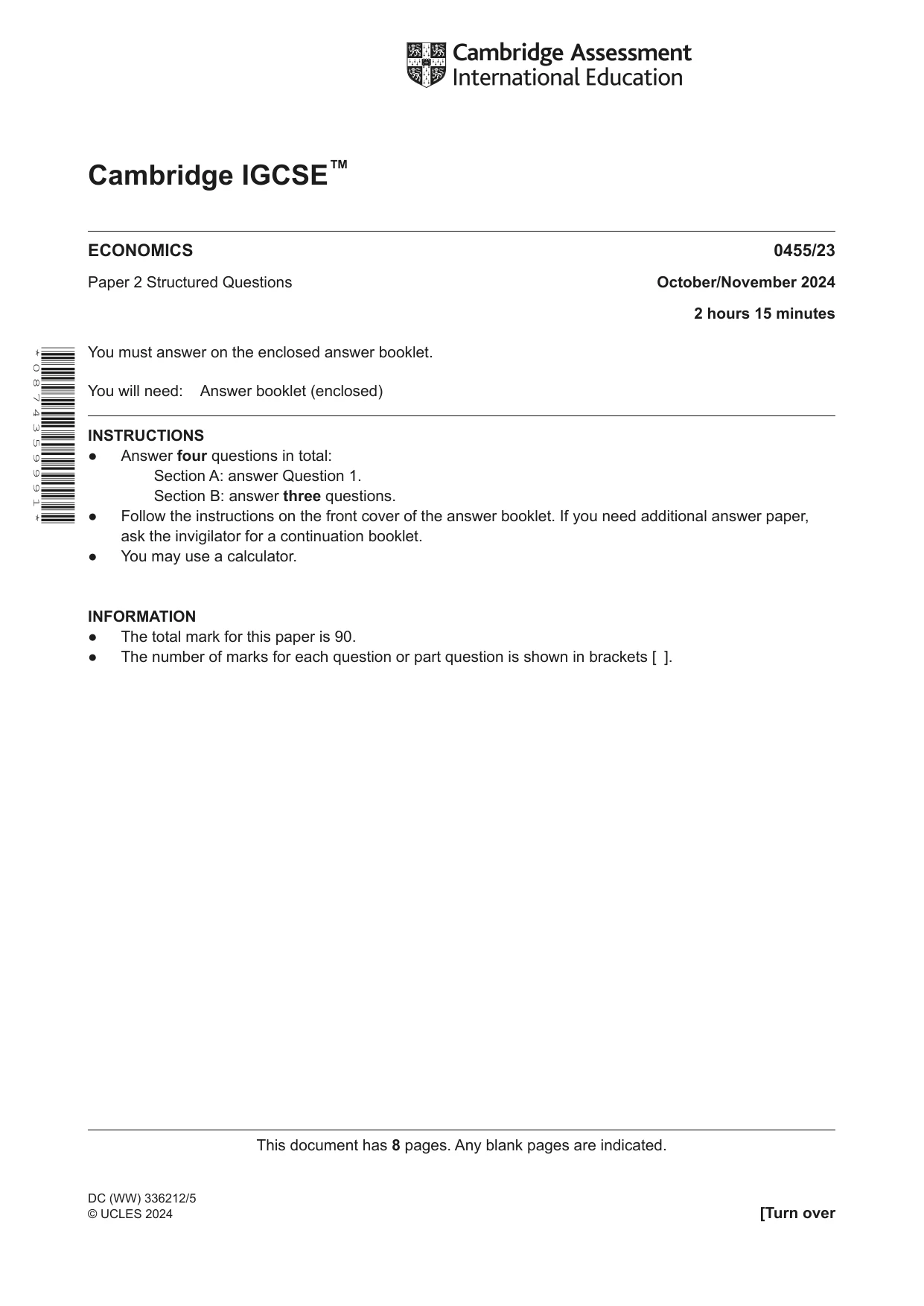
0455/23/O/N/24 · 5 questions · 90 marks · ≈101 min
The question paper and its mark scheme, free to read here and free to download. This is Cambridge’s own paper, exactly as it was sat.
Question paper8 pages




Mark scheme24 pages
Answers below. Sit the paper first if you are practising.

Questions as text
Q1 · Calculate the average cost of producing a car in Belarus in 2021
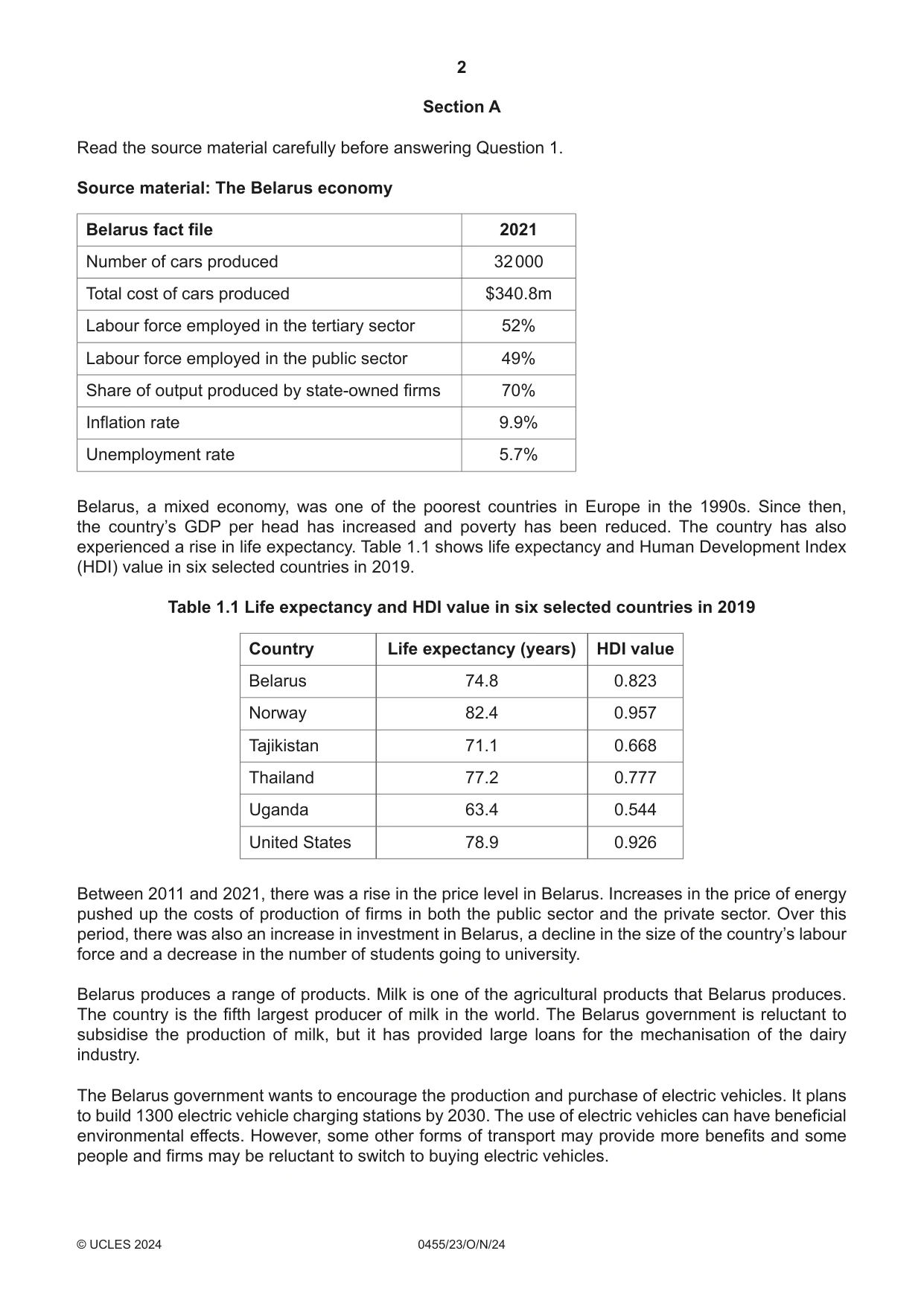
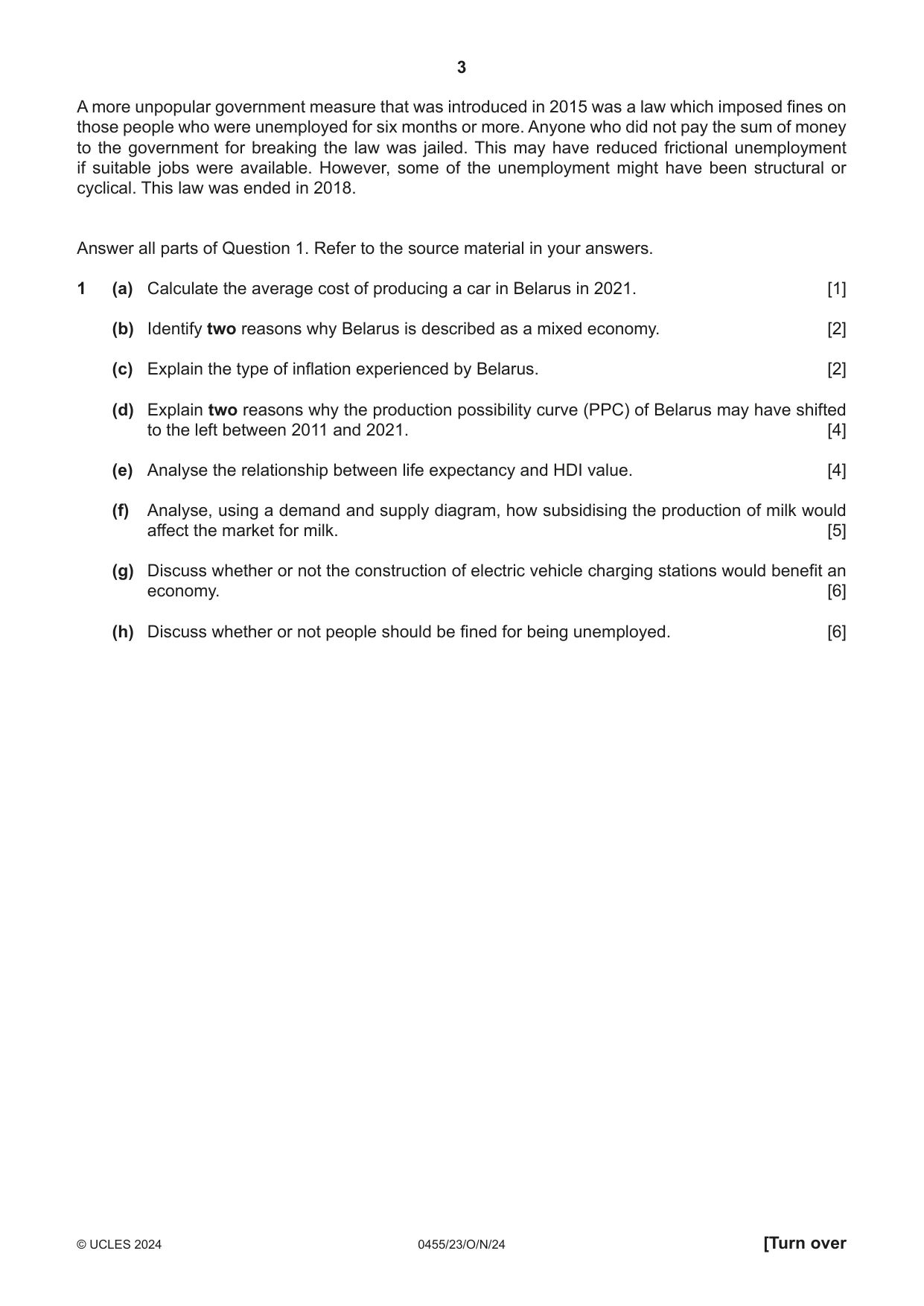
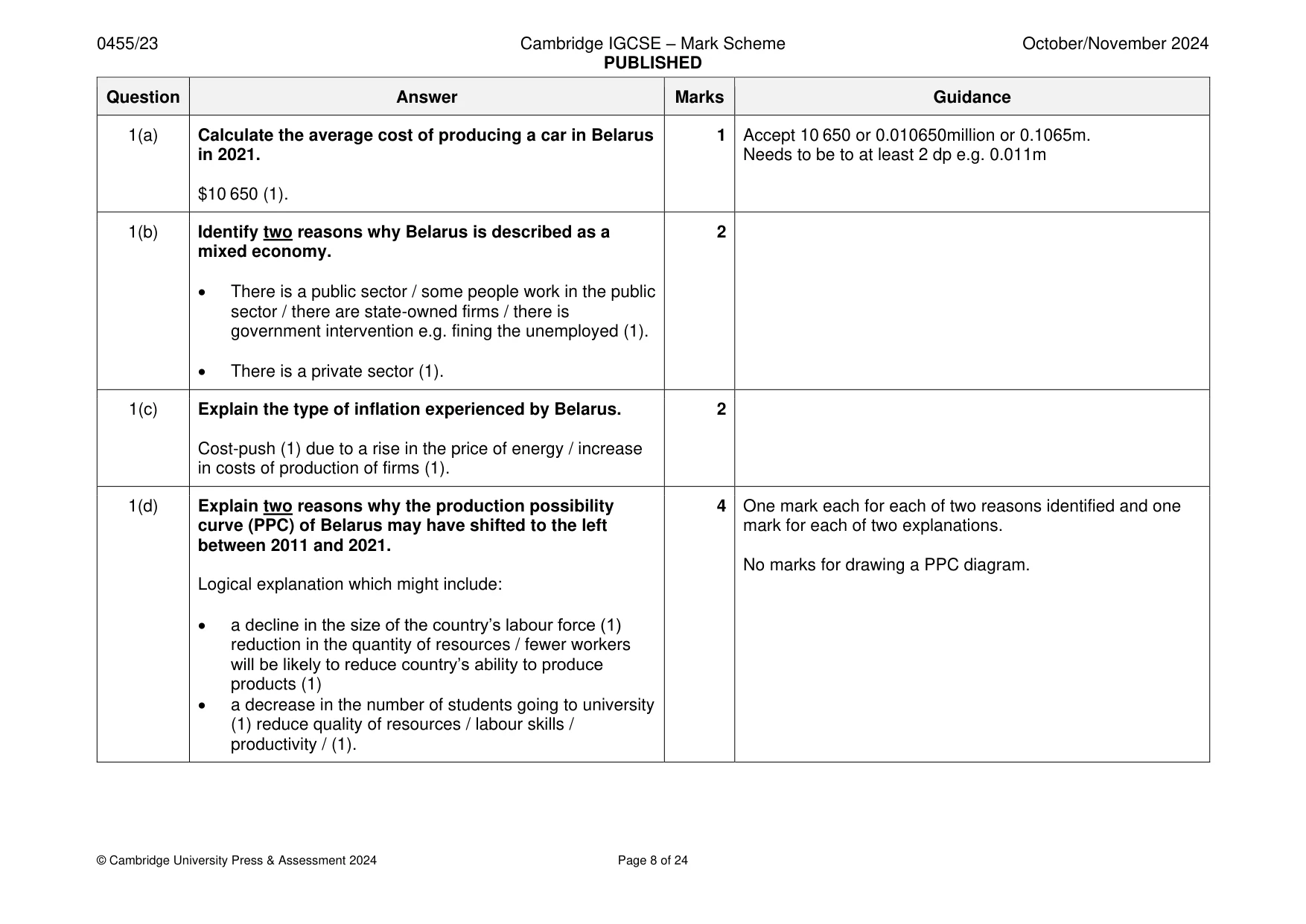
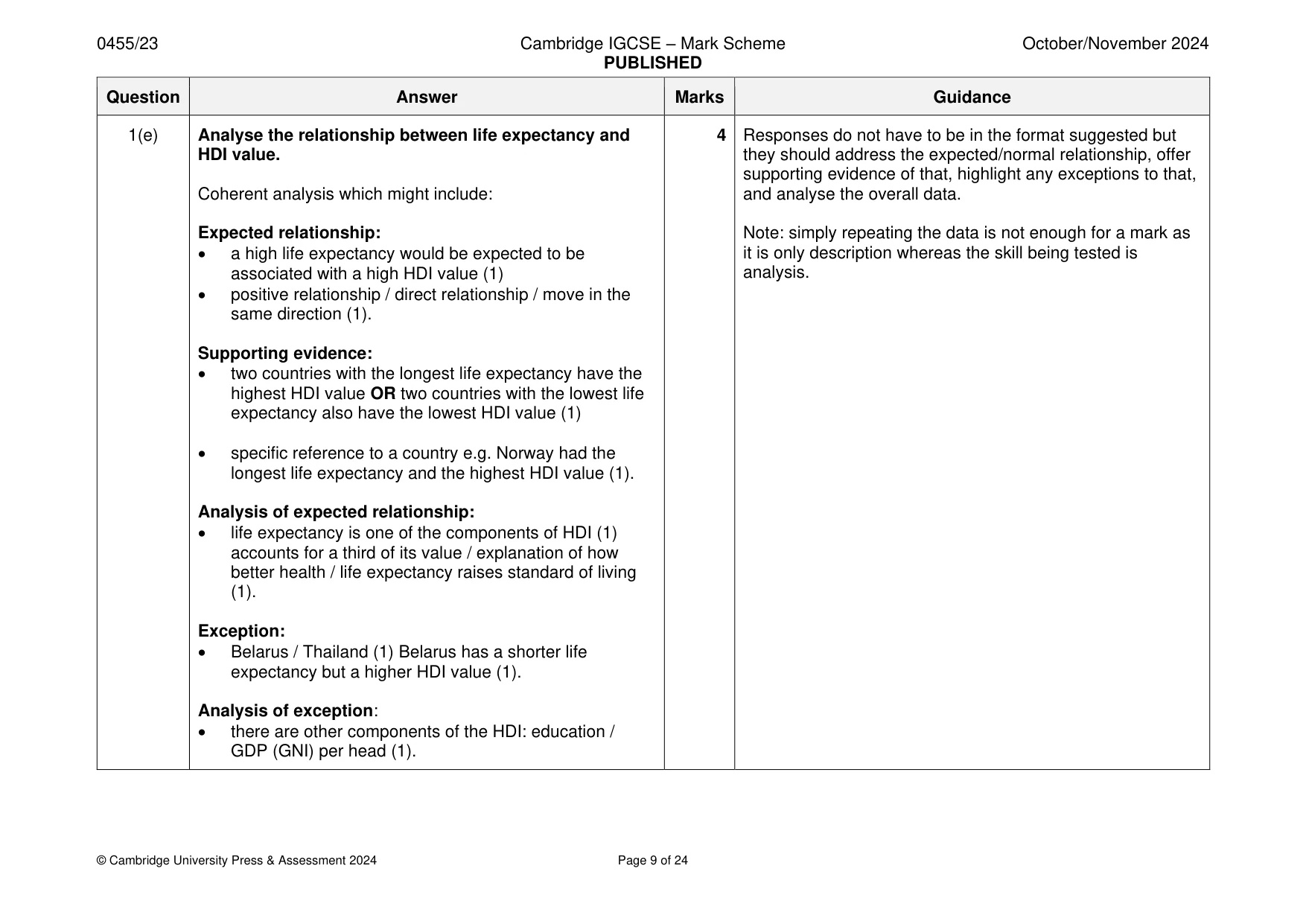
1 (a) Calculate the average cost of producing a car in Belarus in 2021. [1] (b) Identify two reasons why Belarus is described as a mixed economy. [2] (c) Explain the type of inflation experienced by Belarus. [2] (d) Explain two reasons why the production possibility curve (PPC) of Belarus may have shifted to the left between 2011 and 2021. [4] (e) Analyse the relationship between life expectancy and HDI value. [4] (f) Analyse, using a demand and supply diagram, how subsidising the production of milk would affect the market for milk. [5] (g) Discuss whether or not the construction of electric vehicle charging stations would benefit an economy. [6] (h) Discuss whether or not people should be fined for being unemployed. [6]
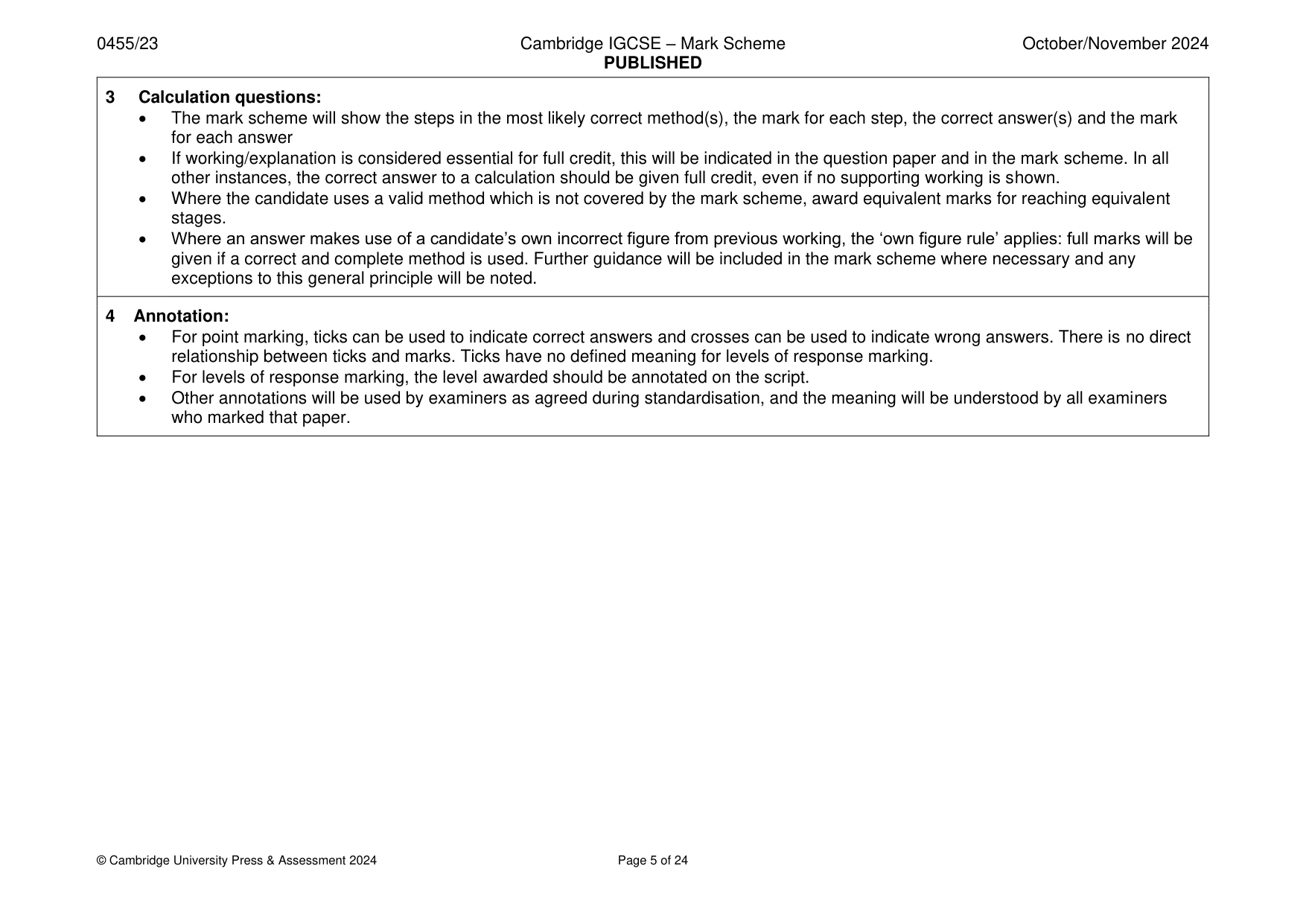
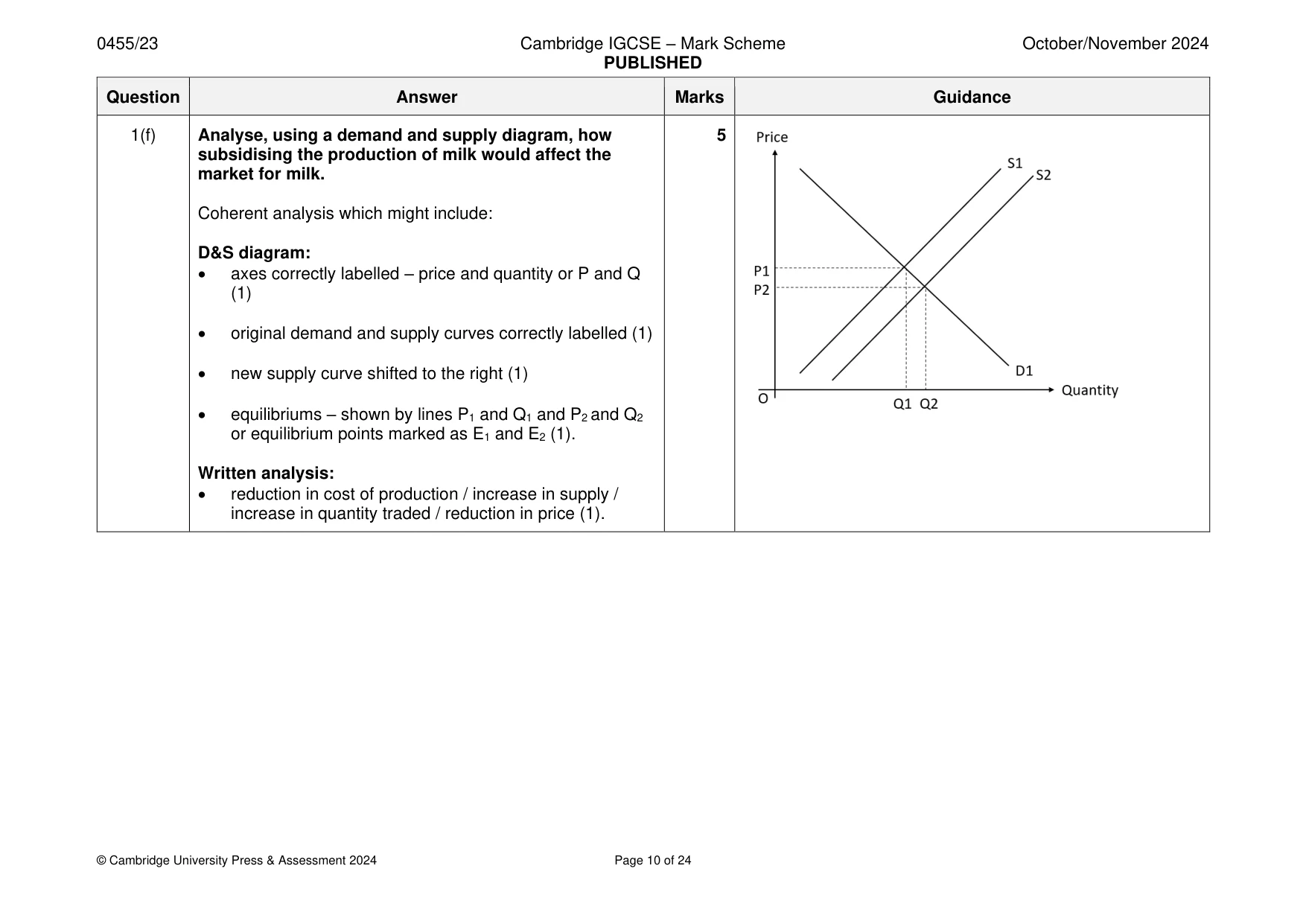
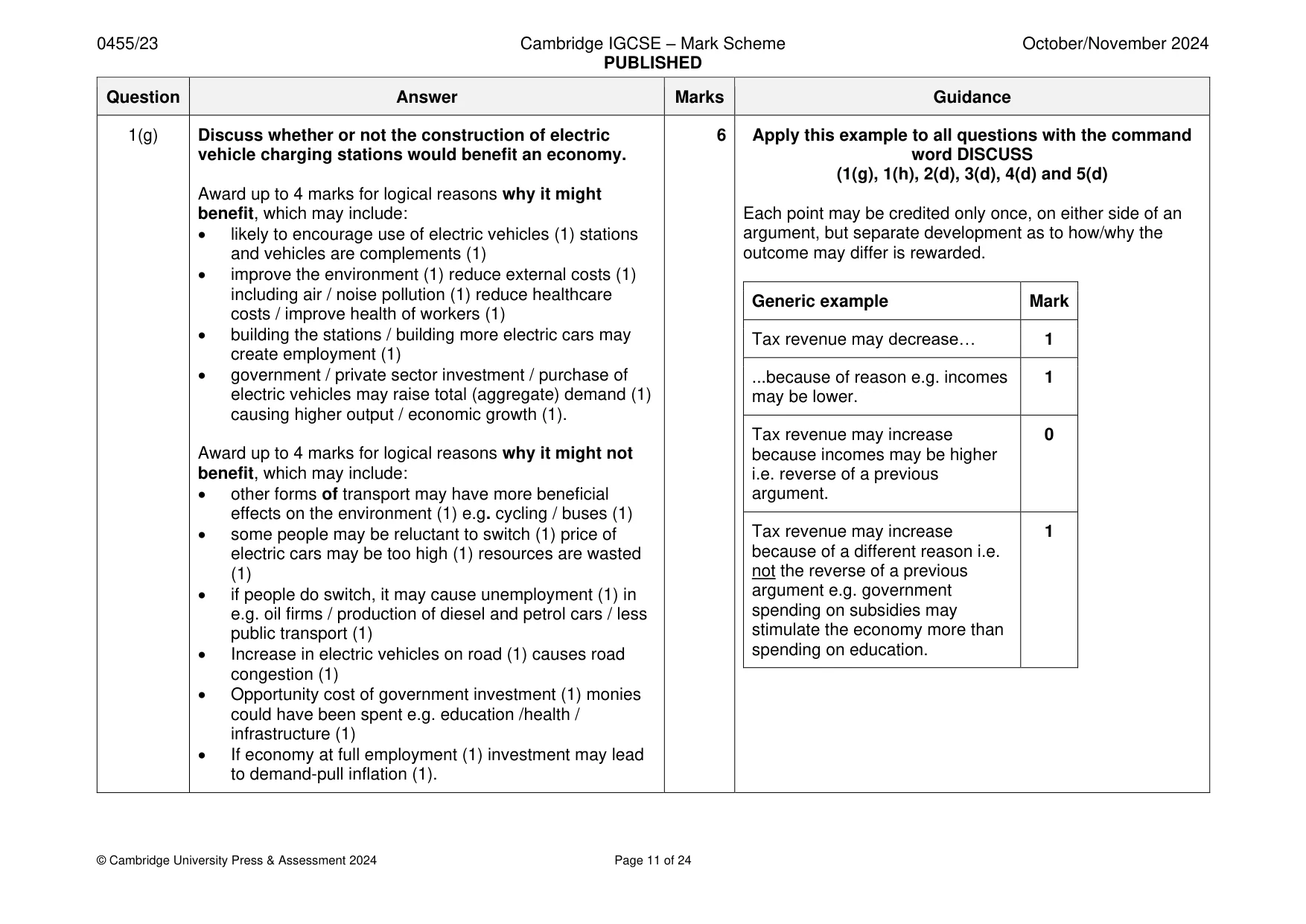
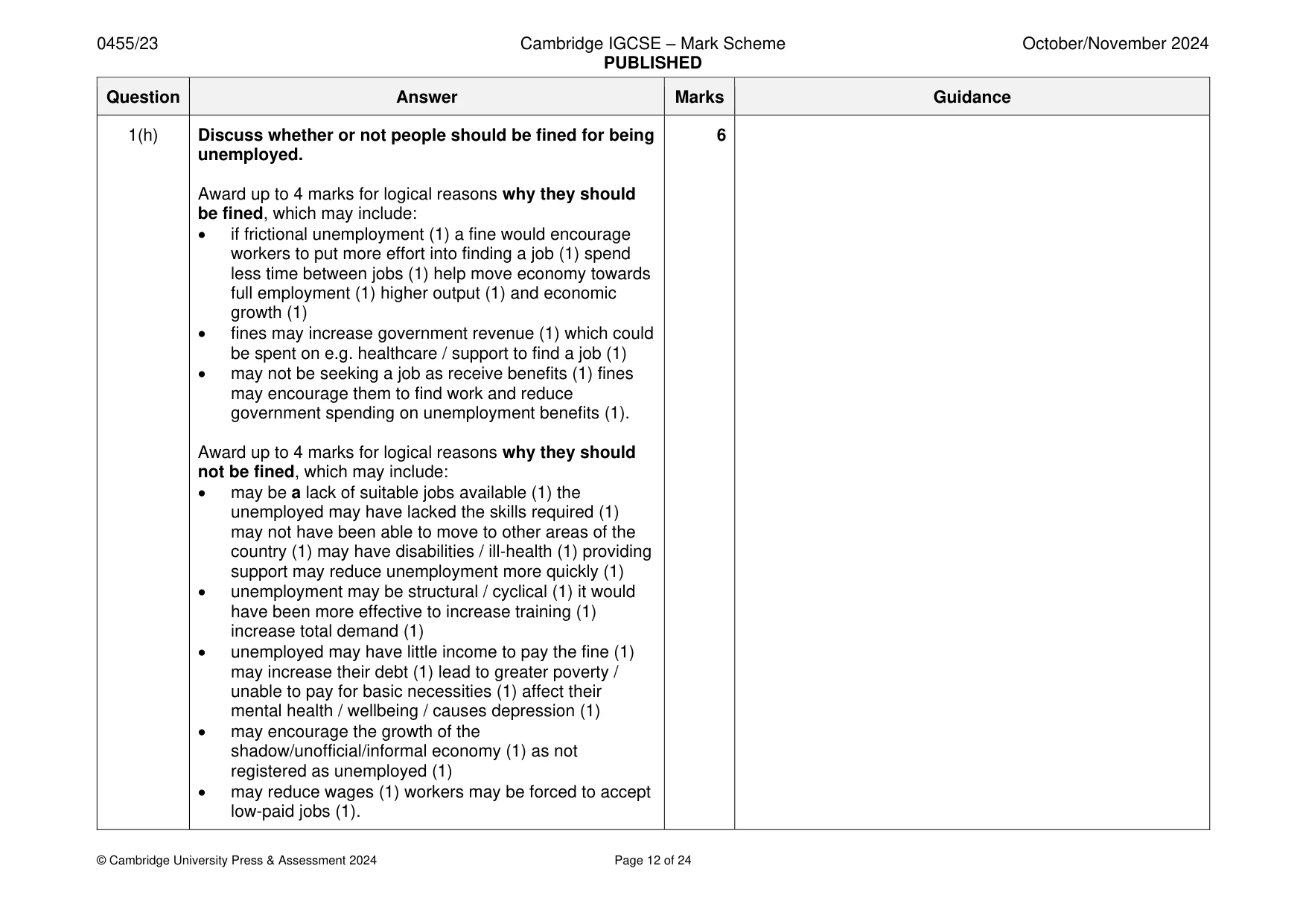
Mark scheme: Question Answer Marks Guidance 1(a) Calculate the average cost of producing a car in Belarus 1 Accept 10 650 or 0.010650million or 0.1065m. in 2021. Needs to be to at least 2 dp e.g. 0.011m $10 650 (1). 1(b) Identify two reasons why Belarus is described as a 2 mixed economy. • There is a public sector / some people work in the public sector / there are state-owned firms / there is government intervention e.g. fining the unemployed (1). • There is a private sector (1). 1(c) Explain the type of inflation experienced by Belarus. 2 Cost-push (1) due to a rise in the price of energy / increase in costs of production of firms (1). 1(d) Explain two reasons why the production possibility 4 One mark each for each of two reasons identified and one curve (PPC) of Belarus may have shifted to the left mark for each of two explanations. between 2011 and 2021. No marks for drawing a PPC diagram. Logical explanation which might include: • a decline in the size of the country’s labour force (1) reduction in the quantity of resources / fewer workers will be likely to reduce country’s ability to produce products (1) • a decrease in the number of students going to university (1) reduce quality of resources / labour skills / productivity / (1). 1(e) Analyse the relationship between life expectancy and 4 Responses do not have to be in the format suggested but HDI value. they should address the expected/normal relationship, offer supporting evidence of that, highlight any exceptions to that, Coherent analysis which might include: and analyse the overall data. Expected relationship: Note: simply repeating the data is not enough for a mark as • a high life expectancy would be expected to be it is only description whereas the skill being tested is associated with a high HDI value (1) analysis. • positive relationship / direct relationship / move in the same direction (1). Supporting evidence: • two countries with the longest life expectancy have the highest HDI value OR two countries with the lowest life expectancy also have the lowest HDI value (1) • specific reference to a country e.g. Norway had the longest life expectancy and the highest HDI value (1). Analysis of expected relationship: • life expectancy is one of the components of HDI (1) accounts for a third of its value / explanation of how better health / life expectancy raises standard of living (1). Exception: • Belarus / Thailand (1) Belarus has a shorter life expectancy but a higher HDI value (1). Analysis of exception: • there are other components of the HDI: education / GDP (GNI) per head (1). 1(f) Analyse, using a demand and supply diagram, how 5 subsidising the production of milk would affect the market for milk. Coherent analysis which might include: D&S diagram: • axes correctly labelled – price and quantity or P and Q (1) • original demand and supply curves correctly labelled (1) • new supply curve shifted to the right (1) • equilibriums – shown by lines P1 and Q1 and P2 and Q2 or equilibrium points marked as E1 and E2 (1). Written analysis: • reduction in cost of production / increase in supply / increase in quantity traded / reduction in price (1). 1(g) Discuss whether or not the construction of electric 6 Apply this example to all questions with the command vehicle charging stations would benefit an economy. word DISCUSS (1(g), 1(h), 2(d), 3(d), 4(d) and 5(d) Award up to 4 marks for logical reasons why it might benefit, which may include: Each point may be credited only once, on either side of an • likely to encourage use of electric vehicles (1) stations argument, but separate development as to how/why the and vehicles are complements (1) outcome may differ is rewarded. • improve the environment (1) reduce external costs (1) including air / noise pollution (1) reduce healthcare Generic example Mark costs / improve health of workers (1) • building the stations / building more electric cars may Tax revenue may decrease… 1 create employment (1) • government / private sector investment / purchase of ...because of reason e.g. incomes 1 electric vehicles may raise total (aggregate) demand (1) may be lower. causing higher output / economic growth (1). Tax revenue may increase 0 Award up to 4 marks for logical reasons why it might not because incomes may be higher benefit, which may include: i.e. reverse of a previous • other forms of transport may have more beneficial argument. effects on the environment (1) e.g. cycling / buses (1) • some people may be reluctant to switch (1) price of Tax revenue may increase 1 electric cars may be too high (1) resources are wasted because of a different reason i.e. (1) not the reverse of a previous • if people do switch, it may cause unemployment (1) in argument e.g. government e.g. oil firms / production of diesel and petrol cars / less spending on subsidies may public transport (1) stimulate the economy more than • Increase in electric vehicles on road (1) causes road spending on education. congestion (1) • Opportunity cost of government investment (1) monies could have been spent e.g. education /health / infrastructure (1) • If economy at full employment (1) investment may lead to demand-pull inflation (1). 1(h) Discuss whether or not people should be fined for being 6 unemployed. Award up to 4 marks for logical reasons why they should be fined, which may include: • if frictional unemployment (1) a fine would encourage workers to put more effort into finding a job (1) spend less time between jobs (1) help move economy towards full employment (1) higher output (1) and economic growth (1) • fines may increase government revenue (1) which could be spent on e.g. healthcare / support to find a job (1) • may not be seeking a job as receive benefits (1) fines may encourage them to find work and reduce government spending on unemployment benefits (1). Award up to 4 marks for logical reasons why they should not be fined, which may include: • may be a lack of suitable jobs available (1) the unemployed may have lacked the skills required (1) may not have been able to move to other areas of the country (1) may have disabilities / ill-health (1) providing support may reduce unemployment more quickly (1) • unemployment may be structural / cyclical (1) it would have been more effective to increase training (1) increase total demand (1) • unemployed may have little income to pay the fine (1) may increase their debt (1) lead to greater poverty / unable to pay for basic necessities (1) affect their mental health / wellbeing / causes depression (1) • may encourage the growth of the shadow/unofficial/informal economy (1) as not registered as unemployed (1) • may reduce wages (1) workers may be forced to accept low-paid jobs (1).
Q2 · Luxembourg is a country with a high level of economic development
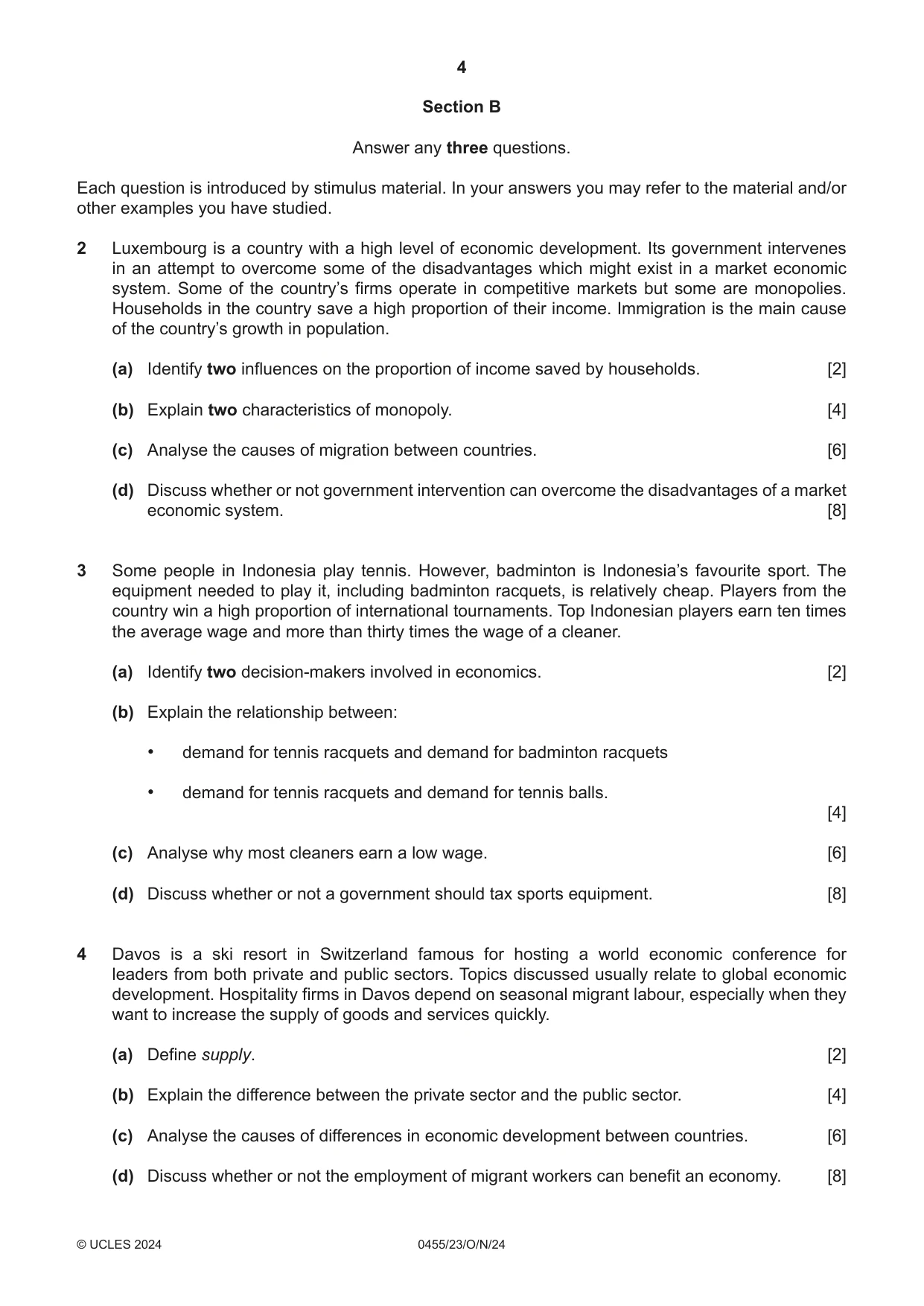
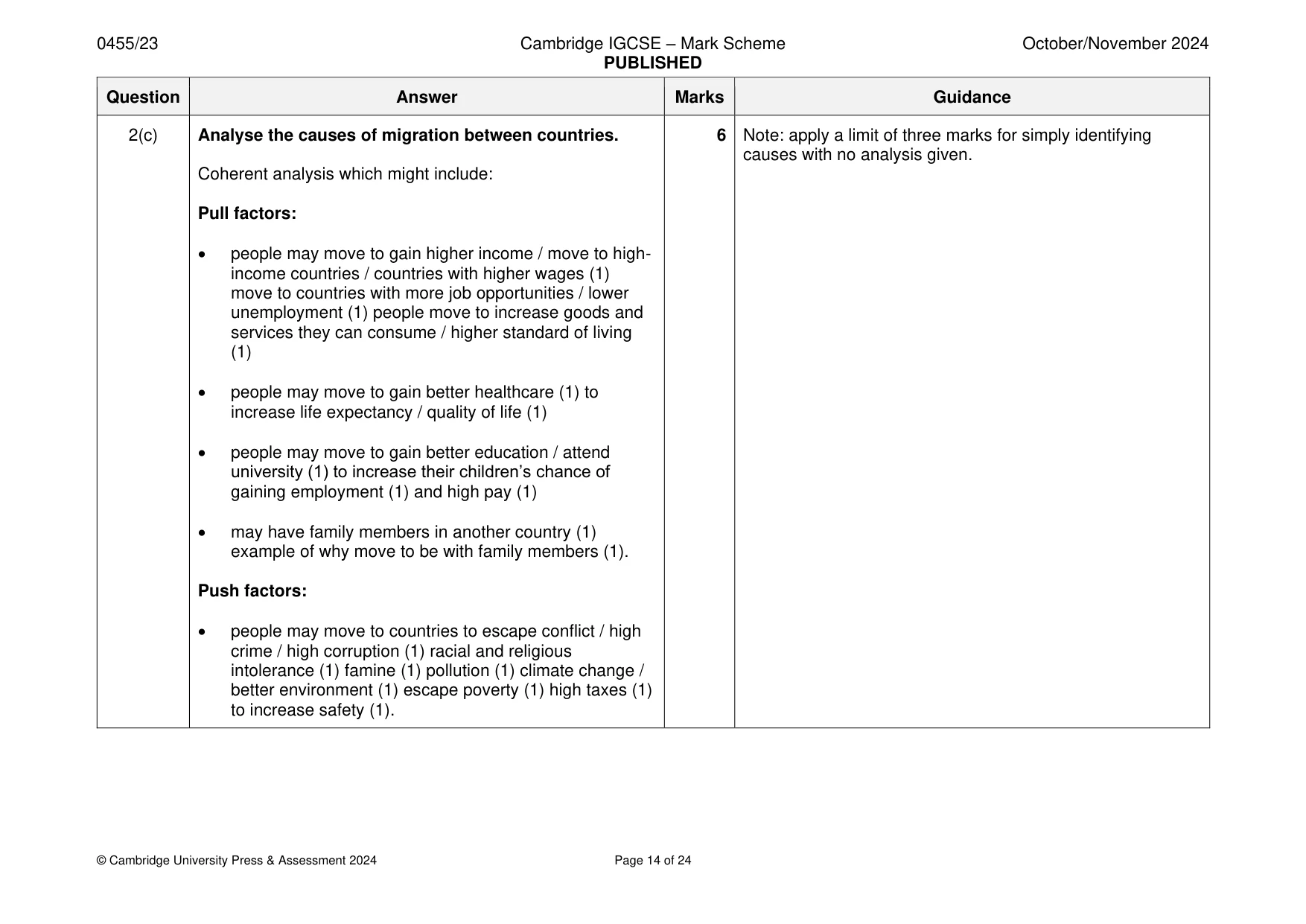
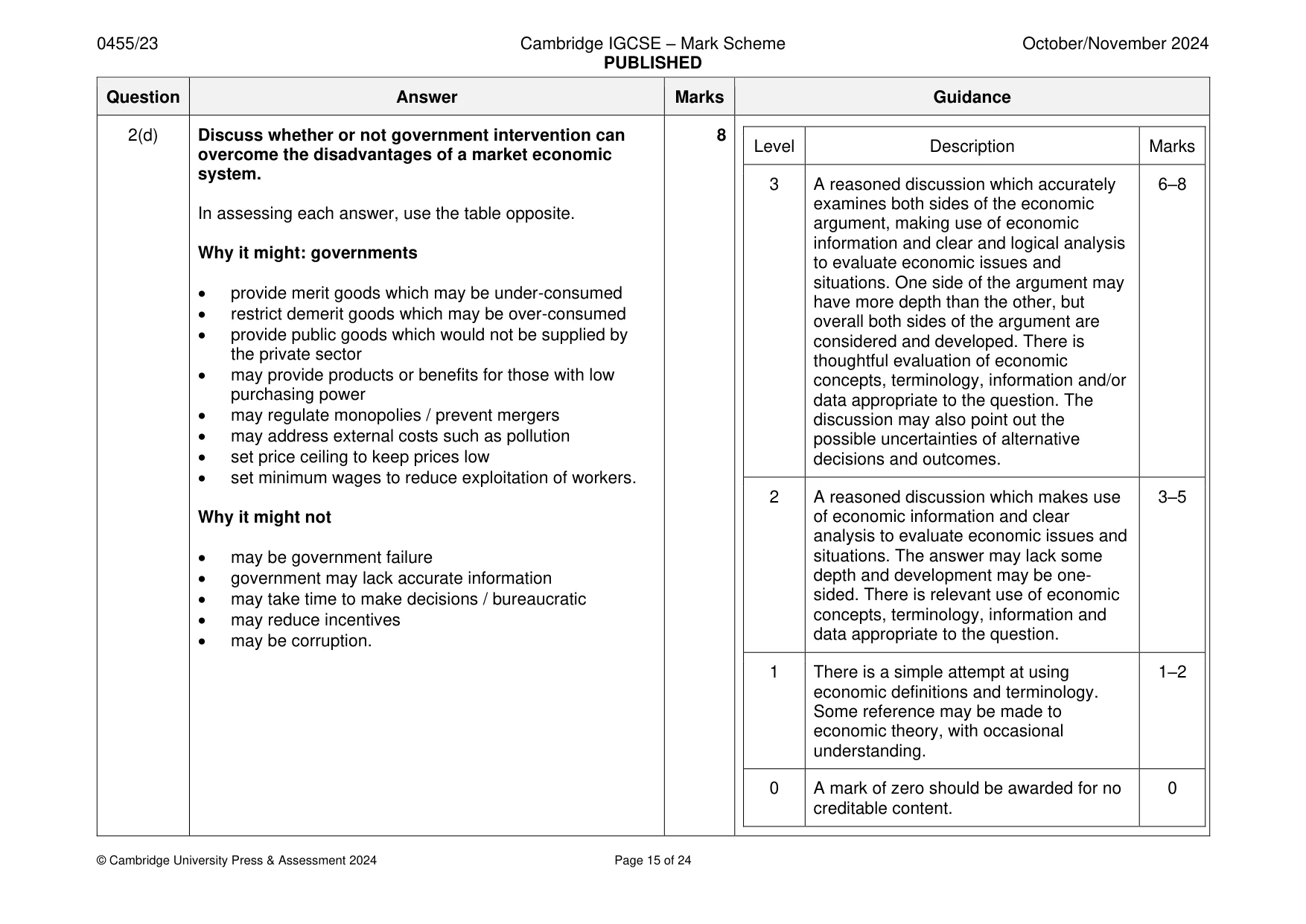
2 Luxembourg is a country with a high level of economic development. Its government intervenes in an attempt to overcome some of the disadvantages which might exist in a market economic system. Some of the country’s firms operate in competitive markets but some are monopolies. Households in the country save a high proportion of their income. Immigration is the main cause of the country’s growth in population. (a) Identify two influences on the proportion of income saved by households. [2] (b) Explain two characteristics of monopoly. [4] (c) Analyse the causes of migration between countries. [6] (d) Discuss whether or not government intervention can overcome the disadvantages of a market economic system. [8]
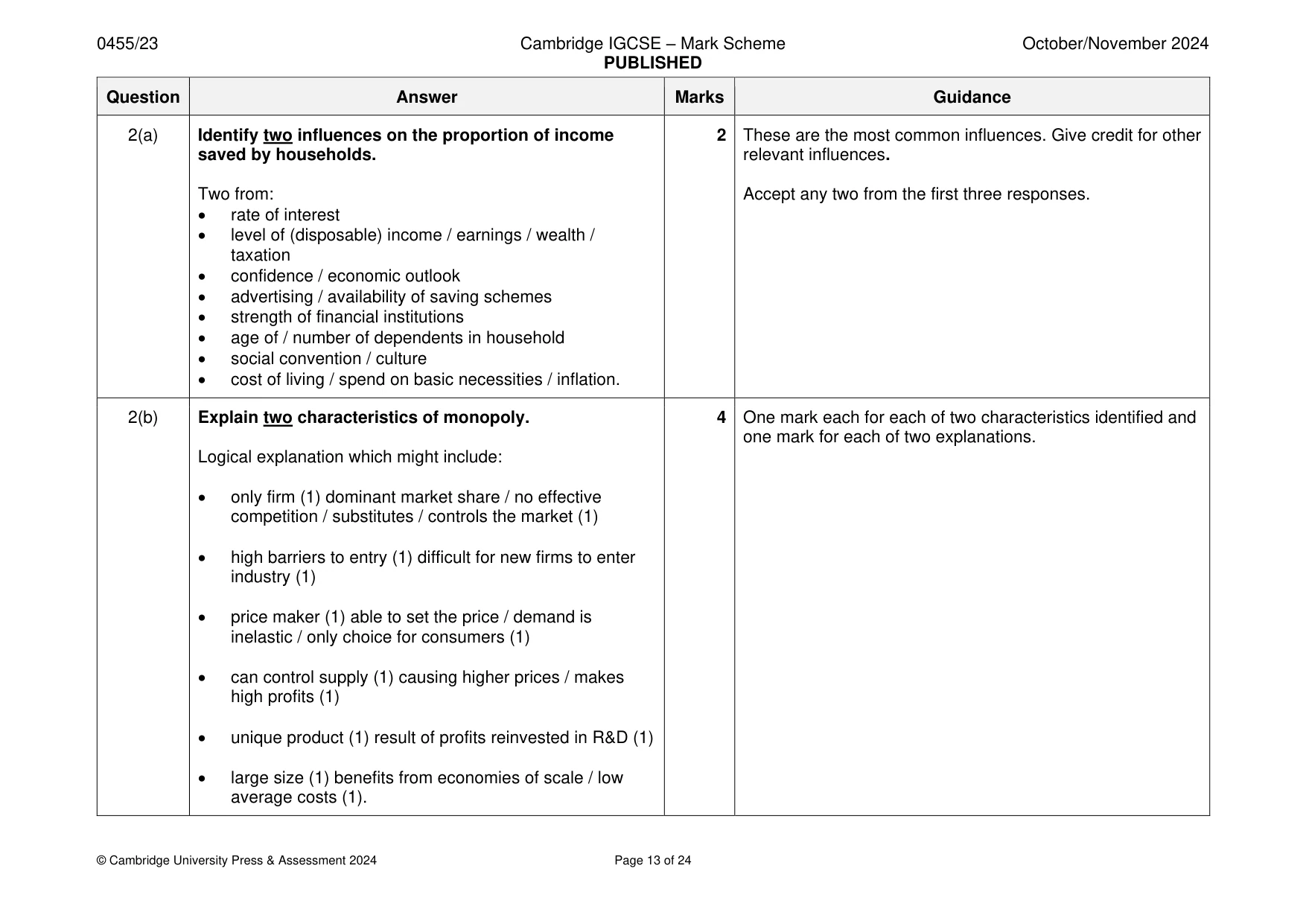
Mark scheme: 2(a) Identify two influences on the proportion of income 2 These are the most common influences. Give credit for other saved by households. relevant influences. Two from: Accept any two from the first three responses. • rate of interest • level of (disposable) income / earnings / wealth / taxation • confidence / economic outlook • advertising / availability of saving schemes • strength of financial institutions • age of / number of dependents in household • social convention / culture • cost of living / spend on basic necessities / inflation. 2(b) Explain two characteristics of monopoly. 4 One mark each for each of two characteristics identified and one mark for each of two explanations. Logical explanation which might include: • only firm (1) dominant market share / no effective competition / substitutes / controls the market (1) • high barriers to entry (1) difficult for new firms to enter industry (1) • price maker (1) able to set the price / demand is inelastic / only choice for consumers (1) • can control supply (1) causing higher prices / makes high profits (1) • unique product (1) result of profits reinvested in R&D (1) • large size (1) benefits from economies of scale / low average costs (1). 2(c) Analyse the causes of migration between countries. 6 Note: apply a limit of three marks for simply identifying causes with no analysis given. Coherent analysis which might include: Pull factors: • people may move to gain higher income / move to high- income countries / countries with higher wages (1) move to countries with more job opportunities / lower unemployment (1) people move to increase goods and services they can consume / higher standard of living (1) • people may move to gain better healthcare (1) to increase life expectancy / quality of life (1) • people may move to gain better education / attend university (1) to increase their children’s chance of gaining employment (1) and high pay (1) • may have family members in another country (1) example of why move to be with family members (1). Push factors: • people may move to countries to escape conflict / high crime / high corruption (1) racial and religious intolerance (1) famine (1) pollution (1) climate change / better environment (1) escape poverty (1) high taxes (1) to increase safety (1). 2(d) Discuss whether or not government intervention can 8 Level Description Marks overcome the disadvantages of a market economic system. 3 A reasoned discussion which accurately 6–8 examines both sides of the economic In assessing each answer, use the table opposite. argument, making use of economic information and clear and logical analysis Why it might: governments to evaluate economic issues and situations. One side of the argument may • provide merit goods which may be under-consumed have more depth than the other, but • restrict demerit goods which may be over-consumed overall both sides of the argument are • provide public goods which would not be supplied by considered and developed. There is the private sector thoughtful evaluation of economic • may provide products or benefits for those with low concepts, terminology, information and/or purchasing power data appropriate to the question. The • may regulate monopolies / prevent mergers discussion may also point out the • may address external costs such as pollution possible uncertainties of alternative • set price ceiling to keep prices low decisions and outcomes. • set minimum wages to reduce exploitation of workers. 2 A reasoned discussion which makes use 3–5 Why it might not of economic information and clear analysis to evaluate economic issues and • may be government failure situations. The answer may lack some • government may lack accurate information depth and development may be one- • may take time to make decisions / bureaucratic sided. There is relevant use of economic • may reduce incentives concepts, terminology, information and • may be corruption. data appropriate to the question. 1 There is a simple attempt at using 1–2 economic definitions and terminology. Some reference may be made to economic theory, with occasional understanding. 0 A mark of zero should be awarded for no 0 creditable content.
Q3 · Some people in Indonesia play tennis
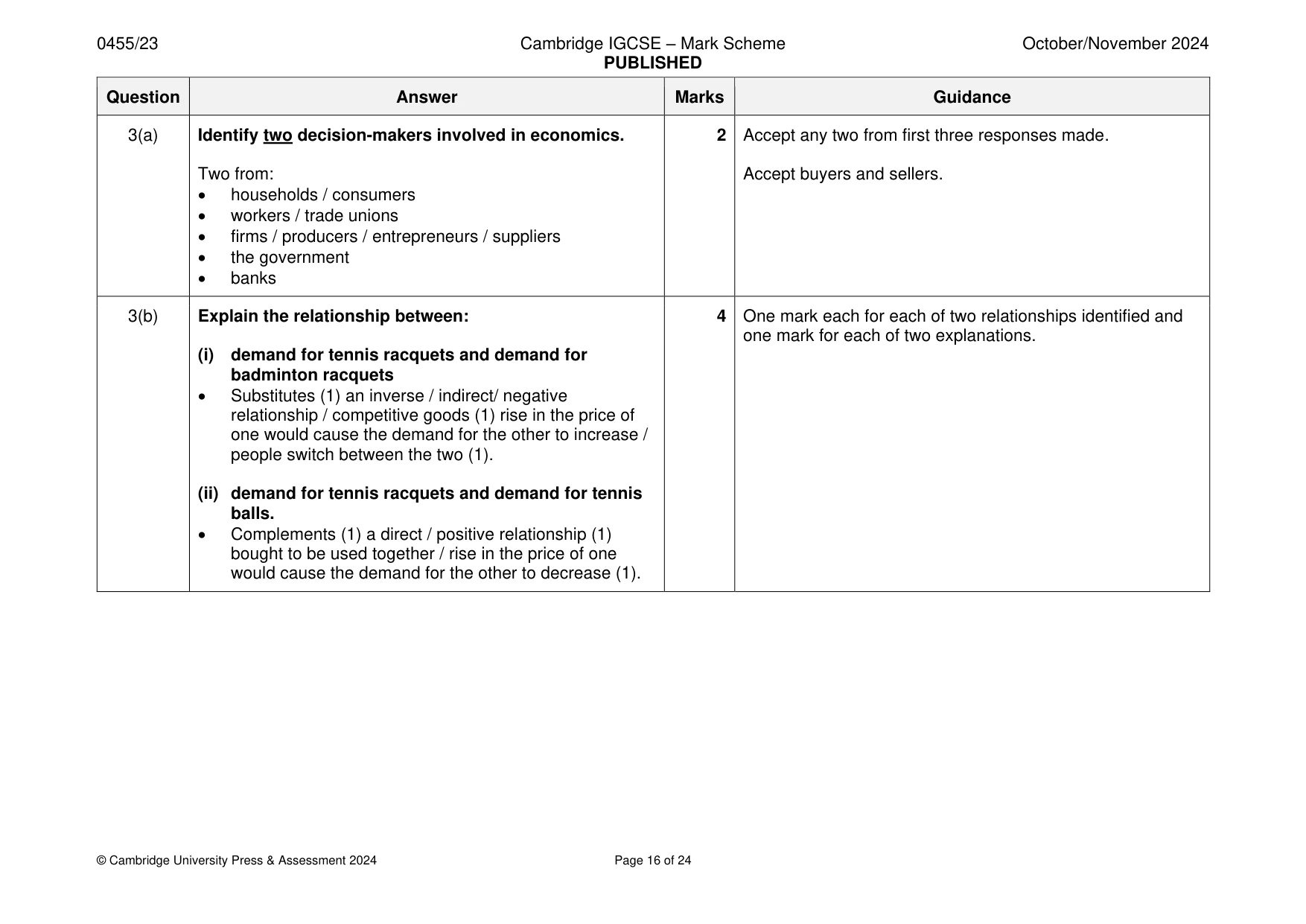
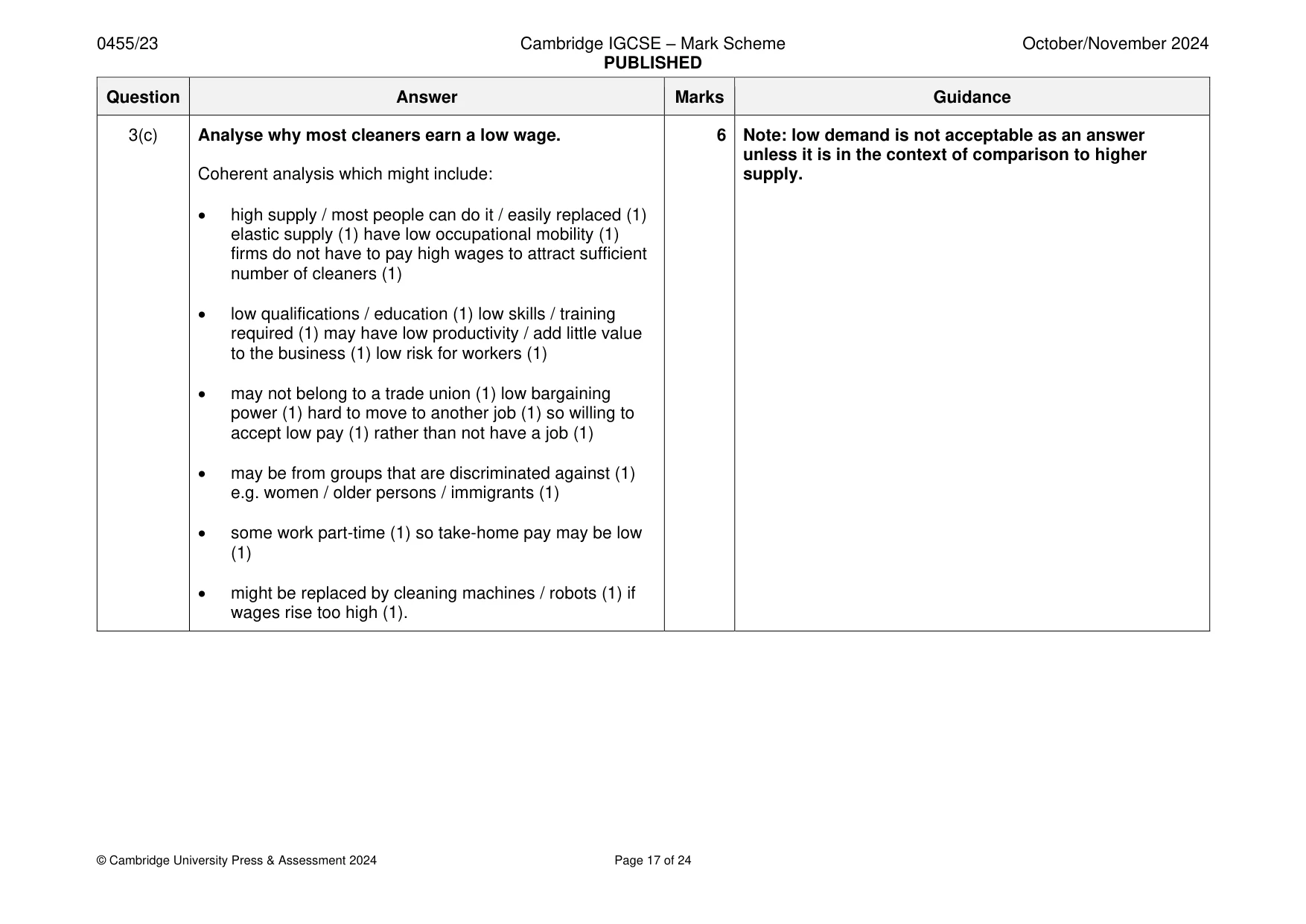
3 Some people in Indonesia play tennis. However, badminton is Indonesia’s favourite sport. The equipment needed to play it, including badminton racquets, is relatively cheap. Players from the country win a high proportion of international tournaments. Top Indonesian players earn ten times the average wage and more than thirty times the wage of a cleaner. (a) Identify two decision-makers involved in economics. [2] (b) Explain the relationship between: • demand for tennis racquets and demand for badminton racquets • demand for tennis racquets and demand for tennis balls. [4] (c) Analyse why most cleaners earn a low wage. [6] (d) Discuss whether or not a government should tax sports equipment. [8]
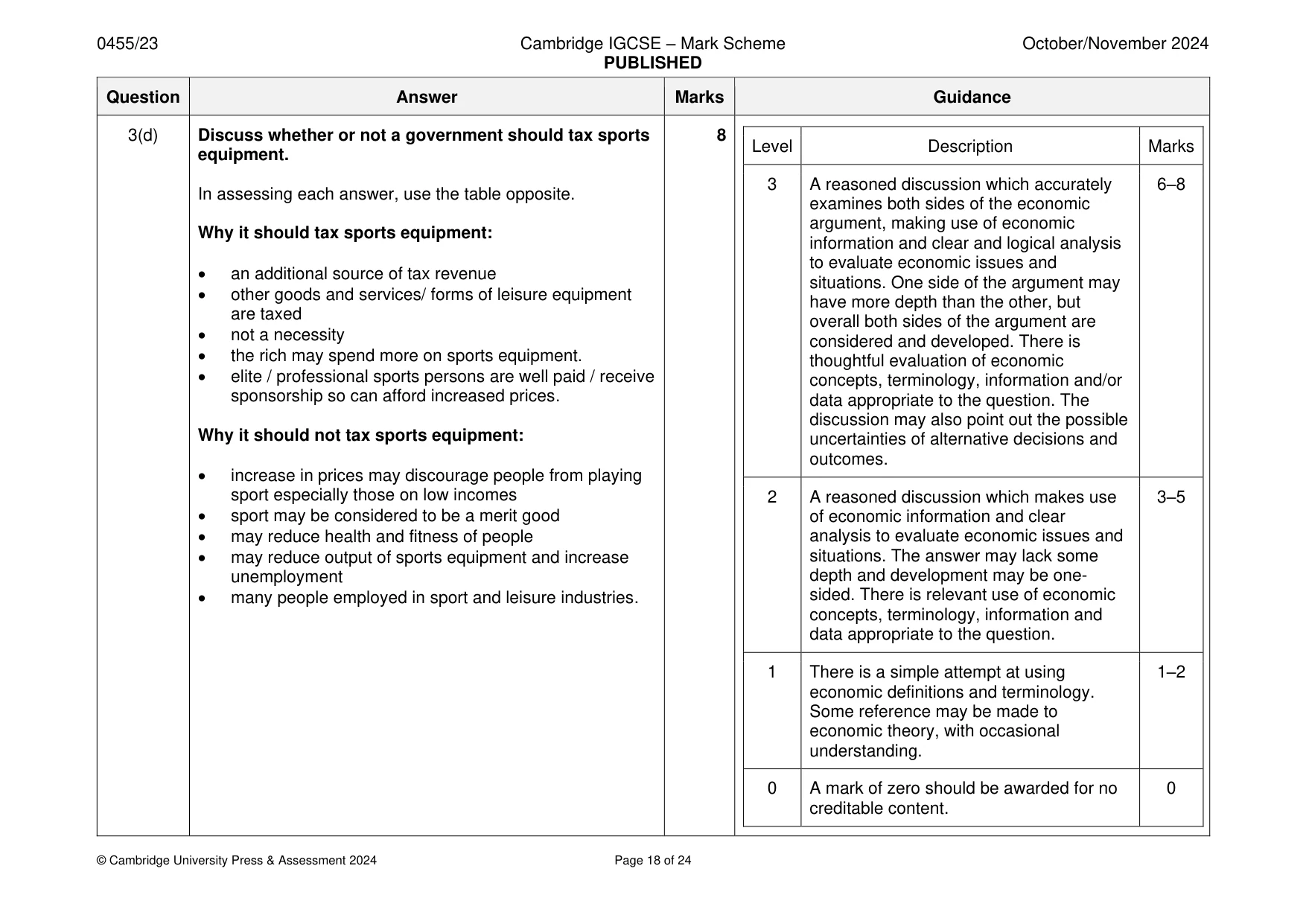
Mark scheme: 3(a) Identify two decision-makers involved in economics. 2 Accept any two from first three responses made. Two from: Accept buyers and sellers. • households / consumers • workers / trade unions • firms / producers / entrepreneurs / suppliers • the government • banks 3(b) Explain the relationship between: 4 One mark each for each of two relationships identified and one mark for each of two explanations. (i) demand for tennis racquets and demand for badminton racquets • Substitutes (1) an inverse / indirect/ negative relationship / competitive goods (1) rise in the price of one would cause the demand for the other to increase / people switch between the two (1). (ii) demand for tennis racquets and demand for tennis balls. • Complements (1) a direct / positive relationship (1) bought to be used together / rise in the price of one would cause the demand for the other to decrease (1). 3(c) Analyse why most cleaners earn a low wage. 6 Note: low demand is not acceptable as an answer unless it is in the context of comparison to higher Coherent analysis which might include: supply. • high supply / most people can do it / easily replaced (1) elastic supply (1) have low occupational mobility (1) firms do not have to pay high wages to attract sufficient number of cleaners (1) • low qualifications / education (1) low skills / training required (1) may have low productivity / add little value to the business (1) low risk for workers (1) • may not belong to a trade union (1) low bargaining power (1) hard to move to another job (1) so willing to accept low pay (1) rather than not have a job (1) • may be from groups that are discriminated against (1) e.g. women / older persons / immigrants (1) • some work part-time (1) so take-home pay may be low (1) • might be replaced by cleaning machines / robots (1) if wages rise too high (1). 3(d) Discuss whether or not a government should tax sports 8 Level Description Marks equipment. 3 A reasoned discussion which accurately 6–8 In assessing each answer, use the table opposite. examines both sides of the economic argument, making use of economic Why it should tax sports equipment: information and clear and logical analysis to evaluate economic issues and • an additional source of tax revenue situations. One side of the argument may • other goods and services/ forms of leisure equipment have more depth than the other, but are taxed overall both sides of the argument are • not a necessity considered and developed. There is • the rich may spend more on sports equipment. thoughtful evaluation of economic • elite / professional sports persons are well paid / receive concepts, terminology, information and/or sponsorship so can afford increased prices. data appropriate to the question. The discussion may also point out the possible Why it should not tax sports equipment: uncertainties of alternative decisions and outcomes. • increase in prices may discourage people from playing sport especially those on low incomes 2 A reasoned discussion which makes use 3–5 • sport may be considered to be a merit good of economic information and clear • may reduce health and fitness of people analysis to evaluate economic issues and • may reduce output of sports equipment and increase situations. The answer may lack some unemployment depth and development may be one- • many people employed in sport and leisure industries. sided. There is relevant use of economic concepts, terminology, information and data appropriate to the question. 1 There is a simple attempt at using 1–2 economic definitions and terminology. Some reference may be made to economic theory, with occasional understanding. 0 A mark of zero should be awarded for no 0 creditable content.
Q4 · Davos is a ski resort in Switzerland famous for hosting a world economic conference for…
4 Davos is a ski resort in Switzerland famous for hosting a world economic conference for leaders from both private and public sectors. Topics discussed usually relate to global economic development. Hospitality firms in Davos depend on seasonal migrant labour, especially when they want to increase the supply of goods and services quickly. (a) Define supply. [2] (b) Explain the difference between the private sector and the public sector. [4] (c) Analyse the causes of differences in economic development between countries. [6] (d) Discuss whether or not the employment of migrant workers can benefit an economy. [8]
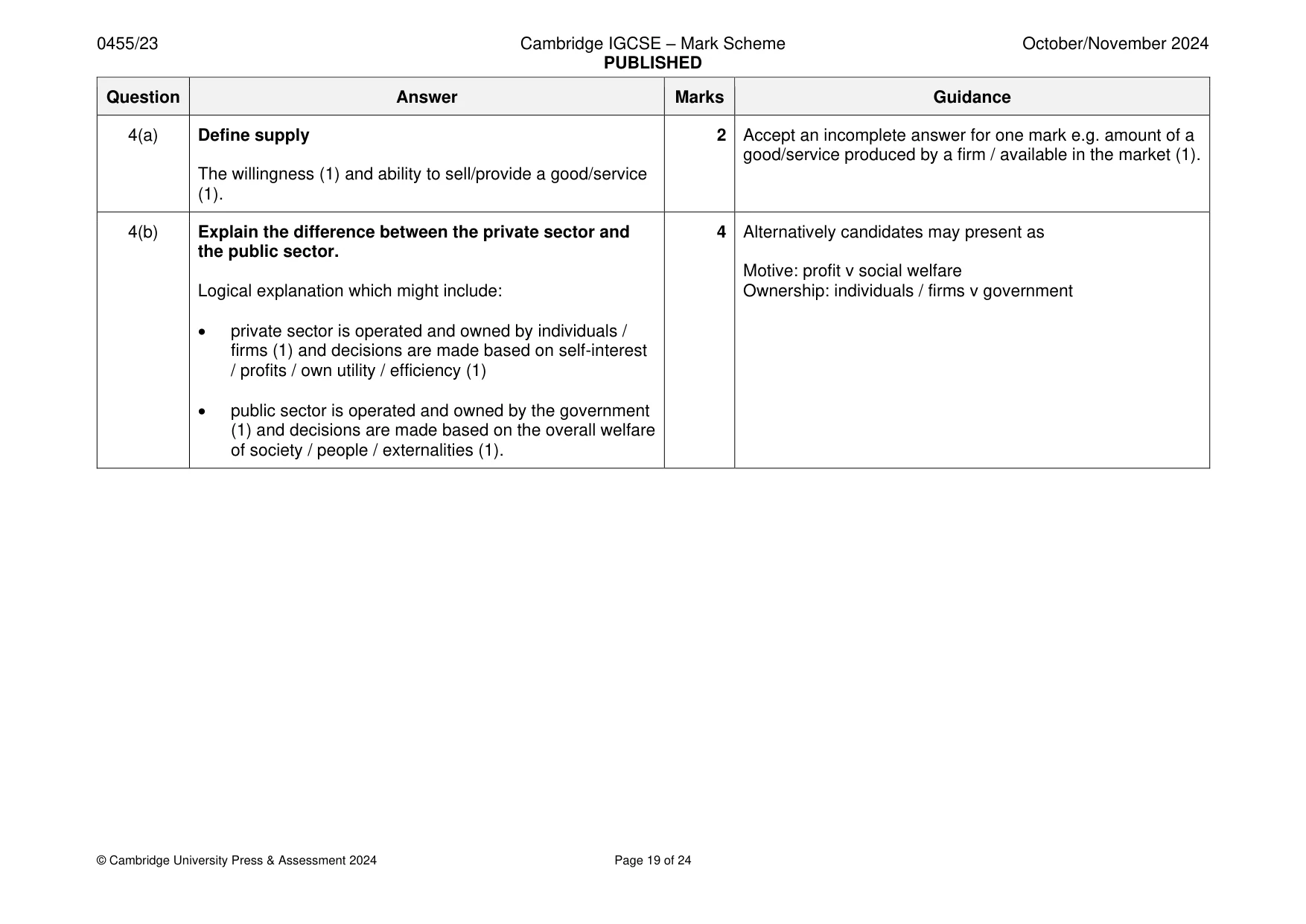
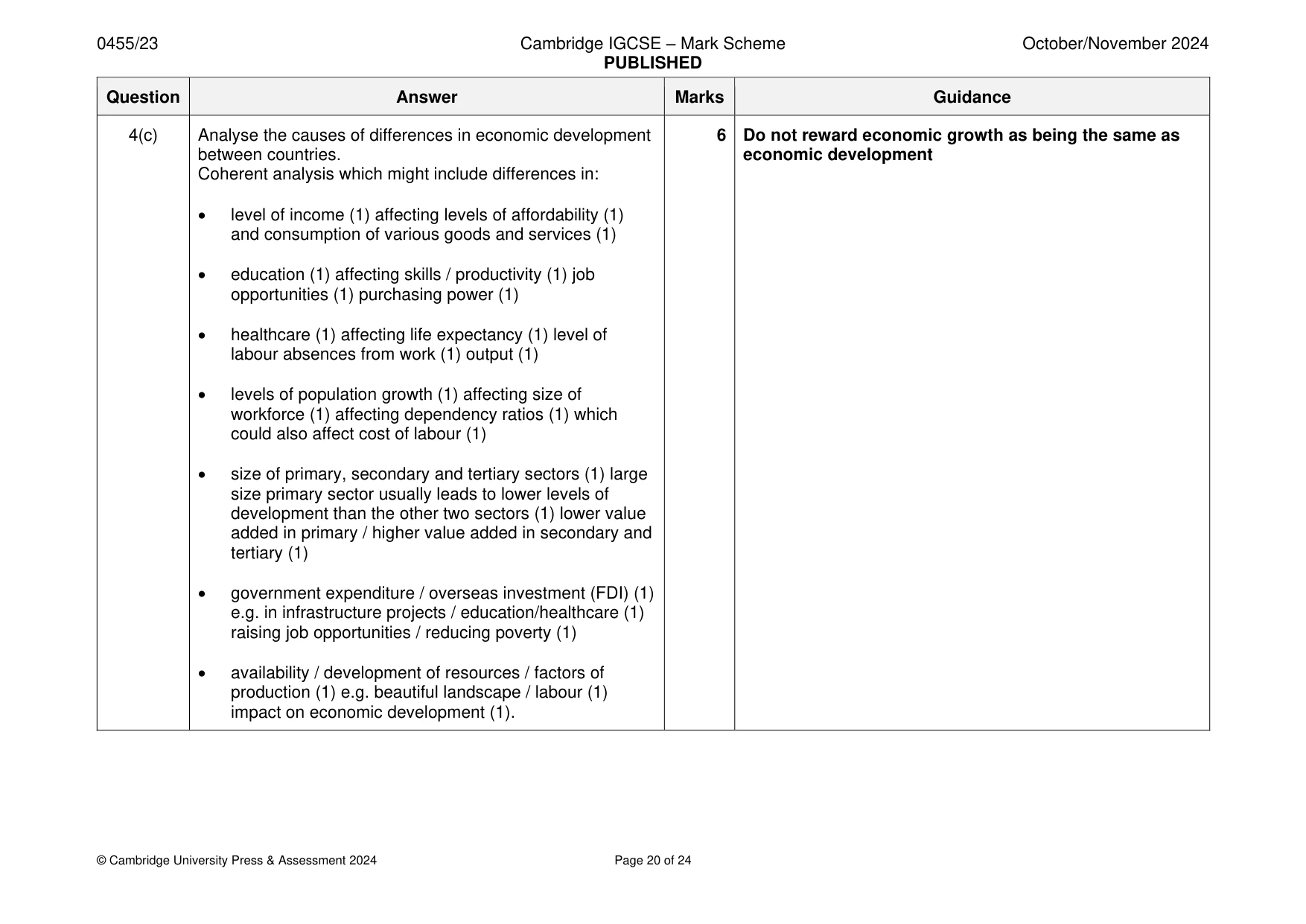
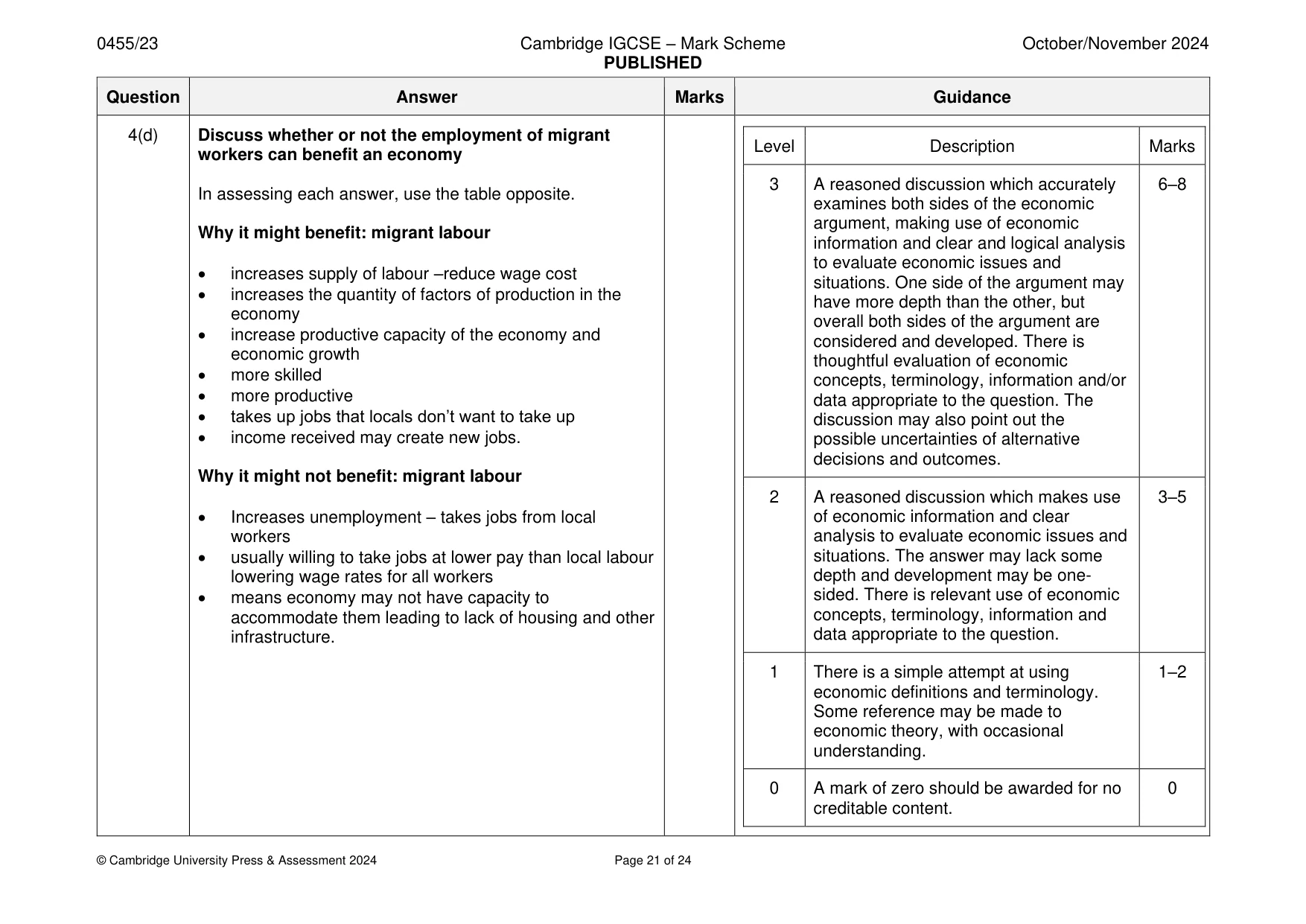
Mark scheme: 4(a) Define supply 2 Accept an incomplete answer for one mark e.g. amount of a good/service produced by a firm / available in the market (1). The willingness (1) and ability to sell/provide a good/service (1). 4(b) Explain the difference between the private sector and 4 Alternatively candidates may present as the public sector. Motive: profit v social welfare Logical explanation which might include: Ownership: individuals / firms v government • private sector is operated and owned by individuals / firms (1) and decisions are made based on self-interest / profits / own utility / efficiency (1) • public sector is operated and owned by the government (1) and decisions are made based on the overall welfare of society / people / externalities (1). 4(c) Analyse the causes of differences in economic development 6 Do not reward economic growth as being the same as between countries. economic development Coherent analysis which might include differences in: • level of income (1) affecting levels of affordability (1) and consumption of various goods and services (1) • education (1) affecting skills / productivity (1) job opportunities (1) purchasing power (1) • healthcare (1) affecting life expectancy (1) level of labour absences from work (1) output (1) • levels of population growth (1) affecting size of workforce (1) affecting dependency ratios (1) which could also affect cost of labour (1) • size of primary, secondary and tertiary sectors (1) large size primary sector usually leads to lower levels of development than the other two sectors (1) lower value added in primary / higher value added in secondary and tertiary (1) • government expenditure / overseas investment (FDI) (1) e.g. in infrastructure projects / education/healthcare (1) raising job opportunities / reducing poverty (1) • availability / development of resources / factors of production (1) e.g. beautiful landscape / labour (1) impact on economic development (1). 4(d) Discuss whether or not the employment of migrant Level Description Marks workers can benefit an economy 3 A reasoned discussion which accurately 6–8 In assessing each answer, use the table opposite. examines both sides of the economic argument, making use of economic Why it might benefit: migrant labour information and clear and logical analysis to evaluate economic issues and • increases supply of labour –reduce wage cost situations. One side of the argument may • increases the quantity of factors of production in the have more depth than the other, but economy overall both sides of the argument are • increase productive capacity of the economy and considered and developed. There is economic growth thoughtful evaluation of economic • more skilled concepts, terminology, information and/or • more productive data appropriate to the question. The • takes up jobs that locals don’t want to take up discussion may also point out the • income received may create new jobs. possible uncertainties of alternative decisions and outcomes. Why it might not benefit: migrant labour 2 A reasoned discussion which makes use 3–5 • Increases unemployment – takes jobs from local of economic information and clear workers analysis to evaluate economic issues and • usually willing to take jobs at lower pay than local labour situations. The answer may lack some lowering wage rates for all workers depth and development may be one- • means economy may not have capacity to sided. There is relevant use of economic accommodate them leading to lack of housing and other concepts, terminology, information and infrastructure. data appropriate to the question. 1 There is a simple attempt at using 1–2 economic definitions and terminology. Some reference may be made to economic theory, with occasional understanding. 0 A mark of zero should be awarded for no 0 creditable content.
Q5 · In 2021, the central bank of Turkey cut the interest rate on four occasions
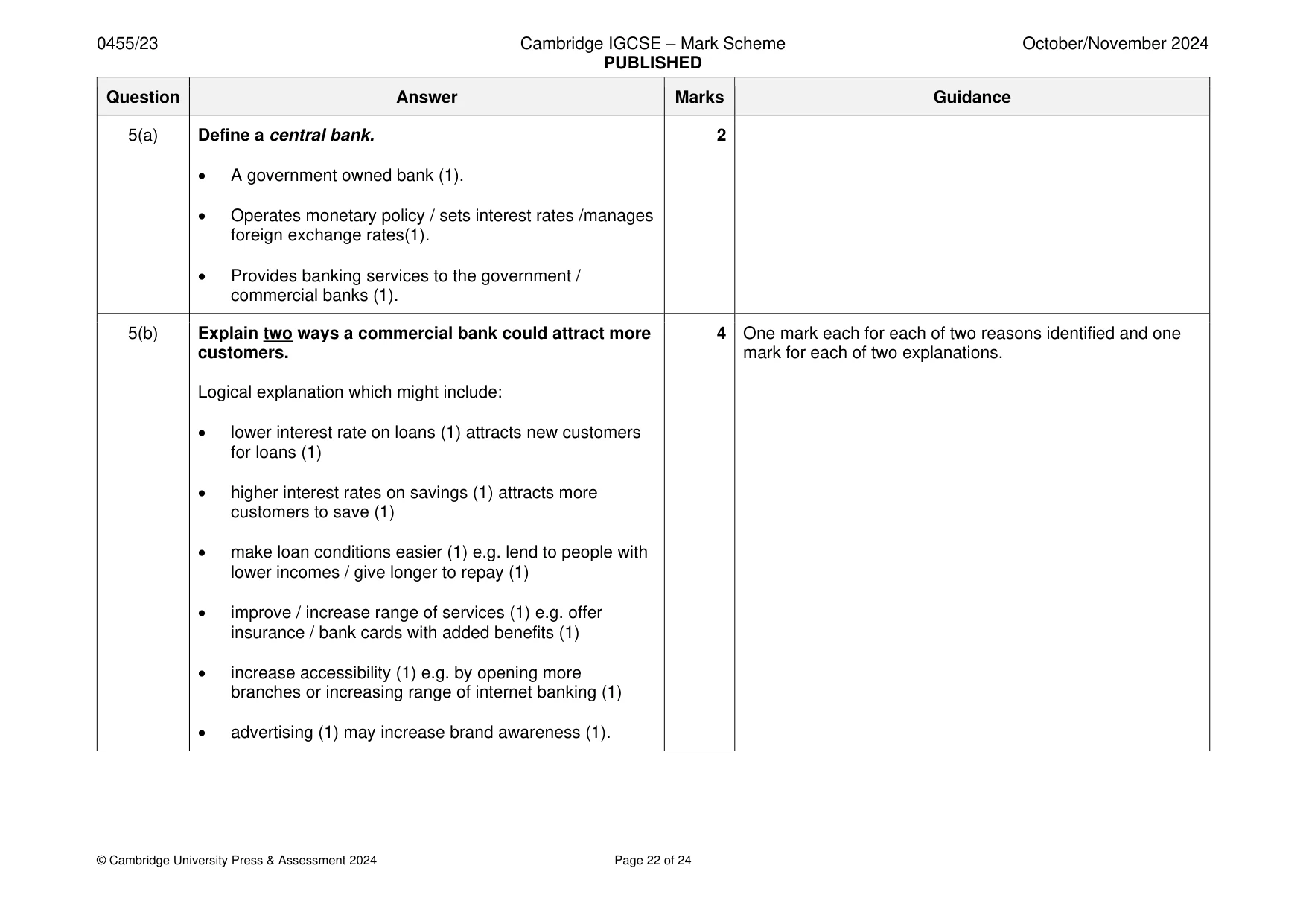
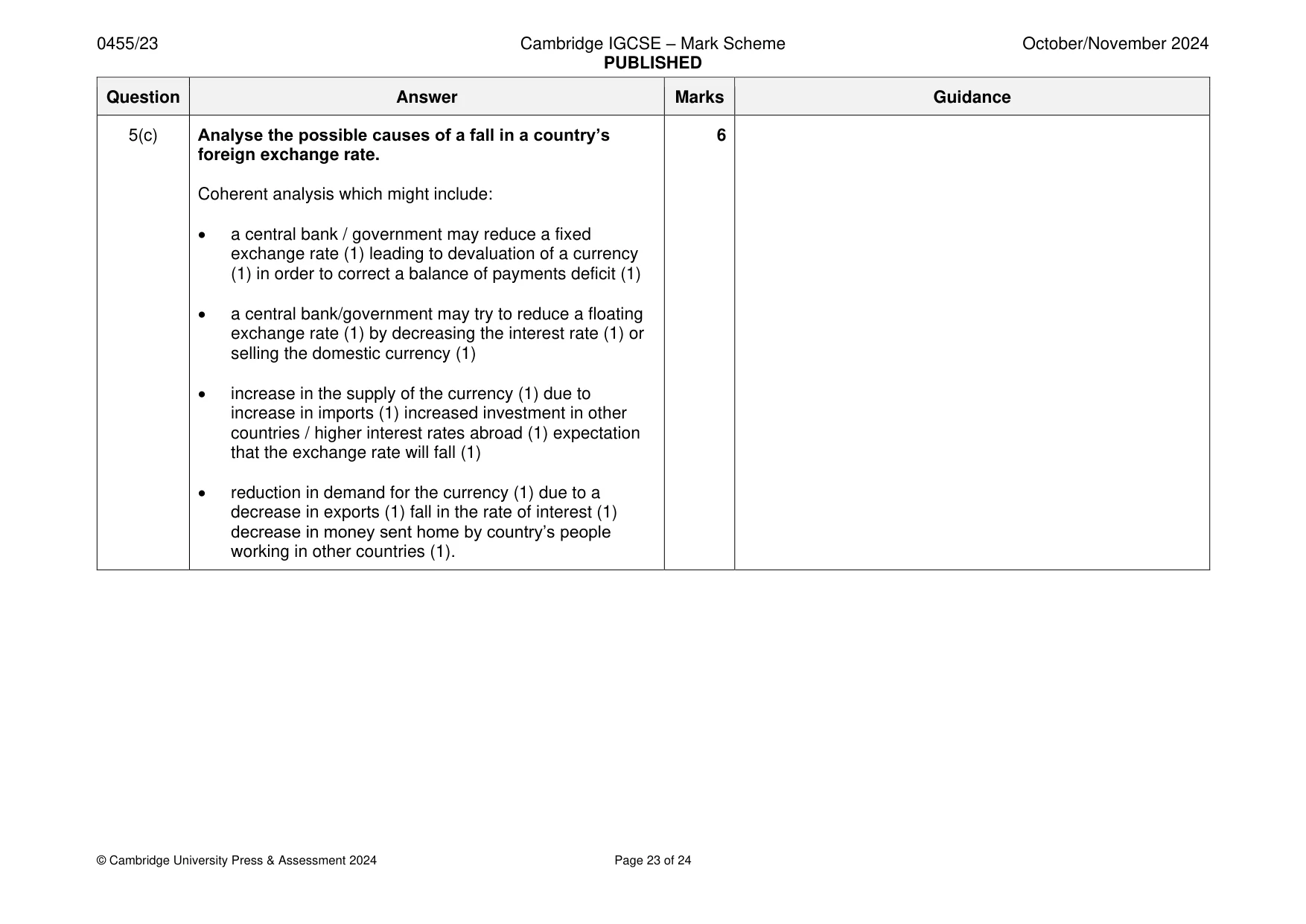
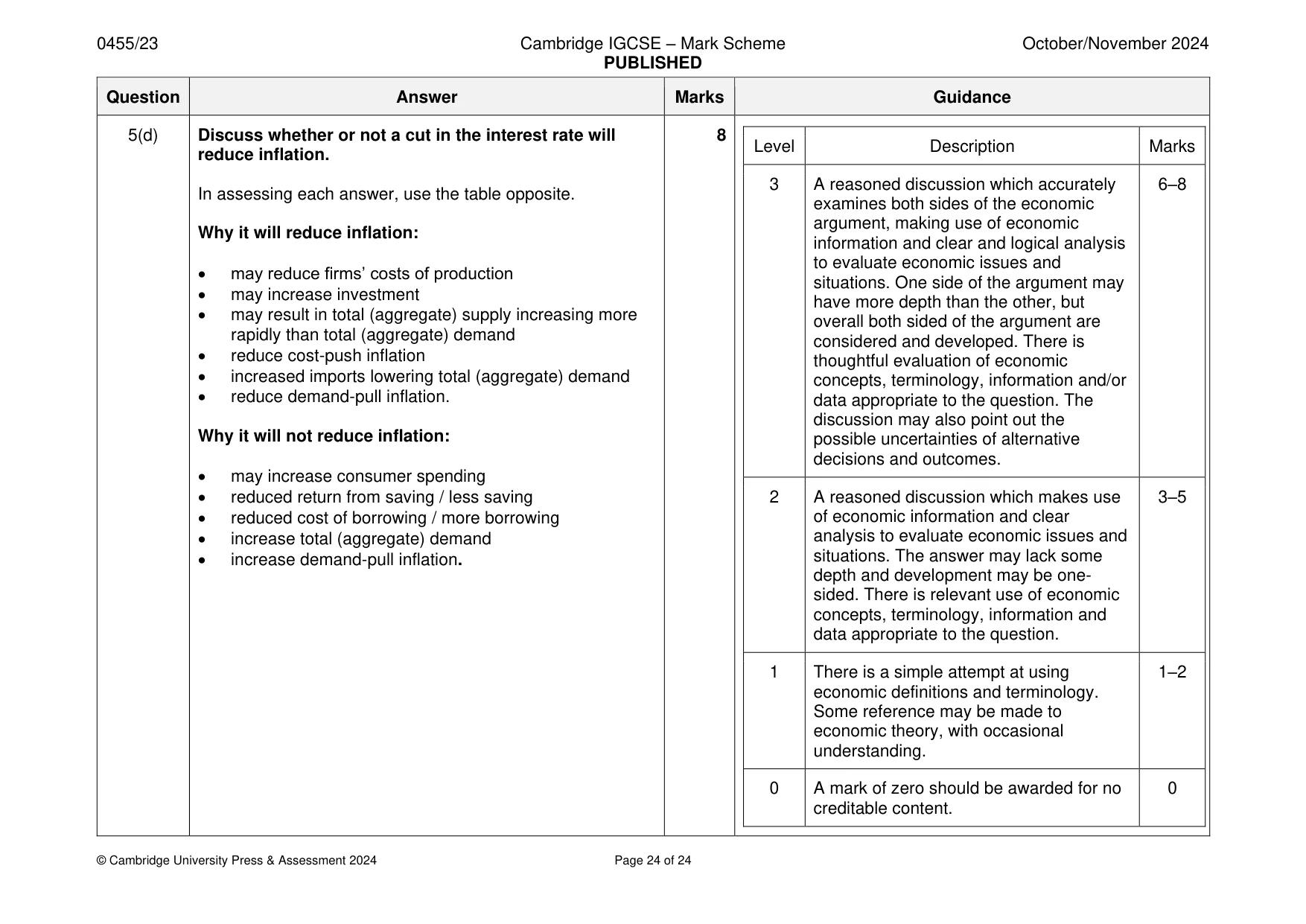
5 In 2021, the central bank of Turkey cut the interest rate on four occasions. This was despite the country’s inflation rate rising from 15% at the start of the year to 36% at the end of the year. Turkish commercial banks attracted more customers which led to a 10% rise in bank deposits. The country’s currency, the Turkish lira, fell to a record low against the US dollar later that year. (a) Define a central bank. [2] (b) Explain two ways a commercial bank could attract more customers. [4] (c) Analyse the possible causes of a fall in a country’s foreign exchange rate. [6] (d) Discuss whether or not a cut in the interest rate will reduce inflation. [8]
Mark scheme: 5(a) Define a central bank. 2 • A government owned bank (1). • Operates monetary policy / sets interest rates /manages foreign exchange rates(1). • Provides banking services to the government / commercial banks (1). 5(b) Explain two ways a commercial bank could attract more 4 One mark each for each of two reasons identified and one customers. mark for each of two explanations. Logical explanation which might include: • lower interest rate on loans (1) attracts new customers for loans (1) • higher interest rates on savings (1) attracts more customers to save (1) • make loan conditions easier (1) e.g. lend to people with lower incomes / give longer to repay (1) • improve / increase range of services (1) e.g. offer insurance / bank cards with added benefits (1) • increase accessibility (1) e.g. by opening more branches or increasing range of internet banking (1) • advertising (1) may increase brand awareness (1). 5(c) Analyse the possible causes of a fall in a country’s 6 foreign exchange rate. Coherent analysis which might include: • a central bank / government may reduce a fixed exchange rate (1) leading to devaluation of a currency (1) in order to correct a balance of payments deficit (1) • a central bank/government may try to reduce a floating exchange rate (1) by decreasing the interest rate (1) or selling the domestic currency (1) • increase in the supply of the currency (1) due to increase in imports (1) increased investment in other countries / higher interest rates abroad (1) expectation that the exchange rate will fall (1) • reduction in demand for the currency (1) due to a decrease in exports (1) fall in the rate of interest (1) decrease in money sent home by country’s people working in other countries (1). 5(d) Discuss whether or not a cut in the interest rate will 8 Level Description Marks reduce inflation. 3 A reasoned discussion which accurately 6–8 In assessing each answer, use the table opposite. examines both sides of the economic argument, making use of economic Why it will reduce inflation: information and clear and logical analysis to evaluate economic issues and • may reduce firms’ costs of production situations. One side of the argument may • may increase investment have more depth than the other, but • may result in total (aggregate) supply increasing more overall both sided of the argument are rapidly than total (aggregate) demand considered and developed. There is • reduce cost-push inflation thoughtful evaluation of economic • increased imports lowering total (aggregate) demand concepts, terminology, information and/or • reduce demand-pull inflation. data appropriate to the question. The discussion may also point out the Why it will not reduce inflation: possible uncertainties of alternative decisions and outcomes. • may increase consumer spending • reduced return from saving / less saving 2 A reasoned discussion which makes use 3–5 • reduced cost of borrowing / more borrowing of economic information and clear • increase total (aggregate) demand analysis to evaluate economic issues and • increase demand-pull inflation. situations. The answer may lack some depth and development may be one- sided. There is relevant use of economic concepts, terminology, information and data appropriate to the question. 1 There is a simple attempt at using 1–2 economic definitions and terminology. Some reference may be made to economic theory, with occasional understanding. 0 A mark of zero should be awarded for no 0 creditable content.
What was in this paper
The subtopics covered by these 5 questions, and how many questions each got. Open one in a new tab to see every Cambridge question on it.
What you needed in this session
Cambridge’s own grade thresholds for 2024 Oct/Nov, Paper 2 · Variant 3. A higher threshold means an easier paper — the bar moves with how the cohort did.