Cambridge IGCSE Economics 0455 — 2023 Oct/Nov Paper 2 · Variant 2
0455/22/O/N/23 · 5 questions · 90 marks · ≈101 min
The question paper and its mark scheme, free to read here and free to download. This is Cambridge’s own paper, exactly as it was sat.
Question paper8 pages




Mark scheme23 pages
Answers below. Sit the paper first if you are practising.
Questions as text
Q1 · Calculate what percentage of Honduran people did not have access to electricity in 2020
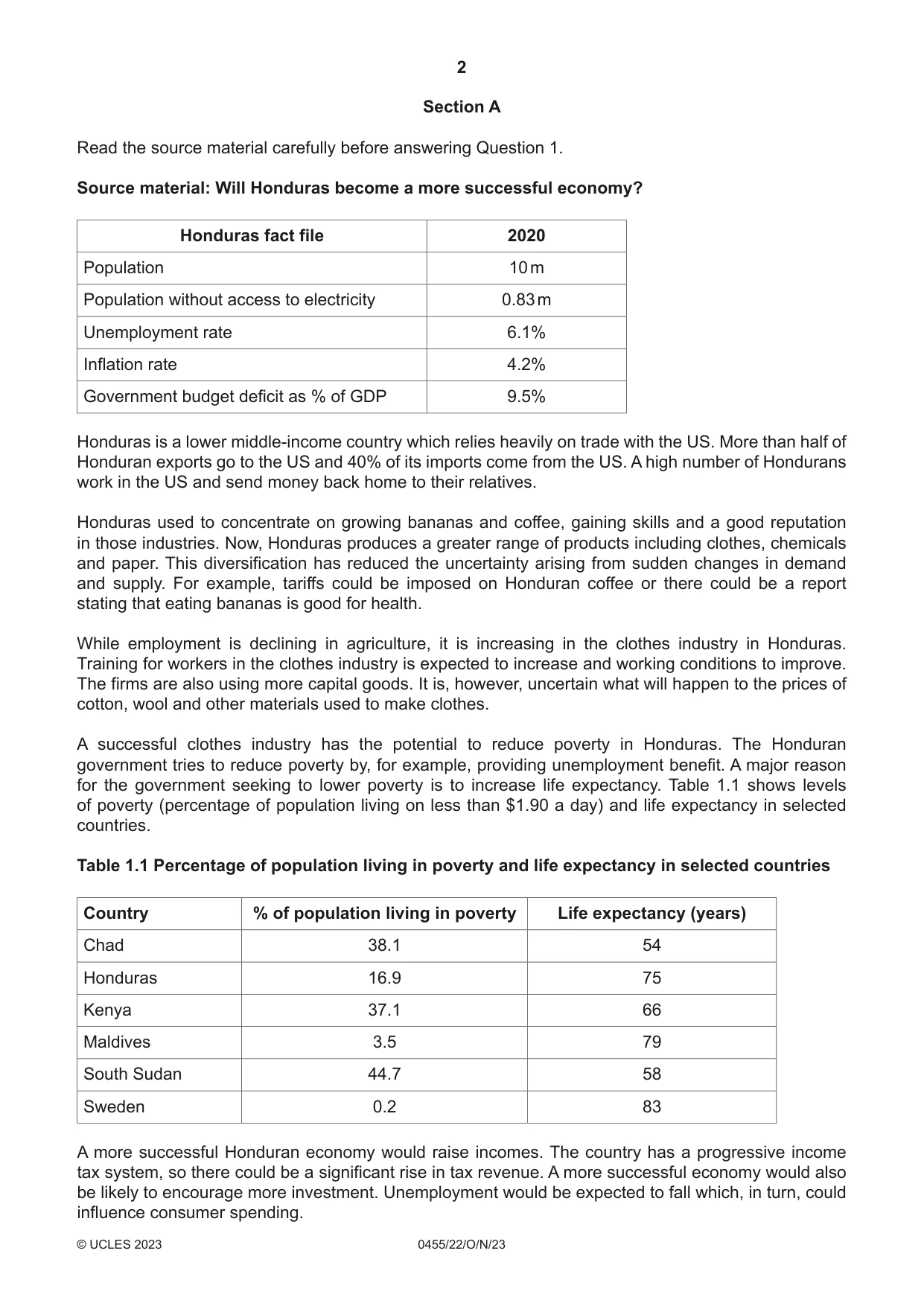
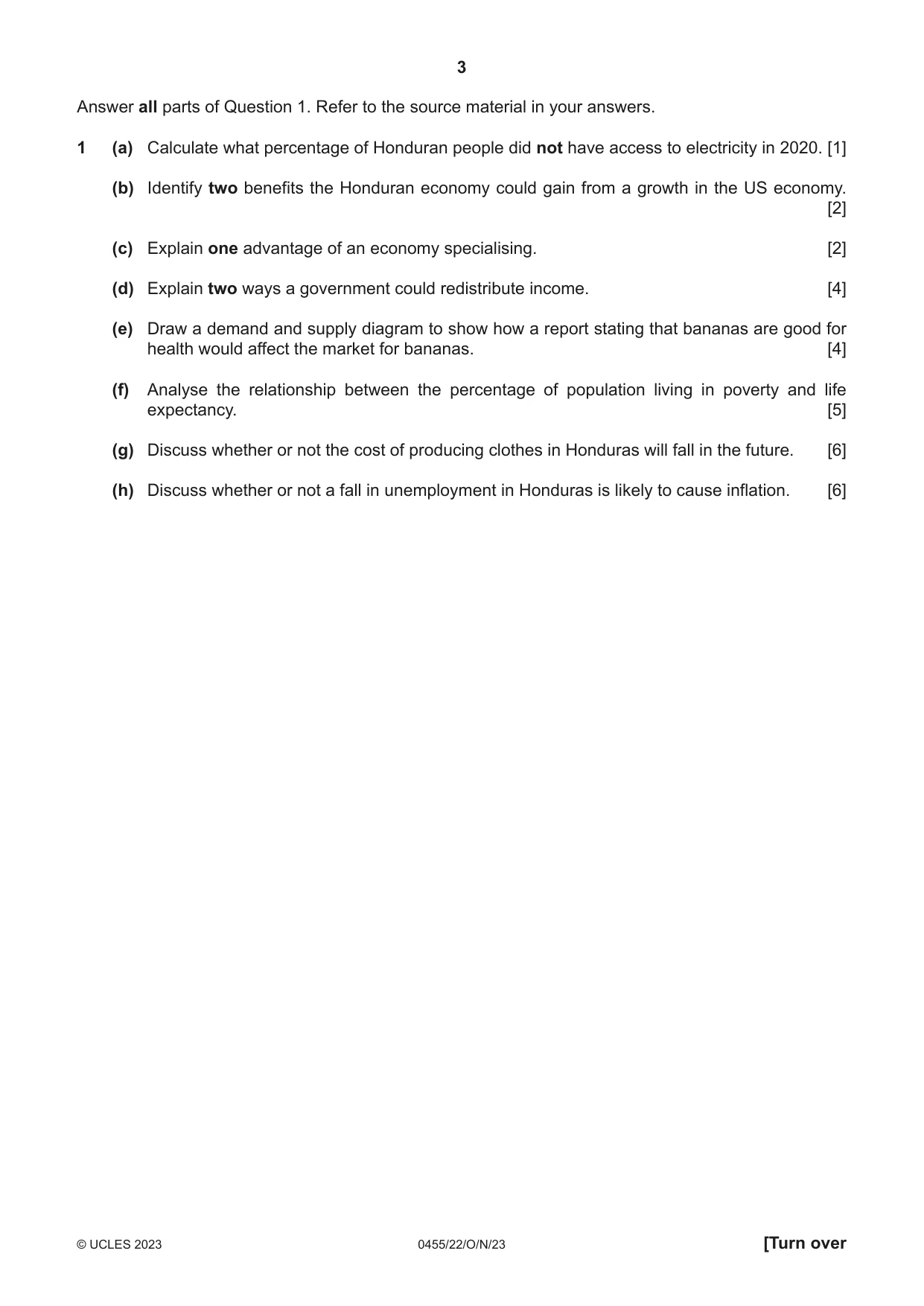
1 (a) Calculate what percentage of Honduran people did not have access to electricity in 2020. [1] (b) Identify two benefits the Honduran economy could gain from a growth in the US economy. [2] (c) Explain one advantage of an economy specialising. [2] (d) Explain two ways a government could redistribute income. [4] (e) Draw a demand and supply diagram to show how a report stating that bananas are good for health would affect the market for bananas. [4] (f) Analyse the relationship between the percentage of population living in poverty and life expectancy. [5] (g) Discuss whether or not the cost of producing clothes in Honduras will fall in the future. [6] (h) Discuss whether or not a fall in unemployment in Honduras is likely to cause inflation. [6]
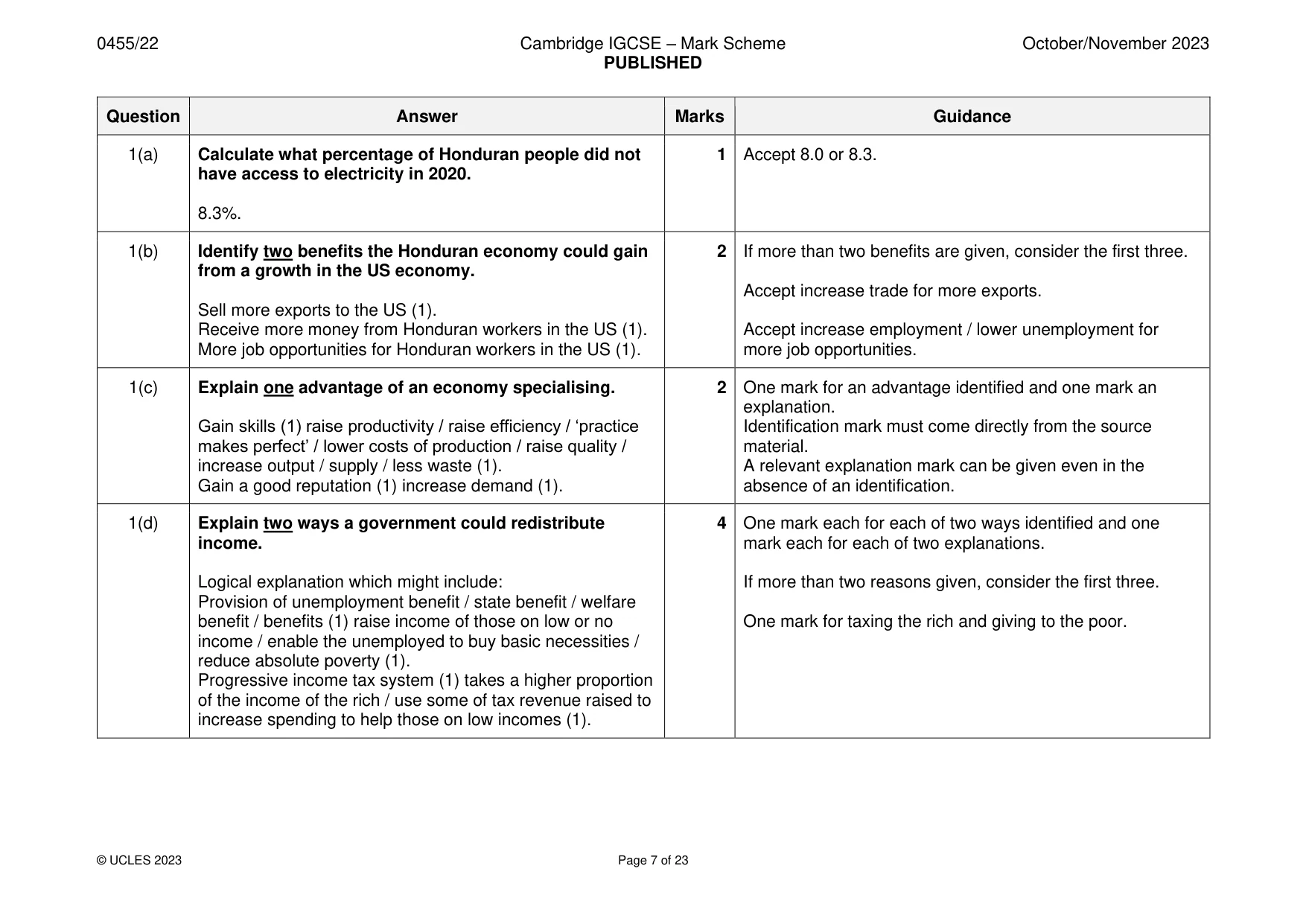
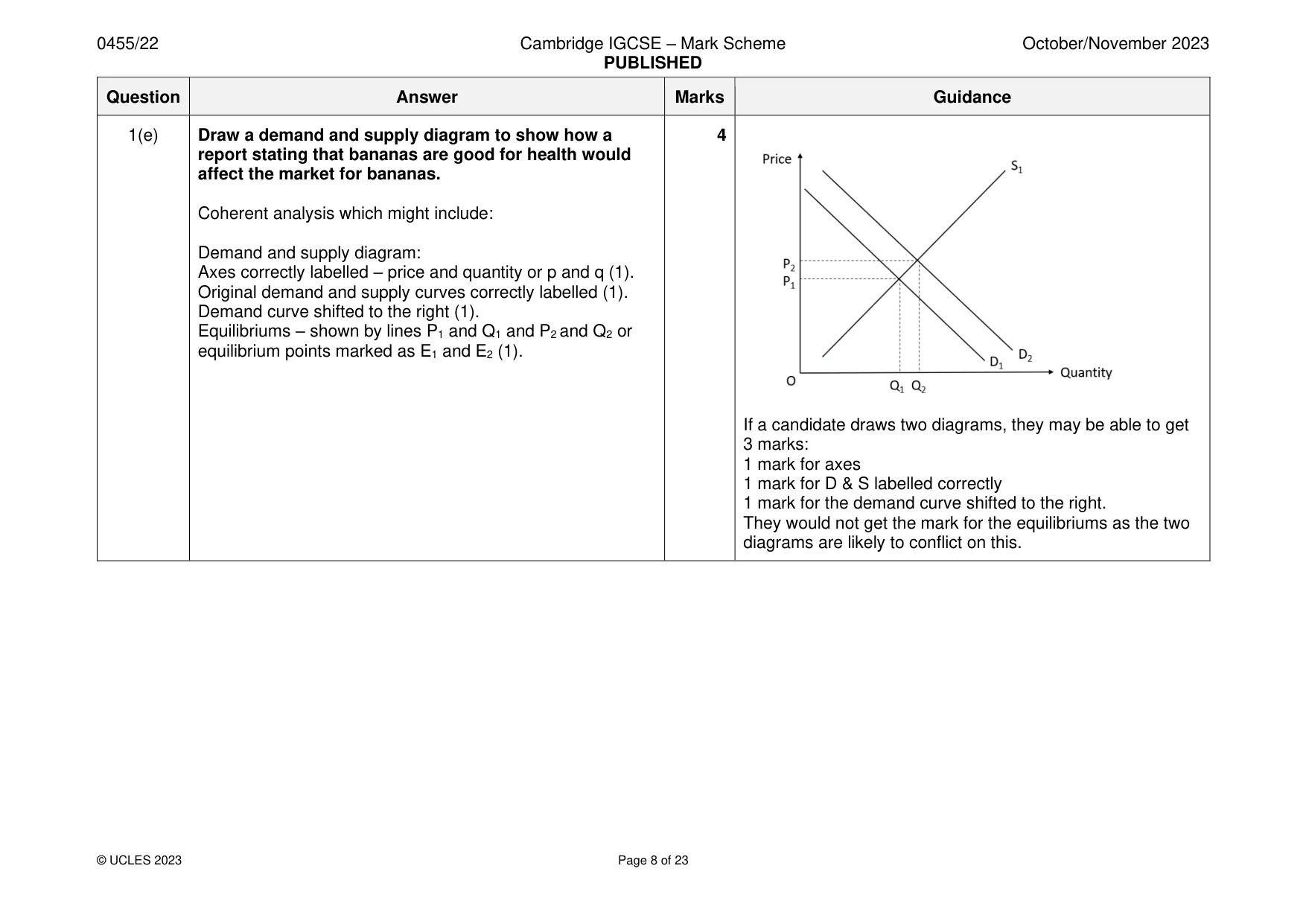
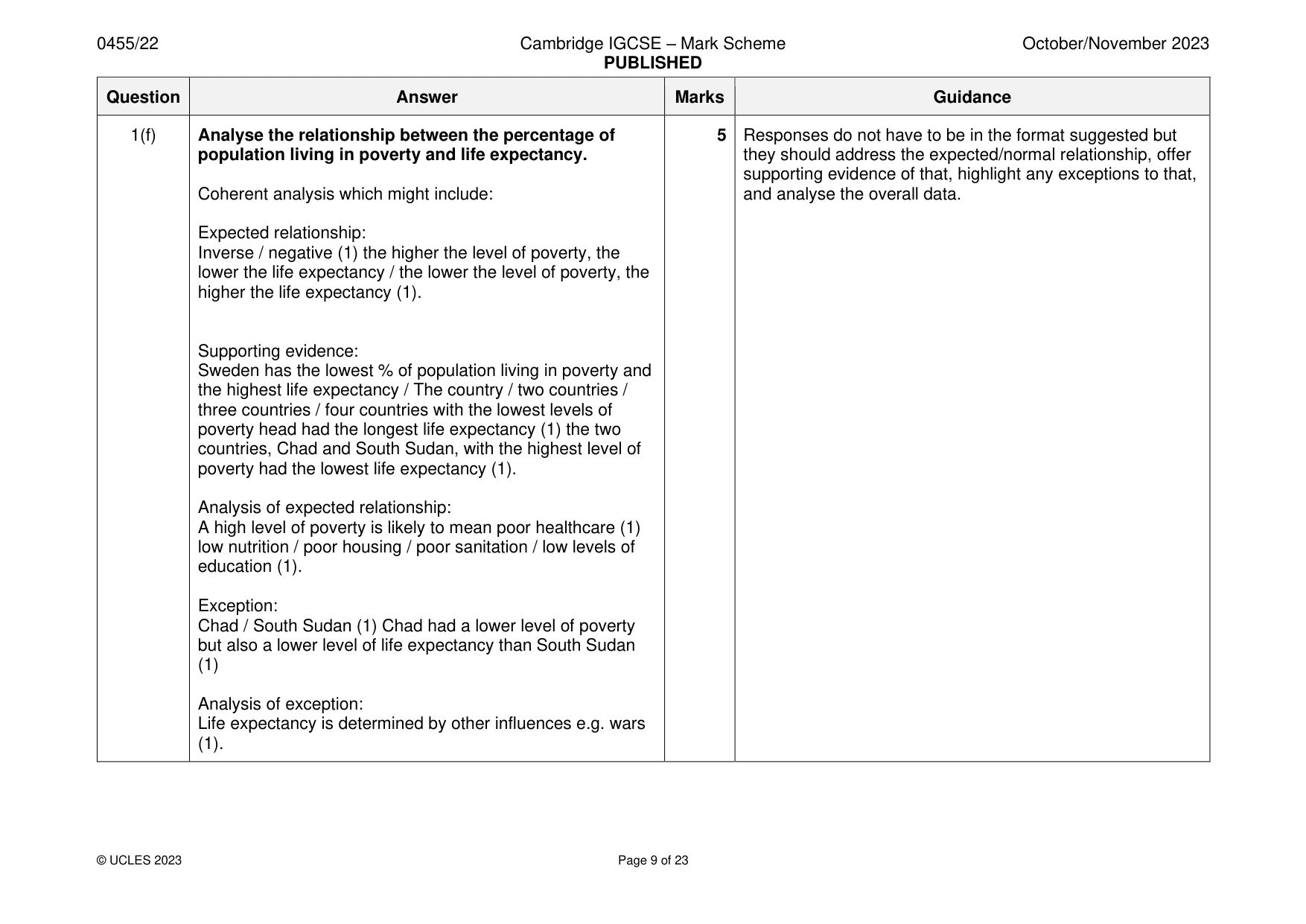
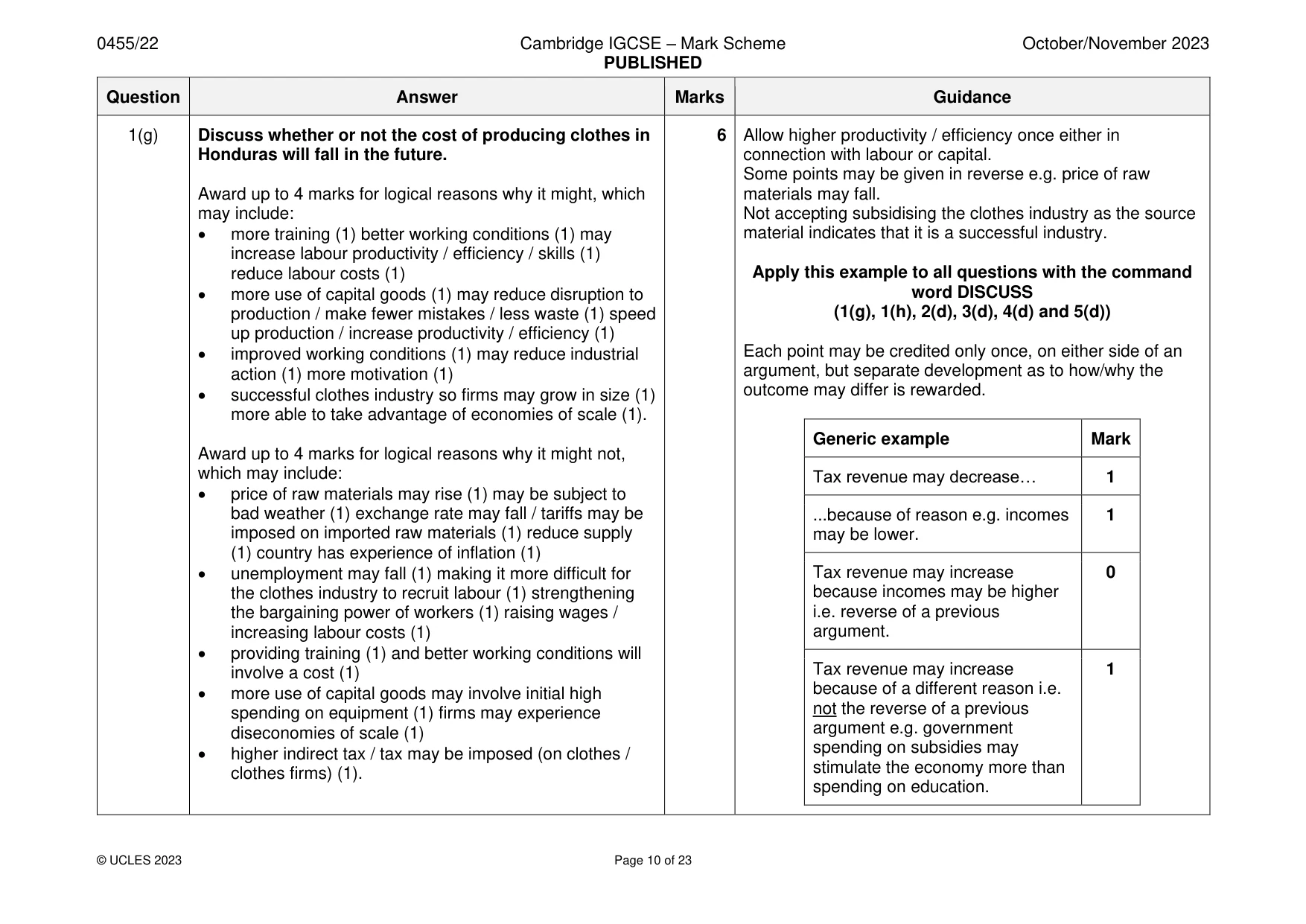
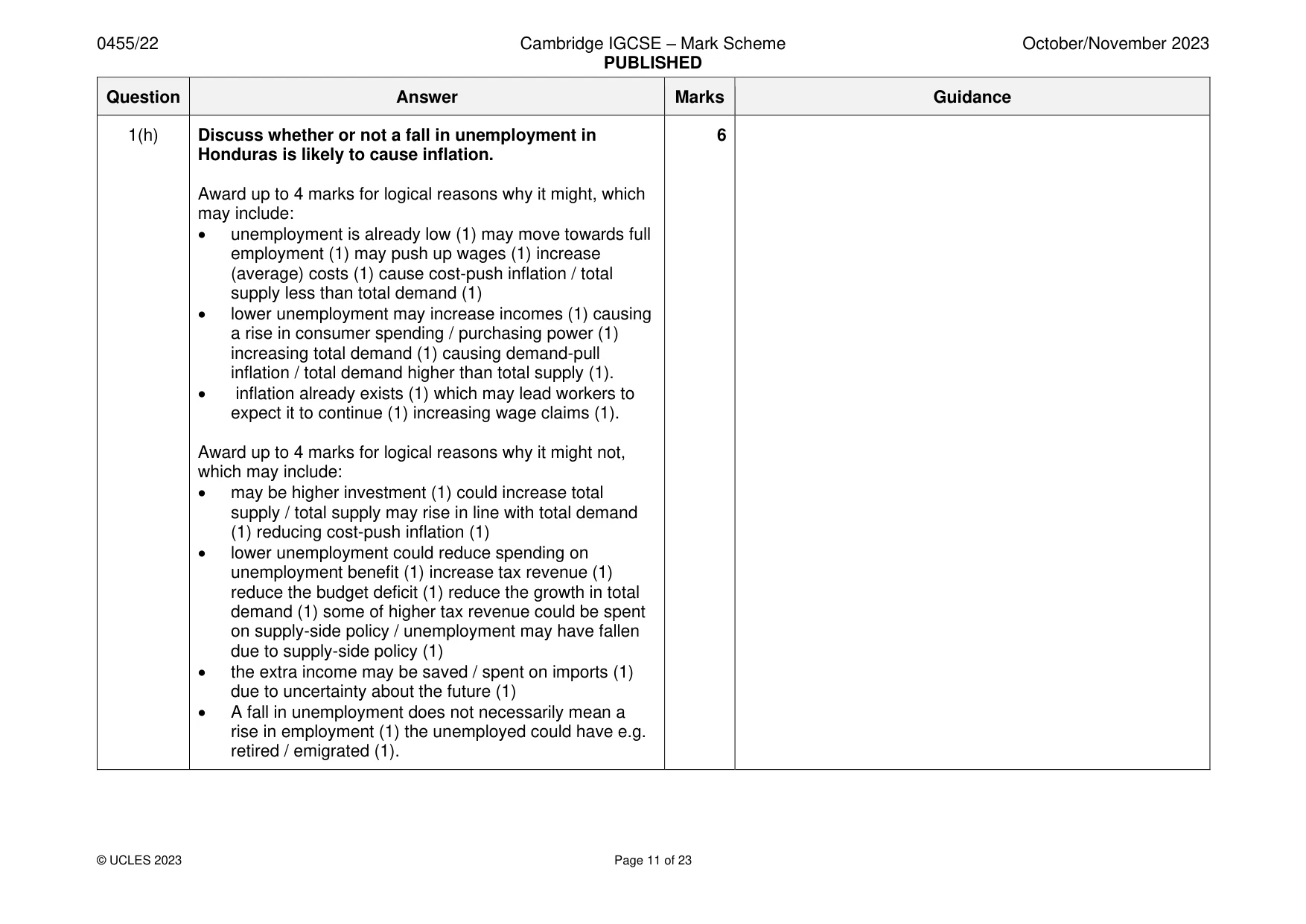
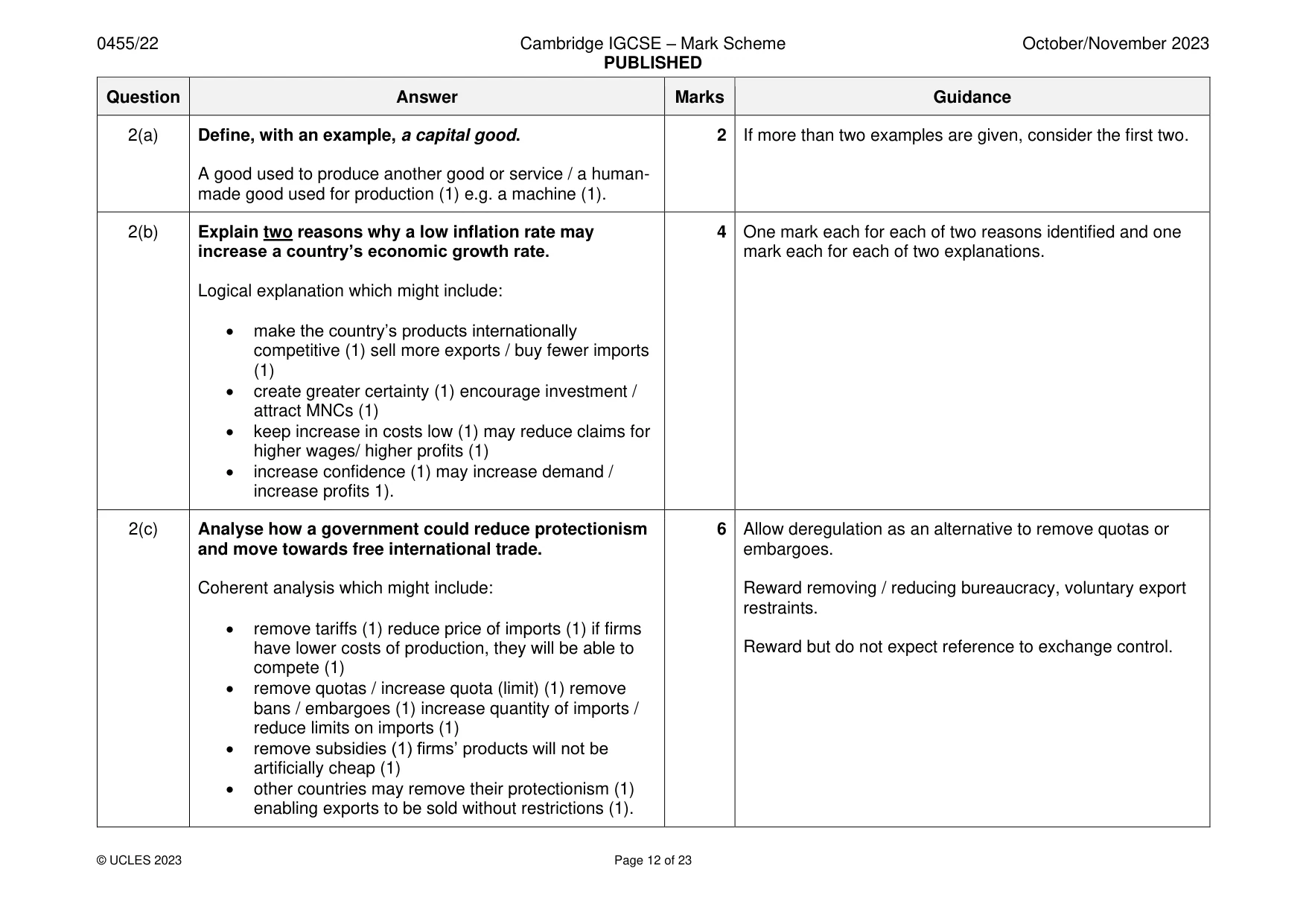
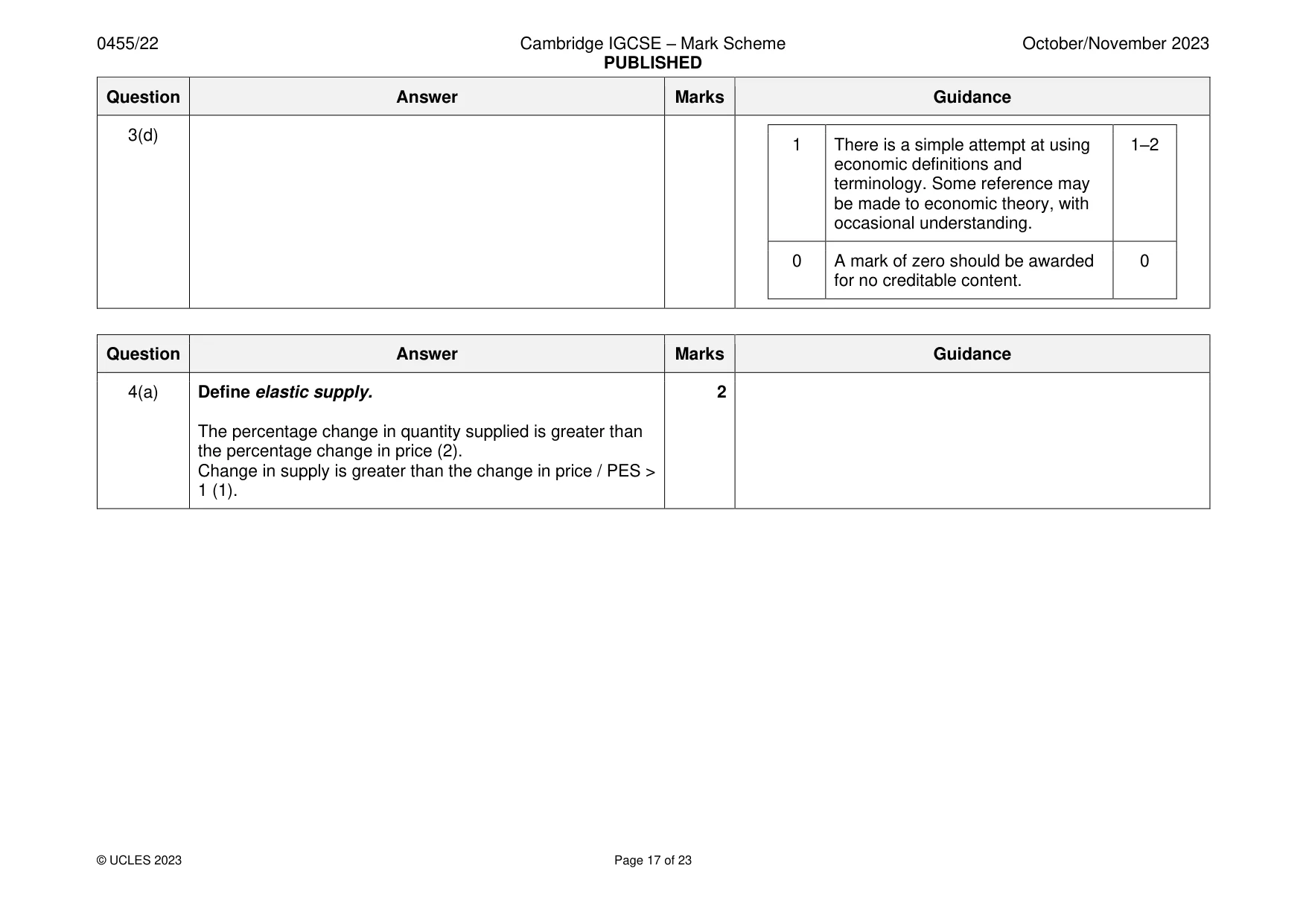
Mark scheme: Question Answer Marks Guidance 1(a) Calculate what percentage of Honduran people did not 1 Accept 8.0 or 8.3. have access to electricity in 2020. 8.3%. 1(b) Identify two benefits the Honduran economy could gain 2 If more than two benefits are given, consider the first three. from a growth in the US economy. Accept increase trade for more exports. Sell more exports to the US (1). Receive more money from Honduran workers in the US (1). Accept increase employment / lower unemployment for More job opportunities for Honduran workers in the US (1). more job opportunities. 1(c) Explain one advantage of an economy specialising. 2 One mark for an advantage identified and one mark an explanation. Gain skills (1) raise productivity / raise efficiency / ‘practice Identification mark must come directly from the source makes perfect’ / lower costs of production / raise quality / material. increase output / supply / less waste (1). A relevant explanation mark can be given even in the Gain a good reputation (1) increase demand (1). absence of an identification. 1(d) Explain two ways a government could redistribute 4 One mark each for each of two ways identified and one income. mark each for each of two explanations. Logical explanation which might include: If more than two reasons given, consider the first three. Provision of unemployment benefit / state benefit / welfare benefit / benefits (1) raise income of those on low or no One mark for taxing the rich and giving to the poor. income / enable the unemployed to buy basic necessities / reduce absolute poverty (1). Progressive income tax system (1) takes a higher proportion of the income of the rich / use some of tax revenue raised to increase spending to help those on low incomes (1). 1(e) Draw a demand and supply diagram to show how a 4 report stating that bananas are good for health would affect the market for bananas. Coherent analysis which might include: Demand and supply diagram: Axes correctly labelled – price and quantity or p and q (1). Original demand and supply curves correctly labelled (1). Demand curve shifted to the right (1). Equilibriums – shown by lines P1 and Q1 and P2 and Q2 or equilibrium points marked as E1 and E2 (1). If a candidate draws two diagrams, they may be able to get 3 marks: 1 mark for axes 1 mark for D & S labelled correctly 1 mark for the demand curve shifted to the right. They would not get the mark for the equilibriums as the two diagrams are likely to conflict on this. 1(f) Analyse the relationship between the percentage of 5 Responses do not have to be in the format suggested but population living in poverty and life expectancy. they should address the expected/normal relationship, offer supporting evidence of that, highlight any exceptions to that, Coherent analysis which might include: and analyse the overall data. Expected relationship: Inverse / negative (1) the higher the level of poverty, the lower the life expectancy / the lower the level of poverty, the higher the life expectancy (1). Supporting evidence: Sweden has the lowest % of population living in poverty and the highest life expectancy / The country / two countries / three countries / four countries with the lowest levels of poverty head had the longest life expectancy (1) the two countries, Chad and South Sudan, with the highest level of poverty had the lowest life expectancy (1). Analysis of expected relationship: A high level of poverty is likely to mean poor healthcare (1) low nutrition / poor housing / poor sanitation / low levels of education (1). Exception: Chad / South Sudan (1) Chad had a lower level of poverty but also a lower level of life expectancy than South Sudan (1) Analysis of exception: Life expectancy is determined by other influences e.g. wars (1). 1(g) Discuss whether or not the cost of producing clothes in 6 Allow higher productivity / efficiency once either in Honduras will fall in the future. connection with labour or capital. Some points may be given in reverse e.g. price of raw Award up to 4 marks for logical reasons why it might, which materials may fall. may include: Not accepting subsidising the clothes industry as the source • more training (1) better working conditions (1) may material indicates that it is a successful industry. increase labour productivity / efficiency / skills (1) reduce labour costs (1) Apply this example to all questions with the command • more use of capital goods (1) may reduce disruption to word DISCUSS production / make fewer mistakes / less waste (1) speed (1(g), 1(h), 2(d), 3(d), 4(d) and 5(d)) up production / increase productivity / efficiency (1) • improved working conditions (1) may reduce industrial Each point may be credited only once, on either side of an action (1) more motivation (1) argument, but separate development as to how/why the • successful clothes industry so firms may grow in size (1) outcome may differ is rewarded. more able to take advantage of economies of scale (1). Generic example Mark Award up to 4 marks for logical reasons why it might not, which may include: Tax revenue may decrease… 1 • price of raw materials may rise (1) may be subject to bad weather (1) exchange rate may fall / tariffs may be ...because of reason e.g. incomes 1 imposed on imported raw materials (1) reduce supply may be lower. (1) country has experience of inflation (1) • unemployment may fall (1) making it more difficult for Tax revenue may increase 0 the clothes industry to recruit labour (1) strengthening because incomes may be higher the bargaining power of workers (1) raising wages / i.e. reverse of a previous increasing labour costs (1) argument. • providing training (1) and better working conditions will involve a cost (1) Tax revenue may increase 1 • more use of capital goods may involve initial high because of a different reason i.e. not the reverse of a previous spending on equipment (1) firms may experience argument e.g. government diseconomies of scale (1) • higher indirect tax / tax may be imposed (on clothes / spending on subsidies may stimulate the economy more than clothes firms) (1). spending on education. 1(h) Discuss whether or not a fall in unemployment in 6 Honduras is likely to cause inflation. Award up to 4 marks for logical reasons why it might, which may include: • unemployment is already low (1) may move towards full employment (1) may push up wages (1) increase (average) costs (1) cause cost-push inflation / total supply less than total demand (1) • lower unemployment may increase incomes (1) causing a rise in consumer spending / purchasing power (1) increasing total demand (1) causing demand-pull inflation / total demand higher than total supply (1). • inflation already exists (1) which may lead workers to expect it to continue (1) increasing wage claims (1). Award up to 4 marks for logical reasons why it might not, which may include: • may be higher investment (1) could increase total supply / total supply may rise in line with total demand (1) reducing cost-push inflation (1) • lower unemployment could reduce spending on unemployment benefit (1) increase tax revenue (1) reduce the budget deficit (1) reduce the growth in total demand (1) some of higher tax revenue could be spent on supply-side policy / unemployment may have fallen due to supply-side policy (1) • the extra income may be saved / spent on imports (1) due to uncertainty about the future (1) • A fall in unemployment does not necessarily mean a rise in employment (1) the unemployed could have e.g. retired / emigrated (1).
Q2 · Botswana uses both capital goods and labour in its diamond mining industry
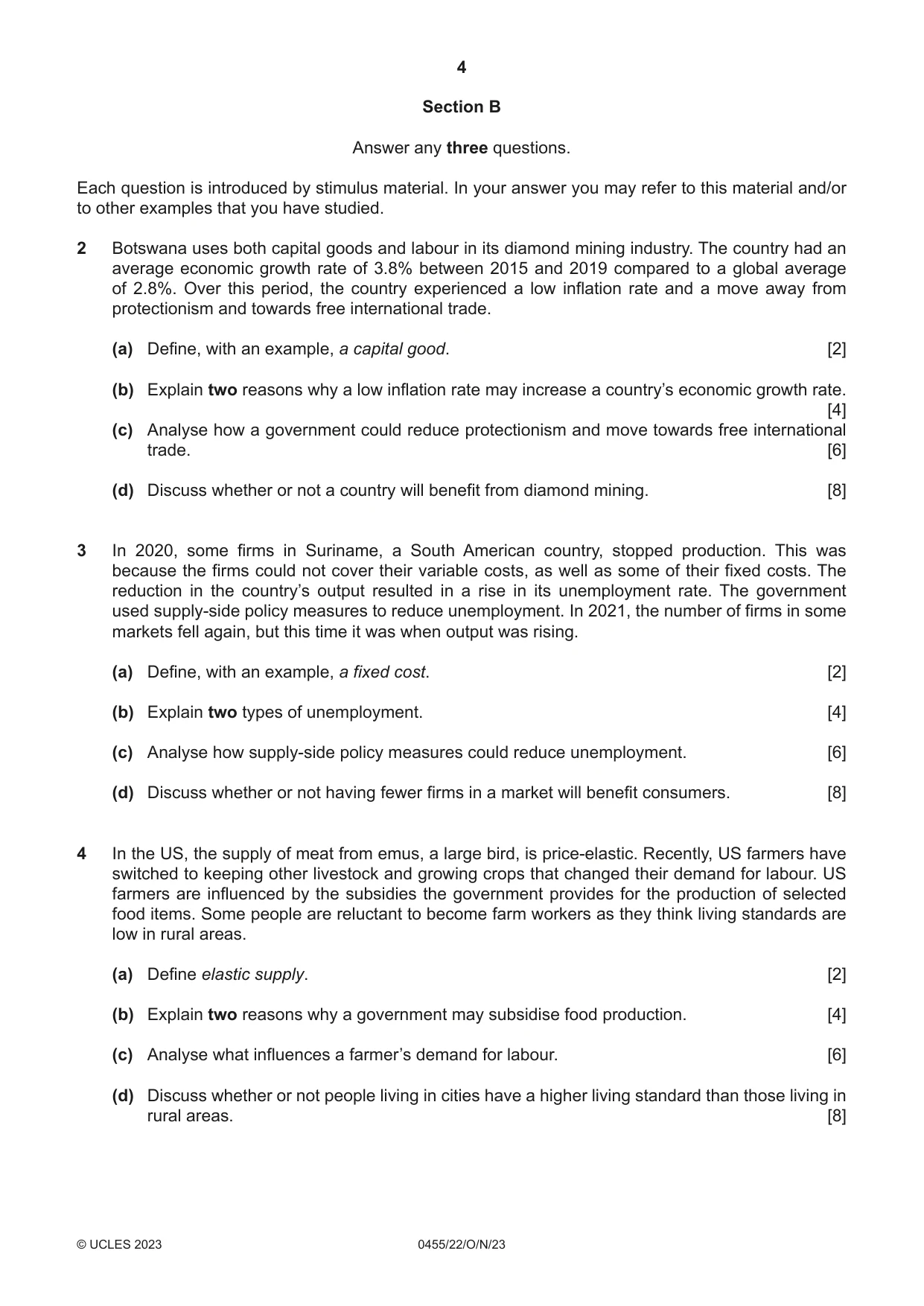
2 Botswana uses both capital goods and labour in its diamond mining industry. The country had an average economic growth rate of 3.8% between 2015 and 2019 compared to a global average of 2.8%. Over this period, the country experienced a low inflation rate and a move away from protectionism and towards free international trade. (a) Define, with an example, a capital good. [2] (b) Explain two reasons why a low inflation rate may increase a country’s economic growth rate. [4] (c) Analyse how a government could reduce protectionism and move towards free international trade. [6] (d) Discuss whether or not a country will benefit from diamond mining. [8]
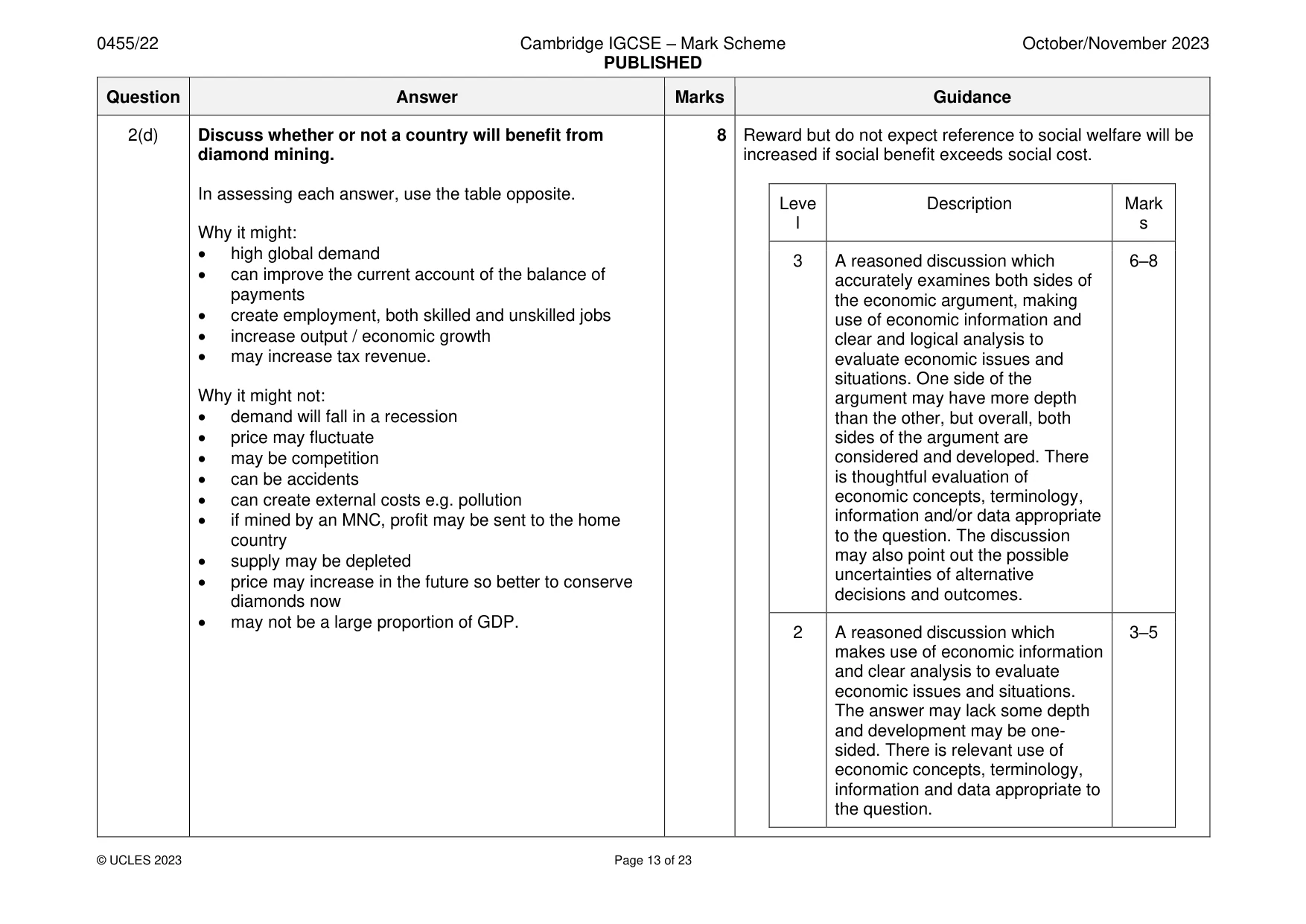
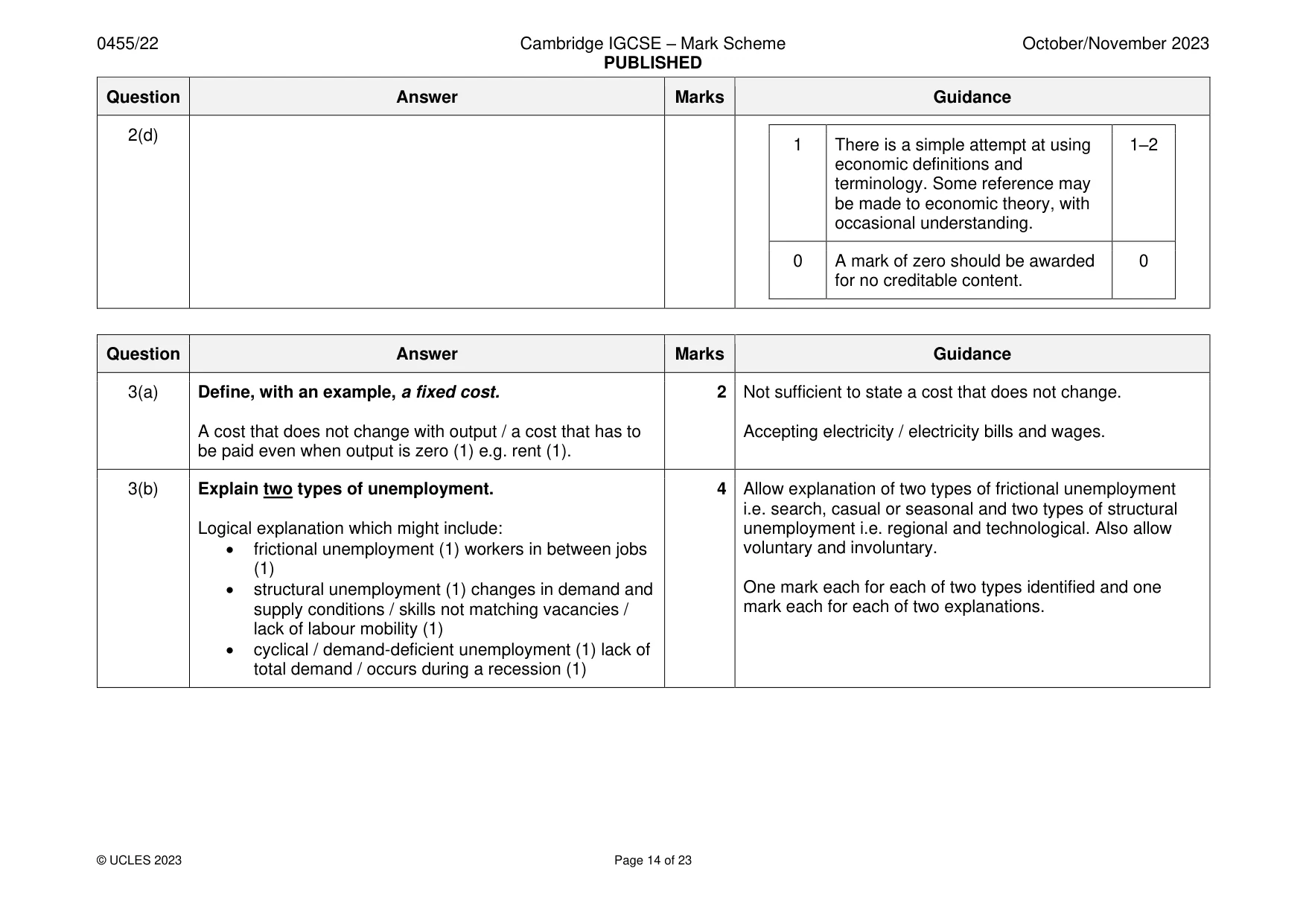
Mark scheme: 2(a) Define, with an example, a capital good. 2 If more than two examples are given, consider the first two. A good used to produce another good or service / a human- made good used for production (1) e.g. a machine (1). 2(b) Explain two reasons why a low inflation rate may 4 One mark each for each of two reasons identified and one increase a country’s economic growth rate. mark each for each of two explanations. Logical explanation which might include: • make the country’s products internationally competitive (1) sell more exports / buy fewer imports (1) • create greater certainty (1) encourage investment / attract MNCs (1) • keep increase in costs low (1) may reduce claims for higher wages/ higher profits (1) • increase confidence (1) may increase demand / increase profits 1). 2(c) Analyse how a government could reduce protectionism 6 Allow deregulation as an alternative to remove quotas or and move towards free international trade. embargoes. Coherent analysis which might include: Reward removing / reducing bureaucracy, voluntary export restraints. • remove tariffs (1) reduce price of imports (1) if firms have lower costs of production, they will be able to Reward but do not expect reference to exchange control. compete (1) • remove quotas / increase quota (limit) (1) remove bans / embargoes (1) increase quantity of imports / reduce limits on imports (1) • remove subsidies (1) firms’ products will not be artificially cheap (1) • other countries may remove their protectionism (1) enabling exports to be sold without restrictions (1). 2(d) Discuss whether or not a country will benefit from 8 Reward but do not expect reference to social welfare will be diamond mining. increased if social benefit exceeds social cost. In assessing each answer, use the table opposite. Leve Description Mark l s Why it might: • high global demand 3 A reasoned discussion which 6–8 • can improve the current account of the balance of accurately examines both sides of payments the economic argument, making • create employment, both skilled and unskilled jobs use of economic information and • increase output / economic growth clear and logical analysis to • may increase tax revenue. evaluate economic issues and situations. One side of the Why it might not: argument may have more depth • demand will fall in a recession than the other, but overall, both • price may fluctuate sides of the argument are • may be competition considered and developed. There • can be accidents is thoughtful evaluation of • can create external costs e.g. pollution economic concepts, terminology, • if mined by an MNC, profit may be sent to the home information and/or data appropriate country to the question. The discussion • supply may be depleted may also point out the possible uncertainties of alternative • price may increase in the future so better to conserve decisions and outcomes. diamonds now • may not be a large proportion of GDP. 2 A reasoned discussion which 3–5 makes use of economic information and clear analysis to evaluate economic issues and situations. The answer may lack some depth and development may be one- sided. There is relevant use of economic concepts, terminology, information and data appropriate to the question. 2(d) 1 There is a simple attempt at using 1–2 economic definitions and terminology. Some reference may be made to economic theory, with occasional understanding. 0 A mark of zero should be awarded 0 for no creditable content.
Q3 · In 2020, some firms in Suriname, a South American country, stopped production
3 In 2020, some firms in Suriname, a South American country, stopped production. This was because the firms could not cover their variable costs, as well as some of their fixed costs. The reduction in the country’s output resulted in a rise in its unemployment rate. The government used supply-side policy measures to reduce unemployment. In 2021, the number of firms in some markets fell again, but this time it was when output was rising. (a) Define, with an example, a fixed cost. [2] (b) Explain two types of unemployment. [4] (c) Analyse how supply-side policy measures could reduce unemployment. [6] (d) Discuss whether or not having fewer firms in a market will benefit consumers. [8]
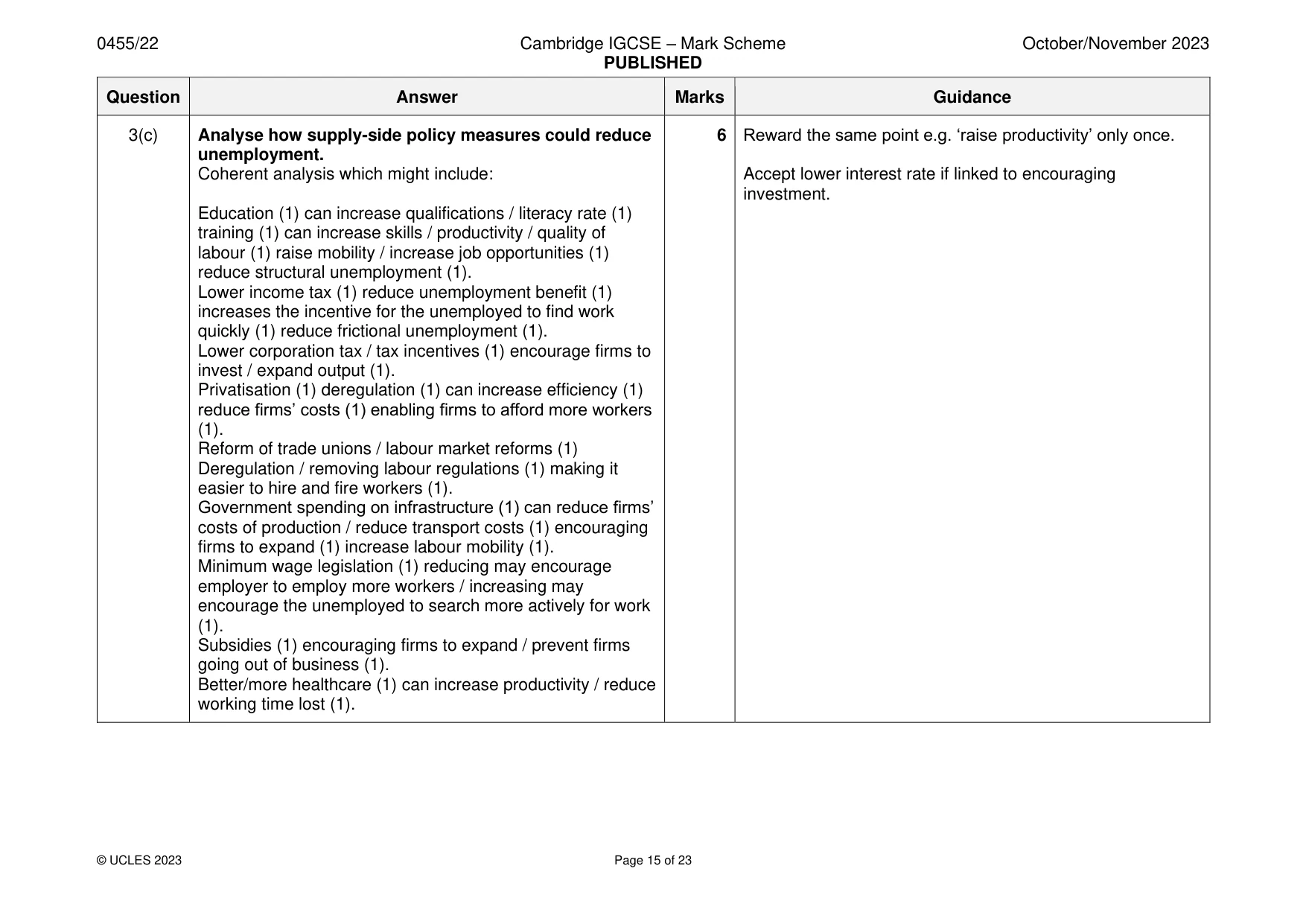
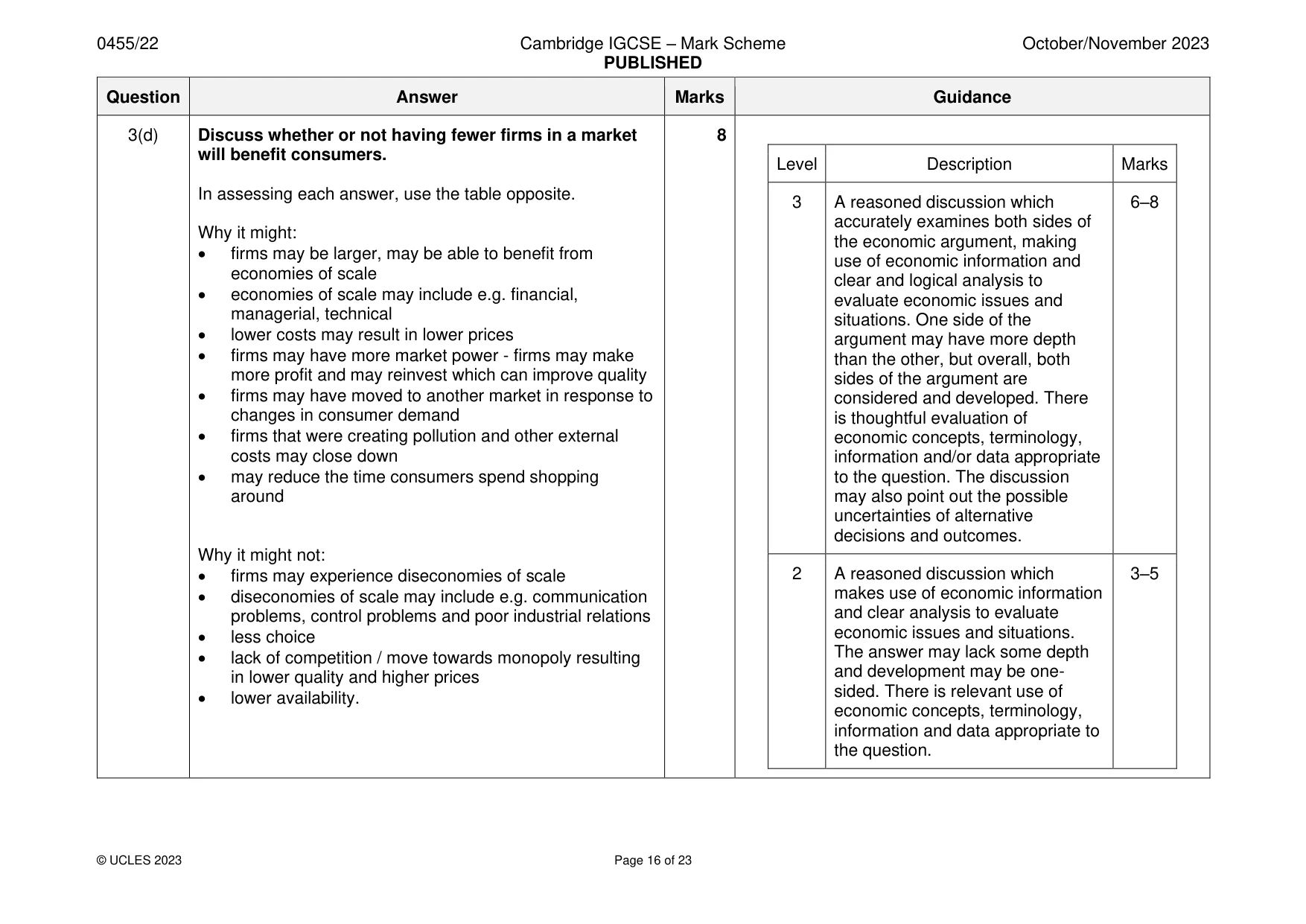
Mark scheme: 3(a) Define, with an example, a fixed cost. 2 Not sufficient to state a cost that does not change. A cost that does not change with output / a cost that has to Accepting electricity / electricity bills and wages. be paid even when output is zero (1) e.g. rent (1). 3(b) Explain two types of unemployment. 4 Allow explanation of two types of frictional unemployment i.e. search, casual or seasonal and two types of structural Logical explanation which might include: unemployment i.e. regional and technological. Also allow • frictional unemployment (1) workers in between jobs voluntary and involuntary. (1) • structural unemployment (1) changes in demand and One mark each for each of two types identified and one supply conditions / skills not matching vacancies / mark each for each of two explanations. lack of labour mobility (1) • cyclical / demand-deficient unemployment (1) lack of total demand / occurs during a recession (1) 3(c) Analyse how supply-side policy measures could reduce 6 Reward the same point e.g. ‘raise productivity’ only once. unemployment. Coherent analysis which might include: Accept lower interest rate if linked to encouraging investment. Education (1) can increase qualifications / literacy rate (1) training (1) can increase skills / productivity / quality of labour (1) raise mobility / increase job opportunities (1) reduce structural unemployment (1). Lower income tax (1) reduce unemployment benefit (1) increases the incentive for the unemployed to find work quickly (1) reduce frictional unemployment (1). Lower corporation tax / tax incentives (1) encourage firms to invest / expand output (1). Privatisation (1) deregulation (1) can increase efficiency (1) reduce firms’ costs (1) enabling firms to afford more workers (1). Reform of trade unions / labour market reforms (1) Deregulation / removing labour regulations (1) making it easier to hire and fire workers (1). Government spending on infrastructure (1) can reduce firms’ costs of production / reduce transport costs (1) encouraging firms to expand (1) increase labour mobility (1). Minimum wage legislation (1) reducing may encourage employer to employ more workers / increasing may encourage the unemployed to search more actively for work (1). Subsidies (1) encouraging firms to expand / prevent firms going out of business (1). Better/more healthcare (1) can increase productivity / reduce working time lost (1). 3(d) Discuss whether or not having fewer firms in a market 8 will benefit consumers. Level Description Marks In assessing each answer, use the table opposite. 3 A reasoned discussion which 6–8 accurately examines both sides of Why it might: the economic argument, making • firms may be larger, may be able to benefit from use of economic information and economies of scale clear and logical analysis to • economies of scale may include e.g. financial, evaluate economic issues and managerial, technical situations. One side of the • lower costs may result in lower prices argument may have more depth • firms may have more market power - firms may make than the other, but overall, both more profit and may reinvest which can improve quality sides of the argument are • firms may have moved to another market in response to considered and developed. There changes in consumer demand is thoughtful evaluation of • firms that were creating pollution and other external economic concepts, terminology, costs may close down information and/or data appropriate • may reduce the time consumers spend shopping to the question. The discussion around may also point out the possible uncertainties of alternative decisions and outcomes. Why it might not: • firms may experience diseconomies of scale 2 A reasoned discussion which 3–5 • diseconomies of scale may include e.g. communication makes use of economic information problems, control problems and poor industrial relations and clear analysis to evaluate • less choice economic issues and situations. • lack of competition / move towards monopoly resulting The answer may lack some depth and development may be one- in lower quality and higher prices sided. There is relevant use of • lower availability. economic concepts, terminology, information and data appropriate to the question. 3(d) 1 There is a simple attempt at using 1–2 economic definitions and terminology. Some reference may be made to economic theory, with occasional understanding. 0 A mark of zero should be awarded 0 for no creditable content.
Q4 · In the US, the supply of meat from emus, a large bird, is price-elastic
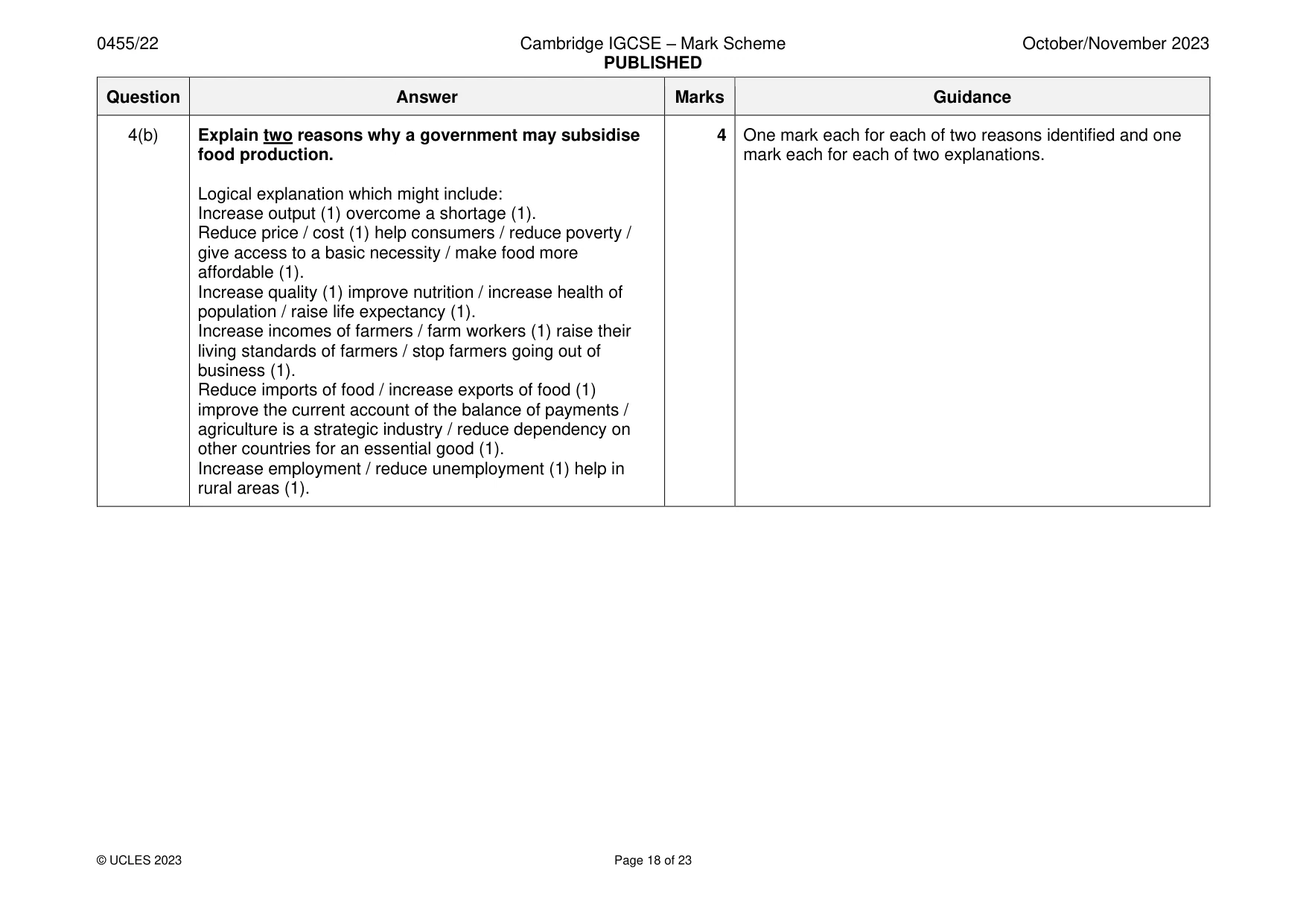
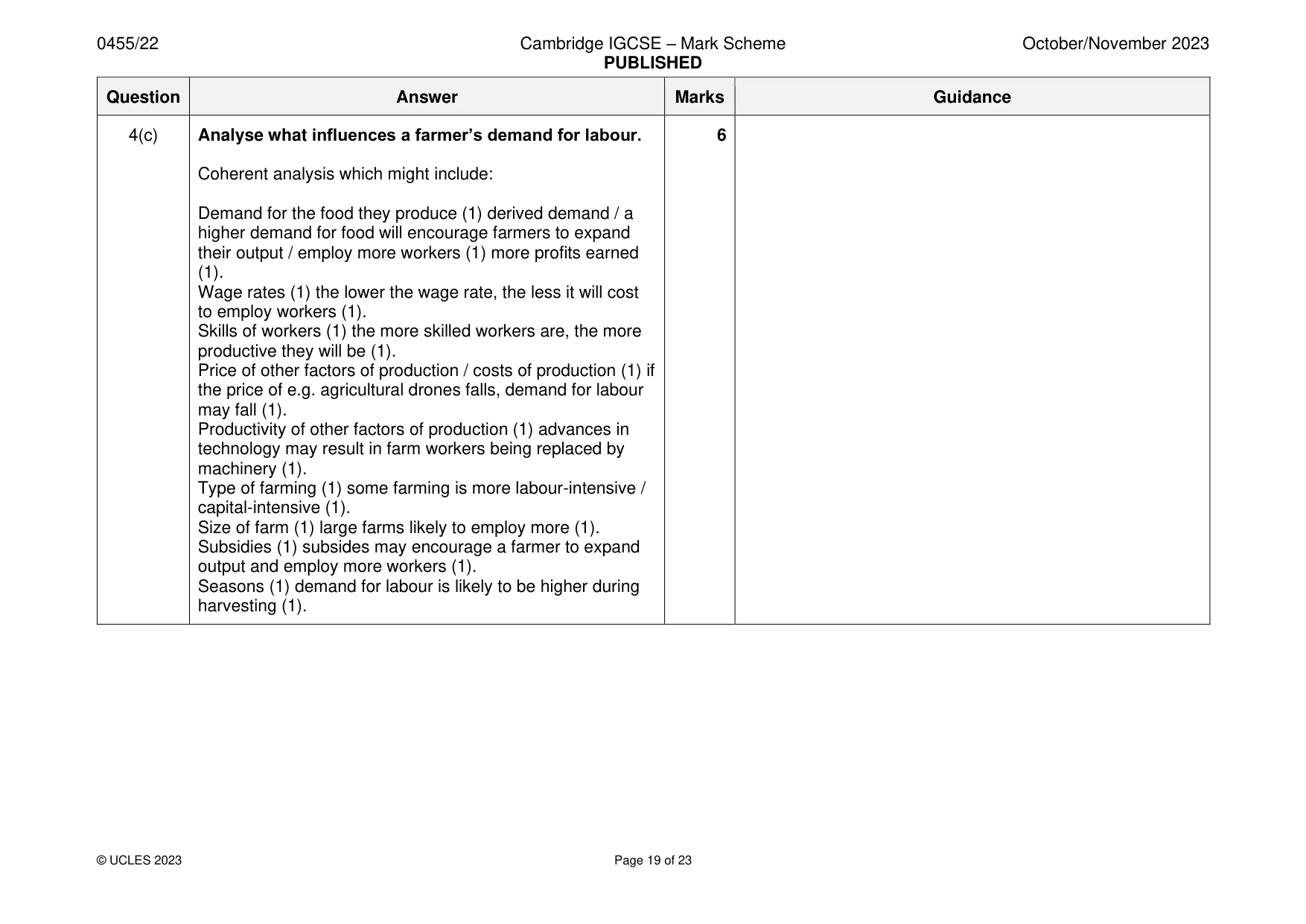
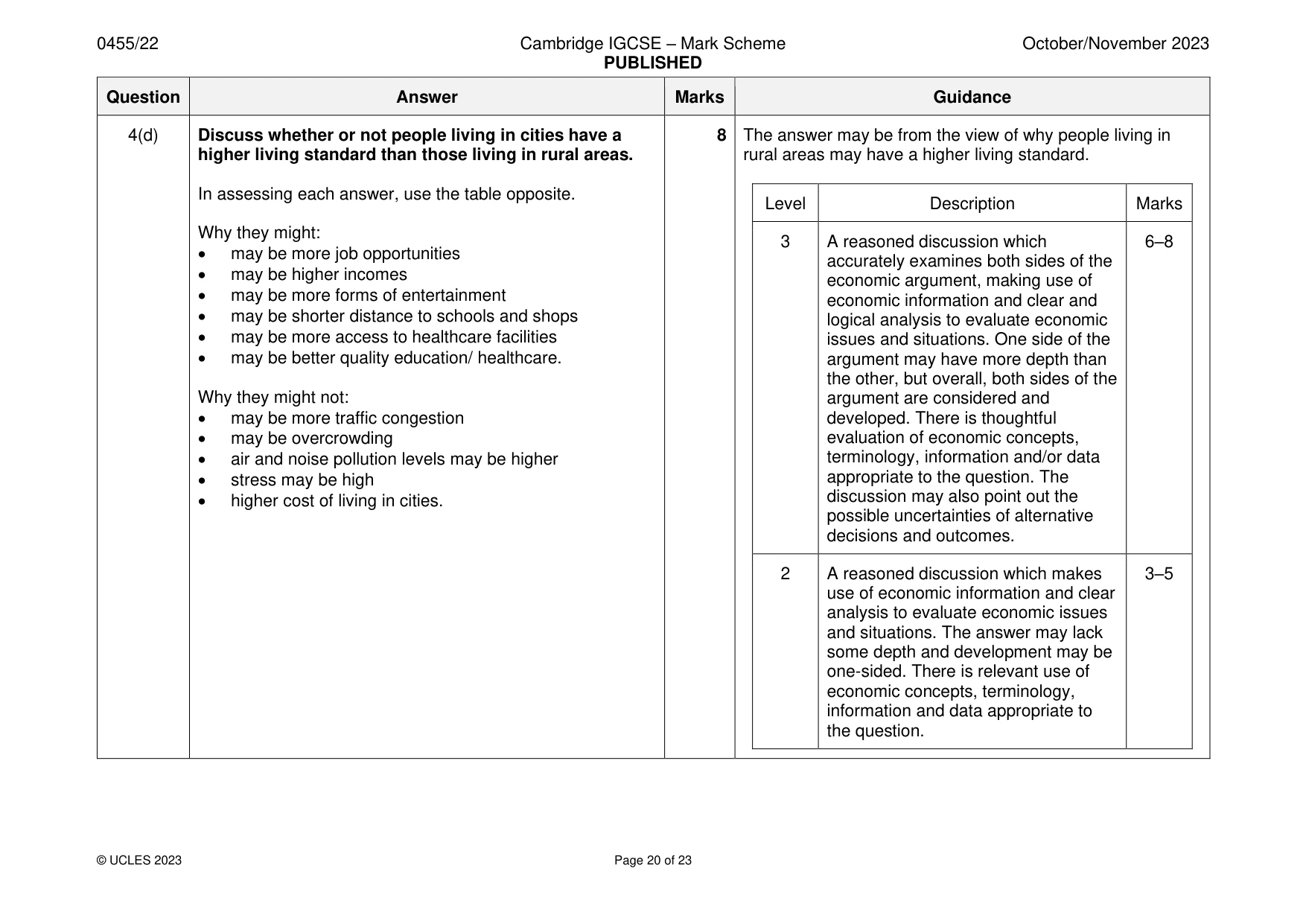
4 In the US, the supply of meat from emus, a large bird, is price-elastic. Recently, US farmers have switched to keeping other livestock and growing crops that changed their demand for labour. US farmers are influenced by the subsidies the government provides for the production of selected food items. Some people are reluctant to become farm workers as they think living standards are low in rural areas. (a) Define elastic supply. [2] (b) Explain two reasons why a government may subsidise food production. [4] (c) Analyse what influences a farmer’s demand for labour. [6] (d) Discuss whether or not people living in cities have a higher living standard than those living in rural areas. [8]
Mark scheme: 4(a) Define elastic supply. 2 The percentage change in quantity supplied is greater than the percentage change in price (2). Change in supply is greater than the change in price / PES > 1 (1). 4(b) Explain two reasons why a government may subsidise 4 One mark each for each of two reasons identified and one food production. mark each for each of two explanations. Logical explanation which might include: Increase output (1) overcome a shortage (1). Reduce price / cost (1) help consumers / reduce poverty / give access to a basic necessity / make food more affordable (1). Increase quality (1) improve nutrition / increase health of population / raise life expectancy (1). Increase incomes of farmers / farm workers (1) raise their living standards of farmers / stop farmers going out of business (1). Reduce imports of food / increase exports of food (1) improve the current account of the balance of payments / agriculture is a strategic industry / reduce dependency on other countries for an essential good (1). Increase employment / reduce unemployment (1) help in rural areas (1). 4(c) Analyse what influences a farmer’s demand for labour. 6 Coherent analysis which might include: Demand for the food they produce (1) derived demand / a higher demand for food will encourage farmers to expand their output / employ more workers (1) more profits earned (1). Wage rates (1) the lower the wage rate, the less it will cost to employ workers (1). Skills of workers (1) the more skilled workers are, the more productive they will be (1). Price of other factors of production / costs of production (1) if the price of e.g. agricultural drones falls, demand for labour may fall (1). Productivity of other factors of production (1) advances in technology may result in farm workers being replaced by machinery (1). Type of farming (1) some farming is more labour-intensive / capital-intensive (1). Size of farm (1) large farms likely to employ more (1). Subsidies (1) subsides may encourage a farmer to expand output and employ more workers (1). Seasons (1) demand for labour is likely to be higher during harvesting (1). 4(d) Discuss whether or not people living in cities have a 8 The answer may be from the view of why people living in higher living standard than those living in rural areas. rural areas may have a higher living standard. In assessing each answer, use the table opposite. Level Description Marks Why they might: 3 A reasoned discussion which 6–8 • may be more job opportunities accurately examines both sides of the • may be higher incomes economic argument, making use of • may be more forms of entertainment economic information and clear and • may be shorter distance to schools and shops logical analysis to evaluate economic • may be more access to healthcare facilities issues and situations. One side of the • may be better quality education/ healthcare. argument may have more depth than the other, but overall, both sides of the Why they might not: argument are considered and • may be more traffic congestion developed. There is thoughtful • may be overcrowding evaluation of economic concepts, • air and noise pollution levels may be higher terminology, information and/or data • stress may be high appropriate to the question. The • higher cost of living in cities. discussion may also point out the possible uncertainties of alternative decisions and outcomes. 2 A reasoned discussion which makes 3–5 use of economic information and clear analysis to evaluate economic issues and situations. The answer may lack some depth and development may be one-sided. There is relevant use of economic concepts, terminology, information and data appropriate to the question. 4(d) Level Description Marks 1 There is a simple attempt at using 1–2 economic definitions and terminology. Some reference may be made to economic theory, with occasional understanding. 0 A mark of zero should be awarded for 0 no creditable content.
Q5 · In 2020, Singapore experienced a decrease in both its population size and its labour force
5 In 2020, Singapore experienced a decrease in both its population size and its labour force. 2020 was a year of great change in a number of Singaporean markets. Some moved from disequilibrium to equilibrium. Despite all these changes, Singapore managed to increase its exports of goods and services. (a) Identify two benefits of a decrease in a country’s population size. [2] (b) Explain how a market moves from disequilibrium to equilibrium. [4] (c) Analyse, using a production possibility curve (PPC) diagram, the effect of a decrease in the size of a country’s labour force on its economy. [6] (d) Discuss whether or not an increase in exports will benefit an economy. [8]
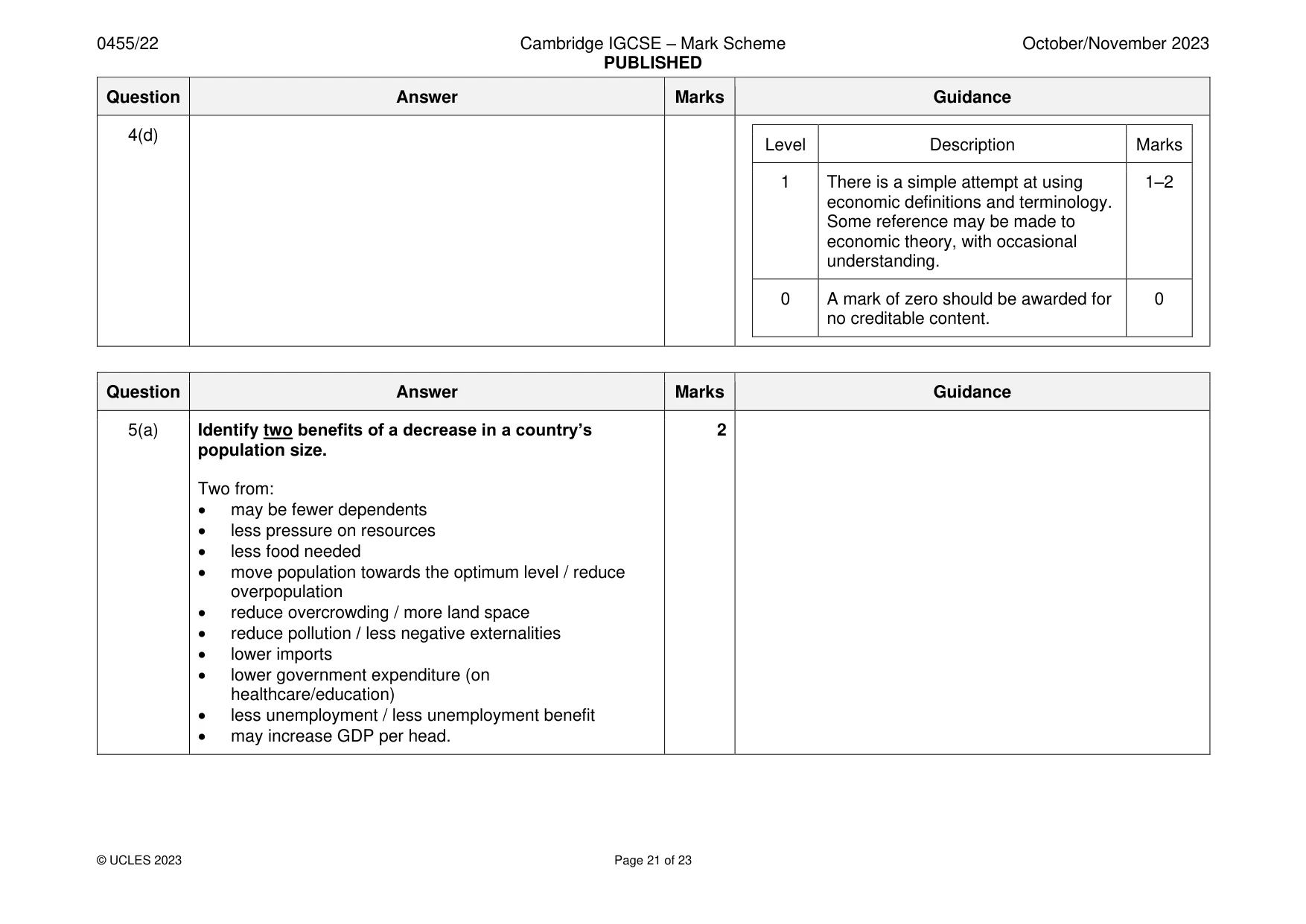
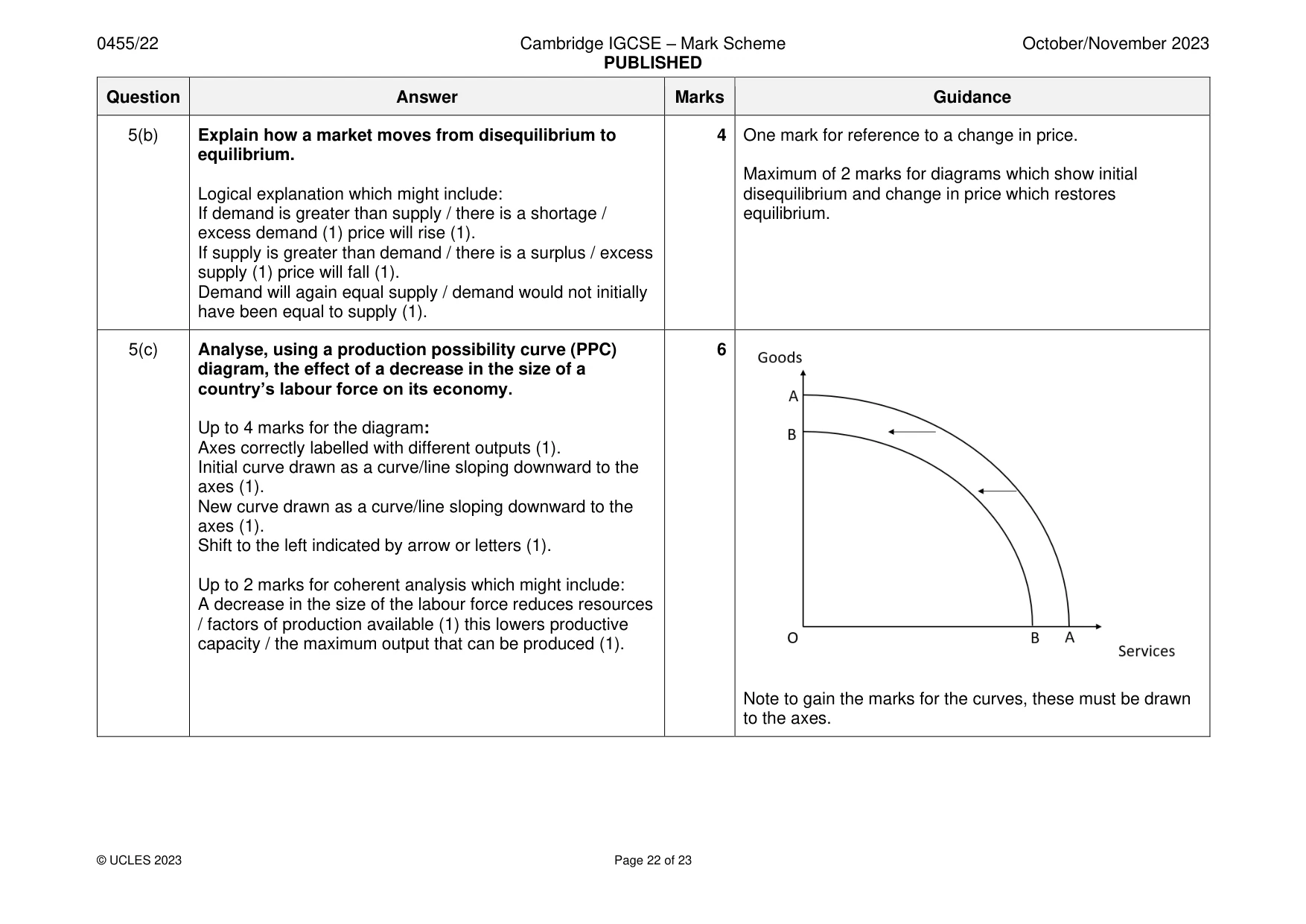
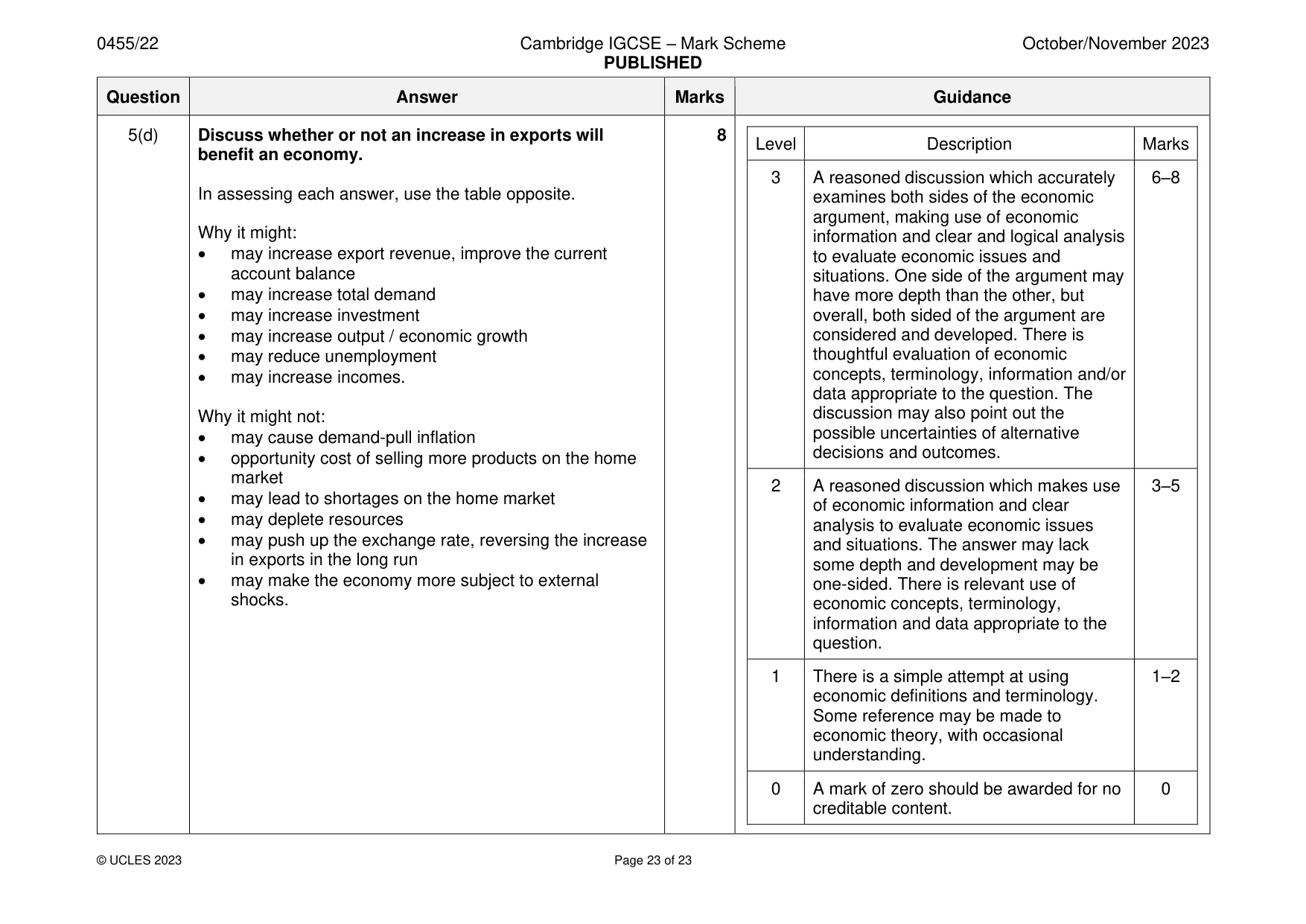
Mark scheme: 5(a) Identify two benefits of a decrease in a country’s 2 population size. Two from: • may be fewer dependents • less pressure on resources • less food needed • move population towards the optimum level / reduce overpopulation • reduce overcrowding / more land space • reduce pollution / less negative externalities • lower imports • lower government expenditure (on healthcare/education) • less unemployment / less unemployment benefit • may increase GDP per head. 5(b) Explain how a market moves from disequilibrium to 4 One mark for reference to a change in price. equilibrium. Maximum of 2 marks for diagrams which show initial Logical explanation which might include: disequilibrium and change in price which restores If demand is greater than supply / there is a shortage / equilibrium. excess demand (1) price will rise (1). If supply is greater than demand / there is a surplus / excess supply (1) price will fall (1). Demand will again equal supply / demand would not initially have been equal to supply (1). 5(c) Analyse, using a production possibility curve (PPC) 6 diagram, the effect of a decrease in the size of a country’s labour force on its economy. Up to 4 marks for the diagram: Axes correctly labelled with different outputs (1). Initial curve drawn as a curve/line sloping downward to the axes (1). New curve drawn as a curve/line sloping downward to the axes (1). Shift to the left indicated by arrow or letters (1). Up to 2 marks for coherent analysis which might include: A decrease in the size of the labour force reduces resources / factors of production available (1) this lowers productive capacity / the maximum output that can be produced (1). Note to gain the marks for the curves, these must be drawn to the axes. 5(d) Discuss whether or not an increase in exports will 8 Level Description Marks benefit an economy. 3 A reasoned discussion which accurately 6–8 In assessing each answer, use the table opposite. examines both sides of the economic argument, making use of economic Why it might: information and clear and logical analysis • may increase export revenue, improve the current to evaluate economic issues and account balance situations. One side of the argument may • may increase total demand have more depth than the other, but • may increase investment overall, both sided of the argument are • may increase output / economic growth considered and developed. There is • may reduce unemployment thoughtful evaluation of economic • may increase incomes. concepts, terminology, information and/or data appropriate to the question. The Why it might not: discussion may also point out the • may cause demand-pull inflation possible uncertainties of alternative • opportunity cost of selling more products on the home decisions and outcomes. market 2 A reasoned discussion which makes use 3–5 • may lead to shortages on the home market of economic information and clear • may deplete resources analysis to evaluate economic issues • may push up the exchange rate, reversing the increase and situations. The answer may lack in exports in the long run some depth and development may be • may make the economy more subject to external one-sided. There is relevant use of shocks. economic concepts, terminology, information and data appropriate to the question. 1 There is a simple attempt at using 1–2 economic definitions and terminology. Some reference may be made to economic theory, with occasional understanding. 0 A mark of zero should be awarded for no 0 creditable content.
What was in this paper
The subtopics covered by these 5 questions, and how many questions each got. Open one in a new tab to see every Cambridge question on it.
What you needed in this session
Cambridge’s own grade thresholds for 2023 Oct/Nov, Paper 2 · Variant 2. A higher threshold means an easier paper — the bar moves with how the cohort did.