Cambridge IGCSE Economics 0455 — 2018 Oct/Nov Paper 2 · Variant 3
0455/23/O/N/18 · 7 questions · 90 marks · ≈101 min
The question paper and its mark scheme, free to read here and free to download. This is Cambridge’s own paper, exactly as it was sat.
Question paper8 pages
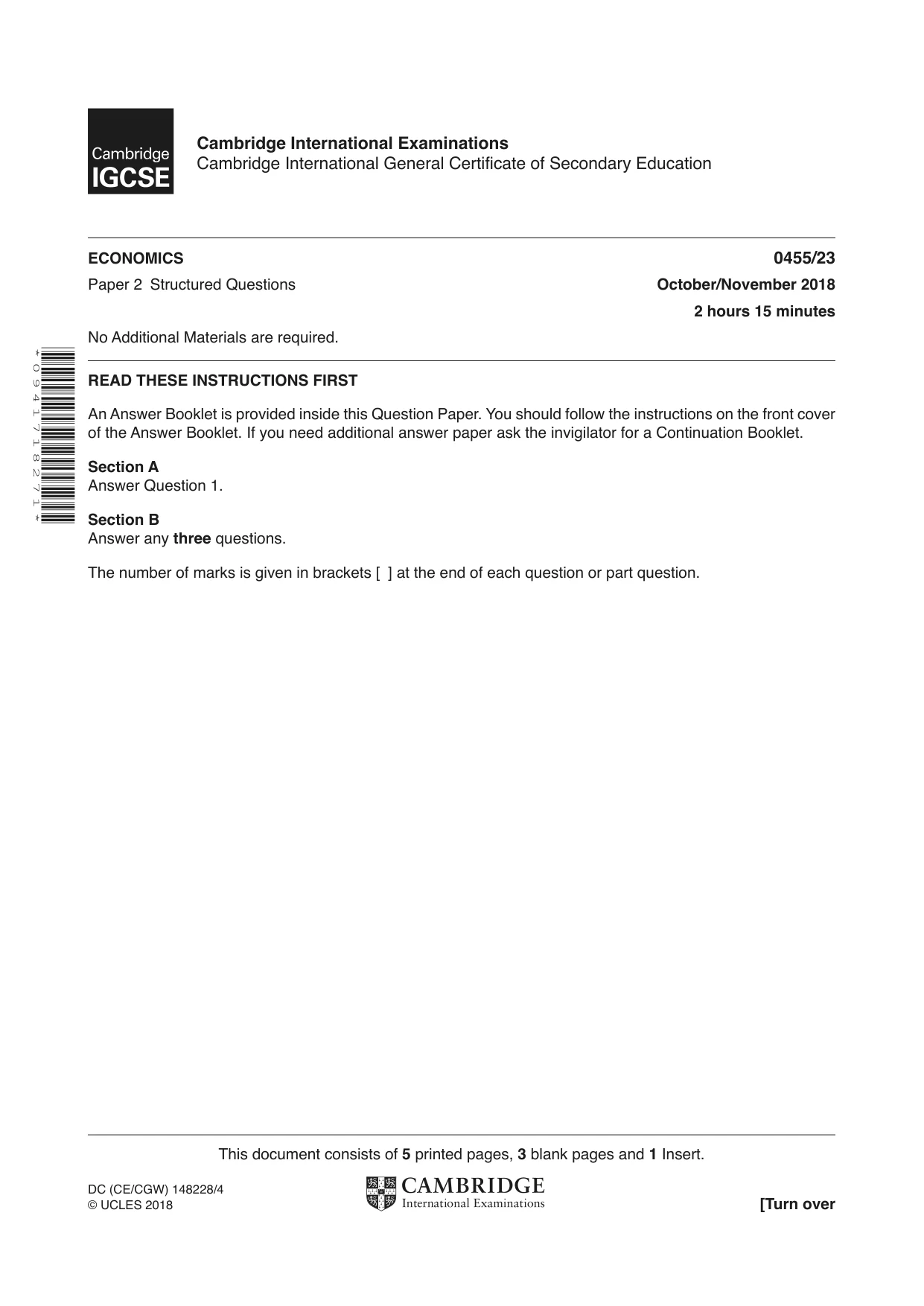
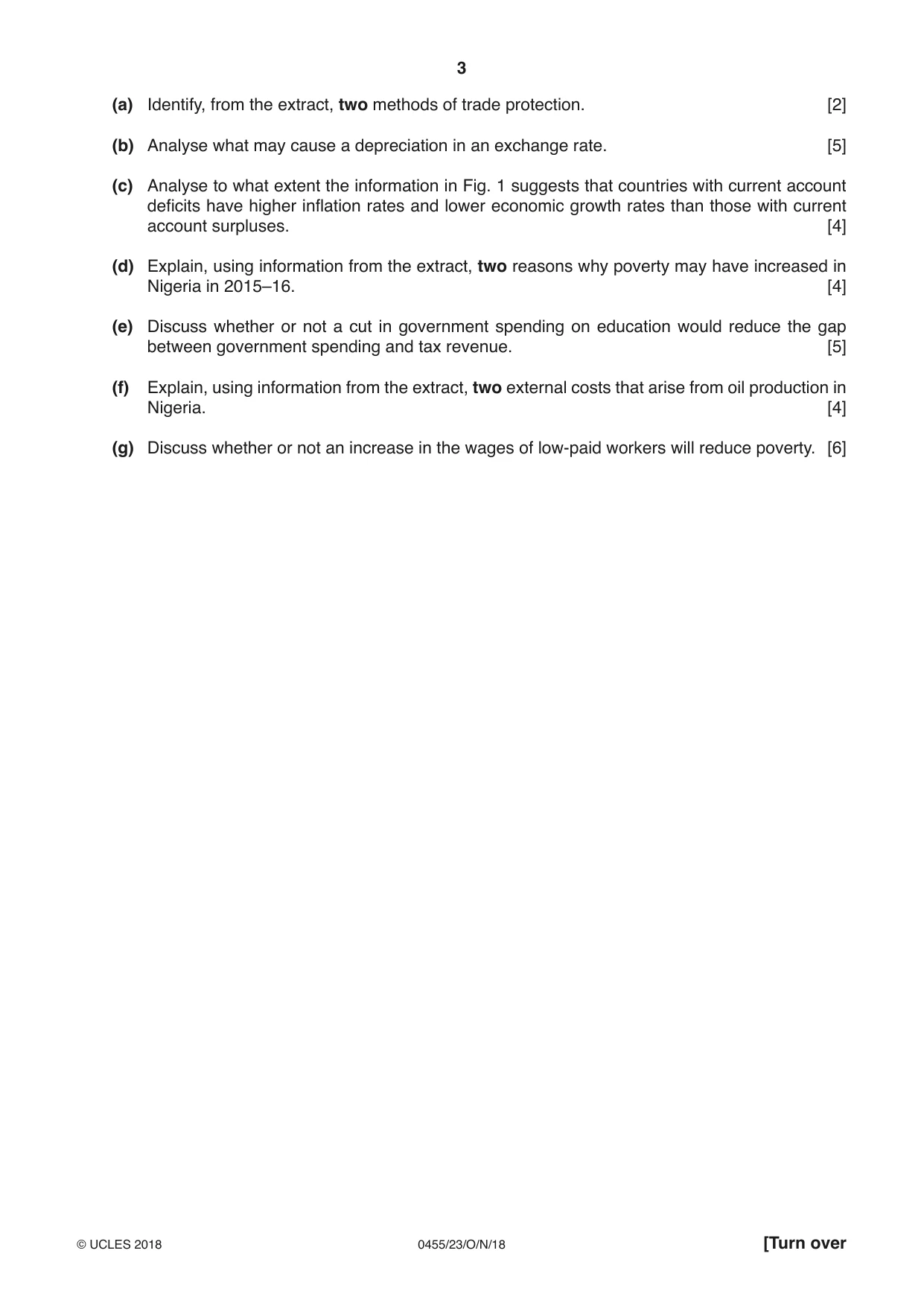
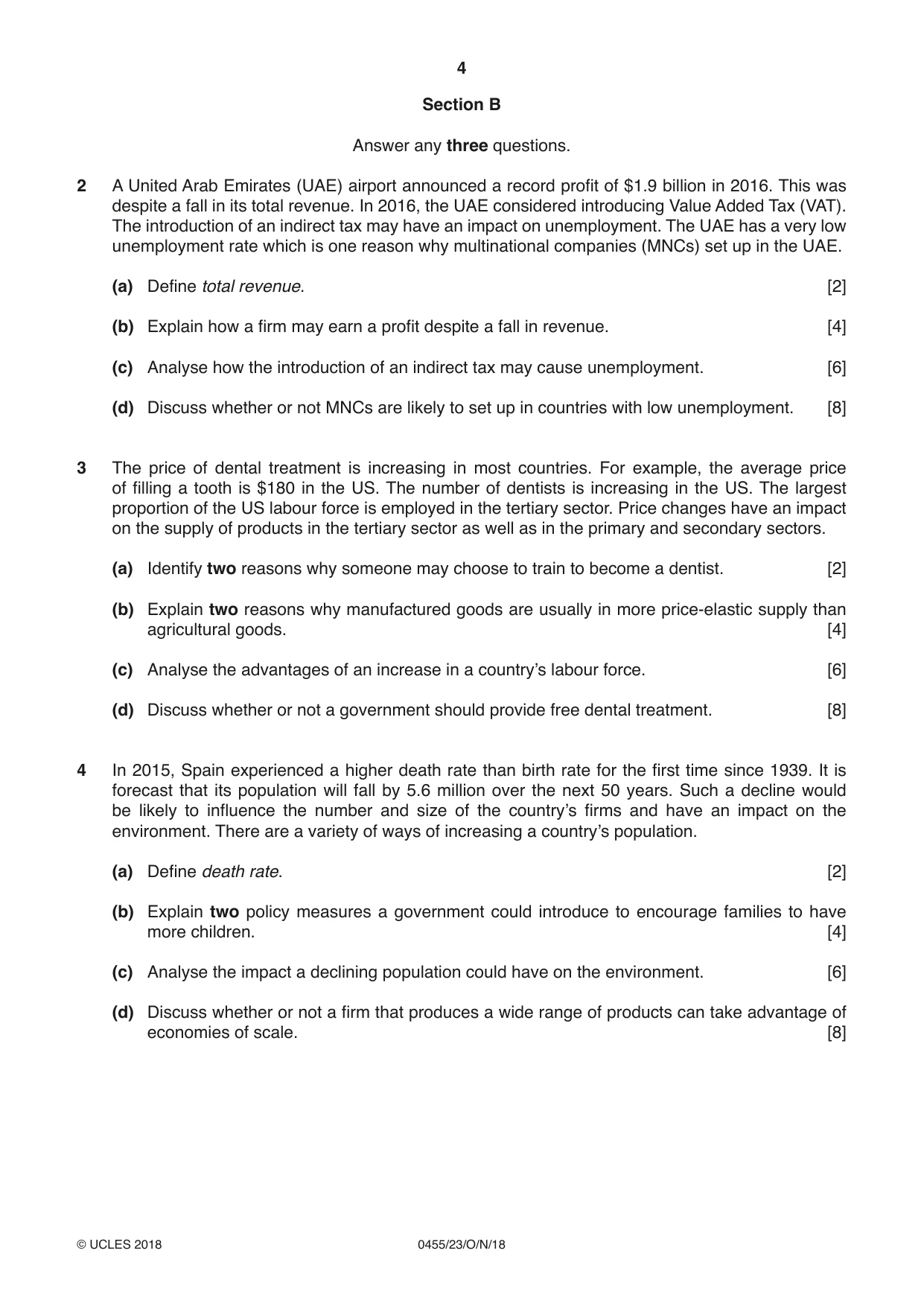



Mark scheme19 pages
Answers below. Sit the paper first if you are practising.
Questions as text
Q1 · Nigeria adopts a floating exchange rate In June 2016, Nigeria adopted a floating exchange…
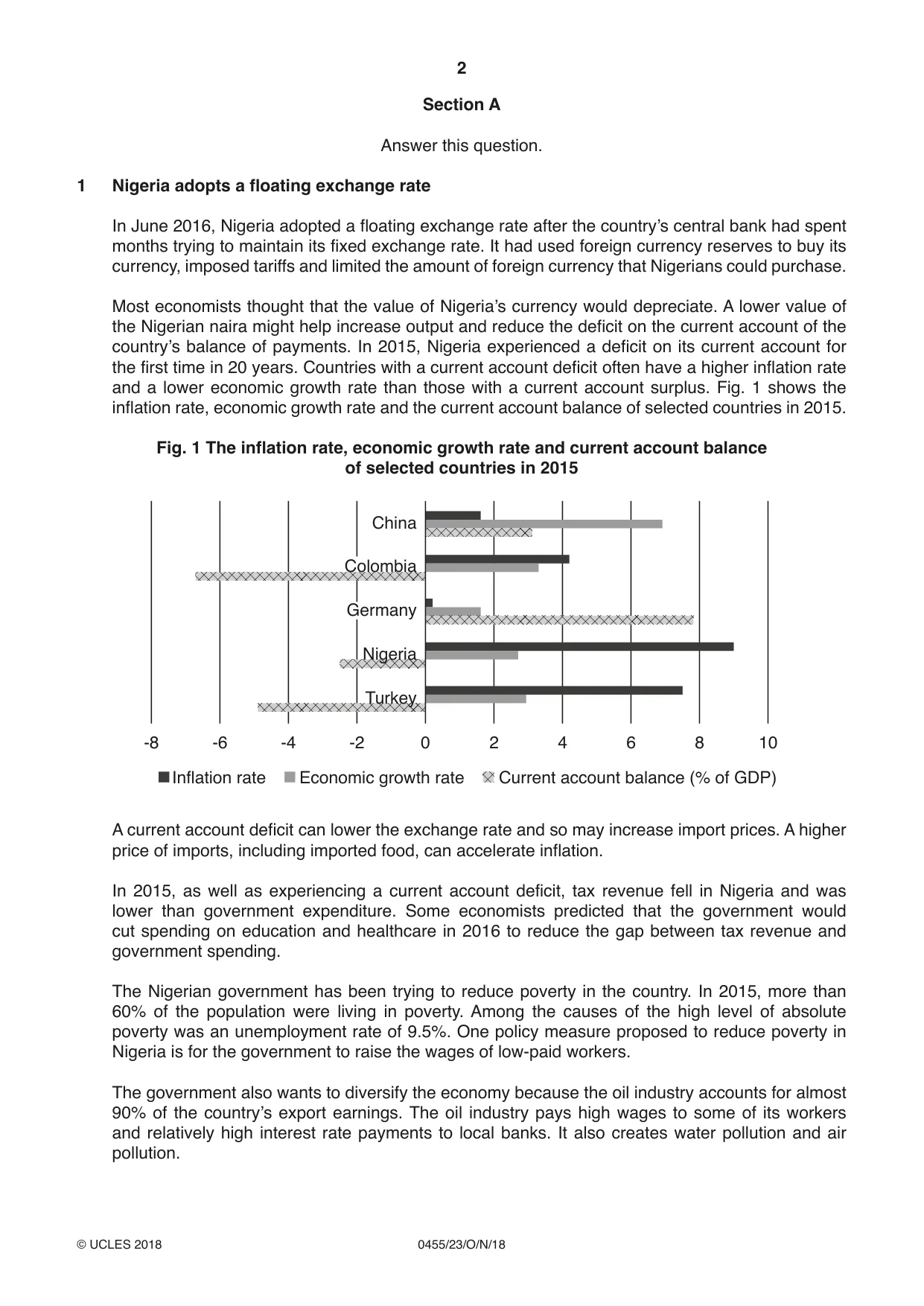
1 Nigeria adopts a floating exchange rate In June 2016, Nigeria adopted a floating exchange rate after the country’s central bank had spent months trying to maintain its fixed exchange rate. It had used foreign currency reserves to buy its currency, imposed tariffs and limited the amount of foreign currency that Nigerians could purchase. Most economists thought that the value of Nigeria’s currency would depreciate. A lower value of the Nigerian naira might help increase output and reduce the deficit on the current account of the country’s balance of payments. In 2015, Nigeria experienced a deficit on its current account for the first time in 20 years. Countries with a current account deficit often have a higher inflation rate and a lower economic growth rate than those with a current account surplus. Fig. 1 shows the inflation rate, economic growth rate and the current account balance of selected countries in 2015. Fig. 1 The inflation rate, economic growth rate and current account balance of selected countries in 2015 China Colombia Germany Nigeria Turkey -8 -6 -4 -2 0 2 4 6 8 10 Inflation rate Economic growth rate Current account balance (% of GDP) A current account deficit can lower the exchange rate and so may increase import prices. A higher price of imports, including imported food, can accelerate inflation. In 2015, as well as experiencing a current account deficit, tax revenue fell in Nigeria and was lower than government expenditure. Some economists predicted that the government would cut spending on education and healthcare in 2016 to reduce the gap between tax revenue and government spending. The Nigerian government has been trying to reduce poverty in the country. In 2015, more than 60% of the population were living in poverty. Among the causes of the high level of absolute poverty was an unemployment rate of 9.5%. One policy measure proposed to reduce poverty in Nigeria is for the government to raise the wages of low-paid workers. The government also wants to diversify the economy because the oil industry accounts for almost 90% of the country’s export earnings. The oil industry pays high wages to some of its workers and relatively high interest rate payments to local banks. It also creates water pollution and air pollution. (a) Identify, from the extract, two methods of trade protection. [2] (b) Analyse what may cause a depreciation in an exchange rate. [5] (c) Analyse to what extent the information in Fig. 1 suggests that countries with current account deficits have higher inflation rates and lower economic growth rates than those with current account surpluses. [4] (d) Explain, using information from the extract, two reasons why poverty may have increased in Nigeria in 2015–16. [4] (e) Discuss whether or not a cut in government spending on education would reduce the gap between government spending and tax revenue. [5] (f) Explain, using information from the extract, two external costs that arise from oil production in Nigeria. [4] (g) Discuss whether or not an increase in the wages of low-paid workers will reduce poverty. [6]
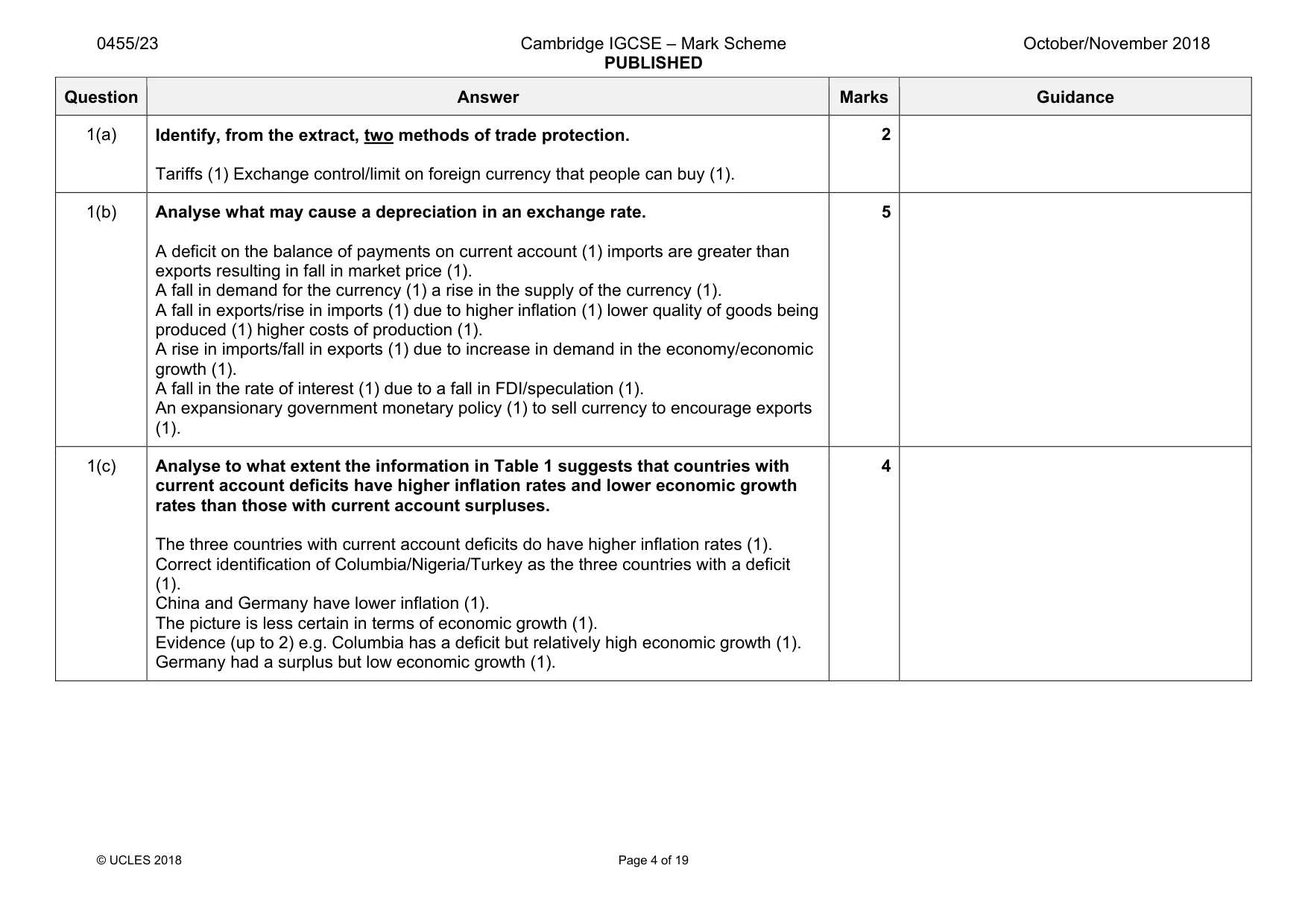
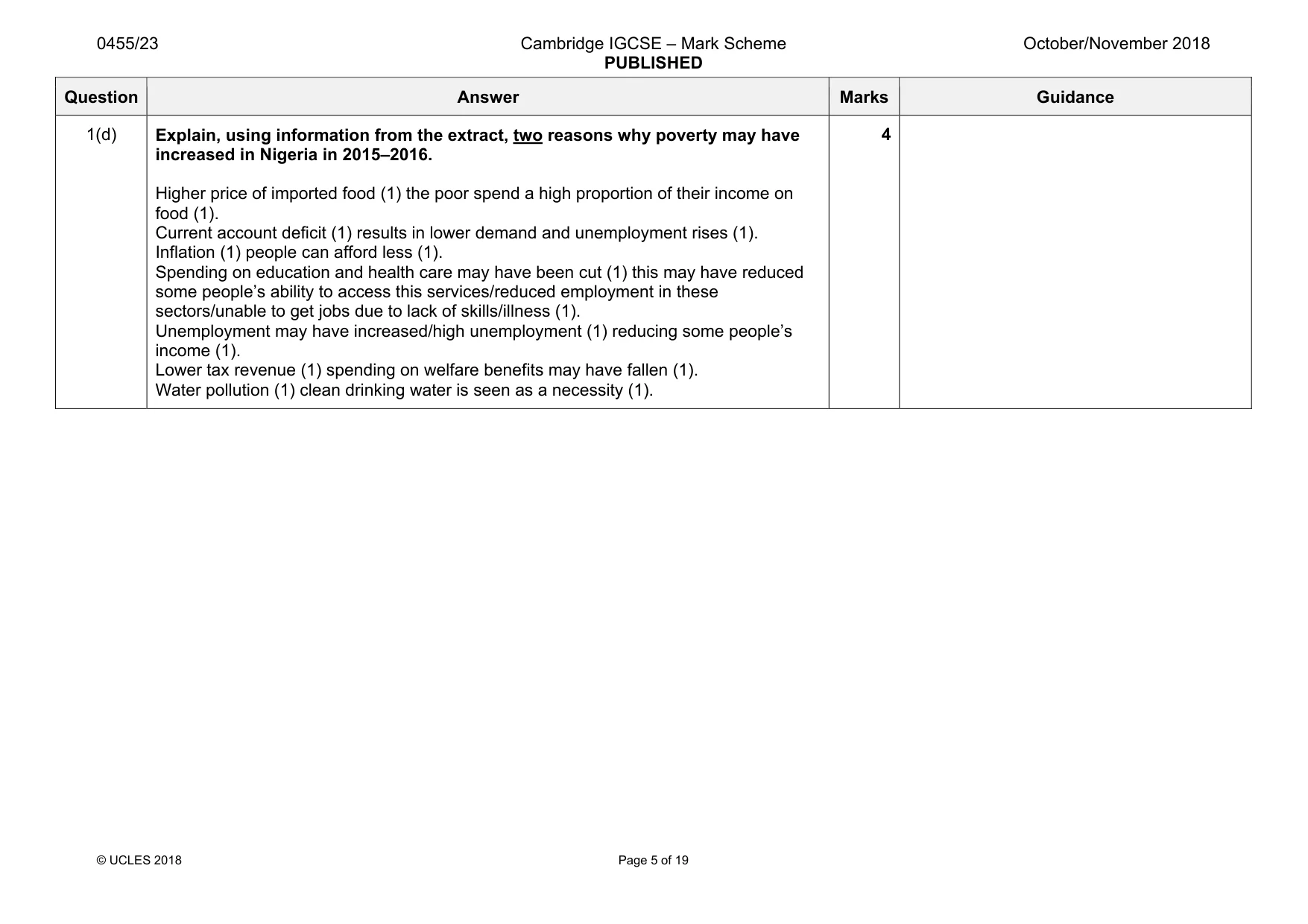
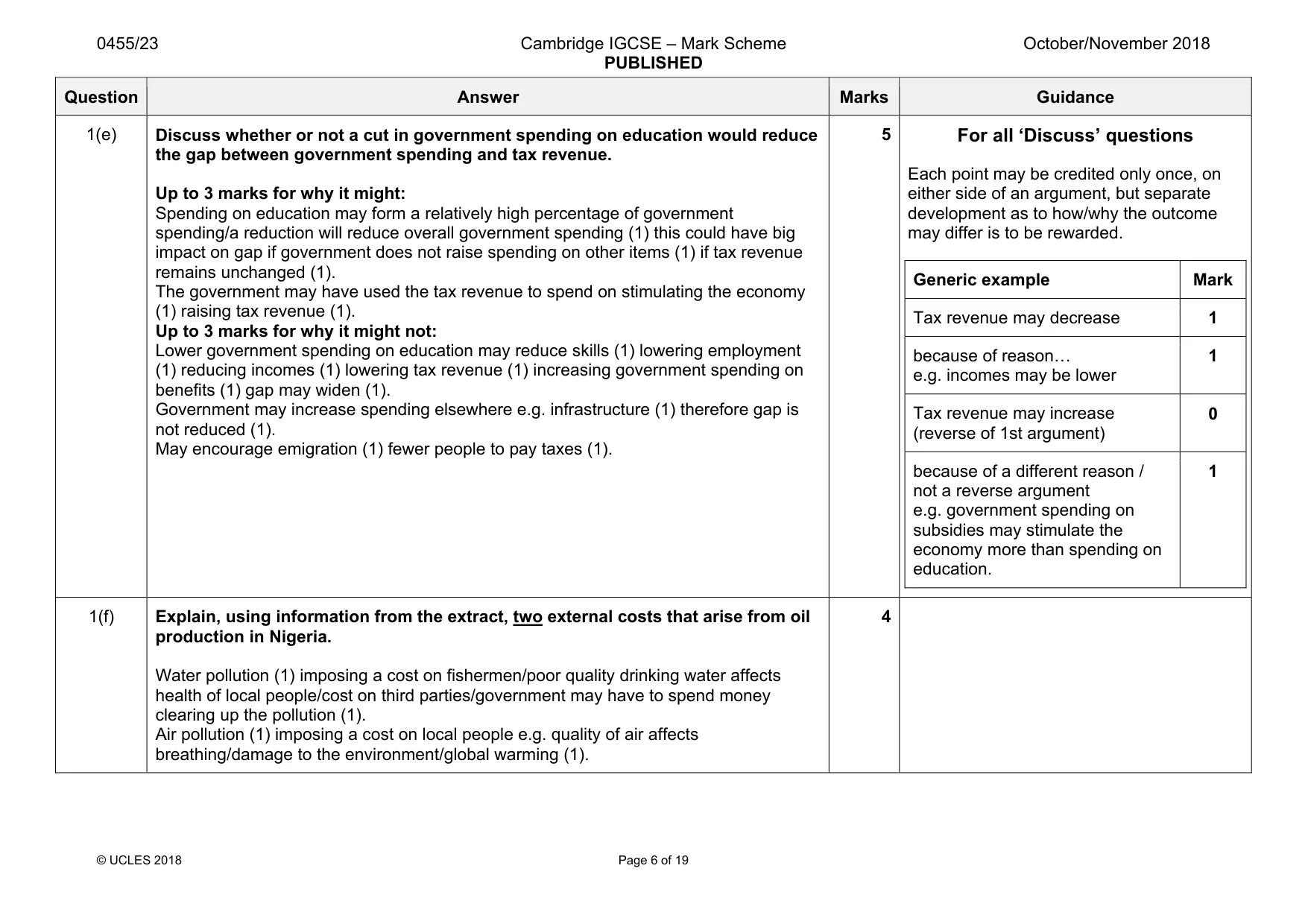
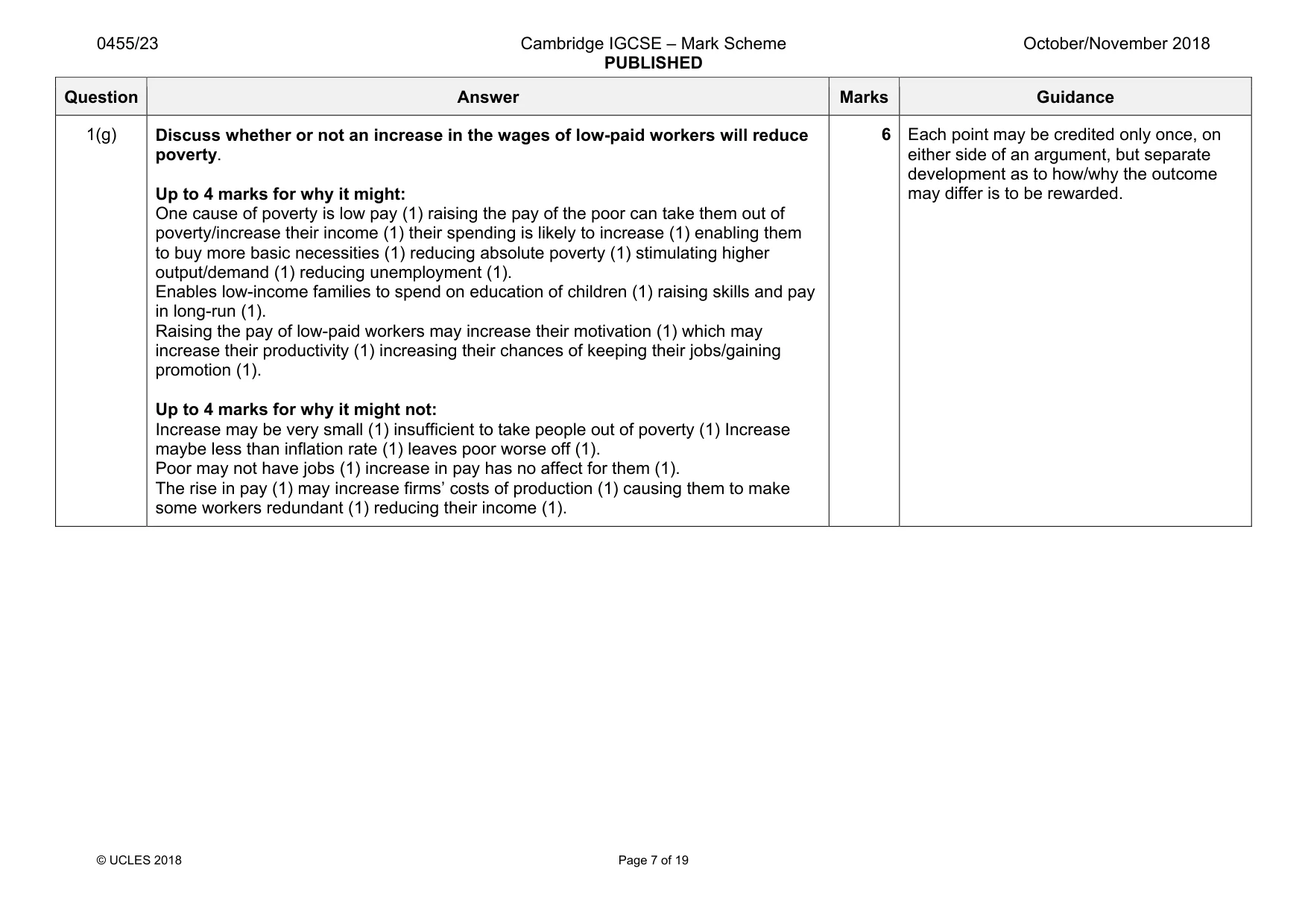
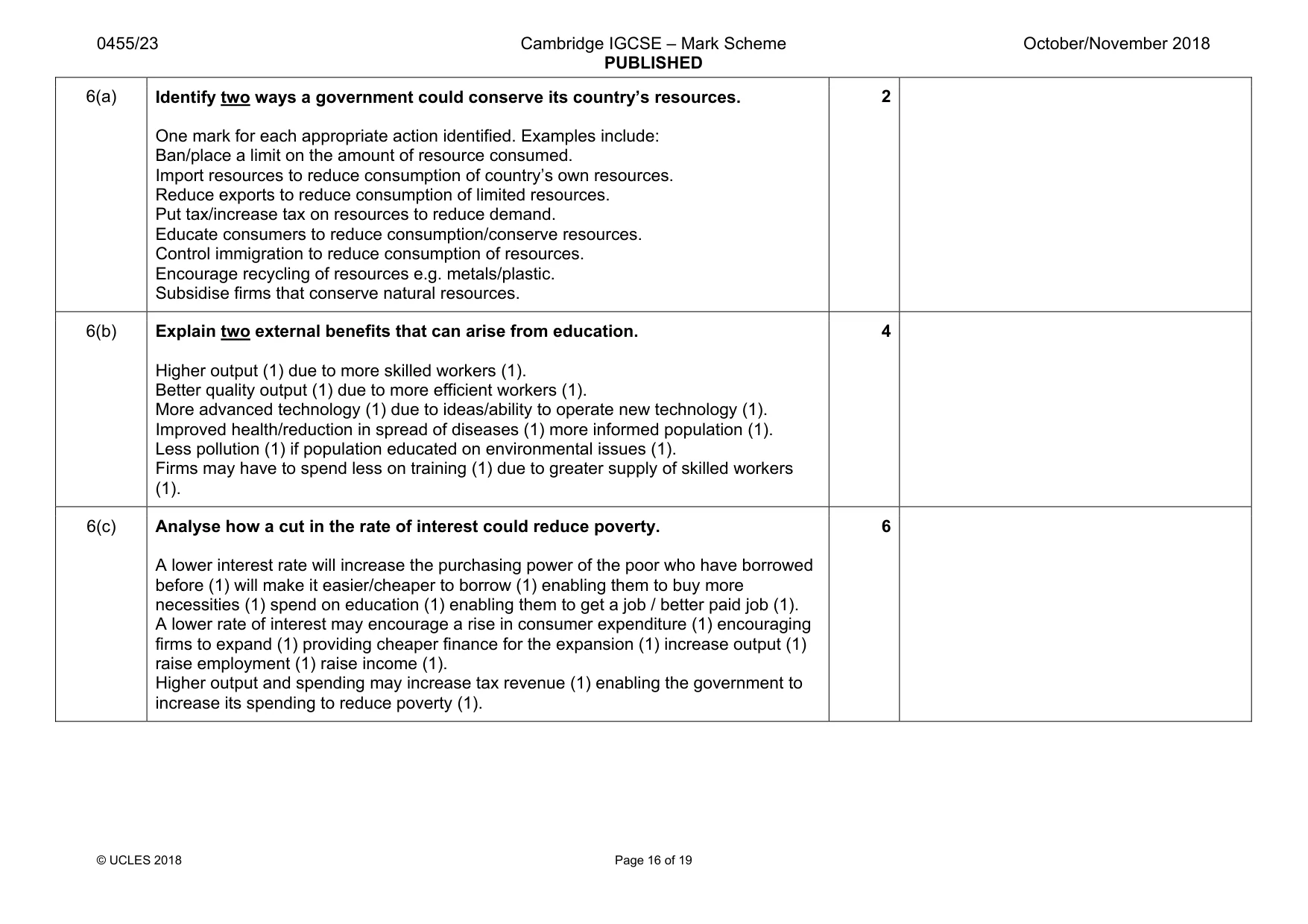
Mark scheme: 1(a) Identify, from the extract, two methods of trade protection. Tariffs (1) Exchange control/limit on foreign currency that people can buy (1). 2 1(b) Analyse what may cause a depreciation in an exchange rate. A deficit on the balance of payments on current account (1) imports are greater than exports resulting in fall in market price (1). A fall in demand for the currency (1) a rise in the supply of the currency (1). A fall in exports/rise in imports (1) due to higher inflation (1) lower quality of goods being produced (1) higher costs of production (1). A rise in imports/fall in exports (1) due to increase in demand in the economy/economic growth (1). A fall in the rate of interest (1) due to a fall in FDI/speculation (1). An expansionary government monetary policy (1) to sell currency to encourage exports (1). 5 1(c) Analyse to what extent the information in Table 1 suggests that countries with current account deficits have higher inflation rates and lower economic growth rates than those with current account surpluses. The three countries with current account deficits do have higher inflation rates (1). Correct identification of Columbia/Nigeria/Turkey as the three countries with a deficit (1). China and Germany have lower inflation (1). The picture is less certain in terms of economic growth (1). Evidence (up to 2) e.g. Columbia has a deficit but relatively high economic growth (1). Germany had a surplus but low economic growth (1). 4 Question Answer Marks Guidance 1(d) Explain, using information from the extract, two reasons why poverty may have increased in Nigeria in 2015–2016. Higher price of imported food (1) the poor spend a high proportion of their income on food (1). Current account deficit (1) results in lower demand and unemployment rises (1). Inflation (1) people can afford less (1). Spending on education and health care may have been cut (1) this may have reduced some people’s ability to access this services/reduced employment in these sectors/unable to get jobs due to lack of skills/illness (1). Unemployment may have increased/high unemployment (1) reducing some people’s income (1). Lower tax revenue (1) spending on welfare benefits may have fallen (1). Water pollution (1) clean drinking water is seen as a necessity (1). 4 Question Answer Marks Guidance 1(e) Discuss whether or not a cut in government spending on education would reduce the gap between government spending and tax revenue. Up to 3 marks for why it might: Spending on education may form a relatively high percentage of government spending/a reduction will reduce overall government spending (1) this could have big impact on gap if government does not raise spending on other items (1) if tax revenue remains unchanged (1). The government may have used the tax revenue to spend on stimulating the economy (1) raising tax revenue (1). Up to 3 marks for why it might not: Lower government spending on education may reduce skills (1) lowering employment (1) reducing incomes (1) lowering tax revenue (1) increasing government spending on benefits (1) gap may widen (1). Government may increase spending elsewhere e.g. infrastructure (1) therefore gap is not reduced (1). May encourage emigration (1) fewer people to pay taxes (1). 5 For all ‘Discuss’ questions Each point may be credited only once, on either side of an argument, but separate development as to how/why the outcome may differ is to be rewarded. Generic example Mark Tax revenue may decrease 1 because of reason« e.g. incomes may be lower 1 Tax revenue may increase (reverse of 1st argument) 0 because of a different reason / not a reverse argument e.g. government spending on subsidies may stimulate the economy more than spending on education. 1 1(f) Explain, using information from the extract, two external costs that arise from oil production in Nigeria. Water pollution (1) imposing a cost on fishermen/poor quality drinking water affects health of local people/cost on third parties/government may have to spend money clearing up the pollution (1). Air pollution (1) imposing a cost on local people e.g. quality of air affects breathing/damage to the environment/global warming (1). 4 Question Answer Marks Guidance 1(g) Discuss whether or not an increase in the wages of low-paid workers will reduce poverty. Up to 4 marks for why it might: One cause of poverty is low pay (1) raising the pay of the poor can take them out of poverty/increase their income (1) their spending is likely to increase (1) enabling them to buy more basic necessities (1) reducing absolute poverty (1) stimulating higher output/demand (1) reducing unemployment (1). Enables low-income families to spend on education of children (1) raising skills and pay in long-run (1). Raising the pay of low-paid workers may increase their motivation (1) which may increase their productivity (1) increasing their chances of keeping their jobs/gaining promotion (1). Up to 4 marks for why it might not: Increase may be very small (1) insufficient to take people out of poverty (1) Increase maybe less than inflation rate (1) leaves poor worse off (1). Poor may not have jobs (1) increase in pay has no affect for them (1). The rise in pay (1) may increase firms’ costs of production (1) causing them to make some workers redundant (1) reducing their income (1). 6 Each point may be credited only once, on either side of an argument, but separate development as to how/why the outcome may differ is to be rewarded.
Q2 · A United Arab Emirates (UAE) airport announced a record profit of $1.9 billion in 2016
2 A United Arab Emirates (UAE) airport announced a record profit of $1.9 billion in 2016. This was despite a fall in its total revenue. In 2016, the UAE considered introducing Value Added Tax (VAT). The introduction of an indirect tax may have an impact on unemployment. The UAE has a very low unemployment rate which is one reason why multinational companies (MNCs) set up in the UAE. (a) Define total revenue. [2] (b) Explain how a firm may earn a profit despite a fall in revenue. [4] (c) Analyse how the introduction of an indirect tax may cause unemployment. [6] (d) Discuss whether or not MNCs are likely to set up in countries with low unemployment. [8]
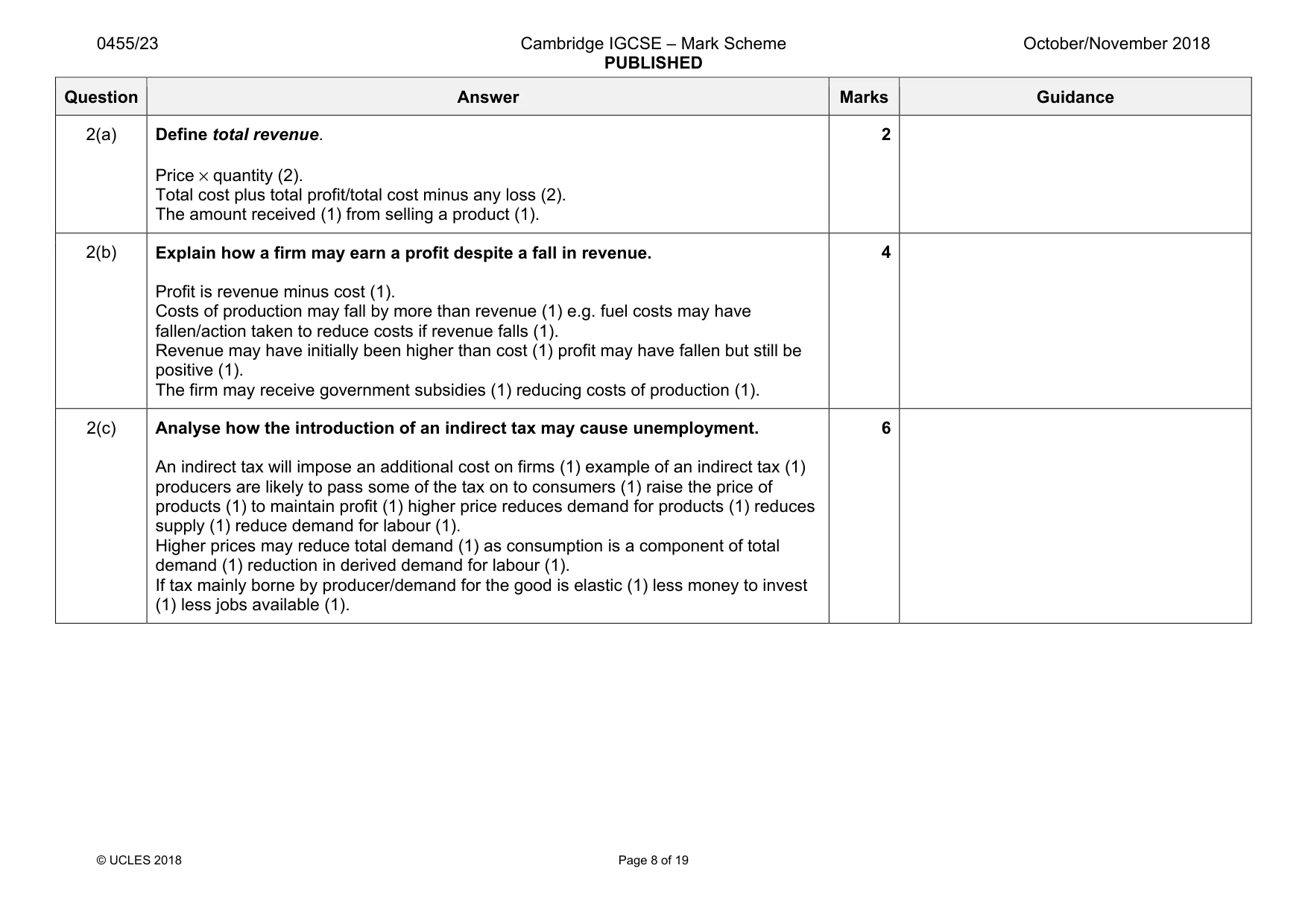
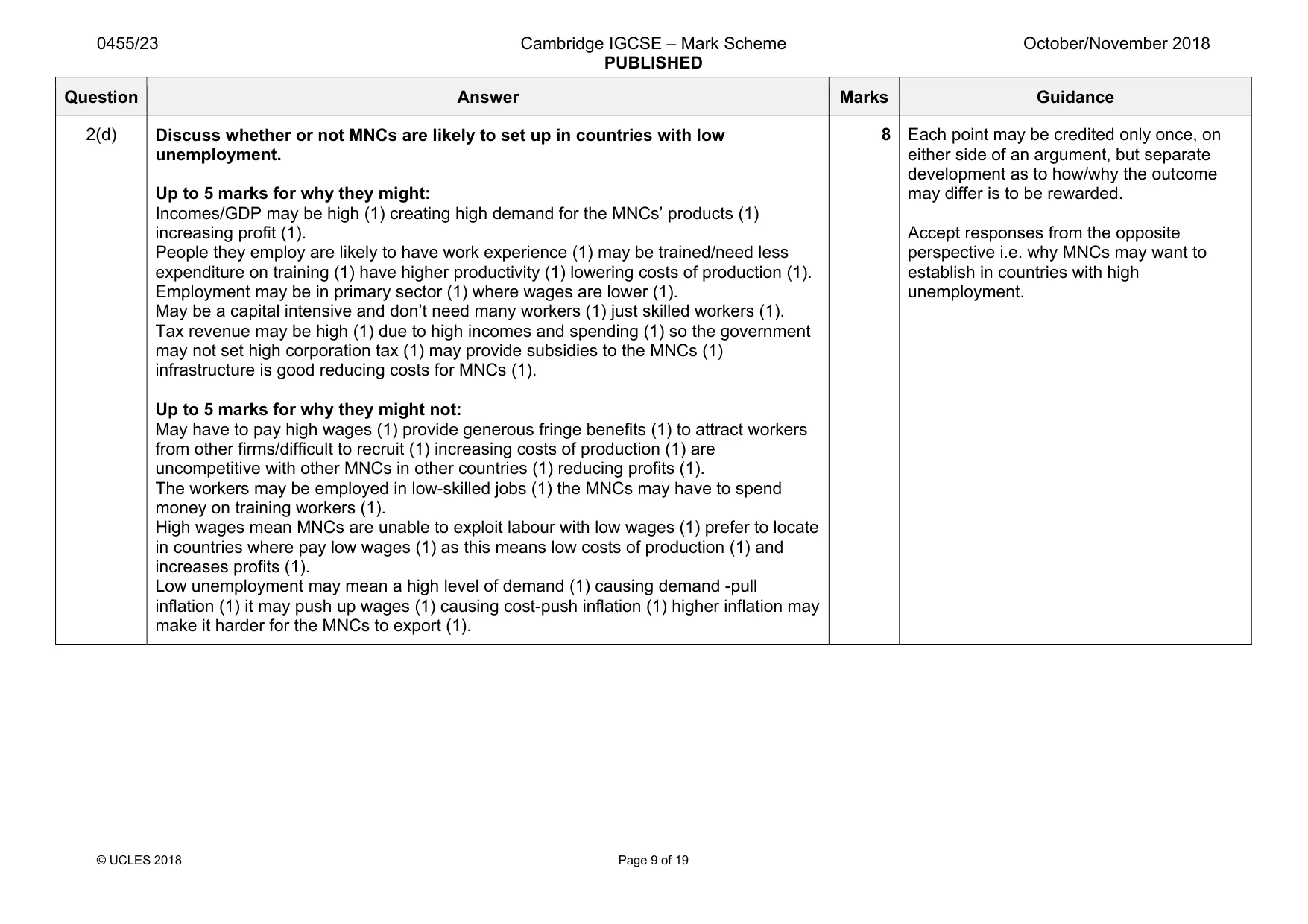
Mark scheme: 2(a) Define total revenue. Price × quantity (2). Total cost plus total profit/total cost minus any loss (2). The amount received (1) from selling a product (1). 2 2(b) Explain how a firm may earn a profit despite a fall in revenue. Profit is revenue minus cost (1). Costs of production may fall by more than revenue (1) e.g. fuel costs may have fallen/action taken to reduce costs if revenue falls (1). Revenue may have initially been higher than cost (1) profit may have fallen but still be positive (1). The firm may receive government subsidies (1) reducing costs of production (1). 4 2(c) Analyse how the introduction of an indirect tax may cause unemployment. An indirect tax will impose an additional cost on firms (1) example of an indirect tax (1) producers are likely to pass some of the tax on to consumers (1) raise the price of products (1) to maintain profit (1) higher price reduces demand for products (1) reduces supply (1) reduce demand for labour (1). Higher prices may reduce total demand (1) as consumption is a component of total demand (1) reduction in derived demand for labour (1). If tax mainly borne by producer/demand for the good is elastic (1) less money to invest (1) less jobs available (1). 6 Question Answer Marks Guidance 2(d) Discuss whether or not MNCs are likely to set up in countries with low unemployment. Up to 5 marks for why they might: Incomes/GDP may be high (1) creating high demand for the MNCs’ products (1) increasing profit (1). People they employ are likely to have work experience (1) may be trained/need less expenditure on training (1) have higher productivity (1) lowering costs of production (1). Employment may be in primary sector (1) where wages are lower (1). May be a capital intensive and don’t need many workers (1) just skilled workers (1). Tax revenue may be high (1) due to high incomes and spending (1) so the government may not set high corporation tax (1) may provide subsidies to the MNCs (1) infrastructure is good reducing costs for MNCs (1). Up to 5 marks for why they might not: May have to pay high wages (1) provide generous fringe benefits (1) to attract workers from other firms/difficult to recruit (1) increasing costs of production (1) are uncompetitive with other MNCs in other countries (1) reducing profits (1). The workers may be employed in low-skilled jobs (1) the MNCs may have to spend money on training workers (1). High wages mean MNCs are unable to exploit labour with low wages (1) prefer to locate in countries where pay low wages (1) as this means low costs of production (1) and increases profits (1). Low unemployment may mean a high level of demand (1) causing demand -pull inflation (1) it may push up wages (1) causing cost-push inflation (1) higher inflation may make it harder for the MNCs to export (1). 8 Each point may be credited only once, on either side of an argument, but separate development as to how/why the outcome may differ is to be rewarded. Accept responses from the opposite perspective i.e. why MNCs may want to establish in countries with high unemployment.
Q3 · The price of dental treatment is increasing in most countries
3 The price of dental treatment is increasing in most countries. For example, the average price of filling a tooth is $180 in the US. The number of dentists is increasing in the US. The largest proportion of the US labour force is employed in the tertiary sector. Price changes have an impact on the supply of products in the tertiary sector as well as in the primary and secondary sectors. (a) Identify two reasons why someone may choose to train to become a dentist. [2] (b) Explain two reasons why manufactured goods are usually in more price-elastic supply than agricultural goods. [4] (c) Analyse the advantages of an increase in a country’s labour force. [6] (d) Discuss whether or not a government should provide free dental treatment. [8]
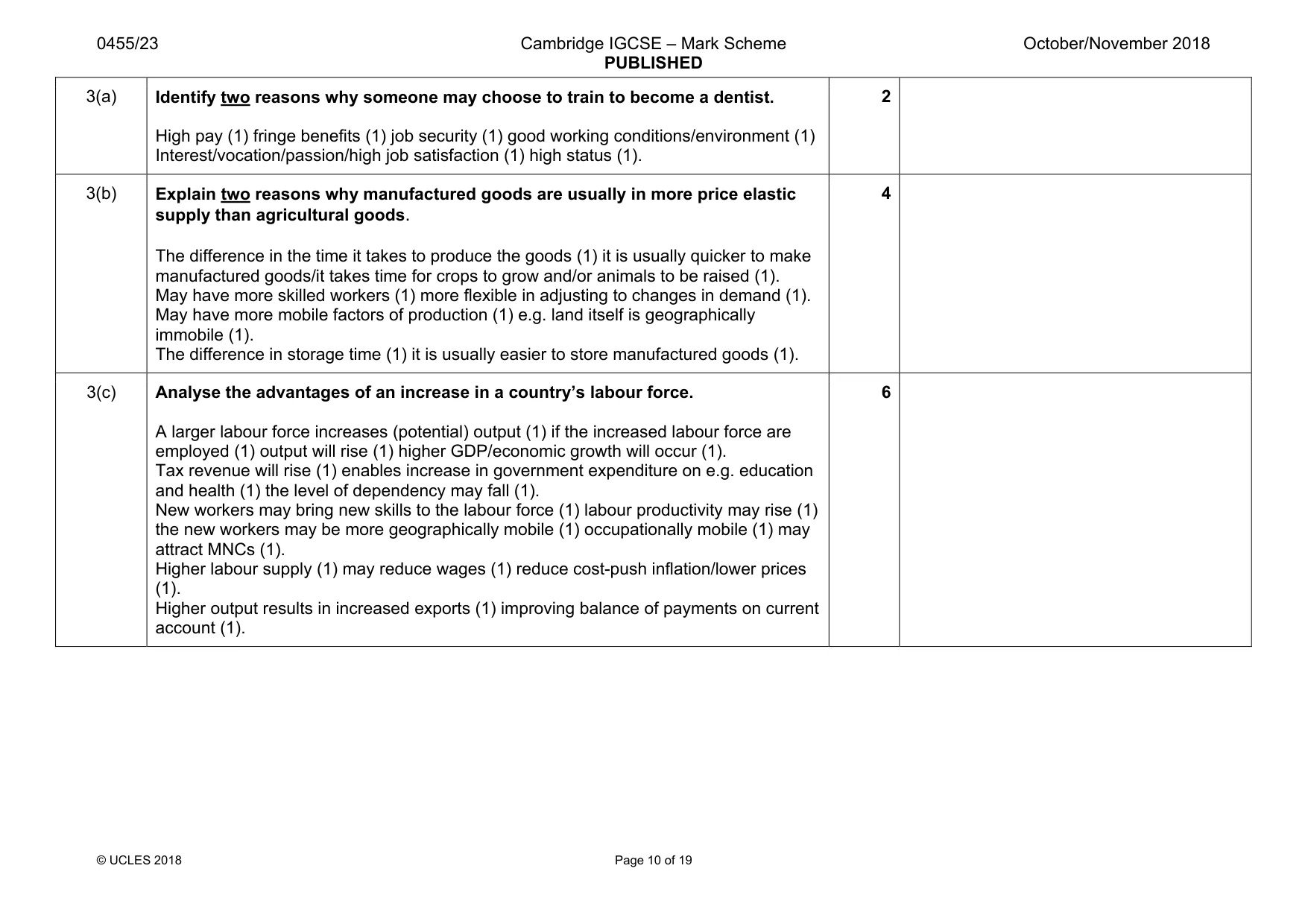
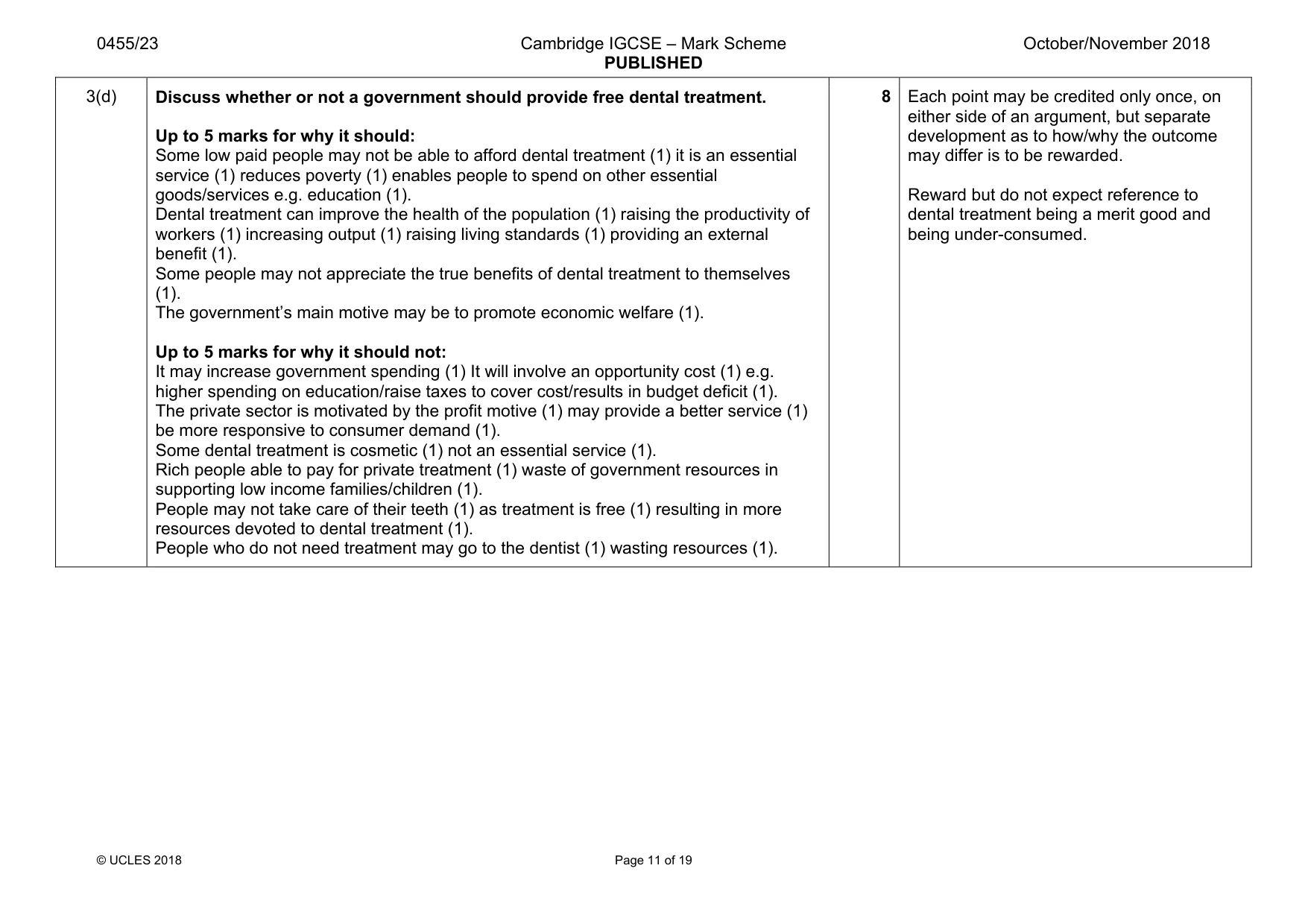
Mark scheme: 3(a) Identify two reasons why someone may choose to train to become a dentist. High pay (1) fringe benefits (1) job security (1) good working conditions/environment (1) Interest/vocation/passion/high job satisfaction (1) high status (1). 2 3(b) Explain two reasons why manufactured goods are usually in more price elastic supply than agricultural goods. The difference in the time it takes to produce the goods (1) it is usually quicker to make manufactured goods/it takes time for crops to grow and/or animals to be raised (1). May have more skilled workers (1) more flexible in adjusting to changes in demand (1). May have more mobile factors of production (1) e.g. land itself is geographically immobile (1). The difference in storage time (1) it is usually easier to store manufactured goods (1). 4 3(c) Analyse the advantages of an increase in a country’s labour force. A larger labour force increases (potential) output (1) if the increased labour force are employed (1) output will rise (1) higher GDP/economic growth will occur (1). Tax revenue will rise (1) enables increase in government expenditure on e.g. education and health (1) the level of dependency may fall (1). New workers may bring new skills to the labour force (1) labour productivity may rise (1) the new workers may be more geographically mobile (1) occupationally mobile (1) may attract MNCs (1). Higher labour supply (1) may reduce wages (1) reduce cost-push inflation/lower prices (1). Higher output results in increased exports (1) improving balance of payments on current account (1). 6 3(d) Discuss whether or not a government should provide free dental treatment. Up to 5 marks for why it should: Some low paid people may not be able to afford dental treatment (1) it is an essential service (1) reduces poverty (1) enables people to spend on other essential goods/services e.g. education (1). Dental treatment can improve the health of the population (1) raising the productivity of workers (1) increasing output (1) raising living standards (1) providing an external benefit (1). Some people may not appreciate the true benefits of dental treatment to themselves (1). The government’s main motive may be to promote economic welfare (1). Up to 5 marks for why it should not: It may increase government spending (1) It will involve an opportunity cost (1) e.g. higher spending on education/raise taxes to cover cost/results in budget deficit (1). The private sector is motivated by the profit motive (1) may provide a better service (1) be more responsive to consumer demand (1). Some dental treatment is cosmetic (1) not an essential service (1). Rich people able to pay for private treatment (1) waste of government resources in supporting low income families/children (1). People may not take care of their teeth (1) as treatment is free (1) resulting in more resources devoted to dental treatment (1). People who do not need treatment may go to the dentist (1) wasting resources (1). 8 Each point may be credited only once, on either side of an argument, but separate development as to how/why the outcome may differ is to be rewarded. Reward but do not expect reference to dental treatment being a merit good and being under-consumed.
Q4 · In 2015, Spain experienced a higher death rate than birth rate for the first time since…
4 In 2015, Spain experienced a higher death rate than birth rate for the first time since 1939. It is forecast that its population will fall by 5.6 million over the next 50 years. Such a decline would be likely to influence the number and size of the country’s firms and have an impact on the environment. There are a variety of ways of increasing a country’s population. (a) Define death rate. [2] (b) Explain two policy measures a government could introduce to encourage families to have more children. [4] (c) Analyse the impact a declining population could have on the environment. [6] (d) Discuss whether or not a firm that produces a wide range of products can take advantage of economies of scale. [8]
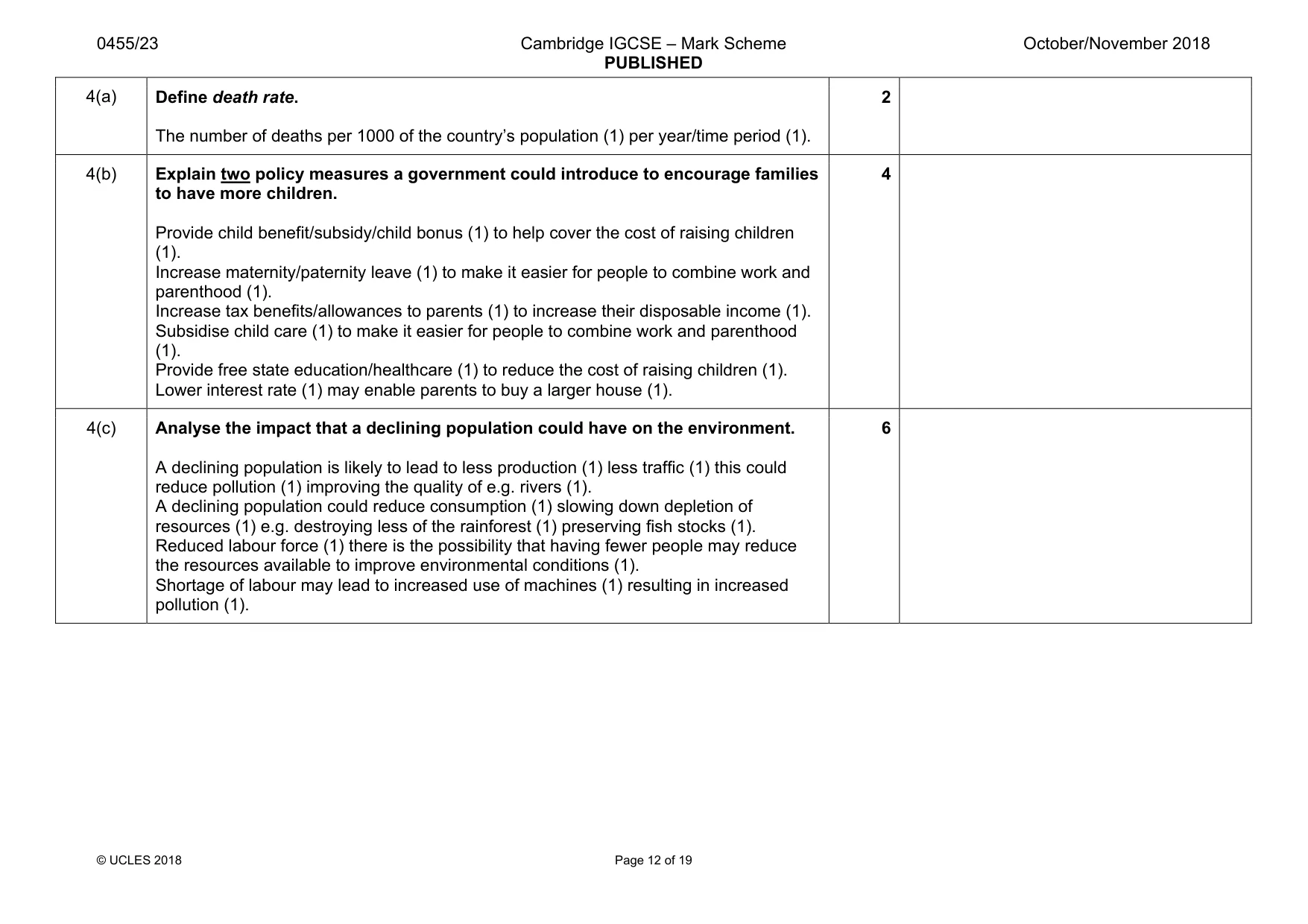
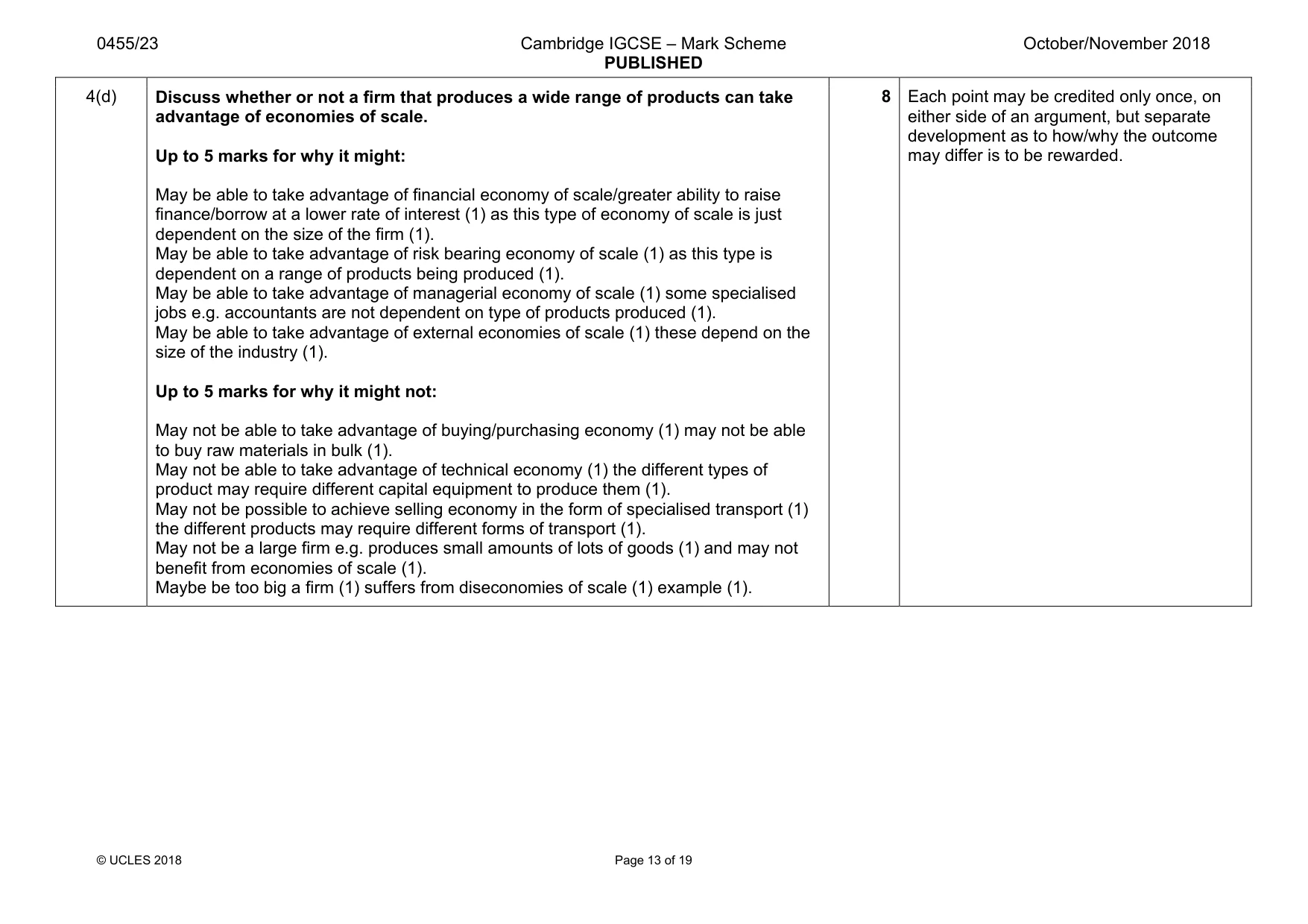
Mark scheme: 4(a) Define death rate. The number of deaths per 1000 of the country’s population (1) per year/time period (1). 2 4(b) Explain two policy measures a government could introduce to encourage families to have more children. Provide child benefit/subsidy/child bonus (1) to help cover the cost of raising children (1). Increase maternity/paternity leave (1) to make it easier for people to combine work and parenthood (1). Increase tax benefits/allowances to parents (1) to increase their disposable income (1). Subsidise child care (1) to make it easier for people to combine work and parenthood (1). Provide free state education/healthcare (1) to reduce the cost of raising children (1). Lower interest rate (1) may enable parents to buy a larger house (1). 4 4(c) Analyse the impact that a declining population could have on the environment. A declining population is likely to lead to less production (1) less traffic (1) this could reduce pollution (1) improving the quality of e.g. rivers (1). A declining population could reduce consumption (1) slowing down depletion of resources (1) e.g. destroying less of the rainforest (1) preserving fish stocks (1). Reduced labour force (1) there is the possibility that having fewer people may reduce the resources available to improve environmental conditions (1). Shortage of labour may lead to increased use of machines (1) resulting in increased pollution (1). 6 4(d) Discuss whether or not a firm that produces a wide range of products can take advantage of economies of scale. Up to 5 marks for why it might: May be able to take advantage of financial economy of scale/greater ability to raise finance/borrow at a lower rate of interest (1) as this type of economy of scale is just dependent on the size of the firm (1). May be able to take advantage of risk bearing economy of scale (1) as this type is dependent on a range of products being produced (1). May be able to take advantage of managerial economy of scale (1) some specialised jobs e.g. accountants are not dependent on type of products produced (1). May be able to take advantage of external economies of scale (1) these depend on the size of the industry (1). Up to 5 marks for why it might not: May not be able to take advantage of buying/purchasing economy (1) may not be able to buy raw materials in bulk (1). May not be able to take advantage of technical economy (1) the different types of product may require different capital equipment to produce them (1). May not be possible to achieve selling economy in the form of specialised transport (1) the different products may require different forms of transport (1). May not be a large firm e.g. produces small amounts of lots of goods (1) and may not benefit from economies of scale (1). Maybe be too big a firm (1) suffers from diseconomies of scale (1) example (1). 8 Each point may be credited only once, on either side of an argument, but separate development as to how/why the outcome may differ is to be rewarded.
Q5 · In 2016, the world shortage of peanuts increased their price
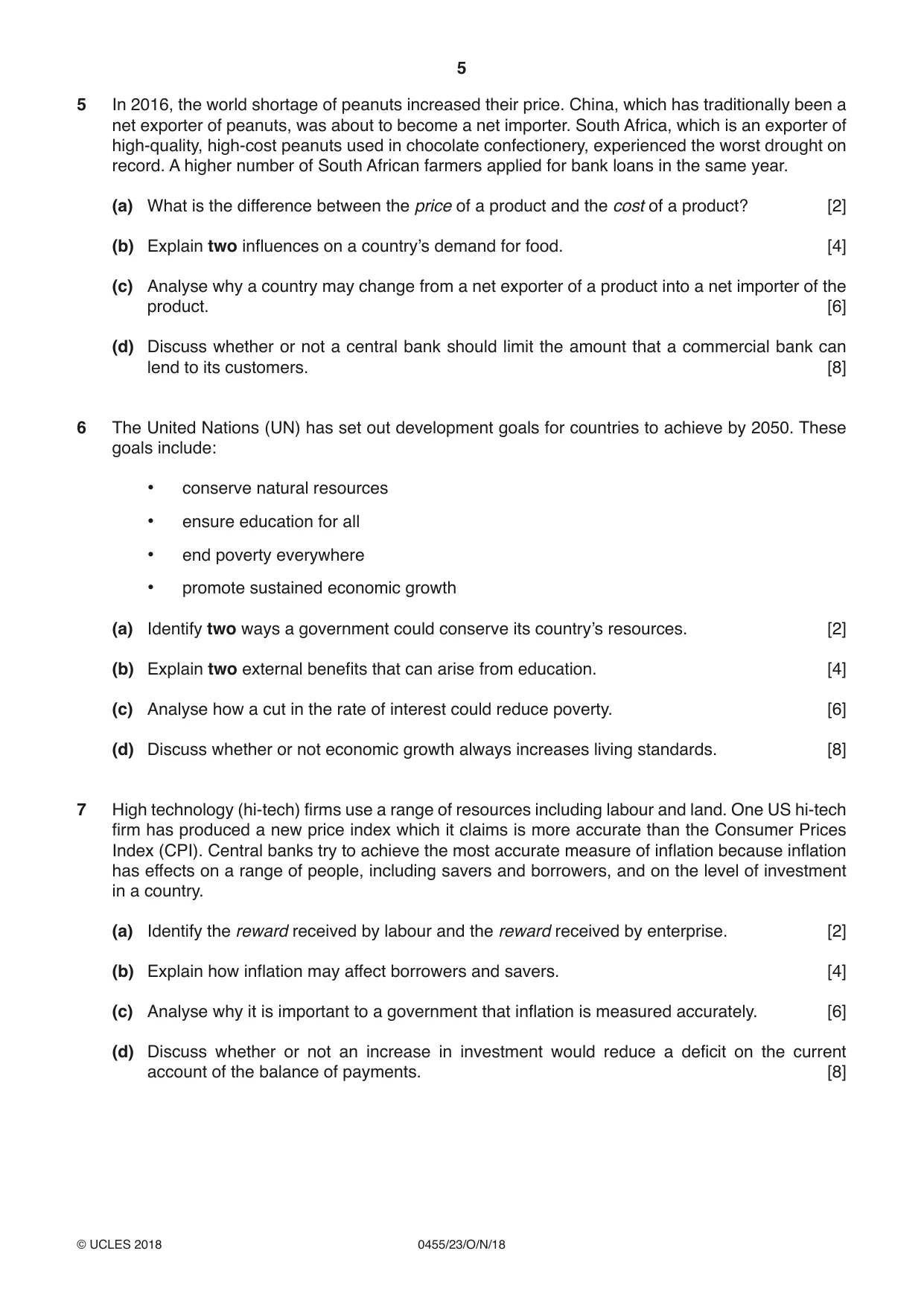
5 In 2016, the world shortage of peanuts increased their price. China, which has traditionally been a net exporter of peanuts, was about to become a net importer. South Africa, which is an exporter of high-quality, high-cost peanuts used in chocolate confectionery, experienced the worst drought on record. A higher number of South African farmers applied for bank loans in the same year. (a) What is the difference between the price of a product and the cost of a product? [2] (b) Explain two influences on a country’s demand for food. [4] (c) Analyse why a country may change from a net exporter of a product into a net importer of the product. [6] (d) Discuss whether or not a central bank should limit the amount that a commercial bank can lend to its customers. [8]
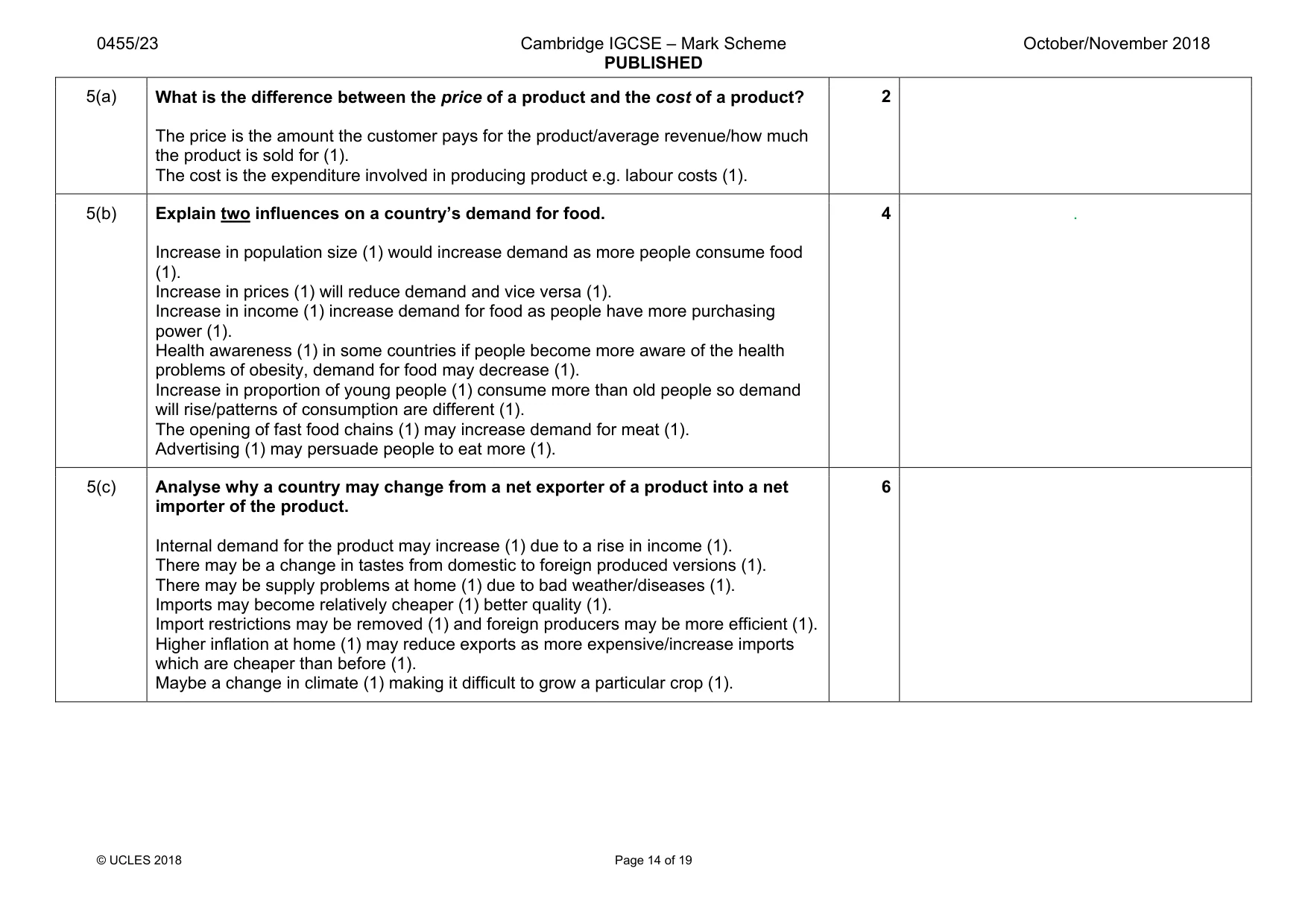
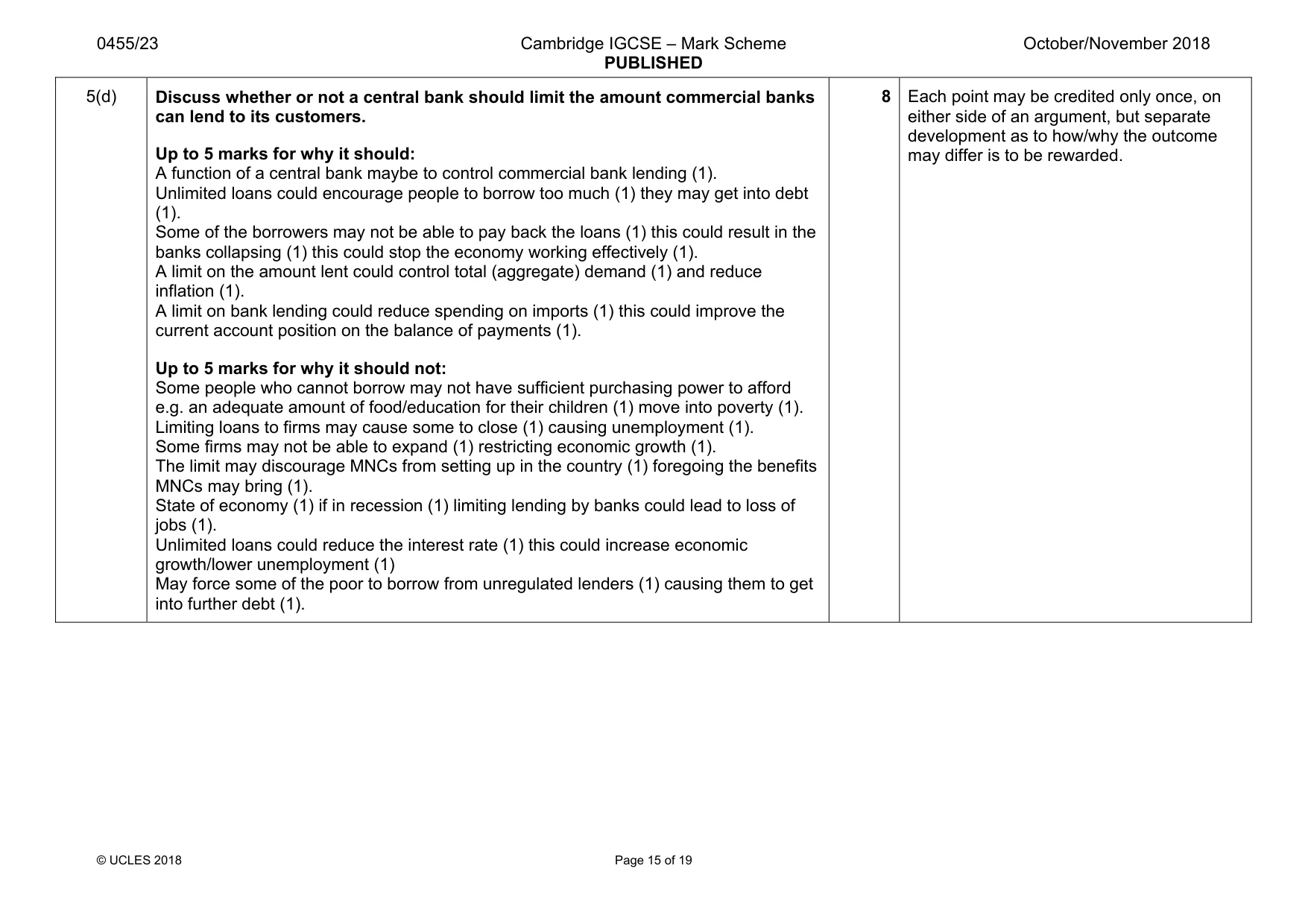
Mark scheme: 5(a) What is the difference between the price of a product and the cost of a product? The price is the amount the customer pays for the product/average revenue/how much the product is sold for (1). The cost is the expenditure involved in producing product e.g. labour costs (1). 2 5(b) Explain two influences on a country’s demand for food. Increase in population size (1) would increase demand as more people consume food (1). Increase in prices (1) will reduce demand and vice versa (1). Increase in income (1) increase demand for food as people have more purchasing power (1). Health awareness (1) in some countries if people become more aware of the health problems of obesity, demand for food may decrease (1). Increase in proportion of young people (1) consume more than old people so demand will rise/patterns of consumption are different (1). The opening of fast food chains (1) may increase demand for meat (1). Advertising (1) may persuade people to eat more (1). 4 . 5(c) Analyse why a country may change from a net exporter of a product into a net importer of the product. Internal demand for the product may increase (1) due to a rise in income (1). There may be a change in tastes from domestic to foreign produced versions (1). There may be supply problems at home (1) due to bad weather/diseases (1). Imports may become relatively cheaper (1) better quality (1). Import restrictions may be removed (1) and foreign producers may be more efficient (1). Higher inflation at home (1) may reduce exports as more expensive/increase imports which are cheaper than before (1). Maybe a change in climate (1) making it difficult to grow a particular crop (1). 6 5(d) Discuss whether or not a central bank should limit the amount commercial banks can lend to its customers. Up to 5 marks for why it should: A function of a central bank maybe to control commercial bank lending (1). Unlimited loans could encourage people to borrow too much (1) they may get into debt (1). Some of the borrowers may not be able to pay back the loans (1) this could result in the banks collapsing (1) this could stop the economy working effectively (1). A limit on the amount lent could control total (aggregate) demand (1) and reduce inflation (1). A limit on bank lending could reduce spending on imports (1) this could improve the current account position on the balance of payments (1). Up to 5 marks for why it should not: Some people who cannot borrow may not have sufficient purchasing power to afford e.g. an adequate amount of food/education for their children (1) move into poverty (1). Limiting loans to firms may cause some to close (1) causing unemployment (1). Some firms may not be able to expand (1) restricting economic growth (1). The limit may discourage MNCs from setting up in the country (1) foregoing the benefits MNCs may bring (1). State of economy (1) if in recession (1) limiting lending by banks could lead to loss of jobs (1). Unlimited loans could reduce the interest rate (1) this could increase economic growth/lower unemployment (1) May force some of the poor to borrow from unregulated lenders (1) causing them to get into further debt (1). 8 Each point may be credited only once, on either side of an argument, but separate development as to how/why the outcome may differ is to be rewarded.
Q6 · The United Nations (UN) has set out development goals for countries to achieve by 2050
6 The United Nations (UN) has set out development goals for countries to achieve by 2050. These goals include: • conserve natural resources • ensure education for all • end poverty everywhere • promote sustained economic growth (a) Identify two ways a government could conserve its country’s resources. [2] (b) Explain two external benefits that can arise from education. [4] (c) Analyse how a cut in the rate of interest could reduce poverty. [6] (d) Discuss whether or not economic growth always increases living standards. [8]
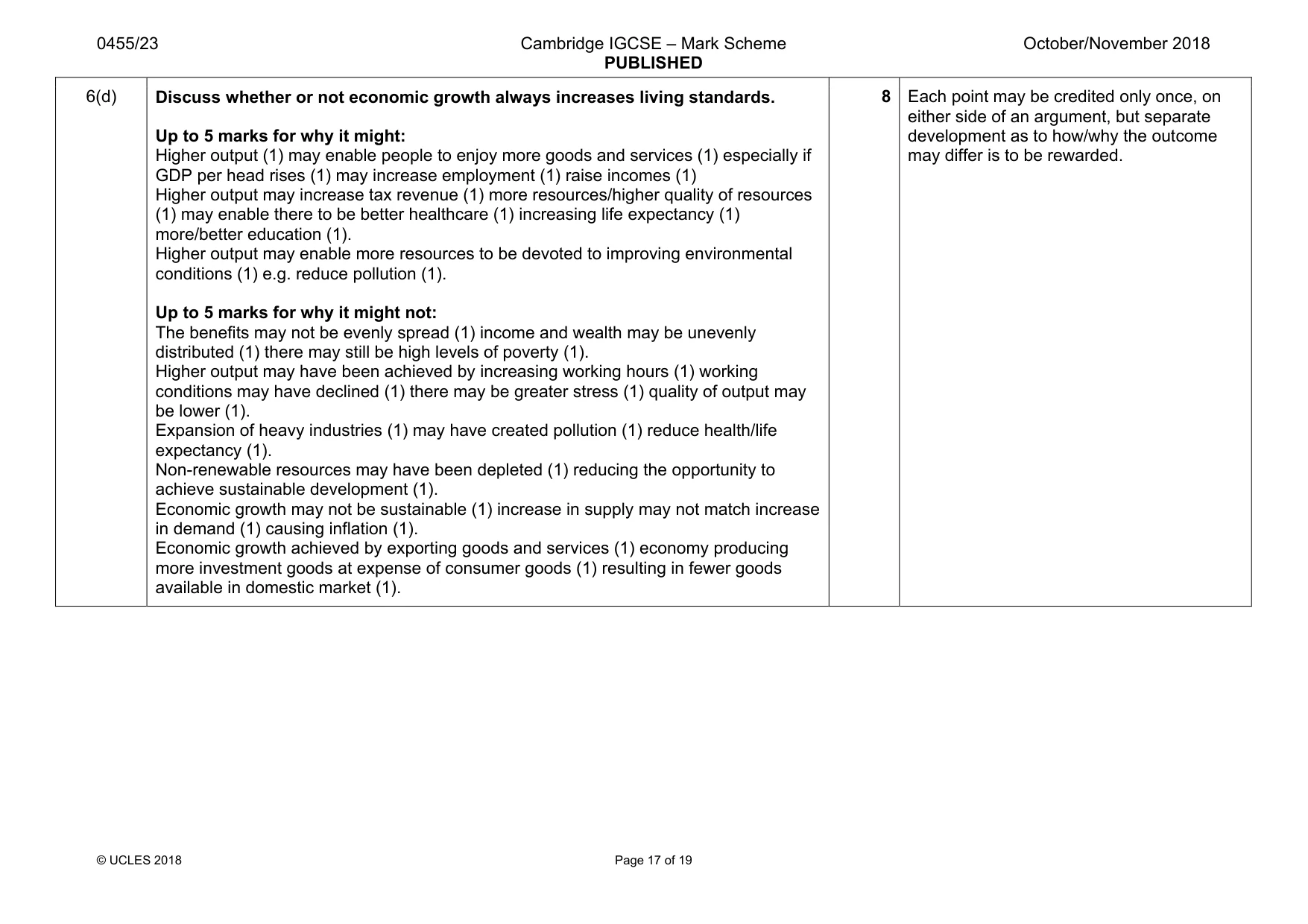
Mark scheme: 6(a) Identify two ways a government could conserve its country’s resources. One mark for each appropriate action identified. Examples include: Ban/place a limit on the amount of resource consumed. Import resources to reduce consumption of country’s own resources. Reduce exports to reduce consumption of limited resources. Put tax/increase tax on resources to reduce demand. Educate consumers to reduce consumption/conserve resources. Control immigration to reduce consumption of resources. Encourage recycling of resources e.g. metals/plastic. Subsidise firms that conserve natural resources. 2 6(b) Explain two external benefits that can arise from education. Higher output (1) due to more skilled workers (1). Better quality output (1) due to more efficient workers (1). More advanced technology (1) due to ideas/ability to operate new technology (1). Improved health/reduction in spread of diseases (1) more informed population (1). Less pollution (1) if population educated on environmental issues (1). Firms may have to spend less on training (1) due to greater supply of skilled workers (1). 4 6(c) Analyse how a cut in the rate of interest could reduce poverty. A lower interest rate will increase the purchasing power of the poor who have borrowed before (1) will make it easier/cheaper to borrow (1) enabling them to buy more necessities (1) spend on education (1) enabling them to get a job / better paid job (1). A lower rate of interest may encourage a rise in consumer expenditure (1) encouraging firms to expand (1) providing cheaper finance for the expansion (1) increase output (1) raise employment (1) raise income (1). Higher output and spending may increase tax revenue (1) enabling the government to increase its spending to reduce poverty (1). 6 6(d) Discuss whether or not economic growth always increases living standards. Up to 5 marks for why it might: Higher output (1) may enable people to enjoy more goods and services (1) especially if GDP per head rises (1) may increase employment (1) raise incomes (1) Higher output may increase tax revenue (1) more resources/higher quality of resources (1) may enable there to be better healthcare (1) increasing life expectancy (1) more/better education (1). Higher output may enable more resources to be devoted to improving environmental conditions (1) e.g. reduce pollution (1). Up to 5 marks for why it might not: The benefits may not be evenly spread (1) income and wealth may be unevenly distributed (1) there may still be high levels of poverty (1). Higher output may have been achieved by increasing working hours (1) working conditions may have declined (1) there may be greater stress (1) quality of output may be lower (1). Expansion of heavy industries (1) may have created pollution (1) reduce health/life expectancy (1). Non-renewable resources may have been depleted (1) reducing the opportunity to achieve sustainable development (1). Economic growth may not be sustainable (1) increase in supply may not match increase in demand (1) causing inflation (1). Economic growth achieved by exporting goods and services (1) economy producing more investment goods at expense of consumer goods (1) resulting in fewer goods available in domestic market (1). 8 Each point may be credited only once, on either side of an argument, but separate development as to how/why the outcome may differ is to be rewarded.
Q7 · High technology (hi-tech) firms use a range of resources including labour and land
7 High technology (hi-tech) firms use a range of resources including labour and land. One US hi-tech firm has produced a new price index which it claims is more accurate than the Consumer Prices Index (CPI). Central banks try to achieve the most accurate measure of inflation because inflation has effects on a range of people, including savers and borrowers, and on the level of investment in a country. (a) Identify the reward received by labour and the reward received by enterprise. [2] (b) Explain how inflation may affect borrowers and savers. [4] (c) Analyse why it is important to a government that inflation is measured accurately. [6] (d) Discuss whether or not an increase in investment would reduce a deficit on the current account of the balance of payments. [8]
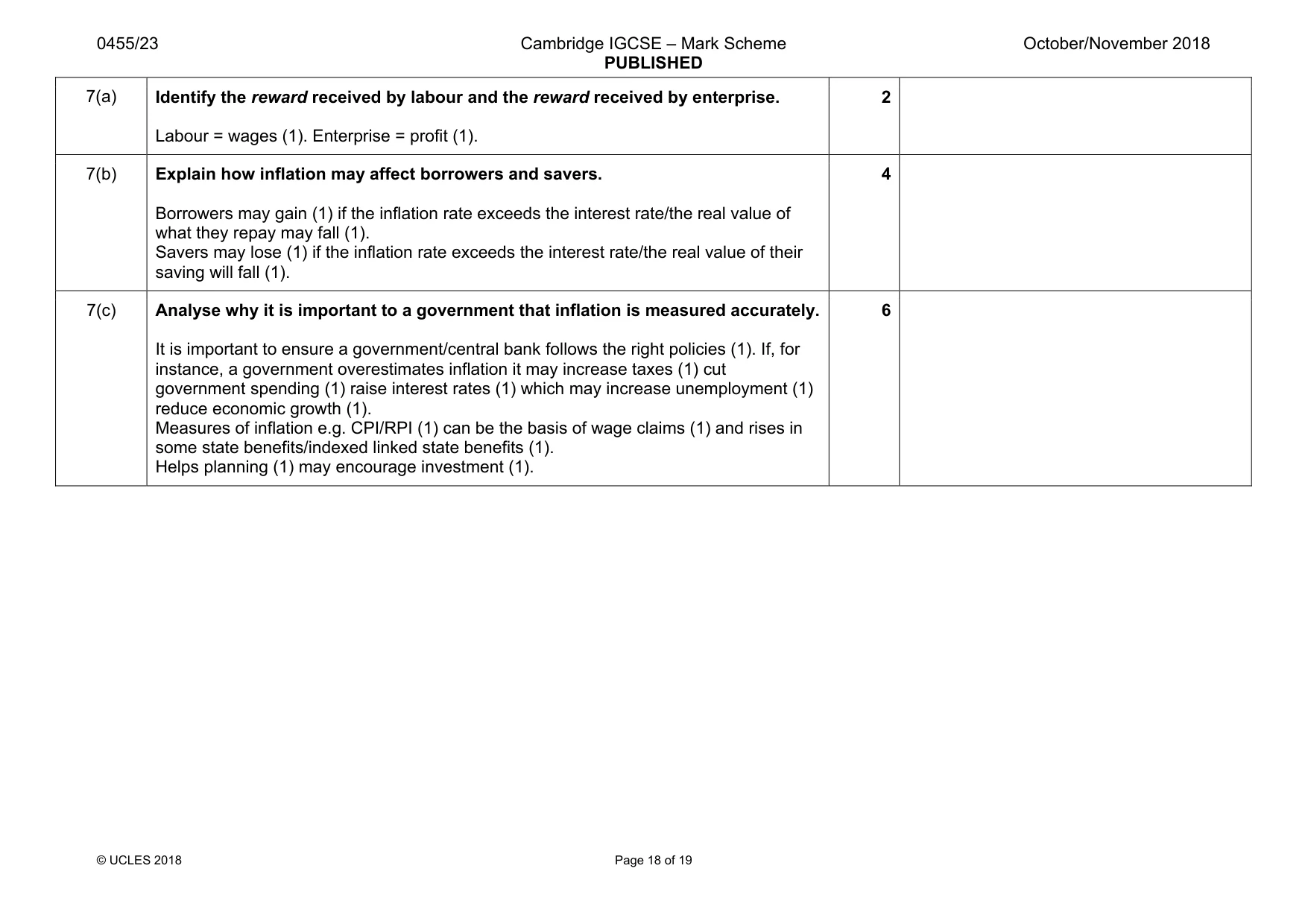
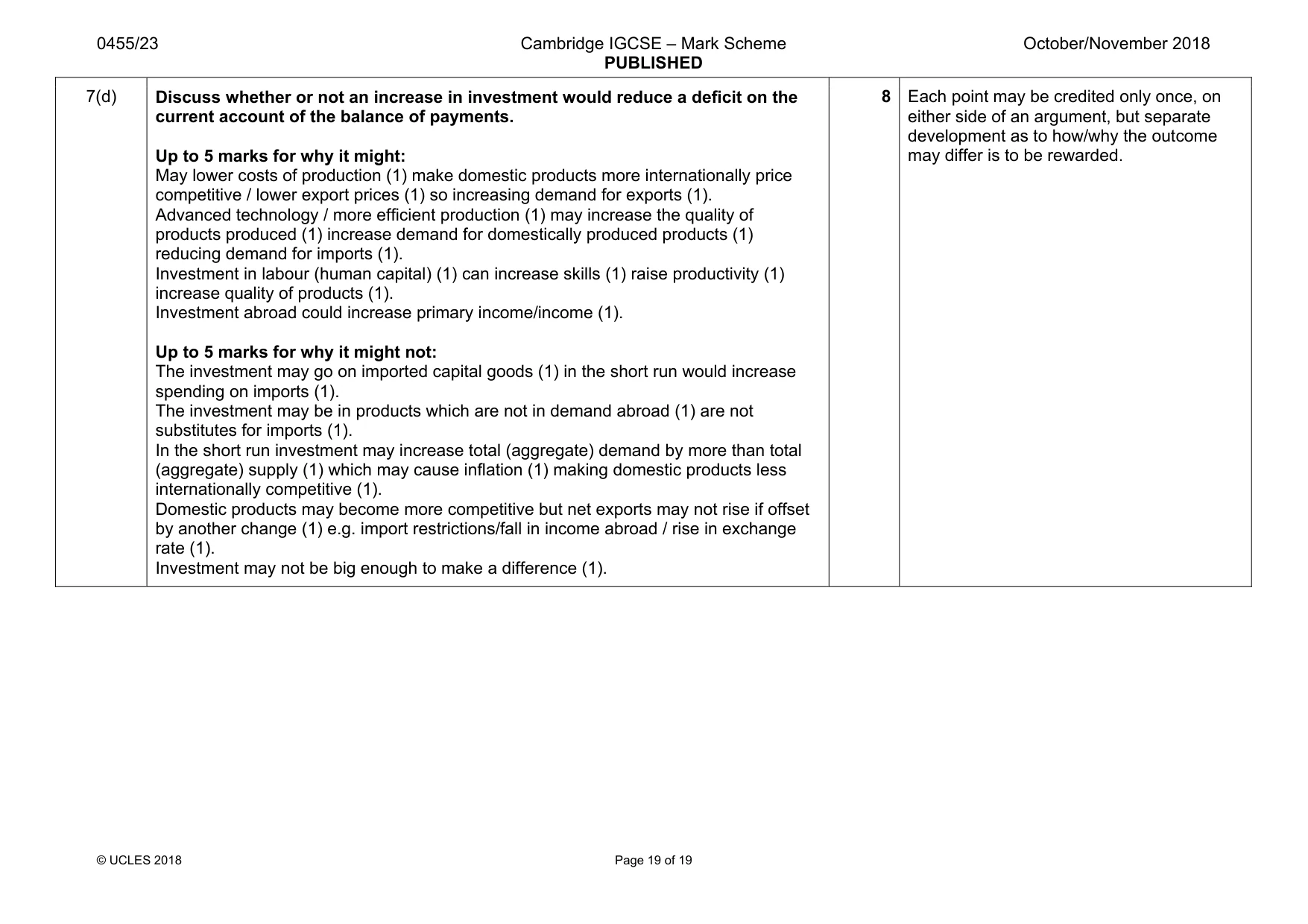
Mark scheme: 7(a) Identify the reward received by labour and the reward received by enterprise. Labour = wages (1). Enterprise = profit (1). 2 7(b) Explain how inflation may affect borrowers and savers. Borrowers may gain (1) if the inflation rate exceeds the interest rate/the real value of what they repay may fall (1). Savers may lose (1) if the inflation rate exceeds the interest rate/the real value of their saving will fall (1). 4 7(c) Analyse why it is important to a government that inflation is measured accurately. It is important to ensure a government/central bank follows the right policies (1). If, for instance, a government overestimates inflation it may increase taxes (1) cut government spending (1) raise interest rates (1) which may increase unemployment (1) reduce economic growth (1). Measures of inflation e.g. CPI/RPI (1) can be the basis of wage claims (1) and rises in some state benefits/indexed linked state benefits (1). Helps planning (1) may encourage investment (1). 6 7(d) Discuss whether or not an increase in investment would reduce a deficit on the current account of the balance of payments. Up to 5 marks for why it might: May lower costs of production (1) make domestic products more internationally price competitive / lower export prices (1) so increasing demand for exports (1). Advanced technology / more efficient production (1) may increase the quality of products produced (1) increase demand for domestically produced products (1) reducing demand for imports (1). Investment in labour (human capital) (1) can increase skills (1) raise productivity (1) increase quality of products (1). Investment abroad could increase primary income/income (1). Up to 5 marks for why it might not: The investment may go on imported capital goods (1) in the short run would increase spending on imports (1). The investment may be in products which are not in demand abroad (1) are not substitutes for imports (1). In the short run investment may increase total (aggregate) demand by more than total (aggregate) supply (1) which may cause inflation (1) making domestic products less internationally competitive (1). Domestic products may become more competitive but net exports may not rise if offset by another change (1) e.g. import restrictions/fall in income abroad / rise in exchange rate (1). Investment may not be big enough to make a difference (1). 8 Each point may be credited only once, on either side of an argument, but separate development as to how/why the outcome may differ is to be rewarded.
What was in this paper
The subtopics covered by these 7 questions, and how many questions each got. Open one in a new tab to see every Cambridge question on it.
What you needed in this session
Cambridge’s own grade thresholds for 2018 Oct/Nov, Paper 2 · Variant 3. A higher threshold means an easier paper — the bar moves with how the cohort did.