Cambridge IGCSE Economics 0455 — 2015 May/June Paper 2 · Variant 3
0455/23/M/J/15 · 90 marks · ≈101 min
The question paper and its mark scheme, free to read here and free to download. This is Cambridge’s own paper, exactly as it was sat.
Question paper8 pages



Mark scheme16 pages
Answers below. Sit the paper first if you are practising.
Paper as text
Question paper, page 1
This document consists of 5 printed pages, 3 blank pages and 1 Insert. DC (ST/CGW) 112019/6 R © UCLES 2015 [Turn over * 6 8 6 0 9 7 0 6 7 0 * ECONOMICS 0455/23 Paper 2 Structured Questions May/June 2015 2 hours 15 minutes No Additional Materials are required. READ THESE INSTRUCTIONS FIRST An answer booklet is provided inside this question paper. You should follow the instructions on the front cover of the answer booklet. If you need additional answer paper ask the invigilator for a continuation booklet. Section A Answer Question 1. Section B Answer any three questions. The number of marks is given in brackets [ ] at the end of each question or part question. Cambridge International Examinations Cambridge International General Certificate of Secondary Education
Question paper, page 2
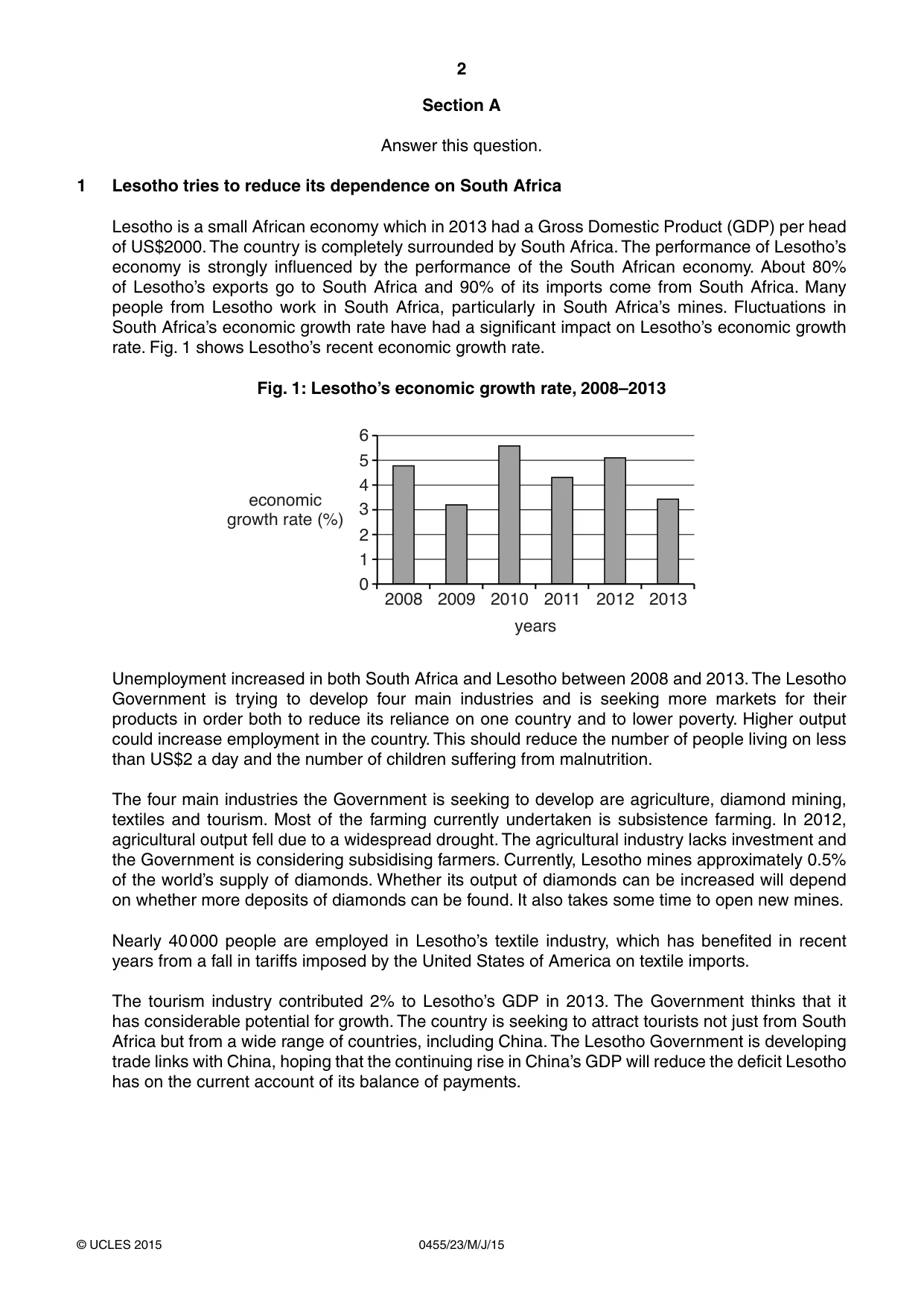
2 0455/23/M/J/15 © UCLES 2015 Section A Answer this question. 1 Lesotho tries to reduce its dependence on South Africa Lesotho is a small African economy which in 2013 had a Gross Domestic Product (GDP) per head of US$2000. The country is completely surrounded by South Africa. The performance of Lesotho’s economy is strongly influenced by the performance of the South African economy. About 80% of Lesotho’s exports go to South Africa and 90% of its imports come from South Africa. Many people from Lesotho work in South Africa, particularly in South Africa’s mines. Fluctuations in South Africa’s economic growth rate have had a significant impact on Lesotho’s economic growth rate. Fig. 1 shows Lesotho’s recent economic growth rate. Fig. 1: Lesotho’s economic growth rate, 2008–2013 2008 2009 2010 2011 2012 2013 5 6 4 3 economic growth rate (%) 2 1 0 years Unemployment increased in both South Africa and Lesotho between 2008 and 2013. The Lesotho Government is trying to develop four main industries and is seeking more markets for their products in order both to reduce its reliance on one country and to lower poverty. Higher output could increase employment in the country. This should reduce the number of people living on less than US$2 a day and the number of children suffering from malnutrition. The four main industries the Government is seeking to develop are agriculture, diamond mining, textiles and tourism. Most of the farming currently undertaken is subsistence farming. In 2012, agricultural output fell due to a widespread drought. The agricultural industry lacks investment and the Government is considering subsidising farmers. Currently, Lesotho mines approximately 0.5% of the world’s supply of diamonds. Whether its output of diamonds can be increased will depend on whether more deposits of diamonds can be found. It also takes some time to open new mines. Nearly 40 000 people are employed in Lesotho’s textile industry, which has benefited in recent years from a fall in tariffs imposed by the United States of America on textile imports. The tourism industry contributed 2% to Lesotho’s GDP in 2013. The Government thinks that it has considerable potential for growth. The country is seeking to attract tourists not just from South Africa but from a wide range of countries, including China. The Lesotho Government is developing trade links with China, hoping that the continuing rise in China’s GDP will reduce the deficit Lesotho has on the current account of its balance of payments.
Question paper, page 3
3 0455/23/M/J/15 © UCLES 2015 [Turn over (a) Using information from the extract, identify three reasons why Lesotho is considered to be a developing country. [3] (b) Using information from Fig. 1: (i) describe what happened to output in Lesotho between 2008 and 2009 [2] (ii) explain in which year output was highest in Lesotho. [2] (c) Using information from the extract, explain why the supply of diamonds is price inelastic. [3] (d) Analyse how a subsidy to farmers may affect the market for food. [5] (e) Discuss whether Lesotho would benefit from more of its people working abroad. [5] (f) Explain two reasons why governments impose tariffs. [4] (g) Discuss whether a rise in China’s Gross Domestic Product is likely to reduce Lesotho’s current account deficit. [6]
Question paper, page 4
4 0455/23/M/J/15 © UCLES 2015 Section B Answer any three questions from this section. 2 In 2009, the unemployment rate in Spain was 8% and the annual inflation rate was 3%. By April 2013, the unemployment rate had reached a record 27% but the annual inflation rate had fallen to 2%. The resulting rise in government spending on unemployment benefits involved an opportunity cost. (a) Define ‘inflation’. [2] (b) Explain why government spending on unemployment benefits involves an opportunity cost. [4] (c) Using a production possibility curve diagram, analyse the effect of an increase in unemployment on a country’s output. [6] (d) Discuss whether a rise in unemployment will cause a fall in inflation. [8] 3 There has been significant deforestation by logging companies in Sarawak. This is seen as a market failure by some economists, who want the industry to be regulated by the government. Other economists, however, suggest that a market system approach has benefits. (a) Define ‘regulation’. [2] (b) Explain how resources are allocated in a market system. [4] (c) Analyse the causes of market failure. [6] (d) Discuss whether an economy will benefit from its forests being cut down. [8] 4 The governments of some African countries are introducing identity cards that also act as electronic payment cards. This should reduce the number of payments made by cash (notes and coins) and encourage more people to use mobile (cell) telephone banking systems. More customers will allow banks to grow in size and may help people and firms to save and borrow. (a) Identify two influences on the amount people save. [2] (b) Explain why cash (notes and coins) is money. [4] (c) Analyse the possible effects of an increase in bank lending on economic growth. [6] (d) Discuss whether the poor are more likely to borrow than the rich. [8]
Question paper, page 5
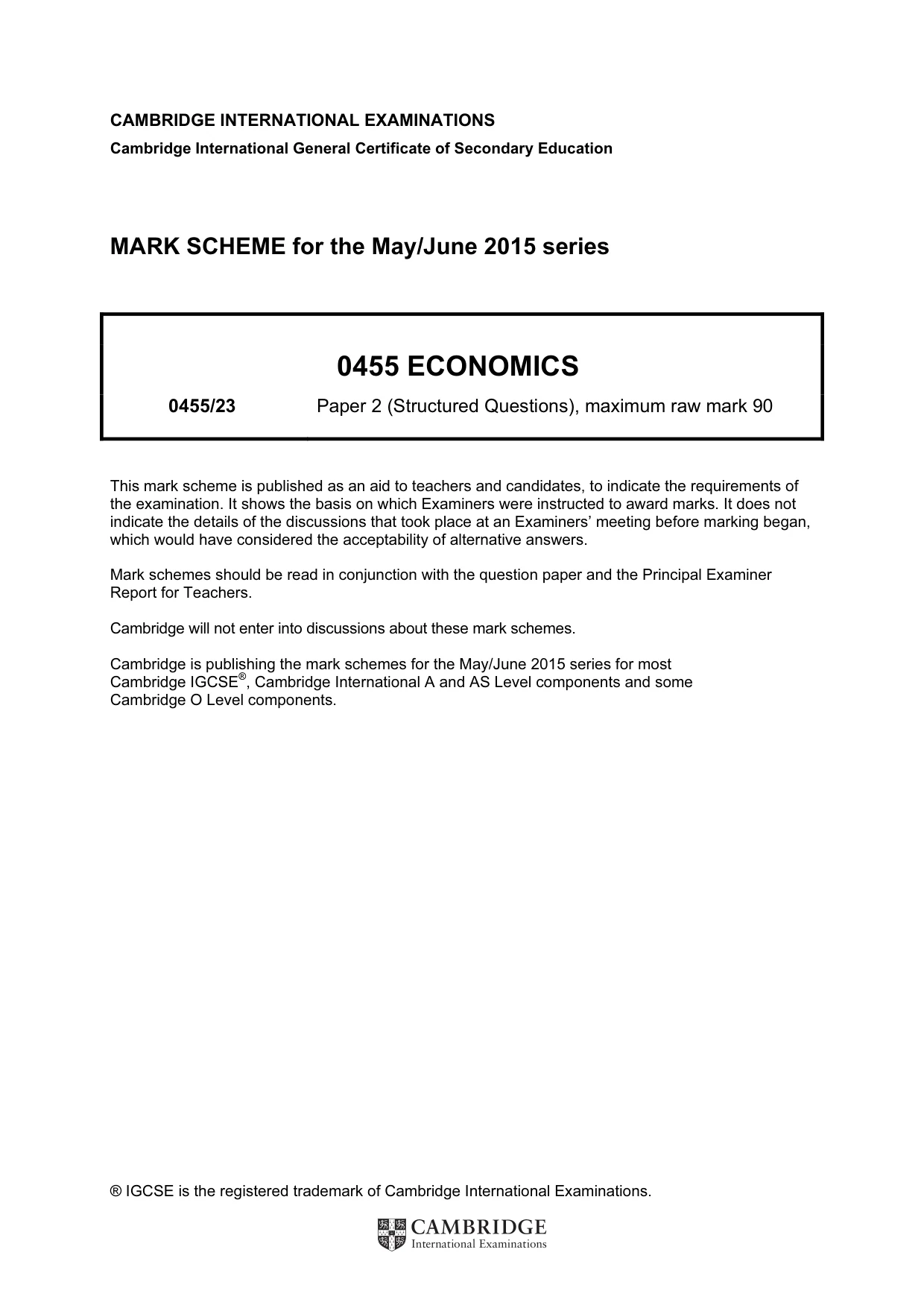
5 0455/23/M/J/15 © UCLES 2015 5 Company X, a private limited company, is one of the world’s largest toy producers. It is planning to open a new factory in China in 2017. Asia is expected to become the largest market for the sale of toys. Manufacturing products within Asia will reduce the need to transport the toys from Company X’s factories in Europe to Asia. (a) Define ‘private limited company’. [2] (b) Explain two influences on what factors of production a firm uses. [4] (c) Analyse how an increase in the size of a firm can increase its profit. [6] (d) Discuss whether an economy would benefit from a foreign producer setting up in the country. [8] 6 The Indian airline industry contains a number of firms, including one state-owned firm and a large private sector firm. In recent years, the industry has moved further from perfect competition, partly because of a rise in horizontal integration. The performance of the industry is influenced by government policy, including supply-side policy measures. (a) Define ‘horizontal integration’. [2] (b) Explain two characteristics of perfect competition. [4] (c) Analyse how two supply-side policy measures could improve the performance of an airline industry. [6] (d) Discuss whether price is likely to be higher in a monopoly than in a perfectly competitive market. [8] 7 Australia operates a floating exchange rate system. In April 2013, the Australian dollar reached its highest value in almost 28 years. The increase in the foreign exchange rate decreased exports of cars from Australia, resulting in reduced employment and wages. However, some Australian industries, including coal mining, did experience an increase in their output and export revenue. (a) Define ‘exchange rate’. [2] (b) Explain two benefits of a floating exchange rate system. [4] (c) Analyse the effects of a rise in unemployment on living standards in a country. [6] (d) Discuss whether coal miners are likely to be paid more than car assembly workers. [8]
Question paper, page 6
6 0455/23/M/J/15 © UCLES 2015 BLANK PAGE
Question paper, page 7
7 0455/23/M/J/15 © UCLES 2015 BLANK PAGE
Question paper, page 8
8 0455/23/M/J/15 © UCLES 2015 BLANK PAGE Permission to reproduce items where third-party owned material protected by copyright is included has been sought and cleared where possible. Every reasonable effort has been made by the publisher (UCLES) to trace copyright holders, but if any items requiring clearance have unwittingly been included, the publisher will be pleased to make amends at the earliest possible opportunity. To avoid the issue of disclosure of answer-related information to candidates, all copyright acknowledgements are reproduced online in the Cambridge International Examinations Copyright Acknowledgements Booklet. This is produced for each series of examinations and is freely available to download at www.cie.org.uk after the live examination series. Cambridge International Examinations is part of the Cambridge Assessment Group. Cambridge Assessment is the brand name of University of Cambridge Local Examinations Syndicate (UCLES), which is itself a department of the University of Cambridge.
Mark scheme, page 1
® IGCSE is the registered trademark of Cambridge International Examinations. CAMBRIDGE INTERNATIONAL EXAMINATIONS Cambridge International General Certificate of Secondary Education MARK SCHEME for the May/June 2015 series 0455 ECONOMICS 0455/23 Paper 2 (Structured Questions), maximum raw mark 90 This mark scheme is published as an aid to teachers and candidates, to indicate the requirements of the examination. It shows the basis on which Examiners were instructed to award marks. It does not indicate the details of the discussions that took place at an Examiners’ meeting before marking began, which would have considered the acceptability of alternative answers. Mark schemes should be read in conjunction with the question paper and the Principal Examiner Report for Teachers. Cambridge will not enter into discussions about these mark schemes. Cambridge is publishing the mark schemes for the May/June 2015 series for most Cambridge IGCSE®, Cambridge International A and AS Level components and some Cambridge O Level components.
Mark scheme, page 2
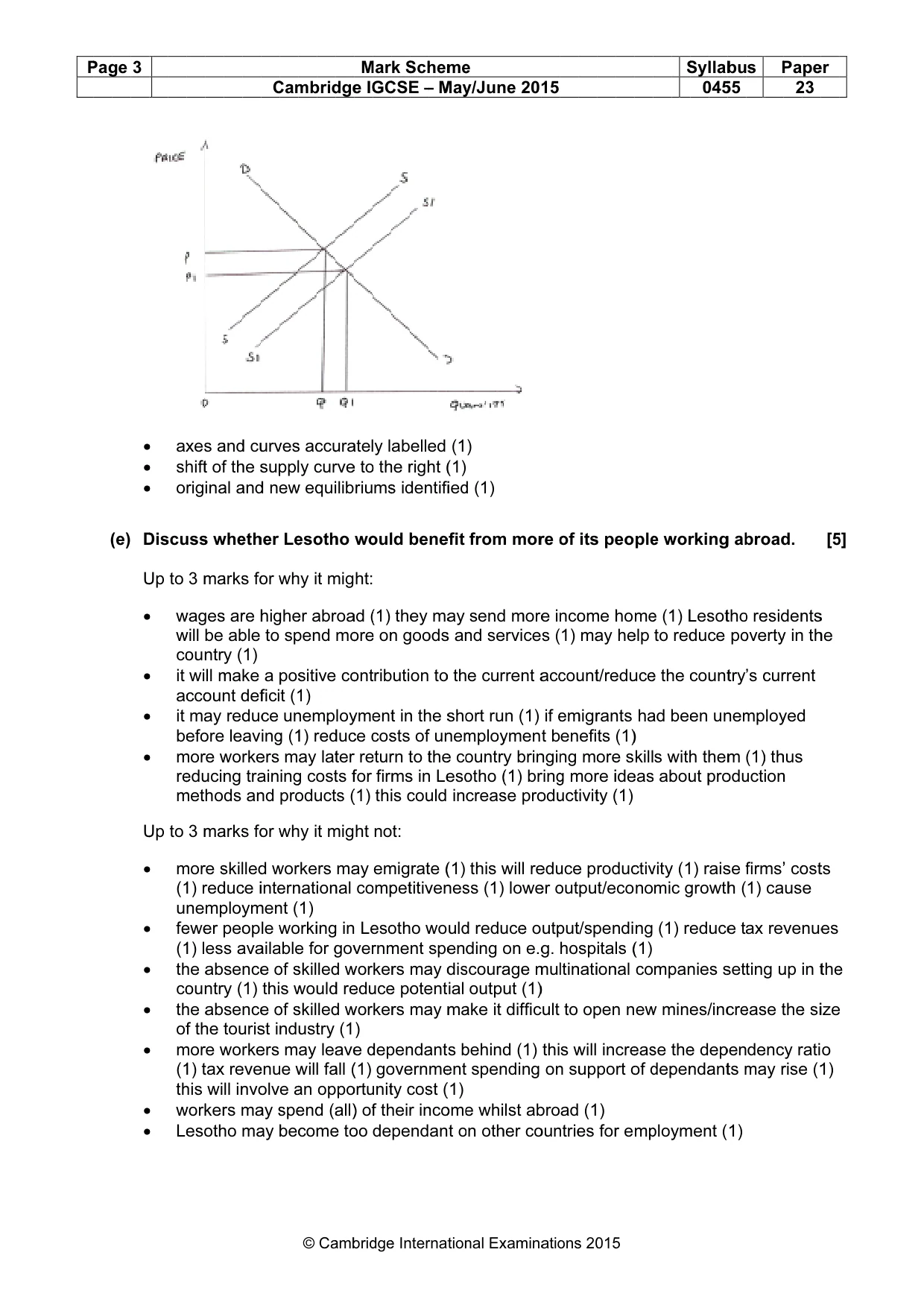
Page 2 Mark Scheme Syllabus Paper Cambridge IGCSE – May/June 2015 0455 23 © Cambridge International Examinations 2015 1 (a) Using information from the extract, identify three reasons why Lesotho is considered to be a developing country. [3] One mark each for three of the following: • low GDP per head • number of people living on less than US$2 a day • children experiencing malnutrition • subsistence farming • large primary sector • large number of workers working abroad • lack of investment (b) (i) Using information from Fig. 1, describe what happened to output in Lesotho between 2008 and 2009. [2] Output increased (1) more slowly. (1) (ii) Using information from Fig. 1, explain in which year output was highest in Lesotho. [2] 2013 (1) as output increased each year. (1) (c) Using information from the extract, explain why the supply of diamonds is price inelastic. [3] • deposits of diamonds have to be located (1) • it takes time to open new mines (1) • it takes time to extract diamonds (1) • this means that supply cannot be adjusted quickly (1) due to a change in price (1) (d) Analyse how a subsidy to farmers may affect the market for food [5] • a subsidy is a payment/government help to encourage production (1) • a subsidy is similar to a reduction in costs of production/makes production less expensive (1) • it allows investment in capital (1) • it will cause an increase in supply (1) • supplying more food will reduce price (1) • a lower price will cause demand to rise/an extension in demand (1) Although a diagram is not required, award 3 marks for an accurately drawn diagram.
Mark scheme, page 3
P Pag ( ge (e) 3 • • • D U • • • • U • • • • • • • • • • Dis Up • • • • Up • • • • • • • ax sh o scu to w w co it ac it be m re m to m (1 u fe (1 th co th of m (1 th w Le xes hift rig uss 3 m wag will oun wi cco ma efo mor edu met 3 m mor 1) r ne ewe 1) l he a oun he a f th mor 1) t his work eso s a t of ina s w ma ges be ntry ll m oun ay ore re w ucin ho ma re s red mp er p es ab ntry ab he t re w tax wi ker oth and f th al a whe arks s ar ab y ( ma nt d red le wo ng ds arks skil duc ploy peo s a se y ( se tou wo x re ll in rs m ho d cu he s and eth s fo re h ble 1) ke def duc av rke tra an s fo lled ce i ym op ava nce 1) nce uris rke eve nvo ma ma C urv sup d ne her or w hig to a p fici ce ing ers ain nd or w d w inte men le w aila e o thi e o st in ers enu olv ay s ay b Cam ves ppl ew Le wh ghe sp pos t (1 un g (1 m ing pro wh wor ern nt ( wo able of s s w of s nd m ue w e a spe bec mb © s ac ly c w eq eso hy i er a pen siti 1) nem 1) r ay g co odu hy i rke nati 1) orki e fo skil wou skil ust ay will an end com brid Ca ccu cur qui oth t m abr nd ive mp red lat ost uct t m rs ion ing or g led uld led try lea l fa op d (a me dge amb ura rve ilib ho mig roa mo co loy duc ter ts f ts ( mig ma nal g in gov d w d re d w (1 ave all ( po all) e to M e IG brid atel e to riu wo ht: ad ( ore ont yme ce c r re for (1) ht ay co Le ver wor edu wor ) e d (1) ortu ) of oo Mar GC dge y l o th ms oul (1) e on trib ent cos etur firm thi no em omp eso rnm ker uce ker dep go unit f th de k S CSE e In ab he r s id ld b the n g uti t in sts rn t ms is c t: mig pet oth me rs e po rs pen ove ty c heir pe Sch E – nter elle righ den be ey goo on n th of to t s in cou rat titiv o w nt s ma ote ma nda ern cos r in nd hem – M rnat ed ht ( ntifi ne ma ods to he s f un the n Le uld te ( ven wo spe ay d ent ay m ant me st ( nco an me May tion (1 (1) ied efit ay s an o th sho nem e co eso inc (1) nes uld end dis ial ma s b ent (1) ome t o e y/J nal ) d (1 fro se nd e c ort mp oun oth cre th ss ( d re din sco ou ake beh sp e w on o un Ex 1) om end se cur ru ploy ntry ho ( eas is w (1) edu ng o oura utpu e it hind pen whi oth ne 2 xam m m d m ervi rren n ( ym y b (1) se will low uce on age ut dif d ( ndi lst her 20 mina mor more ce nt a (1) en brin br pro l re we e o e.g e m (1) ffic 1) ng ab co 15 atio re o e i s ( acc if e t b ngin ring odu edu er o utp g. mul ) cult thi on bro oun ons of nco 1) cou em en ng g m uct uce out put ho ltin to s w n su ad ntrie s 20 its om ma unt migr efi mo mor ivit e p pu t/sp sp nati op will up (1 es 015 s pe me h ay t/re ran ts ore re i ty ( rod t/e pen ital ion pen in po ) for 5 eo ho he edu nts (1) e s ide (1) duc co ndi ls ( nal n n cre rt o r e ple me elp uce ha ) kill eas ctiv no ng (1) co ew eas of d mp e w e (1 to e th ad b s w s ab vity mi (1 mp w m se t dep ploy S wor 1) L red he c bee with bou y (1 c g ) re pan mine the pen ym Syl 0 rki Les duc cou en h th ut p ) r gro ed nie es/ e d nda men llab 045 ng sot ce unt un hem pro rais wth uce s s /inc ep ant nt ( bu 55 g ab tho po try nem m odu se f h ( e ta sett cre pen ts m 1) s bro o re ove ’s c mp (1) ucti firm 1) ax ting eas de ma P oad esid erty cur loy ) th ion ms’ ca rev g u se t enc ay r Pa 2 d. den y in rre yed hus n ’ co us ve up the cy r rise pe 23 nts n th nt d ost e nue in t e si rati e (1 er [5 s he ts es the ize o 1) 5] e
Mark scheme, page 4
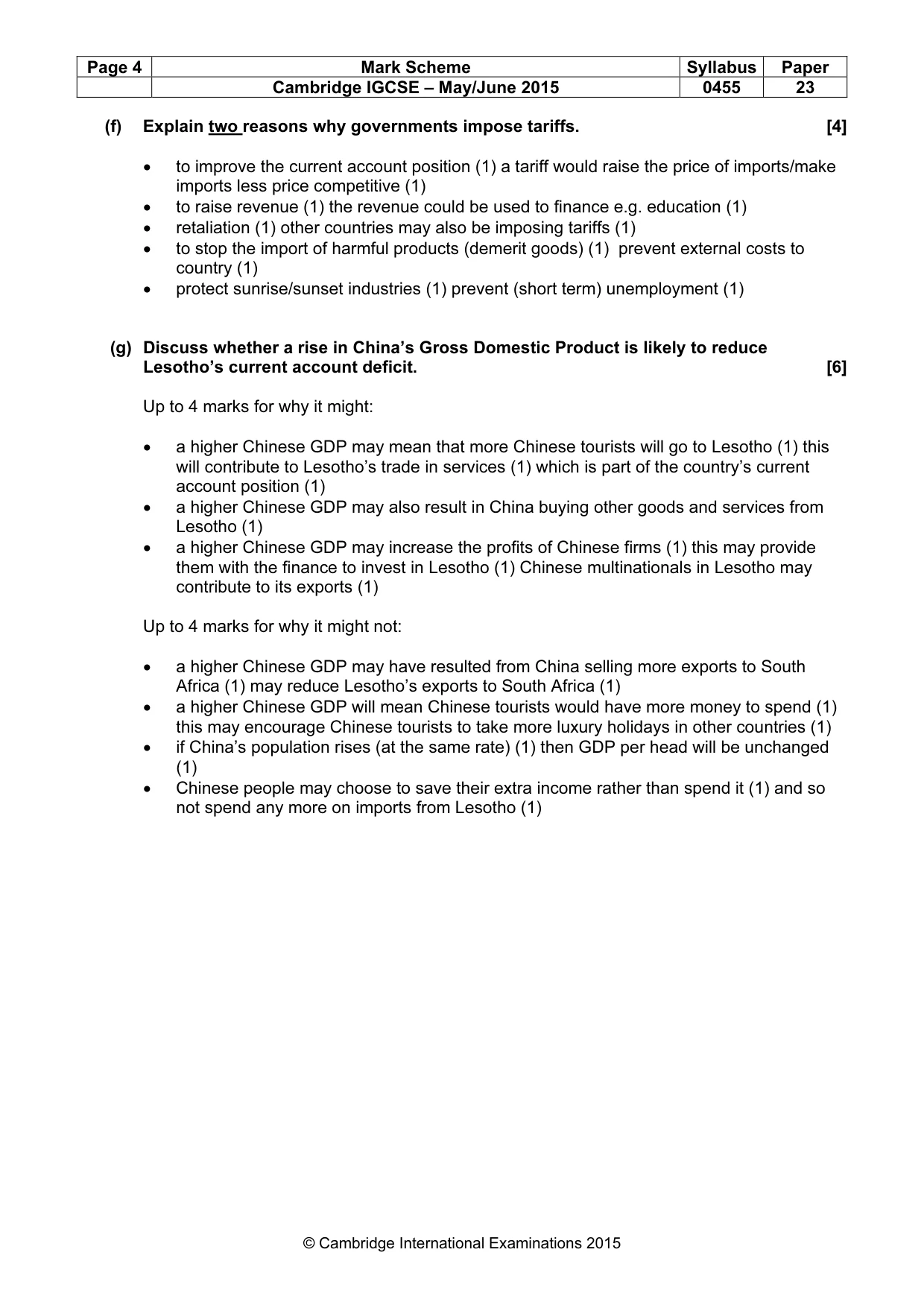
Page 4 Mark Scheme Syllabus Paper Cambridge IGCSE – May/June 2015 0455 23 © Cambridge International Examinations 2015 (f) Explain two reasons why governments impose tariffs. [4] • to improve the current account position (1) a tariff would raise the price of imports/make imports less price competitive (1) • to raise revenue (1) the revenue could be used to finance e.g. education (1) • retaliation (1) other countries may also be imposing tariffs (1) • to stop the import of harmful products (demerit goods) (1) prevent external costs to country (1) • protect sunrise/sunset industries (1) prevent (short term) unemployment (1) (g) Discuss whether a rise in China’s Gross Domestic Product is likely to reduce Lesotho’s current account deficit. [6] Up to 4 marks for why it might: • a higher Chinese GDP may mean that more Chinese tourists will go to Lesotho (1) this will contribute to Lesotho’s trade in services (1) which is part of the country’s current account position (1) • a higher Chinese GDP may also result in China buying other goods and services from Lesotho (1) • a higher Chinese GDP may increase the profits of Chinese firms (1) this may provide them with the finance to invest in Lesotho (1) Chinese multinationals in Lesotho may contribute to its exports (1) Up to 4 marks for why it might not: • a higher Chinese GDP may have resulted from China selling more exports to South Africa (1) may reduce Lesotho’s exports to South Africa (1) • a higher Chinese GDP will mean Chinese tourists would have more money to spend (1) this may encourage Chinese tourists to take more luxury holidays in other countries (1) • if China’s population rises (at the same rate) (1) then GDP per head will be unchanged (1) • Chinese people may choose to save their extra income rather than spend it (1) and so not spend any more on imports from Lesotho (1)
Mark scheme, page 5
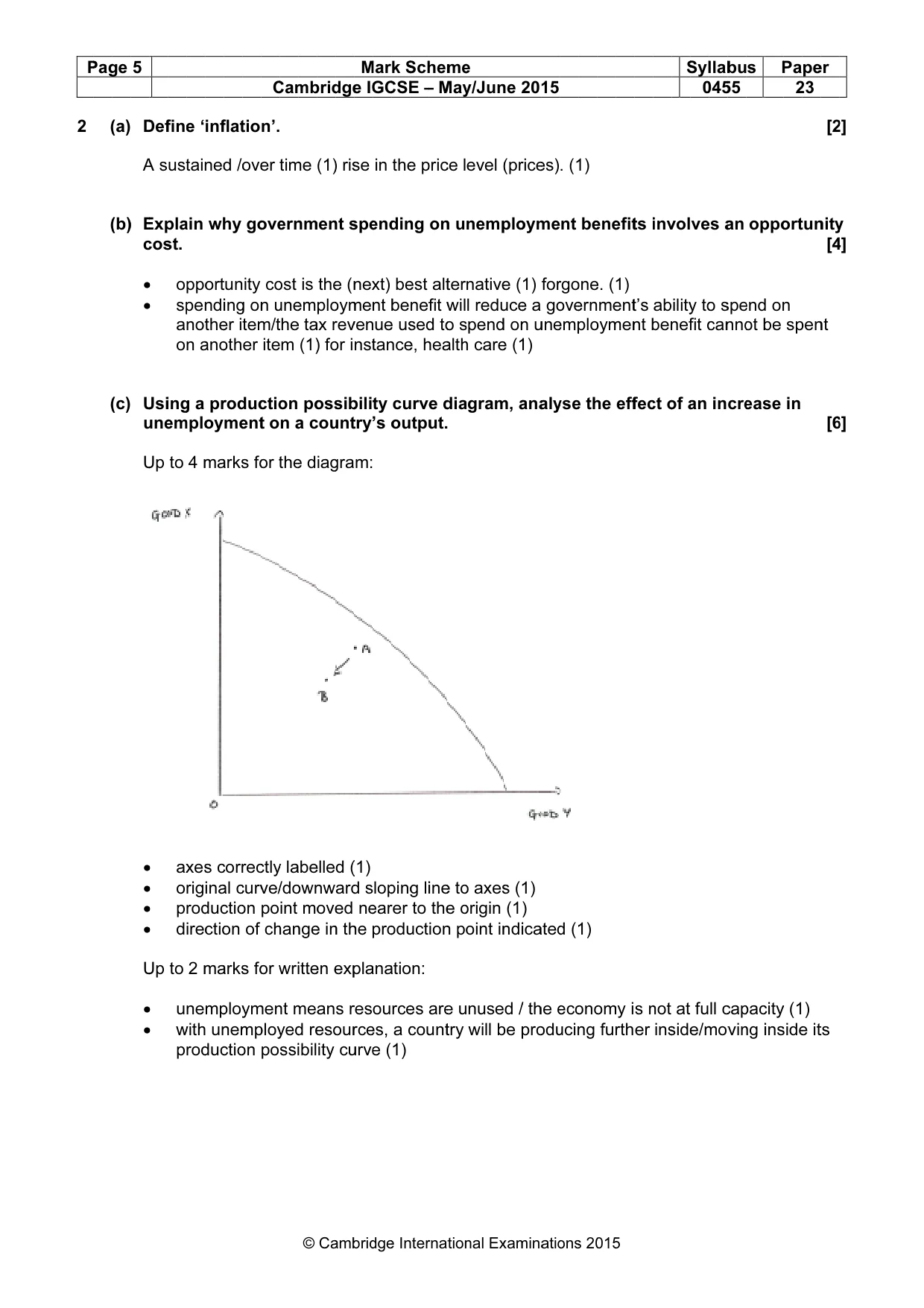
P 2 Pag ( ( ( ge (a) (b) (c) 5 D A ) E c • • U u U • • • • U • • Def A s Exp cos • • Usi une Up • • • • Up • • fine ust pla st. o sp a o ing em to ax o p d to u w p e ‘ tain ain ppo pen not n a g a mplo 4 m xes rig rod irec 2 m ne with rod inf ned wh ort ndi the ano pr oy ma s c ina duc ctio ma mp un duc flat d /o hy tun ing er i oth rod me arks corr al c ctio on arks ploy nem ctio tio ove go ity g on tem er duc ent s fo rec curv on of s fo ym mp on C n’. er ove co n u m/t ite ctio t o or t ctly ve/ po ch or w men ploy po Cam tim ern ost une the m on n a the y la /do int han wri nt m yed ssi mb © me nm is em e ta (1) po a c e d abe own mo nge itte mea d re ibil brid Ca (1) men the plo ax r ) fo oss cou iag elle nw ove e in en e an eso ity dge amb ) ris nt s e (n oym rev or i sib unt gra d ( ard ed n th exp s r our cu M e IG brid se spe nex men ven nst bilit try’ m: (1) d s ne he p pla res rce urve Mar GC dge in end xt) nt b ue tan ty ’s o lop ear pro ana ou es, e ( k S CSE e In the din be be e us nce cu ou ping rer odu atio rce a c 1) Sch E – nter e p ng est nef sed e, h urve tpu g li to uct on: es a cou hem – M rnat pric on alt fit w d to hea e d ut. ine the ion are unt me May tion ce l n u ter wil o s alth dia e to e o n po e u try e y/J nal eve ne nat l re spe h ca agra o ax orig oin nu wi un Ex el ( mp tive edu end are am xes gin nt in use ll b ne 2 xam (pr plo e ( uce d on e (1 m, a s (1 (1 ndi d / be p 20 mina rice oym 1) e a n u 1) ana 1) ) ica / th pro 15 atio es) me for go une aly ated he e odu ons . (1 nt rgo ove emp yse d (1 eco ucin s 20 1) be one ern plo e th 1) ono ng 015 ene e. ( me oym he om fur 5 efit 1) ent men eff my i rth ts i t’s nt b fec s n er inv ab ben ct o not ins S vol ility nef of a at side Syl 0 ve y to fit c an fu e/m llab 045 es a o s can in ll c mov bu 55 an spe nno cre cap vin s op end ot b eas pac ng i P ppo d on be se city ins Pa 2 ort n sp in y (1 side pe 23 tun pen ) e it er [2 nity [4 nt [6 ts 2] y 4] 6]
Mark scheme, page 6
Page 6 Mark Scheme Syllabus Paper Cambridge IGCSE – May/June 2015 0455 23 © Cambridge International Examinations 2015 (d) Discuss whether a rise in unemployment will cause a fall in inflation. [8] Up to 5 marks for why it might: • a rise in unemployment will reduce incomes (1) with lower incomes, people will spend less (1) lower demand will reduce demand-pull inflation (1) • with a rise in unemployment workers are easily replaced/there is now a large pool of workers (1) the increased supply of labour (1) will force down wage rates (1) • a rise in unemployment may discourage workers from asking for wage rises (1) weaken the power of trade unions (1) lower wage rises will mean that firms’ costs of production will increase more slowly (1) this may reduce cost-push inflation (1) Up to 5 marks for why it might not: • demand may still rise despite an increase in unemployment (1) government spending or exports may be increasing (1) • a rise in unemployment reduces national output (AS) (1) increasing inflationary pressures (1) • other costs of production could be rising (1) for instance, raw material costs (1) for instance, a fall in the exchange rate may increase the price of imported raw materials (1) • a rise in unemployment could mean fewer skilled workers (1) this lowers productivity (1) causing average costs to rise for firms (1) • trade unions may still press for wage rises despite an increase in unemployment (1) • inflation can lead to people expecting prices to rise faster in the future (1) this can lead them to act in ways that cause inflation (1) they may buy more products now (1) ask for wage rises (1) • people may receive an income in unemployment benefits (1) and still spend the same amount as before
Mark scheme, page 7
Page 7 Mark Scheme Syllabus Paper Cambridge IGCSE – May/June 2015 0455 23 © Cambridge International Examinations 2015 3 (a) Define ‘regulation’. [2] Rules/laws/controls (1) which are designed to influence the behaviour of firms/people. (1) (b) Explain how resources are allocated in a market system. [4] • market forces (supply and demand) influence the allocation of resources (1) through the price mechanism (1) • resources are privately owned in a market system (1) with little/no government influence (1) • the profit incentive (1) encourages firms to produce what consumers demand (1) • a rise in demand for a good or service (1) will increase price (1) encouraging more resources to be allocated to producing it (1) (c) Analyse the causes of market failure. [6] • market failure arises when markets are inefficient/right products are not produced in the right quantities (1) • abuse of market power (1) monopoly (1) may result in output being restricted (1) high price charged (1) low quality (1) • decisions based on private costs and benefits/failure to take into account external costs (negative externalities) and benefits (1) results in under-consumption and over- consumption of some products (1) leading to inefficient over-production and under- production (1) • lack of information (1) causes consumers and producers to make inefficient choices (1) harmful products may be over-consumed (1) beneficial products may be under- consumed (1) Note: reward (3 marks maximum) references to merit, demerit and public goods but the terms are not required.
Mark scheme, page 8
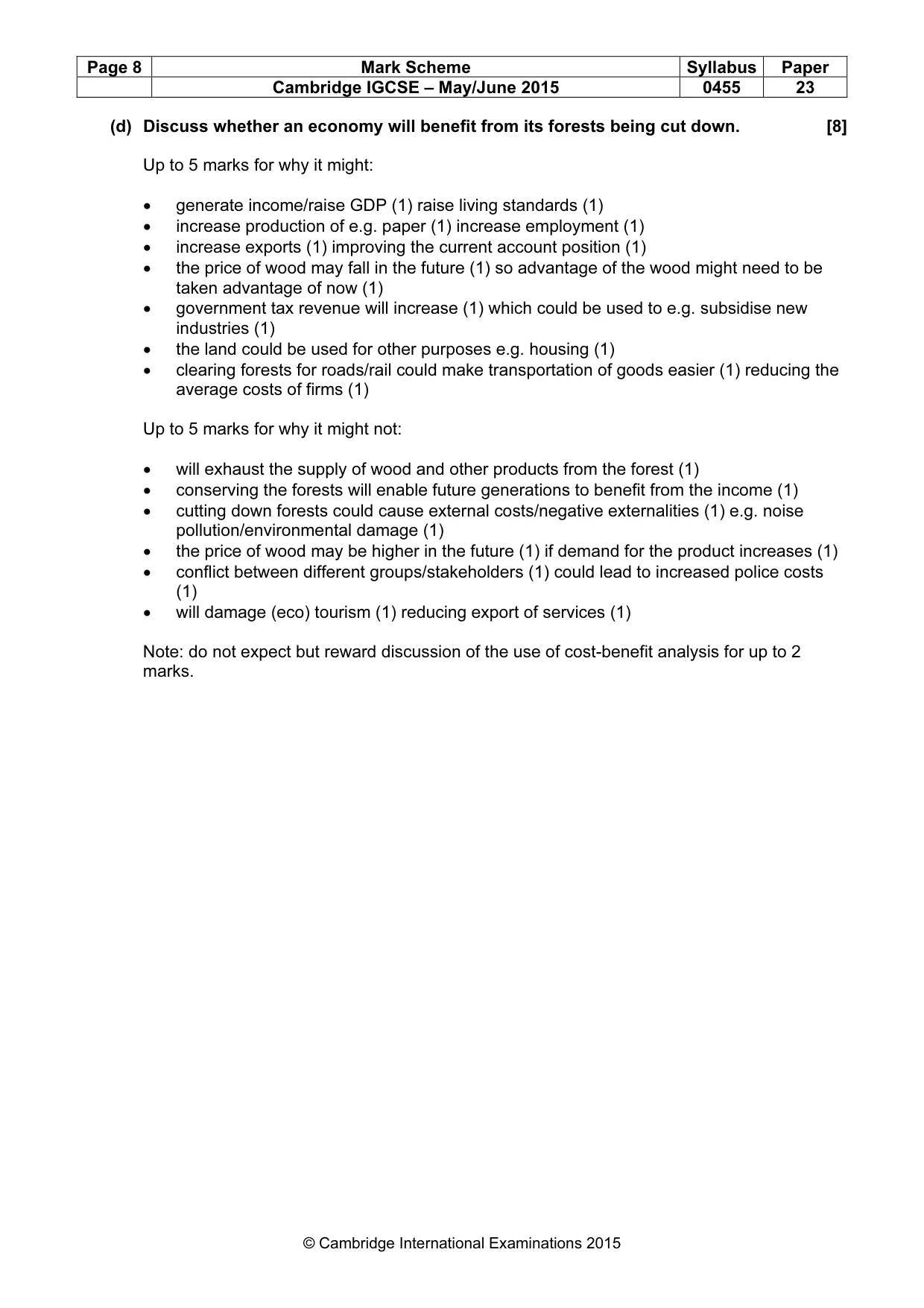
Page 8 Mark Scheme Syllabus Paper Cambridge IGCSE – May/June 2015 0455 23 © Cambridge International Examinations 2015 (d) Discuss whether an economy will benefit from its forests being cut down. [8] Up to 5 marks for why it might: • generate income/raise GDP (1) raise living standards (1) • increase production of e.g. paper (1) increase employment (1) • increase exports (1) improving the current account position (1) • the price of wood may fall in the future (1) so advantage of the wood might need to be taken advantage of now (1) • government tax revenue will increase (1) which could be used to e.g. subsidise new industries (1) • the land could be used for other purposes e.g. housing (1) • clearing forests for roads/rail could make transportation of goods easier (1) reducing the average costs of firms (1) Up to 5 marks for why it might not: • will exhaust the supply of wood and other products from the forest (1) • conserving the forests will enable future generations to benefit from the income (1) • cutting down forests could cause external costs/negative externalities (1) e.g. noise pollution/environmental damage (1) • the price of wood may be higher in the future (1) if demand for the product increases (1) • conflict between different groups/stakeholders (1) could lead to increased police costs (1) • will damage (eco) tourism (1) reducing export of services (1) Note: do not expect but reward discussion of the use of cost-benefit analysis for up to 2 marks.
Mark scheme, page 9
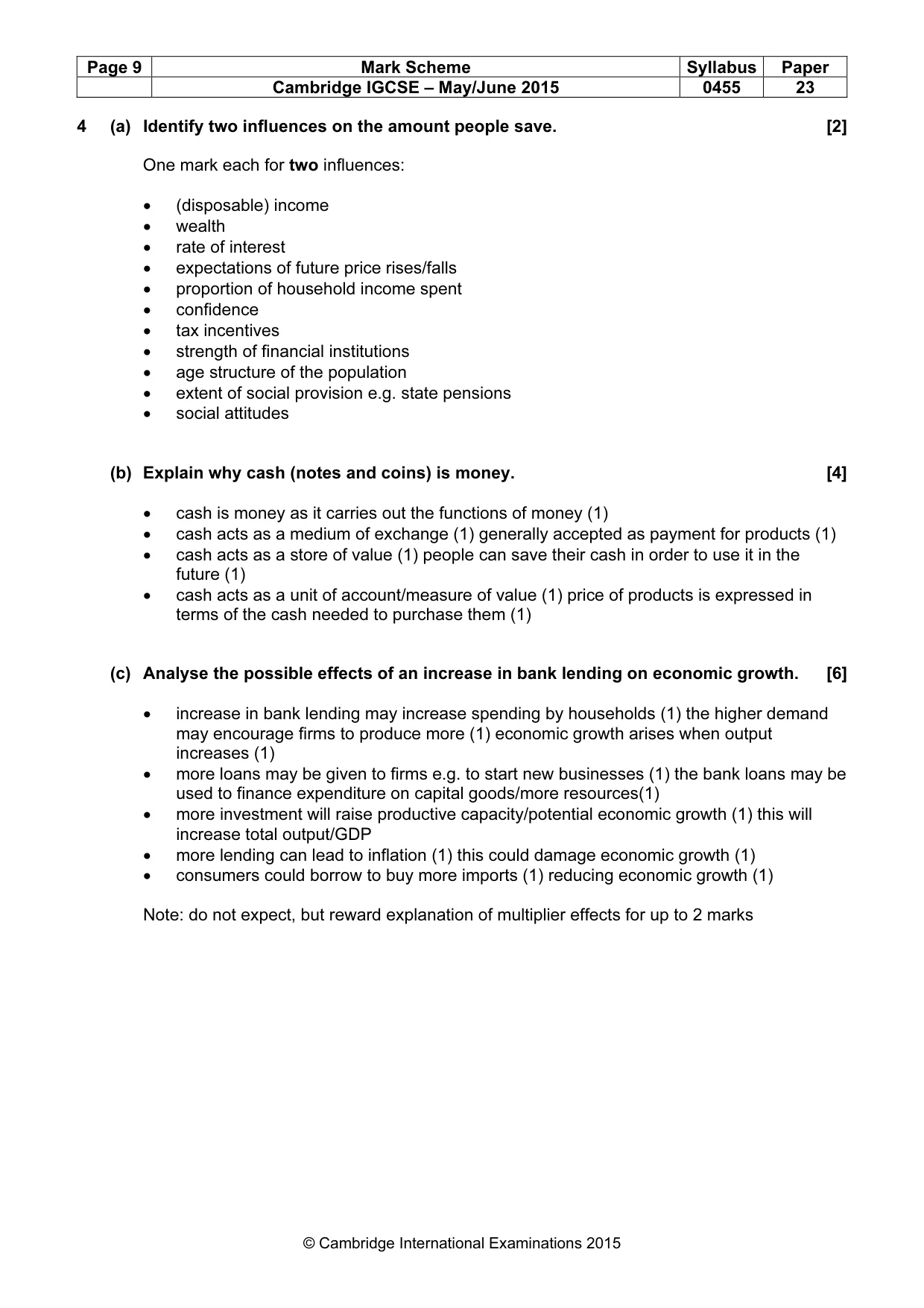
Page 9 Mark Scheme Syllabus Paper Cambridge IGCSE – May/June 2015 0455 23 © Cambridge International Examinations 2015 4 (a) Identify two influences on the amount people save. [2] One mark each for two influences: • (disposable) income • wealth • rate of interest • expectations of future price rises/falls • proportion of household income spent • confidence • tax incentives • strength of financial institutions • age structure of the population • extent of social provision e.g. state pensions • social attitudes (b) Explain why cash (notes and coins) is money. [4] • cash is money as it carries out the functions of money (1) • cash acts as a medium of exchange (1) generally accepted as payment for products (1) • cash acts as a store of value (1) people can save their cash in order to use it in the future (1) • cash acts as a unit of account/measure of value (1) price of products is expressed in terms of the cash needed to purchase them (1) (c) Analyse the possible effects of an increase in bank lending on economic growth. [6] • increase in bank lending may increase spending by households (1) the higher demand may encourage firms to produce more (1) economic growth arises when output increases (1) • more loans may be given to firms e.g. to start new businesses (1) the bank loans may be used to finance expenditure on capital goods/more resources(1) • more investment will raise productive capacity/potential economic growth (1) this will increase total output/GDP • more lending can lead to inflation (1) this could damage economic growth (1) • consumers could borrow to buy more imports (1) reducing economic growth (1) Note: do not expect, but reward explanation of multiplier effects for up to 2 marks
Mark scheme, page 10
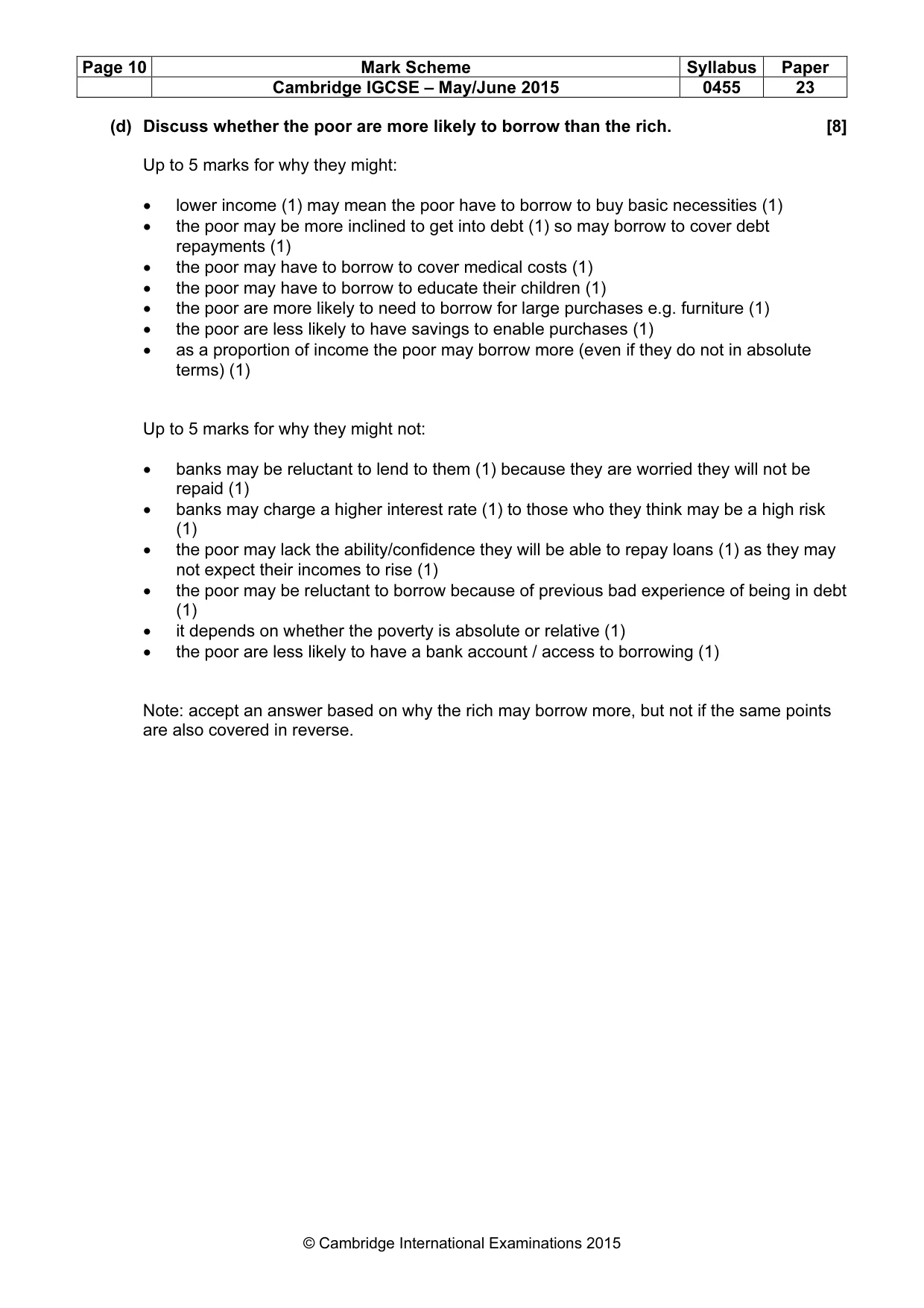
Page 10 Mark Scheme Syllabus Paper Cambridge IGCSE – May/June 2015 0455 23 © Cambridge International Examinations 2015 (d) Discuss whether the poor are more likely to borrow than the rich. [8] Up to 5 marks for why they might: • lower income (1) may mean the poor have to borrow to buy basic necessities (1) • the poor may be more inclined to get into debt (1) so may borrow to cover debt repayments (1) • the poor may have to borrow to cover medical costs (1) • the poor may have to borrow to educate their children (1) • the poor are more likely to need to borrow for large purchases e.g. furniture (1) • the poor are less likely to have savings to enable purchases (1) • as a proportion of income the poor may borrow more (even if they do not in absolute terms) (1) Up to 5 marks for why they might not: • banks may be reluctant to lend to them (1) because they are worried they will not be repaid (1) • banks may charge a higher interest rate (1) to those who they think may be a high risk (1) • the poor may lack the ability/confidence they will be able to repay loans (1) as they may not expect their incomes to rise (1) • the poor may be reluctant to borrow because of previous bad experience of being in debt (1) • it depends on whether the poverty is absolute or relative (1) • the poor are less likely to have a bank account / access to borrowing (1) Note: accept an answer based on why the rich may borrow more, but not if the same points are also covered in reverse.
Mark scheme, page 11
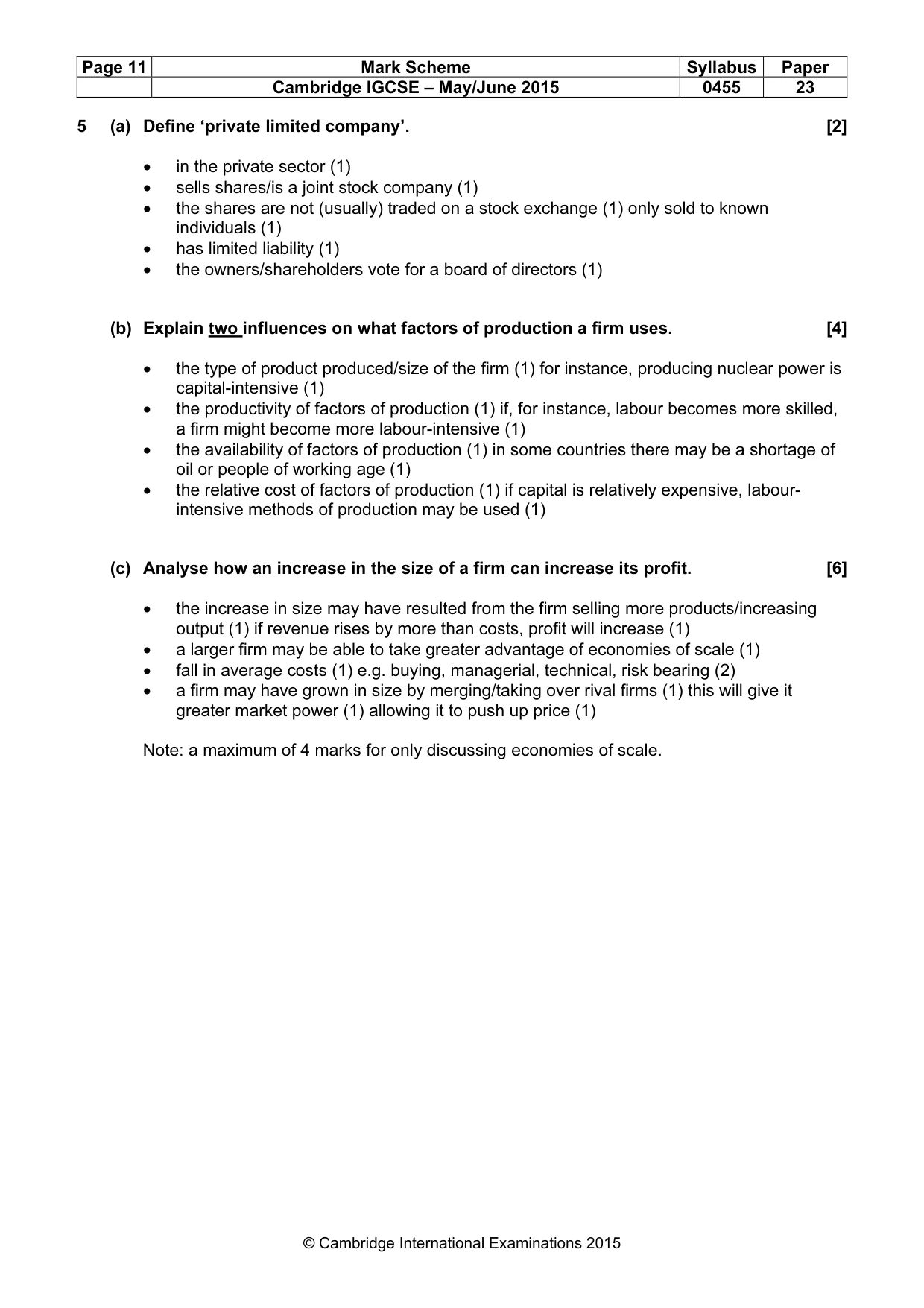
Page 11 Mark Scheme Syllabus Paper Cambridge IGCSE – May/June 2015 0455 23 © Cambridge International Examinations 2015 5 (a) Define ‘private limited company’. [2] • in the private sector (1) • sells shares/is a joint stock company (1) • the shares are not (usually) traded on a stock exchange (1) only sold to known individuals (1) • has limited liability (1) • the owners/shareholders vote for a board of directors (1) (b) Explain two influences on what factors of production a firm uses. [4] • the type of product produced/size of the firm (1) for instance, producing nuclear power is capital-intensive (1) • the productivity of factors of production (1) if, for instance, labour becomes more skilled, a firm might become more labour-intensive (1) • the availability of factors of production (1) in some countries there may be a shortage of oil or people of working age (1) • the relative cost of factors of production (1) if capital is relatively expensive, labour- intensive methods of production may be used (1) (c) Analyse how an increase in the size of a firm can increase its profit. [6] • the increase in size may have resulted from the firm selling more products/increasing output (1) if revenue rises by more than costs, profit will increase (1) • a larger firm may be able to take greater advantage of economies of scale (1) • fall in average costs (1) e.g. buying, managerial, technical, risk bearing (2) • a firm may have grown in size by merging/taking over rival firms (1) this will give it greater market power (1) allowing it to push up price (1) Note: a maximum of 4 marks for only discussing economies of scale.
Mark scheme, page 12
Page 12 Mark Scheme Syllabus Paper Cambridge IGCSE – May/June 2015 0455 23 © Cambridge International Examinations 2015 (d) Discuss whether an economy would benefit from a foreign producer setting up in the country. [8] Up to 5 marks for why it might: • increase GDP (1) raise living standards (1) • create new jobs (1) lower unemployment (1) less spent on benefits (1) • pay higher than local wages (1) • bring new knowledge and skills (1) boosting productivity (1) • pay (corporation) taxes (1) increasing government revenue (1) • increased (inward) investment (1) • creates competition for domestic firms (1) making them cut costs/become more efficient (1) • contribute to the country’s exports (1) improve the current account position (1) • sell more cheaply in the country (1) as lower transport costs (1) • country benefits from improved infrastructure (e.g. roads) built by foreign producer (1) • creates demand for products of local firms e.g. components (1) Up to 5 marks for why it might not: • may drive local producers out of business (1) so not adding to GDP, employment, etc. (1) • may create external costs (1) e.g. pollution (1) may set up in the country to get round regulations at home (1) • top jobs may be taken by workers from the MNC’s home country (1) jobs created for locals may be unskilled (1) • profits earned from the firm may be sent home (1) so not benefiting the home economy (1) • it may have powerful influence on the government (1) reducing budget revenues by demanding tax relief/subsidies (1)
Mark scheme, page 13
Page 13 Mark Scheme Syllabus Paper Cambridge IGCSE – May/June 2015 0455 23 © Cambridge International Examinations 2015 6 (a) Define ‘horizontal integration’. [2] A merger/takeover between firms (1) producing the same product at the same stage of production. (1) (b) Explain two characteristics of perfect competition. [4] • many buyers and sellers (1) so no one buyer or seller can influence price (1) • no barriers to entry and exit (1) so any new firm can start producing the product/nothing which makes it difficult for a firm not currently making the product from starting to make it/no restrictions on firms in the industry stopping producing the products (1) • firms are price takers (1) their supply is such a tiny proportion of total supply that changes in it will have no effect on price (1) • homogeneous product/all the products are the same (1) so the products of different producers are perfect substitutes for each other (1) • perfect information (1) buyers and sellers are fully aware of price and profits earned in the market (1) (c) Analyse how two supply-side policy measures could improve the performance of an airline industry. [6] Up to 4 marks for any one policy measure analysed: • privatisation (1) may introduce competition (1) increase profit incentive (1) encourage firms to be efficient/reduce costs (1) • cut in corporation tax/tax incentives given (1) increase funds available for investment (1) improve technology (1) raise productivity (1) lower costs of production (1) • Improved education and training (1) raise skills of workers (1) increasing productivity (1) lower costs of production (1) • cut in income tax (1) increase the motivation of workers (1) raise productivity (1) lower costs of production (1) • deregulation (1) removing laws and rules may reduce firms’ costs (1) enabling them to invest more (1) • subsidies (1) may encourage firms to invest in advanced technology, engage in research and development and/or train workers (1) lower costs of production/increase productive capacity (1)
Mark scheme, page 14
Page 14 Mark Scheme Syllabus Paper Cambridge IGCSE – May/June 2015 0455 23 © Cambridge International Examinations 2015 (d) Discuss whether price is likely to be higher in a monopoly than in a perfectly competitive market. [8] Up to 5 marks for why it might: • lack of competition (1) gives a monopoly market power (1) if profit maximisers (1) may push up price (1) by restricting supply (1) • lack of consumer choice/consumers can switch to rival producers in a perfectly competitive market (1) an increase in demand raises price (1) which will encourage new firms to enter the industry (1) reducing price (1) • demand is often inelastic, e.g. water (1) increased demand raises price by greater proportion (1) • a monopoly may be experiencing diseconomies of scale (1) example of diseconomies of scale (1) this will raise average costs of production (1) Up to 5 marks for why it might not: • a monopoly may be able to take advantage of economies of scale (1) example of economies of scale (1) with lower average costs, price may be lower (1) whilst still enabling a monopoly to enjoy high profits (1) • with high profits, a monopoly may be able to spend more on research and development/new technology (1) this can reduce costs of production (1) enabling a monopoly to charge a lower price (1) • a monopoly may be state-owned (1) it may choose to charge a low price to ensure everyone can afford it (1) • private sector monopolies may not be profit maximisers (1) they may charge a lower price (1) in order to grow the business (1) • monopolies may still face overseas competition (1) keeping prices down (1)
Mark scheme, page 15
Page 15 Mark Scheme Syllabus Paper Cambridge IGCSE – May/June 2015 0455 23 © Cambridge International Examinations 2015 7 (a) Define ‘exchange rate’. [2] The price (value) of a currency/how much a currency is worth (1) in terms of another currency/currencies. (1) Note: allow 1 mark for an example e.g. £1 = $2. (b) Explain two benefits of a floating exchange rate system. [4] • no need to keep reserves of foreign currencies (1) as the central bank will not be buying the currency to support its value (1) • the exchange rate should move automatically/it is self-correcting (1) to eliminate a current account deficit/surplus (1) • allows a government to concentrate on other aims e.g. full employment (1) as interest rate changes/foreign exchange dealings do not have to be undertaken (1) • market forces determine the exchange rate (1) equilibrium price will be achieved (1) (c) Analyse the effect of a rise in unemployment on living standards in a country. [6] • higher unemployment reduces the income of the unemployed (1) the unemployed will not be able to buy so many goods and services (1) • unemployment involves an opportunity cost (1) output will be lower than possible (1) • the unemployed may experience health care problems (1) this would put a burden on health services (1) • higher unemployment may increase crime (1) crime and the fear of crime lowers the quality of people’s lives more resources e.g. prisons, have to be devoted to tackling crime which involves an opportunity cost (1) • the unemployed may not be able to afford to educate their children (1) less educated people tend to enjoy a lower quality of life (1) • spending on unemployment benefits (1) means less money for e.g. hospitals (1)
Mark scheme, page 16
Page 16 Mark Scheme Syllabus Paper Cambridge IGCSE – May/June 2015 0455 23 © Cambridge International Examinations 2015 (d) Discuss whether coal miners are likely to be paid more than car assembly workers. [8] Up to 5 marks for why they might: • demand for the labour of coal miners might be higher (1) because demand for coal may be increasing whilst demand for cars may be falling (1) • the supply of coal miners may be lower (1) due the skills/qualifications needed (1) and the greater physical risks/dangers involved (1) and non-wage benefits enjoyed by car workers being higher (1) • coal miners may have more bargaining power than car workers (1) this may be because e.g. a higher proportion of coal miners belong to a union (1) • coal mining may provide essential energy for a country and be subsidised by the government (1) lower costs will enable firms to pay coal miners more (1) Up to 5 marks for why they might not: • some coal miners may be in less promoted posts than some car workers (1) • it might be easier to substitute workers with capital in the coal industry (1) making demand for labour more wage elastic in the coal industry (1) • the average age of coal miners may be lower than the average of car workers (1) making the workers less experienced (1) • the coal industry may be declining whilst the car industry may be increasing (1) this may alter relative demand (1) • car workers may be more skilled (1) these skills may be in higher demand (1) Up to 3 marks for an appropriate diagram showing either case Note: accept an answer based on why car workers may be paid more than coal miners.
What you needed in this session
Cambridge’s own grade thresholds for 2015 May/June, Paper 2 · Variant 3. A higher threshold means an easier paper — the bar moves with how the cohort did.