Cambridge IGCSE Economics 0455 — 2015 May/June Paper 2 · Variant 2
0455/22/M/J/15 · 90 marks · ≈101 min
The question paper and its mark scheme, free to read here and free to download. This is Cambridge’s own paper, exactly as it was sat.
Question paper8 pages
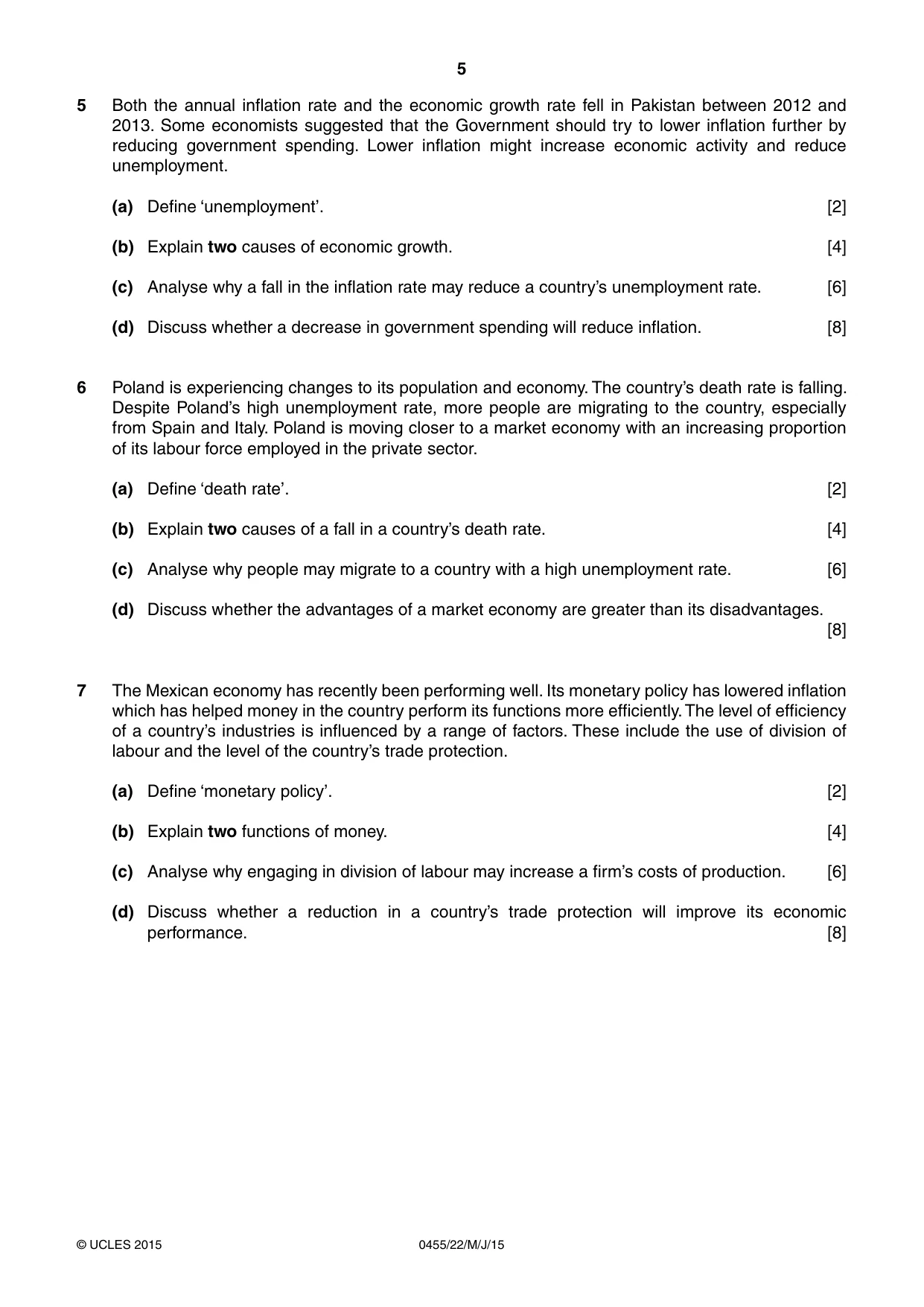



Mark scheme14 pages
Answers below. Sit the paper first if you are practising.
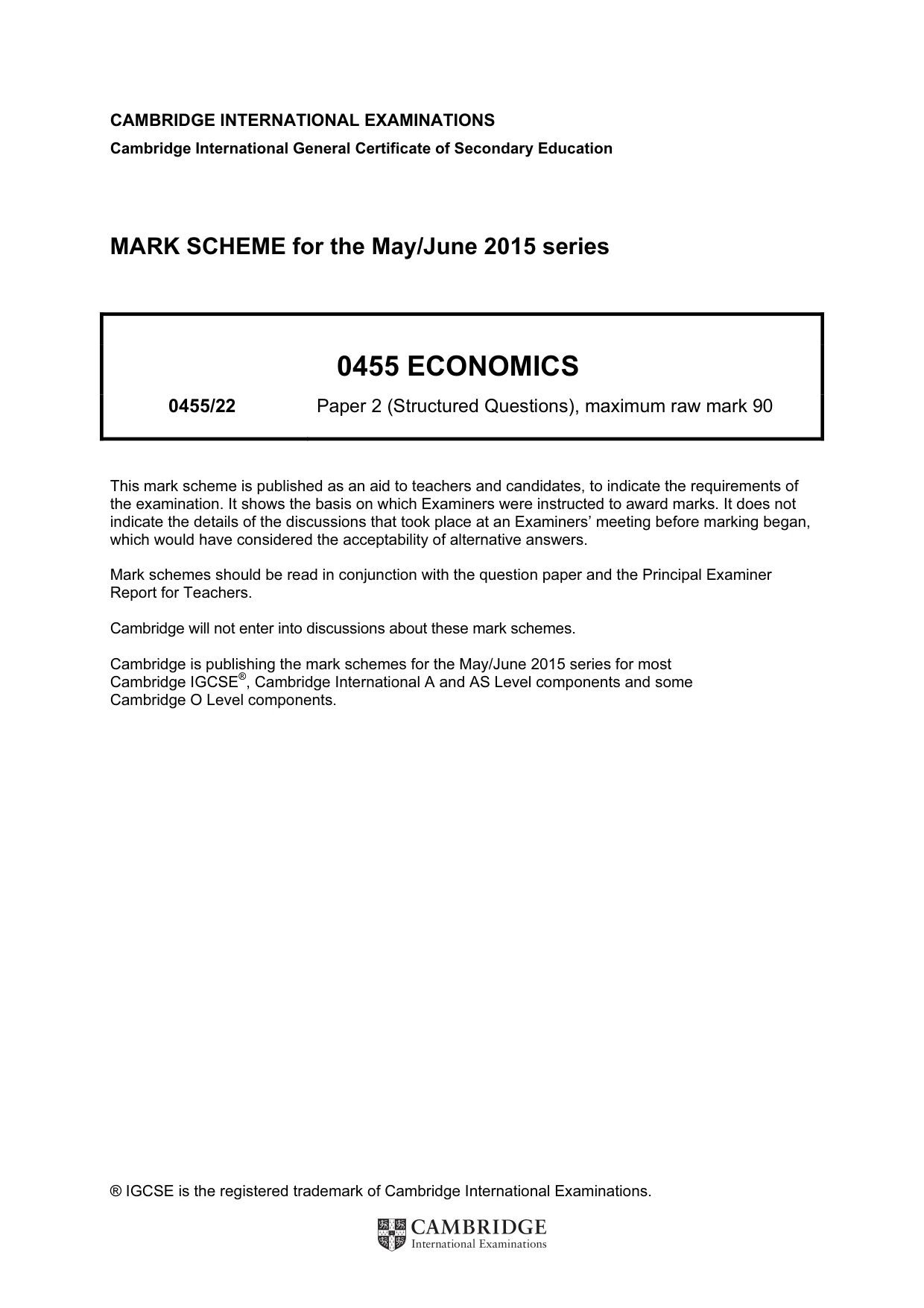
Paper as text
Question paper, page 1
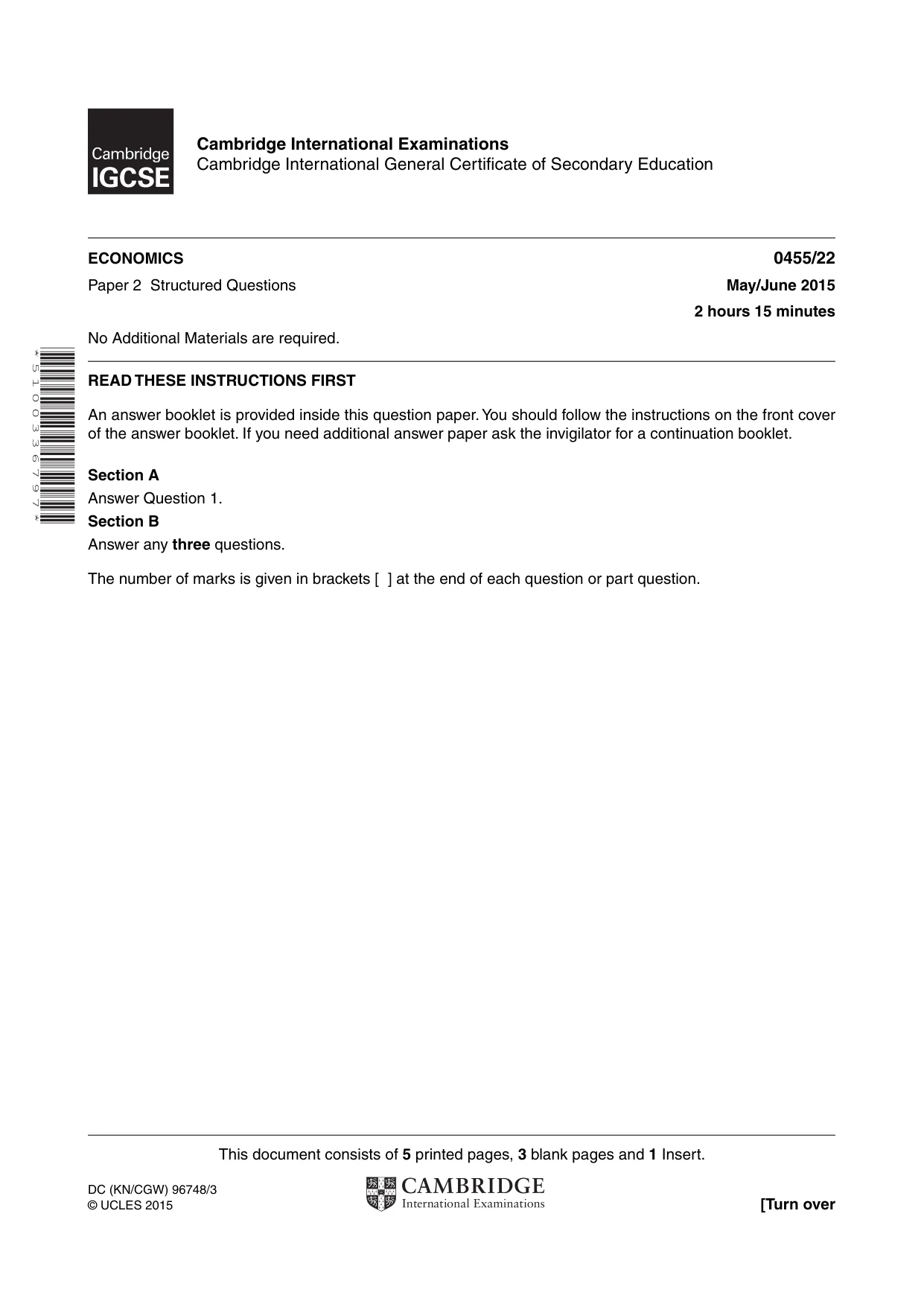
This document consists of 5 printed pages, 3 blank pages and 1 Insert. DC (KN/CGW) 96748/3 © UCLES 2015 [Turn over Cambridge International Examinations Cambridge International General Certificate of Secondary Education * 5 1 0 0 3 3 6 7 9 7 * ECONOMICS 0455/22 Paper 2 Structured Questions May/June 2015 2 hours 15 minutes No Additional Materials are required. READ THESE INSTRUCTIONS FIRST An answer booklet is provided inside this question paper. You should follow the instructions on the front cover of the answer booklet. If you need additional answer paper ask the invigilator for a continuation booklet. Section A Answer Question 1. Section B Answer any three questions. The number of marks is given in brackets [ ] at the end of each question or part question.
Question paper, page 2
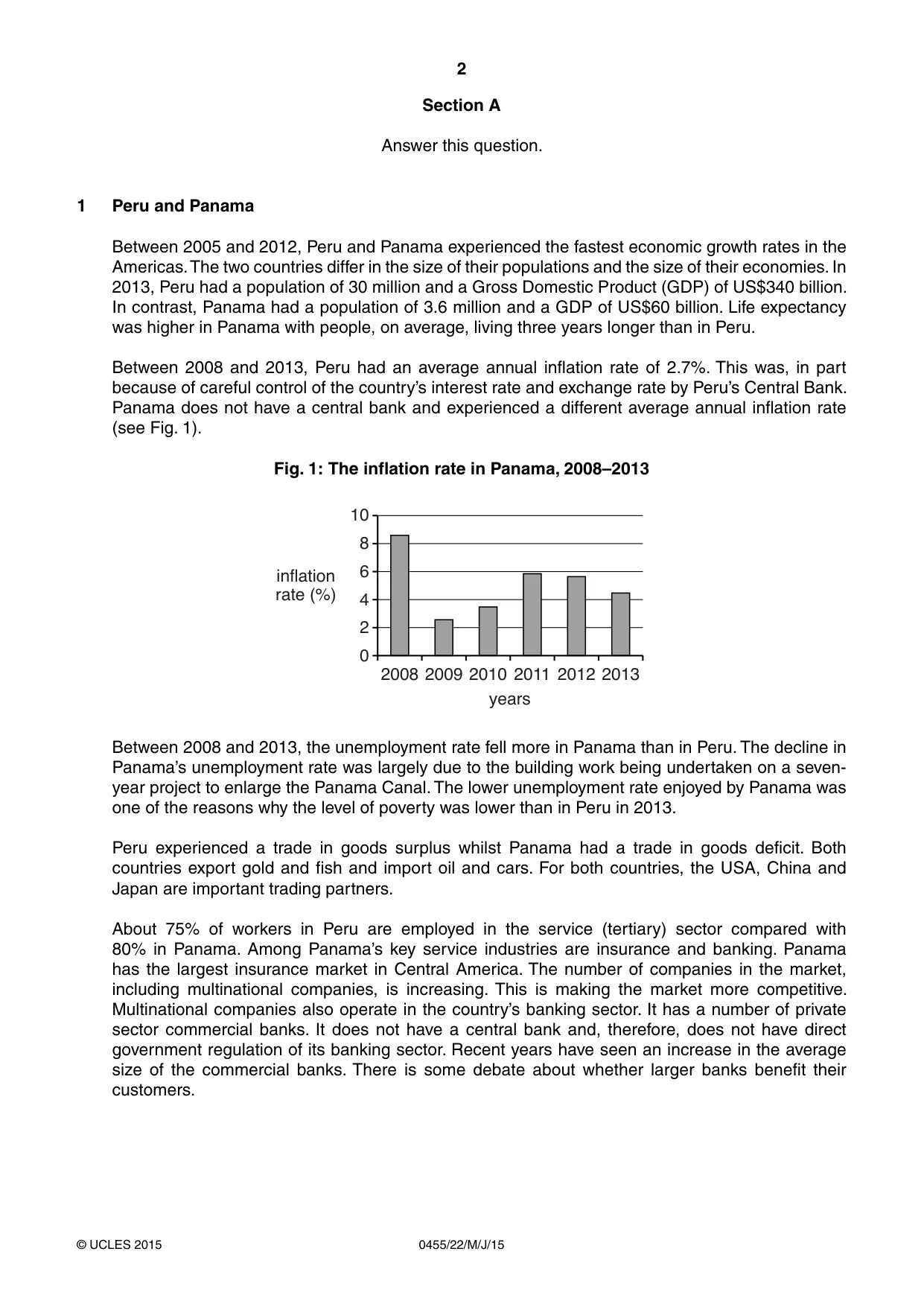
2 0455/22/M/J/15 © UCLES 2015 Section A Answer this question. 1 Peru and Panama Between 2005 and 2012, Peru and Panama experienced the fastest economic growth rates in the Americas. The two countries differ in the size of their populations and the size of their economies. In 2013, Peru had a population of 30 million and a Gross Domestic Product (GDP) of US$340 billion. In contrast, Panama had a population of 3.6 million and a GDP of US$60 billion. Life expectancy was higher in Panama with people, on average, living three years longer than in Peru. Between 2008 and 2013, Peru had an average annual inflation rate of 2.7%. This was, in part because of careful control of the country’s interest rate and exchange rate by Peru’s Central Bank. Panama does not have a central bank and experienced a different average annual inflation rate (see Fig. 1). Fig. 1: The inflation rate in Panama, 2008–2013 2008 2009 10 8 6 inflation rate (%) 4 2 0 2010 2011 years 2012 2013 Between 2008 and 2013, the unemployment rate fell more in Panama than in Peru. The decline in Panama’s unemployment rate was largely due to the building work being undertaken on a seven- year project to enlarge the Panama Canal. The lower unemployment rate enjoyed by Panama was one of the reasons why the level of poverty was lower than in Peru in 2013. Peru experienced a trade in goods surplus whilst Panama had a trade in goods deficit. Both countries export gold and fish and import oil and cars. For both countries, the USA, China and Japan are important trading partners. About 75% of workers in Peru are employed in the service (tertiary) sector compared with 80% in Panama. Among Panama’s key service industries are insurance and banking. Panama has the largest insurance market in Central America. The number of companies in the market, including multinational companies, is increasing. This is making the market more competitive. Multinational companies also operate in the country’s banking sector. It has a number of private sector commercial banks. It does not have a central bank and, therefore, does not have direct government regulation of its banking sector. Recent years have seen an increase in the average size of the commercial banks. There is some debate about whether larger banks benefit their customers.
Question paper, page 3
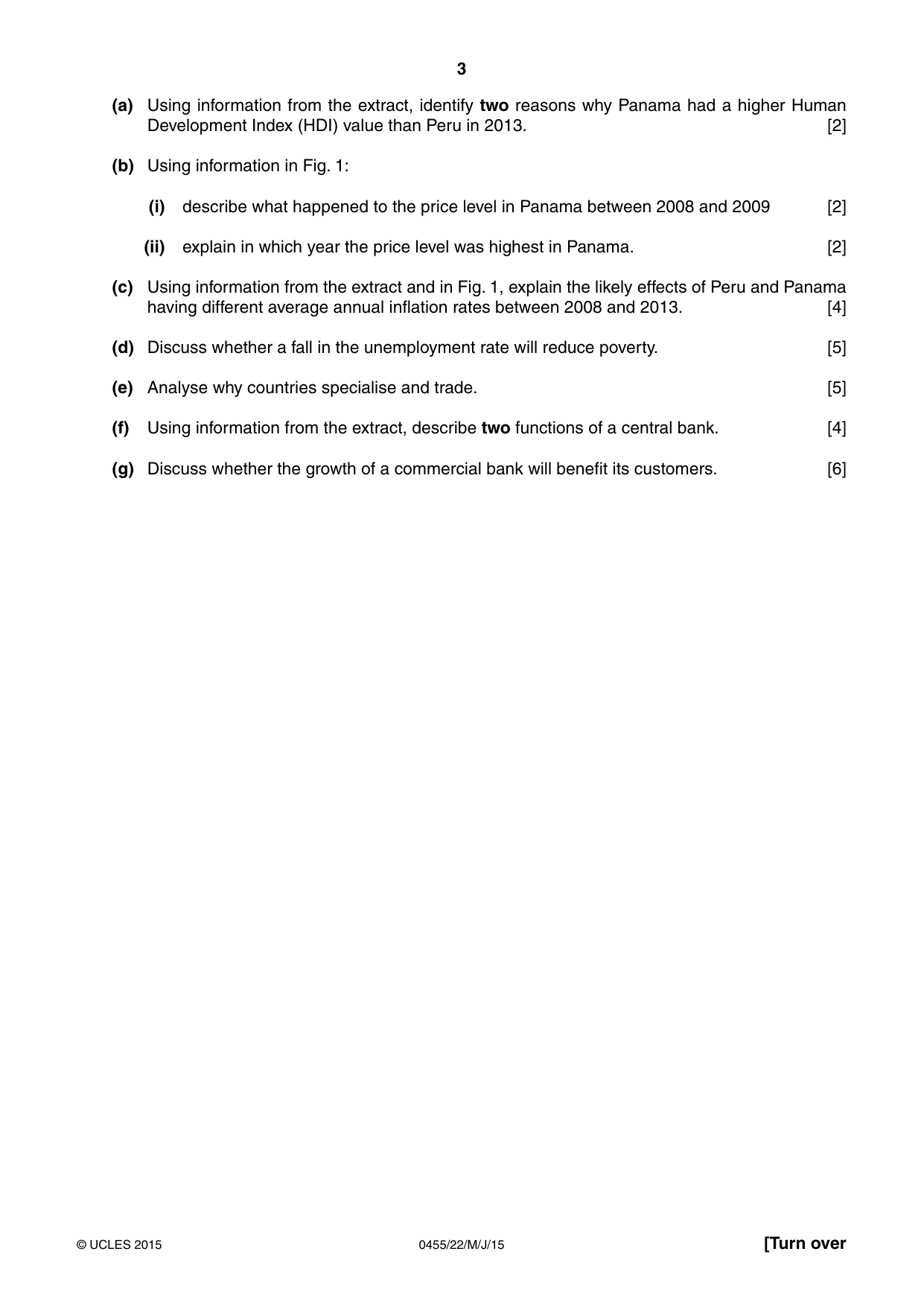
3 0455/22/M/J/15 © UCLES 2015 [Turn over (a) Using information from the extract, identify two reasons why Panama had a higher Human Development Index (HDI) value than Peru in 2013. [2] (b) Using information in Fig. 1: (i) describe what happened to the price level in Panama between 2008 and 2009 [2] (ii) explain in which year the price level was highest in Panama. [2] (c) Using information from the extract and in Fig. 1, explain the likely effects of Peru and Panama having different average annual inflation rates between 2008 and 2013. [4] (d) Discuss whether a fall in the unemployment rate will reduce poverty. [5] (e) Analyse why countries specialise and trade. [5] (f) Using information from the extract, describe two functions of a central bank. [4] (g) Discuss whether the growth of a commercial bank will benefit its customers. [6]
Question paper, page 4
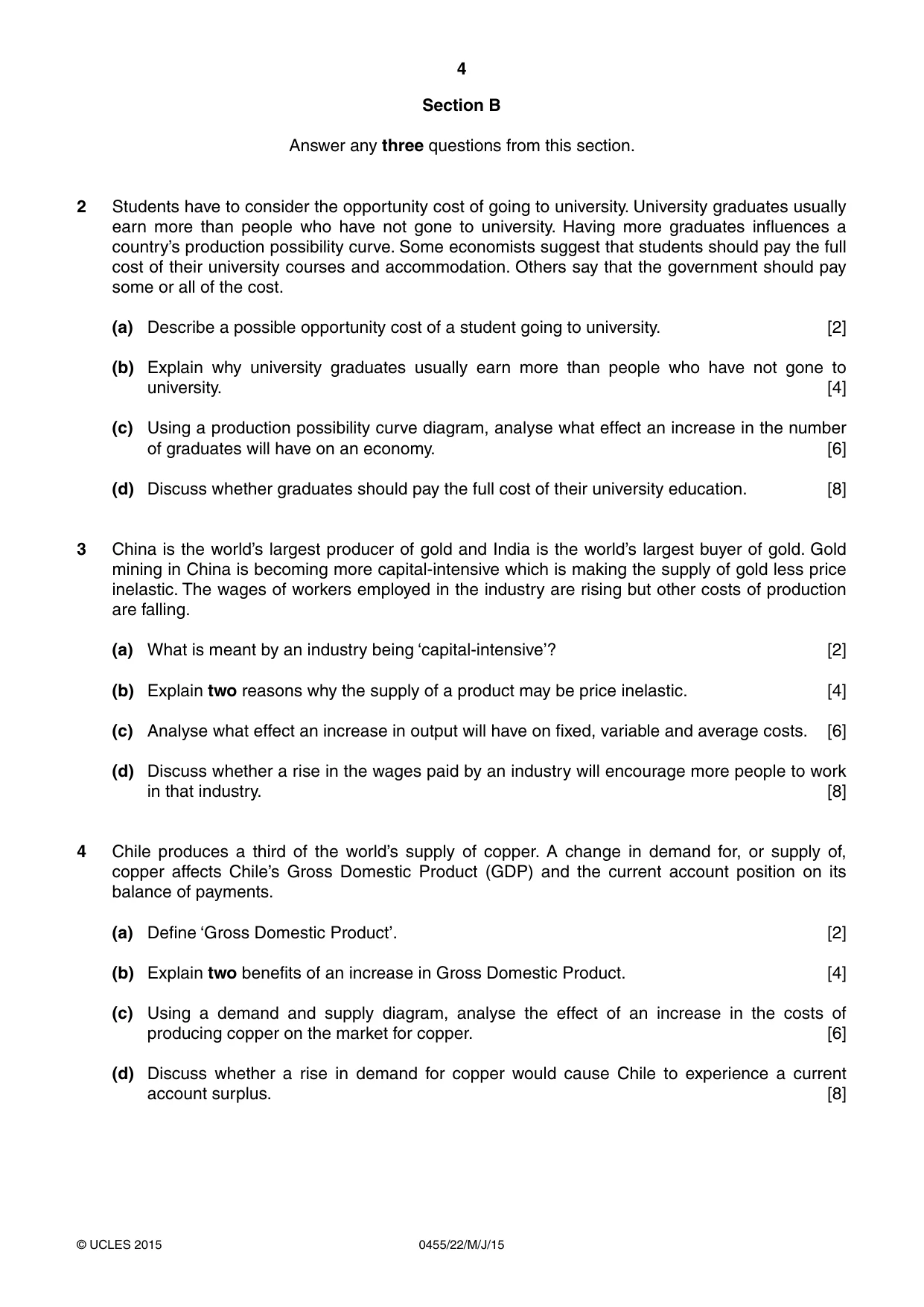
4 0455/22/M/J/15 © UCLES 2015 Section B Answer any three questions from this section. 2 Students have to consider the opportunity cost of going to university. University graduates usually earn more than people who have not gone to university. Having more graduates influences a country’s production possibility curve. Some economists suggest that students should pay the full cost of their university courses and accommodation. Others say that the government should pay some or all of the cost. (a) Describe a possible opportunity cost of a student going to university. [2] (b) Explain why university graduates usually earn more than people who have not gone to university. [4] (c) Using a production possibility curve diagram, analyse what effect an increase in the number of graduates will have on an economy. [6] (d) Discuss whether graduates should pay the full cost of their university education. [8] 3 China is the world’s largest producer of gold and India is the world’s largest buyer of gold. Gold mining in China is becoming more capital-intensive which is making the supply of gold less price inelastic. The wages of workers employed in the industry are rising but other costs of production are falling. (a) What is meant by an industry being ‘capital-intensive’? [2] (b) Explain two reasons why the supply of a product may be price inelastic. [4] (c) Analyse what effect an increase in output will have on fixed, variable and average costs. [6] (d) Discuss whether a rise in the wages paid by an industry will encourage more people to work in that industry. [8] 4 Chile produces a third of the world’s supply of copper. A change in demand for, or supply of, copper affects Chile’s Gross Domestic Product (GDP) and the current account position on its balance of payments. (a) Define ‘Gross Domestic Product’. [2] (b) Explain two benefits of an increase in Gross Domestic Product. [4] (c) Using a demand and supply diagram, analyse the effect of an increase in the costs of producing copper on the market for copper. [6] (d) Discuss whether a rise in demand for copper would cause Chile to experience a current account surplus. [8]
Question paper, page 5
5 0455/22/M/J/15 © UCLES 2015 5 Both the annual inflation rate and the economic growth rate fell in Pakistan between 2012 and 2013. Some economists suggested that the Government should try to lower inflation further by reducing government spending. Lower inflation might increase economic activity and reduce unemployment. (a) Define ‘unemployment’. [2] (b) Explain two causes of economic growth. [4] (c) Analyse why a fall in the inflation rate may reduce a country’s unemployment rate. [6] (d) Discuss whether a decrease in government spending will reduce inflation. [8] 6 Poland is experiencing changes to its population and economy. The country’s death rate is falling. Despite Poland’s high unemployment rate, more people are migrating to the country, especially from Spain and Italy. Poland is moving closer to a market economy with an increasing proportion of its labour force employed in the private sector. (a) Define ‘death rate’. [2] (b) Explain two causes of a fall in a country’s death rate. [4] (c) Analyse why people may migrate to a country with a high unemployment rate. [6] (d) Discuss whether the advantages of a market economy are greater than its disadvantages. [8] 7 The Mexican economy has recently been performing well. Its monetary policy has lowered inflation which has helped money in the country perform its functions more efficiently. The level of efficiency of a country’s industries is influenced by a range of factors. These include the use of division of labour and the level of the country’s trade protection. (a) Define ‘monetary policy’. [2] (b) Explain two functions of money. [4] (c) Analyse why engaging in division of labour may increase a firm’s costs of production. [6] (d) Discuss whether a reduction in a country’s trade protection will improve its economic performance. [8]
Question paper, page 6
6 0455/22/M/J/15 © UCLES 2015 BLANK PAGE
Question paper, page 7
7 0455/22/M/J/15 © UCLES 2015 BLANK PAGE
Question paper, page 8
8 0455/22/M/J/15 © UCLES 2015 BLANK PAGE Permission to reproduce items where third-party owned material protected by copyright is included has been sought and cleared where possible. Every reasonable effort has been made by the publisher (UCLES) to trace copyright holders, but if any items requiring clearance have unwittingly been included, the publisher will be pleased to make amends at the earliest possible opportunity. To avoid the issue of disclosure of answer-related information to candidates, all copyright acknowledgements are reproduced online in the Cambridge International Examinations Copyright Acknowledgements Booklet. This is produced for each series of examinations and is freely available to download at www.cie.org.uk after the live examination series. Cambridge International Examinations is part of the Cambridge Assessment Group. Cambridge Assessment is the brand name of University of Cambridge Local Examinations Syndicate (UCLES), which is itself a department of the University of Cambridge.
Mark scheme, page 1
® IGCSE is the registered trademark of Cambridge International Examinations. CAMBRIDGE INTERNATIONAL EXAMINATIONS Cambridge International General Certificate of Secondary Education MARK SCHEME for the May/June 2015 series 0455 ECONOMICS 0455/22 Paper 2 (Structured Questions), maximum raw mark 90 This mark scheme is published as an aid to teachers and candidates, to indicate the requirements of the examination. It shows the basis on which Examiners were instructed to award marks. It does not indicate the details of the discussions that took place at an Examiners’ meeting before marking began, which would have considered the acceptability of alternative answers. Mark schemes should be read in conjunction with the question paper and the Principal Examiner Report for Teachers. Cambridge will not enter into discussions about these mark schemes. Cambridge is publishing the mark schemes for the May/June 2015 series for most Cambridge IGCSE®, Cambridge International A and AS Level components and some Cambridge O Level components.
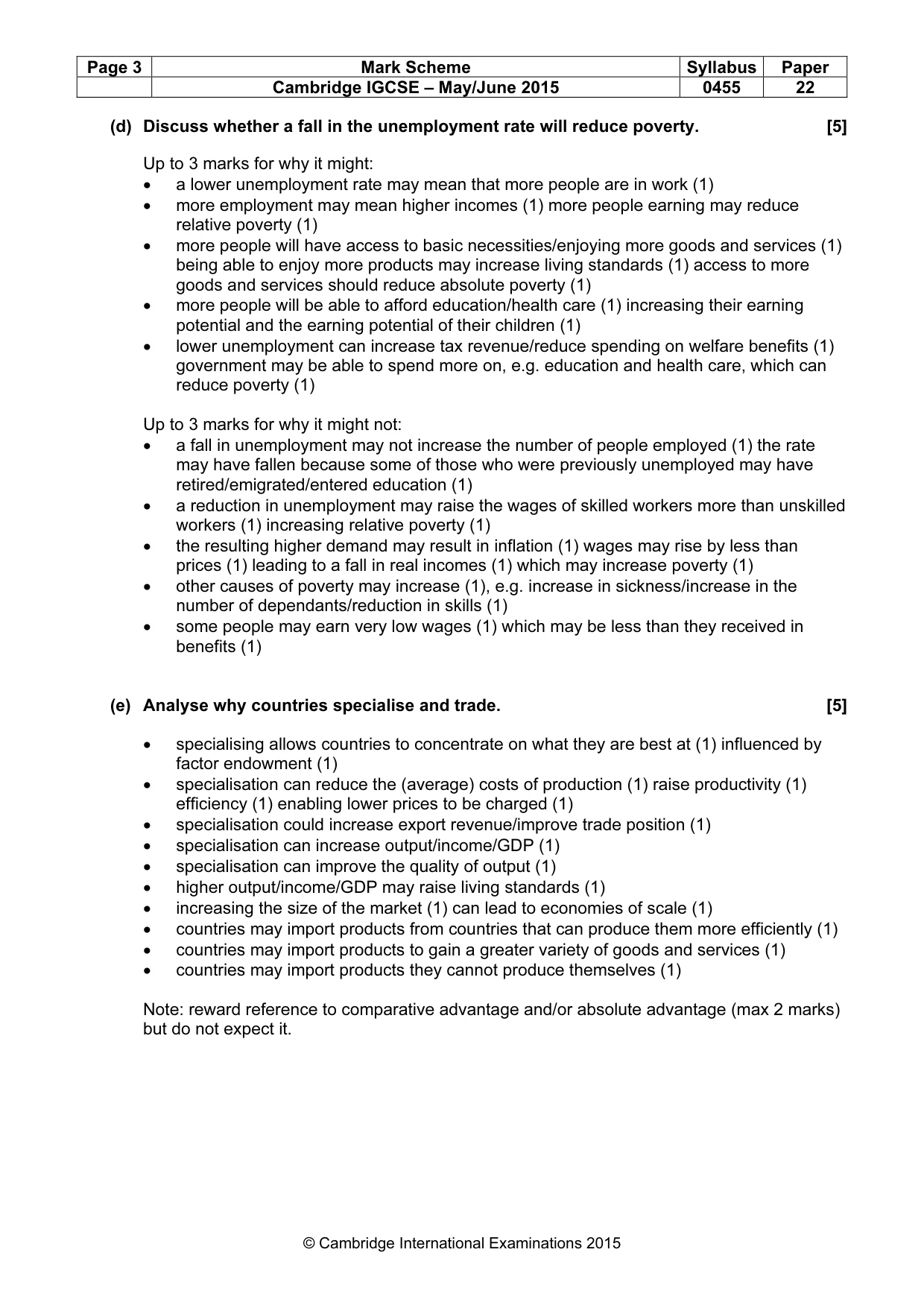
Mark scheme, page 2
Page 2 Mark Scheme Syllabus Paper Cambridge IGCSE – May/June 2015 0455 22 © Cambridge International Examinations 2015 1 (a) Using information from the extract, identify two reasons why Panama had a higher Human Development Index (HDI) value than Peru in 2013. [2] • higher GDP per head/average income (1) • higher life expectancy (1) (b) (i) Using information in Fig. 1, describe what happened to the price level in Panama between 2008 and 2009. [2] The price level rose (1) at a lower rate in 2009/at a higher rate in 2008 (1). (ii) Using information in Fig. 1, explain in which year the price level was highest in Panama. [2] 2013 (1) as price level rose every year/there was inflation throughout the period (1) (c) Using information from the extract and in Fig. 1, explain the likely effects of Peru and Panama having different average annual inflation rates between 2008 and 2013. [4] • the average inflation rate was higher in Panama (1) it was approximately 5% in Panama (1) • the implication is that Panama’s inflation rate is less stable than Peru’s (1) an unstable inflation rate can make planning more difficult/may discourage investment and saving (1) • a higher inflation rate may make a country’s products less internationally competitive (1) worsening the trade position (1) • a higher inflation rate may discourage MNCs setting up in the country/discourage investment (1) reducing potential output/employment (1) • a higher inflation rate may result in greater costs to consumers (1) lower purchasing power (1) • a higher inflation rate may create costs for firms (1), e.g. administrative costs (1) • a higher inflation rate may disadvantage savers (1) but reward borrowers (1) • a higher inflation rate may increase unemployment (1) increasing costs of unemployment/result of lower demand for products (1) • a higher inflation rate may reduce unemployment (1) if it is the result of increased total demand (1) • a higher inflation rate may indicate a less successful monetary policy (1), e.g. not good use of interest rate/exchange rate/money supply changes (1) Note: candidates may answer the question by explaining the benefits to Peru of having a lower inflation rate. Note: 1 mark is reserved for recognising higher inflation in Panama/lower inflation rate in Peru.
Mark scheme, page 3
Page 3 Mark Scheme Syllabus Paper Cambridge IGCSE – May/June 2015 0455 22 © Cambridge International Examinations 2015 (d) Discuss whether a fall in the unemployment rate will reduce poverty. [5] Up to 3 marks for why it might: • a lower unemployment rate may mean that more people are in work (1) • more employment may mean higher incomes (1) more people earning may reduce relative poverty (1) • more people will have access to basic necessities/enjoying more goods and services (1) being able to enjoy more products may increase living standards (1) access to more goods and services should reduce absolute poverty (1) • more people will be able to afford education/health care (1) increasing their earning potential and the earning potential of their children (1) • lower unemployment can increase tax revenue/reduce spending on welfare benefits (1) government may be able to spend more on, e.g. education and health care, which can reduce poverty (1) Up to 3 marks for why it might not: • a fall in unemployment may not increase the number of people employed (1) the rate may have fallen because some of those who were previously unemployed may have retired/emigrated/entered education (1) • a reduction in unemployment may raise the wages of skilled workers more than unskilled workers (1) increasing relative poverty (1) • the resulting higher demand may result in inflation (1) wages may rise by less than prices (1) leading to a fall in real incomes (1) which may increase poverty (1) • other causes of poverty may increase (1), e.g. increase in sickness/increase in the number of dependants/reduction in skills (1) • some people may earn very low wages (1) which may be less than they received in benefits (1) (e) Analyse why countries specialise and trade. [5] • specialising allows countries to concentrate on what they are best at (1) influenced by factor endowment (1) • specialisation can reduce the (average) costs of production (1) raise productivity (1) efficiency (1) enabling lower prices to be charged (1) • specialisation could increase export revenue/improve trade position (1) • specialisation can increase output/income/GDP (1) • specialisation can improve the quality of output (1) • higher output/income/GDP may raise living standards (1) • increasing the size of the market (1) can lead to economies of scale (1) • countries may import products from countries that can produce them more efficiently (1) • countries may import products to gain a greater variety of goods and services (1) • countries may import products they cannot produce themselves (1) Note: reward reference to comparative advantage and/or absolute advantage (max 2 marks) but do not expect it.
Mark scheme, page 4
Page 4 Mark Scheme Syllabus Paper Cambridge IGCSE – May/June 2015 0455 22 © Cambridge International Examinations 2015 (f) Using information from the extract, describe two functions of a central bank. [4] One mark for each of two relevant identifications and one mark for each of two explanations: • may set interest rates/operates monetary policy (1) to influence the level of demand in the economy/keep inflation rate within target (1) • may influence the exchange rate (1) by buying and selling the currency/using reserves/ changing the interest rate (1) • regulates the banking system (1) it will try to ensure banks follow sound policies (1) (g) Discuss whether the growth of a commercial bank will benefit its customers. [6] Up to 4 marks for why it might: • a larger commercial bank may be more financially sound (1) less likely to go out of business (1) • a larger bank may have more funds available (1) this may enable customers to borrow more (1) • a larger commercial bank may be able to take advantage of economies of scale (1) example (1) this will reduce costs of production (1) with lower costs, the bank may lower the interest it charges borrowers/reduce prices to customers (1) increase interest rate it pays savers (1) • a larger bank may open more branches (1) have longer opening hours (1) • a larger bank may be more able to invest in new technology (1), e.g. online banking (1) • a larger commercial bank may offer a greater range of services (1) a better quality of services (1) take greater advantage of risk bearing economies of scale (1) Up to 4 marks for why it might not: • a larger commercial bank may have more market power/may have become a monopoly (1) it may have grown by eliminating competition (1) this may result in it charging higher interest to borrowers/increase price (1) lower interest rate it pays to savers (1) lower the quality of its services (1) • a larger commercial bank may experience diseconomies of scale (1) example (1) this will raise costs of production (1) this may lead the bank to increase interest rate charged to borrowers/price (1) lower the interest rate it pays savers (1) reduce quality of services (1)
Mark scheme, page 5
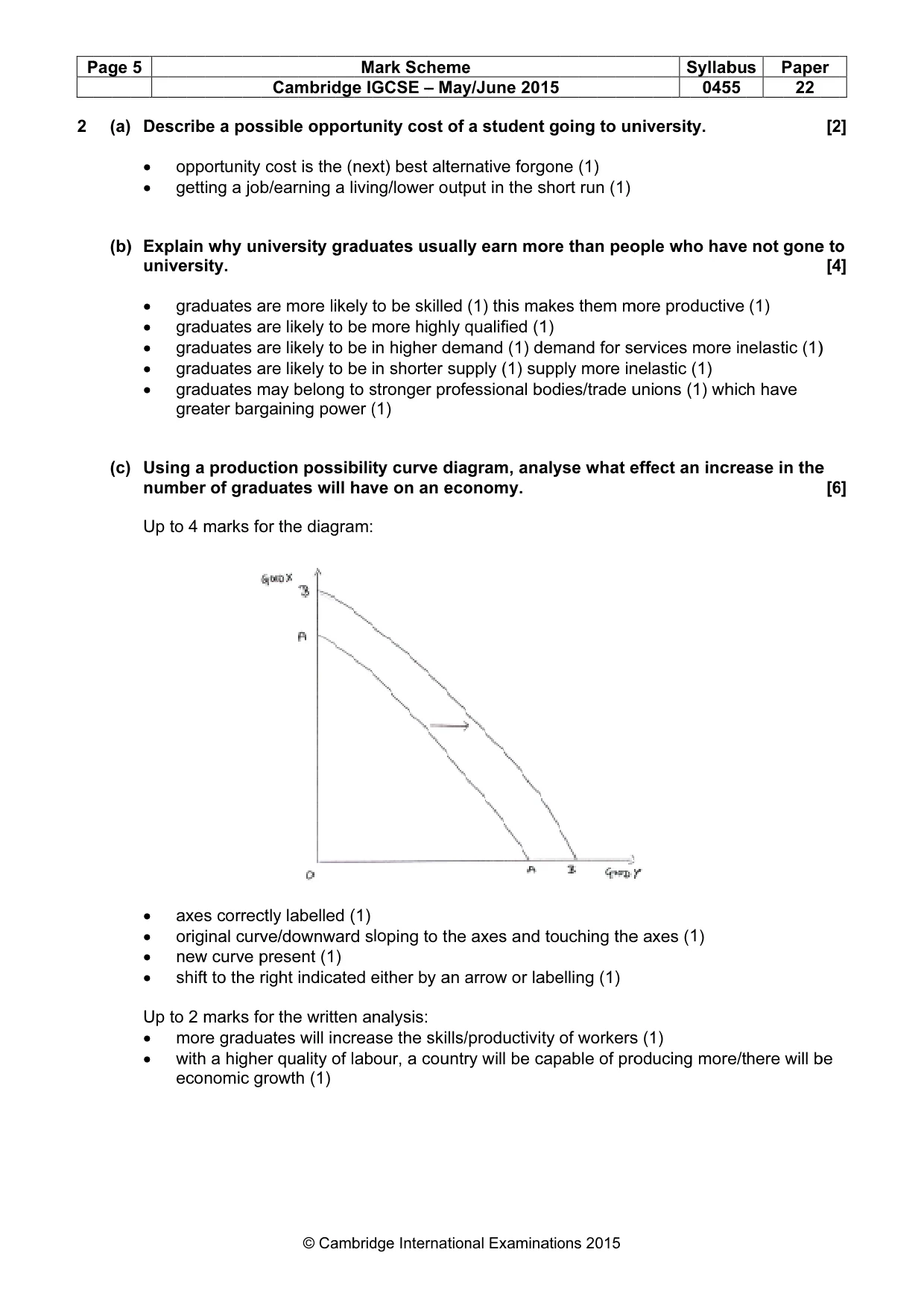
P 2 Pag ( ( ( ge (a) (b) (c) 5 D • • ) E u • • • • • U n U • • • • U • • Des • • Exp uni • • • • • Usi num Up • • • • Up • • scr o ge pla ve g g g g g g ing mb to ax o ne sh to m w ec rib ppo ett ain ersi rad rad rad rad rad rea g a ber 4 m xes rig ew hift 2 m mor with con e a ort ing wh ity dua dua dua dua dua ate pr r of ma s c ina w cu t to ma re g a nom a p tun g a hy . ate ate ate ate ate r b rod f g arks corr al c urv o th arks gra hig mic pos ity job un es a es a es a es a es m barg duc rad s fo rec curv ve p he r s fo adu ghe c g C ssi co b/e niv are are are are ma gai ctio dua or t ctly ve/ pre righ or t uate er q grow Cam ble ost ear vers e m e lik e lik e lik y b inin on ate the y la /do ese ht the es qua wth mb © e o is rnin sit more kely kely kely belo ng po es e d abe own ent ind e w wi alit h ( brid Ca opp the ng ty g e li y to y to y to on po oss wi iag elle nw (1 dica writt ll in ty o 1) dge amb por e (n a l gra ike o b o b o b g t owe sib ll h gra d ( ard ) ate ten ncr of l M e IG brid rtu nex ivin adu ely t be m be i be i o s er ( bilit hav m: (1) d s ed e n an rea ab Mar GC dge nit xt) ng/ uat to mo in h in s stro (1) ty ve lop eith nal ase ou k S CSE e In ty c be /low tes be ore hig sho ong cu on ping her lys e th r, a Sch E – nter cos est we s us sk hig ghe orte ger urve n a g to r by sis: he s a c hem – M rnat st alt r o su kille gh er d er r pr e d n e o t y a ski cou me May tion of ter utp all ed ly q dem su rofe dia eco he an a lls/ untr e y/J nal a s nat put y e (1) qua ma pp ess agra ono ax arr /pro ry w un Ex stu tive t in ear ) th alif nd ly ( sio am om xes row odu will ne 2 xam ude e fo th rn his fied (1 (1) ona m, a my. s a w o uct l be 20 mina ent org e s mo ma d (1 ) d su al b ana nd r la tivi e c 15 atio t g gon sho ore ake 1) dem upp bod aly to abe ty cap ons oin ne ort e th es man ply dies yse uc ellin of w pab s 20 ng (1) run han the nd mo s/tr e w hin ng wo ble 015 to ) n ( n p em for ore rad wha ng t (1) orke of 5 un 1) peo m m r se e in de u at e the ) ers pro niv opl more erv nela uni effe e ax s (1 od ver le w e p vice ast ion ect xes 1) uci S rsit wh pro es tic ns ( t a s ( ing Syl 0 ty. ho du mo (1) (1) n i 1) g m llab 045 ha ctiv ore ) wh nc mor bu 55 ave ve e in hic crea re/t s e no (1 nela h h ase he P ot ) ast hav e i re Pa 2 go tic ve n t wil pe 22 one (1) the ll b er [2 e to [4 ) e [6 be 2] o 4] 6]
Mark scheme, page 6
Page 6 Mark Scheme Syllabus Paper Cambridge IGCSE – May/June 2015 0455 22 © Cambridge International Examinations 2015 (d) Discuss whether graduates should pay the full cost of their university education. [8] Up to 5 marks for why they should: • graduates will learn new skills/gain qualifications (1) their employment opportunities are likely to increase (1) they are likely to earn a high wage (1) the private benefits of education are likely to be high (1) • subsidising graduates involves an opportunity cost (1) requiring students to pay the full cost may enable more to be spent on, e.g. health care (1) government has limited finance (1) • subsidising graduates may result in a budget deficit (1) or high taxes (1) • charging the full cost may ensure prospective students consider the opportunity cost to themselves carefully (1) • some graduates may come from relatively rich families (1) and so may not need to be helped (1) • some graduates may emigrate (1) and so other countries may receive the benefit (1) Up to 5 marks for why they should not: • more educated labour force (1) leading to higher output (1) reduced unemployment (1) increased living standards (1) generating external benefits (1) increasing tax revenue in the long run (1) • people from poor families may not be able to afford the cost (1) this could reduce the number of graduates (1) lowering potential output (1) increasing income inequality (1) • there is an argument for the government paying part of the cost (1), e.g. based on the ability to pay (1) 3 (a) What is meant by an industry being ‘capital-intensive’? [2] An industry which has a high amount of capital/machinery compared with the amount of other factors, e.g. labour employed (2) An industry which uses a large amount of capital/uses capital instead of labour (1) (b) Explain two reasons why the supply of a product may be price inelastic. [4] • long production period (1) this will make it difficult to adjust supply quickly (1) • inability to store the product (1) this means goods cannot be taken out of storage to meet higher demand (1) • time period under consideration (1) supply is more inelastic in the short run (1) • if there is a shortage of the raw material (1) it will be difficult to supply more in response to a rise in demand/price (1)
Mark scheme, page 7
Page 7 Mark Scheme Syllabus Paper Cambridge IGCSE – May/June 2015 0455 22 © Cambridge International Examinations 2015 (c) Analyse what effect an increase in output will have on fixed, variable and average costs. [6] • fixed costs will remain unchanged (1) these costs do not change with output (in the short run) (1) example of a fixed cost (1) costs which are still present when output is zero (1) up to 2 marks • variable costs will rise (1) vary with output (1) example of a short run variable cost (1) all costs are variable in the long run (1) up to 2 marks • effect on average cost is uncertain (1) average cost may fall if economies of scale are experienced (1) average cost may rise if diseconomies of scale are experienced (1) up to 2 marks Note: maximum of 2 marks for each type of cost. (d) Discuss whether a rise in the wages paid by an industry will encourage more people to work in that industry. [8] Up to 5 marks for why more people may be encouraged: • higher wages enable workers to enjoy more goods and services (1) increase living standards (1) • higher wages enable people to borrow more (1) banks are more likely to lend to high earners (1) • higher wages will enable workers to save more (1) increase ability to, e.g. finance children’s education/provide for retirement (1) • higher wages may motivate some workers to work in the industry/wages are a key influence (1) increase workers’ self esteem (1) • workers will be encouraged to switch from other industries (1) to undertake training to work in the industry (1) to gain the necessary qualifications to work in the industry (1) Up to 5 marks for why people may not be encouraged: • wages may still be below those in other industries (1) • earnings may be higher in other industries (1) because of, e.g. higher bonuses or overtime payments (1) • workers may not be aware of the wage rise (1) • workers may lack the appropriate skills/qualifications (1) • workers take into account other factors/non-pecuniary factors (1) • may not work in that industry in that industry if, e.g. working hours are longer, holidays are shorter, worse working conditions, less chance of promotion, lower pensions, fewer fringe benefits, less job security, less job satisfaction, industry is based some distance away (maximum of 3 marks for reasons identified).
Mark scheme, page 8
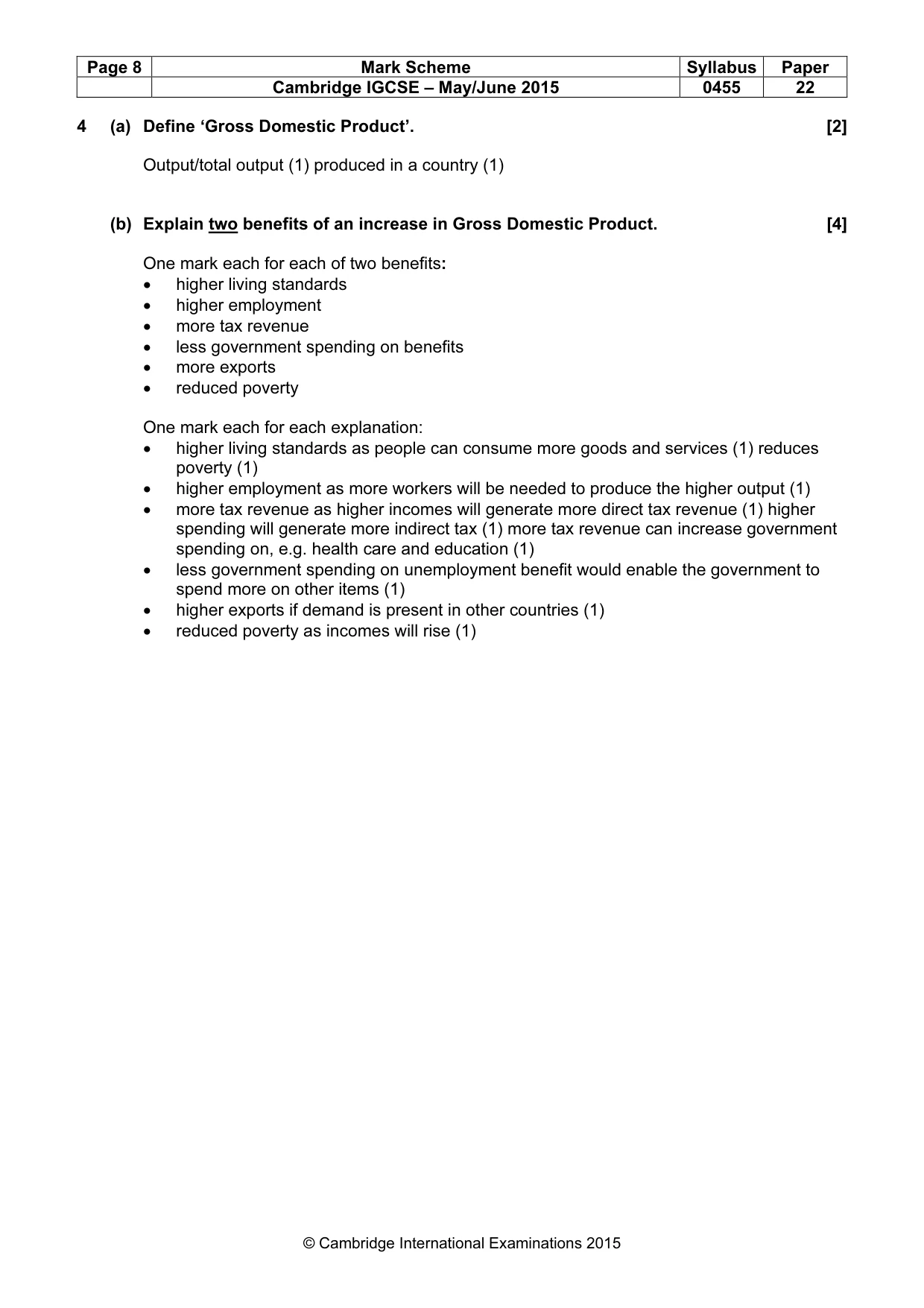
Page 8 Mark Scheme Syllabus Paper Cambridge IGCSE – May/June 2015 0455 22 © Cambridge International Examinations 2015 4 (a) Define ‘Gross Domestic Product’. [2] Output/total output (1) produced in a country (1) (b) Explain two benefits of an increase in Gross Domestic Product. [4] One mark each for each of two benefits: • higher living standards • higher employment • more tax revenue • less government spending on benefits • more exports • reduced poverty One mark each for each explanation: • higher living standards as people can consume more goods and services (1) reduces poverty (1) • higher employment as more workers will be needed to produce the higher output (1) • more tax revenue as higher incomes will generate more direct tax revenue (1) higher spending will generate more indirect tax (1) more tax revenue can increase government spending on, e.g. health care and education (1) • less government spending on unemployment benefit would enable the government to spend more on other items (1) • higher exports if demand is present in other countries (1) • reduced poverty as incomes will rise (1)
Mark scheme, page 9
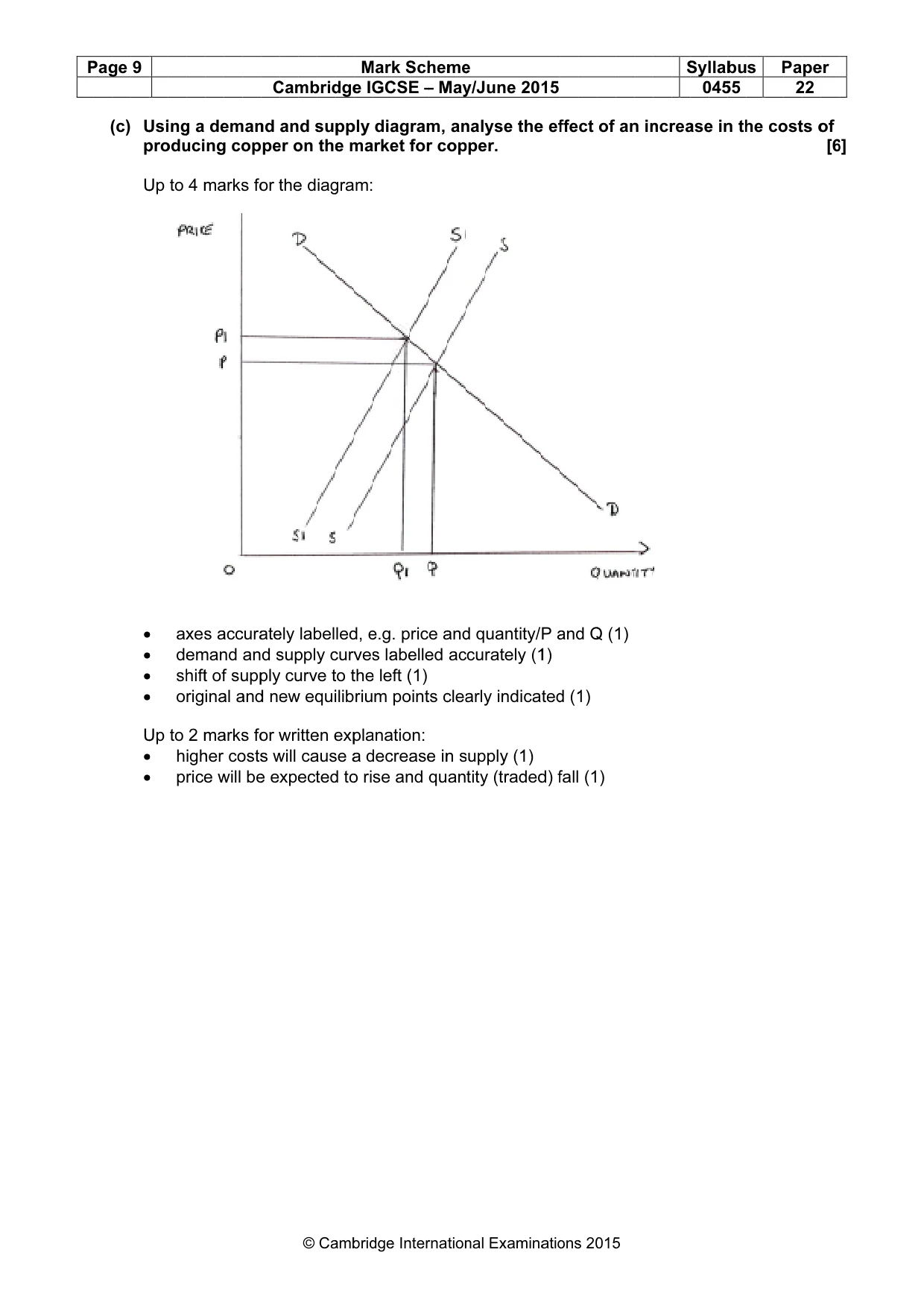
P Pag ( ge (c) 9 U p U • • • • U • • Usi pro Up • • • • Up • • ing odu to ax de sh o to h p g a uci 4 m xes em hift rig 2 m igh rice de ng ma s a man t of ina ma her e w em g co arks acc nd f su al a arks co will man op s fo cura an upp and s fo osts be C nd pe or t ate d s ply d ne or w s w e ex Cam an er o the ely sup y cu ew wri will xpe mb © d s on e d lab pply urv w eq itte ca ect brid Ca sup the iag bel y c e t qui en e aus ted dge amb pp e m gra led curv to t ilib exp se a d to M e IG brid ply ma m: d, e ves the riu pla a d o ris Mar GC dge dia rke e.g s la e le m ana dec se k S CSE e In ag et f . p abe ft ( po atio crea an Sch E – nter ram for rice elle (1) oint on: ase nd q hem – M rnat m, r co e a ed ts c e in qu me May tion an op and ac clea n s an e y/J nal naly ppe d q cu arly sup tity un Ex ys er. ua rat y in pply y (t ne 2 xam e t nti tely ndi y (1 rad 20 mina the ty/ y (1 ca 1) ded 15 atio e ef P a 1) ted d) f ons ffe and d (1 fall s 20 ct d Q 1) (1 015 of Q (1 ) 5 an 1) n incr S rea Syl 0 ase llab 045 e in bu 55 n th s he P co Pa 2 ost pe 22 ts o er of [6]
Mark scheme, page 10
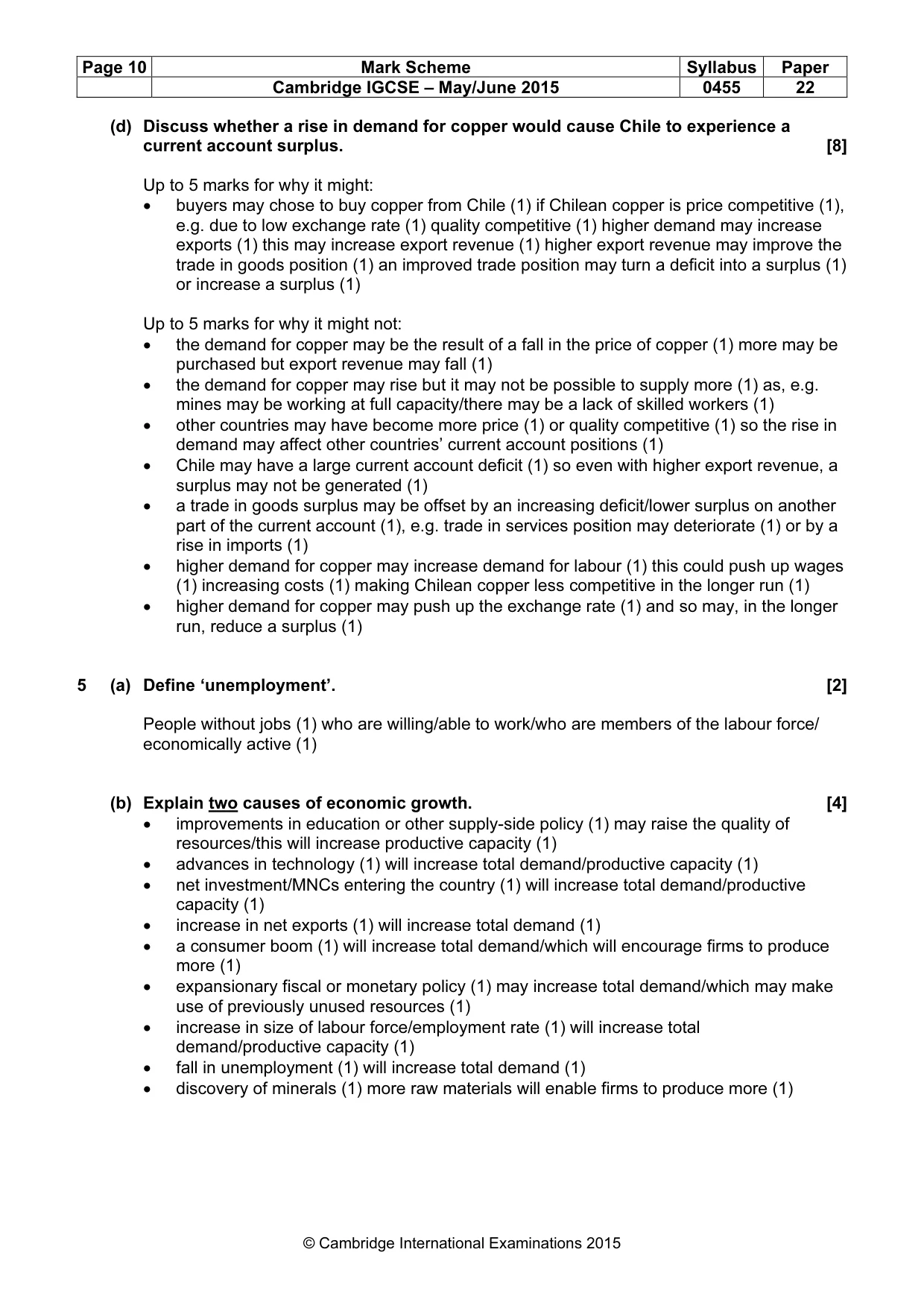
Page 10 Mark Scheme Syllabus Paper Cambridge IGCSE – May/June 2015 0455 22 © Cambridge International Examinations 2015 (d) Discuss whether a rise in demand for copper would cause Chile to experience a current account surplus. [8] Up to 5 marks for why it might: • buyers may chose to buy copper from Chile (1) if Chilean copper is price competitive (1), e.g. due to low exchange rate (1) quality competitive (1) higher demand may increase exports (1) this may increase export revenue (1) higher export revenue may improve the trade in goods position (1) an improved trade position may turn a deficit into a surplus (1) or increase a surplus (1) Up to 5 marks for why it might not: • the demand for copper may be the result of a fall in the price of copper (1) more may be purchased but export revenue may fall (1) • the demand for copper may rise but it may not be possible to supply more (1) as, e.g. mines may be working at full capacity/there may be a lack of skilled workers (1) • other countries may have become more price (1) or quality competitive (1) so the rise in demand may affect other countries’ current account positions (1) • Chile may have a large current account deficit (1) so even with higher export revenue, a surplus may not be generated (1) • a trade in goods surplus may be offset by an increasing deficit/lower surplus on another part of the current account (1), e.g. trade in services position may deteriorate (1) or by a rise in imports (1) • higher demand for copper may increase demand for labour (1) this could push up wages (1) increasing costs (1) making Chilean copper less competitive in the longer run (1) • higher demand for copper may push up the exchange rate (1) and so may, in the longer run, reduce a surplus (1) 5 (a) Define ‘unemployment’. [2] People without jobs (1) who are willing/able to work/who are members of the labour force/ economically active (1) (b) Explain two causes of economic growth. [4] • improvements in education or other supply-side policy (1) may raise the quality of resources/this will increase productive capacity (1) • advances in technology (1) will increase total demand/productive capacity (1) • net investment/MNCs entering the country (1) will increase total demand/productive capacity (1) • increase in net exports (1) will increase total demand (1) • a consumer boom (1) will increase total demand/which will encourage firms to produce more (1) • expansionary fiscal or monetary policy (1) may increase total demand/which may make use of previously unused resources (1) • increase in size of labour force/employment rate (1) will increase total demand/productive capacity (1) • fall in unemployment (1) will increase total demand (1) • discovery of minerals (1) more raw materials will enable firms to produce more (1)
Mark scheme, page 11
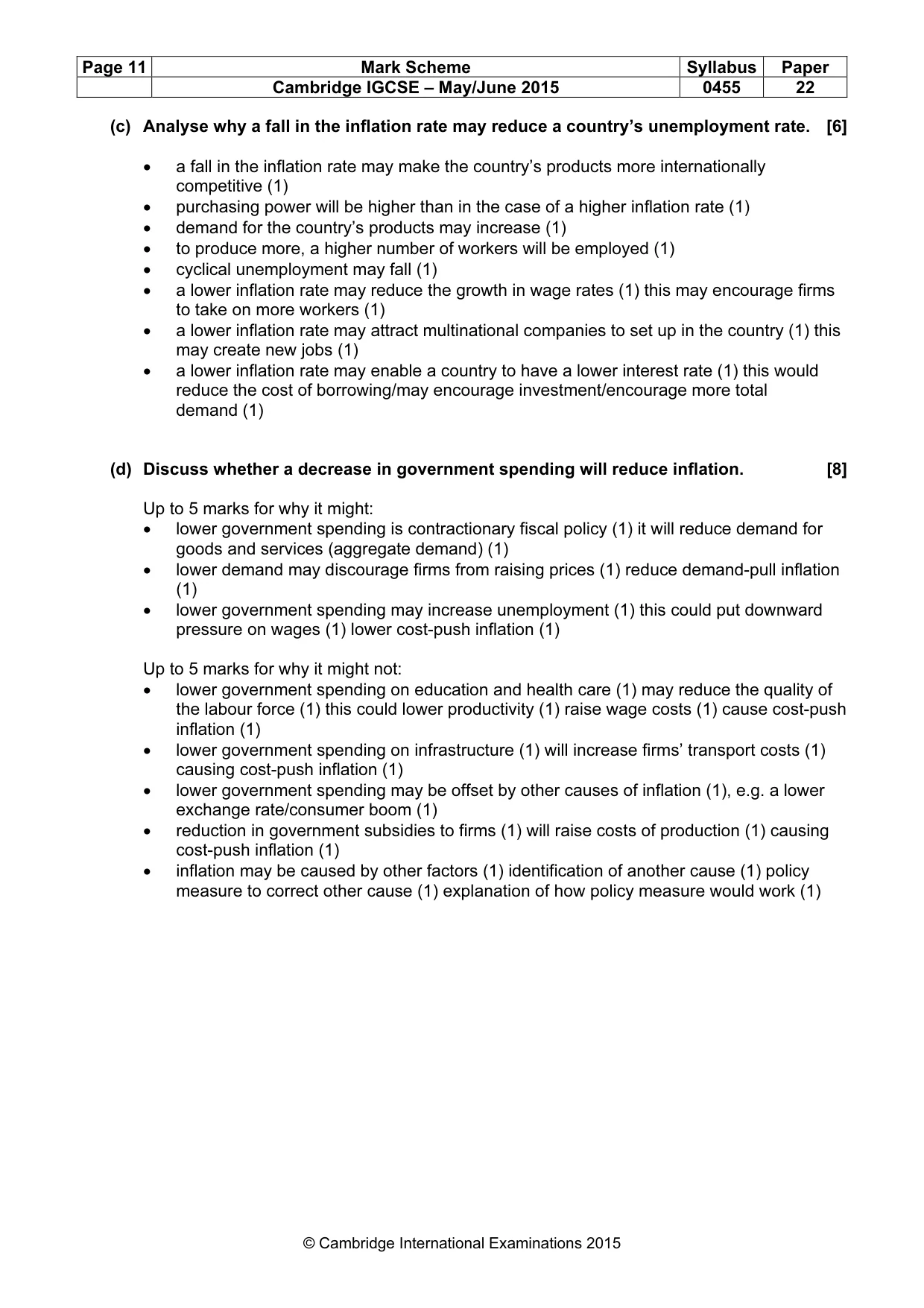
Page 11 Mark Scheme Syllabus Paper Cambridge IGCSE – May/June 2015 0455 22 © Cambridge International Examinations 2015 (c) Analyse why a fall in the inflation rate may reduce a country’s unemployment rate. [6] • a fall in the inflation rate may make the country’s products more internationally competitive (1) • purchasing power will be higher than in the case of a higher inflation rate (1) • demand for the country’s products may increase (1) • to produce more, a higher number of workers will be employed (1) • cyclical unemployment may fall (1) • a lower inflation rate may reduce the growth in wage rates (1) this may encourage firms to take on more workers (1) • a lower inflation rate may attract multinational companies to set up in the country (1) this may create new jobs (1) • a lower inflation rate may enable a country to have a lower interest rate (1) this would reduce the cost of borrowing/may encourage investment/encourage more total demand (1) (d) Discuss whether a decrease in government spending will reduce inflation. [8] Up to 5 marks for why it might: • lower government spending is contractionary fiscal policy (1) it will reduce demand for goods and services (aggregate demand) (1) • lower demand may discourage firms from raising prices (1) reduce demand-pull inflation (1) • lower government spending may increase unemployment (1) this could put downward pressure on wages (1) lower cost-push inflation (1) Up to 5 marks for why it might not: • lower government spending on education and health care (1) may reduce the quality of the labour force (1) this could lower productivity (1) raise wage costs (1) cause cost-push inflation (1) • lower government spending on infrastructure (1) will increase firms’ transport costs (1) causing cost-push inflation (1) • lower government spending may be offset by other causes of inflation (1), e.g. a lower exchange rate/consumer boom (1) • reduction in government subsidies to firms (1) will raise costs of production (1) causing cost-push inflation (1) • inflation may be caused by other factors (1) identification of another cause (1) policy measure to correct other cause (1) explanation of how policy measure would work (1)
Mark scheme, page 12
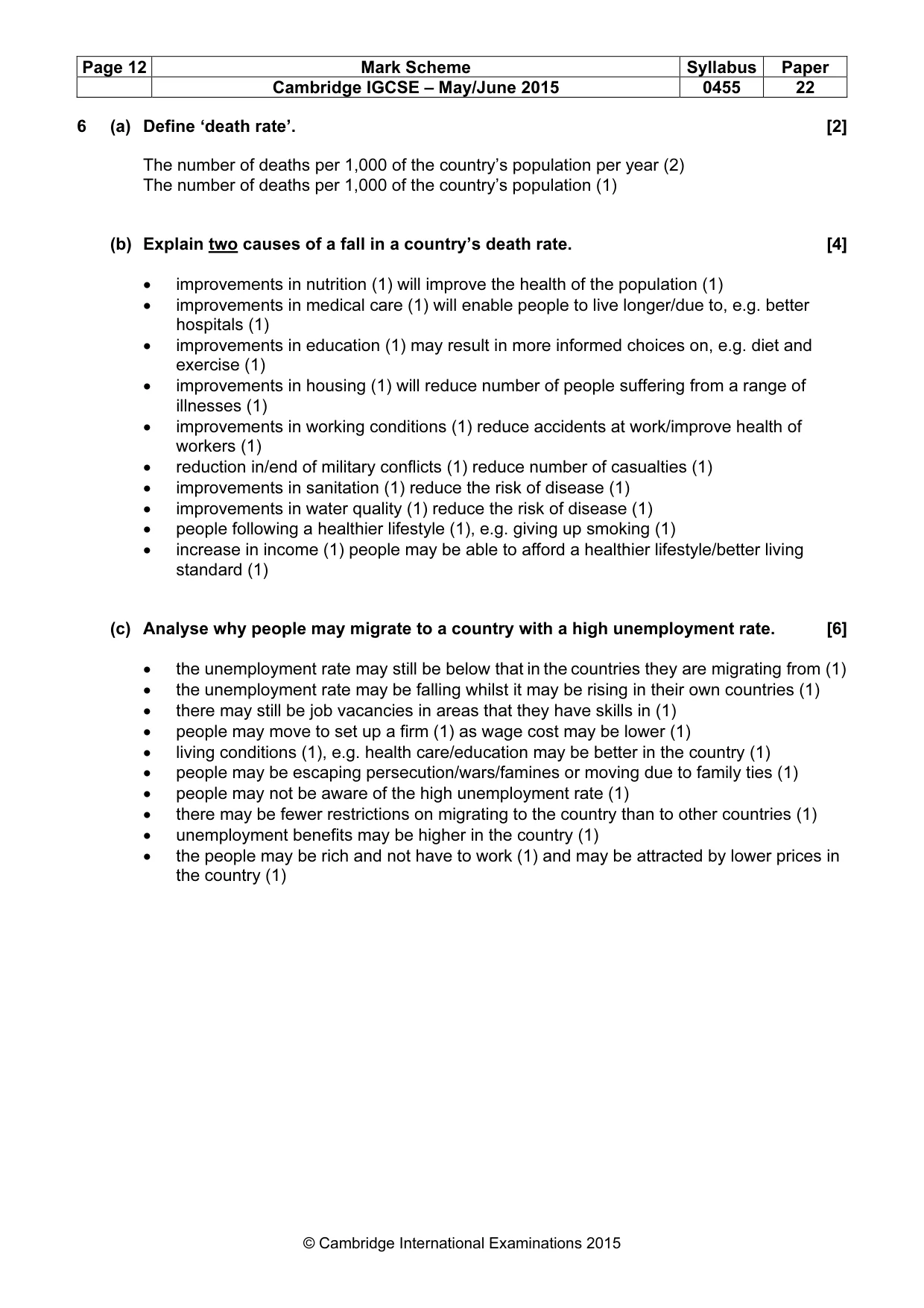
Page 12 Mark Scheme Syllabus Paper Cambridge IGCSE – May/June 2015 0455 22 © Cambridge International Examinations 2015 6 (a) Define ‘death rate’. [2] The number of deaths per 1,000 of the country’s population per year (2) The number of deaths per 1,000 of the country’s population (1) (b) Explain two causes of a fall in a country’s death rate. [4] • improvements in nutrition (1) will improve the health of the population (1) • improvements in medical care (1) will enable people to live longer/due to, e.g. better hospitals (1) • improvements in education (1) may result in more informed choices on, e.g. diet and exercise (1) • improvements in housing (1) will reduce number of people suffering from a range of illnesses (1) • improvements in working conditions (1) reduce accidents at work/improve health of workers (1) • reduction in/end of military conflicts (1) reduce number of casualties (1) • improvements in sanitation (1) reduce the risk of disease (1) • improvements in water quality (1) reduce the risk of disease (1) • people following a healthier lifestyle (1), e.g. giving up smoking (1) • increase in income (1) people may be able to afford a healthier lifestyle/better living standard (1) (c) Analyse why people may migrate to a country with a high unemployment rate. [6] • the unemployment rate may still be below that in the countries they are migrating from (1) • the unemployment rate may be falling whilst it may be rising in their own countries (1) • there may still be job vacancies in areas that they have skills in (1) • people may move to set up a firm (1) as wage cost may be lower (1) • living conditions (1), e.g. health care/education may be better in the country (1) • people may be escaping persecution/wars/famines or moving due to family ties (1) • people may not be aware of the high unemployment rate (1) • there may be fewer restrictions on migrating to the country than to other countries (1) • unemployment benefits may be higher in the country (1) • the people may be rich and not have to work (1) and may be attracted by lower prices in the country (1)
Mark scheme, page 13
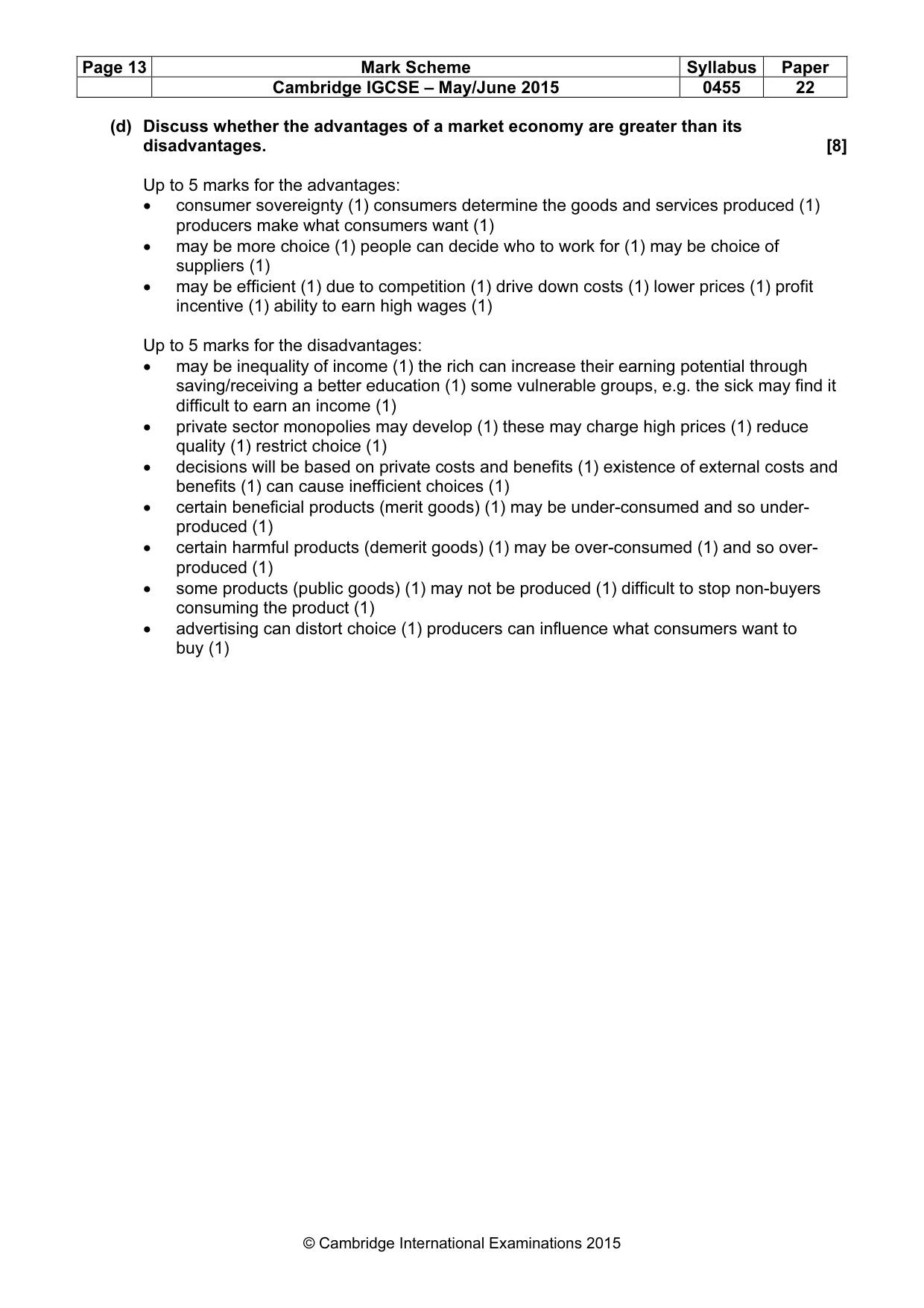
Page 13 Mark Scheme Syllabus Paper Cambridge IGCSE – May/June 2015 0455 22 © Cambridge International Examinations 2015 (d) Discuss whether the advantages of a market economy are greater than its disadvantages. [8] Up to 5 marks for the advantages: • consumer sovereignty (1) consumers determine the goods and services produced (1) producers make what consumers want (1) • may be more choice (1) people can decide who to work for (1) may be choice of suppliers (1) • may be efficient (1) due to competition (1) drive down costs (1) lower prices (1) profit incentive (1) ability to earn high wages (1) Up to 5 marks for the disadvantages: • may be inequality of income (1) the rich can increase their earning potential through saving/receiving a better education (1) some vulnerable groups, e.g. the sick may find it difficult to earn an income (1) • private sector monopolies may develop (1) these may charge high prices (1) reduce quality (1) restrict choice (1) • decisions will be based on private costs and benefits (1) existence of external costs and benefits (1) can cause inefficient choices (1) • certain beneficial products (merit goods) (1) may be under-consumed and so under- produced (1) • certain harmful products (demerit goods) (1) may be over-consumed (1) and so over- produced (1) • some products (public goods) (1) may not be produced (1) difficult to stop non-buyers consuming the product (1) • advertising can distort choice (1) producers can influence what consumers want to buy (1)
Mark scheme, page 14
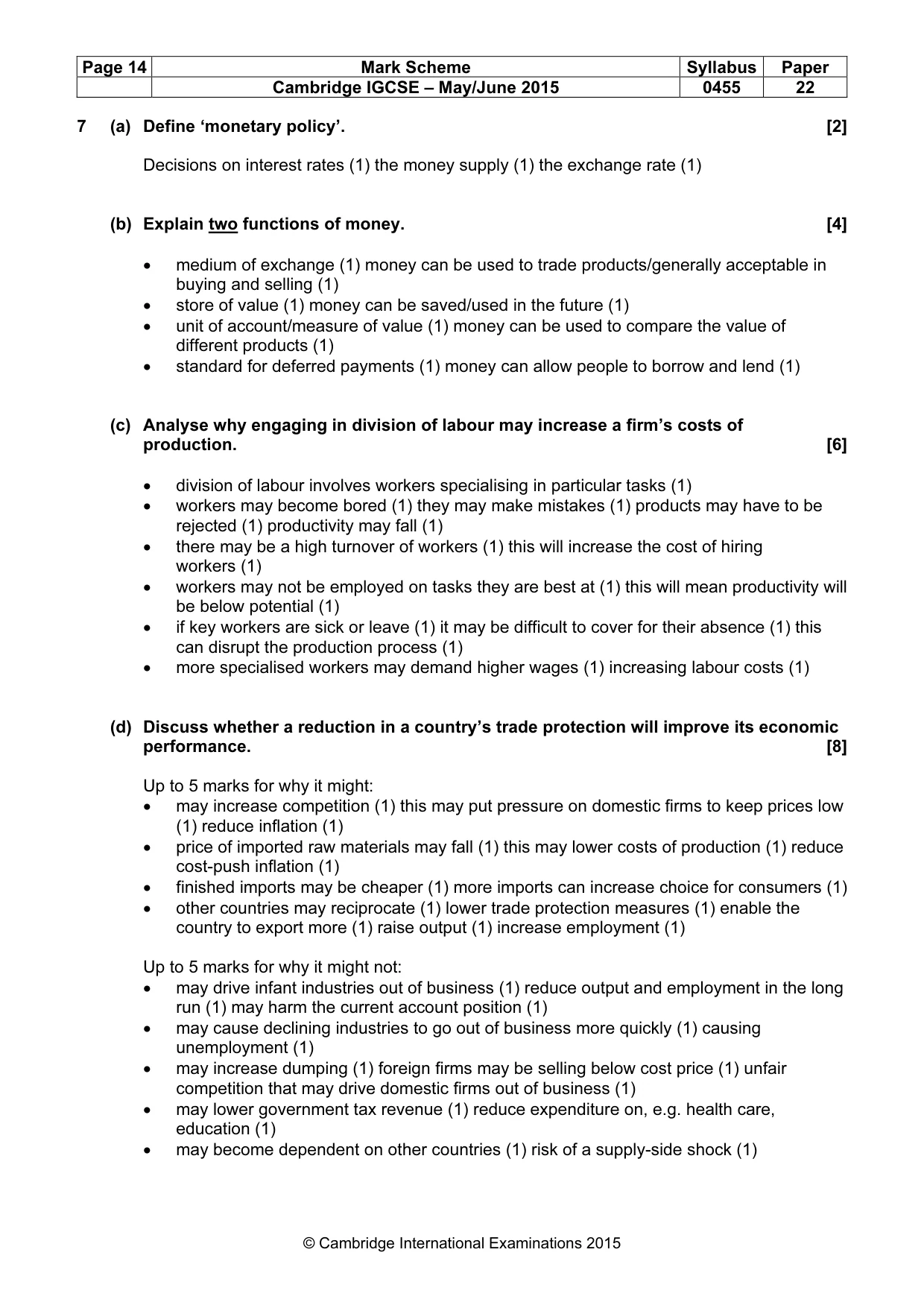
Page 14 Mark Scheme Syllabus Paper Cambridge IGCSE – May/June 2015 0455 22 © Cambridge International Examinations 2015 7 (a) Define ‘monetary policy’. [2] Decisions on interest rates (1) the money supply (1) the exchange rate (1) (b) Explain two functions of money. [4] • medium of exchange (1) money can be used to trade products/generally acceptable in buying and selling (1) • store of value (1) money can be saved/used in the future (1) • unit of account/measure of value (1) money can be used to compare the value of different products (1) • standard for deferred payments (1) money can allow people to borrow and lend (1) (c) Analyse why engaging in division of labour may increase a firm’s costs of production. [6] • division of labour involves workers specialising in particular tasks (1) • workers may become bored (1) they may make mistakes (1) products may have to be rejected (1) productivity may fall (1) • there may be a high turnover of workers (1) this will increase the cost of hiring workers (1) • workers may not be employed on tasks they are best at (1) this will mean productivity will be below potential (1) • if key workers are sick or leave (1) it may be difficult to cover for their absence (1) this can disrupt the production process (1) • more specialised workers may demand higher wages (1) increasing labour costs (1) (d) Discuss whether a reduction in a country’s trade protection will improve its economic performance. [8] Up to 5 marks for why it might: • may increase competition (1) this may put pressure on domestic firms to keep prices low (1) reduce inflation (1) • price of imported raw materials may fall (1) this may lower costs of production (1) reduce cost-push inflation (1) • finished imports may be cheaper (1) more imports can increase choice for consumers (1) • other countries may reciprocate (1) lower trade protection measures (1) enable the country to export more (1) raise output (1) increase employment (1) Up to 5 marks for why it might not: • may drive infant industries out of business (1) reduce output and employment in the long run (1) may harm the current account position (1) • may cause declining industries to go out of business more quickly (1) causing unemployment (1) • may increase dumping (1) foreign firms may be selling below cost price (1) unfair competition that may drive domestic firms out of business (1) • may lower government tax revenue (1) reduce expenditure on, e.g. health care, education (1) • may become dependent on other countries (1) risk of a supply-side shock (1)
What you needed in this session
Cambridge’s own grade thresholds for 2015 May/June, Paper 2 · Variant 2. A higher threshold means an easier paper — the bar moves with how the cohort did.