Cambridge IGCSE Economics 0455 — 2015 May/June Paper 2 · Variant 1
0455/21/M/J/15 · 90 marks · ≈101 min
The question paper and its mark scheme, free to read here and free to download. This is Cambridge’s own paper, exactly as it was sat.
Question paper8 pages



Mark scheme15 pages
Answers below. Sit the paper first if you are practising.
Paper as text
Question paper, page 1
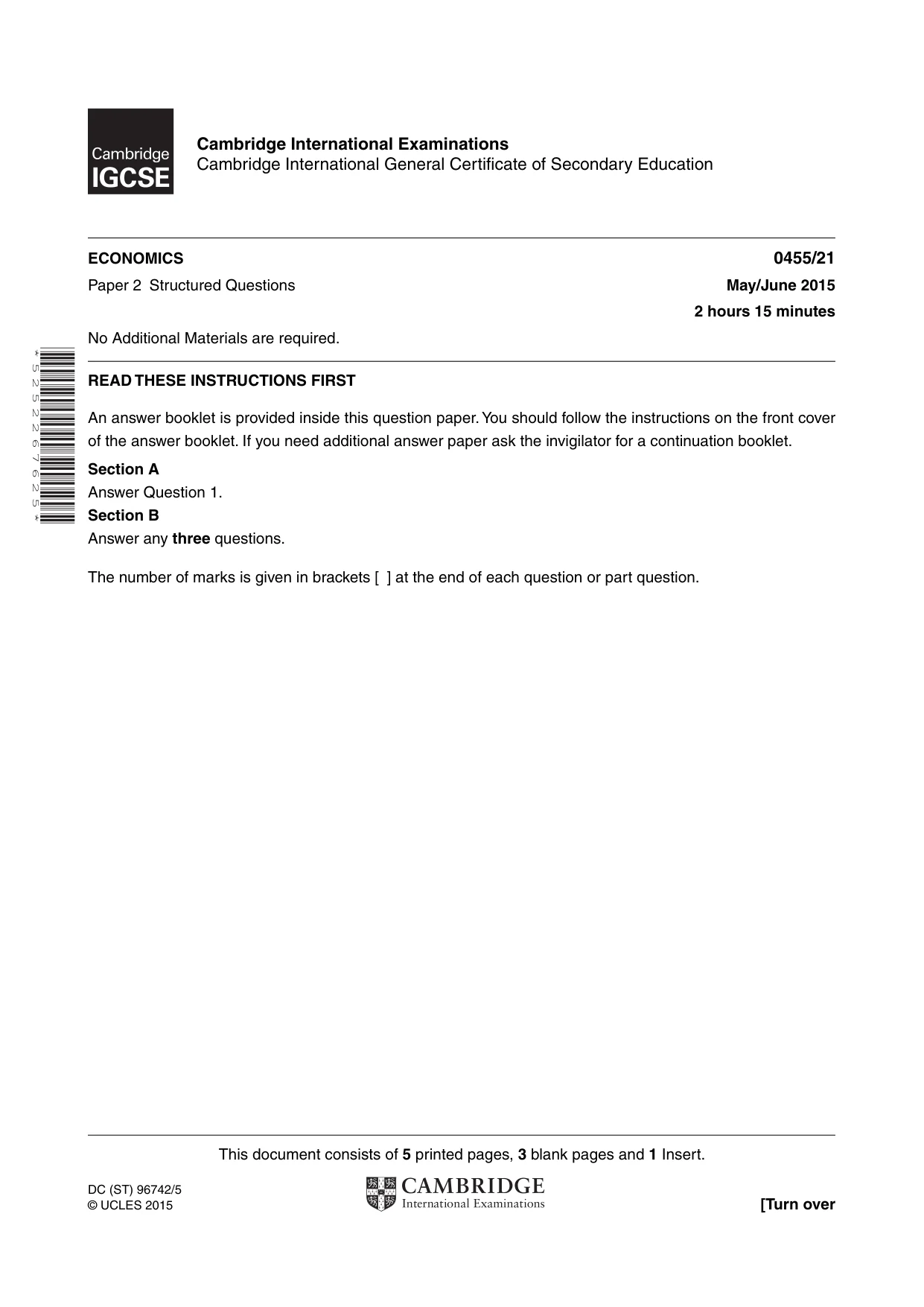
This document consists of 5 printed pages, 3 blank pages and 1 Insert. DC (ST) 96742/5 © UCLES 2015 [Turn over * 5 2 5 2 2 6 7 6 2 5 * ECONOMICS 0455/21 Paper 2 Structured Questions May/June 2015 2 hours 15 minutes No Additional Materials are required. READ THESE INSTRUCTIONS FIRST An answer booklet is provided inside this question paper. You should follow the instructions on the front cover of the answer booklet. If you need additional answer paper ask the invigilator for a continuation booklet. Section A Answer Question 1. Section B Answer any three questions. The number of marks is given in brackets [ ] at the end of each question or part question. Cambridge International Examinations Cambridge International General Certificate of Secondary Education
Question paper, page 2
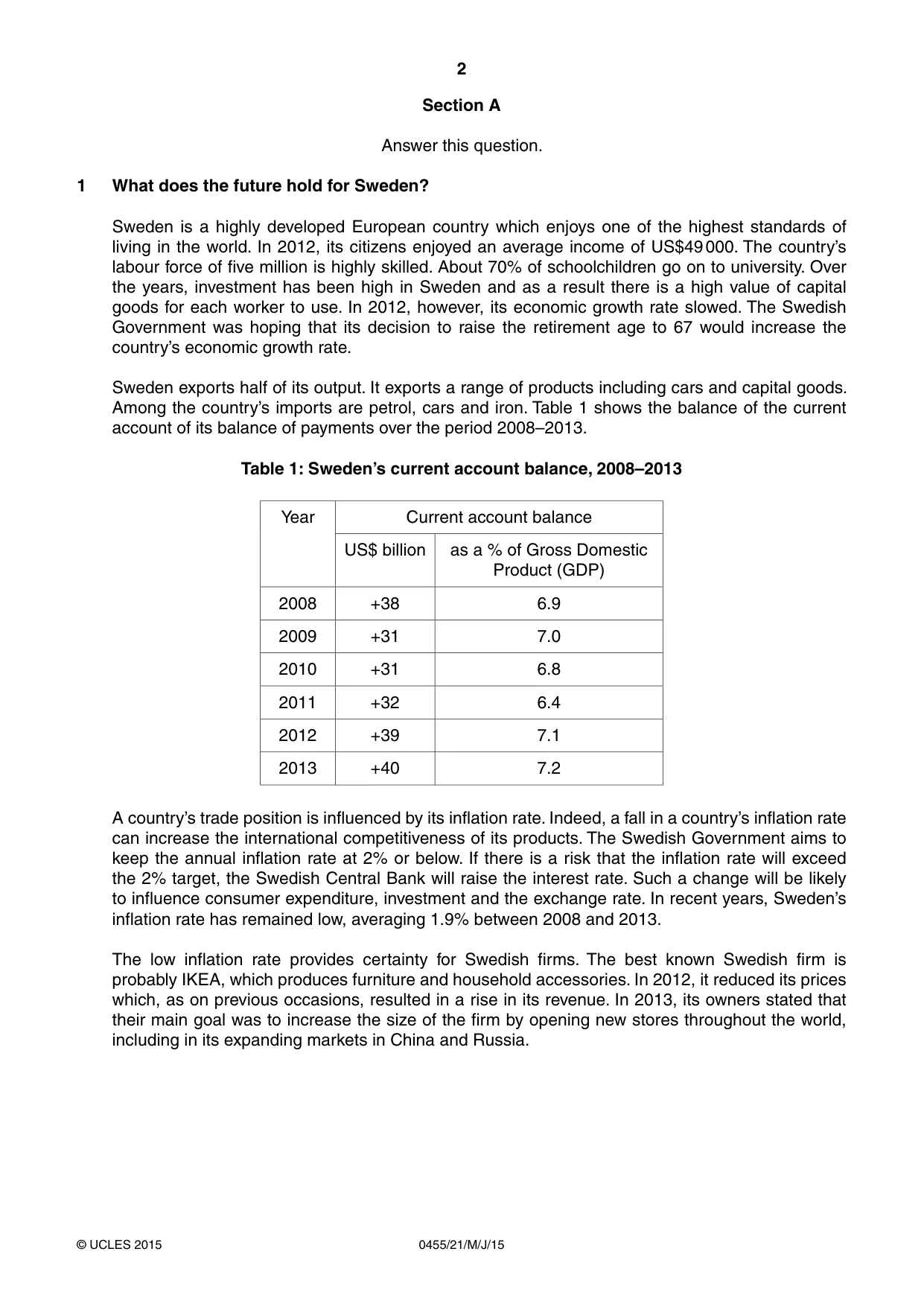
2 0455/21/M/J/15 © UCLES 2015 Section A Answer this question. 1 What does the future hold for Sweden? Sweden is a highly developed European country which enjoys one of the highest standards of living in the world. In 2012, its citizens enjoyed an average income of US$49 000. The country’s labour force of five million is highly skilled. About 70% of schoolchildren go on to university. Over the years, investment has been high in Sweden and as a result there is a high value of capital goods for each worker to use. In 2012, however, its economic growth rate slowed. The Swedish Government was hoping that its decision to raise the retirement age to 67 would increase the country’s economic growth rate. Sweden exports half of its output. It exports a range of products including cars and capital goods. Among the country’s imports are petrol, cars and iron. Table 1 shows the balance of the current account of its balance of payments over the period 2008–2013. Table 1: Sweden’s current account balance, 2008–2013 Year Current account balance US$ billion as a % of Gross Domestic Product (GDP) 2008 +38 6.9 2009 +31 7.0 2010 +31 6.8 2011 +32 6.4 2012 +39 7.1 2013 +40 7.2 A country’s trade position is influenced by its inflation rate. Indeed, a fall in a country’s inflation rate can increase the international competitiveness of its products. The Swedish Government aims to keep the annual inflation rate at 2% or below. If there is a risk that the inflation rate will exceed the 2% target, the Swedish Central Bank will raise the interest rate. Such a change will be likely to influence consumer expenditure, investment and the exchange rate. In recent years, Sweden’s inflation rate has remained low, averaging 1.9% between 2008 and 2013. The low inflation rate provides certainty for Swedish firms. The best known Swedish firm is probably IKEA, which produces furniture and household accessories. In 2012, it reduced its prices which, as on previous occasions, resulted in a rise in its revenue. In 2013, its owners stated that their main goal was to increase the size of the firm by opening new stores throughout the world, including in its expanding markets in China and Russia.
Question paper, page 3
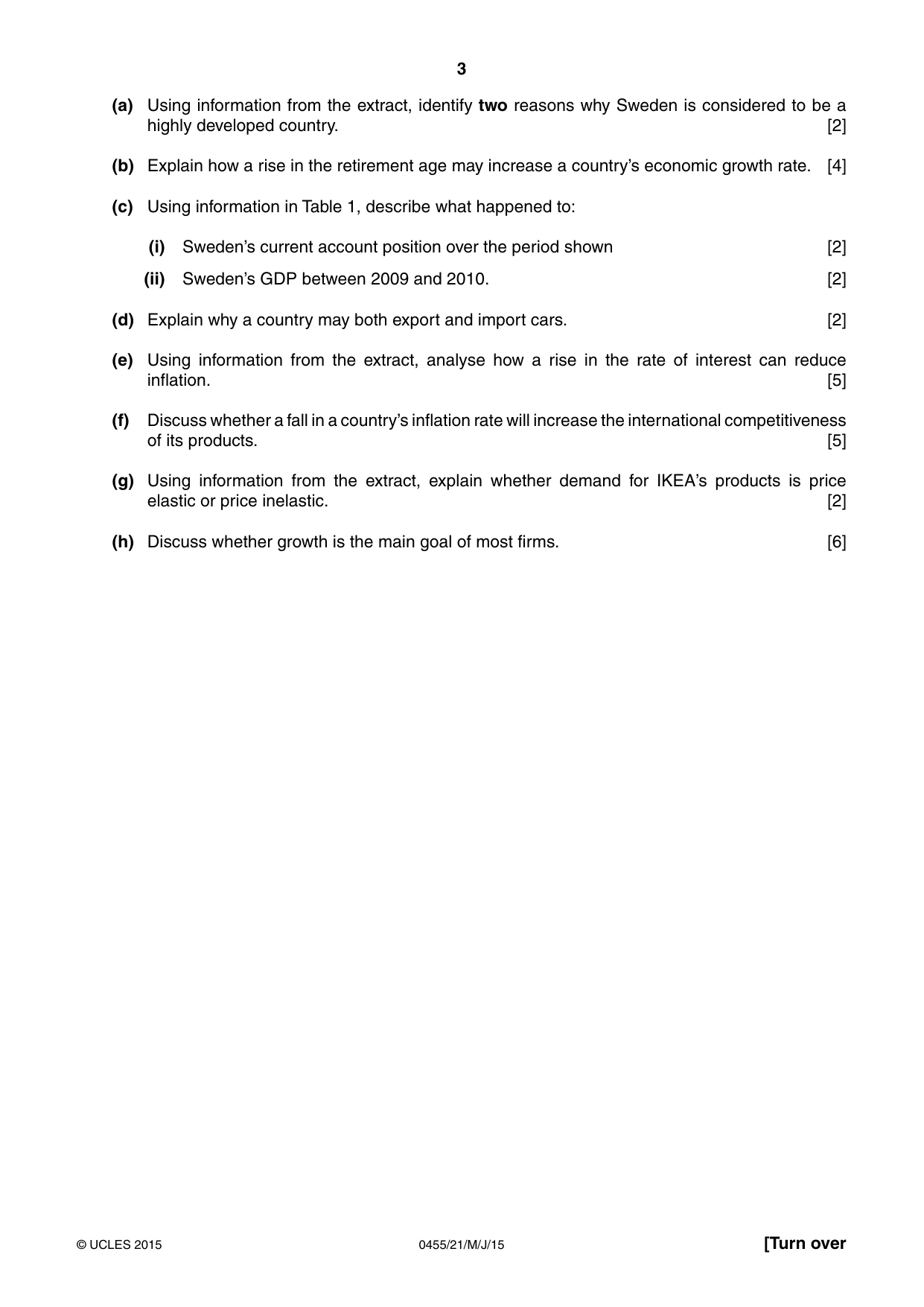
3 0455/21/M/J/15 © UCLES 2015 [Turn over (a) Using information from the extract, identify two reasons why Sweden is considered to be a highly developed country. [2] (b) Explain how a rise in the retirement age may increase a country’s economic growth rate. [4] (c) Using information in Table 1, describe what happened to: (i) Sweden’s current account position over the period shown [2] (ii) Sweden’s GDP between 2009 and 2010. [2] (d) Explain why a country may both export and import cars. [2] (e) Using information from the extract, analyse how a rise in the rate of interest can reduce inflation. [5] (f) Discuss whether a fall in a country’s inflation rate will increase the international competitiveness of its products. [5] (g) Using information from the extract, explain whether demand for IKEA’s products is price elastic or price inelastic. [2] (h) Discuss whether growth is the main goal of most firms. [6]
Question paper, page 4
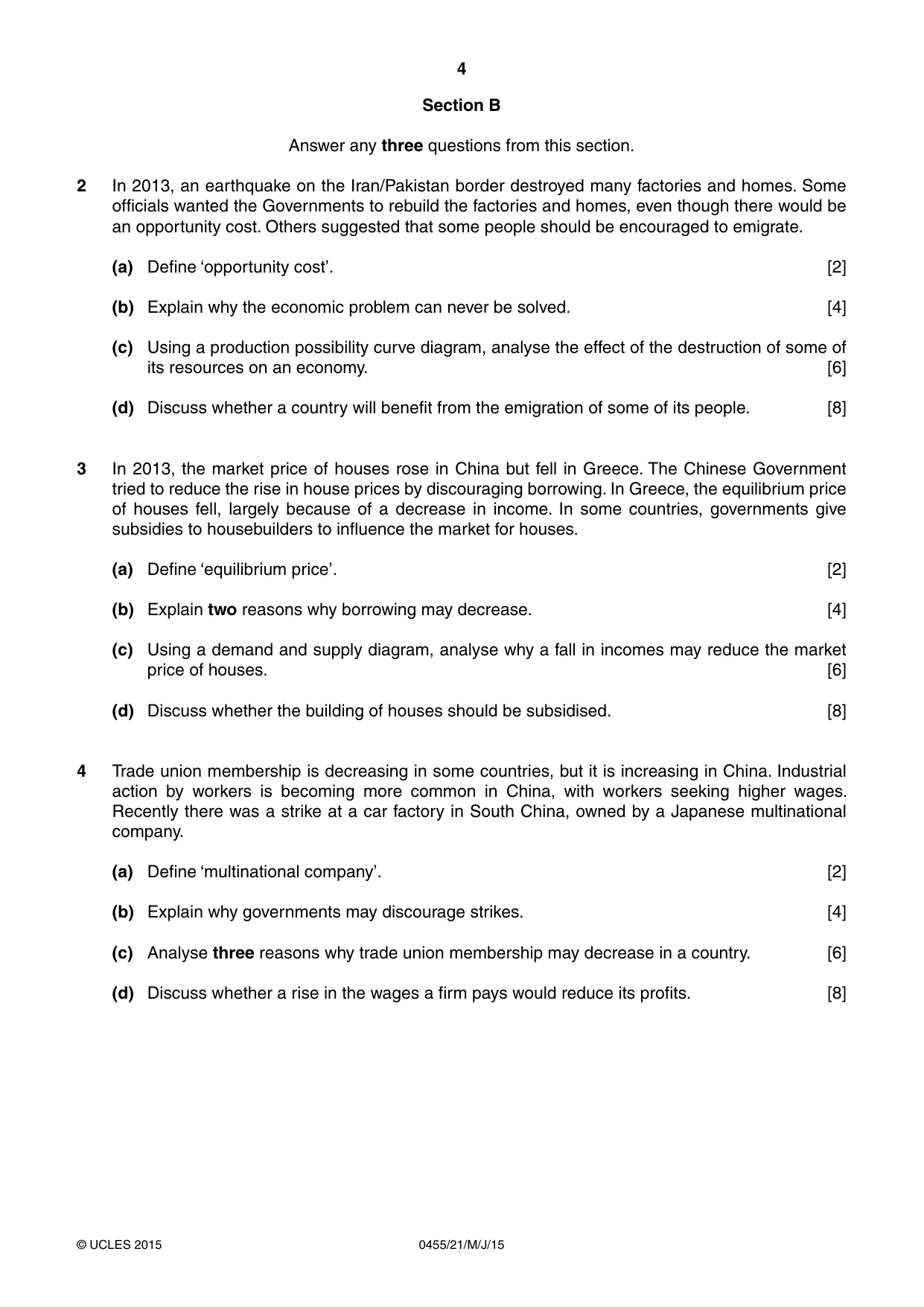
4 0455/21/M/J/15 © UCLES 2015 Section B Answer any three questions from this section. 2 In 2013, an earthquake on the Iran/Pakistan border destroyed many factories and homes. Some officials wanted the Governments to rebuild the factories and homes, even though there would be an opportunity cost. Others suggested that some people should be encouraged to emigrate. (a) Define ‘opportunity cost’. [2] (b) Explain why the economic problem can never be solved. [4] (c) Using a production possibility curve diagram, analyse the effect of the destruction of some of its resources on an economy. [6] (d) Discuss whether a country will benefit from the emigration of some of its people. [8] 3 In 2013, the market price of houses rose in China but fell in Greece. The Chinese Government tried to reduce the rise in house prices by discouraging borrowing. In Greece, the equilibrium price of houses fell, largely because of a decrease in income. In some countries, governments give subsidies to housebuilders to influence the market for houses. (a) Define ‘equilibrium price’. [2] (b) Explain two reasons why borrowing may decrease. [4] (c) Using a demand and supply diagram, analyse why a fall in incomes may reduce the market price of houses. [6] (d) Discuss whether the building of houses should be subsidised. [8] 4 Trade union membership is decreasing in some countries, but it is increasing in China. Industrial action by workers is becoming more common in China, with workers seeking higher wages. Recently there was a strike at a car factory in South China, owned by a Japanese multinational company. (a) Define ‘multinational company’. [2] (b) Explain why governments may discourage strikes. [4] (c) Analyse three reasons why trade union membership may decrease in a country. [6] (d) Discuss whether a rise in the wages a firm pays would reduce its profits. [8]
Question paper, page 5
5 0455/21/M/J/15 © UCLES 2015 5 In January 2013, the Portuguese Government increased tax rates. Three months later it cut its spending on health care and education. Between these two periods, unemployment in Portugal rose. (a) What is meant by ‘tax’? [2] (b) Explain two reasons why an increase in unemployment may reduce tax revenue. [4] (c) Analyse two reasons why unemployment may increase. [6] (d) Discuss whether a reduction in government spending on education will reduce living standards. [8] 6 About 30% of Nigeria’s labour force is employed in agriculture but the country still spends more than US$12 billion a year importing food. The Nigerian Government is seeking to reduce the imports of food. With a high birth rate and many small farms, this may be difficult to achieve. (a) Define ‘birth rate’. [2] (b) Explain two causes of a high birth rate. [4] (c) Analyse how an increase in the size of farms may affect the cost of producing food. [6] (d) Discuss whether a reduction in its imports will always benefit an economy. [8] 7 In 2013, the Singapore Government was concerned that its economy might experience a recession. It was introducing a range of supply-side policy measures to increase productivity, avoid a recession and achieve its other aims for the economy. It was also trying to reduce the international value of the Singapore dollar. (a) Define ‘recession’. [2] (b) Explain two reasons why an economy may have a high foreign exchange rate. [4] (c) Analyse how supply-side policy measures could increase productivity. [6] (d) Discuss whether a fall in the international value of its currency will always benefit an economy. [8]
Question paper, page 6
6 0455/21/M/J/15 © UCLES 2015 BLANK PAGE
Question paper, page 7
7 0455/21/M/J/15 © UCLES 2015 BLANK PAGE
Question paper, page 8
8 0455/21/M/J/15 © UCLES 2015 BLANK PAGE Permission to reproduce items where third-party owned material protected by copyright is included has been sought and cleared where possible. Every reasonable effort has been made by the publisher (UCLES) to trace copyright holders, but if any items requiring clearance have unwittingly been included, the publisher will be pleased to make amends at the earliest possible opportunity. To avoid the issue of disclosure of answer-related information to candidates, all copyright acknowledgements are reproduced online in the Cambridge International Examinations Copyright Acknowledgements Booklet. This is produced for each series of examinations and is freely available to download at www.cie.org.uk after the live examination series. Cambridge International Examinations is part of the Cambridge Assessment Group. Cambridge Assessment is the brand name of University of Cambridge Local Examinations Syndicate (UCLES), which is itself a department of the University of Cambridge.
Mark scheme, page 1
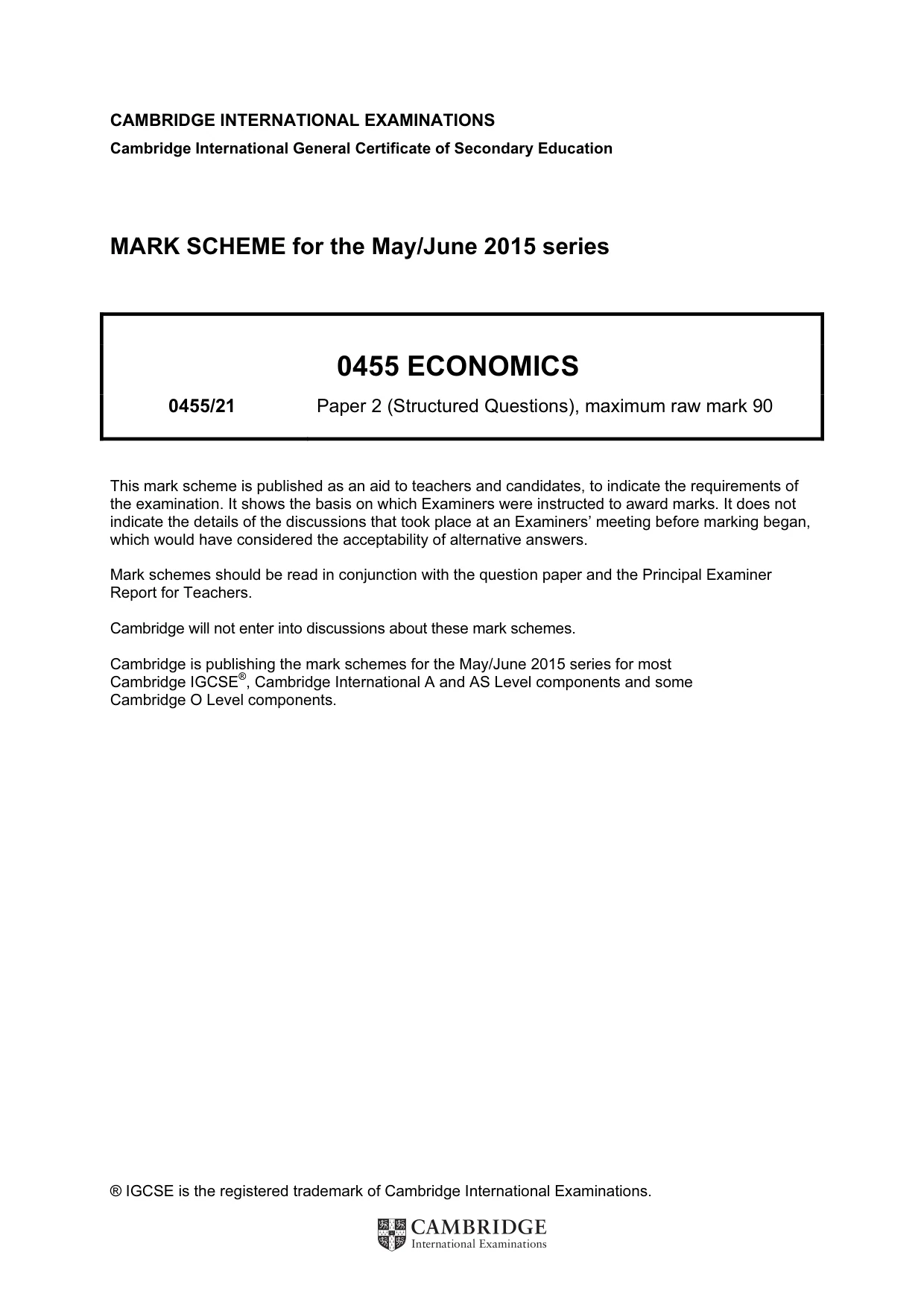
® IGCSE is the registered trademark of Cambridge International Examinations. CAMBRIDGE INTERNATIONAL EXAMINATIONS Cambridge International General Certificate of Secondary Education MARK SCHEME for the May/June 2015 series 0455 ECONOMICS 0455/21 Paper 2 (Structured Questions), maximum raw mark 90 This mark scheme is published as an aid to teachers and candidates, to indicate the requirements of the examination. It shows the basis on which Examiners were instructed to award marks. It does not indicate the details of the discussions that took place at an Examiners’ meeting before marking began, which would have considered the acceptability of alternative answers. Mark schemes should be read in conjunction with the question paper and the Principal Examiner Report for Teachers. Cambridge will not enter into discussions about these mark schemes. Cambridge is publishing the mark schemes for the May/June 2015 series for most Cambridge IGCSE®, Cambridge International A and AS Level components and some Cambridge O Level components.
Mark scheme, page 2
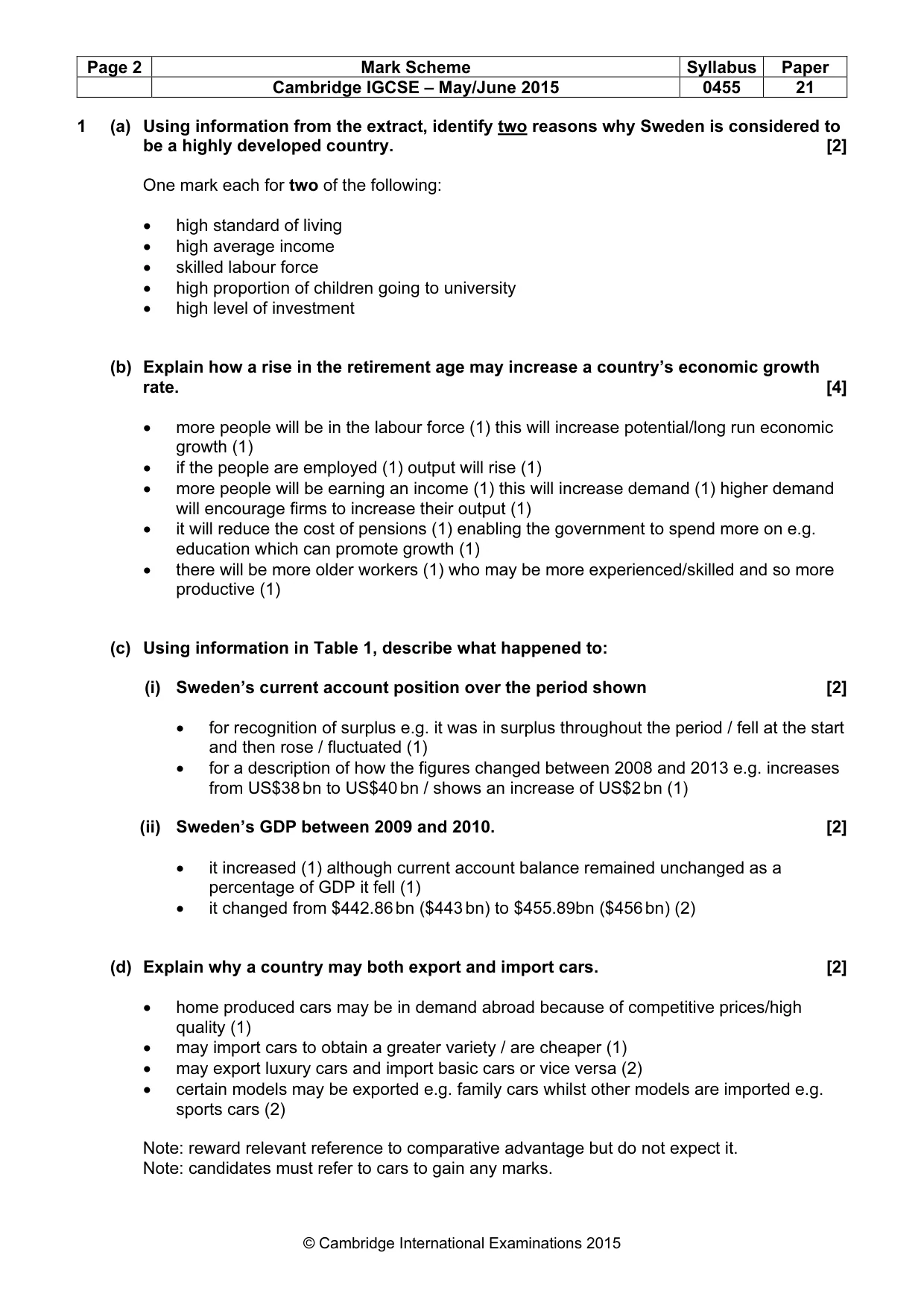
Page 2 Mark Scheme Syllabus Paper Cambridge IGCSE – May/June 2015 0455 21 © Cambridge International Examinations 2015 1 (a) Using information from the extract, identify two reasons why Sweden is considered to be a highly developed country. [2] One mark each for two of the following: • high standard of living • high average income • skilled labour force • high proportion of children going to university • high level of investment (b) Explain how a rise in the retirement age may increase a country’s economic growth rate. [4] • more people will be in the labour force (1) this will increase potential/long run economic growth (1) • if the people are employed (1) output will rise (1) • more people will be earning an income (1) this will increase demand (1) higher demand will encourage firms to increase their output (1) • it will reduce the cost of pensions (1) enabling the government to spend more on e.g. education which can promote growth (1) • there will be more older workers (1) who may be more experienced/skilled and so more productive (1) (c) Using information in Table 1, describe what happened to: (i) Sweden’s current account position over the period shown [2] • for recognition of surplus e.g. it was in surplus throughout the period / fell at the start and then rose / fluctuated (1) • for a description of how the figures changed between 2008 and 2013 e.g. increases from US$38 bn to US$40 bn / shows an increase of US$2 bn (1) (ii) Sweden’s GDP between 2009 and 2010. [2] • it increased (1) although current account balance remained unchanged as a percentage of GDP it fell (1) • it changed from $442.86 bn ($443 bn) to $455.89bn ($456 bn) (2) (d) Explain why a country may both export and import cars. [2] • home produced cars may be in demand abroad because of competitive prices/high quality (1) • may import cars to obtain a greater variety / are cheaper (1) • may export luxury cars and import basic cars or vice versa (2) • certain models may be exported e.g. family cars whilst other models are imported e.g. sports cars (2) Note: reward relevant reference to comparative advantage but do not expect it. Note: candidates must refer to cars to gain any marks.
Mark scheme, page 3
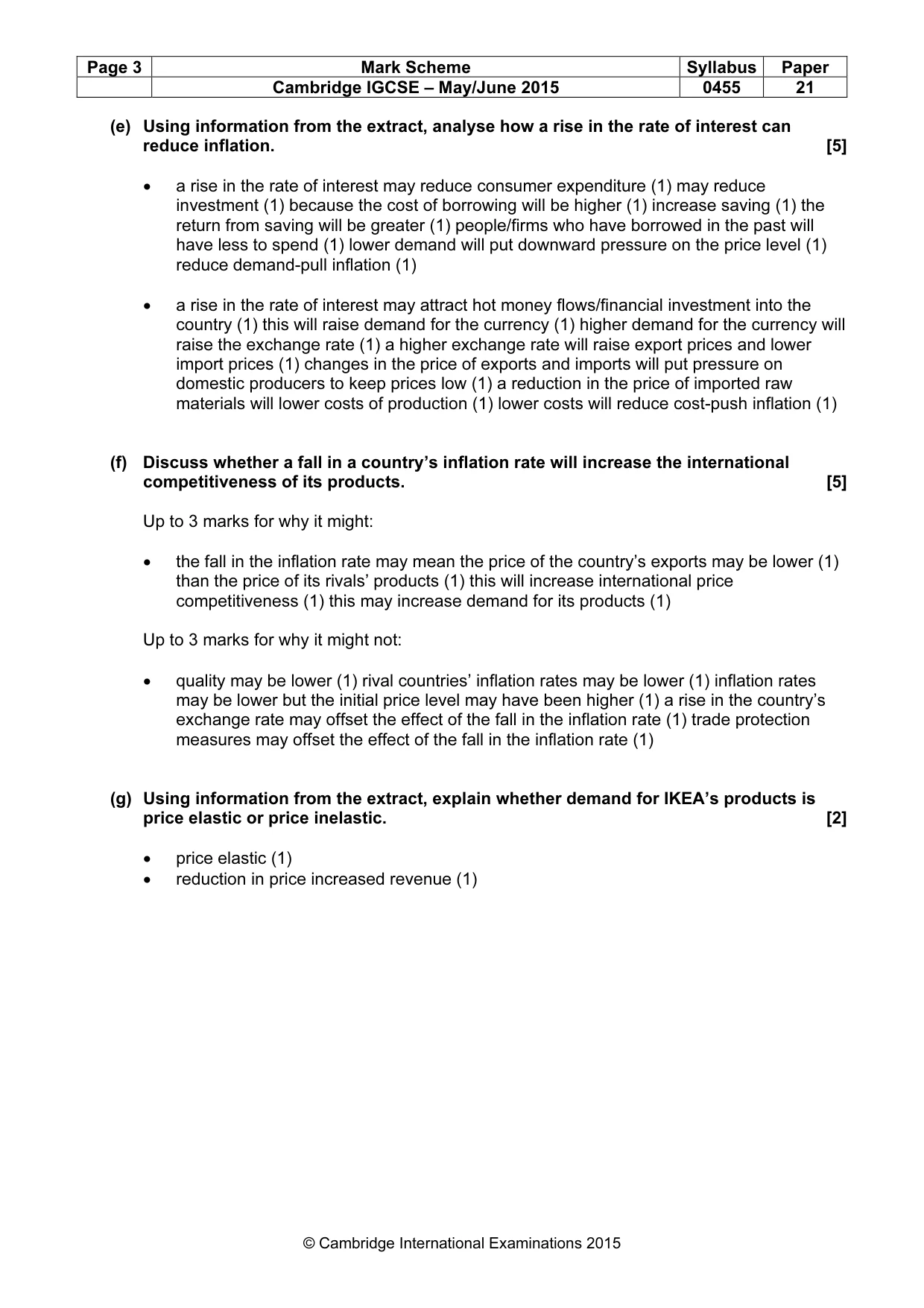
Page 3 Mark Scheme Syllabus Paper Cambridge IGCSE – May/June 2015 0455 21 © Cambridge International Examinations 2015 (e) Using information from the extract, analyse how a rise in the rate of interest can reduce inflation. [5] • a rise in the rate of interest may reduce consumer expenditure (1) may reduce investment (1) because the cost of borrowing will be higher (1) increase saving (1) the return from saving will be greater (1) people/firms who have borrowed in the past will have less to spend (1) lower demand will put downward pressure on the price level (1) reduce demand-pull inflation (1) • a rise in the rate of interest may attract hot money flows/financial investment into the country (1) this will raise demand for the currency (1) higher demand for the currency will raise the exchange rate (1) a higher exchange rate will raise export prices and lower import prices (1) changes in the price of exports and imports will put pressure on domestic producers to keep prices low (1) a reduction in the price of imported raw materials will lower costs of production (1) lower costs will reduce cost-push inflation (1) (f) Discuss whether a fall in a country’s inflation rate will increase the international competitiveness of its products. [5] Up to 3 marks for why it might: • the fall in the inflation rate may mean the price of the country’s exports may be lower (1) than the price of its rivals’ products (1) this will increase international price competitiveness (1) this may increase demand for its products (1) Up to 3 marks for why it might not: • quality may be lower (1) rival countries’ inflation rates may be lower (1) inflation rates may be lower but the initial price level may have been higher (1) a rise in the country’s exchange rate may offset the effect of the fall in the inflation rate (1) trade protection measures may offset the effect of the fall in the inflation rate (1) (g) Using information from the extract, explain whether demand for IKEA’s products is price elastic or price inelastic. [2] • price elastic (1) • reduction in price increased revenue (1)
Mark scheme, page 4
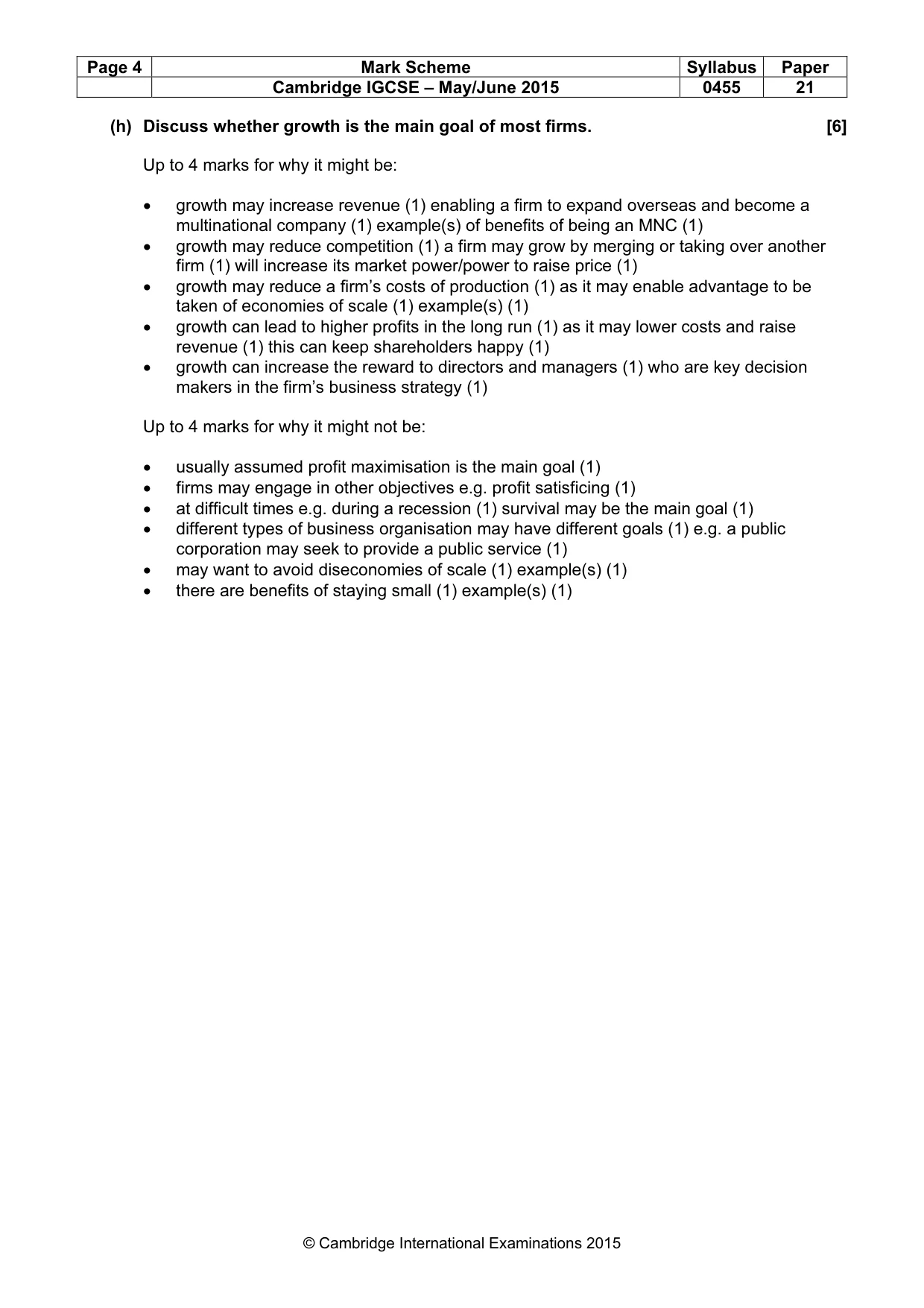
Page 4 Mark Scheme Syllabus Paper Cambridge IGCSE – May/June 2015 0455 21 © Cambridge International Examinations 2015 (h) Discuss whether growth is the main goal of most firms. [6] Up to 4 marks for why it might be: • growth may increase revenue (1) enabling a firm to expand overseas and become a multinational company (1) example(s) of benefits of being an MNC (1) • growth may reduce competition (1) a firm may grow by merging or taking over another firm (1) will increase its market power/power to raise price (1) • growth may reduce a firm’s costs of production (1) as it may enable advantage to be taken of economies of scale (1) example(s) (1) • growth can lead to higher profits in the long run (1) as it may lower costs and raise revenue (1) this can keep shareholders happy (1) • growth can increase the reward to directors and managers (1) who are key decision makers in the firm’s business strategy (1) Up to 4 marks for why it might not be: • usually assumed profit maximisation is the main goal (1) • firms may engage in other objectives e.g. profit satisficing (1) • at difficult times e.g. during a recession (1) survival may be the main goal (1) • different types of business organisation may have different goals (1) e.g. a public corporation may seek to provide a public service (1) • may want to avoid diseconomies of scale (1) example(s) (1) • there are benefits of staying small (1) example(s) (1)
Mark scheme, page 5
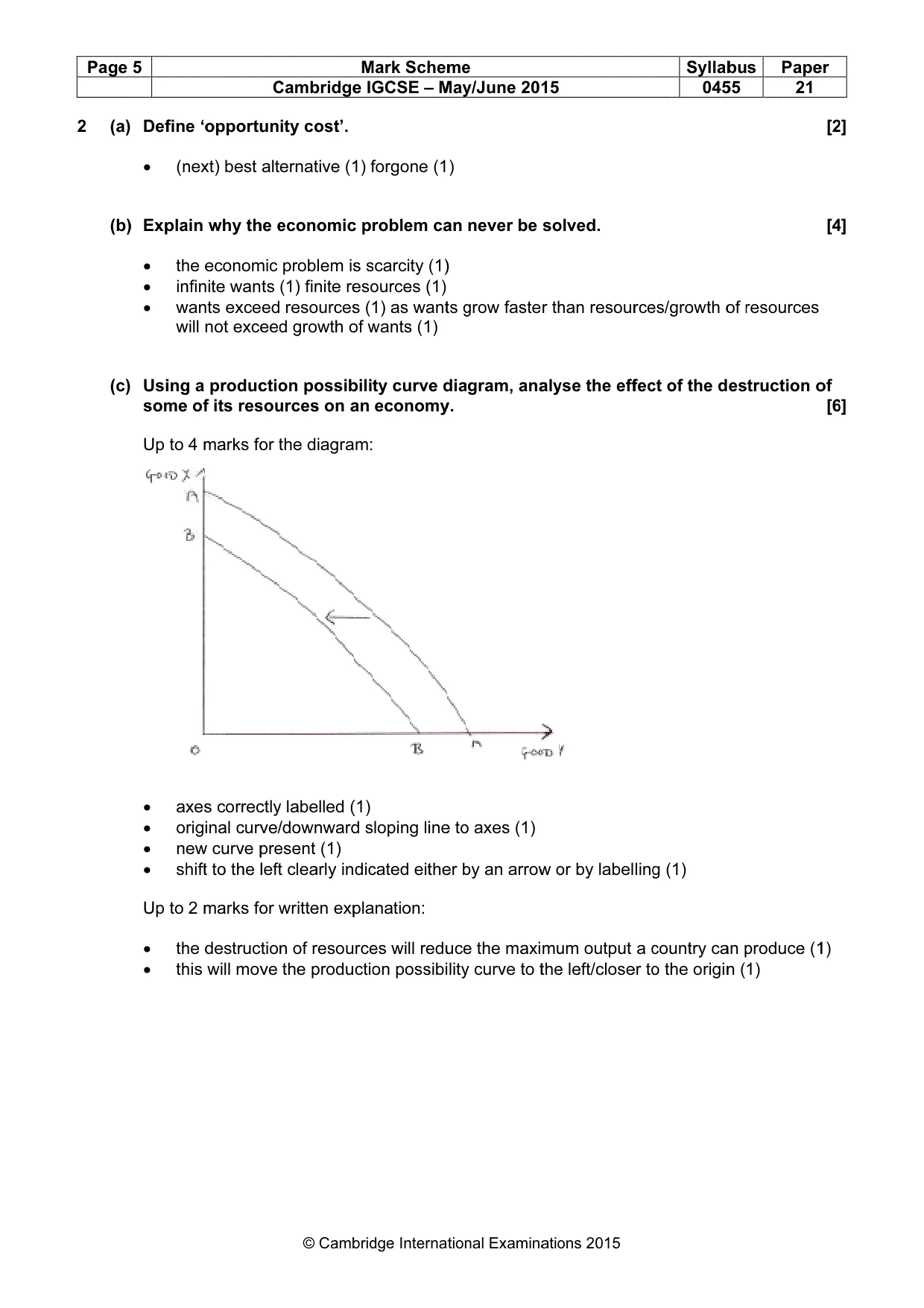
P 2 Pag ( ( ( ge (a) (b) (c) 5 D • ) E • • • U s U • • • • U • • Def • Exp • • • Usi som Up • • • • Up • • fine (n pla th in w w ing me to ax o ne sh to th th e ‘o nex ain he e nfin wan will g a e of 4 m xes rig ew hift 2 m he d his op xt) wh eco nite nts not pr f it ma s c ina w cu t to ma de wi ppo be hy ono e w ex t e rod s r arks corr al c urv o th arks str ll m ortu est th om an xce xce duc res s fo rec curv ve p he l s fo ruct mov C un alt he e mic ts ed eed ctio sou or t ctly ve/ pre left or w tion ve Cam ity ern eco pro (1) re d g on urc the y la /do ese t cl wri n o the mb © y co nat ono ob ) fin eso gro po ces e d abe own ent ea itte of r e p brid Ca ost tive om lem nite ourc wth oss s o iag elle nw (1 arly en e res pro dge amb t’. e (1 mic m is e re ces h o sib n a gra d ( ard ) y in exp ou du M e IG brid 1) f c pr s s eso s (1 of w bilit an m: (1) d s dic pla rce ctio Mar GC dge forg rob sca our 1) a wan ty ec lop cate ana es w on k S CSE e In go ble rci rce as nts cu con ping ed atio wil po Sch E – nter ne em ty es ( wa s (1 urve nom g li eit on: l re oss hem – M rnat (1 ca (1) (1) ant ) e d my ine the edu sibi me May tion ) an ) ts g dia y. e to er b uce lity e y/J nal ne gro agra o ax by a e th y cu un Ex eve ow am xes an he urv ne 2 xam er b fas m, a s (1 ar ma ve t 20 mina be ste ana 1) rrow axi to t 15 atio so r th aly w o mu the ons olve han yse or b um e le s 20 ed n re e th by ou eft/c 015 . eso he lab utp clo 5 our eff bel put ose rce fec ling a c er to es/g ct o g ( cou o th S gro of t 1) unt he Syl 0 owt the try or llab 045 th o e d ca igin bu 55 of r es an p n ( s res tru pro 1) P sou uct odu Pa 2 urce tion uce pe 21 es n o e (1 er [2 [4 of [6 1) 2] 4] 6]
Mark scheme, page 6
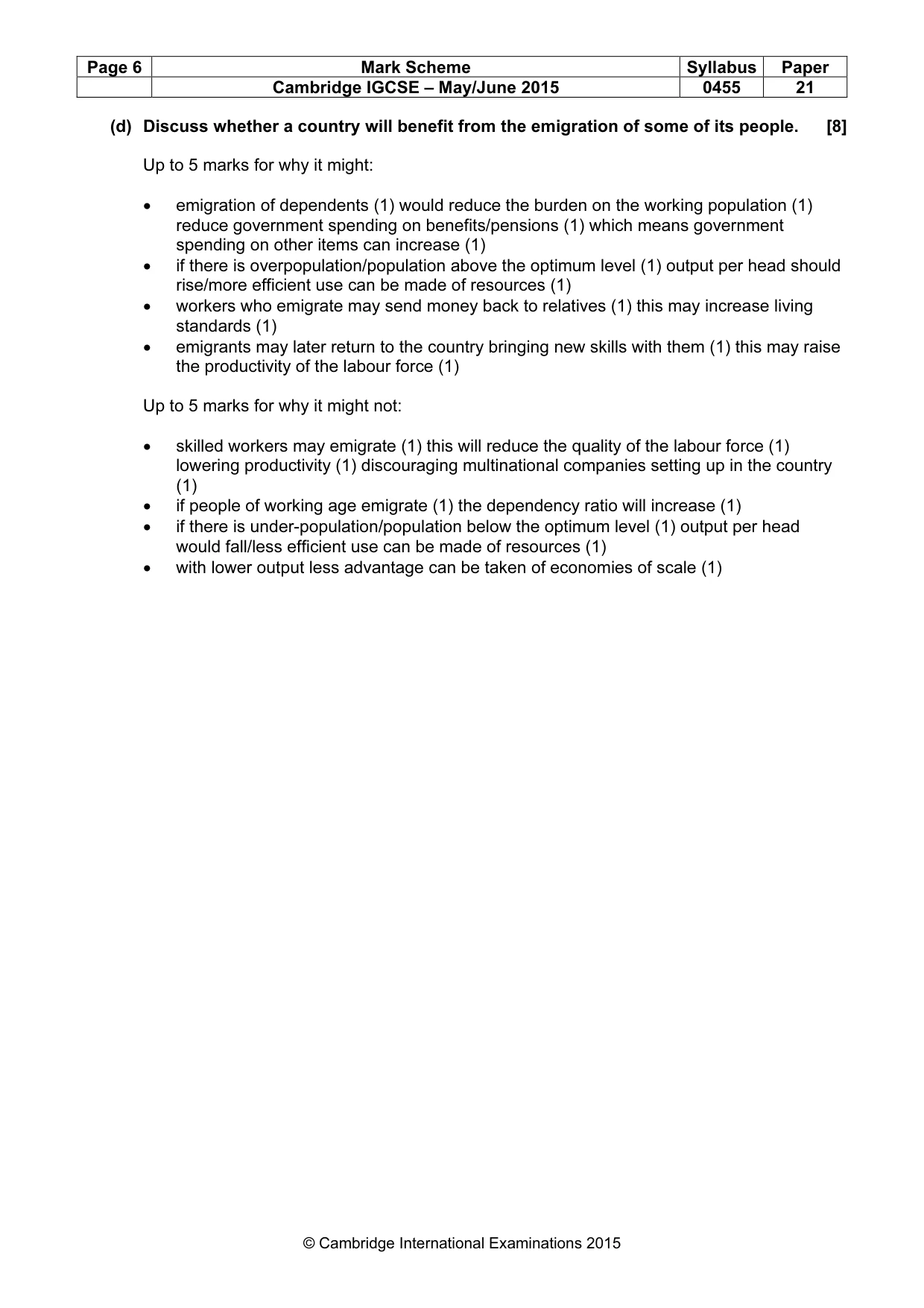
Page 6 Mark Scheme Syllabus Paper Cambridge IGCSE – May/June 2015 0455 21 © Cambridge International Examinations 2015 (d) Discuss whether a country will benefit from the emigration of some of its people. [8] Up to 5 marks for why it might: • emigration of dependents (1) would reduce the burden on the working population (1) reduce government spending on benefits/pensions (1) which means government spending on other items can increase (1) • if there is overpopulation/population above the optimum level (1) output per head should rise/more efficient use can be made of resources (1) • workers who emigrate may send money back to relatives (1) this may increase living standards (1) • emigrants may later return to the country bringing new skills with them (1) this may raise the productivity of the labour force (1) Up to 5 marks for why it might not: • skilled workers may emigrate (1) this will reduce the quality of the labour force (1) lowering productivity (1) discouraging multinational companies setting up in the country (1) • if people of working age emigrate (1) the dependency ratio will increase (1) • if there is under-population/population below the optimum level (1) output per head would fall/less efficient use can be made of resources (1) • with lower output less advantage can be taken of economies of scale (1)
Mark scheme, page 7
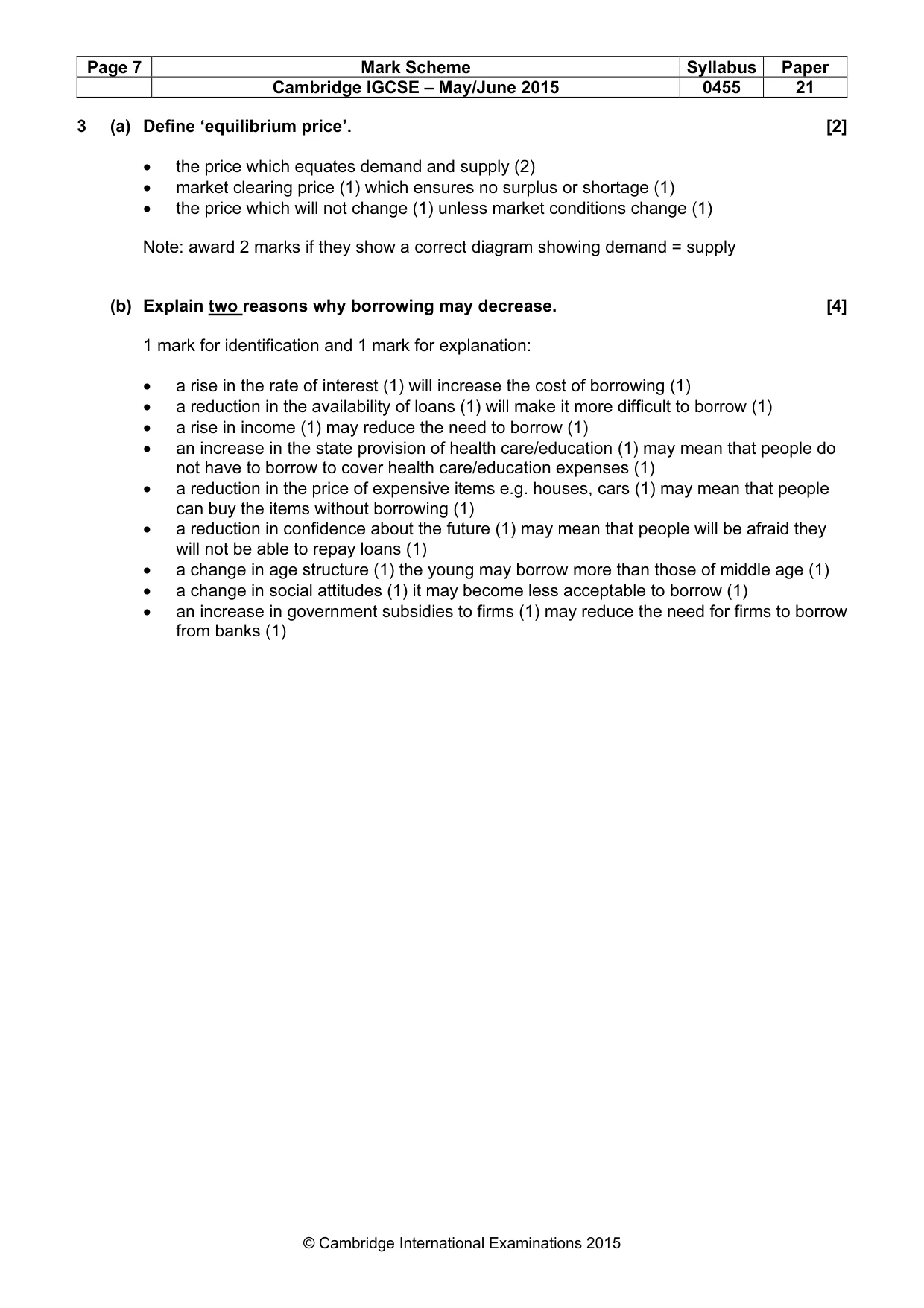
Page 7 Mark Scheme Syllabus Paper Cambridge IGCSE – May/June 2015 0455 21 © Cambridge International Examinations 2015 3 (a) Define ‘equilibrium price’. [2] • the price which equates demand and supply (2) • market clearing price (1) which ensures no surplus or shortage (1) • the price which will not change (1) unless market conditions change (1) Note: award 2 marks if they show a correct diagram showing demand = supply (b) Explain two reasons why borrowing may decrease. [4] 1 mark for identification and 1 mark for explanation: • a rise in the rate of interest (1) will increase the cost of borrowing (1) • a reduction in the availability of loans (1) will make it more difficult to borrow (1) • a rise in income (1) may reduce the need to borrow (1) • an increase in the state provision of health care/education (1) may mean that people do not have to borrow to cover health care/education expenses (1) • a reduction in the price of expensive items e.g. houses, cars (1) may mean that people can buy the items without borrowing (1) • a reduction in confidence about the future (1) may mean that people will be afraid they will not be able to repay loans (1) • a change in age structure (1) the young may borrow more than those of middle age (1) • a change in social attitudes (1) it may become less acceptable to borrow (1) • an increase in government subsidies to firms (1) may reduce the need for firms to borrow from banks (1)
Mark scheme, page 8
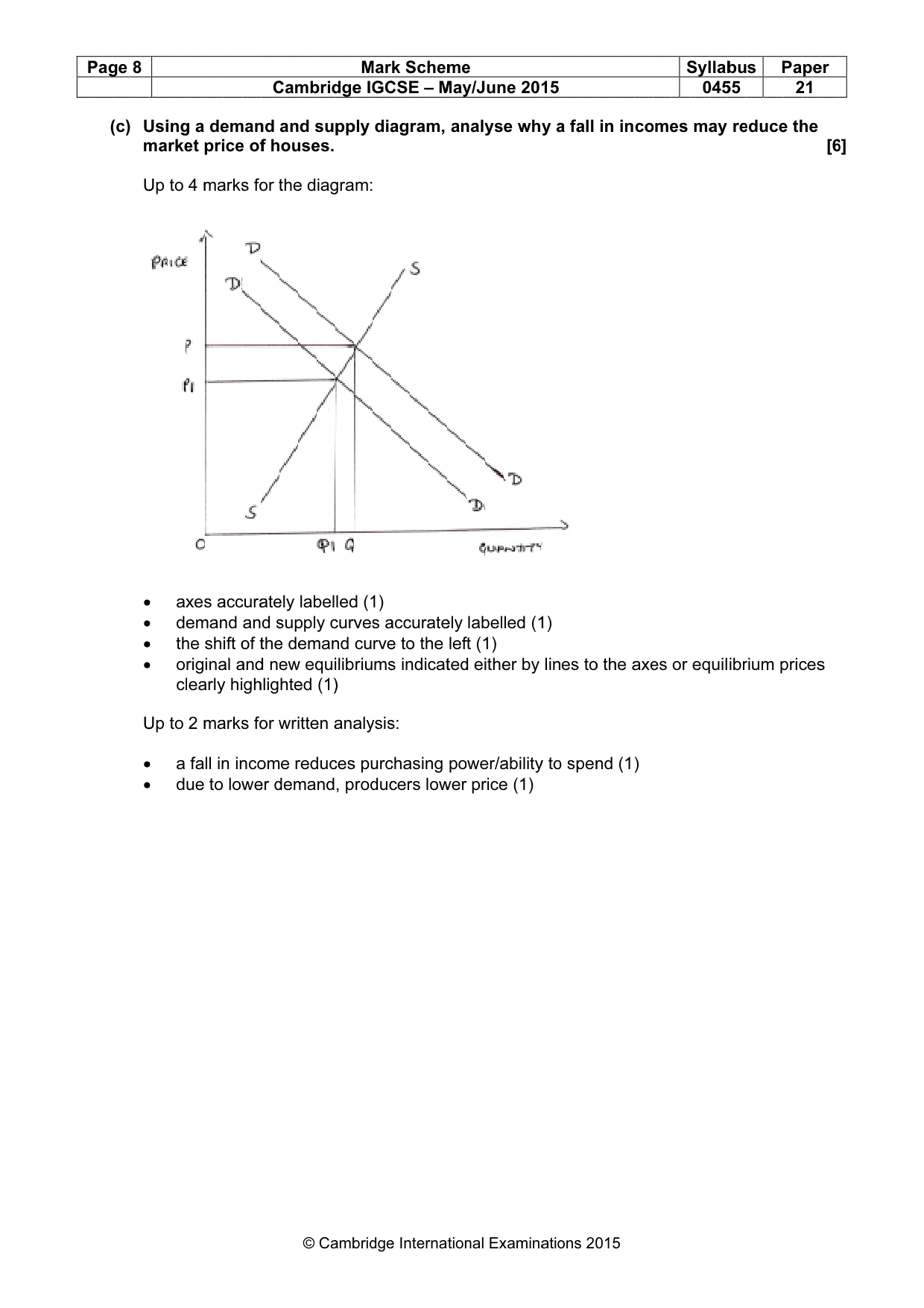
P Pag ( ge (c) 8 U m U • • • • U • • Usi ma Up • • • • Up • • ing rke to ax de th o cl to a d g a et p 4 m xes em he s rig lea 2 m fa ue de pri ma s a man shi ina arly ma ll in to em ice arks acc nd ift o al a y hi arks n in low man e of s fo cura an of t and gh s fo nco we C nd f h or t ate d s the d ne hlig or w om er d Cam an ou the ely sup e de ew hte wri e r dem mb © d s use e d lab pply em w eq ed itte red ma brid Ca sup es. iag bel y c man qui (1) en a duc nd dge amb pp gra led curv nd ilib ) ana ces , p M e IG brid ply m: d (1 ves cu riu aly s pu rod Mar GC dge dia 1) s a rve ms ysis urc duc k S CSE e In ag acc e to s in s: cha cer Sch E – nter ram cura o th ndic asin rs l hem – M rnat m, ate he cat ng ow me May tion an ely lef ted po wer e y/J nal naly lab ft (1 d ei owe r pr un Ex ys bel 1) ithe er/a rice ne 2 xam e w led er abi e (1 20 mina wh d (1 by lity 1) 15 atio y a 1) lin y to ons a fa nes o sp s 20 all s to pen 015 in o th nd 5 in he a (1 co axe ) ome es S es or Syl 0 ma eq llab 045 ay quil bu 55 re ibr s edu rium P uce m p Pa 2 e th pric pe 21 he ces er [6 s 6]
Mark scheme, page 9
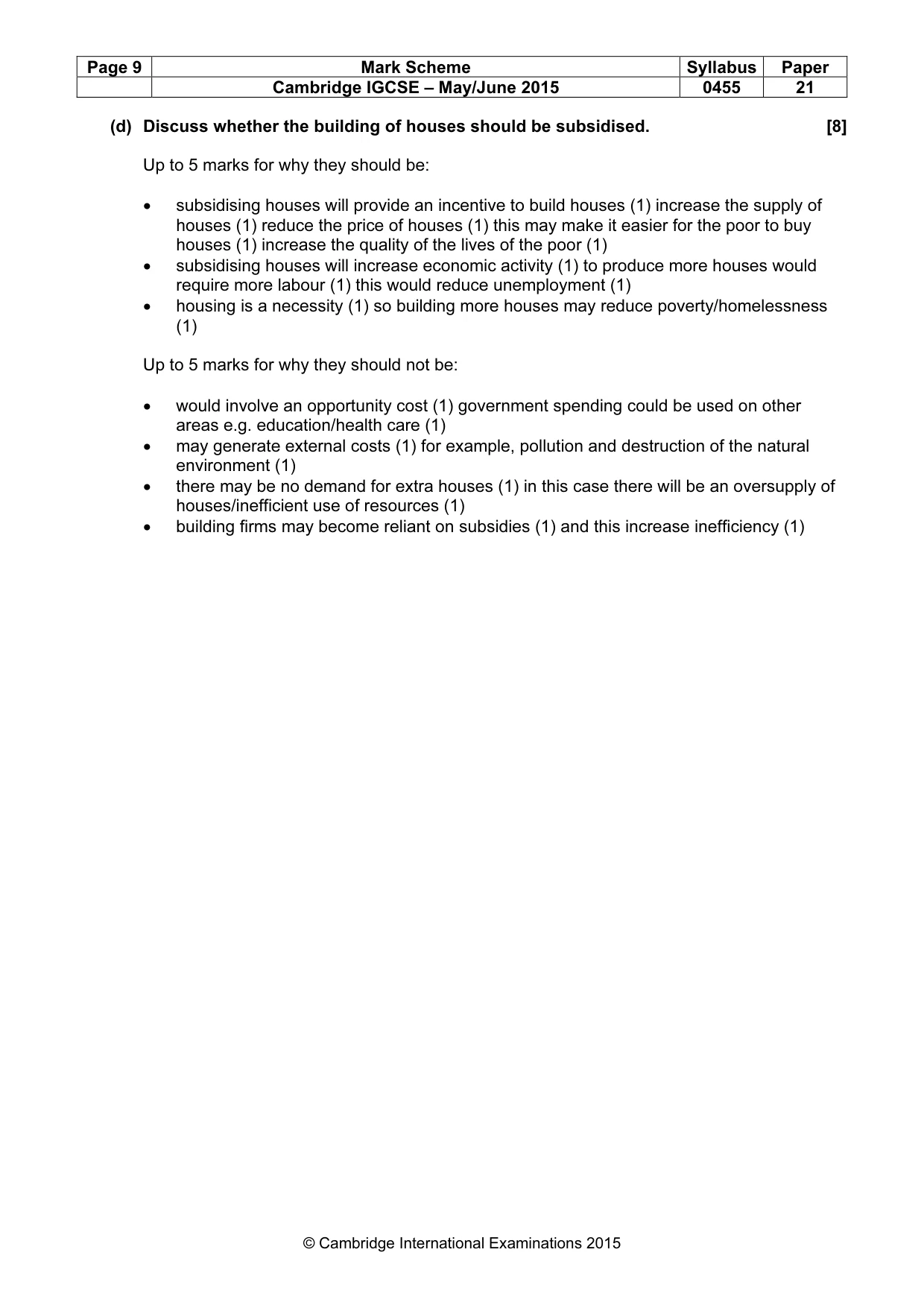
Page 9 Mark Scheme Syllabus Paper Cambridge IGCSE – May/June 2015 0455 21 © Cambridge International Examinations 2015 (d) Discuss whether the building of houses should be subsidised. [8] Up to 5 marks for why they should be: • subsidising houses will provide an incentive to build houses (1) increase the supply of houses (1) reduce the price of houses (1) this may make it easier for the poor to buy houses (1) increase the quality of the lives of the poor (1) • subsidising houses will increase economic activity (1) to produce more houses would require more labour (1) this would reduce unemployment (1) • housing is a necessity (1) so building more houses may reduce poverty/homelessness (1) Up to 5 marks for why they should not be: • would involve an opportunity cost (1) government spending could be used on other areas e.g. education/health care (1) • may generate external costs (1) for example, pollution and destruction of the natural environment (1) • there may be no demand for extra houses (1) in this case there will be an oversupply of houses/inefficient use of resources (1) • building firms may become reliant on subsidies (1) and this increase inefficiency (1)
Mark scheme, page 10
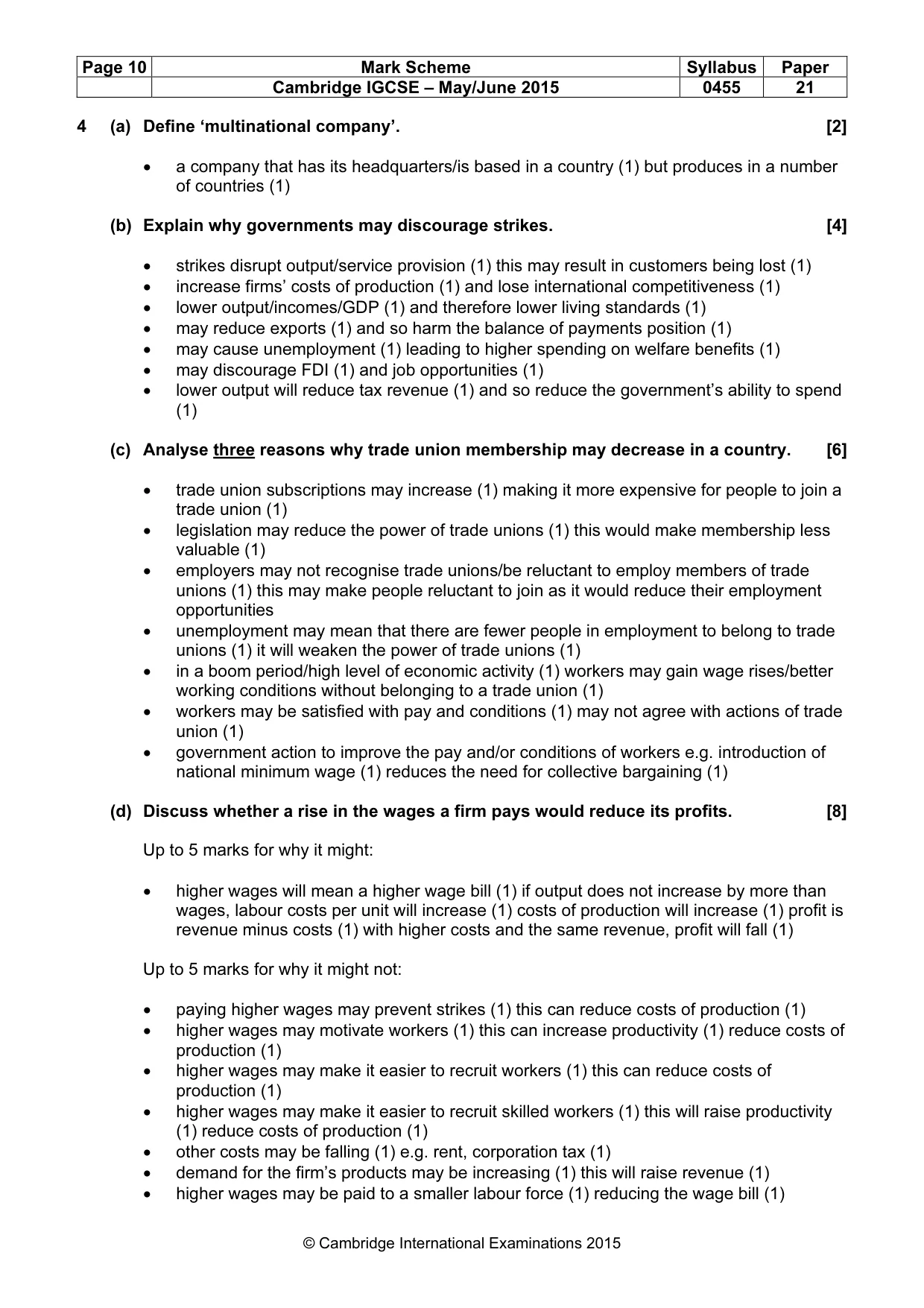
Page 10 Mark Scheme Syllabus Paper Cambridge IGCSE – May/June 2015 0455 21 © Cambridge International Examinations 2015 4 (a) Define ‘multinational company’. [2] • a company that has its headquarters/is based in a country (1) but produces in a number of countries (1) (b) Explain why governments may discourage strikes. [4] • strikes disrupt output/service provision (1) this may result in customers being lost (1) • increase firms’ costs of production (1) and lose international competitiveness (1) • lower output/incomes/GDP (1) and therefore lower living standards (1) • may reduce exports (1) and so harm the balance of payments position (1) • may cause unemployment (1) leading to higher spending on welfare benefits (1) • may discourage FDI (1) and job opportunities (1) • lower output will reduce tax revenue (1) and so reduce the government’s ability to spend (1) (c) Analyse three reasons why trade union membership may decrease in a country. [6] • trade union subscriptions may increase (1) making it more expensive for people to join a trade union (1) • legislation may reduce the power of trade unions (1) this would make membership less valuable (1) • employers may not recognise trade unions/be reluctant to employ members of trade unions (1) this may make people reluctant to join as it would reduce their employment opportunities • unemployment may mean that there are fewer people in employment to belong to trade unions (1) it will weaken the power of trade unions (1) • in a boom period/high level of economic activity (1) workers may gain wage rises/better working conditions without belonging to a trade union (1) • workers may be satisfied with pay and conditions (1) may not agree with actions of trade union (1) • government action to improve the pay and/or conditions of workers e.g. introduction of national minimum wage (1) reduces the need for collective bargaining (1) (d) Discuss whether a rise in the wages a firm pays would reduce its profits. [8] Up to 5 marks for why it might: • higher wages will mean a higher wage bill (1) if output does not increase by more than wages, labour costs per unit will increase (1) costs of production will increase (1) profit is revenue minus costs (1) with higher costs and the same revenue, profit will fall (1) Up to 5 marks for why it might not: • paying higher wages may prevent strikes (1) this can reduce costs of production (1) • higher wages may motivate workers (1) this can increase productivity (1) reduce costs of production (1) • higher wages may make it easier to recruit workers (1) this can reduce costs of production (1) • higher wages may make it easier to recruit skilled workers (1) this will raise productivity (1) reduce costs of production (1) • other costs may be falling (1) e.g. rent, corporation tax (1) • demand for the firm’s products may be increasing (1) this will raise revenue (1) • higher wages may be paid to a smaller labour force (1) reducing the wage bill (1)
Mark scheme, page 11
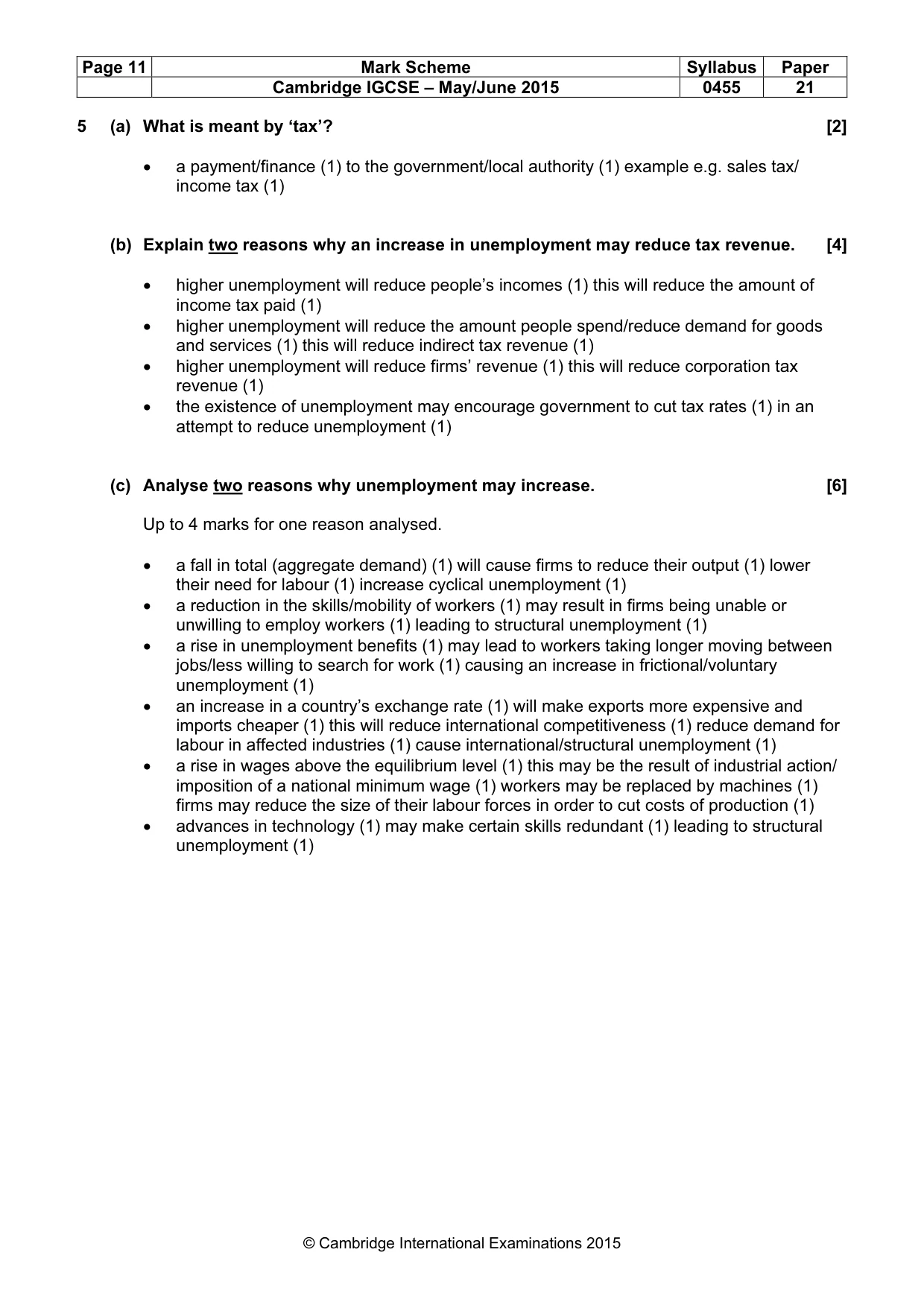
Page 11 Mark Scheme Syllabus Paper Cambridge IGCSE – May/June 2015 0455 21 © Cambridge International Examinations 2015 5 (a) What is meant by ‘tax’? [2] • a payment/finance (1) to the government/local authority (1) example e.g. sales tax/ income tax (1) (b) Explain two reasons why an increase in unemployment may reduce tax revenue. [4] • higher unemployment will reduce people’s incomes (1) this will reduce the amount of income tax paid (1) • higher unemployment will reduce the amount people spend/reduce demand for goods and services (1) this will reduce indirect tax revenue (1) • higher unemployment will reduce firms’ revenue (1) this will reduce corporation tax revenue (1) • the existence of unemployment may encourage government to cut tax rates (1) in an attempt to reduce unemployment (1) (c) Analyse two reasons why unemployment may increase. [6] Up to 4 marks for one reason analysed. • a fall in total (aggregate demand) (1) will cause firms to reduce their output (1) lower their need for labour (1) increase cyclical unemployment (1) • a reduction in the skills/mobility of workers (1) may result in firms being unable or unwilling to employ workers (1) leading to structural unemployment (1) • a rise in unemployment benefits (1) may lead to workers taking longer moving between jobs/less willing to search for work (1) causing an increase in frictional/voluntary unemployment (1) • an increase in a country’s exchange rate (1) will make exports more expensive and imports cheaper (1) this will reduce international competitiveness (1) reduce demand for labour in affected industries (1) cause international/structural unemployment (1) • a rise in wages above the equilibrium level (1) this may be the result of industrial action/ imposition of a national minimum wage (1) workers may be replaced by machines (1) firms may reduce the size of their labour forces in order to cut costs of production (1) • advances in technology (1) may make certain skills redundant (1) leading to structural unemployment (1)
Mark scheme, page 12
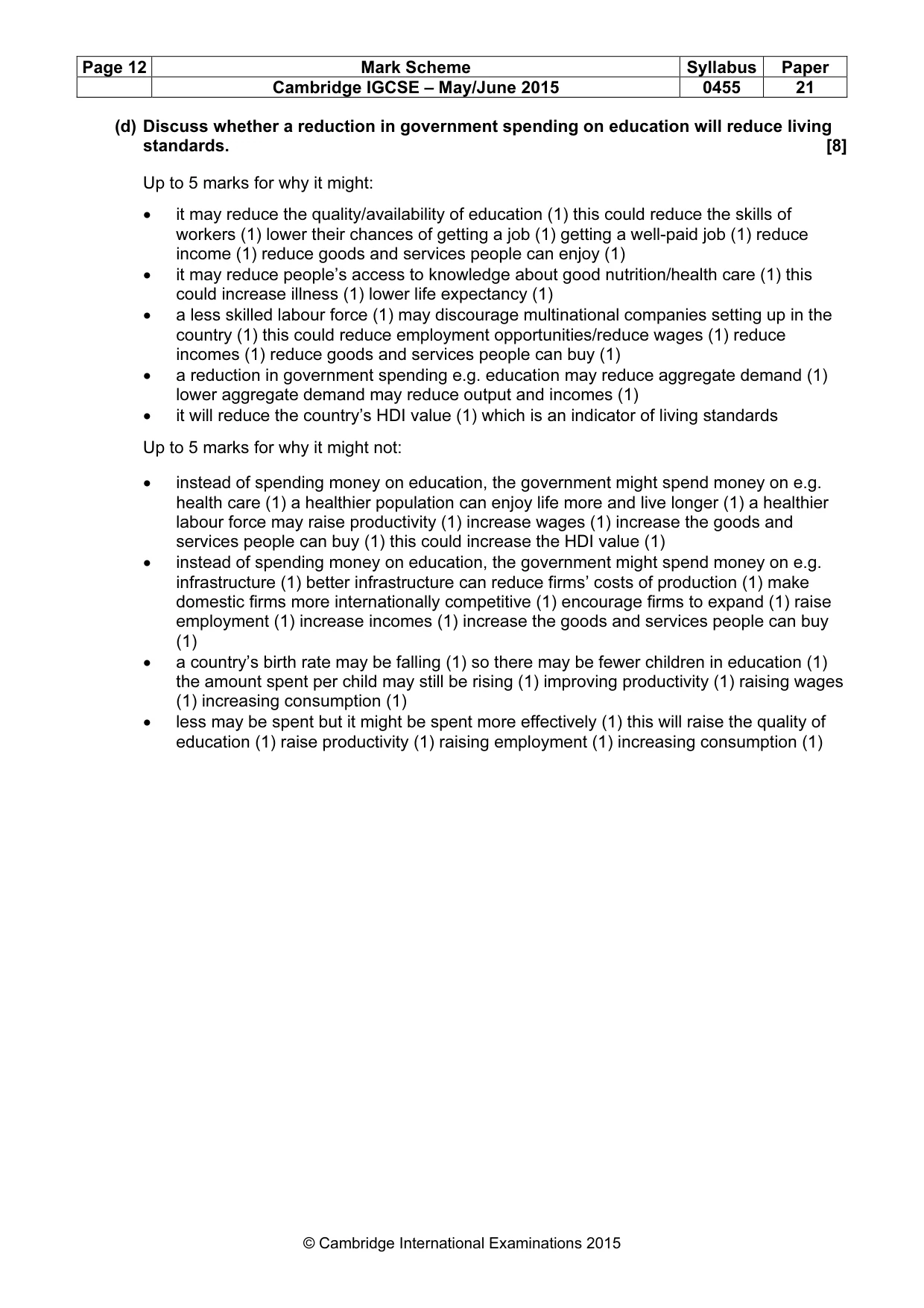
Page 12 Mark Scheme Syllabus Paper Cambridge IGCSE – May/June 2015 0455 21 © Cambridge International Examinations 2015 (d) Discuss whether a reduction in government spending on education will reduce living standards. [8] Up to 5 marks for why it might: • it may reduce the quality/availability of education (1) this could reduce the skills of workers (1) lower their chances of getting a job (1) getting a well-paid job (1) reduce income (1) reduce goods and services people can enjoy (1) • it may reduce people’s access to knowledge about good nutrition/health care (1) this could increase illness (1) lower life expectancy (1) • a less skilled labour force (1) may discourage multinational companies setting up in the country (1) this could reduce employment opportunities/reduce wages (1) reduce incomes (1) reduce goods and services people can buy (1) • a reduction in government spending e.g. education may reduce aggregate demand (1) lower aggregate demand may reduce output and incomes (1) • it will reduce the country’s HDI value (1) which is an indicator of living standards Up to 5 marks for why it might not: • instead of spending money on education, the government might spend money on e.g. health care (1) a healthier population can enjoy life more and live longer (1) a healthier labour force may raise productivity (1) increase wages (1) increase the goods and services people can buy (1) this could increase the HDI value (1) • instead of spending money on education, the government might spend money on e.g. infrastructure (1) better infrastructure can reduce firms’ costs of production (1) make domestic firms more internationally competitive (1) encourage firms to expand (1) raise employment (1) increase incomes (1) increase the goods and services people can buy (1) • a country’s birth rate may be falling (1) so there may be fewer children in education (1) the amount spent per child may still be rising (1) improving productivity (1) raising wages (1) increasing consumption (1) • less may be spent but it might be spent more effectively (1) this will raise the quality of education (1) raise productivity (1) raising employment (1) increasing consumption (1)
Mark scheme, page 13
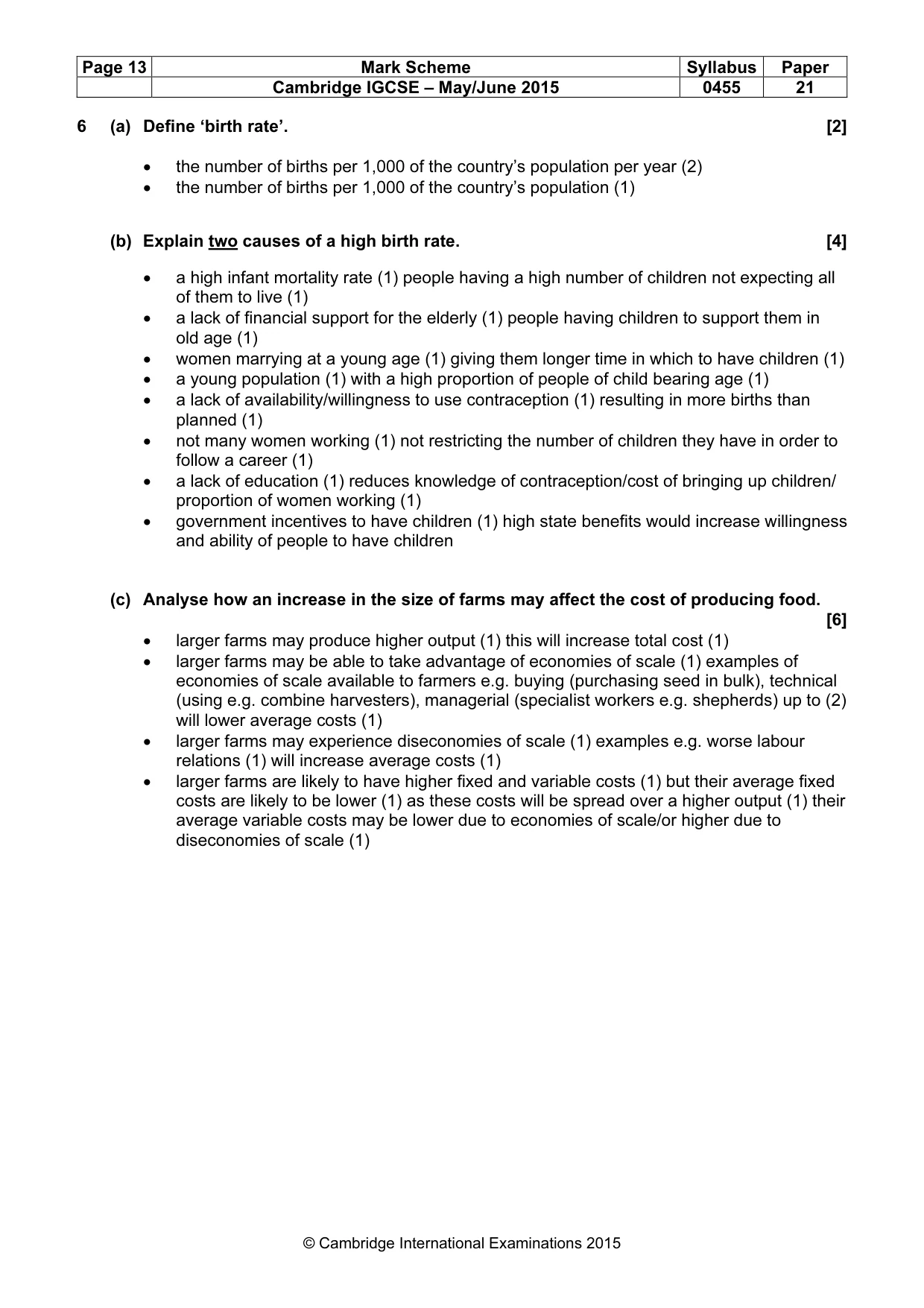
Page 13 Mark Scheme Syllabus Paper Cambridge IGCSE – May/June 2015 0455 21 © Cambridge International Examinations 2015 6 (a) Define ‘birth rate’. [2] • the number of births per 1,000 of the country’s population per year (2) • the number of births per 1,000 of the country’s population (1) (b) Explain two causes of a high birth rate. [4] • a high infant mortality rate (1) people having a high number of children not expecting all of them to live (1) • a lack of financial support for the elderly (1) people having children to support them in old age (1) • women marrying at a young age (1) giving them longer time in which to have children (1) • a young population (1) with a high proportion of people of child bearing age (1) • a lack of availability/willingness to use contraception (1) resulting in more births than planned (1) • not many women working (1) not restricting the number of children they have in order to follow a career (1) • a lack of education (1) reduces knowledge of contraception/cost of bringing up children/ proportion of women working (1) • government incentives to have children (1) high state benefits would increase willingness and ability of people to have children (c) Analyse how an increase in the size of farms may affect the cost of producing food. [6] • larger farms may produce higher output (1) this will increase total cost (1) • larger farms may be able to take advantage of economies of scale (1) examples of economies of scale available to farmers e.g. buying (purchasing seed in bulk), technical (using e.g. combine harvesters), managerial (specialist workers e.g. shepherds) up to (2) will lower average costs (1) • larger farms may experience diseconomies of scale (1) examples e.g. worse labour relations (1) will increase average costs (1) • larger farms are likely to have higher fixed and variable costs (1) but their average fixed costs are likely to be lower (1) as these costs will be spread over a higher output (1) their average variable costs may be lower due to economies of scale/or higher due to diseconomies of scale (1)
Mark scheme, page 14
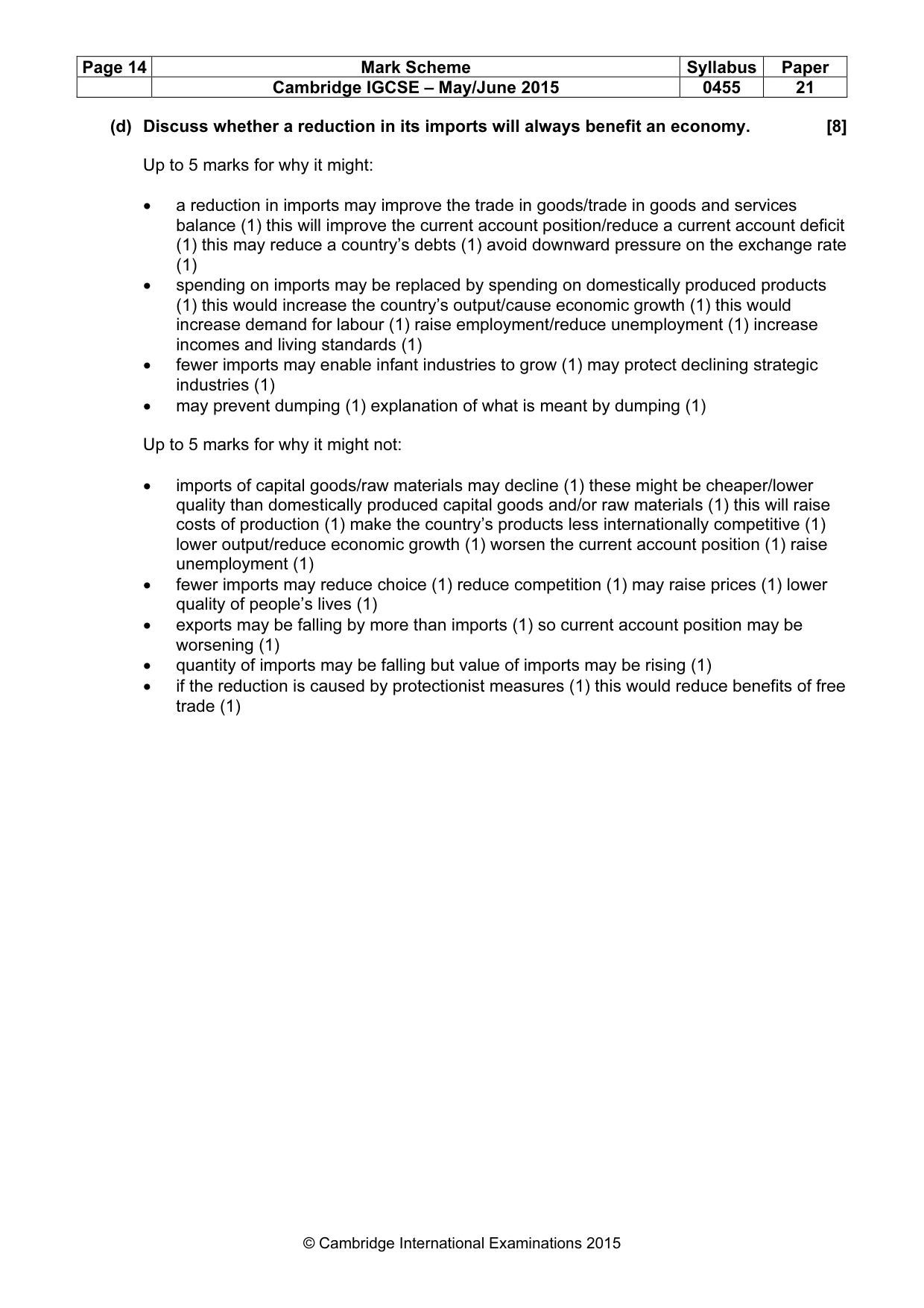
Page 14 Mark Scheme Syllabus Paper Cambridge IGCSE – May/June 2015 0455 21 © Cambridge International Examinations 2015 (d) Discuss whether a reduction in its imports will always benefit an economy. [8] Up to 5 marks for why it might: • a reduction in imports may improve the trade in goods/trade in goods and services balance (1) this will improve the current account position/reduce a current account deficit (1) this may reduce a country’s debts (1) avoid downward pressure on the exchange rate (1) • spending on imports may be replaced by spending on domestically produced products (1) this would increase the country’s output/cause economic growth (1) this would increase demand for labour (1) raise employment/reduce unemployment (1) increase incomes and living standards (1) • fewer imports may enable infant industries to grow (1) may protect declining strategic industries (1) • may prevent dumping (1) explanation of what is meant by dumping (1) Up to 5 marks for why it might not: • imports of capital goods/raw materials may decline (1) these might be cheaper/lower quality than domestically produced capital goods and/or raw materials (1) this will raise costs of production (1) make the country’s products less internationally competitive (1) lower output/reduce economic growth (1) worsen the current account position (1) raise unemployment (1) • fewer imports may reduce choice (1) reduce competition (1) may raise prices (1) lower quality of people’s lives (1) • exports may be falling by more than imports (1) so current account position may be worsening (1) • quantity of imports may be falling but value of imports may be rising (1) • if the reduction is caused by protectionist measures (1) this would reduce benefits of free trade (1)
Mark scheme, page 15
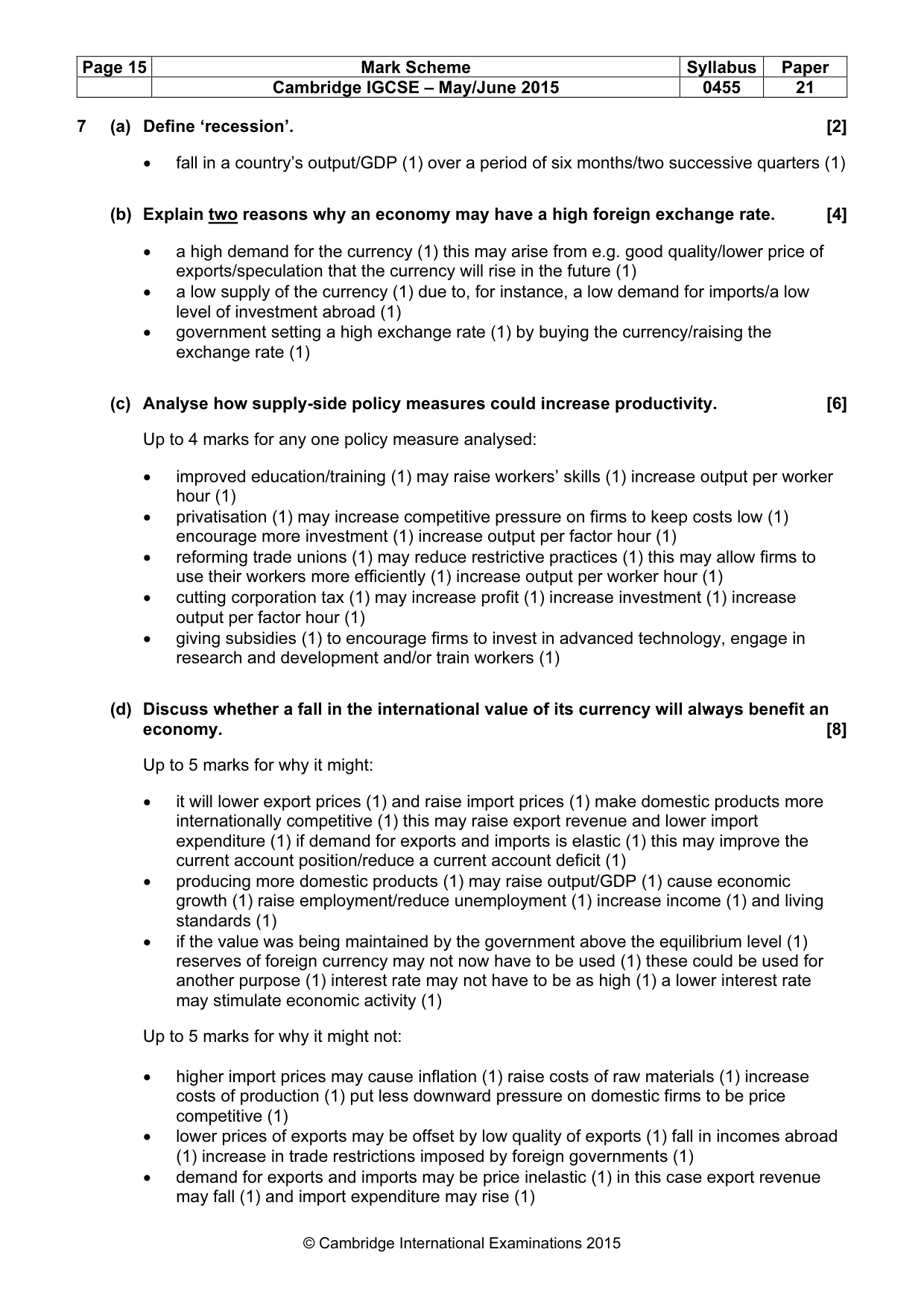
Page 15 Mark Scheme Syllabus Paper Cambridge IGCSE – May/June 2015 0455 21 © Cambridge International Examinations 2015 7 (a) Define ‘recession’. [2] • fall in a country’s output/GDP (1) over a period of six months/two successive quarters (1) (b) Explain two reasons why an economy may have a high foreign exchange rate. [4] • a high demand for the currency (1) this may arise from e.g. good quality/lower price of exports/speculation that the currency will rise in the future (1) • a low supply of the currency (1) due to, for instance, a low demand for imports/a low level of investment abroad (1) • government setting a high exchange rate (1) by buying the currency/raising the exchange rate (1) (c) Analyse how supply-side policy measures could increase productivity. [6] Up to 4 marks for any one policy measure analysed: • improved education/training (1) may raise workers’ skills (1) increase output per worker hour (1) • privatisation (1) may increase competitive pressure on firms to keep costs low (1) encourage more investment (1) increase output per factor hour (1) • reforming trade unions (1) may reduce restrictive practices (1) this may allow firms to use their workers more efficiently (1) increase output per worker hour (1) • cutting corporation tax (1) may increase profit (1) increase investment (1) increase output per factor hour (1) • giving subsidies (1) to encourage firms to invest in advanced technology, engage in research and development and/or train workers (1) (d) Discuss whether a fall in the international value of its currency will always benefit an economy. [8] Up to 5 marks for why it might: • it will lower export prices (1) and raise import prices (1) make domestic products more internationally competitive (1) this may raise export revenue and lower import expenditure (1) if demand for exports and imports is elastic (1) this may improve the current account position/reduce a current account deficit (1) • producing more domestic products (1) may raise output/GDP (1) cause economic growth (1) raise employment/reduce unemployment (1) increase income (1) and living standards (1) • if the value was being maintained by the government above the equilibrium level (1) reserves of foreign currency may not now have to be used (1) these could be used for another purpose (1) interest rate may not have to be as high (1) a lower interest rate may stimulate economic activity (1) Up to 5 marks for why it might not: • higher import prices may cause inflation (1) raise costs of raw materials (1) increase costs of production (1) put less downward pressure on domestic firms to be price competitive (1) • lower prices of exports may be offset by low quality of exports (1) fall in incomes abroad (1) increase in trade restrictions imposed by foreign governments (1) • demand for exports and imports may be price inelastic (1) in this case export revenue may fall (1) and import expenditure may rise (1)
What you needed in this session
Cambridge’s own grade thresholds for 2015 May/June, Paper 2 · Variant 1. A higher threshold means an easier paper — the bar moves with how the cohort did.