Cambridge IGCSE Economics 0455 — 2014 Oct/Nov Paper 2 · Variant 3
0455/23/O/N/14 · 90 marks · ≈101 min
The question paper and its mark scheme, free to read here and free to download. This is Cambridge’s own paper, exactly as it was sat.
Question paper8 pages



Mark scheme16 pages
Answers below. Sit the paper first if you are practising.
Paper as text
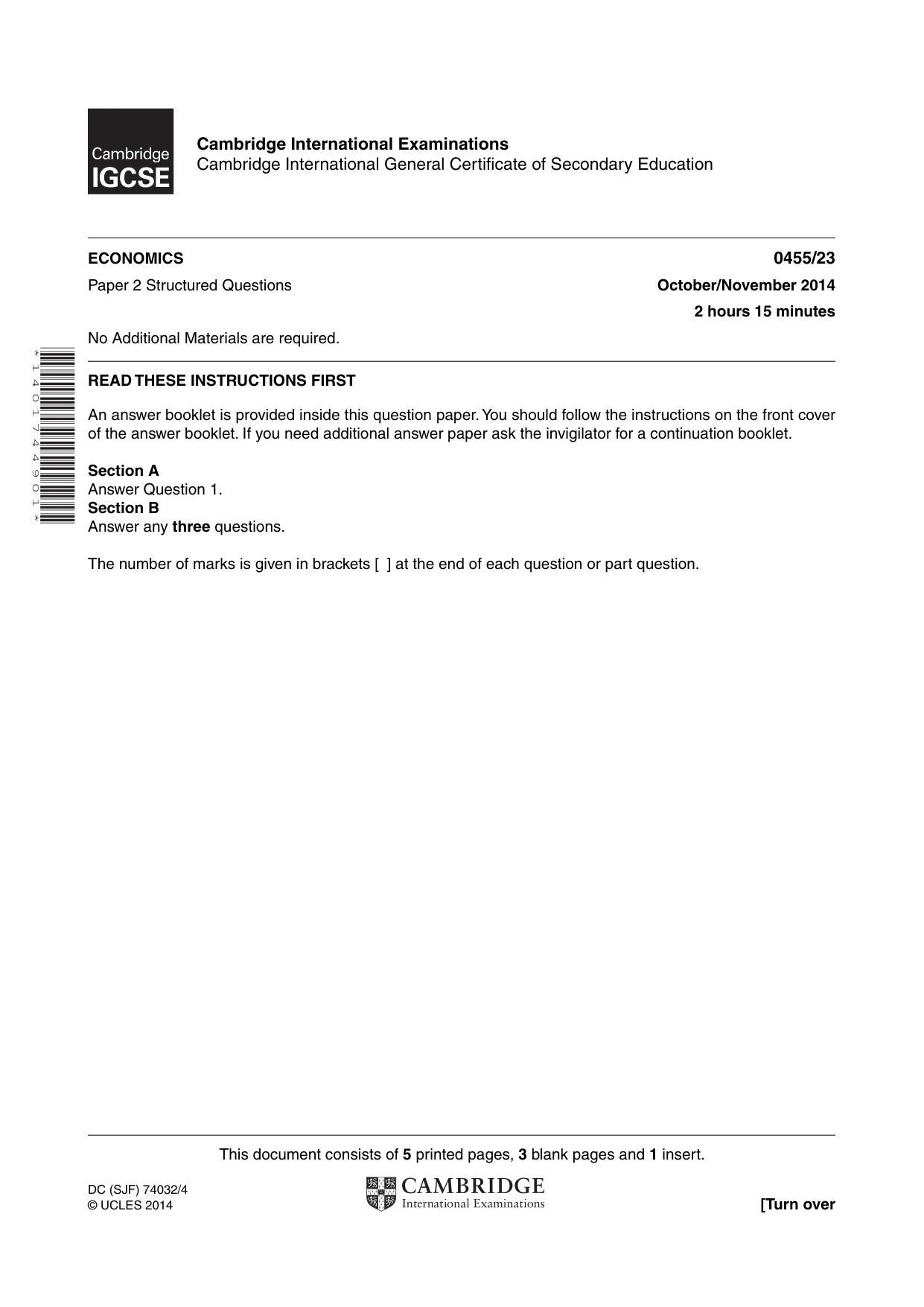
Question paper, page 1
This document consists of 5 printed pages, 3 blank pages and 1 insert. DC (SJF) 74032/4 © UCLES 2014 [Turn over Cambridge International Examinations Cambridge International General Certificate of Secondary Education * 1 4 0 1 7 4 4 9 0 1 * ECONOMICS 0455/23 Paper 2 Structured Questions October/November 2014 2 hours 15 minutes No Additional Materials are required. READ THESE INSTRUCTIONS FIRST An answer booklet is provided inside this question paper. You should follow the instructions on the front cover of the answer booklet. If you need additional answer paper ask the invigilator for a continuation booklet. Section A Answer Question 1. Section B Answer any three questions. The number of marks is given in brackets [ ] at the end of each question or part question.
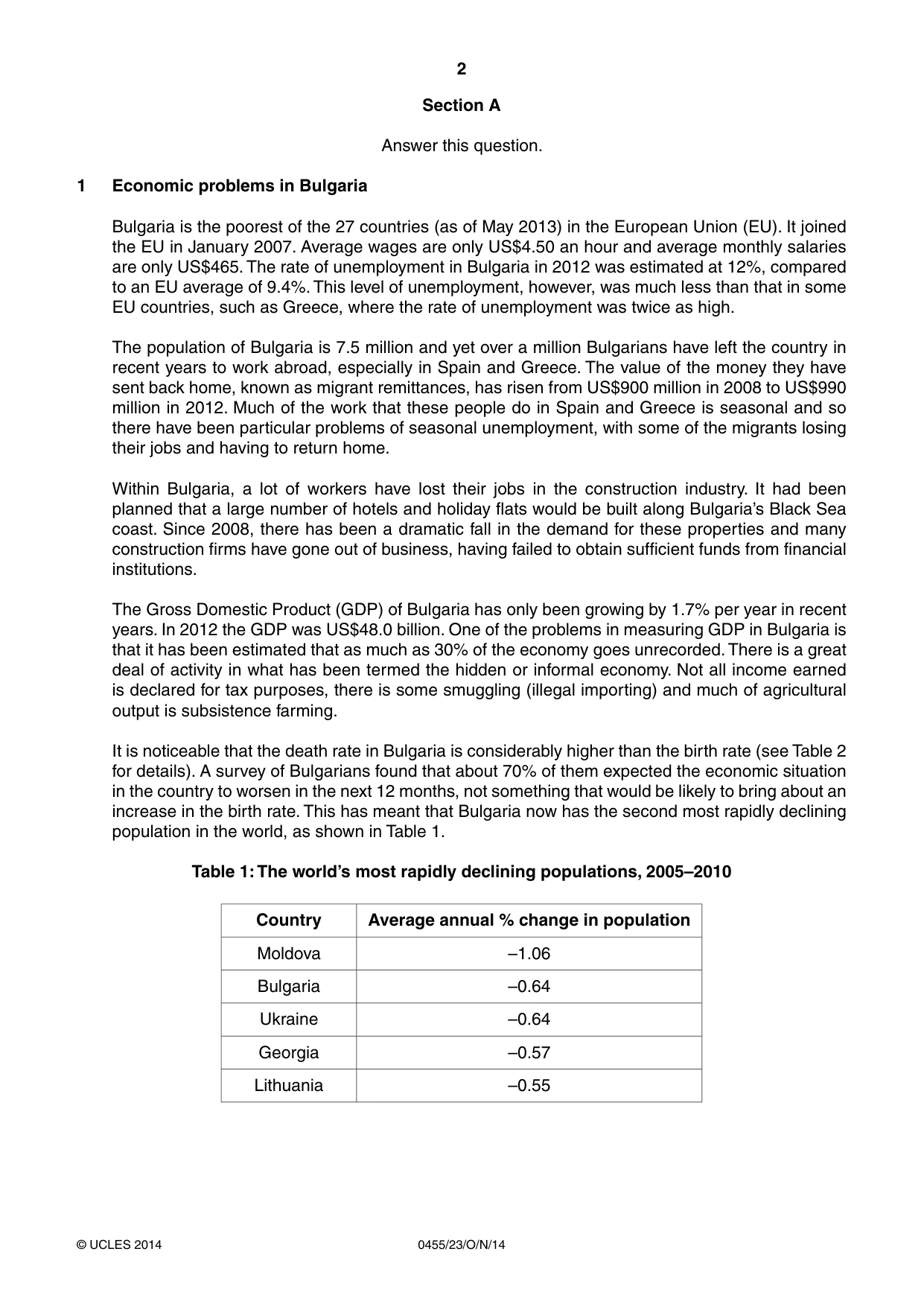
Question paper, page 2
2 0455/23/O/N/14 © UCLES 2014 Section A Answer this question. 1 Economic problems in Bulgaria Bulgaria is the poorest of the 27 countries (as of May 2013) in the European Union (EU). It joined the EU in January 2007. Average wages are only US$4.50 an hour and average monthly salaries are only US$465. The rate of unemployment in Bulgaria in 2012 was estimated at 12%, compared to an EU average of 9.4%. This level of unemployment, however, was much less than that in some EU countries, such as Greece, where the rate of unemployment was twice as high. The population of Bulgaria is 7.5 million and yet over a million Bulgarians have left the country in recent years to work abroad, especially in Spain and Greece. The value of the money they have sent back home, known as migrant remittances, has risen from US$900 million in 2008 to US$990 million in 2012. Much of the work that these people do in Spain and Greece is seasonal and so there have been particular problems of seasonal unemployment, with some of the migrants losing their jobs and having to return home. Within Bulgaria, a lot of workers have lost their jobs in the construction industry. It had been planned that a large number of hotels and holiday flats would be built along Bulgaria’s Black Sea coast. Since 2008, there has been a dramatic fall in the demand for these properties and many construction firms have gone out of business, having failed to obtain sufficient funds from financial institutions. The Gross Domestic Product (GDP) of Bulgaria has only been growing by 1.7% per year in recent years. In 2012 the GDP was US$48.0 billion. One of the problems in measuring GDP in Bulgaria is that it has been estimated that as much as 30% of the economy goes unrecorded. There is a great deal of activity in what has been termed the hidden or informal economy. Not all income earned is declared for tax purposes, there is some smuggling (illegal importing) and much of agricultural output is subsistence farming. It is noticeable that the death rate in Bulgaria is considerably higher than the birth rate (see Table 2 for details). A survey of Bulgarians found that about 70% of them expected the economic situation in the country to worsen in the next 12 months, not something that would be likely to bring about an increase in the birth rate. This has meant that Bulgaria now has the second most rapidly declining population in the world, as shown in Table 1. Table 1: The world’s most rapidly declining populations, 2005–2010 Country Average annual % change in population Moldova –1.06 Bulgaria –0.64 Ukraine –0.64 Georgia –0.57 Lithuania –0.55
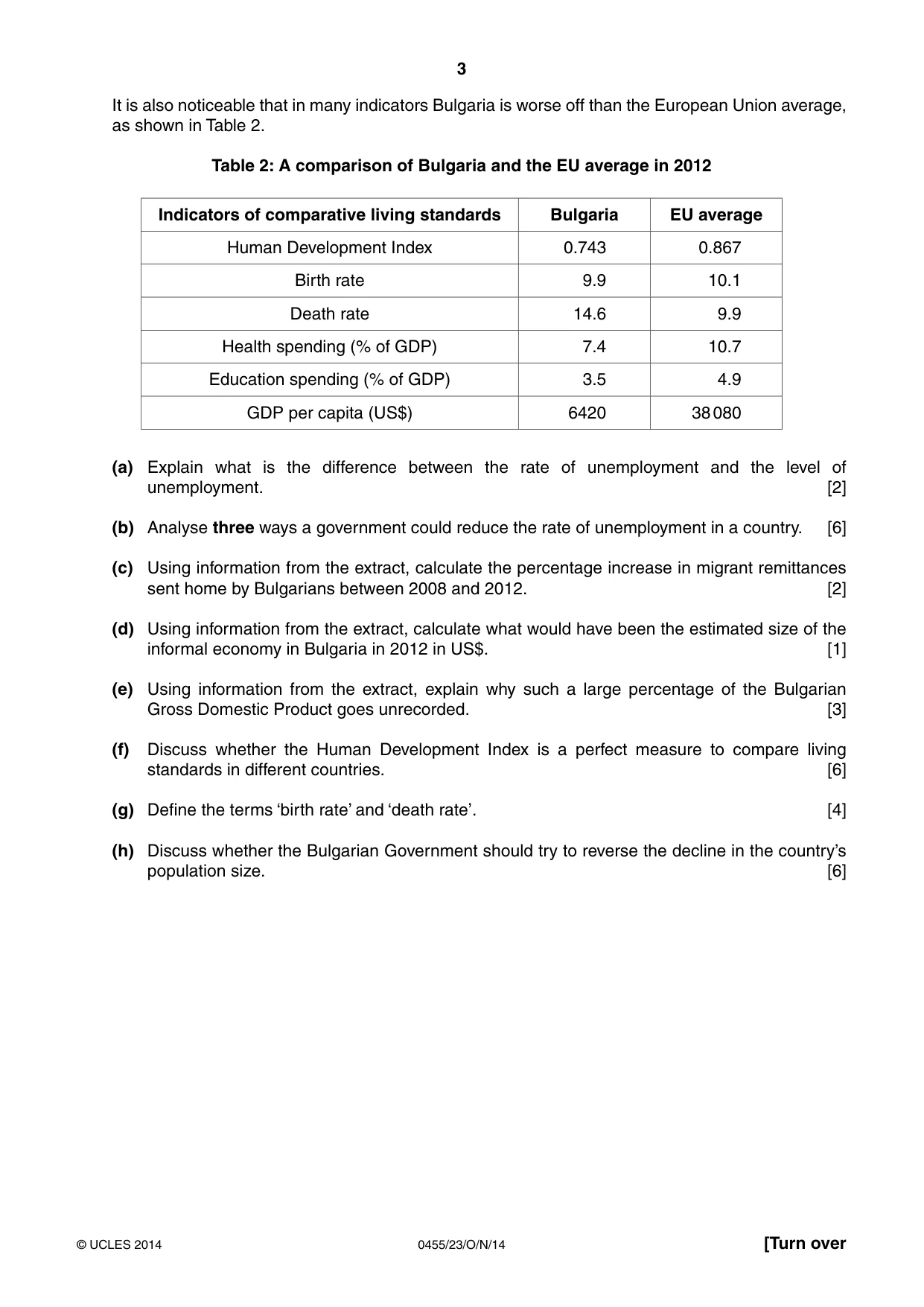
Question paper, page 3
3 0455/23/O/N/14 © UCLES 2014 [Turn over It is also noticeable that in many indicators Bulgaria is worse off than the European Union average, as shown in Table 2. Table 2: A comparison of Bulgaria and the EU average in 2012 Indicators of comparative living standards Bulgaria EU average Human Development Index 0.743 0.867 Birth rate 9.9 10.1 Death rate 14.6 9.9 Health spending (% of GDP) 7.4 10.7 Education spending (% of GDP) 3.5 4.9 GDP per capita (US$) 6420 38 080 (a) Explain what is the difference between the rate of unemployment and the level of unemployment. [2] (b) Analyse three ways a government could reduce the rate of unemployment in a country. [6] (c) Using information from the extract, calculate the percentage increase in migrant remittances sent home by Bulgarians between 2008 and 2012. [2] (d) Using information from the extract, calculate what would have been the estimated size of the informal economy in Bulgaria in 2012 in US$. [1] (e) Using information from the extract, explain why such a large percentage of the Bulgarian Gross Domestic Product goes unrecorded. [3] (f) Discuss whether the Human Development Index is a perfect measure to compare living standards in different countries. [6] (g) Define the terms ‘birth rate’ and ‘death rate’. [4] (h) Discuss whether the Bulgarian Government should try to reverse the decline in the country’s population size. [6]
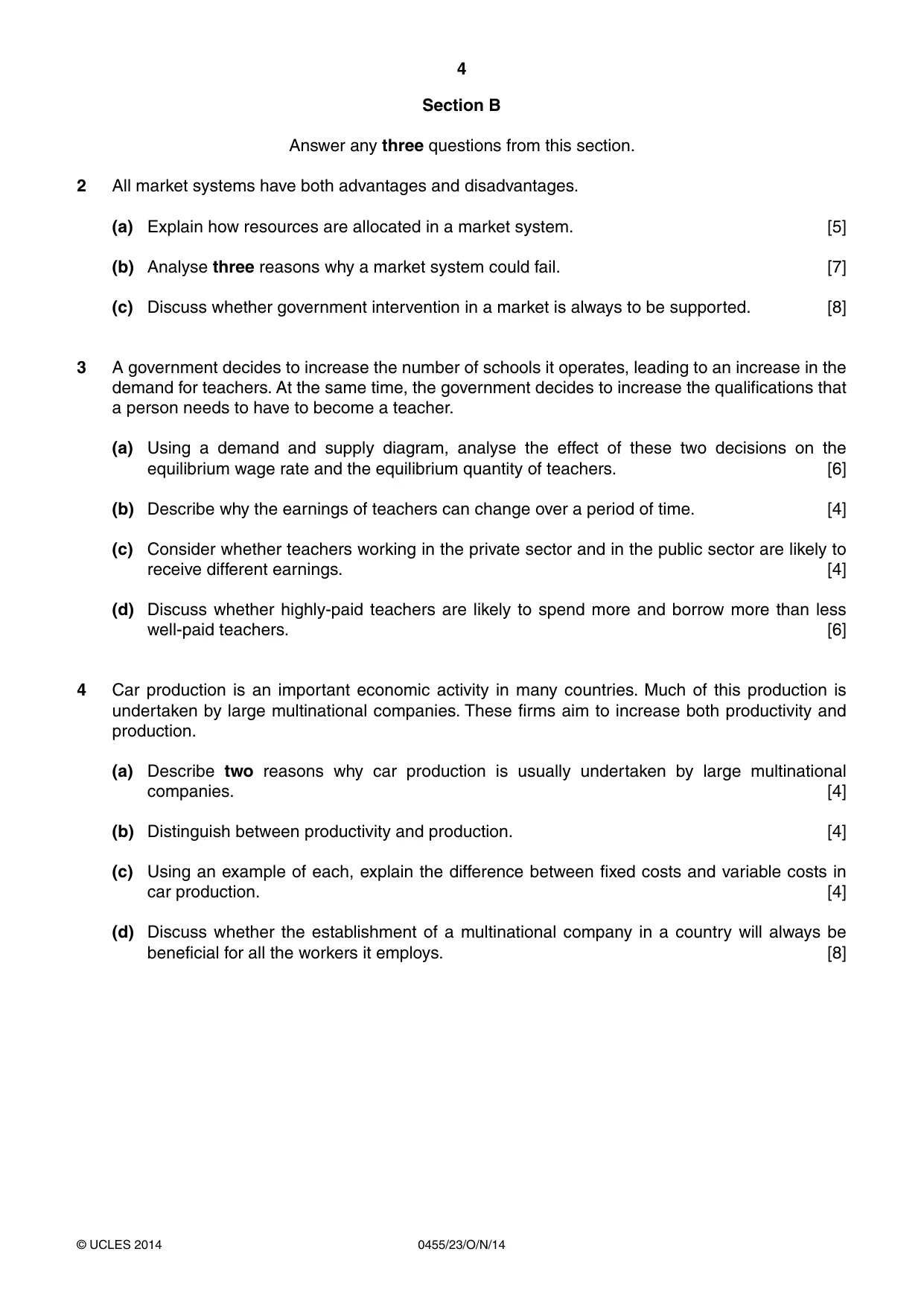
Question paper, page 4
4 0455/23/O/N/14 © UCLES 2014 Section B Answer any three questions from this section. 2 All market systems have both advantages and disadvantages. (a) Explain how resources are allocated in a market system. [5] (b) Analyse three reasons why a market system could fail. [7] (c) Discuss whether government intervention in a market is always to be supported. [8] 3 A government decides to increase the number of schools it operates, leading to an increase in the demand for teachers. At the same time, the government decides to increase the qualifications that a person needs to have to become a teacher. (a) Using a demand and supply diagram, analyse the effect of these two decisions on the equilibrium wage rate and the equilibrium quantity of teachers. [6] (b) Describe why the earnings of teachers can change over a period of time. [4] (c) Consider whether teachers working in the private sector and in the public sector are likely to receive different earnings. [4] (d) Discuss whether highly-paid teachers are likely to spend more and borrow more than less well-paid teachers. [6] 4 Car production is an important economic activity in many countries. Much of this production is undertaken by large multinational companies. These firms aim to increase both productivity and production. (a) Describe two reasons why car production is usually undertaken by large multinational companies. [4] (b) Distinguish between productivity and production. [4] (c) Using an example of each, explain the difference between fixed costs and variable costs in car production. [4] (d) Discuss whether the establishment of a multinational company in a country will always be beneficial for all the workers it employs. [8]
Question paper, page 5
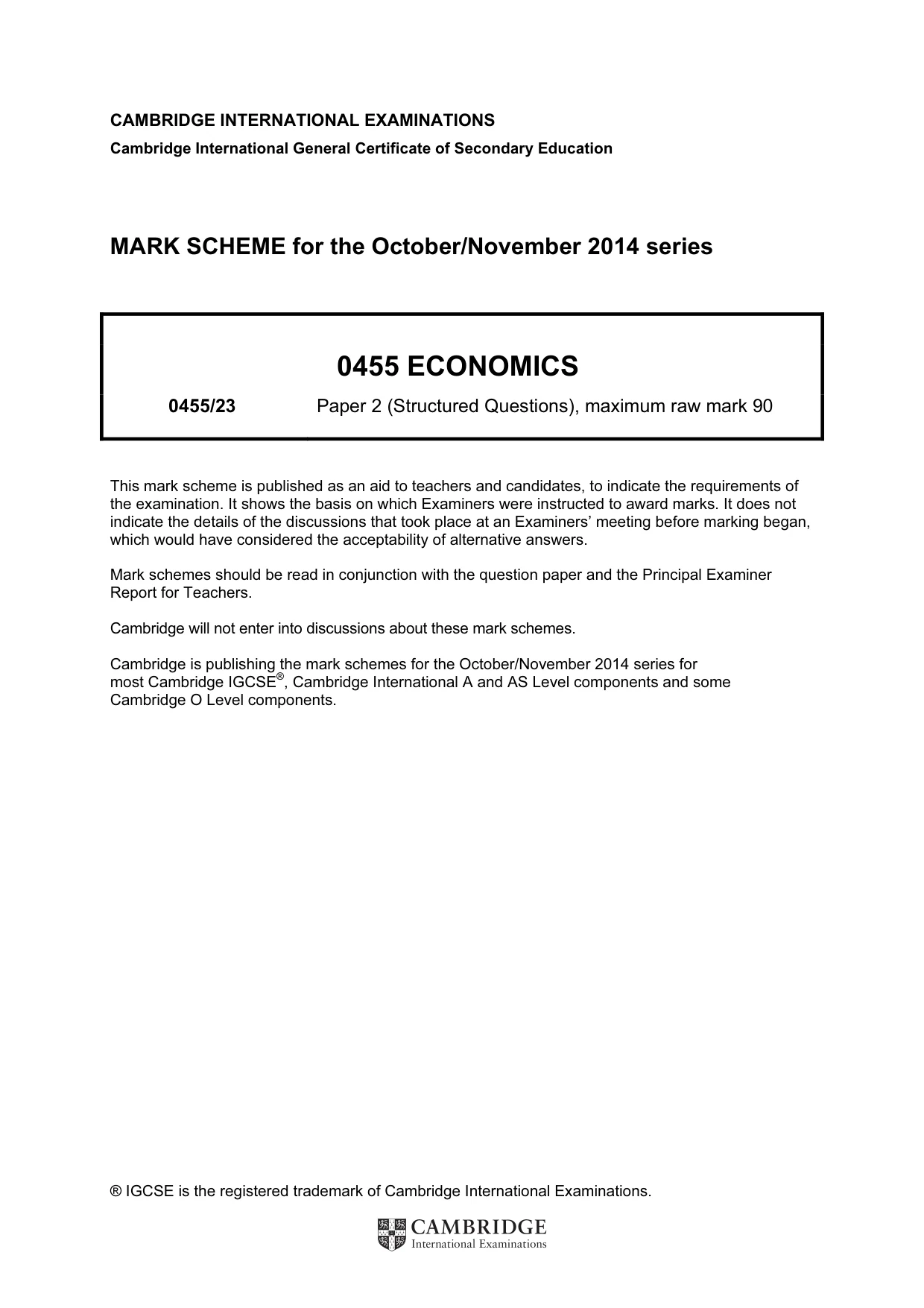
5 0455/23/O/N/14 © UCLES 2014 5 Inflation is an economic problem faced by many economies, but governments differ in how they attempt to bring down the rate of inflation. (a) Describe how changes in the price level are measured in an economy. [5] (b) Explain how a situation of ‘too much money chasing too few goods’ can lead to inflation. [5] (c) Discuss whether fiscal policy, rather than monetary policy, is always a better way to bring down the rate of inflation in an economy. [10] 6 Developing countries have characteristics that are different from those of developed countries. One of these is the extent of poverty in such countries. (a) Describe three features of a developing country. [6] (b) Describe the changes that are likely to occur as a country becomes more developed in (i) its occupational structure, and (ii) the geographical distribution of its population. [4] (c) Explain what is meant by ‘absolute poverty’. [2] (d) Discuss whether government policies can always reduce poverty in a developing country. [8] 7 Many countries have a deficit in the current account of their balance of payments but some countries, such as China, Germany and Japan, regularly have a surplus in their current account. (a) Explain two consequences of a current account deficit. [4] (b) Analyse what can cause a surplus in the current account of the balance of payments. [8] (c) Discuss whether a current account surplus is always to be regarded as desirable. [8]
Question paper, page 6
6 0455/23/O/N/14 © UCLES 2014 BLANK PAGE
Question paper, page 7
7 0455/23/O/N/14 © UCLES 2014 BLANK PAGE
Question paper, page 8
8 0455/23/O/N/14 © UCLES 2014 Permission to reproduce items where third-party owned material protected by copyright is included has been sought and cleared where possible. Every reasonable effort has been made by the publisher (UCLES) to trace copyright holders, but if any items requiring clearance have unwittingly been included, the publisher will be pleased to make amends at the earliest possible opportunity. Cambridge International Examinations is part of the Cambridge Assessment Group. Cambridge Assessment is the brand name of University of Cambridge Local Examinations Syndicate (UCLES), which is itself a department of the University of Cambridge. BLANK PAGE
Mark scheme, page 1
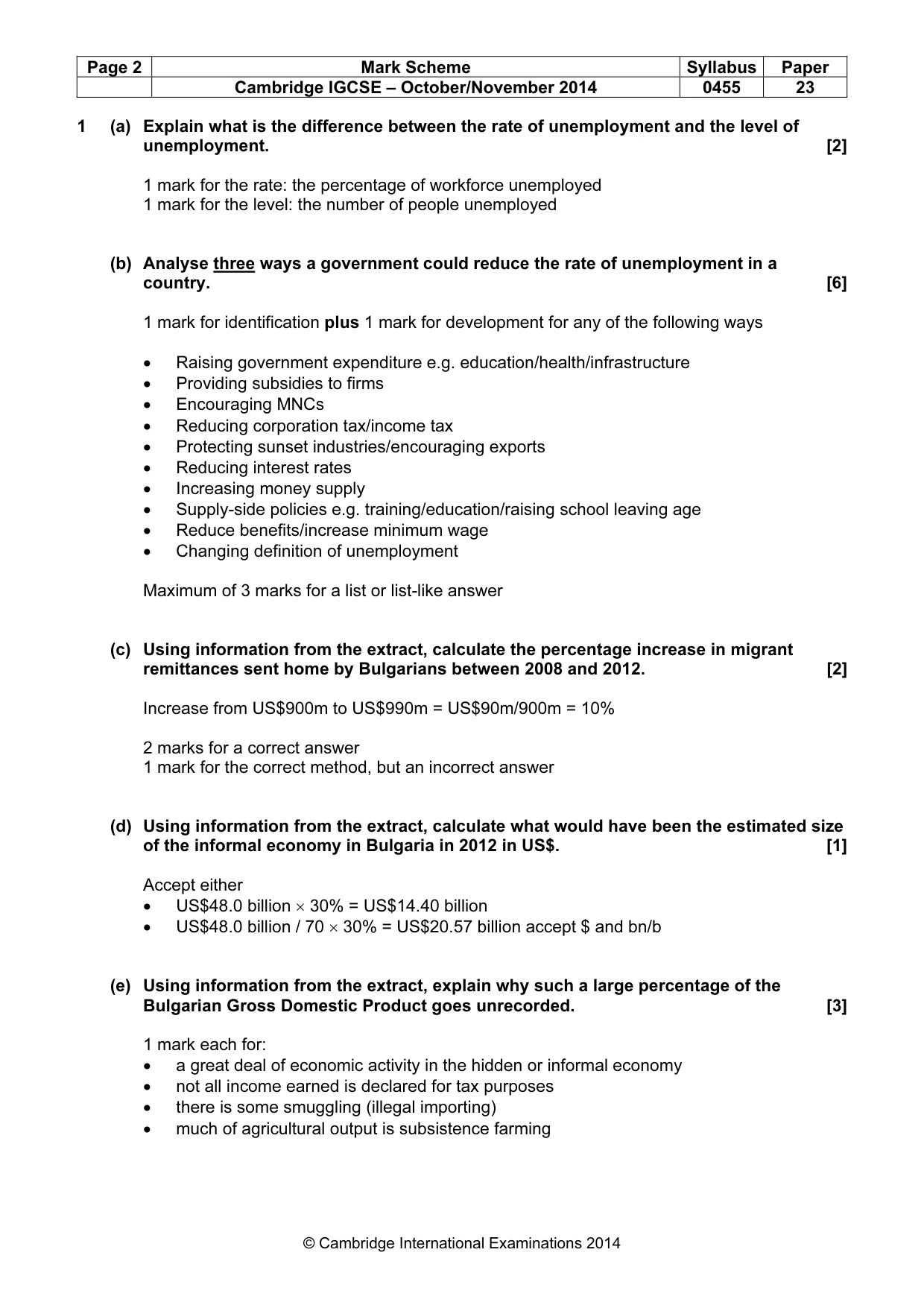
® IGCSE is the registered trademark of Cambridge International Examinations. CAMBRIDGE INTERNATIONAL EXAMINATIONS Cambridge International General Certificate of Secondary Education MARK SCHEME for the October/November 2014 series 0455 ECONOMICS 0455/23 Paper 2 (Structured Questions), maximum raw mark 90 This mark scheme is published as an aid to teachers and candidates, to indicate the requirements of the examination. It shows the basis on which Examiners were instructed to award marks. It does not indicate the details of the discussions that took place at an Examiners’ meeting before marking began, which would have considered the acceptability of alternative answers. Mark schemes should be read in conjunction with the question paper and the Principal Examiner Report for Teachers. Cambridge will not enter into discussions about these mark schemes. Cambridge is publishing the mark schemes for the October/November 2014 series for most Cambridge IGCSE®, Cambridge International A and AS Level components and some Cambridge O Level components.
Mark scheme, page 2
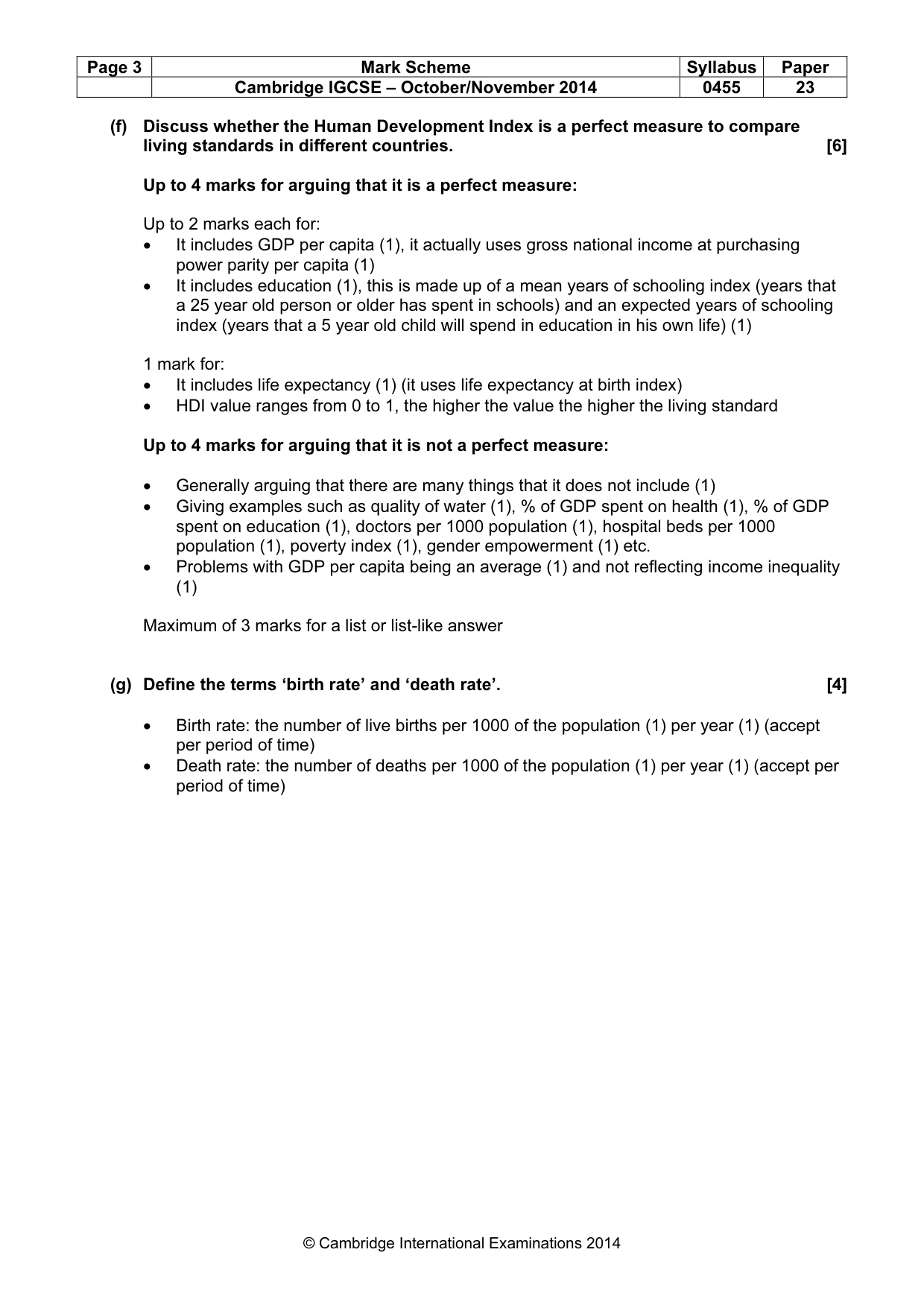
Page 2 Mark Scheme Syllabus Paper Cambridge IGCSE – October/November 2014 0455 23 © Cambridge International Examinations 2014 1 (a) Explain what is the difference between the rate of unemployment and the level of unemployment. [2] 1 mark for the rate: the percentage of workforce unemployed 1 mark for the level: the number of people unemployed (b) Analyse three ways a government could reduce the rate of unemployment in a country. [6] 1 mark for identification plus 1 mark for development for any of the following ways • Raising government expenditure e.g. education/health/infrastructure • Providing subsidies to firms • Encouraging MNCs • Reducing corporation tax/income tax • Protecting sunset industries/encouraging exports • Reducing interest rates • Increasing money supply • Supply-side policies e.g. training/education/raising school leaving age • Reduce benefits/increase minimum wage • Changing definition of unemployment Maximum of 3 marks for a list or list-like answer (c) Using information from the extract, calculate the percentage increase in migrant remittances sent home by Bulgarians between 2008 and 2012. [2] Increase from US$900m to US$990m = US$90m/900m = 10% 2 marks for a correct answer 1 mark for the correct method, but an incorrect answer (d) Using information from the extract, calculate what would have been the estimated size of the informal economy in Bulgaria in 2012 in US$. [1] Accept either • US$48.0 billion × 30% = US$14.40 billion • US$48.0 billion / 70 × 30% = US$20.57 billion accept $ and bn/b (e) Using information from the extract, explain why such a large percentage of the Bulgarian Gross Domestic Product goes unrecorded. [3] 1 mark each for: • a great deal of economic activity in the hidden or informal economy • not all income earned is declared for tax purposes • there is some smuggling (illegal importing) • much of agricultural output is subsistence farming
Mark scheme, page 3
Page 3 Mark Scheme Syllabus Paper Cambridge IGCSE – October/November 2014 0455 23 © Cambridge International Examinations 2014 (f) Discuss whether the Human Development Index is a perfect measure to compare living standards in different countries. [6] Up to 4 marks for arguing that it is a perfect measure: Up to 2 marks each for: • It includes GDP per capita (1), it actually uses gross national income at purchasing power parity per capita (1) • It includes education (1), this is made up of a mean years of schooling index (years that a 25 year old person or older has spent in schools) and an expected years of schooling index (years that a 5 year old child will spend in education in his own life) (1) 1 mark for: • It includes life expectancy (1) (it uses life expectancy at birth index) • HDI value ranges from 0 to 1, the higher the value the higher the living standard Up to 4 marks for arguing that it is not a perfect measure: • Generally arguing that there are many things that it does not include (1) • Giving examples such as quality of water (1), % of GDP spent on health (1), % of GDP spent on education (1), doctors per 1000 population (1), hospital beds per 1000 population (1), poverty index (1), gender empowerment (1) etc. • Problems with GDP per capita being an average (1) and not reflecting income inequality (1) Maximum of 3 marks for a list or list-like answer (g) Define the terms ‘birth rate’ and ‘death rate’. [4] • Birth rate: the number of live births per 1000 of the population (1) per year (1) (accept per period of time) • Death rate: the number of deaths per 1000 of the population (1) per year (1) (accept per period of time)
Mark scheme, page 4
Page 4 Mark Scheme Syllabus Paper Cambridge IGCSE – October/November 2014 0455 23 © Cambridge International Examinations 2014 (h) Discuss whether the Bulgarian Government should try to reverse the decline in the country’s population size. [6] Up to 4 marks for arguing that the government should try to reverse the decline: Up to 3 marks each for: • The decline in the population could lead to less demand in the economy (1) which could have a negative effect on the economy, e.g. a higher rate of unemployment (1) and a lower rate of economic growth/living standards (1) • Action by the government to increase population results in larger labour force (1), greater demand/higher output/more employment (1) resulting in higher standard of living/economic growth (1) • A falling population could lead to lower demand (1), less employment (1) and a further reduction in living standards (1) Up to 2 marks for: • Expenditure on health as a % of GDP (7.4%) is already much less than the EU average (1), suggesting that it needs to be increased (1) Up to 4 marks for arguing that it should not try to reverse the decline: Up to 2 marks each for: • There is an opportunity cost (1), the allocation of resources in one area means that fewer resources can be allocated in other areas (1) • The government may reallocate resources, such as through spending more on the health service (1), but there is no guarantee that this will lead to a substantial decrease in the death rate (1) • Encouragements of an increase in the birth rate not likely to be that successful (1) given the pessimistic outlook on the economy discovered by the survey (1) • It may not be worth reallocating resources to meet this objective (1) given that there is actually not much of a change in the size of population (1) Maximum of 3 marks for a list or list-like answer
Mark scheme, page 5
Page 5 Mark Scheme Syllabus Paper Cambridge IGCSE – October/November 2014 0455 23 © Cambridge International Examinations 2014 2 All market systems have both advantages and disadvantages. (a) Explain how resources are allocated in a market system. [5] 1 mark each for • private sector • consumer sovereignty plays a key role • producers respond to consumer demand • allocation of scarce resources in a market system is carried out through changes in the forces of demand and supply/price mechanism • firms are driven by profit motive • prices act as a signal indicating when resources should be reallocated • excess demand will cause prices to rise • attracting resources into this market • excess supply will cause prices to fall • resources are reallocated out of this market. (b) Analyse three reasons why a market system could fail. [7] Up to 3 marks for identification of examples of market failure: 1 mark for each example e.g. • underproduction/consumption of merit goods (candidates do not need to refer to this term) • overproduction/consumption of demerit goods (candidates do not need to refer to this term) • non-production/consumption of public goods (candidates do not need to refer to this term) • existence of negative externalities • information failure • existence of monopoly Up to 4 marks for analysis of market failure: 1 mark each for any of the following: • merit goods will be underprovided because fewer people will consume them if a market price is charged/people will not appreciate their true value • demerit goods will be overprovided because more people will consume them if a market price is charged/people will not realise their full harmful effects • public goods will not be provided because it will be impossible to charge a price for them • negative externalities will be difficult to cost • monopoly will have control over a market, denying market competition Maximum of 3 marks for a list or list-like answer
Mark scheme, page 6
Page 6 Mark Scheme Syllabus Paper Cambridge IGCSE – October/November 2014 0455 23 © Cambridge International Examinations 2014 (c) Discuss whether government intervention in a market is always to be supported. [8] Up to 6 marks for arguing that government intervention in a market is always to be supported: Up to 2 marks each for a government can: • supply merit goods (candidates do not need to use that term), such as education or health care (1), which will improve the standard of living (1) • discourage consumption of demerit goods (candidates do not need to use that term), such as cigarettes or alcohol (1), which will improve the health of people (1) • provide public goods, such as defence or law and order (1), which will provide a safe and secure basis for economic activity (1) • use taxes/regulations to reduce negative externalities (1), such as pollution and congestion/improving the economic environment (1) • use regulations/legislation to control monopoly where this is against the public interest (1), e.g. demonstrated by higher prices and lower quantity (1) • use regulations relating to working conditions (1) e.g. minimum wage in labour market/to reduce discrimination • apply maximum price controls (1) to influence prices for consumers (1) • reduce income equality (1) by reducing gap between rich and poor (1) Up to 6 marks for arguing that government intervention in a market is not always to be supported: Up to 2 marks each for arguing that: • intervention would disrupt the operation of free market forces (1), i.e. the idea that decisions about the allocation of scarce resources should be left to free market forces to achieve the greatest efficiency (1) • intervention is often a subjective matter (1); how will the extent/form of intervention be determined? – normative economics (1) • public money is likely to be needed, e.g. to finance the provision of merit goods (1); where is this money to come from? (1) • the idea of opportunity cost (1); funds to provide merit or public goods would have alternative possible uses (1) • a monopoly could actually be in the public interest, e.g. economies of scale could lead to lower costs and, possibly, lower prices (1); a monopoly may especially be in the public interest if it is an example of a natural monopoly (1) Maximum of 4 marks for a list or list-like answer
Mark scheme, page 7
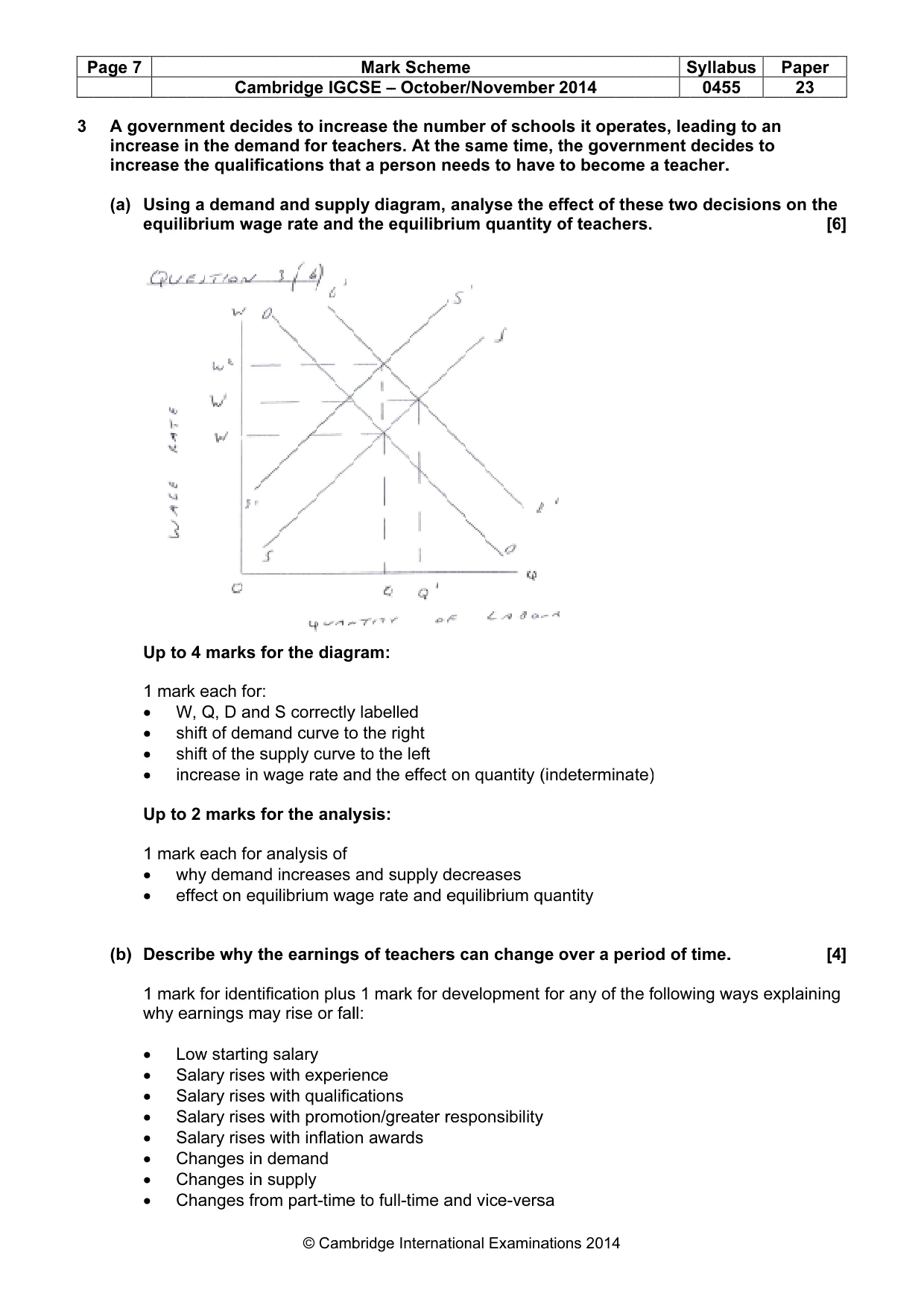
P 3 Pag A i i ( ( ge A g inc inc (a) (b) 7 gov cre cre U e U 1 • • • • U 1 • • ) D 1 w • • • • • • • • ve eas eas Usi equ Up 1 m • • • • Up 1 m • • Des 1 m why • • • • • • • • rnm se i se t ing uili to mar W sh sh in to mar w ef scr mar y e Lo S S S S C C C me in t the g a br 4 rk e W, Q hift hift ncre 2 rk e why ffec rib rk f earn ow ala ala ala ala Cha Cha Cha ent the e q de ium ma eac Q, t of t of eas ma eac y de ct o e w for nin w st ary ary ary ary ang ang ang C t de e d ua em m w ark ch f D a f de f th se ark ch f em on wh ide ngs tart y ris y ris y ris y ris ges ges ges Cam eci dem alifi man wa ks f for and em he s in ks f for man eq y t ent s m ting ses ses ses ses s in s in s fro mb ide ma ica nd age for r: d S man sup wa for r an nd i quil the tific may g s s w s w s w s w n de n su om brid es t nd atio an e ra r th S c nd c ppl age r th nal inc libr e ea cati y ris sala with with with with em upp m pa dge © to d fo ons d s ate he corr cur ly c e ra he ysi crea rium arn ion se ary h ex h qu h pr h in man ply art e IG Ca inc or t s t sup e an dia rec rve cur ate an is o ase m w nin n pl or y xpe ual rom fla nd t-tim GC amb cre tea ha pp nd ag ctly e to rve e an naly of es wa ngs lus fal erie lific mot tio me M CSE brid eas ach t a ply th ram y la o th e to nd ysi an age s o s 1 ll: enc cat tion n a e to Mar E – dge se her a pe dia he e m: be he o th the is: d s e ra of te ma ce ion n/g awa o fu k S – O e In the rs. ers ag equ lled rig he l e e sup ate eac ark ns gre ard ull-t Sch Oct nter e n At son ram uil d ht eft effe ppl an ch k fo ate ds tim hem ob rnat num t th n n m, ibr t ect y d nd e ers or d er r e a me ber/ tion mb he s nee an riu on dec eq s c dev res and e /No nal ber sam eds naly m n q cre uili can velo spo d v ove Ex r of me s to ys qu ua as ibri n c opm ons vice em xam f sc e ti o h e t uan ntit es ium ha me sibi e-ve mbe mina ch me hav the ntit ty ( m q ang ent lity ers er 2 atio oo e, t ve e ef ty o (ind qua ge o fo y sa 20 ons ols the to ffe of t det anti ov r a 14 s 20 it o e g be ct tea ter ity er ny 014 op gov eco of ach rmi a p of 4 pera ver om th her na pe f th ate rnm me a hes rs. te) rio e f es, men a te se t ) od o follo S le nt eac two of ow Syl 0 ad de ch o d tim wing llab 045 ding ecid er. dec me. g w bu 55 g t des . cis . way s o a s t ion ys e P an o ns exp Pa 2 on pla pe 23 n th aini er he [6 [4 ng 6] 4]
Mark scheme, page 8
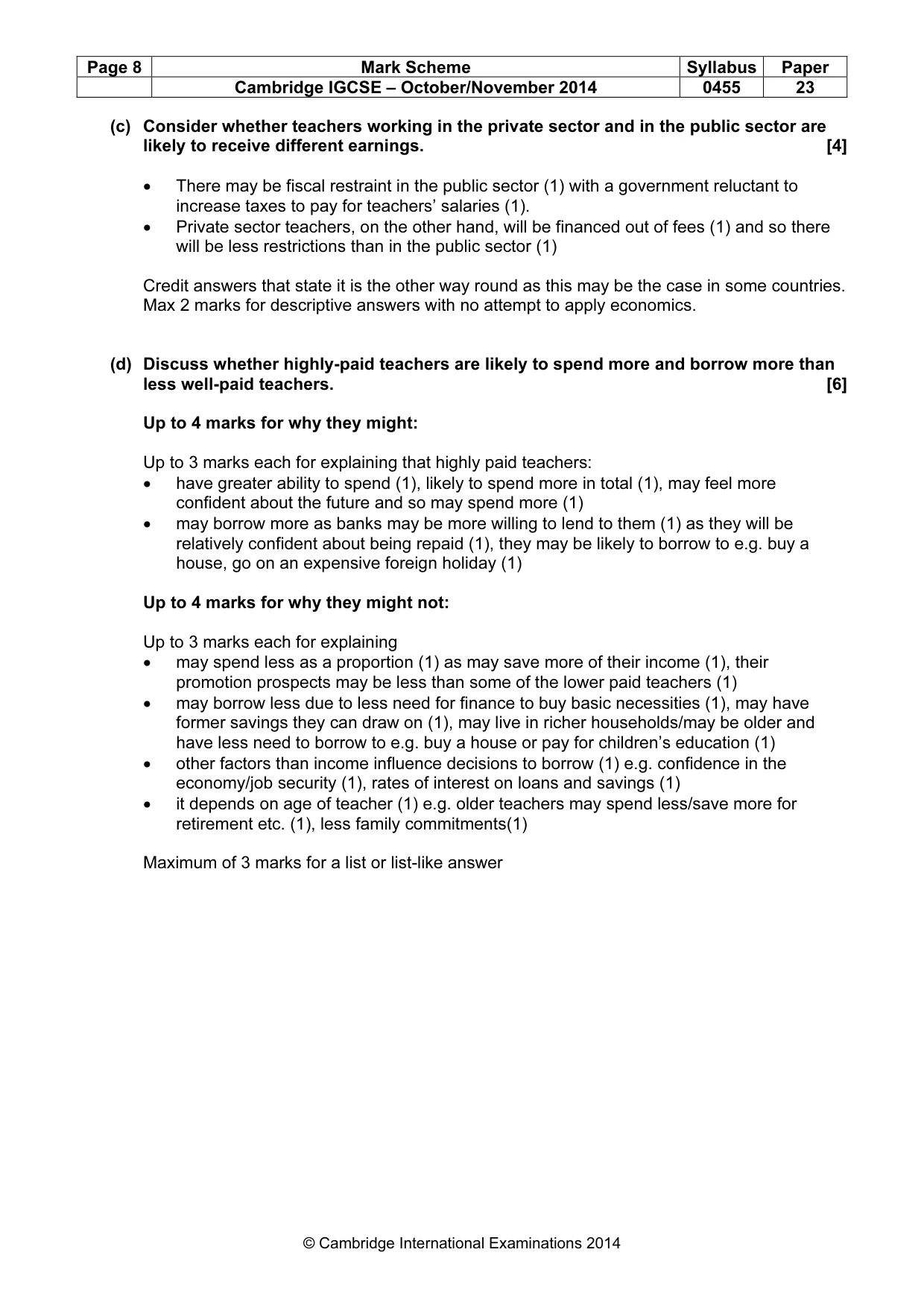
Page 8 Mark Scheme Syllabus Paper Cambridge IGCSE – October/November 2014 0455 23 © Cambridge International Examinations 2014 (c) Consider whether teachers working in the private sector and in the public sector are likely to receive different earnings. [4] • There may be fiscal restraint in the public sector (1) with a government reluctant to increase taxes to pay for teachers’ salaries (1). • Private sector teachers, on the other hand, will be financed out of fees (1) and so there will be less restrictions than in the public sector (1) Credit answers that state it is the other way round as this may be the case in some countries. Max 2 marks for descriptive answers with no attempt to apply economics. (d) Discuss whether highly-paid teachers are likely to spend more and borrow more than less well-paid teachers. [6] Up to 4 marks for why they might: Up to 3 marks each for explaining that highly paid teachers: • have greater ability to spend (1), likely to spend more in total (1), may feel more confident about the future and so may spend more (1) • may borrow more as banks may be more willing to lend to them (1) as they will be relatively confident about being repaid (1), they may be likely to borrow to e.g. buy a house, go on an expensive foreign holiday (1) Up to 4 marks for why they might not: Up to 3 marks each for explaining • may spend less as a proportion (1) as may save more of their income (1), their promotion prospects may be less than some of the lower paid teachers (1) • may borrow less due to less need for finance to buy basic necessities (1), may have former savings they can draw on (1), may live in richer households/may be older and have less need to borrow to e.g. buy a house or pay for children’s education (1) • other factors than income influence decisions to borrow (1) e.g. confidence in the economy/job security (1), rates of interest on loans and savings (1) • it depends on age of teacher (1) e.g. older teachers may spend less/save more for retirement etc. (1), less family commitments(1) Maximum of 3 marks for a list or list-like answer
Mark scheme, page 9
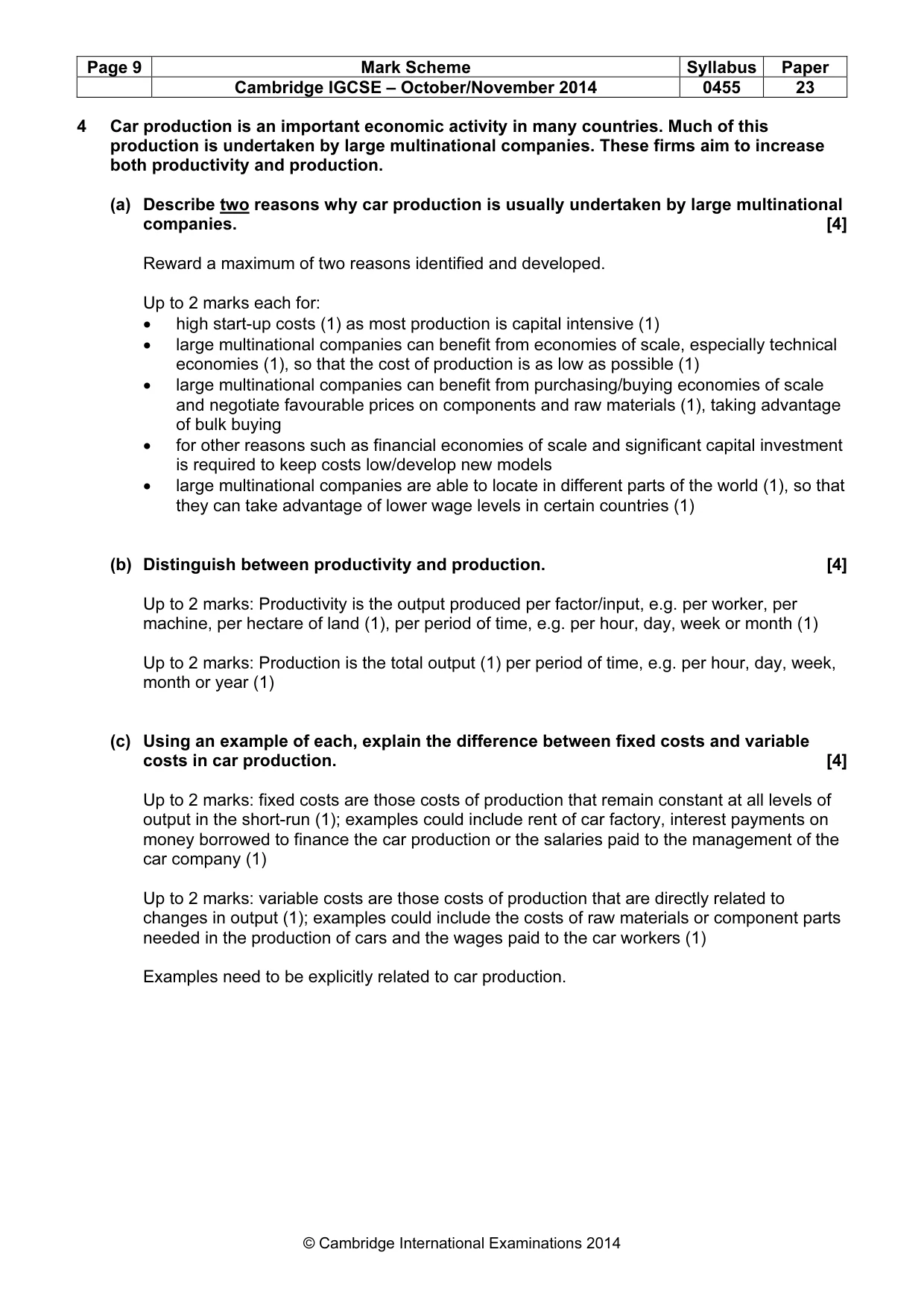
Page 9 Mark Scheme Syllabus Paper Cambridge IGCSE – October/November 2014 0455 23 © Cambridge International Examinations 2014 4 Car production is an important economic activity in many countries. Much of this production is undertaken by large multinational companies. These firms aim to increase both productivity and production. (a) Describe two reasons why car production is usually undertaken by large multinational companies. [4] Reward a maximum of two reasons identified and developed. Up to 2 marks each for: • high start-up costs (1) as most production is capital intensive (1) • large multinational companies can benefit from economies of scale, especially technical economies (1), so that the cost of production is as low as possible (1) • large multinational companies can benefit from purchasing/buying economies of scale and negotiate favourable prices on components and raw materials (1), taking advantage of bulk buying • for other reasons such as financial economies of scale and significant capital investment is required to keep costs low/develop new models • large multinational companies are able to locate in different parts of the world (1), so that they can take advantage of lower wage levels in certain countries (1) (b) Distinguish between productivity and production. [4] Up to 2 marks: Productivity is the output produced per factor/input, e.g. per worker, per machine, per hectare of land (1), per period of time, e.g. per hour, day, week or month (1) Up to 2 marks: Production is the total output (1) per period of time, e.g. per hour, day, week, month or year (1) (c) Using an example of each, explain the difference between fixed costs and variable costs in car production. [4] Up to 2 marks: fixed costs are those costs of production that remain constant at all levels of output in the short-run (1); examples could include rent of car factory, interest payments on money borrowed to finance the car production or the salaries paid to the management of the car company (1) Up to 2 marks: variable costs are those costs of production that are directly related to changes in output (1); examples could include the costs of raw materials or component parts needed in the production of cars and the wages paid to the car workers (1) Examples need to be explicitly related to car production.
Mark scheme, page 10
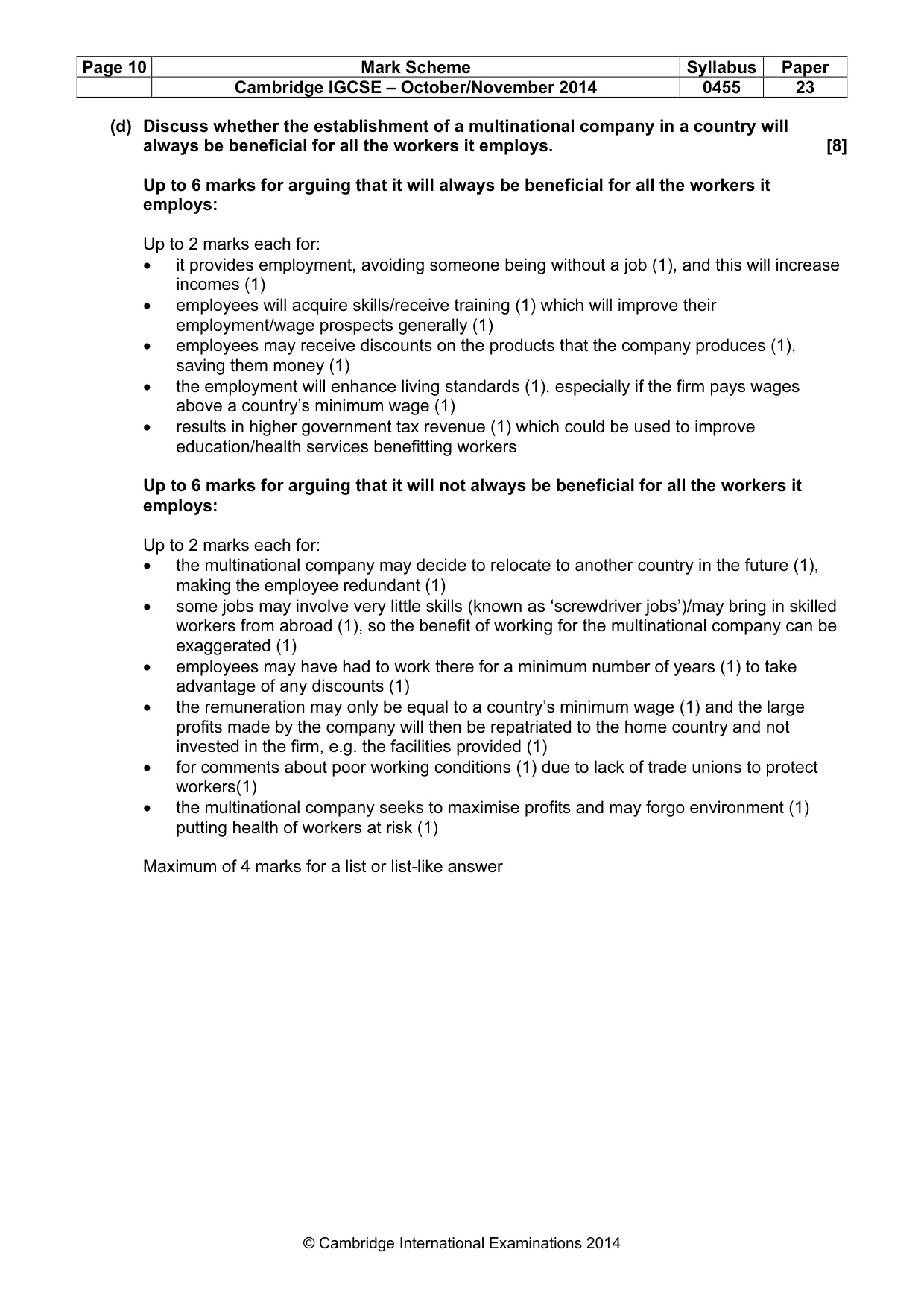
Page 10 Mark Scheme Syllabus Paper Cambridge IGCSE – October/November 2014 0455 23 © Cambridge International Examinations 2014 (d) Discuss whether the establishment of a multinational company in a country will always be beneficial for all the workers it employs. [8] Up to 6 marks for arguing that it will always be beneficial for all the workers it employs: Up to 2 marks each for: • it provides employment, avoiding someone being without a job (1), and this will increase incomes (1) • employees will acquire skills/receive training (1) which will improve their employment/wage prospects generally (1) • employees may receive discounts on the products that the company produces (1), saving them money (1) • the employment will enhance living standards (1), especially if the firm pays wages above a country’s minimum wage (1) • results in higher government tax revenue (1) which could be used to improve education/health services benefitting workers Up to 6 marks for arguing that it will not always be beneficial for all the workers it employs: Up to 2 marks each for: • the multinational company may decide to relocate to another country in the future (1), making the employee redundant (1) • some jobs may involve very little skills (known as ‘screwdriver jobs’)/may bring in skilled workers from abroad (1), so the benefit of working for the multinational company can be exaggerated (1) • employees may have had to work there for a minimum number of years (1) to take advantage of any discounts (1) • the remuneration may only be equal to a country’s minimum wage (1) and the large profits made by the company will then be repatriated to the home country and not invested in the firm, e.g. the facilities provided (1) • for comments about poor working conditions (1) due to lack of trade unions to protect workers(1) • the multinational company seeks to maximise profits and may forgo environment (1) putting health of workers at risk (1) Maximum of 4 marks for a list or list-like answer
Mark scheme, page 11
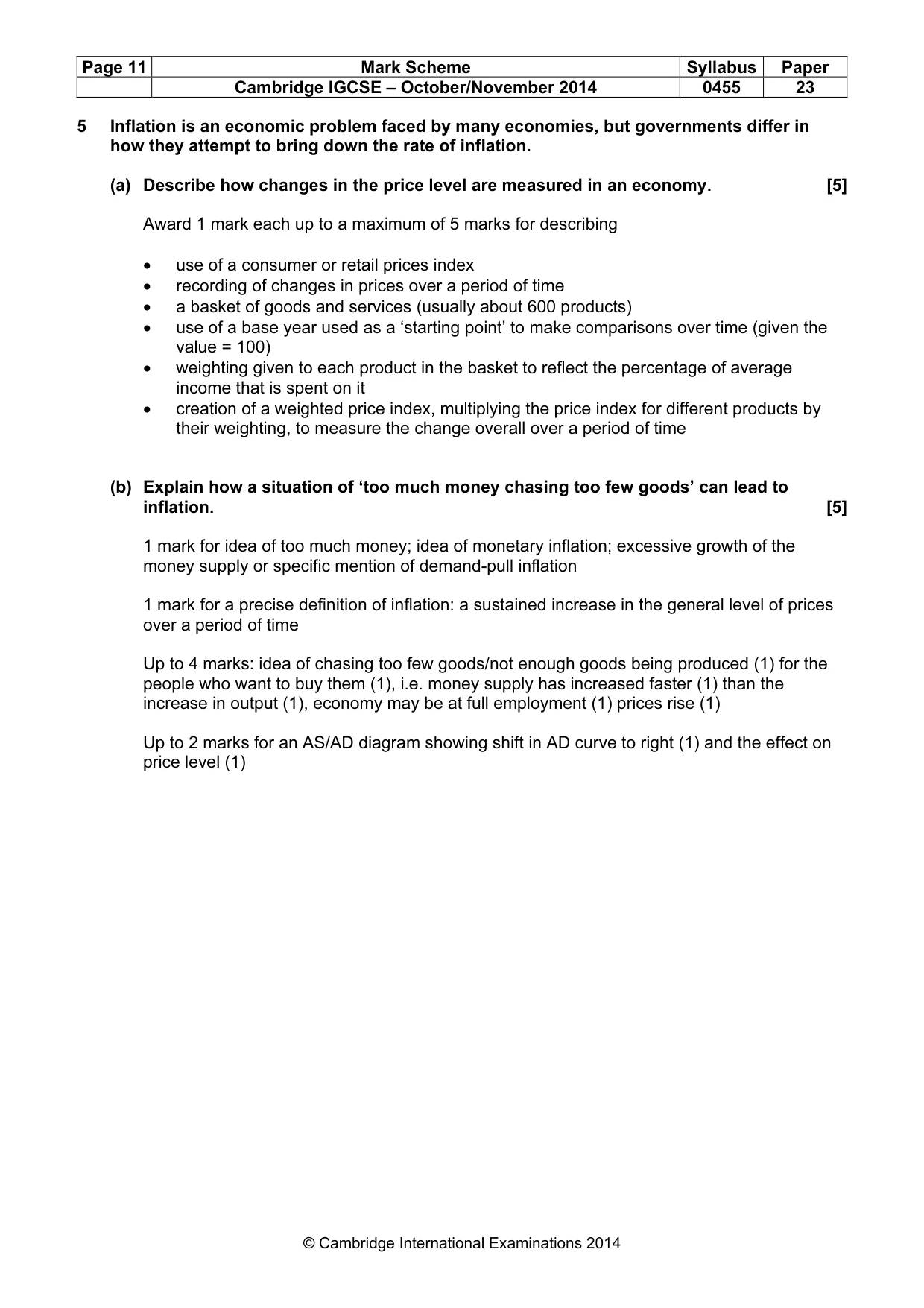
Page 11 Mark Scheme Syllabus Paper Cambridge IGCSE – October/November 2014 0455 23 © Cambridge International Examinations 2014 5 Inflation is an economic problem faced by many economies, but governments differ in how they attempt to bring down the rate of inflation. (a) Describe how changes in the price level are measured in an economy. [5] Award 1 mark each up to a maximum of 5 marks for describing • use of a consumer or retail prices index • recording of changes in prices over a period of time • a basket of goods and services (usually about 600 products) • use of a base year used as a ‘starting point’ to make comparisons over time (given the value = 100) • weighting given to each product in the basket to reflect the percentage of average income that is spent on it • creation of a weighted price index, multiplying the price index for different products by their weighting, to measure the change overall over a period of time (b) Explain how a situation of ‘too much money chasing too few goods’ can lead to inflation. [5] 1 mark for idea of too much money; idea of monetary inflation; excessive growth of the money supply or specific mention of demand-pull inflation 1 mark for a precise definition of inflation: a sustained increase in the general level of prices over a period of time Up to 4 marks: idea of chasing too few goods/not enough goods being produced (1) for the people who want to buy them (1), i.e. money supply has increased faster (1) than the increase in output (1), economy may be at full employment (1) prices rise (1) Up to 2 marks for an AS/AD diagram showing shift in AD curve to right (1) and the effect on price level (1)
Mark scheme, page 12
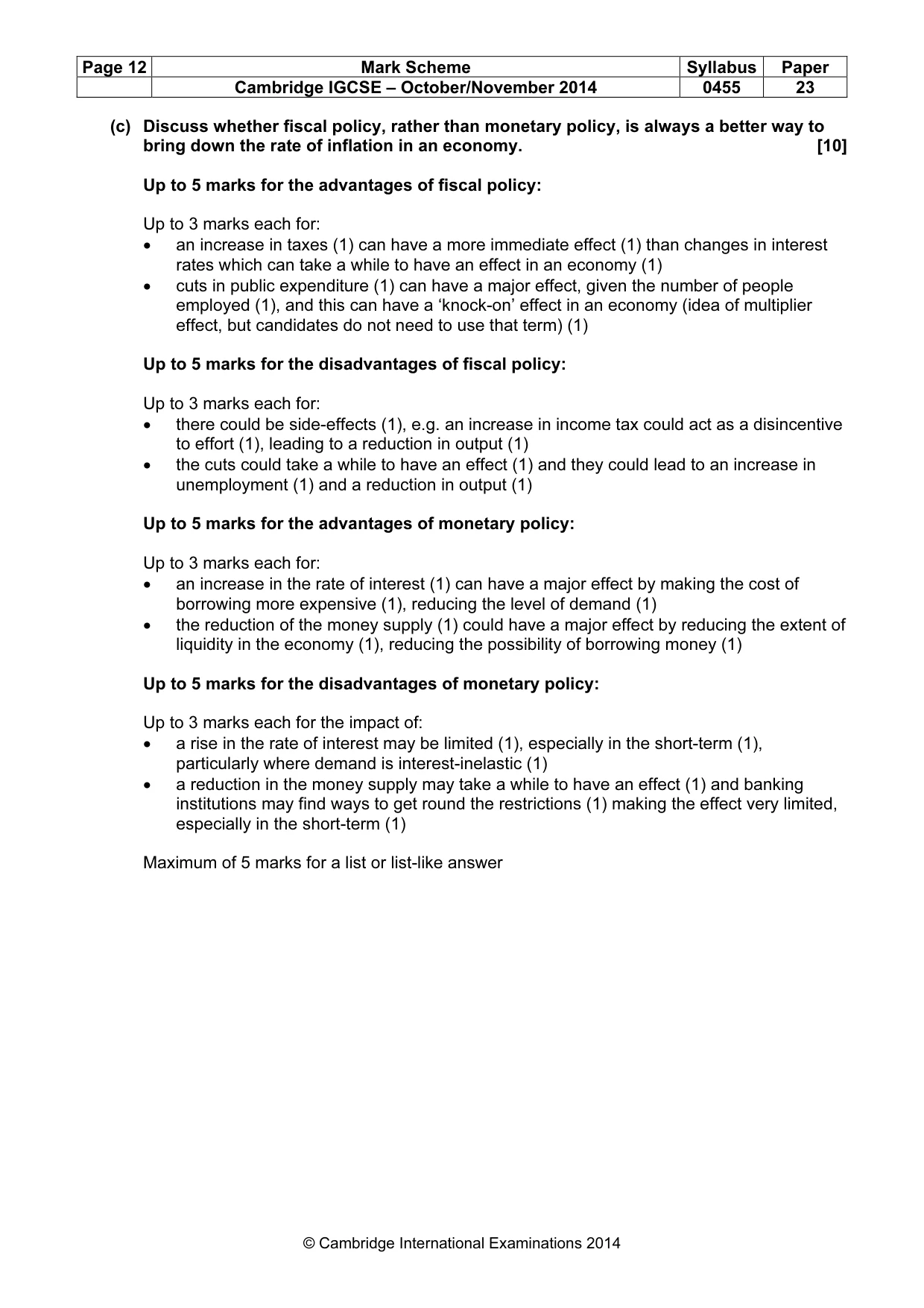
Page 12 Mark Scheme Syllabus Paper Cambridge IGCSE – October/November 2014 0455 23 © Cambridge International Examinations 2014 (c) Discuss whether fiscal policy, rather than monetary policy, is always a better way to bring down the rate of inflation in an economy. [10] Up to 5 marks for the advantages of fiscal policy: Up to 3 marks each for: • an increase in taxes (1) can have a more immediate effect (1) than changes in interest rates which can take a while to have an effect in an economy (1) • cuts in public expenditure (1) can have a major effect, given the number of people employed (1), and this can have a ‘knock-on’ effect in an economy (idea of multiplier effect, but candidates do not need to use that term) (1) Up to 5 marks for the disadvantages of fiscal policy: Up to 3 marks each for: • there could be side-effects (1), e.g. an increase in income tax could act as a disincentive to effort (1), leading to a reduction in output (1) • the cuts could take a while to have an effect (1) and they could lead to an increase in unemployment (1) and a reduction in output (1) Up to 5 marks for the advantages of monetary policy: Up to 3 marks each for: • an increase in the rate of interest (1) can have a major effect by making the cost of borrowing more expensive (1), reducing the level of demand (1) • the reduction of the money supply (1) could have a major effect by reducing the extent of liquidity in the economy (1), reducing the possibility of borrowing money (1) Up to 5 marks for the disadvantages of monetary policy: Up to 3 marks each for the impact of: • a rise in the rate of interest may be limited (1), especially in the short-term (1), particularly where demand is interest-inelastic (1) • a reduction in the money supply may take a while to have an effect (1) and banking institutions may find ways to get round the restrictions (1) making the effect very limited, especially in the short-term (1) Maximum of 5 marks for a list or list-like answer
Mark scheme, page 13
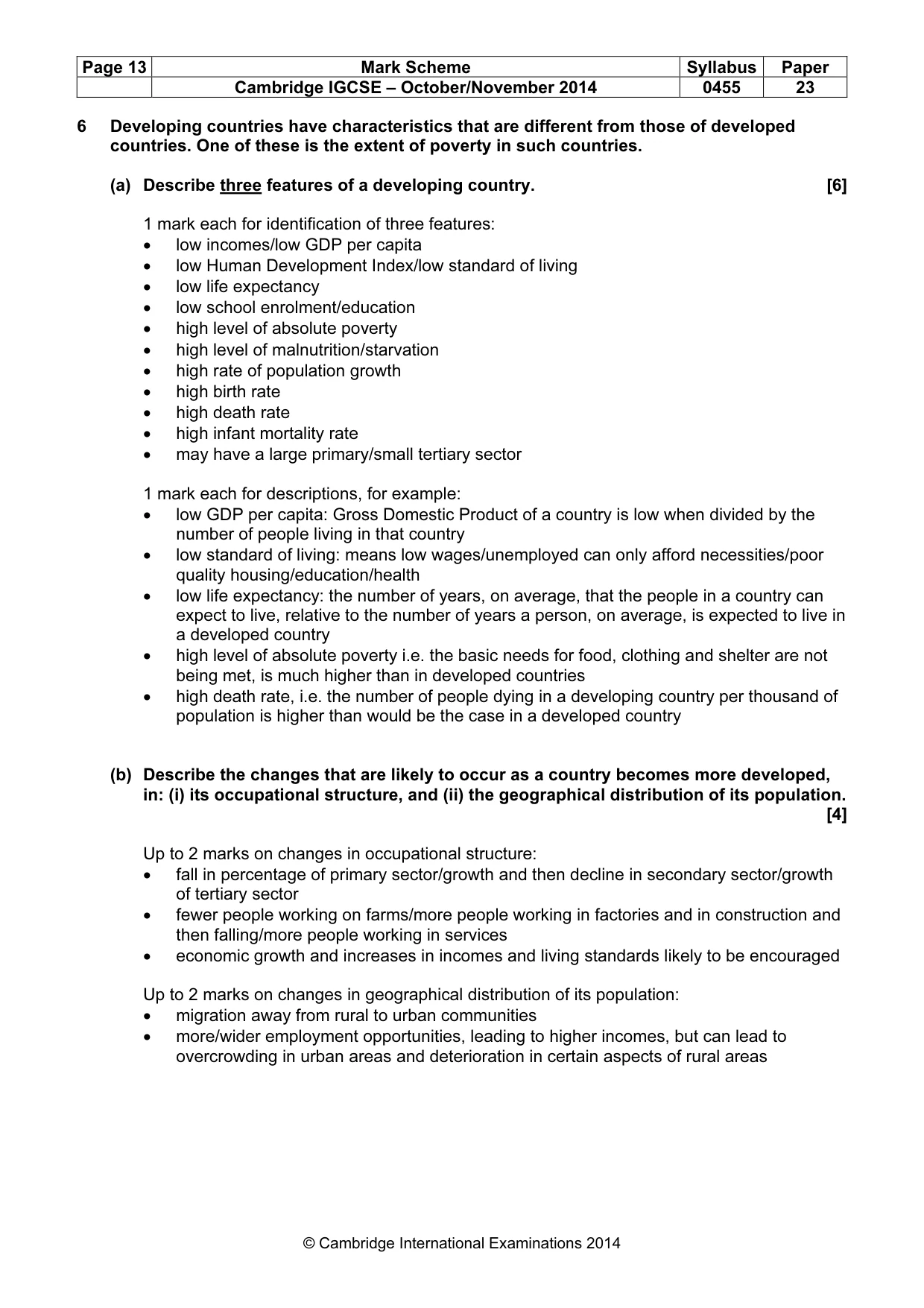
Page 13 Mark Scheme Syllabus Paper Cambridge IGCSE – October/November 2014 0455 23 © Cambridge International Examinations 2014 6 Developing countries have characteristics that are different from those of developed countries. One of these is the extent of poverty in such countries. (a) Describe three features of a developing country. [6] 1 mark each for identification of three features: • low incomes/low GDP per capita • low Human Development Index/low standard of living • low life expectancy • low school enrolment/education • high level of absolute poverty • high level of malnutrition/starvation • high rate of population growth • high birth rate • high death rate • high infant mortality rate • may have a large primary/small tertiary sector 1 mark each for descriptions, for example: • low GDP per capita: Gross Domestic Product of a country is low when divided by the number of people living in that country • low standard of living: means low wages/unemployed can only afford necessities/poor quality housing/education/health • low life expectancy: the number of years, on average, that the people in a country can expect to live, relative to the number of years a person, on average, is expected to live in a developed country • high level of absolute poverty i.e. the basic needs for food, clothing and shelter are not being met, is much higher than in developed countries • high death rate, i.e. the number of people dying in a developing country per thousand of population is higher than would be the case in a developed country (b) Describe the changes that are likely to occur as a country becomes more developed, in: (i) its occupational structure, and (ii) the geographical distribution of its population. [4] Up to 2 marks on changes in occupational structure: • fall in percentage of primary sector/growth and then decline in secondary sector/growth of tertiary sector • fewer people working on farms/more people working in factories and in construction and then falling/more people working in services • economic growth and increases in incomes and living standards likely to be encouraged Up to 2 marks on changes in geographical distribution of its population: • migration away from rural to urban communities • more/wider employment opportunities, leading to higher incomes, but can lead to overcrowding in urban areas and deterioration in certain aspects of rural areas
Mark scheme, page 14
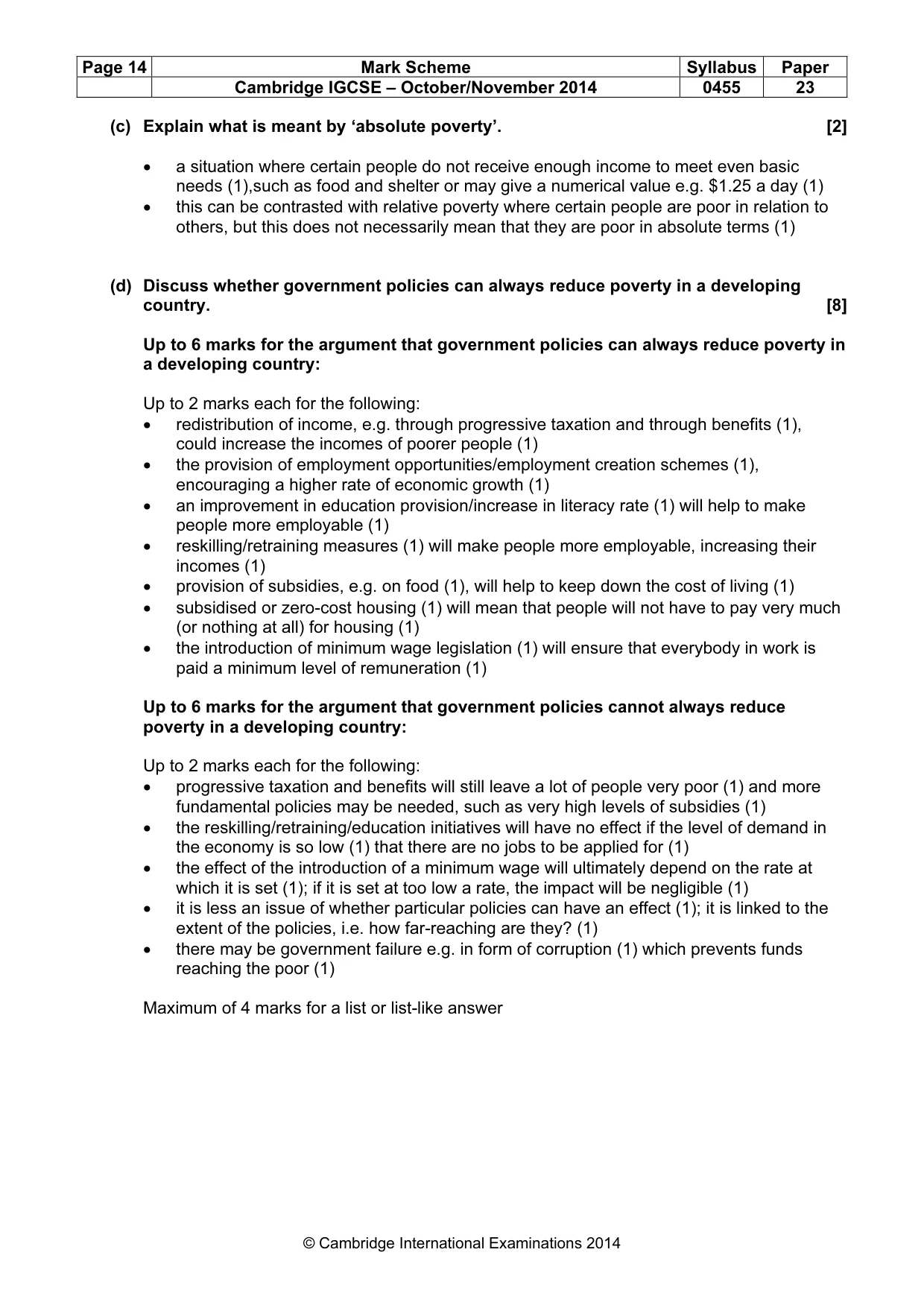
Page 14 Mark Scheme Syllabus Paper Cambridge IGCSE – October/November 2014 0455 23 © Cambridge International Examinations 2014 (c) Explain what is meant by ‘absolute poverty’. [2] • a situation where certain people do not receive enough income to meet even basic needs (1),such as food and shelter or may give a numerical value e.g. $1.25 a day (1) • this can be contrasted with relative poverty where certain people are poor in relation to others, but this does not necessarily mean that they are poor in absolute terms (1) (d) Discuss whether government policies can always reduce poverty in a developing country. [8] Up to 6 marks for the argument that government policies can always reduce poverty in a developing country: Up to 2 marks each for the following: • redistribution of income, e.g. through progressive taxation and through benefits (1), could increase the incomes of poorer people (1) • the provision of employment opportunities/employment creation schemes (1), encouraging a higher rate of economic growth (1) • an improvement in education provision/increase in literacy rate (1) will help to make people more employable (1) • reskilling/retraining measures (1) will make people more employable, increasing their incomes (1) • provision of subsidies, e.g. on food (1), will help to keep down the cost of living (1) • subsidised or zero-cost housing (1) will mean that people will not have to pay very much (or nothing at all) for housing (1) • the introduction of minimum wage legislation (1) will ensure that everybody in work is paid a minimum level of remuneration (1) Up to 6 marks for the argument that government policies cannot always reduce poverty in a developing country: Up to 2 marks each for the following: • progressive taxation and benefits will still leave a lot of people very poor (1) and more fundamental policies may be needed, such as very high levels of subsidies (1) • the reskilling/retraining/education initiatives will have no effect if the level of demand in the economy is so low (1) that there are no jobs to be applied for (1) • the effect of the introduction of a minimum wage will ultimately depend on the rate at which it is set (1); if it is set at too low a rate, the impact will be negligible (1) • it is less an issue of whether particular policies can have an effect (1); it is linked to the extent of the policies, i.e. how far-reaching are they? (1) • there may be government failure e.g. in form of corruption (1) which prevents funds reaching the poor (1) Maximum of 4 marks for a list or list-like answer
Mark scheme, page 15
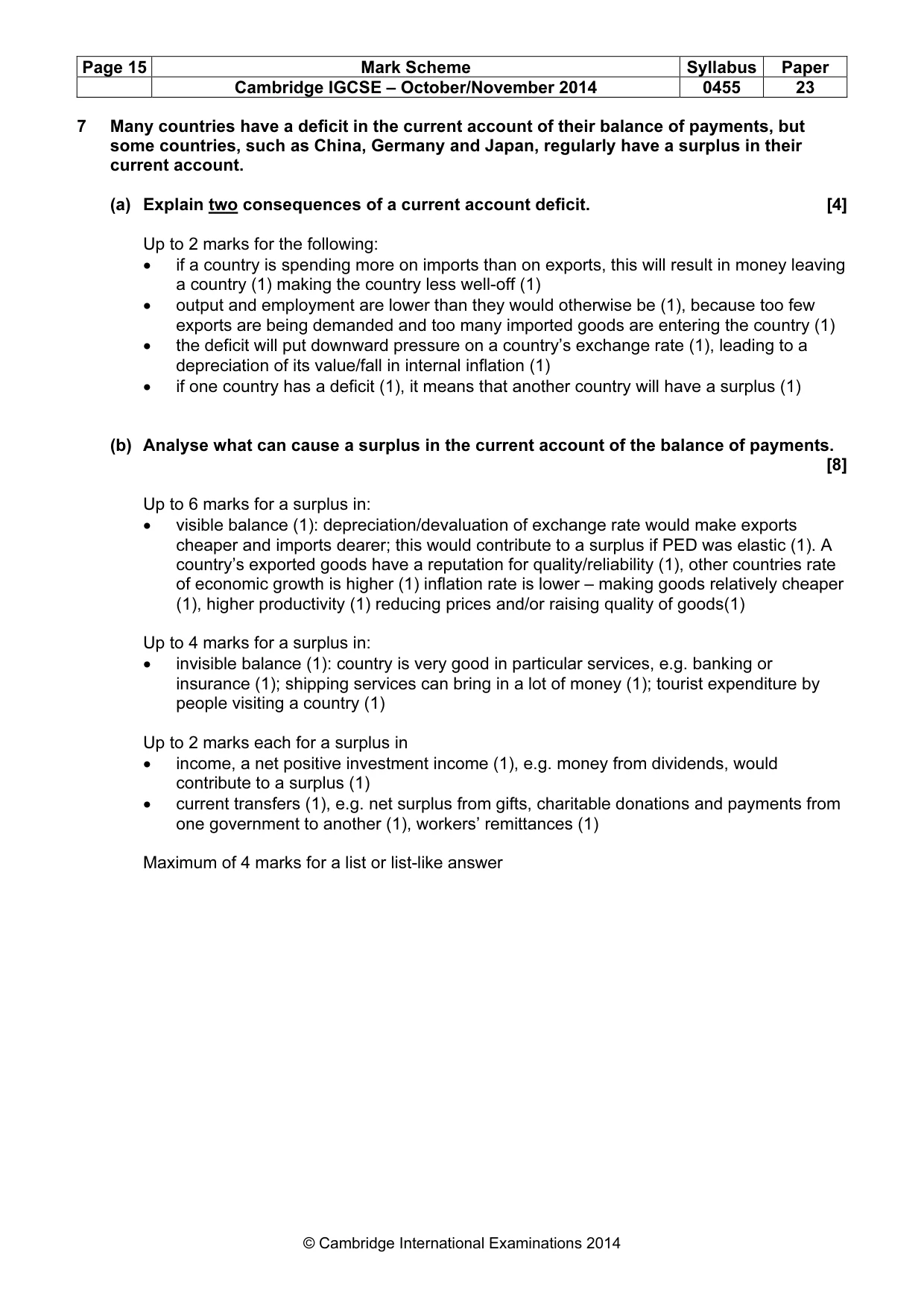
Page 15 Mark Scheme Syllabus Paper Cambridge IGCSE – October/November 2014 0455 23 © Cambridge International Examinations 2014 7 Many countries have a deficit in the current account of their balance of payments, but some countries, such as China, Germany and Japan, regularly have a surplus in their current account. (a) Explain two consequences of a current account deficit. [4] Up to 2 marks for the following: • if a country is spending more on imports than on exports, this will result in money leaving a country (1) making the country less well-off (1) • output and employment are lower than they would otherwise be (1), because too few exports are being demanded and too many imported goods are entering the country (1) • the deficit will put downward pressure on a country’s exchange rate (1), leading to a depreciation of its value/fall in internal inflation (1) • if one country has a deficit (1), it means that another country will have a surplus (1) (b) Analyse what can cause a surplus in the current account of the balance of payments. [8] Up to 6 marks for a surplus in: • visible balance (1): depreciation/devaluation of exchange rate would make exports cheaper and imports dearer; this would contribute to a surplus if PED was elastic (1). A country’s exported goods have a reputation for quality/reliability (1), other countries rate of economic growth is higher (1) inflation rate is lower – making goods relatively cheaper (1), higher productivity (1) reducing prices and/or raising quality of goods(1) Up to 4 marks for a surplus in: • invisible balance (1): country is very good in particular services, e.g. banking or insurance (1); shipping services can bring in a lot of money (1); tourist expenditure by people visiting a country (1) Up to 2 marks each for a surplus in • income, a net positive investment income (1), e.g. money from dividends, would contribute to a surplus (1) • current transfers (1), e.g. net surplus from gifts, charitable donations and payments from one government to another (1), workers’ remittances (1) Maximum of 4 marks for a list or list-like answer
Mark scheme, page 16
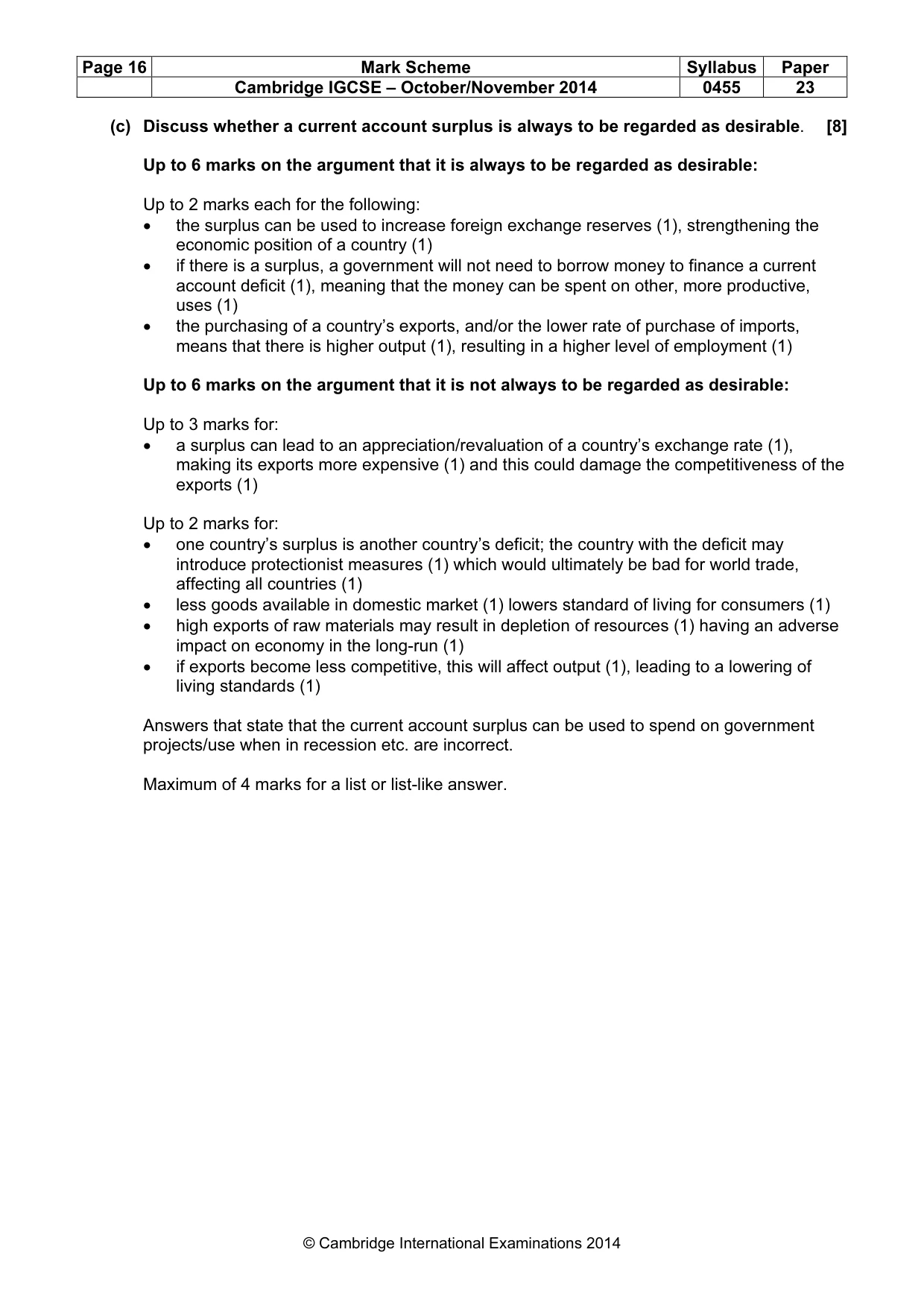
Page 16 Mark Scheme Syllabus Paper Cambridge IGCSE – October/November 2014 0455 23 © Cambridge International Examinations 2014 (c) Discuss whether a current account surplus is always to be regarded as desirable. [8] Up to 6 marks on the argument that it is always to be regarded as desirable: Up to 2 marks each for the following: • the surplus can be used to increase foreign exchange reserves (1), strengthening the economic position of a country (1) • if there is a surplus, a government will not need to borrow money to finance a current account deficit (1), meaning that the money can be spent on other, more productive, uses (1) • the purchasing of a country’s exports, and/or the lower rate of purchase of imports, means that there is higher output (1), resulting in a higher level of employment (1) Up to 6 marks on the argument that it is not always to be regarded as desirable: Up to 3 marks for: • a surplus can lead to an appreciation/revaluation of a country’s exchange rate (1), making its exports more expensive (1) and this could damage the competitiveness of the exports (1) Up to 2 marks for: • one country’s surplus is another country’s deficit; the country with the deficit may introduce protectionist measures (1) which would ultimately be bad for world trade, affecting all countries (1) • less goods available in domestic market (1) lowers standard of living for consumers (1) • high exports of raw materials may result in depletion of resources (1) having an adverse impact on economy in the long-run (1) • if exports become less competitive, this will affect output (1), leading to a lowering of living standards (1) Answers that state that the current account surplus can be used to spend on government projects/use when in recession etc. are incorrect. Maximum of 4 marks for a list or list-like answer.
What you needed in this session
Cambridge’s own grade thresholds for 2014 Oct/Nov, Paper 2 · Variant 3. A higher threshold means an easier paper — the bar moves with how the cohort did.