Cambridge IGCSE Economics 0455 — 2014 Oct/Nov Paper 2 · Variant 2
0455/22/O/N/14 · 90 marks · ≈101 min
The question paper and its mark scheme, free to read here and free to download. This is Cambridge’s own paper, exactly as it was sat.
Question paper8 pages



Mark scheme13 pages
Answers below. Sit the paper first if you are practising.
Paper as text
Question paper, page 1
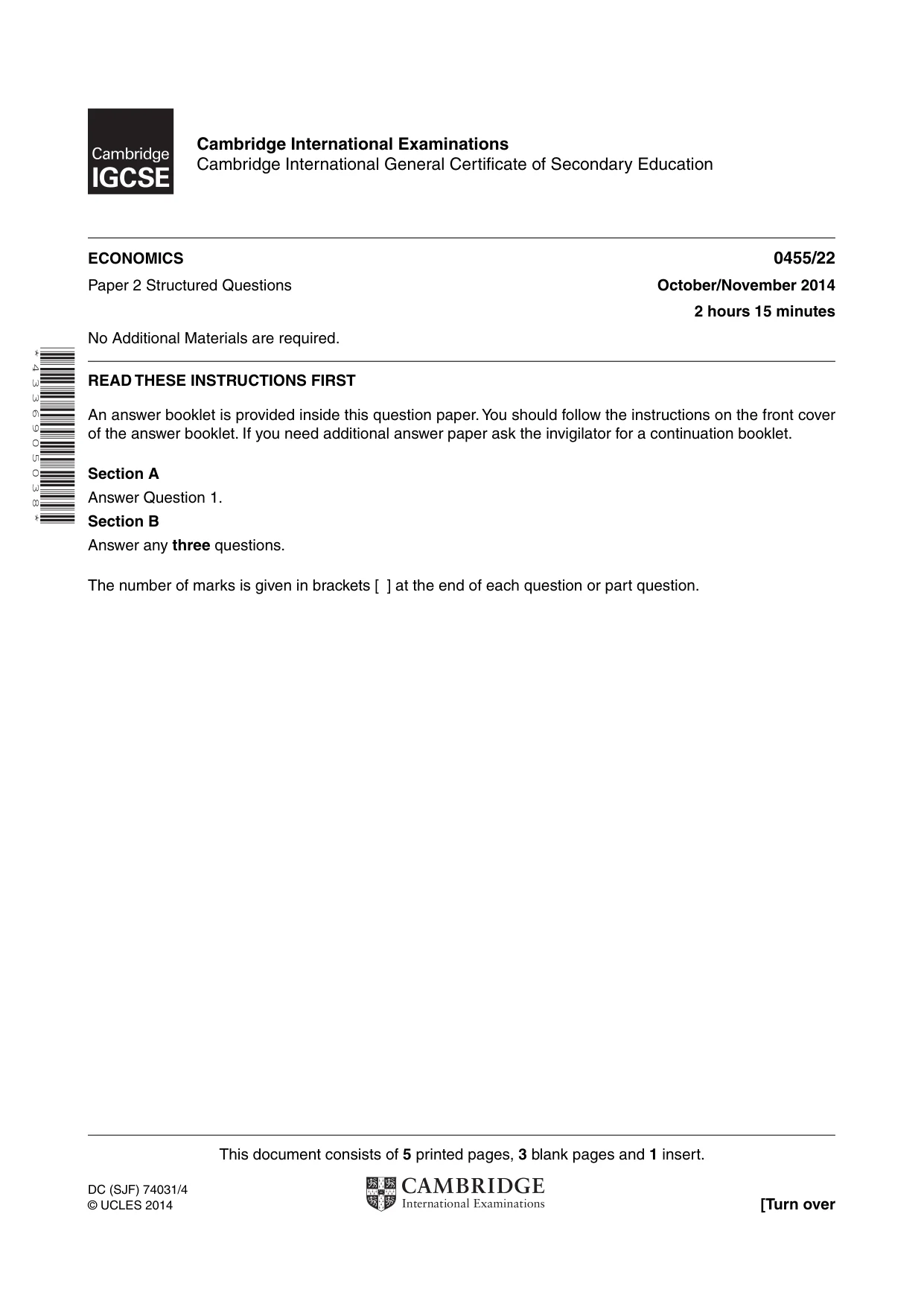
This document consists of 5 printed pages, 3 blank pages and 1 insert. DC (SJF) 74031/4 © UCLES 2014 [Turn over Cambridge International Examinations Cambridge International General Certificate of Secondary Education * 4 3 3 6 9 0 5 0 3 8 * ECONOMICS 0455/22 Paper 2 Structured Questions October/November 2014 2 hours 15 minutes No Additional Materials are required. READ THESE INSTRUCTIONS FIRST An answer booklet is provided inside this question paper. You should follow the instructions on the front cover of the answer booklet. If you need additional answer paper ask the invigilator for a continuation booklet. Section A Answer Question 1. Section B Answer any three questions. The number of marks is given in brackets [ ] at the end of each question or part question.
Question paper, page 2
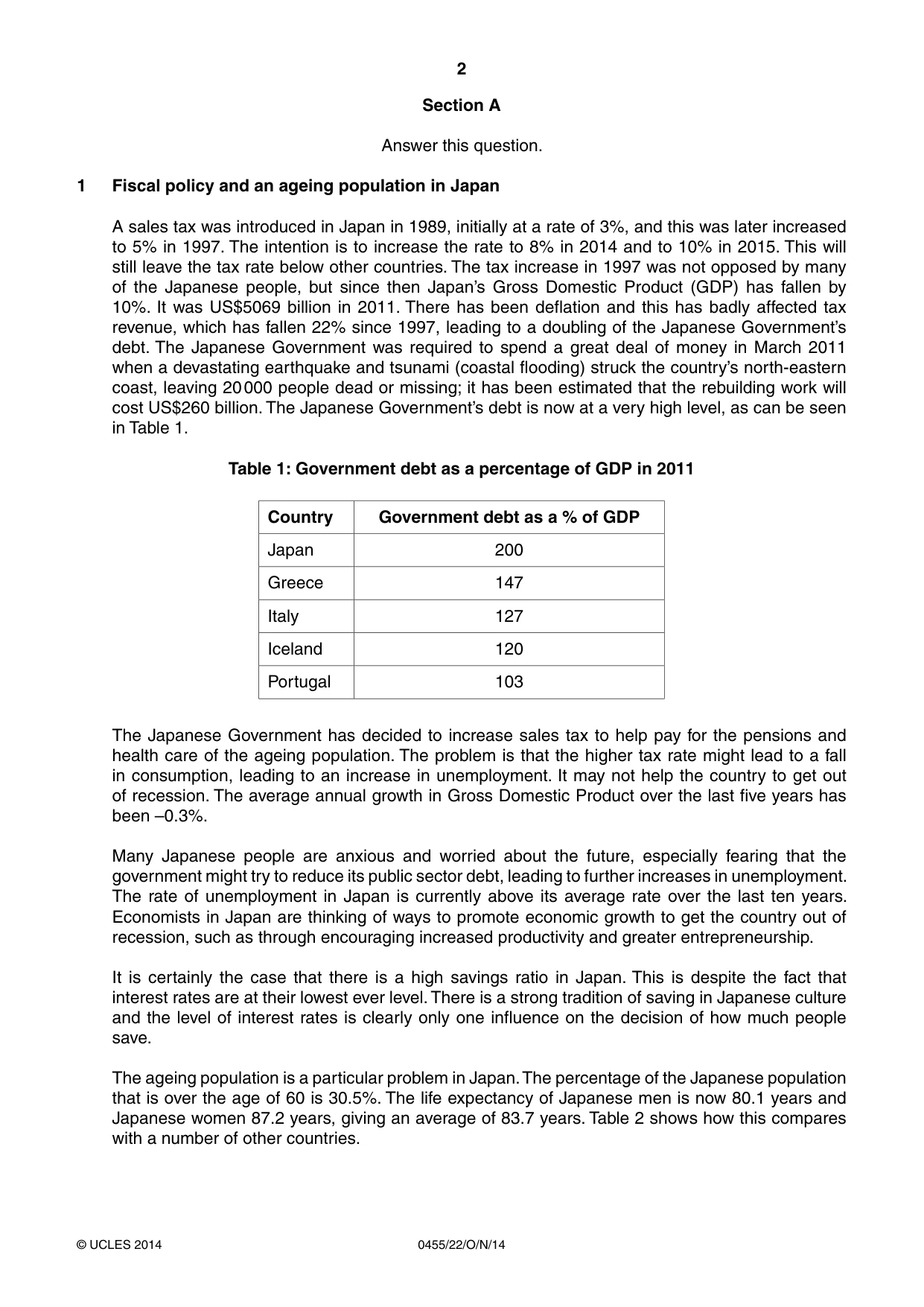
2 0455/22/O/N/14 © UCLES 2014 Section A Answer this question. 1 Fiscal policy and an ageing population in Japan A sales tax was introduced in Japan in 1989, initially at a rate of 3%, and this was later increased to 5% in 1997. The intention is to increase the rate to 8% in 2014 and to 10% in 2015. This will still leave the tax rate below other countries. The tax increase in 1997 was not opposed by many of the Japanese people, but since then Japan’s Gross Domestic Product (GDP) has fallen by 10%. It was US$5069 billion in 2011. There has been deflation and this has badly affected tax revenue, which has fallen 22% since 1997, leading to a doubling of the Japanese Government’s debt. The Japanese Government was required to spend a great deal of money in March 2011 when a devastating earthquake and tsunami (coastal flooding) struck the country’s north-eastern coast, leaving 20 000 people dead or missing; it has been estimated that the rebuilding work will cost US$260 billion. The Japanese Government’s debt is now at a very high level, as can be seen in Table 1. Table 1: Government debt as a percentage of GDP in 2011 Country Government debt as a % of GDP Japan 200 Greece 147 Italy 127 Iceland 120 Portugal 103 The Japanese Government has decided to increase sales tax to help pay for the pensions and health care of the ageing population. The problem is that the higher tax rate might lead to a fall in consumption, leading to an increase in unemployment. It may not help the country to get out of recession. The average annual growth in Gross Domestic Product over the last five years has been – 0.3%. Many Japanese people are anxious and worried about the future, especially fearing that the government might try to reduce its public sector debt, leading to further increases in unemployment. The rate of unemployment in Japan is currently above its average rate over the last ten years. Economists in Japan are thinking of ways to promote economic growth to get the country out of recession, such as through encouraging increased productivity and greater entrepreneurship. It is certainly the case that there is a high savings ratio in Japan. This is despite the fact that interest rates are at their lowest ever level. There is a strong tradition of saving in Japanese culture and the level of interest rates is clearly only one influence on the decision of how much people save. The ageing population is a particular problem in Japan. The percentage of the Japanese population that is over the age of 60 is 30.5%. The life expectancy of Japanese men is now 80.1 years and Japanese women 87.2 years, giving an average of 83.7 years. Table 2 shows how this compares with a number of other countries.
Question paper, page 3
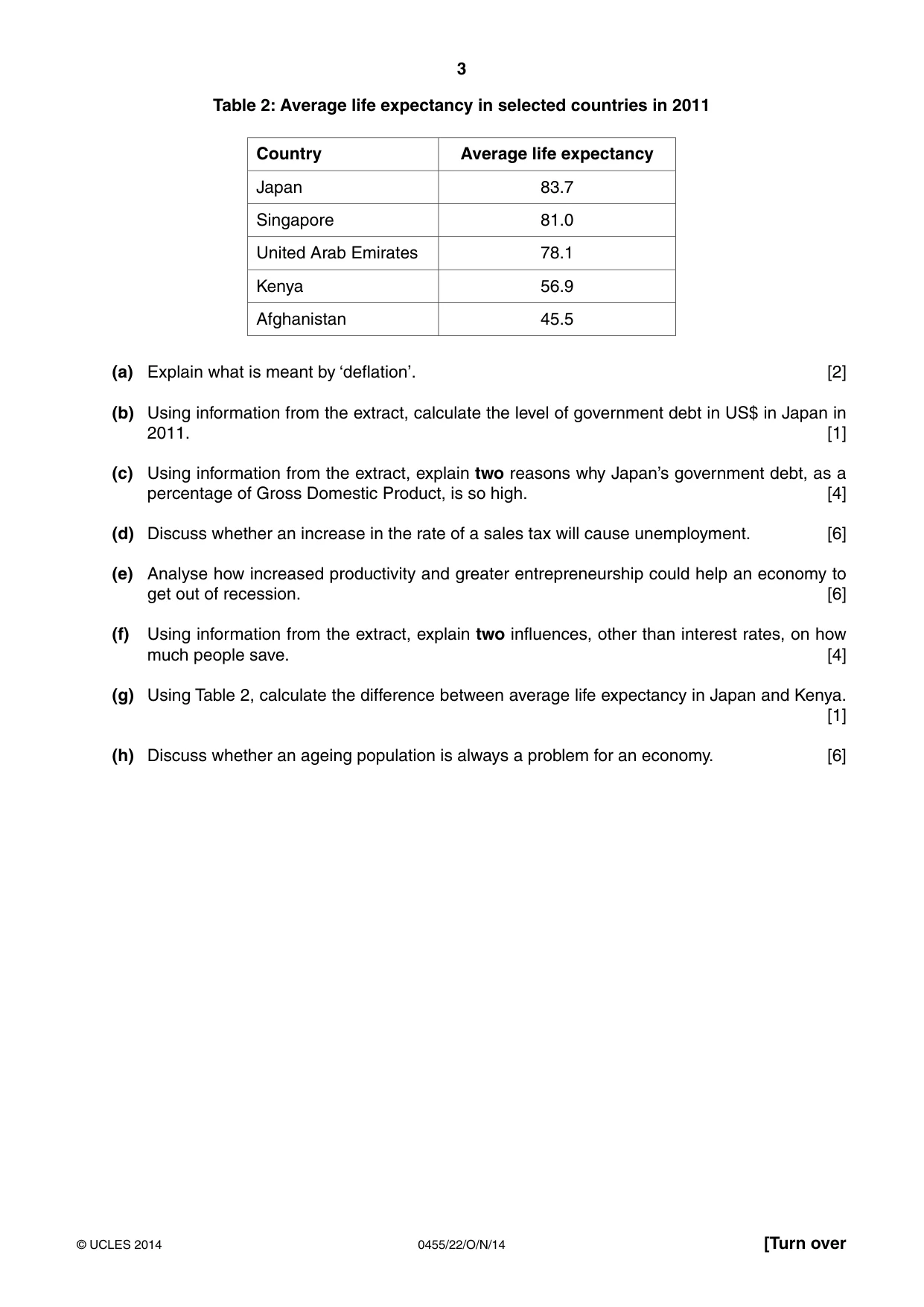
3 0455/22/O/N/14 © UCLES 2014 [Turn over Table 2: Average life expectancy in selected countries in 2011 Country Average life expectancy Japan 83.7 Singapore 81.0 United Arab Emirates 78.1 Kenya 56.9 Afghanistan 45.5 (a) Explain what is meant by ‘deflation’. [2] (b) Using information from the extract, calculate the level of government debt in US$ in Japan in 2011. [1] (c) Using information from the extract, explain two reasons why Japan’s government debt, as a percentage of Gross Domestic Product, is so high. [4] (d) Discuss whether an increase in the rate of a sales tax will cause unemployment. [6] (e) Analyse how increased productivity and greater entrepreneurship could help an economy to get out of recession. [6] (f) Using information from the extract, explain two influences, other than interest rates, on how much people save. [4] (g) Using Table 2, calculate the difference between average life expectancy in Japan and Kenya. [1] (h) Discuss whether an ageing population is always a problem for an economy. [6]
Question paper, page 4
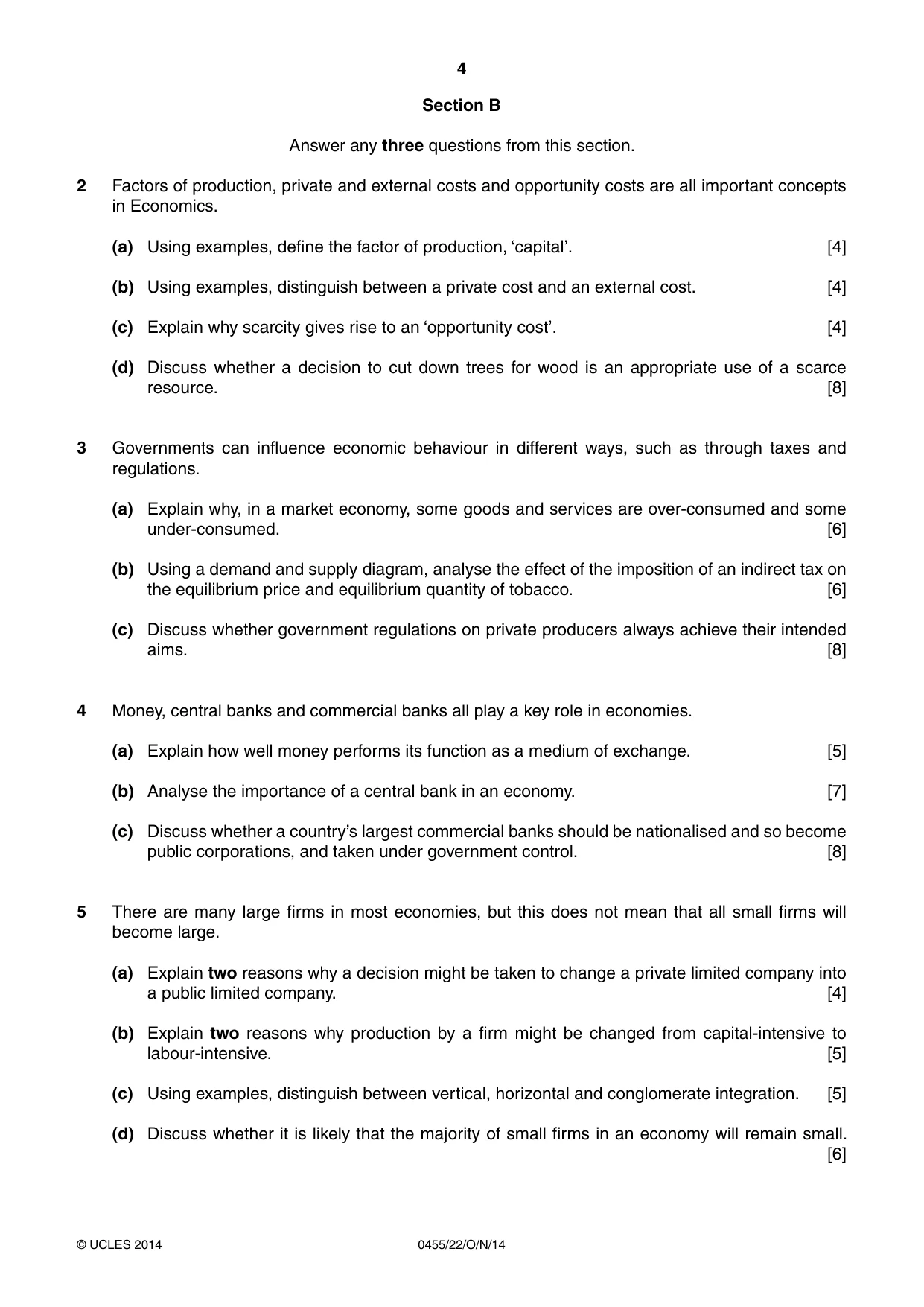
4 0455/22/O/N/14 © UCLES 2014 Section B Answer any three questions from this section. 2 Factors of production, private and external costs and opportunity costs are all important concepts in Economics. (a) Using examples, define the factor of production, ‘capital’. [4] (b) Using examples, distinguish between a private cost and an external cost. [4] (c) Explain why scarcity gives rise to an ‘opportunity cost’. [4] (d) Discuss whether a decision to cut down trees for wood is an appropriate use of a scarce resource. [8] 3 Governments can influence economic behaviour in different ways, such as through taxes and regulations. (a) Explain why, in a market economy, some goods and services are over-consumed and some under-consumed. [6] (b) Using a demand and supply diagram, analyse the effect of the imposition of an indirect tax on the equilibrium price and equilibrium quantity of tobacco. [6] (c) Discuss whether government regulations on private producers always achieve their intended aims. [8] 4 Money, central banks and commercial banks all play a key role in economies. (a) Explain how well money performs its function as a medium of exchange. [5] (b) Analyse the importance of a central bank in an economy. [7] (c) Discuss whether a country’s largest commercial banks should be nationalised and so become public corporations, and taken under government control. [8] 5 There are many large firms in most economies, but this does not mean that all small firms will become large. (a) Explain two reasons why a decision might be taken to change a private limited company into a public limited company. [4] (b) Explain two reasons why production by a firm might be changed from capital-intensive to labour-intensive. [5] (c) Using examples, distinguish between vertical, horizontal and conglomerate integration. [5] (d) Discuss whether it is likely that the majority of small firms in an economy will remain small. [6]
Question paper, page 5
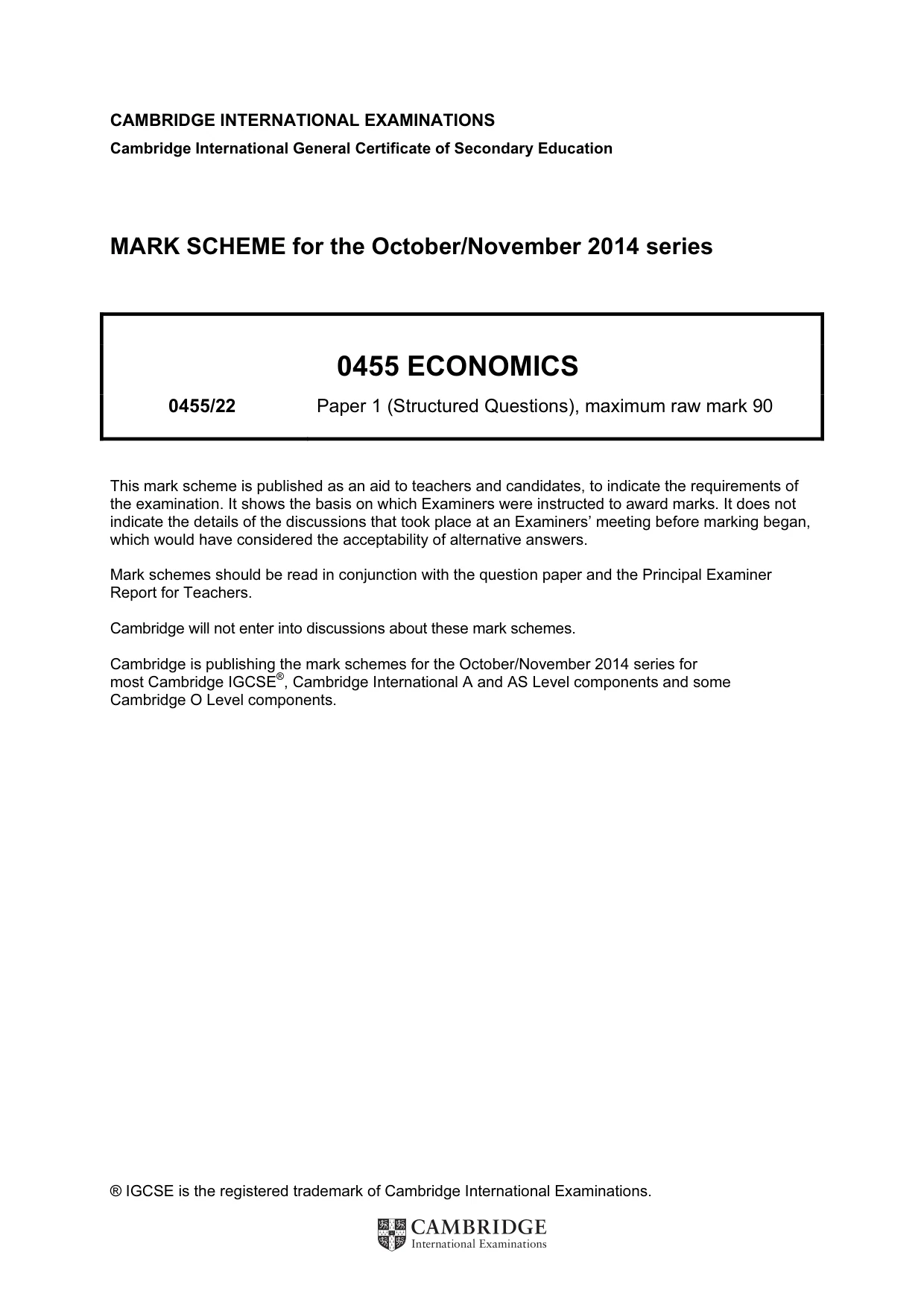
5 0455/22/O/N/14 © UCLES 2014 6 Inflation and unemployment are two economic problems that governments usually have to deal with. (a) Distinguish between demand-pull and cost-push inflation. [4] (b) Explain three reasons why inflation is regarded as a serious economic problem. [6] (c) Distinguish between frictional and cyclical unemployment. [4] (d) Discuss whether there is likely to be a conflict between the government aims of low inflation and low unemployment. [6] 7 Specialisation can lead to a significant increase in output and international trade. (a) Explain what is meant by ‘specialisation’. [4] (b) Describe the benefits and disadvantages of specialisation at a regional level. [6] (c) Discuss whether an economy will always benefit from an increase in international trade. [10]
Question paper, page 6
6 0455/22/O/N/14 © UCLES 2014 BLANK PAGE
Question paper, page 7
7 0455/22/O/N/14 © UCLES 2014 BLANK PAGE
Question paper, page 8
8 0455/22/O/N/14 © UCLES 2014 Permission to reproduce items where third-party owned material protected by copyright is included has been sought and cleared where possible. Every reasonable effort has been made by the publisher (UCLES) to trace copyright holders, but if any items requiring clearance have unwittingly been included, the publisher will be pleased to make amends at the earliest possible opportunity. Cambridge International Examinations is part of the Cambridge Assessment Group. Cambridge Assessment is the brand name of University of Cambridge Local Examinations Syndicate (UCLES), which is itself a department of the University of Cambridge. BLANK PAGE
Mark scheme, page 1
® IGCSE is the registered trademark of Cambridge International Examinations. CAMBRIDGE INTERNATIONAL EXAMINATIONS Cambridge International General Certificate of Secondary Education MARK SCHEME for the October/November 2014 series 0455 ECONOMICS 0455/22 Paper 1 (Structured Questions), maximum raw mark 90 This mark scheme is published as an aid to teachers and candidates, to indicate the requirements of the examination. It shows the basis on which Examiners were instructed to award marks. It does not indicate the details of the discussions that took place at an Examiners’ meeting before marking began, which would have considered the acceptability of alternative answers. Mark schemes should be read in conjunction with the question paper and the Principal Examiner Report for Teachers. Cambridge will not enter into discussions about these mark schemes. Cambridge is publishing the mark schemes for the October/November 2014 series for most Cambridge IGCSE®, Cambridge International A and AS Level components and some Cambridge O Level components.
Mark scheme, page 2
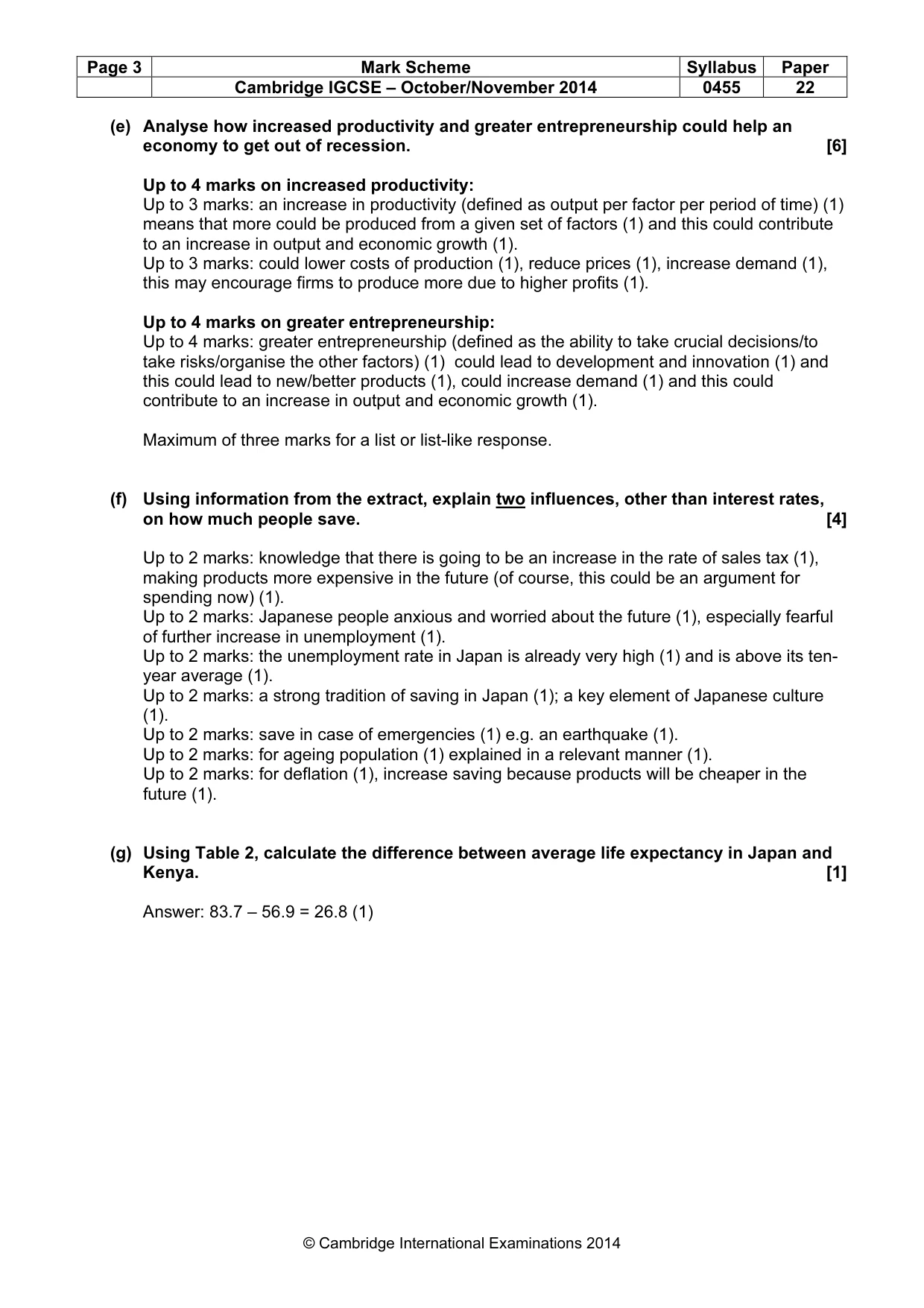
Page 2 Mark Scheme Syllabus Paper Cambridge IGCSE – October/November 2014 0455 22 © Cambridge International Examinations 2014 1 (a) Explain what is meant by ‘deflation’. [2] Deflation refers to a fall (1) in the (general) price level (1). Rise in the value (1) of money (1). Rise in the purchasing power (1) of money (1). N.B.: Do not reward a fall in the rate of inflation which simply means that prices are rising more slowly than before. (b) Using information from the extract, calculate the level of government debt in U.S.$ in Japan in 2011. [1] 200% of (U.S.)$ 5069 bn = U.S.$ 10 138 bn (c) Using information from the extract, explain two reasons why Japan’s government debt, as a percentage of Gross Domestic Product, is so high. [4] Expenditure: Up to 2 marks: damage caused by earthquake and tsunami/natural calamity (1) cost of rebuilding and reconstruction (1). Up to 2 marks: ageing population (1) large expense of paying for pensions and health care (1). Up to 2 marks: unemployment (1) expenditure by the government on unemployment benefits/expenditure on measures to reduce unemployment/lower tax revenue (1). Up to 2 marks: fall in GDP (1) so any given debt figure will become a greater % of GDP/lower tax revenue (1). Revenue: Up to 2 marks: fall in prices/deflation (1) has led to a fall in tax revenues (1). Up to 2 marks: sales tax is low (1) compared with many other countries; e.g. EU average is about 20% (1). (d) Discuss whether an increase in the rate of a sales tax will cause unemployment. [6] Up to 4 marks for why it might: It will increase costs of production (1), increase the price of products (1), this may reduce spending/demand (1), lower spending may reduce output/revenue (1), lower output may reduce demand for workers (1) to maintain profits, firms may seek to lower costs (1), may achieve this by dismissing workers (1). Up to 4 marks for why it might not: Up to 3 marks: it will depend on what the government does with the tax revenue (1), if it spends all of it, the level of demand would be unchanged (may even be higher) (1), spending on education and health care could make people more employable (1). Up to 2 marks: other costs of production may fall (1) leaving the price of products unchanged (1). Up to 3 marks: firms may absorb the higher rate (1) leaving the price of products unchanged (1), firms are more likely to leave the price the same if demand is elastic (1). If demand is inelastic, a rise in price will have less impact on demand and so on output and employment (1).
Mark scheme, page 3
Page 3 Mark Scheme Syllabus Paper Cambridge IGCSE – October/November 2014 0455 22 © Cambridge International Examinations 2014 (e) Analyse how increased productivity and greater entrepreneurship could help an economy to get out of recession. [6] Up to 4 marks on increased productivity: Up to 3 marks: an increase in productivity (defined as output per factor per period of time) (1) means that more could be produced from a given set of factors (1) and this could contribute to an increase in output and economic growth (1). Up to 3 marks: could lower costs of production (1), reduce prices (1), increase demand (1), this may encourage firms to produce more due to higher profits (1). Up to 4 marks on greater entrepreneurship: Up to 4 marks: greater entrepreneurship (defined as the ability to take crucial decisions/to take risks/organise the other factors) (1) could lead to development and innovation (1) and this could lead to new/better products (1), could increase demand (1) and this could contribute to an increase in output and economic growth (1). Maximum of three marks for a list or list-like response. (f) Using information from the extract, explain two influences, other than interest rates, on how much people save. [4] Up to 2 marks: knowledge that there is going to be an increase in the rate of sales tax (1), making products more expensive in the future (of course, this could be an argument for spending now) (1). Up to 2 marks: Japanese people anxious and worried about the future (1), especially fearful of further increase in unemployment (1). Up to 2 marks: the unemployment rate in Japan is already very high (1) and is above its ten- year average (1). Up to 2 marks: a strong tradition of saving in Japan (1); a key element of Japanese culture (1). Up to 2 marks: save in case of emergencies (1) e.g. an earthquake (1). Up to 2 marks: for ageing population (1) explained in a relevant manner (1). Up to 2 marks: for deflation (1), increase saving because products will be cheaper in the future (1). (g) Using Table 2, calculate the difference between average life expectancy in Japan and Kenya. [1] Answer: 83.7 – 56.9 = 26.8 (1)
Mark scheme, page 4
Page 4 Mark Scheme Syllabus Paper Cambridge IGCSE – October/November 2014 0455 22 © Cambridge International Examinations 2014 (h) Discuss whether an ageing population is always a problem for an economy. [6] Up to 4 marks for stating that it is always a problem: Up to 2 marks: an increase in the dependency ratio (1) with fewer people working to support more older people (1). Up to 3 marks: increased government spending on health care (1) and pensions (1) involves an opportunity cost (1), example (1). Up to 2 marks: there may need to be higher taxes for those in work (1) which could cause a disincentive to effort effect (1). Up to 3 marks: it could lead to a shortage of workers (1) which could push up wages (1) leading to inflation (1). Up to 4 marks for stating that it is not always a problem: Up to 2 marks: older people can be an economic asset (1), such as through their knowledge and experience (1). Up to 2 marks: firms could be encouraged to give jobs to older people (1) through various government schemes (1). Up to 2 marks: the government could increase the retirement age (1), and so control the extent of any problem (1). Up to 2 marks: indicates a good health care system (1), increased life expectancy/improved living standards (1). Up to 2 marks: dependency ratio may be falling (1) if the increase in average age is increasing the size of the labour force (1). Up to 2 marks: may be importing labour (1) to overcome the potential fall in the supply of labour (1). Maximum of 3 marks for a list or list-like answer. 2 Factors of production, private and external costs and opportunity costs are all important concepts in Economics. (a) Using examples, define the factor of production, ‘capital’. [4] Up to 2 marks: capital can be defined as any human-made good (1) that is used to produce other goods and services (1), i.e. they are aids to production. Up to 2 marks: examples (two needed) could include offices, factories, tools, machinery and equipment (1 × 2). N.B.: Do not reward money that is used to buy equipment. (b) Using examples, distinguish between a private cost and an external cost. [4] Two marks for the distinction, and two marks for the examples Up to 2 marks: private cost is the cost to the consumer or producer (1) e.g. the cost of borrowing the finance, building a factory, purchasing machinery and the cost of labour and raw materials (1), whereas … Up to 2 marks: … external cost is a harmful effect/e.g. pollution, congestion (1), to a third party/people not involved in consuming or producing a product (1) Or: External cost is social cost minus private cost (1) so will include costs such as pollution, congestion (1).
Mark scheme, page 5
Page 5 Mark Scheme Syllabus Paper Cambridge IGCSE – October/November 2014 0455 22 © Cambridge International Examinations 2014 (c) Explain why scarcity gives rise to an ‘opportunity cost’. [4] 1 mark for explanation of the term ‘scarcity’ in terms of the finite resources. 1 mark for insufficient resources to satisfy the unlimited wants. 1 mark for stating that this gives rise to the need to make a choice. 1 mark for stating that this choice will involve an opportunity cost in terms of the (next) best alternative that is foregone. (d) Discuss whether a decision to cut down trees for wood is an appropriate use of a scarce resource. [8] Up to 5 marks for stressing that it is an appropriate use of a scarce resource: Up to 2 marks: cutting down trees for wood will create employment (1) which will increase incomes in the economy (1). Up to 3 marks: cutting down trees for wood can be used to build houses, bridges and furniture (1), improving the country’s infrastructure (1), satisfying people’s wants/demand (1). Up to 3 marks: the wood can be sold (1), creating profit (1), leading to an increase in GDP (1). Up to 2 marks: replacement trees can be planted (1) enabling trees to be harvested in the future (1). Up to 2 marks: wood could be exported (1), improve current account/balance of payments (1). Up to 5 marks for stressing that it is an inappropriate use of a scarce resource: Up to 2 marks: it could destroy the livelihoods of people who live and work in the forests (1), leading to a rise in unemployment (1). Up to 3 marks: examples of environmental damage e.g. such as loss of wildlife habitats and cause global warming (1 + 1) causing negative externalities (1). Up to 2 marks: there is a need to take into account the interests of future generations (1), and so there is an issue of sustainability (candidates do not need to use that particular term) (1). Up to 2 marks: decision may be informed by a C.B.A. (1) recommendation would depend on the relationship of social benefits and social costs (1). Maximum of 3 marks for a list or list-like answer.
Mark scheme, page 6
Page 6 Mark Scheme Syllabus Paper Cambridge IGCSE – October/November 2014 0455 22 © Cambridge International Examinations 2014 3 Governments can influence economic behaviour in different ways, such as through taxes and regulations. (a) Explain why, in a market economy, some goods and services are over-consumed and some under-consumed. [6] Up to 2 marks: explanation of how resources are allocated through a price mechanism without any government intervention (1) with the market price reflecting demand and supply. Up to 3 marks: goods such as demerit goods/goods that have external costs are over- consumed (1) will have a relatively low market price (1) (compared to if there was government intervention)/consumers will not fully appreciate their harmful effects and so there will be over-consumption (1), e.g. tobacco or alcohol (1). Up to 3 marks: goods such as merit goods/goods that have external benefits are underconsumed (1), will have a relatively high market price (1) (compared to if there was government intervention)/consumers will not fully appreciate their beneficial effects and so there will be under-consumption (1), e.g. education or health care (1). Up to 3 marks: a monopoly may restrict output (1) pushing up the price (1) reducing the amount people can consume (1). Up to 3 marks: private sector firms will have no incentive (1) to provide public goods (1) so these will not be consumed (1).
Mark scheme, page 7
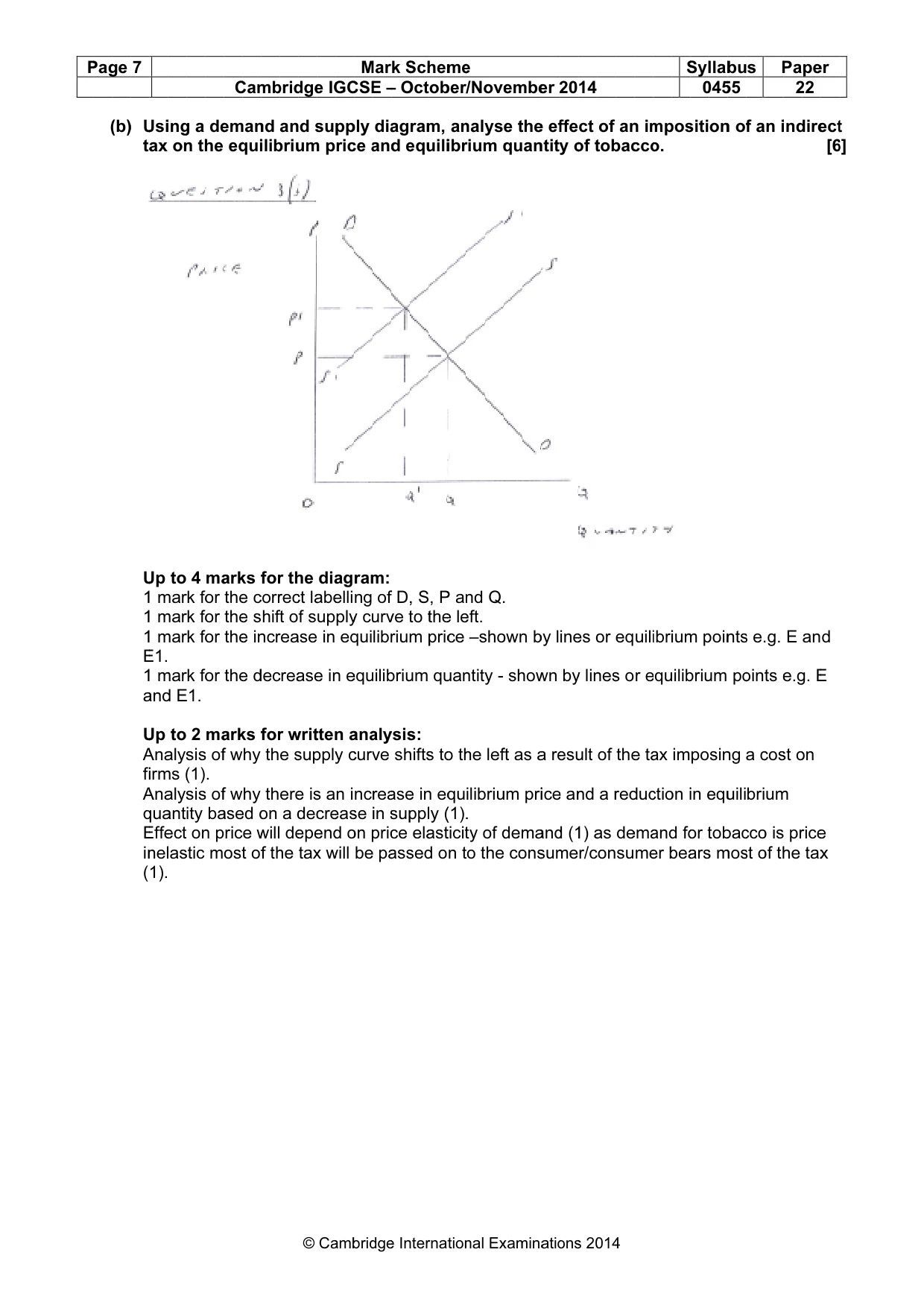
P Pag ( ge (b) 7 ) U ta U 1 1 1 E 1 a U A fi A q E in ( Usi ax Up 1 m 1 m 1 m E1. 1 m and Up Ana irm Ana qua Effe nel 1). ing on to mar mar mar mar d E to alys ms ( alys ant ect las g a n th 4 rk fo rk fo rk fo rk fo E1. 2 sis (1) sis ity on stic de he ma or or or or ma s of . s of ba n p m C em eq ark the the the the ark f w f w ase ric ost Cam man qui ks f e c e s e in e d ks f hy hy ed o e w t of mb nd ilib for corr hif ncr dec for th th on will f th brid an briu r th rec ft o rea crea r w e s ere a d de he dge © d s um he ct la f s ase ase writ sup e is dec epe tax e IG Ca sup m p dia abe up in e in tten pply s a cre end x w GC amb pp ric ag elli ply eq n e n a y c n i eas d o will M CSE brid ply ce a ram ng y cu qui equ ana curv ncr se i on p be Mar E – dge dia and m: of urv libr uilib aly ve rea in s pric pa k S – O e In ag d e f D, ve t rium briu ysis sh ase sup ce ass Sch Oct nter ram equ , S to t m p um s: hifts e in ppl ela sed hem ob rnat m, uili , P the pric qu s to n eq ly ( ast d o me ber/ tion an ibr P an e le ce uan o th qu (1). ticit n t e /No nal naly rium nd eft. –s ntity he ilib . ty o o t ove Ex ys m q Q. sho y - lef briu of d the em xam e t qu . own sh ft a um dem co mbe mina the an n b how as a pri ma ons er 2 atio e ef ntity by l wn a re ice and sum 20 ons ffe y o ine by esu e an d (1 me 14 s 20 ct of t es o y lin ult nd 1) a r/c 014 of tob or nes of a r as con 4 an bac eq s o the red de su n im cco uili r e e ta duc ema me mp o. ibri equ ax ctio and er b S pos ium uilib im on i d fo bea Syl 0 siti m p briu po in e or t ars llab 045 on poin um sin equ tob s m bu 55 n of nts po ng uili bac mos s f a s e. oint a c bri cco st o P n i .g. ts e cos um o is of th Pa 2 ind E e.g st o m pr he pe 22 dire an g. E on rice tax er ect [6 d E e x t 6]
Mark scheme, page 8
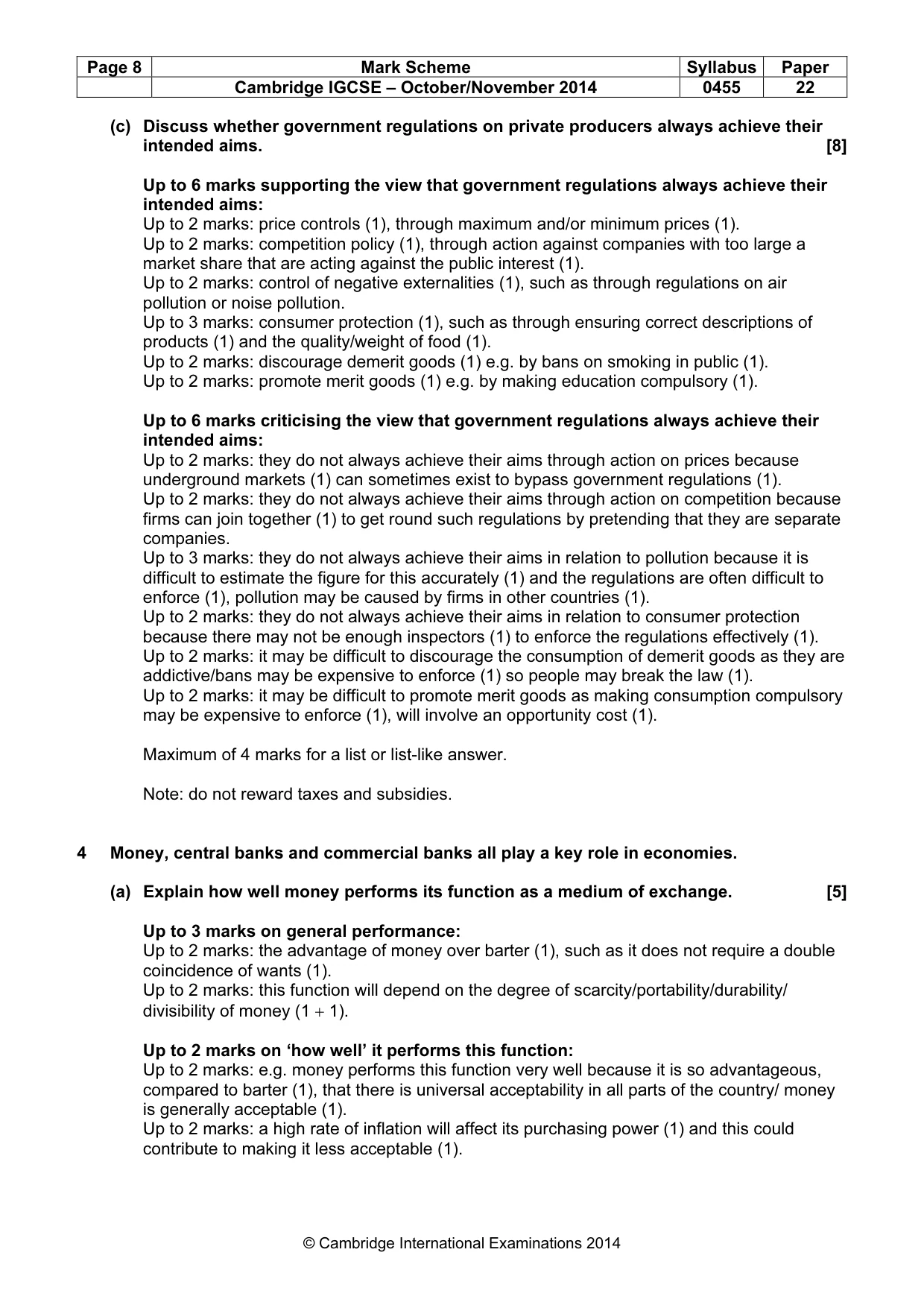
Page 8 Mark Scheme Syllabus Paper Cambridge IGCSE – October/November 2014 0455 22 © Cambridge International Examinations 2014 (c) Discuss whether government regulations on private producers always achieve their intended aims. [8] Up to 6 marks supporting the view that government regulations always achieve their intended aims: Up to 2 marks: price controls (1), through maximum and/or minimum prices (1). Up to 2 marks: competition policy (1), through action against companies with too large a market share that are acting against the public interest (1). Up to 2 marks: control of negative externalities (1), such as through regulations on air pollution or noise pollution. Up to 3 marks: consumer protection (1), such as through ensuring correct descriptions of products (1) and the quality/weight of food (1). Up to 2 marks: discourage demerit goods (1) e.g. by bans on smoking in public (1). Up to 2 marks: promote merit goods (1) e.g. by making education compulsory (1). Up to 6 marks criticising the view that government regulations always achieve their intended aims: Up to 2 marks: they do not always achieve their aims through action on prices because underground markets (1) can sometimes exist to bypass government regulations (1). Up to 2 marks: they do not always achieve their aims through action on competition because firms can join together (1) to get round such regulations by pretending that they are separate companies. Up to 3 marks: they do not always achieve their aims in relation to pollution because it is difficult to estimate the figure for this accurately (1) and the regulations are often difficult to enforce (1), pollution may be caused by firms in other countries (1). Up to 2 marks: they do not always achieve their aims in relation to consumer protection because there may not be enough inspectors (1) to enforce the regulations effectively (1). Up to 2 marks: it may be difficult to discourage the consumption of demerit goods as they are addictive/bans may be expensive to enforce (1) so people may break the law (1). Up to 2 marks: it may be difficult to promote merit goods as making consumption compulsory may be expensive to enforce (1), will involve an opportunity cost (1). Maximum of 4 marks for a list or list-like answer. Note: do not reward taxes and subsidies. 4 Money, central banks and commercial banks all play a key role in economies. (a) Explain how well money performs its function as a medium of exchange. [5] Up to 3 marks on general performance: Up to 2 marks: the advantage of money over barter (1), such as it does not require a double coincidence of wants (1). Up to 2 marks: this function will depend on the degree of scarcity/portability/durability/ divisibility of money (1 + 1). Up to 2 marks on ‘how well’ it performs this function: Up to 2 marks: e.g. money performs this function very well because it is so advantageous, compared to barter (1), that there is universal acceptability in all parts of the country/ money is generally acceptable (1). Up to 2 marks: a high rate of inflation will affect its purchasing power (1) and this could contribute to making it less acceptable (1).
Mark scheme, page 9
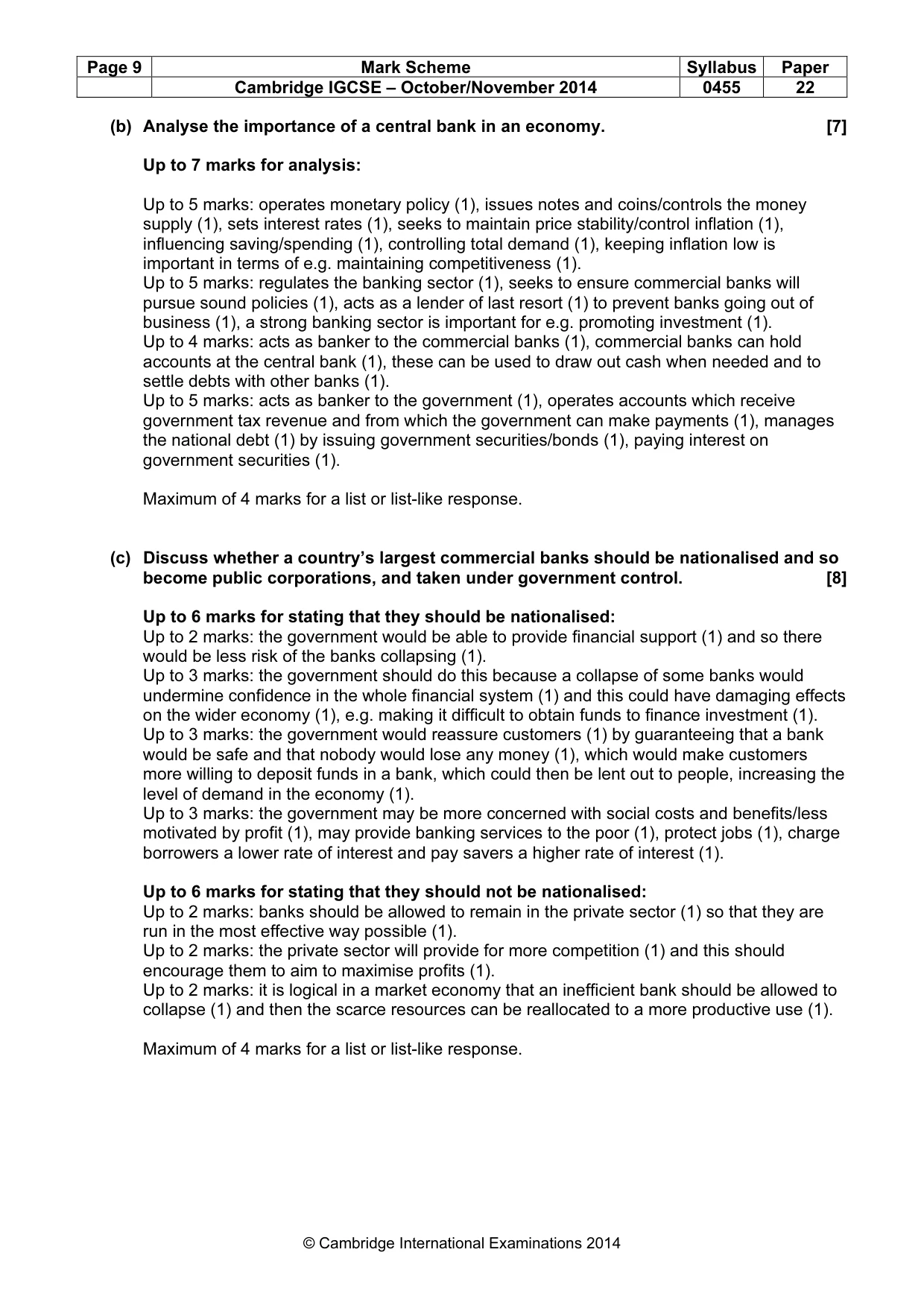
Page 9 Mark Scheme Syllabus Paper Cambridge IGCSE – October/November 2014 0455 22 © Cambridge International Examinations 2014 (b) Analyse the importance of a central bank in an economy. [7] Up to 7 marks for analysis: Up to 5 marks: operates monetary policy (1), issues notes and coins/controls the money supply (1), sets interest rates (1), seeks to maintain price stability/control inflation (1), influencing saving/spending (1), controlling total demand (1), keeping inflation low is important in terms of e.g. maintaining competitiveness (1). Up to 5 marks: regulates the banking sector (1), seeks to ensure commercial banks will pursue sound policies (1), acts as a lender of last resort (1) to prevent banks going out of business (1), a strong banking sector is important for e.g. promoting investment (1). Up to 4 marks: acts as banker to the commercial banks (1), commercial banks can hold accounts at the central bank (1), these can be used to draw out cash when needed and to settle debts with other banks (1). Up to 5 marks: acts as banker to the government (1), operates accounts which receive government tax revenue and from which the government can make payments (1), manages the national debt (1) by issuing government securities/bonds (1), paying interest on government securities (1). Maximum of 4 marks for a list or list-like response. (c) Discuss whether a country’s largest commercial banks should be nationalised and so become public corporations, and taken under government control. [8] Up to 6 marks for stating that they should be nationalised: Up to 2 marks: the government would be able to provide financial support (1) and so there would be less risk of the banks collapsing (1). Up to 3 marks: the government should do this because a collapse of some banks would undermine confidence in the whole financial system (1) and this could have damaging effects on the wider economy (1), e.g. making it difficult to obtain funds to finance investment (1). Up to 3 marks: the government would reassure customers (1) by guaranteeing that a bank would be safe and that nobody would lose any money (1), which would make customers more willing to deposit funds in a bank, which could then be lent out to people, increasing the level of demand in the economy (1). Up to 3 marks: the government may be more concerned with social costs and benefits/less motivated by profit (1), may provide banking services to the poor (1), protect jobs (1), charge borrowers a lower rate of interest and pay savers a higher rate of interest (1). Up to 6 marks for stating that they should not be nationalised: Up to 2 marks: banks should be allowed to remain in the private sector (1) so that they are run in the most effective way possible (1). Up to 2 marks: the private sector will provide for more competition (1) and this should encourage them to aim to maximise profits (1). Up to 2 marks: it is logical in a market economy that an inefficient bank should be allowed to collapse (1) and then the scarce resources can be reallocated to a more productive use (1). Maximum of 4 marks for a list or list-like response.
Mark scheme, page 10
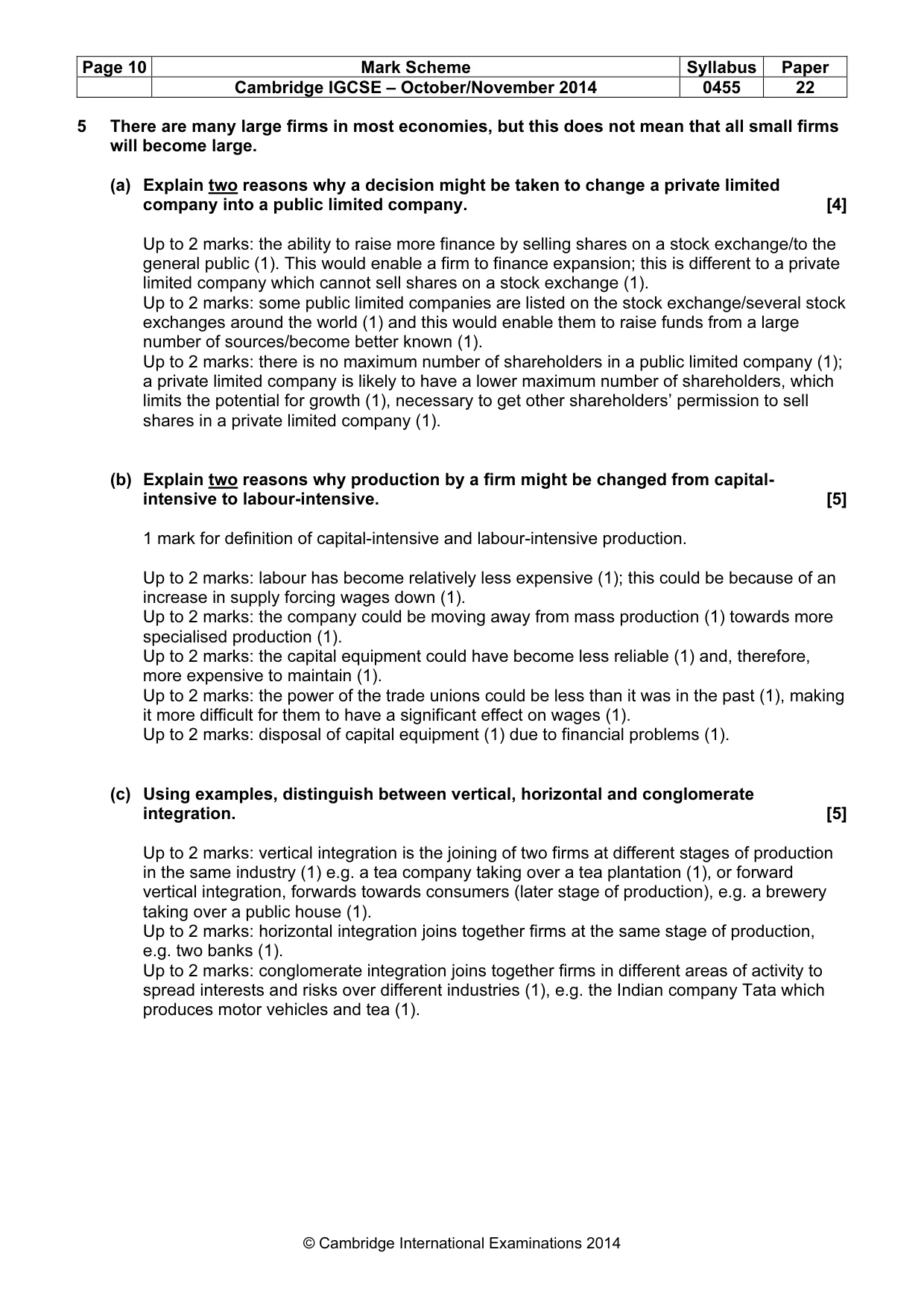
Page 10 Mark Scheme Syllabus Paper Cambridge IGCSE – October/November 2014 0455 22 © Cambridge International Examinations 2014 5 There are many large firms in most economies, but this does not mean that all small firms will become large. (a) Explain two reasons why a decision might be taken to change a private limited company into a public limited company. [4] Up to 2 marks: the ability to raise more finance by selling shares on a stock exchange/to the general public (1). This would enable a firm to finance expansion; this is different to a private limited company which cannot sell shares on a stock exchange (1). Up to 2 marks: some public limited companies are listed on the stock exchange/several stock exchanges around the world (1) and this would enable them to raise funds from a large number of sources/become better known (1). Up to 2 marks: there is no maximum number of shareholders in a public limited company (1); a private limited company is likely to have a lower maximum number of shareholders, which limits the potential for growth (1), necessary to get other shareholders’ permission to sell shares in a private limited company (1). (b) Explain two reasons why production by a firm might be changed from capital- intensive to labour-intensive. [5] 1 mark for definition of capital-intensive and labour-intensive production. Up to 2 marks: labour has become relatively less expensive (1); this could be because of an increase in supply forcing wages down (1). Up to 2 marks: the company could be moving away from mass production (1) towards more specialised production (1). Up to 2 marks: the capital equipment could have become less reliable (1) and, therefore, more expensive to maintain (1). Up to 2 marks: the power of the trade unions could be less than it was in the past (1), making it more difficult for them to have a significant effect on wages (1). Up to 2 marks: disposal of capital equipment (1) due to financial problems (1). (c) Using examples, distinguish between vertical, horizontal and conglomerate integration. [5] Up to 2 marks: vertical integration is the joining of two firms at different stages of production in the same industry (1) e.g. a tea company taking over a tea plantation (1), or forward vertical integration, forwards towards consumers (later stage of production), e.g. a brewery taking over a public house (1). Up to 2 marks: horizontal integration joins together firms at the same stage of production, e.g. two banks (1). Up to 2 marks: conglomerate integration joins together firms in different areas of activity to spread interests and risks over different industries (1), e.g. the Indian company Tata which produces motor vehicles and tea (1).
Mark scheme, page 11
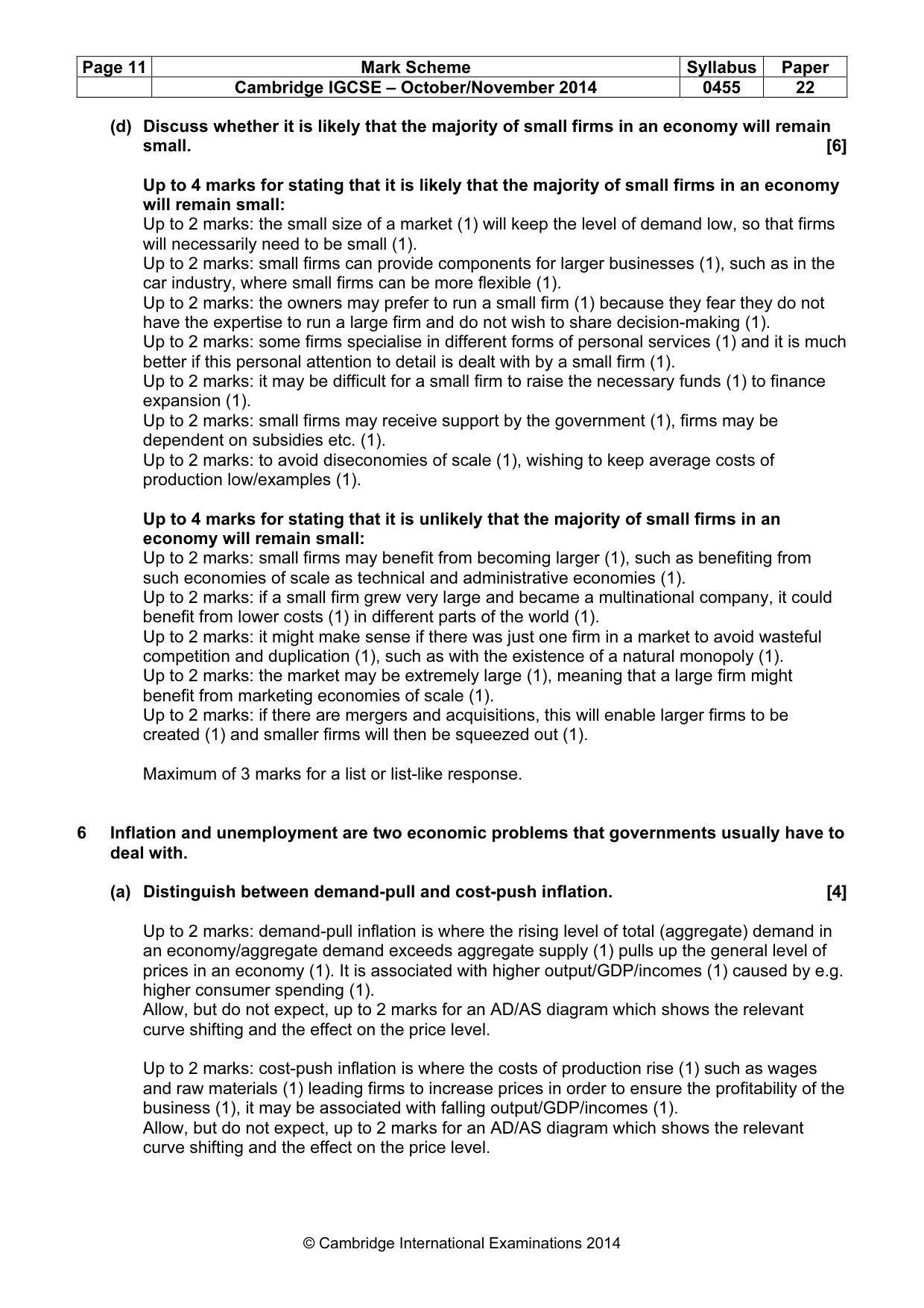
Page 11 Mark Scheme Syllabus Paper Cambridge IGCSE – October/November 2014 0455 22 © Cambridge International Examinations 2014 (d) Discuss whether it is likely that the majority of small firms in an economy will remain small. [6] Up to 4 marks for stating that it is likely that the majority of small firms in an economy will remain small: Up to 2 marks: the small size of a market (1) will keep the level of demand low, so that firms will necessarily need to be small (1). Up to 2 marks: small firms can provide components for larger businesses (1), such as in the car industry, where small firms can be more flexible (1). Up to 2 marks: the owners may prefer to run a small firm (1) because they fear they do not have the expertise to run a large firm and do not wish to share decision-making (1). Up to 2 marks: some firms specialise in different forms of personal services (1) and it is much better if this personal attention to detail is dealt with by a small firm (1). Up to 2 marks: it may be difficult for a small firm to raise the necessary funds (1) to finance expansion (1). Up to 2 marks: small firms may receive support by the government (1), firms may be dependent on subsidies etc. (1). Up to 2 marks: to avoid diseconomies of scale (1), wishing to keep average costs of production low/examples (1). Up to 4 marks for stating that it is unlikely that the majority of small firms in an economy will remain small: Up to 2 marks: small firms may benefit from becoming larger (1), such as benefiting from such economies of scale as technical and administrative economies (1). Up to 2 marks: if a small firm grew very large and became a multinational company, it could benefit from lower costs (1) in different parts of the world (1). Up to 2 marks: it might make sense if there was just one firm in a market to avoid wasteful competition and duplication (1), such as with the existence of a natural monopoly (1). Up to 2 marks: the market may be extremely large (1), meaning that a large firm might benefit from marketing economies of scale (1). Up to 2 marks: if there are mergers and acquisitions, this will enable larger firms to be created (1) and smaller firms will then be squeezed out (1). Maximum of 3 marks for a list or list-like response. 6 Inflation and unemployment are two economic problems that governments usually have to deal with. (a) Distinguish between demand-pull and cost-push inflation. [4] Up to 2 marks: demand-pull inflation is where the rising level of total (aggregate) demand in an economy/aggregate demand exceeds aggregate supply (1) pulls up the general level of prices in an economy (1). It is associated with higher output/GDP/incomes (1) caused by e.g. higher consumer spending (1). Allow, but do not expect, up to 2 marks for an AD/AS diagram which shows the relevant curve shifting and the effect on the price level. Up to 2 marks: cost-push inflation is where the costs of production rise (1) such as wages and raw materials (1) leading firms to increase prices in order to ensure the profitability of the business (1), it may be associated with falling output/GDP/incomes (1). Allow, but do not expect, up to 2 marks for an AD/AS diagram which shows the relevant curve shifting and the effect on the price level.
Mark scheme, page 12
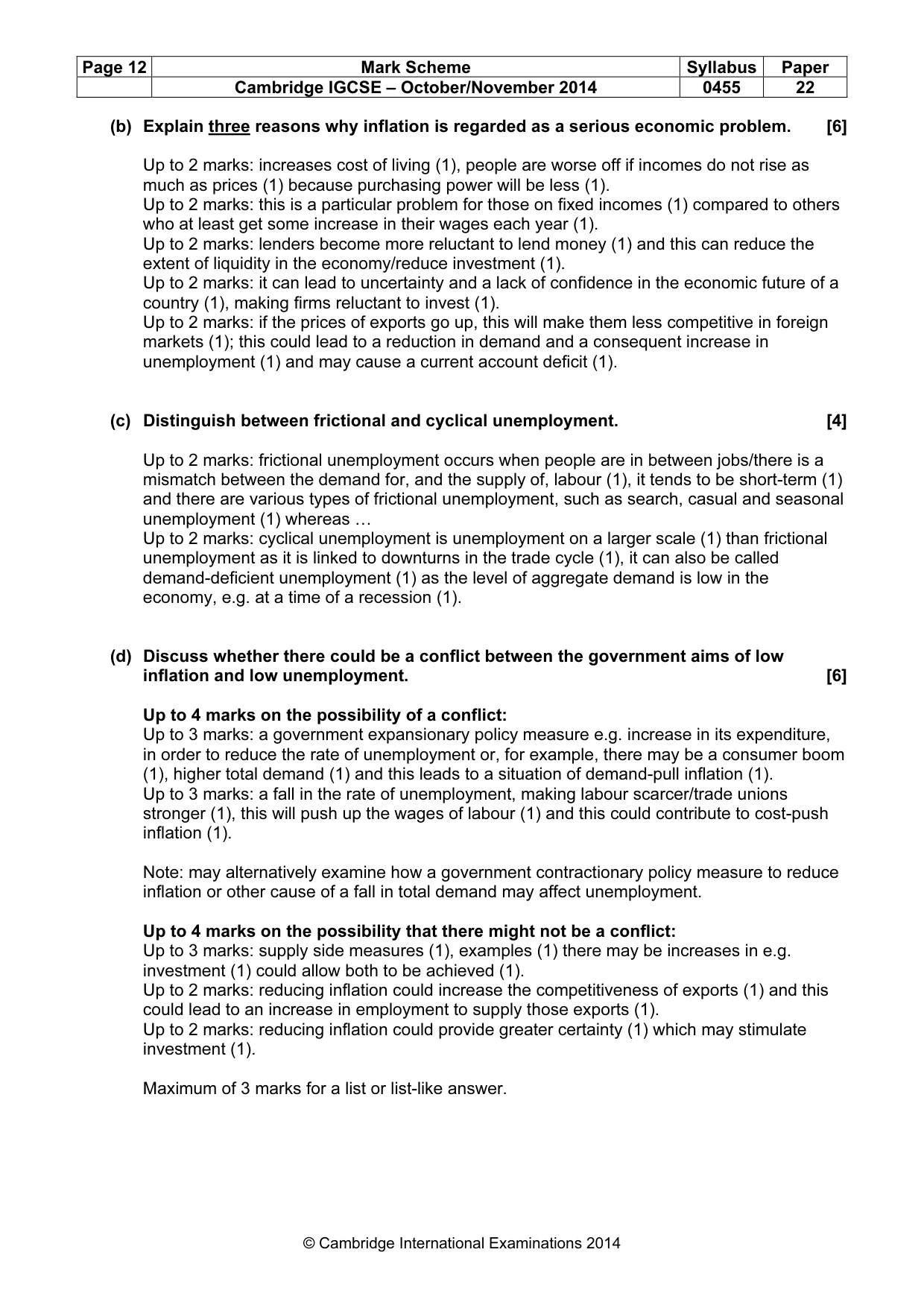
Page 12 Mark Scheme Syllabus Paper Cambridge IGCSE – October/November 2014 0455 22 © Cambridge International Examinations 2014 (b) Explain three reasons why inflation is regarded as a serious economic problem. [6] Up to 2 marks: increases cost of living (1), people are worse off if incomes do not rise as much as prices (1) because purchasing power will be less (1). Up to 2 marks: this is a particular problem for those on fixed incomes (1) compared to others who at least get some increase in their wages each year (1). Up to 2 marks: lenders become more reluctant to lend money (1) and this can reduce the extent of liquidity in the economy/reduce investment (1). Up to 2 marks: it can lead to uncertainty and a lack of confidence in the economic future of a country (1), making firms reluctant to invest (1). Up to 2 marks: if the prices of exports go up, this will make them less competitive in foreign markets (1); this could lead to a reduction in demand and a consequent increase in unemployment (1) and may cause a current account deficit (1). (c) Distinguish between frictional and cyclical unemployment. [4] Up to 2 marks: frictional unemployment occurs when people are in between jobs/there is a mismatch between the demand for, and the supply of, labour (1), it tends to be short-term (1) and there are various types of frictional unemployment, such as search, casual and seasonal unemployment (1) whereas … Up to 2 marks: cyclical unemployment is unemployment on a larger scale (1) than frictional unemployment as it is linked to downturns in the trade cycle (1), it can also be called demand-deficient unemployment (1) as the level of aggregate demand is low in the economy, e.g. at a time of a recession (1). (d) Discuss whether there could be a conflict between the government aims of low inflation and low unemployment. [6] Up to 4 marks on the possibility of a conflict: Up to 3 marks: a government expansionary policy measure e.g. increase in its expenditure, in order to reduce the rate of unemployment or, for example, there may be a consumer boom (1), higher total demand (1) and this leads to a situation of demand-pull inflation (1). Up to 3 marks: a fall in the rate of unemployment, making labour scarcer/trade unions stronger (1), this will push up the wages of labour (1) and this could contribute to cost-push inflation (1). Note: may alternatively examine how a government contractionary policy measure to reduce inflation or other cause of a fall in total demand may affect unemployment. Up to 4 marks on the possibility that there might not be a conflict: Up to 3 marks: supply side measures (1), examples (1) there may be increases in e.g. investment (1) could allow both to be achieved (1). Up to 2 marks: reducing inflation could increase the competitiveness of exports (1) and this could lead to an increase in employment to supply those exports (1). Up to 2 marks: reducing inflation could provide greater certainty (1) which may stimulate investment (1). Maximum of 3 marks for a list or list-like answer.
Mark scheme, page 13
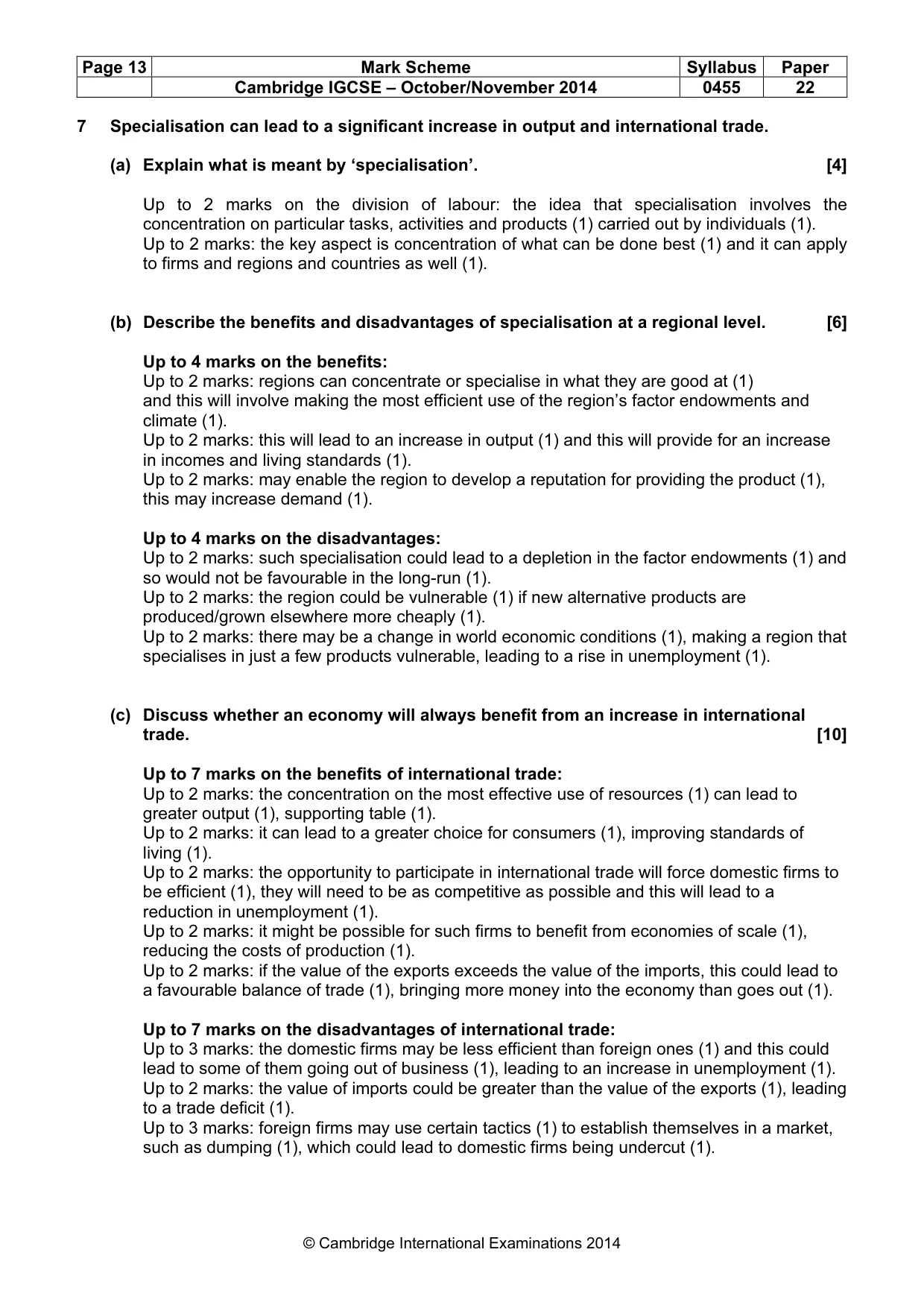
Page 13 Mark Scheme Syllabus Paper Cambridge IGCSE – October/November 2014 0455 22 © Cambridge International Examinations 2014 7 Specialisation can lead to a significant increase in output and international trade. (a) Explain what is meant by ‘specialisation’. [4] Up to 2 marks on the division of labour: the idea that specialisation involves the concentration on particular tasks, activities and products (1) carried out by individuals (1). Up to 2 marks: the key aspect is concentration of what can be done best (1) and it can apply to firms and regions and countries as well (1). (b) Describe the benefits and disadvantages of specialisation at a regional level. [6] Up to 4 marks on the benefits: Up to 2 marks: regions can concentrate or specialise in what they are good at (1) and this will involve making the most efficient use of the region’s factor endowments and climate (1). Up to 2 marks: this will lead to an increase in output (1) and this will provide for an increase in incomes and living standards (1). Up to 2 marks: may enable the region to develop a reputation for providing the product (1), this may increase demand (1). Up to 4 marks on the disadvantages: Up to 2 marks: such specialisation could lead to a depletion in the factor endowments (1) and so would not be favourable in the long-run (1). Up to 2 marks: the region could be vulnerable (1) if new alternative products are produced/grown elsewhere more cheaply (1). Up to 2 marks: there may be a change in world economic conditions (1), making a region that specialises in just a few products vulnerable, leading to a rise in unemployment (1). (c) Discuss whether an economy will always benefit from an increase in international trade. [10] Up to 7 marks on the benefits of international trade: Up to 2 marks: the concentration on the most effective use of resources (1) can lead to greater output (1), supporting table (1). Up to 2 marks: it can lead to a greater choice for consumers (1), improving standards of living (1). Up to 2 marks: the opportunity to participate in international trade will force domestic firms to be efficient (1), they will need to be as competitive as possible and this will lead to a reduction in unemployment (1). Up to 2 marks: it might be possible for such firms to benefit from economies of scale (1), reducing the costs of production (1). Up to 2 marks: if the value of the exports exceeds the value of the imports, this could lead to a favourable balance of trade (1), bringing more money into the economy than goes out (1). Up to 7 marks on the disadvantages of international trade: Up to 3 marks: the domestic firms may be less efficient than foreign ones (1) and this could lead to some of them going out of business (1), leading to an increase in unemployment (1). Up to 2 marks: the value of imports could be greater than the value of the exports (1), leading to a trade deficit (1). Up to 3 marks: foreign firms may use certain tactics (1) to establish themselves in a market, such as dumping (1), which could lead to domestic firms being undercut (1).
What you needed in this session
Cambridge’s own grade thresholds for 2014 Oct/Nov, Paper 2 · Variant 2. A higher threshold means an easier paper — the bar moves with how the cohort did.