Cambridge IGCSE Economics 0455 — 2014 Oct/Nov Paper 2 · Variant 1
0455/21/O/N/14 · 90 marks · ≈101 min
The question paper and its mark scheme, free to read here and free to download. This is Cambridge’s own paper, exactly as it was sat.
Question paper4 pages
Mark scheme19 pages
Answers below. Sit the paper first if you are practising.
Paper as text
Question paper, page 1
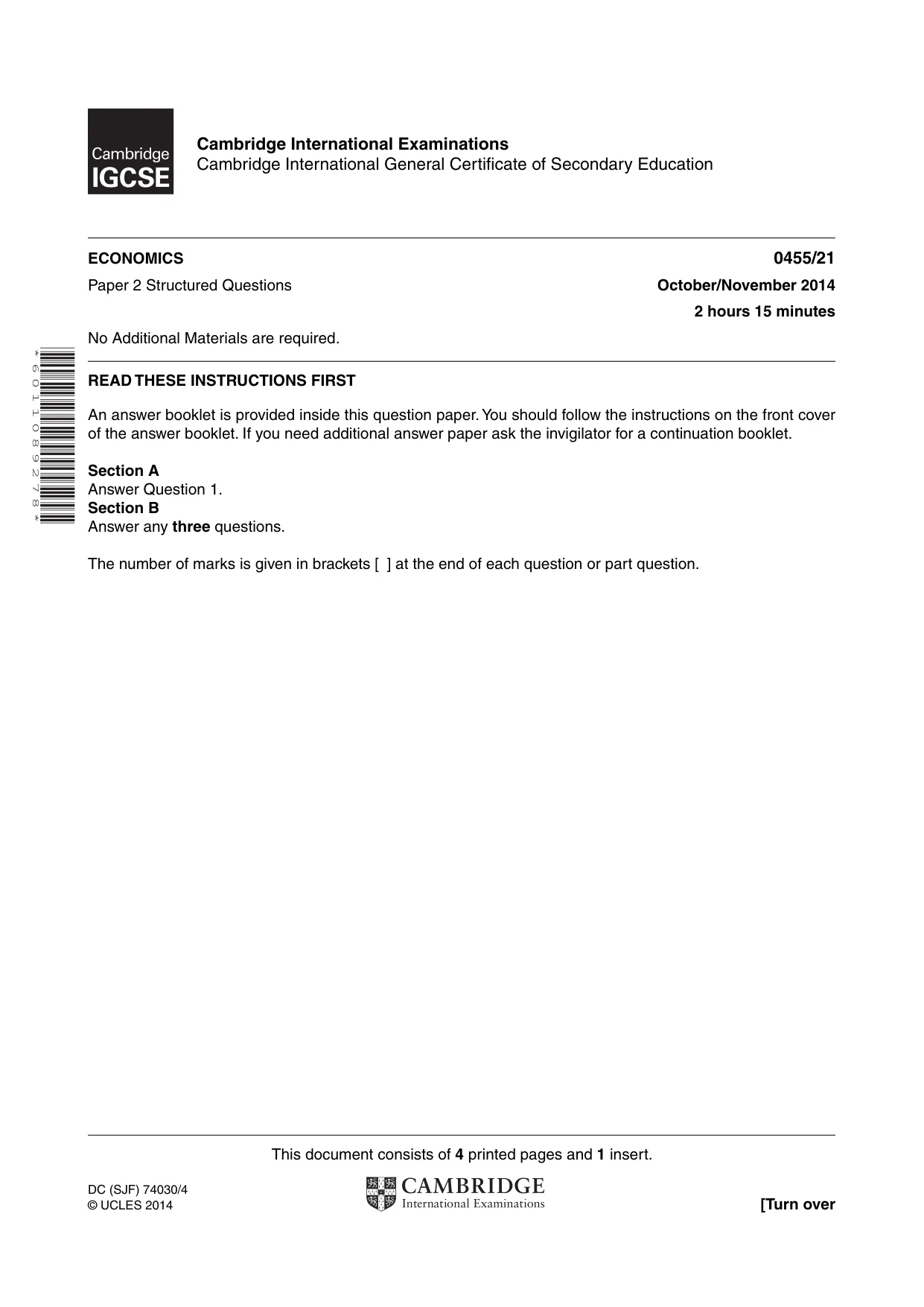
This document consists of 4 printed pages and 1 insert. DC (SJF) 74030/4 © UCLES 2014 [Turn over Cambridge International Examinations Cambridge International General Certificate of Secondary Education * 6 0 1 1 0 8 9 2 7 8 * ECONOMICS 0455/21 Paper 2 Structured Questions October/November 2014 2 hours 15 minutes No Additional Materials are required. READ THESE INSTRUCTIONS FIRST An answer booklet is provided inside this question paper. You should follow the instructions on the front cover of the answer booklet. If you need additional answer paper ask the invigilator for a continuation booklet. Section A Answer Question 1. Section B Answer any three questions. The number of marks is given in brackets [ ] at the end of each question or part question.
Question paper, page 2
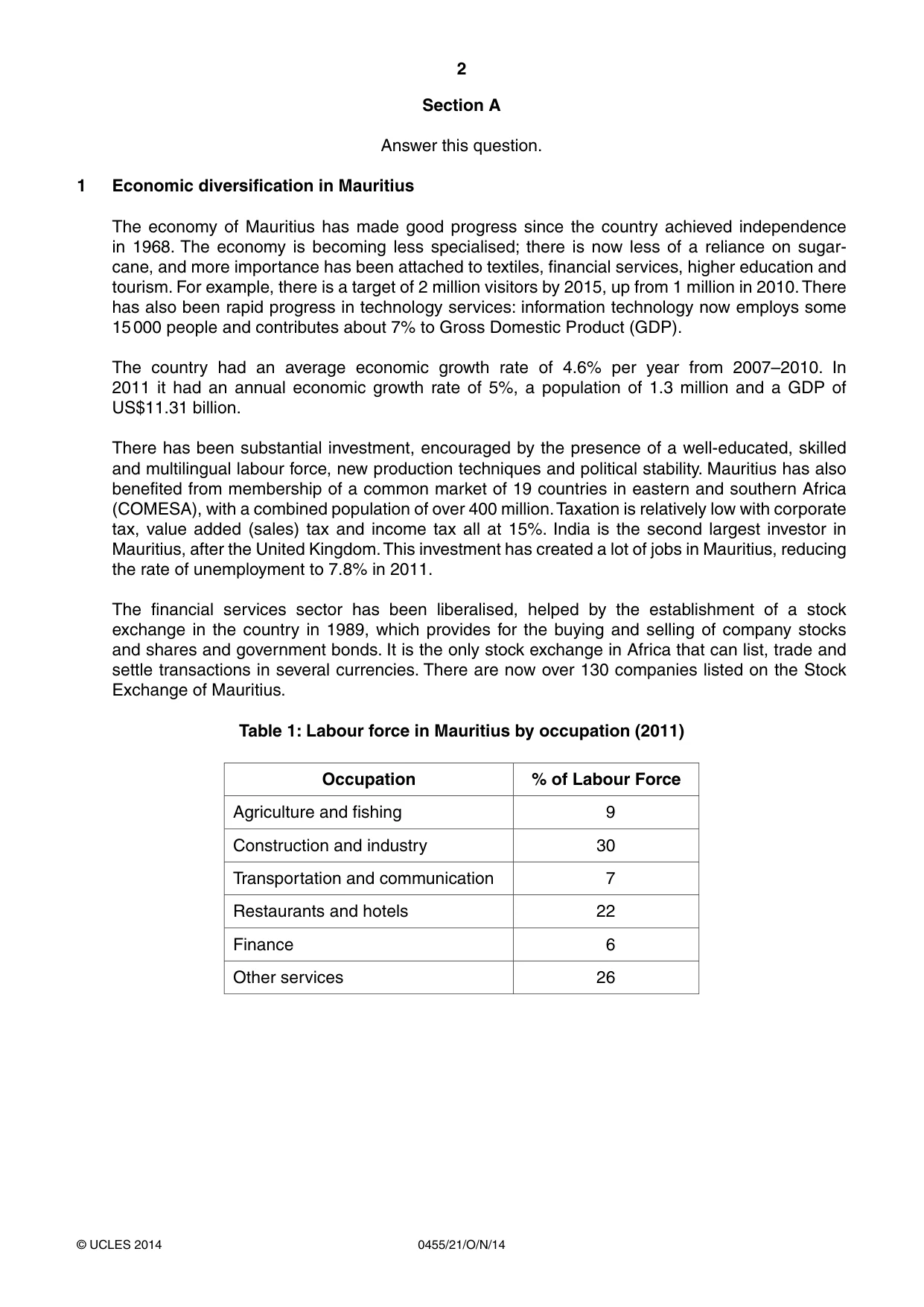
2 0455/21/O/N/14 © UCLES 2014 Section A Answer this question. 1 Economic diversification in Mauritius The economy of Mauritius has made good progress since the country achieved independence in 1968. The economy is becoming less specialised; there is now less of a reliance on sugar- cane, and more importance has been attached to textiles, financial services, higher education and tourism. For example, there is a target of 2 million visitors by 2015, up from 1 million in 2010. There has also been rapid progress in technology services: information technology now employs some 15 000 people and contributes about 7% to Gross Domestic Product (GDP). The country had an average economic growth rate of 4.6% per year from 2007–2010. In 2011 it had an annual economic growth rate of 5%, a population of 1.3 million and a GDP of US$11.31 billion. There has been substantial investment, encouraged by the presence of a well-educated, skilled and multilingual labour force, new production techniques and political stability. Mauritius has also benefited from membership of a common market of 19 countries in eastern and southern Africa (COMESA), with a combined population of over 400 million. Taxation is relatively low with corporate tax, value added (sales) tax and income tax all at 15%. India is the second largest investor in Mauritius, after the United Kingdom. This investment has created a lot of jobs in Mauritius, reducing the rate of unemployment to 7.8% in 2011. The financial services sector has been liberalised, helped by the establishment of a stock exchange in the country in 1989, which provides for the buying and selling of company stocks and shares and government bonds. It is the only stock exchange in Africa that can list, trade and settle transactions in several currencies. There are now over 130 companies listed on the Stock Exchange of Mauritius. Table 1: Labour force in Mauritius by occupation (2011) Occupation % of Labour Force Agriculture and fishing 9 Construction and industry 30 Transportation and communication 7 Restaurants and hotels 22 Finance 6 Other services 26
Question paper, page 3
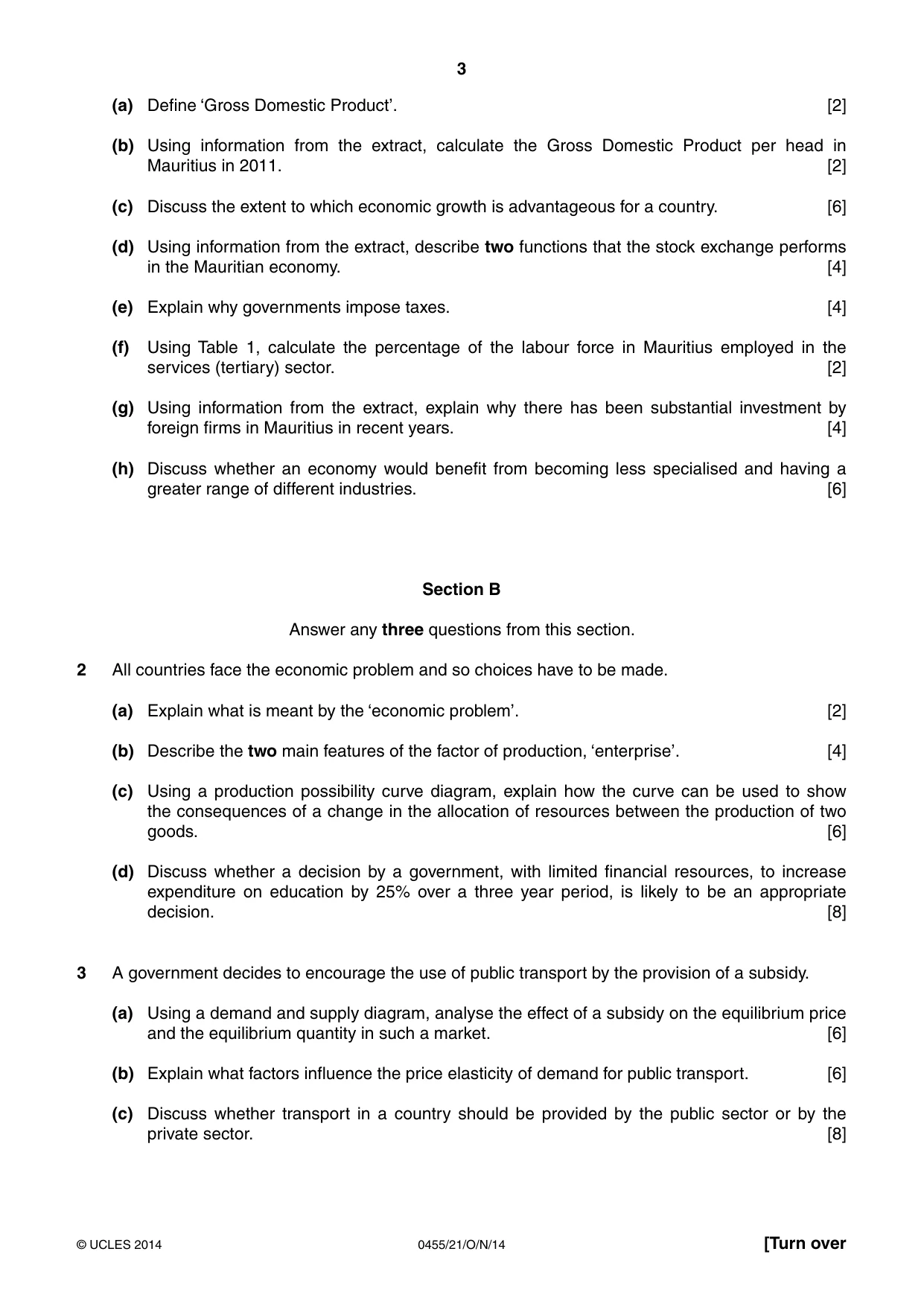
3 0455/21/O/N/14 © UCLES 2014 [Turn over (a) Define ‘Gross Domestic Product’. [2] (b) Using information from the extract, calculate the Gross Domestic Product per head in Mauritius in 2011. [2] (c) Discuss the extent to which economic growth is advantageous for a country. [6] (d) Using information from the extract, describe two functions that the stock exchange performs in the Mauritian economy. [4] (e) Explain why governments impose taxes. [4] (f) Using Table 1, calculate the percentage of the labour force in Mauritius employed in the services (tertiary) sector. [2] (g) Using information from the extract, explain why there has been substantial investment by foreign firms in Mauritius in recent years. [4] (h) Discuss whether an economy would benefit from becoming less specialised and having a greater range of different industries. [6] Section B Answer any three questions from this section. 2 All countries face the economic problem and so choices have to be made. (a) Explain what is meant by the ‘economic problem’. [2] (b) Describe the two main features of the factor of production, ‘enterprise’. [4] (c) Using a production possibility curve diagram, explain how the curve can be used to show the consequences of a change in the allocation of resources between the production of two goods. [6] (d) Discuss whether a decision by a government, with limited financial resources, to increase expenditure on education by 25% over a three year period, is likely to be an appropriate decision. [8] 3 A government decides to encourage the use of public transport by the provision of a subsidy. (a) Using a demand and supply diagram, analyse the effect of a subsidy on the equilibrium price and the equilibrium quantity in such a market. [6] (b) Explain what factors influence the price elasticity of demand for public transport. [6] (c) Discuss whether transport in a country should be provided by the public sector or by the private sector. [8]
Question paper, page 4
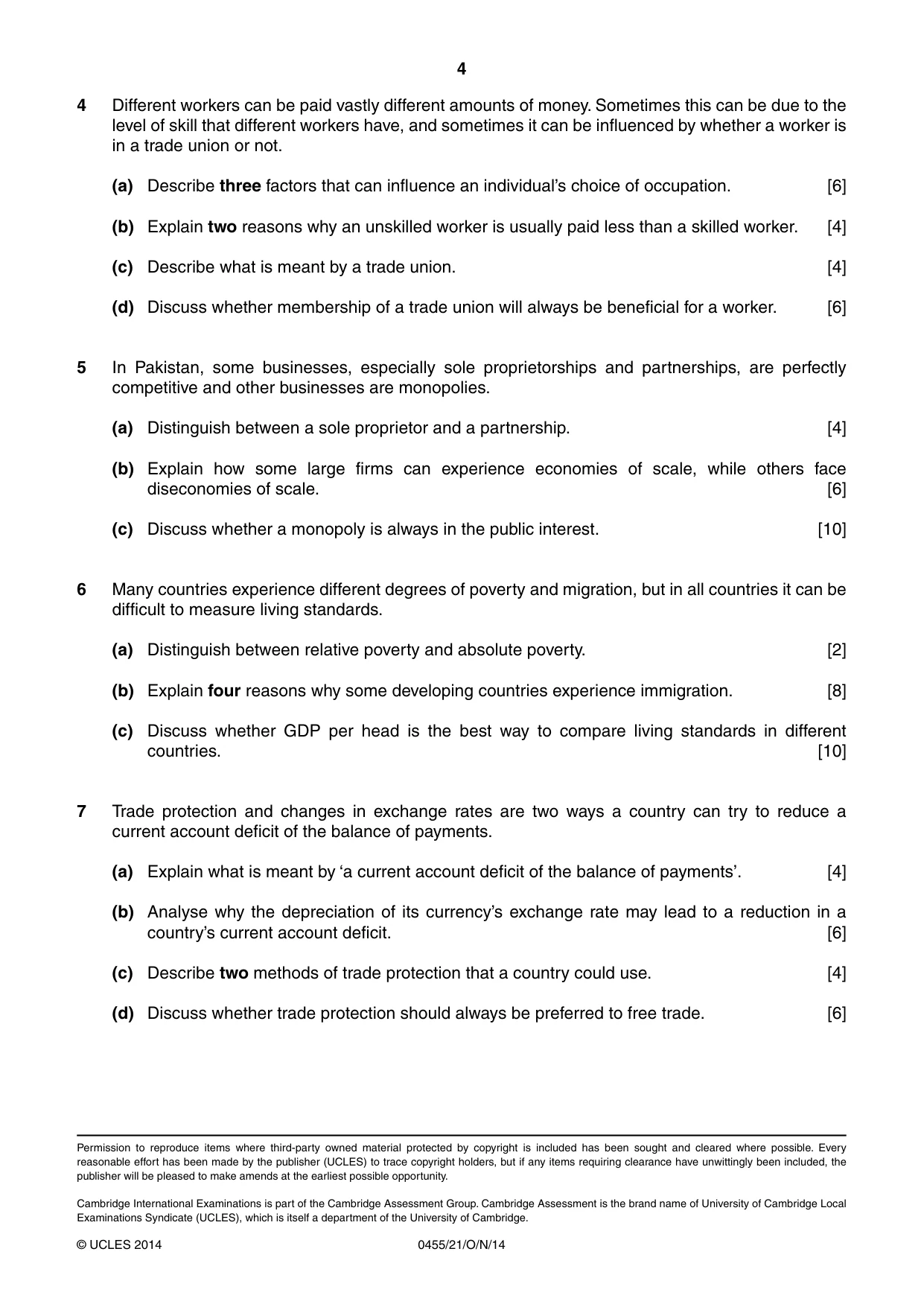
4 0455/21/O/N/14 © UCLES 2014 Permission to reproduce items where third-party owned material protected by copyright is included has been sought and cleared where possible. Every reasonable effort has been made by the publisher (UCLES) to trace copyright holders, but if any items requiring clearance have unwittingly been included, the publisher will be pleased to make amends at the earliest possible opportunity. Cambridge International Examinations is part of the Cambridge Assessment Group. Cambridge Assessment is the brand name of University of Cambridge Local Examinations Syndicate (UCLES), which is itself a department of the University of Cambridge. 4 Different workers can be paid vastly different amounts of money. Sometimes this can be due to the level of skill that different workers have, and sometimes it can be influenced by whether a worker is in a trade union or not. (a) Describe three factors that can influence an individual’s choice of occupation. [6] (b) Explain two reasons why an unskilled worker is usually paid less than a skilled worker. [4] (c) Describe what is meant by a trade union. [4] (d) Discuss whether membership of a trade union will always be beneficial for a worker. [6] 5 In Pakistan, some businesses, especially sole proprietorships and partnerships, are perfectly competitive and other businesses are monopolies. (a) Distinguish between a sole proprietor and a partnership. [4] (b) Explain how some large firms can experience economies of scale, while others face diseconomies of scale. [6] (c) Discuss whether a monopoly is always in the public interest. [10] 6 Many countries experience different degrees of poverty and migration, but in all countries it can be difficult to measure living standards. (a) Distinguish between relative poverty and absolute poverty. [2] (b) Explain four reasons why some developing countries experience immigration. [8] (c) Discuss whether GDP per head is the best way to compare living standards in different countries. [10] 7 Trade protection and changes in exchange rates are two ways a country can try to reduce a current account deficit of the balance of payments. (a) Explain what is meant by ‘a current account deficit of the balance of payments’. [4] (b) Analyse why the depreciation of its currency’s exchange rate may lead to a reduction in a country’s current account deficit. [6] (c) Describe two methods of trade protection that a country could use. [4] (d) Discuss whether trade protection should always be preferred to free trade. [6]
Mark scheme, page 1
® IGCSE is the registered trademark of Cambridge International Examinations. CAMBRIDGE INTERNATIONAL EXAMINATIONS Cambridge International General Certificate of Secondary Education MARK SCHEME for the October/November 2014 series 0455 ECONOMICS 0455/21 Paper 2 (Structured Questions), maximum raw mark 90 This mark scheme is published as an aid to teachers and candidates, to indicate the requirements of the examination. It shows the basis on which Examiners were instructed to award marks. It does not indicate the details of the discussions that took place at an Examiners’ meeting before marking began, which would have considered the acceptability of alternative answers. Mark schemes should be read in conjunction with the question paper and the Principal Examiner Report for Teachers. Cambridge will not enter into discussions about these mark schemes. Cambridge is publishing the mark schemes for the October/November 2014 series for most Cambridge IGCSE®, Cambridge International A and AS Level components and some Cambridge O Level components.
Mark scheme, page 2
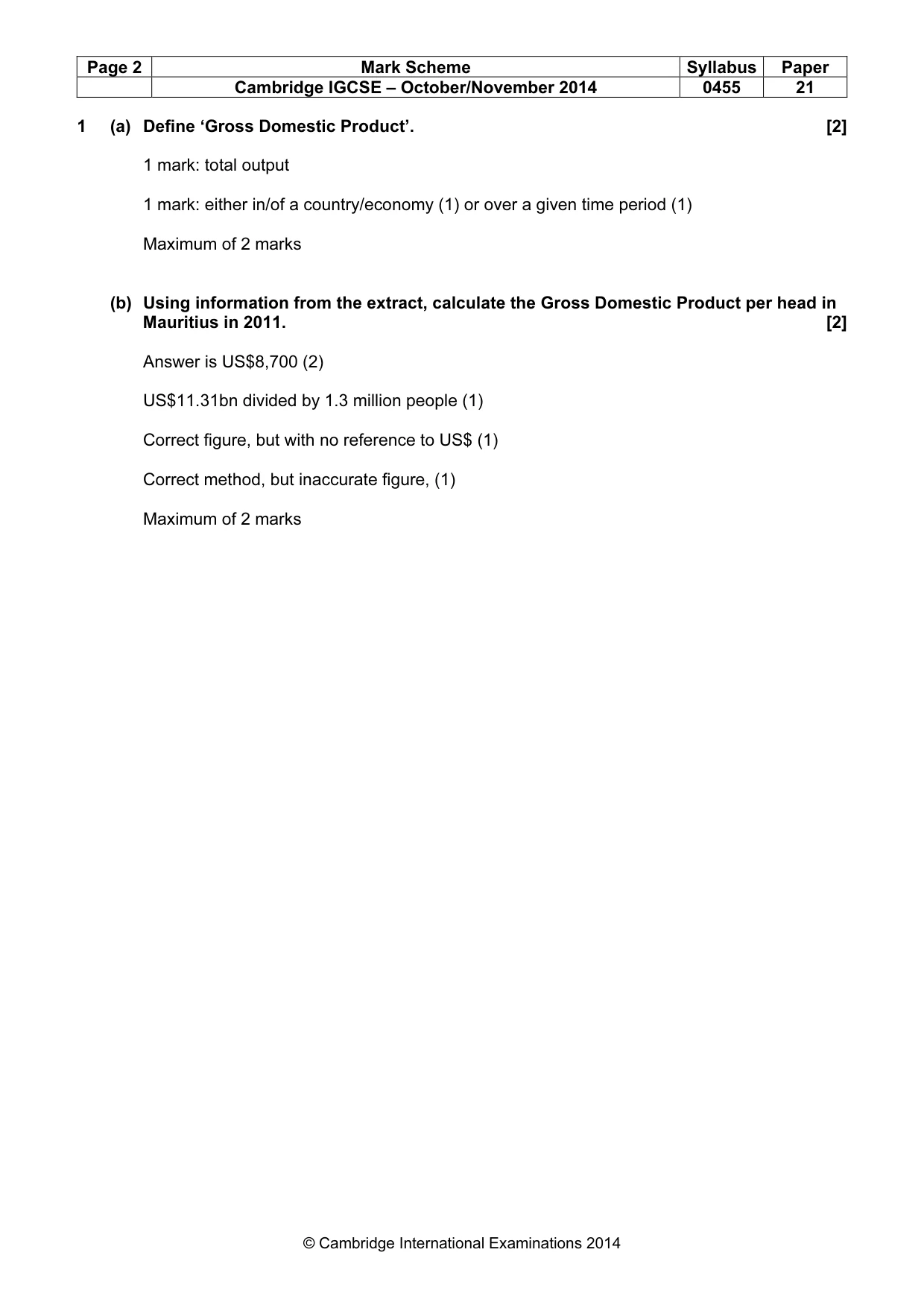
Page 2 Mark Scheme Syllabus Paper Cambridge IGCSE – October/November 2014 0455 21 © Cambridge International Examinations 2014 1 (a) Define ‘Gross Domestic Product’. [2] 1 mark: total output 1 mark: either in/of a country/economy (1) or over a given time period (1) Maximum of 2 marks (b) Using information from the extract, calculate the Gross Domestic Product per head in Mauritius in 2011. [2] Answer is US$8,700 (2) US$11.31bn divided by 1.3 million people (1) Correct figure, but with no reference to US$ (1) Correct method, but inaccurate figure, (1) Maximum of 2 marks
Mark scheme, page 3
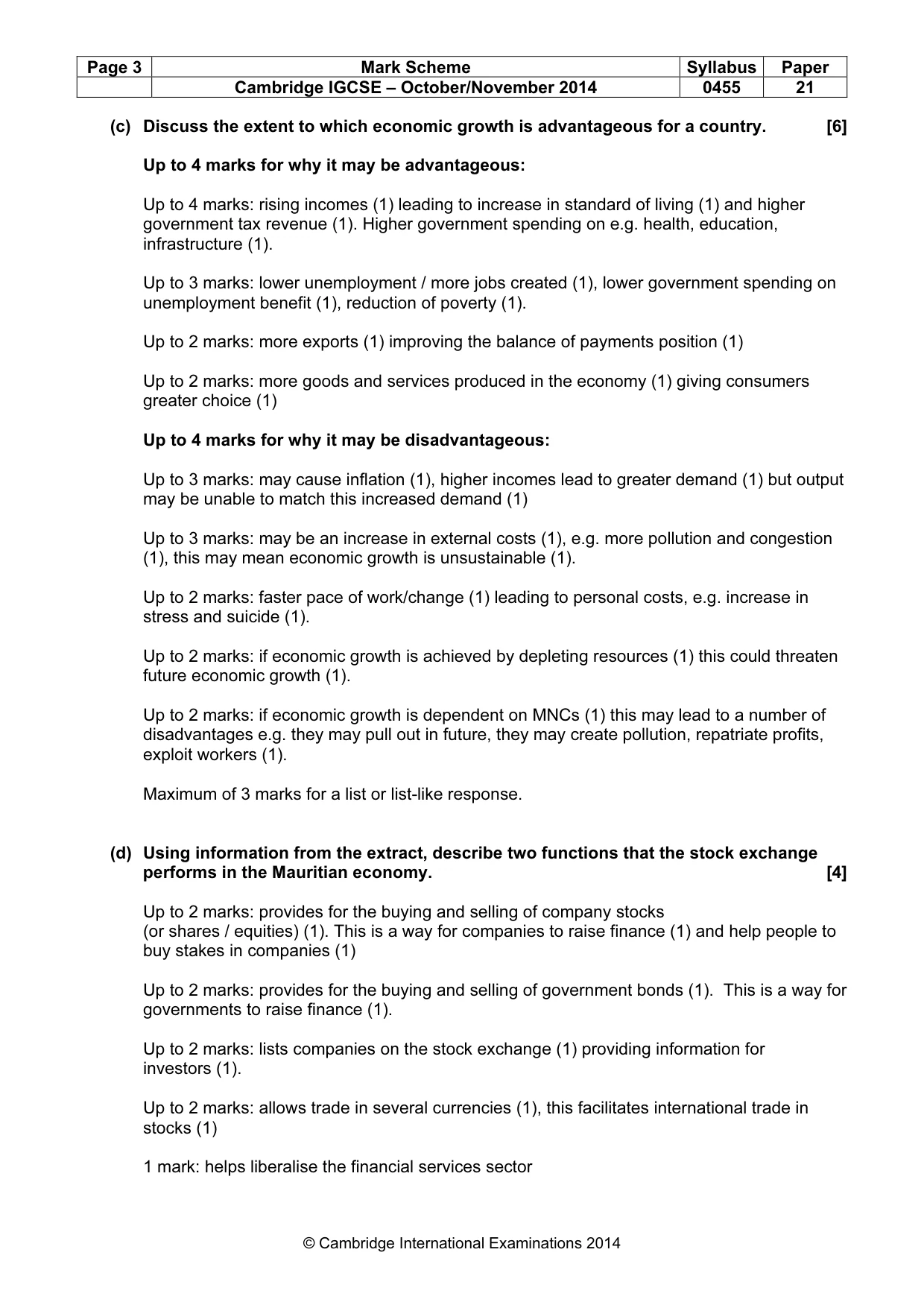
Page 3 Mark Scheme Syllabus Paper Cambridge IGCSE – October/November 2014 0455 21 © Cambridge International Examinations 2014 (c) Discuss the extent to which economic growth is advantageous for a country. [6] Up to 4 marks for why it may be advantageous: Up to 4 marks: rising incomes (1) leading to increase in standard of living (1) and higher government tax revenue (1). Higher government spending on e.g. health, education, infrastructure (1). Up to 3 marks: lower unemployment / more jobs created (1), lower government spending on unemployment benefit (1), reduction of poverty (1). Up to 2 marks: more exports (1) improving the balance of payments position (1) Up to 2 marks: more goods and services produced in the economy (1) giving consumers greater choice (1) Up to 4 marks for why it may be disadvantageous: Up to 3 marks: may cause inflation (1), higher incomes lead to greater demand (1) but output may be unable to match this increased demand (1) Up to 3 marks: may be an increase in external costs (1), e.g. more pollution and congestion (1), this may mean economic growth is unsustainable (1). Up to 2 marks: faster pace of work/change (1) leading to personal costs, e.g. increase in stress and suicide (1). Up to 2 marks: if economic growth is achieved by depleting resources (1) this could threaten future economic growth (1). Up to 2 marks: if economic growth is dependent on MNCs (1) this may lead to a number of disadvantages e.g. they may pull out in future, they may create pollution, repatriate profits, exploit workers (1). Maximum of 3 marks for a list or list-like response. (d) Using information from the extract, describe two functions that the stock exchange performs in the Mauritian economy. [4] Up to 2 marks: provides for the buying and selling of company stocks (or shares / equities) (1). This is a way for companies to raise finance (1) and help people to buy stakes in companies (1) Up to 2 marks: provides for the buying and selling of government bonds (1). This is a way for governments to raise finance (1). Up to 2 marks: lists companies on the stock exchange (1) providing information for investors (1). Up to 2 marks: allows trade in several currencies (1), this facilitates international trade in stocks (1) 1 mark: helps liberalise the financial services sector
Mark scheme, page 4
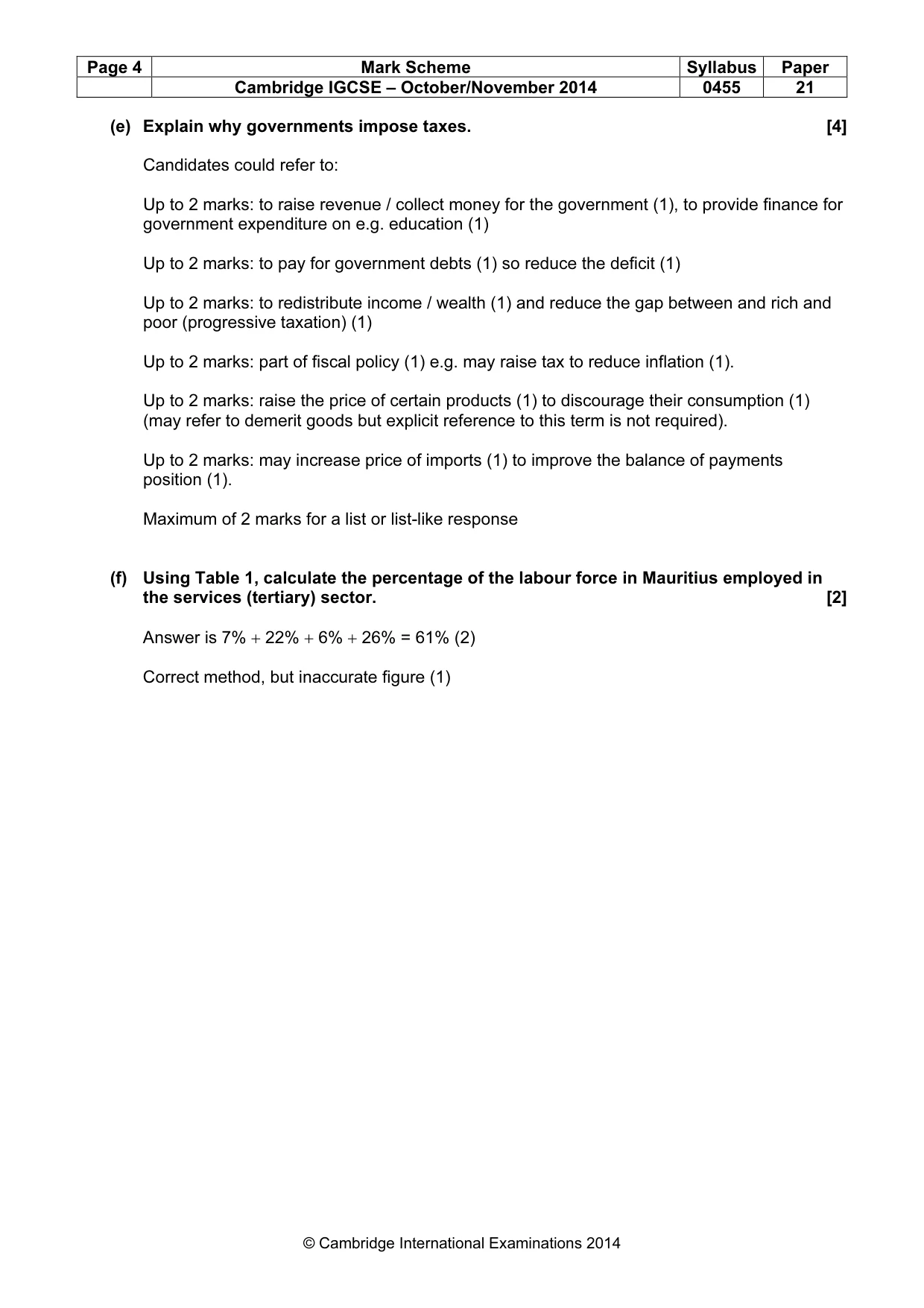
Page 4 Mark Scheme Syllabus Paper Cambridge IGCSE – October/November 2014 0455 21 © Cambridge International Examinations 2014 (e) Explain why governments impose taxes. [4] Candidates could refer to: Up to 2 marks: to raise revenue / collect money for the government (1), to provide finance for government expenditure on e.g. education (1) Up to 2 marks: to pay for government debts (1) so reduce the deficit (1) Up to 2 marks: to redistribute income / wealth (1) and reduce the gap between and rich and poor (progressive taxation) (1) Up to 2 marks: part of fiscal policy (1) e.g. may raise tax to reduce inflation (1). Up to 2 marks: raise the price of certain products (1) to discourage their consumption (1) (may refer to demerit goods but explicit reference to this term is not required). Up to 2 marks: may increase price of imports (1) to improve the balance of payments position (1). Maximum of 2 marks for a list or list-like response (f) Using Table 1, calculate the percentage of the labour force in Mauritius employed in the services (tertiary) sector. [2] Answer is 7% + 22% + 6% + 26% = 61% (2) Correct method, but inaccurate figure (1)
Mark scheme, page 5
Page 5 Mark Scheme Syllabus Paper Cambridge IGCSE – October/November 2014 0455 21 © Cambridge International Examinations 2014 (g) Using information from the extract, explain why there has been substantial investment by foreign firms in Mauritius in recent years. [4] Candidates could refer to: Up to 2 marks: well-educated, skilled and multi-lingual workforce (1) which could contribute to higher productivity (1) and lower costs of production (1). Up to 3 marks: new production techniques/advances in technology (1) which could give rise to economies of scale (1) and development/innovation of new products (1) Up to 3 marks: political stability (1), less change (1), less likelihood of wars/riots (1) giving greater certainty for investors (1) Up to 2 marks: membership of a common market (COMESA – Common Market for Eastern and Southern Africa) (1), very large market (1) Up to 3 marks: relatively low rates of taxation (1), which reduces firms’ costs and increases spending (1) and makes it more attractive than other countries (1) Up to 2 marks: flat tax rate e.g. 15% corporate, value added and income taxes (1) are simple to operate and budget for (1). Maximum of 2 marks for a list-like response or more than two undeveloped points.
Mark scheme, page 6
Page 6 Mark Scheme Syllabus Paper Cambridge IGCSE – October/November 2014 0455 21 © Cambridge International Examinations 2014 (h) Discuss whether an economy would benefit from becoming less specialised and having a greater range of different industries. [6] Up to 4 marks for possible benefits: Up to 4 marks: broader spread of industries (1), leading to less reliance on one or a few particular industries (1). This lowers risk (1), as demand for one type of product may fall (1), or there may be problems with supply, especially in primary sector (1). Up to 3 marks: more industries may be linked to economic development (1) and movement in all countries from primary, through secondary, to tertiary sector (1), should lead to higher standards of living in the country (1). Up to 4 marks for possible disadvantages: Up to 4 marks: it may be difficult to identify which industries to develop (1) and the country may not be as efficient as other countries in producing other products/services (1). Costs are always changing, e.g. economies of scale may be overestimated and problems of diseconomies of scale may be underestimated (1) or set up costs may be high for new industries (1). If a mistake is made in the industries developed, resources will have been wasted setting up new and unprofitable industries (1). Up to 4 marks: country may not have the appropriate resources (1). Labour may lack the skills/knowledge for the new areas (1) and there may be a lack of capital to support the new industries (1) or this could lead to over-reliance on foreign investors (1). Up to 2 marks: Other countries may react to the development of new industries by imposing trade restrictions (1). If they do this, it will make this country’s products uncompetitive (1). Maximum of 4 marks for an indirect approach examining the benefits (2) and disadvantages (2) of specialisation. Maximum of 3 marks for a list or list-like response. 2 All countries face the economic problem and so choices have to be made. (a) Explain what is meant by the ‘economic problem’. [2] There are finite/limited/scarce resources (1) but unlimited/infinite wants (1) and so it is necessary for a choice to be made (1) Maximum of 2 marks (b) Describe the two main features of the factor of production, ‘enterprise’. [4] 2 marks for identifying the two features: • bringing together/combining the other factors of production (1) • bearing risks (1) 2 marks for describing the two features: • making a decision about how to combine/which factors to employ/whether to be labour- intensive or capital-intensive (1) • risking own money/recognising risk/risk could include natural disasters, new competitors/change in technology/reward for the risk is profit (1)
Mark scheme, page 7
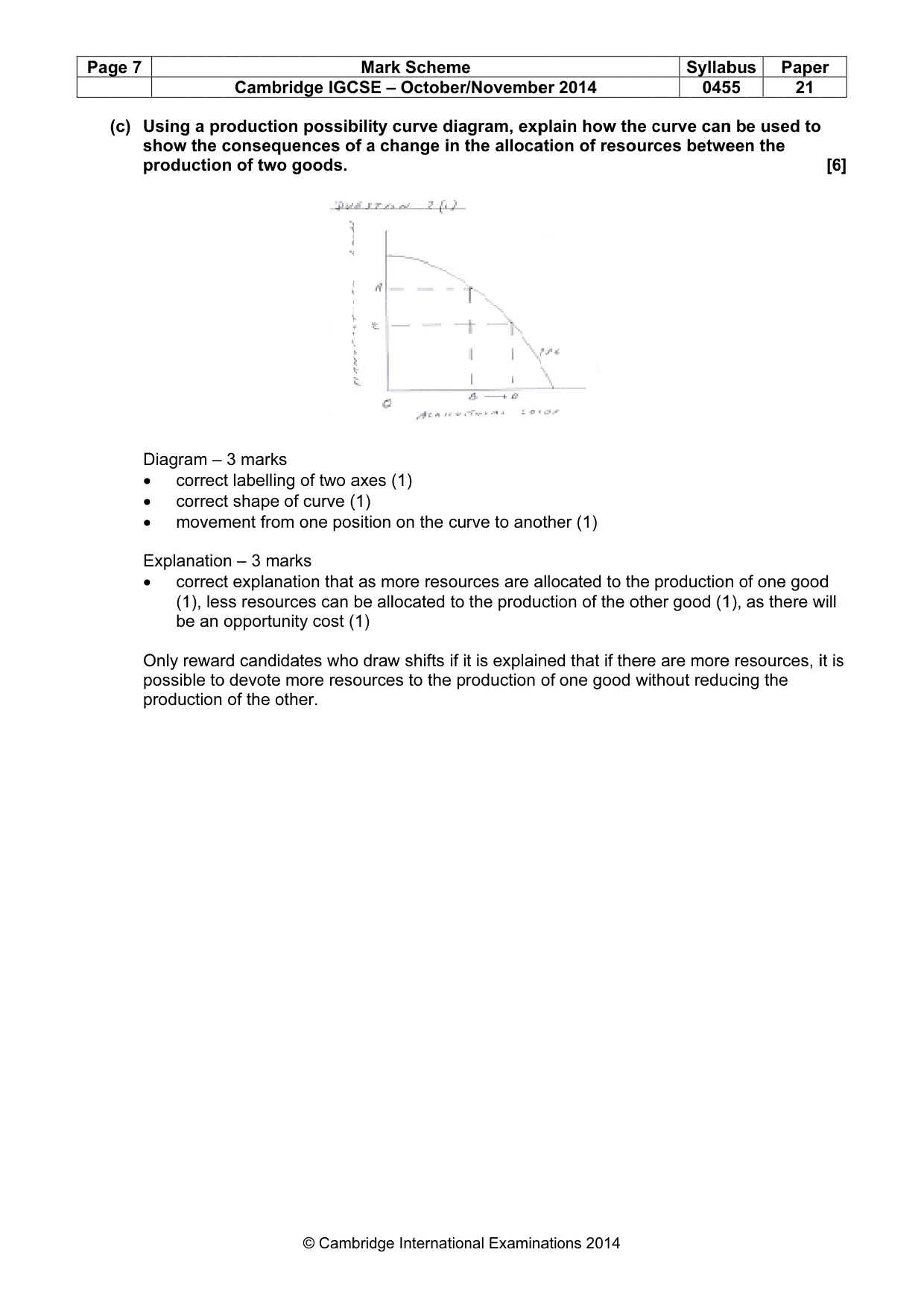
P Pag ( ge (c) 7 U s p D • • • E • O p p Usi sho pro Dia • • • Exp • Onl pos pro ing ow odu agra co co m pla co (1 be ly r ssib du g a th uct am orr orr mov nat orr 1), e a rew ble ctio pr he c tion m – rect rect vem tion rect les an war to on C rod co n o 3 m t la t s me n – t ex ss op rd c o de of Cam duc ns of t ma abe ha nt f – 3 xp res po can evo th mb ctio eq two arks ellin pe fro m lan sou rtu ndi ote e o brid on que o g s ng of m ark nat urc unit da e m oth dge © po enc goo of f cu on ks ion es ty c ates ore er. e IG Ca oss ces ods tw urv e p n th ca cos s w e re GC amb sib s o s. wo a e ( pos hat an st ( who eso M CSE brid bilit of a axe (1) sitio as be 1) o d our Mar E – dge ty a ch es on s m all raw rce k S – O e In cu ha (1) on mor loc w s es t Sch Oct nter urve ng ) n th re r cate shif to t hem ob rnat e d ge i he res ed fts the me ber/ tion dia in t cu ou to if i e p e /No nal agra the rve rce the t is rod ove Ex am e a e to es e p s ex duc em xam m, e allo o a are pro xpl ctio mbe mina exp oca ano e a du lain on er 2 atio pla atio othe allo ctio ned of 20 ons ain on er ( ca on d th on 14 s 20 ho of (1) ted of hat e g 014 ow re d to th t if goo 4 w th so o th e o the od he c our he oth ere wit cu rce pro er e ar tho S rve s b odu go re out Syl 0 e c bet uct ood mo re llab 045 can twe tion d (1 ore du bu 55 n b een n o 1), e re cin s e u n t of o as eso ng t P use the one th ourc the Pa 2 ed e e go ere ces e pe 21 to ood e w s, i er [6 d will it is 6] s
Mark scheme, page 8
Page 8 Mark Scheme Syllabus Paper Cambridge IGCSE – October/November 2014 0455 21 © Cambridge International Examinations 2014 (d) Discuss whether a decision by a government, with limited financial resources, to increase expenditure on education by 25% over a three year period, is likely to be an appropriate decision. [8] Up to 6 marks for why it may be an appropriate decision: Up to 4 marks: increase in expenditure is likely to improve the quality of education (1), this would enhance the skills/knowledge/quality of the workforce (1), leading to greater productivity (1) and a higher rate of economic growth (1). Up to 4 marks: higher education spending should improve health (1) e.g. greater awareness of need for cleanliness/sanitation/diseases/nutrition (1), fewer days missed from work (1) and less spending on health care in the long term (1). Up to 4 marks: more employment opportunities (1) for school leavers/graduates who are better educated (1), also for teachers and school support staff (1). Labour becomes more geographically and occupationally mobile (1), which reduces frictional and structural unemployment (1). Up to 3 marks: educated school leavers are more likely to be innovative (1) and start new businesses (1), this will create employment (1) Up to 3 marks: incomes will increase (1), demand/spending in the economy will increase (1), tax revenues will rise (1) (multiplier effect but this term not expected). Up to 2 marks: education provides awareness of family planning (1), this could reduce population pressures on the economy (1) Up to 6 marks for why it may not be an appropriate decision: Up to 3 marks: there would be an opportunity cost involved (1), given that we are told that the government has limited resources (1). This could lead to other areas of the economy receiving less money e.g. housing, defence, transport (1). Up to 2 marks: those benefiting from the higher education spending may emigrate (brain drain) (1), which may reduce the country’s production/output/productivity (1) and increase the dependency ratio (1). Up to 4 marks: in the short run, if mean years of schooling increase (1) the current labour supply will fall (1). The labour force may become more skilled but there may be a lack of appropriate jobs (1) and this would lead to a waste of resources (1). Up to 2 marks: skills acquired might quickly become outdated e.g. in ICT (1) meaning more spending after 3 years will be required (1) Up to 2 marks: it depends upon the distribution of the extra spending (1). It may only be a small minority which benefits (1) or spending may be on unproductive areas (1) Up to 2 marks: three years could be too short (1). Education investment needs to be long-term (1) Maximum of 4 marks for a list or list-like response.
Mark scheme, page 9
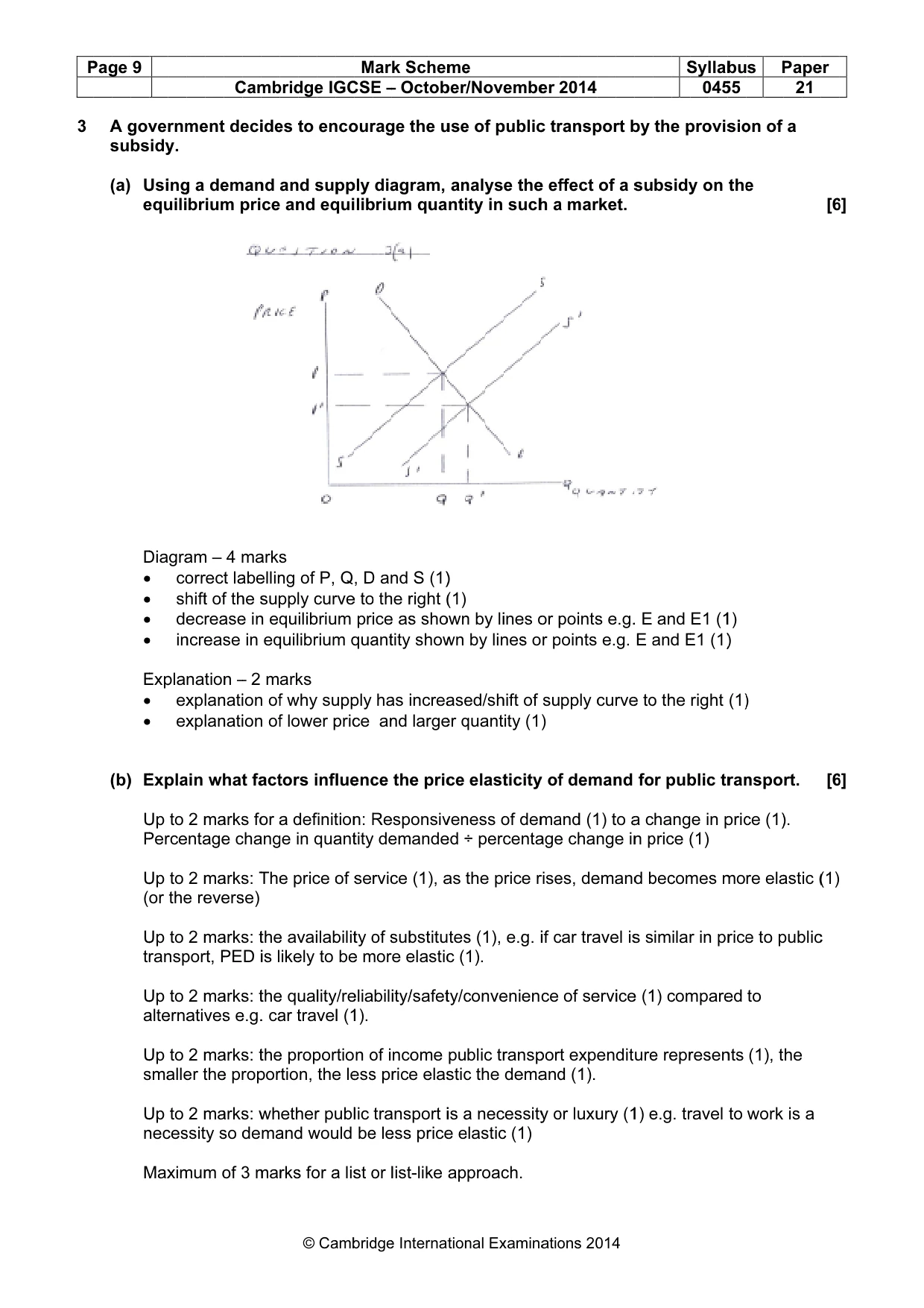
P 3 Pag A s ( ( ge A g su (a) (b) 9 gov bs U e D • • • • E • • ) E U P U ( U tr U a U s U n M ve idy Usi equ Dia • • • • Exp • • Exp Up Per Up or Up ran Up alte Up sma Up nec Max rnm y. ing uili gra co sh de in pla ex ex pla to rce to the to nsp to erna to alle to ces xim me g a br am orr hift ecr ncre nat xpl xpl ain 2 m enta 2 m e re 2 m por 2 m ativ 2 m er t 2 m ssit mum ent de ium m – rect t of rea eas tion lan lan wh ma age ma eve ma rt, P ma ves ma the ma ty s m o C t de em m p 4 m t la f th ase se n – nati nati hat arks e c arks ers arks PE arks s e arks e pr arks so d of 3 Cam eci man pri ma abe he s e in in – 2 ion ion t fa s fo cha s: T se) s: t D i s: t e.g. s: t rop s: w de 3 m mb ide nd ce arks ellin sup n eq eq m n of n of act or a ang The the is l the . ca the por wh ma mar brid es t an an s ng ppl qu quil ark f w f lo tor a d ge i e p e av ike e qu ar t e pr rtio eth and rks dge © to d s nd of ly c ilib ibr ks why owe rs i def n q pric vai ely ual trav rop n, her d w s fo e IG Ca en sup eq P, cur briu rium y su er p nfl finit qua ce o ilab to lity vel por the r pu wou or a GC amb nco pp qui Q rve um m q upp pric lue tion ant of s bilit be y/re l (1 rtio e le ubl uld a lis M CSE brid our ply lib , D e to pri qua ply ce enc n: R tity ser ty o e m elia 1). n o ess lic be st o Mar E – dge rag dia briu D an o th ice ant ha an ce Re y de rvic of s mor bili of i s pr tra e le or l k S – O e In ge t ag um nd he r e as tity as i nd the esp em ce sub e e ity/ nco rice ans ess list Sch Oct nter the ram m qu S righ s s sh inc lar e p on an (1) bst elas /sa om e e spo s pr t-lik hem ob rnat e u m, ua (1) ht ( ho how crea rge pric siv nde ), a titu stic afet me elas ort i rice ke me ber/ tion use an nti ) (1) own wn ase er q ce ven ed ÷ as t tes c ( ty/c pu stic is a e e ap e /No nal e of naly ity n by by ed/ qua ela nes ÷ p the s (1 1). con blic c th a n elas pro ove Ex f p ys in y li y lin /sh ant ast ss o perc e p 1), nve c tr he nec stic oac em xam pub e t su ine nes hift ity tic of d cen rice e.g enie ran de ces c (1 ch. mbe mina blic the uch es o s o of (1 ity dem nta e r g. i en nsp ema sity 1) er 2 atio c tr e ef h a or p r p su ) y of ma age rise if c ce por and y o 20 ons ran ffe a m poi poin pp f d and e ch es, car of rt e d ( or lu 14 s 20 nsp ct mar ints nts ply c em d (1 han de tra se xp 1). uxu 014 por of rke s e e. cur man 1) t nge ema ave ervi en ury 4 rt b a s et. e.g. g. rve nd to a e in and el is ice dit y (1 by su . E E a e to fo a c n p d b s s e (1 ure 1) e the bs an and o th or p cha pric bec im 1) c e re e.g S e p sidy nd d E he pub ng ce ( com ilar com epr . tr Syl 0 pro y o E1 E1 rig blic e i (1) mes r in mp res rav llab 045 ovis on (1 (1) ht c tr n p s m n pr are sen vel bu 55 sio the 1) ) (1) ran pric mo rice ed nts to s on e ) nsp ce re e to to (1) wo P of po (1) ela o p ), t ork Pa 2 a rt. ). ast pub he is pe 21 ic ( blic a er [6 [6 (1) c 6] 6]
Mark scheme, page 10
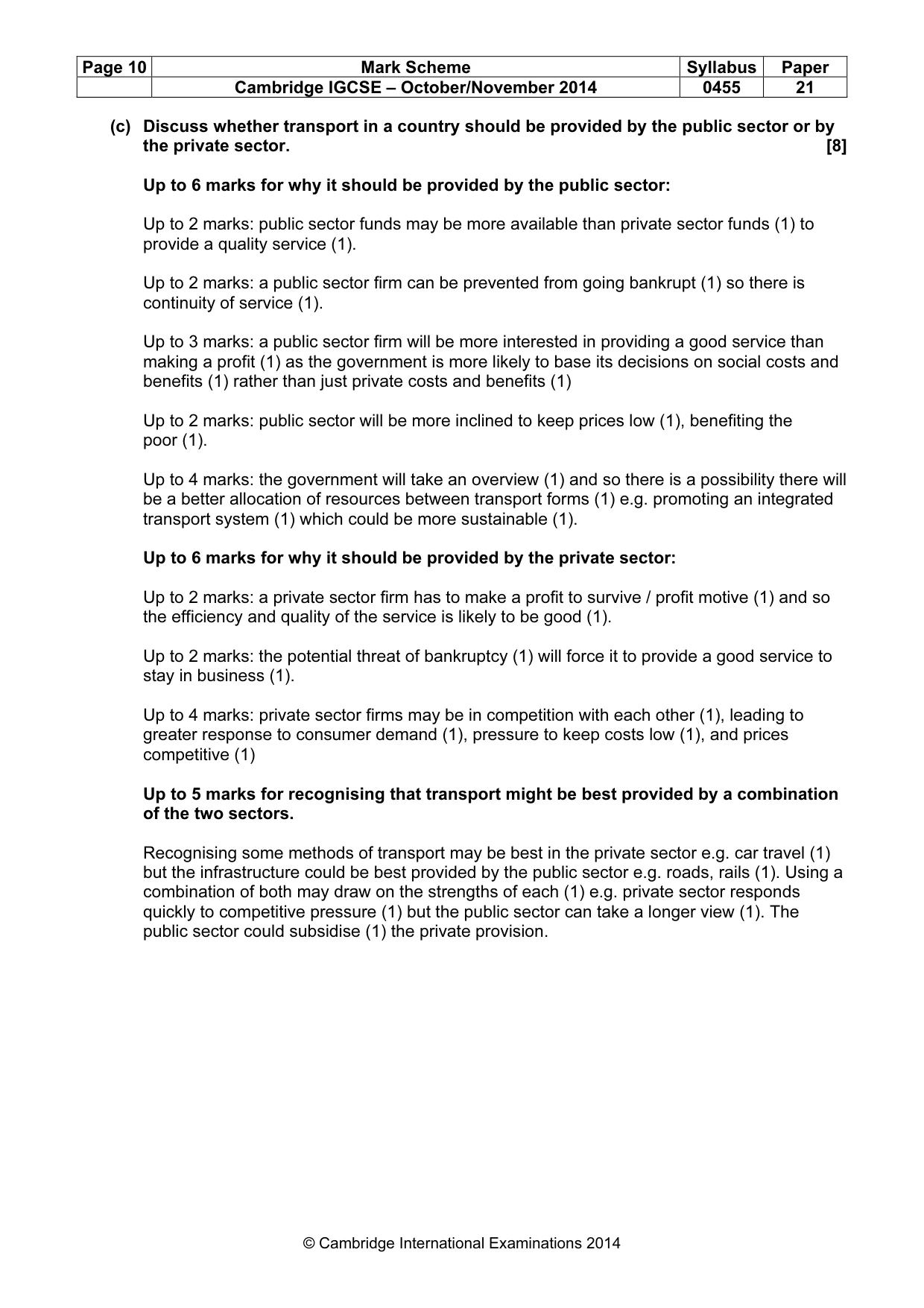
Page 10 Mark Scheme Syllabus Paper Cambridge IGCSE – October/November 2014 0455 21 © Cambridge International Examinations 2014 (c) Discuss whether transport in a country should be provided by the public sector or by the private sector. [8] Up to 6 marks for why it should be provided by the public sector: Up to 2 marks: public sector funds may be more available than private sector funds (1) to provide a quality service (1). Up to 2 marks: a public sector firm can be prevented from going bankrupt (1) so there is continuity of service (1). Up to 3 marks: a public sector firm will be more interested in providing a good service than making a profit (1) as the government is more likely to base its decisions on social costs and benefits (1) rather than just private costs and benefits (1) Up to 2 marks: public sector will be more inclined to keep prices low (1), benefiting the poor (1). Up to 4 marks: the government will take an overview (1) and so there is a possibility there will be a better allocation of resources between transport forms (1) e.g. promoting an integrated transport system (1) which could be more sustainable (1). Up to 6 marks for why it should be provided by the private sector: Up to 2 marks: a private sector firm has to make a profit to survive / profit motive (1) and so the efficiency and quality of the service is likely to be good (1). Up to 2 marks: the potential threat of bankruptcy (1) will force it to provide a good service to stay in business (1). Up to 4 marks: private sector firms may be in competition with each other (1), leading to greater response to consumer demand (1), pressure to keep costs low (1), and prices competitive (1) Up to 5 marks for recognising that transport might be best provided by a combination of the two sectors. Recognising some methods of transport may be best in the private sector e.g. car travel (1) but the infrastructure could be best provided by the public sector e.g. roads, rails (1). Using a combination of both may draw on the strengths of each (1) e.g. private sector responds quickly to competitive pressure (1) but the public sector can take a longer view (1). The public sector could subsidise (1) the private provision.
Mark scheme, page 11
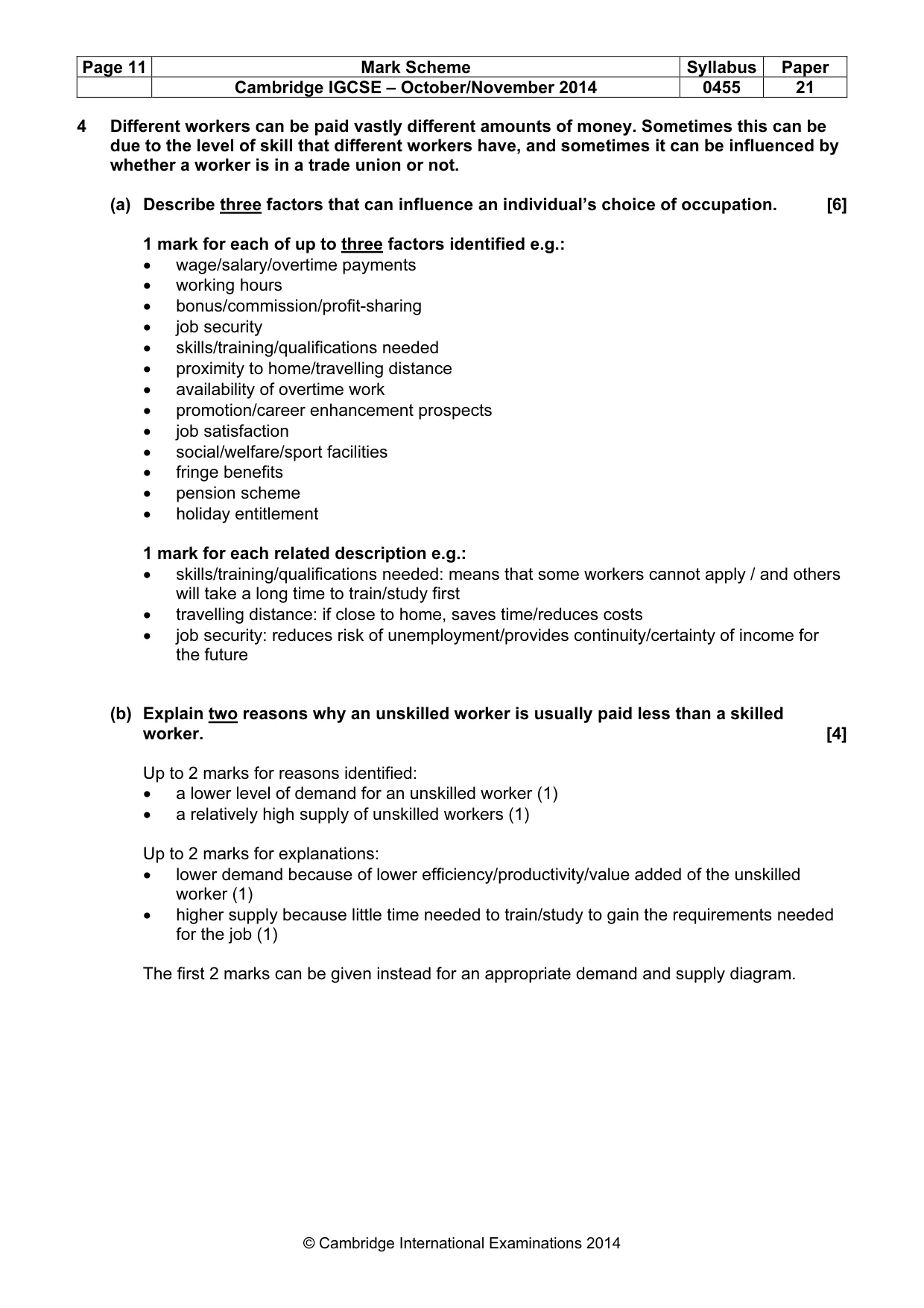
Page 11 Mark Scheme Syllabus Paper Cambridge IGCSE – October/November 2014 0455 21 © Cambridge International Examinations 2014 4 Different workers can be paid vastly different amounts of money. Sometimes this can be due to the level of skill that different workers have, and sometimes it can be influenced by whether a worker is in a trade union or not. (a) Describe three factors that can influence an individual’s choice of occupation. [6] 1 mark for each of up to three factors identified e.g.: • wage/salary/overtime payments • working hours • bonus/commission/profit-sharing • job security • skills/training/qualifications needed • proximity to home/travelling distance • availability of overtime work • promotion/career enhancement prospects • job satisfaction • social/welfare/sport facilities • fringe benefits • pension scheme • holiday entitlement 1 mark for each related description e.g.: • skills/training/qualifications needed: means that some workers cannot apply / and others will take a long time to train/study first • travelling distance: if close to home, saves time/reduces costs • job security: reduces risk of unemployment/provides continuity/certainty of income for the future (b) Explain two reasons why an unskilled worker is usually paid less than a skilled worker. [4] Up to 2 marks for reasons identified: • a lower level of demand for an unskilled worker (1) • a relatively high supply of unskilled workers (1) Up to 2 marks for explanations: • lower demand because of lower efficiency/productivity/value added of the unskilled worker (1) • higher supply because little time needed to train/study to gain the requirements needed for the job (1) The first 2 marks can be given instead for an appropriate demand and supply diagram.
Mark scheme, page 12
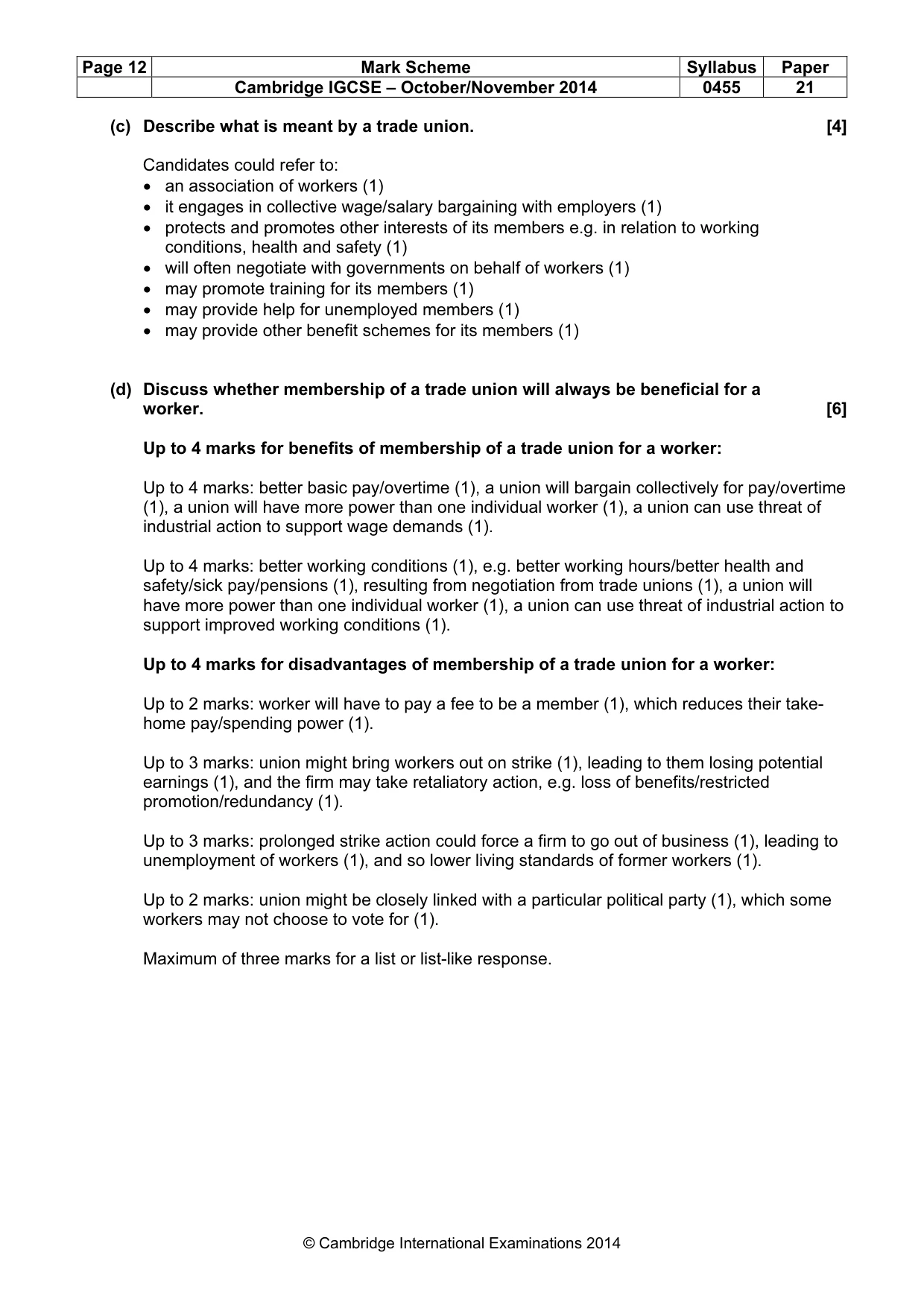
Page 12 Mark Scheme Syllabus Paper Cambridge IGCSE – October/November 2014 0455 21 © Cambridge International Examinations 2014 (c) Describe what is meant by a trade union. [4] Candidates could refer to: • an association of workers (1) • it engages in collective wage/salary bargaining with employers (1) • protects and promotes other interests of its members e.g. in relation to working conditions, health and safety (1) • will often negotiate with governments on behalf of workers (1) • may promote training for its members (1) • may provide help for unemployed members (1) • may provide other benefit schemes for its members (1) (d) Discuss whether membership of a trade union will always be beneficial for a worker. [6] Up to 4 marks for benefits of membership of a trade union for a worker: Up to 4 marks: better basic pay/overtime (1), a union will bargain collectively for pay/overtime (1), a union will have more power than one individual worker (1), a union can use threat of industrial action to support wage demands (1). Up to 4 marks: better working conditions (1), e.g. better working hours/better health and safety/sick pay/pensions (1), resulting from negotiation from trade unions (1), a union will have more power than one individual worker (1), a union can use threat of industrial action to support improved working conditions (1). Up to 4 marks for disadvantages of membership of a trade union for a worker: Up to 2 marks: worker will have to pay a fee to be a member (1), which reduces their take- home pay/spending power (1). Up to 3 marks: union might bring workers out on strike (1), leading to them losing potential earnings (1), and the firm may take retaliatory action, e.g. loss of benefits/restricted promotion/redundancy (1). Up to 3 marks: prolonged strike action could force a firm to go out of business (1), leading to unemployment of workers (1), and so lower living standards of former workers (1). Up to 2 marks: union might be closely linked with a particular political party (1), which some workers may not choose to vote for (1). Maximum of three marks for a list or list-like response.
Mark scheme, page 13
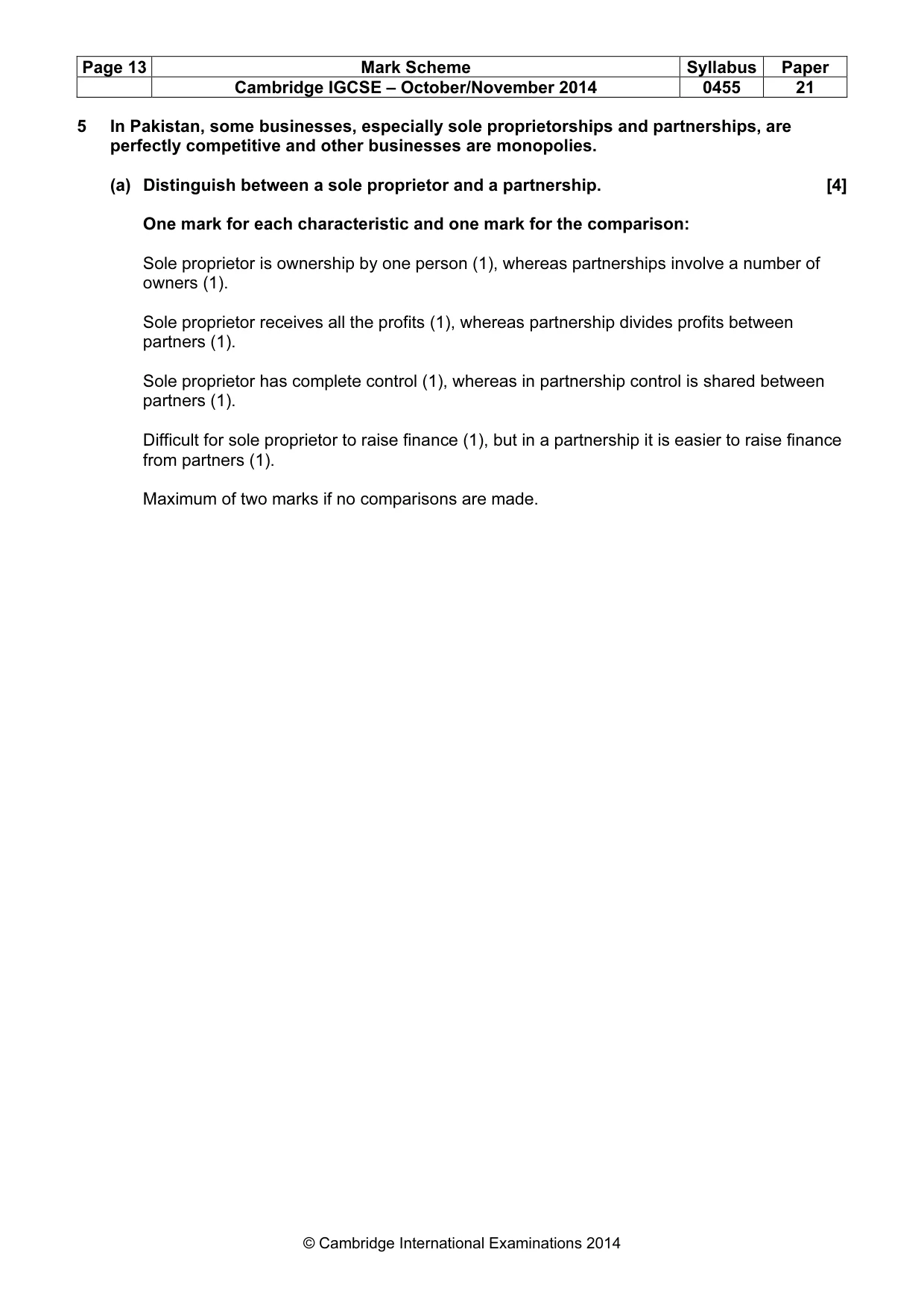
Page 13 Mark Scheme Syllabus Paper Cambridge IGCSE – October/November 2014 0455 21 © Cambridge International Examinations 2014 5 In Pakistan, some businesses, especially sole proprietorships and partnerships, are perfectly competitive and other businesses are monopolies. (a) Distinguish between a sole proprietor and a partnership. [4] One mark for each characteristic and one mark for the comparison: Sole proprietor is ownership by one person (1), whereas partnerships involve a number of owners (1). Sole proprietor receives all the profits (1), whereas partnership divides profits between partners (1). Sole proprietor has complete control (1), whereas in partnership control is shared between partners (1). Difficult for sole proprietor to raise finance (1), but in a partnership it is easier to raise finance from partners (1). Maximum of two marks if no comparisons are made.
Mark scheme, page 14
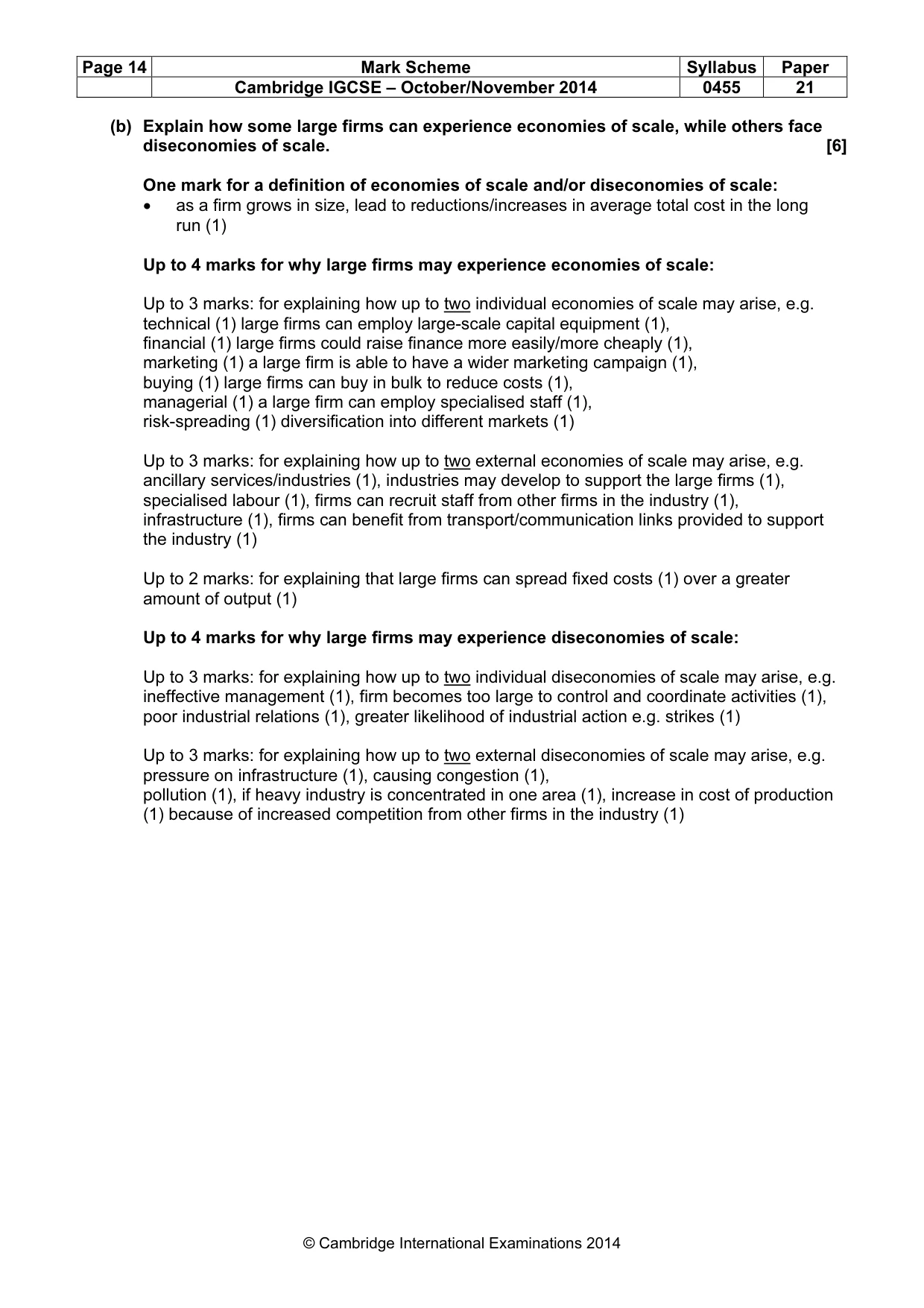
Page 14 Mark Scheme Syllabus Paper Cambridge IGCSE – October/November 2014 0455 21 © Cambridge International Examinations 2014 (b) Explain how some large firms can experience economies of scale, while others face diseconomies of scale. [6] One mark for a definition of economies of scale and/or diseconomies of scale: • as a firm grows in size, lead to reductions/increases in average total cost in the long run (1) Up to 4 marks for why large firms may experience economies of scale: Up to 3 marks: for explaining how up to two individual economies of scale may arise, e.g. technical (1) large firms can employ large-scale capital equipment (1), financial (1) large firms could raise finance more easily/more cheaply (1), marketing (1) a large firm is able to have a wider marketing campaign (1), buying (1) large firms can buy in bulk to reduce costs (1), managerial (1) a large firm can employ specialised staff (1), risk-spreading (1) diversification into different markets (1) Up to 3 marks: for explaining how up to two external economies of scale may arise, e.g. ancillary services/industries (1), industries may develop to support the large firms (1), specialised labour (1), firms can recruit staff from other firms in the industry (1), infrastructure (1), firms can benefit from transport/communication links provided to support the industry (1) Up to 2 marks: for explaining that large firms can spread fixed costs (1) over a greater amount of output (1) Up to 4 marks for why large firms may experience diseconomies of scale: Up to 3 marks: for explaining how up to two individual diseconomies of scale may arise, e.g. ineffective management (1), firm becomes too large to control and coordinate activities (1), poor industrial relations (1), greater likelihood of industrial action e.g. strikes (1) Up to 3 marks: for explaining how up to two external diseconomies of scale may arise, e.g. pressure on infrastructure (1), causing congestion (1), pollution (1), if heavy industry is concentrated in one area (1), increase in cost of production (1) because of increased competition from other firms in the industry (1)
Mark scheme, page 15
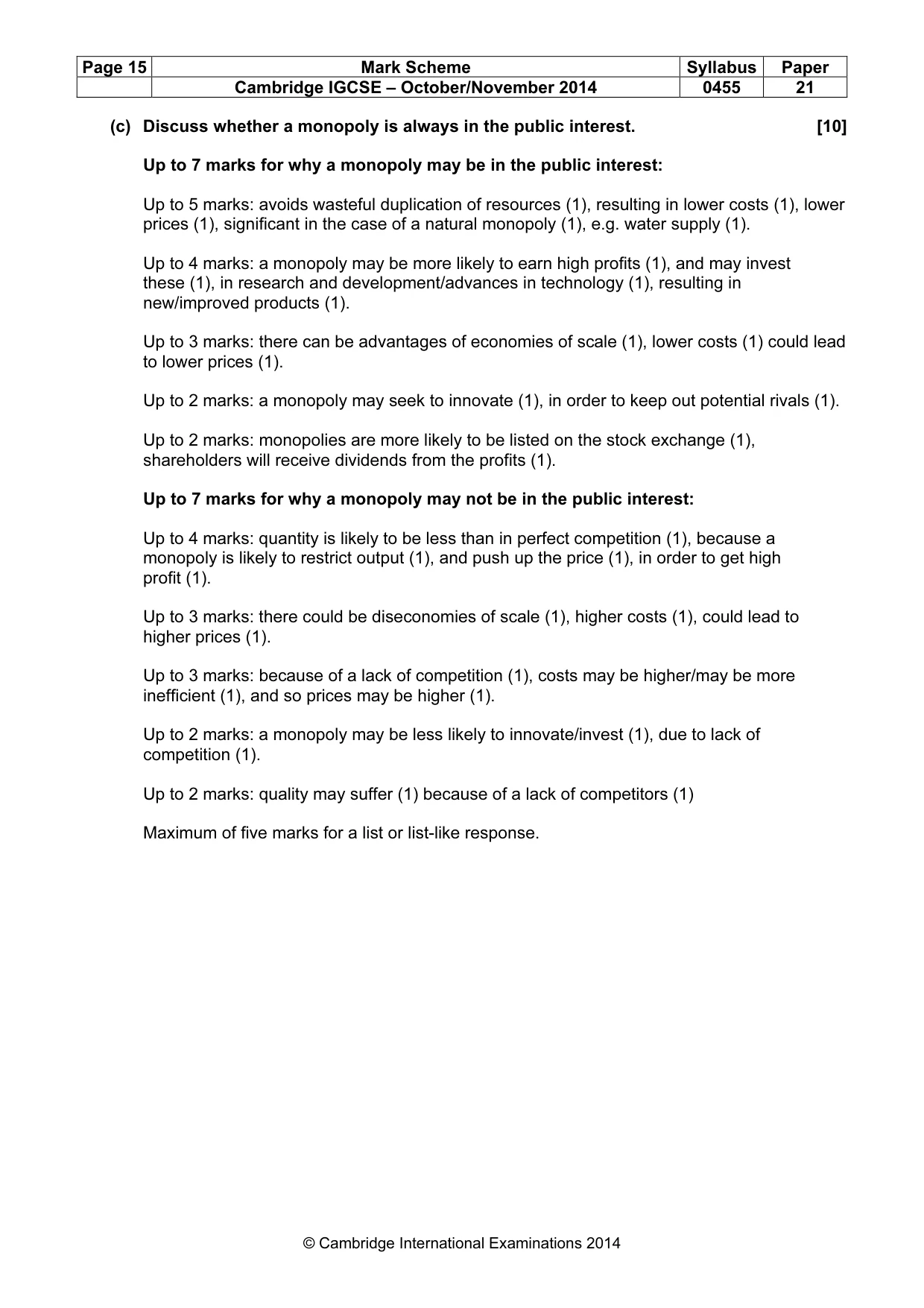
Page 15 Mark Scheme Syllabus Paper Cambridge IGCSE – October/November 2014 0455 21 © Cambridge International Examinations 2014 (c) Discuss whether a monopoly is always in the public interest. [10] Up to 7 marks for why a monopoly may be in the public interest: Up to 5 marks: avoids wasteful duplication of resources (1), resulting in lower costs (1), lower prices (1), significant in the case of a natural monopoly (1), e.g. water supply (1). Up to 4 marks: a monopoly may be more likely to earn high profits (1), and may invest these (1), in research and development/advances in technology (1), resulting in new/improved products (1). Up to 3 marks: there can be advantages of economies of scale (1), lower costs (1) could lead to lower prices (1). Up to 2 marks: a monopoly may seek to innovate (1), in order to keep out potential rivals (1). Up to 2 marks: monopolies are more likely to be listed on the stock exchange (1), shareholders will receive dividends from the profits (1). Up to 7 marks for why a monopoly may not be in the public interest: Up to 4 marks: quantity is likely to be less than in perfect competition (1), because a monopoly is likely to restrict output (1), and push up the price (1), in order to get high profit (1). Up to 3 marks: there could be diseconomies of scale (1), higher costs (1), could lead to higher prices (1). Up to 3 marks: because of a lack of competition (1), costs may be higher/may be more inefficient (1), and so prices may be higher (1). Up to 2 marks: a monopoly may be less likely to innovate/invest (1), due to lack of competition (1). Up to 2 marks: quality may suffer (1) because of a lack of competitors (1) Maximum of five marks for a list or list-like response.
Mark scheme, page 16
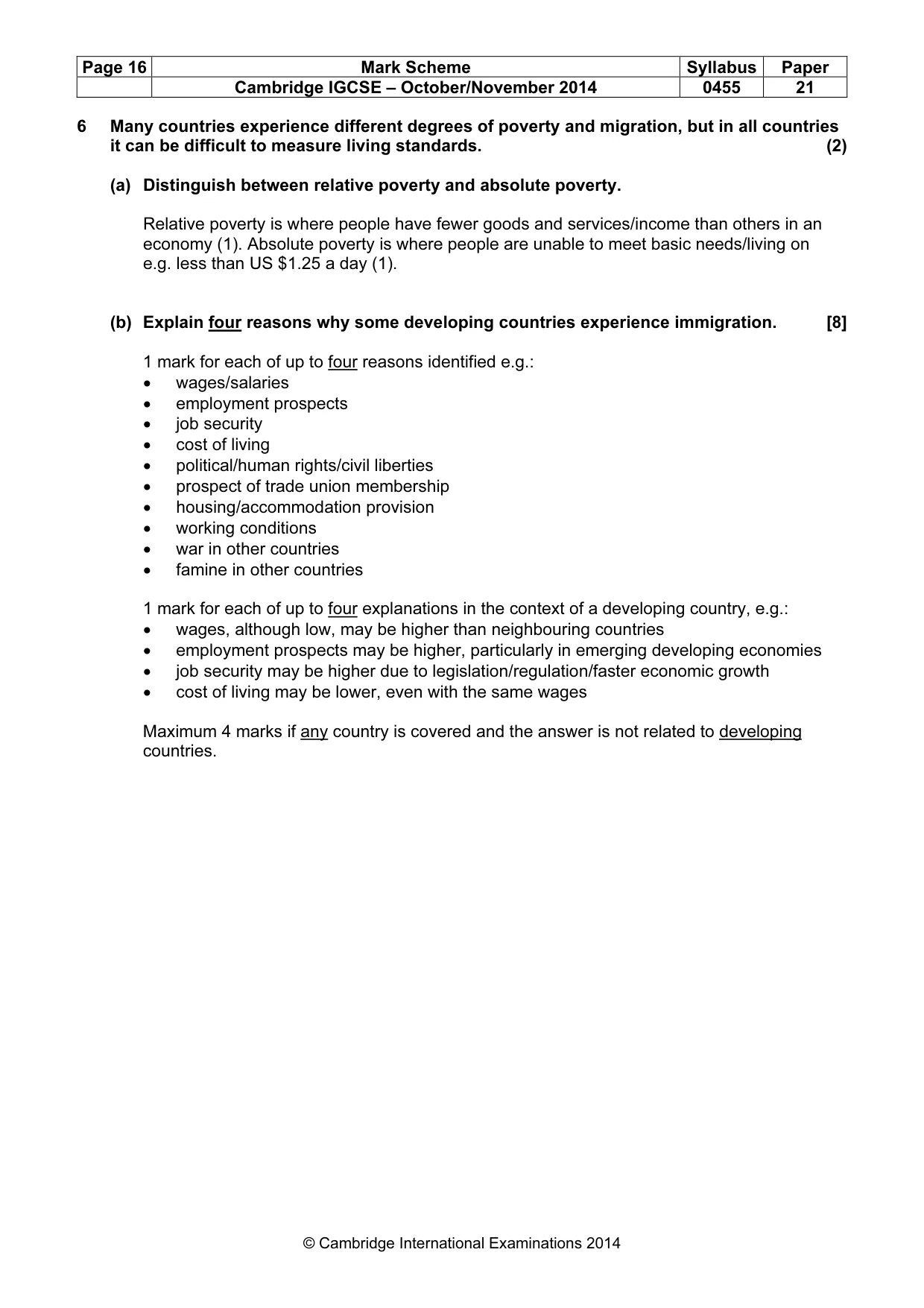
Page 16 Mark Scheme Syllabus Paper Cambridge IGCSE – October/November 2014 0455 21 © Cambridge International Examinations 2014 6 Many countries experience different degrees of poverty and migration, but in all countries it can be difficult to measure living standards. (2) (a) Distinguish between relative poverty and absolute poverty. Relative poverty is where people have fewer goods and services/income than others in an economy (1). Absolute poverty is where people are unable to meet basic needs/living on e.g. less than US $1.25 a day (1). (b) Explain four reasons why some developing countries experience immigration. [8] 1 mark for each of up to four reasons identified e.g.: • wages/salaries • employment prospects • job security • cost of living • political/human rights/civil liberties • prospect of trade union membership • housing/accommodation provision • working conditions • war in other countries • famine in other countries 1 mark for each of up to four explanations in the context of a developing country, e.g.: • wages, although low, may be higher than neighbouring countries • employment prospects may be higher, particularly in emerging developing economies • job security may be higher due to legislation/regulation/faster economic growth • cost of living may be lower, even with the same wages Maximum 4 marks if any country is covered and the answer is not related to developing countries.
Mark scheme, page 17
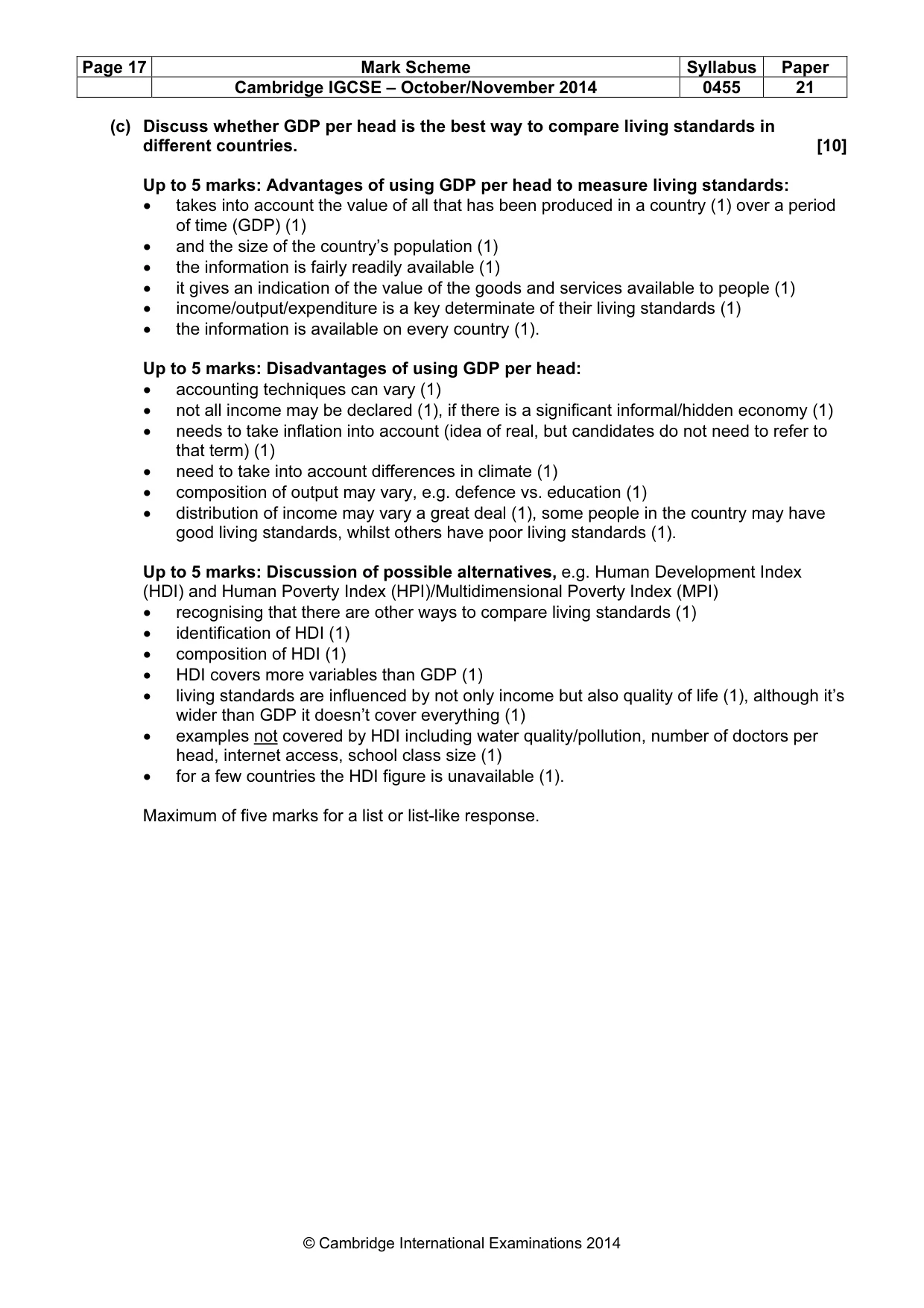
Page 17 Mark Scheme Syllabus Paper Cambridge IGCSE – October/November 2014 0455 21 © Cambridge International Examinations 2014 (c) Discuss whether GDP per head is the best way to compare living standards in different countries. [10] Up to 5 marks: Advantages of using GDP per head to measure living standards: • takes into account the value of all that has been produced in a country (1) over a period of time (GDP) (1) • and the size of the country’s population (1) • the information is fairly readily available (1) • it gives an indication of the value of the goods and services available to people (1) • income/output/expenditure is a key determinate of their living standards (1) • the information is available on every country (1). Up to 5 marks: Disadvantages of using GDP per head: • accounting techniques can vary (1) • not all income may be declared (1), if there is a significant informal/hidden economy (1) • needs to take inflation into account (idea of real, but candidates do not need to refer to that term) (1) • need to take into account differences in climate (1) • composition of output may vary, e.g. defence vs. education (1) • distribution of income may vary a great deal (1), some people in the country may have good living standards, whilst others have poor living standards (1). Up to 5 marks: Discussion of possible alternatives, e.g. Human Development Index (HDI) and Human Poverty Index (HPI)/Multidimensional Poverty Index (MPI) • recognising that there are other ways to compare living standards (1) • identification of HDI (1) • composition of HDI (1) • HDI covers more variables than GDP (1) • living standards are influenced by not only income but also quality of life (1), although it’s wider than GDP it doesn’t cover everything (1) • examples not covered by HDI including water quality/pollution, number of doctors per head, internet access, school class size (1) • for a few countries the HDI figure is unavailable (1). Maximum of five marks for a list or list-like response.
Mark scheme, page 18
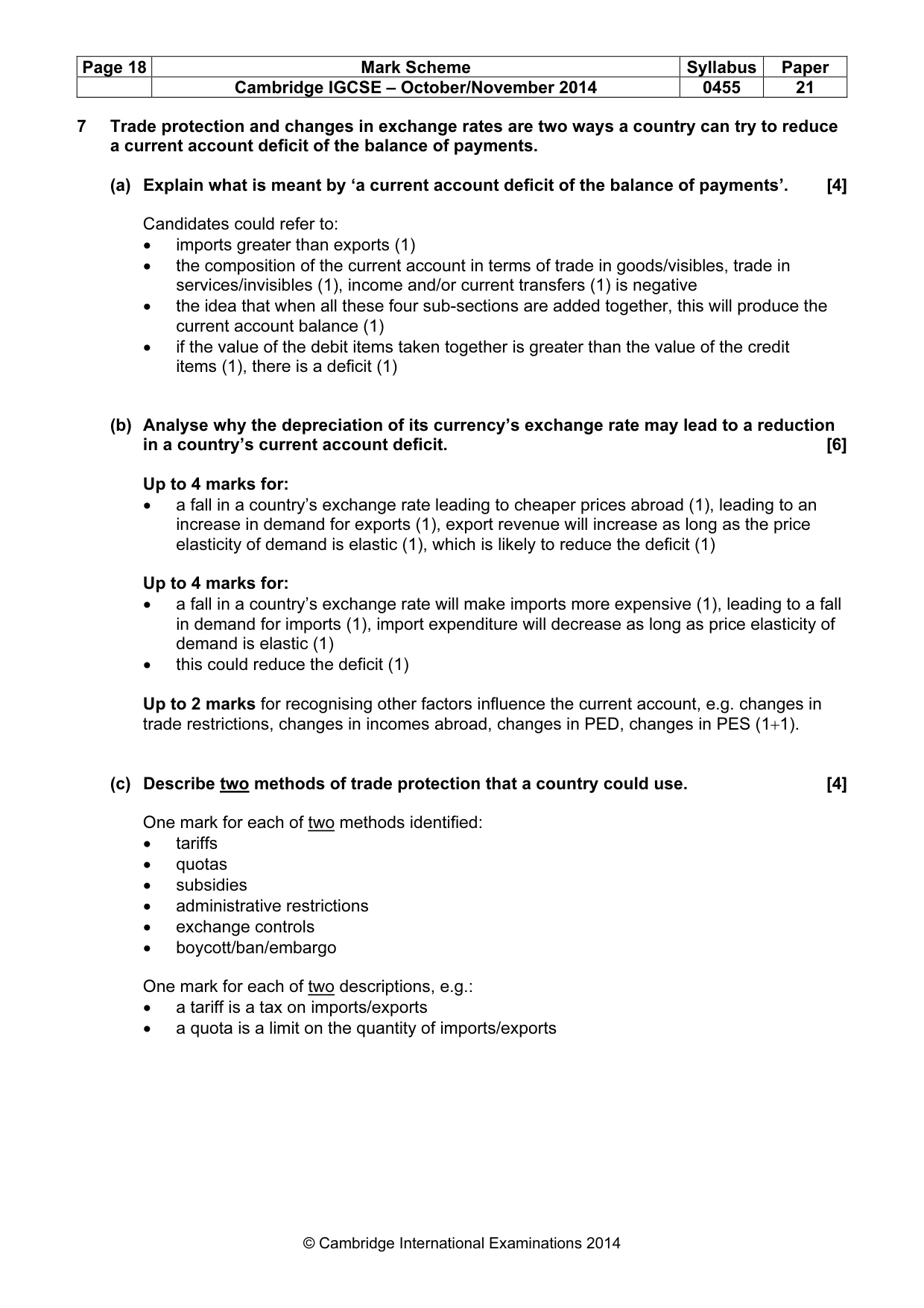
Page 18 Mark Scheme Syllabus Paper Cambridge IGCSE – October/November 2014 0455 21 © Cambridge International Examinations 2014 7 Trade protection and changes in exchange rates are two ways a country can try to reduce a current account deficit of the balance of payments. (a) Explain what is meant by ‘a current account deficit of the balance of payments’. [4] Candidates could refer to: • imports greater than exports (1) • the composition of the current account in terms of trade in goods/visibles, trade in services/invisibles (1), income and/or current transfers (1) is negative • the idea that when all these four sub-sections are added together, this will produce the current account balance (1) • if the value of the debit items taken together is greater than the value of the credit items (1), there is a deficit (1) (b) Analyse why the depreciation of its currency’s exchange rate may lead to a reduction in a country’s current account deficit. [6] Up to 4 marks for: • a fall in a country’s exchange rate leading to cheaper prices abroad (1), leading to an increase in demand for exports (1), export revenue will increase as long as the price elasticity of demand is elastic (1), which is likely to reduce the deficit (1) Up to 4 marks for: • a fall in a country’s exchange rate will make imports more expensive (1), leading to a fall in demand for imports (1), import expenditure will decrease as long as price elasticity of demand is elastic (1) • this could reduce the deficit (1) Up to 2 marks for recognising other factors influence the current account, e.g. changes in trade restrictions, changes in incomes abroad, changes in PED, changes in PES (1+1). (c) Describe two methods of trade protection that a country could use. [4] One mark for each of two methods identified: • tariffs • quotas • subsidies • administrative restrictions • exchange controls • boycott/ban/embargo One mark for each of two descriptions, e.g.: • a tariff is a tax on imports/exports • a quota is a limit on the quantity of imports/exports
Mark scheme, page 19
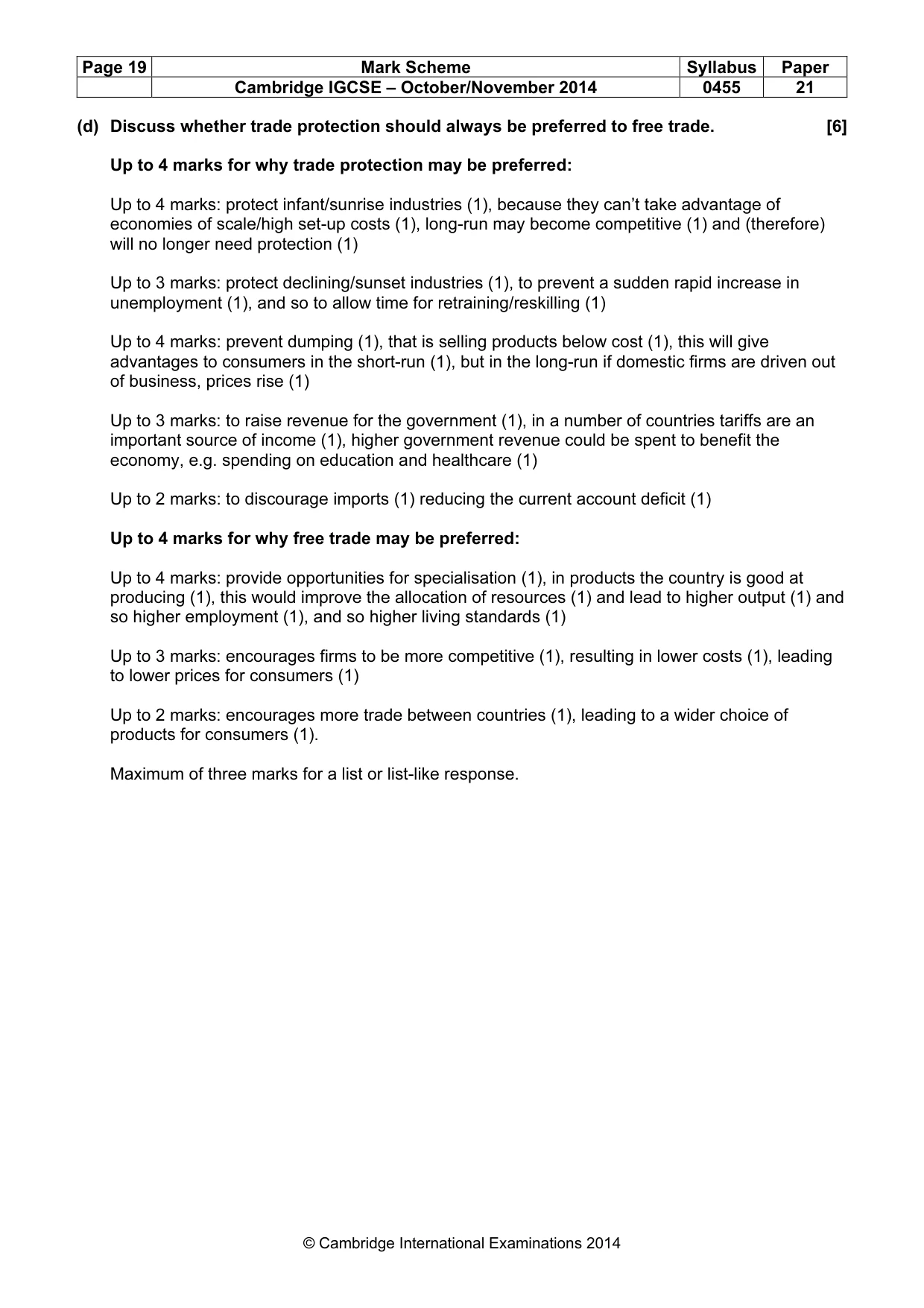
Page 19 Mark Scheme Syllabus Paper Cambridge IGCSE – October/November 2014 0455 21 © Cambridge International Examinations 2014 (d) Discuss whether trade protection should always be preferred to free trade. [6] Up to 4 marks for why trade protection may be preferred: Up to 4 marks: protect infant/sunrise industries (1), because they can’t take advantage of economies of scale/high set-up costs (1), long-run may become competitive (1) and (therefore) will no longer need protection (1) Up to 3 marks: protect declining/sunset industries (1), to prevent a sudden rapid increase in unemployment (1), and so to allow time for retraining/reskilling (1) Up to 4 marks: prevent dumping (1), that is selling products below cost (1), this will give advantages to consumers in the short-run (1), but in the long-run if domestic firms are driven out of business, prices rise (1) Up to 3 marks: to raise revenue for the government (1), in a number of countries tariffs are an important source of income (1), higher government revenue could be spent to benefit the economy, e.g. spending on education and healthcare (1) Up to 2 marks: to discourage imports (1) reducing the current account deficit (1) Up to 4 marks for why free trade may be preferred: Up to 4 marks: provide opportunities for specialisation (1), in products the country is good at producing (1), this would improve the allocation of resources (1) and lead to higher output (1) and so higher employment (1), and so higher living standards (1) Up to 3 marks: encourages firms to be more competitive (1), resulting in lower costs (1), leading to lower prices for consumers (1) Up to 2 marks: encourages more trade between countries (1), leading to a wider choice of products for consumers (1). Maximum of three marks for a list or list-like response.
What you needed in this session
Cambridge’s own grade thresholds for 2014 Oct/Nov, Paper 2 · Variant 1. A higher threshold means an easier paper — the bar moves with how the cohort did.