Cambridge IGCSE Economics 0455 — 2014 May/June Paper 2 · Variant 3
0455/23/M/J/14 · 90 marks · ≈101 min
The question paper and its mark scheme, free to read here and free to download. This is Cambridge’s own paper, exactly as it was sat.
Question paper8 pages



Mark scheme19 pages
Answers below. Sit the paper first if you are practising.
Paper as text
Question paper, page 1
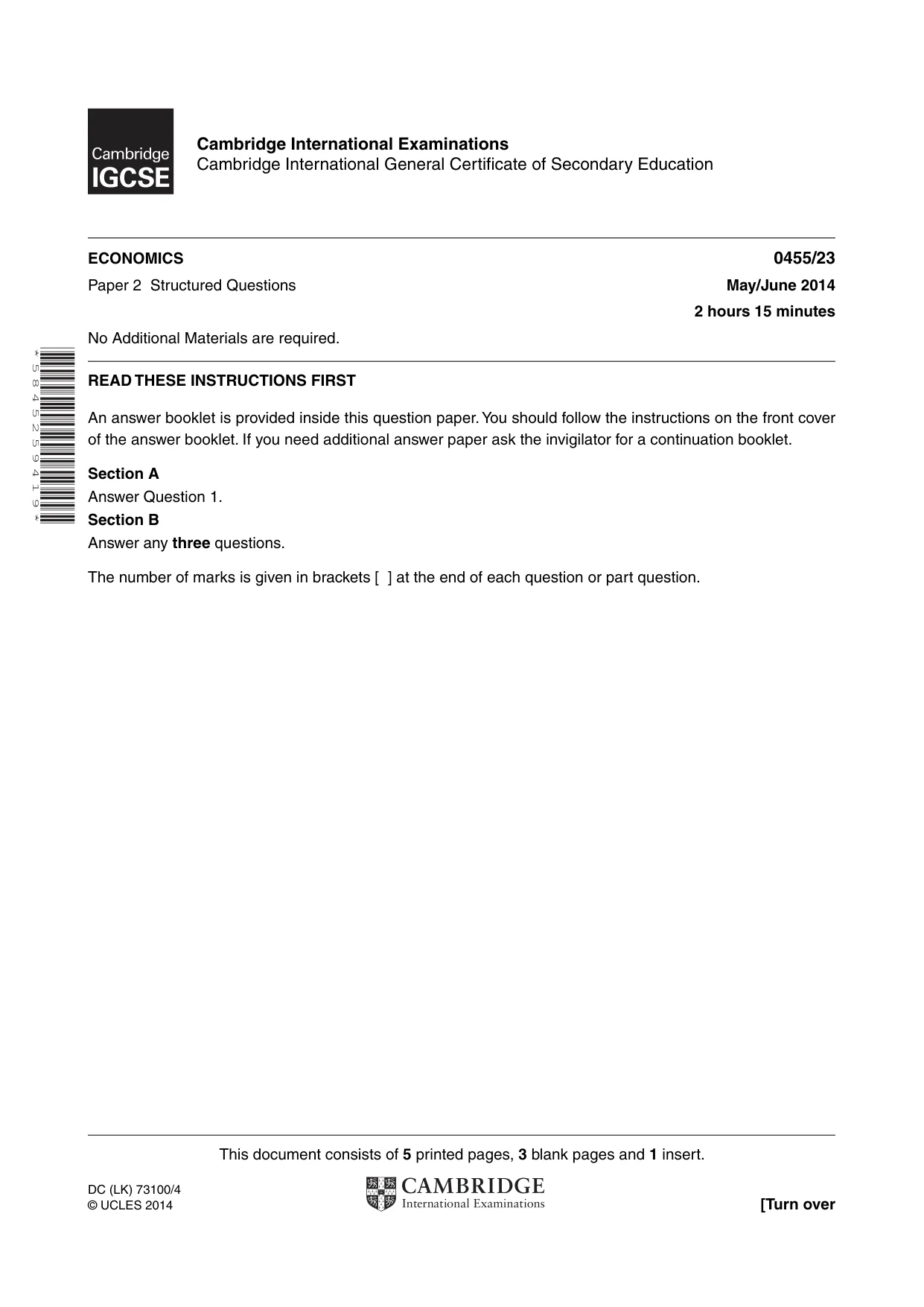
This document consists of 5 printed pages, 3 blank pages and 1 insert. DC (LK) 73100/4 © UCLES 2014 [Turn over * 5 8 4 5 2 5 9 4 1 9 * ECONOMICS 0455/23 Paper 2 Structured Questions May/June 2014 2 hours 15 minutes No Additional Materials are required. READ THESE INSTRUCTIONS FIRST An answer booklet is provided inside this question paper. You should follow the instructions on the front cover of the answer booklet. If you need additional answer paper ask the invigilator for a continuation booklet. Section A Answer Question 1. Section B Answer any three questions. The number of marks is given in brackets [ ] at the end of each question or part question. Cambridge International Examinations Cambridge International General Certificate of Secondary Education
Question paper, page 2
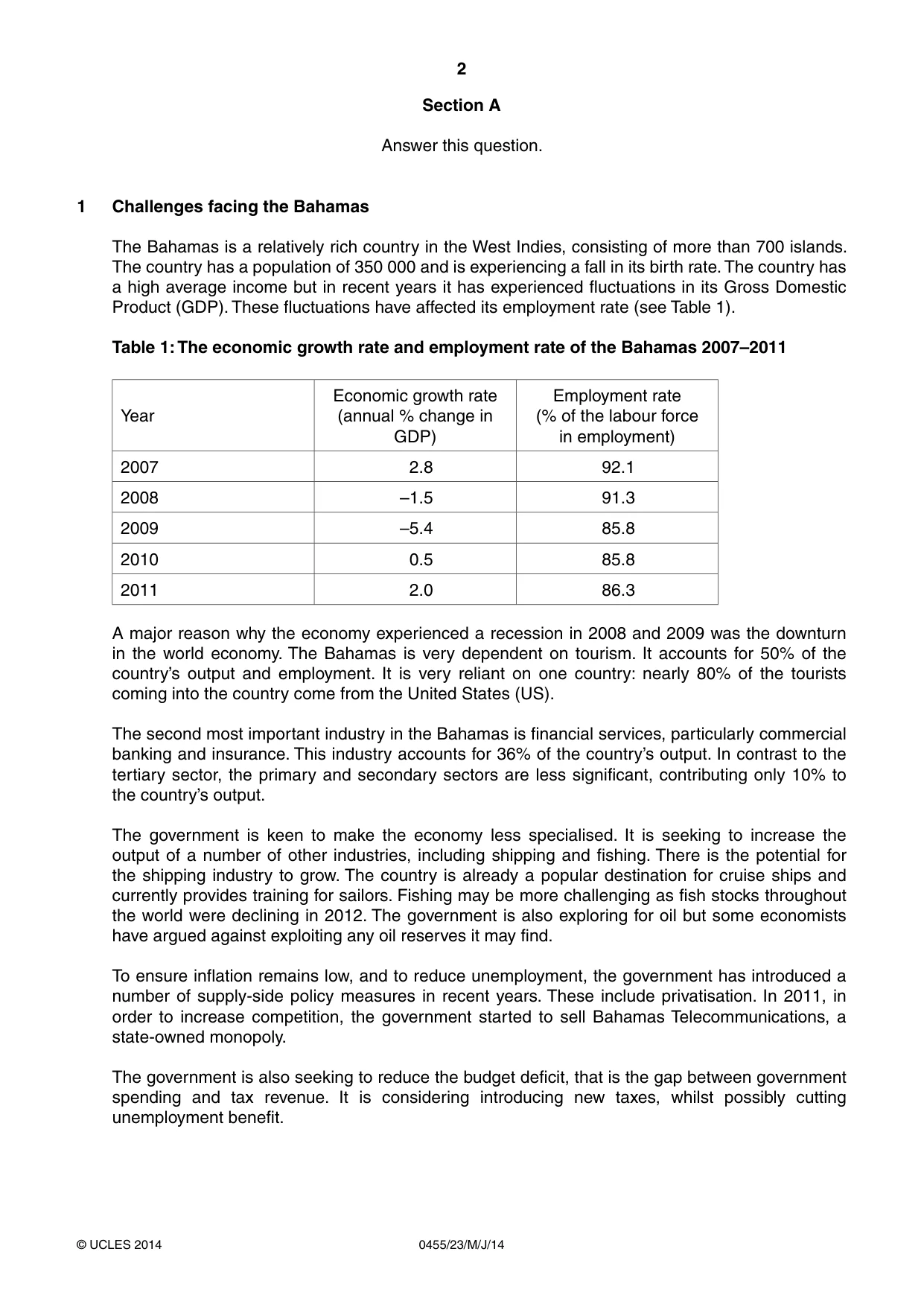
2 0455/23/M/J/14 © UCLES 2014 Section A Answer this question. 1 Challenges facing the Bahamas The Bahamas is a relatively rich country in the West Indies, consisting of more than 700 islands. The country has a population of 350 000 and is experiencing a fall in its birth rate. The country has a high average income but in recent years it has experienced fluctuations in its Gross Domestic Product (GDP). These fluctuations have affected its employment rate (see Table 1). Table 1: The economic growth rate and employment rate of the Bahamas 2007–2011 Year Economic growth rate (annual % change in GDP) Employment rate (% of the labour force in employment) 2007 2.8 92.1 2008 –1.5 91.3 2009 –5.4 85.8 2010 0.5 85.8 2011 2.0 86.3 A major reason why the economy experienced a recession in 2008 and 2009 was the downturn in the world economy. The Bahamas is very dependent on tourism. It accounts for 50% of the country’s output and employment. It is very reliant on one country: nearly 80% of the tourists coming into the country come from the United States (US). The second most important industry in the Bahamas is financial services, particularly commercial banking and insurance. This industry accounts for 36% of the country’s output. In contrast to the tertiary sector, the primary and secondary sectors are less significant, contributing only 10% to the country’s output. The government is keen to make the economy less specialised. It is seeking to increase the output of a number of other industries, including shipping and fishing. There is the potential for the shipping industry to grow. The country is already a popular destination for cruise ships and currently provides training for sailors. Fishing may be more challenging as fish stocks throughout the world were declining in 2012. The government is also exploring for oil but some economists have argued against exploiting any oil reserves it may find. To ensure inflation remains low, and to reduce unemployment, the government has introduced a number of supply-side policy measures in recent years. These include privatisation. In 2011, in order to increase competition, the government started to sell Bahamas Telecommunications, a state-owned monopoly. The government is also seeking to reduce the budget deficit, that is the gap between government spending and tax revenue. It is considering introducing new taxes, whilst possibly cutting unemployment benefit.
Question paper, page 3
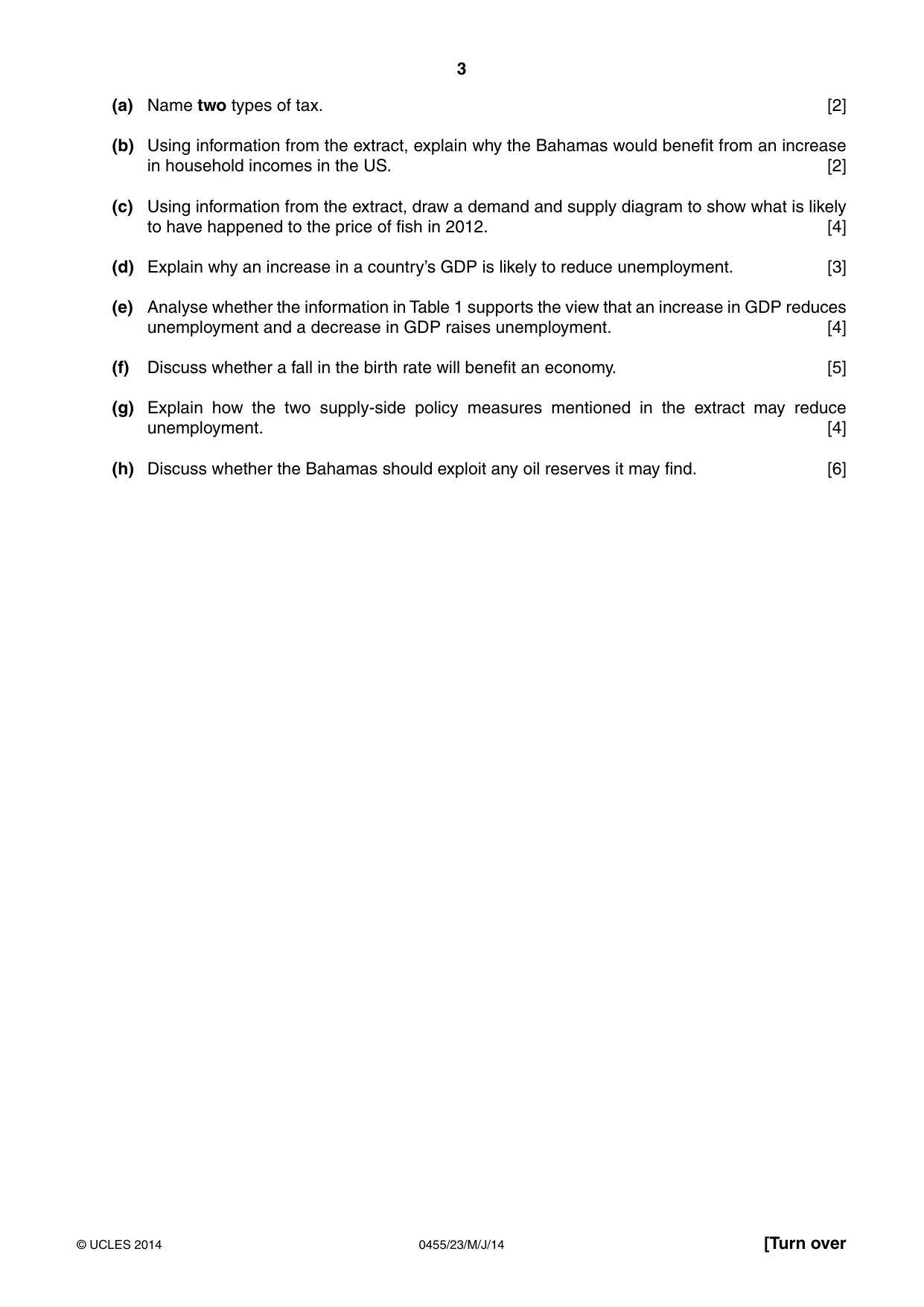
3 0455/23/M/J/14 © UCLES 2014 [Turn over (a) Name two types of tax. [2] (b) Using information from the extract, explain why the Bahamas would benefit from an increase in household incomes in the US. [2] (c) Using information from the extract, draw a demand and supply diagram to show what is likely to have happened to the price of fish in 2012. [4] (d) Explain why an increase in a country’s GDP is likely to reduce unemployment. [3] (e) Analyse whether the information in Table 1 supports the view that an increase in GDP reduces unemployment and a decrease in GDP raises unemployment. [4] (f) Discuss whether a fall in the birth rate will benefit an economy. [5] (g) Explain how the two supply-side policy measures mentioned in the extract may reduce unemployment. [4] (h) Discuss whether the Bahamas should exploit any oil reserves it may find. [6]
Question paper, page 4
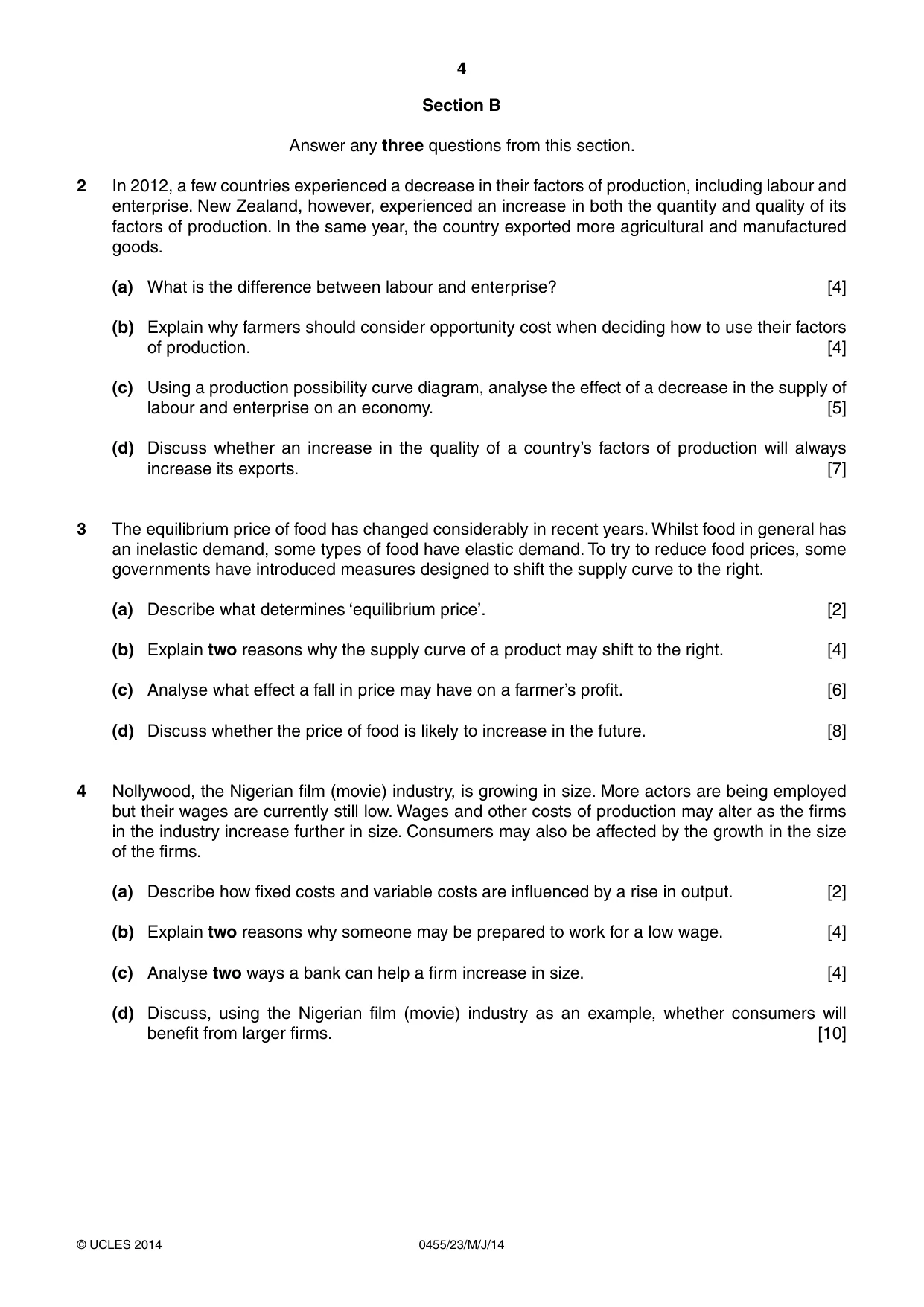
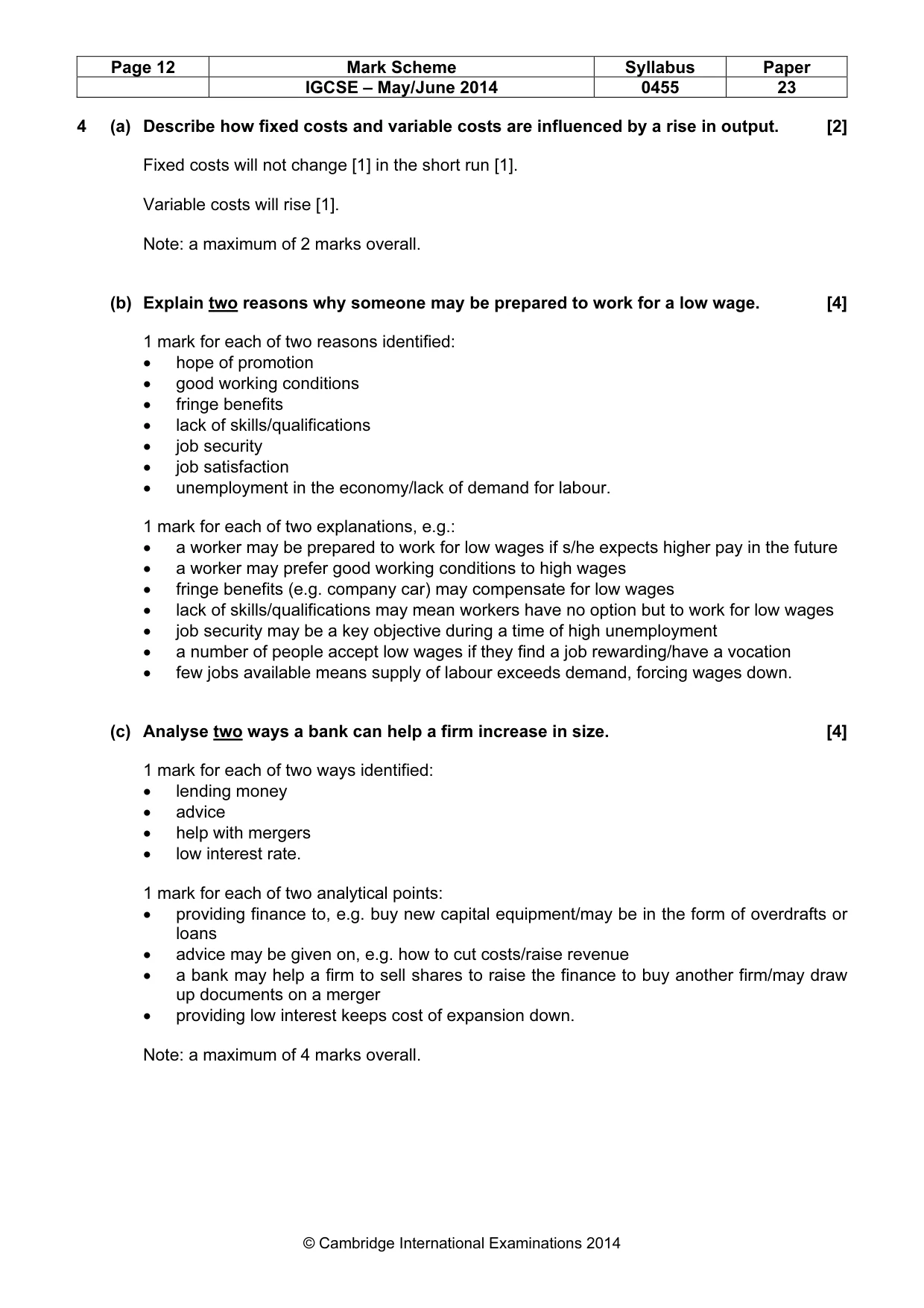
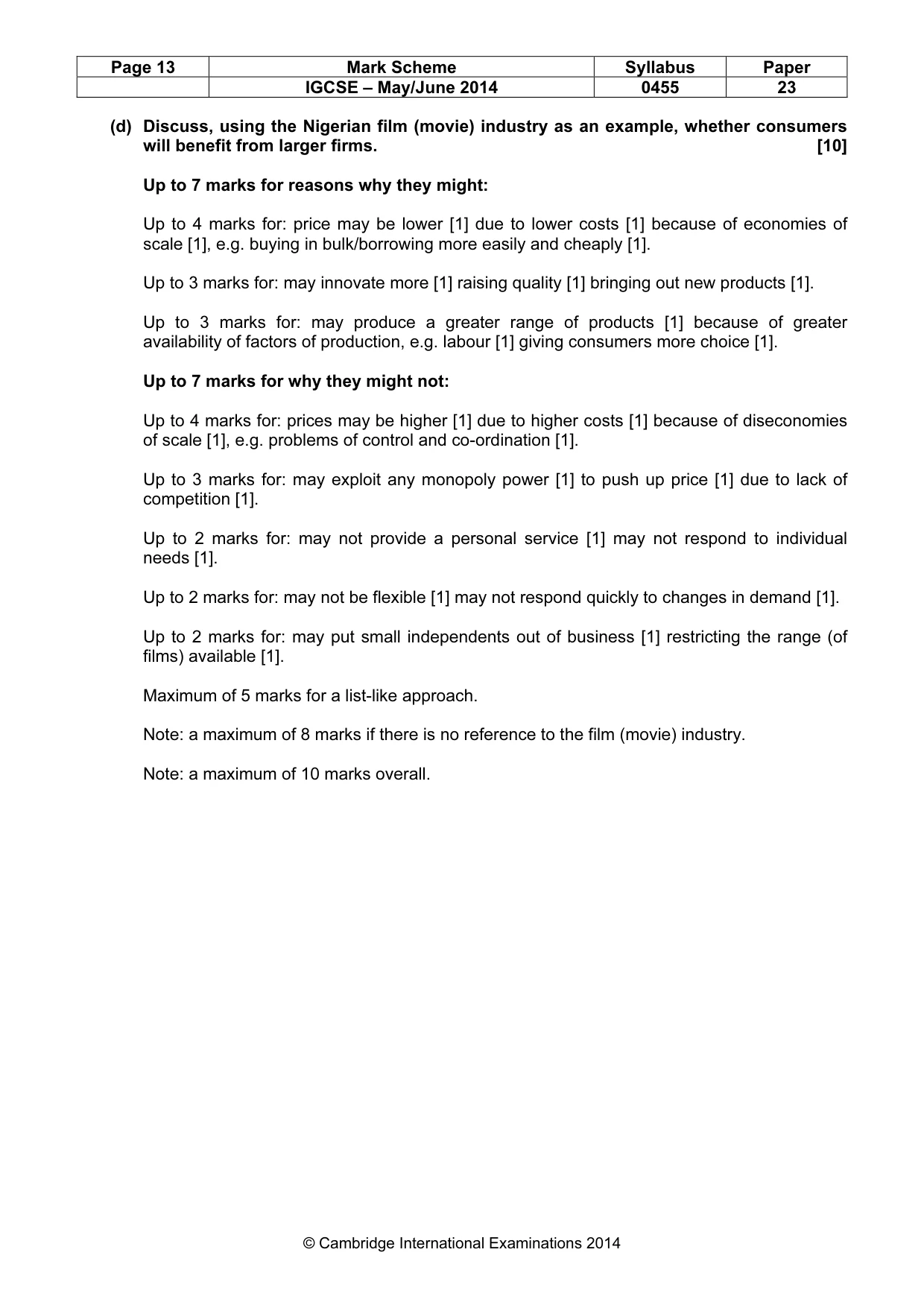
4 0455/23/M/J/14 © UCLES 2014 Section B Answer any three questions from this section. 2 In 2012, a few countries experienced a decrease in their factors of production, including labour and enterprise. New Zealand, however, experienced an increase in both the quantity and quality of its factors of production. In the same year, the country exported more agricultural and manufactured goods. (a) What is the difference between labour and enterprise? [4] (b) Explain why farmers should consider opportunity cost when deciding how to use their factors of production. [4] (c) Using a production possibility curve diagram, analyse the effect of a decrease in the supply of labour and enterprise on an economy. [5] (d) Discuss whether an increase in the quality of a country’s factors of production will always increase its exports. [7] 3 The equilibrium price of food has changed considerably in recent years. Whilst food in general has an inelastic demand, some types of food have elastic demand. To try to reduce food prices, some governments have introduced measures designed to shift the supply curve to the right. (a) Describe what determines ‘equilibrium price’. [2] (b) Explain two reasons why the supply curve of a product may shift to the right. [4] (c) Analyse what effect a fall in price may have on a farmer’s profit. [6] (d) Discuss whether the price of food is likely to increase in the future. [8] 4 Nollywood, the Nigerian film (movie) industry, is growing in size. More actors are being employed but their wages are currently still low. Wages and other costs of production may alter as the firms in the industry increase further in size. Consumers may also be affected by the growth in the size of the firms. (a) Describe how fixed costs and variable costs are influenced by a rise in output. [2] (b) Explain two reasons why someone may be prepared to work for a low wage. [4] (c) Analyse two ways a bank can help a firm increase in size. [4] (d) Discuss, using the Nigerian film (movie) industry as an example, whether consumers will benefit from larger firms. [10]
Question paper, page 5
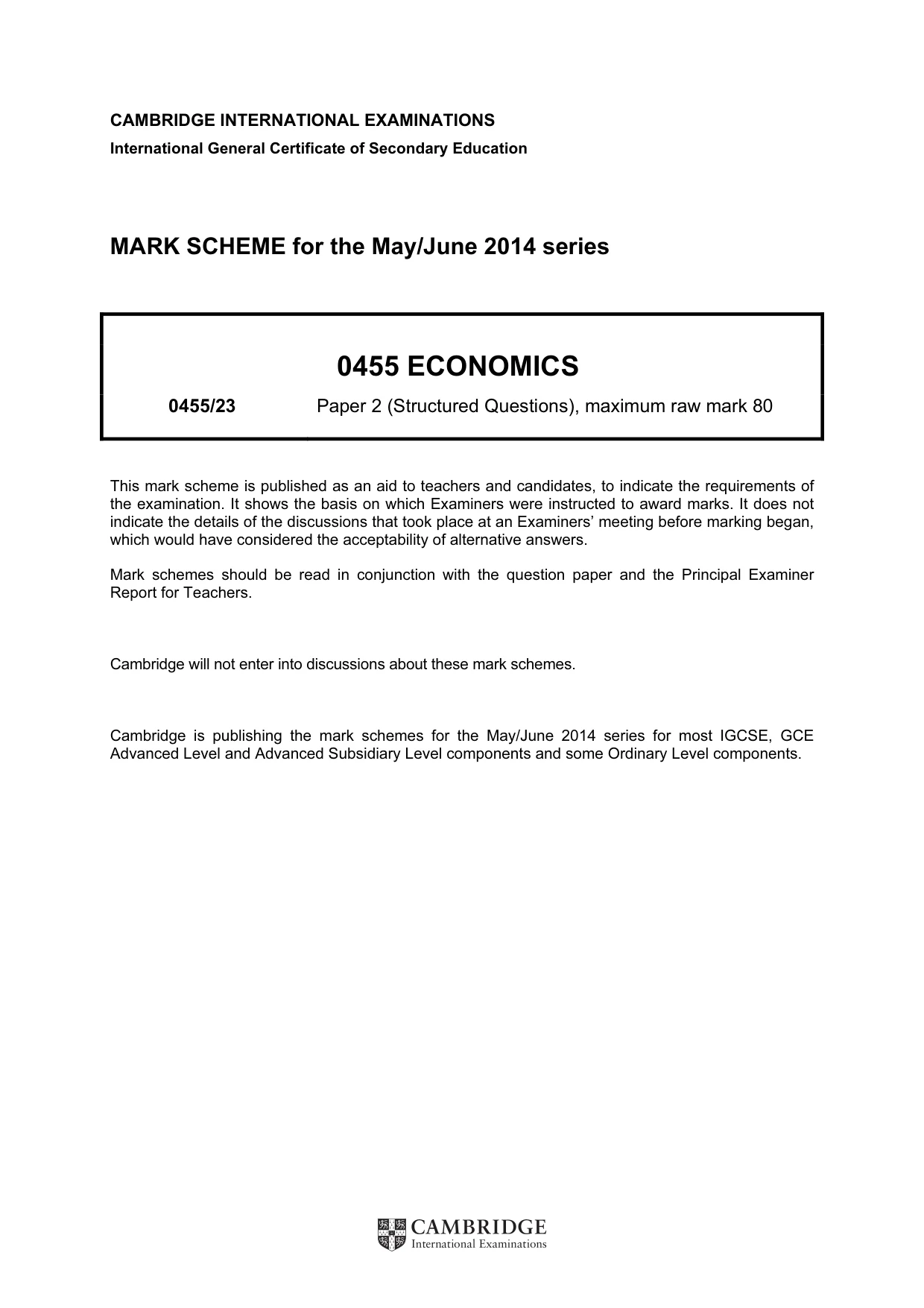
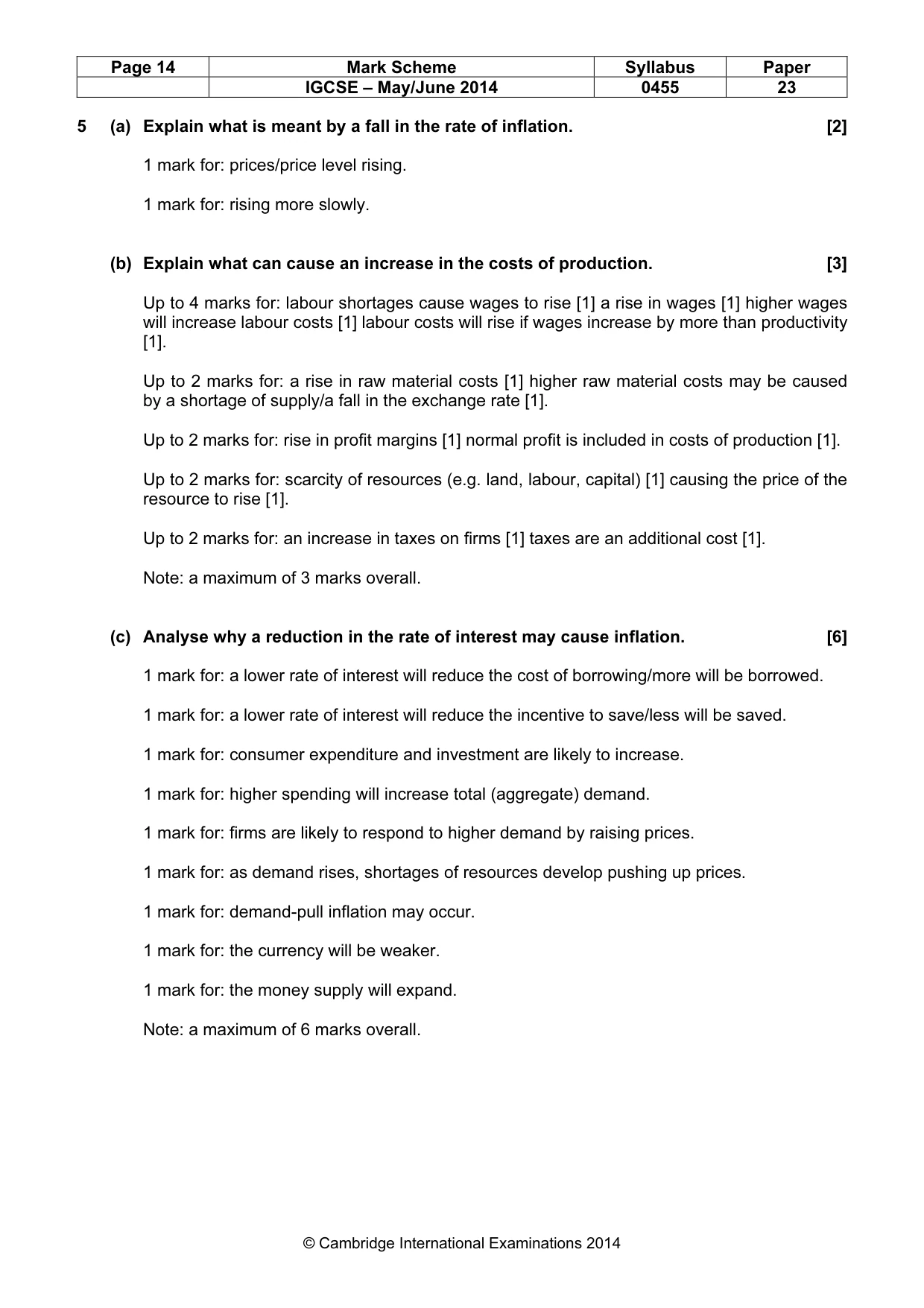
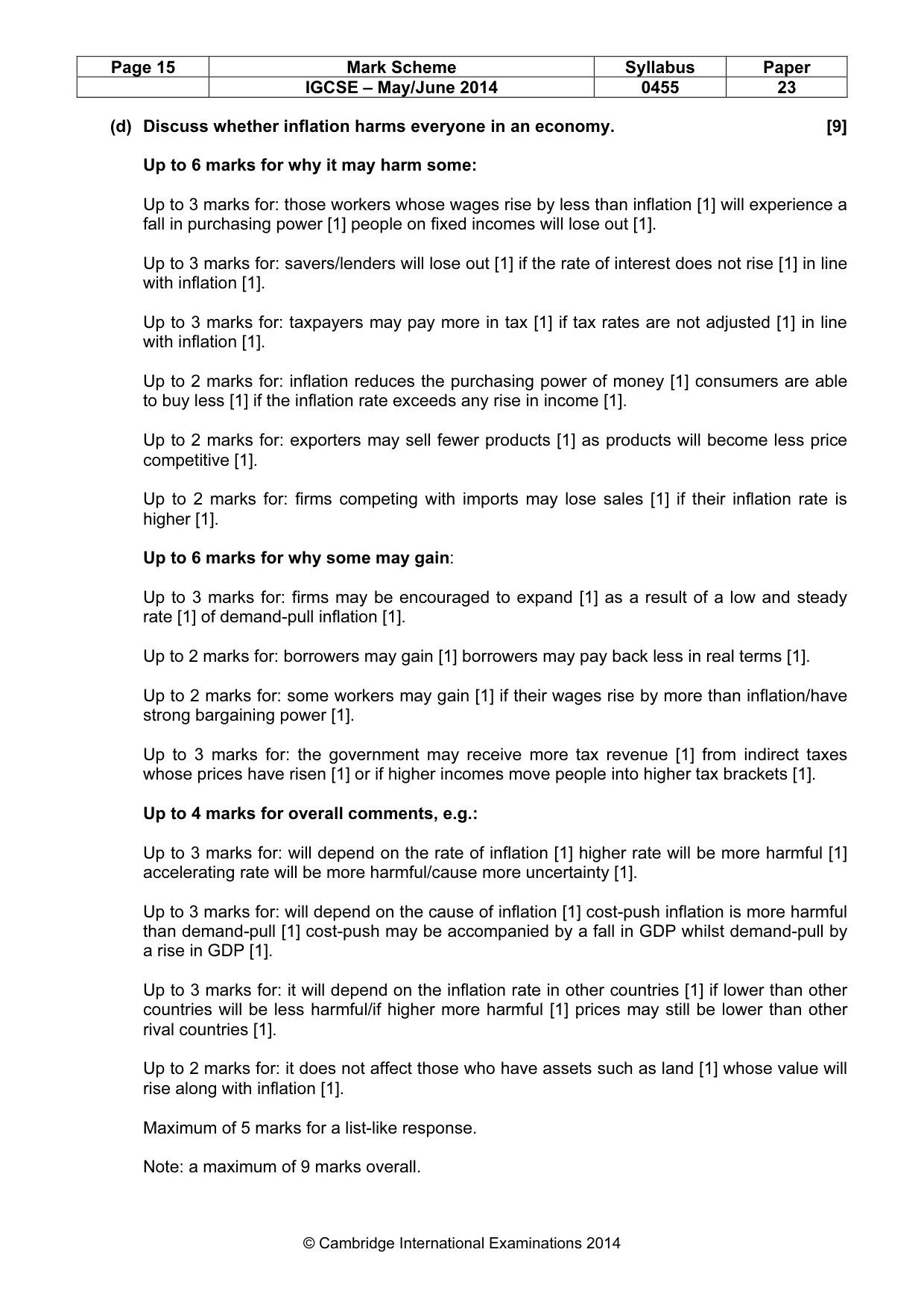
5 0455/23/M/J/14 © UCLES 2014 5 In 2012, India’s price level was still rising, largely because of increases in the costs of production. However, there was a fall in the country’s rate of inflation. This reduction in the inflation rate led some economists to suggest that the rate of interest should be reduced. Other economists opposed this, arguing that inflation causes considerable problems for people. (a) Explain what is meant by a fall in the rate of inflation. [2] (b) Explain what can cause an increase in the costs of production. [3] (c) Analyse why a reduction in the rate of interest may cause inflation. [6] (d) Discuss whether inflation harms everyone in an economy. [9] 6 Living standards vary between countries. This is due, in part, to differences in productivity and the amount of foreign investment the countries can attract. (a) Identify four characteristics of a developed country. [4] (b) Explain two measures of living standards. [4] (c) Analyse how a rise in productivity may increase living standards. [4] (d) Discuss whether developed countries are likely to attract more foreign investment than developing countries. [8] 7 Between 2011 and 2012 Russia’s exchange rate was relatively constant. The country continued to have a surplus on the current account of its balance of payments. The main change in its international trade position arose from it joining the World Trade Organisation. In order to do this, the government agreed to move towards free trade. (a) Describe what is meant by a current account surplus. [4] (b) Analyse why a country’s exchange rate may rise in value. [6] (c) Discuss whether engaging in free trade will always benefit an economy. [10]
Question paper, page 6
6 0455/23/M/J/14 © UCLES 2014 BLANK PAGE
Question paper, page 7
7 0455/23/M/J/14 © UCLES 2014 BLANK PAGE
Question paper, page 8
8 0455/23/M/J/14 © UCLES 2014 Permission to reproduce items where third-party owned material protected by copyright is included has been sought and cleared where possible. Every reasonable effort has been made by the publisher (UCLES) to trace copyright holders, but if any items requiring clearance have unwittingly been included, the publisher will be pleased to make amends at the earliest possible opportunity. Cambridge International Examinations is part of the Cambridge Assessment Group. Cambridge Assessment is the brand name of University of Cambridge Local Examinations Syndicate (UCLES), which is itself a department of the University of Cambridge. BLANK PAGE
Mark scheme, page 1
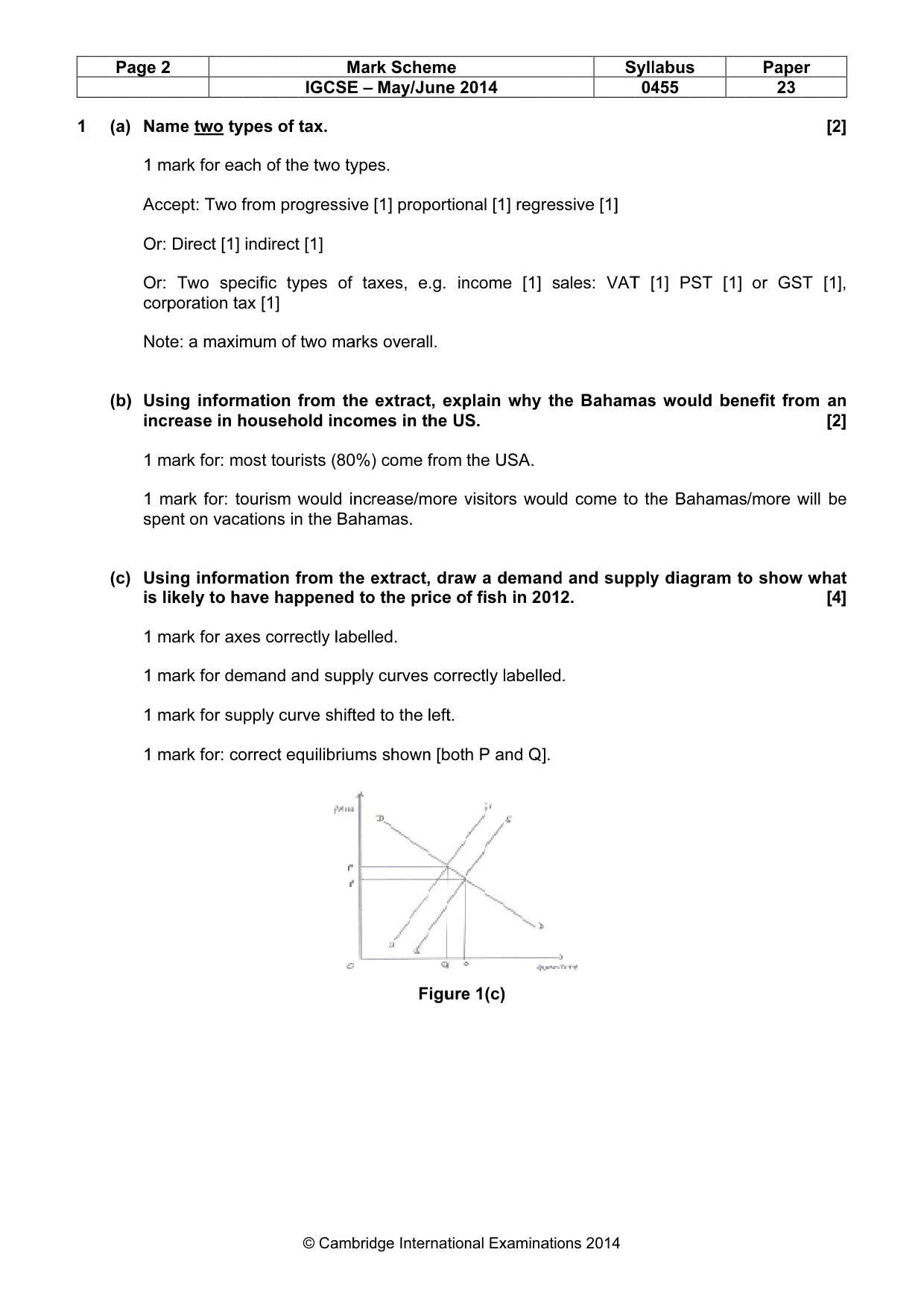
CAMBRIDGE INTERNATIONAL EXAMINATIONS International General Certificate of Secondary Education MARK SCHEME for the May/June 2014 series 0455 ECONOMICS 0455/23 Paper 2 (Structured Questions), maximum raw mark 80 This mark scheme is published as an aid to teachers and candidates, to indicate the requirements of the examination. It shows the basis on which Examiners were instructed to award marks. It does not indicate the details of the discussions that took place at an Examiners’ meeting before marking began, which would have considered the acceptability of alternative answers. Mark schemes should be read in conjunction with the question paper and the Principal Examiner Report for Teachers. Cambridge will not enter into discussions about these mark schemes. Cambridge is publishing the mark schemes for the May/June 2014 series for most IGCSE, GCE Advanced Level and Advanced Subsidiary Level components and some Ordinary Level components.
Mark scheme, page 2
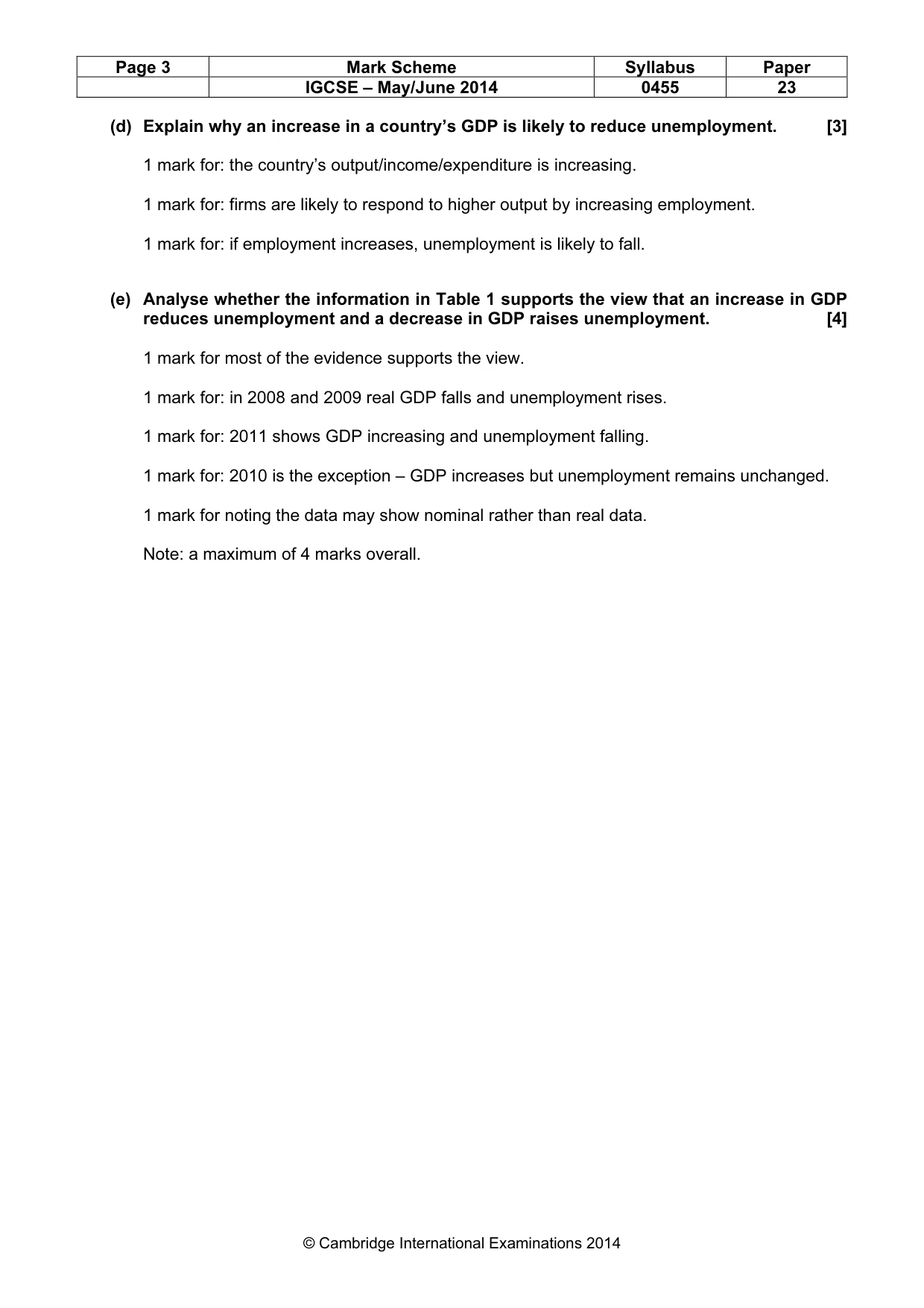
1 ( ( ( Pa (a) (b) (c) age N 1 A O O c N ) U in 1 1 s U is 1 1 1 1 e 2 Nam 1 m Acc Or: Or: corp Not Usi nc 1 m 1 m spe Usi s l 1 m 1 m 1 m 1 m 2 me mar cep Di T po te: ing rea mar mar ent ing ike mar mar mar mar e tw rk f pt: T rec Two rat a m g in ase rk f rk f on g in ely rk f rk f rk f rk f wo for Tw ct [ o s tion ma nfo e in for: for n va nfo to for for for for: ty ea wo f [1] spe n ta axim orm n h m r: to aca orm o ha ax de su co ype ach fro ind ecif ax mu mat hou os our atio mat ave es ema pp orre es o of m dire fic [1] um tio use t to rism ons tio e h co and ly c ect of f th pro ect ty of on f eho our m w s in n f hap orre d a cur t eq IG © tax e t ogr t [1 ype tw fro old rist wo n th fro ppe ect and rve qui GC Ca x. two res ] es wo m om d in ts ( ould he om ene tly l d su e sh ilib M SE amb o ty ssiv of ma th nco 80 d in Ba th ed lab upp hift riu Mar E – brid ype ve ta arks he om 0%) ncr aha e e to bell ply ted ms rk S M dge es. [1] axe s o ex mes ) co rea ama ext o th led y cu d to s sh Sc ay/ e In pr es, ve xtra s in om ase as. tra he d. urv o th how che /Ju nter rop e ral act n th me f e/m . act, pri es he l wn F eme une rnat port .g. l. t, e he fro mor , d ice co left n [b igu e e 2 tion tion in exp US m re v raw e o orre t. both ure 201 nal nal nco pla S. the vis w a f fi ect h P e 1 14 Ex l [1 ome ain e U ito a d ish tly l P a (c) xam ] re e w USA rs dem h in lab nd ) mina eg [1] hy A. wo ma n 2 bell Q atio res s y th oul and 01 led Q]. ons ssiv ale he d c d a 2. d. s 20 ve es: Ba com nd 014 [1] V aha me d su S 4 ] VAT am e to up Syll 04 T [ mas o th ply lab 455 [1] s w he y d bus 5 P wou Ba diag s ST uld aha gra T [ d b am am [1] ben mas m to P or nef s/m o s Pa 2 r G fit f ore sho pe 23 GS fro e w ow er T om will w w [2 [1] an [2 be wha [4 2] ], n 2] e at 4]
Mark scheme, page 3
Page 3 Mark Scheme Syllabus Paper IGCSE – May/June 2014 0455 23 © Cambridge International Examinations 2014 (d) Explain why an increase in a country’s GDP is likely to reduce unemployment. [3] 1 mark for: the country’s output/income/expenditure is increasing. 1 mark for: firms are likely to respond to higher output by increasing employment. 1 mark for: if employment increases, unemployment is likely to fall. (e) Analyse whether the information in Table 1 supports the view that an increase in GDP reduces unemployment and a decrease in GDP raises unemployment. [4] 1 mark for most of the evidence supports the view. 1 mark for: in 2008 and 2009 real GDP falls and unemployment rises. 1 mark for: 2011 shows GDP increasing and unemployment falling. 1 mark for: 2010 is the exception – GDP increases but unemployment remains unchanged. 1 mark for noting the data may show nominal rather than real data. Note: a maximum of 4 marks overall.
Mark scheme, page 4
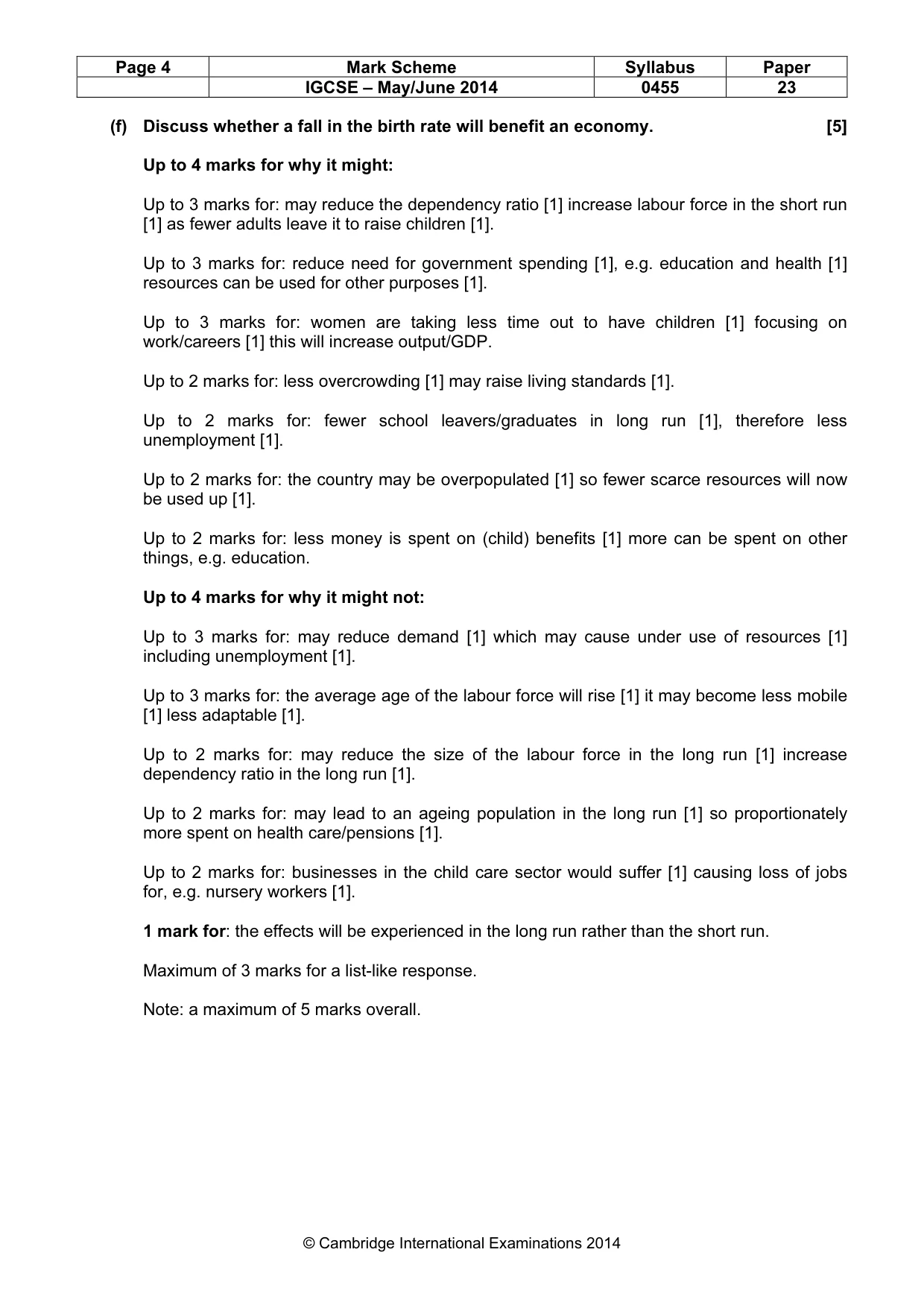
Page 4 Mark Scheme Syllabus Paper IGCSE – May/June 2014 0455 23 © Cambridge International Examinations 2014 (f) Discuss whether a fall in the birth rate will benefit an economy. [5] Up to 4 marks for why it might: Up to 3 marks for: may reduce the dependency ratio [1] increase labour force in the short run [1] as fewer adults leave it to raise children [1]. Up to 3 marks for: reduce need for government spending [1], e.g. education and health [1] resources can be used for other purposes [1]. Up to 3 marks for: women are taking less time out to have children [1] focusing on work/careers [1] this will increase output/GDP. Up to 2 marks for: less overcrowding [1] may raise living standards [1]. Up to 2 marks for: fewer school leavers/graduates in long run [1], therefore less unemployment [1]. Up to 2 marks for: the country may be overpopulated [1] so fewer scarce resources will now be used up [1]. Up to 2 marks for: less money is spent on (child) benefits [1] more can be spent on other things, e.g. education. Up to 4 marks for why it might not: Up to 3 marks for: may reduce demand [1] which may cause under use of resources [1] including unemployment [1]. Up to 3 marks for: the average age of the labour force will rise [1] it may become less mobile [1] less adaptable [1]. Up to 2 marks for: may reduce the size of the labour force in the long run [1] increase dependency ratio in the long run [1]. Up to 2 marks for: may lead to an ageing population in the long run [1] so proportionately more spent on health care/pensions [1]. Up to 2 marks for: businesses in the child care sector would suffer [1] causing loss of jobs for, e.g. nursery workers [1]. 1 mark for: the effects will be experienced in the long run rather than the short run. Maximum of 3 marks for a list-like response. Note: a maximum of 5 marks overall.
Mark scheme, page 5
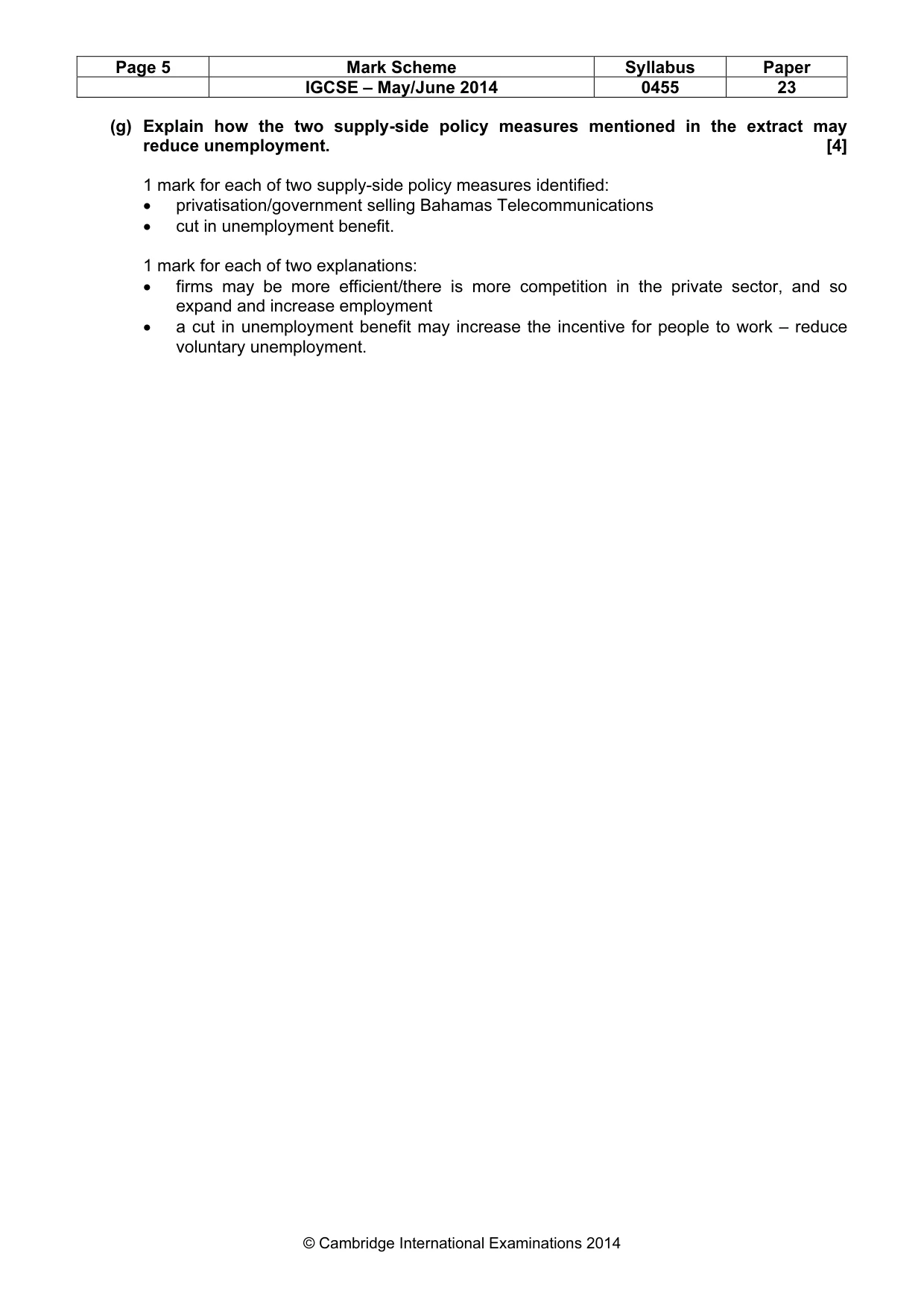
Page 5 Mark Scheme Syllabus Paper IGCSE – May/June 2014 0455 23 © Cambridge International Examinations 2014 (g) Explain how the two supply-side policy measures mentioned in the extract may reduce unemployment. [4] 1 mark for each of two supply-side policy measures identified: • privatisation/government selling Bahamas Telecommunications • cut in unemployment benefit. 1 mark for each of two explanations: • firms may be more efficient/there is more competition in the private sector, and so expand and increase employment • a cut in unemployment benefit may increase the incentive for people to work – reduce voluntary unemployment.
Mark scheme, page 6
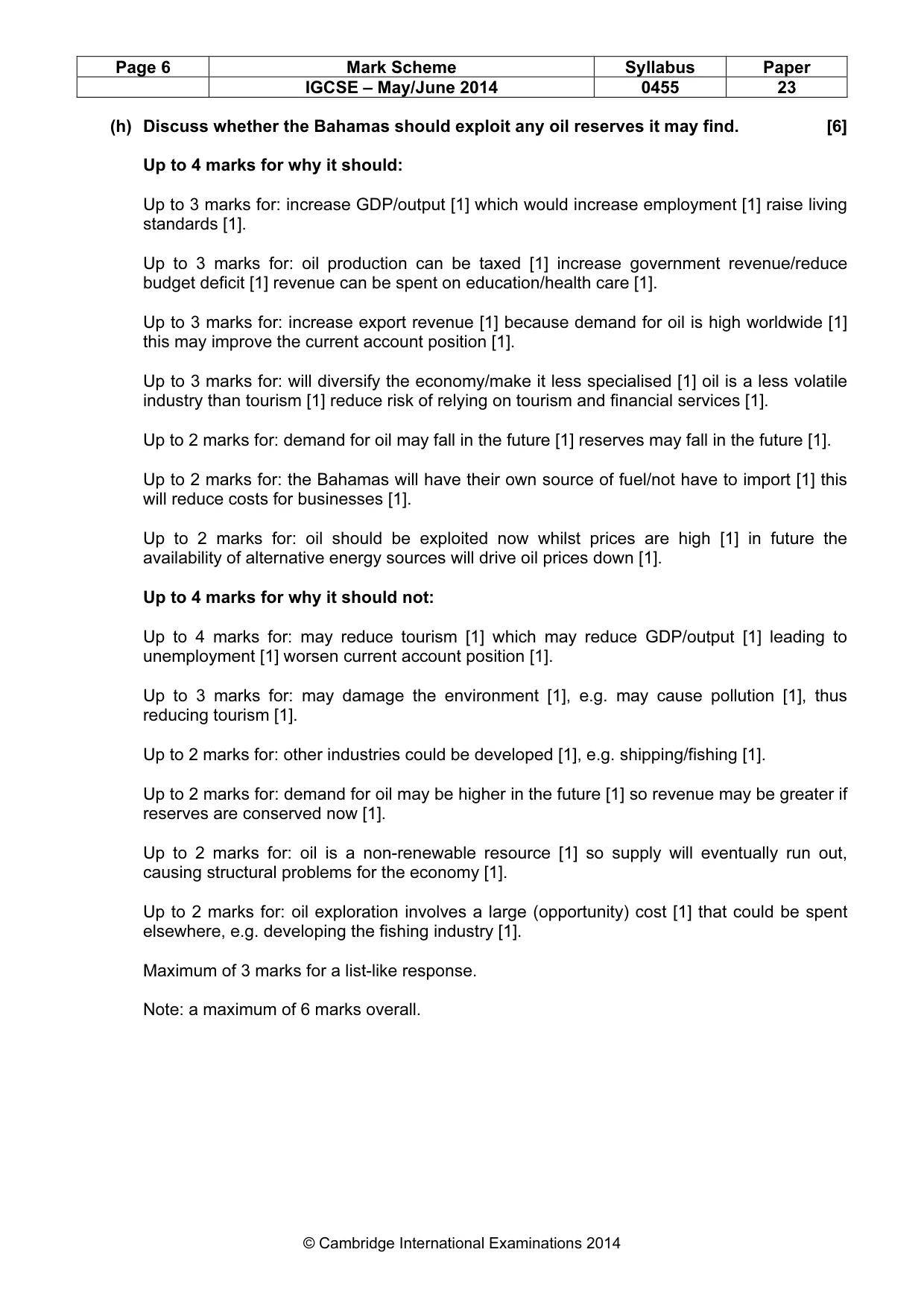
Page 6 Mark Scheme Syllabus Paper IGCSE – May/June 2014 0455 23 © Cambridge International Examinations 2014 (h) Discuss whether the Bahamas should exploit any oil reserves it may find. [6] Up to 4 marks for why it should: Up to 3 marks for: increase GDP/output [1] which would increase employment [1] raise living standards [1]. Up to 3 marks for: oil production can be taxed [1] increase government revenue/reduce budget deficit [1] revenue can be spent on education/health care [1]. Up to 3 marks for: increase export revenue [1] because demand for oil is high worldwide [1] this may improve the current account position [1]. Up to 3 marks for: will diversify the economy/make it less specialised [1] oil is a less volatile industry than tourism [1] reduce risk of relying on tourism and financial services [1]. Up to 2 marks for: demand for oil may fall in the future [1] reserves may fall in the future [1]. Up to 2 marks for: the Bahamas will have their own source of fuel/not have to import [1] this will reduce costs for businesses [1]. Up to 2 marks for: oil should be exploited now whilst prices are high [1] in future the availability of alternative energy sources will drive oil prices down [1]. Up to 4 marks for why it should not: Up to 4 marks for: may reduce tourism [1] which may reduce GDP/output [1] leading to unemployment [1] worsen current account position [1]. Up to 3 marks for: may damage the environment [1], e.g. may cause pollution [1], thus reducing tourism [1]. Up to 2 marks for: other industries could be developed [1], e.g. shipping/fishing [1]. Up to 2 marks for: demand for oil may be higher in the future [1] so revenue may be greater if reserves are conserved now [1]. Up to 2 marks for: oil is a non-renewable resource [1] so supply will eventually run out, causing structural problems for the economy [1]. Up to 2 marks for: oil exploration involves a large (opportunity) cost [1] that could be spent elsewhere, e.g. developing the fishing industry [1]. Maximum of 3 marks for a list-like response. Note: a maximum of 6 marks overall.
Mark scheme, page 7
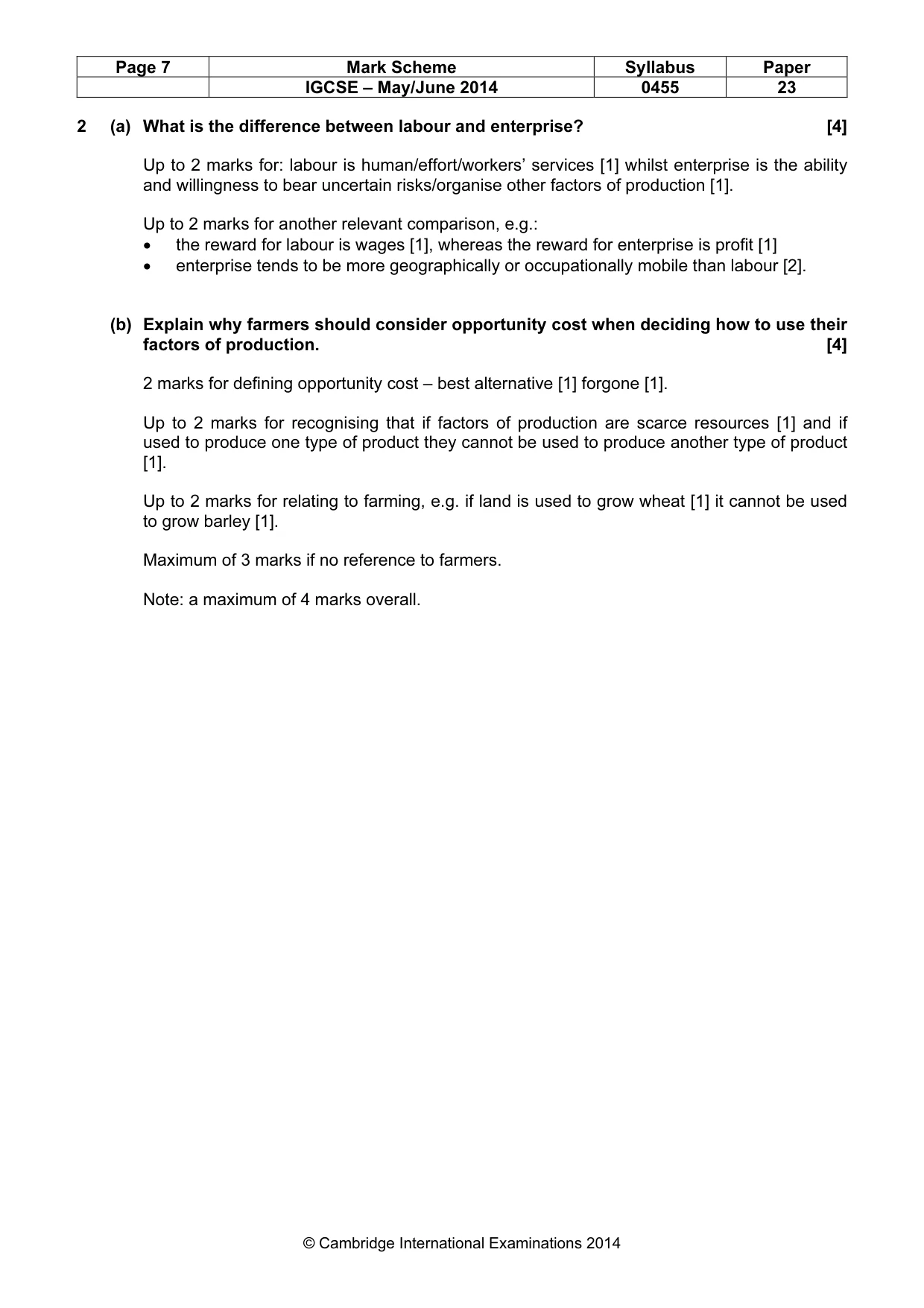
Page 7 Mark Scheme Syllabus Paper IGCSE – May/June 2014 0455 23 © Cambridge International Examinations 2014 2 (a) What is the difference between labour and enterprise? [4] Up to 2 marks for: labour is human/effort/workers’ services [1] whilst enterprise is the ability and willingness to bear uncertain risks/organise other factors of production [1]. Up to 2 marks for another relevant comparison, e.g.: • the reward for labour is wages [1], whereas the reward for enterprise is profit [1] • enterprise tends to be more geographically or occupationally mobile than labour [2]. (b) Explain why farmers should consider opportunity cost when deciding how to use their factors of production. [4] 2 marks for defining opportunity cost – best alternative [1] forgone [1]. Up to 2 marks for recognising that if factors of production are scarce resources [1] and if used to produce one type of product they cannot be used to produce another type of product [1]. Up to 2 marks for relating to farming, e.g. if land is used to grow wheat [1] it cannot be used to grow barley [1]. Maximum of 3 marks if no reference to farmers. Note: a maximum of 4 marks overall.
Mark scheme, page 8
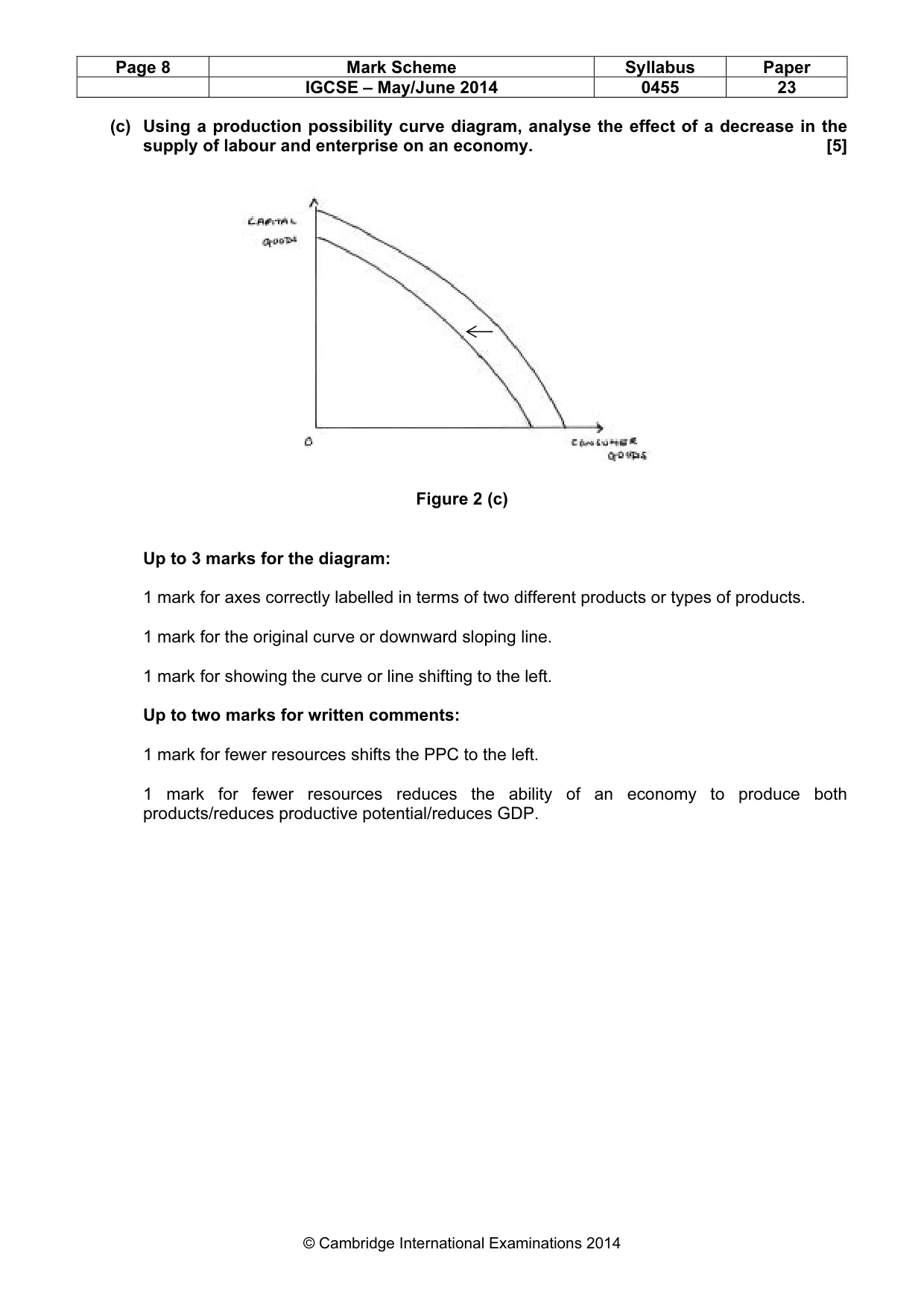
Page 8 Mark Scheme Syllabus Paper IGCSE – May/June 2014 0455 23 © Cambridge International Examinations 2014 (c) Using a production possibility curve diagram, analyse the effect of a decrease in the supply of labour and enterprise on an economy. [5] Figure 2 (c) Up to 3 marks for the diagram: 1 mark for axes correctly labelled in terms of two different products or types of products. 1 mark for the original curve or downward sloping line. 1 mark for showing the curve or line shifting to the left. Up to two marks for written comments: 1 mark for fewer resources shifts the PPC to the left. 1 mark for fewer resources reduces the ability of an economy to produce both products/reduces productive potential/reduces GDP.
Mark scheme, page 9
Page 9 Mark Scheme Syllabus Paper IGCSE – May/June 2014 0455 23 © Cambridge International Examinations 2014 (d) Discuss whether an increase in the quality of a country’s factors of production will always increase its exports. [7] Up to 5 marks for why it might: Up to 5 marks for: will raise productivity/make firms more efficient [1] may lower costs of production [1] will lower price of exports [1] may make exports more price competitive [1] will increase demand for exports [1]. Up to 3 marks for: supply of goods and services for export could increase [1] due to higher productivity of factors [1] causing prices to fall [1] raising the demand for exports [1]. Up to 3 marks for: may raise the quality of exports [1] may make exports more quality competitive [1] may increase demand for exports [1]. Up to 5 marks for why it might not: Up to 4 marks for: quality of other country’s factors of production may rise by more [1] so price competitiveness of exports may fall [1] quality competitiveness of exports may fall [1] demand for exports may fall [1]. Up to 4 marks for: payments to factors of production may rise by more than quality/higher factor payments may be needed to increase export quality [1] this will raise costs [1] pushing up price [1] reducing demand [1]. Up to 4 marks for: exchange rate may rise [1] pushing up the price of exports [1] making them less price competitive [1] reducing demand for exports [1]. Up to 3 marks for an additional comment: It depends upon the type of product being exported [1], e.g. a staple food such as rice will be little affected [1] whilst a luxury good could be greatly affected [1]. Up to 2 marks for: income abroad may fall [1] reducing foreigners ability to buy exports [1]. Up to 2 marks for: output may be mainly for domestic consumption [1] and so not available for export markets [1]. Maximum of 4 marks for a list-like response. Note: a maximum of 7 marks overall.
Mark scheme, page 10
Page 10 Mark Scheme Syllabus Paper IGCSE – May/June 2014 0455 23 © Cambridge International Examinations 2014 3 (a) Describe what determines ‘equilibrium price’. [2] 2 marks for: demand and supply/market forces. Or 1 mark for demand OR supply. Note: a diagram is acceptable. (b) Explain two reasons why the supply curve of a product may shift to the right. [4] 1 mark for each of two reasons identified, e.g.: • government subsidy • falls in costs of production • advances in technology • good weather • seasonal factors • increased use of pesticides/fertilisers/capital equipment (e.g. tractors) • reduction in indirect tax • changes in the price of other products produced. 1 mark for each of two explanations, e.g.: • a government subsidy will reduce costs of production/provides an incentive to produce more • a fall in costs of production means that firms can produce more at the same price • advances in technology lower costs of production • good weather can increase the supply of agricultural products • when a crop is in season, the supply increases • pesticides/fertilisers/more capital increase crop yields • reduction in indirect tax lowers costs of production • if the price of one product firms produce falls, they may move resources to this product. (c) Analyse what effect a fall in price may have on a farmer’s profit. [6] 1 mark for: a fall in price will increase the quantity of a farmer's product demanded. Up to 5 marks for: if demand is elastic [1] demand will increase proportionately more than the fall in price [1] a fall in price will raise revenue [1] to produce more to take advantage of higher demand, total cost will rise [1] profit will increase if revenue rises by more than costs [1] to increase output, a farmer must have spare resources [1]. Up to 3 marks for: if demand is inelastic [1] demand will fall proportionately less than the fall in price [1] a fall in price will reduce revenue [1] lower revenue will reduce profits if costs remain unchanged [1]. 1 mark for: profit is revenue minus costs. Note: a maximum of 6 marks overall.
Mark scheme, page 11
Page 11 Mark Scheme Syllabus Paper IGCSE – May/June 2014 0455 23 © Cambridge International Examinations 2014 (d) Discuss whether the price of food is likely to increase in the future. [8] Up to 6 marks for reasons why it might: Up to 2 marks for: rise in population size [1] leading to higher demand [1]. Up to 2 marks for: rise in incomes [1] resulting in higher demand [1]. Up to 2 marks for: land becoming scarce [1] reducing food supplies [1]. Up to 2 marks for: rise in demand for biofuels [1] and so a reduction in resources to produce food [1]. Up to 2 marks for: fall in food supply [1] due to, e.g. weather conditions/natural resources [1]. Up to 2 marks for: food markets may become monopolies [1] which charge higher prices [1]. Up to 2 mark for: costs of food production rise [1] such as increased wages [1]. Up to 6 marks for reasons why it might not: Up to 2 marks for: advances in technology [1] leading to higher supply [1]. Up to 2 marks for: more efficient use of resources [1] increasing supply [1]. Up to 2 marks for: fall in the cost of factors of production (e.g. seeds, tractors) [1] leading to increased supply [1]. Up to 2 marks for: reduction in households wasting food [1] reducing demand [1]. Up to 2 marks for: reduction in crop losses due to vermin [1] reducing demand [1]. Up to 2 marks for: good weather conditions/absence of natural disasters [1] increasing supply [1]. Up to 2 marks for: increased competition in agriculture [1] pushing prices lower [1]. Up to 4 marks for why there may be variations in the future price of different types of food: Up to 2 marks for why changes in demand may vary: • changes in tastes may occur [1], e.g. demand for meat may increase/fall [1] • changes in population size may vary [1] • health reports may discourage/encourage consumption of certain food products [1]. Up to 2 marks for why changes in supply may vary: • some foods can be stored more easily [1] • some are more resistant to disease [1] • some may be subsidised [1] but this is not always passed on to the consumer [1]. Note: a maximum of 8 marks overall.
Mark scheme, page 12
Page 12 Mark Scheme Syllabus Paper IGCSE – May/June 2014 0455 23 © Cambridge International Examinations 2014 4 (a) Describe how fixed costs and variable costs are influenced by a rise in output. [2] Fixed costs will not change [1] in the short run [1]. Variable costs will rise [1]. Note: a maximum of 2 marks overall. (b) Explain two reasons why someone may be prepared to work for a low wage. [4] 1 mark for each of two reasons identified: • hope of promotion • good working conditions • fringe benefits • lack of skills/qualifications • job security • job satisfaction • unemployment in the economy/lack of demand for labour. 1 mark for each of two explanations, e.g.: • a worker may be prepared to work for low wages if s/he expects higher pay in the future • a worker may prefer good working conditions to high wages • fringe benefits (e.g. company car) may compensate for low wages • lack of skills/qualifications may mean workers have no option but to work for low wages • job security may be a key objective during a time of high unemployment • a number of people accept low wages if they find a job rewarding/have a vocation • few jobs available means supply of labour exceeds demand, forcing wages down. (c) Analyse two ways a bank can help a firm increase in size. [4] 1 mark for each of two ways identified: • lending money • advice • help with mergers • low interest rate. 1 mark for each of two analytical points: • providing finance to, e.g. buy new capital equipment/may be in the form of overdrafts or loans • advice may be given on, e.g. how to cut costs/raise revenue • a bank may help a firm to sell shares to raise the finance to buy another firm/may draw up documents on a merger • providing low interest keeps cost of expansion down. Note: a maximum of 4 marks overall.
Mark scheme, page 13
Page 13 Mark Scheme Syllabus Paper IGCSE – May/June 2014 0455 23 © Cambridge International Examinations 2014 (d) Discuss, using the Nigerian film (movie) industry as an example, whether consumers will benefit from larger firms. [10] Up to 7 marks for reasons why they might: Up to 4 marks for: price may be lower [1] due to lower costs [1] because of economies of scale [1], e.g. buying in bulk/borrowing more easily and cheaply [1]. Up to 3 marks for: may innovate more [1] raising quality [1] bringing out new products [1]. Up to 3 marks for: may produce a greater range of products [1] because of greater availability of factors of production, e.g. labour [1] giving consumers more choice [1]. Up to 7 marks for why they might not: Up to 4 marks for: prices may be higher [1] due to higher costs [1] because of diseconomies of scale [1], e.g. problems of control and co-ordination [1]. Up to 3 marks for: may exploit any monopoly power [1] to push up price [1] due to lack of competition [1]. Up to 2 marks for: may not provide a personal service [1] may not respond to individual needs [1]. Up to 2 marks for: may not be flexible [1] may not respond quickly to changes in demand [1]. Up to 2 marks for: may put small independents out of business [1] restricting the range (of films) available [1]. Maximum of 5 marks for a list-like approach. Note: a maximum of 8 marks if there is no reference to the film (movie) industry. Note: a maximum of 10 marks overall.
Mark scheme, page 14
Page 14 Mark Scheme Syllabus Paper IGCSE – May/June 2014 0455 23 © Cambridge International Examinations 2014 5 (a) Explain what is meant by a fall in the rate of inflation. [2] 1 mark for: prices/price level rising. 1 mark for: rising more slowly. (b) Explain what can cause an increase in the costs of production. [3] Up to 4 marks for: labour shortages cause wages to rise [1] a rise in wages [1] higher wages will increase labour costs [1] labour costs will rise if wages increase by more than productivity [1]. Up to 2 marks for: a rise in raw material costs [1] higher raw material costs may be caused by a shortage of supply/a fall in the exchange rate [1]. Up to 2 marks for: rise in profit margins [1] normal profit is included in costs of production [1]. Up to 2 marks for: scarcity of resources (e.g. land, labour, capital) [1] causing the price of the resource to rise [1]. Up to 2 marks for: an increase in taxes on firms [1] taxes are an additional cost [1]. Note: a maximum of 3 marks overall. (c) Analyse why a reduction in the rate of interest may cause inflation. [6] 1 mark for: a lower rate of interest will reduce the cost of borrowing/more will be borrowed. 1 mark for: a lower rate of interest will reduce the incentive to save/less will be saved. 1 mark for: consumer expenditure and investment are likely to increase. 1 mark for: higher spending will increase total (aggregate) demand. 1 mark for: firms are likely to respond to higher demand by raising prices. 1 mark for: as demand rises, shortages of resources develop pushing up prices. 1 mark for: demand-pull inflation may occur. 1 mark for: the currency will be weaker. 1 mark for: the money supply will expand. Note: a maximum of 6 marks overall.
Mark scheme, page 15
Page 15 Mark Scheme Syllabus Paper IGCSE – May/June 2014 0455 23 © Cambridge International Examinations 2014 (d) Discuss whether inflation harms everyone in an economy. [9] Up to 6 marks for why it may harm some: Up to 3 marks for: those workers whose wages rise by less than inflation [1] will experience a fall in purchasing power [1] people on fixed incomes will lose out [1]. Up to 3 marks for: savers/lenders will lose out [1] if the rate of interest does not rise [1] in line with inflation [1]. Up to 3 marks for: taxpayers may pay more in tax [1] if tax rates are not adjusted [1] in line with inflation [1]. Up to 2 marks for: inflation reduces the purchasing power of money [1] consumers are able to buy less [1] if the inflation rate exceeds any rise in income [1]. Up to 2 marks for: exporters may sell fewer products [1] as products will become less price competitive [1]. Up to 2 marks for: firms competing with imports may lose sales [1] if their inflation rate is higher [1]. Up to 6 marks for why some may gain: Up to 3 marks for: firms may be encouraged to expand [1] as a result of a low and steady rate [1] of demand-pull inflation [1]. Up to 2 marks for: borrowers may gain [1] borrowers may pay back less in real terms [1]. Up to 2 marks for: some workers may gain [1] if their wages rise by more than inflation/have strong bargaining power [1]. Up to 3 marks for: the government may receive more tax revenue [1] from indirect taxes whose prices have risen [1] or if higher incomes move people into higher tax brackets [1]. Up to 4 marks for overall comments, e.g.: Up to 3 marks for: will depend on the rate of inflation [1] higher rate will be more harmful [1] accelerating rate will be more harmful/cause more uncertainty [1]. Up to 3 marks for: will depend on the cause of inflation [1] cost-push inflation is more harmful than demand-pull [1] cost-push may be accompanied by a fall in GDP whilst demand-pull by a rise in GDP [1]. Up to 3 marks for: it will depend on the inflation rate in other countries [1] if lower than other countries will be less harmful/if higher more harmful [1] prices may still be lower than other rival countries [1]. Up to 2 marks for: it does not affect those who have assets such as land [1] whose value will rise along with inflation [1]. Maximum of 5 marks for a list-like response. Note: a maximum of 9 marks overall.
Mark scheme, page 16
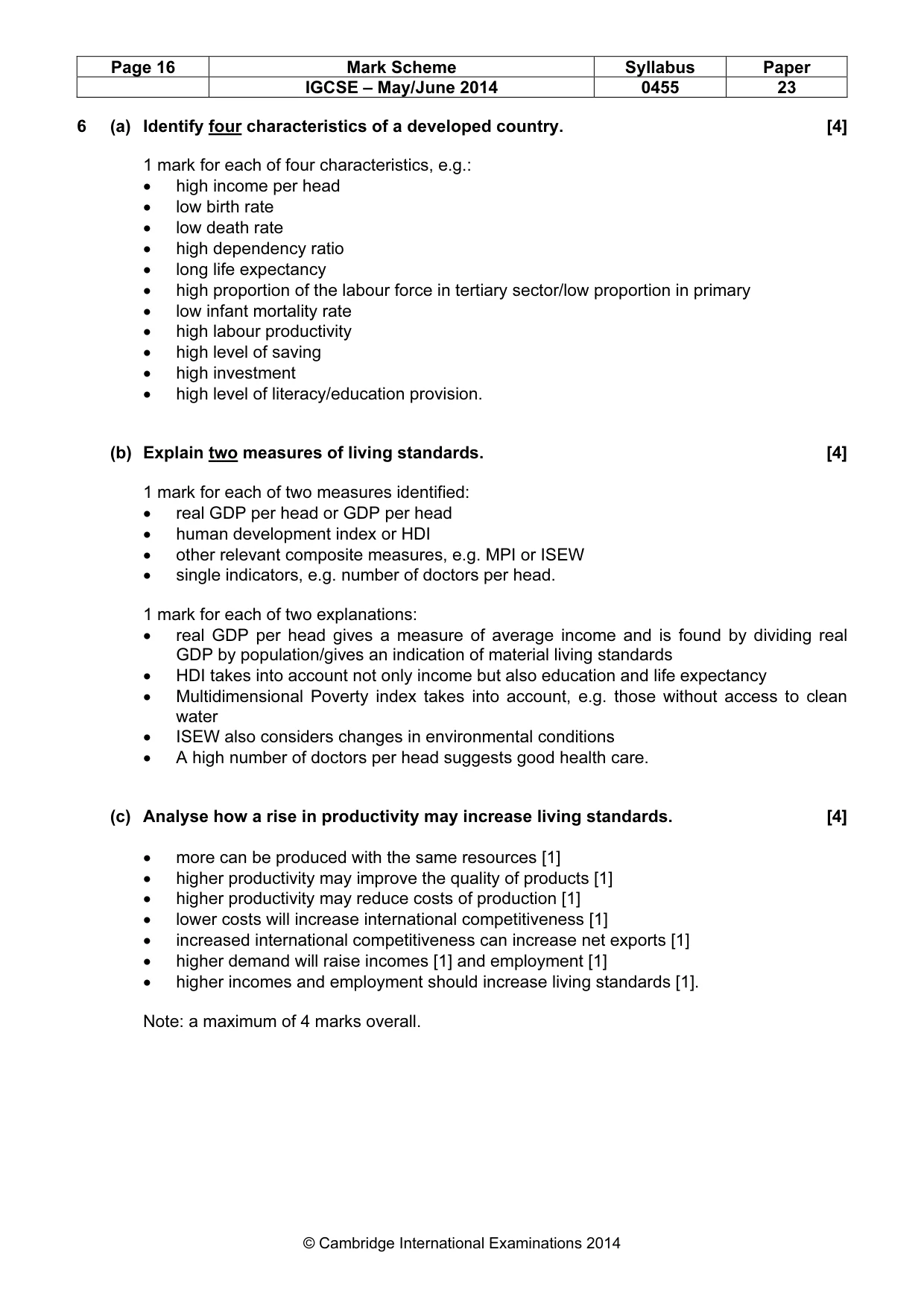
Page 16 Mark Scheme Syllabus Paper IGCSE – May/June 2014 0455 23 © Cambridge International Examinations 2014 6 (a) Identify four characteristics of a developed country. [4] 1 mark for each of four characteristics, e.g.: • high income per head • low birth rate • low death rate • high dependency ratio • long life expectancy • high proportion of the labour force in tertiary sector/low proportion in primary • low infant mortality rate • high labour productivity • high level of saving • high investment • high level of literacy/education provision. (b) Explain two measures of living standards. [4] 1 mark for each of two measures identified: • real GDP per head or GDP per head • human development index or HDI • other relevant composite measures, e.g. MPI or ISEW • single indicators, e.g. number of doctors per head. 1 mark for each of two explanations: • real GDP per head gives a measure of average income and is found by dividing real GDP by population/gives an indication of material living standards • HDI takes into account not only income but also education and life expectancy • Multidimensional Poverty index takes into account, e.g. those without access to clean water • ISEW also considers changes in environmental conditions • A high number of doctors per head suggests good health care. (c) Analyse how a rise in productivity may increase living standards. [4] • more can be produced with the same resources [1] • higher productivity may improve the quality of products [1] • higher productivity may reduce costs of production [1] • lower costs will increase international competitiveness [1] • increased international competitiveness can increase net exports [1] • higher demand will raise incomes [1] and employment [1] • higher incomes and employment should increase living standards [1]. Note: a maximum of 4 marks overall.
Mark scheme, page 17
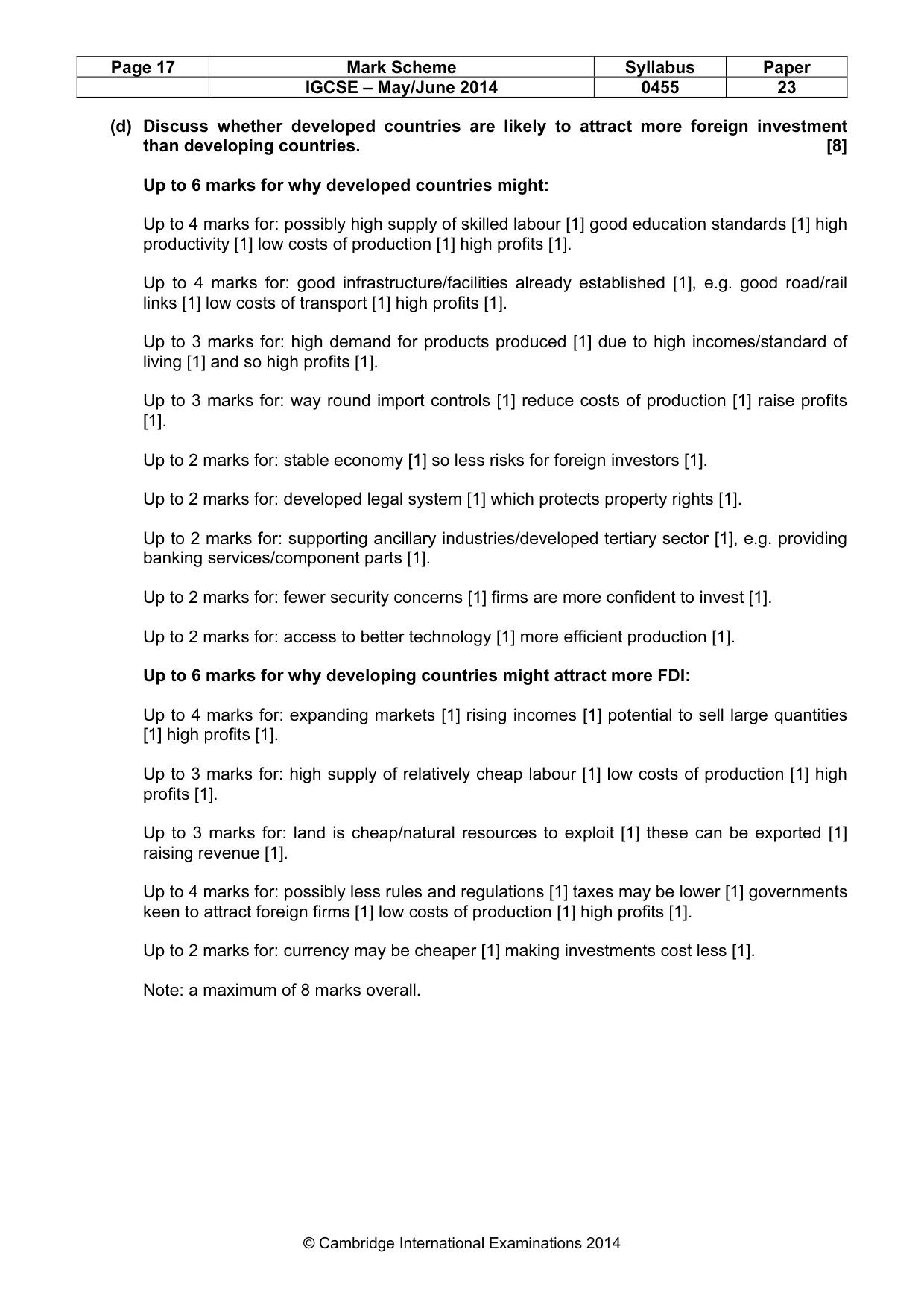
Page 17 Mark Scheme Syllabus Paper IGCSE – May/June 2014 0455 23 © Cambridge International Examinations 2014 (d) Discuss whether developed countries are likely to attract more foreign investment than developing countries. [8] Up to 6 marks for why developed countries might: Up to 4 marks for: possibly high supply of skilled labour [1] good education standards [1] high productivity [1] low costs of production [1] high profits [1]. Up to 4 marks for: good infrastructure/facilities already established [1], e.g. good road/rail links [1] low costs of transport [1] high profits [1]. Up to 3 marks for: high demand for products produced [1] due to high incomes/standard of living [1] and so high profits [1]. Up to 3 marks for: way round import controls [1] reduce costs of production [1] raise profits [1]. Up to 2 marks for: stable economy [1] so less risks for foreign investors [1]. Up to 2 marks for: developed legal system [1] which protects property rights [1]. Up to 2 marks for: supporting ancillary industries/developed tertiary sector [1], e.g. providing banking services/component parts [1]. Up to 2 marks for: fewer security concerns [1] firms are more confident to invest [1]. Up to 2 marks for: access to better technology [1] more efficient production [1]. Up to 6 marks for why developing countries might attract more FDI: Up to 4 marks for: expanding markets [1] rising incomes [1] potential to sell large quantities [1] high profits [1]. Up to 3 marks for: high supply of relatively cheap labour [1] low costs of production [1] high profits [1]. Up to 3 marks for: land is cheap/natural resources to exploit [1] these can be exported [1] raising revenue [1]. Up to 4 marks for: possibly less rules and regulations [1] taxes may be lower [1] governments keen to attract foreign firms [1] low costs of production [1] high profits [1]. Up to 2 marks for: currency may be cheaper [1] making investments cost less [1]. Note: a maximum of 8 marks overall.
Mark scheme, page 18
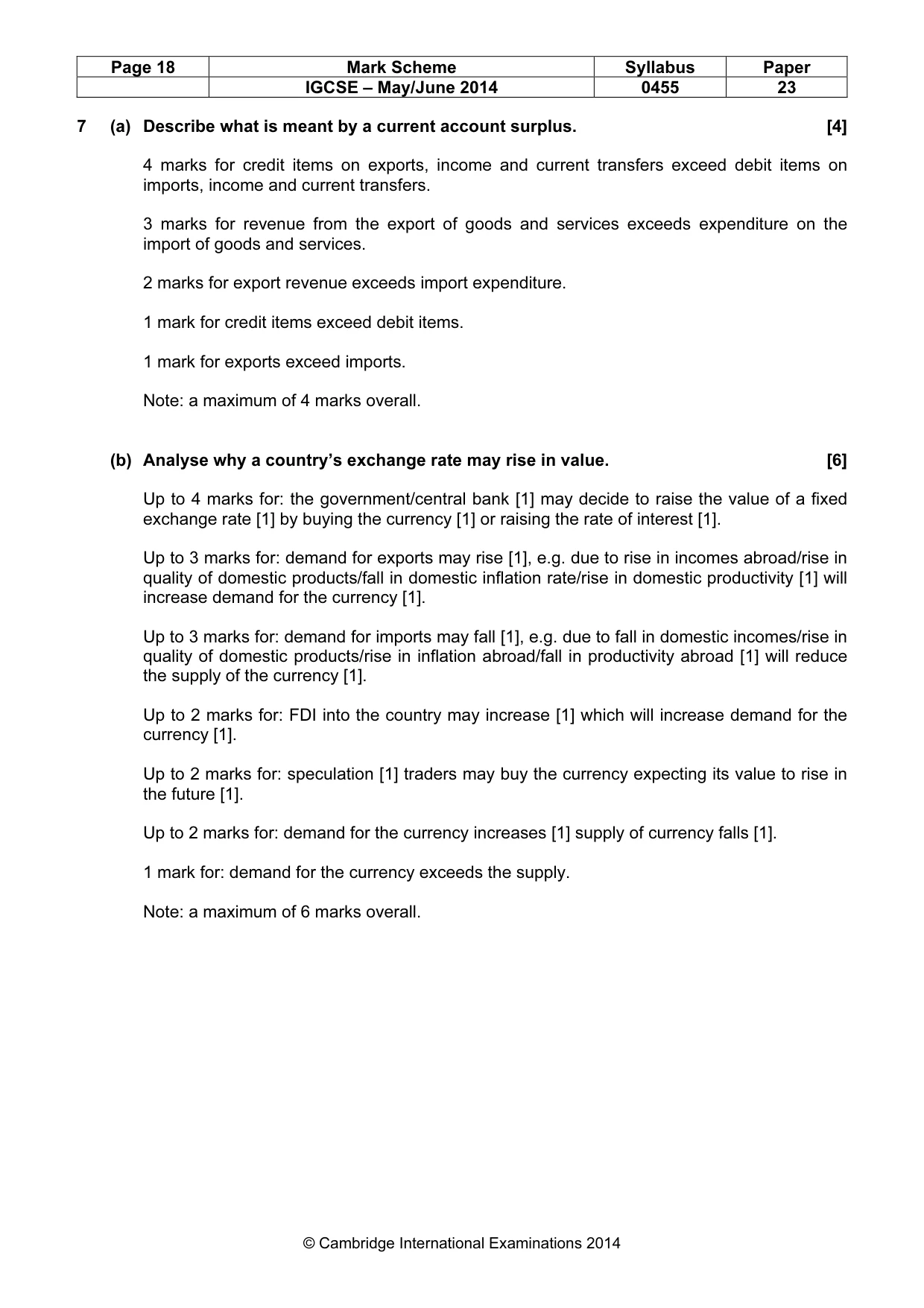
Page 18 Mark Scheme Syllabus Paper IGCSE – May/June 2014 0455 23 © Cambridge International Examinations 2014 7 (a) Describe what is meant by a current account surplus. [4] 4 marks for credit items on exports, income and current transfers exceed debit items on imports, income and current transfers. 3 marks for revenue from the export of goods and services exceeds expenditure on the import of goods and services. 2 marks for export revenue exceeds import expenditure. 1 mark for credit items exceed debit items. 1 mark for exports exceed imports. Note: a maximum of 4 marks overall. (b) Analyse why a country’s exchange rate may rise in value. [6] Up to 4 marks for: the government/central bank [1] may decide to raise the value of a fixed exchange rate [1] by buying the currency [1] or raising the rate of interest [1]. Up to 3 marks for: demand for exports may rise [1], e.g. due to rise in incomes abroad/rise in quality of domestic products/fall in domestic inflation rate/rise in domestic productivity [1] will increase demand for the currency [1]. Up to 3 marks for: demand for imports may fall [1], e.g. due to fall in domestic incomes/rise in quality of domestic products/rise in inflation abroad/fall in productivity abroad [1] will reduce the supply of the currency [1]. Up to 2 marks for: FDI into the country may increase [1] which will increase demand for the currency [1]. Up to 2 marks for: speculation [1] traders may buy the currency expecting its value to rise in the future [1]. Up to 2 marks for: demand for the currency increases [1] supply of currency falls [1]. 1 mark for: demand for the currency exceeds the supply. Note: a maximum of 6 marks overall.
Mark scheme, page 19
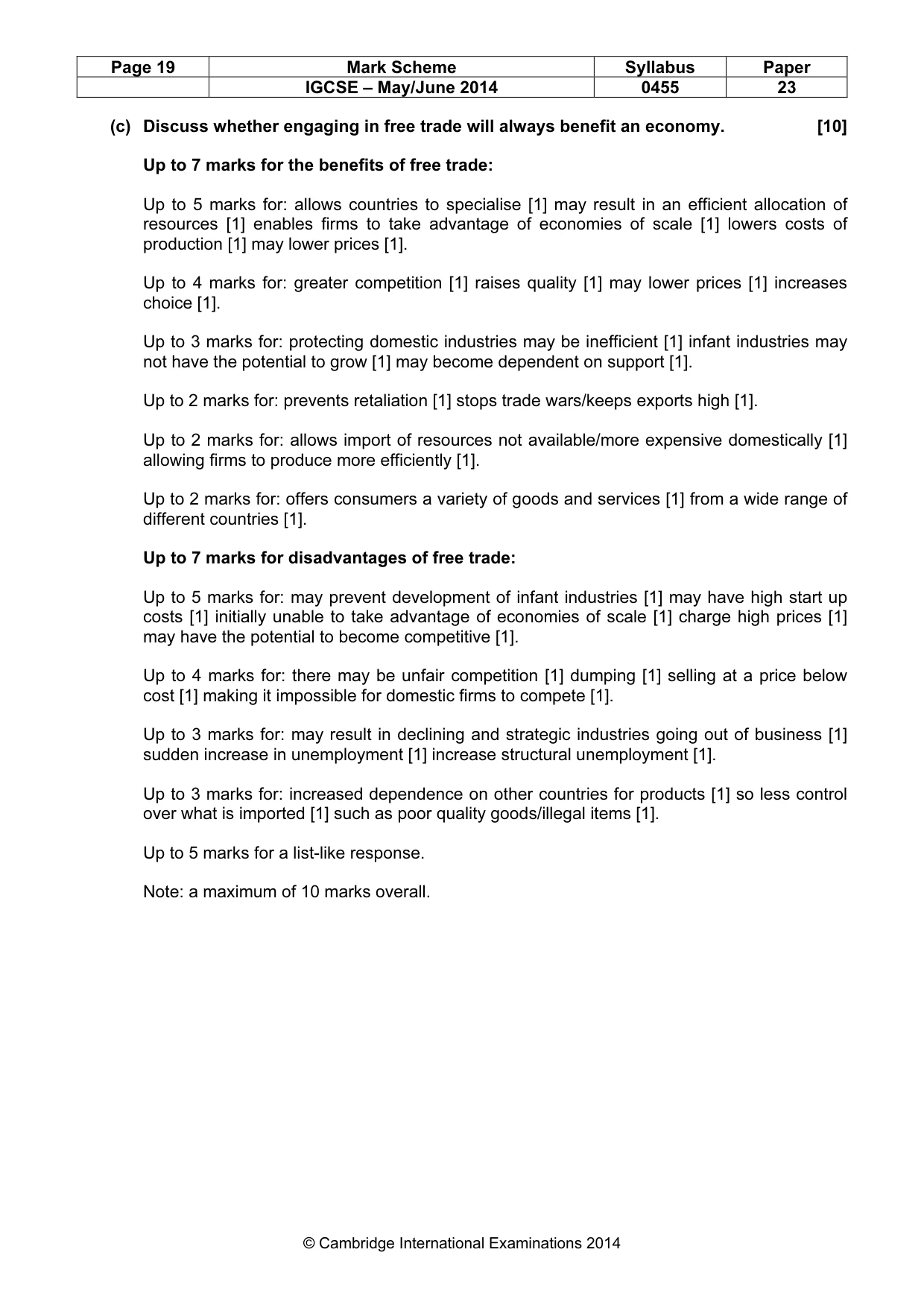
Page 19 Mark Scheme Syllabus Paper IGCSE – May/June 2014 0455 23 © Cambridge International Examinations 2014 (c) Discuss whether engaging in free trade will always benefit an economy. [10] Up to 7 marks for the benefits of free trade: Up to 5 marks for: allows countries to specialise [1] may result in an efficient allocation of resources [1] enables firms to take advantage of economies of scale [1] lowers costs of production [1] may lower prices [1]. Up to 4 marks for: greater competition [1] raises quality [1] may lower prices [1] increases choice [1]. Up to 3 marks for: protecting domestic industries may be inefficient [1] infant industries may not have the potential to grow [1] may become dependent on support [1]. Up to 2 marks for: prevents retaliation [1] stops trade wars/keeps exports high [1]. Up to 2 marks for: allows import of resources not available/more expensive domestically [1] allowing firms to produce more efficiently [1]. Up to 2 marks for: offers consumers a variety of goods and services [1] from a wide range of different countries [1]. Up to 7 marks for disadvantages of free trade: Up to 5 marks for: may prevent development of infant industries [1] may have high start up costs [1] initially unable to take advantage of economies of scale [1] charge high prices [1] may have the potential to become competitive [1]. Up to 4 marks for: there may be unfair competition [1] dumping [1] selling at a price below cost [1] making it impossible for domestic firms to compete [1]. Up to 3 marks for: may result in declining and strategic industries going out of business [1] sudden increase in unemployment [1] increase structural unemployment [1]. Up to 3 marks for: increased dependence on other countries for products [1] so less control over what is imported [1] such as poor quality goods/illegal items [1]. Up to 5 marks for a list-like response. Note: a maximum of 10 marks overall.
What you needed in this session
Cambridge’s own grade thresholds for 2014 May/June, Paper 2 · Variant 3. A higher threshold means an easier paper — the bar moves with how the cohort did.