Cambridge IGCSE Economics 0455 — 2014 May/June Paper 2 · Variant 1
0455/21/M/J/14 · 90 marks · ≈101 min
The question paper and its mark scheme, free to read here and free to download. This is Cambridge’s own paper, exactly as it was sat.
Question paper8 pages



Mark scheme19 pages
Answers below. Sit the paper first if you are practising.
Paper as text
Question paper, page 1
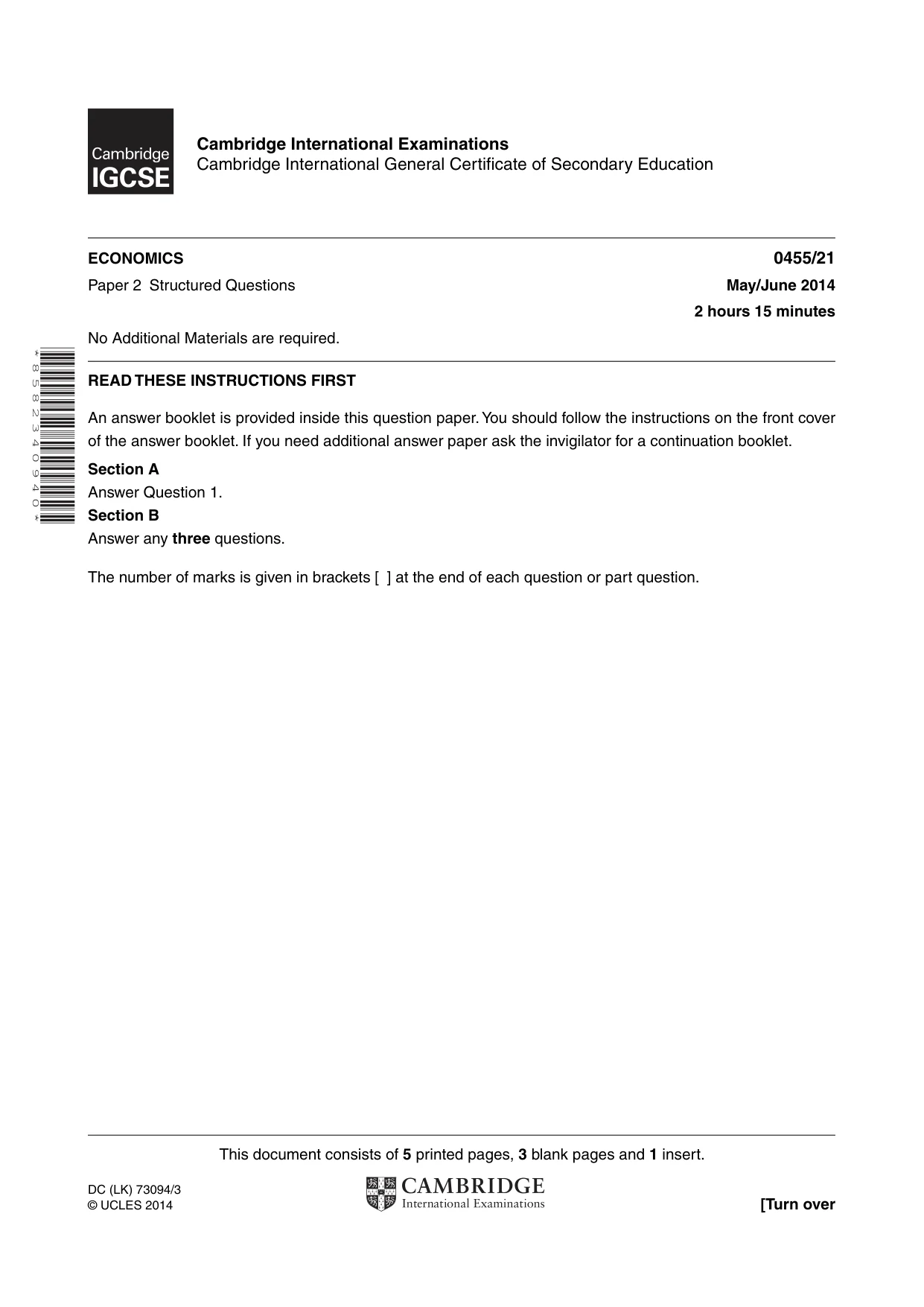
This document consists of 5 printed pages, 3 blank pages and 1 insert. DC (LK) 73094/3 © UCLES 2014 [Turn over * 8 5 8 2 3 4 0 9 4 0 * ECONOMICS 0455/21 Paper 2 Structured Questions May/June 2014 2 hours 15 minutes No Additional Materials are required. READ THESE INSTRUCTIONS FIRST An answer booklet is provided inside this question paper. You should follow the instructions on the front cover of the answer booklet. If you need additional answer paper ask the invigilator for a continuation booklet. Section A Answer Question 1. Section B Answer any three questions. The number of marks is given in brackets [ ] at the end of each question or part question. Cambridge International Examinations Cambridge International General Certificate of Secondary Education
Question paper, page 2
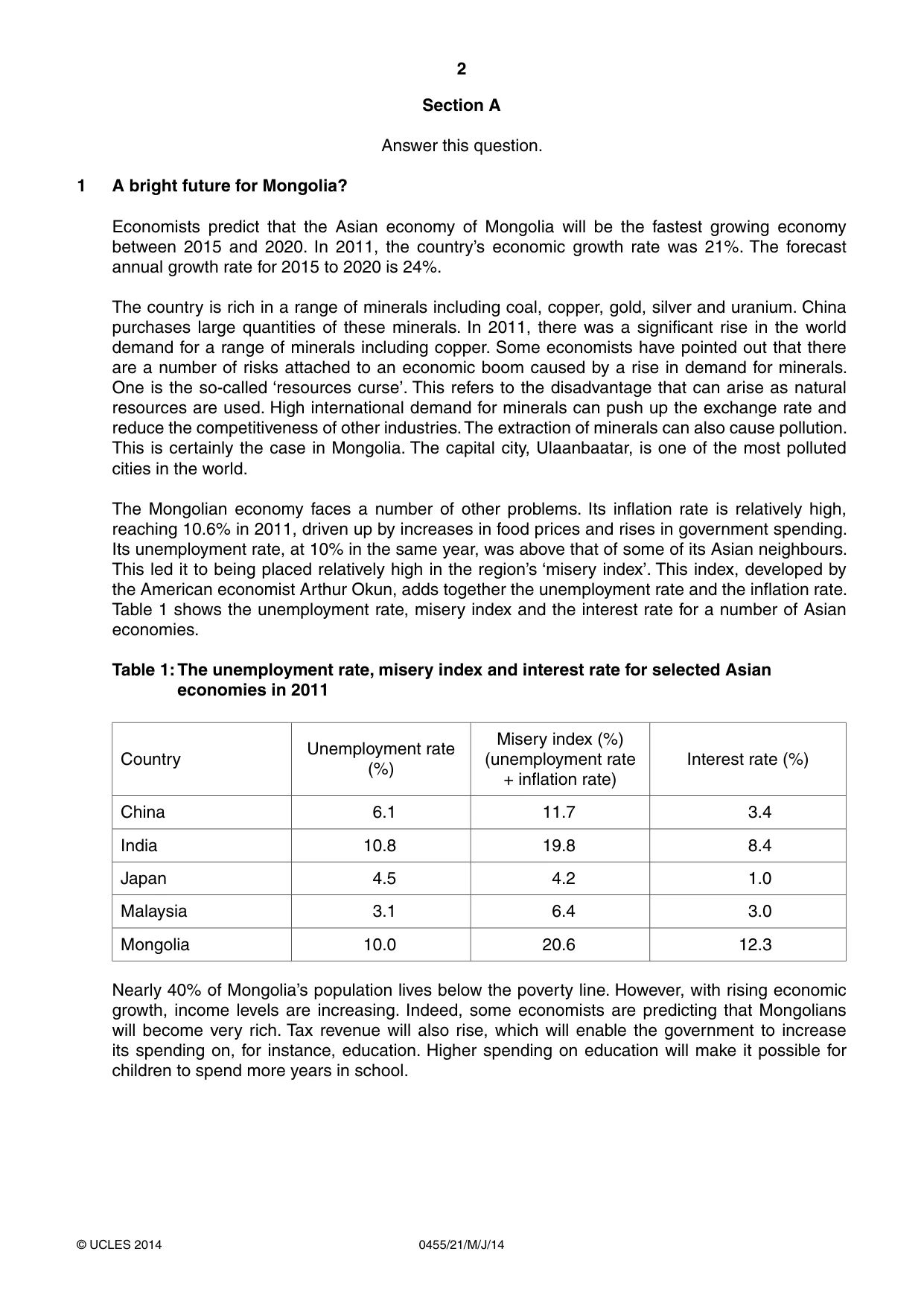
2 0455/21/M/J/14 © UCLES 2014 Section A Answer this question. 1 A bright future for Mongolia? Economists predict that the Asian economy of Mongolia will be the fastest growing economy between 2015 and 2020. In 2011, the country’s economic growth rate was 21%. The forecast annual growth rate for 2015 to 2020 is 24%. The country is rich in a range of minerals including coal, copper, gold, silver and uranium. China purchases large quantities of these minerals. In 2011, there was a significant rise in the world demand for a range of minerals including copper. Some economists have pointed out that there are a number of risks attached to an economic boom caused by a rise in demand for minerals. One is the so-called ‘resources curse’. This refers to the disadvantage that can arise as natural resources are used. High international demand for minerals can push up the exchange rate and reduce the competitiveness of other industries. The extraction of minerals can also cause pollution. This is certainly the case in Mongolia. The capital city, Ulaanbaatar, is one of the most polluted cities in the world. The Mongolian economy faces a number of other problems. Its inflation rate is relatively high, reaching 10.6% in 2011, driven up by increases in food prices and rises in government spending. Its unemployment rate, at 10% in the same year, was above that of some of its Asian neighbours. This led it to being placed relatively high in the region’s ‘misery index’. This index, developed by the American economist Arthur Okun, adds together the unemployment rate and the inflation rate. Table 1 shows the unemployment rate, misery index and the interest rate for a number of Asian economies. Table 1: The unemployment rate, misery index and interest rate for selected Asian economies in 2011 Country Unemployment rate (%) Misery index (%) (unemployment rate + inflation rate) Interest rate (%) China 6.1 11.7 3.4 India 10.8 19.8 8.4 Japan 4.5 4.2 1.0 Malaysia 3.1 6.4 3.0 Mongolia 10.0 20.6 12.3 Nearly 40% of Mongolia’s population lives below the poverty line. However, with rising economic growth, income levels are increasing. Indeed, some economists are predicting that Mongolians will become very rich. Tax revenue will also rise, which will enable the government to increase its spending on, for instance, education. Higher spending on education will make it possible for children to spend more years in school.
Question paper, page 3
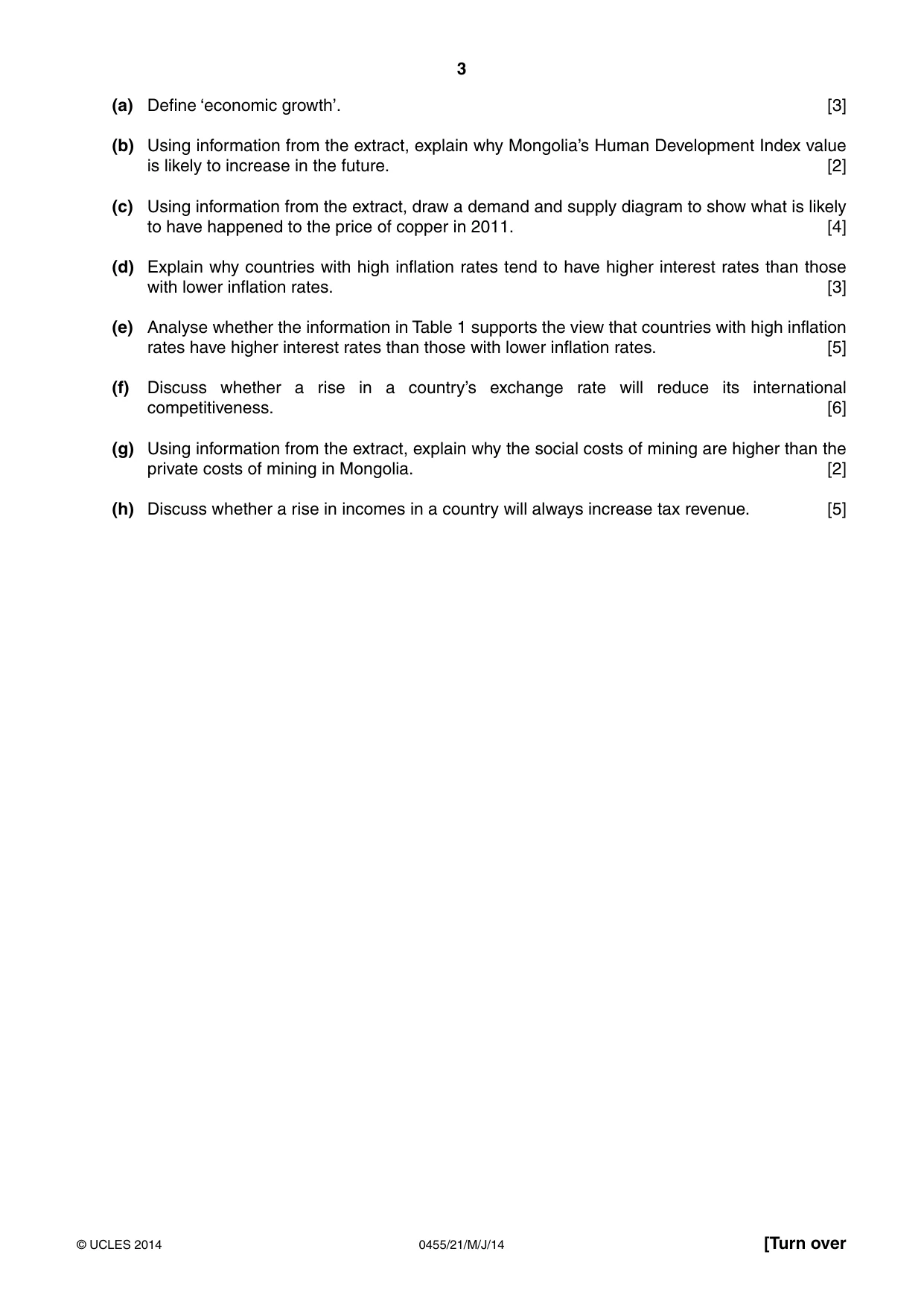
3 0455/21/M/J/14 © UCLES 2014 [Turn over (a) Define ‘economic growth’. [3] (b) Using information from the extract, explain why Mongolia’s Human Development Index value is likely to increase in the future. [2] (c) Using information from the extract, draw a demand and supply diagram to show what is likely to have happened to the price of copper in 2011. [4] (d) Explain why countries with high inflation rates tend to have higher interest rates than those with lower inflation rates. [3] (e) Analyse whether the information in Table 1 supports the view that countries with high inflation rates have higher interest rates than those with lower inflation rates. [5] (f) Discuss whether a rise in a country’s exchange rate will reduce its international competitiveness. [6] (g) Using information from the extract, explain why the social costs of mining are higher than the private costs of mining in Mongolia. [2] (h) Discuss whether a rise in incomes in a country will always increase tax revenue. [5]
Question paper, page 4
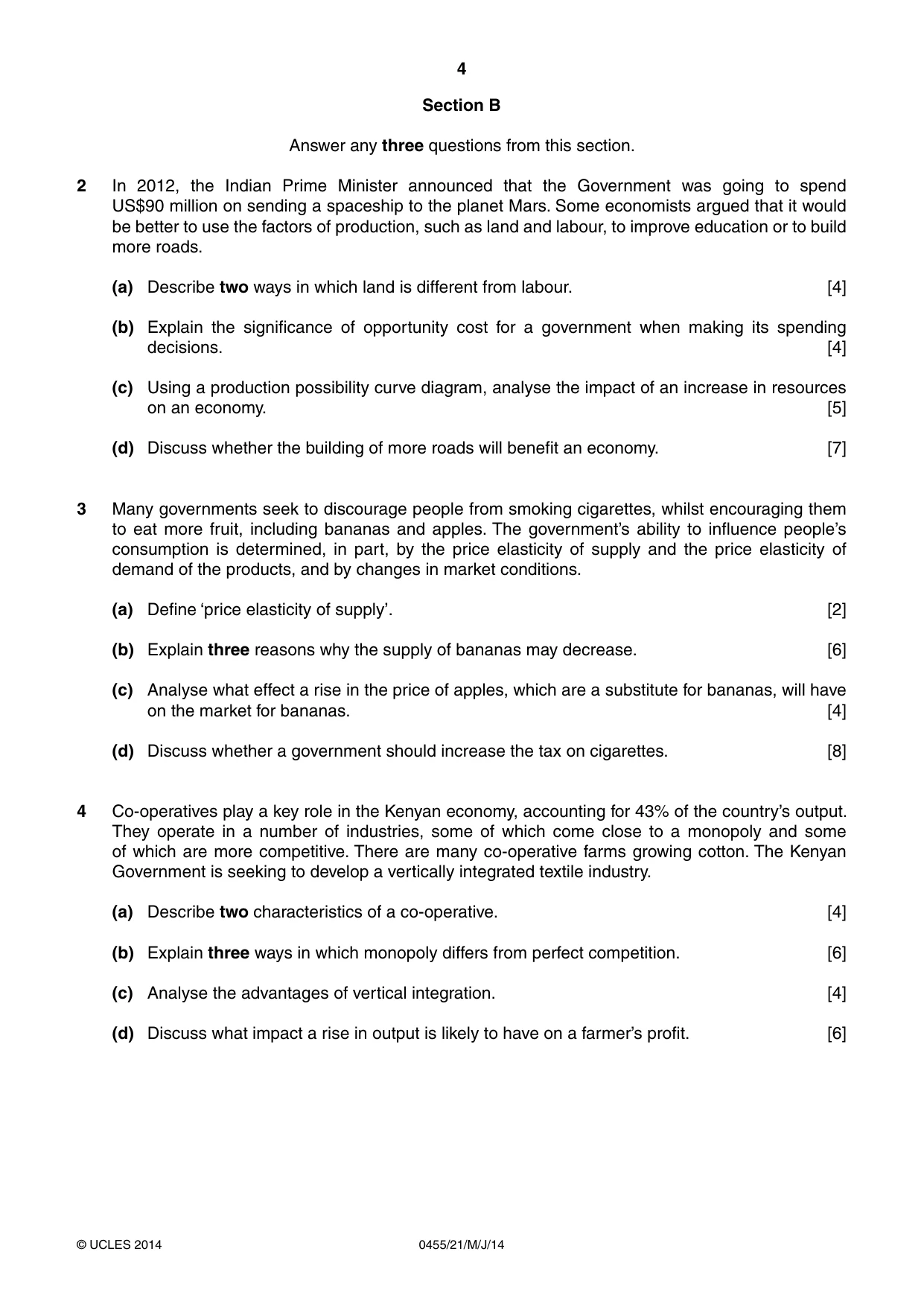
4 0455/21/M/J/14 © UCLES 2014 Section B Answer any three questions from this section. 2 In 2012, the Indian Prime Minister announced that the Government was going to spend US$90 million on sending a spaceship to the planet Mars. Some economists argued that it would be better to use the factors of production, such as land and labour, to improve education or to build more roads. (a) Describe two ways in which land is different from labour. [4] (b) Explain the significance of opportunity cost for a government when making its spending decisions. [4] (c) Using a production possibility curve diagram, analyse the impact of an increase in resources on an economy. [5] (d) Discuss whether the building of more roads will benefit an economy. [7] 3 Many governments seek to discourage people from smoking cigarettes, whilst encouraging them to eat more fruit, including bananas and apples. The government’s ability to influence people’s consumption is determined, in part, by the price elasticity of supply and the price elasticity of demand of the products, and by changes in market conditions. (a) Define ‘price elasticity of supply’. [2] (b) Explain three reasons why the supply of bananas may decrease. [6] (c) Analyse what effect a rise in the price of apples, which are a substitute for bananas, will have on the market for bananas. [4] (d) Discuss whether a government should increase the tax on cigarettes. [8] 4 Co-operatives play a key role in the Kenyan economy, accounting for 43% of the country’s output. They operate in a number of industries, some of which come close to a monopoly and some of which are more competitive. There are many co-operative farms growing cotton. The Kenyan Government is seeking to develop a vertically integrated textile industry. (a) Describe two characteristics of a co-operative. [4] (b) Explain three ways in which monopoly differs from perfect competition. [6] (c) Analyse the advantages of vertical integration. [4] (d) Discuss what impact a rise in output is likely to have on a farmer’s profit. [6]
Question paper, page 5
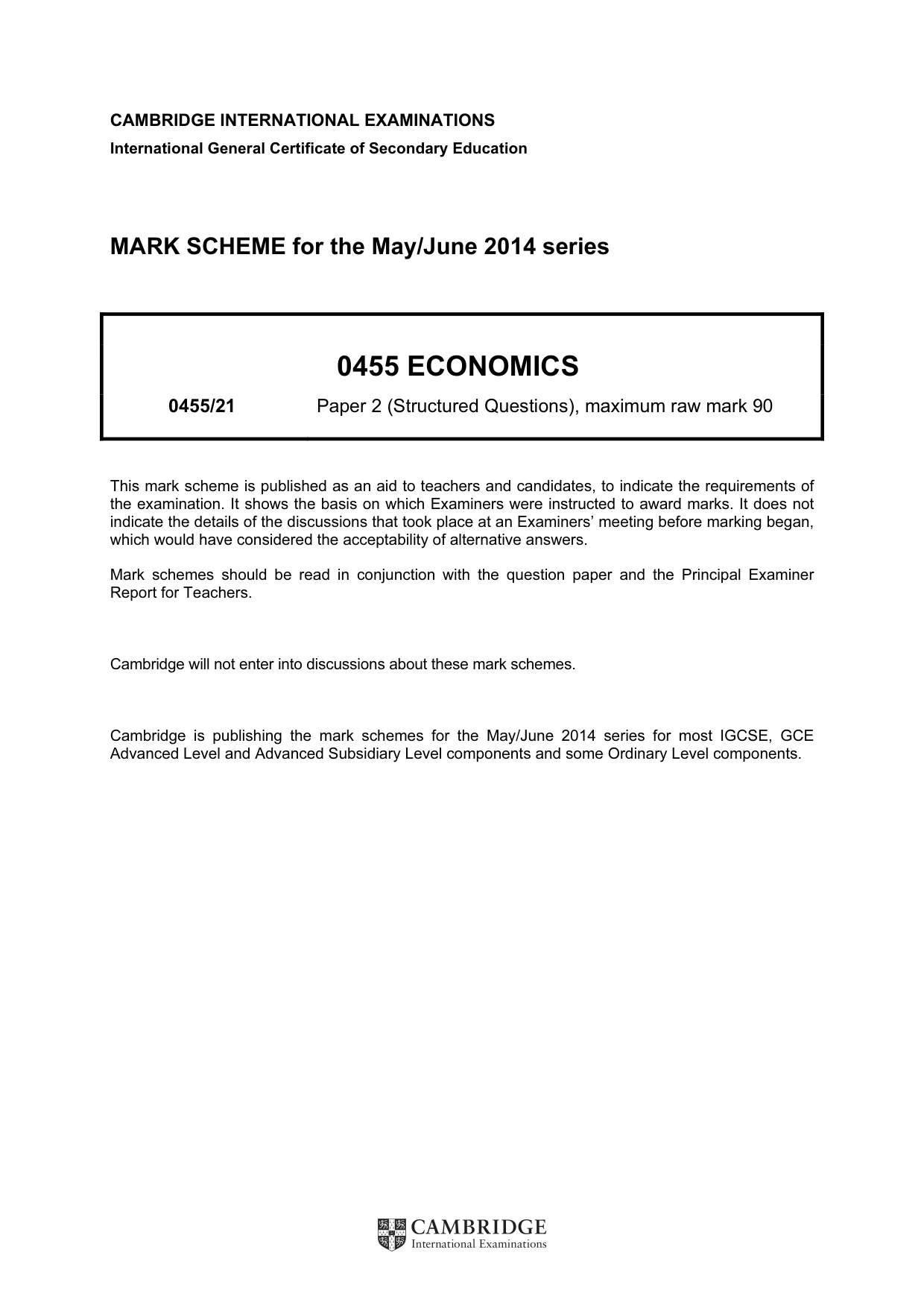
5 0455/21/M/J/14 © UCLES 2014 5 Walmart, the US multinational retailer, is the world’s largest company. It allows its customers to pay for their purchases by cash and by using a variety of other forms of money. The company is the third largest employer in the world. Most of its workers do not belong to a trade union. (a) Describe two influences on the amount people spend. [4] (b) Explain why an item has to be generally acceptable and divisible for it to carry out the functions of money. [4] (c) Explain two advantages of working for a large company. [4] (d) Discuss whether a firm will benefit from encouraging its workers to join a trade union. [8] 6 Over time the determinants of population size, including the birth rate and the fertility rate, change. It is predicted that the world population will rise to 9 billion by 2050. Some countries, including Italy and Japan, however, are expected to experience a fall in population size. It is also predicted that average incomes will rise in most countries. (a) Describe how the birth rate differs from the fertility rate. [4] (b) Analyse how an increase in average incomes may influence a country’s population size. [6] (c) Discuss whether a government should be concerned about a fall in the country’s population size. [10] 7 Algeria’s exports have been increasing in recent years. The country has experienced low inflation, in part, because of the fiscal and supply-side policy measures the government has introduced. In 2012, the Algerian Government stated its main objective was to reduce unemployment. (a) Describe two reasons why a country’s exports may increase. [4] (b) Explain why governments aim for low unemployment. [6] (c) Discuss whether a government should increase or decrease taxes to reduce inflation. [10]
Question paper, page 6
6 0455/21/M/J/14 © UCLES 2014 BLANK PAGE
Question paper, page 7
7 0455/21/M/J/14 © UCLES 2014 BLANK PAGE
Question paper, page 8
8 0455/21/M/J/14 © UCLES 2014 Permission to reproduce items where third-party owned material protected by copyright is included has been sought and cleared where possible. Every reasonable effort has been made by the publisher (UCLES) to trace copyright holders, but if any items requiring clearance have unwittingly been included, the publisher will be pleased to make amends at the earliest possible opportunity. Cambridge International Examinations is part of the Cambridge Assessment Group. Cambridge Assessment is the brand name of University of Cambridge Local Examinations Syndicate (UCLES), which is itself a department of the University of Cambridge. BLANK PAGE
Mark scheme, page 1
CAMBRIDGE INTERNATIONAL EXAMINATIONS International General Certificate of Secondary Education MARK SCHEME for the May/June 2014 series 0455 ECONOMICS 0455/21 Paper 2 (Structured Questions), maximum raw mark 90 This mark scheme is published as an aid to teachers and candidates, to indicate the requirements of the examination. It shows the basis on which Examiners were instructed to award marks. It does not indicate the details of the discussions that took place at an Examiners’ meeting before marking began, which would have considered the acceptability of alternative answers. Mark schemes should be read in conjunction with the question paper and the Principal Examiner Report for Teachers. Cambridge will not enter into discussions about these mark schemes. Cambridge is publishing the mark schemes for the May/June 2014 series for most IGCSE, GCE Advanced Level and Advanced Subsidiary Level components and some Ordinary Level components.
Mark scheme, page 2
1 ( ( ( Pa (a) (b) (c) age D 3 ti O O ) U v 1 1 1 N U is F 1 1 1 1 p e 2 Def 3 m ime Or 2 Or Usi val 1 m 1 m 1 m Not Usi s l Fig 1 m 1 m 1 m 1 m poin 2 fine mar e. 2 m 1 m ing ue mar mar mar te: ing ike ure mar mar mar mar nts e ‘e rks ma ma g in is rk f rk f rk f a m g in ely e 1 rk f rk f rk f rk f s cl ec fo rks rk f nfo lik for for for ma nfo to 1(c for for for for ea on r in s fo for orm kel rec rec ex axim orm o ha c) ax ori de co rly nom ncr or i r re mat y t cog cog pla mu mat ave es gin ema orre id mic rea ncr efer tio to gni gni ain um tio e h co nal and ect en c g ase rea ren n f inc sin sin ing of n f hap orre de d c t eq tifie IG © row in ase nce fro cre ng t ng t g th 2 m fro ppe ect em curv qui ed, GC Ca wt (re e in e to m eas the the he l ma om ene tly l an ve ilib , e M SE amb h’. eal n (r o G the se i e lik e lik link arks th ed lab d a sh riu .g. Mar E – brid l) G rea GDP e e in t kel kel k to s. e e to bell and hifte ms E1 rk S M dge GD al) G P/o ext the liho liho o th ext o th led d s ed s id 1 a Sc ay/ e In DP/c GD out rac e fu ood ood he tra he d – sup to den and che /Ju nter cou DP/ put ct, utu d th d th co act, pri pri pply the ntif d E2 eme une rnat unt /co t/n ex ure hat hat omp , d ice ice y cu e ri fied 2. e e 2 tion try’ oun atio xpl e. t in t ye pos raw e o e an urv igh d – 201 nal ’s o try on ain co ear siti w a f c nd ves ht. – ei 14 Ex out y’s al n w me rs i on a d cop qu s co ithe xam tpu ou inc why es/ n s of dem ppe uan orr er mina ut/n tpu com y M /GD sch f th ma er i ntity rect by atio nat ut/p me. Mo DP hoo e H and in 2 y o tly y lin ons ion pro . ng wi ol w HD d a 20 or P lab nes s 20 nal odu oli ill r will DI. nd 11 P a bel s d 014 inc ucti ia’s rise inc d su . nd lled raw S 4 com ve s H e/e cre up Q d. wn Syll 04 me po Hum co eas ply . to lab 455 e/pr ote ma no se/e y d o bo bus 5 rod nti an mic ed diag oth s duc al/ De c g uca gra h a ctiv na eve grow atio am axe ve p tio elo wth on m to es o P pot na pm h w wi o s or e Pa 2 ten l in men will ll im sho eq pe 21 ntia nco nt oc mp ow uili er al o ome Ind ccu prov w w ibri [3 ove e. dex [2 ur. ve wha [4 ium 3] er x 2] . at 4] m
Mark scheme, page 3
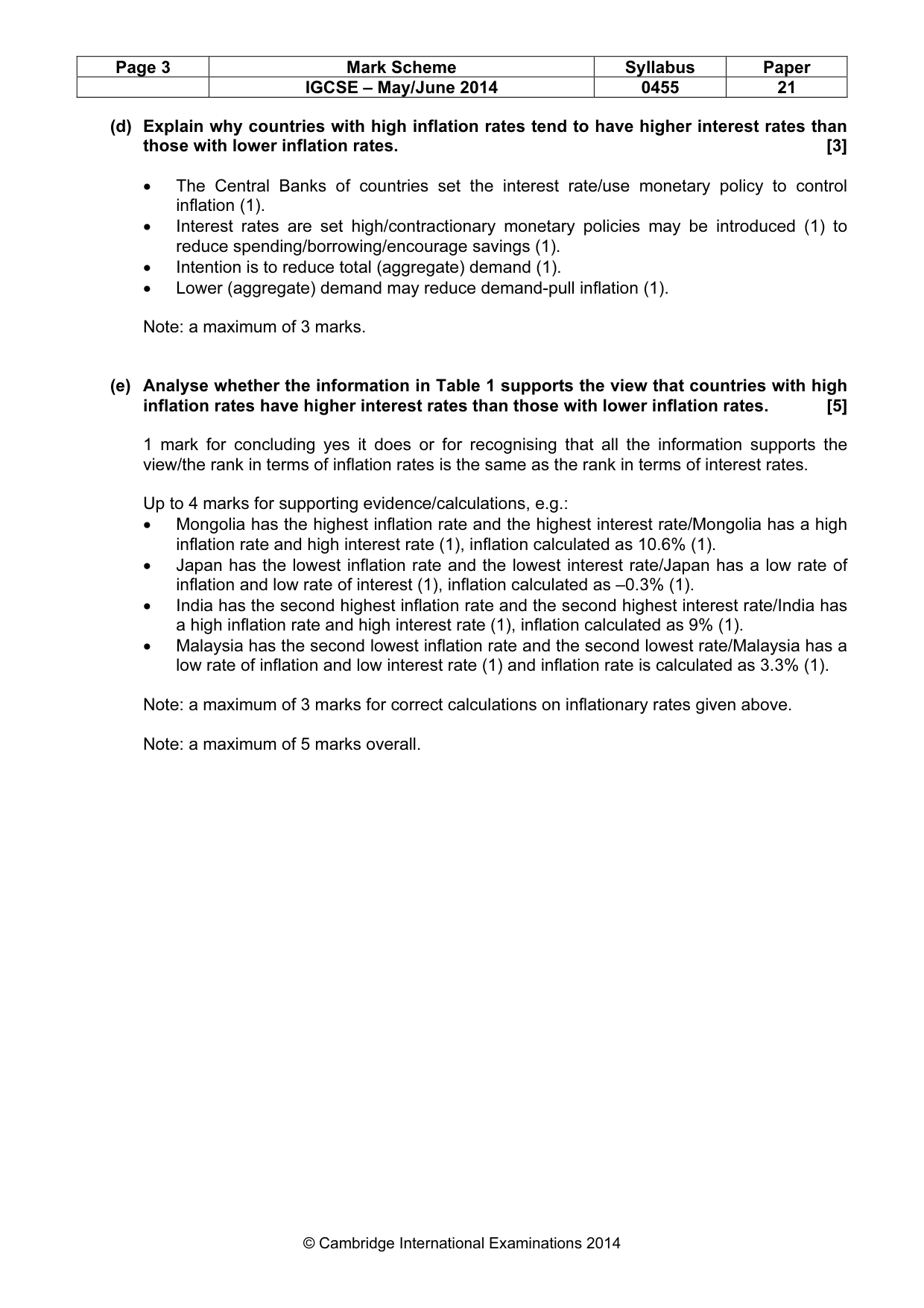
Page 3 Mark Scheme Syllabus Paper IGCSE – May/June 2014 0455 21 © Cambridge International Examinations 2014 (d) Explain why countries with high inflation rates tend to have higher interest rates than those with lower inflation rates. [3] • The Central Banks of countries set the interest rate/use monetary policy to control inflation (1). • Interest rates are set high/contractionary monetary policies may be introduced (1) to reduce spending/borrowing/encourage savings (1). • Intention is to reduce total (aggregate) demand (1). • Lower (aggregate) demand may reduce demand-pull inflation (1). Note: a maximum of 3 marks. (e) Analyse whether the information in Table 1 supports the view that countries with high inflation rates have higher interest rates than those with lower inflation rates. [5] 1 mark for concluding yes it does or for recognising that all the information supports the view/the rank in terms of inflation rates is the same as the rank in terms of interest rates. Up to 4 marks for supporting evidence/calculations, e.g.: • Mongolia has the highest inflation rate and the highest interest rate/Mongolia has a high inflation rate and high interest rate (1), inflation calculated as 10.6% (1). • Japan has the lowest inflation rate and the lowest interest rate/Japan has a low rate of inflation and low rate of interest (1), inflation calculated as –0.3% (1). • India has the second highest inflation rate and the second highest interest rate/India has a high inflation rate and high interest rate (1), inflation calculated as 9% (1). • Malaysia has the second lowest inflation rate and the second lowest rate/Malaysia has a low rate of inflation and low interest rate (1) and inflation rate is calculated as 3.3% (1). Note: a maximum of 3 marks for correct calculations on inflationary rates given above. Note: a maximum of 5 marks overall.
Mark scheme, page 4
Page 4 Mark Scheme Syllabus Paper IGCSE – May/June 2014 0455 21 © Cambridge International Examinations 2014 (f) Discuss whether a rise in a country’s exchange rate will reduce its international competitiveness. [6] Up to 4 marks for why it might: 1 mark for identifying that it will increase export prices. 1 mark for explaining that higher export prices are likely to reduce demand for exports. 1 mark for identifying that it will reduce import prices. 1 mark for explaining that reduced import prices are likely to increase demand for imports. Up to 4 marks for why it might not: 1 mark for identifying that quality of domestically produced products may rise. 1 mark for explaining that a rise in quality of domestically produced products will make them more attractive to foreign buyers. 1 mark for identifying that domestic inflation rate may fall. Up to 2 marks for explaining that if the domestic inflation rate falls below that of rival countries (1), exports may still be relatively cheaper in the foreign market even though the exchange rate has risen (1). Up to 2 marks for explaining that a reduction in the price of raw materials or capital goods could reduce domestic firms’ costs (1) and so make them more price competitive (1). 1 mark for identifying that labour productivity might rise. Up to 2 marks for explaining that higher labour productivity will reduce costs of production (1), which may make exports relatively cheaper in the foreign markets even though the exchange rate has risen (1). Up to 3 marks for explaining that in the case of products where a country has a monopoly (1) with an example of a monopoly (1) demand may not be significantly affected by a rise in price (1). Reward, but do not expect, answers that discuss that the outcome will depend upon the PED of exports and imports. Note: a maximum of 6 marks overall.
Mark scheme, page 5
Page 5 Mark Scheme Syllabus Paper IGCSE – May/June 2014 0455 21 © Cambridge International Examinations 2014 (g) Using information from the extract, explain why the social costs of mining are higher than the private costs of mining in Mongolia. [2] 1 mark for recognising that it is due to pollution. 1 mark for explaining that pollution is an external cost. 1 mark for recognising that social costs are external costs plus internal costs/the existence of external costs will mean that the social costs are higher than private costs. (h) Discuss whether a rise in incomes in a country will always increase tax revenue. [5] Up to 3 marks why it may: Up to 2 marks: higher incomes can increase income tax revenue (1), how much tax revenue rises will be influenced by whether it is progressive or regressive (1). Up to 2 marks: higher incomes can increase spending (1) and so increase sales tax revenue (1). Up to 2 marks: higher incomes can increase firms’ profits (1) and so increase corporation tax revenue (1). Up to 2 marks: higher incomes can increase spending on imports (1) and so revenue from tariffs increases (1). Up to 3 marks for why it might not: Up to 2 marks: spending may not rise (1) if the additional income is saved (1). Up to 2 marks: profits may not increase (1) if the extra spending goes on imports/costs rise as output increases/firms experience diseconomies of scale (1). Up to 2 marks: tax rates/coverage may be cut (1) and so even with higher incomes tax revenue does not increase (1). Up to 2 marks: tax avoidance and evasion may increase (1) and so for every ‘dollar’ earned/spent less revenue is collected (1). Note: a maximum of 5 marks overall.
Mark scheme, page 6
Page 6 Mark Scheme Syllabus Paper IGCSE – May/June 2014 0455 21 © Cambridge International Examinations 2014 2 (a) Describe two ways in which land is different from labour. [4] Land is a natural resource (1) whilst labour is human resources/workers (1). The payment for land is rent (1) whilst the payment for labour is wages (1). Land is geographically immobile (1) whilst there is some limited geographical mobility in the case of labour (1). Note: a maximum of 4 marks overall. (b) Explain the significance of opportunity cost for a government when making its spending decisions. [4] Up to 2 marks for defining opportunity cost– best alternative (1) forgone (1). Up to 2 marks for recognising that if a government changes its spending on one area (1) it will have an impact on how much it can spend on another area/areas (1). Up to 2 marks for recognising that a government has limited tax revenue (1) and limited ability to borrow (1). Up to 2 marks for recognising that a country has limited resources (1) and so if more resources are devoted to one area, less can be devoted to other areas (1). Note: a maximum of 4 marks overall.
Mark scheme, page 7
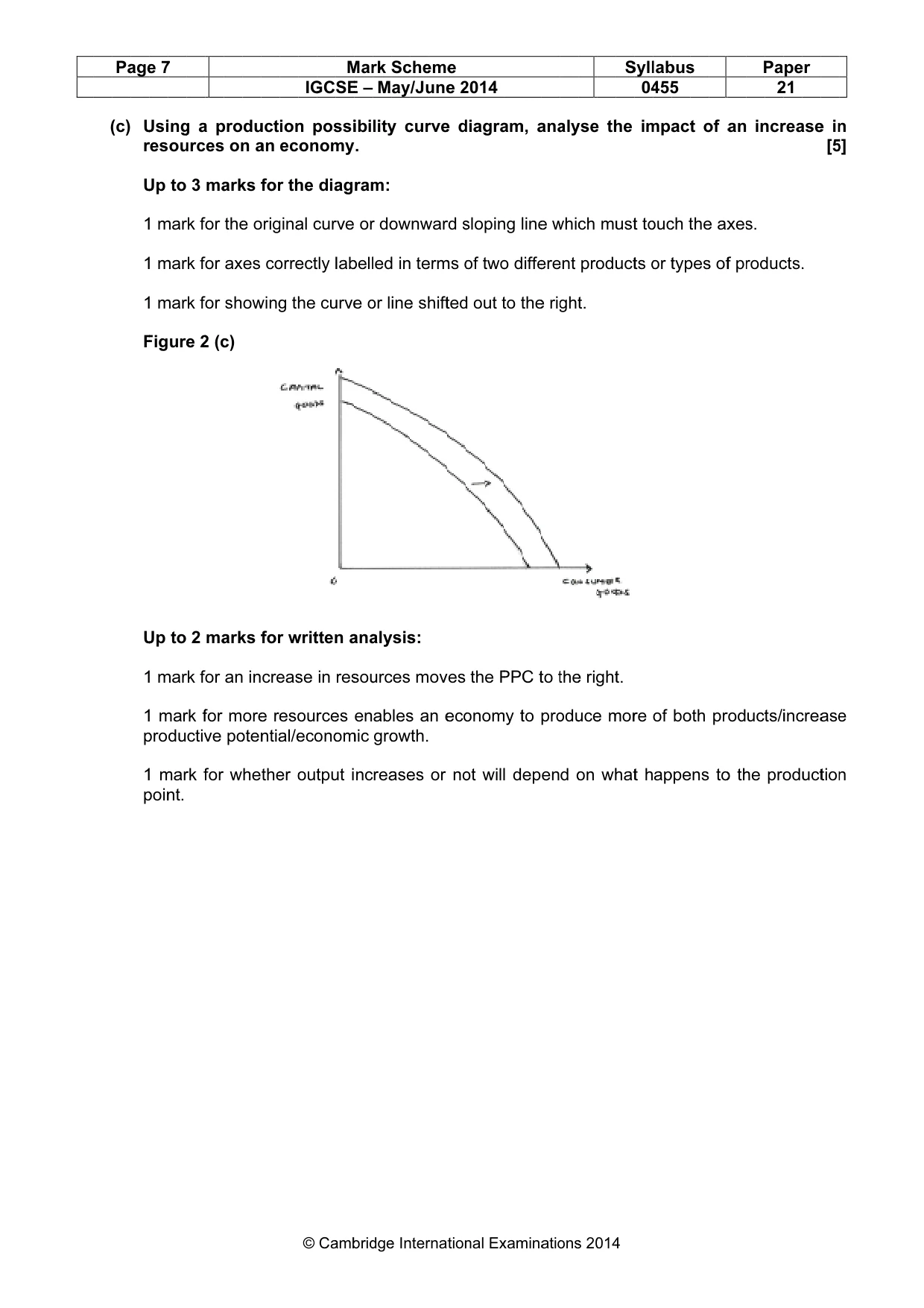
( Pa (c) age U r U 1 1 1 F U 1 1 p 1 p e 7 Usi res Up 1 m 1 m 1 m Fig Up 1 m 1 m pro 1 m poin 7 ing ou to mar mar mar ure to mar mar du mar nt. g a urc 3 rk f rk f rk f e 2 2 rk f rk f ctiv rk f a p es ma for for for 2 (c ma for for ve for pro on ark the ax sh c) ark an m po w du n a ks f e o es ow ks f in ore oten he uct an for orig co wing for cre e re ntia the ion ec r th gina orre g th r w eas eso al/e er o IG © n p on he al c ect he writ se our eco out GC Ca pos nom dia cur tly l cu tten in rce ono tpu M SE amb ssi my ag rve lab urve n a res es om ut i Mar E – brid ibi . ram or bell e o ana sou en mic nc rk S M dge lity m: r do led or li aly urc ab gro rea Sc ay/ e In y c ow d in ine ysis ces les ow ase che /Ju nter cur nw te e sh s: m s a th. es eme une rnat rve war erm hift ov n e or e e 2 tion e d rd s ms o ted es eco no 201 nal diag slop of t d ou th ono ot w 14 Ex gra pin two ut t e P om will xam am ng l o d to t PPC my t l d mina m, a line iffe the C t to ep atio ana e w ere e rig to t pro en ons aly whic ent ght the odu d o s 20 yse ch pro t. e rig uce on 014 e th mu odu ght e m wh S 4 he ust uct t. mor hat Syll 04 im t to ts o re t h lab 455 mpa ouc or t of ap bus 5 act ch t typ bo ppe s t o the pes oth ens of a e ax s of pr to an xes f pr rod o th P in s. rod uct he Pa 2 ncr duc ts/i pro pe 21 rea cts. inc odu er ase . crea uct e in [5 ase tion n 5] e n
Mark scheme, page 8
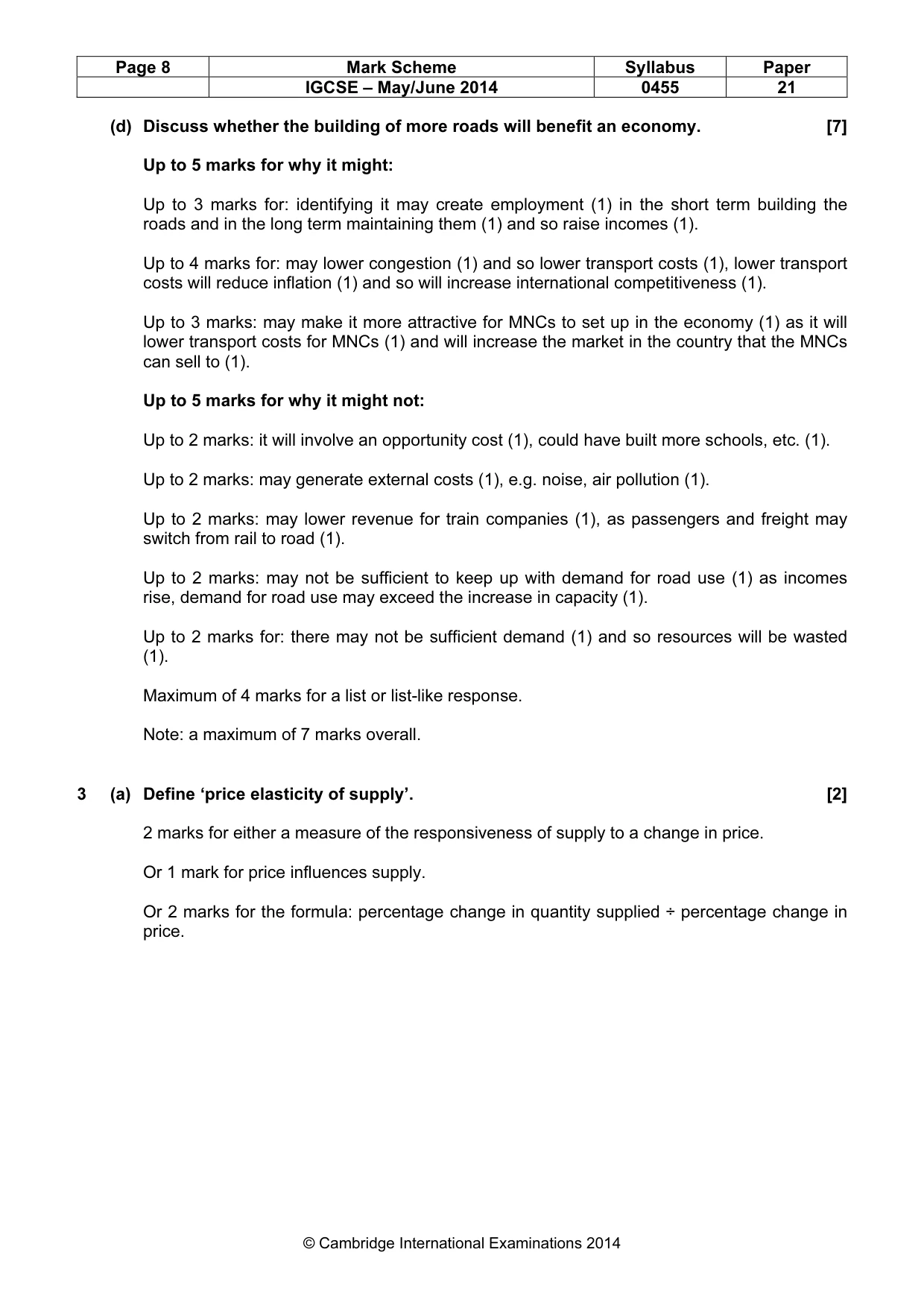
Page 8 Mark Scheme Syllabus Paper IGCSE – May/June 2014 0455 21 © Cambridge International Examinations 2014 (d) Discuss whether the building of more roads will benefit an economy. [7] Up to 5 marks for why it might: Up to 3 marks for: identifying it may create employment (1) in the short term building the roads and in the long term maintaining them (1) and so raise incomes (1). Up to 4 marks for: may lower congestion (1) and so lower transport costs (1), lower transport costs will reduce inflation (1) and so will increase international competitiveness (1). Up to 3 marks: may make it more attractive for MNCs to set up in the economy (1) as it will lower transport costs for MNCs (1) and will increase the market in the country that the MNCs can sell to (1). Up to 5 marks for why it might not: Up to 2 marks: it will involve an opportunity cost (1), could have built more schools, etc. (1). Up to 2 marks: may generate external costs (1), e.g. noise, air pollution (1). Up to 2 marks: may lower revenue for train companies (1), as passengers and freight may switch from rail to road (1). Up to 2 marks: may not be sufficient to keep up with demand for road use (1) as incomes rise, demand for road use may exceed the increase in capacity (1). Up to 2 marks for: there may not be sufficient demand (1) and so resources will be wasted (1). Maximum of 4 marks for a list or list-like response. Note: a maximum of 7 marks overall. 3 (a) Define ‘price elasticity of supply’. [2] 2 marks for either a measure of the responsiveness of supply to a change in price. Or 1 mark for price influences supply. Or 2 marks for the formula: percentage change in quantity supplied ÷ percentage change in price.
Mark scheme, page 9
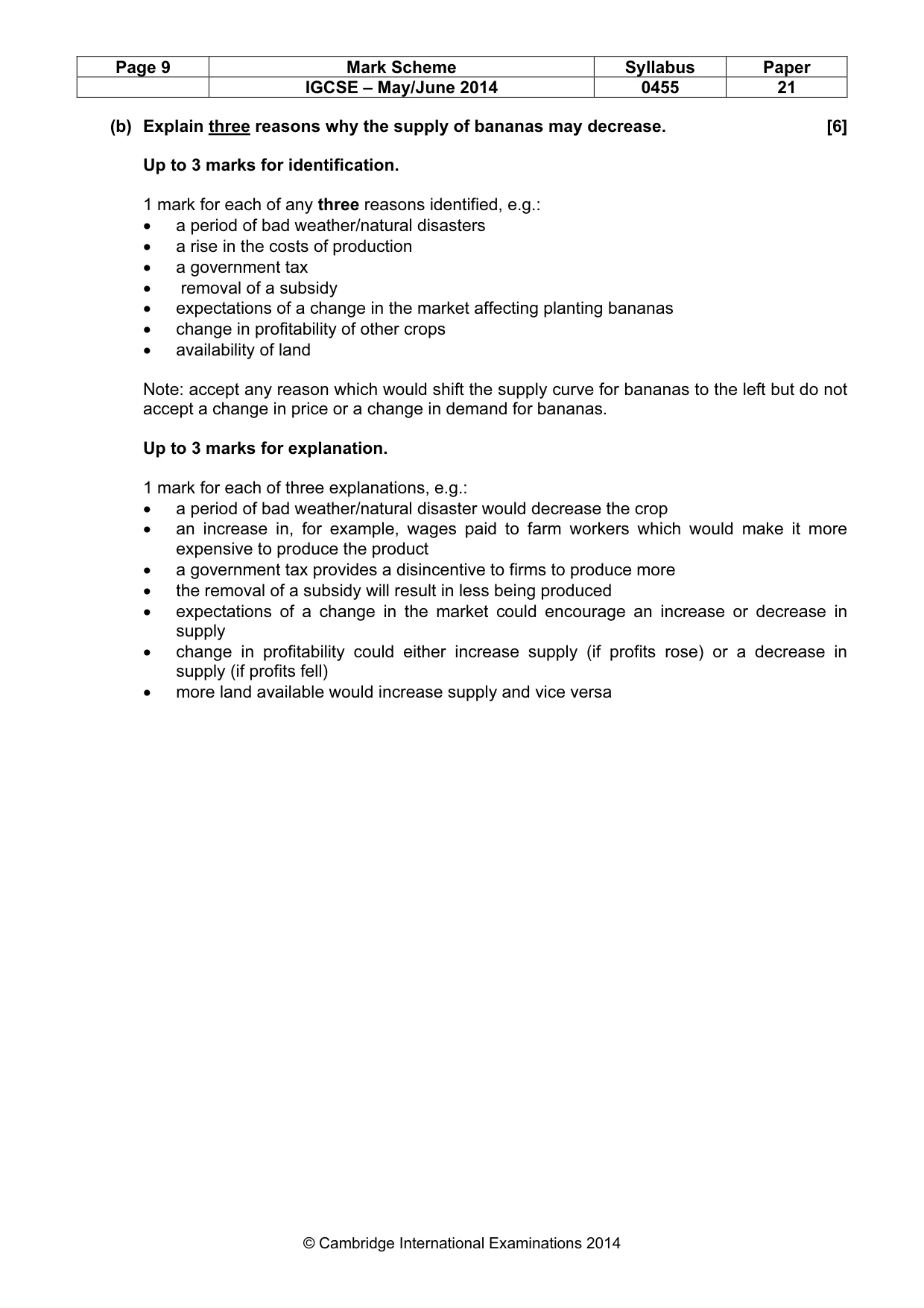
Page 9 Mark Scheme Syllabus Paper IGCSE – May/June 2014 0455 21 © Cambridge International Examinations 2014 (b) Explain three reasons why the supply of bananas may decrease. [6] Up to 3 marks for identification. 1 mark for each of any three reasons identified, e.g.: • a period of bad weather/natural disasters • a rise in the costs of production • a government tax • removal of a subsidy • expectations of a change in the market affecting planting bananas • change in profitability of other crops • availability of land Note: accept any reason which would shift the supply curve for bananas to the left but do not accept a change in price or a change in demand for bananas. Up to 3 marks for explanation. 1 mark for each of three explanations, e.g.: • a period of bad weather/natural disaster would decrease the crop • an increase in, for example, wages paid to farm workers which would make it more expensive to produce the product • a government tax provides a disincentive to firms to produce more • the removal of a subsidy will result in less being produced • expectations of a change in the market could encourage an increase or decrease in supply • change in profitability could either increase supply (if profits rose) or a decrease in supply (if profits fell) • more land available would increase supply and vice versa
Mark scheme, page 10
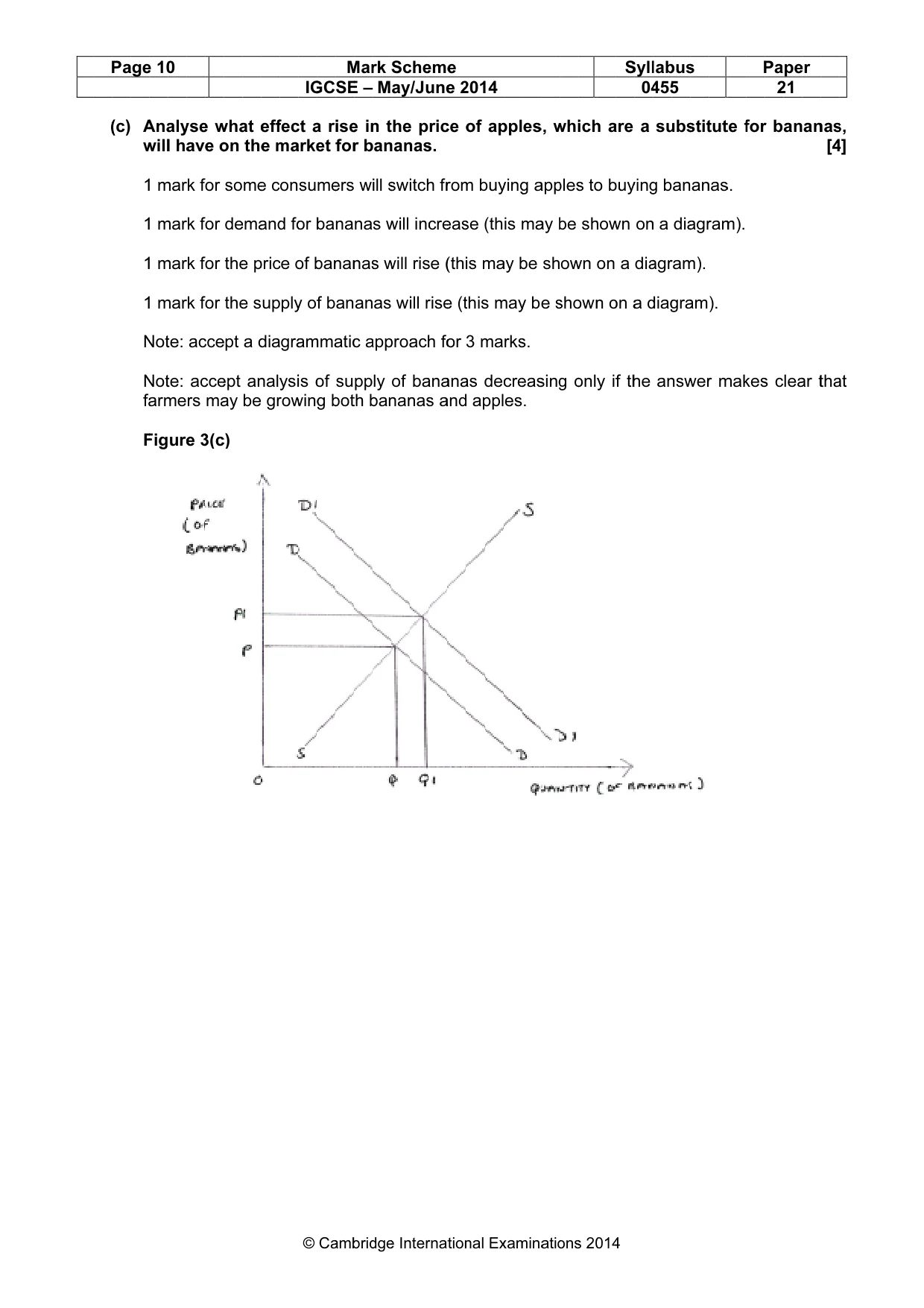
( Pa (c) age A w 1 1 1 1 N N fa F e 10 Ana will 1 m 1 m 1 m 1 m Not Not arm Fig 0 aly l ha mar mar mar mar te: te: me ure yse ave rk f rk f rk f rk f ac ac rs e 3 e w e o for for for for cce cce ma 3(c wha on so de the the ept ept ay c) at e the me ema e p e s a d an be eff e m e c and pric up dia naly gr fec ma on d fo ce o ply gra ysi row IG © ct a arke su or b of b y of am is o wing GC Ca a ri et f me ba ban f b mma of g b M SE amb ise for ers na nan an atic su bot Mar E – brid e in r b wi na nas an c a pp th b rk S M dge n t an ill s s w s w as app ly ban Sc ay/ e In he nan swi will will wi proa of nan che /Ju nter e p nas itch inc ris ill r ach ba nas eme une rnat ric s. h fr cre se ( rise h fo ana s a e e 2 tion ce o rom eas (thi e (t or ana and 201 nal of m b se ( is m this 3 m as d ap 14 Ex ap buy (th ma s m ma dec ppl xam ppl ying is m ay b may rks cre es mina es g a ma be y b s. eas . atio s, w app ay b sh e s sing ons whi ples be ow sho g o s 20 ich s to sh wn own only 014 h a o b how on n o y if S 4 are buy wn a on a f th Syll 04 a ying on dia a d he lab 455 su g b n a agr diag an bus 5 ubs an dia ram gra nsw s stit an agr m). am wer tut nas ram ). r m te f s. m). mak P for kes Pa 2 r b s c pe 21 an lea er an ar t nas [4 tha s, 4] at
Mark scheme, page 11
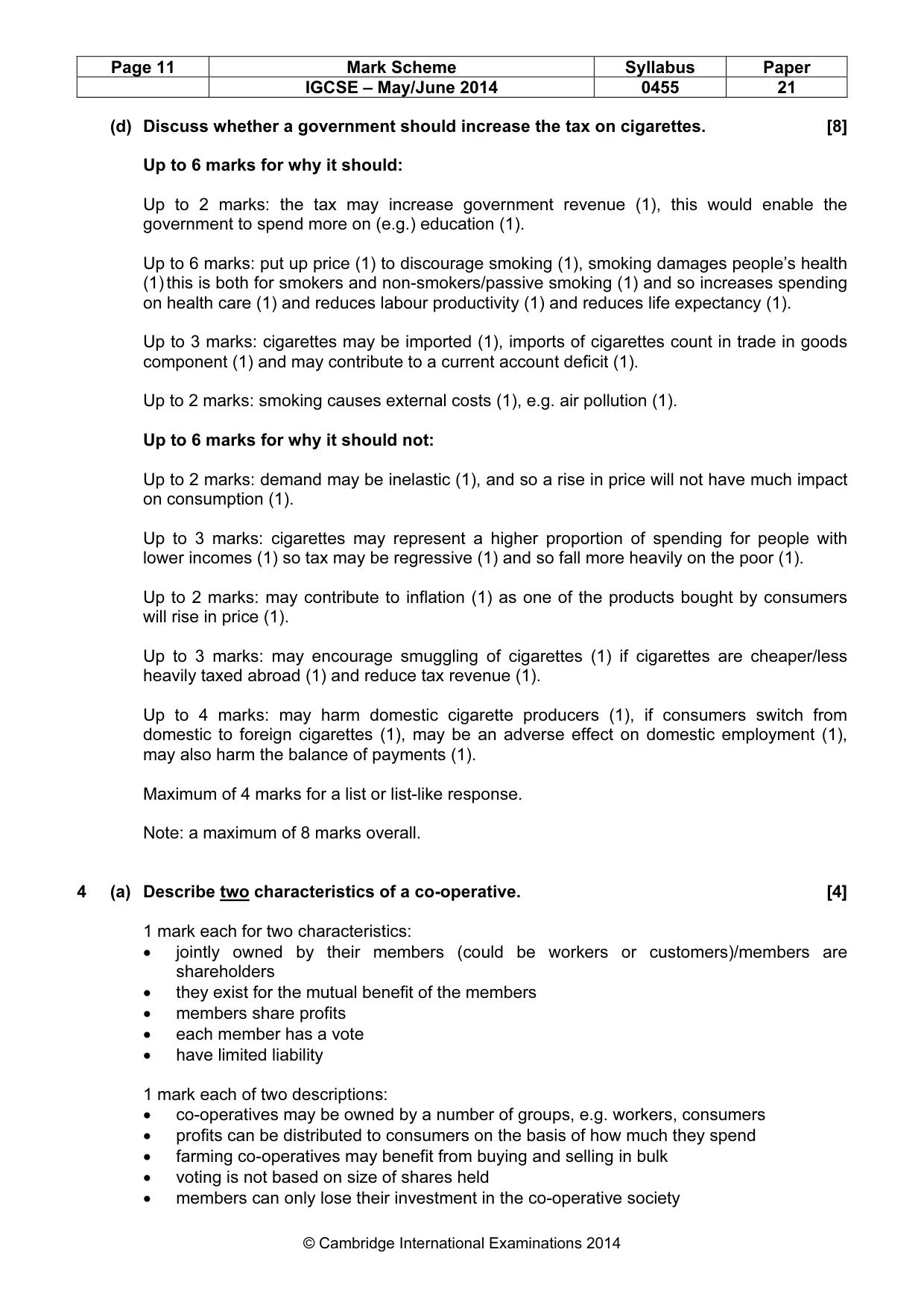
Page 11 Mark Scheme Syllabus Paper IGCSE – May/June 2014 0455 21 © Cambridge International Examinations 2014 (d) Discuss whether a government should increase the tax on cigarettes. [8] Up to 6 marks for why it should: Up to 2 marks: the tax may increase government revenue (1), this would enable the government to spend more on (e.g.) education (1). Up to 6 marks: put up price (1) to discourage smoking (1), smoking damages people’s health (1) this is both for smokers and non-smokers/passive smoking (1) and so increases spending on health care (1) and reduces labour productivity (1) and reduces life expectancy (1). Up to 3 marks: cigarettes may be imported (1), imports of cigarettes count in trade in goods component (1) and may contribute to a current account deficit (1). Up to 2 marks: smoking causes external costs (1), e.g. air pollution (1). Up to 6 marks for why it should not: Up to 2 marks: demand may be inelastic (1), and so a rise in price will not have much impact on consumption (1). Up to 3 marks: cigarettes may represent a higher proportion of spending for people with lower incomes (1) so tax may be regressive (1) and so fall more heavily on the poor (1). Up to 2 marks: may contribute to inflation (1) as one of the products bought by consumers will rise in price (1). Up to 3 marks: may encourage smuggling of cigarettes (1) if cigarettes are cheaper/less heavily taxed abroad (1) and reduce tax revenue (1). Up to 4 marks: may harm domestic cigarette producers (1), if consumers switch from domestic to foreign cigarettes (1), may be an adverse effect on domestic employment (1), may also harm the balance of payments (1). Maximum of 4 marks for a list or list-like response. Note: a maximum of 8 marks overall. 4 (a) Describe two characteristics of a co-operative. [4] 1 mark each for two characteristics: • jointly owned by their members (could be workers or customers)/members are shareholders • they exist for the mutual benefit of the members • members share profits • each member has a vote • have limited liability 1 mark each of two descriptions: • co-operatives may be owned by a number of groups, e.g. workers, consumers • profits can be distributed to consumers on the basis of how much they spend • farming co-operatives may benefit from buying and selling in bulk • voting is not based on size of shares held • members can only lose their investment in the co-operative society
Mark scheme, page 12
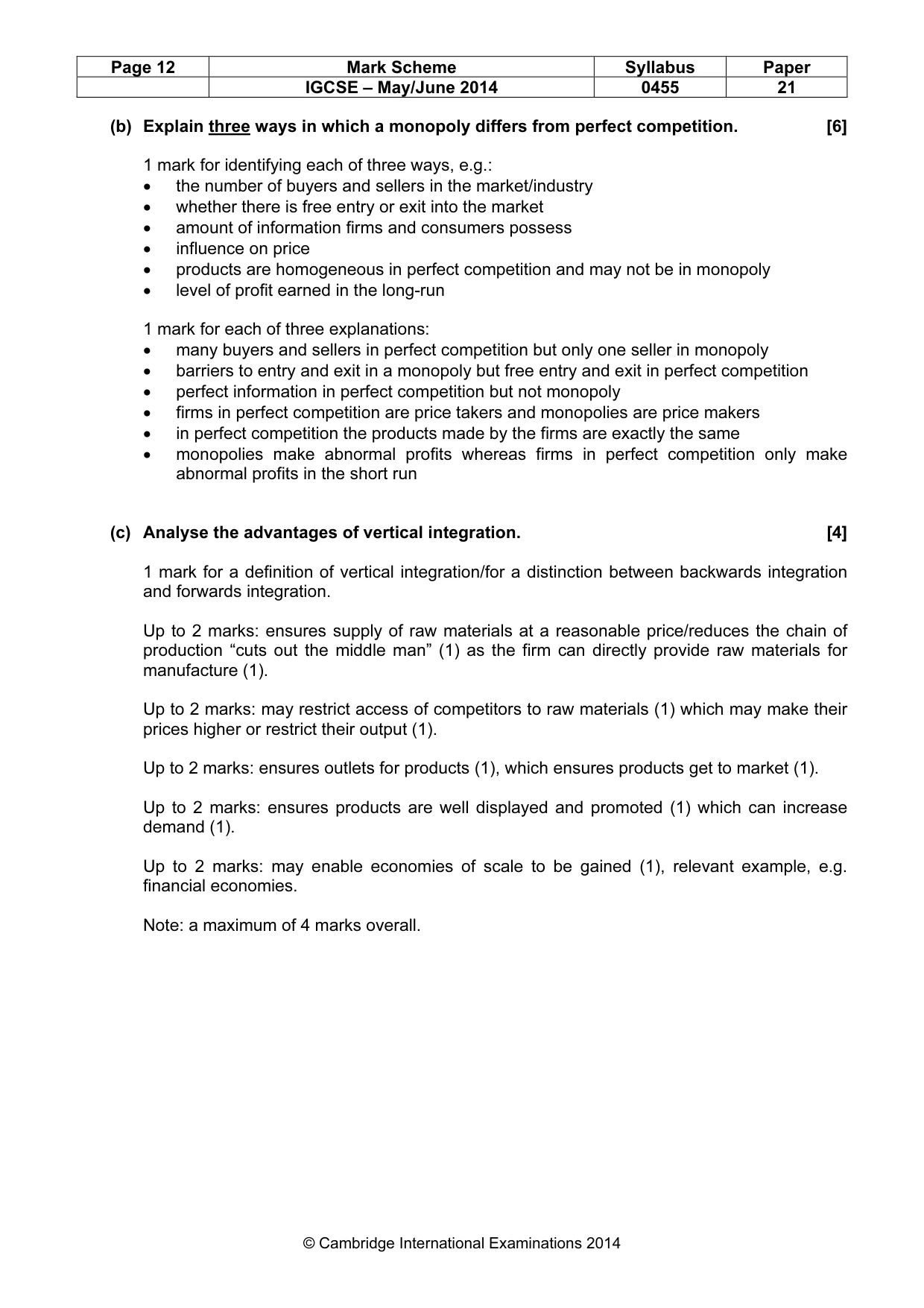
Page 12 Mark Scheme Syllabus Paper IGCSE – May/June 2014 0455 21 © Cambridge International Examinations 2014 (b) Explain three ways in which a monopoly differs from perfect competition. [6] 1 mark for identifying each of three ways, e.g.: • the number of buyers and sellers in the market/industry • whether there is free entry or exit into the market • amount of information firms and consumers possess • influence on price • products are homogeneous in perfect competition and may not be in monopoly • level of profit earned in the long-run 1 mark for each of three explanations: • many buyers and sellers in perfect competition but only one seller in monopoly • barriers to entry and exit in a monopoly but free entry and exit in perfect competition • perfect information in perfect competition but not monopoly • firms in perfect competition are price takers and monopolies are price makers • in perfect competition the products made by the firms are exactly the same • monopolies make abnormal profits whereas firms in perfect competition only make abnormal profits in the short run (c) Analyse the advantages of vertical integration. [4] 1 mark for a definition of vertical integration/for a distinction between backwards integration and forwards integration. Up to 2 marks: ensures supply of raw materials at a reasonable price/reduces the chain of production “cuts out the middle man” (1) as the firm can directly provide raw materials for manufacture (1). Up to 2 marks: may restrict access of competitors to raw materials (1) which may make their prices higher or restrict their output (1). Up to 2 marks: ensures outlets for products (1), which ensures products get to market (1). Up to 2 marks: ensures products are well displayed and promoted (1) which can increase demand (1). Up to 2 marks: may enable economies of scale to be gained (1), relevant example, e.g. financial economies. Note: a maximum of 4 marks overall.
Mark scheme, page 13
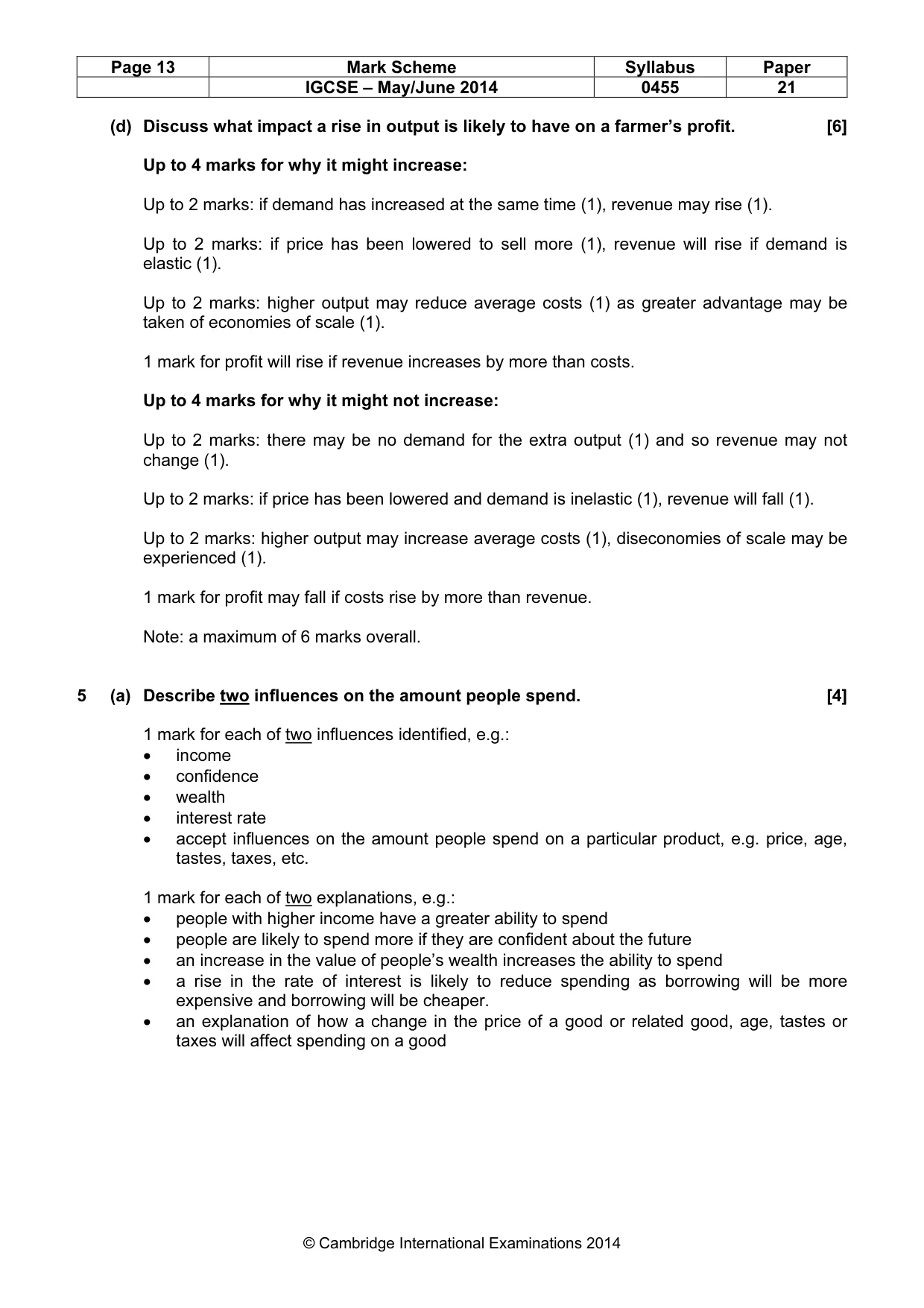
Page 13 Mark Scheme Syllabus Paper IGCSE – May/June 2014 0455 21 © Cambridge International Examinations 2014 (d) Discuss what impact a rise in output is likely to have on a farmer’s profit. [6] Up to 4 marks for why it might increase: Up to 2 marks: if demand has increased at the same time (1), revenue may rise (1). Up to 2 marks: if price has been lowered to sell more (1), revenue will rise if demand is elastic (1). Up to 2 marks: higher output may reduce average costs (1) as greater advantage may be taken of economies of scale (1). 1 mark for profit will rise if revenue increases by more than costs. Up to 4 marks for why it might not increase: Up to 2 marks: there may be no demand for the extra output (1) and so revenue may not change (1). Up to 2 marks: if price has been lowered and demand is inelastic (1), revenue will fall (1). Up to 2 marks: higher output may increase average costs (1), diseconomies of scale may be experienced (1). 1 mark for profit may fall if costs rise by more than revenue. Note: a maximum of 6 marks overall. 5 (a) Describe two influences on the amount people spend. [4] 1 mark for each of two influences identified, e.g.: • income • confidence • wealth • interest rate • accept influences on the amount people spend on a particular product, e.g. price, age, tastes, taxes, etc. 1 mark for each of two explanations, e.g.: • people with higher income have a greater ability to spend • people are likely to spend more if they are confident about the future • an increase in the value of people’s wealth increases the ability to spend • a rise in the rate of interest is likely to reduce spending as borrowing will be more expensive and borrowing will be cheaper. • an explanation of how a change in the price of a good or related good, age, tastes or taxes will affect spending on a good
Mark scheme, page 14
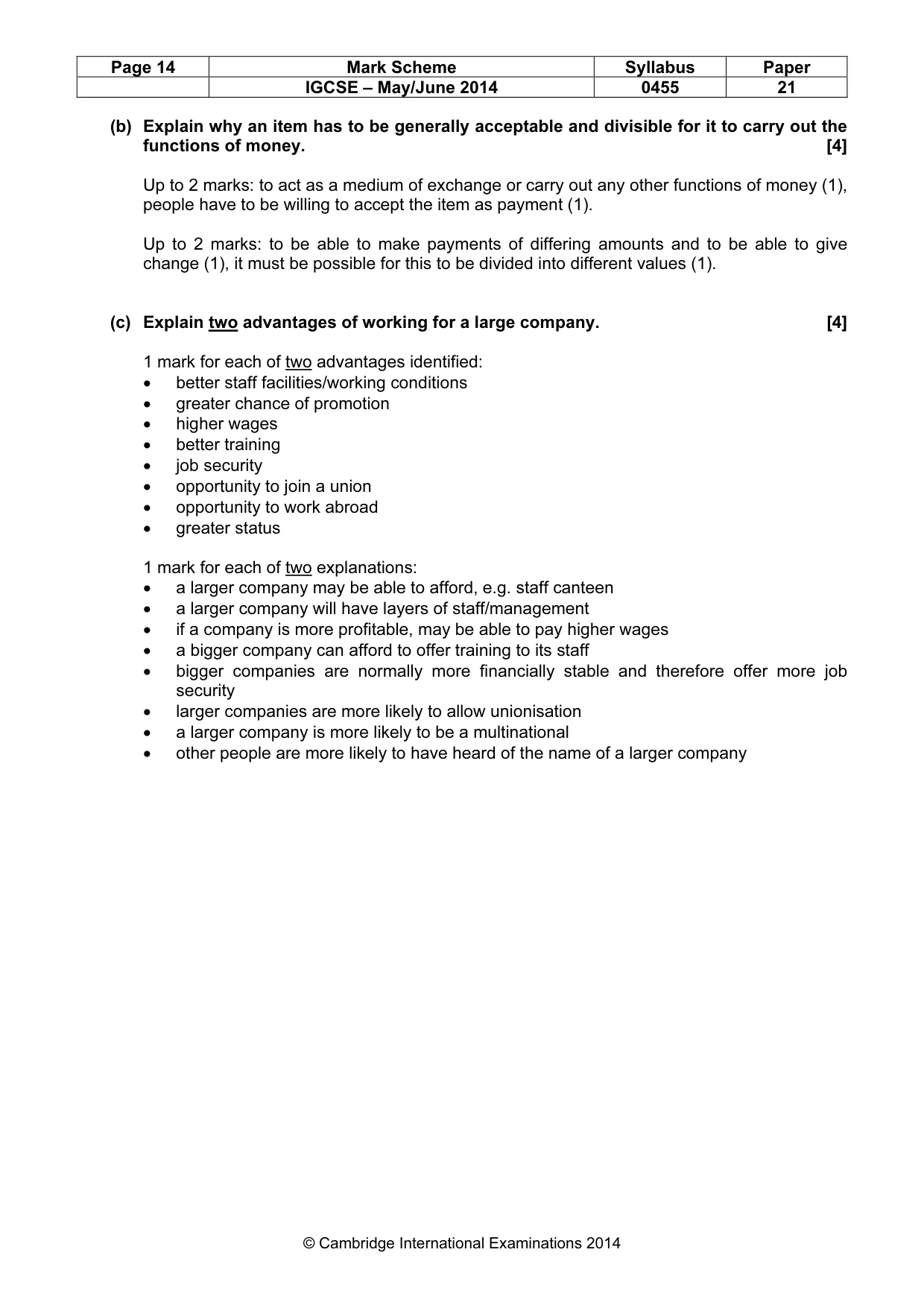
Page 14 Mark Scheme Syllabus Paper IGCSE – May/June 2014 0455 21 © Cambridge International Examinations 2014 (b) Explain why an item has to be generally acceptable and divisible for it to carry out the functions of money. [4] Up to 2 marks: to act as a medium of exchange or carry out any other functions of money (1), people have to be willing to accept the item as payment (1). Up to 2 marks: to be able to make payments of differing amounts and to be able to give change (1), it must be possible for this to be divided into different values (1). (c) Explain two advantages of working for a large company. [4] 1 mark for each of two advantages identified: • better staff facilities/working conditions • greater chance of promotion • higher wages • better training • job security • opportunity to join a union • opportunity to work abroad • greater status 1 mark for each of two explanations: • a larger company may be able to afford, e.g. staff canteen • a larger company will have layers of staff/management • if a company is more profitable, may be able to pay higher wages • a bigger company can afford to offer training to its staff • bigger companies are normally more financially stable and therefore offer more job security • larger companies are more likely to allow unionisation • a larger company is more likely to be a multinational • other people are more likely to have heard of the name of a larger company
Mark scheme, page 15
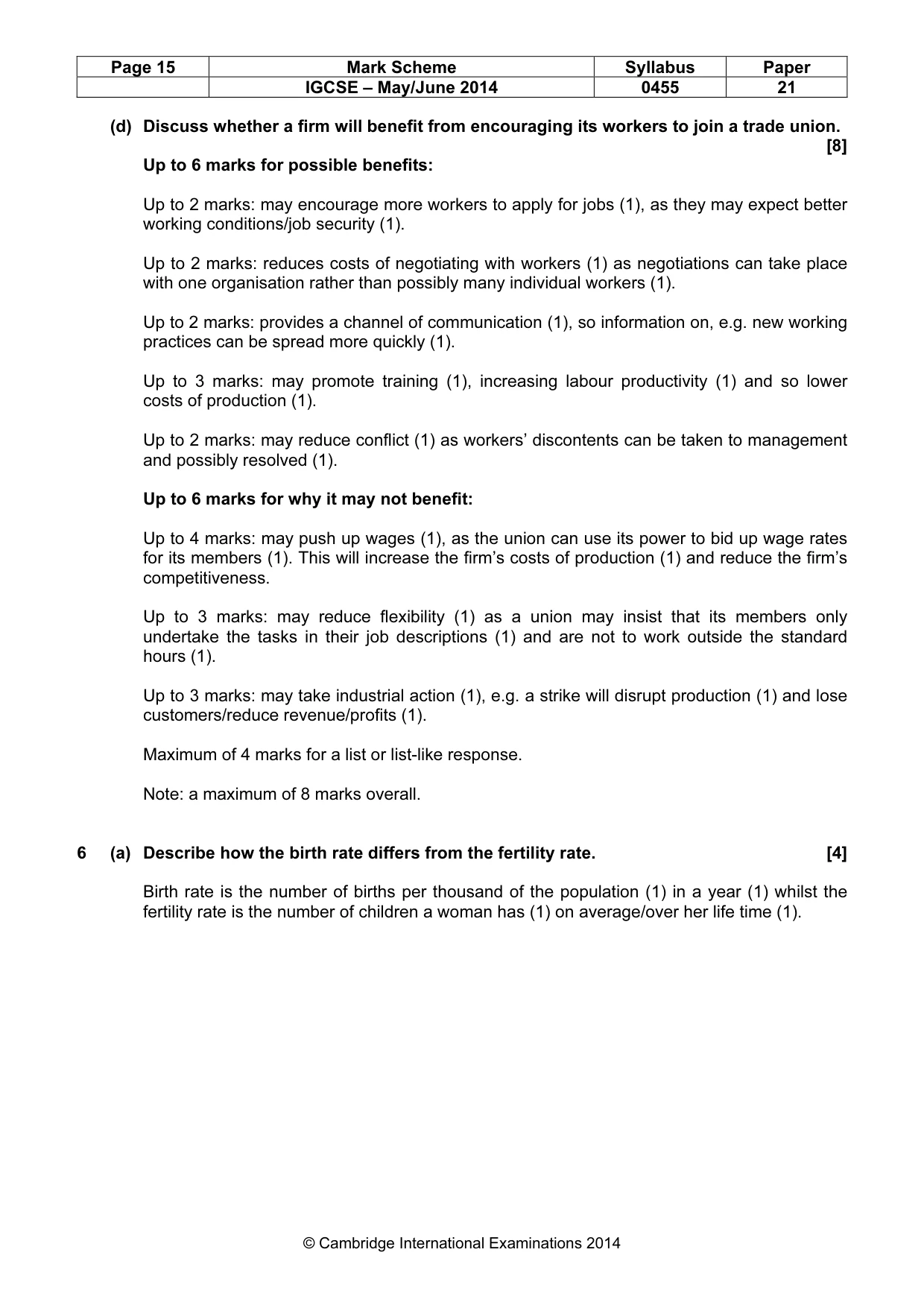
Page 15 Mark Scheme Syllabus Paper IGCSE – May/June 2014 0455 21 © Cambridge International Examinations 2014 (d) Discuss whether a firm will benefit from encouraging its workers to join a trade union. [8] Up to 6 marks for possible benefits: Up to 2 marks: may encourage more workers to apply for jobs (1), as they may expect better working conditions/job security (1). Up to 2 marks: reduces costs of negotiating with workers (1) as negotiations can take place with one organisation rather than possibly many individual workers (1). Up to 2 marks: provides a channel of communication (1), so information on, e.g. new working practices can be spread more quickly (1). Up to 3 marks: may promote training (1), increasing labour productivity (1) and so lower costs of production (1). Up to 2 marks: may reduce conflict (1) as workers’ discontents can be taken to management and possibly resolved (1). Up to 6 marks for why it may not benefit: Up to 4 marks: may push up wages (1), as the union can use its power to bid up wage rates for its members (1). This will increase the firm’s costs of production (1) and reduce the firm’s competitiveness. Up to 3 marks: may reduce flexibility (1) as a union may insist that its members only undertake the tasks in their job descriptions (1) and are not to work outside the standard hours (1). Up to 3 marks: may take industrial action (1), e.g. a strike will disrupt production (1) and lose customers/reduce revenue/profits (1). Maximum of 4 marks for a list or list-like response. Note: a maximum of 8 marks overall. 6 (a) Describe how the birth rate differs from the fertility rate. [4] Birth rate is the number of births per thousand of the population (1) in a year (1) whilst the fertility rate is the number of children a woman has (1) on average/over her life time (1).
Mark scheme, page 16
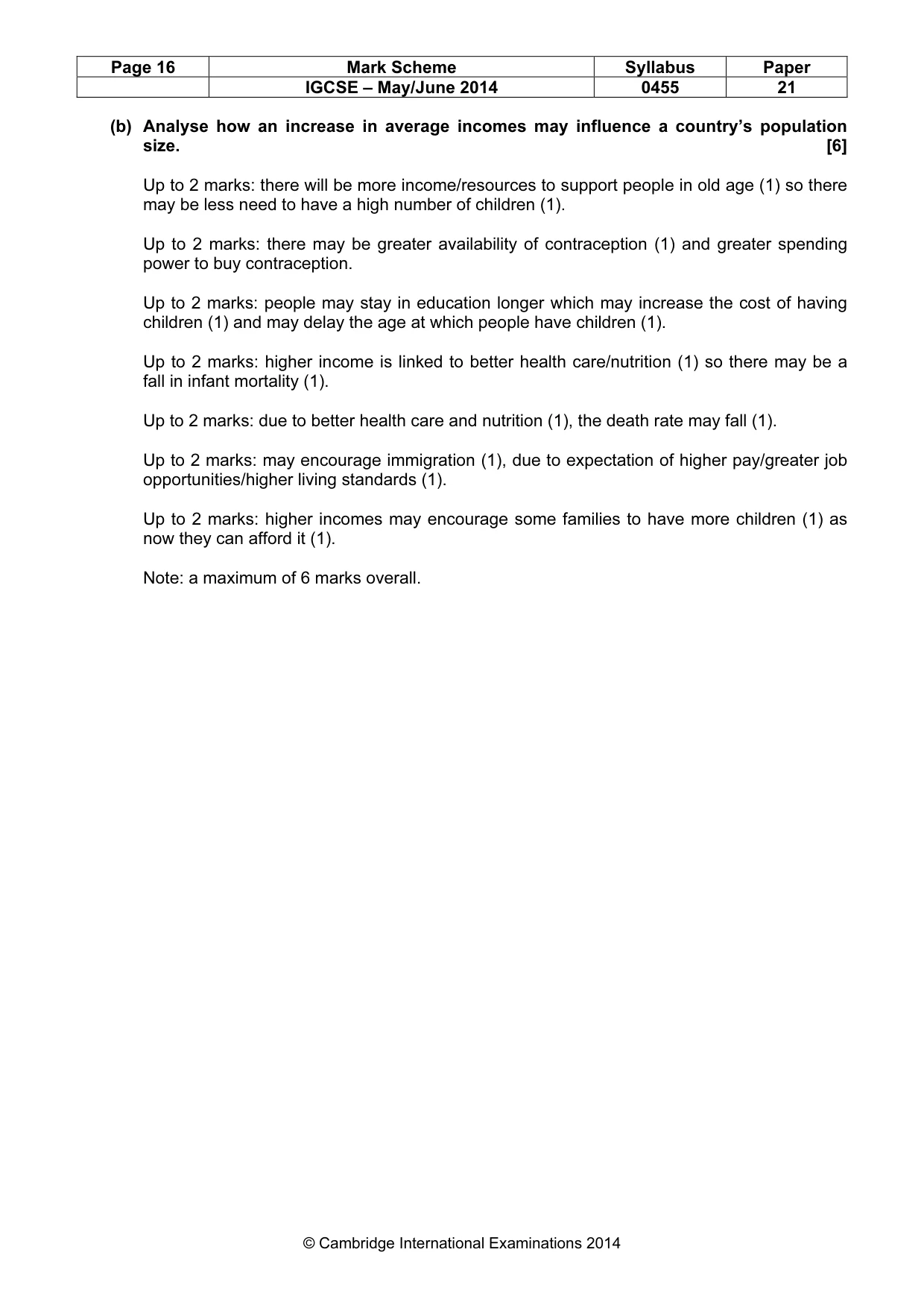
Page 16 Mark Scheme Syllabus Paper IGCSE – May/June 2014 0455 21 © Cambridge International Examinations 2014 (b) Analyse how an increase in average incomes may influence a country’s population size. [6] Up to 2 marks: there will be more income/resources to support people in old age (1) so there may be less need to have a high number of children (1). Up to 2 marks: there may be greater availability of contraception (1) and greater spending power to buy contraception. Up to 2 marks: people may stay in education longer which may increase the cost of having children (1) and may delay the age at which people have children (1). Up to 2 marks: higher income is linked to better health care/nutrition (1) so there may be a fall in infant mortality (1). Up to 2 marks: due to better health care and nutrition (1), the death rate may fall (1). Up to 2 marks: may encourage immigration (1), due to expectation of higher pay/greater job opportunities/higher living standards (1). Up to 2 marks: higher incomes may encourage some families to have more children (1) as now they can afford it (1). Note: a maximum of 6 marks overall.
Mark scheme, page 17
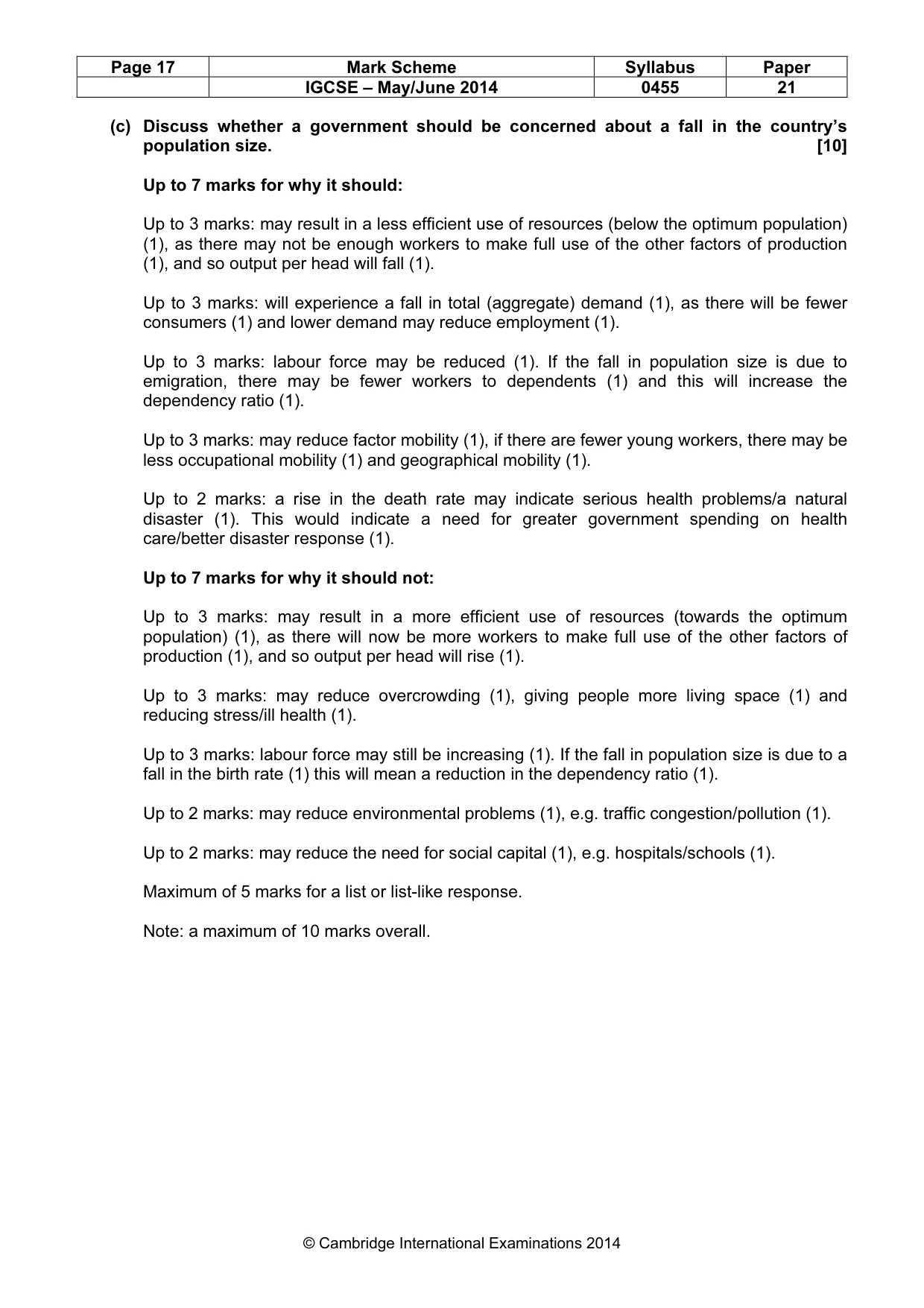
Page 17 Mark Scheme Syllabus Paper IGCSE – May/June 2014 0455 21 © Cambridge International Examinations 2014 (c) Discuss whether a government should be concerned about a fall in the country’s population size. [10] Up to 7 marks for why it should: Up to 3 marks: may result in a less efficient use of resources (below the optimum population) (1), as there may not be enough workers to make full use of the other factors of production (1), and so output per head will fall (1). Up to 3 marks: will experience a fall in total (aggregate) demand (1), as there will be fewer consumers (1) and lower demand may reduce employment (1). Up to 3 marks: labour force may be reduced (1). If the fall in population size is due to emigration, there may be fewer workers to dependents (1) and this will increase the dependency ratio (1). Up to 3 marks: may reduce factor mobility (1), if there are fewer young workers, there may be less occupational mobility (1) and geographical mobility (1). Up to 2 marks: a rise in the death rate may indicate serious health problems/a natural disaster (1). This would indicate a need for greater government spending on health care/better disaster response (1). Up to 7 marks for why it should not: Up to 3 marks: may result in a more efficient use of resources (towards the optimum population) (1), as there will now be more workers to make full use of the other factors of production (1), and so output per head will rise (1). Up to 3 marks: may reduce overcrowding (1), giving people more living space (1) and reducing stress/ill health (1). Up to 3 marks: labour force may still be increasing (1). If the fall in population size is due to a fall in the birth rate (1) this will mean a reduction in the dependency ratio (1). Up to 2 marks: may reduce environmental problems (1), e.g. traffic congestion/pollution (1). Up to 2 marks: may reduce the need for social capital (1), e.g. hospitals/schools (1). Maximum of 5 marks for a list or list-like response. Note: a maximum of 10 marks overall.
Mark scheme, page 18
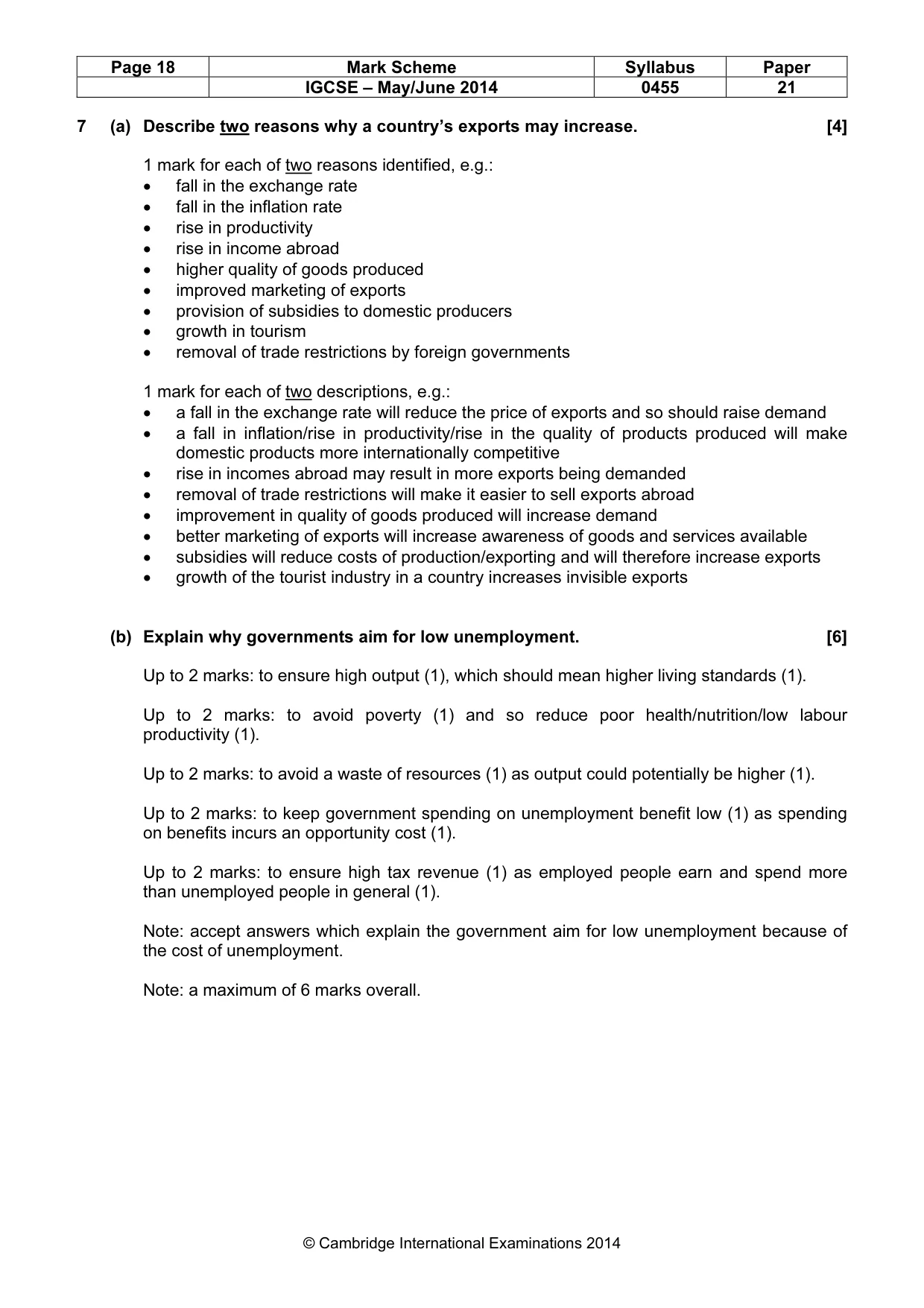
Page 18 Mark Scheme Syllabus Paper IGCSE – May/June 2014 0455 21 © Cambridge International Examinations 2014 7 (a) Describe two reasons why a country’s exports may increase. [4] 1 mark for each of two reasons identified, e.g.: • fall in the exchange rate • fall in the inflation rate • rise in productivity • rise in income abroad • higher quality of goods produced • improved marketing of exports • provision of subsidies to domestic producers • growth in tourism • removal of trade restrictions by foreign governments 1 mark for each of two descriptions, e.g.: • a fall in the exchange rate will reduce the price of exports and so should raise demand • a fall in inflation/rise in productivity/rise in the quality of products produced will make domestic products more internationally competitive • rise in incomes abroad may result in more exports being demanded • removal of trade restrictions will make it easier to sell exports abroad • improvement in quality of goods produced will increase demand • better marketing of exports will increase awareness of goods and services available • subsidies will reduce costs of production/exporting and will therefore increase exports • growth of the tourist industry in a country increases invisible exports (b) Explain why governments aim for low unemployment. [6] Up to 2 marks: to ensure high output (1), which should mean higher living standards (1). Up to 2 marks: to avoid poverty (1) and so reduce poor health/nutrition/low labour productivity (1). Up to 2 marks: to avoid a waste of resources (1) as output could potentially be higher (1). Up to 2 marks: to keep government spending on unemployment benefit low (1) as spending on benefits incurs an opportunity cost (1). Up to 2 marks: to ensure high tax revenue (1) as employed people earn and spend more than unemployed people in general (1). Note: accept answers which explain the government aim for low unemployment because of the cost of unemployment. Note: a maximum of 6 marks overall.
Mark scheme, page 19
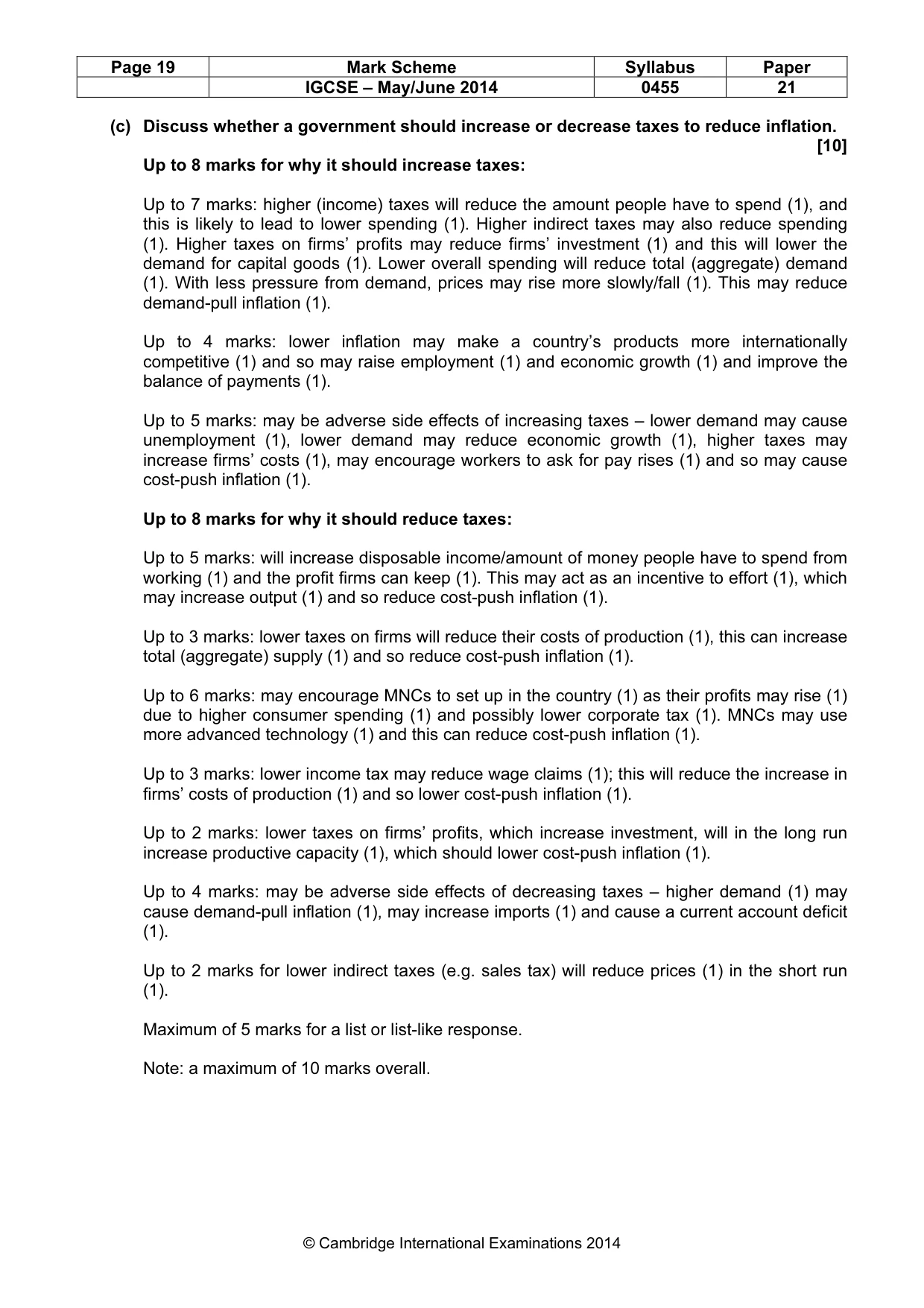
Page 19 Mark Scheme Syllabus Paper IGCSE – May/June 2014 0455 21 © Cambridge International Examinations 2014 (c) Discuss whether a government should increase or decrease taxes to reduce inflation. [10] Up to 8 marks for why it should increase taxes: Up to 7 marks: higher (income) taxes will reduce the amount people have to spend (1), and this is likely to lead to lower spending (1). Higher indirect taxes may also reduce spending (1). Higher taxes on firms’ profits may reduce firms’ investment (1) and this will lower the demand for capital goods (1). Lower overall spending will reduce total (aggregate) demand (1). With less pressure from demand, prices may rise more slowly/fall (1). This may reduce demand-pull inflation (1). Up to 4 marks: lower inflation may make a country’s products more internationally competitive (1) and so may raise employment (1) and economic growth (1) and improve the balance of payments (1). Up to 5 marks: may be adverse side effects of increasing taxes – lower demand may cause unemployment (1), lower demand may reduce economic growth (1), higher taxes may increase firms’ costs (1), may encourage workers to ask for pay rises (1) and so may cause cost-push inflation (1). Up to 8 marks for why it should reduce taxes: Up to 5 marks: will increase disposable income/amount of money people have to spend from working (1) and the profit firms can keep (1). This may act as an incentive to effort (1), which may increase output (1) and so reduce cost-push inflation (1). Up to 3 marks: lower taxes on firms will reduce their costs of production (1), this can increase total (aggregate) supply (1) and so reduce cost-push inflation (1). Up to 6 marks: may encourage MNCs to set up in the country (1) as their profits may rise (1) due to higher consumer spending (1) and possibly lower corporate tax (1). MNCs may use more advanced technology (1) and this can reduce cost-push inflation (1). Up to 3 marks: lower income tax may reduce wage claims (1); this will reduce the increase in firms’ costs of production (1) and so lower cost-push inflation (1). Up to 2 marks: lower taxes on firms’ profits, which increase investment, will in the long run increase productive capacity (1), which should lower cost-push inflation (1). Up to 4 marks: may be adverse side effects of decreasing taxes – higher demand (1) may cause demand-pull inflation (1), may increase imports (1) and cause a current account deficit (1). Up to 2 marks for lower indirect taxes (e.g. sales tax) will reduce prices (1) in the short run (1). Maximum of 5 marks for a list or list-like response. Note: a maximum of 10 marks overall.
What you needed in this session
Cambridge’s own grade thresholds for 2014 May/June, Paper 2 · Variant 1. A higher threshold means an easier paper — the bar moves with how the cohort did.