Cambridge IGCSE Economics 0455 — 2014 May/June Paper 2 · Variant 2
0455/22/M/J/14 · 90 marks · ≈101 min
The question paper and its mark scheme, free to read here and free to download. This is Cambridge’s own paper, exactly as it was sat.
Question paper8 pages
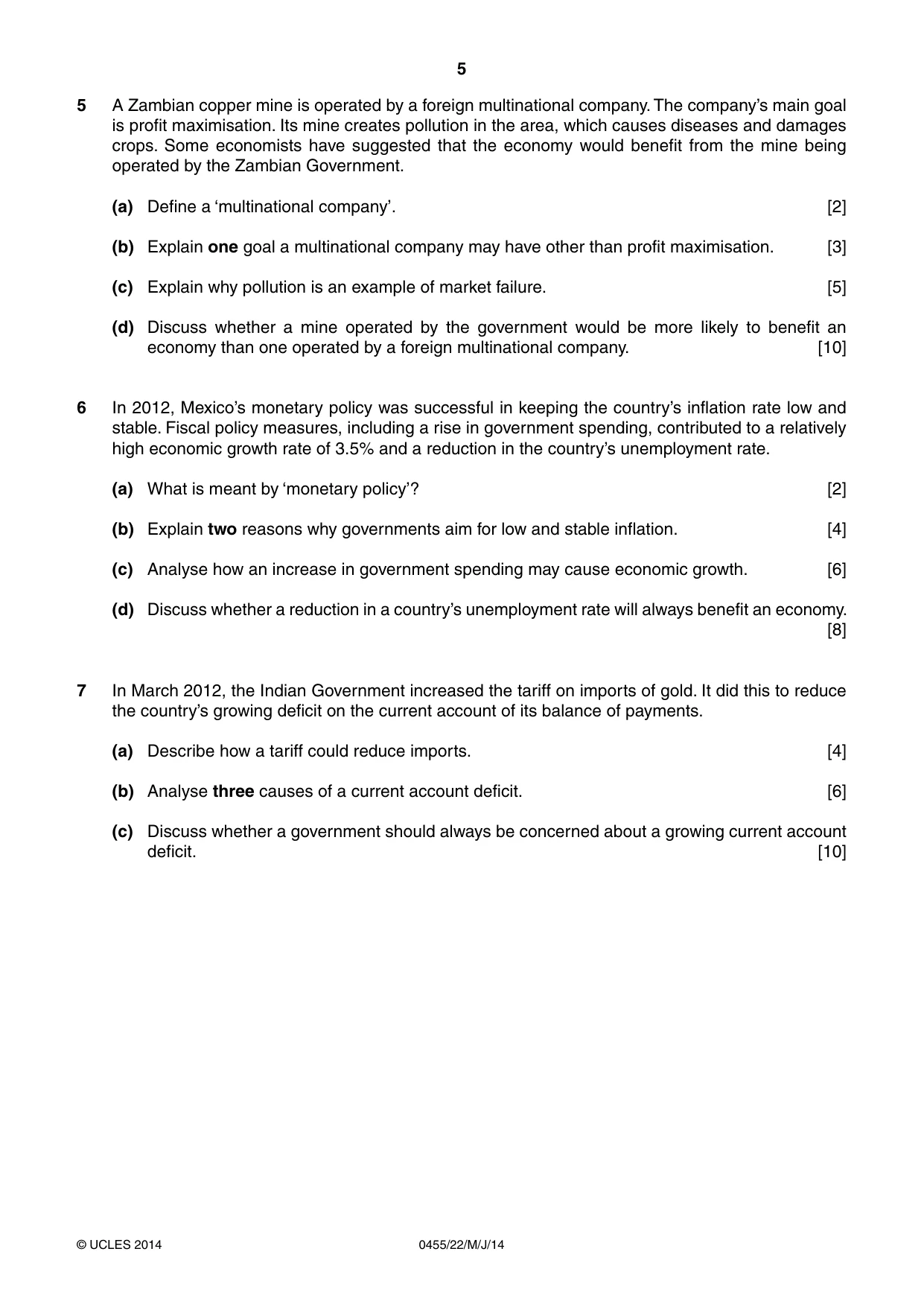



Mark scheme14 pages
Answers below. Sit the paper first if you are practising.
Paper as text
Question paper, page 1
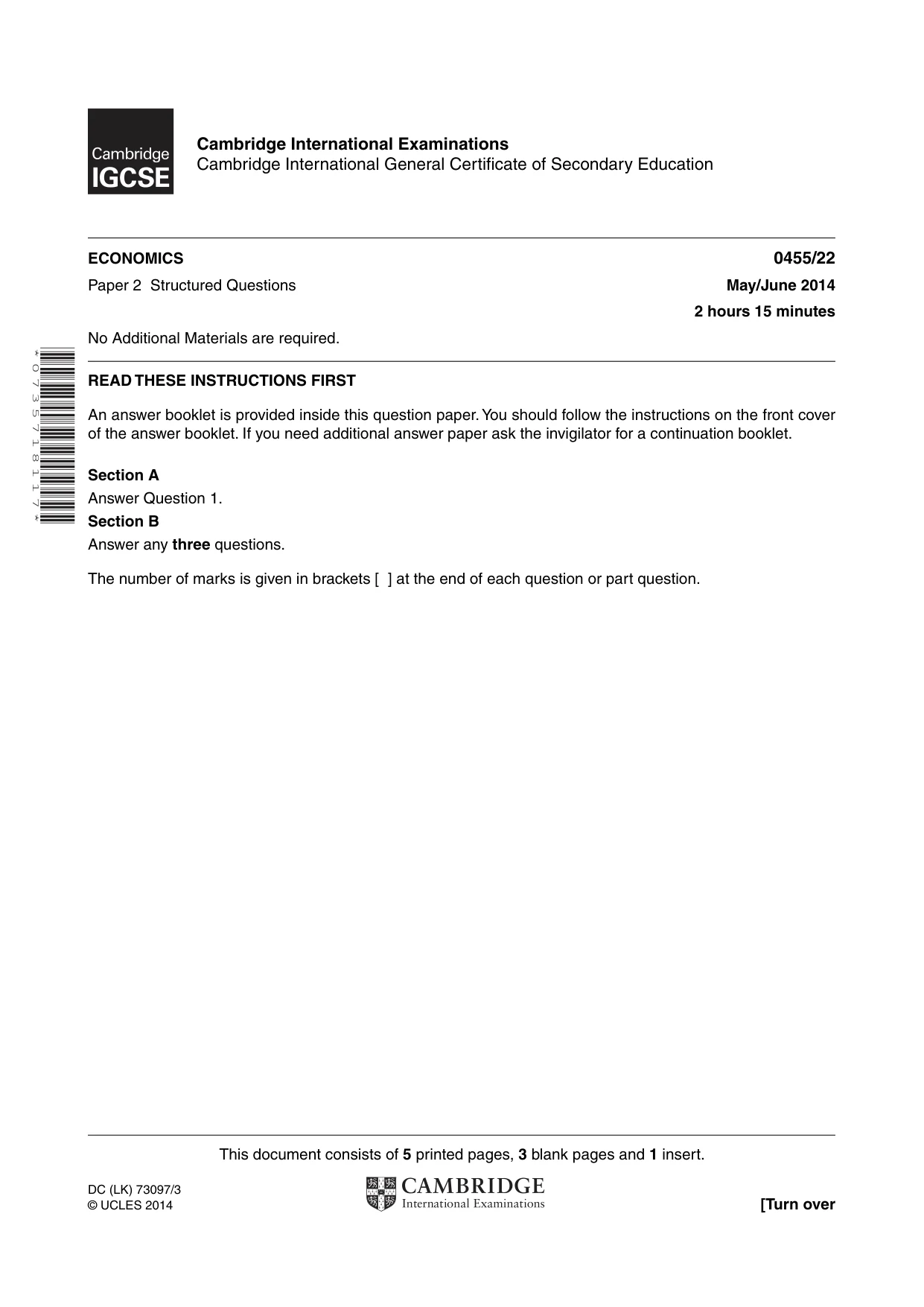
This document consists of 5 printed pages, 3 blank pages and 1 insert. DC (LK) 73097/3 © UCLES 2014 [Turn over * 0 7 3 5 7 1 8 1 1 7 * ECONOMICS 0455/22 Paper 2 Structured Questions May/June 2014 2 hours 15 minutes No Additional Materials are required. READ THESE INSTRUCTIONS FIRST An answer booklet is provided inside this question paper. You should follow the instructions on the front cover of the answer booklet. If you need additional answer paper ask the invigilator for a continuation booklet. Section A Answer Question 1. Section B Answer any three questions. The number of marks is given in brackets [ ] at the end of each question or part question. Cambridge International Examinations Cambridge International General Certificate of Secondary Education
Question paper, page 2
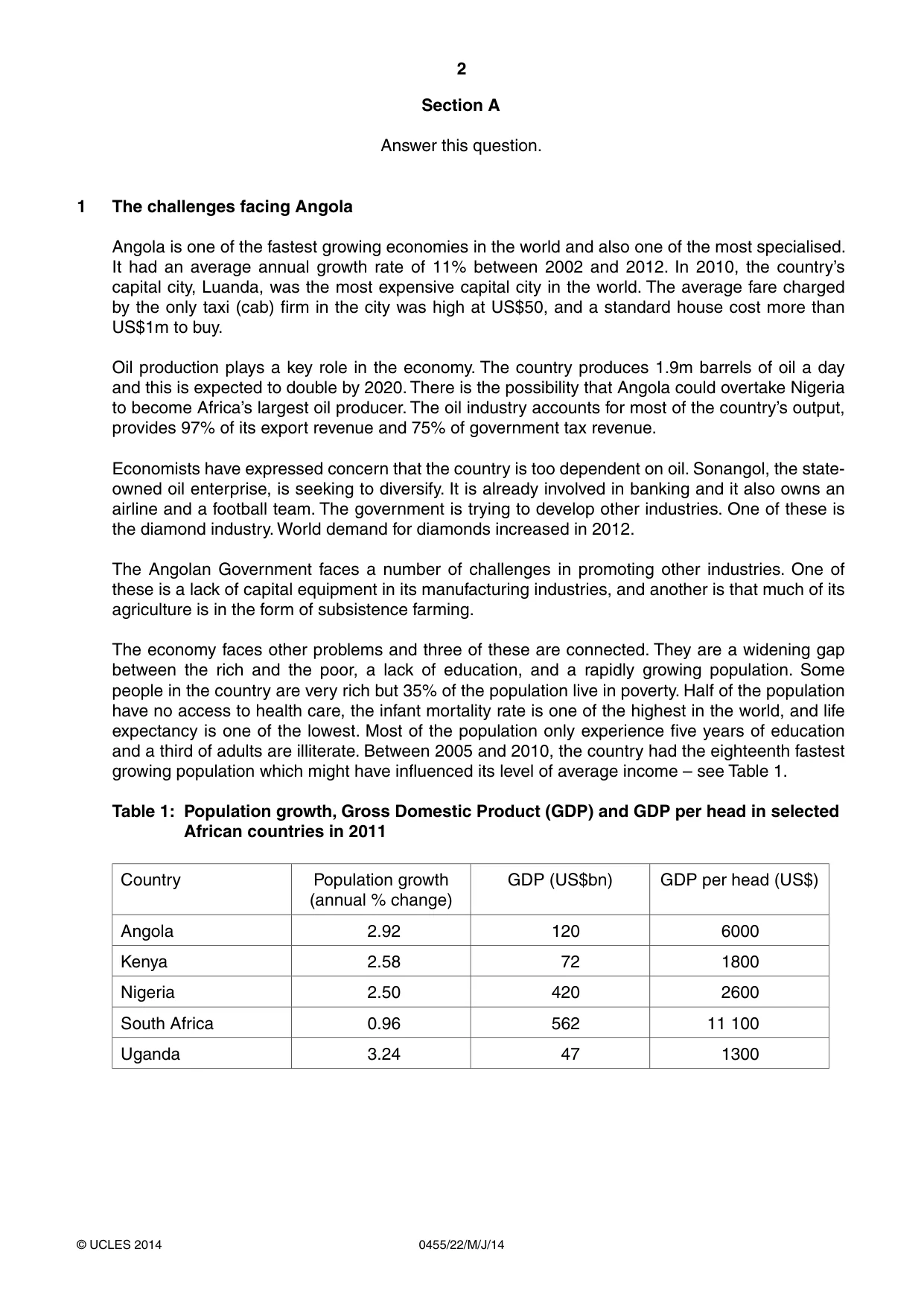
2 0455/22/M/J/14 © UCLES 2014 Section A Answer this question. 1 The challenges facing Angola Angola is one of the fastest growing economies in the world and also one of the most specialised. It had an average annual growth rate of 11% between 2002 and 2012. In 2010, the country’s capital city, Luanda, was the most expensive capital city in the world. The average fare charged by the only taxi (cab) firm in the city was high at US$50, and a standard house cost more than US$1m to buy. Oil production plays a key role in the economy. The country produces 1.9m barrels of oil a day and this is expected to double by 2020. There is the possibility that Angola could overtake Nigeria to become Africa’s largest oil producer. The oil industry accounts for most of the country’s output, provides 97% of its export revenue and 75% of government tax revenue. Economists have expressed concern that the country is too dependent on oil. Sonangol, the state- owned oil enterprise, is seeking to diversify. It is already involved in banking and it also owns an airline and a football team. The government is trying to develop other industries. One of these is the diamond industry. World demand for diamonds increased in 2012. The Angolan Government faces a number of challenges in promoting other industries. One of these is a lack of capital equipment in its manufacturing industries, and another is that much of its agriculture is in the form of subsistence farming. The economy faces other problems and three of these are connected. They are a widening gap between the rich and the poor, a lack of education, and a rapidly growing population. Some people in the country are very rich but 35% of the population live in poverty. Half of the population have no access to health care, the infant mortality rate is one of the highest in the world, and life expectancy is one of the lowest. Most of the population only experience five years of education and a third of adults are illiterate. Between 2005 and 2010, the country had the eighteenth fastest growing population which might have influenced its level of average income – see Table 1. Table 1: Population growth, Gross Domestic Product (GDP) and GDP per head in selected African countries in 2011 Country Population growth (annual % change) GDP (US$bn) GDP per head (US$) Angola 2.92 120 6000 Kenya 2.58 72 1800 Nigeria 2.50 420 2600 South Africa 0.96 562 11 100 Uganda 3.24 47 1300
Question paper, page 3
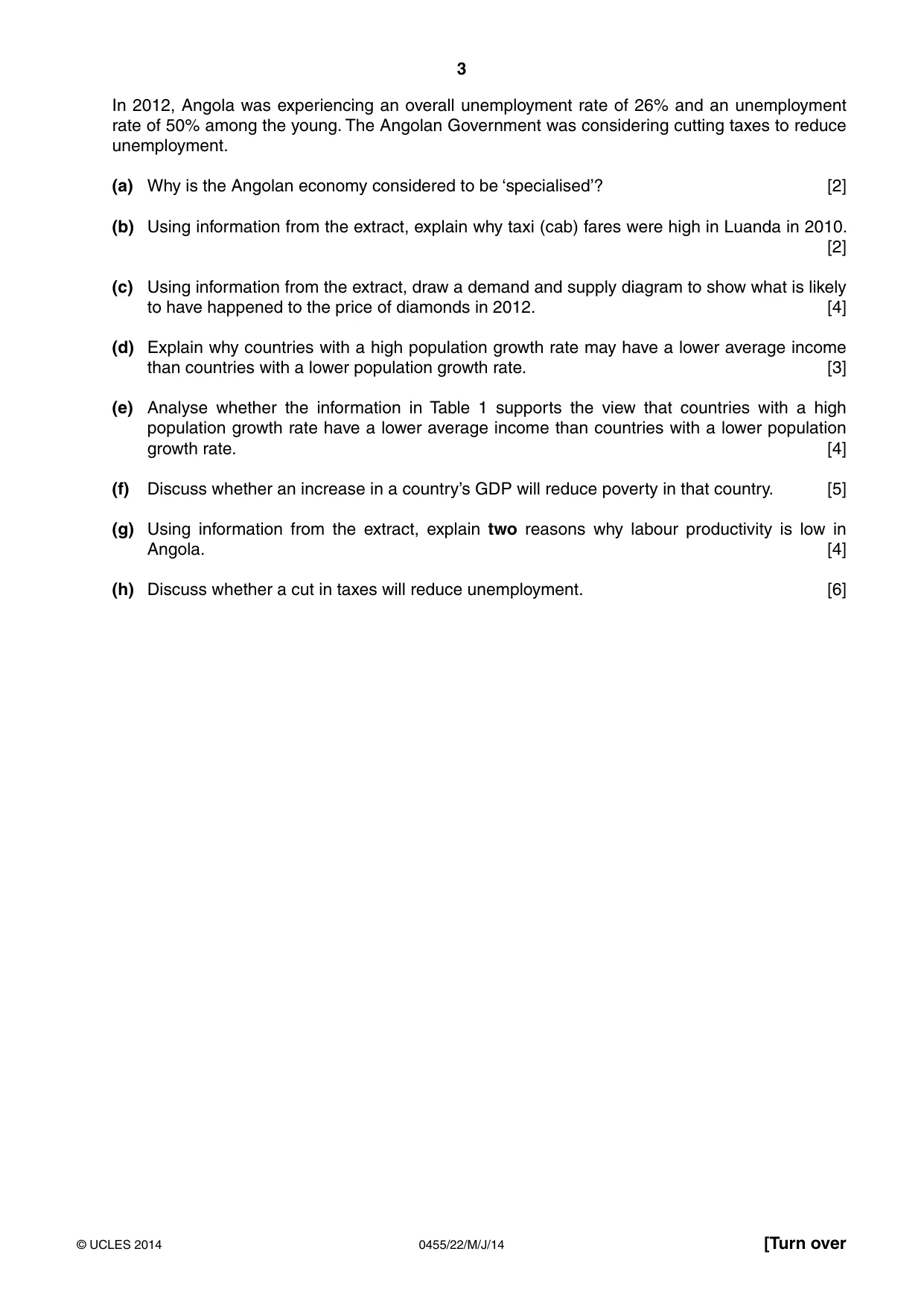
3 0455/22/M/J/14 © UCLES 2014 [Turn over In 2012, Angola was experiencing an overall unemployment rate of 26% and an unemployment rate of 50% among the young. The Angolan Government was considering cutting taxes to reduce unemployment. (a) Why is the Angolan economy considered to be ‘specialised’? [2] (b) Using information from the extract, explain why taxi (cab) fares were high in Luanda in 2010. [2] (c) Using information from the extract, draw a demand and supply diagram to show what is likely to have happened to the price of diamonds in 2012. [4] (d) Explain why countries with a high population growth rate may have a lower average income than countries with a lower population growth rate. [3] (e) Analyse whether the information in Table 1 supports the view that countries with a high population growth rate have a lower average income than countries with a lower population growth rate. [4] (f) Discuss whether an increase in a country’s GDP will reduce poverty in that country. [5] (g) Using information from the extract, explain two reasons why labour productivity is low in Angola. [4] (h) Discuss whether a cut in taxes will reduce unemployment. [6]
Question paper, page 4
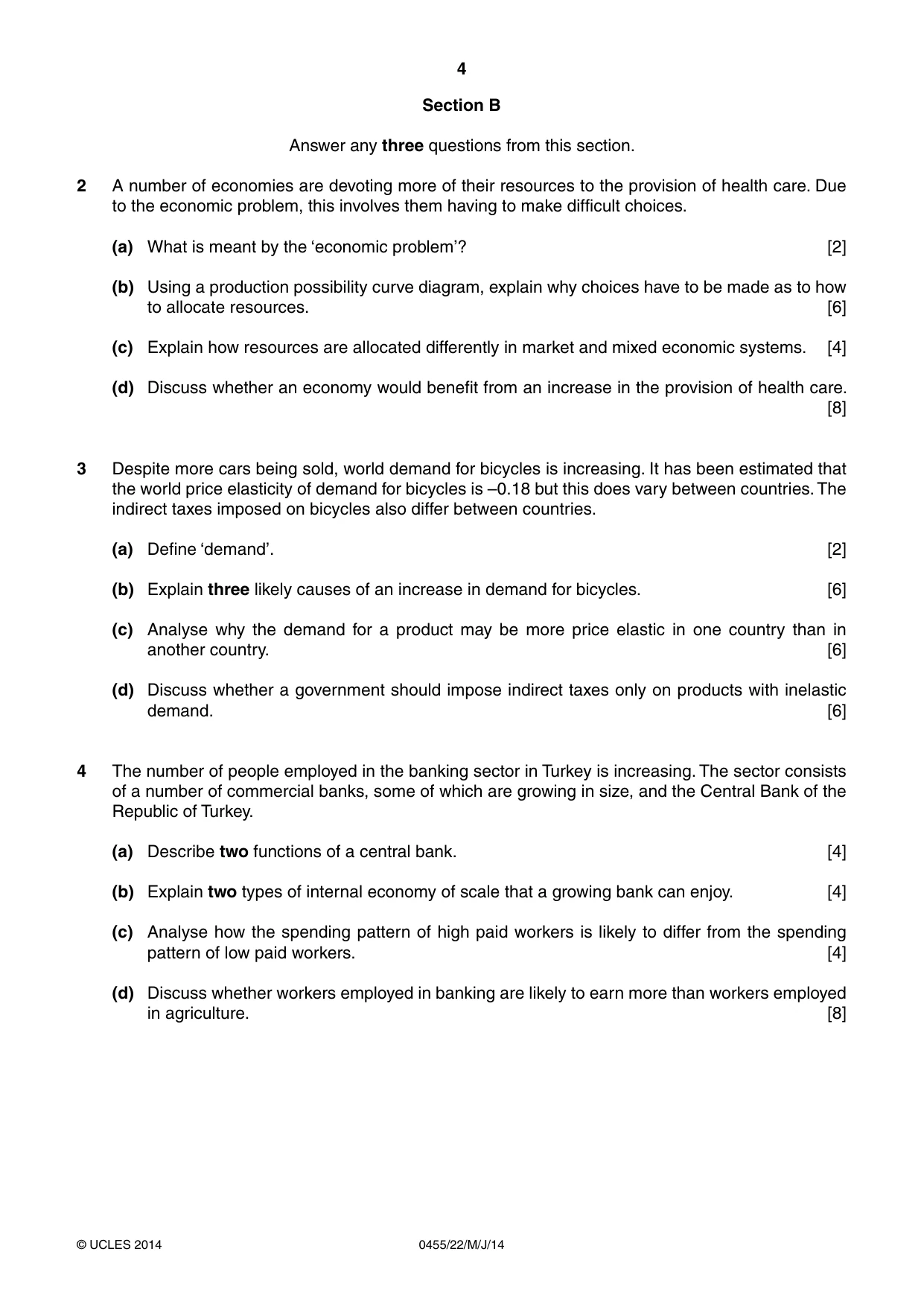
4 0455/22/M/J/14 © UCLES 2014 Section B Answer any three questions from this section. 2 A number of economies are devoting more of their resources to the provision of health care. Due to the economic problem, this involves them having to make difficult choices. (a) What is meant by the ‘economic problem’? [2] (b) Using a production possibility curve diagram, explain why choices have to be made as to how to allocate resources. [6] (c) Explain how resources are allocated differently in market and mixed economic systems. [4] (d) Discuss whether an economy would benefit from an increase in the provision of health care. [8] 3 Despite more cars being sold, world demand for bicycles is increasing. It has been estimated that the world price elasticity of demand for bicycles is –0.18 but this does vary between countries. The indirect taxes imposed on bicycles also differ between countries. (a) Define ‘demand’. [2] (b) Explain three likely causes of an increase in demand for bicycles. [6] (c) Analyse why the demand for a product may be more price elastic in one country than in another country. [6] (d) Discuss whether a government should impose indirect taxes only on products with inelastic demand. [6] 4 The number of people employed in the banking sector in Turkey is increasing. The sector consists of a number of commercial banks, some of which are growing in size, and the Central Bank of the Republic of Turkey. (a) Describe two functions of a central bank. [4] (b) Explain two types of internal economy of scale that a growing bank can enjoy. [4] (c) Analyse how the spending pattern of high paid workers is likely to differ from the spending pattern of low paid workers. [4] (d) Discuss whether workers employed in banking are likely to earn more than workers employed in agriculture. [8]
Question paper, page 5
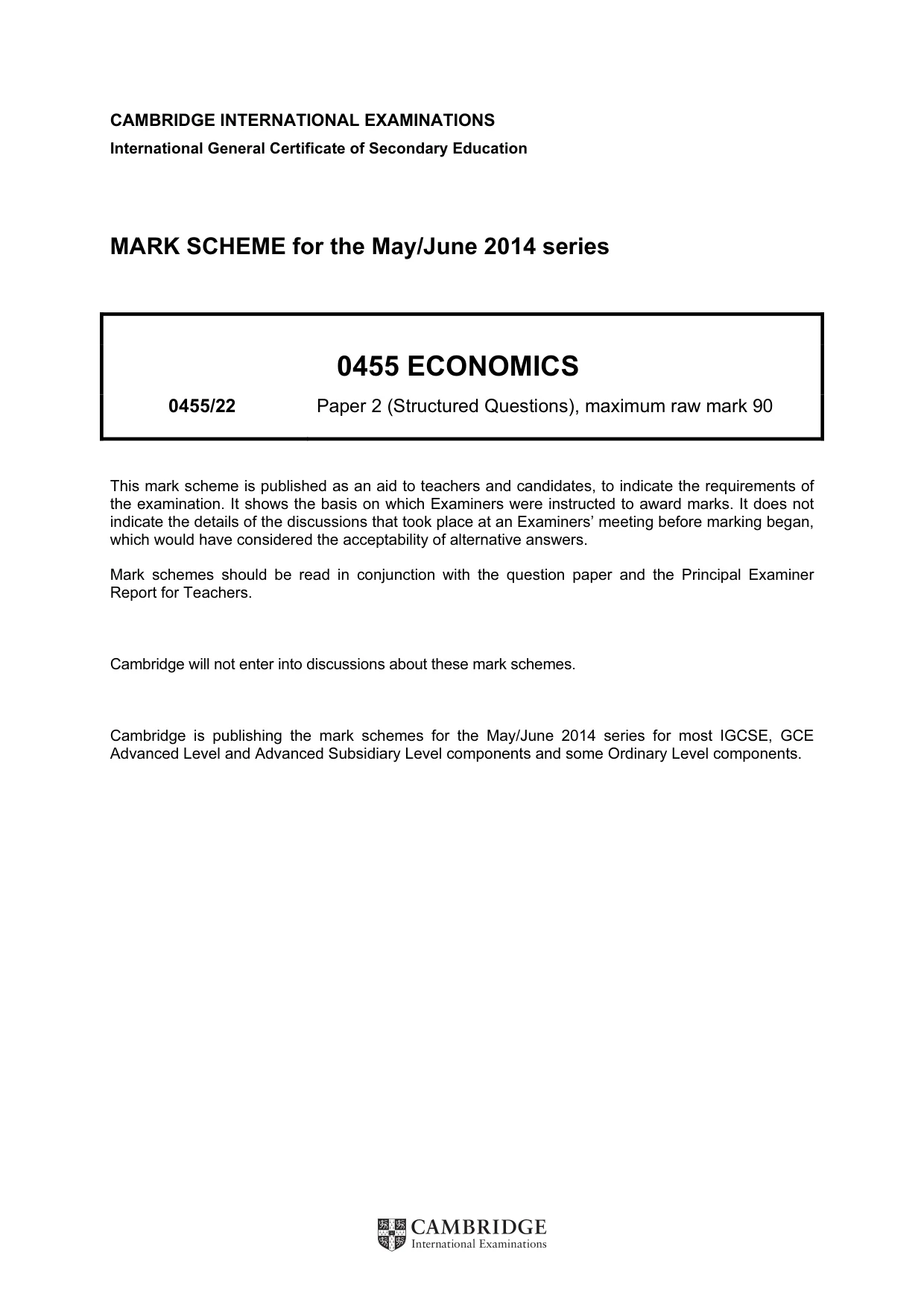
5 0455/22/M/J/14 © UCLES 2014 5 A Zambian copper mine is operated by a foreign multinational company. The company’s main goal is profit maximisation. Its mine creates pollution in the area, which causes diseases and damages crops. Some economists have suggested that the economy would benefit from the mine being operated by the Zambian Government. (a) Define a ‘multinational company’. [2] (b) Explain one goal a multinational company may have other than profit maximisation. [3] (c) Explain why pollution is an example of market failure. [5] (d) Discuss whether a mine operated by the government would be more likely to benefit an economy than one operated by a foreign multinational company. [10] 6 In 2012, Mexico’s monetary policy was successful in keeping the country’s inflation rate low and stable. Fiscal policy measures, including a rise in government spending, contributed to a relatively high economic growth rate of 3.5% and a reduction in the country’s unemployment rate. (a) What is meant by ‘monetary policy’? [2] (b) Explain two reasons why governments aim for low and stable inflation. [4] (c) Analyse how an increase in government spending may cause economic growth. [6] (d) Discuss whether a reduction in a country’s unemployment rate will always benefit an economy. [8] 7 In March 2012, the Indian Government increased the tariff on imports of gold. It did this to reduce the country’s growing deficit on the current account of its balance of payments. (a) Describe how a tariff could reduce imports. [4] (b) Analyse three causes of a current account deficit. [6] (c) Discuss whether a government should always be concerned about a growing current account deficit. [10]
Question paper, page 6
6 0455/22/M/J/14 © UCLES 2014 BLANK PAGE
Question paper, page 7
7 0455/22/M/J/14 © UCLES 2014 BLANK PAGE
Question paper, page 8
8 0455/22/M/J/14 © UCLES 2014 Permission to reproduce items where third-party owned material protected by copyright is included has been sought and cleared where possible. Every reasonable effort has been made by the publisher (UCLES) to trace copyright holders, but if any items requiring clearance have unwittingly been included, the publisher will be pleased to make amends at the earliest possible opportunity. Cambridge International Examinations is part of the Cambridge Assessment Group. Cambridge Assessment is the brand name of University of Cambridge Local Examinations Syndicate (UCLES), which is itself a department of the University of Cambridge. BLANK PAGE
Mark scheme, page 1
CAMBRIDGE INTERNATIONAL EXAMINATIONS International General Certificate of Secondary Education MARK SCHEME for the May/June 2014 series 0455 ECONOMICS 0455/22 Paper 2 (Structured Questions), maximum raw mark 90 This mark scheme is published as an aid to teachers and candidates, to indicate the requirements of the examination. It shows the basis on which Examiners were instructed to award marks. It does not indicate the details of the discussions that took place at an Examiners’ meeting before marking began, which would have considered the acceptability of alternative answers. Mark schemes should be read in conjunction with the question paper and the Principal Examiner Report for Teachers. Cambridge will not enter into discussions about these mark schemes. Cambridge is publishing the mark schemes for the May/June 2014 series for most IGCSE, GCE Advanced Level and Advanced Subsidiary Level components and some Ordinary Level components.
Mark scheme, page 2
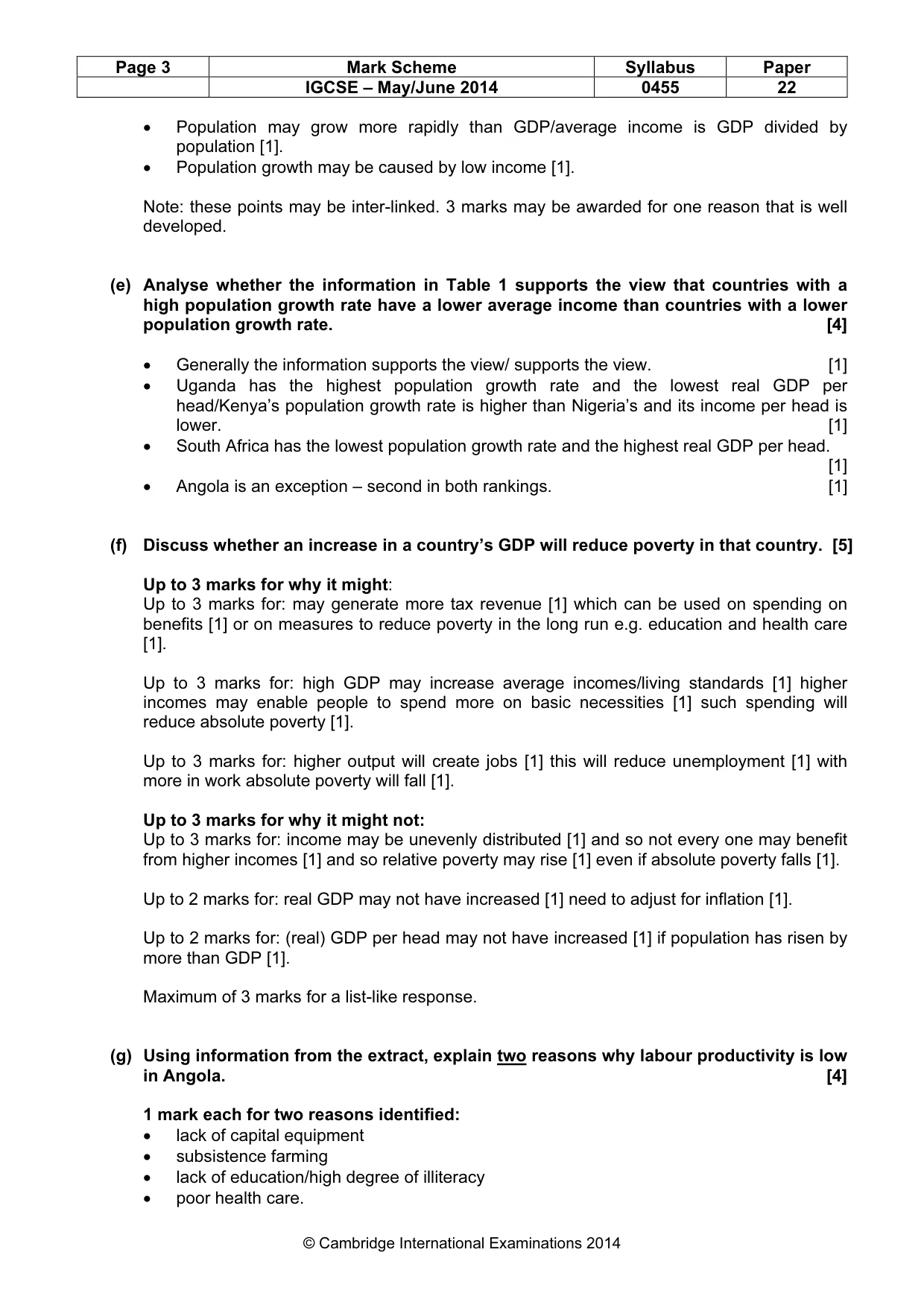
1 ( ( ( ( Pa (a) (b) (c) (d) age W 1 • • • • N ) U 2 1 1 p U is 1 1 1 1 p F ) E in • • • • • e 2 Wh 1 m • • • • Not Usi 201 1 m 1 m pric Usi s l 1 m 1 m 1 m 1 m poin Fig Exp nc • • • • • 2 hy i mar m o o p go te: ing 10. mar mar ce m ing ike mar mar mar mar nts ure pla om M M th A T R ex is t rk e mos il/d il p rov ove no g in rk f rk f ma g in ely rk f rk f rk f rk f s cl e 1 ain me May May he A hi he Res xpa the eac st o dep prod vide ern o m nfo for for ake nfo to for for for for ea 1(c w th y re y m lab gh re sou and e A ch of pen duc es nm mar orm rec r m er/p orm o ha ax de de r co arly c) hy an esu mea bou er ma urce din Ang fo its nde ctio 75 en ks mat cog men pric mat ave es ema ema orre y id y co co ult i an ur f lab ay es ng p gol or a s o ent on 5% t tr for tio gni ntio ce c tio e h co and and ect en ou ou in m few forc bou no m pro lan any outp on ac of ryin r p n f sin onin can n f hap orre d a d c t e tifie ntr ntr mo we ce ur f ot b may odu IG © n ec y o put n o cco f go ng rod fro ng t ng n b fro ppe ect and curv qu ed rie ries ore er w [1] forc be e y b uct GC Ca co of t t is il/m oun ove to duc m the th be d om ene tly l d su ve ilib e.g s w s w de wor ]. ce eno be ive M SE amb no he s o mos nts ern de ces the ere at driv th ed lab upp sh briu g. wit wit epe rke ma oug de e ca Mar E – brid omy fo oil/p st o for me eve s 1 e e e is the ven e e to bell ply how ums E a th h a end ers ay gh evo apa rk S M dge y c ollo pla of i r 97 ent lop .9m ext on e la n u ext o th led y cu wn s id and a h a lo dan [1] inc va ote aci Sc ay e In con owi ays its 7% t ta p o m b trac nly ack up tra he d – urv sh de d E hig ow nts ] if cre aca ed ty che /Ju nter nsi ing a res % of ax r the bar ct, on k o be act, pri pri es ifte ntif E1. gh wer [1 f th eas anc to [1] eme une rnat ide g tw ke sou f its rev er i rrel ex ne f of c ca , d ice ice co ed t fied po po ] d here se c cies p . e e 2 tion ere wo ey urc s e ven nd ls a xpl firm com use raw e o e an orre to t d opu opu ue e i com s [1 prov 201 nal d t o: ro ces exp nue us a d ain m/a mp e d w a f d nd ect the eit ula ula e to s a mp 1] f vid 14 Ex to b ole s ar port e trie day n w a m peti dem a d diam qu tly e ri the atio atio o ris a h peti for ding xam be in re d t re es/ y/la why mon itio ma dem mo uan lab gh er b on on se high itio inc g f mina ‘s n th dev eve /div rge y t nop on e nd ma ond ntity bell t. by gr gr in h b on f cre for atio pe he vot enu ver e q ax pol ena is and ds y o led lin row row bir birth for eas r th ons ecia ec ted ue sify qua xi (c y. ab ine d a in or P d. es wth wth rth h r job ing he s 20 alis con d to y anti cab les ela nd 20 P a dr h r h ra rat rate bs g n e 014 sed nom o oi ity b) f s fi asti d su 012 nd raw rate ate te o e, t [1] um xtr S 4 d’? my il of far rm c. up 2. Q wn e m e. or f the ] m mbe ra Syll 04 ? y/co oil/ res s t pply . to ma fall ere may er o po lab 455 oun /sp s w to y d bo y h l in m y pu of p opu bus 5 ntry pec wer dri diag oth hav n de may ush pot ulat s y t cial re h ve gra h a ve eat y be h d ten tion too lise hig up am xe a th r e f ow ntia n o d es gh p p m to s o lo rate few wn al w [1] P dep in o in pric o s or e we e [ wer wa wor ra Pa 2 pen oil. Lu ce/f sho eq er a 1]. pa age rke ath pe 22 nde . uan firm ow uili ave are es [ rs her er ent nda m i w w ibri era ents [1]. [1] r th [2 on a in [2 is a wha [4 ium age [3 s in . ]. han 2] n n 2] a at 4] m e 3] n n
Mark scheme, page 3
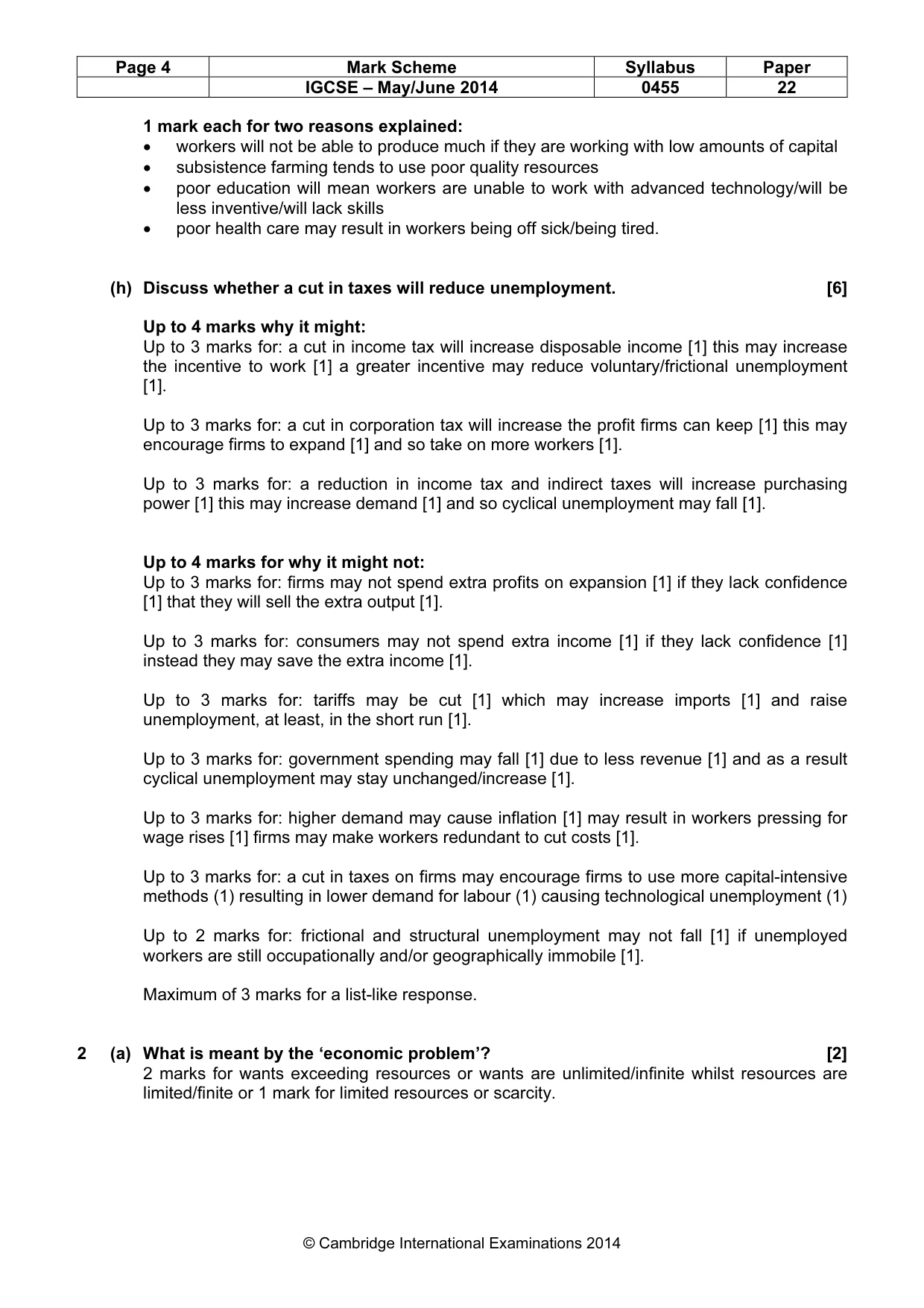
Page 3 Mark Scheme Syllabus Paper IGCSE – May/June 2014 0455 22 © Cambridge International Examinations 2014 • Population may grow more rapidly than GDP/average income is GDP divided by population [1]. • Population growth may be caused by low income [1]. Note: these points may be inter-linked. 3 marks may be awarded for one reason that is well developed. (e) Analyse whether the information in Table 1 supports the view that countries with a high population growth rate have a lower average income than countries with a lower population growth rate. [4] • Generally the information supports the view/ supports the view. [1] • Uganda has the highest population growth rate and the lowest real GDP per head/Kenya’s population growth rate is higher than Nigeria’s and its income per head is lower. [1] • South Africa has the lowest population growth rate and the highest real GDP per head. [1] • Angola is an exception – second in both rankings. [1] (f) Discuss whether an increase in a country’s GDP will reduce poverty in that country. [5] Up to 3 marks for why it might: Up to 3 marks for: may generate more tax revenue [1] which can be used on spending on benefits [1] or on measures to reduce poverty in the long run e.g. education and health care [1]. Up to 3 marks for: high GDP may increase average incomes/living standards [1] higher incomes may enable people to spend more on basic necessities [1] such spending will reduce absolute poverty [1]. Up to 3 marks for: higher output will create jobs [1] this will reduce unemployment [1] with more in work absolute poverty will fall [1]. Up to 3 marks for why it might not: Up to 3 marks for: income may be unevenly distributed [1] and so not every one may benefit from higher incomes [1] and so relative poverty may rise [1] even if absolute poverty falls [1]. Up to 2 marks for: real GDP may not have increased [1] need to adjust for inflation [1]. Up to 2 marks for: (real) GDP per head may not have increased [1] if population has risen by more than GDP [1]. Maximum of 3 marks for a list-like response. (g) Using information from the extract, explain two reasons why labour productivity is low in Angola. [4] 1 mark each for two reasons identified: • lack of capital equipment • subsistence farming • lack of education/high degree of illiteracy • poor health care.
Mark scheme, page 4
Page 4 Mark Scheme Syllabus Paper IGCSE – May/June 2014 0455 22 © Cambridge International Examinations 2014 1 mark each for two reasons explained: • workers will not be able to produce much if they are working with low amounts of capital • subsistence farming tends to use poor quality resources • poor education will mean workers are unable to work with advanced technology/will be less inventive/will lack skills • poor health care may result in workers being off sick/being tired. (h) Discuss whether a cut in taxes will reduce unemployment. [6] Up to 4 marks why it might: Up to 3 marks for: a cut in income tax will increase disposable income [1] this may increase the incentive to work [1] a greater incentive may reduce voluntary/frictional unemployment [1]. Up to 3 marks for: a cut in corporation tax will increase the profit firms can keep [1] this may encourage firms to expand [1] and so take on more workers [1]. Up to 3 marks for: a reduction in income tax and indirect taxes will increase purchasing power [1] this may increase demand [1] and so cyclical unemployment may fall [1]. Up to 4 marks for why it might not: Up to 3 marks for: firms may not spend extra profits on expansion [1] if they lack confidence [1] that they will sell the extra output [1]. Up to 3 marks for: consumers may not spend extra income [1] if they lack confidence [1] instead they may save the extra income [1]. Up to 3 marks for: tariffs may be cut [1] which may increase imports [1] and raise unemployment, at least, in the short run [1]. Up to 3 marks for: government spending may fall [1] due to less revenue [1] and as a result cyclical unemployment may stay unchanged/increase [1]. Up to 3 marks for: higher demand may cause inflation [1] may result in workers pressing for wage rises [1] firms may make workers redundant to cut costs [1]. Up to 3 marks for: a cut in taxes on firms may encourage firms to use more capital-intensive methods (1) resulting in lower demand for labour (1) causing technological unemployment (1) Up to 2 marks for: frictional and structural unemployment may not fall [1] if unemployed workers are still occupationally and/or geographically immobile [1]. Maximum of 3 marks for a list-like response. 2 (a) What is meant by the ‘economic problem’? [2] 2 marks for wants exceeding resources or wants are unlimited/infinite whilst resources are limited/finite or 1 mark for limited resources or scarcity.
Mark scheme, page 5
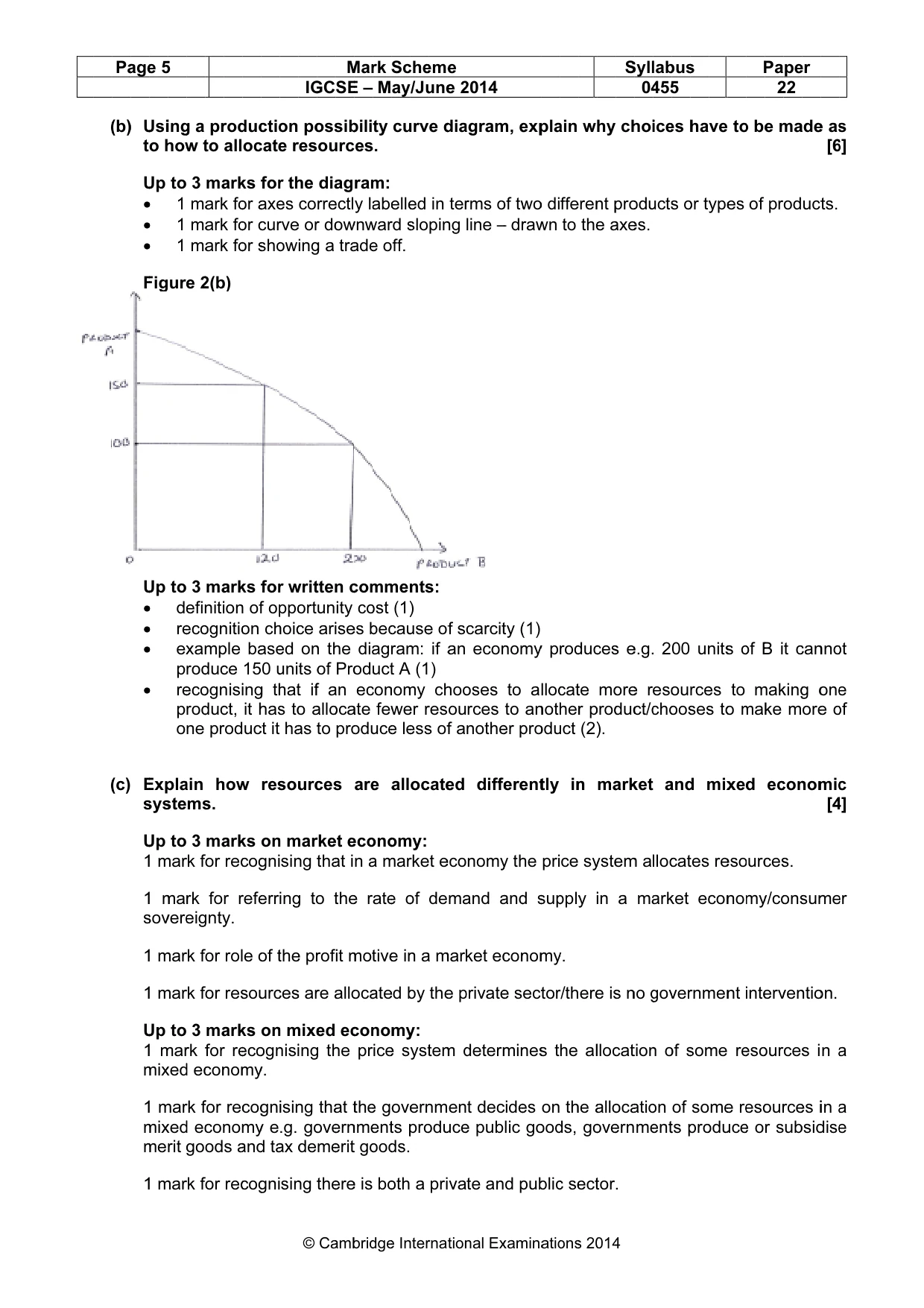
( ( Pa (b) (c) age ) U t U • • • F U • • • • E s U 1 1 s 1 1 U 1 m 1 m m 1 e 5 Usi o h Up • • • Fig Up • • • • Exp sys Up 1 m 1 m sov 1 m 1 m Up 1 m mix 1 m mix me 1 m 5 ing how to 1 1 1 ure to de re ex p re p o pla ste to mar mar vere mar mar to mar xed mar xed rit g mar g a w t 3 ma ma ma e 2 3 efin eco xam rod eco rod ne ain ms 3 rk f rk eig rk f rk f 3 rk f d ec rk f d ec go rk f pr to ma ark ark ark 2(b ma niti ogn mp duc ogn duc pr h s. ma for fo gnty for for ma for con for con od for rod all ark k fo k fo k fo b) ark ion nitio ple ce nisi ct, rod how ark rec r r y. rol res ark r re nom rec nom s a rec duc oc ks f or a or c or s ks f n of on ba 15 ing it h uc w ks cog refe e o sou ks eco my cog my and cog ctio cate for axe cur sho for f op ch ase 0 u g th has ct it res on gni err of t urc on ogn y. gni y e d ta gni on e r r th es rve ow r w ppo hoic ed uni hat s to ha sou n m sin ing the ces n m nisi isin .g. ax d sin IG © po res he co e or ing writ ort ce on ts o t if o a as t urc mar ng t g to e pr s ar mixe ing ng go de ng t GC Ca oss ou dia rre r do g a tten un ari n th of f a allo to ces rke tha o t rof re a ed g th tha ove me the M SE amb sib urc ag ectl ow tra n c ity ise he Pro an oca pro s et e at i the it m allo ec he at t ern erit ere Mar E – brid bili es ram y la wnw ade com co es b dia odu ec ate odu are eco n a e r mot oca con pr the nme t go e is rk S M dge ty . m: abe war e o mm ost bec agr uct con few uce e a ono a m ate tive ate nom ice e go ent ood bo Sc ay e In cu elle rd s ff. men (1) cau ram t A nom we e le all om mar e o e in ed b my e sy ove ts p ds. oth che /Ju nter urv ed slo nts ) use m: (1 my er r ess oc my: rke of n a by y: yst ern pro a eme une rnat e d in pin s: e of if a ) ch res s of cate t e de a m the tem nm odu pri e e 2 tion dia ter ng f sc an hoo ou f a ed eco ma mark e p m d en uce va 201 nal agr rms line car ec ose rce not d no and ket priv det t d e p te 14 Ex am s o e – rcit con es es the diffe my d a t ec vate term dec ub an xam m, e of tw – dr ty ( nom to to er p ere y th and con e s min cide lic d p mina exp wo raw (1) my a an pro ent he d s nom ect nes es go pub atio pla o di wn y p lloc noth odu tly pri sup my tor s t on ood blic ons ain ffe to rod cat her uct in ce pply y. r/th he th ds, c se s 20 w eren the duc te r p (2) n sy y i ere al he a go ect 014 hy nt p e a ces mo prod ). ma yste in e is lloc allo ove tor S 4 ch pro axe s e ore duc ark em a s n cat oca ern . Syll 04 hoi odu es. e.g. e r ct/c ket m al ma no g tion atio me lab 455 ice ucts . 2 eso cho a lloc ark gov n o on ent bus 5 es h s o 00 ou oos and cat ket ver of s of ts p s ha or ty un rce ses d m tes ec rnm som so pro ve ype nits es s to mix re con men me me odu to es s o to o m xed eso nom nt i re e re uce P o be of of B m mak d ourc my inte eso eso e o Pa 2 e m pr B i mak ke ec ces y/co erv our our r s pe 22 ma od t c king m con s. ons ven ces rce ub er ade uct can g o ore nom sum ntio s i es i bsid e as [6 ts. nno one e o mic [4 me on. n a in a dise s 6] ot e of c 4] er a a e
Mark scheme, page 6
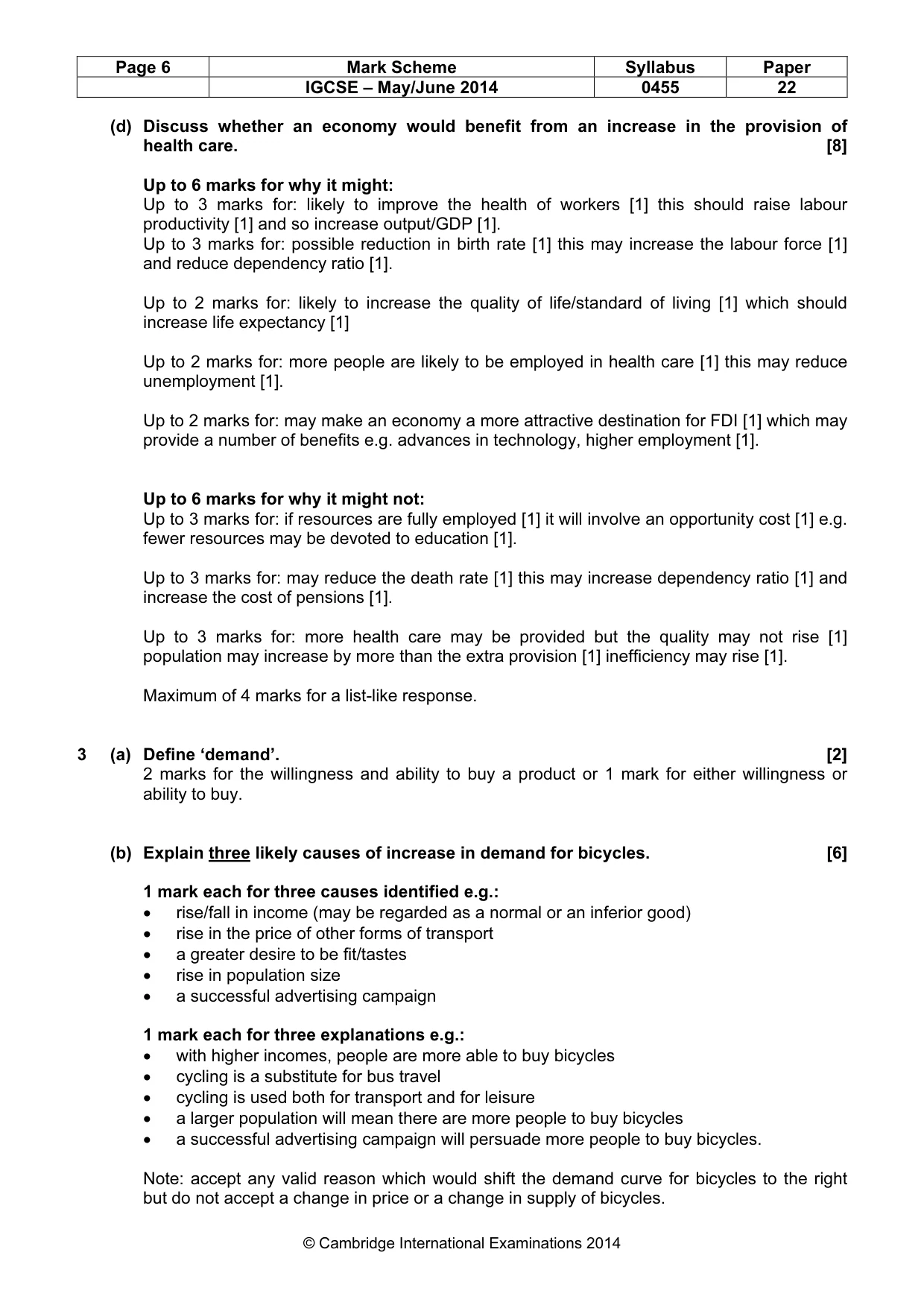
Page 6 Mark Scheme Syllabus Paper IGCSE – May/June 2014 0455 22 © Cambridge International Examinations 2014 (d) Discuss whether an economy would benefit from an increase in the provision of health care. [8] Up to 6 marks for why it might: Up to 3 marks for: likely to improve the health of workers [1] this should raise labour productivity [1] and so increase output/GDP [1]. Up to 3 marks for: possible reduction in birth rate [1] this may increase the labour force [1] and reduce dependency ratio [1]. Up to 2 marks for: likely to increase the quality of life/standard of living [1] which should increase life expectancy [1] Up to 2 marks for: more people are likely to be employed in health care [1] this may reduce unemployment [1]. Up to 2 marks for: may make an economy a more attractive destination for FDI [1] which may provide a number of benefits e.g. advances in technology, higher employment [1]. Up to 6 marks for why it might not: Up to 3 marks for: if resources are fully employed [1] it will involve an opportunity cost [1] e.g. fewer resources may be devoted to education [1]. Up to 3 marks for: may reduce the death rate [1] this may increase dependency ratio [1] and increase the cost of pensions [1]. Up to 3 marks for: more health care may be provided but the quality may not rise [1] population may increase by more than the extra provision [1] inefficiency may rise [1]. Maximum of 4 marks for a list-like response. 3 (a) Define ‘demand’. [2] 2 marks for the willingness and ability to buy a product or 1 mark for either willingness or ability to buy. (b) Explain three likely causes of increase in demand for bicycles. [6] 1 mark each for three causes identified e.g.: • rise/fall in income (may be regarded as a normal or an inferior good) • rise in the price of other forms of transport • a greater desire to be fit/tastes • rise in population size • a successful advertising campaign 1 mark each for three explanations e.g.: • with higher incomes, people are more able to buy bicycles • cycling is a substitute for bus travel • cycling is used both for transport and for leisure • a larger population will mean there are more people to buy bicycles • a successful advertising campaign will persuade more people to buy bicycles. Note: accept any valid reason which would shift the demand curve for bicycles to the right but do not accept a change in price or a change in supply of bicycles.
Mark scheme, page 7
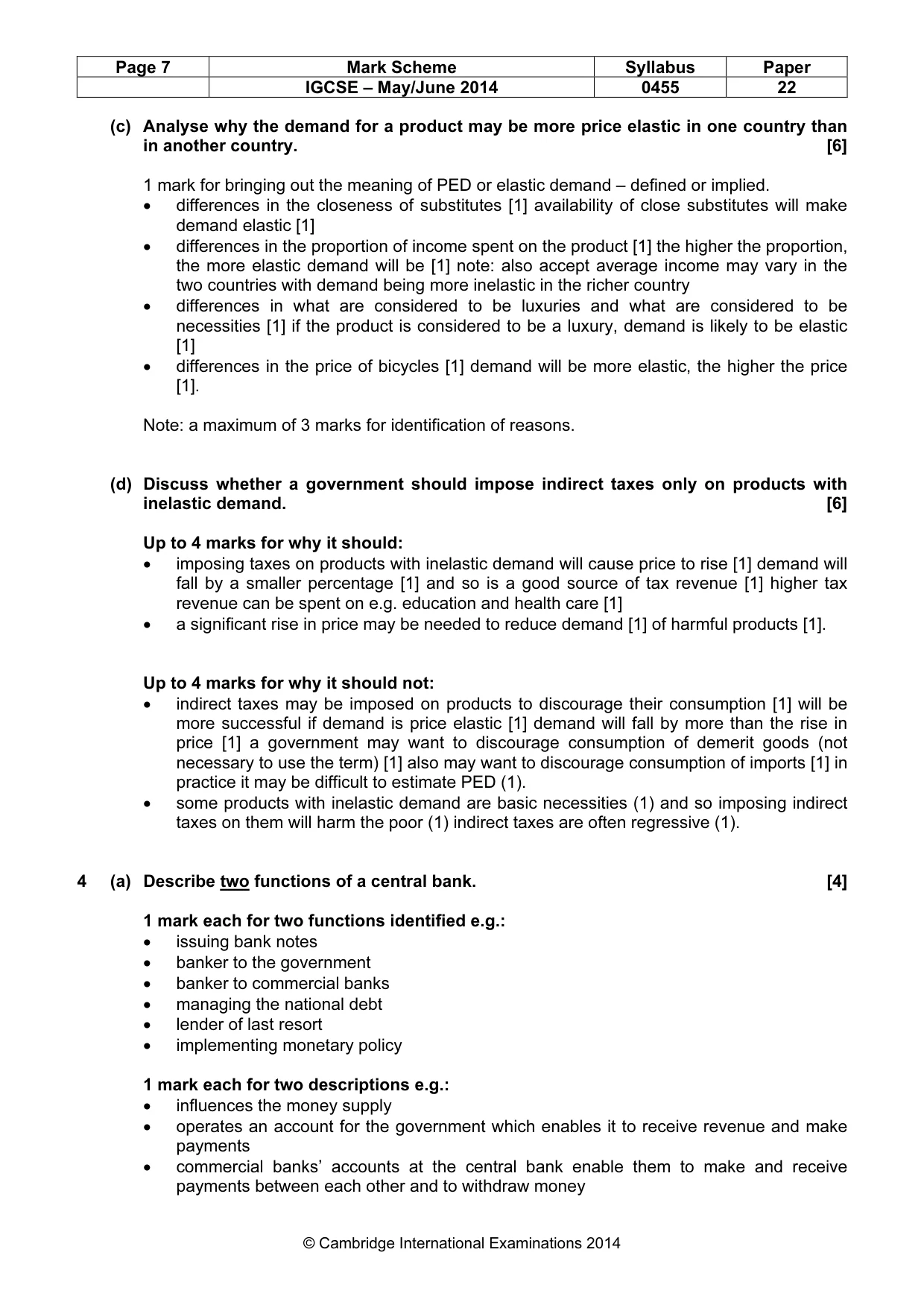
Page 7 Mark Scheme Syllabus Paper IGCSE – May/June 2014 0455 22 © Cambridge International Examinations 2014 (c) Analyse why the demand for a product may be more price elastic in one country than in another country. [6] 1 mark for bringing out the meaning of PED or elastic demand – defined or implied. • differences in the closeness of substitutes [1] availability of close substitutes will make demand elastic [1] • differences in the proportion of income spent on the product [1] the higher the proportion, the more elastic demand will be [1] note: also accept average income may vary in the two countries with demand being more inelastic in the richer country • differences in what are considered to be luxuries and what are considered to be necessities [1] if the product is considered to be a luxury, demand is likely to be elastic [1] • differences in the price of bicycles [1] demand will be more elastic, the higher the price [1]. Note: a maximum of 3 marks for identification of reasons. (d) Discuss whether a government should impose indirect taxes only on products with inelastic demand. [6] Up to 4 marks for why it should: • imposing taxes on products with inelastic demand will cause price to rise [1] demand will fall by a smaller percentage [1] and so is a good source of tax revenue [1] higher tax revenue can be spent on e.g. education and health care [1] • a significant rise in price may be needed to reduce demand [1] of harmful products [1]. Up to 4 marks for why it should not: • indirect taxes may be imposed on products to discourage their consumption [1] will be more successful if demand is price elastic [1] demand will fall by more than the rise in price [1] a government may want to discourage consumption of demerit goods (not necessary to use the term) [1] also may want to discourage consumption of imports [1] in practice it may be difficult to estimate PED (1). • some products with inelastic demand are basic necessities (1) and so imposing indirect taxes on them will harm the poor (1) indirect taxes are often regressive (1). 4 (a) Describe two functions of a central bank. [4] 1 mark each for two functions identified e.g.: • issuing bank notes • banker to the government • banker to commercial banks • managing the national debt • lender of last resort • implementing monetary policy 1 mark each for two descriptions e.g.: • influences the money supply • operates an account for the government which enables it to receive revenue and make payments • commercial banks’ accounts at the central bank enable them to make and receive payments between each other and to withdraw money
Mark scheme, page 8
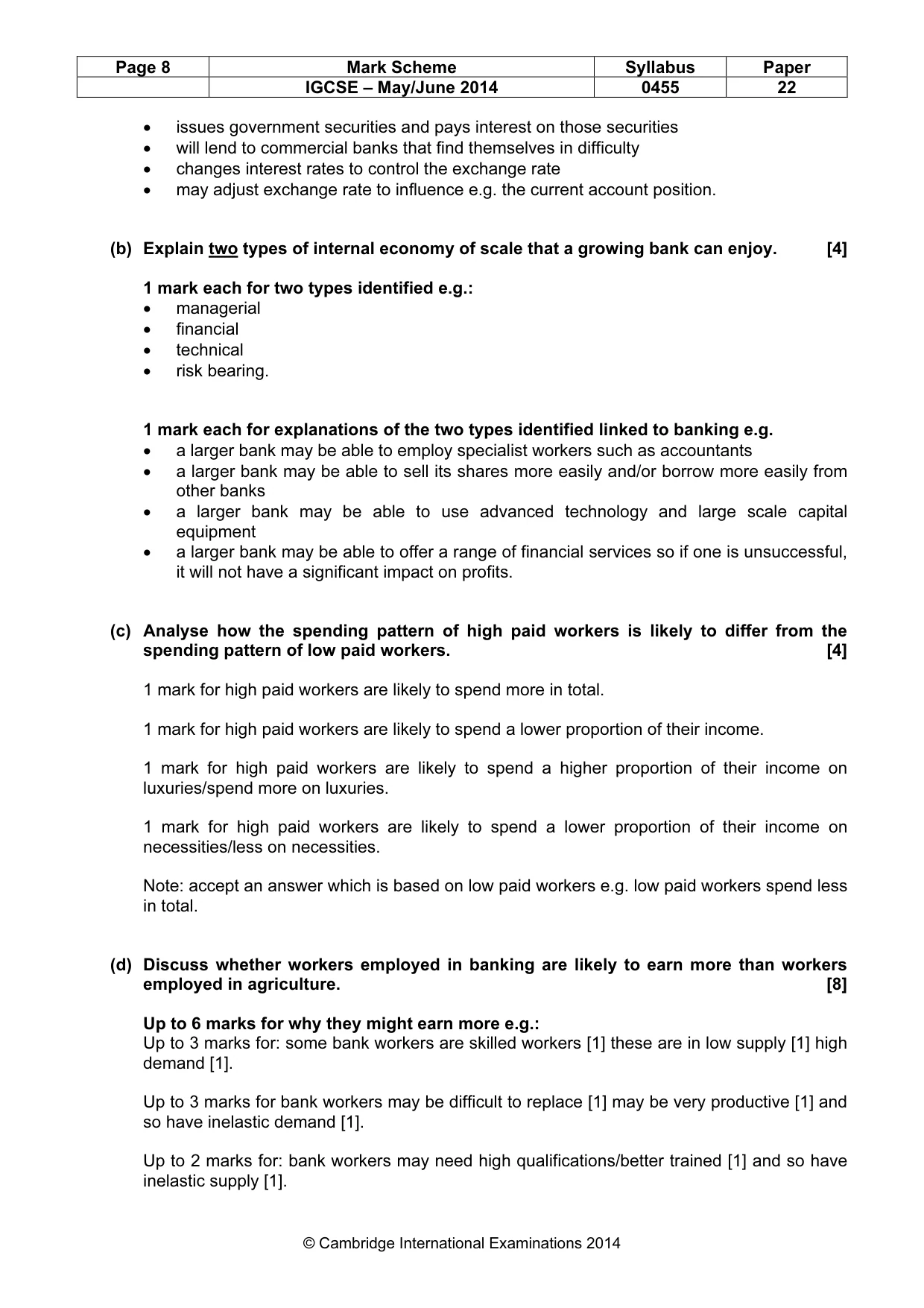
Page 8 Mark Scheme Syllabus Paper IGCSE – May/June 2014 0455 22 © Cambridge International Examinations 2014 • issues government securities and pays interest on those securities • will lend to commercial banks that find themselves in difficulty • changes interest rates to control the exchange rate • may adjust exchange rate to influence e.g. the current account position. (b) Explain two types of internal economy of scale that a growing bank can enjoy. [4] 1 mark each for two types identified e.g.: • managerial • financial • technical • risk bearing. 1 mark each for explanations of the two types identified linked to banking e.g. • a larger bank may be able to employ specialist workers such as accountants • a larger bank may be able to sell its shares more easily and/or borrow more easily from other banks • a larger bank may be able to use advanced technology and large scale capital equipment • a larger bank may be able to offer a range of financial services so if one is unsuccessful, it will not have a significant impact on profits. (c) Analyse how the spending pattern of high paid workers is likely to differ from the spending pattern of low paid workers. [4] 1 mark for high paid workers are likely to spend more in total. 1 mark for high paid workers are likely to spend a lower proportion of their income. 1 mark for high paid workers are likely to spend a higher proportion of their income on luxuries/spend more on luxuries. 1 mark for high paid workers are likely to spend a lower proportion of their income on necessities/less on necessities. Note: accept an answer which is based on low paid workers e.g. low paid workers spend less in total. (d) Discuss whether workers employed in banking are likely to earn more than workers employed in agriculture. [8] Up to 6 marks for why they might earn more e.g.: Up to 3 marks for: some bank workers are skilled workers [1] these are in low supply [1] high demand [1]. Up to 3 marks for bank workers may be difficult to replace [1] may be very productive [1] and so have inelastic demand [1]. Up to 2 marks for: bank workers may need high qualifications/better trained [1] and so have inelastic supply [1].
Mark scheme, page 9
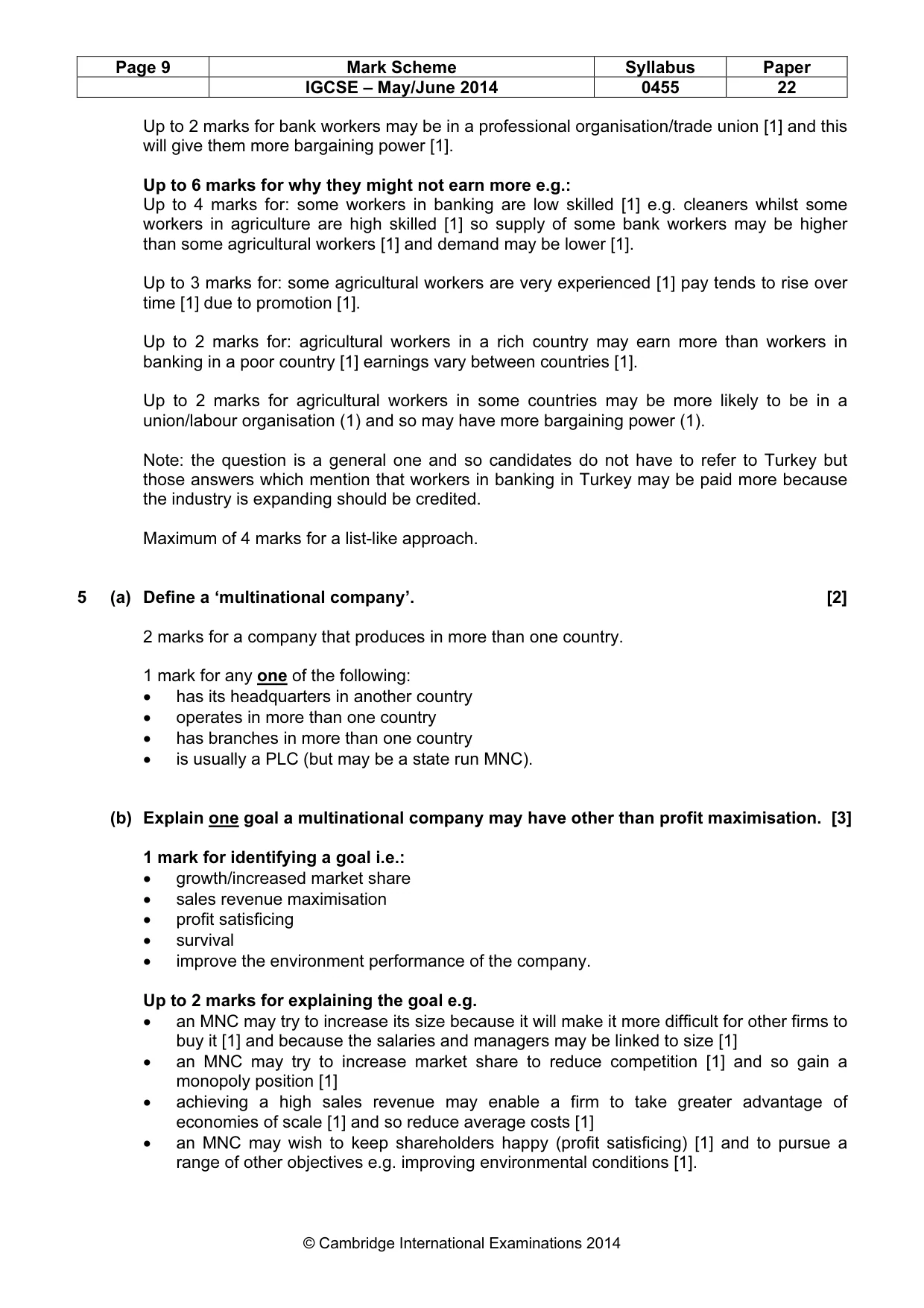
Page 9 Mark Scheme Syllabus Paper IGCSE – May/June 2014 0455 22 © Cambridge International Examinations 2014 Up to 2 marks for bank workers may be in a professional organisation/trade union [1] and this will give them more bargaining power [1]. Up to 6 marks for why they might not earn more e.g.: Up to 4 marks for: some workers in banking are low skilled [1] e.g. cleaners whilst some workers in agriculture are high skilled [1] so supply of some bank workers may be higher than some agricultural workers [1] and demand may be lower [1]. Up to 3 marks for: some agricultural workers are very experienced [1] pay tends to rise over time [1] due to promotion [1]. Up to 2 marks for: agricultural workers in a rich country may earn more than workers in banking in a poor country [1] earnings vary between countries [1]. Up to 2 marks for agricultural workers in some countries may be more likely to be in a union/labour organisation (1) and so may have more bargaining power (1). Note: the question is a general one and so candidates do not have to refer to Turkey but those answers which mention that workers in banking in Turkey may be paid more because the industry is expanding should be credited. Maximum of 4 marks for a list-like approach. 5 (a) Define a ‘multinational company’. [2] 2 marks for a company that produces in more than one country. 1 mark for any one of the following: • has its headquarters in another country • operates in more than one country • has branches in more than one country • is usually a PLC (but may be a state run MNC). (b) Explain one goal a multinational company may have other than profit maximisation. [3] 1 mark for identifying a goal i.e.: • growth/increased market share • sales revenue maximisation • profit satisficing • survival • improve the environment performance of the company. Up to 2 marks for explaining the goal e.g. • an MNC may try to increase its size because it will make it more difficult for other firms to buy it [1] and because the salaries and managers may be linked to size [1] • an MNC may try to increase market share to reduce competition [1] and so gain a monopoly position [1] • achieving a high sales revenue may enable a firm to take greater advantage of economies of scale [1] and so reduce average costs [1] • an MNC may wish to keep shareholders happy (profit satisficing) [1] and to pursue a range of other objectives e.g. improving environmental conditions [1].
Mark scheme, page 10
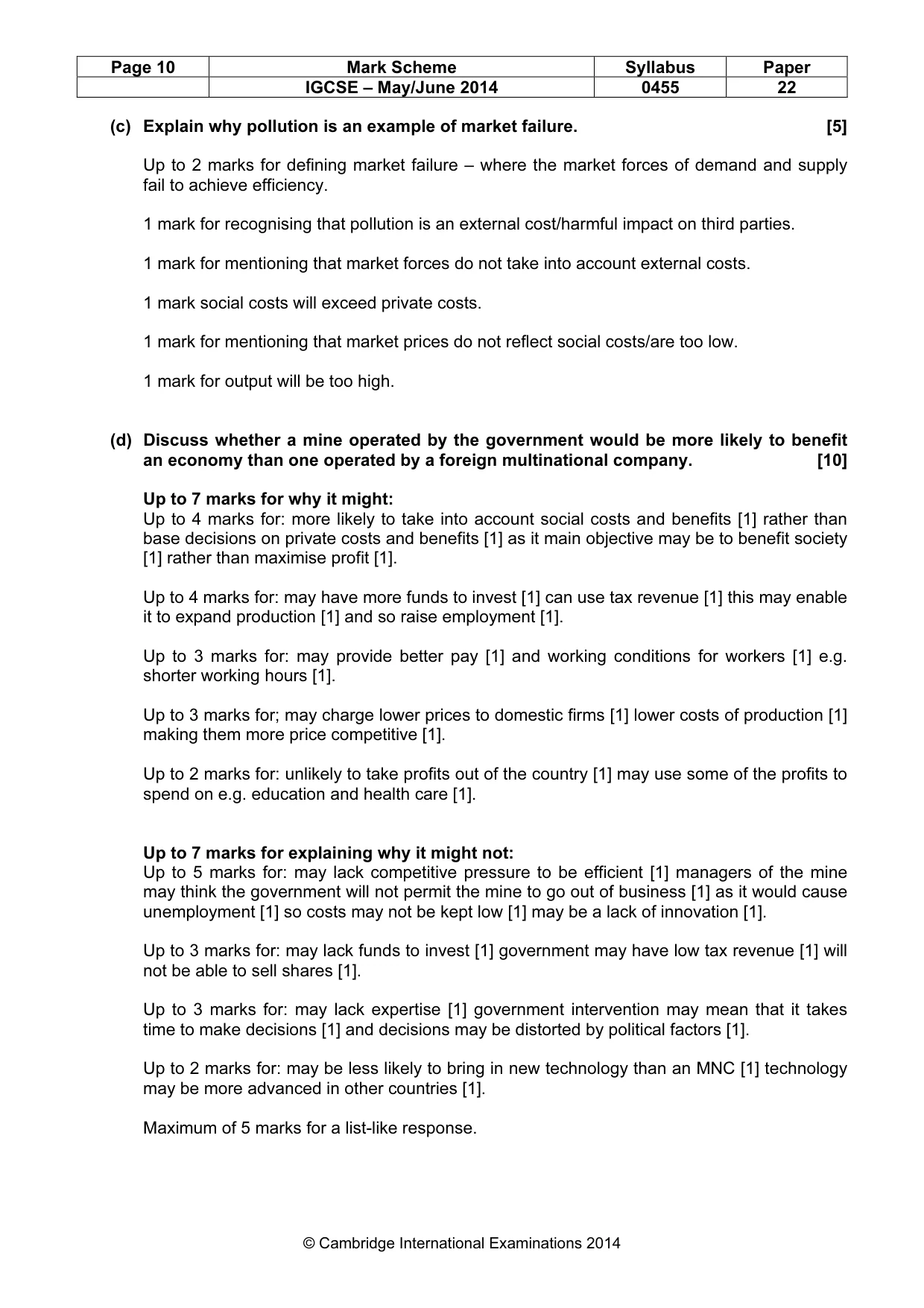
Page 10 Mark Scheme Syllabus Paper IGCSE – May/June 2014 0455 22 © Cambridge International Examinations 2014 (c) Explain why pollution is an example of market failure. [5] Up to 2 marks for defining market failure – where the market forces of demand and supply fail to achieve efficiency. 1 mark for recognising that pollution is an external cost/harmful impact on third parties. 1 mark for mentioning that market forces do not take into account external costs. 1 mark social costs will exceed private costs. 1 mark for mentioning that market prices do not reflect social costs/are too low. 1 mark for output will be too high. (d) Discuss whether a mine operated by the government would be more likely to benefit an economy than one operated by a foreign multinational company. [10] Up to 7 marks for why it might: Up to 4 marks for: more likely to take into account social costs and benefits [1] rather than base decisions on private costs and benefits [1] as it main objective may be to benefit society [1] rather than maximise profit [1]. Up to 4 marks for: may have more funds to invest [1] can use tax revenue [1] this may enable it to expand production [1] and so raise employment [1]. Up to 3 marks for: may provide better pay [1] and working conditions for workers [1] e.g. shorter working hours [1]. Up to 3 marks for; may charge lower prices to domestic firms [1] lower costs of production [1] making them more price competitive [1]. Up to 2 marks for: unlikely to take profits out of the country [1] may use some of the profits to spend on e.g. education and health care [1]. Up to 7 marks for explaining why it might not: Up to 5 marks for: may lack competitive pressure to be efficient [1] managers of the mine may think the government will not permit the mine to go out of business [1] as it would cause unemployment [1] so costs may not be kept low [1] may be a lack of innovation [1]. Up to 3 marks for: may lack funds to invest [1] government may have low tax revenue [1] will not be able to sell shares [1]. Up to 3 marks for: may lack expertise [1] government intervention may mean that it takes time to make decisions [1] and decisions may be distorted by political factors [1]. Up to 2 marks for: may be less likely to bring in new technology than an MNC [1] technology may be more advanced in other countries [1]. Maximum of 5 marks for a list-like response.
Mark scheme, page 11
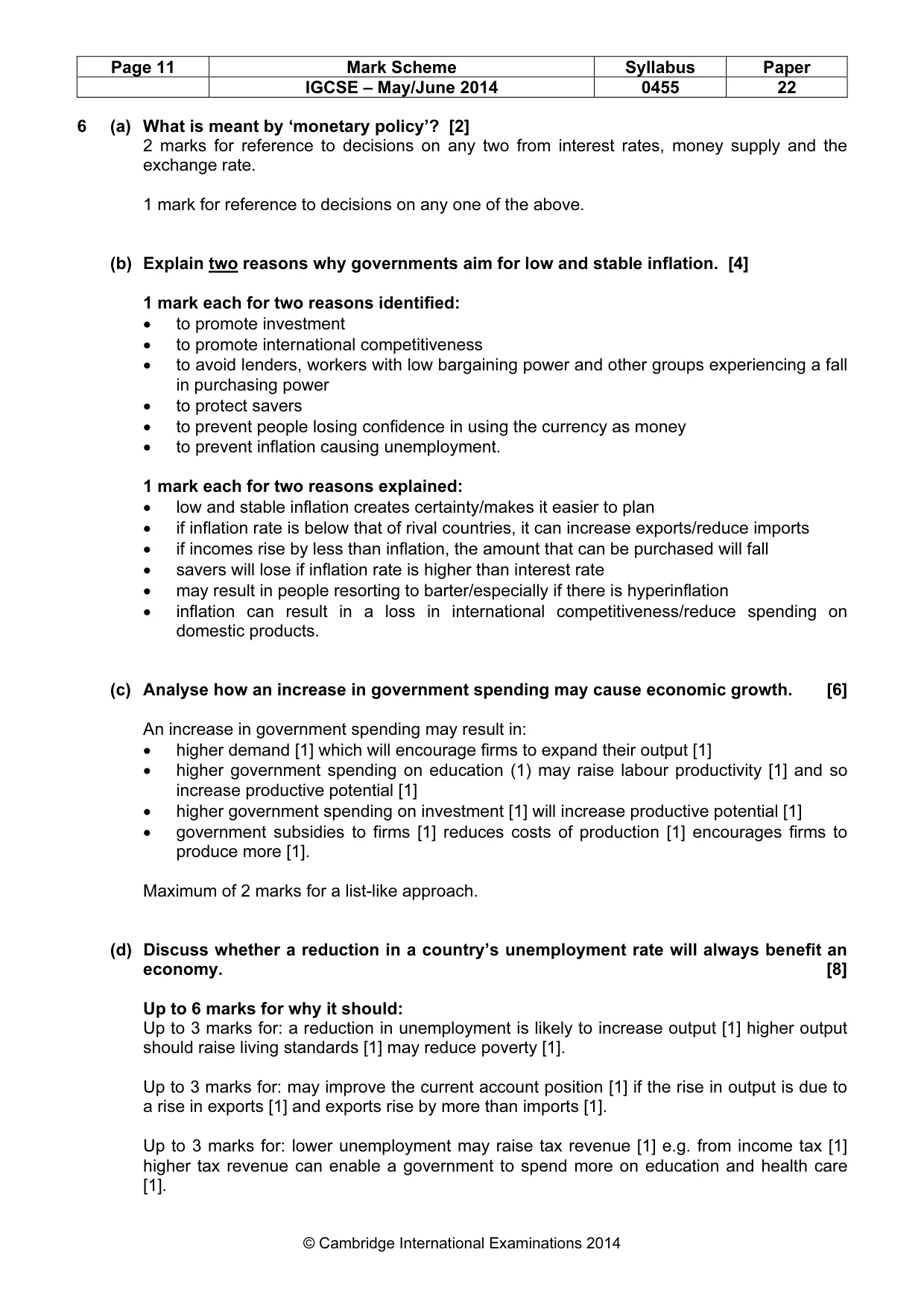
Page 11 Mark Scheme Syllabus Paper IGCSE – May/June 2014 0455 22 © Cambridge International Examinations 2014 6 (a) What is meant by ‘monetary policy’? [2] 2 marks for reference to decisions on any two from interest rates, money supply and the exchange rate. 1 mark for reference to decisions on any one of the above. (b) Explain two reasons why governments aim for low and stable inflation. [4] 1 mark each for two reasons identified: • to promote investment • to promote international competitiveness • to avoid lenders, workers with low bargaining power and other groups experiencing a fall in purchasing power • to protect savers • to prevent people losing confidence in using the currency as money • to prevent inflation causing unemployment. 1 mark each for two reasons explained: • low and stable inflation creates certainty/makes it easier to plan • if inflation rate is below that of rival countries, it can increase exports/reduce imports • if incomes rise by less than inflation, the amount that can be purchased will fall • savers will lose if inflation rate is higher than interest rate • may result in people resorting to barter/especially if there is hyperinflation • inflation can result in a loss in international competitiveness/reduce spending on domestic products. (c) Analyse how an increase in government spending may cause economic growth. [6] An increase in government spending may result in: • higher demand [1] which will encourage firms to expand their output [1] • higher government spending on education (1) may raise labour productivity [1] and so increase productive potential [1] • higher government spending on investment [1] will increase productive potential [1] • government subsidies to firms [1] reduces costs of production [1] encourages firms to produce more [1]. Maximum of 2 marks for a list-like approach. (d) Discuss whether a reduction in a country’s unemployment rate will always benefit an economy. [8] Up to 6 marks for why it should: Up to 3 marks for: a reduction in unemployment is likely to increase output [1] higher output should raise living standards [1] may reduce poverty [1]. Up to 3 marks for: may improve the current account position [1] if the rise in output is due to a rise in exports [1] and exports rise by more than imports [1]. Up to 3 marks for: lower unemployment may raise tax revenue [1] e.g. from income tax [1] higher tax revenue can enable a government to spend more on education and health care [1].
Mark scheme, page 12
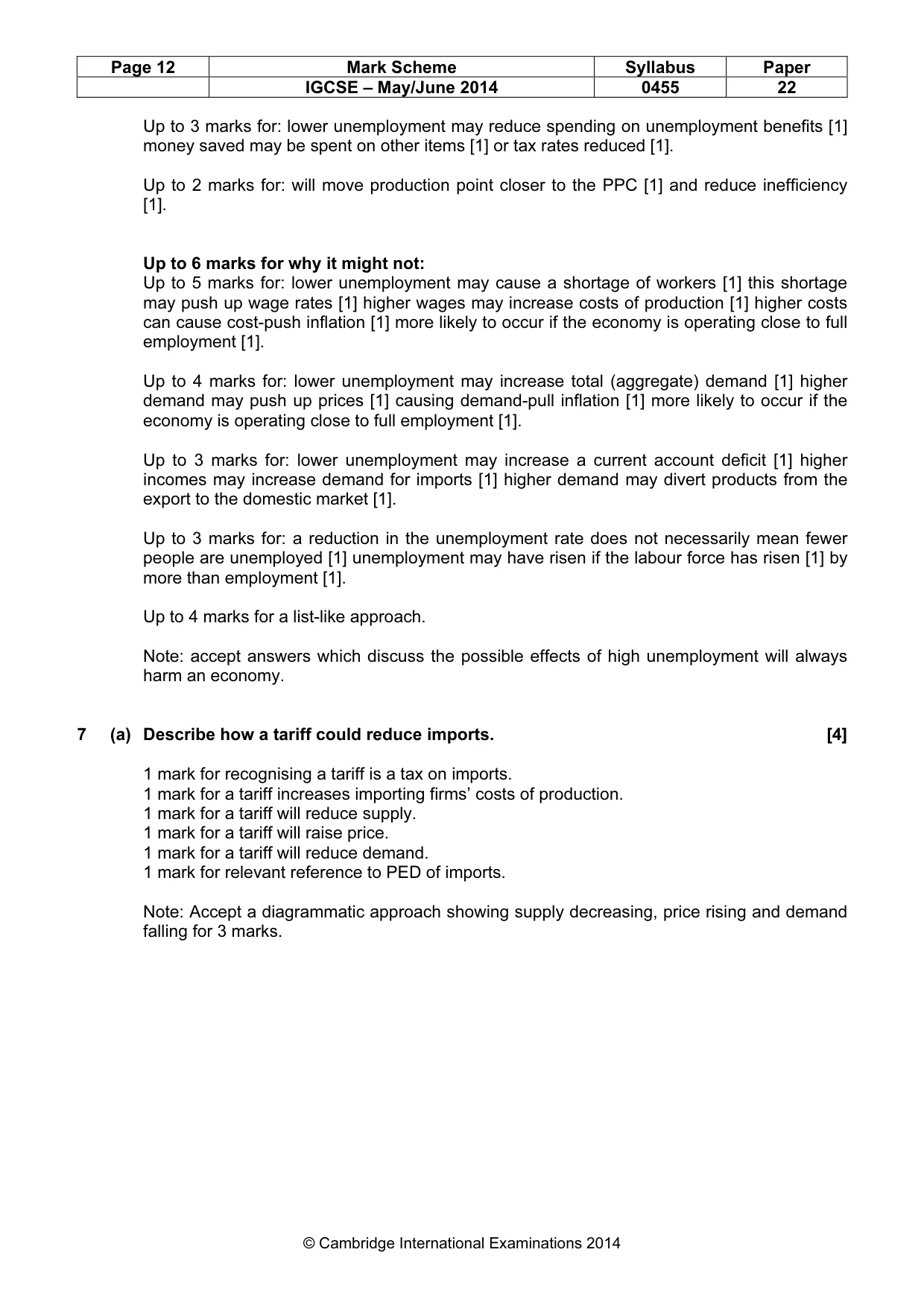
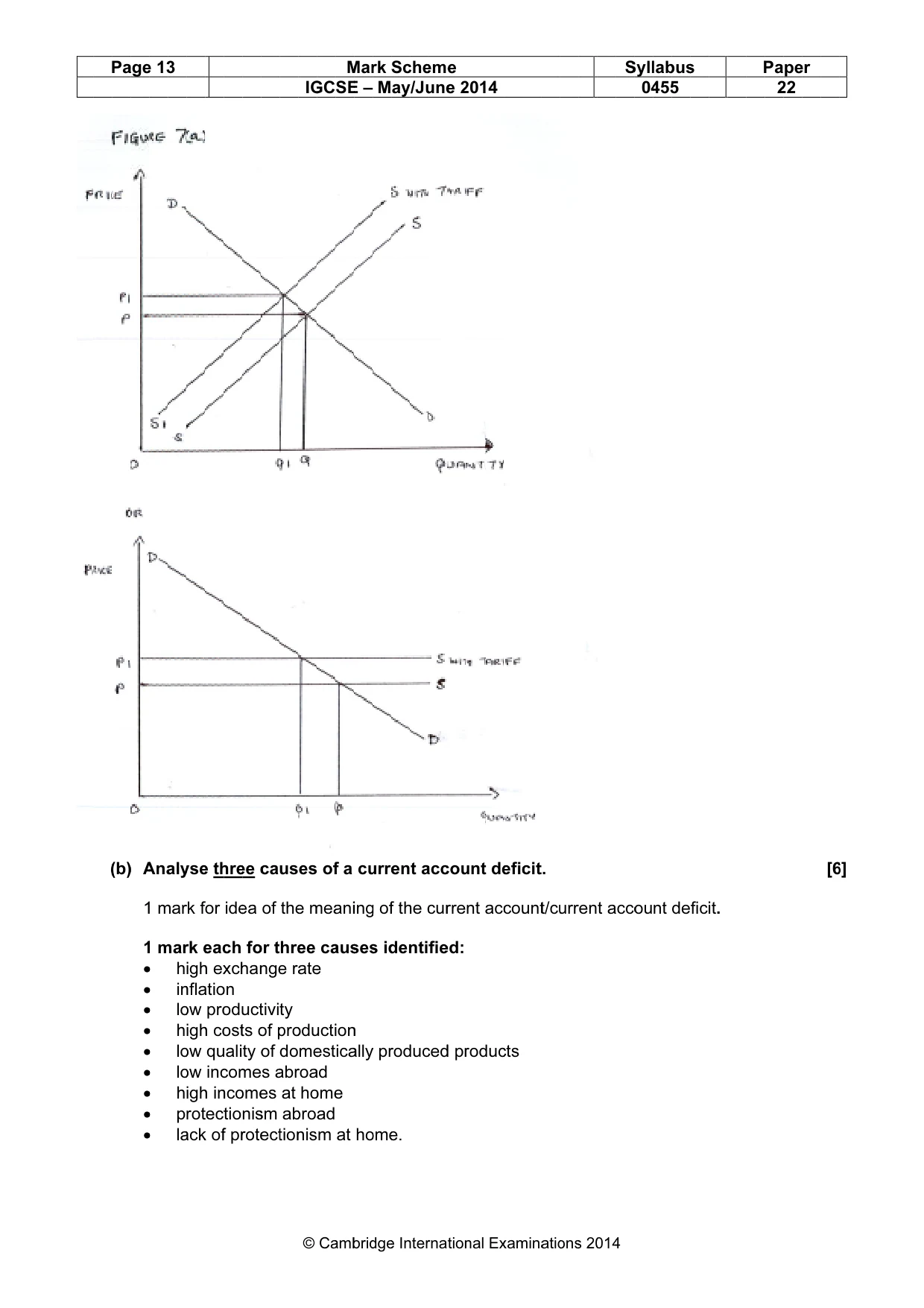
Page 12 Mark Scheme Syllabus Paper IGCSE – May/June 2014 0455 22 © Cambridge International Examinations 2014 Up to 3 marks for: lower unemployment may reduce spending on unemployment benefits [1] money saved may be spent on other items [1] or tax rates reduced [1]. Up to 2 marks for: will move production point closer to the PPC [1] and reduce inefficiency [1]. Up to 6 marks for why it might not: Up to 5 marks for: lower unemployment may cause a shortage of workers [1] this shortage may push up wage rates [1] higher wages may increase costs of production [1] higher costs can cause cost-push inflation [1] more likely to occur if the economy is operating close to full employment [1]. Up to 4 marks for: lower unemployment may increase total (aggregate) demand [1] higher demand may push up prices [1] causing demand-pull inflation [1] more likely to occur if the economy is operating close to full employment [1]. Up to 3 marks for: lower unemployment may increase a current account deficit [1] higher incomes may increase demand for imports [1] higher demand may divert products from the export to the domestic market [1]. Up to 3 marks for: a reduction in the unemployment rate does not necessarily mean fewer people are unemployed [1] unemployment may have risen if the labour force has risen [1] by more than employment [1]. Up to 4 marks for a list-like approach. Note: accept answers which discuss the possible effects of high unemployment will always harm an economy. 7 (a) Describe how a tariff could reduce imports. [4] 1 mark for recognising a tariff is a tax on imports. 1 mark for a tariff increases importing firms’ costs of production. 1 mark for a tariff will reduce supply. 1 mark for a tariff will raise price. 1 mark for a tariff will reduce demand. 1 mark for relevant reference to PED of imports. Note: Accept a diagrammatic approach showing supply decreasing, price rising and demand falling for 3 marks.
Mark scheme, page 13
( Pa (b) age ) A 1 1 • • • • • • • • • e 13 Ana 1 m 1 m • • • • • • • • • 3 aly mar mar h in lo h lo lo h p la yse rk f rk e igh nfla ow igh ow ow igh rot ack e th for eac h ex atio pro h co qu inc h in tect k of hre ide ch xch on odu ost uali com nco tio f pr ee c ea fo han uct ts o ty o me ome nis rote ca of or t nge tivi of p of s a es sm ect us the hre e ra ty pro do abr at ab tion IG © es e m ee ate odu me roa ho broa nis GC Ca of mea ca e ucti est ad ome ad m M SE amb f a ani aus ion ica e at Mar E – brid cu ing ses n ally ho rk S M dge urre g of s id y pr ome Sc ay e In en f th den rod e. che /Ju nter t a he c ntif duc eme une rnat acc cur fie ced e e 2 tion cou rre ed: d pr 201 nal unt nt rod 14 Ex t de acc duc xam efic cou cts mina cit unt atio t. t/cu ons urr s 20 ren 014 t a S 4 acco Syll 04 ou lab 455 nt bus 5 de s ficit. Pa 2 pe 22 er [6]
Mark scheme, page 14
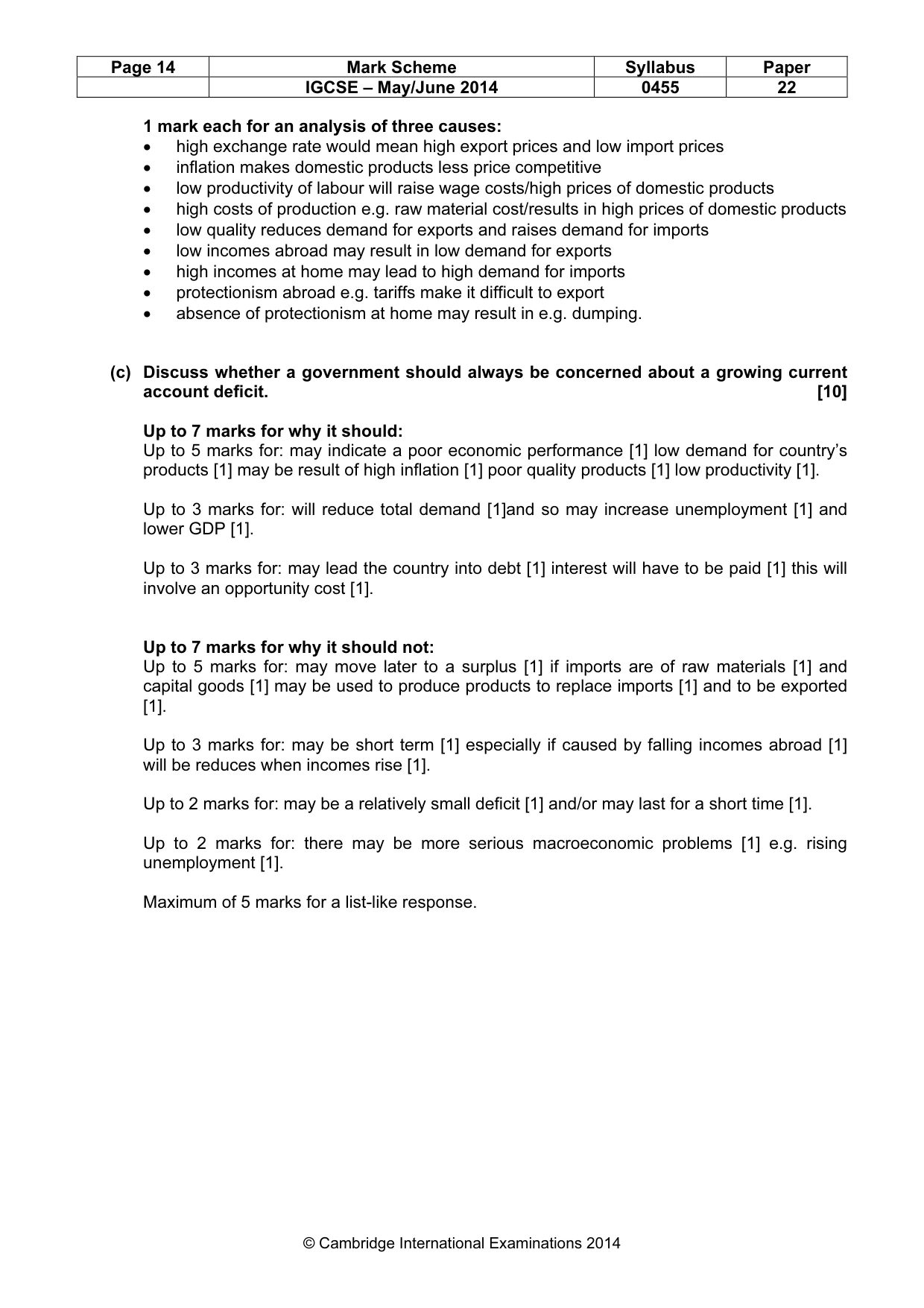
Page 14 Mark Scheme Syllabus Paper IGCSE – May/June 2014 0455 22 © Cambridge International Examinations 2014 1 mark each for an analysis of three causes: • high exchange rate would mean high export prices and low import prices • inflation makes domestic products less price competitive • low productivity of labour will raise wage costs/high prices of domestic products • high costs of production e.g. raw material cost/results in high prices of domestic products • low quality reduces demand for exports and raises demand for imports • low incomes abroad may result in low demand for exports • high incomes at home may lead to high demand for imports • protectionism abroad e.g. tariffs make it difficult to export • absence of protectionism at home may result in e.g. dumping. (c) Discuss whether a government should always be concerned about a growing current account deficit. [10] Up to 7 marks for why it should: Up to 5 marks for: may indicate a poor economic performance [1] low demand for country’s products [1] may be result of high inflation [1] poor quality products [1] low productivity [1]. Up to 3 marks for: will reduce total demand [1]and so may increase unemployment [1] and lower GDP [1]. Up to 3 marks for: may lead the country into debt [1] interest will have to be paid [1] this will involve an opportunity cost [1]. Up to 7 marks for why it should not: Up to 5 marks for: may move later to a surplus [1] if imports are of raw materials [1] and capital goods [1] may be used to produce products to replace imports [1] and to be exported [1]. Up to 3 marks for: may be short term [1] especially if caused by falling incomes abroad [1] will be reduces when incomes rise [1]. Up to 2 marks for: may be a relatively small deficit [1] and/or may last for a short time [1]. Up to 2 marks for: there may be more serious macroeconomic problems [1] e.g. rising unemployment [1]. Maximum of 5 marks for a list-like response.
What you needed in this session
Cambridge’s own grade thresholds for 2014 May/June, Paper 2 · Variant 2. A higher threshold means an easier paper — the bar moves with how the cohort did.