Cambridge IGCSE Economics 0455 — 2013 May/June Paper 2 · Variant 3
0455/23/M/J/13 · 80 marks · ≈90 min
The question paper and its mark scheme, free to read here and free to download. This is Cambridge’s own paper, exactly as it was sat.
Question paper4 pages
Mark scheme8 pages
Answers below. Sit the paper first if you are practising.
Paper as text
Question paper, page 1
This document consists of 4 printed pages. DC (KN) 59987/1 © UCLES 2013 [Turn over UNIVERSITY OF CAMBRIDGE INTERNATIONAL EXAMINATIONS International General Certificate of Secondary Education * 9 5 5 1 8 0 0 0 5 3 * ECONOMICS 0455/23 Paper 2 Structured Questions May/June 2013 2 hours Additional Materials: Answer Booklet/Paper READ THESE INSTRUCTIONS FIRST If you have been given an Answer Booklet, follow the instructions on the front cover of the Booklet. Write your Centre number, candidate number and name on all the work you hand in. Write in dark blue or black pen. You may use a soft pencil for any diagrams, graphs or rough working. Do not use staples, paper clips, highlighters, glue or correction fluid. Section A Answer Question 1. Section B Answer any three questions. At the end of the examination, fasten all your work securely together. The number of marks is given in brackets [ ] at the end of each question or part question.
Question paper, page 2
2 0455/23/M/J/13 © UCLES 2013 Section A Answer this question. 1 Brazil and the problem of inflation In 2010, the President of Brazil stated that her aims were to increase employment, eliminate extreme poverty, improve the quality of health care and education and reduce the rate of inflation. In 2011, however, the rate of inflation increased to 6.2%. Interest rates were raised to try to control inflation and were expected to go up further in 2012. Higher interest rates put upward pressure on the external value (foreign exchange rate) of the Brazilian currency, which has already doubled in value against the US$ in the last ten years. The President realised that she would not be able to achieve all these aims and that she would need to reduce the amount of government spending. In 2011, government spending was significantly greater than tax revenue. (a) Define inflation. [3] (b) Explain how a rise in interest rates can help to control a country’s rate of inflation. [5] (c) Explain why the President of Brazil wishes to reduce government spending. [5] (d) Discuss to what extent a rise in the external value of the Brazilian currency is likely to be a serious economic problem for Brazil. [7]
Question paper, page 3
3 0455/23/M/J/13 © UCLES 2013 [Turn over Section B Answer any three questions from this section. 2 Producers aim to achieve a high rate of productivity. Production in some industries tends to be labour-intensive while in others it is largely capital-intensive. (a) Using examples, define the factors of production, land and capital. [4] (b) Distinguish between an increase in productivity and an increase in production. [6] (c) Discuss to what extent production should be encouraged to move from being labour-intensive to being capital-intensive. [10] 3 Market systems are sometimes said to fail and this can lead to different forms of government intervention. (a) Explain what is meant by a mixed economy. [4] (b) Using a demand and supply diagram, analyse the effect of introducing an indirect tax on a product on its equilibrium price and its equilibrium quantity. [6] (c) Discuss whether government intervention to reduce market failure is always likely to be successful. [10] 4 Specialisation, whether at the individual or national level, can have enormous advantages. There can, however, also be some disadvantages. (a) Define the term specialisation. [4] (b) Analyse the advantages and disadvantages of a worker specialising. [4] (c) Explain the benefits of countries specialising. [4] (d) Discuss whether trade protection, despite the advantages of international specialisation, can ever be justified. [8] 5 Many people like to save some of their income and commercial banks usually have various ways of encouraging people to save. (a) Analyse two motives that people may have for saving money. [4] (b) Describe why different groups of people are likely to save different proportions of their income. [4] (c) Explain the different ways that commercial banks can encourage people to save. [5] (d) Discuss whether a government should be worried if more people in a country decide to save a large proportion of their income. [7]
Question paper, page 4
4 0455/23/M/J/13 © UCLES 2013 6 Many countries in recent years have suffered from recession. Governments, therefore, have adopted various policies to try to decrease the level of unemployment in their countries. (a) Define the term recession. [2] (b) Explain two different types of unemployment. [4] (c) Explain why unemployment is regarded as a serious economic problem. [6] (d) Discuss whether policies to decrease unemployment will always conflict with a government’s other aims. [8] 7 Economies, as they become more developed, tend to experience a change in the structure of their labour force with an increasing proportion of employment in the tertiary sector. (a) Using examples, explain the differences between the primary, secondary and tertiary sectors of production. [6] (b) Describe three characteristics of developing economies. [6] (c) Discuss to what extent everybody in a developed country has a higher standard of living than everybody in a developing country. [8] Permission to reproduce items where third-party owned material protected by copyright is included has been sought and cleared where possible. Every reasonable effort has been made by the publisher (UCLES) to trace copyright holders, but if any items requiring clearance have unwittingly been included, the publisher will be pleased to make amends at the earliest possible opportunity. University of Cambridge International Examinations is part of the Cambridge Assessment Group. Cambridge Assessment is the brand name of University of Cambridge Local Examinations Syndicate (UCLES), which is itself a department of the University of Cambridge.
Mark scheme, page 1
CAMBRIDGE INTERNATIONAL EXAMINATIONS International General Certificate of Secondary Education MARK SCHEME for the May/June 2013 series 0455 ECONOMICS 0455/23 Paper 2 (Structured Questions), maximum raw mark 80 This mark scheme is published as an aid to teachers and candidates, to indicate the requirements of the examination. It shows the basis on which Examiners were instructed to award marks. It does not indicate the details of the discussions that took place at an Examiners’ meeting before marking began, which would have considered the acceptability of alternative answers. Mark schemes should be read in conjunction with the question paper and the Principal Examiner Report for Teachers. Cambridge will not enter into discussions about these mark schemes. Cambridge is publishing the mark schemes for the May/June 2013 series for most IGCSE, GCE Advanced Level and Advanced Subsidiary Level components and some Ordinary Level components.
Mark scheme, page 2
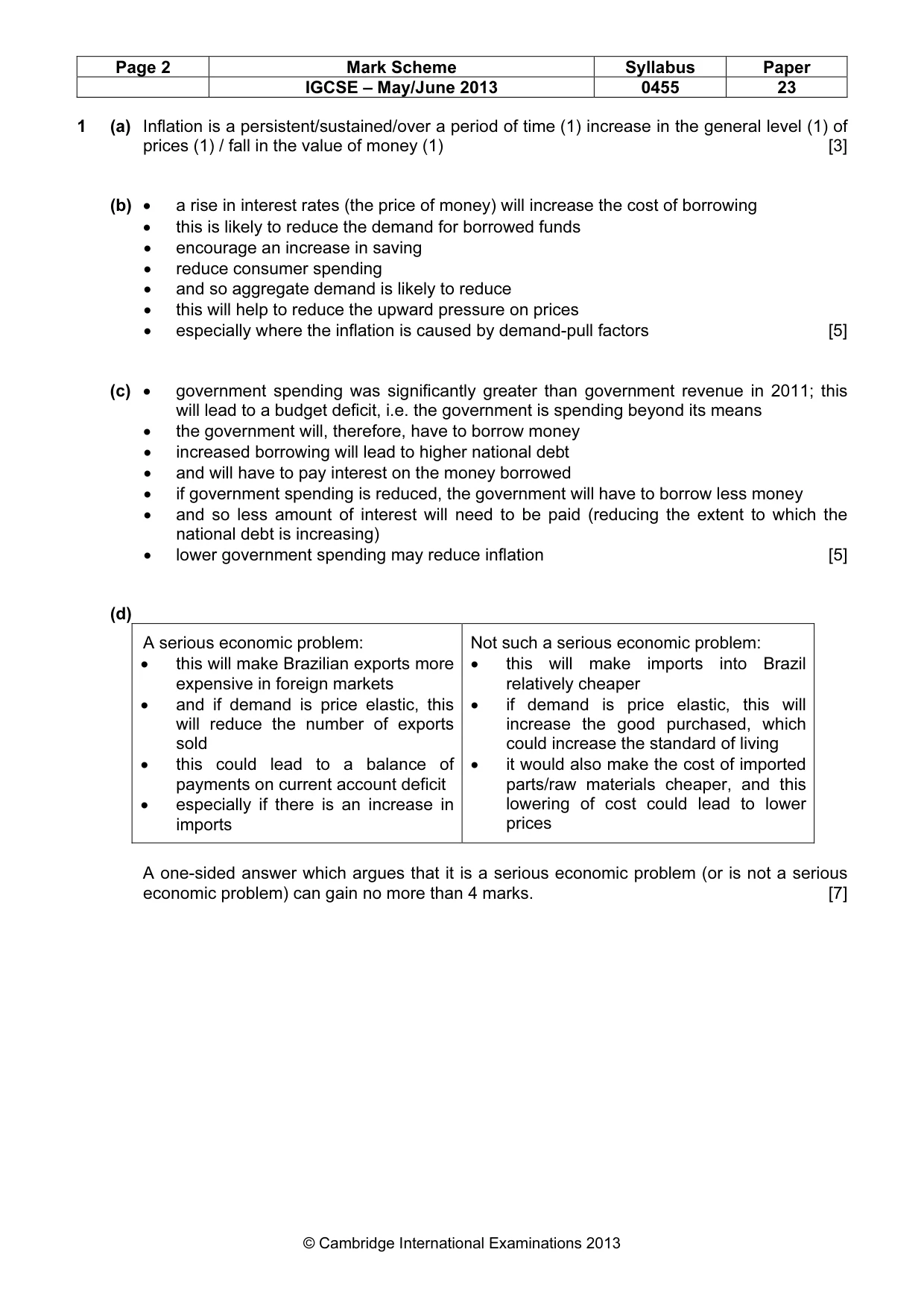
Page 2 Mark Scheme Syllabus Paper IGCSE – May/June 2013 0455 23 © Cambridge International Examinations 2013 1 (a) Inflation is a persistent/sustained/over a period of time (1) increase in the general level (1) of prices (1) / fall in the value of money (1) [3] (b) • a rise in interest rates (the price of money) will increase the cost of borrowing • this is likely to reduce the demand for borrowed funds • encourage an increase in saving • reduce consumer spending • and so aggregate demand is likely to reduce • this will help to reduce the upward pressure on prices • especially where the inflation is caused by demand-pull factors [5] (c) • government spending was significantly greater than government revenue in 2011; this will lead to a budget deficit, i.e. the government is spending beyond its means • the government will, therefore, have to borrow money • increased borrowing will lead to higher national debt • and will have to pay interest on the money borrowed • if government spending is reduced, the government will have to borrow less money • and so less amount of interest will need to be paid (reducing the extent to which the national debt is increasing) • lower government spending may reduce inflation [5] (d) A serious economic problem: • this will make Brazilian exports more expensive in foreign markets • and if demand is price elastic, this will reduce the number of exports sold • this could lead to a balance of payments on current account deficit • especially if there is an increase in imports Not such a serious economic problem: • this will make imports into Brazil relatively cheaper • if demand is price elastic, this will increase the good purchased, which could increase the standard of living • it would also make the cost of imported parts/raw materials cheaper, and this lowering of cost could lead to lower prices A one-sided answer which argues that it is a serious economic problem (or is not a serious economic problem) can gain no more than 4 marks. [7]
Mark scheme, page 3
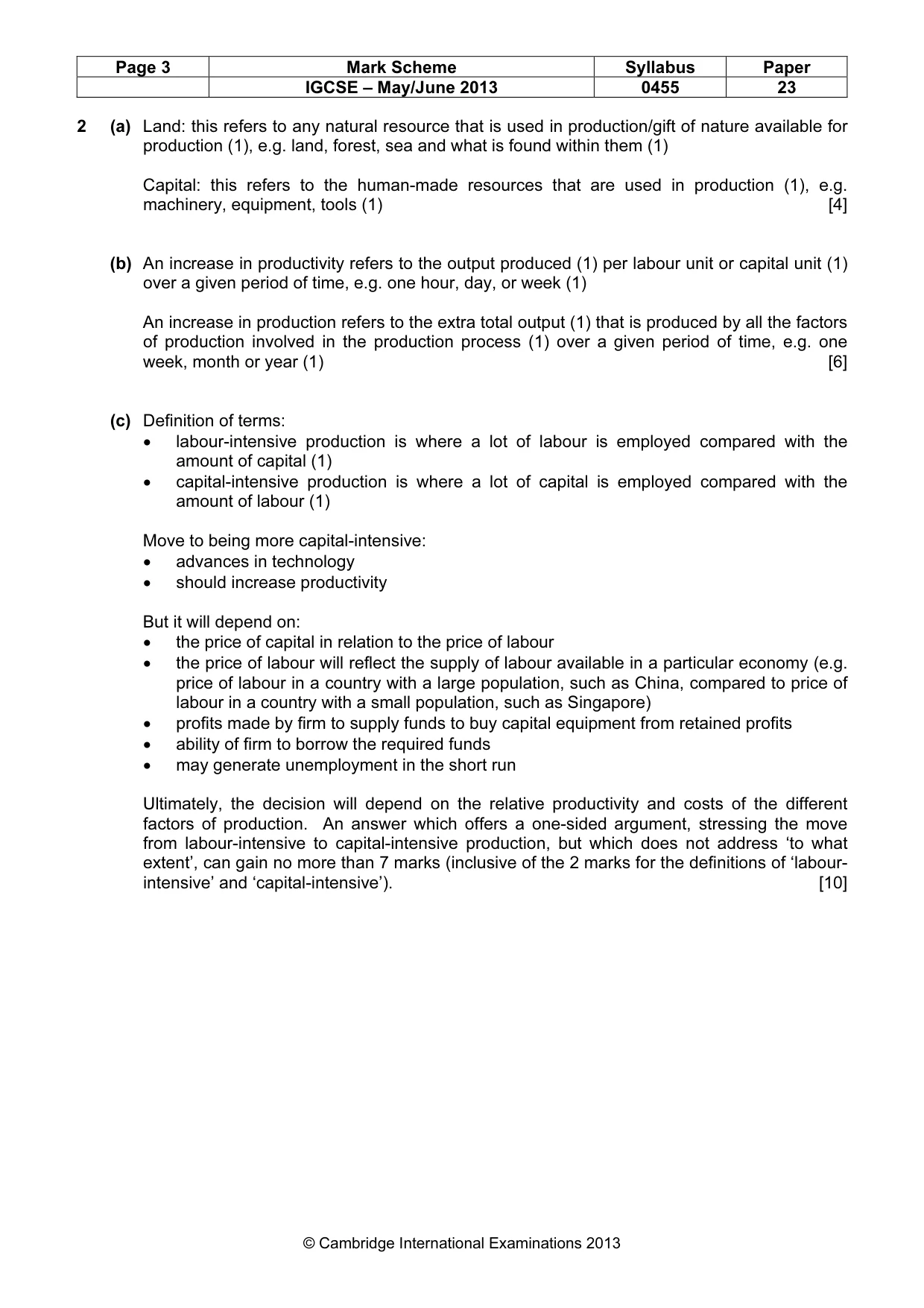
Page 3 Mark Scheme Syllabus Paper IGCSE – May/June 2013 0455 23 © Cambridge International Examinations 2013 2 (a) Land: this refers to any natural resource that is used in production/gift of nature available for production (1), e.g. land, forest, sea and what is found within them (1) Capital: this refers to the human-made resources that are used in production (1), e.g. machinery, equipment, tools (1) [4] (b) An increase in productivity refers to the output produced (1) per labour unit or capital unit (1) over a given period of time, e.g. one hour, day, or week (1) An increase in production refers to the extra total output (1) that is produced by all the factors of production involved in the production process (1) over a given period of time, e.g. one week, month or year (1) [6] (c) Definition of terms: • labour-intensive production is where a lot of labour is employed compared with the amount of capital (1) • capital-intensive production is where a lot of capital is employed compared with the amount of labour (1) Move to being more capital-intensive: • advances in technology • should increase productivity But it will depend on: • the price of capital in relation to the price of labour • the price of labour will reflect the supply of labour available in a particular economy (e.g. price of labour in a country with a large population, such as China, compared to price of labour in a country with a small population, such as Singapore) • profits made by firm to supply funds to buy capital equipment from retained profits • ability of firm to borrow the required funds • may generate unemployment in the short run Ultimately, the decision will depend on the relative productivity and costs of the different factors of production. An answer which offers a one-sided argument, stressing the move from labour-intensive to capital-intensive production, but which does not address ‘to what extent’, can gain no more than 7 marks (inclusive of the 2 marks for the definitions of ‘labour- intensive’ and ‘capital-intensive’). [10]
Mark scheme, page 4
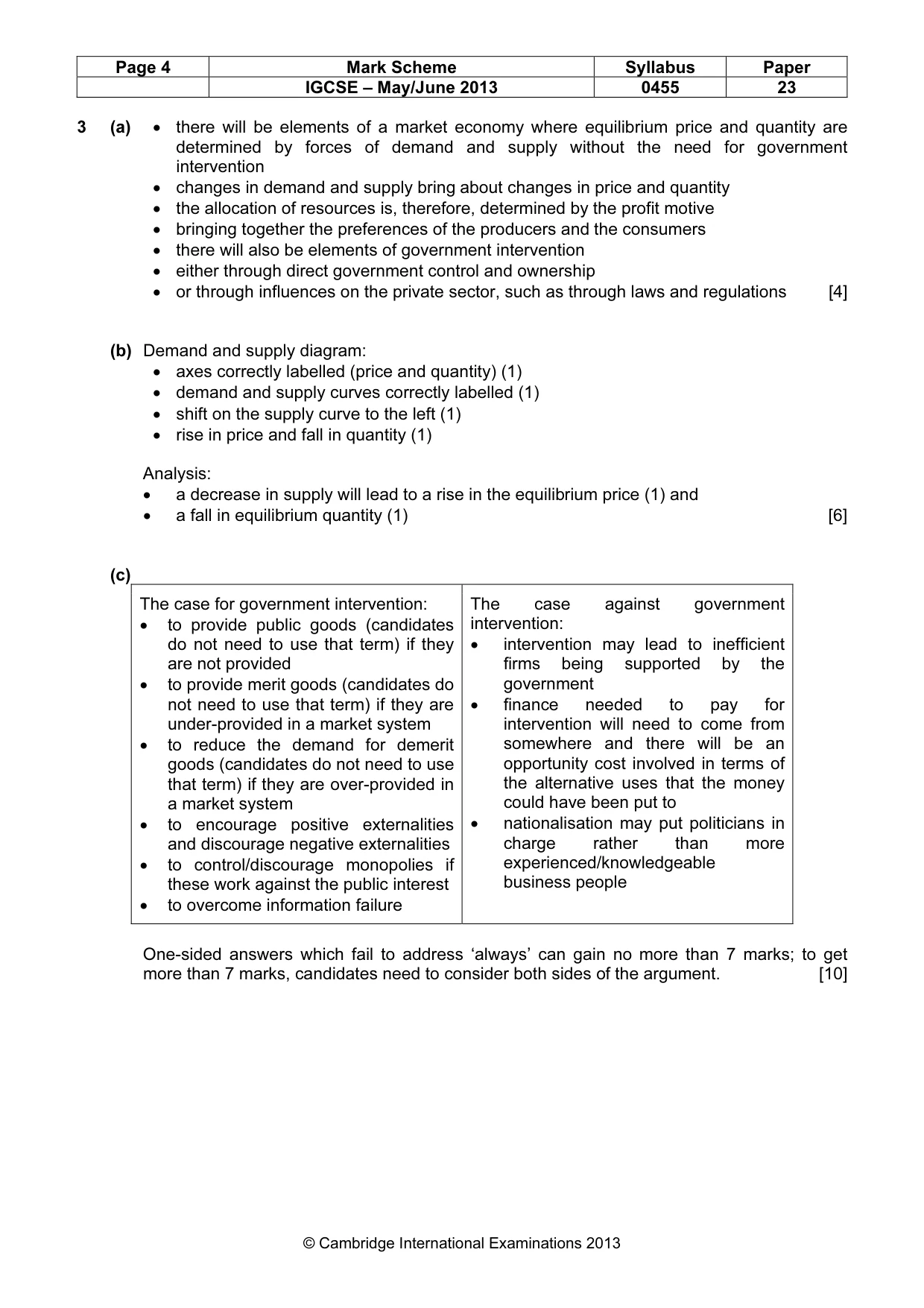
Page 4 Mark Scheme Syllabus Paper IGCSE – May/June 2013 0455 23 © Cambridge International Examinations 2013 3 (a) • there will be elements of a market economy where equilibrium price and quantity are determined by forces of demand and supply without the need for government intervention • changes in demand and supply bring about changes in price and quantity • the allocation of resources is, therefore, determined by the profit motive • bringing together the preferences of the producers and the consumers • there will also be elements of government intervention • either through direct government control and ownership • or through influences on the private sector, such as through laws and regulations [4] (b) Demand and supply diagram: • axes correctly labelled (price and quantity) (1) • demand and supply curves correctly labelled (1) • shift on the supply curve to the left (1) • rise in price and fall in quantity (1) Analysis: • a decrease in supply will lead to a rise in the equilibrium price (1) and • a fall in equilibrium quantity (1) [6] (c) The case for government intervention: • to provide public goods (candidates do not need to use that term) if they are not provided • to provide merit goods (candidates do not need to use that term) if they are under-provided in a market system • to reduce the demand for demerit goods (candidates do not need to use that term) if they are over-provided in a market system • to encourage positive externalities and discourage negative externalities • to control/discourage monopolies if these work against the public interest • to overcome information failure The case against government intervention: • intervention may lead to inefficient firms being supported by the government • finance needed to pay for intervention will need to come from somewhere and there will be an opportunity cost involved in terms of the alternative uses that the money could have been put to • nationalisation may put politicians in charge rather than more experienced/knowledgeable business people One-sided answers which fail to address ‘always’ can gain no more than 7 marks; to get more than 7 marks, candidates need to consider both sides of the argument. [10]
Mark scheme, page 5
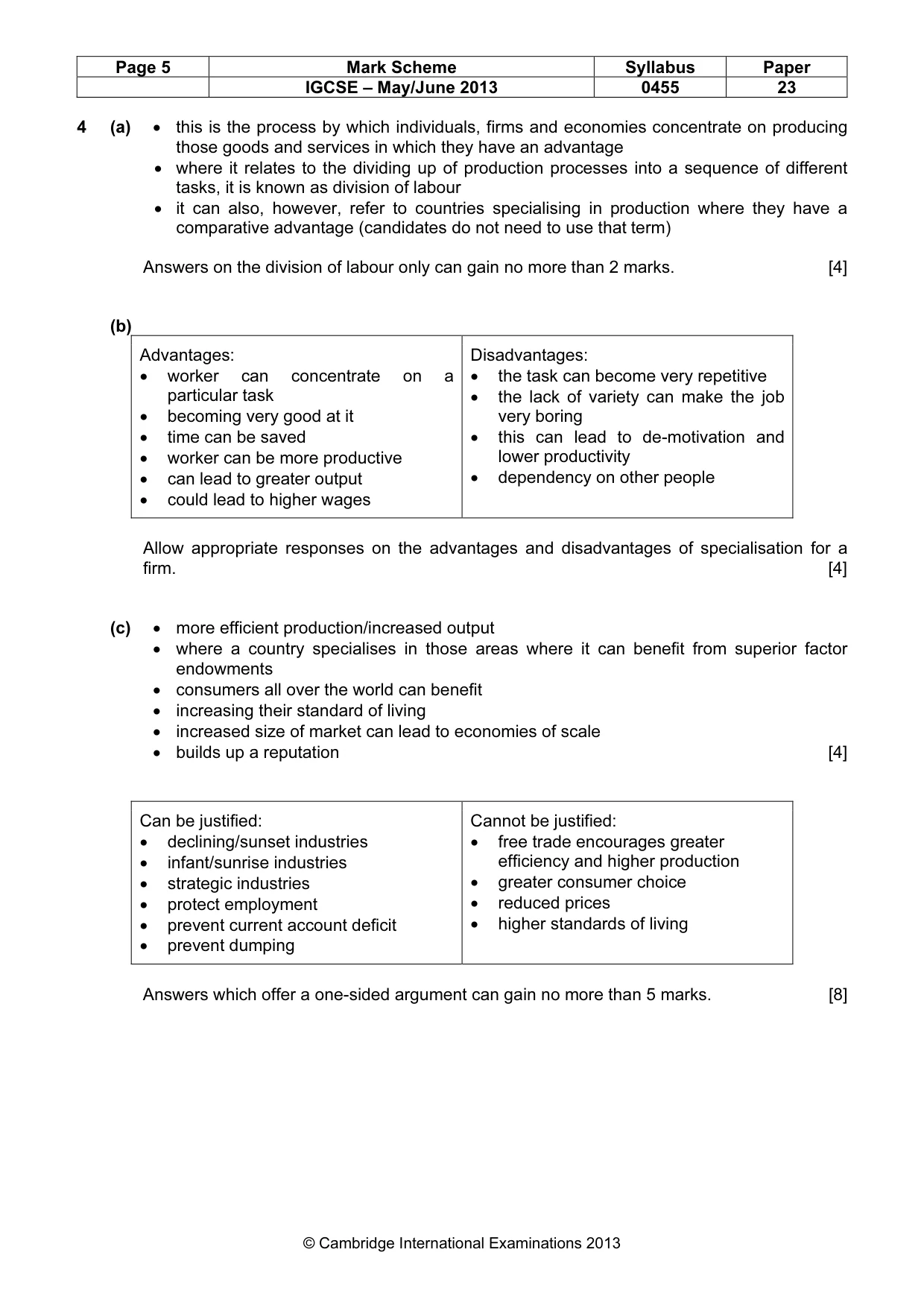
Page 5 Mark Scheme Syllabus Paper IGCSE – May/June 2013 0455 23 © Cambridge International Examinations 2013 4 (a) • this is the process by which individuals, firms and economies concentrate on producing those goods and services in which they have an advantage • where it relates to the dividing up of production processes into a sequence of different tasks, it is known as division of labour • it can also, however, refer to countries specialising in production where they have a comparative advantage (candidates do not need to use that term) Answers on the division of labour only can gain no more than 2 marks. [4] (b) Advantages: • worker can concentrate on a particular task • becoming very good at it • time can be saved • worker can be more productive • can lead to greater output • could lead to higher wages Disadvantages: • the task can become very repetitive • the lack of variety can make the job very boring • this can lead to de-motivation and lower productivity • dependency on other people Allow appropriate responses on the advantages and disadvantages of specialisation for a firm. [4] (c) • more efficient production/increased output • where a country specialises in those areas where it can benefit from superior factor endowments • consumers all over the world can benefit • increasing their standard of living • increased size of market can lead to economies of scale • builds up a reputation [4] Can be justified: • declining/sunset industries • infant/sunrise industries • strategic industries • protect employment • prevent current account deficit • prevent dumping Cannot be justified: • free trade encourages greater efficiency and higher production • greater consumer choice • reduced prices • higher standards of living Answers which offer a one-sided argument can gain no more than 5 marks. [8]
Mark scheme, page 6
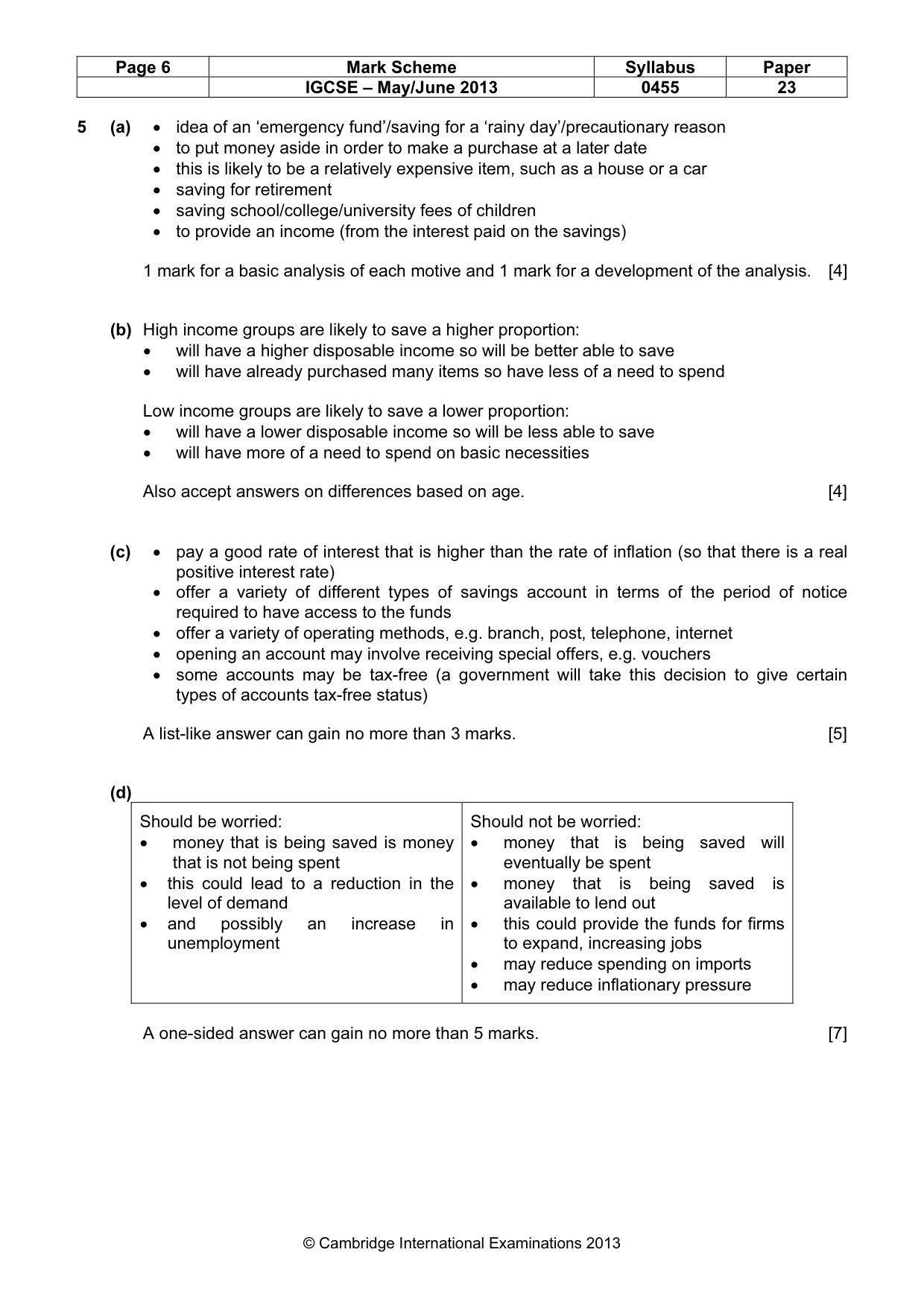
Page 6 Mark Scheme Syllabus Paper IGCSE – May/June 2013 0455 23 © Cambridge International Examinations 2013 5 (a) • idea of an ‘emergency fund’/saving for a ‘rainy day’/precautionary reason • to put money aside in order to make a purchase at a later date • this is likely to be a relatively expensive item, such as a house or a car • saving for retirement • saving school/college/university fees of children • to provide an income (from the interest paid on the savings) 1 mark for a basic analysis of each motive and 1 mark for a development of the analysis. [4] (b) High income groups are likely to save a higher proportion: • will have a higher disposable income so will be better able to save • will have already purchased many items so have less of a need to spend Low income groups are likely to save a lower proportion: • will have a lower disposable income so will be less able to save • will have more of a need to spend on basic necessities Also accept answers on differences based on age. [4] (c) • pay a good rate of interest that is higher than the rate of inflation (so that there is a real positive interest rate) • offer a variety of different types of savings account in terms of the period of notice required to have access to the funds • offer a variety of operating methods, e.g. branch, post, telephone, internet • opening an account may involve receiving special offers, e.g. vouchers • some accounts may be tax-free (a government will take this decision to give certain types of accounts tax-free status) A list-like answer can gain no more than 3 marks. [5] (d) Should be worried: • money that is being saved is money that is not being spent • this could lead to a reduction in the level of demand • and possibly an increase in unemployment Should not be worried: • money that is being saved will eventually be spent • money that is being saved is available to lend out • this could provide the funds for firms to expand, increasing jobs • may reduce spending on imports • may reduce inflationary pressure A one-sided answer can gain no more than 5 marks. [7]
Mark scheme, page 7
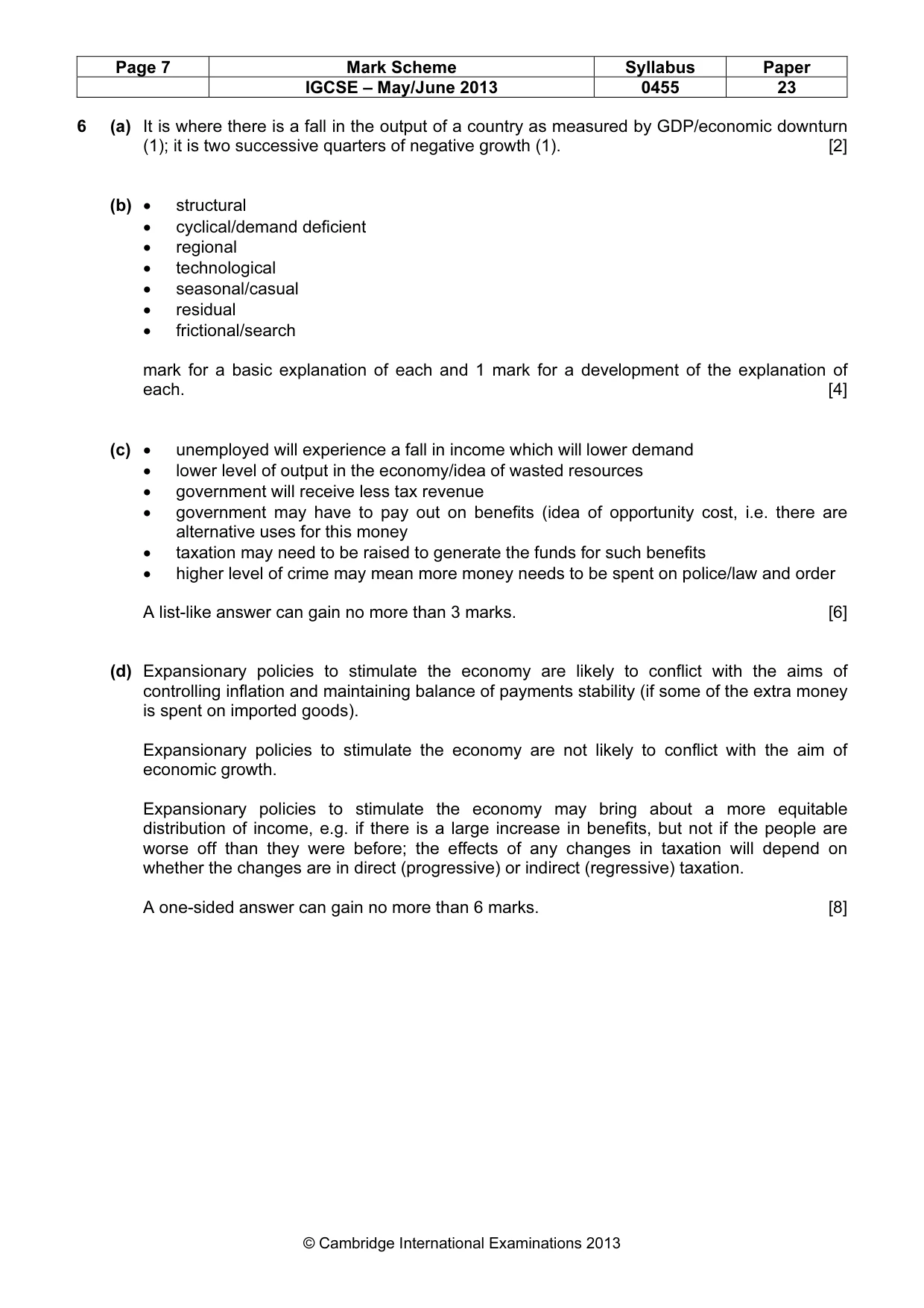
Page 7 Mark Scheme Syllabus Paper IGCSE – May/June 2013 0455 23 © Cambridge International Examinations 2013 6 (a) It is where there is a fall in the output of a country as measured by GDP/economic downturn (1); it is two successive quarters of negative growth (1). [2] (b) • structural • cyclical/demand deficient • regional • technological • seasonal/casual • residual • frictional/search mark for a basic explanation of each and 1 mark for a development of the explanation of each. [4] (c) • unemployed will experience a fall in income which will lower demand • lower level of output in the economy/idea of wasted resources • government will receive less tax revenue • government may have to pay out on benefits (idea of opportunity cost, i.e. there are alternative uses for this money • taxation may need to be raised to generate the funds for such benefits • higher level of crime may mean more money needs to be spent on police/law and order A list-like answer can gain no more than 3 marks. [6] (d) Expansionary policies to stimulate the economy are likely to conflict with the aims of controlling inflation and maintaining balance of payments stability (if some of the extra money is spent on imported goods). Expansionary policies to stimulate the economy are not likely to conflict with the aim of economic growth. Expansionary policies to stimulate the economy may bring about a more equitable distribution of income, e.g. if there is a large increase in benefits, but not if the people are worse off than they were before; the effects of any changes in taxation will depend on whether the changes are in direct (progressive) or indirect (regressive) taxation. A one-sided answer can gain no more than 6 marks. [8]
Mark scheme, page 8
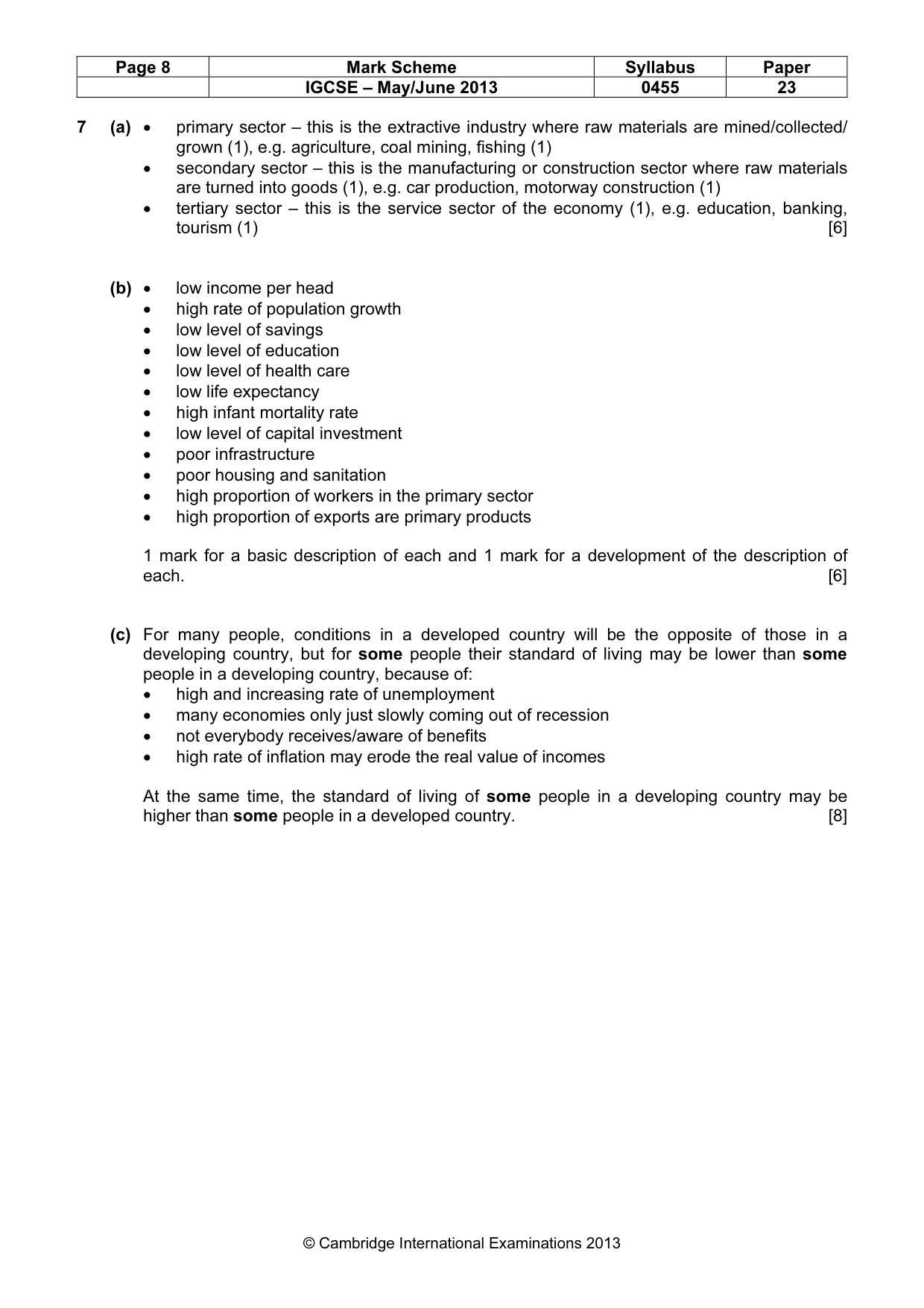
Page 8 Mark Scheme Syllabus Paper IGCSE – May/June 2013 0455 23 © Cambridge International Examinations 2013 7 (a) • primary sector – this is the extractive industry where raw materials are mined/collected/ grown (1), e.g. agriculture, coal mining, fishing (1) • secondary sector – this is the manufacturing or construction sector where raw materials are turned into goods (1), e.g. car production, motorway construction (1) • tertiary sector – this is the service sector of the economy (1), e.g. education, banking, tourism (1) [6] (b) • low income per head • high rate of population growth • low level of savings • low level of education • low level of health care • low life expectancy • high infant mortality rate • low level of capital investment • poor infrastructure • poor housing and sanitation • high proportion of workers in the primary sector • high proportion of exports are primary products 1 mark for a basic description of each and 1 mark for a development of the description of each. [6] (c) For many people, conditions in a developed country will be the opposite of those in a developing country, but for some people their standard of living may be lower than some people in a developing country, because of: • high and increasing rate of unemployment • many economies only just slowly coming out of recession • not everybody receives/aware of benefits • high rate of inflation may erode the real value of incomes At the same time, the standard of living of some people in a developing country may be higher than some people in a developed country. [8]
What you needed in this session
Cambridge’s own grade thresholds for 2013 May/June, Paper 2 · Variant 3. A higher threshold means an easier paper — the bar moves with how the cohort did.