Cambridge IGCSE Economics 0455 — 2013 May/June Paper 2 · Variant 2
0455/22/M/J/13 · 80 marks · ≈90 min
The question paper and its mark scheme, free to read here and free to download. This is Cambridge’s own paper, exactly as it was sat.
Question paper4 pages
Mark scheme11 pages
Answers below. Sit the paper first if you are practising.
Paper as text
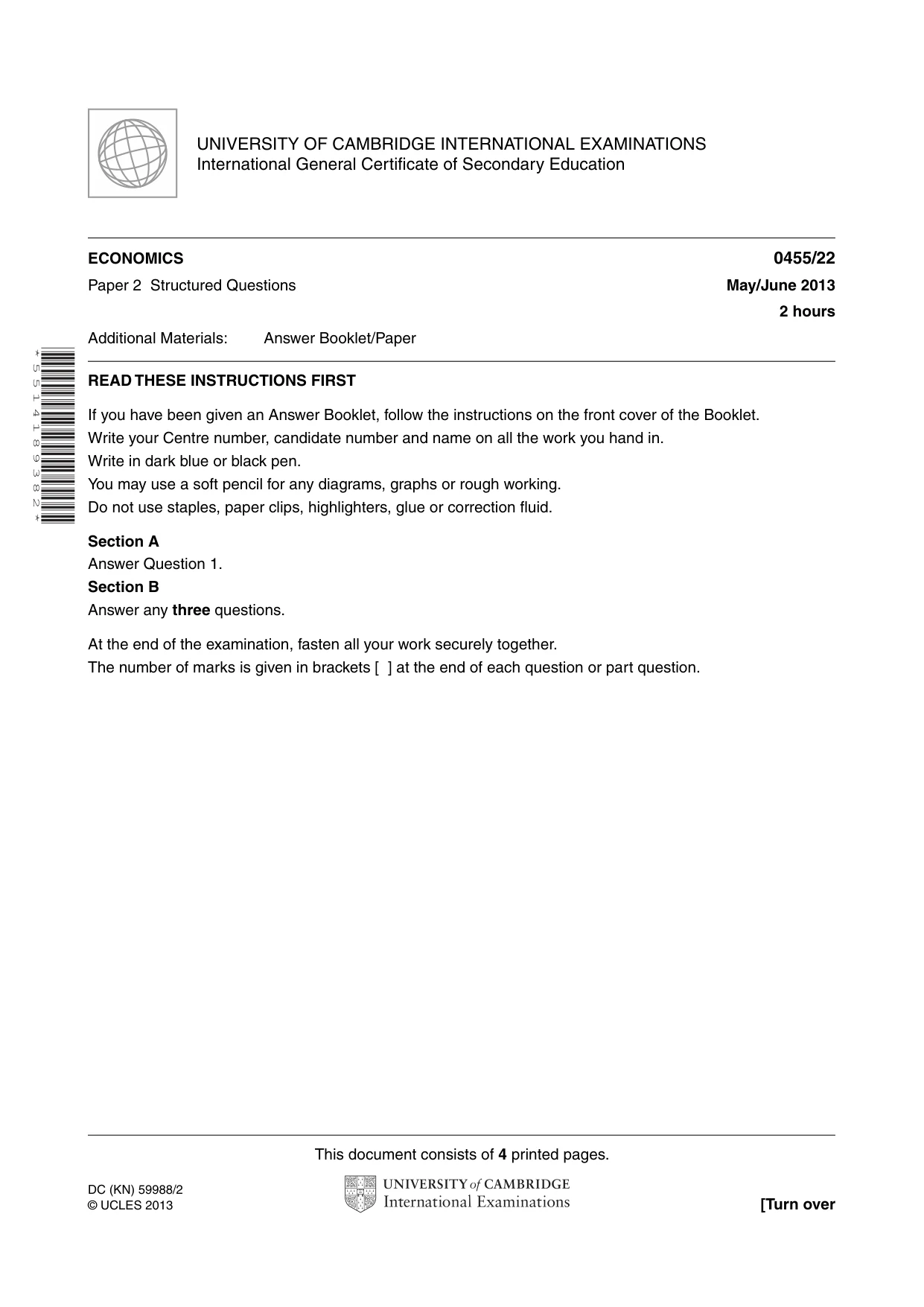
Question paper, page 1
This document consists of 4 printed pages. DC (KN) 59988/2 © UCLES 2013 [Turn over UNIVERSITY OF CAMBRIDGE INTERNATIONAL EXAMINATIONS International General Certificate of Secondary Education * 5 5 1 4 1 8 9 3 8 2 * ECONOMICS 0455/22 Paper 2 Structured Questions May/June 2013 2 hours Additional Materials: Answer Booklet/Paper READ THESE INSTRUCTIONS FIRST If you have been given an Answer Booklet, follow the instructions on the front cover of the Booklet. Write your Centre number, candidate number and name on all the work you hand in. Write in dark blue or black pen. You may use a soft pencil for any diagrams, graphs or rough working. Do not use staples, paper clips, highlighters, glue or correction fluid. Section A Answer Question 1. Section B Answer any three questions. At the end of the examination, fasten all your work securely together. The number of marks is given in brackets [ ] at the end of each question or part question.
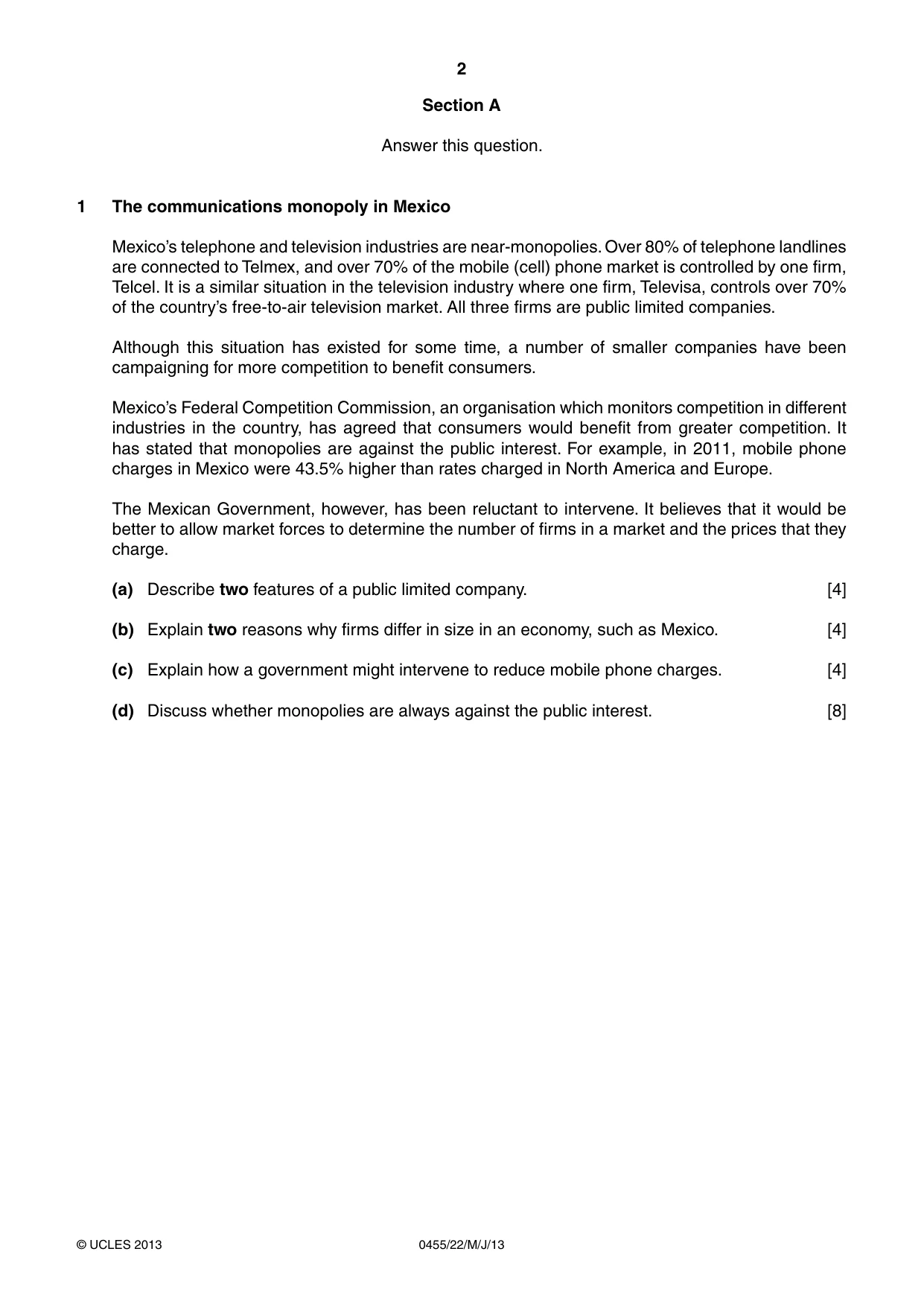
Question paper, page 2
2 0455/22/M/J/13 © UCLES 2013 Section A Answer this question. 1 The communications monopoly in Mexico Mexico’s telephone and television industries are near-monopolies. Over 80% of telephone landlines are connected to Telmex, and over 70% of the mobile (cell) phone market is controlled by one firm, Telcel. It is a similar situation in the television industry where one firm, Televisa, controls over 70% of the country’s free-to-air television market. All three firms are public limited companies. Although this situation has existed for some time, a number of smaller companies have been campaigning for more competition to benefit consumers. Mexico’s Federal Competition Commission, an organisation which monitors competition in different industries in the country, has agreed that consumers would benefit from greater competition. It has stated that monopolies are against the public interest. For example, in 2011, mobile phone charges in Mexico were 43.5% higher than rates charged in North America and Europe. The Mexican Government, however, has been reluctant to intervene. It believes that it would be better to allow market forces to determine the number of firms in a market and the prices that they charge. (a) Describe two features of a public limited company. [4] (b) Explain two reasons why firms differ in size in an economy, such as Mexico. [4] (c) Explain how a government might intervene to reduce mobile phone charges. [4] (d) Discuss whether monopolies are always against the public interest. [8]
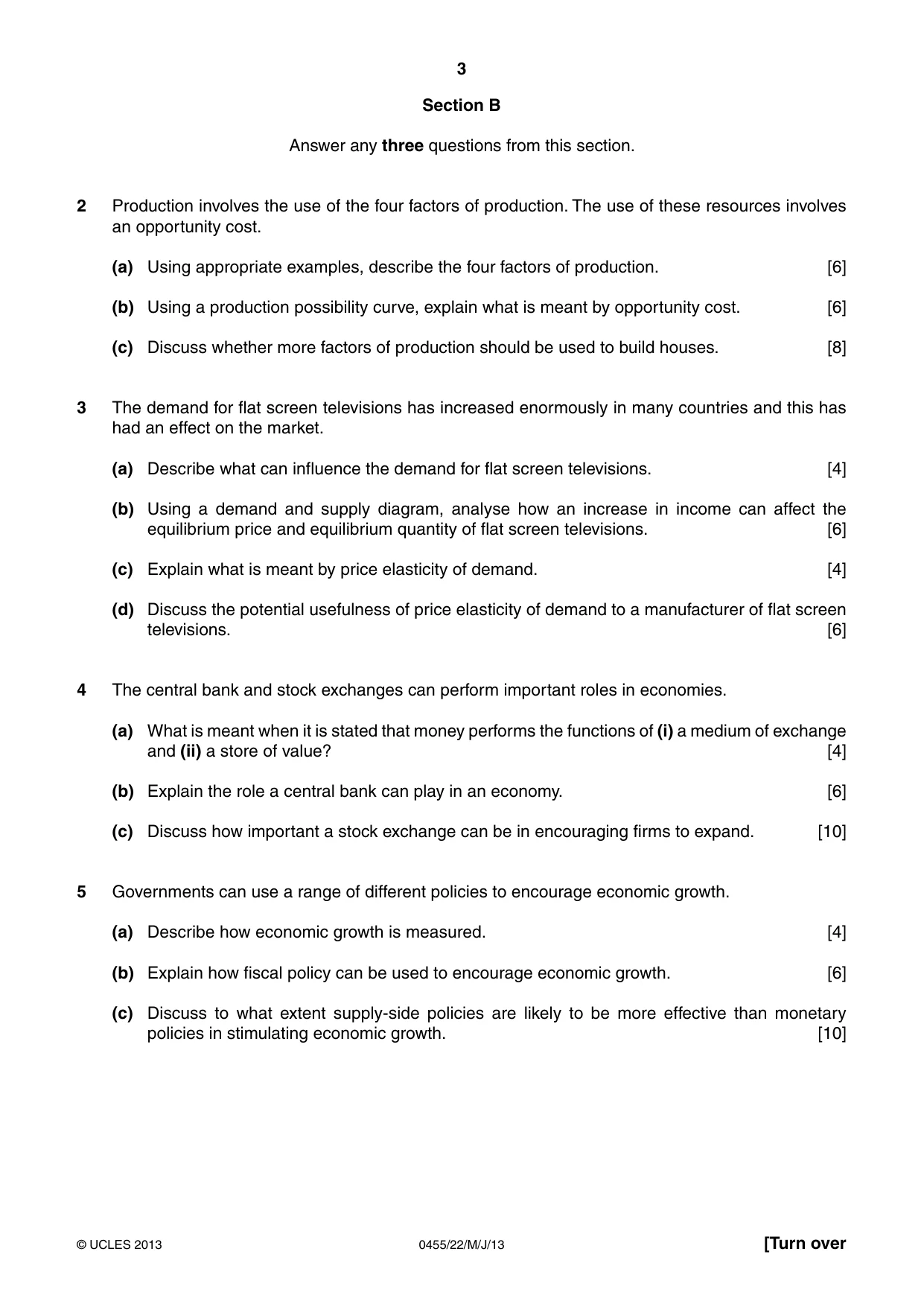
Question paper, page 3
3 0455/22/M/J/13 © UCLES 2013 [Turn over Section B Answer any three questions from this section. 2 Production involves the use of the four factors of production. The use of these resources involves an opportunity cost. (a) Using appropriate examples, describe the four factors of production. [6] (b) Using a production possibility curve, explain what is meant by opportunity cost. [6] (c) Discuss whether more factors of production should be used to build houses. [8] 3 The demand for flat screen televisions has increased enormously in many countries and this has had an effect on the market. (a) Describe what can influence the demand for flat screen televisions. [4] (b) Using a demand and supply diagram, analyse how an increase in income can affect the equilibrium price and equilibrium quantity of flat screen televisions. [6] (c) Explain what is meant by price elasticity of demand. [4] (d) Discuss the potential usefulness of price elasticity of demand to a manufacturer of flat screen televisions. [6] 4 The central bank and stock exchanges can perform important roles in economies. (a) What is meant when it is stated that money performs the functions of (i) a medium of exchange and (ii) a store of value? [4] (b) Explain the role a central bank can play in an economy. [6] (c) Discuss how important a stock exchange can be in encouraging firms to expand. [10] 5 Governments can use a range of different policies to encourage economic growth. (a) Describe how economic growth is measured. [4] (b) Explain how fiscal policy can be used to encourage economic growth. [6] (c) Discuss to what extent supply-side policies are likely to be more effective than monetary policies in stimulating economic growth. [10]
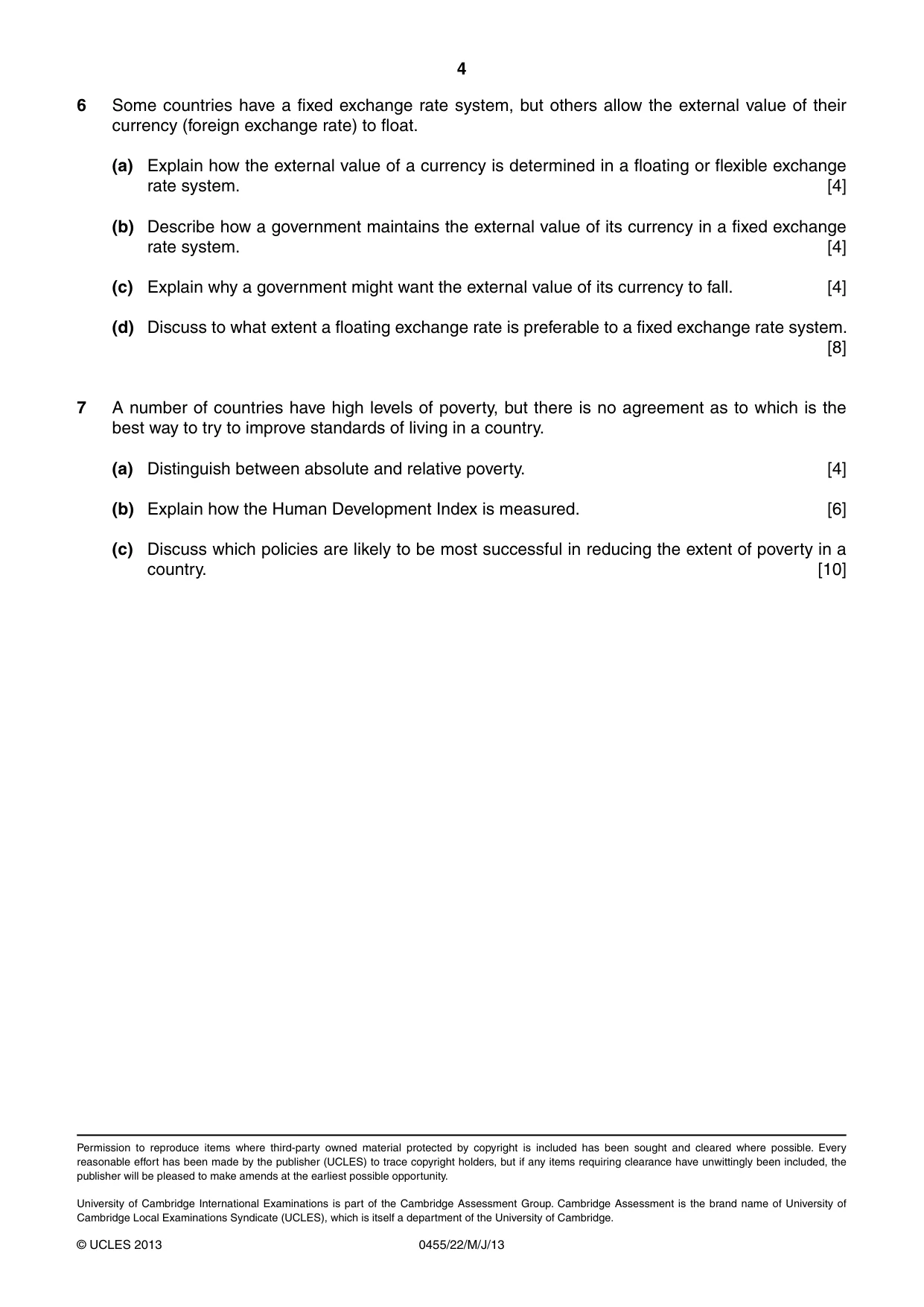
Question paper, page 4
4 0455/22/M/J/13 © UCLES 2013 6 Some countries have a fixed exchange rate system, but others allow the external value of their currency (foreign exchange rate) to float. (a) Explain how the external value of a currency is determined in a floating or flexible exchange rate system. [4] (b) Describe how a government maintains the external value of its currency in a fixed exchange rate system. [4] (c) Explain why a government might want the external value of its currency to fall. [4] (d) Discuss to what extent a floating exchange rate is preferable to a fixed exchange rate system. [8] 7 A number of countries have high levels of poverty, but there is no agreement as to which is the best way to try to improve standards of living in a country. (a) Distinguish between absolute and relative poverty. [4] (b) Explain how the Human Development Index is measured. [6] (c) Discuss which policies are likely to be most successful in reducing the extent of poverty in a country. [10] Permission to reproduce items where third-party owned material protected by copyright is included has been sought and cleared where possible. Every reasonable effort has been made by the publisher (UCLES) to trace copyright holders, but if any items requiring clearance have unwittingly been included, the publisher will be pleased to make amends at the earliest possible opportunity. University of Cambridge International Examinations is part of the Cambridge Assessment Group. Cambridge Assessment is the brand name of University of Cambridge Local Examinations Syndicate (UCLES), which is itself a department of the University of Cambridge.
Mark scheme, page 1
CAMBRIDGE INTERNATIONAL EXAMINATIONS International General Certificate of Secondary Education MARK SCHEME for the May/June 2013 series 0455 ECONOMICS 0455/22 Paper 2 (Structured Questions), maximum raw mark 80 This mark scheme is published as an aid to teachers and candidates, to indicate the requirements of the examination. It shows the basis on which Examiners were instructed to award marks. It does not indicate the details of the discussions that took place at an Examiners’ meeting before marking began, which would have considered the acceptability of alternative answers. Mark schemes should be read in conjunction with the question paper and the Principal Examiner Report for Teachers. Cambridge will not enter into discussions about these mark schemes. Cambridge is publishing the mark schemes for the May/June 2013 series for most IGCSE, GCE Advanced Level and Advanced Subsidiary Level components and some Ordinary Level components.
Mark scheme, page 2
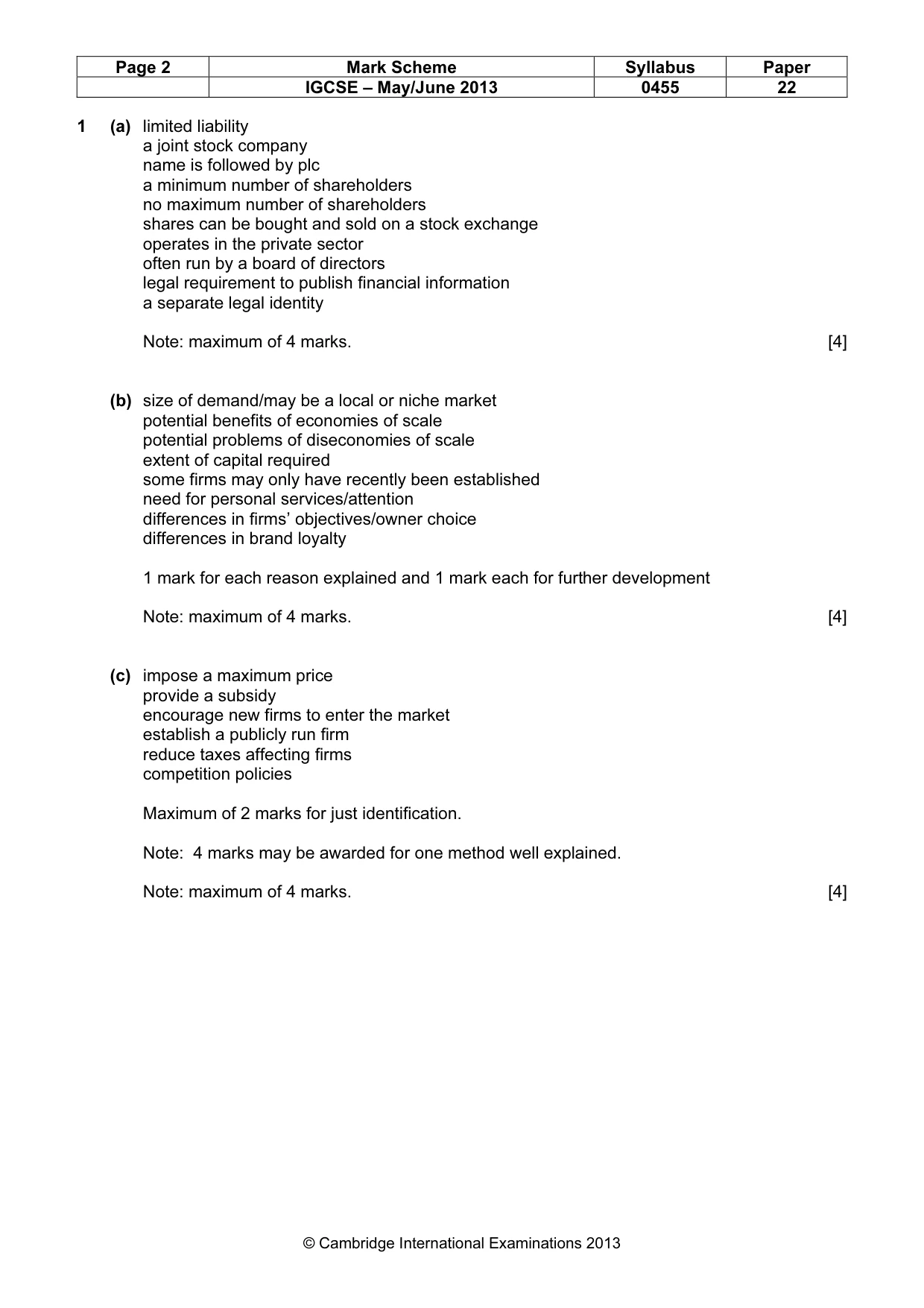
Page 2 Mark Scheme Syllabus Paper IGCSE – May/June 2013 0455 22 © Cambridge International Examinations 2013 1 (a) limited liability a joint stock company name is followed by plc a minimum number of shareholders no maximum number of shareholders shares can be bought and sold on a stock exchange operates in the private sector often run by a board of directors legal requirement to publish financial information a separate legal identity Note: maximum of 4 marks. [4] (b) size of demand/may be a local or niche market potential benefits of economies of scale potential problems of diseconomies of scale extent of capital required some firms may only have recently been established need for personal services/attention differences in firms’ objectives/owner choice differences in brand loyalty 1 mark for each reason explained and 1 mark each for further development Note: maximum of 4 marks. [4] (c) impose a maximum price provide a subsidy encourage new firms to enter the market establish a publicly run firm reduce taxes affecting firms competition policies Maximum of 2 marks for just identification. Note: 4 marks may be awarded for one method well explained. Note: maximum of 4 marks. [4]
Mark scheme, page 3
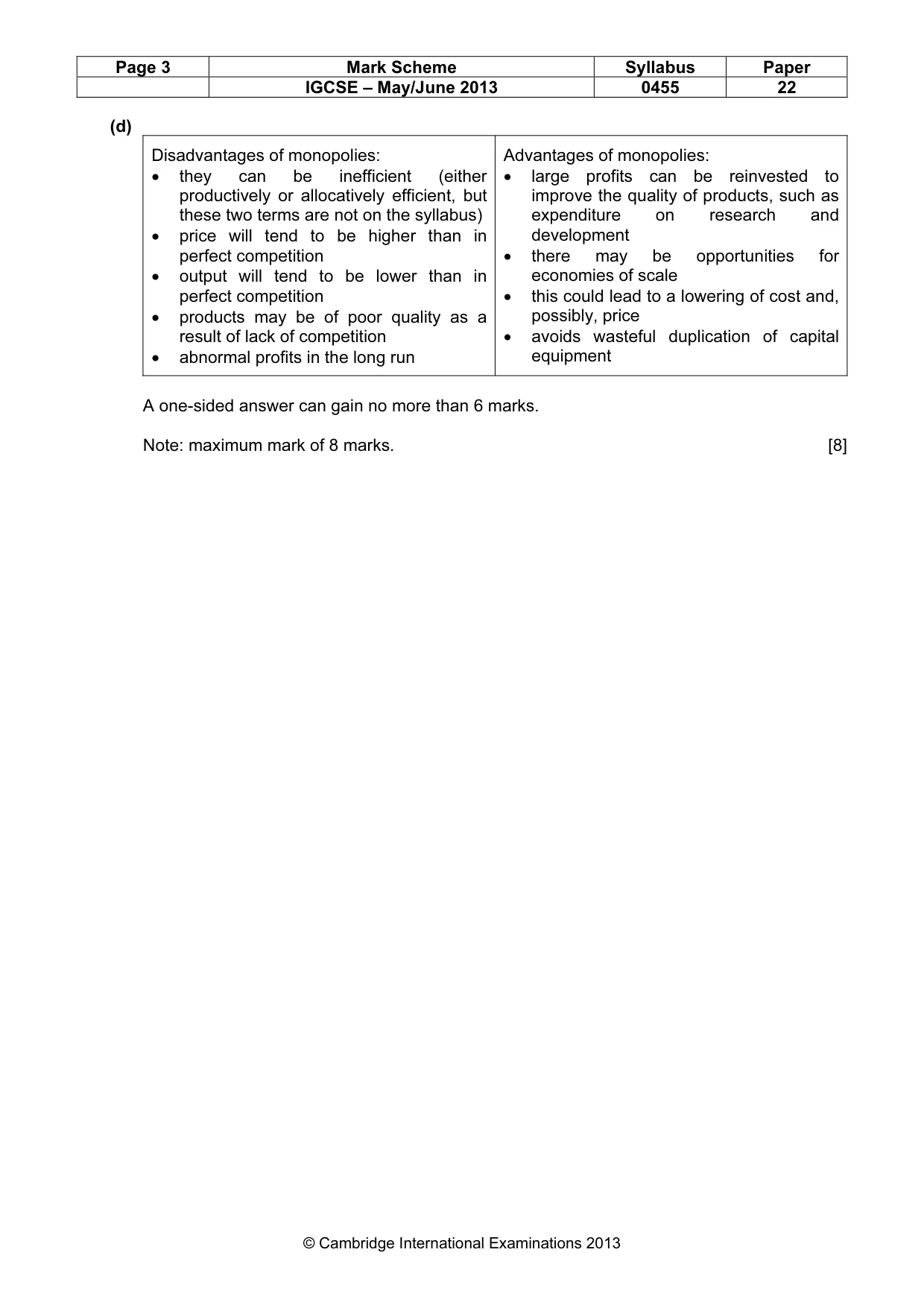
Page 3 Mark Scheme Syllabus Paper IGCSE – May/June 2013 0455 22 © Cambridge International Examinations 2013 (d) Disadvantages of monopolies: • they can be inefficient (either productively or allocatively efficient, but these two terms are not on the syllabus) • price will tend to be higher than in perfect competition • output will tend to be lower than in perfect competition • products may be of poor quality as a result of lack of competition • abnormal profits in the long run Advantages of monopolies: • large profits can be reinvested to improve the quality of products, such as expenditure on research and development • there may be opportunities for economies of scale • this could lead to a lowering of cost and, possibly, price • avoids wasteful duplication of capital equipment A one-sided answer can gain no more than 6 marks. Note: maximum mark of 8 marks. [8]
Mark scheme, page 4
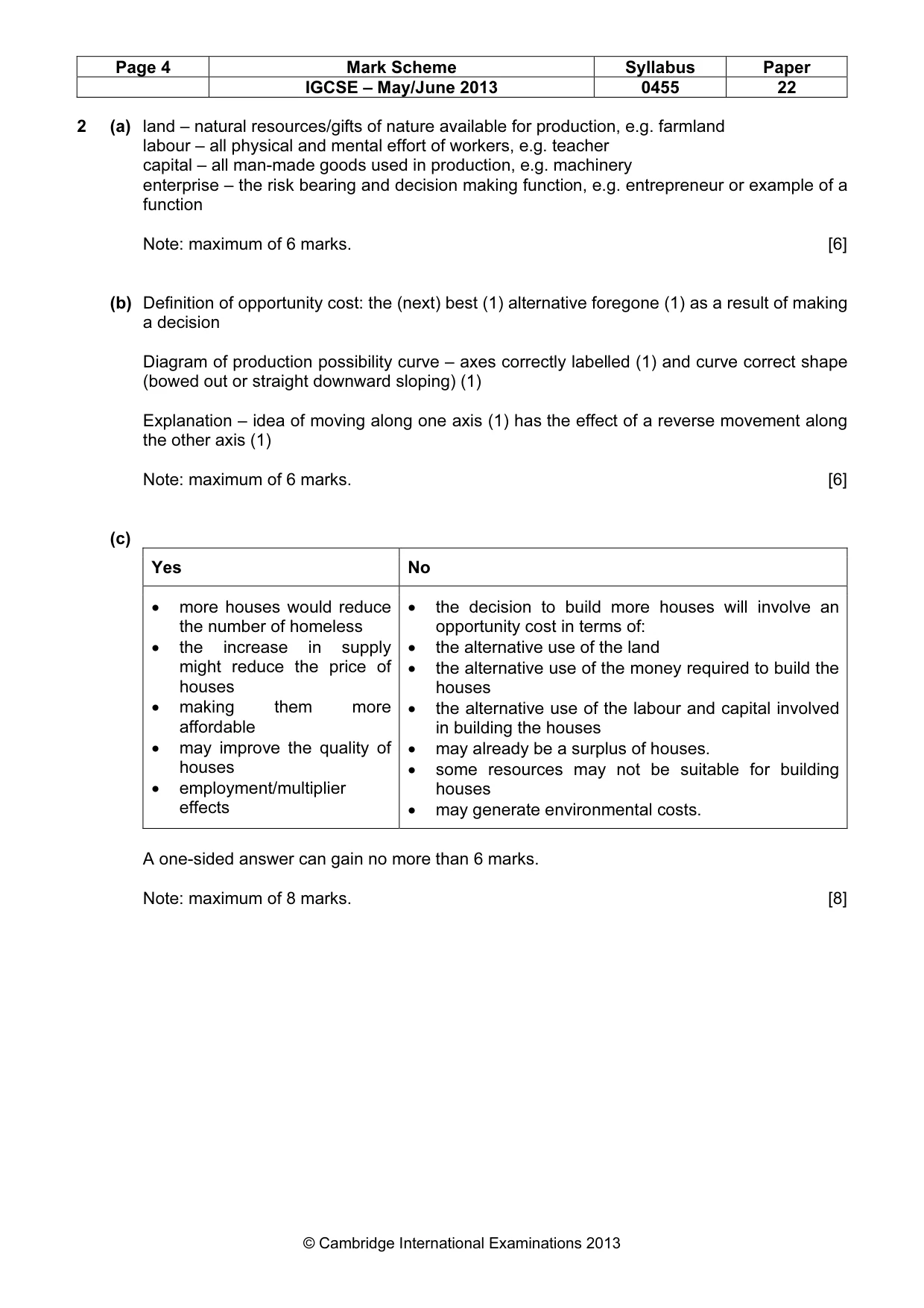
Page 4 Mark Scheme Syllabus Paper IGCSE – May/June 2013 0455 22 © Cambridge International Examinations 2013 2 (a) land – natural resources/gifts of nature available for production, e.g. farmland labour – all physical and mental effort of workers, e.g. teacher capital – all man-made goods used in production, e.g. machinery enterprise – the risk bearing and decision making function, e.g. entrepreneur or example of a function Note: maximum of 6 marks. [6] (b) Definition of opportunity cost: the (next) best (1) alternative foregone (1) as a result of making a decision Diagram of production possibility curve – axes correctly labelled (1) and curve correct shape (bowed out or straight downward sloping) (1) Explanation – idea of moving along one axis (1) has the effect of a reverse movement along the other axis (1) Note: maximum of 6 marks. [6] (c) Yes No • more houses would reduce the number of homeless • the increase in supply might reduce the price of houses • making them more affordable • may improve the quality of houses • employment/multiplier effects • the decision to build more houses will involve an opportunity cost in terms of: • the alternative use of the land • the alternative use of the money required to build the houses • the alternative use of the labour and capital involved in building the houses • may already be a surplus of houses. • some resources may not be suitable for building houses • may generate environmental costs. A one-sided answer can gain no more than 6 marks. Note: maximum of 8 marks. [8]
Mark scheme, page 5
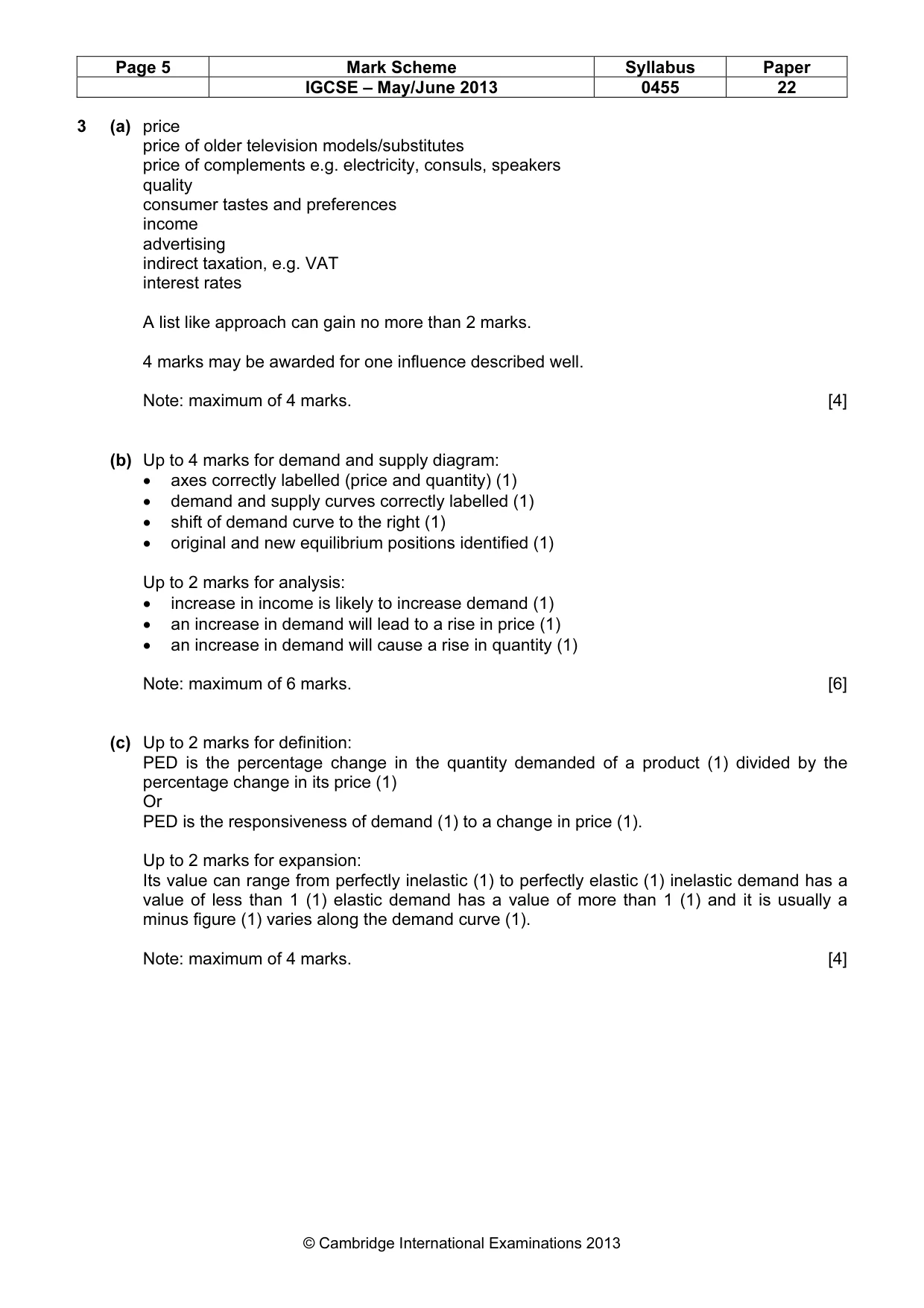
Page 5 Mark Scheme Syllabus Paper IGCSE – May/June 2013 0455 22 © Cambridge International Examinations 2013 3 (a) price price of older television models/substitutes price of complements e.g. electricity, consuls, speakers quality consumer tastes and preferences income advertising indirect taxation, e.g. VAT interest rates A list like approach can gain no more than 2 marks. 4 marks may be awarded for one influence described well. Note: maximum of 4 marks. [4] (b) Up to 4 marks for demand and supply diagram: • axes correctly labelled (price and quantity) (1) • demand and supply curves correctly labelled (1) • shift of demand curve to the right (1) • original and new equilibrium positions identified (1) Up to 2 marks for analysis: • increase in income is likely to increase demand (1) • an increase in demand will lead to a rise in price (1) • an increase in demand will cause a rise in quantity (1) Note: maximum of 6 marks. [6] (c) Up to 2 marks for definition: PED is the percentage change in the quantity demanded of a product (1) divided by the percentage change in its price (1) Or PED is the responsiveness of demand (1) to a change in price (1). Up to 2 marks for expansion: Its value can range from perfectly inelastic (1) to perfectly elastic (1) inelastic demand has a value of less than 1 (1) elastic demand has a value of more than 1 (1) and it is usually a minus figure (1) varies along the demand curve (1). Note: maximum of 4 marks. [4]
Mark scheme, page 6
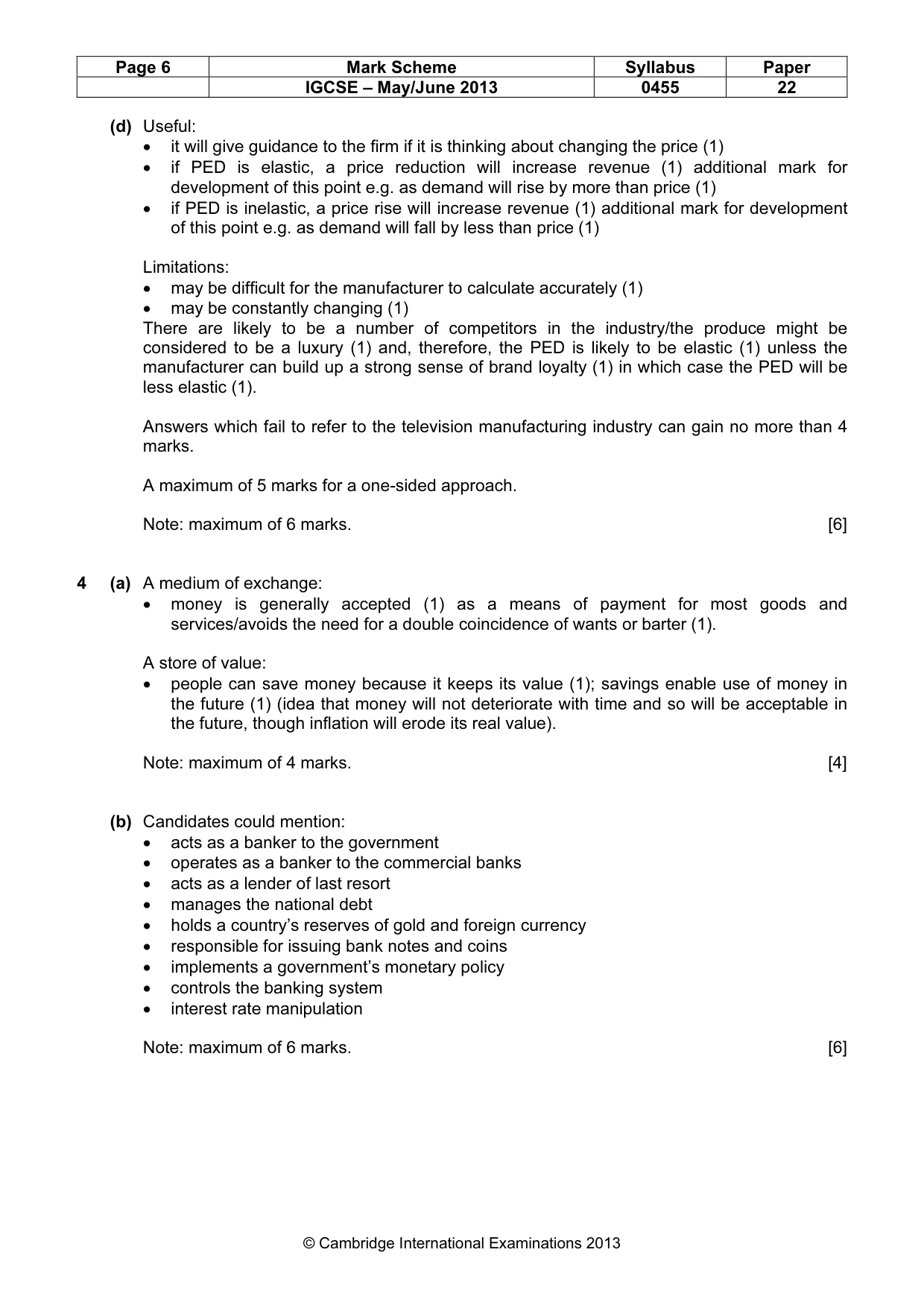
Page 6 Mark Scheme Syllabus Paper IGCSE – May/June 2013 0455 22 © Cambridge International Examinations 2013 (d) Useful: • it will give guidance to the firm if it is thinking about changing the price (1) • if PED is elastic, a price reduction will increase revenue (1) additional mark for development of this point e.g. as demand will rise by more than price (1) • if PED is inelastic, a price rise will increase revenue (1) additional mark for development of this point e.g. as demand will fall by less than price (1) Limitations: • may be difficult for the manufacturer to calculate accurately (1) • may be constantly changing (1) There are likely to be a number of competitors in the industry/the produce might be considered to be a luxury (1) and, therefore, the PED is likely to be elastic (1) unless the manufacturer can build up a strong sense of brand loyalty (1) in which case the PED will be less elastic (1). Answers which fail to refer to the television manufacturing industry can gain no more than 4 marks. A maximum of 5 marks for a one-sided approach. Note: maximum of 6 marks. [6] 4 (a) A medium of exchange: • money is generally accepted (1) as a means of payment for most goods and services/avoids the need for a double coincidence of wants or barter (1). A store of value: • people can save money because it keeps its value (1); savings enable use of money in the future (1) (idea that money will not deteriorate with time and so will be acceptable in the future, though inflation will erode its real value). Note: maximum of 4 marks. [4] (b) Candidates could mention: • acts as a banker to the government • operates as a banker to the commercial banks • acts as a lender of last resort • manages the national debt • holds a country’s reserves of gold and foreign currency • responsible for issuing bank notes and coins • implements a government’s monetary policy • controls the banking system • interest rate manipulation Note: maximum of 6 marks. [6]
Mark scheme, page 7
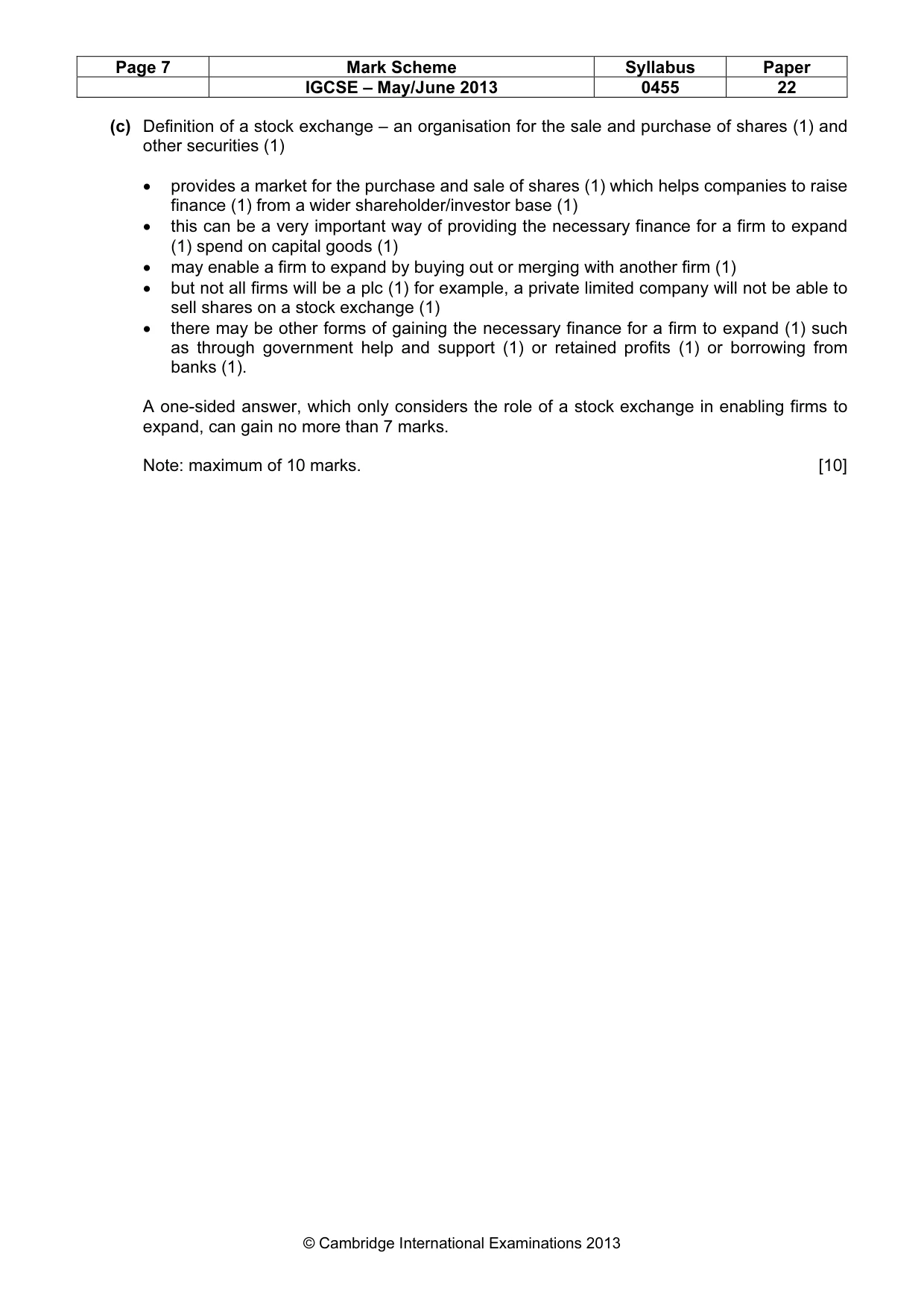
Page 7 Mark Scheme Syllabus Paper IGCSE – May/June 2013 0455 22 © Cambridge International Examinations 2013 (c) Definition of a stock exchange – an organisation for the sale and purchase of shares (1) and other securities (1) • provides a market for the purchase and sale of shares (1) which helps companies to raise finance (1) from a wider shareholder/investor base (1) • this can be a very important way of providing the necessary finance for a firm to expand (1) spend on capital goods (1) • may enable a firm to expand by buying out or merging with another firm (1) • but not all firms will be a plc (1) for example, a private limited company will not be able to sell shares on a stock exchange (1) • there may be other forms of gaining the necessary finance for a firm to expand (1) such as through government help and support (1) or retained profits (1) or borrowing from banks (1). A one-sided answer, which only considers the role of a stock exchange in enabling firms to expand, can gain no more than 7 marks. Note: maximum of 10 marks. [10]
Mark scheme, page 8
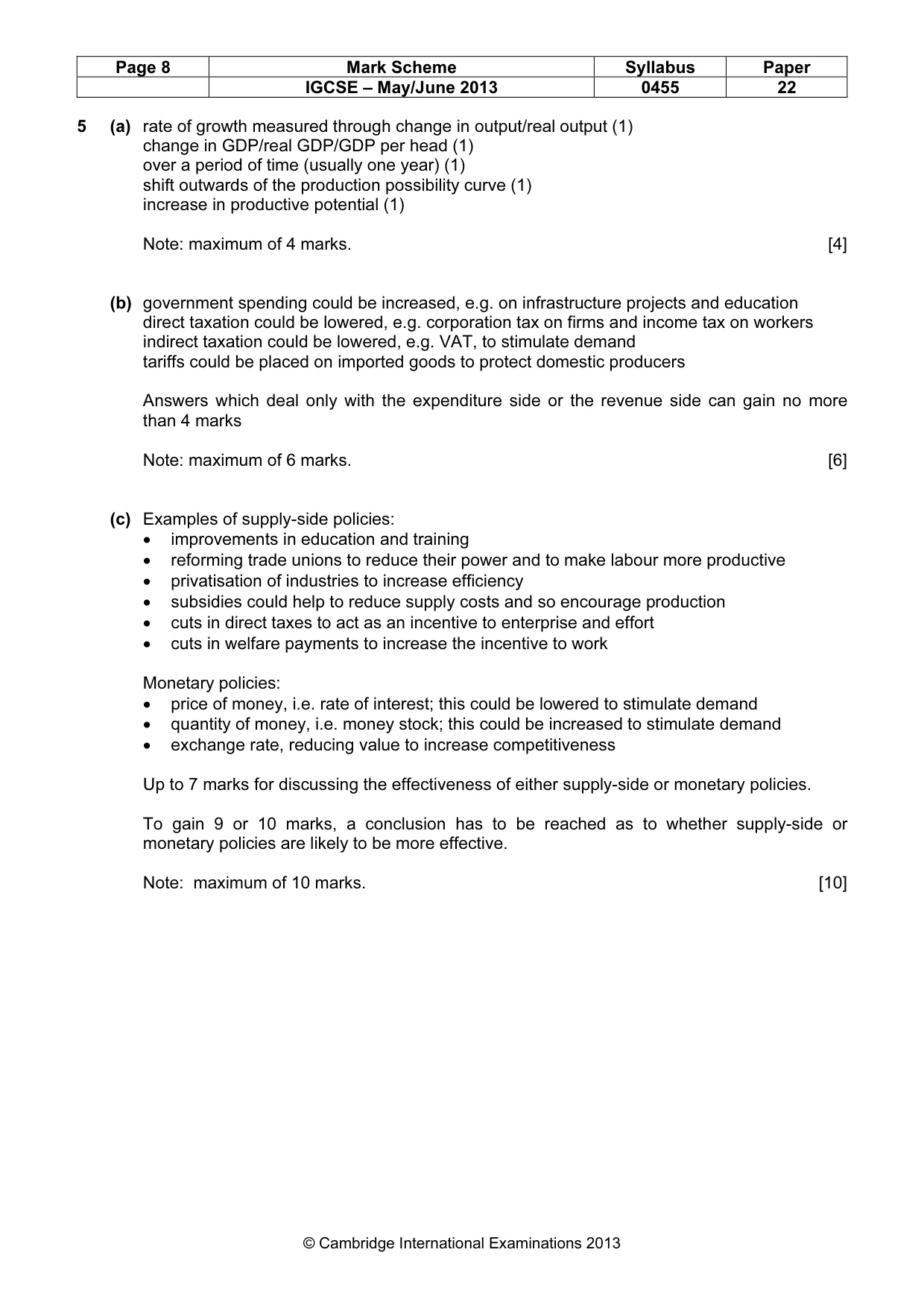
Page 8 Mark Scheme Syllabus Paper IGCSE – May/June 2013 0455 22 © Cambridge International Examinations 2013 5 (a) rate of growth measured through change in output/real output (1) change in GDP/real GDP/GDP per head (1) over a period of time (usually one year) (1) shift outwards of the production possibility curve (1) increase in productive potential (1) Note: maximum of 4 marks. [4] (b) government spending could be increased, e.g. on infrastructure projects and education direct taxation could be lowered, e.g. corporation tax on firms and income tax on workers indirect taxation could be lowered, e.g. VAT, to stimulate demand tariffs could be placed on imported goods to protect domestic producers Answers which deal only with the expenditure side or the revenue side can gain no more than 4 marks Note: maximum of 6 marks. [6] (c) Examples of supply-side policies: • improvements in education and training • reforming trade unions to reduce their power and to make labour more productive • privatisation of industries to increase efficiency • subsidies could help to reduce supply costs and so encourage production • cuts in direct taxes to act as an incentive to enterprise and effort • cuts in welfare payments to increase the incentive to work Monetary policies: • price of money, i.e. rate of interest; this could be lowered to stimulate demand • quantity of money, i.e. money stock; this could be increased to stimulate demand • exchange rate, reducing value to increase competitiveness Up to 7 marks for discussing the effectiveness of either supply-side or monetary policies. To gain 9 or 10 marks, a conclusion has to be reached as to whether supply-side or monetary policies are likely to be more effective. Note: maximum of 10 marks. [10]
Mark scheme, page 9
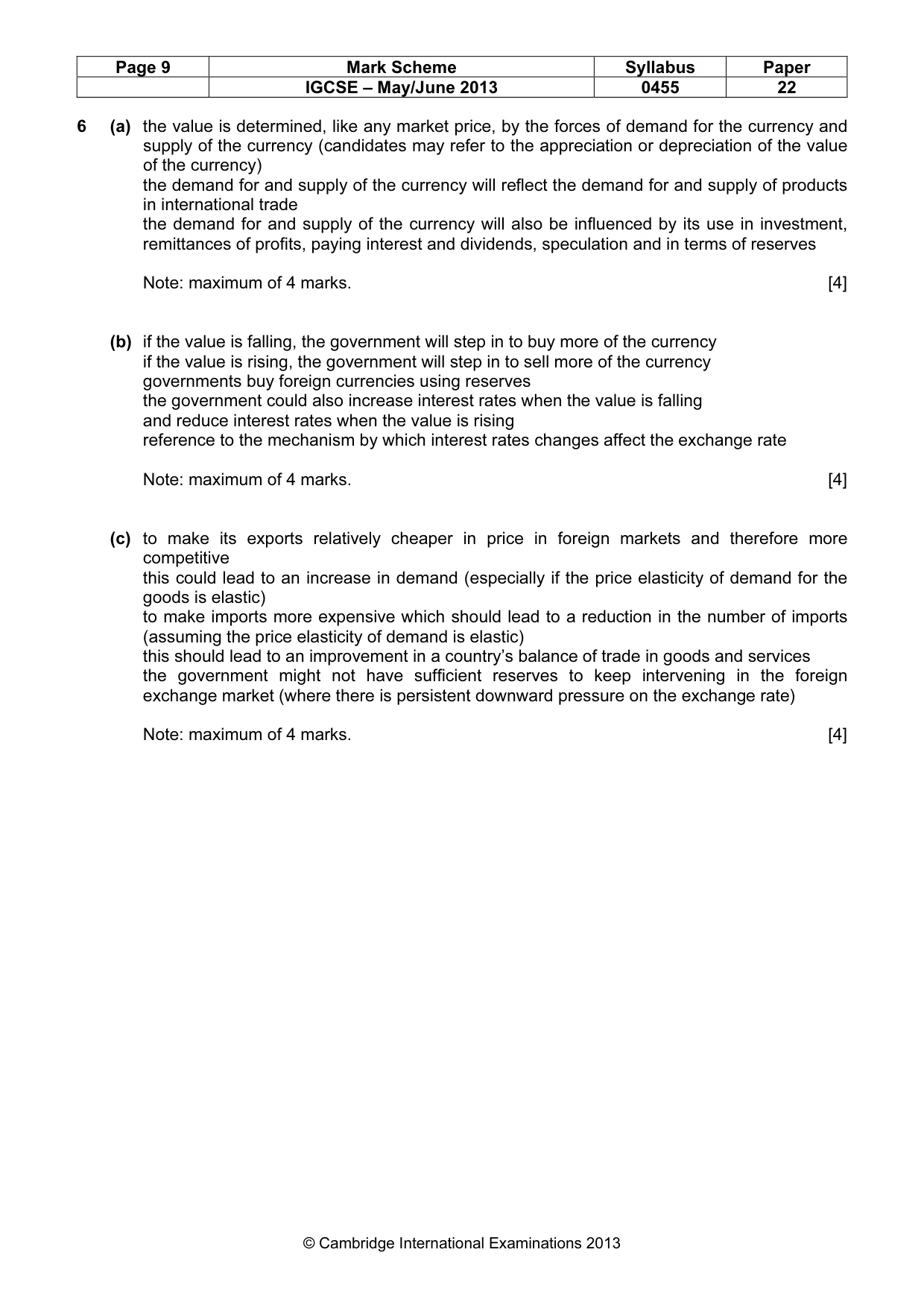
Page 9 Mark Scheme Syllabus Paper IGCSE – May/June 2013 0455 22 © Cambridge International Examinations 2013 6 (a) the value is determined, like any market price, by the forces of demand for the currency and supply of the currency (candidates may refer to the appreciation or depreciation of the value of the currency) the demand for and supply of the currency will reflect the demand for and supply of products in international trade the demand for and supply of the currency will also be influenced by its use in investment, remittances of profits, paying interest and dividends, speculation and in terms of reserves Note: maximum of 4 marks. [4] (b) if the value is falling, the government will step in to buy more of the currency if the value is rising, the government will step in to sell more of the currency governments buy foreign currencies using reserves the government could also increase interest rates when the value is falling and reduce interest rates when the value is rising reference to the mechanism by which interest rates changes affect the exchange rate Note: maximum of 4 marks. [4] (c) to make its exports relatively cheaper in price in foreign markets and therefore more competitive this could lead to an increase in demand (especially if the price elasticity of demand for the goods is elastic) to make imports more expensive which should lead to a reduction in the number of imports (assuming the price elasticity of demand is elastic) this should lead to an improvement in a country’s balance of trade in goods and services the government might not have sufficient reserves to keep intervening in the foreign exchange market (where there is persistent downward pressure on the exchange rate) Note: maximum of 4 marks. [4]
Mark scheme, page 10
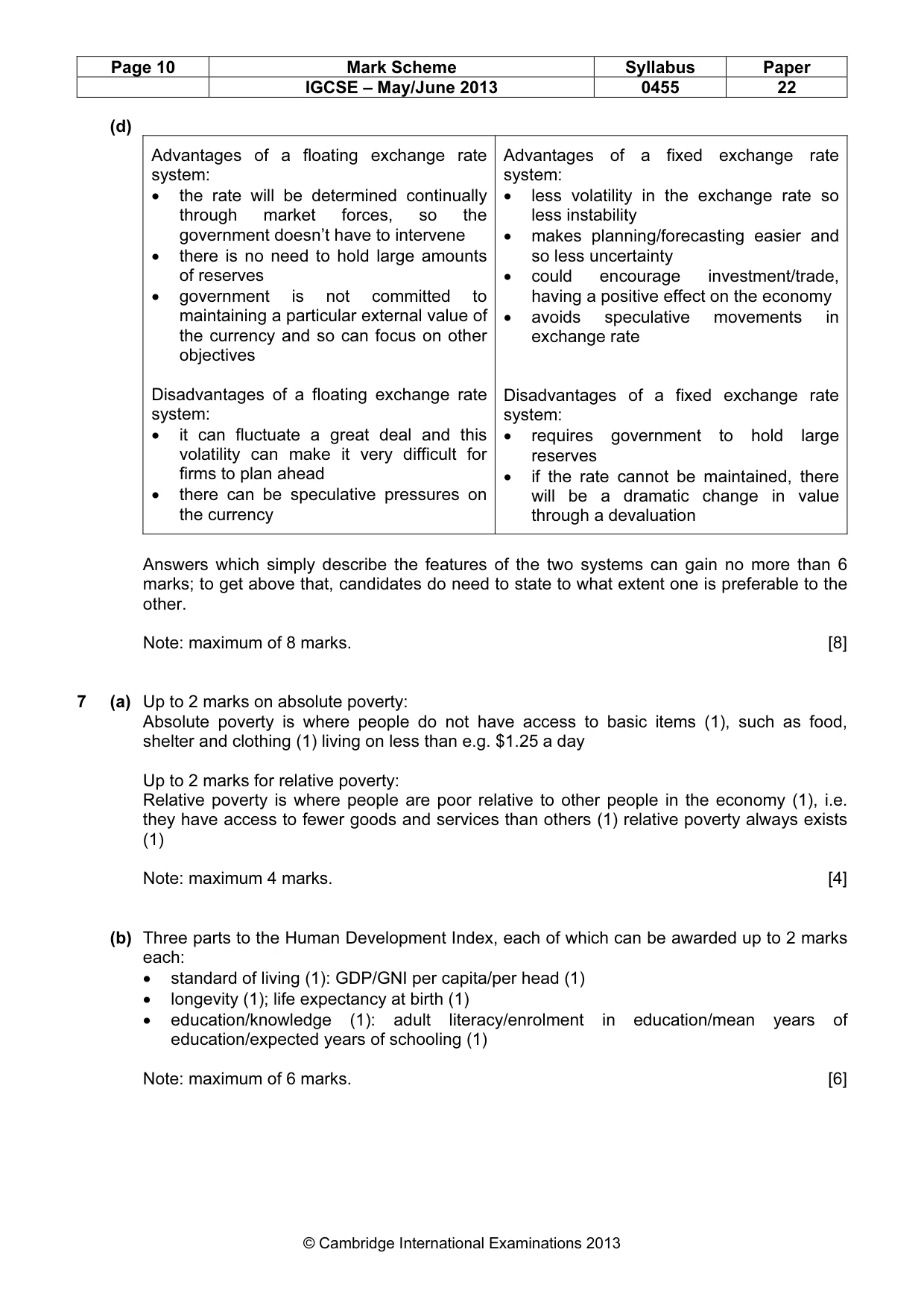
Page 10 Mark Scheme Syllabus Paper IGCSE – May/June 2013 0455 22 © Cambridge International Examinations 2013 (d) Advantages of a floating exchange rate system: • the rate will be determined continually through market forces, so the government doesn’t have to intervene • there is no need to hold large amounts of reserves • government is not committed to maintaining a particular external value of the currency and so can focus on other objectives Disadvantages of a floating exchange rate system: • it can fluctuate a great deal and this volatility can make it very difficult for firms to plan ahead • there can be speculative pressures on the currency Advantages of a fixed exchange rate system: • less volatility in the exchange rate so less instability • makes planning/forecasting easier and so less uncertainty • could encourage investment/trade, having a positive effect on the economy • avoids speculative movements in exchange rate Disadvantages of a fixed exchange rate system: • requires government to hold large reserves • if the rate cannot be maintained, there will be a dramatic change in value through a devaluation Answers which simply describe the features of the two systems can gain no more than 6 marks; to get above that, candidates do need to state to what extent one is preferable to the other. Note: maximum of 8 marks. [8] 7 (a) Up to 2 marks on absolute poverty: Absolute poverty is where people do not have access to basic items (1), such as food, shelter and clothing (1) living on less than e.g. $1.25 a day Up to 2 marks for relative poverty: Relative poverty is where people are poor relative to other people in the economy (1), i.e. they have access to fewer goods and services than others (1) relative poverty always exists (1) Note: maximum 4 marks. [4] (b) Three parts to the Human Development Index, each of which can be awarded up to 2 marks each: • standard of living (1): GDP/GNI per capita/per head (1) • longevity (1); life expectancy at birth (1) • education/knowledge (1): adult literacy/enrolment in education/mean years of education/expected years of schooling (1) Note: maximum of 6 marks. [6]
Mark scheme, page 11
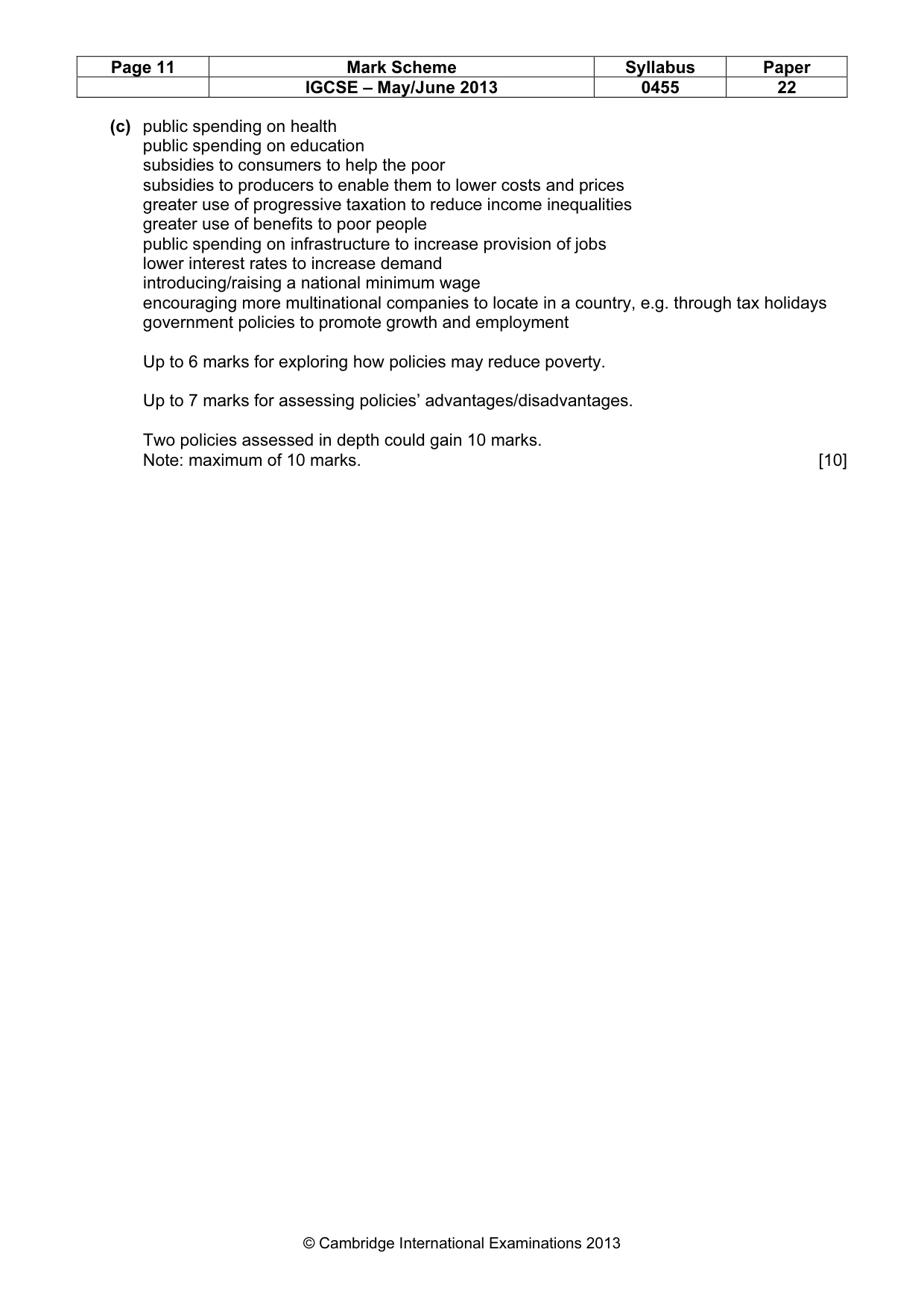
Page 11 Mark Scheme Syllabus Paper IGCSE – May/June 2013 0455 22 © Cambridge International Examinations 2013 (c) public spending on health public spending on education subsidies to consumers to help the poor subsidies to producers to enable them to lower costs and prices greater use of progressive taxation to reduce income inequalities greater use of benefits to poor people public spending on infrastructure to increase provision of jobs lower interest rates to increase demand introducing/raising a national minimum wage encouraging more multinational companies to locate in a country, e.g. through tax holidays government policies to promote growth and employment Up to 6 marks for exploring how policies may reduce poverty. Up to 7 marks for assessing policies’ advantages/disadvantages. Two policies assessed in depth could gain 10 marks. Note: maximum of 10 marks. [10]
What you needed in this session
Cambridge’s own grade thresholds for 2013 May/June, Paper 2 · Variant 2. A higher threshold means an easier paper — the bar moves with how the cohort did.