Cambridge IGCSE Economics 0455 — 2013 May/June Paper 2 · Variant 1
0455/21/M/J/13 · 80 marks · ≈90 min
The question paper and its mark scheme, free to read here and free to download. This is Cambridge’s own paper, exactly as it was sat.
Question paper4 pages
Mark scheme12 pages
Answers below. Sit the paper first if you are practising.
Paper as text
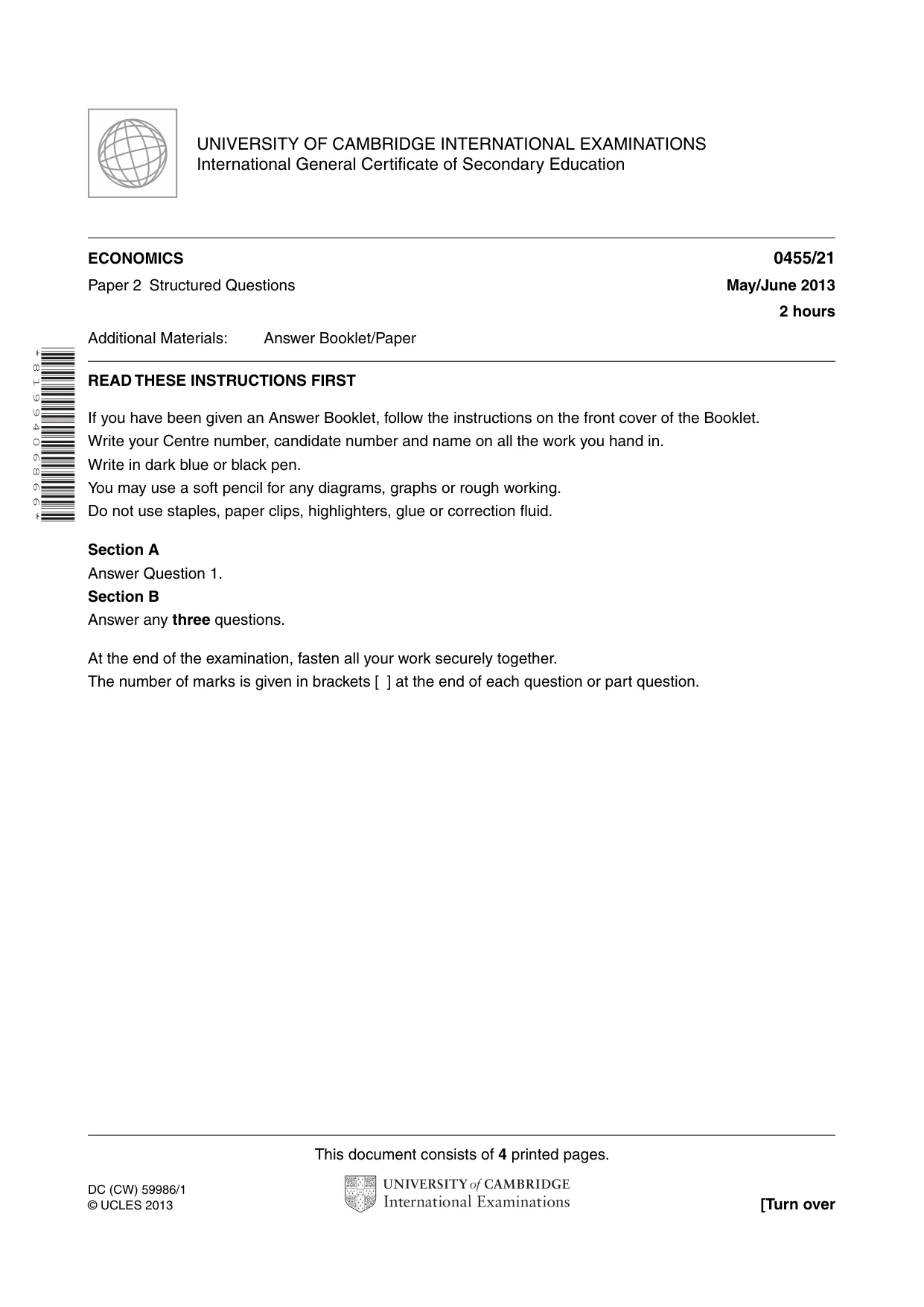
Question paper, page 1
This document consists of 4 printed pages. DC (CW) 59986/1 © UCLES 2013 [Turn over UNIVERSITY OF CAMBRIDGE INTERNATIONAL EXAMINATIONS International General Certificate of Secondary Education * 8 1 9 9 4 0 6 8 6 6 * ECONOMICS 0455/21 Paper 2 Structured Questions May/June 2013 2 hours Additional Materials: Answer Booklet/Paper READ THESE INSTRUCTIONS FIRST If you have been given an Answer Booklet, follow the instructions on the front cover of the Booklet. Write your Centre number, candidate number and name on all the work you hand in. Write in dark blue or black pen. You may use a soft pencil for any diagrams, graphs or rough working. Do not use staples, paper clips, highlighters, glue or correction fluid. Section A Answer Question 1. Section B Answer any three questions. At the end of the examination, fasten all your work securely together. The number of marks is given in brackets [ ] at the end of each question or part question.
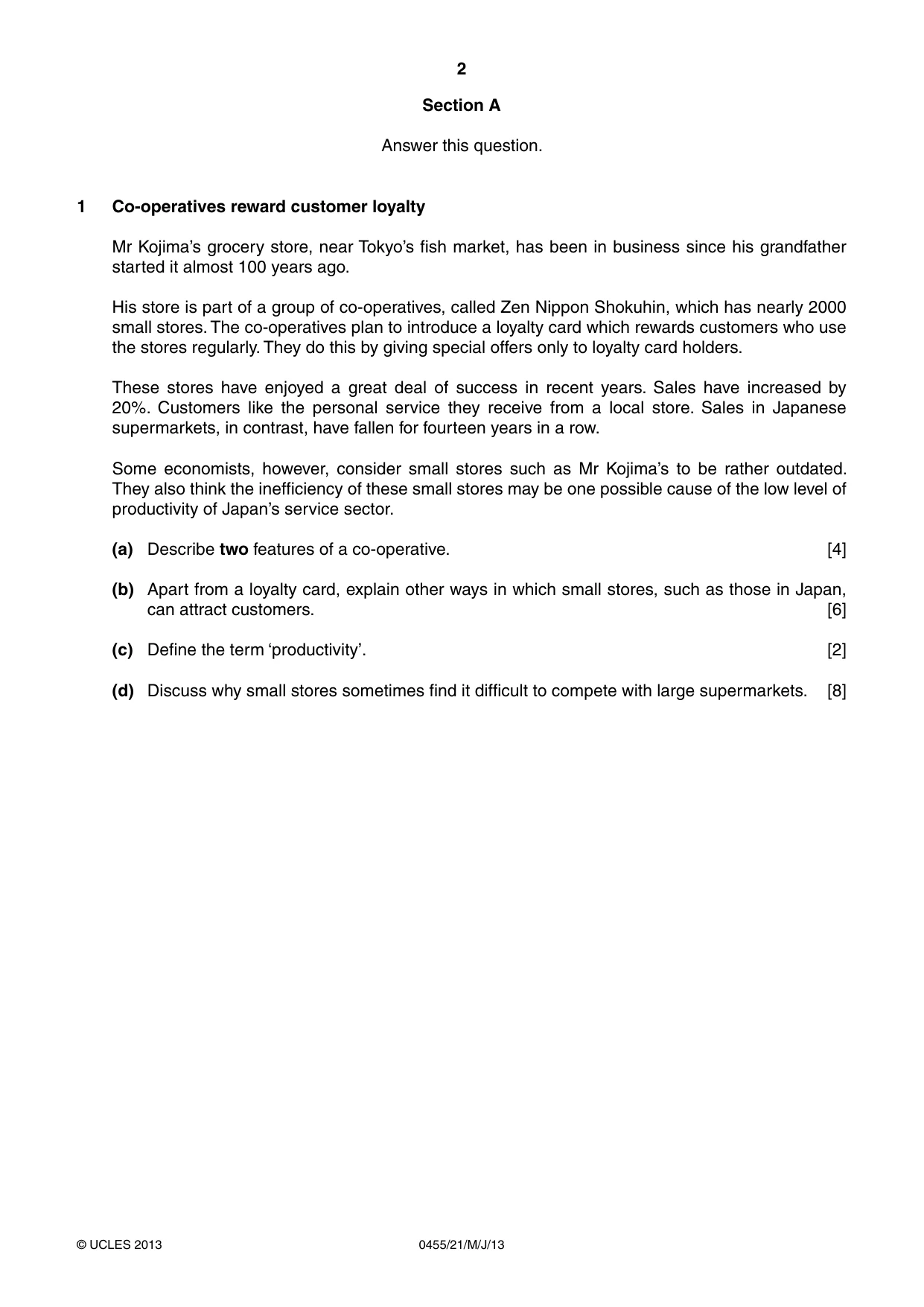
Question paper, page 2
2 0455/21/M/J/13 © UCLES 2013 Section A Answer this question. 1 Co-operatives reward customer loyalty Mr Kojima’s grocery store, near Tokyo’s fish market, has been in business since his grandfather started it almost 100 years ago. His store is part of a group of co-operatives, called Zen Nippon Shokuhin, which has nearly 2000 small stores. The co-operatives plan to introduce a loyalty card which rewards customers who use the stores regularly. They do this by giving special offers only to loyalty card holders. These stores have enjoyed a great deal of success in recent years. Sales have increased by 20%. Customers like the personal service they receive from a local store. Sales in Japanese supermarkets, in contrast, have fallen for fourteen years in a row. Some economists, however, consider small stores such as Mr Kojima’s to be rather outdated. They also think the inefficiency of these small stores may be one possible cause of the low level of productivity of Japan’s service sector. (a) Describe two features of a co-operative. [4] (b) Apart from a loyalty card, explain other ways in which small stores, such as those in Japan, can attract customers. [6] (c) Define the term ‘productivity’. [2] (d) Discuss why small stores sometimes find it difficult to compete with large supermarkets. [8]
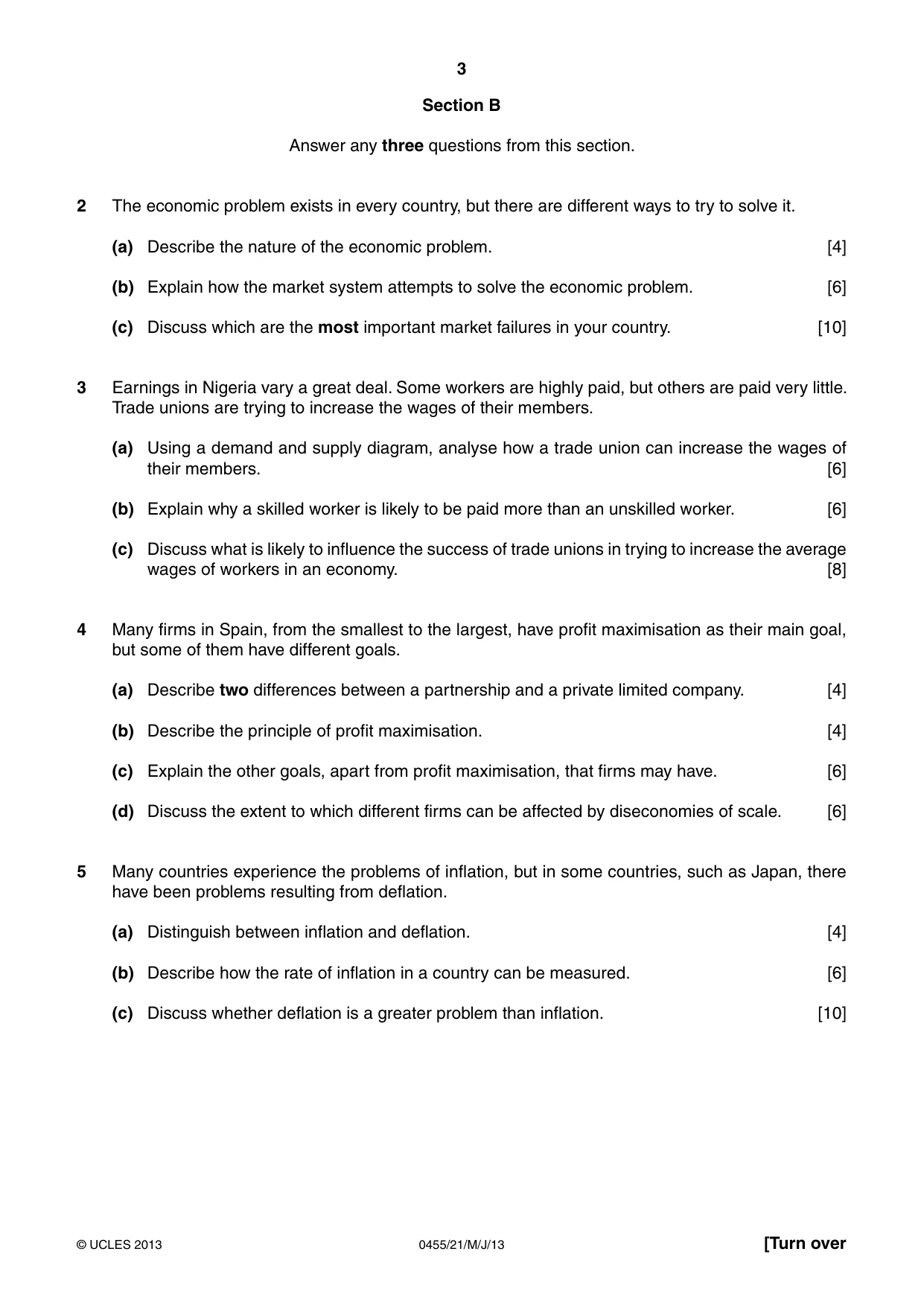
Question paper, page 3
3 0455/21/M/J/13 © UCLES 2013 [Turn over Section B Answer any three questions from this section. 2 The economic problem exists in every country, but there are different ways to try to solve it. (a) Describe the nature of the economic problem. [4] (b) Explain how the market system attempts to solve the economic problem. [6] (c) Discuss which are the most important market failures in your country. [10] 3 Earnings in Nigeria vary a great deal. Some workers are highly paid, but others are paid very little. Trade unions are trying to increase the wages of their members. (a) Using a demand and supply diagram, analyse how a trade union can increase the wages of their members. [6] (b) Explain why a skilled worker is likely to be paid more than an unskilled worker. [6] (c) Discuss what is likely to influence the success of trade unions in trying to increase the average wages of workers in an economy. [8] 4 Many firms in Spain, from the smallest to the largest, have profit maximisation as their main goal, but some of them have different goals. (a) Describe two differences between a partnership and a private limited company. [4] (b) Describe the principle of profit maximisation. [4] (c) Explain the other goals, apart from profit maximisation, that firms may have. [6] (d) Discuss the extent to which different firms can be affected by diseconomies of scale. [6] 5 Many countries experience the problems of inflation, but in some countries, such as Japan, there have been problems resulting from deflation. (a) Distinguish between inflation and deflation. [4] (b) Describe how the rate of inflation in a country can be measured. [6] (c) Discuss whether deflation is a greater problem than inflation. [10]
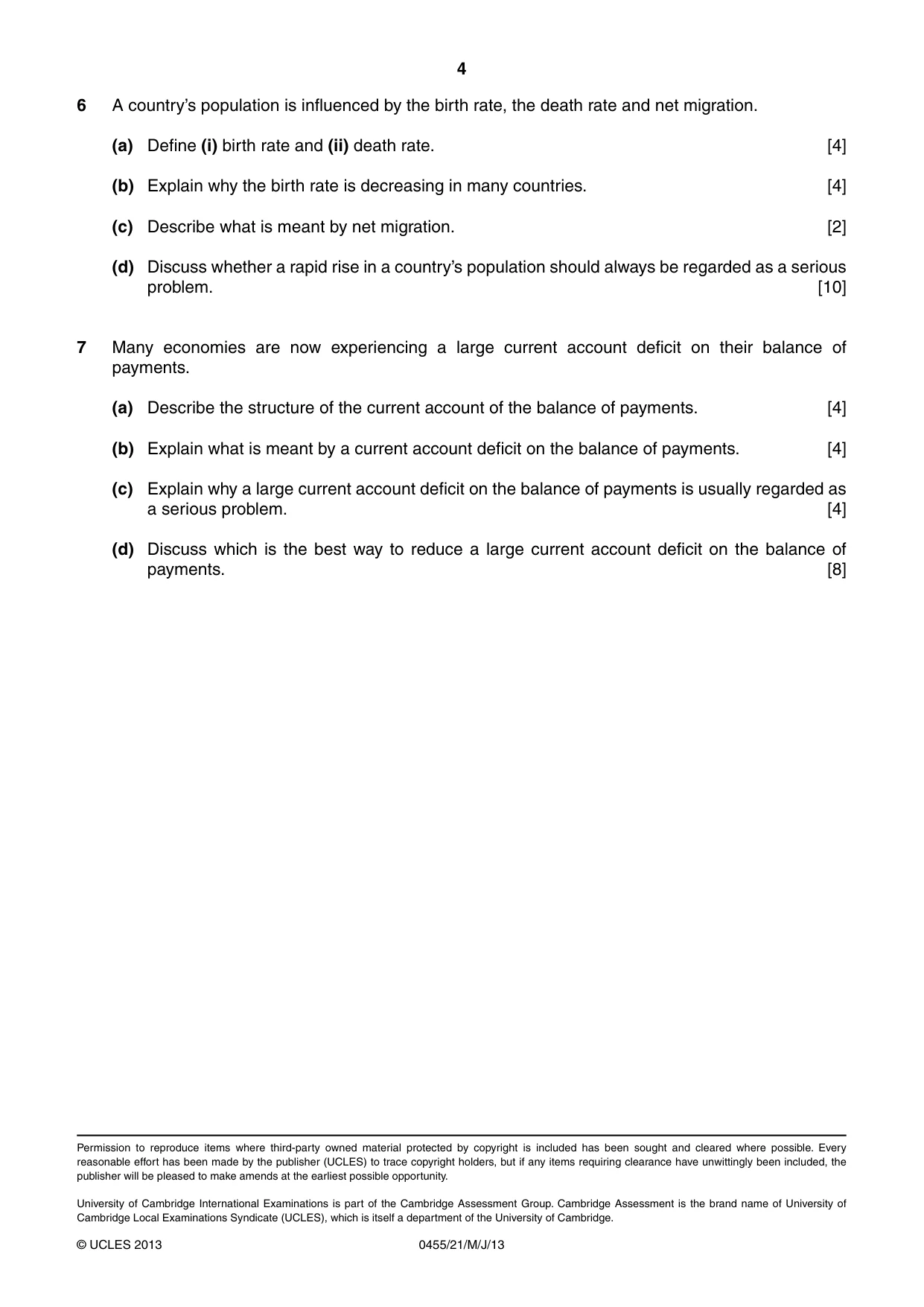
Question paper, page 4
4 0455/21/M/J/13 © UCLES 2013 6 A country’s population is influenced by the birth rate, the death rate and net migration. (a) Define (i) birth rate and (ii) death rate. [4] (b) Explain why the birth rate is decreasing in many countries. [4] (c) Describe what is meant by net migration. [2] (d) Discuss whether a rapid rise in a country’s population should always be regarded as a serious problem. [10] 7 Many economies are now experiencing a large current account deficit on their balance of payments. (a) Describe the structure of the current account of the balance of payments. [4] (b) Explain what is meant by a current account deficit on the balance of payments. [4] (c) Explain why a large current account deficit on the balance of payments is usually regarded as a serious problem. [4] (d) Discuss which is the best way to reduce a large current account deficit on the balance of payments. [8] Permission to reproduce items where third-party owned material protected by copyright is included has been sought and cleared where possible. Every reasonable effort has been made by the publisher (UCLES) to trace copyright holders, but if any items requiring clearance have unwittingly been included, the publisher will be pleased to make amends at the earliest possible opportunity. University of Cambridge International Examinations is part of the Cambridge Assessment Group. Cambridge Assessment is the brand name of University of Cambridge Local Examinations Syndicate (UCLES), which is itself a department of the University of Cambridge.
Mark scheme, page 1
CAMBRIDGE INTERNATIONAL EXAMINATIONS International General Certificate of Secondary Education MARK SCHEME for the May/June 2013 series 0455 ECONOMICS 0455/21 Paper 2 (Structured Questions), maximum raw mark 80 This mark scheme is published as an aid to teachers and candidates, to indicate the requirements of the examination. It shows the basis on which Examiners were instructed to award marks. It does not indicate the details of the discussions that took place at an Examiners’ meeting before marking began, which would have considered the acceptability of alternative answers. Mark schemes should be read in conjunction with the question paper and the Principal Examiner Report for Teachers. Cambridge will not enter into discussions about these mark schemes. Cambridge is publishing the mark schemes for the May/June 2013 series for most IGCSE, GCE Advanced Level and Advanced Subsidiary Level components and some Ordinary Level components.
Mark scheme, page 2
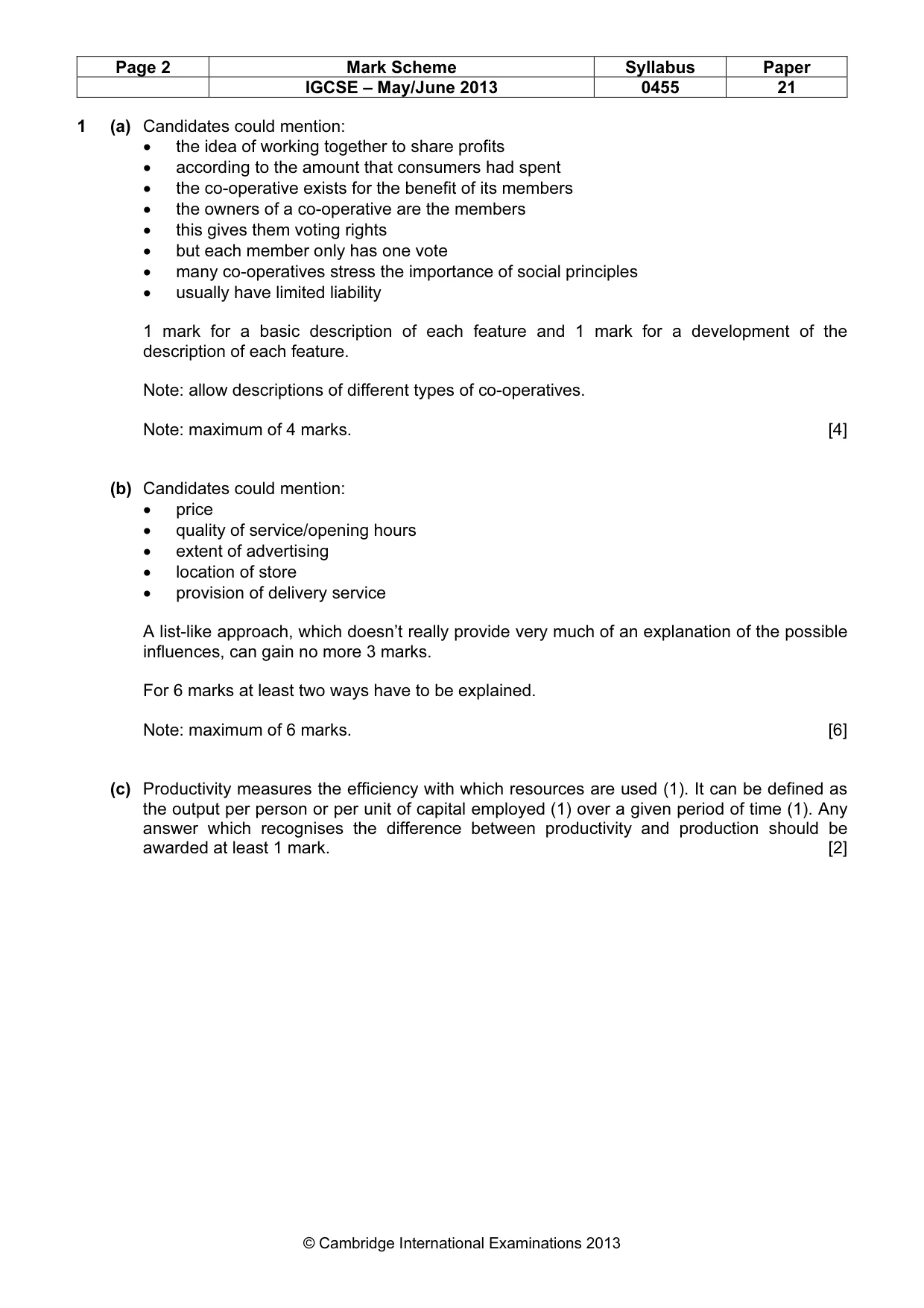
Page 2 Mark Scheme Syllabus Paper IGCSE – May/June 2013 0455 21 © Cambridge International Examinations 2013 1 (a) Candidates could mention: • the idea of working together to share profits • according to the amount that consumers had spent • the co-operative exists for the benefit of its members • the owners of a co-operative are the members • this gives them voting rights • but each member only has one vote • many co-operatives stress the importance of social principles • usually have limited liability 1 mark for a basic description of each feature and 1 mark for a development of the description of each feature. Note: allow descriptions of different types of co-operatives. Note: maximum of 4 marks. [4] (b) Candidates could mention: • price • quality of service/opening hours • extent of advertising • location of store • provision of delivery service A list-like approach, which doesn’t really provide very much of an explanation of the possible influences, can gain no more 3 marks. For 6 marks at least two ways have to be explained. Note: maximum of 6 marks. [6] (c) Productivity measures the efficiency with which resources are used (1). It can be defined as the output per person or per unit of capital employed (1) over a given period of time (1). Any answer which recognises the difference between productivity and production should be awarded at least 1 mark. [2]
Mark scheme, page 3
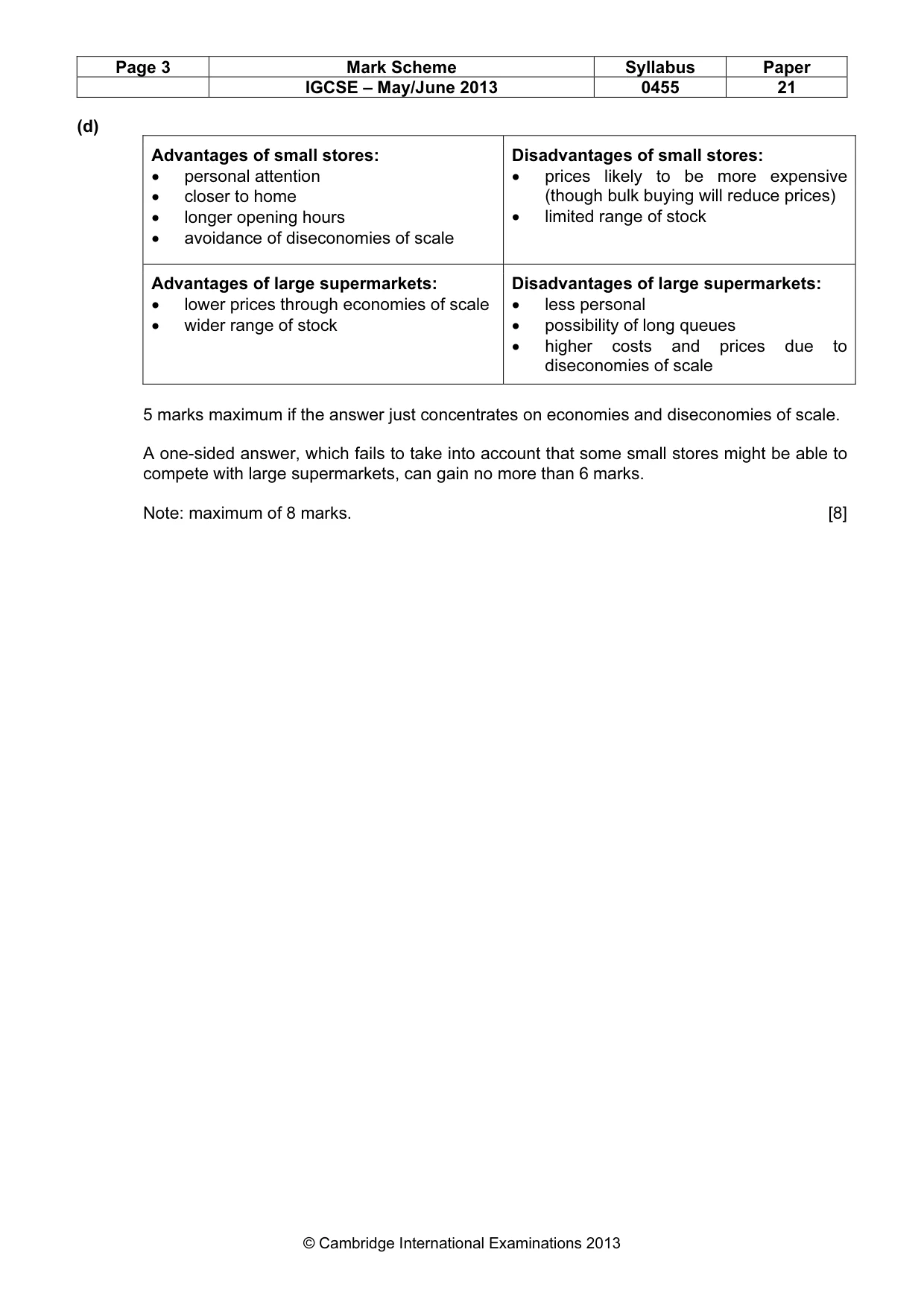
Page 3 Mark Scheme Syllabus Paper IGCSE – May/June 2013 0455 21 © Cambridge International Examinations 2013 (d) Advantages of small stores: • personal attention • closer to home • longer opening hours • avoidance of diseconomies of scale Disadvantages of small stores: • prices likely to be more expensive (though bulk buying will reduce prices) • limited range of stock Advantages of large supermarkets: • lower prices through economies of scale • wider range of stock Disadvantages of large supermarkets: • less personal • possibility of long queues • higher costs and prices due to diseconomies of scale 5 marks maximum if the answer just concentrates on economies and diseconomies of scale. A one-sided answer, which fails to take into account that some small stores might be able to compete with large supermarkets, can gain no more than 6 marks. Note: maximum of 8 marks. [8]
Mark scheme, page 4
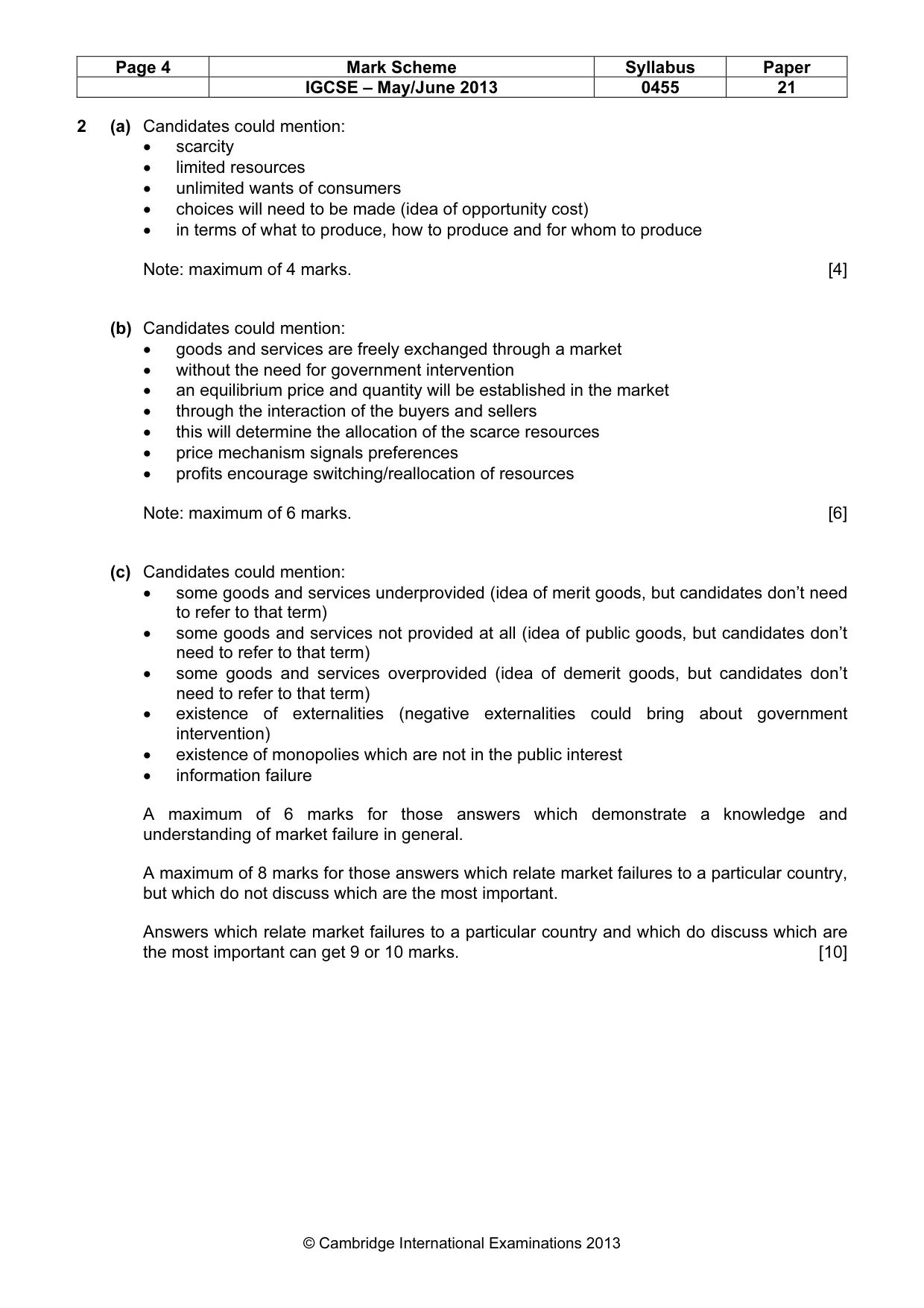
Page 4 Mark Scheme Syllabus Paper IGCSE – May/June 2013 0455 21 © Cambridge International Examinations 2013 2 (a) Candidates could mention: • scarcity • limited resources • unlimited wants of consumers • choices will need to be made (idea of opportunity cost) • in terms of what to produce, how to produce and for whom to produce Note: maximum of 4 marks. [4] (b) Candidates could mention: • goods and services are freely exchanged through a market • without the need for government intervention • an equilibrium price and quantity will be established in the market • through the interaction of the buyers and sellers • this will determine the allocation of the scarce resources • price mechanism signals preferences • profits encourage switching/reallocation of resources Note: maximum of 6 marks. [6] (c) Candidates could mention: • some goods and services underprovided (idea of merit goods, but candidates don’t need to refer to that term) • some goods and services not provided at all (idea of public goods, but candidates don’t need to refer to that term) • some goods and services overprovided (idea of demerit goods, but candidates don’t need to refer to that term) • existence of externalities (negative externalities could bring about government intervention) • existence of monopolies which are not in the public interest • information failure A maximum of 6 marks for those answers which demonstrate a knowledge and understanding of market failure in general. A maximum of 8 marks for those answers which relate market failures to a particular country, but which do not discuss which are the most important. Answers which relate market failures to a particular country and which do discuss which are the most important can get 9 or 10 marks. [10]
Mark scheme, page 5
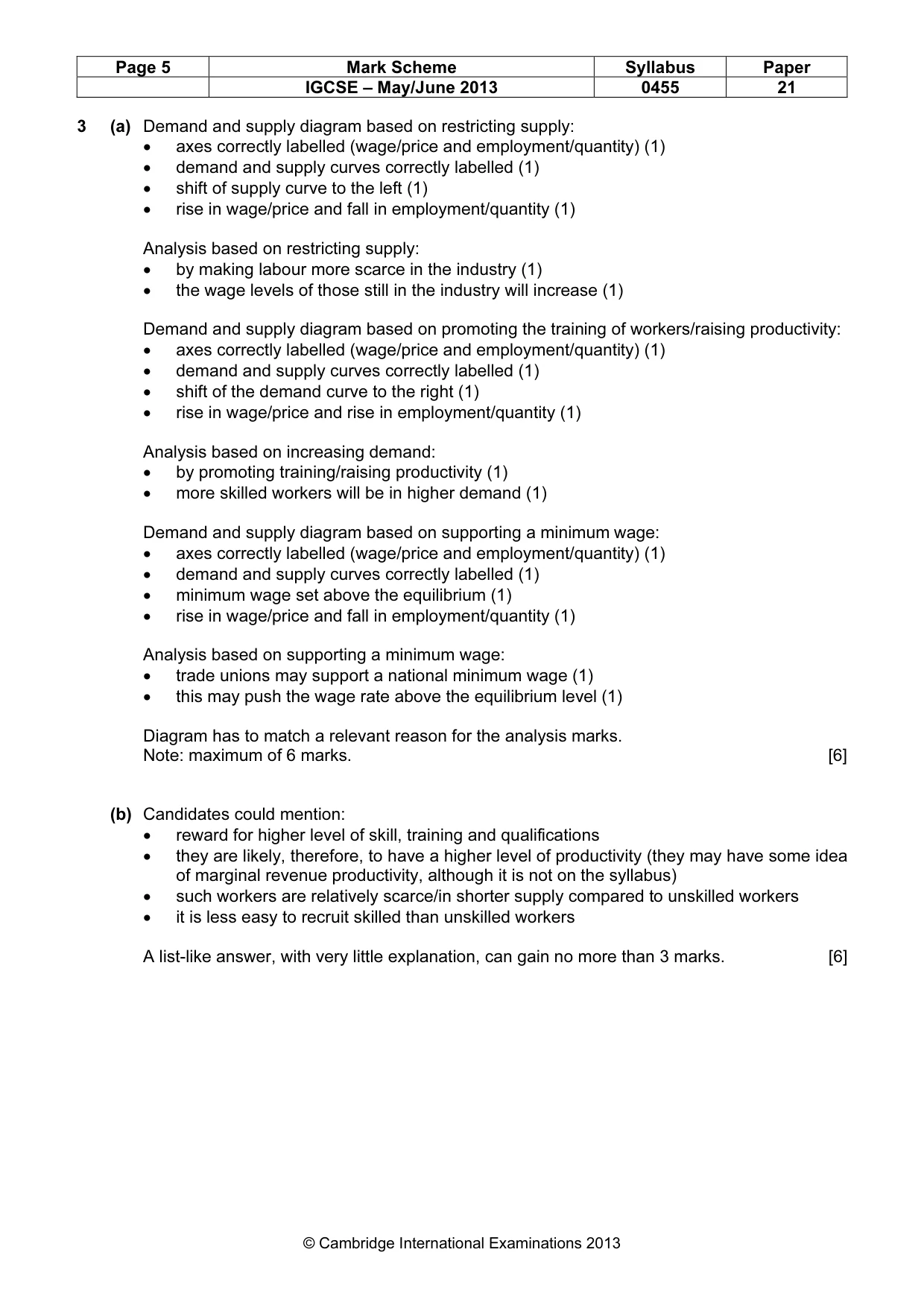
Page 5 Mark Scheme Syllabus Paper IGCSE – May/June 2013 0455 21 © Cambridge International Examinations 2013 3 (a) Demand and supply diagram based on restricting supply: • axes correctly labelled (wage/price and employment/quantity) (1) • demand and supply curves correctly labelled (1) • shift of supply curve to the left (1) • rise in wage/price and fall in employment/quantity (1) Analysis based on restricting supply: • by making labour more scarce in the industry (1) • the wage levels of those still in the industry will increase (1) Demand and supply diagram based on promoting the training of workers/raising productivity: • axes correctly labelled (wage/price and employment/quantity) (1) • demand and supply curves correctly labelled (1) • shift of the demand curve to the right (1) • rise in wage/price and rise in employment/quantity (1) Analysis based on increasing demand: • by promoting training/raising productivity (1) • more skilled workers will be in higher demand (1) Demand and supply diagram based on supporting a minimum wage: • axes correctly labelled (wage/price and employment/quantity) (1) • demand and supply curves correctly labelled (1) • minimum wage set above the equilibrium (1) • rise in wage/price and fall in employment/quantity (1) Analysis based on supporting a minimum wage: • trade unions may support a national minimum wage (1) • this may push the wage rate above the equilibrium level (1) Diagram has to match a relevant reason for the analysis marks. Note: maximum of 6 marks. [6] (b) Candidates could mention: • reward for higher level of skill, training and qualifications • they are likely, therefore, to have a higher level of productivity (they may have some idea of marginal revenue productivity, although it is not on the syllabus) • such workers are relatively scarce/in shorter supply compared to unskilled workers • it is less easy to recruit skilled than unskilled workers A list-like answer, with very little explanation, can gain no more than 3 marks. [6]
Mark scheme, page 6
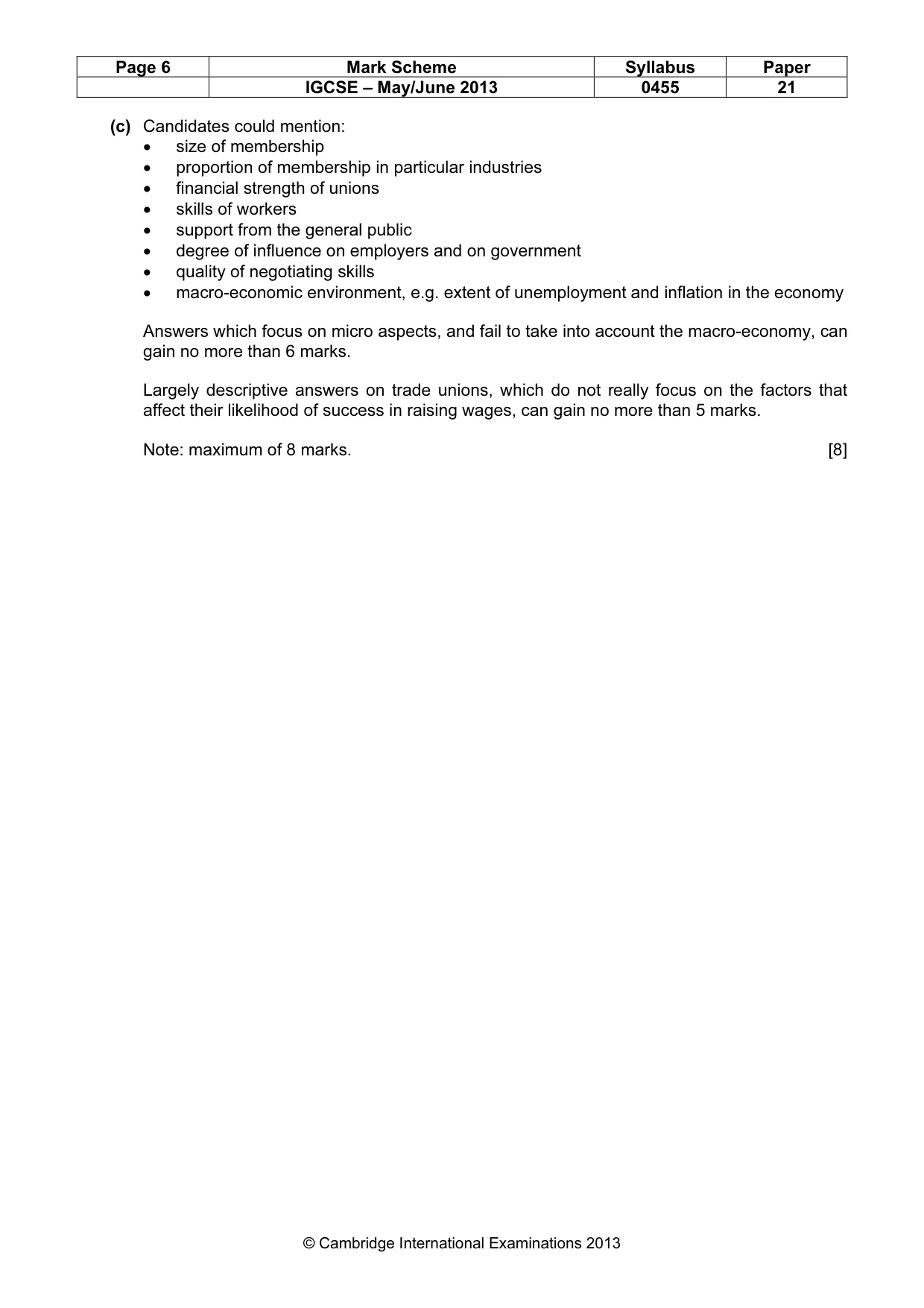
Page 6 Mark Scheme Syllabus Paper IGCSE – May/June 2013 0455 21 © Cambridge International Examinations 2013 (c) Candidates could mention: • size of membership • proportion of membership in particular industries • financial strength of unions • skills of workers • support from the general public • degree of influence on employers and on government • quality of negotiating skills • macro-economic environment, e.g. extent of unemployment and inflation in the economy Answers which focus on micro aspects, and fail to take into account the macro-economy, can gain no more than 6 marks. Largely descriptive answers on trade unions, which do not really focus on the factors that affect their likelihood of success in raising wages, can gain no more than 5 marks. Note: maximum of 8 marks. [8]
Mark scheme, page 7
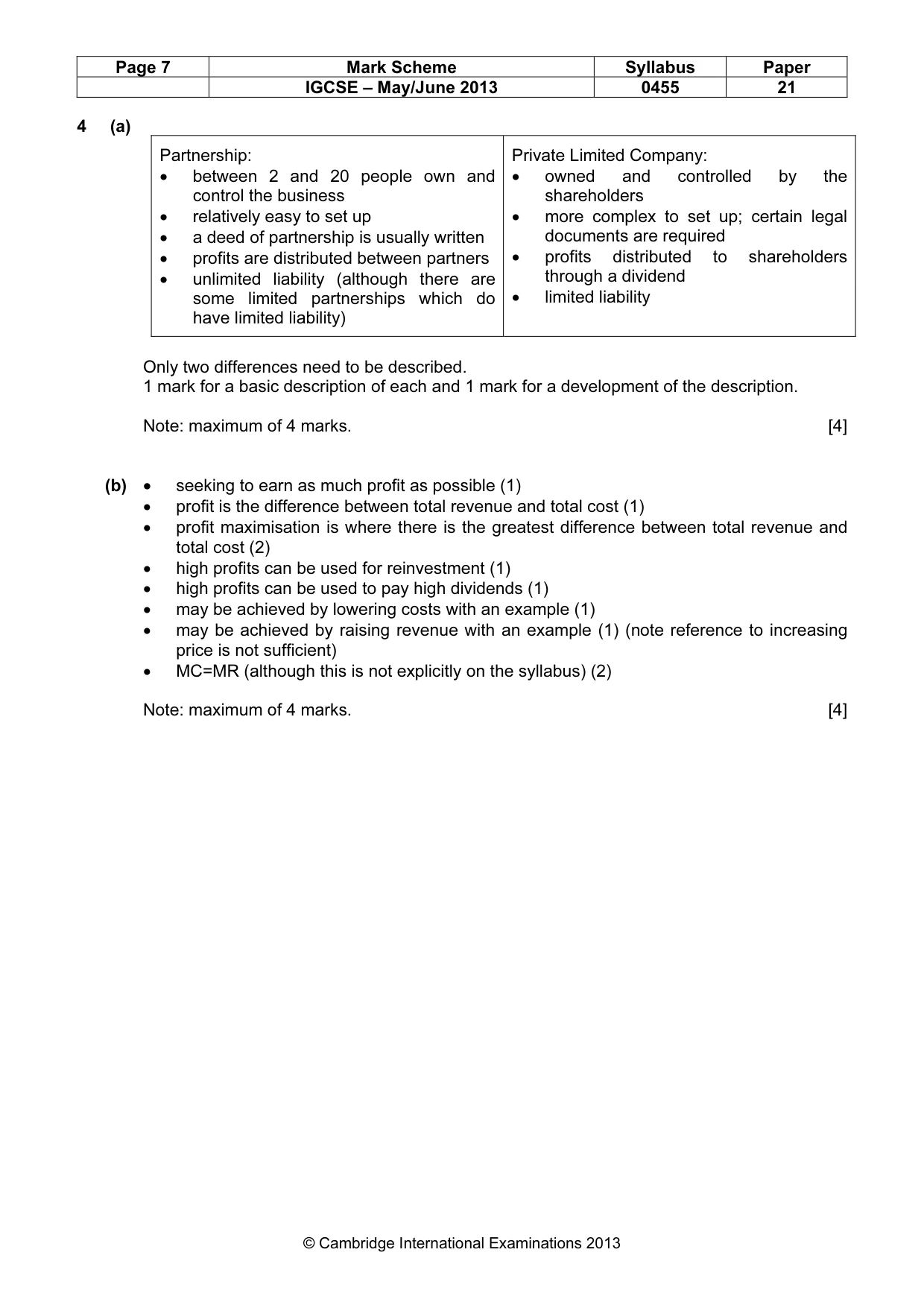
Page 7 Mark Scheme Syllabus Paper IGCSE – May/June 2013 0455 21 © Cambridge International Examinations 2013 4 (a) Partnership: • between 2 and 20 people own and control the business • relatively easy to set up • a deed of partnership is usually written • profits are distributed between partners • unlimited liability (although there are some limited partnerships which do have limited liability) Private Limited Company: • owned and controlled by the shareholders • more complex to set up; certain legal documents are required • profits distributed to shareholders through a dividend • limited liability Only two differences need to be described. 1 mark for a basic description of each and 1 mark for a development of the description. Note: maximum of 4 marks. [4] (b) • seeking to earn as much profit as possible (1) • profit is the difference between total revenue and total cost (1) • profit maximisation is where there is the greatest difference between total revenue and total cost (2) • high profits can be used for reinvestment (1) • high profits can be used to pay high dividends (1) • may be achieved by lowering costs with an example (1) • may be achieved by raising revenue with an example (1) (note reference to increasing price is not sufficient) • MC=MR (although this is not explicitly on the syllabus) (2) Note: maximum of 4 marks. [4]
Mark scheme, page 8
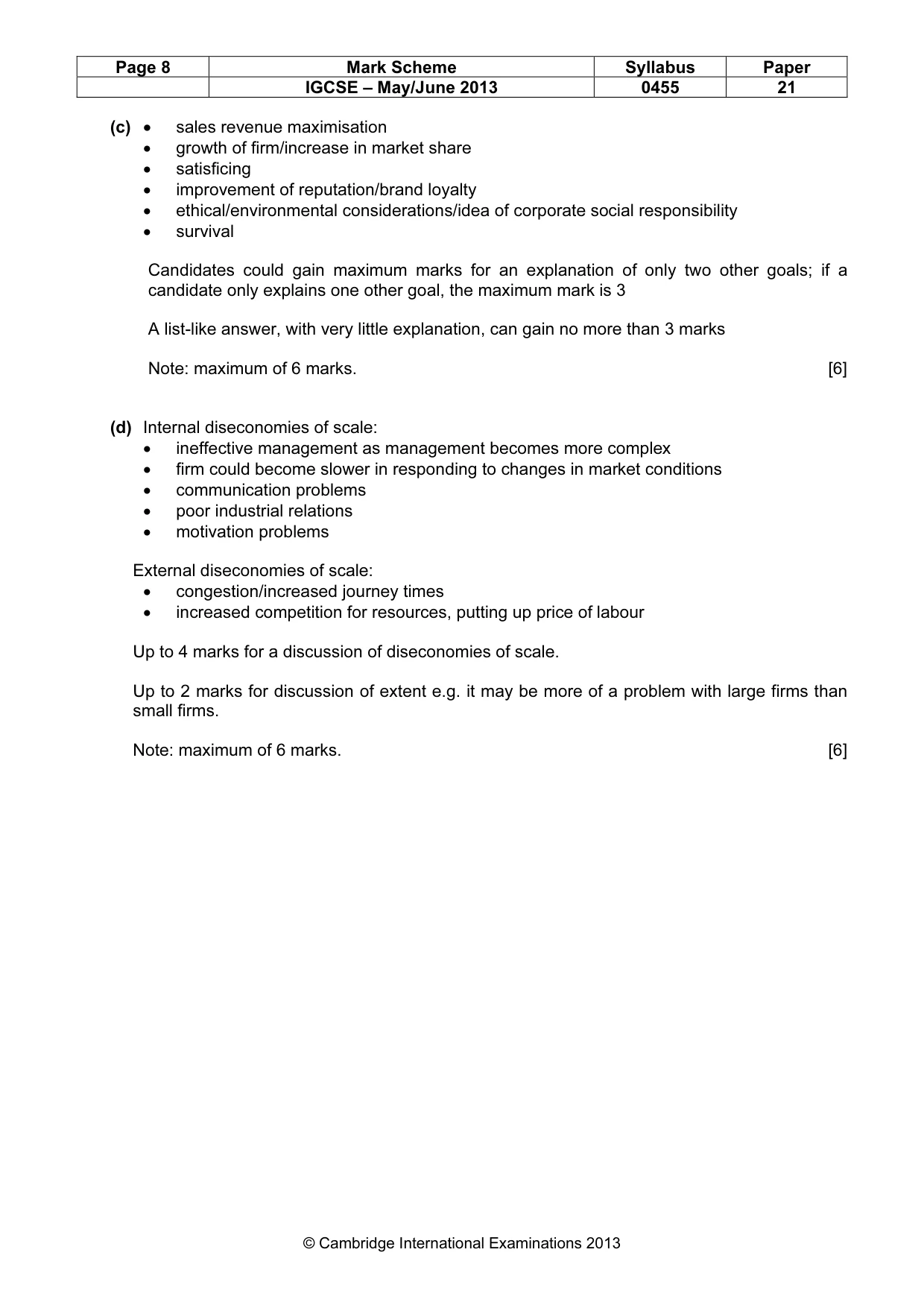
Page 8 Mark Scheme Syllabus Paper IGCSE – May/June 2013 0455 21 © Cambridge International Examinations 2013 (c) • sales revenue maximisation • growth of firm/increase in market share • satisficing • improvement of reputation/brand loyalty • ethical/environmental considerations/idea of corporate social responsibility • survival Candidates could gain maximum marks for an explanation of only two other goals; if a candidate only explains one other goal, the maximum mark is 3 A list-like answer, with very little explanation, can gain no more than 3 marks Note: maximum of 6 marks. [6] (d) Internal diseconomies of scale: • ineffective management as management becomes more complex • firm could become slower in responding to changes in market conditions • communication problems • poor industrial relations • motivation problems External diseconomies of scale: • congestion/increased journey times • increased competition for resources, putting up price of labour Up to 4 marks for a discussion of diseconomies of scale. Up to 2 marks for discussion of extent e.g. it may be more of a problem with large firms than small firms. Note: maximum of 6 marks. [6]
Mark scheme, page 9
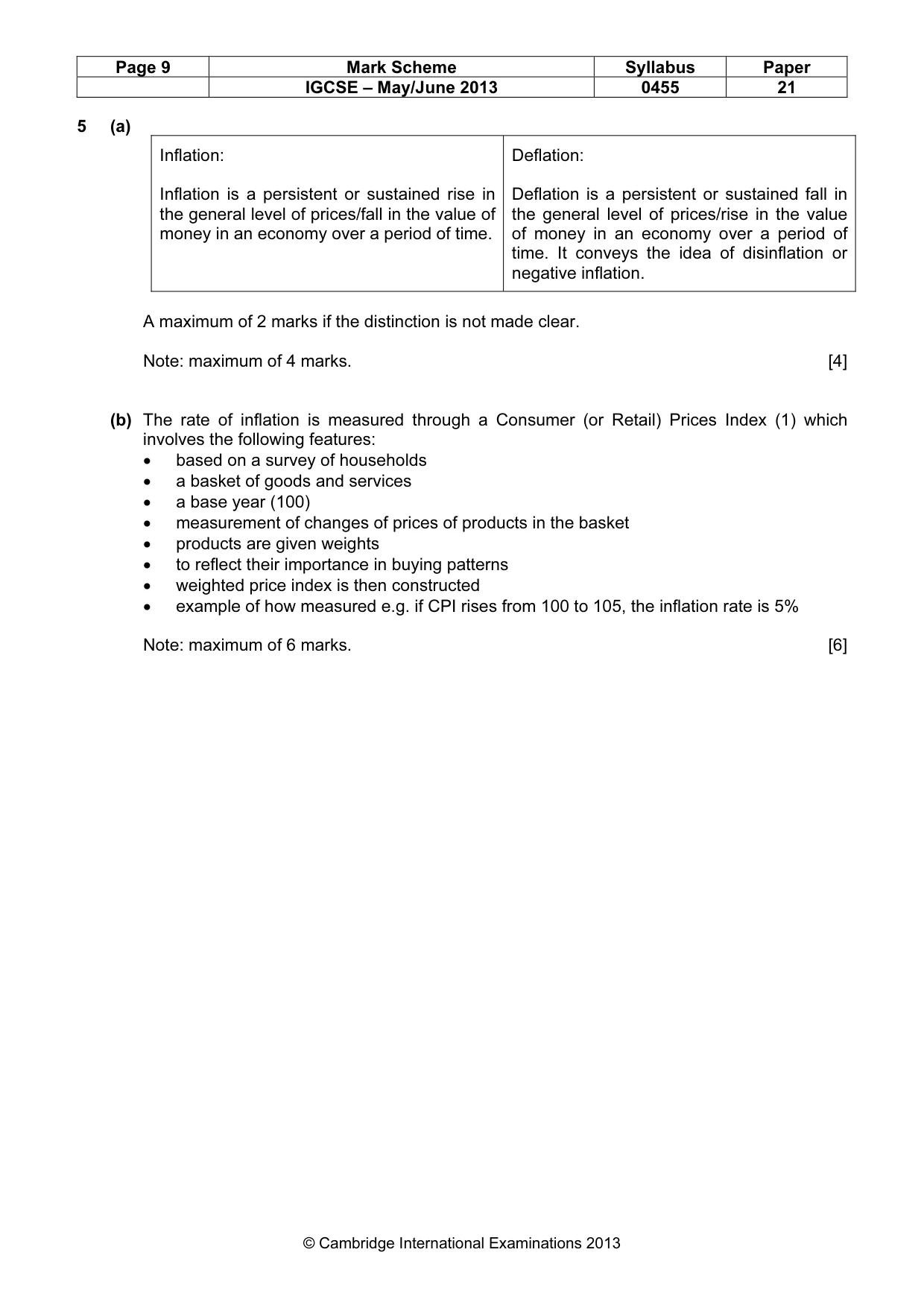
Page 9 Mark Scheme Syllabus Paper IGCSE – May/June 2013 0455 21 © Cambridge International Examinations 2013 5 (a) Inflation: Inflation is a persistent or sustained rise in the general level of prices/fall in the value of money in an economy over a period of time. Deflation: Deflation is a persistent or sustained fall in the general level of prices/rise in the value of money in an economy over a period of time. It conveys the idea of disinflation or negative inflation. A maximum of 2 marks if the distinction is not made clear. Note: maximum of 4 marks. [4] (b) The rate of inflation is measured through a Consumer (or Retail) Prices Index (1) which involves the following features: • based on a survey of households • a basket of goods and services • a base year (100) • measurement of changes of prices of products in the basket • products are given weights • to reflect their importance in buying patterns • weighted price index is then constructed • example of how measured e.g. if CPI rises from 100 to 105, the inflation rate is 5% Note: maximum of 6 marks. [6]
Mark scheme, page 10
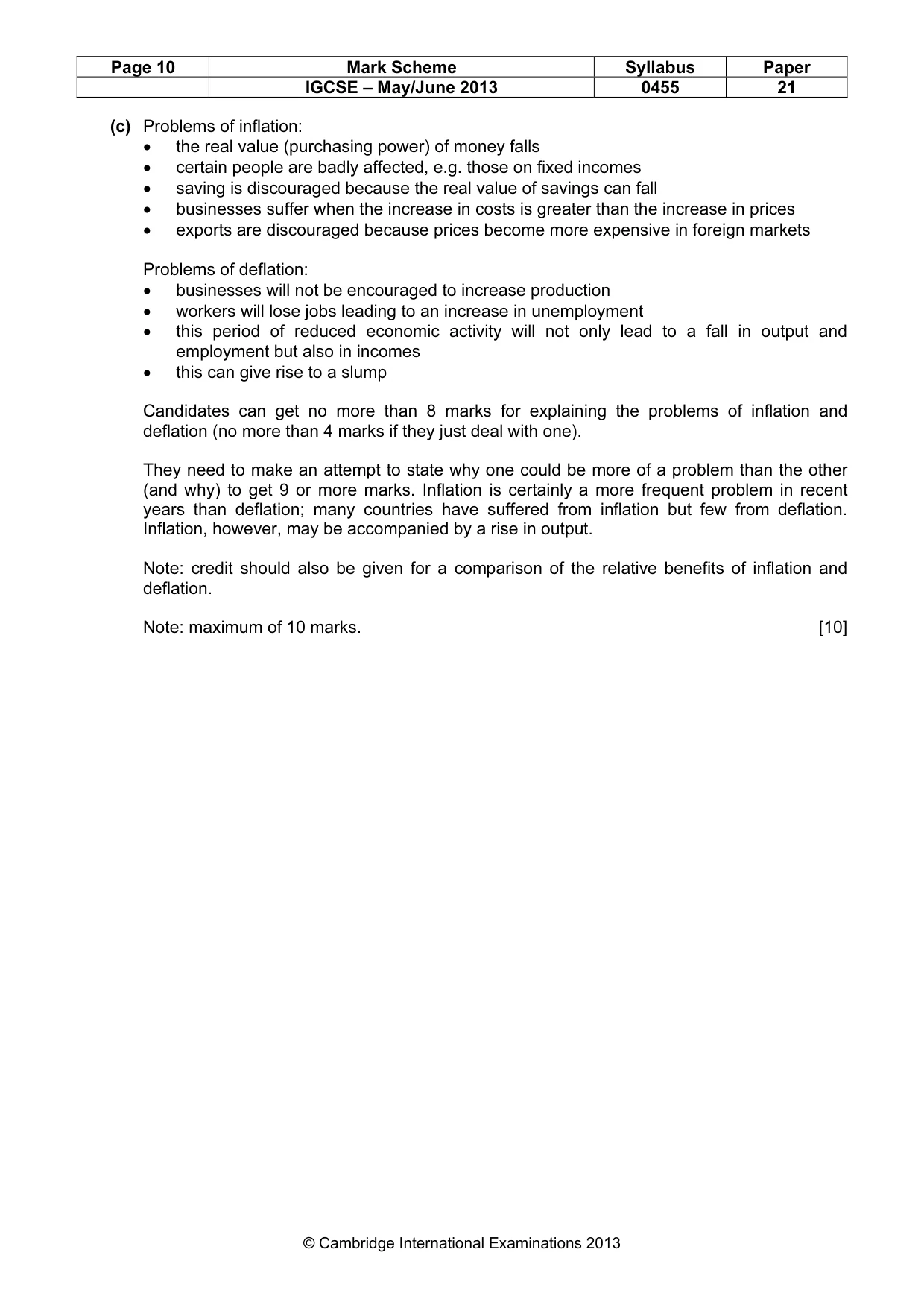
Page 10 Mark Scheme Syllabus Paper IGCSE – May/June 2013 0455 21 © Cambridge International Examinations 2013 (c) Problems of inflation: • the real value (purchasing power) of money falls • certain people are badly affected, e.g. those on fixed incomes • saving is discouraged because the real value of savings can fall • businesses suffer when the increase in costs is greater than the increase in prices • exports are discouraged because prices become more expensive in foreign markets Problems of deflation: • businesses will not be encouraged to increase production • workers will lose jobs leading to an increase in unemployment • this period of reduced economic activity will not only lead to a fall in output and employment but also in incomes • this can give rise to a slump Candidates can get no more than 8 marks for explaining the problems of inflation and deflation (no more than 4 marks if they just deal with one). They need to make an attempt to state why one could be more of a problem than the other (and why) to get 9 or more marks. Inflation is certainly a more frequent problem in recent years than deflation; many countries have suffered from inflation but few from deflation. Inflation, however, may be accompanied by a rise in output. Note: credit should also be given for a comparison of the relative benefits of inflation and deflation. Note: maximum of 10 marks. [10]
Mark scheme, page 11
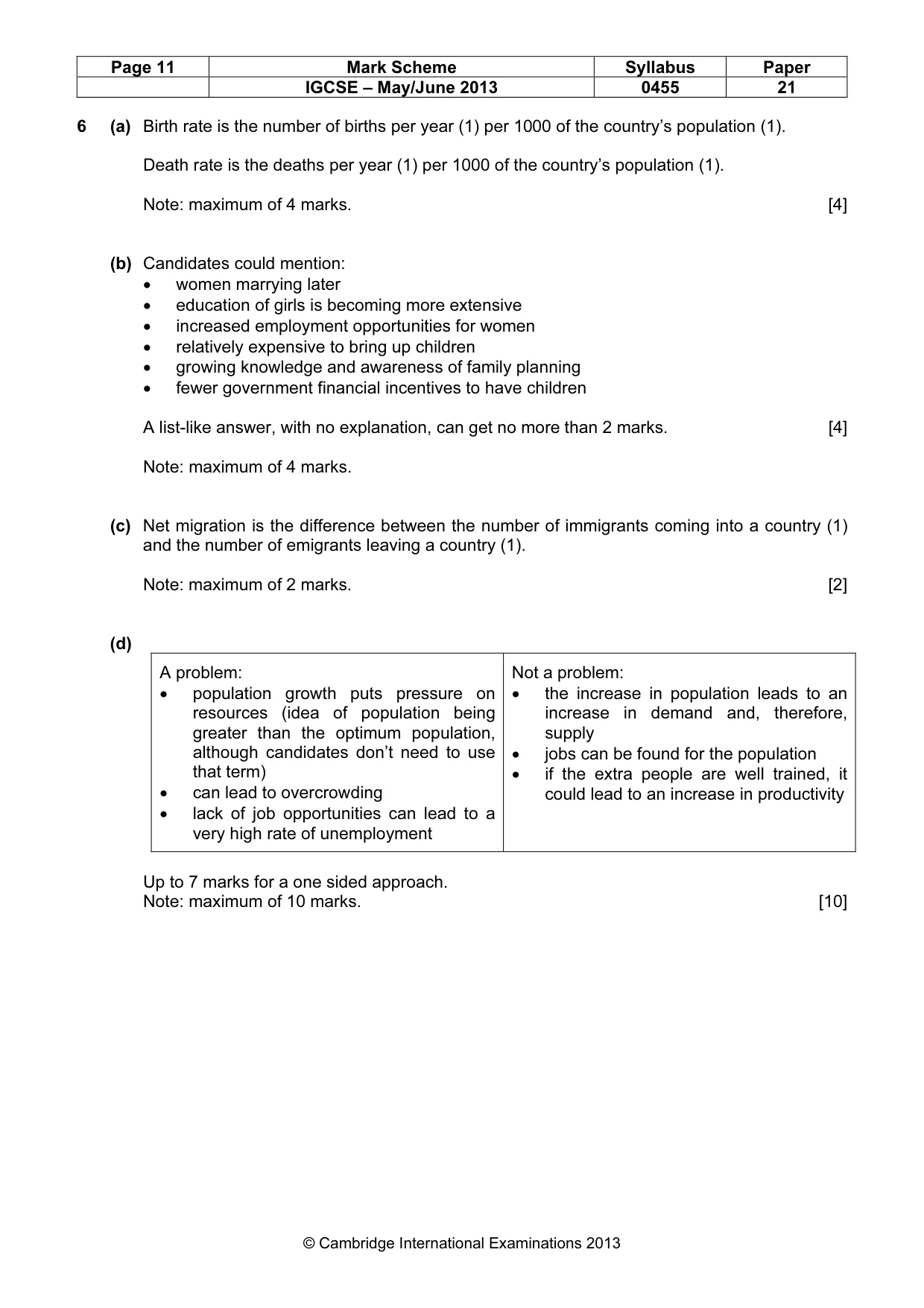
Page 11 Mark Scheme Syllabus Paper IGCSE – May/June 2013 0455 21 © Cambridge International Examinations 2013 6 (a) Birth rate is the number of births per year (1) per 1000 of the country’s population (1). Death rate is the deaths per year (1) per 1000 of the country’s population (1). Note: maximum of 4 marks. [4] (b) Candidates could mention: • women marrying later • education of girls is becoming more extensive • increased employment opportunities for women • relatively expensive to bring up children • growing knowledge and awareness of family planning • fewer government financial incentives to have children A list-like answer, with no explanation, can get no more than 2 marks. [4] Note: maximum of 4 marks. (c) Net migration is the difference between the number of immigrants coming into a country (1) and the number of emigrants leaving a country (1). Note: maximum of 2 marks. [2] (d) A problem: • population growth puts pressure on resources (idea of population being greater than the optimum population, although candidates don’t need to use that term) • can lead to overcrowding • lack of job opportunities can lead to a very high rate of unemployment Not a problem: • the increase in population leads to an increase in demand and, therefore, supply • jobs can be found for the population • if the extra people are well trained, it could lead to an increase in productivity Up to 7 marks for a one sided approach. Note: maximum of 10 marks. [10]
Mark scheme, page 12
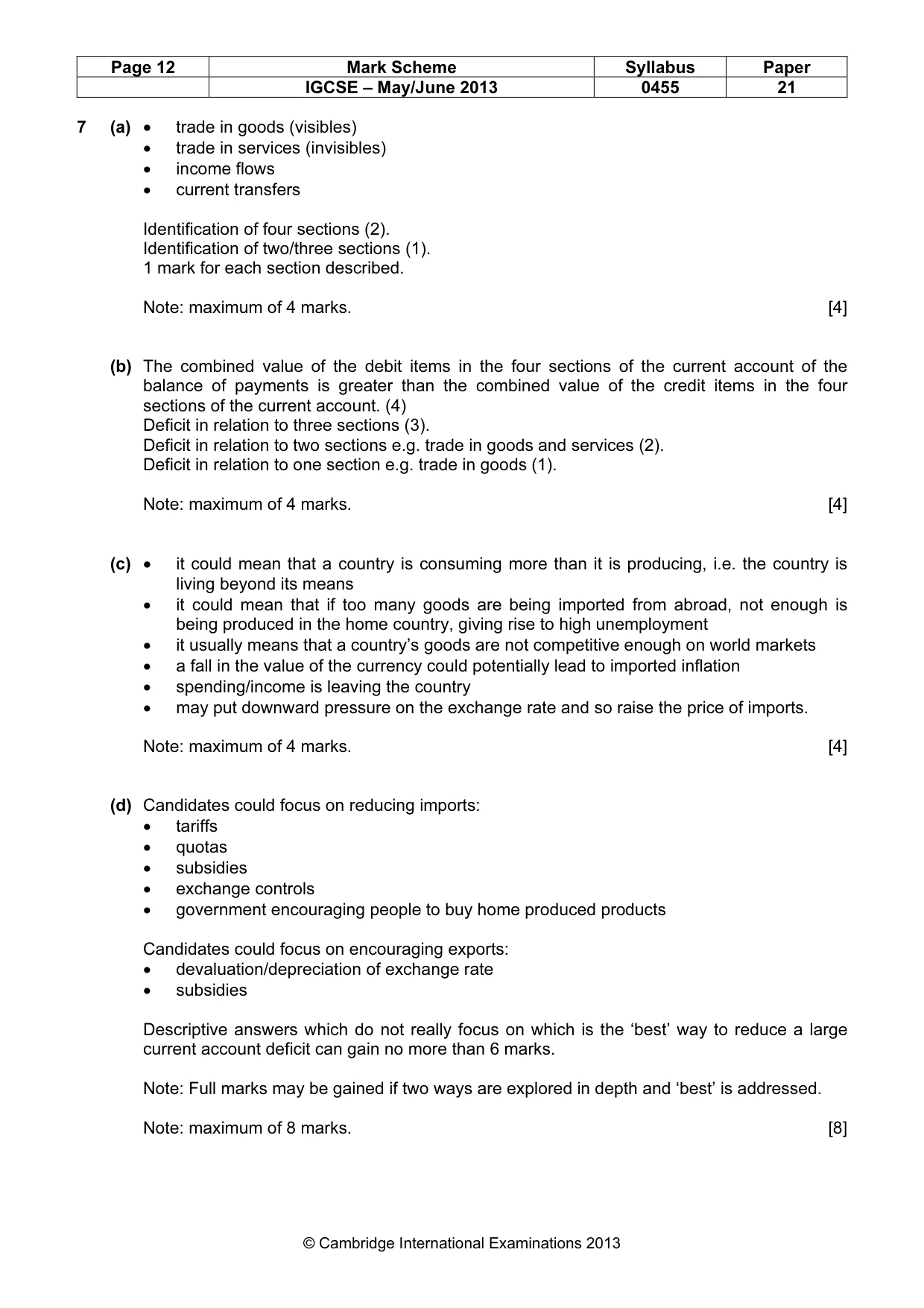
Page 12 Mark Scheme Syllabus Paper IGCSE – May/June 2013 0455 21 © Cambridge International Examinations 2013 7 (a) • trade in goods (visibles) • trade in services (invisibles) • income flows • current transfers Identification of four sections (2). Identification of two/three sections (1). 1 mark for each section described. Note: maximum of 4 marks. [4] (b) The combined value of the debit items in the four sections of the current account of the balance of payments is greater than the combined value of the credit items in the four sections of the current account. (4) Deficit in relation to three sections (3). Deficit in relation to two sections e.g. trade in goods and services (2). Deficit in relation to one section e.g. trade in goods (1). Note: maximum of 4 marks. [4] (c) • it could mean that a country is consuming more than it is producing, i.e. the country is living beyond its means • it could mean that if too many goods are being imported from abroad, not enough is being produced in the home country, giving rise to high unemployment • it usually means that a country’s goods are not competitive enough on world markets • a fall in the value of the currency could potentially lead to imported inflation • spending/income is leaving the country • may put downward pressure on the exchange rate and so raise the price of imports. Note: maximum of 4 marks. [4] (d) Candidates could focus on reducing imports: • tariffs • quotas • subsidies • exchange controls • government encouraging people to buy home produced products Candidates could focus on encouraging exports: • devaluation/depreciation of exchange rate • subsidies Descriptive answers which do not really focus on which is the ‘best’ way to reduce a large current account deficit can gain no more than 6 marks. Note: Full marks may be gained if two ways are explored in depth and ‘best’ is addressed. Note: maximum of 8 marks. [8]
What you needed in this session
Cambridge’s own grade thresholds for 2013 May/June, Paper 2 · Variant 1. A higher threshold means an easier paper — the bar moves with how the cohort did.