Cambridge IGCSE Economics 0455 — 2011 Oct/Nov Paper 2 · Variant 3
0455/23/O/N/11 · 80 marks · ≈90 min
The question paper and its mark scheme, free to read here and free to download. This is Cambridge’s own paper, exactly as it was sat.
Question paper4 pages
Mark scheme8 pages
Answers below. Sit the paper first if you are practising.
Paper as text
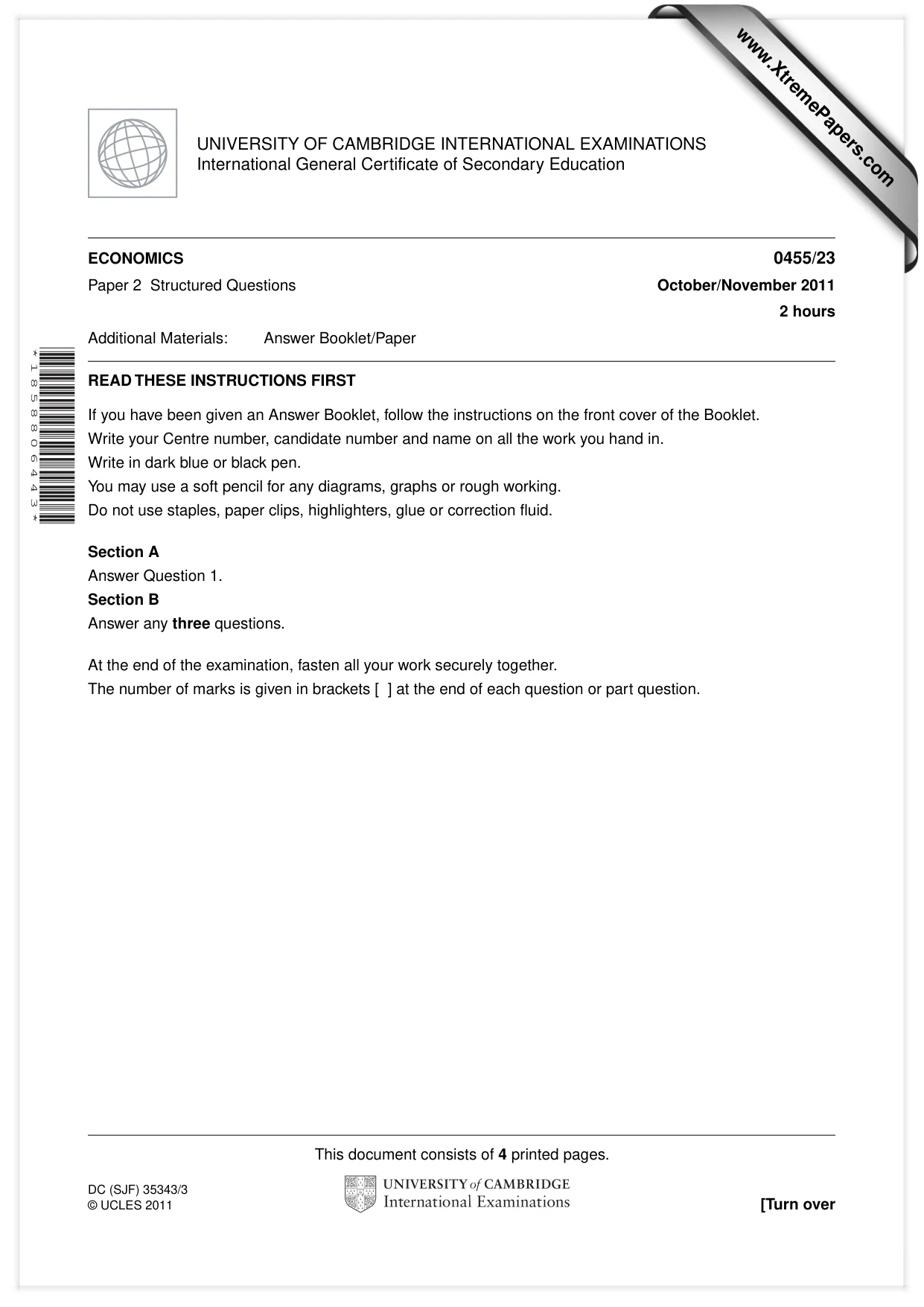
Question paper, page 1
This document consists of 4 printed pages. DC (SJF) 35343/3 © UCLES 2011 [Turn over UNIVERSITY OF CAMBRIDGE INTERNATIONAL EXAMINATIONS International General Certificate of Secondary Education * 1 8 5 8 8 0 6 4 4 3 * ECONOMICS 0455/23 Paper 2 Structured Questions October/November 2011 2 hours Additional Materials: Answer Booklet/Paper READ THESE INSTRUCTIONS FIRST If you have been given an Answer Booklet, follow the instructions on the front cover of the Booklet. Write your Centre number, candidate number and name on all the work you hand in. Write in dark blue or black pen. You may use a soft pencil for any diagrams, graphs or rough working. Do not use staples, paper clips, highlighters, glue or correction fluid. Section A Answer Question 1. Section B Answer any three questions. At the end of the examination, fasten all your work securely together. The number of marks is given in brackets [ ] at the end of each question or part question. www.XtremePapers.com
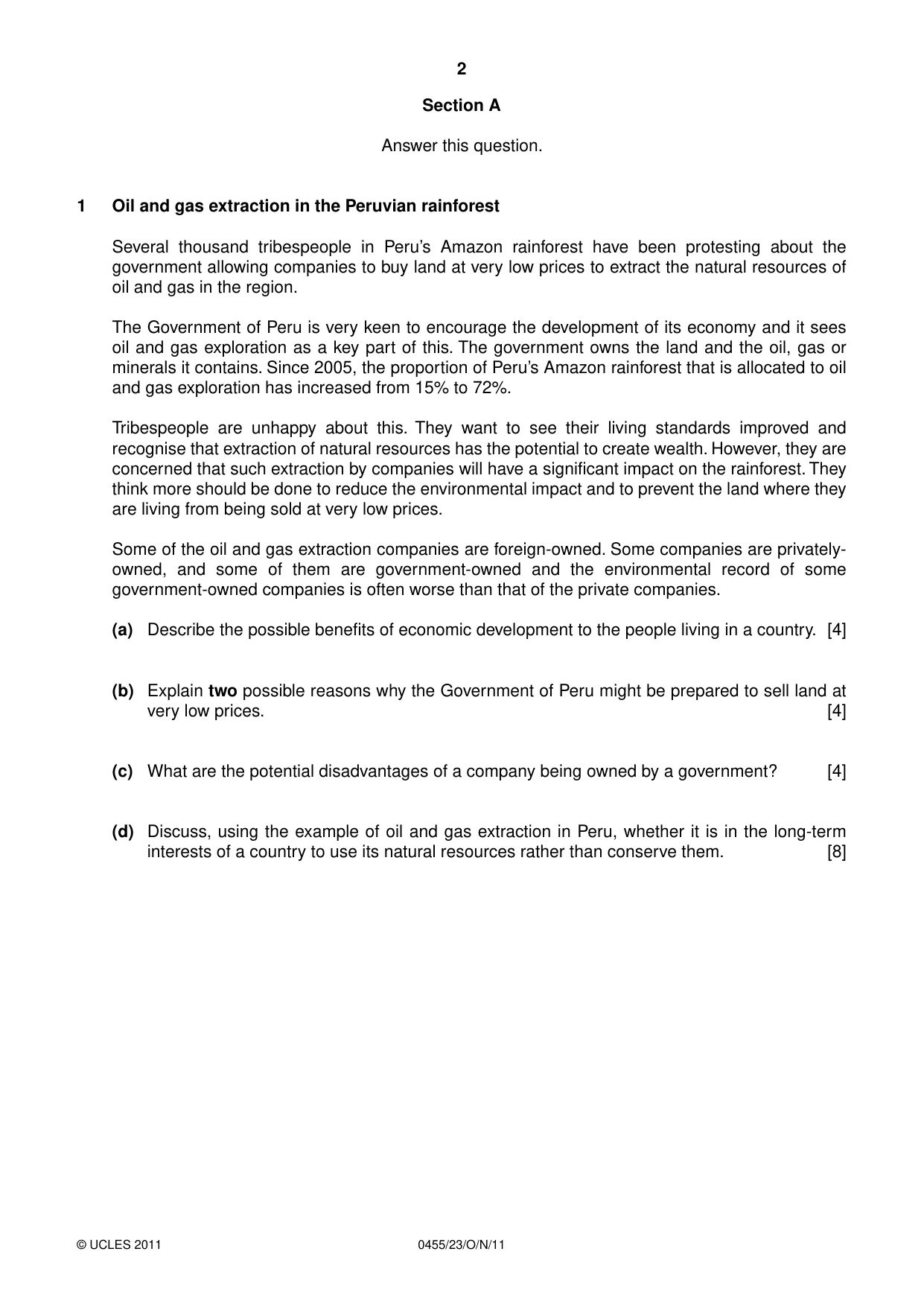
Question paper, page 2
2 0455/23/O/N/11 © UCLES 2011 Section A Answer this question. 1 Oil and gas extraction in the Peruvian rainforest Several thousand tribespeople in Peru’s Amazon rainforest have been protesting about the government allowing companies to buy land at very low prices to extract the natural resources of oil and gas in the region. The Government of Peru is very keen to encourage the development of its economy and it sees oil and gas exploration as a key part of this. The government owns the land and the oil, gas or minerals it contains. Since 2005, the proportion of Peru’s Amazon rainforest that is allocated to oil and gas exploration has increased from 15% to 72%. Tribespeople are unhappy about this. They want to see their living standards improved and recognise that extraction of natural resources has the potential to create wealth. However, they are concerned that such extraction by companies will have a significant impact on the rainforest. They think more should be done to reduce the environmental impact and to prevent the land where they are living from being sold at very low prices. Some of the oil and gas extraction companies are foreign-owned. Some companies are privately- owned, and some of them are government-owned and the environmental record of some government-owned companies is often worse than that of the private companies. (a) Describe the possible benefits of economic development to the people living in a country. [4] (b) Explain two possible reasons why the Government of Peru might be prepared to sell land at very low prices. [4] (c) What are the potential disadvantages of a company being owned by a government? [4] (d) Discuss, using the example of oil and gas extraction in Peru, whether it is in the long-term interests of a country to use its natural resources rather than conserve them. [8]
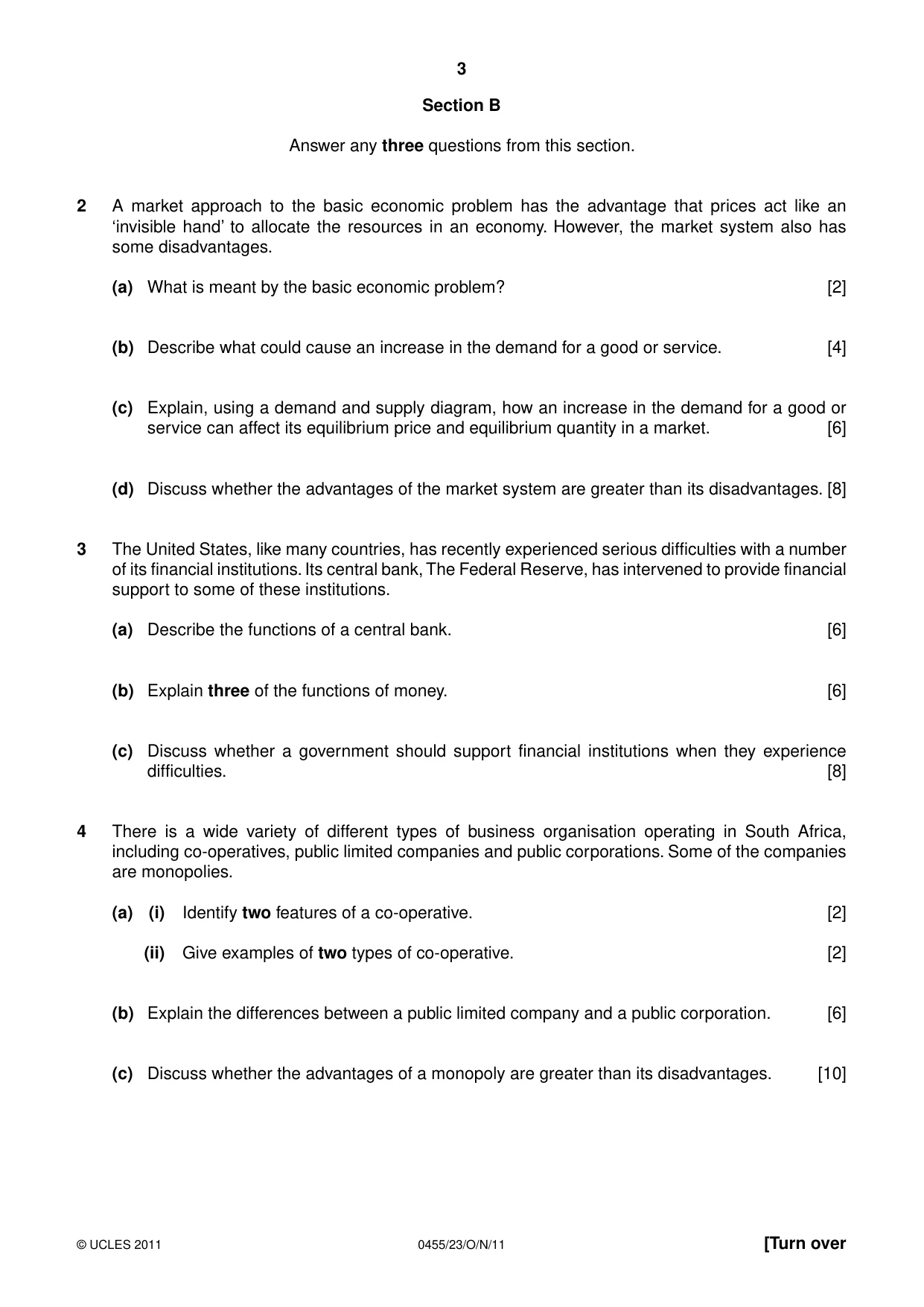
Question paper, page 3
3 0455/23/O/N/11 © UCLES 2011 [Turn over Section B Answer any three questions from this section. 2 A market approach to the basic economic problem has the advantage that prices act like an ‘invisible hand’ to allocate the resources in an economy. However, the market system also has some disadvantages. (a) What is meant by the basic economic problem? [2] (b) Describe what could cause an increase in the demand for a good or service. [4] (c) Explain, using a demand and supply diagram, how an increase in the demand for a good or service can affect its equilibrium price and equilibrium quantity in a market. [6] (d) Discuss whether the advantages of the market system are greater than its disadvantages. [8] 3 The United States, like many countries, has recently experienced serious difficulties with a number of its financial institutions. Its central bank, The Federal Reserve, has intervened to provide financial support to some of these institutions. (a) Describe the functions of a central bank. [6] (b) Explain three of the functions of money. [6] (c) Discuss whether a government should support financial institutions when they experience difficulties. [8] 4 There is a wide variety of different types of business organisation operating in South Africa, including co-operatives, public limited companies and public corporations. Some of the companies are monopolies. (a) (i) Identify two features of a co-operative. [2] (ii) Give examples of two types of co-operative. [2] (b) Explain the differences between a public limited company and a public corporation. [6] (c) Discuss whether the advantages of a monopoly are greater than its disadvantages. [10]
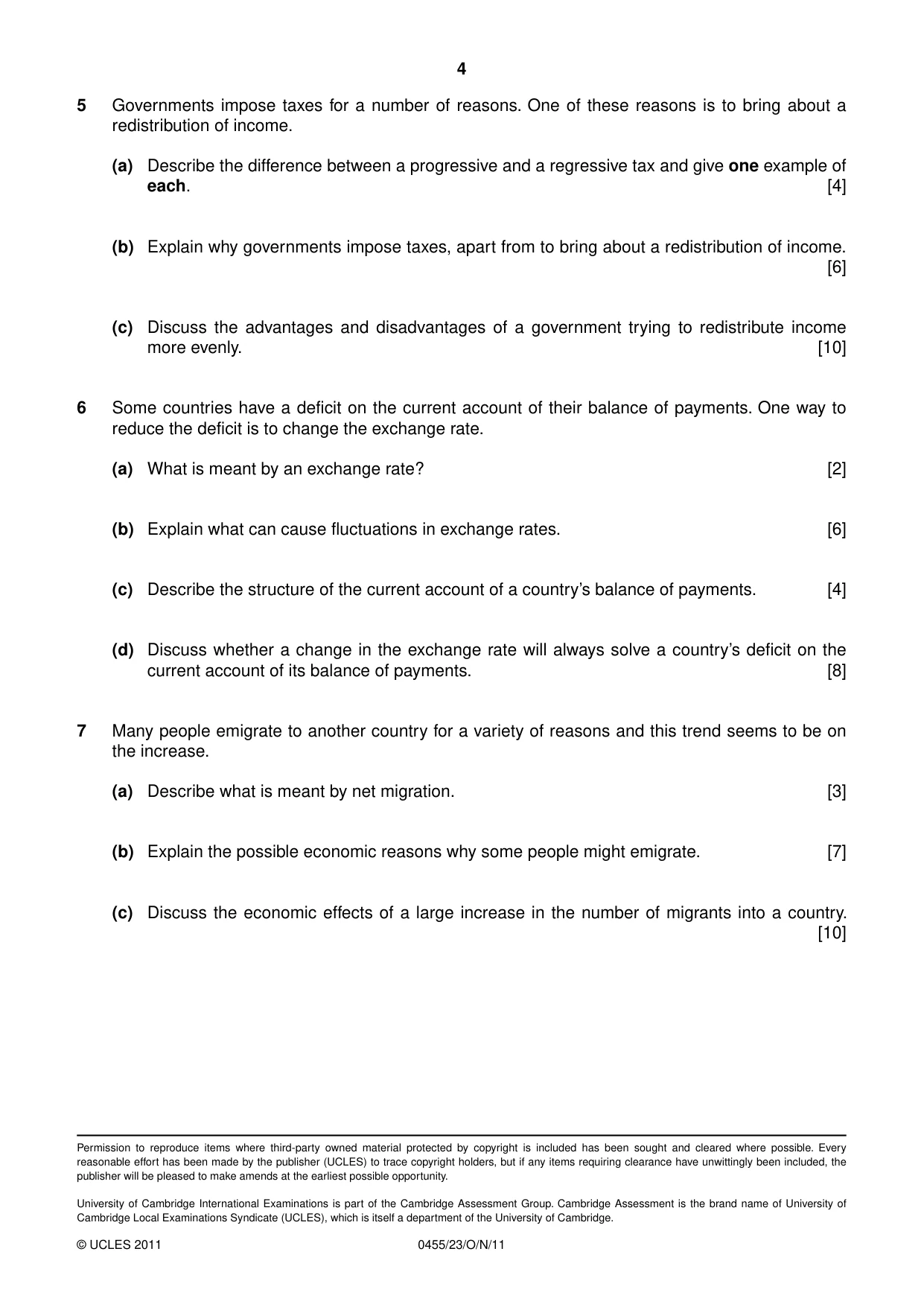
Question paper, page 4
4 0455/23/O/N/11 © UCLES 2011 5 Governments impose taxes for a number of reasons. One of these reasons is to bring about a redistribution of income. (a) Describe the difference between a progressive and a regressive tax and give one example of each. [4] (b) Explain why governments impose taxes, apart from to bring about a redistribution of income. [6] (c) Discuss the advantages and disadvantages of a government trying to redistribute income more evenly. [10] 6 Some countries have a deficit on the current account of their balance of payments. One way to reduce the deficit is to change the exchange rate. (a) What is meant by an exchange rate? [2] (b) Explain what can cause fluctuations in exchange rates. [6] (c) Describe the structure of the current account of a country’s balance of payments. [4] (d) Discuss whether a change in the exchange rate will always solve a country’s deficit on the current account of its balance of payments. [8] 7 Many people emigrate to another country for a variety of reasons and this trend seems to be on the increase. (a) Describe what is meant by net migration. [3] (b) Explain the possible economic reasons why some people might emigrate. [7] (c) Discuss the economic effects of a large increase in the number of migrants into a country. [10] Permission to reproduce items where third-party owned material protected by copyright is included has been sought and cleared where possible. Every reasonable effort has been made by the publisher (UCLES) to trace copyright holders, but if any items requiring clearance have unwittingly been included, the publisher will be pleased to make amends at the earliest possible opportunity. University of Cambridge International Examinations is part of the Cambridge Assessment Group. Cambridge Assessment is the brand name of University of Cambridge Local Examinations Syndicate (UCLES), which is itself a department of the University of Cambridge.
Mark scheme, page 1
UNIVERSITY OF CAMBRIDGE INTERNATIONAL EXAMINATIONS International General Certificate of Secondary Education MARK SCHEME for the October/November 2011 question paper for the guidance of teachers 0455 ECONOMICS 0455/23 Paper 2 (Structured Questions), maximum raw mark 80 This mark scheme is published as an aid to teachers and candidates, to indicate the requirements of the examination. It shows the basis on which Examiners were instructed to award marks. It does not indicate the details of the discussions that took place at an Examiners’ meeting before marking began, which would have considered the acceptability of alternative answers. Mark schemes must be read in conjunction with the question papers and the report on the examination. • Cambridge will not enter into discussions or correspondence in connection with these mark schemes. Cambridge is publishing the mark schemes for the October/November 2011 question papers for most IGCSE, GCE Advanced Level and Advanced Subsidiary Level syllabuses and some Ordinary Level syllabuses. www.XtremePapers.com
Mark scheme, page 2
Page 2 Mark Scheme: Teachers’ version Syllabus Paper IGCSE – October/November 2011 0455 23 © University of Cambridge International Examinations 2011 1 (a) Possible benefits of economic development: • increase in standard of living/quality of life • better educational opportunities • improved health care • increase in incomes • increase in employment • increase in output/real GDP/economic growth • higher ranking in Human Development Index. [4] A list-like approach can gain no more than 2 marks. (b) Any two reasons: • to ensure that the natural resources of natural gas and oil are extracted • this could contribute to economic growth/encourage economic development • taxation on this could lead to an increase in government revenue • could help to create wealth/increase living standards • large amount of land/supply could reduce price • not enough resources to develop without external support. [4] (c) Potential disadvantages: • may be more inefficient • will be supported by public funds and so will not be so worried about making profits • may have less concern for the environment (indicated in item) • may not have the necessary expertise/knowledge • possibly too much interference from politicians • issue of opportunity cost. [4] A list-like approach can gain no more than 2 marks. (d) Use of resources: • contributes to the economic development of Peru • leads to a higher standard of living/quality of life. Conservation of resources: • this will be better in the long-term • avoids using up scarce resources too quickly • need to be mindful of environmental impact of use/exploitation; people in Peru have been unhappy about exploitation • idea of sustainability in terms of future generations [candidates do not need to refer to the term sustainability itself]. Answers need to get across the idea that there is a trade-off between the two; an answer which is entirely one-sided can gain no more than 5 marks. An answer which fails to make any reference to Peru can gain no more than 6 marks. [8]
Mark scheme, page 3
Page 3 Mark Scheme: Teachers’ version Syllabus Paper IGCSE – October/November 2011 0455 23 © University of Cambridge International Examinations 2011 2 (a) Basic economic problem: • finite/limited resources • basic situation of scarcity • unlimited wants • necessity for a choice to be made. [2] (b) Possible causes: • reduction in price of complements • increase in price of substitutes • change in income • change in tastes and preferences • effect of advertising campaign • climate/season. A list-like approach can gain no more than 2 marks. [4] (c) Diagram: • axes (P and Q) and curves (D and S) correctly labelled (1) • shift of the demand curve to the right (1) • rise in both equilibrium price and equilibrium quantity (1). Explanation of what is happening in the diagram, e.g. shift in demand curve and increase in equilibrium price and output – up to 3 marks. [6] (d) Advantages: • idea of invisible hand to allocate resources through price signals • no need for government intervention to achieve this • profit motive should lead to greater efficiency • importance of consumer sovereignty. Disadvantages: • there may be market failures • some goods may be under-consumed • some goods may be over-consumed • problem of externalities. A one-sided answer can gain no more than 5 marks. [8]
Mark scheme, page 4
Page 4 Mark Scheme: Teachers’ version Syllabus Paper IGCSE – October/November 2011 0455 23 © University of Cambridge International Examinations 2011 3 (a) Functions: • government’s bank • lender of last resort • issuing of notes/coins • involvement in monetary policy, e.g. determination of interest rates • management of the national debt • possible involvement in exchange rate determination. A list-like approach can gain no more than 3 marks. [6] (b) Explanation of three of: • means of exchange • unit of account/measure of value • store of value • standard for deferred payment. [6] (c) Reasons in favour of government support: • the financial system is too important to be allowed to ‘go under’ • money is the ‘oil’ in the economic system • continued liquidity is important for both institutions and private individuals • without that, aggregate demand will fall • this will have a negative effect on employment and economic growth • collapse of financial institutions would have a terrible effect on confidence in country and its economy • this could deter inward investment. Reasons against government support: • government might be supporting inefficient institutions • the ‘survival of the fittest’ idea suggests that weak institutions should be allowed to collapse • the money will need to come from somewhere – public funds • this might lead to taxes going up • idea of opportunity cost – the alternative areas of public expenditure that the money might have gone to. A one-sided answer can gain no more than 5 marks. [8]
Mark scheme, page 5
Page 5 Mark Scheme: Teachers’ version Syllabus Paper IGCSE – October/November 2011 0455 23 © University of Cambridge International Examinations 2011 4 (a) (i) Features of a co-operative: • owned and controlled by members • each member has an equal share in this: one member, one vote. [2] (ii) Any two of: • producer • worker • farming • consumer/retail • banking/financial • insurance • funeral. [2] (b) A public limited company: • part of the private sector • companies exist to make profit • controlled by shareholders • has limited liability. A public corporation: • part of the public sector • may make a profit, but not necessarily the main aim • may have objective to serve public/community interest in one way • controlled by the state/government. A one-sided answer can gain no more than 4 marks. [6] (c) For a definition of monopoly – up to 2 marks. Advantages of monopoly: • they make abnormal/supernormal profits • these can be used to finance research and development • their products should therefore be in the vanguard • such a large firm can benefit from economies of scale • the lower costs could lead to lower prices for consumers. Disadvantages of monopoly: • the large profits are a reflection of the higher prices that consumers have to pay • firm is a price maker, not a price taker • output will be lower than in perfect competition • there will therefore be inefficiency • no guarantee that the lower costs will lead to lower prices • consumer not given choice. A one-sided answer can gain no more than 6 marks. [10]
Mark scheme, page 6
Page 6 Mark Scheme: Teachers’ version Syllabus Paper IGCSE – October/November 2011 0455 23 © University of Cambridge International Examinations 2011 5 (a) Progressive tax: • these are taxes on income, e.g. Income Tax • they take a higher proportion of a person’s income (not just a higher amount) as the income rises. Regressive tax: • these are taxes on spending, e.g. VAT, GST • they take a smaller proportion of a person’s income as the income rises. [4] (b) Possible reasons: • to finance expenditure on public goods, e.g. defence, law and order • to finance expenditure on merit goods, e.g. education, health care • to discourage consumption of demerit goods, e.g. tobacco, alcohol • to discourage consumption of imports • to support different sectors of the economy • to reduce consumption/growth/inflation. A list-like approach can gain no more than 3 marks. Candidates who only give one reason can still get full marks if the answer is extremely thorough. [6] (c) Advantages: • taxes can be used to finance expenditure on various benefits for the less well-off • progressive taxation is particularly useful to raise the finance as it takes an increasing proportion of income from the better-off • taxes can be used to finance subsidies to make things cheaper • taxes can be used to finance maximum prices • idea of ‘fairness’ as a policy objective. Disadvantages: • the cost of the various benefits can be very large • taxes could be too high (especially income tax) • there is an opportunity cost here as the money used to finance benefits could have been spent on other things • some people may decide to leave the country as a result of a high level of taxation • the distribution of income can be so fundamentally uneven that government policies/initiatives don’t really achieve very much (‘tip of the iceberg’). A one-sided answer can gain no more than 6 marks. [10]
Mark scheme, page 7
Page 7 Mark Scheme: Teachers’ version Syllabus Paper IGCSE – October/November 2011 0455 23 © University of Cambridge International Examinations 2011 6 (a) Exchange rate: It is the price/value (1) at which one currency is bought and sold (1) for another currency on the foreign exchange market/it is the price of one currency (1) in terms of another currency (1). For a specific example, e.g. £1 = $1.4, one mark. [2] (b) Possible causes: • changes in the demand for the currency • to pay for more exports • changes in the supply of the currency • to pay for more imports • changes in the balance of trade • changes in interest rates • economic/political state of the country; level of confidence • speculation • rate of inflation in relation to other countries. A list-like approach can gain no more than 3 marks. [6] (c) Current account structure: • the trade in goods (visible balance) • the trade in services (invisible balance) • income • current transfers. [4] A list-like approach can gain no more than 3 marks. A good answer on the visible and invisible balance only can be awarded 3 marks. (d) Yes: • a depreciation (or devaluation) of a currency will make exports cheaper • and if demand is price elastic this should lead to an increase in demand • it will also make imports dearer • and if demand is price elastic this should lead to a reduction in demand. No: • price elasticity of demand may not be elastic • the change in the currency may not have much of an effect • any impact is likely to take a while to come into effect • the demand for goods is dependent on many factors, not just the price of a good. A one-sided answer can gain no more than 5 marks. Up to 3 marks where candidates explain alternative options for solving a deficit e.g. deflation, higher taxes/import duties and higher interest rates. [8]
Mark scheme, page 8
Page 8 Mark Scheme: Teachers’ version Syllabus Paper IGCSE – October/November 2011 0455 23 © University of Cambridge International Examinations 2011 7 (a) Net migration: This is the difference (1) between the number of people coming into a country (immigrants) (1) and the number of people leaving a country (emigrants) (1) over a particular period of time. [3] (b) Possible economic reasons: • to gain employment • to obtain a higher income/lower tax rates • to improve standard of living/quality of life • to benefit from improved education/health care facilities • to improve skills/widen experience • to follow firm, e.g. multi-national. [7] (c) Positive effects: • obtaining employment • increase in standard of living/quality of life • economy may benefit from economic growth • government will benefit from increased revenue. Negative effects: • migrants may not have the necessary skills/training and cannot obtain work • may lead to unemployment • may lead to inflation if demand exceeds supply • may be a burden on resources, especially if migrants locate in particular areas, e.g. housing • similar point in relation to education • some of the income may be sent home to relatives; leakage from the economy • may lead to a fall in wages if supply of labour is greater than the demand. A maximum of 6 marks for a one-sided answer. [10]
What you needed in this session
Cambridge’s own grade thresholds for 2011 Oct/Nov, Paper 2 · Variant 3. A higher threshold means an easier paper — the bar moves with how the cohort did.