Cambridge IGCSE Economics 0455 — 2011 Oct/Nov Paper 2 · Variant 1
0455/21/O/N/11 · 80 marks · ≈90 min
The question paper and its mark scheme, free to read here and free to download. This is Cambridge’s own paper, exactly as it was sat.
Question paper4 pages
Mark scheme7 pages
Answers below. Sit the paper first if you are practising.
Paper as text
Question paper, page 1
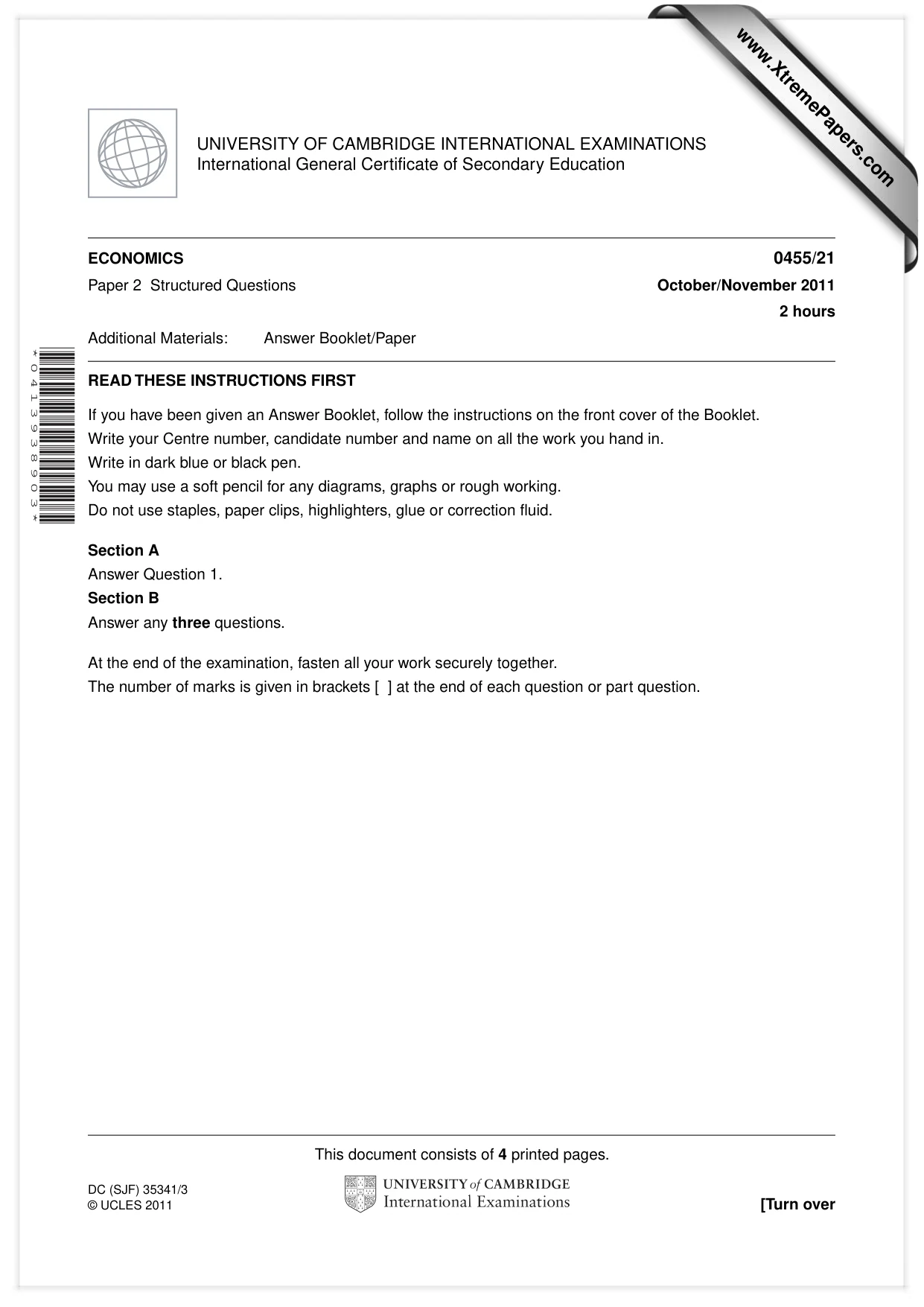
This document consists of 4 printed pages. DC (SJF) 35341/3 © UCLES 2011 [Turn over UNIVERSITY OF CAMBRIDGE INTERNATIONAL EXAMINATIONS International General Certificate of Secondary Education * 0 4 1 3 9 3 8 9 0 3 * ECONOMICS 0455/21 Paper 2 Structured Questions October/November 2011 2 hours Additional Materials: Answer Booklet/Paper READ THESE INSTRUCTIONS FIRST If you have been given an Answer Booklet, follow the instructions on the front cover of the Booklet. Write your Centre number, candidate number and name on all the work you hand in. Write in dark blue or black pen. You may use a soft pencil for any diagrams, graphs or rough working. Do not use staples, paper clips, highlighters, glue or correction fluid. Section A Answer Question 1. Section B Answer any three questions. At the end of the examination, fasten all your work securely together. The number of marks is given in brackets [ ] at the end of each question or part question. www.XtremePapers.com
Question paper, page 2
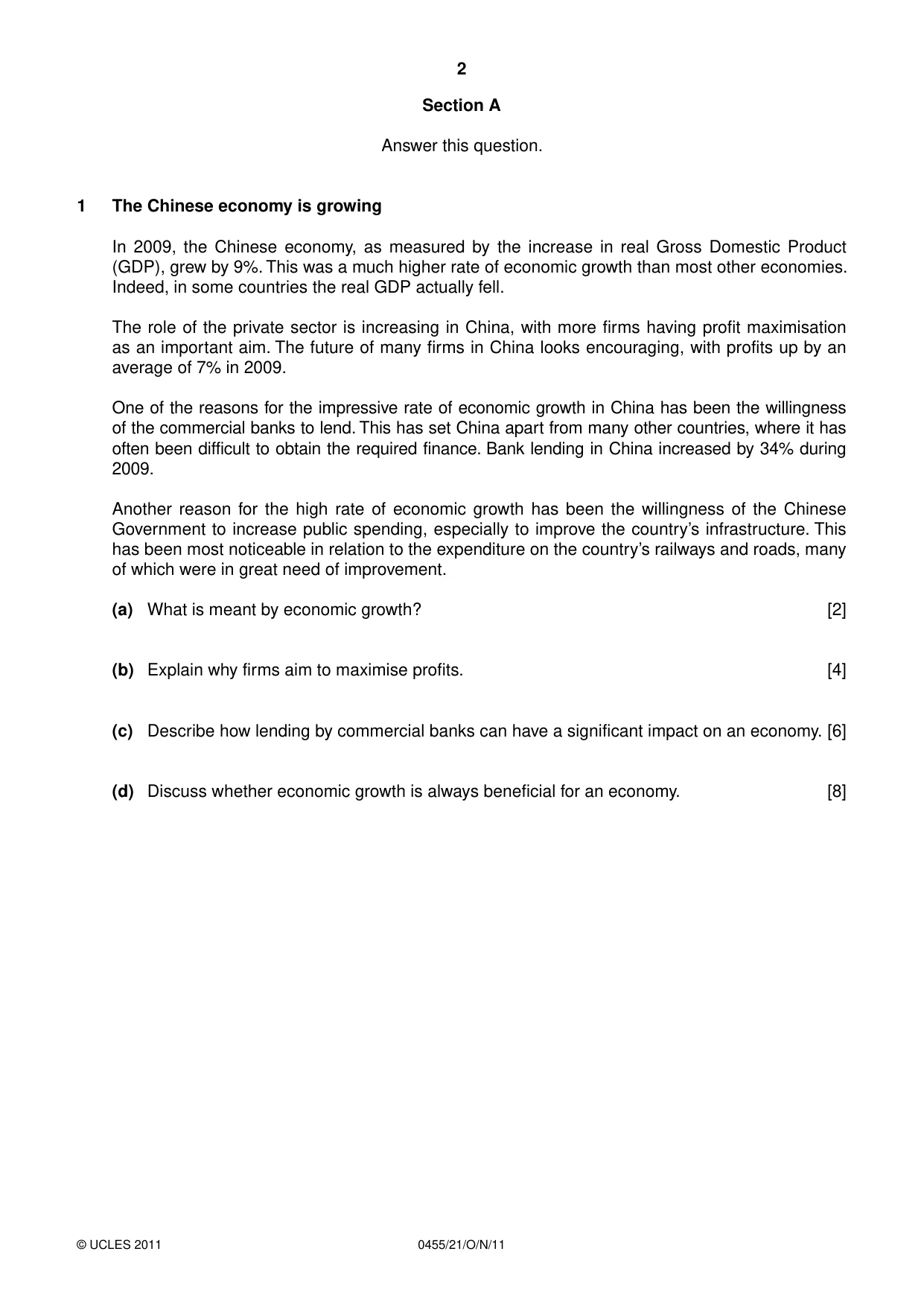
2 0455/21/O/N/11 © UCLES 2011 Section A Answer this question. 1 The Chinese economy is growing In 2009, the Chinese economy, as measured by the increase in real Gross Domestic Product (GDP), grew by 9%. This was a much higher rate of economic growth than most other economies. Indeed, in some countries the real GDP actually fell. The role of the private sector is increasing in China, with more firms having profit maximisation as an important aim. The future of many firms in China looks encouraging, with profits up by an average of 7% in 2009. One of the reasons for the impressive rate of economic growth in China has been the willingness of the commercial banks to lend. This has set China apart from many other countries, where it has often been difficult to obtain the required finance. Bank lending in China increased by 34% during 2009. Another reason for the high rate of economic growth has been the willingness of the Chinese Government to increase public spending, especially to improve the country’s infrastructure. This has been most noticeable in relation to the expenditure on the country’s railways and roads, many of which were in great need of improvement. (a) What is meant by economic growth? [2] (b) Explain why firms aim to maximise profits. [4] (c) Describe how lending by commercial banks can have a significant impact on an economy. [6] (d) Discuss whether economic growth is always beneficial for an economy. [8]
Question paper, page 3
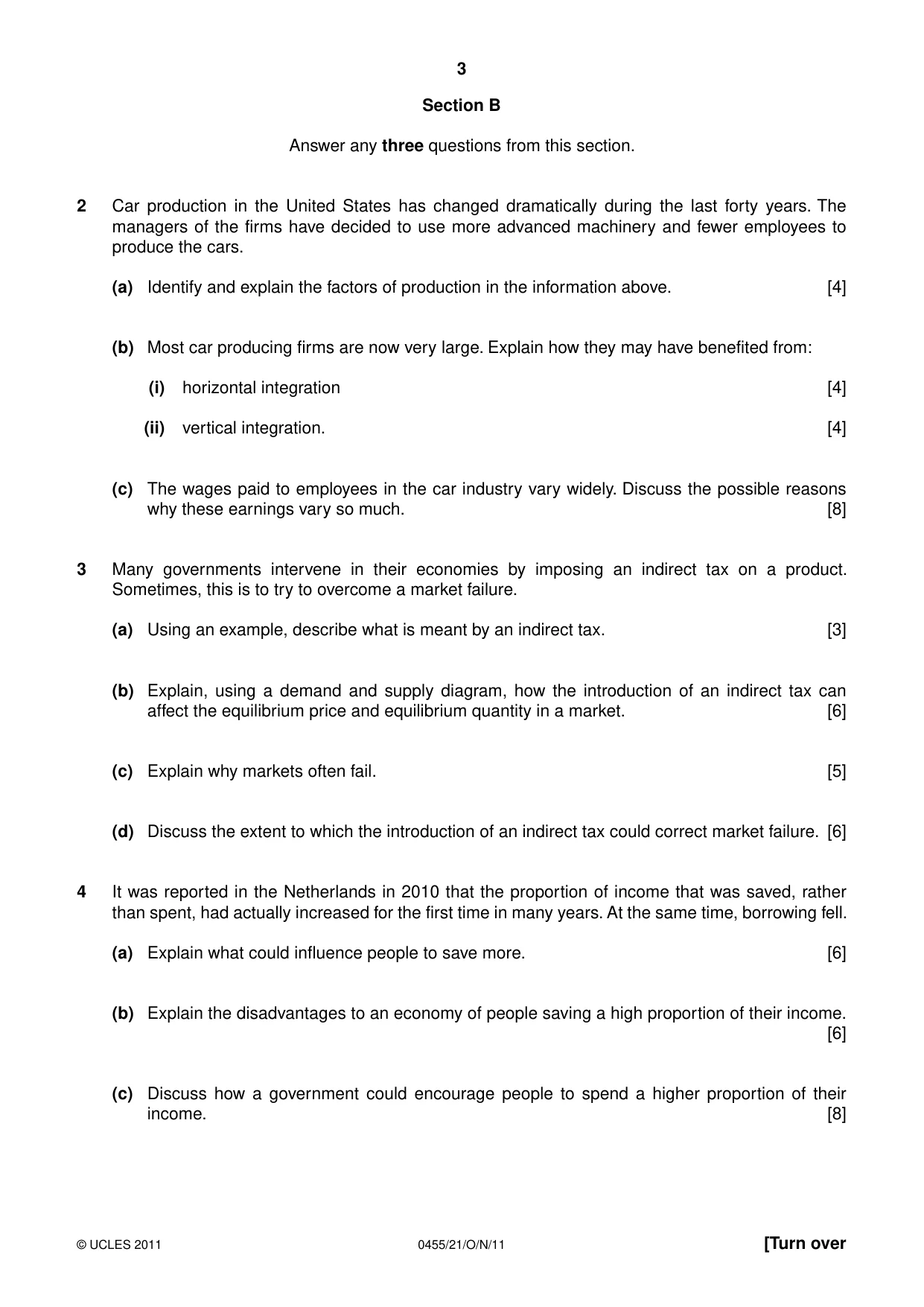
3 0455/21/O/N/11 © UCLES 2011 [Turn over Section B Answer any three questions from this section. 2 Car production in the United States has changed dramatically during the last forty years. The managers of the firms have decided to use more advanced machinery and fewer employees to produce the cars. (a) Identify and explain the factors of production in the information above. [4] (b) Most car producing firms are now very large. Explain how they may have benefited from: (i) horizontal integration [4] (ii) vertical integration. [4] (c) The wages paid to employees in the car industry vary widely. Discuss the possible reasons why these earnings vary so much. [8] 3 Many governments intervene in their economies by imposing an indirect tax on a product. Sometimes, this is to try to overcome a market failure. (a) Using an example, describe what is meant by an indirect tax. [3] (b) Explain, using a demand and supply diagram, how the introduction of an indirect tax can affect the equilibrium price and equilibrium quantity in a market. [6] (c) Explain why markets often fail. [5] (d) Discuss the extent to which the introduction of an indirect tax could correct market failure. [6] 4 It was reported in the Netherlands in 2010 that the proportion of income that was saved, rather than spent, had actually increased for the first time in many years. At the same time, borrowing fell. (a) Explain what could influence people to save more. [6] (b) Explain the disadvantages to an economy of people saving a high proportion of their income. [6] (c) Discuss how a government could encourage people to spend a higher proportion of their income. [8]
Question paper, page 4
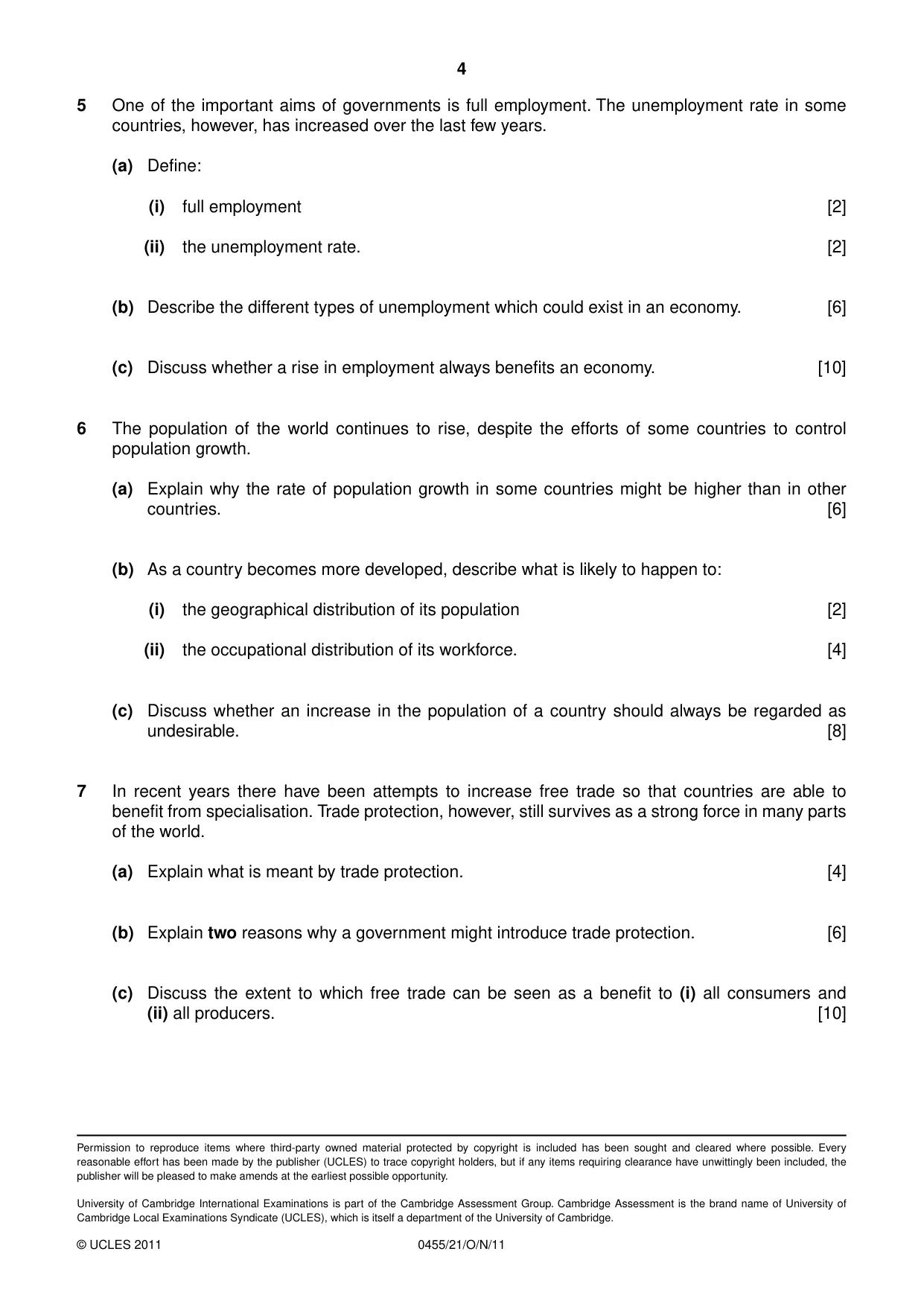
4 0455/21/O/N/11 © UCLES 2011 5 One of the important aims of governments is full employment. The unemployment rate in some countries, however, has increased over the last few years. (a) Define: (i) full employment [2] (ii) the unemployment rate. [2] (b) Describe the different types of unemployment which could exist in an economy. [6] (c) Discuss whether a rise in employment always benefits an economy. [10] 6 The population of the world continues to rise, despite the efforts of some countries to control population growth. (a) Explain why the rate of population growth in some countries might be higher than in other countries. [6] (b) As a country becomes more developed, describe what is likely to happen to: (i) the geographical distribution of its population [2] (ii) the occupational distribution of its workforce. [4] (c) Discuss whether an increase in the population of a country should always be regarded as undesirable. [8] 7 In recent years there have been attempts to increase free trade so that countries are able to benefit from specialisation. Trade protection, however, still survives as a strong force in many parts of the world. (a) Explain what is meant by trade protection. [4] (b) Explain two reasons why a government might introduce trade protection. [6] (c) Discuss the extent to which free trade can be seen as a benefit to (i) all consumers and (ii) all producers. [10] Permission to reproduce items where third-party owned material protected by copyright is included has been sought and cleared where possible. Every reasonable effort has been made by the publisher (UCLES) to trace copyright holders, but if any items requiring clearance have unwittingly been included, the publisher will be pleased to make amends at the earliest possible opportunity. University of Cambridge International Examinations is part of the Cambridge Assessment Group. Cambridge Assessment is the brand name of University of Cambridge Local Examinations Syndicate (UCLES), which is itself a department of the University of Cambridge.
Mark scheme, page 1
UNIVERSITY OF CAMBRIDGE INTERNATIONAL EXAMINATIONS International General Certificate of Secondary Education MARK SCHEME for the October/November 2011 question paper for the guidance of teachers 0455 ECONOMICS 0455/21 Paper 2 (Structured Questions), maximum raw mark 80 This mark scheme is published as an aid to teachers and candidates, to indicate the requirements of the examination. It shows the basis on which Examiners were instructed to award marks. It does not indicate the details of the discussions that took place at an Examiners’ meeting before marking began, which would have considered the acceptability of alternative answers. Mark schemes must be read in conjunction with the question papers and the report on the examination. • Cambridge will not enter into discussions or correspondence in connection with these mark schemes. Cambridge is publishing the mark schemes for the October/November 2011 question papers for most IGCSE, GCE Advanced Level and Advanced Subsidiary Level syllabuses and some Ordinary Level syllabuses. www.XtremePapers.com
Mark scheme, page 2
Page 2 Mark Scheme: Teachers’ version Syllabus Paper IGCSE – October/November 2011 0455 21 © University of Cambridge International Examinations 2011 1 (a) Economic growth: • an increase in the total output of goods and services in an economy over a period of time • an increase in national income • an increase in real Gross Domestic Product (GDP) • an increase in the productive capacity/potential of an economy. [2] (b) Profit maximisation: • profit is the reward to business owners or entrepreneurs • for taking the risk of setting up a firm • a firm which does not make a profit may be forced to close down • retained profit is an important source of finance for firms. [4] (c) Importance of bank lending by commercial banks: • bank lending in China up by 34% in 2009 • idea of greater liquidity in the banking system • this will enable firms and private individuals to finance expenditure more easily • this will lead to higher employment and incomes • but there are potential problems – it could be inflationary and/or lead to an increase in imports, affecting the balance of payments • limited funds will involve an opportunity cost. A maximum of 4 marks if only positive aspects are described. [6] (d) Potential advantages: • a rise in national output; more goods and services produced • can lead to a rise in standards of living. Potential disadvantages: • can cause external costs, such as pollution • could reduce quality of life, e.g. less leisure time. A maximum of 5 marks for a one-sided answer. [8] 2 (a) Identification of factors: • managers – accept managers as either labour or enterprise • machinery – capital • people – labour. 2 marks for the identification of 2 or 3 factors. 2 marks for the explanation of 2 or 3 factors. Do not accept land. [4] (b) (i) Horizontal integration: • when firms engaged in the same stage of production of a good combine • examples of car firms that have combined, e.g. Tata Motors and Jaguar. [4]
Mark scheme, page 3
Page 3 Mark Scheme: Teachers’ version Syllabus Paper IGCSE – October/November 2011 0455 21 © University of Cambridge International Examinations 2011 (ii) Vertical integration: • when firms engaged in different stages of production combine • forward integration involves going forward to a retail outlet, e.g. where a car producer owns/controls dealerships • backward integration involves going backward to the supply of raw materials, e.g. where a car producer owns/controls supplies of raw materials/parts. [4] The benefits will relate to the possible advantages of economies of scale in reducing the costs of production. A maximum of 3 marks in each of (i) and (ii) for an answer which makes no explicit reference to the car industry. (c) Reasons for differences in remuneration: • skills/training • education/qualifications • experience • level of responsibility • geographical area • trade union membership • demand factors (idea of derived demand) • supply factors. Answers which make no reference to the demand for, or the supply of, labour can gain no more than 5 marks. Similarly, an answer which makes no reference to people in the car industry can gain no more than 5 marks. Answers which fail to address both of these aspects can gain no more than 4 marks. [8] 3 (a) Description of an indirect tax: • these are taxes on the expenditure on goods and services (1) • they are added to the price of goods and services and normally collected from those selling the goods or services (1). Example: • sales tax (e.g. VAT, GST), tariffs, excise duties (1). [3] (b) Diagram: • correct labelling of P and Q axes and D and S curves (1) • shift of the supply curve to the left (1) • equilibrium price rises and equilibrium quantity falls (1). Explanation of what is shown in the diagram (3). [6]
Mark scheme, page 4
Page 4 Mark Scheme: Teachers’ version Syllabus Paper IGCSE – October/November 2011 0455 21 © University of Cambridge International Examinations 2011 (c) Explanation of market failure: • the market does not allocate resources as efficiently as was expected • some goods may be over-consumed (demerit goods, but don’t need to use the term) • some goods may be under-consumed (merit goods, but don’t need to use the term) • some goods may not be provided at all (public goods, but don’t need to use the term) • positive and negative externalities may not be taken account of (but don’t need to use the term) • there may be information failure. [5] (d) Extent to which introduction of an indirect tax could correct market failure: • an indirect tax on a good would increase its price • and this might lead to a reduction in demand • reducing the market failure • but it won’t have much of an effect if demand is relatively price inelastic • and it would not address other aspects of market failure • such as the under-consumption of merit goods, which would require a subsidy. A maximum of 4 marks if extent is not addressed. [6] 4 (a) Possible factors that can affect saving: • interest rates, especially real interest rates • availability of appropriate savings schemes • advertising of/knowledge about what is available at financial institutions • confidence/trust in financial institutions • size of real disposable income • rate of inflation • wealth • save for a future purchase, e.g. a house • precautionary factors, e.g. ‘saving for a rainy day’ • satisfaction of wants and needs • tastes and preferences of consumers • consumer confidence/expectations about future changes in the economy, e.g. risk of unemployment. [6] (b) Possible reasons: • consumption would fall • savings are a withdrawal from the circular flow of income (don’t expect that term) • a lower demand could lead to jobs being lost and higher unemployment • lower spending would lead to a reduction in government revenue from indirect taxes on expenditure. [6]
Mark scheme, page 5
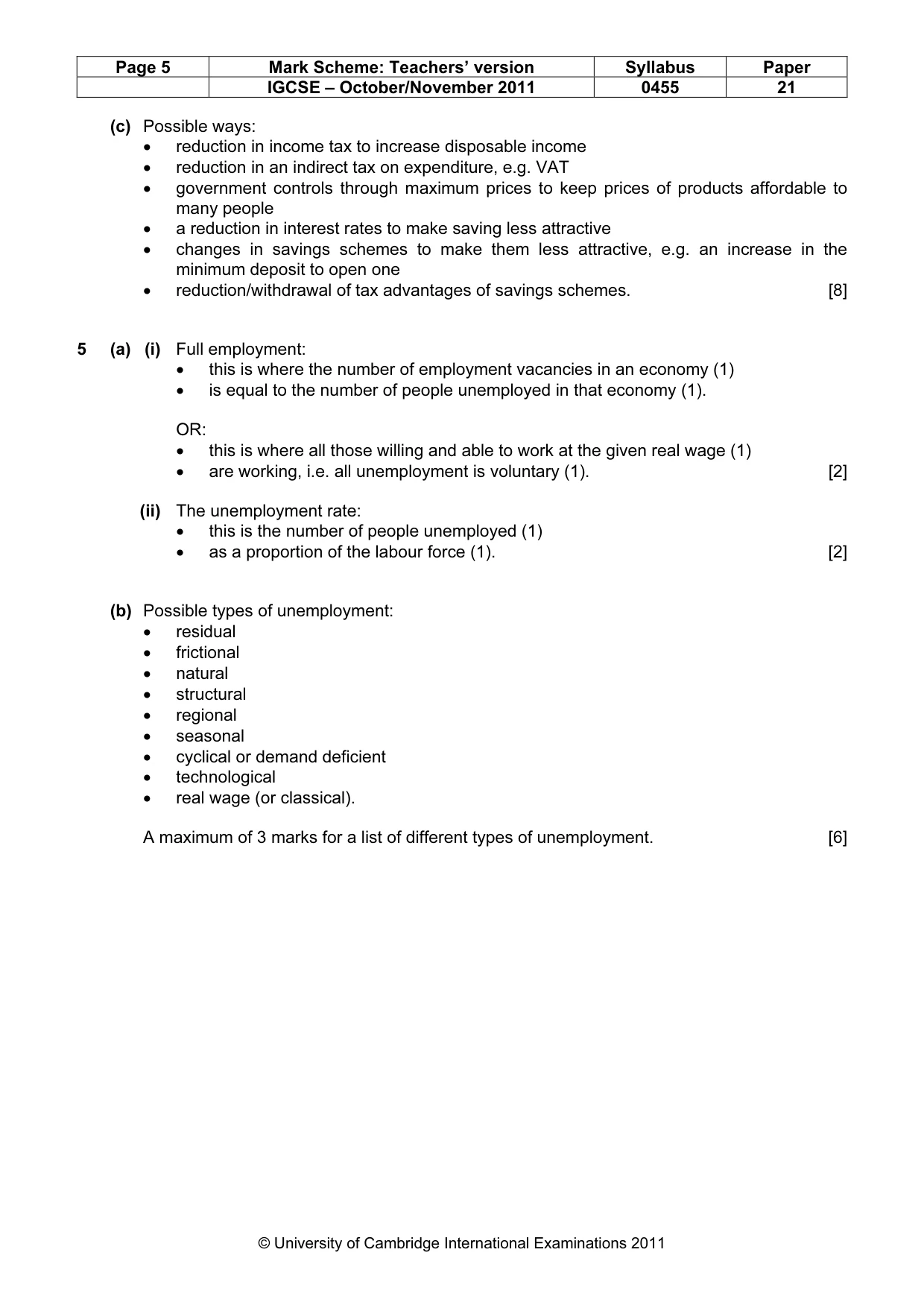
Page 5 Mark Scheme: Teachers’ version Syllabus Paper IGCSE – October/November 2011 0455 21 © University of Cambridge International Examinations 2011 (c) Possible ways: • reduction in income tax to increase disposable income • reduction in an indirect tax on expenditure, e.g. VAT • government controls through maximum prices to keep prices of products affordable to many people • a reduction in interest rates to make saving less attractive • changes in savings schemes to make them less attractive, e.g. an increase in the minimum deposit to open one • reduction/withdrawal of tax advantages of savings schemes. [8] 5 (a) (i) Full employment: • this is where the number of employment vacancies in an economy (1) • is equal to the number of people unemployed in that economy (1). OR: • this is where all those willing and able to work at the given real wage (1) • are working, i.e. all unemployment is voluntary (1). [2] (ii) The unemployment rate: • this is the number of people unemployed (1) • as a proportion of the labour force (1). [2] (b) Possible types of unemployment: • residual • frictional • natural • structural • regional • seasonal • cyclical or demand deficient • technological • real wage (or classical). A maximum of 3 marks for a list of different types of unemployment. [6]
Mark scheme, page 6
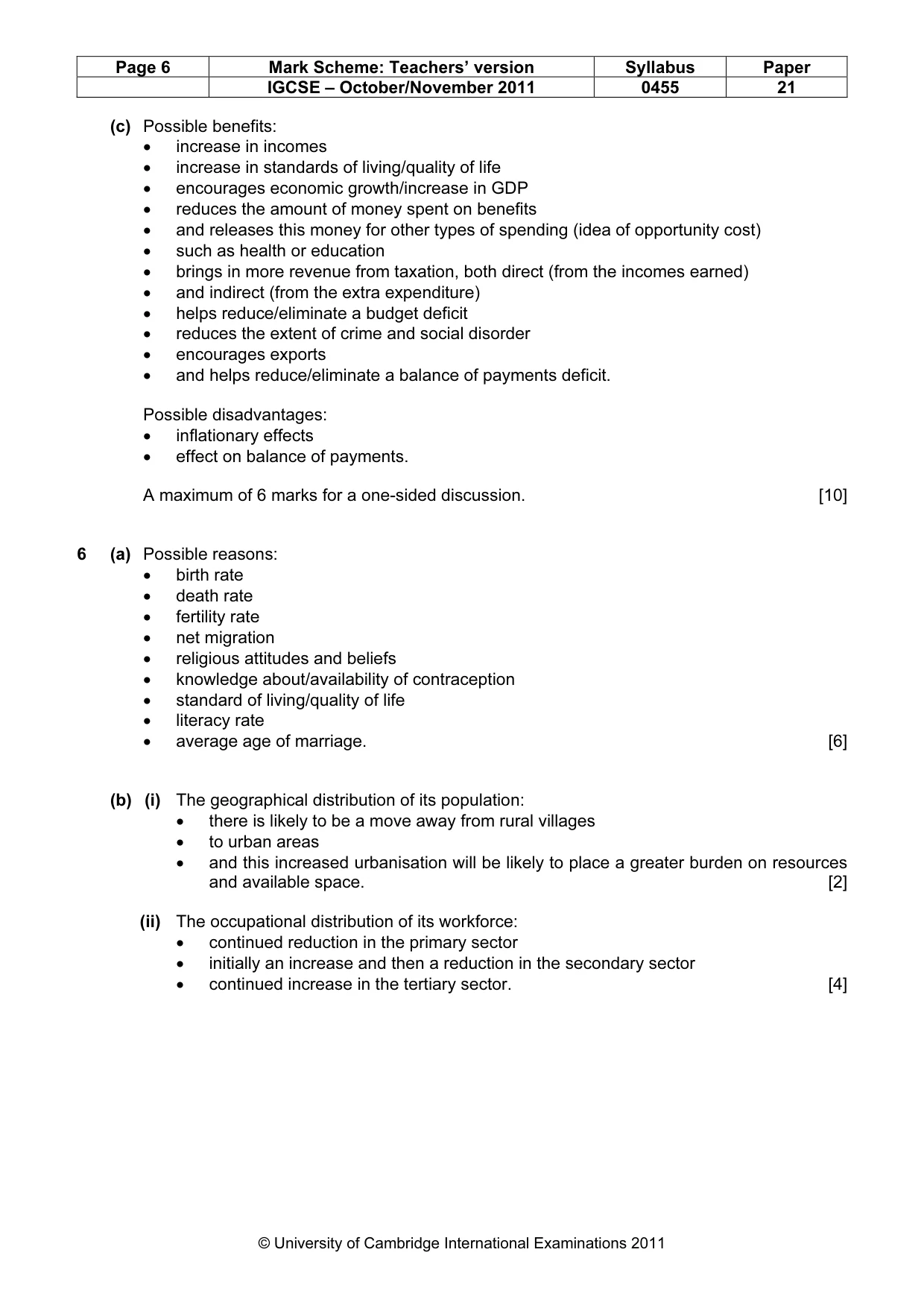
Page 6 Mark Scheme: Teachers’ version Syllabus Paper IGCSE – October/November 2011 0455 21 © University of Cambridge International Examinations 2011 (c) Possible benefits: • increase in incomes • increase in standards of living/quality of life • encourages economic growth/increase in GDP • reduces the amount of money spent on benefits • and releases this money for other types of spending (idea of opportunity cost) • such as health or education • brings in more revenue from taxation, both direct (from the incomes earned) • and indirect (from the extra expenditure) • helps reduce/eliminate a budget deficit • reduces the extent of crime and social disorder • encourages exports • and helps reduce/eliminate a balance of payments deficit. Possible disadvantages: • inflationary effects • effect on balance of payments. A maximum of 6 marks for a one-sided discussion. [10] 6 (a) Possible reasons: • birth rate • death rate • fertility rate • net migration • religious attitudes and beliefs • knowledge about/availability of contraception • standard of living/quality of life • literacy rate • average age of marriage. [6] (b) (i) The geographical distribution of its population: • there is likely to be a move away from rural villages • to urban areas • and this increased urbanisation will be likely to place a greater burden on resources and available space. [2] (ii) The occupational distribution of its workforce: • continued reduction in the primary sector • initially an increase and then a reduction in the secondary sector • continued increase in the tertiary sector. [4]
Mark scheme, page 7
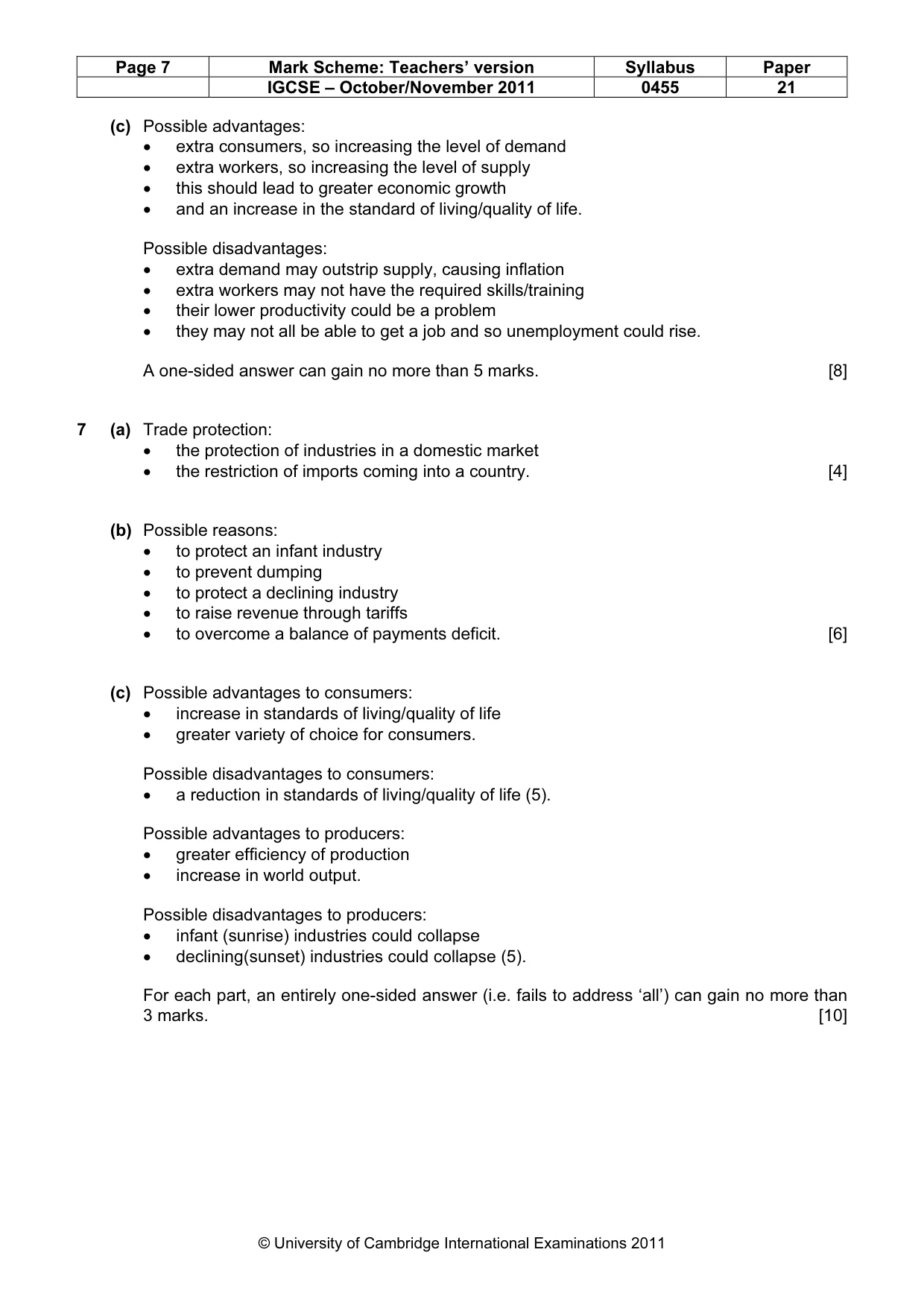
Page 7 Mark Scheme: Teachers’ version Syllabus Paper IGCSE – October/November 2011 0455 21 © University of Cambridge International Examinations 2011 (c) Possible advantages: • extra consumers, so increasing the level of demand • extra workers, so increasing the level of supply • this should lead to greater economic growth • and an increase in the standard of living/quality of life. Possible disadvantages: • extra demand may outstrip supply, causing inflation • extra workers may not have the required skills/training • their lower productivity could be a problem • they may not all be able to get a job and so unemployment could rise. A one-sided answer can gain no more than 5 marks. [8] 7 (a) Trade protection: • the protection of industries in a domestic market • the restriction of imports coming into a country. [4] (b) Possible reasons: • to protect an infant industry • to prevent dumping • to protect a declining industry • to raise revenue through tariffs • to overcome a balance of payments deficit. [6] (c) Possible advantages to consumers: • increase in standards of living/quality of life • greater variety of choice for consumers. Possible disadvantages to consumers: • a reduction in standards of living/quality of life (5). Possible advantages to producers: • greater efficiency of production • increase in world output. Possible disadvantages to producers: • infant (sunrise) industries could collapse • declining(sunset) industries could collapse (5). For each part, an entirely one-sided answer (i.e. fails to address ‘all’) can gain no more than 3 marks. [10]
What you needed in this session
Cambridge’s own grade thresholds for 2011 Oct/Nov, Paper 2 · Variant 1. A higher threshold means an easier paper — the bar moves with how the cohort did.