Cambridge IGCSE Economics 0455 — 2011 Oct/Nov Paper 2 · Variant 2
0455/22/O/N/11 · 80 marks · ≈90 min
The question paper and its mark scheme, free to read here and free to download. This is Cambridge’s own paper, exactly as it was sat.
Question paper4 pages
Mark scheme8 pages
Answers below. Sit the paper first if you are practising.
Paper as text
Question paper, page 1
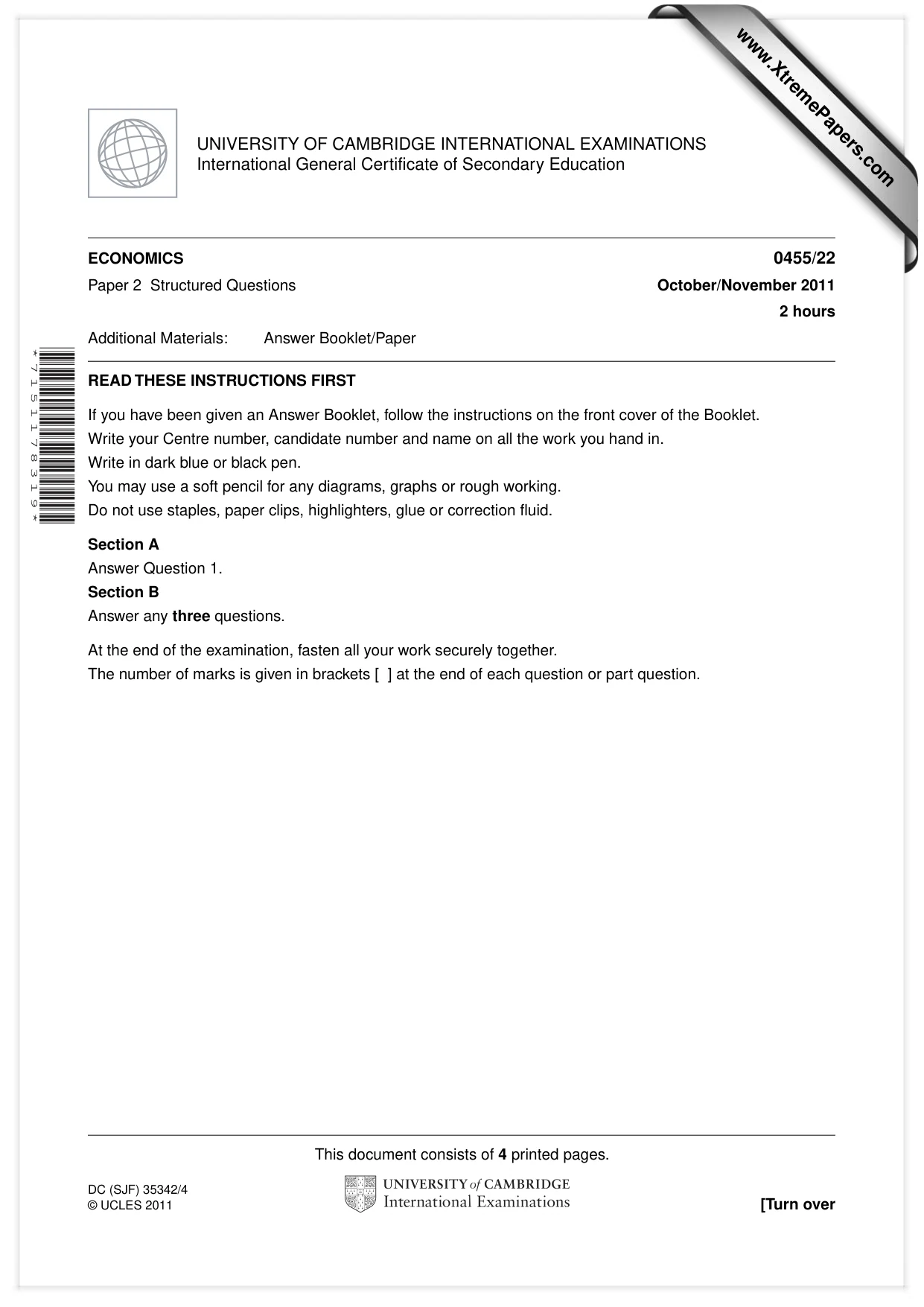
This document consists of 4 printed pages. DC (SJF) 35342/4 © UCLES 2011 [Turn over UNIVERSITY OF CAMBRIDGE INTERNATIONAL EXAMINATIONS International General Certificate of Secondary Education * 7 1 5 1 1 7 8 3 1 9 * ECONOMICS 0455/22 Paper 2 Structured Questions October/November 2011 2 hours Additional Materials: Answer Booklet/Paper READ THESE INSTRUCTIONS FIRST If you have been given an Answer Booklet, follow the instructions on the front cover of the Booklet. Write your Centre number, candidate number and name on all the work you hand in. Write in dark blue or black pen. You may use a soft pencil for any diagrams, graphs or rough working. Do not use staples, paper clips, highlighters, glue or correction fluid. Section A Answer Question 1. Section B Answer any three questions. At the end of the examination, fasten all your work securely together. The number of marks is given in brackets [ ] at the end of each question or part question. www.XtremePapers.com
Question paper, page 2
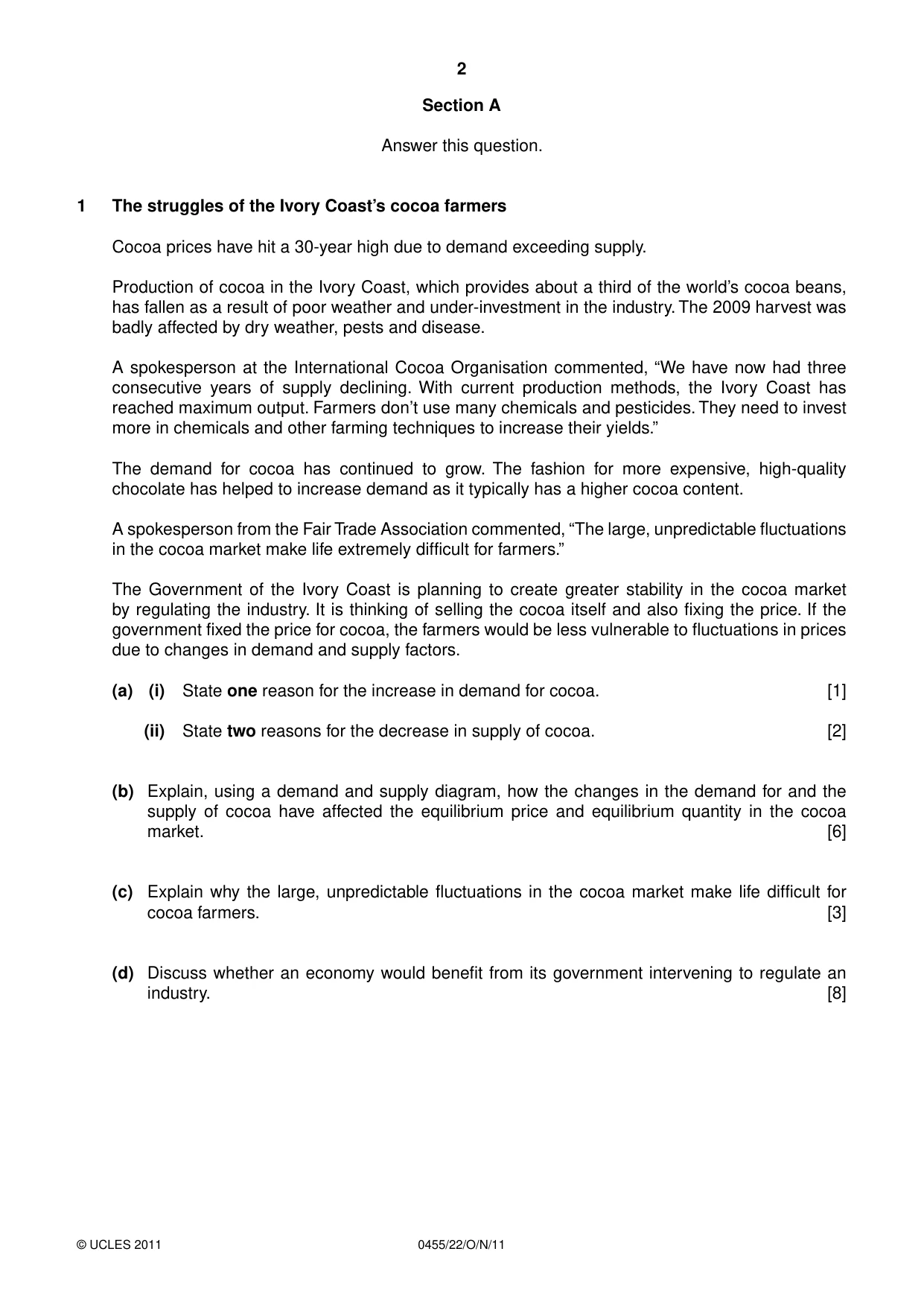
2 0455/22/O/N/11 © UCLES 2011 Section A Answer this question. 1 The struggles of the Ivory Coast’s cocoa farmers Cocoa prices have hit a 30-year high due to demand exceeding supply. Production of cocoa in the Ivory Coast, which provides about a third of the world’s cocoa beans, has fallen as a result of poor weather and under-investment in the industry. The 2009 harvest was badly affected by dry weather, pests and disease. A spokesperson at the International Cocoa Organisation commented, “We have now had three consecutive years of supply declining. With current production methods, the Ivory Coast has reached maximum output. Farmers don’t use many chemicals and pesticides. They need to invest more in chemicals and other farming techniques to increase their yields.” The demand for cocoa has continued to grow. The fashion for more expensive, high-quality chocolate has helped to increase demand as it typically has a higher cocoa content. A spokesperson from the Fair Trade Association commented, “The large, unpredictable fluctuations in the cocoa market make life extremely difficult for farmers.” The Government of the Ivory Coast is planning to create greater stability in the cocoa market by regulating the industry. It is thinking of selling the cocoa itself and also fixing the price. If the government fixed the price for cocoa, the farmers would be less vulnerable to fluctuations in prices due to changes in demand and supply factors. (a) (i) State one reason for the increase in demand for cocoa. [1] (ii) State two reasons for the decrease in supply of cocoa. [2] (b) Explain, using a demand and supply diagram, how the changes in the demand for and the supply of cocoa have affected the equilibrium price and equilibrium quantity in the cocoa market. [6] (c) Explain why the large, unpredictable fluctuations in the cocoa market make life difficult for cocoa farmers. [3] (d) Discuss whether an economy would benefit from its government intervening to regulate an industry. [8]
Question paper, page 3
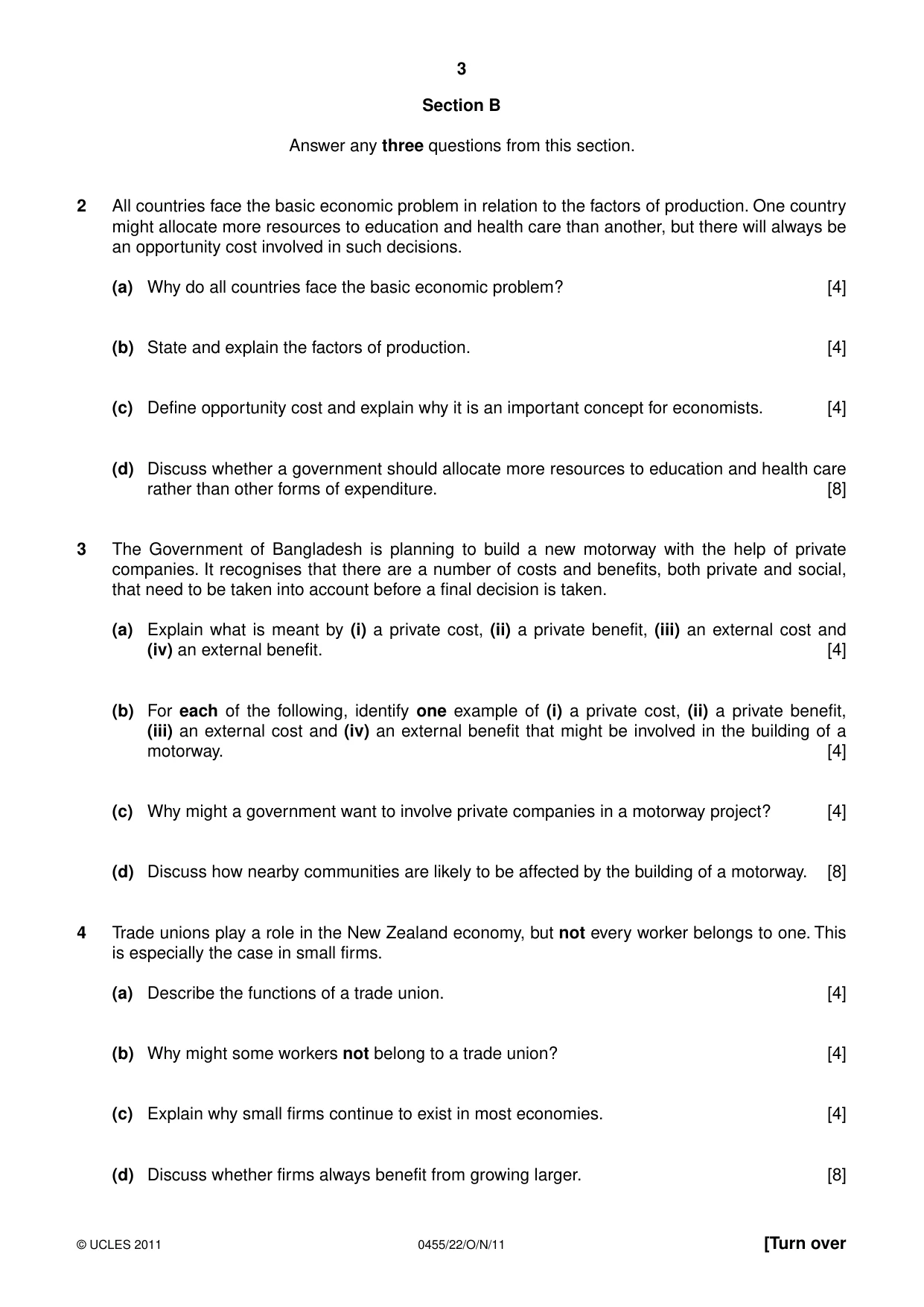
3 0455/22/O/N/11 © UCLES 2011 [Turn over Section B Answer any three questions from this section. 2 All countries face the basic economic problem in relation to the factors of production. One country might allocate more resources to education and health care than another, but there will always be an opportunity cost involved in such decisions. (a) Why do all countries face the basic economic problem? [4] (b) State and explain the factors of production. [4] (c) Define opportunity cost and explain why it is an important concept for economists. [4] (d) Discuss whether a government should allocate more resources to education and health care rather than other forms of expenditure. [8] 3 The Government of Bangladesh is planning to build a new motorway with the help of private companies. It recognises that there are a number of costs and benefits, both private and social, that need to be taken into account before a final decision is taken. (a) Explain what is meant by (i) a private cost, (ii) a private benefit, (iii) an external cost and (iv) an external benefit. [4] (b) For each of the following, identify one example of (i) a private cost, (ii) a private benefit, (iii) an external cost and (iv) an external benefit that might be involved in the building of a motorway. [4] (c) Why might a government want to involve private companies in a motorway project? [4] (d) Discuss how nearby communities are likely to be affected by the building of a motorway. [8] 4 Trade unions play a role in the New Zealand economy, but not every worker belongs to one. This is especially the case in small firms. (a) Describe the functions of a trade union. [4] (b) Why might some workers not belong to a trade union? [4] (c) Explain why small firms continue to exist in most economies. [4] (d) Discuss whether firms always benefit from growing larger. [8]
Question paper, page 4
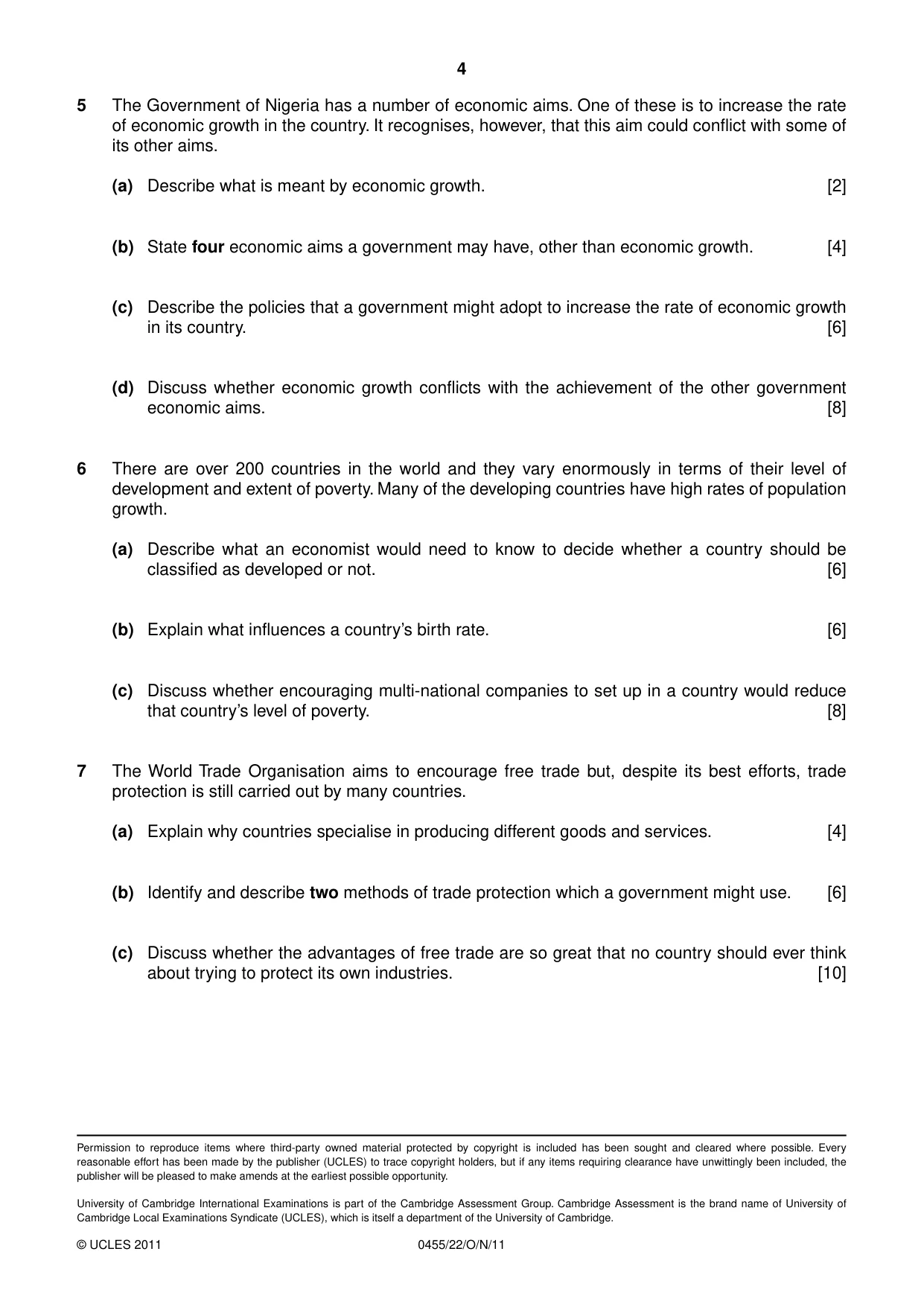
4 0455/22/O/N/11 © UCLES 2011 5 The Government of Nigeria has a number of economic aims. One of these is to increase the rate of economic growth in the country. It recognises, however, that this aim could conflict with some of its other aims. (a) Describe what is meant by economic growth. [2] (b) State four economic aims a government may have, other than economic growth. [4] (c) Describe the policies that a government might adopt to increase the rate of economic growth in its country. [6] (d) Discuss whether economic growth conflicts with the achievement of the other government economic aims. [8] 6 There are over 200 countries in the world and they vary enormously in terms of their level of development and extent of poverty. Many of the developing countries have high rates of population growth. (a) Describe what an economist would need to know to decide whether a country should be classified as developed or not. [6] (b) Explain what influences a country’s birth rate. [6] (c) Discuss whether encouraging multi-national companies to set up in a country would reduce that country’s level of poverty. [8] 7 The World Trade Organisation aims to encourage free trade but, despite its best efforts, trade protection is still carried out by many countries. (a) Explain why countries specialise in producing different goods and services. [4] (b) Identify and describe two methods of trade protection which a government might use. [6] (c) Discuss whether the advantages of free trade are so great that no country should ever think about trying to protect its own industries. [10] Permission to reproduce items where third-party owned material protected by copyright is included has been sought and cleared where possible. Every reasonable effort has been made by the publisher (UCLES) to trace copyright holders, but if any items requiring clearance have unwittingly been included, the publisher will be pleased to make amends at the earliest possible opportunity. University of Cambridge International Examinations is part of the Cambridge Assessment Group. Cambridge Assessment is the brand name of University of Cambridge Local Examinations Syndicate (UCLES), which is itself a department of the University of Cambridge.
Mark scheme, page 1
UNIVERSITY OF CAMBRIDGE INTERNATIONAL EXAMINATIONS International General Certificate of Secondary Education MARK SCHEME for the October/November 2011 question paper for the guidance of teachers 0455 ECONOMICS 0455/22 Paper 2 (Structured Questions), maximum raw mark 80 This mark scheme is published as an aid to teachers and candidates, to indicate the requirements of the examination. It shows the basis on which Examiners were instructed to award marks. It does not indicate the details of the discussions that took place at an Examiners’ meeting before marking began, which would have considered the acceptability of alternative answers. Mark schemes must be read in conjunction with the question papers and the report on the examination. • Cambridge will not enter into discussions or correspondence in connection with these mark schemes. Cambridge is publishing the mark schemes for the October/November 2011 question papers for most IGCSE, GCE Advanced Level and Advanced Subsidiary Level syllabuses and some Ordinary Level syllabuses. www.XtremePapers.com
Mark scheme, page 2
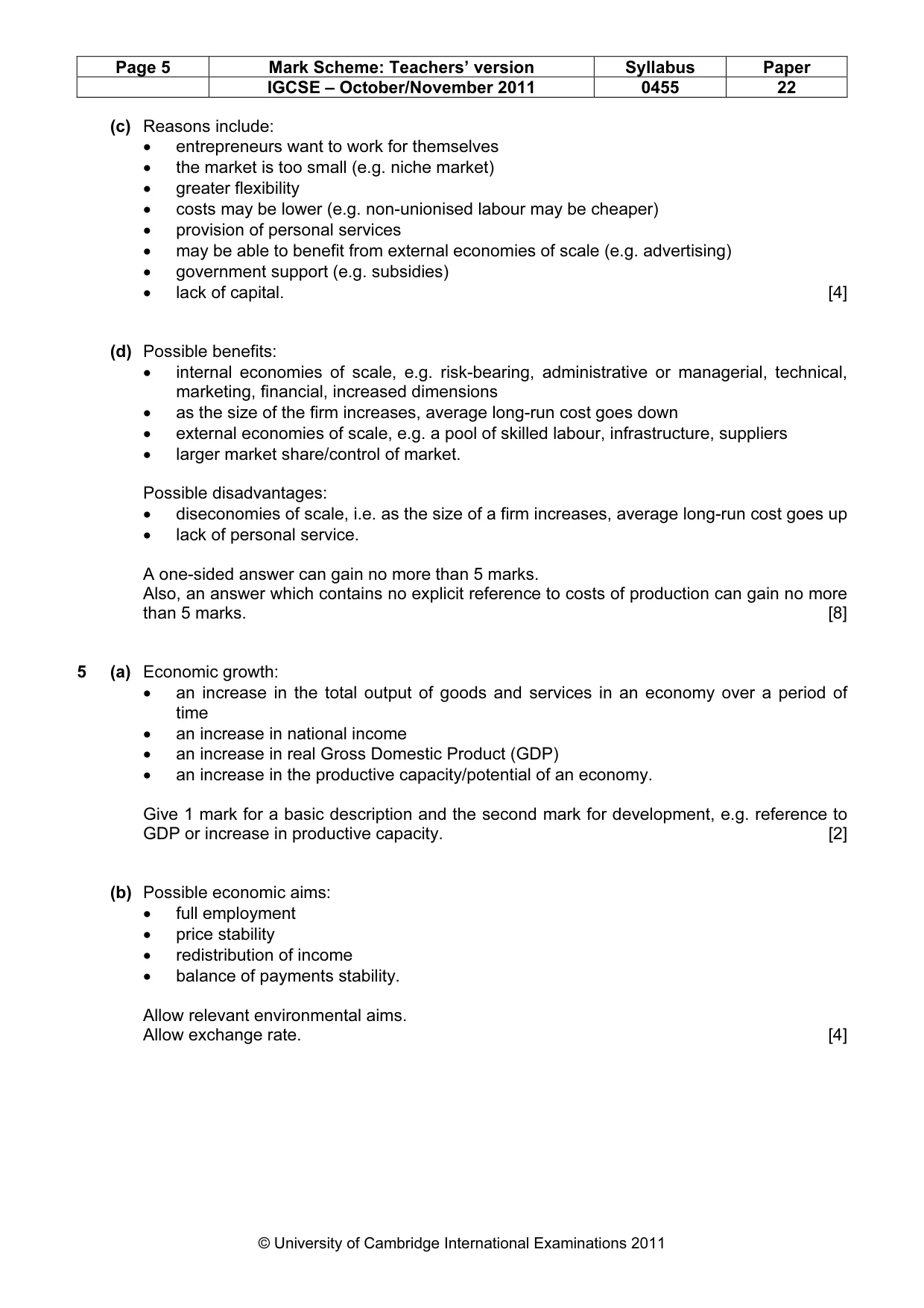
Page 2 Mark Scheme: Teachers’ version Syllabus Paper IGCSE – October/November 2011 0455 22 © University of Cambridge International Examinations 2011 1 (a) (i) One influence on the increase in demand for cocoa: • the fashion for more ‘upmarket’ chocolate. [1] (ii) Two influences on the decrease in supply of cocoa: • poor weather (dry weather) • under-investment in the industry • producers don’t use many chemicals or pesticides • they need to invest in other farming techniques • pests • disease. [2] (b) Diagram: • correctly labelled and drawn axes (P and Q) and curves (D and S) (1) • correctly labelled and drawn shift of the demand curve to the right and supply curve to the left (1) • change in equilibrium price and equilibrium quantity clearly shown (1). Explanation of diagram: • shifts of demand and supply curves (1) • higher price (1) • change in quantity uncertain (1). [6] (c) Effects of fluctuations in the cocoa market: • wild fluctuations in relation to changes in demand and supply conditions, especially in relation to supply • these fluctuations likely to lead to volatile prices • this will be extremely unstable for farmers – this instability can be very unsettling, making planning uncertain. Variations in prices will lead to variations in incomes – this will affect the standard of living of the farmers. [3] (d) In favour: • establish fixed (minimum or maximum) prices to support an industry • may be able to maintain employment levels. Against: • goes against free market forces • could mean that a government is supporting an inefficient industry. A one-sided answer can gain no more than 5 marks. [8] 2 (a) Explanation: • there are finite/limited resources • so there is a basic situation of scarcity • there are unlimited wants • so there is a need to exercise choice. [4] (b) Explanation of factors of production: 2 marks for identifying four factors, but no explanation. 1 mark for identifying three factors, but no explanation. Candidates should state and explain all four factors to gain full marks. [4]
Mark scheme, page 3
Page 3 Mark Scheme: Teachers’ version Syllabus Paper IGCSE – October/November 2011 0455 22 © University of Cambridge International Examinations 2011 (c) Opportunity cost: • it is the next best alternative that is foregone (2 marks for definition) • it represents cost in terms of what could have been had as an alternative to the item actually chosen • the idea of opportunity cost may be applied in any situation where choices are being made • the need for choice is due to the existence of scarce resources which have alternative uses; this is why it is an important concept for economists (2 marks for development that goes beyond a definition). If opportunity cost is not clearly defined, but an example is used which indicates a basic understanding, give 1 mark. Alternatively, an example might be used to aid the explanation and this could be given 1 mark. There are no marks, however, for simply giving an example. [4] (d) Possible benefits: • a better-educated workforce is likely to be more productive • this could lead to greater output/higher GDP • a healthier workforce is likely to miss fewer days of work • and so again productivity could increase. Possible disadvantages: • there might not be sufficient demand for workers • there could be a high rate of unemployment • improved health care is likely to lead to a lower death rate/higher birth rate • this would lead to an increase in population which could put pressure on resources. Other types of expenditure: • idea of opportunity cost involved • other types of expenditure might also have a significant impact on economy, e.g. spending on transport infrastructure or housing. A one-sided answer can gain no more than 5 marks. [8] 3 (a) (i) Private cost: the costs of production that are borne by the business which produces the product or by the consumer who purchases the product (1). (ii) Private benefit: the benefits which accrue to the individual buyer or seller of a product (1). (iii) External cost: the costs which occur that are paid by a third party, rather than the producer (1). (iv) External benefit: the benefits which result from a firm’s operations, but which give benefits to a third party (1). [4] (b) Possible examples: (i) Private cost: the construction cost (1). (ii) Private benefit: the profit made by the private company (1).
Mark scheme, page 4
Page 4 Mark Scheme: Teachers’ version Syllabus Paper IGCSE – October/November 2011 0455 22 © University of Cambridge International Examinations 2011 (iii) External cost: the noise pollution resulting from the noise of vehicles on the motorway (1). (iv) External benefit: the savings in time from people driving their vehicles along the motorway (1). [4] (c) Reasons for involvement of private companies: • they could contribute some of the finance • would be less of a burden on the government/taxpayer • they would have the expertise/experience from having built other roads • they would have the necessary equipment/machinery • government free to concentrate on other things, e.g. defence. A candidate can get full marks if they answer on just one of these. [4] (d) Benefits: • jobs will be created • bring in more business (idea of multiplier effect, but don’t need that term) • journey times will be reduced. Disadvantages: • some business may be lost as towns/villages are by-passed • noise pollution • some people may have to be moved if their land is on the motorway route. A one-sided answer can gain no more than 5 marks. Don’t award marks where the answer is simply repeating what was in (b). [8] 4 (a) Functions of a trade union: • they exist to protect the interests of their members • gain appropriate wage/salary increases; idea of collective bargaining • job security • working conditions/health and safety • dismissal/redundancy • possible influence on government at national level. A list-like approach can gain no more than 2 marks. [4] (b) Reasons include: • union doesn’t exist in a particular line of work • person is self-employed • cost of annual fee/subscription is expensive • worker doesn’t agree with views/actions of union • employees are satisfied with their pay and working conditions • they are illegal in some countries. [4]
Mark scheme, page 5
Page 5 Mark Scheme: Teachers’ version Syllabus Paper IGCSE – October/November 2011 0455 22 © University of Cambridge International Examinations 2011 (c) Reasons include: • entrepreneurs want to work for themselves • the market is too small (e.g. niche market) • greater flexibility • costs may be lower (e.g. non-unionised labour may be cheaper) • provision of personal services • may be able to benefit from external economies of scale (e.g. advertising) • government support (e.g. subsidies) • lack of capital. [4] (d) Possible benefits: • internal economies of scale, e.g. risk-bearing, administrative or managerial, technical, marketing, financial, increased dimensions • as the size of the firm increases, average long-run cost goes down • external economies of scale, e.g. a pool of skilled labour, infrastructure, suppliers • larger market share/control of market. Possible disadvantages: • diseconomies of scale, i.e. as the size of a firm increases, average long-run cost goes up • lack of personal service. A one-sided answer can gain no more than 5 marks. Also, an answer which contains no explicit reference to costs of production can gain no more than 5 marks. [8] 5 (a) Economic growth: • an increase in the total output of goods and services in an economy over a period of time • an increase in national income • an increase in real Gross Domestic Product (GDP) • an increase in the productive capacity/potential of an economy. Give 1 mark for a basic description and the second mark for development, e.g. reference to GDP or increase in productive capacity. [2] (b) Possible economic aims: • full employment • price stability • redistribution of income • balance of payments stability. Allow relevant environmental aims. Allow exchange rate. [4]
Mark scheme, page 6
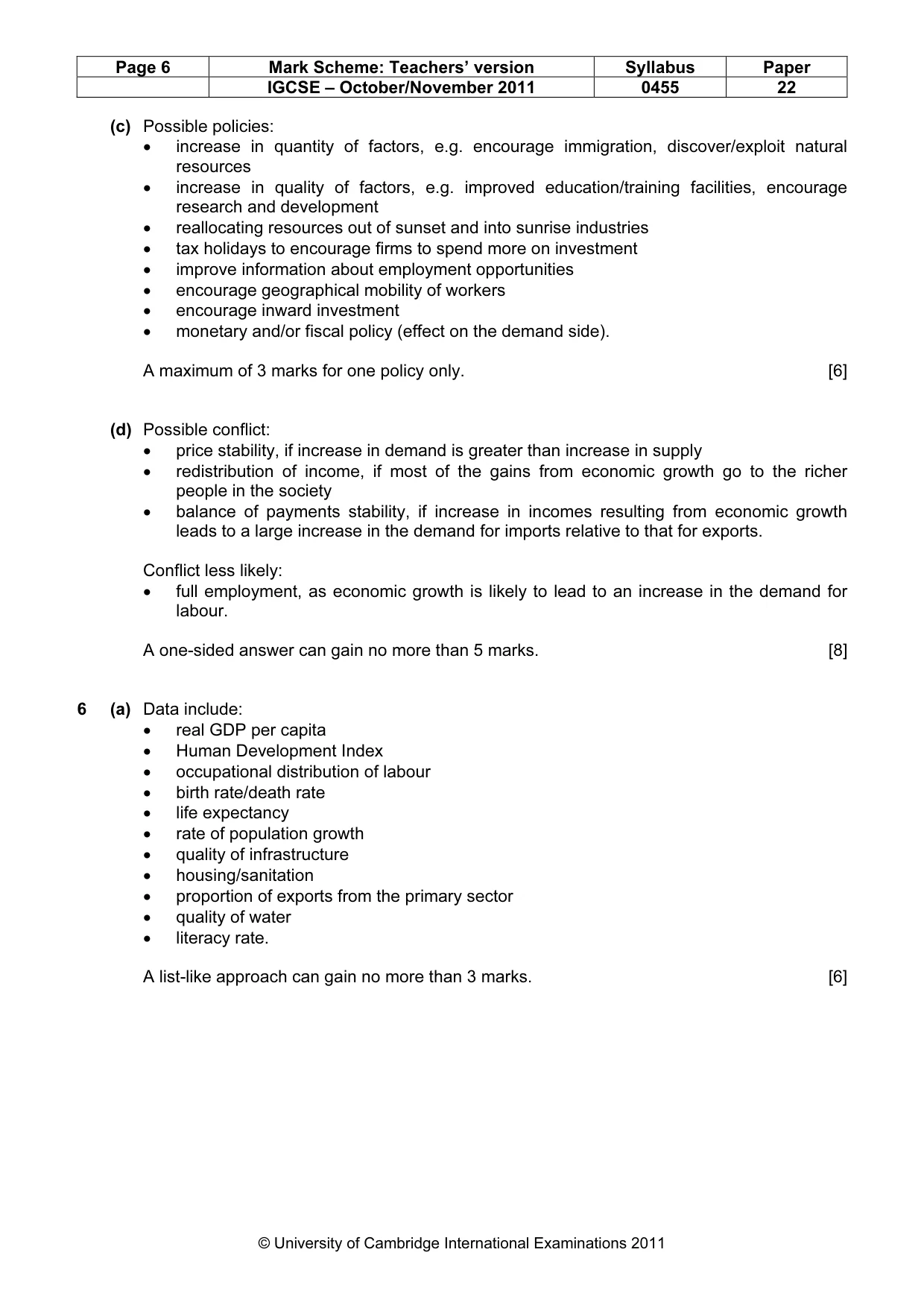
Page 6 Mark Scheme: Teachers’ version Syllabus Paper IGCSE – October/November 2011 0455 22 © University of Cambridge International Examinations 2011 (c) Possible policies: • increase in quantity of factors, e.g. encourage immigration, discover/exploit natural resources • increase in quality of factors, e.g. improved education/training facilities, encourage research and development • reallocating resources out of sunset and into sunrise industries • tax holidays to encourage firms to spend more on investment • improve information about employment opportunities • encourage geographical mobility of workers • encourage inward investment • monetary and/or fiscal policy (effect on the demand side). A maximum of 3 marks for one policy only. [6] (d) Possible conflict: • price stability, if increase in demand is greater than increase in supply • redistribution of income, if most of the gains from economic growth go to the richer people in the society • balance of payments stability, if increase in incomes resulting from economic growth leads to a large increase in the demand for imports relative to that for exports. Conflict less likely: • full employment, as economic growth is likely to lead to an increase in the demand for labour. A one-sided answer can gain no more than 5 marks. [8] 6 (a) Data include: • real GDP per capita • Human Development Index • occupational distribution of labour • birth rate/death rate • life expectancy • rate of population growth • quality of infrastructure • housing/sanitation • proportion of exports from the primary sector • quality of water • literacy rate. A list-like approach can gain no more than 3 marks. [6]
Mark scheme, page 7
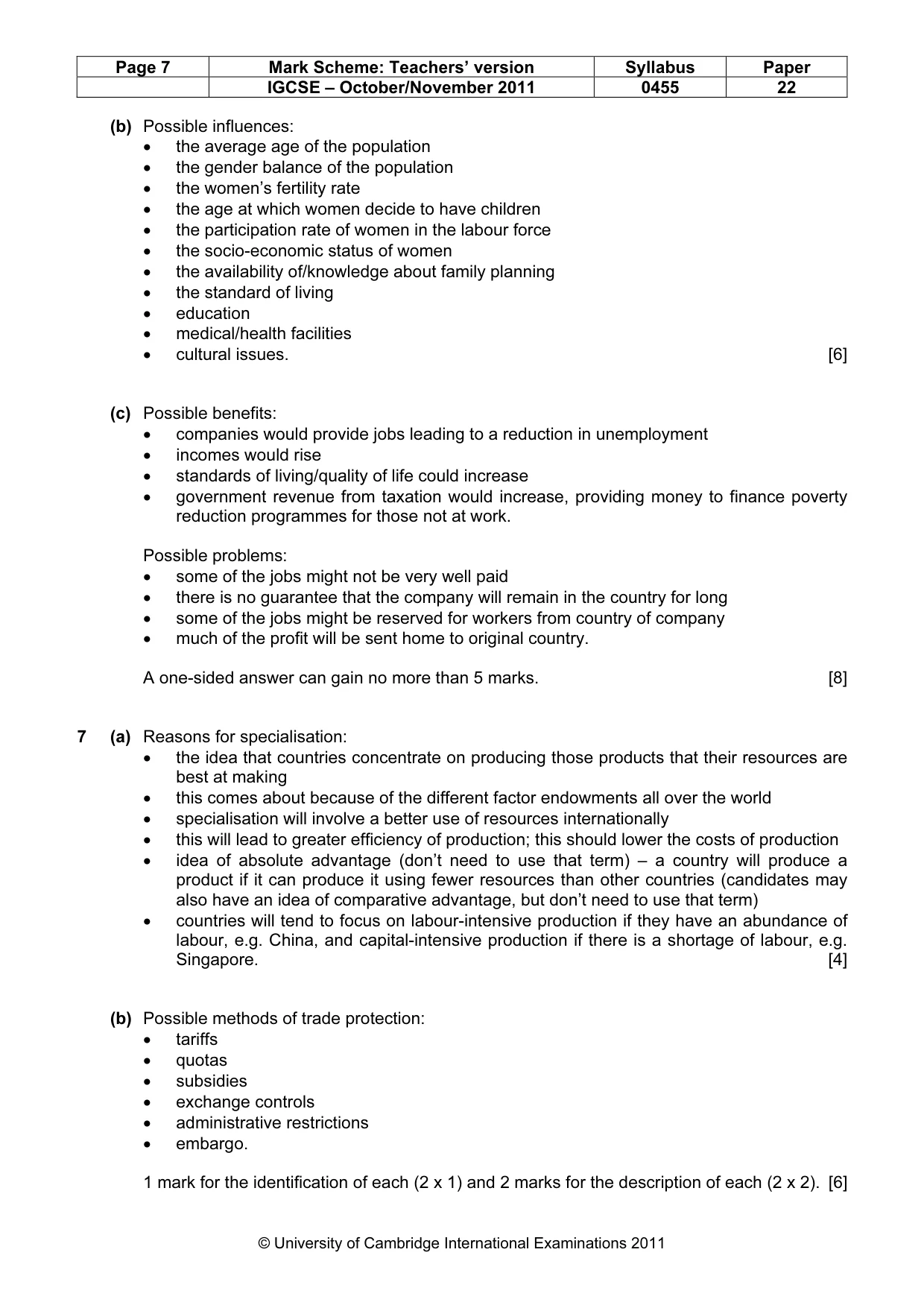
Page 7 Mark Scheme: Teachers’ version Syllabus Paper IGCSE – October/November 2011 0455 22 © University of Cambridge International Examinations 2011 (b) Possible influences: • the average age of the population • the gender balance of the population • the women’s fertility rate • the age at which women decide to have children • the participation rate of women in the labour force • the socio-economic status of women • the availability of/knowledge about family planning • the standard of living • education • medical/health facilities • cultural issues. [6] (c) Possible benefits: • companies would provide jobs leading to a reduction in unemployment • incomes would rise • standards of living/quality of life could increase • government revenue from taxation would increase, providing money to finance poverty reduction programmes for those not at work. Possible problems: • some of the jobs might not be very well paid • there is no guarantee that the company will remain in the country for long • some of the jobs might be reserved for workers from country of company • much of the profit will be sent home to original country. A one-sided answer can gain no more than 5 marks. [8] 7 (a) Reasons for specialisation: • the idea that countries concentrate on producing those products that their resources are best at making • this comes about because of the different factor endowments all over the world • specialisation will involve a better use of resources internationally • this will lead to greater efficiency of production; this should lower the costs of production • idea of absolute advantage (don’t need to use that term) – a country will produce a product if it can produce it using fewer resources than other countries (candidates may also have an idea of comparative advantage, but don’t need to use that term) • countries will tend to focus on labour-intensive production if they have an abundance of labour, e.g. China, and capital-intensive production if there is a shortage of labour, e.g. Singapore. [4] (b) Possible methods of trade protection: • tariffs • quotas • subsidies • exchange controls • administrative restrictions • embargo. 1 mark for the identification of each (2 x 1) and 2 marks for the description of each (2 x 2). [6]
Mark scheme, page 8
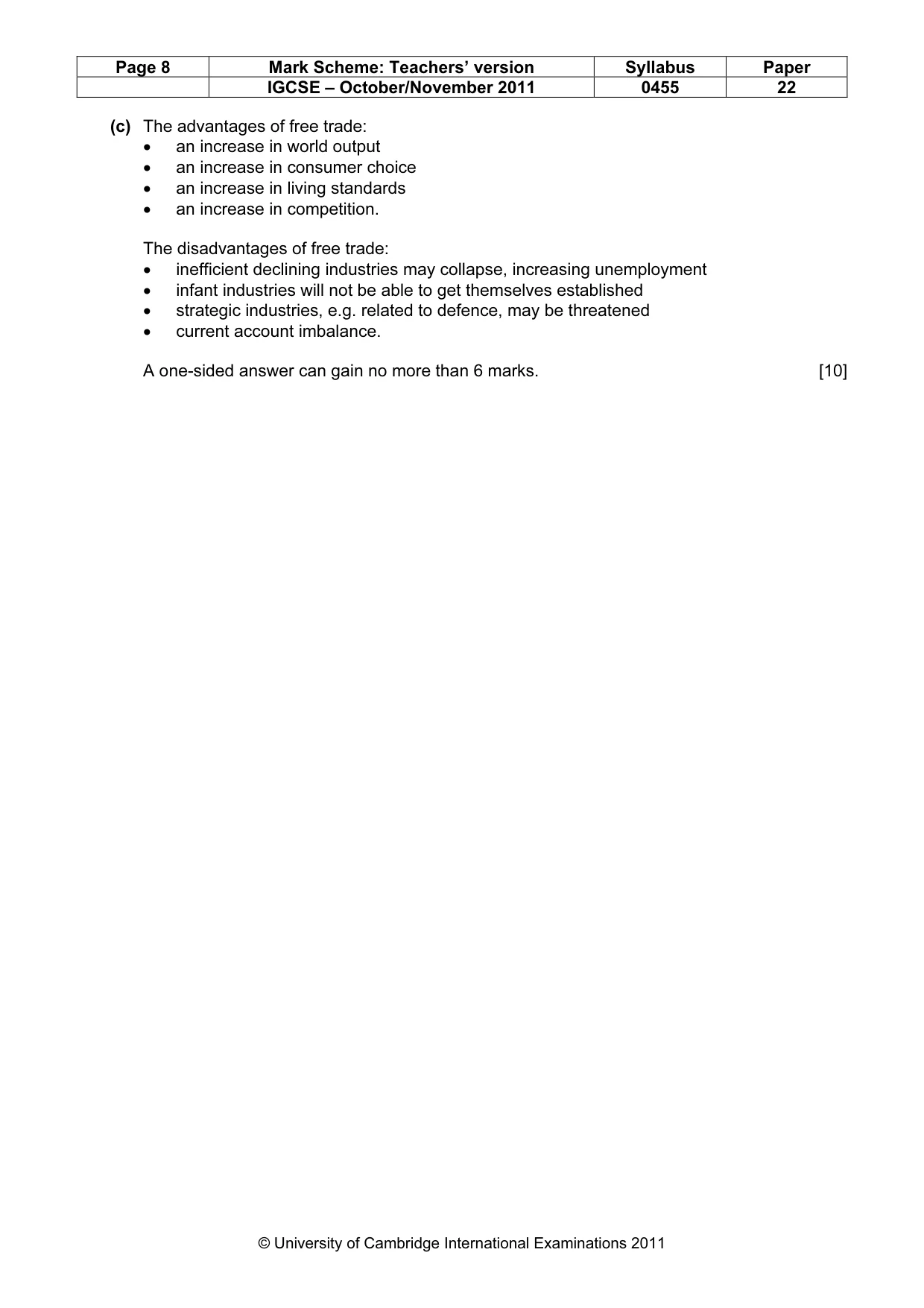
Page 8 Mark Scheme: Teachers’ version Syllabus Paper IGCSE – October/November 2011 0455 22 © University of Cambridge International Examinations 2011 (c) The advantages of free trade: • an increase in world output • an increase in consumer choice • an increase in living standards • an increase in competition. The disadvantages of free trade: • inefficient declining industries may collapse, increasing unemployment • infant industries will not be able to get themselves established • strategic industries, e.g. related to defence, may be threatened • current account imbalance. A one-sided answer can gain no more than 6 marks. [10]
What you needed in this session
Cambridge’s own grade thresholds for 2011 Oct/Nov, Paper 2 · Variant 2. A higher threshold means an easier paper — the bar moves with how the cohort did.