Cambridge IGCSE Economics 0455 — 2010 Oct/Nov Paper 2 · Variant 3
0455/23/O/N/10 · 80 marks · ≈90 min
The question paper and its mark scheme, free to read here and free to download. This is Cambridge’s own paper, exactly as it was sat.
Question paper4 pages
Mark scheme8 pages
Answers below. Sit the paper first if you are practising.

Paper as text
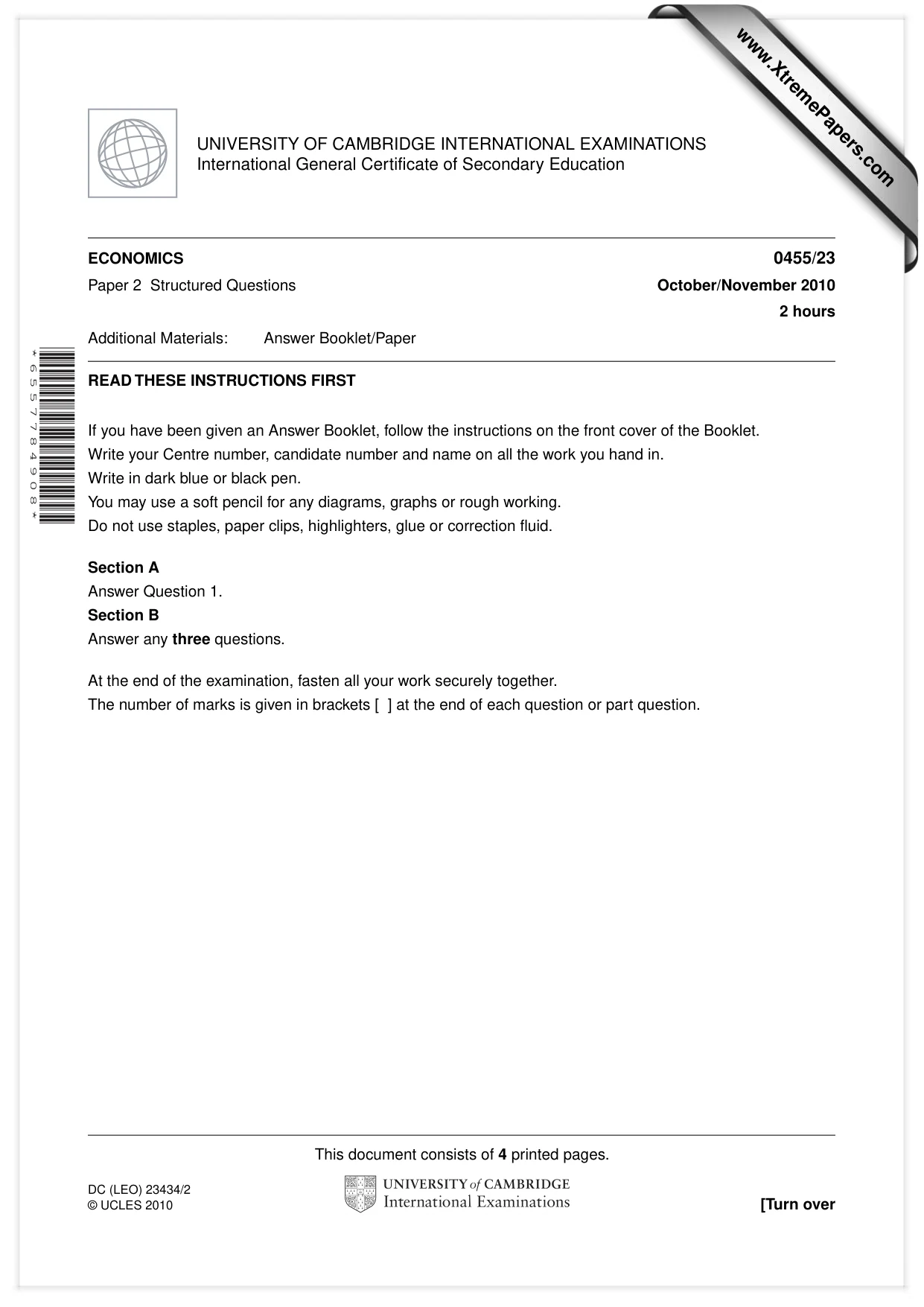
Question paper, page 1
This document consists of 4 printed pages. DC (LEO) 23434/2 © UCLES 2010 [Turn over UNIVERSITY OF CAMBRIDGE INTERNATIONAL EXAMINATIONS International General Certificate of Secondary Education * 6 5 5 7 7 8 4 9 0 8 * ECONOMICS 0455/23 Paper 2 Structured Questions October/November 2010 2 hours Additional Materials: Answer Booklet/Paper READ THESE INSTRUCTIONS FIRST If you have been given an Answer Booklet, follow the instructions on the front cover of the Booklet. Write your Centre number, candidate number and name on all the work you hand in. Write in dark blue or black pen. You may use a soft pencil for any diagrams, graphs or rough working. Do not use staples, paper clips, highlighters, glue or correction fluid. Section A Answer Question 1. Section B Answer any three questions. At the end of the examination, fasten all your work securely together. The number of marks is given in brackets [ ] at the end of each question or part question. www.XtremePapers.com
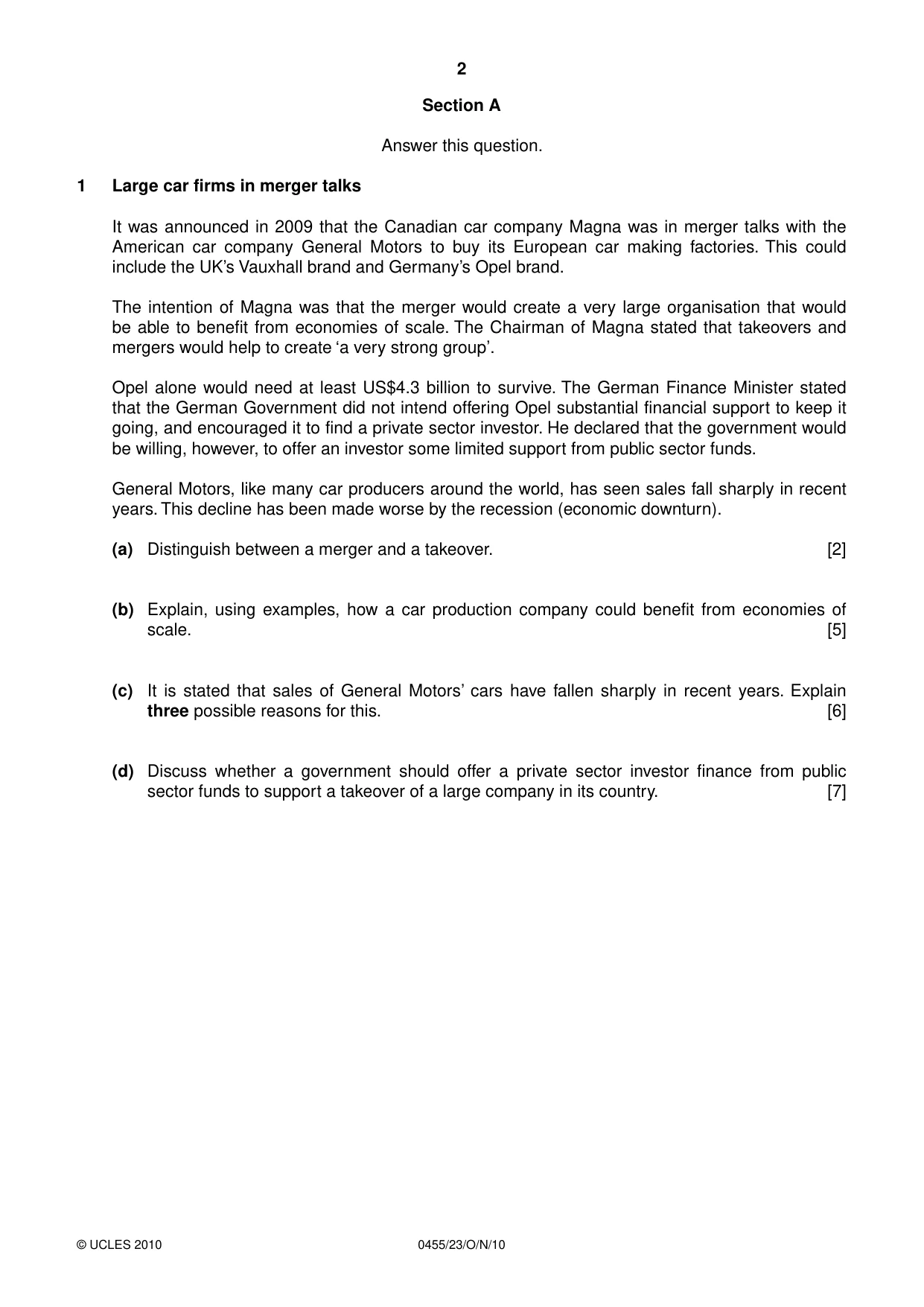
Question paper, page 2
2 0455/23/O/N/10 © UCLES 2010 Section A Answer this question. 1 Large car firms in merger talks It was announced in 2009 that the Canadian car company Magna was in merger talks with the American car company General Motors to buy its European car making factories. This could include the UK’s Vauxhall brand and Germany’s Opel brand. The intention of Magna was that the merger would create a very large organisation that would be able to benefit from economies of scale. The Chairman of Magna stated that takeovers and mergers would help to create ‘a very strong group’. Opel alone would need at least US$4.3 billion to survive. The German Finance Minister stated that the German Government did not intend offering Opel substantial financial support to keep it going, and encouraged it to find a private sector investor. He declared that the government would be willing, however, to offer an investor some limited support from public sector funds. General Motors, like many car producers around the world, has seen sales fall sharply in recent years. This decline has been made worse by the recession (economic downturn). (a) Distinguish between a merger and a takeover. [2] (b) Explain, using examples, how a car production company could benefit from economies of scale. [5] (c) It is stated that sales of General Motors’ cars have fallen sharply in recent years. Explain three possible reasons for this. [6] (d) Discuss whether a government should offer a private sector investor finance from public sector funds to support a takeover of a large company in its country. [7]
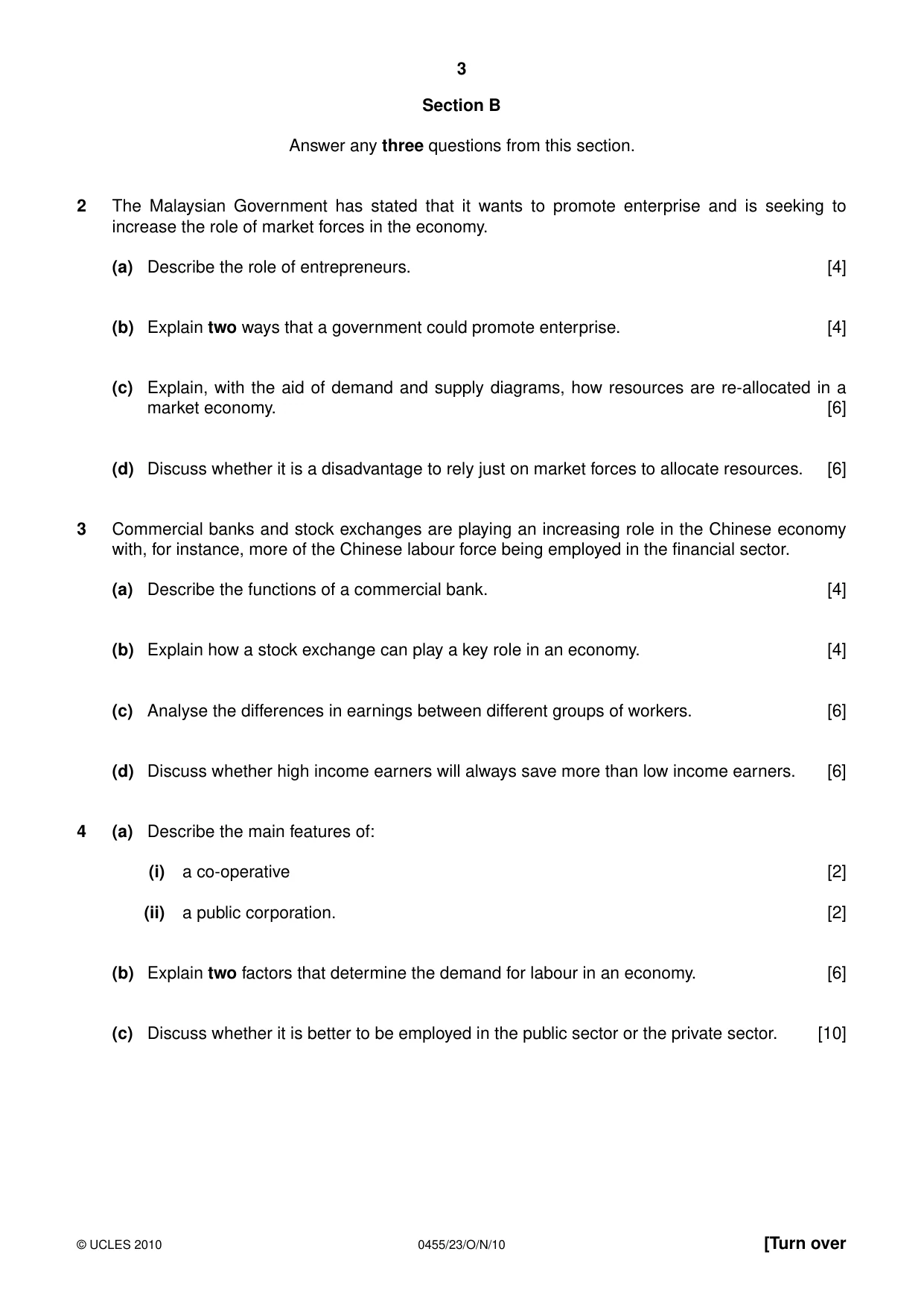
Question paper, page 3
3 0455/23/O/N/10 © UCLES 2010 [Turn over Section B Answer any three questions from this section. 2 The Malaysian Government has stated that it wants to promote enterprise and is seeking to increase the role of market forces in the economy. (a) Describe the role of entrepreneurs. [4] (b) Explain two ways that a government could promote enterprise. [4] (c) Explain, with the aid of demand and supply diagrams, how resources are re-allocated in a market economy. [6] (d) Discuss whether it is a disadvantage to rely just on market forces to allocate resources. [6] 3 Commercial banks and stock exchanges are playing an increasing role in the Chinese economy with, for instance, more of the Chinese labour force being employed in the financial sector. (a) Describe the functions of a commercial bank. [4] (b) Explain how a stock exchange can play a key role in an economy. [4] (c) Analyse the differences in earnings between different groups of workers. [6] (d) Discuss whether high income earners will always save more than low income earners. [6] 4 (a) Describe the main features of: (i) a co-operative [2] (ii) a public corporation. [2] (b) Explain two factors that determine the demand for labour in an economy. [6] (c) Discuss whether it is better to be employed in the public sector or the private sector. [10]
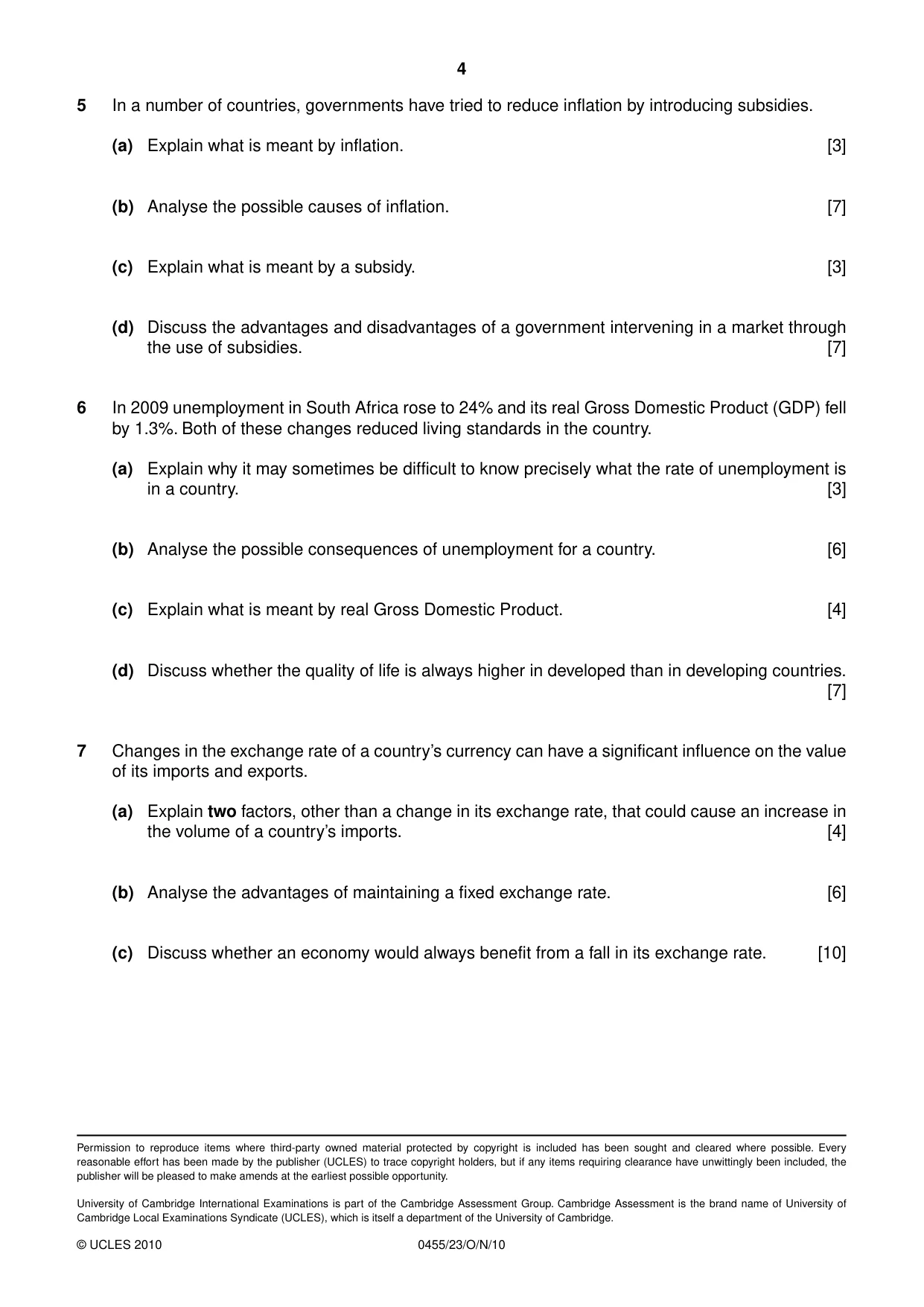
Question paper, page 4
4 0455/23/O/N/10 © UCLES 2010 5 In a number of countries, governments have tried to reduce inflation by introducing subsidies. (a) Explain what is meant by inflation. [3] (b) Analyse the possible causes of inflation. [7] (c) Explain what is meant by a subsidy. [3] (d) Discuss the advantages and disadvantages of a government intervening in a market through the use of subsidies. [7] 6 In 2009 unemployment in South Africa rose to 24% and its real Gross Domestic Product (GDP) fell by 1.3%. Both of these changes reduced living standards in the country. (a) Explain why it may sometimes be difficult to know precisely what the rate of unemployment is in a country. [3] (b) Analyse the possible consequences of unemployment for a country. [6] (c) Explain what is meant by real Gross Domestic Product. [4] (d) Discuss whether the quality of life is always higher in developed than in developing countries. [7] 7 Changes in the exchange rate of a country’s currency can have a significant influence on the value of its imports and exports. (a) Explain two factors, other than a change in its exchange rate, that could cause an increase in the volume of a country’s imports. [4] (b) Analyse the advantages of maintaining a fixed exchange rate. [6] (c) Discuss whether an economy would always benefit from a fall in its exchange rate. [10] Permission to reproduce items where third-party owned material protected by copyright is included has been sought and cleared where possible. Every reasonable effort has been made by the publisher (UCLES) to trace copyright holders, but if any items requiring clearance have unwittingly been included, the publisher will be pleased to make amends at the earliest possible opportunity. University of Cambridge International Examinations is part of the Cambridge Assessment Group. Cambridge Assessment is the brand name of University of Cambridge Local Examinations Syndicate (UCLES), which is itself a department of the University of Cambridge.
Mark scheme, page 1
UNIVERSITY OF CAMBRIDGE INTERNATIONAL EXAMINATIONS International General Certificate of Secondary Education MARK SCHEME for the October/November 2010 question paper for the guidance of teachers 0455 ECONOMICS 0455/23 Paper 2 (Structured Questions), maximum raw mark 80 This mark scheme is published as an aid to teachers and candidates, to indicate the requirements of the examination. It shows the basis on which Examiners were instructed to award marks. It does not indicate the details of the discussions that took place at an Examiners’ meeting before marking began, which would have considered the acceptability of alternative answers. Mark schemes must be read in conjunction with the question papers and the report on the examination. • CIE will not enter into discussions or correspondence in connection with these mark schemes. CIE is publishing the mark schemes for the October/November 2010 question papers for most IGCSE, GCE Advanced Level and Advanced Subsidiary Level syllabuses and some Ordinary Level syllabuses. www.XtremePapers.com
Mark scheme, page 2
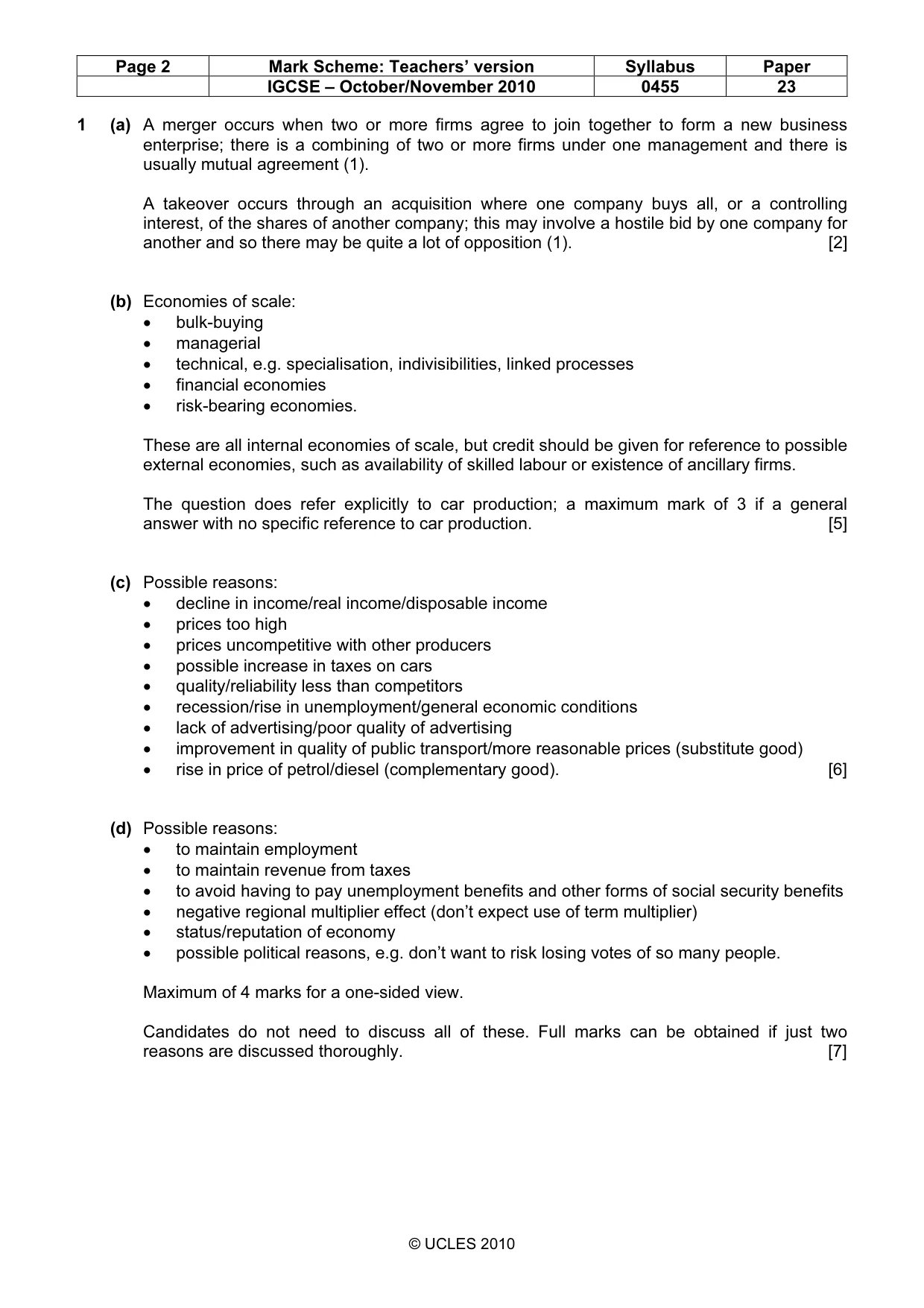
Page 2 Mark Scheme: Teachers’ version Syllabus Paper IGCSE – October/November 2010 0455 23 © UCLES 2010 1 (a) A merger occurs when two or more firms agree to join together to form a new business enterprise; there is a combining of two or more firms under one management and there is usually mutual agreement (1). A takeover occurs through an acquisition where one company buys all, or a controlling interest, of the shares of another company; this may involve a hostile bid by one company for another and so there may be quite a lot of opposition (1). [2] (b) Economies of scale: • bulk-buying • managerial • technical, e.g. specialisation, indivisibilities, linked processes • financial economies • risk-bearing economies. These are all internal economies of scale, but credit should be given for reference to possible external economies, such as availability of skilled labour or existence of ancillary firms. The question does refer explicitly to car production; a maximum mark of 3 if a general answer with no specific reference to car production. [5] (c) Possible reasons: • decline in income/real income/disposable income • prices too high • prices uncompetitive with other producers • possible increase in taxes on cars • quality/reliability less than competitors • recession/rise in unemployment/general economic conditions • lack of advertising/poor quality of advertising • improvement in quality of public transport/more reasonable prices (substitute good) • rise in price of petrol/diesel (complementary good). [6] (d) Possible reasons: • to maintain employment • to maintain revenue from taxes • to avoid having to pay unemployment benefits and other forms of social security benefits • negative regional multiplier effect (don’t expect use of term multiplier) • status/reputation of economy • possible political reasons, e.g. don’t want to risk losing votes of so many people. Maximum of 4 marks for a one-sided view. Candidates do not need to discuss all of these. Full marks can be obtained if just two reasons are discussed thoroughly. [7]
Mark scheme, page 3
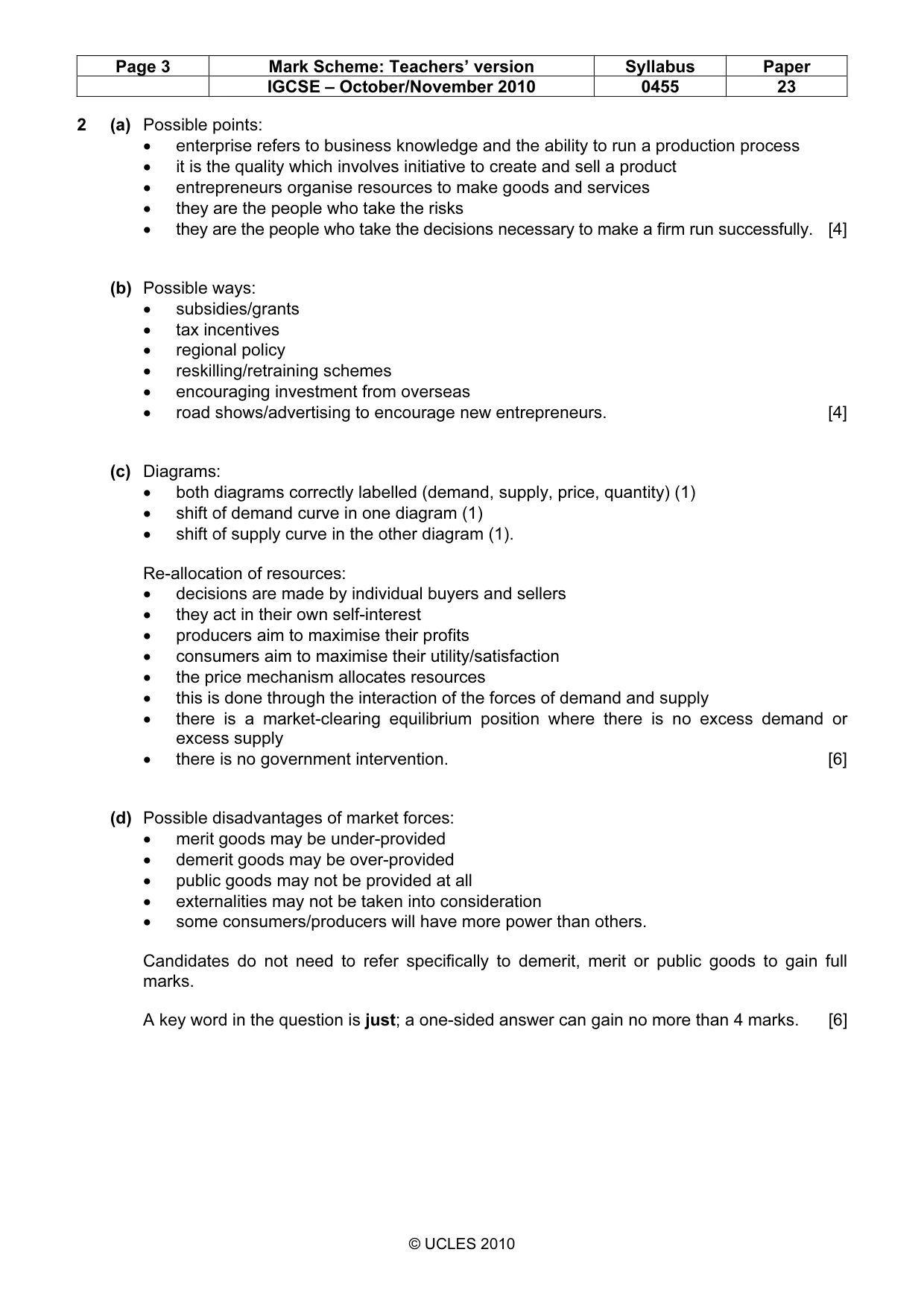
Page 3 Mark Scheme: Teachers’ version Syllabus Paper IGCSE – October/November 2010 0455 23 © UCLES 2010 2 (a) Possible points: • enterprise refers to business knowledge and the ability to run a production process • it is the quality which involves initiative to create and sell a product • entrepreneurs organise resources to make goods and services • they are the people who take the risks • they are the people who take the decisions necessary to make a firm run successfully. [4] (b) Possible ways: • subsidies/grants • tax incentives • regional policy • reskilling/retraining schemes • encouraging investment from overseas • road shows/advertising to encourage new entrepreneurs. [4] (c) Diagrams: • both diagrams correctly labelled (demand, supply, price, quantity) (1) • shift of demand curve in one diagram (1) • shift of supply curve in the other diagram (1). Re-allocation of resources: • decisions are made by individual buyers and sellers • they act in their own self-interest • producers aim to maximise their profits • consumers aim to maximise their utility/satisfaction • the price mechanism allocates resources • this is done through the interaction of the forces of demand and supply • there is a market-clearing equilibrium position where there is no excess demand or excess supply • there is no government intervention. [6] (d) Possible disadvantages of market forces: • merit goods may be under-provided • demerit goods may be over-provided • public goods may not be provided at all • externalities may not be taken into consideration • some consumers/producers will have more power than others. Candidates do not need to refer specifically to demerit, merit or public goods to gain full marks. A key word in the question is just; a one-sided answer can gain no more than 4 marks. [6]
Mark scheme, page 4
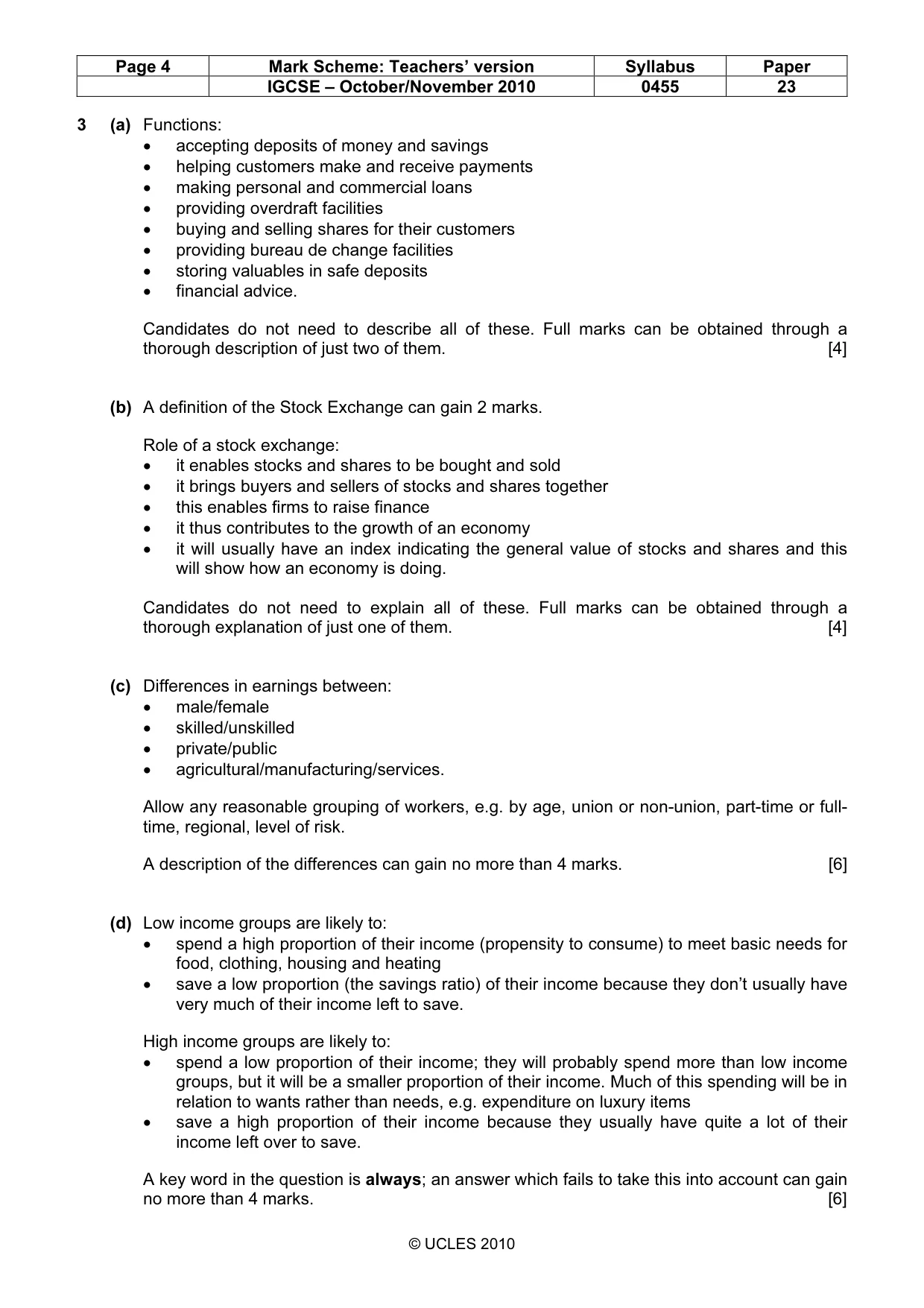
Page 4 Mark Scheme: Teachers’ version Syllabus Paper IGCSE – October/November 2010 0455 23 © UCLES 2010 3 (a) Functions: • accepting deposits of money and savings • helping customers make and receive payments • making personal and commercial loans • providing overdraft facilities • buying and selling shares for their customers • providing bureau de change facilities • storing valuables in safe deposits • financial advice. Candidates do not need to describe all of these. Full marks can be obtained through a thorough description of just two of them. [4] (b) A definition of the Stock Exchange can gain 2 marks. Role of a stock exchange: • it enables stocks and shares to be bought and sold • it brings buyers and sellers of stocks and shares together • this enables firms to raise finance • it thus contributes to the growth of an economy • it will usually have an index indicating the general value of stocks and shares and this will show how an economy is doing. Candidates do not need to explain all of these. Full marks can be obtained through a thorough explanation of just one of them. [4] (c) Differences in earnings between: • male/female • skilled/unskilled • private/public • agricultural/manufacturing/services. Allow any reasonable grouping of workers, e.g. by age, union or non-union, part-time or full- time, regional, level of risk. A description of the differences can gain no more than 4 marks. [6] (d) Low income groups are likely to: • spend a high proportion of their income (propensity to consume) to meet basic needs for food, clothing, housing and heating • save a low proportion (the savings ratio) of their income because they don’t usually have very much of their income left to save. High income groups are likely to: • spend a low proportion of their income; they will probably spend more than low income groups, but it will be a smaller proportion of their income. Much of this spending will be in relation to wants rather than needs, e.g. expenditure on luxury items • save a high proportion of their income because they usually have quite a lot of their income left over to save. A key word in the question is always; an answer which fails to take this into account can gain no more than 4 marks. [6]
Mark scheme, page 5
Page 5 Mark Scheme: Teachers’ version Syllabus Paper IGCSE – October/November 2010 0455 23 © UCLES 2010 4 (a) A co-operative: • a business organisation which is owned and controlled by a group of people to undertake an economic activity to their mutual benefit • each member of a co-operative has an equal share in the ownership and control of the organisation, e.g. a co-operative retail or farming group. [2] A public corporation: • it is owned/controlled by a government/is in the public sector • it is responsible for the day-to-day running of a business. [2] (b) Demand for labour: • a derived demand for what the labour can produce • the higher the revenue obtained from the sales of these products, the greater the demand for labour to produce these products • the revenue obtained from the sale of these products will need to be greater than the cost of employing the labour • is therefore linked to the wage rate paid; idea of surplus value (don’t need to use that term) • this is why the demand curve for labour is downward-sloping • linked to the productivity of the labour • will be affected by demand for capital. [6] (c) Definitions of public and private sector – up to 2 marks. Possible advantages of public sector employment: • greater job security • job satisfaction, e.g. working in state community schools • status, e.g. doctors in state community hospitals • enhanced pension provision. Possible advantages of private sector employment: • improved working conditions • better pay • more incentives, e.g. bonuses • stress on efficiency. A maximum of 6 marks, inclusive of mark(s) for definitions, for an answer which deals with only one of the sectors. [10]
Mark scheme, page 6
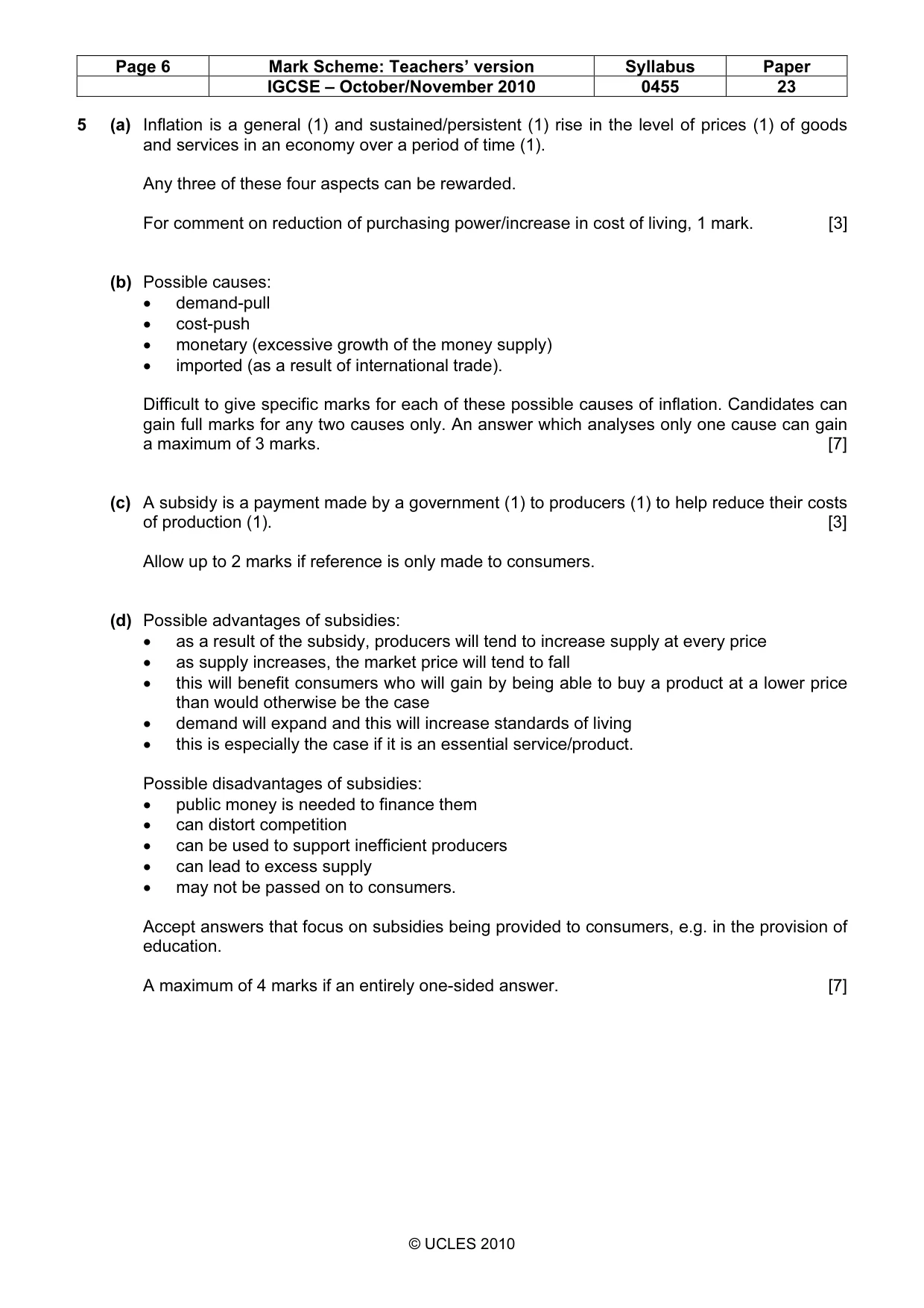
Page 6 Mark Scheme: Teachers’ version Syllabus Paper IGCSE – October/November 2010 0455 23 © UCLES 2010 5 (a) Inflation is a general (1) and sustained/persistent (1) rise in the level of prices (1) of goods and services in an economy over a period of time (1). Any three of these four aspects can be rewarded. For comment on reduction of purchasing power/increase in cost of living, 1 mark. [3] (b) Possible causes: • demand-pull • cost-push • monetary (excessive growth of the money supply) • imported (as a result of international trade). Difficult to give specific marks for each of these possible causes of inflation. Candidates can gain full marks for any two causes only. An answer which analyses only one cause can gain a maximum of 3 marks. [7] (c) A subsidy is a payment made by a government (1) to producers (1) to help reduce their costs of production (1). [3] Allow up to 2 marks if reference is only made to consumers. (d) Possible advantages of subsidies: • as a result of the subsidy, producers will tend to increase supply at every price • as supply increases, the market price will tend to fall • this will benefit consumers who will gain by being able to buy a product at a lower price than would otherwise be the case • demand will expand and this will increase standards of living • this is especially the case if it is an essential service/product. Possible disadvantages of subsidies: • public money is needed to finance them • can distort competition • can be used to support inefficient producers • can lead to excess supply • may not be passed on to consumers. Accept answers that focus on subsidies being provided to consumers, e.g. in the provision of education. A maximum of 4 marks if an entirely one-sided answer. [7]
Mark scheme, page 7
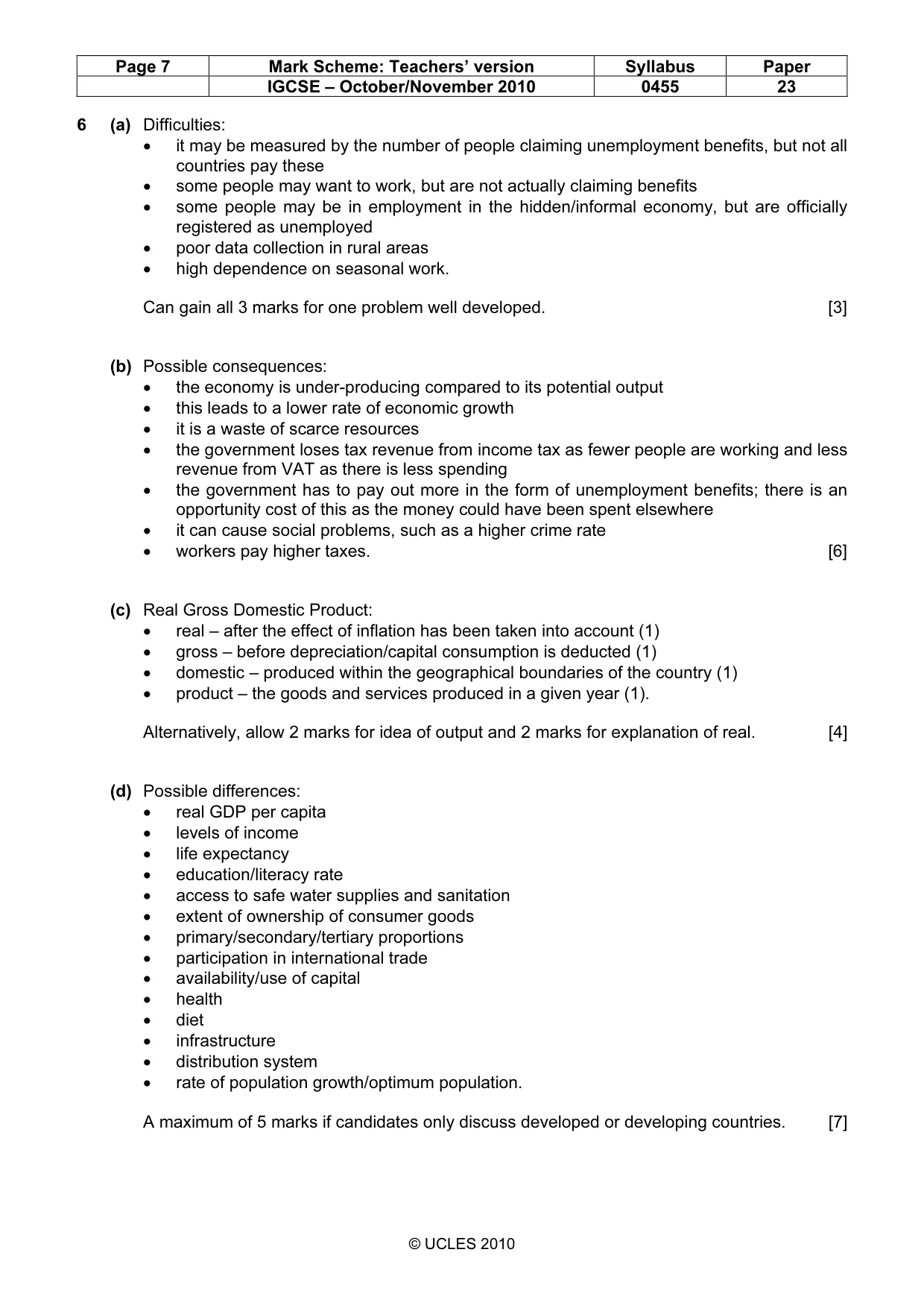
Page 7 Mark Scheme: Teachers’ version Syllabus Paper IGCSE – October/November 2010 0455 23 © UCLES 2010 6 (a) Difficulties: • it may be measured by the number of people claiming unemployment benefits, but not all countries pay these • some people may want to work, but are not actually claiming benefits • some people may be in employment in the hidden/informal economy, but are officially registered as unemployed • poor data collection in rural areas • high dependence on seasonal work. Can gain all 3 marks for one problem well developed. [3] (b) Possible consequences: • the economy is under-producing compared to its potential output • this leads to a lower rate of economic growth • it is a waste of scarce resources • the government loses tax revenue from income tax as fewer people are working and less revenue from VAT as there is less spending • the government has to pay out more in the form of unemployment benefits; there is an opportunity cost of this as the money could have been spent elsewhere • it can cause social problems, such as a higher crime rate • workers pay higher taxes. [6] (c) Real Gross Domestic Product: • real – after the effect of inflation has been taken into account (1) • gross – before depreciation/capital consumption is deducted (1) • domestic – produced within the geographical boundaries of the country (1) • product – the goods and services produced in a given year (1). Alternatively, allow 2 marks for idea of output and 2 marks for explanation of real. [4] (d) Possible differences: • real GDP per capita • levels of income • life expectancy • education/literacy rate • access to safe water supplies and sanitation • extent of ownership of consumer goods • primary/secondary/tertiary proportions • participation in international trade • availability/use of capital • health • diet • infrastructure • distribution system • rate of population growth/optimum population. A maximum of 5 marks if candidates only discuss developed or developing countries. [7]
Mark scheme, page 8
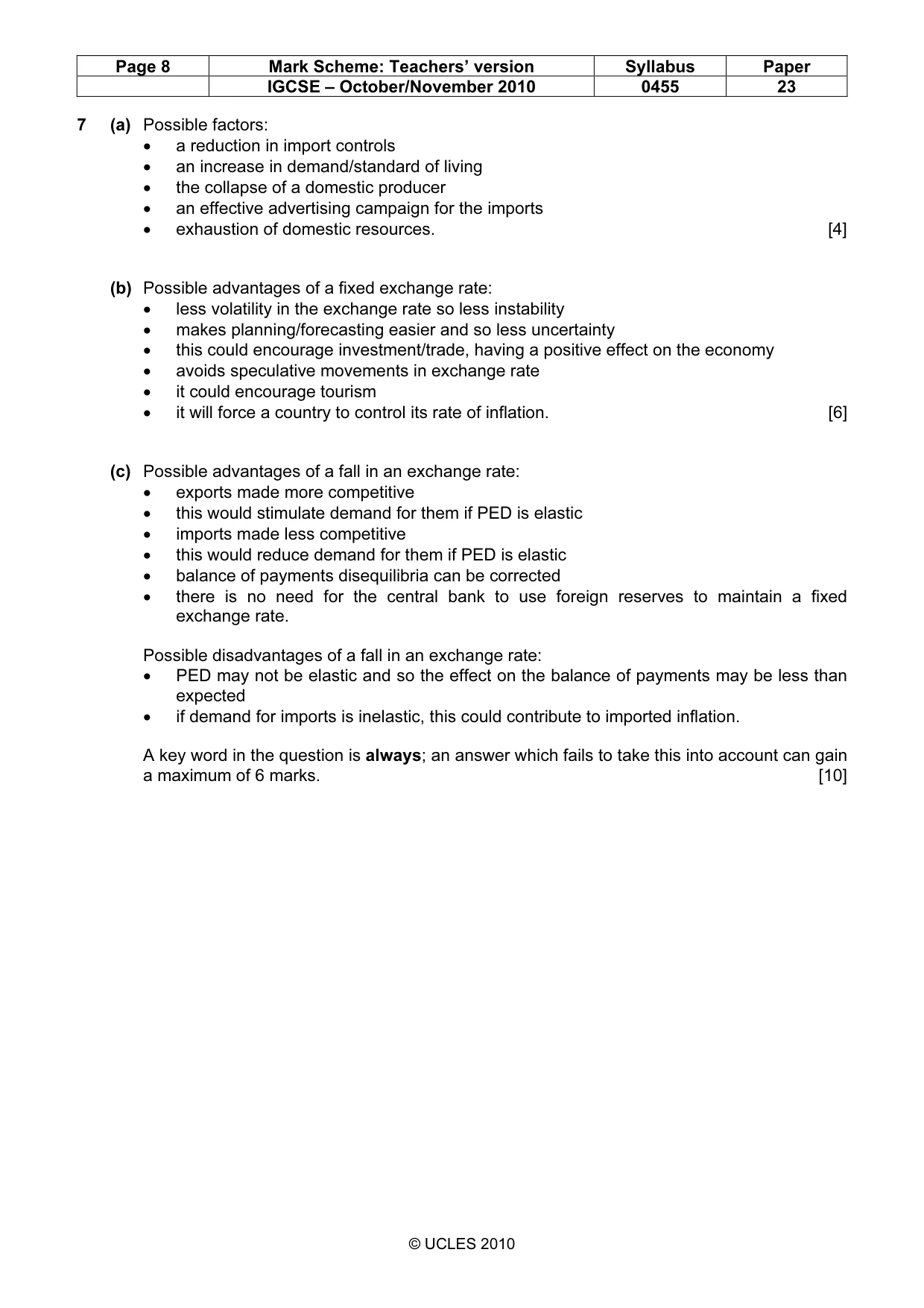
Page 8 Mark Scheme: Teachers’ version Syllabus Paper IGCSE – October/November 2010 0455 23 © UCLES 2010 7 (a) Possible factors: • a reduction in import controls • an increase in demand/standard of living • the collapse of a domestic producer • an effective advertising campaign for the imports • exhaustion of domestic resources. [4] (b) Possible advantages of a fixed exchange rate: • less volatility in the exchange rate so less instability • makes planning/forecasting easier and so less uncertainty • this could encourage investment/trade, having a positive effect on the economy • avoids speculative movements in exchange rate • it could encourage tourism • it will force a country to control its rate of inflation. [6] (c) Possible advantages of a fall in an exchange rate: • exports made more competitive • this would stimulate demand for them if PED is elastic • imports made less competitive • this would reduce demand for them if PED is elastic • balance of payments disequilibria can be corrected • there is no need for the central bank to use foreign reserves to maintain a fixed exchange rate. Possible disadvantages of a fall in an exchange rate: • PED may not be elastic and so the effect on the balance of payments may be less than expected • if demand for imports is inelastic, this could contribute to imported inflation. A key word in the question is always; an answer which fails to take this into account can gain a maximum of 6 marks. [10]
What you needed in this session
Cambridge’s own grade thresholds for 2010 Oct/Nov, Paper 2 · Variant 3. A higher threshold means an easier paper — the bar moves with how the cohort did.