Cambridge IGCSE Economics 0455 — 2010 Oct/Nov Paper 2 · Variant 2
0455/22/O/N/10 · 80 marks · ≈90 min
The question paper and its mark scheme, free to read here and free to download. This is Cambridge’s own paper, exactly as it was sat.
Question paper4 pages
Mark scheme9 pages
Answers below. Sit the paper first if you are practising.
Paper as text
Question paper, page 1
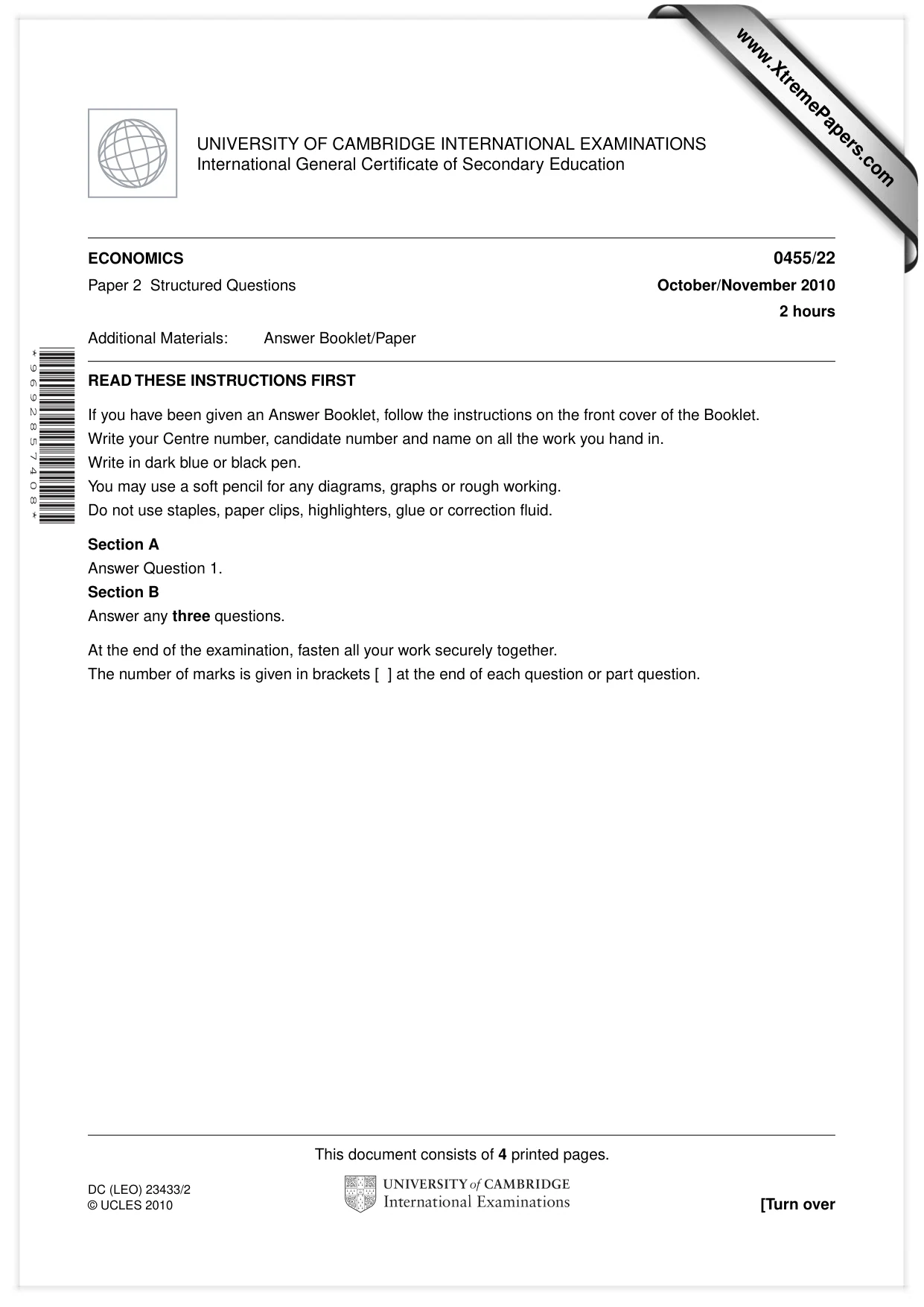
This document consists of 4 printed pages. DC (LEO) 23433/2 © UCLES 2010 [Turn over UNIVERSITY OF CAMBRIDGE INTERNATIONAL EXAMINATIONS International General Certificate of Secondary Education * 9 6 9 2 8 5 7 4 0 8 * ECONOMICS 0455/22 Paper 2 Structured Questions October/November 2010 2 hours Additional Materials: Answer Booklet/Paper READ THESE INSTRUCTIONS FIRST If you have been given an Answer Booklet, follow the instructions on the front cover of the Booklet. Write your Centre number, candidate number and name on all the work you hand in. Write in dark blue or black pen. You may use a soft pencil for any diagrams, graphs or rough working. Do not use staples, paper clips, highlighters, glue or correction fluid. Section A Answer Question 1. Section B Answer any three questions. At the end of the examination, fasten all your work securely together. The number of marks is given in brackets [ ] at the end of each question or part question. www.XtremePapers.com
Question paper, page 2
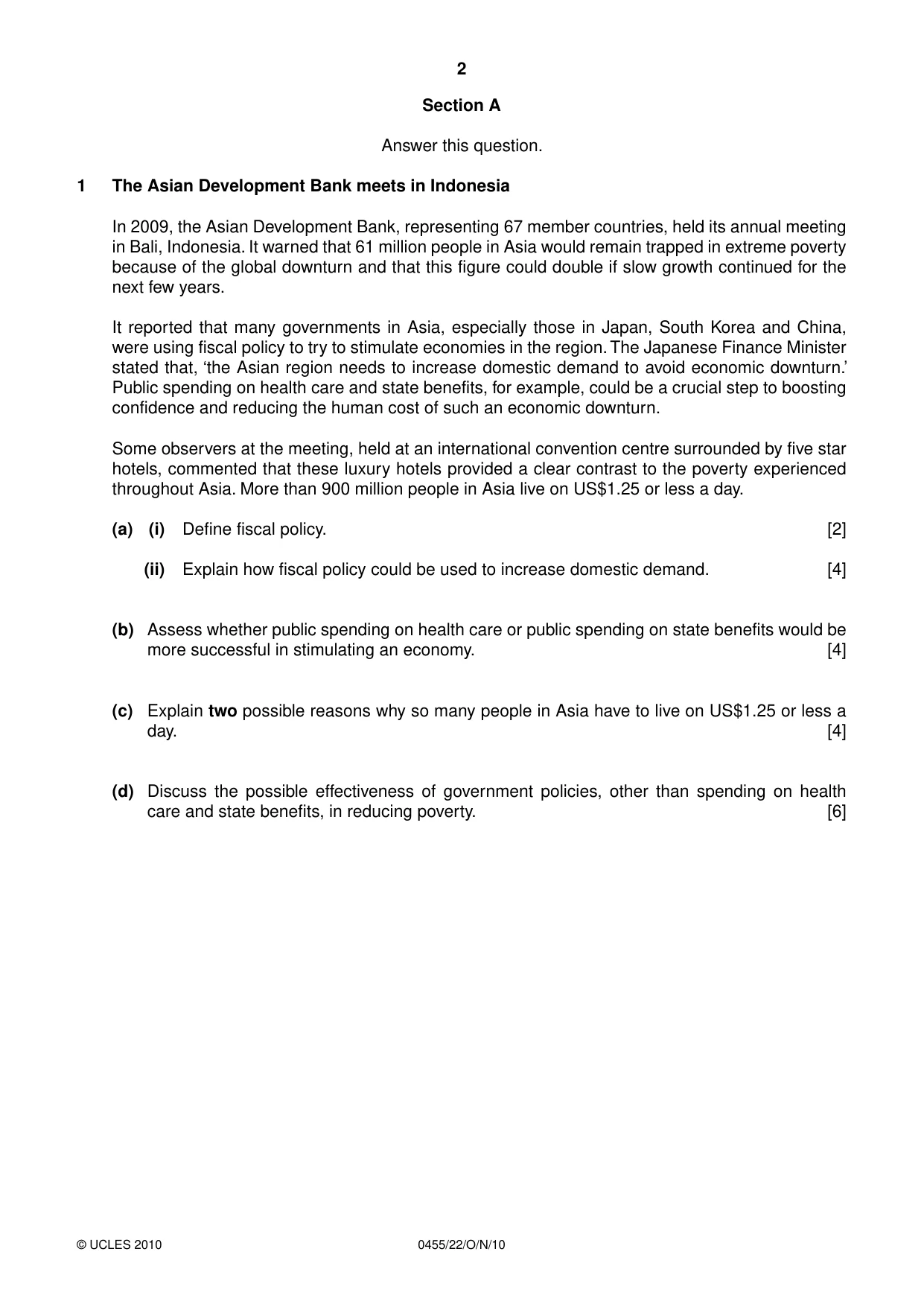
2 0455/22/O/N/10 © UCLES 2010 Section A Answer this question. 1 The Asian Development Bank meets in Indonesia In 2009, the Asian Development Bank, representing 67 member countries, held its annual meeting in Bali, Indonesia. It warned that 61 million people in Asia would remain trapped in extreme poverty because of the global downturn and that this figure could double if slow growth continued for the next few years. It reported that many governments in Asia, especially those in Japan, South Korea and China, were using fiscal policy to try to stimulate economies in the region. The Japanese Finance Minister stated that, ‘the Asian region needs to increase domestic demand to avoid economic downturn.’ Public spending on health care and state benefits, for example, could be a crucial step to boosting confidence and reducing the human cost of such an economic downturn. Some observers at the meeting, held at an international convention centre surrounded by five star hotels, commented that these luxury hotels provided a clear contrast to the poverty experienced throughout Asia. More than 900 million people in Asia live on US$1.25 or less a day. (a) (i) Define fiscal policy. [2] (ii) Explain how fiscal policy could be used to increase domestic demand. [4] (b) Assess whether public spending on health care or public spending on state benefits would be more successful in stimulating an economy. [4] (c) Explain two possible reasons why so many people in Asia have to live on US$1.25 or less a day. [4] (d) Discuss the possible effectiveness of government policies, other than spending on health care and state benefits, in reducing poverty. [6]
Question paper, page 3
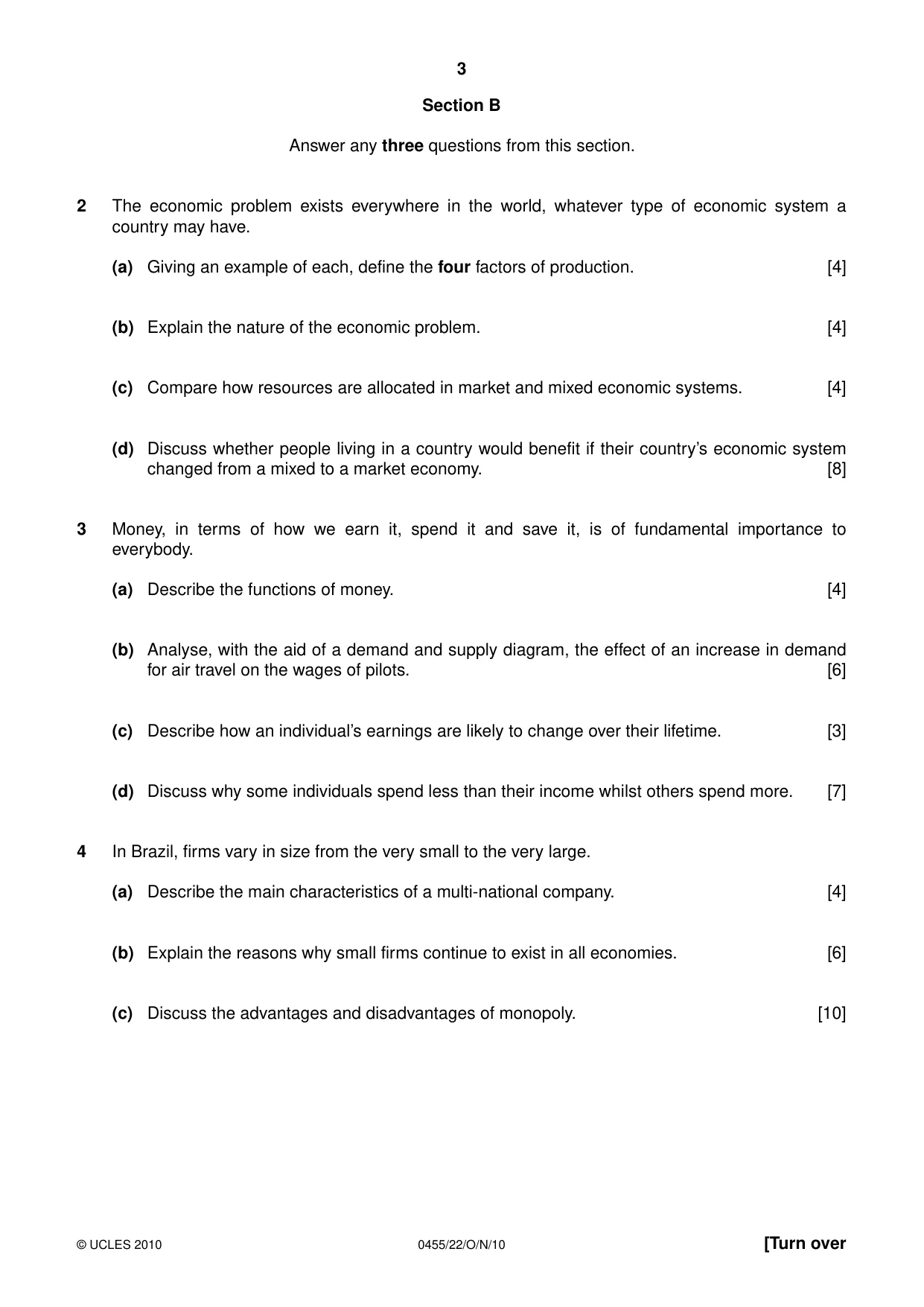
3 0455/22/O/N/10 © UCLES 2010 [Turn over Section B Answer any three questions from this section. 2 The economic problem exists everywhere in the world, whatever type of economic system a country may have. (a) Giving an example of each, define the four factors of production. [4] (b) Explain the nature of the economic problem. [4] (c) Compare how resources are allocated in market and mixed economic systems. [4] (d) Discuss whether people living in a country would benefit if their country’s economic system changed from a mixed to a market economy. [8] 3 Money, in terms of how we earn it, spend it and save it, is of fundamental importance to everybody. (a) Describe the functions of money. [4] (b) Analyse, with the aid of a demand and supply diagram, the effect of an increase in demand for air travel on the wages of pilots. [6] (c) Describe how an individual’s earnings are likely to change over their lifetime. [3] (d) Discuss why some individuals spend less than their income whilst others spend more. [7] 4 In Brazil, firms vary in size from the very small to the very large. (a) Describe the main characteristics of a multi-national company. [4] (b) Explain the reasons why small firms continue to exist in all economies. [6] (c) Discuss the advantages and disadvantages of monopoly. [10]
Question paper, page 4
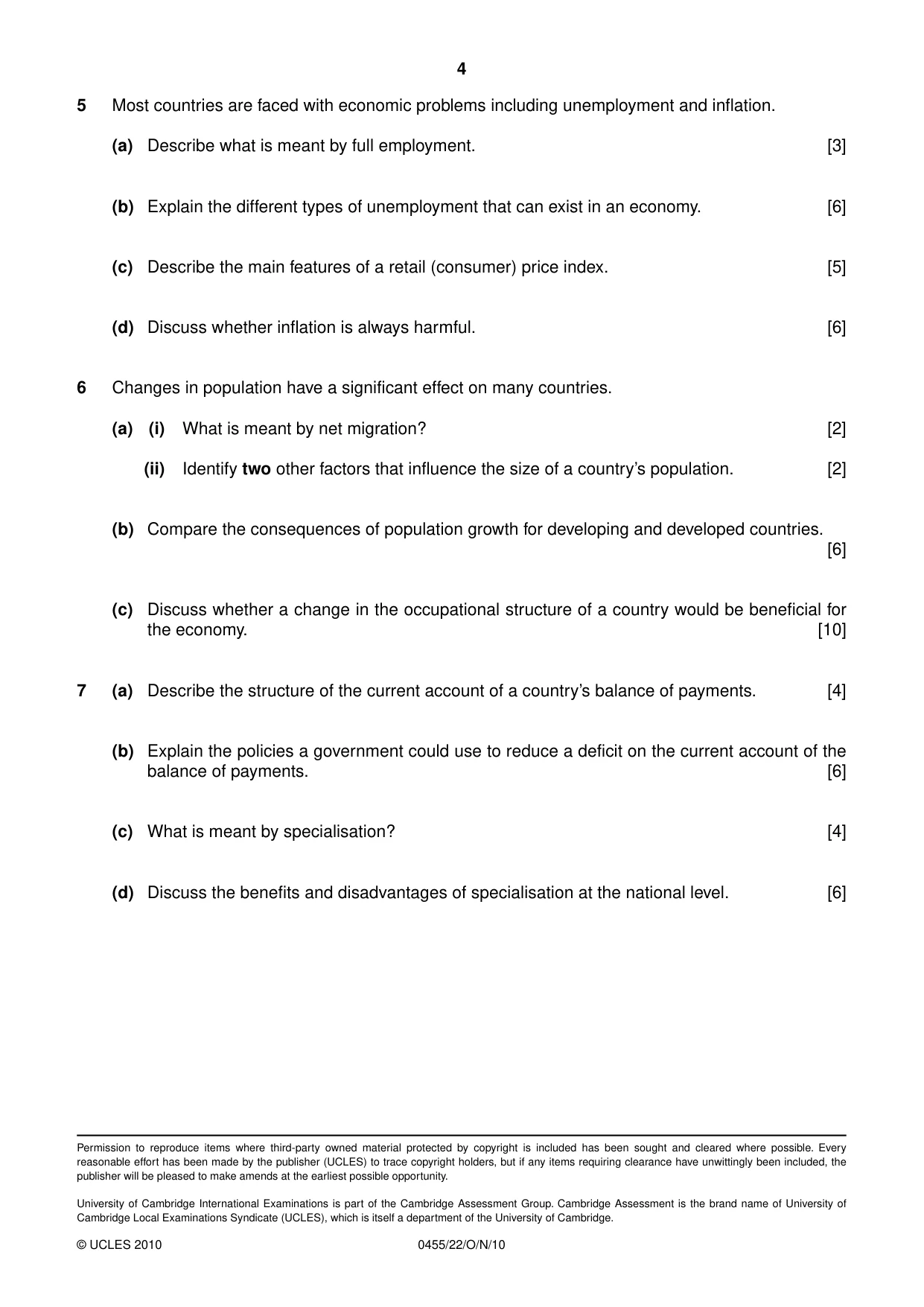
4 0455/22/O/N/10 © UCLES 2010 5 Most countries are faced with economic problems including unemployment and inflation. (a) Describe what is meant by full employment. [3] (b) Explain the different types of unemployment that can exist in an economy. [6] (c) Describe the main features of a retail (consumer) price index. [5] (d) Discuss whether inflation is always harmful. [6] 6 Changes in population have a significant effect on many countries. (a) (i) What is meant by net migration? [2] (ii) Identify two other factors that influence the size of a country’s population. [2] (b) Compare the consequences of population growth for developing and developed countries. [6] (c) Discuss whether a change in the occupational structure of a country would be beneficial for the economy. [10] 7 (a) Describe the structure of the current account of a country’s balance of payments. [4] (b) Explain the policies a government could use to reduce a deficit on the current account of the balance of payments. [6] (c) What is meant by specialisation? [4] (d) Discuss the benefits and disadvantages of specialisation at the national level. [6] Permission to reproduce items where third-party owned material protected by copyright is included has been sought and cleared where possible. Every reasonable effort has been made by the publisher (UCLES) to trace copyright holders, but if any items requiring clearance have unwittingly been included, the publisher will be pleased to make amends at the earliest possible opportunity. University of Cambridge International Examinations is part of the Cambridge Assessment Group. Cambridge Assessment is the brand name of University of Cambridge Local Examinations Syndicate (UCLES), which is itself a department of the University of Cambridge.
Mark scheme, page 1
UNIVERSITY OF CAMBRIDGE INTERNATIONAL EXAMINATIONS International General Certificate of Secondary Education MARK SCHEME for the October/November 2010 question paper for the guidance of teachers 0455 ECONOMICS 0455/22 Paper 2 (Structured Questions), maximum raw mark 80 This mark scheme is published as an aid to teachers and candidates, to indicate the requirements of the examination. It shows the basis on which Examiners were instructed to award marks. It does not indicate the details of the discussions that took place at an Examiners’ meeting before marking began, which would have considered the acceptability of alternative answers. Mark schemes must be read in conjunction with the question papers and the report on the examination. • CIE will not enter into discussions or correspondence in connection with these mark schemes. CIE is publishing the mark schemes for the October/November 2010 question papers for most IGCSE, GCE Advanced Level and Advanced Subsidiary Level syllabuses and some Ordinary Level syllabuses. www.XtremePapers.com
Mark scheme, page 2
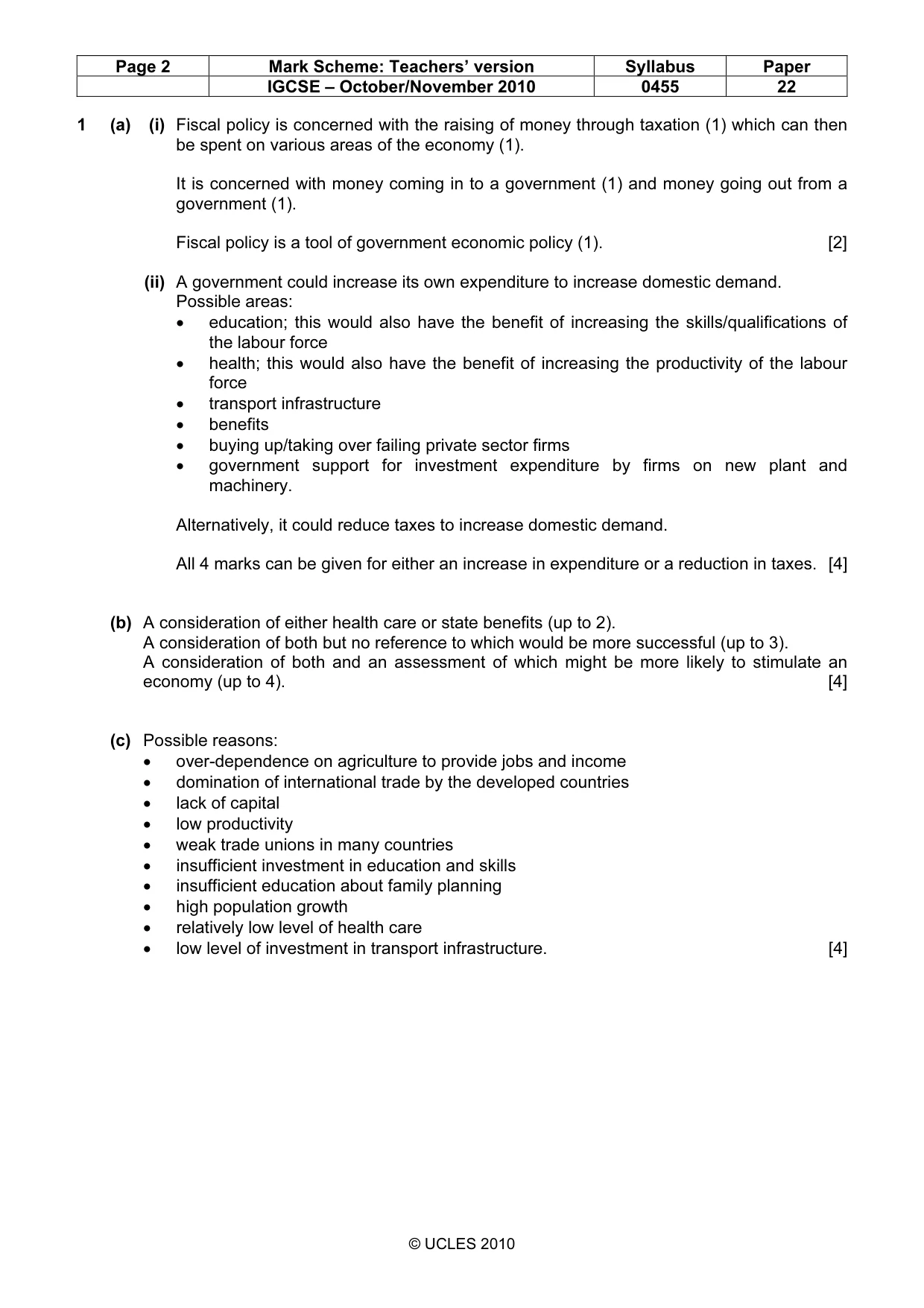
Page 2 Mark Scheme: Teachers’ version Syllabus Paper IGCSE – October/November 2010 0455 22 © UCLES 2010 1 (a) (i) Fiscal policy is concerned with the raising of money through taxation (1) which can then be spent on various areas of the economy (1). It is concerned with money coming in to a government (1) and money going out from a government (1). Fiscal policy is a tool of government economic policy (1). [2] (ii) A government could increase its own expenditure to increase domestic demand. Possible areas: • education; this would also have the benefit of increasing the skills/qualifications of the labour force • health; this would also have the benefit of increasing the productivity of the labour force • transport infrastructure • benefits • buying up/taking over failing private sector firms • government support for investment expenditure by firms on new plant and machinery. Alternatively, it could reduce taxes to increase domestic demand. All 4 marks can be given for either an increase in expenditure or a reduction in taxes. [4] (b) A consideration of either health care or state benefits (up to 2). A consideration of both but no reference to which would be more successful (up to 3). A consideration of both and an assessment of which might be more likely to stimulate an economy (up to 4). [4] (c) Possible reasons: • over-dependence on agriculture to provide jobs and income • domination of international trade by the developed countries • lack of capital • low productivity • weak trade unions in many countries • insufficient investment in education and skills • insufficient education about family planning • high population growth • relatively low level of health care • low level of investment in transport infrastructure. [4]
Mark scheme, page 3
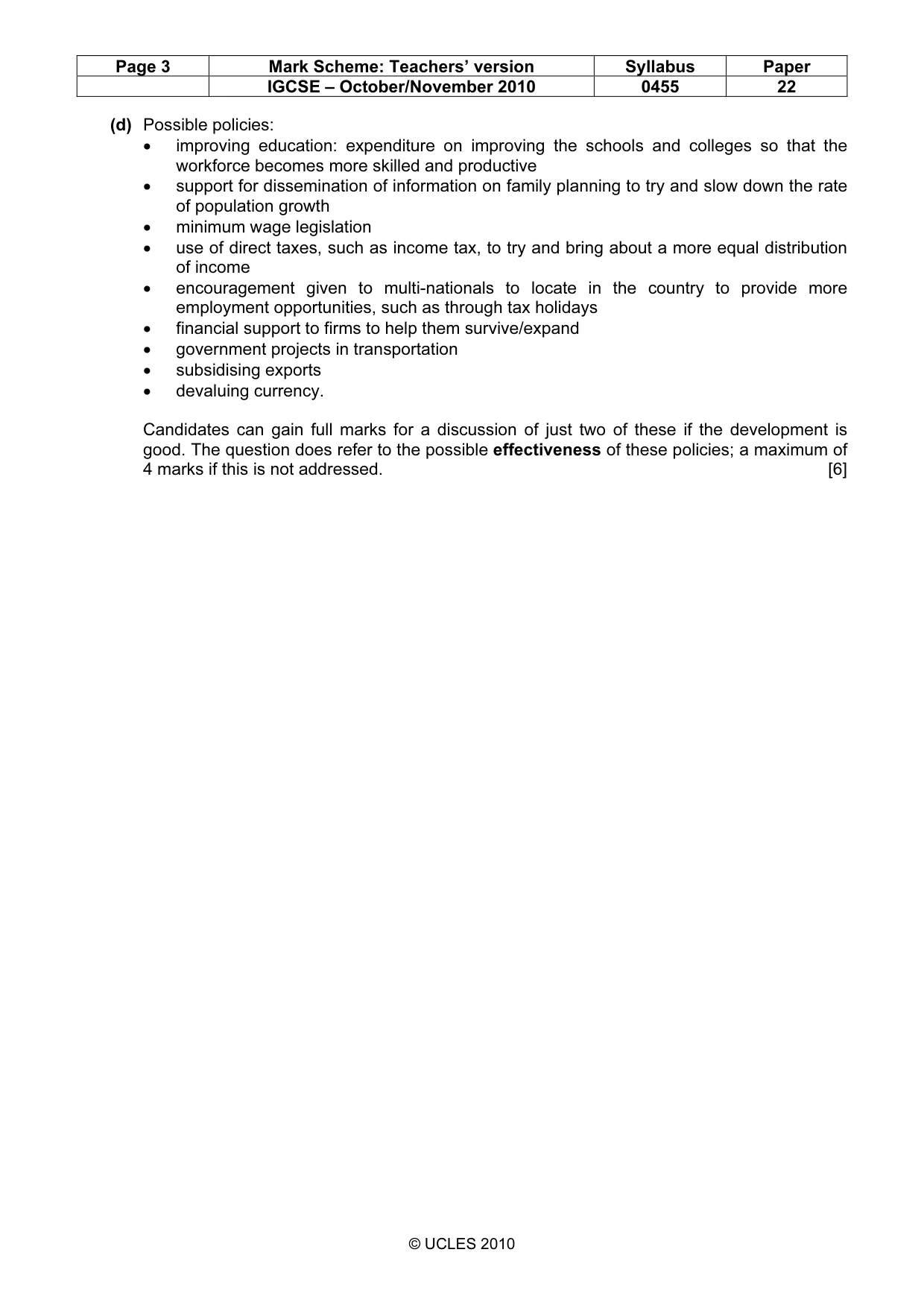
Page 3 Mark Scheme: Teachers’ version Syllabus Paper IGCSE – October/November 2010 0455 22 © UCLES 2010 (d) Possible policies: • improving education: expenditure on improving the schools and colleges so that the workforce becomes more skilled and productive • support for dissemination of information on family planning to try and slow down the rate of population growth • minimum wage legislation • use of direct taxes, such as income tax, to try and bring about a more equal distribution of income • encouragement given to multi-nationals to locate in the country to provide more employment opportunities, such as through tax holidays • financial support to firms to help them survive/expand • government projects in transportation • subsidising exports • devaluing currency. Candidates can gain full marks for a discussion of just two of these if the development is good. The question does refer to the possible effectiveness of these policies; a maximum of 4 marks if this is not addressed. [6]
Mark scheme, page 4
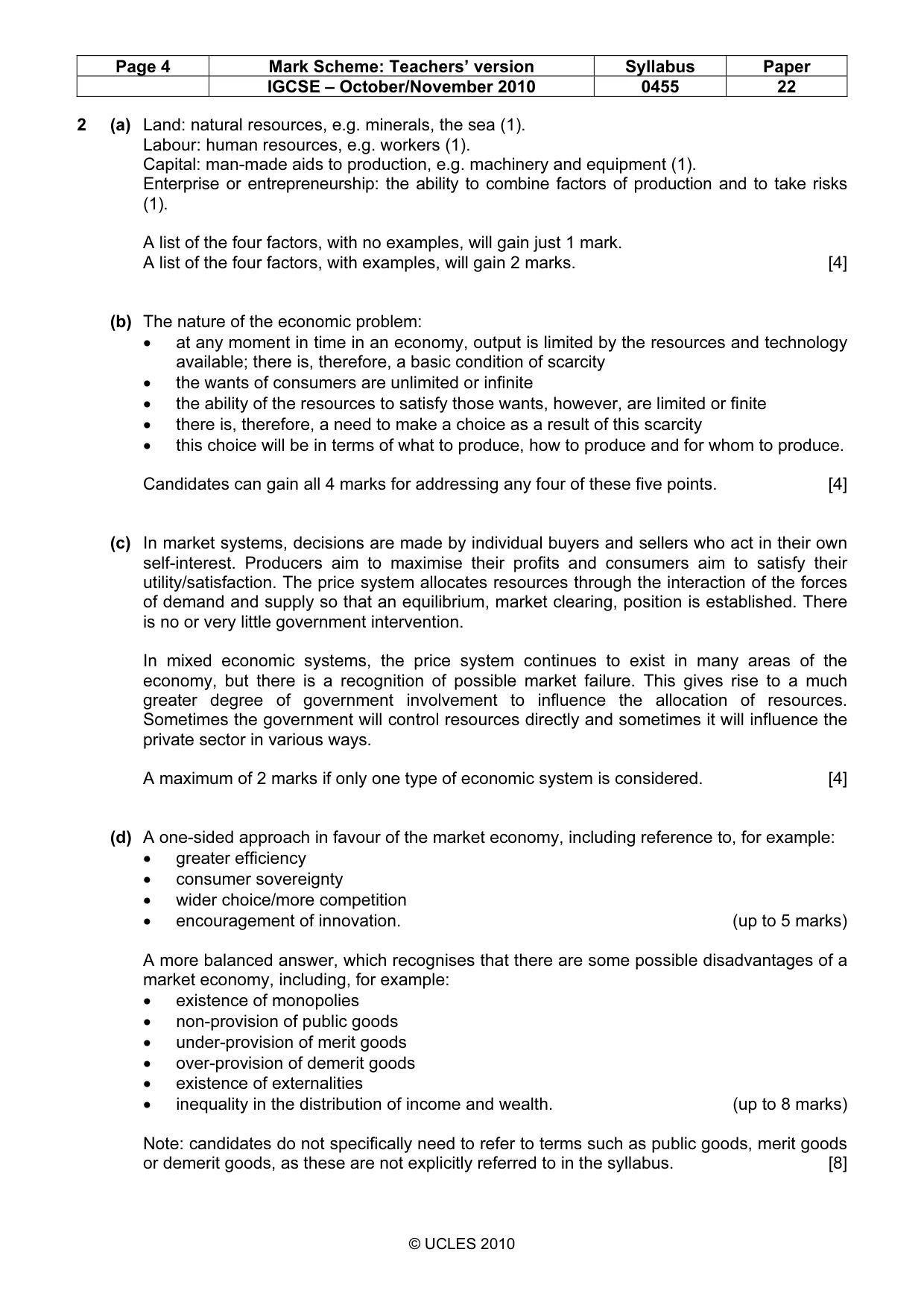
Page 4 Mark Scheme: Teachers’ version Syllabus Paper IGCSE – October/November 2010 0455 22 © UCLES 2010 2 (a) Land: natural resources, e.g. minerals, the sea (1). Labour: human resources, e.g. workers (1). Capital: man-made aids to production, e.g. machinery and equipment (1). Enterprise or entrepreneurship: the ability to combine factors of production and to take risks (1). A list of the four factors, with no examples, will gain just 1 mark. A list of the four factors, with examples, will gain 2 marks. [4] (b) The nature of the economic problem: • at any moment in time in an economy, output is limited by the resources and technology available; there is, therefore, a basic condition of scarcity • the wants of consumers are unlimited or infinite • the ability of the resources to satisfy those wants, however, are limited or finite • there is, therefore, a need to make a choice as a result of this scarcity • this choice will be in terms of what to produce, how to produce and for whom to produce. Candidates can gain all 4 marks for addressing any four of these five points. [4] (c) In market systems, decisions are made by individual buyers and sellers who act in their own self-interest. Producers aim to maximise their profits and consumers aim to satisfy their utility/satisfaction. The price system allocates resources through the interaction of the forces of demand and supply so that an equilibrium, market clearing, position is established. There is no or very little government intervention. In mixed economic systems, the price system continues to exist in many areas of the economy, but there is a recognition of possible market failure. This gives rise to a much greater degree of government involvement to influence the allocation of resources. Sometimes the government will control resources directly and sometimes it will influence the private sector in various ways. A maximum of 2 marks if only one type of economic system is considered. [4] (d) A one-sided approach in favour of the market economy, including reference to, for example: • greater efficiency • consumer sovereignty • wider choice/more competition • encouragement of innovation. (up to 5 marks) A more balanced answer, which recognises that there are some possible disadvantages of a market economy, including, for example: • existence of monopolies • non-provision of public goods • under-provision of merit goods • over-provision of demerit goods • existence of externalities • inequality in the distribution of income and wealth. (up to 8 marks) Note: candidates do not specifically need to refer to terms such as public goods, merit goods or demerit goods, as these are not explicitly referred to in the syllabus. [8]
Mark scheme, page 5
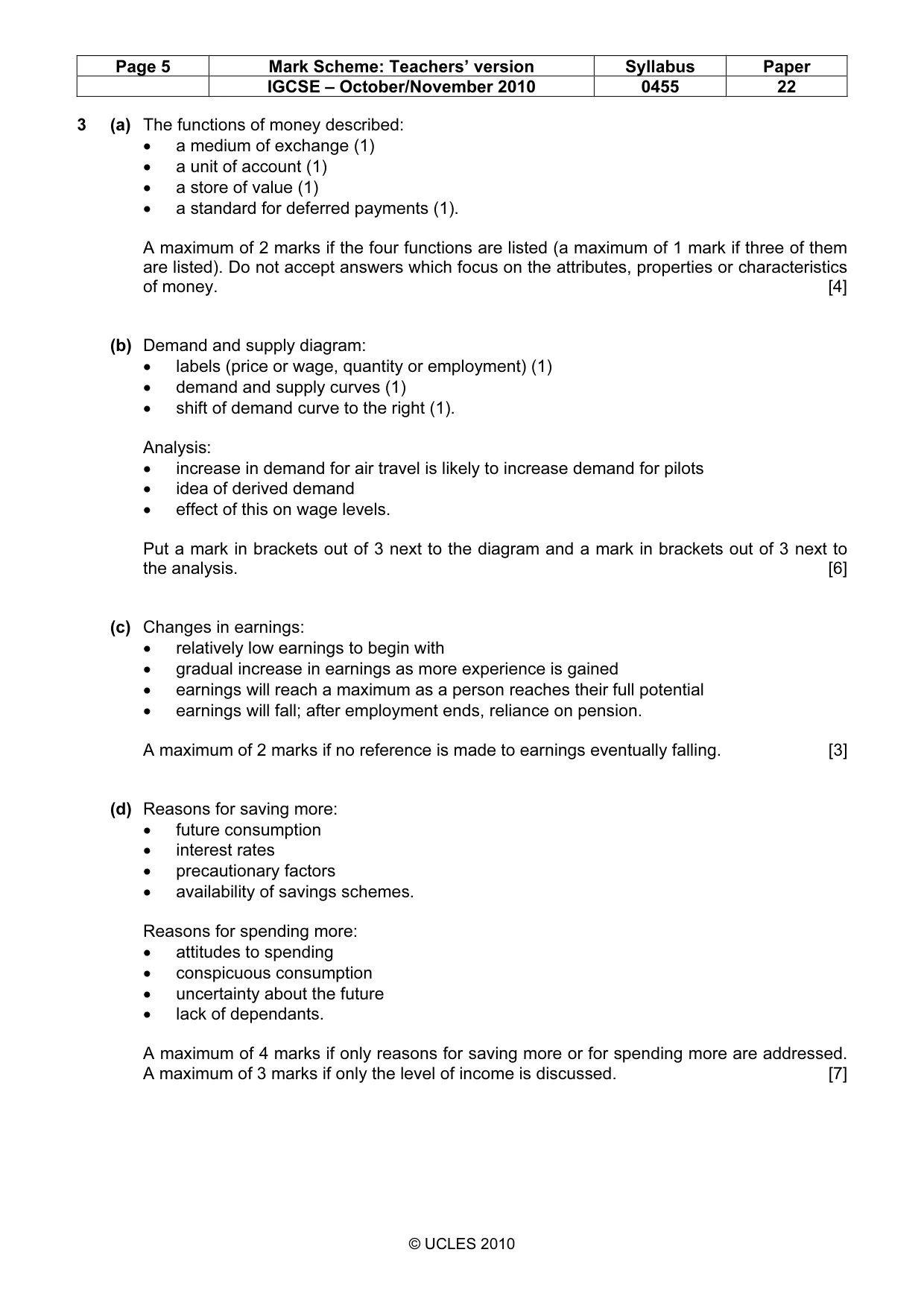
Page 5 Mark Scheme: Teachers’ version Syllabus Paper IGCSE – October/November 2010 0455 22 © UCLES 2010 3 (a) The functions of money described: • a medium of exchange (1) • a unit of account (1) • a store of value (1) • a standard for deferred payments (1). A maximum of 2 marks if the four functions are listed (a maximum of 1 mark if three of them are listed). Do not accept answers which focus on the attributes, properties or characteristics of money. [4] (b) Demand and supply diagram: • labels (price or wage, quantity or employment) (1) • demand and supply curves (1) • shift of demand curve to the right (1). Analysis: • increase in demand for air travel is likely to increase demand for pilots • idea of derived demand • effect of this on wage levels. Put a mark in brackets out of 3 next to the diagram and a mark in brackets out of 3 next to the analysis. [6] (c) Changes in earnings: • relatively low earnings to begin with • gradual increase in earnings as more experience is gained • earnings will reach a maximum as a person reaches their full potential • earnings will fall; after employment ends, reliance on pension. A maximum of 2 marks if no reference is made to earnings eventually falling. [3] (d) Reasons for saving more: • future consumption • interest rates • precautionary factors • availability of savings schemes. Reasons for spending more: • attitudes to spending • conspicuous consumption • uncertainty about the future • lack of dependants. A maximum of 4 marks if only reasons for saving more or for spending more are addressed. A maximum of 3 marks if only the level of income is discussed. [7]
Mark scheme, page 6
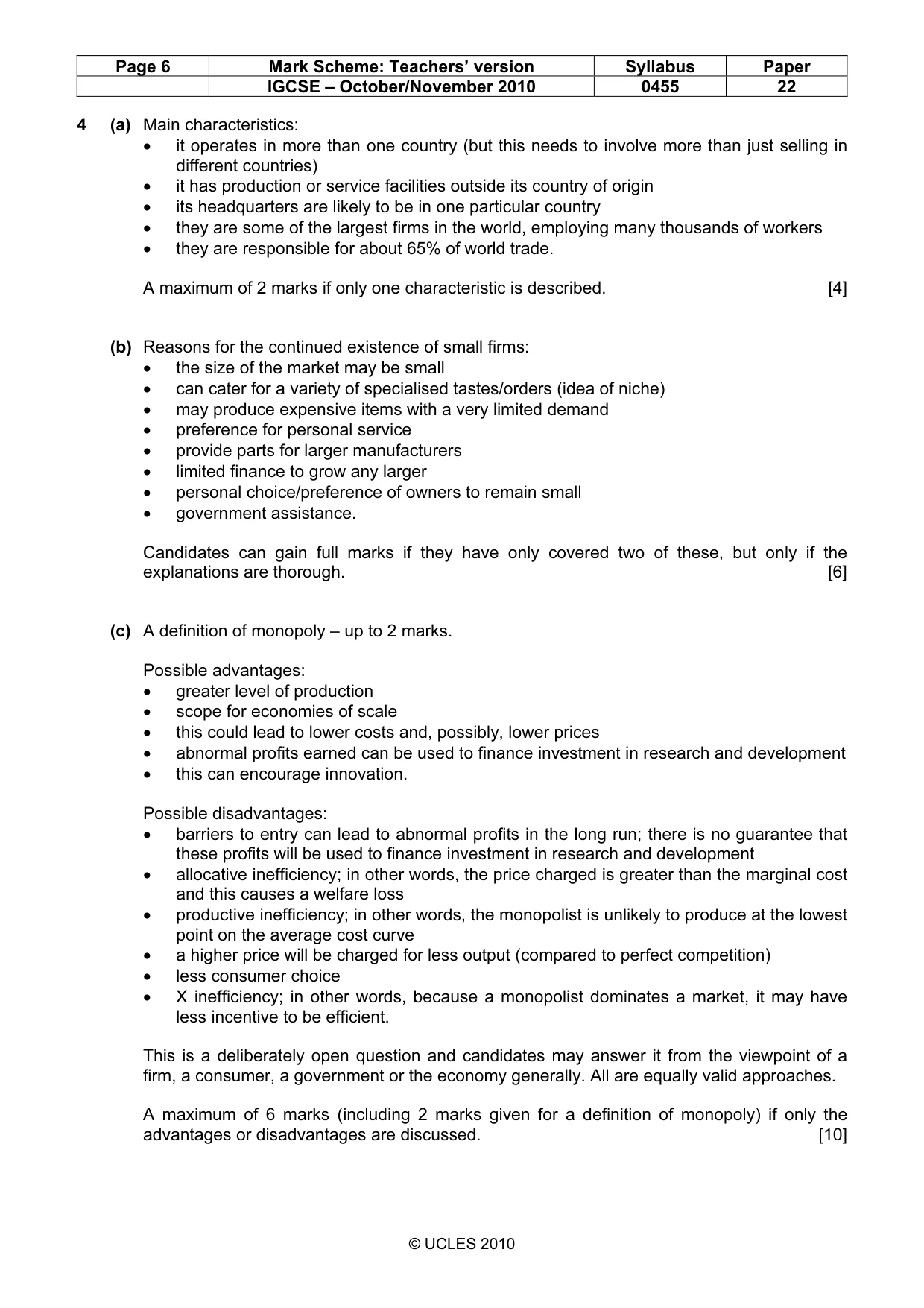
Page 6 Mark Scheme: Teachers’ version Syllabus Paper IGCSE – October/November 2010 0455 22 © UCLES 2010 4 (a) Main characteristics: • it operates in more than one country (but this needs to involve more than just selling in different countries) • it has production or service facilities outside its country of origin • its headquarters are likely to be in one particular country • they are some of the largest firms in the world, employing many thousands of workers • they are responsible for about 65% of world trade. A maximum of 2 marks if only one characteristic is described. [4] (b) Reasons for the continued existence of small firms: • the size of the market may be small • can cater for a variety of specialised tastes/orders (idea of niche) • may produce expensive items with a very limited demand • preference for personal service • provide parts for larger manufacturers • limited finance to grow any larger • personal choice/preference of owners to remain small • government assistance. Candidates can gain full marks if they have only covered two of these, but only if the explanations are thorough. [6] (c) A definition of monopoly – up to 2 marks. Possible advantages: • greater level of production • scope for economies of scale • this could lead to lower costs and, possibly, lower prices • abnormal profits earned can be used to finance investment in research and development • this can encourage innovation. Possible disadvantages: • barriers to entry can lead to abnormal profits in the long run; there is no guarantee that these profits will be used to finance investment in research and development • allocative inefficiency; in other words, the price charged is greater than the marginal cost and this causes a welfare loss • productive inefficiency; in other words, the monopolist is unlikely to produce at the lowest point on the average cost curve • a higher price will be charged for less output (compared to perfect competition) • less consumer choice • X inefficiency; in other words, because a monopolist dominates a market, it may have less incentive to be efficient. This is a deliberately open question and candidates may answer it from the viewpoint of a firm, a consumer, a government or the economy generally. All are equally valid approaches. A maximum of 6 marks (including 2 marks given for a definition of monopoly) if only the advantages or disadvantages are discussed. [10]
Mark scheme, page 7
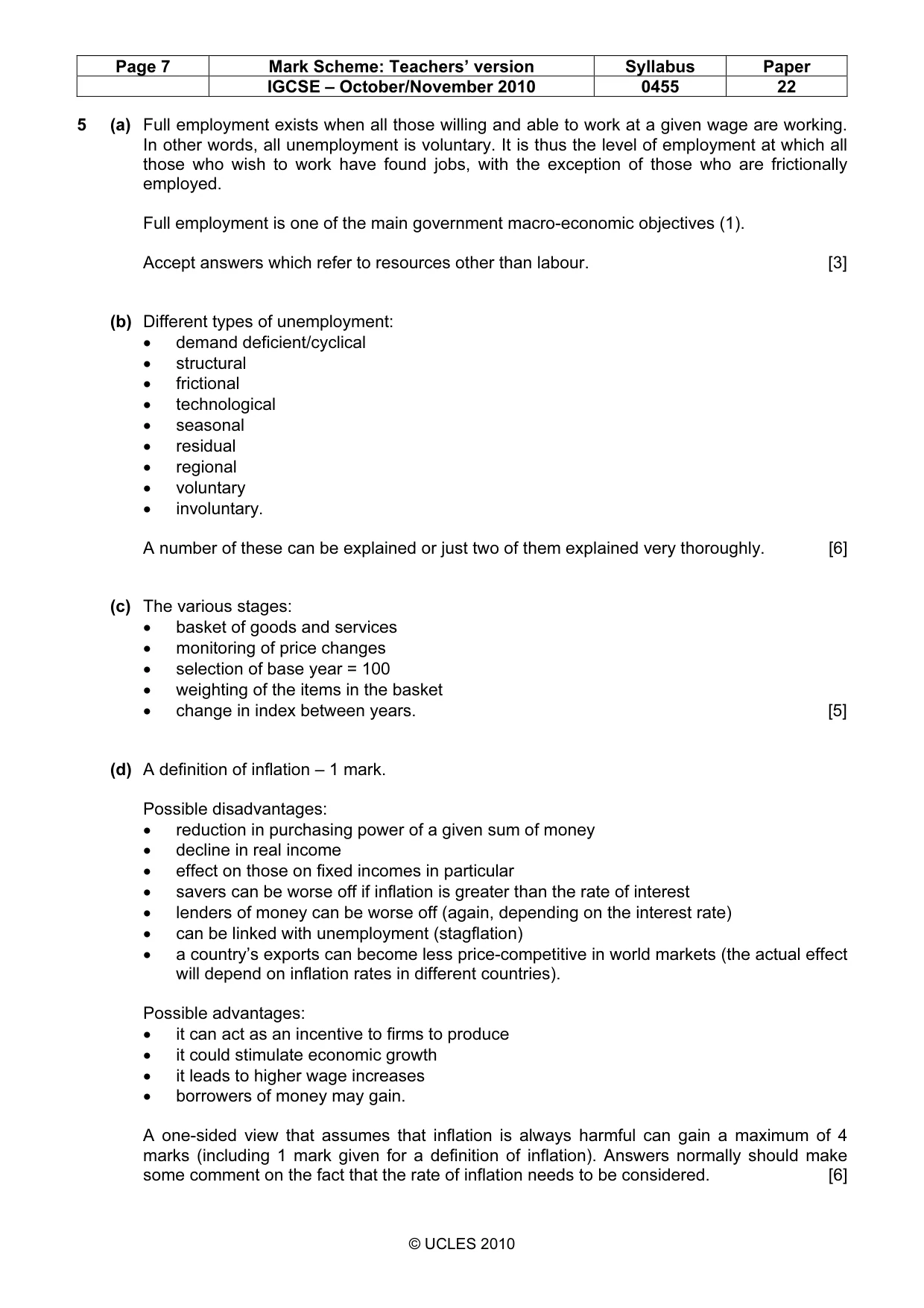
Page 7 Mark Scheme: Teachers’ version Syllabus Paper IGCSE – October/November 2010 0455 22 © UCLES 2010 5 (a) Full employment exists when all those willing and able to work at a given wage are working. In other words, all unemployment is voluntary. It is thus the level of employment at which all those who wish to work have found jobs, with the exception of those who are frictionally employed. Full employment is one of the main government macro-economic objectives (1). Accept answers which refer to resources other than labour. [3] (b) Different types of unemployment: • demand deficient/cyclical • structural • frictional • technological • seasonal • residual • regional • voluntary • involuntary. A number of these can be explained or just two of them explained very thoroughly. [6] (c) The various stages: • basket of goods and services • monitoring of price changes • selection of base year = 100 • weighting of the items in the basket • change in index between years. [5] (d) A definition of inflation – 1 mark. Possible disadvantages: • reduction in purchasing power of a given sum of money • decline in real income • effect on those on fixed incomes in particular • savers can be worse off if inflation is greater than the rate of interest • lenders of money can be worse off (again, depending on the interest rate) • can be linked with unemployment (stagflation) • a country’s exports can become less price-competitive in world markets (the actual effect will depend on inflation rates in different countries). Possible advantages: • it can act as an incentive to firms to produce • it could stimulate economic growth • it leads to higher wage increases • borrowers of money may gain. A one-sided view that assumes that inflation is always harmful can gain a maximum of 4 marks (including 1 mark given for a definition of inflation). Answers normally should make some comment on the fact that the rate of inflation needs to be considered. [6]
Mark scheme, page 8
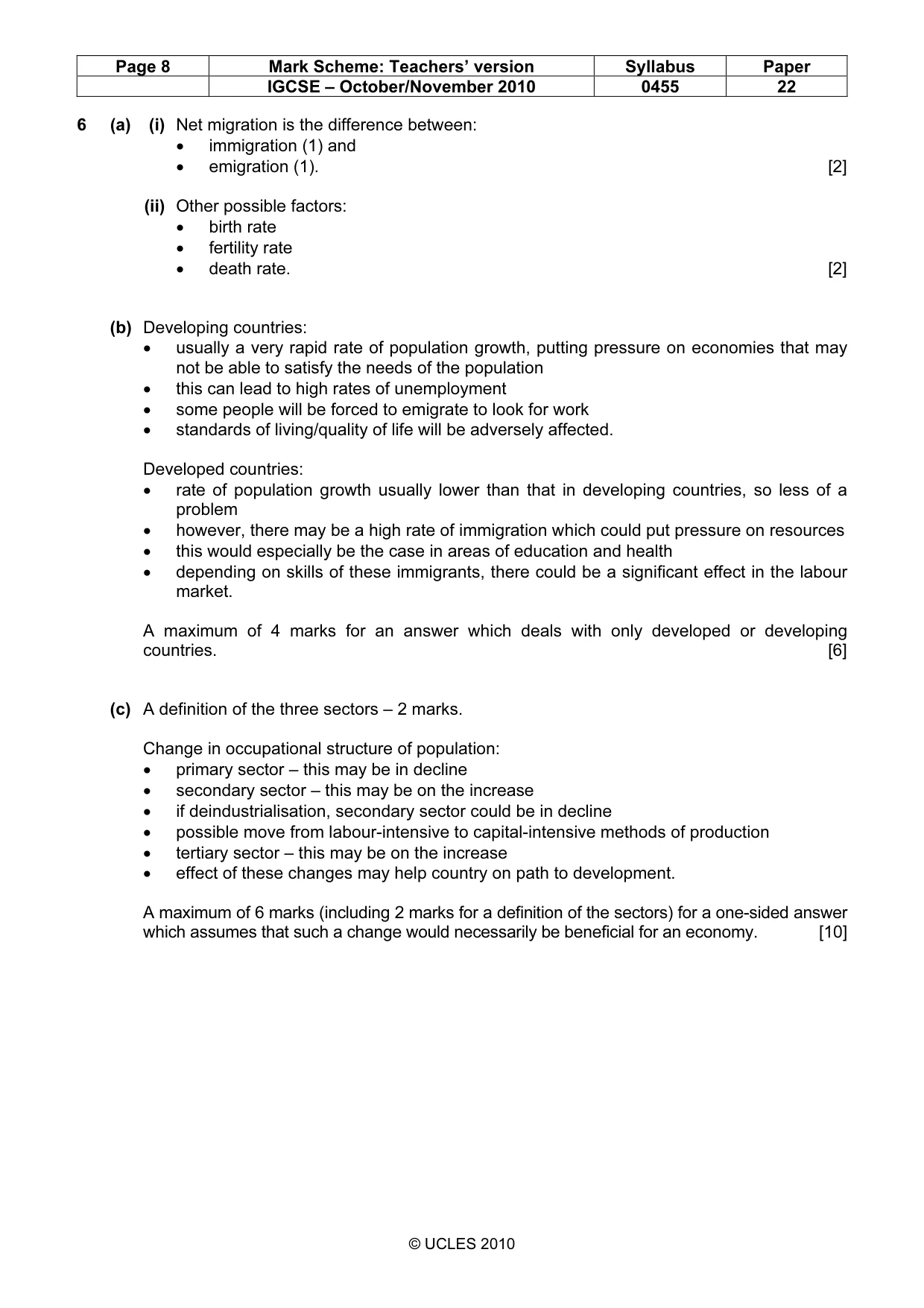
Page 8 Mark Scheme: Teachers’ version Syllabus Paper IGCSE – October/November 2010 0455 22 © UCLES 2010 6 (a) (i) Net migration is the difference between: • immigration (1) and • emigration (1). [2] (ii) Other possible factors: • birth rate • fertility rate • death rate. [2] (b) Developing countries: • usually a very rapid rate of population growth, putting pressure on economies that may not be able to satisfy the needs of the population • this can lead to high rates of unemployment • some people will be forced to emigrate to look for work • standards of living/quality of life will be adversely affected. Developed countries: • rate of population growth usually lower than that in developing countries, so less of a problem • however, there may be a high rate of immigration which could put pressure on resources • this would especially be the case in areas of education and health • depending on skills of these immigrants, there could be a significant effect in the labour market. A maximum of 4 marks for an answer which deals with only developed or developing countries. [6] (c) A definition of the three sectors – 2 marks. Change in occupational structure of population: • primary sector – this may be in decline • secondary sector – this may be on the increase • if deindustrialisation, secondary sector could be in decline • possible move from labour-intensive to capital-intensive methods of production • tertiary sector – this may be on the increase • effect of these changes may help country on path to development. A maximum of 6 marks (including 2 marks for a definition of the sectors) for a one-sided answer which assumes that such a change would necessarily be beneficial for an economy. [10]
Mark scheme, page 9
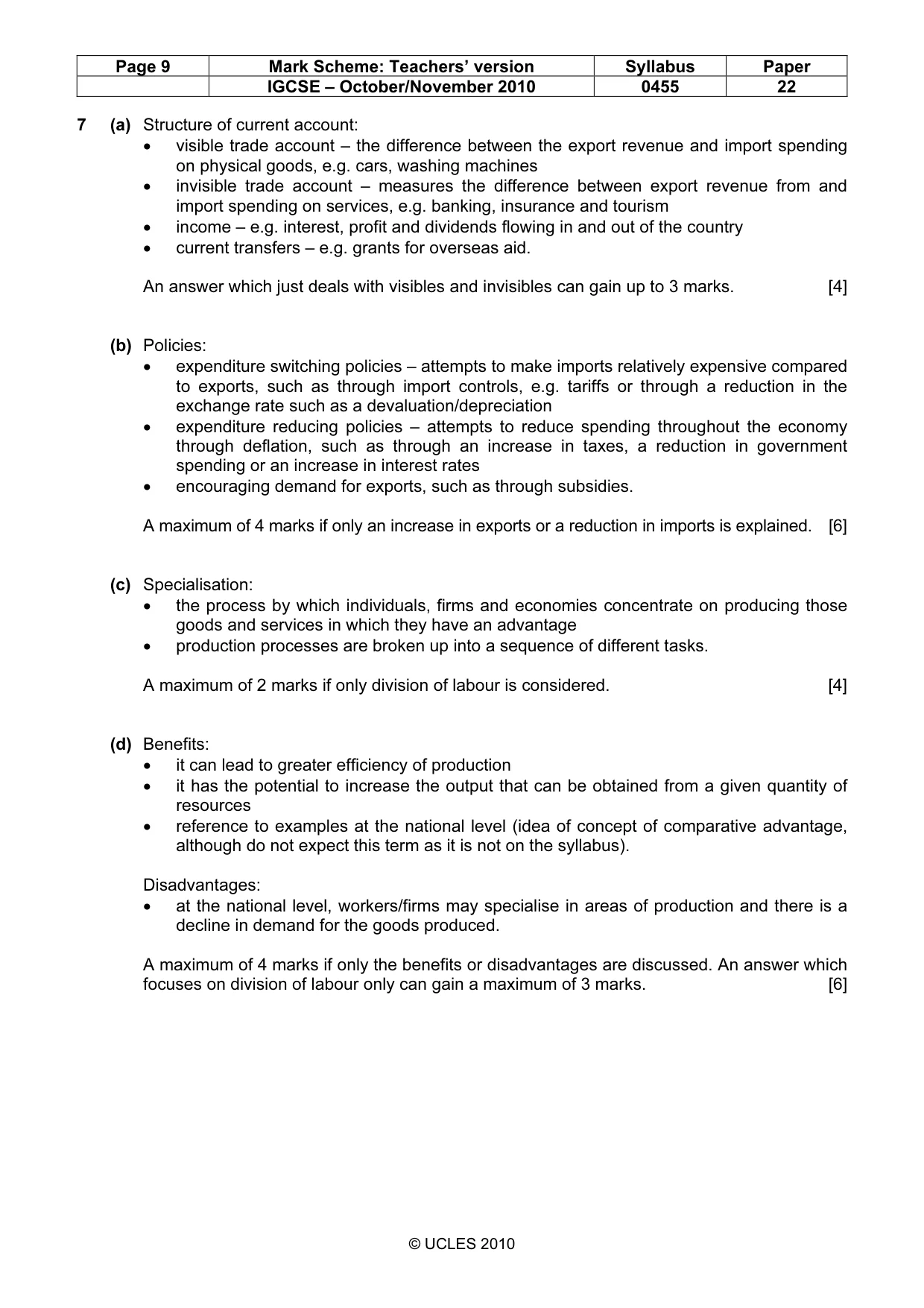
Page 9 Mark Scheme: Teachers’ version Syllabus Paper IGCSE – October/November 2010 0455 22 © UCLES 2010 7 (a) Structure of current account: • visible trade account – the difference between the export revenue and import spending on physical goods, e.g. cars, washing machines • invisible trade account – measures the difference between export revenue from and import spending on services, e.g. banking, insurance and tourism • income – e.g. interest, profit and dividends flowing in and out of the country • current transfers – e.g. grants for overseas aid. An answer which just deals with visibles and invisibles can gain up to 3 marks. [4] (b) Policies: • expenditure switching policies – attempts to make imports relatively expensive compared to exports, such as through import controls, e.g. tariffs or through a reduction in the exchange rate such as a devaluation/depreciation • expenditure reducing policies – attempts to reduce spending throughout the economy through deflation, such as through an increase in taxes, a reduction in government spending or an increase in interest rates • encouraging demand for exports, such as through subsidies. A maximum of 4 marks if only an increase in exports or a reduction in imports is explained. [6] (c) Specialisation: • the process by which individuals, firms and economies concentrate on producing those goods and services in which they have an advantage • production processes are broken up into a sequence of different tasks. A maximum of 2 marks if only division of labour is considered. [4] (d) Benefits: • it can lead to greater efficiency of production • it has the potential to increase the output that can be obtained from a given quantity of resources • reference to examples at the national level (idea of concept of comparative advantage, although do not expect this term as it is not on the syllabus). Disadvantages: • at the national level, workers/firms may specialise in areas of production and there is a decline in demand for the goods produced. A maximum of 4 marks if only the benefits or disadvantages are discussed. An answer which focuses on division of labour only can gain a maximum of 3 marks. [6]
What you needed in this session
Cambridge’s own grade thresholds for 2010 Oct/Nov, Paper 2 · Variant 2. A higher threshold means an easier paper — the bar moves with how the cohort did.