Cambridge IGCSE Economics 0455 — 2010 Oct/Nov Paper 2 · Variant 1
0455/21/O/N/10 · 80 marks · ≈90 min
The question paper and its mark scheme, free to read here and free to download. This is Cambridge’s own paper, exactly as it was sat.
Question paper4 pages
Mark scheme8 pages
Answers below. Sit the paper first if you are practising.
Paper as text
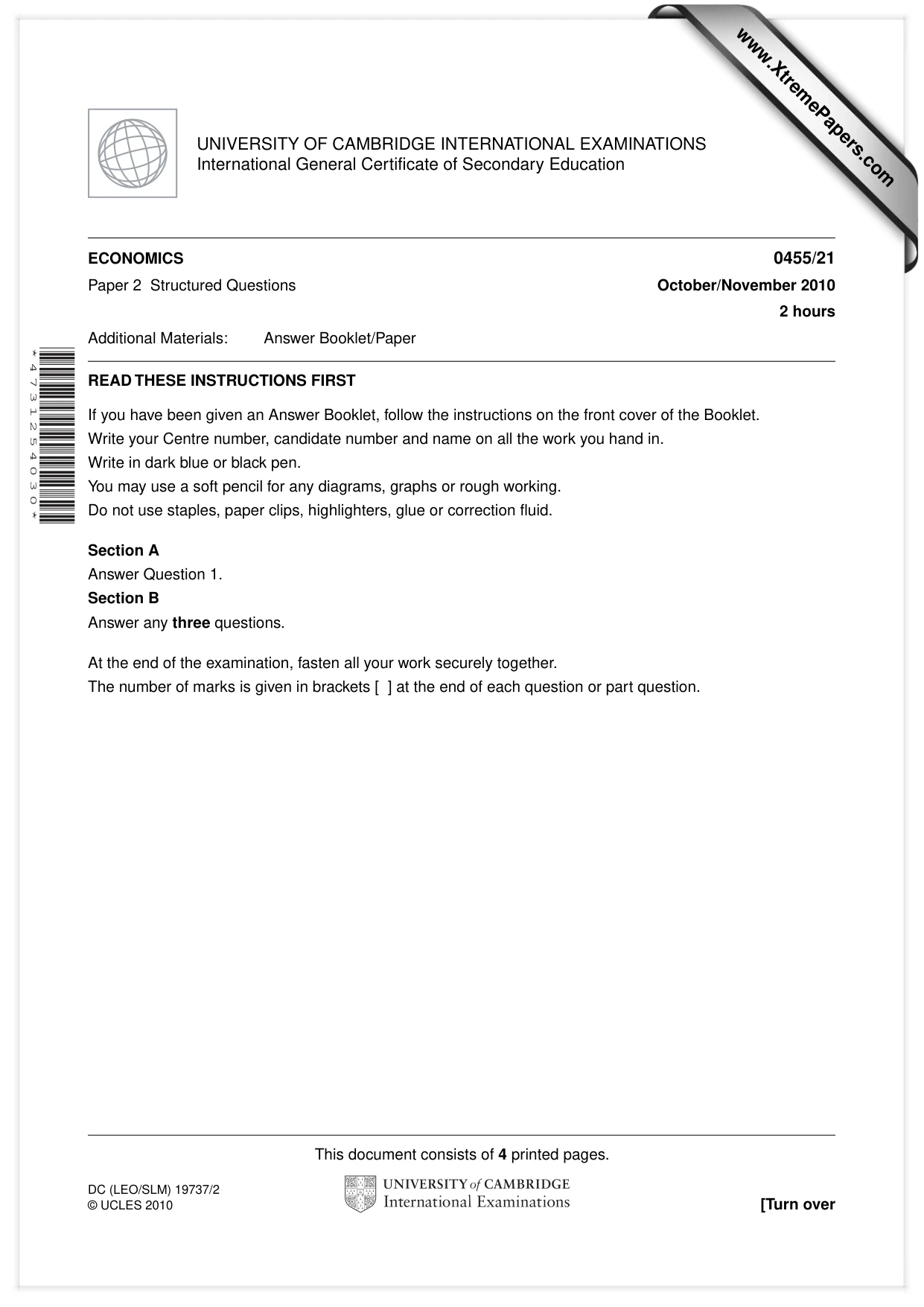
Question paper, page 1
This document consists of 4 printed pages. DC (LEO/SLM) 19737/2 © UCLES 2010 [Turn over UNIVERSITY OF CAMBRIDGE INTERNATIONAL EXAMINATIONS International General Certificate of Secondary Education * 4 7 3 1 2 5 4 0 3 0 * ECONOMICS 0455/21 Paper 2 Structured Questions October/November 2010 2 hours Additional Materials: Answer Booklet/Paper READ THESE INSTRUCTIONS FIRST If you have been given an Answer Booklet, follow the instructions on the front cover of the Booklet. Write your Centre number, candidate number and name on all the work you hand in. Write in dark blue or black pen. You may use a soft pencil for any diagrams, graphs or rough working. Do not use staples, paper clips, highlighters, glue or correction fluid. Section A Answer Question 1. Section B Answer any three questions. At the end of the examination, fasten all your work securely together. The number of marks is given in brackets [ ] at the end of each question or part question. www.XtremePapers.com
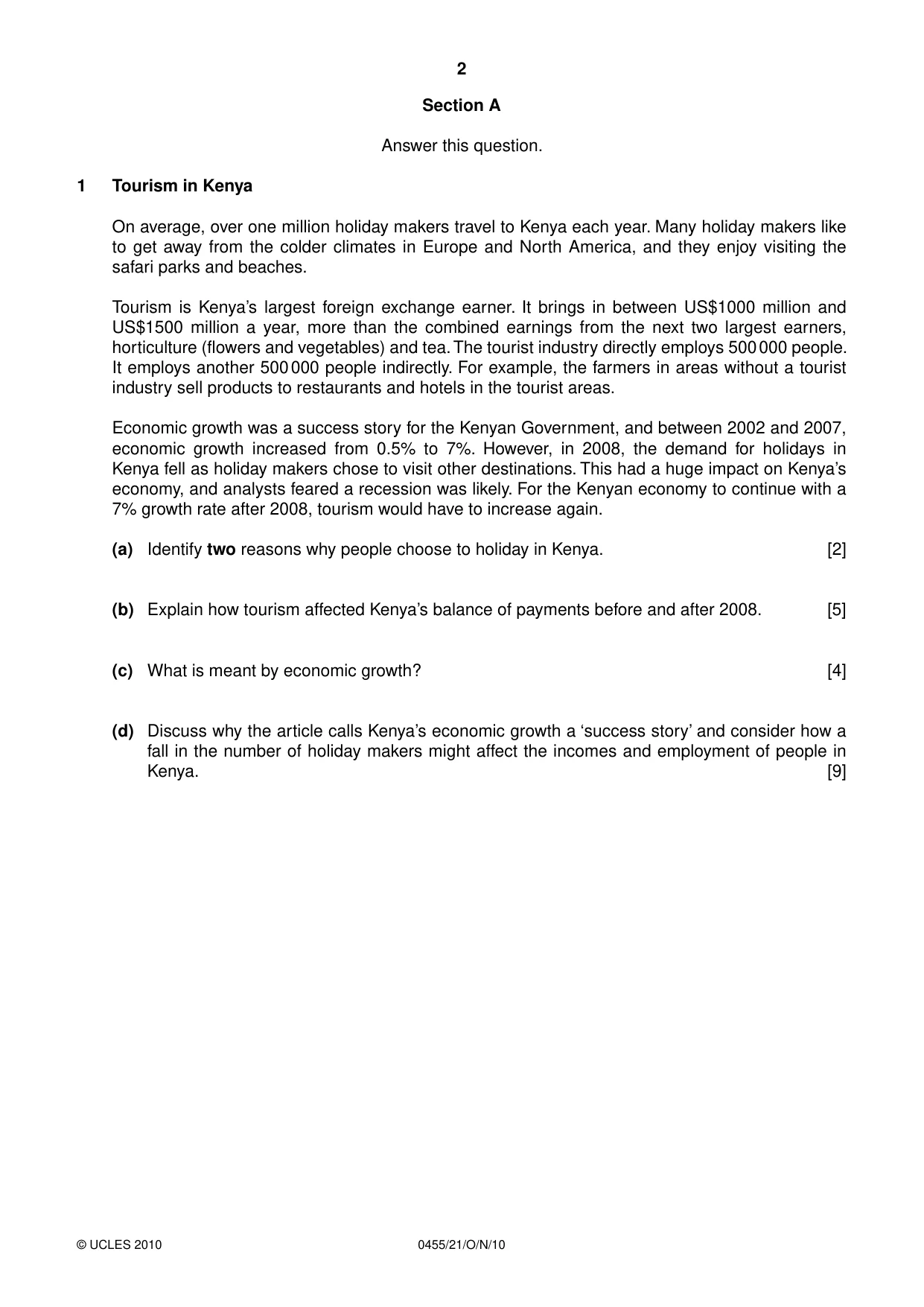
Question paper, page 2
2 0455/21/O/N/10 © UCLES 2010 Section A Answer this question. 1 Tourism in Kenya On average, over one million holiday makers travel to Kenya each year. Many holiday makers like to get away from the colder climates in Europe and North America, and they enjoy visiting the safari parks and beaches. Tourism is Kenya’s largest foreign exchange earner. It brings in between US$1000 million and US$1500 million a year, more than the combined earnings from the next two largest earners, horticulture (flowers and vegetables) and tea. The tourist industry directly employs 500 000 people. It employs another 500 000 people indirectly. For example, the farmers in areas without a tourist industry sell products to restaurants and hotels in the tourist areas. Economic growth was a success story for the Kenyan Government, and between 2002 and 2007, economic growth increased from 0.5% to 7%. However, in 2008, the demand for holidays in Kenya fell as holiday makers chose to visit other destinations. This had a huge impact on Kenya’s economy, and analysts feared a recession was likely. For the Kenyan economy to continue with a 7% growth rate after 2008, tourism would have to increase again. (a) Identify two reasons why people choose to holiday in Kenya. [2] (b) Explain how tourism affected Kenya’s balance of payments before and after 2008. [5] (c) What is meant by economic growth? [4] (d) Discuss why the article calls Kenya’s economic growth a ‘success story’ and consider how a fall in the number of holiday makers might affect the incomes and employment of people in Kenya. [9]
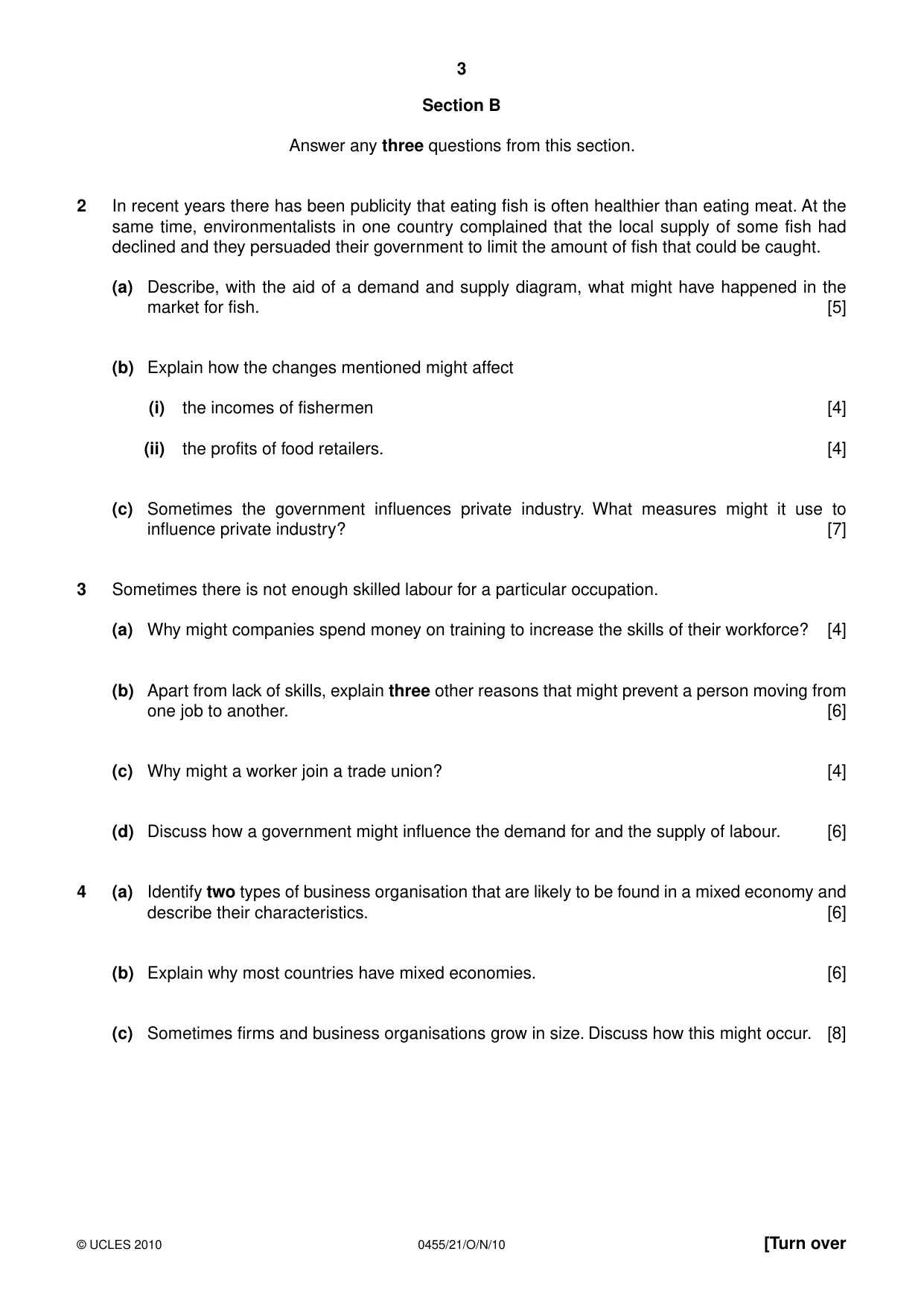
Question paper, page 3
3 0455/21/O/N/10 © UCLES 2010 [Turn over Section B Answer any three questions from this section. 2 In recent years there has been publicity that eating fish is often healthier than eating meat. At the same time, environmentalists in one country complained that the local supply of some fish had declined and they persuaded their government to limit the amount of fish that could be caught. (a) Describe, with the aid of a demand and supply diagram, what might have happened in the market for fish. [5] (b) Explain how the changes mentioned might affect (i) the incomes of fishermen [4] (ii) the profits of food retailers. [4] (c) Sometimes the government influences private industry. What measures might it use to influence private industry? [7] 3 Sometimes there is not enough skilled labour for a particular occupation. (a) Why might companies spend money on training to increase the skills of their workforce? [4] (b) Apart from lack of skills, explain three other reasons that might prevent a person moving from one job to another. [6] (c) Why might a worker join a trade union? [4] (d) Discuss how a government might influence the demand for and the supply of labour. [6] 4 (a) Identify two types of business organisation that are likely to be found in a mixed economy and describe their characteristics. [6] (b) Explain why most countries have mixed economies. [6] (c) Sometimes firms and business organisations grow in size. Discuss how this might occur. [8]
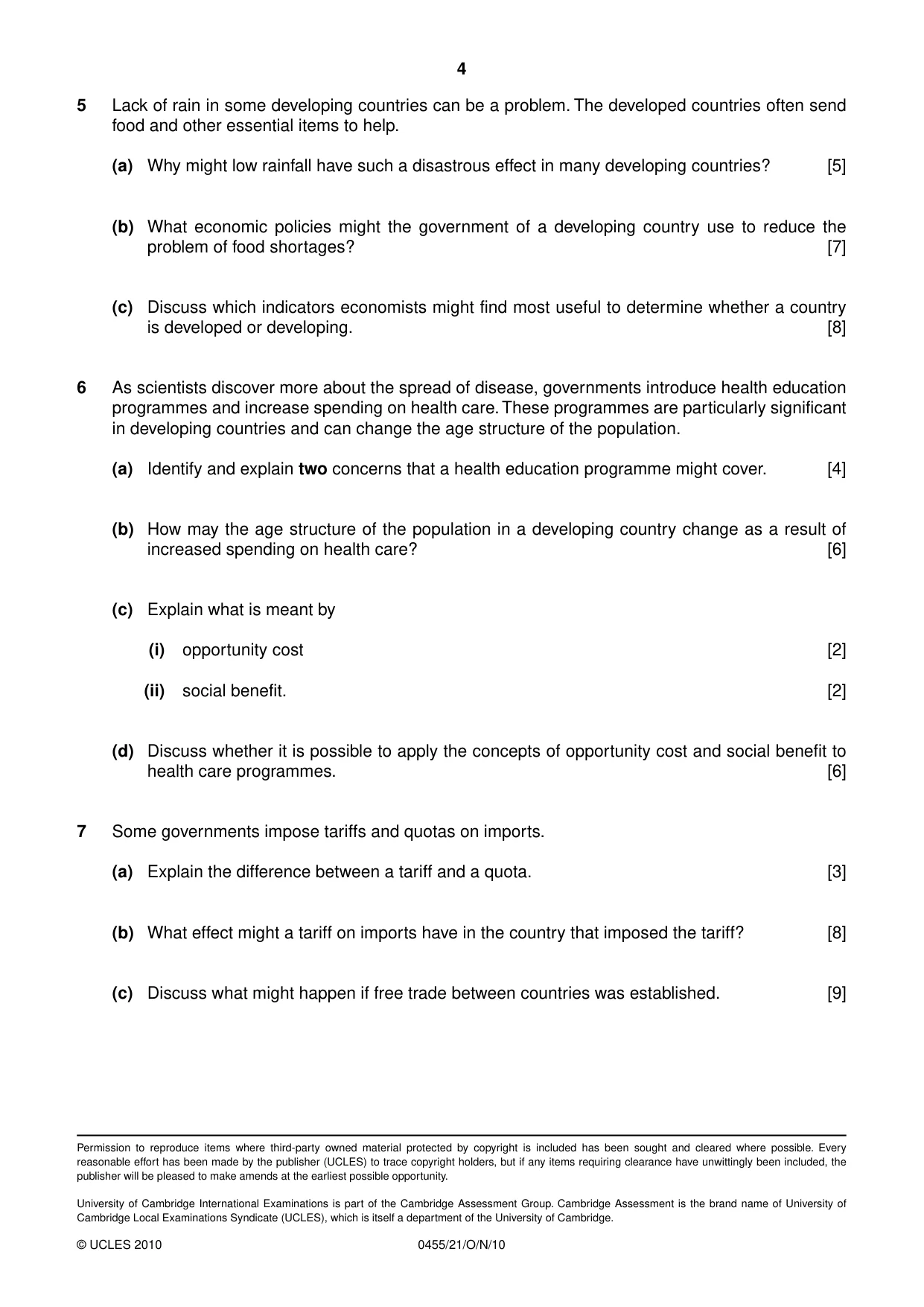
Question paper, page 4
4 0455/21/O/N/10 © UCLES 2010 5 Lack of rain in some developing countries can be a problem. The developed countries often send food and other essential items to help. (a) Why might low rainfall have such a disastrous effect in many developing countries? [5] (b) What economic policies might the government of a developing country use to reduce the problem of food shortages? [7] (c) Discuss which indicators economists might find most useful to determine whether a country is developed or developing. [8] 6 As scientists discover more about the spread of disease, governments introduce health education programmes and increase spending on health care. These programmes are particularly significant in developing countries and can change the age structure of the population. (a) Identify and explain two concerns that a health education programme might cover. [4] (b) How may the age structure of the population in a developing country change as a result of increased spending on health care? [6] (c) Explain what is meant by (i) opportunity cost [2] (ii) social benefit. [2] (d) Discuss whether it is possible to apply the concepts of opportunity cost and social benefit to health care programmes. [6] 7 Some governments impose tariffs and quotas on imports. (a) Explain the difference between a tariff and a quota. [3] (b) What effect might a tariff on imports have in the country that imposed the tariff? [8] (c) Discuss what might happen if free trade between countries was established. [9] Permission to reproduce items where third-party owned material protected by copyright is included has been sought and cleared where possible. Every reasonable effort has been made by the publisher (UCLES) to trace copyright holders, but if any items requiring clearance have unwittingly been included, the publisher will be pleased to make amends at the earliest possible opportunity. University of Cambridge International Examinations is part of the Cambridge Assessment Group. Cambridge Assessment is the brand name of University of Cambridge Local Examinations Syndicate (UCLES), which is itself a department of the University of Cambridge.
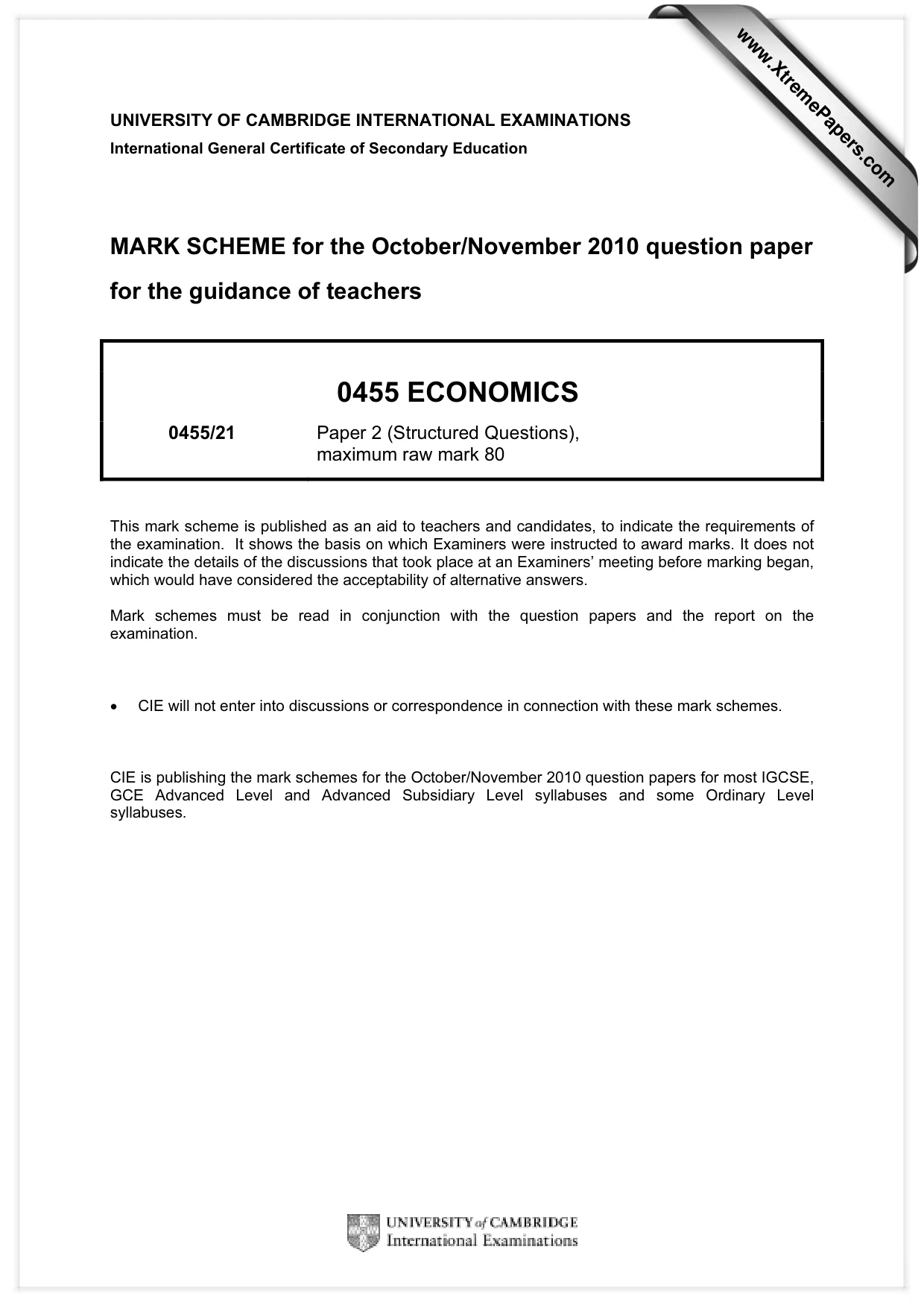
Mark scheme, page 1
UNIVERSITY OF CAMBRIDGE INTERNATIONAL EXAMINATIONS International General Certificate of Secondary Education MARK SCHEME for the October/November 2010 question paper for the guidance of teachers 0455 ECONOMICS 0455/21 Paper 2 (Structured Questions), maximum raw mark 80 This mark scheme is published as an aid to teachers and candidates, to indicate the requirements of the examination. It shows the basis on which Examiners were instructed to award marks. It does not indicate the details of the discussions that took place at an Examiners’ meeting before marking began, which would have considered the acceptability of alternative answers. Mark schemes must be read in conjunction with the question papers and the report on the examination. • CIE will not enter into discussions or correspondence in connection with these mark schemes. CIE is publishing the mark schemes for the October/November 2010 question papers for most IGCSE, GCE Advanced Level and Advanced Subsidiary Level syllabuses and some Ordinary Level syllabuses. www.XtremePapers.com
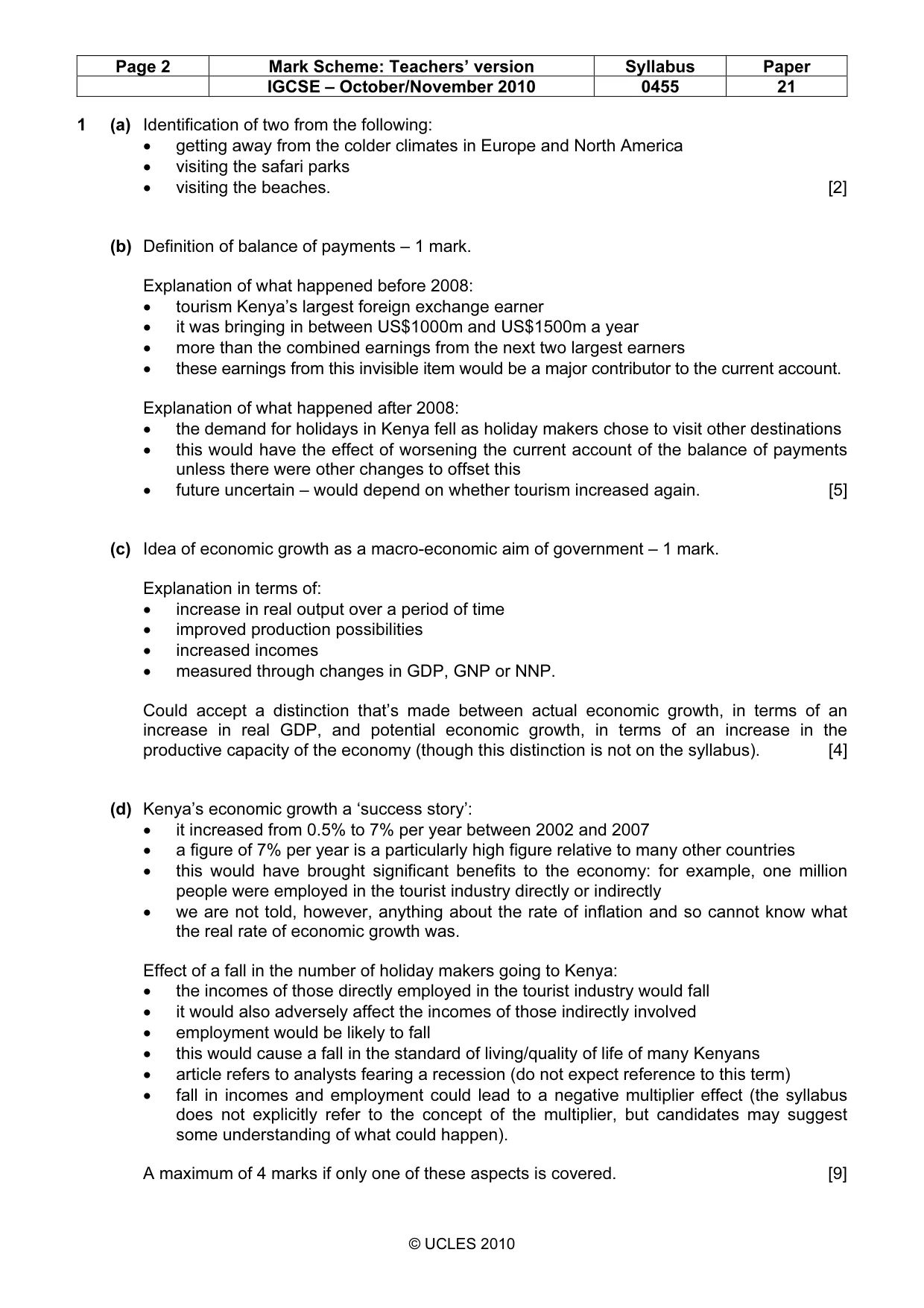
Mark scheme, page 2
Page 2 Mark Scheme: Teachers’ version Syllabus Paper IGCSE – October/November 2010 0455 21 © UCLES 2010 1 (a) Identification of two from the following: • getting away from the colder climates in Europe and North America • visiting the safari parks • visiting the beaches. [2] (b) Definition of balance of payments – 1 mark. Explanation of what happened before 2008: • tourism Kenya’s largest foreign exchange earner • it was bringing in between US$1000m and US$1500m a year • more than the combined earnings from the next two largest earners • these earnings from this invisible item would be a major contributor to the current account. Explanation of what happened after 2008: • the demand for holidays in Kenya fell as holiday makers chose to visit other destinations • this would have the effect of worsening the current account of the balance of payments unless there were other changes to offset this • future uncertain – would depend on whether tourism increased again. [5] (c) Idea of economic growth as a macro-economic aim of government – 1 mark. Explanation in terms of: • increase in real output over a period of time • improved production possibilities • increased incomes • measured through changes in GDP, GNP or NNP. Could accept a distinction that’s made between actual economic growth, in terms of an increase in real GDP, and potential economic growth, in terms of an increase in the productive capacity of the economy (though this distinction is not on the syllabus). [4] (d) Kenya’s economic growth a ‘success story’: • it increased from 0.5% to 7% per year between 2002 and 2007 • a figure of 7% per year is a particularly high figure relative to many other countries • this would have brought significant benefits to the economy: for example, one million people were employed in the tourist industry directly or indirectly • we are not told, however, anything about the rate of inflation and so cannot know what the real rate of economic growth was. Effect of a fall in the number of holiday makers going to Kenya: • the incomes of those directly employed in the tourist industry would fall • it would also adversely affect the incomes of those indirectly involved • employment would be likely to fall • this would cause a fall in the standard of living/quality of life of many Kenyans • article refers to analysts fearing a recession (do not expect reference to this term) • fall in incomes and employment could lead to a negative multiplier effect (the syllabus does not explicitly refer to the concept of the multiplier, but candidates may suggest some understanding of what could happen). A maximum of 4 marks if only one of these aspects is covered. [9]
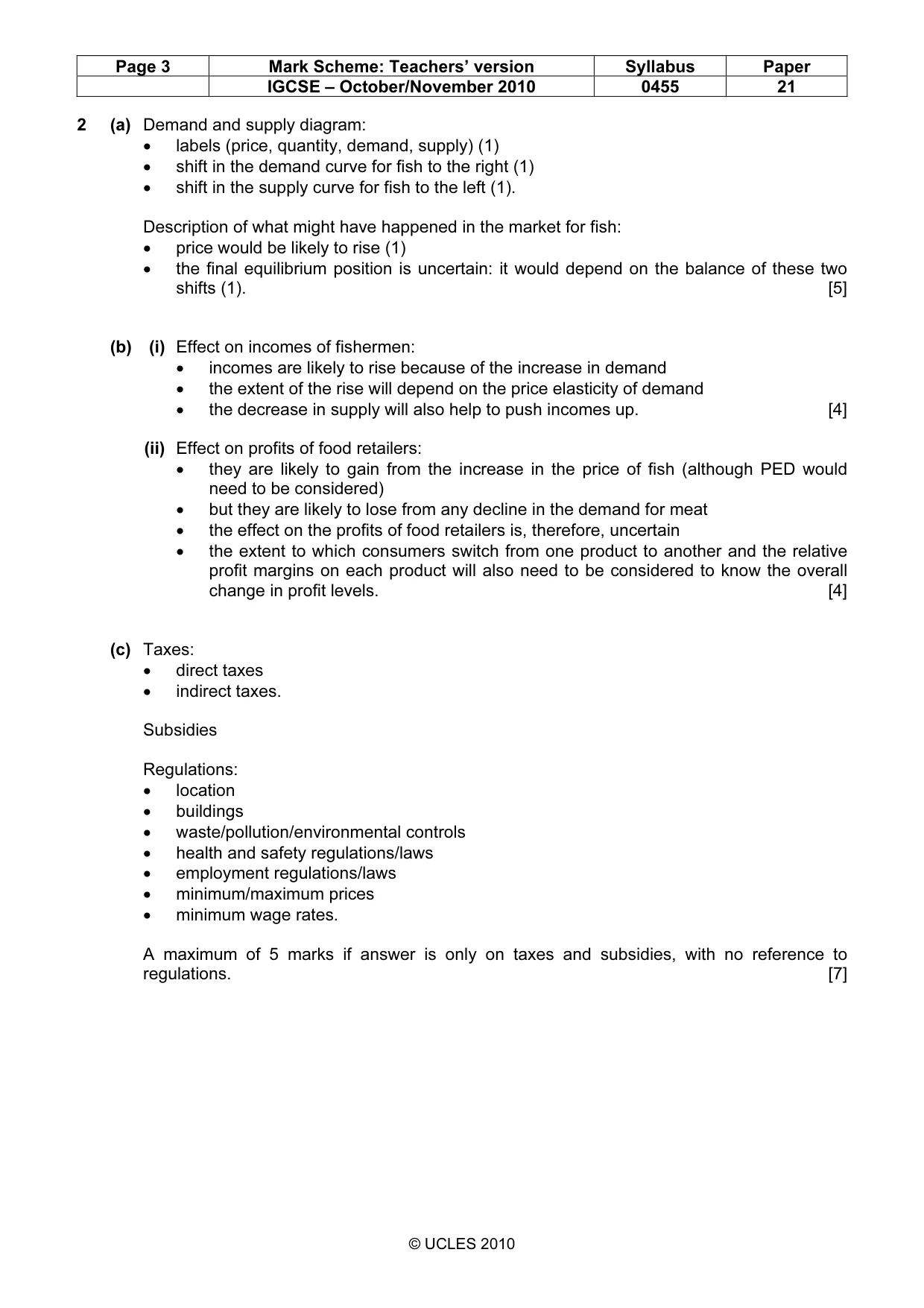
Mark scheme, page 3
Page 3 Mark Scheme: Teachers’ version Syllabus Paper IGCSE – October/November 2010 0455 21 © UCLES 2010 2 (a) Demand and supply diagram: • labels (price, quantity, demand, supply) (1) • shift in the demand curve for fish to the right (1) • shift in the supply curve for fish to the left (1). Description of what might have happened in the market for fish: • price would be likely to rise (1) • the final equilibrium position is uncertain: it would depend on the balance of these two shifts (1). [5] (b) (i) Effect on incomes of fishermen: • incomes are likely to rise because of the increase in demand • the extent of the rise will depend on the price elasticity of demand • the decrease in supply will also help to push incomes up. [4] (ii) Effect on profits of food retailers: • they are likely to gain from the increase in the price of fish (although PED would need to be considered) • but they are likely to lose from any decline in the demand for meat • the effect on the profits of food retailers is, therefore, uncertain • the extent to which consumers switch from one product to another and the relative profit margins on each product will also need to be considered to know the overall change in profit levels. [4] (c) Taxes: • direct taxes • indirect taxes. Subsidies Regulations: • location • buildings • waste/pollution/environmental controls • health and safety regulations/laws • employment regulations/laws • minimum/maximum prices • minimum wage rates. A maximum of 5 marks if answer is only on taxes and subsidies, with no reference to regulations. [7]
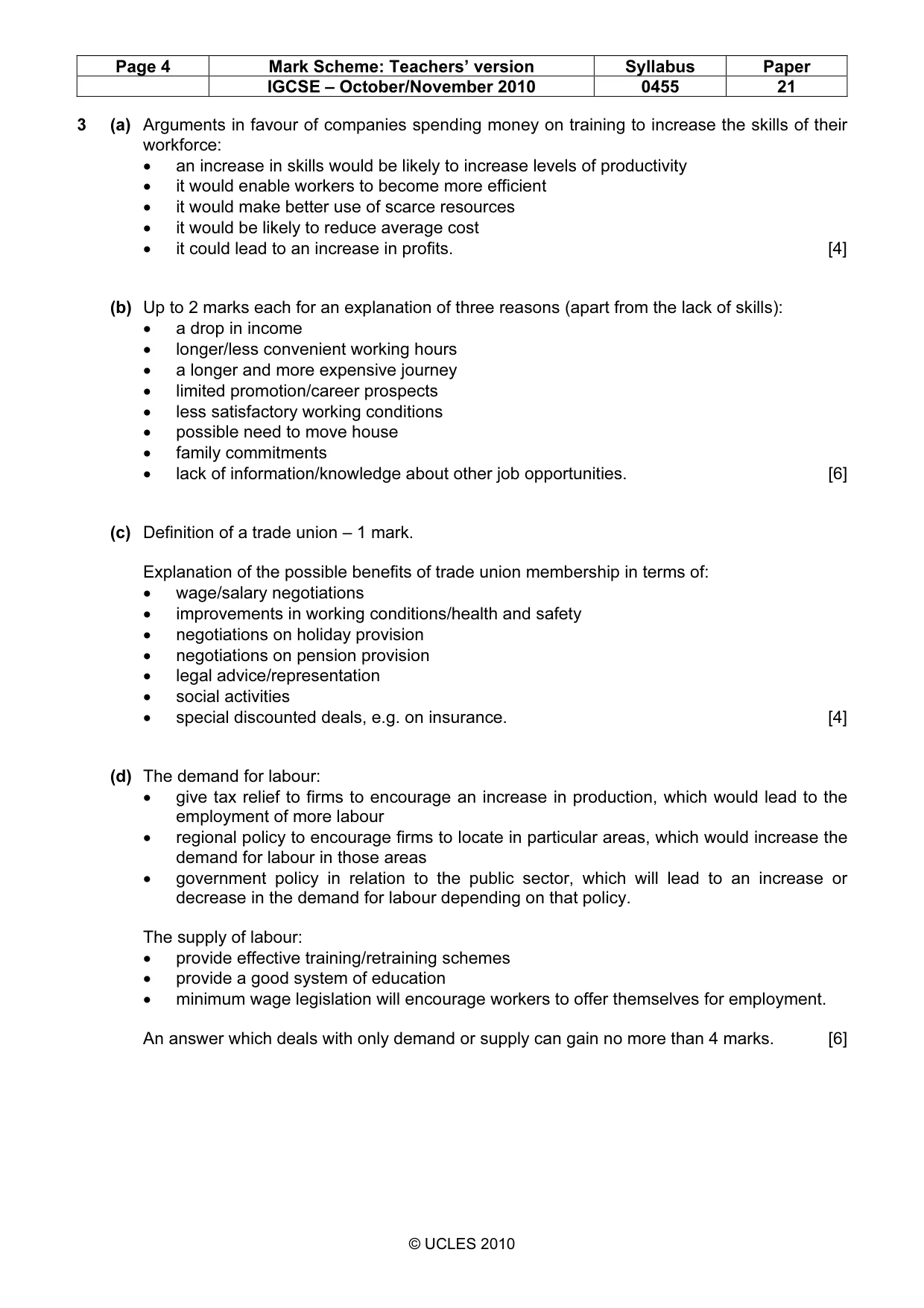
Mark scheme, page 4
Page 4 Mark Scheme: Teachers’ version Syllabus Paper IGCSE – October/November 2010 0455 21 © UCLES 2010 3 (a) Arguments in favour of companies spending money on training to increase the skills of their workforce: • an increase in skills would be likely to increase levels of productivity • it would enable workers to become more efficient • it would make better use of scarce resources • it would be likely to reduce average cost • it could lead to an increase in profits. [4] (b) Up to 2 marks each for an explanation of three reasons (apart from the lack of skills): • a drop in income • longer/less convenient working hours • a longer and more expensive journey • limited promotion/career prospects • less satisfactory working conditions • possible need to move house • family commitments • lack of information/knowledge about other job opportunities. [6] (c) Definition of a trade union – 1 mark. Explanation of the possible benefits of trade union membership in terms of: • wage/salary negotiations • improvements in working conditions/health and safety • negotiations on holiday provision • negotiations on pension provision • legal advice/representation • social activities • special discounted deals, e.g. on insurance. [4] (d) The demand for labour: • give tax relief to firms to encourage an increase in production, which would lead to the employment of more labour • regional policy to encourage firms to locate in particular areas, which would increase the demand for labour in those areas • government policy in relation to the public sector, which will lead to an increase or decrease in the demand for labour depending on that policy. The supply of labour: • provide effective training/retraining schemes • provide a good system of education • minimum wage legislation will encourage workers to offer themselves for employment. An answer which deals with only demand or supply can gain no more than 4 marks. [6]
Mark scheme, page 5
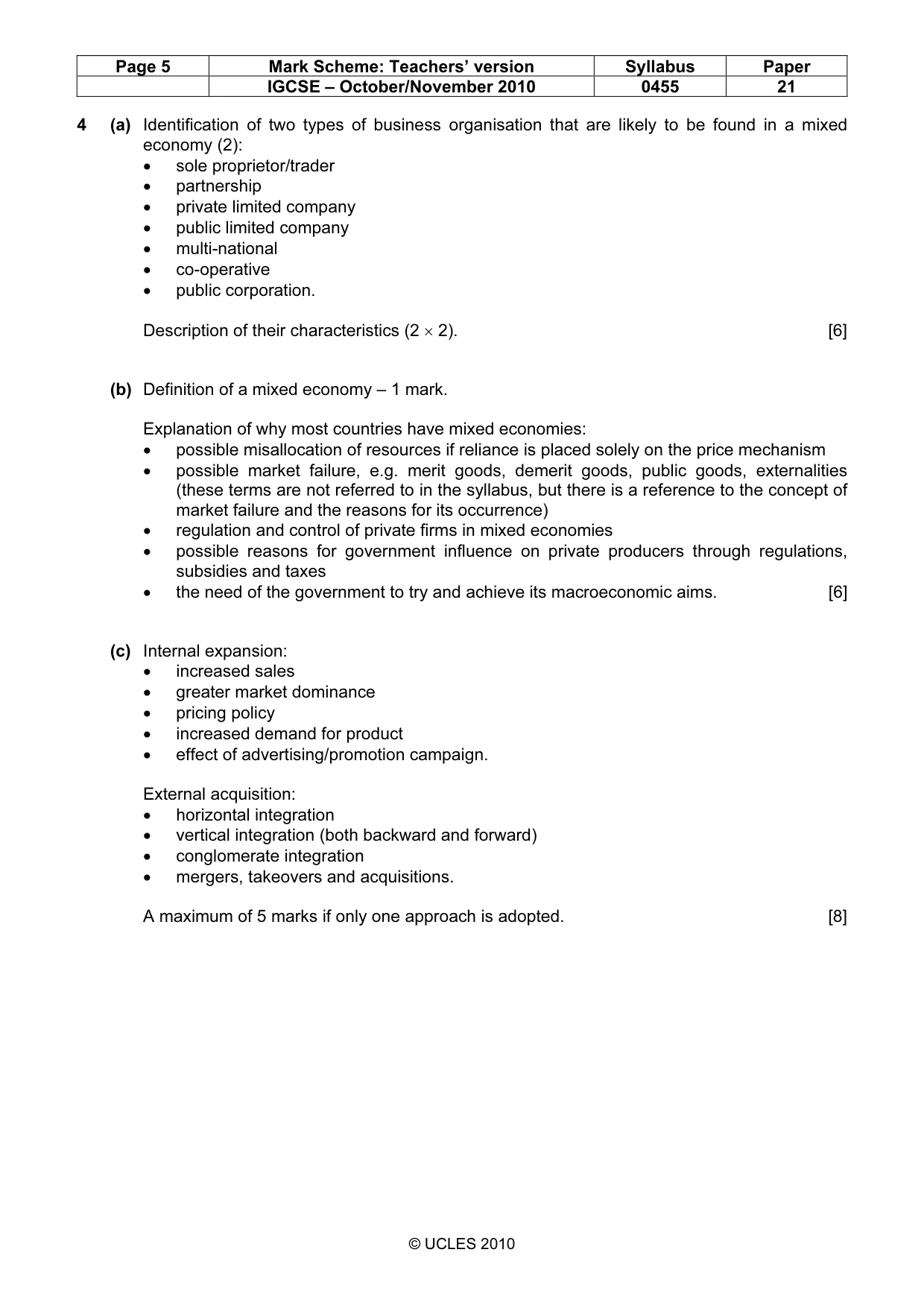
Page 5 Mark Scheme: Teachers’ version Syllabus Paper IGCSE – October/November 2010 0455 21 © UCLES 2010 4 (a) Identification of two types of business organisation that are likely to be found in a mixed economy (2): • sole proprietor/trader • partnership • private limited company • public limited company • multi-national • co-operative • public corporation. Description of their characteristics (2 × 2). [6] (b) Definition of a mixed economy – 1 mark. Explanation of why most countries have mixed economies: • possible misallocation of resources if reliance is placed solely on the price mechanism • possible market failure, e.g. merit goods, demerit goods, public goods, externalities (these terms are not referred to in the syllabus, but there is a reference to the concept of market failure and the reasons for its occurrence) • regulation and control of private firms in mixed economies • possible reasons for government influence on private producers through regulations, subsidies and taxes • the need of the government to try and achieve its macroeconomic aims. [6] (c) Internal expansion: • increased sales • greater market dominance • pricing policy • increased demand for product • effect of advertising/promotion campaign. External acquisition: • horizontal integration • vertical integration (both backward and forward) • conglomerate integration • mergers, takeovers and acquisitions. A maximum of 5 marks if only one approach is adopted. [8]
Mark scheme, page 6
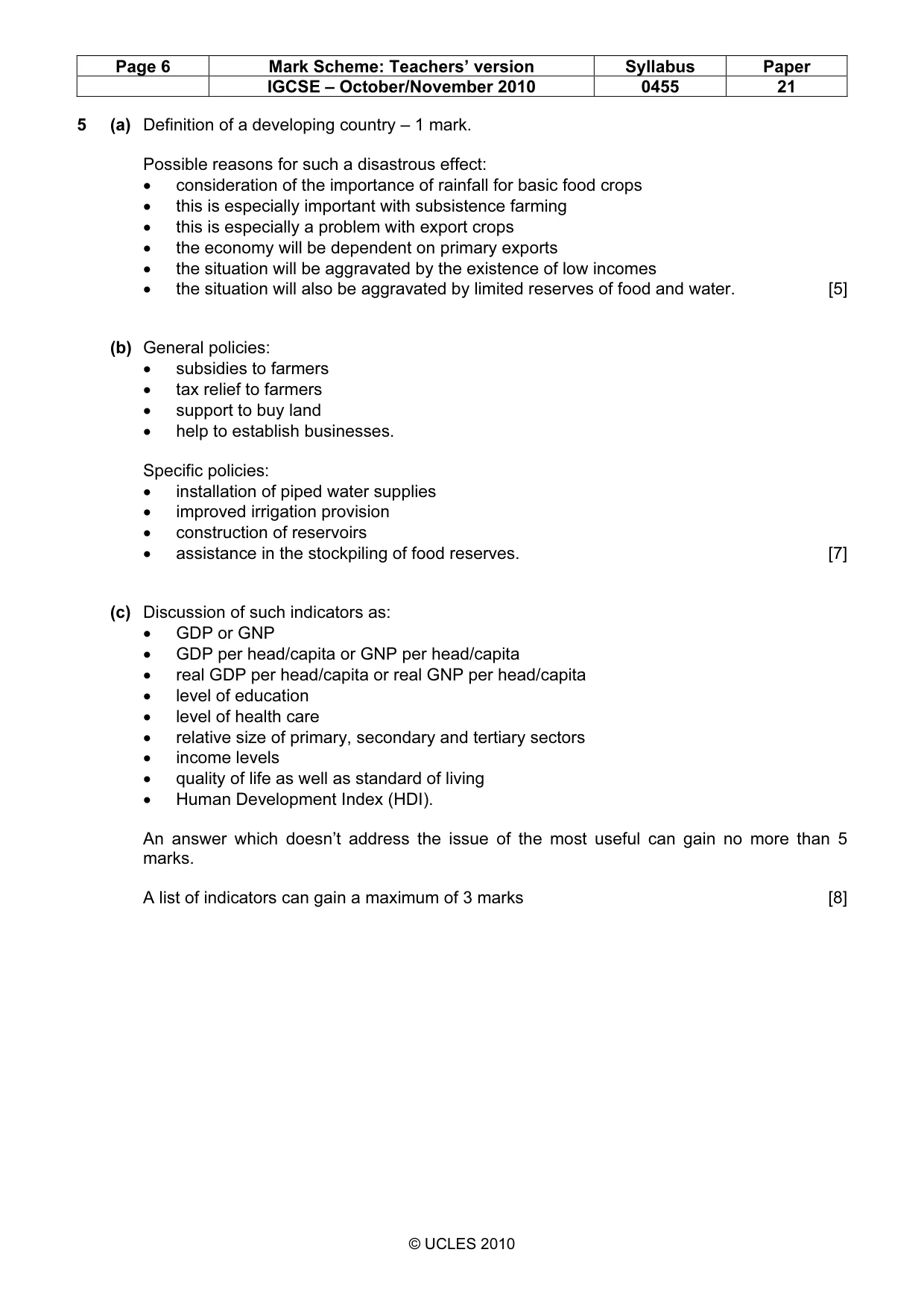
Page 6 Mark Scheme: Teachers’ version Syllabus Paper IGCSE – October/November 2010 0455 21 © UCLES 2010 5 (a) Definition of a developing country – 1 mark. Possible reasons for such a disastrous effect: • consideration of the importance of rainfall for basic food crops • this is especially important with subsistence farming • this is especially a problem with export crops • the economy will be dependent on primary exports • the situation will be aggravated by the existence of low incomes • the situation will also be aggravated by limited reserves of food and water. [5] (b) General policies: • subsidies to farmers • tax relief to farmers • support to buy land • help to establish businesses. Specific policies: • installation of piped water supplies • improved irrigation provision • construction of reservoirs • assistance in the stockpiling of food reserves. [7] (c) Discussion of such indicators as: • GDP or GNP • GDP per head/capita or GNP per head/capita • real GDP per head/capita or real GNP per head/capita • level of education • level of health care • relative size of primary, secondary and tertiary sectors • income levels • quality of life as well as standard of living • Human Development Index (HDI). An answer which doesn’t address the issue of the most useful can gain no more than 5 marks. A list of indicators can gain a maximum of 3 marks [8]
Mark scheme, page 7
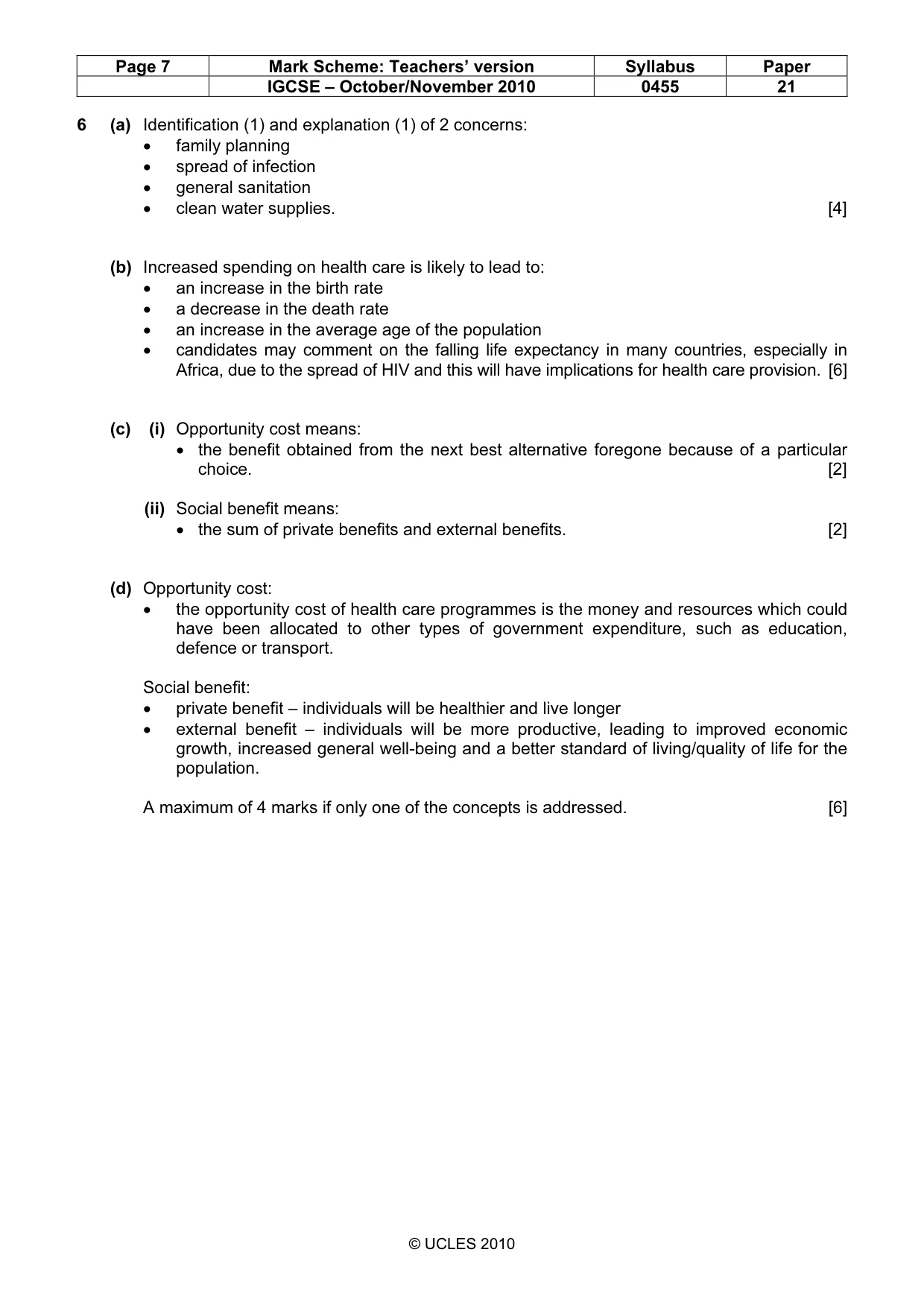
Page 7 Mark Scheme: Teachers’ version Syllabus Paper IGCSE – October/November 2010 0455 21 © UCLES 2010 6 (a) Identification (1) and explanation (1) of 2 concerns: • family planning • spread of infection • general sanitation • clean water supplies. [4] (b) Increased spending on health care is likely to lead to: • an increase in the birth rate • a decrease in the death rate • an increase in the average age of the population • candidates may comment on the falling life expectancy in many countries, especially in Africa, due to the spread of HIV and this will have implications for health care provision. [6] (c) (i) Opportunity cost means: • the benefit obtained from the next best alternative foregone because of a particular choice. [2] (ii) Social benefit means: • the sum of private benefits and external benefits. [2] (d) Opportunity cost: • the opportunity cost of health care programmes is the money and resources which could have been allocated to other types of government expenditure, such as education, defence or transport. Social benefit: • private benefit – individuals will be healthier and live longer • external benefit – individuals will be more productive, leading to improved economic growth, increased general well-being and a better standard of living/quality of life for the population. A maximum of 4 marks if only one of the concepts is addressed. [6]
Mark scheme, page 8
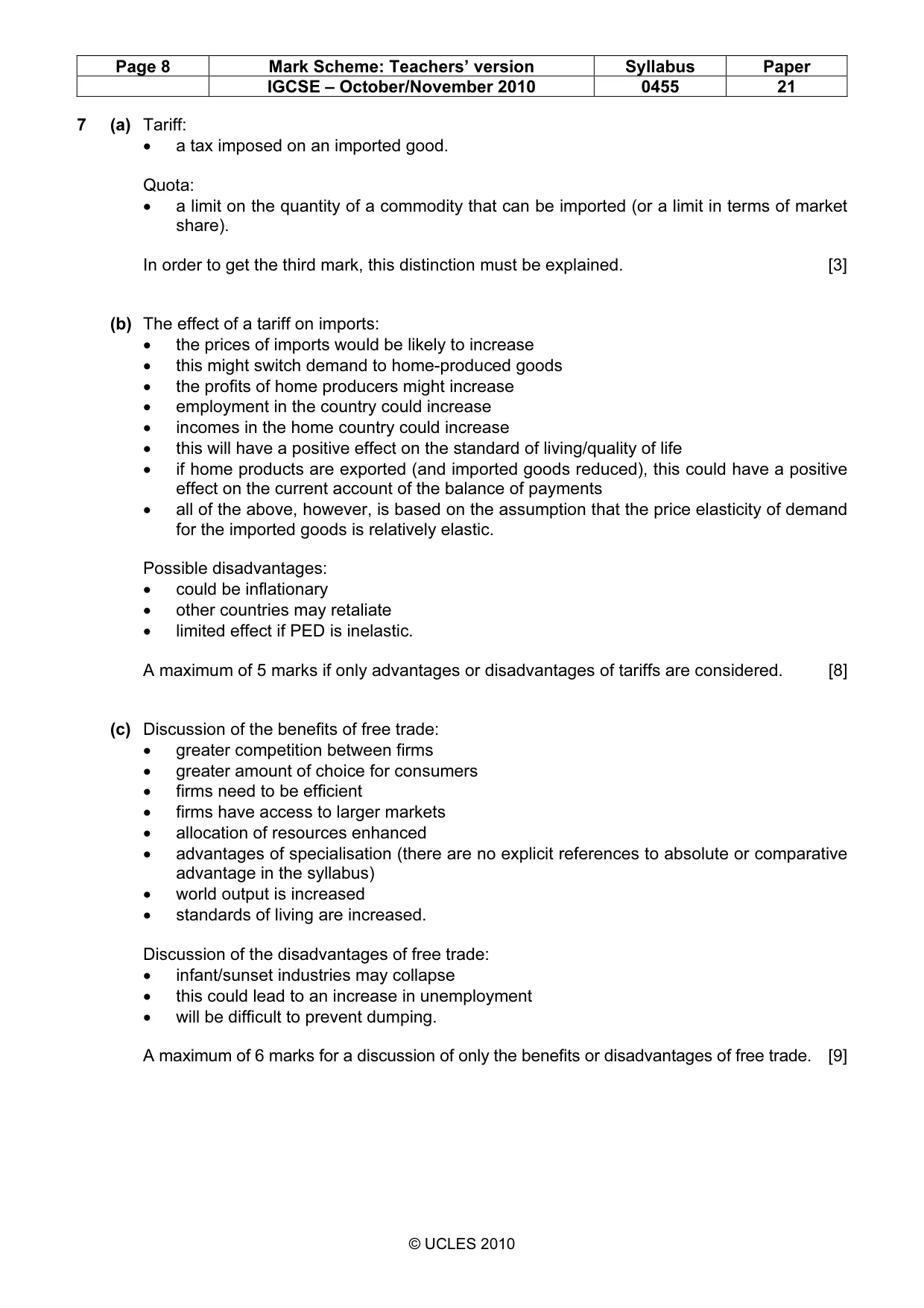
Page 8 Mark Scheme: Teachers’ version Syllabus Paper IGCSE – October/November 2010 0455 21 © UCLES 2010 7 (a) Tariff: • a tax imposed on an imported good. Quota: • a limit on the quantity of a commodity that can be imported (or a limit in terms of market share). In order to get the third mark, this distinction must be explained. [3] (b) The effect of a tariff on imports: • the prices of imports would be likely to increase • this might switch demand to home-produced goods • the profits of home producers might increase • employment in the country could increase • incomes in the home country could increase • this will have a positive effect on the standard of living/quality of life • if home products are exported (and imported goods reduced), this could have a positive effect on the current account of the balance of payments • all of the above, however, is based on the assumption that the price elasticity of demand for the imported goods is relatively elastic. Possible disadvantages: • could be inflationary • other countries may retaliate • limited effect if PED is inelastic. A maximum of 5 marks if only advantages or disadvantages of tariffs are considered. [8] (c) Discussion of the benefits of free trade: • greater competition between firms • greater amount of choice for consumers • firms need to be efficient • firms have access to larger markets • allocation of resources enhanced • advantages of specialisation (there are no explicit references to absolute or comparative advantage in the syllabus) • world output is increased • standards of living are increased. Discussion of the disadvantages of free trade: • infant/sunset industries may collapse • this could lead to an increase in unemployment • will be difficult to prevent dumping. A maximum of 6 marks for a discussion of only the benefits or disadvantages of free trade. [9]
What you needed in this session
Cambridge’s own grade thresholds for 2010 Oct/Nov, Paper 2 · Variant 1. A higher threshold means an easier paper — the bar moves with how the cohort did.