Cambridge IGCSE Design and Technology 0445 — 2018 May/June Paper 3 · Variant 2
0445/32/M/J/18 · 13 questions · 50 marks · ≈56 min
The question paper and its mark scheme, free to read here and free to download. This is Cambridge’s own paper, exactly as it was sat.
Question paper20 pages
Mark scheme9 pages
Answers below. Sit the paper first if you are practising.
Questions as text
Q1 · A door bolt made from steel for use in a bathroom
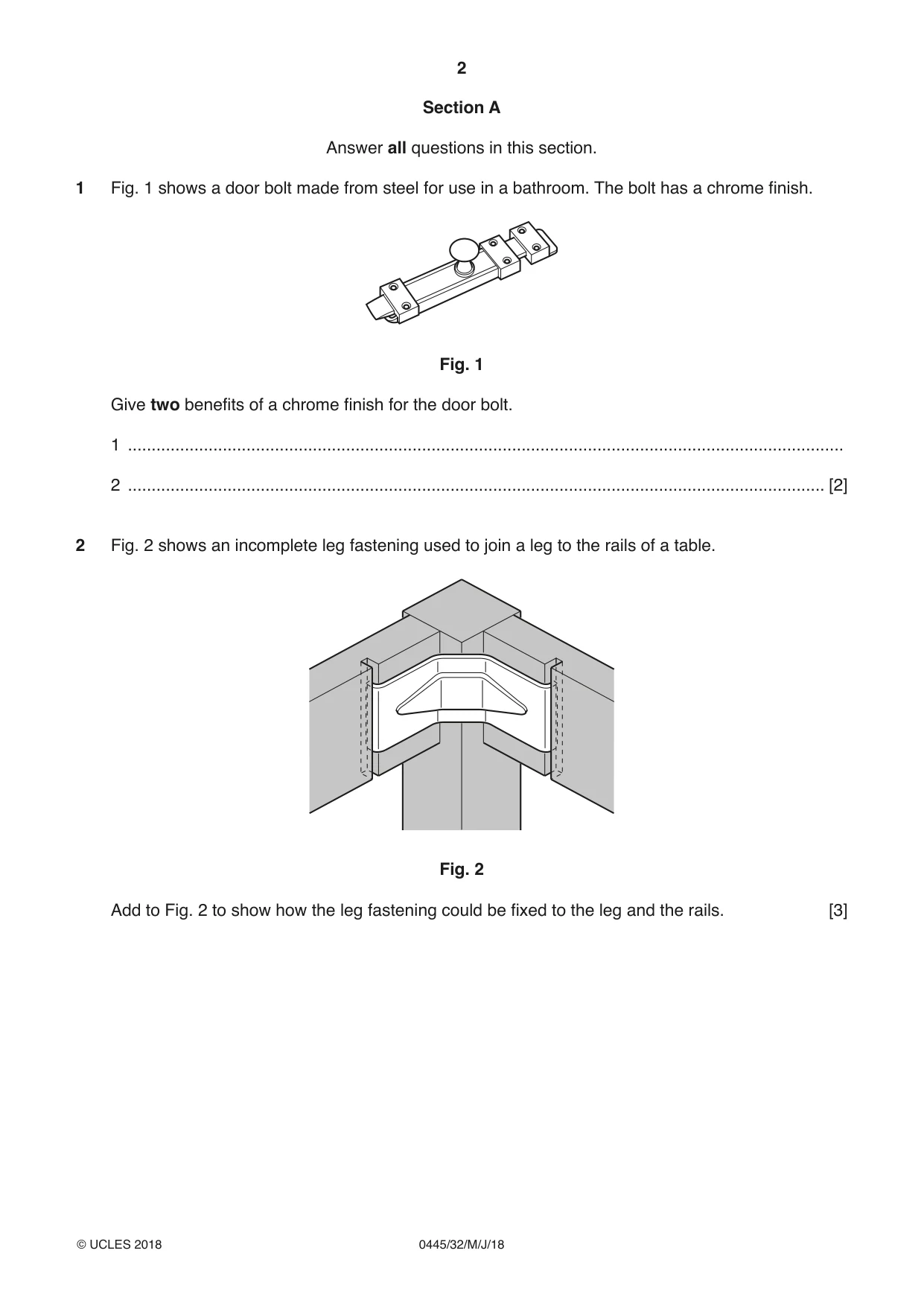
1 Fig. 1 shows a door bolt made from steel for use in a bathroom. The bolt has a chrome finish. Fig. 1 Give two benefits of a chrome finish for the door bolt. 1 ....................................................................................................................................................... 2 ................................................................................................................................................... [2]
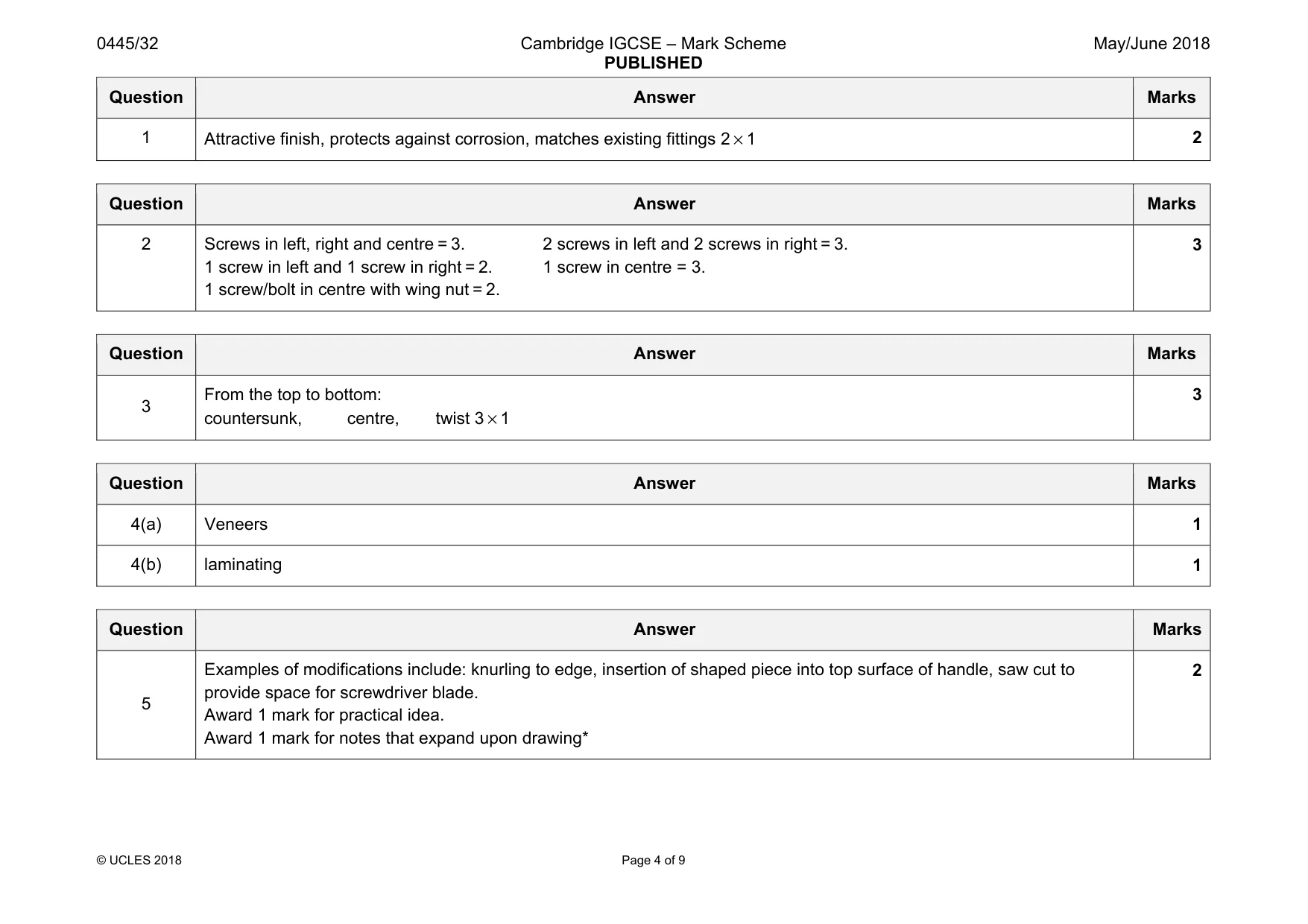
Mark scheme: 1 2
Q2 · An incomplete leg fastening used to join a leg to the rails of a table
2 Fig. 2 shows an incomplete leg fastening used to join a leg to the rails of a table. Fig. 2 Add to Fig. 2 to show how the leg fastening could be fixed to the leg and the rails. [3]
Mark scheme: 2 Screws in left, right and centre = 3. 2 screws in left and 2 screws in right = 3. 1 screw in left and 1 screw in right = 2. 1 screw in centre = 3. 1 screw/bolt in centre with wing nut = 2. 3
Q3 · Complete the table below by adding the correct name from the list
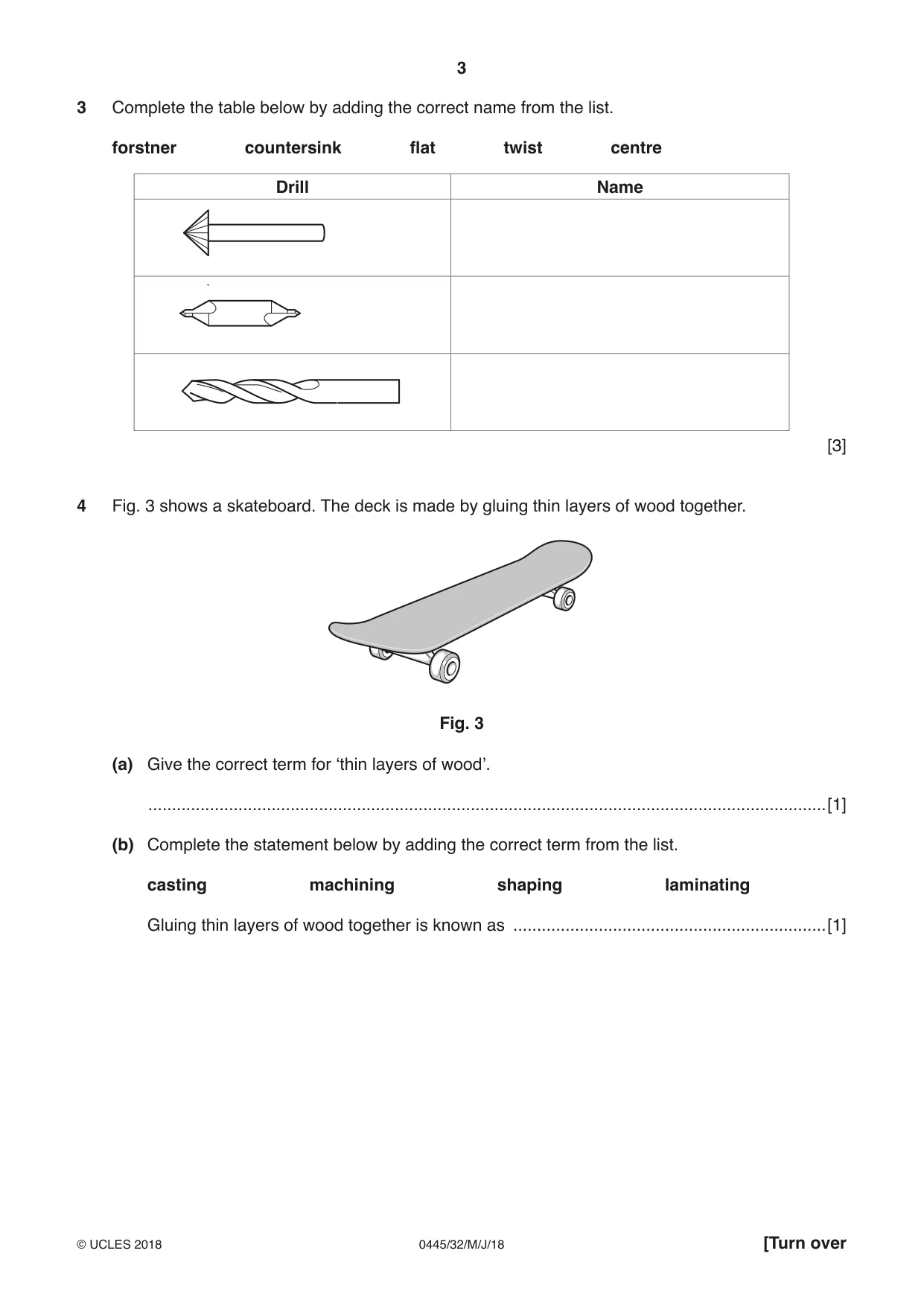
3 Complete the table below by adding the correct name from the list. forstner countersink flat twist centre Drill Name [3]
Mark scheme: 3 countersunk, centre, twist 3 × 1
Question 4
4 Fig. 3 shows a skateboard. The deck is made by gluing thin layers of wood together. Fig. 3 (a) Give the correct term for ‘thin layers of wood’. ...............................................................................................................................................[1] (b) Complete the statement below by adding the correct term from the list. casting machining shaping laminating Gluing thin layers of wood together is known as ..................................................................[1]
Mark scheme: 4(a) Veneers 1 4(b) laminating 1 Question Answer Marks 5 Examples of modifications include: knurling to edge, insertion of shaped piece into top surface of handle, saw cut to provide space for screwdriver blade. Award 1 mark for practical idea. Award 1 mark for notes that expand upon drawing* 2
Q5 · A handle made from metal
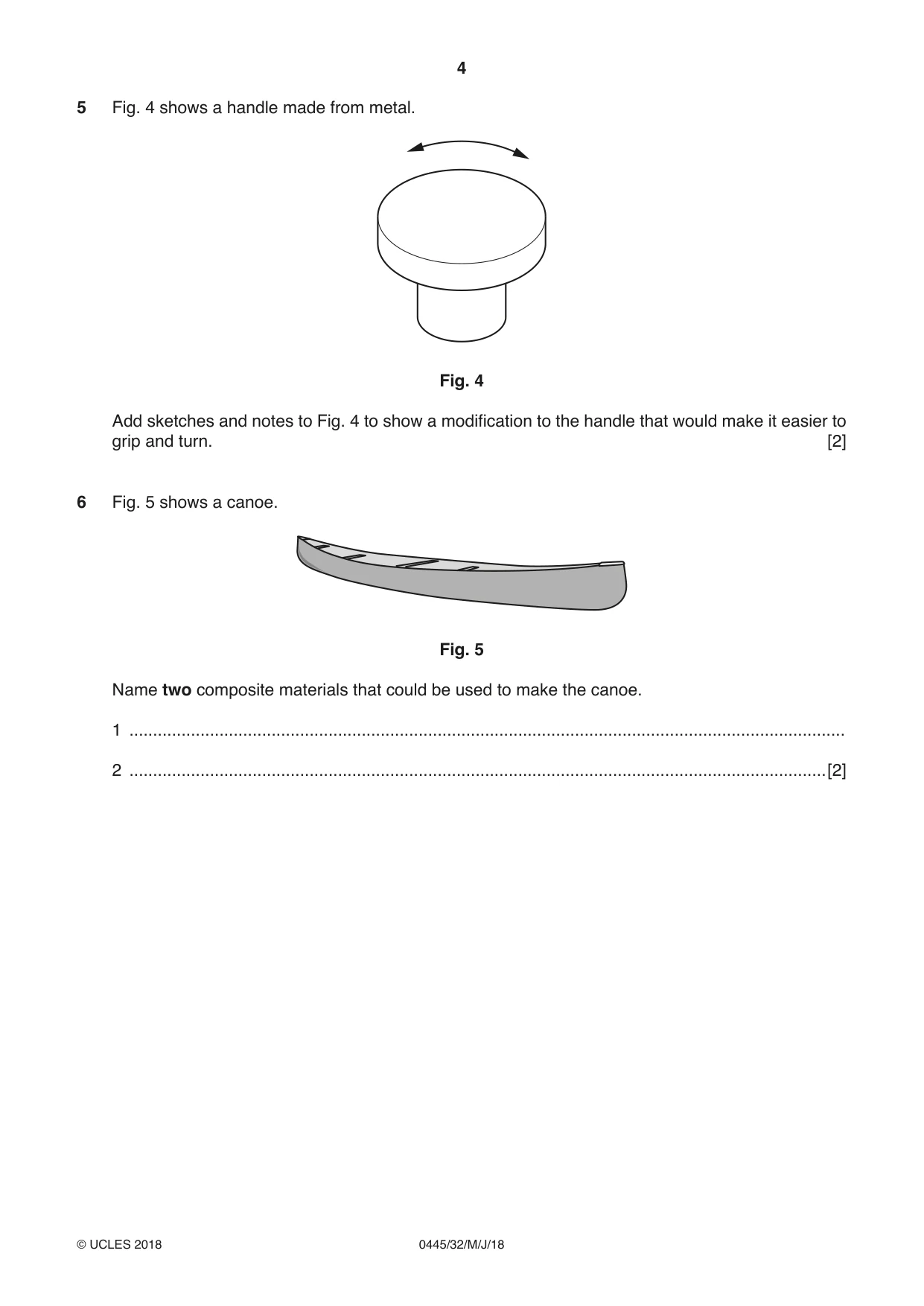
5 Fig. 4 shows a handle made from metal. Fig. 4 Add sketches and notes to Fig. 4 to show a modification to the handle that would make it easier to grip and turn. [2]
Mark scheme: 5 Award 1 mark for practical idea. Award 1 mark for notes that expand upon drawing*
Question 6
6 Fig. 5 shows a canoe. Fig. 5 Name two composite materials that could be used to make the canoe. 1 ....................................................................................................................................................... 2 ...................................................................................................................................................[2]
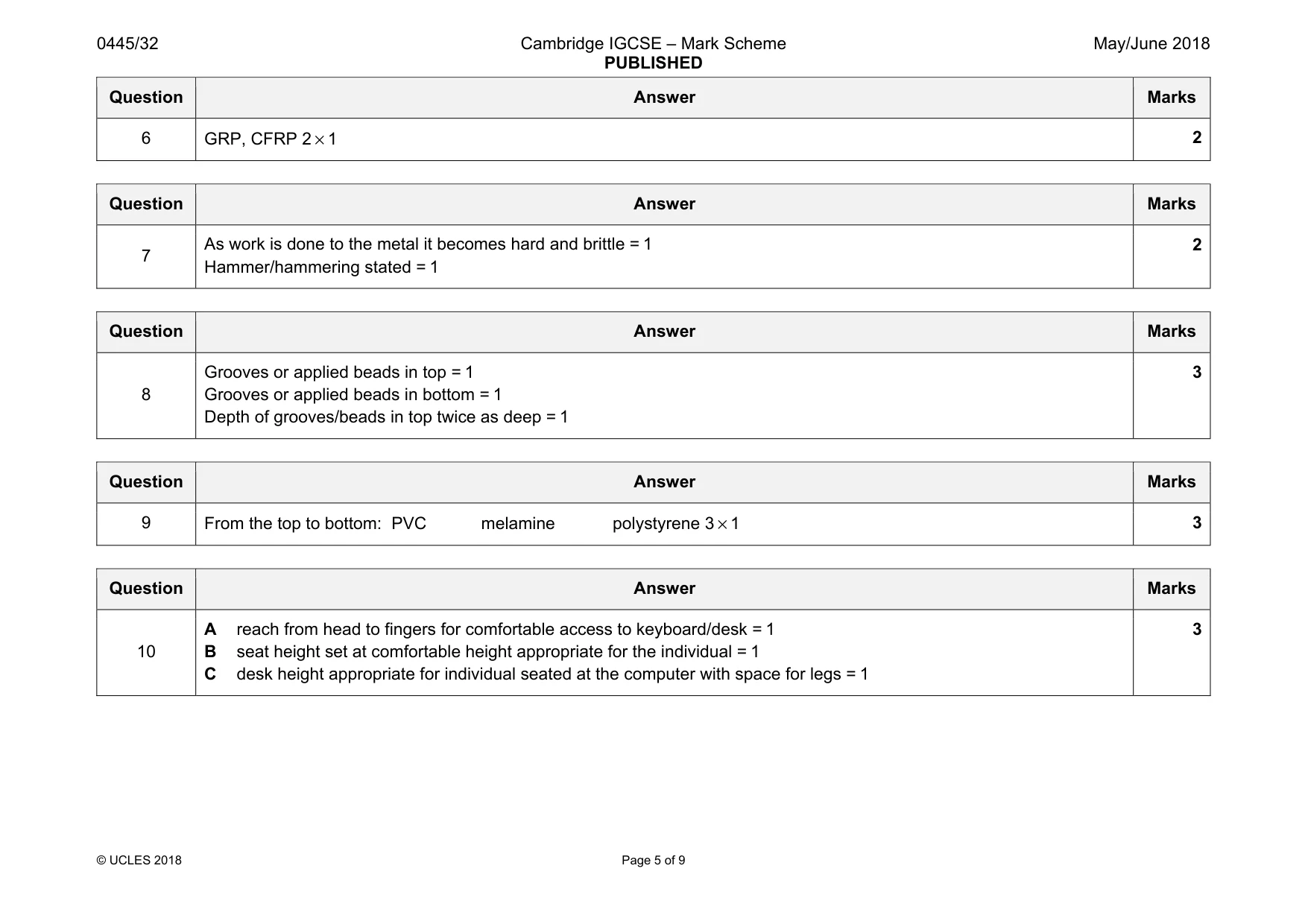
Mark scheme: 6
Q7 · A piece of steel that has cracked due to work hardening during bending
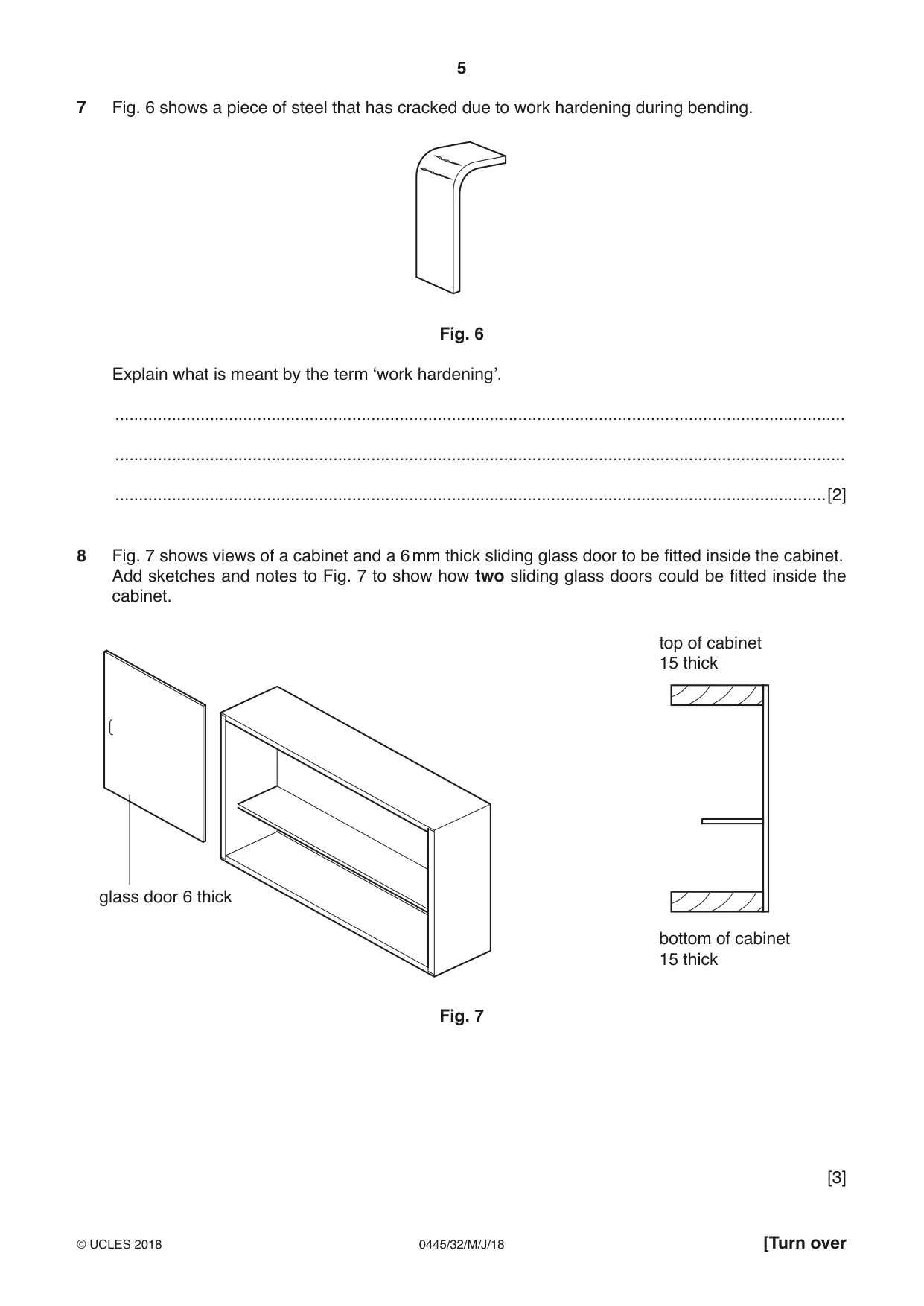
7 Fig. 6 shows a piece of steel that has cracked due to work hardening during bending. Fig. 6 Explain what is meant by the term ‘work hardening’. .......................................................................................................................................................... .......................................................................................................................................................... ......................................................................................................................................................[2]
Mark scheme: 7 Hammer/hammering stated = 1
Q8 · Views of a cabinet and a 6 mm thick sliding glass door to be fitted inside the cabinet
8 Fig. 7 shows views of a cabinet and a 6 mm thick sliding glass door to be fitted inside the cabinet. Add sketches and notes to Fig. 7 to show how two sliding glass doors could be fitted inside the cabinet. top of cabinet 15 thick glass door 6 thick bottom of cabinet 15 thick Fig. 7 [3]
Mark scheme: 8 Grooves or applied beads in bottom = 1 Depth of grooves/beads in top twice as deep = 1
Q9 · Complete the table by naming the correct plastic from the list below to match each…
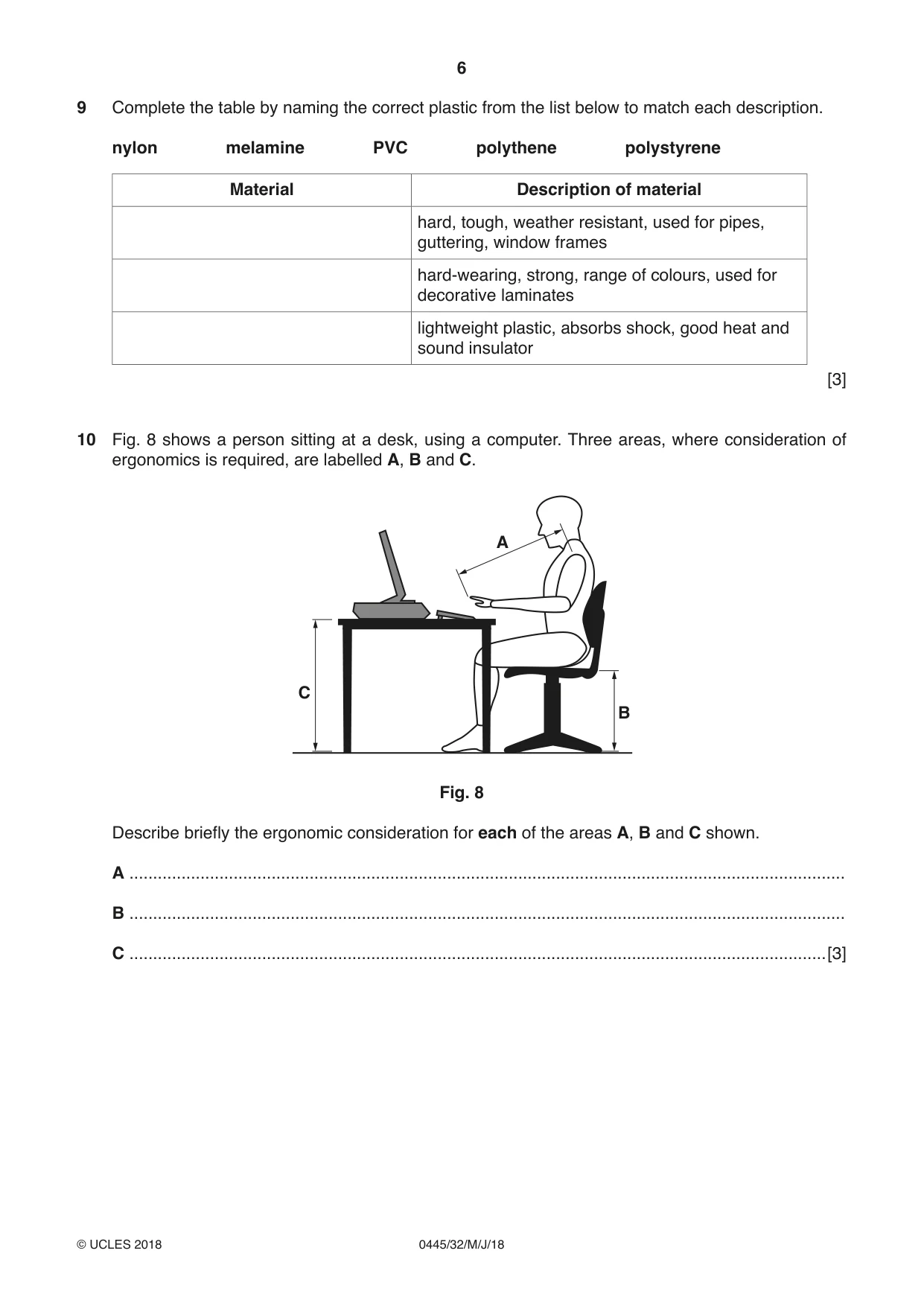
9 Complete the table by naming the correct plastic from the list below to match each description. nylon melamine PVC polythene polystyrene Material Description of material hard, tough, weather resistant, used for pipes, guttering, window frames hard-wearing, strong, range of colours, used for decorative laminates lightweight plastic, absorbs shock, good heat and sound insulator [3]
Mark scheme: 9 From the top to bottom: PVC melamine Question Answer Marks 10 A reach from head to fingers for comfortable access to keyboard/desk = 1 B seat height set at comfortable height appropriate for the individual = 1 C desk height appropriate for individual seated at the computer with space for legs = 1 3
Q10 · A person sitting at a desk, using a computer
10 Fig. 8 shows a person sitting at a desk, using a computer. Three areas, where consideration of ergonomics is required, are labelled A, B and C. A C B Fig. 8 Describe briefly the ergonomic consideration for each of the areas A, B and C shown. A ....................................................................................................................................................... B ....................................................................................................................................................... C ...................................................................................................................................................[3]
Mark scheme: 10 B seat height set at comfortable height appropriate for the individual = 1 C desk height appropriate for individual seated at the computer with space for legs = 1
Q11 · A child’s desk organiser made from 4 mm thick acrylic
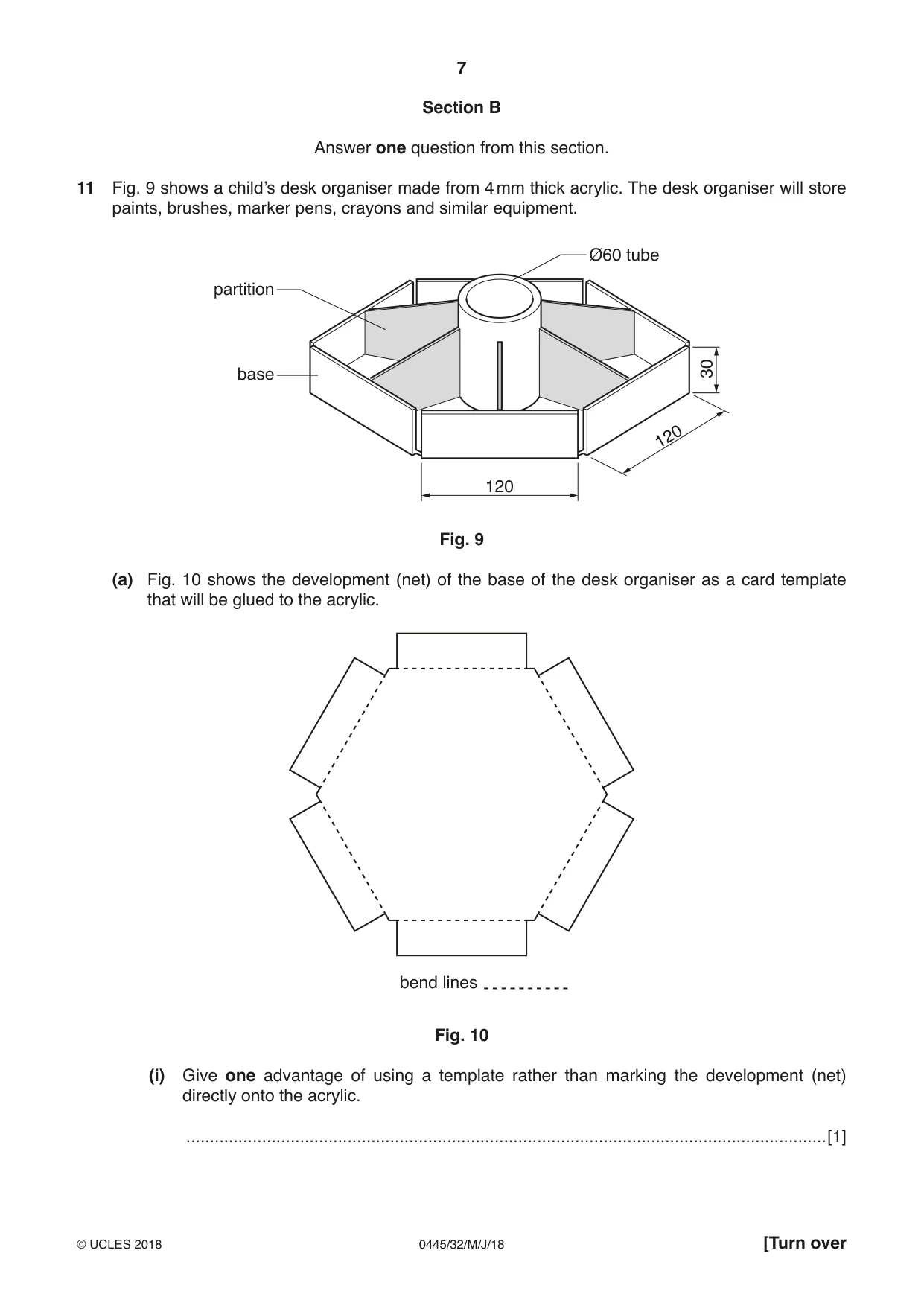
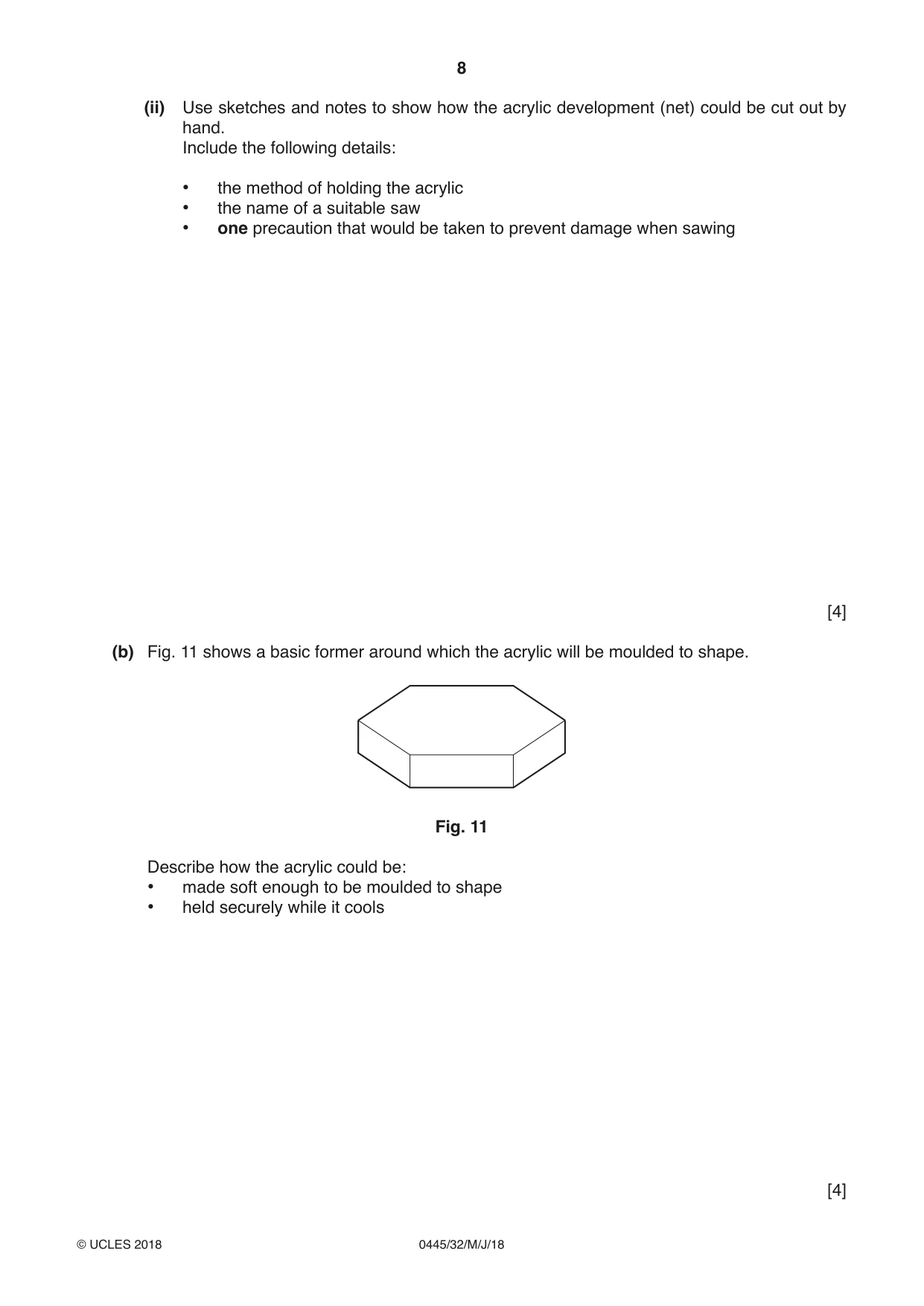
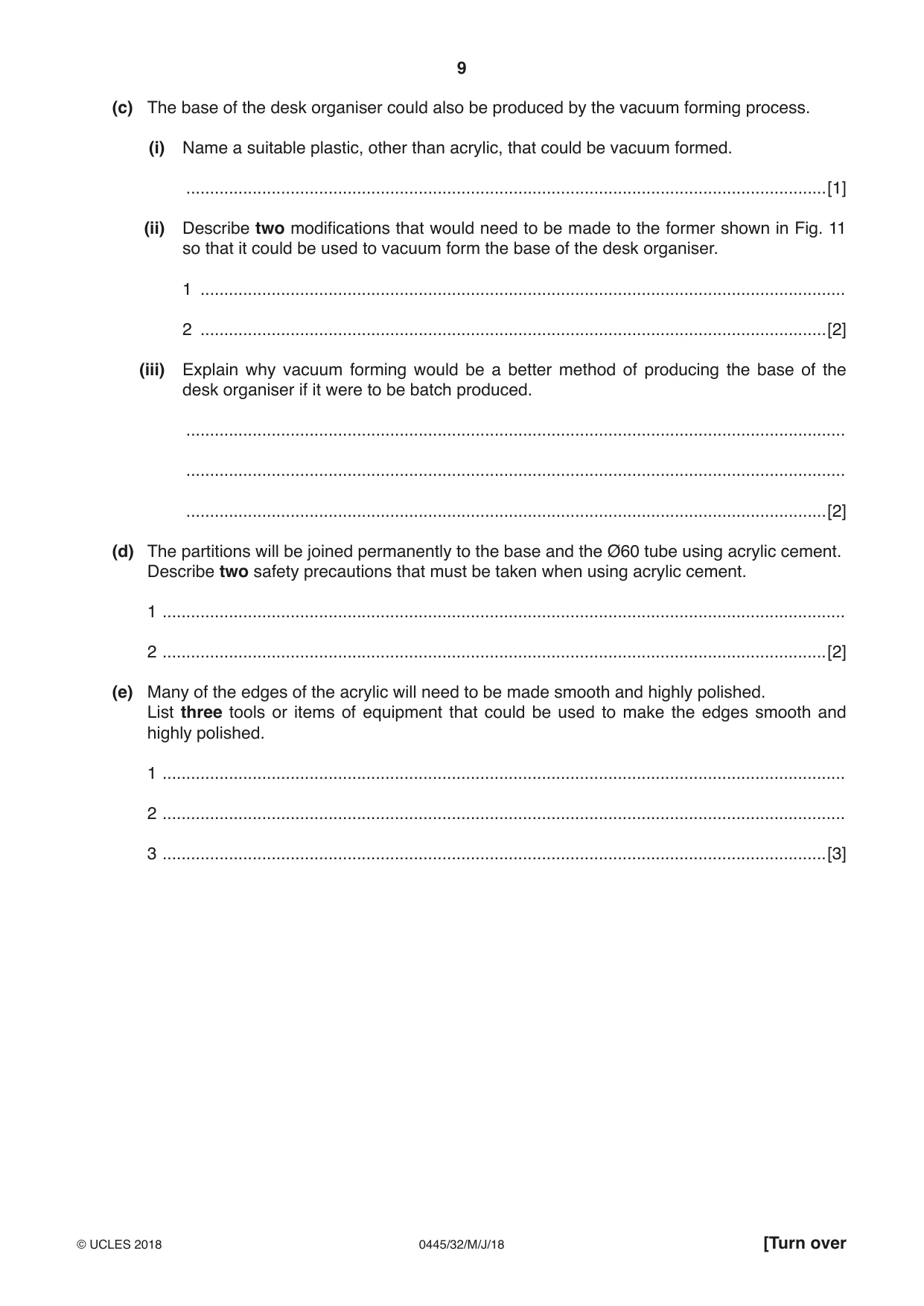
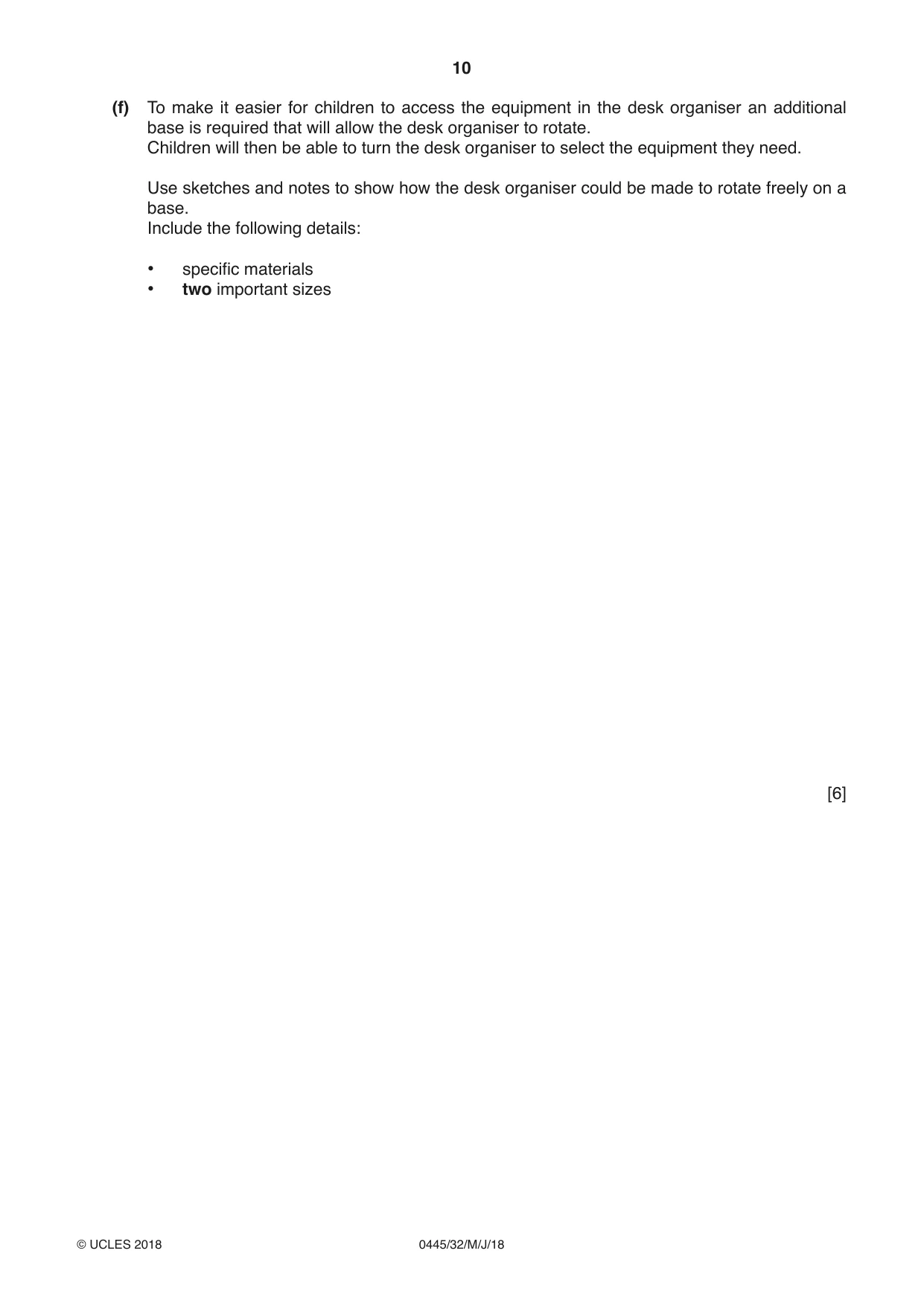
11 Fig. 9 shows a child’s desk organiser made from 4 mm thick acrylic. The desk organiser will store paints, brushes, marker pens, crayons and similar equipment. Ø60 tube partition base 30 120 120 Fig. 9 (a) Fig. 10 shows the development (net) of the base of the desk organiser as a card template that will be glued to the acrylic. bend lines Fig. 10 (i) Give one advantage of using a template rather than marking the development (net) directly onto the acrylic. .......................................................................................................................................[1] (ii) Use sketches and notes to show how the acrylic development (net) could be cut out by hand. Include the following details: • the method of holding the acrylic • the name of a suitable saw • one precaution that would be taken to prevent damage when sawing [4] (b) Fig. 11 shows a basic former around which the acrylic will be moulded to shape. Fig. 11 Describe how the acrylic could be: • made soft enough to be moulded to shape • held securely while it cools [4] (c) The base of the desk organiser could also be produced by the vacuum forming process. (i) Name a suitable plastic, other than acrylic, that could be vacuum formed. .......................................................................................................................................[1] (ii) Describe two modifications that would need to be made to the former shown in Fig. 11 so that it could be used to vacuum form the base of the desk organiser. 1 ........................................................................................................................................ 2 ....................................................................................................................................[2] (iii) Explain why vacuum forming would be a better method of producing the base of the desk organiser if it were to be batch produced. ........................................................................................................................................... ........................................................................................................................................... .......................................................................................................................................[2] (d) The partitions will be joined permanently to the base and the Ø60 tube using acrylic cement. Describe two safety precautions that must be taken when using acrylic cement. 1 ................................................................................................................................................ 2 ............................................................................................................................................[2] (e) Many of the edges of the acrylic will need to be made smooth and highly polished. List three tools or items of equipment that could be used to make the edges smooth and highly polished. 1 ................................................................................................................................................ 2 ................................................................................................................................................ 3 ............................................................................................................................................[3] (f) To make it easier for children to access the equipment in the desk organiser an additional base is required that will allow the desk organiser to rotate. Children will then be able to turn the desk organiser to select the equipment they need. Use sketches and notes to show how the desk organiser could be made to rotate freely on a base. Include the following details: • specific materials • two important sizes [6]
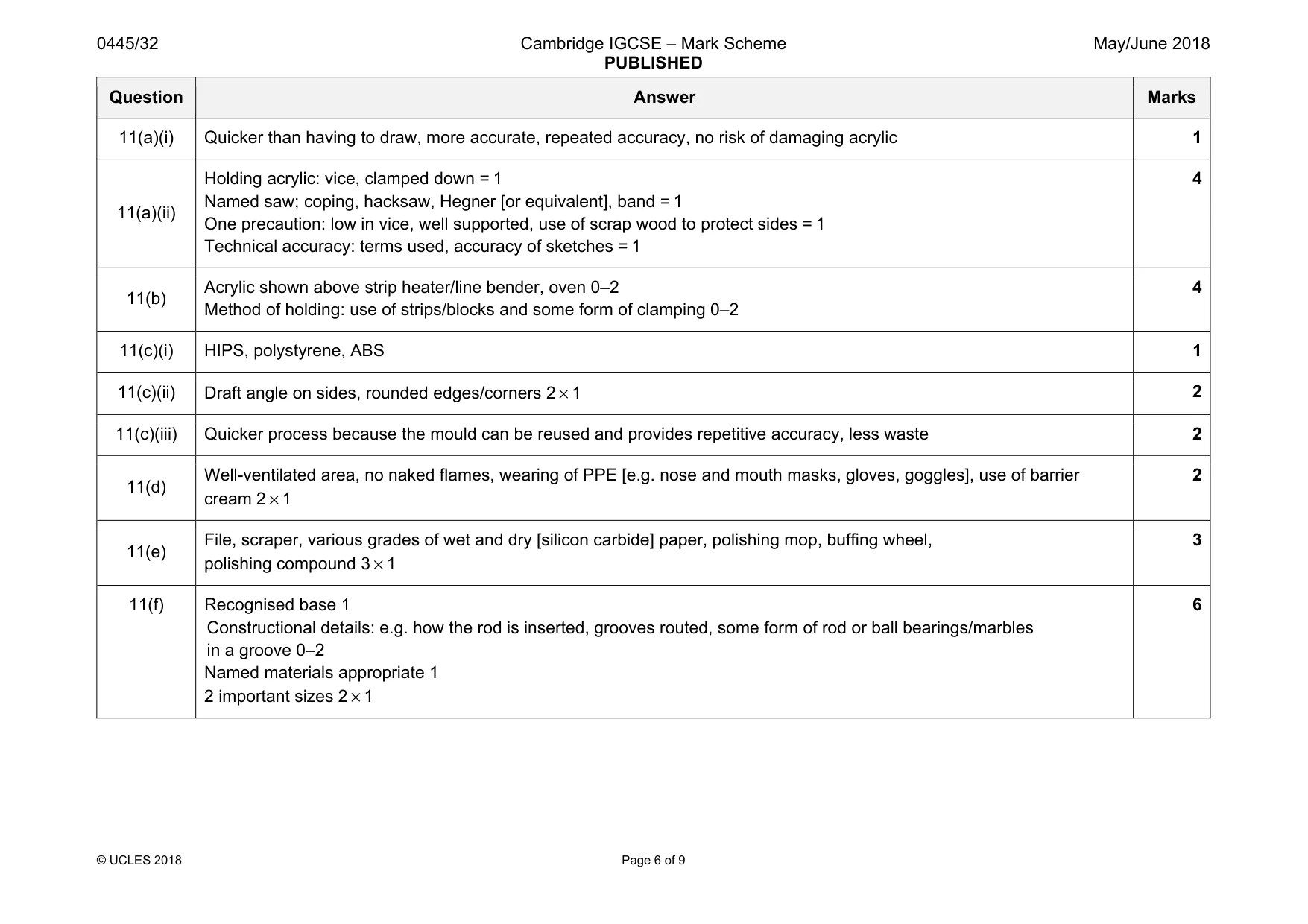
Mark scheme: 11(a)(i) Quicker than having to draw, more accurate, repeated accuracy, no risk of damaging acrylic 1 11(a)(ii) Holding acrylic: vice, clamped down = 1 Named saw; coping, hacksaw, Hegner [or equivalent], band = 1 One precaution: low in vice, well supported, use of scrap wood to protect sides = 1 Technical accuracy: terms used, accuracy of sketches = 1 4 11(b) Acrylic shown above strip heater/line bender, oven 0–2 Method of holding: use of strips/blocks and some form of clamping 0–2 4 11(c)(i) HIPS, polystyrene, ABS 1 11(c)(ii) Draft angle on sides, rounded edges/corners 2 × 1 2 11(c)(iii) Quicker process because the mould can be reused and provides repetitive accuracy, less waste 2 11(d) Well-ventilated area, no naked flames, wearing of PPE [e.g. nose and mouth masks, gloves, goggles], use of barrier cream 2 × 1 2 11(e) File, scraper, various grades of wet and dry [silicon carbide] paper, polishing mop, buffing wheel, polishing compound 3 × 1 3 11(f) Recognised base 1 Constructional details: e.g. how the rod is inserted, grooves routed, some form of rod or ball bearings/marbles in a groove 0–2 Named materials appropriate 1 2 important sizes 2 × 1 6
Q12 · A guitar stand made from hardwood
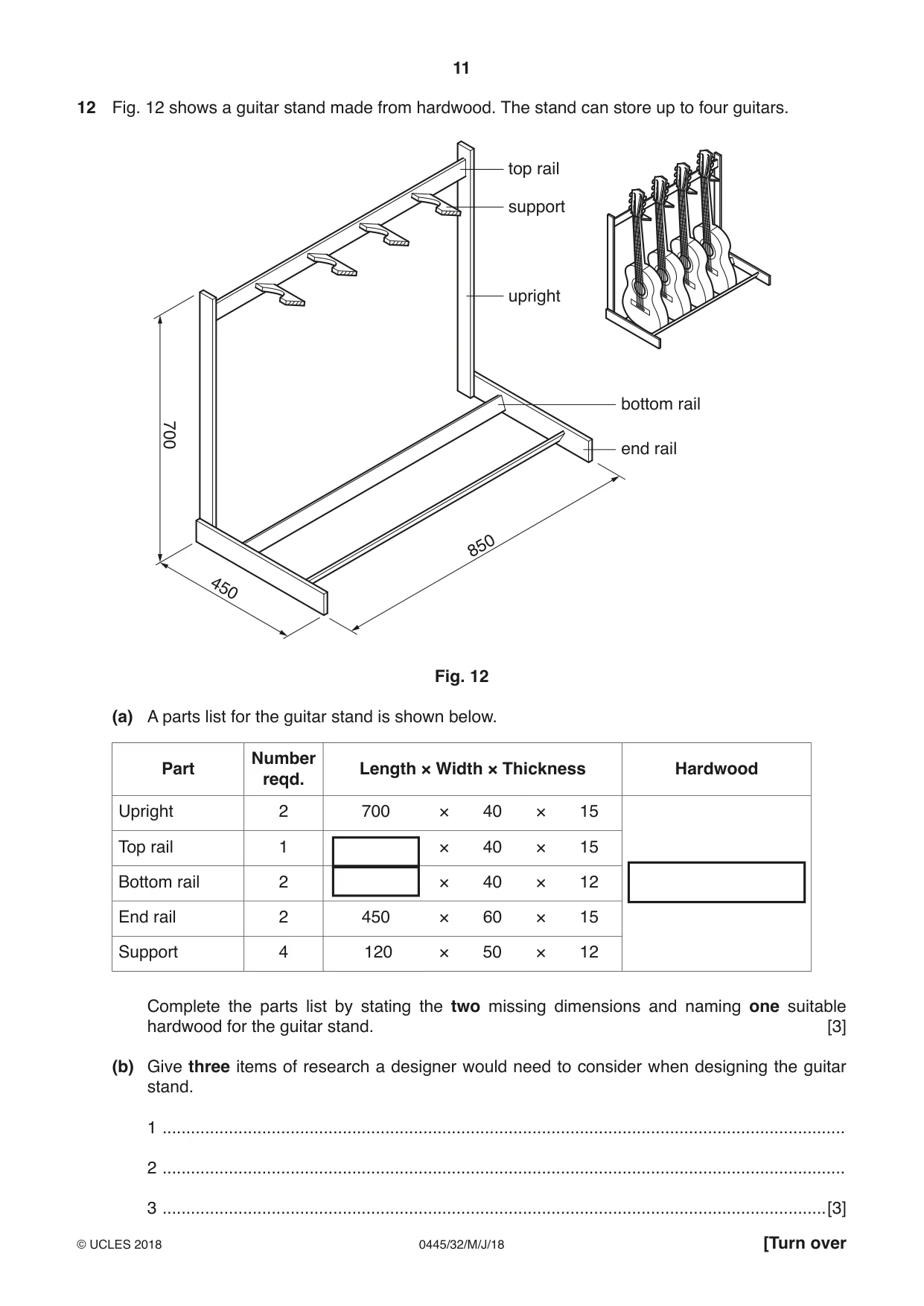
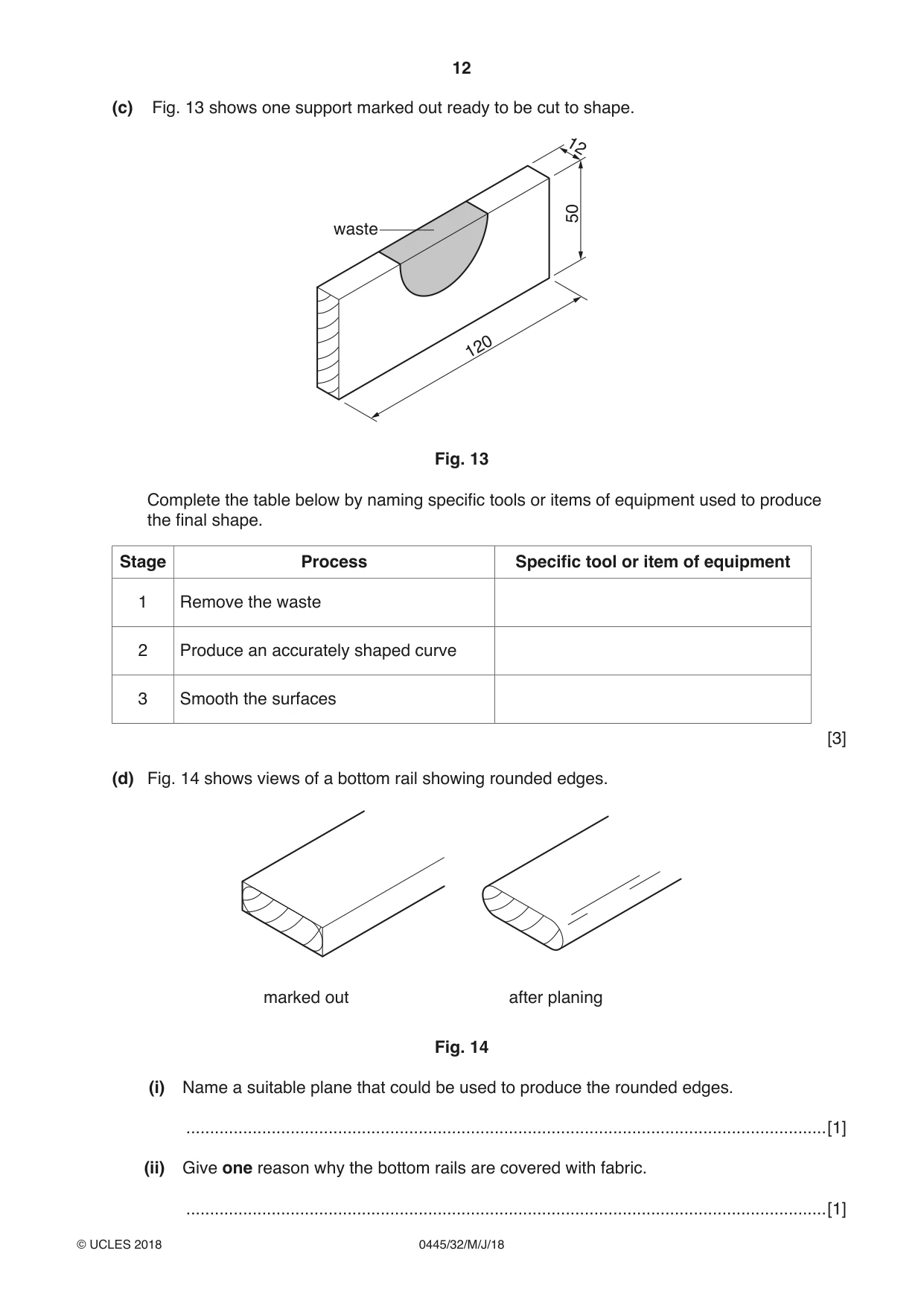
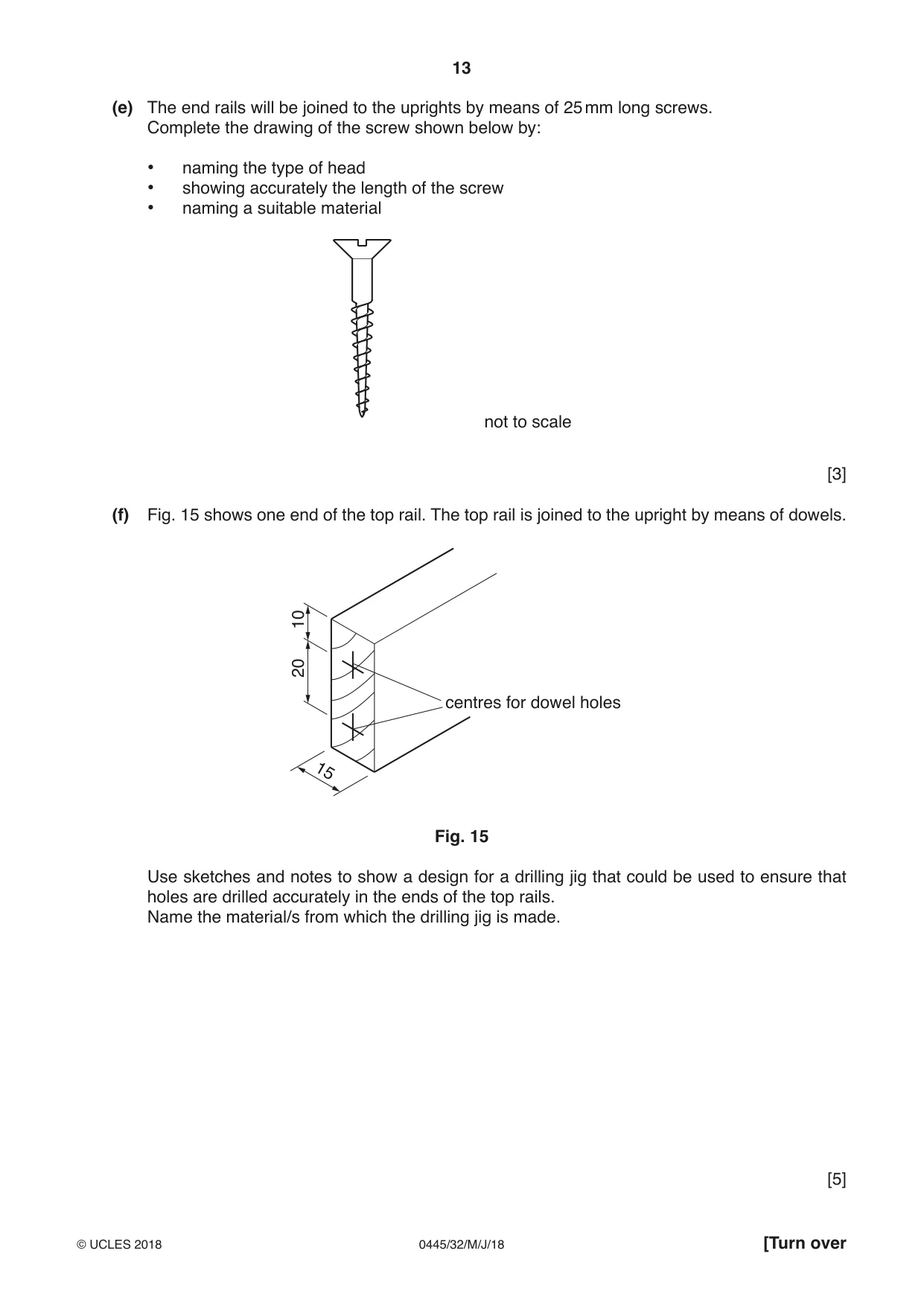
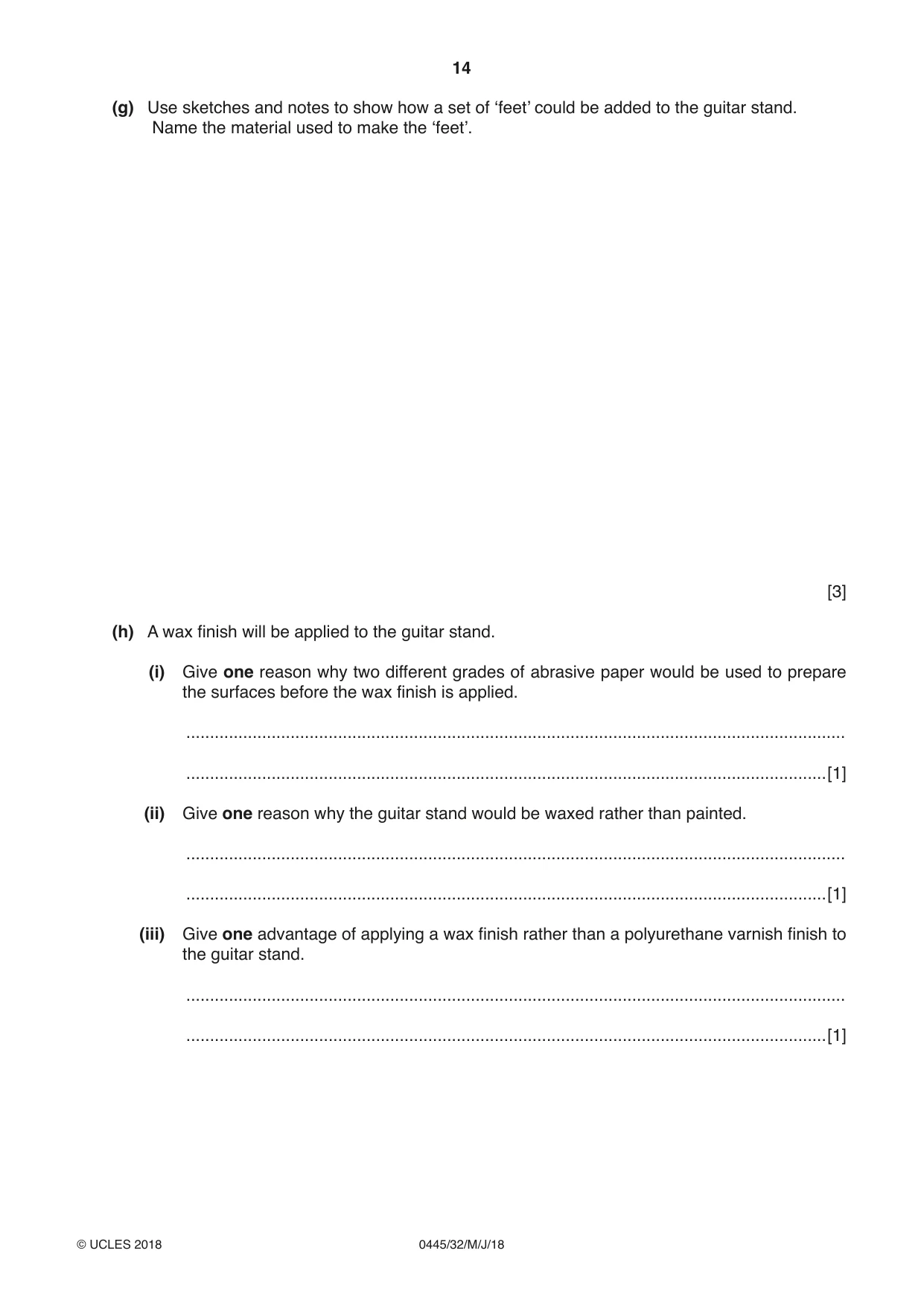
12 Fig. 12 shows a guitar stand made from hardwood. The stand can store up to four guitars. top rail support upright bottom rail 700 end rail 850 450 Fig. 12 (a) A parts list for the guitar stand is shown below. Number Part Length × Width × Thickness Hardwood reqd. Upright 2 700 × 40 × 15 Top rail 1 × 40 × 15 Bottom rail 2 × 40 × 12 End rail 2 450 × 60 × 15 Support 4 120 × 50 × 12 Complete the parts list by stating the two missing dimensions and naming one suitable hardwood for the guitar stand. [3] (b) Give three items of research a designer would need to consider when designing the guitar stand. 1 ................................................................................................................................................ 2 ................................................................................................................................................ 3 ............................................................................................................................................[3] (c) Fig. 13 shows one support marked out ready to be cut to shape. 12 50 waste 120 Fig. 13 Complete the table below by naming specific tools or items of equipment used to produce the final shape. Stage Process Specific tool or item of equipment 1 Remove the waste 2 Produce an accurately shaped curve 3 Smooth the surfaces [3] (d) Fig. 14 shows views of a bottom rail showing rounded edges. marked out after planing Fig. 14 (i) Name a suitable plane that could be used to produce the rounded edges. .......................................................................................................................................[1] (ii) Give one reason why the bottom rails are covered with fabric. .......................................................................................................................................[1] (e) The end rails will be joined to the uprights by means of 25 mm long screws. Complete the drawing of the screw shown below by: • naming the type of head • showing accurately the length of the screw • naming a suitable material not to scale [3] (f) Fig. 15 shows one end of the top rail. The top rail is joined to the upright by means of dowels. 10 20 centres for dowel holes 15 Fig. 15 Use sketches and notes to show a design for a drilling jig that could be used to ensure that holes are drilled accurately in the ends of the top rails. Name the material/s from which the drilling jig is made. [5] (g) Use sketches and notes to show how a set of ‘feet’ could be added to the guitar stand. Name the material used to make the ‘feet’. [3] (h) A wax finish will be applied to the guitar stand. (i) Give one reason why two different grades of abrasive paper would be used to prepare the surfaces before the wax finish is applied. ........................................................................................................................................... .......................................................................................................................................[1] (ii) Give one reason why the guitar stand would be waxed rather than painted. ........................................................................................................................................... .......................................................................................................................................[1] (iii) Give one advantage of applying a wax finish rather than a polyurethane varnish finish to the guitar stand. ........................................................................................................................................... .......................................................................................................................................[1]
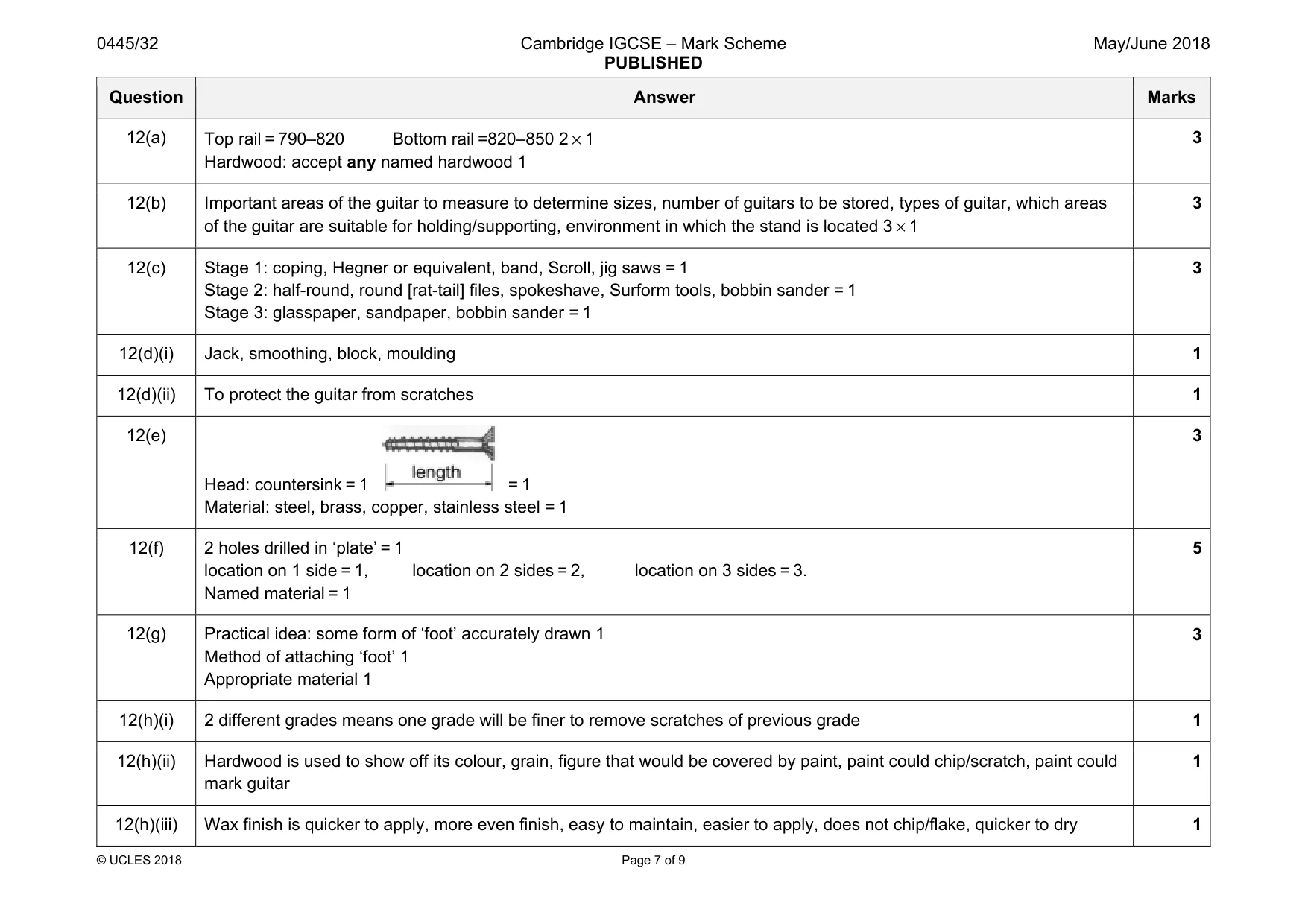
Mark scheme: 12(a) Top rail = 790–820 Hardwood: accept any named hardwood 1 3 12(b) Important areas of the guitar to measure to determine sizes, number of guitars to be stored, types of guitar, which areas of the guitar are suitable for holding/supporting, environment in which the stand is located 3 × 1 3 12(c) Stage 1: coping, Hegner or equivalent, band, Scroll, jig saws = 1 Stage 2: half-round, round [rat-tail] files, spokeshave, Surform tools, bobbin sander = 1 Stage 3: glasspaper, sandpaper, bobbin sander = 1 3 12(d)(i) Jack, smoothing, block, moulding 1 12(d)(ii) To protect the guitar from scratches 1 12(e) Head: countersink = 1 = 1 Material: steel, brass, copper, stainless steel = 1 3 12(f) 2 holes drilled in ‘plate’ = 1 location on 1 side = 1, location on 2 sides = 2, location on 3 sides = 3. Named material = 1 5 12(g) Practical idea: some form of ‘foot’ accurately drawn 1 Method of attaching ‘foot’ 1 Appropriate material 1 3 12(h)(i) 2 different grades means one grade will be finer to remove scratches of previous grade 1 12(h)(ii) Hardwood is used to show off its colour, grain, figure that would be covered by paint, paint could chip/scratch, paint could mark guitar 1 12(h)(iii) Wax finish is quicker to apply, more even finish, easy to maintain, easier to apply, does not chip/flake, quicker to dry 1
Q13 · A card model for a safety glasses holder
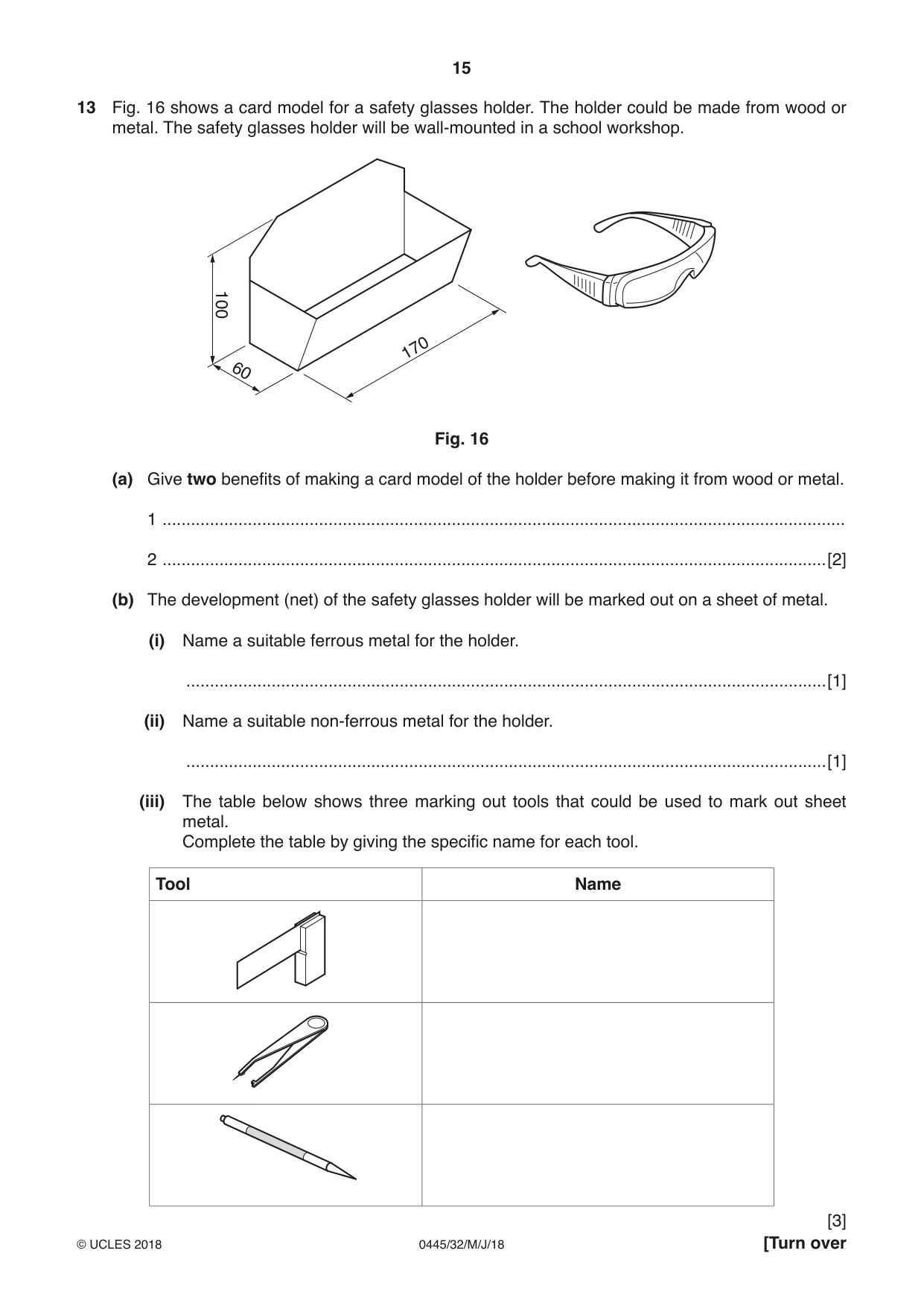
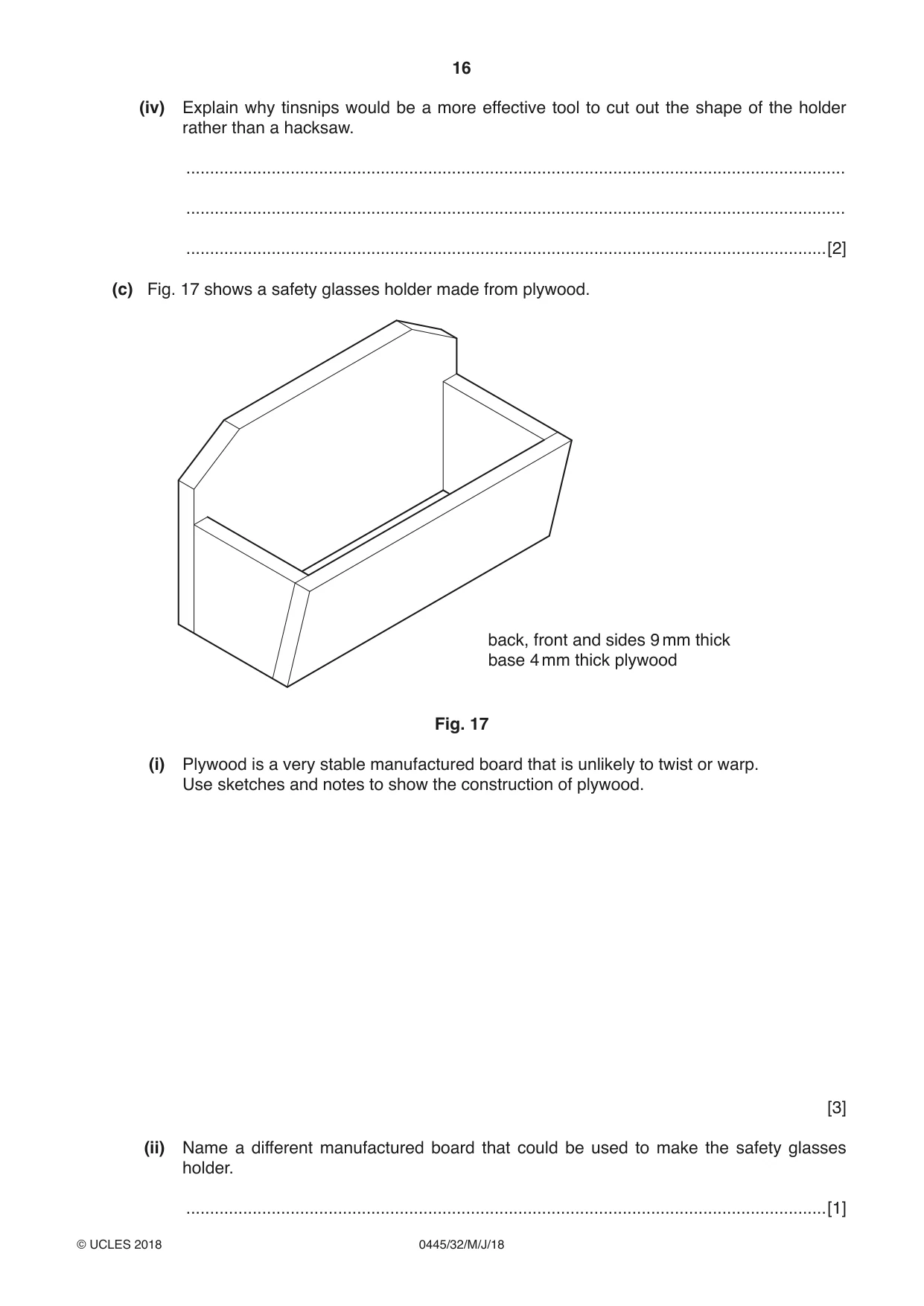
13 Fig. 16 shows a card model for a safety glasses holder. The holder could be made from wood or metal. The safety glasses holder will be wall-mounted in a school workshop. 100 170 60 Fig. 16 (a) Give two benefits of making a card model of the holder before making it from wood or metal. 1 ................................................................................................................................................ 2 ............................................................................................................................................[2] (b) The development (net) of the safety glasses holder will be marked out on a sheet of metal. (i) Name a suitable ferrous metal for the holder. .......................................................................................................................................[1] (ii) Name a suitable non-ferrous metal for the holder. .......................................................................................................................................[1] (iii) The table below shows three marking out tools that could be used to mark out sheet metal. Complete the table by giving the specific name for each tool. Tool Name (iv) Explain why tinsnips would be a more effective tool to cut out the shape of the holder rather than a hacksaw. ........................................................................................................................................... ........................................................................................................................................... .......................................................................................................................................[2] (c) Fig. 17 shows a safety glasses holder made from plywood. back, front and sides 9 mm thick base 4 mm thick plywood Fig. 17 (i) Plywood is a very stable manufactured board that is unlikely to twist or warp. Use sketches and notes to show the construction of plywood. [3] (ii) Name a different manufactured board that could be used to make the safety glasses holder. .......................................................................................................................................[1] (iii) The parts of the safety glasses holder shown in Fig. 17 will be nailed and glued together. Name a specific type of nail that could be used to join the parts of the holder together. .......................................................................................................................................[1] (iv) State a suitable length for the nail that could be used to join the front to the sides. .......................................................................................................................................[1] (v) Name a suitable adhesive that could be used to glue the parts together. .......................................................................................................................................[1] (vi) State approximately how long the adhesive named in part (v) would take to set. .......................................................................................................................................[1] (d) Choose whether to make the safety glasses holder from metal or plywood. (i) Use sketches and notes to show a modification to the safety glasses holder so that it could be fixed to a wall and easily removed for cleaning. [3]
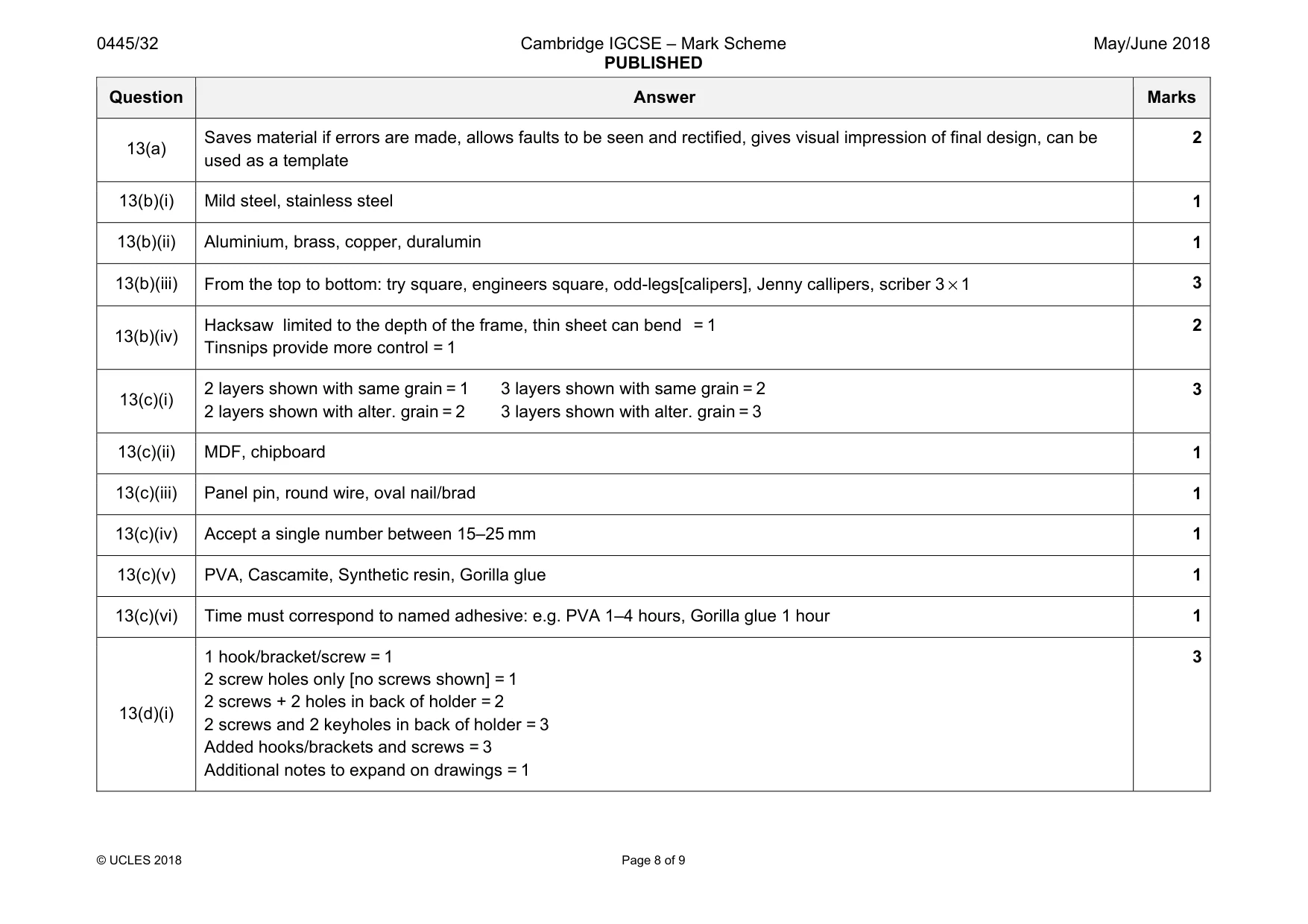
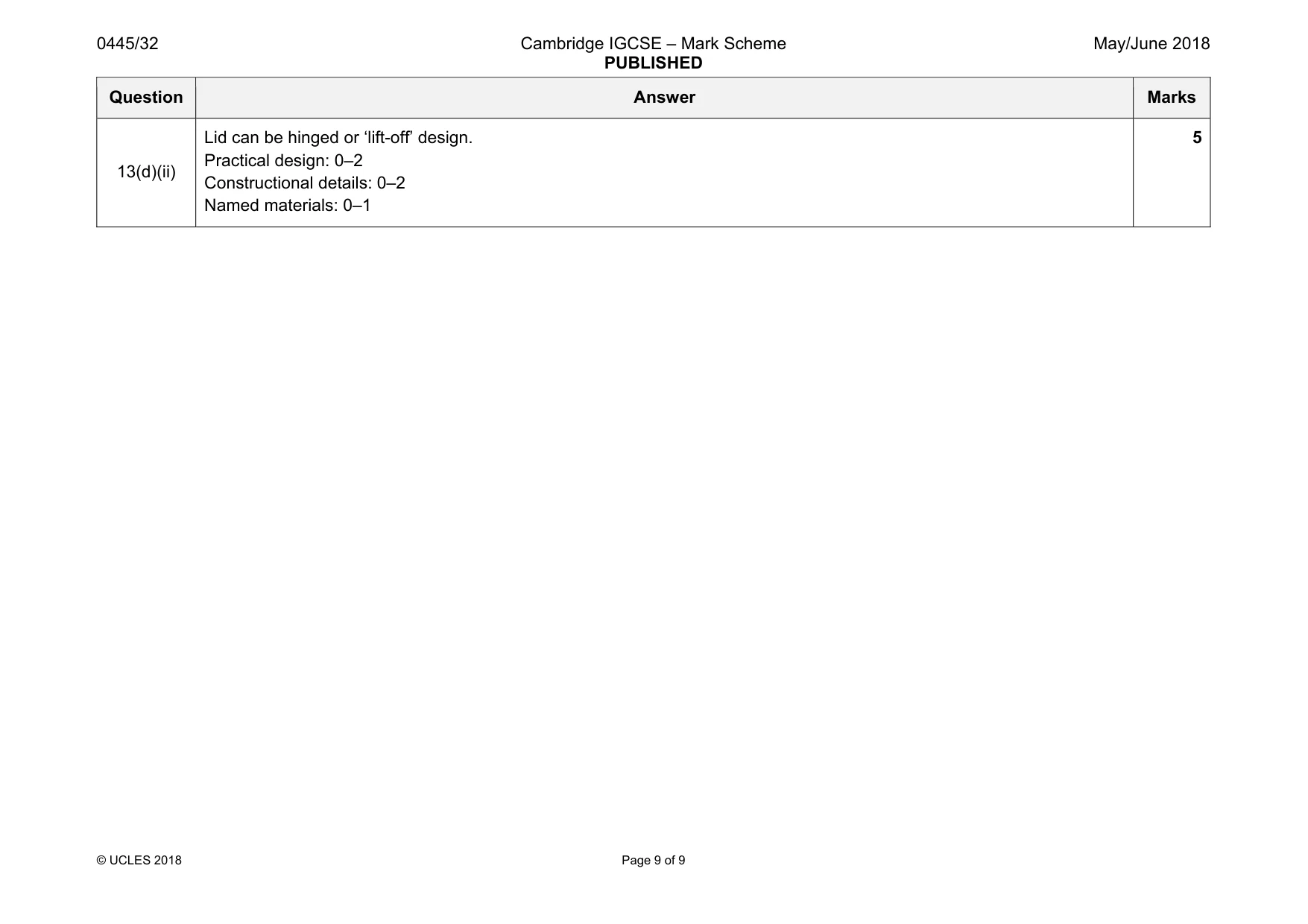
Mark scheme: 13(b)(i) Mild steel, stainless steel 1 13(b)(ii) Aluminium, brass, copper, duralumin 1 13(b)(iii) From the top to bottom: try square, engineers square, odd-legs[calipers], Jenny callipers, scriber 3 × 1 3 13(b)(iv) Hacksaw limited to the depth of the frame, thin sheet can bend = 1 Tinsnips provide more control = 1 2 13(c)(i) 2 layers shown with same grain = 1 3 layers shown with same grain = 2 2 layers shown with alter. grain = 2 3 layers shown with alter. grain = 3 3 13(c)(ii) MDF, chipboard 1 13(c)(iii) Panel pin, round wire, oval nail/brad 1 13(c)(iv) Accept a single number between 15–25 mm 1 13(c)(v) PVA, Cascamite, Synthetic resin, Gorilla glue 1 13(c)(vi) Time must correspond to named adhesive: e.g. PVA 1–4 hours, Gorilla glue 1 hour 1 13(d)(i) 1 hook/bracket/screw = 1 2 screw holes only [no screws shown] = 1 2 screws + 2 holes in back of holder = 2 2 screws and 2 keyholes in back of holder = 3 Added hooks/brackets and screws = 3 Additional notes to expand on drawings = 1 3 Question Answer Marks 13(d)(ii) Lid can be hinged or ‘lift-off’ design. Practical design: 0–2 Constructional details: 0–2 Named materials: 0–1 5
What was in this paper
The subtopics covered by these 13 questions, and how many questions each got. Open one in a new tab to see every Cambridge question on it.
What you needed in this session
Cambridge’s own grade thresholds for 2018 May/June, Paper 3 · Variant 2. A higher threshold means an easier paper — the bar moves with how the cohort did.