Cambridge IGCSE Design and Technology 0445 — 2018 May/June Paper 3 · Variant 1
0445/31/M/J/18 · 13 questions · 50 marks · ≈56 min
The question paper and its mark scheme, free to read here and free to download. This is Cambridge’s own paper, exactly as it was sat.
Question paper20 pages

Mark scheme8 pages
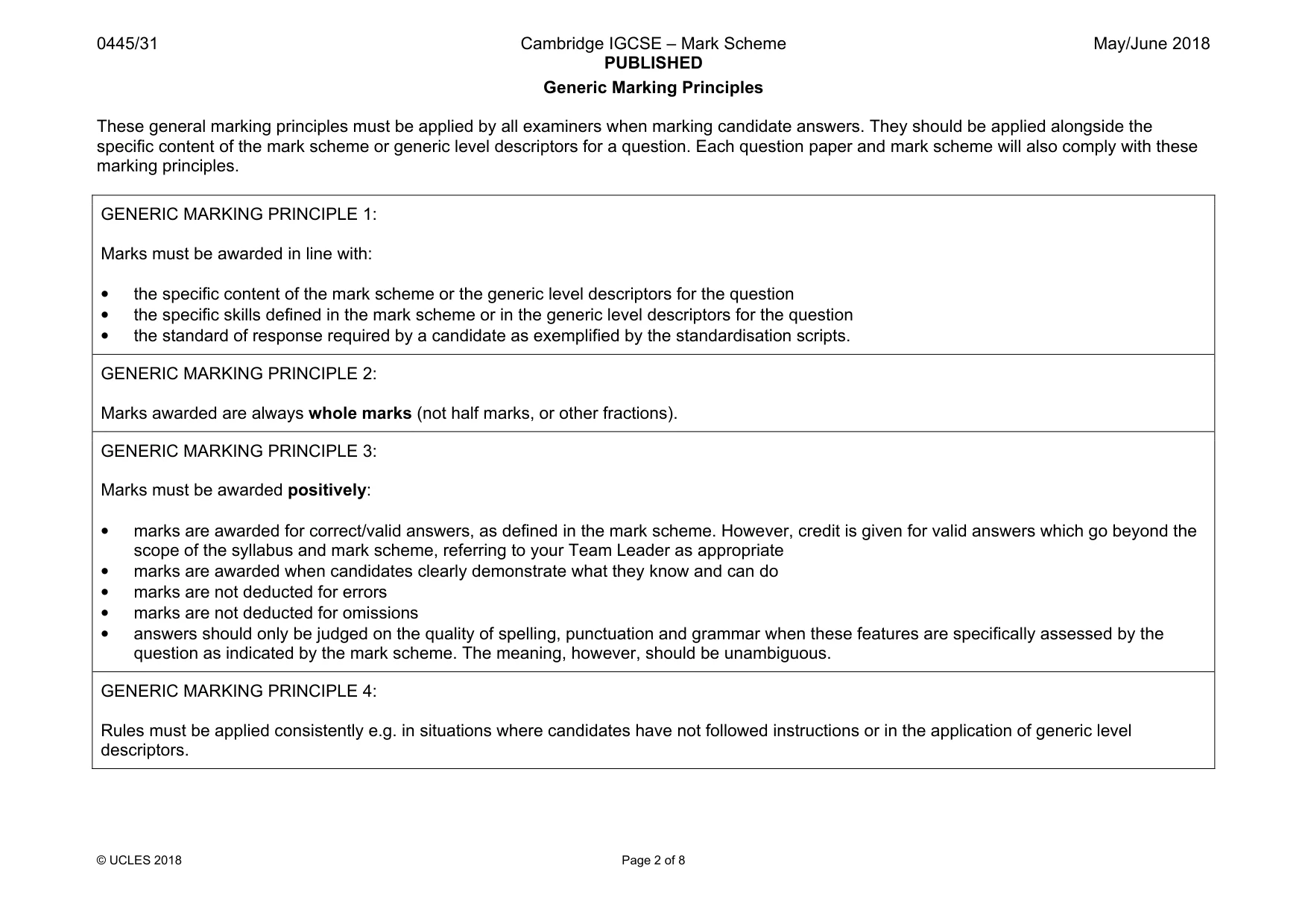
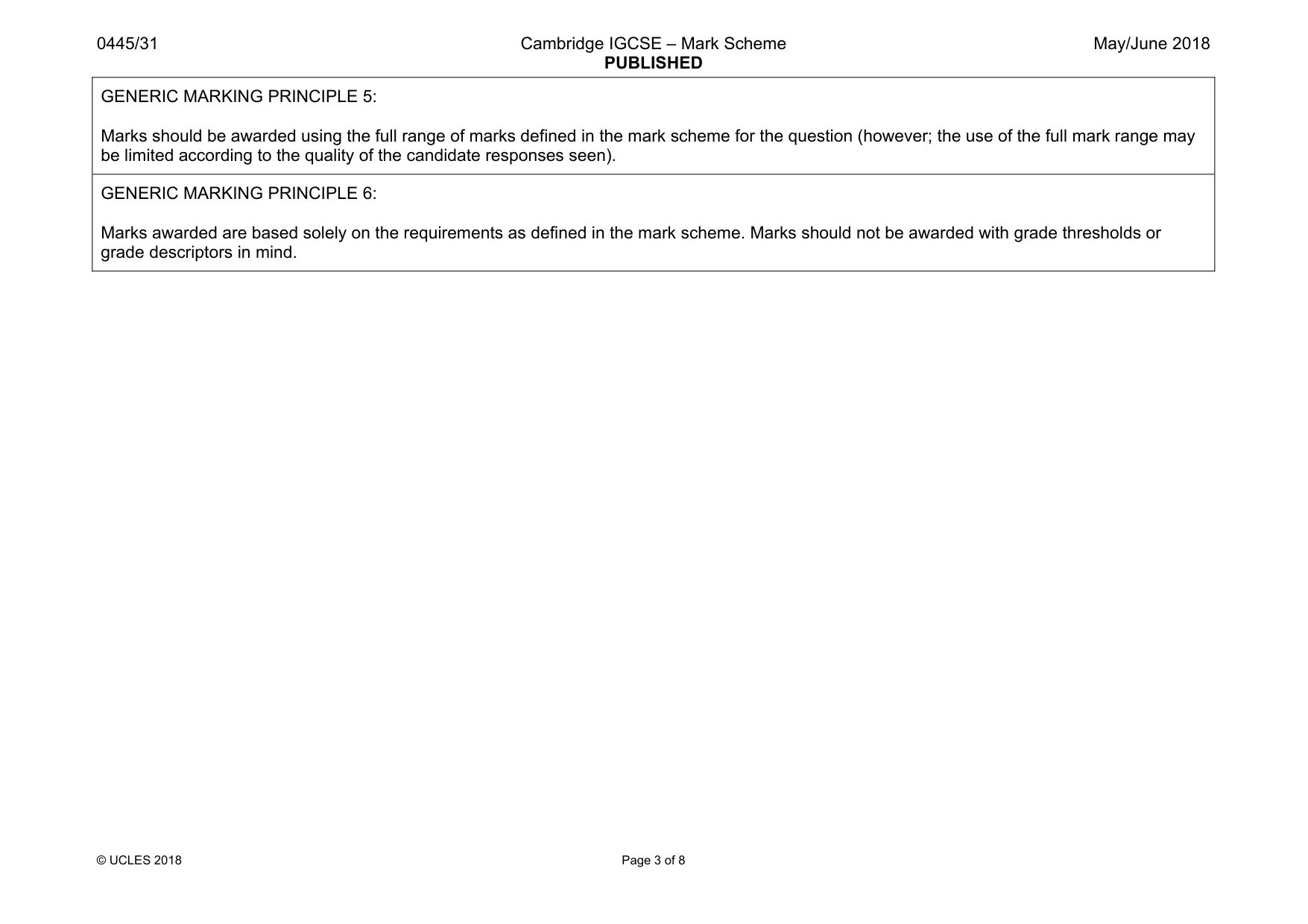
Answers below. Sit the paper first if you are practising.
Questions as text
Q1 · A tool box made from plastic and a symbol found on the tool box
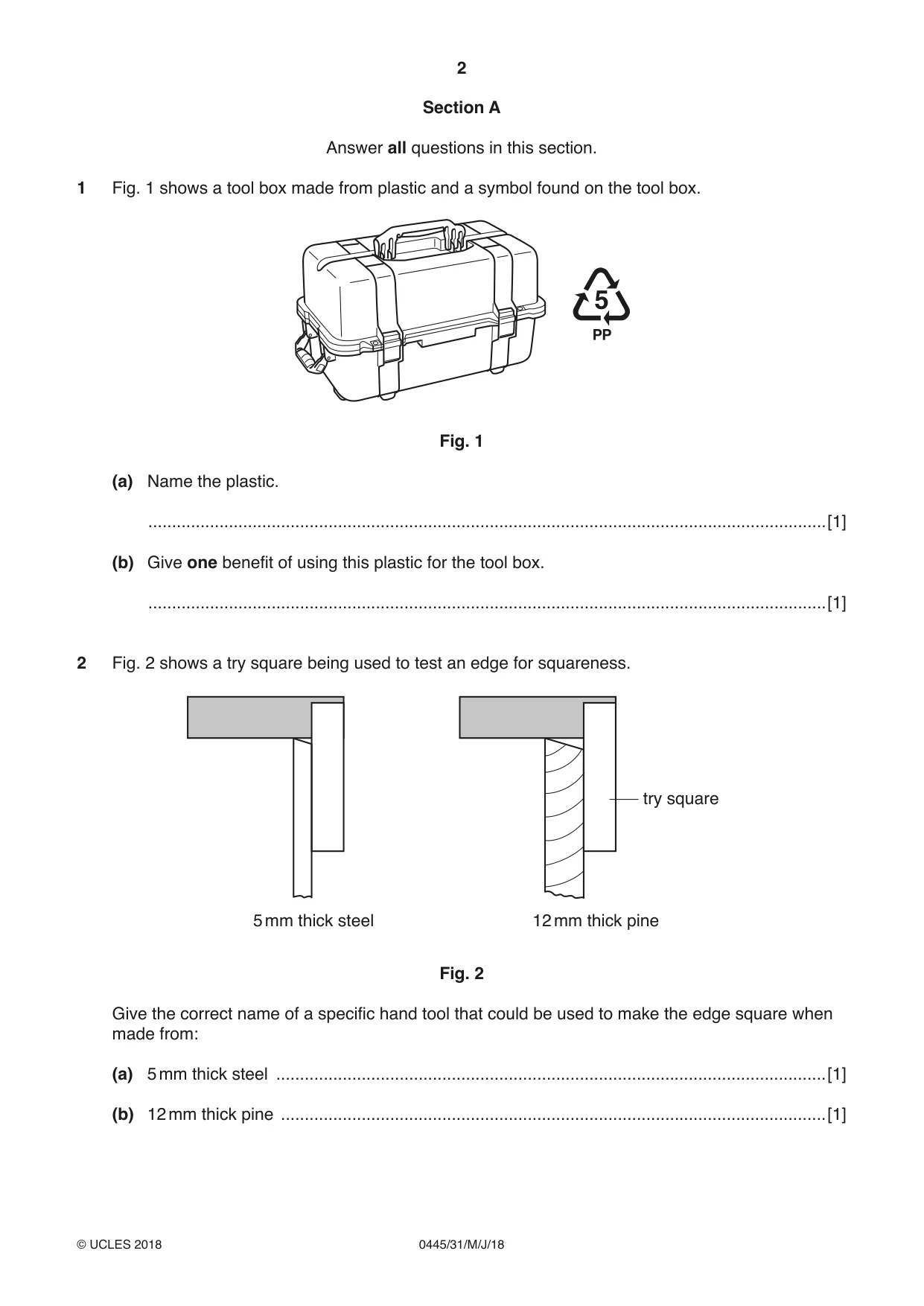
1 Fig. 1 shows a tool box made from plastic and a symbol found on the tool box. Fig. 1 (a) Name the plastic. ...............................................................................................................................................[1] (b) Give one benefit of using this plastic for the tool box. ...............................................................................................................................................[1]
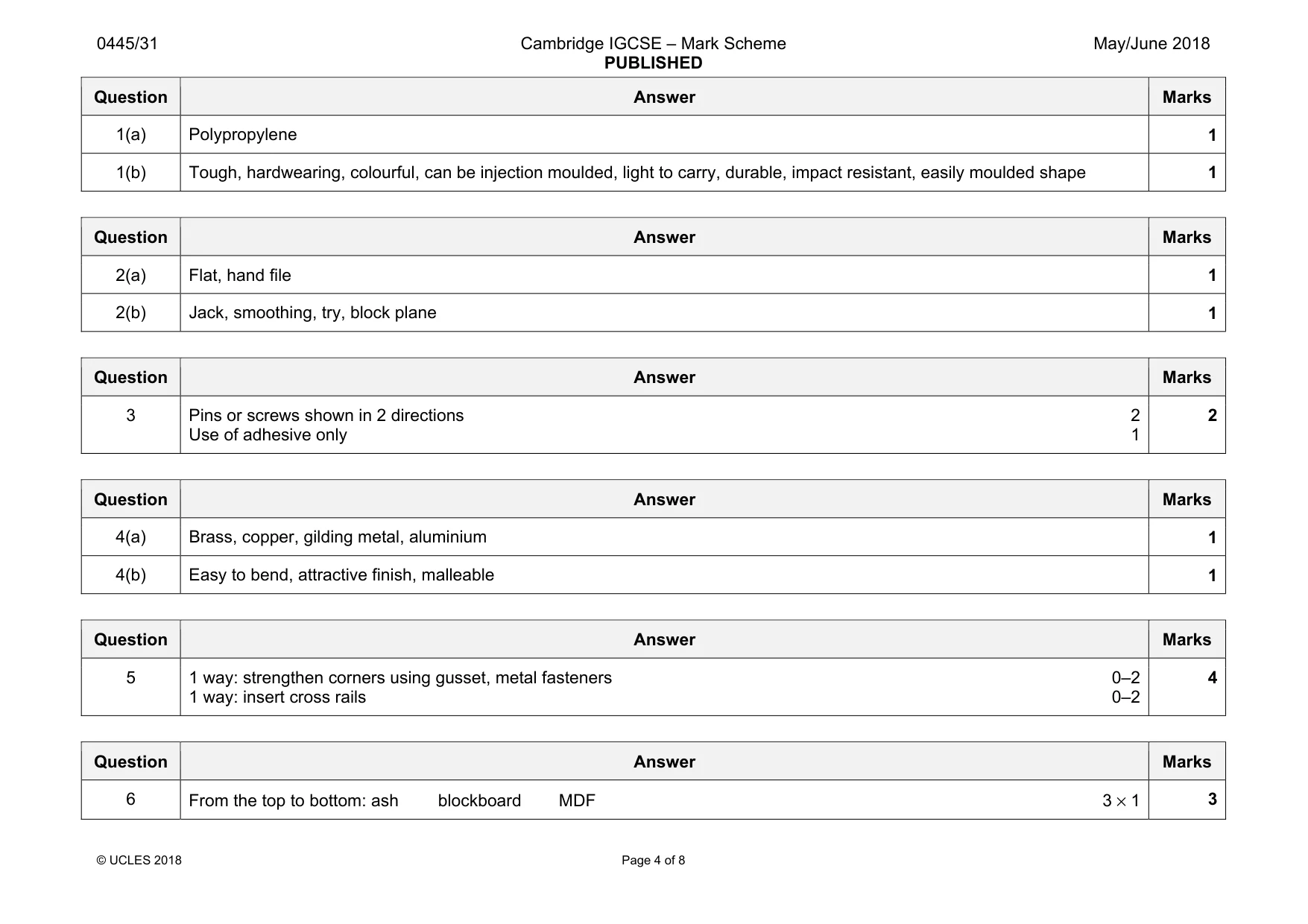
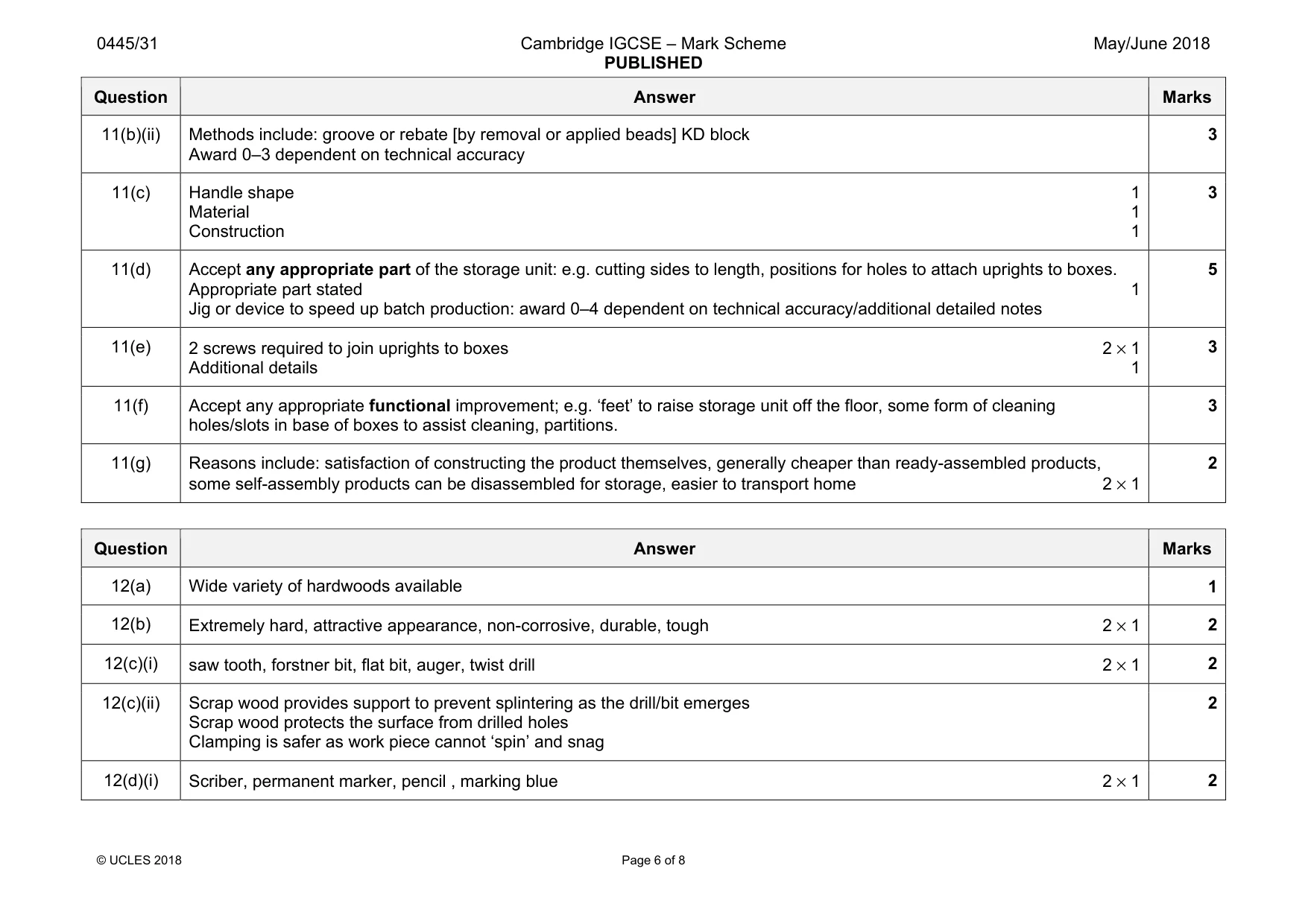
Mark scheme: 1(a) Polypropylene 1 1(b) Tough, hardwearing, colourful, can be injection moulded, light to carry, durable, impact resistant, easily moulded shape 1
Q2 · A try square being used to test an edge for squareness
2 Fig. 2 shows a try square being used to test an edge for squareness. try square 5 mm thick steel 12 mm thick pine Fig. 2 Give the correct name of a specific hand tool that could be used to make the edge square when made from: (a) 5 mm thick steel ....................................................................................................................[1] (b) 12 mm thick pine ...................................................................................................................[1]
Mark scheme: 2(a) Flat, hand file 1 2(b) Jack, smoothing, try, block plane 1
Question 3
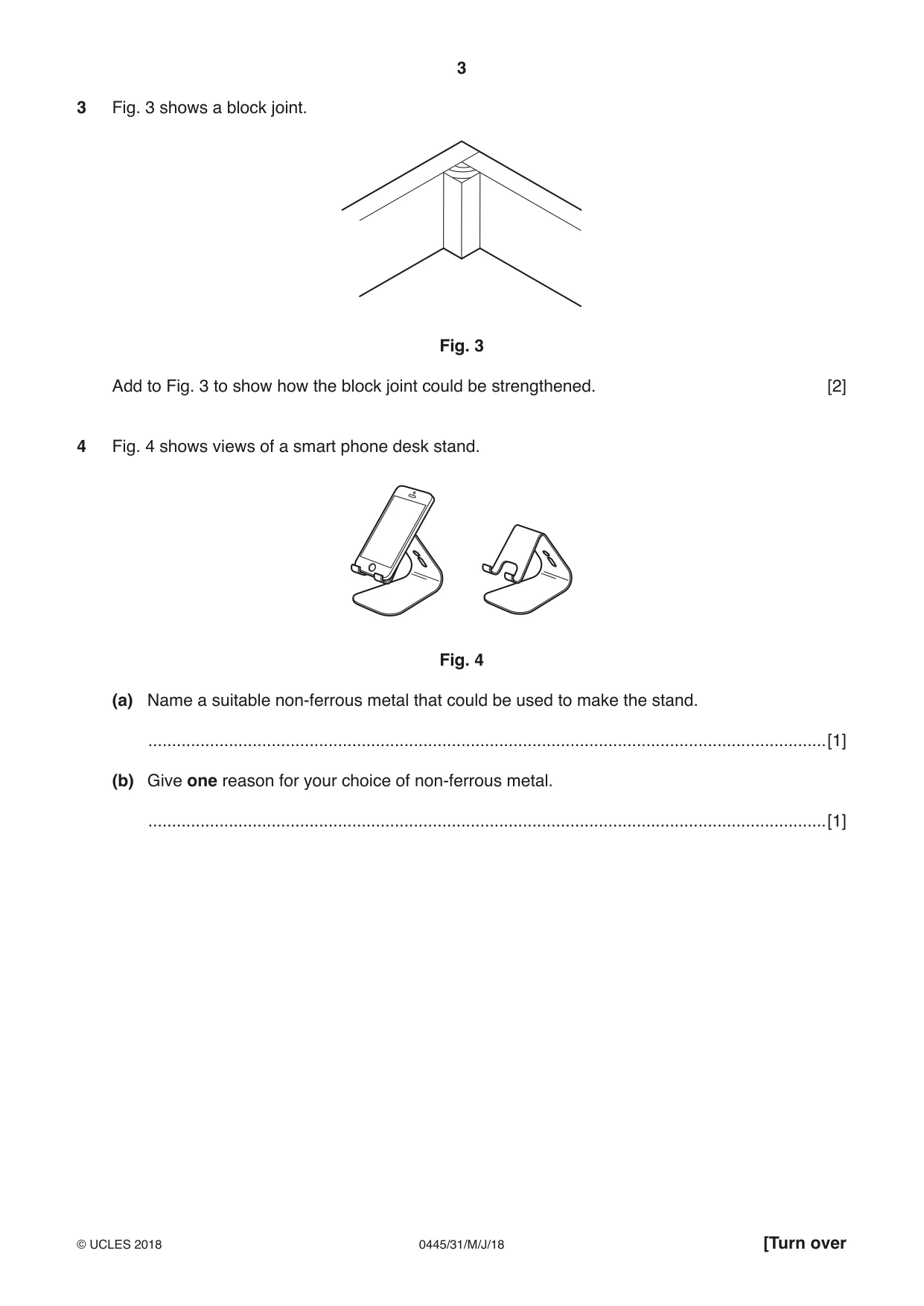
3 Fig. 3 shows a block joint. Fig. 3 Add to Fig. 3 to show how the block joint could be strengthened. [2]
Mark scheme: 3 Pins or screws shown in 2 directions 2 Use of adhesive only 1 2
Q4 · Views of a smart phone desk stand
4 Fig. 4 shows views of a smart phone desk stand. Fig. 4 (a) Name a suitable non-ferrous metal that could be used to make the stand. ...............................................................................................................................................[1] (b) Give one reason for your choice of non-ferrous metal. ...............................................................................................................................................[1]
Mark scheme: 4(a) Brass, copper, gilding metal, aluminium 1 4(b) Easy to bend, attractive finish, malleable 1
Q5 · Views of a basic frame construction in wood
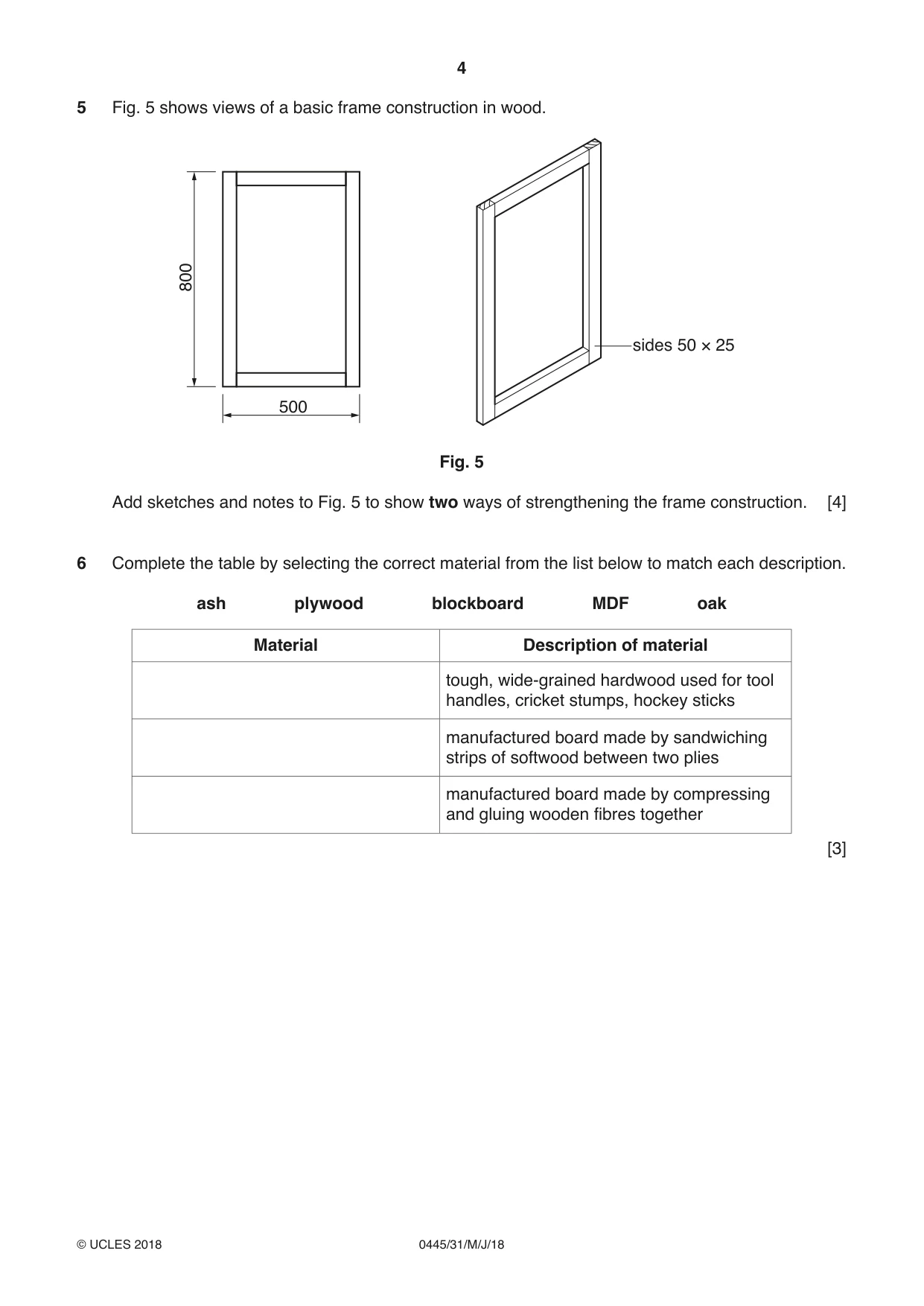
5 Fig. 5 shows views of a basic frame construction in wood. 800 sides 50 × 25 500 Fig. 5 Add sketches and notes to Fig. 5 to show two ways of strengthening the frame construction. [4]
Mark scheme: 5 1 way: strengthen corners using gusset, metal fasteners 0–2 1 way: insert cross rails 0–2 4
Q6 · Complete the table by selecting the correct material from the list below to match each…
6 Complete the table by selecting the correct material from the list below to match each description. ash plywood blockboard MDF oak Material Description of material tough, wide-grained hardwood used for tool handles, cricket stumps, hockey sticks manufactured board made by sandwiching strips of softwood between two plies manufactured board made by compressing and gluing wooden fibres together [3]
Mark scheme: 6 From the top to bottom: ash blockboard MDF 3
Q7 · Acrylic sheet bent to shape
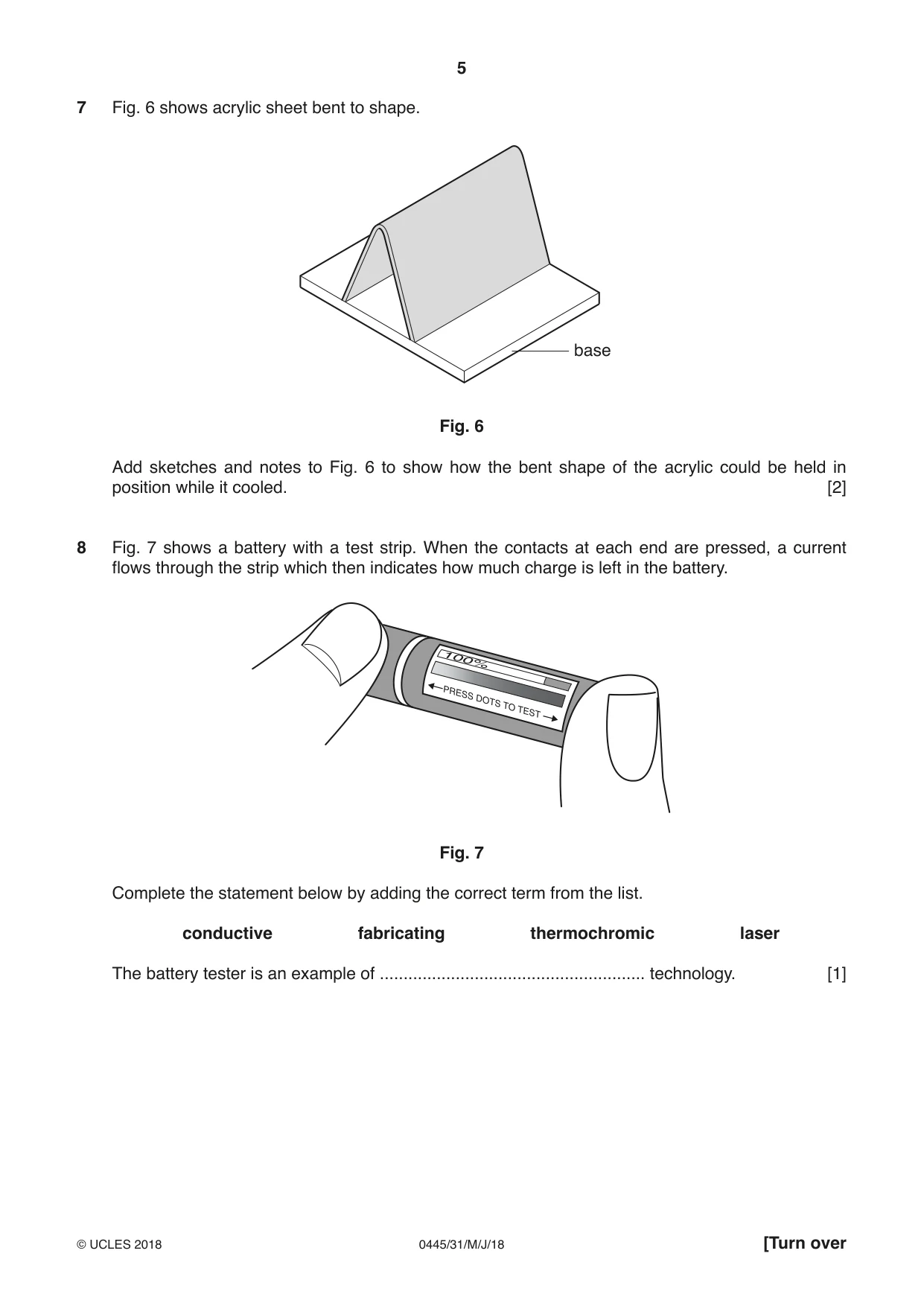
7 Fig. 6 shows acrylic sheet bent to shape. base Fig. 6 Add sketches and notes to Fig. 6 to show how the bent shape of the acrylic could be held in position while it cooled. [2]
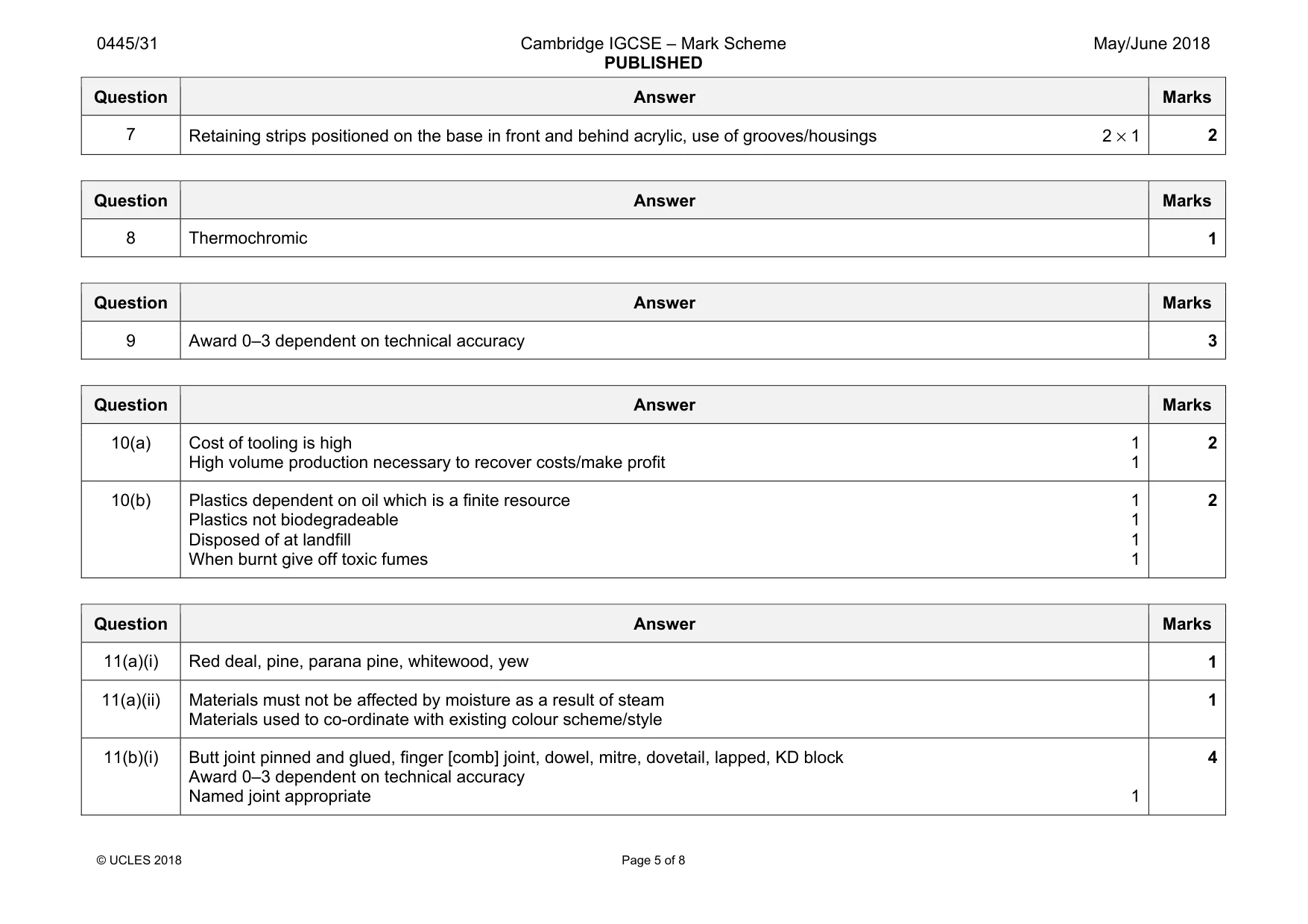
Mark scheme: 7 Retaining strips positioned on the base in front and behind acrylic, use of grooves/housings 2
Q8 · A battery with a test strip
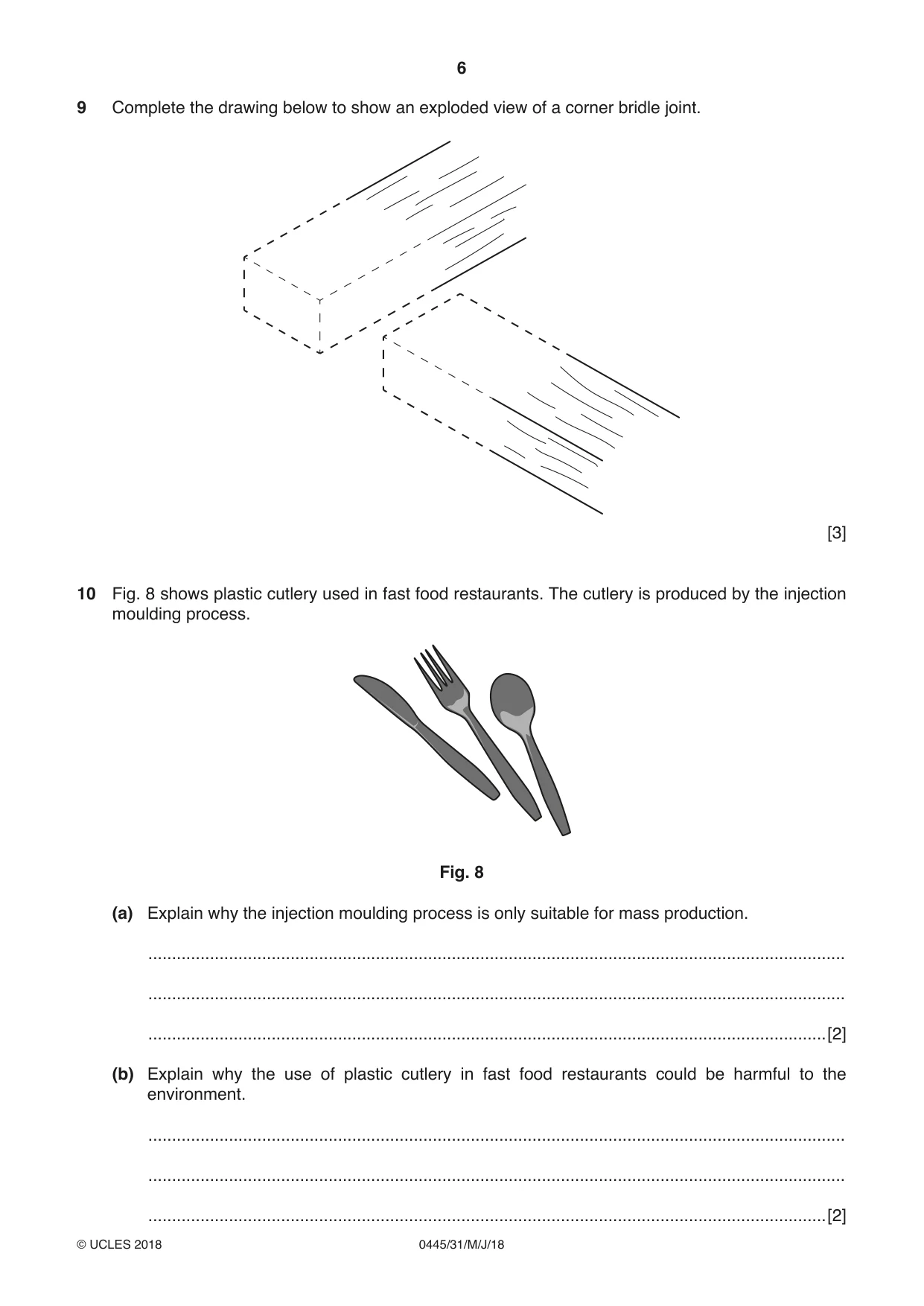
8 Fig. 7 shows a battery with a test strip. When the contacts at each end are pressed, a current flows through the strip which then indicates how much charge is left in the battery. Fig. 7 Complete the statement below by adding the correct term from the list. conductive fabricating thermochromic laser The battery tester is an example of ........................................................ technology. [1]
Mark scheme: 8 Thermochromic 1
Q9 · Complete the drawing below to show an exploded view of a corner bridle joint
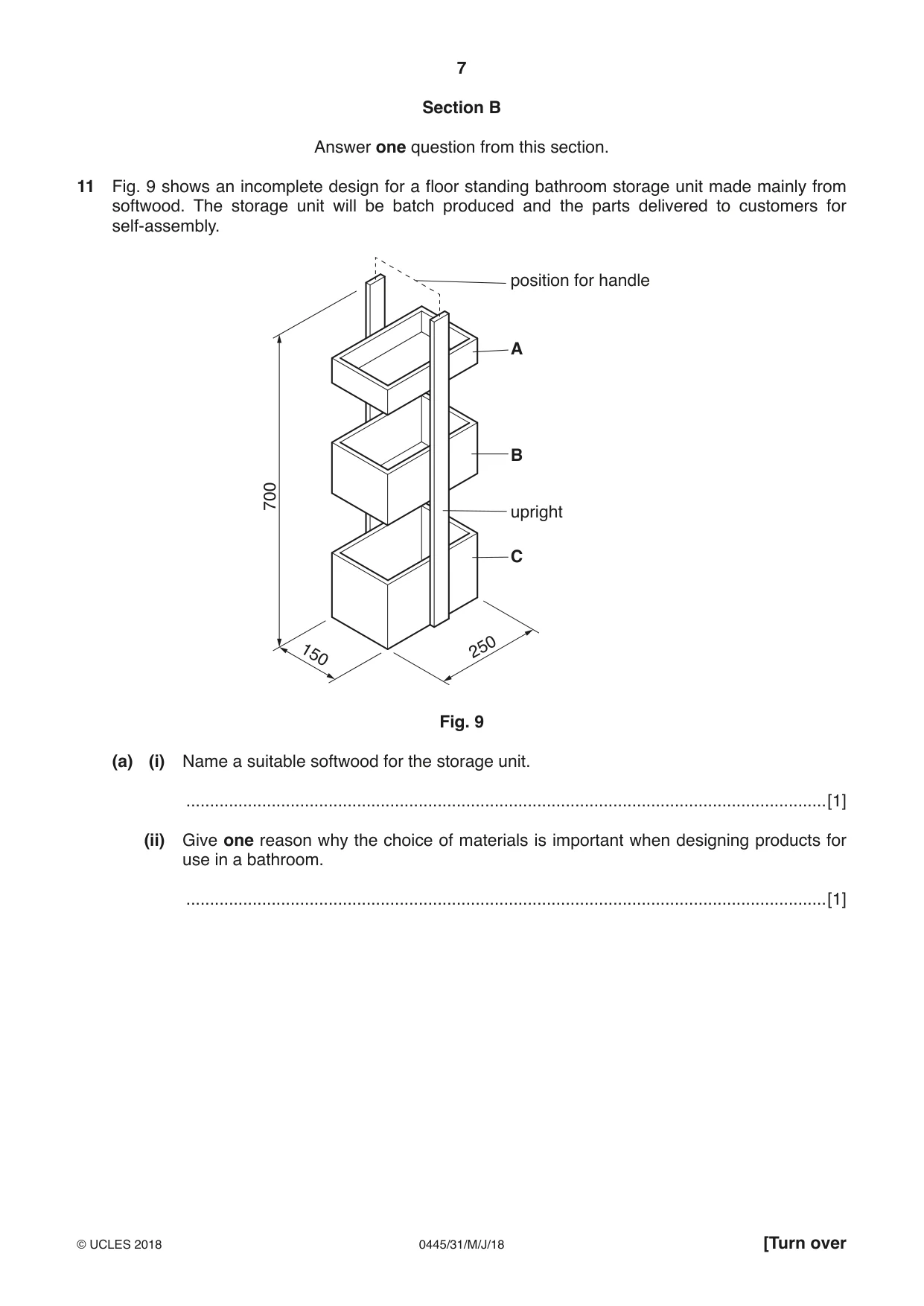
9 Complete the drawing below to show an exploded view of a corner bridle joint. [3]
Mark scheme: 9 Award 0–3 dependent on technical accuracy 3
Q10 · Plastic cutlery used in fast food restaurants
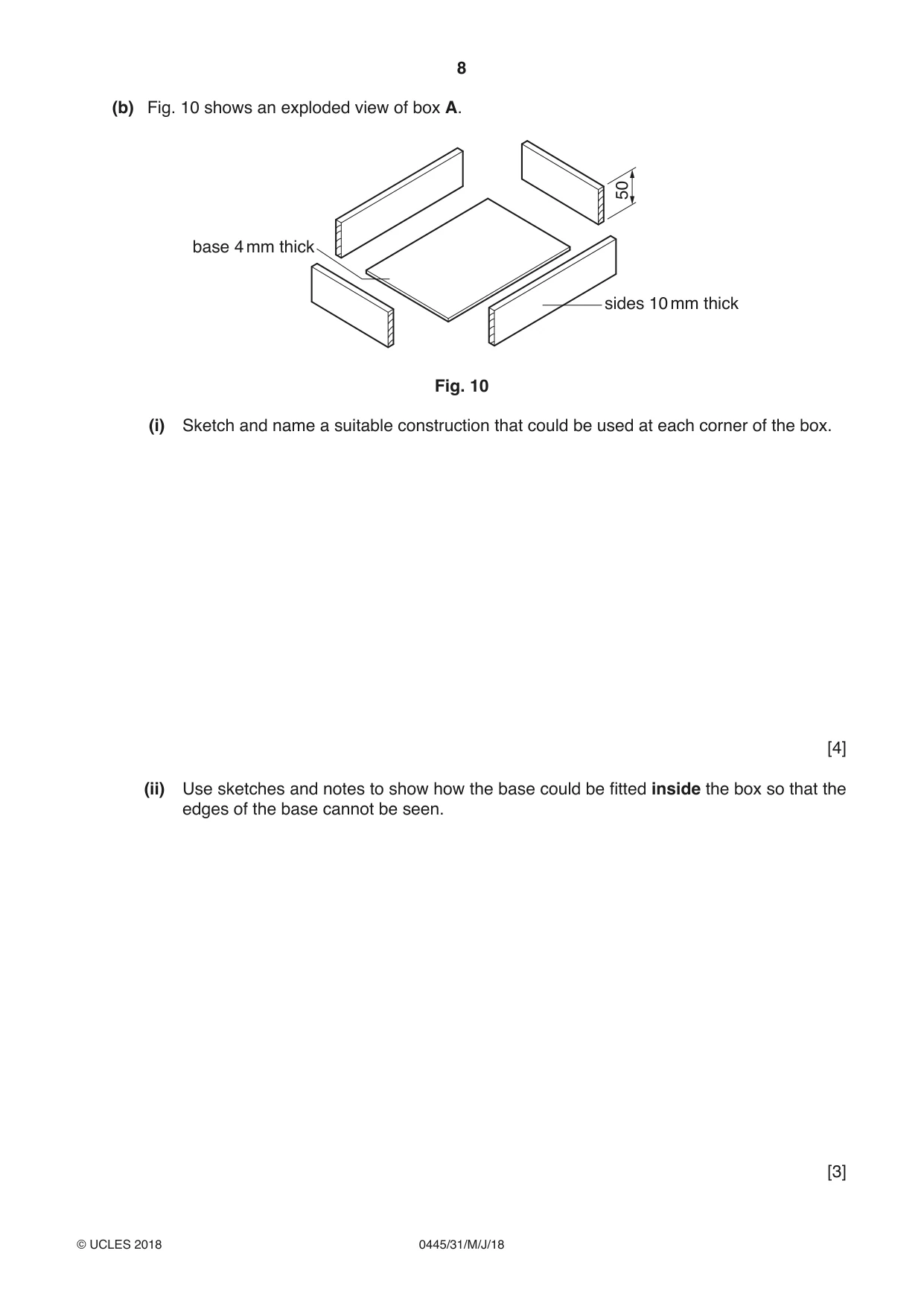
10 Fig. 8 shows plastic cutlery used in fast food restaurants. The cutlery is produced by the injection moulding process. Fig. 8 (a) Explain why the injection moulding process is only suitable for mass production. ................................................................................................................................................... ................................................................................................................................................... ...............................................................................................................................................[2] (b) Explain why the use of plastic cutlery in fast food restaurants could be harmful to the environment. ................................................................................................................................................... ................................................................................................................................................... ...............................................................................................................................................[2]
Mark scheme: 10(a) Cost of tooling is high 1 High volume production necessary to recover costs/make profit 1 2 10(b) Plastics dependent on oil which is a finite resource 1 Plastics not biodegradeable 1 Disposed of at landfill 1 When burnt give off toxic fumes 1 2
Q11 · An incomplete design for a floor standing bathroom storage unit made mainly from softwood
11 Fig. 9 shows an incomplete design for a floor standing bathroom storage unit made mainly from softwood. The storage unit will be batch produced and the parts delivered to customers for self-assembly. position for handle A B 700 upright C 250 150 Fig. 9 (a) (i) Name a suitable softwood for the storage unit. .......................................................................................................................................[1] (ii) Give one reason why the choice of materials is important when designing products for use in a bathroom. .......................................................................................................................................[1] (b) Fig. 10 shows an exploded view of box A. 50 base 4 mm thick sides 10 mm thick Fig. 10 (i) Sketch and name a suitable construction that could be used at each corner of the box. [4] (ii) Use sketches and notes to show how the base could be fitted inside the box so that the edges of the base cannot be seen. [3] (c) Use sketches and notes to show a design for a handle that could be fitted in the position shown in Fig. 9. [3] (d) Use sketches and notes to design a jig or device that could be used to speed up batch production of one part of the storage unit. State clearly which part of the storage unit is to be batch produced. Part to be batch produced ........................................................................................................ [5] (e) Each of the boxes will be fitted to the uprights by customers using only screws. Use sketches and notes to show customers how one box will be fitted to an upright. [3] (f) Use sketches and notes to show one functional improvement to the design of the storage unit. [3] (g) Give two reasons why self-assembly products are popular with customers. 1 ................................................................................................................................................ 2 ............................................................................................................................................[2]
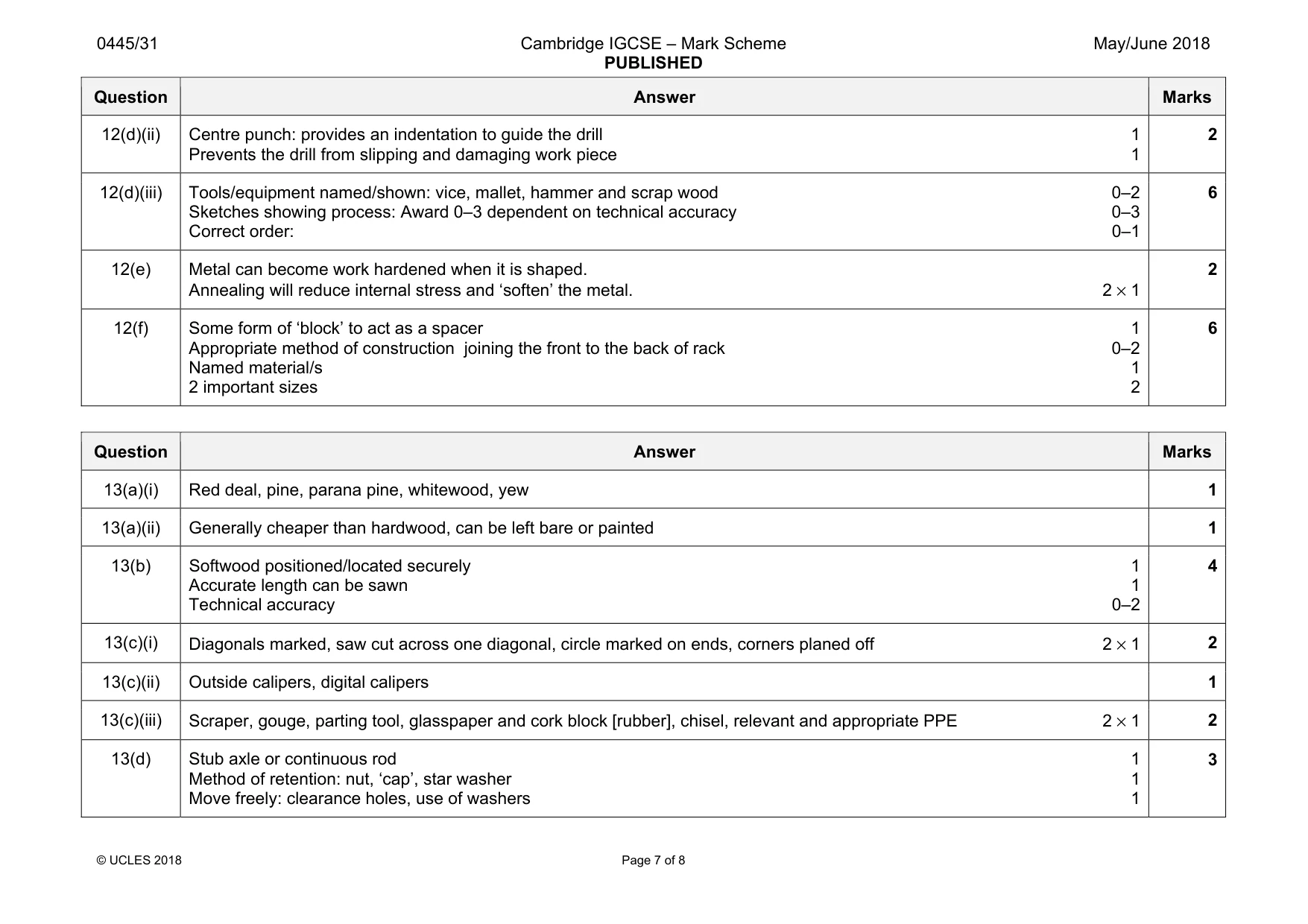
Mark scheme: 11(a)(i) Red deal, pine, parana pine, whitewood, yew 1 11(a)(ii) Materials must not be affected by moisture as a result of steam Materials used to co-ordinate with existing colour scheme/style 1 11(b)(i) Butt joint pinned and glued, finger [comb] joint, dowel, mitre, dovetail, lapped, KD block Award 0–3 dependent on technical accuracy Named joint appropriate 1 4 Question Answer Marks 11(b)(ii) Methods include: groove or rebate [by removal or applied beads] KD block Award 0–3 dependent on technical accuracy 3 11(c) Handle shape 1 Material 1 Construction 1 3 11(d) Accept any appropriate part of the storage unit: e.g. cutting sides to length, positions for holes to attach uprights to boxes. Appropriate part stated 1 Jig or device to speed up batch production: award 0–4 dependent on technical accuracy/additional detailed notes 5 11(e) 2 screws required to join uprights to boxes 2 × 1 Additional details 1 3 11(f) Accept any appropriate functional improvement; e.g. ‘feet’ to raise storage unit off the floor, some form of cleaning holes/slots in base of boxes to assist cleaning, partitions. 3 11(g) Reasons include: satisfaction of constructing the product themselves, generally cheaper than ready-assembled products, some self-assembly products can be disassembled for storage, easier to transport home 2 × 1 2
Q12 · Views of a wall-mounted coat rack
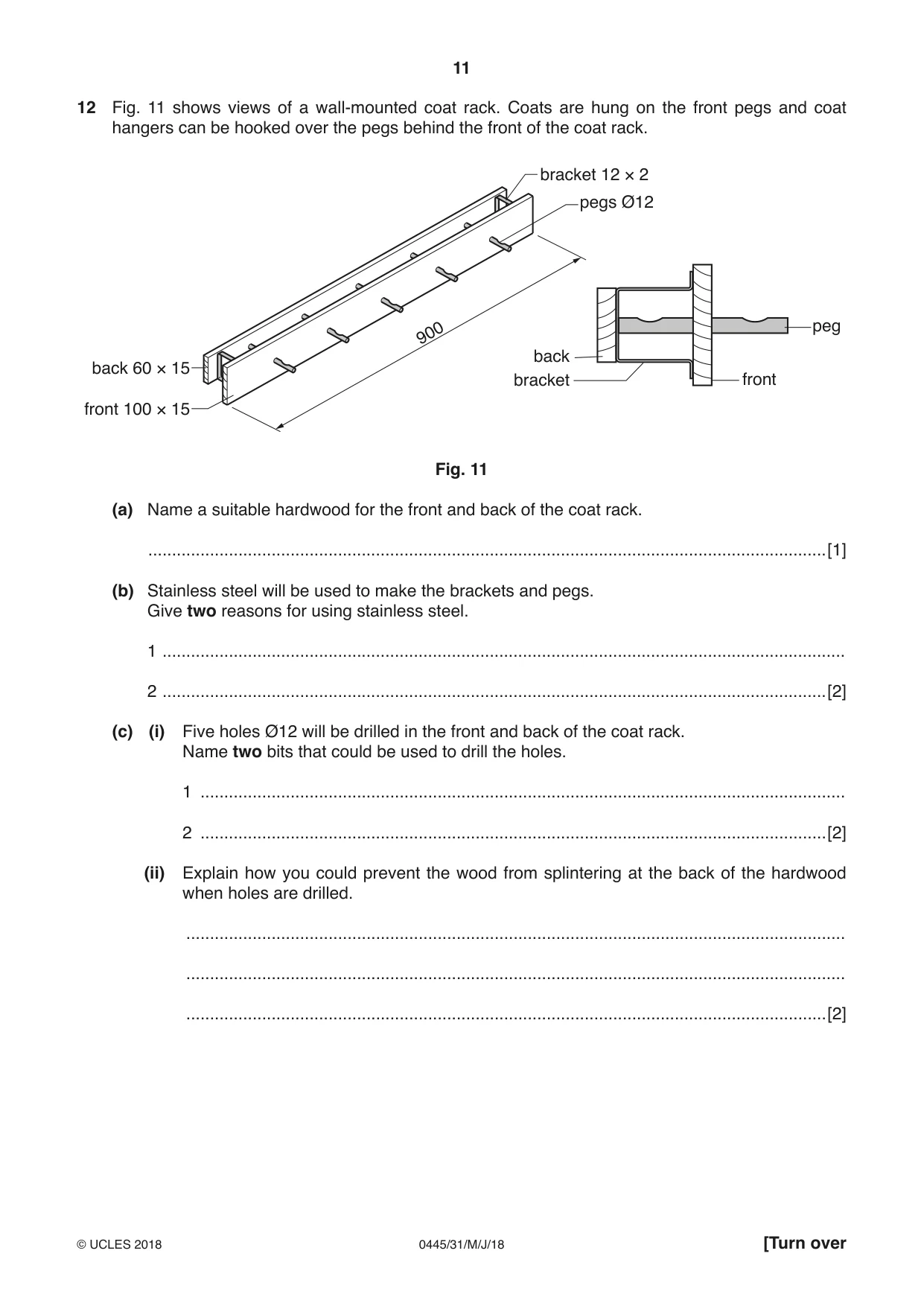
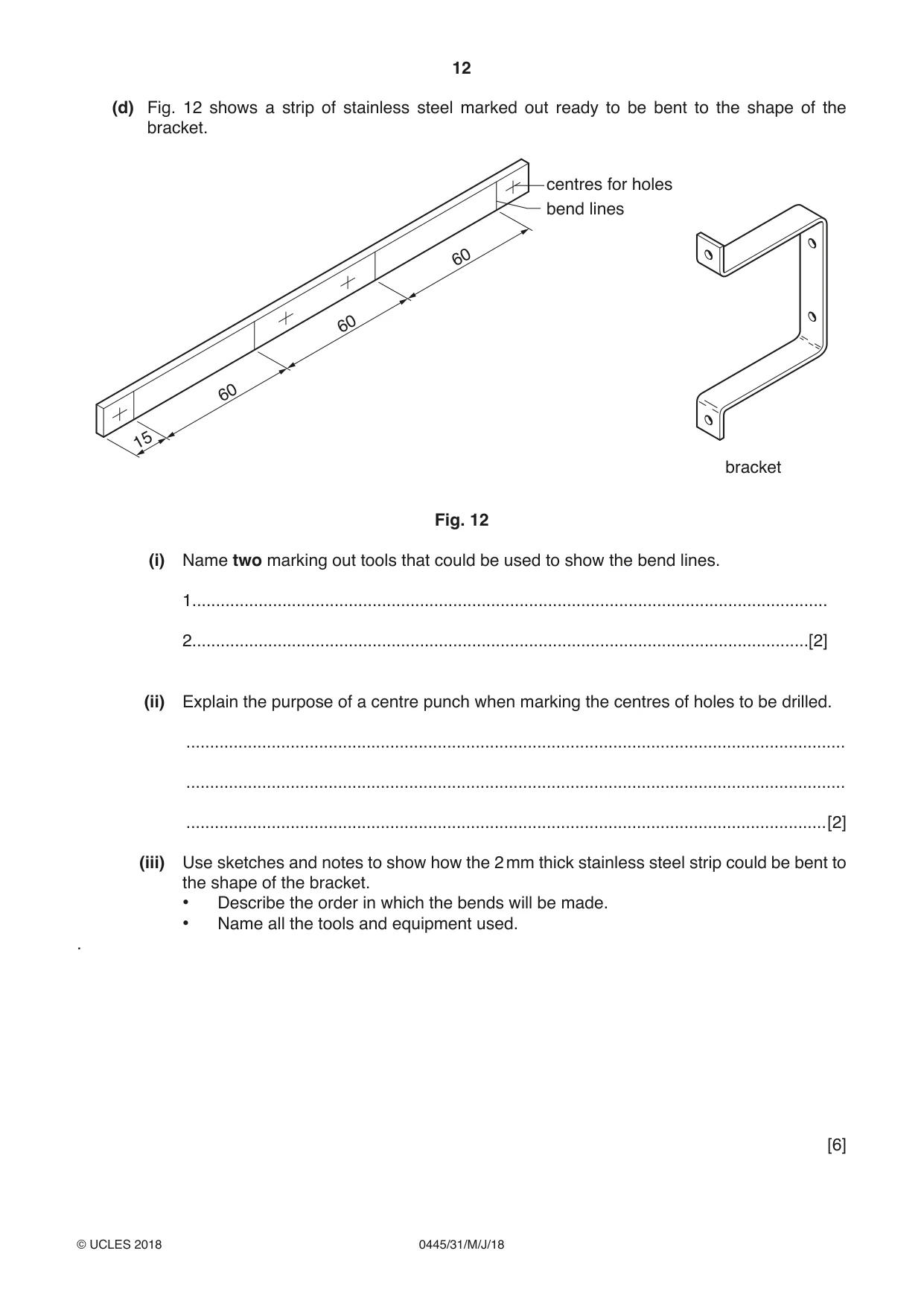
12 Fig. 11 shows views of a wall-mounted coat rack. Coats are hung on the front pegs and coat hangers can be hooked over the pegs behind the front of the coat rack. bracket 12 × 2 pegs Ø12 900 peg back back 60 × 15 bracket front front 100 × 15 Fig. 11 (a) Name a suitable hardwood for the front and back of the coat rack. ...............................................................................................................................................[1] (b) Stainless steel will be used to make the brackets and pegs. Give two reasons for using stainless steel. 1 ................................................................................................................................................ 2 ............................................................................................................................................[2] (c) (i) Five holes Ø12 will be drilled in the front and back of the coat rack. Name two bits that could be used to drill the holes. 1 ........................................................................................................................................ 2 ....................................................................................................................................[2] (ii) Explain how you could prevent the wood from splintering at the back of the hardwood when holes are drilled. ........................................................................................................................................... ........................................................................................................................................... .......................................................................................................................................[2] (d) Fig. 12 shows a strip of stainless steel marked out ready to be bent to the shape of the bracket. centres for holes bend lines 60 60 60 15 bracket Fig. 12 (i) Name two marking out tools that could be used to show the bend lines. 1...................................................................................................................................... 2..................................................................................................................................[2] (ii) Explain the purpose of a centre punch when marking the centres of holes to be drilled. ........................................................................................................................................... ........................................................................................................................................... .......................................................................................................................................[2] (iii) Use sketches and notes to show how the 2 mm thick stainless steel strip could be bent to the shape of the bracket. • Describe the order in which the bends will be made. • Name all the tools and equipment used. . [6] (e) Explain why it is sometimes necessary to anneal metals. ................................................................................................................................................... ................................................................................................................................................... ................................................................................................................................................... ...............................................................................................................................................[2] (f) The purpose of the bracket shown in Fig. 11 is to join the front to the back of the coat rack. Use sketches and notes to show a different method using wood-based materials rather than stainless steel. Include the following details: • specific material/s • constructions used • two important sizes. [6]
Mark scheme: 12(a) Wide variety of hardwoods available 1 12(b) Extremely hard, attractive appearance, non-corrosive, durable, tough 2 × 1 2 12(c)(i) saw tooth, forstner bit, flat bit, auger, twist drill 2 × 1 2 12(c)(ii) Scrap wood provides support to prevent splintering as the drill/bit emerges Scrap wood protects the surface from drilled holes Clamping is safer as work piece cannot ‘spin’ and snag 2 12(d)(i) Scriber, permanent marker, pencil , marking blue 2 × 1 2 Question Answer Marks 12(d)(ii) Centre punch: provides an indentation to guide the drill 1 Prevents the drill from slipping and damaging work piece 1 2 12(d)(iii) Tools/equipment named/shown: vice, mallet, hammer and scrap wood 0–2 Sketches showing process: Award 0–3 dependent on technical accuracy 0–3 Correct order: 0–1 6 12(e) Metal can become work hardened when it is shaped. Annealing will reduce internal stress and ‘soften’ the metal. 2 × 1 2 12(f) Some form of ‘block’ to act as a spacer 1 Appropriate method of construction joining the front to the back of rack 0–2 Named material/s 1 2 important sizes 2 6
Q13 · A toy racing car made from softwood
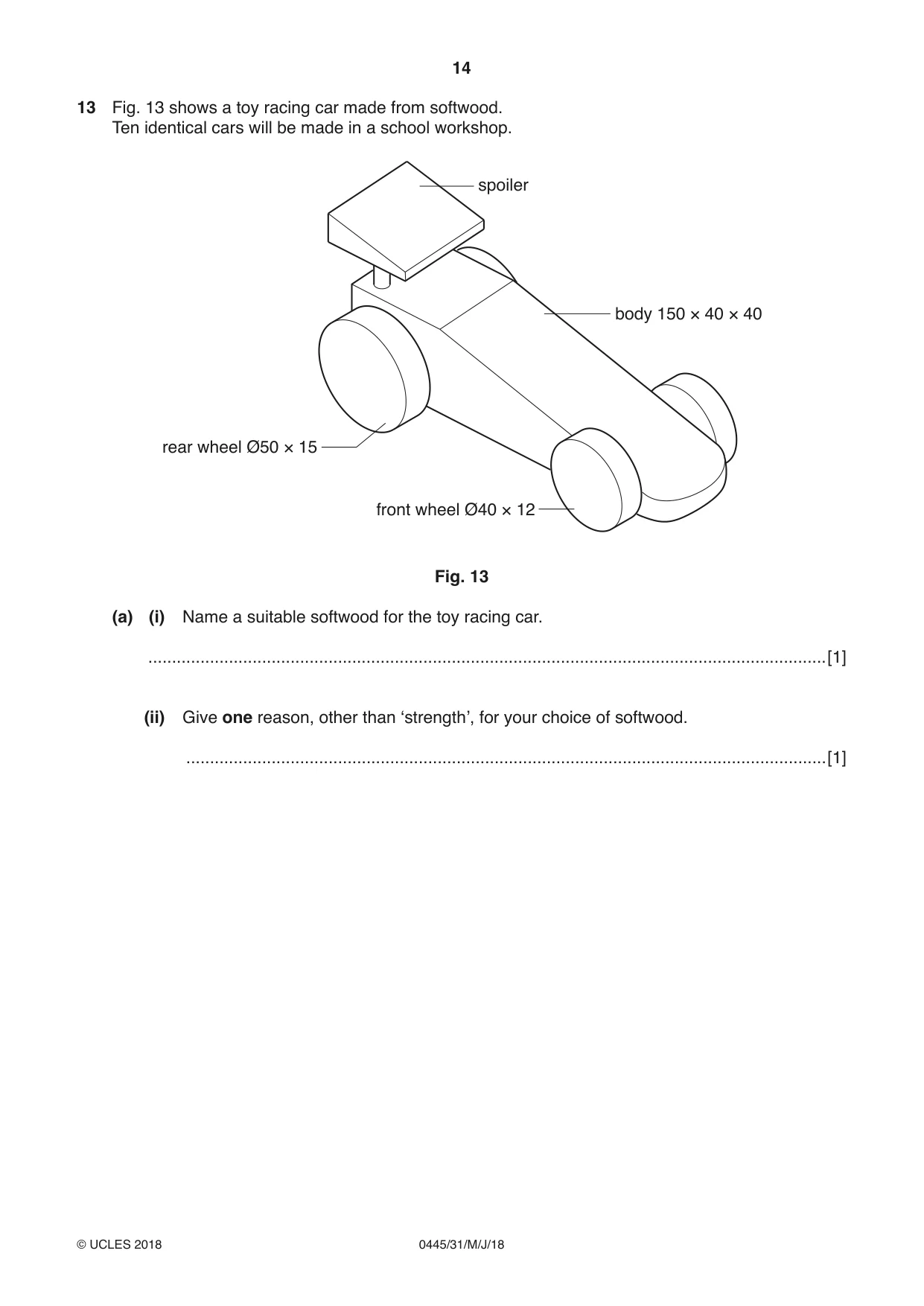
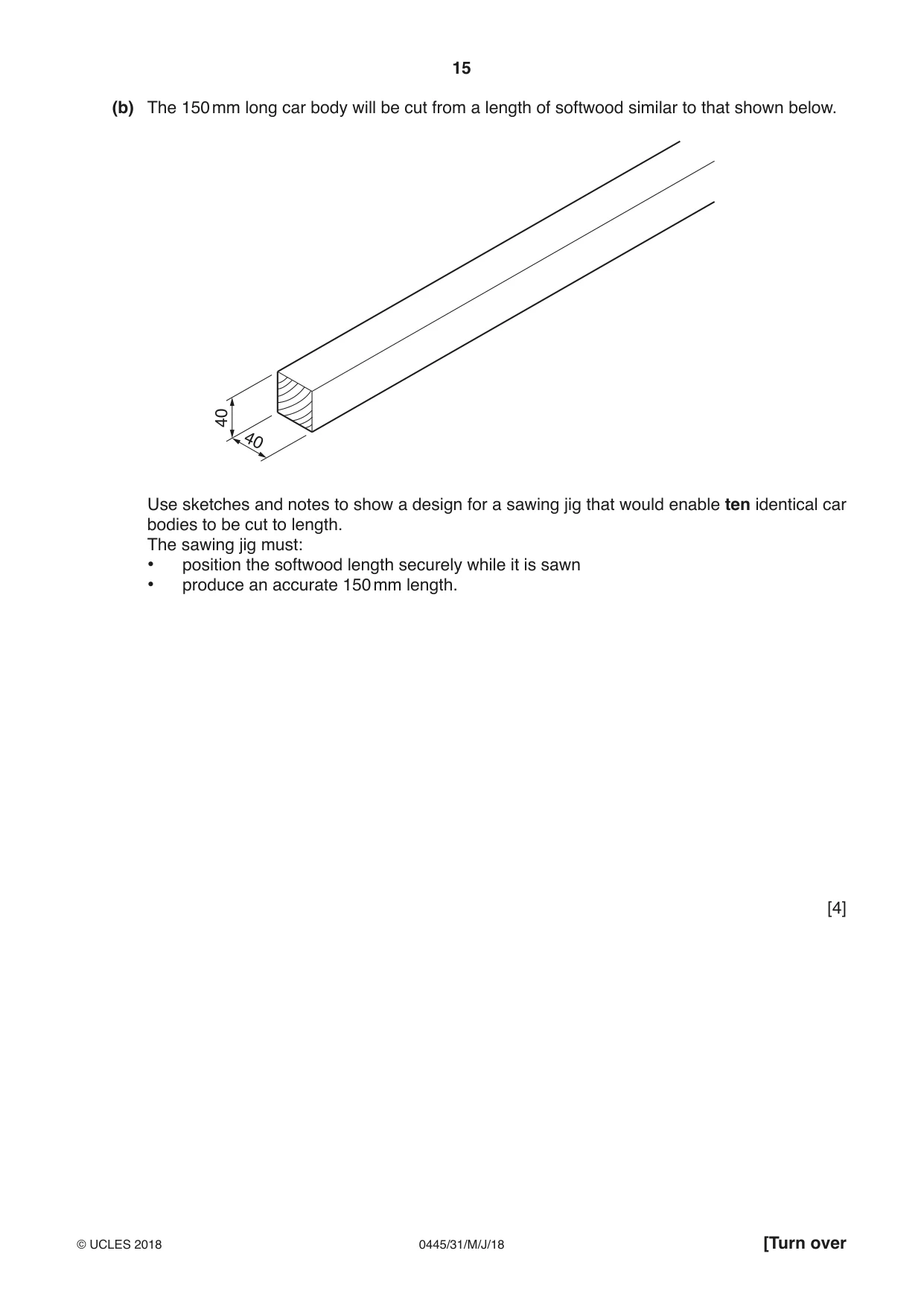
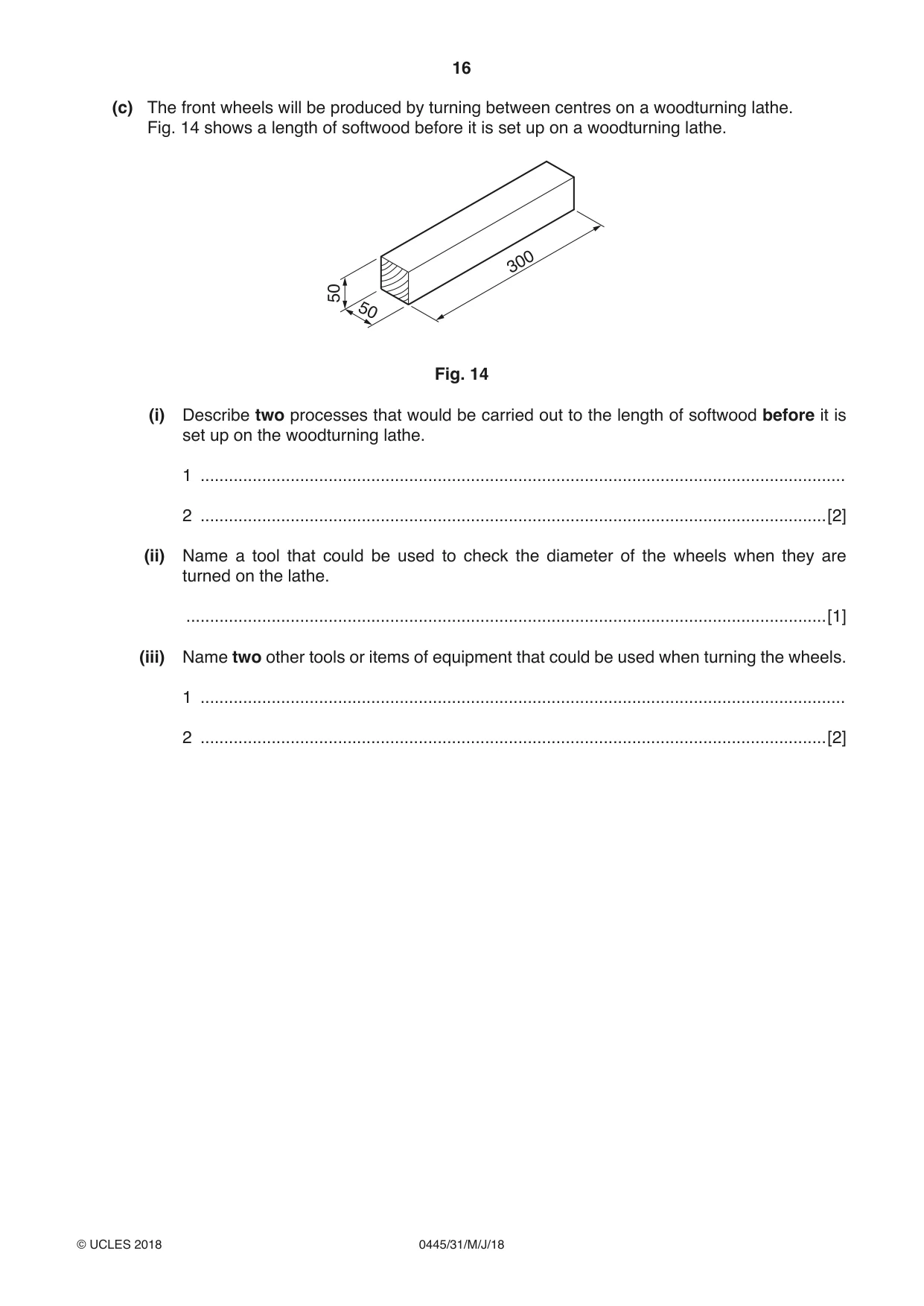
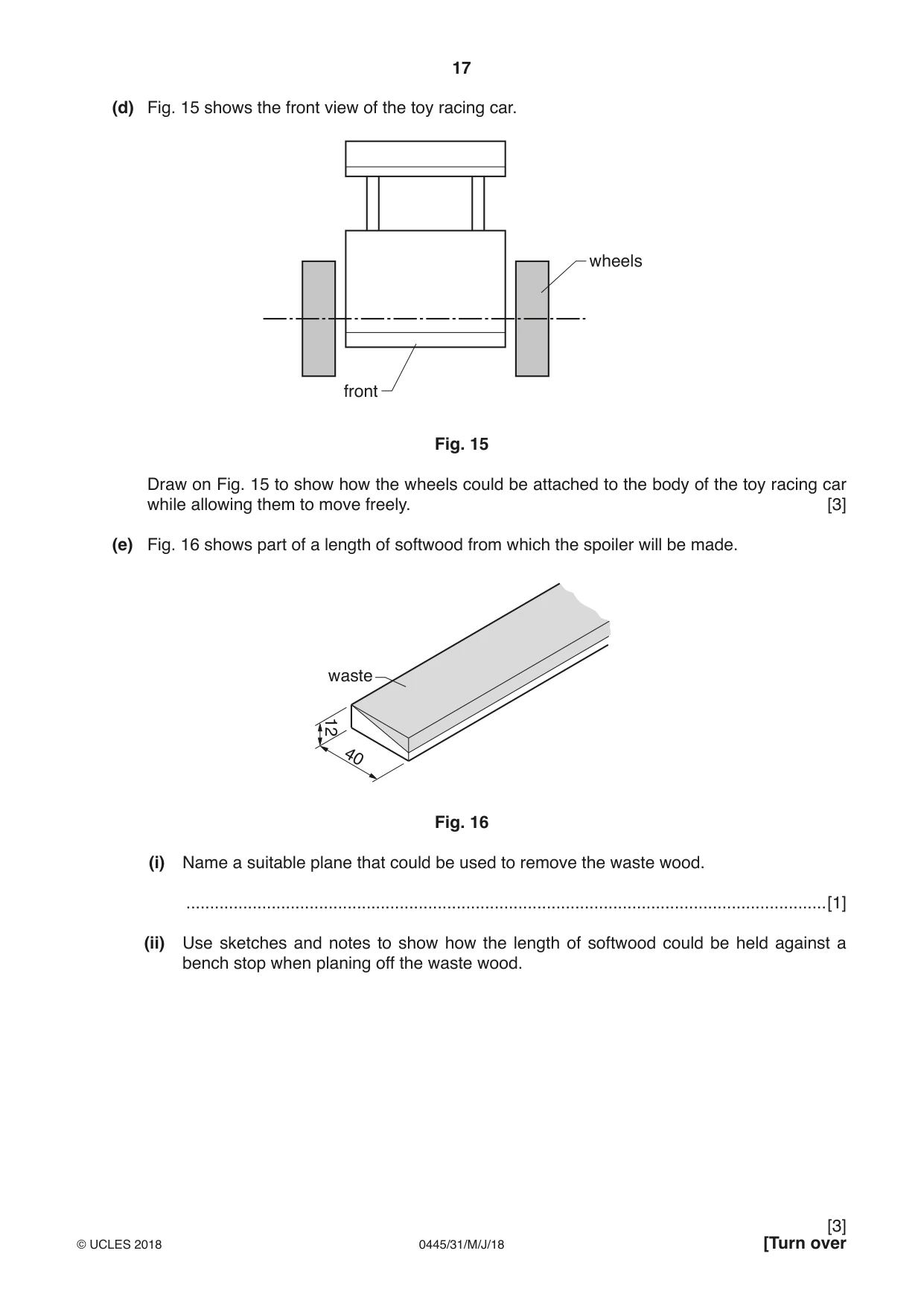
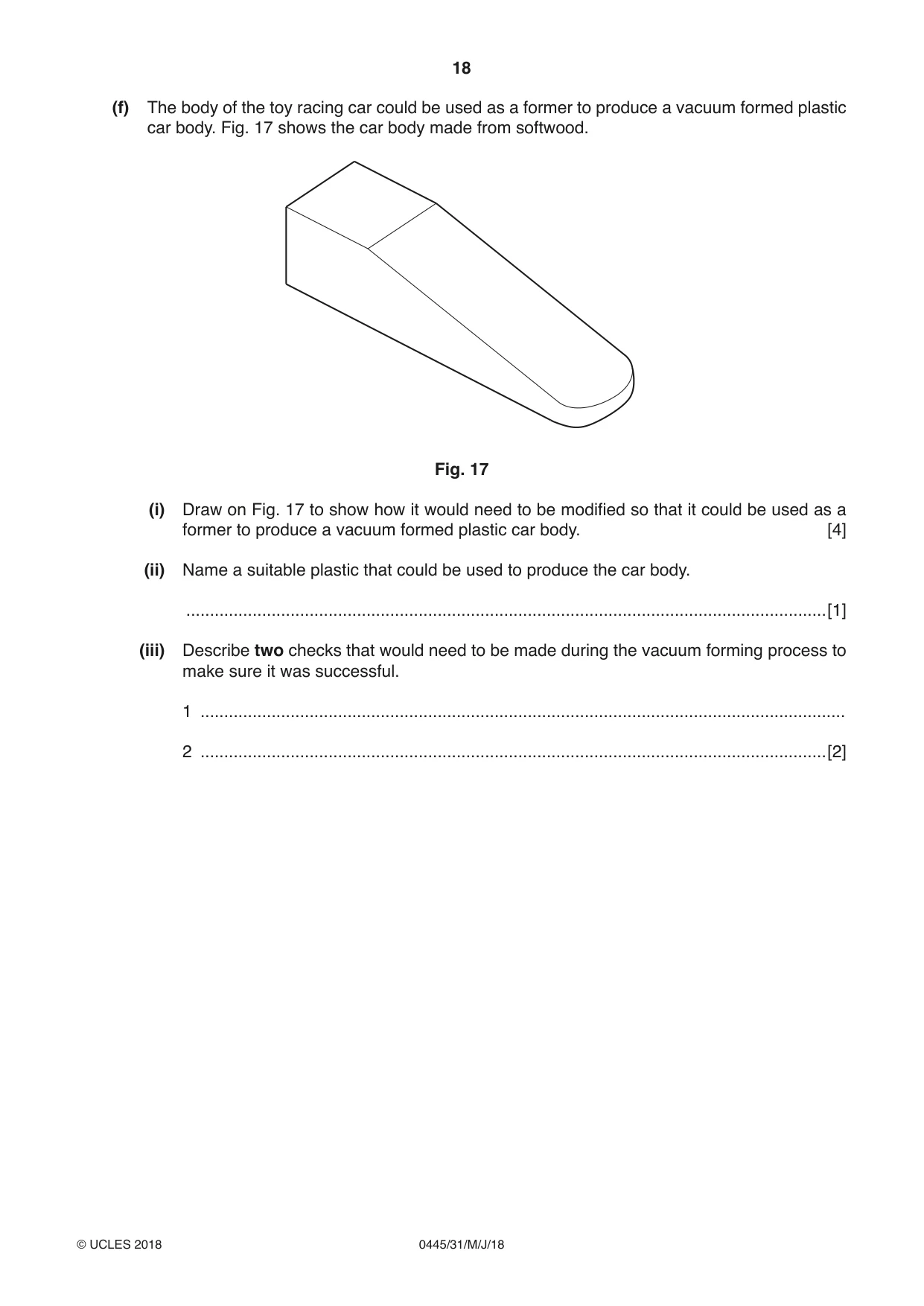
13 Fig. 13 shows a toy racing car made from softwood. Ten identical cars will be made in a school workshop. spoiler body 150 × 40 × 40 rear wheel Ø50 × 15 front wheel Ø40 × 12 Fig. 13 (a) (i) Name a suitable softwood for the toy racing car. ...............................................................................................................................................[1] (ii) Give one reason, other than ‘strength’, for your choice of softwood. .......................................................................................................................................[1] (b) The 150 mm long car body will be cut from a length of softwood similar to that shown below. 40 40 Use sketches and notes to show a design for a sawing jig that would enable ten identical car bodies to be cut to length. The sawing jig must: • position the softwood length securely while it is sawn • produce an accurate 150 mm length. [4] (c) The front wheels will be produced by turning between centres on a woodturning lathe. Fig. 14 shows a length of softwood before it is set up on a woodturning lathe. 300 50 50 Fig. 14 (i) Describe two processes that would be carried out to the length of softwood before it is set up on the woodturning lathe. 1 ........................................................................................................................................ 2 ....................................................................................................................................[2] (ii) Name a tool that could be used to check the diameter of the wheels when they are turned on the lathe. .......................................................................................................................................[1] (iii) Name two other tools or items of equipment that could be used when turning the wheels. 1 ........................................................................................................................................ 2 ....................................................................................................................................[2]
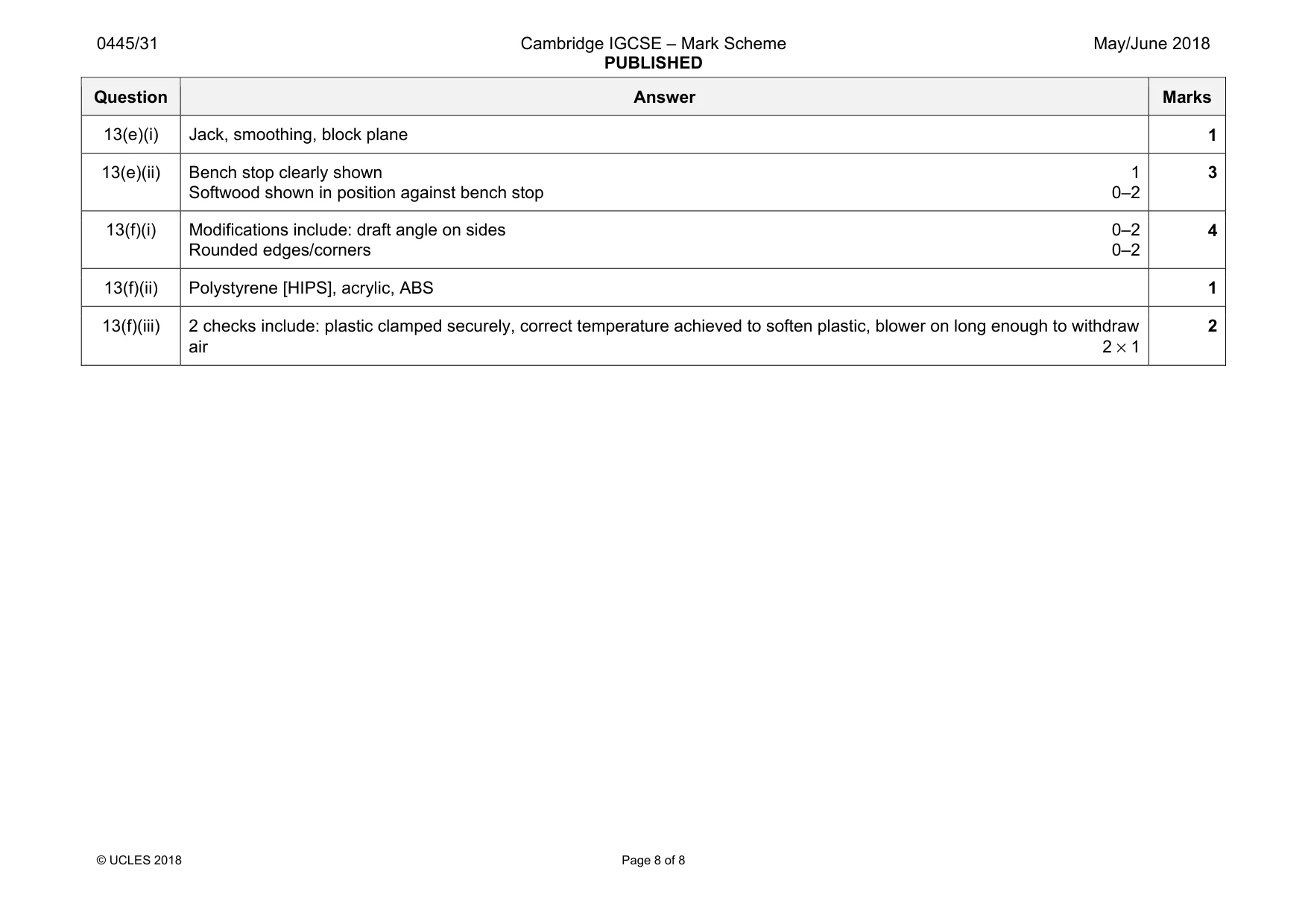
Mark scheme: 13(a)(i) Red deal, pine, parana pine, whitewood, yew 1 13(a)(ii) Generally cheaper than hardwood, can be left bare or painted 1 13(b) Softwood positioned/located securely 1 Accurate length can be sawn 1 Technical accuracy 0–2 4 13(c)(i) Diagonals marked, saw cut across one diagonal, circle marked on ends, corners planed off 2 × 1 2 13(c)(ii) Outside calipers, digital calipers 1 13(c)(iii) Scraper, gouge, parting tool, glasspaper and cork block [rubber], chisel, relevant and appropriate PPE 2 × 1 2 13(d) Stub axle or continuous rod 1 Method of retention: nut, ‘cap’, star washer 1 Move freely: clearance holes, use of washers 1 3 Question Answer Marks 13(e)(i) Jack, smoothing, block plane 1 13(e)(ii) Bench stop clearly shown 1 Softwood shown in position against bench stop 0–2 3 13(f)(i) Modifications include: draft angle on sides 0–2 Rounded edges/corners 0–2 4 13(f)(ii) Polystyrene [HIPS], acrylic, ABS 1 13(f)(iii) 2 checks include: plastic clamped securely, correct temperature achieved to soften plastic, blower on long enough to withdraw air 2 × 1 2
What was in this paper
The subtopics covered by these 13 questions, and how many questions each got. Open one in a new tab to see every Cambridge question on it.
What you needed in this session
Cambridge’s own grade thresholds for 2018 May/June, Paper 3 · Variant 1. A higher threshold means an easier paper — the bar moves with how the cohort did.