Cambridge IGCSE Design and Technology 0445 — 2025 May/June Paper 3 · Variant 1
0445/31/M/J/25 · 13 questions · 50 marks · 60 min
The question paper and its mark scheme, free to read here and free to download. This is Cambridge’s own paper, exactly as it was sat.
Question paper24 pages
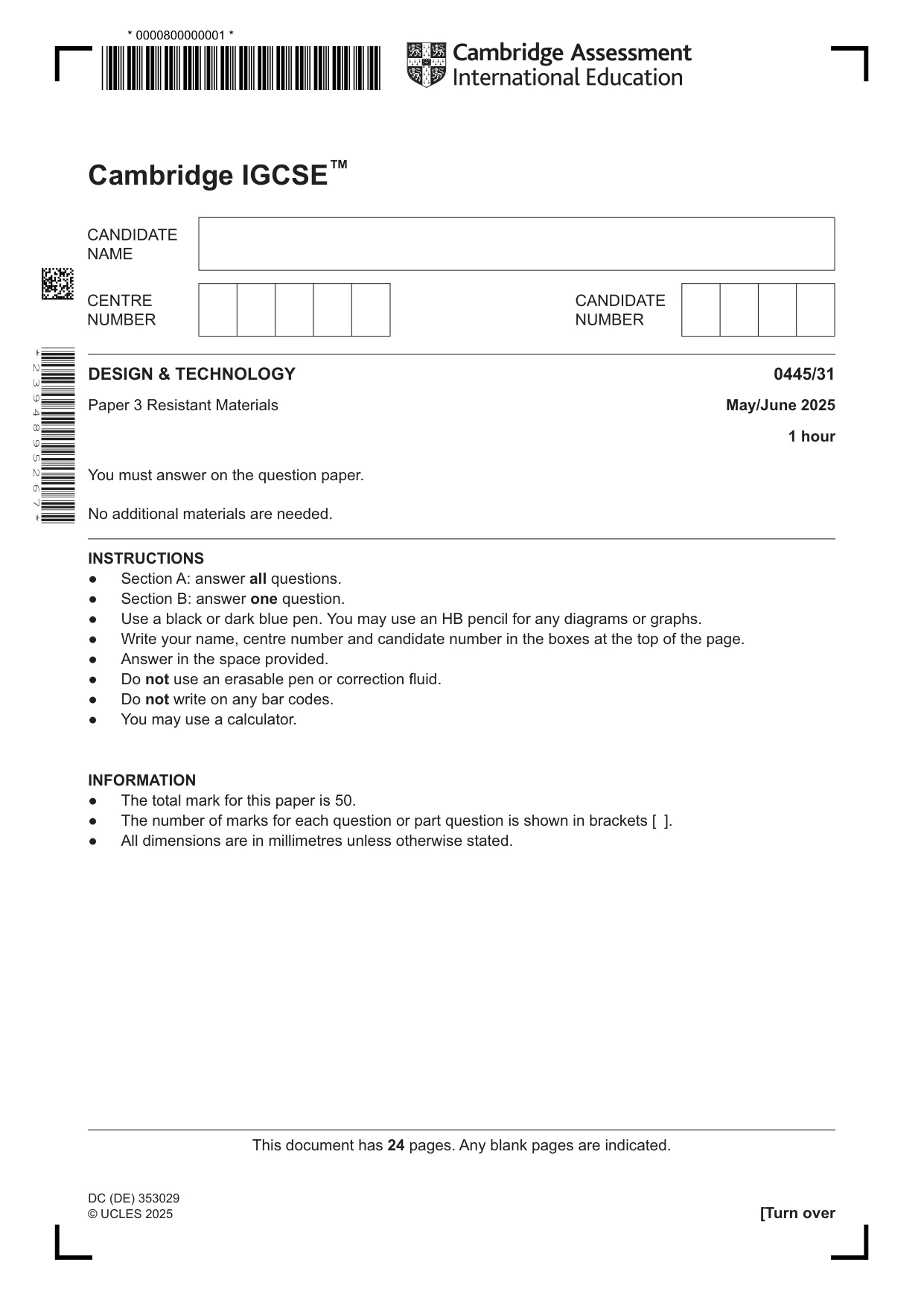
Mark scheme12 pages
Answers below. Sit the paper first if you are practising.
Questions as text
Q1 · Timber being seasoned naturally in the open air
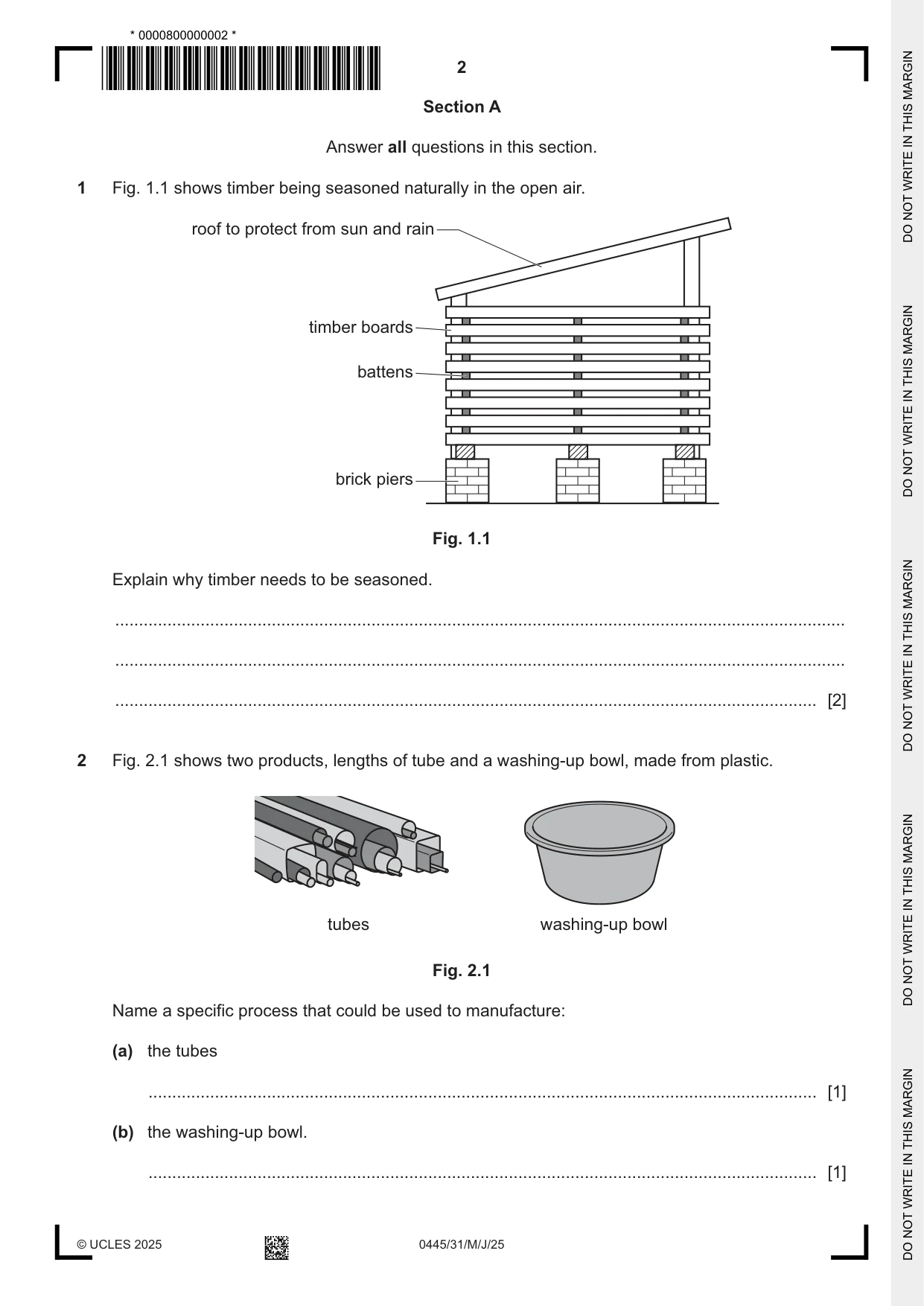
1 Fig. 1.1 shows timber being seasoned naturally in the open air. roof to protect from sun and rain timber boards battens brick piers Fig. 1.1 Explain why timber needs to be seasoned. .......................................................................................................................................................... .......................................................................................................................................................... .................................................................................................................................................... [2]
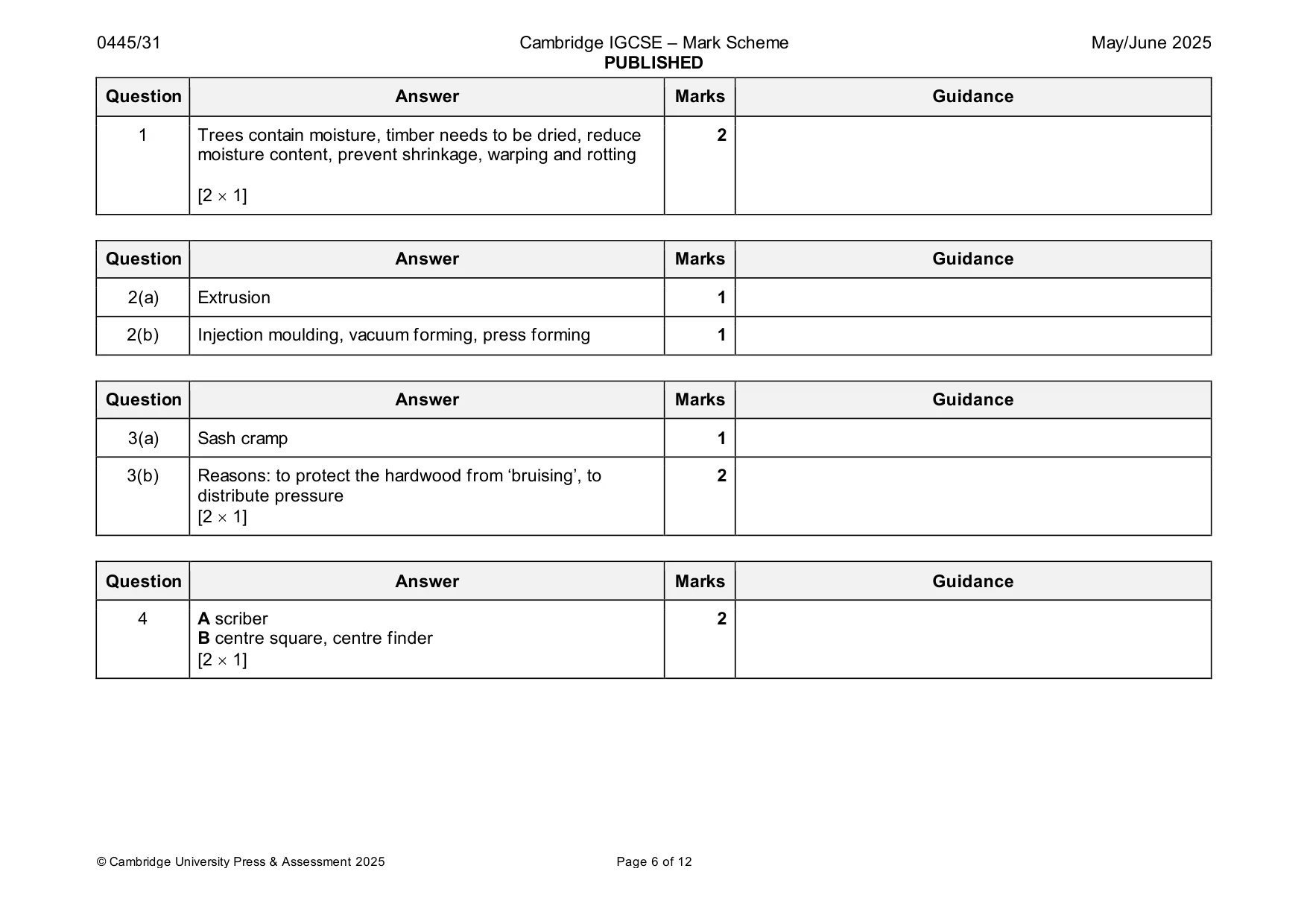
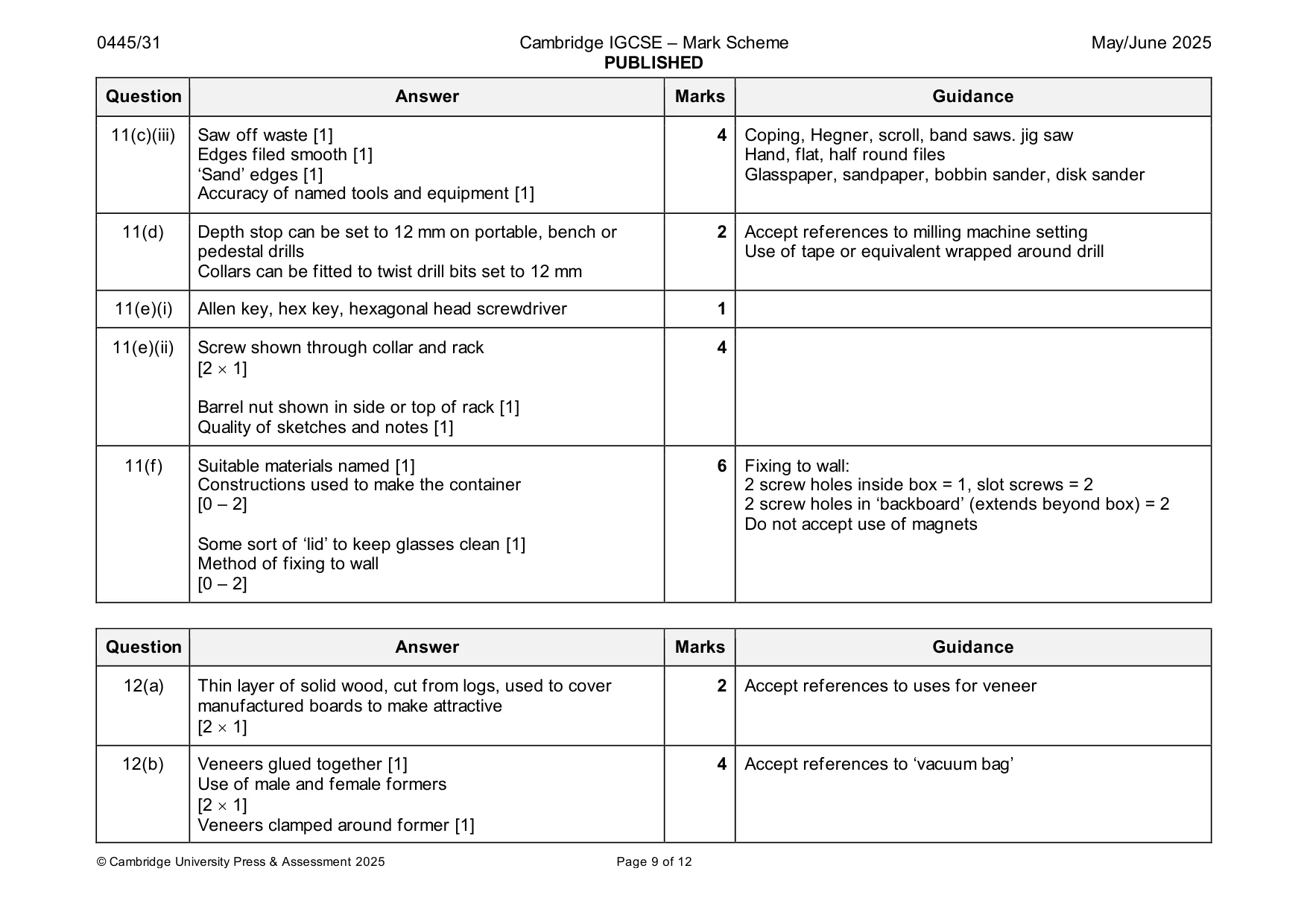
Mark scheme: Question Answer Marks Guidance 1 Trees contain moisture, timber needs to be dried, reduce 2 moisture content, prevent shrinkage, warping and rotting [2 1]
Q2 · Two products, lengths of tube and a washing-up bowl, made from plastic
2 Fig. 2.1 shows two products, lengths of tube and a washing-up bowl, made from plastic. tubes washing-up bowl Fig. 2.1 Name a specific process that could be used to manufacture: (a) the tubes ............................................................................................................................................. [1] (b) the washing-up bowl. ............................................................................................................................................. [1]
Mark scheme: 2(a) Extrusion 1 2(b) Injection moulding, vacuum forming, press forming 1
Q3 · Strips of hardwood glued and clamped together to make a chopping board
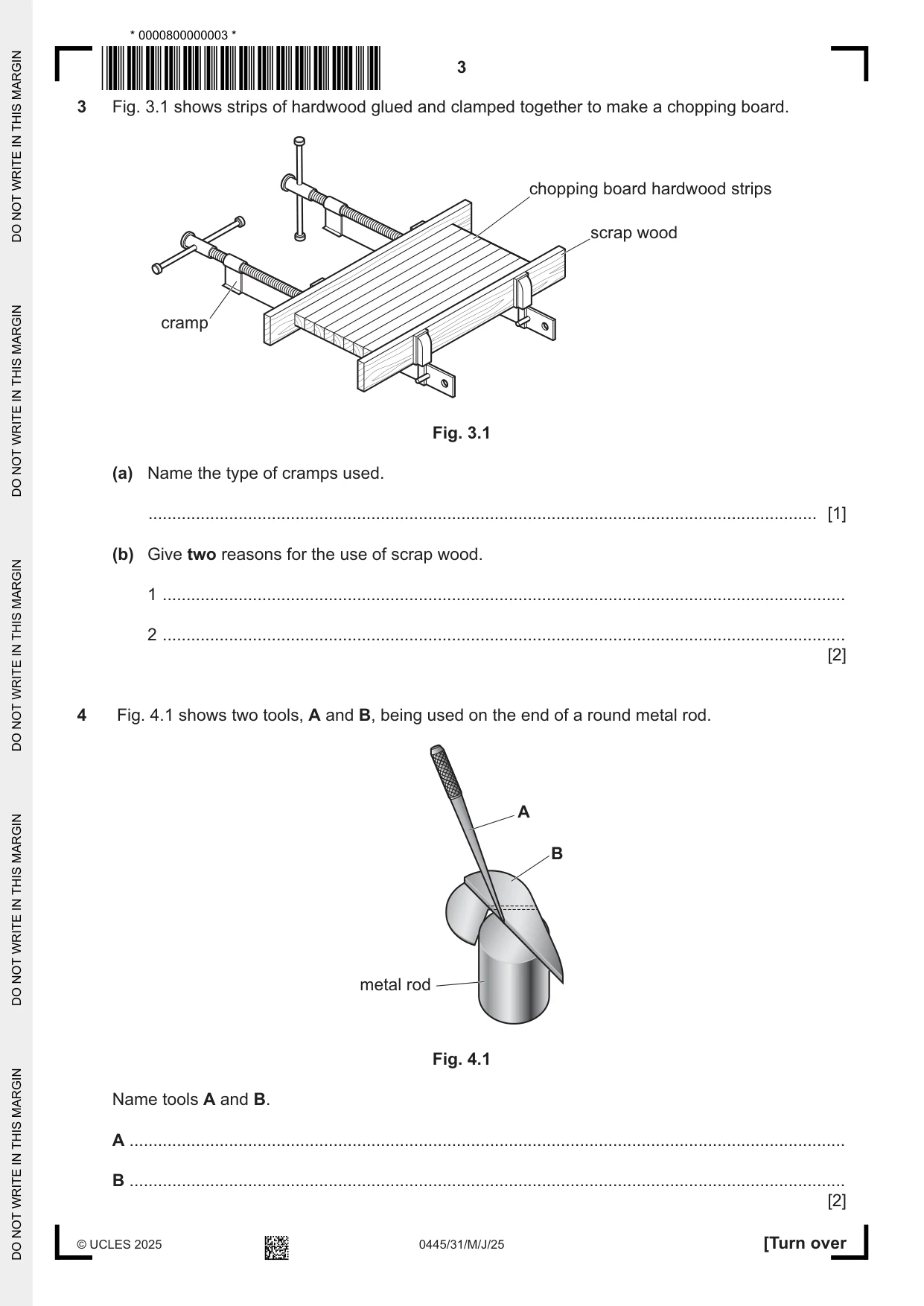
3 Fig. 3.1 shows strips of hardwood glued and clamped together to make a chopping board. chopping board hardwood strips scrap wood cramp Fig. 3.1 (a) Name the type of cramps used. ............................................................................................................................................. [1] (b) Give two reasons for the use of scrap wood. 1 ................................................................................................................................................ 2 ................................................................................................................................................ [2]
Mark scheme: 3(a) Sash cramp 1 3(b) Reasons: to protect the hardwood from ‘bruising’, to 2 distribute pressure [2 1]
Q4 · Two tools, A and B, being used on the end of a round metal rod
4 Fig. 4.1 shows two tools, A and B, being used on the end of a round metal rod. A B metal rod Fig. 4.1 Name tools A and B. A ....................................................................................................................................................... B ....................................................................................................................................................... [2]
Mark scheme: 4 A scriber 2 B centre square, centre finder [2 1]
Q5 · A basic design for a letter rack made from 4 mm thick acrylic
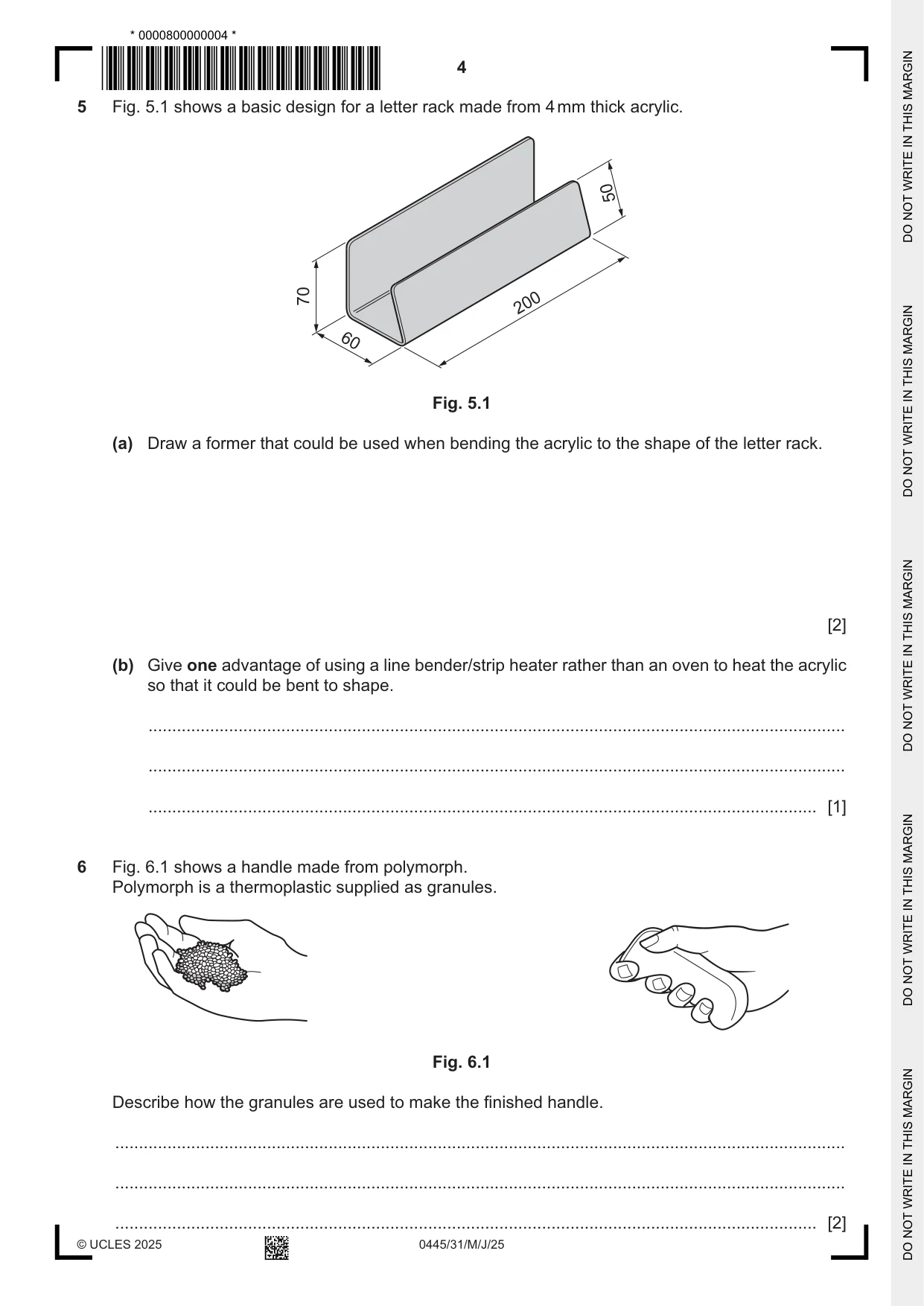
5 Fig. 5.1 shows a basic design for a letter rack made from 4 mm thick acrylic. 50 70 200 60 Fig. 5.1 (a) Draw a former that could be used when bending the acrylic to the shape of the letter rack. [2] (b) Give one advantage of using a line bender/strip heater rather than an oven to heat the acrylic so that it could be bent to shape. ................................................................................................................................................... ................................................................................................................................................... ............................................................................................................................................. [1]
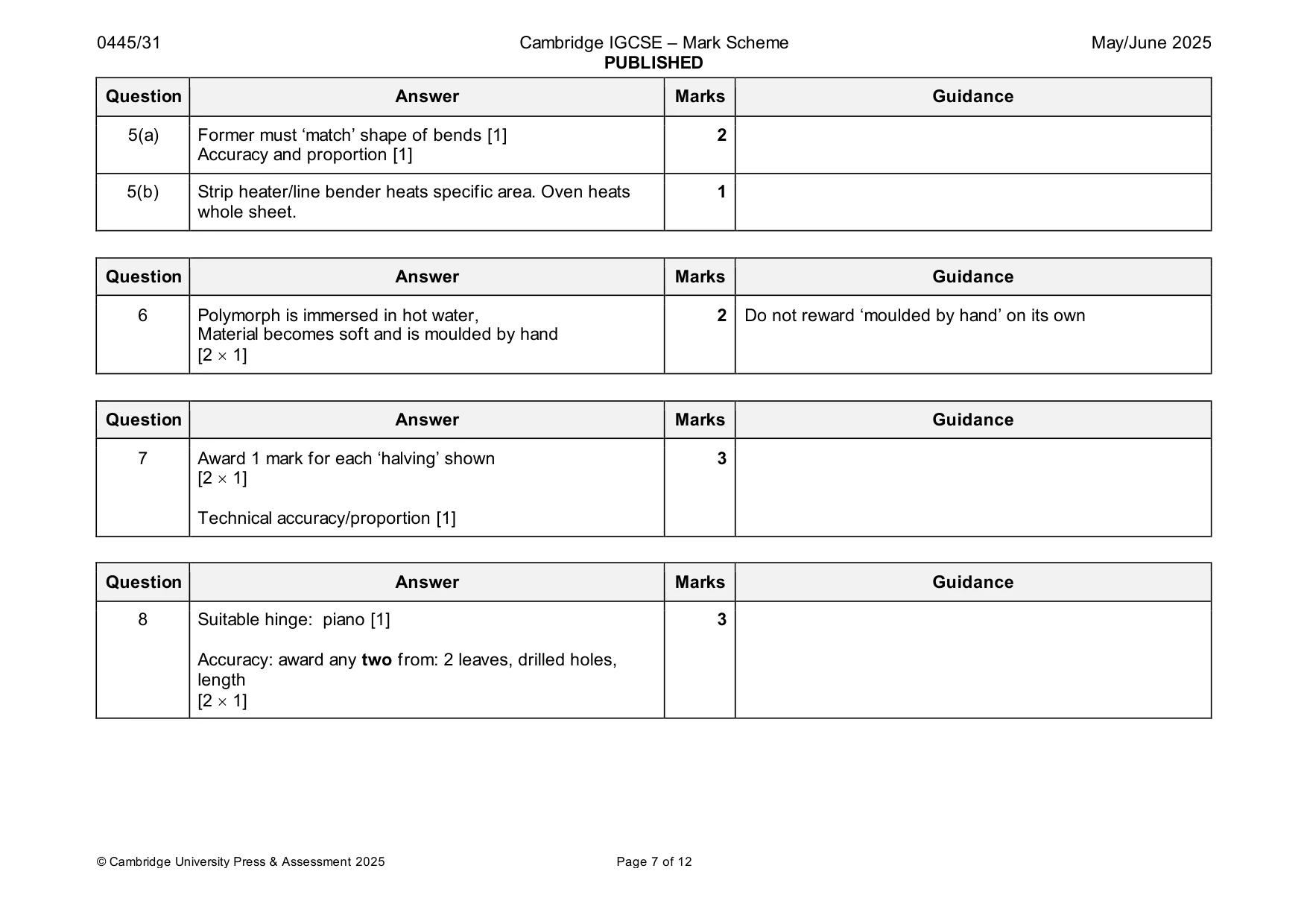
Mark scheme: 5(a) Former must ‘match’ shape of bends [1] 2 Accuracy and proportion [1] 5(b) Strip heater/line bender heats specific area. Oven heats 1 whole sheet.
Q6 · A handle made from polymorph
6 Fig. 6.1 shows a handle made from polymorph. Polymorph is a thermoplastic supplied as granules. Fig. 6.1 Describe how the granules are used to make the finished handle. .......................................................................................................................................................... .......................................................................................................................................................... ............................... ............................................................................................................... [2]
Mark scheme: 6 Polymorph is immersed in hot water, 2 Do not reward ‘moulded by hand’ on its own Material becomes soft and is moulded by hand [2 1]
Question 7
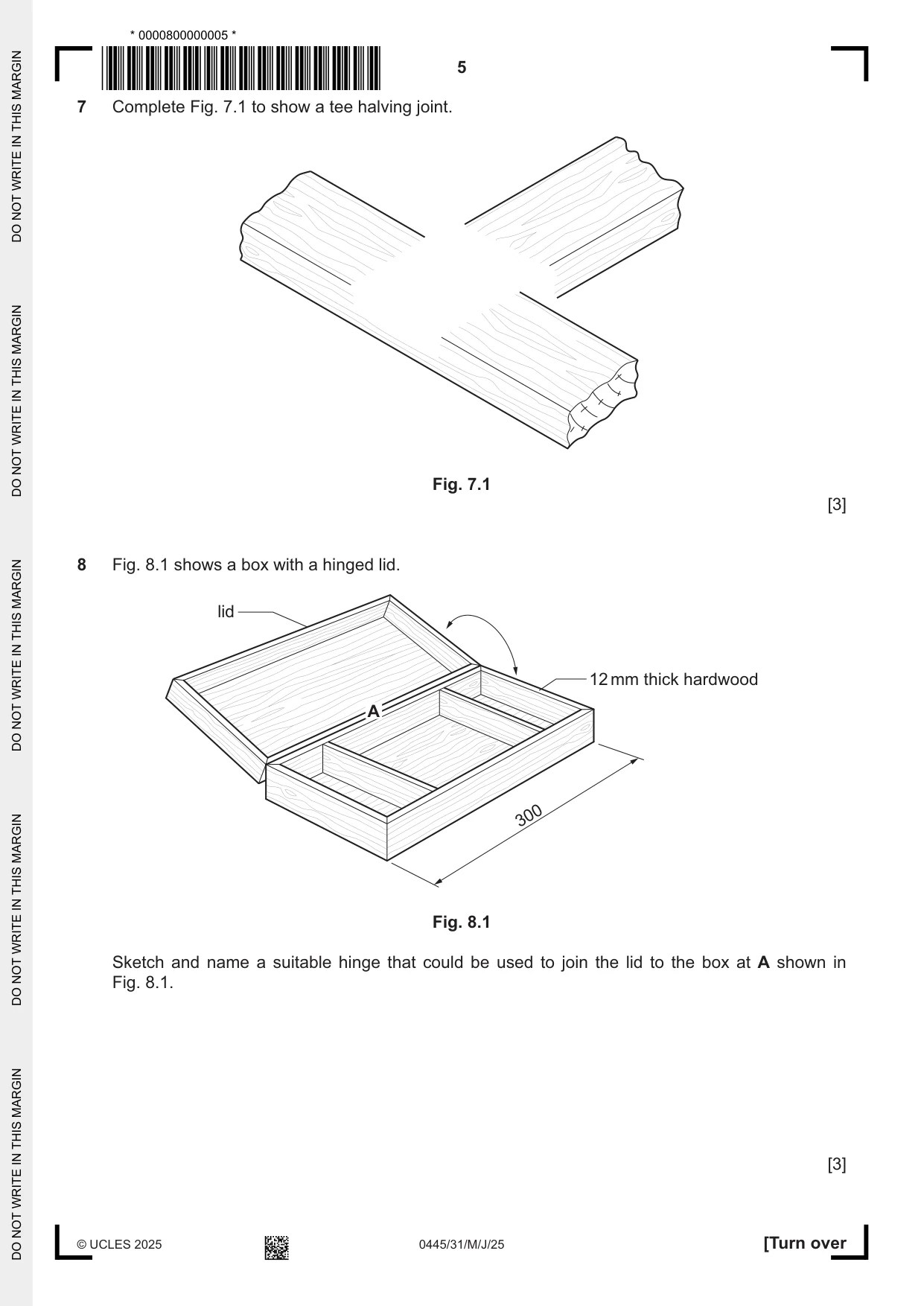
7 Complete Fig. 7.1 to show a tee halving joint. Fig. 7.1 [3]
Mark scheme: 7 Award 1 mark for each ‘halving’ shown 3 [2 1] Technical accuracy/proportion [1]
Q8 · A box with a hinged lid
8 Fig. 8.1 shows a box with a hinged lid. lid 12 mm thick hardwood A 300 Fig. 8.1 Sketch and name a suitable hinge that could be used to join the lid to the box at A shown in Fig. 8.1. [3]
Mark scheme: 8 Suitable hinge: piano [1] 3 Accuracy: award any two from: 2 leaves, drilled holes, length [2 1]
Q9 · Details of a jig used when bending a brass strip to shape
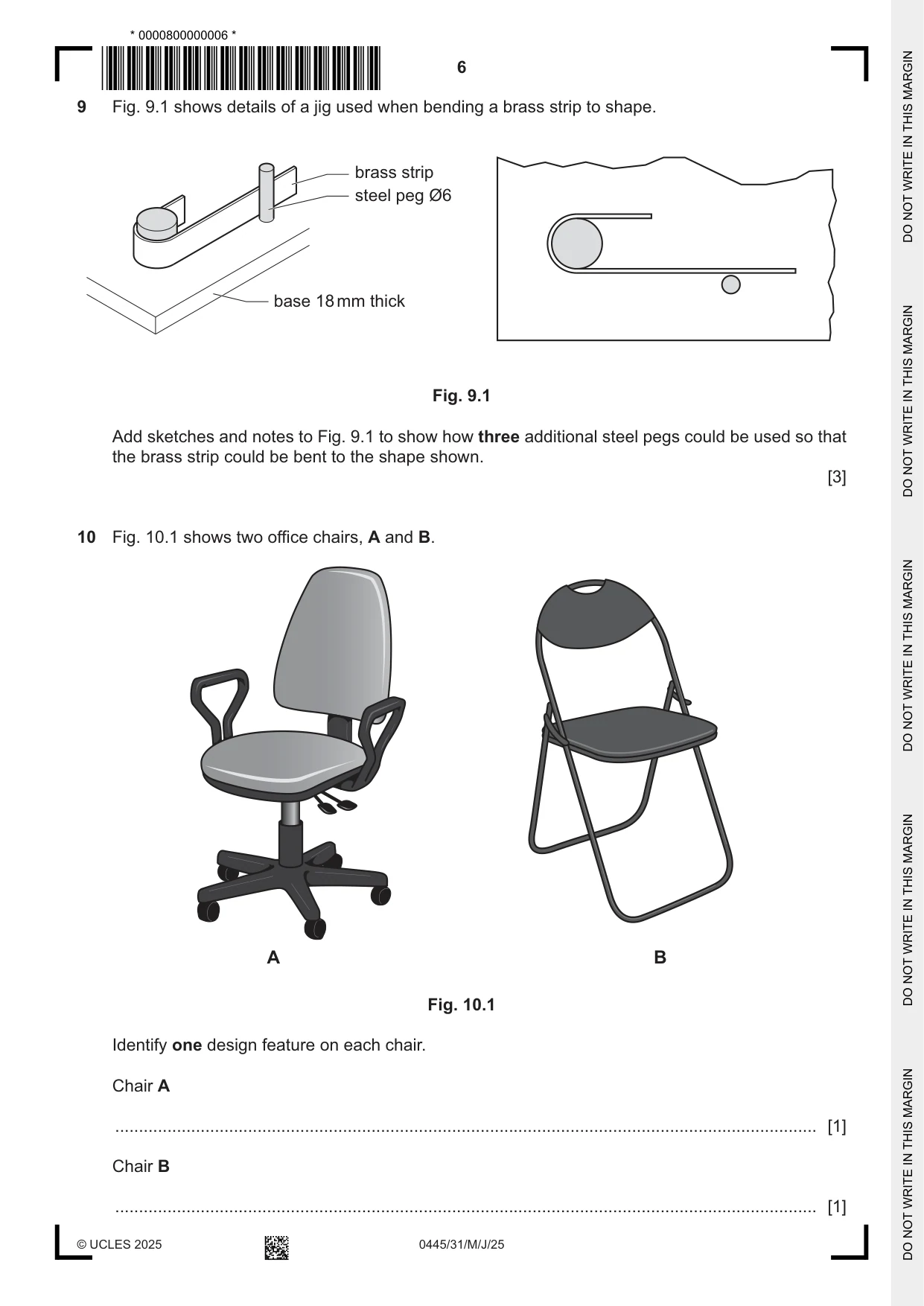
9 Fig. 9.1 shows details of a jig used when bending a brass strip to shape. brass strip steel peg Ø6 base 18 mm thick Fig. 9.1 Add sketches and notes to Fig. 9.1 to show how three additional steel pegs could be used so that the brass strip could be bent to the shape shown. [3]
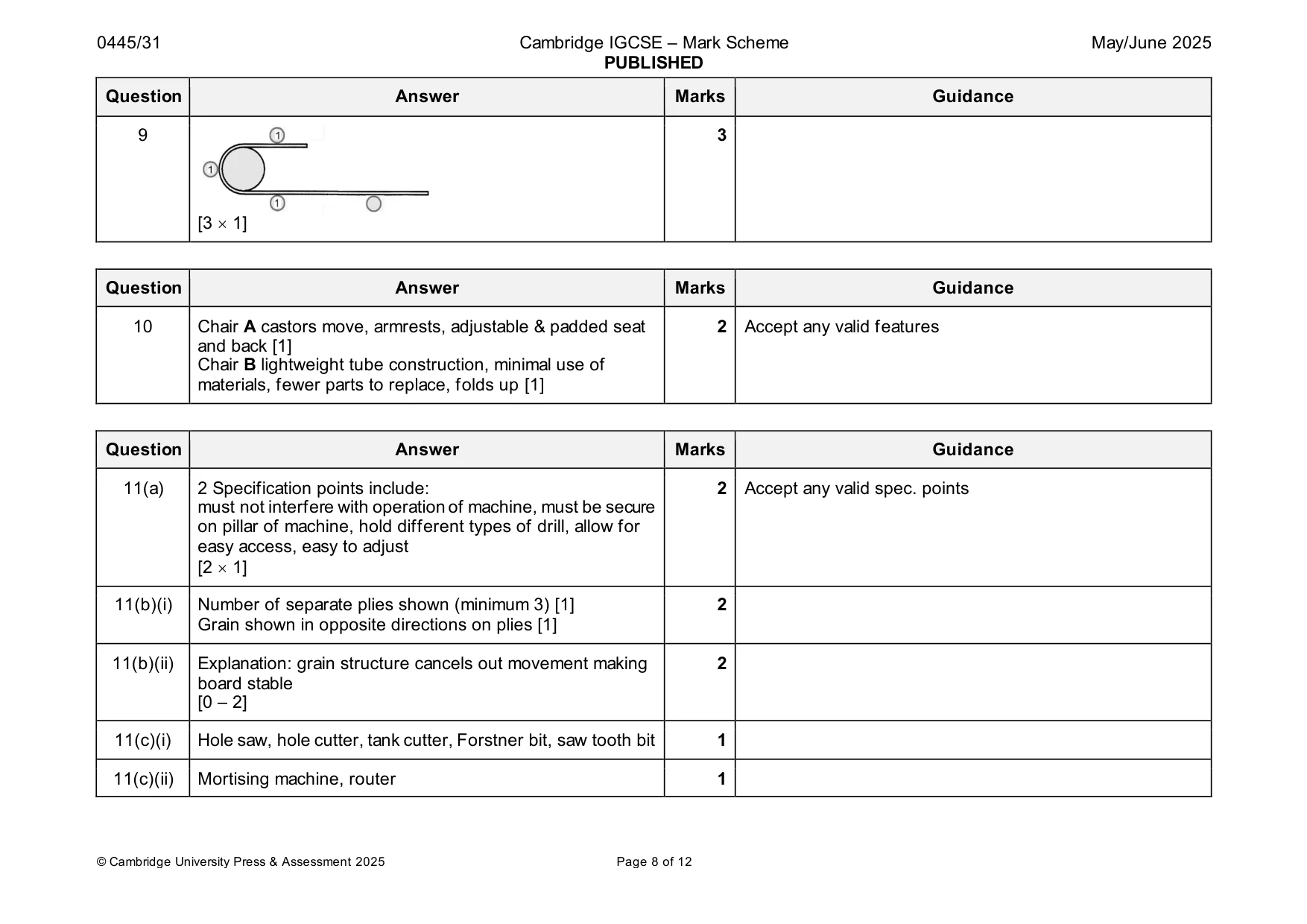
Mark scheme: 9 3 [3 1]
Q10 · Two office chairs, A and B
10 Fig. 10.1 shows two office chairs, A and B. A B Fig. 10.1 Identify one design feature on each chair. Chair A .................................................................................................................................................... [1] Chair B .................................................................................................................................................... [1]
Mark scheme: 10 Chair A castors move, armrests, adjustable & padded seat 2 Accept any valid features and back [1] Chair B lightweight tube construction, minimal use of materials, fewer parts to replace, folds up [1]
Q11 · A drill rack that will be attached to the pillar of a pillar drill
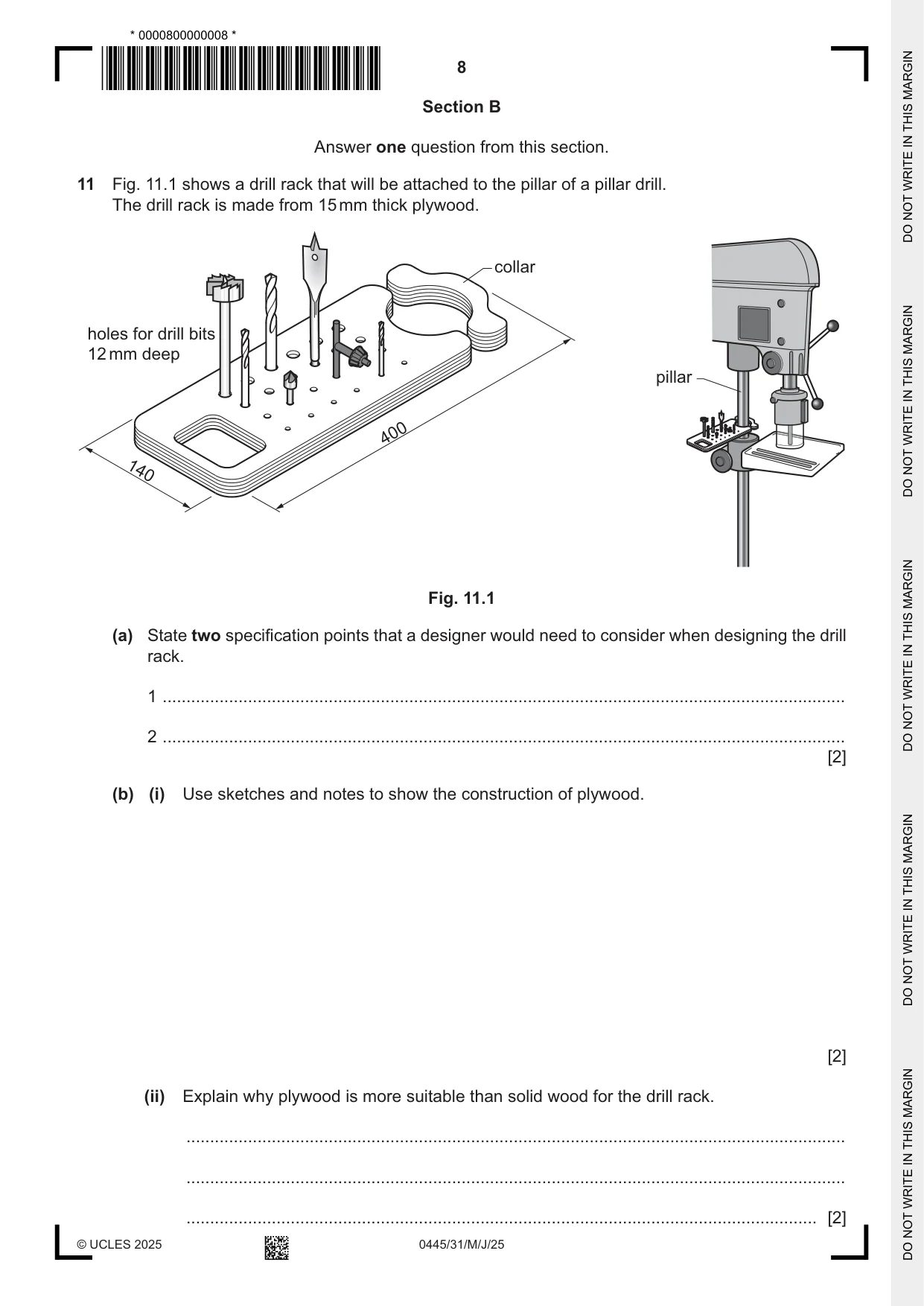
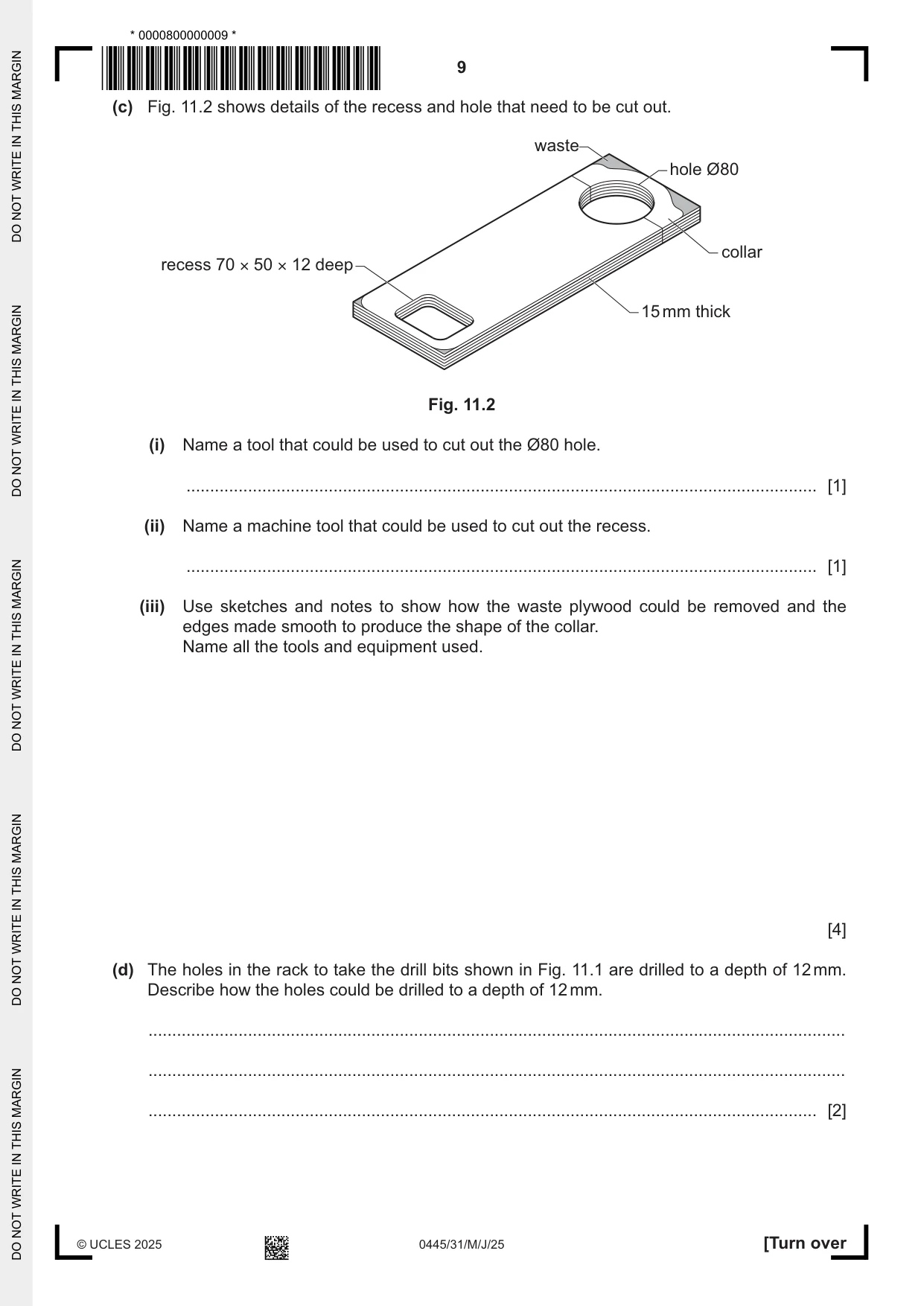
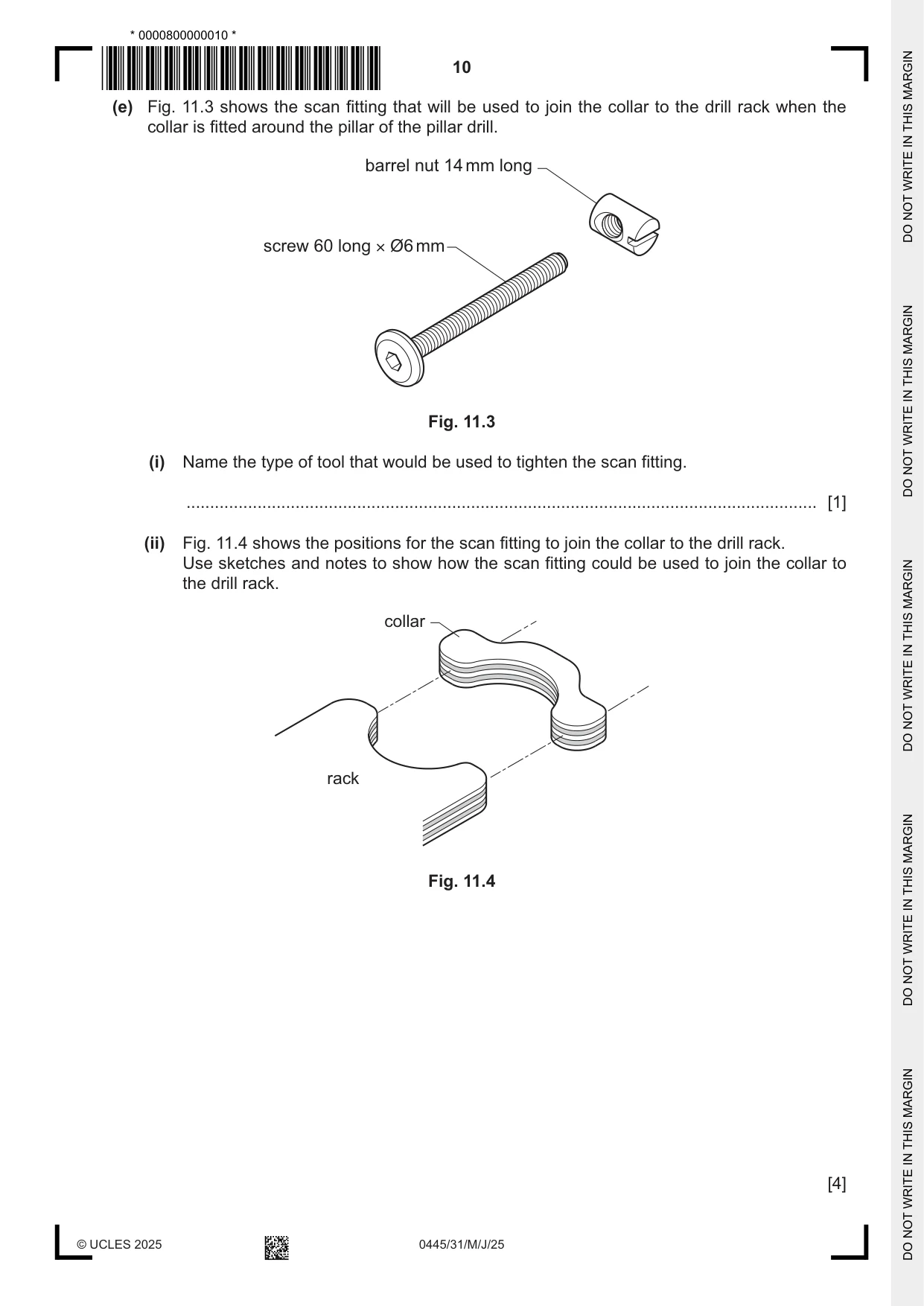
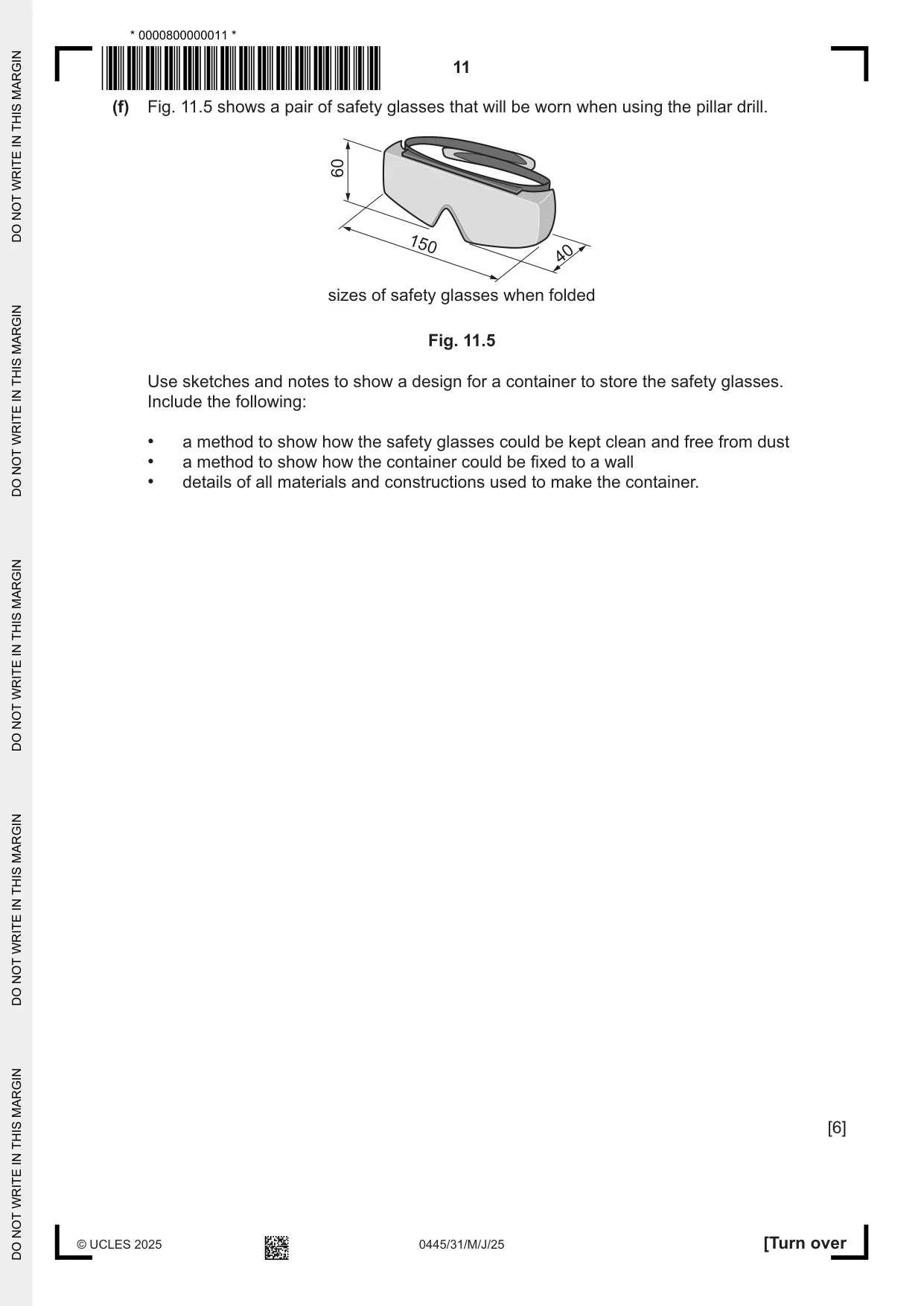
11 Fig. 11.1 shows a drill rack that will be attached to the pillar of a pillar drill. The drill rack is made from 15 mm thick plywood. collar holes for drill bits 12mm deep pillar 400 140 Fig. 11.1 (a) State two specification points that a designer would need to consider when designing the drill rack. 1 ................................................................................................................................................ 2 ................................................................................................................................................ [2] (b) (i) Use sketches and notes to show the construction of plywood. [2] (ii) Explain why plywood is more suitable than solid wood for the drill rack. ........................................................................................................................................... ........................................................................................................................................... ..................................................................................................................................... [2] (c) Fig. 11.2 shows details of the recess and hole that need to be cut out. waste hole Ø80 collar recess 70 × 50 × 12 deep 15 mm thick Fig. 11.2 (i) Name a tool that could be used to cut out the Ø80 hole. ..................................................................................................................................... [1] (ii) Name a machine tool that could be used to cut out the recess. ..................................................................................................................................... [1] (iii) Use sketches and notes to show how the waste plywood could be removed and the edges made smooth to produce the shape of the collar. Name all the tools and equipment used. [4] (d) The holes in the rack to take the drill bits shown in Fig. 11.1 are drilled to a depth of 12 mm. Describe how the holes could be drilled to a depth of 12 mm. ................................................................................................................................................... ................................................................................................................................................... ............................................................................................................................................. [2] (e) Fig. 11.3 shows the scan fitting that will be used to join the collar to the drill rack when the collar is fitted around the pillar of the pillar drill. barrel nut 14 mm long screw 60 long × Ø6 mm Fig. 11.3 (i) Name the type of tool that would be used to tighten the scan fitting. ..................................................................................................................................... [1] (ii) Fig. 11.4 shows the positions for the scan fitting to join the collar to the drill rack. Use sketches and notes to show how the scan fitting could be used to join the collar to the drill rack. collar rack Fig. 11.4 [4] (f) Fig. 11.5 shows a pair of safety glasses that will be worn when using the pillar drill. 60 150 40 sizes of safety glasses when folded Fig. 11.5 Use sketches and notes to show a design for a container to store the safety glasses. Include the following: • a method to show how the safety glasses could be kept clean and free from dust • a method to show how the container could be fixed to a wall • details of all materials and constructions used to make the container. [6]
Mark scheme: 11(a) 2 Specification points include: 2 Accept any valid spec. points must not interfere with operation of machine, must be secure on pillar of machine, hold different types of drill, allow for easy access, easy to adjust [2 1] 11(b)(i) Number of separate plies shown (minimum 3) [1] 2 Grain shown in opposite directions on plies [1] 11(b)(ii) Explanation: grain structure cancels out movement making 2 board stable [0 – 2] 11(c)(i) Hole saw, hole cutter, tank cutter, Forstner bit, saw tooth bit 1 11(c)(ii) Mortising machine, router 1 11(c)(iii) Saw off waste [1] 4 Coping, Hegner, scroll, band saws. jig saw Edges filed smooth [1] Hand, flat, half round files ‘Sand’ edges [1] Glasspaper, sandpaper, bobbin sander, disk sander Accuracy of named tools and equipment [1] 11(d) Depth stop can be set to 12 mm on portable, bench or 2 Accept references to milling machine setting pedestal drills Use of tape or equivalent wrapped around drill Collars can be fitted to twist drill bits set to 12 mm 11(e)(i) Allen key, hex key, hexagonal head screwdriver 1 11(e)(ii) Screw shown through collar and rack 4 [2 1] Barrel nut shown in side or top of rack [1] Quality of sketches and notes [1] 11(f) Suitable materials named [1] 6 Fixing to wall: Constructions used to make the container 2 screw holes inside box = 1, slot screws = 2 [0 – 2] 2 screw holes in ‘backboard’ (extends beyond box) = 2 Do not accept use of magnets Some sort of ‘lid’ to keep glasses clean [1] Method of fixing to wall [0 – 2]
Q12 · A child’s xylophone that could be made in a school workshop
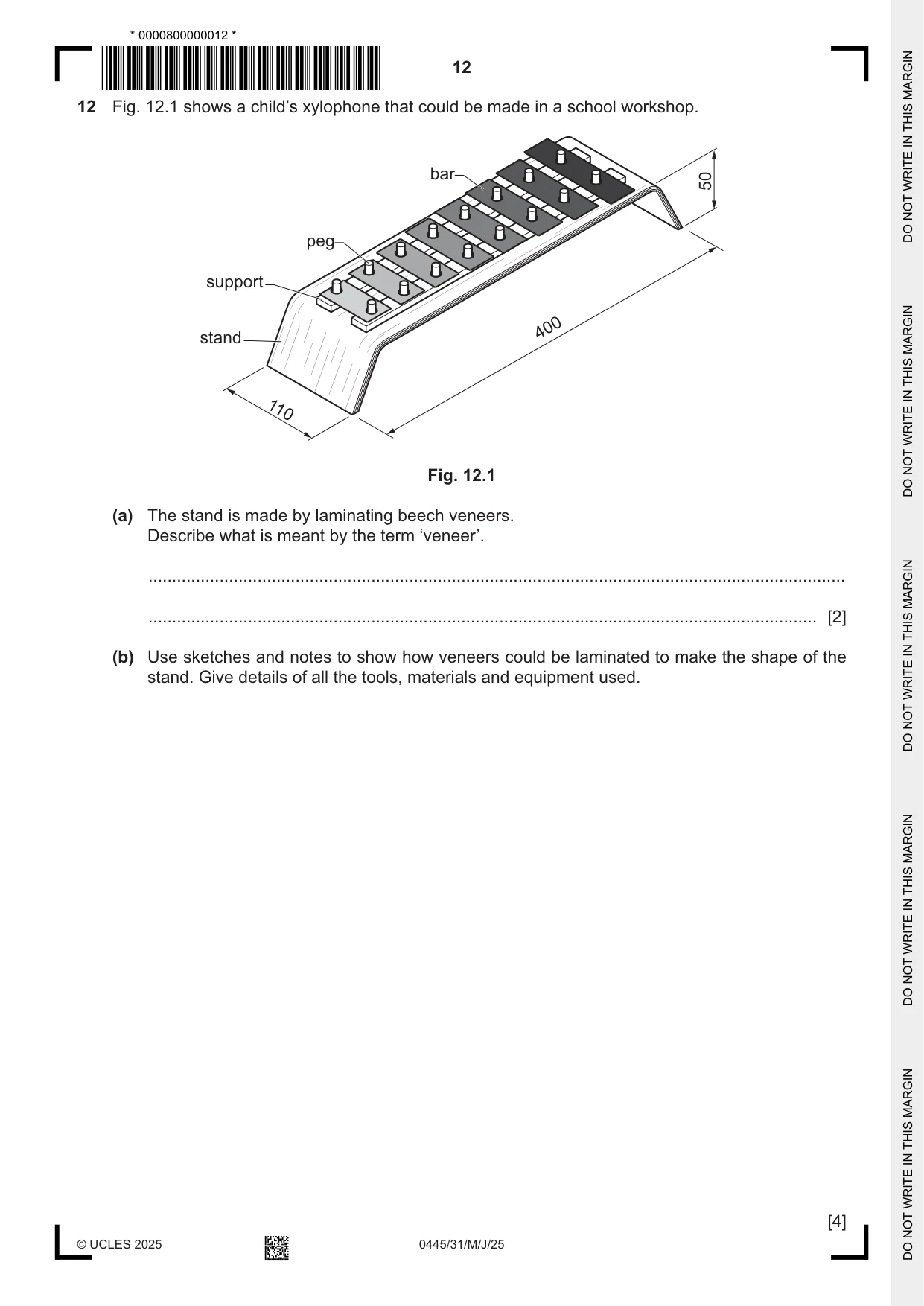
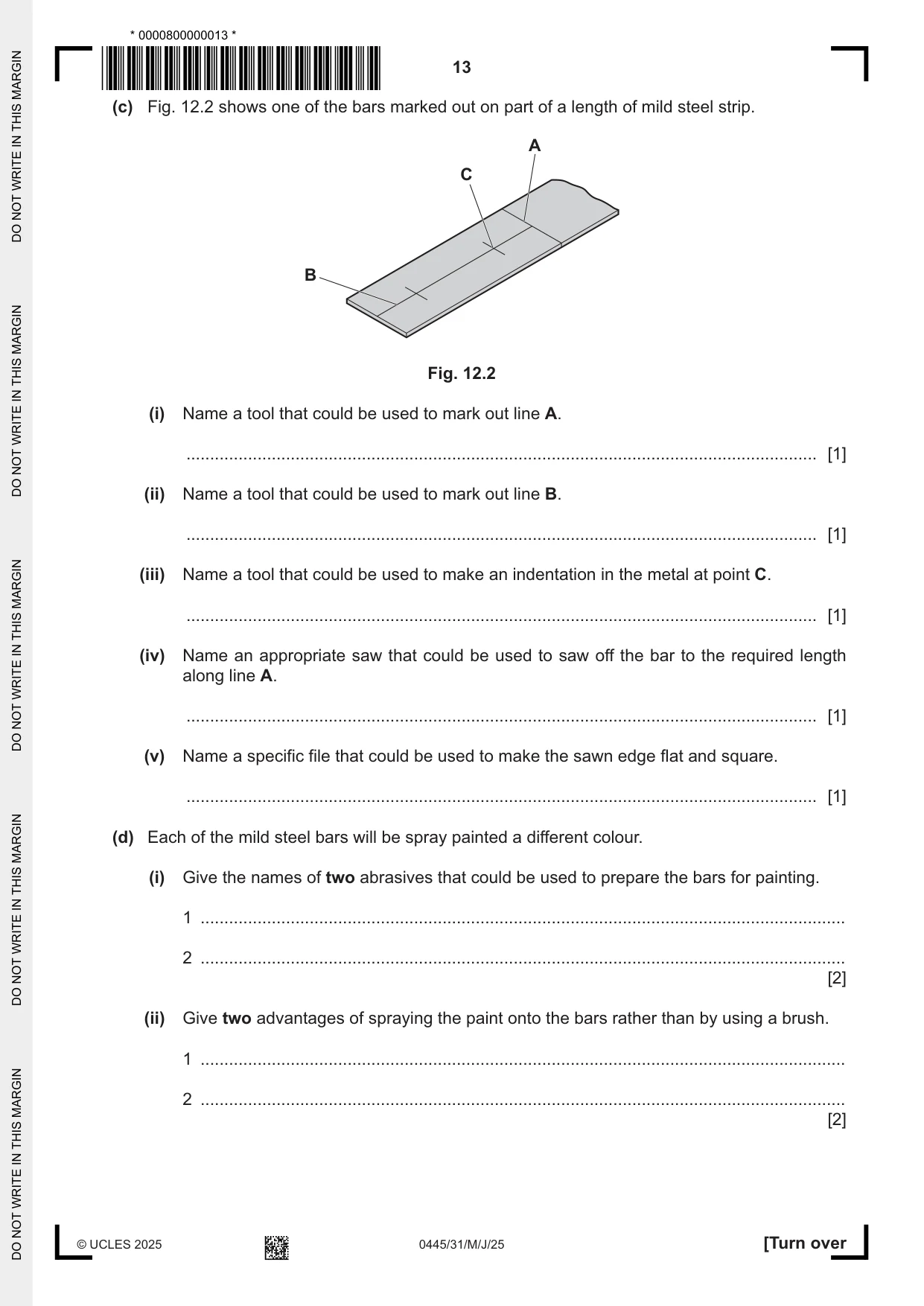
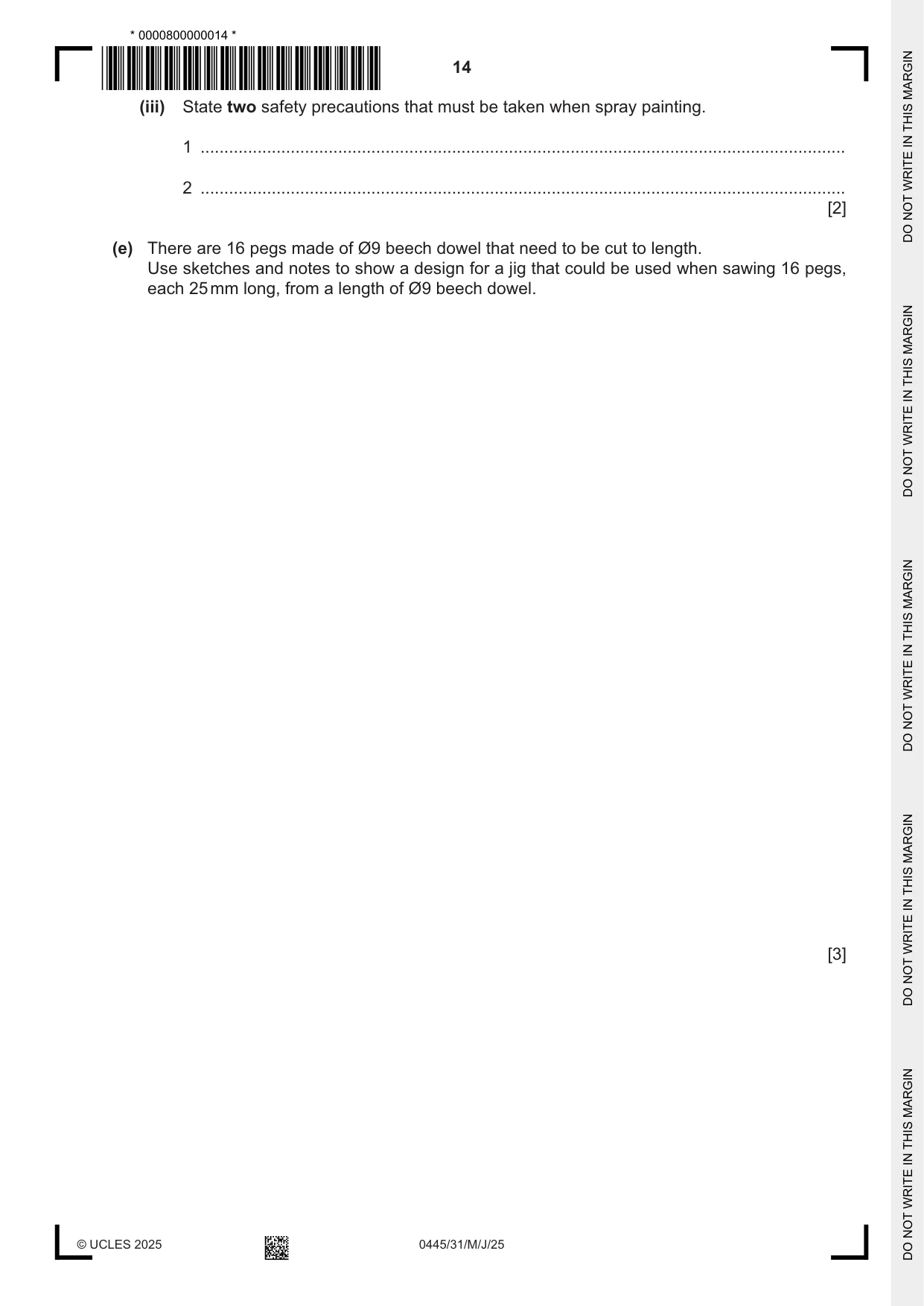
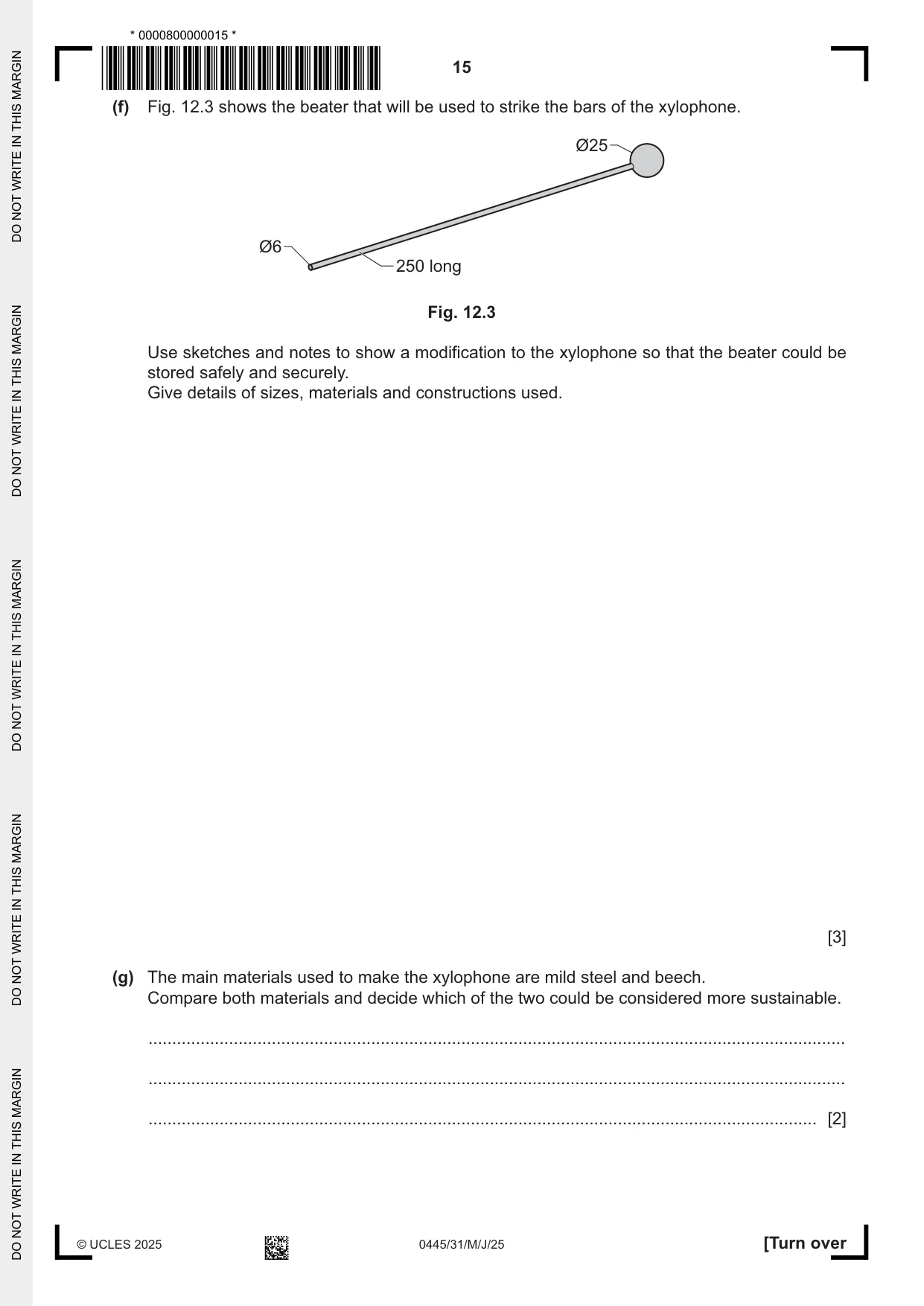
12 Fig. 12.1 shows a child’s xylophone that could be made in a school workshop. bar 50 peg support stand 400 110 Fig. 12.1 (a) The stand is made by laminating beech veneers. Describe what is meant by the term ‘veneer’. ................................................................................................................................................... ............................................................................................................................................. [2] (b) Use sketches and notes to show how veneers could be laminated to make the shape of the stand. Give details of all the tools, materials and equipment used. [4] (c) Fig. 12.2 shows one of the bars marked out on part of a length of mild steel strip. A C B Fig. 12.2 (i) Name a tool that could be used to mark out line A. ..................................................................................................................................... [1] (ii) Name a tool that could be used to mark out line B. ..................................................................................................................................... [1] (iii) Name a tool that could be used to make an indentation in the metal at point C. ..................................................................................................................................... [1] (iv) Name an appropriate saw that could be used to saw off the bar to the required length along line A. ..................................................................................................................................... [1] (v) Name a specific file that could be used to make the sawn edge flat and square. ..................................................................................................................................... [1] (d) Each of the mild steel bars will be spray painted a different colour. (i) Give the names of two abrasives that could be used to prepare the bars for painting. 1 ........................................................................................................................................ 2 ........................................................................................................................................ [2] (ii) Give two advantages of spraying the paint onto the bars rather than by using a brush. 1 ........................................................................................................................................ 2 ........................................................................................................................................ [2] (iii) State two safety precautions that must be taken when spray painting. 1 ........................................................................................................................................ 2 ........................................................................................................................................ [2] (e) There are 16 pegs made of Ø9 beech dowel that need to be cut to length. Use sketches and notes to show a design for a jig that could be used when sawing 16 pegs, each 25 mm long, from a length of Ø9 beech dowel. [3] (f) Fig. 12.3 shows the beater that will be used to strike the bars of the xylophone. Ø25 Ø6 250 long Fig. 12.3 Use sketches and notes to show a modification to the xylophone so that the beater could be stored safely and securely. Give details of sizes, materials and constructions used. [3] (g) The main materials used to make the xylophone are mild steel and beech. Compare both materials and decide which of the two could be considered more sustainable. ................................................................................................................................................... ................................................................................................................................................... ............................................................................................................................................. [2]
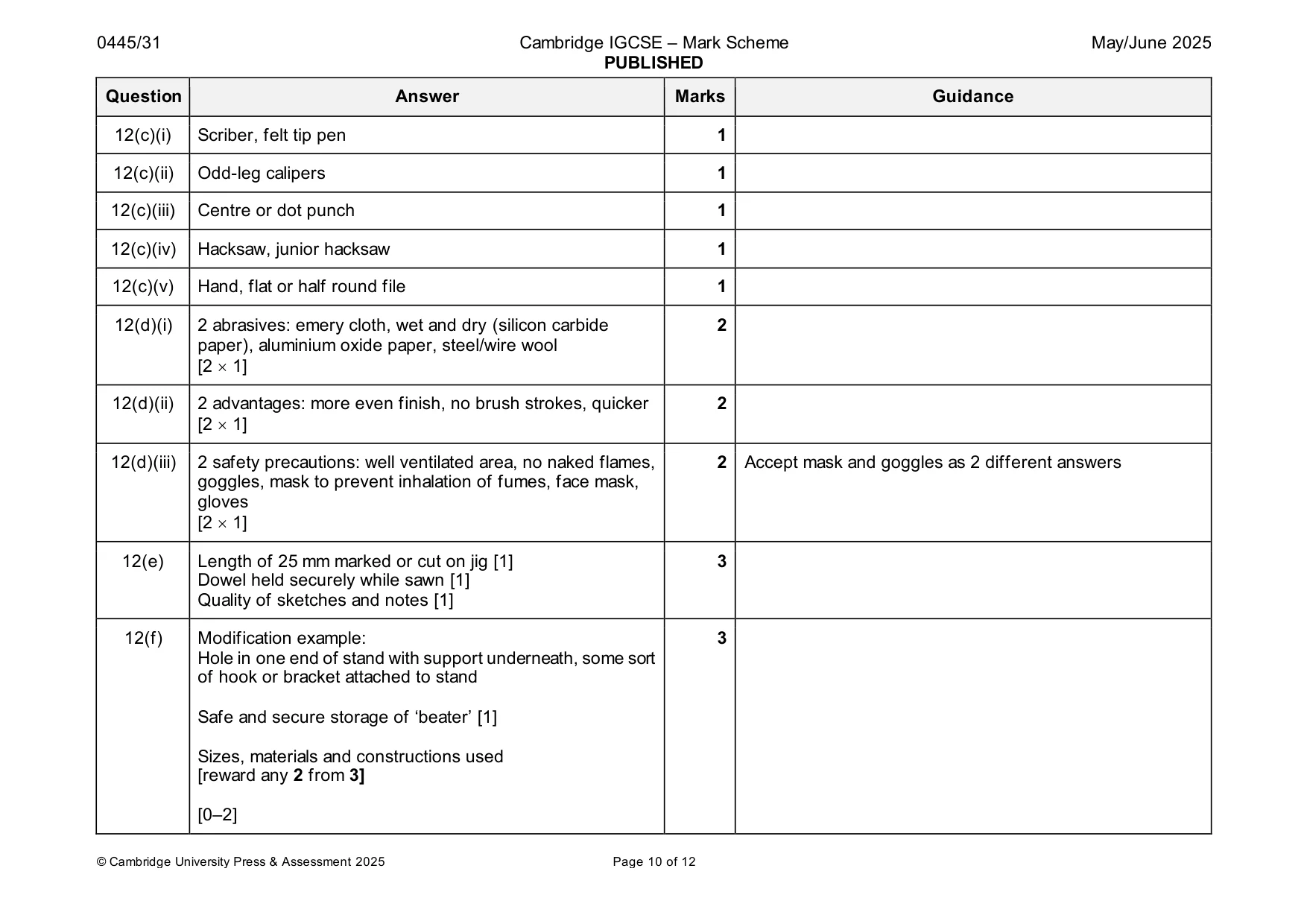
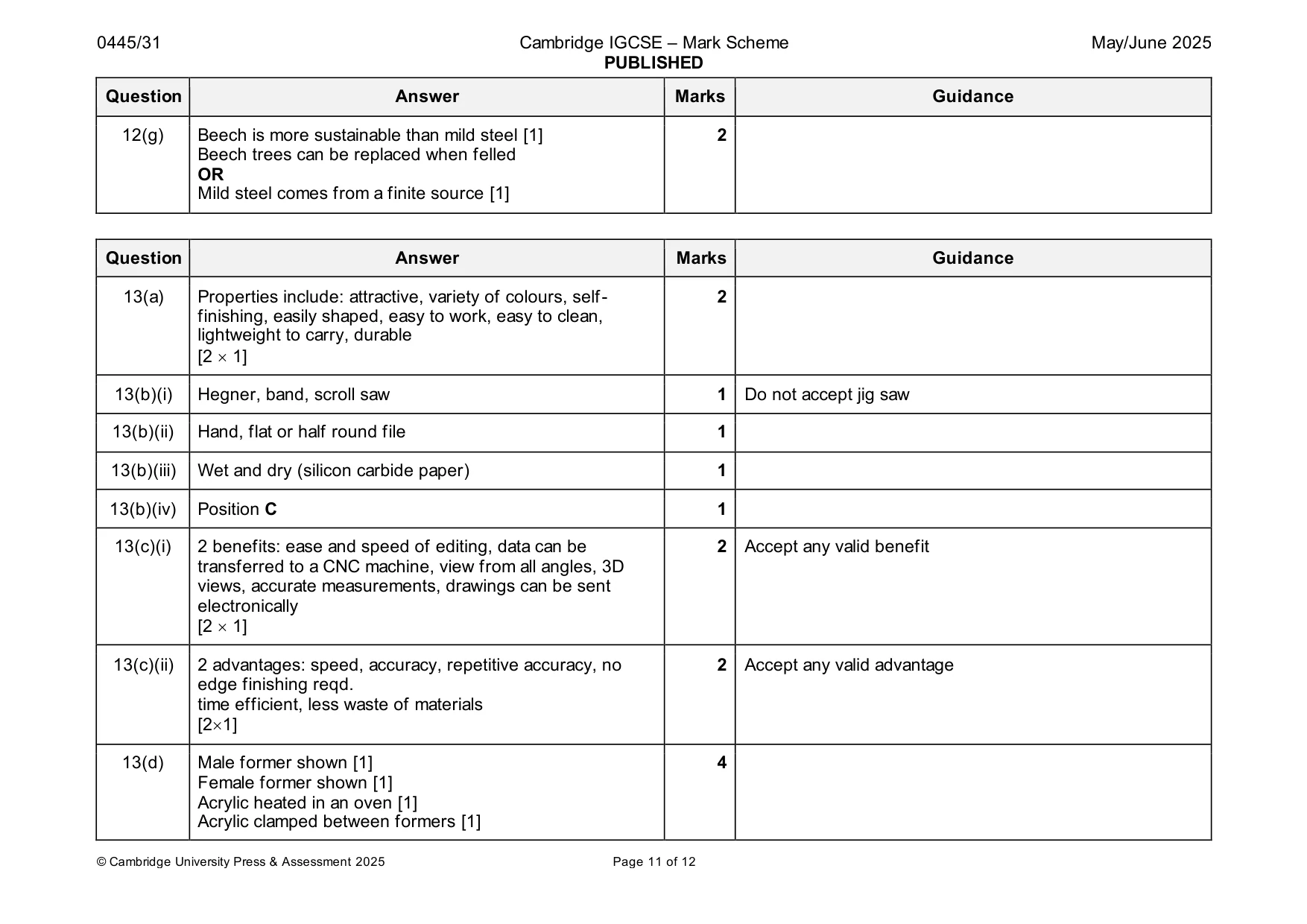
Mark scheme: 12(a) Thin layer of solid wood, cut from logs, used to cover 2 Accept references to uses for veneer manufactured boards to make attractive [2 1] 12(b) Veneers glued together [1] 4 Accept references to ‘vacuum bag’ Use of male and female formers [2 1] Veneers clamped around former [1] 12(c)(i) Scriber, felt tip pen 1 12(c)(ii) Odd-leg calipers 1 12(c)(iii) Centre or dot punch 1 12(c)(iv) Hacksaw, junior hacksaw 1 12(c)(v) Hand, flat or half round file 1 12(d)(i) 2 abrasives: emery cloth, wet and dry (silicon carbide 2 paper), aluminium oxide paper, steel/wire wool [2 1] 12(d)(ii) 2 advantages: more even finish, no brush strokes, quicker 2 [2 1] 12(d)(iii) 2 safety precautions: well ventilated area, no naked flames, 2 Accept mask and goggles as 2 different answers goggles, mask to prevent inhalation of fumes, face mask, gloves [2 1] 12(e) Length of 25 mm marked or cut on jig [1] 3 Dowel held securely while sawn [1] Quality of sketches and notes [1] 12(f) Modification example: 3 Hole in one end of stand with support underneath, some sort of hook or bracket attached to stand Safe and secure storage of ‘beater’ [1] Sizes, materials and constructions used [reward any 2 from 3] [0–2] 12(g) Beech is more sustainable than mild steel [1] 2 Beech trees can be replaced when felled OR Mild steel comes from a finite source [1]
Q13 · A basic design for a headphone stand made from 5 mm thick acrylic
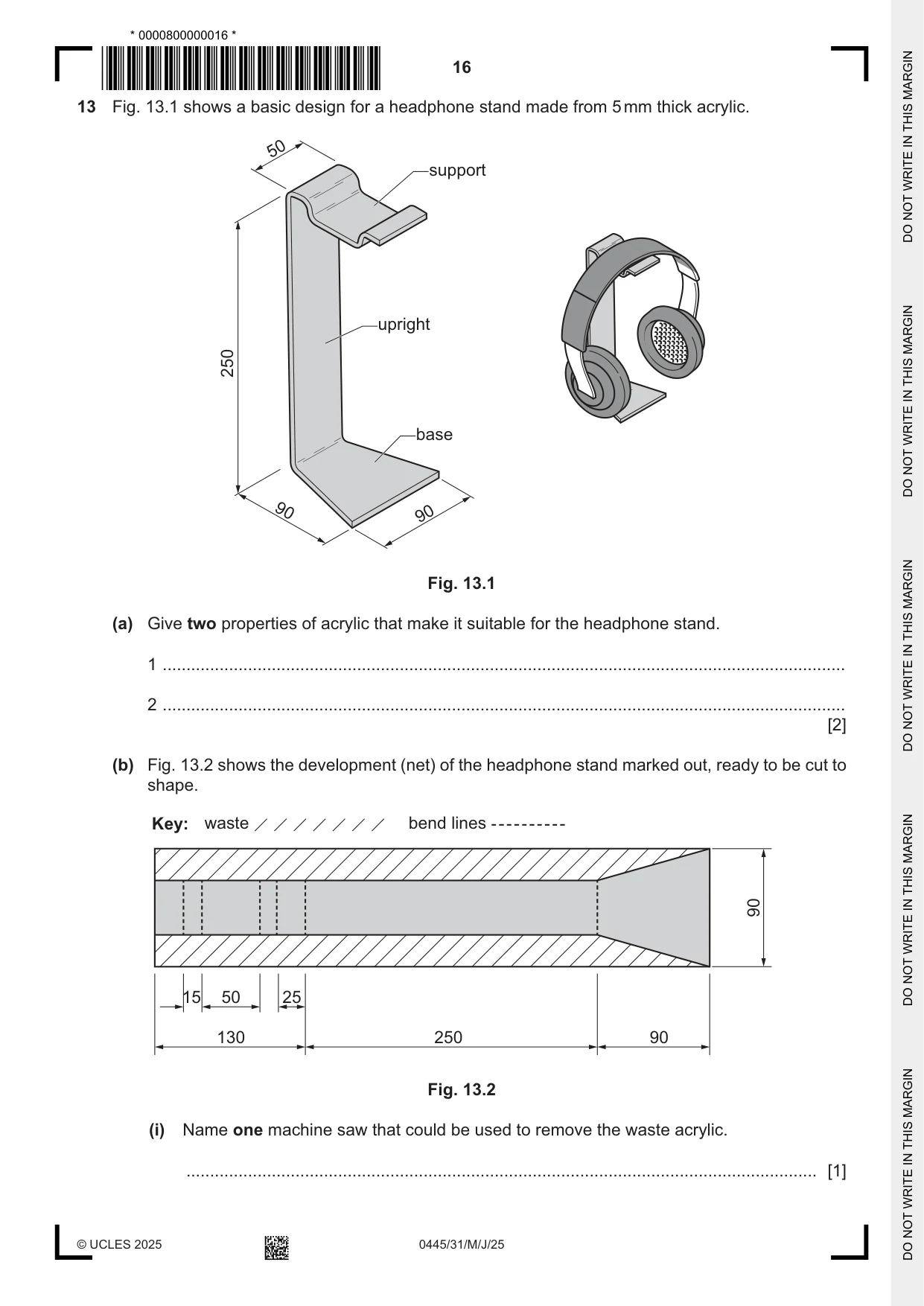
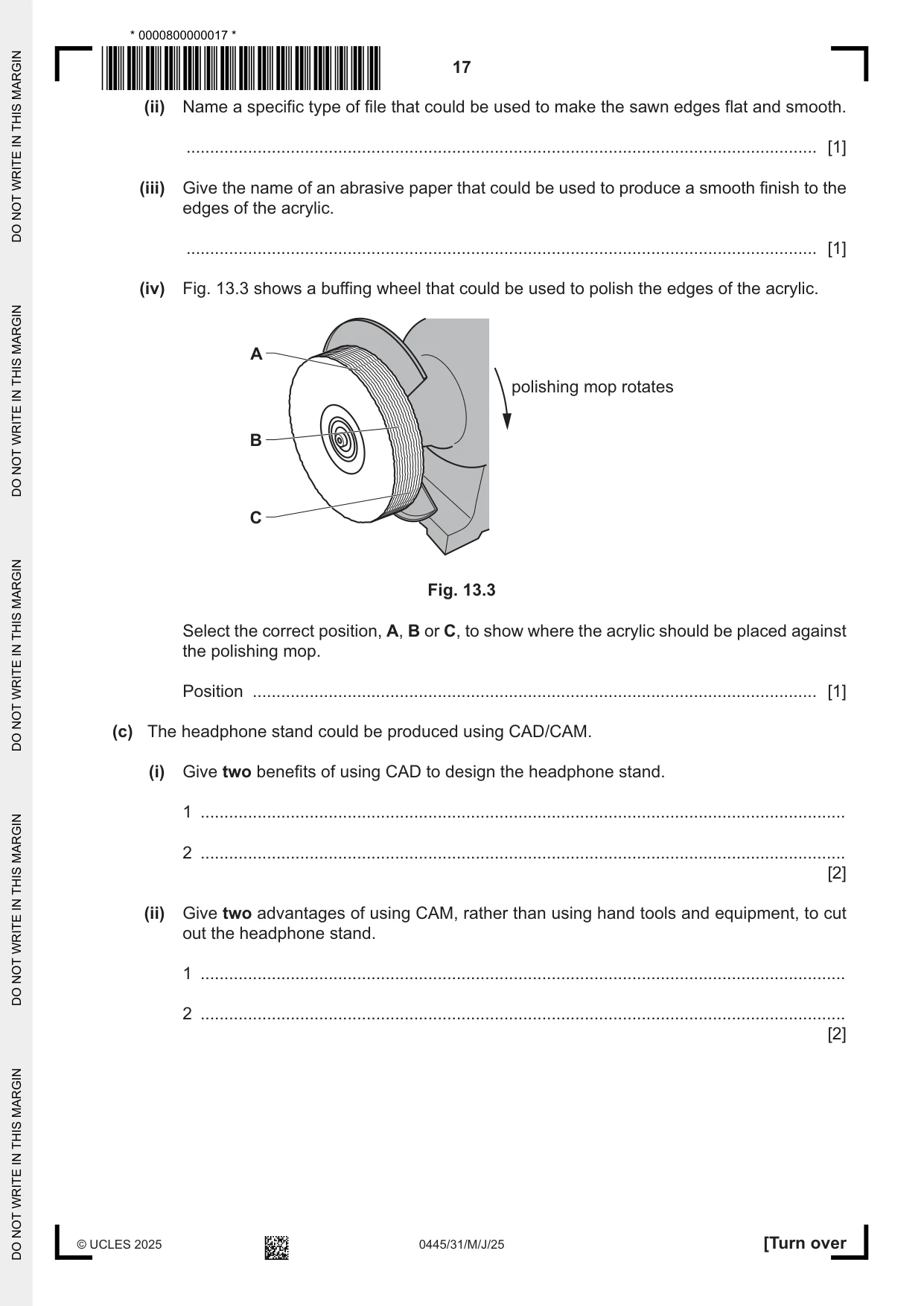
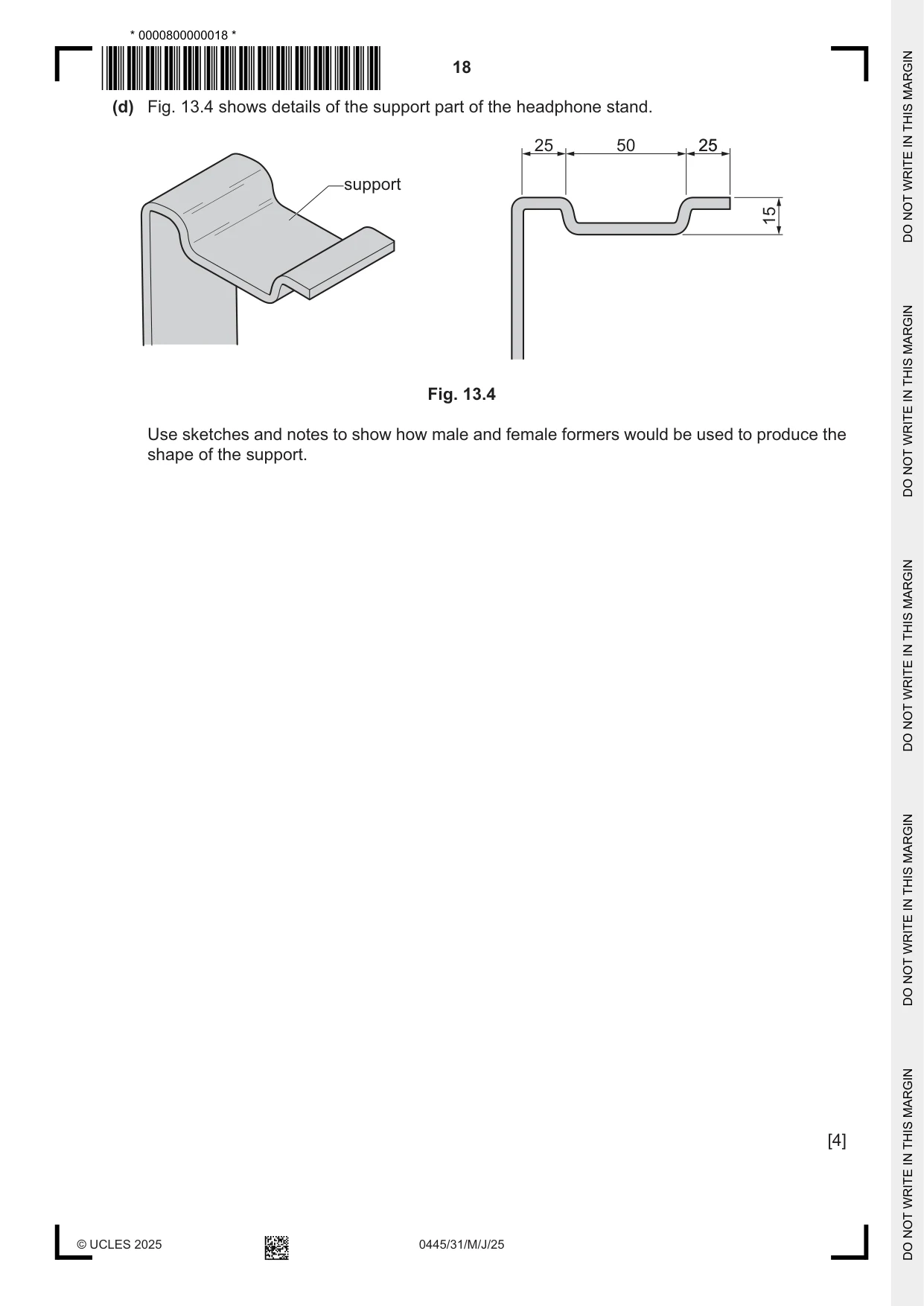
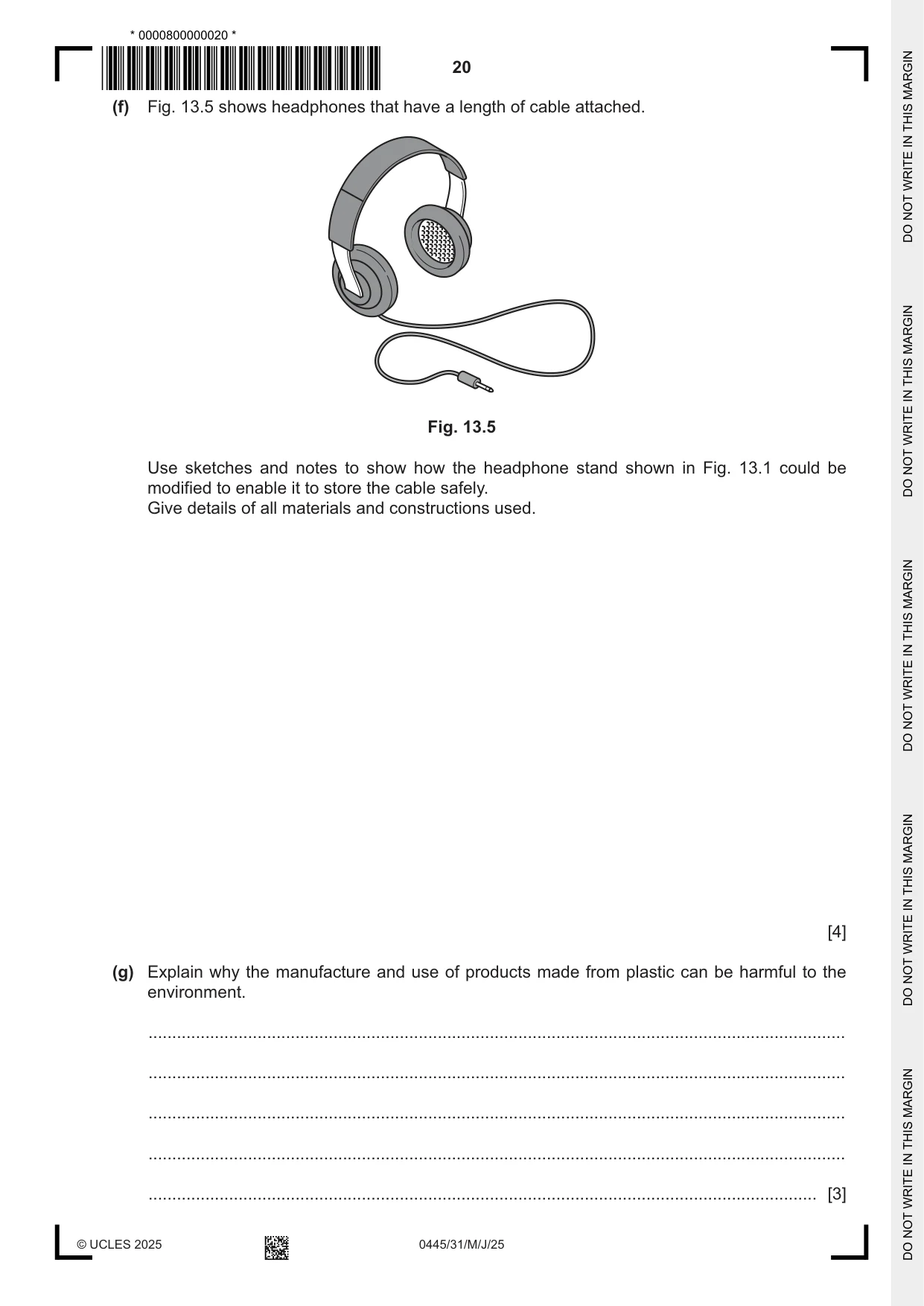
13 Fig. 13.1 shows a basic design for a headphone stand made from 5 mm thick acrylic. 50 support upright 250 base 90 90 Fig. 13.1 (a) Give two properties of acrylic that make it suitable for the headphone stand. 1 ................................................................................................................................................ 2 ................................................................................................................................................ [2] (b) Fig. 13.2 shows the development (net) of the headphone stand marked out, ready to be cut to shape. Key: waste bend lines 90 15 50 25 130 250 90 Fig. 13.2 (i) Name one machine saw that could be used to remove the waste acrylic. ..................................................................................................................................... [1] (ii) Name a specific type of file that could be used to make the sawn edges flat and smooth. ..................................................................................................................................... [1] (iii) Give the name of an abrasive paper that could be used to produce a smooth finish to the edges of the acrylic. ..................................................................................................................................... [1] (iv) Fig. 13.3 shows a buffing wheel that could be used to polish the edges of the acrylic. A polishing mop rotates B C Fig. 13.3 Select the correct position, A, B or C, to show where the acrylic should be placed against the polishing mop. Position ....................................................................................................................... [1] (c) The headphone stand could be produced using CAD/CAM. (i) Give two benefits of using CAD to design the headphone stand. 1 ........................................................................................................................................ 2 ........................................................................................................................................ [2] (ii) Give two advantages of using CAM, rather than using hand tools and equipment, to cut out the headphone stand. 1 ........................................................................................................................................ 2 ........................................................................................................................................ [2] (d) Fig. 13.4 shows details of the support part of the headphone stand. 25 50 2525 support 15 Fig. 13.4 Use sketches and notes to show how male and female formers would be used to produce the shape of the support. [4]
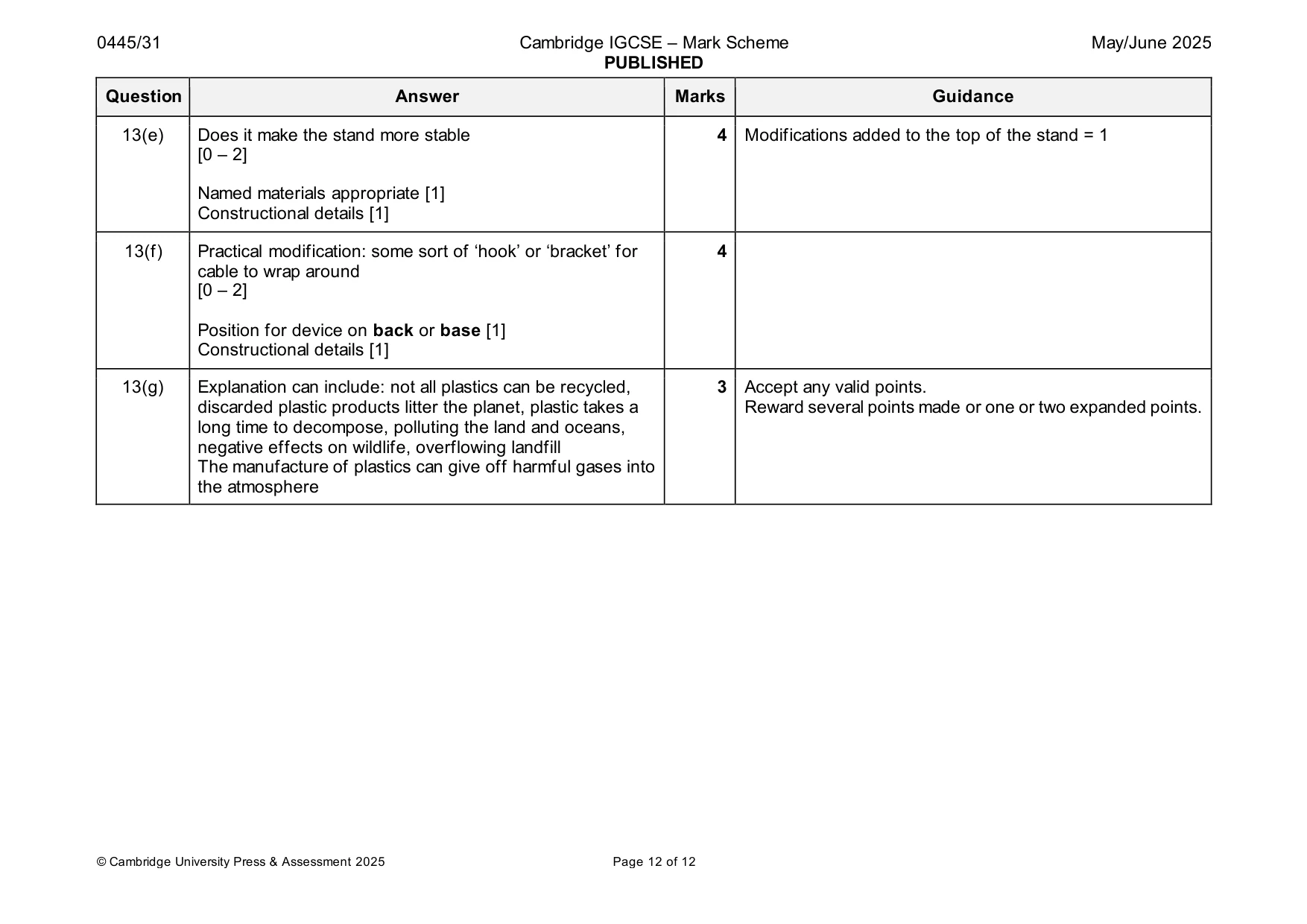
Mark scheme: 13(a) Properties include: attractive, variety of colours, self- 2 finishing, easily shaped, easy to work, easy to clean, lightweight to carry, durable [2 1] 13(b)(i) Hegner, band, scroll saw 1 Do not accept jig saw 13(b)(ii) Hand, flat or half round file 1 13(b)(iii) Wet and dry (silicon carbide paper) 1 13(b)(iv) Position C 1 13(c)(i) 2 benefits: ease and speed of editing, data can be 2 Accept any valid benefit transferred to a CNC machine, view from all angles, 3D views, accurate measurements, drawings can be sent electronically [2 1] 13(c)(ii) 2 advantages: speed, accuracy, repetitive accuracy, no 2 Accept any valid advantage edge finishing reqd. time efficient, less waste of materials [21] 13(d) Male former shown [1] 4 Female former shown [1] Acrylic heated in an oven [1] Acrylic clamped between formers [1] 13(e) Does it make the stand more stable 4 Modifications added to the top of the stand = 1 [0 – 2] Named materials appropriate [1] Constructional details [1] 13(f) Practical modification: some sort of ‘hook’ or ‘bracket’ for 4 cable to wrap around [0 – 2] Position for device on back or base [1] Constructional details [1] 13(g) Explanation can include: not all plastics can be recycled, 3 Accept any valid points. discarded plastic products litter the planet, plastic takes a Reward several points made or one or two expanded points. long time to decompose, polluting the land and oceans, negative effects on wildlife, overflowing landfill The manufacture of plastics can give off harmful gases into the atmosphere
What was in this paper
The subtopics covered by these 13 questions, and how many questions each got. Open one in a new tab to see every Cambridge question on it.
What you needed in this session
Cambridge’s own grade thresholds for 2025 May/June, Paper 3 · Variant 1. A higher threshold means an easier paper — the bar moves with how the cohort did.