Cambridge IGCSE Design and Technology 0445 — 2025 Oct/Nov Paper 3 · Variant 1
0445/31/O/N/25 · 13 questions · 50 marks · 60 min
The question paper and its mark scheme, free to read here and free to download. This is Cambridge’s own paper, exactly as it was sat.
Question paper24 pages
Mark scheme11 pages
Answers below. Sit the paper first if you are practising.
Questions as text
Q1 · Two methods of seasoning wood
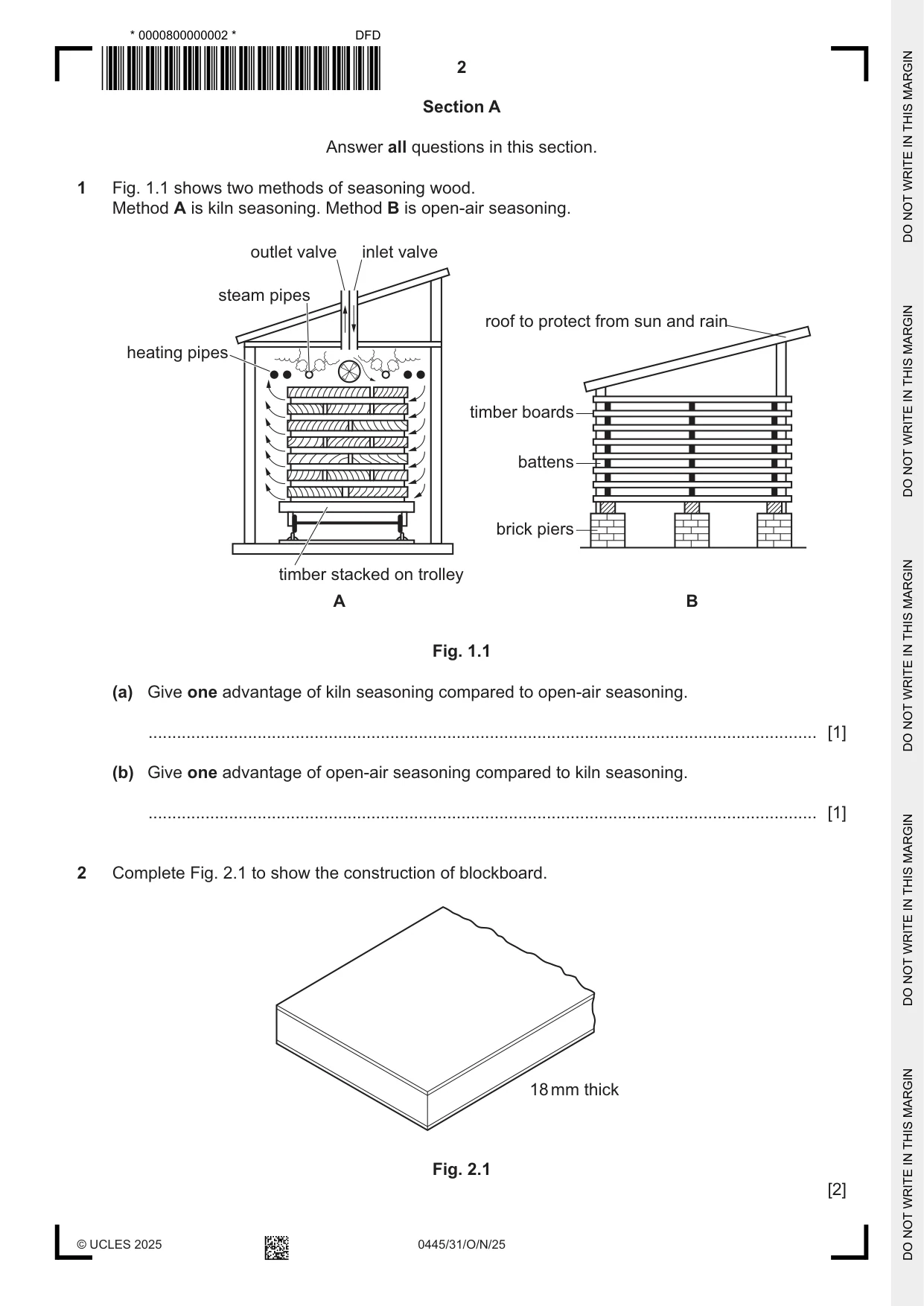
1 Fig. 1.1 shows two methods of seasoning wood. Method A is kiln seasoning. Method B is open-air seasoning. outlet valve inlet valve steam pipes roof to protect from sun and rain heating pipes timber boards battens brick piers timber stacked on trolley A B Fig. 1.1 (a) Give one advantage of kiln seasoning compared to open-air seasoning. ............................................................................................................................................. [1] (b) Give one advantage of open-air seasoning compared to kiln seasoning. ............................................................................................................................................. [1]
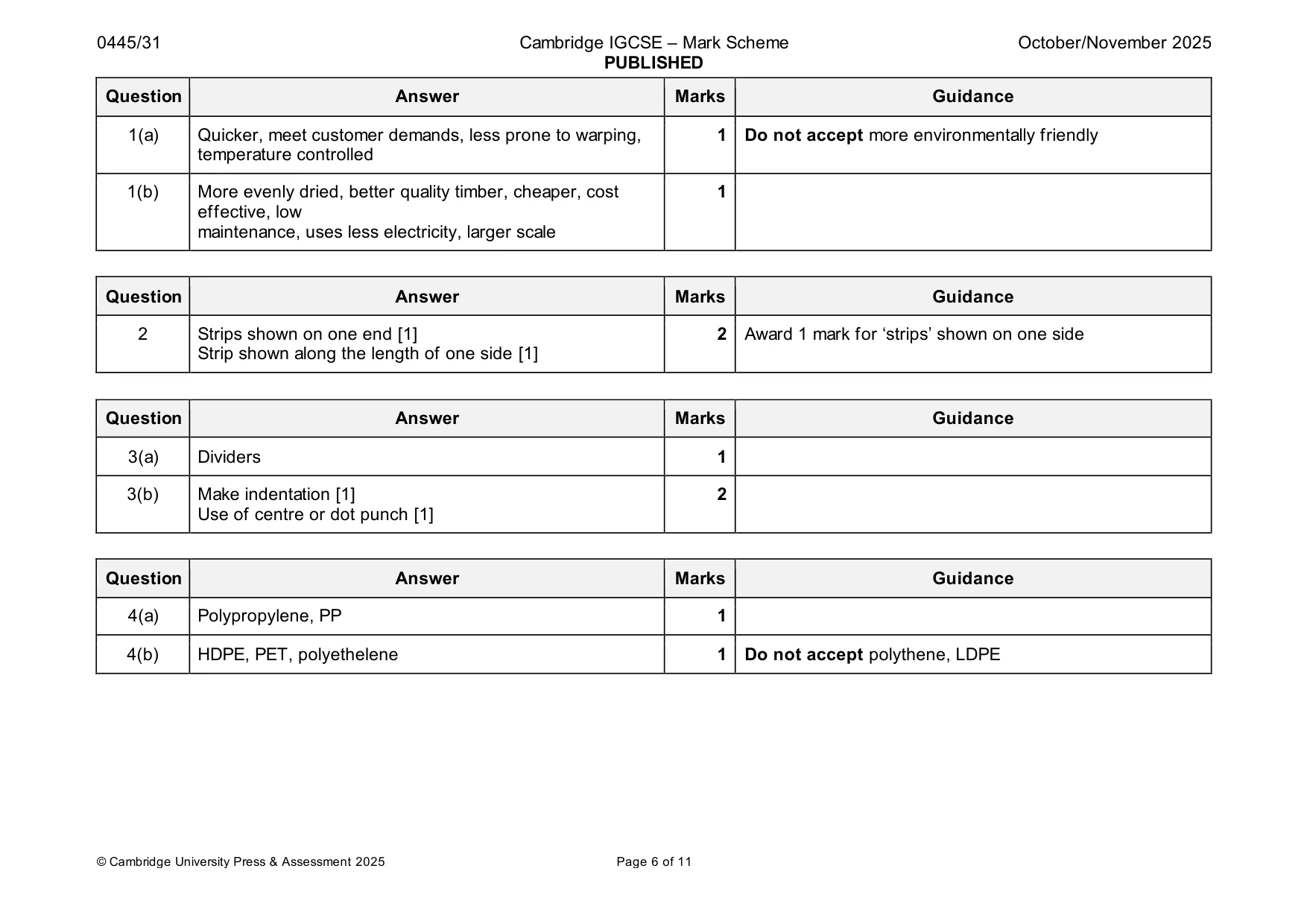
Mark scheme: Question Answer Marks Guidance 1(a) Quicker, meet customer demands, less prone to warping, 1 Do not accept more environmentally friendly temperature controlled 1(b) More evenly dried, better quality timber, cheaper, cost 1 effective, low maintenance, uses less electricity, larger scale
Question 2
2 Complete Fig. 2.1 to show the construction of blockboard. 18 mm thick Fig. 2.1 [2]
Mark scheme: 2 Strips shown on one end [1] 2 Award 1 mark for ‘strips’ shown on one side Strip shown along the length of one side [1]
Q3 · A tool used to mark a circle on metal surfaces
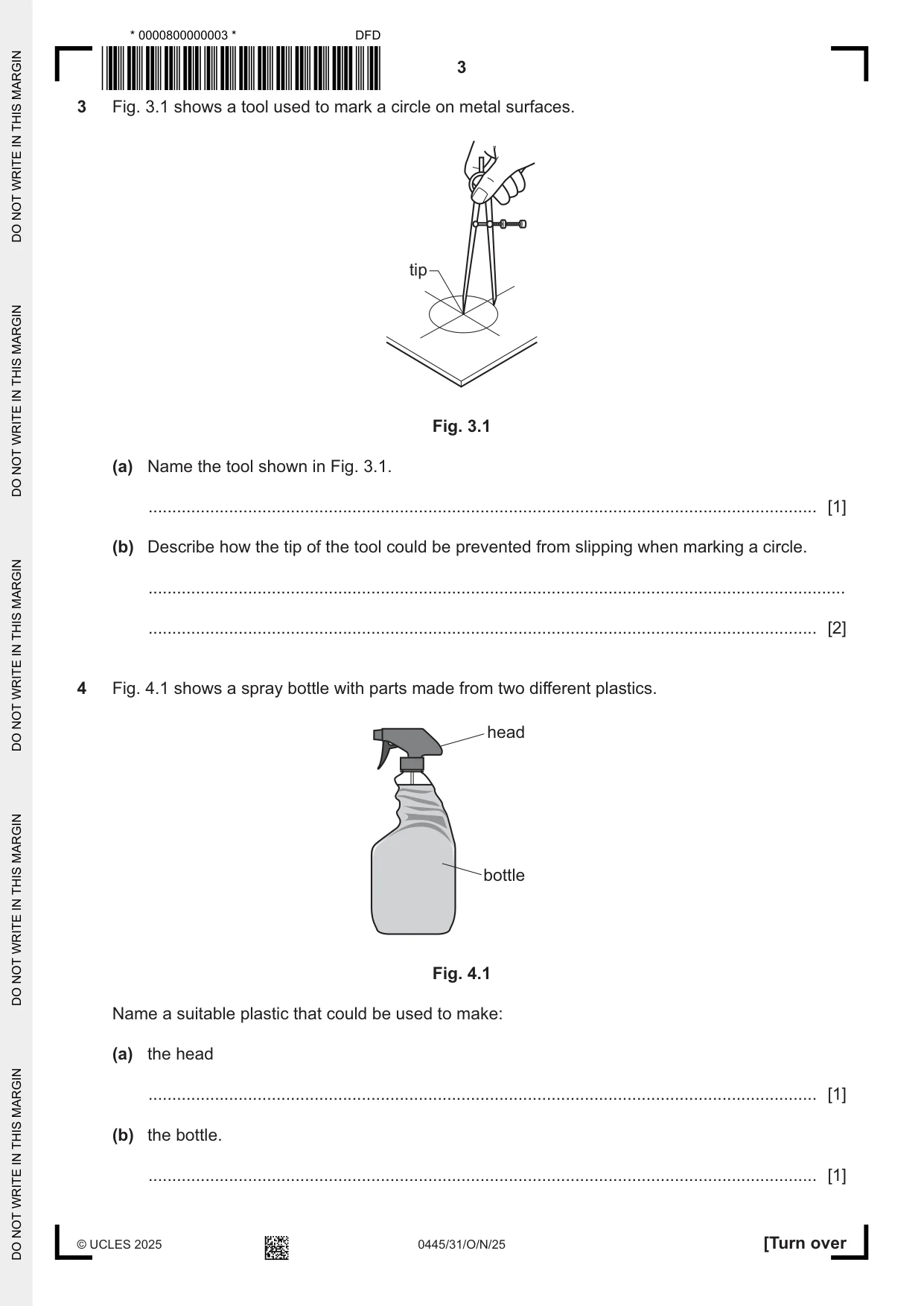
3 Fig. 3.1 shows a tool used to mark a circle on metal surfaces. tip Fig. 3.1 (a) Name the tool shown in Fig. 3.1. ............................................................................................................................................. [1] (b) Describe how the tip of the tool could be prevented from slipping when marking a circle. ................................................................................................................................................... ............................................................................................................................................. [2]
Mark scheme: 3(a) Dividers 1 3(b) Make indentation [1] 2 Use of centre or dot punch [1]
Q4 · A spray bottle with parts made from two different plastics
4 Fig. 4.1 shows a spray bottle with parts made from two different plastics. head bottle Fig. 4.1 Name a suitable plastic that could be used to make: (a) the head ............................................................................................................................................. [1] (b) the bottle. ............................................................................................................................................. [1]
Mark scheme: 4(a) Polypropylene, PP 1 4(b) HDPE, PET, polyethelene 1 Do not accept polythene, LDPE
Q5 · A hardwood block with line A marked across the grain and lines B marked along the grain
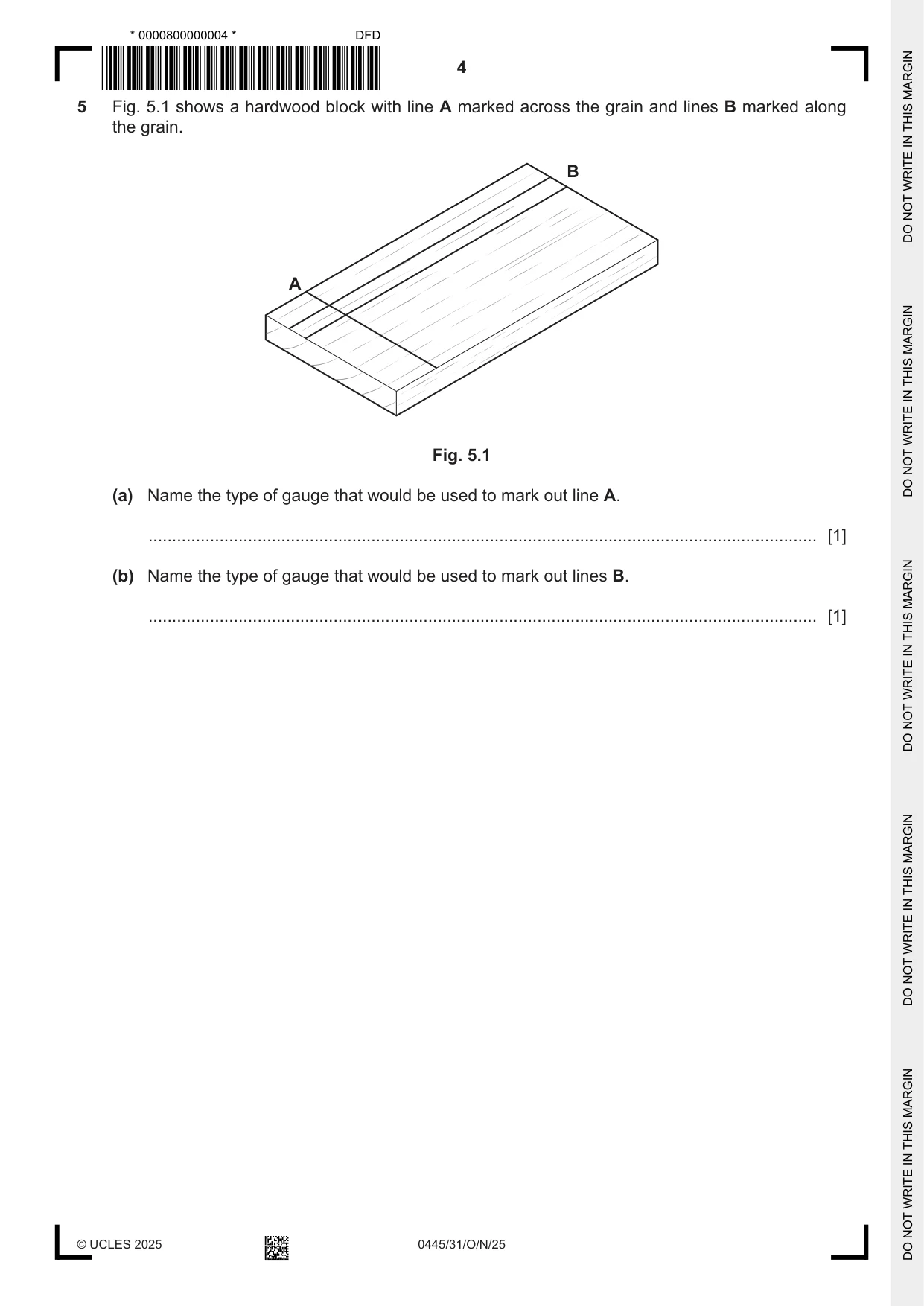
5 Fig. 5.1 shows a hardwood block with line A marked across the grain and lines B marked along the grain. B A Fig. 5.1 (a) Name the type of gauge that would be used to mark out line A. ............................................................................................................................................. [1] (b) Name the type of gauge that would be used to mark out lines B. ............................................................................................................................................. [1]
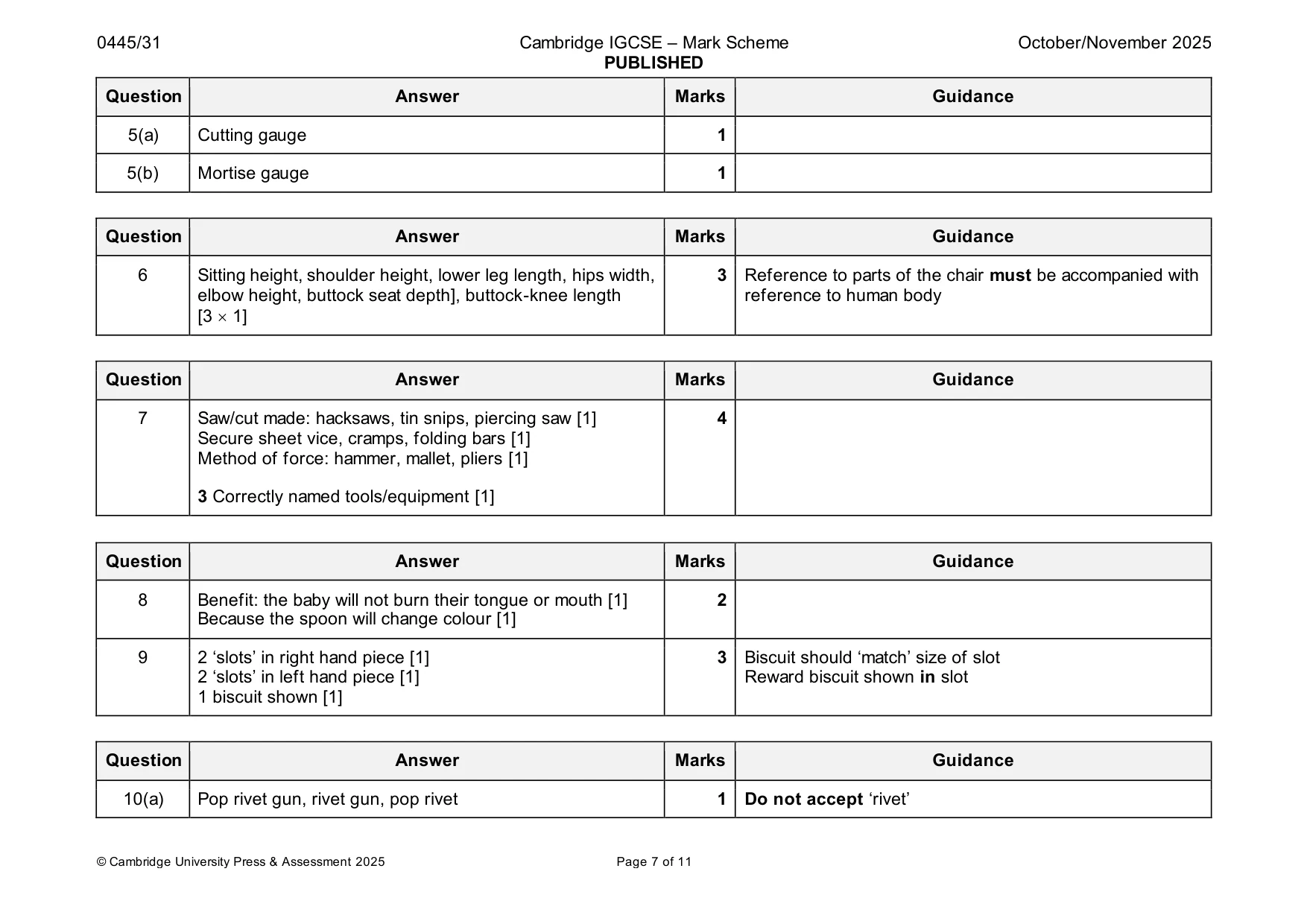
Mark scheme: 5(a) Cutting gauge 1 5(b) Mortise gauge 1
Question 6
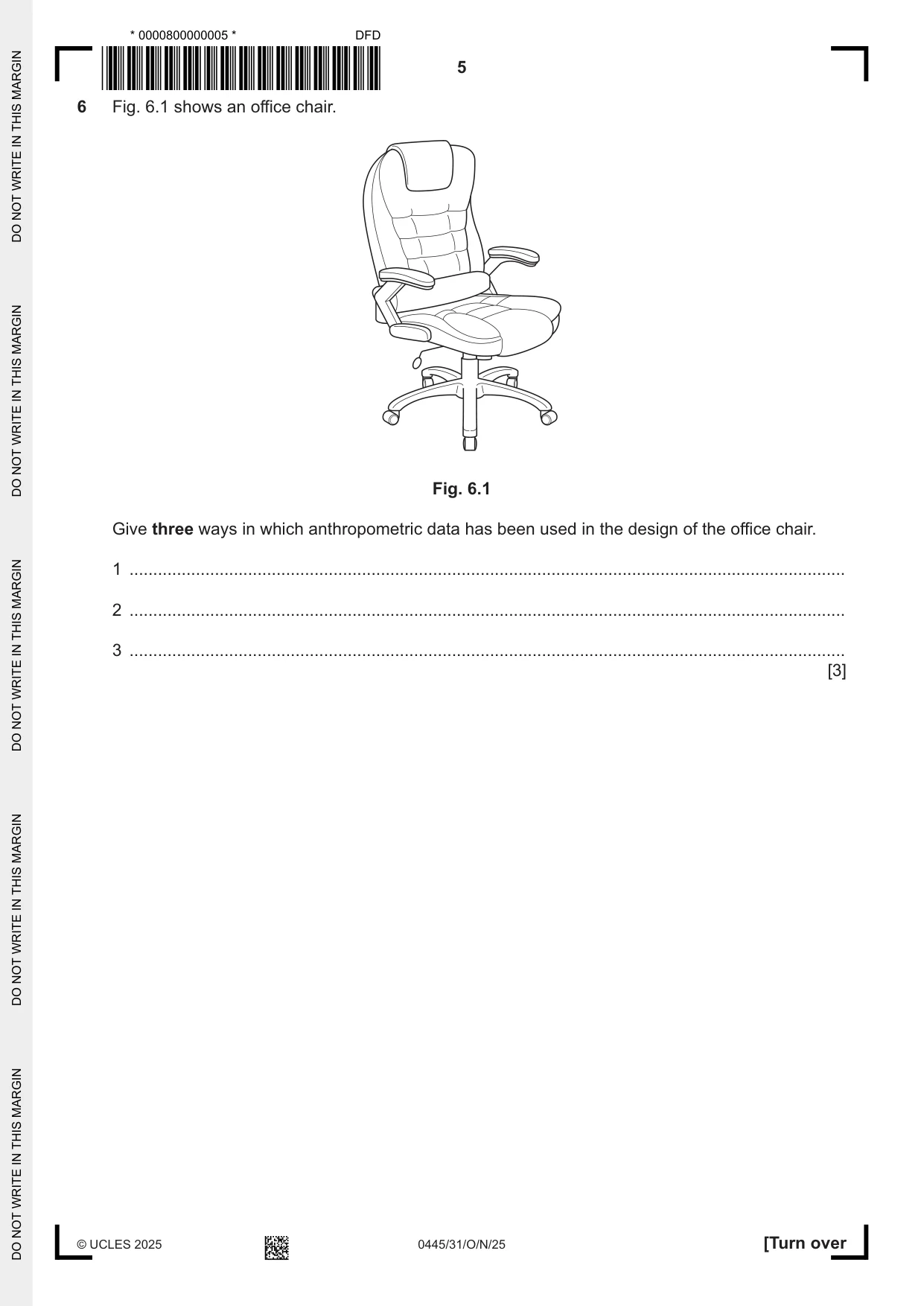
6 Fig. 6.1 shows an office chair. Fig. 6.1 Give three ways in which anthropometric data has been used in the design of the office chair. 1 ....................................................................................................................................................... 2 ....................................................................................................................................................... 3 ....................................................................................................................................................... [3]
Mark scheme: 6 Sitting height, shoulder height, lower leg length, hips width, 3 Reference to parts of the chair must be accompanied with elbow height, buttock seat depth], buttock-knee length reference to human body [3 1]
Q7 · A table number made from 1.5 mm thick aluminium sheet, for use in a local café
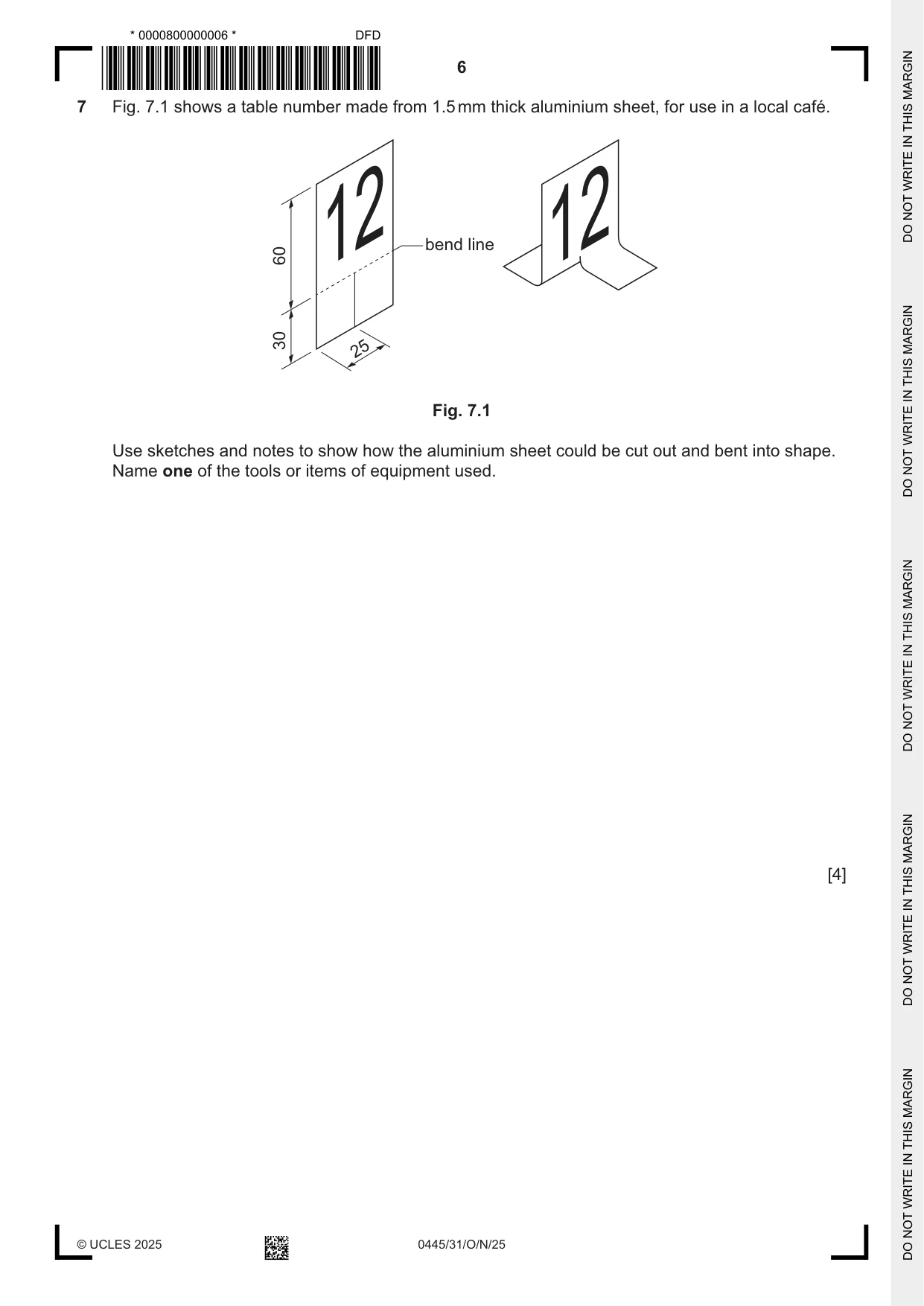
7 Fig. 7.1 shows a table number made from 1.5 mm thick aluminium sheet, for use in a local café. bend line 60 12 12 30 25 Fig. 7.1 Use sketches and notes to show how the aluminium sheet could be cut out and bent into shape. Name one of the tools or items of equipment used. [4]
Mark scheme: 7 Saw/cut made: hacksaws, tin snips, piercing saw [1] 4 Secure sheet vice, cramps, folding bars [1] Method of force: hammer, mallet, pliers [1] 3 Correctly named tools/equipment [1]
Q8 · A baby’s feeding spoon
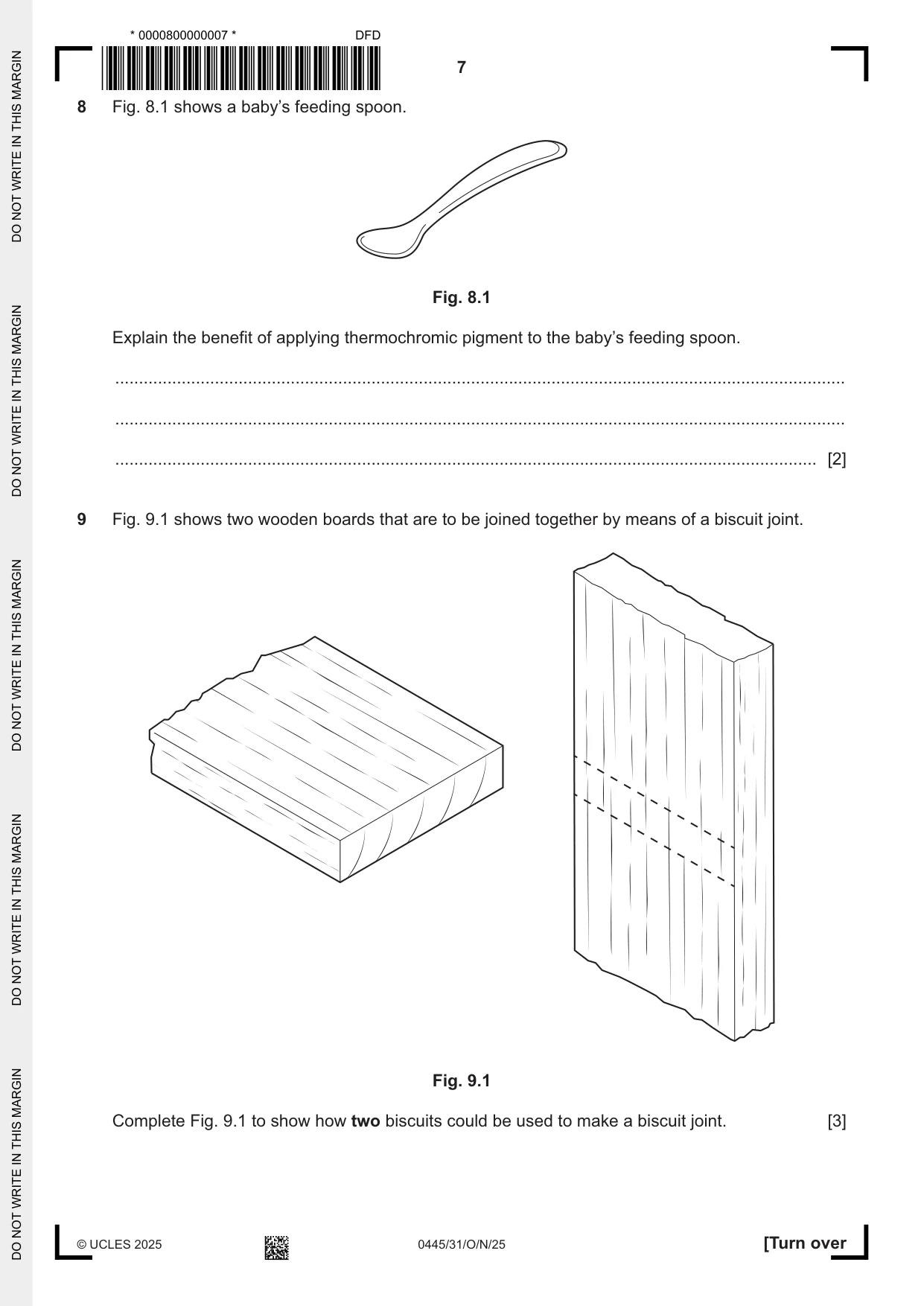
8 Fig. 8.1 shows a baby’s feeding spoon. Fig. 8.1 Explain the benefit of applying thermochromic pigment to the baby’s feeding spoon. .......................................................................................................................................................... .......................................................................................................................................................... .................................................................................................................................................... [2]
Mark scheme: 8 Benefit: the baby will not burn their tongue or mouth [1] 2 Because the spoon will change colour [1]
Q9 · Two wooden boards that are to be joined together by means of a biscuit joint
9 Fig. 9.1 shows two wooden boards that are to be joined together by means of a biscuit joint. Fig. 9.1 Complete Fig. 9.1 to show how two biscuits could be used to make a biscuit joint. [3]
Mark scheme: 9 2 ‘slots’ in right hand piece [1] 3 Biscuit should ‘match’ size of slot 2 ‘slots’ in left hand piece [1] Reward biscuit shown in slot 1 biscuit shown [1]
Q10 · An item of equipment that can be used to join pieces of metal permanently
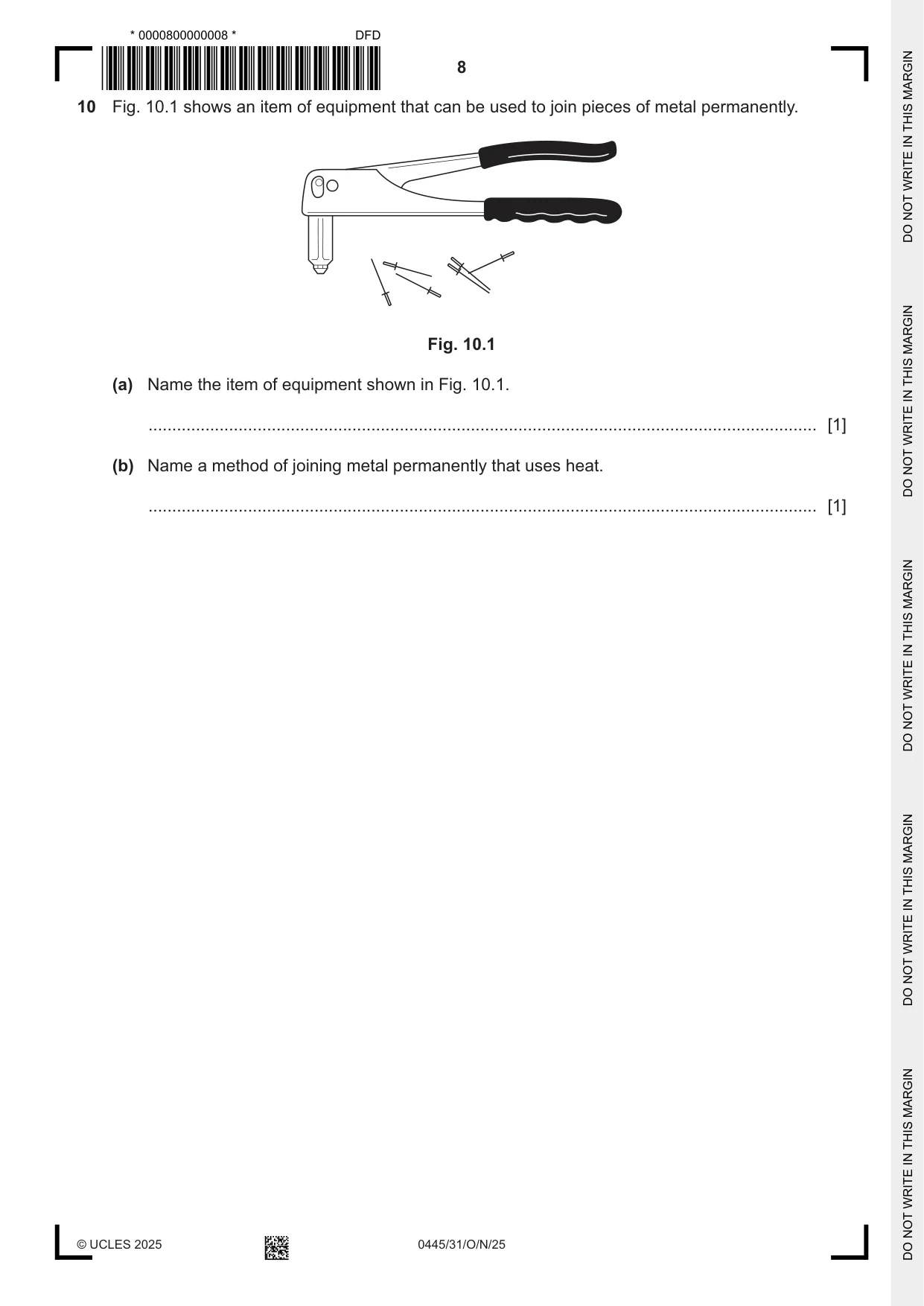
10 Fig. 10.1 shows an item of equipment that can be used to join pieces of metal permanently. Fig. 10.1 (a) Name the item of equipment shown in Fig. 10.1. ............................................................................................................................................. [1] (b) Name a method of joining metal permanently that uses heat. ............................................................................................................................................. [1]
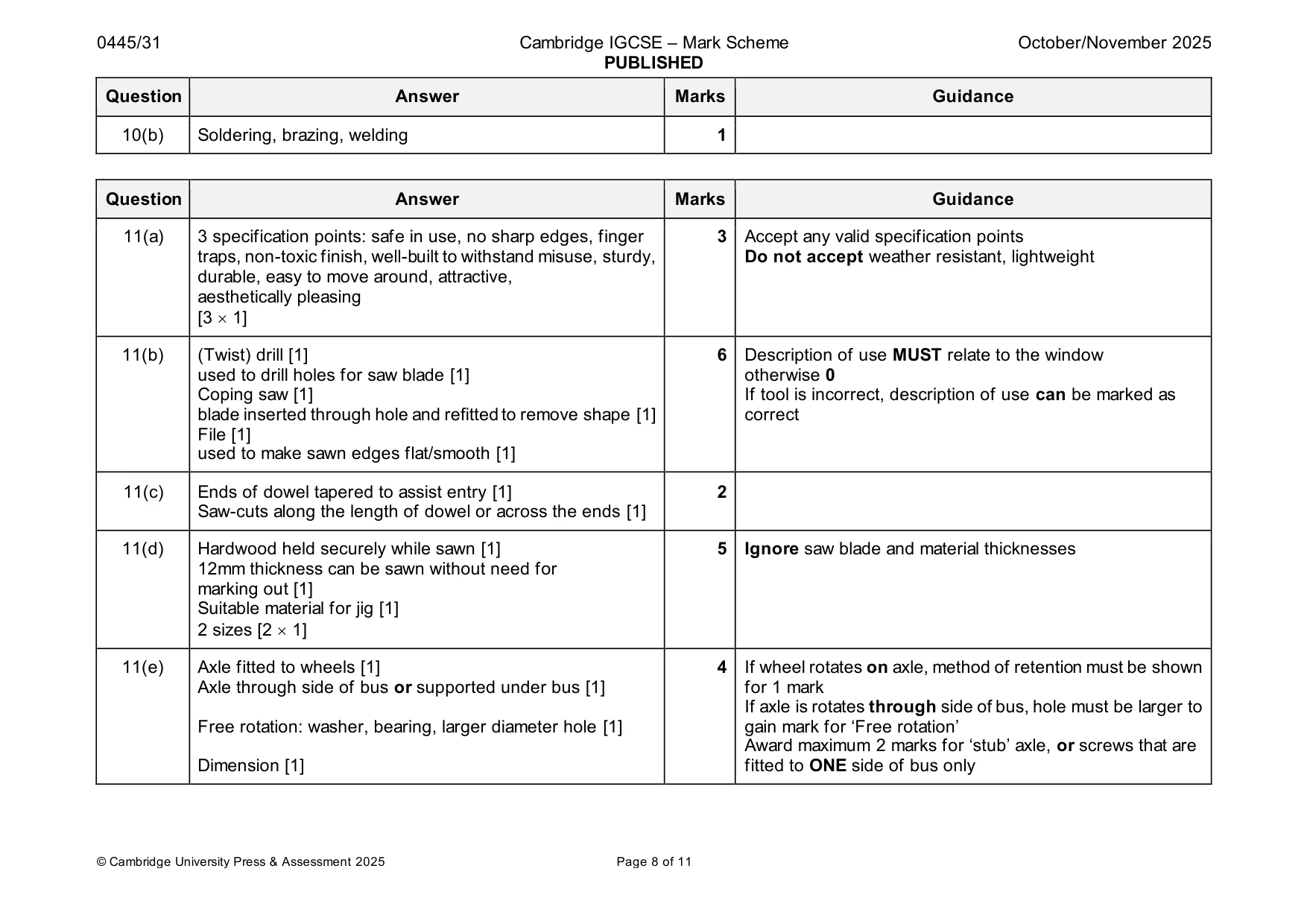
Mark scheme: 10(a) Pop rivet gun, rivet gun, pop rivet 1 Do not accept ‘rivet’ 10(b) Soldering, brazing, welding 1
Q11 · A child’s toy bus made mainly from 12 mm thick plywood
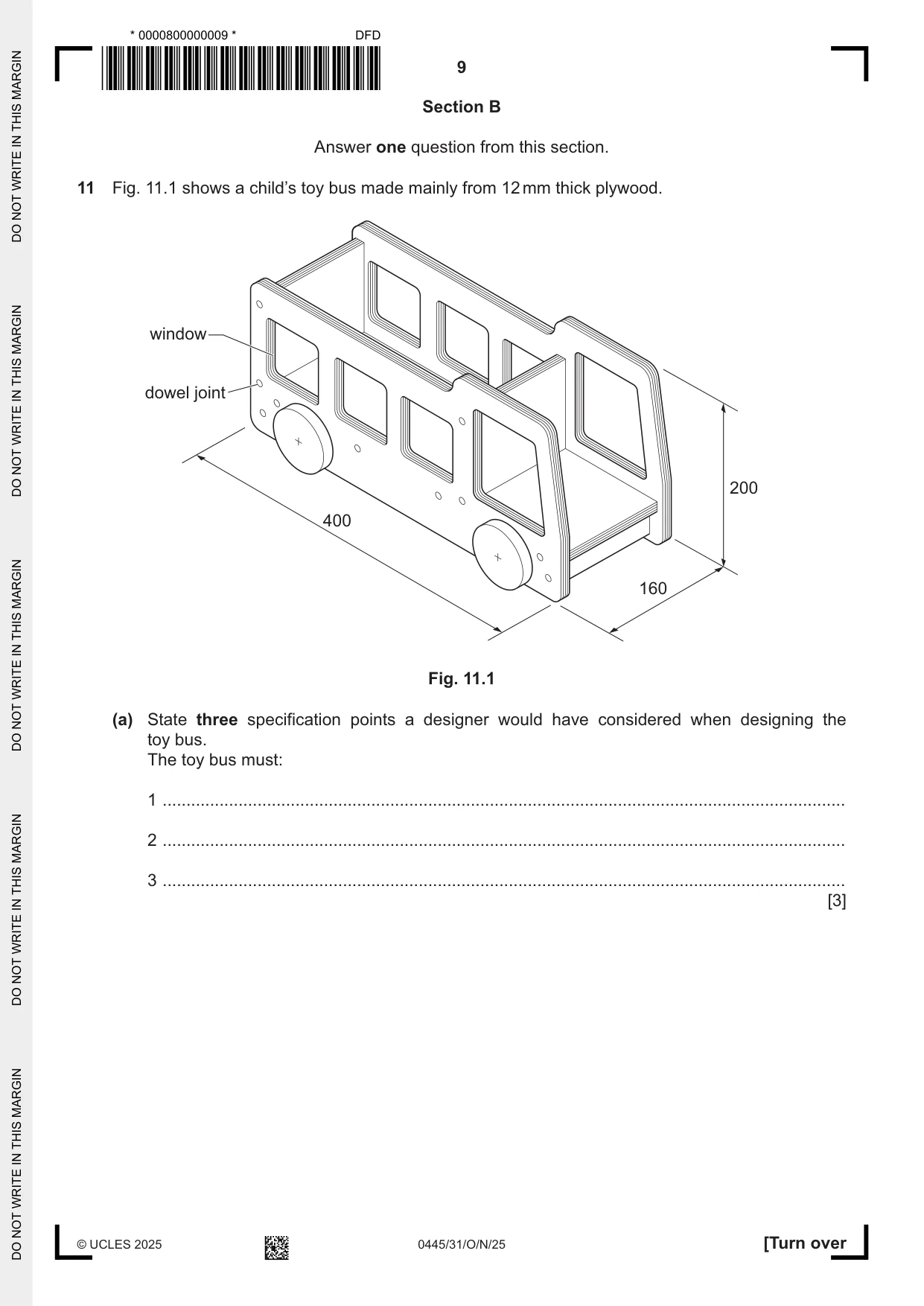
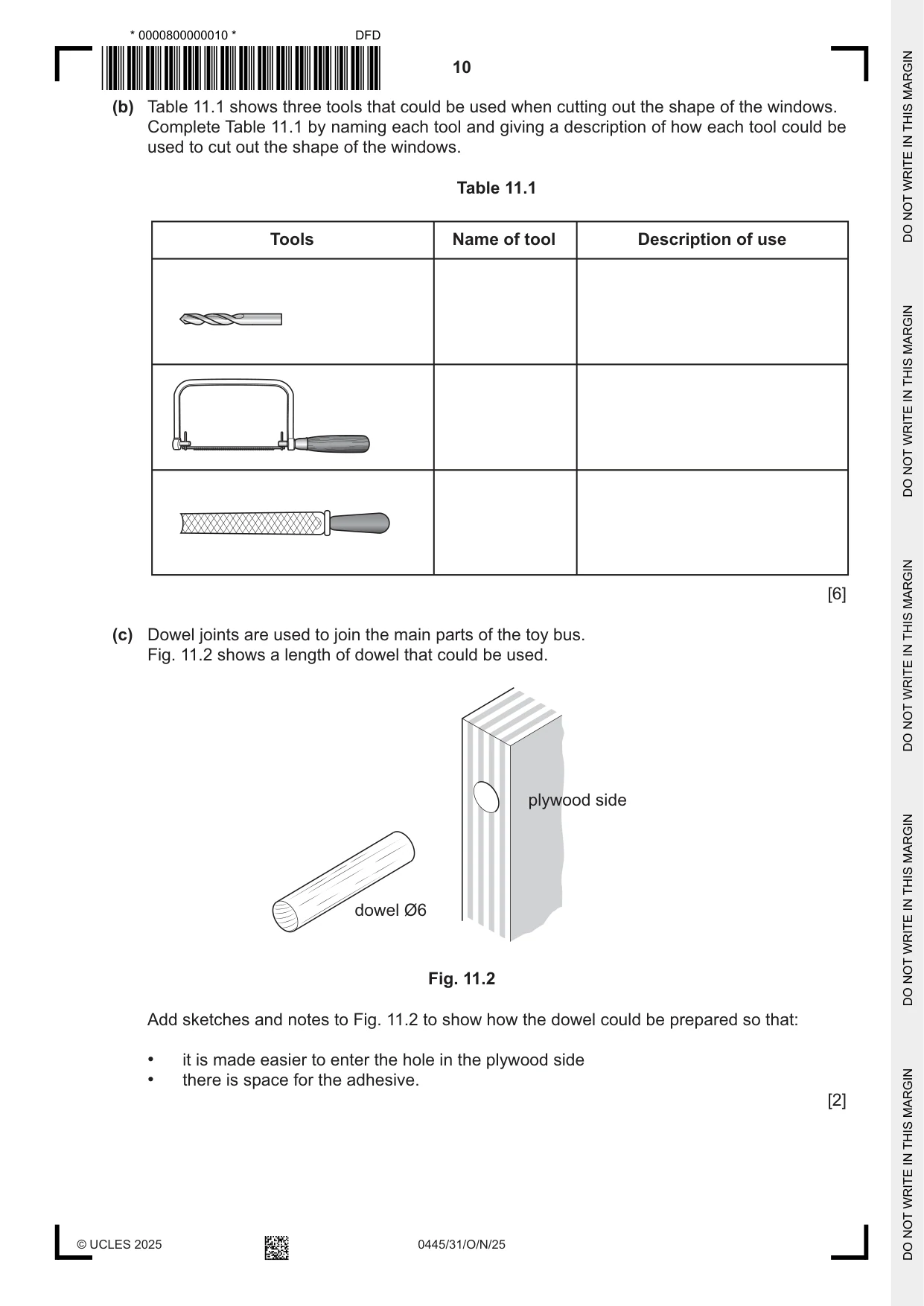
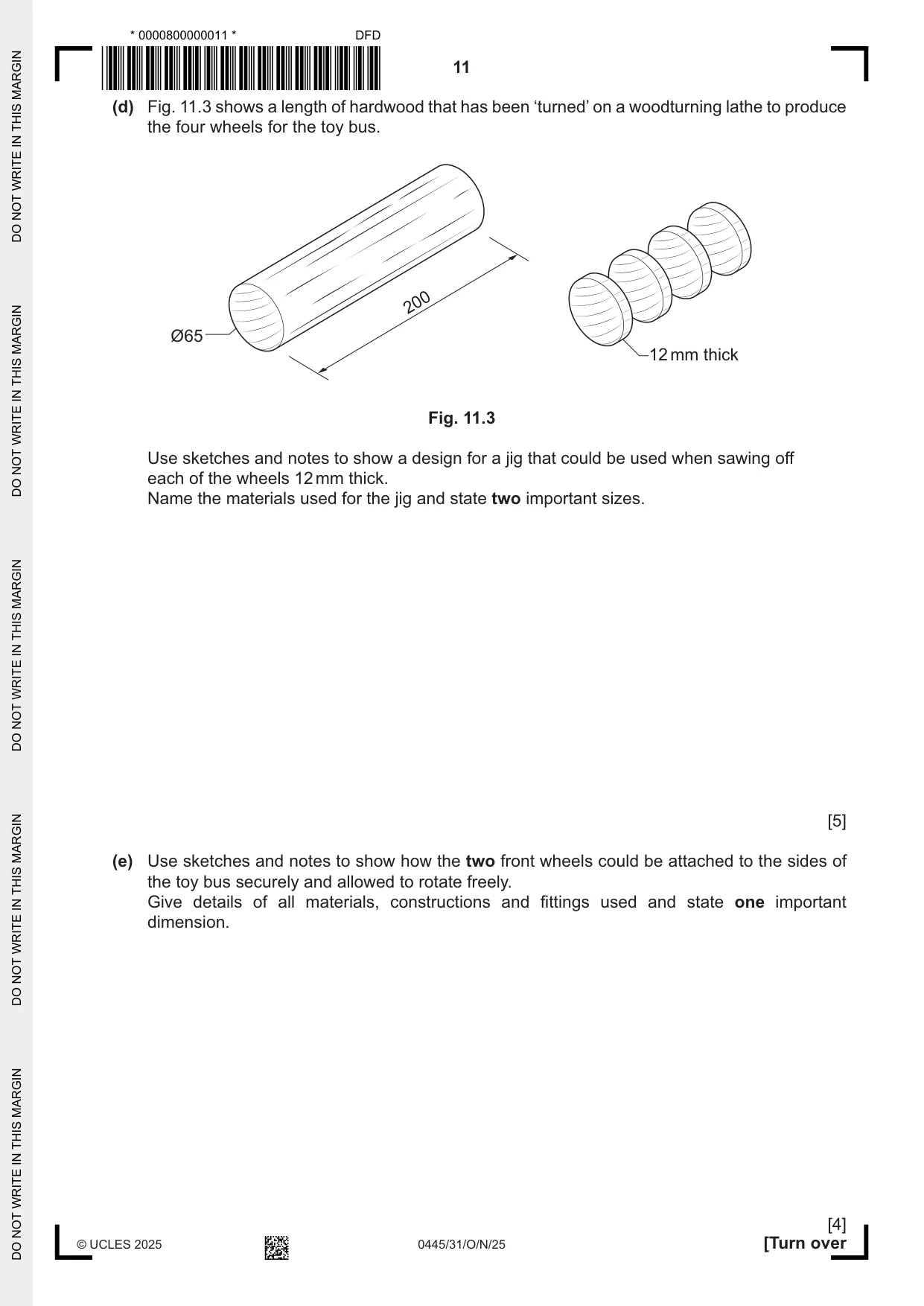
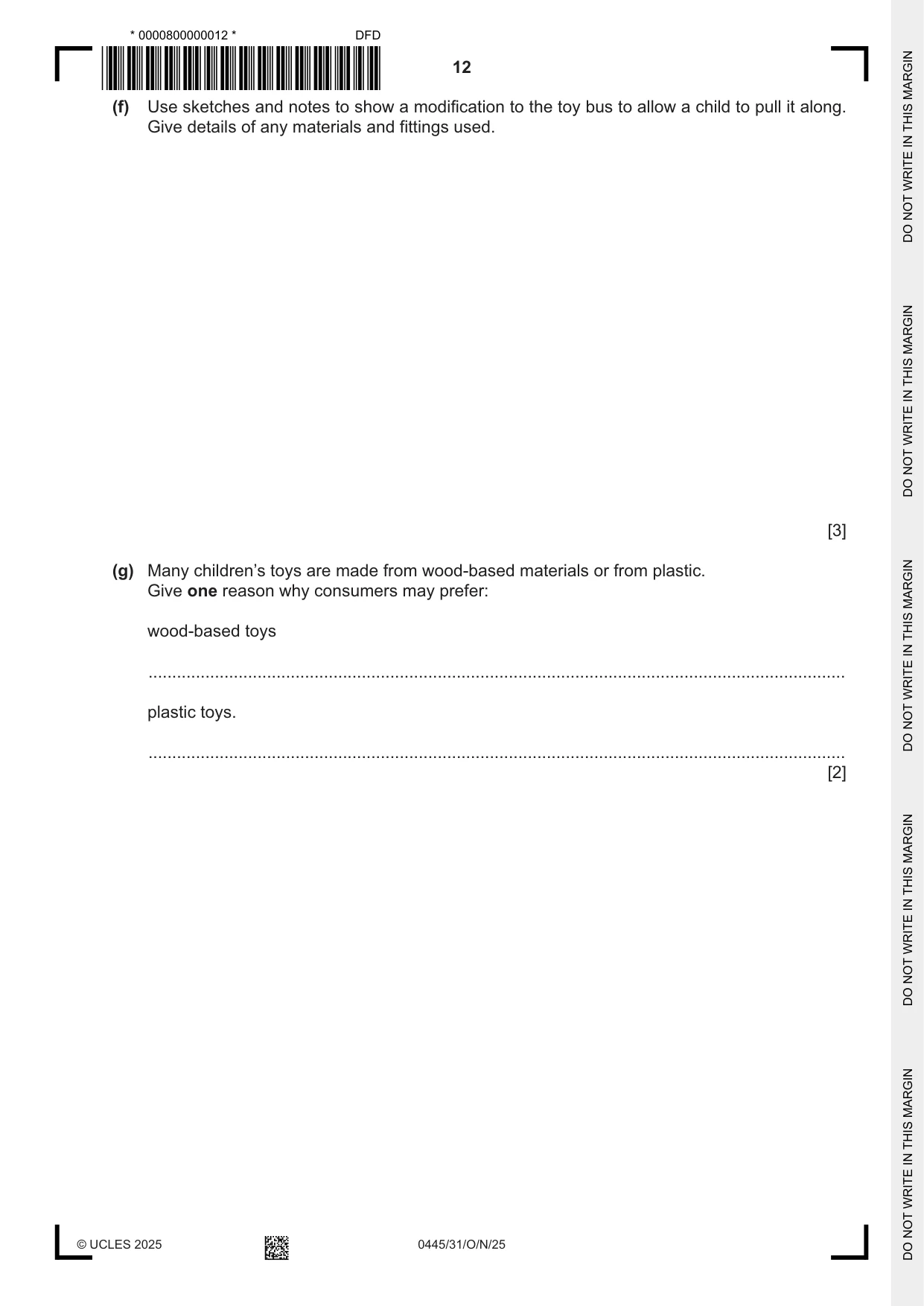
11 Fig. 11.1 shows a child’s toy bus made mainly from 12 mm thick plywood. window dowel joint 200 400 160 Fig. 11.1 (a) State three specification points a designer would have considered when designing the toy bus. The toy bus must: 1 ................................................................................................................................................ 2 ................................................................................................................................................ 3 ................................................................................................................................................ [3] (b) Table 11.1 shows three tools that could be used when cutting out the shape of the windows. Complete Table 11.1 by naming each tool and giving a description of how each tool could be used to cut out the shape of the windows. Table 11.1 Tools Name of tool Description of use [6] (c) Dowel joints are used to join the main parts of the toy bus. Fig. 11.2 shows a length of dowel that could be used. plywood side dowel Ø6 Fig. 11.2 Add sketches and notes to Fig. 11.2 to show how the dowel could be prepared so that: • it is made easier to enter the hole in the plywood side • there is space for the adhesive. [2] (d) Fig. 11.3 shows a length of hardwood that has been ‘turned’ on a woodturning lathe to produce the four wheels for the toy bus. 200 Ø65 12 mm thick Fig. 11.3 Use sketches and notes to show a design for a jig that could be used when sawing off each of the wheels 12 mm thick. Name the materials used for the jig and state two important sizes. [5] (e) Use sketches and notes to show how the two front wheels could be attached to the sides of the toy bus securely and allowed to rotate freely. Give details of all materials, constructions and fittings used and state one important dimension. [4] (f) Use sketches and notes to show a modification to the toy bus to allow a child to pull it along. Give details of any materials and fittings used. [3] (g) Many children’s toys are made from wood-based materials or from plastic. Give one reason why consumers may prefer: wood-based toys ................................................................................................................................................... plastic toys. ................................................................................................................................................... [2]
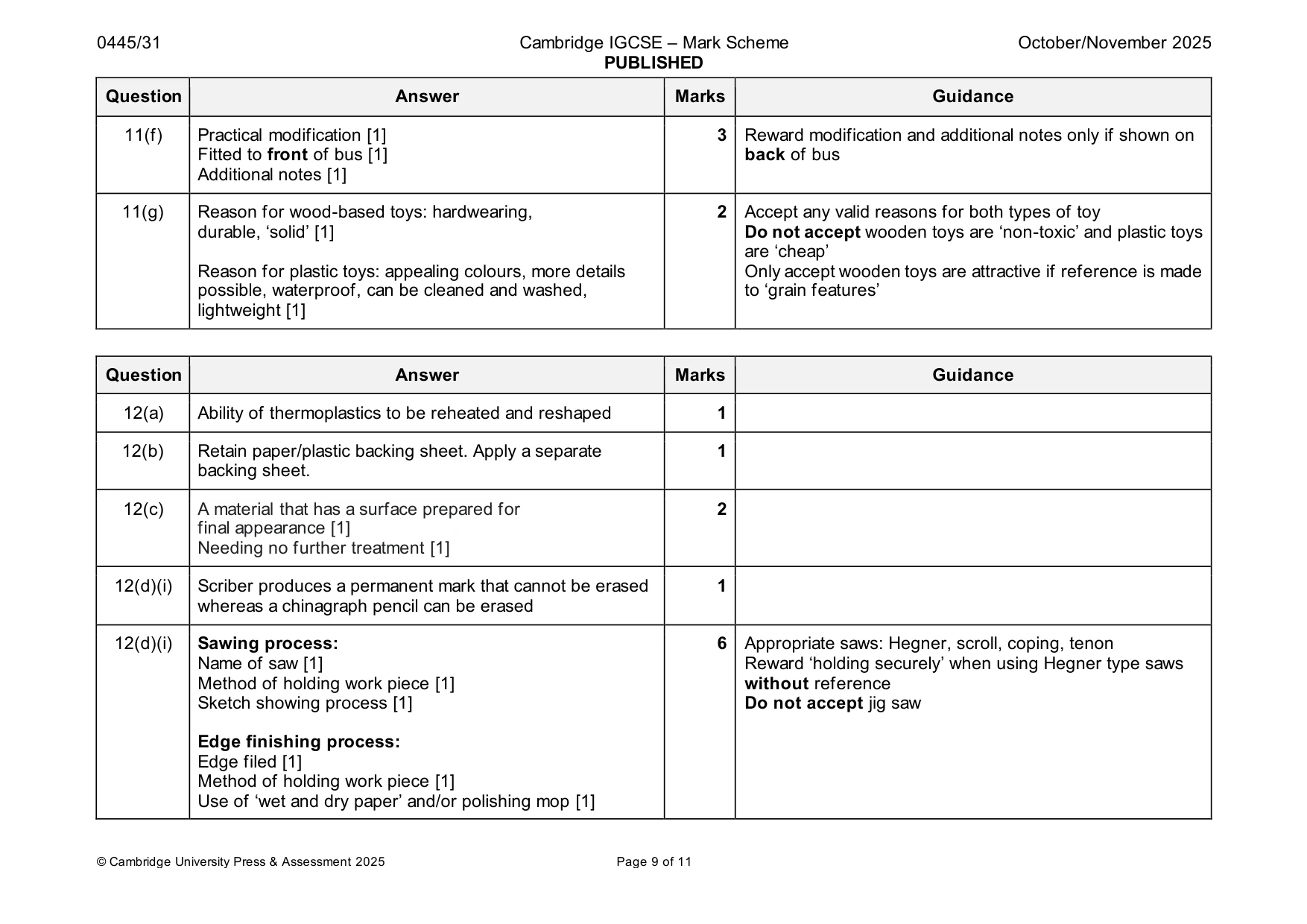
Mark scheme: 11(a) 3 specification points: safe in use, no sharp edges, finger 3 Accept any valid specification points traps, non-toxic finish, well-built to withstand misuse, sturdy, Do not accept weather resistant, lightweight durable, easy to move around, attractive, aesthetically pleasing [3 1] 11(b) (Twist) drill [1] 6 Description of use MUST relate to the window used to drill holes for saw blade [1] otherwise 0 Coping saw [1] If tool is incorrect, description of use can be marked as blade inserted through hole and refitted to remove shape [1] correct File [1] used to make sawn edges flat/smooth [1] 11(c) Ends of dowel tapered to assist entry [1] 2 Saw-cuts along the length of dowel or across the ends [1] 11(d) Hardwood held securely while sawn [1] 5 Ignore saw blade and material thicknesses 12mm thickness can be sawn without need for marking out [1] Suitable material for jig [1] 2 sizes [2 1] 11(e) Axle fitted to wheels [1] 4 If wheel rotates on axle, method of retention must be shown Axle through side of bus or supported under bus [1] for 1 mark If axle is rotates through side of bus, hole must be larger to Free rotation: washer, bearing, larger diameter hole [1] gain mark for ‘Free rotation’ Award maximum 2 marks for ‘stub’ axle, or screws that are Dimension [1] fitted to ONE side of bus only 11(f) Practical modification [1] 3 Reward modification and additional notes only if shown on Fitted to front of bus [1] back of bus Additional notes [1] 11(g) Reason for wood-based toys: hardwearing, 2 Accept any valid reasons for both types of toy durable, ‘solid’ [1] Do not accept wooden toys are ‘non-toxic’ and plastic toys are ‘cheap’ Reason for plastic toys: appealing colours, more details Only accept wooden toys are attractive if reference is made possible, waterproof, can be cleaned and washed, to ‘grain features’ lightweight [1]
Q12 · A stand used to display a model yacht
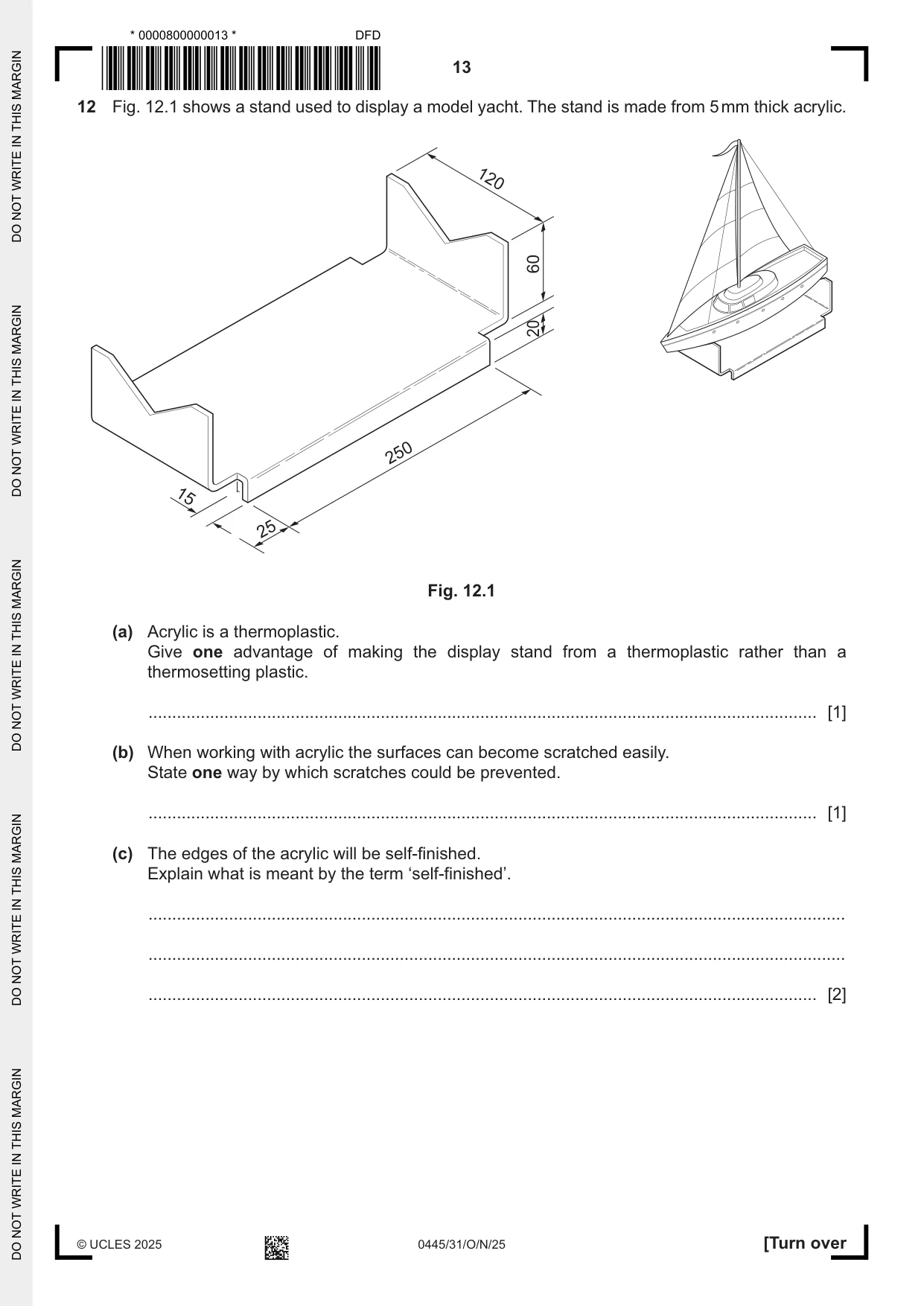
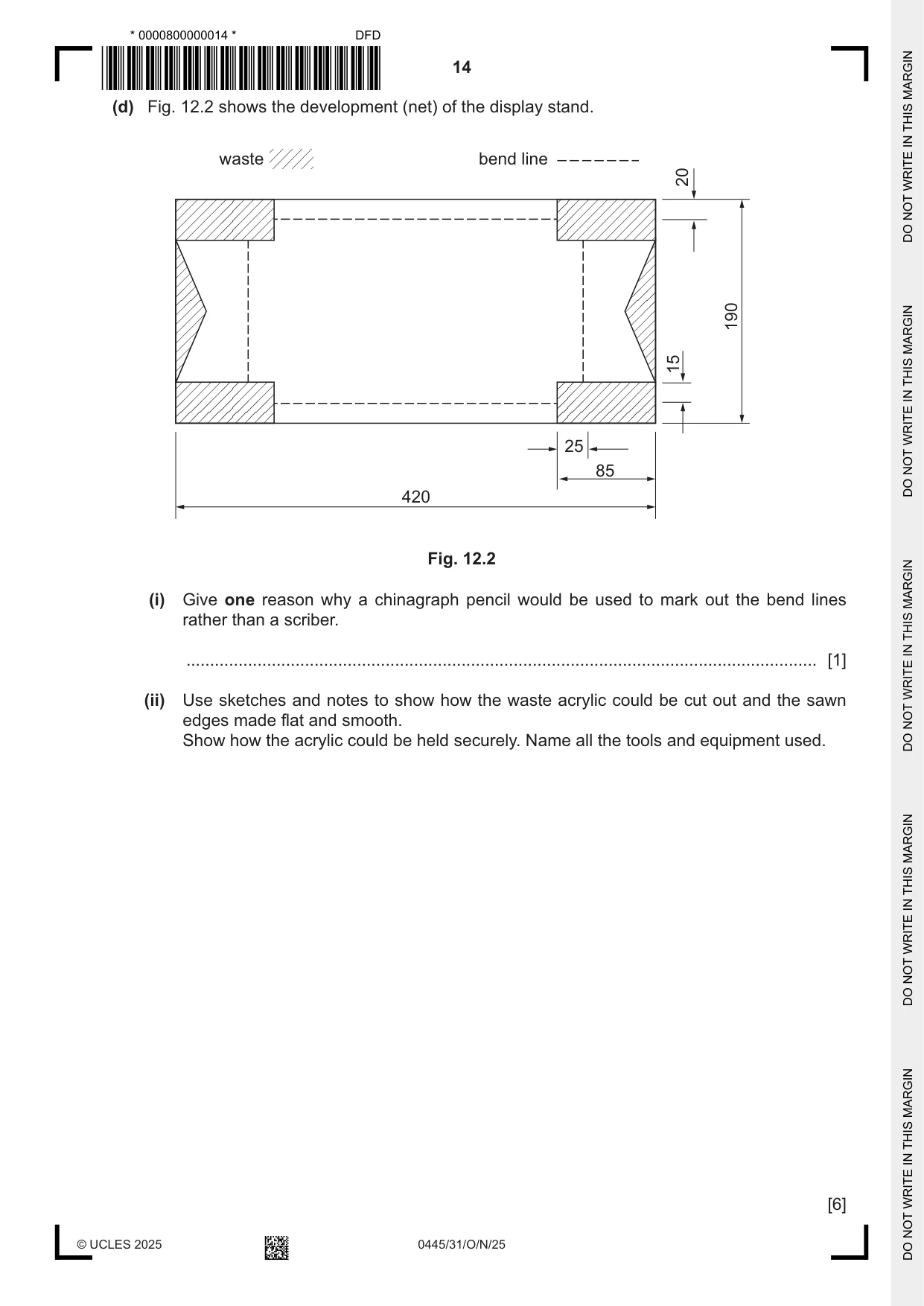
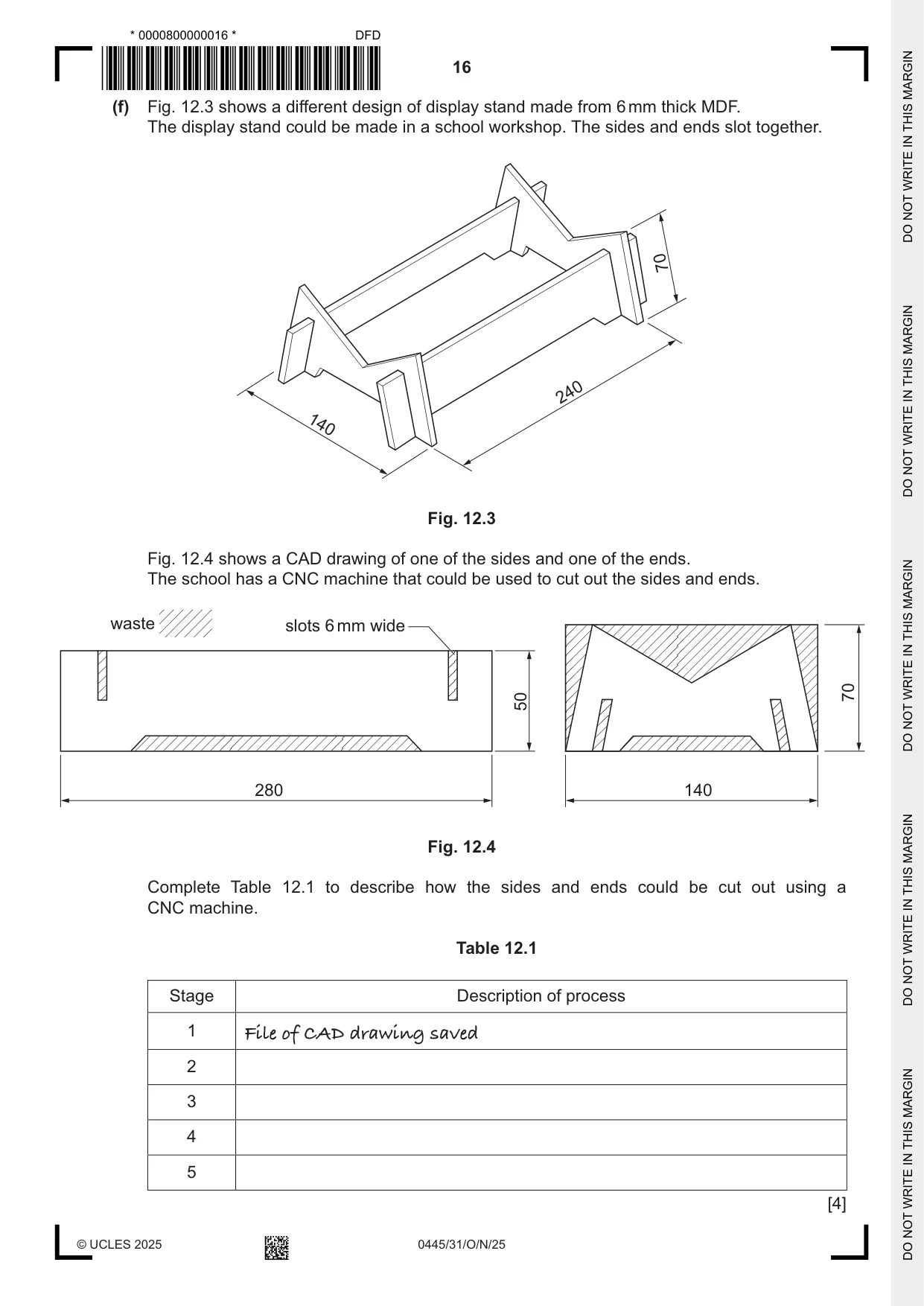
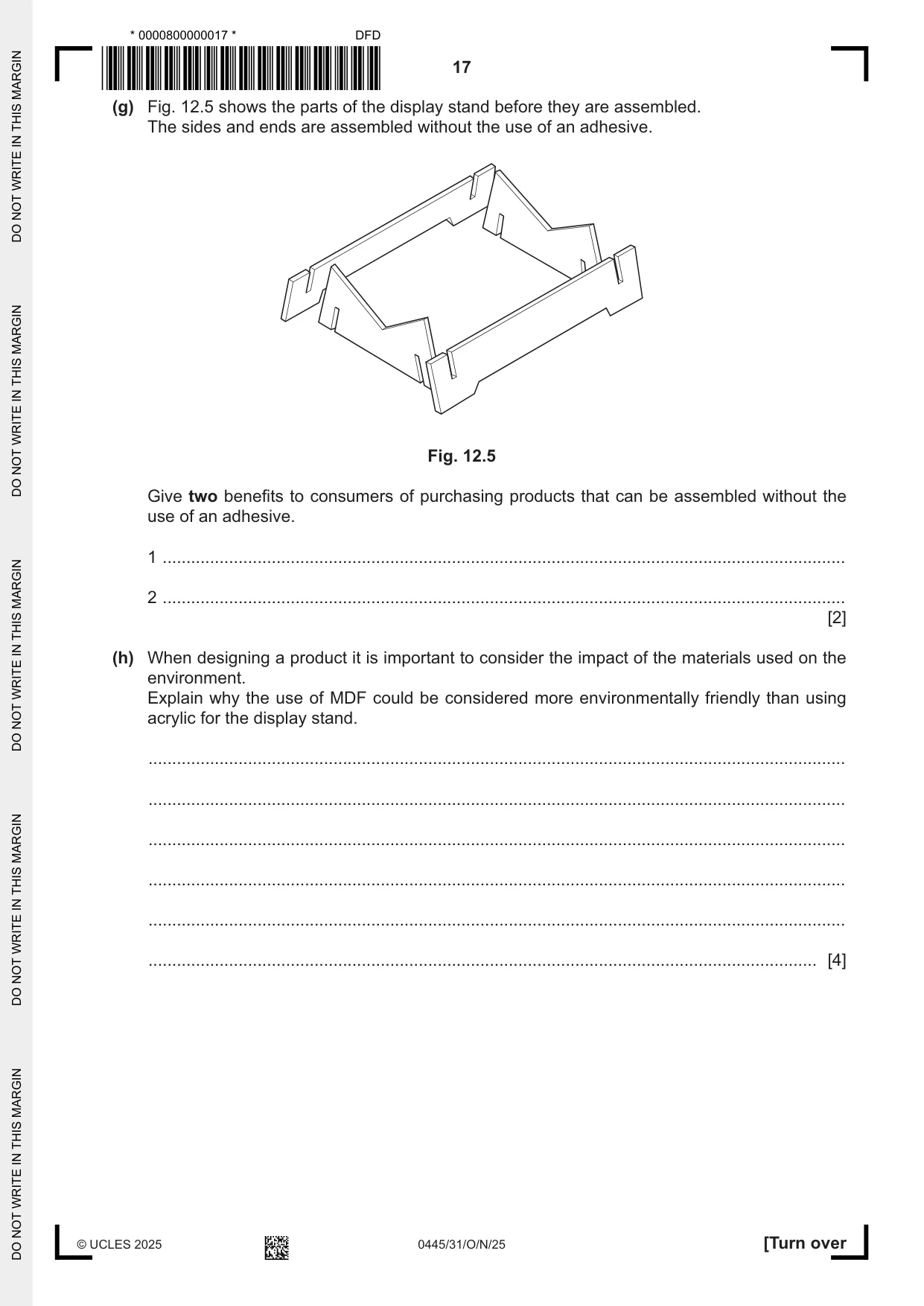
12 Fig. 12.1 shows a stand used to display a model yacht. The stand is made from 5 mm thick acrylic. 120 60 20 250 15 25 Fig. 12.1 (a) Acrylic is a thermoplastic. Give one advantage of making the display stand from a thermoplastic rather than a thermosetting plastic. ............................................................................................................................................. [1] (b) When working with acrylic the surfaces can become scratched easily. State one way by which scratches could be prevented. ............................................................................................................................................. [1] (c) The edges of the acrylic will be self-finished. Explain what is meant by the term ‘self-finished’. ................................................................................................................................................... ................................................................................................................................................... ............................................................................................................................................. [2] (d) Fig. 12.2 shows the development (net) of the display stand. waste bend line 20 190 15 25 85 420 Fig. 12.2 (i) Give one reason why a chinagraph pencil would be used to mark out the bend lines rather than a scriber. ..................................................................................................................................... [1] (ii) Use sketches and notes to show how the waste acrylic could be cut out and the sawn edges made flat and smooth. Show how the acrylic could be held securely. Name all the tools and equipment used. [6] (e) Use sketches and notes to show how the ends of the display stand could be bent to shape. Name all the tools and equipment used. [4] (f) Fig. 12.3 shows a different design of display stand made from 6 mm thick MDF. The display stand could be made in a school workshop. The sides and ends slot together. 70 240 140 Fig. 12.3 Fig. 12.4 shows a CAD drawing of one of the sides and one of the ends. The school has a CNC machine that could be used to cut out the sides and ends. waste slots 6 mm wide 70 50 280 140 Fig. 12.4 Complete Table 12.1 to describe how the sides and ends could be cut out using a CNC machine. Table 12.1 Stage Description of process 1 File of CAD drawing saved 2 3 4 5 [4] (g) Fig. 12.5 shows the parts of the display stand before they are assembled. The sides and ends are assembled without the use of an adhesive. Fig. 12.5 Give two benefits to consumers of purchasing products that can be assembled without the use of an adhesive. 1 ................................................................................................................................................ 2 ................................................................................................................................................ [2] (h) When designing a product it is important to consider the impact of the materials used on the environment. Explain why the use of MDF could be considered more environmentally friendly than using acrylic for the display stand. ................................................................................................................................................... ................................................................................................................................................... ................................................................................................................................................... ................................................................................................................................................... ................................................................................................................................................... ............................................................................................................................................. [4]
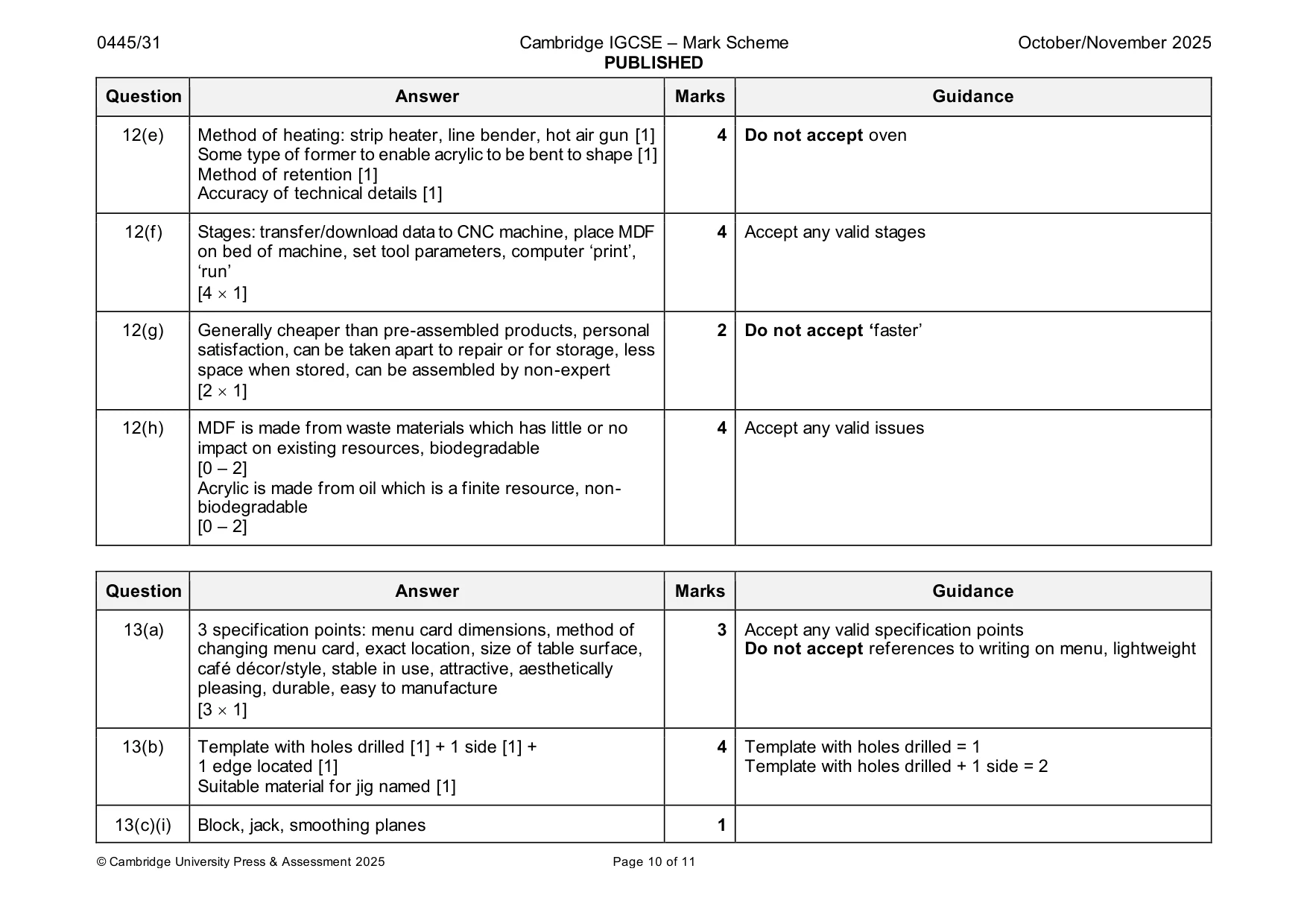
Mark scheme: 12(a) Ability of thermoplastics to be reheated and reshaped 1 12(b) Retain paper/plastic backing sheet. Apply a separate 1 backing sheet. 12(c) A material that has a surface prepared for 2 final appearance [1] Needing no further treatment [1] 12(d)(i) Scriber produces a permanent mark that cannot be erased 1 whereas a chinagraph pencil can be erased 12(d)(i) Sawing process: 6 Appropriate saws: Hegner, scroll, coping, tenon Name of saw [1] Reward ‘holding securely’ when using Hegner type saws Method of holding work piece [1] without reference Sketch showing process [1] Do not accept jig saw Edge finishing process: Edge filed [1] Method of holding work piece [1] Use of ‘wet and dry paper’ and/or polishing mop [1] 12(e) Method of heating: strip heater, line bender, hot air gun [1] 4 Do not accept oven Some type of former to enable acrylic to be bent to shape [1] Method of retention [1] Accuracy of technical details [1] 12(f) Stages: transfer/download data to CNC machine, place MDF 4 Accept any valid stages on bed of machine, set tool parameters, computer ‘print’, ‘run’ [4 1] 12(g) Generally cheaper than pre-assembled products, personal 2 Do not accept ‘faster’ satisfaction, can be taken apart to repair or for storage, less space when stored, can be assembled by non-expert [2 1] 12(h) MDF is made from waste materials which has little or no 4 Accept any valid issues impact on existing resources, biodegradable [0 – 2] Acrylic is made from oil which is a finite resource, non- biodegradable [0 – 2]
Q13 · A menu stand that has been produced by a D&T student for use in a local café
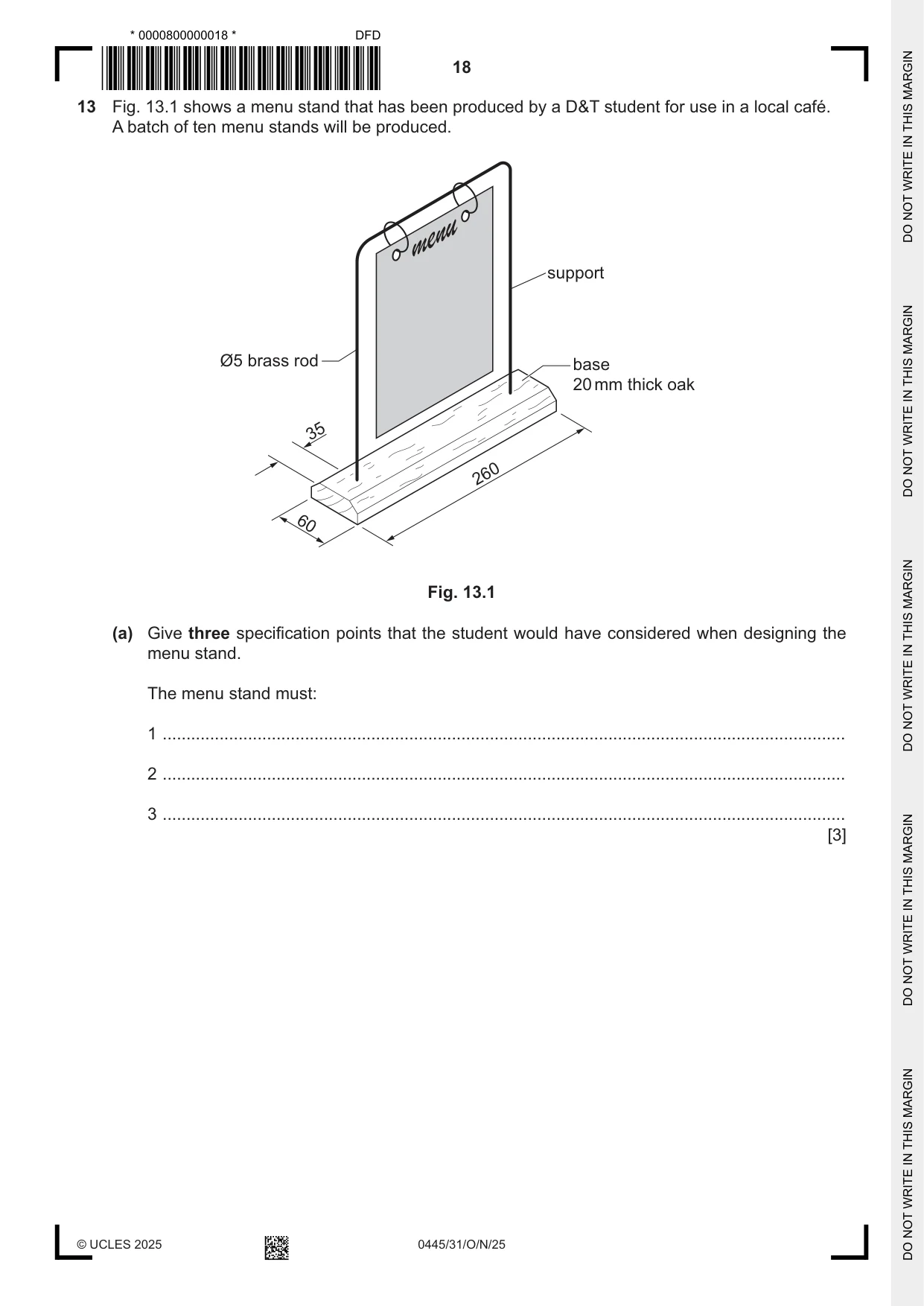
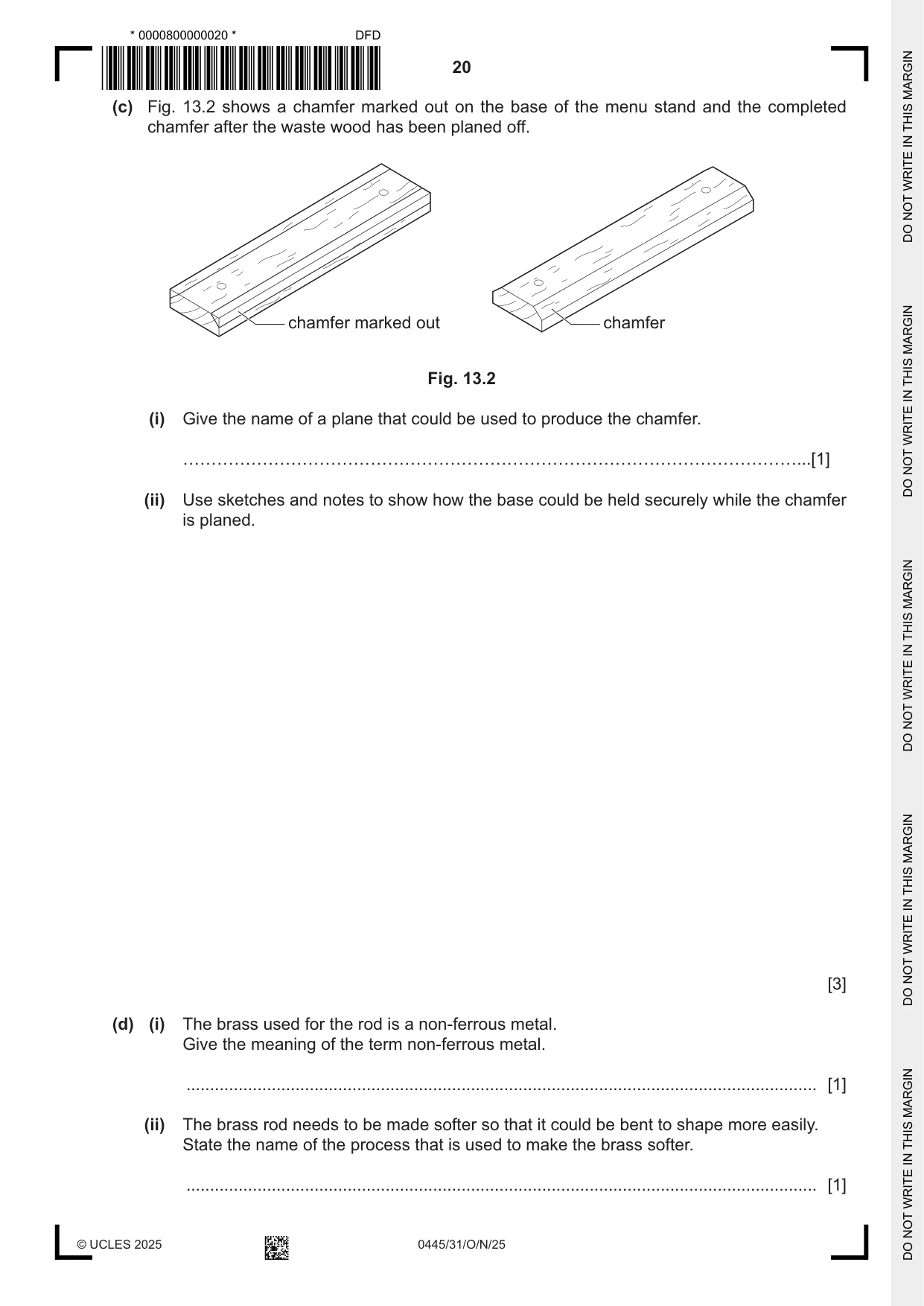
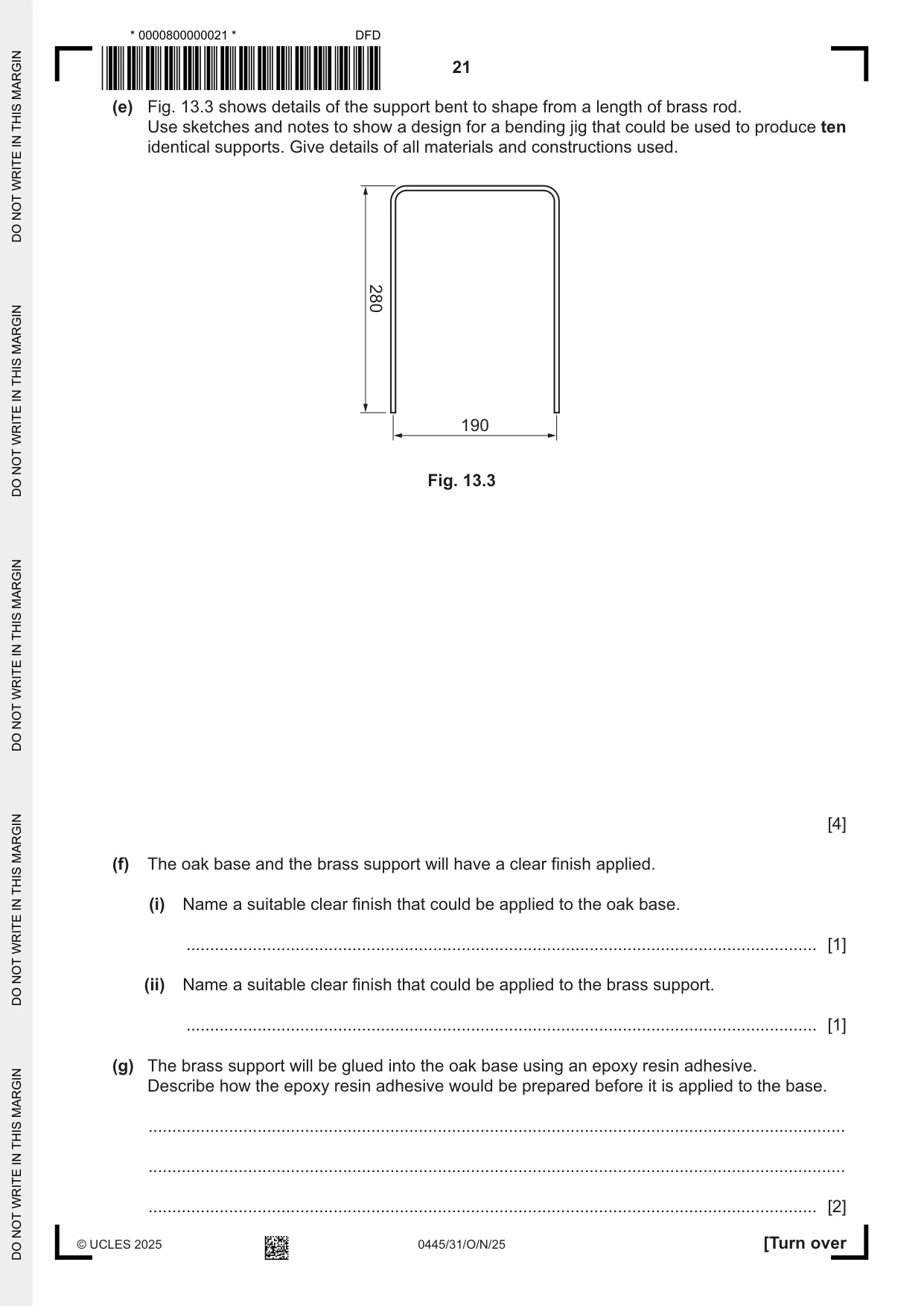
13 Fig. 13.1 shows a menu stand that has been produced by a D&T student for use in a local café. A batch of ten menu stands will be produced. menu support Ø5 brass rod base 20 mm thick oak 35 260 60 Fig. 13.1 (a) Give three specification points that the student would have considered when designing the menu stand. The menu stand must: 1 ................................................................................................................................................ 2 ................................................................................................................................................ 3 ................................................................................................................................................ [3] (b) Two Ø5 holes will be drilled in the base before it is shaped. Use sketches and notes to show a jig that could be used to mark out the positions of the holes accurately when making a batch of ten menu stands. Name the material from which the jig could be made. [4] (c) Fig. 13.2 shows a chamfer marked out on the base of the menu stand and the completed chamfer after the waste wood has been planed off. chamfer marked out chamfer Fig. 13.2 (i) Give the name of a plane that could be used to produce the chamfer. (ii) Use sketches and notes to show how the base could be held securely while the chamfer is planed. [3] (d) (i) The brass used for the rod is a non-ferrous metal. Give the meaning of the term non-ferrous metal. ..................................................................................................................................... [1] (ii) The brass rod needs to be made softer so that it could be bent to shape more easily. State the name of the process that is used to make the brass softer. ..................................................................................................................................... [1]
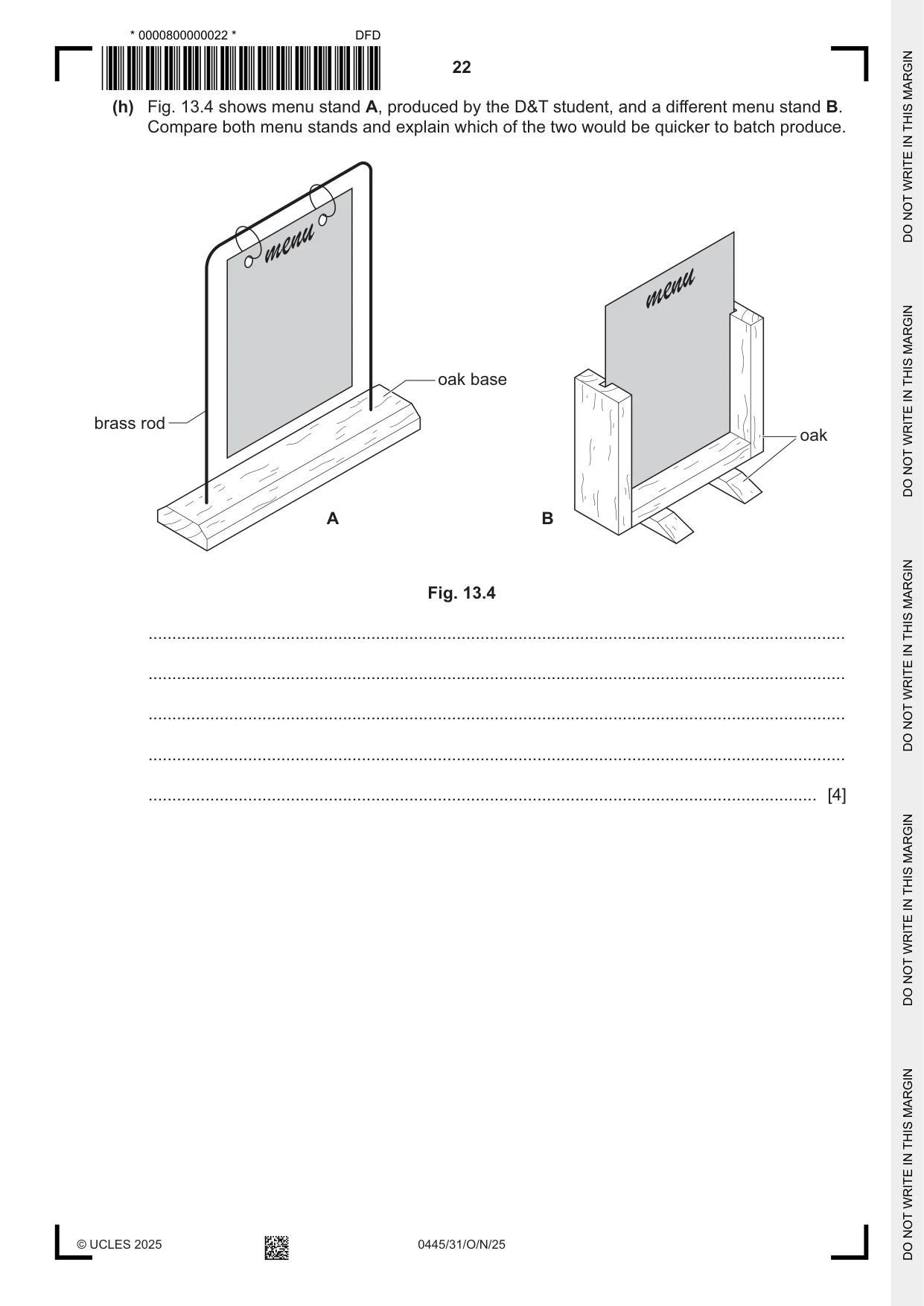
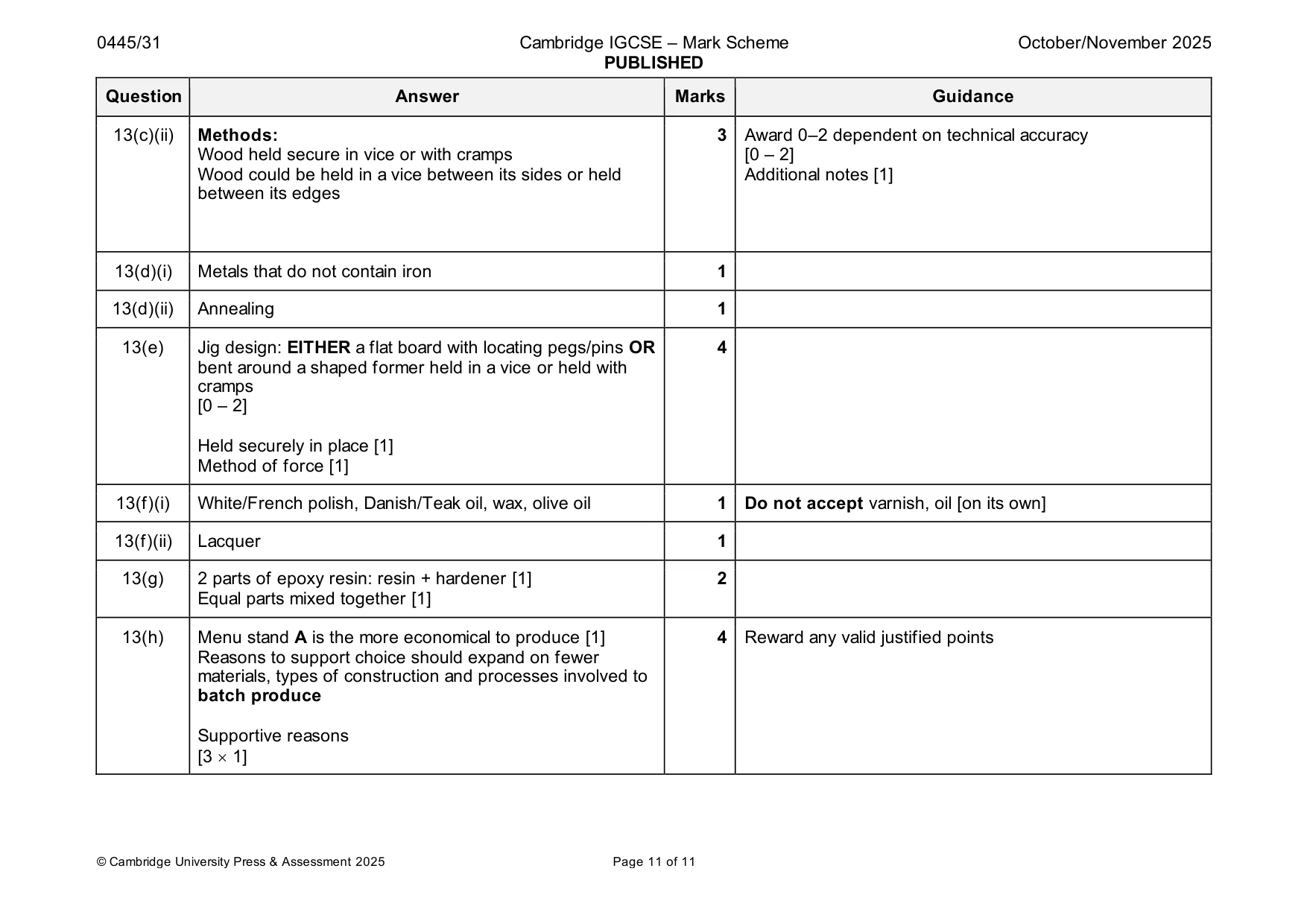
Mark scheme: 13(a) 3 specification points: menu card dimensions, method of 3 Accept any valid specification points changing menu card, exact location, size of table surface, Do not accept references to writing on menu, lightweight café décor/style, stable in use, attractive, aesthetically pleasing, durable, easy to manufacture [3 1] 13(b) Template with holes drilled [1] + 1 side [1] + 4 Template with holes drilled = 1 1 edge located [1] Template with holes drilled + 1 side = 2 Suitable material for jig named [1] 13(c)(i) Block, jack, smoothing planes 1 13(c)(ii) Methods: 3 Award 0–2 dependent on technical accuracy Wood held secure in vice or with cramps [0 – 2] Wood could be held in a vice between its sides or held Additional notes [1] between its edges 13(d)(i) Metals that do not contain iron 1 13(d)(ii) Annealing 1 13(e) Jig design: EITHER a flat board with locating pegs/pins OR 4 bent around a shaped former held in a vice or held with cramps [0 – 2] Held securely in place [1] Method of force [1] 13(f)(i) White/French polish, Danish/Teak oil, wax, olive oil 1 Do not accept varnish, oil [on its own] 13(f)(ii) Lacquer 1 13(g) 2 parts of epoxy resin: resin + hardener [1] 2 Equal parts mixed together [1] 13(h) Menu stand A is the more economical to produce [1] 4 Reward any valid justified points Reasons to support choice should expand on fewer materials, types of construction and processes involved to batch produce Supportive reasons [3 1]
What was in this paper
The subtopics covered by these 13 questions, and how many questions each got. Open one in a new tab to see every Cambridge question on it.
What you needed in this session
Cambridge’s own grade thresholds for 2025 Oct/Nov, Paper 3 · Variant 1. A higher threshold means an easier paper — the bar moves with how the cohort did.