Cambridge IGCSE Design and Technology 0445 — 2014 May/June Paper 3 · Variant 2
0445/32/M/J/14 · 50 marks · ≈56 min
The question paper and its mark scheme, free to read here and free to download. This is Cambridge’s own paper, exactly as it was sat.
Question paper16 pages
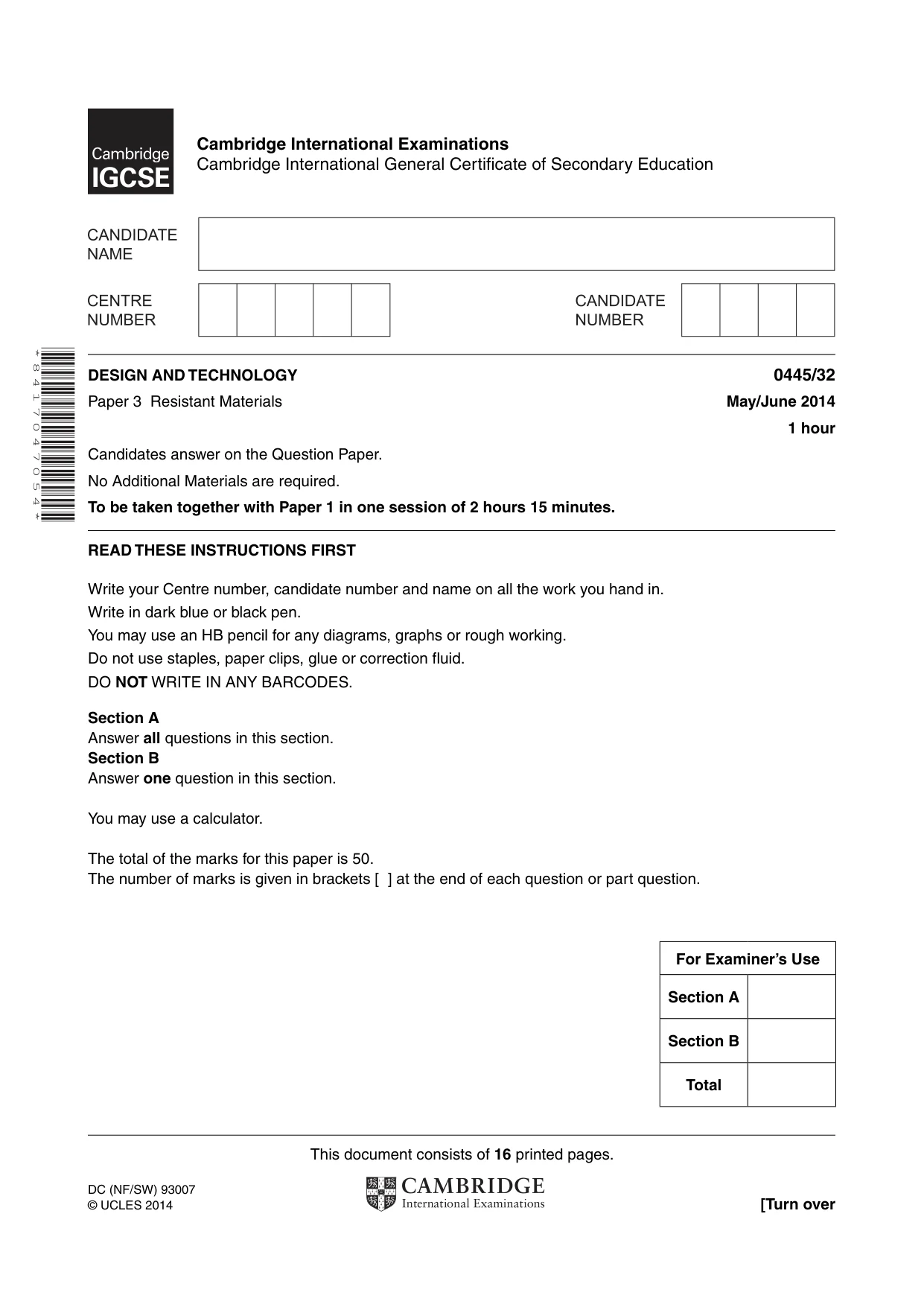
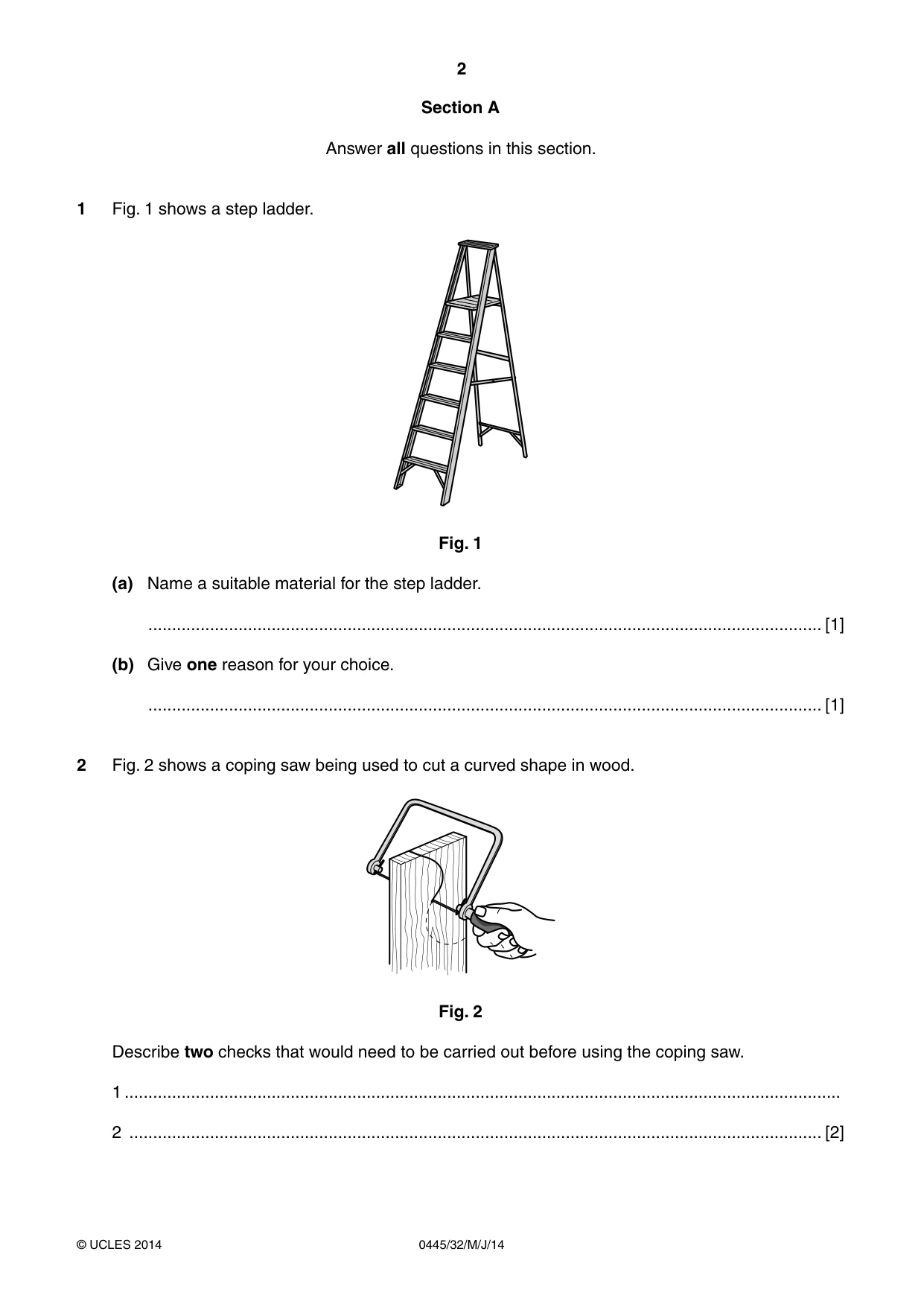
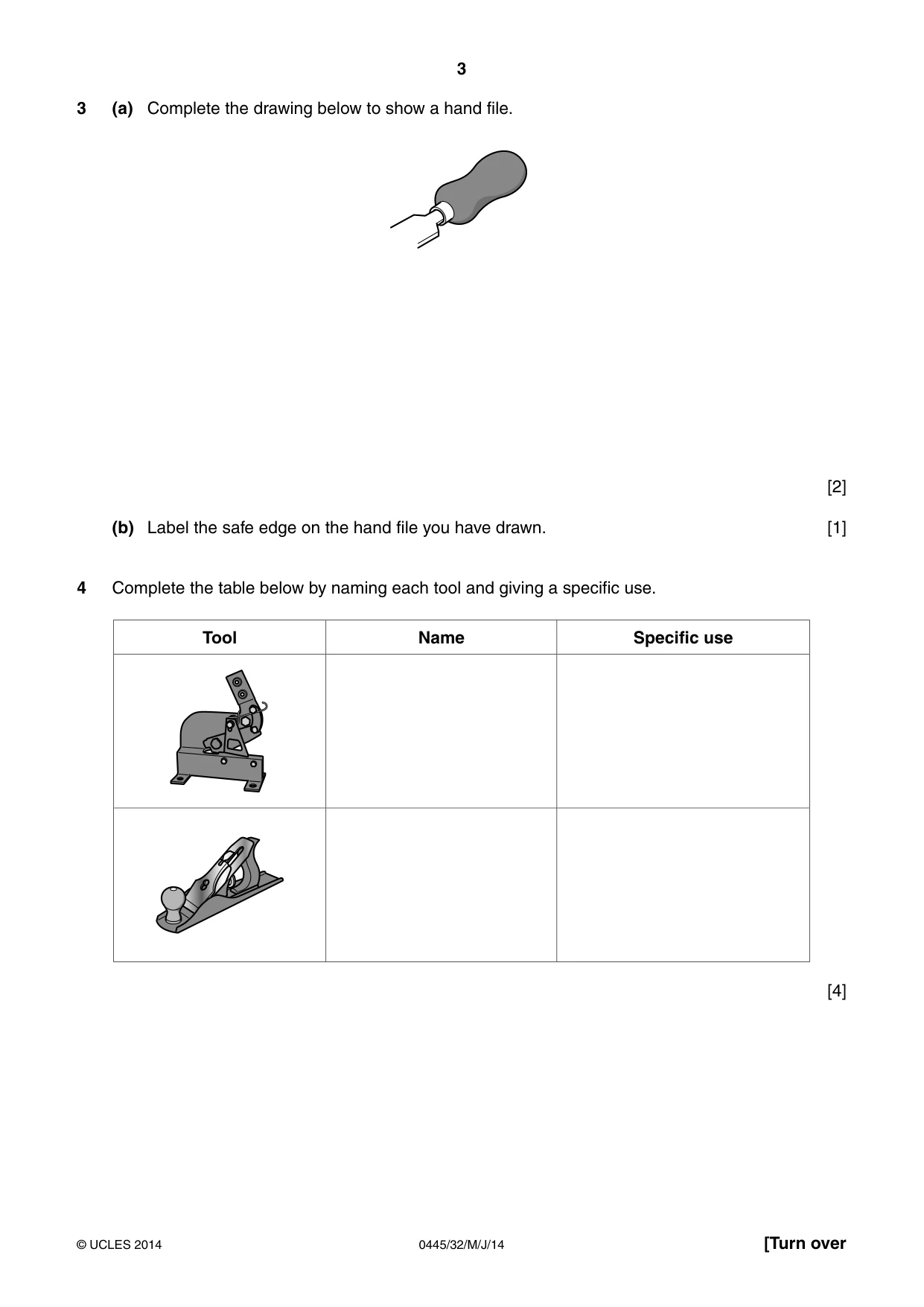
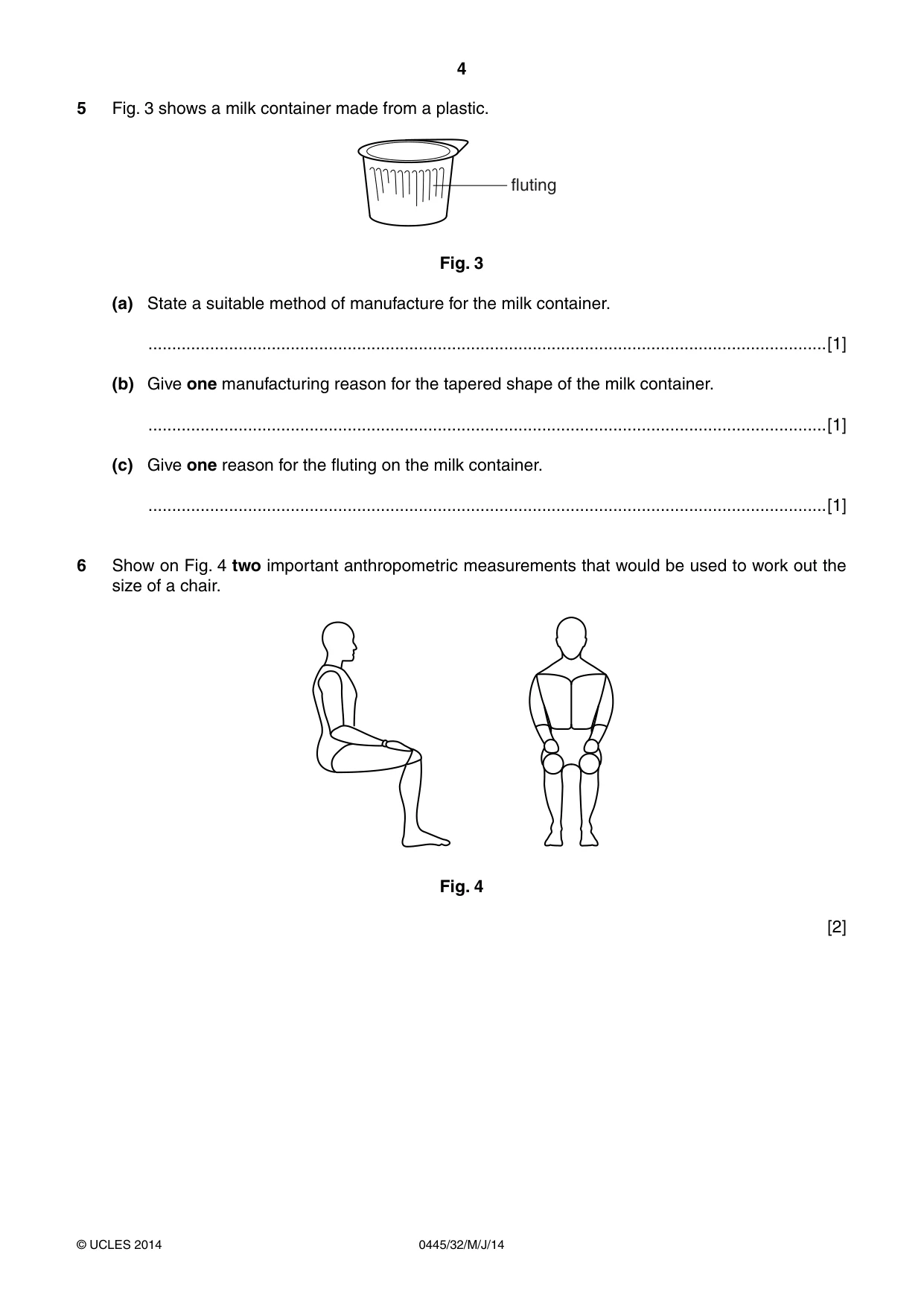
Mark scheme6 pages
Answers below. Sit the paper first if you are practising.
Paper as text
Question paper, page 1
This document consists of 16 printed pages. DC (NF/SW) 93007 © UCLES 2014 [Turn over Cambridge International Examinations Cambridge International General Certificate of Secondary Education * 8 4 1 7 0 4 7 0 5 4 * DESIGN AND TECHNOLOGY 0445/32 Paper 3 Resistant Materials May/June 2014 1 hour Candidates answer on the Question Paper. No Additional Materials are required. To be taken together with Paper 1 in one session of 2 hours 15 minutes. READ THESE INSTRUCTIONS FIRST Write your Centre number, candidate number and name on all the work you hand in. Write in dark blue or black pen. You may use an HB pencil for any diagrams, graphs or rough working. Do not use staples, paper clips, glue or correction fluid. DO NOT WRITE IN ANY BARCODES. Section A Answer all questions in this section. Section B Answer one question in this section. You may use a calculator. The total of the marks for this paper is 50. The number of marks is given in brackets [ ] at the end of each question or part question. For Examiner’s Use Section A Section B Total
Question paper, page 2
2 0445/32/M/J/14 © UCLES 2014 Section A Answer all questions in this section. 1 Fig. 1 shows a step ladder. Fig. 1 (a) Name a suitable material for the step ladder. … [1] (b) Give one reason for your choice. … [1] 2 Fig. 2 shows a coping saw being used to cut a curved shape in wood. Fig. 2 Describe two checks that would need to be carried out before using the coping saw. 1 … 2 … [2]
Question paper, page 3
3 0445/32/M/J/14 © UCLES 2014 [Turn over 3 (a) Complete the drawing below to show a hand file. [2] (b) Label the safe edge on the hand file you have drawn. [1] 4 Complete the table below by naming each tool and giving a specific use. Tool Name Specific use [4]
Question paper, page 4
4 0445/32/M/J/14 © UCLES 2014 5 Fig. 3 shows a milk container made from a plastic. fluting Fig. 3 (a) State a suitable method of manufacture for the milk container. …[1] (b) Give one manufacturing reason for the tapered shape of the milk container. …[1] (c) Give one reason for the fluting on the milk container. …[1] 6 Show on Fig. 4 two important anthropometric measurements that would be used to work out the size of a chair. Fig. 4 [2]
Question paper, page 5
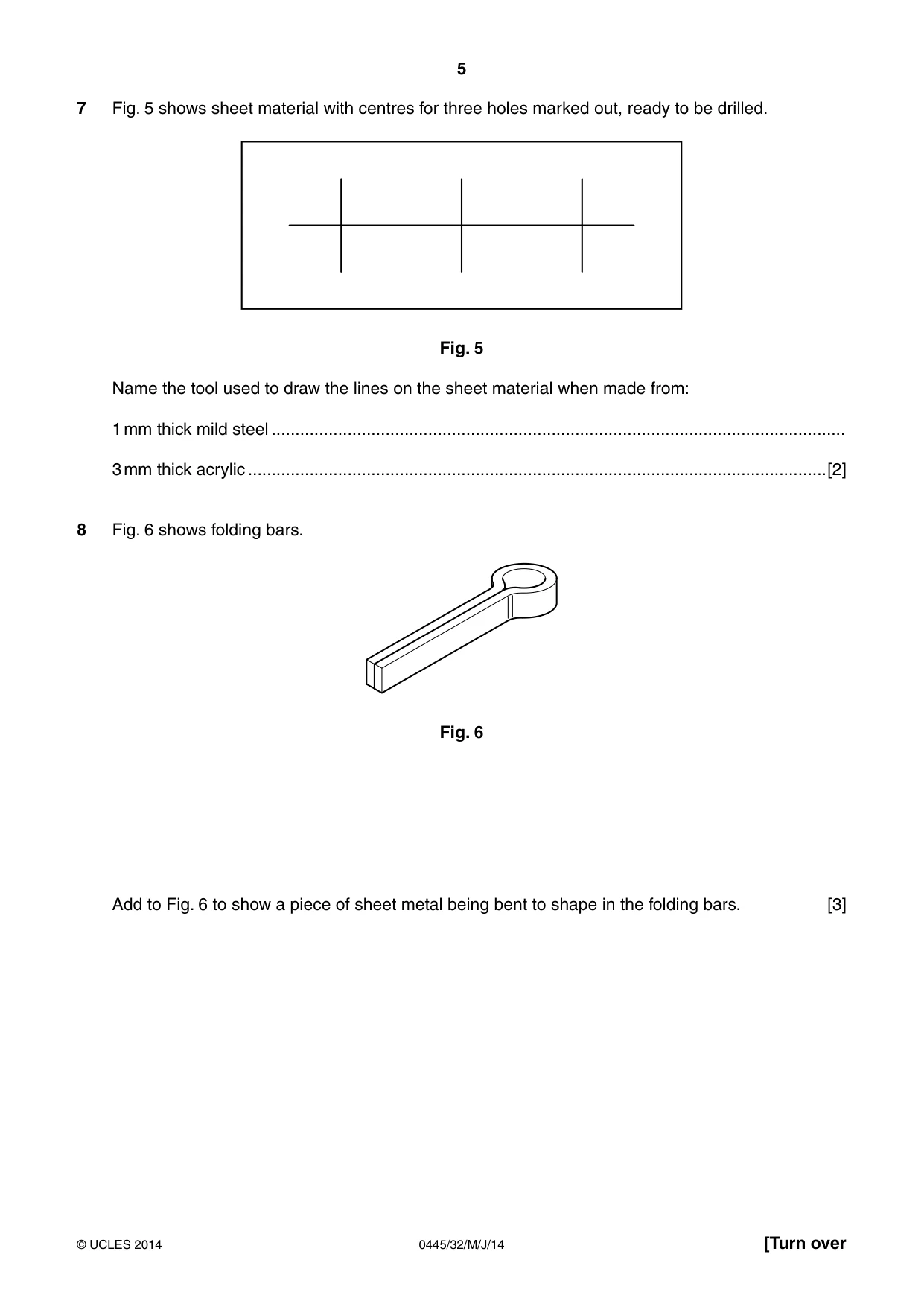
5 0445/32/M/J/14 © UCLES 2014 [Turn over 7 Fig. 5 shows sheet material with centres for three holes marked out, ready to be drilled. Fig. 5 Name the tool used to draw the lines on the sheet material when made from: 1 mm thick mild steel … 3 mm thick acrylic …[2] 8 Fig. 6 shows folding bars. Fig. 6 Add to Fig. 6 to show a piece of sheet metal being bent to shape in the folding bars. [3]
Question paper, page 6
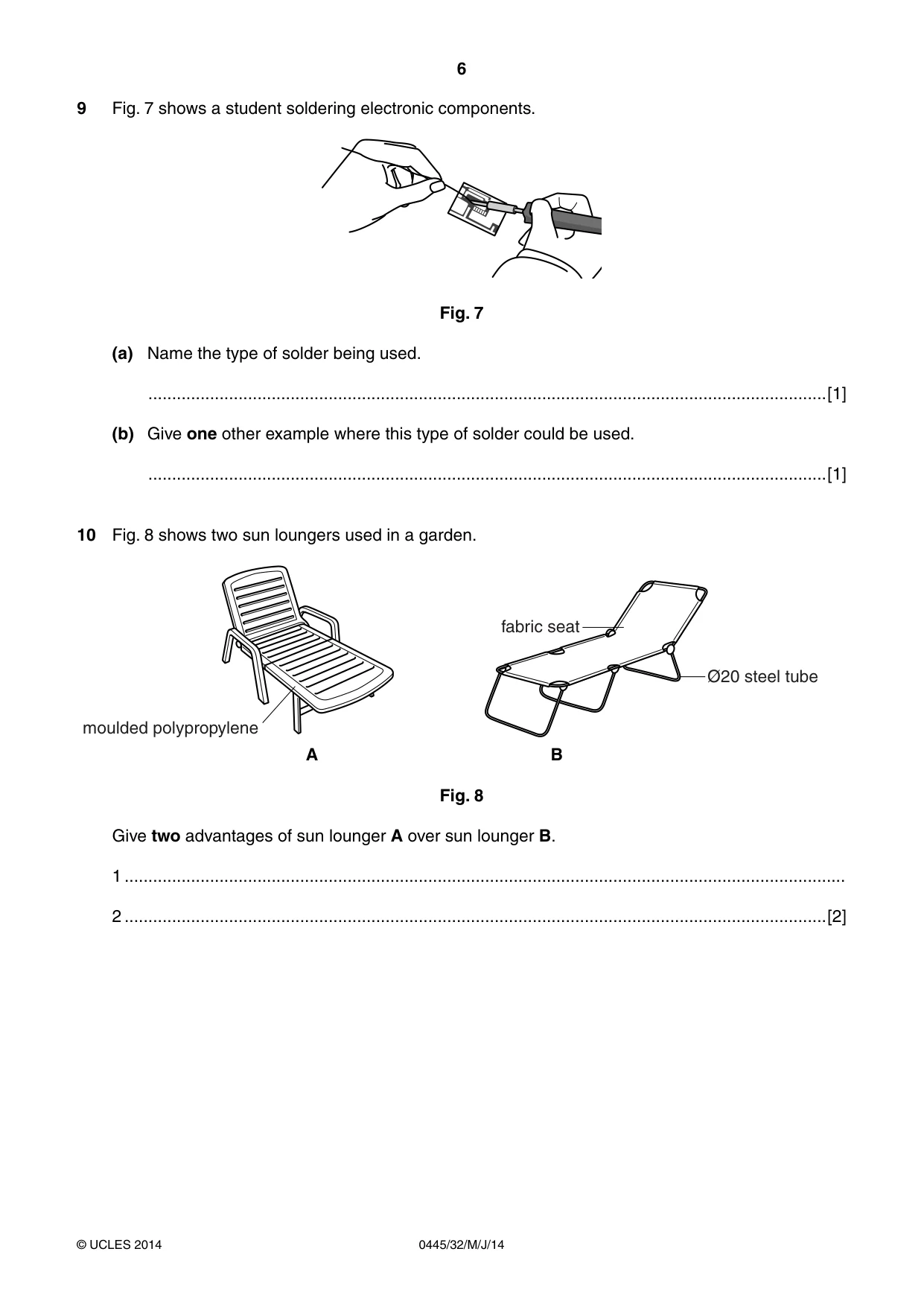
6 0445/32/M/J/14 © UCLES 2014 9 Fig. 7 shows a student soldering electronic components. Fig. 7 (a) Name the type of solder being used. …[1] (b) Give one other example where this type of solder could be used. …[1] 10 Fig. 8 shows two sun loungers used in a garden. moulded polypropylene fabric seat Ø20 steel tube A B Fig. 8 Give two advantages of sun lounger A over sun lounger B. 1 … 2 …[2]
Question paper, page 7
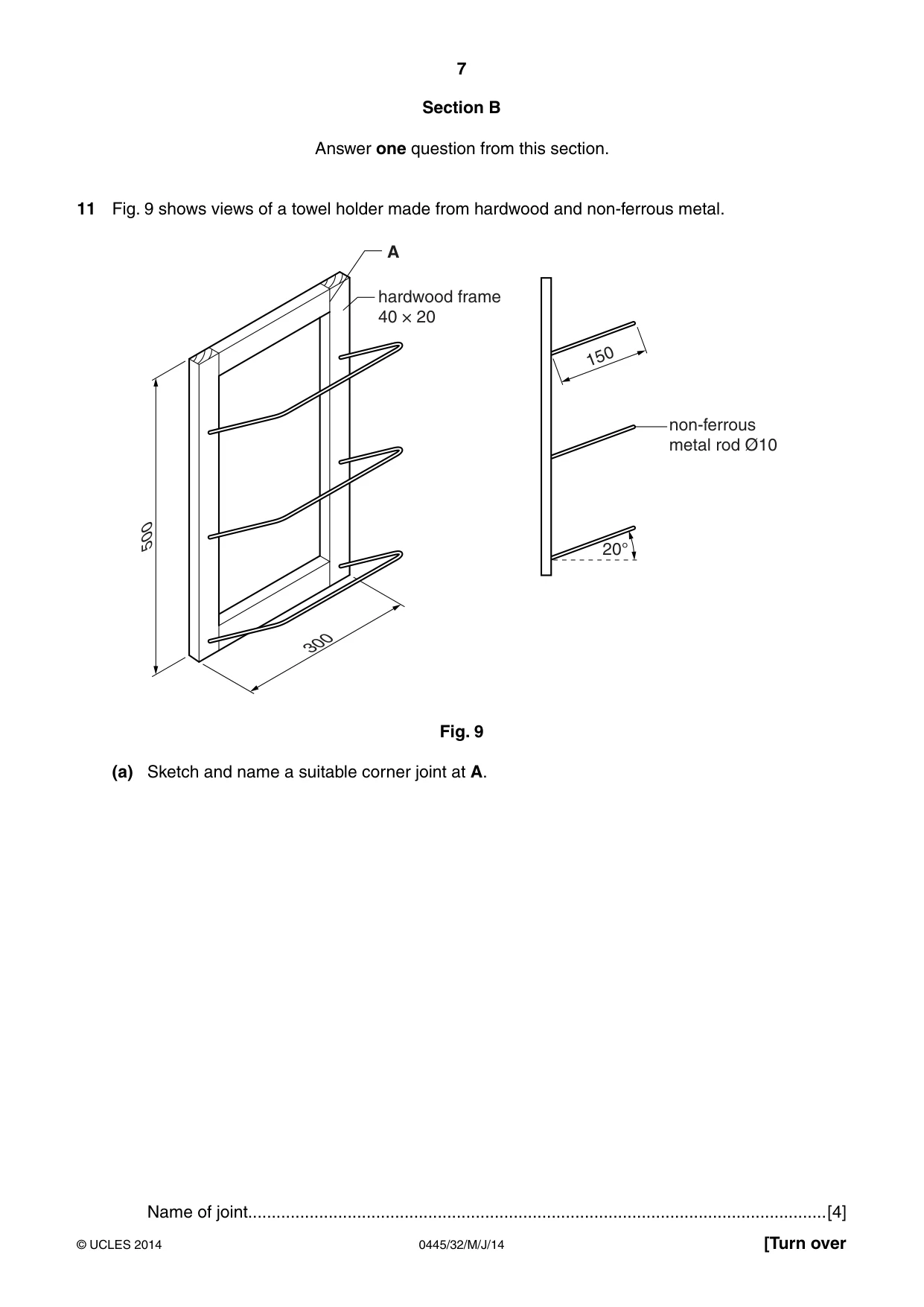
7 0445/32/M/J/14 © UCLES 2014 [Turn over Section B Answer one question from this section. 11 Fig. 9 shows views of a towel holder made from hardwood and non-ferrous metal. 20° 150 non-ferrous metal rod Ø10 hardwood frame 40 × 20 A 500 300 Fig. 9 (a) Sketch and name a suitable corner joint at A. Name of joint…[4]
Question paper, page 8
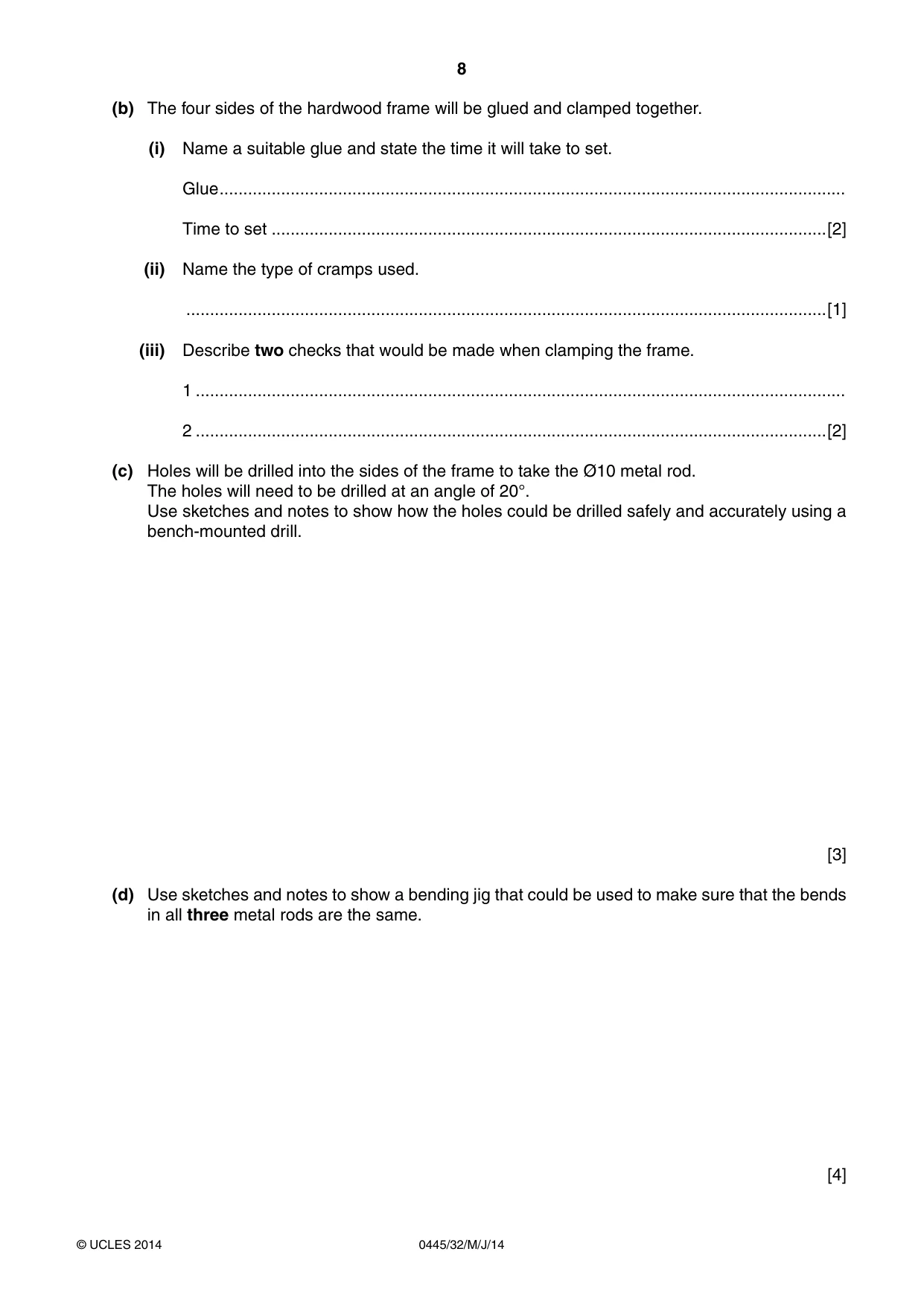
8 0445/32/M/J/14 © UCLES 2014 (b) The four sides of the hardwood frame will be glued and clamped together. (i) Name a suitable glue and state the time it will take to set. Glue … Time to set …[2] (ii) Name the type of cramps used. …[1] (iii) Describe two checks that would be made when clamping the frame. 1 … 2 …[2] (c) Holes will be drilled into the sides of the frame to take the Ø10 metal rod. The holes will need to be drilled at an angle of 20°. Use sketches and notes to show how the holes could be drilled safely and accurately using a bench-mounted drill. [3] (d) Use sketches and notes to show a bending jig that could be used to make sure that the bends in all three metal rods are the same. [4]
Question paper, page 9
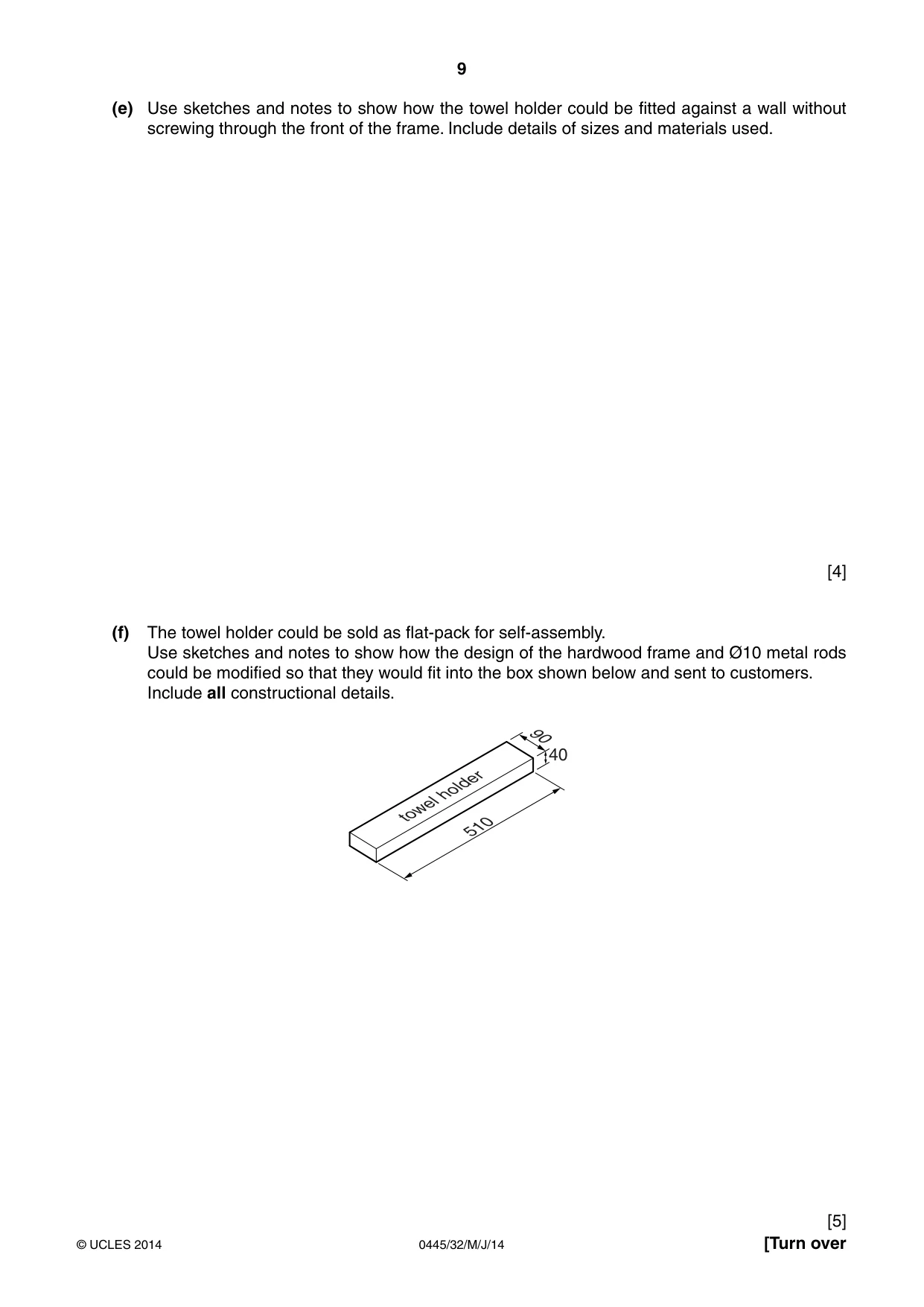
9 0445/32/M/J/14 © UCLES 2014 [Turn over (e) Use sketches and notes to show how the towel holder could be fitted against a wall without screwing through the front of the frame. Include details of sizes and materials used. [4] (f) The towel holder could be sold as flat-pack for self-assembly. Use sketches and notes to show how the design of the hardwood frame and Ø10 metal rods could be modified so that they would fit into the box shown below and sent to customers. Include all constructional details. 510 towel holder 90 40 [5]
Question paper, page 10
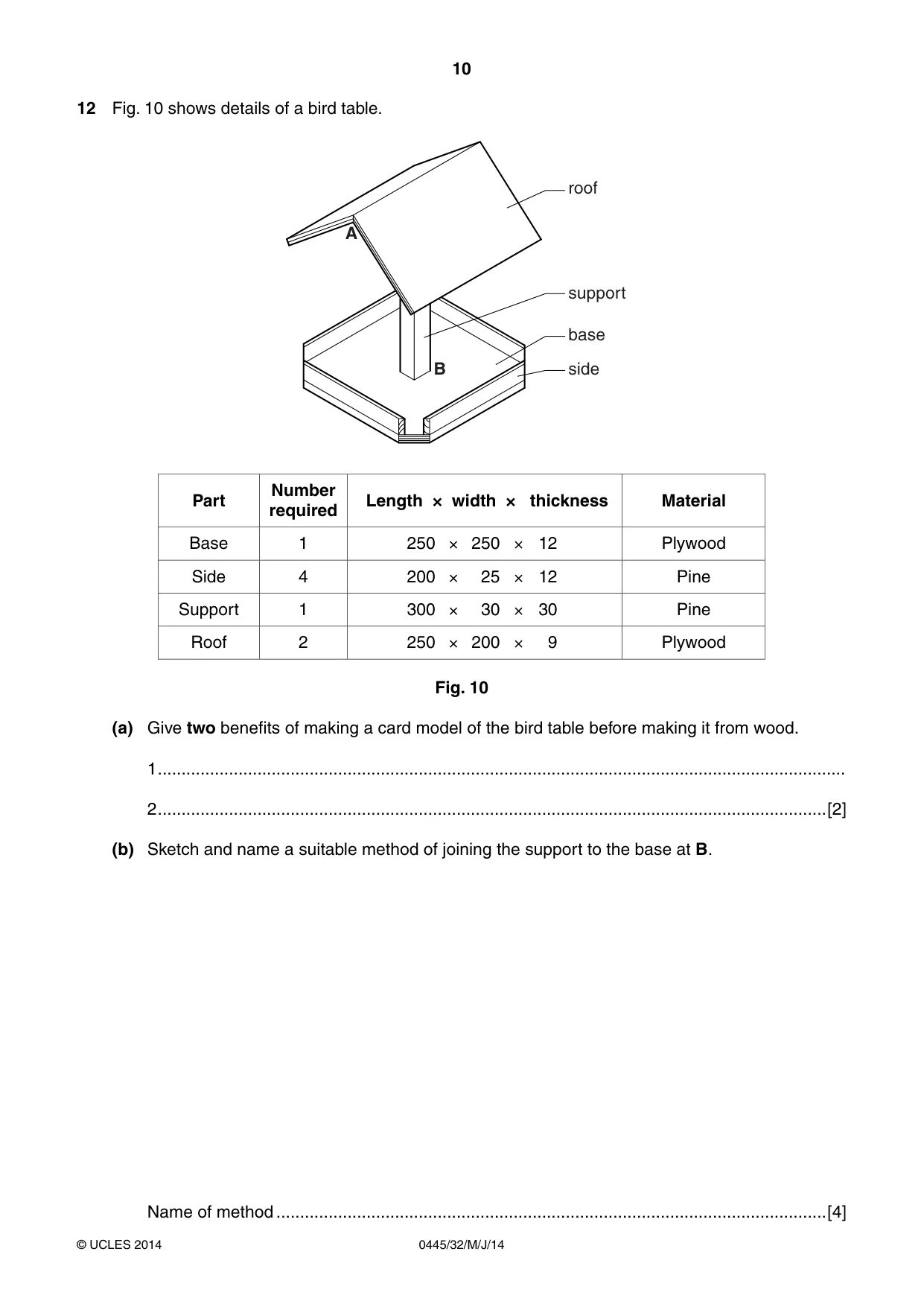
10 0445/32/M/J/14 © UCLES 2014 12 Fig. 10 shows details of a bird table. A B roof support base side Part Number required Length × width × thickness Material Base 1 250 × 250 × 12 Plywood Side 4 200 × 25 × 12 Pine Support 1 300 × 30 × 30 Pine Roof 2 250 × 200 × 9 Plywood Fig. 10 (a) Give two benefits of making a card model of the bird table before making it from wood. 1 … 2 …[2] (b) Sketch and name a suitable method of joining the support to the base at B. Name of method …[4]
Question paper, page 11
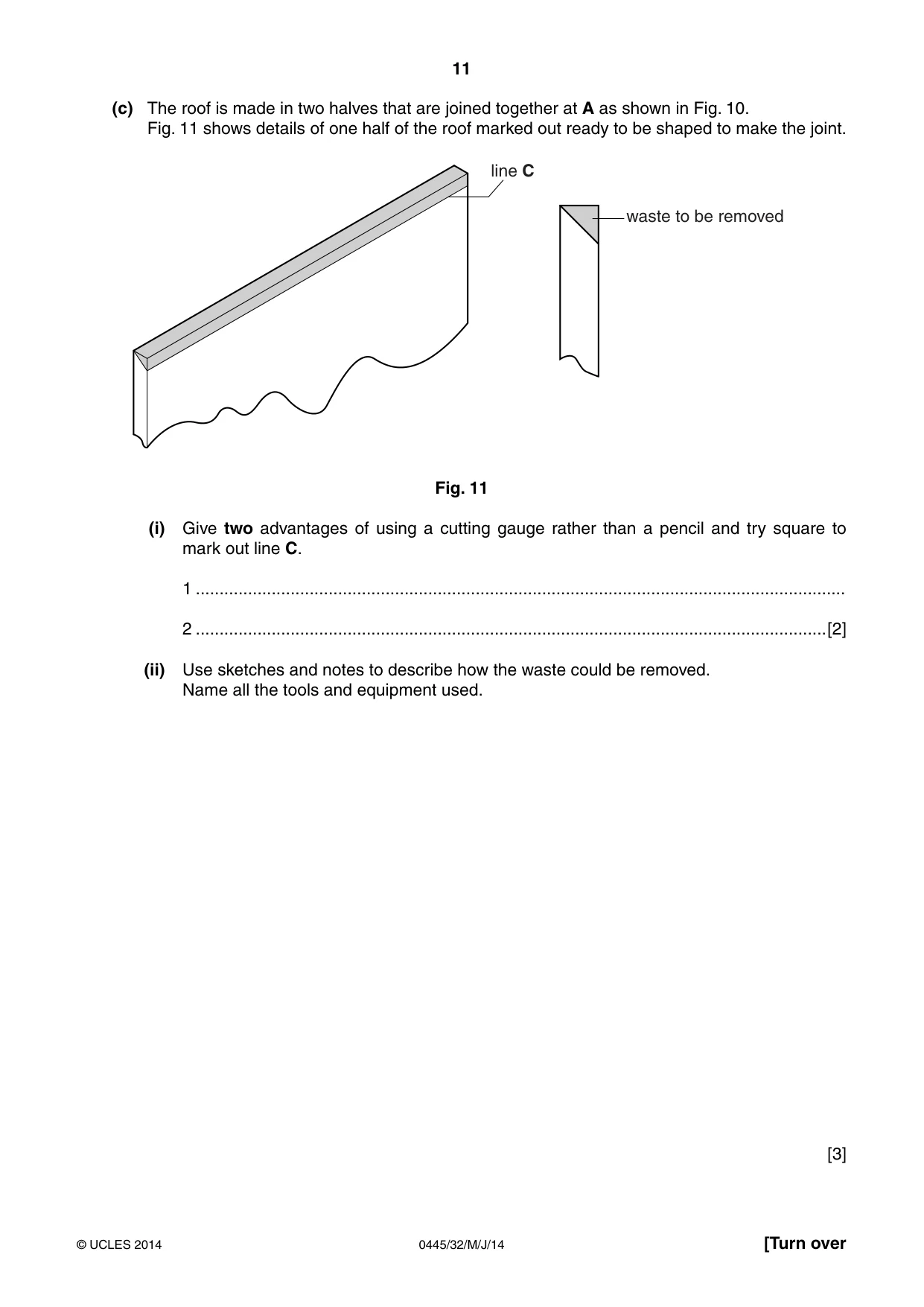
11 0445/32/M/J/14 © UCLES 2014 [Turn over (c) The roof is made in two halves that are joined together at A as shown in Fig. 10. Fig. 11 shows details of one half of the roof marked out ready to be shaped to make the joint. line C waste to be removed Fig. 11 (i) Give two advantages of using a cutting gauge rather than a pencil and try square to mark out line C. 1 … 2 …[2] (ii) Use sketches and notes to describe how the waste could be removed. Name all the tools and equipment used. [3]
Question paper, page 12
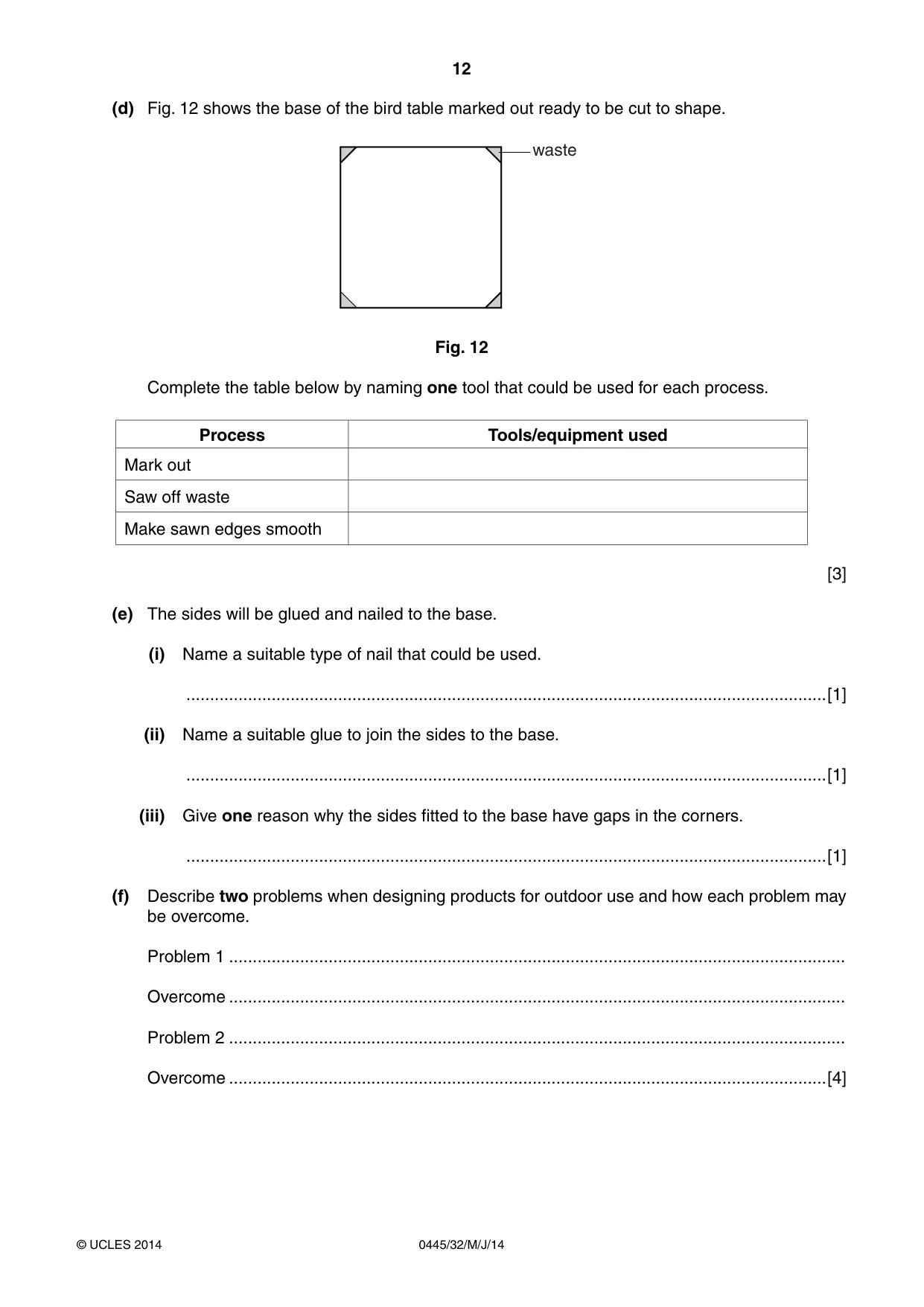
12 0445/32/M/J/14 © UCLES 2014 (d) Fig. 12 shows the base of the bird table marked out ready to be cut to shape. waste Fig. 12 Complete the table below by naming one tool that could be used for each process. Process Tools/equipment used Mark out Saw off waste Make sawn edges smooth [3] (e) The sides will be glued and nailed to the base. (i) Name a suitable type of nail that could be used. …[1] (ii) Name a suitable glue to join the sides to the base. …[1] (iii) Give one reason why the sides fitted to the base have gaps in the corners. …[1] (f) Describe two problems when designing products for outdoor use and how each problem may be overcome. Problem 1 … Overcome … Problem 2 … Overcome …[4]
Question paper, page 13
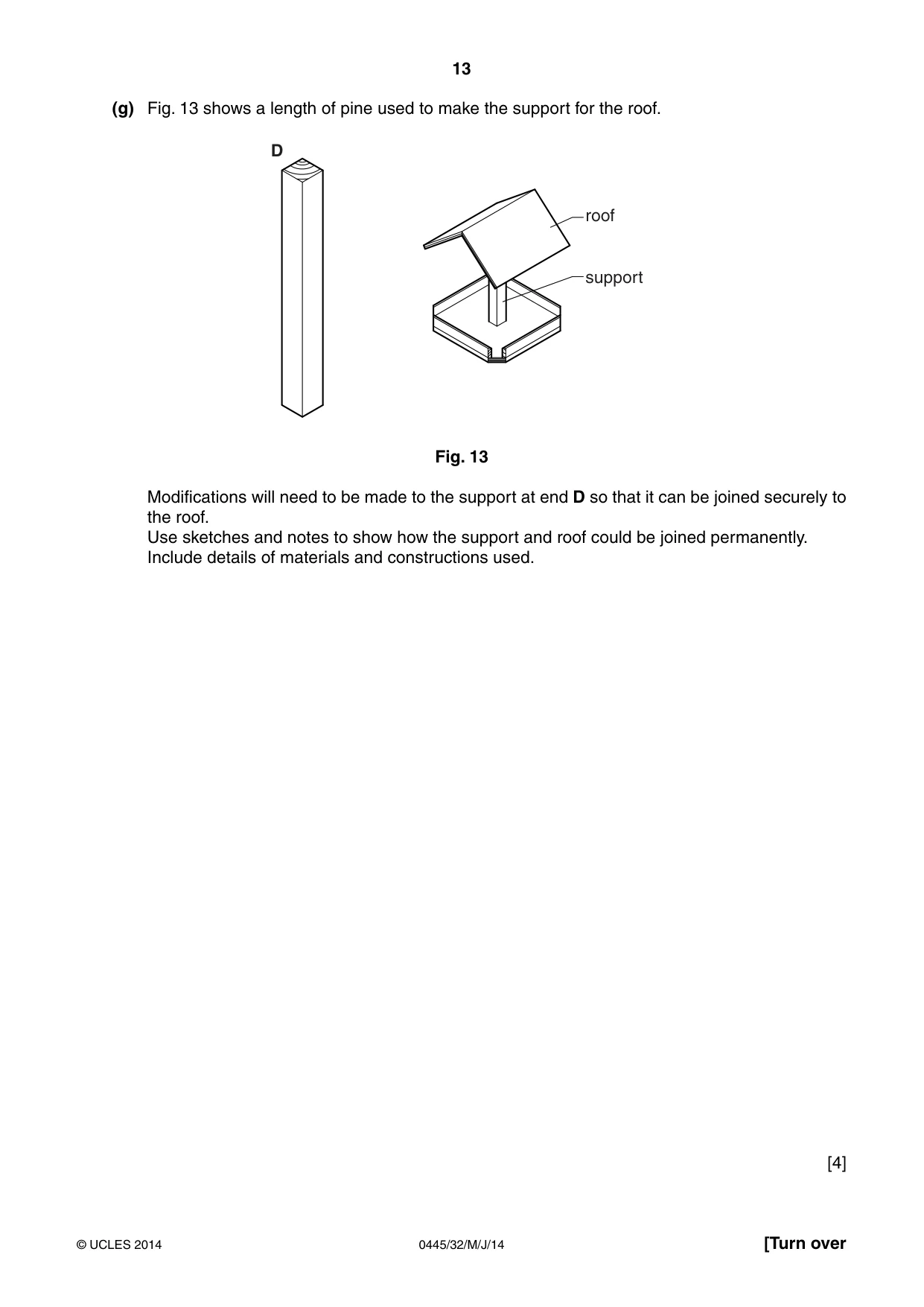
13 0445/32/M/J/14 © UCLES 2014 [Turn over (g) Fig. 13 shows a length of pine used to make the support for the roof. roof support D Fig. 13 Modifications will need to be made to the support at end D so that it can be joined securely to the roof. Use sketches and notes to show how the support and roof could be joined permanently. Include details of materials and constructions used. [4]
Question paper, page 14
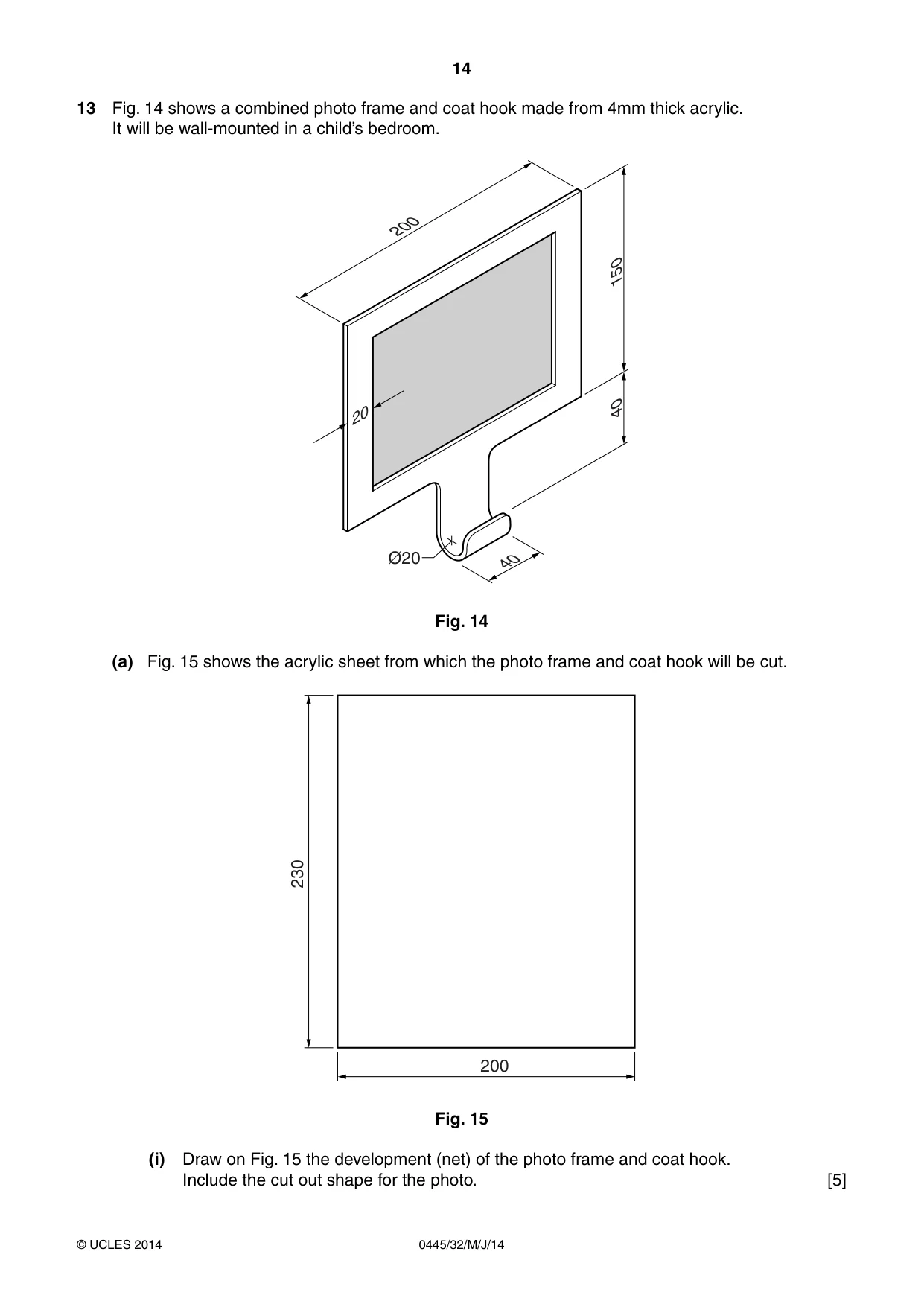
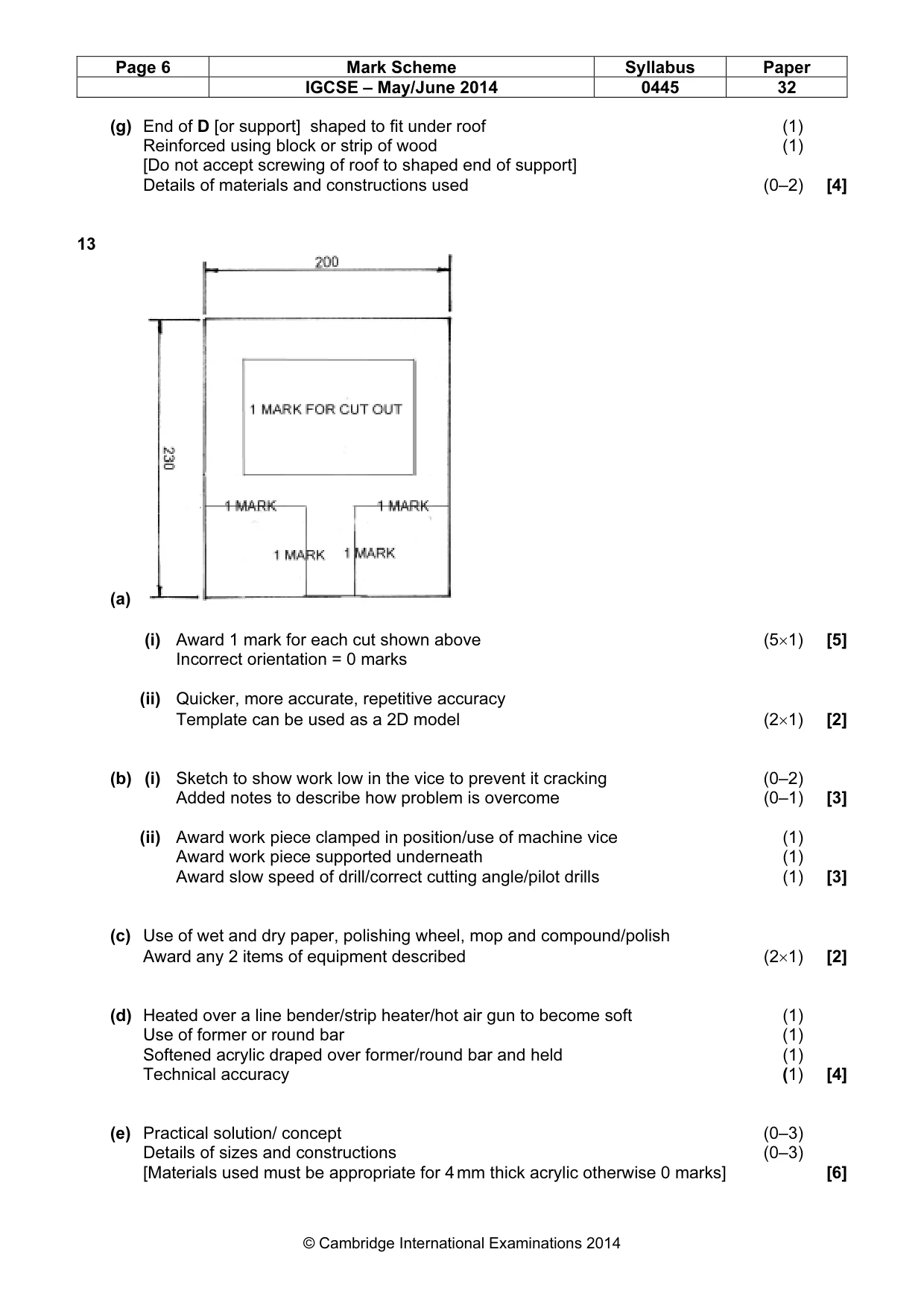
14 0445/32/M/J/14 © UCLES 2014 13 Fig. 14 shows a combined photo frame and coat hook made from 4mm thick acrylic. It will be wall-mounted in a child’s bedroom. 200 40 20 150 40 Ø20 Fig. 14 (a) Fig. 15 shows the acrylic sheet from which the photo frame and coat hook will be cut. 200 230 Fig. 15 (i) Draw on Fig. 15 the development (net) of the photo frame and coat hook. Include the cut out shape for the photo. [5]
Question paper, page 15
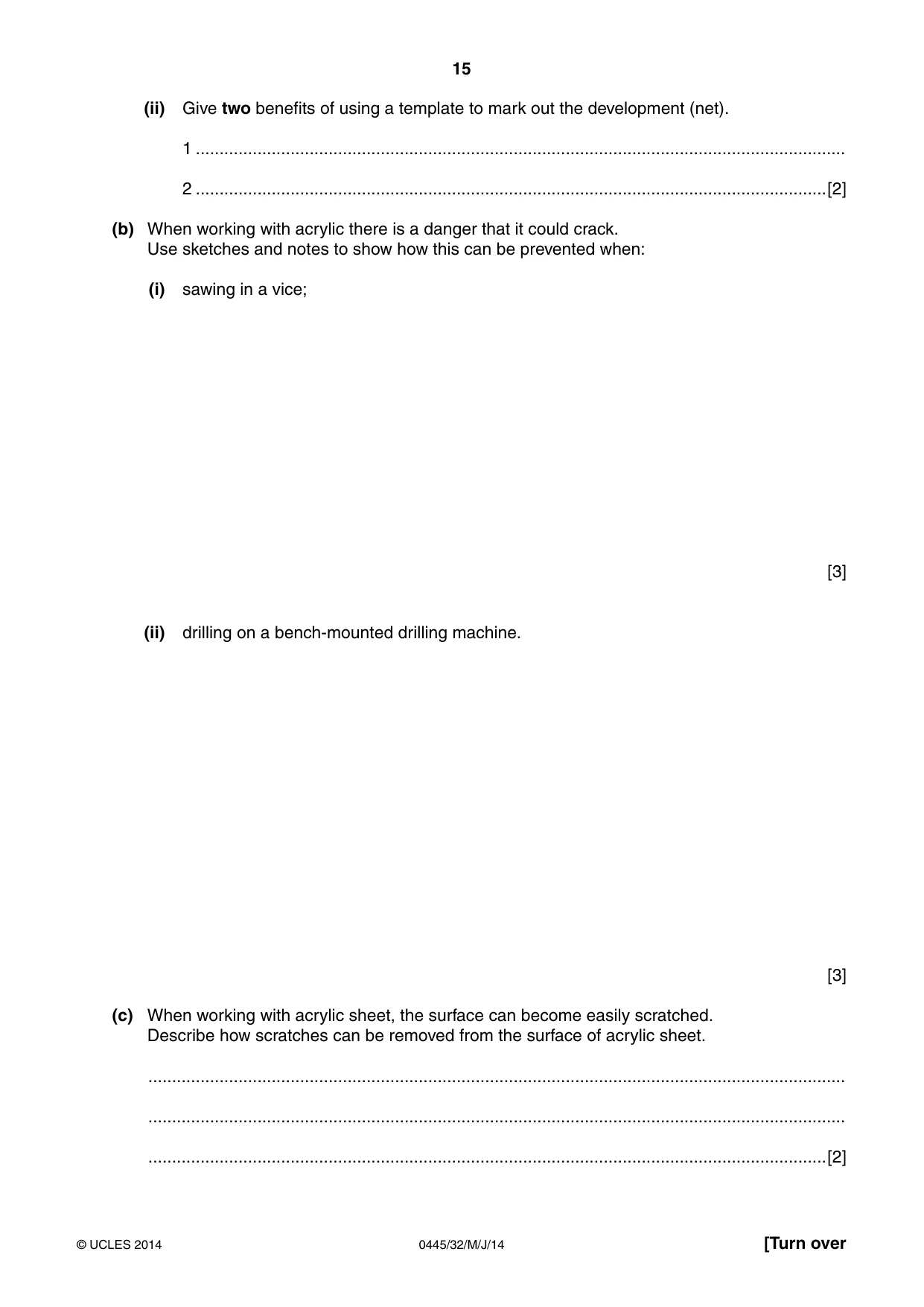
15 0445/32/M/J/14 © UCLES 2014 [Turn over (ii) Give two benefits of using a template to mark out the development (net). 1 … 2 …[2] (b) When working with acrylic there is a danger that it could crack. Use sketches and notes to show how this can be prevented when: (i) sawing in a vice; [3] (ii) drilling on a bench-mounted drilling machine. [3] (c) When working with acrylic sheet, the surface can become easily scratched. Describe how scratches can be removed from the surface of acrylic sheet. … … …[2]
Question paper, page 16
16 0445/32/M/J/14 © UCLES 2014 Permission to reproduce items where third-party owned material protected by copyright is included has been sought and cleared where possible. Every reasonable effort has been made by the publisher (UCLES) to trace copyright holders, but if any items requiring clearance have unwittingly been included, the publisher will be pleased to make amends at the earliest possible opportunity. Cambridge International Examinations is part of the Cambridge Assessment Group. Cambridge Assessment is the brand name of University of Cambridge Local Examinations Syndicate (UCLES), which is itself a department of the University of Cambridge. (d) Use sketches and notes to show how the coat hook would be heated and bent to shape. [4] (e) Use sketches and notes to show how a photograph could be supported behind the photo frame. Your design must allow the photo to be replaced quickly and easily. Include details of sizes and constructions. [6]
Mark scheme, page 1
CAMBRIDGE INTERNATIONAL EXAMINATIONS International General Certificate of Secondary Education MARK SCHEME for the May/June 2014 series 0445 DESIGN AND TECHNOLOGY 0445/32 Paper 3 (Resistant Materials), maximum raw mark 50 This mark scheme is published as an aid to teachers and candidates, to indicate the requirements of the examination. It shows the basis on which Examiners were instructed to award marks. It does not indicate the details of the discussions that took place at an Examiners’ meeting before marking began, which would have considered the acceptability of alternative answers. Mark schemes should be read in conjunction with the question paper and the Principal Examiner Report for Teachers. Cambridge will not enter into discussions about these mark schemes. Cambridge is publishing the mark schemes for the May/June 2014 series for most IGCSE, GCE Advanced Level and Advanced Subsidiary Level components and some Ordinary Level components.
Mark scheme, page 2
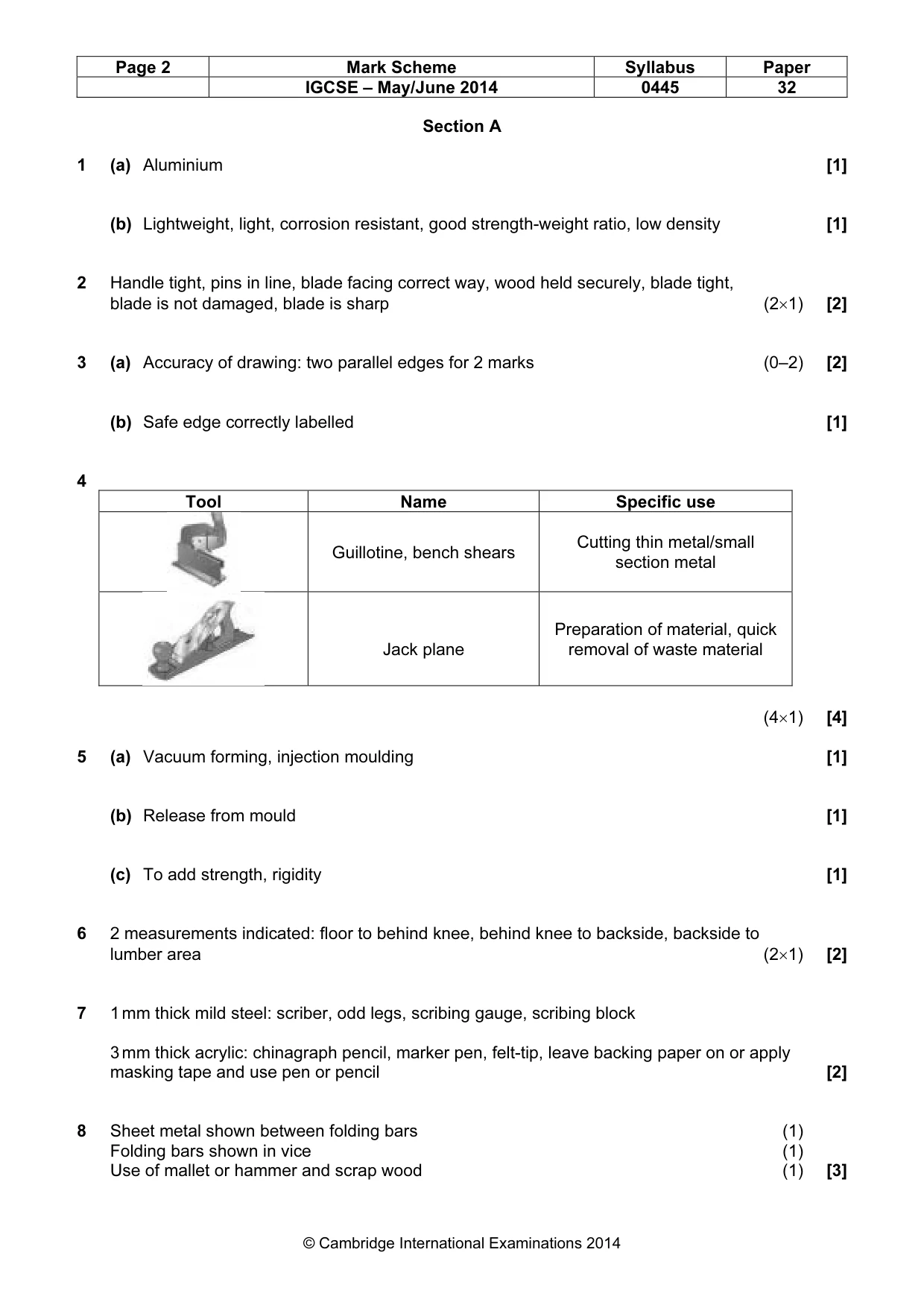
Page 2 Mark Scheme Syllabus Paper IGCSE – May/June 2014 0445 32 © Cambridge International Examinations 2014 Section A 1 (a) Aluminium [1] (b) Lightweight, light, corrosion resistant, good strength-weight ratio, low density [1] 2 Handle tight, pins in line, blade facing correct way, wood held securely, blade tight, blade is not damaged, blade is sharp (2×1) [2] 3 (a) Accuracy of drawing: two parallel edges for 2 marks (0–2) [2] (b) Safe edge correctly labelled [1] 4 Tool Name Specific use Guillotine, bench shears Cutting thin metal/small section metal Jack plane Preparation of material, quick removal of waste material (4×1) [4] 5 (a) Vacuum forming, injection moulding [1] (b) Release from mould [1] (c) To add strength, rigidity [1] 6 2 measurements indicated: floor to behind knee, behind knee to backside, backside to lumber area (2×1) [2] 7 1 mm thick mild steel: scriber, odd legs, scribing gauge, scribing block 3 mm thick acrylic: chinagraph pencil, marker pen, felt-tip, leave backing paper on or apply masking tape and use pen or pencil [2] 8 Sheet metal shown between folding bars (1) Folding bars shown in vice (1) Use of mallet or hammer and scrap wood (1) [3]
Mark scheme, page 3
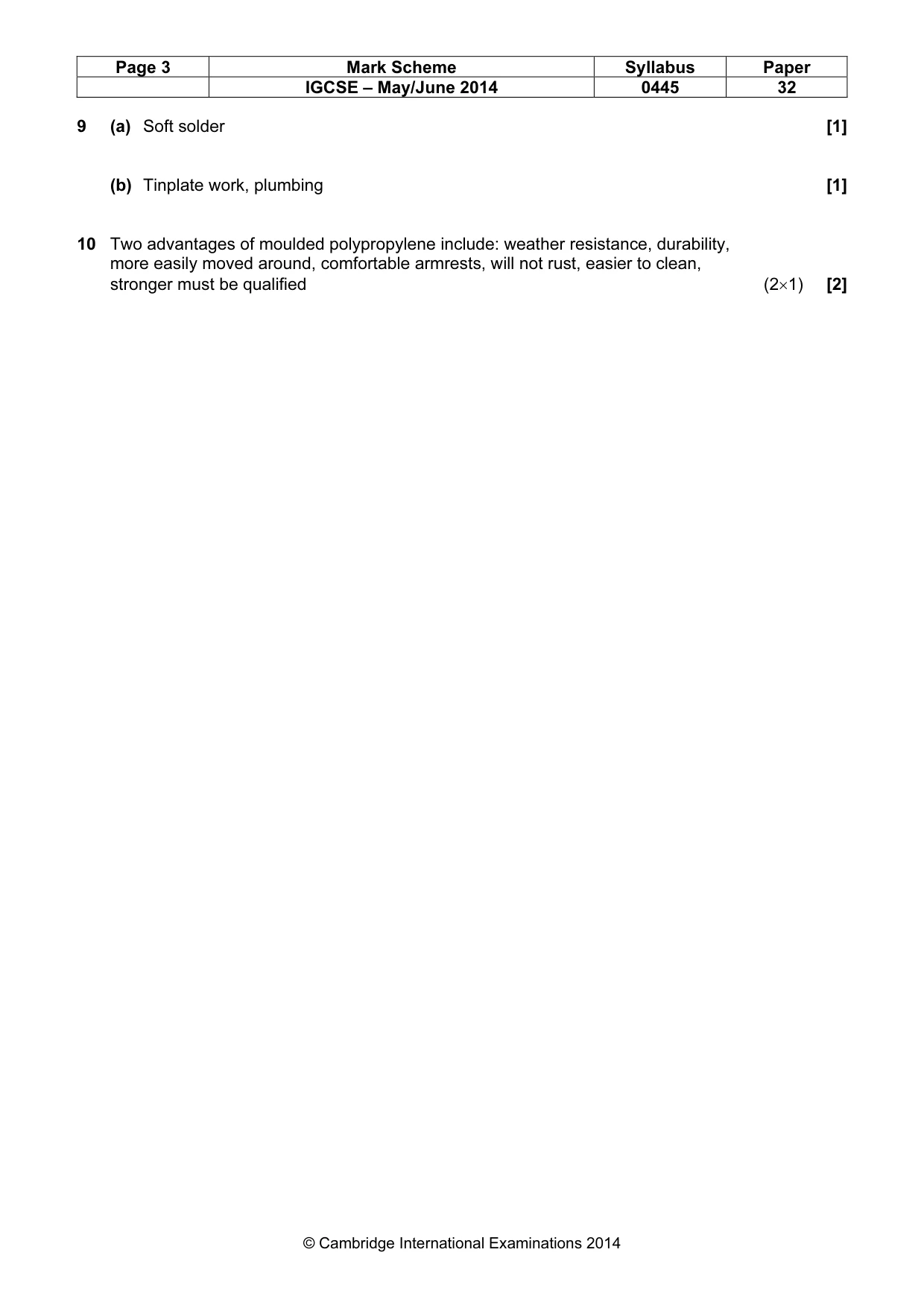
Page 3 Mark Scheme Syllabus Paper IGCSE – May/June 2014 0445 32 © Cambridge International Examinations 2014 9 (a) Soft solder [1] (b) Tinplate work, plumbing [1] 10 Two advantages of moulded polypropylene include: weather resistance, durability, more easily moved around, comfortable armrests, will not rust, easier to clean, stronger must be qualified (2×1) [2]
Mark scheme, page 4
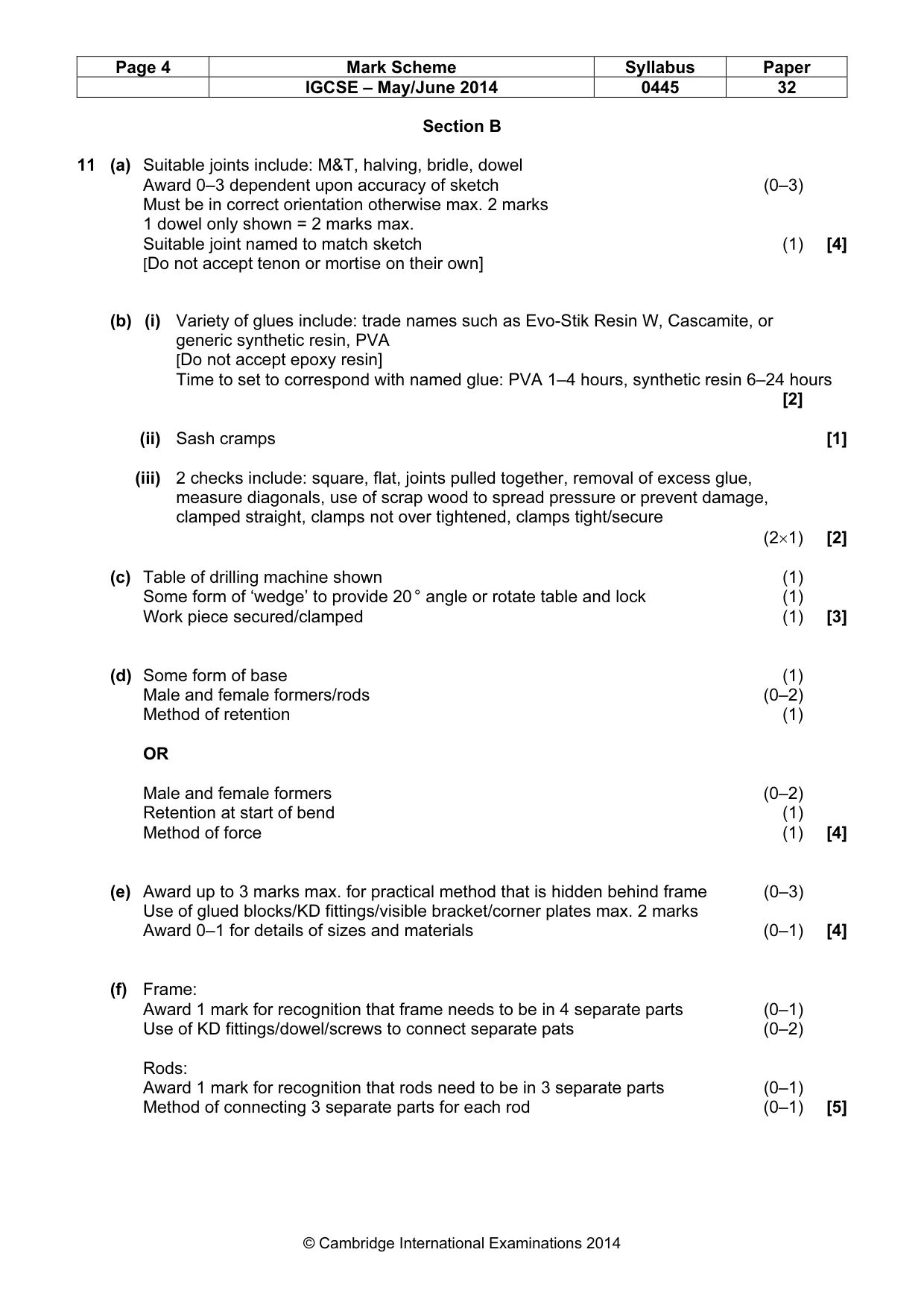
Page 4 Mark Scheme Syllabus Paper IGCSE – May/June 2014 0445 32 © Cambridge International Examinations 2014 Section B 11 (a) Suitable joints include: M&T, halving, bridle, dowel Award 0–3 dependent upon accuracy of sketch (0–3) Must be in correct orientation otherwise max. 2 marks 1 dowel only shown = 2 marks max. Suitable joint named to match sketch (1) [4] [Do not accept tenon or mortise on their own] (b) (i) Variety of glues include: trade names such as Evo-Stik Resin W, Cascamite, or generic synthetic resin, PVA [Do not accept epoxy resin] Time to set to correspond with named glue: PVA 1–4 hours, synthetic resin 6–24 hours [2] (ii) Sash cramps [1] (iii) 2 checks include: square, flat, joints pulled together, removal of excess glue, measure diagonals, use of scrap wood to spread pressure or prevent damage, clamped straight, clamps not over tightened, clamps tight/secure (2×1) [2] (c) Table of drilling machine shown (1) Some form of ‘wedge’ to provide 20 ° angle or rotate table and lock (1) Work piece secured/clamped (1) [3] (d) Some form of base (1) Male and female formers/rods (0–2) Method of retention (1) OR Male and female formers (0–2) Retention at start of bend (1) Method of force (1) [4] (e) Award up to 3 marks max. for practical method that is hidden behind frame (0–3) Use of glued blocks/KD fittings/visible bracket/corner plates max. 2 marks Award 0–1 for details of sizes and materials (0–1) [4] (f) Frame: Award 1 mark for recognition that frame needs to be in 4 separate parts (0–1) Use of KD fittings/dowel/screws to connect separate pats (0–2) Rods: Award 1 mark for recognition that rods need to be in 3 separate parts (0–1) Method of connecting 3 separate parts for each rod (0–1) [5]
Mark scheme, page 5
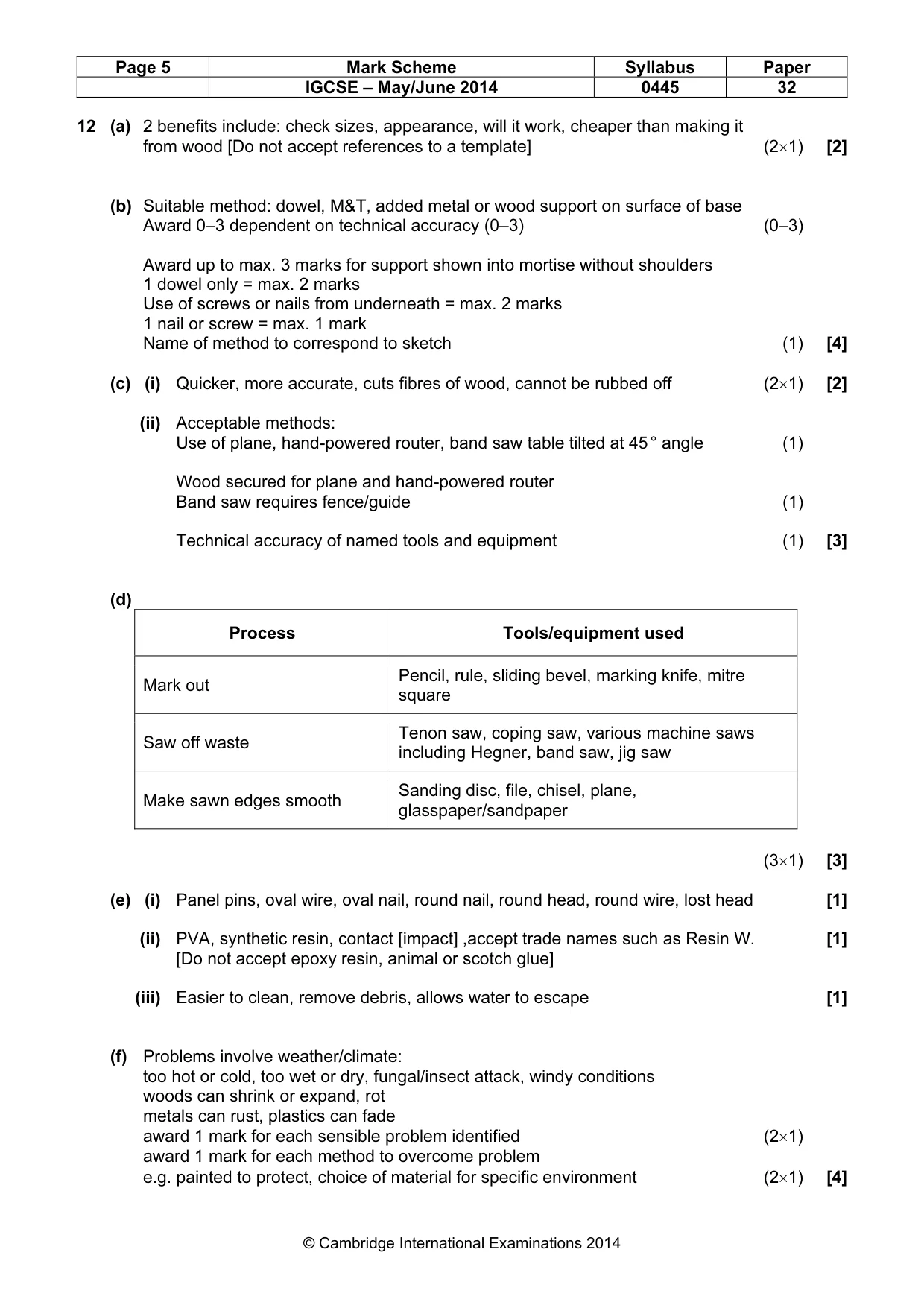
Page 5 Mark Scheme Syllabus Paper IGCSE – May/June 2014 0445 32 © Cambridge International Examinations 2014 12 (a) 2 benefits include: check sizes, appearance, will it work, cheaper than making it from wood [Do not accept references to a template] (2×1) [2] (b) Suitable method: dowel, M&T, added metal or wood support on surface of base Award 0–3 dependent on technical accuracy (0–3) (0–3) Award up to max. 3 marks for support shown into mortise without shoulders 1 dowel only = max. 2 marks Use of screws or nails from underneath = max. 2 marks 1 nail or screw = max. 1 mark Name of method to correspond to sketch (1) [4] (c) (i) Quicker, more accurate, cuts fibres of wood, cannot be rubbed off (2×1) [2] (ii) Acceptable methods: Use of plane, hand-powered router, band saw table tilted at 45 ° angle (1) Wood secured for plane and hand-powered router Band saw requires fence/guide (1) Technical accuracy of named tools and equipment (1) [3] (d) Process Tools/equipment used Mark out Pencil, rule, sliding bevel, marking knife, mitre square Saw off waste Tenon saw, coping saw, various machine saws including Hegner, band saw, jig saw Make sawn edges smooth Sanding disc, file, chisel, plane, glasspaper/sandpaper (3×1) [3] (e) (i) Panel pins, oval wire, oval nail, round nail, round head, round wire, lost head [1] (ii) PVA, synthetic resin, contact [impact] ,accept trade names such as Resin W. [1] [Do not accept epoxy resin, animal or scotch glue] (iii) Easier to clean, remove debris, allows water to escape [1] (f) Problems involve weather/climate: too hot or cold, too wet or dry, fungal/insect attack, windy conditions woods can shrink or expand, rot metals can rust, plastics can fade award 1 mark for each sensible problem identified (2×1) award 1 mark for each method to overcome problem e.g. painted to protect, choice of material for specific environment (2×1) [4]
Mark scheme, page 6
Page 6 Mark Scheme Syllabus Paper IGCSE – May/June 2014 0445 32 © Cambridge International Examinations 2014 (g) End of D [or support] shaped to fit under roof (1) Reinforced using block or strip of wood (1) [Do not accept screwing of roof to shaped end of support] Details of materials and constructions used (0–2) [4] 13 (a) (i) Award 1 mark for each cut shown above (5×1) [5] Incorrect orientation = 0 marks (ii) Quicker, more accurate, repetitive accuracy Template can be used as a 2D model (2×1) [2] (b) (i) Sketch to show work low in the vice to prevent it cracking (0–2) Added notes to describe how problem is overcome (0–1) [3] (ii) Award work piece clamped in position/use of machine vice (1) Award work piece supported underneath (1) Award slow speed of drill/correct cutting angle/pilot drills (1) [3] (c) Use of wet and dry paper, polishing wheel, mop and compound/polish Award any 2 items of equipment described (2×1) [2] (d) Heated over a line bender/strip heater/hot air gun to become soft (1) Use of former or round bar (1) Softened acrylic draped over former/round bar and held (1) Technical accuracy (1) [4] (e) Practical solution/ concept (0–3) Details of sizes and constructions (0–3) [Materials used must be appropriate for 4 mm thick acrylic otherwise 0 marks] [6]
What you needed in this session
Cambridge’s own grade thresholds for 2014 May/June, Paper 3 · Variant 2. A higher threshold means an easier paper — the bar moves with how the cohort did.