Cambridge IGCSE Design and Technology 0445 — 2014 May/June Paper 3 · Variant 3
0445/33/M/J/14 · 50 marks · ≈56 min
The question paper and its mark scheme, free to read here and free to download. This is Cambridge’s own paper, exactly as it was sat.
Question paper20 pages

Mark scheme5 pages
Answers below. Sit the paper first if you are practising.
Paper as text
Question paper, page 1
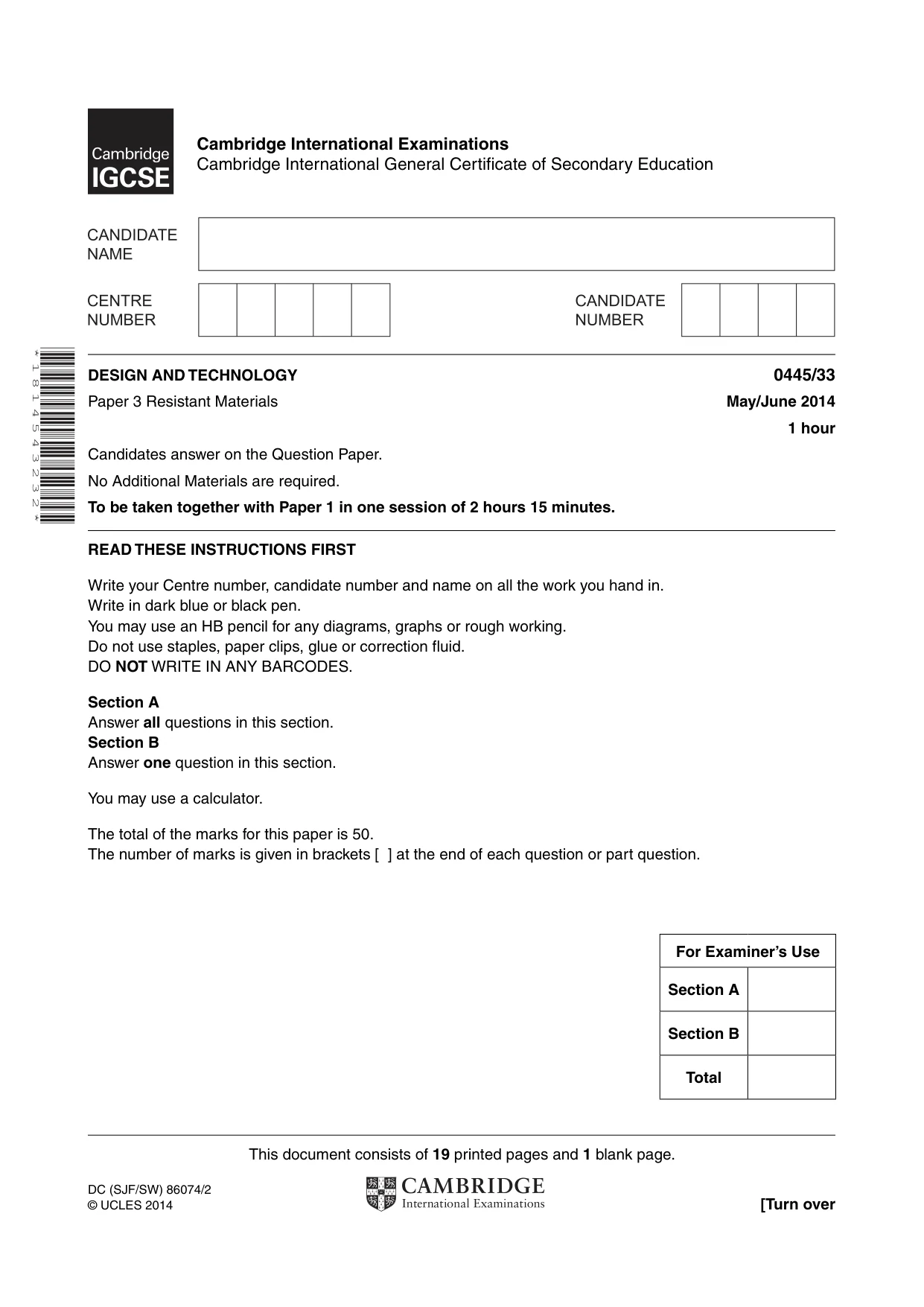
This document consists of 19 printed pages and 1 blank page. DC (SJF/SW) 86074/2 © UCLES 2014 [Turn over Cambridge International Examinations Cambridge International General Certificate of Secondary Education * 1 8 1 4 5 4 3 2 3 2 * DESIGN AND TECHNOLOGY 0445/33 Paper 3 Resistant Materials May/June 2014 1 hour Candidates answer on the Question Paper. No Additional Materials are required. To be taken together with Paper 1 in one session of 2 hours 15 minutes. READ THESE INSTRUCTIONS FIRST Write your Centre number, candidate number and name on all the work you hand in. Write in dark blue or black pen. You may use an HB pencil for any diagrams, graphs or rough working. Do not use staples, paper clips, glue or correction fluid. DO NOT WRITE IN ANY BARCODES. Section A Answer all questions in this section. Section B Answer one question in this section. You may use a calculator. The total of the marks for this paper is 50. The number of marks is given in brackets [ ] at the end of each question or part question. For Examiner’s Use Section A Section B Total
Question paper, page 2
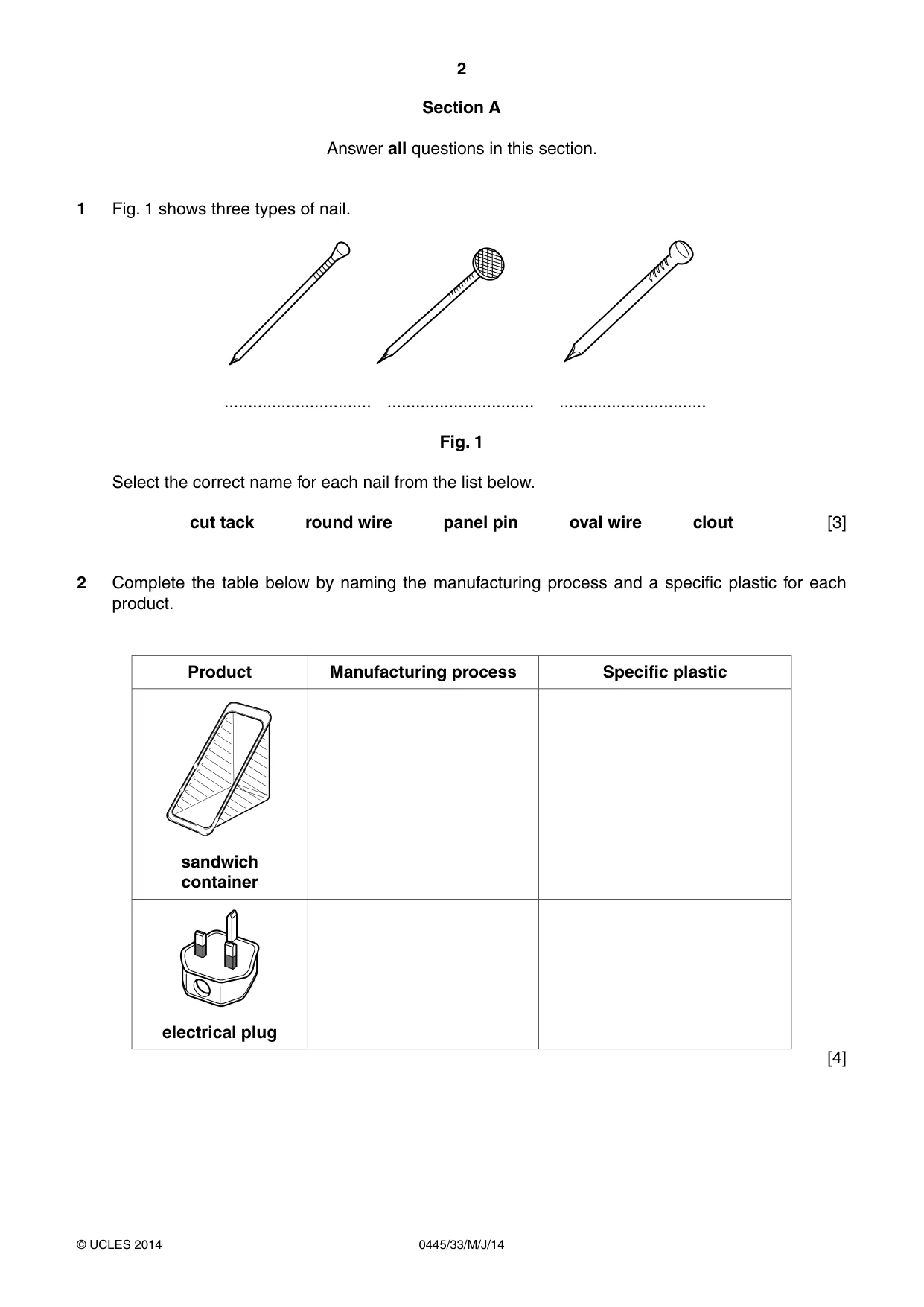
2 0445/33/M/J/14 © UCLES 2014 Section A Answer all questions in this section. 1 Fig. 1 shows three types of nail. … … … Fig. 1 Select the correct name for each nail from the list below. cut tack round wire panel pin oval wire clout [3] 2 Complete the table below by naming the manufacturing process and a specific plastic for each product. Product Manufacturing process Specific plastic sandwich container electrical plug [4]
Question paper, page 3
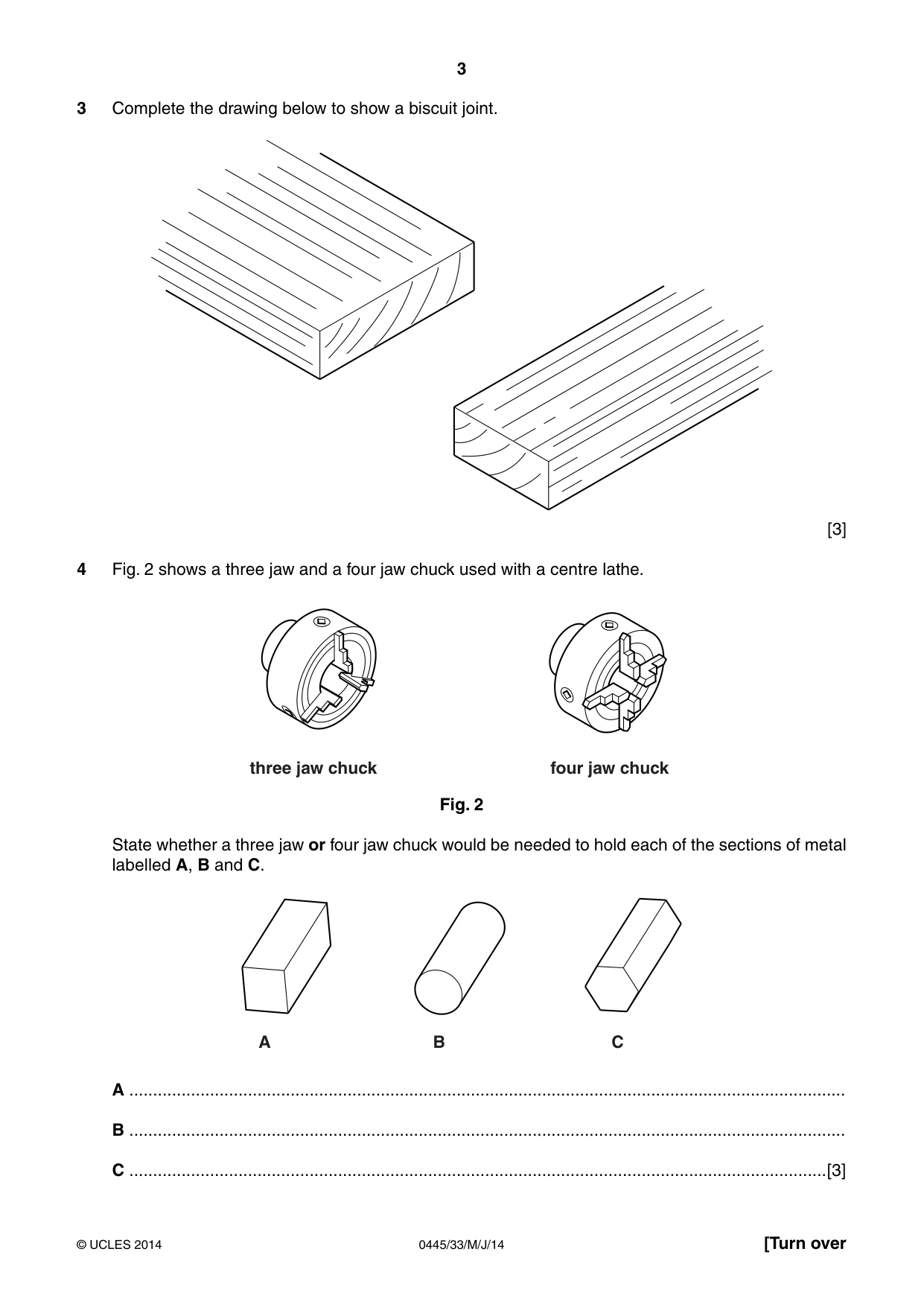
3 0445/33/M/J/14 © UCLES 2014 [Turn over 3 Complete the drawing below to show a biscuit joint. [3] 4 Fig. 2 shows a three jaw and a four jaw chuck used with a centre lathe. three jaw chuck four jaw chuck Fig. 2 State whether a three jaw or four jaw chuck would be needed to hold each of the sections of metal labelled A, B and C. A B C A … B … C …[3]
Question paper, page 4
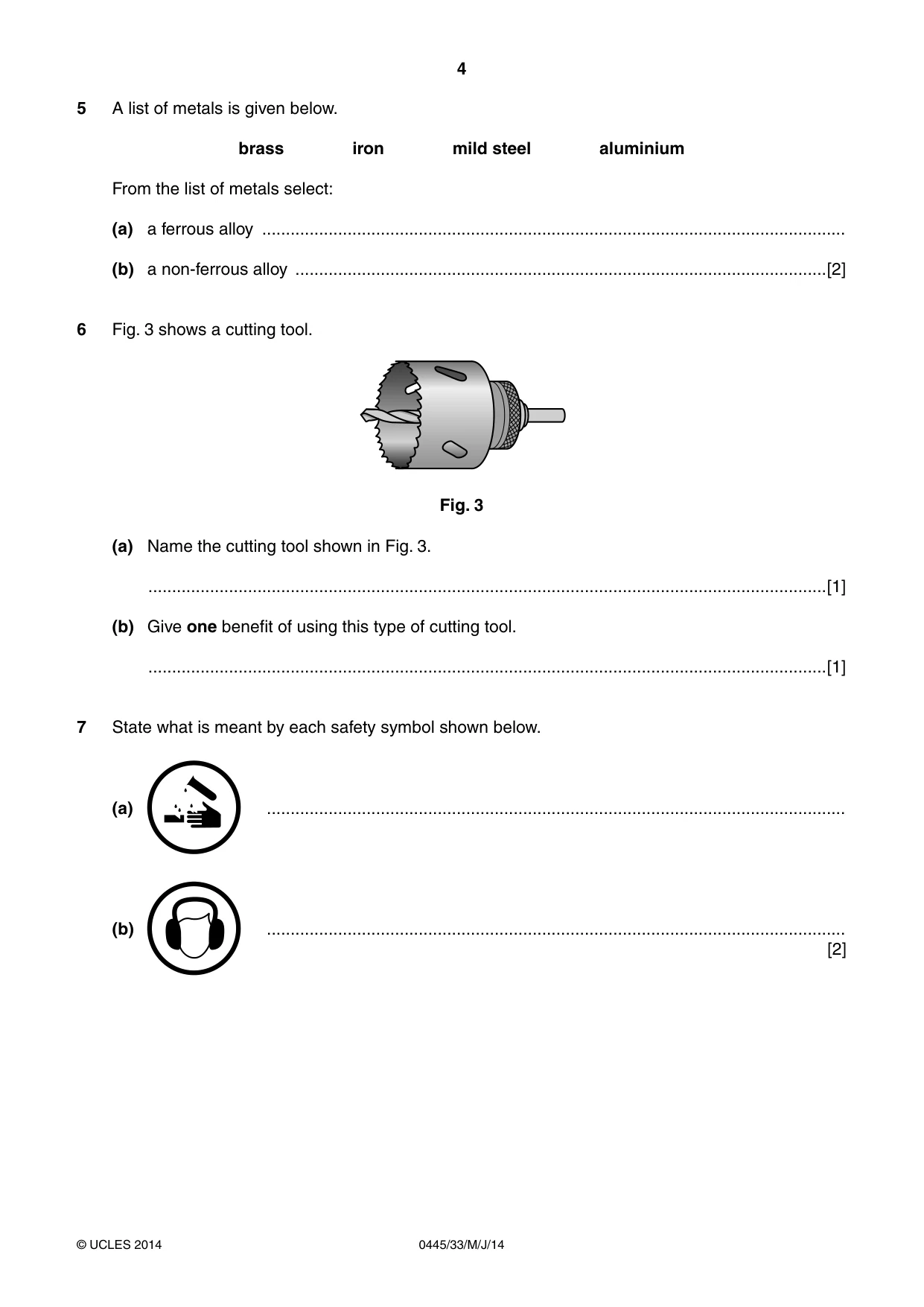
4 0445/33/M/J/14 © UCLES 2014 5 A list of metals is given below. brass iron mild steel aluminium From the list of metals select: (a) a ferrous alloy … (b) a non-ferrous alloy …[2] 6 Fig. 3 shows a cutting tool. Fig. 3 (a) Name the cutting tool shown in Fig. 3. …[1] (b) Give one benefit of using this type of cutting tool. …[1] 7 State what is meant by each safety symbol shown below. (a) … (b) … [2]
Question paper, page 5
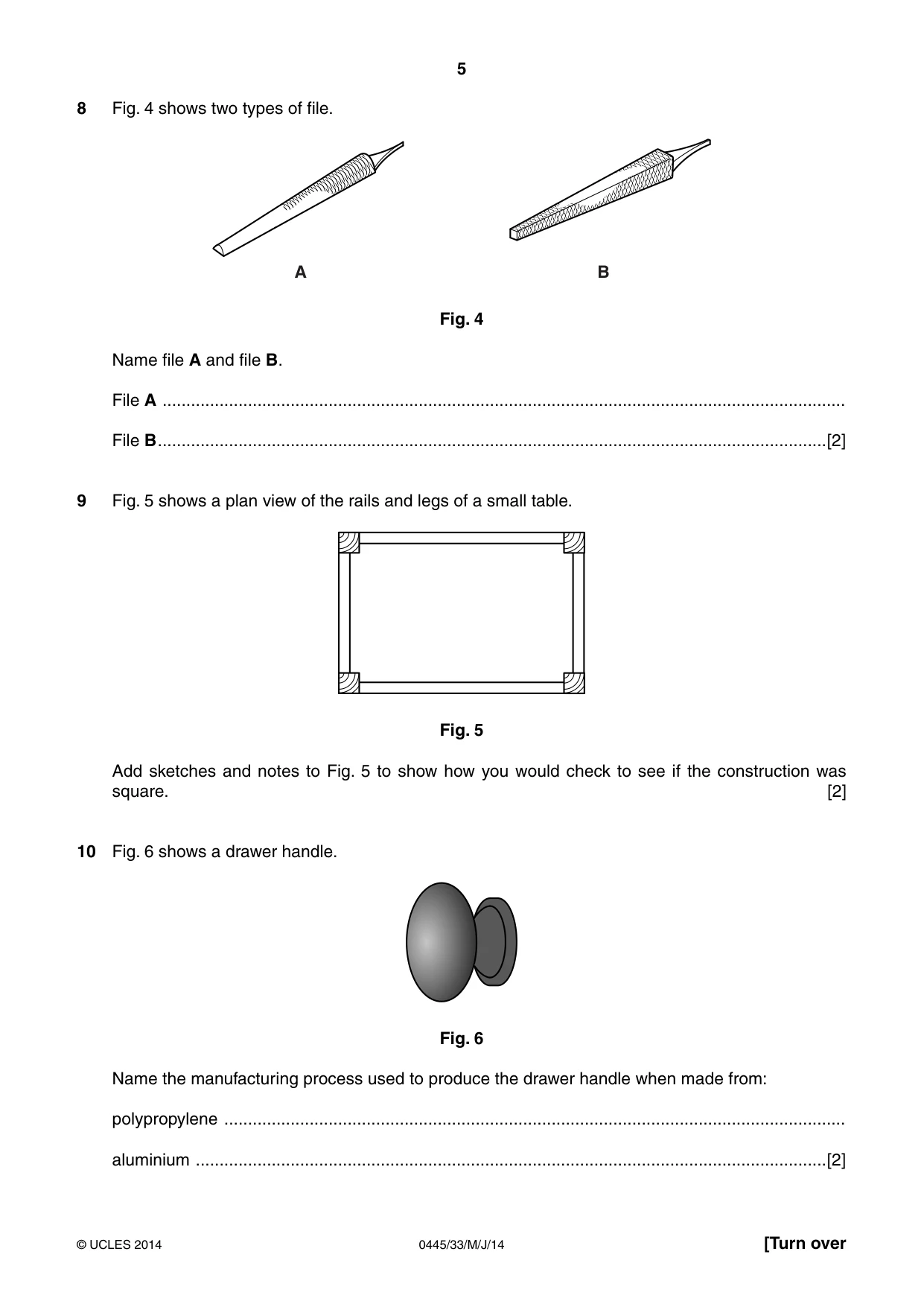
5 0445/33/M/J/14 © UCLES 2014 [Turn over 8 Fig. 4 shows two types of file. A B Fig. 4 Name file A and file B. File A … File B …[2] 9 Fig. 5 shows a plan view of the rails and legs of a small table. Fig. 5 Add sketches and notes to Fig. 5 to show how you would check to see if the construction was square. [2] 10 Fig. 6 shows a drawer handle. Fig. 6 Name the manufacturing process used to produce the drawer handle when made from: polypropylene … aluminium …[2]
Question paper, page 6
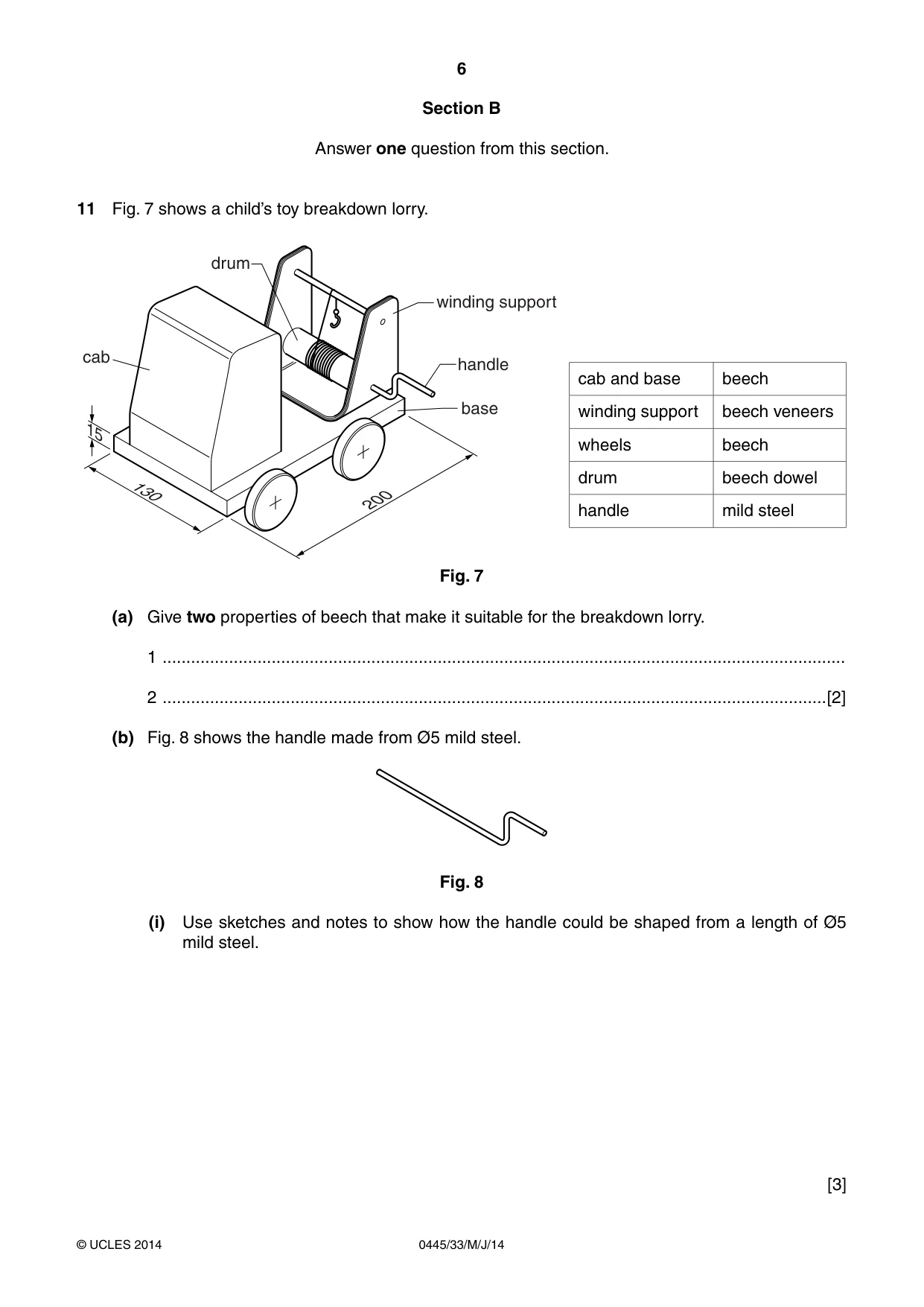
6 0445/33/M/J/14 © UCLES 2014 Section B Answer one question from this section. 11 Fig. 7 shows a child’s toy breakdown lorry. cab and base beech winding support beech veneers wheels beech drum beech dowel handle mild steel 15 130 200 cab drum winding support handle base Fig. 7 (a) Give two properties of beech that make it suitable for the breakdown lorry. 1 … 2 …[2] (b) Fig. 8 shows the handle made from Ø5 mild steel. Fig. 8 (i) Use sketches and notes to show how the handle could be shaped from a length of Ø5 mild steel. [3]
Question paper, page 7
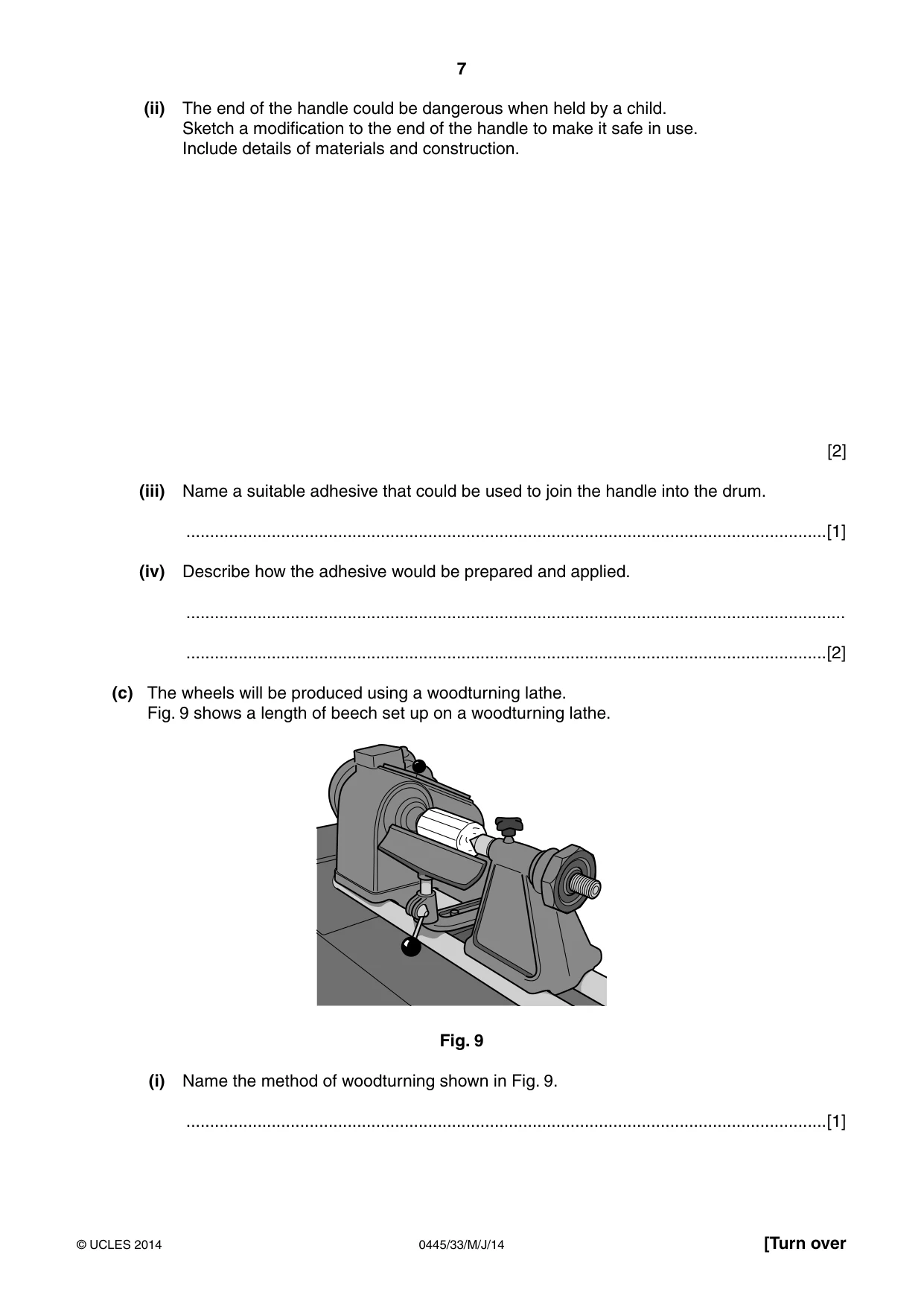
7 0445/33/M/J/14 © UCLES 2014 [Turn over (ii) The end of the handle could be dangerous when held by a child. Sketch a modification to the end of the handle to make it safe in use. Include details of materials and construction. [2] (iii) Name a suitable adhesive that could be used to join the handle into the drum. …[1] (iv) Describe how the adhesive would be prepared and applied. … …[2] (c) The wheels will be produced using a woodturning lathe. Fig. 9 shows a length of beech set up on a woodturning lathe. Fig. 9 (i) Name the method of woodturning shown in Fig. 9. …[1]
Question paper, page 8
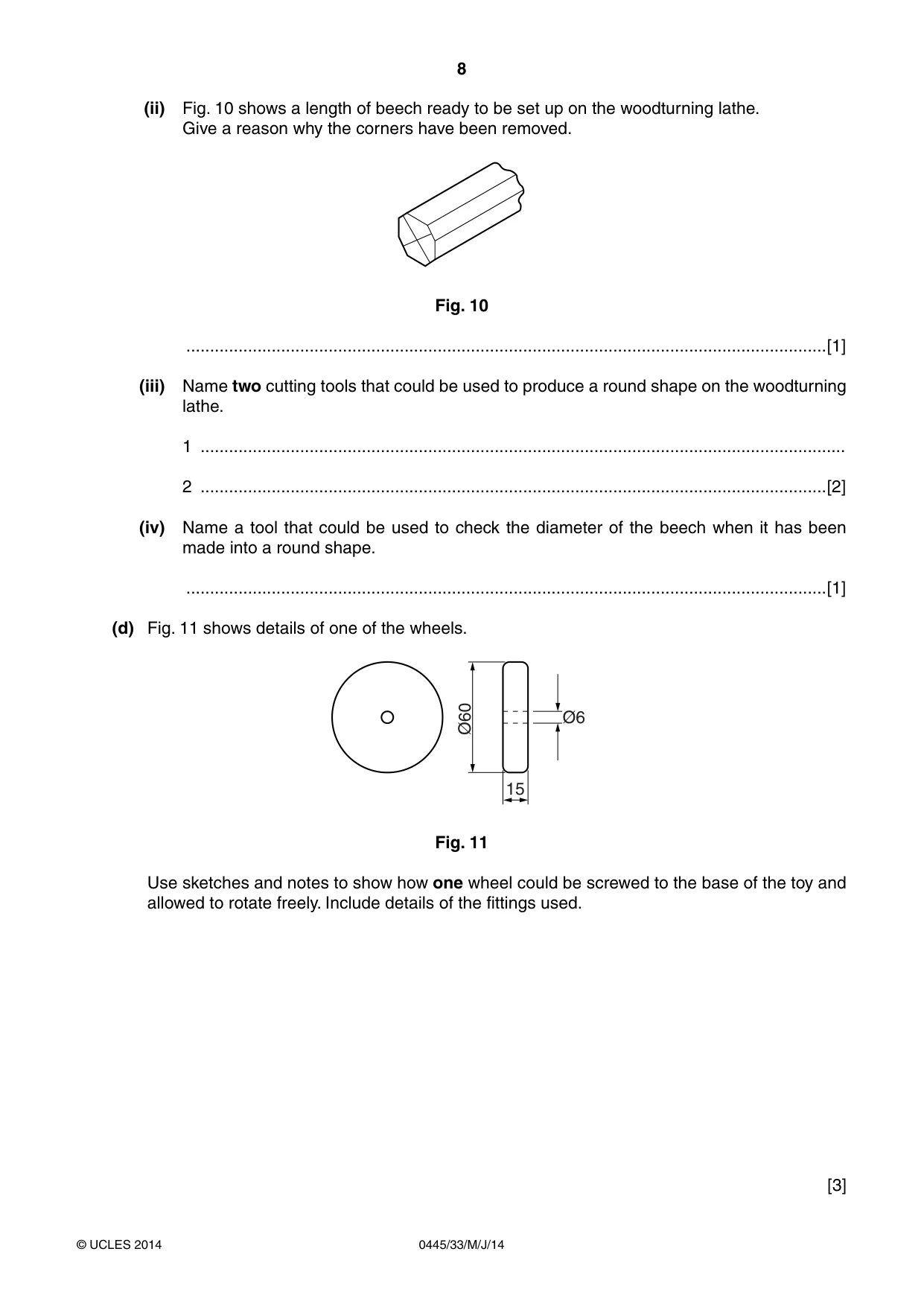
8 0445/33/M/J/14 © UCLES 2014 (ii) Fig. 10 shows a length of beech ready to be set up on the woodturning lathe. Give a reason why the corners have been removed. Fig. 10 …[1] (iii) Name two cutting tools that could be used to produce a round shape on the woodturning lathe. 1 … 2 …[2] (iv) Name a tool that could be used to check the diameter of the beech when it has been made into a round shape. …[1] (d) Fig. 11 shows details of one of the wheels. 15 Ø6 Ø60 Fig. 11 Use sketches and notes to show how one wheel could be screwed to the base of the toy and allowed to rotate freely. Include details of the fittings used. [3]
Question paper, page 9
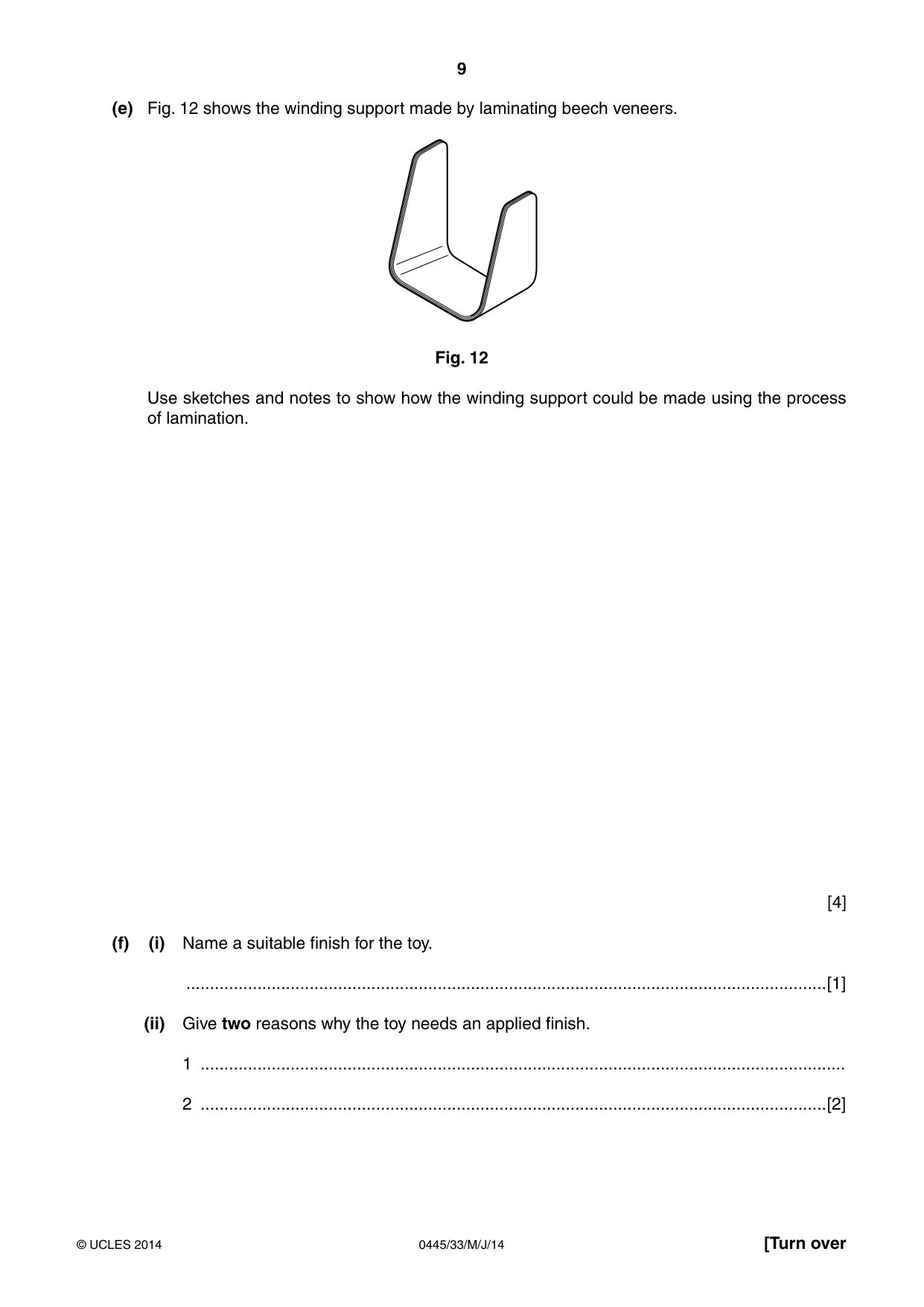
9 0445/33/M/J/14 © UCLES 2014 [Turn over (e) Fig. 12 shows the winding support made by laminating beech veneers. Fig. 12 Use sketches and notes to show how the winding support could be made using the process of lamination. [4] (f) (i) Name a suitable finish for the toy. …[1] (ii) Give two reasons why the toy needs an applied finish. 1 … 2 …[2]
Question paper, page 10
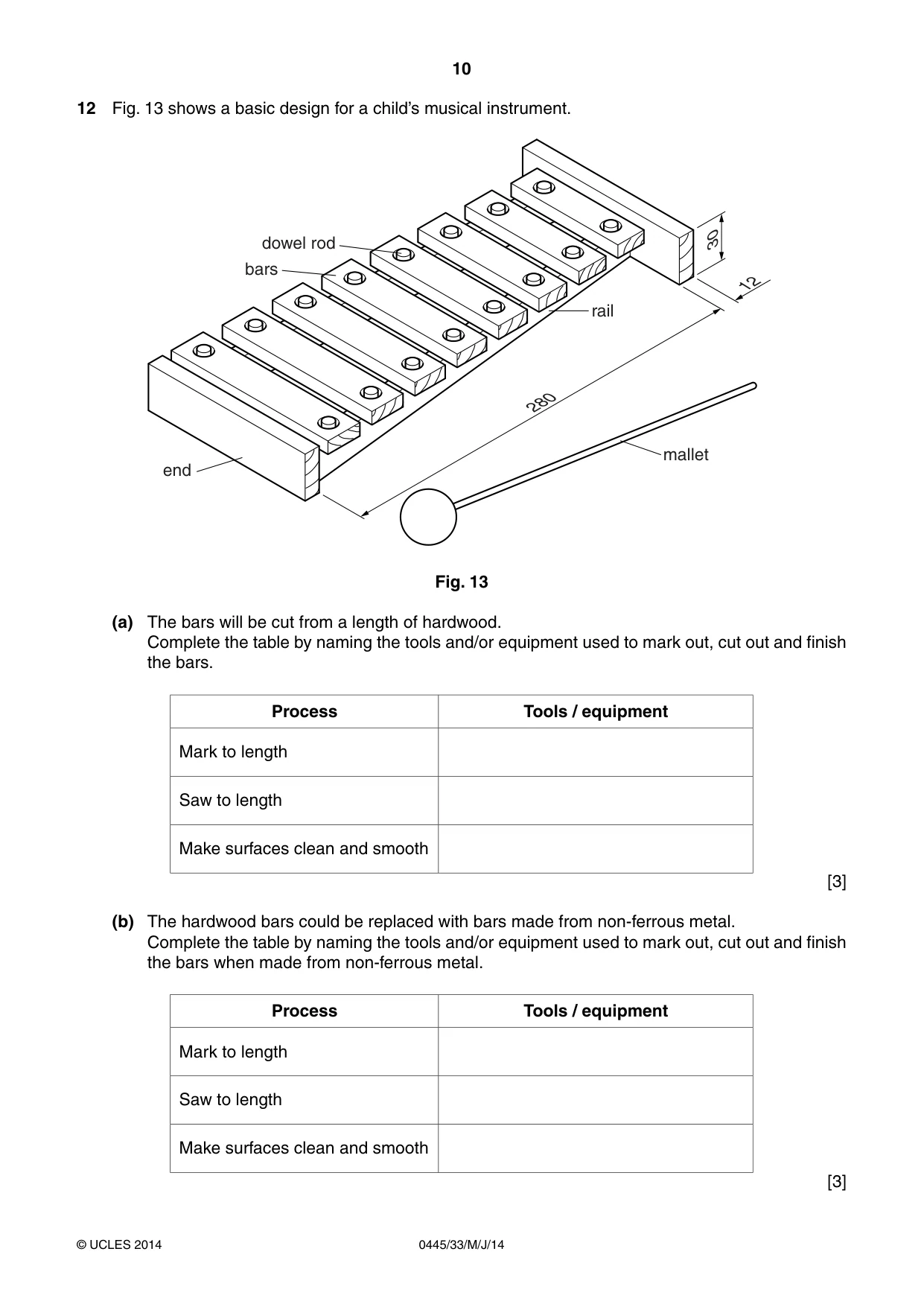
10 0445/33/M/J/14 © UCLES 2014 12 Fig. 13 shows a basic design for a child’s musical instrument. 280 12 30 dowel rod rail mallet bars end Fig. 13 (a) The bars will be cut from a length of hardwood. Complete the table by naming the tools and/or equipment used to mark out, cut out and finish the bars. Process Tools / equipment Mark to length Saw to length Make surfaces clean and smooth [3] (b) The hardwood bars could be replaced with bars made from non-ferrous metal. Complete the table by naming the tools and/or equipment used to mark out, cut out and finish the bars when made from non-ferrous metal. Process Tools / equipment Mark to length Saw to length Make surfaces clean and smooth [3]
Question paper, page 11
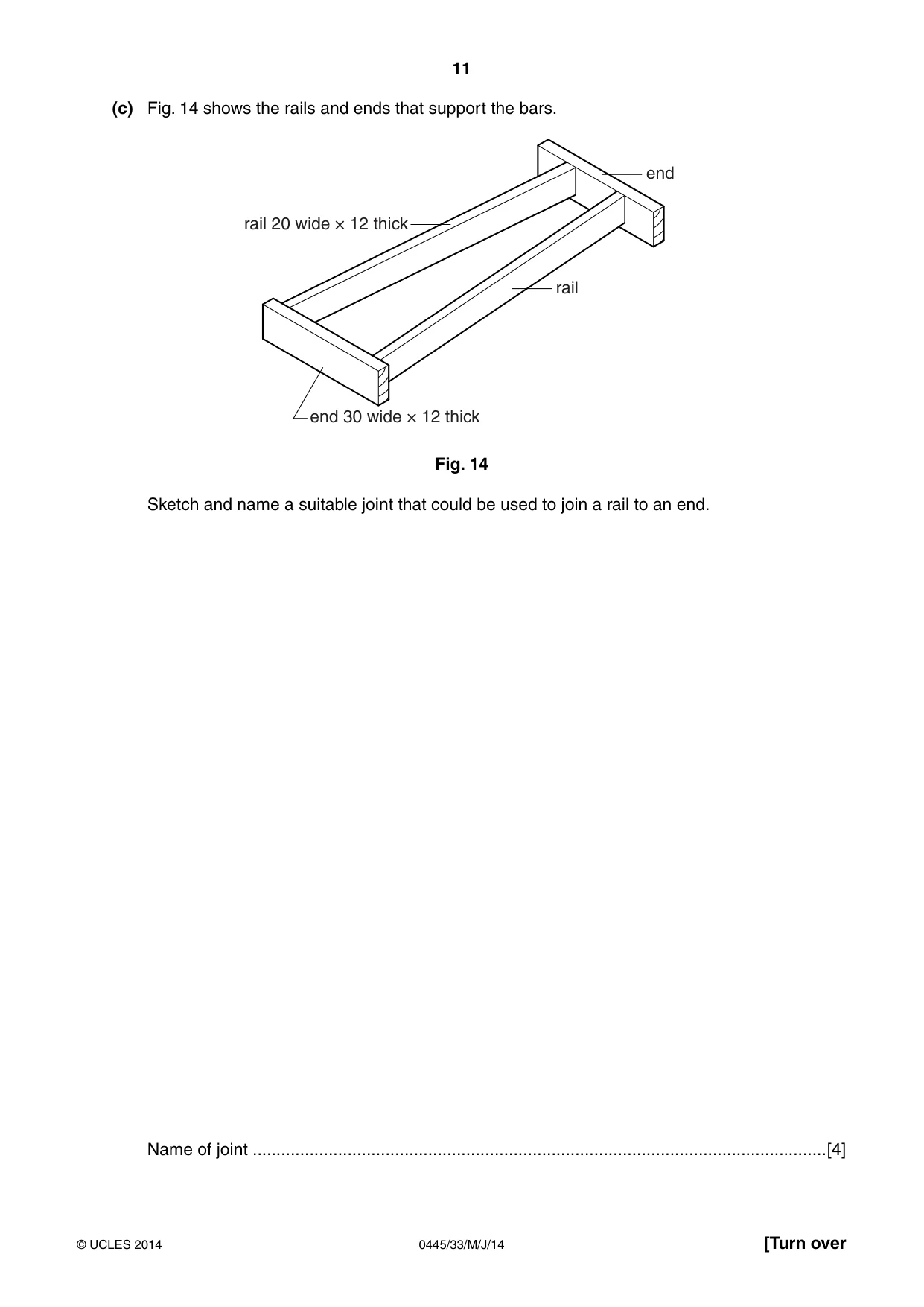
11 0445/33/M/J/14 © UCLES 2014 [Turn over (c) Fig. 14 shows the rails and ends that support the bars. end rail 20 wide × 12 thick end 30 wide × 12 thick rail Fig. 14 Sketch and name a suitable joint that could be used to join a rail to an end. Name of joint …[4]
Question paper, page 12
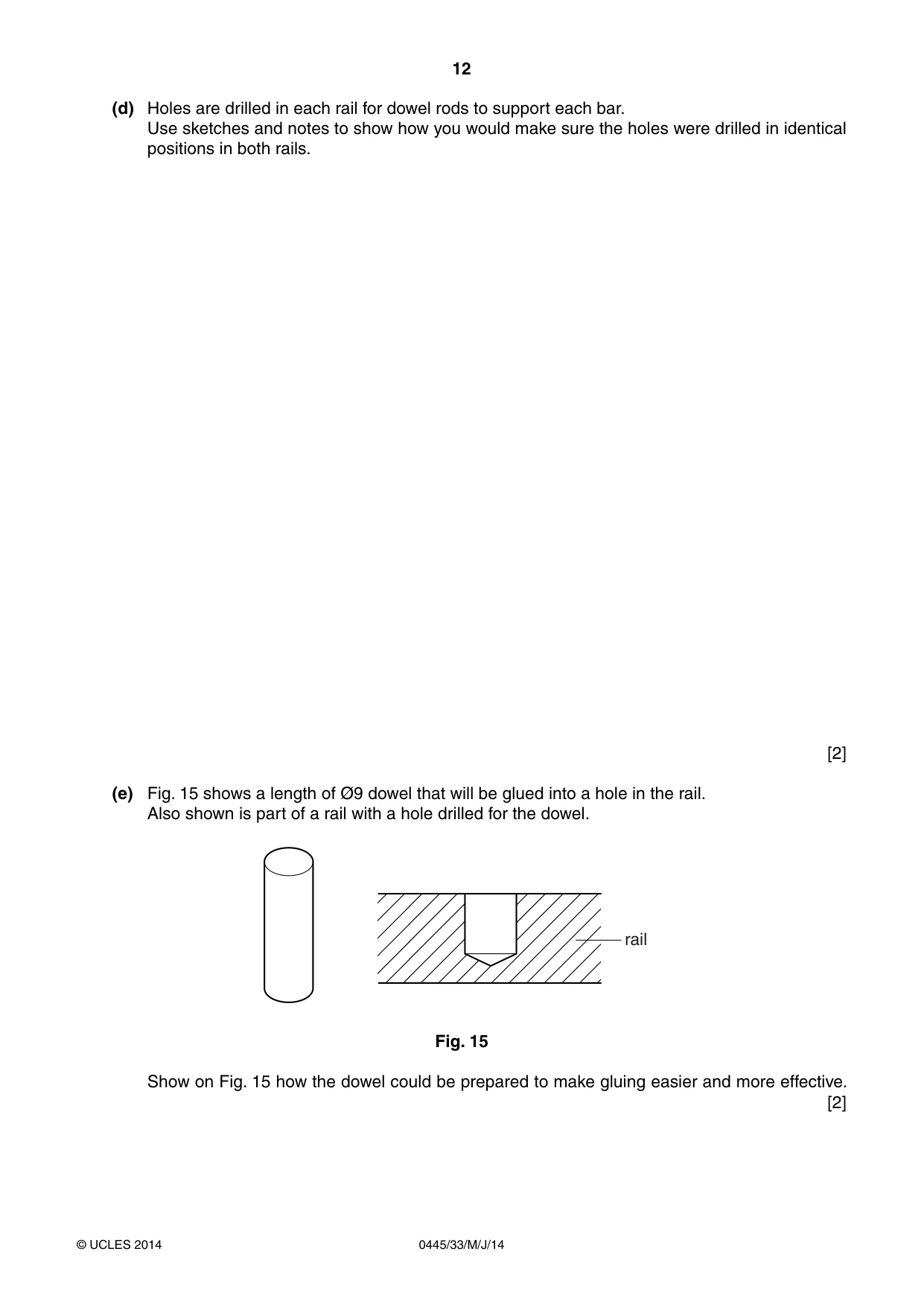
12 0445/33/M/J/14 © UCLES 2014 (d) Holes are drilled in each rail for dowel rods to support each bar. Use sketches and notes to show how you would make sure the holes were drilled in identical positions in both rails. [2] (e) Fig. 15 shows a length of Ø9 dowel that will be glued into a hole in the rail. Also shown is part of a rail with a hole drilled for the dowel. rail Fig. 15 Show on Fig. 15 how the dowel could be prepared to make gluing easier and more effective. [2]
Question paper, page 13
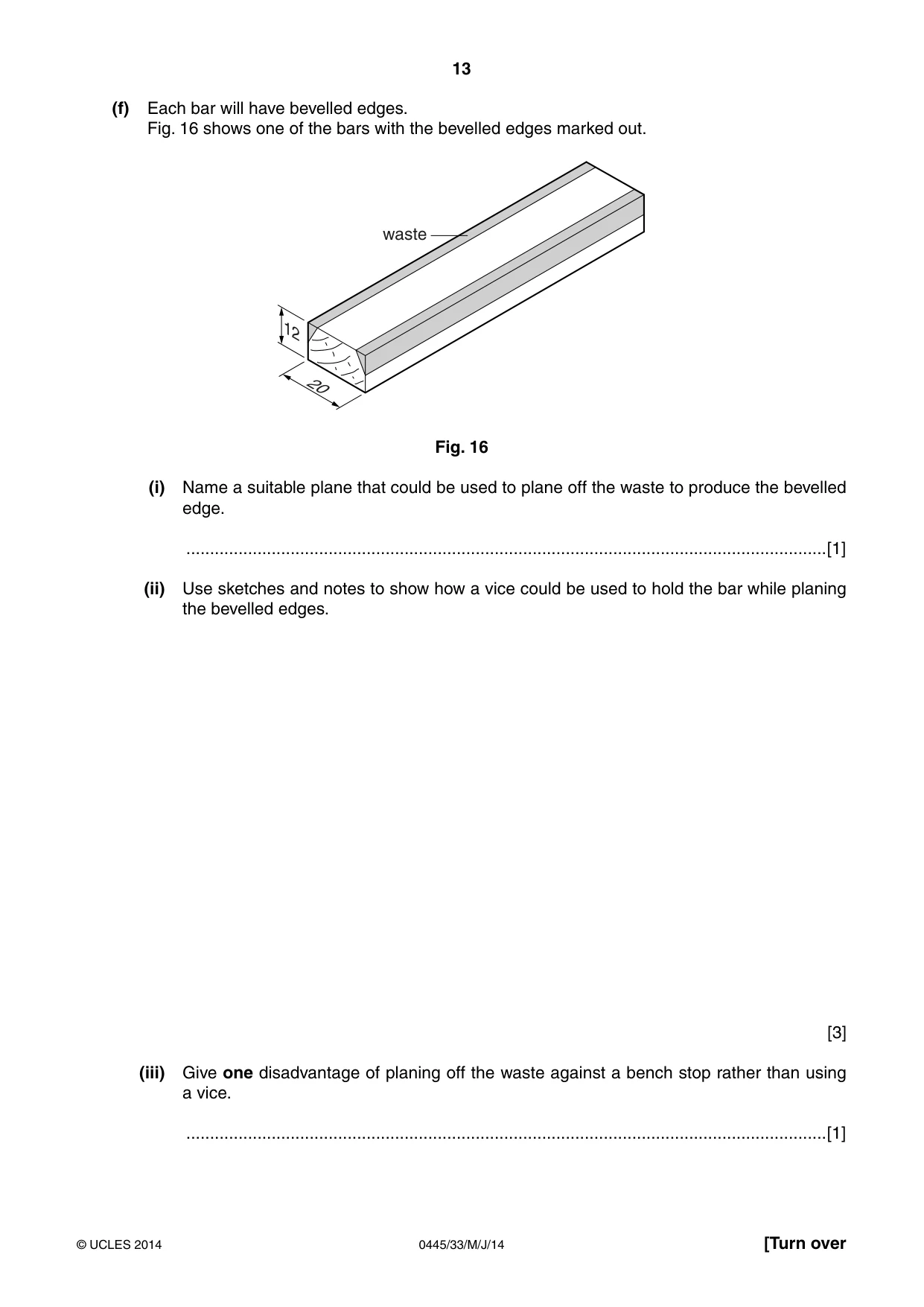
13 0445/33/M/J/14 © UCLES 2014 [Turn over (f) Each bar will have bevelled edges. Fig. 16 shows one of the bars with the bevelled edges marked out. 12 20 waste Fig. 16 (i) Name a suitable plane that could be used to plane off the waste to produce the bevelled edge. …[1] (ii) Use sketches and notes to show how a vice could be used to hold the bar while planing the bevelled edges. [3] (iii) Give one disadvantage of planing off the waste against a bench stop rather than using a vice. …[1]
Question paper, page 14
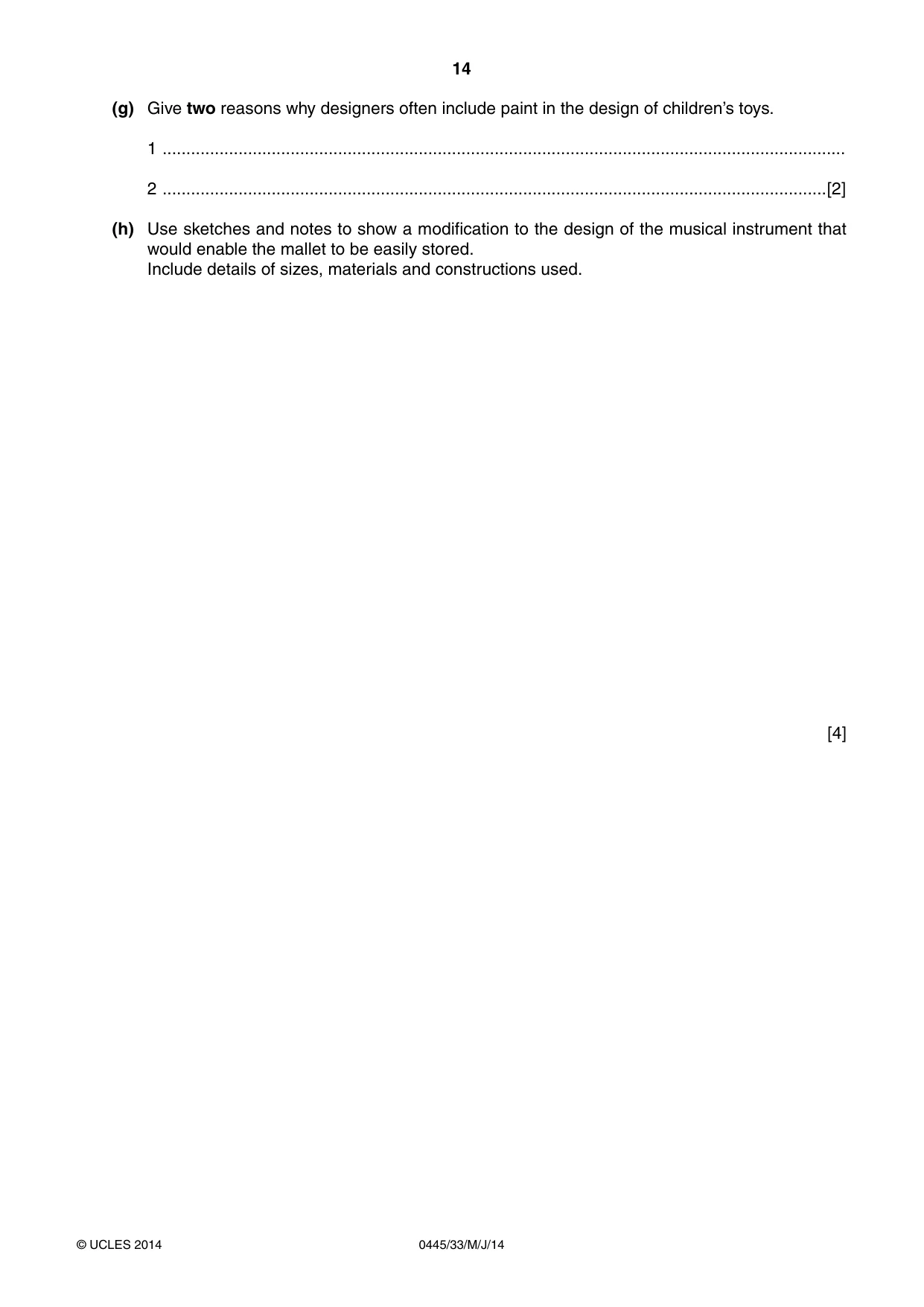
14 0445/33/M/J/14 © UCLES 2014 (g) Give two reasons why designers often include paint in the design of children’s toys. 1 … 2 …[2] (h) Use sketches and notes to show a modification to the design of the musical instrument that would enable the mallet to be easily stored. Include details of sizes, materials and constructions used. [4]
Question paper, page 15
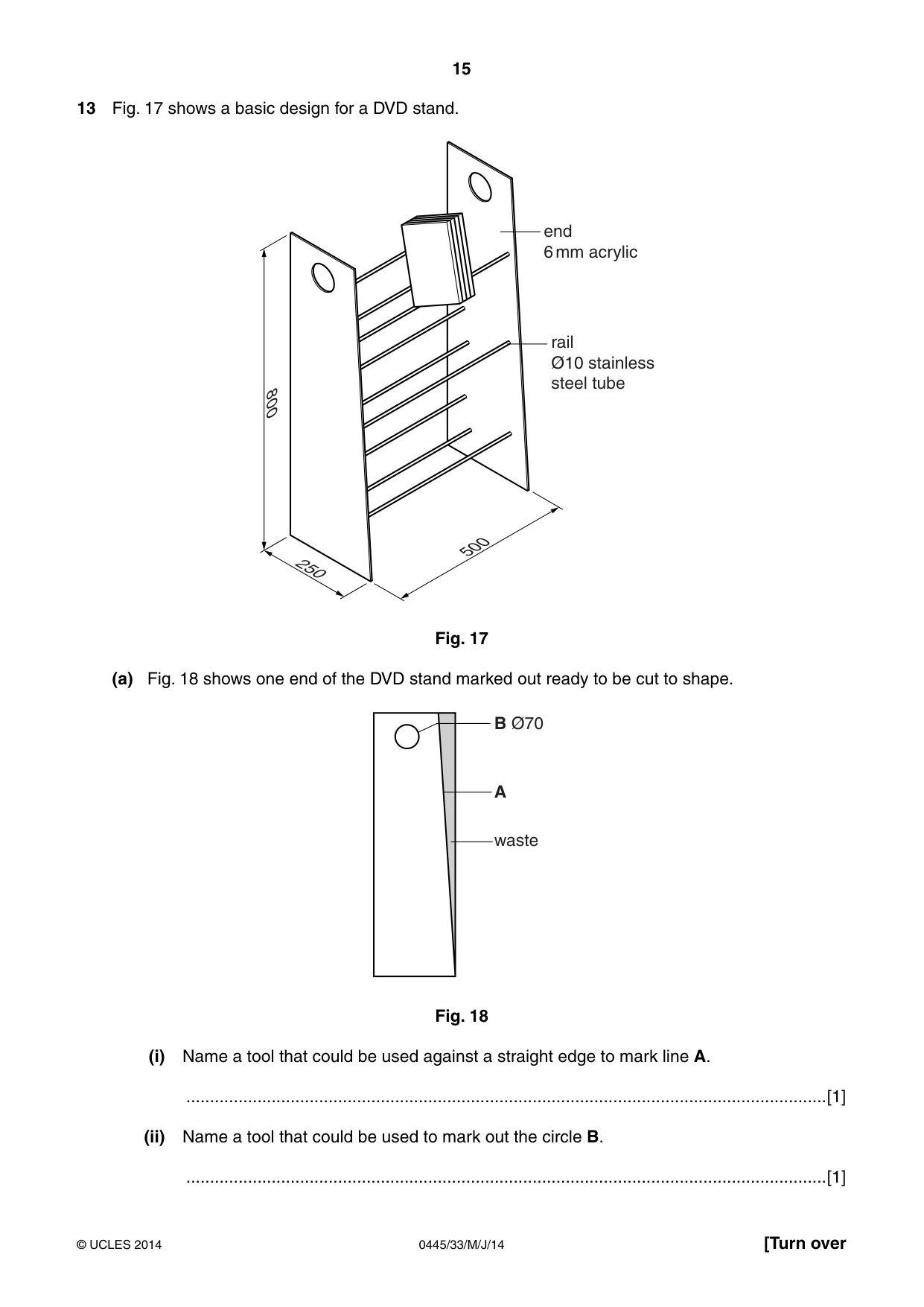
15 0445/33/M/J/14 © UCLES 2014 [Turn over 13 Fig. 17 shows a basic design for a DVD stand. 250 500 800 end 6 mm acrylic rail Ø10 stainless steel tube Fig. 17 (a) Fig. 18 shows one end of the DVD stand marked out ready to be cut to shape. B Ø70 A waste Fig. 18 (i) Name a tool that could be used against a straight edge to mark line A. …[1] (ii) Name a tool that could be used to mark out the circle B. …[1]
Question paper, page 16
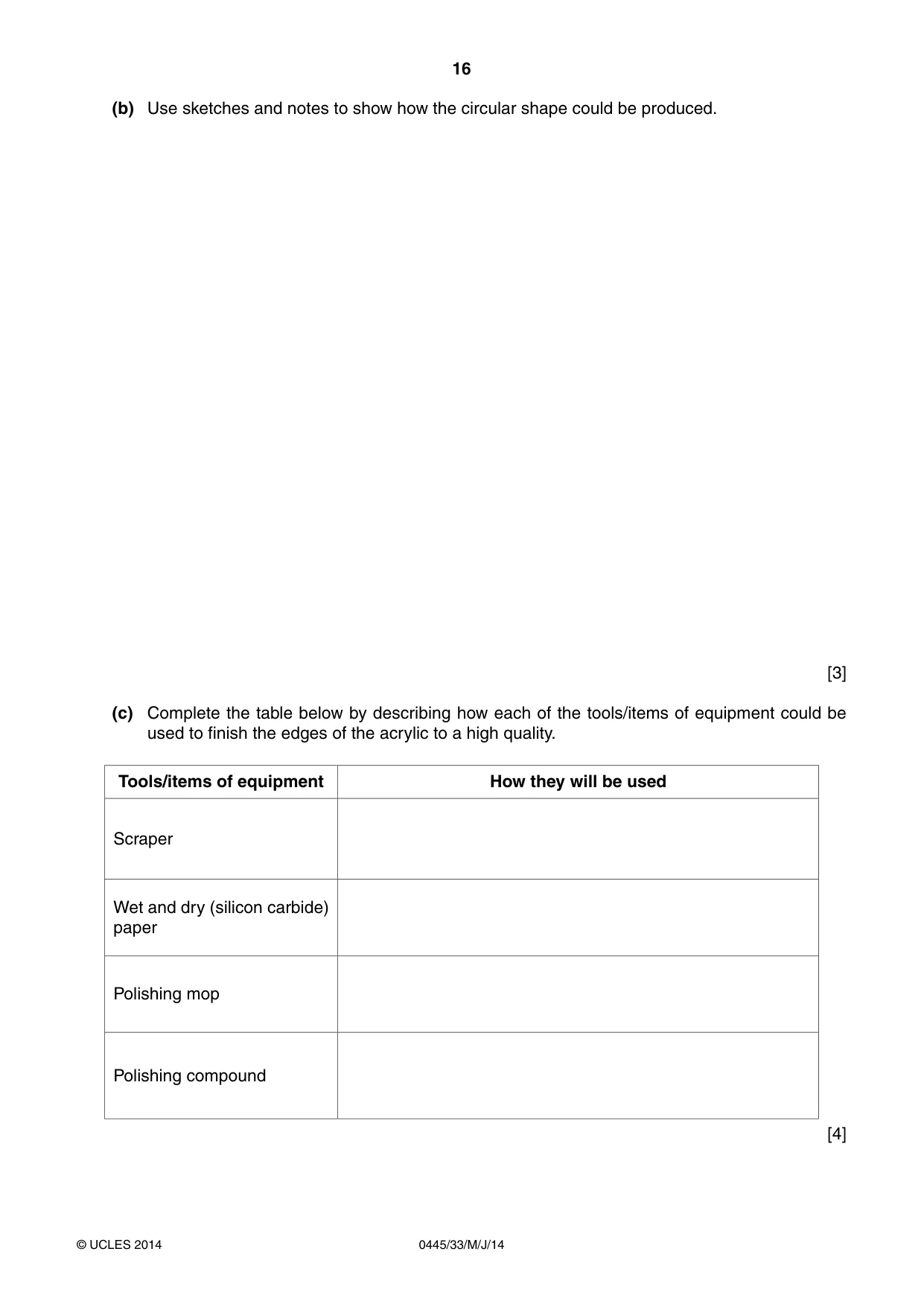
16 0445/33/M/J/14 © UCLES 2014 (b) Use sketches and notes to show how the circular shape could be produced. [3] (c) Complete the table below by describing how each of the tools/items of equipment could be used to finish the edges of the acrylic to a high quality. Tools/items of equipment How they will be used Scraper Wet and dry (silicon carbide) paper Polishing mop Polishing compound [4]
Question paper, page 17
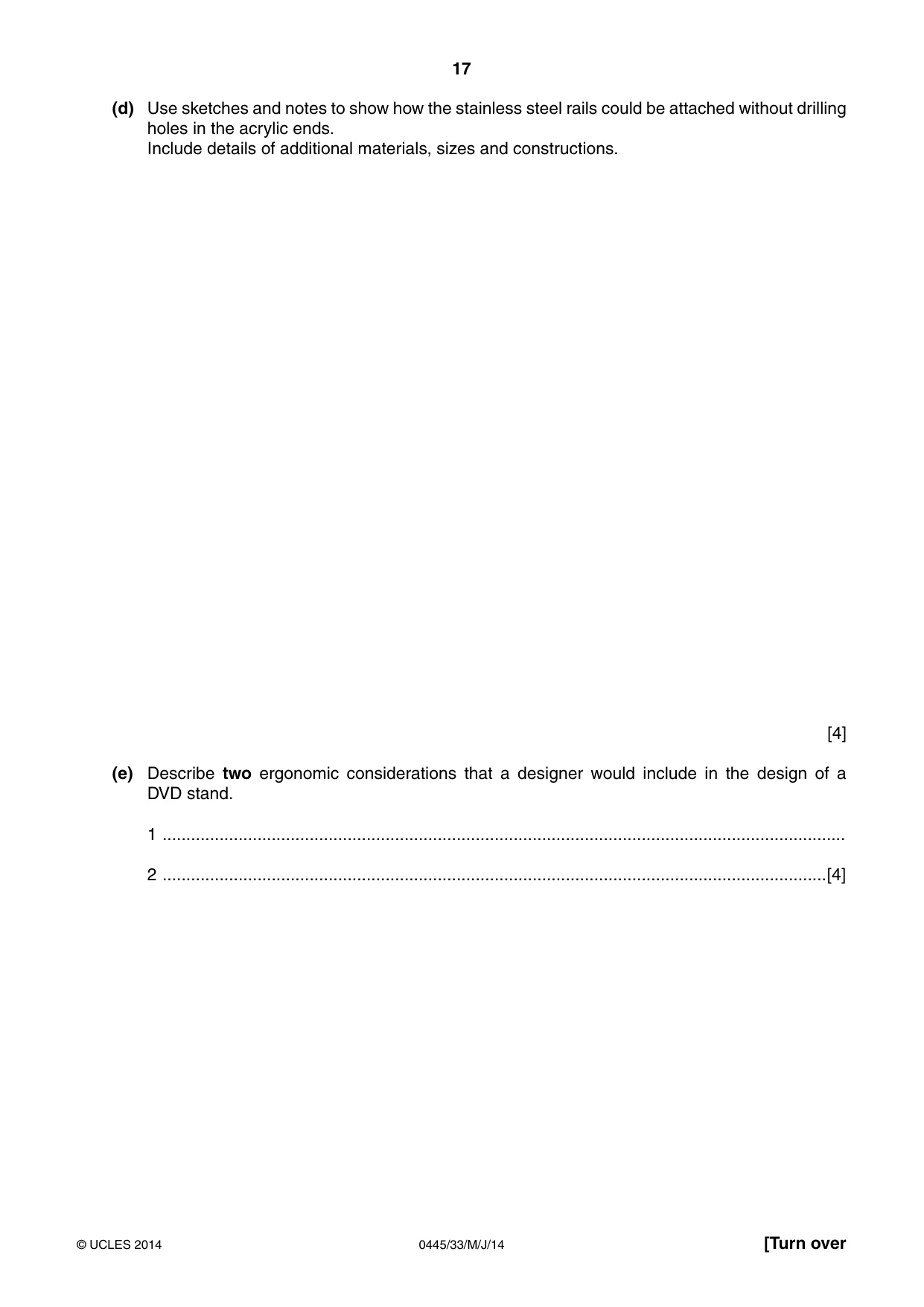
17 0445/33/M/J/14 © UCLES 2014 [Turn over (d) Use sketches and notes to show how the stainless steel rails could be attached without drilling holes in the acrylic ends. Include details of additional materials, sizes and constructions. [4] (e) Describe two ergonomic considerations that a designer would include in the design of a DVD stand. 1 … 2 …[4]
Question paper, page 18
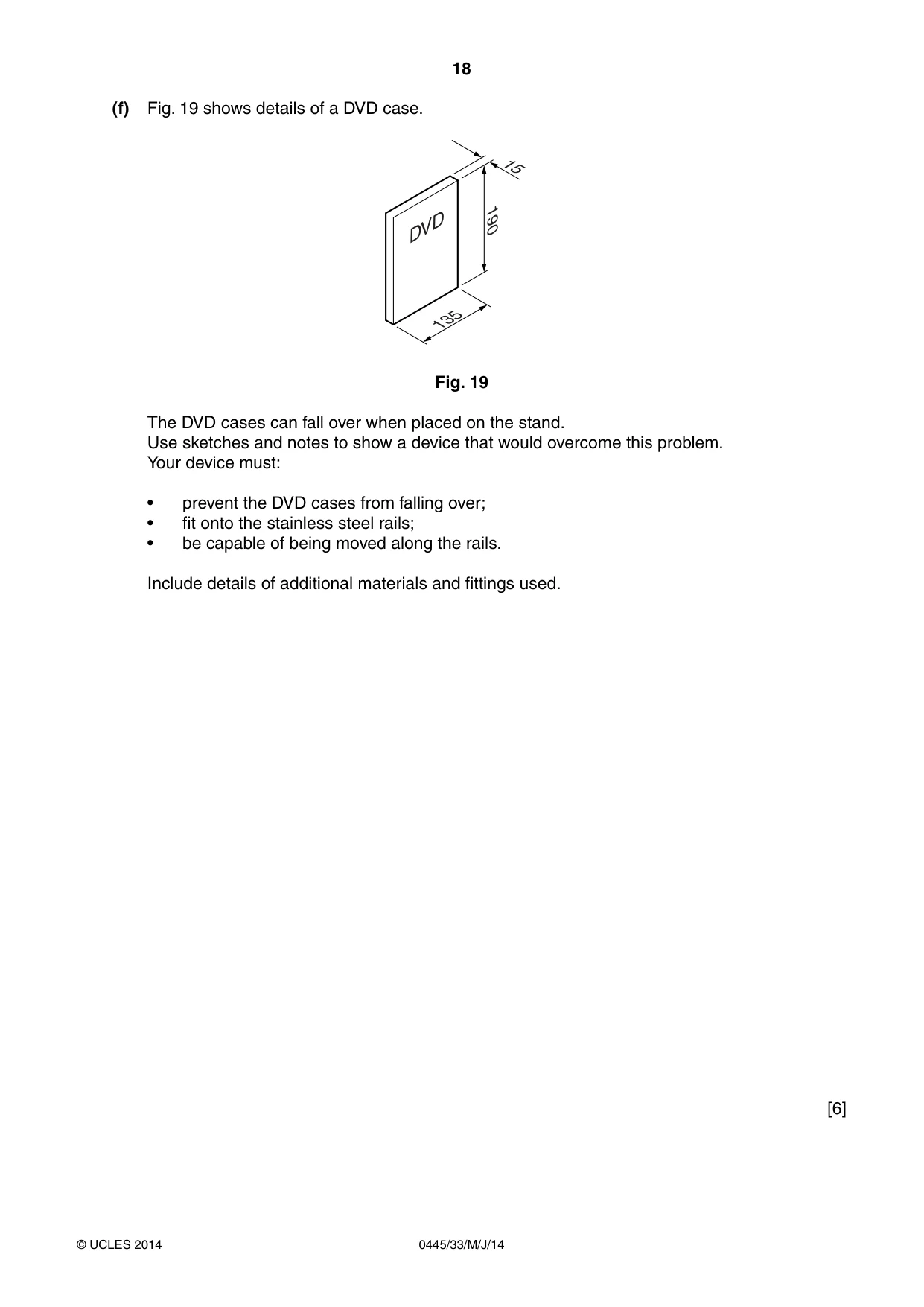
18 0445/33/M/J/14 © UCLES 2014 (f) Fig. 19 shows details of a DVD case. 135 190 DVD 15 Fig. 19 The DVD cases can fall over when placed on the stand. Use sketches and notes to show a device that would overcome this problem. Your device must: • prevent the DVD cases from falling over; • fit onto the stainless steel rails; • be capable of being moved along the rails. Include details of additional materials and fittings used. [6]
Question paper, page 19
19 0445/33/M/J/14 © UCLES 2014 (g) The DVD stand could also be made entirely from wood-based materials. Give two advantages of making the DVD stand from wood-based materials rather than acrylic and stainless steel. 1 … 2 …[2]
Question paper, page 20
20 0445/33/M/J/14 © UCLES 2014 Permission to reproduce items where third-party owned material protected by copyright is included has been sought and cleared where possible. Every reasonable effort has been made by the publisher (UCLES) to trace copyright holders, but if any items requiring clearance have unwittingly been included, the publisher will be pleased to make amends at the earliest possible opportunity. Cambridge International Examinations is part of the Cambridge Assessment Group. Cambridge Assessment is the brand name of University of Cambridge Local Examinations Syndicate (UCLES), which is itself a department of the University of Cambridge. BLANK PAGE
Mark scheme, page 1
CAMBRIDGE INTERNATIONAL EXAMINATIONS International General Certificate of Secondary Education MARK SCHEME for the May/June 2014 series 0445 DESIGN AND TECHNOLOGY 0445/33 Paper 3 (Resistant Materials), maximum raw mark 50 This mark scheme is published as an aid to teachers and candidates, to indicate the requirements of the examination. It shows the basis on which Examiners were instructed to award marks. It does not indicate the details of the discussions that took place at an Examiners’ meeting before marking began, which would have considered the acceptability of alternative answers. Mark schemes should be read in conjunction with the question paper and the Principal Examiner Report for Teachers. Cambridge will not enter into discussions about these mark schemes. Cambridge is publishing the mark schemes for the May/June 2014 series for most IGCSE, GCE Advanced Level and Advanced Subsidiary Level components and some Ordinary Level components.
Mark scheme, page 2
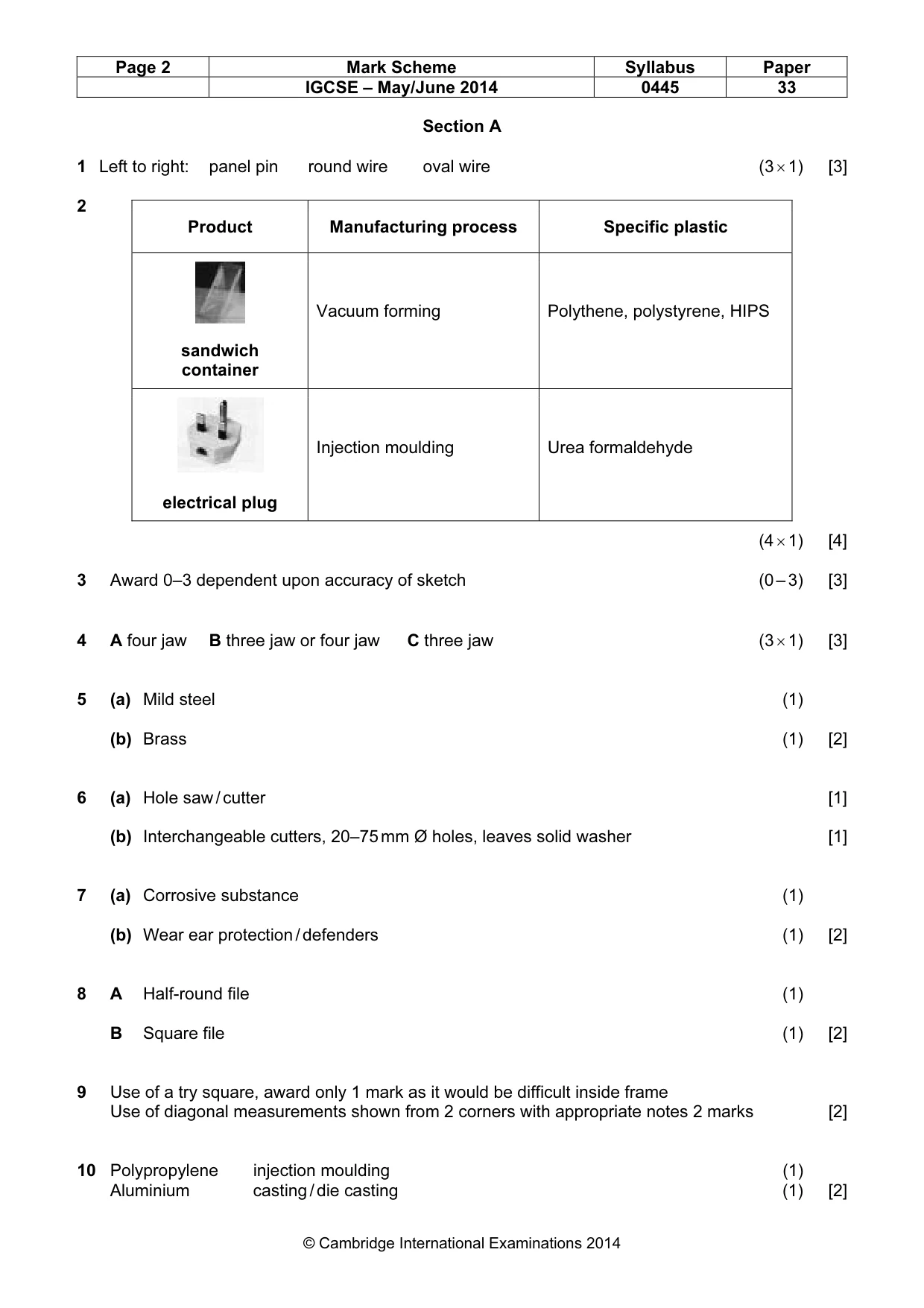
Page 2 Mark Scheme Syllabus Paper IGCSE – May/June 2014 0445 33 © Cambridge International Examinations 2014 Section A 1 Left to right: panel pin round wire oval wire (3 × 1) [3] 2 (4 × 1) [4] 3 Award 0–3 dependent upon accuracy of sketch (0 – 3) [3] 4 A four jaw B three jaw or four jaw C three jaw (3 × 1) [3] 5 (a) Mild steel (1) (b) Brass (1) [2] 6 (a) Hole saw / cutter [1] (b) Interchangeable cutters, 20–75 mm Ø holes, leaves solid washer [1] 7 (a) Corrosive substance (1) (b) Wear ear protection / defenders (1) [2] 8 A Half-round file (1) B Square file (1) [2] 9 Use of a try square, award only 1 mark as it would be difficult inside frame Use of diagonal measurements shown from 2 corners with appropriate notes 2 marks [2] 10 Polypropylene injection moulding (1) Aluminium casting / die casting (1) [2] Product Manufacturing process Specific plastic sandwich container Vacuum forming Polythene, polystyrene, HIPS electrical plug Injection moulding Urea formaldehyde
Mark scheme, page 3
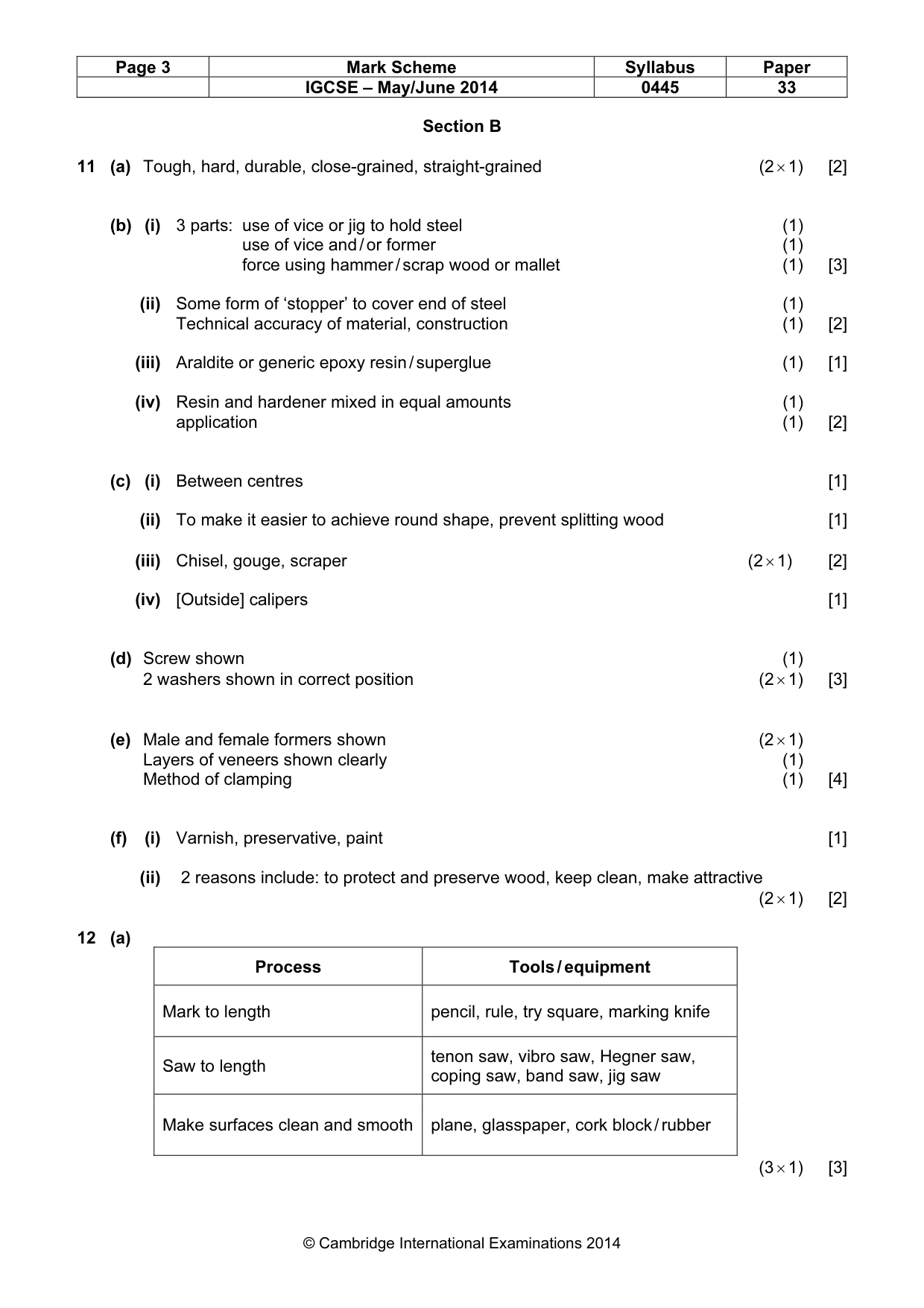
Page 3 Mark Scheme Syllabus Paper IGCSE – May/June 2014 0445 33 © Cambridge International Examinations 2014 Section B 11 (a) Tough, hard, durable, close-grained, straight-grained (2 × 1) [2] (b) (i) 3 parts: use of vice or jig to hold steel (1) use of vice and / or former (1) force using hammer / scrap wood or mallet (1) [3] (ii) Some form of ‘stopper’ to cover end of steel (1) Technical accuracy of material, construction (1) [2] (iii) Araldite or generic epoxy resin / superglue (1) [1] (iv) Resin and hardener mixed in equal amounts (1) application (1) [2] (c) (i) Between centres [1] (ii) To make it easier to achieve round shape, prevent splitting wood [1] (iii) Chisel, gouge, scraper (2 × 1) [2] (iv) [Outside] calipers [1] (d) Screw shown (1) 2 washers shown in correct position (2 × 1) [3] (e) Male and female formers shown (2 × 1) Layers of veneers shown clearly (1) Method of clamping (1) [4] (f) (i) Varnish, preservative, paint [1] (ii) 2 reasons include: to protect and preserve wood, keep clean, make attractive (2 × 1) [2] 12 (a) Process Tools / equipment Mark to length pencil, rule, try square, marking knife Saw to length tenon saw, vibro saw, Hegner saw, coping saw, band saw, jig saw Make surfaces clean and smooth plane, glasspaper, cork block / rubber (3 × 1) [3]
Mark scheme, page 4
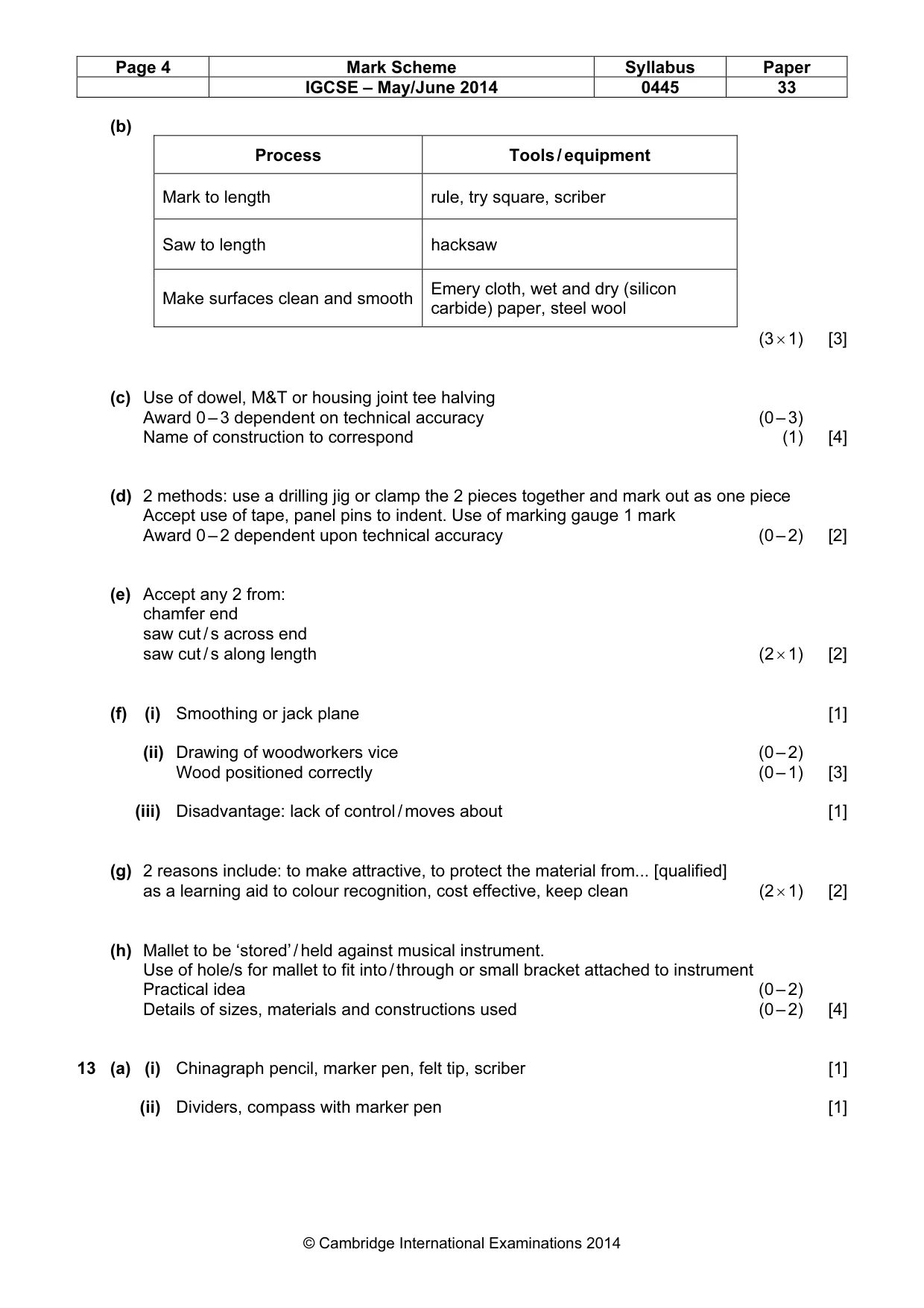
Page 4 Mark Scheme Syllabus Paper IGCSE – May/June 2014 0445 33 © Cambridge International Examinations 2014 (b) Process Tools / equipment Mark to length rule, try square, scriber Saw to length hacksaw Make surfaces clean and smooth Emery cloth, wet and dry (silicon carbide) paper, steel wool (3 × 1) [3] (c) Use of dowel, M&T or housing joint tee halving Award 0 – 3 dependent on technical accuracy (0 – 3) Name of construction to correspond (1) [4] (d) 2 methods: use a drilling jig or clamp the 2 pieces together and mark out as one piece Accept use of tape, panel pins to indent. Use of marking gauge 1 mark Award 0 – 2 dependent upon technical accuracy (0 – 2) [2] (e) Accept any 2 from: chamfer end saw cut / s across end saw cut / s along length (2 × 1) [2] (f) (i) Smoothing or jack plane [1] (ii) Drawing of woodworkers vice (0 – 2) Wood positioned correctly (0 – 1) [3] (iii) Disadvantage: lack of control / moves about [1] (g) 2 reasons include: to make attractive, to protect the material from... [qualified] as a learning aid to colour recognition, cost effective, keep clean (2 × 1) [2] (h) Mallet to be ‘stored’ / held against musical instrument. Use of hole/s for mallet to fit into / through or small bracket attached to instrument Practical idea (0 – 2) Details of sizes, materials and constructions used (0 – 2) [4] 13 (a) (i) Chinagraph pencil, marker pen, felt tip, scriber [1] (ii) Dividers, compass with marker pen [1]
Mark scheme, page 5
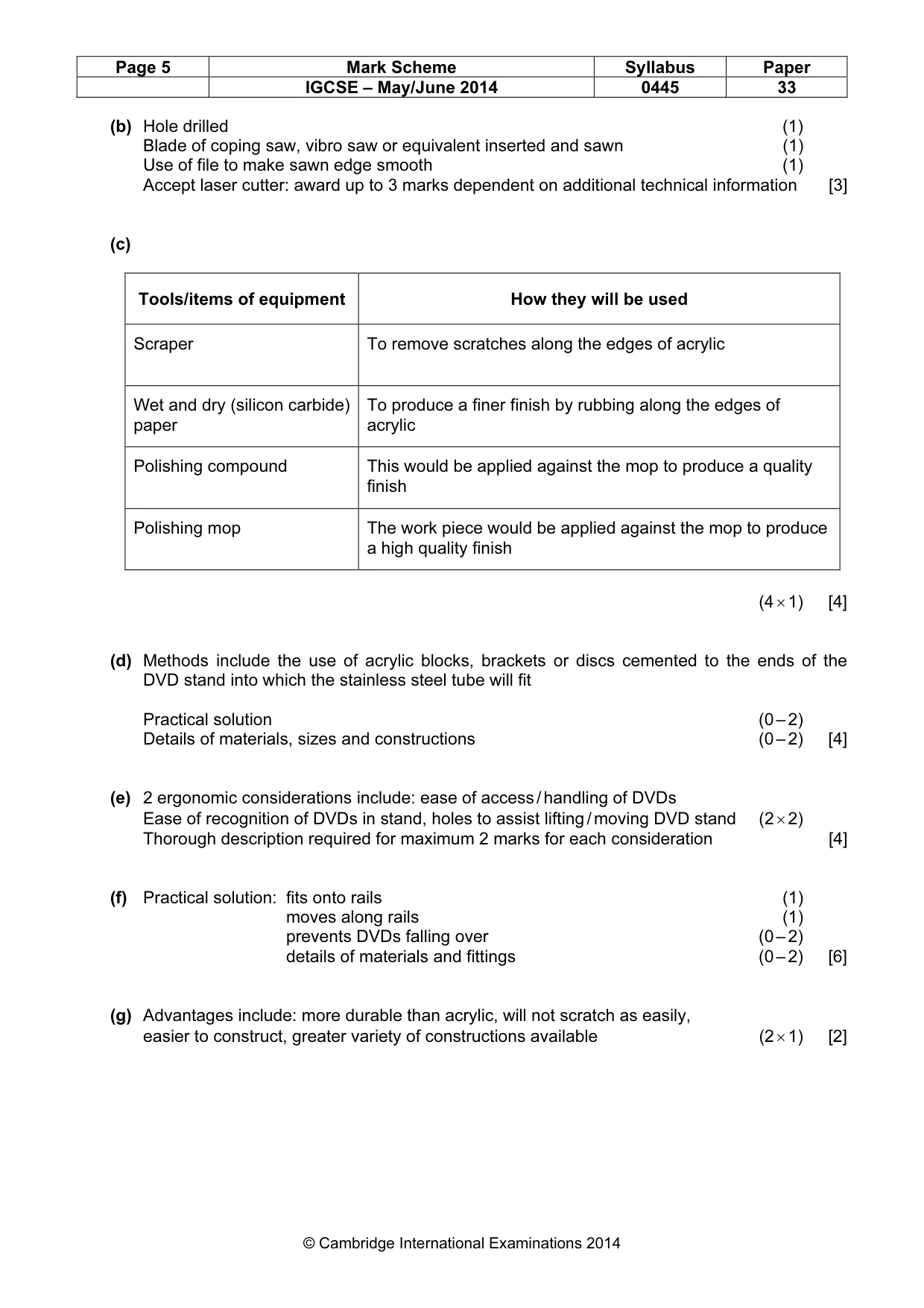
Page 5 Mark Scheme Syllabus Paper IGCSE – May/June 2014 0445 33 © Cambridge International Examinations 2014 (b) Hole drilled (1) Blade of coping saw, vibro saw or equivalent inserted and sawn (1) Use of file to make sawn edge smooth (1) Accept laser cutter: award up to 3 marks dependent on additional technical information [3] (c) Tools/items of equipment How they will be used Scraper To remove scratches along the edges of acrylic Wet and dry (silicon carbide) paper To produce a finer finish by rubbing along the edges of acrylic Polishing compound This would be applied against the mop to produce a quality finish Polishing mop The work piece would be applied against the mop to produce a high quality finish (4 × 1) [4] (d) Methods include the use of acrylic blocks, brackets or discs cemented to the ends of the DVD stand into which the stainless steel tube will fit Practical solution (0 – 2) Details of materials, sizes and constructions (0 – 2) [4] (e) 2 ergonomic considerations include: ease of access / handling of DVDs Ease of recognition of DVDs in stand, holes to assist lifting / moving DVD stand (2 × 2) Thorough description required for maximum 2 marks for each consideration [4] (f) Practical solution: fits onto rails (1) moves along rails (1) prevents DVDs falling over (0 – 2) details of materials and fittings (0 – 2) [6] (g) Advantages include: more durable than acrylic, will not scratch as easily, easier to construct, greater variety of constructions available (2 × 1) [2]
What you needed in this session
Cambridge’s own grade thresholds for 2014 May/June, Paper 3 · Variant 3. A higher threshold means an easier paper — the bar moves with how the cohort did.