Cambridge IGCSE Design and Technology 0445 — 2013 Oct/Nov Paper 3 · Variant 2
0445/32/O/N/13 · 50 marks · ≈56 min
The question paper and its mark scheme, free to read here and free to download. This is Cambridge’s own paper, exactly as it was sat.
Question paper16 pages
Mark scheme5 pages
Answers below. Sit the paper first if you are practising.
Paper as text
Question paper, page 1
READ THESE INSTRUCTIONS FIRST Write your Centre number, candidate number and name on all the work you hand in. Write in blue or black pen. You may use a soft pencil for any diagrams, graphs or rough working. Do not use staples, paper clips, highlighters, glue or correction fl uid. DO NOT WRITE IN ANY BARCODES. Section A Answer all questions in this section. Section B Answer one question in this section. You may use a calculator. The total of the marks for this paper is 50. The number of marks is given in brackets [ ] at the end of each question or part question. DESIGN AND TECHNOLOGY 0445/32 Paper 3 Resistant Materials October/November 2013 1 hour Candidates answer on the Question Paper. No Additional Materials are required. To be taken together with Paper 1 in one session of 2 hours 15 minutes. UNIVERSITY OF CAMBRIDGE INTERNATIONAL EXAMINATIONS International General Certifi cate of Secondary Education This document consists of 14 printed pages and 2 blank pages. [Turn over IB13 11_0445_32/RP © UCLES 2013 *3930508656* For Examiner’s Use Section A Section B Total
Question paper, page 2
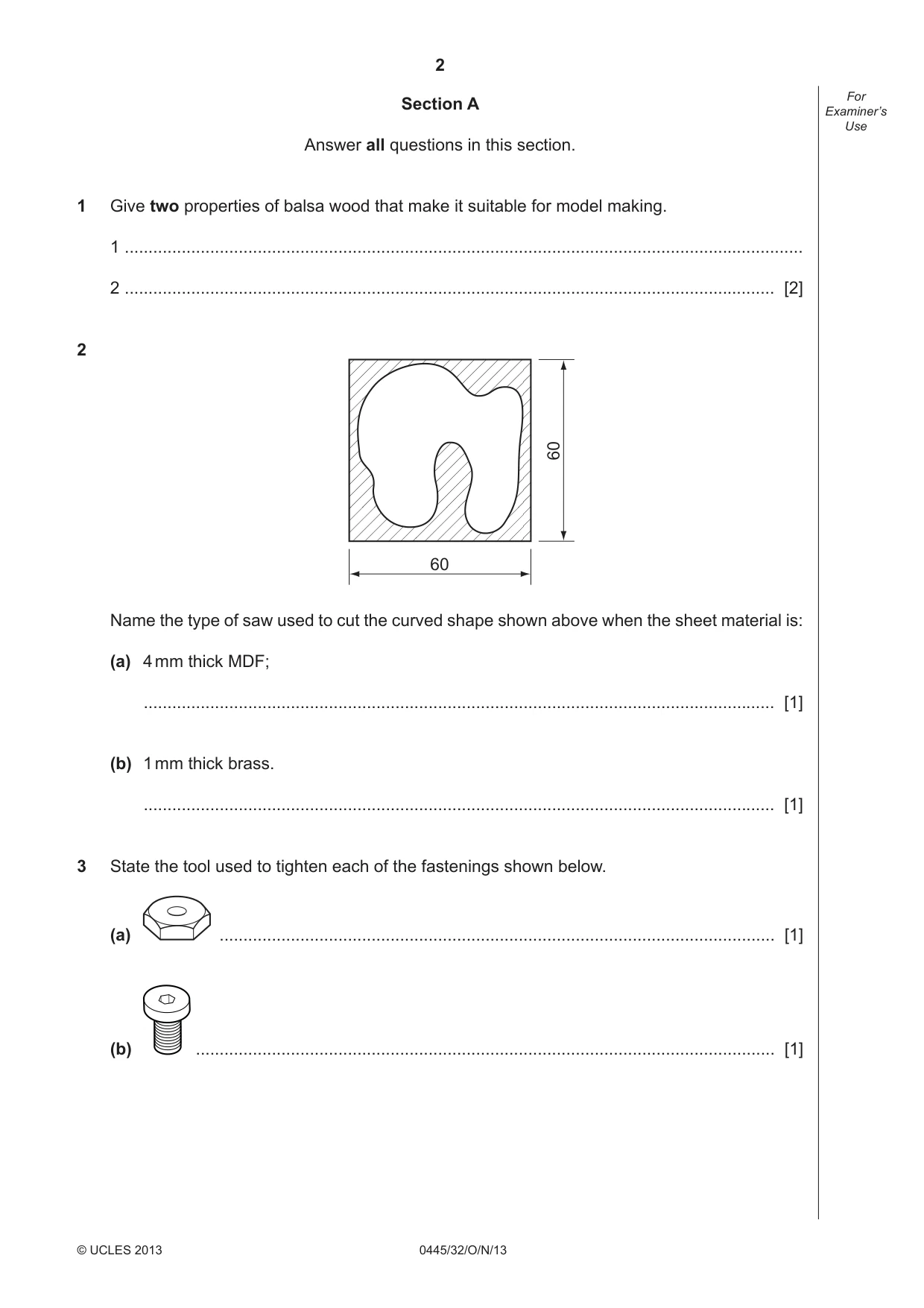
2 0445/32/O/N/13 © UCLES 2013 For Examiner’s Use Section A Answer all questions in this section. 1 Give two properties of balsa wood that make it suitable for model making. 1 … 2 … [2] 2 60 60 Name the type of saw used to cut the curved shape shown above when the sheet material is: (a) 4 mm thick MDF; … [1] (b) 1 mm thick brass. … [1] 3 State the tool used to tighten each of the fastenings shown below. (a) … [1] (b) … [1]
Question paper, page 3
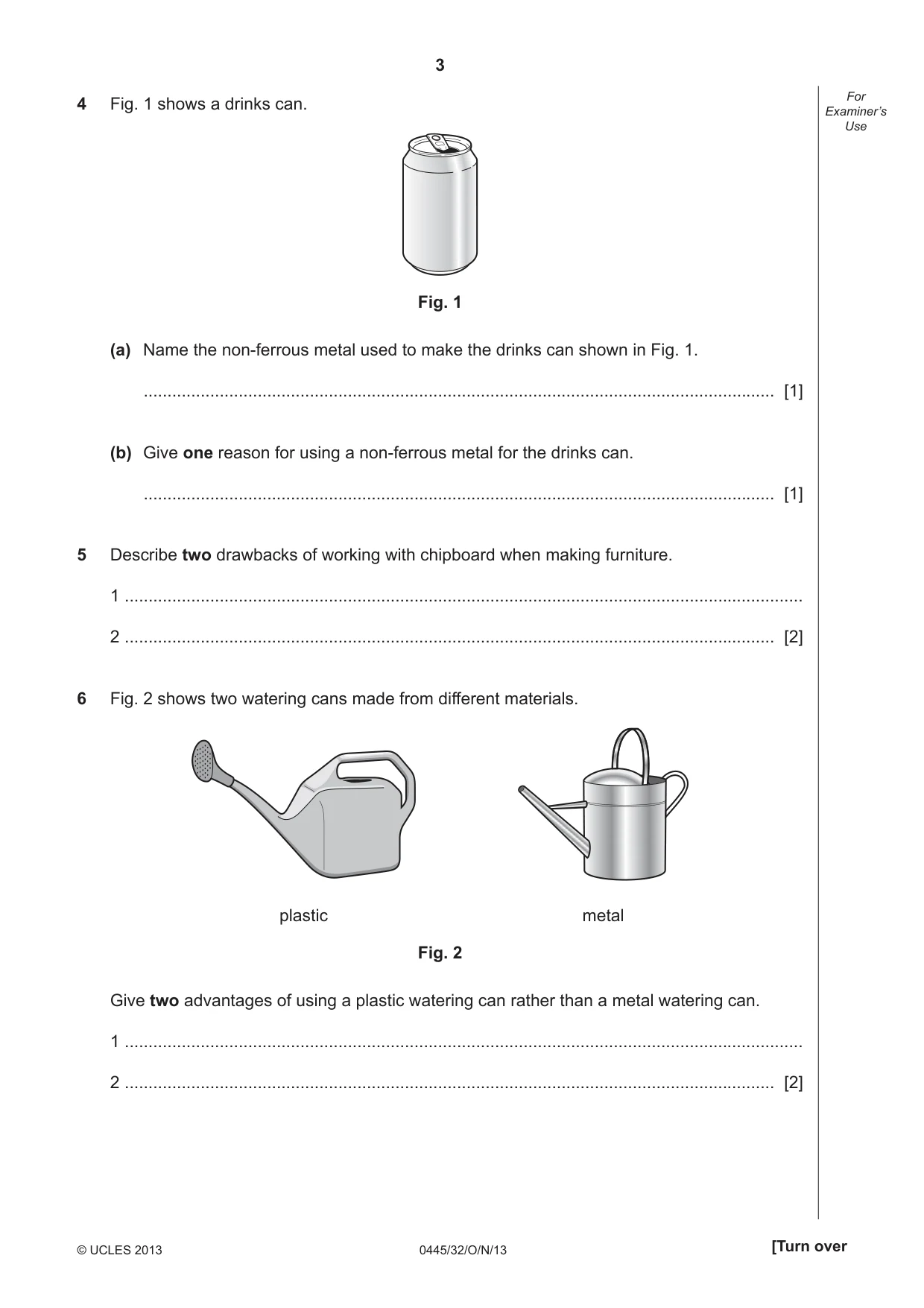
3 0445/32/O/N/13 © UCLES 2013 [Turn over For Examiner’s Use 4 Fig. 1 shows a drinks can. Fig. 1 (a) Name the non-ferrous metal used to make the drinks can shown in Fig. 1. … [1] (b) Give one reason for using a non-ferrous metal for the drinks can. … [1] 5 Describe two drawbacks of working with chipboard when making furniture. 1 … 2 … [2] 6 Fig. 2 shows two watering cans made from different materials. metal plastic Fig. 2 Give two advantages of using a plastic watering can rather than a metal watering can. 1 … 2 … [2]
Question paper, page 4
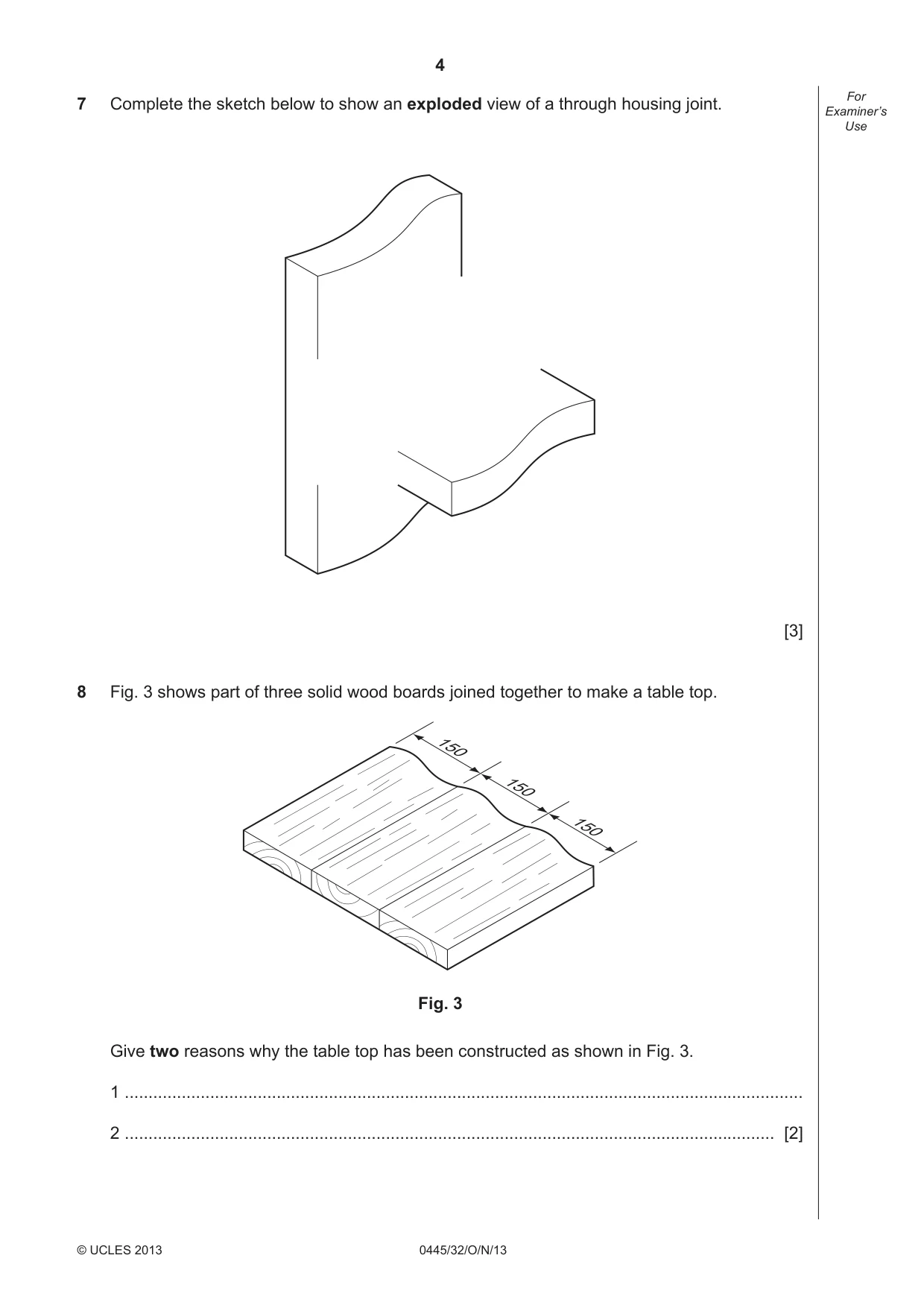
4 0445/32/O/N/13 © UCLES 2013 For Examiner’s Use 7 Complete the sketch below to show an exploded view of a through housing joint. [3] 8 Fig. 3 shows part of three solid wood boards joined together to make a table top. 150 150 150 Fig. 3 Give two reasons why the table top has been constructed as shown in Fig. 3. 1 … 2 … [2]
Question paper, page 5
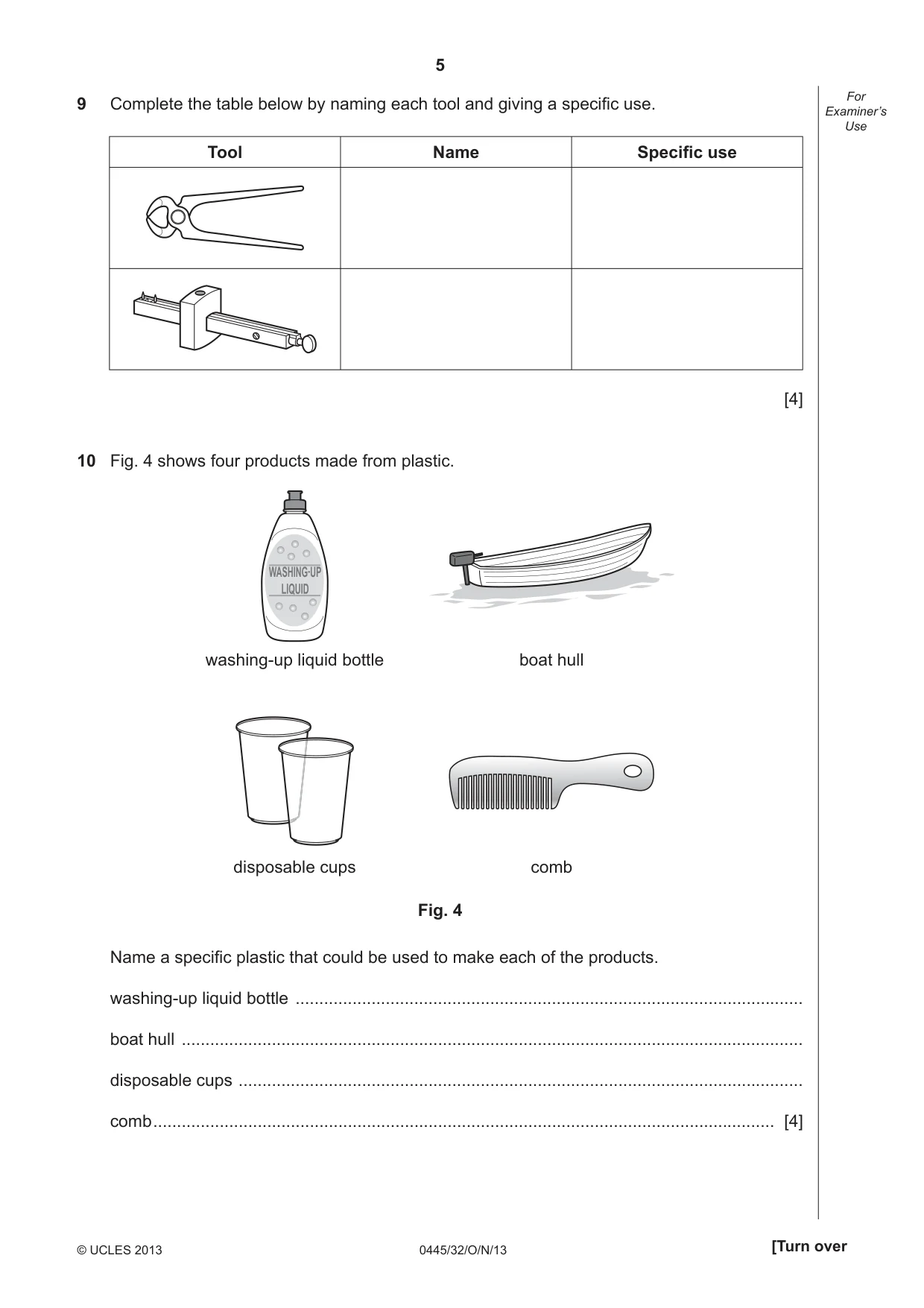
5 0445/32/O/N/13 © UCLES 2013 [Turn over For Examiner’s Use 9 Complete the table below by naming each tool and giving a specifi c use. Tool Name Specifi c use [4] 10 Fig. 4 shows four products made from plastic. washing-up liquid bottle boat hull comb disposable cups Fig. 4 Name a specifi c plastic that could be used to make each of the products. washing-up liquid bottle … boat hull … disposable cups … comb … [4]
Question paper, page 6
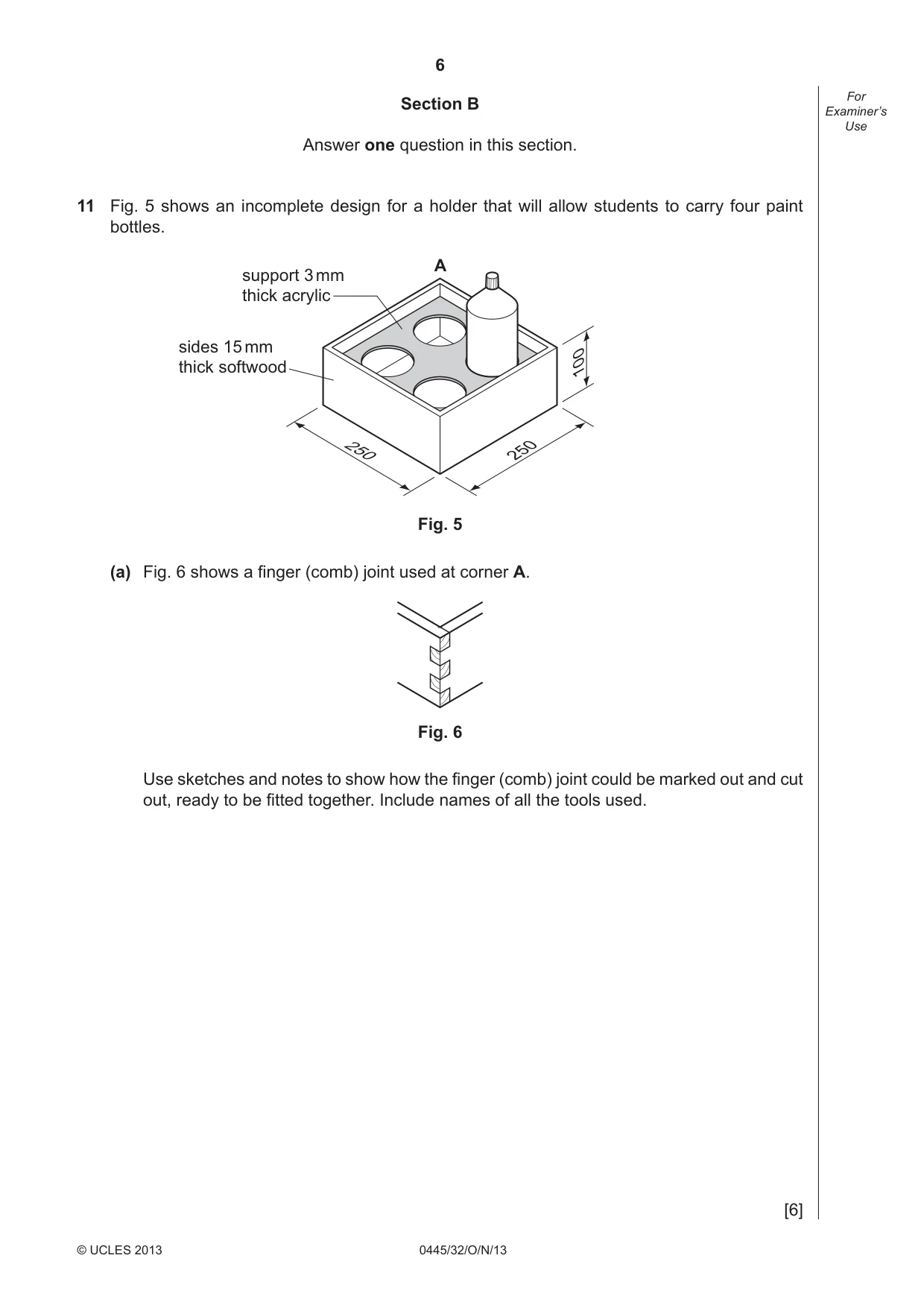
6 0445/32/O/N/13 © UCLES 2013 For Examiner’s Use Section B Answer one question in this section. 11 Fig. 5 shows an incomplete design for a holder that will allow students to carry four paint bottles. 250 250 100 A Fig. 5 sides 15 mm thick softwood support 3 mm thick acrylic (a) Fig. 6 shows a fi nger (comb) joint used at corner A. Fig. 6 Use sketches and notes to show how the fi nger (comb) joint could be marked out and cut out, ready to be fi tted together. Include names of all the tools used. [6]
Question paper, page 7
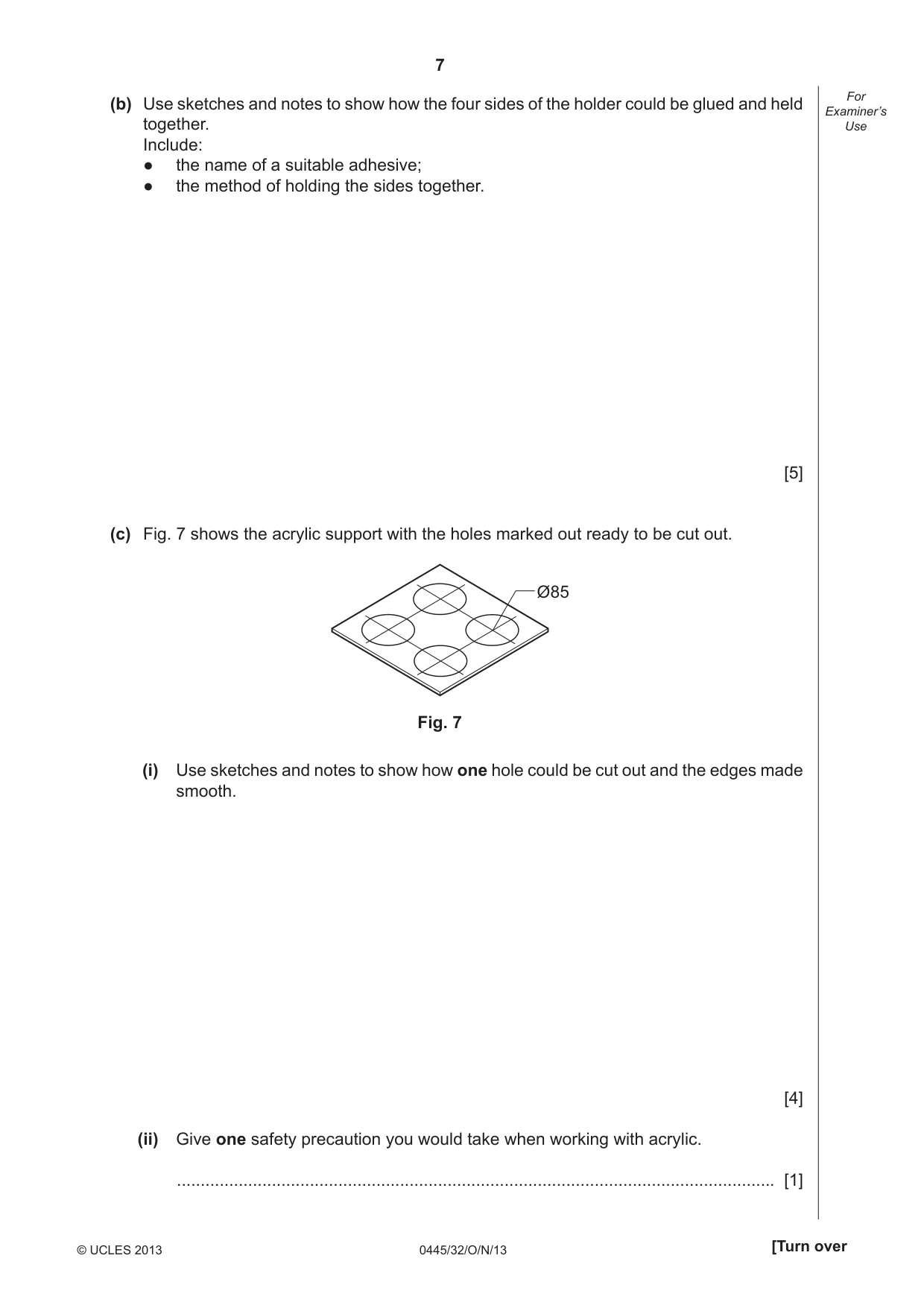
7 0445/32/O/N/13 © UCLES 2013 [Turn over For Examiner’s Use (b) Use sketches and notes to show how the four sides of the holder could be glued and held together. Include: ● the name of a suitable adhesive; ● the method of holding the sides together. [5] (c) Fig. 7 shows the acrylic support with the holes marked out ready to be cut out. Ø85 Fig. 7 (i) Use sketches and notes to show how one hole could be cut out and the edges made smooth. [4] (ii) Give one safety precaution you would take when working with acrylic. … [1]
Question paper, page 8
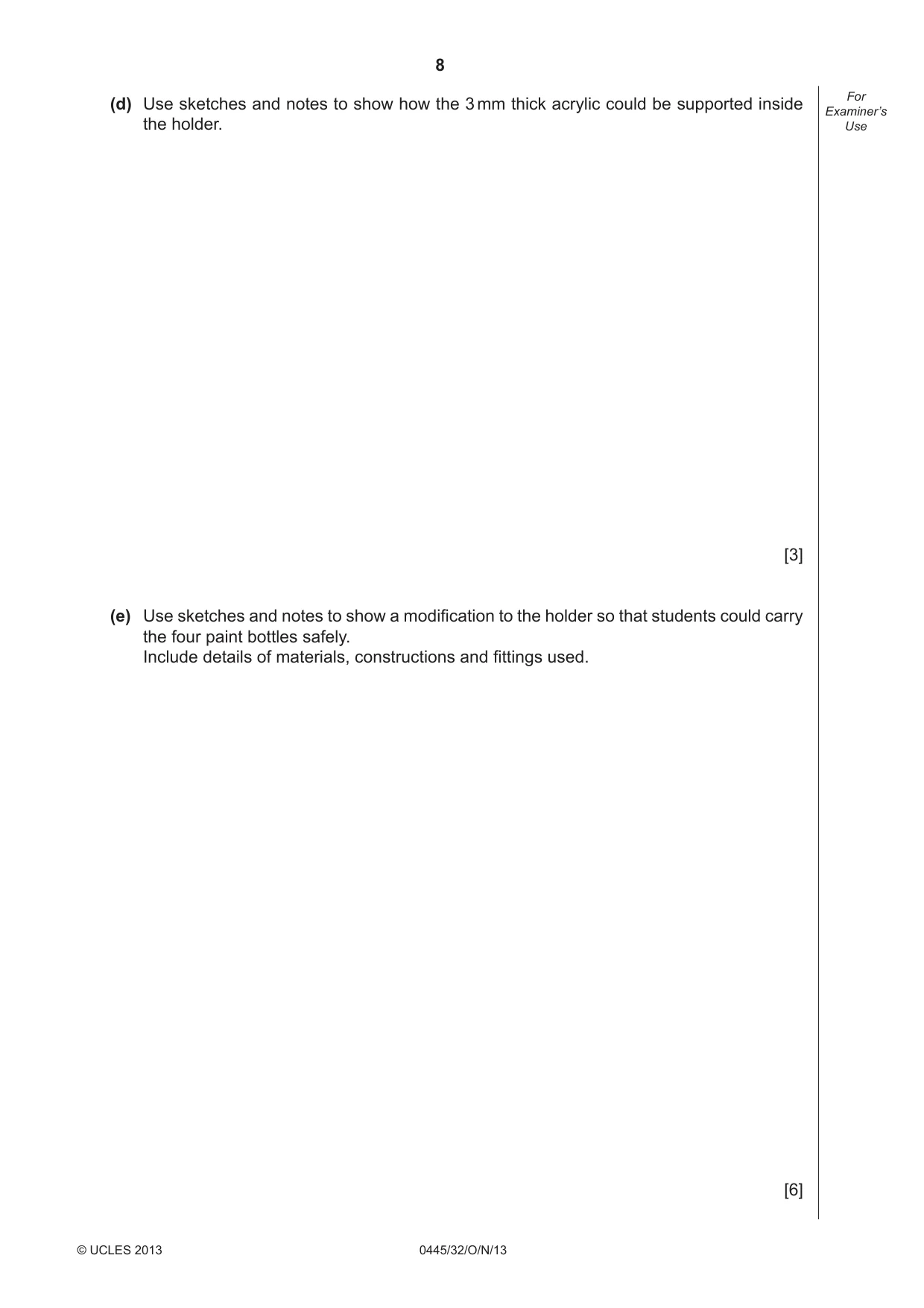
8 0445/32/O/N/13 © UCLES 2013 For Examiner’s Use (d) Use sketches and notes to show how the 3 mm thick acrylic could be supported inside the holder. [3] (e) Use sketches and notes to show a modifi cation to the holder so that students could carry the four paint bottles safely. Include details of materials, constructions and fi ttings used. [6]
Question paper, page 9
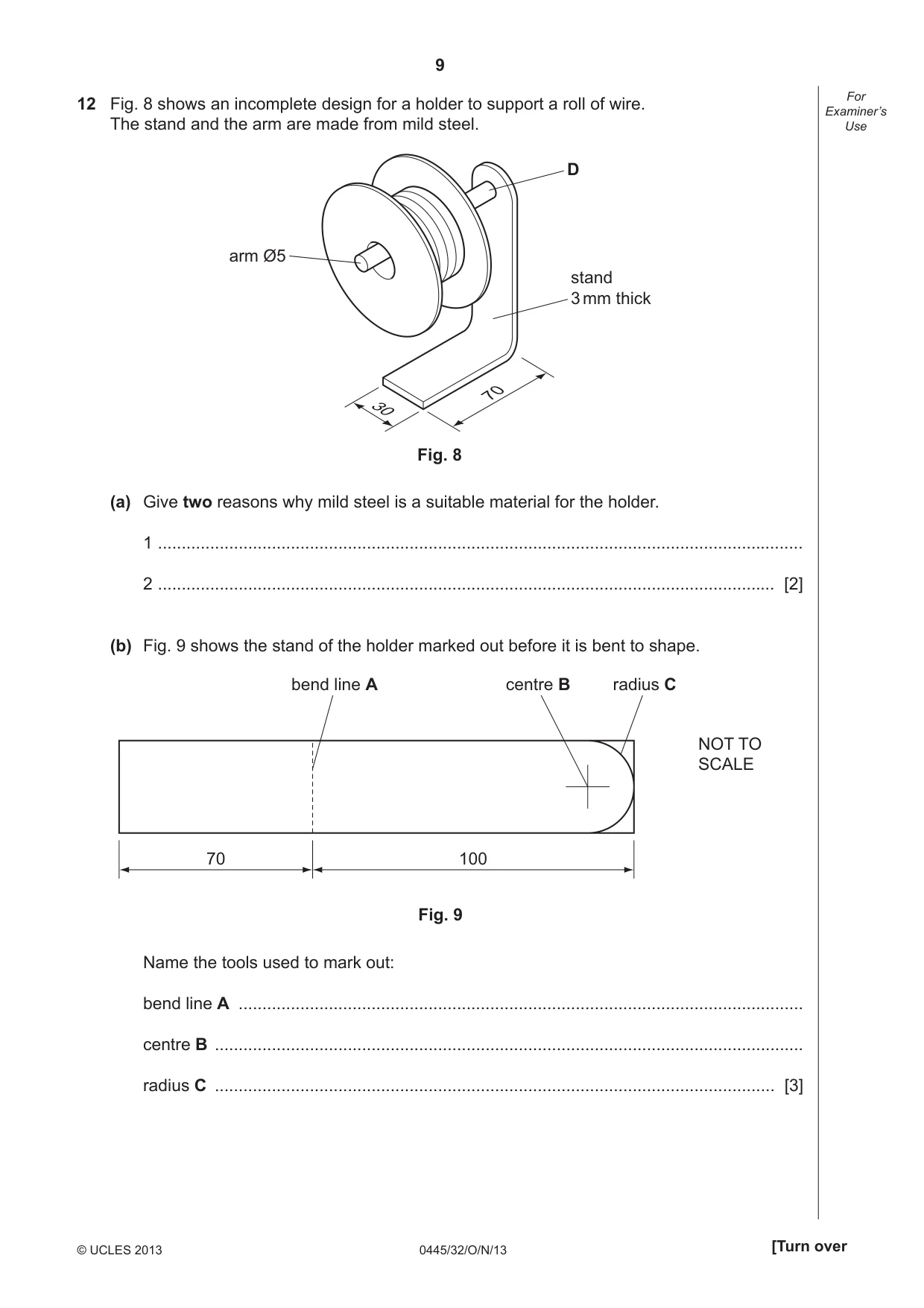
9 0445/32/O/N/13 © UCLES 2013 [Turn over For Examiner’s Use 12 Fig. 8 shows an incomplete design for a holder to support a roll of wire. The stand and the arm are made from mild steel. arm Ø5 D stand 3 mm thick 70 30 Fig. 8 (a) Give two reasons why mild steel is a suitable material for the holder. 1 … 2 … [2] (b) Fig. 9 shows the stand of the holder marked out before it is bent to shape. 70 100 bend line A centre B radius C NOT TO SCALE Fig. 9 Name the tools used to mark out: bend line A … centre B … radius C … [3]
Question paper, page 10
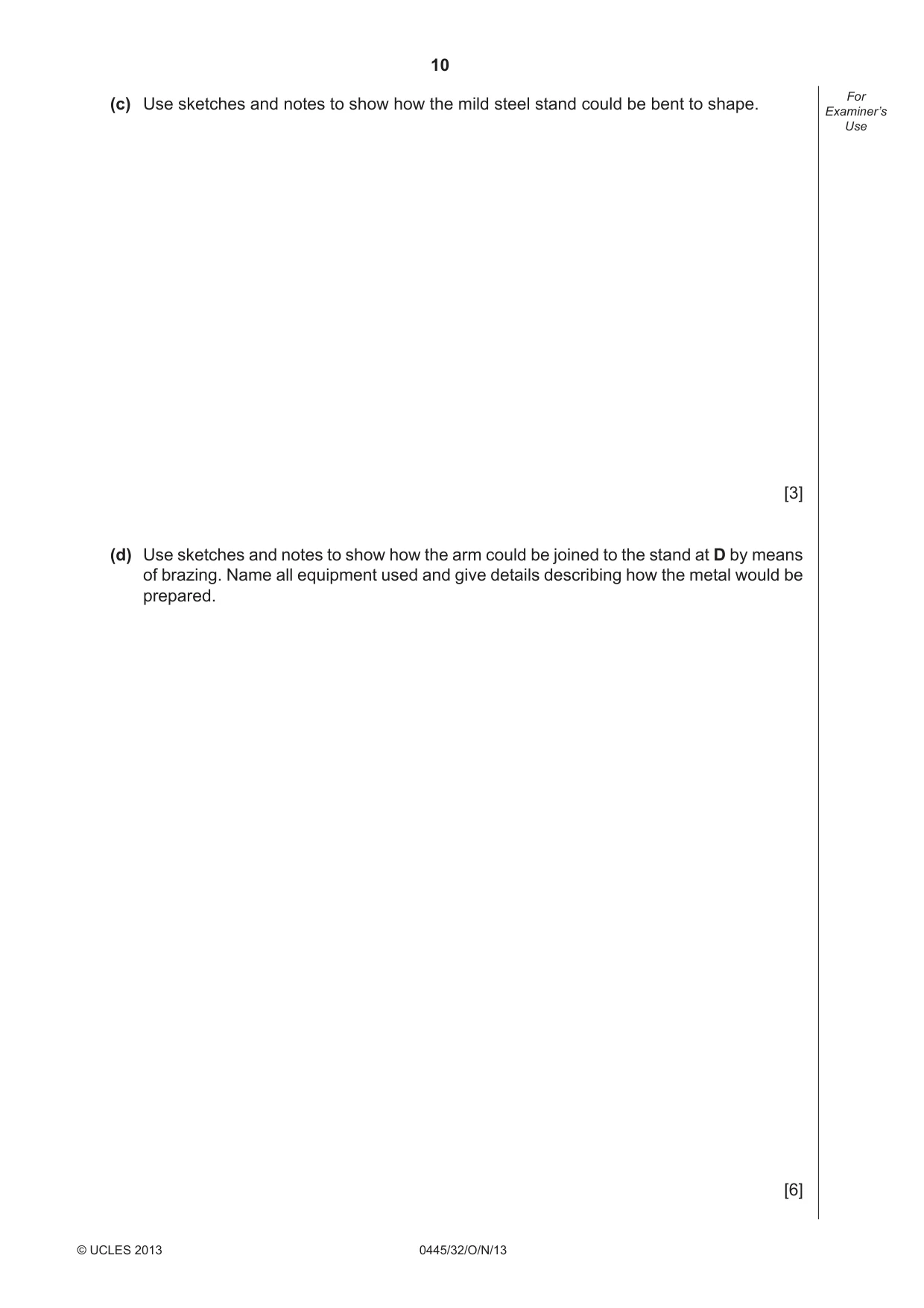
10 0445/32/O/N/13 © UCLES 2013 For Examiner’s Use (c) Use sketches and notes to show how the mild steel stand could be bent to shape. [3] (d) Use sketches and notes to show how the arm could be joined to the stand at D by means of brazing. Name all equipment used and give details describing how the metal would be prepared. [6]
Question paper, page 11
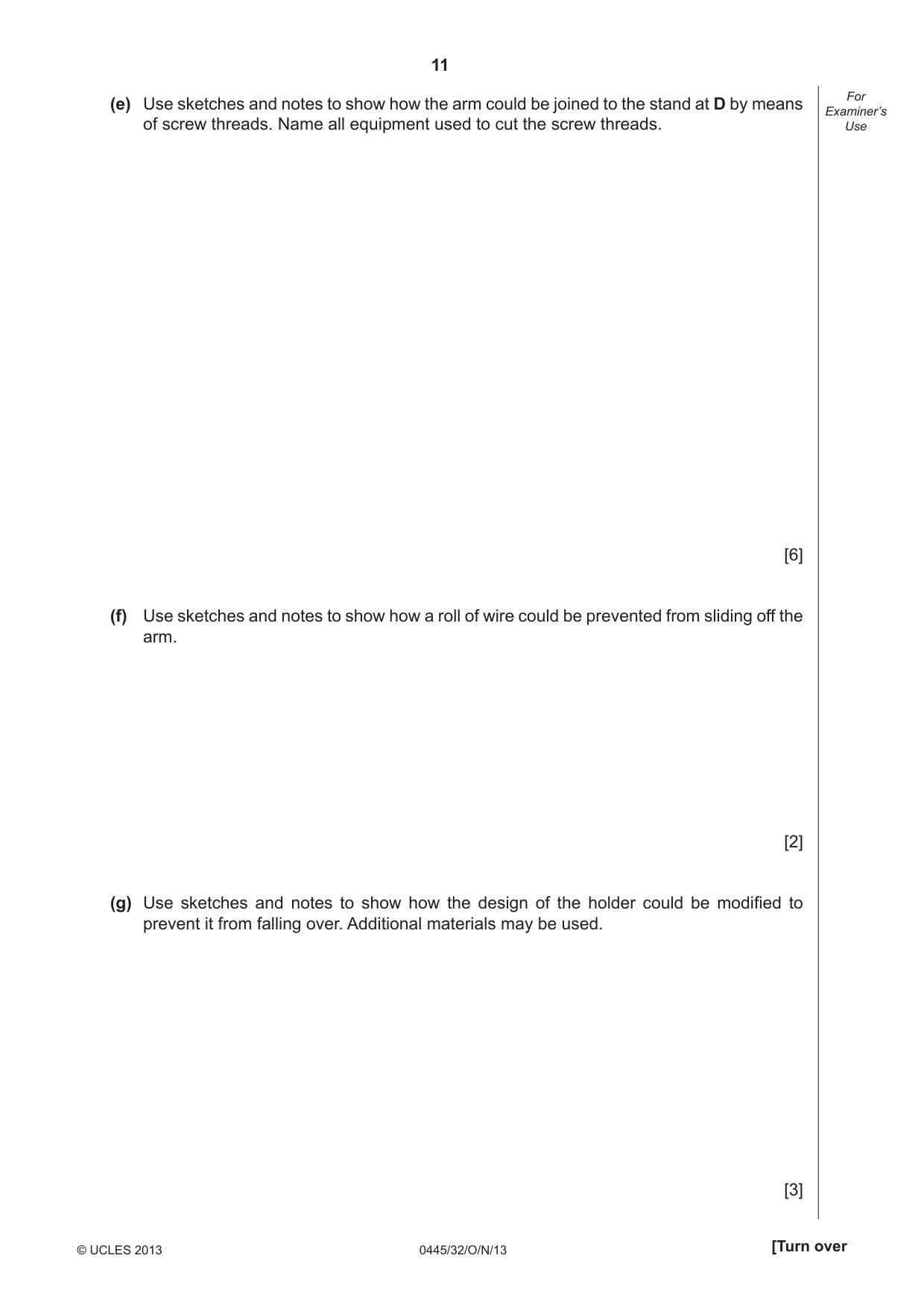
11 0445/32/O/N/13 © UCLES 2013 [Turn over For Examiner’s Use (e) Use sketches and notes to show how the arm could be joined to the stand at D by means of screw threads. Name all equipment used to cut the screw threads. [6] (f) Use sketches and notes to show how a roll of wire could be prevented from sliding off the arm. [2] (g) Use sketches and notes to show how the design of the holder could be modifi ed to prevent it from falling over. Additional materials may be used. [3]
Question paper, page 12
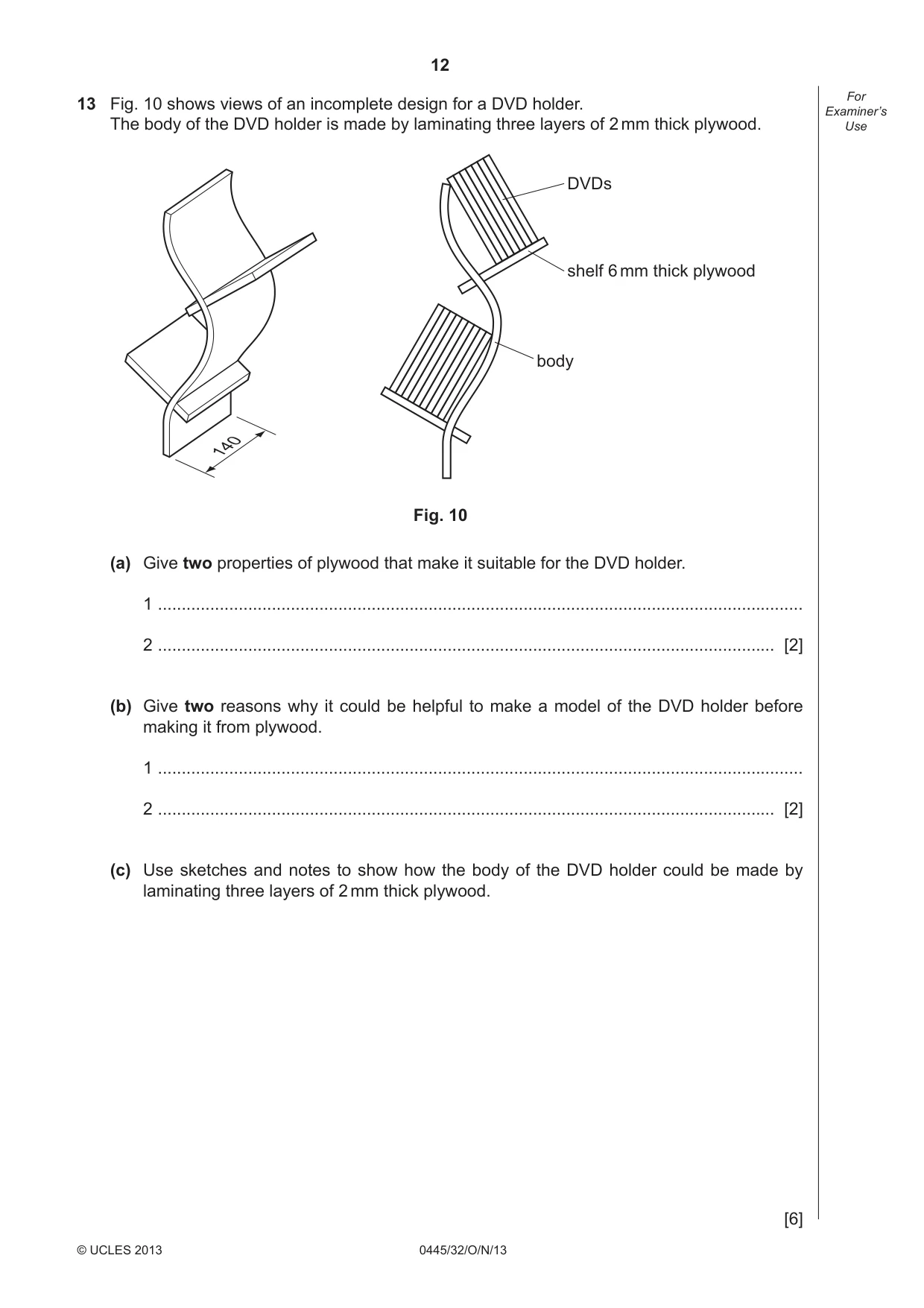
12 0445/32/O/N/13 © UCLES 2013 For Examiner’s Use 13 Fig. 10 shows views of an incomplete design for a DVD holder. The body of the DVD holder is made by laminating three layers of 2 mm thick plywood. body shelf 6 mm thick plywood DVDs 140 Fig. 10 (a) Give two properties of plywood that make it suitable for the DVD holder. 1 … 2 … [2] (b) Give two reasons why it could be helpful to make a model of the DVD holder before making it from plywood. 1 … 2 … [2] (c) Use sketches and notes to show how the body of the DVD holder could be made by laminating three layers of 2 mm thick plywood. [6]
Question paper, page 13
13 0445/32/O/N/13 © UCLES 2013 [Turn over For Examiner’s Use (d) (i) The shelf is made from 6 mm thick plywood. Use sketches and notes to show how one shelf could be joined to the body of the DVD holder. [3] (ii) Name a suitable adhesive that could be used for the joint in (d)(i). … [1] (e) (i) Describe how the surfaces of the body could be prepared to take an applied fi nish. … … … … [3] (ii) Name a suitable fi nish for the DVD holder and give a reason for your choice. Finish … Reason for choice … [2]
Question paper, page 14
14 0445/32/O/N/13 © UCLES 2013 For Examiner’s Use (f) Use sketches and notes to design a stable base for the DVD holder. Include: ● names of materials used; ● methods of construction; ● two important sizes. [6]
Question paper, page 15
15 0445/32/O/N/13 © UCLES 2013 BLANK PAGE
Question paper, page 16
16 0445/32/O/N/13 Permission to reproduce items where third-party owned material protected by copyright is included has been sought and cleared where possible. Every reasonable effort has been made by the publisher (UCLES) to trace copyright holders, but if any items requiring clearance have unwittingly been included the publisher will be pleased to make amends at the earliest possible opportunity. University of Cambridge International Examinations is part of the Cambridge Assessment Group. Cambridge Assessment is the brand name of University of Cambridge Local Examinations Syndicate (UCLES), which is itself a department of the University of Cambridge. BLANK PAGE © UCLES 2013
Mark scheme, page 1
CAMBRIDGE INTERNATIONAL EXAMINATIONS International General Certificate of Secondary Education MARK SCHEME for the October/November 2013 series 0445 DESIGN AND TECHNOLOGY 0445/32 Paper 3 (Resistant Materials), maximum raw mark 50 This mark scheme is published as an aid to teachers and candidates, to indicate the requirements of the examination. It shows the basis on which Examiners were instructed to award marks. It does not indicate the details of the discussions that took place at an Examiners’ meeting before marking began, which would have considered the acceptability of alternative answers. Mark schemes should be read in conjunction with the question paper and the Principal Examiner Report for Teachers. Cambridge will not enter into discussions about these mark schemes. Cambridge is publishing the mark schemes for the October/November 2013 series for most IGCSE, GCE Advanced Level and Advanced Subsidiary Level components and some Ordinary Level components.
Mark scheme, page 2
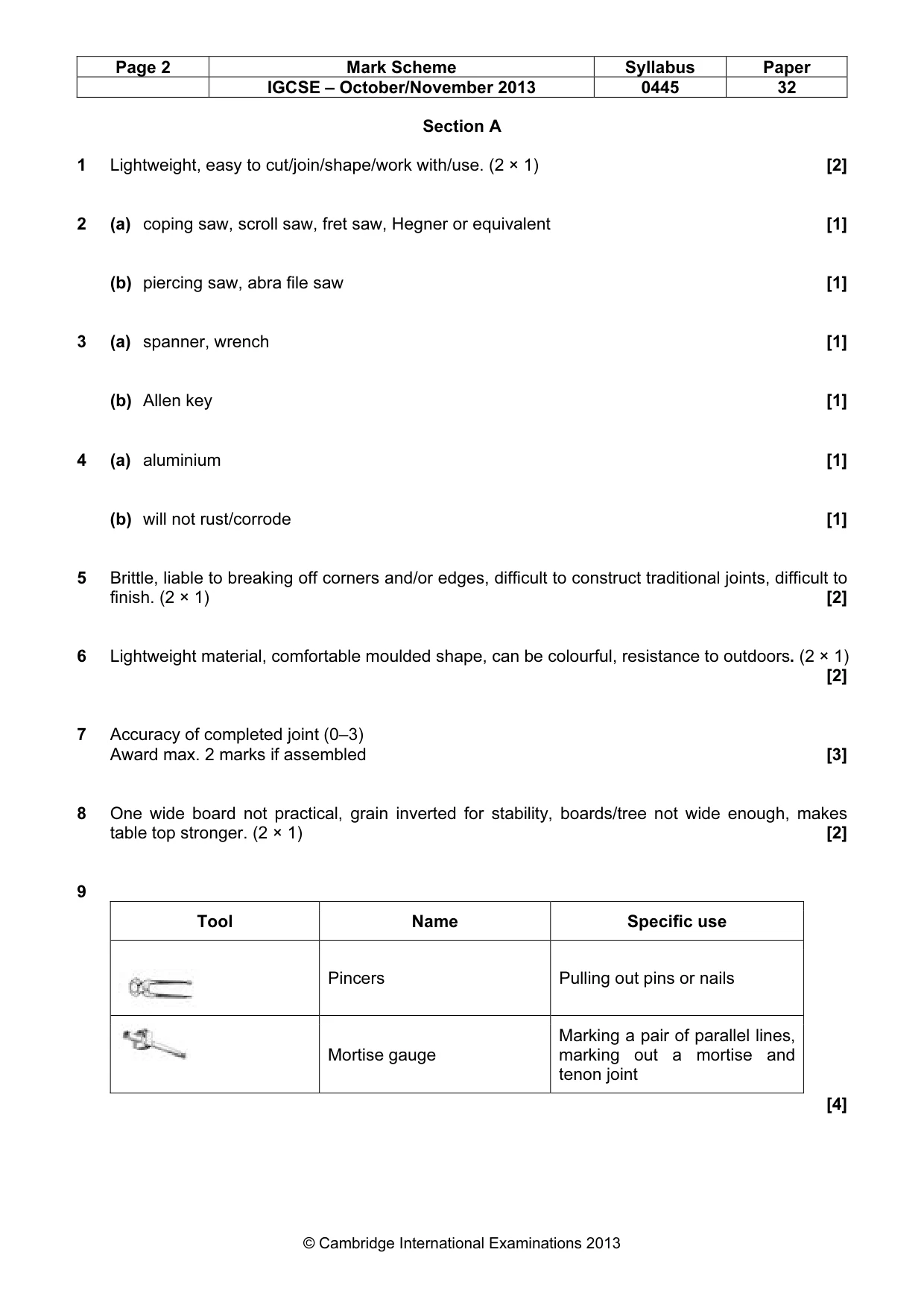
Page 2 Mark Scheme Syllabus Paper IGCSE – October/November 2013 0445 32 © Cambridge International Examinations 2013 Section A 1 Lightweight, easy to cut/join/shape/work with/use. (2 × 1) [2] 2 (a) coping saw, scroll saw, fret saw, Hegner or equivalent [1] (b) piercing saw, abra file saw [1] 3 (a) spanner, wrench [1] (b) Allen key [1] 4 (a) aluminium [1] (b) will not rust/corrode [1] 5 Brittle, liable to breaking off corners and/or edges, difficult to construct traditional joints, difficult to finish. (2 × 1) [2] 6 Lightweight material, comfortable moulded shape, can be colourful, resistance to outdoors. (2 × 1) [2] 7 Accuracy of completed joint (0–3) Award max. 2 marks if assembled [3] 8 One wide board not practical, grain inverted for stability, boards/tree not wide enough, makes table top stronger. (2 × 1) [2] 9 Tool Name Specific use Pincers Pulling out pins or nails Mortise gauge Marking a pair of parallel lines, marking out a mortise and tenon joint [4]
Mark scheme, page 3
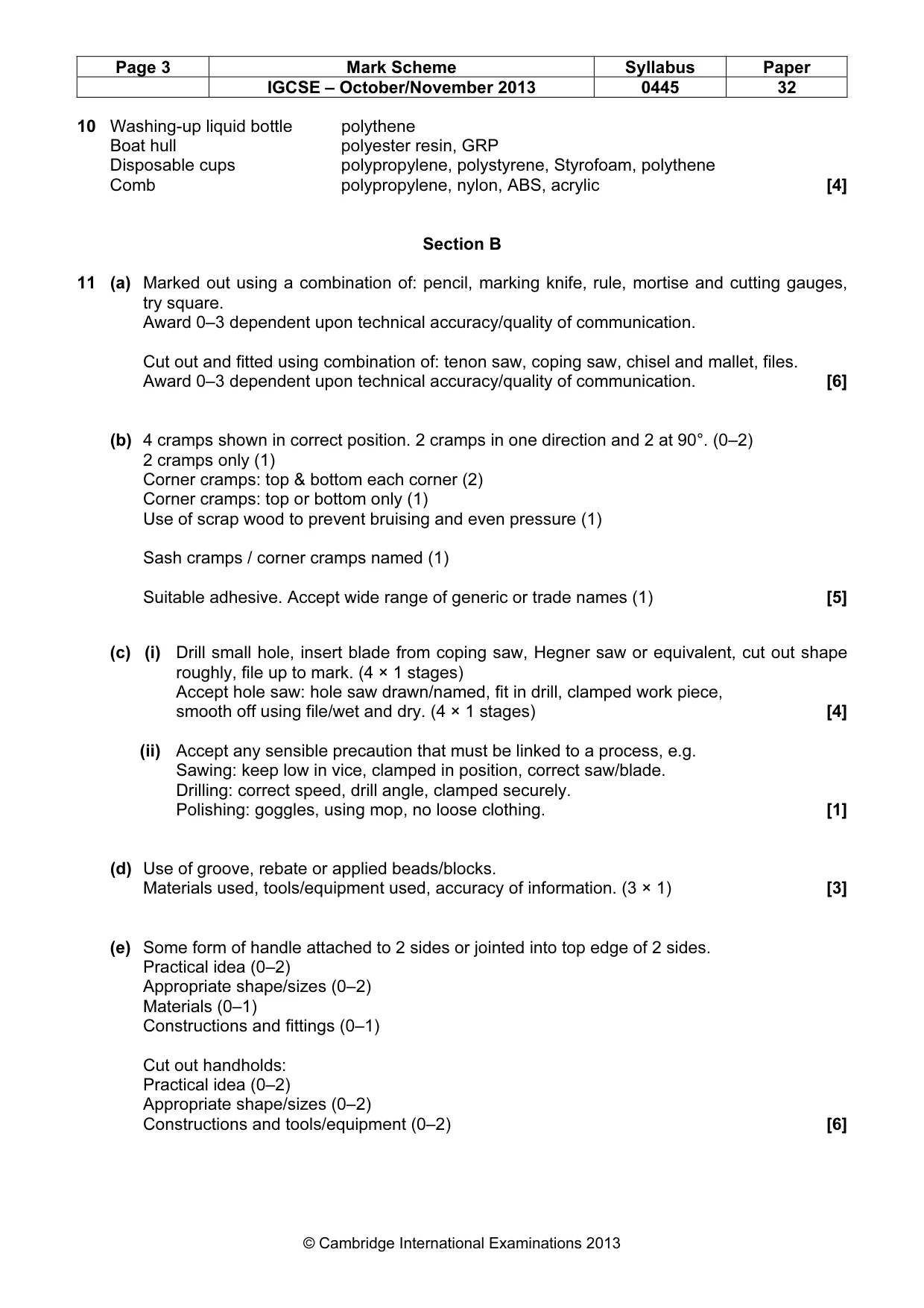
Page 3 Mark Scheme Syllabus Paper IGCSE – October/November 2013 0445 32 © Cambridge International Examinations 2013 10 Washing-up liquid bottle polythene Boat hull polyester resin, GRP Disposable cups polypropylene, polystyrene, Styrofoam, polythene Comb polypropylene, nylon, ABS, acrylic [4] Section B 11 (a) Marked out using a combination of: pencil, marking knife, rule, mortise and cutting gauges, try square. Award 0–3 dependent upon technical accuracy/quality of communication. Cut out and fitted using combination of: tenon saw, coping saw, chisel and mallet, files. Award 0–3 dependent upon technical accuracy/quality of communication. [6] (b) 4 cramps shown in correct position. 2 cramps in one direction and 2 at 90°. (0–2) 2 cramps only (1) Corner cramps: top & bottom each corner (2) Corner cramps: top or bottom only (1) Use of scrap wood to prevent bruising and even pressure (1) Sash cramps / corner cramps named (1) Suitable adhesive. Accept wide range of generic or trade names (1) [5] (c) (i) Drill small hole, insert blade from coping saw, Hegner saw or equivalent, cut out shape roughly, file up to mark. (4 × 1 stages) Accept hole saw: hole saw drawn/named, fit in drill, clamped work piece, smooth off using file/wet and dry. (4 × 1 stages) [4] (ii) Accept any sensible precaution that must be linked to a process, e.g. Sawing: keep low in vice, clamped in position, correct saw/blade. Drilling: correct speed, drill angle, clamped securely. Polishing: goggles, using mop, no loose clothing. [1] (d) Use of groove, rebate or applied beads/blocks. Materials used, tools/equipment used, accuracy of information. (3 × 1) [3] (e) Some form of handle attached to 2 sides or jointed into top edge of 2 sides. Practical idea (0–2) Appropriate shape/sizes (0–2) Materials (0–1) Constructions and fittings (0–1) Cut out handholds: Practical idea (0–2) Appropriate shape/sizes (0–2) Constructions and tools/equipment (0–2) [6]
Mark scheme, page 4
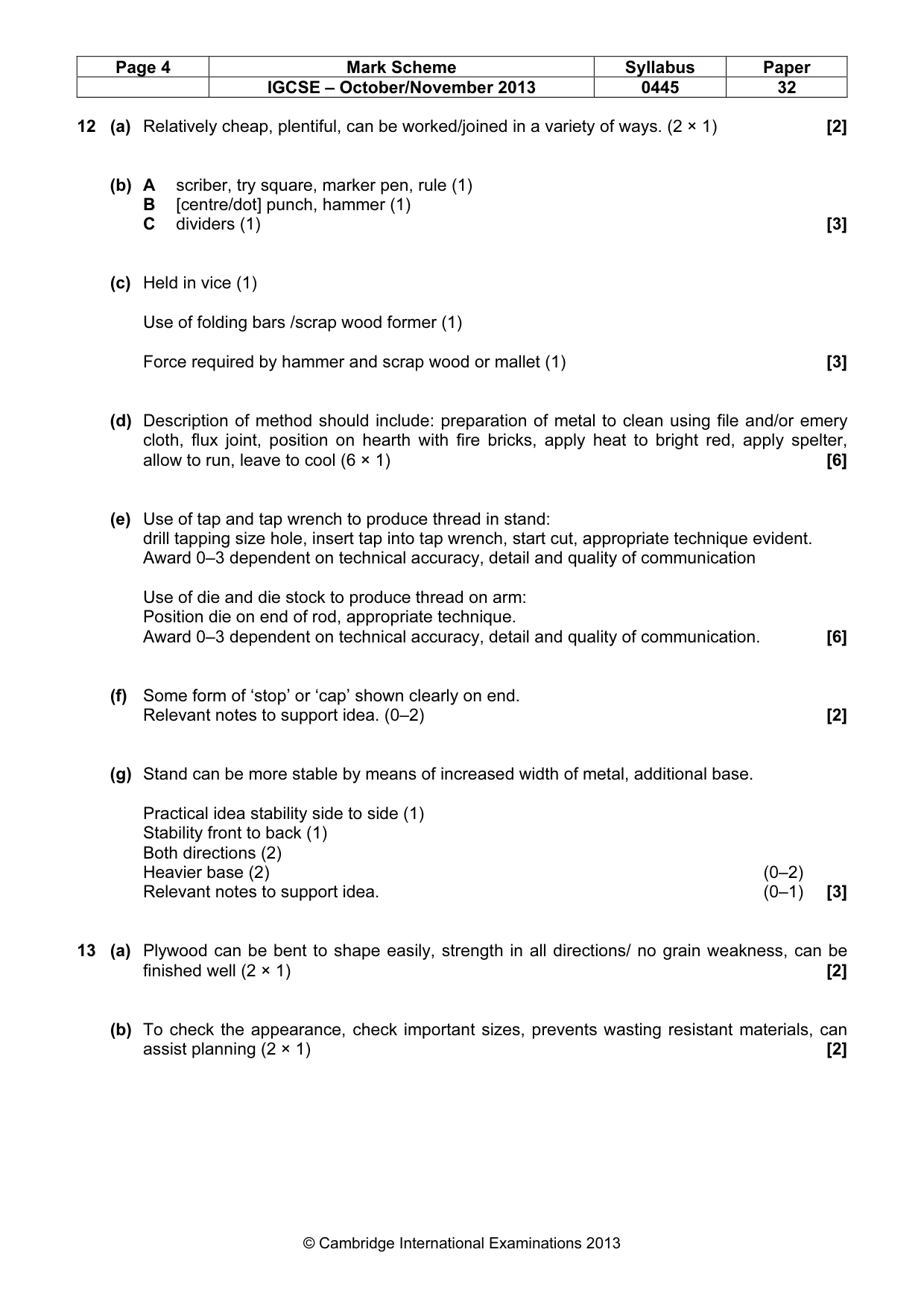
Page 4 Mark Scheme Syllabus Paper IGCSE – October/November 2013 0445 32 © Cambridge International Examinations 2013 12 (a) Relatively cheap, plentiful, can be worked/joined in a variety of ways. (2 × 1) [2] (b) A scriber, try square, marker pen, rule (1) B [centre/dot] punch, hammer (1) C dividers (1) [3] (c) Held in vice (1) Use of folding bars /scrap wood former (1) Force required by hammer and scrap wood or mallet (1) [3] (d) Description of method should include: preparation of metal to clean using file and/or emery cloth, flux joint, position on hearth with fire bricks, apply heat to bright red, apply spelter, allow to run, leave to cool (6 × 1) [6] (e) Use of tap and tap wrench to produce thread in stand: drill tapping size hole, insert tap into tap wrench, start cut, appropriate technique evident. Award 0–3 dependent on technical accuracy, detail and quality of communication Use of die and die stock to produce thread on arm: Position die on end of rod, appropriate technique. Award 0–3 dependent on technical accuracy, detail and quality of communication. [6] (f) Some form of ‘stop’ or ‘cap’ shown clearly on end. Relevant notes to support idea. (0–2) [2] (g) Stand can be more stable by means of increased width of metal, additional base. Practical idea stability side to side (1) Stability front to back (1) Both directions (2) Heavier base (2) (0–2) Relevant notes to support idea. (0–1) [3] 13 (a) Plywood can be bent to shape easily, strength in all directions/ no grain weakness, can be finished well (2 × 1) [2] (b) To check the appearance, check important sizes, prevents wasting resistant materials, can assist planning (2 × 1) [2]
Mark scheme, page 5
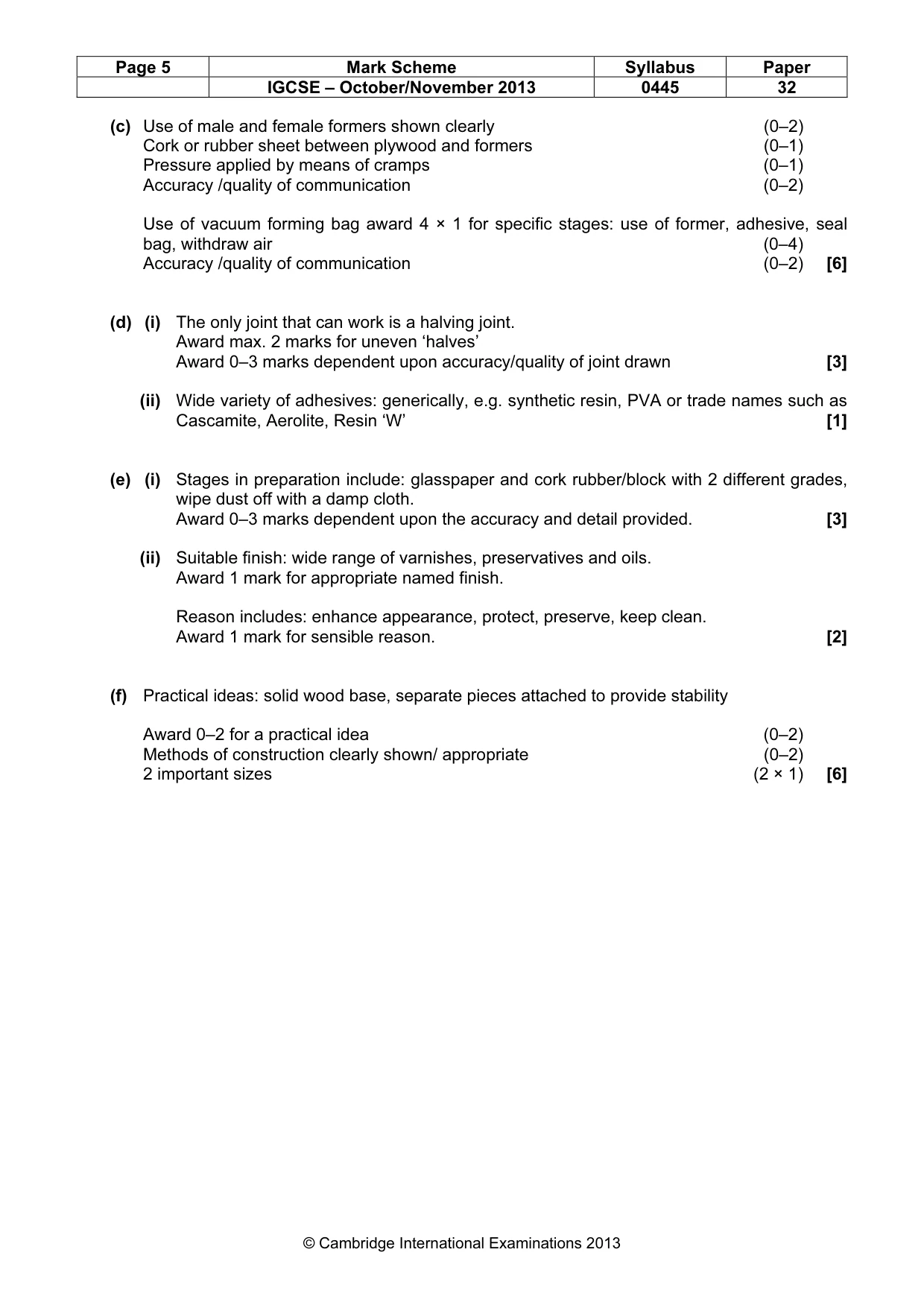
Page 5 Mark Scheme Syllabus Paper IGCSE – October/November 2013 0445 32 © Cambridge International Examinations 2013 (c) Use of male and female formers shown clearly (0–2) Cork or rubber sheet between plywood and formers (0–1) Pressure applied by means of cramps (0–1) Accuracy /quality of communication (0–2) Use of vacuum forming bag award 4 × 1 for specific stages: use of former, adhesive, seal bag, withdraw air (0–4) Accuracy /quality of communication (0–2) [6] (d) (i) The only joint that can work is a halving joint. Award max. 2 marks for uneven ‘halves’ Award 0–3 marks dependent upon accuracy/quality of joint drawn [3] (ii) Wide variety of adhesives: generically, e.g. synthetic resin, PVA or trade names such as Cascamite, Aerolite, Resin ‘W’ [1] (e) (i) Stages in preparation include: glasspaper and cork rubber/block with 2 different grades, wipe dust off with a damp cloth. Award 0–3 marks dependent upon the accuracy and detail provided. [3] (ii) Suitable finish: wide range of varnishes, preservatives and oils. Award 1 mark for appropriate named finish. Reason includes: enhance appearance, protect, preserve, keep clean. Award 1 mark for sensible reason. [2] (f) Practical ideas: solid wood base, separate pieces attached to provide stability Award 0–2 for a practical idea (0–2) Methods of construction clearly shown/ appropriate (0–2) 2 important sizes (2 × 1) [6]
What you needed in this session
Cambridge’s own grade thresholds for 2013 Oct/Nov, Paper 3 · Variant 2. A higher threshold means an easier paper — the bar moves with how the cohort did.