Cambridge IGCSE Design and Technology 0445 — 2013 Oct/Nov Paper 3 · Variant 1
0445/31/O/N/13 · 50 marks · ≈56 min
The question paper and its mark scheme, free to read here and free to download. This is Cambridge’s own paper, exactly as it was sat.
Question paper16 pages
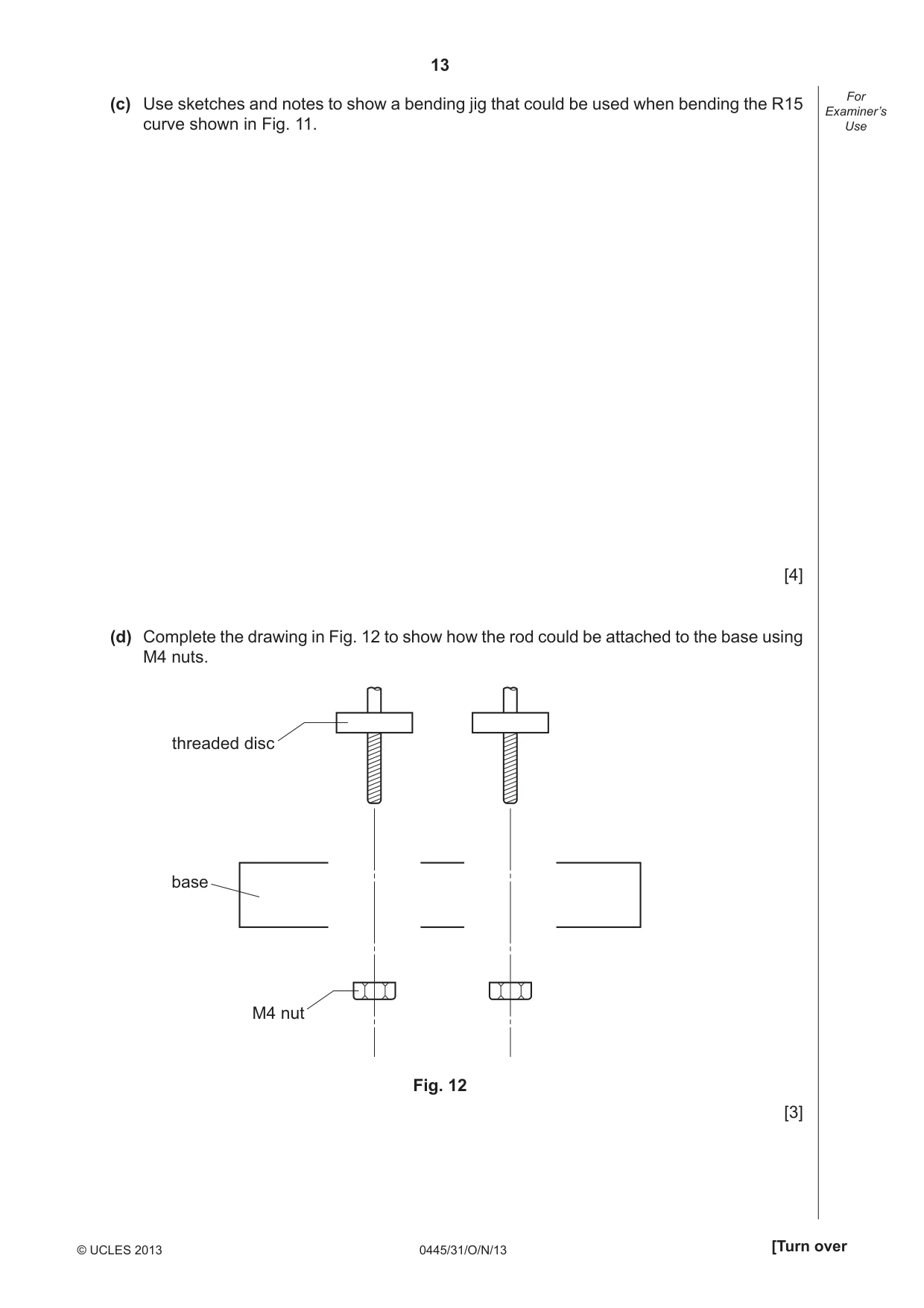
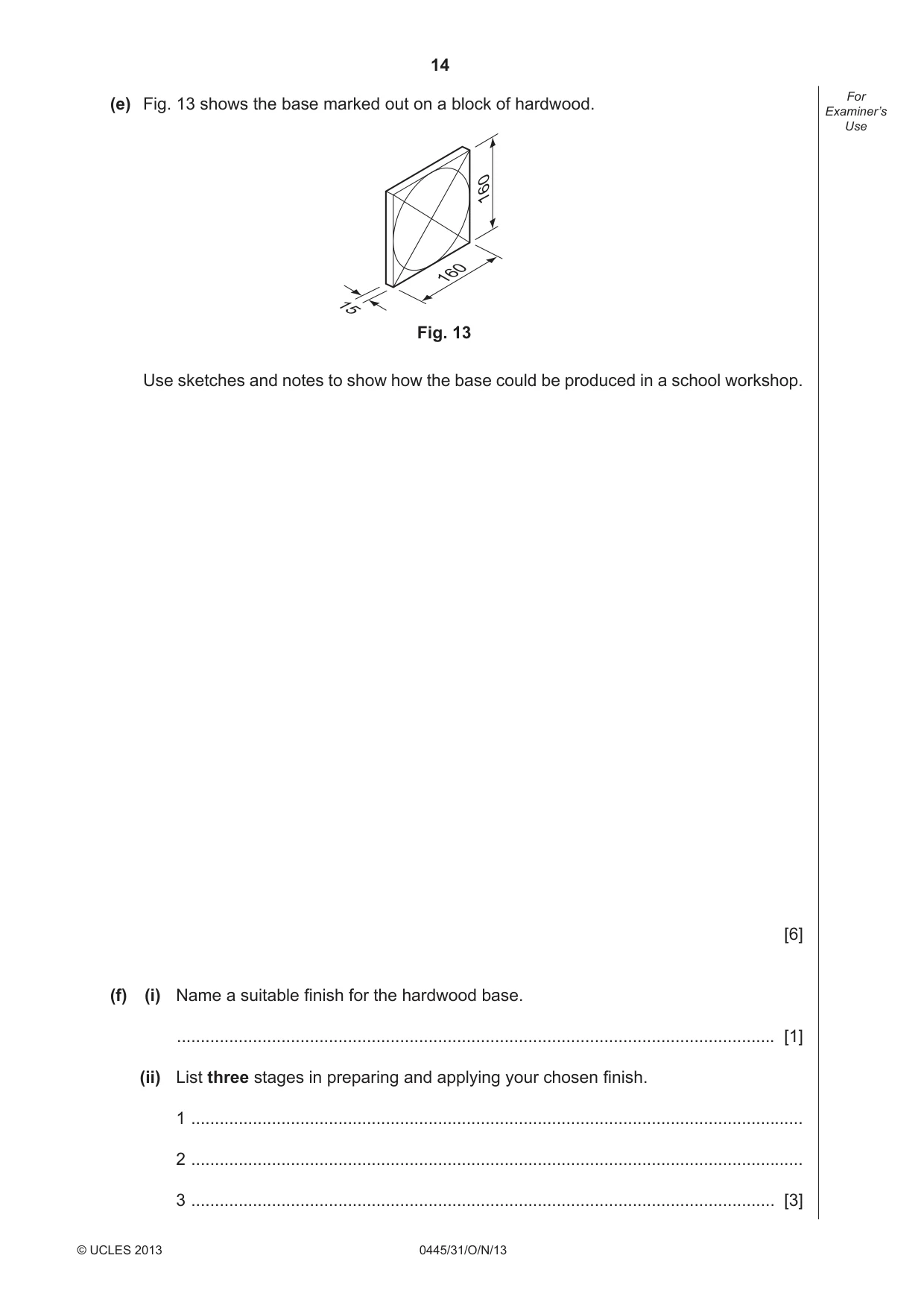

Mark scheme6 pages
Answers below. Sit the paper first if you are practising.
Paper as text
Question paper, page 1
READ THESE INSTRUCTIONS FIRST Write your Centre number, candidate number and name on all the work you hand in. Write in blue or black pen. You may use a soft pencil for any diagrams, graphs or rough working. Do not use staples, paper clips, highlighters, glue or correction fl uid. DO NOT WRITE IN ANY BARCODES. Section A Answer all questions in this section. Section B Answer one question in this section. You may use a calculator. The total of the marks for this paper is 50. The number of marks is given in brackets [ ] at the end of each question or part question. DESIGN AND TECHNOLOGY 0445/31 Paper 3 Resistant Materials October/November 2013 1 hour Candidates answer on the Question Paper. No Additional Materials are required. To be taken together with Paper 1 in one session of 2 hours 15 minutes. UNIVERSITY OF CAMBRIDGE INTERNATIONAL EXAMINATIONS International General Certifi cate of Secondary Education This document consists of 14 printed pages and 2 blank pages. [Turn over IB13 11_0445_31/2RP © UCLES 2013 *2830800063* For Examiner’s Use Section A Section B Total
Question paper, page 2
2 0445/31/O/N/13 © UCLES 2013 For Examiner’s Use Section A Answer all questions in this section. 1 Fig. 1 shows part of a toy made from 4 mm thick manufactured board. Fig. 1 (a) Give one benefi t of using a template to mark out the shape. … [1] (b) Name a tool that could be used to cut out the shape. … [1] 2 Complete the table below by naming a specifi c material and giving a reason for your choice. Product Specifi c material Reason for choice plastic gears wooden rolling pin [4] 3 Fig. 2 shows three different types of rivet. A B Fig. 2 C Name each type of rivet. rivet A … rivet B … rivet C … [3]
Question paper, page 3
3 0445/31/O/N/13 © UCLES 2013 [Turn over For Examiner’s Use 4 Complete the sketch below to show blockboard. [2] 5 Complete the table below by describing a situation in the workshop where each of the following items of safety equipment must be worn. Safety equipment Situation where it must be worn ear defenders gauntlets apron [3] 6 Fig. 3 shows a corner bridle joint. Fig. 3 Name three marking out tools that could be used to mark out the corner bridle joint. 1 … 2 … 3 … [3]
Question paper, page 4
4 0445/31/O/N/13 © UCLES 2013 For Examiner’s Use 7 Fig. 4 shows a plastic food tray and fork. Fig. 4 Name the process that would be used to make: (a) the food tray; … [1] (b) the fork. … [1] 8 Fig. 5 shows a picnic table made from hardwood. Fig. 5 Name two different methods of joining that could be used in the manufacture of the picnic table. 1 … 2 … [2]
Question paper, page 5
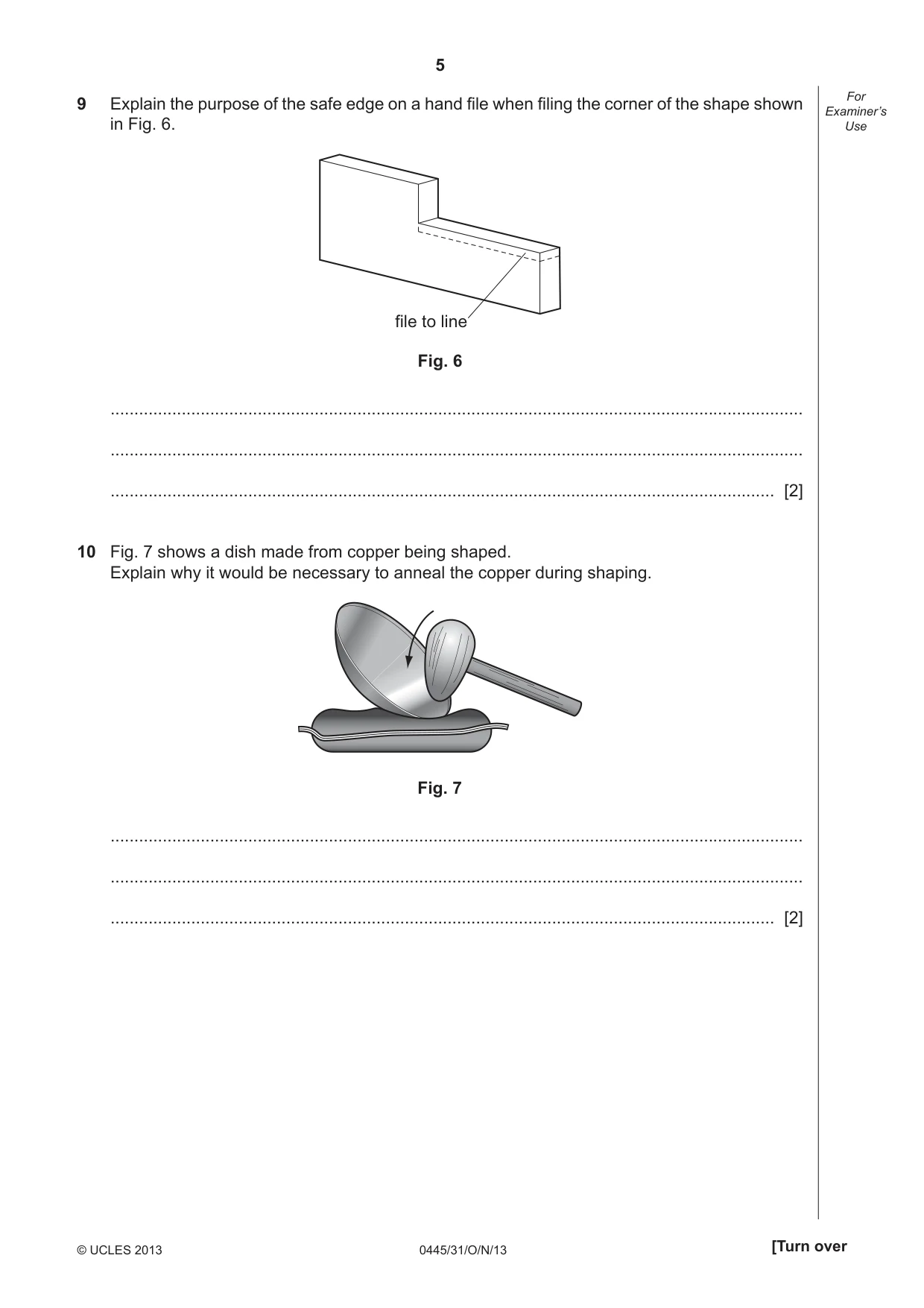
5 0445/31/O/N/13 © UCLES 2013 [Turn over For Examiner’s Use 9 Explain the purpose of the safe edge on a hand fi le when fi ling the corner of the shape shown in Fig. 6. file to line Fig. 6 … … … [2] 10 Fig. 7 shows a dish made from copper being shaped. Explain why it would be necessary to anneal the copper during shaping. Fig. 7 … … … [2]
Question paper, page 6
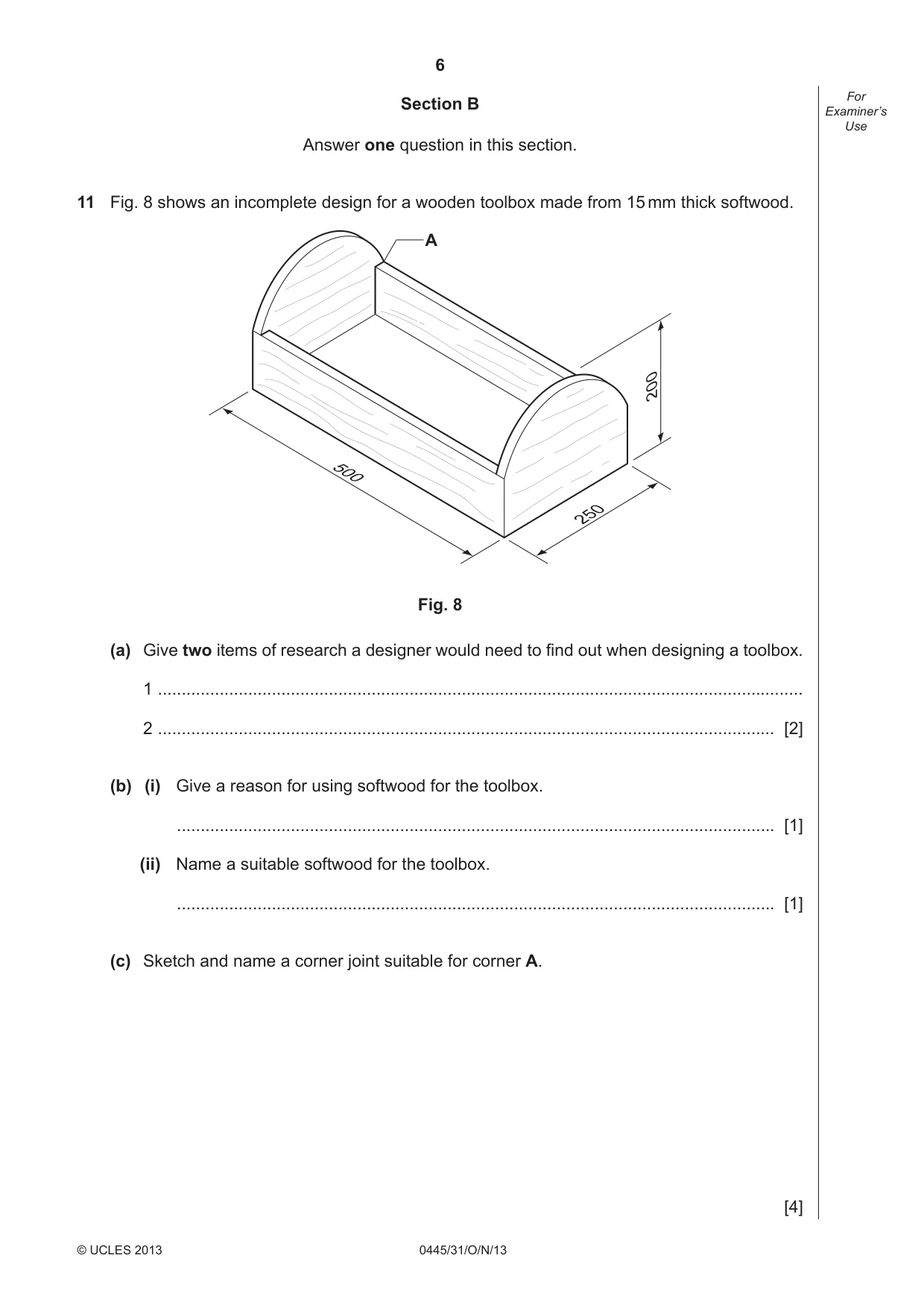
6 0445/31/O/N/13 © UCLES 2013 For Examiner’s Use Section B Answer one question in this section. 11 Fig. 8 shows an incomplete design for a wooden toolbox made from 15 mm thick softwood. A 500 250 200 Fig. 8 (a) Give two items of research a designer would need to fi nd out when designing a toolbox. 1 … 2 … [2] (b) (i) Give a reason for using softwood for the toolbox. … [1] (ii) Name a suitable softwood for the toolbox. … [1] (c) Sketch and name a corner joint suitable for corner A. [4]
Question paper, page 7
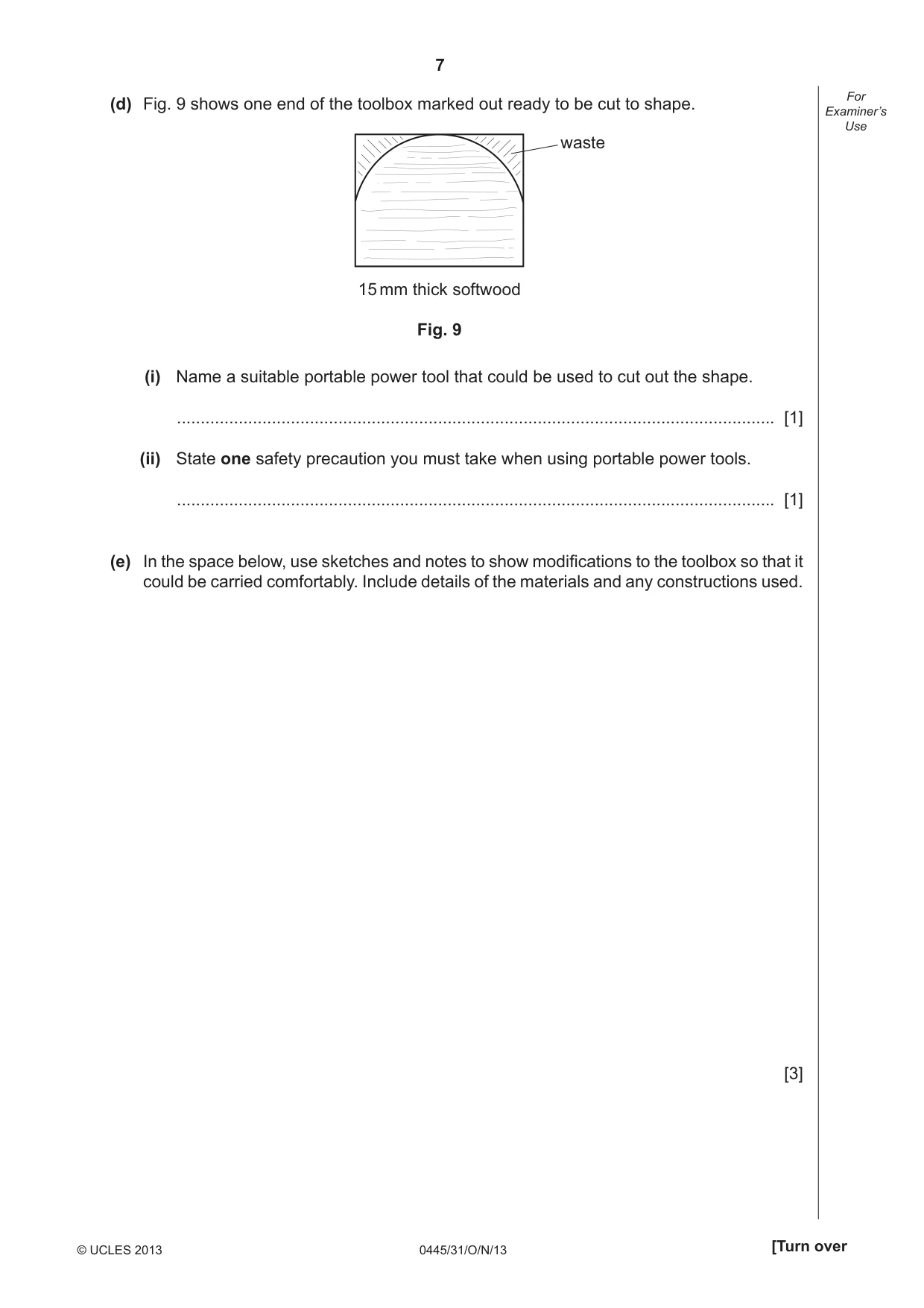
7 0445/31/O/N/13 © UCLES 2013 [Turn over For Examiner’s Use (d) Fig. 9 shows one end of the toolbox marked out ready to be cut to shape. waste 15 mm thick softwood Fig. 9 (i) Name a suitable portable power tool that could be used to cut out the shape. … [1] (ii) State one safety precaution you must take when using portable power tools. … [1] (e) In the space below, use sketches and notes to show modifi cations to the toolbox so that it could be carried comfortably. Include details of the materials and any constructions used. [3]
Question paper, page 8
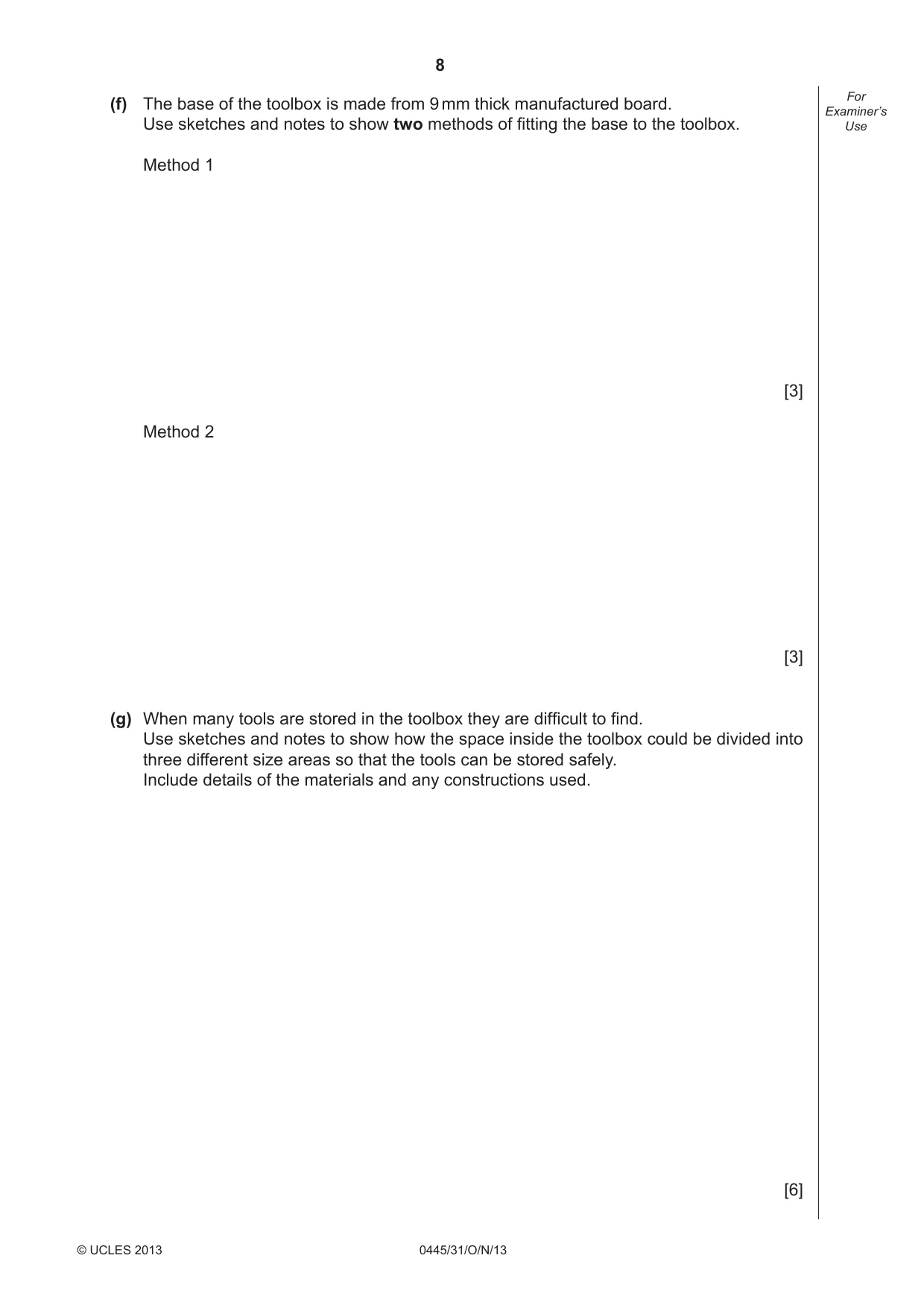
8 0445/31/O/N/13 © UCLES 2013 For Examiner’s Use (f) The base of the toolbox is made from 9 mm thick manufactured board. Use sketches and notes to show two methods of fi tting the base to the toolbox. Method 1 [3] Method 2 [3] (g) When many tools are stored in the toolbox they are diffi cult to fi nd. Use sketches and notes to show how the space inside the toolbox could be divided into three different size areas so that the tools can be stored safely. Include details of the materials and any constructions used. [6]
Question paper, page 9
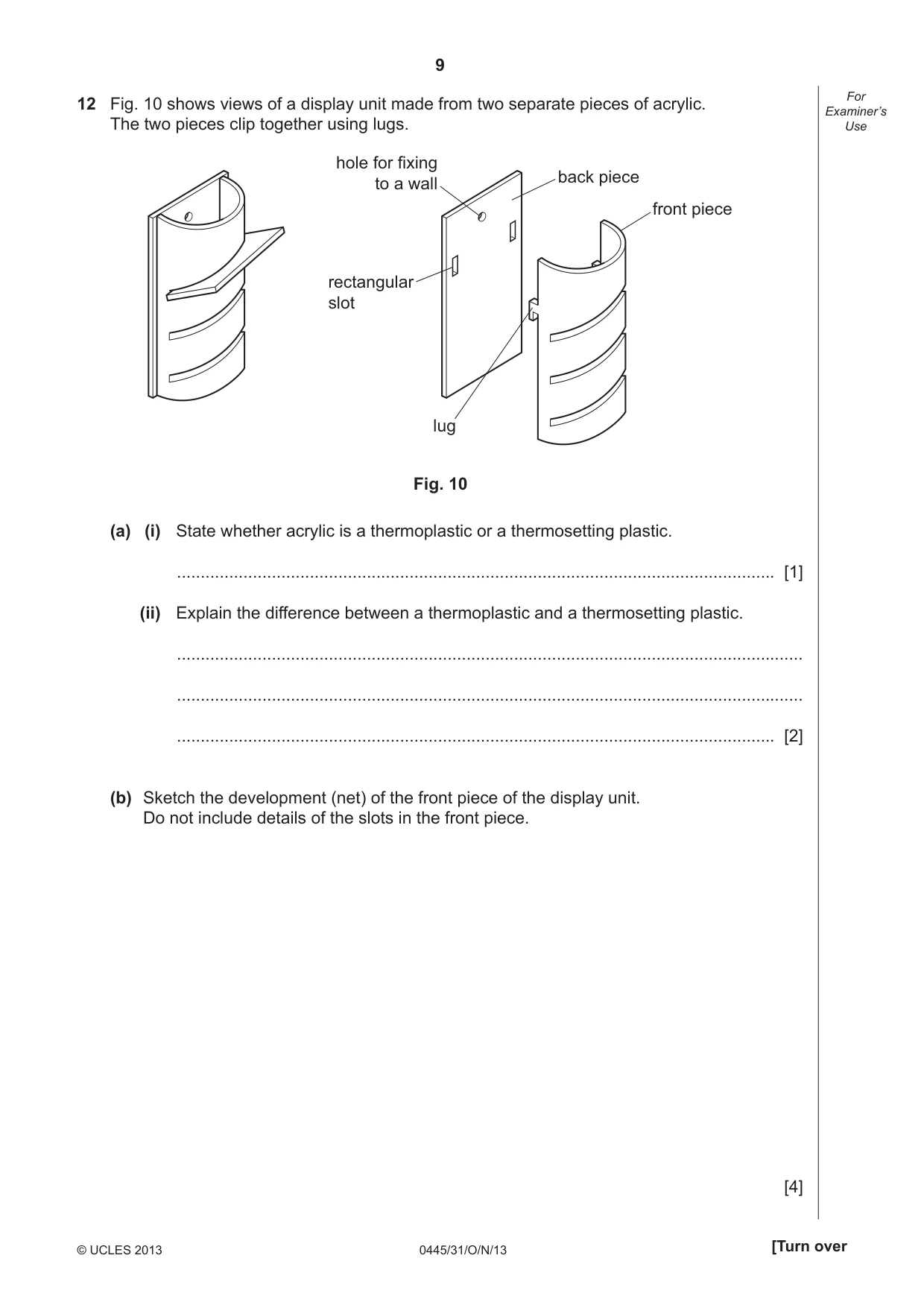
9 0445/31/O/N/13 © UCLES 2013 [Turn over For Examiner’s Use 12 Fig. 10 shows views of a display unit made from two separate pieces of acrylic. The two pieces clip together using lugs. rectangular slot hole for fixing to a wall lug back piece front piece Fig. 10 (a) (i) State whether acrylic is a thermoplastic or a thermosetting plastic. … [1] (ii) Explain the difference between a thermoplastic and a thermosetting plastic. … … … [2] (b) Sketch the development (net) of the front piece of the display unit. Do not include details of the slots in the front piece. [4]
Question paper, page 10
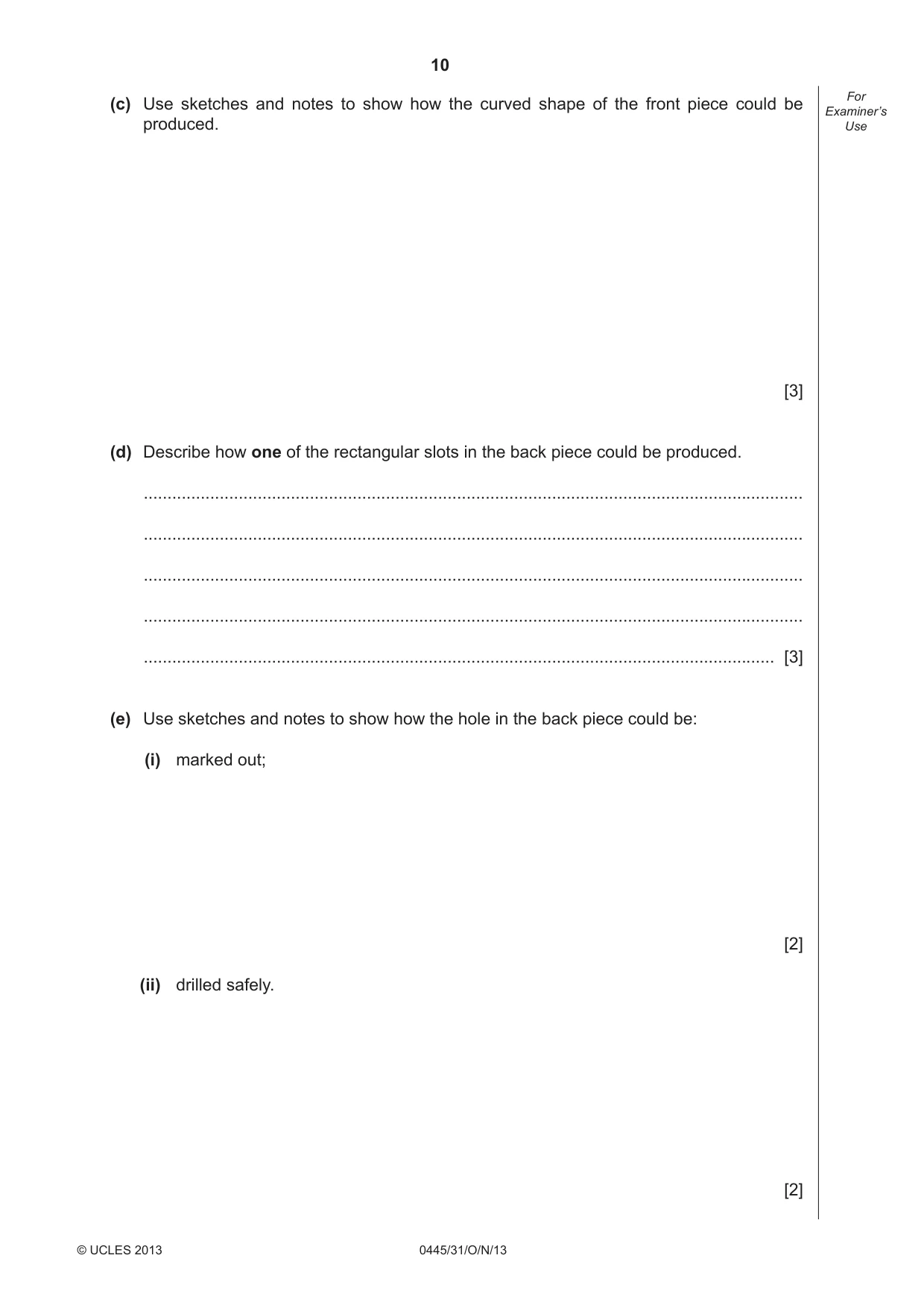
10 0445/31/O/N/13 © UCLES 2013 For Examiner’s Use (c) Use sketches and notes to show how the curved shape of the front piece could be produced. [3] (d) Describe how one of the rectangular slots in the back piece could be produced. … … … … … [3] (e) Use sketches and notes to show how the hole in the back piece could be: (i) marked out; [2] (ii) drilled safely. [2]
Question paper, page 11
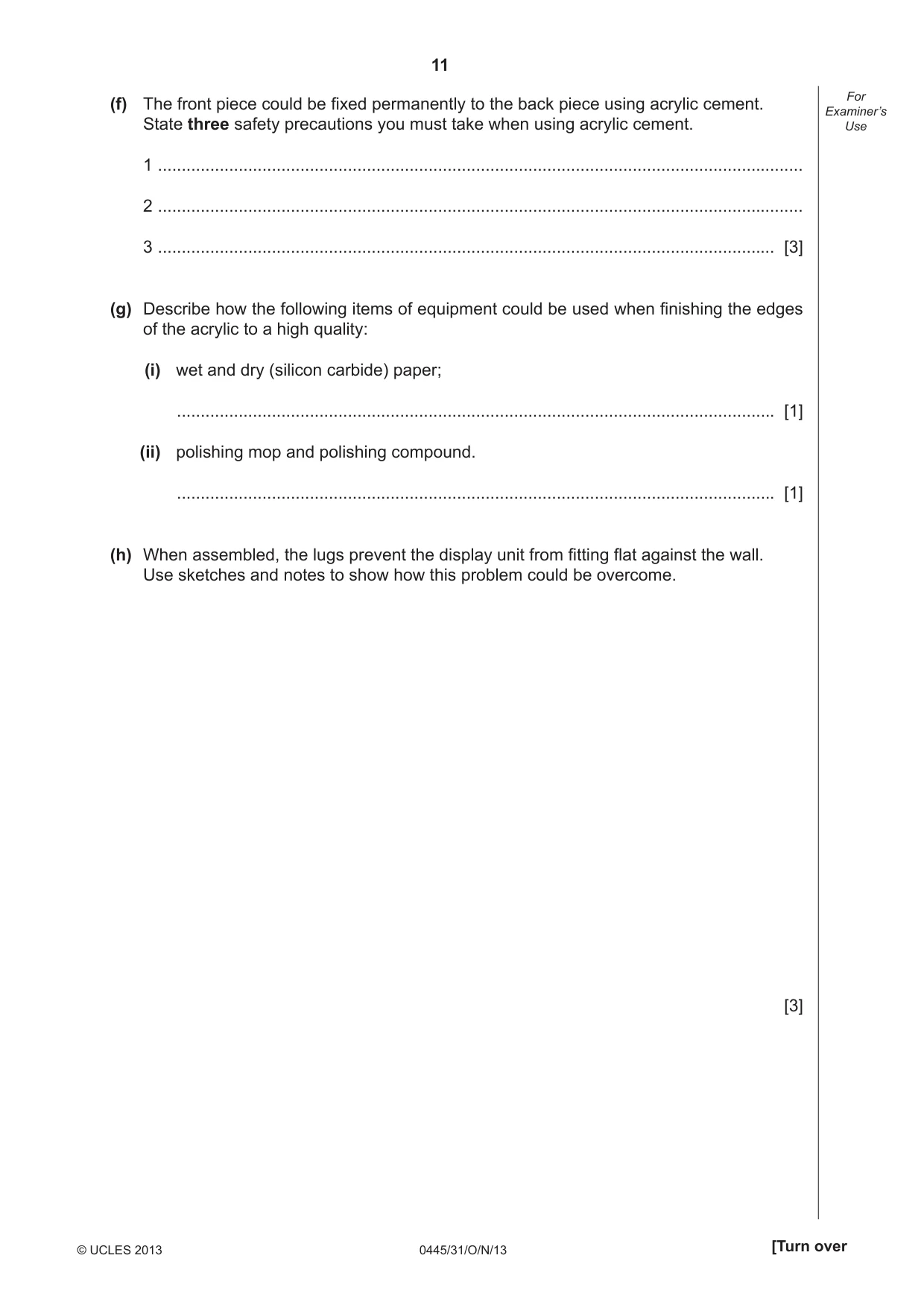
11 0445/31/O/N/13 © UCLES 2013 [Turn over For Examiner’s Use (f) The front piece could be fi xed permanently to the back piece using acrylic cement. State three safety precautions you must take when using acrylic cement. 1 … 2 … 3 … [3] (g) Describe how the following items of equipment could be used when fi nishing the edges of the acrylic to a high quality: (i) wet and dry (silicon carbide) paper; … [1] (ii) polishing mop and polishing compound. … [1] (h) When assembled, the lugs prevent the display unit from fi tting fl at against the wall. Use sketches and notes to show how this problem could be overcome. [3]
Question paper, page 12
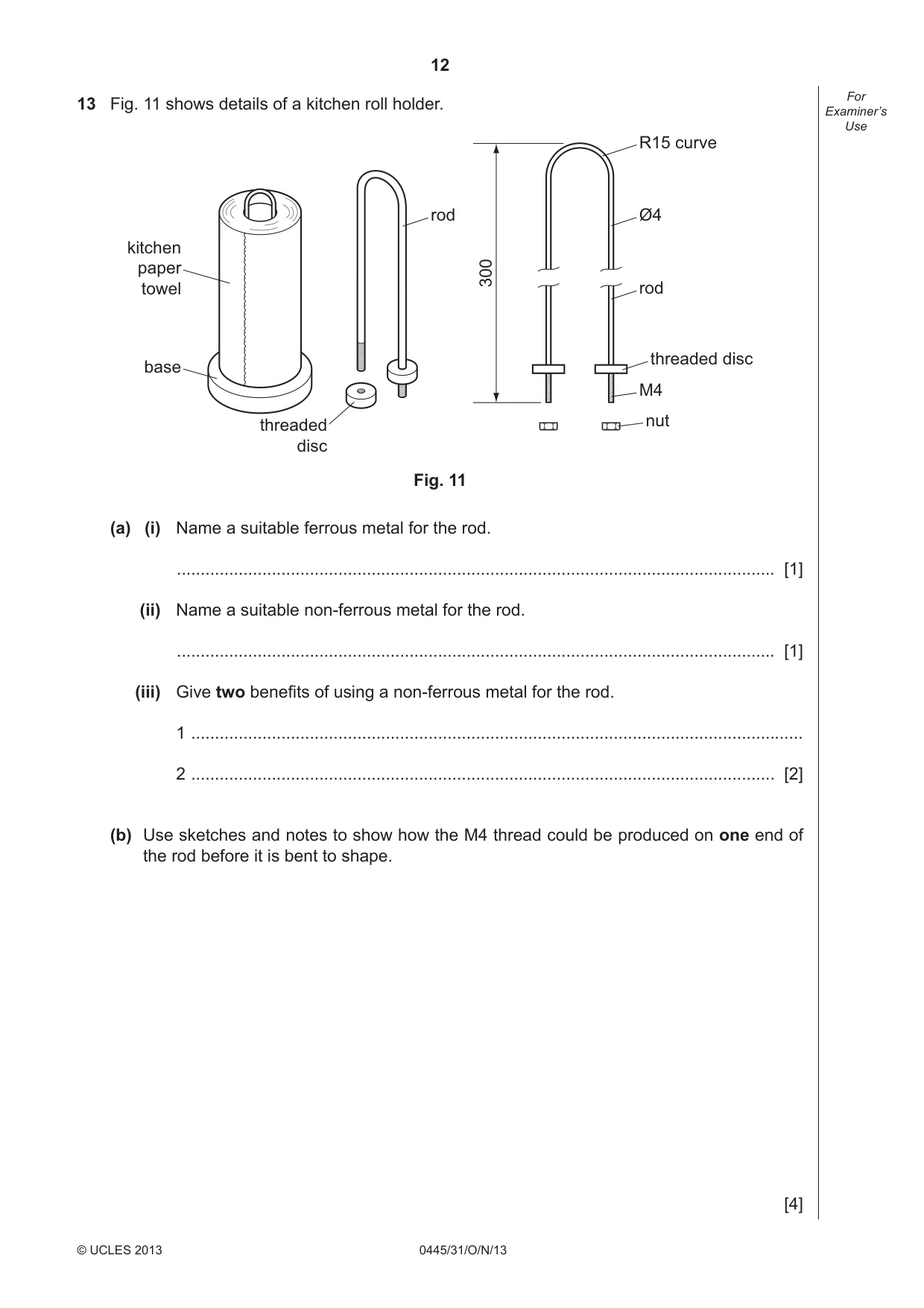
12 0445/31/O/N/13 © UCLES 2013 For Examiner’s Use 13 Fig. 11 shows details of a kitchen roll holder. kitchen paper towel base threaded disc rod 300 rod nut M4 threaded disc Ø4 R15 curve Fig. 11 (a) (i) Name a suitable ferrous metal for the rod. … [1] (ii) Name a suitable non-ferrous metal for the rod. … [1] (iii) Give two benefi ts of using a non-ferrous metal for the rod. 1 … 2 … [2] (b) Use sketches and notes to show how the M4 thread could be produced on one end of the rod before it is bent to shape. [4]
Question paper, page 13
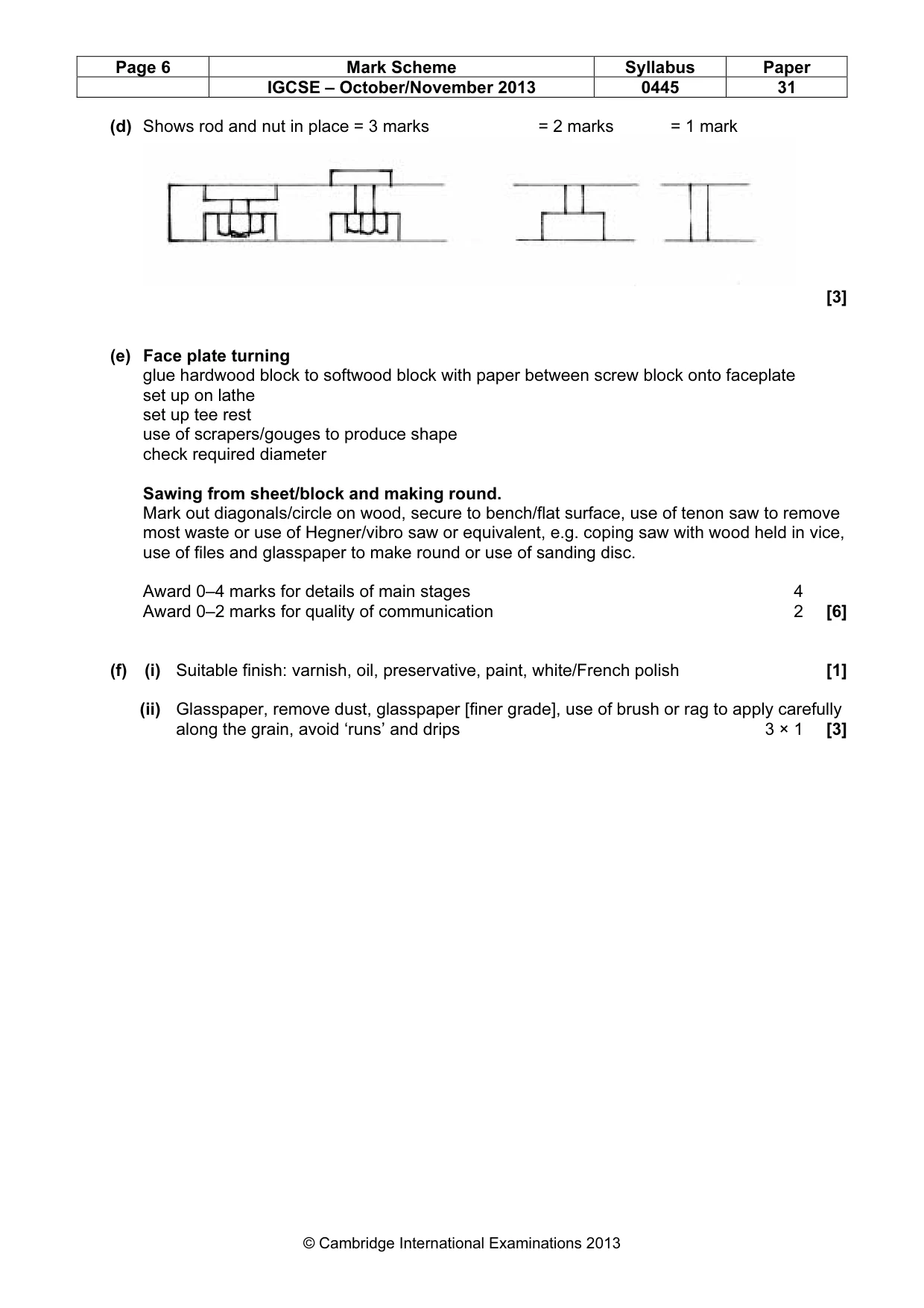
13 0445/31/O/N/13 © UCLES 2013 [Turn over For Examiner’s Use (c) Use sketches and notes to show a bending jig that could be used when bending the R15 curve shown in Fig. 11. [4] (d) Complete the drawing in Fig. 12 to show how the rod could be attached to the base using M4 nuts. threaded disc M4 nut base Fig. 12 [3]
Question paper, page 14
14 0445/31/O/N/13 © UCLES 2013 For Examiner’s Use (e) Fig. 13 shows the base marked out on a block of hardwood. 160 160 Fig. 13 15 Use sketches and notes to show how the base could be produced in a school workshop. [6] (f) (i) Name a suitable fi nish for the hardwood base. … [1] (ii) List three stages in preparing and applying your chosen fi nish. 1 … 2 … 3 … [3]
Question paper, page 15
15 0445/31/O/N/13 © UCLES 2013 BLANK PAGE
Question paper, page 16
16 0445/31/O/N/13 Permission to reproduce items where third-party owned material protected by copyright is included has been sought and cleared where possible. Every reasonable effort has been made by the publisher (UCLES) to trace copyright holders, but if any items requiring clearance have unwittingly been included the publisher will be pleased to make amends at the earliest possible opportunity. University of Cambridge International Examinations is part of the Cambridge Assessment Group. Cambridge Assessment is the brand name of University of Cambridge Local Examinations Syndicate (UCLES), which is itself a department of the University of Cambridge. BLANK PAGE © UCLES 2013
Mark scheme, page 1
CAMBRIDGE INTERNATIONAL EXAMINATIONS International General Certificate of Secondary Education MARK SCHEME for the October/November 2013 series 0445 DESIGN AND TECHNOLOGY 0445/31 Paper 3 (Resistant Materials), maximum raw mark 50 This mark scheme is published as an aid to teachers and candidates, to indicate the requirements of the examination. It shows the basis on which Examiners were instructed to award marks. It does not indicate the details of the discussions that took place at an Examiners’ meeting before marking began, which would have considered the acceptability of alternative answers. Mark schemes should be read in conjunction with the question paper and the Principal Examiner Report for Teachers. Cambridge will not enter into discussions about these mark schemes. Cambridge is publishing the mark schemes for the October/November 2013 series for most IGCSE, GCE Advanced Level and Advanced Subsidiary Level components and some Ordinary Level components.
Mark scheme, page 2
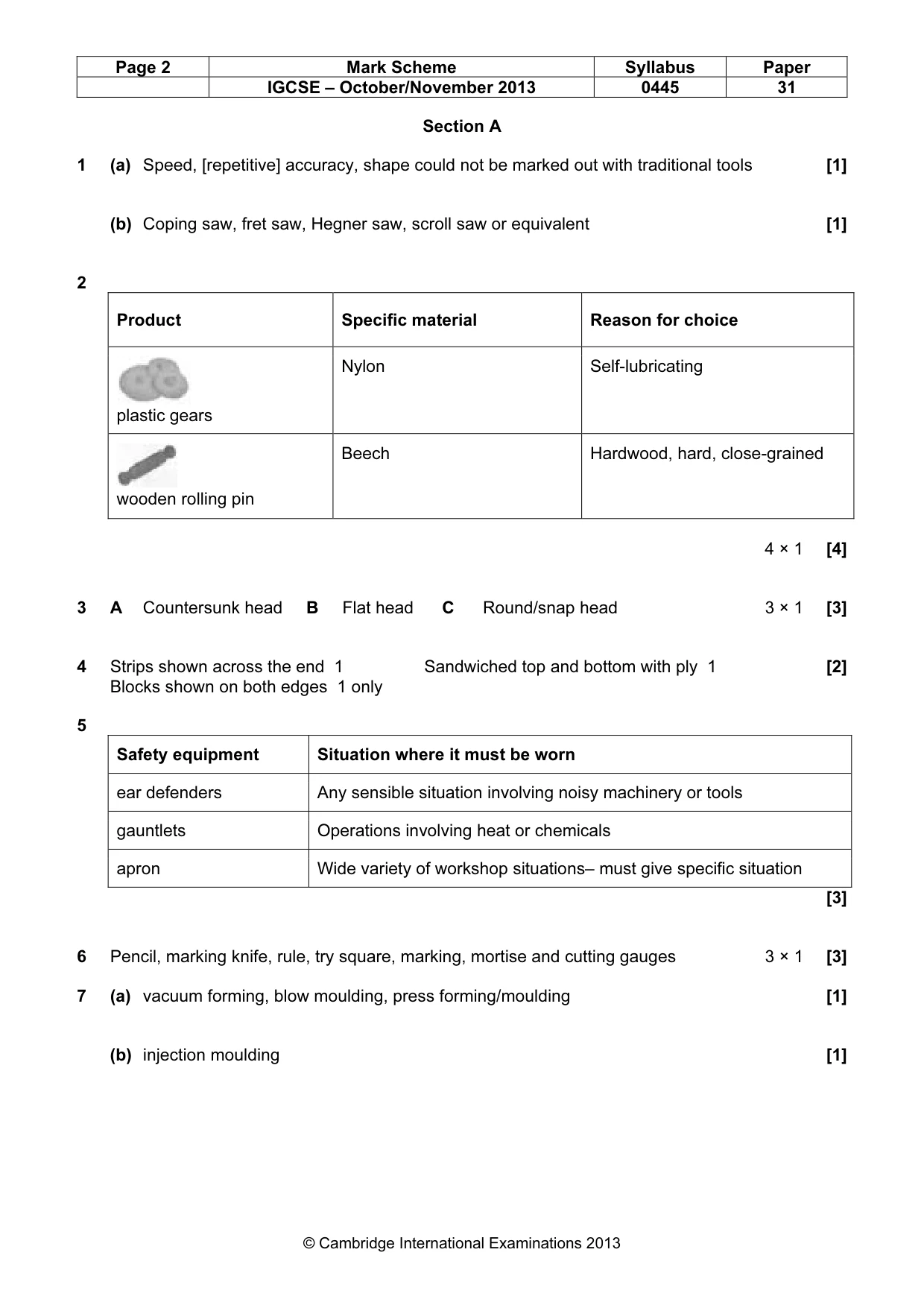
Page 2 Mark Scheme Syllabus Paper IGCSE – October/November 2013 0445 31 © Cambridge International Examinations 2013 Section A 1 (a) Speed, [repetitive] accuracy, shape could not be marked out with traditional tools [1] (b) Coping saw, fret saw, Hegner saw, scroll saw or equivalent [1] 2 Product Specific material Reason for choice plastic gears Nylon Self-lubricating wooden rolling pin Beech Hardwood, hard, close-grained 4 × 1 [4] 3 A Countersunk head B Flat head C Round/snap head 3 × 1 [3] 4 Strips shown across the end 1 Sandwiched top and bottom with ply 1 [2] Blocks shown on both edges 1 only 5 Safety equipment Situation where it must be worn ear defenders Any sensible situation involving noisy machinery or tools gauntlets Operations involving heat or chemicals apron Wide variety of workshop situations– must give specific situation [3] 6 Pencil, marking knife, rule, try square, marking, mortise and cutting gauges 3 × 1 [3] 7 (a) vacuum forming, blow moulding, press forming/moulding [1] (b) injection moulding [1]
Mark scheme, page 3
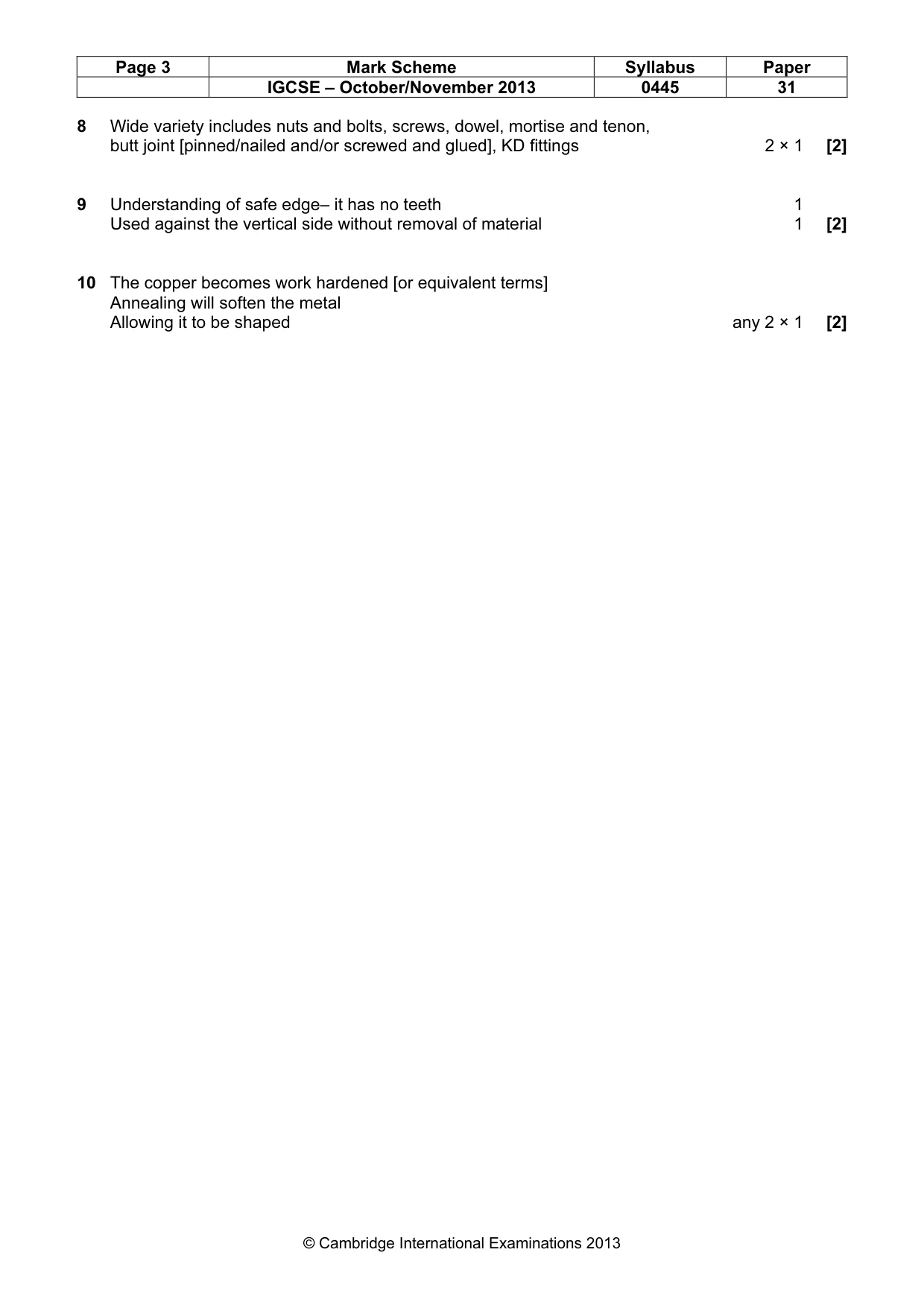
Page 3 Mark Scheme Syllabus Paper IGCSE – October/November 2013 0445 31 © Cambridge International Examinations 2013 8 Wide variety includes nuts and bolts, screws, dowel, mortise and tenon, butt joint [pinned/nailed and/or screwed and glued], KD fittings 2 × 1 [2] 9 Understanding of safe edge– it has no teeth 1 Used against the vertical side without removal of material 1 [2] 10 The copper becomes work hardened [or equivalent terms] Annealing will soften the metal Allowing it to be shaped any 2 × 1 [2]
Mark scheme, page 4
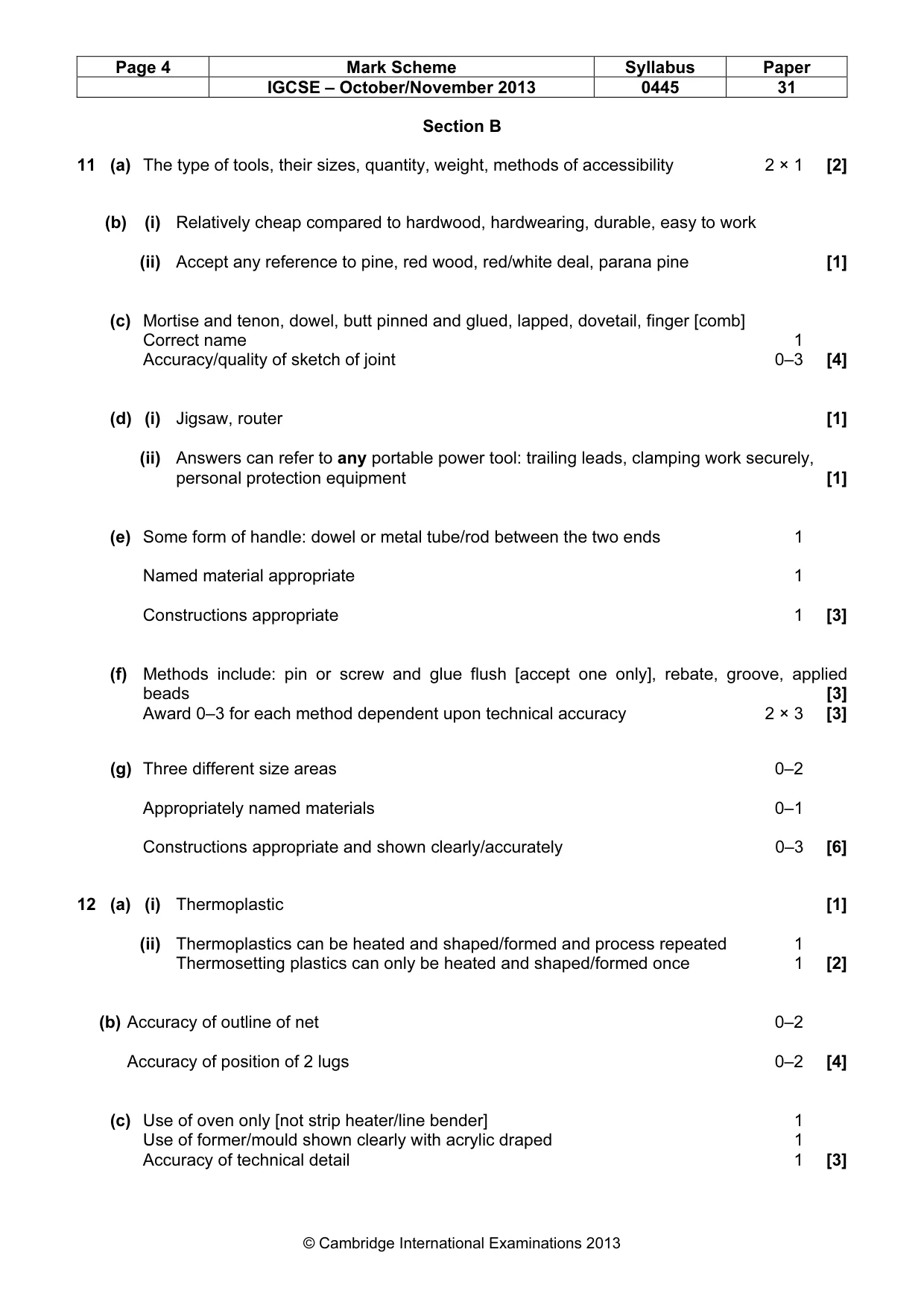
Page 4 Mark Scheme Syllabus Paper IGCSE – October/November 2013 0445 31 © Cambridge International Examinations 2013 Section B 11 (a) The type of tools, their sizes, quantity, weight, methods of accessibility 2 × 1 [2] (b) (i) Relatively cheap compared to hardwood, hardwearing, durable, easy to work (ii) Accept any reference to pine, red wood, red/white deal, parana pine [1] (c) Mortise and tenon, dowel, butt pinned and glued, lapped, dovetail, finger [comb] Correct name 1 Accuracy/quality of sketch of joint 0–3 [4] (d) (i) Jigsaw, router [1] (ii) Answers can refer to any portable power tool: trailing leads, clamping work securely, personal protection equipment [1] (e) Some form of handle: dowel or metal tube/rod between the two ends 1 Named material appropriate 1 Constructions appropriate 1 [3] (f) Methods include: pin or screw and glue flush [accept one only], rebate, groove, applied beads [3] Award 0–3 for each method dependent upon technical accuracy 2 × 3 [3] (g) Three different size areas 0–2 Appropriately named materials 0–1 Constructions appropriate and shown clearly/accurately 0–3 [6] 12 (a) (i) Thermoplastic [1] (ii) Thermoplastics can be heated and shaped/formed and process repeated 1 Thermosetting plastics can only be heated and shaped/formed once 1 [2] (b) Accuracy of outline of net 0–2 Accuracy of position of 2 lugs 0–2 [4] (c) Use of oven only [not strip heater/line bender] 1 Use of former/mould shown clearly with acrylic draped 1 Accuracy of technical detail 1 [3]
Mark scheme, page 5
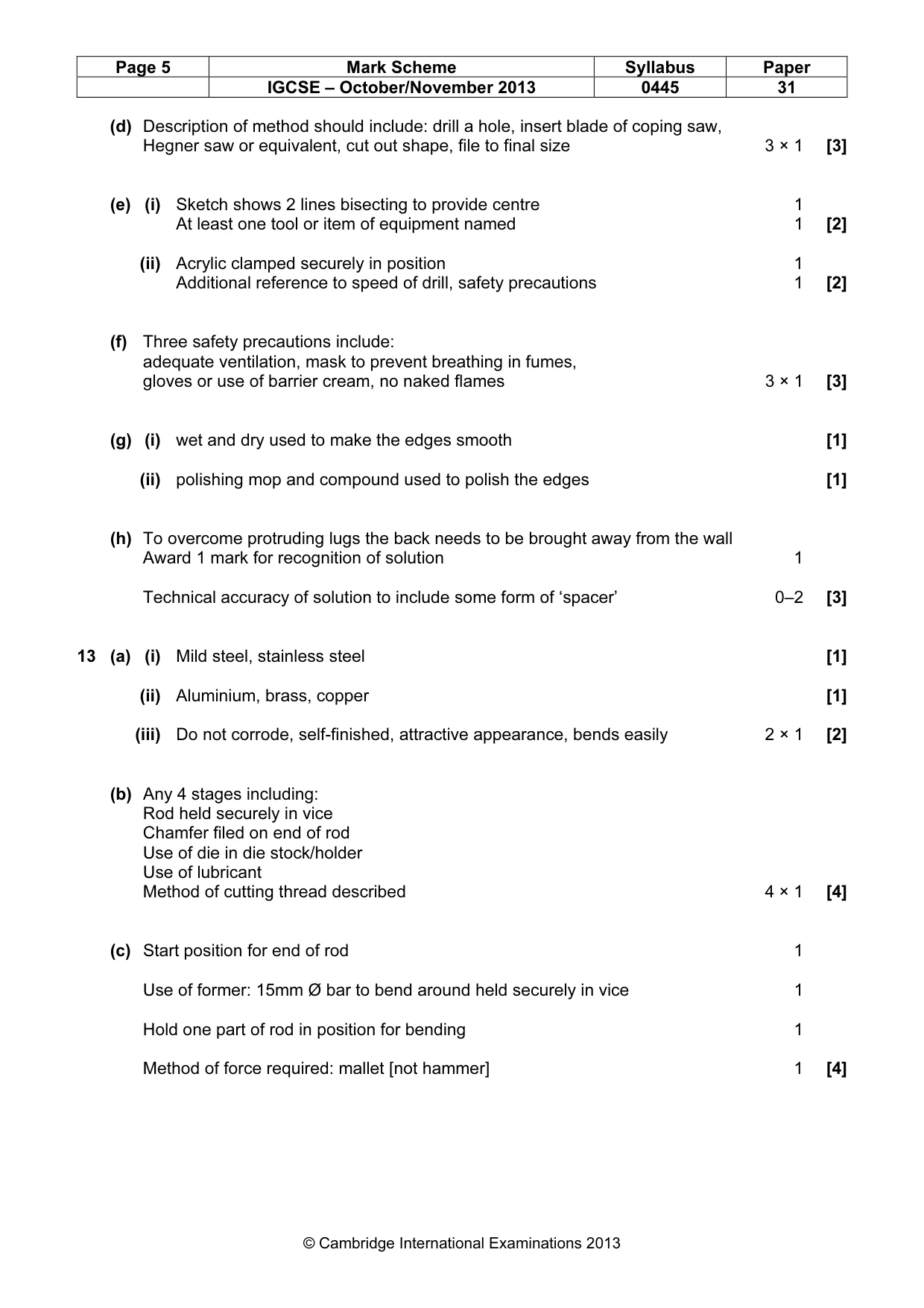
Page 5 Mark Scheme Syllabus Paper IGCSE – October/November 2013 0445 31 © Cambridge International Examinations 2013 (d) Description of method should include: drill a hole, insert blade of coping saw, Hegner saw or equivalent, cut out shape, file to final size 3 × 1 [3] (e) (i) Sketch shows 2 lines bisecting to provide centre 1 At least one tool or item of equipment named 1 [2] (ii) Acrylic clamped securely in position 1 Additional reference to speed of drill, safety precautions 1 [2] (f) Three safety precautions include: adequate ventilation, mask to prevent breathing in fumes, gloves or use of barrier cream, no naked flames 3 × 1 [3] (g) (i) wet and dry used to make the edges smooth [1] (ii) polishing mop and compound used to polish the edges [1] (h) To overcome protruding lugs the back needs to be brought away from the wall Award 1 mark for recognition of solution 1 Technical accuracy of solution to include some form of ‘spacer’ 0–2 [3] 13 (a) (i) Mild steel, stainless steel [1] (ii) Aluminium, brass, copper [1] (iii) Do not corrode, self-finished, attractive appearance, bends easily 2 × 1 [2] (b) Any 4 stages including: Rod held securely in vice Chamfer filed on end of rod Use of die in die stock/holder Use of lubricant Method of cutting thread described 4 × 1 [4] (c) Start position for end of rod 1 Use of former: 15mm Ø bar to bend around held securely in vice 1 Hold one part of rod in position for bending 1 Method of force required: mallet [not hammer] 1 [4]
Mark scheme, page 6
Page 6 Mark Scheme Syllabus Paper IGCSE – October/November 2013 0445 31 © Cambridge International Examinations 2013 (d) Shows rod and nut in place = 3 marks = 2 marks = 1 mark [3] (e) Face plate turning glue hardwood block to softwood block with paper between screw block onto faceplate set up on lathe set up tee rest use of scrapers/gouges to produce shape check required diameter Sawing from sheet/block and making round. Mark out diagonals/circle on wood, secure to bench/flat surface, use of tenon saw to remove most waste or use of Hegner/vibro saw or equivalent, e.g. coping saw with wood held in vice, use of files and glasspaper to make round or use of sanding disc. Award 0–4 marks for details of main stages 4 Award 0–2 marks for quality of communication 2 [6] (f) (i) Suitable finish: varnish, oil, preservative, paint, white/French polish [1] (ii) Glasspaper, remove dust, glasspaper [finer grade], use of brush or rag to apply carefully along the grain, avoid ‘runs’ and drips 3 × 1 [3]
What you needed in this session
Cambridge’s own grade thresholds for 2013 Oct/Nov, Paper 3 · Variant 1. A higher threshold means an easier paper — the bar moves with how the cohort did.