Cambridge IGCSE Design and Technology 0445 — 2012 Oct/Nov Paper 3 · Variant 2
0445/32/O/N/12 · 50 marks · ≈56 min
The question paper and its mark scheme, free to read here and free to download. This is Cambridge’s own paper, exactly as it was sat.
Question paper16 pages
Mark scheme5 pages
Answers below. Sit the paper first if you are practising.
Paper as text
Question paper, page 1
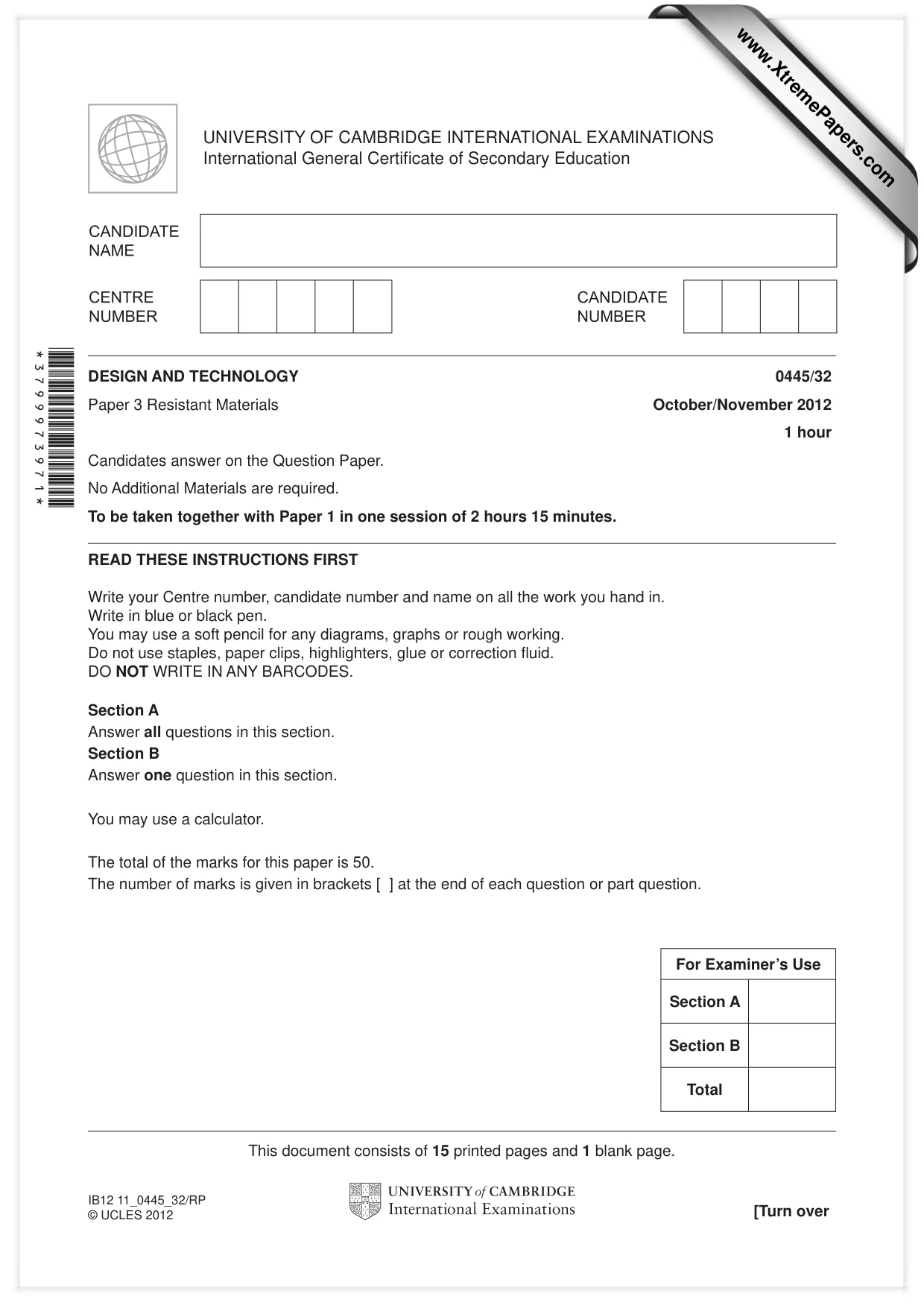
READ THESE INSTRUCTIONS FIRST Write your Centre number, candidate number and name on all the work you hand in. Write in blue or black pen. You may use a soft pencil for any diagrams, graphs or rough working. Do not use staples, paper clips, highlighters, glue or correction fl uid. DO NOT WRITE IN ANY BARCODES. Section A Answer all questions in this section. Section B Answer one question in this section. You may use a calculator. The total of the marks for this paper is 50. The number of marks is given in brackets [ ] at the end of each question or part question. DESIGN AND TECHNOLOGY 0445/32 Paper 3 Resistant Materials October/November 2012 1 hour Candidates answer on the Question Paper. No Additional Materials are required. To be taken together with Paper 1 in one session of 2 hours 15 minutes. UNIVERSITY OF CAMBRIDGE INTERNATIONAL EXAMINATIONS International General Certifi cate of Secondary Education This document consists of 15 printed pages and 1 blank page. [Turn over IB12 11_0445_32/RP © UCLES 2012 *3799973971* For Examiner’s Use Section A Section B Total www.XtremePapers.com
Question paper, page 2
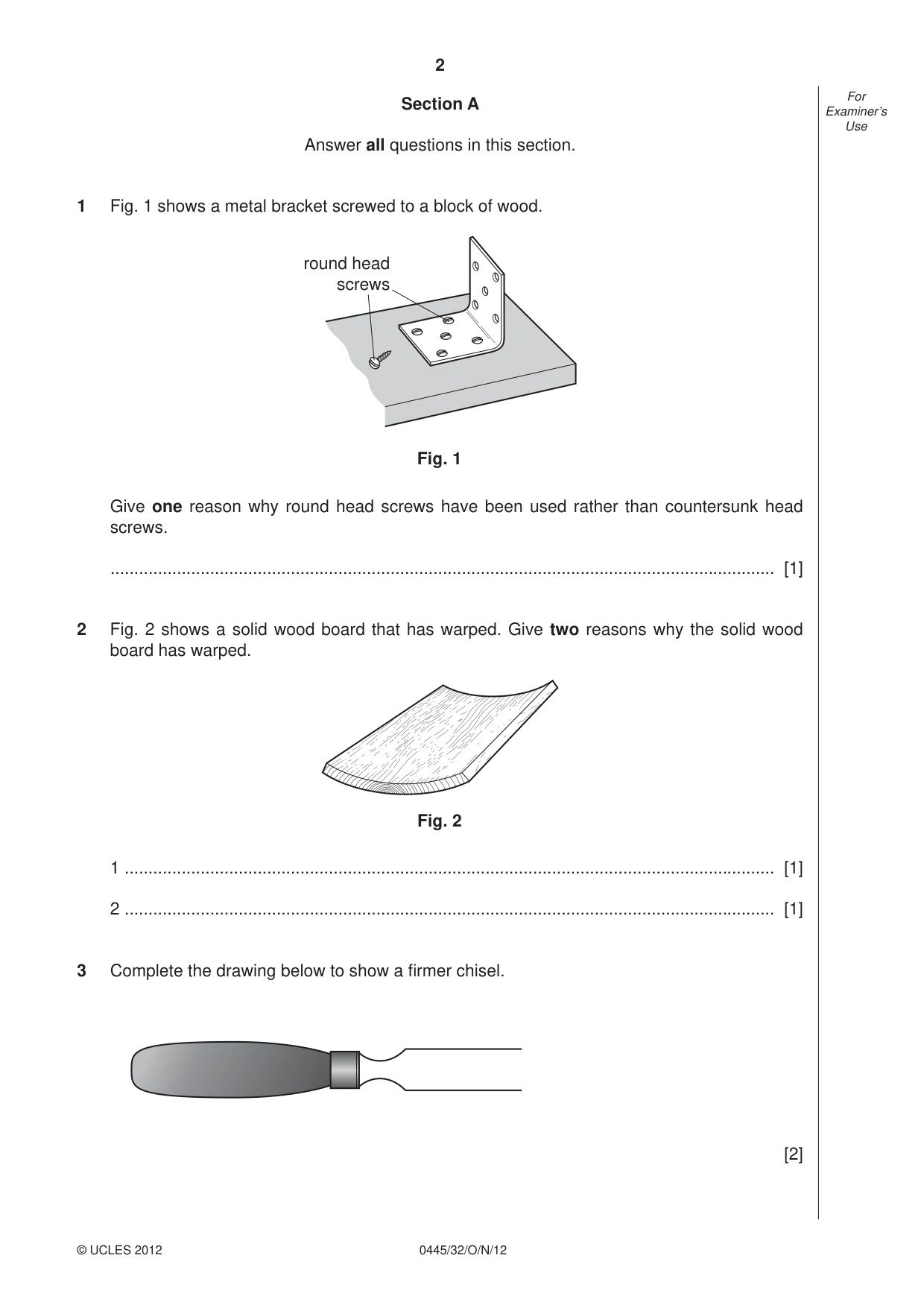
2 0445/32/O/N/12 © UCLES 2012 For Examiner’s Use Section A Answer all questions in this section. 1 Fig. 1 shows a metal bracket screwed to a block of wood. round head screws Fig. 1 Give one reason why round head screws have been used rather than countersunk head screws. … [1] 2 Fig. 2 shows a solid wood board that has warped. Give two reasons why the solid wood board has warped. Fig. 2 1 … [1] 2 … [1] 3 Complete the drawing below to show a fi rmer chisel. [2]
Question paper, page 3
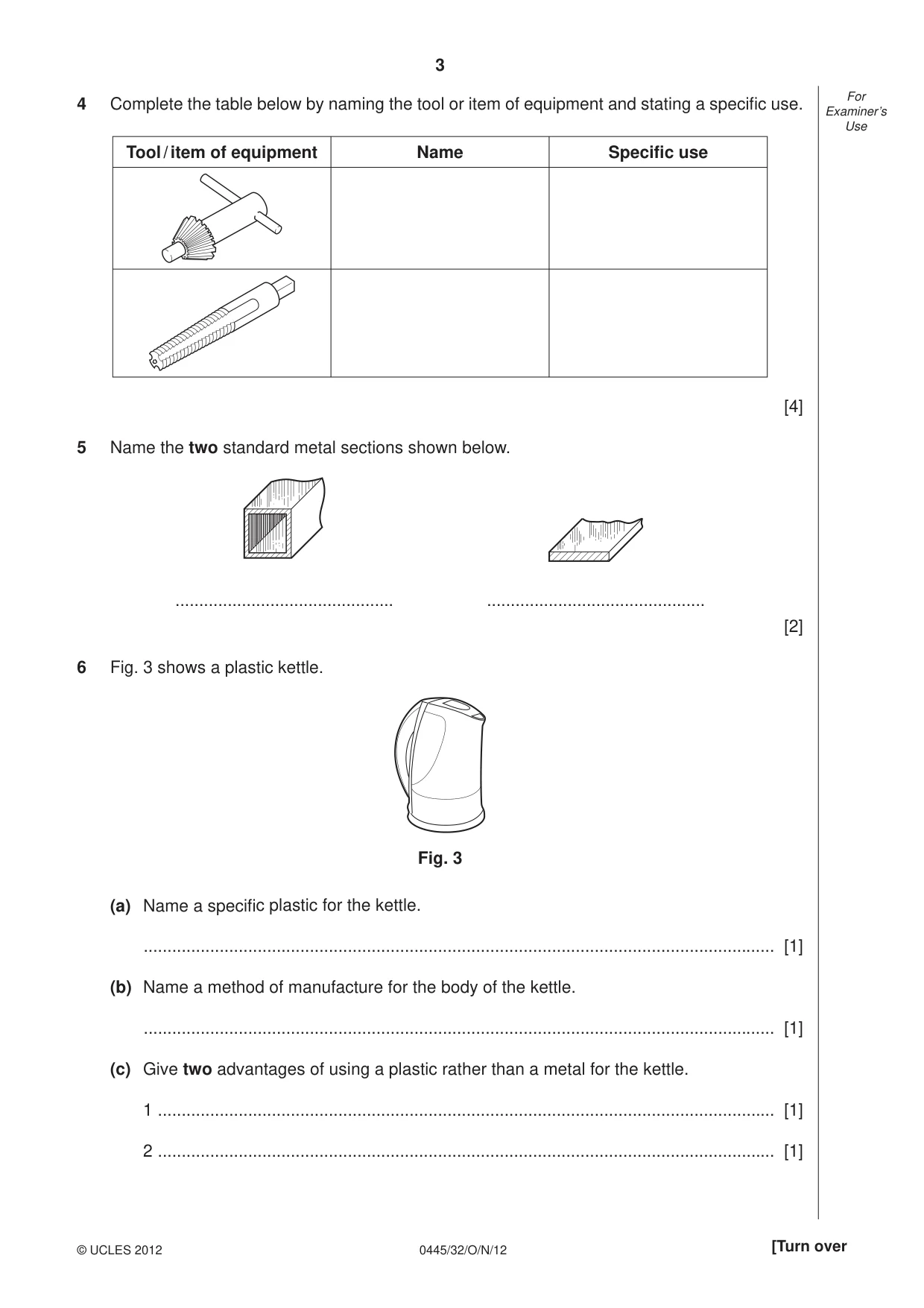
3 0445/32/O/N/12 © UCLES 2012 [Turn over For Examiner’s Use 4 Complete the table below by naming the tool or item of equipment and stating a specifi c use. Tool / item of equipment Name Specifi c use [4] 5 Name the two standard metal sections shown below. … … [2] 6 Fig. 3 shows a plastic kettle. Fig. 3 (a) Name a specifi c plastic for the kettle. … [1] (b) Name a method of manufacture for the body of the kettle. … [1] (c) Give two advantages of using a plastic rather than a metal for the kettle. 1 … [1] 2 … [1]
Question paper, page 4
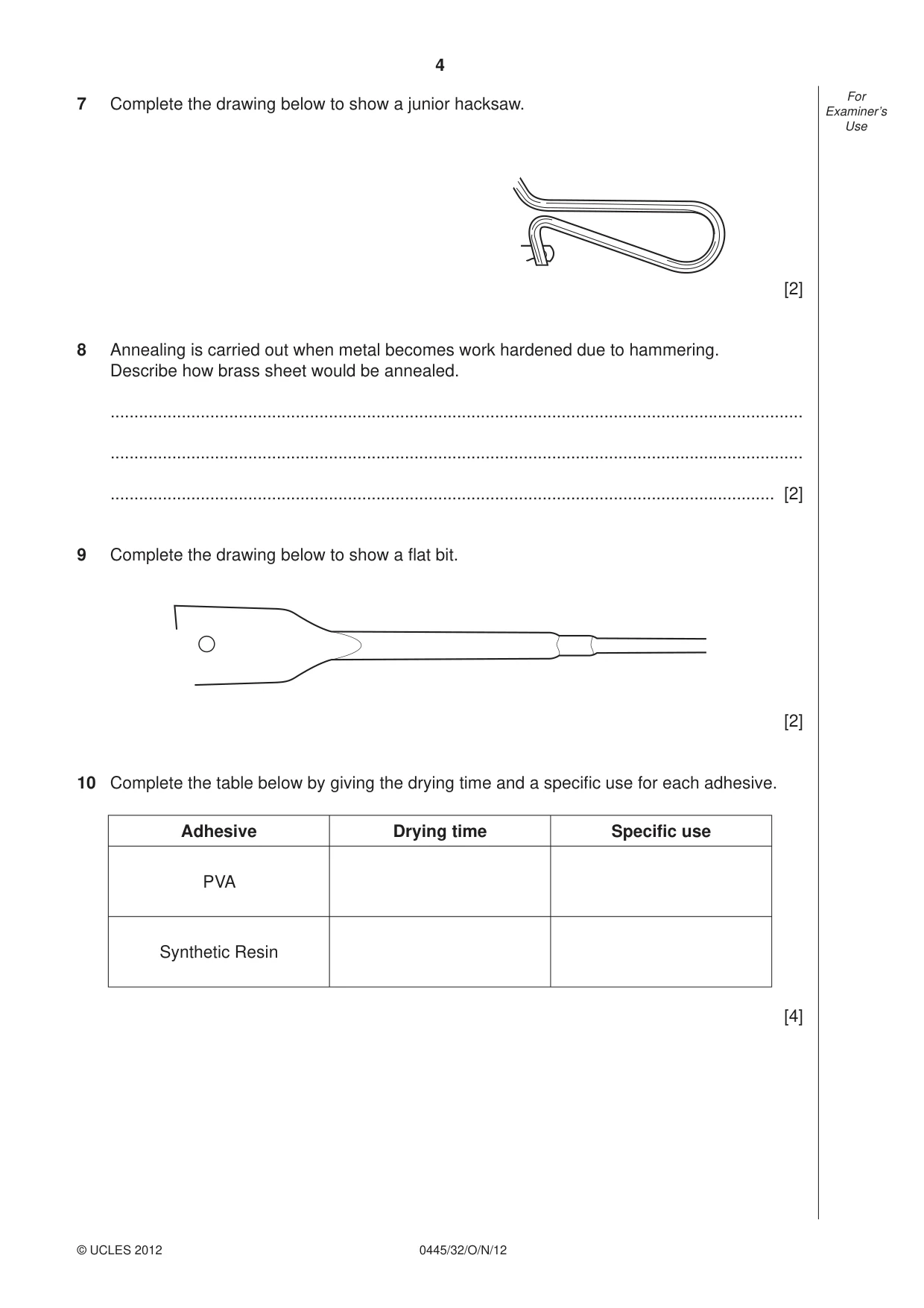
4 0445/32/O/N/12 © UCLES 2012 For Examiner’s Use 7 Complete the drawing below to show a junior hacksaw. [2] 8 Annealing is carried out when metal becomes work hardened due to hammering. Describe how brass sheet would be annealed. … … … [2] 9 Complete the drawing below to show a fl at bit. [2] 10 Complete the table below by giving the drying time and a specifi c use for each adhesive. Adhesive Drying time Specifi c use PVA Synthetic Resin [4]
Question paper, page 5
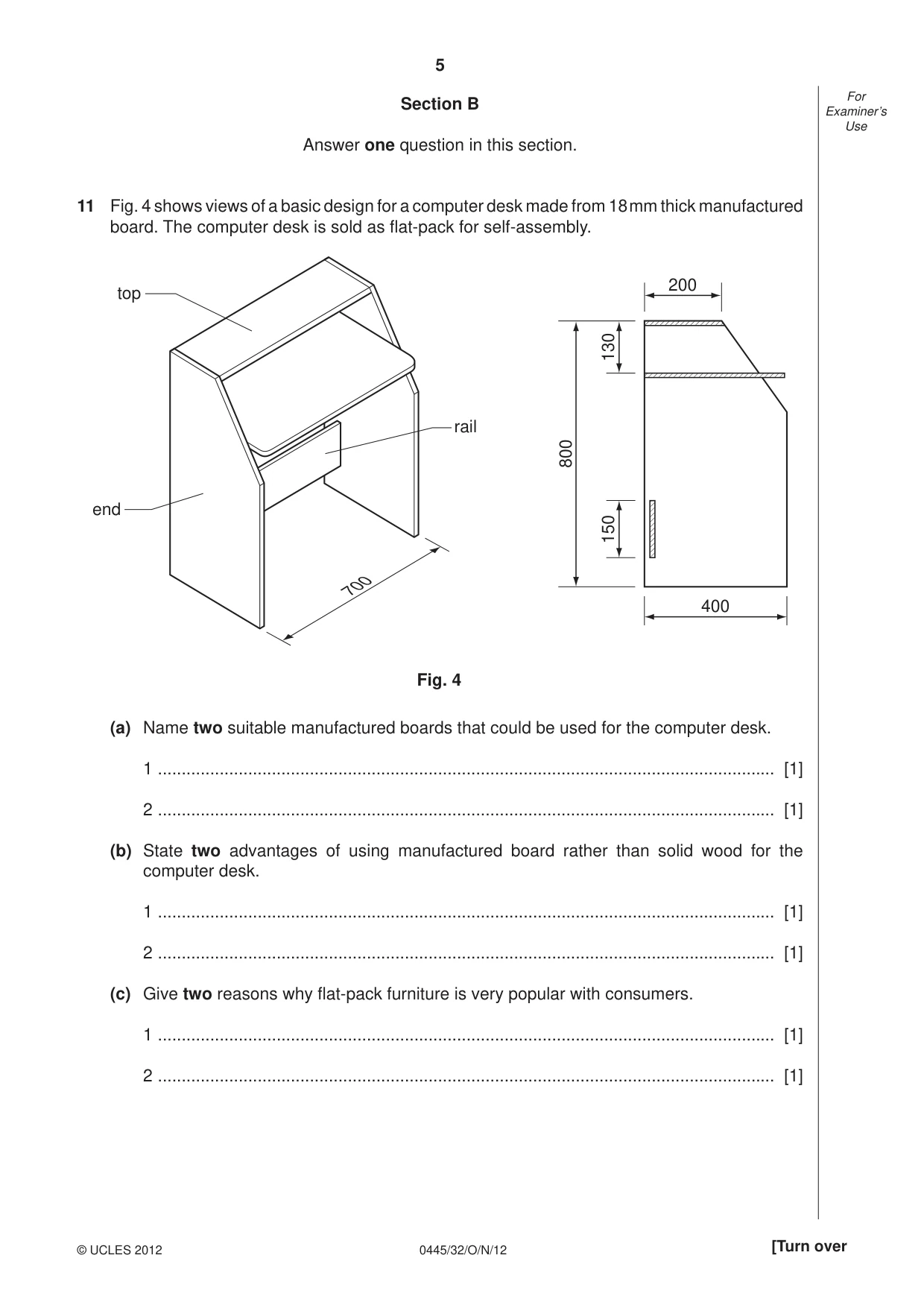
5 0445/32/O/N/12 © UCLES 2012 [Turn over For Examiner’s Use Section B Answer one question in this section. 11 Fig. 4 shows views of a basic design for a computer desk made from 18 mm thick manufactured board. The computer desk is sold as fl at-pack for self-assembly. top end rail 700 150 200 400 130 800 Fig. 4 (a) Name two suitable manufactured boards that could be used for the computer desk. 1 … [1] 2 … [1] (b) State two advantages of using manufactured board rather than solid wood for the computer desk. 1 … [1] 2 … [1] (c) Give two reasons why fl at-pack furniture is very popular with consumers. 1 … [1] 2 … [1]
Question paper, page 6
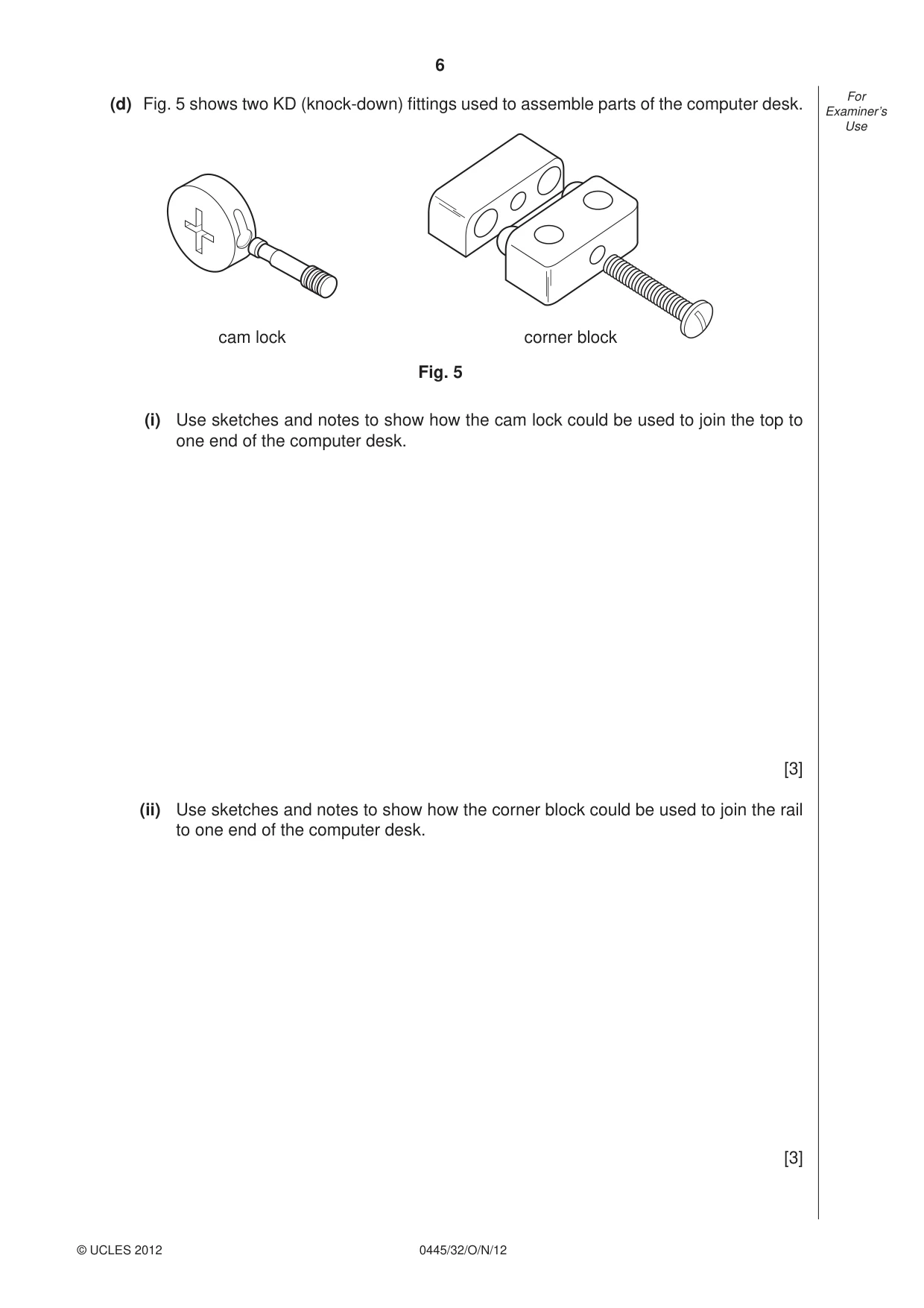
6 0445/32/O/N/12 © UCLES 2012 For Examiner’s Use (d) Fig. 5 shows two KD (knock-down) fi ttings used to assemble parts of the computer desk. corner block Fig. 5 cam lock (i) Use sketches and notes to show how the cam lock could be used to join the top to one end of the computer desk. [3] (ii) Use sketches and notes to show how the corner block could be used to join the rail to one end of the computer desk. [3]
Question paper, page 7
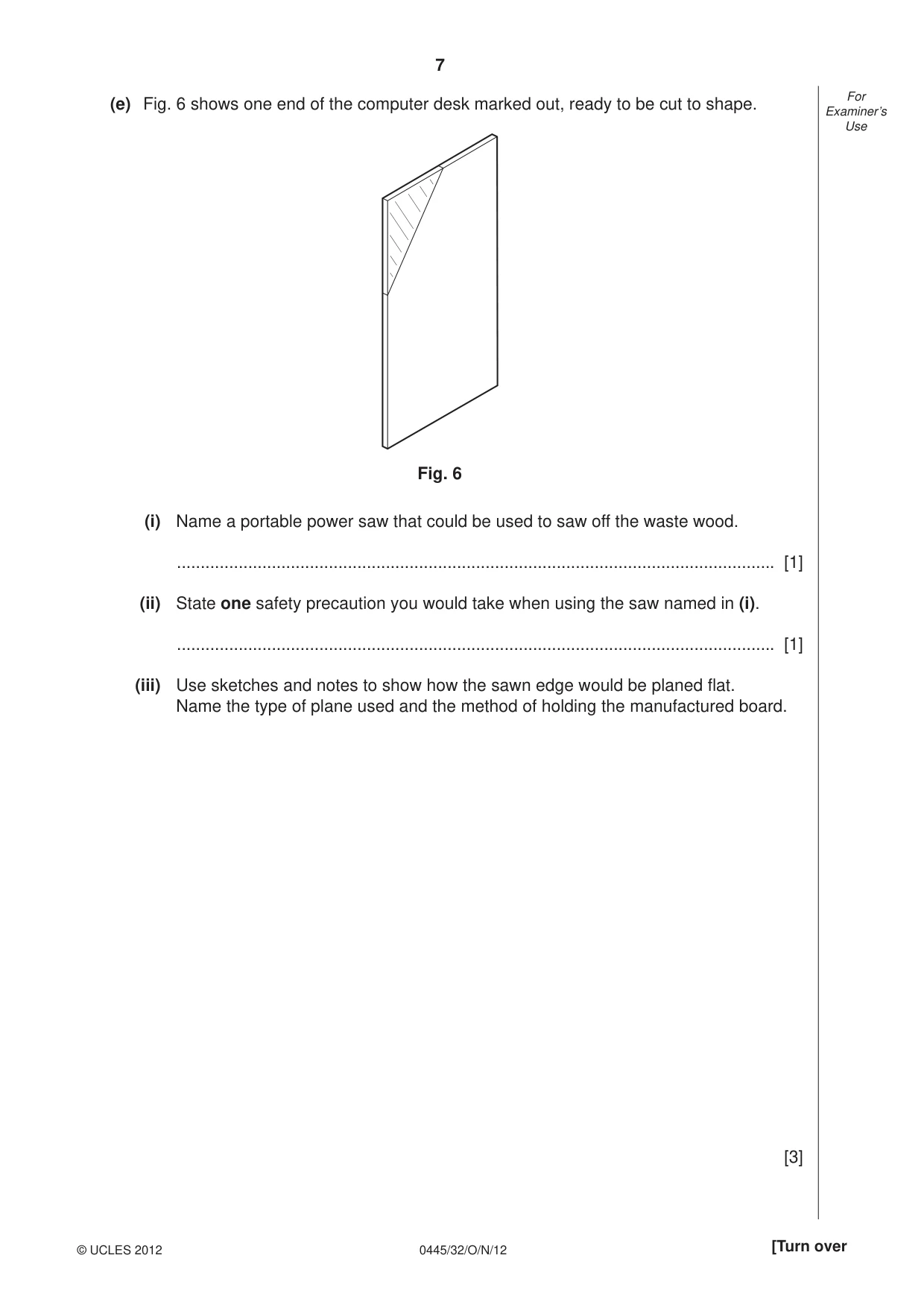
7 0445/32/O/N/12 © UCLES 2012 [Turn over For Examiner’s Use (e) Fig. 6 shows one end of the computer desk marked out, ready to be cut to shape. Fig. 6 (i) Name a portable power saw that could be used to saw off the waste wood. … [1] (ii) State one safety precaution you would take when using the saw named in (i). … [1] (iii) Use sketches and notes to show how the sawn edge would be planed fl at. Name the type of plane used and the method of holding the manufactured board. [3]
Question paper, page 8
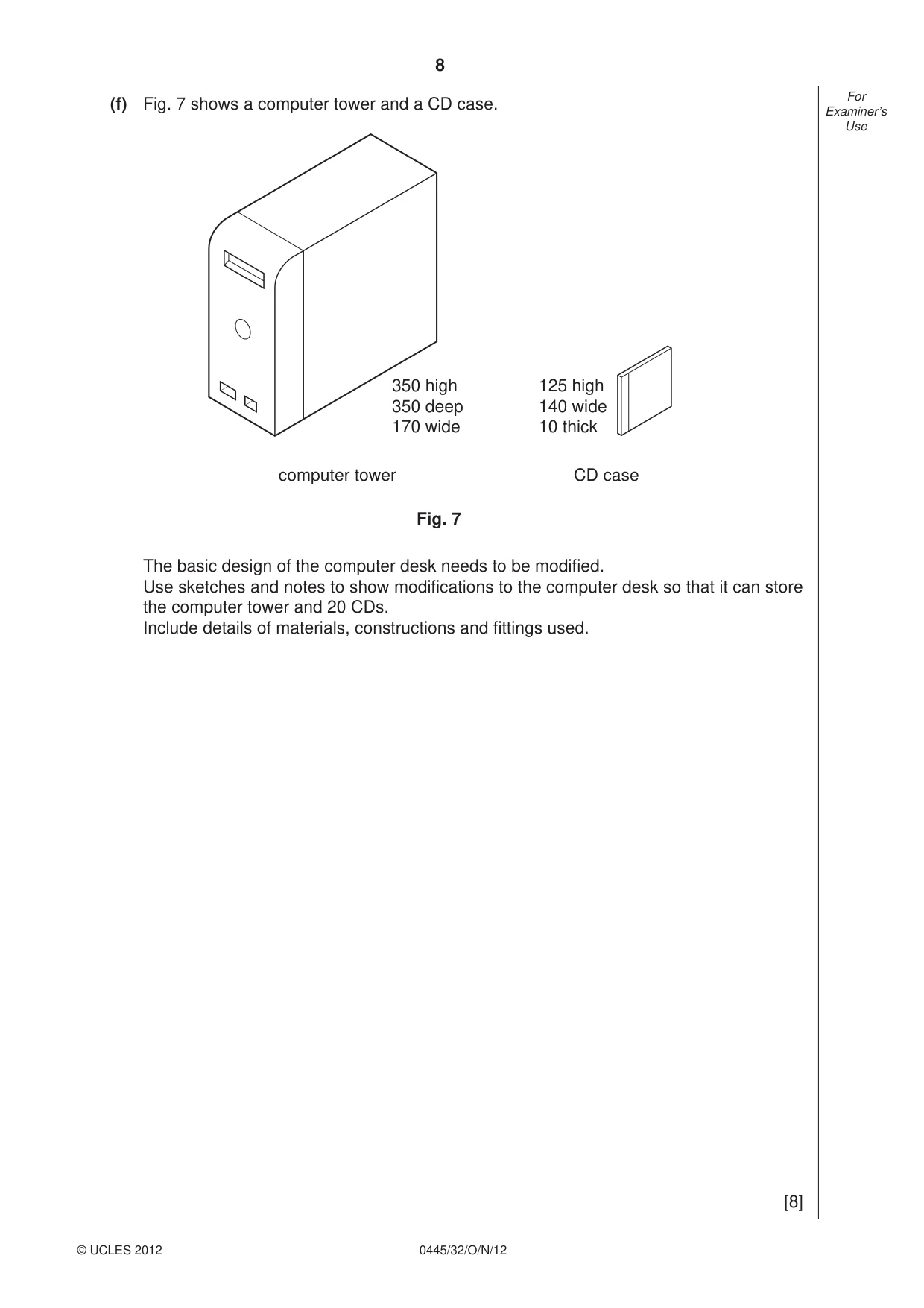
8 0445/32/O/N/12 © UCLES 2012 For Examiner’s Use (f) Fig. 7 shows a computer tower and a CD case. 350 high 350 deep 170 wide 125 high 140 wide 10 thick computer tower CD case Fig. 7 The basic design of the computer desk needs to be modifi ed. Use sketches and notes to show modifi cations to the computer desk so that it can store the computer tower and 20 CDs. Include details of materials, constructions and fi ttings used. [8]
Question paper, page 9
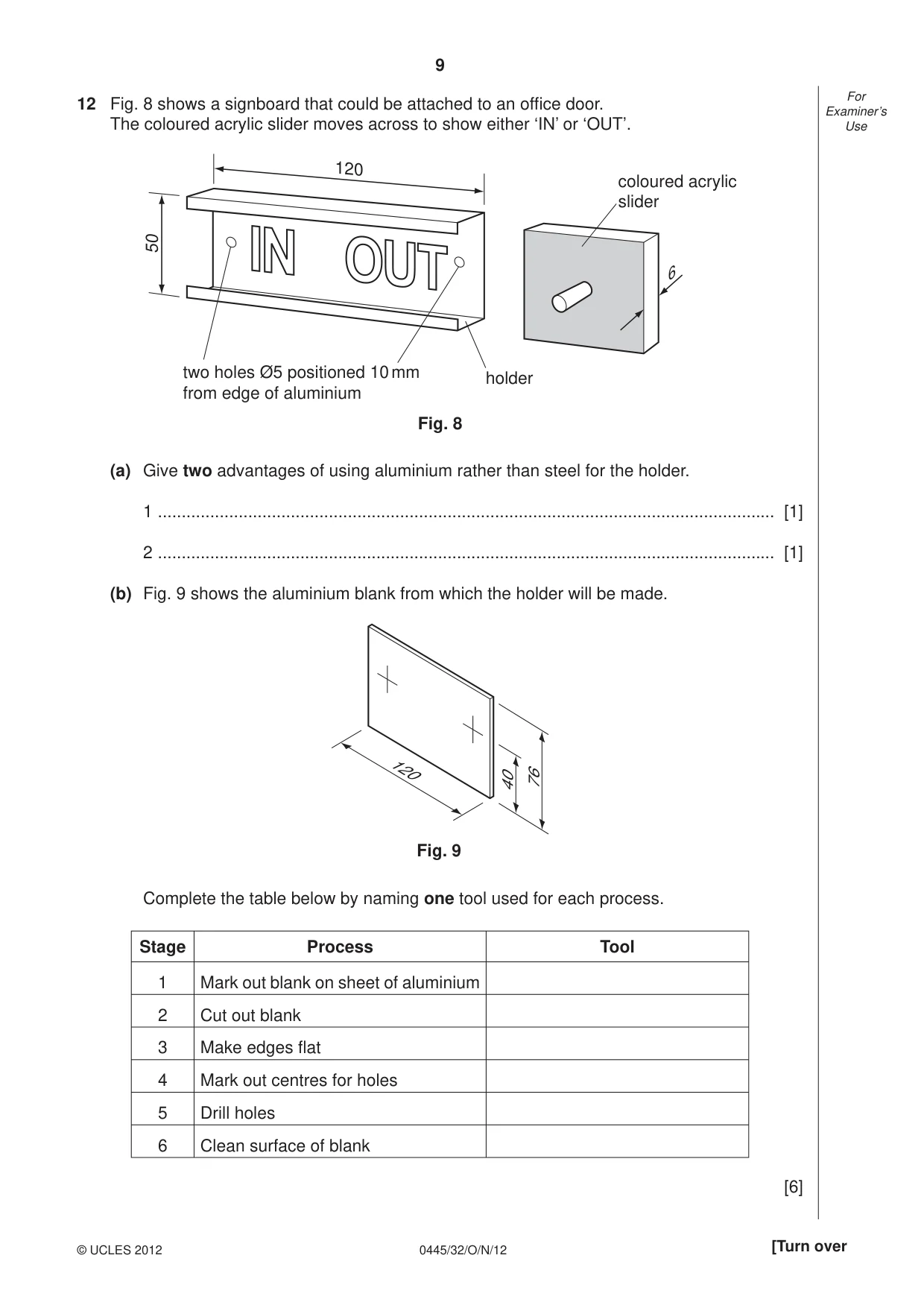
9 0445/32/O/N/12 © UCLES 2012 [Turn over For Examiner’s Use 12 Fig. 8 shows a signboard that could be attached to an offi ce door. The coloured acrylic slider moves across to show either ‘IN’ or ‘OUT’. 50 120 two holes Ø5 positioned 10 mm from edge of aluminium holder 6 coloured acrylic slider Fig. 8 (a) Give two advantages of using aluminium rather than steel for the holder. 1 … [1] 2 … [1] (b) Fig. 9 shows the aluminium blank from which the holder will be made. 120 40 76 Fig. 9 Complete the table below by naming one tool used for each process. Stage Process Tool 1 Mark out blank on sheet of aluminium 2 Cut out blank 3 Make edges fl at 4 Mark out centres for holes 5 Drill holes 6 Clean surface of blank [6]
Question paper, page 10
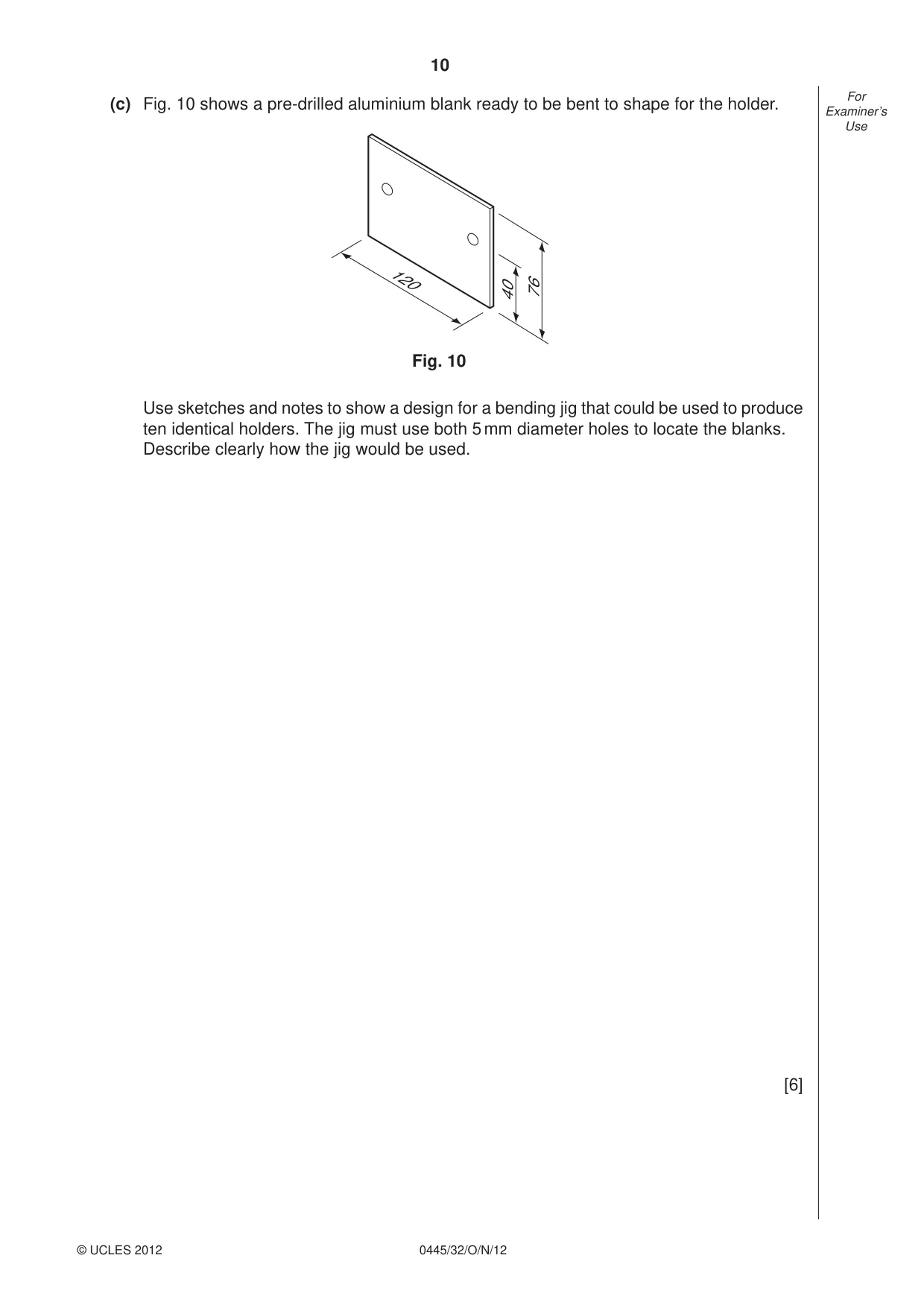
10 0445/32/O/N/12 © UCLES 2012 For Examiner’s Use (c) Fig. 10 shows a pre-drilled aluminium blank ready to be bent to shape for the holder. 120 40 76 Fig. 10 Use sketches and notes to show a design for a bending jig that could be used to produce ten identical holders. The jig must use both 5 mm diameter holes to locate the blanks. Describe clearly how the jig would be used. [6]
Question paper, page 11
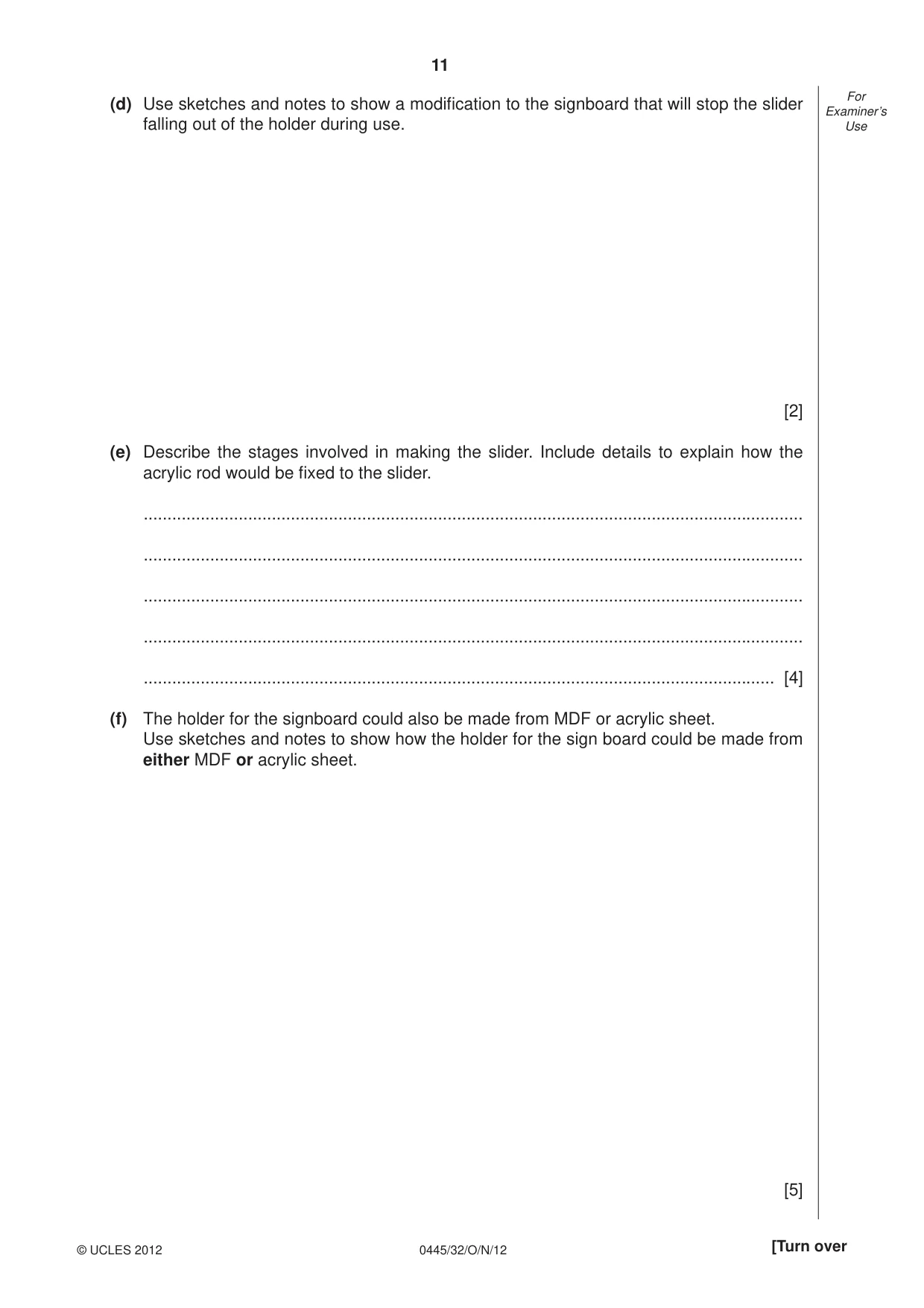
11 0445/32/O/N/12 © UCLES 2012 [Turn over For Examiner’s Use (d) Use sketches and notes to show a modifi cation to the signboard that will stop the slider falling out of the holder during use. [2] (e) Describe the stages involved in making the slider. Include details to explain how the acrylic rod would be fi xed to the slider. … … … … … [4] (f) The holder for the signboard could also be made from MDF or acrylic sheet. Use sketches and notes to show how the holder for the sign board could be made from either MDF or acrylic sheet. [5]
Question paper, page 12
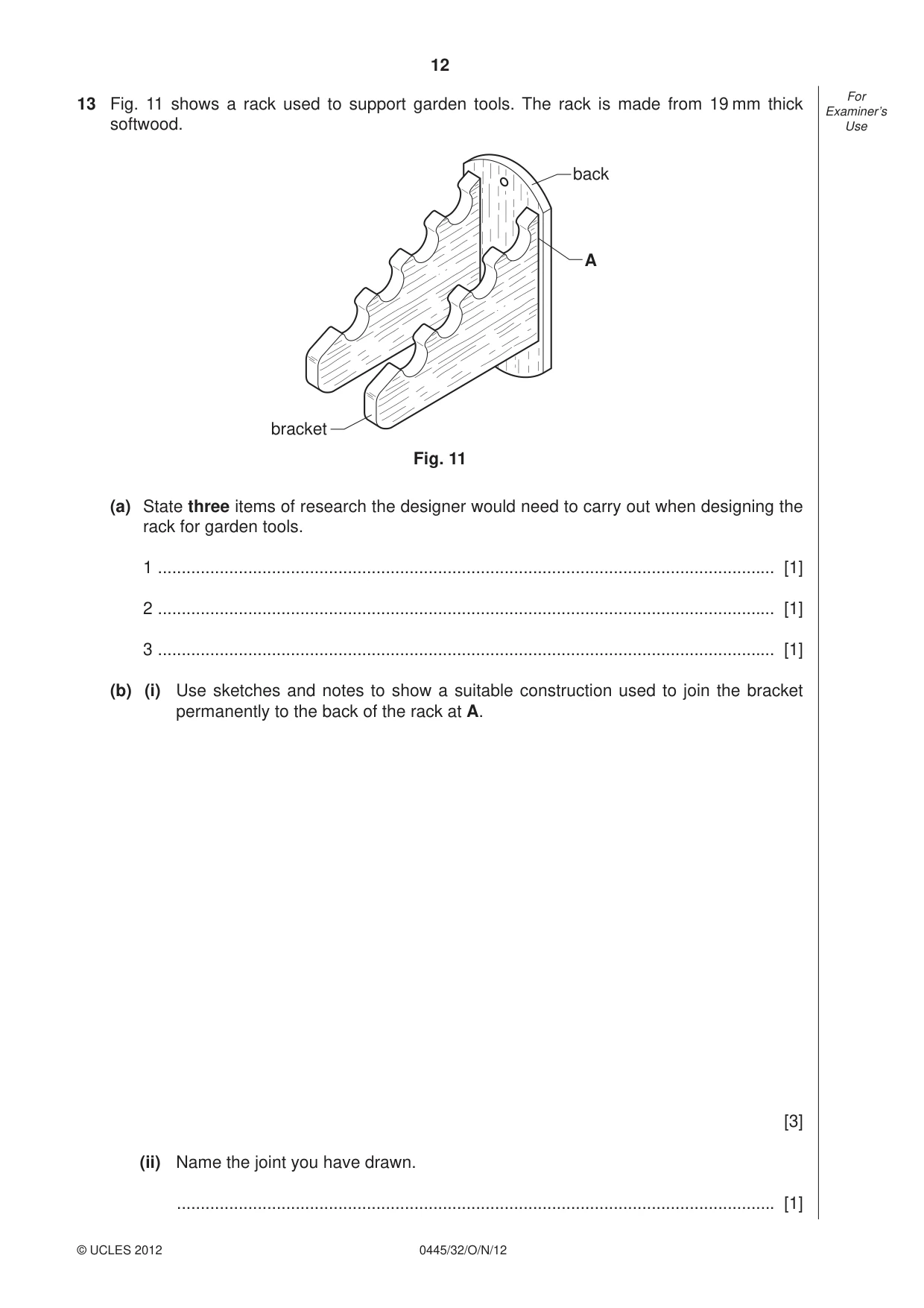
12 0445/32/O/N/12 © UCLES 2012 For Examiner’s Use 13 Fig. 11 shows a rack used to support garden tools. The rack is made from 19 mm thick softwood. A back bracket Fig. 11 (a) State three items of research the designer would need to carry out when designing the rack for garden tools. 1 … [1] 2 … [1] 3 … [1] (b) (i) Use sketches and notes to show a suitable construction used to join the bracket permanently to the back of the rack at A. [3] (ii) Name the joint you have drawn. … [1]
Question paper, page 13
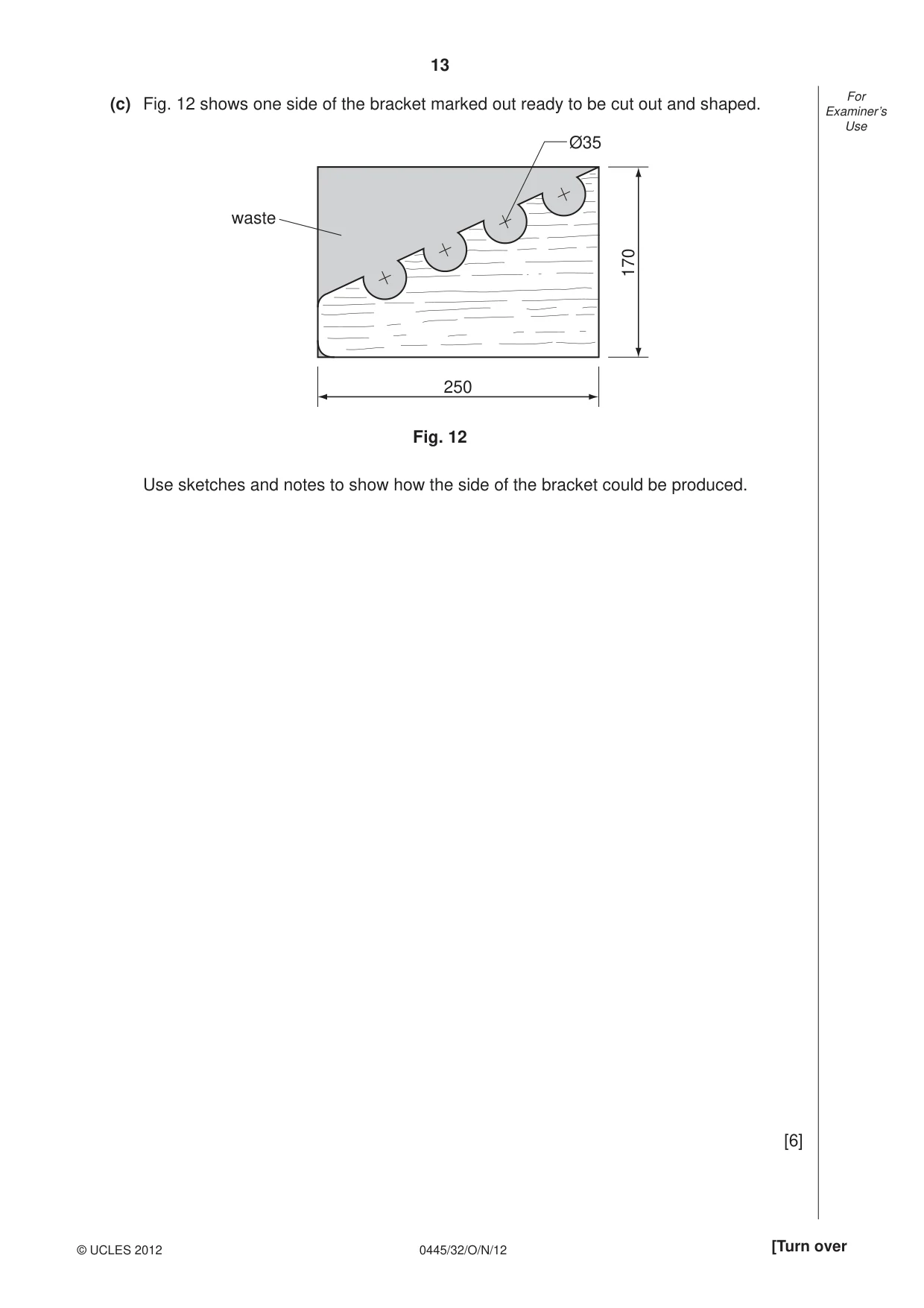
13 0445/32/O/N/12 © UCLES 2012 [Turn over For Examiner’s Use (c) Fig. 12 shows one side of the bracket marked out ready to be cut out and shaped. 250 170 Ø35 waste Fig. 12 Use sketches and notes to show how the side of the bracket could be produced. [6]
Question paper, page 14
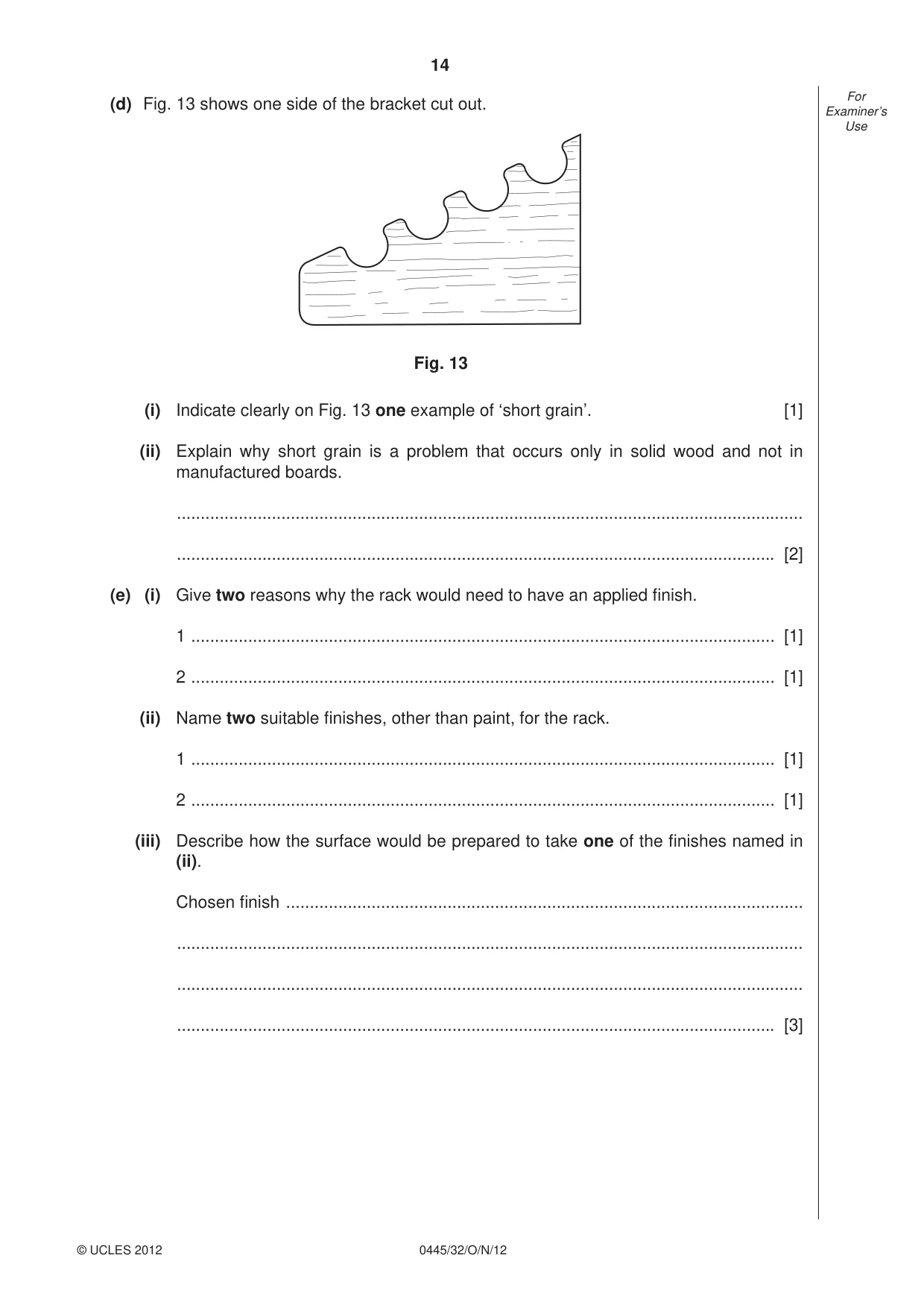
14 0445/32/O/N/12 © UCLES 2012 For Examiner’s Use (d) Fig. 13 shows one side of the bracket cut out. Fig. 13 (i) Indicate clearly on Fig. 13 one example of ‘short grain’. [1] (ii) Explain why short grain is a problem that occurs only in solid wood and not in manufactured boards. … … [2] (e) (i) Give two reasons why the rack would need to have an applied fi nish. 1 … [1] 2 … [1] (ii) Name two suitable fi nishes, other than paint, for the rack. 1 … [1] 2 … [1] (iii) Describe how the surface would be prepared to take one of the fi nishes named in (ii). Chosen fi nish … … … … [3]
Question paper, page 15
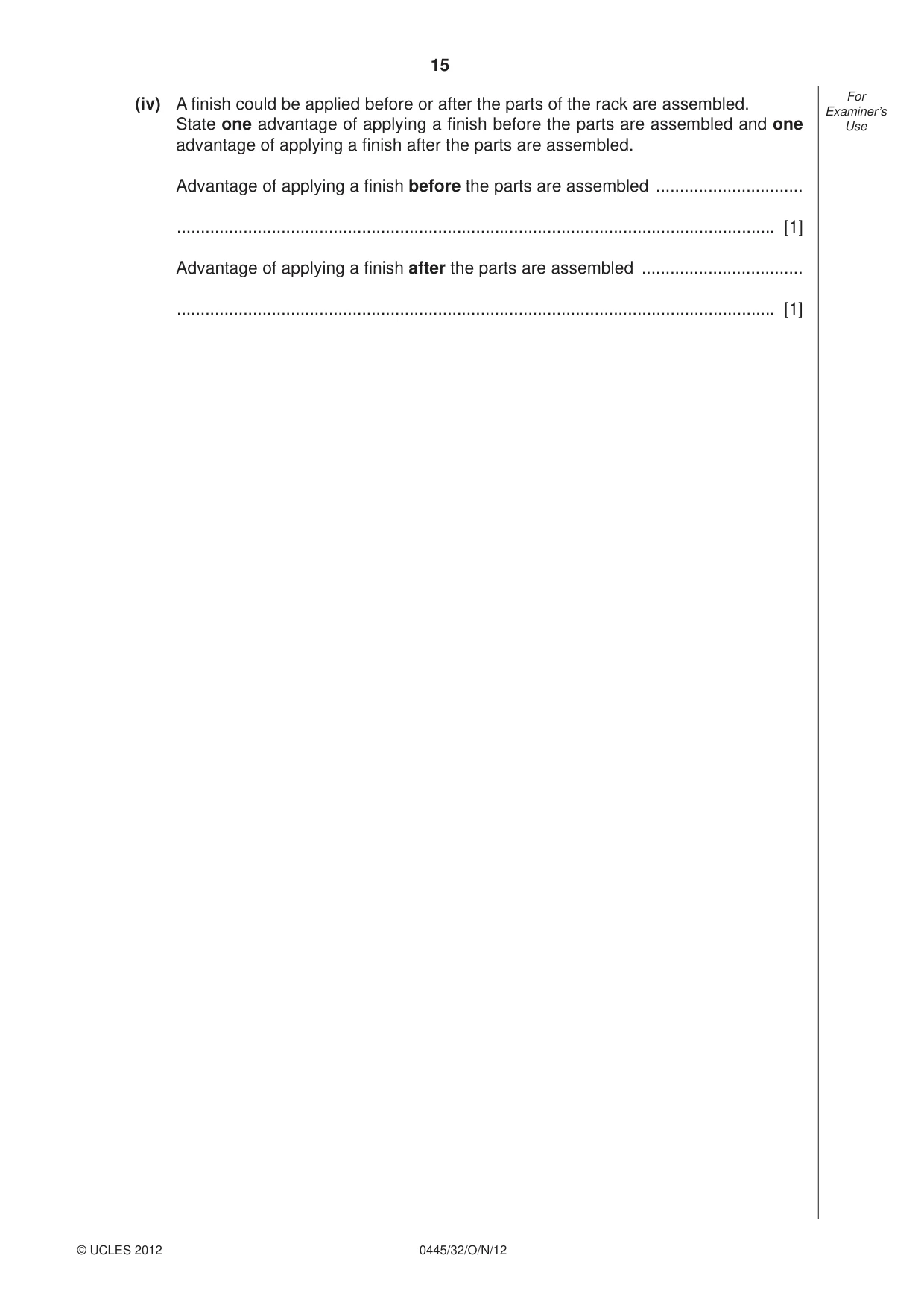
15 0445/32/O/N/12 © UCLES 2012 [Turn over For Examiner’s Use (iv) A fi nish could be applied before or after the parts of the rack are assembled. State one advantage of applying a fi nish before the parts are assembled and one advantage of applying a fi nish after the parts are assembled. Advantage of applying a fi nish before the parts are assembled … … [1] Advantage of applying a fi nish after the parts are assembled … … [1]
Question paper, page 16
16 0445/32/O/N/12 Permission to reproduce items where third-party owned material protected by copyright is included has been sought and cleared where possible. Every reasonable effort has been made by the publisher (UCLES) to trace copyright holders, but if any items requiring clearance have unwittingly been included the publisher will be pleased to make amends at the earliest possible opportunity. University of Cambridge International Examinations is part of the Cambridge Assessment Group. Cambridge Assessment is the brand name of University of Cambridge Local Examinations Syndicate (UCLES), which is itself a department of the University of Cambridge. BLANK PAGE © UCLES 2012
Mark scheme, page 1
CAMBRIDGE INTERNATIONAL EXAMINATIONS International General Certificate of Secondary Education MARK SCHEME for the October/November 2012 series 0445 DESIGN AND TECHNOLOGY 0445/32 Paper 3 (Resistant Materials), maximum raw mark 50 This mark scheme is published as an aid to teachers and candidates, to indicate the requirements of the examination. It shows the basis on which Examiners were instructed to award marks. It does not indicate the details of the discussions that took place at an Examiners’ meeting before marking began, which would have considered the acceptability of alternative answers. Mark schemes should be read in conjunction with the question paper and the Principal Examiner Report for Teachers. Cambridge will not enter into discussions about these mark schemes. Cambridge is publishing the mark schemes for the October/November 2012 series for most IGCSE, GCE Advanced Level and Advanced Subsidiary Level components and some Ordinary Level components. www.XtremePapers.com
Mark scheme, page 2
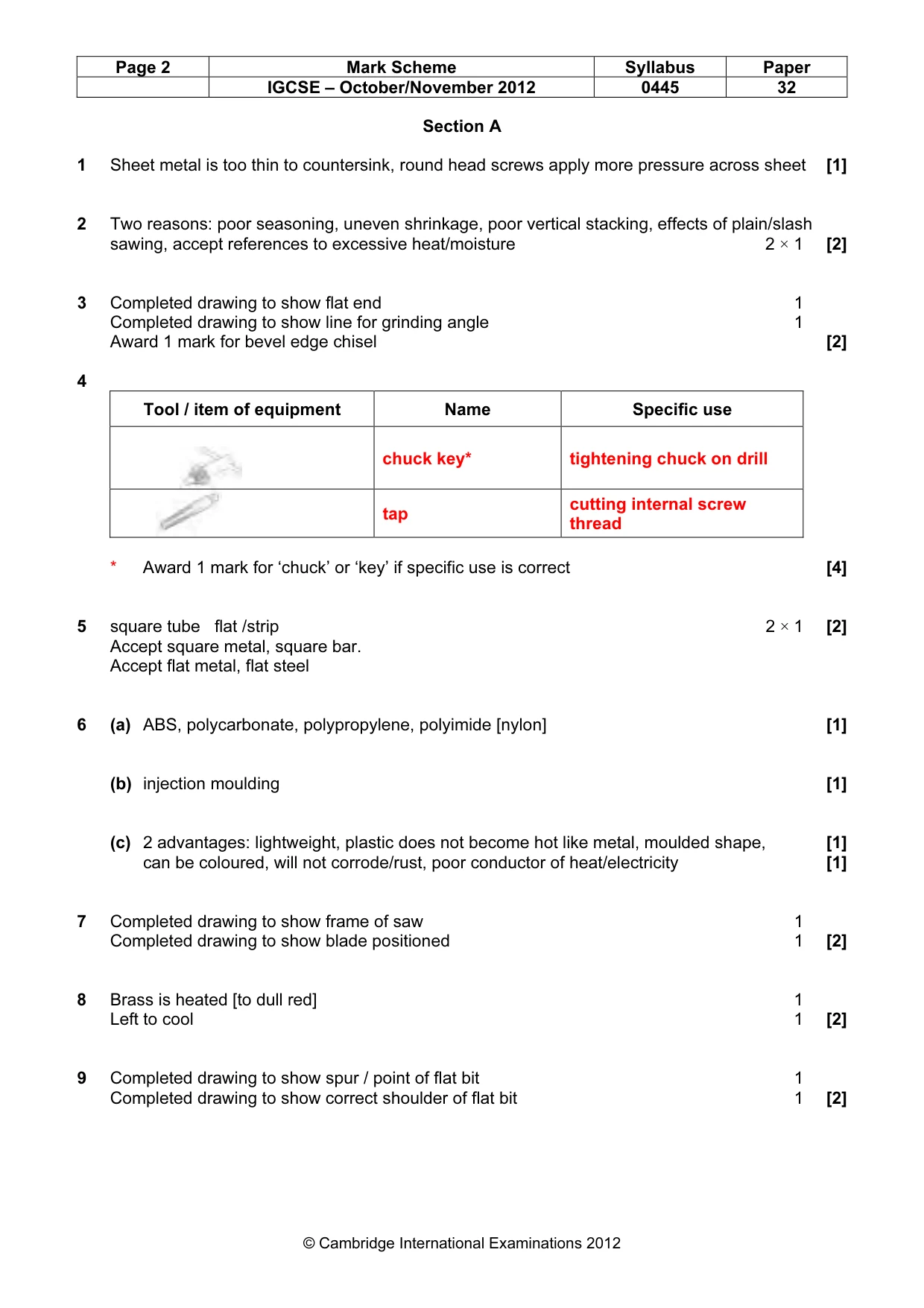
Page 2 Mark Scheme Syllabus Paper IGCSE – October/November 2012 0445 32 © Cambridge International Examinations 2012 Section A 1 Sheet metal is too thin to countersink, round head screws apply more pressure across sheet [1] 2 Two reasons: poor seasoning, uneven shrinkage, poor vertical stacking, effects of plain/slash sawing, accept references to excessive heat/moisture 2 × 1 [2] 3 Completed drawing to show flat end 1 Completed drawing to show line for grinding angle 1 Award 1 mark for bevel edge chisel [2] 4 Tool / item of equipment Name Specific use chuck key* tightening chuck on drill tap cutting internal screw thread * Award 1 mark for ‘chuck’ or ‘key’ if specific use is correct [4] 5 square tube flat /strip 2 × 1 [2] Accept square metal, square bar. Accept flat metal, flat steel 6 (a) ABS, polycarbonate, polypropylene, polyimide [nylon] [1] (b) injection moulding [1] (c) 2 advantages: lightweight, plastic does not become hot like metal, moulded shape, [1] can be coloured, will not corrode/rust, poor conductor of heat/electricity [1] 7 Completed drawing to show frame of saw 1 Completed drawing to show blade positioned 1 [2] 8 Brass is heated [to dull red] 1 Left to cool 1 [2] 9 Completed drawing to show spur / point of flat bit 1 Completed drawing to show correct shoulder of flat bit 1 [2]
Mark scheme, page 3
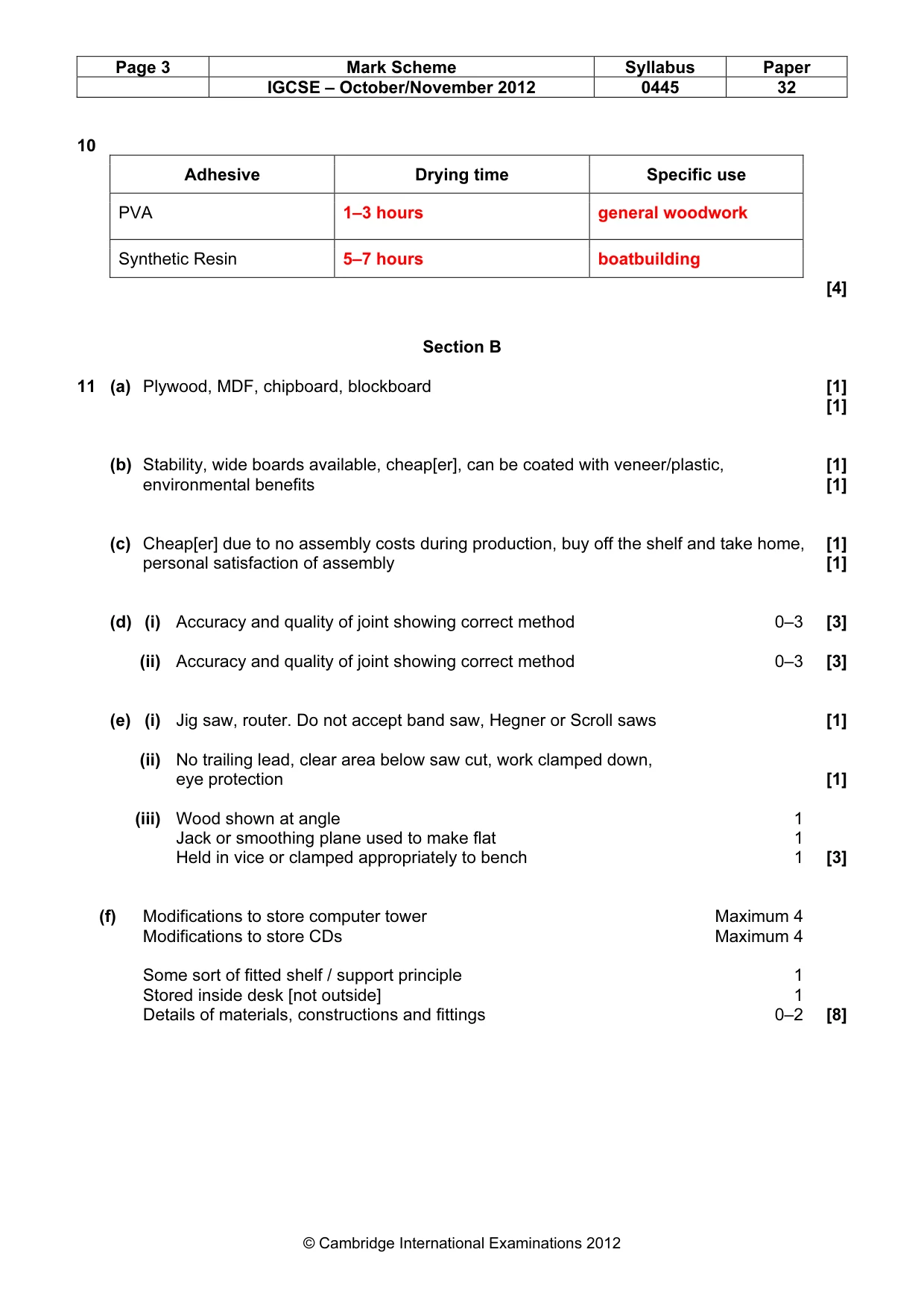
Page 3 Mark Scheme Syllabus Paper IGCSE – October/November 2012 0445 32 © Cambridge International Examinations 2012 10 Adhesive Drying time Specific use PVA 1–3 hours general woodwork Synthetic Resin 5–7 hours boatbuilding [4] Section B 11 (a) Plywood, MDF, chipboard, blockboard [1] [1] (b) Stability, wide boards available, cheap[er], can be coated with veneer/plastic, [1] environmental benefits [1] (c) Cheap[er] due to no assembly costs during production, buy off the shelf and take home, [1] personal satisfaction of assembly [1] (d) (i) Accuracy and quality of joint showing correct method 0–3 [3] (ii) Accuracy and quality of joint showing correct method 0–3 [3] (e) (i) Jig saw, router. Do not accept band saw, Hegner or Scroll saws [1] (ii) No trailing lead, clear area below saw cut, work clamped down, eye protection [1] (iii) Wood shown at angle 1 Jack or smoothing plane used to make flat 1 Held in vice or clamped appropriately to bench 1 [3] (f) Modifications to store computer tower Maximum 4 Modifications to store CDs Maximum 4 Some sort of fitted shelf / support principle 1 Stored inside desk [not outside] 1 Details of materials, constructions and fittings 0–2 [8]
Mark scheme, page 4
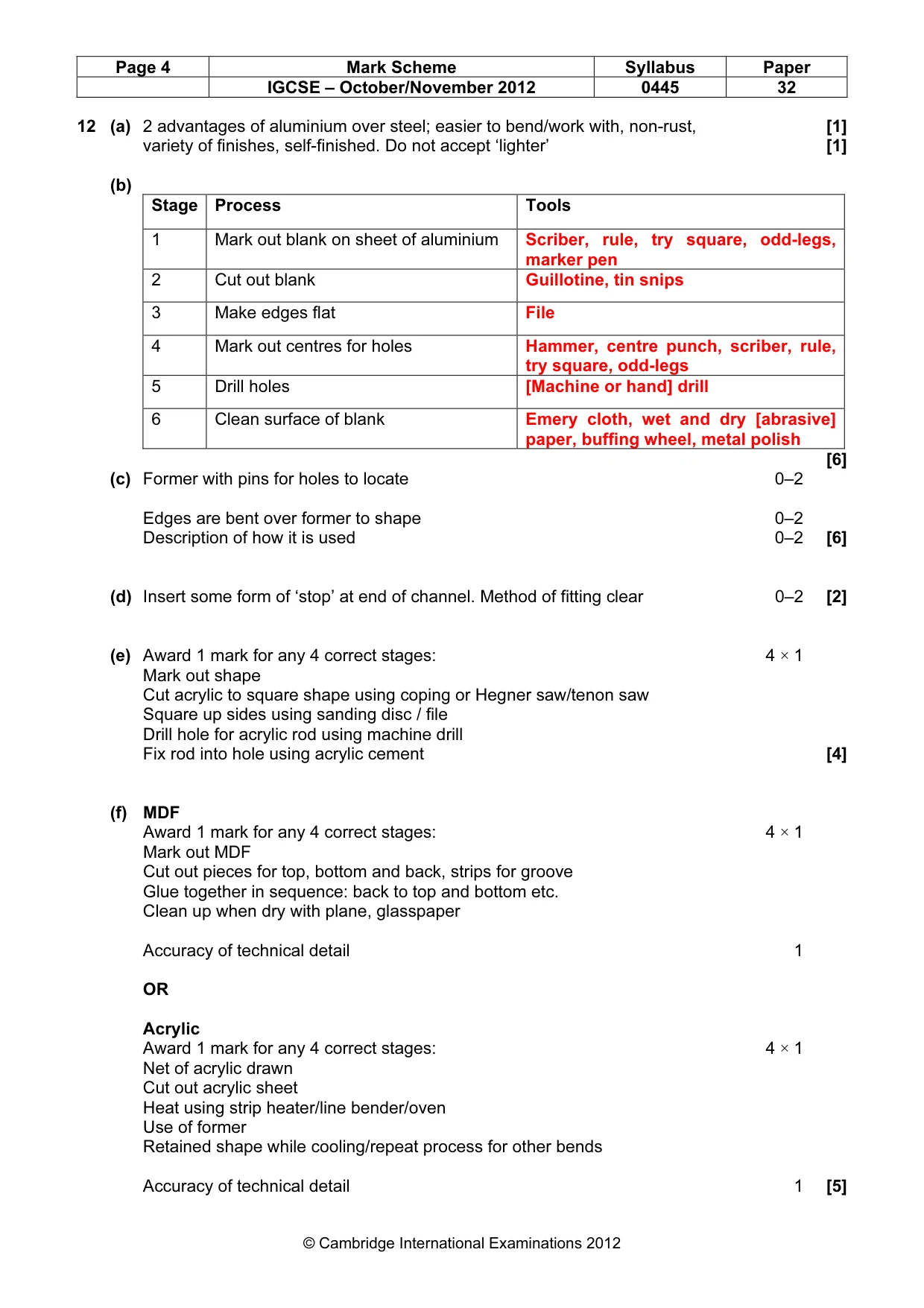
Page 4 Mark Scheme Syllabus Paper IGCSE – October/November 2012 0445 32 © Cambridge International Examinations 2012 12 (a) 2 advantages of aluminium over steel; easier to bend/work with, non-rust, [1] variety of finishes, self-finished. Do not accept ‘lighter’ [1] (b) Stage Process Tools 1 Mark out blank on sheet of aluminium Scriber, rule, try square, odd-legs, marker pen 2 Cut out blank Guillotine, tin snips 3 Make edges flat File 4 Mark out centres for holes Hammer, centre punch, scriber, rule, try square, odd-legs 5 Drill holes [Machine or hand] drill 6 Clean surface of blank Emery cloth, wet and dry [abrasive] paper, buffing wheel, metal polish [6] (c) Former with pins for holes to locate 0–2 Edges are bent over former to shape 0–2 Description of how it is used 0–2 [6] (d) Insert some form of ‘stop’ at end of channel. Method of fitting clear 0–2 [2] (e) Award 1 mark for any 4 correct stages: 4 × 1 Mark out shape Cut acrylic to square shape using coping or Hegner saw/tenon saw Square up sides using sanding disc / file Drill hole for acrylic rod using machine drill Fix rod into hole using acrylic cement [4] (f) MDF Award 1 mark for any 4 correct stages: 4 × 1 Mark out MDF Cut out pieces for top, bottom and back, strips for groove Glue together in sequence: back to top and bottom etc. Clean up when dry with plane, glasspaper Accuracy of technical detail 1 OR Acrylic Award 1 mark for any 4 correct stages: 4 × 1 Net of acrylic drawn Cut out acrylic sheet Heat using strip heater/line bender/oven Use of former Retained shape while cooling/repeat process for other bends Accuracy of technical detail 1 [5]
Mark scheme, page 5
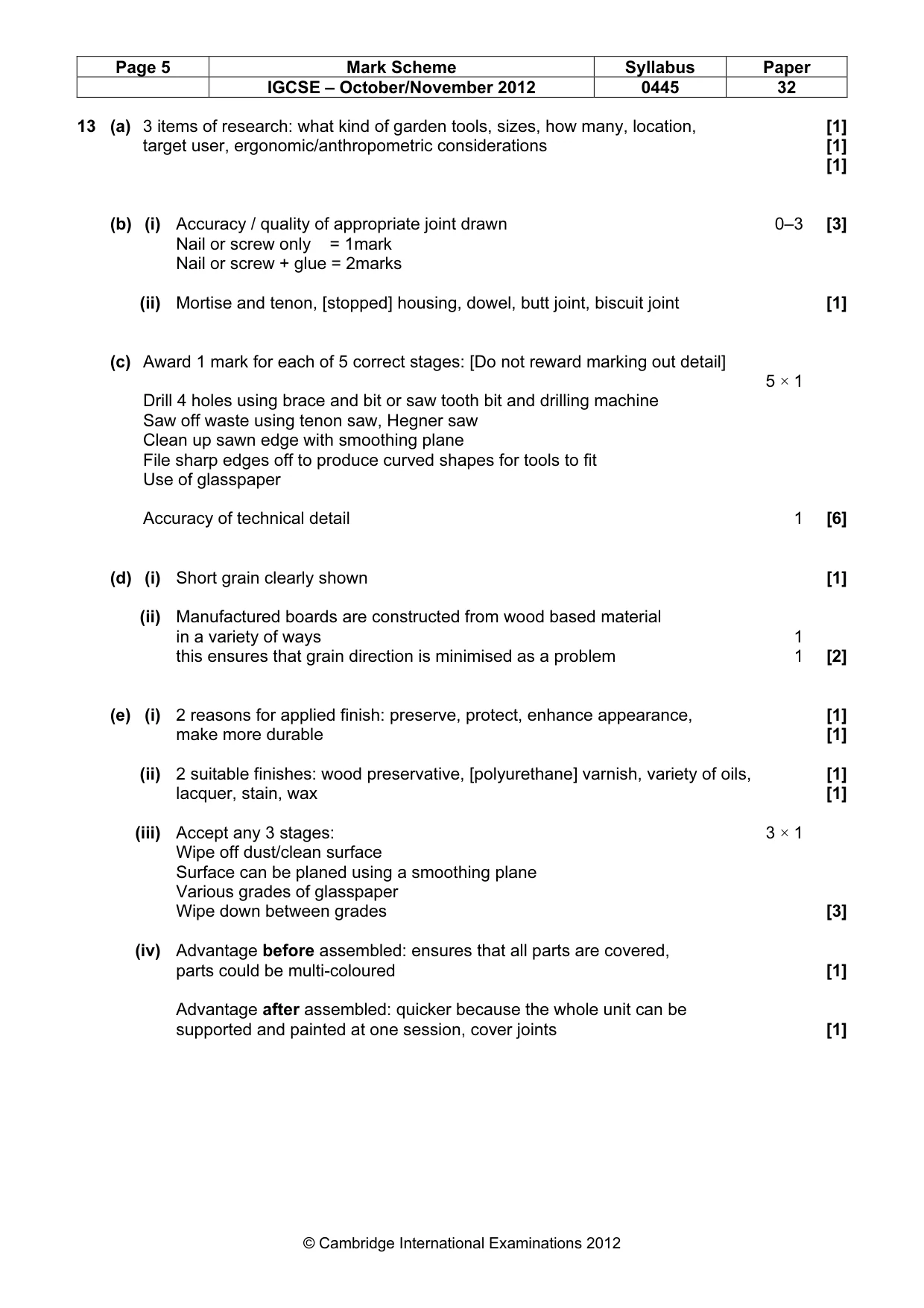
Page 5 Mark Scheme Syllabus Paper IGCSE – October/November 2012 0445 32 © Cambridge International Examinations 2012 13 (a) 3 items of research: what kind of garden tools, sizes, how many, location, [1] target user, ergonomic/anthropometric considerations [1] [1] (b) (i) Accuracy / quality of appropriate joint drawn 0–3 [3] Nail or screw only = 1mark Nail or screw + glue = 2marks (ii) Mortise and tenon, [stopped] housing, dowel, butt joint, biscuit joint [1] (c) Award 1 mark for each of 5 correct stages: [Do not reward marking out detail] 5 × 1 Drill 4 holes using brace and bit or saw tooth bit and drilling machine Saw off waste using tenon saw, Hegner saw Clean up sawn edge with smoothing plane File sharp edges off to produce curved shapes for tools to fit Use of glasspaper Accuracy of technical detail 1 [6] (d) (i) Short grain clearly shown [1] (ii) Manufactured boards are constructed from wood based material in a variety of ways 1 this ensures that grain direction is minimised as a problem 1 [2] (e) (i) 2 reasons for applied finish: preserve, protect, enhance appearance, [1] make more durable [1] (ii) 2 suitable finishes: wood preservative, [polyurethane] varnish, variety of oils, [1] lacquer, stain, wax [1] (iii) Accept any 3 stages: 3 × 1 Wipe off dust/clean surface Surface can be planed using a smoothing plane Various grades of glasspaper Wipe down between grades [3] (iv) Advantage before assembled: ensures that all parts are covered, parts could be multi-coloured [1] Advantage after assembled: quicker because the whole unit can be supported and painted at one session, cover joints [1]
What you needed in this session
Cambridge’s own grade thresholds for 2012 Oct/Nov, Paper 3 · Variant 2. A higher threshold means an easier paper — the bar moves with how the cohort did.