Cambridge IGCSE Design and Technology 0445 — 2012 Oct/Nov Paper 3 · Variant 1
0445/31/O/N/12 · 50 marks · ≈56 min
The question paper and its mark scheme, free to read here and free to download. This is Cambridge’s own paper, exactly as it was sat.
Question paper16 pages
Mark scheme5 pages
Answers below. Sit the paper first if you are practising.
Paper as text
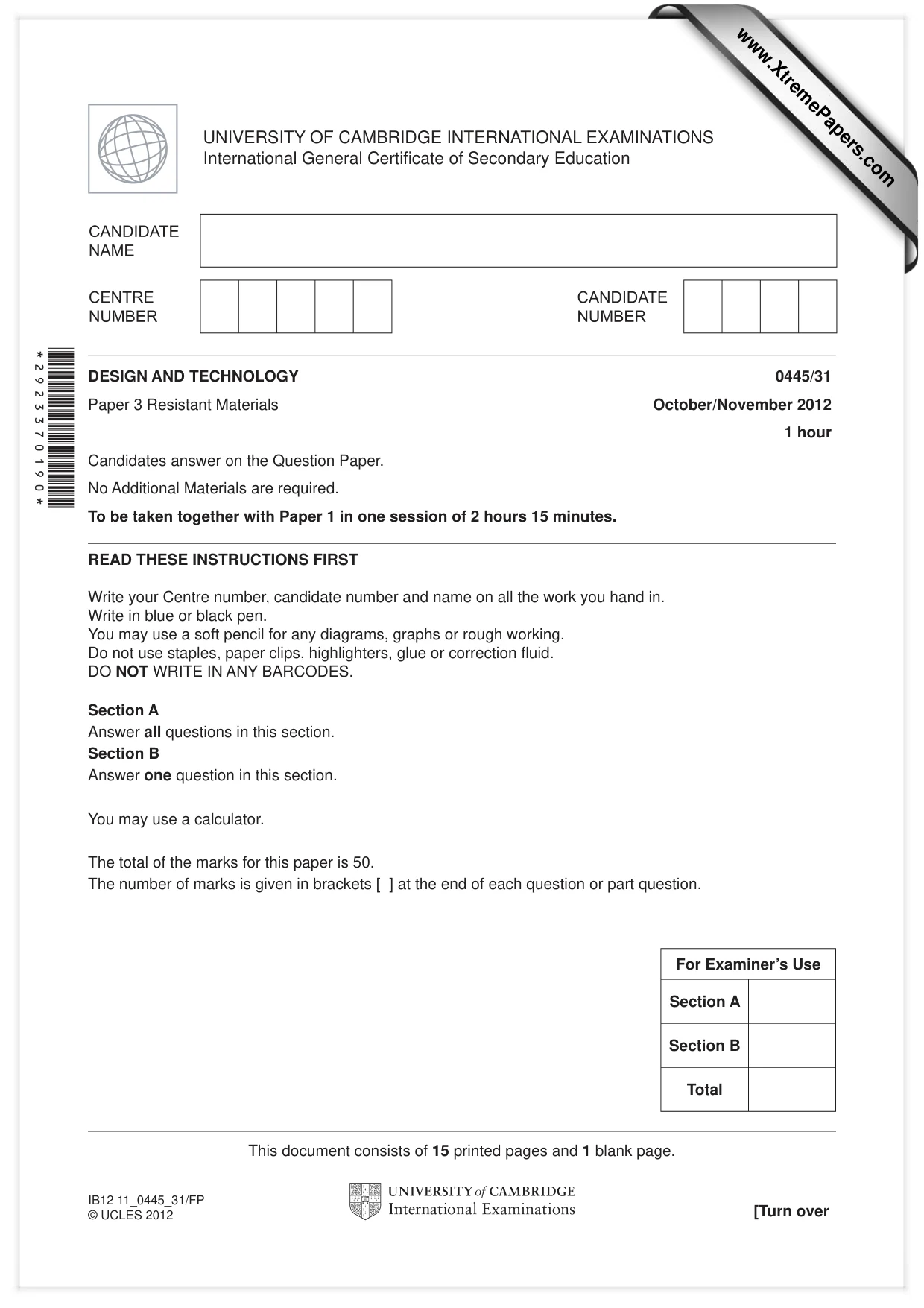
Question paper, page 1
READ THESE INSTRUCTIONS FIRST Write your Centre number, candidate number and name on all the work you hand in. Write in blue or black pen. You may use a soft pencil for any diagrams, graphs or rough working. Do not use staples, paper clips, highlighters, glue or correction fl uid. DO NOT WRITE IN ANY BARCODES. Section A Answer all questions in this section. Section B Answer one question in this section. You may use a calculator. The total of the marks for this paper is 50. The number of marks is given in brackets [ ] at the end of each question or part question. DESIGN AND TECHNOLOGY 0445/31 Paper 3 Resistant Materials October/November 2012 1 hour Candidates answer on the Question Paper. No Additional Materials are required. To be taken together with Paper 1 in one session of 2 hours 15 minutes. UNIVERSITY OF CAMBRIDGE INTERNATIONAL EXAMINATIONS International General Certifi cate of Secondary Education This document consists of 15 printed pages and 1 blank page. [Turn over IB12 11_0445_31/FP © UCLES 2012 *2923370190* For Examiner’s Use Section A Section B Total www.XtremePapers.com
Question paper, page 2
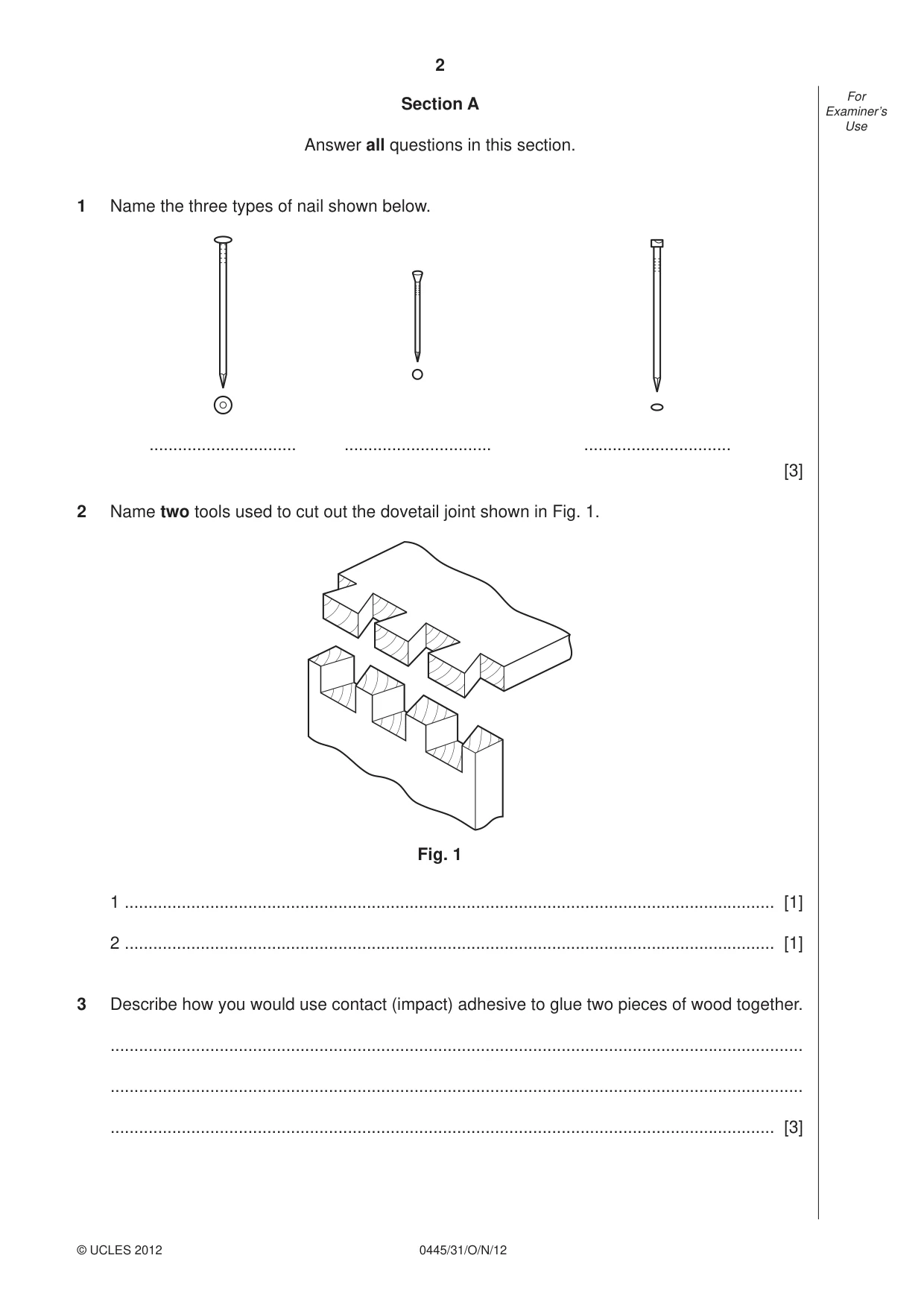
2 0445/31/O/N/12 © UCLES 2012 For Examiner’s Use Section A Answer all questions in this section. 1 Name the three types of nail shown below. … … … [3] 2 Name two tools used to cut out the dovetail joint shown in Fig. 1. Fig. 1 1 … [1] 2 … [1] 3 Describe how you would use contact (impact) adhesive to glue two pieces of wood together. … … … [3]
Question paper, page 3
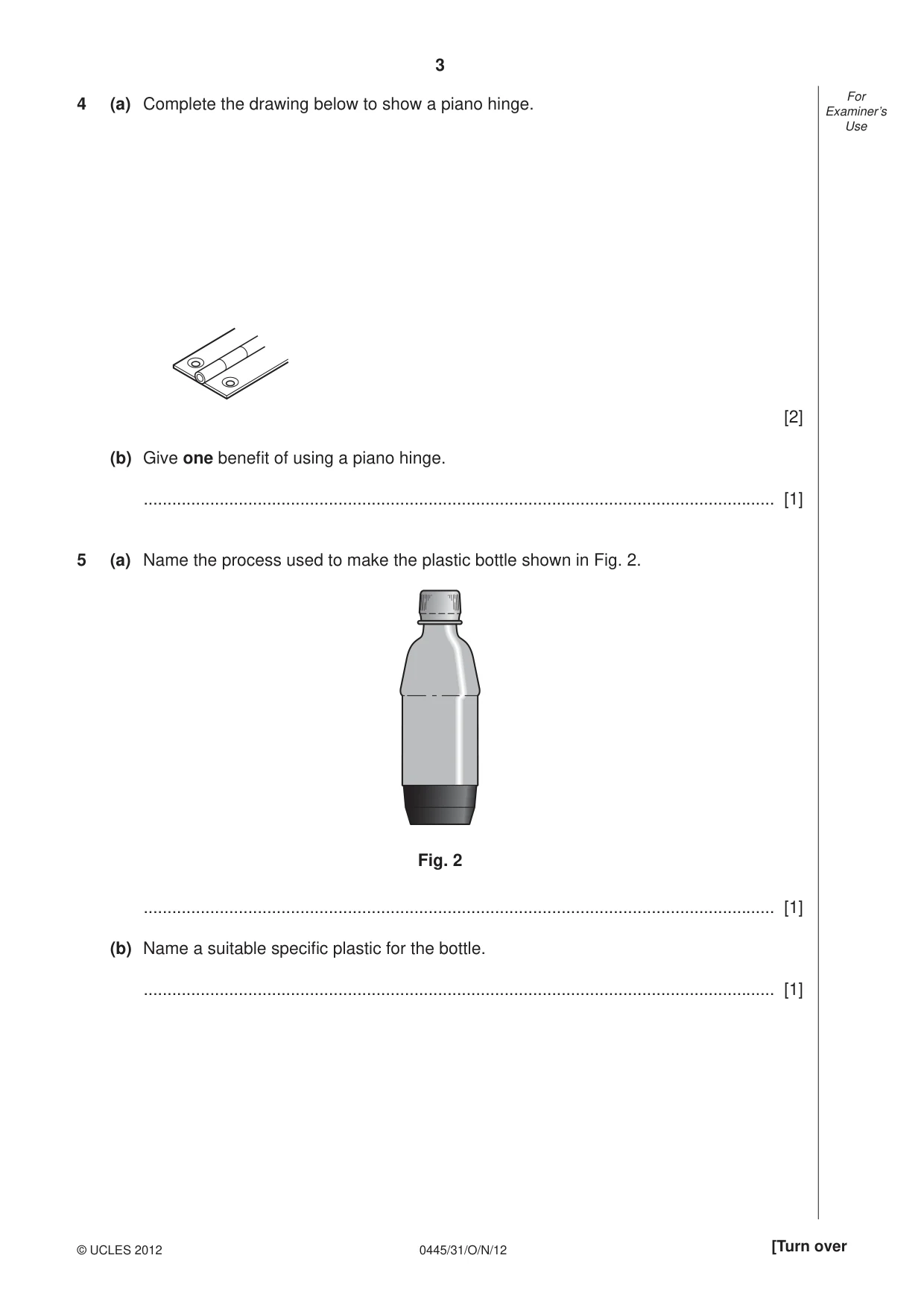
3 0445/31/O/N/12 © UCLES 2012 [Turn over For Examiner’s Use 4 (a) Complete the drawing below to show a piano hinge. [2] (b) Give one benefi t of using a piano hinge. … [1] 5 (a) Name the process used to make the plastic bottle shown in Fig. 2. Fig. 2 … [1] (b) Name a suitable specifi c plastic for the bottle. … [1]
Question paper, page 4
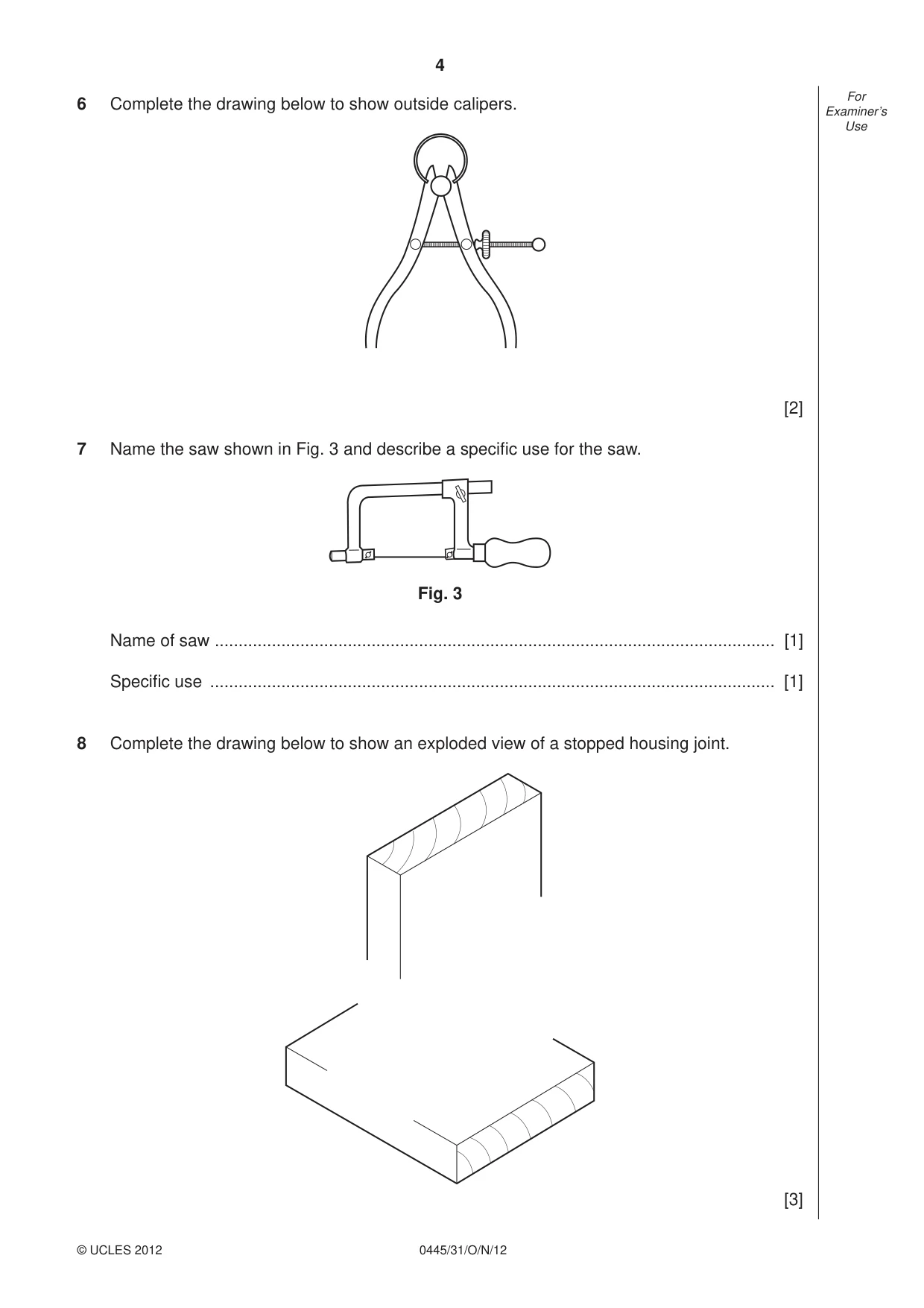
4 0445/31/O/N/12 © UCLES 2012 For Examiner’s Use 6 Complete the drawing below to show outside calipers. [2] 7 Name the saw shown in Fig. 3 and describe a specifi c use for the saw. Fig. 3 Name of saw … [1] Specifi c use … [1] 8 Complete the drawing below to show an exploded view of a stopped housing joint. [3]
Question paper, page 5
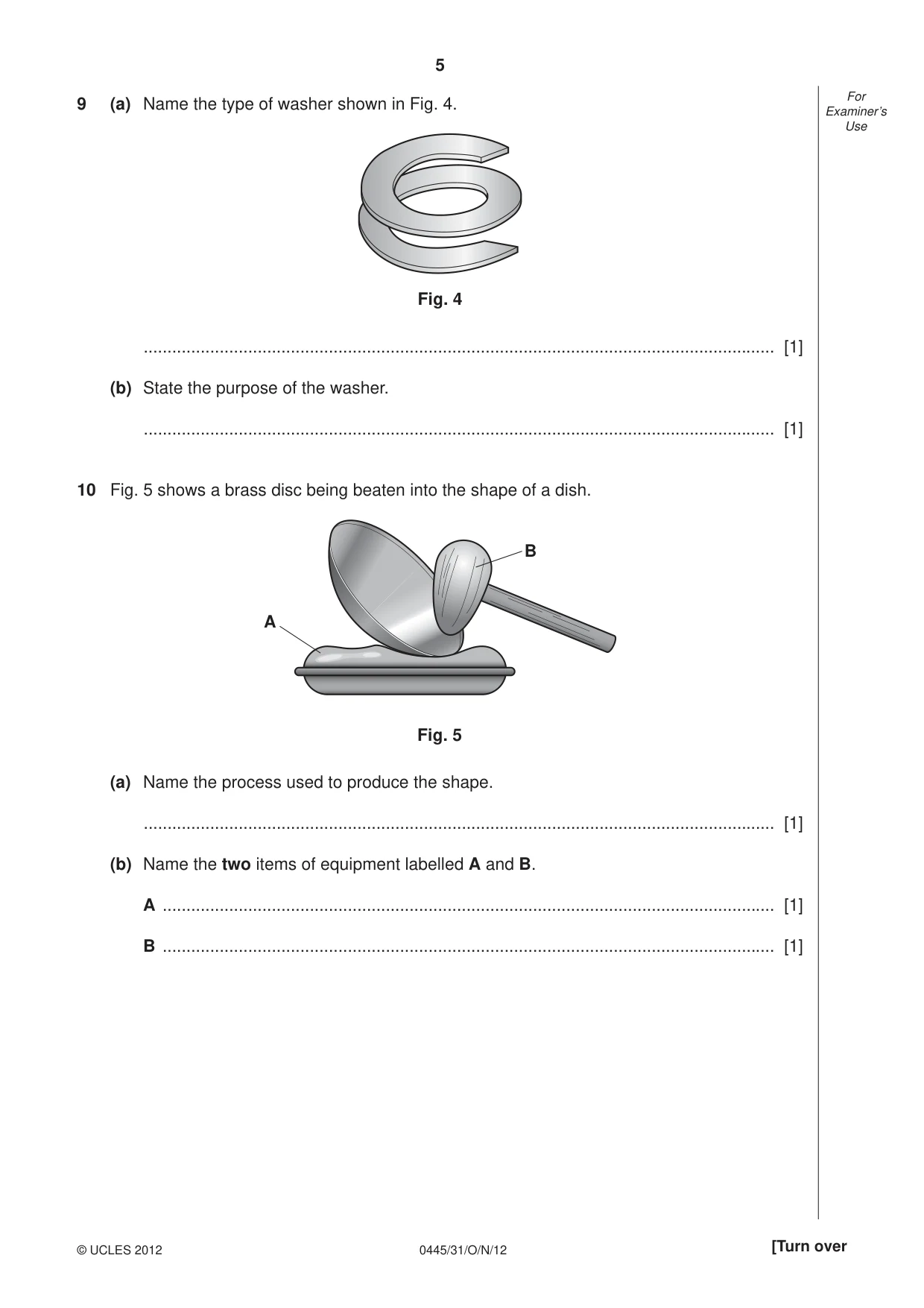
5 0445/31/O/N/12 © UCLES 2012 [Turn over For Examiner’s Use 9 (a) Name the type of washer shown in Fig. 4. Fig. 4 … [1] (b) State the purpose of the washer. … [1] 10 Fig. 5 shows a brass disc being beaten into the shape of a dish. B A Fig. 5 (a) Name the process used to produce the shape. … [1] (b) Name the two items of equipment labelled A and B. A … [1] B … [1]
Question paper, page 6
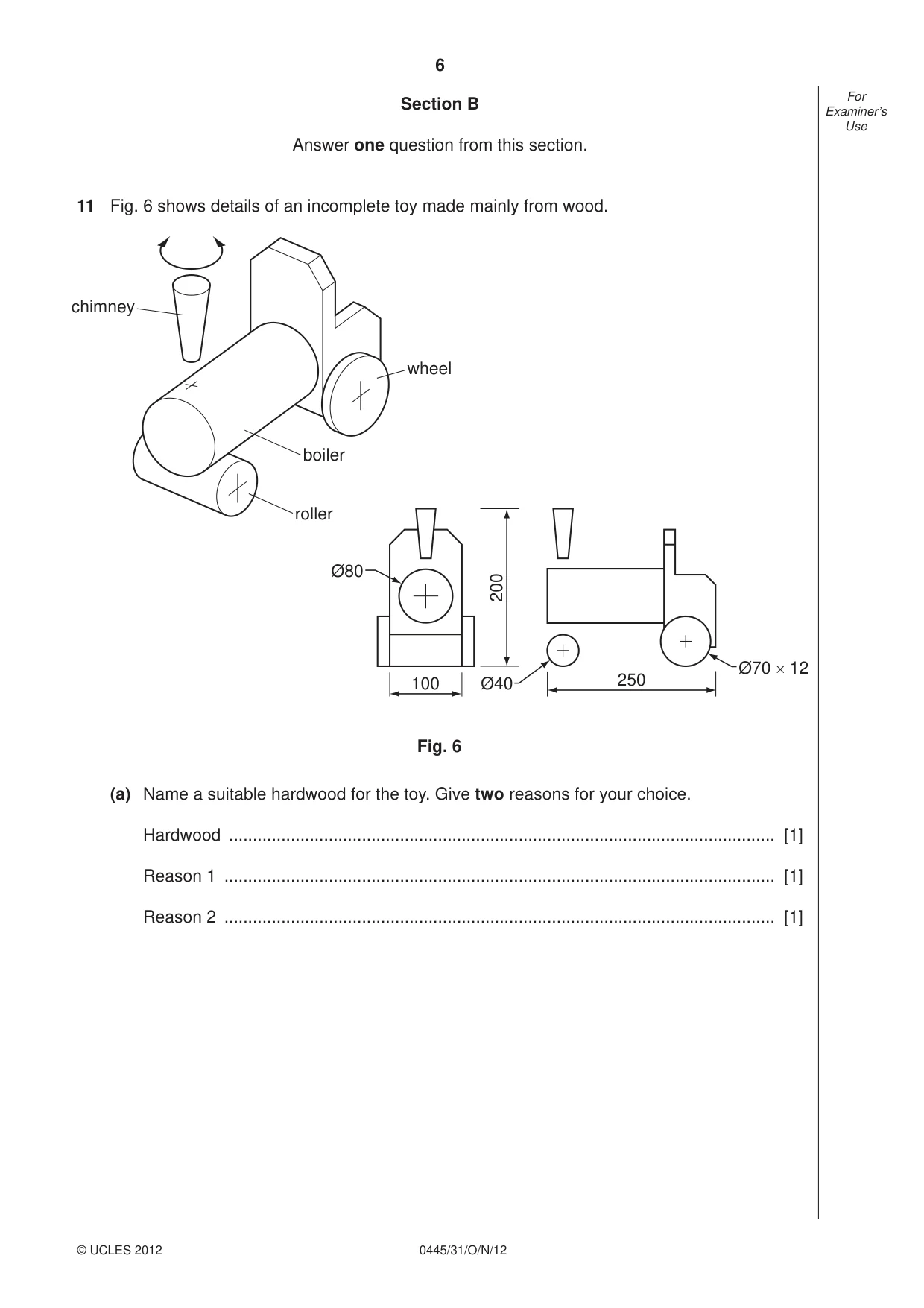
6 0445/31/O/N/12 © UCLES 2012 For Examiner’s Use Section B Answer one question from this section. 11 Fig. 6 shows details of an incomplete toy made mainly from wood. chimney boiler roller wheel 100 200 250 Ø40 Ø80 Ø70 × 12 Fig. 6 (a) Name a suitable hardwood for the toy. Give two reasons for your choice. Hardwood … [1] Reason 1 … [1] Reason 2 … [1]
Question paper, page 7
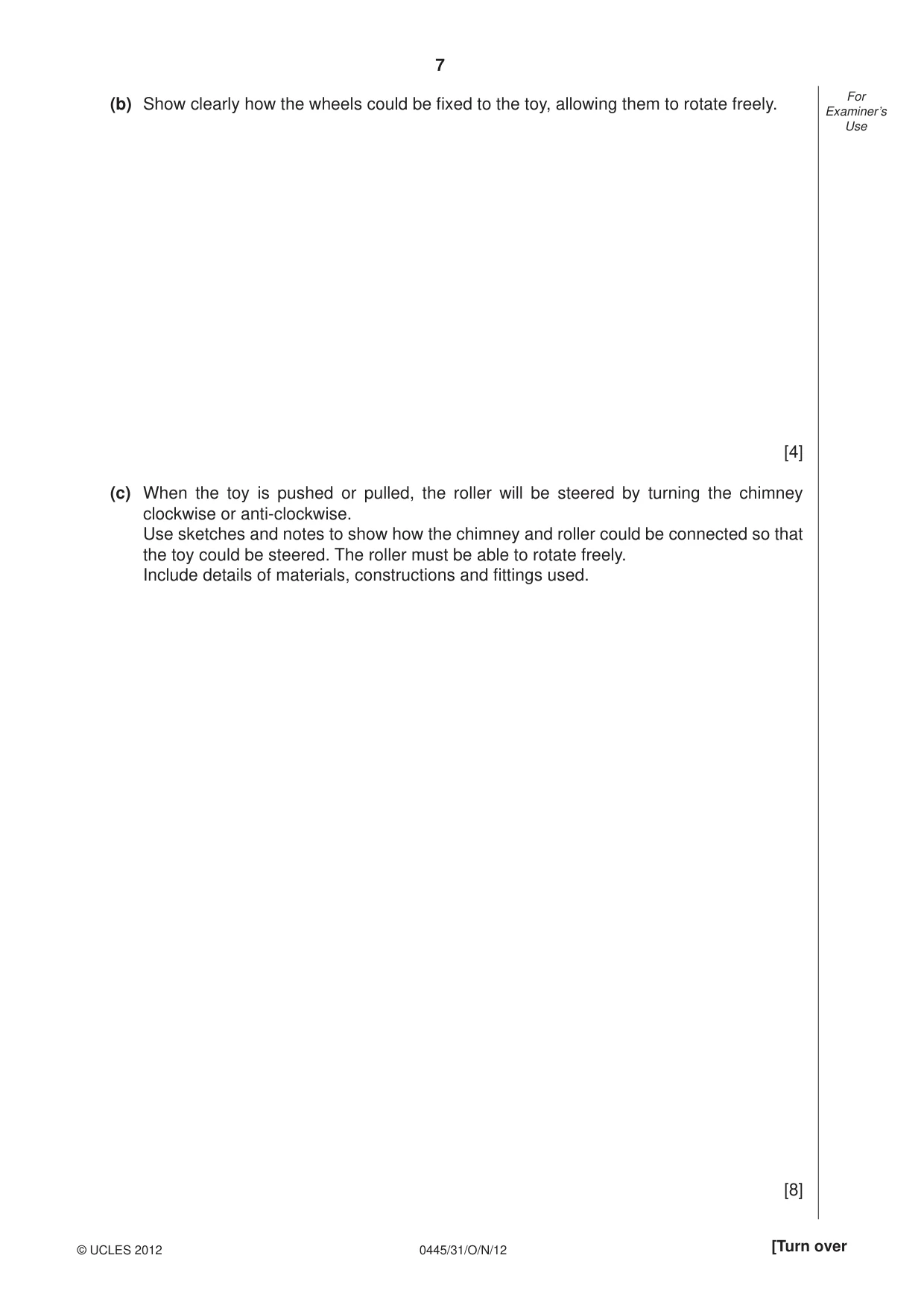
7 0445/31/O/N/12 © UCLES 2012 [Turn over For Examiner’s Use (b) Show clearly how the wheels could be fi xed to the toy, allowing them to rotate freely. [4] (c) When the toy is pushed or pulled, the roller will be steered by turning the chimney clockwise or anti-clockwise. Use sketches and notes to show how the chimney and roller could be connected so that the toy could be steered. The roller must be able to rotate freely. Include details of materials, constructions and fi ttings used. [8]
Question paper, page 8
8 0445/31/O/N/12 © UCLES 2012 For Examiner’s Use (d) Use sketches and notes to show how the boiler could be made using a woodturning lathe. Include details of the following stages: ● preparation of the wood before setting up on the lathe; ● setting up the wood on the lathe; ● turning the wood to shape; ● finishing the boiler, including the application of a finish. [10]
Question paper, page 9
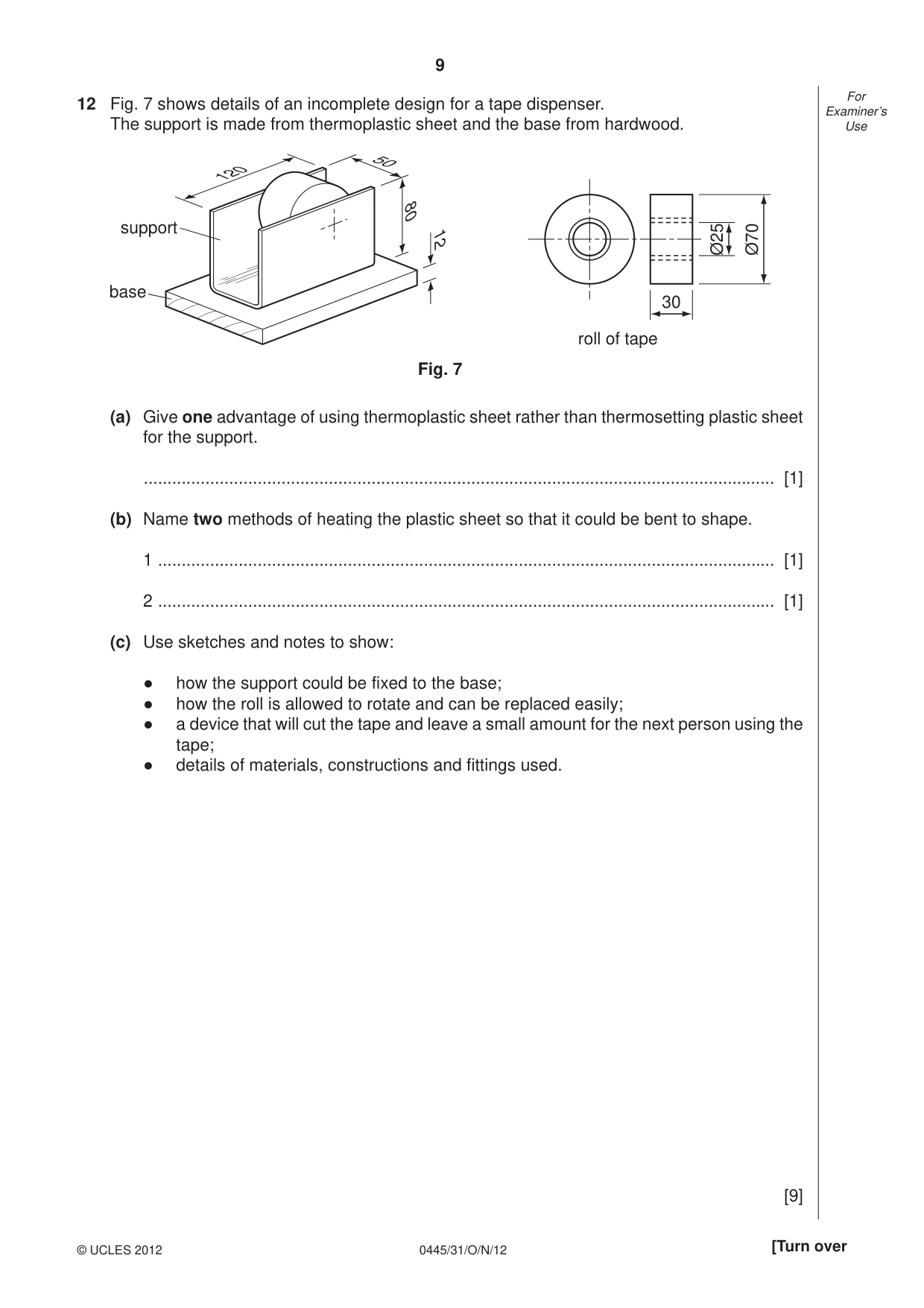
9 0445/31/O/N/12 © UCLES 2012 [Turn over For Examiner’s Use 12 Fig. 7 shows details of an incomplete design for a tape dispenser. The support is made from thermoplastic sheet and the base from hardwood. 50 80 12 120 Ø25 30 Ø70 support base roll of tape Fig. 7 (a) Give one advantage of using thermoplastic sheet rather than thermosetting plastic sheet for the support. … [1] (b) Name two methods of heating the plastic sheet so that it could be bent to shape. 1 … [1] 2 … [1] (c) Use sketches and notes to show: ● how the support could be fixed to the base; ● how the roll is allowed to rotate and can be replaced easily; ● a device that will cut the tape and leave a small amount for the next person using the tape; ● details of materials, constructions and fittings used. [9]
Question paper, page 10
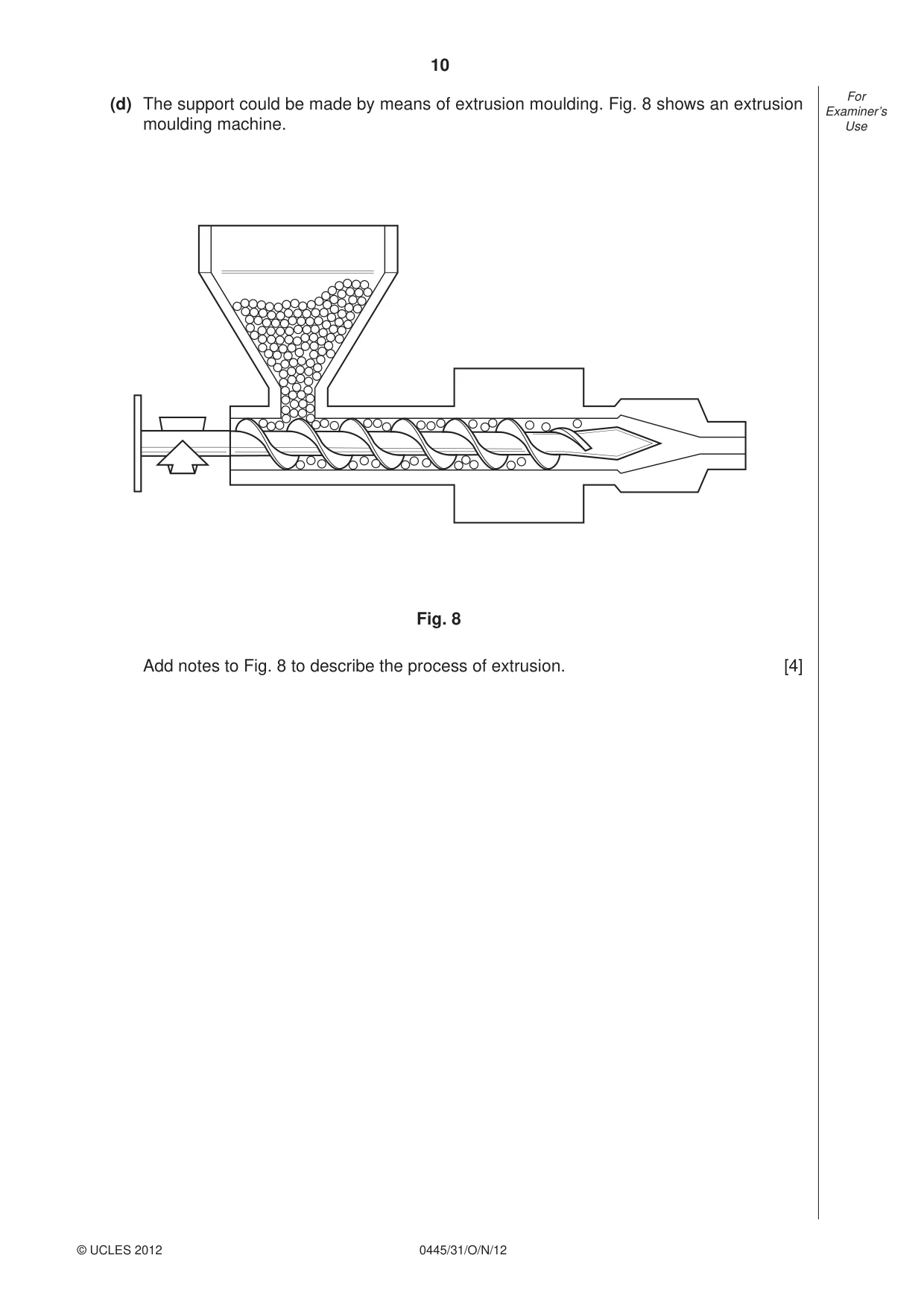
10 0445/31/O/N/12 © UCLES 2012 For Examiner’s Use (d) The support could be made by means of extrusion moulding. Fig. 8 shows an extrusion moulding machine. Fig. 8 Add notes to Fig. 8 to describe the process of extrusion. [4]
Question paper, page 11
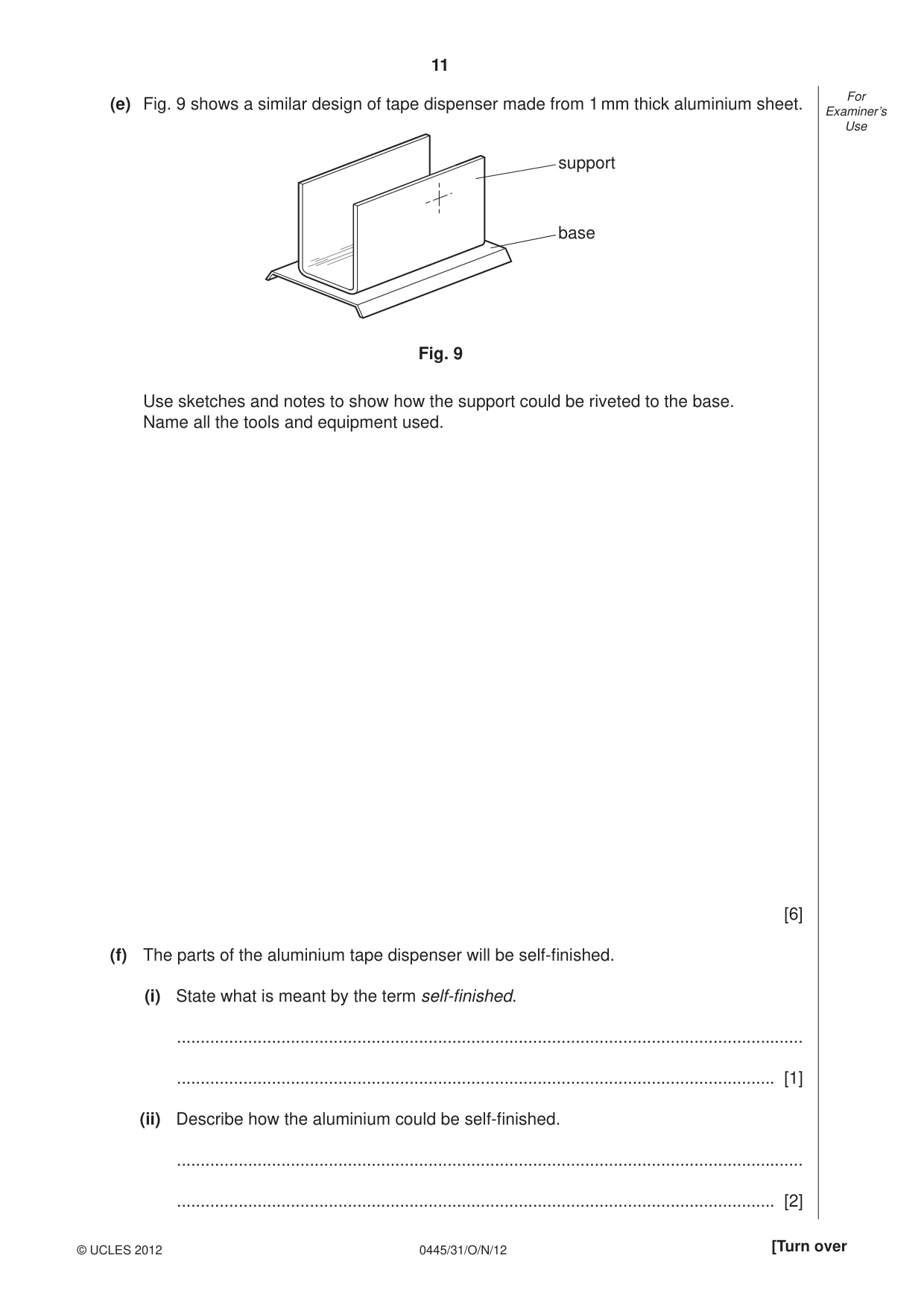
11 0445/31/O/N/12 © UCLES 2012 [Turn over For Examiner’s Use (e) Fig. 9 shows a similar design of tape dispenser made from 1 mm thick aluminium sheet. support base Fig. 9 Use sketches and notes to show how the support could be riveted to the base. Name all the tools and equipment used. [6] (f) The parts of the aluminium tape dispenser will be self-fi nished. (i) State what is meant by the term self-fi nished. … … [1] (ii) Describe how the aluminium could be self-fi nished. … … [2]
Question paper, page 12
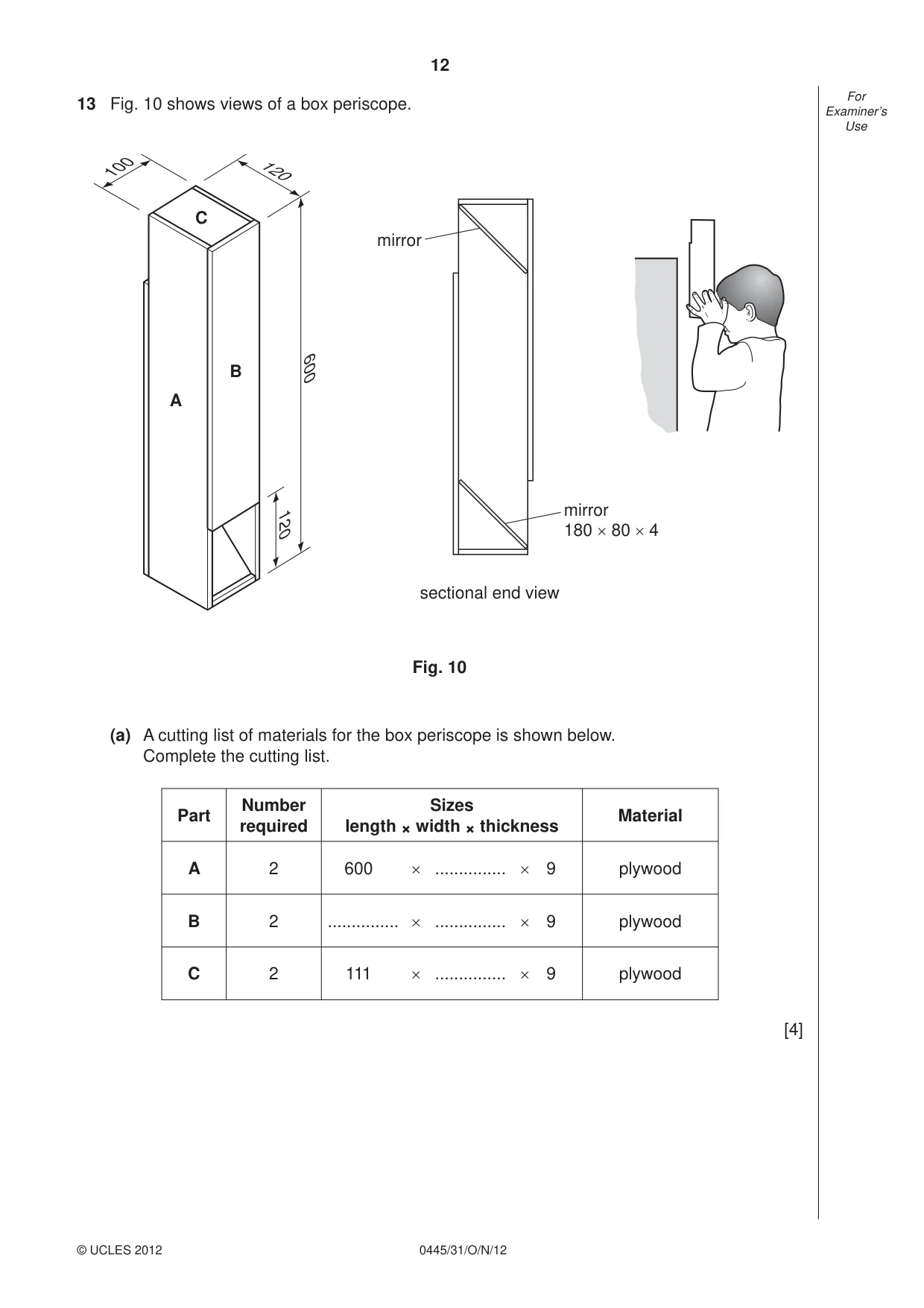
12 0445/31/O/N/12 © UCLES 2012 For Examiner’s Use 13 Fig. 10 shows views of a box periscope. C A B 120 100 120 600 mirror mirror 180 × 80 × 4 sectional end view Fig. 10 (a) A cutting list of materials for the box periscope is shown below. Complete the cutting list. Part Number required Sizes length × width × thickness Material A 2 600 × … × 9 plywood B 2 … × … × 9 plywood C 2 111 × … × 9 plywood [4]
Question paper, page 13
13 0445/31/O/N/12 © UCLES 2012 [Turn over For Examiner’s Use (b) All the parts of the box periscope are screwed together. Use sketches and notes to show how sides A and B could be screwed together. Include the following details: ● the type of screws used: length, head and material; ● the number of screws used and their spacing. [5] (c) Use sketches and notes to show how one glass mirror could be fi xed permanently inside the box periscope. [3]
Question paper, page 14
14 0445/31/O/N/12 © UCLES 2012 For Examiner’s Use (d) The box periscope is not easy to hold. Use sketches and notes to show modifi cations to the design of the box periscope so that it could be held more easily. Include details of materials, constructions and fi ttings used. [4]
Question paper, page 15
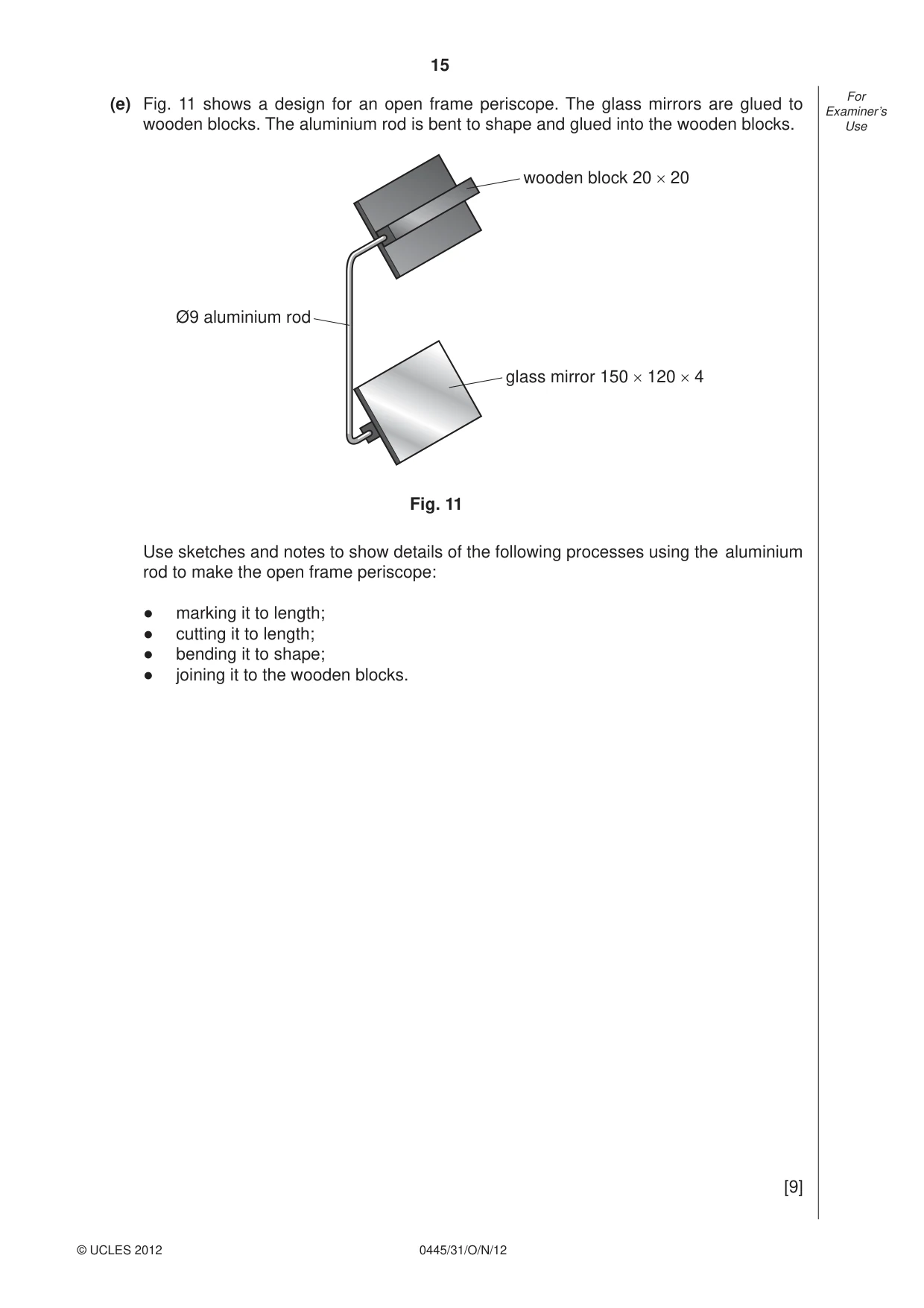
15 0445/31/O/N/12 © UCLES 2012 [Turn over For Examiner’s Use (e) Fig. 11 shows a design for an open frame periscope. The glass mirrors are glued to wooden blocks. The aluminium rod is bent to shape and glued into the wooden blocks. Ø9 aluminium rod wooden block 20 × 20 glass mirror 150 × 120 × 4 Fig. 11 Use sketches and notes to show details of the following processes using the aluminium rod to make the open frame periscope: ● marking it to length; ● cutting it to length; ● bending it to shape; ● joining it to the wooden blocks. [9]
Question paper, page 16
16 0445/31/O/N/12 Permission to reproduce items where third-party owned material protected by copyright is included has been sought and cleared where possible. Every reasonable effort has been made by the publisher (UCLES) to trace copyright holders, but if any items requiring clearance have unwittingly been included the publisher will be pleased to make amends at the earliest possible opportunity. University of Cambridge International Examinations is part of the Cambridge Assessment Group. Cambridge Assessment is the brand name of University of Cambridge Local Examinations Syndicate (UCLES), which is itself a department of the University of Cambridge. BLANK PAGE © UCLES 2012
Mark scheme, page 1
CAMBRIDGE INTERNATIONAL EXAMINATIONS International General Certificate of Secondary Education MARK SCHEME for the October/November 2012 series 0445 DESIGN AND TECHNOLOGY 0445/31 Paper 3 (Resistant Materials), maximum raw mark 50 This mark scheme is published as an aid to teachers and candidates, to indicate the requirements of the examination. It shows the basis on which Examiners were instructed to award marks. It does not indicate the details of the discussions that took place at an Examiners’ meeting before marking began, which would have considered the acceptability of alternative answers. Mark schemes should be read in conjunction with the question paper and the Principal Examiner Report for Teachers. Cambridge will not enter into discussions about these mark schemes. Cambridge is publishing the mark schemes for the October/November 2012 series for most IGCSE, GCE Advanced Level and Advanced Subsidiary Level components and some Ordinary Level components. www.XtremePapers.com
Mark scheme, page 2
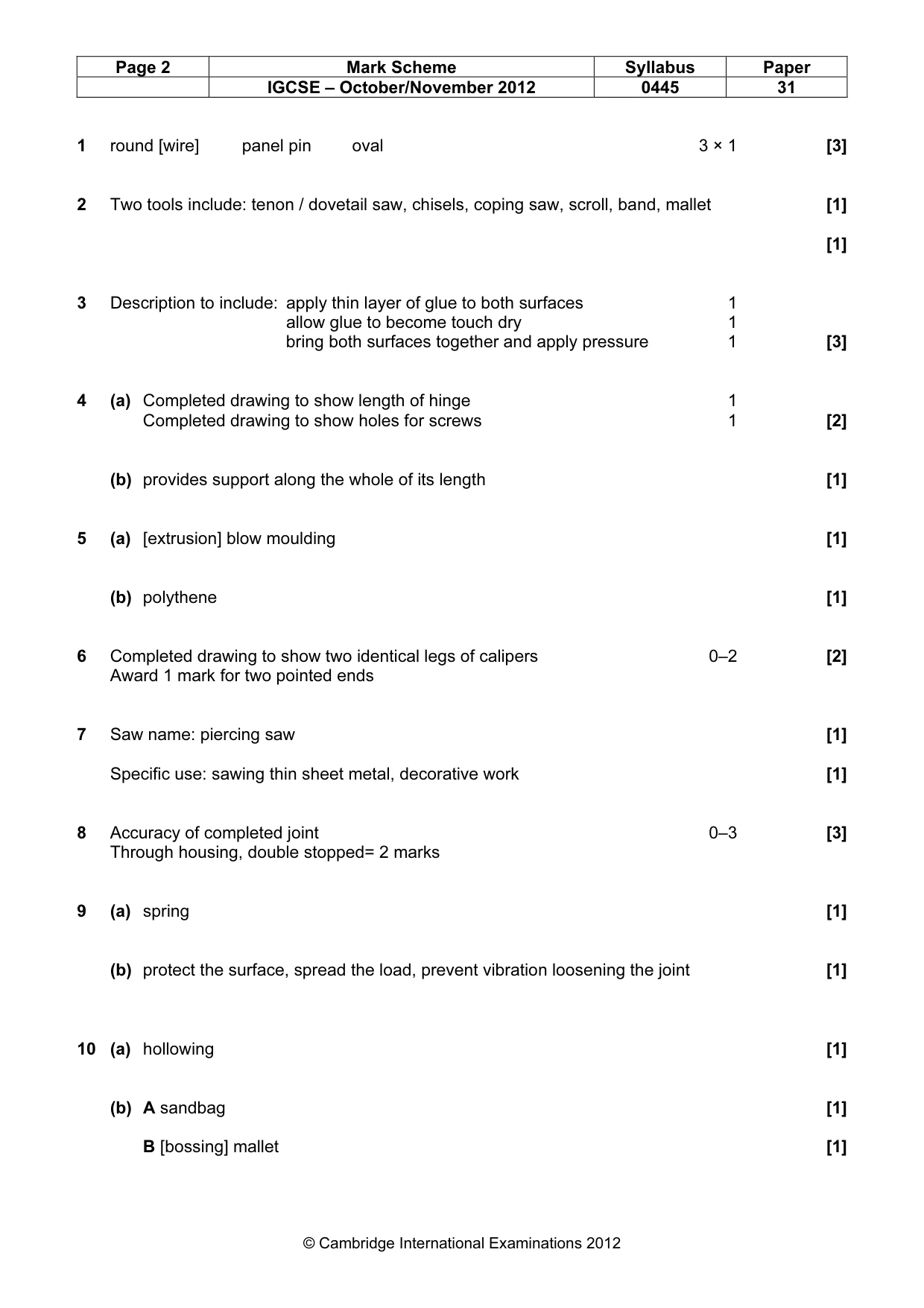
Page 2 Mark Scheme Syllabus Paper IGCSE – October/November 2012 0445 31 © Cambridge International Examinations 2012 1 round [wire] panel pin oval 3 × 1 [3] 2 Two tools include: tenon / dovetail saw, chisels, coping saw, scroll, band, mallet [1] [1] 3 Description to include: apply thin layer of glue to both surfaces 1 allow glue to become touch dry 1 bring both surfaces together and apply pressure 1 [3] 4 (a) Completed drawing to show length of hinge 1 Completed drawing to show holes for screws 1 [2] (b) provides support along the whole of its length [1] 5 (a) [extrusion] blow moulding [1] (b) polythene [1] 6 Completed drawing to show two identical legs of calipers 0–2 [2] Award 1 mark for two pointed ends 7 Saw name: piercing saw [1] Specific use: sawing thin sheet metal, decorative work [1] 8 Accuracy of completed joint 0–3 [3] Through housing, double stopped= 2 marks 9 (a) spring [1] (b) protect the surface, spread the load, prevent vibration loosening the joint [1] 10 (a) hollowing [1] (b) A sandbag [1] B [bossing] mallet [1]
Mark scheme, page 3
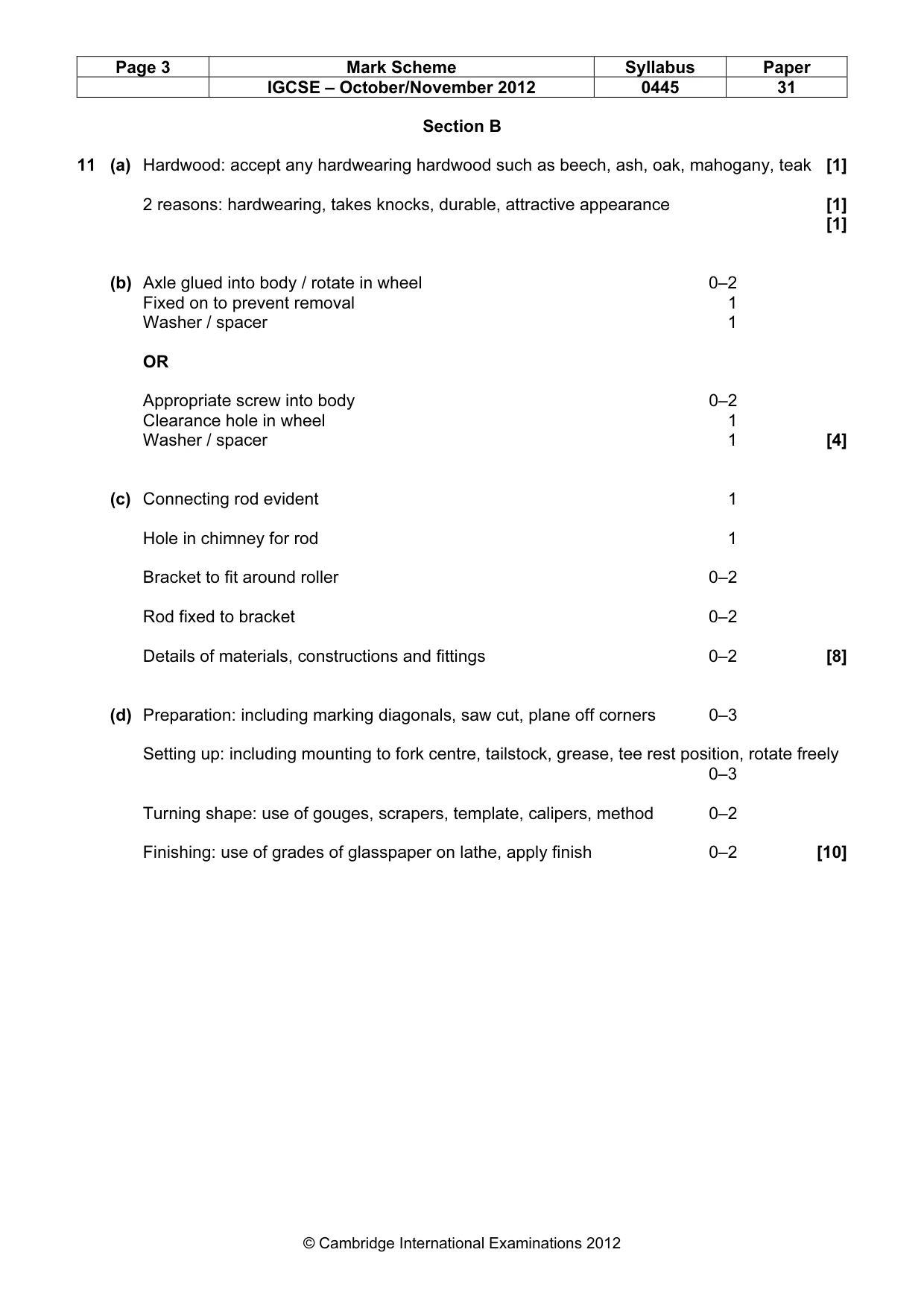
Page 3 Mark Scheme Syllabus Paper IGCSE – October/November 2012 0445 31 © Cambridge International Examinations 2012 Section B 11 (a) Hardwood: accept any hardwearing hardwood such as beech, ash, oak, mahogany, teak [1] 2 reasons: hardwearing, takes knocks, durable, attractive appearance [1] [1] (b) Axle glued into body / rotate in wheel 0–2 Fixed on to prevent removal 1 Washer / spacer 1 OR Appropriate screw into body 0–2 Clearance hole in wheel 1 Washer / spacer 1 [4] (c) Connecting rod evident 1 Hole in chimney for rod 1 Bracket to fit around roller 0–2 Rod fixed to bracket 0–2 Details of materials, constructions and fittings 0–2 [8] (d) Preparation: including marking diagonals, saw cut, plane off corners 0–3 Setting up: including mounting to fork centre, tailstock, grease, tee rest position, rotate freely 0–3 Turning shape: use of gouges, scrapers, template, calipers, method 0–2 Finishing: use of grades of glasspaper on lathe, apply finish 0–2 [10]
Mark scheme, page 4
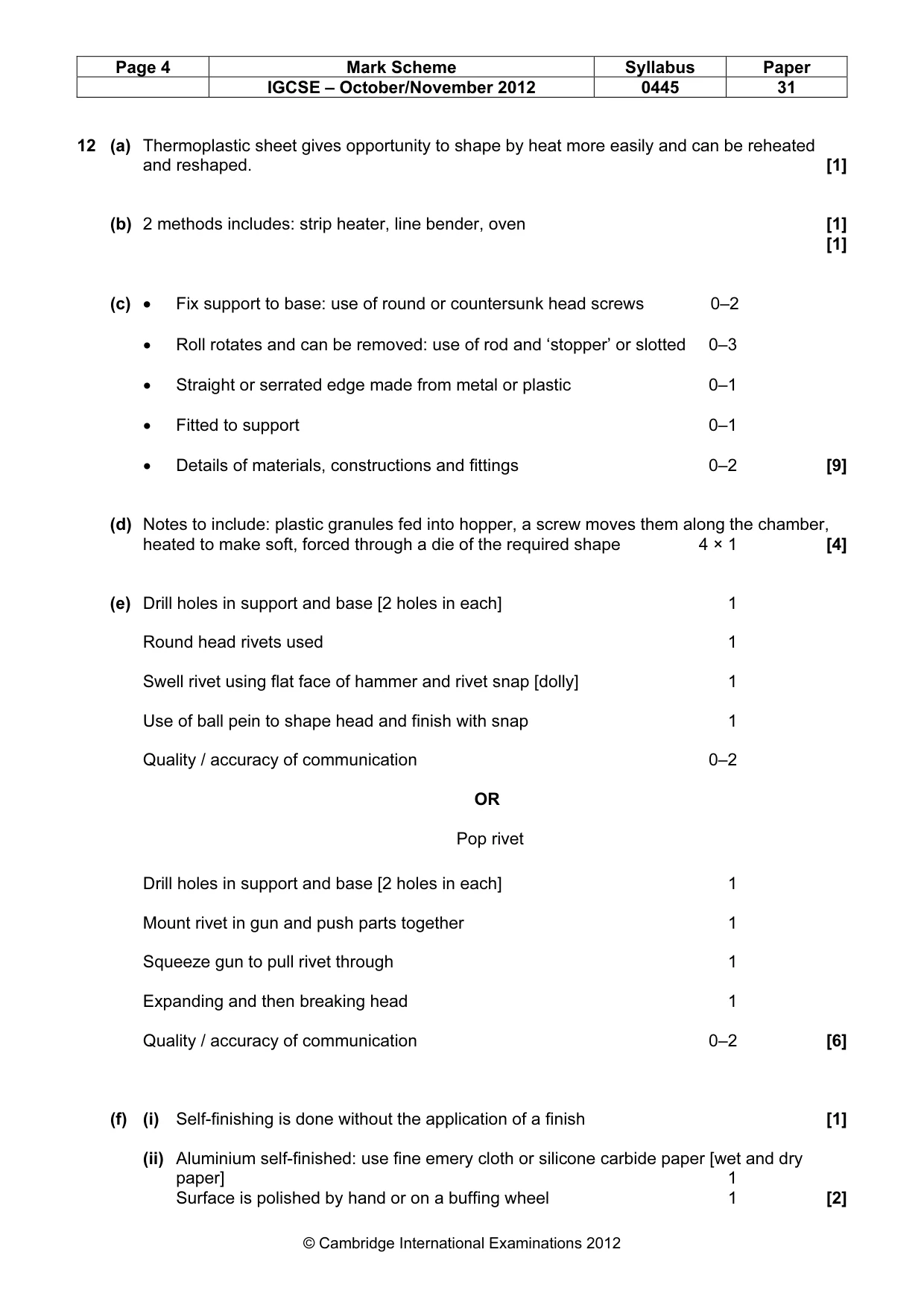
Page 4 Mark Scheme Syllabus Paper IGCSE – October/November 2012 0445 31 © Cambridge International Examinations 2012 12 (a) Thermoplastic sheet gives opportunity to shape by heat more easily and can be reheated and reshaped. [1] (b) 2 methods includes: strip heater, line bender, oven [1] [1] (c) • Fix support to base: use of round or countersunk head screws 0–2 • Roll rotates and can be removed: use of rod and ‘stopper’ or slotted 0–3 • Straight or serrated edge made from metal or plastic 0–1 • Fitted to support 0–1 • Details of materials, constructions and fittings 0–2 [9] (d) Notes to include: plastic granules fed into hopper, a screw moves them along the chamber, heated to make soft, forced through a die of the required shape 4 × 1 [4] (e) Drill holes in support and base [2 holes in each] 1 Round head rivets used 1 Swell rivet using flat face of hammer and rivet snap [dolly] 1 Use of ball pein to shape head and finish with snap 1 Quality / accuracy of communication 0–2 OR Pop rivet Drill holes in support and base [2 holes in each] 1 Mount rivet in gun and push parts together 1 Squeeze gun to pull rivet through 1 Expanding and then breaking head 1 Quality / accuracy of communication 0–2 [6] (f) (i) Self-finishing is done without the application of a finish [1] (ii) Aluminium self-finished: use fine emery cloth or silicone carbide paper [wet and dry paper] 1 Surface is polished by hand or on a buffing wheel 1 [2]
Mark scheme, page 5
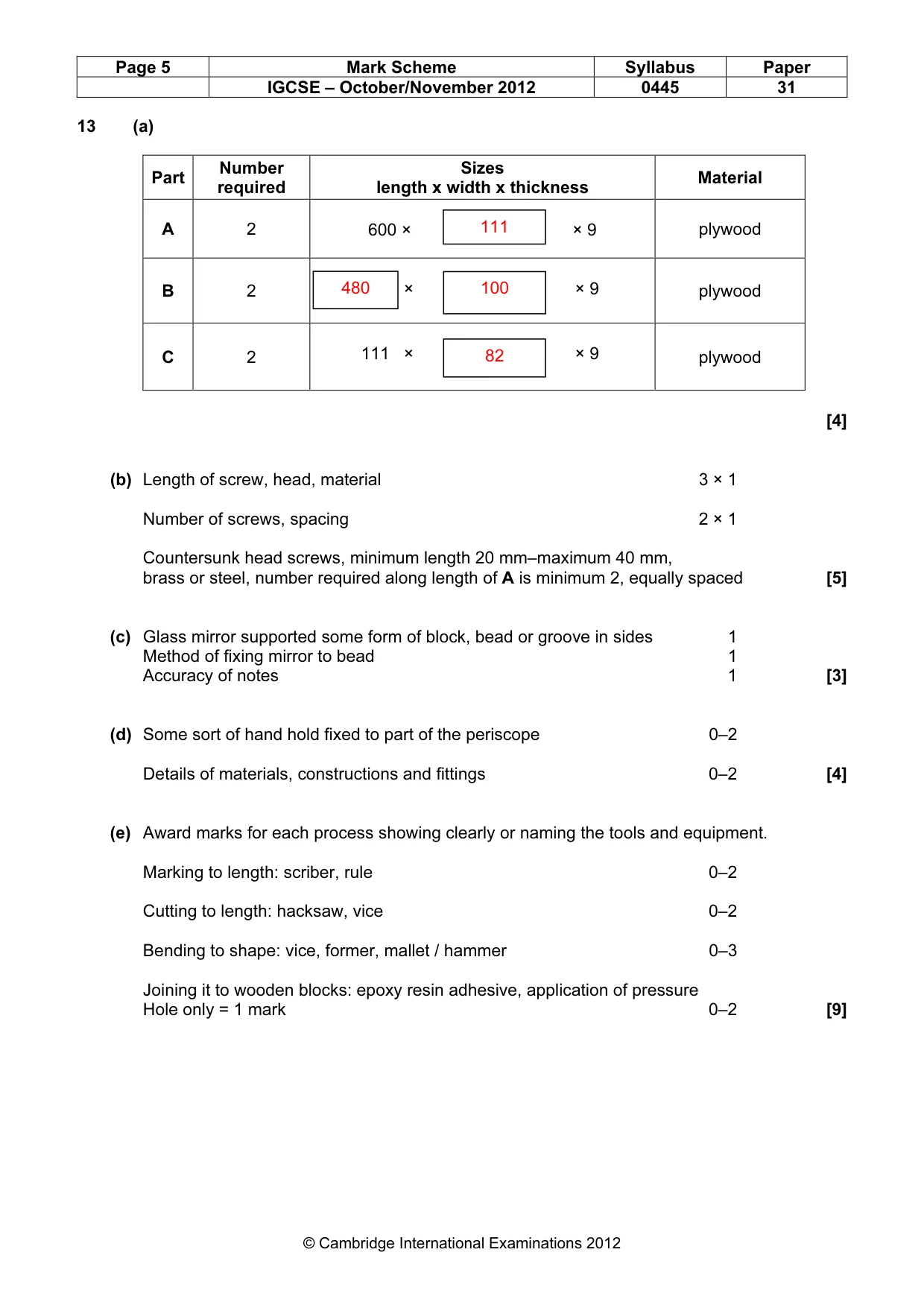
Page 5 Mark Scheme Syllabus Paper IGCSE – October/November 2012 0445 31 © Cambridge International Examinations 2012 13 (a) Part Number required Sizes length x width x thickness Material A 2 600 × × 9 plywood B 2 × × 9 plywood C 2 111 × × 9 plywood [4] (b) Length of screw, head, material 3 × 1 Number of screws, spacing 2 × 1 Countersunk head screws, minimum length 20 mm–maximum 40 mm, brass or steel, number required along length of A is minimum 2, equally spaced [5] (c) Glass mirror supported some form of block, bead or groove in sides 1 Method of fixing mirror to bead 1 Accuracy of notes 1 [3] (d) Some sort of hand hold fixed to part of the periscope 0–2 Details of materials, constructions and fittings 0–2 [4] (e) Award marks for each process showing clearly or naming the tools and equipment. Marking to length: scriber, rule 0–2 Cutting to length: hacksaw, vice 0–2 Bending to shape: vice, former, mallet / hammer 0–3 Joining it to wooden blocks: epoxy resin adhesive, application of pressure Hole only = 1 mark 0–2 [9] 111 480 100 82
What you needed in this session
Cambridge’s own grade thresholds for 2012 Oct/Nov, Paper 3 · Variant 1. A higher threshold means an easier paper — the bar moves with how the cohort did.