Cambridge IGCSE Design and Technology 0445 — 2012 May/June Paper 3 · Variant 2
0445/32/M/J/12 · 50 marks · ≈56 min
The question paper and its mark scheme, free to read here and free to download. This is Cambridge’s own paper, exactly as it was sat.
Question paper16 pages
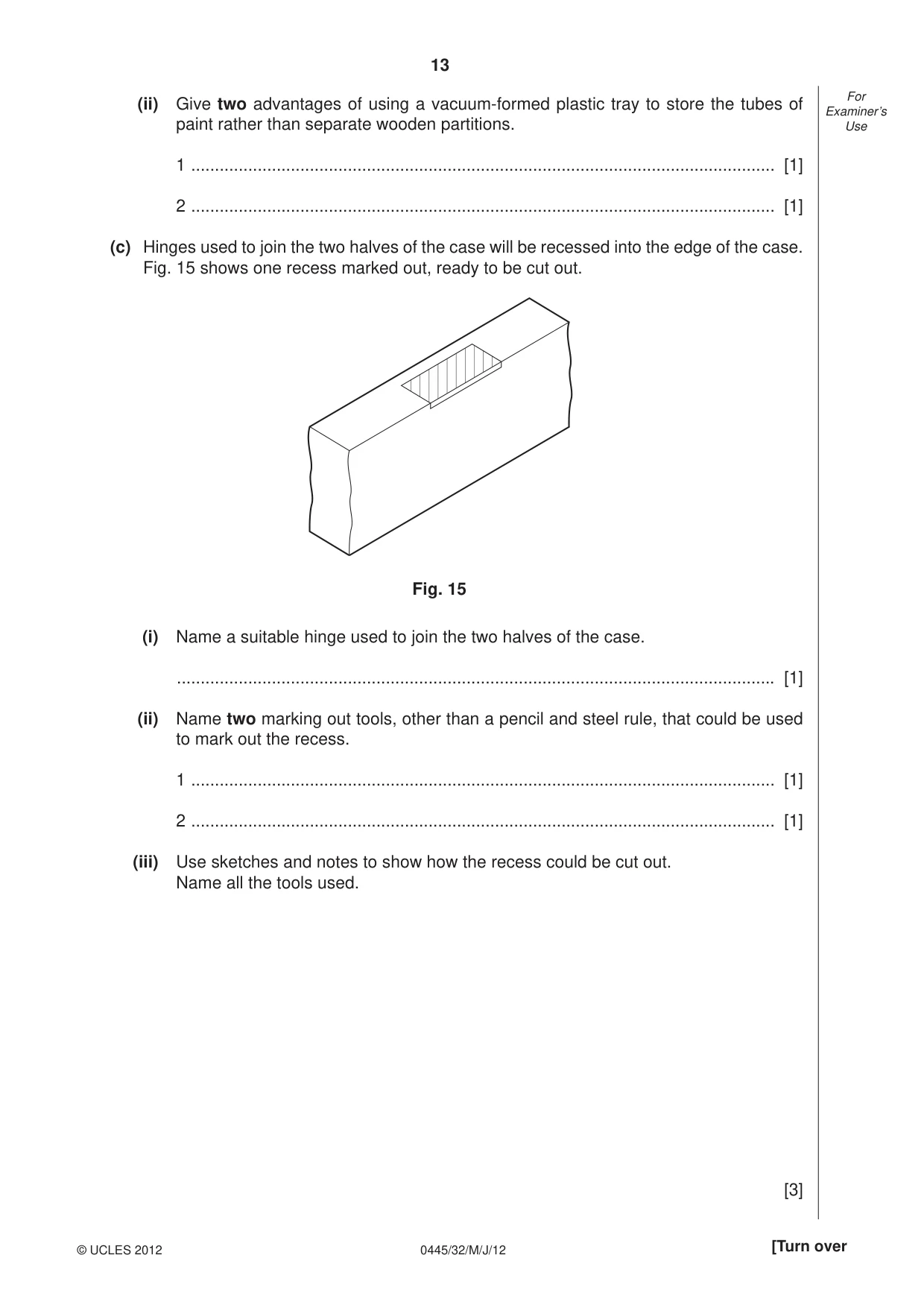
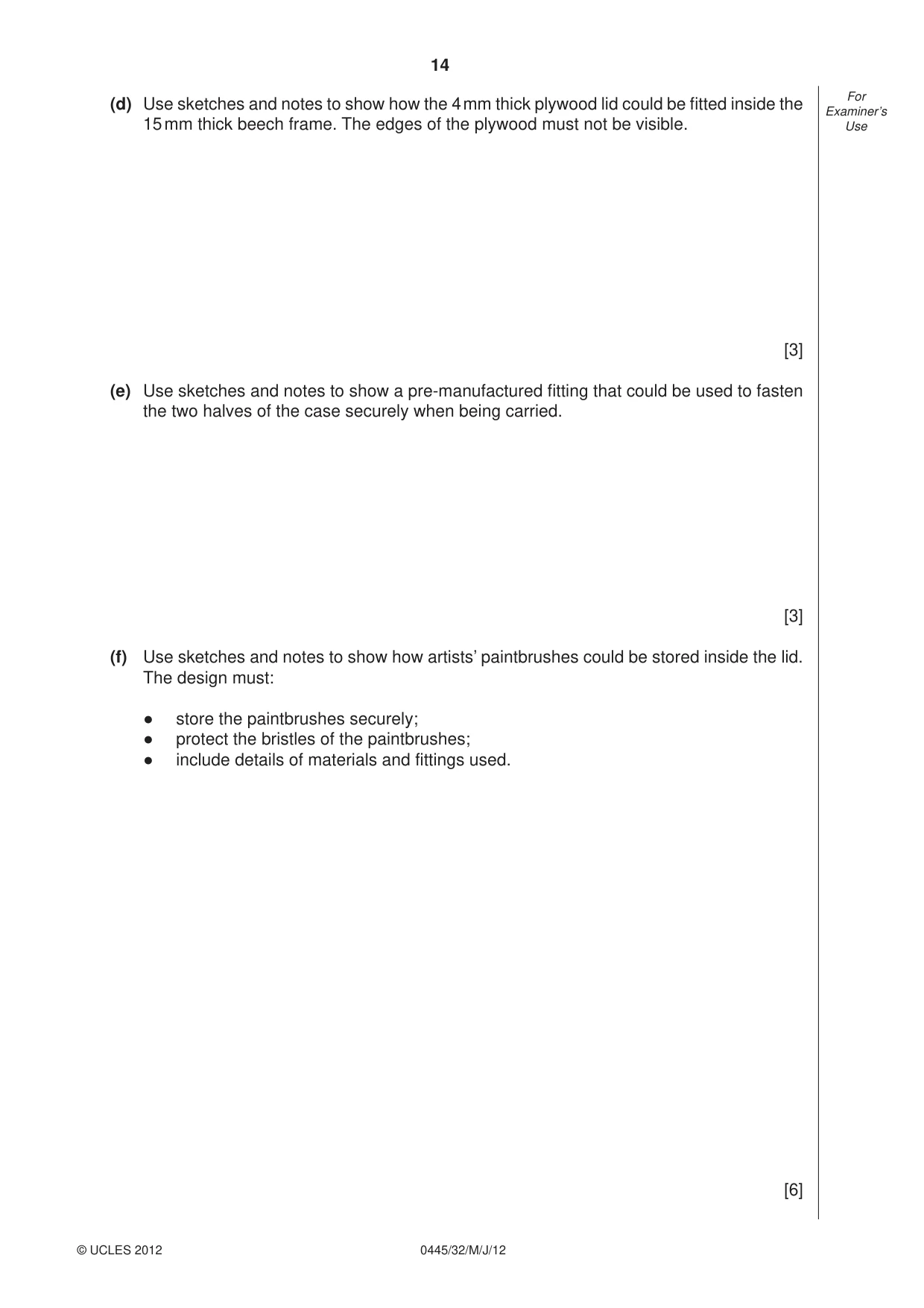

Mark scheme5 pages
Answers below. Sit the paper first if you are practising.
Paper as text
Question paper, page 1
READ THESE INSTRUCTIONS FIRST Write your Centre number, candidate number and name on all the work you hand in. Write in blue or black pen. You may use a soft pencil for any diagrams, graphs or rough working. Do not use staples, paper clips, highlighters, glue or correction fl uid. DO NOT WRITE IN ANY BARCODES. Section A Answer all questions in this section. Section B Answer one question in this section. You may use a calculator. The total of the marks for this paper is 50. The number of marks is given in brackets [ ] at the end of each question or part question. DESIGN AND TECHNOLOGY 0445/32 Paper 3 Resistant Materials May/June 2012 1 hour Candidates answer on the Question Paper. No Additional Materials are required. To be taken together with Paper 1 in one session of 2 hours 15 minutes. UNIVERSITY OF CAMBRIDGE INTERNATIONAL EXAMINATIONS International General Certifi cate of Secondary Education This document consists of 14 printed pages and 2 blank pages. [Turn over IB12 06_0445_32/FP © UCLES 2012 *3749220570* For Examiner’s Use Section A Section B Total www.XtremePapers.com
Question paper, page 2
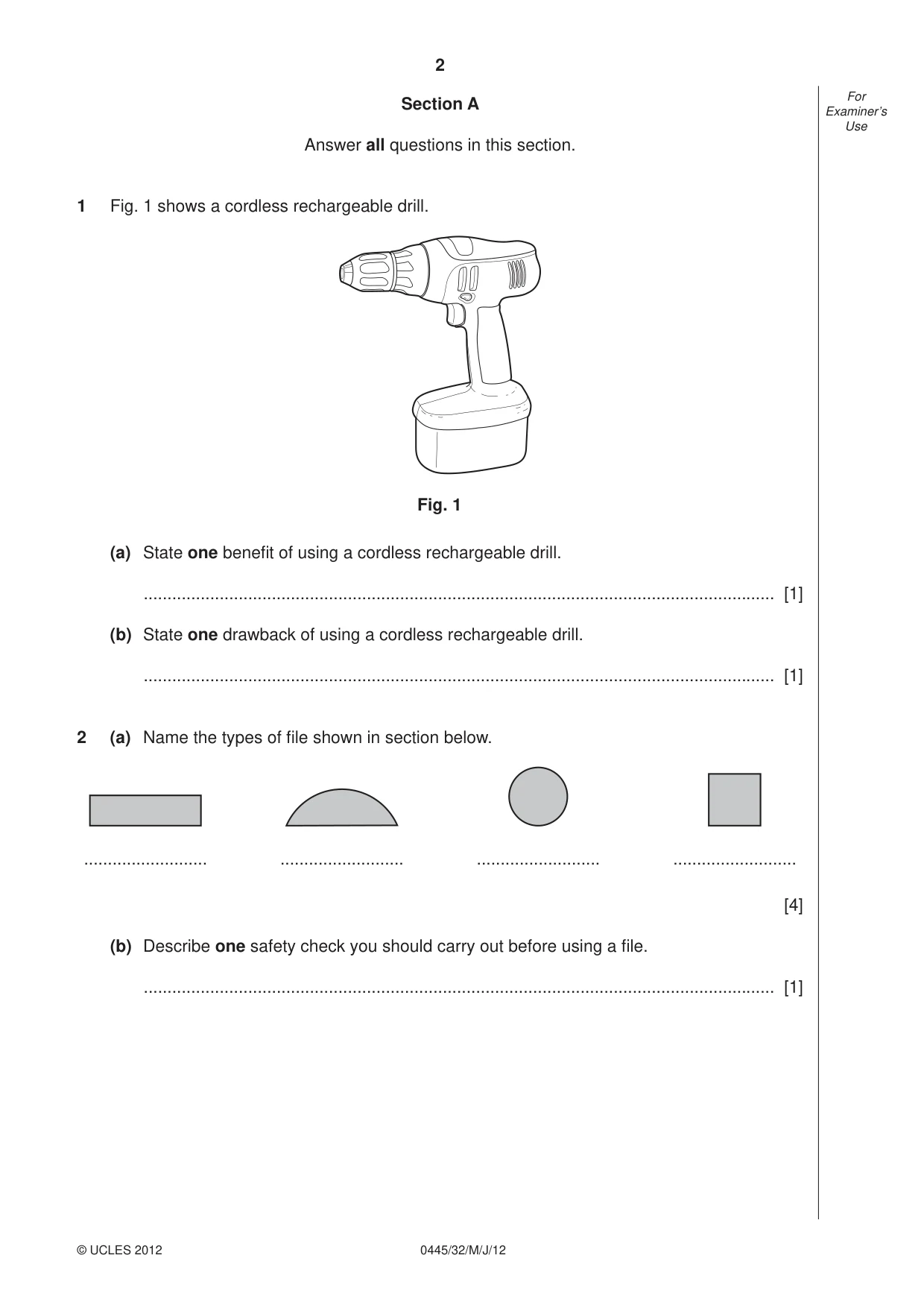
2 0445/32/M/J/12 © UCLES 2012 For Examiner’s Use Section A Answer all questions in this section. 1 Fig. 1 shows a cordless rechargeable drill. Fig. 1 (a) State one benefi t of using a cordless rechargeable drill. … [1] (b) State one drawback of using a cordless rechargeable drill. … [1] 2 (a) Name the types of fi le shown in section below. … … … … [4] (b) Describe one safety check you should carry out before using a fi le. … [1]
Question paper, page 3
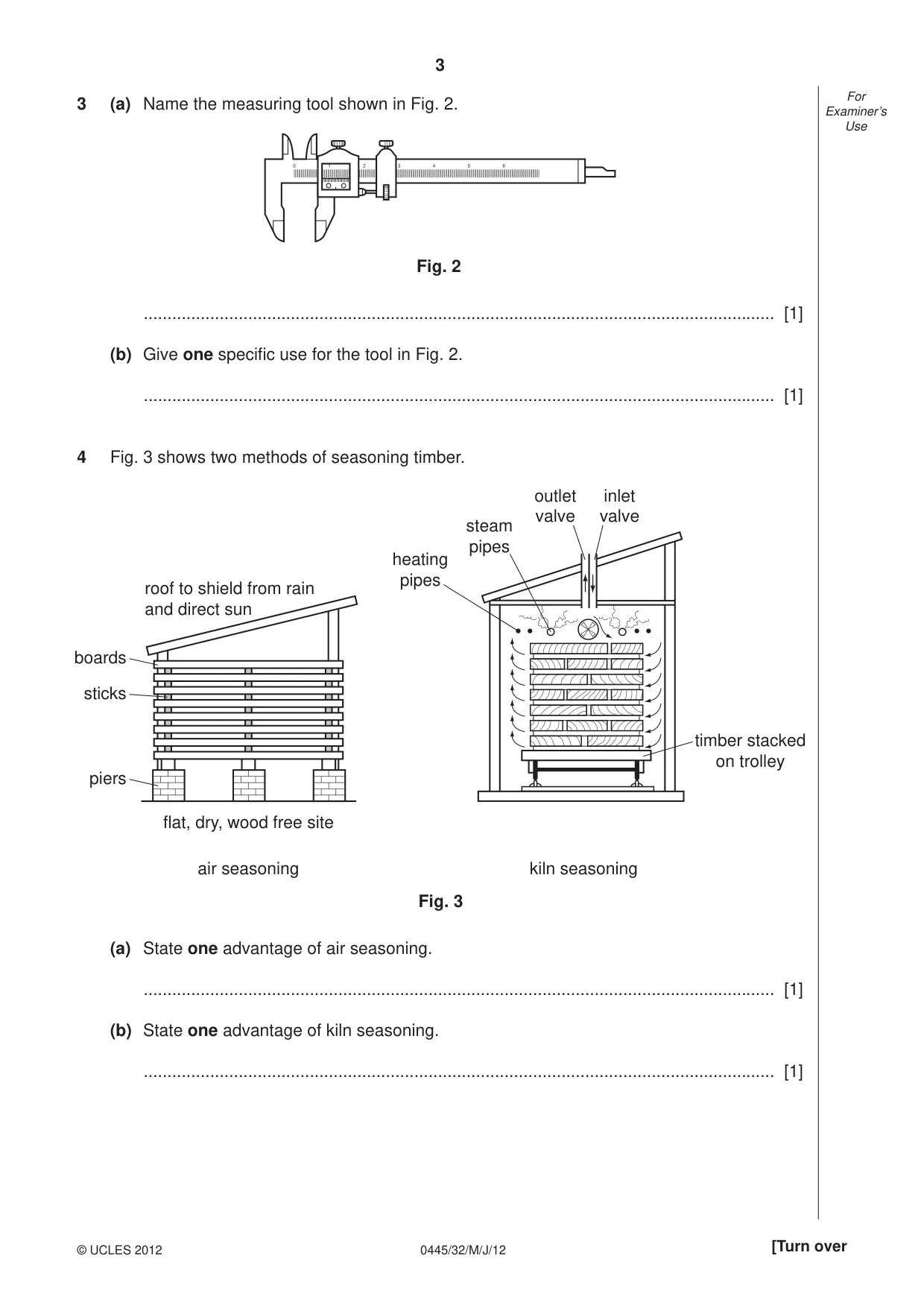
3 0445/32/M/J/12 © UCLES 2012 [Turn over For Examiner’s Use 3 (a) Name the measuring tool shown in Fig. 2. Fig. 2 … [1] (b) Give one specifi c use for the tool in Fig. 2. … [1] 4 Fig. 3 shows two methods of seasoning timber. heating pipes steam pipes outlet valve inlet valve timber stacked on trolley Fig. 3 boards piers sticks roof to shield from rain and direct sun flat, dry, wood free site air seasoning kiln seasoning (a) State one advantage of air seasoning. … [1] (b) State one advantage of kiln seasoning. … [1]
Question paper, page 4
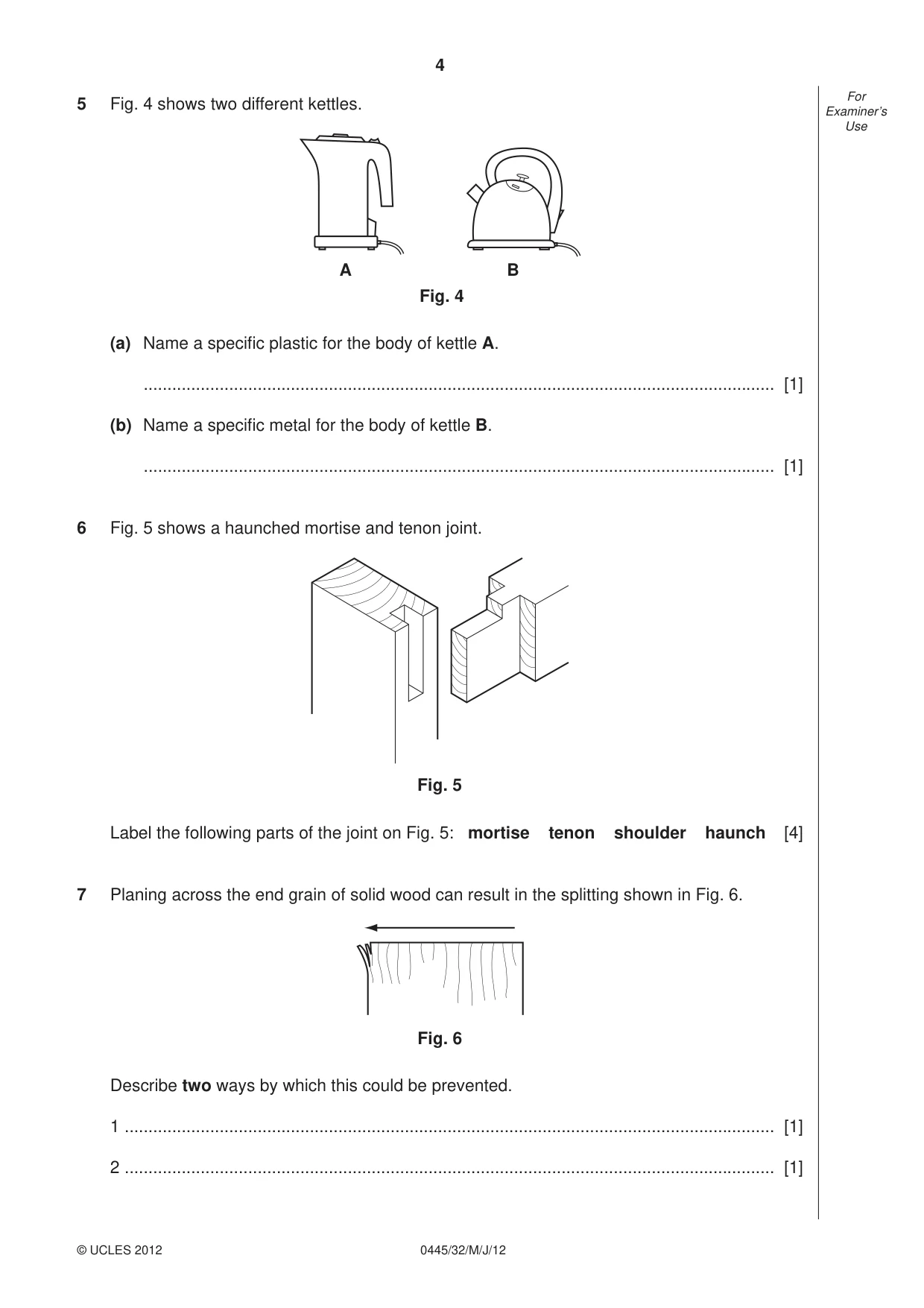
4 0445/32/M/J/12 © UCLES 2012 For Examiner’s Use 5 Fig. 4 shows two different kettles. A B Fig. 4 (a) Name a specifi c plastic for the body of kettle A. … [1] (b) Name a specifi c metal for the body of kettle B. … [1] 6 Fig. 5 shows a haunched mortise and tenon joint. Fig. 5 Label the following parts of the joint on Fig. 5: mortise tenon shoulder haunch [4] 7 Planing across the end grain of solid wood can result in the splitting shown in Fig. 6. Fig. 6 Describe two ways by which this could be prevented. 1 … [1] 2 … [1]
Question paper, page 5
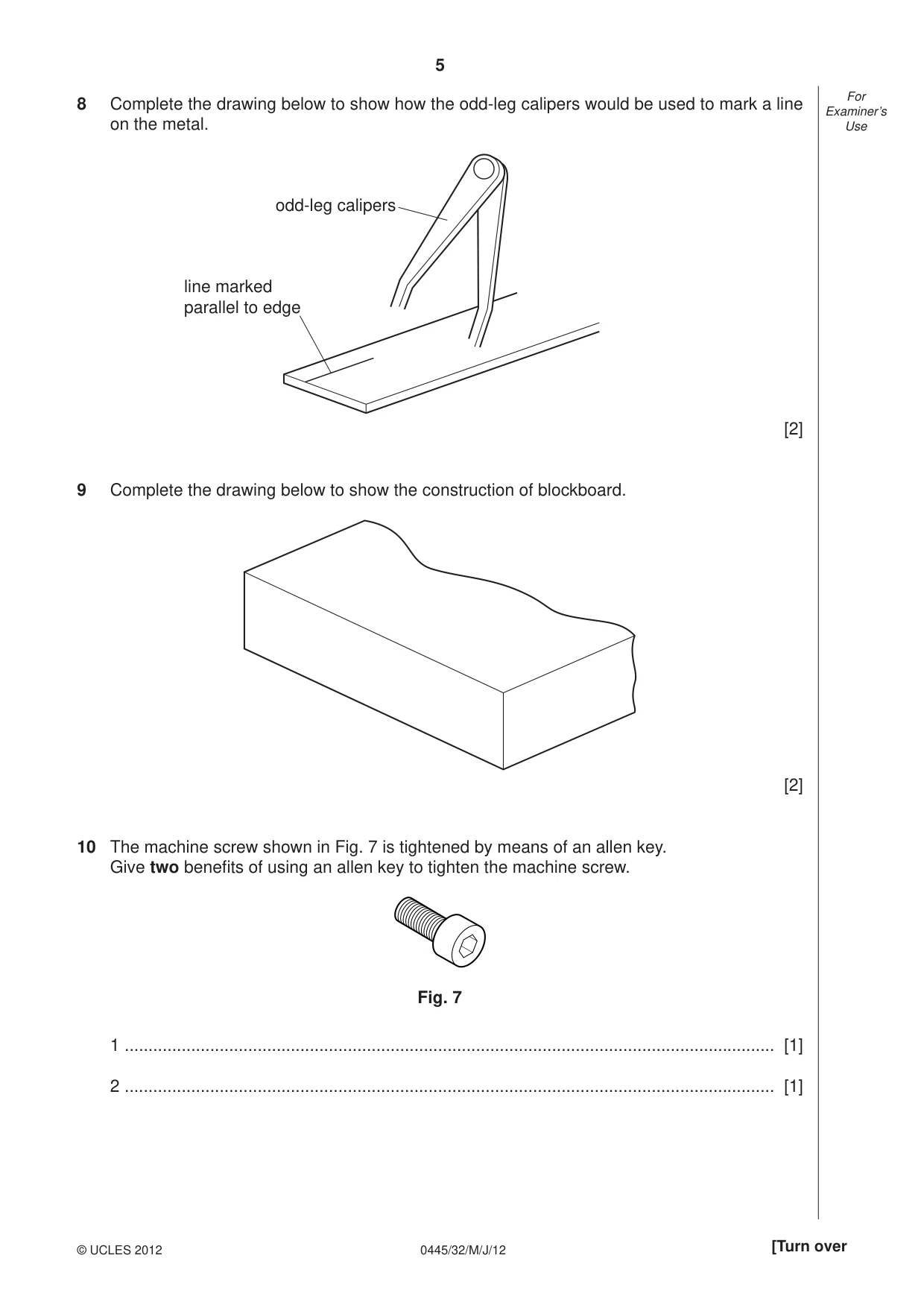
5 0445/32/M/J/12 © UCLES 2012 [Turn over For Examiner’s Use 8 Complete the drawing below to show how the odd-leg calipers would be used to mark a line on the metal. line marked parallel to edge odd-leg calipers [2] 9 Complete the drawing below to show the construction of blockboard. [2] 10 The machine screw shown in Fig. 7 is tightened by means of an allen key. Give two benefi ts of using an allen key to tighten the machine screw. Fig. 7 1 … [1] 2 … [1]
Question paper, page 6
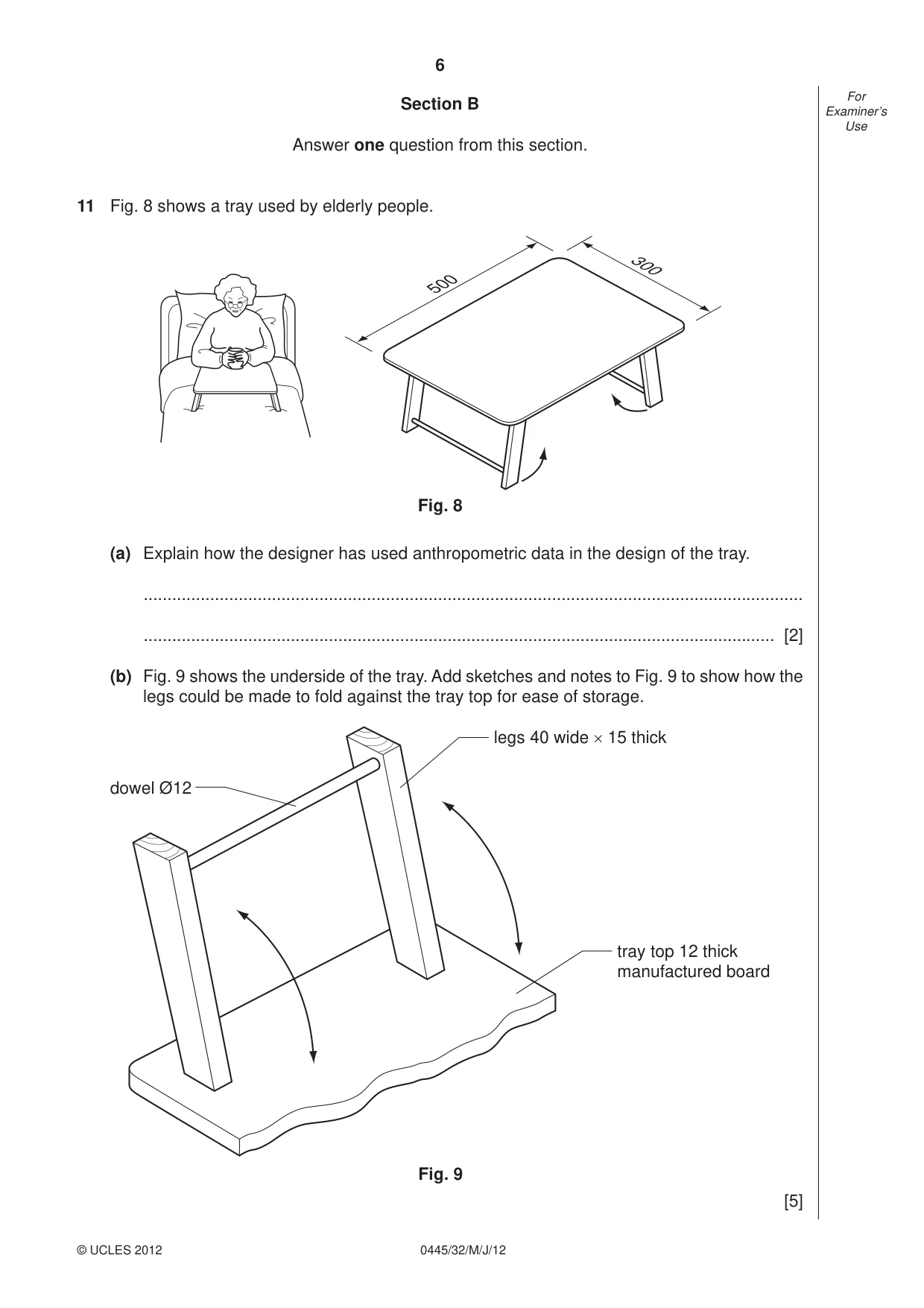
6 0445/32/M/J/12 © UCLES 2012 For Examiner’s Use Section B Answer one question from this section. 11 Fig. 8 shows a tray used by elderly people. 300 500 Fig. 8 (a) Explain how the designer has used anthropometric data in the design of the tray. … … [2] (b) Fig. 9 shows the underside of the tray. Add sketches and notes to Fig. 9 to show how the legs could be made to fold against the tray top for ease of storage. dowel Ø12 legs 40 wide × 15 thick tray top 12 thick manufactured board Fig. 9 [5]
Question paper, page 7
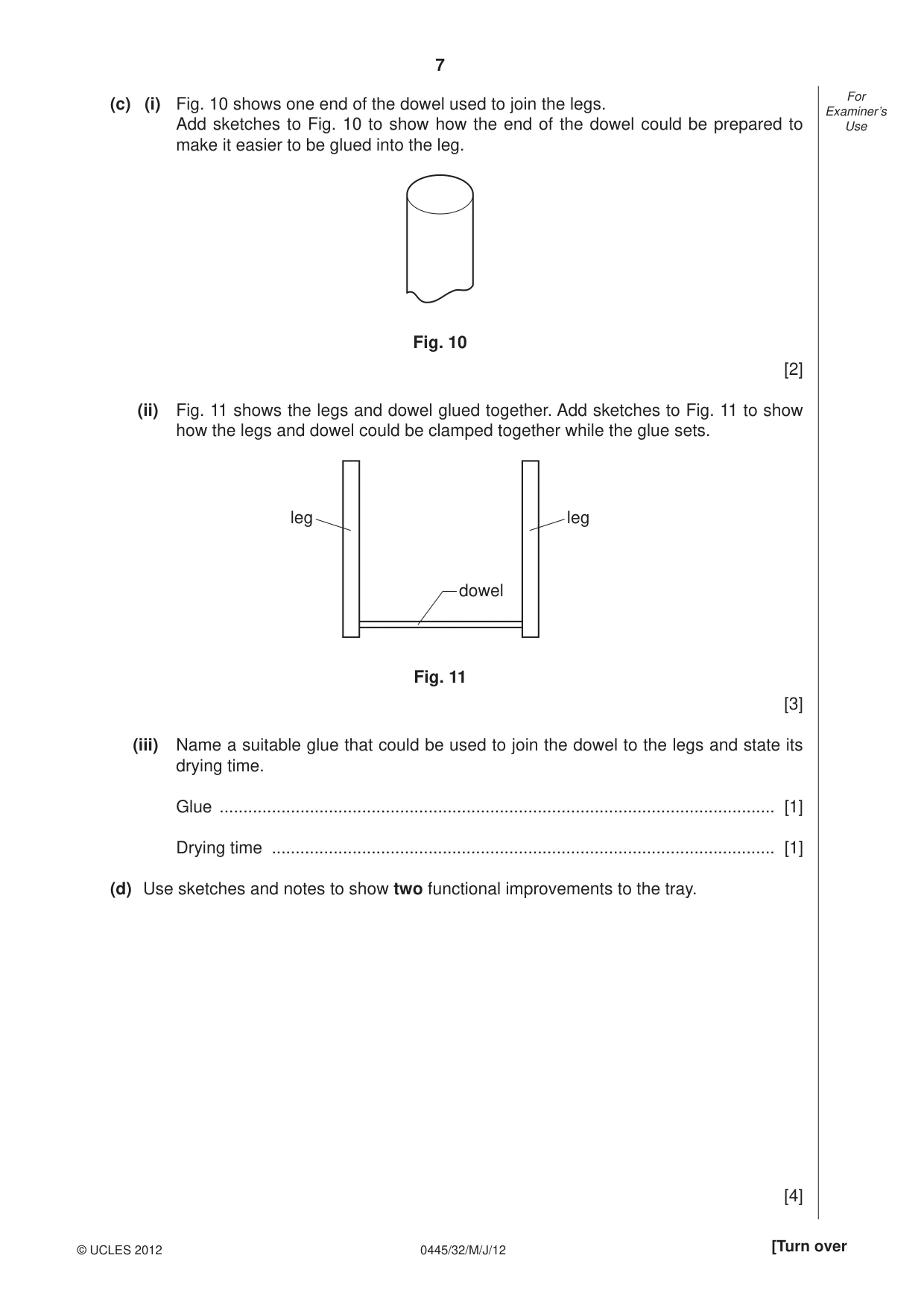
7 0445/32/M/J/12 © UCLES 2012 [Turn over For Examiner’s Use (c) (i) Fig. 10 shows one end of the dowel used to join the legs. Add sketches to Fig. 10 to show how the end of the dowel could be prepared to make it easier to be glued into the leg. Fig. 10 [2] (ii) Fig. 11 shows the legs and dowel glued together. Add sketches to Fig. 11 to show how the legs and dowel could be clamped together while the glue sets. dowel leg leg Fig. 11 [3] (iii) Name a suitable glue that could be used to join the dowel to the legs and state its drying time. Glue … [1] Drying time … [1] (d) Use sketches and notes to show two functional improvements to the tray. [4]
Question paper, page 8
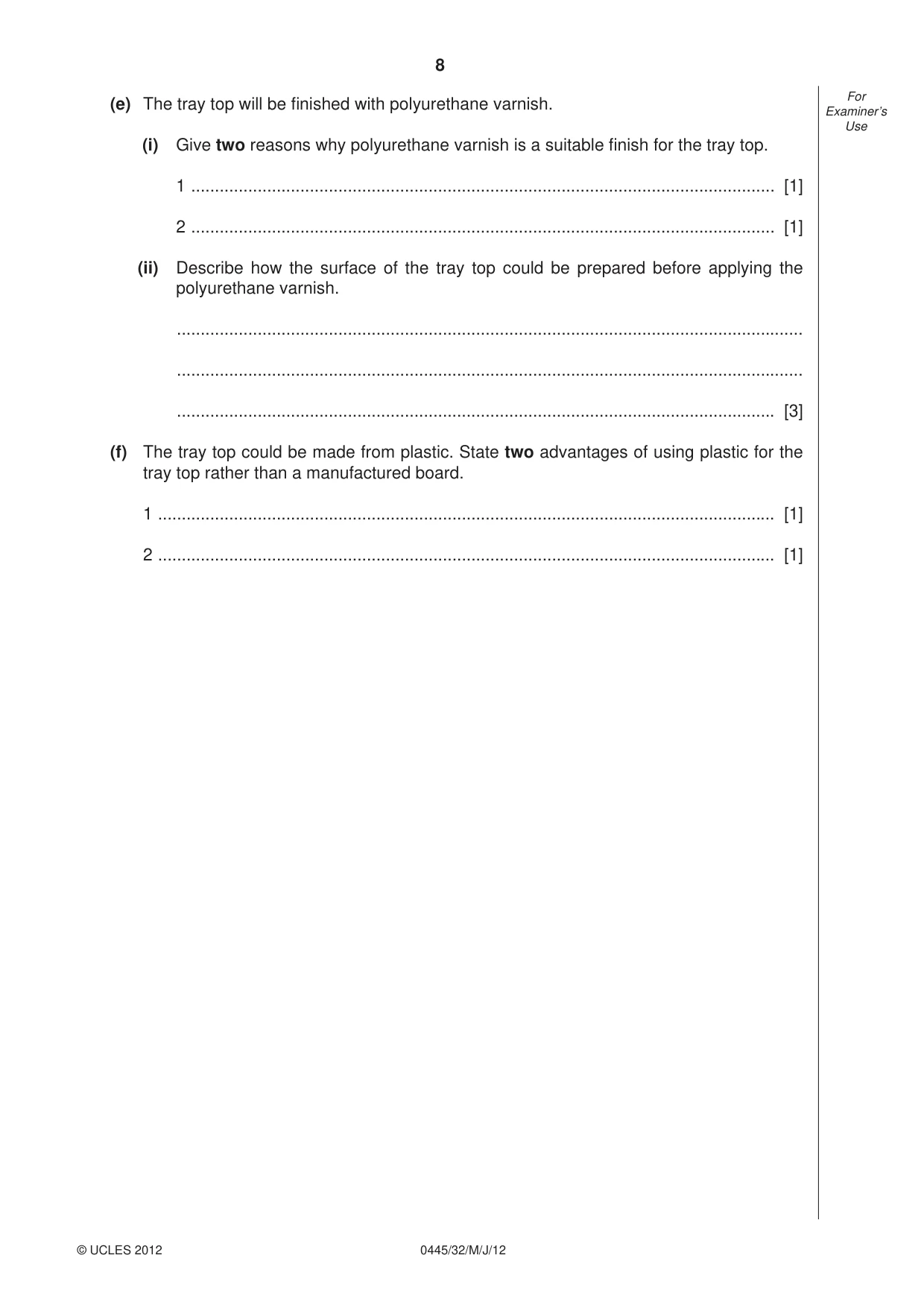
8 0445/32/M/J/12 © UCLES 2012 For Examiner’s Use (e) The tray top will be fi nished with polyurethane varnish. (i) Give two reasons why polyurethane varnish is a suitable fi nish for the tray top. 1 … [1] 2 … [1] (ii) Describe how the surface of the tray top could be prepared before applying the polyurethane varnish. … … … [3] (f) The tray top could be made from plastic. State two advantages of using plastic for the tray top rather than a manufactured board. 1 … [1] 2 … [1]
Question paper, page 9
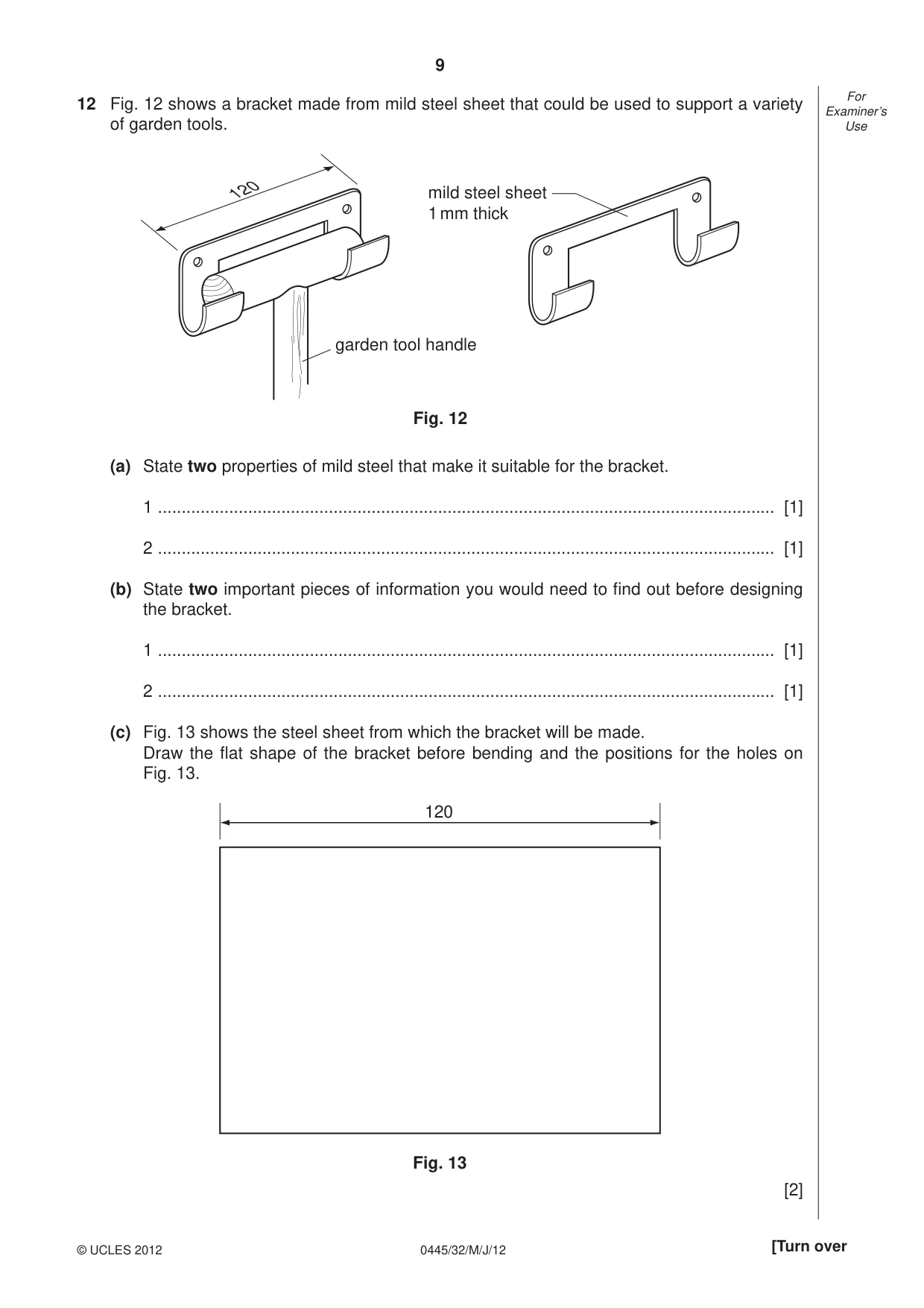
9 0445/32/M/J/12 © UCLES 2012 [Turn over For Examiner’s Use 12 Fig. 12 shows a bracket made from mild steel sheet that could be used to support a variety of garden tools. mild steel sheet 1 mm thick 120 garden tool handle Fig. 12 (a) State two properties of mild steel that make it suitable for the bracket. 1 … [1] 2 … [1] (b) State two important pieces of information you would need to fi nd out before designing the bracket. 1 … [1] 2 … [1] (c) Fig. 13 shows the steel sheet from which the bracket will be made. Draw the fl at shape of the bracket before bending and the positions for the holes on Fig. 13. 120 Fig. 13 [2]
Question paper, page 10
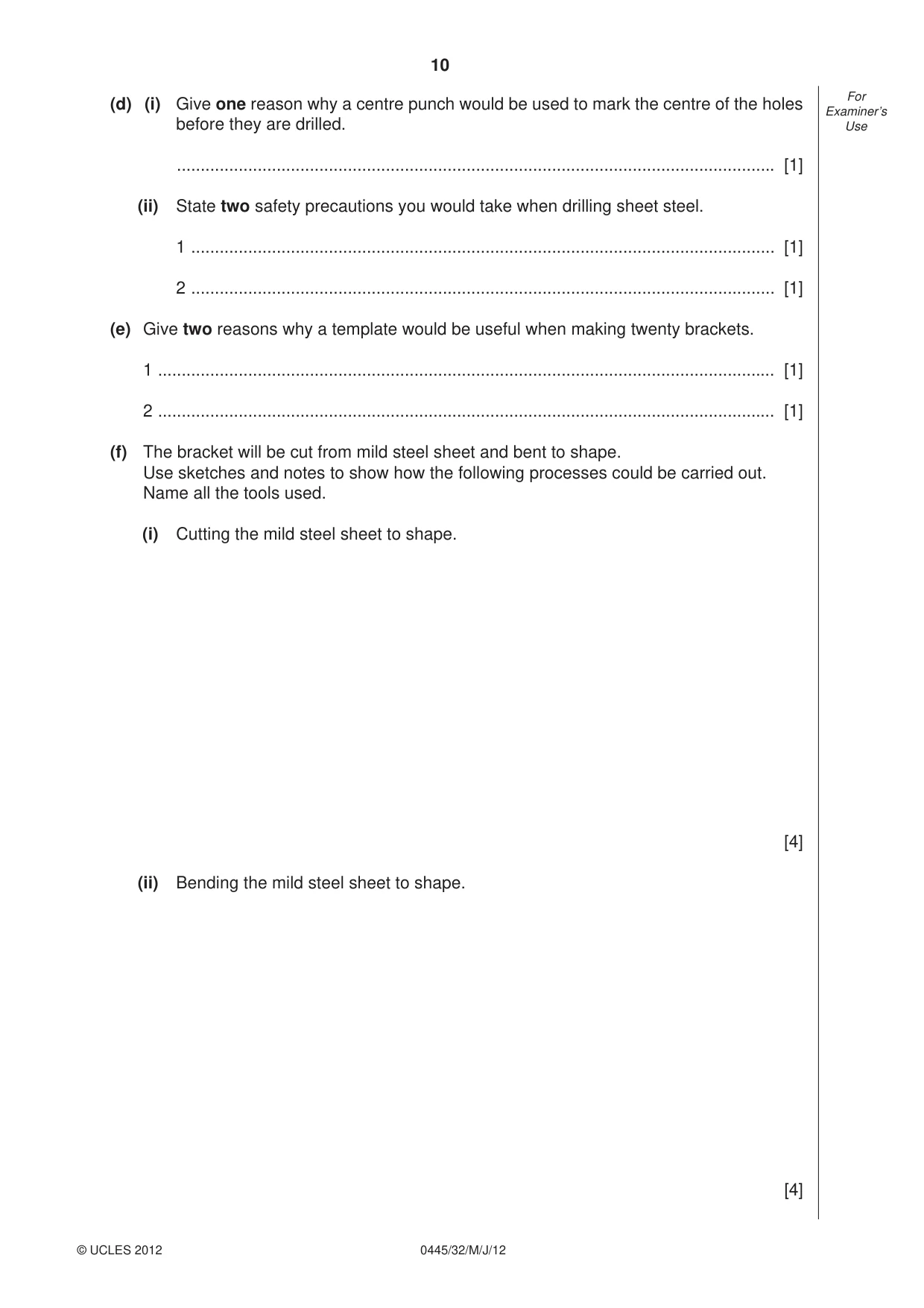
10 0445/32/M/J/12 © UCLES 2012 For Examiner’s Use (d) (i) Give one reason why a centre punch would be used to mark the centre of the holes before they are drilled. … [1] (ii) State two safety precautions you would take when drilling sheet steel. 1 … [1] 2 … [1] (e) Give two reasons why a template would be useful when making twenty brackets. 1 … [1] 2 … [1] (f) The bracket will be cut from mild steel sheet and bent to shape. Use sketches and notes to show how the following processes could be carried out. Name all the tools used. (i) Cutting the mild steel sheet to shape. [4] (ii) Bending the mild steel sheet to shape. [4]
Question paper, page 11
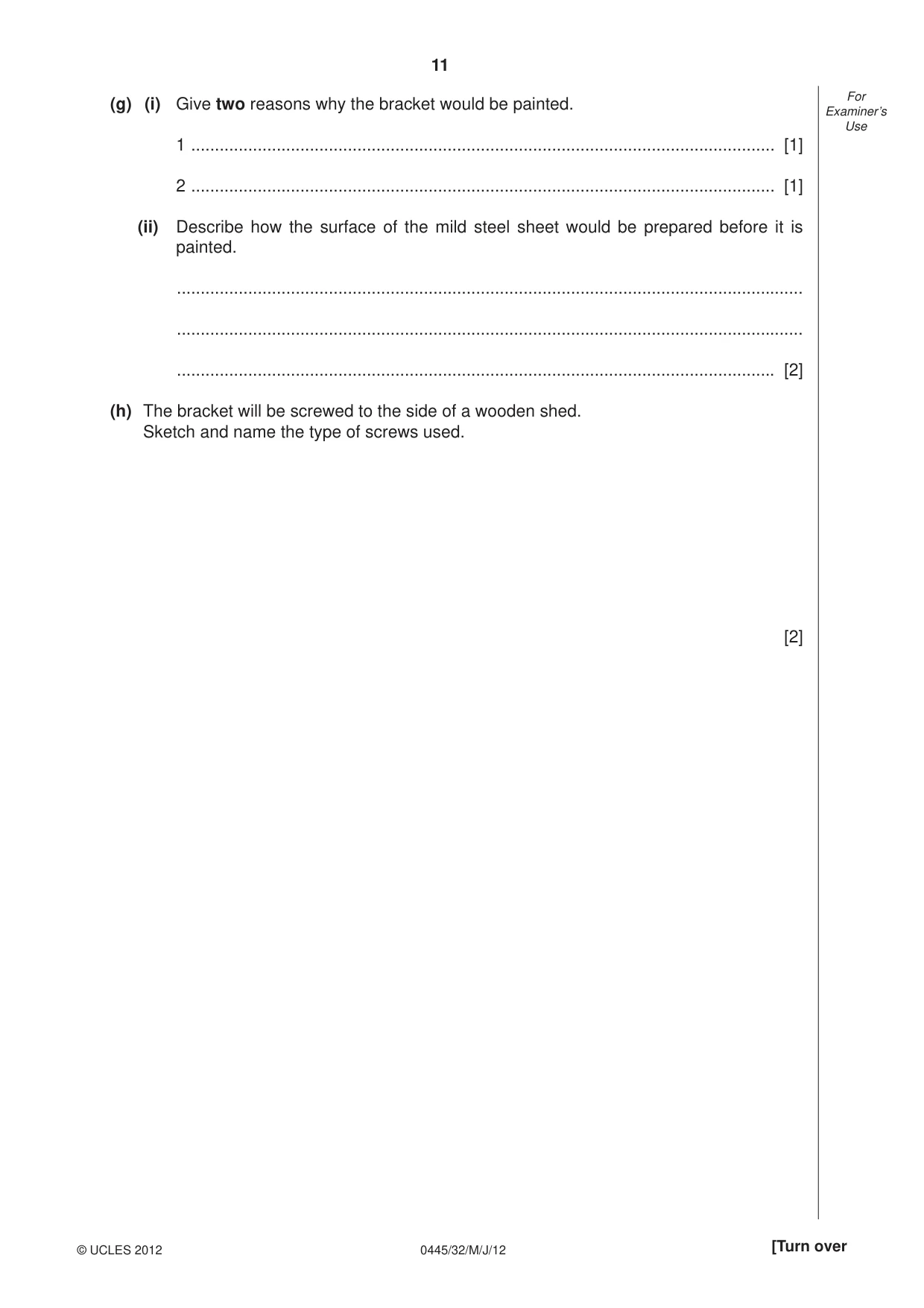
11 0445/32/M/J/12 © UCLES 2012 [Turn over For Examiner’s Use (g) (i) Give two reasons why the bracket would be painted. 1 … [1] 2 … [1] (ii) Describe how the surface of the mild steel sheet would be prepared before it is painted. … … … [2] (h) The bracket will be screwed to the side of a wooden shed. Sketch and name the type of screws used. [2]
Question paper, page 12
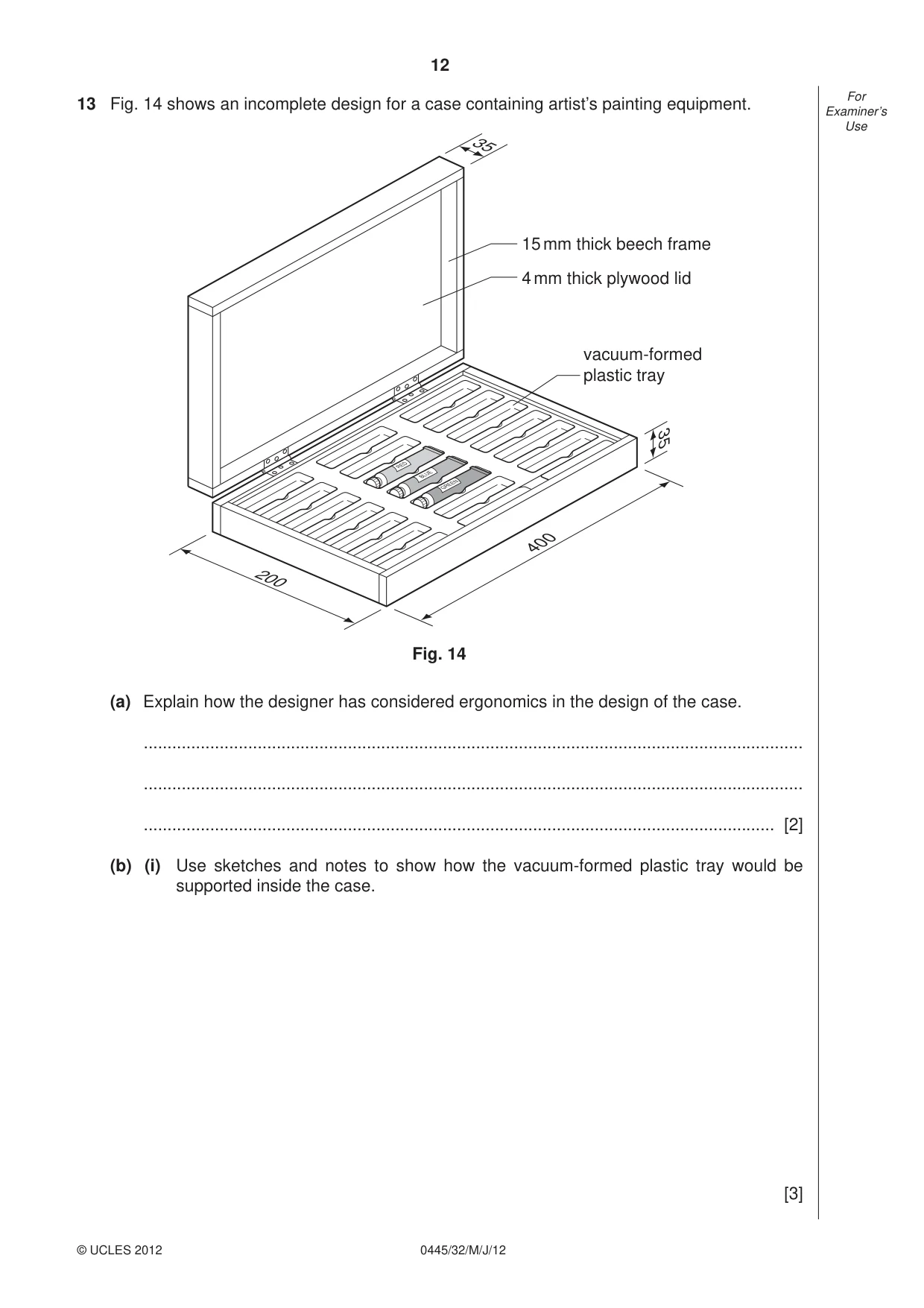
12 0445/32/M/J/12 © UCLES 2012 For Examiner’s Use 13 Fig. 14 shows an incomplete design for a case containing artist’s painting equipment. GREEN BLUE RED 15 mm thick beech frame 4 mm thick plywood lid vacuum-formed plastic tray 400 35 200 35 Fig. 14 (a) Explain how the designer has considered ergonomics in the design of the case. … … … [2] (b) (i) Use sketches and notes to show how the vacuum-formed plastic tray would be supported inside the case. [3]
Question paper, page 13
13 0445/32/M/J/12 © UCLES 2012 [Turn over For Examiner’s Use (ii) Give two advantages of using a vacuum-formed plastic tray to store the tubes of paint rather than separate wooden partitions. 1 … [1] 2 … [1] (c) Hinges used to join the two halves of the case will be recessed into the edge of the case. Fig. 15 shows one recess marked out, ready to be cut out. Fig. 15 (i) Name a suitable hinge used to join the two halves of the case. … [1] (ii) Name two marking out tools, other than a pencil and steel rule, that could be used to mark out the recess. 1 … [1] 2 … [1] (iii) Use sketches and notes to show how the recess could be cut out. Name all the tools used. [3]
Question paper, page 14
14 0445/32/M/J/12 © UCLES 2012 For Examiner’s Use (d) Use sketches and notes to show how the 4 mm thick plywood lid could be fi tted inside the 15 mm thick beech frame. The edges of the plywood must not be visible. [3] (e) Use sketches and notes to show a pre-manufactured fi tting that could be used to fasten the two halves of the case securely when being carried. [3] (f) Use sketches and notes to show how artists’ paintbrushes could be stored inside the lid. The design must: ● store the paintbrushes securely; ● protect the bristles of the paintbrushes; ● include details of materials and fittings used. [6]
Question paper, page 15
15 0445/32/M/J/12 © UCLES 2012 BLANK PAGE
Question paper, page 16
16 0445/32/M/J/12 Permission to reproduce items where third-party owned material protected by copyright is included has been sought and cleared where possible. Every reasonable effort has been made by the publisher (UCLES) to trace copyright holders, but if any items requiring clearance have unwittingly been included the publisher will be pleased to make amends at the earliest possible opportunity. University of Cambridge International Examinations is part of the Cambridge Assessment Group. Cambridge Assessment is the brand name of University of Cambridge Local Examinations Syndicate (UCLES), which is itself a department of the University of Cambridge. BLANK PAGE © UCLES 2012
Mark scheme, page 1
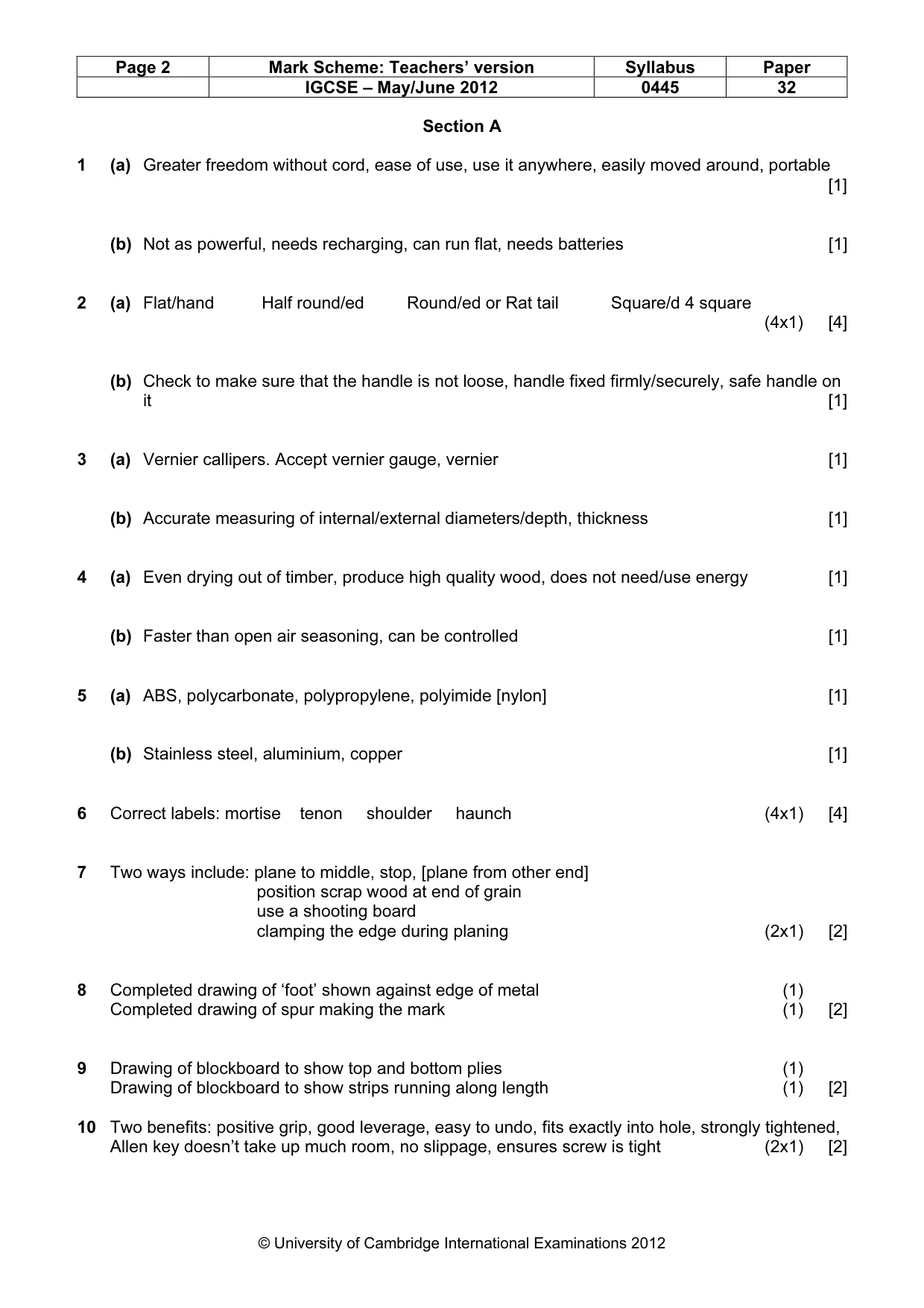
UNIVERSITY OF CAMBRIDGE INTERNATIONAL EXAMINATIONS International General Certificate of Secondary Education MARK SCHEME for the May/June 2012 question paper for the guidance of teachers 0445 DESIGN AND TECHNOLOGY 0445/32 Paper 3 (Resistant Materials), maximum raw mark 50 This mark scheme is published as an aid to teachers and candidates, to indicate the requirements of the examination. It shows the basis on which Examiners were instructed to award marks. It does not indicate the details of the discussions that took place at an Examiners’ meeting before marking began, which would have considered the acceptability of alternative answers. Mark schemes must be read in conjunction with the question papers and the report on the examination. • Cambridge will not enter into discussions or correspondence in connection with these mark schemes. Cambridge is publishing the mark schemes for the May/June 2012 question papers for most IGCSE, GCE Advanced Level and Advanced Subsidiary Level syllabuses and some Ordinary Level syllabuses. www.XtremePapers.com
Mark scheme, page 2
Page 2 Mark Scheme: Teachers’ version Syllabus Paper IGCSE – May/June 2012 0445 32 © University of Cambridge International Examinations 2012 Section A 1 (a) Greater freedom without cord, ease of use, use it anywhere, easily moved around, portable [1] (b) Not as powerful, needs recharging, can run flat, needs batteries [1] 2 (a) Flat/hand Half round/ed Round/ed or Rat tail Square/d 4 square (4x1) [4] (b) Check to make sure that the handle is not loose, handle fixed firmly/securely, safe handle on it [1] 3 (a) Vernier callipers. Accept vernier gauge, vernier [1] (b) Accurate measuring of internal/external diameters/depth, thickness [1] 4 (a) Even drying out of timber, produce high quality wood, does not need/use energy [1] (b) Faster than open air seasoning, can be controlled [1] 5 (a) ABS, polycarbonate, polypropylene, polyimide [nylon] [1] (b) Stainless steel, aluminium, copper [1] 6 Correct labels: mortise tenon shoulder haunch (4x1) [4] 7 Two ways include: plane to middle, stop, [plane from other end] position scrap wood at end of grain use a shooting board clamping the edge during planing (2x1) [2] 8 Completed drawing of ‘foot’ shown against edge of metal (1) Completed drawing of spur making the mark (1) [2] 9 Drawing of blockboard to show top and bottom plies (1) Drawing of blockboard to show strips running along length (1) [2] 10 Two benefits: positive grip, good leverage, easy to undo, fits exactly into hole, strongly tightened, Allen key doesn’t take up much room, no slippage, ensures screw is tight (2x1) [2]
Mark scheme, page 3
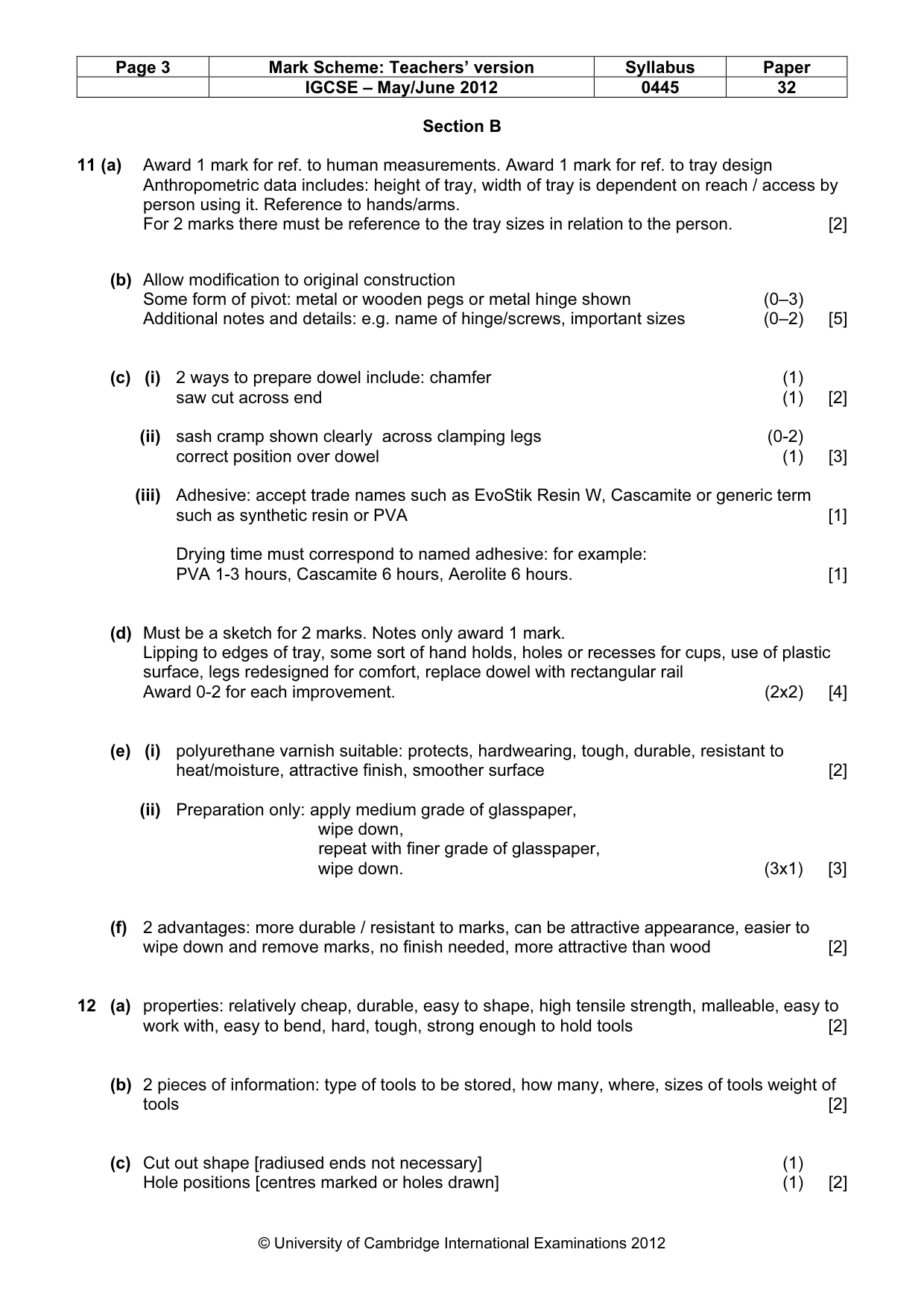
Page 3 Mark Scheme: Teachers’ version Syllabus Paper IGCSE – May/June 2012 0445 32 © University of Cambridge International Examinations 2012 Section B 11 (a) Award 1 mark for ref. to human measurements. Award 1 mark for ref. to tray design Anthropometric data includes: height of tray, width of tray is dependent on reach / access by person using it. Reference to hands/arms. For 2 marks there must be reference to the tray sizes in relation to the person. [2] (b) Allow modification to original construction Some form of pivot: metal or wooden pegs or metal hinge shown (0–3) Additional notes and details: e.g. name of hinge/screws, important sizes (0–2) [5] (c) (i) 2 ways to prepare dowel include: chamfer (1) saw cut across end (1) [2] (ii) sash cramp shown clearly across clamping legs (0-2) correct position over dowel (1) [3] (iii) Adhesive: accept trade names such as EvoStik Resin W, Cascamite or generic term such as synthetic resin or PVA [1] Drying time must correspond to named adhesive: for example: PVA 1-3 hours, Cascamite 6 hours, Aerolite 6 hours. [1] (d) Must be a sketch for 2 marks. Notes only award 1 mark. Lipping to edges of tray, some sort of hand holds, holes or recesses for cups, use of plastic surface, legs redesigned for comfort, replace dowel with rectangular rail Award 0-2 for each improvement. (2x2) [4] (e) (i) polyurethane varnish suitable: protects, hardwearing, tough, durable, resistant to heat/moisture, attractive finish, smoother surface [2] (ii) Preparation only: apply medium grade of glasspaper, wipe down, repeat with finer grade of glasspaper, wipe down. (3x1) [3] (f) 2 advantages: more durable / resistant to marks, can be attractive appearance, easier to wipe down and remove marks, no finish needed, more attractive than wood [2] 12 (a) properties: relatively cheap, durable, easy to shape, high tensile strength, malleable, easy to work with, easy to bend, hard, tough, strong enough to hold tools [2] (b) 2 pieces of information: type of tools to be stored, how many, where, sizes of tools weight of tools [2] (c) Cut out shape [radiused ends not necessary] (1) Hole positions [centres marked or holes drawn] (1) [2]
Mark scheme, page 4
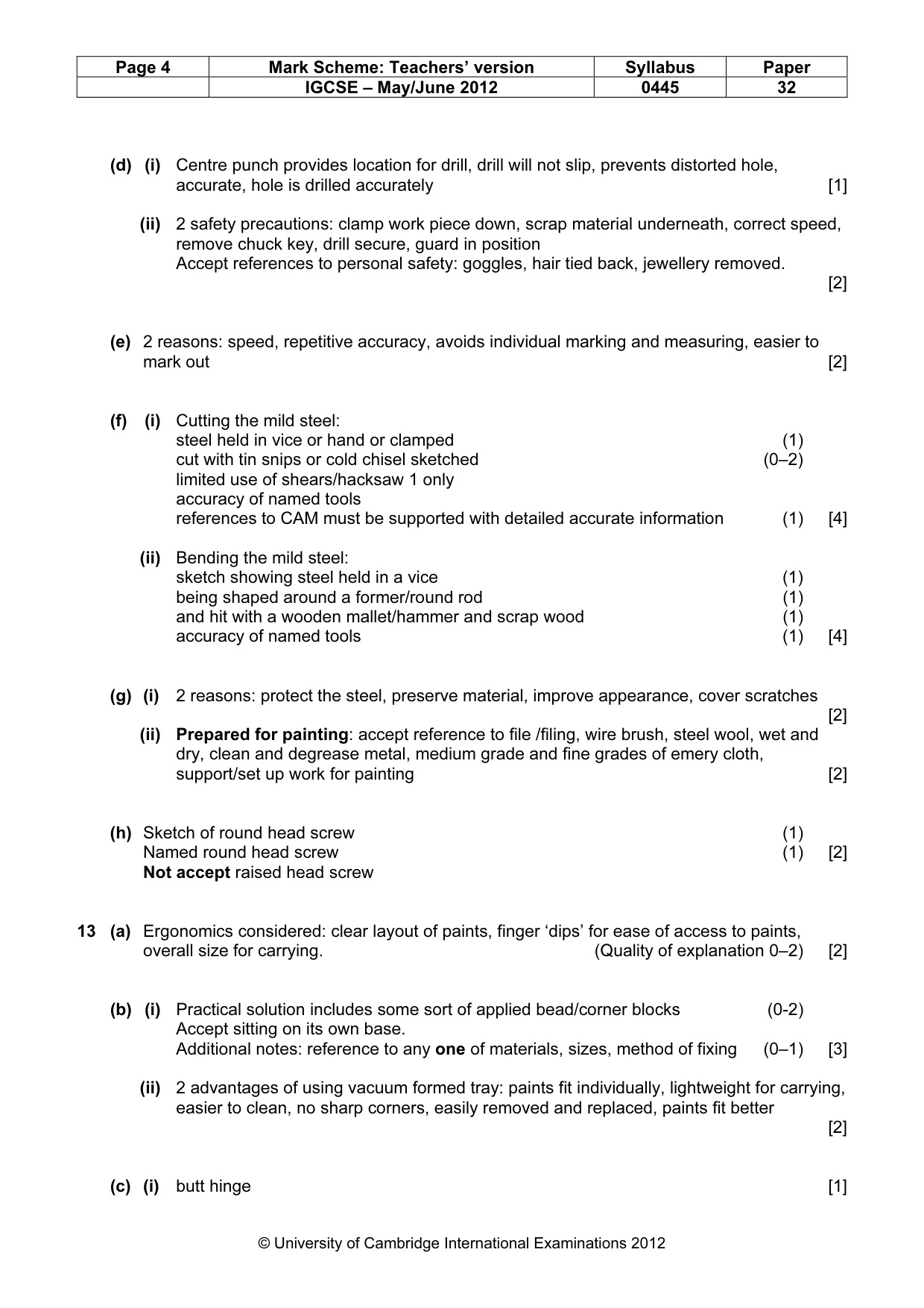
Page 4 Mark Scheme: Teachers’ version Syllabus Paper IGCSE – May/June 2012 0445 32 © University of Cambridge International Examinations 2012 (d) (i) Centre punch provides location for drill, drill will not slip, prevents distorted hole, accurate, hole is drilled accurately [1] (ii) 2 safety precautions: clamp work piece down, scrap material underneath, correct speed, remove chuck key, drill secure, guard in position Accept references to personal safety: goggles, hair tied back, jewellery removed. [2] (e) 2 reasons: speed, repetitive accuracy, avoids individual marking and measuring, easier to mark out [2] (f) (i) Cutting the mild steel: steel held in vice or hand or clamped (1) cut with tin snips or cold chisel sketched (0–2) limited use of shears/hacksaw 1 only accuracy of named tools references to CAM must be supported with detailed accurate information (1) [4] (ii) Bending the mild steel: sketch showing steel held in a vice (1) being shaped around a former/round rod (1) and hit with a wooden mallet/hammer and scrap wood (1) accuracy of named tools (1) [4] (g) (i) 2 reasons: protect the steel, preserve material, improve appearance, cover scratches [2] (ii) Prepared for painting: accept reference to file /filing, wire brush, steel wool, wet and dry, clean and degrease metal, medium grade and fine grades of emery cloth, support/set up work for painting [2] (h) Sketch of round head screw (1) Named round head screw (1) [2] Not accept raised head screw 13 (a) Ergonomics considered: clear layout of paints, finger ‘dips’ for ease of access to paints, overall size for carrying. (Quality of explanation 0–2) [2] (b) (i) Practical solution includes some sort of applied bead/corner blocks (0-2) Accept sitting on its own base. Additional notes: reference to any one of materials, sizes, method of fixing (0–1) [3] (ii) 2 advantages of using vacuum formed tray: paints fit individually, lightweight for carrying, easier to clean, no sharp corners, easily removed and replaced, paints fit better [2] (c) (i) butt hinge [1]
Mark scheme, page 5
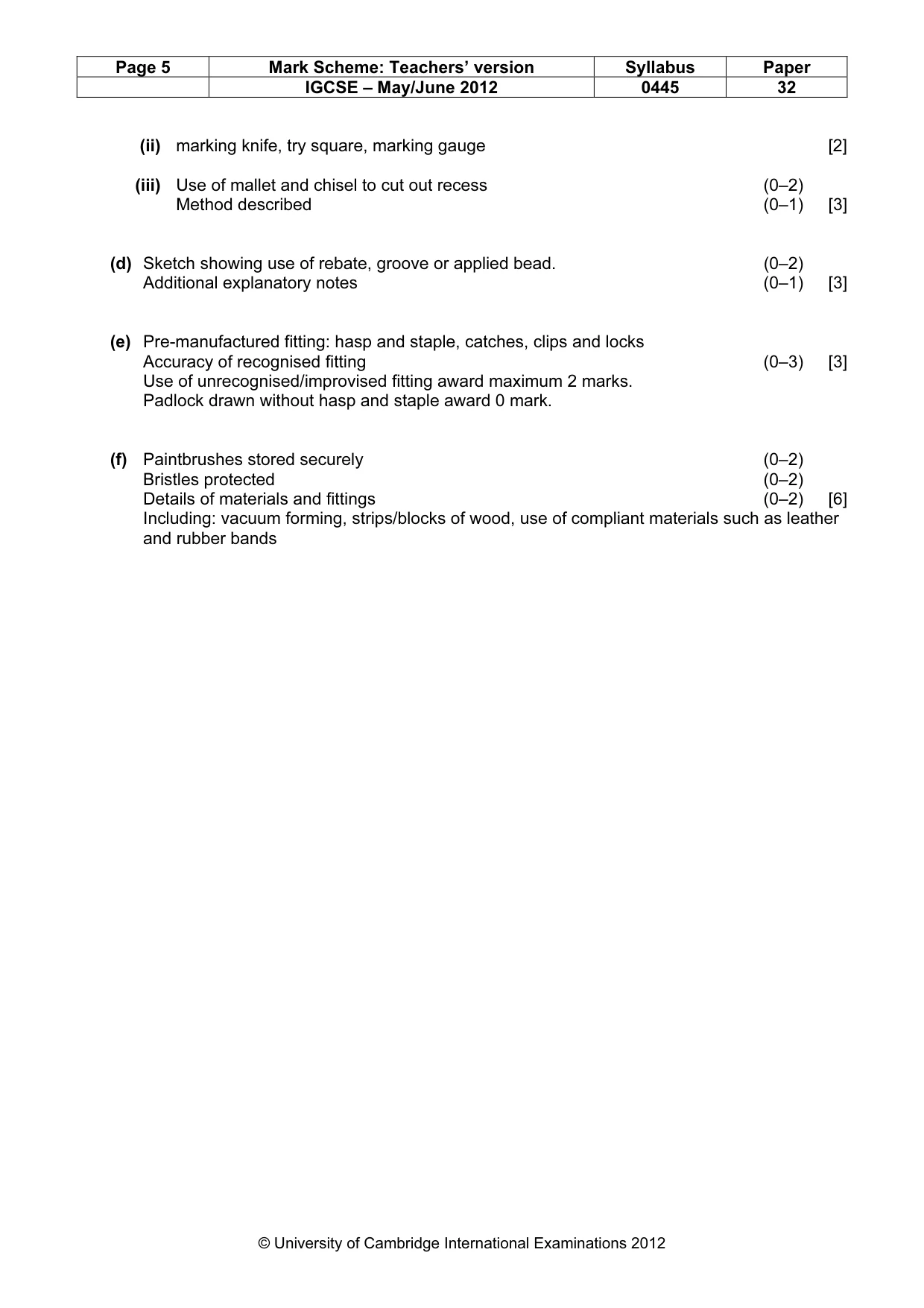
Page 5 Mark Scheme: Teachers’ version Syllabus Paper IGCSE – May/June 2012 0445 32 © University of Cambridge International Examinations 2012 (ii) marking knife, try square, marking gauge [2] (iii) Use of mallet and chisel to cut out recess (0–2) Method described (0–1) [3] (d) Sketch showing use of rebate, groove or applied bead. (0–2) Additional explanatory notes (0–1) [3] (e) Pre-manufactured fitting: hasp and staple, catches, clips and locks Accuracy of recognised fitting (0–3) [3] Use of unrecognised/improvised fitting award maximum 2 marks. Padlock drawn without hasp and staple award 0 mark. (f) Paintbrushes stored securely (0–2) Bristles protected (0–2) Details of materials and fittings (0–2) [6] Including: vacuum forming, strips/blocks of wood, use of compliant materials such as leather and rubber bands
What you needed in this session
Cambridge’s own grade thresholds for 2012 May/June, Paper 3 · Variant 2. A higher threshold means an easier paper — the bar moves with how the cohort did.