Cambridge IGCSE Design and Technology 0445 — 2012 May/June Paper 3 · Variant 3
0445/33/M/J/12 · 50 marks · ≈56 min
The question paper and its mark scheme, free to read here and free to download. This is Cambridge’s own paper, exactly as it was sat.
Question paper16 pages
Mark scheme6 pages
Answers below. Sit the paper first if you are practising.
Paper as text
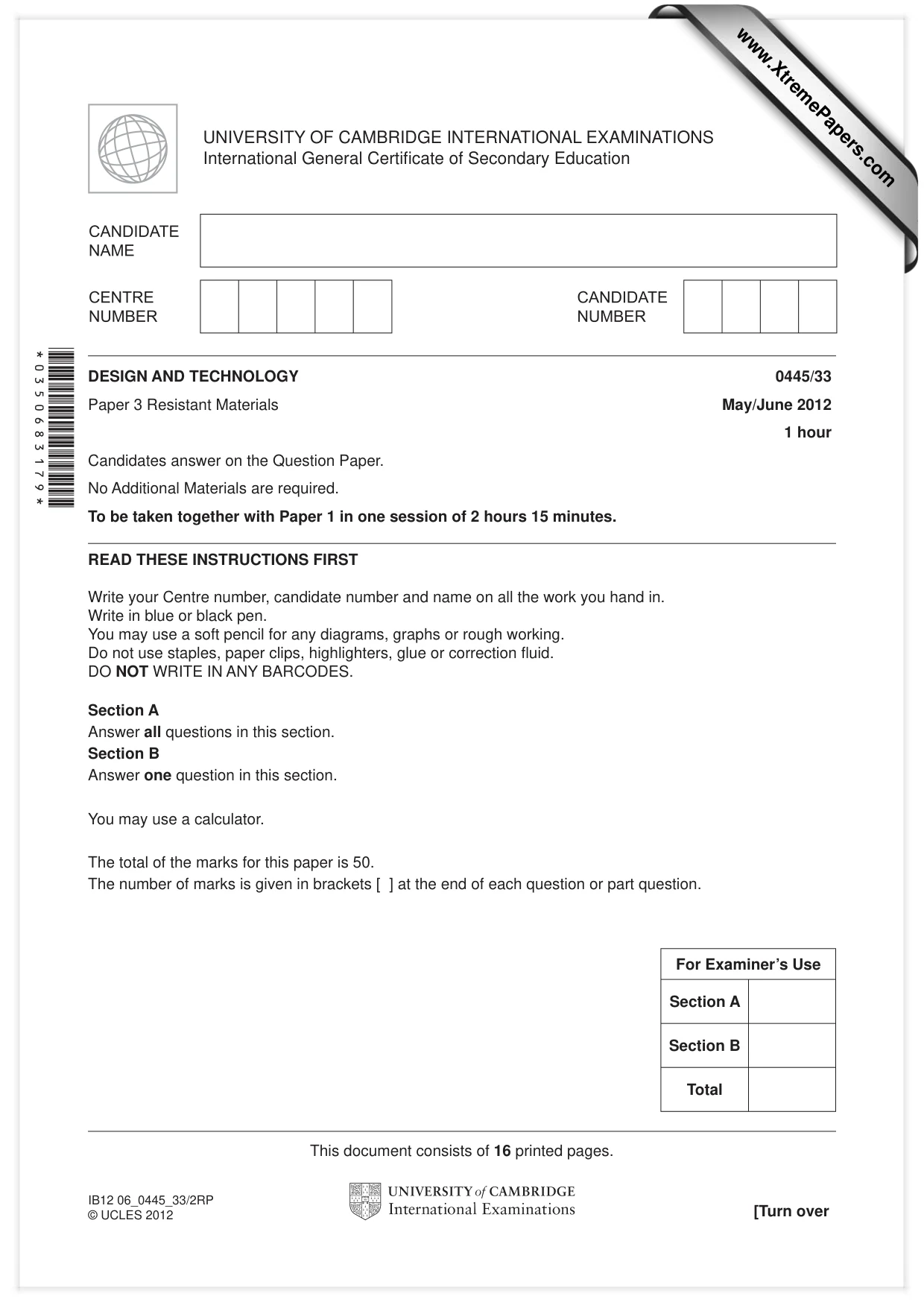
Question paper, page 1
READ THESE INSTRUCTIONS FIRST Write your Centre number, candidate number and name on all the work you hand in. Write in blue or black pen. You may use a soft pencil for any diagrams, graphs or rough working. Do not use staples, paper clips, highlighters, glue or correction fl uid. DO NOT WRITE IN ANY BARCODES. Section A Answer all questions in this section. Section B Answer one question in this section. You may use a calculator. The total of the marks for this paper is 50. The number of marks is given in brackets [ ] at the end of each question or part question. DESIGN AND TECHNOLOGY 0445/33 Paper 3 Resistant Materials May/June 2012 1 hour Candidates answer on the Question Paper. No Additional Materials are required. To be taken together with Paper 1 in one session of 2 hours 15 minutes. UNIVERSITY OF CAMBRIDGE INTERNATIONAL EXAMINATIONS International General Certifi cate of Secondary Education This document consists of 16 printed pages. [Turn over IB12 06_0445_33/2RP © UCLES 2012 *0350683179* For Examiner’s Use Section A Section B Total www.XtremePapers.com
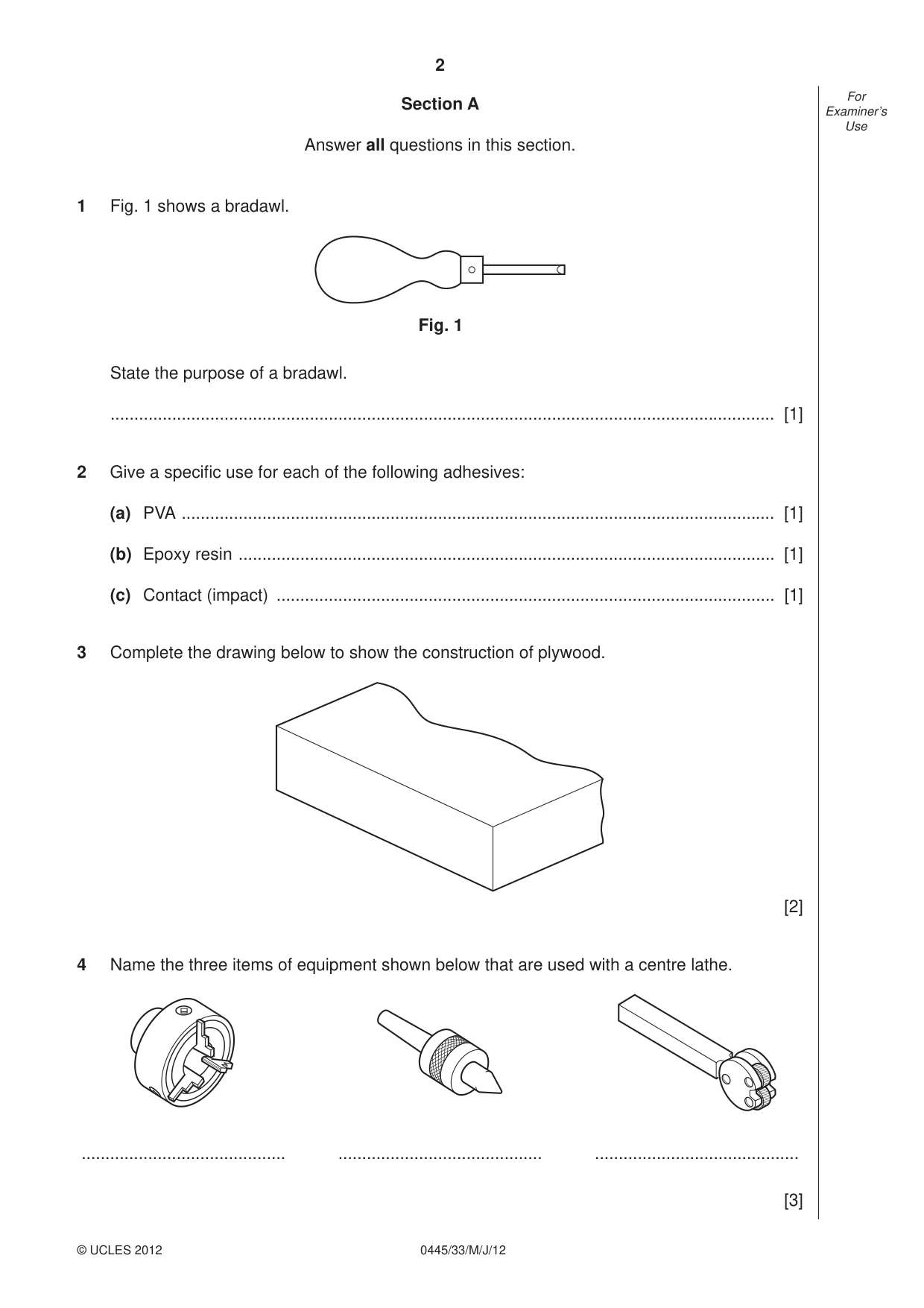
Question paper, page 2
2 0445/33/M/J/12 © UCLES 2012 For Examiner’s Use Section A Answer all questions in this section. 1 Fig. 1 shows a bradawl. Fig. 1 State the purpose of a bradawl. … [1] 2 Give a specifi c use for each of the following adhesives: (a) PVA … [1] (b) Epoxy resin … [1] (c) Contact (impact) … [1] 3 Complete the drawing below to show the construction of plywood. [2] 4 Name the three items of equipment shown below that are used with a centre lathe. … … … [3]
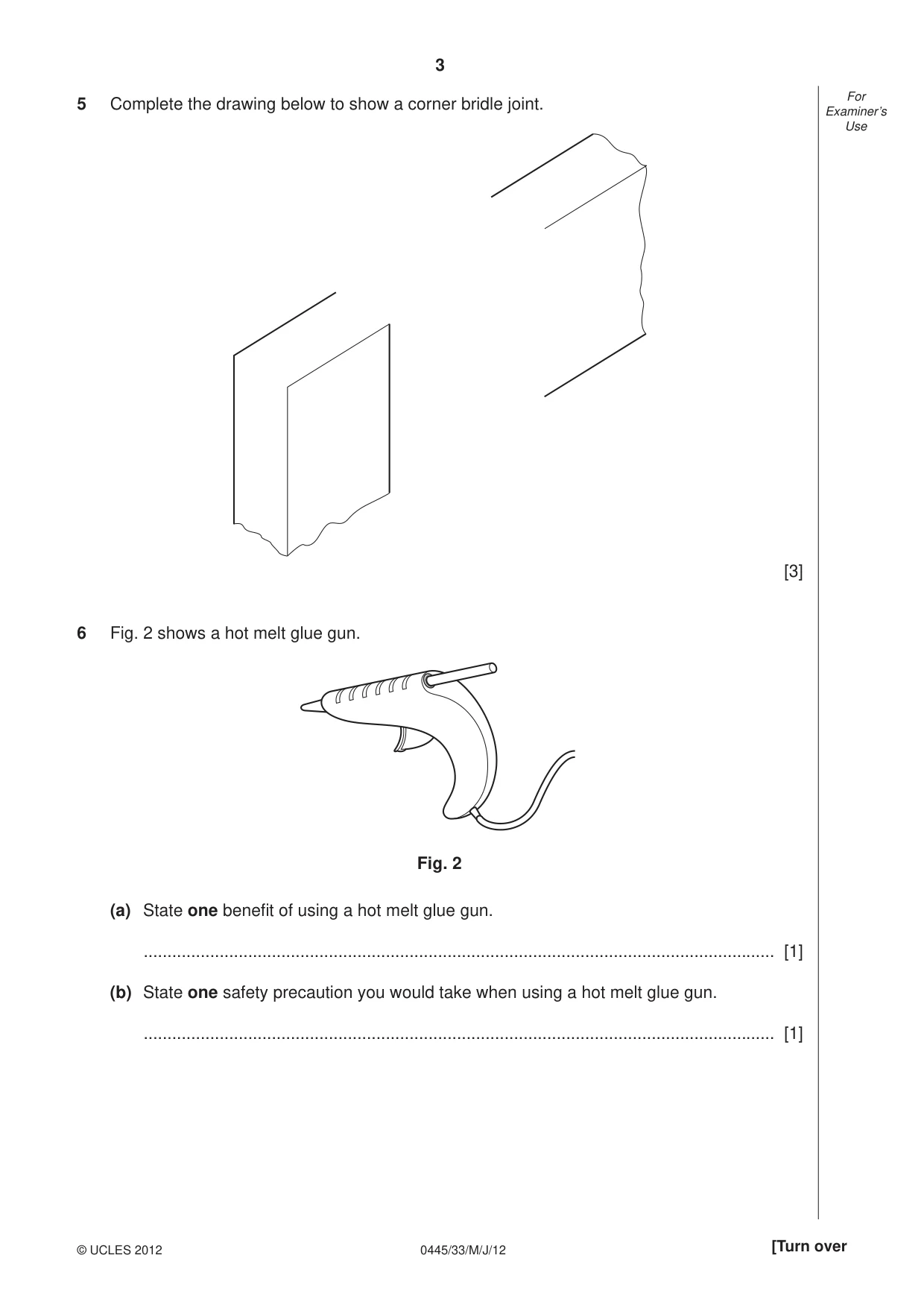
Question paper, page 3
3 0445/33/M/J/12 © UCLES 2012 [Turn over For Examiner’s Use 5 Complete the drawing below to show a corner bridle joint. [3] 6 Fig. 2 shows a hot melt glue gun. Fig. 2 (a) State one benefi t of using a hot melt glue gun. … [1] (b) State one safety precaution you would take when using a hot melt glue gun. … [1]
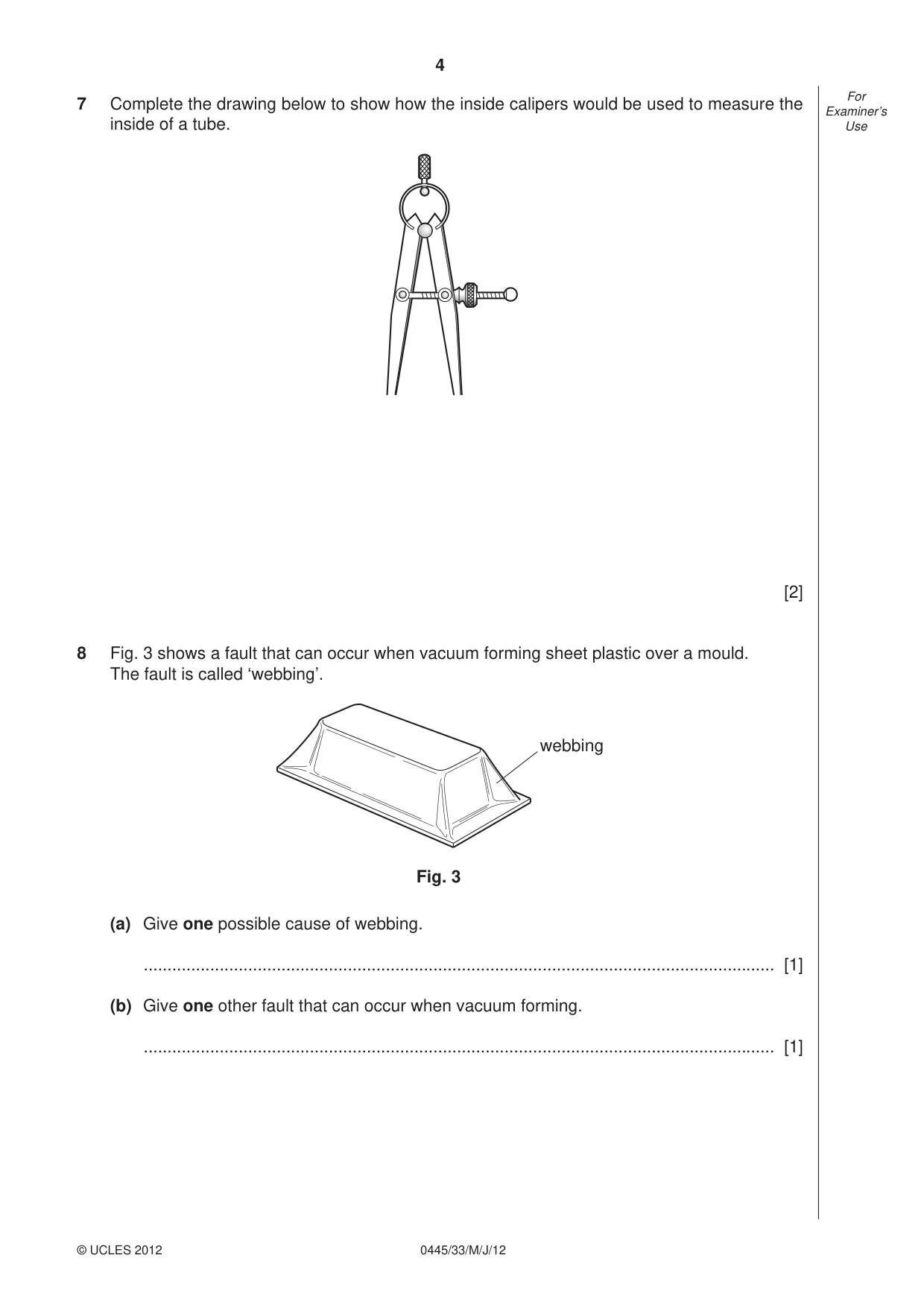
Question paper, page 4
4 0445/33/M/J/12 © UCLES 2012 For Examiner’s Use 7 Complete the drawing below to show how the inside calipers would be used to measure the inside of a tube. [2] 8 Fig. 3 shows a fault that can occur when vacuum forming sheet plastic over a mould. The fault is called ‘webbing’. webbing Fig. 3 (a) Give one possible cause of webbing. … [1] (b) Give one other fault that can occur when vacuum forming. … [1]
Question paper, page 5
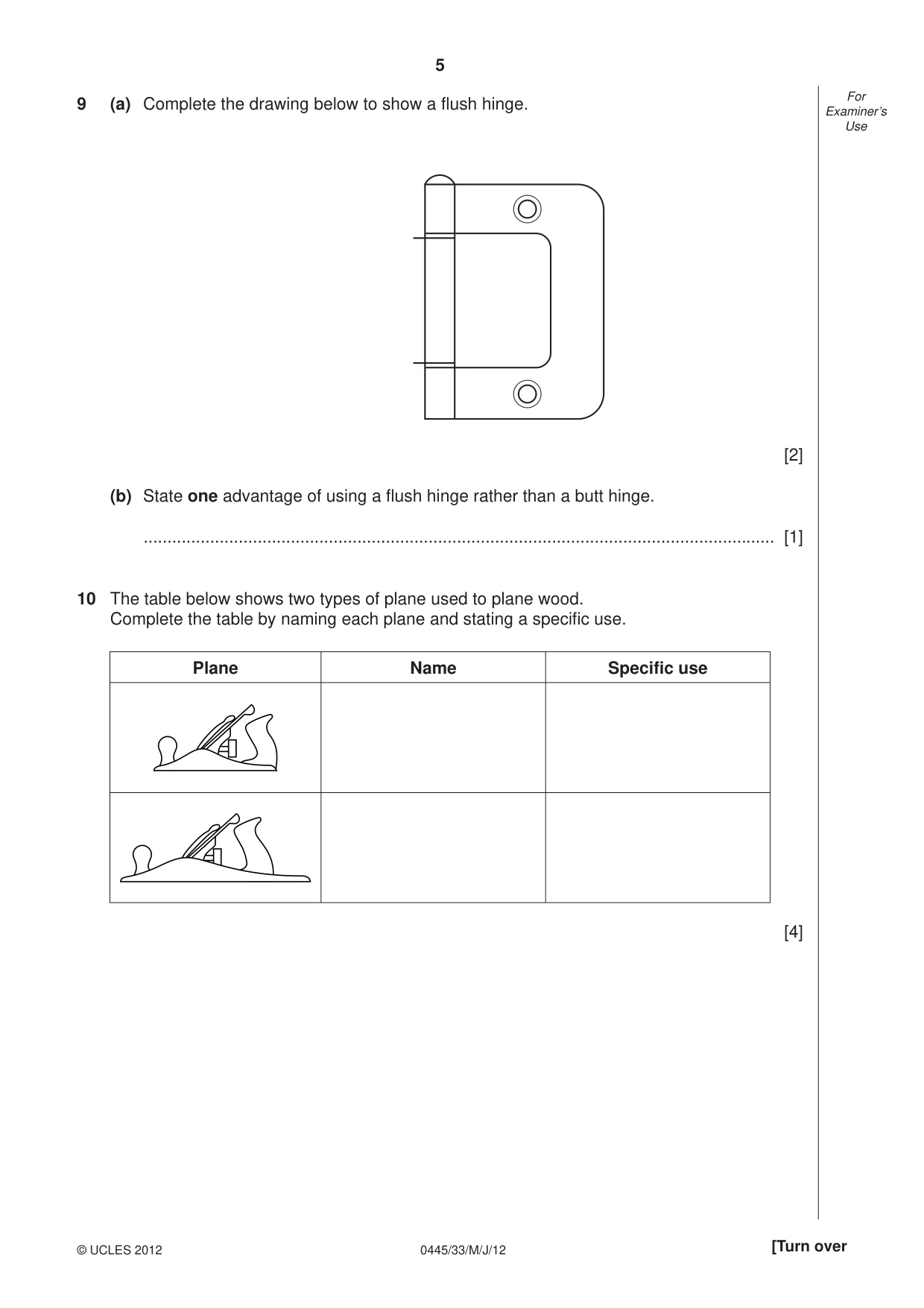
5 0445/33/M/J/12 © UCLES 2012 [Turn over For Examiner’s Use 9 (a) Complete the drawing below to show a fl ush hinge. [2] (b) State one advantage of using a fl ush hinge rather than a butt hinge. … [1] 10 The table below shows two types of plane used to plane wood. Complete the table by naming each plane and stating a specifi c use. Plane Name Specifi c use [4]
Question paper, page 6
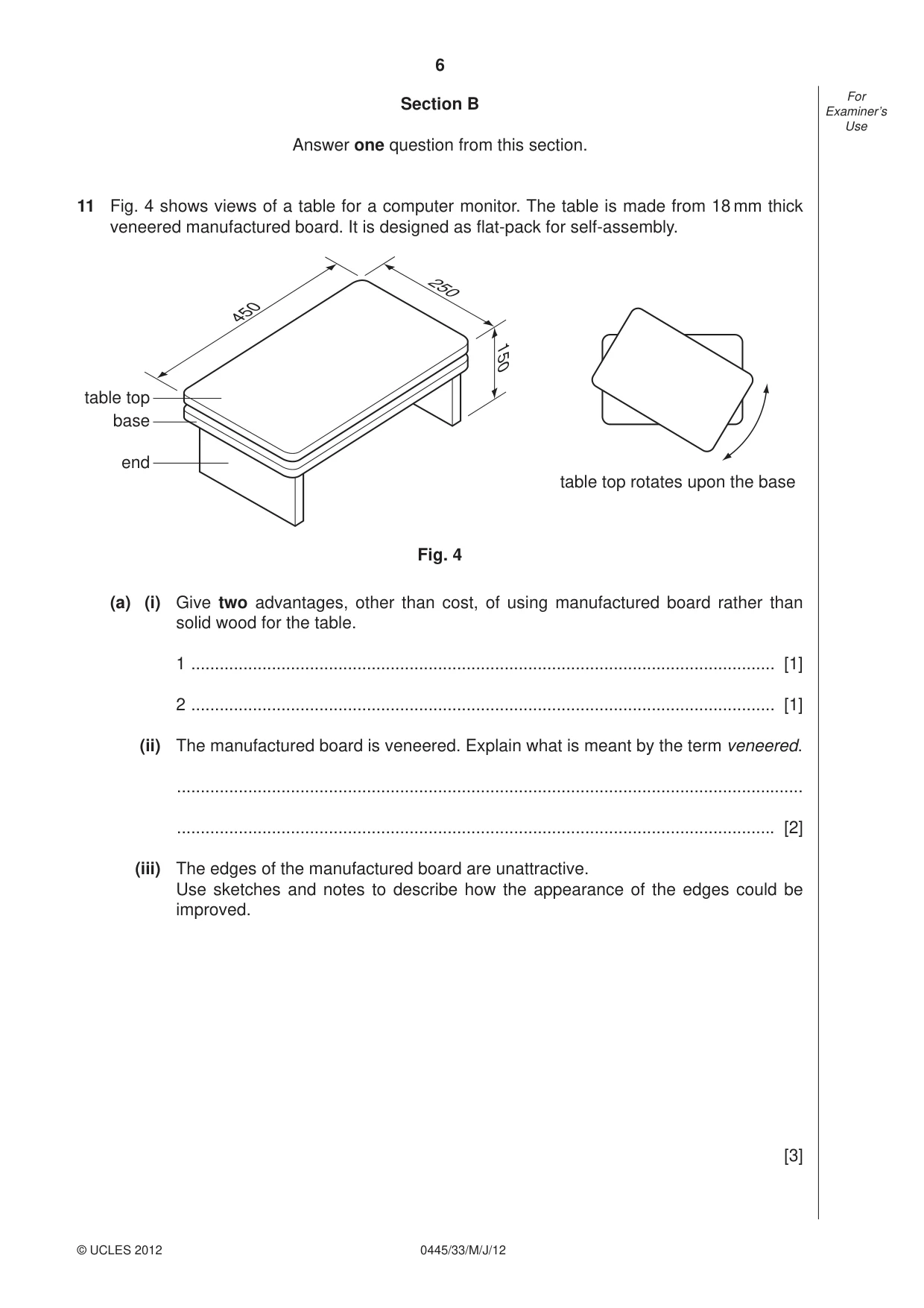
6 0445/33/M/J/12 © UCLES 2012 For Examiner’s Use Section B Answer one question from this section. 11 Fig. 4 shows views of a table for a computer monitor. The table is made from 18 mm thick veneered manufactured board. It is designed as fl at-pack for self-assembly. 450 250 150 table top base end table top rotates upon the base Fig. 4 (a) (i) Give two advantages, other than cost, of using manufactured board rather than solid wood for the table. 1 … [1] 2 … [1] (ii) The manufactured board is veneered. Explain what is meant by the term veneered. … … [2] (iii) The edges of the manufactured board are unattractive. Use sketches and notes to describe how the appearance of the edges could be improved. [3]
Question paper, page 7
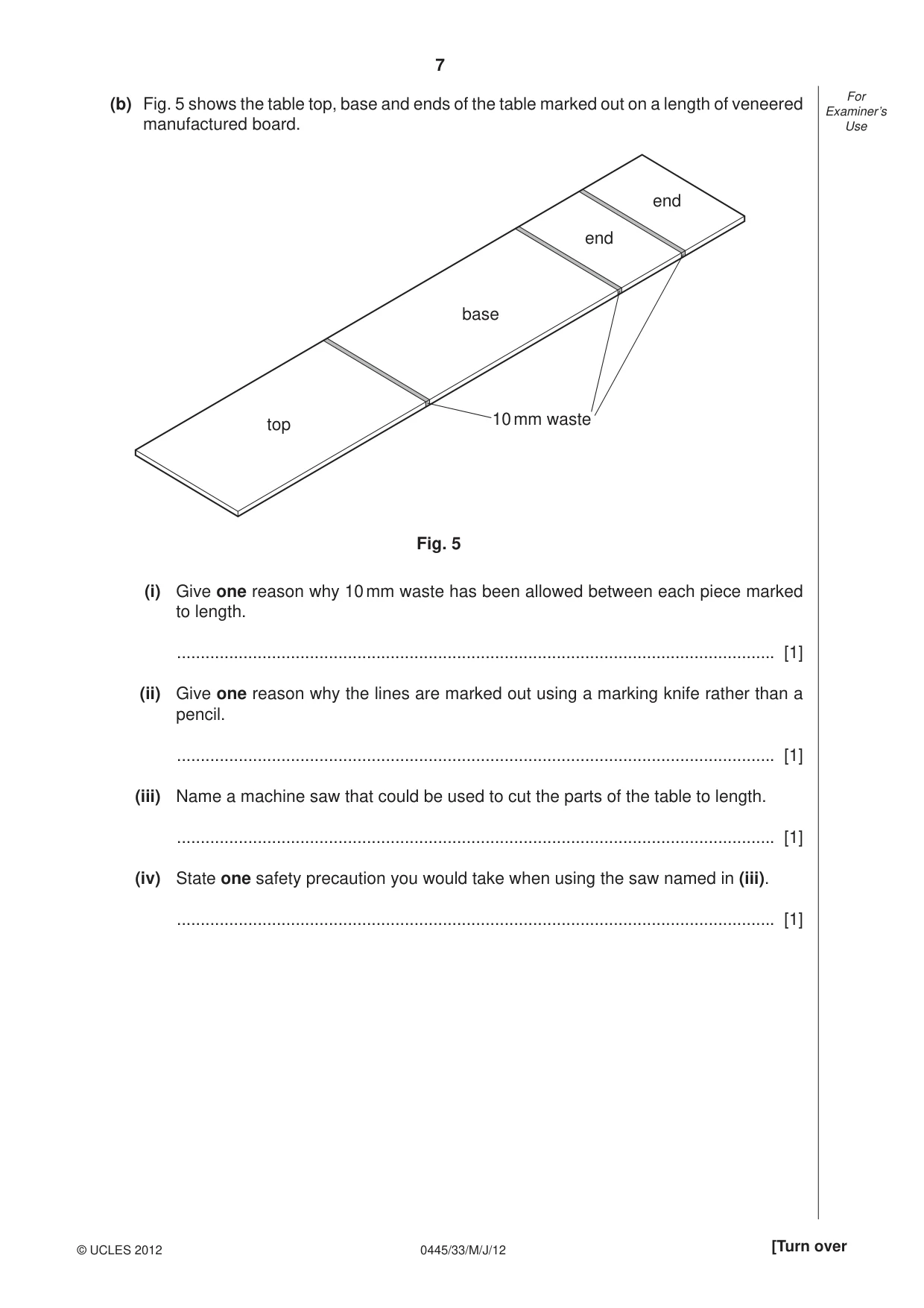
7 0445/33/M/J/12 © UCLES 2012 [Turn over For Examiner’s Use (b) Fig. 5 shows the table top, base and ends of the table marked out on a length of veneered manufactured board. end end base top 10 mm waste Fig. 5 (i) Give one reason why 10 mm waste has been allowed between each piece marked to length. … [1] (ii) Give one reason why the lines are marked out using a marking knife rather than a pencil. … [1] (iii) Name a machine saw that could be used to cut the parts of the table to length. … [1] (iv) State one safety precaution you would take when using the saw named in (iii). … [1]
Question paper, page 8
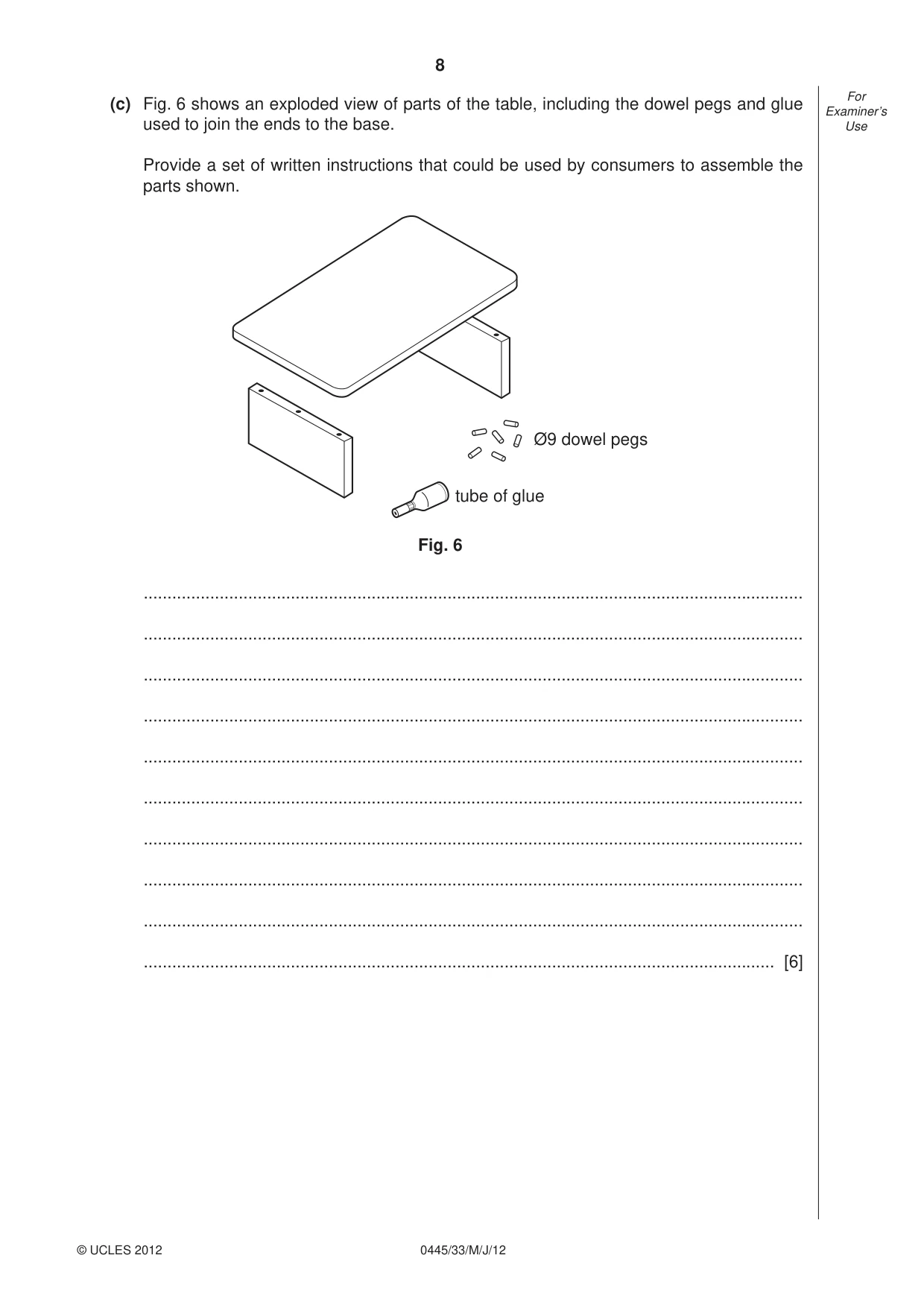
8 0445/33/M/J/12 © UCLES 2012 For Examiner’s Use (c) Fig. 6 shows an exploded view of parts of the table, including the dowel pegs and glue used to join the ends to the base. Provide a set of written instructions that could be used by consumers to assemble the parts shown. Fig. 6 Ø9 dowel pegs tube of glue … … … … … … … … … … [6]
Question paper, page 9
9 0445/33/M/J/12 © UCLES 2012 [Turn over For Examiner’s Use (d) Use sketches and notes to show how you would ensure that the holes for the dowel pegs in the ends and base line up accurately. [4] (e) Use sketches and notes to show how the table top could be made to rotate upon its base. Your method must: ● enable the table top to remain level at all times; ● include details of materials, sizes and fittings used. [4]
Question paper, page 10
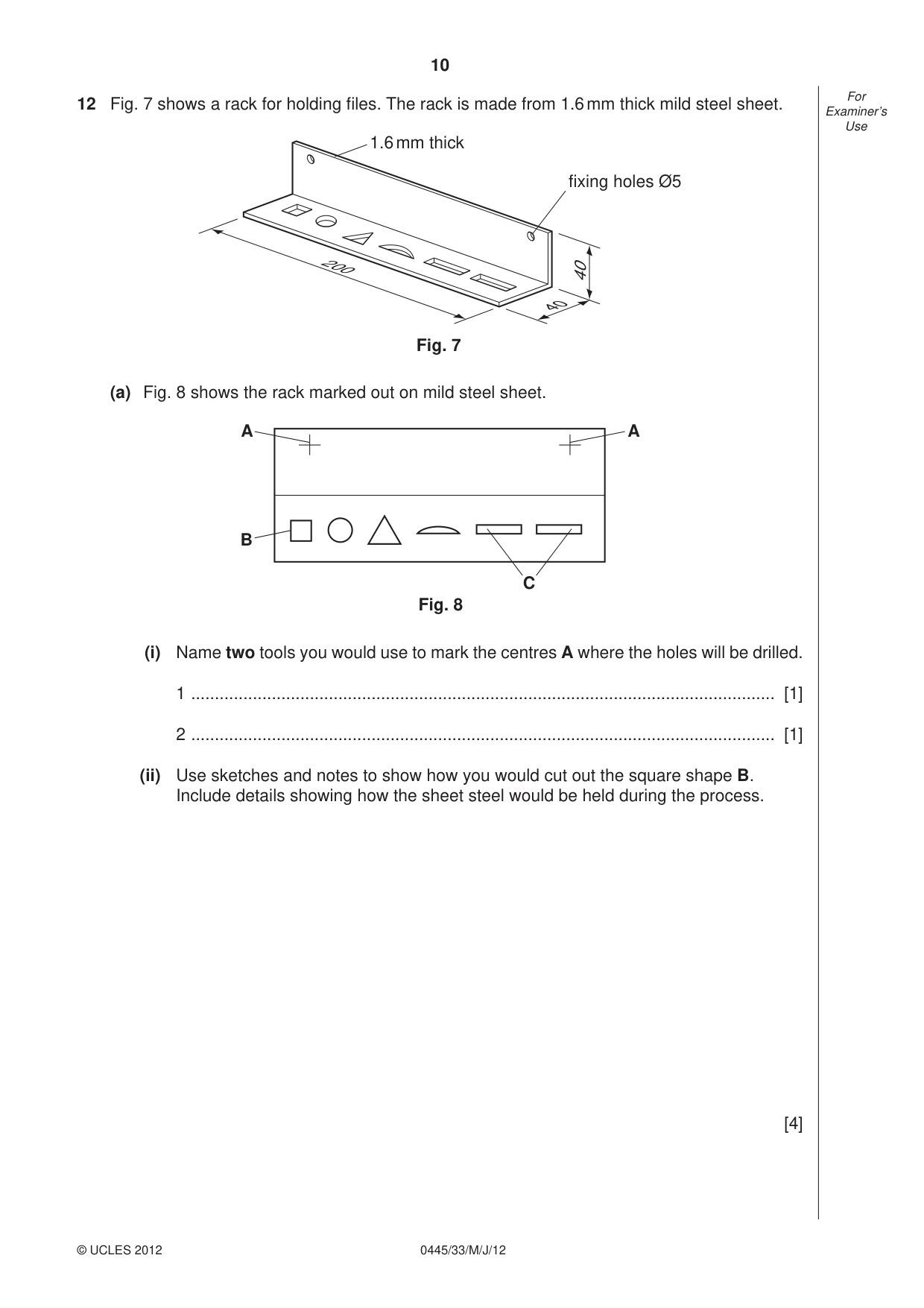
10 0445/33/M/J/12 © UCLES 2012 For Examiner’s Use 12 Fig. 7 shows a rack for holding fi les. The rack is made from 1.6 mm thick mild steel sheet. 1.6 mm thick fixing holes Ø5 40 40 200 Fig. 7 (a) Fig. 8 shows the rack marked out on mild steel sheet. A B A C Fig. 8 (i) Name two tools you would use to mark the centres A where the holes will be drilled. 1 … [1] 2 … [1] (ii) Use sketches and notes to show how you would cut out the square shape B. Include details showing how the sheet steel would be held during the process. [4]
Question paper, page 11
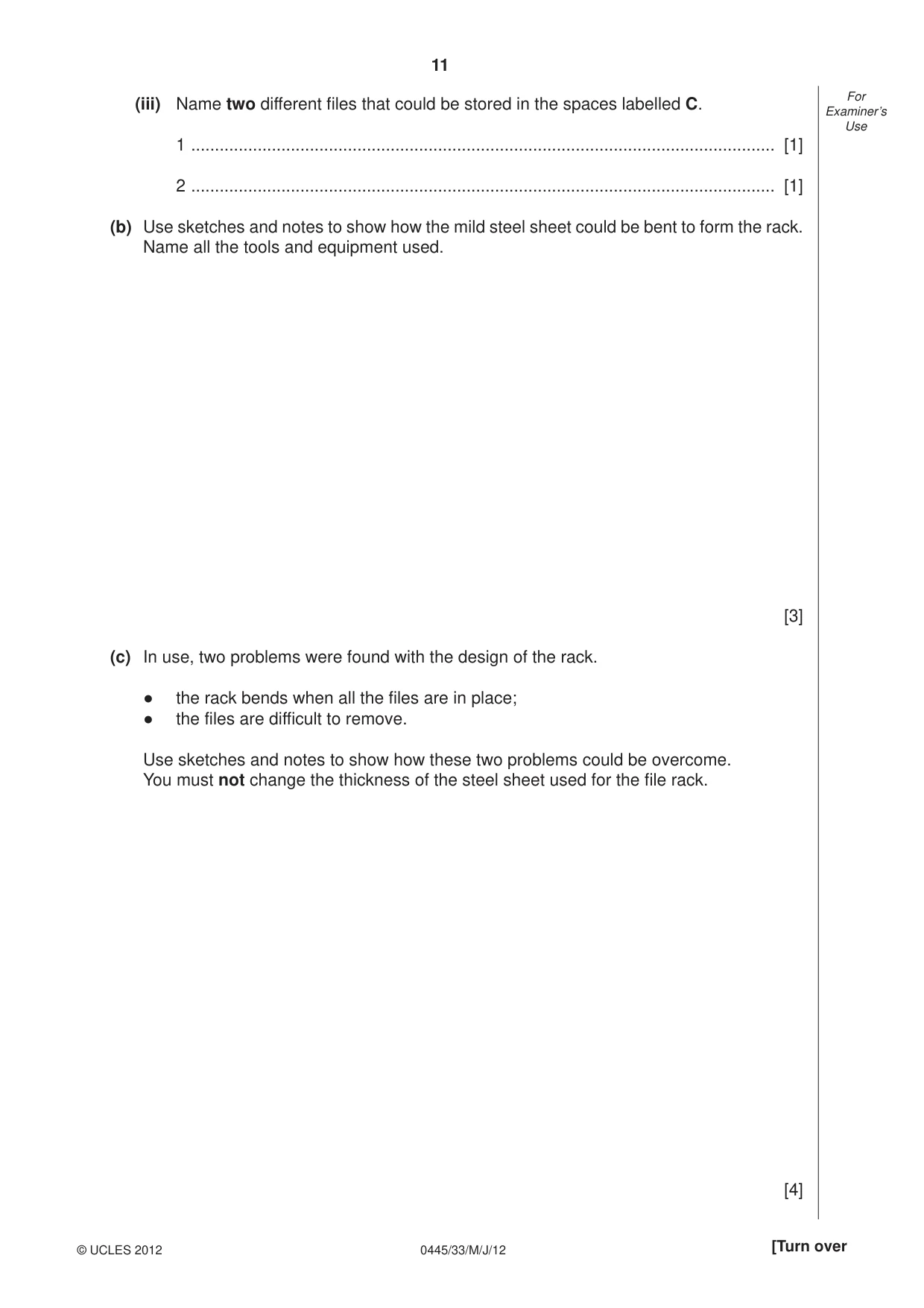
11 0445/33/M/J/12 © UCLES 2012 [Turn over For Examiner’s Use (iii) Name two different fi les that could be stored in the spaces labelled C. 1 … [1] 2 … [1] (b) Use sketches and notes to show how the mild steel sheet could be bent to form the rack. Name all the tools and equipment used. [3] (c) In use, two problems were found with the design of the rack. ● the rack bends when all the files are in place; ● the files are difficult to remove. Use sketches and notes to show how these two problems could be overcome. You must not change the thickness of the steel sheet used for the fi le rack. [4]
Question paper, page 12
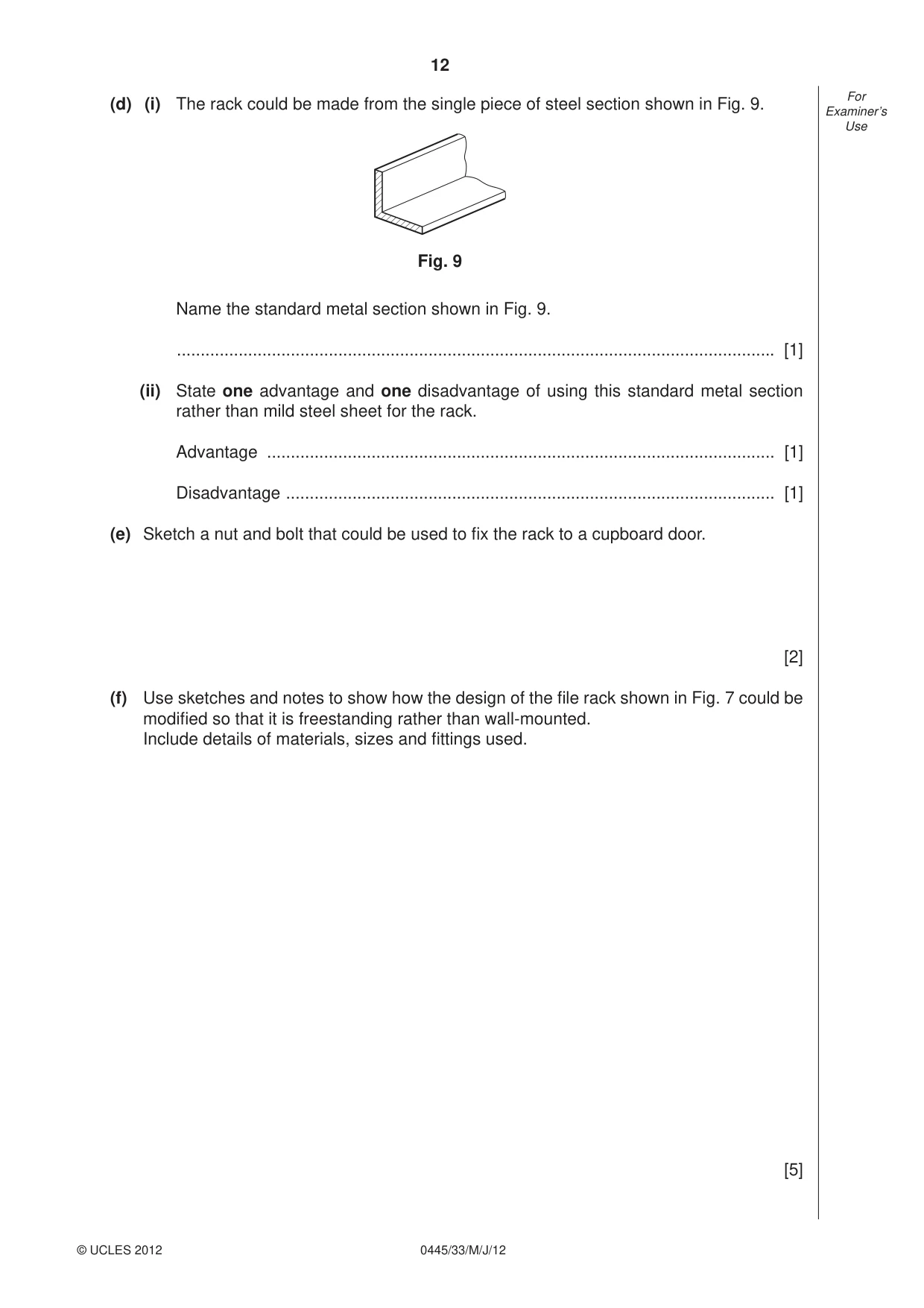
12 0445/33/M/J/12 © UCLES 2012 For Examiner’s Use (d) (i) The rack could be made from the single piece of steel section shown in Fig. 9. Fig. 9 Name the standard metal section shown in Fig. 9. … [1] (ii) State one advantage and one disadvantage of using this standard metal section rather than mild steel sheet for the rack. Advantage … [1] Disadvantage … [1] (e) Sketch a nut and bolt that could be used to fi x the rack to a cupboard door. [2] (f) Use sketches and notes to show how the design of the fi le rack shown in Fig. 7 could be modifi ed so that it is freestanding rather than wall-mounted. Include details of materials, sizes and fi ttings used. [5]
Question paper, page 13
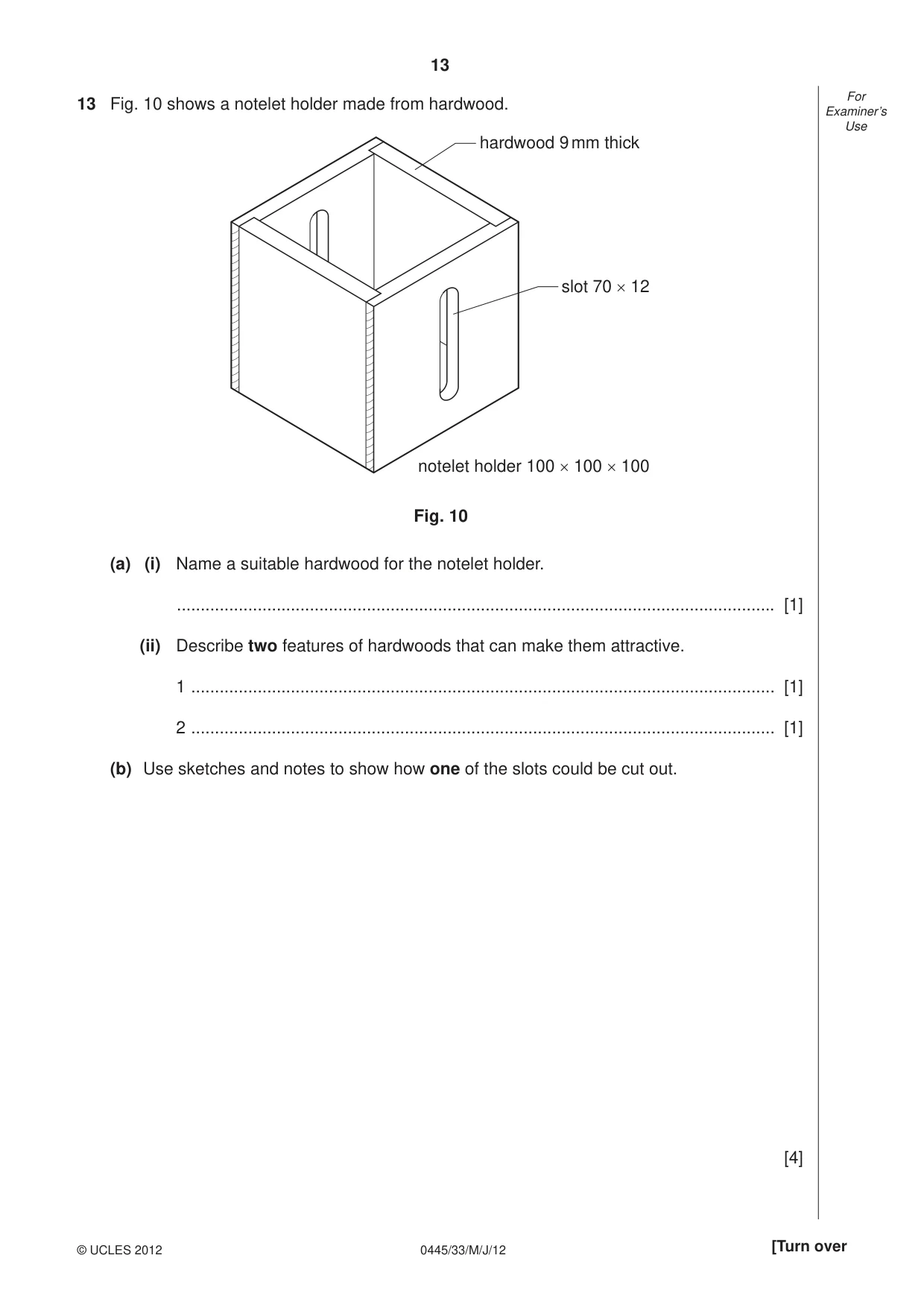
13 0445/33/M/J/12 © UCLES 2012 [Turn over For Examiner’s Use 13 Fig. 10 shows a notelet holder made from hardwood. hardwood 9 mm thick slot 70 × 12 notelet holder 100 × 100 × 100 Fig. 10 (a) (i) Name a suitable hardwood for the notelet holder. … [1] (ii) Describe two features of hardwoods that can make them attractive. 1 … [1] 2 … [1] (b) Use sketches and notes to show how one of the slots could be cut out. [4]
Question paper, page 14
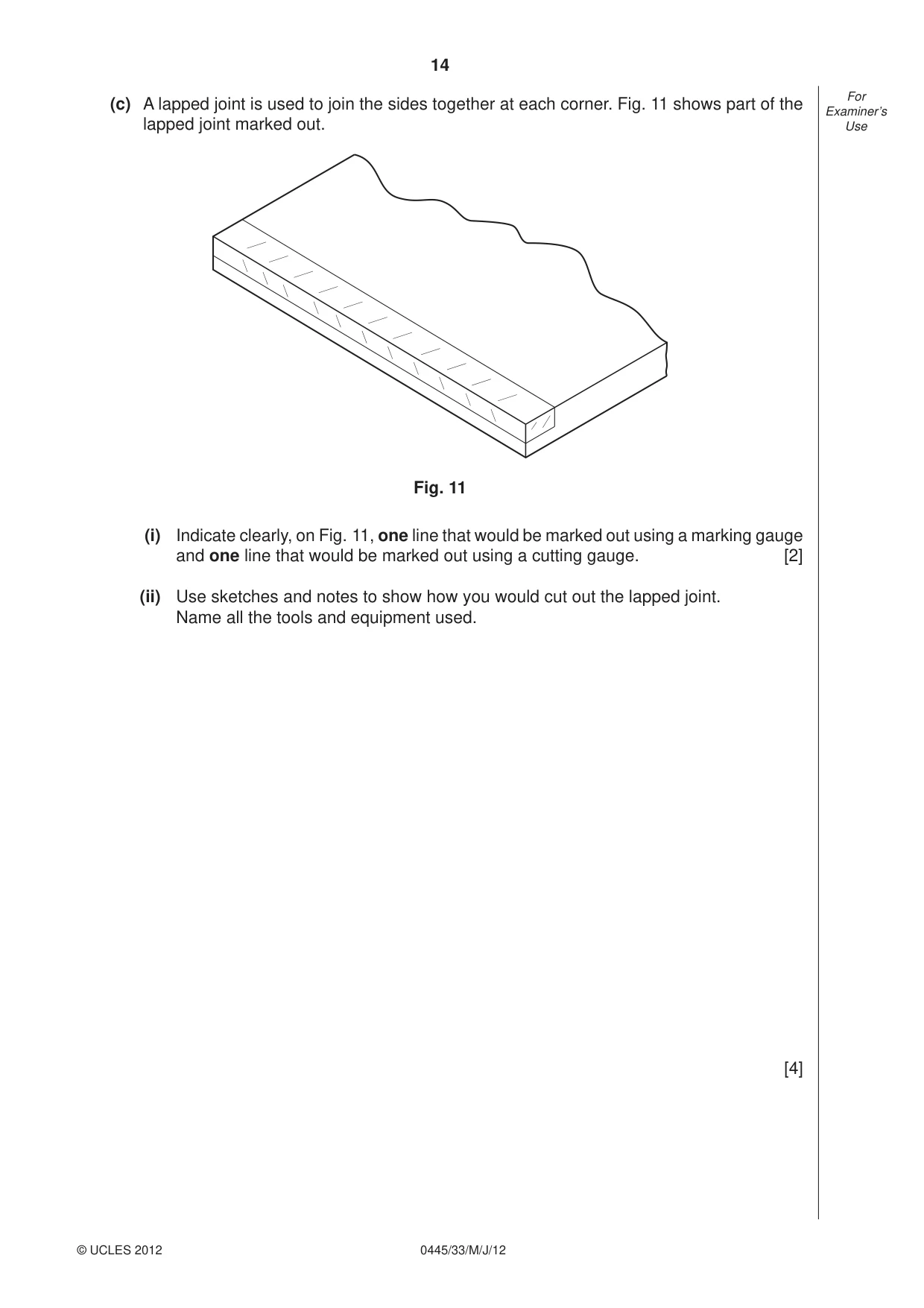
14 0445/33/M/J/12 © UCLES 2012 For Examiner’s Use (c) A lapped joint is used to join the sides together at each corner. Fig. 11 shows part of the lapped joint marked out. Fig. 11 (i) Indicate clearly, on Fig. 11, one line that would be marked out using a marking gauge and one line that would be marked out using a cutting gauge. [2] (ii) Use sketches and notes to show how you would cut out the lapped joint. Name all the tools and equipment used. [4]
Question paper, page 15
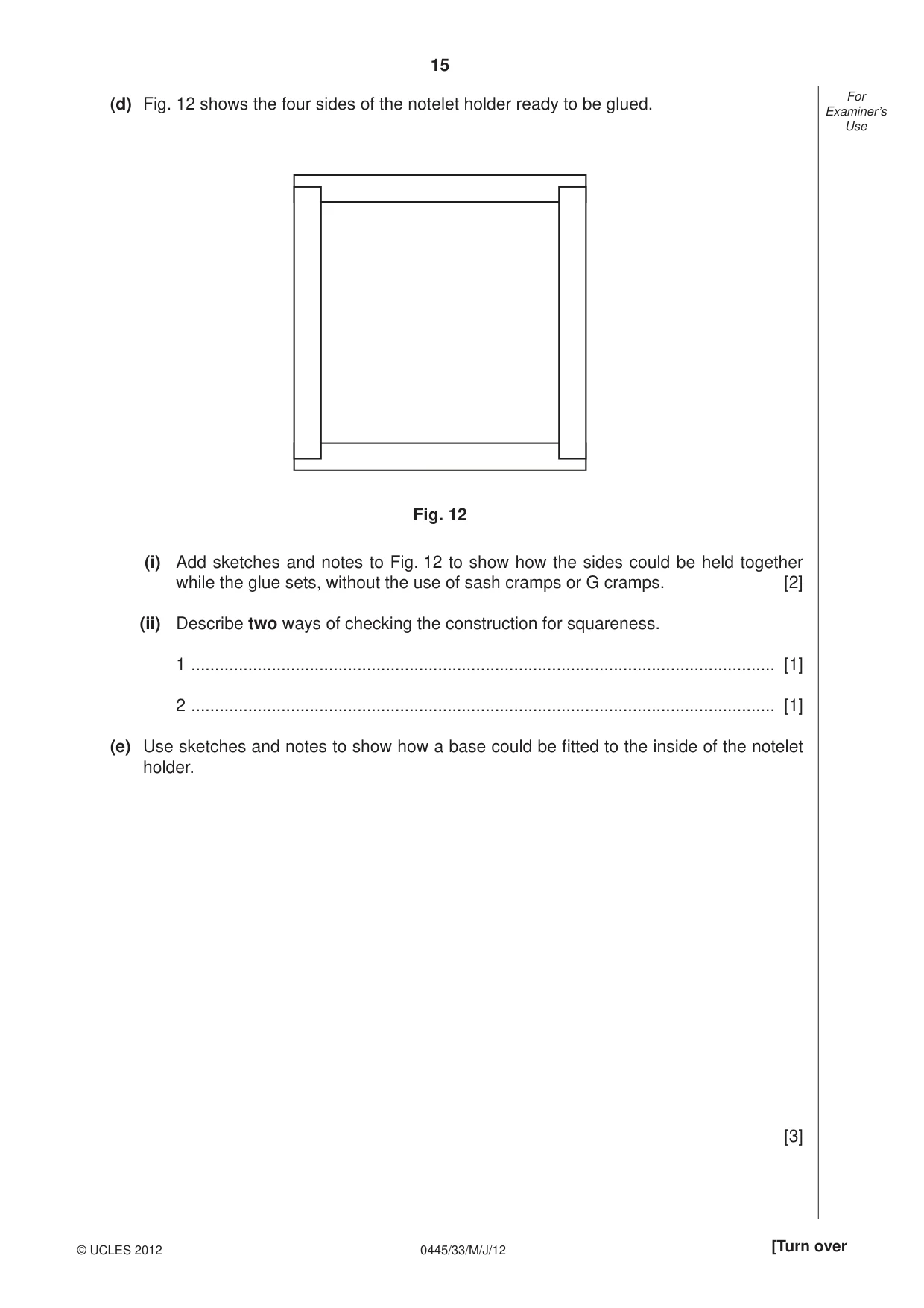
15 0445/33/M/J/12 © UCLES 2012 [Turn over For Examiner’s Use (d) Fig. 12 shows the four sides of the notelet holder ready to be glued. Fig. 12 (i) Add sketches and notes to Fig. 12 to show how the sides could be held together while the glue sets, without the use of sash cramps or G cramps. [2] (ii) Describe two ways of checking the construction for squareness. 1 … [1] 2 … [1] (e) Use sketches and notes to show how a base could be fi tted to the inside of the notelet holder. [3]
Question paper, page 16
16 Permission to reproduce items where third-party owned material protected by copyright is included has been sought and cleared where possible. Every reasonable effort has been made by the publisher (UCLES) to trace copyright holders, but if any items requiring clearance have unwittingly been included the publisher will be pleased to make amends at the earliest possible opportunity. University of Cambridge International Examinations is part of the Cambridge Assessment Group. Cambridge Assessment is the brand name of University of Cambridge Local Examinations Syndicate (UCLES), which is itself a department of the University of Cambridge. 0445/33/M/J/12 © UCLES 2012 For Examiner’s Use (f) The notelet holder could be made from a single piece of acrylic sheet. Use sketches and notes to show a design for a similar notelet holder made from a single piece of acrylic sheet. [5]
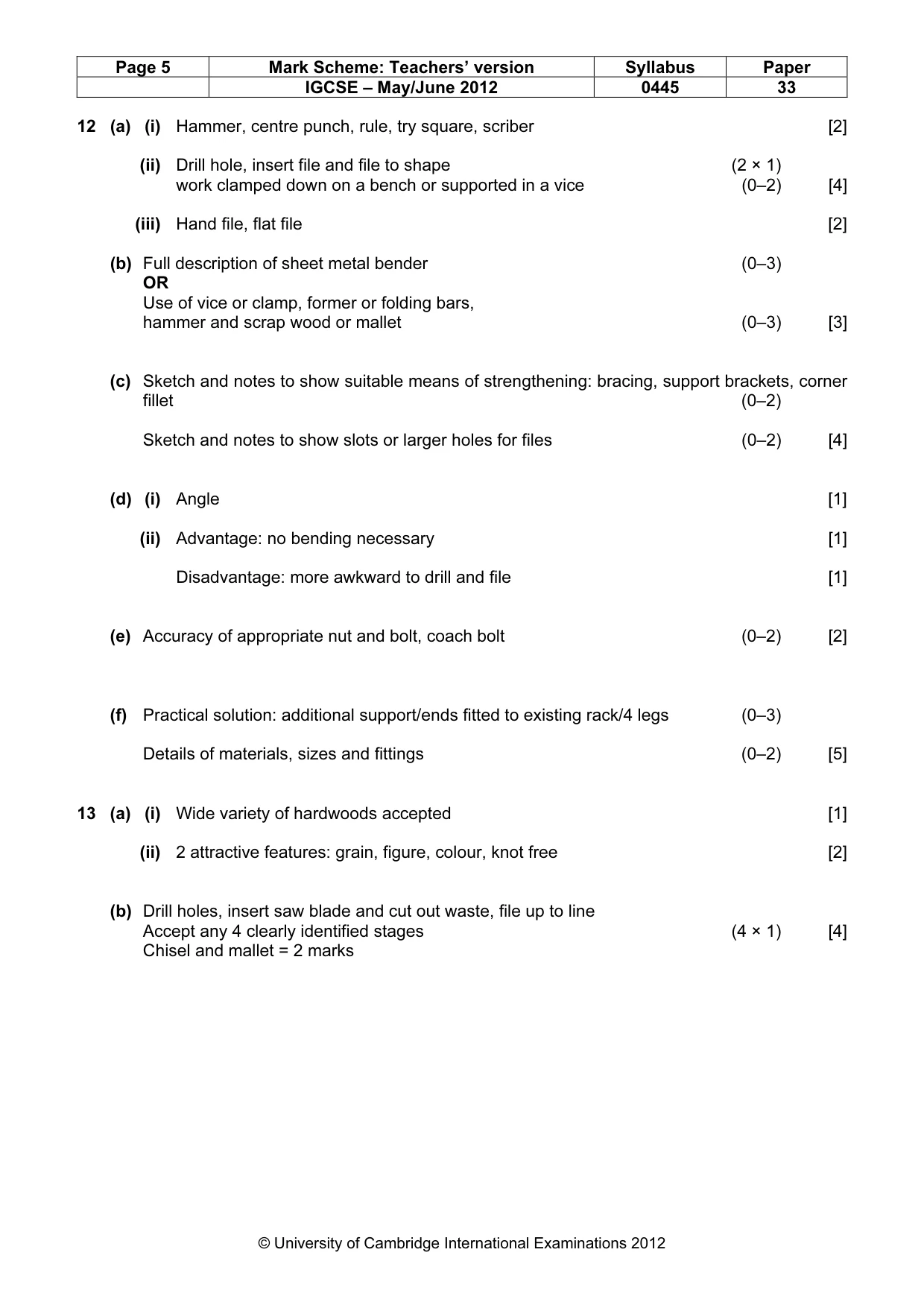
Mark scheme, page 1
UNIVERSITY OF CAMBRIDGE INTERNATIONAL EXAMINATIONS International General Certificate of Secondary Education MARK SCHEME for the May/June 2012 question paper for the guidance of teachers 0445 DESIGN AND TECHNOLOGY 0445/33 Paper 3 (Resistant Materials), maximum raw mark 50 This mark scheme is published as an aid to teachers and candidates, to indicate the requirements of the examination. It shows the basis on which Examiners were instructed to award marks. It does not indicate the details of the discussions that took place at an Examiners’ meeting before marking began, which would have considered the acceptability of alternative answers. Mark schemes must be read in conjunction with the question papers and the report on the examination. • Cambridge will not enter into discussions or correspondence in connection with these mark schemes. Cambridge is publishing the mark schemes for the May/June 2012 question papers for most IGCSE, GCE Advanced Level and Advanced Subsidiary Level syllabuses and some Ordinary Level syllabuses. www.XtremePapers.com
Mark scheme, page 2
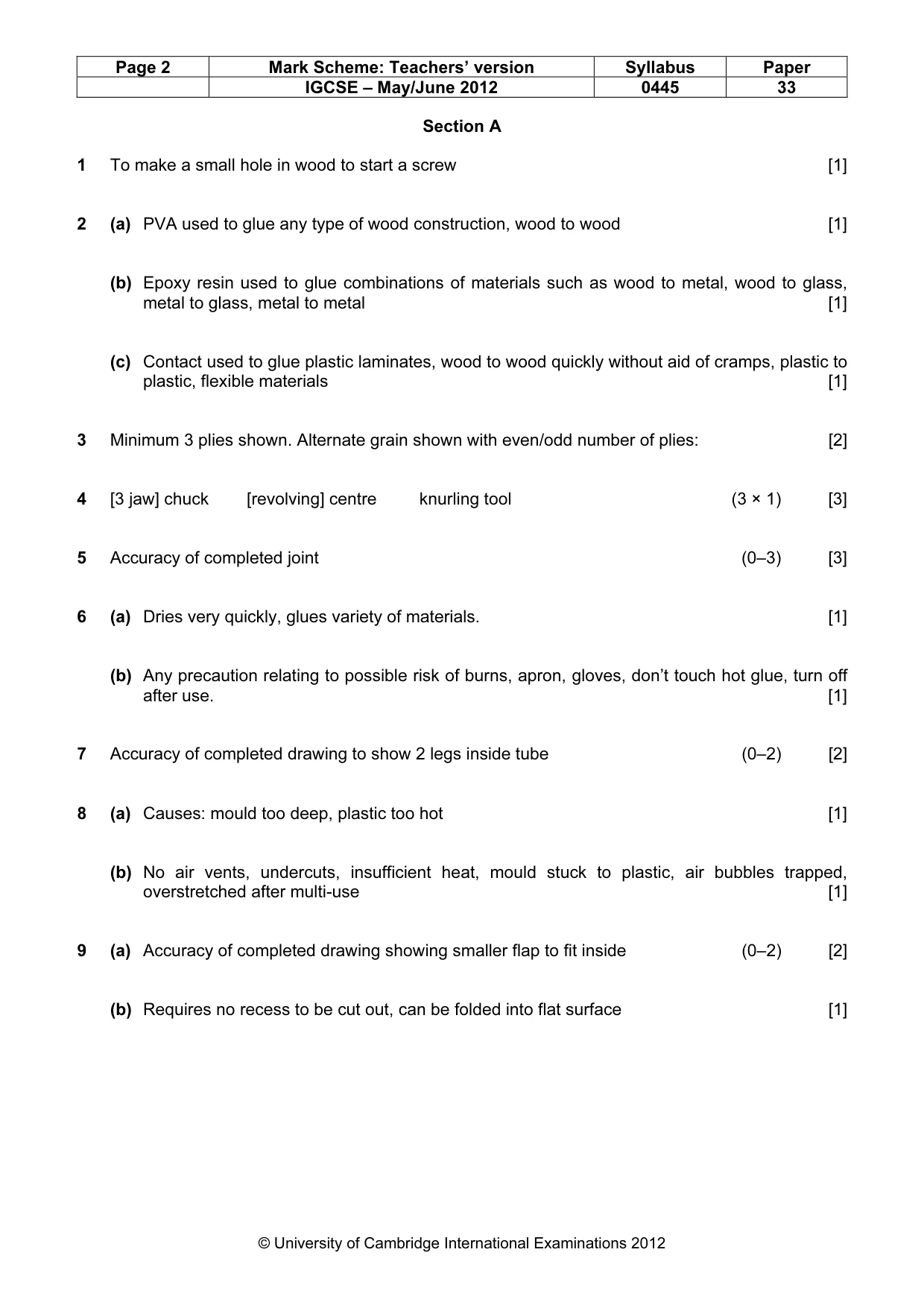
Page 2 Mark Scheme: Teachers’ version Syllabus Paper IGCSE – May/June 2012 0445 33 © University of Cambridge International Examinations 2012 Section A 1 To make a small hole in wood to start a screw [1] 2 (a) PVA used to glue any type of wood construction, wood to wood [1] (b) Epoxy resin used to glue combinations of materials such as wood to metal, wood to glass, metal to glass, metal to metal [1] (c) Contact used to glue plastic laminates, wood to wood quickly without aid of cramps, plastic to plastic, flexible materials [1] 3 Minimum 3 plies shown. Alternate grain shown with even/odd number of plies: [2] 4 [3 jaw] chuck [revolving] centre knurling tool (3 × 1) [3] 5 Accuracy of completed joint (0–3) [3] 6 (a) Dries very quickly, glues variety of materials. [1] (b) Any precaution relating to possible risk of burns, apron, gloves, don’t touch hot glue, turn off after use. [1] 7 Accuracy of completed drawing to show 2 legs inside tube (0–2) [2] 8 (a) Causes: mould too deep, plastic too hot [1] (b) No air vents, undercuts, insufficient heat, mould stuck to plastic, air bubbles trapped, overstretched after multi-use [1] 9 (a) Accuracy of completed drawing showing smaller flap to fit inside (0–2) [2] (b) Requires no recess to be cut out, can be folded into flat surface [1]
Mark scheme, page 3
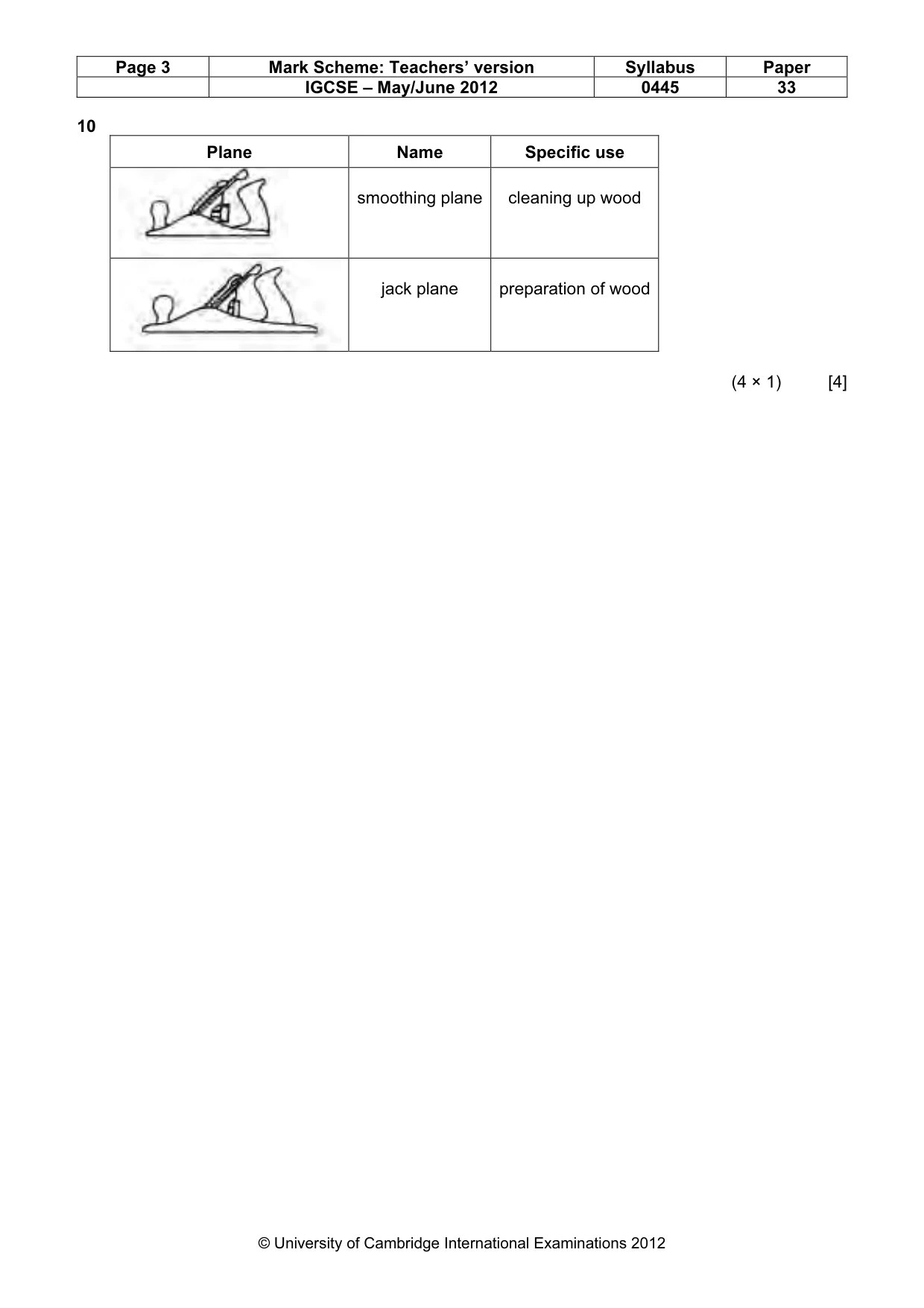
Page 3 Mark Scheme: Teachers’ version Syllabus Paper IGCSE – May/June 2012 0445 33 © University of Cambridge International Examinations 2012 10 Plane Name Specific use smoothing plane cleaning up wood jack plane preparation of wood (4 × 1) [4]
Mark scheme, page 4
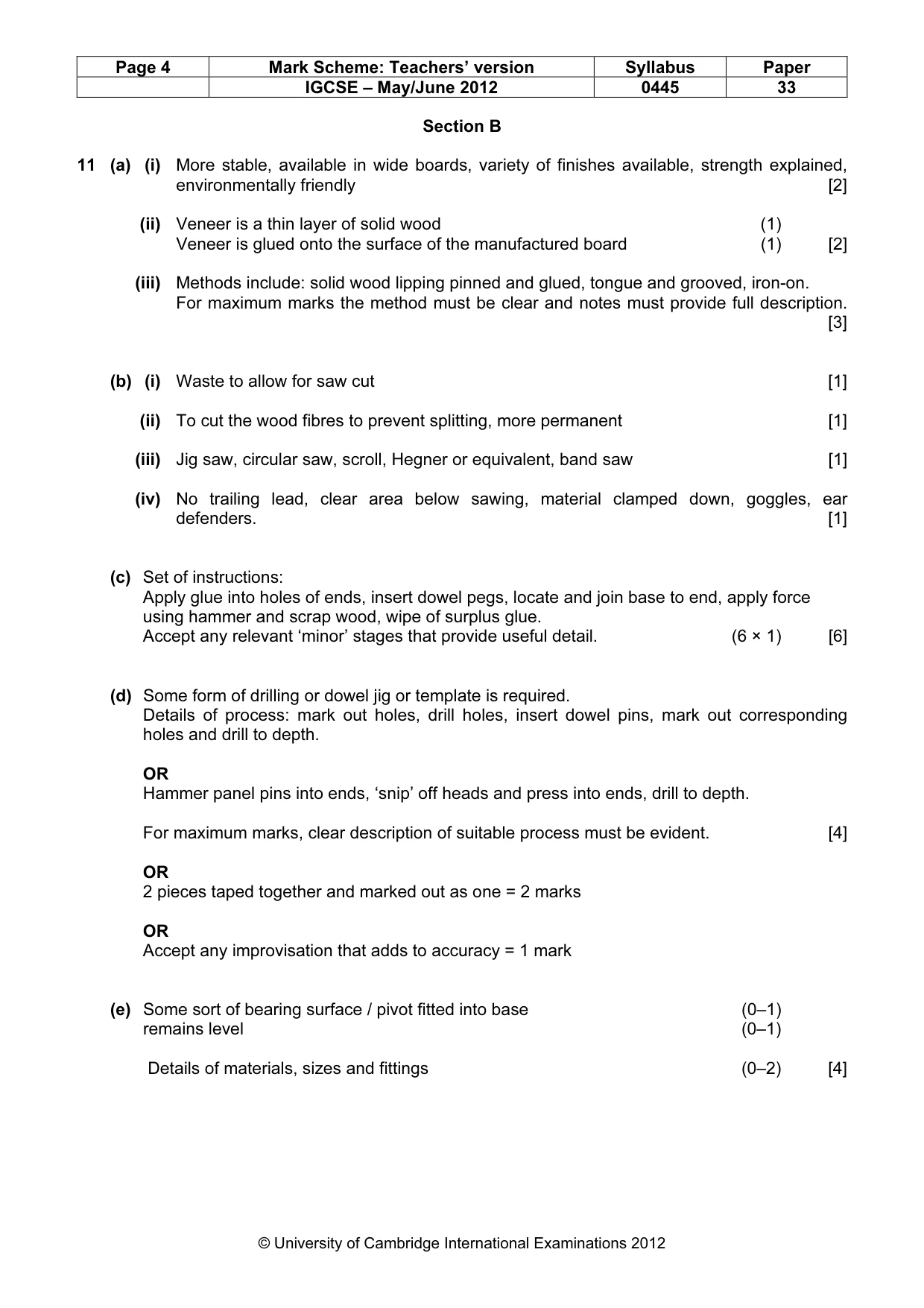
Page 4 Mark Scheme: Teachers’ version Syllabus Paper IGCSE – May/June 2012 0445 33 © University of Cambridge International Examinations 2012 Section B 11 (a) (i) More stable, available in wide boards, variety of finishes available, strength explained, environmentally friendly [2] (ii) Veneer is a thin layer of solid wood (1) Veneer is glued onto the surface of the manufactured board (1) [2] (iii) Methods include: solid wood lipping pinned and glued, tongue and grooved, iron-on. For maximum marks the method must be clear and notes must provide full description. [3] (b) (i) Waste to allow for saw cut [1] (ii) To cut the wood fibres to prevent splitting, more permanent [1] (iii) Jig saw, circular saw, scroll, Hegner or equivalent, band saw [1] (iv) No trailing lead, clear area below sawing, material clamped down, goggles, ear defenders. [1] (c) Set of instructions: Apply glue into holes of ends, insert dowel pegs, locate and join base to end, apply force using hammer and scrap wood, wipe of surplus glue. Accept any relevant ‘minor’ stages that provide useful detail. (6 × 1) [6] (d) Some form of drilling or dowel jig or template is required. Details of process: mark out holes, drill holes, insert dowel pins, mark out corresponding holes and drill to depth. OR Hammer panel pins into ends, ‘snip’ off heads and press into ends, drill to depth. For maximum marks, clear description of suitable process must be evident. [4] OR 2 pieces taped together and marked out as one = 2 marks OR Accept any improvisation that adds to accuracy = 1 mark (e) Some sort of bearing surface / pivot fitted into base (0–1) remains level (0–1) Details of materials, sizes and fittings (0–2) [4]
Mark scheme, page 5
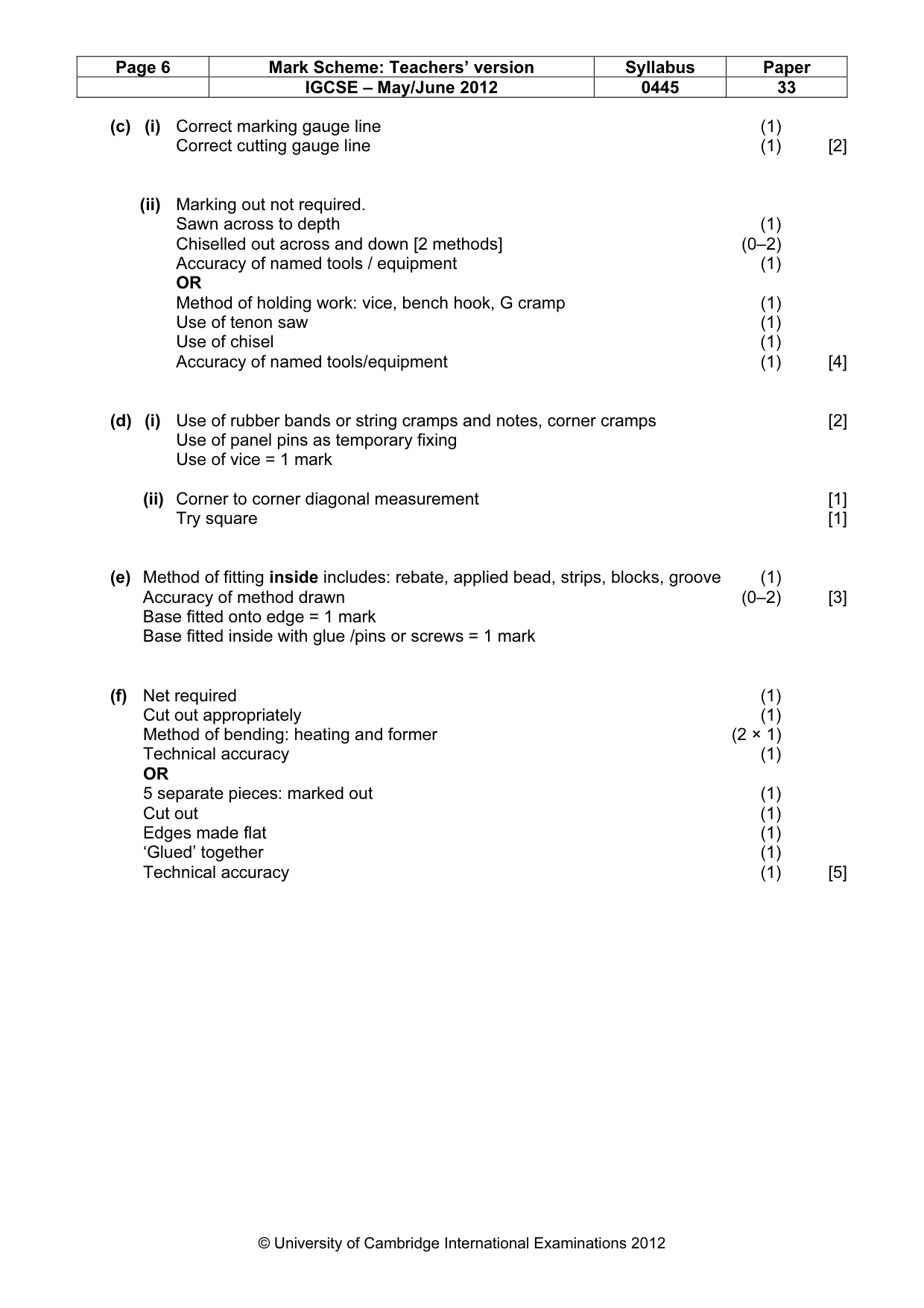
Page 5 Mark Scheme: Teachers’ version Syllabus Paper IGCSE – May/June 2012 0445 33 © University of Cambridge International Examinations 2012 12 (a) (i) Hammer, centre punch, rule, try square, scriber [2] (ii) Drill hole, insert file and file to shape (2 × 1) work clamped down on a bench or supported in a vice (0–2) [4] (iii) Hand file, flat file [2] (b) Full description of sheet metal bender (0–3) OR Use of vice or clamp, former or folding bars, hammer and scrap wood or mallet (0–3) [3] (c) Sketch and notes to show suitable means of strengthening: bracing, support brackets, corner fillet (0–2) Sketch and notes to show slots or larger holes for files (0–2) [4] (d) (i) Angle [1] (ii) Advantage: no bending necessary [1] Disadvantage: more awkward to drill and file [1] (e) Accuracy of appropriate nut and bolt, coach bolt (0–2) [2] (f) Practical solution: additional support/ends fitted to existing rack/4 legs (0–3) Details of materials, sizes and fittings (0–2) [5] 13 (a) (i) Wide variety of hardwoods accepted [1] (ii) 2 attractive features: grain, figure, colour, knot free [2] (b) Drill holes, insert saw blade and cut out waste, file up to line Accept any 4 clearly identified stages (4 × 1) [4] Chisel and mallet = 2 marks
Mark scheme, page 6
Page 6 Mark Scheme: Teachers’ version Syllabus Paper IGCSE – May/June 2012 0445 33 © University of Cambridge International Examinations 2012 (c) (i) Correct marking gauge line (1) Correct cutting gauge line (1) [2] (ii) Marking out not required. Sawn across to depth (1) Chiselled out across and down [2 methods] (0–2) Accuracy of named tools / equipment (1) OR Method of holding work: vice, bench hook, G cramp (1) Use of tenon saw (1) Use of chisel (1) Accuracy of named tools/equipment (1) [4] (d) (i) Use of rubber bands or string cramps and notes, corner cramps [2] Use of panel pins as temporary fixing Use of vice = 1 mark (ii) Corner to corner diagonal measurement [1] Try square [1] (e) Method of fitting inside includes: rebate, applied bead, strips, blocks, groove (1) Accuracy of method drawn (0–2) [3] Base fitted onto edge = 1 mark Base fitted inside with glue /pins or screws = 1 mark (f) Net required (1) Cut out appropriately (1) Method of bending: heating and former (2 × 1) Technical accuracy (1) OR 5 separate pieces: marked out (1) Cut out (1) Edges made flat (1) ‘Glued’ together (1) Technical accuracy (1) [5]
What you needed in this session
Cambridge’s own grade thresholds for 2012 May/June, Paper 3 · Variant 3. A higher threshold means an easier paper — the bar moves with how the cohort did.