Cambridge IGCSE Design and Technology 0445 — 2011 May/June Paper 3 · Variant 2
0445/32/M/J/11 · 50 marks · ≈56 min
The question paper and its mark scheme, free to read here and free to download. This is Cambridge’s own paper, exactly as it was sat.
Question paper16 pages


Mark scheme5 pages
Answers below. Sit the paper first if you are practising.
Paper as text
Question paper, page 1
READ THESE INSTRUCTIONS FIRST Write your Centre number, candidate number and name on all the work you hand in. Write in blue or black pen. You may use a soft pencil for any diagrams, graphs or rough working. Do not use staples, paper clips, highlighters, glue or correction fl uid. DO NOT WRITE IN ANY BARCODES. Section A Answer all questions in this section. Section B Answer one question in this section. You may use a calculator. The total of the marks for this paper is 50. The number of marks is given in brackets [ ] at the end of each question or part question. DESIGN AND TECHNOLOGY 0445/32 Paper 3 Resistant Materials May/June 2011 1 hour Candidates answer on the Question Paper. No Additional Materials are required. To be taken together with Paper 1 in one session of 2 hours 15 minutes. UNIVERSITY OF CAMBRIDGE INTERNATIONAL EXAMINATIONS International General Certifi cate of Secondary Education This document consists of 13 printed pages and 3 blank pages. [Turn over IB11 06_0445_32/RP © UCLES 2011 *6225179871* For Examiner’s Use Total Section A Section B www.XtremePapers.com
Question paper, page 2
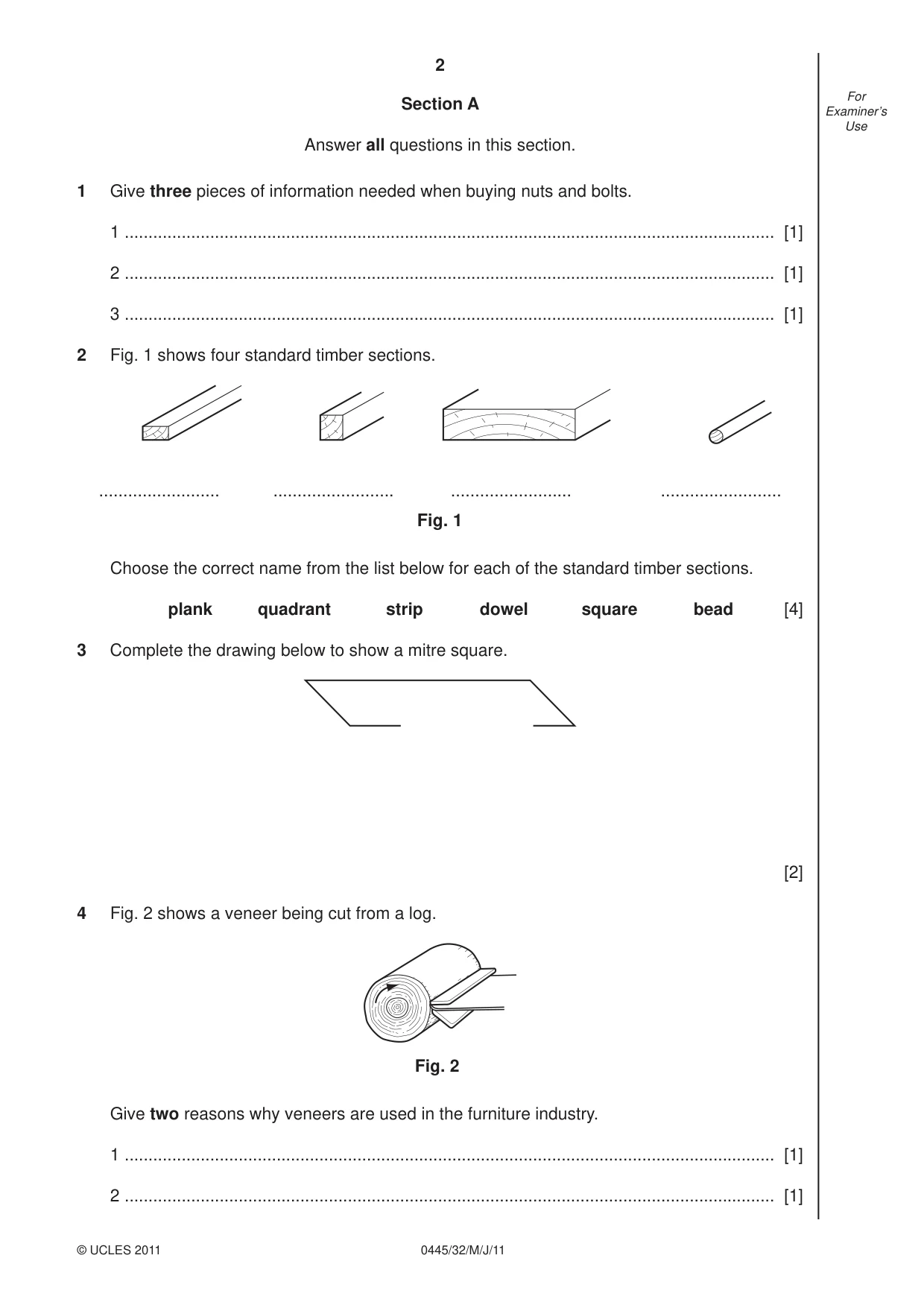
2 0445/32/M/J/11 © UCLES 2011 For Examiner’s Use Section A Answer all questions in this section. 1 Give three pieces of information needed when buying nuts and bolts. 1 … [1] 2 … [1] 3 … [1] 2 Fig. 1 shows four standard timber sections. … … … … Fig. 1 Choose the correct name from the list below for each of the standard timber sections. plank quadrant strip dowel square bead [4] 3 Complete the drawing below to show a mitre square. [2] 4 Fig. 2 shows a veneer being cut from a log. Fig. 2 Give two reasons why veneers are used in the furniture industry. 1 … [1] 2 … [1]
Question paper, page 3
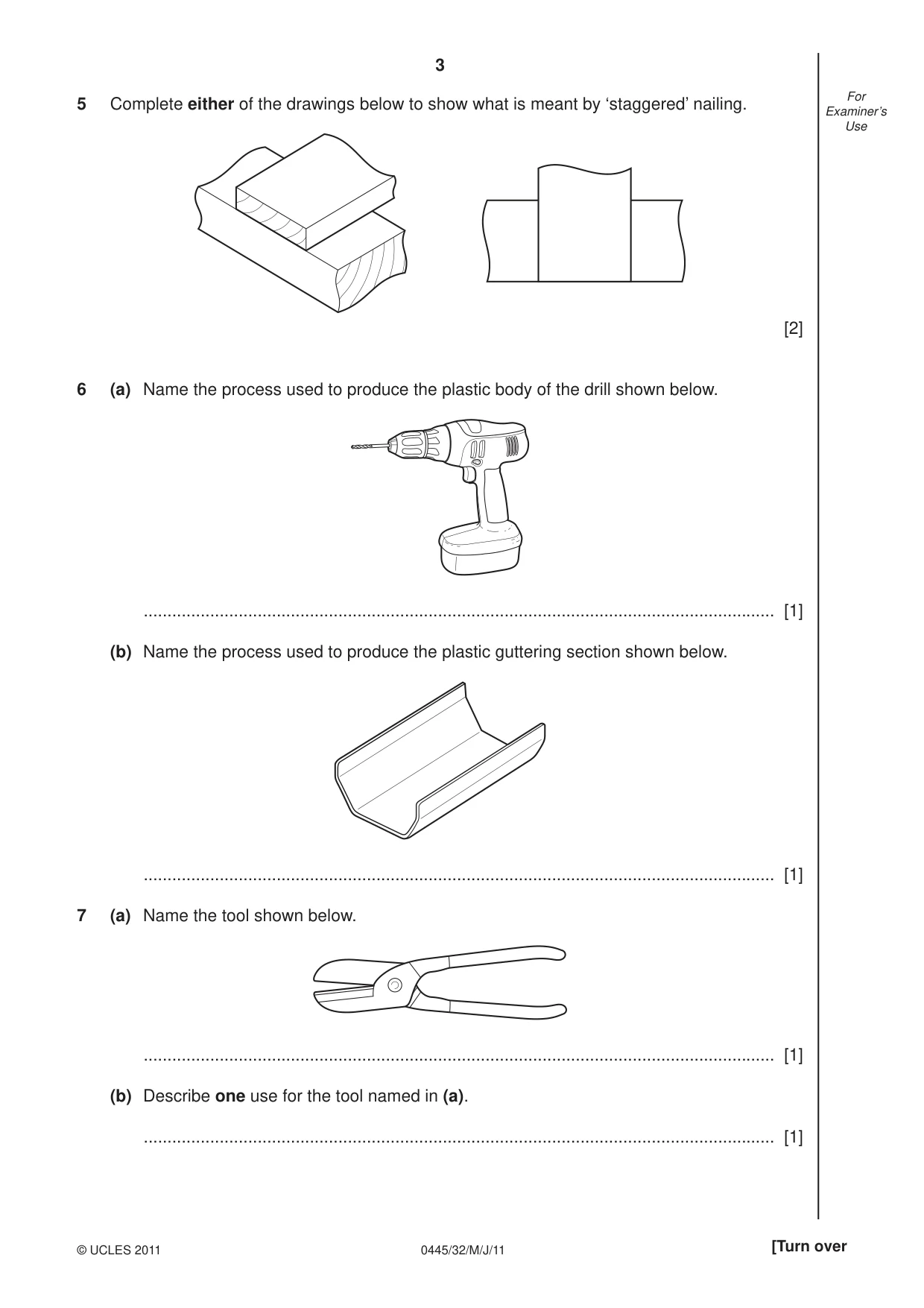
3 0445/32/M/J/11 © UCLES 2011 [Turn over For Examiner’s Use 5 Complete either of the drawings below to show what is meant by ‘staggered’ nailing. [2] 6 (a) Name the process used to produce the plastic body of the drill shown below. … [1] (b) Name the process used to produce the plastic guttering section shown below. … [1] 7 (a) Name the tool shown below. … [1] (b) Describe one use for the tool named in (a). … [1]
Question paper, page 4
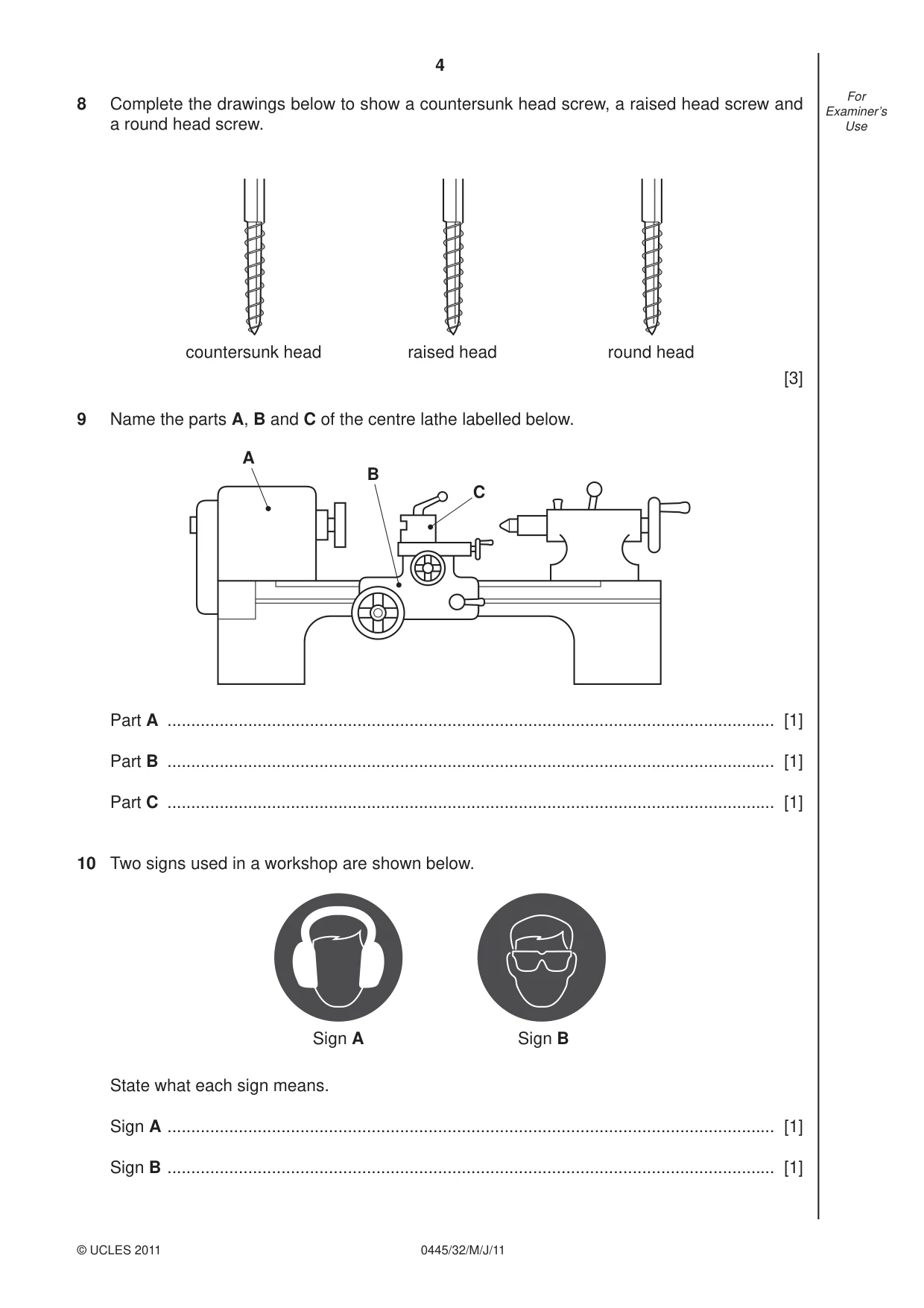
4 0445/32/M/J/11 © UCLES 2011 For Examiner’s Use 8 Complete the drawings below to show a countersunk head screw, a raised head screw and a round head screw. countersunk head raised head round head [3] 9 Name the parts A, B and C of the centre lathe labelled below. A B C Part A … [1] Part B … [1] Part C … [1] 10 Two signs used in a workshop are shown below. Sign A Sign B State what each sign means. Sign A … [1] Sign B … [1]
Question paper, page 5
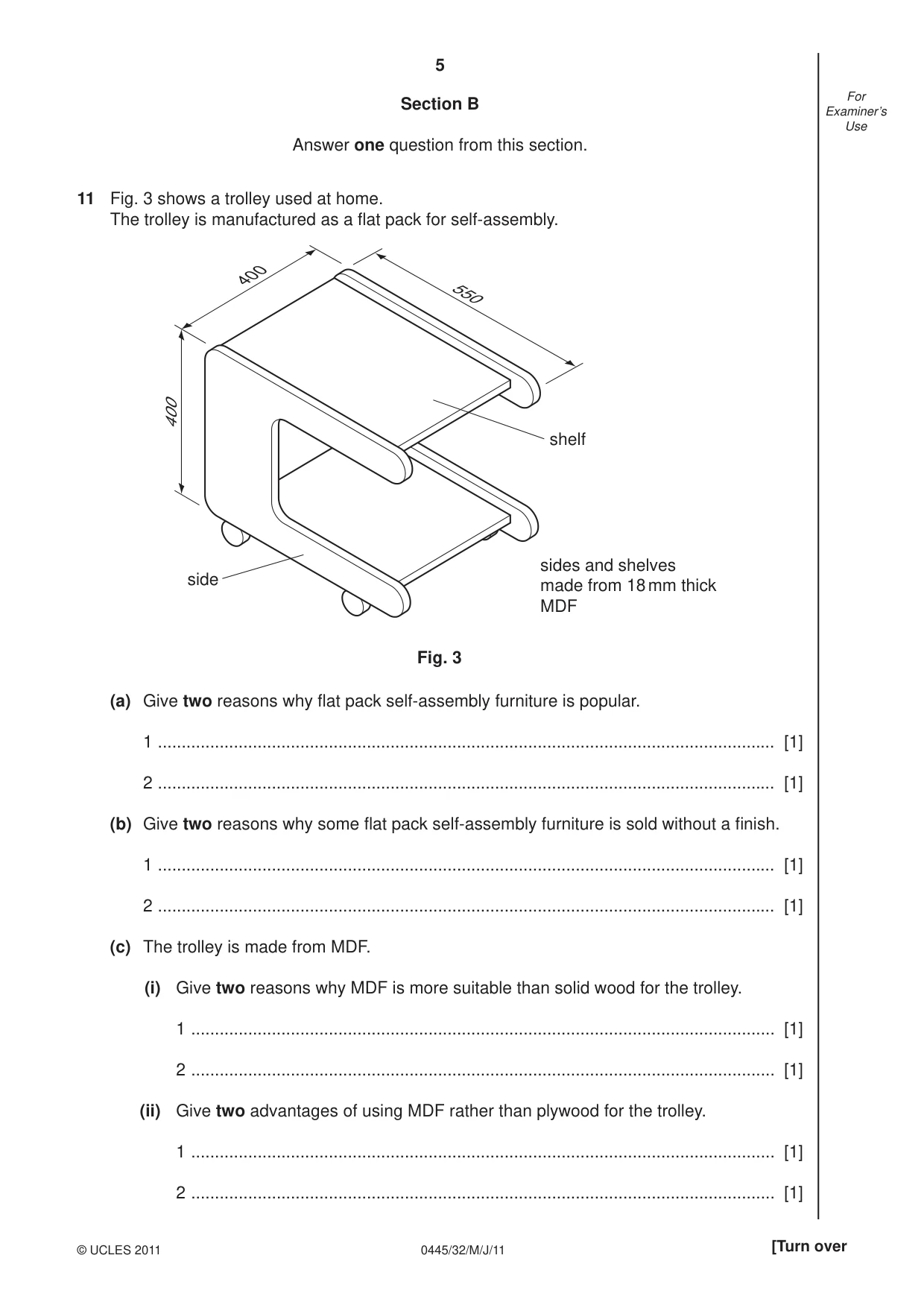
5 0445/32/M/J/11 © UCLES 2011 [Turn over For Examiner’s Use Section B Answer one question from this section. 11 Fig. 3 shows a trolley used at home. The trolley is manufactured as a fl at pack for self-assembly. 550 400 400 shelf side sides and shelves made from 18 mm thick MDF Fig. 3 (a) Give two reasons why fl at pack self-assembly furniture is popular. 1 … [1] 2 … [1] (b) Give two reasons why some fl at pack self-assembly furniture is sold without a fi nish. 1 … [1] 2 … [1] (c) The trolley is made from MDF. (i) Give two reasons why MDF is more suitable than solid wood for the trolley. 1 … [1] 2 … [1] (ii) Give two advantages of using MDF rather than plywood for the trolley. 1 … [1] 2 … [1]
Question paper, page 6
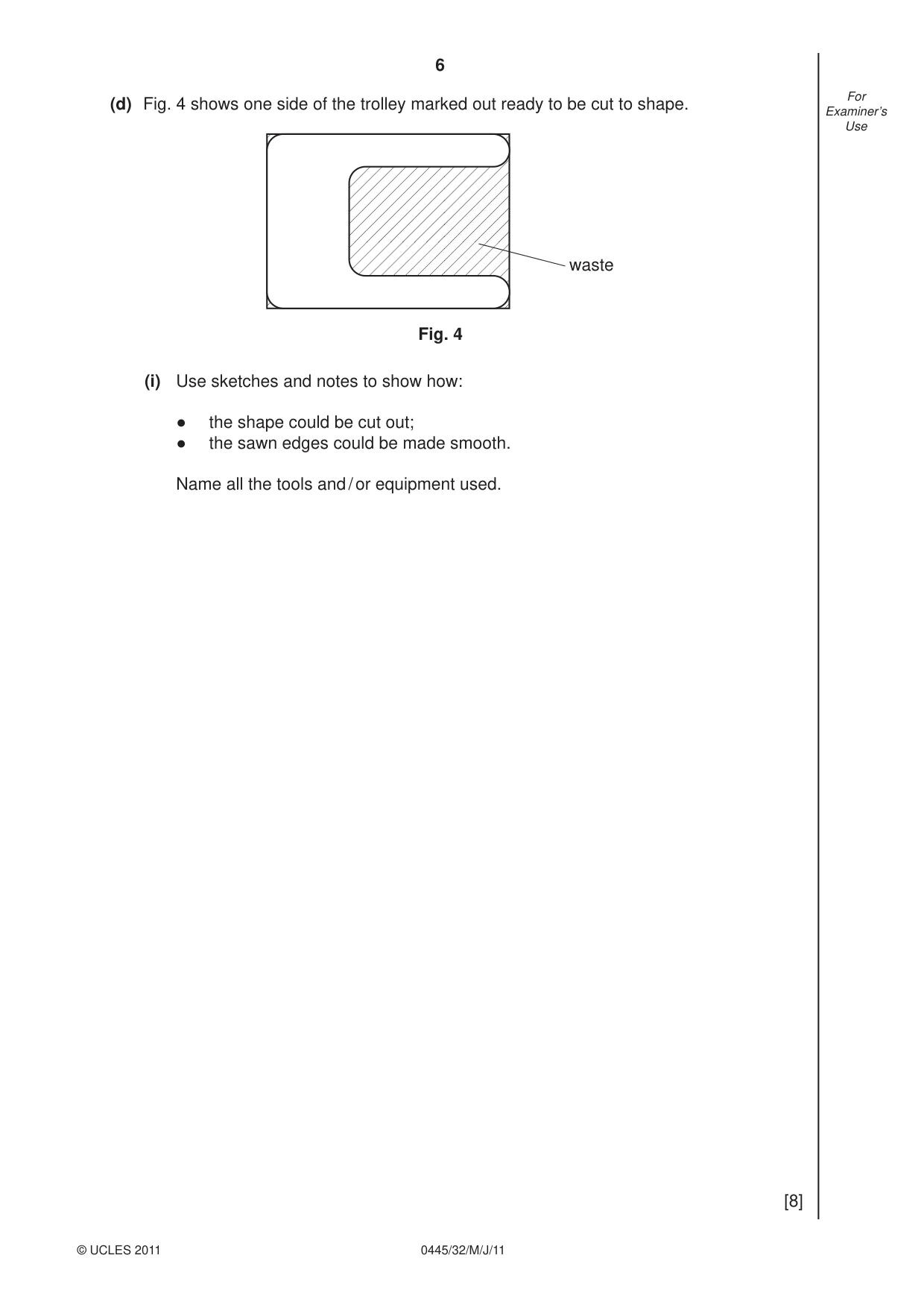
6 0445/32/M/J/11 © UCLES 2011 For Examiner’s Use (d) Fig. 4 shows one side of the trolley marked out ready to be cut to shape. waste Fig. 4 (i) Use sketches and notes to show how: ● the shape could be cut out; ● the sawn edges could be made smooth. Name all the tools and / or equipment used. [8]
Question paper, page 7
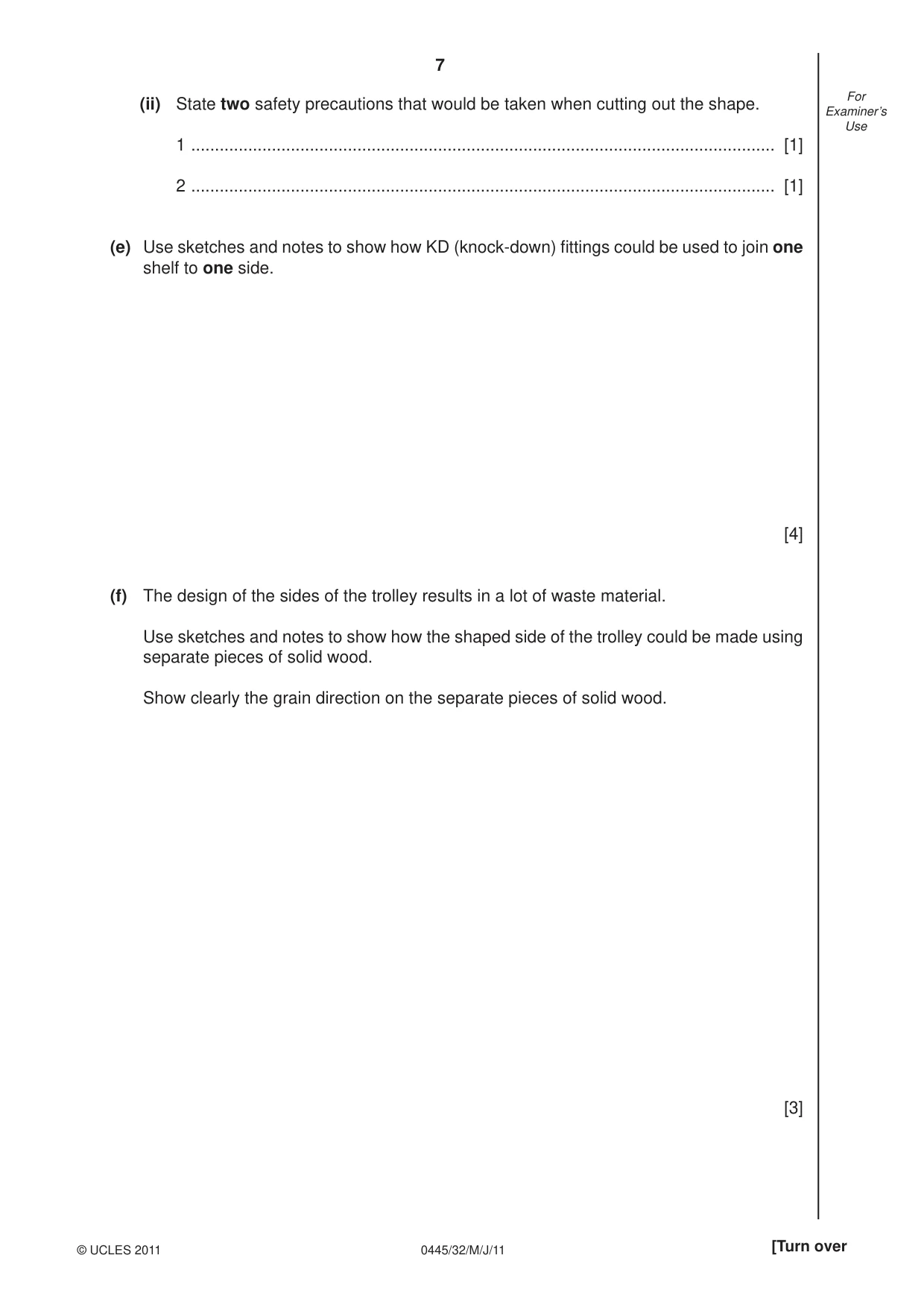
7 0445/32/M/J/11 © UCLES 2011 [Turn over For Examiner’s Use (ii) State two safety precautions that would be taken when cutting out the shape. 1 … [1] 2 … [1] (e) Use sketches and notes to show how KD (knock-down) fi ttings could be used to join one shelf to one side. [4] (f) The design of the sides of the trolley results in a lot of waste material. Use sketches and notes to show how the shaped side of the trolley could be made using separate pieces of solid wood. Show clearly the grain direction on the separate pieces of solid wood. [3]
Question paper, page 8
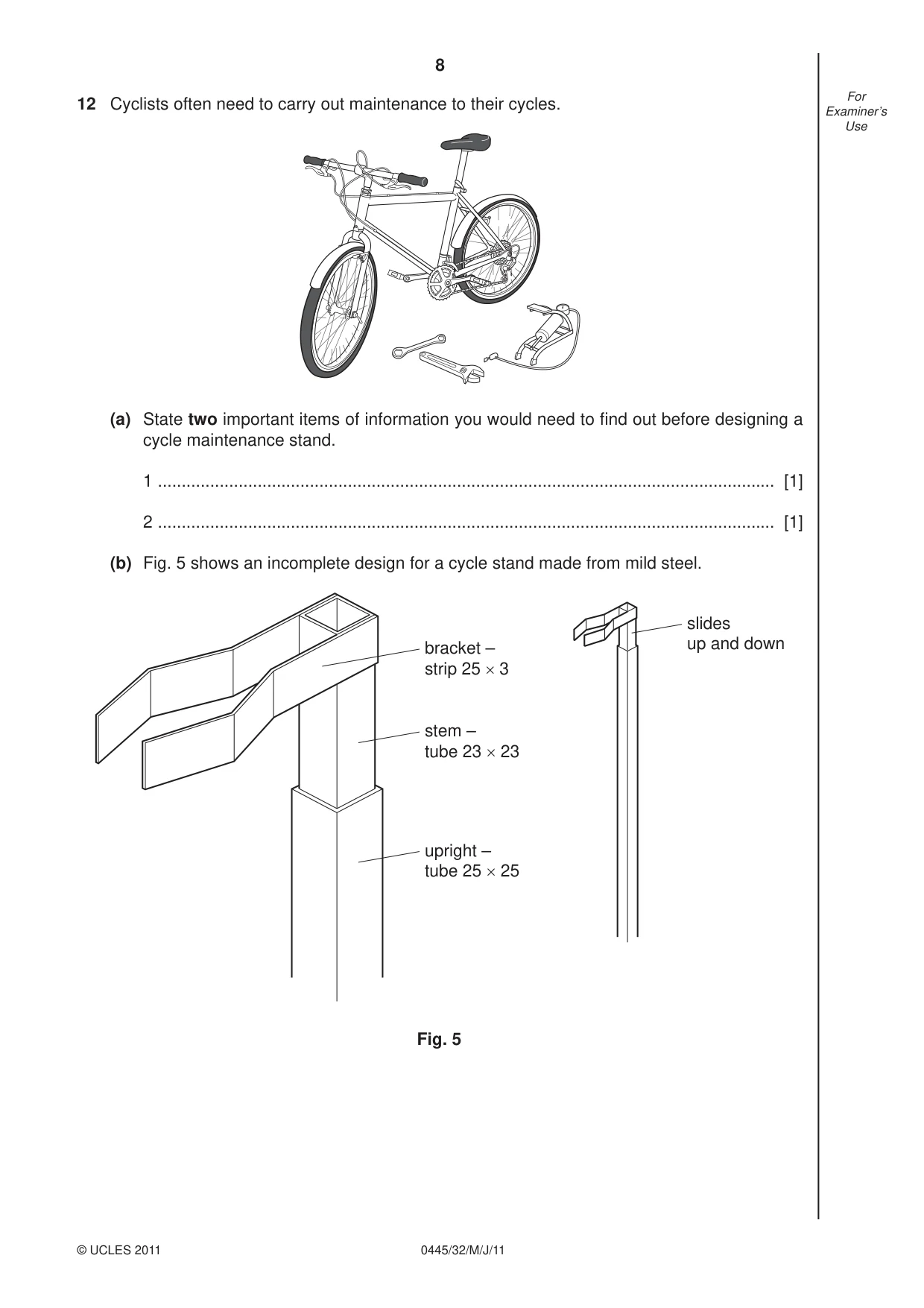
8 0445/32/M/J/11 © UCLES 2011 For Examiner’s Use 12 Cyclists often need to carry out maintenance to their cycles. (a) State two important items of information you would need to fi nd out before designing a cycle maintenance stand. 1 … [1] 2 … [1] (b) Fig. 5 shows an incomplete design for a cycle stand made from mild steel. bracket – strip 25 × 3 slides up and down stem – tube 23 × 23 upright – tube 25 × 25 Fig. 5
Question paper, page 9
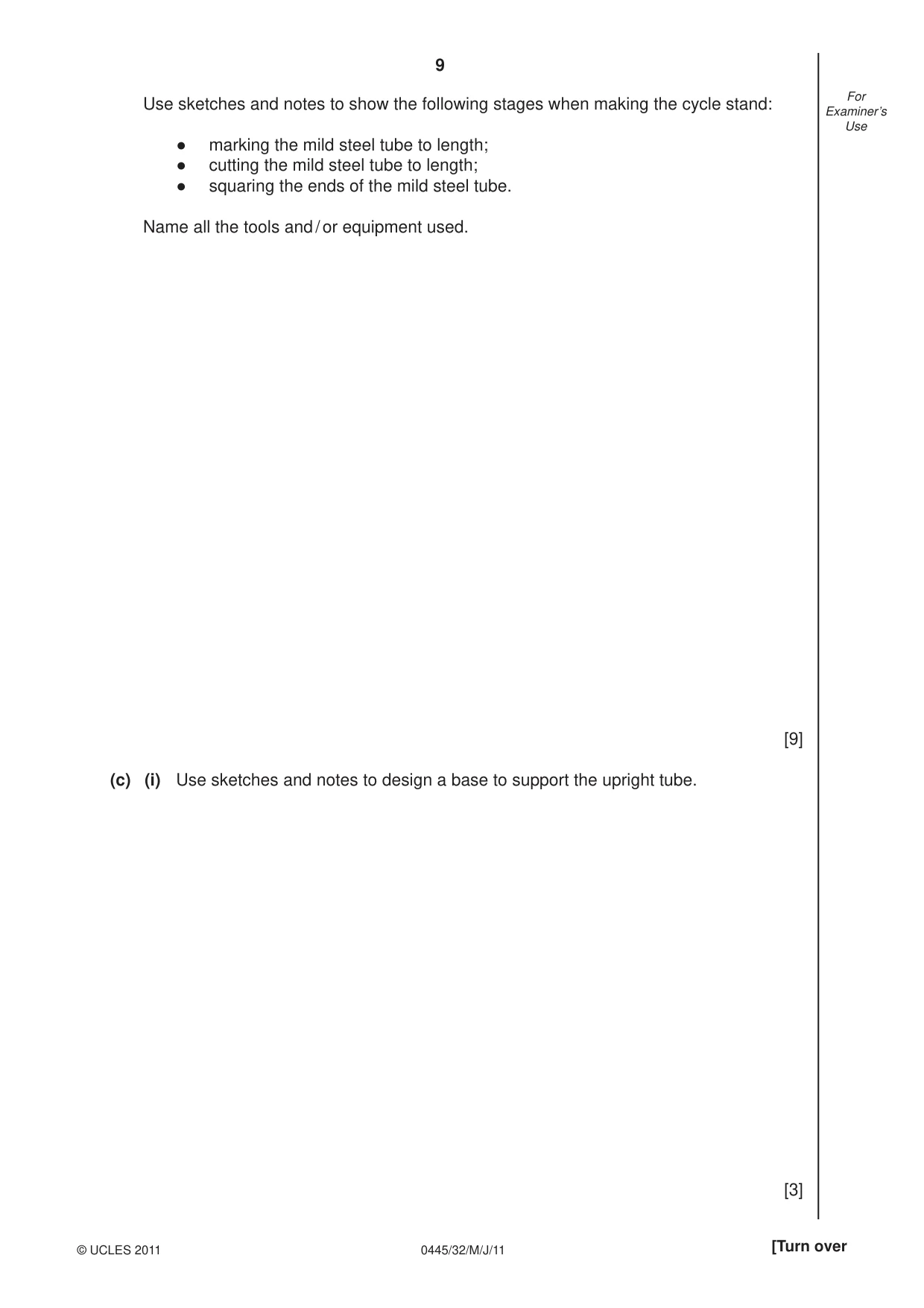
9 0445/32/M/J/11 © UCLES 2011 [Turn over For Examiner’s Use Use sketches and notes to show the following stages when making the cycle stand: ● marking the mild steel tube to length; ● cutting the mild steel tube to length; ● squaring the ends of the mild steel tube. Name all the tools and / or equipment used. [9] (c) (i) Use sketches and notes to design a base to support the upright tube. [3]
Question paper, page 10
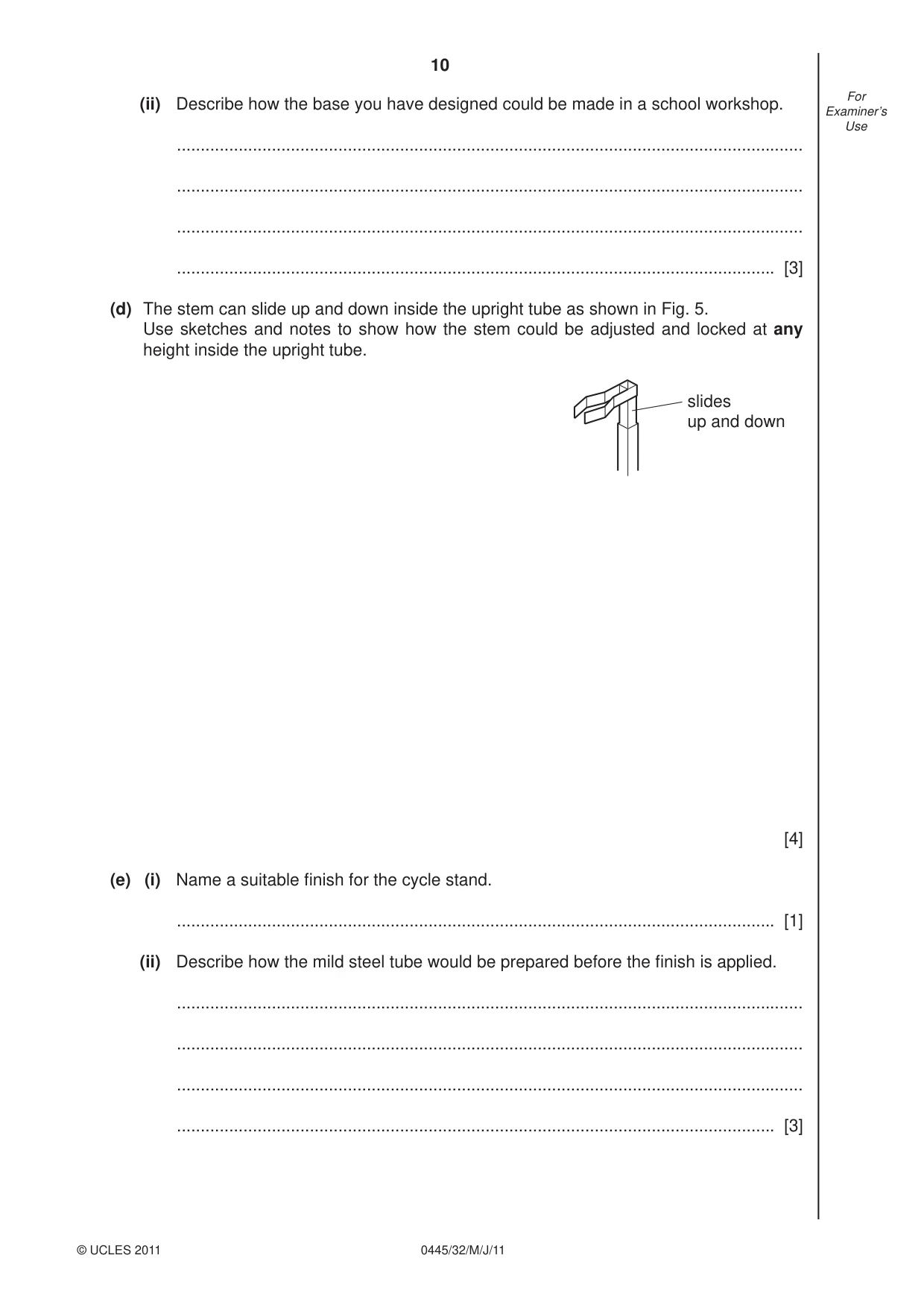
10 0445/32/M/J/11 © UCLES 2011 For Examiner’s Use (ii) Describe how the base you have designed could be made in a school workshop. … … … … [3] (d) The stem can slide up and down inside the upright tube as shown in Fig. 5. Use sketches and notes to show how the stem could be adjusted and locked at any height inside the upright tube. slides up and down [4] (e) (i) Name a suitable fi nish for the cycle stand. … [1] (ii) Describe how the mild steel tube would be prepared before the fi nish is applied. … … … … [3]
Question paper, page 11
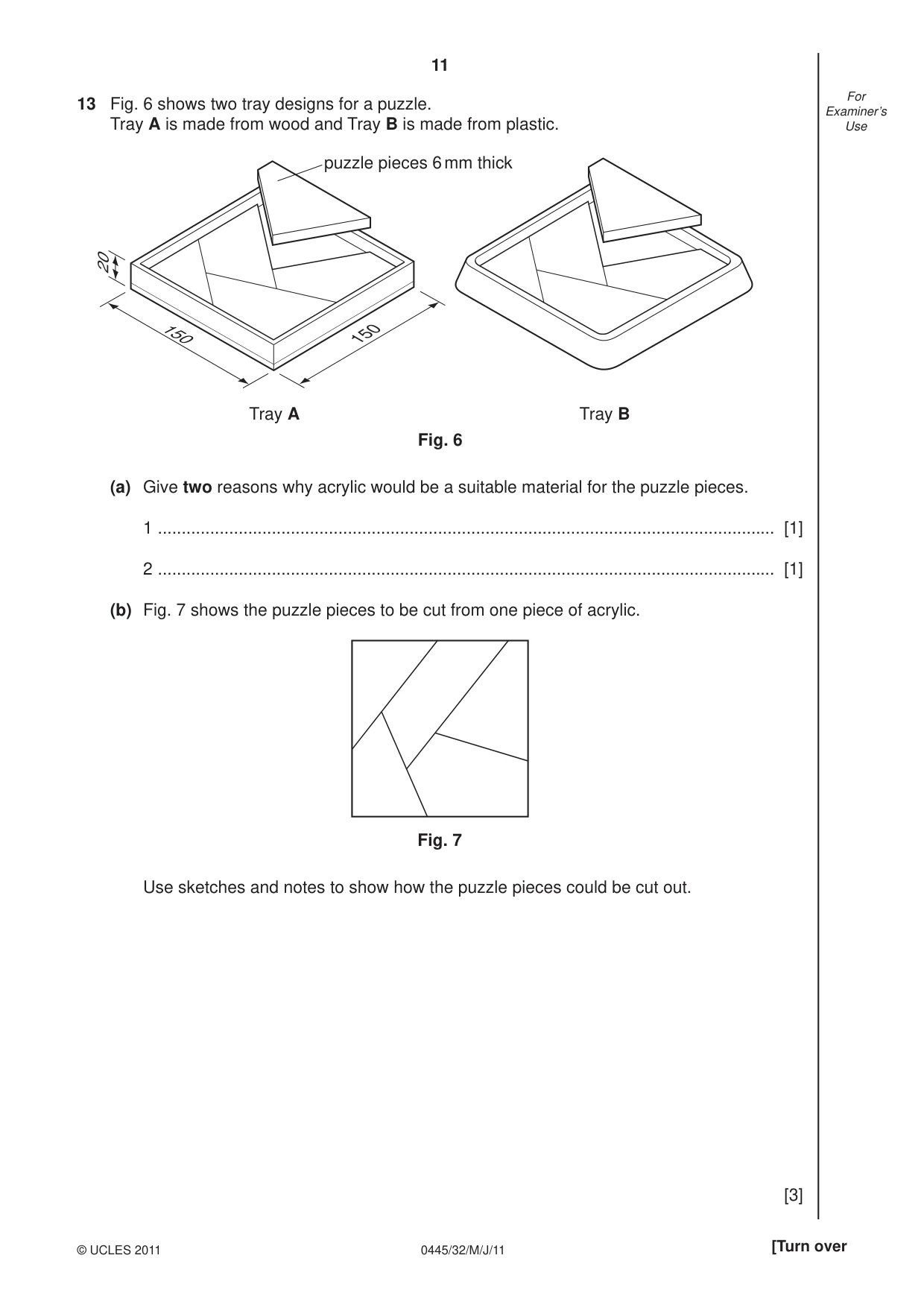
11 0445/32/M/J/11 © UCLES 2011 [Turn over For Examiner’s Use 13 Fig. 6 shows two tray designs for a puzzle. Tray A is made from wood and Tray B is made from plastic. 150 150 20 Tray A Tray B Fig. 6 puzzle pieces 6 mm thick (a) Give two reasons why acrylic would be a suitable material for the puzzle pieces. 1 … [1] 2 … [1] (b) Fig. 7 shows the puzzle pieces to be cut from one piece of acrylic. Fig. 7 Use sketches and notes to show how the puzzle pieces could be cut out. [3]
Question paper, page 12
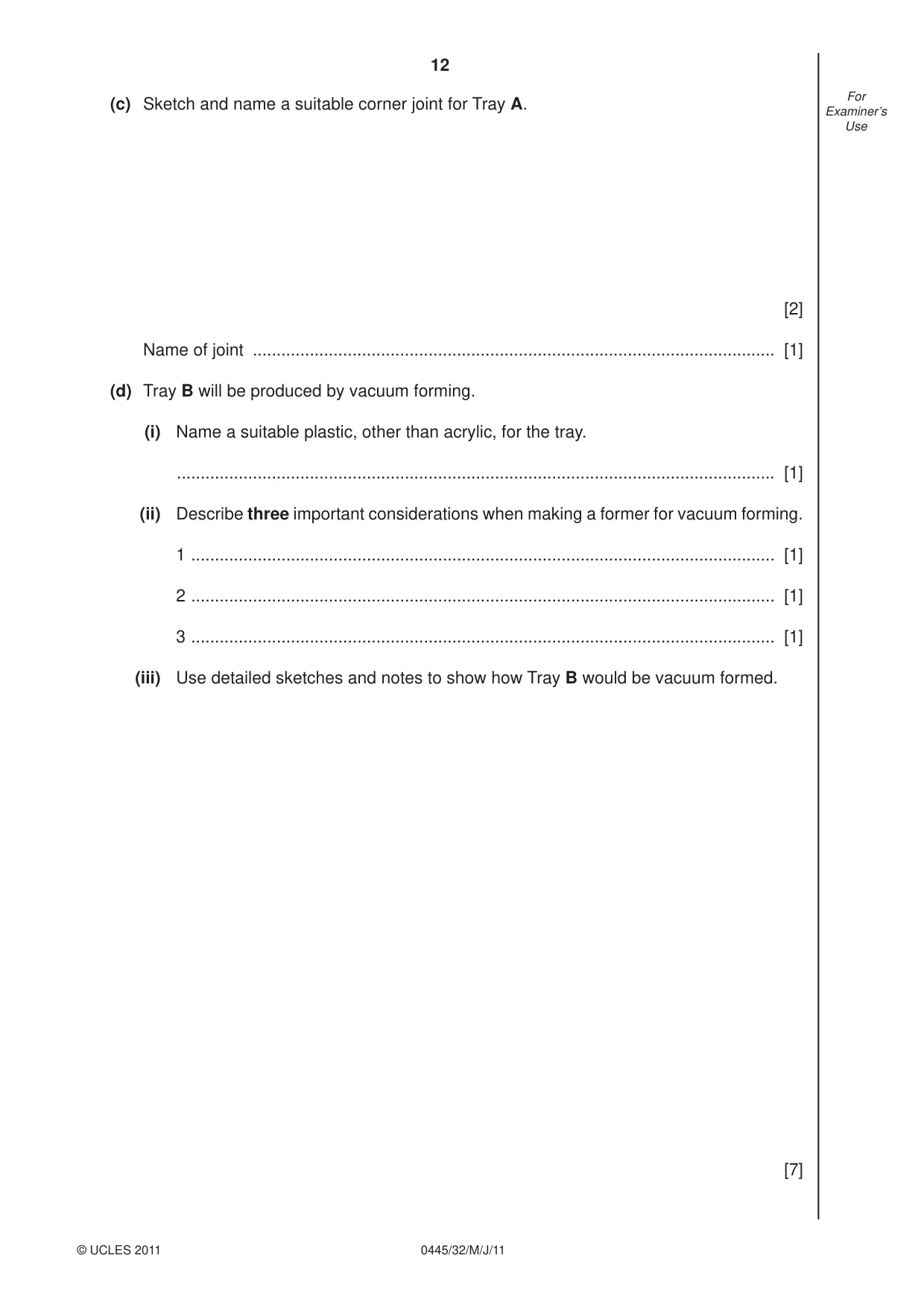
12 0445/32/M/J/11 © UCLES 2011 For Examiner’s Use (c) Sketch and name a suitable corner joint for Tray A. [2] Name of joint … [1] (d) Tray B will be produced by vacuum forming. (i) Name a suitable plastic, other than acrylic, for the tray. … [1] (ii) Describe three important considerations when making a former for vacuum forming. 1 … [1] 2 … [1] 3 … [1] (iii) Use detailed sketches and notes to show how Tray B would be vacuum formed. [7]
Question paper, page 13
13 0445/32/M/J/11 © UCLES 2011 [Turn over For Examiner’s Use (e) (i) State which of the two trays would be more suitable for quantity production. … [1] (ii) Give two reasons for your choice. 1 … [1] 2 … [1] (f) Use sketches and notes to show how Tray A could be made more suitable as a travel puzzle. [3]
Question paper, page 14
14 0445/32/M/J/11 © UCLES 2011 BLANK PAGE
Question paper, page 15
15 0445/32/M/J/11 © UCLES 2011 BLANK PAGE
Question paper, page 16
16 0445/32/M/J/11 Permission to reproduce items where third-party owned material protected by copyright is included has been sought and cleared where possible. Every reasonable effort has been made by the publisher (UCLES) to trace copyright holders, but if any items requiring clearance have unwittingly been included the publisher will be pleased to make amends at the earliest possible opportunity. University of Cambridge International Examinations is part of the Cambridge Assessment Group. Cambridge Assessment is the brand name of University of Cambridge Local Examinations Syndicate (UCLES), which is itself a department of the University of Cambridge. BLANK PAGE © UCLES 2011
Mark scheme, page 1
UNIVERSITY OF CAMBRIDGE INTERNATIONAL EXAMINATIONS International General Certificate of Secondary Education MARK SCHEME for the May/June 2011 question paper for the guidance of teachers 0445 DESIGN AND TECHNOLOGY 0445/32 Paper 3 (Resistant Materials), maximum raw mark 50 This mark scheme is published as an aid to teachers and candidates, to indicate the requirements of the examination. It shows the basis on which Examiners were instructed to award marks. It does not indicate the details of the discussions that took place at an Examiners’ meeting before marking began, which would have considered the acceptability of alternative answers. Mark schemes must be read in conjunction with the question papers and the report on the examination. • Cambridge will not enter into discussions or correspondence in connection with these mark schemes. Cambridge is publishing the mark schemes for the May/June 2011 question papers for most IGCSE, GCE Advanced Level and Advanced Subsidiary Level syllabuses and some Ordinary Level syllabuses. www.XtremePapers.com
Mark scheme, page 2
Page 2 Mark Scheme: Teachers’ version Syllabus Paper IGCSE – May/June 2011 0445 32 © University of Cambridge International Examinations 2011 1 Length of bolt, diameter of bolt, diameter of nut, type of head of nut or bolt, (3 × 1) [3] quantity, type, size, size of thread, diameter for bolt, thickness of material the bolt goes through. 2 Left to right: strip square plank dowel (4 × 1) [4] 3 Correct angle of stock Stock completed to correct shape [2] 4 Used to cover cheaper manufactured boards Give appearance of more expensive wood, better looks / appearance, furniture will not warp, cheaper than solid wood, easily laminated / bent. [2] 5 For maximum 2 marks 4 nails must be positioned staggered. [2] Award 1 mark for those shown above. 6 (a) Injection moulding [1] (b) Extrusion / extrusion blow moulding [1] 7 (a) Tinsnips [1] (b) To cut sheet metal / metal. [1] 8 Correct drawing of each screw head (3 × 1) [3] 9 A headstock B saddle C tool post (3 × 1) [3] 10 A ear defenders must be warn due to risk of hearing damage caused by loud noise, wear protection. [1] B safety glasses must be worn to protect eyes while carrying out an operation, wear protection for glasses / spectacles [1]
Mark scheme, page 3
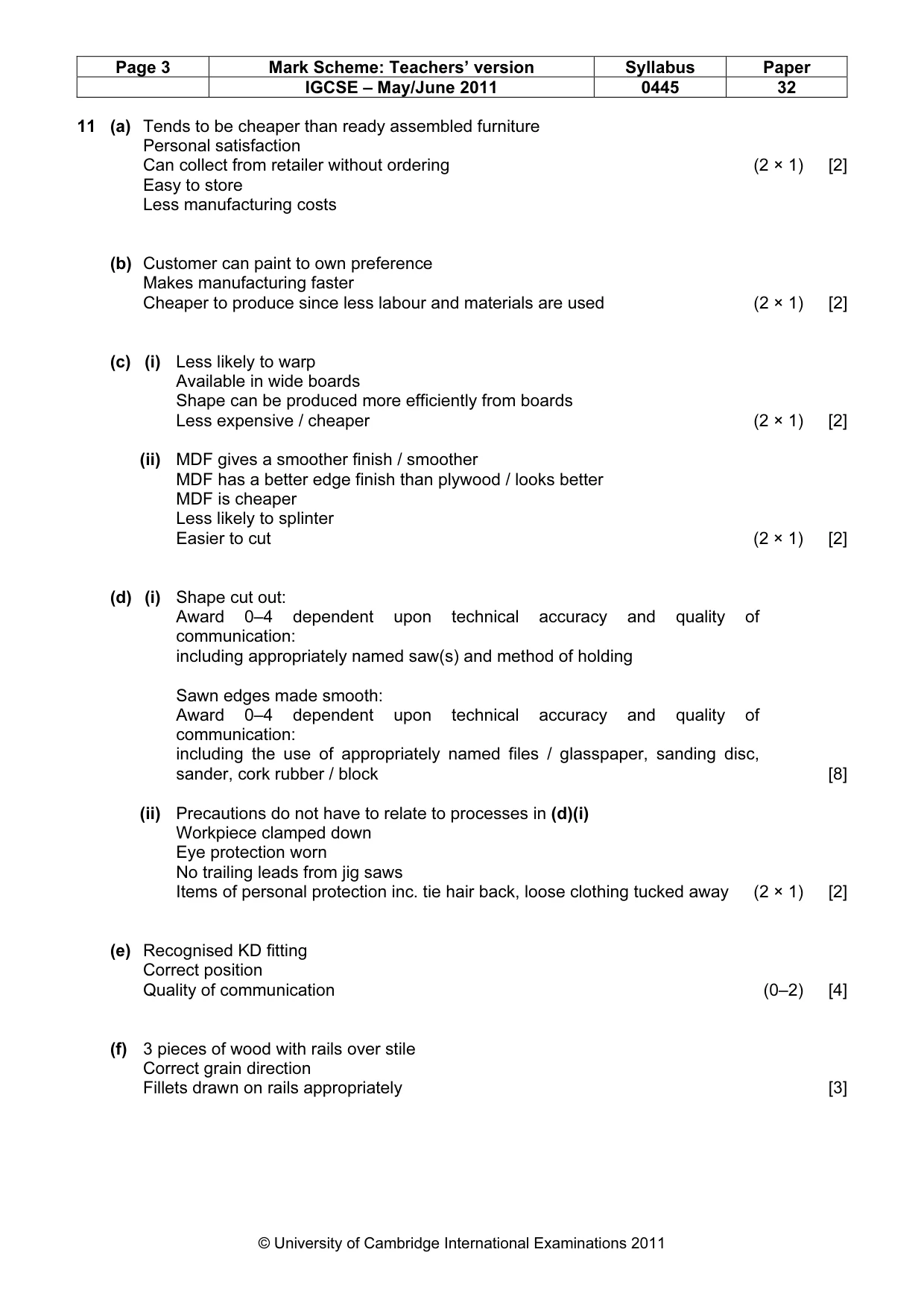
Page 3 Mark Scheme: Teachers’ version Syllabus Paper IGCSE – May/June 2011 0445 32 © University of Cambridge International Examinations 2011 11 (a) Tends to be cheaper than ready assembled furniture Personal satisfaction Can collect from retailer without ordering (2 × 1) [2] Easy to store Less manufacturing costs (b) Customer can paint to own preference Makes manufacturing faster Cheaper to produce since less labour and materials are used (2 × 1) [2] (c) (i) Less likely to warp Available in wide boards Shape can be produced more efficiently from boards Less expensive / cheaper (2 × 1) [2] (ii) MDF gives a smoother finish / smoother MDF has a better edge finish than plywood / looks better MDF is cheaper Less likely to splinter Easier to cut (2 × 1) [2] (d) (i) Shape cut out: Award 0–4 dependent upon technical accuracy and quality of communication: including appropriately named saw(s) and method of holding Sawn edges made smooth: Award 0–4 dependent upon technical accuracy and quality of communication: including the use of appropriately named files / glasspaper, sanding disc, sander, cork rubber / block [8] (ii) Precautions do not have to relate to processes in (d)(i) Workpiece clamped down Eye protection worn No trailing leads from jig saws Items of personal protection inc. tie hair back, loose clothing tucked away (2 × 1) [2] (e) Recognised KD fitting Correct position Quality of communication (0–2) [4] (f) 3 pieces of wood with rails over stile Correct grain direction Fillets drawn on rails appropriately [3]
Mark scheme, page 4
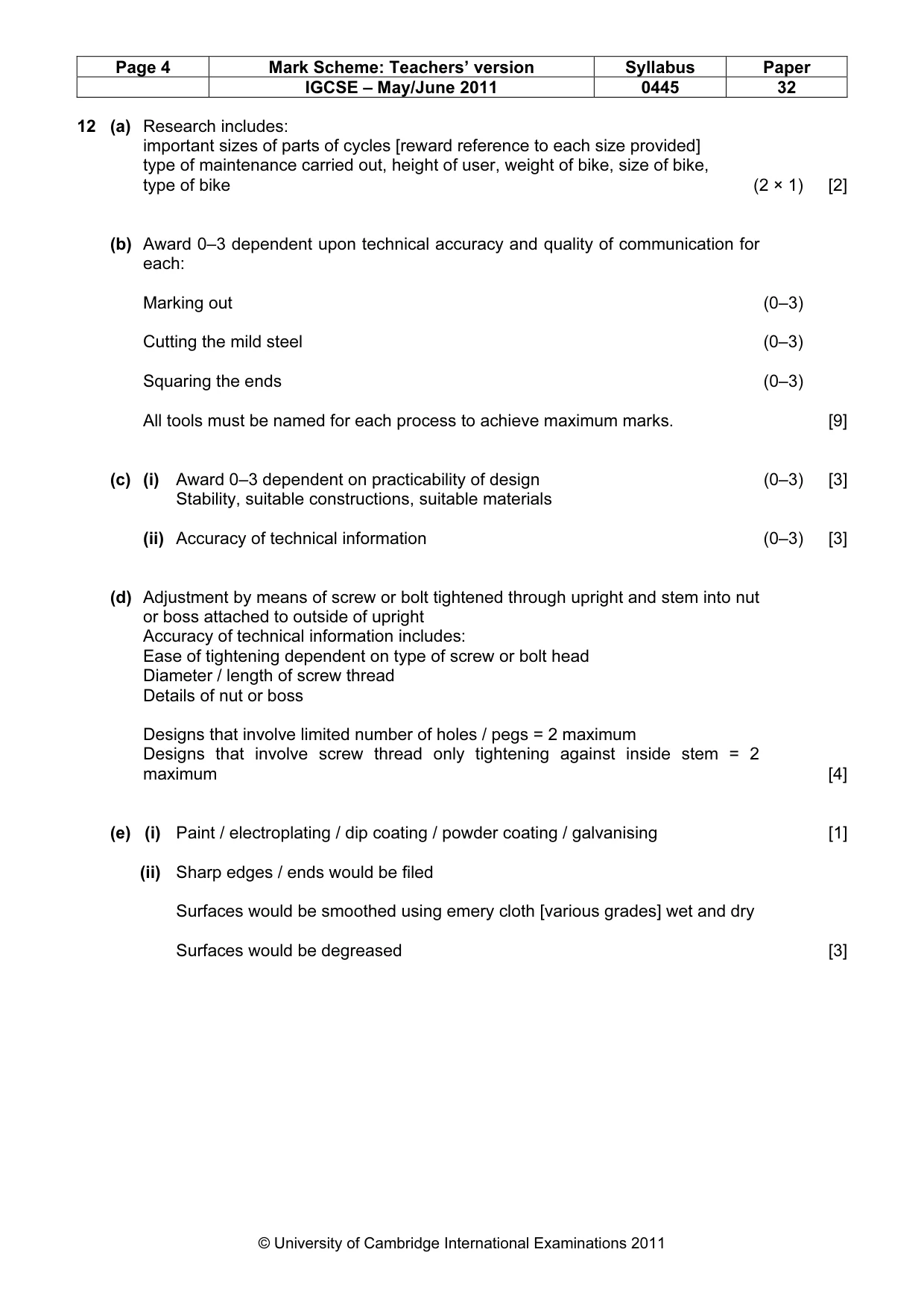
Page 4 Mark Scheme: Teachers’ version Syllabus Paper IGCSE – May/June 2011 0445 32 © University of Cambridge International Examinations 2011 12 (a) Research includes: important sizes of parts of cycles [reward reference to each size provided] type of maintenance carried out, height of user, weight of bike, size of bike, type of bike (2 × 1) [2] (b) Award 0–3 dependent upon technical accuracy and quality of communication for each: Marking out (0–3) Cutting the mild steel (0–3) Squaring the ends (0–3) All tools must be named for each process to achieve maximum marks. [9] (c) (i) Award 0–3 dependent on practicability of design (0–3) [3] Stability, suitable constructions, suitable materials (ii) Accuracy of technical information (0–3) [3] (d) Adjustment by means of screw or bolt tightened through upright and stem into nut or boss attached to outside of upright Accuracy of technical information includes: Ease of tightening dependent on type of screw or bolt head Diameter / length of screw thread Details of nut or boss Designs that involve limited number of holes / pegs = 2 maximum Designs that involve screw thread only tightening against inside stem = 2 maximum [4] (e) (i) Paint / electroplating / dip coating / powder coating / galvanising [1] (ii) Sharp edges / ends would be filed Surfaces would be smoothed using emery cloth [various grades] wet and dry Surfaces would be degreased [3]
Mark scheme, page 5
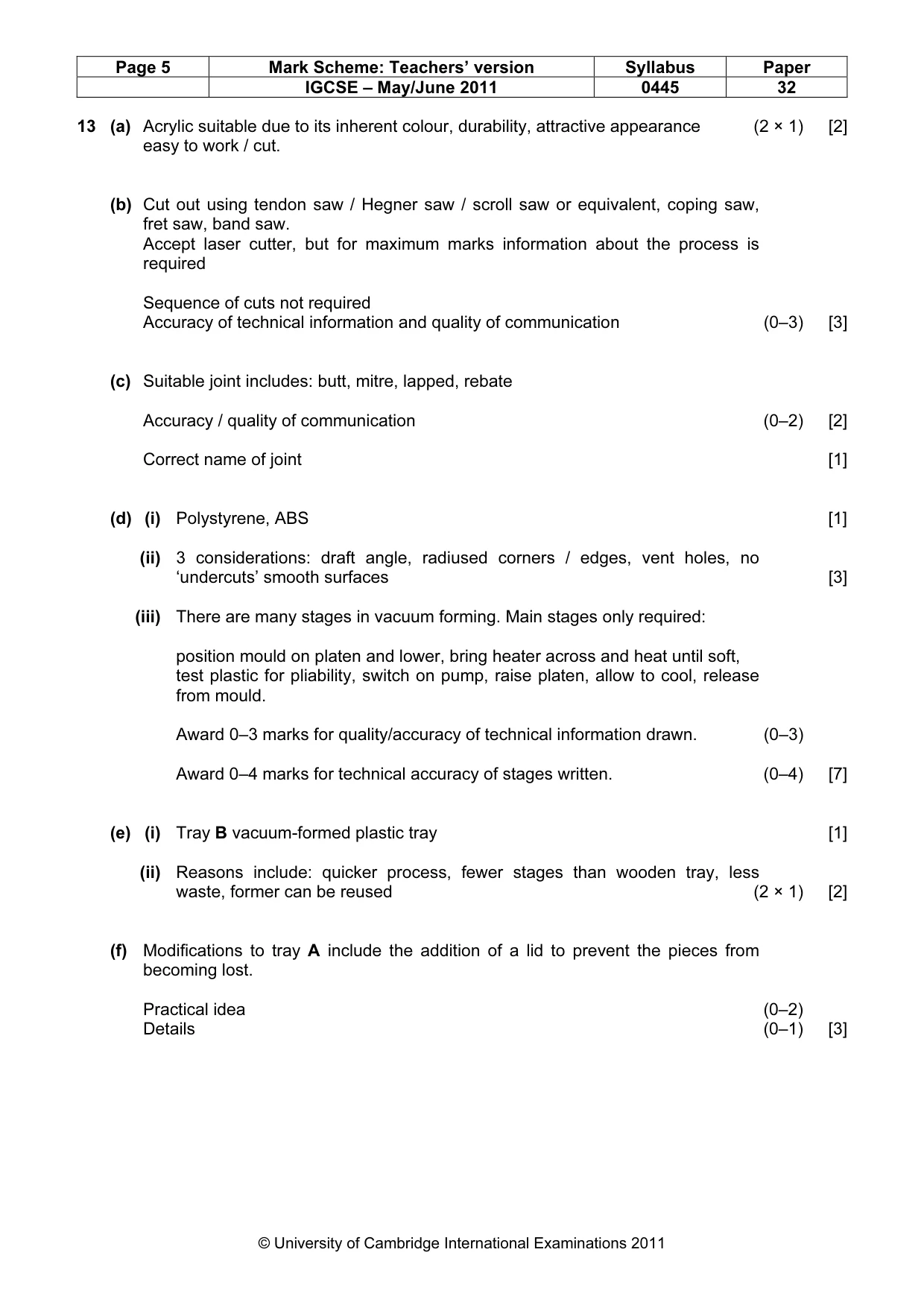
Page 5 Mark Scheme: Teachers’ version Syllabus Paper IGCSE – May/June 2011 0445 32 © University of Cambridge International Examinations 2011 13 (a) Acrylic suitable due to its inherent colour, durability, attractive appearance (2 × 1) [2] easy to work / cut. (b) Cut out using tendon saw / Hegner saw / scroll saw or equivalent, coping saw, fret saw, band saw. Accept laser cutter, but for maximum marks information about the process is required Sequence of cuts not required Accuracy of technical information and quality of communication (0–3) [3] (c) Suitable joint includes: butt, mitre, lapped, rebate Accuracy / quality of communication (0–2) [2] Correct name of joint [1] (d) (i) Polystyrene, ABS [1] (ii) 3 considerations: draft angle, radiused corners / edges, vent holes, no ‘undercuts’ smooth surfaces [3] (iii) There are many stages in vacuum forming. Main stages only required: position mould on platen and lower, bring heater across and heat until soft, test plastic for pliability, switch on pump, raise platen, allow to cool, release from mould. Award 0–3 marks for quality/accuracy of technical information drawn. (0–3) Award 0–4 marks for technical accuracy of stages written. (0–4) [7] (e) (i) Tray B vacuum-formed plastic tray [1] (ii) Reasons include: quicker process, fewer stages than wooden tray, less waste, former can be reused (2 × 1) [2] (f) Modifications to tray A include the addition of a lid to prevent the pieces from becoming lost. Practical idea (0–2) Details (0–1) [3]
What you needed in this session
Cambridge’s own grade thresholds for 2011 May/June, Paper 3 · Variant 2. A higher threshold means an easier paper — the bar moves with how the cohort did.