Cambridge IGCSE Design and Technology 0445 — 2011 May/June Paper 3 · Variant 3
0445/33/M/J/11 · 50 marks · ≈56 min
The question paper and its mark scheme, free to read here and free to download. This is Cambridge’s own paper, exactly as it was sat.
Question paper16 pages


Mark scheme5 pages
Answers below. Sit the paper first if you are practising.
Paper as text
Question paper, page 1
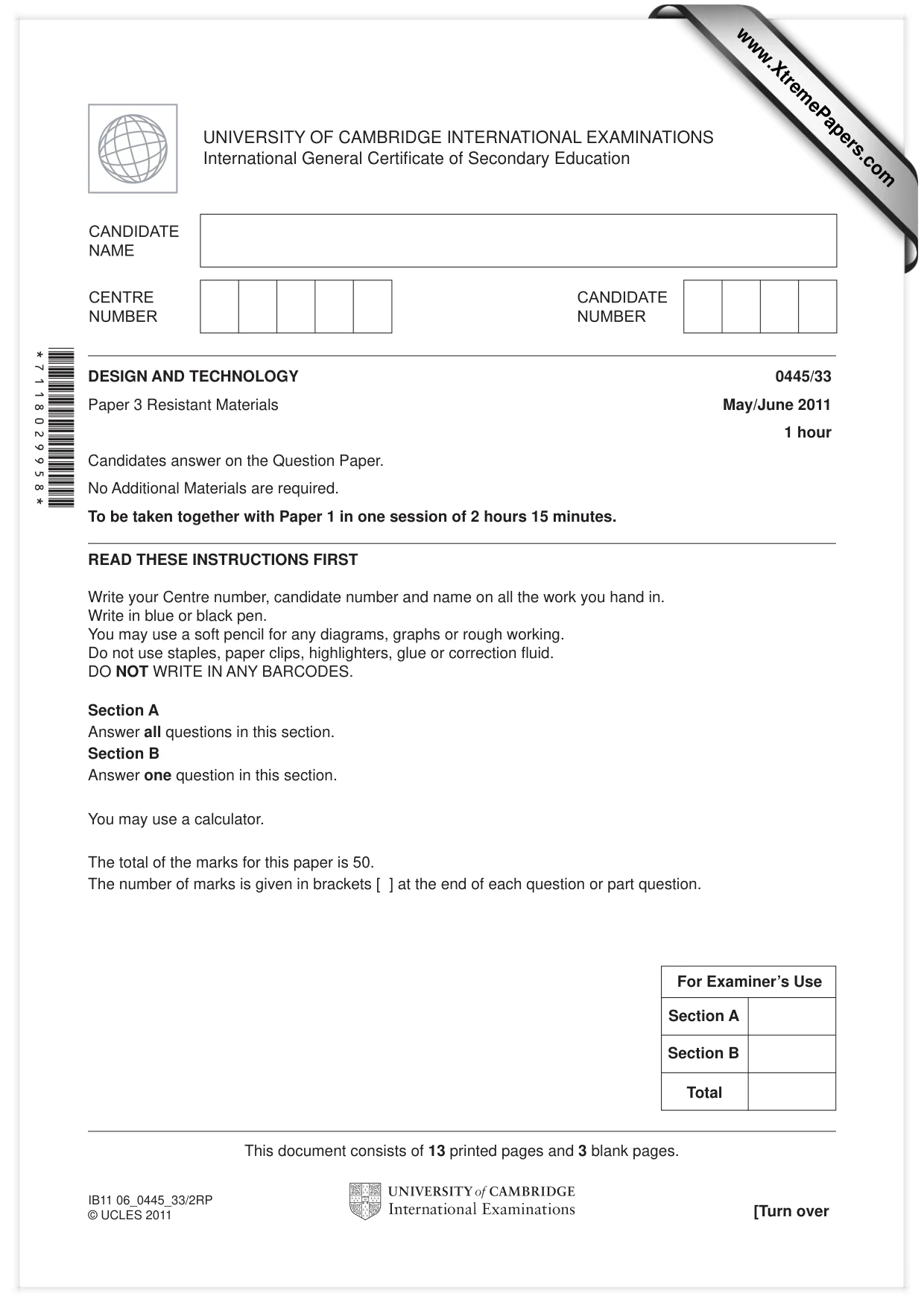
READ THESE INSTRUCTIONS FIRST Write your Centre number, candidate number and name on all the work you hand in. Write in blue or black pen. You may use a soft pencil for any diagrams, graphs or rough working. Do not use staples, paper clips, highlighters, glue or correction fl uid. DO NOT WRITE IN ANY BARCODES. Section A Answer all questions in this section. Section B Answer one question in this section. You may use a calculator. The total of the marks for this paper is 50. The number of marks is given in brackets [ ] at the end of each question or part question. DESIGN AND TECHNOLOGY 0445/33 Paper 3 Resistant Materials May/June 2011 1 hour Candidates answer on the Question Paper. No Additional Materials are required. To be taken together with Paper 1 in one session of 2 hours 15 minutes. UNIVERSITY OF CAMBRIDGE INTERNATIONAL EXAMINATIONS International General Certifi cate of Secondary Education This document consists of 13 printed pages and 3 blank pages. [Turn over IB11 06_0445_33/2RP © UCLES 2011 *7118029958* For Examiner’s Use Total Section A Section B www.XtremePapers.com
Question paper, page 2
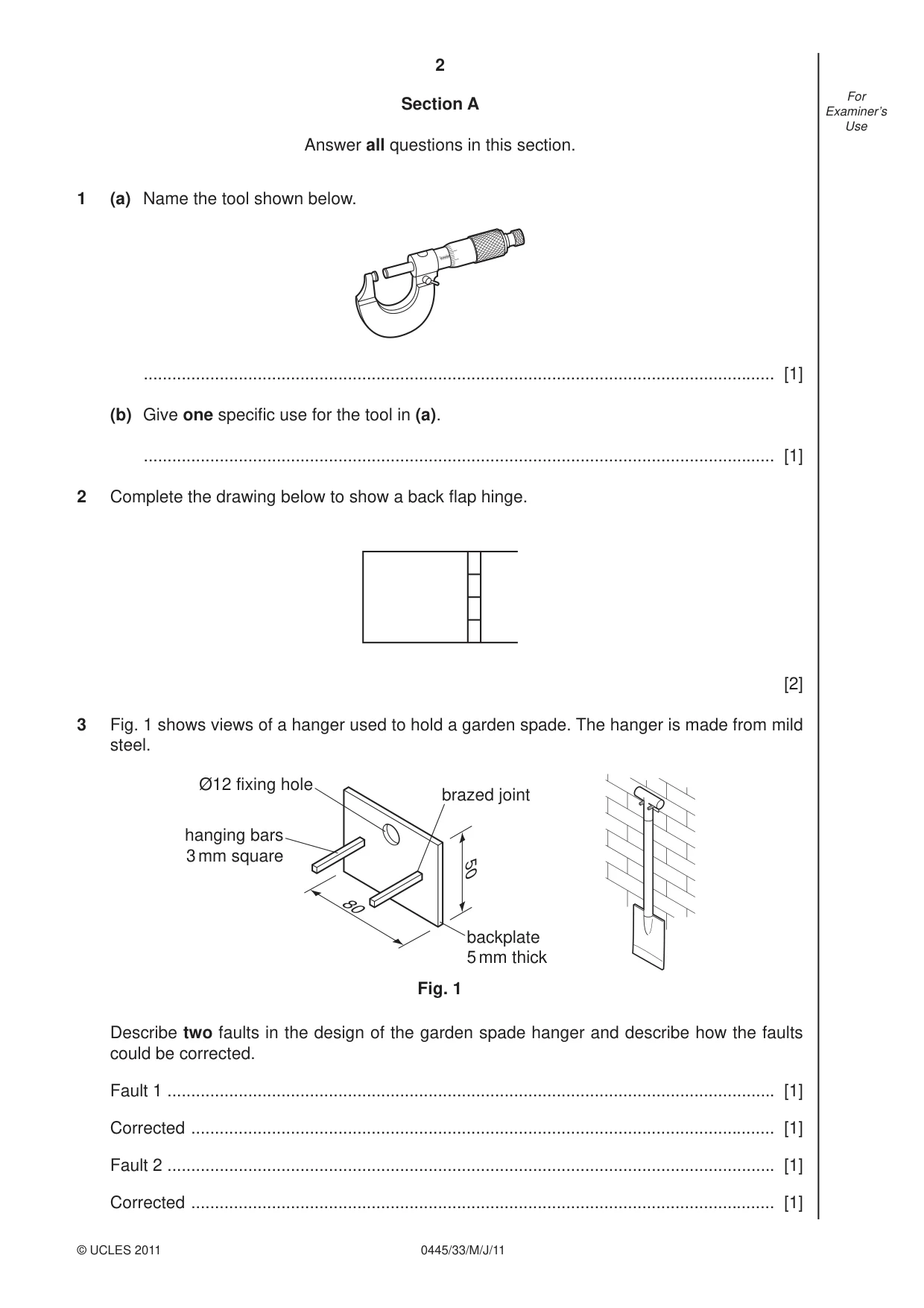
2 0445/33/M/J/11 © UCLES 2011 For Examiner’s Use Section A Answer all questions in this section. 1 (a) Name the tool shown below. … [1] (b) Give one specifi c use for the tool in (a). … [1] 2 Complete the drawing below to show a back fl ap hinge. [2] 3 Fig. 1 shows views of a hanger used to hold a garden spade. The hanger is made from mild steel. 80 50 Ø12 fixing hole hanging bars 3 mm square backplate 5 mm thick brazed joint Fig. 1 Describe two faults in the design of the garden spade hanger and describe how the faults could be corrected. Fault 1 … [1] Corrected … [1] Fault 2 … [1] Corrected … [1]
Question paper, page 3
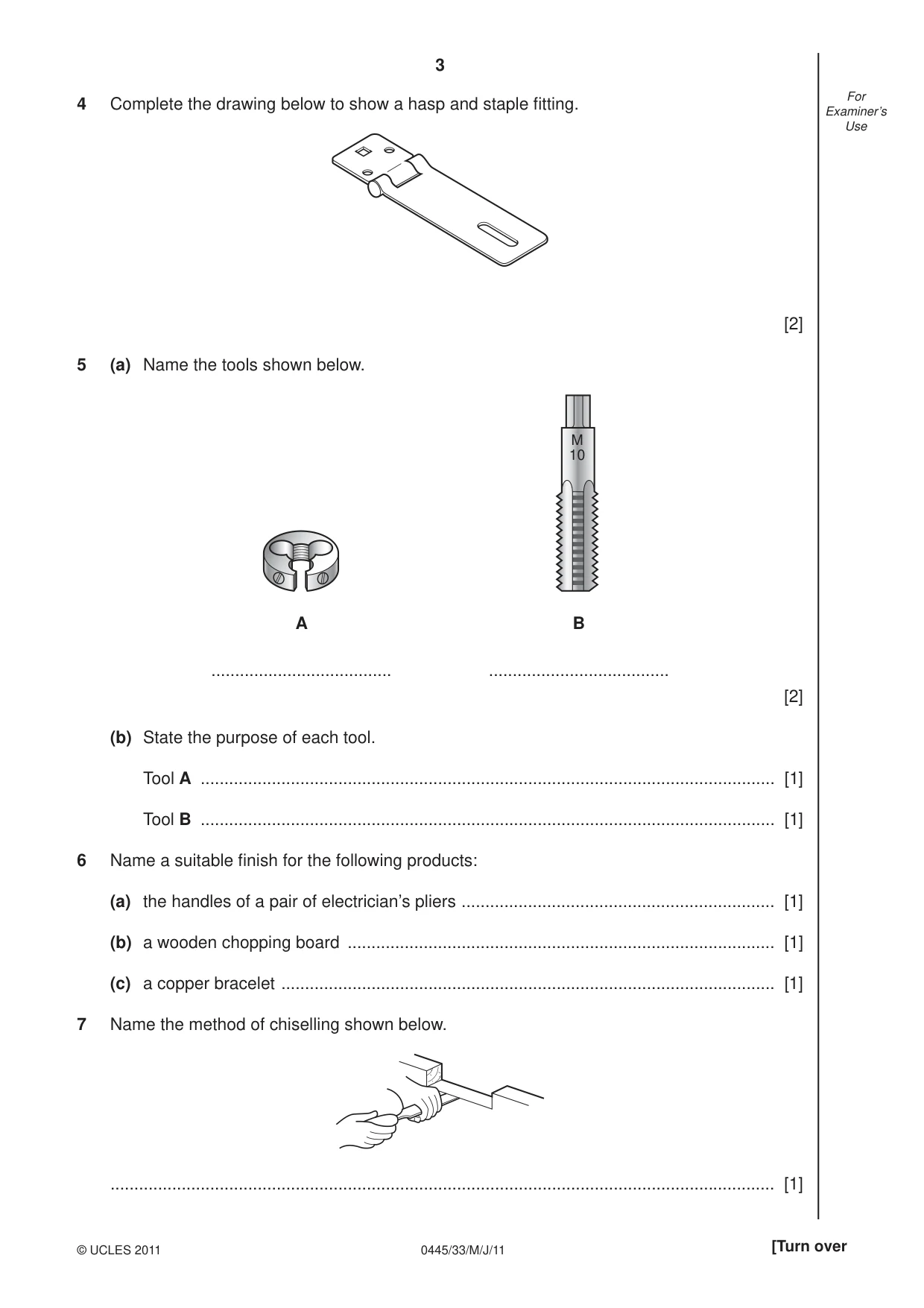
3 0445/33/M/J/11 © UCLES 2011 [Turn over For Examiner’s Use 4 Complete the drawing below to show a hasp and staple fi tting. [2] 5 (a) Name the tools shown below. M 10 A … B … [2] (b) State the purpose of each tool. Tool A … [1] Tool B … [1] 6 Name a suitable fi nish for the following products: (a) the handles of a pair of electrician’s pliers … [1] (b) a wooden chopping board … [1] (c) a copper bracelet … [1] 7 Name the method of chiselling shown below. … [1]
Question paper, page 4
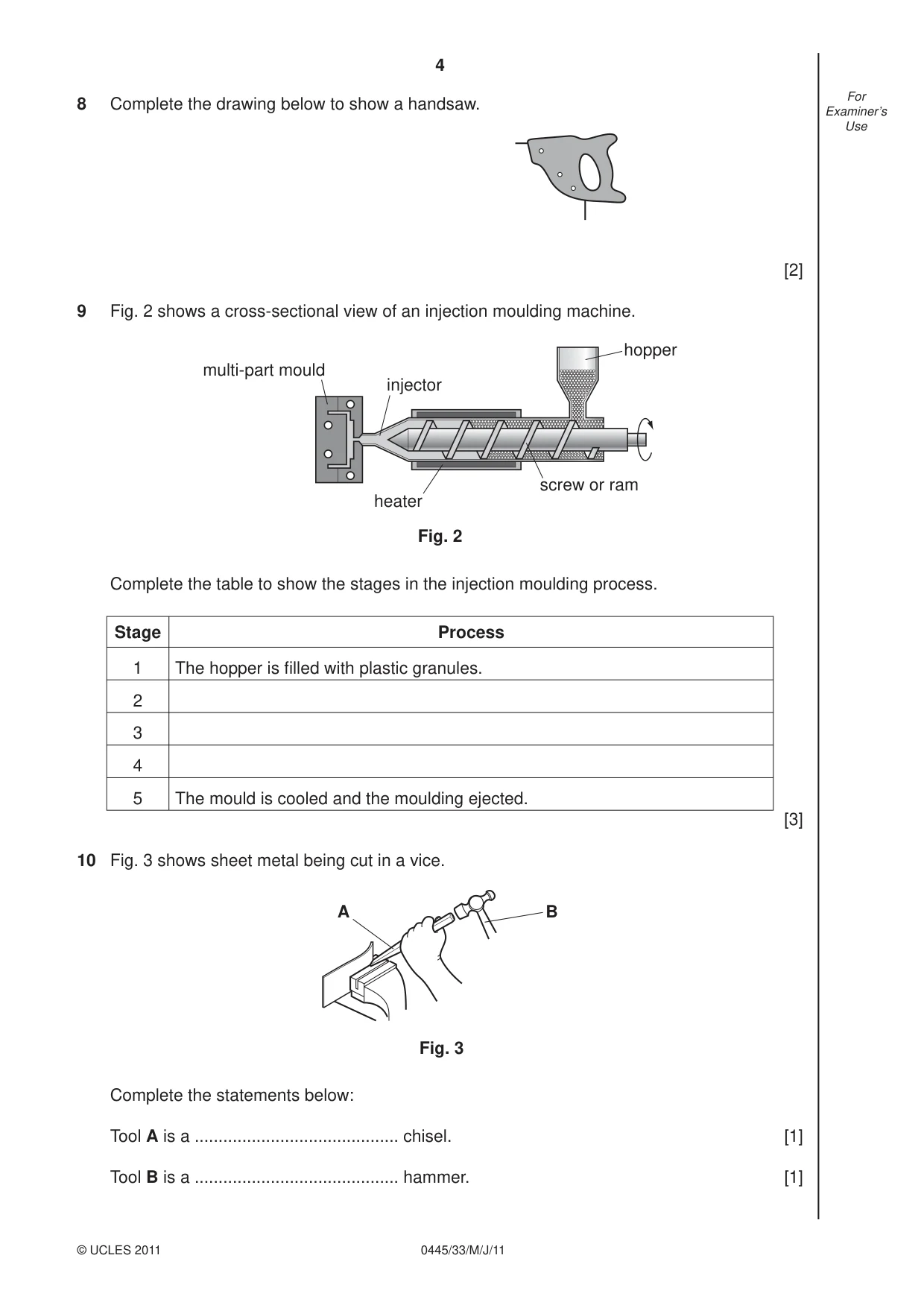
4 0445/33/M/J/11 © UCLES 2011 For Examiner’s Use 8 Complete the drawing below to show a handsaw. [2] 9 Fig. 2 shows a cross-sectional view of an injection moulding machine. hopper screw or ram multi-part mould injector heater Fig. 2 Complete the table to show the stages in the injection moulding process. Stage Process 1 The hopper is fi lled with plastic granules. 2 3 4 5 The mould is cooled and the moulding ejected. [3] 10 Fig. 3 shows sheet metal being cut in a vice. A B Fig. 3 Complete the statements below: Tool A is a … chisel. [1] Tool B is a … hammer. [1]
Question paper, page 5
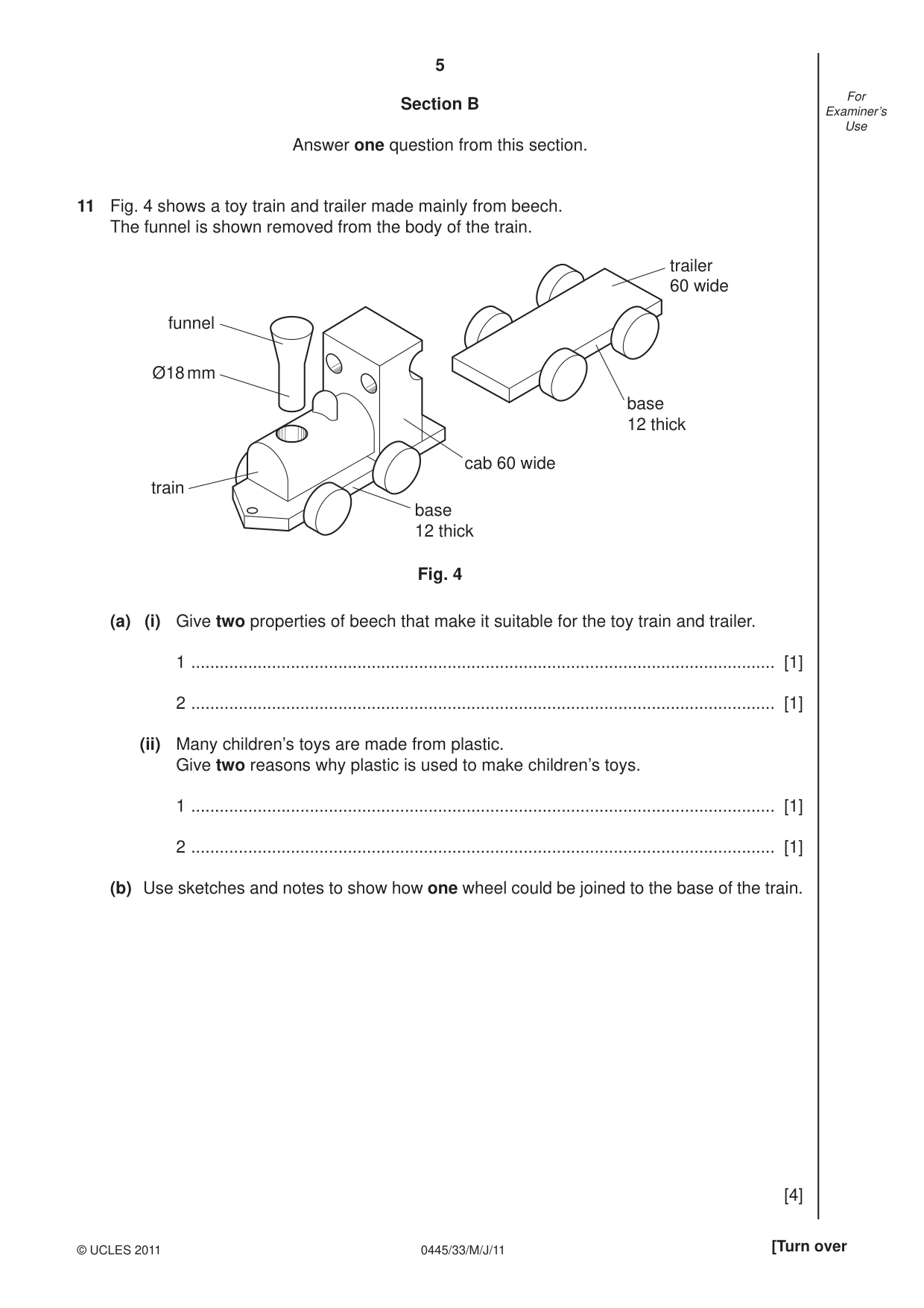
5 0445/33/M/J/11 © UCLES 2011 [Turn over For Examiner’s Use Section B Answer one question from this section. 11 Fig. 4 shows a toy train and trailer made mainly from beech. The funnel is shown removed from the body of the train. base 12 thick base 12 thick trailer 60 wide cab 60 wide funnel Ø18 mm train Fig. 4 (a) (i) Give two properties of beech that make it suitable for the toy train and trailer. 1 … [1] 2 … [1] (ii) Many children’s toys are made from plastic. Give two reasons why plastic is used to make children’s toys. 1 … [1] 2 … [1] (b) Use sketches and notes to show how one wheel could be joined to the base of the train. [4]
Question paper, page 6
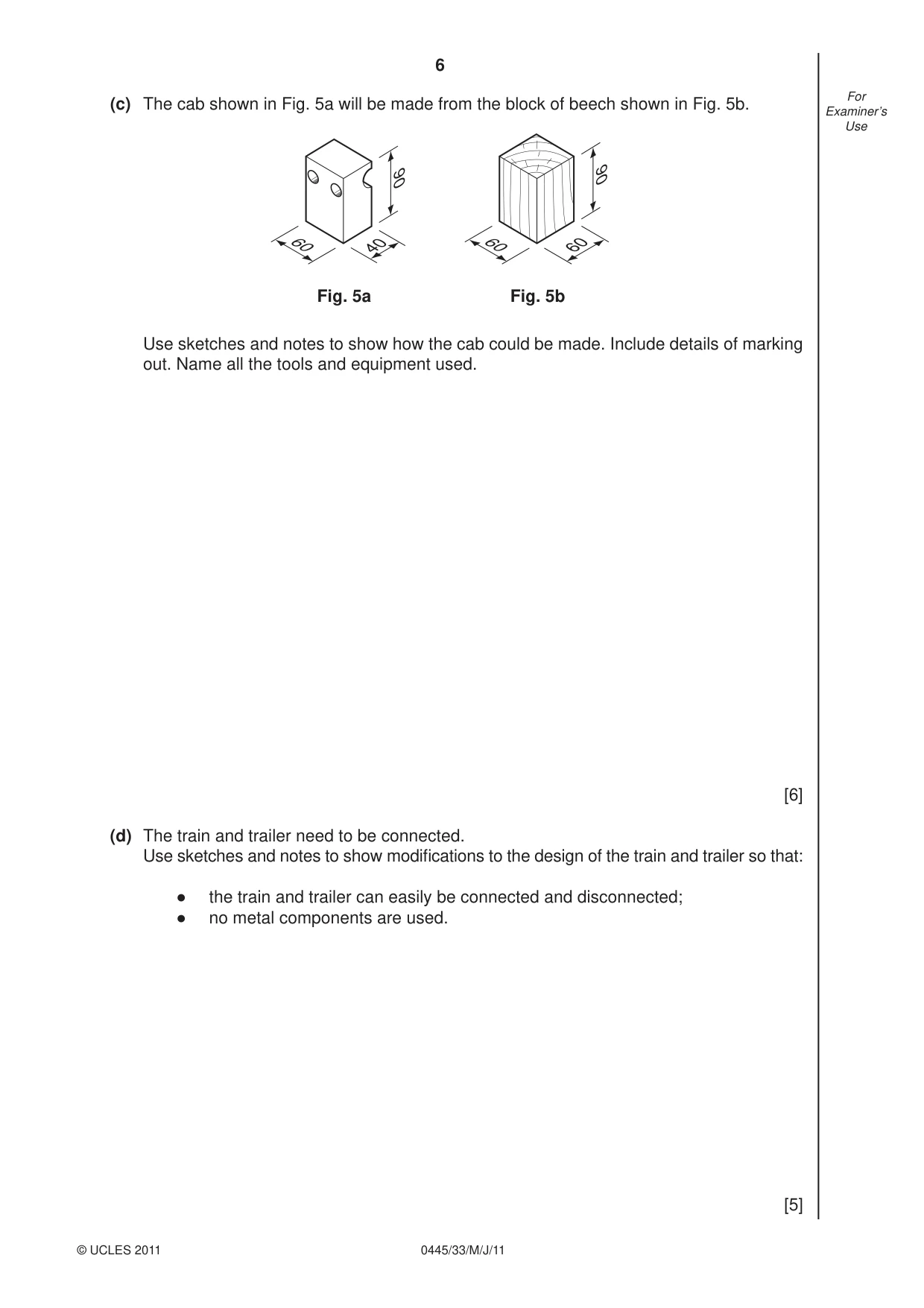
6 0445/33/M/J/11 © UCLES 2011 For Examiner’s Use (c) The cab shown in Fig. 5a will be made from the block of beech shown in Fig. 5b. 60 60 40 60 90 90 Fig. 5a Fig. 5b Use sketches and notes to show how the cab could be made. Include details of marking out. Name all the tools and equipment used. [6] (d) The train and trailer need to be connected. Use sketches and notes to show modifi cations to the design of the train and trailer so that: ● the train and trailer can easily be connected and disconnected; ● no metal components are used. [5]
Question paper, page 7
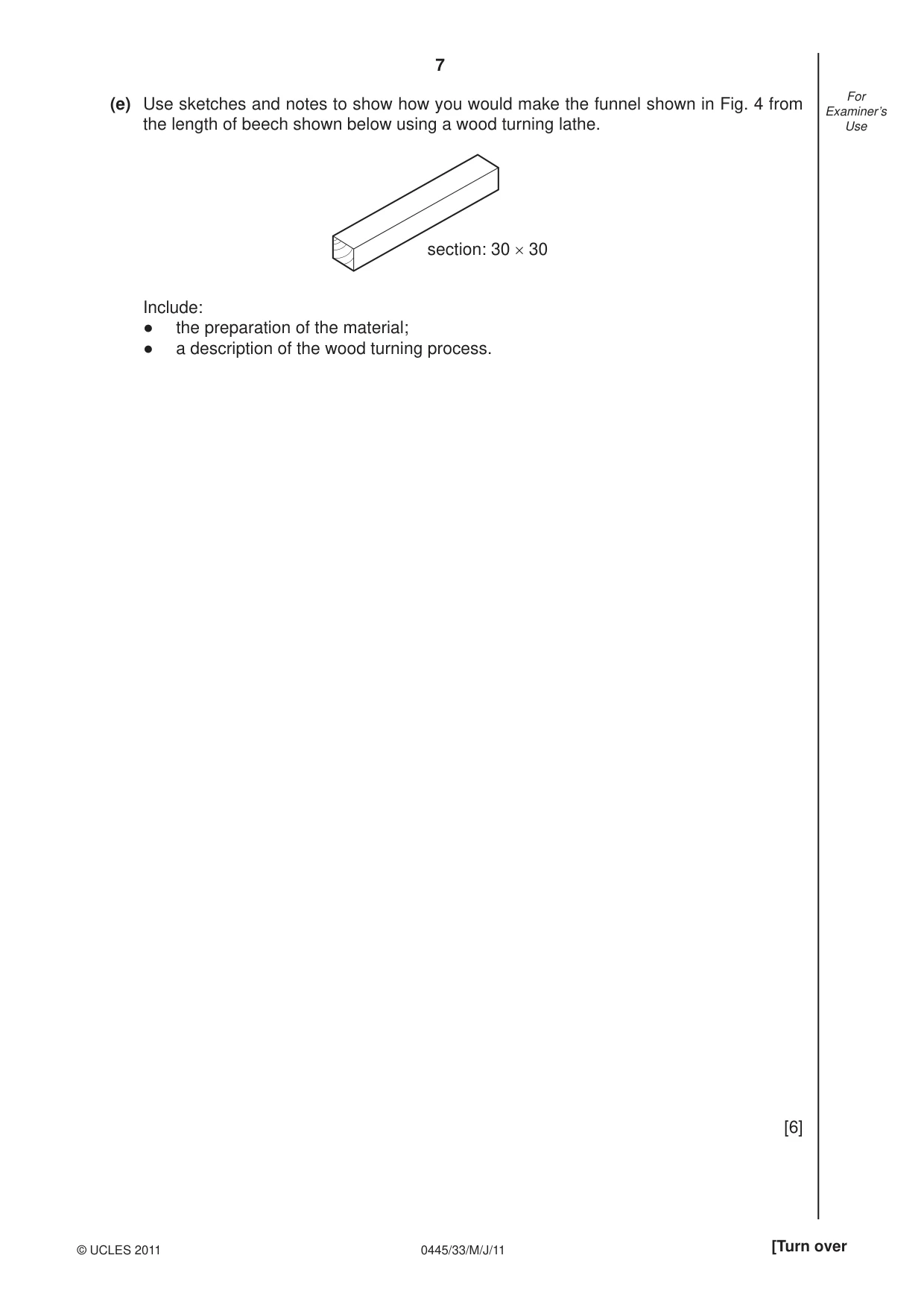
7 0445/33/M/J/11 © UCLES 2011 [Turn over For Examiner’s Use (e) Use sketches and notes to show how you would make the funnel shown in Fig. 4 from the length of beech shown below using a wood turning lathe. section: 30 × 30 Include: ● the preparation of the material; ● a description of the wood turning process. [6]
Question paper, page 8
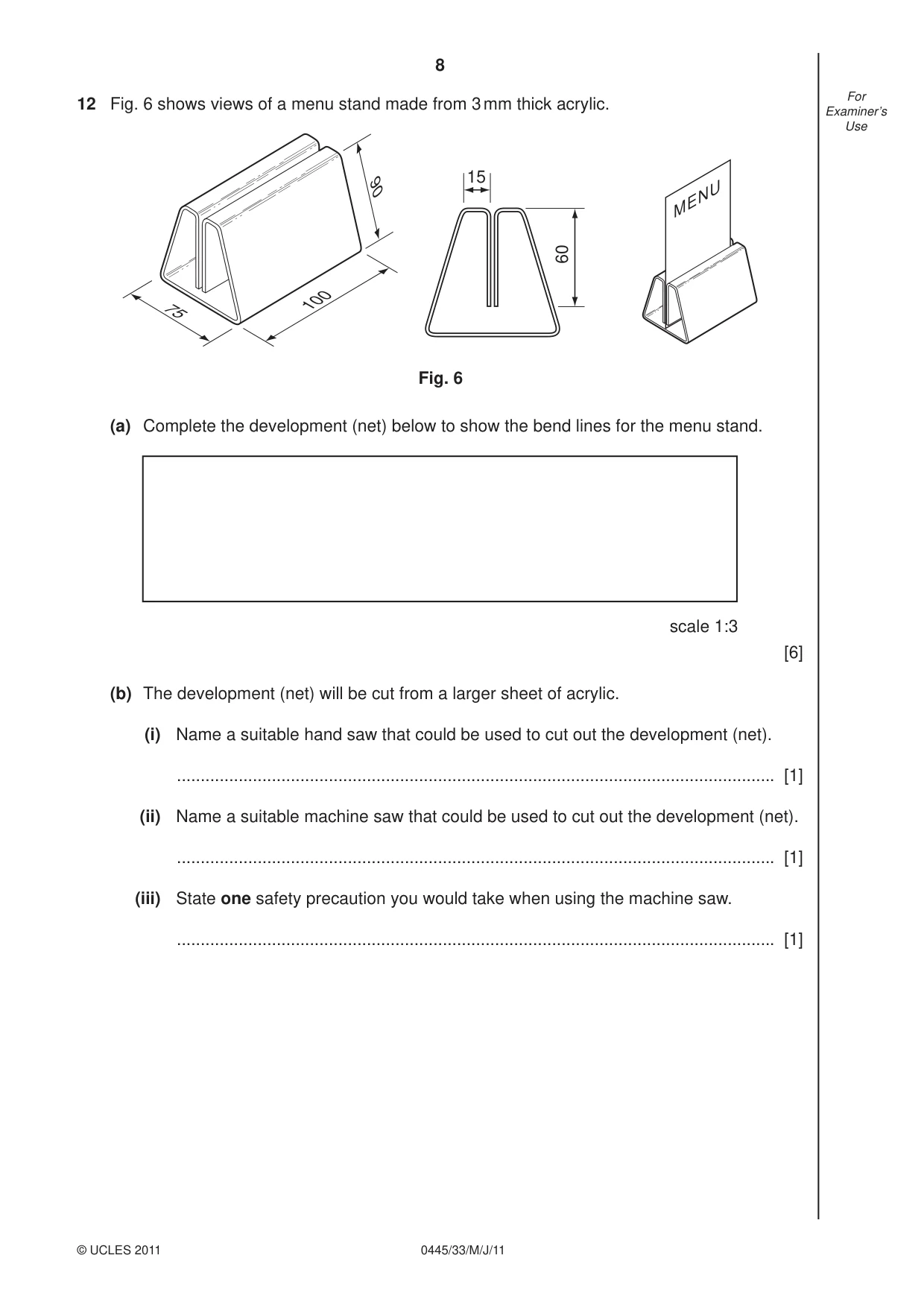
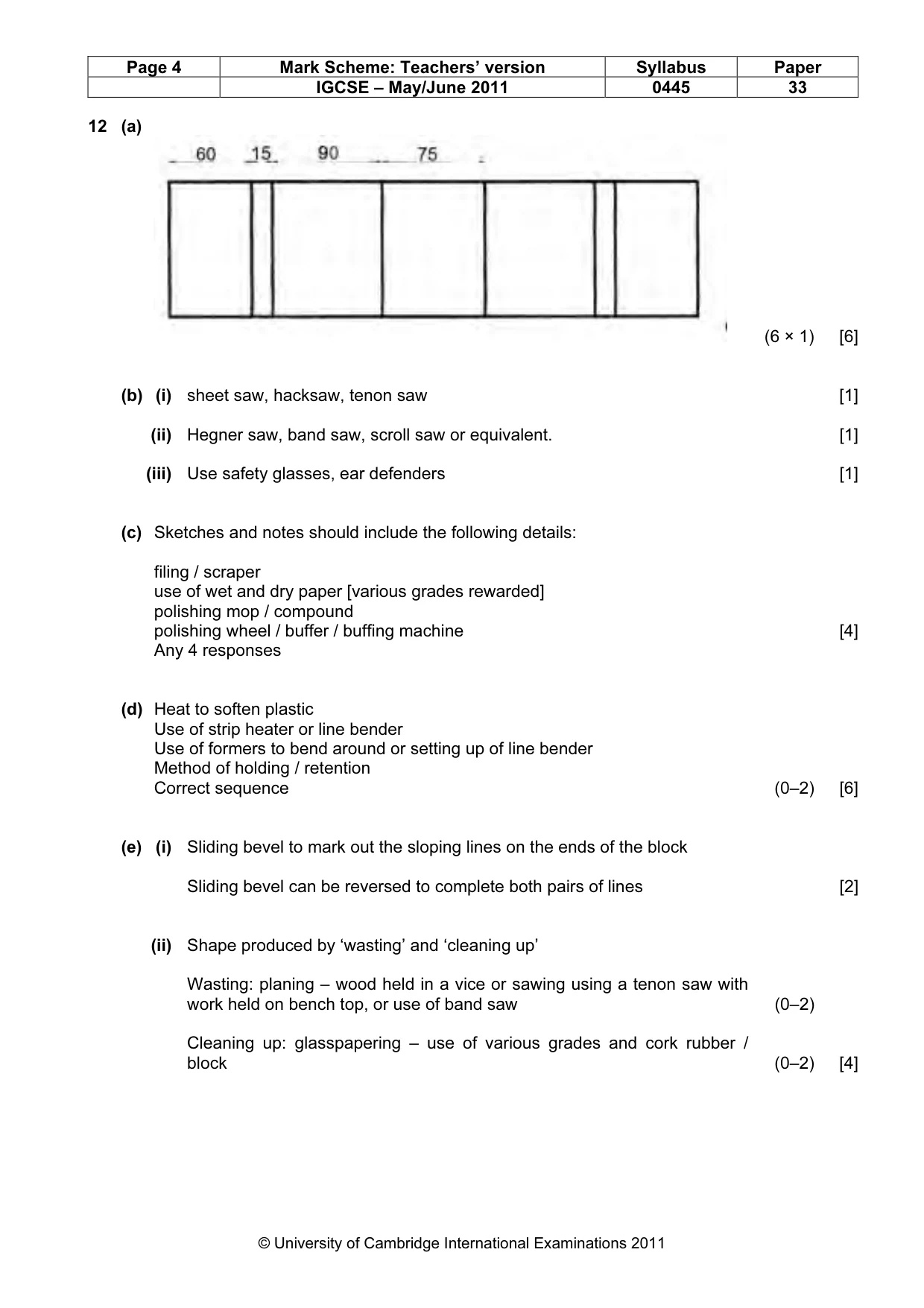
8 0445/33/M/J/11 © UCLES 2011 For Examiner’s Use 12 Fig. 6 shows views of a menu stand made from 3 mm thick acrylic. 75 100 90 15 60 MENU Fig. 6 (a) Complete the development (net) below to show the bend lines for the menu stand. scale 1:3 [6] (b) The development (net) will be cut from a larger sheet of acrylic. (i) Name a suitable hand saw that could be used to cut out the development (net). … [1] (ii) Name a suitable machine saw that could be used to cut out the development (net). … [1] (iii) State one safety precaution you would take when using the machine saw. … [1]
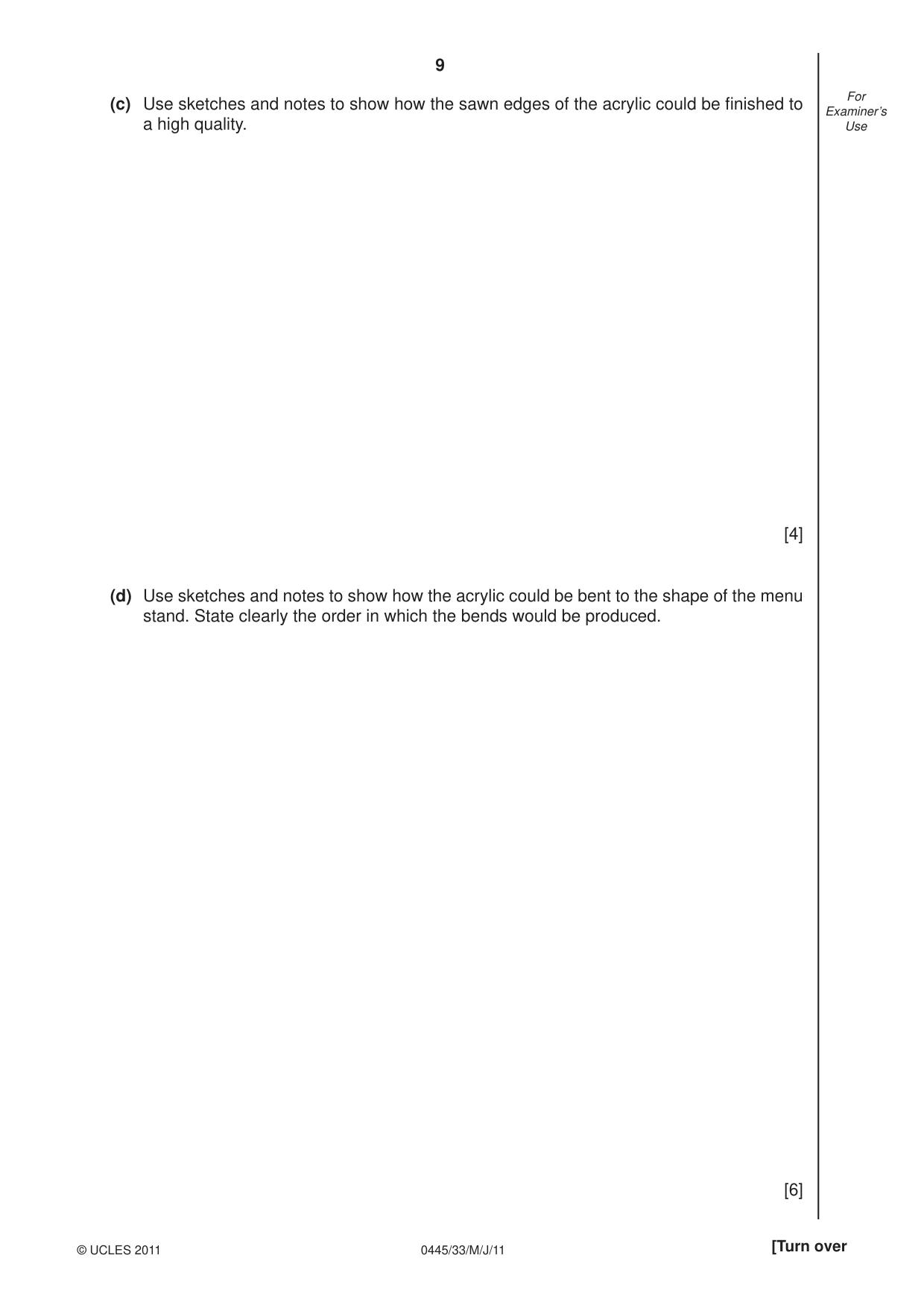
Question paper, page 9
9 0445/33/M/J/11 © UCLES 2011 [Turn over For Examiner’s Use (c) Use sketches and notes to show how the sawn edges of the acrylic could be fi nished to a high quality. [4] (d) Use sketches and notes to show how the acrylic could be bent to the shape of the menu stand. State clearly the order in which the bends would be produced. [6]
Question paper, page 10
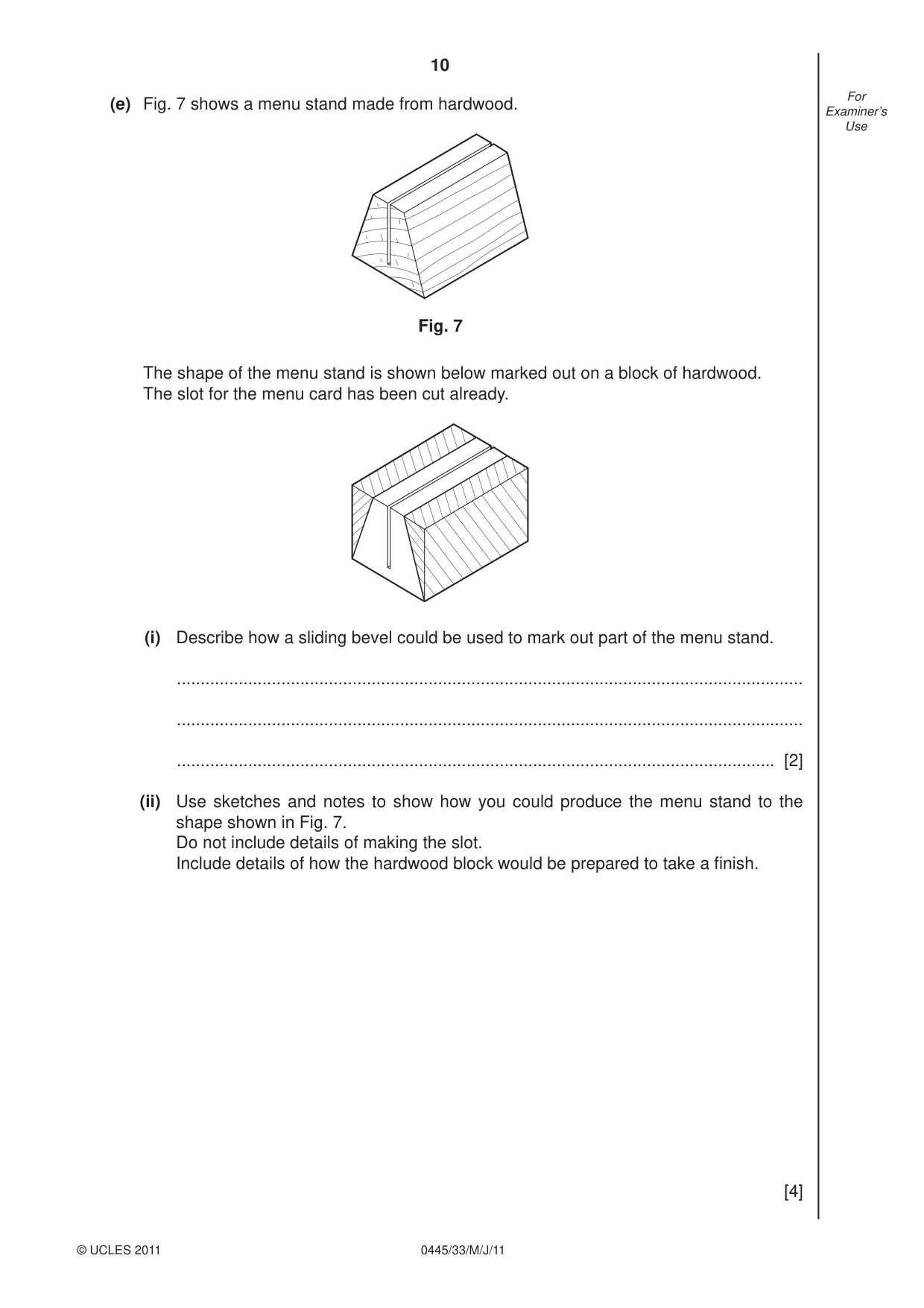
10 0445/33/M/J/11 © UCLES 2011 For Examiner’s Use (e) Fig. 7 shows a menu stand made from hardwood. Fig. 7 The shape of the menu stand is shown below marked out on a block of hardwood. The slot for the menu card has been cut already. (i) Describe how a sliding bevel could be used to mark out part of the menu stand. … … … [2] (ii) Use sketches and notes to show how you could produce the menu stand to the shape shown in Fig. 7. Do not include details of making the slot. Include details of how the hardwood block would be prepared to take a fi nish. [4]
Question paper, page 11
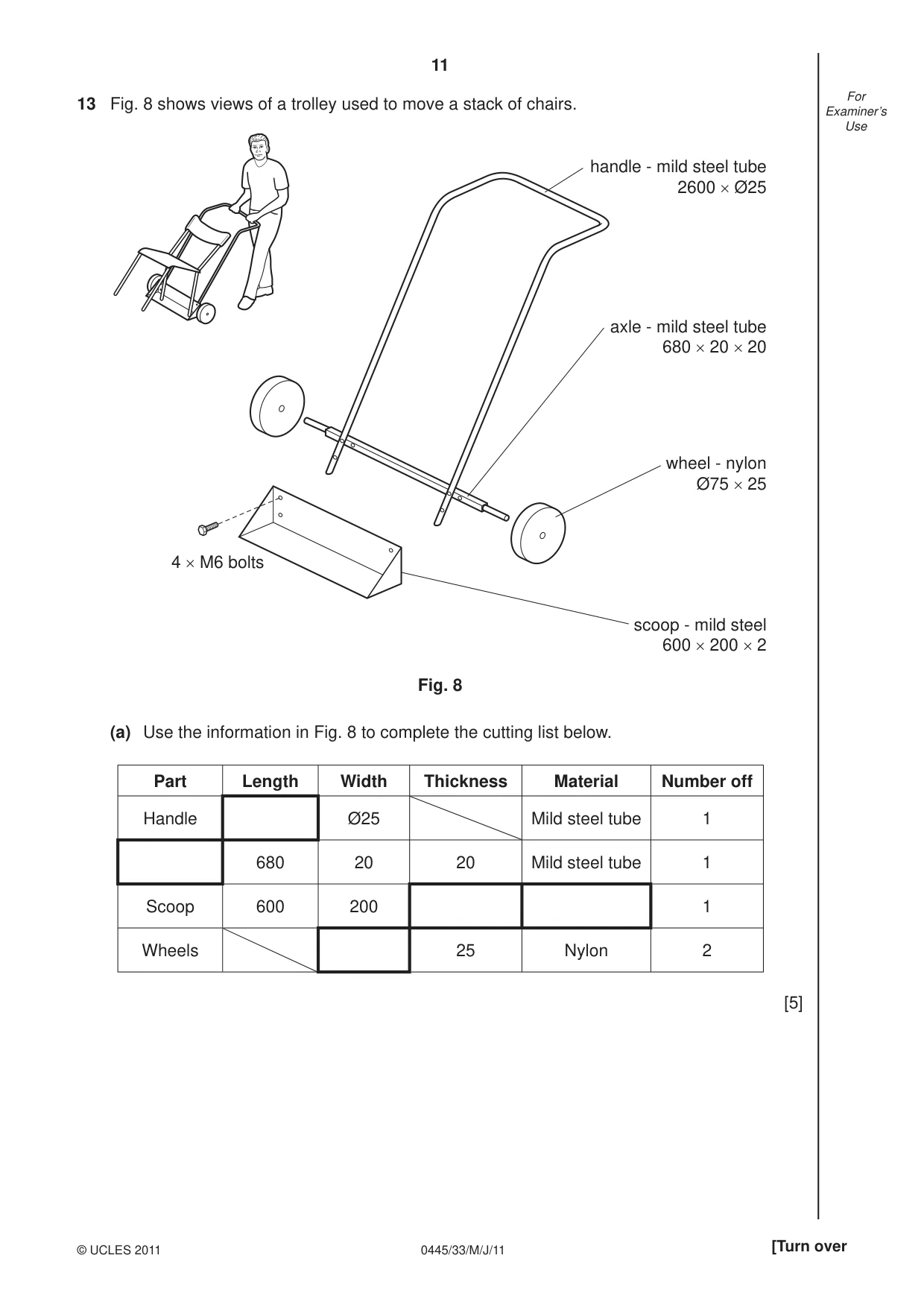
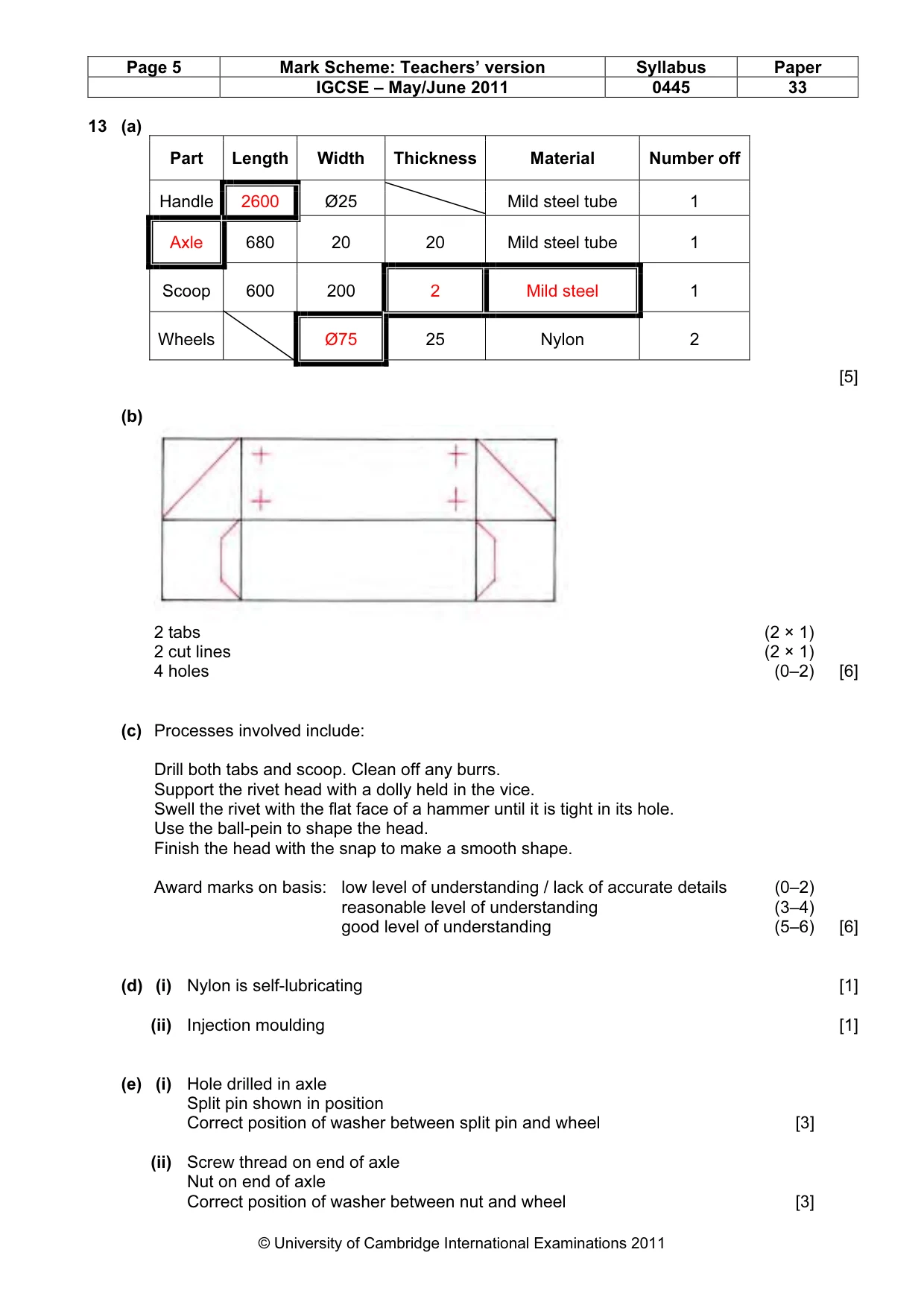
11 0445/33/M/J/11 © UCLES 2011 [Turn over For Examiner’s Use 13 Fig. 8 shows views of a trolley used to move a stack of chairs. 4 × M6 bolts handle - mild steel tube 2600 × Ø25 axle - mild steel tube 680 × 20 × 20 wheel - nylon Ø75 × 25 scoop - mild steel 600 × 200 × 2 Fig. 8 (a) Use the information in Fig. 8 to complete the cutting list below. Part Length Width Thickness Material Number off Handle Ø25 Mild steel tube 1 680 20 20 Mild steel tube 1 Scoop 600 200 1 Wheels 25 Nylon 2 [5]
Question paper, page 12
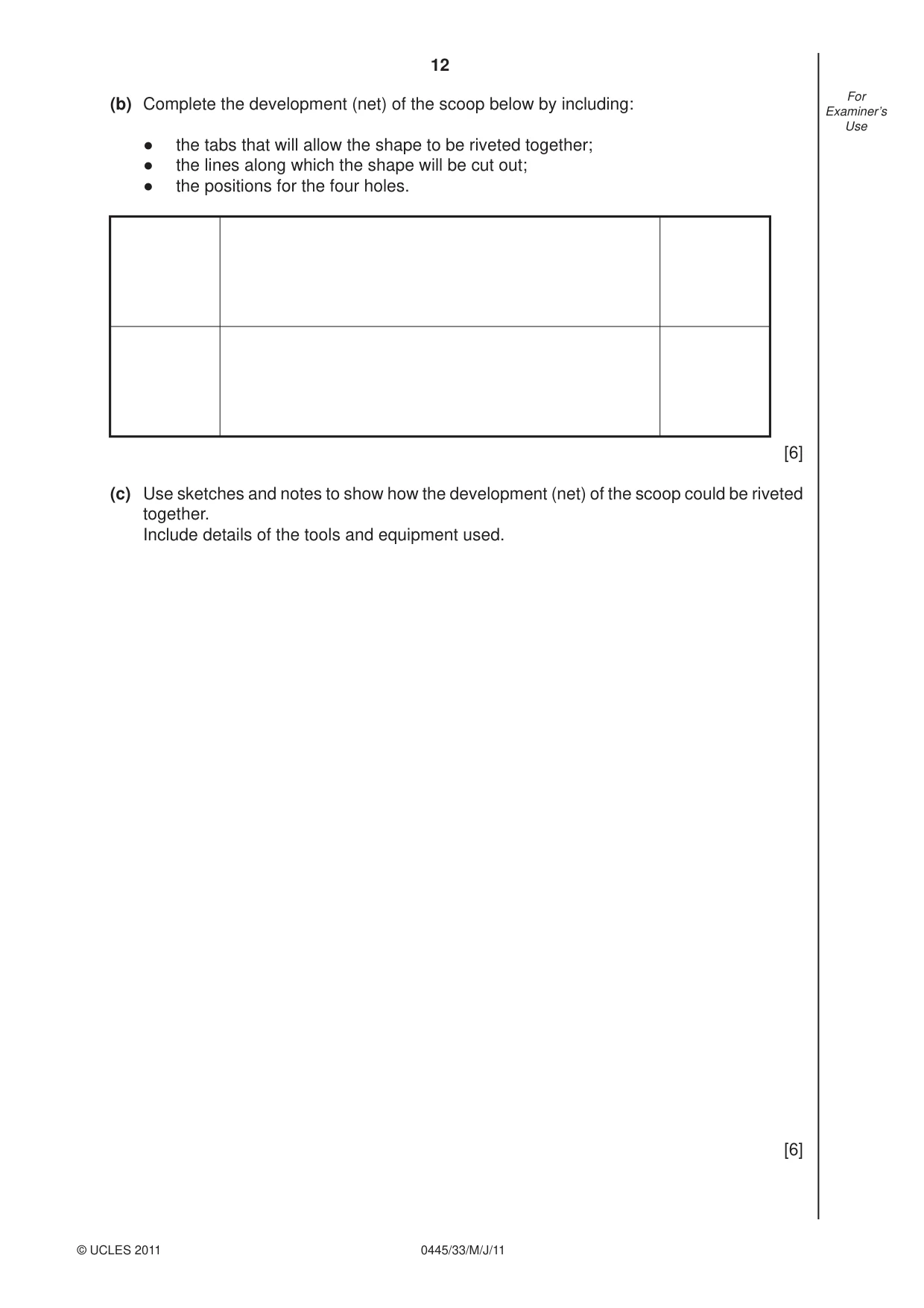
12 0445/33/M/J/11 © UCLES 2011 For Examiner’s Use (b) Complete the development (net) of the scoop below by including: ● the tabs that will allow the shape to be riveted together; ● the lines along which the shape will be cut out; ● the positions for the four holes. [6] (c) Use sketches and notes to show how the development (net) of the scoop could be riveted together. Include details of the tools and equipment used. [6]
Question paper, page 13
13 0445/33/M/J/11 © UCLES 2011 [Turn over For Examiner’s Use (d) The wheels are made from nylon. (i) Give one property of nylon that makes it suitable for the wheels. … [1] (ii) Name a process used to manufacture the wheels. … [1] (e) The wheels will be fi xed to the axle and allowed to rotate freely. Use sketches and notes to show how one wheel could be fi xed to the axle using: (i) a split pin and washer; [3] (ii) a nut and washer. [3]
Question paper, page 14
14 0445/33/M/J/11 © UCLES 2011 BLANK PAGE
Question paper, page 15
15 0445/33/M/J/11 © UCLES 2011 BLANK PAGE
Question paper, page 16
16 0445/33/M/J/11 Permission to reproduce items where third-party owned material protected by copyright is included has been sought and cleared where possible. Every reasonable effort has been made by the publisher (UCLES) to trace copyright holders, but if any items requiring clearance have unwittingly been included the publisher will be pleased to make amends at the earliest possible opportunity. University of Cambridge International Examinations is part of the Cambridge Assessment Group. Cambridge Assessment is the brand name of University of Cambridge Local Examinations Syndicate (UCLES), which is itself a department of the University of Cambridge. BLANK PAGE © UCLES 2011
Mark scheme, page 1
UNIVERSITY OF CAMBRIDGE INTERNATIONAL EXAMINATIONS International General Certificate of Secondary Education MARK SCHEME for the May/June 2011 question paper for the guidance of teachers 0445 DESIGN AND TECHNOLOGY 0445/33 Paper 3 (Resistant Materials), maximum raw mark 50 This mark scheme is published as an aid to teachers and candidates, to indicate the requirements of the examination. It shows the basis on which Examiners were instructed to award marks. It does not indicate the details of the discussions that took place at an Examiners’ meeting before marking began, which would have considered the acceptability of alternative answers. Mark schemes must be read in conjunction with the question papers and the report on the examination. • Cambridge will not enter into discussions or correspondence in connection with these mark schemes. Cambridge is publishing the mark schemes for the May/June 2011 question papers for most IGCSE, GCE Advanced Level and Advanced Subsidiary Level syllabuses and some Ordinary Level syllabuses. www.XtremePapers.com
Mark scheme, page 2
Page 2 Mark Scheme: Teachers’ version Syllabus Paper IGCSE – May/June 2011 0445 33 © University of Cambridge International Examinations 2011 1 (a) Micrometer [1] (b) Accurate measurement [of thickness or diameter of materials] [1] 2 Equal length flap drawn Holes drawn in correct position in both flaps [2] 3 2 faults: fixing hole too large, hanging bars do not stop spade falling off, (2 × 1) hanging bars are too thin Corrected: drill a smaller hole to screw to wall, angle holes for hanging bars, (2 × 1) [4] increase the size of the hanging bars 4 Complete drawing must show the staple. 0–2 marks dependent on technical accuracy [2] 5 (a) A die B tap [2] (b) A to cut a thread on a rod or bar B to cut a thread inside a hole [2] 6 (a) plastic / polythene / dip-coated / rubber [1] (b) olive oil or leave without a finish / sanded [1] (c) ‘Ercolene’ or equivalent clear lacquer / enamelled [1] 7 Horizontal paring / chiselling [accept paring] [1] 8 Drawing dependent upon technical accuracy (0–2) [2] Award 1 mark for saw drawn without a back. 9 Plastic granules heated to liquid form Forced by screw into injector Injected into mould [3] 10 A Cold chisel B Ball pein hammer / engineering hammer. Accept ball hammer. [2]
Mark scheme, page 3
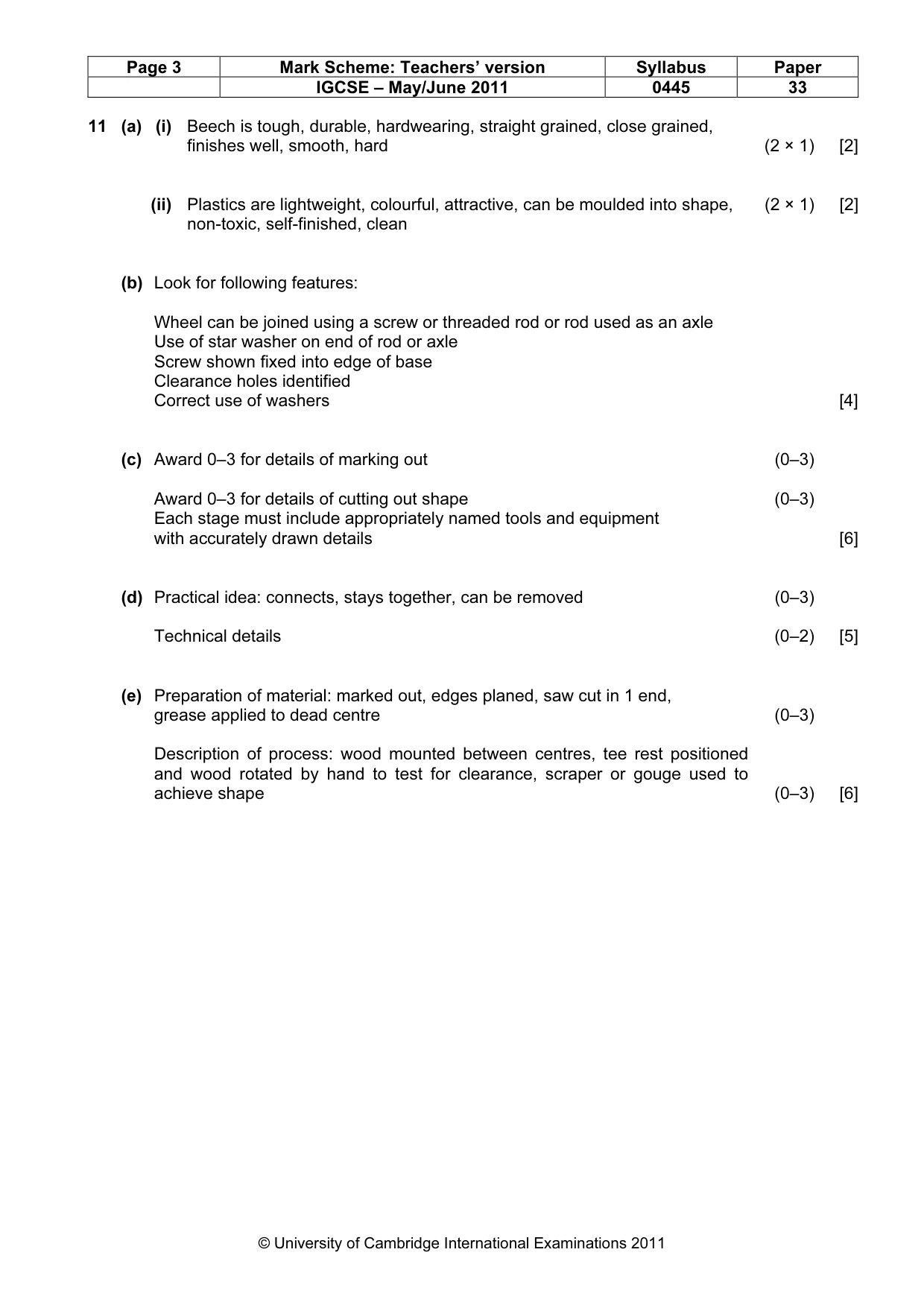
Page 3 Mark Scheme: Teachers’ version Syllabus Paper IGCSE – May/June 2011 0445 33 © University of Cambridge International Examinations 2011 11 (a) (i) Beech is tough, durable, hardwearing, straight grained, close grained, finishes well, smooth, hard (2 × 1) [2] (ii) Plastics are lightweight, colourful, attractive, can be moulded into shape, (2 × 1) [2] non-toxic, self-finished, clean (b) Look for following features: Wheel can be joined using a screw or threaded rod or rod used as an axle Use of star washer on end of rod or axle Screw shown fixed into edge of base Clearance holes identified Correct use of washers [4] (c) Award 0–3 for details of marking out (0–3) Award 0–3 for details of cutting out shape (0–3) Each stage must include appropriately named tools and equipment with accurately drawn details [6] (d) Practical idea: connects, stays together, can be removed (0–3) Technical details (0–2) [5] (e) Preparation of material: marked out, edges planed, saw cut in 1 end, grease applied to dead centre (0–3) Description of process: wood mounted between centres, tee rest positioned and wood rotated by hand to test for clearance, scraper or gouge used to achieve shape (0–3) [6]
Mark scheme, page 4
Page 4 Mark Scheme: Teachers’ version Syllabus Paper IGCSE – May/June 2011 0445 33 © University of Cambridge International Examinations 2011 12 (a) (6 × 1) [6] (b) (i) sheet saw, hacksaw, tenon saw [1] (ii) Hegner saw, band saw, scroll saw or equivalent. [1] (iii) Use safety glasses, ear defenders [1] (c) Sketches and notes should include the following details: filing / scraper use of wet and dry paper [various grades rewarded] polishing mop / compound polishing wheel / buffer / buffing machine [4] Any 4 responses (d) Heat to soften plastic Use of strip heater or line bender Use of formers to bend around or setting up of line bender Method of holding / retention Correct sequence (0–2) [6] (e) (i) Sliding bevel to mark out the sloping lines on the ends of the block Sliding bevel can be reversed to complete both pairs of lines [2] (ii) Shape produced by ‘wasting’ and ‘cleaning up’ Wasting: planing – wood held in a vice or sawing using a tenon saw with work held on bench top, or use of band saw (0–2) Cleaning up: glasspapering – use of various grades and cork rubber / block (0–2) [4]
Mark scheme, page 5
Page 5 Mark Scheme: Teachers’ version Syllabus Paper IGCSE – May/June 2011 0445 33 © University of Cambridge International Examinations 2011 13 (a) Part Length Width Thickness Material Number off Handle 2600 Ø25 Mild steel tube 1 Axle 680 20 20 Mild steel tube 1 Scoop 600 200 2 Mild steel 1 Wheels Ø75 25 Nylon 2 [5] (b) 2 tabs (2 × 1) 2 cut lines (2 × 1) 4 holes (0–2) [6] (c) Processes involved include: Drill both tabs and scoop. Clean off any burrs. Support the rivet head with a dolly held in the vice. Swell the rivet with the flat face of a hammer until it is tight in its hole. Use the ball-pein to shape the head. Finish the head with the snap to make a smooth shape. Award marks on basis: low level of understanding / lack of accurate details (0–2) reasonable level of understanding (3–4) good level of understanding (5–6) [6] (d) (i) Nylon is self-lubricating [1] (ii) Injection moulding [1] (e) (i) Hole drilled in axle Split pin shown in position Correct position of washer between split pin and wheel [3] (ii) Screw thread on end of axle Nut on end of axle Correct position of washer between nut and wheel [3]
What you needed in this session
Cambridge’s own grade thresholds for 2011 May/June, Paper 3 · Variant 3. A higher threshold means an easier paper — the bar moves with how the cohort did.