Cambridge IGCSE Chemistry (9-1) 0971 — 2025 May/June Paper 4 · Variant 2
0971/42/M/J/25 · 6 questions · 80 marks · 75 min
The question paper and its mark scheme, free to read here and free to download. This is Cambridge’s own paper, exactly as it was sat.
Question paper16 pages


Mark scheme12 pages
Answers below. Sit the paper first if you are practising.
Questions as text
Q1 · Using numbers only, state the: (a) percentage of nitrogen in clean, dry air…
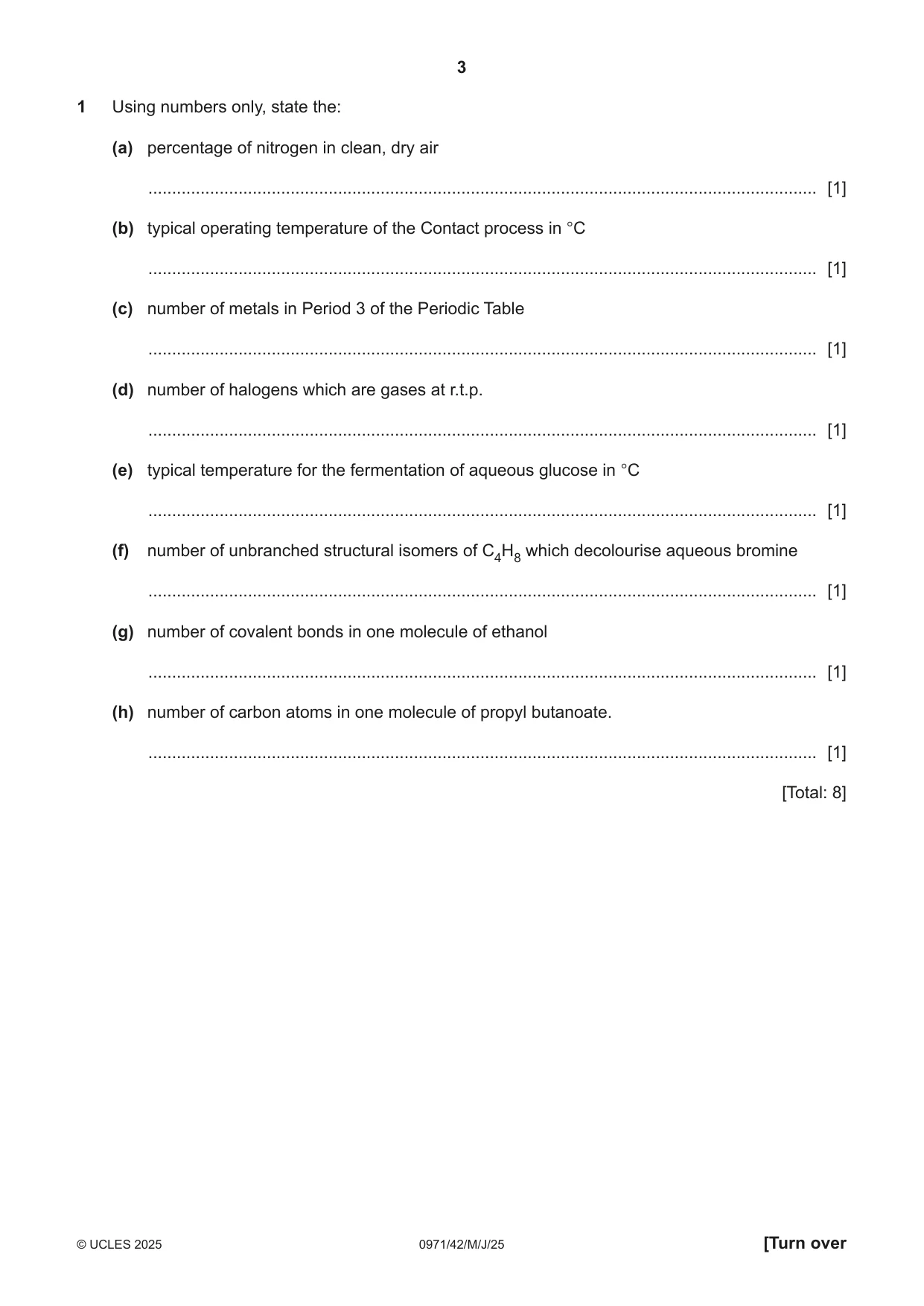
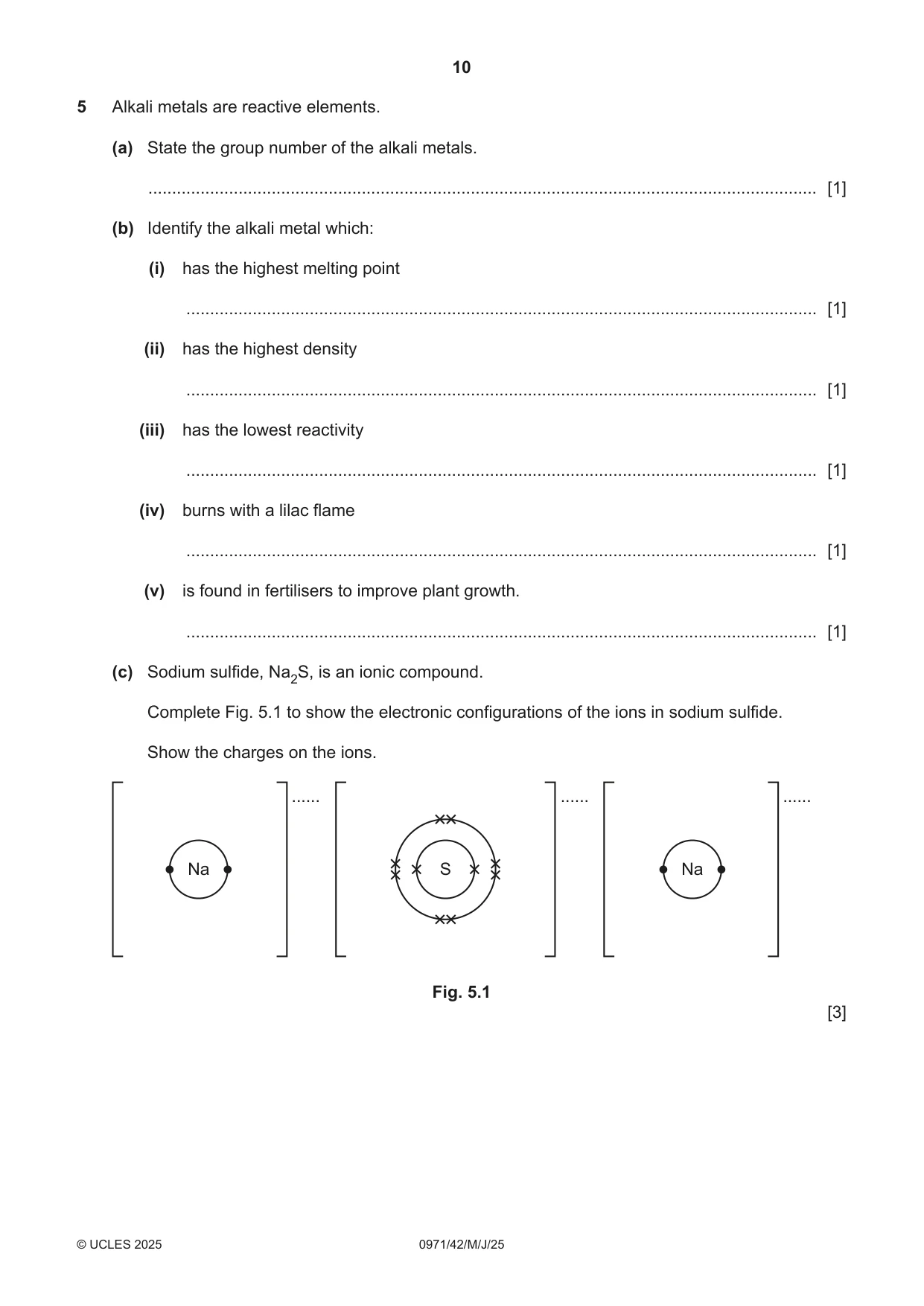
1 Using numbers only, state the: (a) percentage of nitrogen in clean, dry air ............................................................................................................................................. [1] (b) typical operating temperature of the Contact process in °C ............................................................................................................................................. [1] (c) number of metals in Period 3 of the Periodic Table ............................................................................................................................................. [1] (d) number of halogens which are gases at r.t.p. ............................................................................................................................................. [1] (e) typical temperature for the fermentation of aqueous glucose in °C ............................................................................................................................................. [1] (f) number of unbranched structural isomers of C4H8 which decolourise aqueous bromine ............................................................................................................................................. [1] (g) number of covalent bonds in one molecule of ethanol ............................................................................................................................................. [1] (h) number of carbon atoms in one molecule of propyl butanoate. ............................................................................................................................................. [1] [Total: 8]
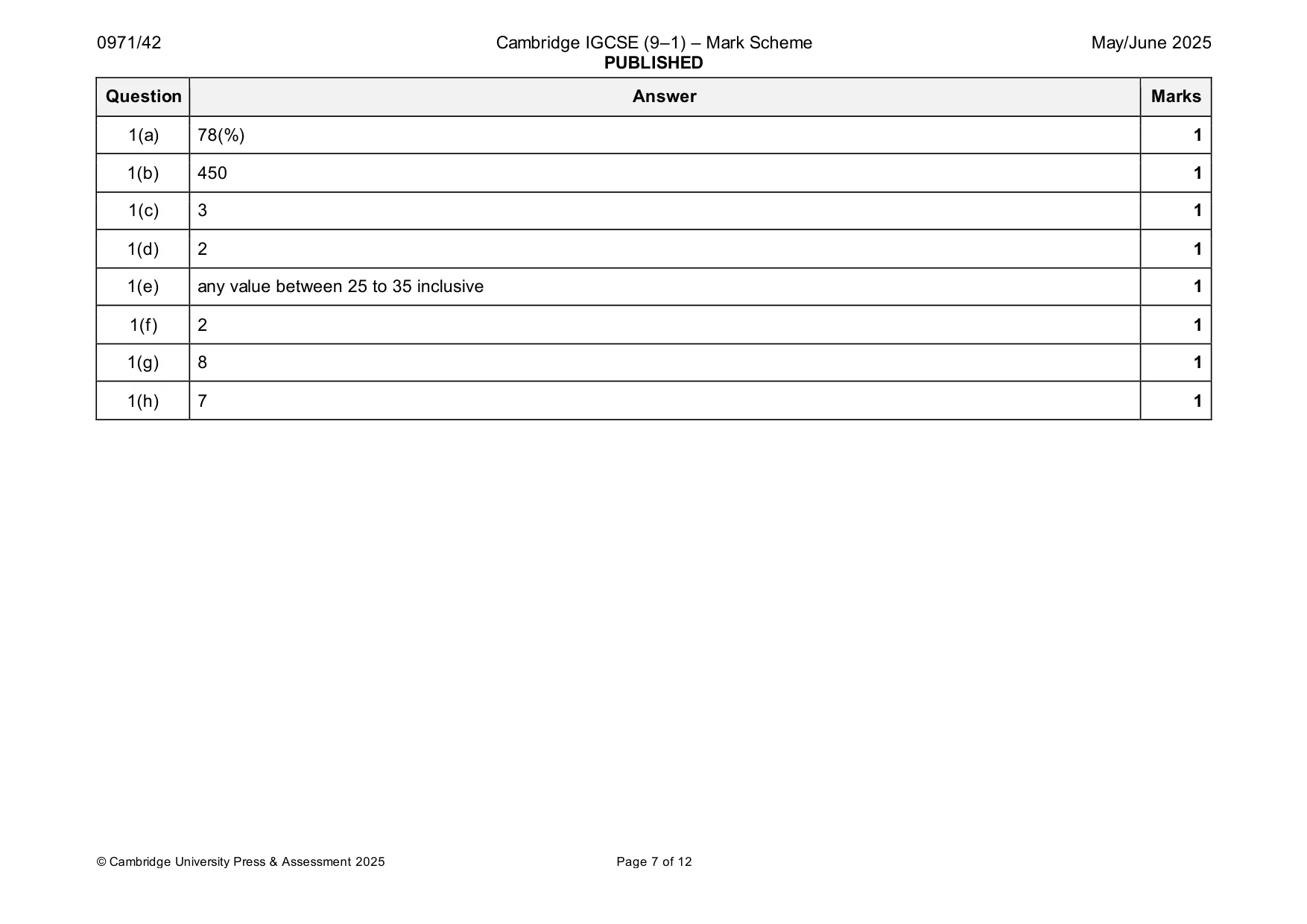
Mark scheme: Question Answer Marks 1(a) 78(%) 1 1(b) 450 1 1(c) 3 1 1(d) 2 1 1(e) any value between 25 to 35 inclusive 1 1(f) 2 1 1(g) 8 1 1(h) 7 1
Q2 · This question is about covalent compounds
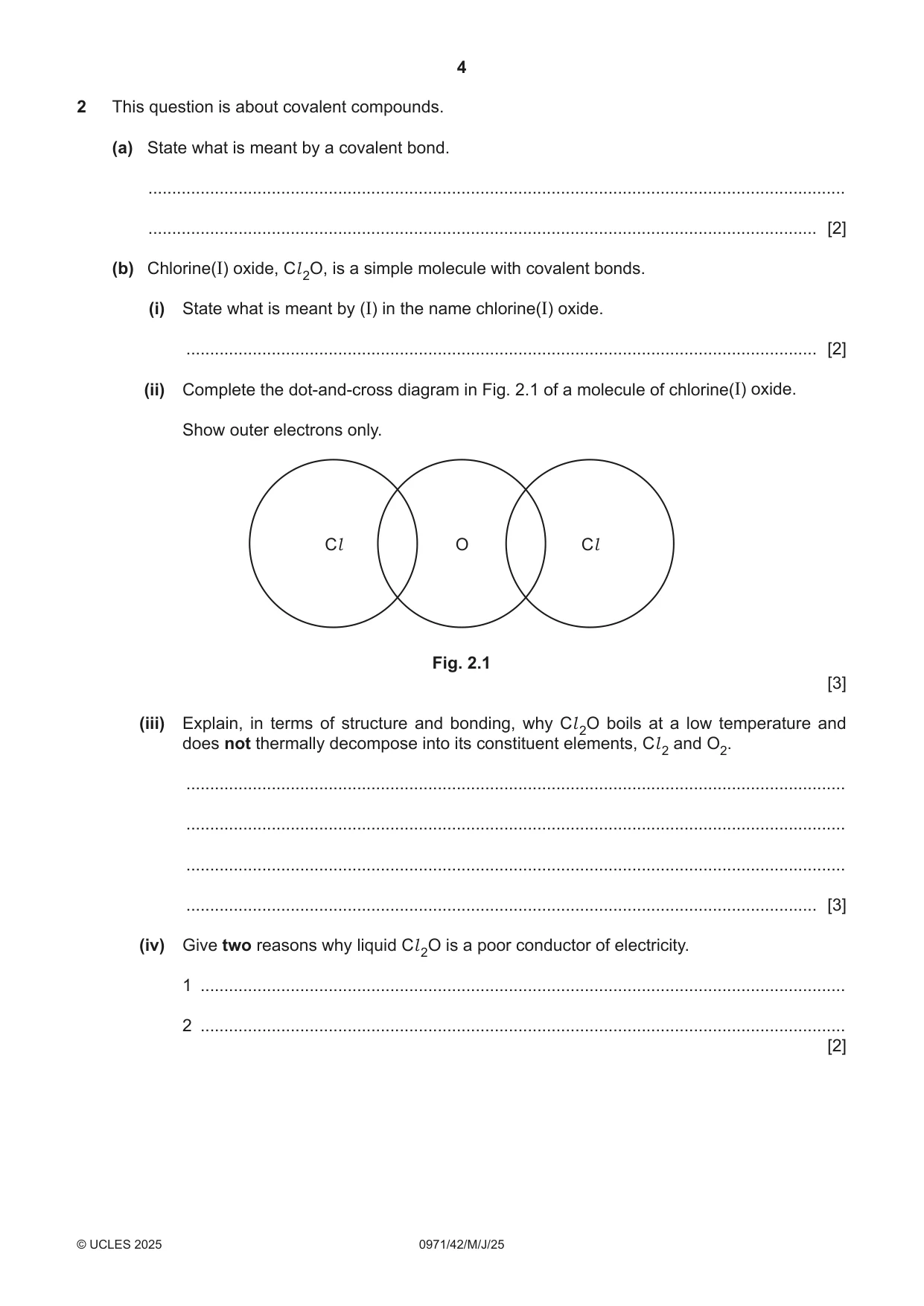
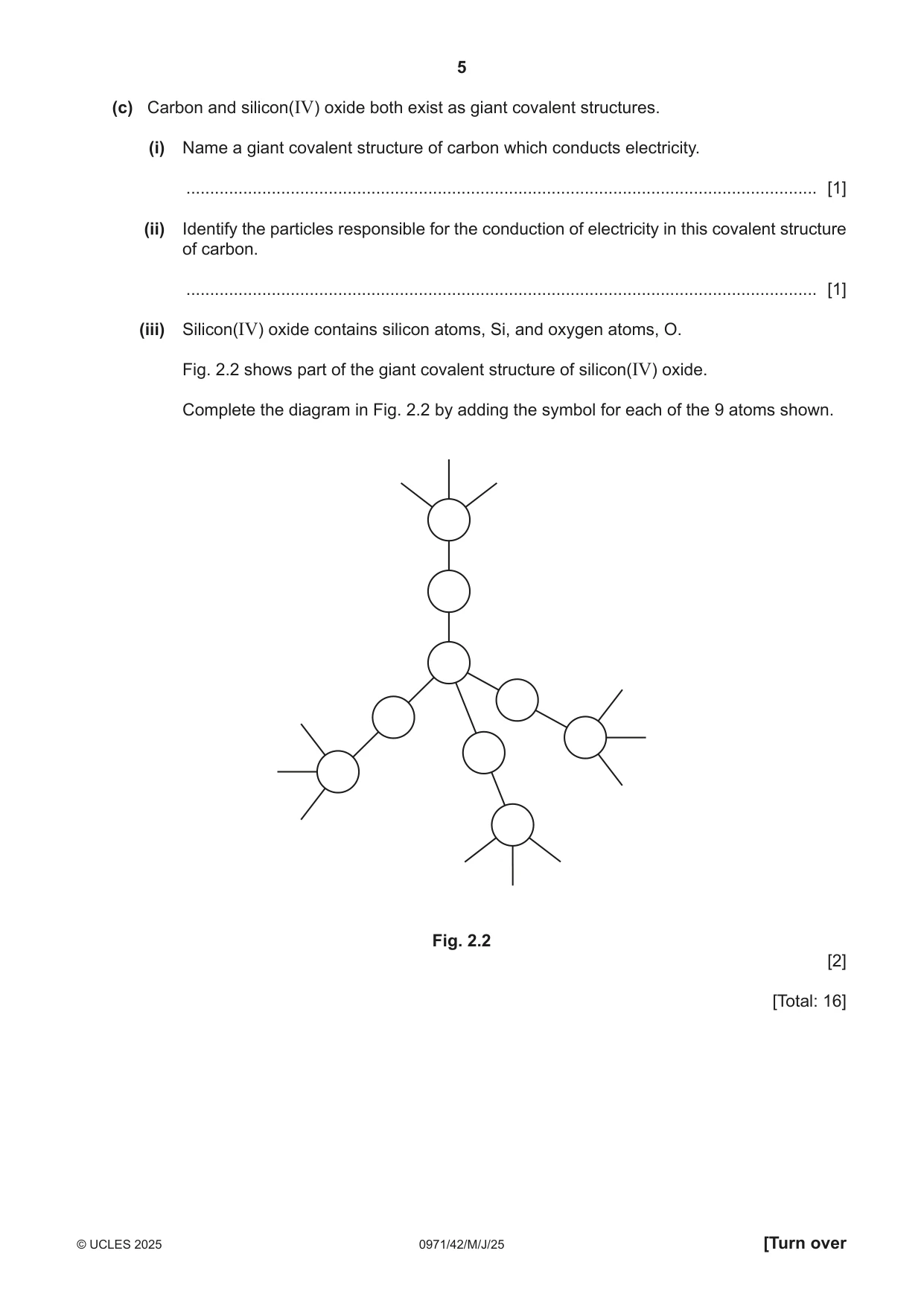
2 This question is about covalent compounds. (a) State what is meant by a covalent bond. ................................................................................................................................................... ............................................................................................................................................. [2] (b) Chlorine(I) oxide, Cl 2O, is a simple molecule with covalent bonds. (i) State what is meant by (I) in the name chlorine(I) oxide. ..................................................................................................................................... [2] (ii) Complete the dot-and-cross diagram in Fig. 2.1 of a molecule of chlorine(I) oxide. Show outer electrons only. Cl O Cl Fig. 2.1 [3] (iii) Explain, in terms of structure and bonding, why Cl 2O boils at a low temperature and does not thermally decompose into its constituent elements, Cl 2 and O2. ........................................................................................................................................... ........................................................................................................................................... ........................................................................................................................................... ..................................................................................................................................... [3] (iv) Give two reasons why liquid Cl 2O is a poor conductor of electricity. 1 ........................................................................................................................................ 2 ........................................................................................................................................ [2] (c) Carbon and silicon(IV) oxide both exist as giant covalent structures. (i) Name a giant covalent structure of carbon which conducts electricity. ..................................................................................................................................... [1] (ii) Identify the particles responsible for the conduction of electricity in this covalent structure of carbon. ..................................................................................................................................... [1] (iii) Silicon(IV) oxide contains silicon atoms, Si, and oxygen atoms, O. Fig. 2.2 shows part of the giant covalent structure of silicon(IV) oxide. Complete the diagram in Fig. 2.2 by adding the symbol for each of the 9 atoms shown. Fig. 2.2 [2] [Total: 16]
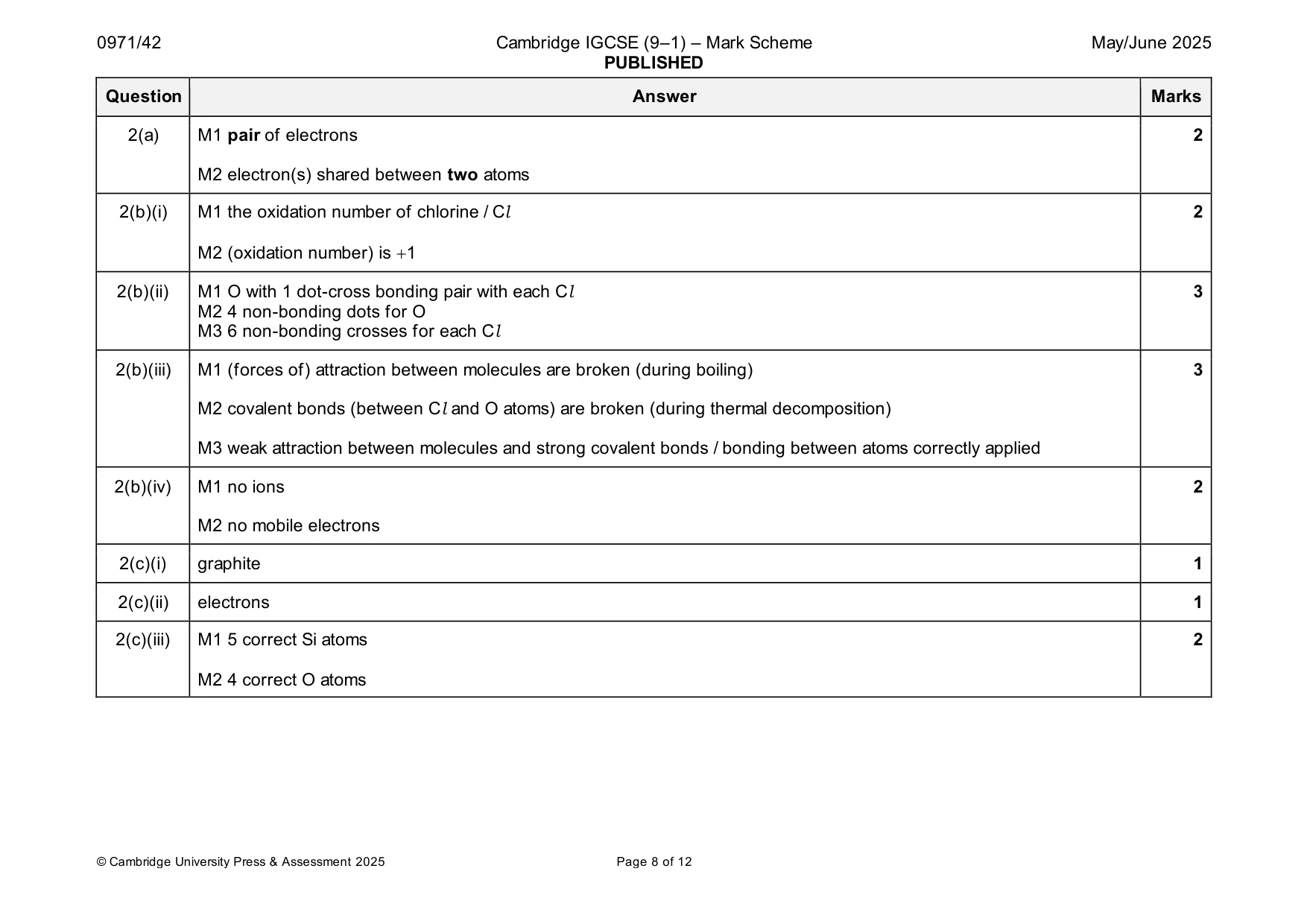
Mark scheme: 2(a) M1 pair of electrons 2 M2 electron(s) shared between two atoms 2(b)(i) M1 the oxidation number of chlorine / Cl 2 M2 (oxidation number) is +1 2(b)(ii) M1 O with 1 dot-cross bonding pair with each Cl 3 M2 4 non-bonding dots for O M3 6 non-bonding crosses for each Cl 2(b)(iii) M1 (forces of) attraction between molecules are broken (during boiling) 3 M2 covalent bonds (between Cl and O atoms) are broken (during thermal decomposition) M3 weak attraction between molecules and strong covalent bonds / bonding between atoms correctly applied 2(b)(iv) M1 no ions 2 M2 no mobile electrons 2(c)(i) graphite 1 2(c)(ii) electrons 1 2(c)(iii) M1 5 correct Si atoms 2 M2 4 correct O atoms
More questions on Formulae, functional groups and terminology
Q3 · This question is about electrolysis
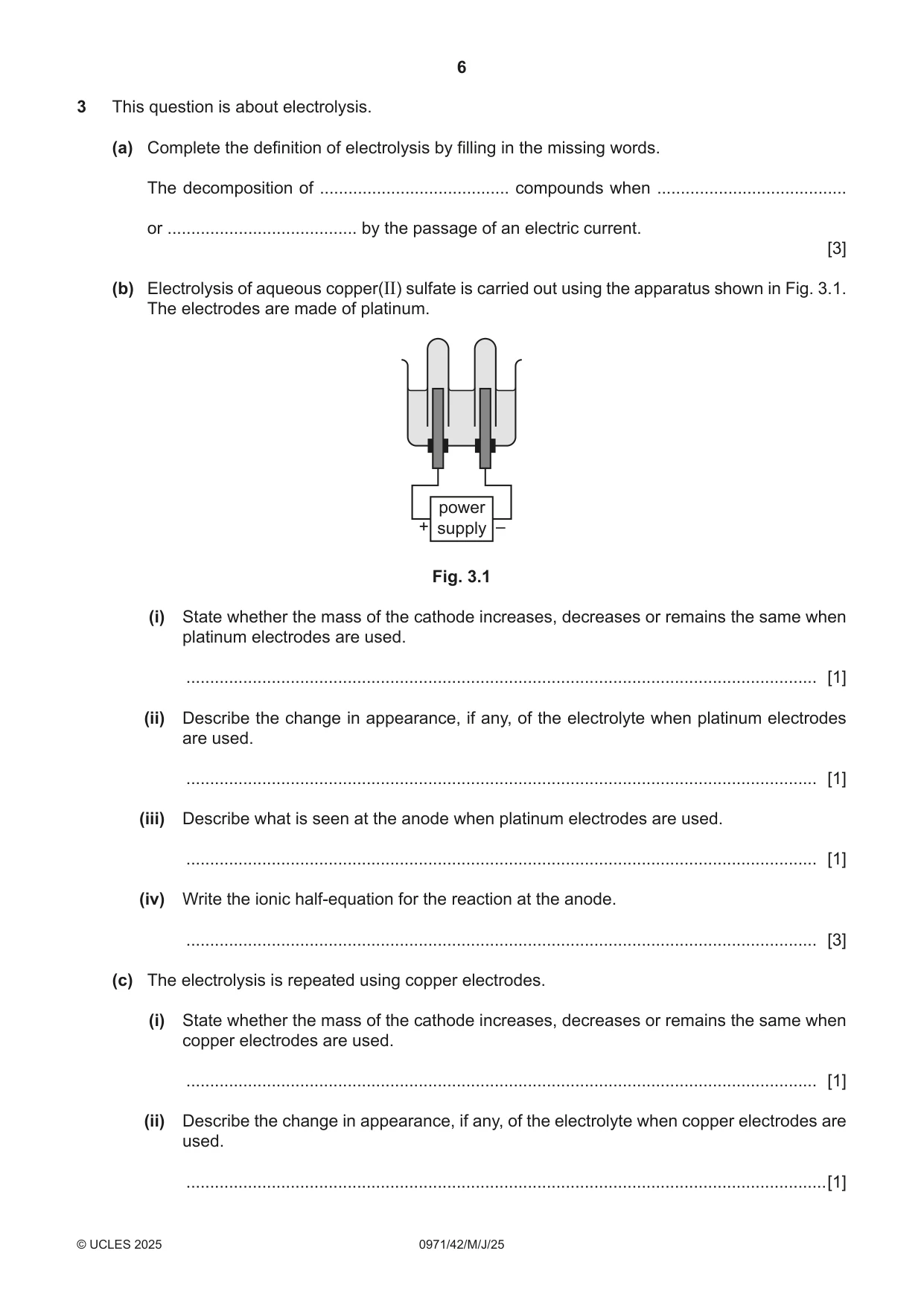
3 This question is about electrolysis. (a) Complete the definition of electrolysis by filling in the missing words. The decomposition of ........................................ compounds when ........................................ or ........................................ by the passage of an electric current. [3] (b) Electrolysis of aqueous copper(II) sulfate is carried out using the apparatus shown in Fig. 3.1. The electrodes are made of platinum. power + supply – Fig. 3.1 (i) State whether the mass of the cathode increases, decreases or remains the same when platinum electrodes are used. ..................................................................................................................................... [1] (ii) Describe the change in appearance, if any, of the electrolyte when platinum electrodes are used. ..................................................................................................................................... [1] (iii) Describe what is seen at the anode when platinum electrodes are used. ..................................................................................................................................... [1] (iv) Write the ionic half-equation for the reaction at the anode. ..................................................................................................................................... [3] (c) The electrolysis is repeated using copper electrodes. (i) State whether the mass of the cathode increases, decreases or remains the same when copper electrodes are used. ..................................................................................................................................... [1] (ii) Describe the change in appearance, if any, of the electrolyte when copper electrodes are used. .......................................................................................................................................[1] (d) Aluminium is extracted from its purified ore by electrolysis. (i) Name this ore of aluminium. ..................................................................................................................................... [1] (ii) Name the substance added to this process to reduce the operating temperature. ..................................................................................................................................... [1] (iii) Explain why the anodes need to be continually replaced during this process. ........................................................................................................................................... ..................................................................................................................................... [2] [Total: 15]
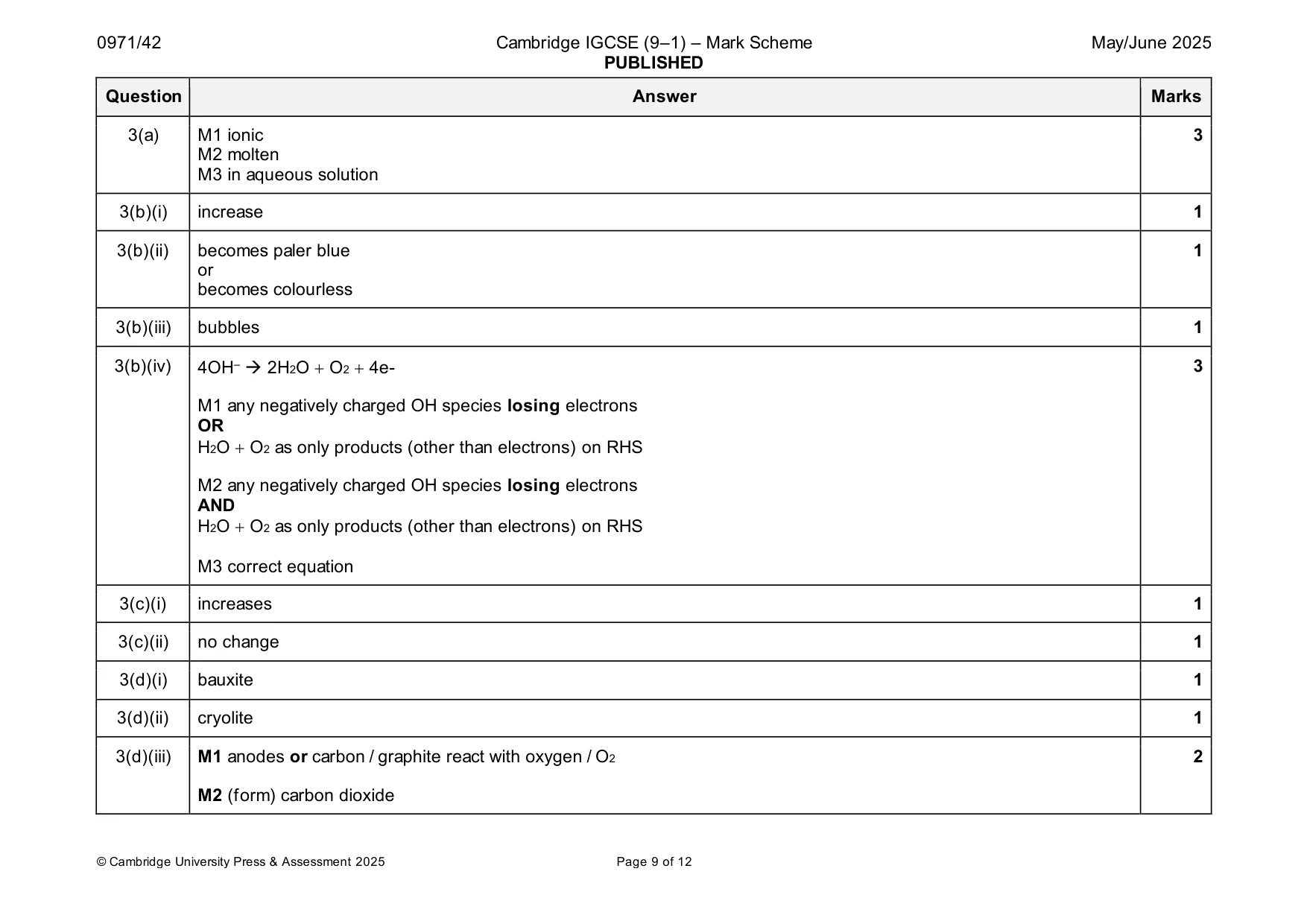
Mark scheme: 3(a) M1 ionic 3 M2 molten M3 in aqueous solution 3(b)(i) increase 1 3(b)(ii) becomes paler blue 1 or becomes colourless 3(b)(iii) bubbles 1 3(b)(iv) 4OH– → 2H2O + O2 + 4e- 3 M1 any negatively charged OH species losing electrons OR H2O + O2 as only products (other than electrons) on RHS M2 any negatively charged OH species losing electrons AND H2O + O2 as only products (other than electrons) on RHS M3 correct equation 3(c)(i) increases 1 3(c)(ii) no change 1 3(d)(i) bauxite 1 3(d)(ii) cryolite 1 3(d)(iii) M1 anodes or carbon / graphite react with oxygen / O2 2 M2 (form) carbon dioxide
Q4 · Chromium is the element with atomic number 24 in the Periodic Table
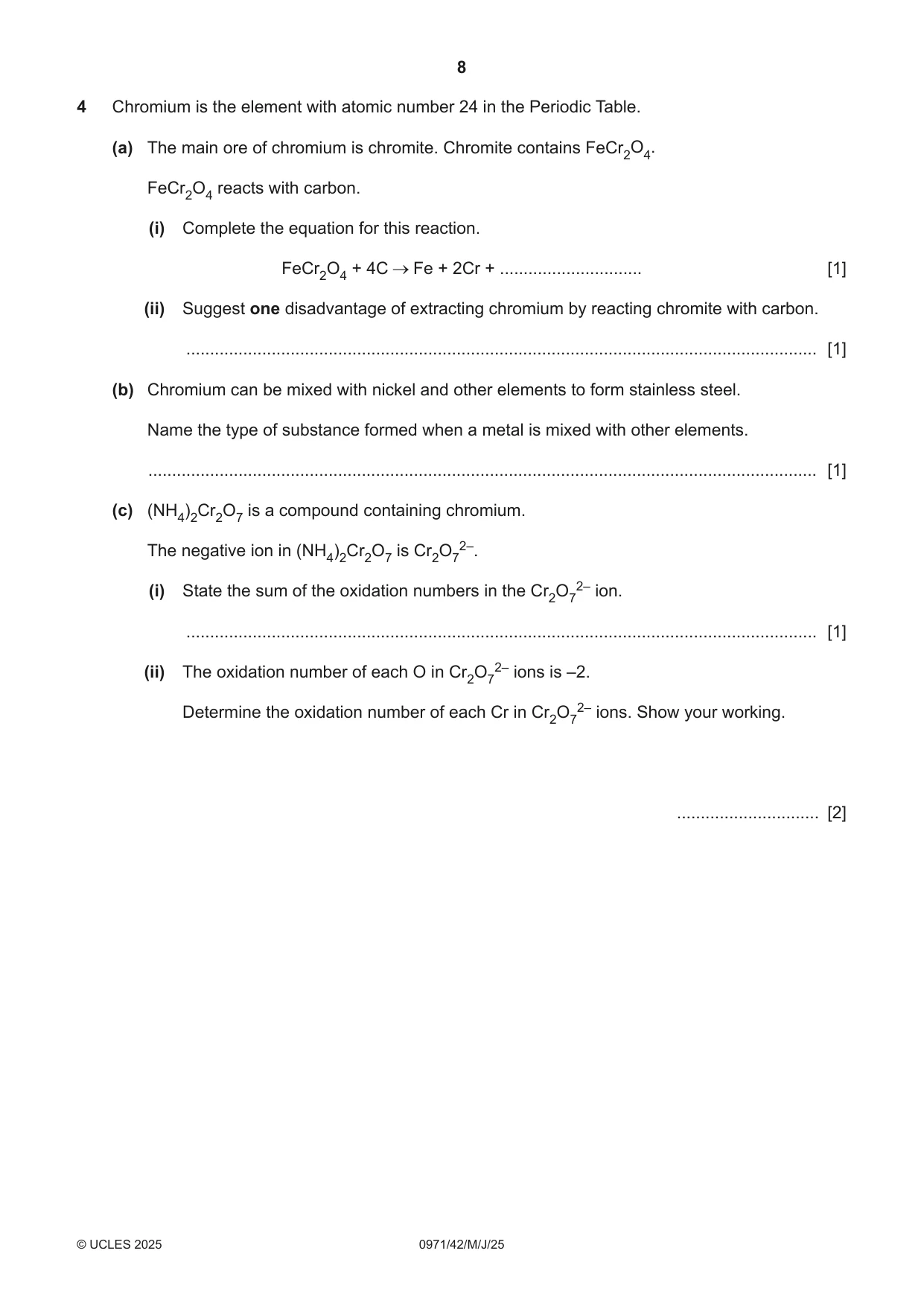
4 Chromium is the element with atomic number 24 in the Periodic Table. (a) The main ore of chromium is chromite. Chromite contains FeCr2O4. FeCr2O4 reacts with carbon. (i) Complete the equation for this reaction. FeCr2O4 + 4C Fe + 2Cr + .............................. [1] (ii) Suggest one disadvantage of extracting chromium by reacting chromite with carbon. ..................................................................................................................................... [1] (b) Chromium can be mixed with nickel and other elements to form stainless steel. Name the type of substance formed when a metal is mixed with other elements. ............................................................................................................................................. [1] (c) (NH4)2Cr2O7 is a compound containing chromium. The negative ion in (NH4)2Cr2O7 is Cr2O72–. (i) State the sum of the oxidation numbers in the Cr2O72– ion. ..................................................................................................................................... [1] (ii) The oxidation number of each O in Cr2O72– ions is –2. Determine the oxidation number of each Cr in Cr2O72– ions. Show your working. .............................. [2] (iii) When (NH4)2Cr2O7 is heated the following reaction occurs. (NH4)2Cr2O7 Cr2O3 + 4H2O + N2 Calculate the volume of nitrogen gas produced at r.t.p., in cm3, when 1.26 g of (NH4)2Cr2O7 is heated using the following steps. The Mr of (NH4)2Cr2O7 is 252. • Calculate the number of moles of (NH4)2Cr2O7 used. .............................. mol • Determine the number of moles of N2 formed. .............................. mol • Calculate the volume of N2 formed at r.t.p. in cm3. .............................. cm3 [3] [Total: 9]
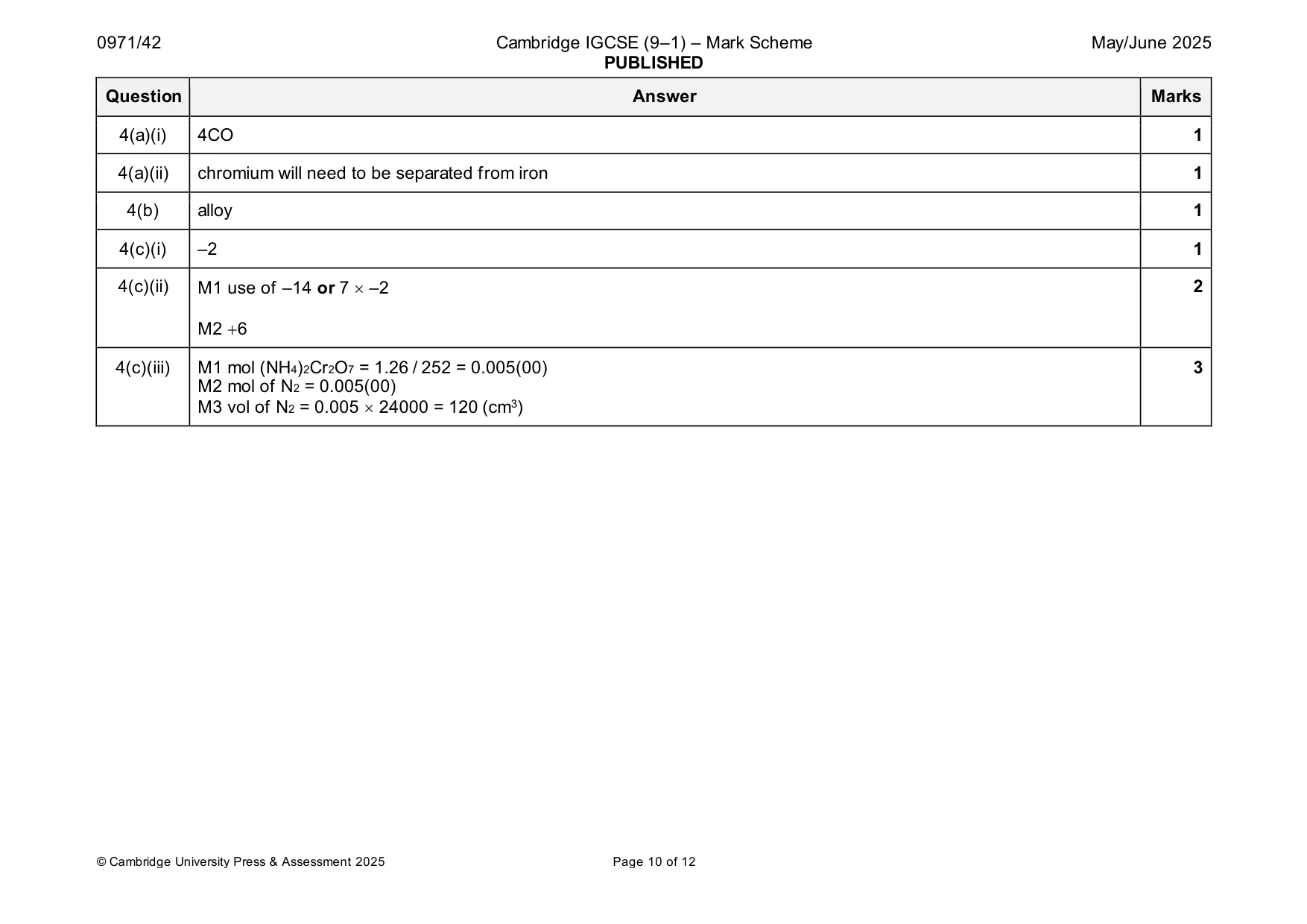
Mark scheme: 4(a)(i) 4CO 1 4(a)(ii) chromium will need to be separated from iron 1 4(b) alloy 1 4(c)(i) –2 1 4(c)(ii) M1 use of –14 or 7 –2 2 M2 +6 4(c)(iii) M1 mol (NH4)2Cr2O7 = 1.26 / 252 = 0.005(00) 3 M2 mol of N2 = 0.005(00) M3 vol of N2 = 0.005 24000 = 120 (cm3)
Q5 · Alkali metals are reactive elements
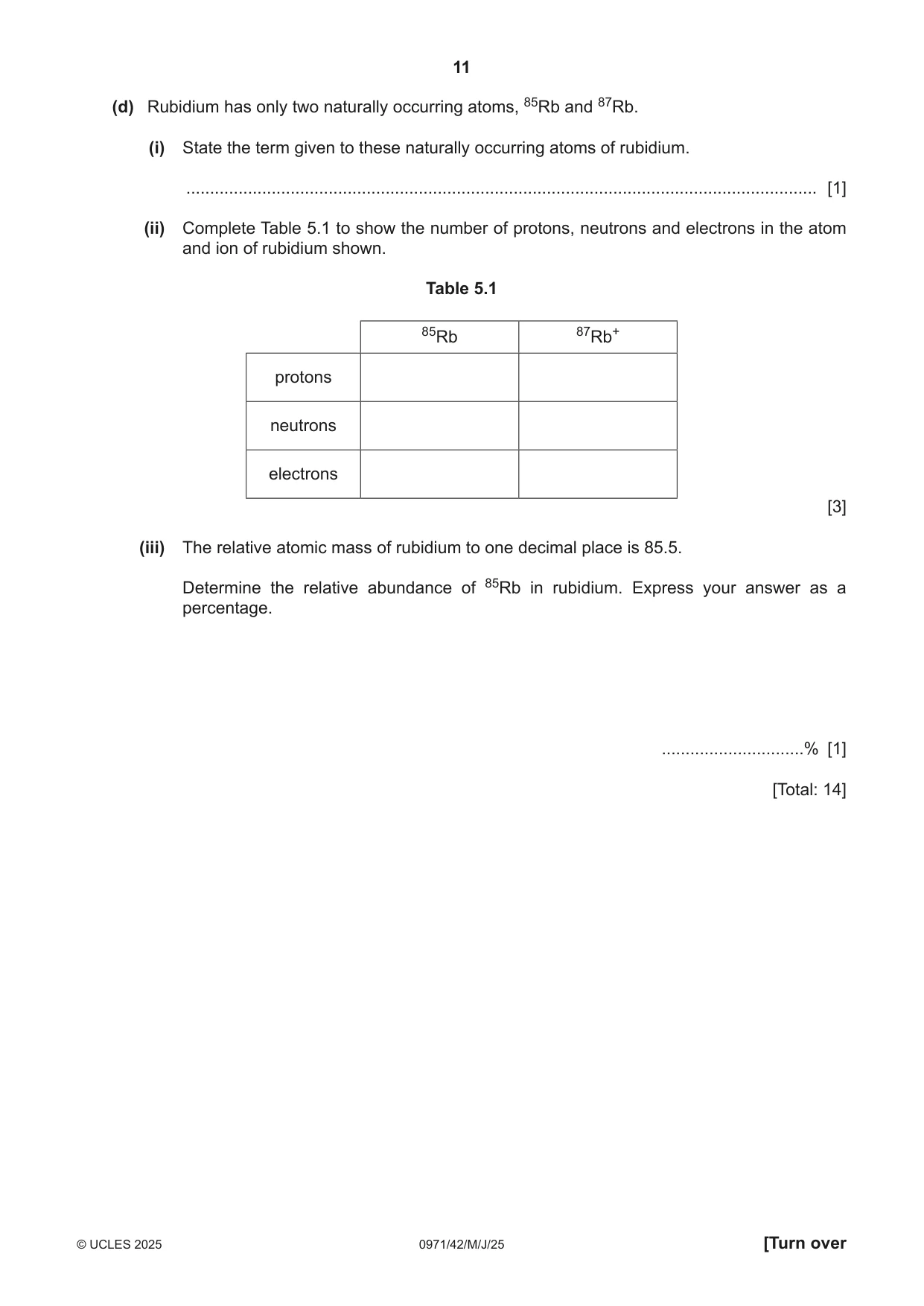
5 Alkali metals are reactive elements. (a) State the group number of the alkali metals. ............................................................................................................................................. [1] (b) Identify the alkali metal which: (i) has the highest melting point ..................................................................................................................................... [1] (ii) has the highest density ..................................................................................................................................... [1] (iii) has the lowest reactivity ..................................................................................................................................... [1] (iv) burns with a lilac flame ..................................................................................................................................... [1] (v) is found in fertilisers to improve plant growth. ..................................................................................................................................... [1] (c) Sodium sulfide, Na2S, is an ionic compound. Complete Fig. 5.1 to show the electronic configurations of the ions in sodium sulfide. Show the charges on the ions. ...... ...... ...... Na S Na Fig. 5.1 [3] (d) Rubidium has only two naturally occurring atoms, 85Rb and 87Rb. (i) State the term given to these naturally occurring atoms of rubidium. ..................................................................................................................................... [1] (ii) Complete Table 5.1 to show the number of protons, neutrons and electrons in the atom and ion of rubidium shown. Table 5.1 85Rb 87Rb+ protons neutrons electrons [3] (iii) The relative atomic mass of rubidium to one decimal place is 85.5. Determine the relative abundance of 85Rb in rubidium. Express your answer as a percentage. ..............................% [1] [Total: 14]
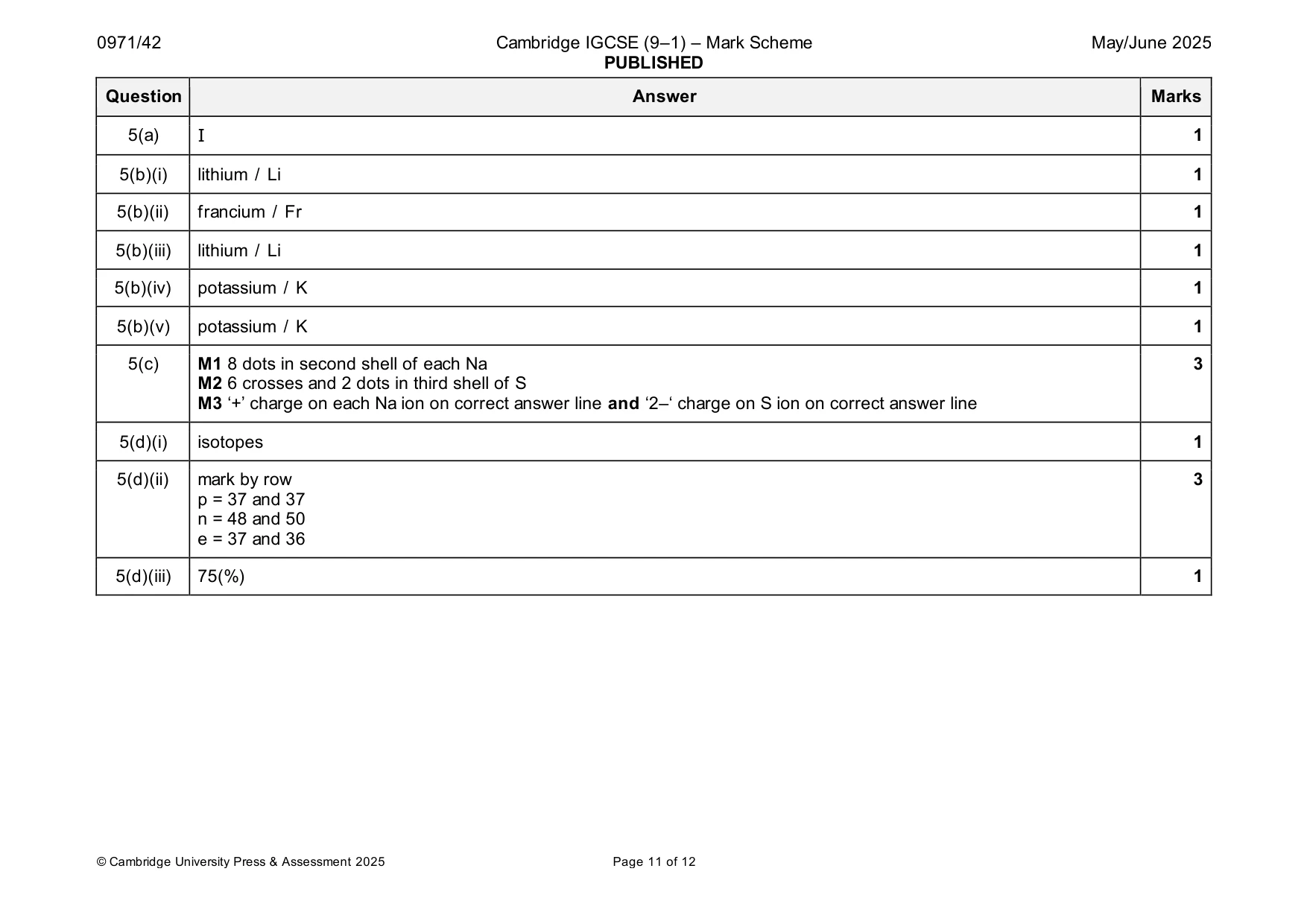
Mark scheme: 5(a) I 1 5(b)(i) lithium / Li 1 5(b)(ii) francium / Fr 1 5(b)(iii) lithium / Li 1 5(b)(iv) potassium / K 1 5(b)(v) potassium / K 1 5(c) M1 8 dots in second shell of each Na 3 M2 6 crosses and 2 dots in third shell of S M3 ‘+’ charge on each Na ion on correct answer line and ‘2–‘ charge on S ion on correct answer line 5(d)(i) isotopes 1 5(d)(ii) mark by row 3 p = 37 and 37 n = 48 and 50 e = 37 and 36 5(d)(iii) 75(%) 1
Q6 · Ethene, C2H4, is the first member of a family of similar compounds which contains the…
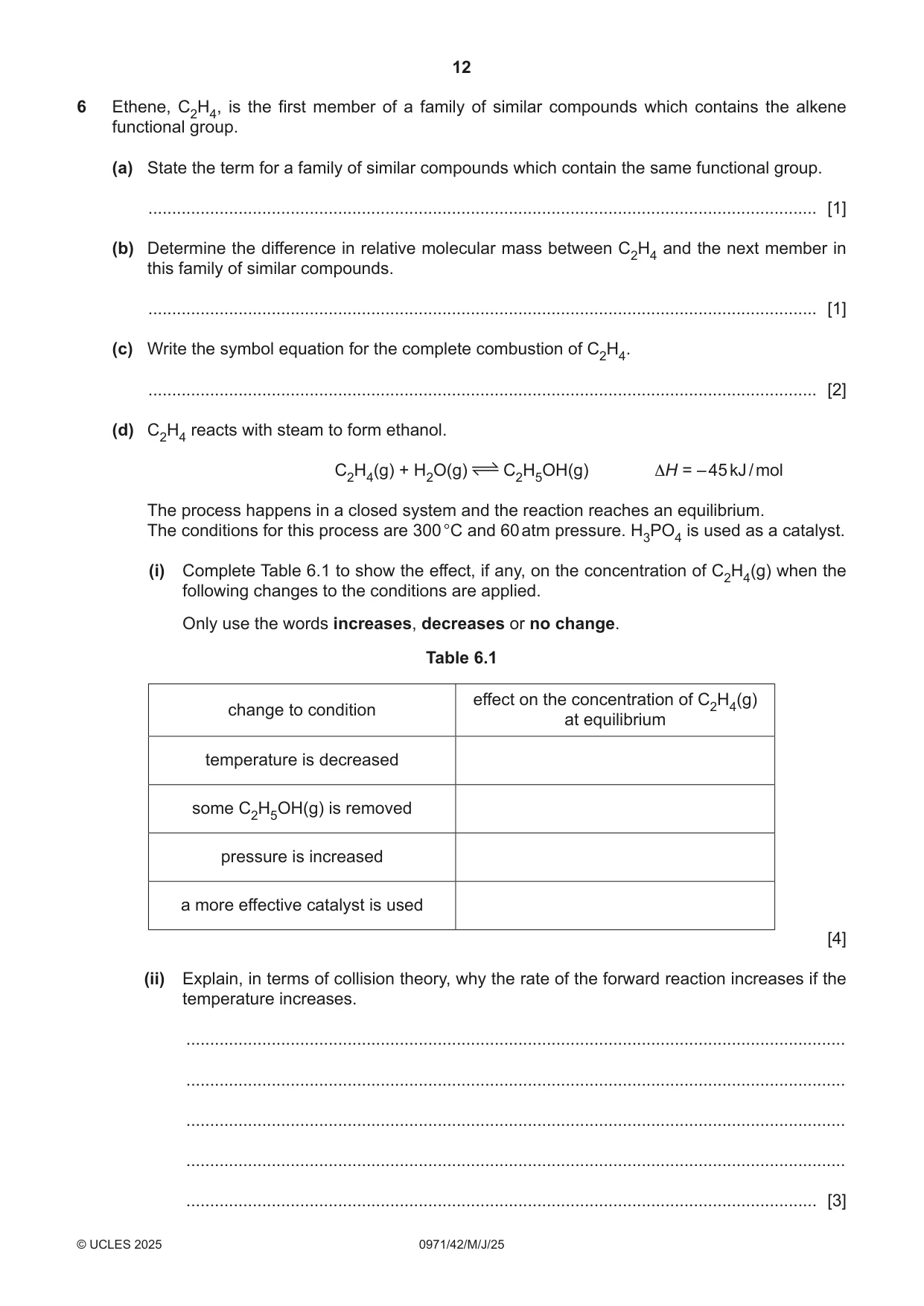
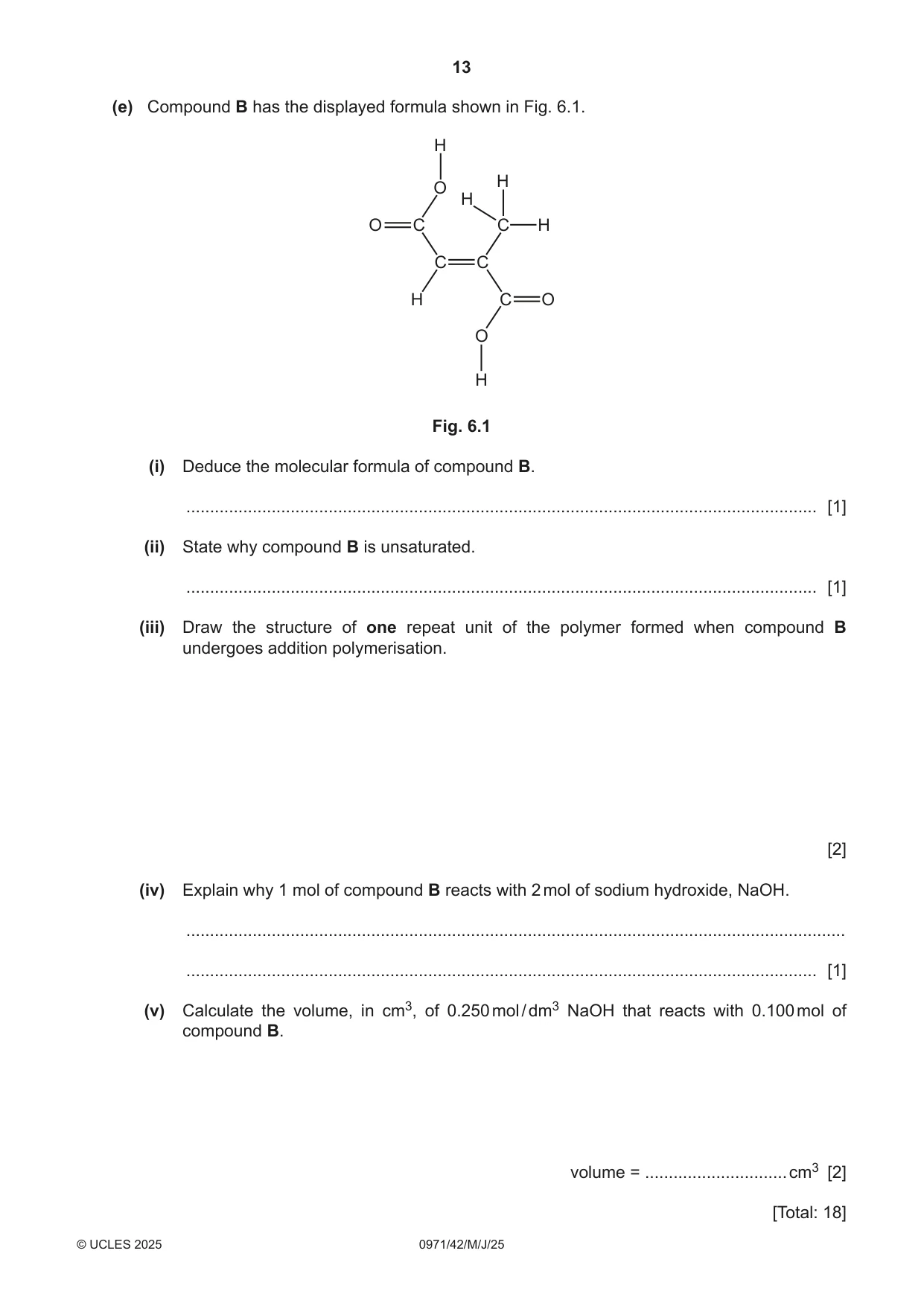
6 Ethene, C2H4, is the first member of a family of similar compounds which contains the alkene functional group. (a) State the term for a family of similar compounds which contain the same functional group. ............................................................................................................................................. [1] (b) Determine the difference in relative molecular mass between C2H4 and the next member in this family of similar compounds. ............................................................................................................................................. [1] (c) Write the symbol equation for the complete combustion of C2H4. ............................................................................................................................................. [2] (d) C2H4 reacts with steam to form ethanol. C2H4(g) + H2O(g) C2H5OH(g) ΔH = – 45 kJ / mol The process happens in a closed system and the reaction reaches an equilibrium. The conditions for this process are 300 °C and 60 atm pressure. H3PO4 is used as a catalyst. (i) Complete Table 6.1 to show the effect, if any, on the concentration of C2H4(g) when the following changes to the conditions are applied. Only use the words increases, decreases or no change. Table 6.1 effect on the concentration of C2H4(g) change to condition at equilibrium temperature is decreased some C2H5OH(g) is removed pressure is increased a more effective catalyst is used [4] (ii) Explain, in terms of collision theory, why the rate of the forward reaction increases if the temperature increases. ........................................................................................................................................... ........................................................................................................................................... ........................................................................................................................................... ........................................................................................................................................... ..................................................................................................................................... [3] (e) Compound B has the displayed formula shown in Fig. 6.1. H H O H O C C H C C H C O O H Fig. 6.1 (i) Deduce the molecular formula of compound B. ..................................................................................................................................... [1] (ii) State why compound B is unsaturated. ..................................................................................................................................... [1] (iii) Draw the structure of one repeat unit of the polymer formed when compound B undergoes addition polymerisation. [2] (iv) Explain why 1 mol of compound B reacts with 2 mol of sodium hydroxide, NaOH. ........................................................................................................................................... ..................................................................................................................................... [1] (v) Calculate the volume, in cm3, of 0.250 mol / dm3 NaOH that reacts with 0.100 mol of compound B. volume = .............................. cm3 [2] [Total: 18]
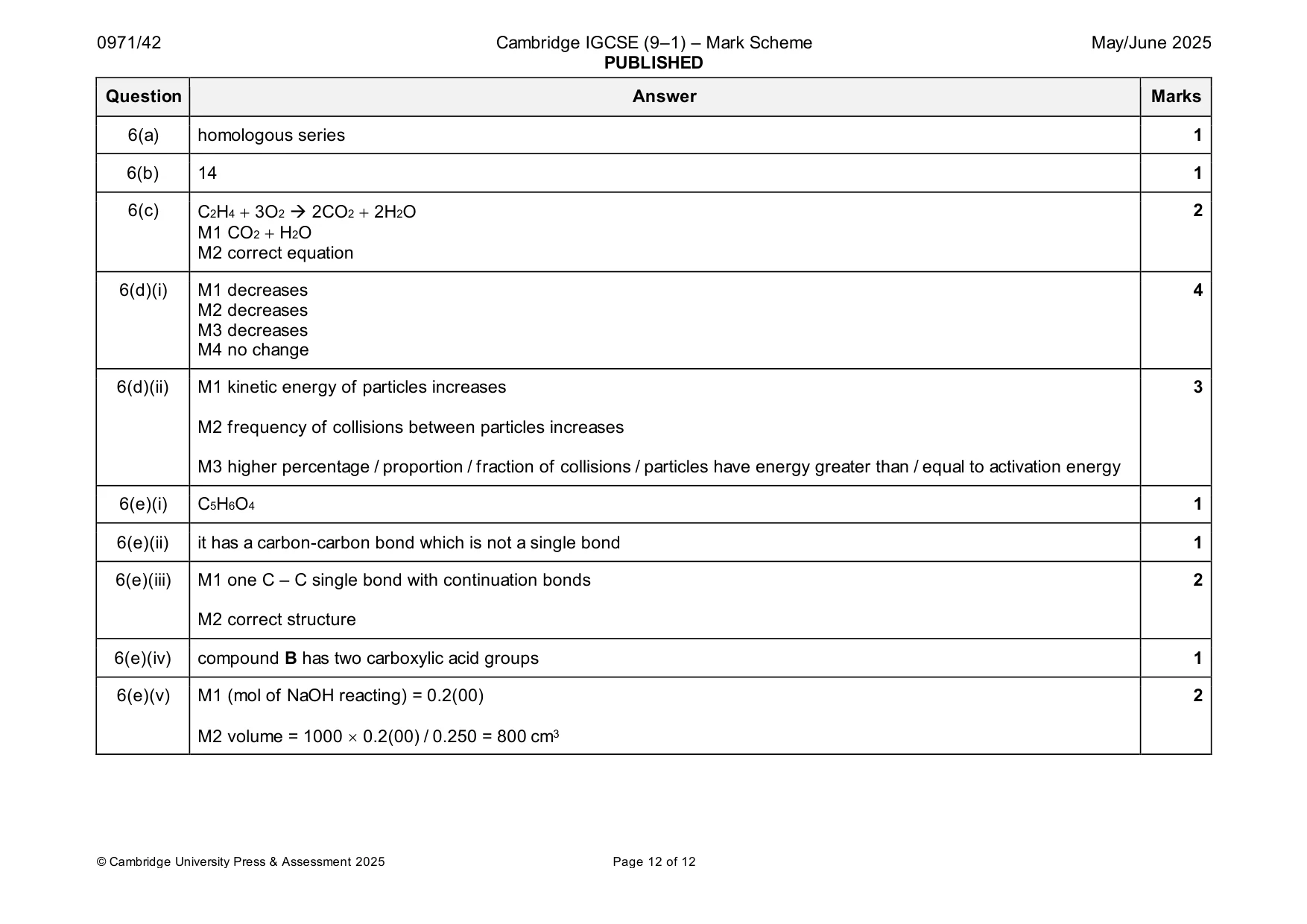
Mark scheme: 6(a) homologous series 1 6(b) 14 1 6(c) C2H4 + 3O2 → 2CO2 + 2H2O 2 M1 CO2 + H2O M2 correct equation 6(d)(i) M1 decreases 4 M2 decreases M3 decreases M4 no change 6(d)(ii) M1 kinetic energy of particles increases 3 M2 frequency of collisions between particles increases M3 higher percentage / proportion / fraction of collisions / particles have energy greater than / equal to activation energy 6(e)(i) C5H6O4 1 6(e)(ii) it has a carbon-carbon bond which is not a single bond 1 6(e)(iii) M1 one C – C single bond with continuation bonds 2 M2 correct structure 6(e)(iv) compound B has two carboxylic acid groups 1 6(e)(v) M1 (mol of NaOH reacting) = 0.2(00) 2 M2 volume = 1000 0.2(00) / 0.250 = 800 cm3
What was in this paper
The subtopics covered by these 6 questions, and how many questions each got. Open one in a new tab to see every Cambridge question on it.
What you needed in this session
Cambridge’s own grade thresholds for 2025 May/June, Paper 4 · Variant 2. A higher threshold means an easier paper — the bar moves with how the cohort did.