Cambridge IGCSE Chemistry (9-1) 0971 — 2025 May/June Paper 4 · Variant 1
0971/41/M/J/25 · 6 questions · 80 marks · 75 min
The question paper and its mark scheme, free to read here and free to download. This is Cambridge’s own paper, exactly as it was sat.
Question paper16 pages
Mark scheme14 pages
Answers below. Sit the paper first if you are practising.
Questions as text
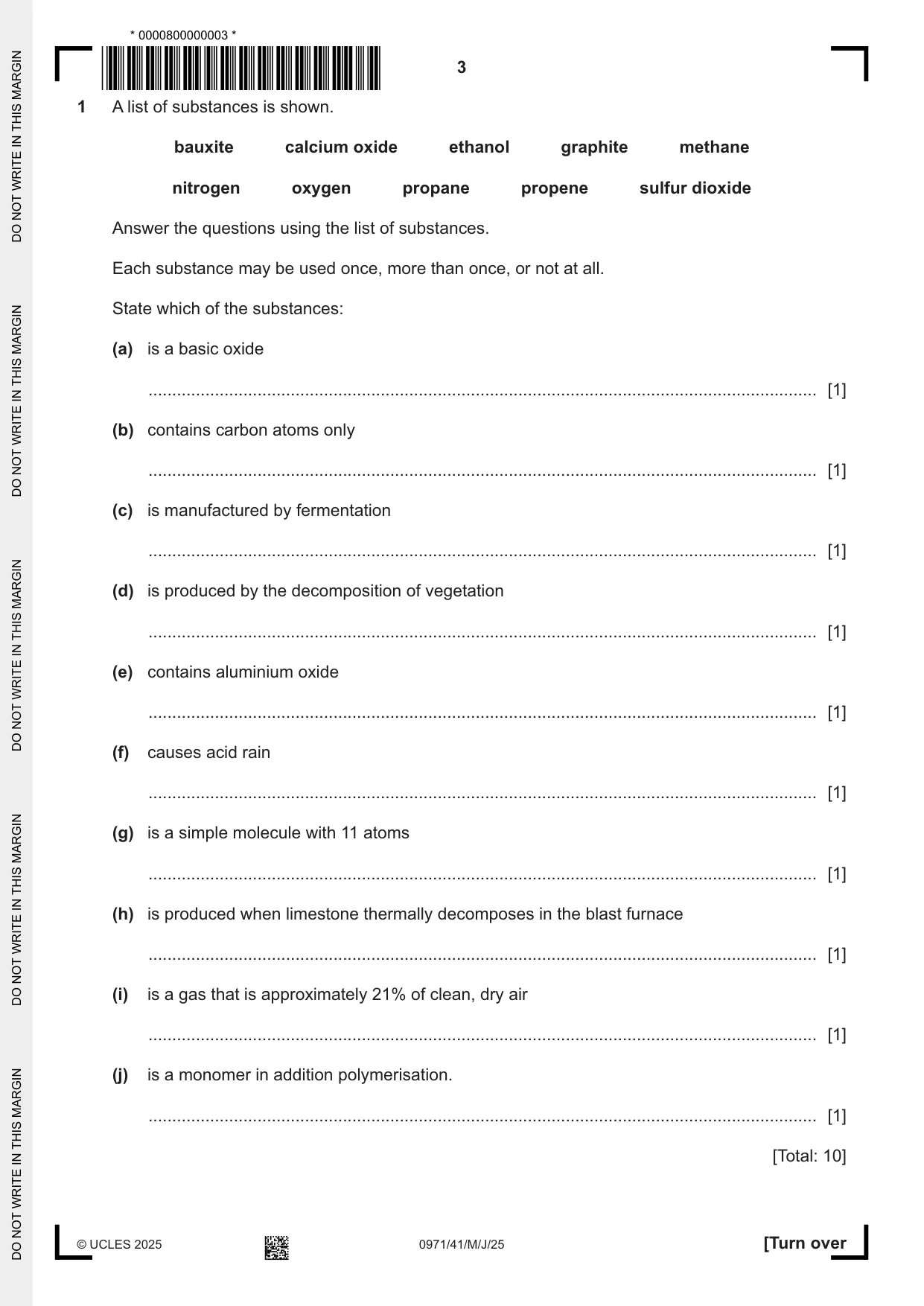
Q1 · A list of substances is shown
1 A list of substances is shown. bauxite calcium oxide ethanol graphite methane nitrogen oxygen propane propene sulfur dioxide Answer the questions using the list of substances. Each substance may be used once, more than once, or not at all. State which of the substances: (a) is a basic oxide ............................................................................................................................................. [1] (b) contains carbon atoms only ............................................................................................................................................. [1] (c) is manufactured by fermentation ............................................................................................................................................. [1] (d) is produced by the decomposition of vegetation ............................................................................................................................................. [1] (e) contains aluminium oxide ............................................................................................................................................. [1] (f) causes acid rain ............................................................................................................................................. [1] (g) is a simple molecule with 11 atoms ............................................................................................................................................. [1] (h) is produced when limestone thermally decomposes in the blast furnace ............................................................................................................................................. [1] (i) is a gas that is approximately 21% of clean, dry air ............................................................................................................................................. [1] (j) is a monomer in addition polymerisation. ............................................................................................................................................. [1] [Total: 10]
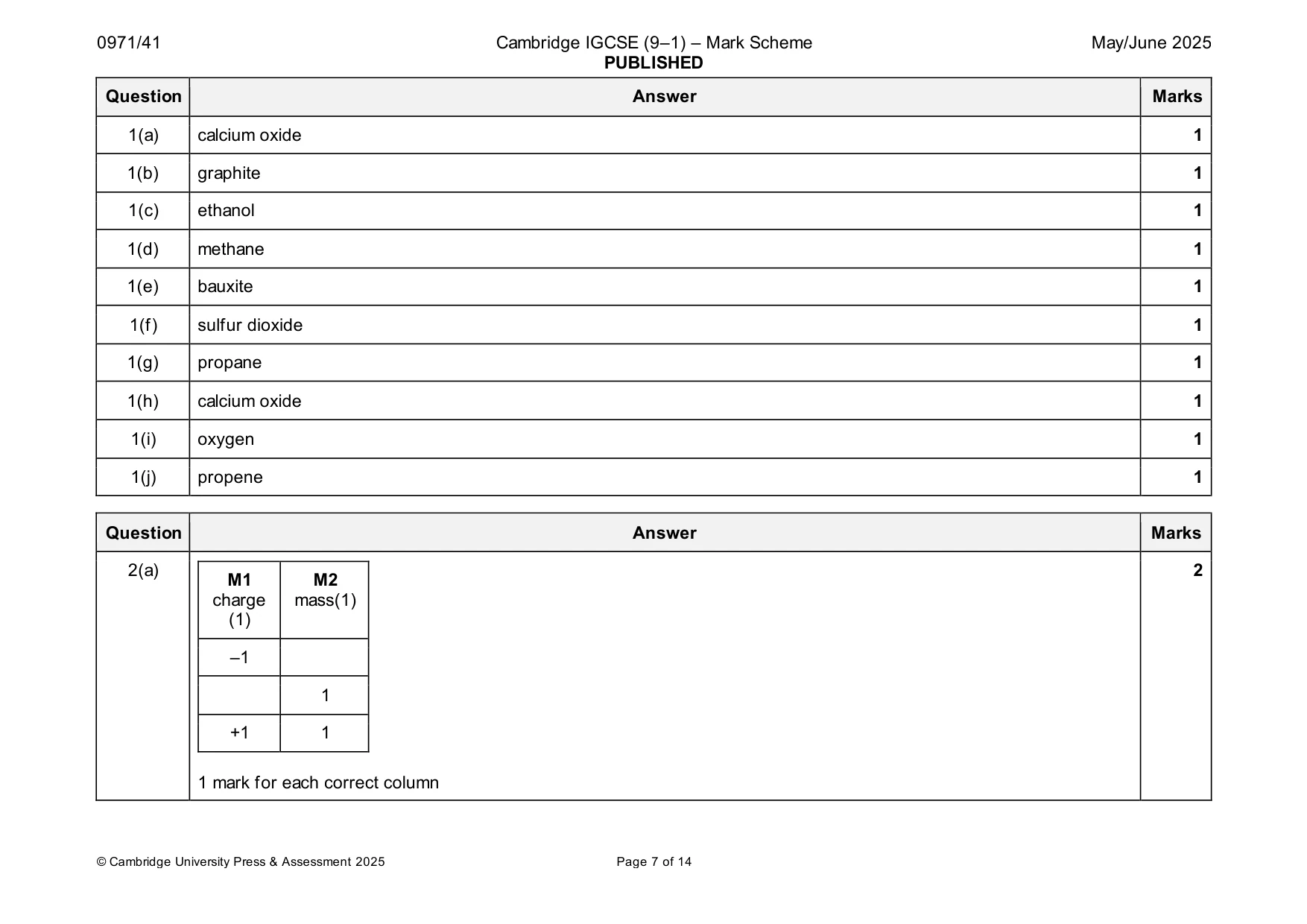
Mark scheme: Question Answer Marks 1(a) calcium oxide 1 1(b) graphite 1 1(c) ethanol 1 1(d) methane 1 1(e) bauxite 1 1(f) sulfur dioxide 1 1(g) propane 1 1(h) calcium oxide 1 1(i) oxygen 1 1(j) propene 1
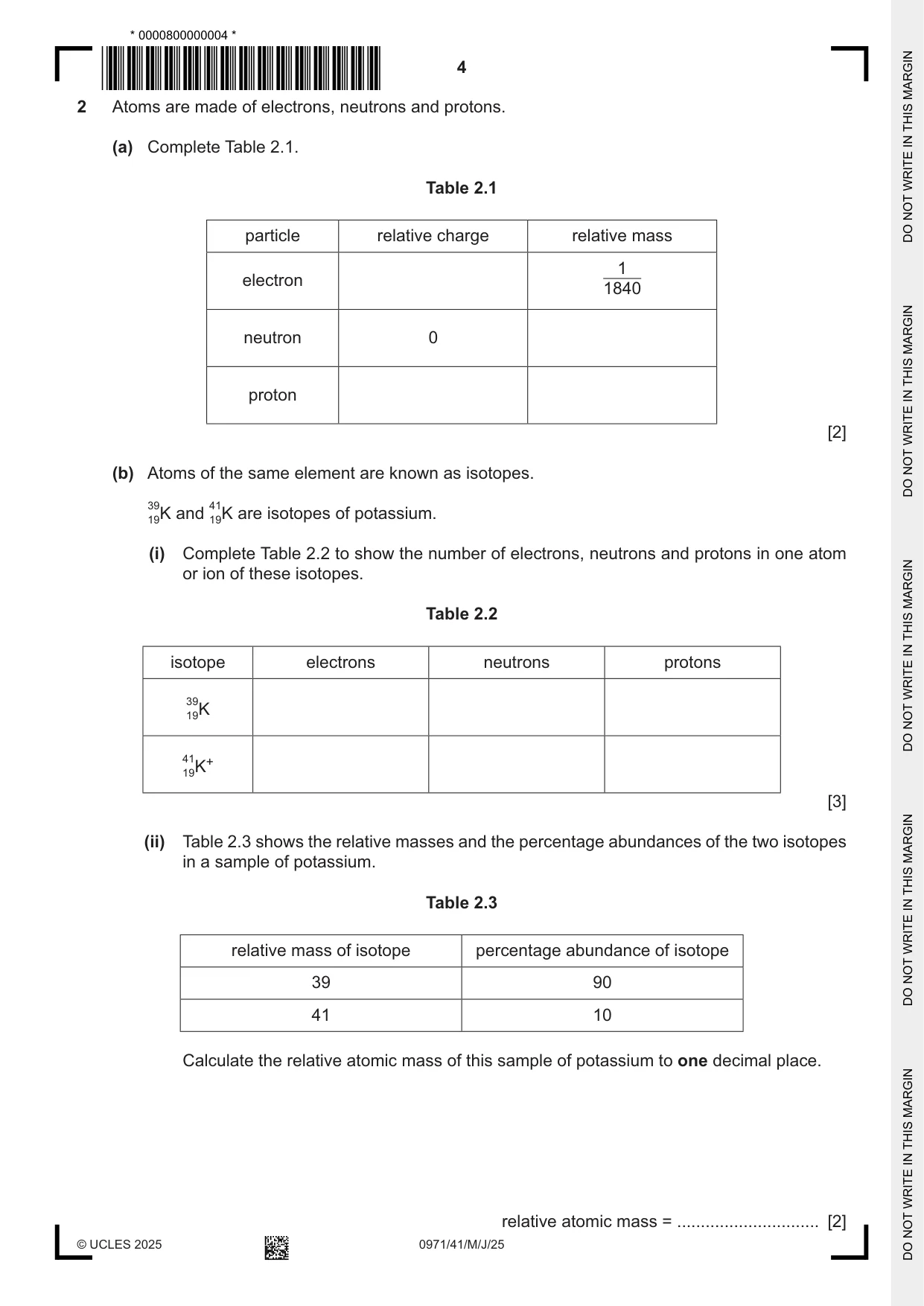
Q2 · Atoms are made of electrons, neutrons and protons
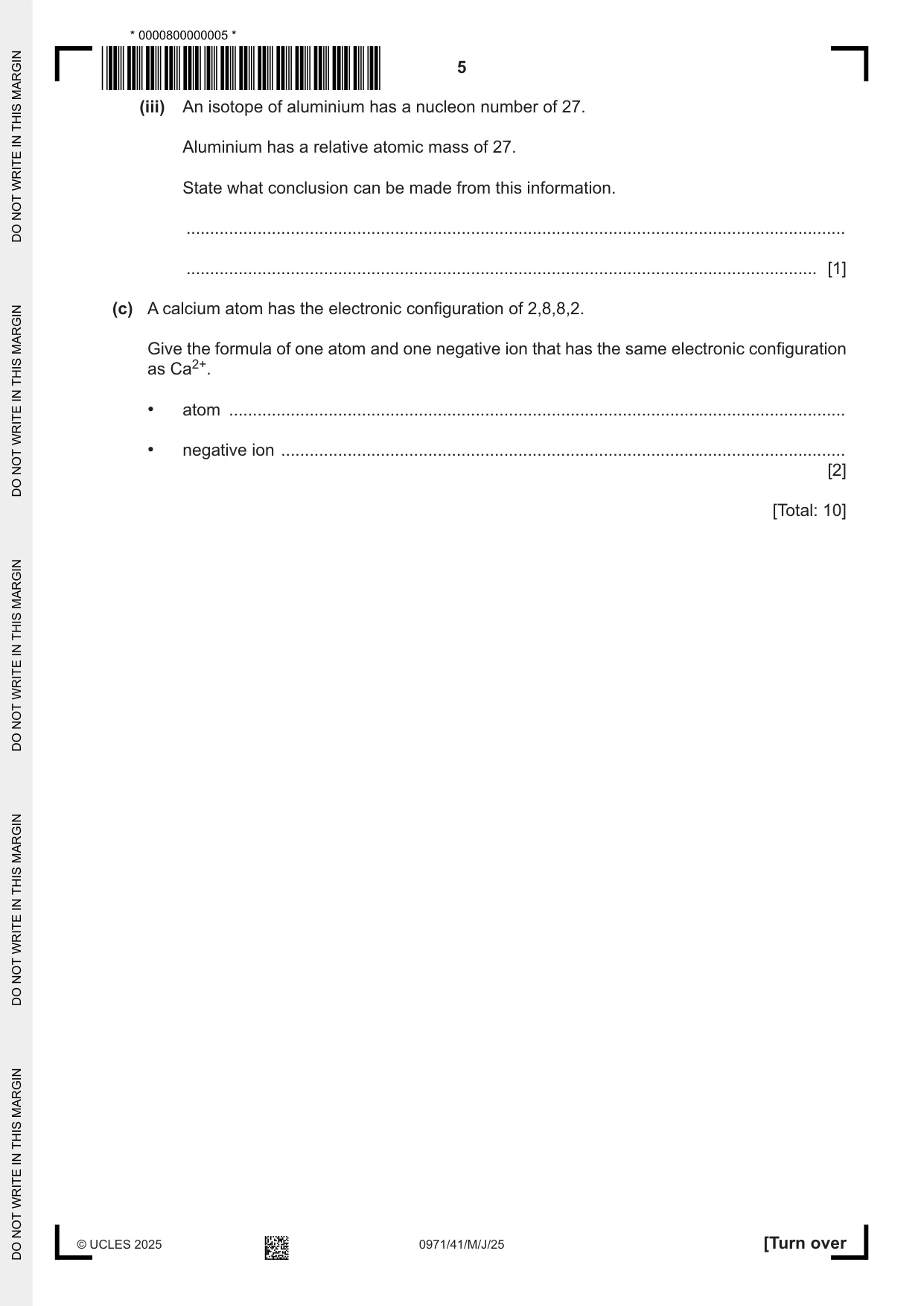
2 Atoms are made of electrons, neutrons and protons. (a) Complete Table 2.1. Table 2.1 particle relative charge relative mass 1 electron 1840 neutron 0 proton [2] (b) Atoms of the same element are known as isotopes. 3919K and 4119K are isotopes of potassium. (i) Complete Table 2.2 to show the number of electrons, neutrons and protons in one atom or ion of these isotopes. Table 2.2 isotope electrons neutrons protons 3919K 4119K+ [3] (ii) Table 2.3 shows the relative masses and the percentage abundances of the two isotopes in a sample of potassium. Table 2.3 relative mass of isotope percentage abundance of isotope 39 90 41 10 Calculate the relative atomic mass of this sample of potassium to one decimal place. relative atomic mass = .............................. [2] (iii) An isotope of aluminium has a nucleon number of 27. Aluminium has a relative atomic mass of 27. State what conclusion can be made from this information. ........................................................................................................................................... ..................................................................................................................................... [1] (c) A calcium atom has the electronic configuration of 2,8,8,2. Give the formula of one atom and one negative ion that has the same electronic configuration as Ca2+. • atom .................................................................................................................................. • negative ion ....................................................................................................................... [2] [Total: 10]
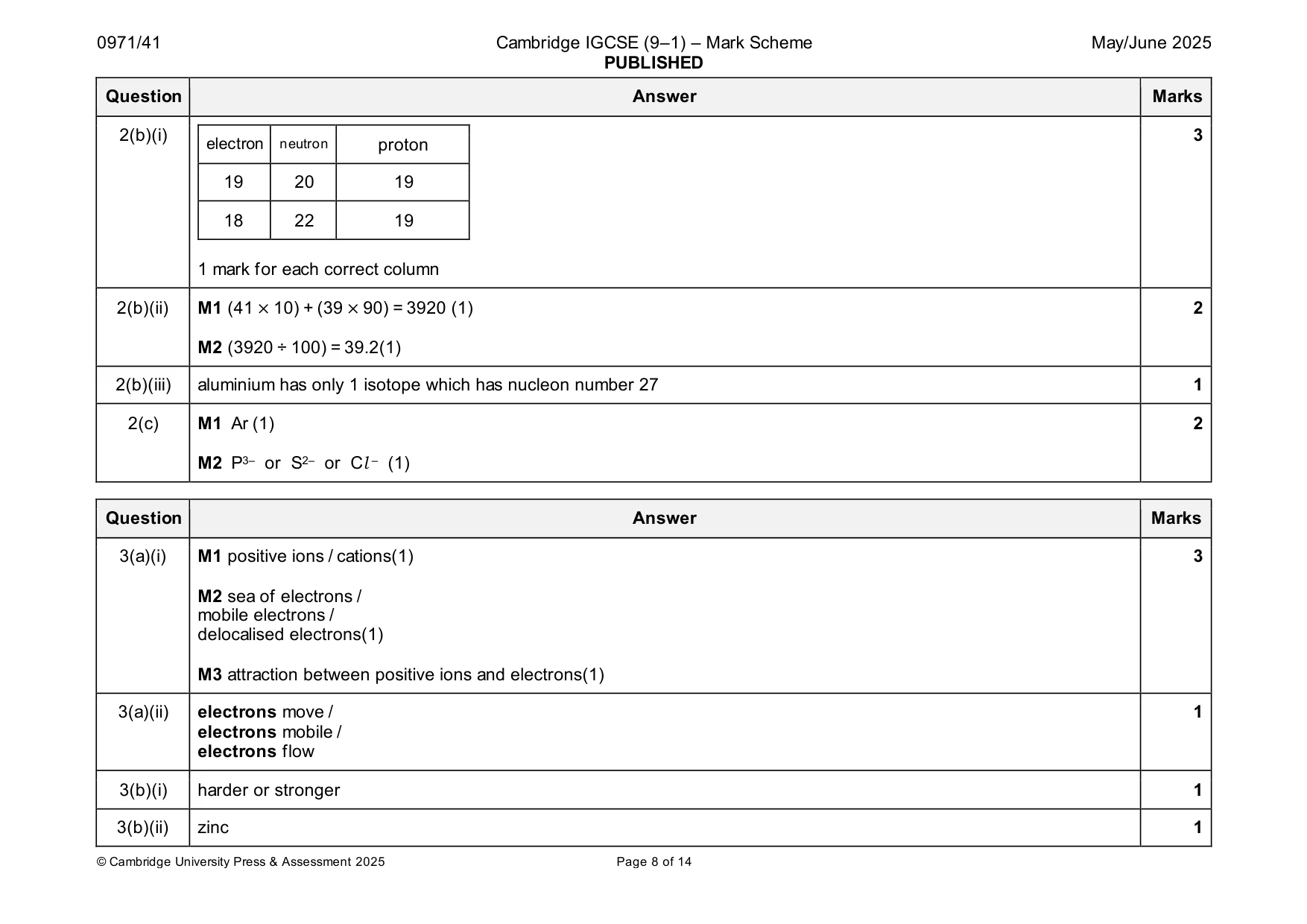
Mark scheme: 2(a) 2 M1 M2 charge mass(1) (1) –1 1 +1 1 1 mark for each correct column 2(b)(i) 3 electron neutron proton 19 20 19 18 22 19 1 mark for each correct column 2(b)(ii) M1 (41 × 10) + (39 × 90) = 3920 (1) 2 M2 (3920 ÷ 100) = 39.2(1) 2(b)(iii) aluminium has only 1 isotope which has nucleon number 27 1 2(c) M1 Ar (1) 2 M2 P3– or S2– or Cl – (1)
Q3 · This question is about copper and compounds of copper
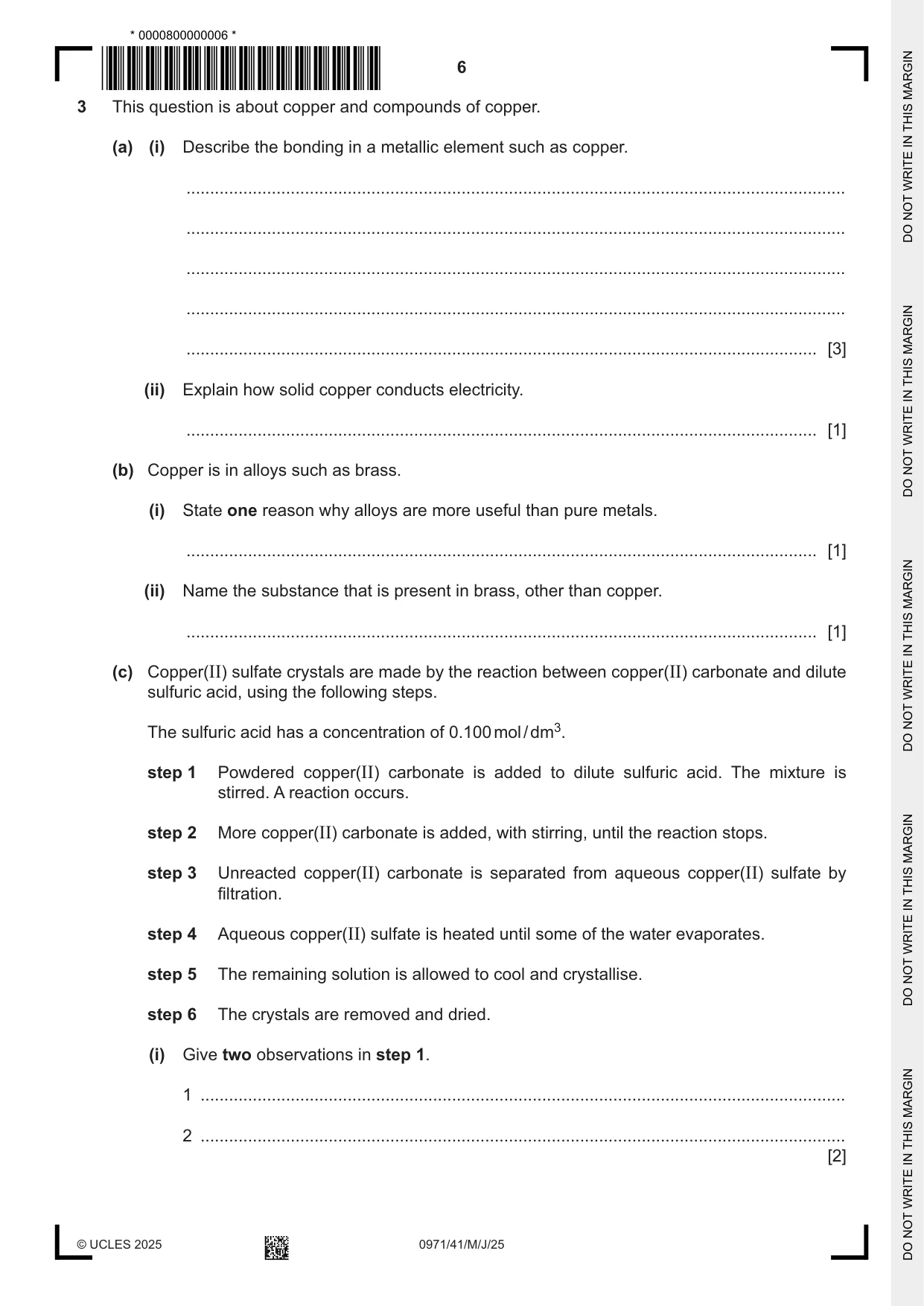
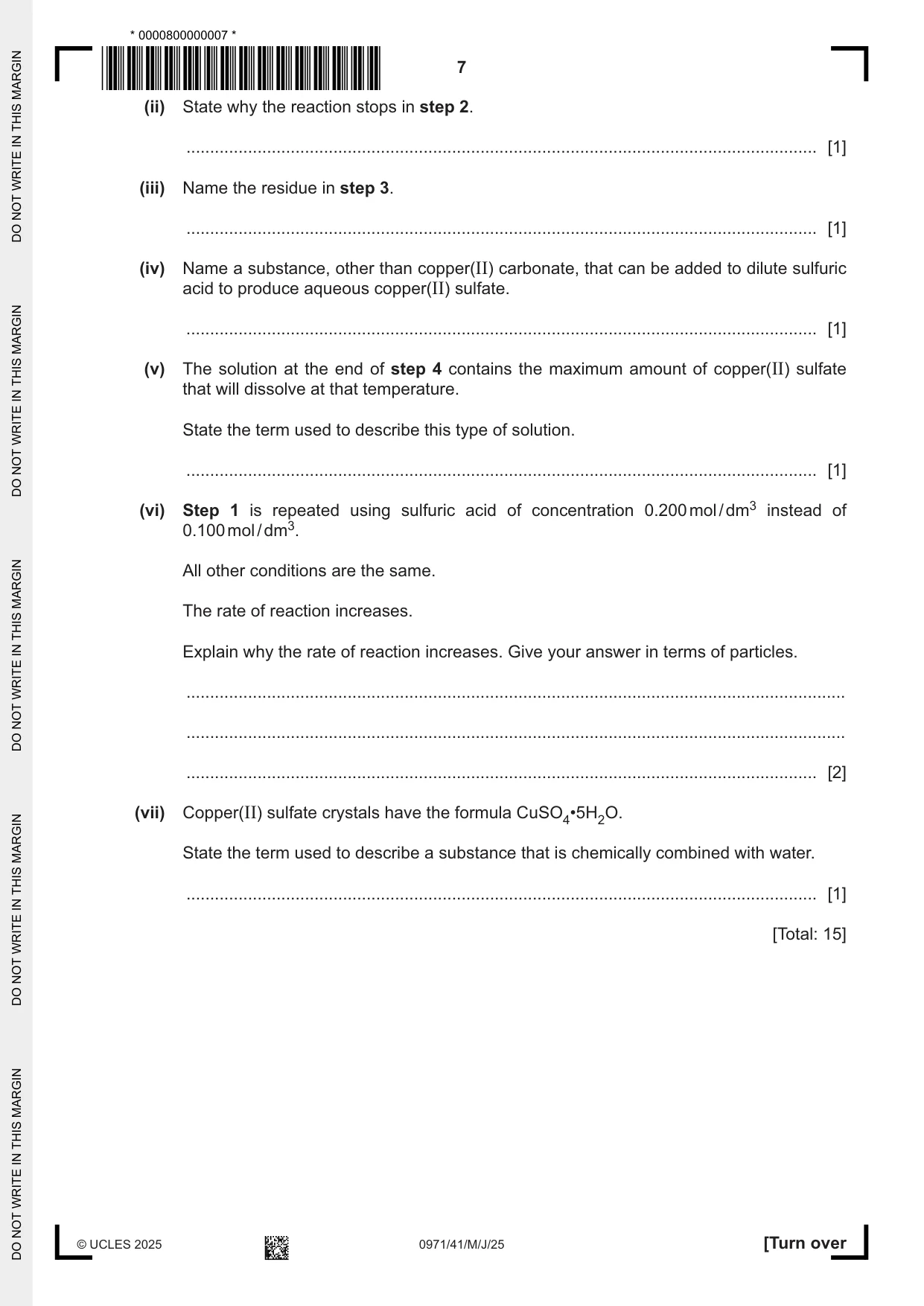
3 This question is about copper and compounds of copper. (a) (i) Describe the bonding in a metallic element such as copper. ........................................................................................................................................... ........................................................................................................................................... ........................................................................................................................................... ........................................................................................................................................... ..................................................................................................................................... [3] (ii) Explain how solid copper conducts electricity. ..................................................................................................................................... [1] (b) Copper is in alloys such as brass. (i) State one reason why alloys are more useful than pure metals. ..................................................................................................................................... [1] (ii) Name the substance that is present in brass, other than copper. ..................................................................................................................................... [1] (c) Copper(II) sulfate crystals are made by the reaction between copper(II) carbonate and dilute sulfuric acid, using the following steps. The sulfuric acid has a concentration of 0.100 mol / dm3. step 1 Powdered copper(II) carbonate is added to dilute sulfuric acid. The mixture is stirred. A reaction occurs. step 2 More copper(II) carbonate is added, with stirring, until the reaction stops. step 3 Unreacted copper(II) carbonate is separated from aqueous copper(II) sulfate by filtration. step 4 Aqueous copper(II) sulfate is heated until some of the water evaporates. step 5 The remaining solution is allowed to cool and crystallise. step 6 The crystals are removed and dried. (i) Give two observations in step 1. 1 ........................................................................................................................................ 2 ........................................................................................................................................ [2] (ii) State why the reaction stops in step 2. ..................................................................................................................................... [1] (iii) Name the residue in step 3. ..................................................................................................................................... [1] (iv) Name a substance, other than copper(II) carbonate, that can be added to dilute sulfuric acid to produce aqueous copper(II) sulfate. ..................................................................................................................................... [1] (v) The solution at the end of step 4 contains the maximum amount of copper(II) sulfate that will dissolve at that temperature. State the term used to describe this type of solution. ..................................................................................................................................... [1] (vi) Step 1 is repeated using sulfuric acid of concentration 0.200 mol / dm3 instead of 0.100 mol / dm3. All other conditions are the same. The rate of reaction increases. Explain why the rate of reaction increases. Give your answer in terms of particles. ........................................................................................................................................... ........................................................................................................................................... ..................................................................................................................................... [2] (vii) Copper(II) sulfate crystals have the formula CuSO4•5H2O. State the term used to describe a substance that is chemically combined with water. ..................................................................................................................................... [1] [Total: 15]
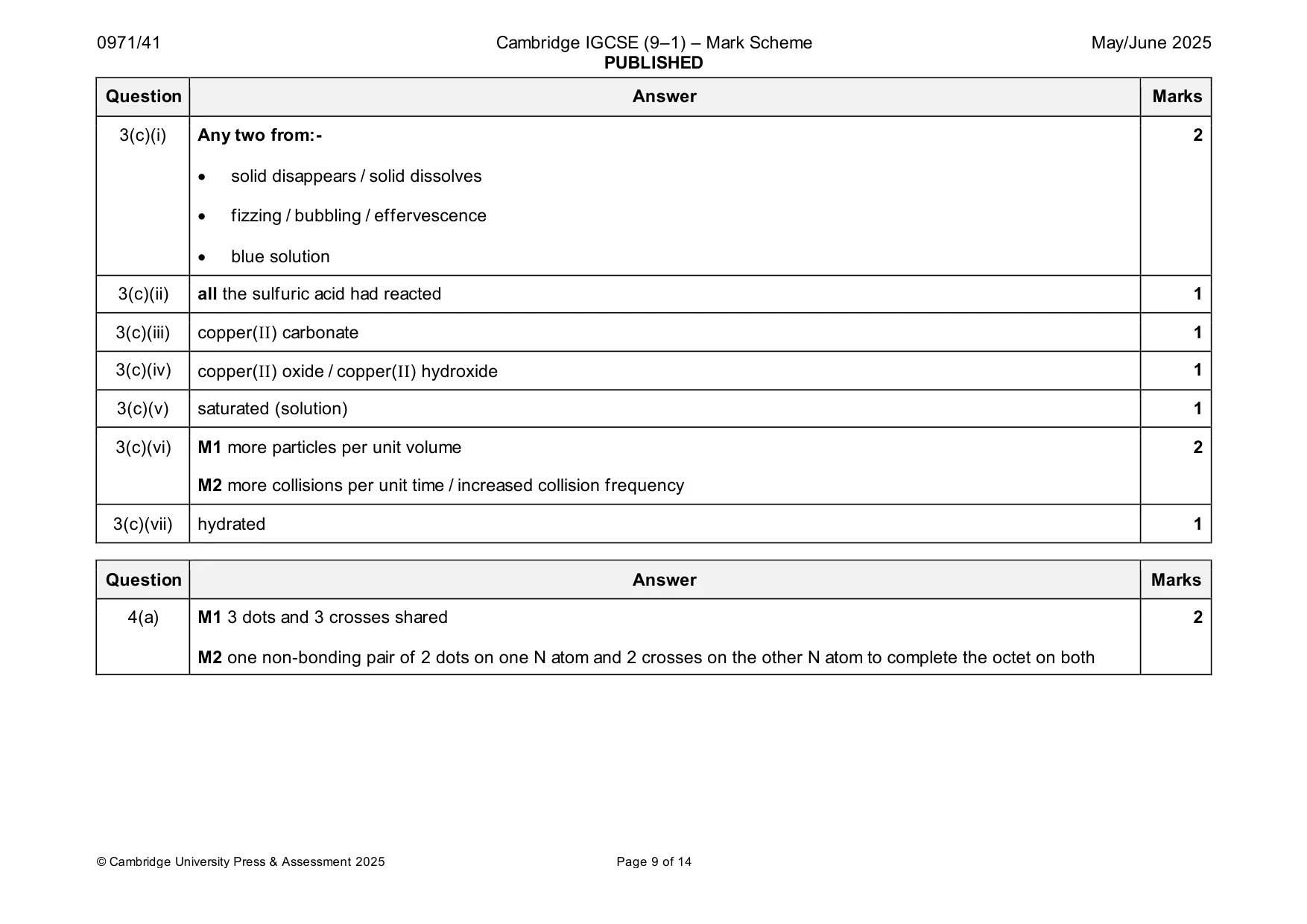
Mark scheme: 3(a)(i) M1 positive ions / cations(1) 3 M2 sea of electrons / mobile electrons / delocalised electrons(1) M3 attraction between positive ions and electrons(1) 3(a)(ii) electrons move / 1 electrons mobile / electrons flow 3(b)(i) harder or stronger 1 3(b)(ii) zinc 1 3(c)(i) Any two from:- 2 • solid disappears / solid dissolves • fizzing / bubbling / effervescence • blue solution 3(c)(ii) all the sulfuric acid had reacted 1 3(c)(iii) copper(II) carbonate 1 3(c)(iv) copper(II) oxide / copper(II) hydroxide 1 3(c)(v) saturated (solution) 1 3(c)(vi) M1 more particles per unit volume 2 M2 more collisions per unit time / increased collision frequency 3(c)(vii) hydrated 1
Q4 · This question is about nitrogen and its compounds
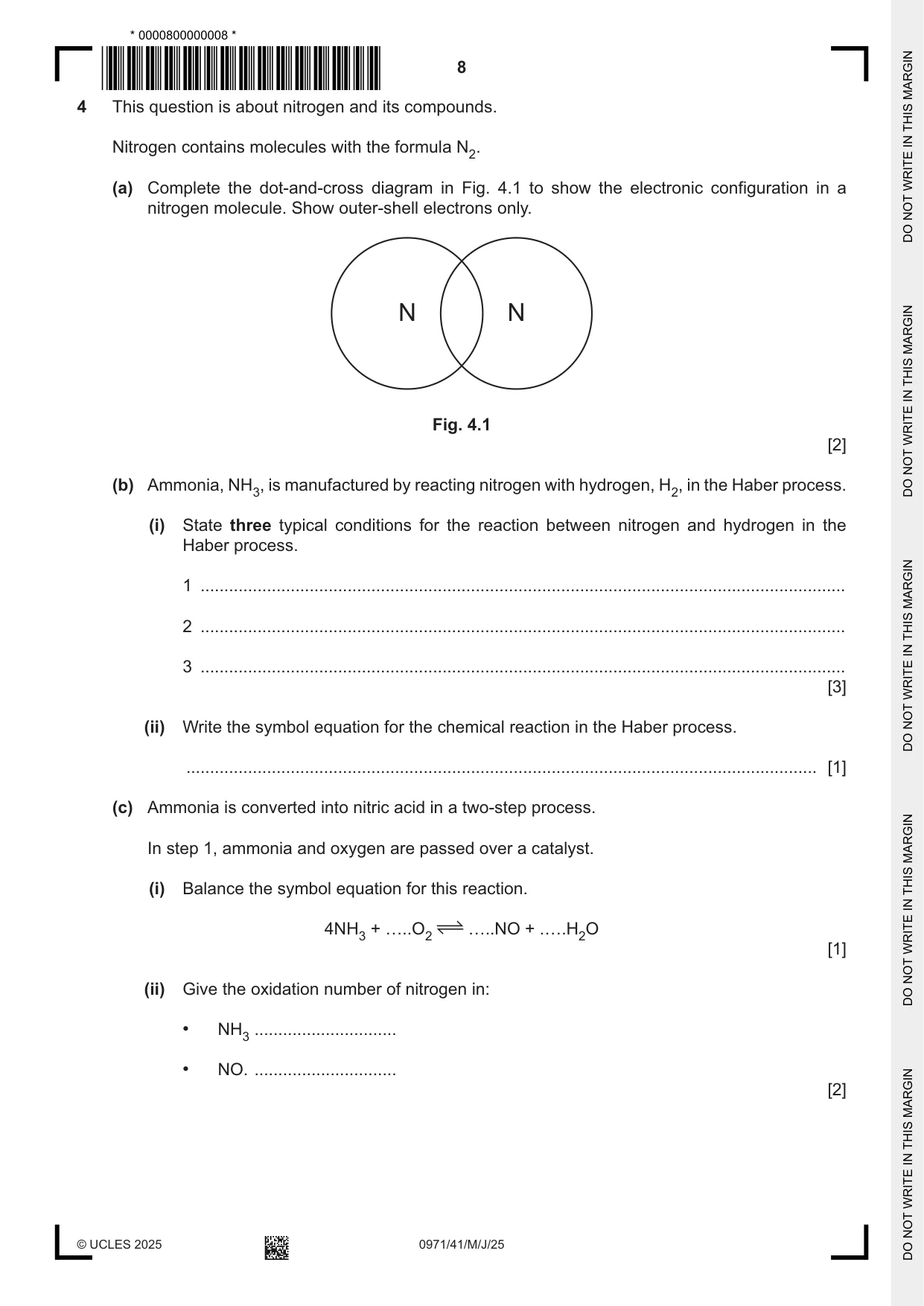
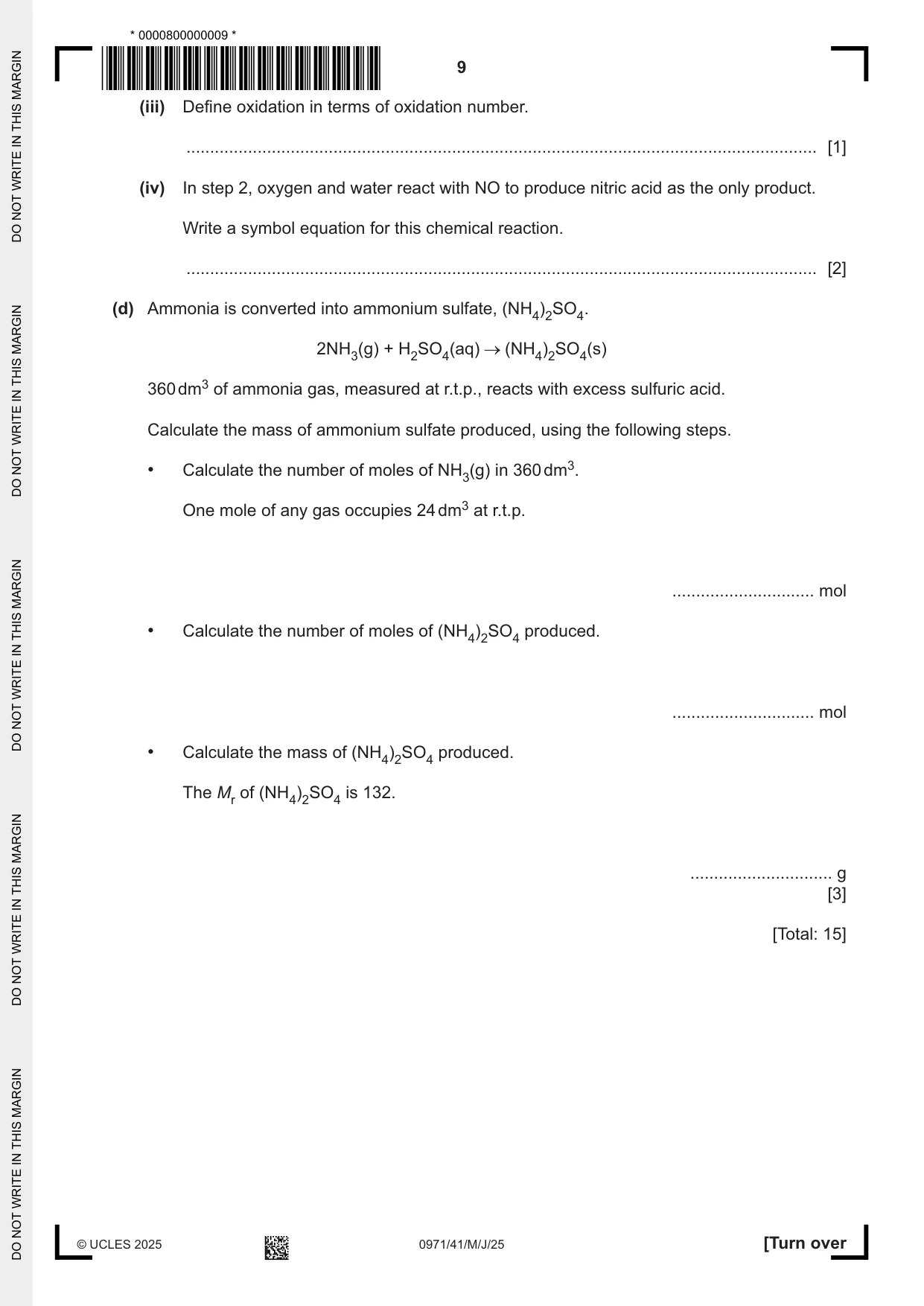
4 This question is about nitrogen and its compounds. Nitrogen contains molecules with the formula N2. (a) Complete the dot-and-cross diagram in Fig. 4.1 to show the electronic configuration in a nitrogen molecule. Show outer-shell electrons only. N N Fig. 4.1 [2] (b) Ammonia, NH3, is manufactured by reacting nitrogen with hydrogen, H2, in the Haber process. (i) State three typical conditions for the reaction between nitrogen and hydrogen in the Haber process. 1 ........................................................................................................................................ 2 ........................................................................................................................................ 3 ........................................................................................................................................ [3] (ii) Write the symbol equation for the chemical reaction in the Haber process. ..................................................................................................................................... [1] (c) Ammonia is converted into nitric acid in a two-step process. In step 1, ammonia and oxygen are passed over a catalyst. (i) Balance the symbol equation for this reaction. 4NH3 + …..O2 …..NO + .….H2O [1] (ii) Give the oxidation number of nitrogen in: • NH3 .............................. • NO. .............................. [2] (iii) Define oxidation in terms of oxidation number. ..................................................................................................................................... [1] (iv) In step 2, oxygen and water react with NO to produce nitric acid as the only product. Write a symbol equation for this chemical reaction. ..................................................................................................................................... [2] (d) Ammonia is converted into ammonium sulfate, (NH4)2SO4. 2NH3(g) + H2SO4(aq) (NH4)2SO4(s) 360 dm3 of ammonia gas, measured at r.t.p., reacts with excess sulfuric acid. Calculate the mass of ammonium sulfate produced, using the following steps. • Calculate the number of moles of NH3(g) in 360 dm3. One mole of any gas occupies 24 dm3 at r.t.p. .............................. mol • Calculate the number of moles of (NH4)2SO4 produced. .............................. mol • Calculate the mass of (NH4)2SO4 produced. The Mr of (NH4)2SO4 is 132. .............................. g [3] [Total: 15]
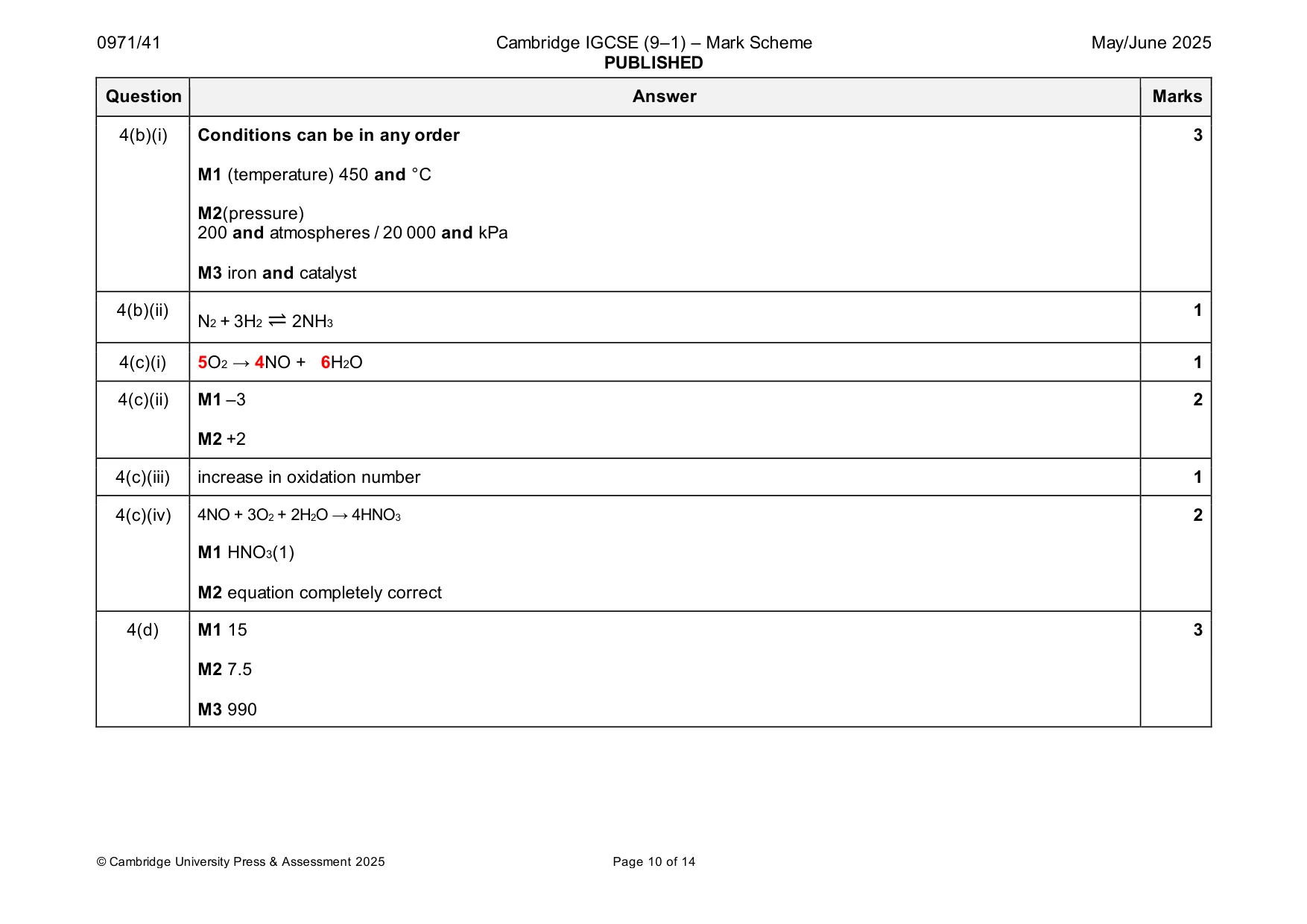
Mark scheme: 4(a) M1 3 dots and 3 crosses shared 2 M2 one non-bonding pair of 2 dots on one N atom and 2 crosses on the other N atom to complete the octet on both 4(b)(i) Conditions can be in any order 3 M1 (temperature) 450 and °C M2(pressure) 200 and atmospheres / 20 000 and kPa M3 iron and catalyst 4(b)(ii) N2 + 3H2 ⇌ 2NH3 1 4(c)(i) 5O2 → 4NO + 6H2O 1 4(c)(ii) M1 –3 2 M2 +2 4(c)(iii) increase in oxidation number 1 4(c)(iv) 4NO + 3O2 + 2H2O → 4HNO3 2 M1 HNO3(1) M2 equation completely correct 4(d) M1 15 3 M2 7.5 M3 990
Q5 · Methanol, CH3OH, is manufactured by the reaction between hydrogen and carbon monoxide
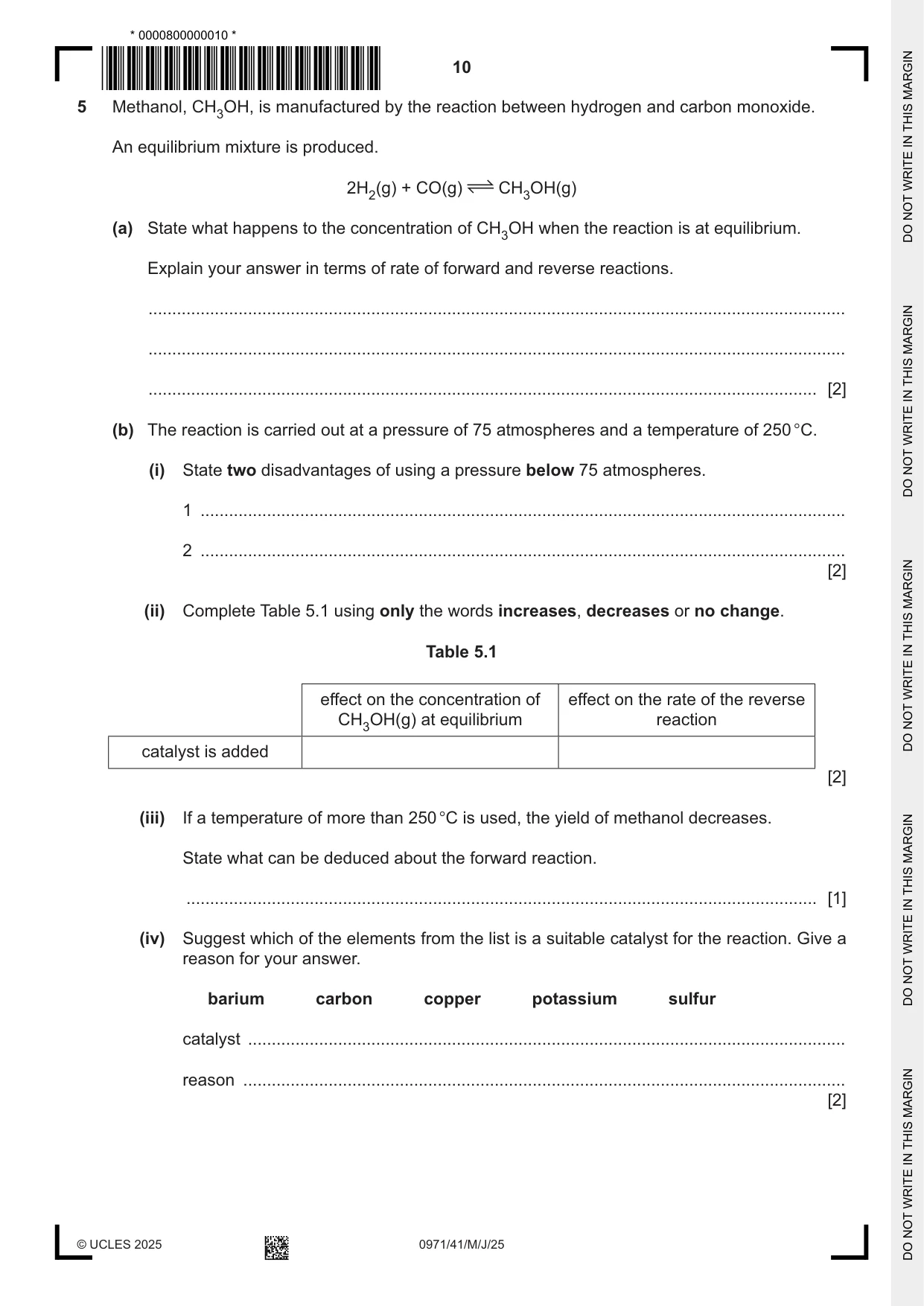
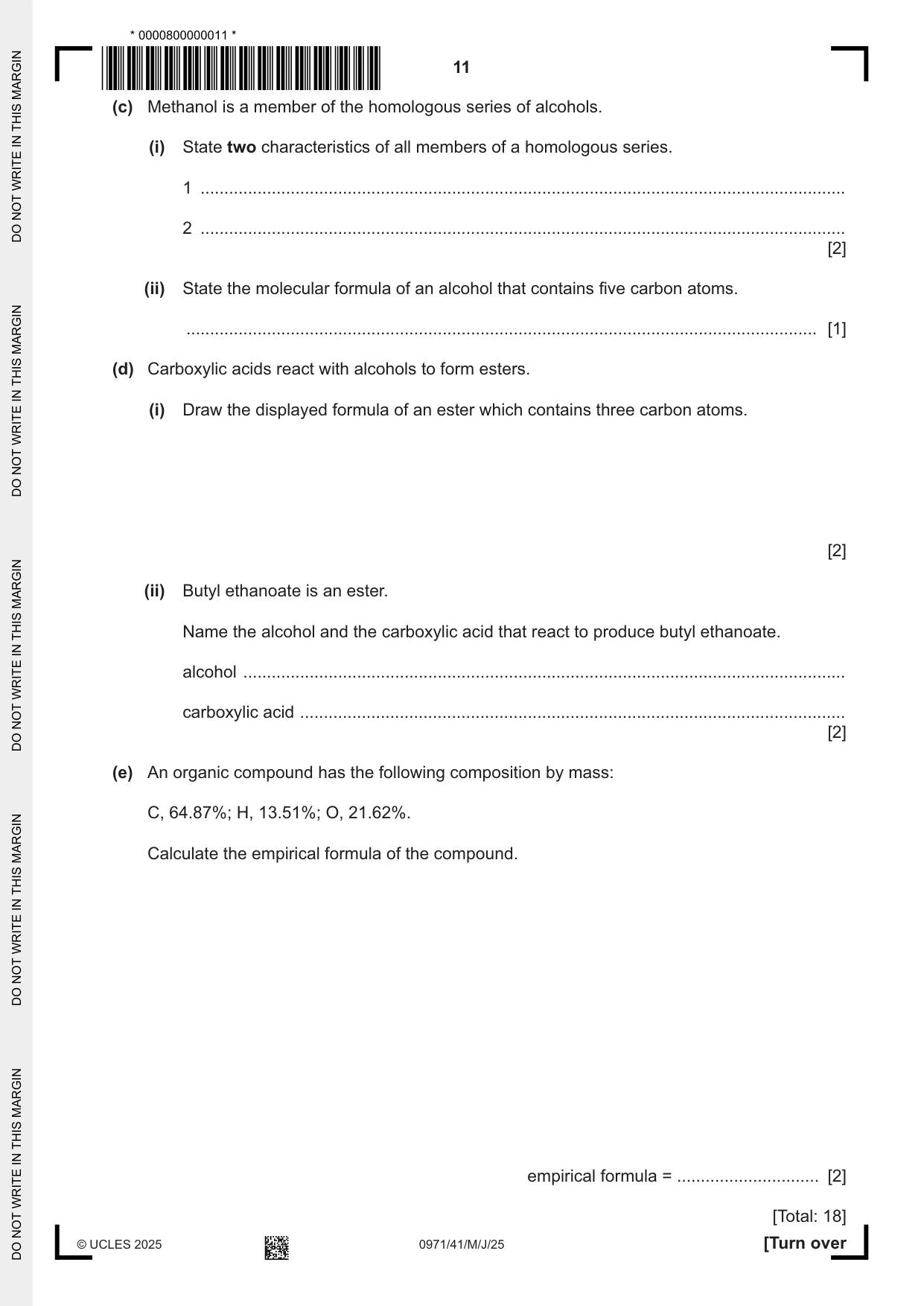
5 Methanol, CH3OH, is manufactured by the reaction between hydrogen and carbon monoxide. An equilibrium mixture is produced. 2H2(g) + CO(g) CH3OH(g) (a) State what happens to the concentration of CH3OH when the reaction is at equilibrium. Explain your answer in terms of rate of forward and reverse reactions. ................................................................................................................................................... ................................................................................................................................................... ............................................................................................................................................. [2] (b) The reaction is carried out at a pressure of 75 atmospheres and a temperature of 250 °C. (i) State two disadvantages of using a pressure below 75 atmospheres. 1 ........................................................................................................................................ 2 ........................................................................................................................................ [2] (ii) Complete Table 5.1 using only the words increases, decreases or no change. Table 5.1 effect on the concentration of effect on the rate of the reverse CH3OH(g) at equilibrium reaction catalyst is added [2] (iii) If a temperature of more than 250 °C is used, the yield of methanol decreases. State what can be deduced about the forward reaction. ..................................................................................................................................... [1] (iv) Suggest which of the elements from the list is a suitable catalyst for the reaction. Give a reason for your answer. barium carbon copper potassium sulfur catalyst .............................................................................................................................. reason ............................................................................................................................... [2] (c) Methanol is a member of the homologous series of alcohols. (i) State two characteristics of all members of a homologous series. 1 ........................................................................................................................................ 2 ........................................................................................................................................ [2] (ii) State the molecular formula of an alcohol that contains five carbon atoms. ..................................................................................................................................... [1] (d) Carboxylic acids react with alcohols to form esters. (i) Draw the displayed formula of an ester which contains three carbon atoms. [2] (ii) Butyl ethanoate is an ester. Name the alcohol and the carboxylic acid that react to produce butyl ethanoate. alcohol ............................................................................................................................... carboxylic acid ................................................................................................................... [2] (e) An organic compound has the following composition by mass: C, 64.87%; H, 13.51%; O, 21.62%. Calculate the empirical formula of the compound. empirical formula = .............................. [2] [Total: 18]
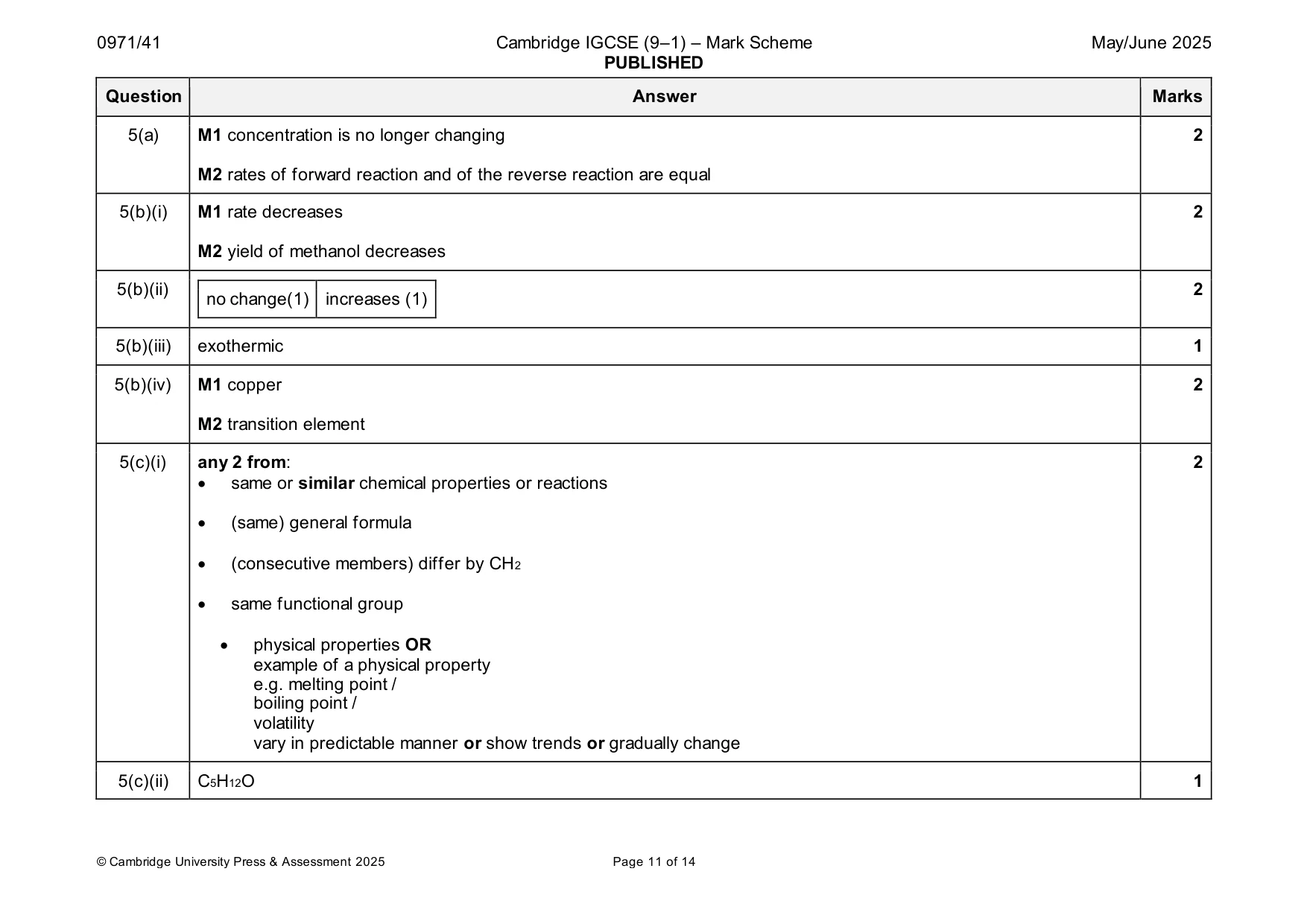
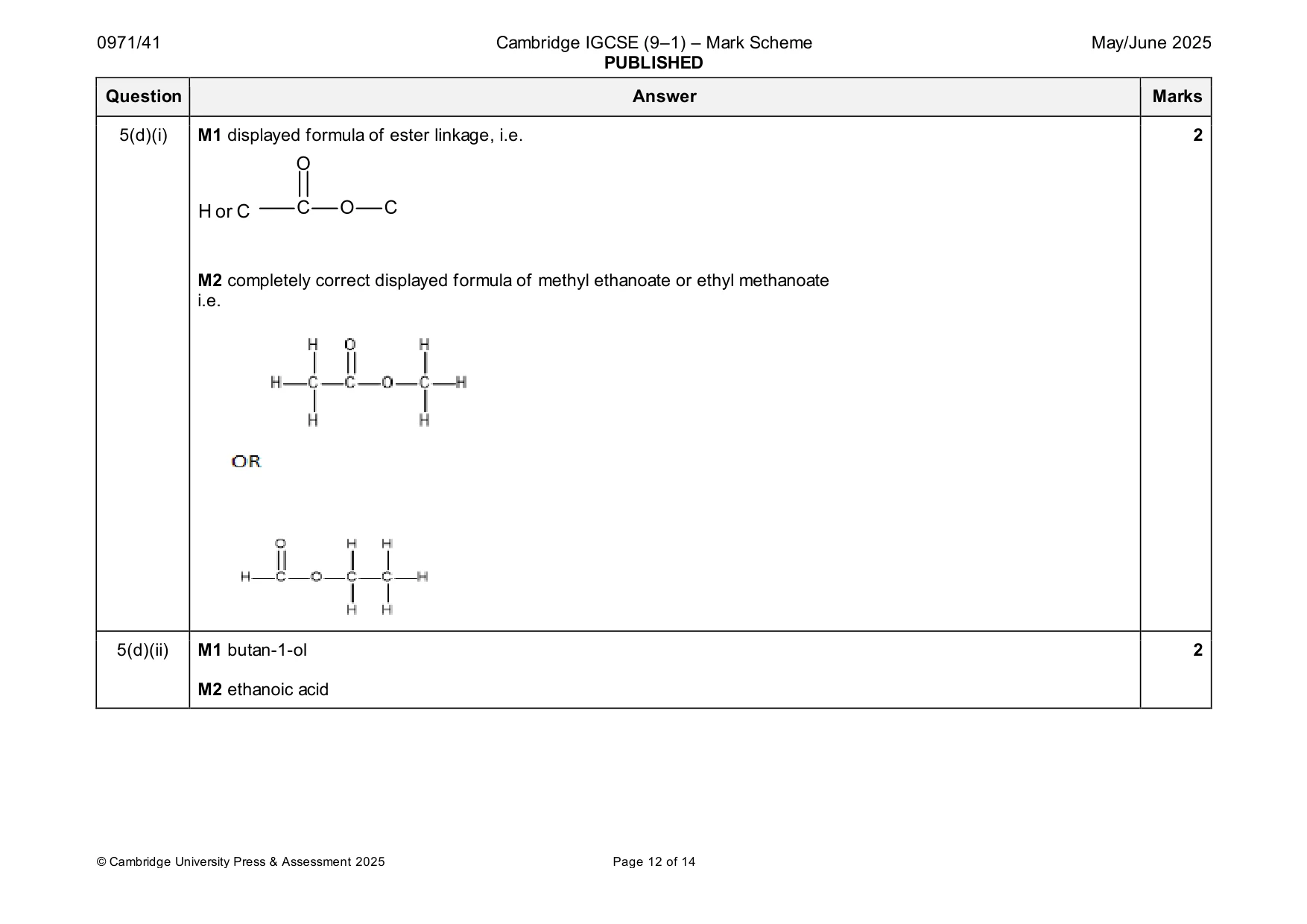
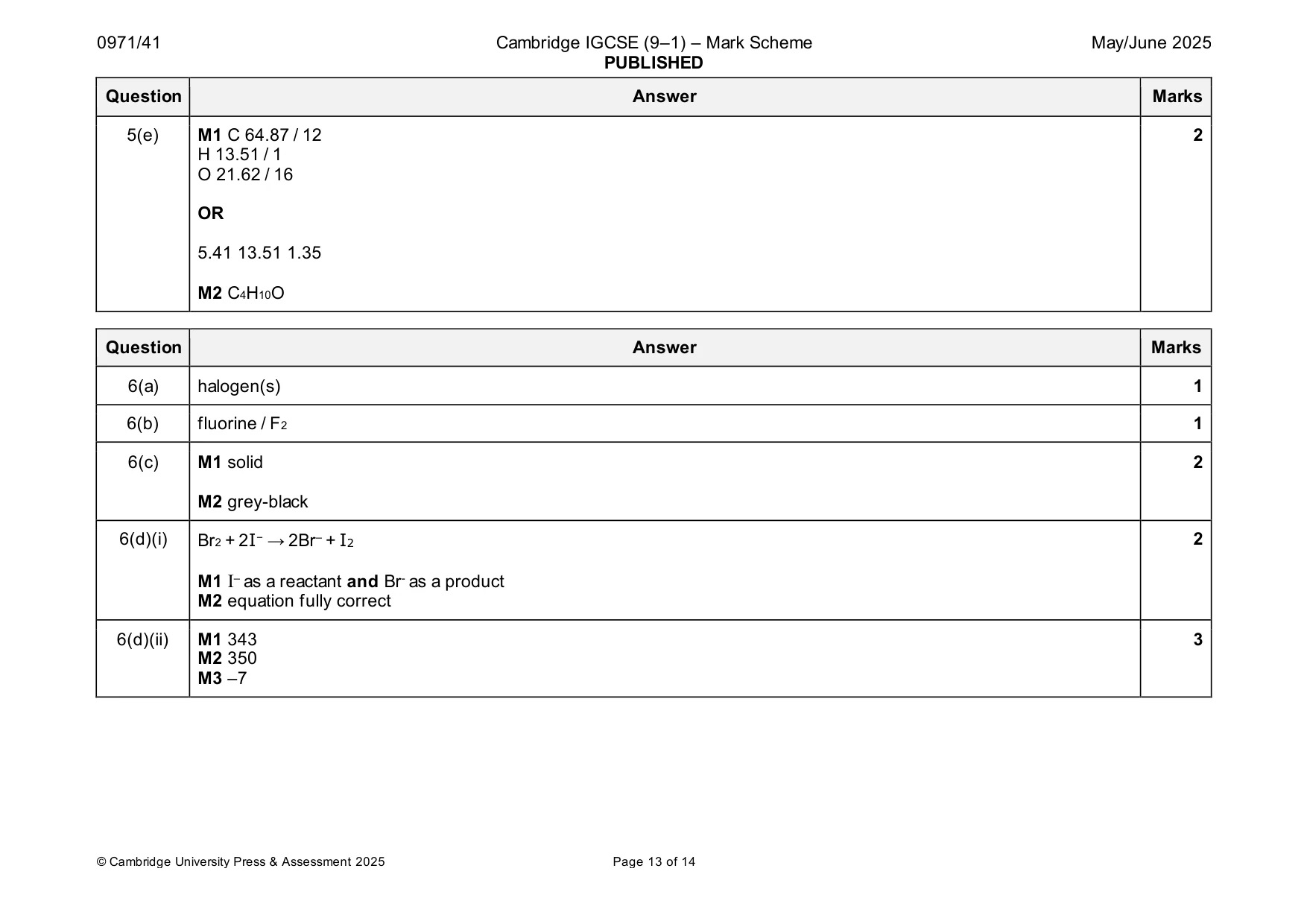
Mark scheme: 5(a) M1 concentration is no longer changing 2 M2 rates of forward reaction and of the reverse reaction are equal 5(b)(i) M1 rate decreases 2 M2 yield of methanol decreases 5(b)(ii) 2 no change(1) increases (1) 5(b)(iii) exothermic 1 5(b)(iv) M1 copper 2 M2 transition element 5(c)(i) any 2 from: 2 • same or similar chemical properties or reactions • (same) general formula • (consecutive members) differ by CH2 • same functional group • physical properties OR example of a physical property e.g. melting point / boiling point / volatility vary in predictable manner or show trends or gradually change 5(c)(ii) C5H12O 1 5(d)(i) M1 displayed formula of ester linkage, i.e. 2 H or C M2 completely correct displayed formula of methyl ethanoate or ethyl methanoate i.e. 5(d)(ii) M1 butan-1-ol 2 M2 ethanoic acid 5(e) M1 C 64.87 / 12 2 H 13.51 / 1 O 21.62 / 16 OR 5.41 13.51 1.35 M2 C4H10O
Q6 · This question is about the Periodic Table
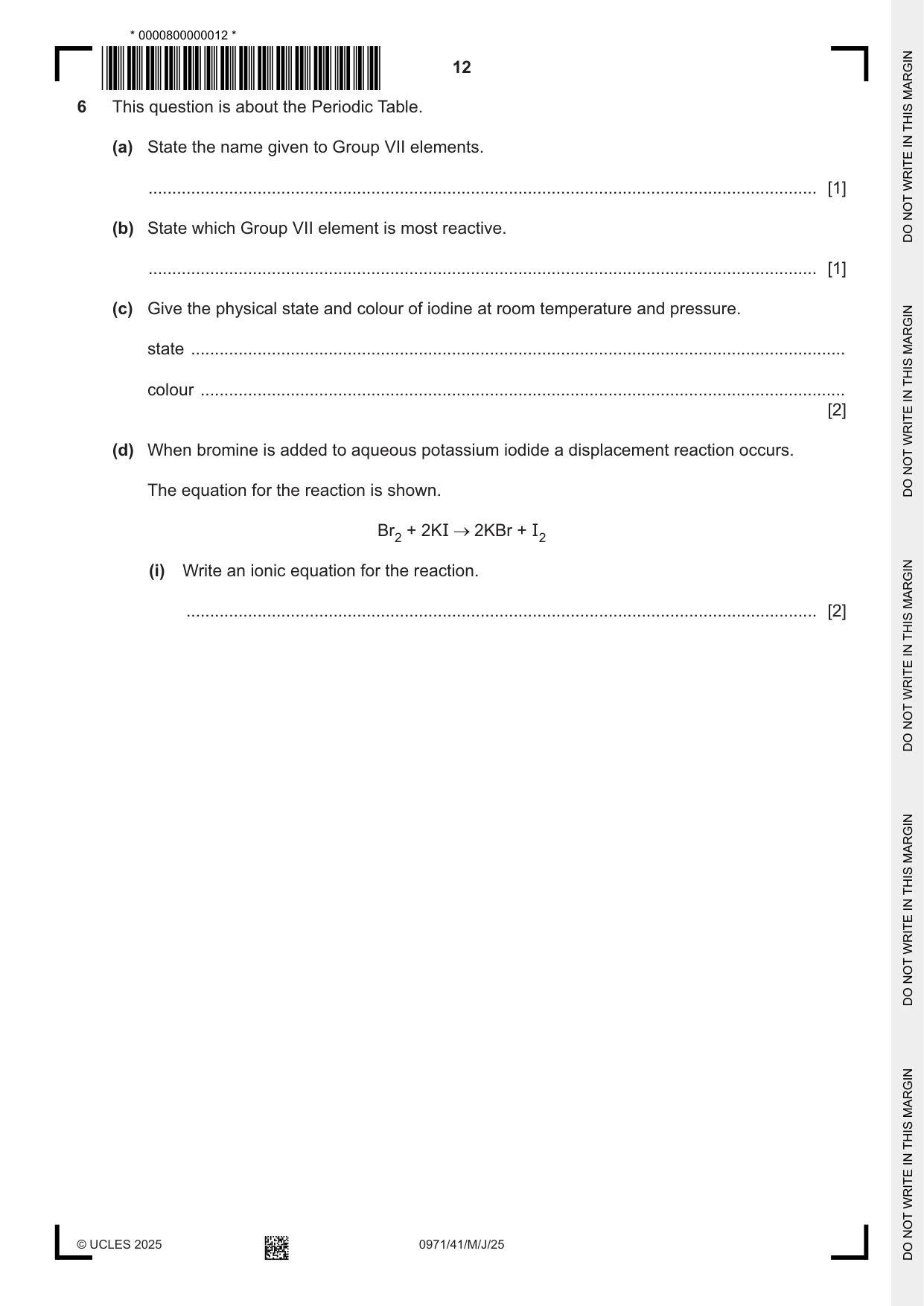
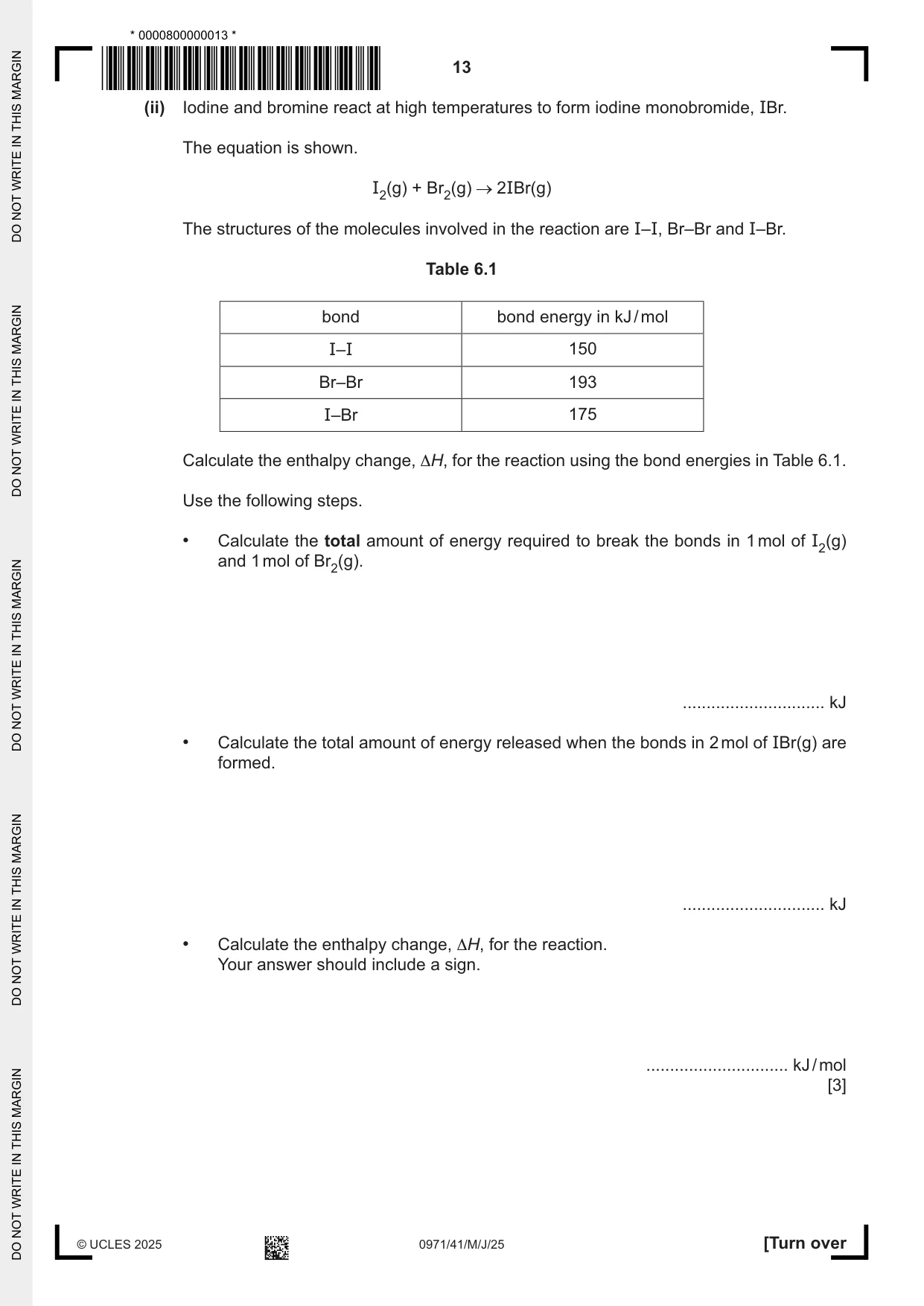
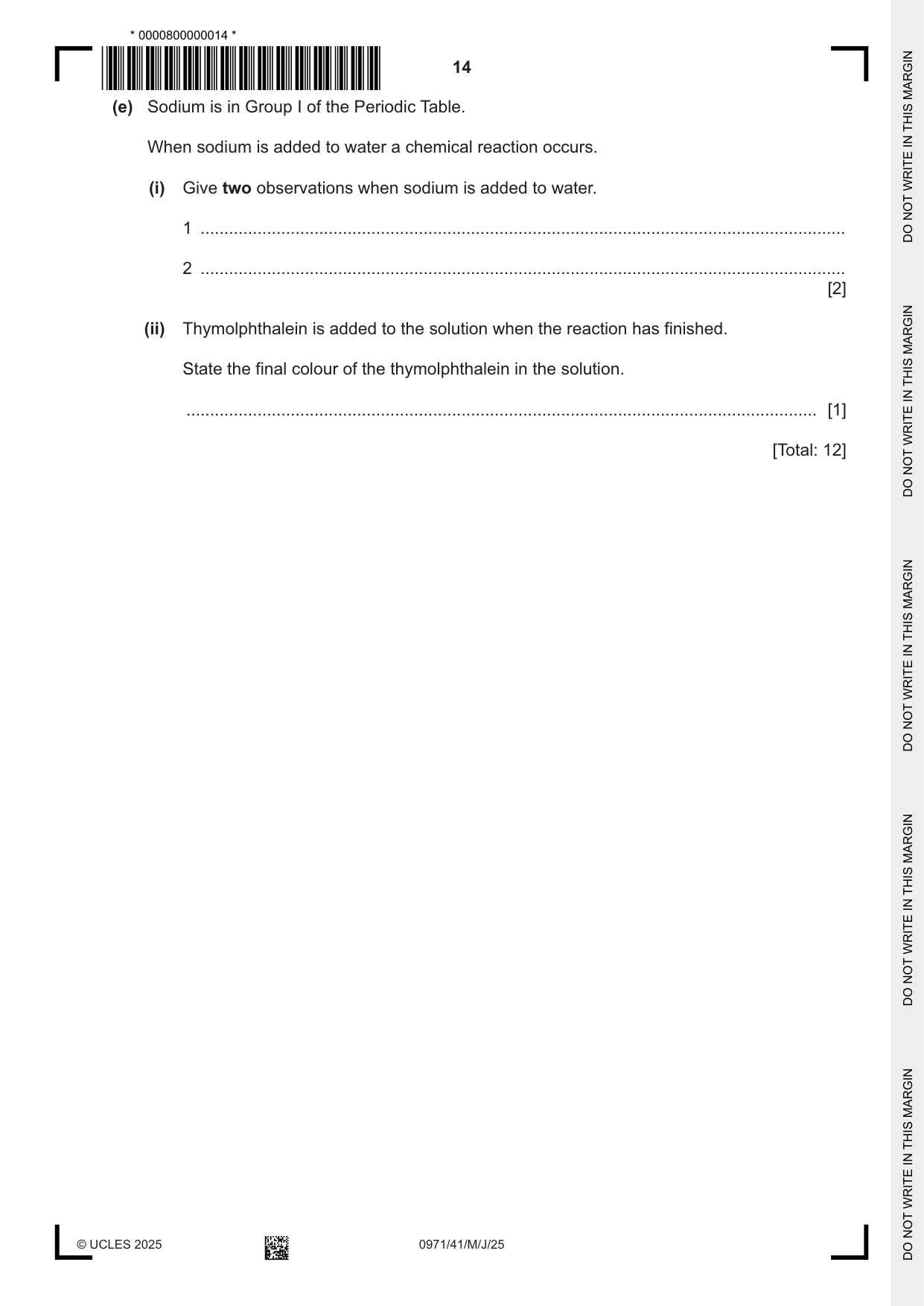
6 This question is about the Periodic Table. (a) State the name given to Group VII elements. ............................................................................................................................................. [1] (b) State which Group VII element is most reactive. ............................................................................................................................................. [1] (c) Give the physical state and colour of iodine at room temperature and pressure. state .......................................................................................................................................... colour ........................................................................................................................................ [2] (d) When bromine is added to aqueous potassium iodide a displacement reaction occurs. The equation for the reaction is shown. Br2 + 2KI 2KBr + I2 (i) Write an ionic equation for the reaction. ..................................................................................................................................... [2] (ii) Iodine and bromine react at high temperatures to form iodine monobromide, IBr. The equation is shown. I2(g) + Br2(g) 2IBr(g) The structures of the molecules involved in the reaction are I–I, Br–Br and I–Br. Table 6.1 bond bond energy in kJ / mol I–I 150 Br–Br 193 I–Br 175 Calculate the enthalpy change, ΔH, for the reaction using the bond energies in Table 6.1. Use the following steps. • Calculate the total amount of energy required to break the bonds in 1 mol of I2(g) and 1 mol of Br2(g). .............................. kJ • Calculate the total amount of energy released when the bonds in 2 mol of IBr(g) are formed. .............................. kJ • Calculate the enthalpy change, ΔH, for the reaction. Your answer should include a sign. .............................. kJ / mol [3] (e) Sodium is in Group I of the Periodic Table. When sodium is added to water a chemical reaction occurs. (i) Give two observations when sodium is added to water. 1 ........................................................................................................................................ 2 ........................................................................................................................................ [2] (ii) Thymolphthalein is added to the solution when the reaction has finished. State the final colour of the thymolphthalein in the solution. ..................................................................................................................................... [1] [Total: 12]
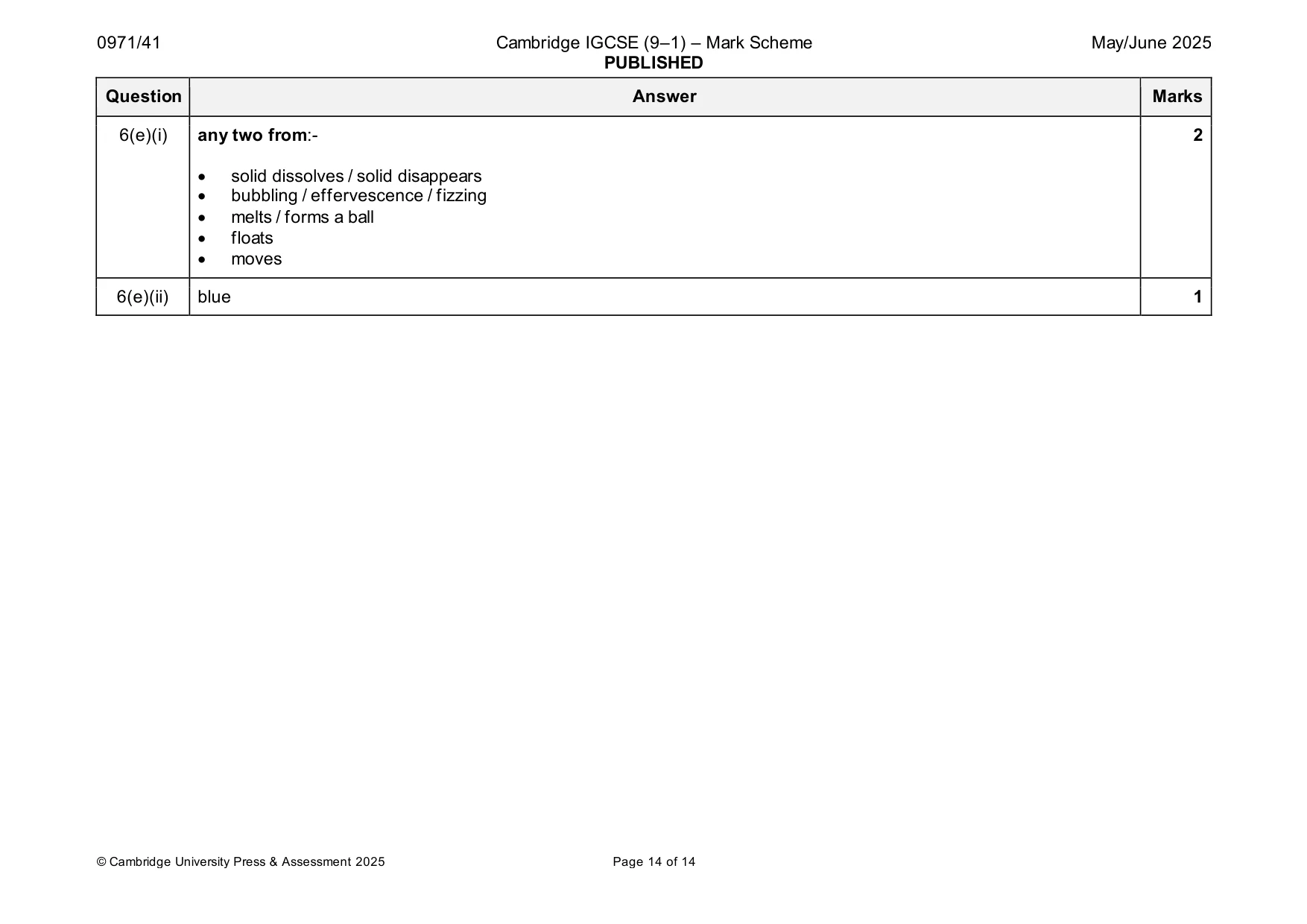
Mark scheme: 6(a) halogen(s) 1 6(b) fluorine / F2 1 6(c) M1 solid 2 M2 grey-black 6(d)(i) Br2 + 2I– → 2Br– + I2 2 M1 I– as a reactant and Br- as a product M2 equation fully correct 6(d)(ii) M1 343 3 M2 350 M3 –7 6(e)(i) any two from:- 2 • solid dissolves / solid disappears • bubbling / effervescence / fizzing • melts / forms a ball • floats • moves 6(e)(ii) blue 1
What was in this paper
The subtopics covered by these 6 questions, and how many questions each got. Open one in a new tab to see every Cambridge question on it.
What you needed in this session
Cambridge’s own grade thresholds for 2025 May/June, Paper 4 · Variant 1. A higher threshold means an easier paper — the bar moves with how the cohort did.