Cambridge IGCSE Chemistry (9-1) 0971 — 2024 May/June Paper 4 · Variant 2
0971/42/M/J/24 · 6 questions · 80 marks · 75 min
The question paper and its mark scheme, free to read here and free to download. This is Cambridge’s own paper, exactly as it was sat.
Question paper16 pages

Mark scheme9 pages
Answers below. Sit the paper first if you are practising.
Questions as text
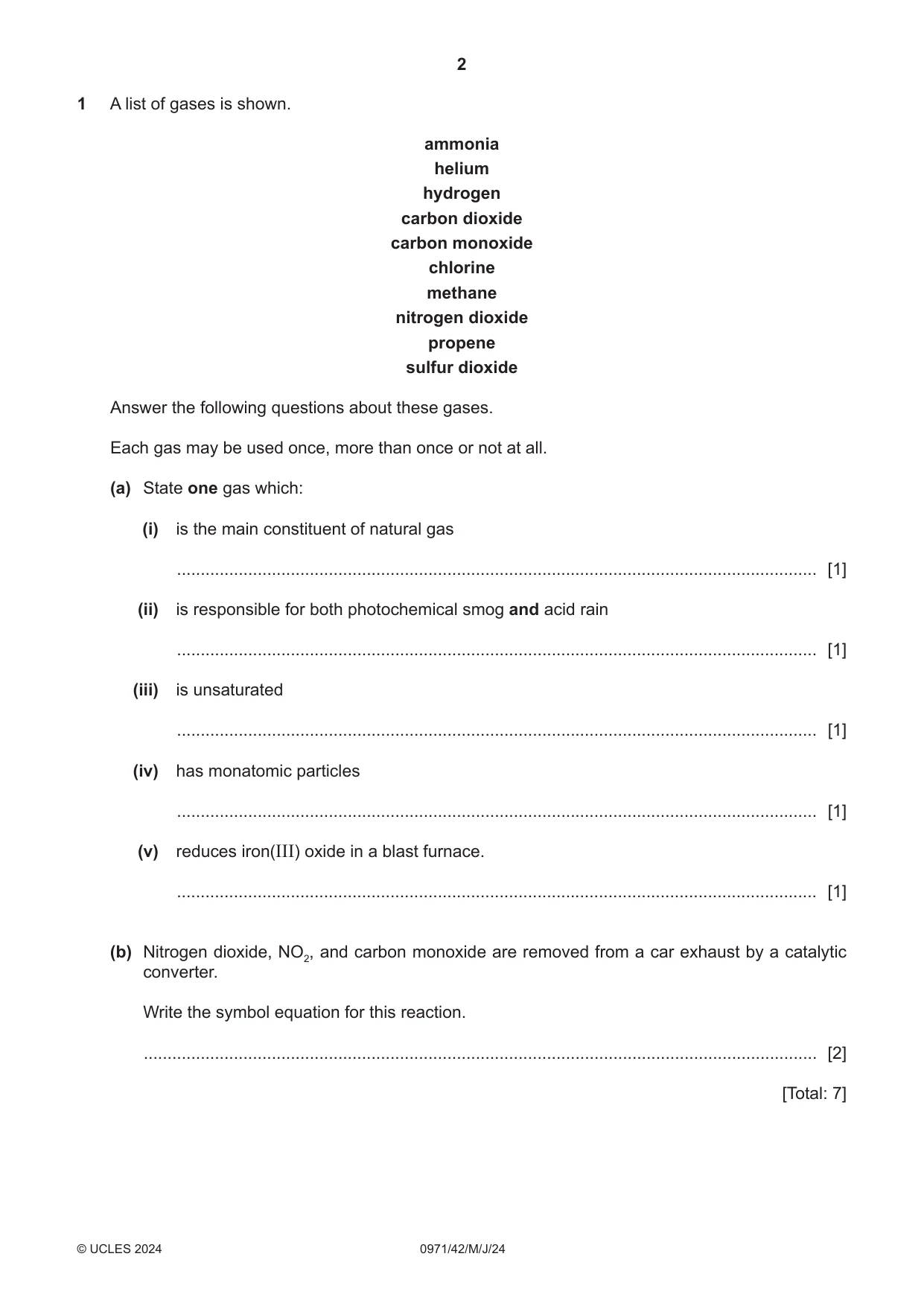
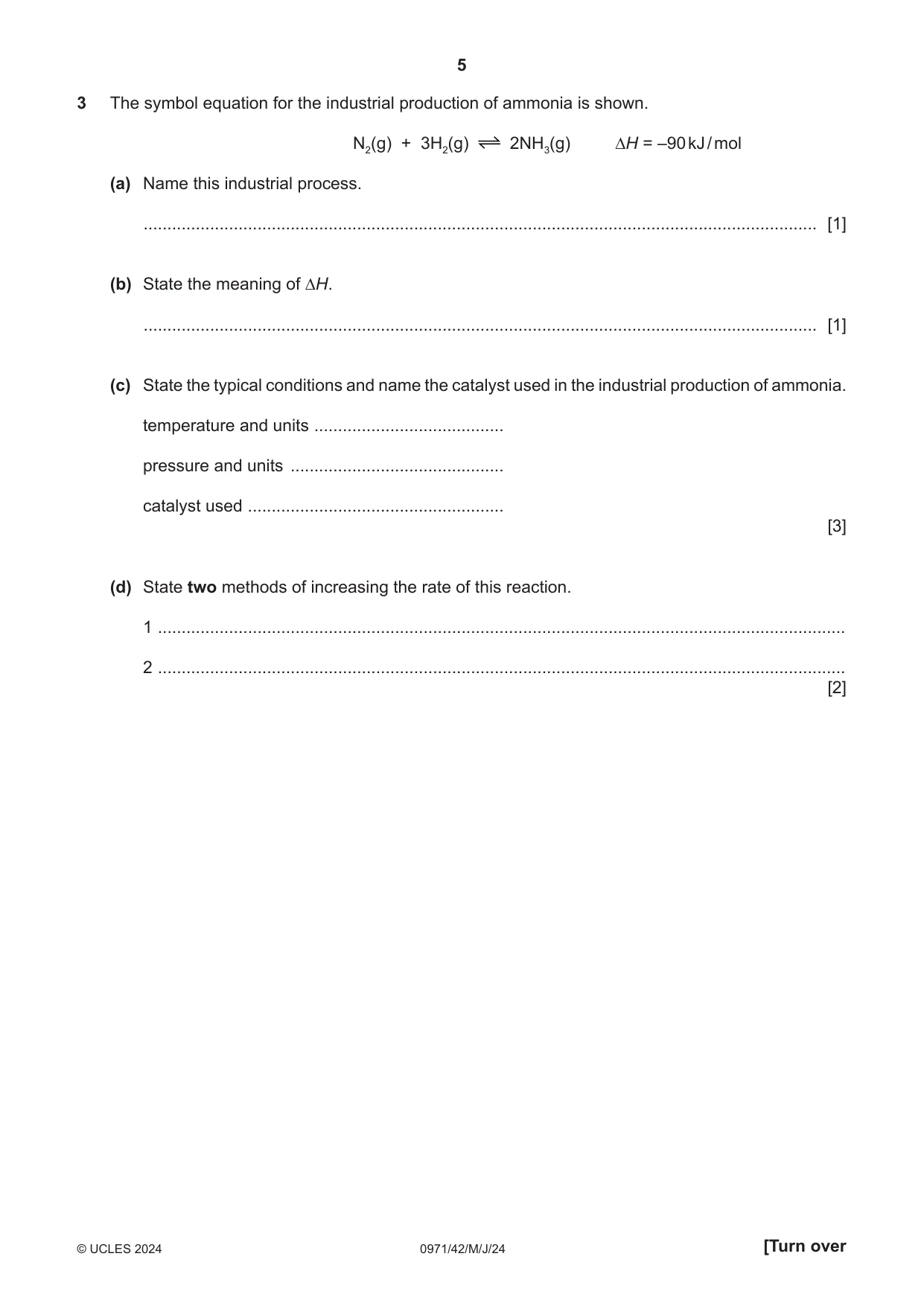
Q1 · A list of gases is shown
1 A list of gases is shown. ammonia helium hydrogen carbon dioxide carbon monoxide chlorine methane nitrogen dioxide propene sulfur dioxide Answer the following questions about these gases. Each gas may be used once, more than once or not at all. (a) State one gas which: (i) is the main constituent of natural gas ....................................................................................................................................... [1] (ii) is responsible for both photochemical smog and acid rain ....................................................................................................................................... [1] (iii) is unsaturated ....................................................................................................................................... [1] (iv) has monatomic particles ....................................................................................................................................... [1] (v) reduces iron(III) oxide in a blast furnace. ....................................................................................................................................... [1] (b) Nitrogen dioxide, NO2, and carbon monoxide are removed from a car exhaust by a catalytic converter. Write the symbol equation for this reaction. .............................................................................................................................................. [2] [Total: 7]
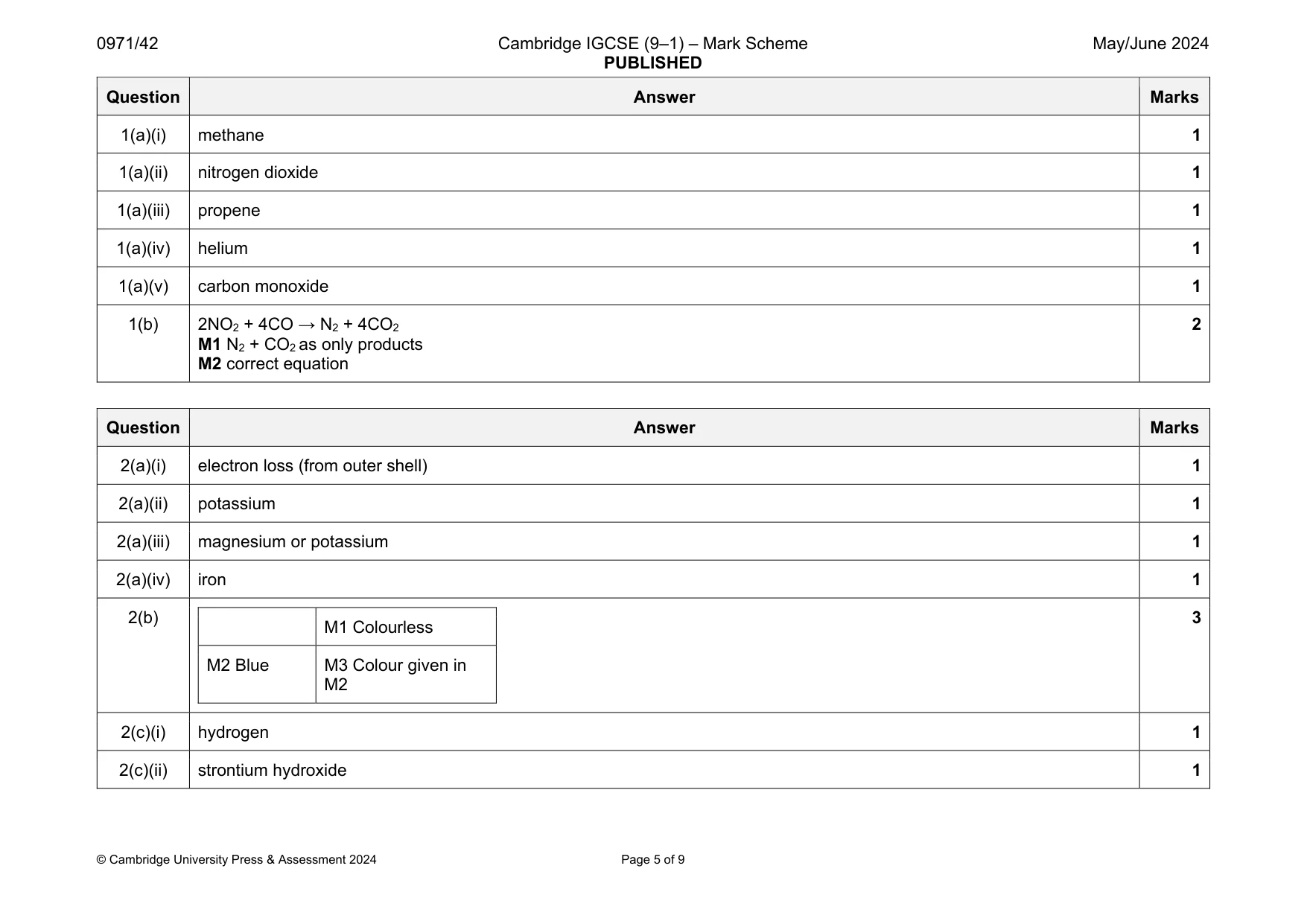
Mark scheme: 1(a)(i) methane 1 1(a)(ii) nitrogen dioxide 1 1(a)(iii) propene 1 1(a)(iv) helium 1 1(a)(v) carbon monoxide 1 1(b) 2NO2 + 4CO → N2 + 4CO2 M1 N2 + CO2 as only products M2 correct equation 2
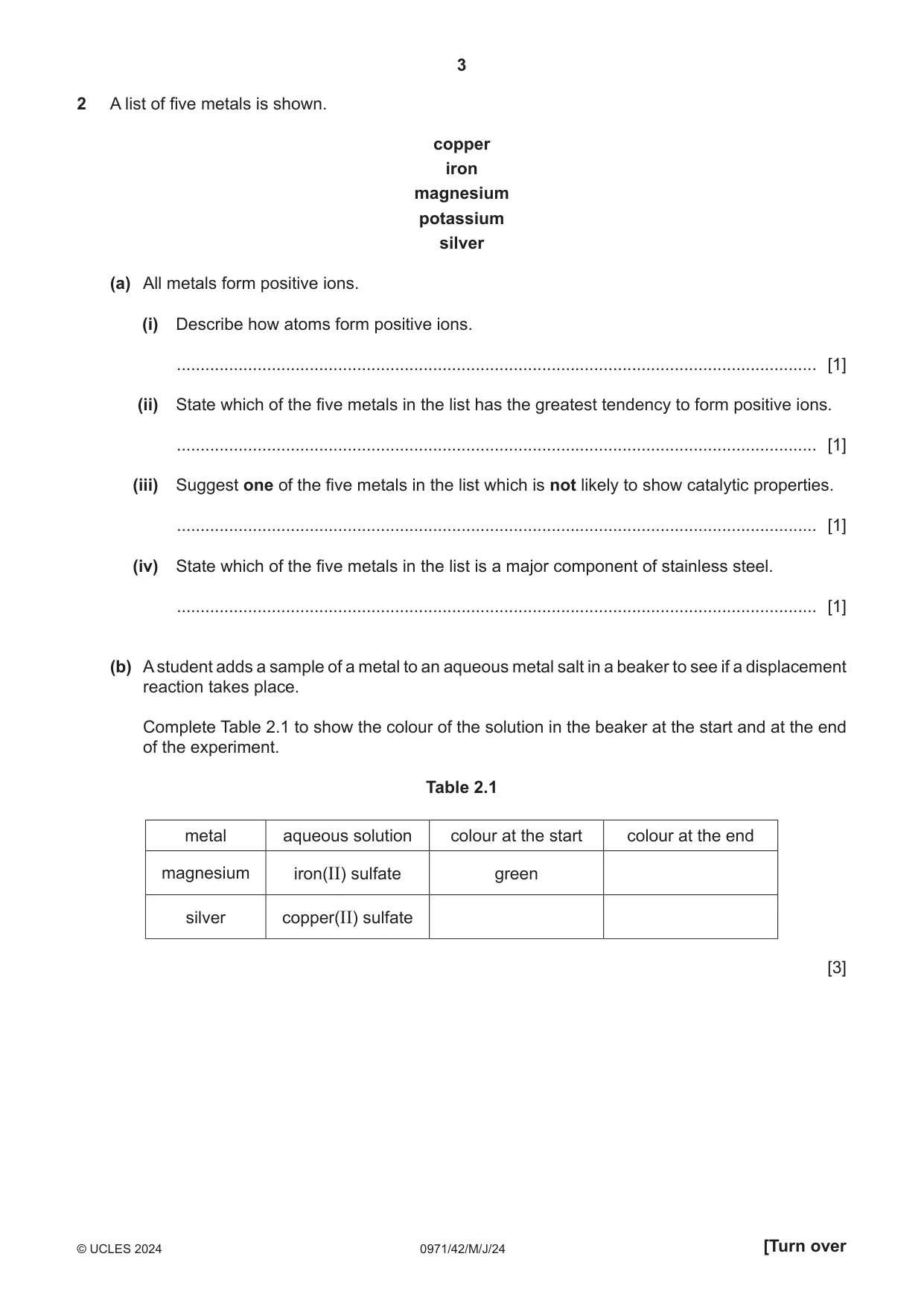
Q2 · A list of five metals is shown
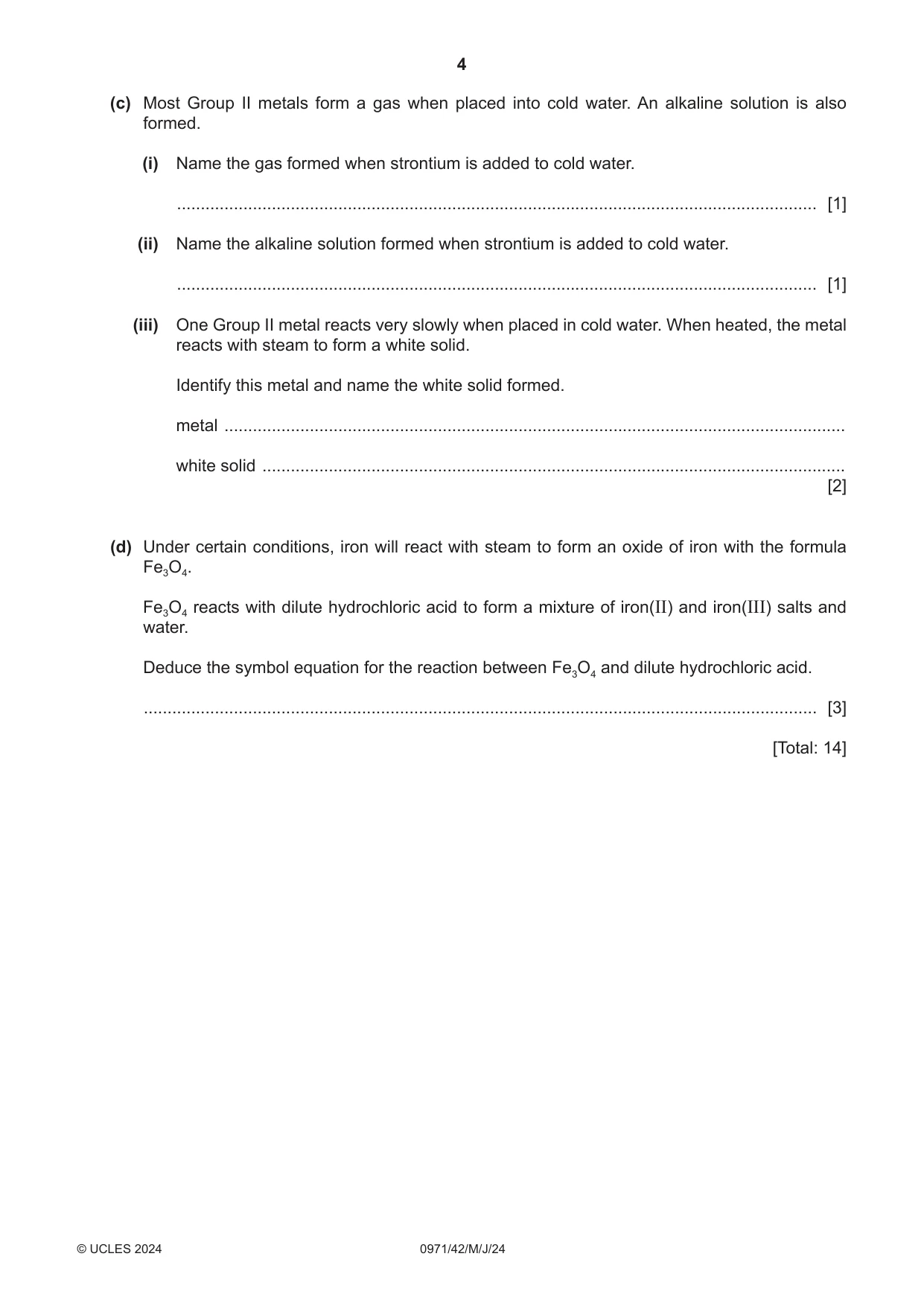
2 A list of five metals is shown. copper iron magnesium potassium silver (a) All metals form positive ions. (i) Describe how atoms form positive ions. ....................................................................................................................................... [1] (ii) State which of the five metals in the list has the greatest tendency to form positive ions. ....................................................................................................................................... [1] (iii) Suggest one of the five metals in the list which is not likely to show catalytic properties. ....................................................................................................................................... [1] (iv) State which of the five metals in the list is a major component of stainless steel. ....................................................................................................................................... [1] (b) A student adds a sample of a metal to an aqueous metal salt in a beaker to see if a displacement reaction takes place. Complete Table 2.1 to show the colour of the solution in the beaker at the start and at the end of the experiment. Table 2.1 metal aqueous solution colour at the start colour at the end magnesium iron(II) sulfate green silver copper(II) sulfate [3] (c) Most Group II metals form a gas when placed into cold water. An alkaline solution is also formed. (i) Name the gas formed when strontium is added to cold water. ....................................................................................................................................... [1] (ii) Name the alkaline solution formed when strontium is added to cold water. ....................................................................................................................................... [1] (iii) One Group II metal reacts very slowly when placed in cold water. When heated, the metal reacts with steam to form a white solid. Identify this metal and name the white solid formed. metal ................................................................................................................................... white solid ........................................................................................................................... [2] (d) Under certain conditions, iron will react with steam to form an oxide of iron with the formula Fe3O4. Fe3O4 reacts with dilute hydrochloric acid to form a mixture of iron(II) and iron(III) salts and water. Deduce the symbol equation for the reaction between Fe3O4 and dilute hydrochloric acid. .............................................................................................................................................. [3] [Total: 14]
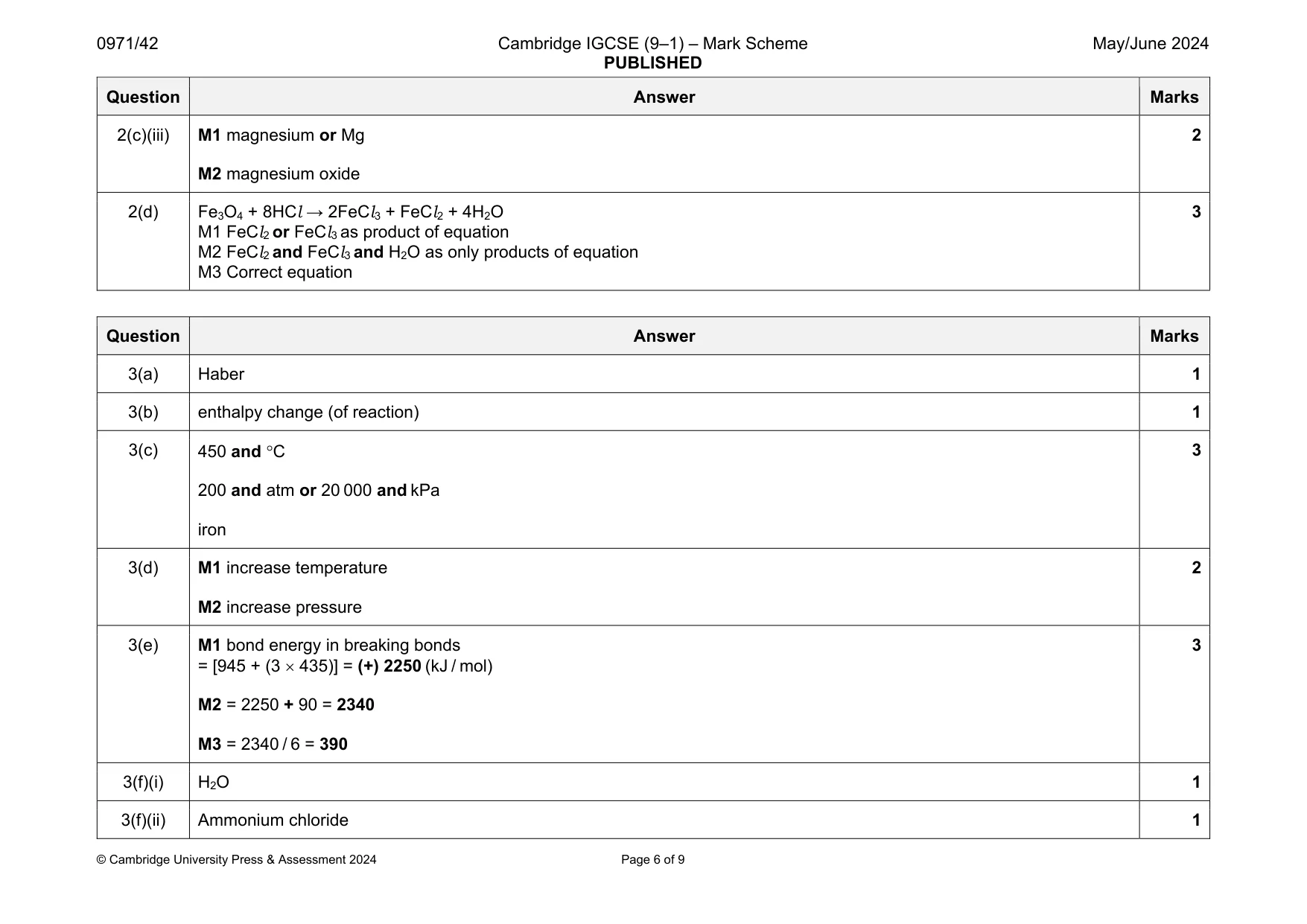
Mark scheme: 2(a)(i) electron loss (from outer shell) 1 2(a)(ii) potassium 1 2(a)(iii) magnesium or potassium 1 2(a)(iv) iron 1 2(b) M1 Colourless M2 Blue M3 Colour given in M2 3 2(c)(i) hydrogen 1 2(c)(ii) strontium hydroxide 1 Question Answer Marks 2(c)(iii) M1 magnesium or Mg M2 magnesium oxide 2 2(d) Fe3O4 + 8HCl → 2FeCl3 + FeCl2 + 4H2O M1 FeCl2 or FeCl3 as product of equation M2 FeCl2 and FeCl3 and H2O as only products of equation M3 Correct equation 3
Q3 · The symbol equation for the industrial production of ammonia is shown
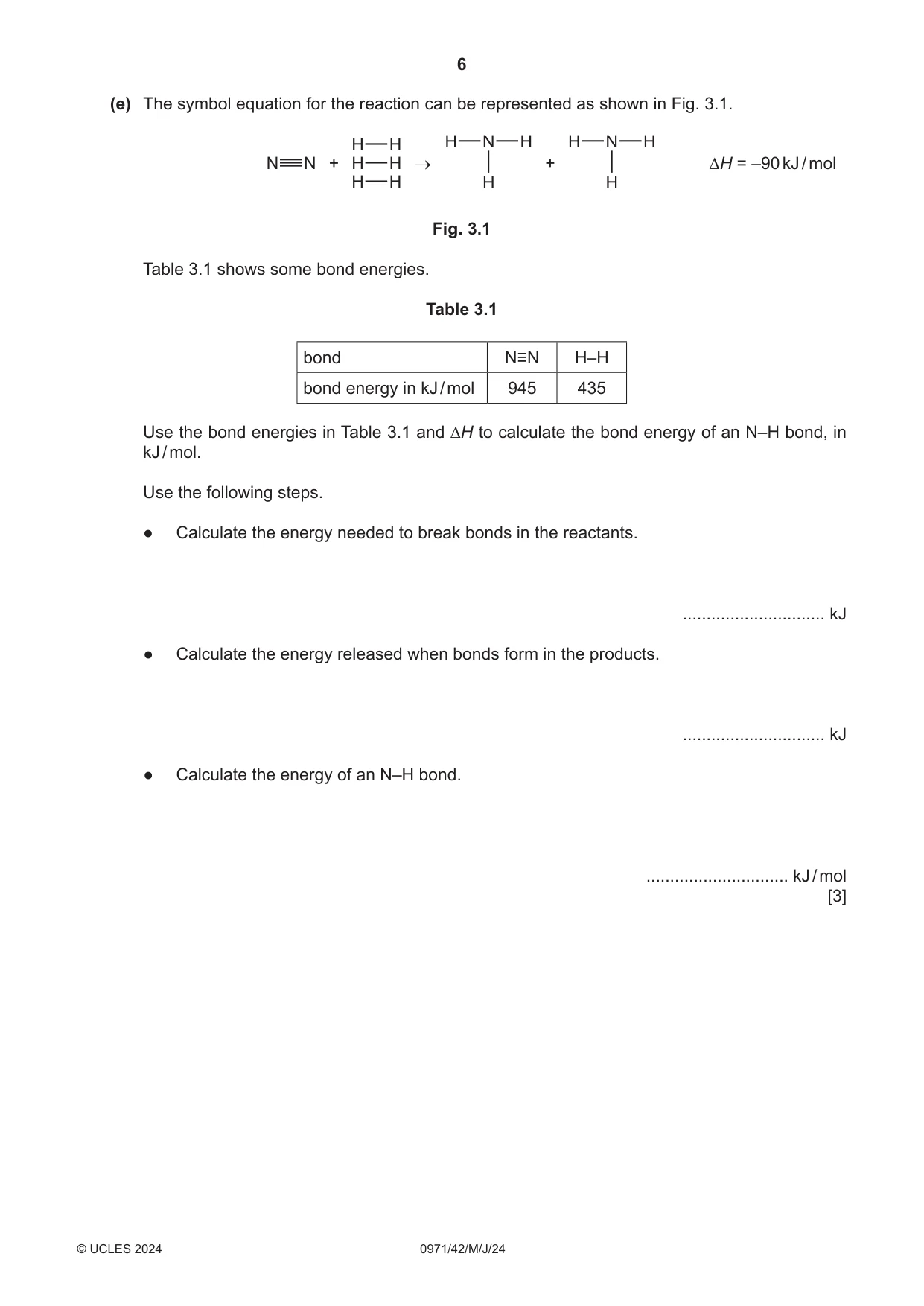
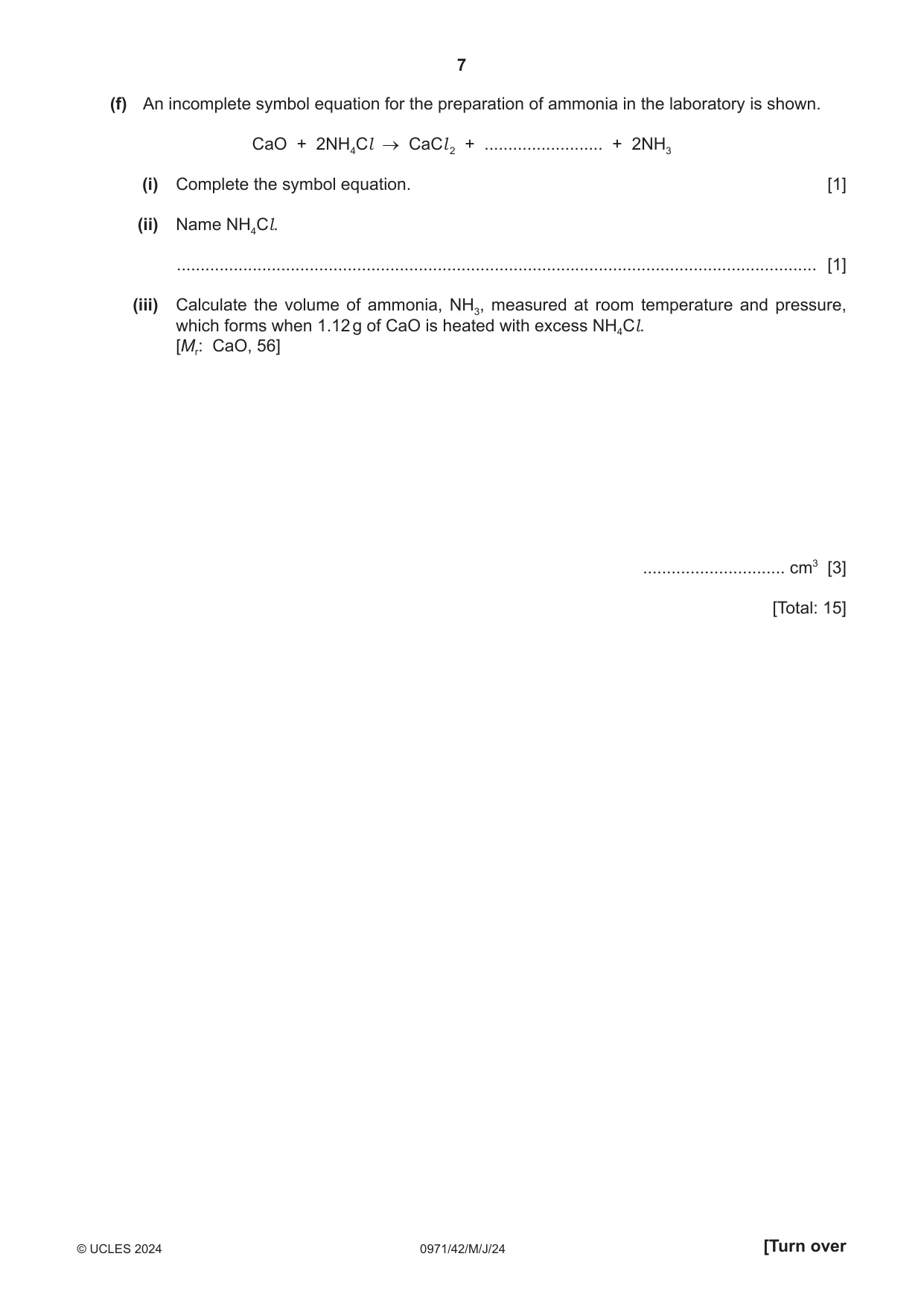
3 The symbol equation for the industrial production of ammonia is shown. N2(g) + 3H2(g) 2NH3(g) ∆H = –90 kJ / mol (a) Name this industrial process. .............................................................................................................................................. [1] (b) State the meaning of ∆H. .............................................................................................................................................. [1] (c) State the typical conditions and name the catalyst used in the industrial production of ammonia. temperature and units ........................................ pressure and units .............................................. catalyst used ...................................................... [3] (d) State two methods of increasing the rate of this reaction. 1 ................................................................................................................................................. 2 ................................................................................................................................................. [2] (e) The symbol equation for the reaction can be represented as shown in Fig. 3.1. H H H N H H N H N N + H H + H = –90 kJ / mol H H H H Fig. 3.1 Table 3.1 shows some bond energies. Table 3.1 bond N≡N H–H bond energy in kJ / mol 945 435 Use the bond energies in Table 3.1 and ∆H to calculate the bond energy of an N–H bond, in kJ / mol. Use the following steps. ● Calculate the energy needed to break bonds in the reactants. .............................. kJ ● Calculate the energy released when bonds form in the products. .............................. kJ ● Calculate the energy of an N–H bond. .............................. kJ / mol [3] (f) An incomplete symbol equation for the preparation of ammonia in the laboratory is shown. CaO + 2NH4Cl → CaCl 2 + ......................... + 2NH3 (i) Complete the symbol equation. [1] (ii) Name NH4Cl. ....................................................................................................................................... [1] (iii) Calculate the volume of ammonia, NH3, measured at room temperature and pressure, which forms when 1.12 g of CaO is heated with excess NH4Cl. [Mr: CaO, 56] .............................. cm3 [3] [Total: 15]
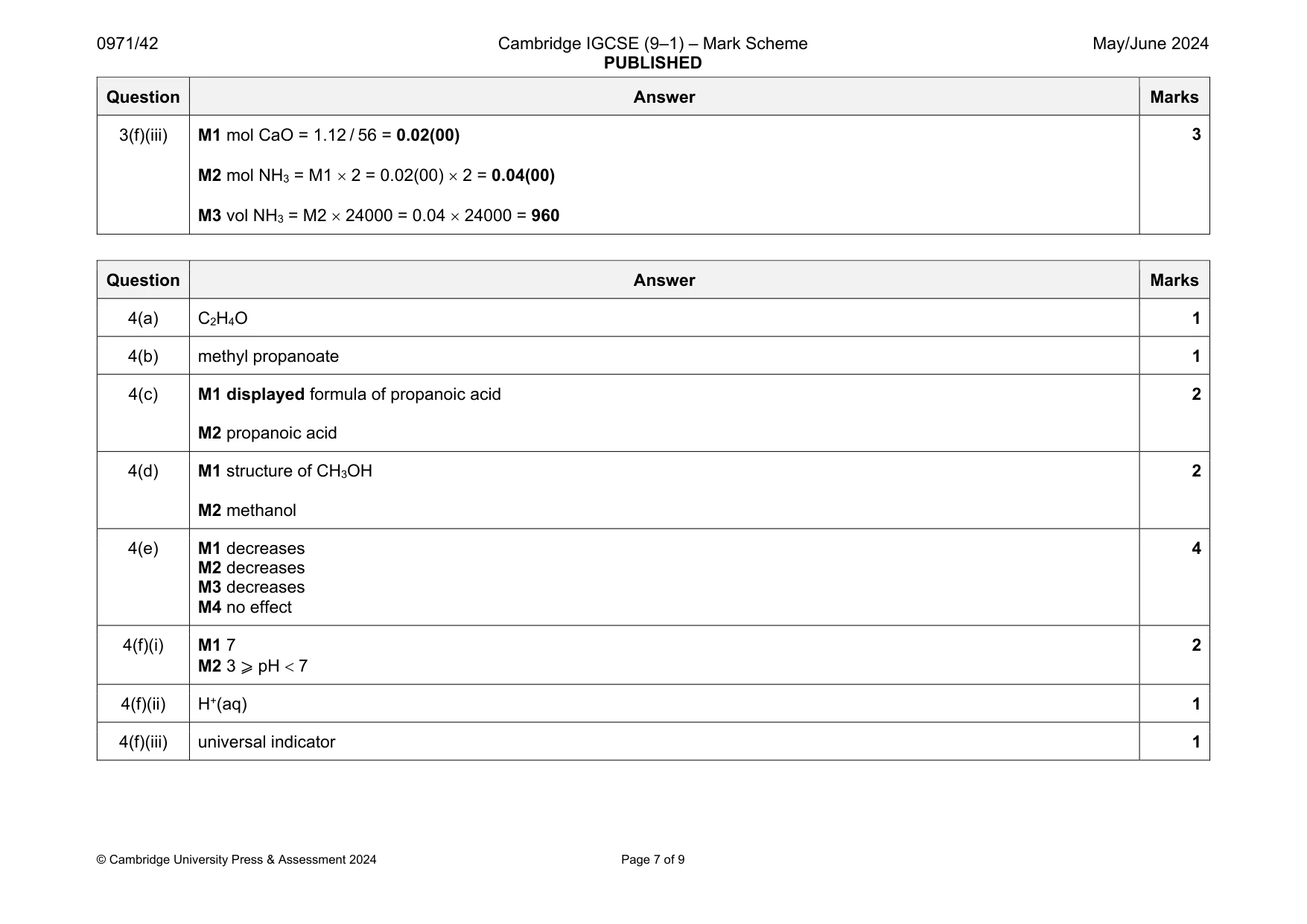
Mark scheme: 3(a) Haber 1 3(b) enthalpy change (of reaction) 1 3(c) 450 and C 200 and atm or 20 000 and kPa iron 3 3(d) M1 increase temperature M2 increase pressure 2 3(e) M1 bond energy in breaking bonds = [945 + (3 435)] = (+) 2250 (kJ / mol) M2 = 2250 + 90 = 2340 M3 = 2340 / 6 = 390 3 3(f)(i) H2O 1 3(f)(ii) Ammonium chloride 1 Question Answer Marks 3(f)(iii) M1 mol CaO = 1.12 / 56 = 0.02(00) M2 mol NH3 = M1 2 = 0.02(00) 2 = 0.04(00) M3 vol NH3 = M2 24000 = 0.04 24000 = 960 3
Q4 · A carboxylic acid reacts with an alcohol to produce an ester and water
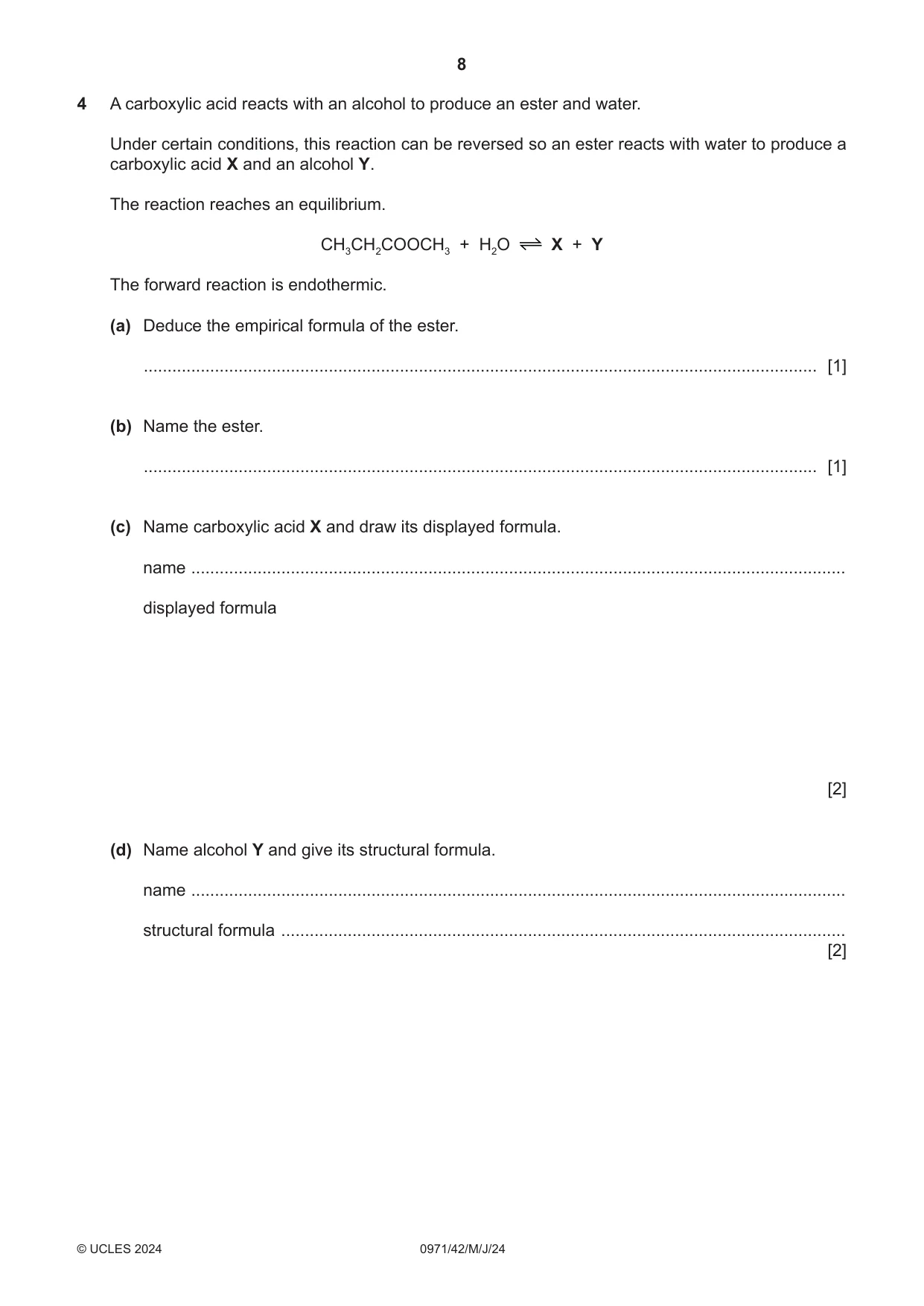
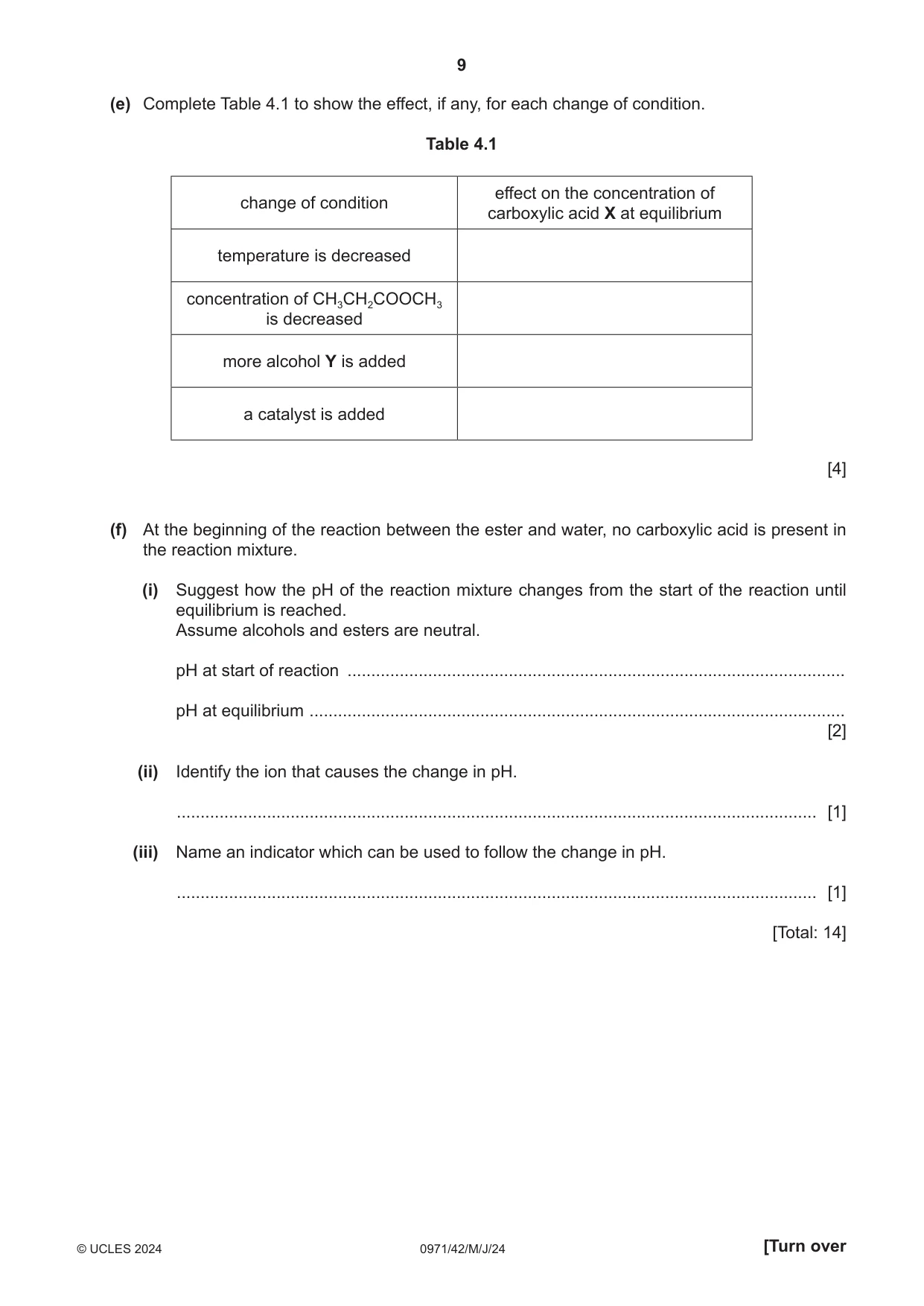
4 A carboxylic acid reacts with an alcohol to produce an ester and water. Under certain conditions, this reaction can be reversed so an ester reacts with water to produce a carboxylic acid X and an alcohol Y. The reaction reaches an equilibrium. CH3CH2COOCH3 + H2O X + Y The forward reaction is endothermic. (a) Deduce the empirical formula of the ester. .............................................................................................................................................. [1] (b) Name the ester. .............................................................................................................................................. [1] (c) Name carboxylic acid X and draw its displayed formula. name .......................................................................................................................................... displayed formula [2] (d) Name alcohol Y and give its structural formula. name .......................................................................................................................................... structural formula ....................................................................................................................... [2] (e) Complete Table 4.1 to show the effect, if any, for each change of condition. Table 4.1 effect on the concentration of change of condition carboxylic acid X at equilibrium temperature is decreased concentration of CH3CH2COOCH3 is decreased more alcohol Y is added a catalyst is added [4] (f) At the beginning of the reaction between the ester and water, no carboxylic acid is present in the reaction mixture. (i) Suggest how the pH of the reaction mixture changes from the start of the reaction until equilibrium is reached. Assume alcohols and esters are neutral. pH at start of reaction .......................................................................................................... pH at equilibrium ................................................................................................................. [2] (ii) Identify the ion that causes the change in pH. ....................................................................................................................................... [1] (iii) Name an indicator which can be used to follow the change in pH. ....................................................................................................................................... [1] [Total: 14]
Mark scheme: 4(a) C2H4O 1 4(b) methyl propanoate 1 4(c) M1 displayed formula of propanoic acid M2 propanoic acid 2 4(d) M1 structure of CH3OH M2 methanol 2 4(e) M1 decreases M2 decreases M3 decreases M4 no effect 4 4(f)(i) M1 7 M2 3 ⩾ pH 7 2 4(f)(ii) H+(aq) 1 4(f)(iii) universal indicator 1
Q5 · Sulfur is a Group VI element
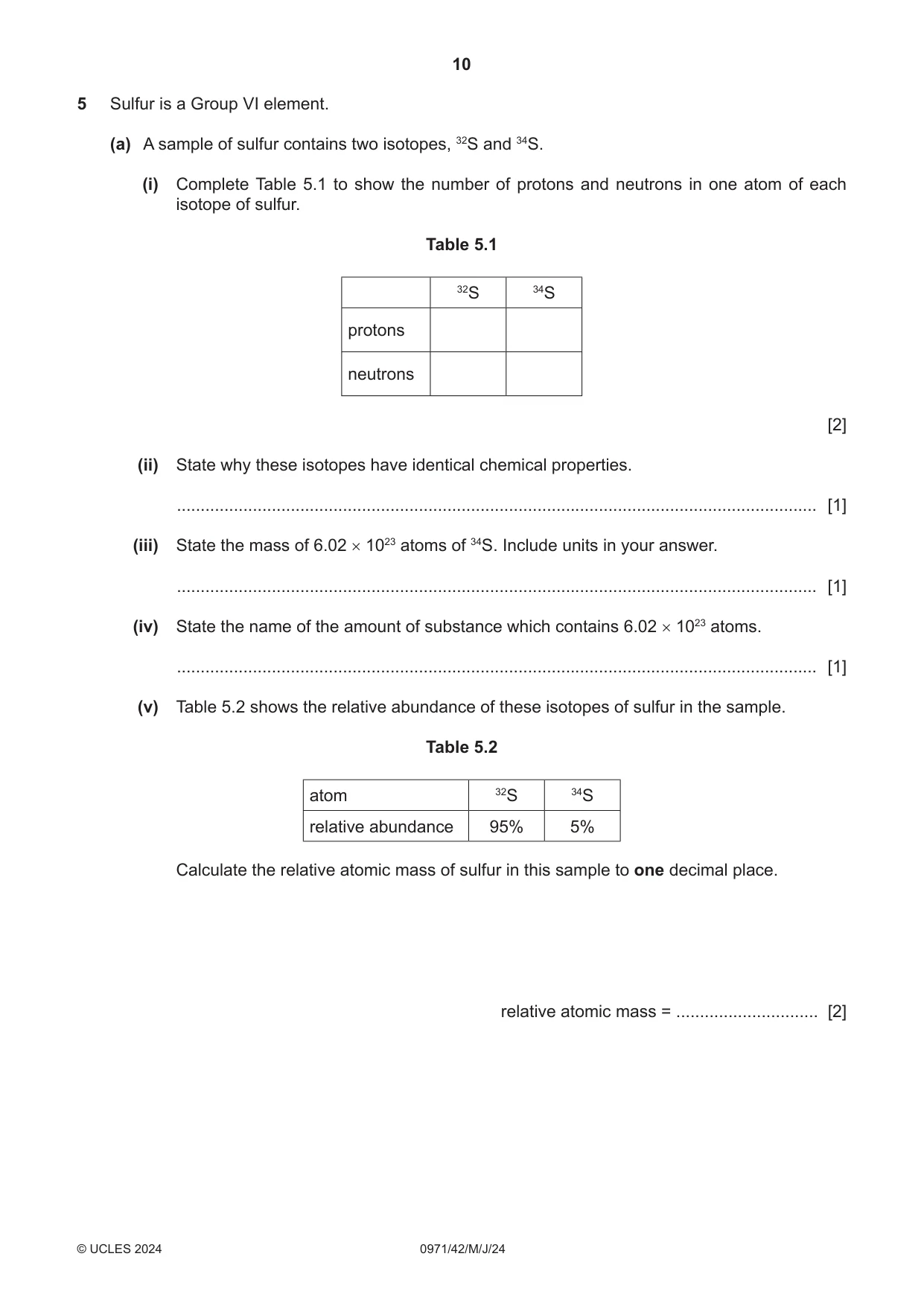
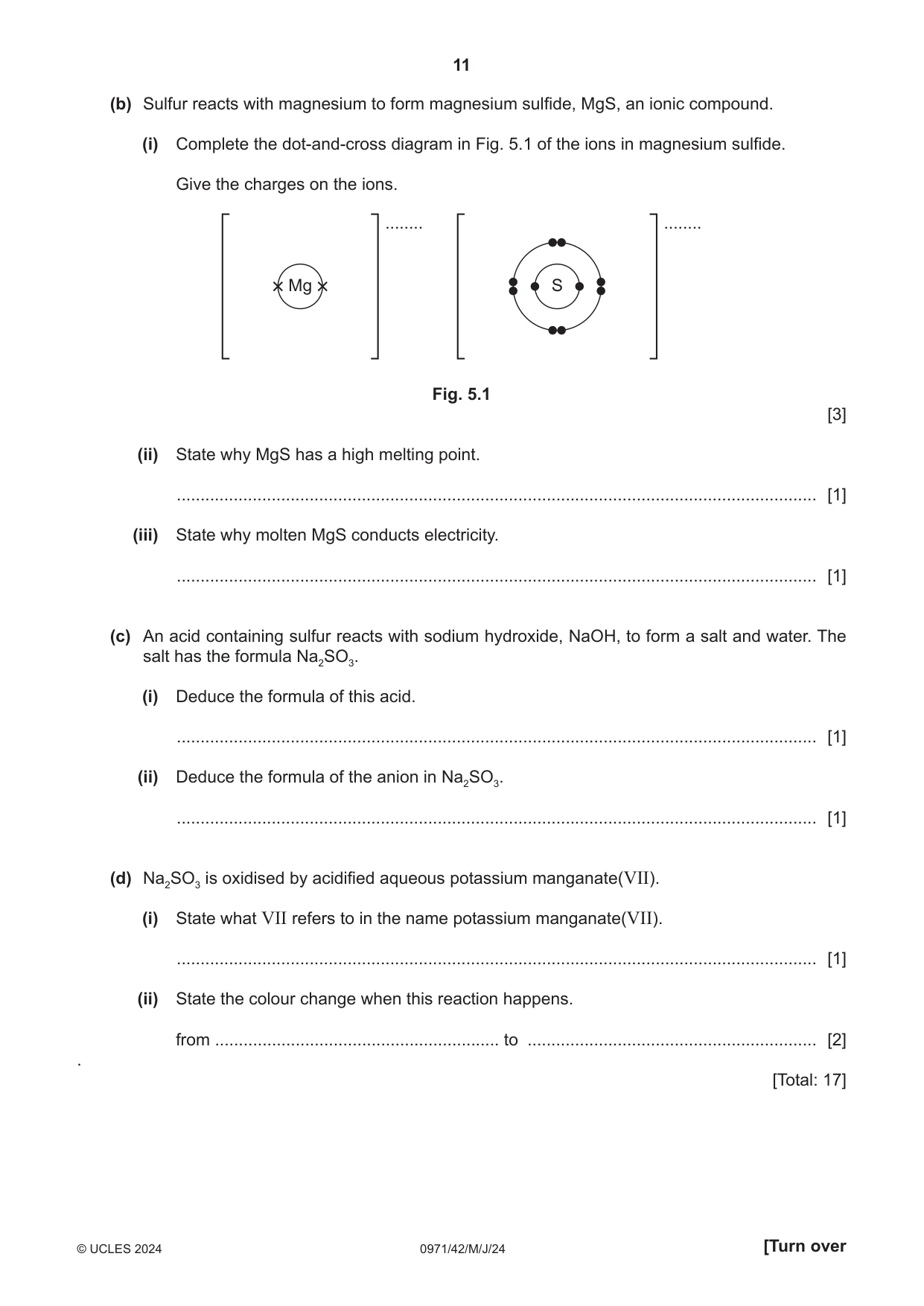
5 Sulfur is a Group VI element. (a) A sample of sulfur contains two isotopes, 32S and 34S. (i) Complete Table 5.1 to show the number of protons and neutrons in one atom of each isotope of sulfur. Table 5.1 32S 34S protons neutrons [2] (ii) State why these isotopes have identical chemical properties. ....................................................................................................................................... [1] (iii) State the mass of 6.02 × 10²³ atoms of 34S. Include units in your answer. ....................................................................................................................................... [1] (iv) State the name of the amount of substance which contains 6.02 × 10²³ atoms. ....................................................................................................................................... [1] (v) Table 5.2 shows the relative abundance of these isotopes of sulfur in the sample. Table 5.2 atom 32S 34S relative abundance 95% 5% Calculate the relative atomic mass of sulfur in this sample to one decimal place. relative atomic mass = .............................. [2] (b) Sulfur reacts with magnesium to form magnesium sulfide, MgS, an ionic compound. (i) Complete the dot-and-cross diagram in Fig. 5.1 of the ions in magnesium sulfide. Give the charges on the ions. ........ ........ Mg S Fig. 5.1 [3] (ii) State why MgS has a high melting point. ....................................................................................................................................... [1] (iii) State why molten MgS conducts electricity. ....................................................................................................................................... [1] (c) An acid containing sulfur reacts with sodium hydroxide, NaOH, to form a salt and water. The salt has the formula Na2SO3. (i) Deduce the formula of this acid. ....................................................................................................................................... [1] (ii) Deduce the formula of the anion in Na2SO3. ....................................................................................................................................... [1] (d) Na2SO3 is oxidised by acidified aqueous potassium manganate(VII). (i) State what VII refers to in the name potassium manganate(VII). ....................................................................................................................................... [1] (ii) State the colour change when this reaction happens. from ............................................................ to .............................................................. [2] [Total: 17]
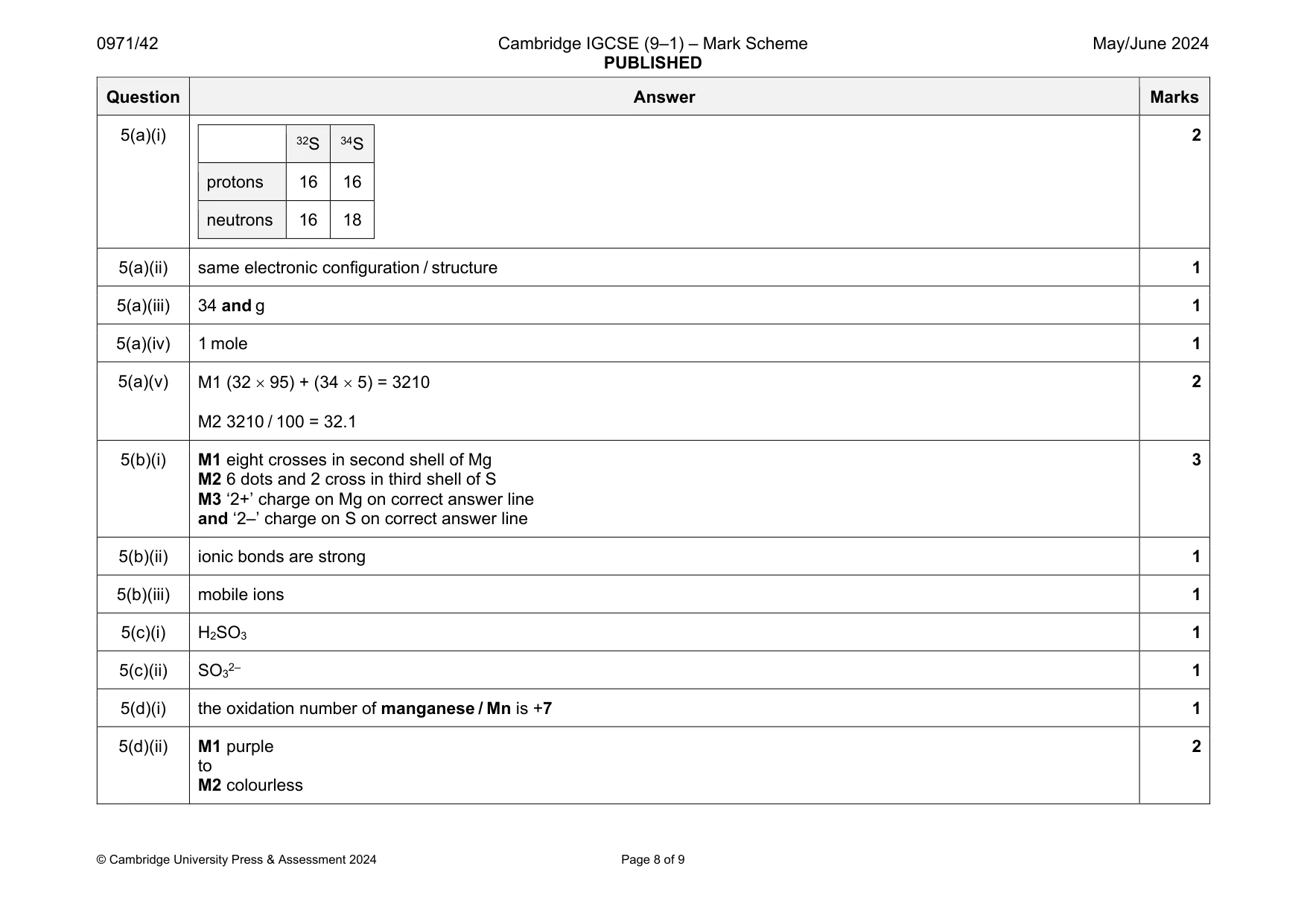
Mark scheme: 5(a)(i) 32S 34S protons 16 16 neutrons 16 18 2 5(a)(ii) same electronic configuration / structure 1 5(a)(iii) 34 and g 1 5(a)(iv) 1 mole 1 5(a)(v) M1 (32 95) + (34 5) = 3210 M2 3210 / 100 = 32.1 2 5(b)(i) M1 eight crosses in second shell of Mg M2 6 dots and 2 cross in third shell of S M3 ‘2+’ charge on Mg on correct answer line and ‘2–’ charge on S on correct answer line 3 5(b)(ii) ionic bonds are strong 1 5(b)(iii) mobile ions 1 5(c)(i) H2SO3 1 5(c)(ii) SO32– 1 5(d)(i) the oxidation number of manganese / Mn is +7 1 5(d)(ii) M1 purple to M2 colourless 2
Q6 · Glucose is involved in two processes
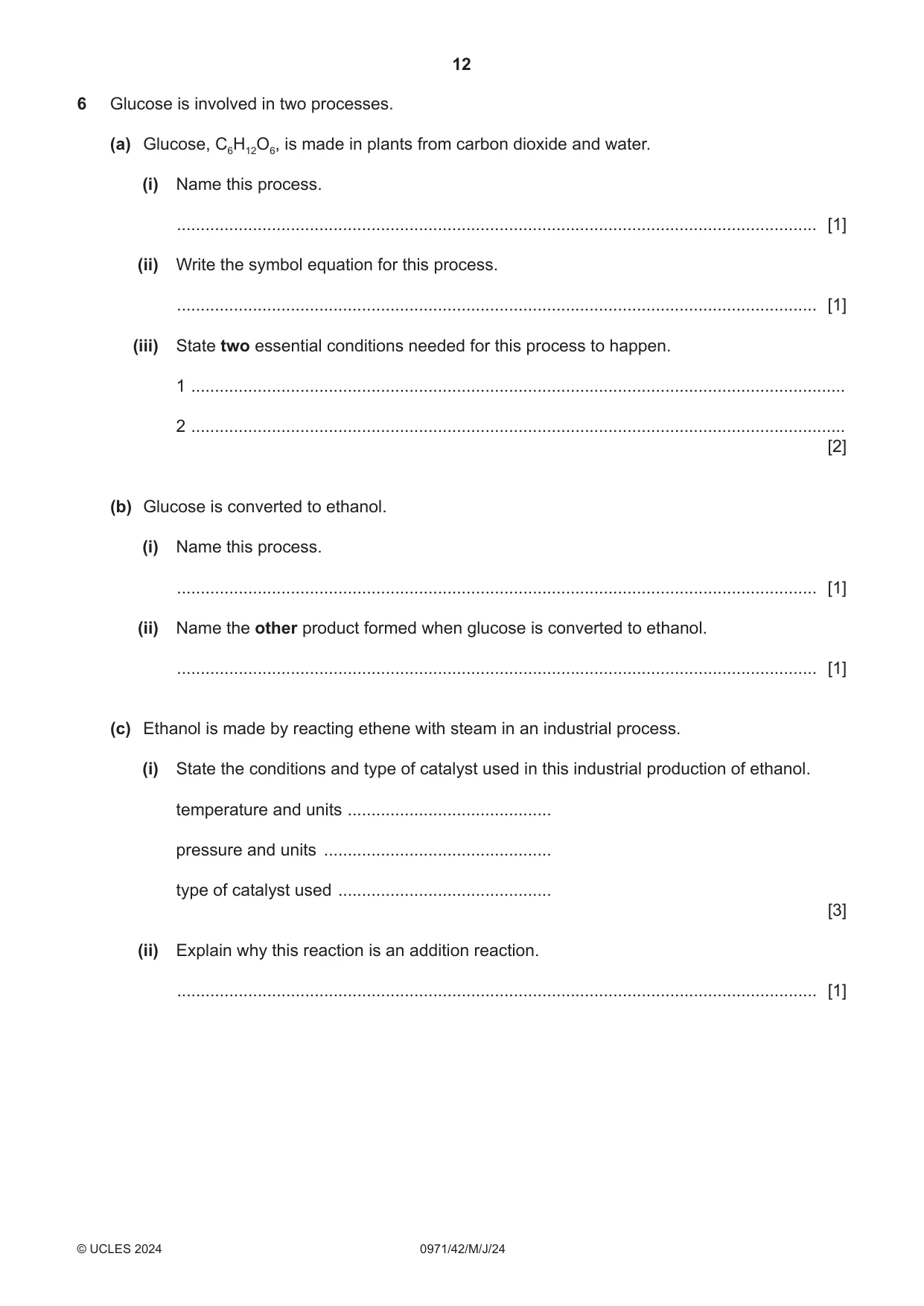
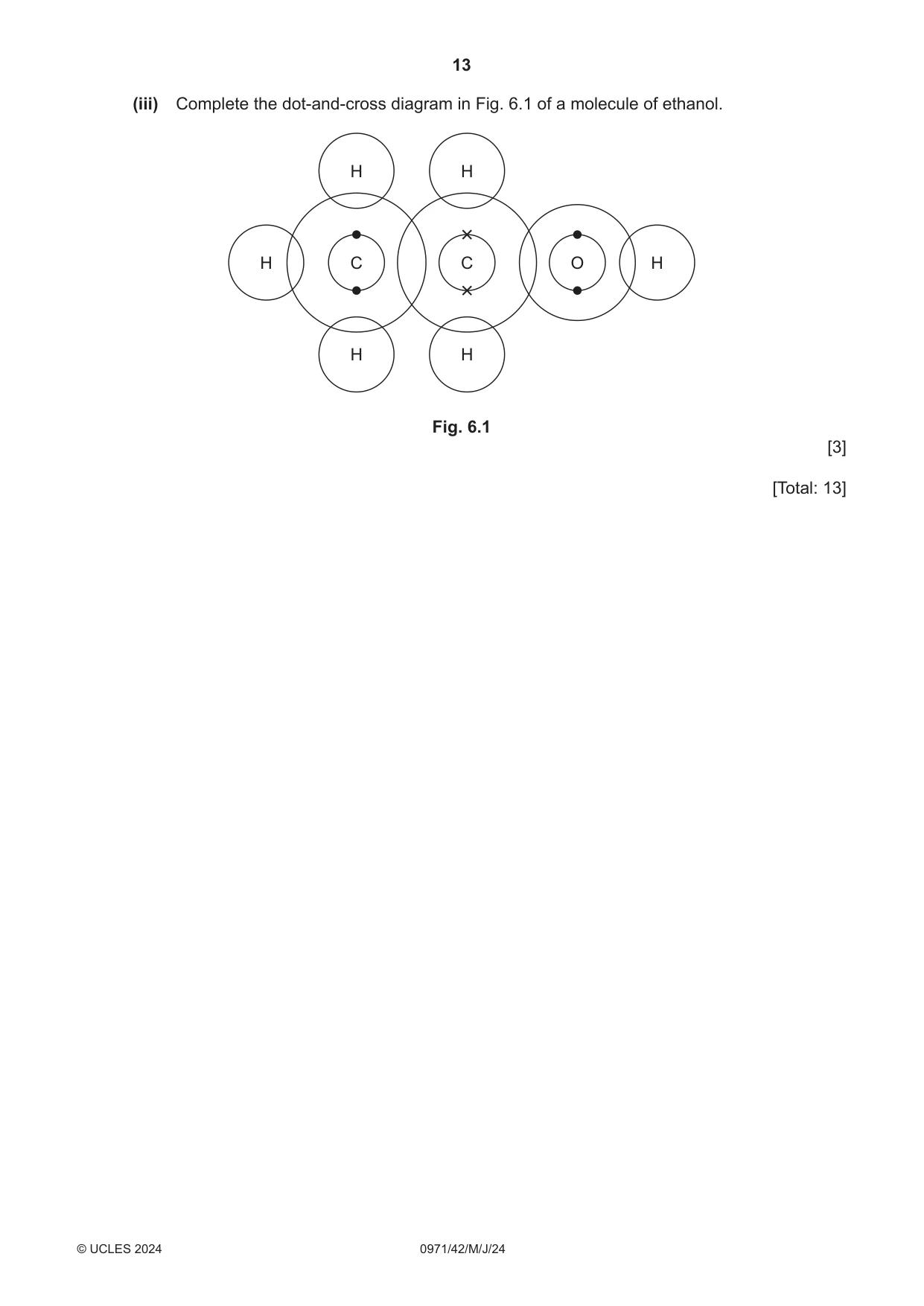
6 Glucose is involved in two processes. (a) Glucose, C6H12O6, is made in plants from carbon dioxide and water. (i) Name this process. ....................................................................................................................................... [1] (ii) Write the symbol equation for this process. ....................................................................................................................................... [1] (iii) State two essential conditions needed for this process to happen. 1 .......................................................................................................................................... 2 .......................................................................................................................................... [2] (b) Glucose is converted to ethanol. (i) Name this process. ....................................................................................................................................... [1] (ii) Name the other product formed when glucose is converted to ethanol. ....................................................................................................................................... [1] (c) Ethanol is made by reacting ethene with steam in an industrial process. (i) State the conditions and type of catalyst used in this industrial production of ethanol. temperature and units ........................................... pressure and units ................................................. type of catalyst used ............................................. [3] (ii) Explain why this reaction is an addition reaction. ....................................................................................................................................... [1] (iii) Complete the dot-and-cross diagram in Fig. 6.1 of a molecule of ethanol. H H H C C O H H H Fig. 6.1 [3] [Total: 13]
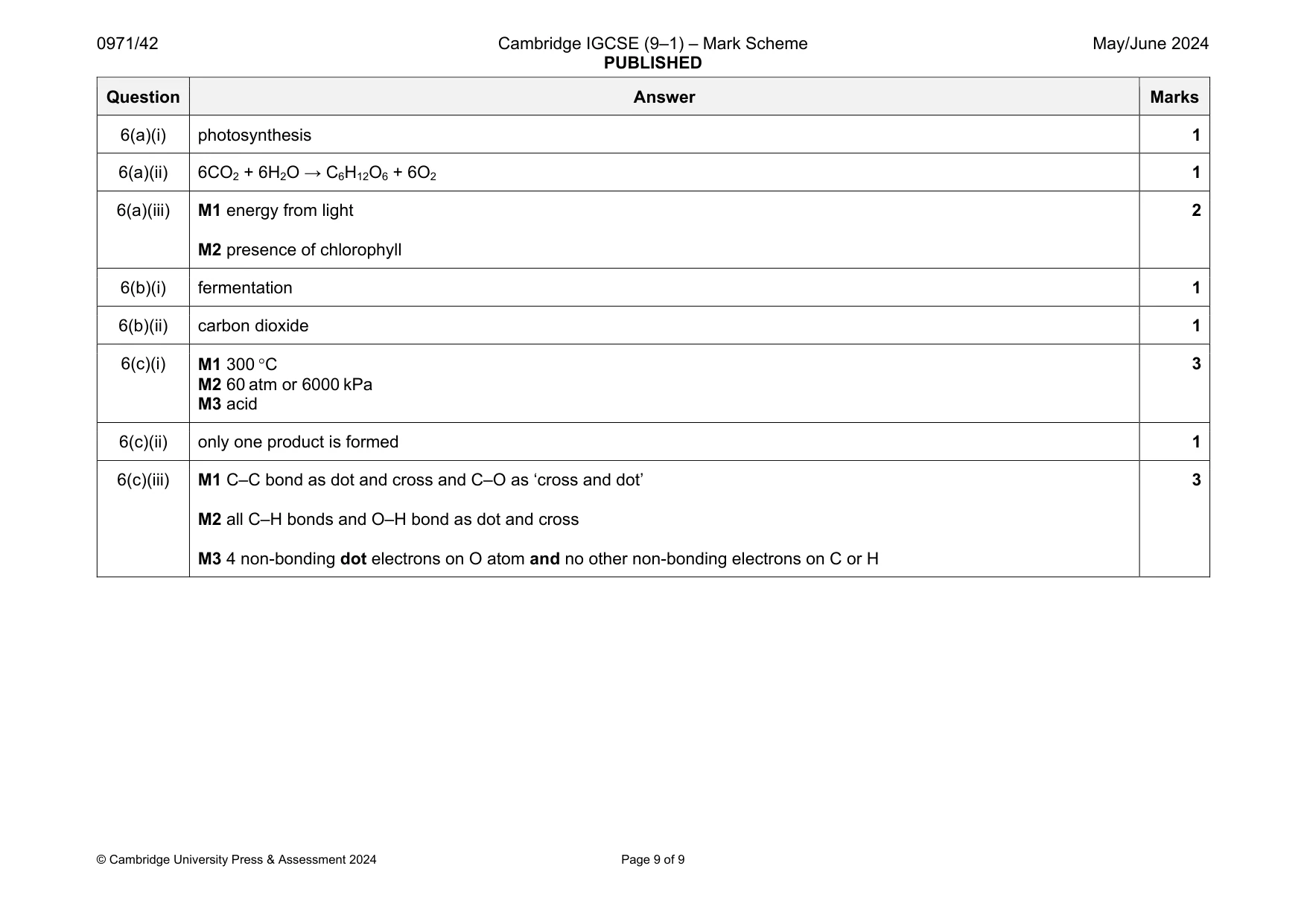
Mark scheme: 6(a)(i) photosynthesis 1 6(a)(ii) 6CO2 + 6H2O → C6H12O6 + 6O2 1 6(a)(iii) M1 energy from light M2 presence of chlorophyll 2 6(b)(i) fermentation 1 6(b)(ii) carbon dioxide 1 6(c)(i) M1 300 C M2 60 atm or 6000 kPa M3 acid 3 6(c)(ii) only one product is formed 1 6(c)(iii) M1 C–C bond as dot and cross and C–O as ‘cross and dot’ M2 all C–H bonds and O–H bond as dot and cross M3 4 non-bonding dot electrons on O atom and no other non-bonding electrons on C or H 3
What was in this paper
The subtopics covered by these 6 questions, and how many questions each got. Open one in a new tab to see every Cambridge question on it.
What you needed in this session
Cambridge’s own grade thresholds for 2024 May/June, Paper 4 · Variant 2. A higher threshold means an easier paper — the bar moves with how the cohort did.