Cambridge IGCSE Chemistry (9-1) 0971 — 2023 May/June Paper 4 · Variant 2
0971/42/M/J/23 · 6 questions · 80 marks · 75 min
The question paper and its mark scheme, free to read here and free to download. This is Cambridge’s own paper, exactly as it was sat.
Question paper12 pages
Mark scheme10 pages
Answers below. Sit the paper first if you are practising.
Questions as text
Q1 · A list of oxides, A to H, is shown
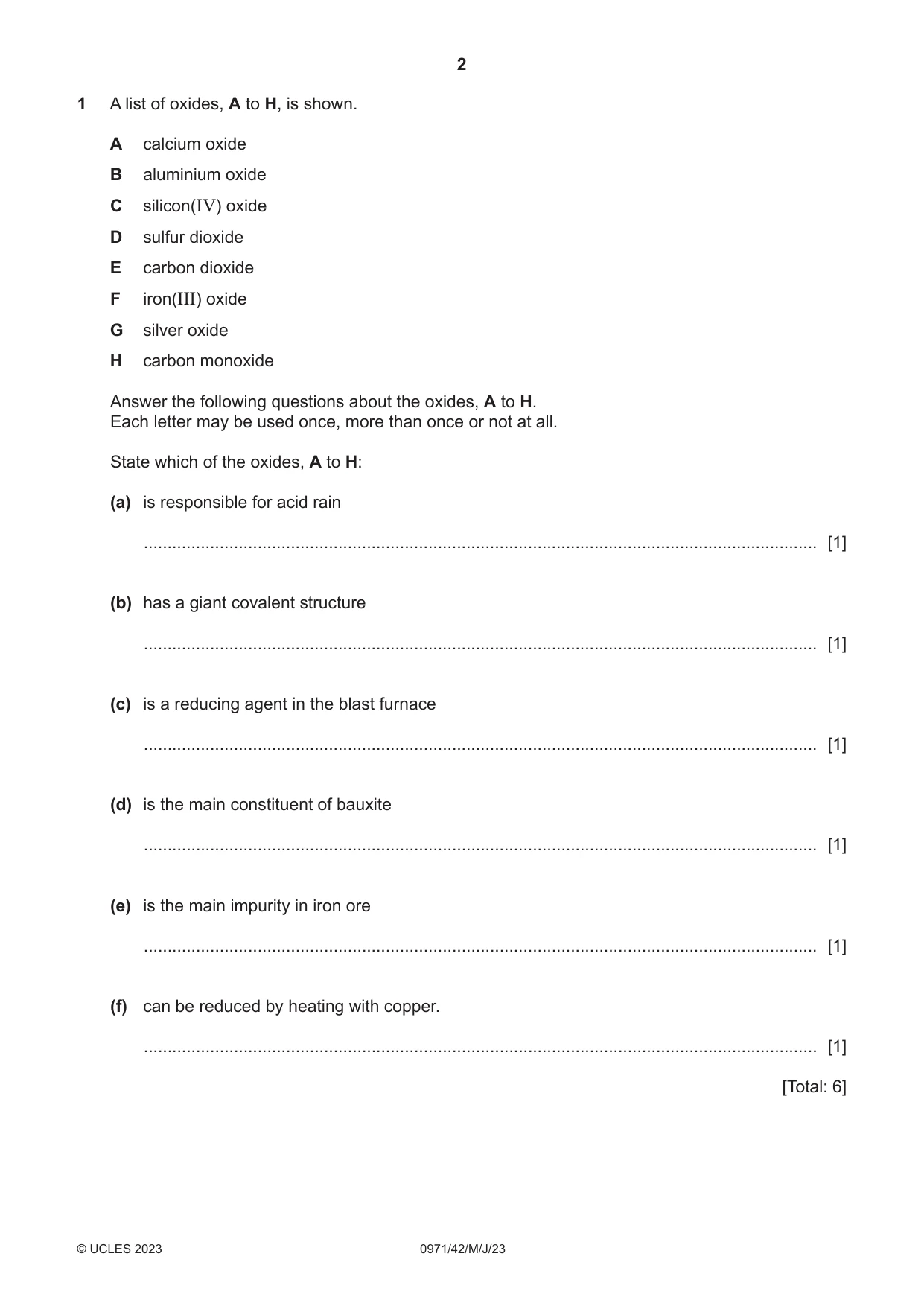
1 A list of oxides, A to H, is shown. A calcium oxide B aluminium oxide C silicon(IV) oxide D sulfur dioxide E carbon dioxide F iron(III) oxide G silver oxide H carbon monoxide Answer the following questions about the oxides, A to H. Each letter may be used once, more than once or not at all. State which of the oxides, A to H: (a) is responsible for acid rain (b) has a giant covalent structure (c) is a reducing agent in the blast furnace (d) is the main constituent of bauxite (e) is the main impurity in iron ore (f) can be reduced by heating with copper. [Total: 6]
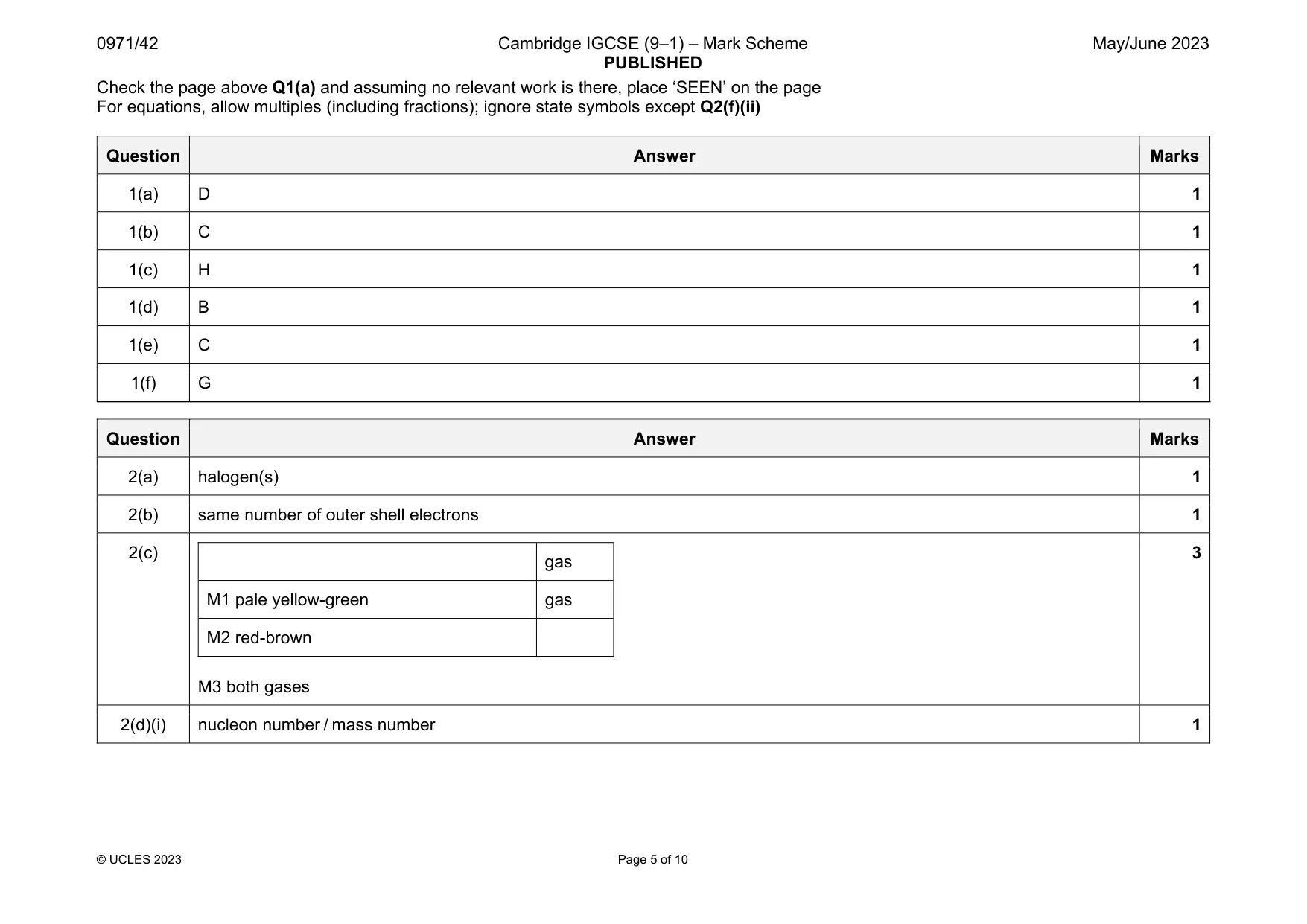
Mark scheme: 1(a) D 1 1(b) C 1 1(c) H 1 1(d) B 1 1(e) C 1 1(f) G 1
Q2 · Fluorine, chlorine and bromine are in Group VII of the Periodic Table
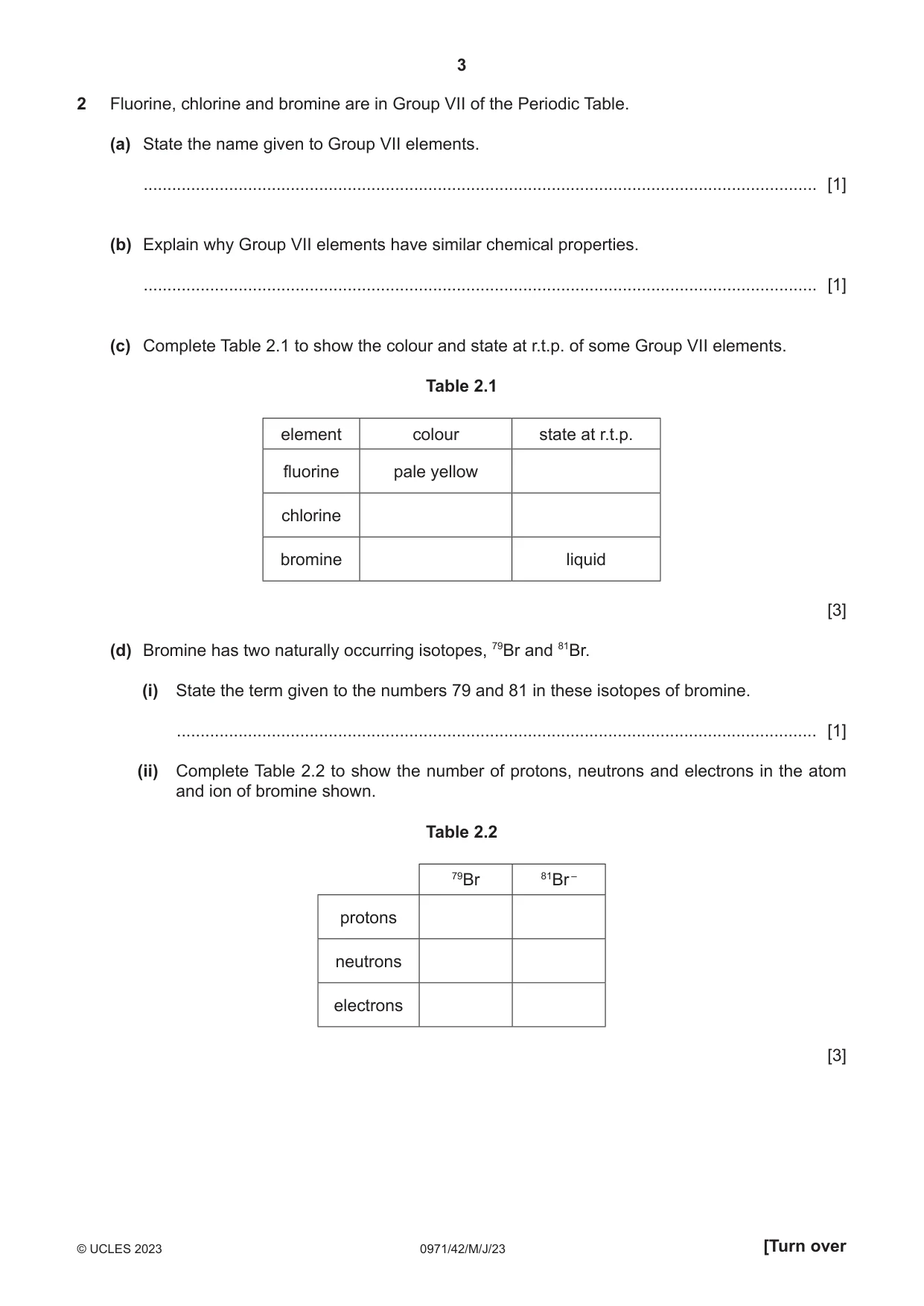
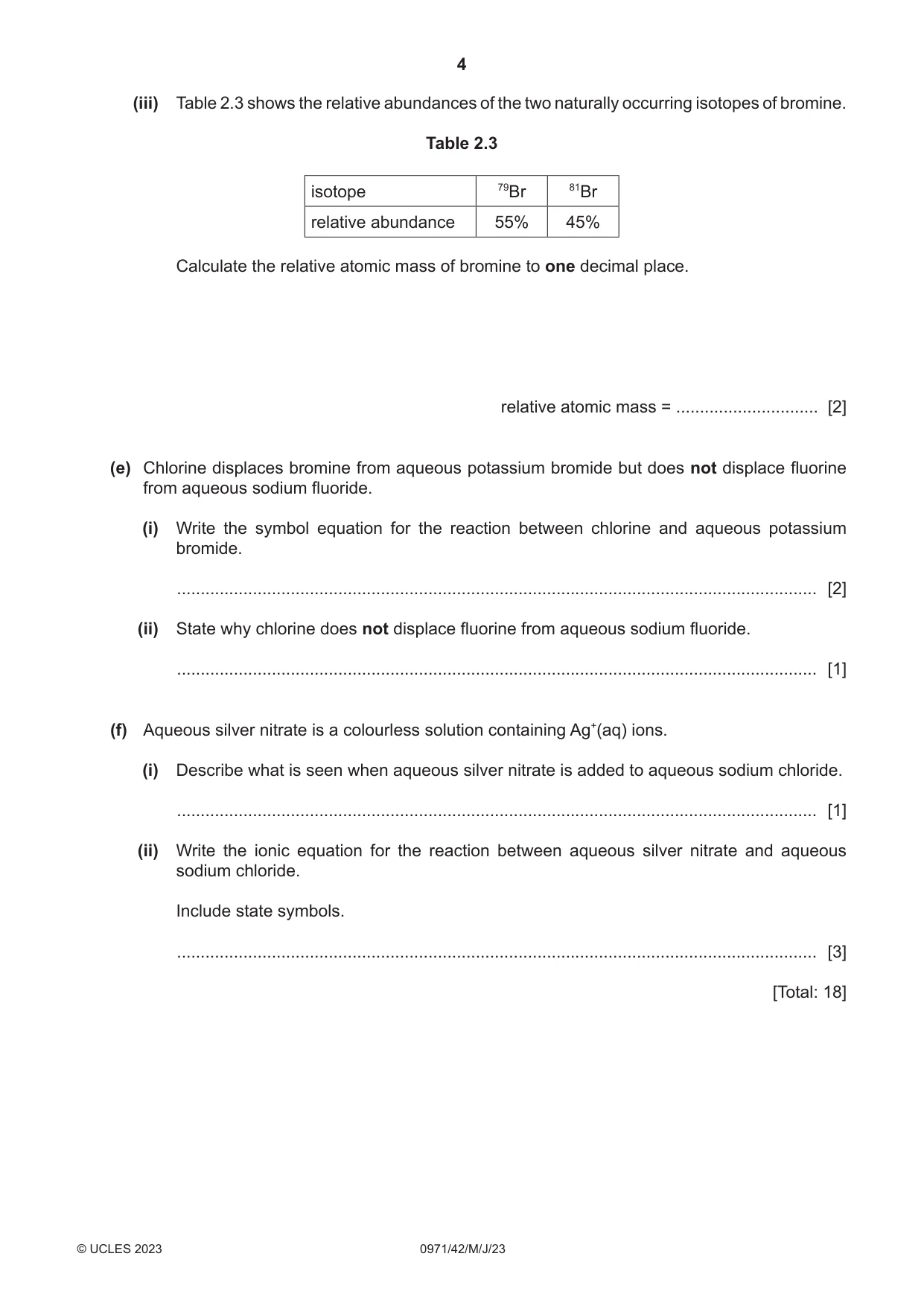
2 Fluorine, chlorine and bromine are in Group VII of the Periodic Table. (a) State the name given to Group VII elements. .............................................................................................................................................. [1] (b) Explain why Group VII elements have similar chemical properties. .............................................................................................................................................. [1] (c) Complete Table 2.1 to show the colour and state at r.t.p. of some Group VII elements. Table 2.1 element colour state at r.t.p. fluorine pale yellow chlorine bromine liquid [3] (d) Bromine has two naturally occurring isotopes, 79Br and 81Br. (i) State the term given to the numbers 79 and 81 in these isotopes of bromine. ....................................................................................................................................... [1] (ii) Complete Table 2.2 to show the number of protons, neutrons and electrons in the atom and ion of bromine shown. Table 2.2 79Br 81Br – protons neutrons electrons [3] (iii) Table 2.3 shows the relative abundances of the two naturally occurring isotopes of bromine. Table 2.3 isotope 79Br 81Br relative abundance 55% 45% Calculate the relative atomic mass of bromine to one decimal place. relative atomic mass = .............................. [2] (e) Chlorine displaces bromine from aqueous potassium bromide but does not displace fluorine from aqueous sodium fluoride. (i) Write the symbol equation for the reaction between chlorine and aqueous potassium bromide. ....................................................................................................................................... [2] (ii) State why chlorine does not displace fluorine from aqueous sodium fluoride. ....................................................................................................................................... [1] (f) Aqueous silver nitrate is a colourless solution containing Ag+(aq) ions. (i) Describe what is seen when aqueous silver nitrate is added to aqueous sodium chloride. ....................................................................................................................................... [1] (ii) Write the ionic equation for the reaction between aqueous silver nitrate and aqueous sodium chloride. Include state symbols. ....................................................................................................................................... [3] [Total: 18]
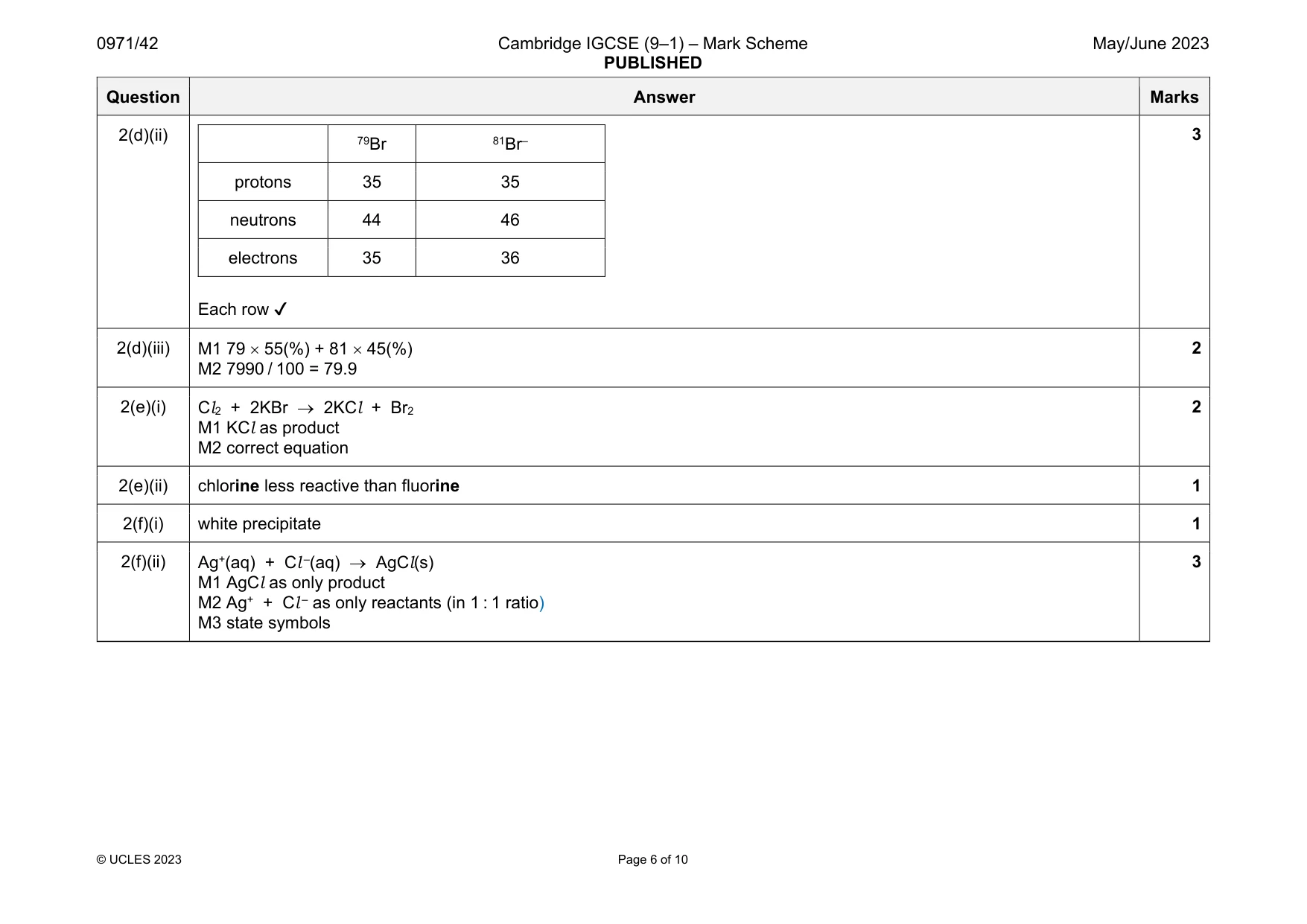
Mark scheme: 2(a) halogen(s) 1 2(b) same number of outer shell electrons 1 2(c) gas M1 pale yellow-green gas M2 red-brown M3 both gases 3 2(d)(i) nucleon number / mass number 1 Question Answer Marks 2(d)(ii) 79Br 81Br– protons 35 35 neutrons 44 46 electrons 35 36 Each row ✔ 3 2(d)(iii) M1 79 55(%) + 81 45(%) M2 7990 / 100 = 79.9 2 2(e)(i) Cl2 + 2KBr 2KCl + Br2 M1 KCl as product M2 correct equation 2 2(e)(ii) chlorine less reactive than fluorine 1 2(f)(i) white precipitate 1 2(f)(ii) Ag+(aq) + Cl –(aq) AgCl(s) M1 AgCl as only product M2 Ag+ + Cl – as only reactants (in 1 : 1 ratio) M3 state symbols 3
Q3 · Over 200 million tonnes of sulfuric acid are manufactured every year
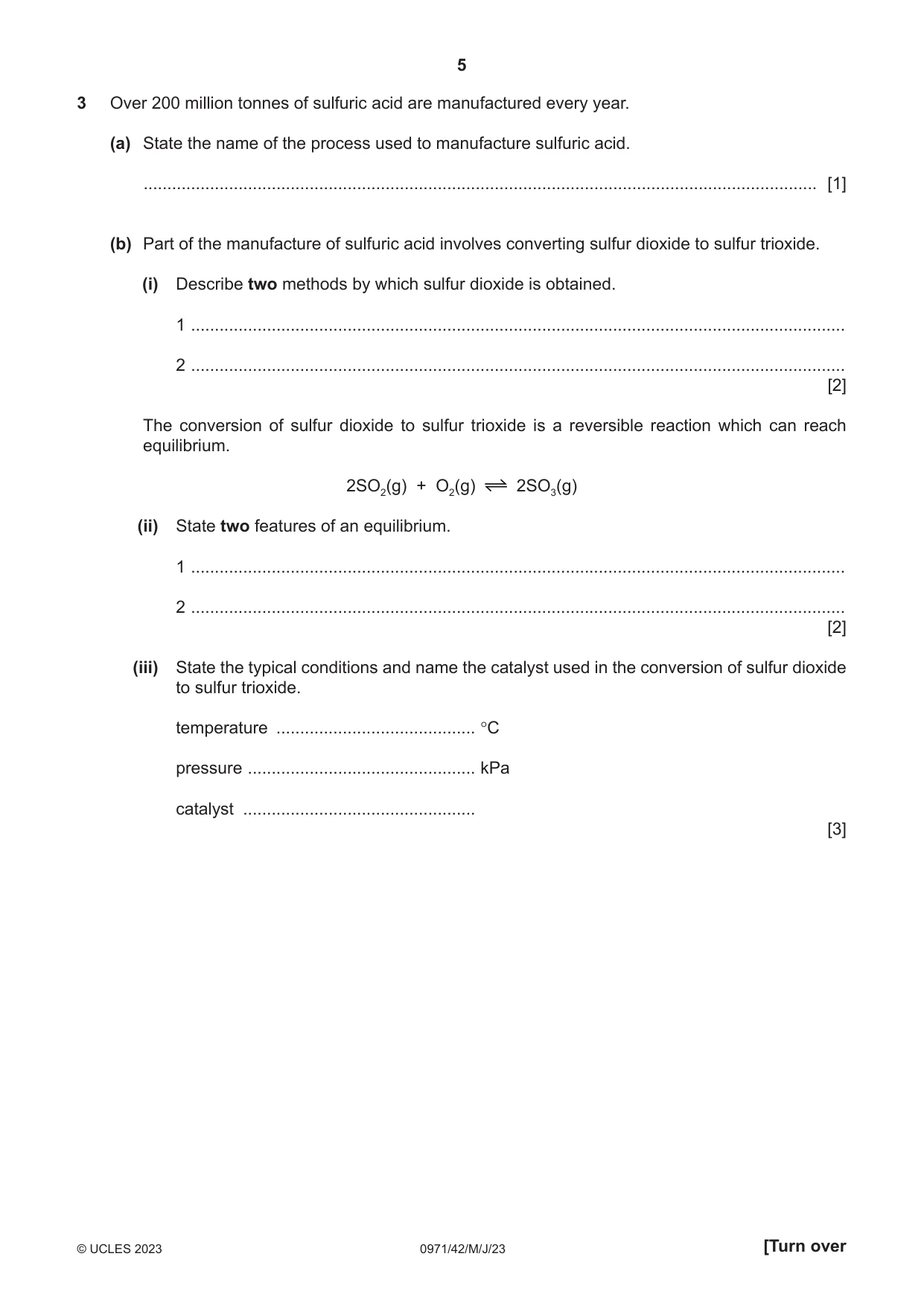
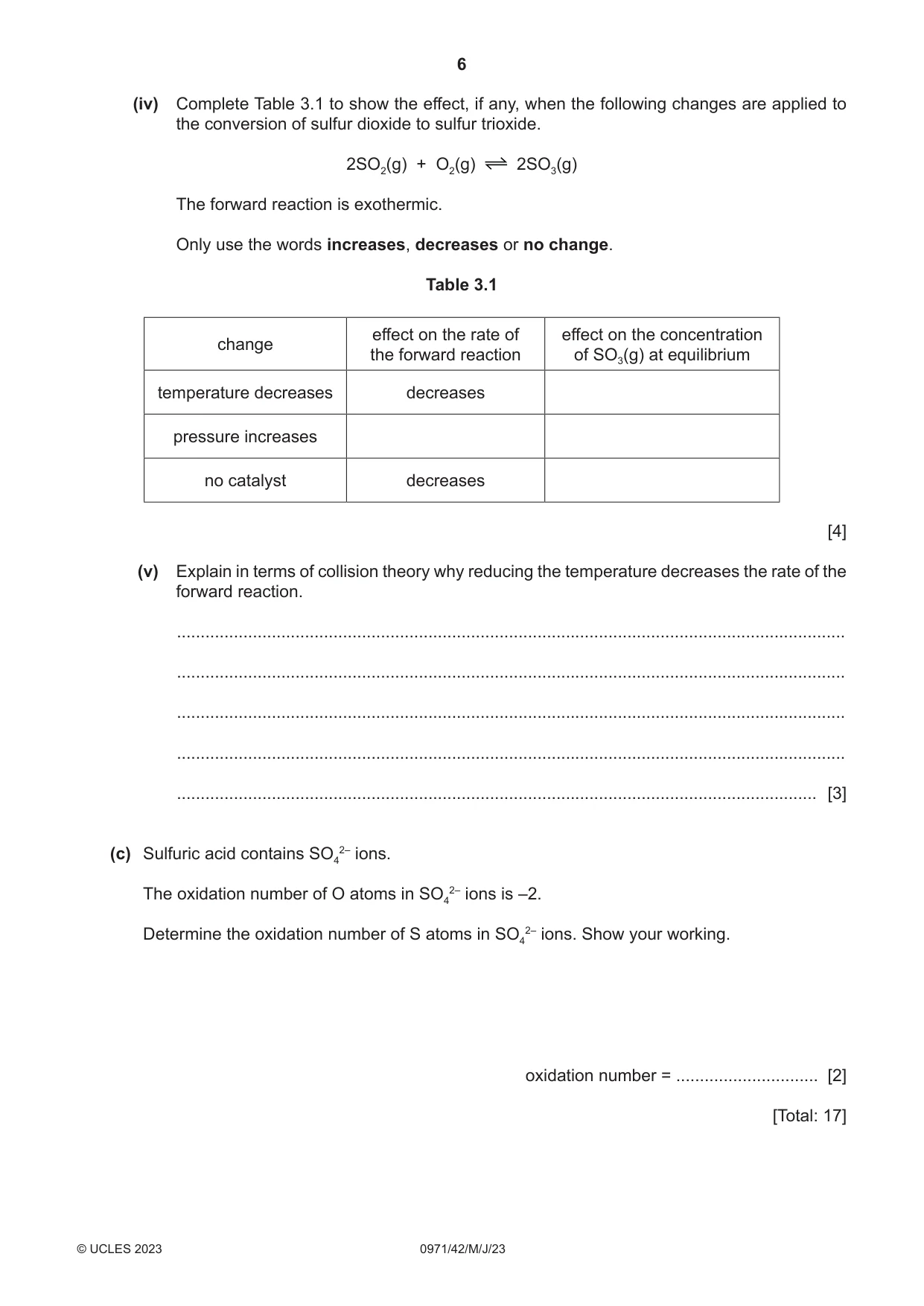
3 Over 200 million tonnes of sulfuric acid are manufactured every year. (a) State the name of the process used to manufacture sulfuric acid. .............................................................................................................................................. [1] (b) Part of the manufacture of sulfuric acid involves converting sulfur dioxide to sulfur trioxide. (i) Describe two methods by which sulfur dioxide is obtained. 1 .......................................................................................................................................... 2 .......................................................................................................................................... [2] The conversion of sulfur dioxide to sulfur trioxide is a reversible reaction which can reach equilibrium. 2SO2(g) + O2(g) 2SO3(g) (ii) State two features of an equilibrium. 1 .......................................................................................................................................... 2 .......................................................................................................................................... [2] (iii) State the typical conditions and name the catalyst used in the conversion of sulfur dioxide to sulfur trioxide. temperature ........................................... °C pressure ................................................ kPa catalyst .................................................. [3] (iv) Complete Table 3.1 to show the effect, if any, when the following changes are applied to the conversion of sulfur dioxide to sulfur trioxide. 2SO2(g) + O2(g) 2SO3(g) The forward reaction is exothermic. Only use the words increases, decreases or no change. Table 3.1 effect on the rate of effect on the concentration change the forward reaction of SO3(g) at equilibrium temperature decreases decreases pressure increases no catalyst decreases [4] (v) Explain in terms of collision theory why reducing the temperature decreases the rate of the forward reaction. ............................................................................................................................................. ............................................................................................................................................. ............................................................................................................................................. ............................................................................................................................................. ....................................................................................................................................... [3] (c) Sulfuric acid contains SO42– ions. The oxidation number of O atoms in SO42– ions is –2. Determine the oxidation number of S atoms in SO42– ions. Show your working. oxidation number = .............................. [2] [Total: 17]
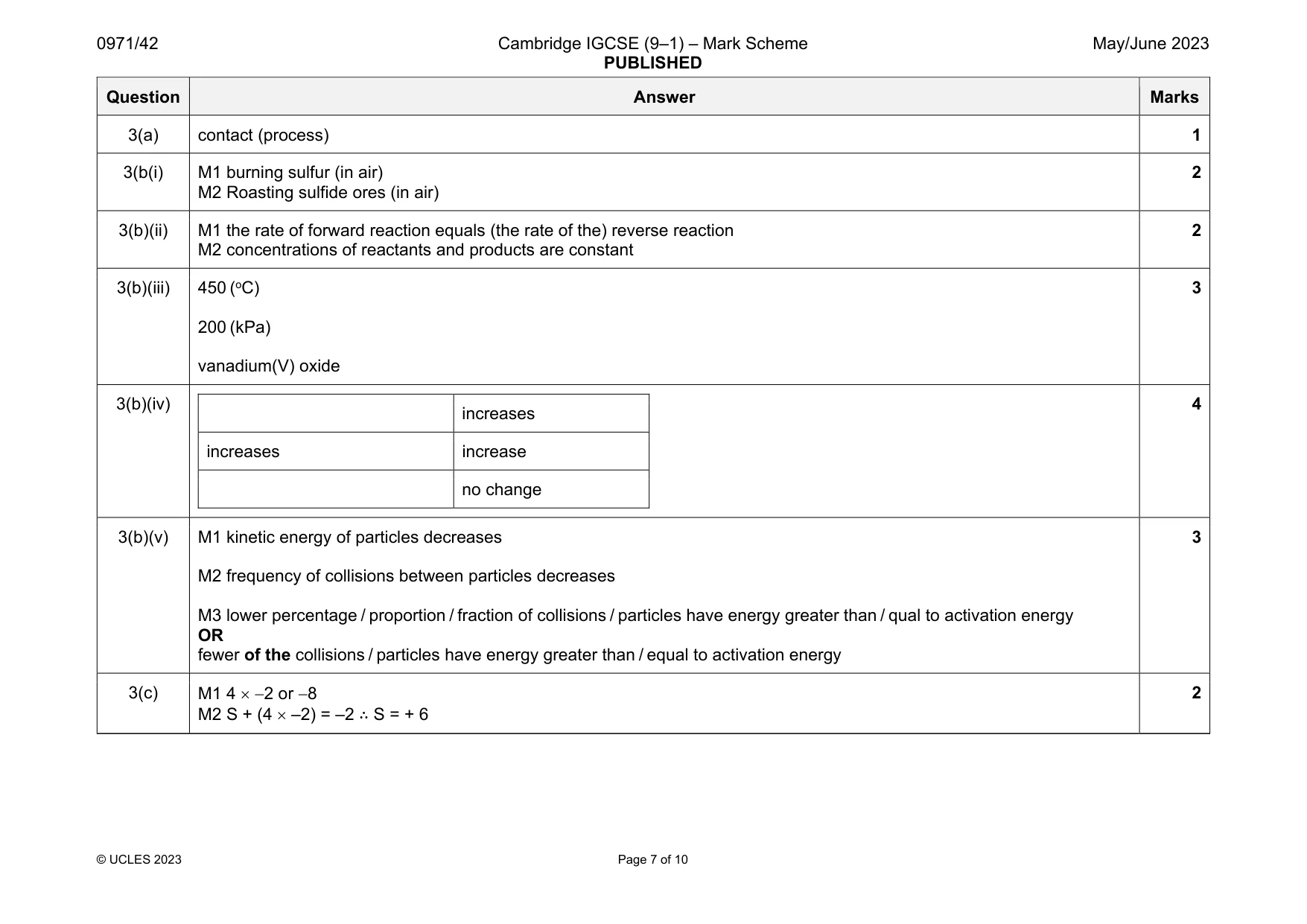
Mark scheme: 3(a) contact (process) 1 3(b(i) M1 burning sulfur (in air) M2 Roasting sulfide ores (in air) 2 3(b)(ii) M1 the rate of forward reaction equals (the rate of the) reverse reaction M2 concentrations of reactants and products are constant 2 3(b)(iii) 450 (oC) 200 (kPa) vanadium(V) oxide 3 3(b)(iv) increases increases increase no change 4 3(b)(v) M1 kinetic energy of particles decreases M2 frequency of collisions between particles decreases M3 lower percentage / proportion / fraction of collisions / particles have energy greater than / qual to activation energy OR fewer of the collisions / particles have energy greater than / equal to activation energy 3 3(c) M1 4 2 or 8 M2 S + (4 –2) = –2 ∴ S = + 6 2
Q4 · Solid sodium hydroxide is a base which dissolves to form an aqueous solution, NaOH(aq)
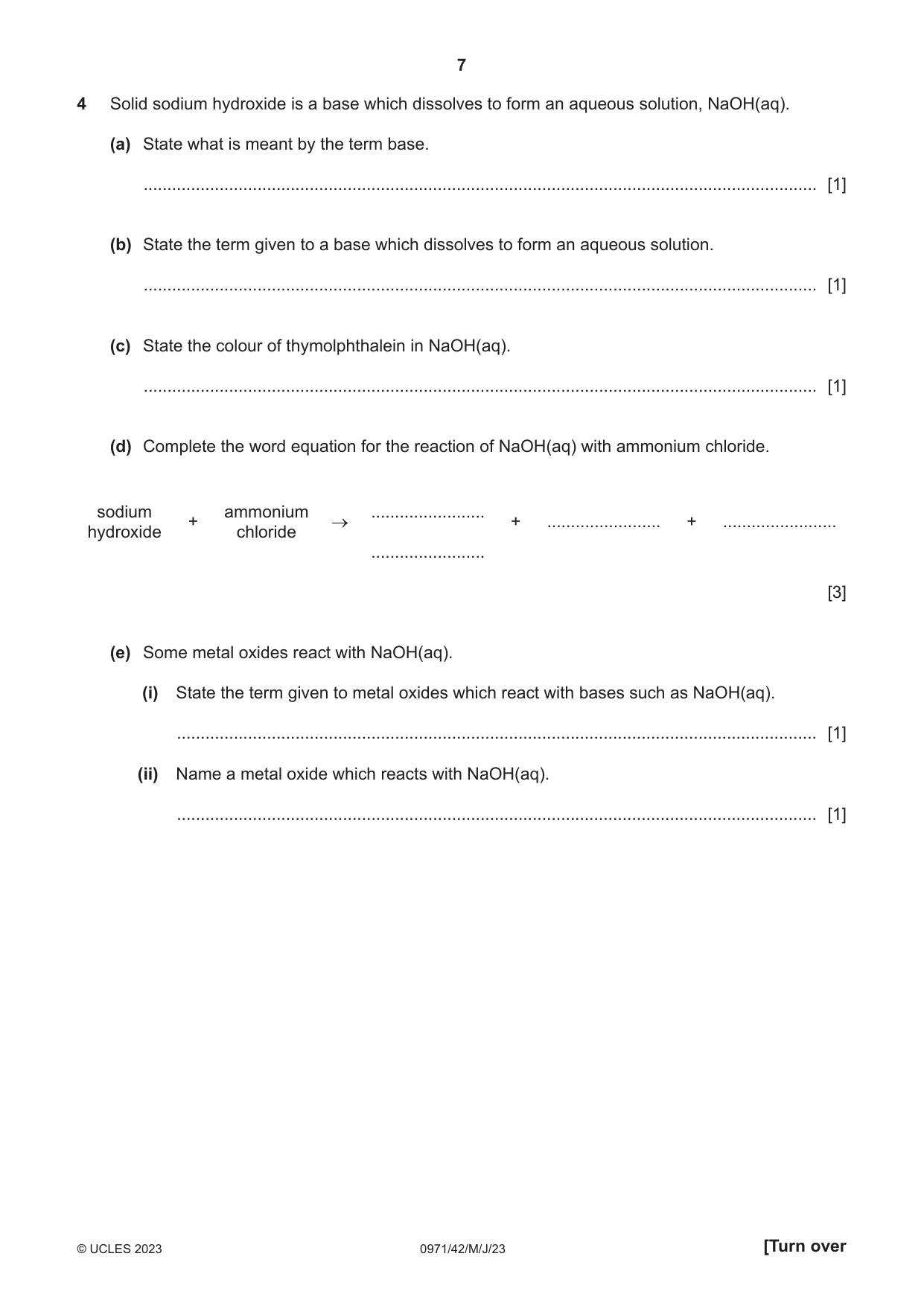
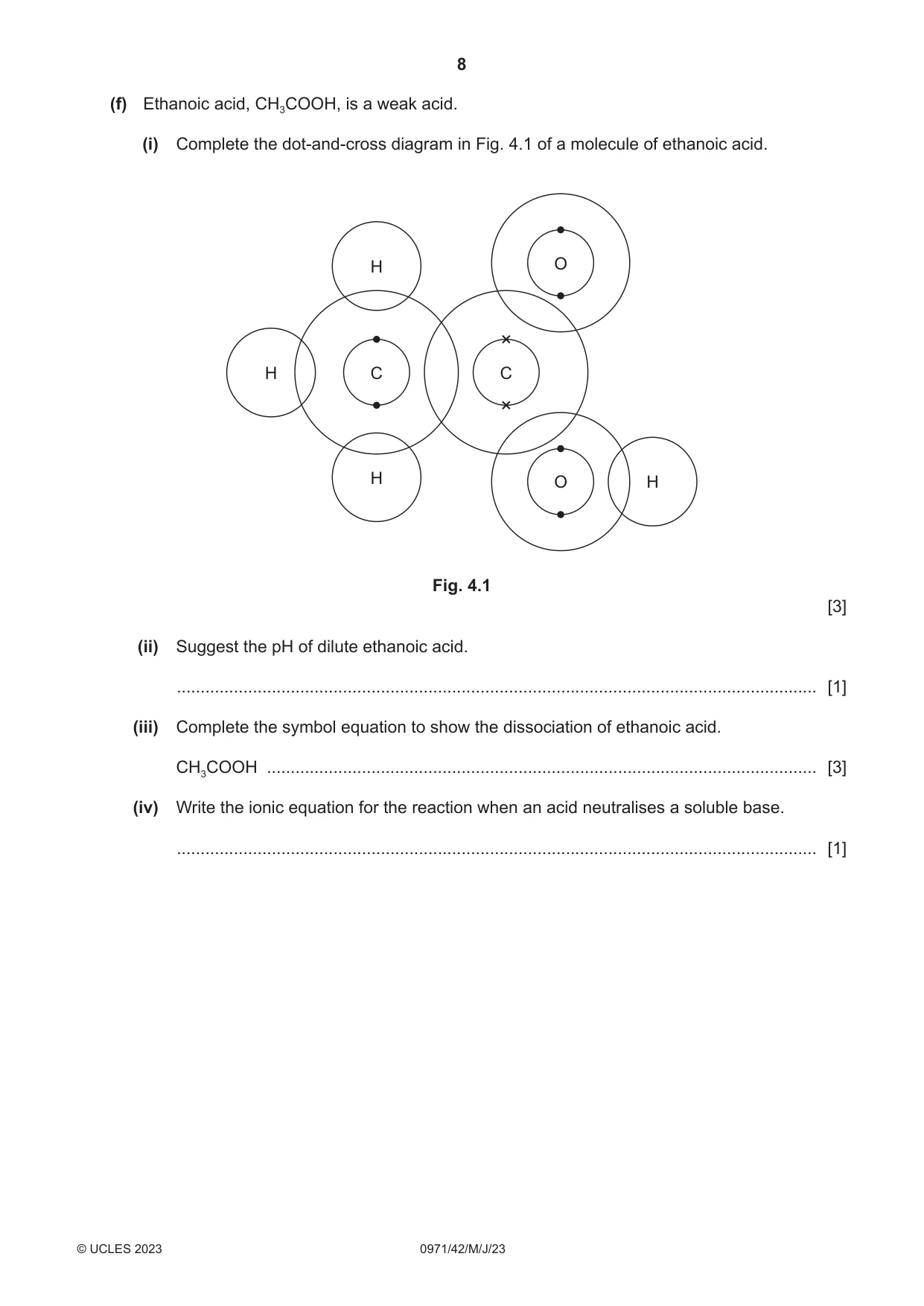
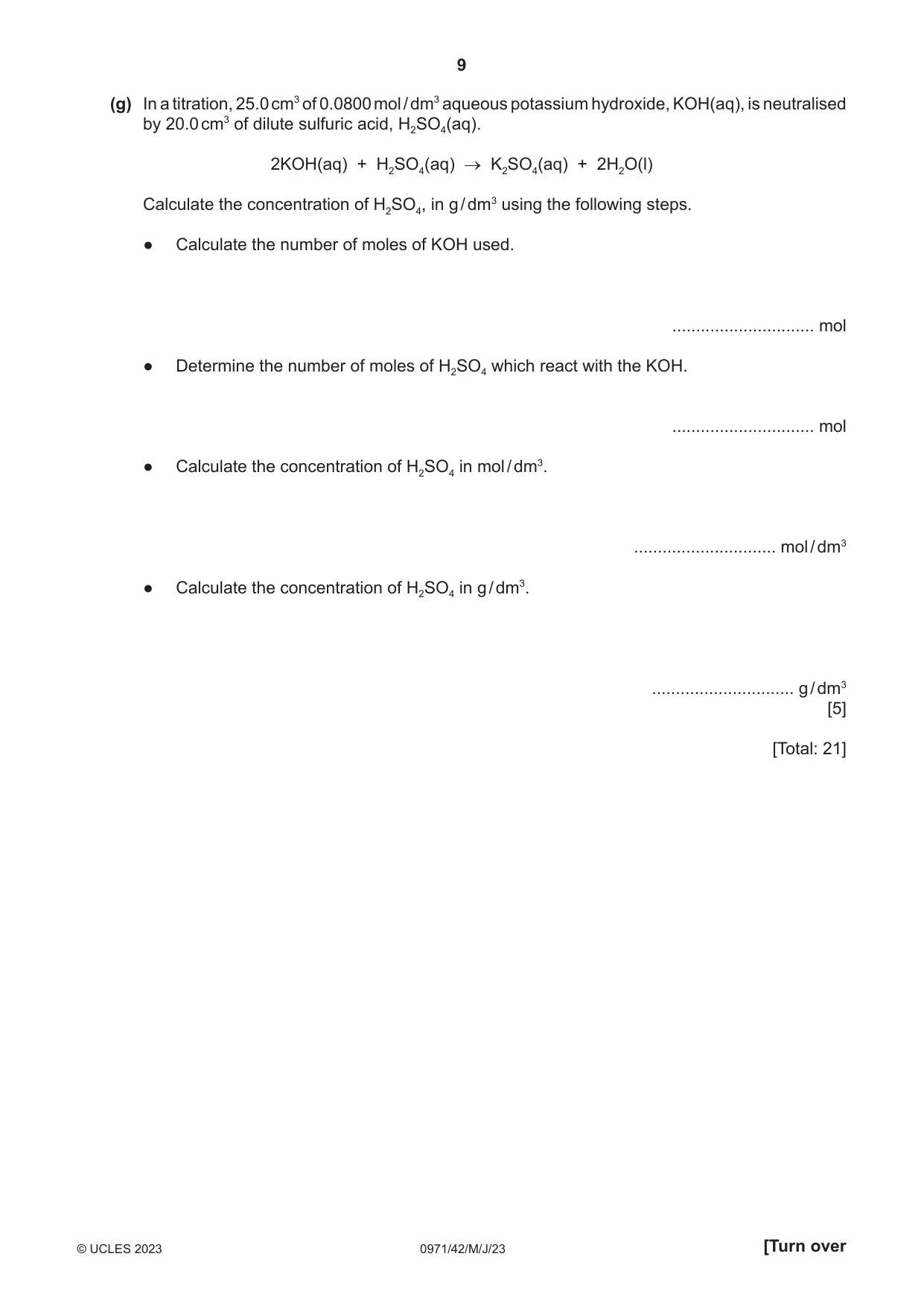
4 Solid sodium hydroxide is a base which dissolves to form an aqueous solution, NaOH(aq). (a) State what is meant by the term base. .............................................................................................................................................. [1] (b) State the term given to a base which dissolves to form an aqueous solution. .............................................................................................................................................. [1] (c) State the colour of thymolphthalein in NaOH(aq). .............................................................................................................................................. [1] (d) Complete the word equation for the reaction of NaOH(aq) with ammonium chloride. sodium ammonium ........................ + → + ........................ + ........................ hydroxide chloride ........................ [3] (e) Some metal oxides react with NaOH(aq). (i) State the term given to metal oxides which react with bases such as NaOH(aq). ....................................................................................................................................... [1] (ii) Name a metal oxide which reacts with NaOH(aq). ....................................................................................................................................... [1] (f) Ethanoic acid, CH3COOH, is a weak acid. (i) Complete the dot-and-cross diagram in Fig. 4.1 of a molecule of ethanoic acid. H O H C C H O H Fig. 4.1 [3] (ii) Suggest the pH of dilute ethanoic acid. ....................................................................................................................................... [1] (iii) Complete the symbol equation to show the dissociation of ethanoic acid. CH3COOH ..................................................................................................................... [3] (iv) Write the ionic equation for the reaction when an acid neutralises a soluble base. ....................................................................................................................................... [1] (g) In a titration, 25.0 cm3 of 0.0800 mol / dm3 aqueous potassium hydroxide, KOH(aq), is neutralised by 20.0 cm3 of dilute sulfuric acid, H2SO4(aq). 2KOH(aq) + H2SO4(aq) → K2SO4(aq) + 2H2O(l) Calculate the concentration of H2SO4, in g / dm3 using the following steps. ● Calculate the number of moles of KOH used. .............................. mol ● Determine the number of moles of H2SO4 which react with the KOH. .............................. mol ● Calculate the concentration of H2SO4 in mol / dm3. .............................. mol / dm3 ● Calculate the concentration of H2SO4 in g / dm3. .............................. g / dm3 [5] [Total: 21]
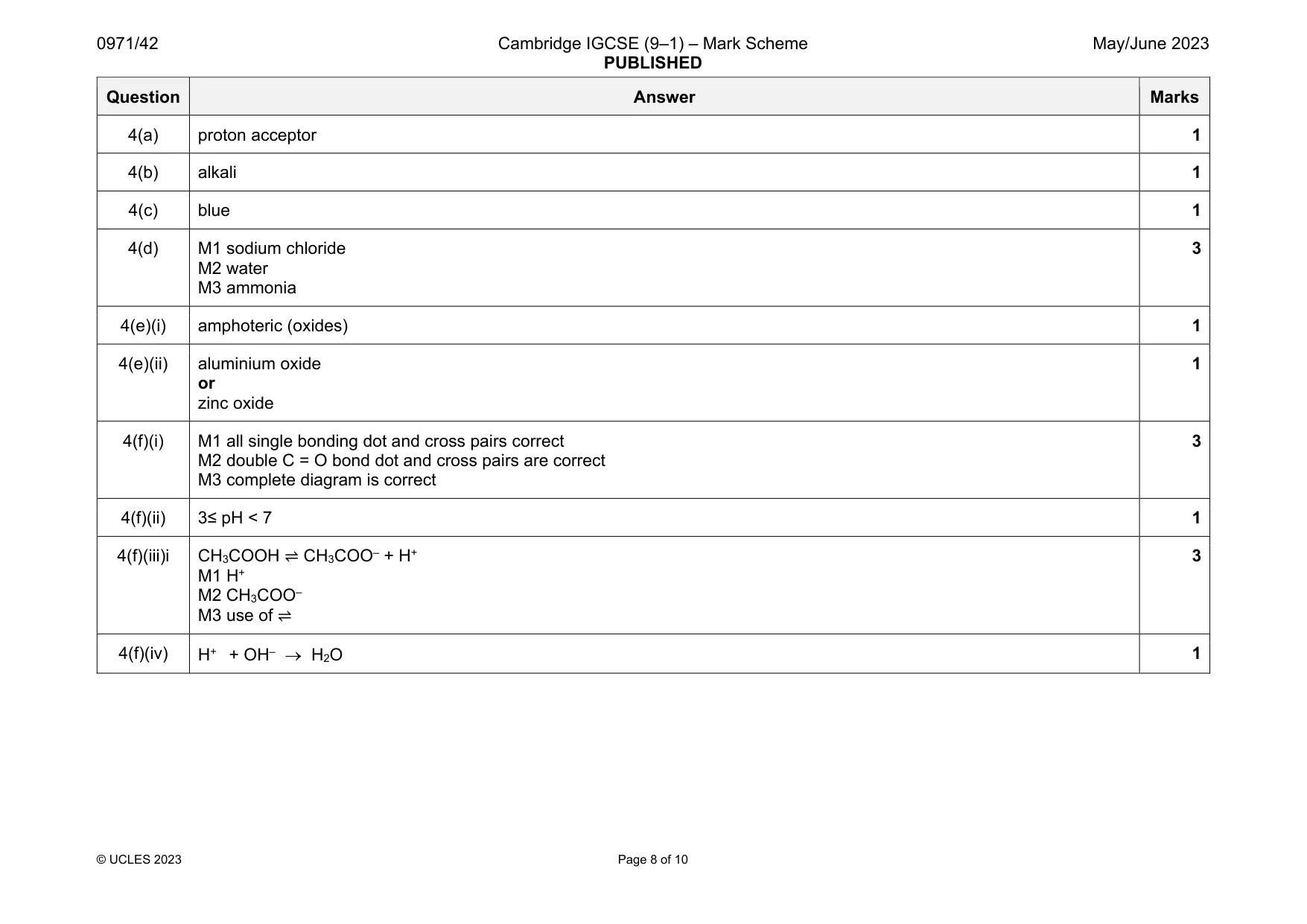
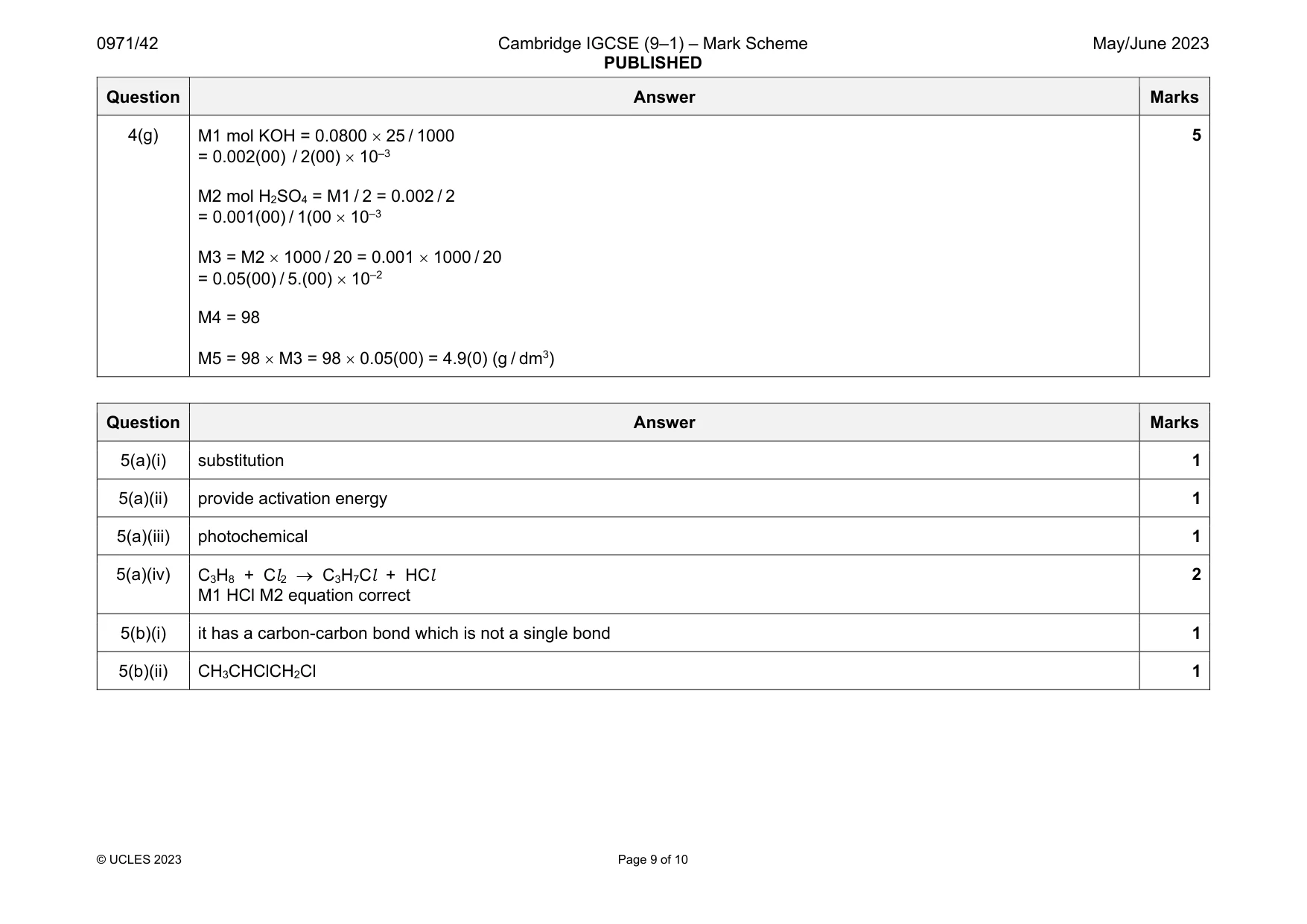
Mark scheme: 4(a) proton acceptor 1 4(b) alkali 1 4(c) blue 1 4(d) M1 sodium chloride M2 water M3 ammonia 3 4(e)(i) amphoteric (oxides) 1 4(e)(ii) aluminium oxide or zinc oxide 1 4(f)(i) M1 all single bonding dot and cross pairs correct M2 double C = O bond dot and cross pairs are correct M3 complete diagram is correct 3 4(f)(ii) 3≤ pH < 7 1 4(f)(iii)i CH3COOH ⇌ CH3COO– + H+ M1 H+ M2 CH3COO– M3 use of ⇌ 3 4(f)(iv) H+ + OH– H2O 1 Question Answer Marks 4(g) M1 mol KOH = 0.0800 25 / 1000 = 0.002(00) / 2(00) 10–3 M2 mol H2SO4 = M1 / 2 = 0.002 / 2 = 0.001(00) / 1(00 10–3 M3 = M2 1000 / 20 = 0.001 1000 / 20 = 0.05(00) / 5.(00) 10–2 M4 = 98 M5 = 98 M3 = 98 0.05(00) = 4.9(0) (g / dm3) 5
Q5 · Propane and propene both react with chlorine
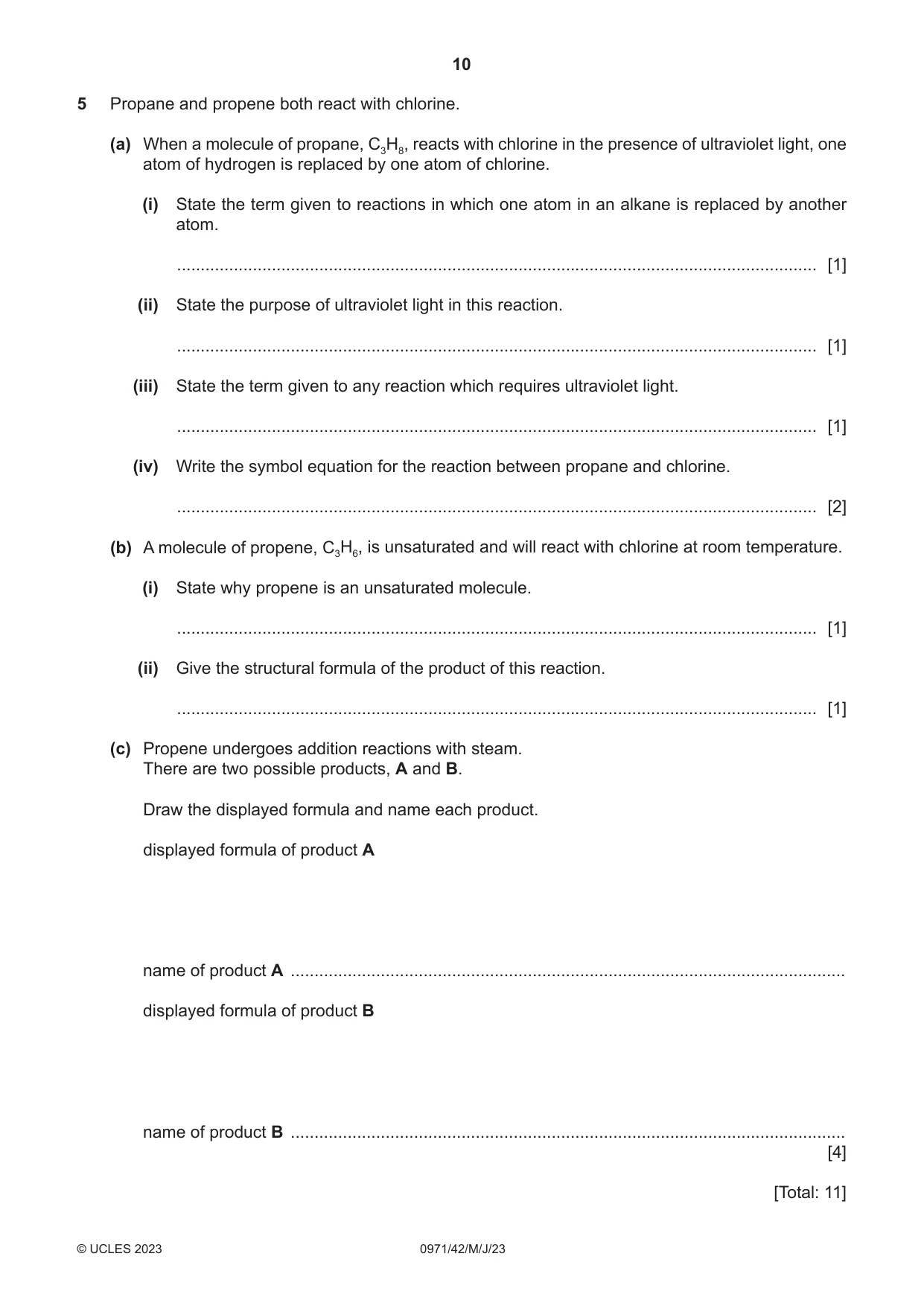
5 Propane and propene both react with chlorine. (a) When a molecule of propane, C3H8, reacts with chlorine in the presence of ultraviolet light, one atom of hydrogen is replaced by one atom of chlorine. (i) State the term given to reactions in which one atom in an alkane is replaced by another atom. ....................................................................................................................................... [1] (ii) State the purpose of ultraviolet light in this reaction. ....................................................................................................................................... [1] (iii) State the term given to any reaction which requires ultraviolet light. ....................................................................................................................................... [1] (iv) Write the symbol equation for the reaction between propane and chlorine. ....................................................................................................................................... [2] (b) A molecule of propene, C3H6, is unsaturated and will react with chlorine at room temperature. (i) State why propene is an unsaturated molecule. ....................................................................................................................................... [1] (ii) Give the structural formula of the product of this reaction. ....................................................................................................................................... [1] (c) Propene undergoes addition reactions with steam. There are two possible products, A and B. Draw the displayed formula and name each product. displayed formula of product A name of product A ...................................................................................................................... displayed formula of product B name of product B ...................................................................................................................... [4] [Total: 11]
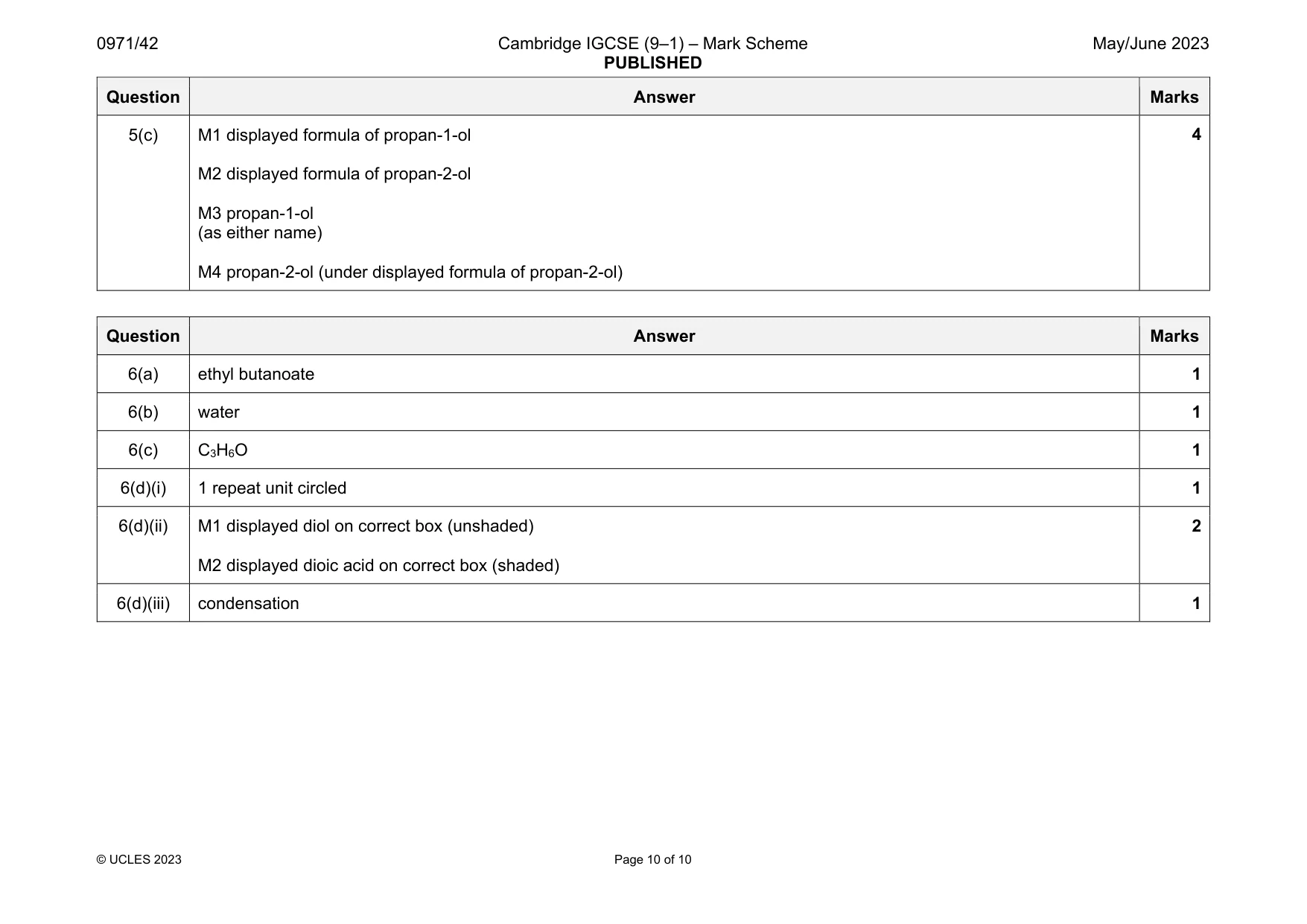
Mark scheme: 5(a)(i) substitution 1 5(a)(ii) provide activation energy 1 5(a)(iii) photochemical 1 5(a)(iv) C3H8 + Cl2 C3H7Cl + HCl M1 HCl M2 equation correct 2 5(b)(i) it has a carbon-carbon bond which is not a single bond 1 5(b)(ii) CH3CHClCH2Cl 1 Question Answer Marks 5(c) M1 displayed formula of propan-1-ol M2 displayed formula of propan-2-ol M3 propan-1-ol (as either name) M4 propan-2-ol (under displayed formula of propan-2-ol) 4
Q6 · Carboxylic acids can be converted to esters
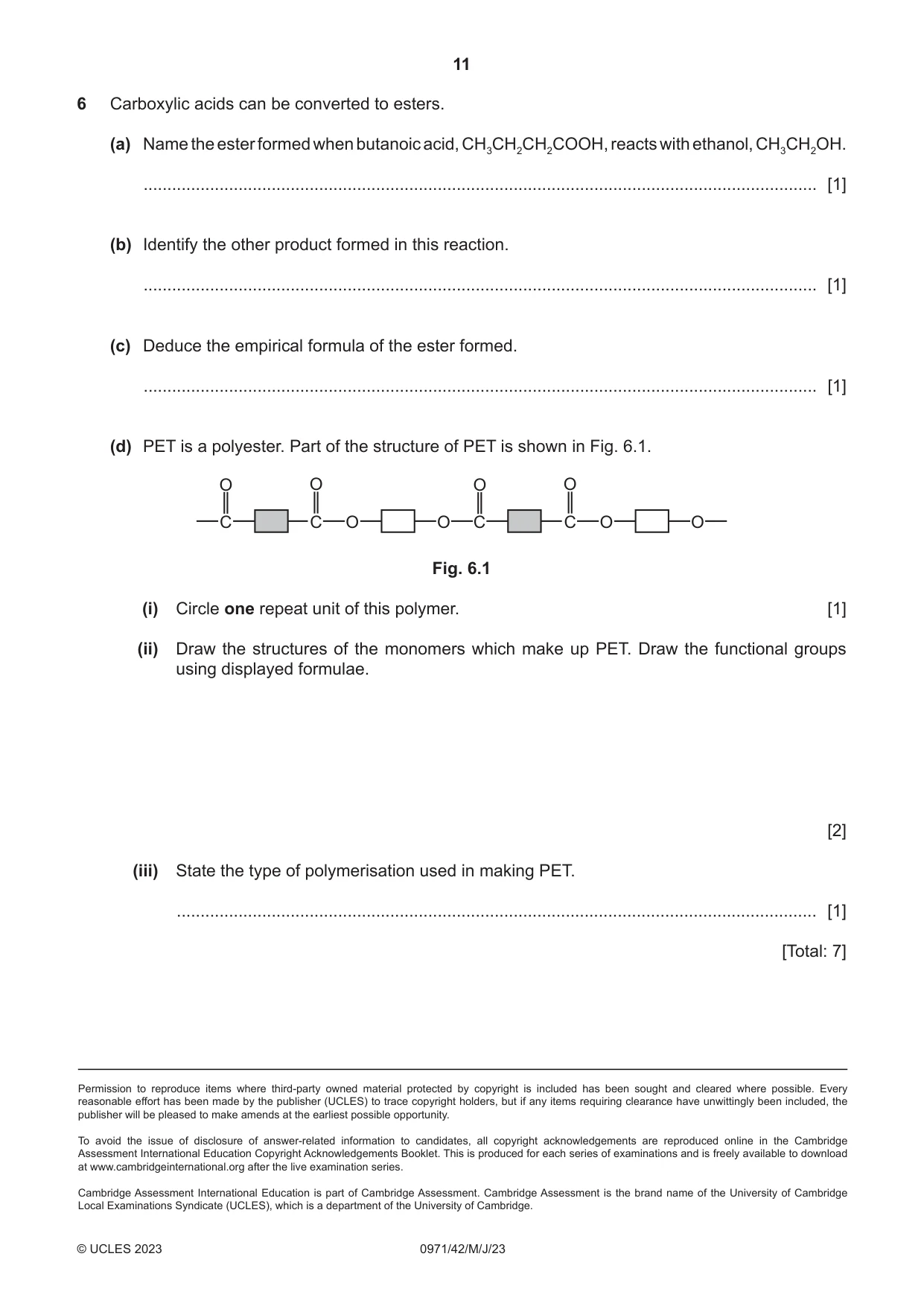
6 Carboxylic acids can be converted to esters. (a) Name the ester formed when butanoic acid, CH3CH2CH2COOH, reacts with ethanol, CH3CH2OH. .............................................................................................................................................. [1] (b) Identify the other product formed in this reaction. .............................................................................................................................................. [1] (c) Deduce the empirical formula of the ester formed. .............................................................................................................................................. [1] (d) PET is a polyester. Part of the structure of PET is shown in Fig. 6.1. O O O O C C O O C C O O Fig. 6.1 (i) Circle one repeat unit of this polymer. [1] (ii) Draw the structures of the monomers which make up PET. Draw the functional groups using displayed formulae. [2] (iii) State the type of polymerisation used in making PET. ....................................................................................................................................... [1] [Total: 7]
Mark scheme: 6(a) ethyl butanoate 1 6(b) water 1 6(c) C3H6O 1 6(d)(i) 1 repeat unit circled 1 6(d)(ii) M1 displayed diol on correct box (unshaded) M2 displayed dioic acid on correct box (shaded) 2 6(d)(iii) condensation 1
What was in this paper
The subtopics covered by these 6 questions, and how many questions each got. Open one in a new tab to see every Cambridge question on it.
What you needed in this session
Cambridge’s own grade thresholds for 2023 May/June, Paper 4 · Variant 2. A higher threshold means an easier paper — the bar moves with how the cohort did.