Cambridge IGCSE Chemistry (9-1) 0971 — 2025 Oct/Nov Paper 4 · Variant 2
0971/42/O/N/25 · 6 questions · 80 marks · 75 min
The question paper and its mark scheme, free to read here and free to download. This is Cambridge’s own paper, exactly as it was sat.
Question paper16 pages


Mark scheme12 pages
Answers below. Sit the paper first if you are practising.

Questions as text
Q1 · The three states of matter are solid, liquid and gas
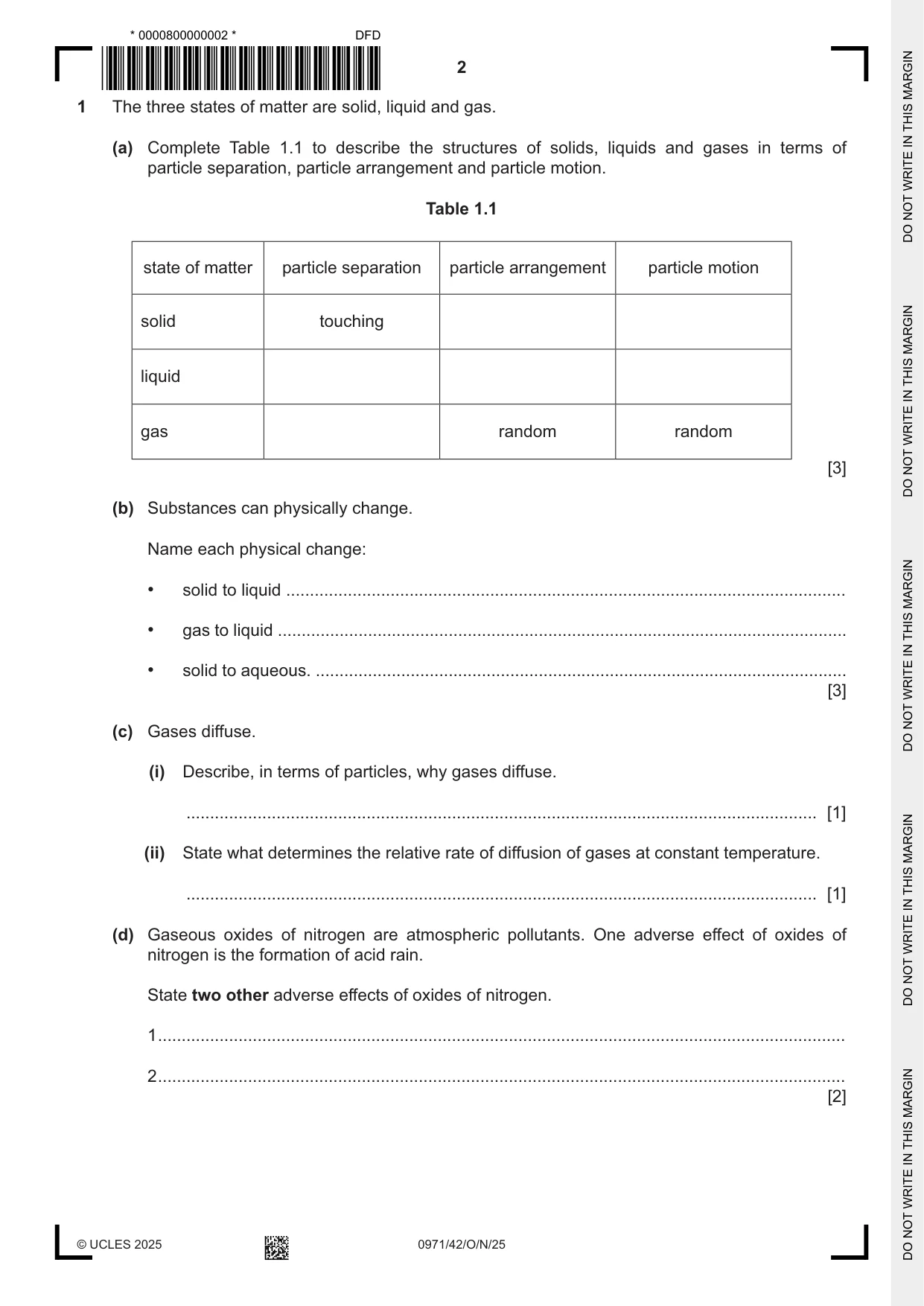
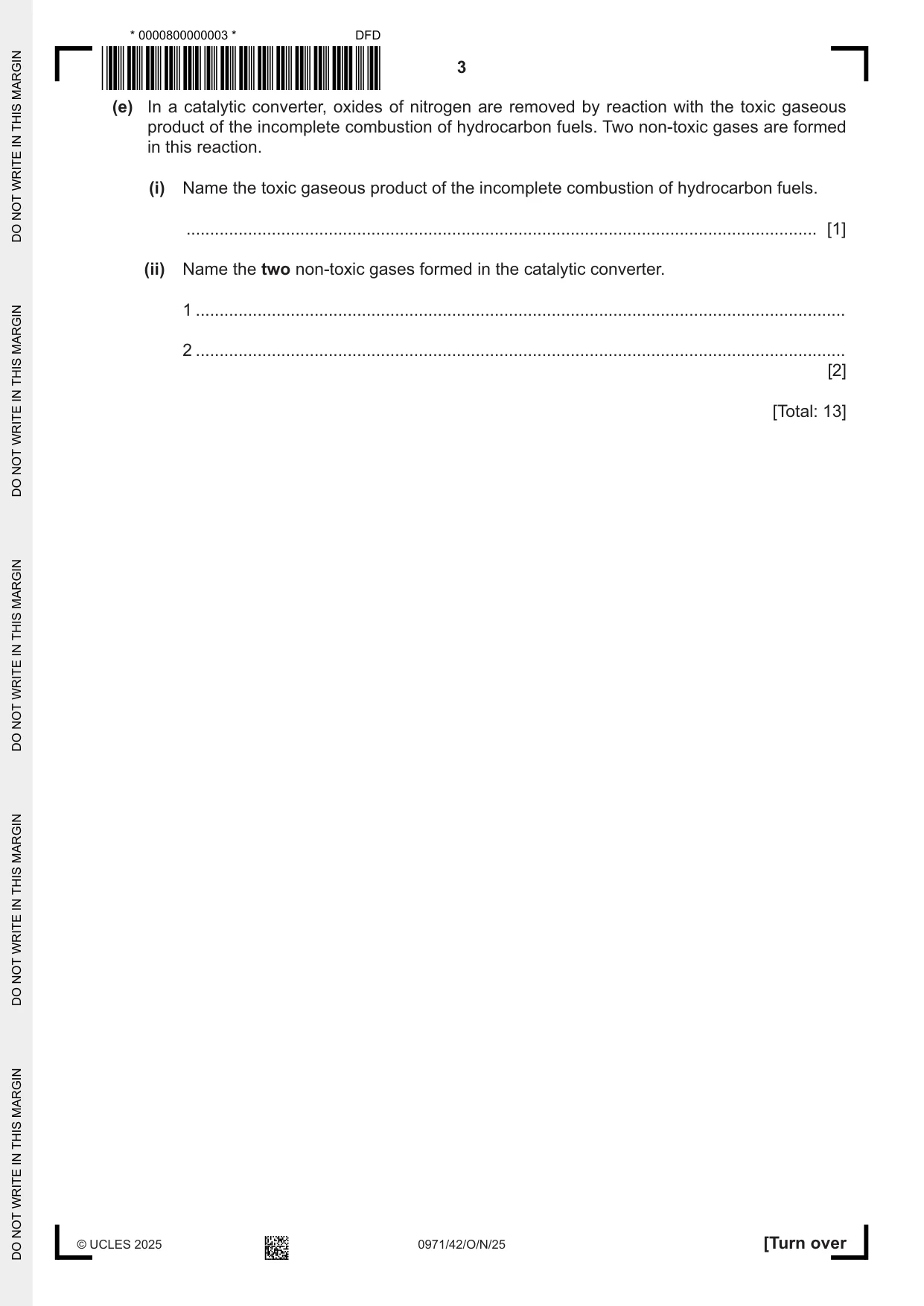
1 The three states of matter are solid, liquid and gas. (a) Complete Table 1.1 to describe the structures of solids, liquids and gases in terms of particle separation, particle arrangement and particle motion. Table 1.1 state of matter particle separation particle arrangement particle motion solid touching liquid gas random random [3] (b) Substances can physically change. Name each physical change: • solid to liquid ...................................................................................................................... • gas to liquid ........................................................................................................................ • solid to aqueous. ................................................................................................................ [3] (c) Gases diffuse. (i) Describe, in terms of particles, why gases diffuse. ..................................................................................................................................... [1] (ii) State what determines the relative rate of diffusion of gases at constant temperature. ..................................................................................................................................... [1] (d) Gaseous oxides of nitrogen are atmospheric pollutants. One adverse effect of oxides of nitrogen is the formation of acid rain. State two other adverse effects of oxides of nitrogen. 1 ................................................................................................................................................. 2 ................................................................................................................................................. [2] (e) In a catalytic converter, oxides of nitrogen are removed by reaction with the toxic gaseous product of the incomplete combustion of hydrocarbon fuels. Two non-toxic gases are formed in this reaction. (i) Name the toxic gaseous product of the incomplete combustion of hydrocarbon fuels. ..................................................................................................................................... [1] (ii) Name the two non-toxic gases formed in the catalytic converter. 1 ......................................................................................................................................... 2 ......................................................................................................................................... [2] [Total: 13]
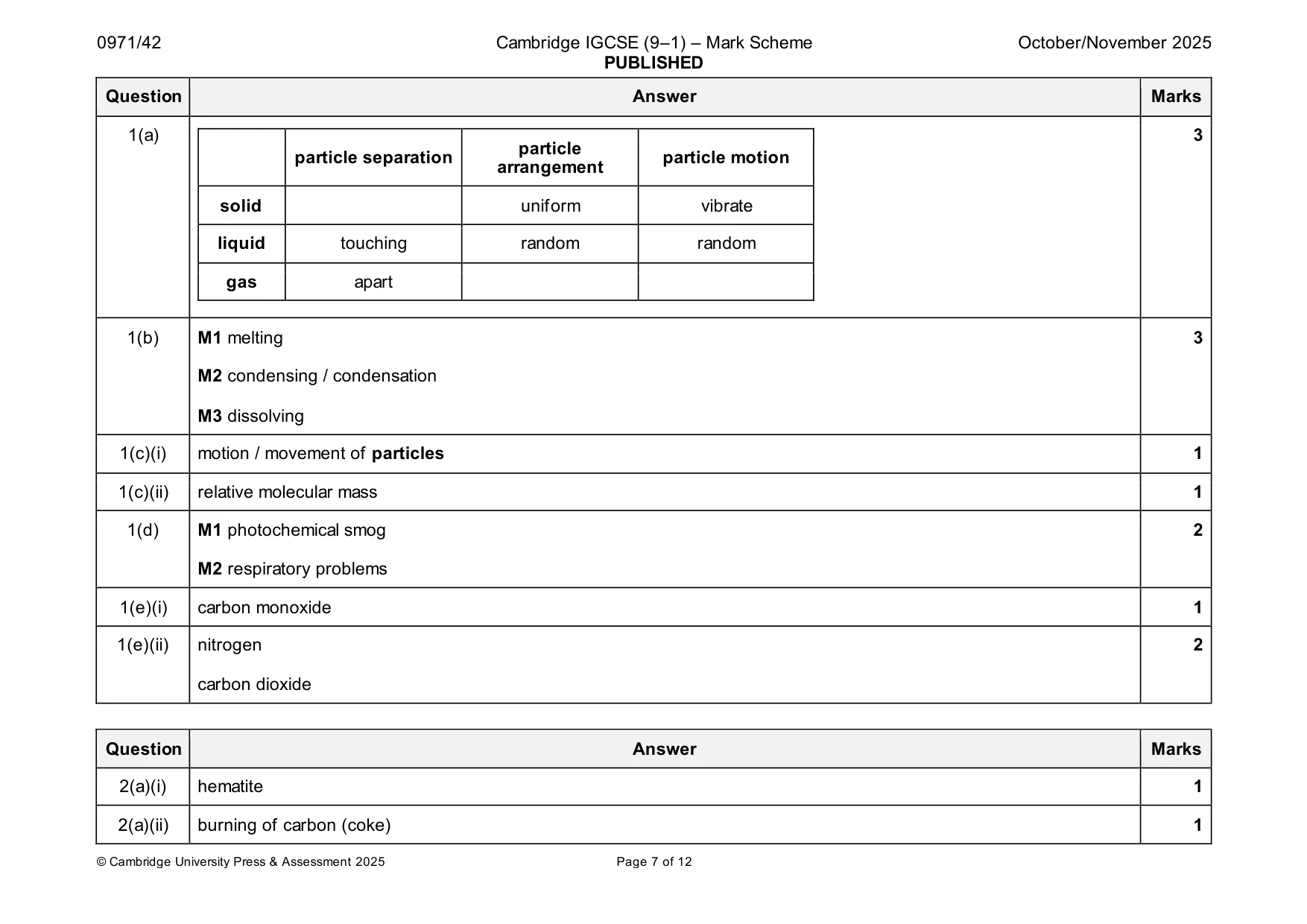
Mark scheme: Question Answer Marks 1(a) 3 particle particle separation particle motion arrangement solid uniform vibrate liquid touching random random gas apart 1(b) M1 melting 3 M2 condensing / condensation M3 dissolving 1(c)(i) motion / movement of particles 1 1(c)(ii) relative molecular mass 1 1(d) M1 photochemical smog 2 M2 respiratory problems 1(e)(i) carbon monoxide 1 1(e)(ii) nitrogen 2 carbon dioxide
Q2 · Iron is extracted from iron ore in a blast furnace
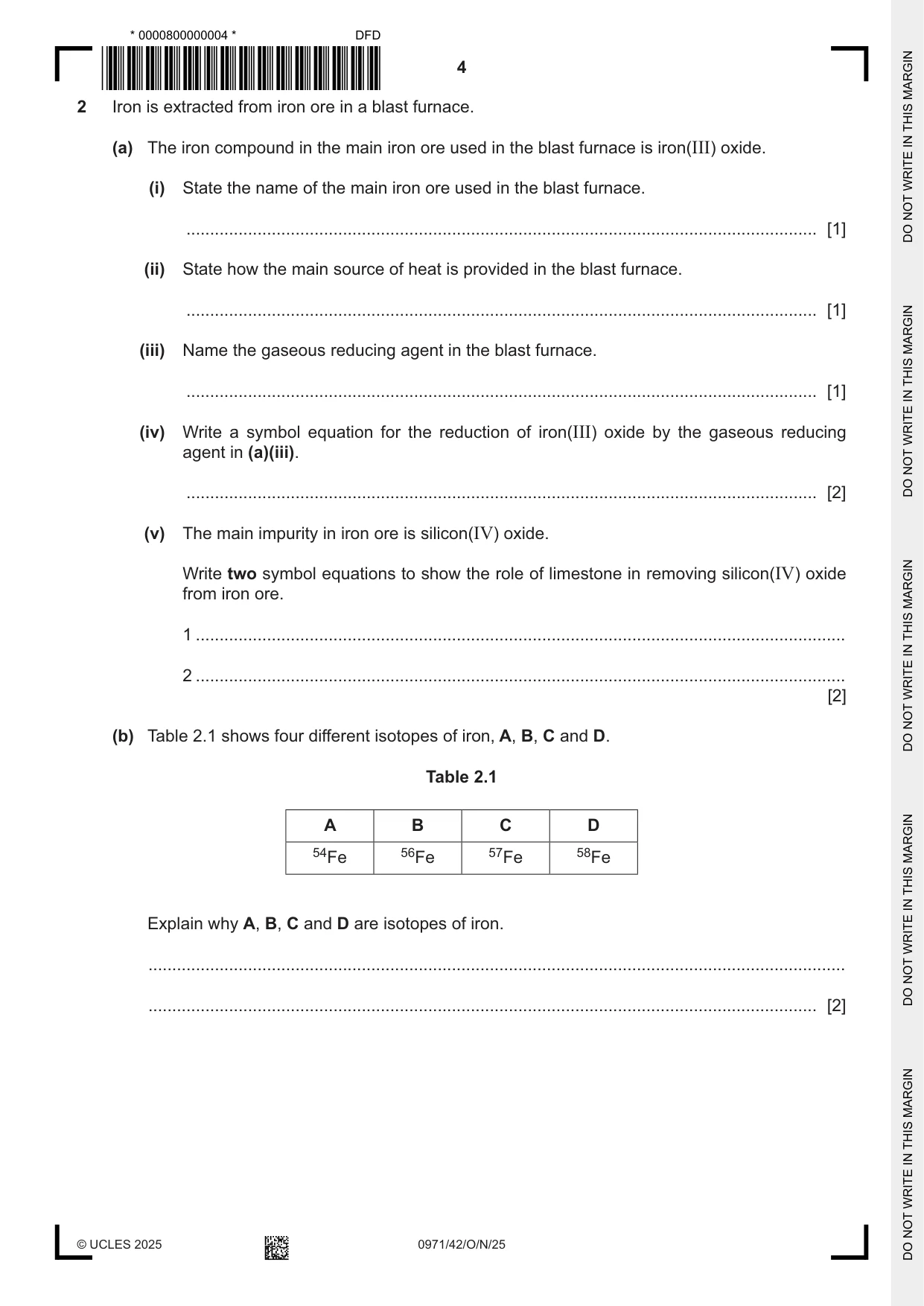
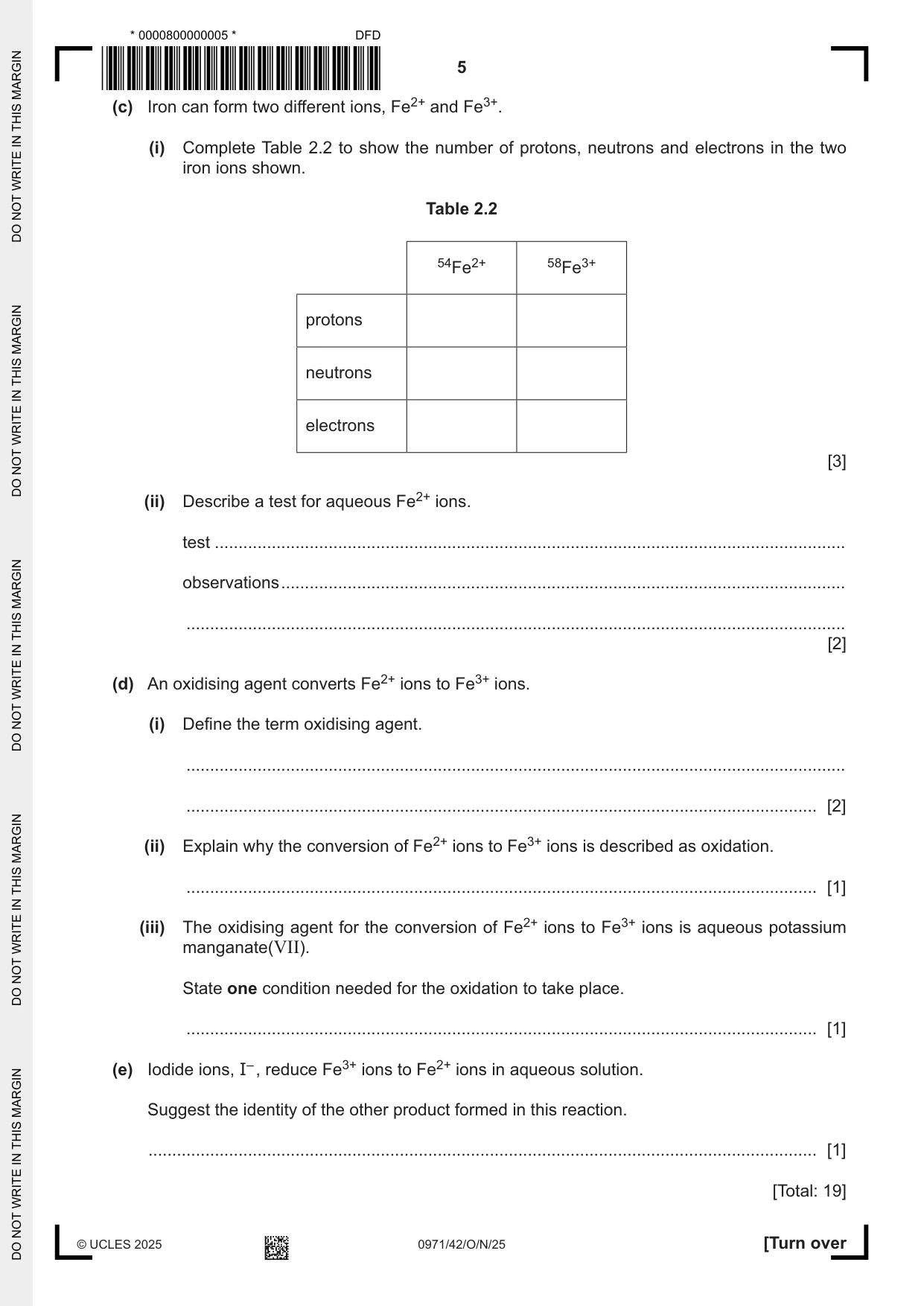
2 Iron is extracted from iron ore in a blast furnace. (a) The iron compound in the main iron ore used in the blast furnace is iron(III) oxide. (i) State the name of the main iron ore used in the blast furnace. ..................................................................................................................................... [1] (ii) State how the main source of heat is provided in the blast furnace. ..................................................................................................................................... [1] (iii) Name the gaseous reducing agent in the blast furnace. ..................................................................................................................................... [1] (iv) Write a symbol equation for the reduction of iron(III) oxide by the gaseous reducing agent in (a)(iii). ..................................................................................................................................... [2] (v) The main impurity in iron ore is silicon(IV) oxide. Write two symbol equations to show the role of limestone in removing silicon(IV) oxide from iron ore. 1 ......................................................................................................................................... 2 ......................................................................................................................................... [2] (b) Table 2.1 shows four different isotopes of iron, A, B, C and D. Table 2.1 A B C D 54Fe 56Fe 57Fe 58Fe Explain why A, B, C and D are isotopes of iron. ................................................................................................................................................... ............................................................................................................................................. [2] (c) Iron can form two different ions, Fe2+ and Fe3+. (i) Complete Table 2.2 to show the number of protons, neutrons and electrons in the two iron ions shown. Table 2.2 54Fe2+ 58Fe3+ protons neutrons electrons [3] (ii) Describe a test for aqueous Fe2+ ions. test ..................................................................................................................................... observations ....................................................................................................................... ........................................................................................................................................... [2] (d) An oxidising agent converts Fe2+ ions to Fe3+ ions. (i) Define the term oxidising agent. ........................................................................................................................................... ..................................................................................................................................... [2] (ii) Explain why the conversion of Fe2+ ions to Fe3+ ions is described as oxidation. ..................................................................................................................................... [1] (iii) The oxidising agent for the conversion of Fe2+ ions to Fe3+ ions is aqueous potassium manganate(VII). State one condition needed for the oxidation to take place. ..................................................................................................................................... [1] (e) Iodide ions, I– , reduce Fe3+ ions to Fe2+ ions in aqueous solution. Suggest the identity of the other product formed in this reaction. ............................................................................................................................................. [1] [Total: 19]
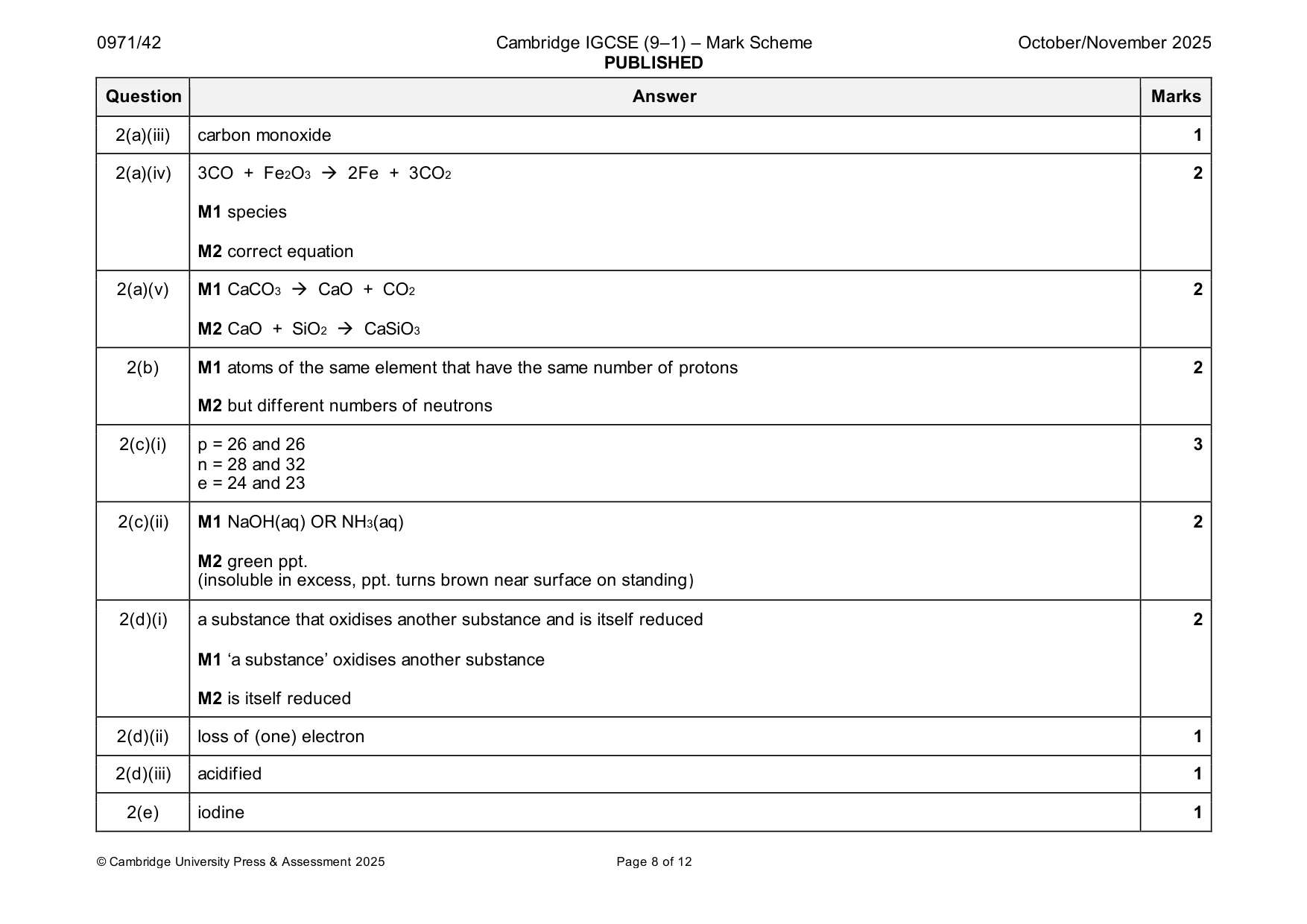
Mark scheme: 2(a)(i) hematite 1 2(a)(ii) burning of carbon (coke) 1 2(a)(iii) carbon monoxide 1 2(a)(iv) 3CO + Fe2O3 → 2Fe + 3CO2 2 M1 species M2 correct equation 2(a)(v) M1 CaCO3 → CaO + CO2 2 M2 CaO + SiO2 → CaSiO3 2(b) M1 atoms of the same element that have the same number of protons 2 M2 but different numbers of neutrons 2(c)(i) p = 26 and 26 3 n = 28 and 32 e = 24 and 23 2(c)(ii) M1 NaOH(aq) OR NH3(aq) 2 M2 green ppt. (insoluble in excess, ppt. turns brown near surface on standing) 2(d)(i) a substance that oxidises another substance and is itself reduced 2 M1 ‘a substance’ oxidises another substance M2 is itself reduced 2(d)(ii) loss of (one) electron 1 2(d)(iii) acidified 1 2(e) iodine 1
Q3 · A student prepares a sample of the insoluble salt barium sulfate, BaSO4
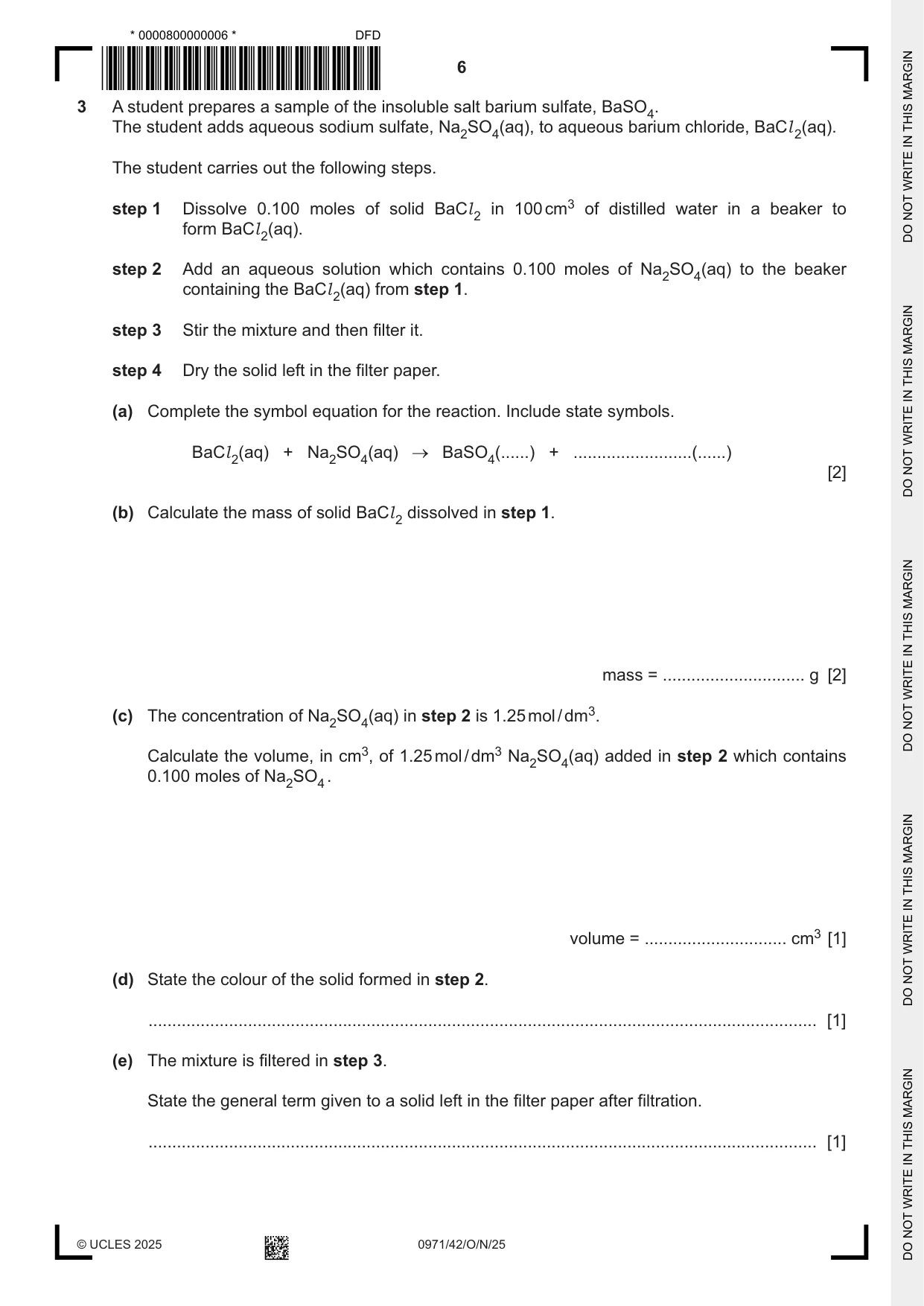
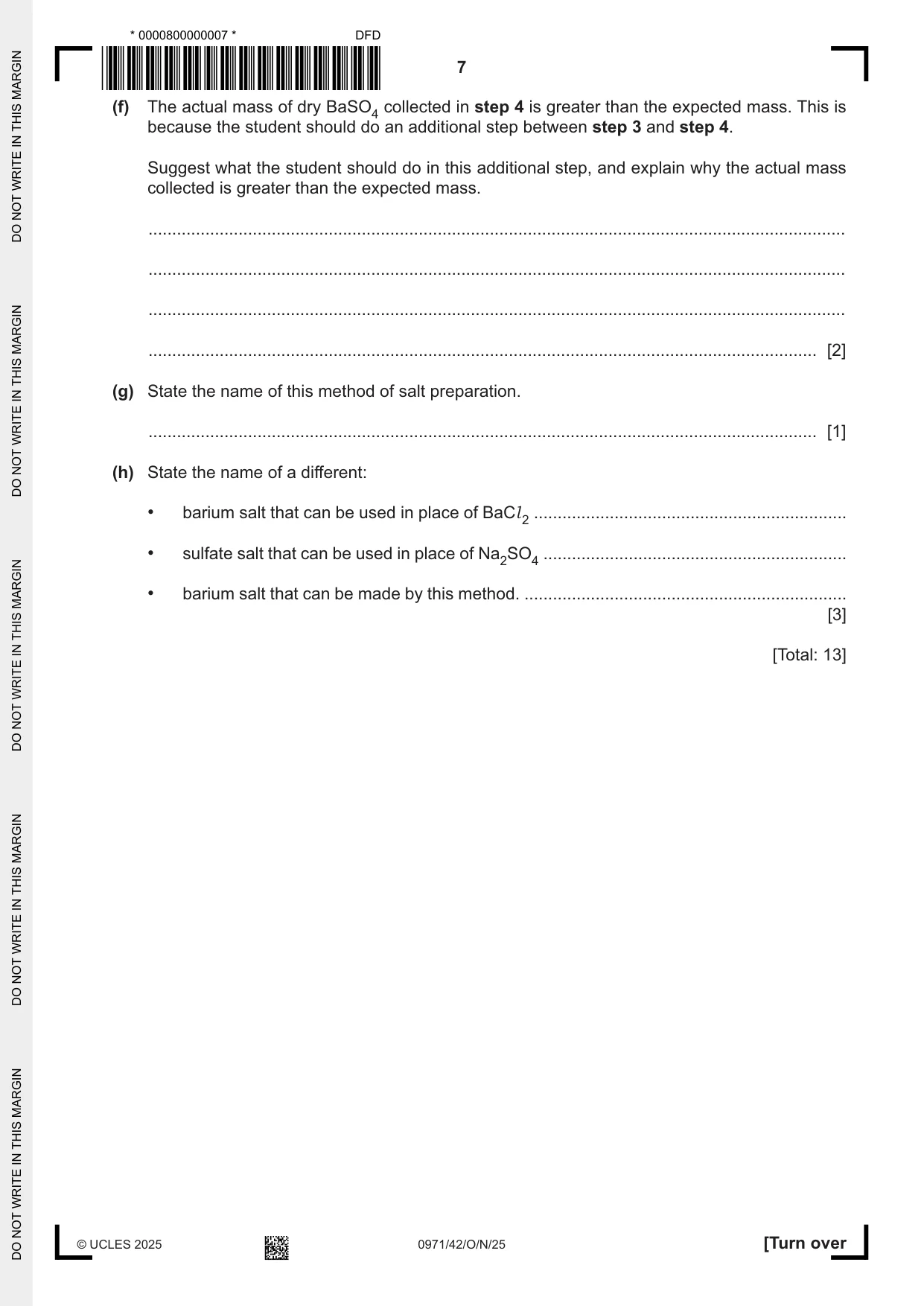
3 A student prepares a sample of the insoluble salt barium sulfate, BaSO4. The student adds aqueous sodium sulfate, Na2SO4(aq), to aqueous barium chloride, BaCl 2(aq). The student carries out the following steps. step 1 Dissolve 0.100 moles of solid BaCl 2 in 100 cm3 of distilled water in a beaker to form BaCl 2(aq). step 2 Add an aqueous solution which contains 0.100 moles of Na2SO4(aq) to the beaker containing the BaCl 2(aq) from step 1. step 3 Stir the mixture and then filter it. step 4 Dry the solid left in the filter paper. (a) Complete the symbol equation for the reaction. Include state symbols. BaCl 2(aq) + Na2SO4(aq) BaSO4(......) + .........................(......) [2] (b) Calculate the mass of solid BaCl 2 dissolved in step 1. mass = .............................. g [2] (c) The concentration of Na2SO4(aq) in step 2 is 1.25 mol / dm3. Calculate the volume, in cm3, of 1.25 mol / dm3 Na2SO4(aq) added in step 2 which contains 0.100 moles of Na2SO4 . volume = .............................. cm3 [1] (d) State the colour of the solid formed in step 2. ............................................................................................................................................. [1] (e) The mixture is filtered in step 3. State the general term given to a solid left in the filter paper after filtration. ............................................................................................................................................. [1] (f) The actual mass of dry BaSO4 collected in step 4 is greater than the expected mass. This is because the student should do an additional step between step 3 and step 4. Suggest what the student should do in this additional step, and explain why the actual mass collected is greater than the expected mass. ................................................................................................................................................... ................................................................................................................................................... ................................................................................................................................................... ............................................................................................................................................. [2] (g) State the name of this method of salt preparation. ............................................................................................................................................. [1] (h) State the name of a different: • barium salt that can be used in place of BaCl 2 .................................................................. • sulfate salt that can be used in place of Na2SO4 ................................................................ • barium salt that can be made by this method. .................................................................... [3] [Total: 13]
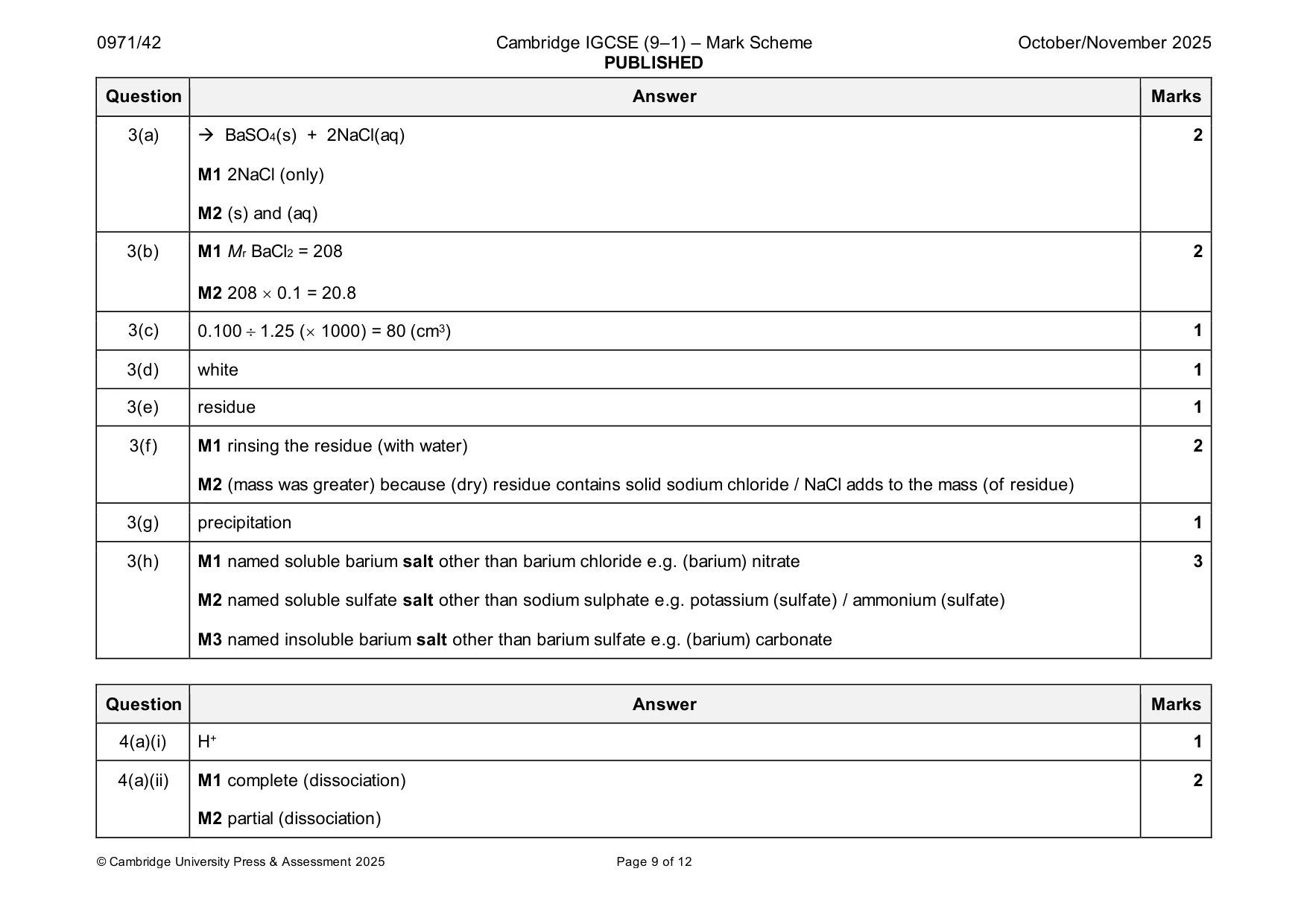
Mark scheme: 3(a) → BaSO4(s) + 2NaCl(aq) 2 M1 2NaCl (only) M2 (s) and (aq) 3(b) M1 Mr BaCl2 = 208 2 M2 208 0.1 = 20.8 3(c) 0.100 1.25 ( 1000) = 80 (cm3) 1 3(d) white 1 3(e) residue 1 3(f) M1 rinsing the residue (with water) 2 M2 (mass was greater) because (dry) residue contains solid sodium chloride / NaCl adds to the mass (of residue) 3(g) precipitation 1 3(h) M1 named soluble barium salt other than barium chloride e.g. (barium) nitrate 3 M2 named soluble sulfate salt other than sodium sulphate e.g. potassium (sulfate) / ammonium (sulfate) M3 named insoluble barium salt other than barium sulfate e.g. (barium) carbonate
Q4 · Nitric acid, HNO3 , and sulfuric acid, H2SO4 , are strong acids
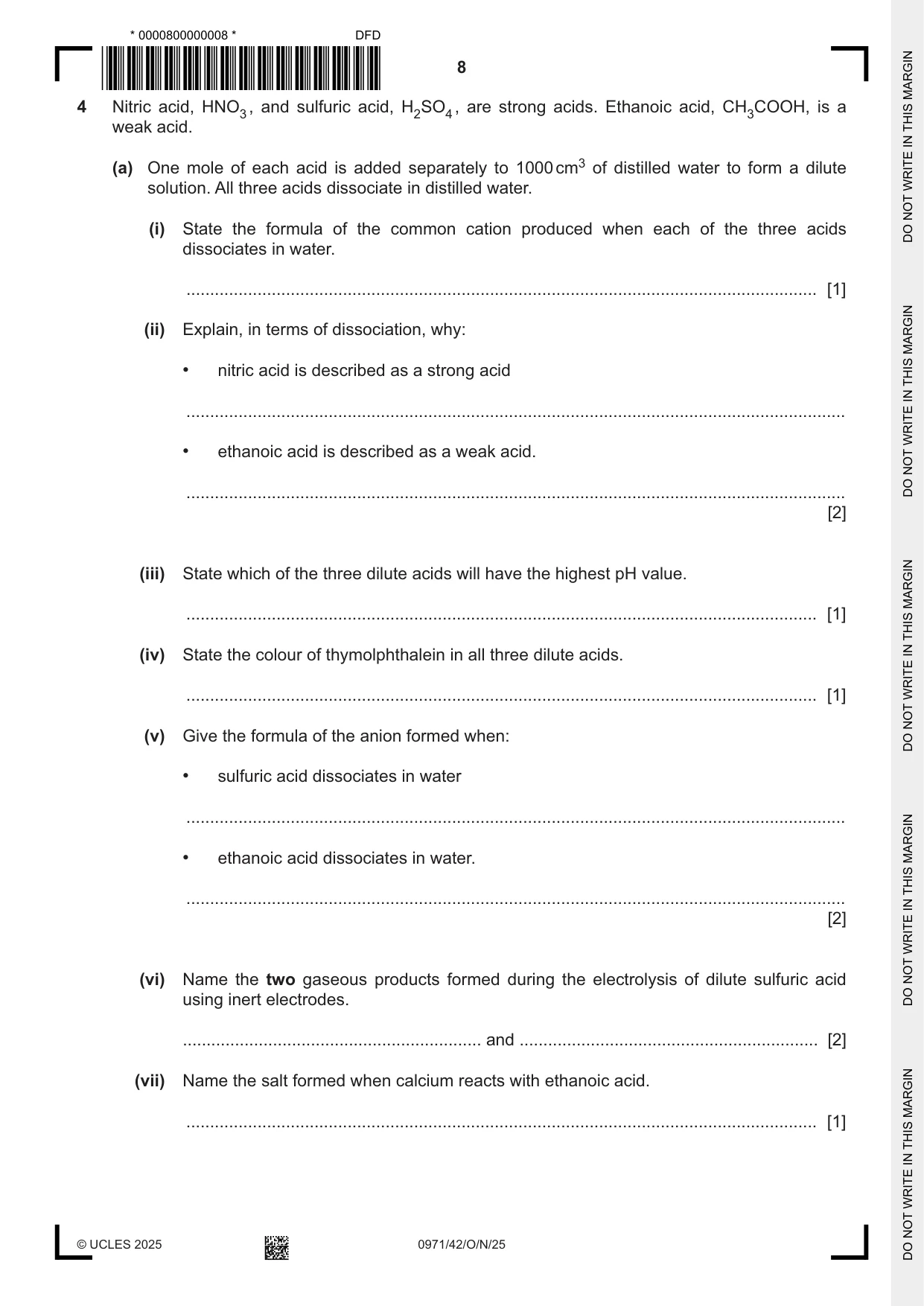
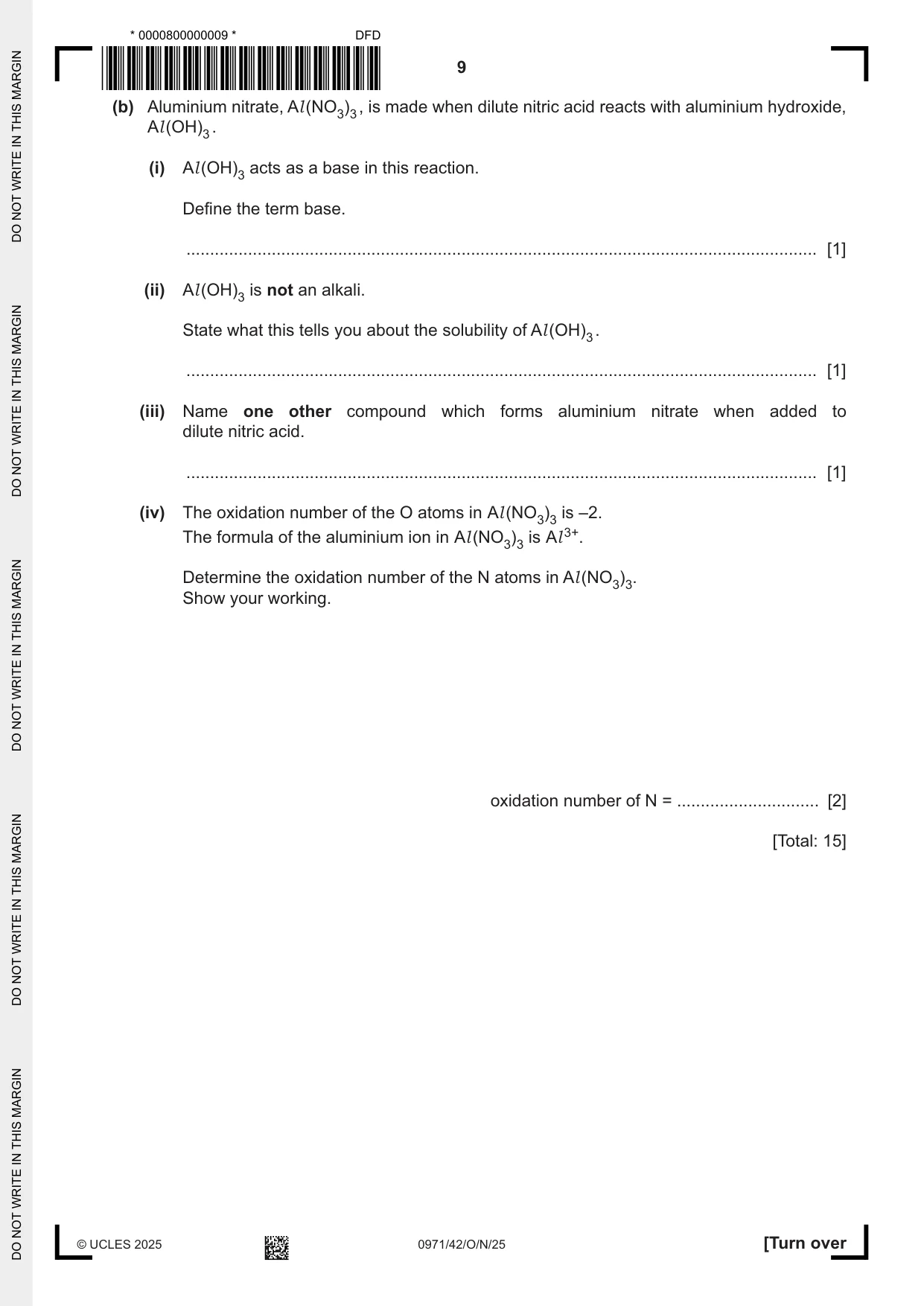
4 Nitric acid, HNO3 , and sulfuric acid, H2SO4 , are strong acids. Ethanoic acid, CH3COOH, is a weak acid. (a) One mole of each acid is added separately to 1000 cm3 of distilled water to form a dilute solution. All three acids dissociate in distilled water. (i) State the formula of the common cation produced when each of the three acids dissociates in water. ..................................................................................................................................... [1] (ii) Explain, in terms of dissociation, why: • nitric acid is described as a strong acid ........................................................................................................................................... • ethanoic acid is described as a weak acid. ........................................................................................................................................... [2] (iii) State which of the three dilute acids will have the highest pH value. ..................................................................................................................................... [1] (iv) State the colour of thymolphthalein in all three dilute acids. ..................................................................................................................................... [1] (v) Give the formula of the anion formed when: • sulfuric acid dissociates in water ........................................................................................................................................... • ethanoic acid dissociates in water. ........................................................................................................................................... [2] (vi) Name the two gaseous products formed during the electrolysis of dilute sulfuric acid using inert electrodes. ............................................................... and ............................................................... [2] (vii) Name the salt formed when calcium reacts with ethanoic acid. ..................................................................................................................................... [1] (b) Aluminium nitrate, Al (NO3)3 , is made when dilute nitric acid reacts with aluminium hydroxide, Al (OH)3 . (i) Al (OH)3 acts as a base in this reaction. Define the term base. ..................................................................................................................................... [1] (ii) Al (OH)3 is not an alkali. State what this tells you about the solubility of Al (OH)3 . ..................................................................................................................................... [1] (iii) Name one other compound which forms aluminium nitrate when added to dilute nitric acid. ..................................................................................................................................... [1] (iv) The oxidation number of the O atoms in Al (NO3)3 is –2. The formula of the aluminium ion in Al (NO3)3 is Al 3+. Determine the oxidation number of the N atoms in Al (NO3)3. Show your working. oxidation number of N = .............................. [2] [Total: 15]
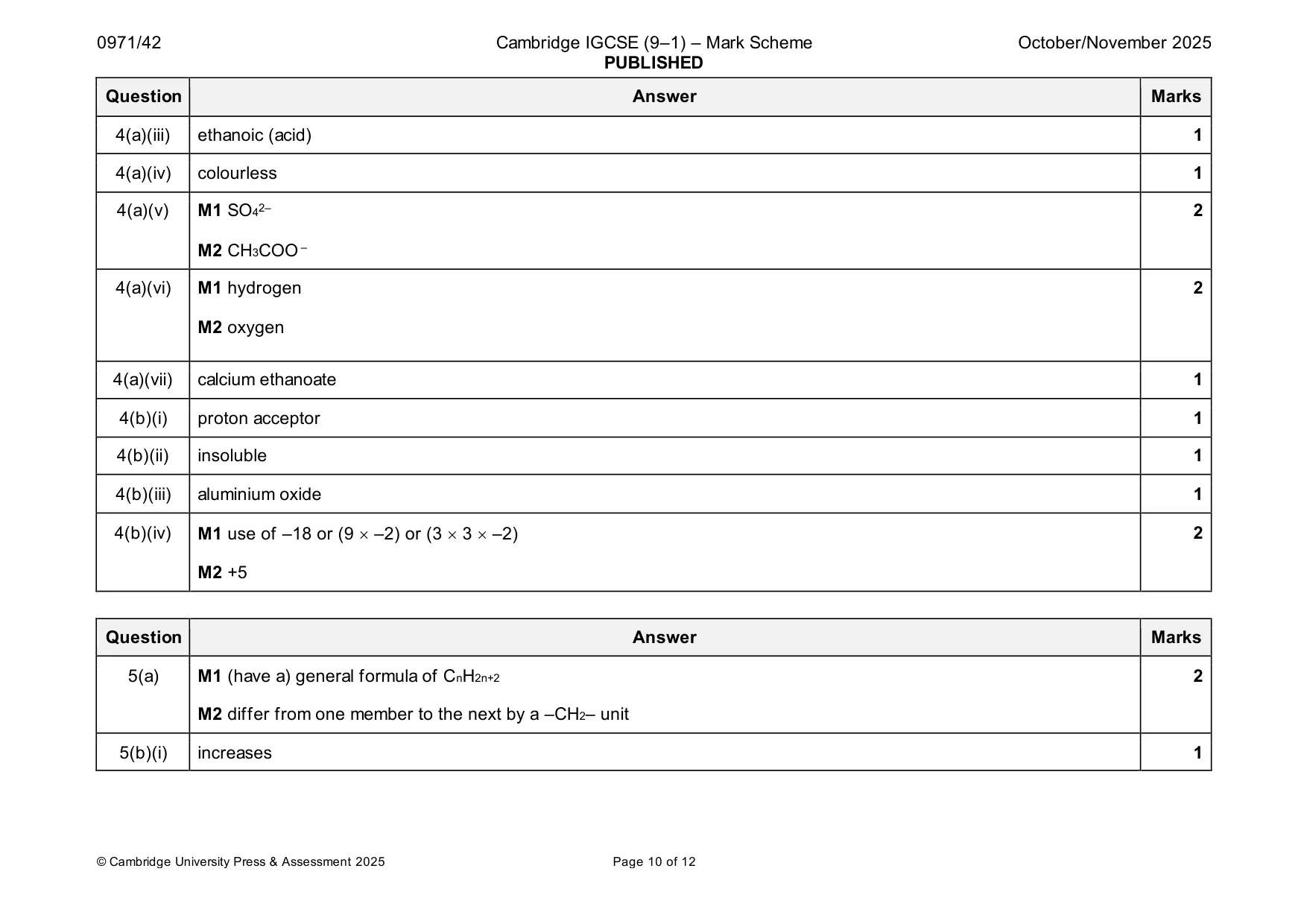
Mark scheme: 4(a)(i) H+ 1 4(a)(ii) M1 complete (dissociation) 2 M2 partial (dissociation) 4(a)(iii) ethanoic (acid) 1 4(a)(iv) colourless 1 4(a)(v) M1 SO42– 2 M2 CH3COO – 4(a)(vi) M1 hydrogen 2 M2 oxygen 4(a)(vii) calcium ethanoate 1 4(b)(i) proton acceptor 1 4(b)(ii) insoluble 1 4(b)(iii) aluminium oxide 1 4(b)(iv) M1 use of –18 or (9 –2) or (3 3 –2) 2 M2 +5
More questions on The characteristic properties of acids and bases
Q5 · This question is about the homologous series of alkanes
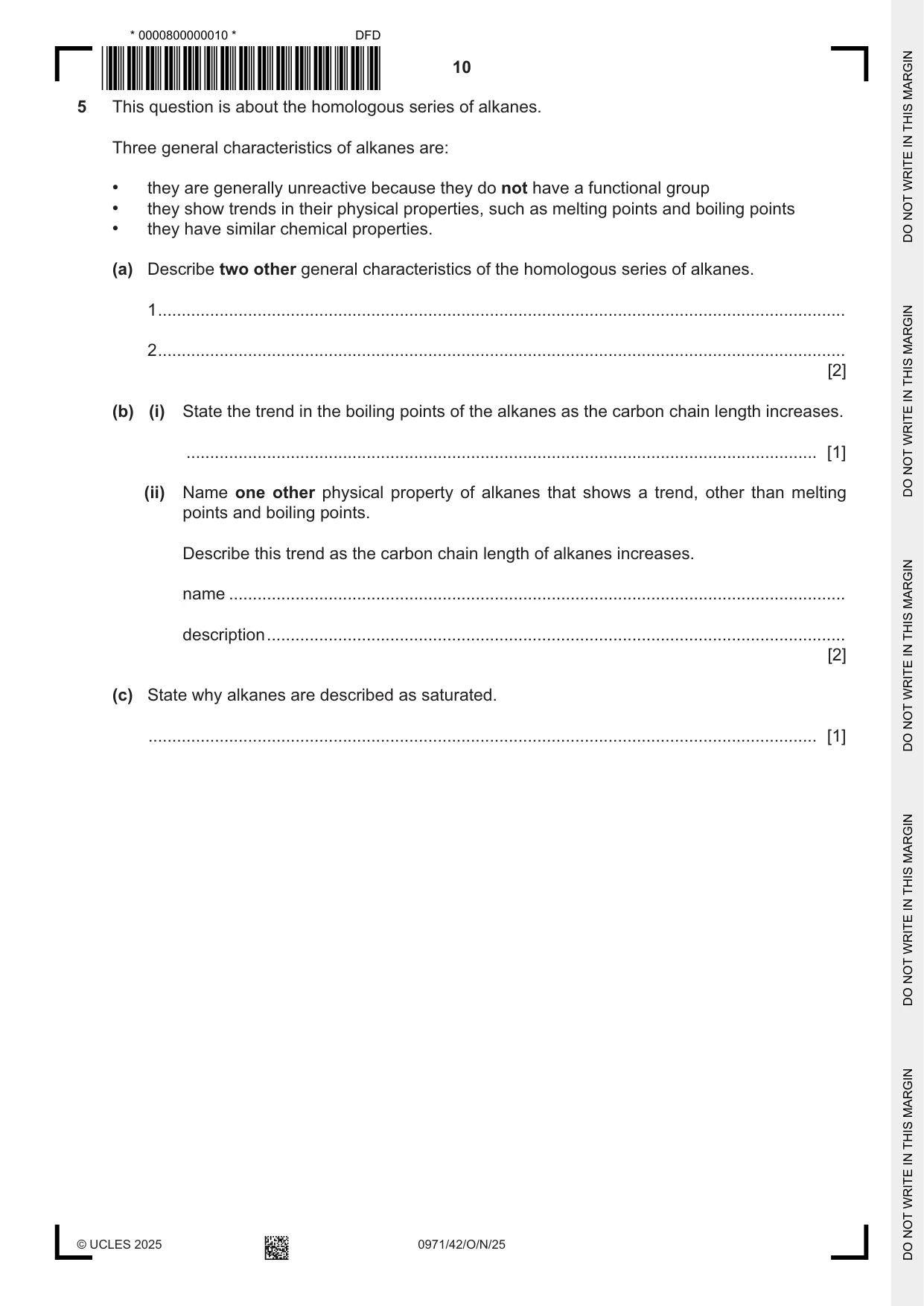
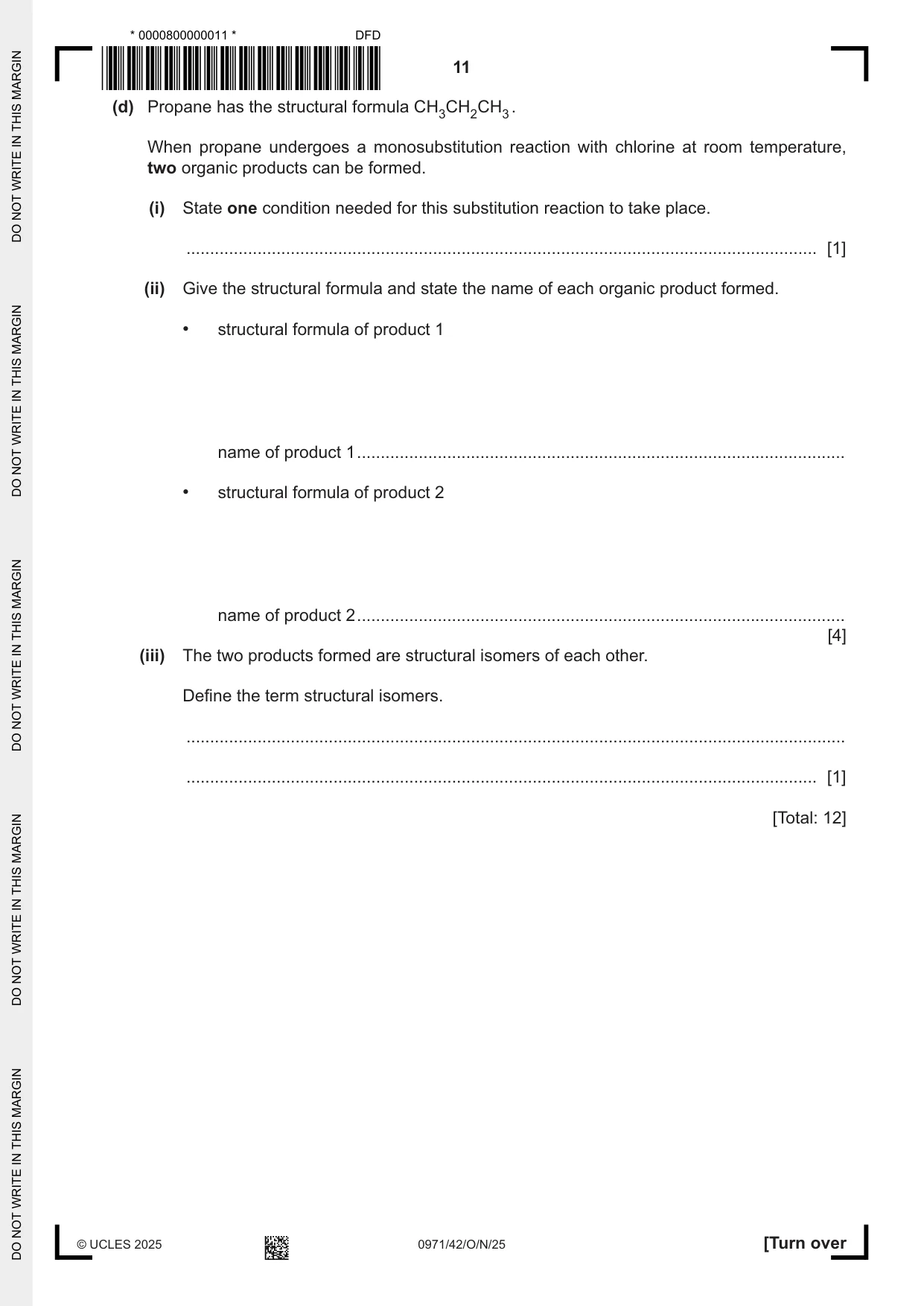
5 This question is about the homologous series of alkanes. Three general characteristics of alkanes are: • they are generally unreactive because they do not have a functional group • they show trends in their physical properties, such as melting points and boiling points • they have similar chemical properties. (a) Describe two other general characteristics of the homologous series of alkanes. 1 ................................................................................................................................................. 2 ................................................................................................................................................. [2] (b) (i) State the trend in the boiling points of the alkanes as the carbon chain length increases. ..................................................................................................................................... [1] (ii) Name one other physical property of alkanes that shows a trend, other than melting points and boiling points. Describe this trend as the carbon chain length of alkanes increases. name .................................................................................................................................. description .......................................................................................................................... [2] (c) State why alkanes are described as saturated. ............................................................................................................................................. [1] (d) Propane has the structural formula CH3CH2CH3 . When propane undergoes a monosubstitution reaction with chlorine at room temperature, two organic products can be formed. (i) State one condition needed for this substitution reaction to take place. ..................................................................................................................................... [1] (ii) Give the structural formula and state the name of each organic product formed. • structural formula of product 1 name of product 1 ....................................................................................................... • structural formula of product 2 name of product 2 ....................................................................................................... [4] (iii) The two products formed are structural isomers of each other. Define the term structural isomers. ........................................................................................................................................... ..................................................................................................................................... [1] [Total: 12]
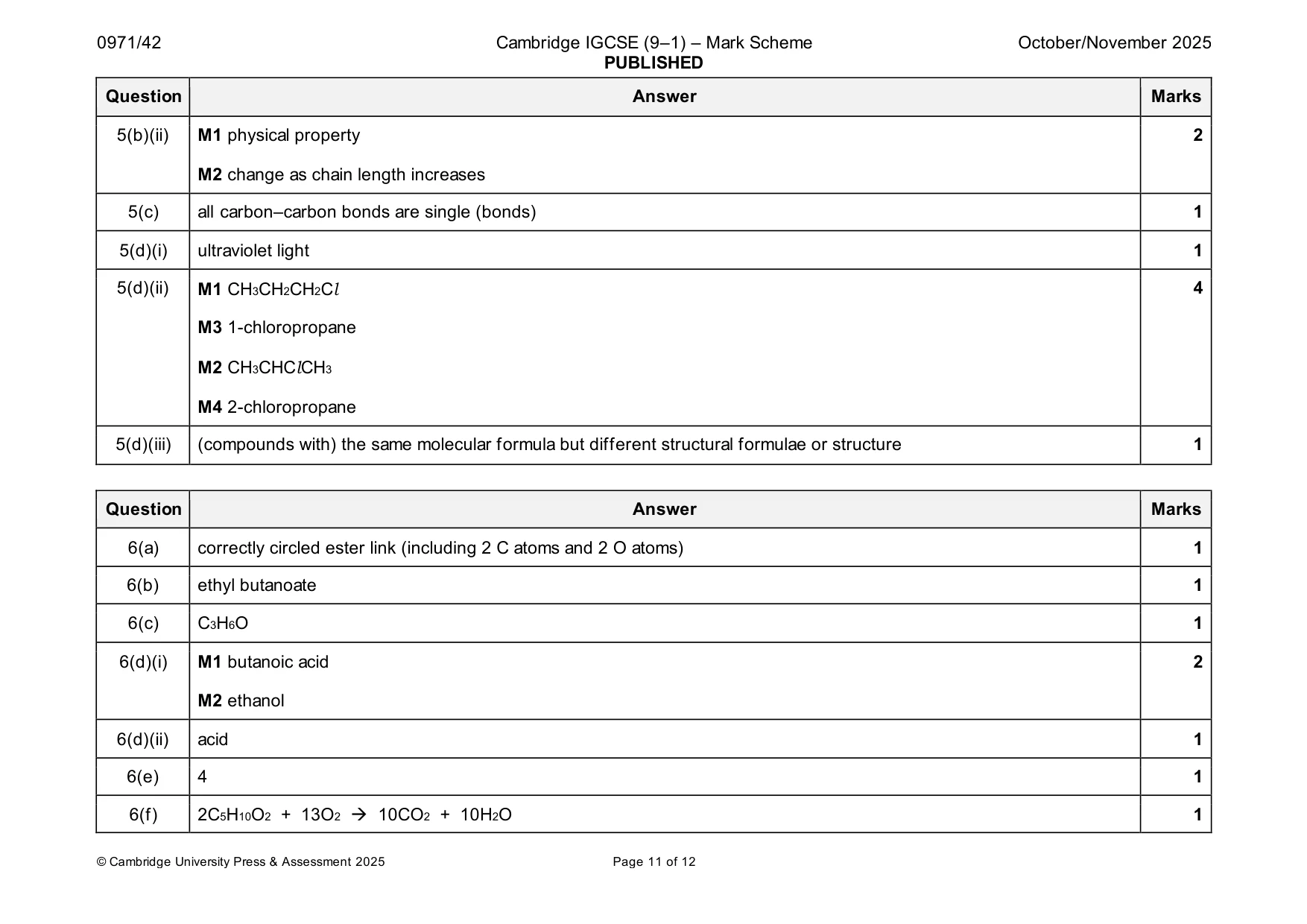
Mark scheme: 5(a) M1 (have a) general formula of CnH2n+2 2 M2 differ from one member to the next by a –CH2– unit 5(b)(i) increases 1 5(b)(ii) M1 physical property 2 M2 change as chain length increases 5(c) all carbon–carbon bonds are single (bonds) 1 5(d)(i) ultraviolet light 1 5(d)(ii) M1 CH3CH2CH2Cl 4 M3 1-chloropropane M2 CH3CHClCH3 M4 2-chloropropane 5(d)(iii) (compounds with) the same molecular formula but different structural formulae or structure 1
Q6 · Compound E shown in Fig
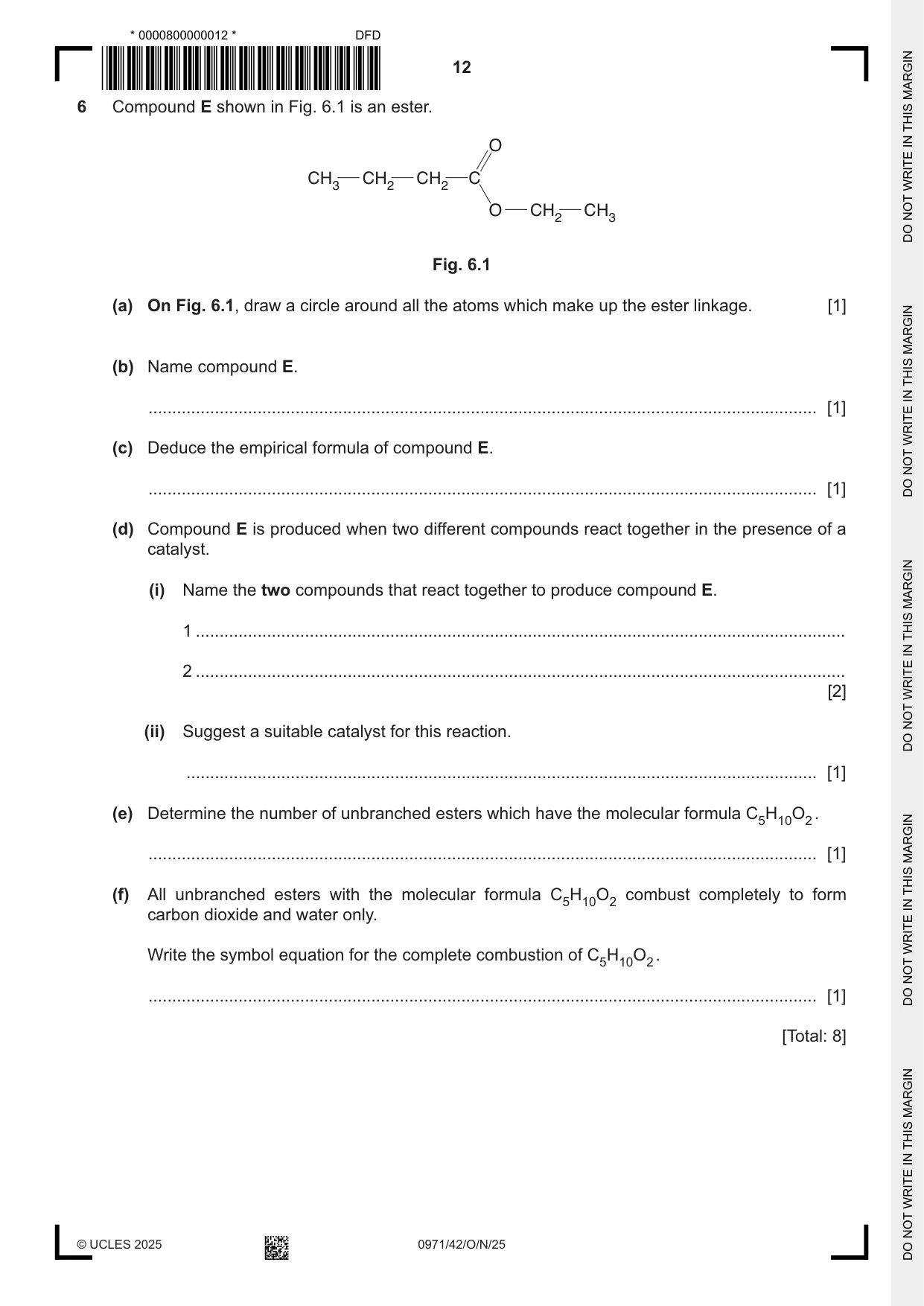
6 Compound E shown in Fig. 6.1 is an ester. O CH3 CH2 CH2 C O CH2 CH3 Fig. 6.1 (a) On Fig. 6.1, draw a circle around all the atoms which make up the ester linkage. [1] (b) Name compound E. ............................................................................................................................................. [1] (c) Deduce the empirical formula of compound E. ............................................................................................................................................. [1] (d) Compound E is produced when two different compounds react together in the presence of a catalyst. (i) Name the two compounds that react together to produce compound E. 1 ......................................................................................................................................... 2 ......................................................................................................................................... [2] (ii) Suggest a suitable catalyst for this reaction. ..................................................................................................................................... [1] (e) Determine the number of unbranched esters which have the molecular formula C5H10O2 . ............................................................................................................................................. [1] (f) All unbranched esters with the molecular formula C5H10O2 combust completely to form carbon dioxide and water only. Write the symbol equation for the complete combustion of C5H10O2 . ............................................................................................................................................. [1] [Total: 8]
Mark scheme: 6(a) correctly circled ester link (including 2 C atoms and 2 O atoms) 1 6(b) ethyl butanoate 1 6(c) C3H6O 1 6(d)(i) M1 butanoic acid 2 M2 ethanol 6(d)(ii) acid 1 6(e) 4 1 6(f) 2C5H10O2 + 13O2 → 10CO2 + 10H2O 1
What was in this paper
The subtopics covered by these 6 questions, and how many questions each got. Open one in a new tab to see every Cambridge question on it.
What you needed in this session
Cambridge’s own grade thresholds for 2025 Oct/Nov, Paper 4 · Variant 2. A higher threshold means an easier paper — the bar moves with how the cohort did.