Cambridge IGCSE Chemistry (9-1) 0971 — 2024 Oct/Nov Paper 4 · Variant 2
0971/42/O/N/24 · 6 questions · 80 marks · 75 min
The question paper and its mark scheme, free to read here and free to download. This is Cambridge’s own paper, exactly as it was sat.
Question paper16 pages
Mark scheme10 pages
Answers below. Sit the paper first if you are practising.
Questions as text
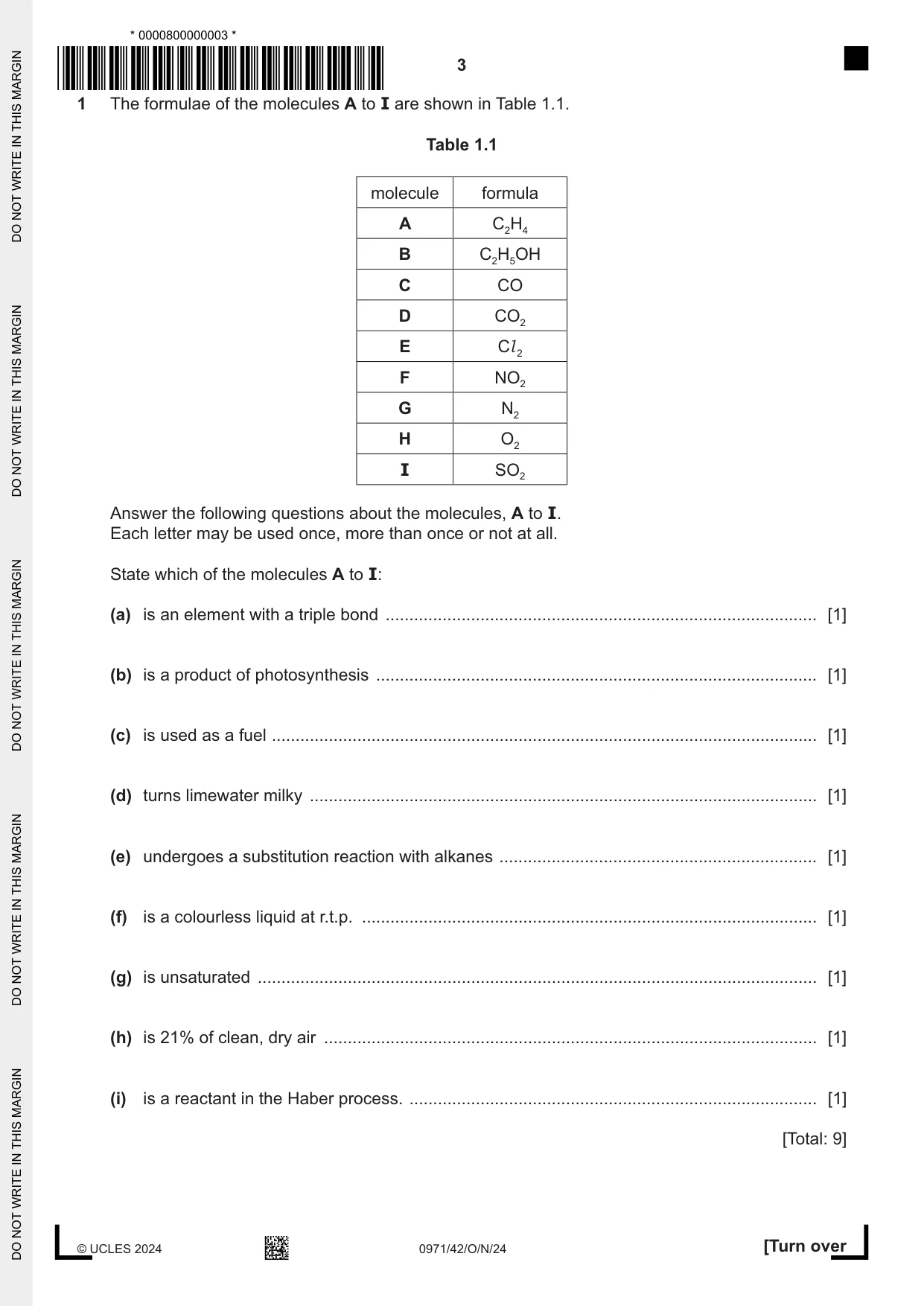
Q1 · The formulae of the molecules A to I are shown in Table 1.1
1 The formulae of the molecules A to I are shown in Table 1.1. Table 1.1 molecule formula A C2H4 B C2H5OH C CO D CO2 E Cl 2 F NO2 G N2 H O2 I SO2 Answer the following questions about the molecules, A to I. Each letter may be used once, more than once or not at all. State which of the molecules A to I: (a) is an element with a triple bond ........................................................................................... [1] (b) is a product of photosynthesis ............................................................................................. [1] (c) is used as a fuel ................................................................................................................... [1] (d) turns limewater milky ........................................................................................................... [1] (e) undergoes a substitution reaction with alkanes ................................................................... [1] (f) is a colourless liquid at r.t.p. ................................................................................................ [1] (g) is unsaturated ...................................................................................................................... [1] (h) is 21% of clean, dry air ........................................................................................................ [1] (i) is a reactant in the Haber process. ...................................................................................... [1] [Total: 9]
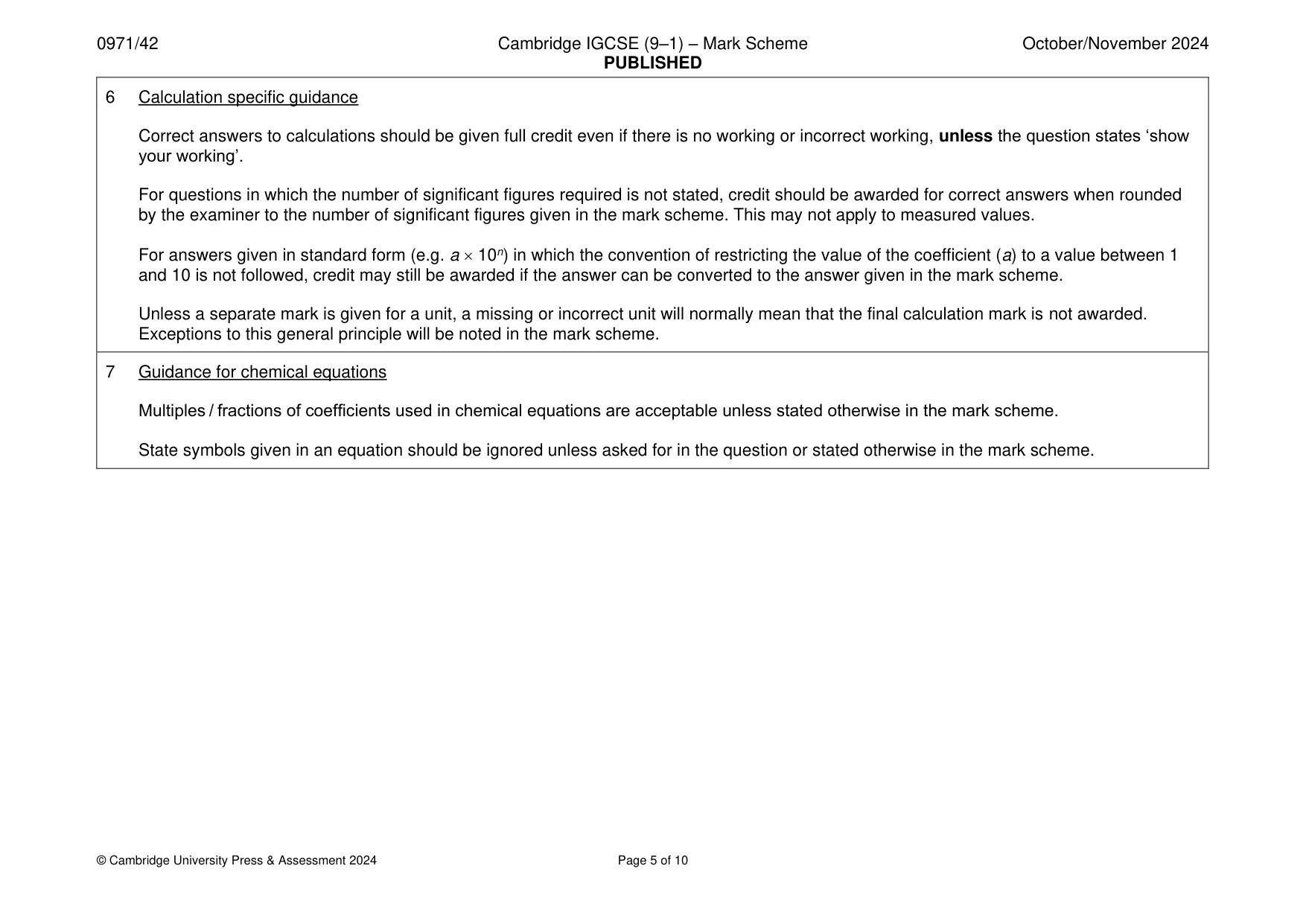
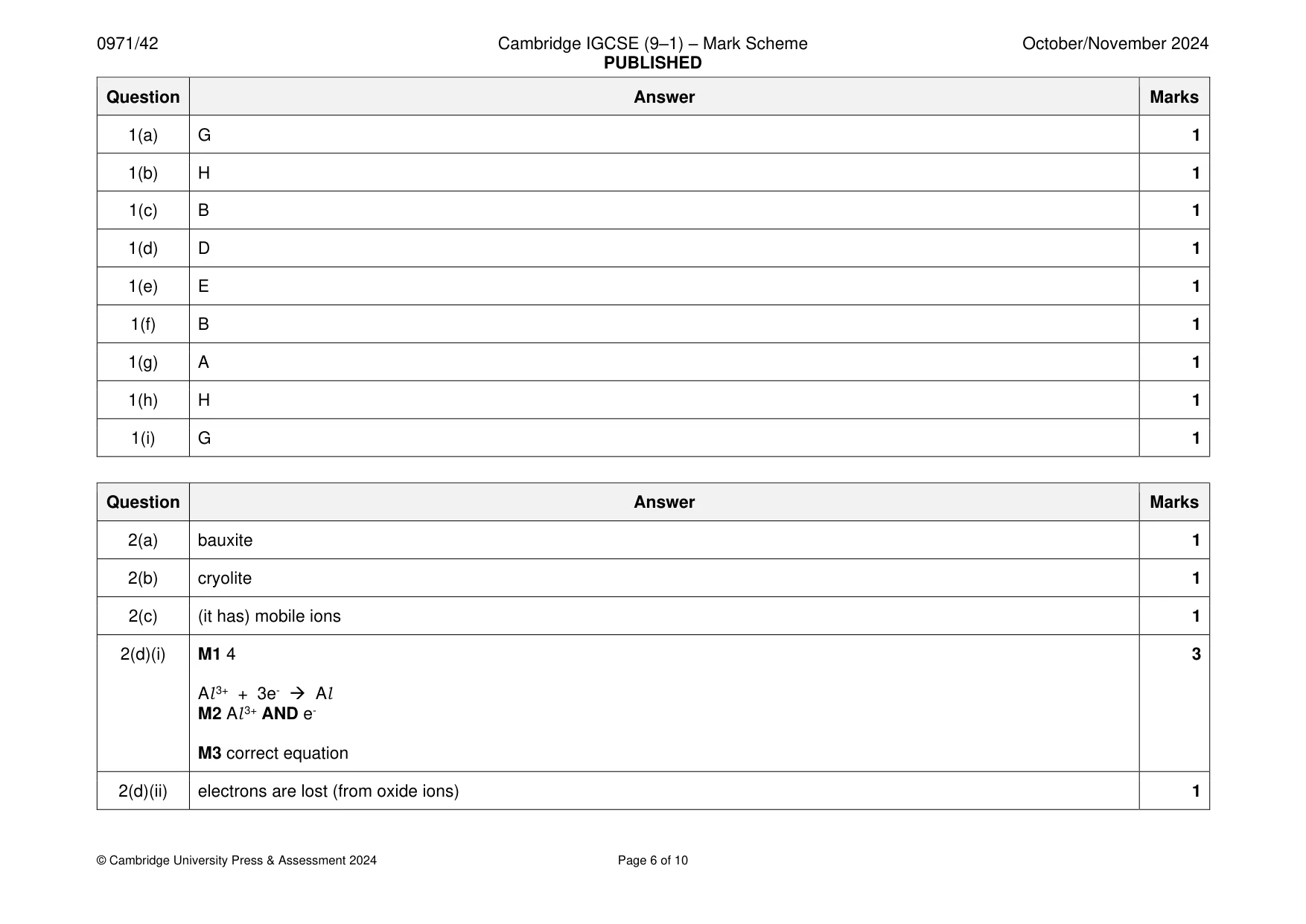
Mark scheme: Question Answer Marks 1(a) G 1 1(b) H 1 1(c) B 1 1(d) D 1 1(e) E 1 1(f) B 1 1(g) A 1 1(h) H 1 1(i) G 1
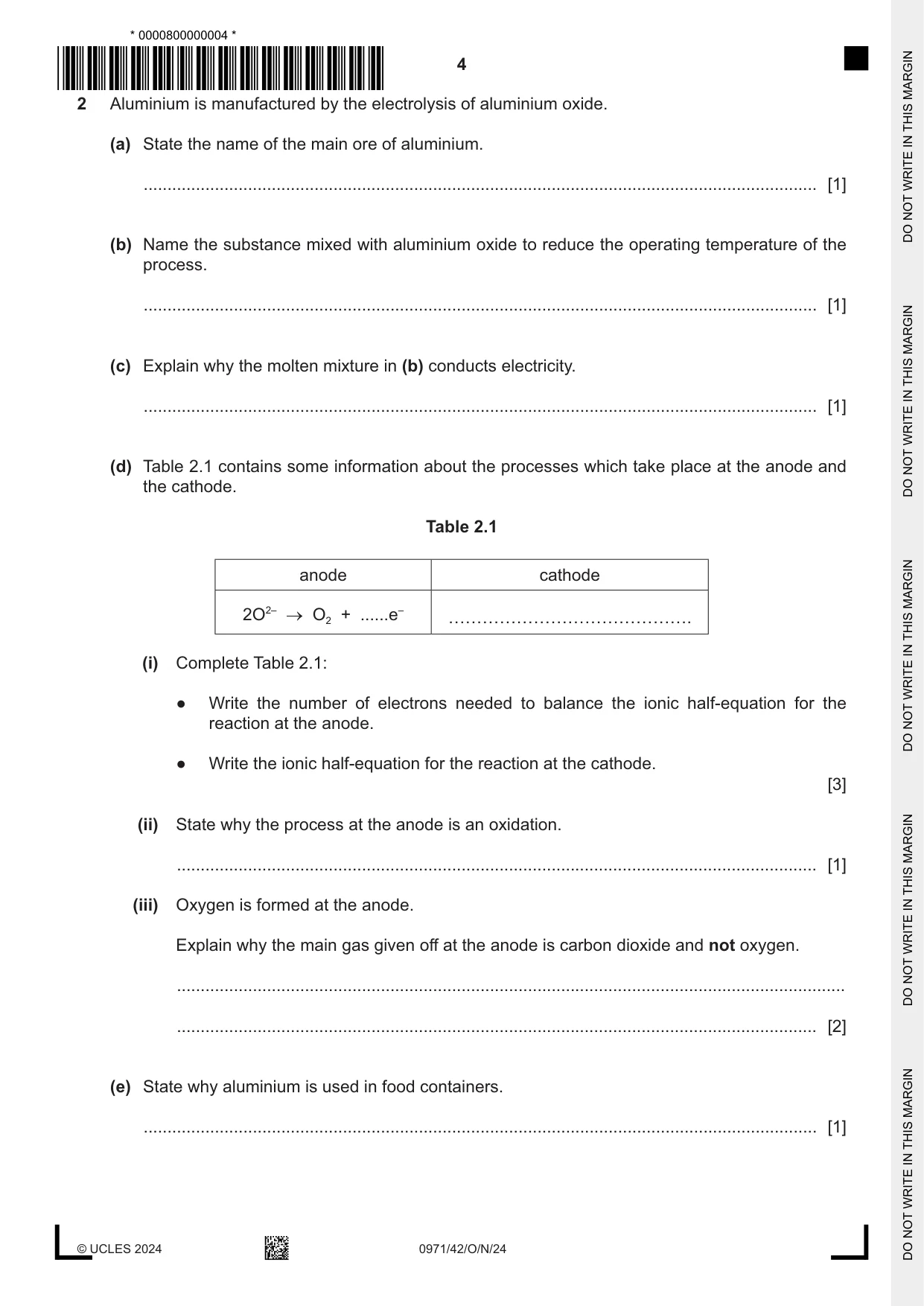
Q2 · Aluminium is manufactured by the electrolysis of aluminium oxide
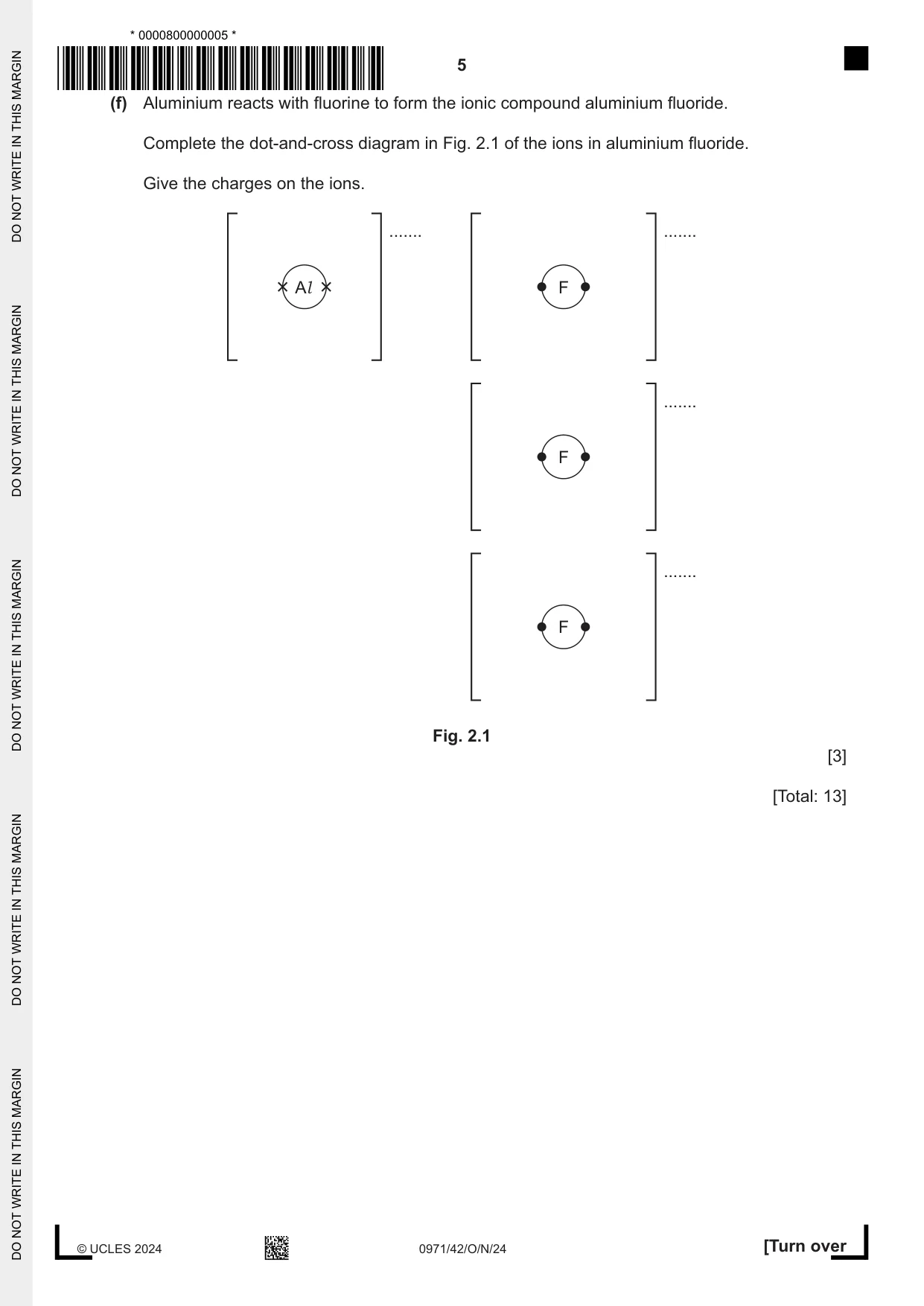
2 Aluminium is manufactured by the electrolysis of aluminium oxide. (a) State the name of the main ore of aluminium. .............................................................................................................................................. [1] (b) Name the substance mixed with aluminium oxide to reduce the operating temperature of the process. .............................................................................................................................................. [1] (c) Explain why the molten mixture in (b) conducts electricity. .............................................................................................................................................. [1] (d) Table 2.1 contains some information about the processes which take place at the anode and the cathode. Table 2.1 anode cathode 2O2– → O2 + ......e– (i) Complete Table 2.1: ● Write the number of electrons needed to balance the ionic half-equation for the reaction at the anode. ● Write the ionic half-equation for the reaction at the cathode. [3] (ii) State why the process at the anode is an oxidation. ....................................................................................................................................... [1] (iii) Oxygen is formed at the anode. Explain why the main gas given off at the anode is carbon dioxide and not oxygen. ............................................................................................................................................. ....................................................................................................................................... [2] (e) State why aluminium is used in food containers. .............................................................................................................................................. [1] (f) Aluminium reacts with fluorine to form the ionic compound aluminium fluoride. Complete the dot-and-cross diagram in Fig. 2.1 of the ions in aluminium fluoride. Give the charges on the ions. ....... ....... Al F ....... F ....... F Fig. 2.1 [3] [Total: 13]
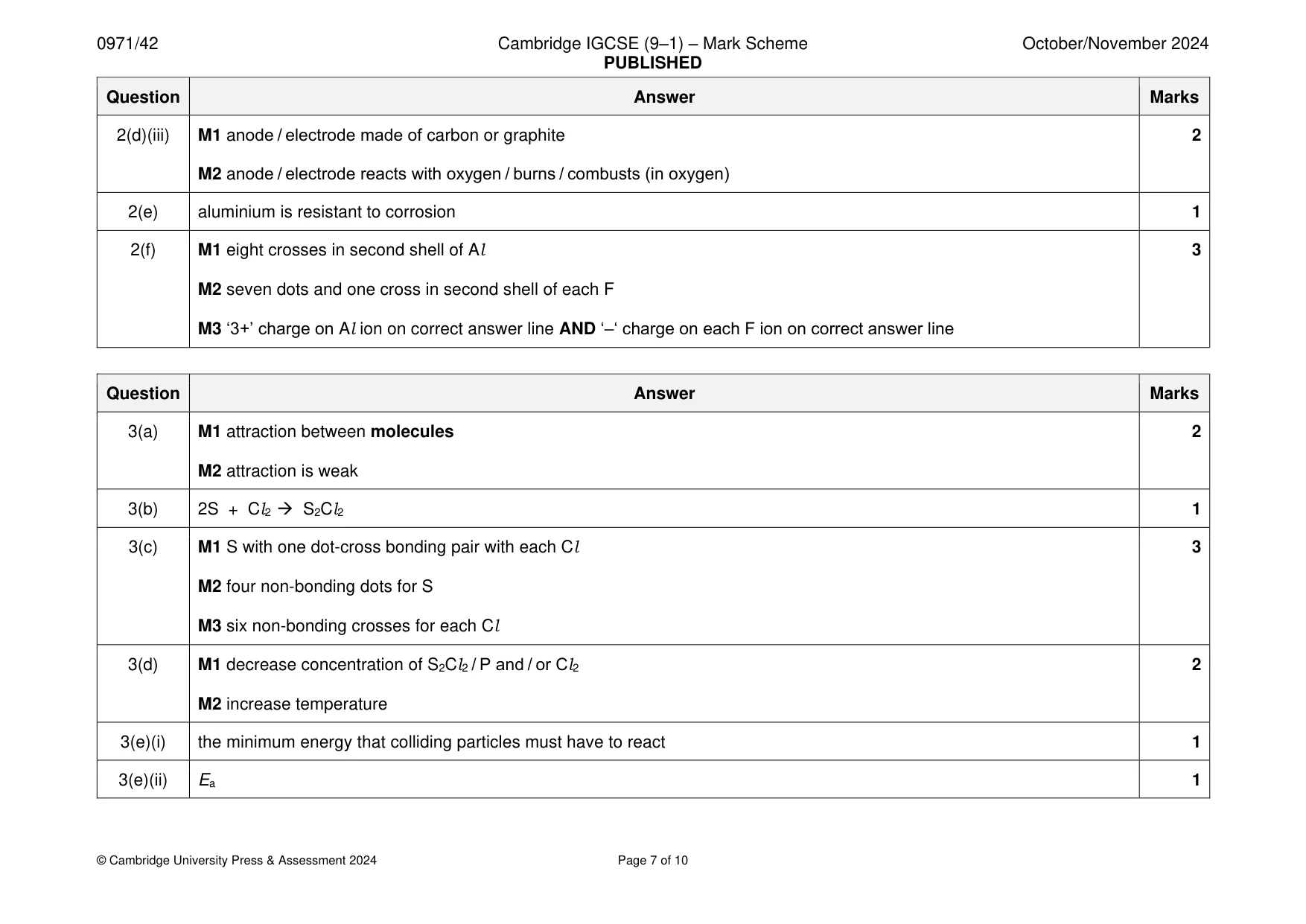
Mark scheme: 2(a) bauxite 1 2(b) cryolite 1 2(c) (it has) mobile ions 1 2(d)(i) M1 4 3 Al 3+ + 3e- → Al M2 Al 3+ AND e- M3 correct equation 2(d)(ii) electrons are lost (from oxide ions) 1 2(d)(iii) M1 anode / electrode made of carbon or graphite 2 M2 anode / electrode reacts with oxygen / burns / combusts (in oxygen) 2(e) aluminium is resistant to corrosion 1 2(f) M1 eight crosses in second shell of Al 3 M2 seven dots and one cross in second shell of each F M3 ‘3+’ charge on Al ion on correct answer line AND ‘–‘ charge on each F ion on correct answer line
Q3 · Sulfur forms two chlorides, P and Q
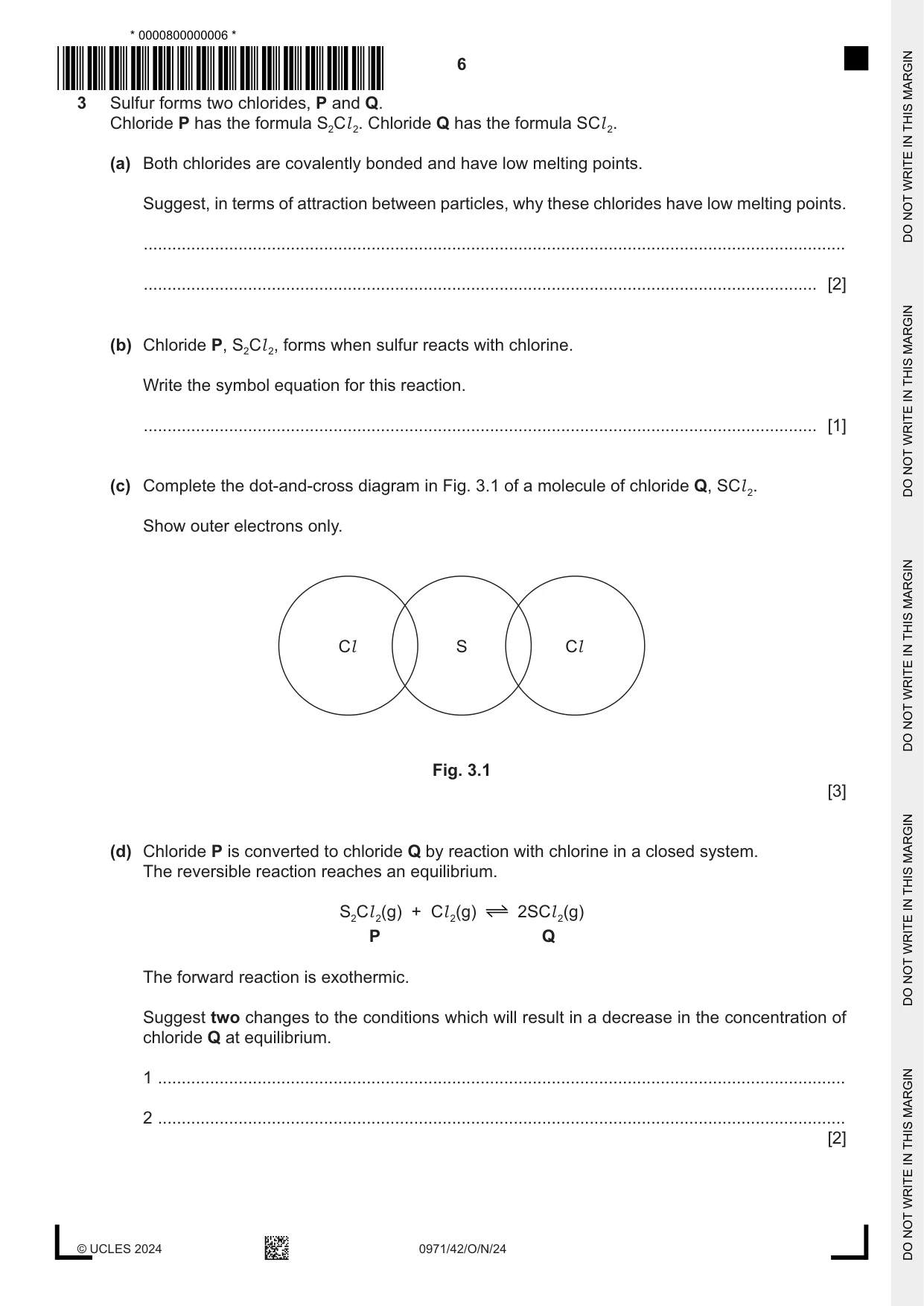
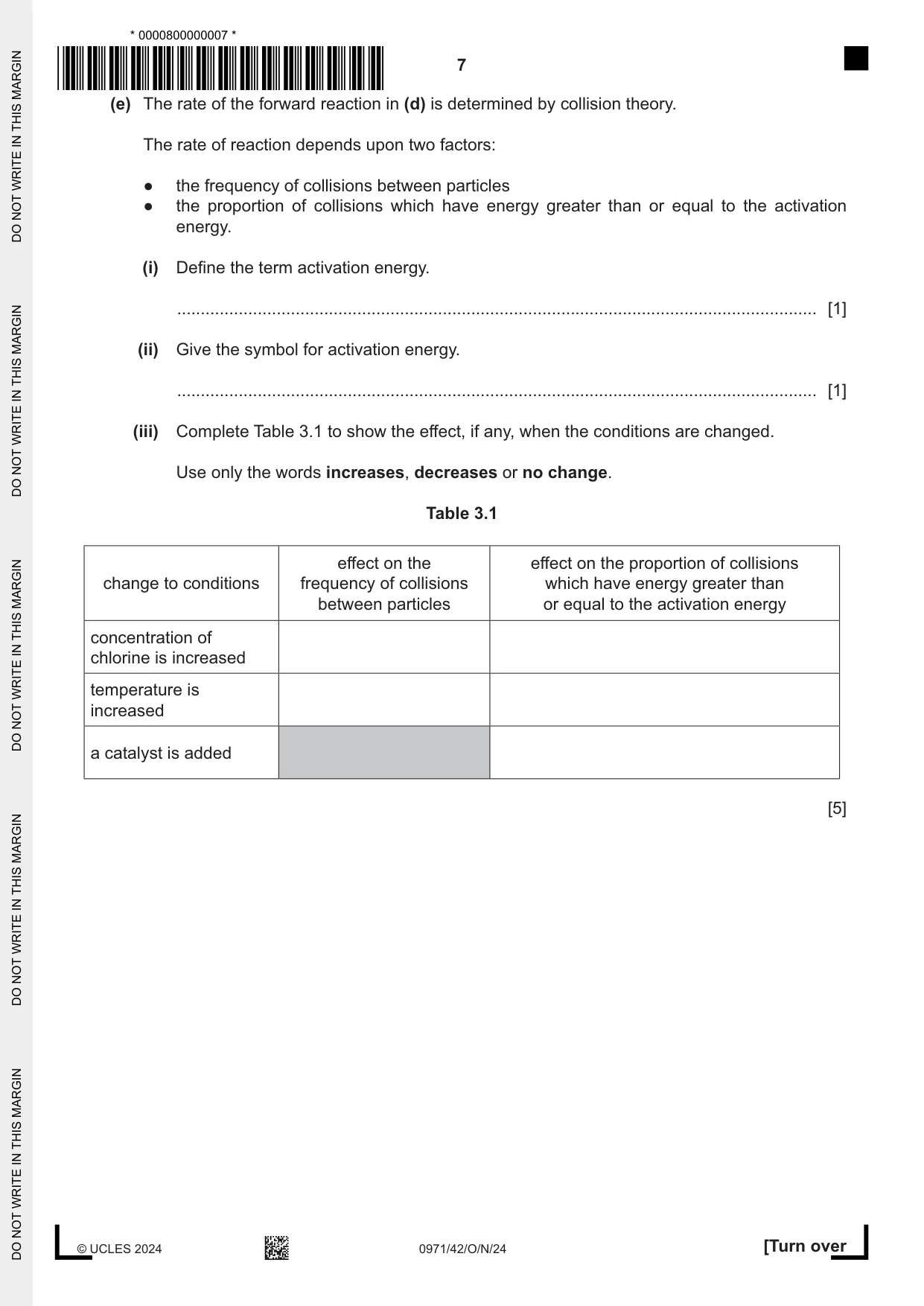
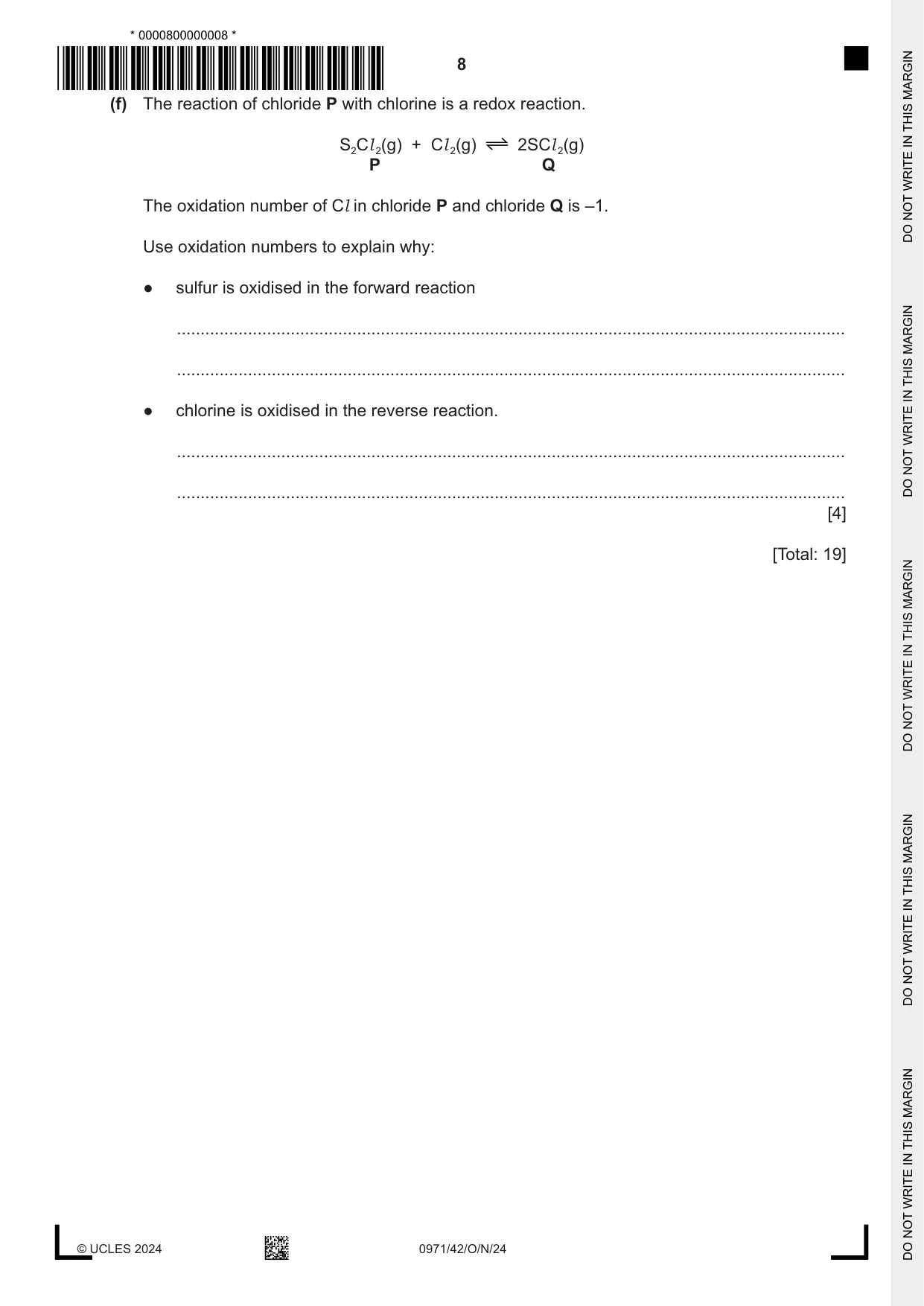
3 Sulfur forms two chlorides, P and Q. Chloride P has the formula S2Cl 2. Chloride Q has the formula SCl 2. (a) Both chlorides are covalently bonded and have low melting points. Suggest, in terms of attraction between particles, why these chlorides have low melting points. .................................................................................................................................................... .............................................................................................................................................. [2] (b) Chloride P, S2Cl 2, forms when sulfur reacts with chlorine. Write the symbol equation for this reaction. .............................................................................................................................................. [1] (c) Complete the dot-and-cross diagram in Fig. 3.1 of a molecule of chloride Q, SCl 2. Show outer electrons only. Cl S Cl Fig. 3.1 [3] (d) Chloride P is converted to chloride Q by reaction with chlorine in a closed system. The reversible reaction reaches an equilibrium. S2Cl 2(g) + Cl 2(g) 2SCl 2(g) P Q The forward reaction is exothermic. Suggest two changes to the conditions which will result in a decrease in the concentration of chloride Q at equilibrium. 1 ................................................................................................................................................. 2 ................................................................................................................................................. [2] (e) The rate of the forward reaction in (d) is determined by collision theory. The rate of reaction depends upon two factors: ● the frequency of collisions between particles ● the proportion of collisions which have energy greater than or equal to the activation energy. (i) Define the term activation energy. ....................................................................................................................................... [1] (ii) Give the symbol for activation energy. ....................................................................................................................................... [1] (iii) Complete Table 3.1 to show the effect, if any, when the conditions are changed. Use only the words increases, decreases or no change. Table 3.1 effect on the effect on the proportion of collisions change to conditions frequency of collisions which have energy greater than between particles or equal to the activation energy concentration of chlorine is increased temperature is increased a catalyst is added [5] (f) The reaction of chloride P with chlorine is a redox reaction. S2Cl 2(g) + Cl 2(g) 2SCl 2(g) P Q The oxidation number of Cl in chloride P and chloride Q is –1. Use oxidation numbers to explain why: ● sulfur is oxidised in the forward reaction ............................................................................................................................................. ............................................................................................................................................. ● chlorine is oxidised in the reverse reaction. ............................................................................................................................................. ............................................................................................................................................. [4] [Total: 19] Question 4 starts on the next page.
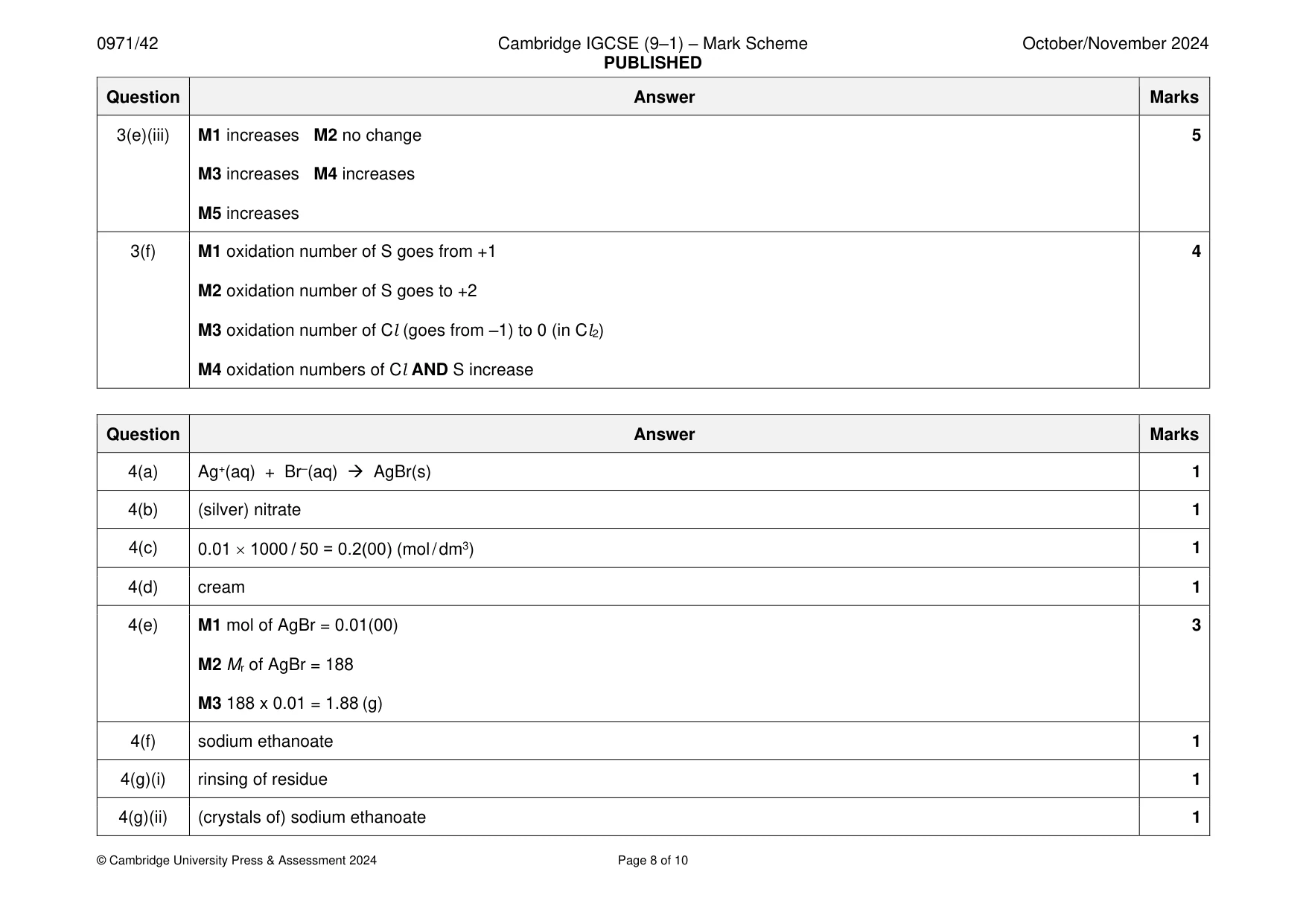
Mark scheme: 3(a) M1 attraction between molecules 2 M2 attraction is weak 3(b) 2S + Cl2 → S2Cl2 1 3(c) M1 S with one dot-cross bonding pair with each Cl 3 M2 four non-bonding dots for S M3 six non-bonding crosses for each Cl 3(d) M1 decrease concentration of S2Cl2 / P and / or Cl2 2 M2 increase temperature 3(e)(i) the minimum energy that colliding particles must have to react 1 3(e)(ii) Ea 1 3(e)(iii) M1 increases M2 no change 5 M3 increases M4 increases M5 increases 3(f) M1 oxidation number of S goes from +1 4 M2 oxidation number of S goes to +2 M3 oxidation number of Cl (goes from –1) to 0 (in Cl2) M4 oxidation numbers of Cl AND S increase
Q4 · Silver bromide, AgBr, is made when aqueous silver ethanoate, CH3COOAg, is added to…
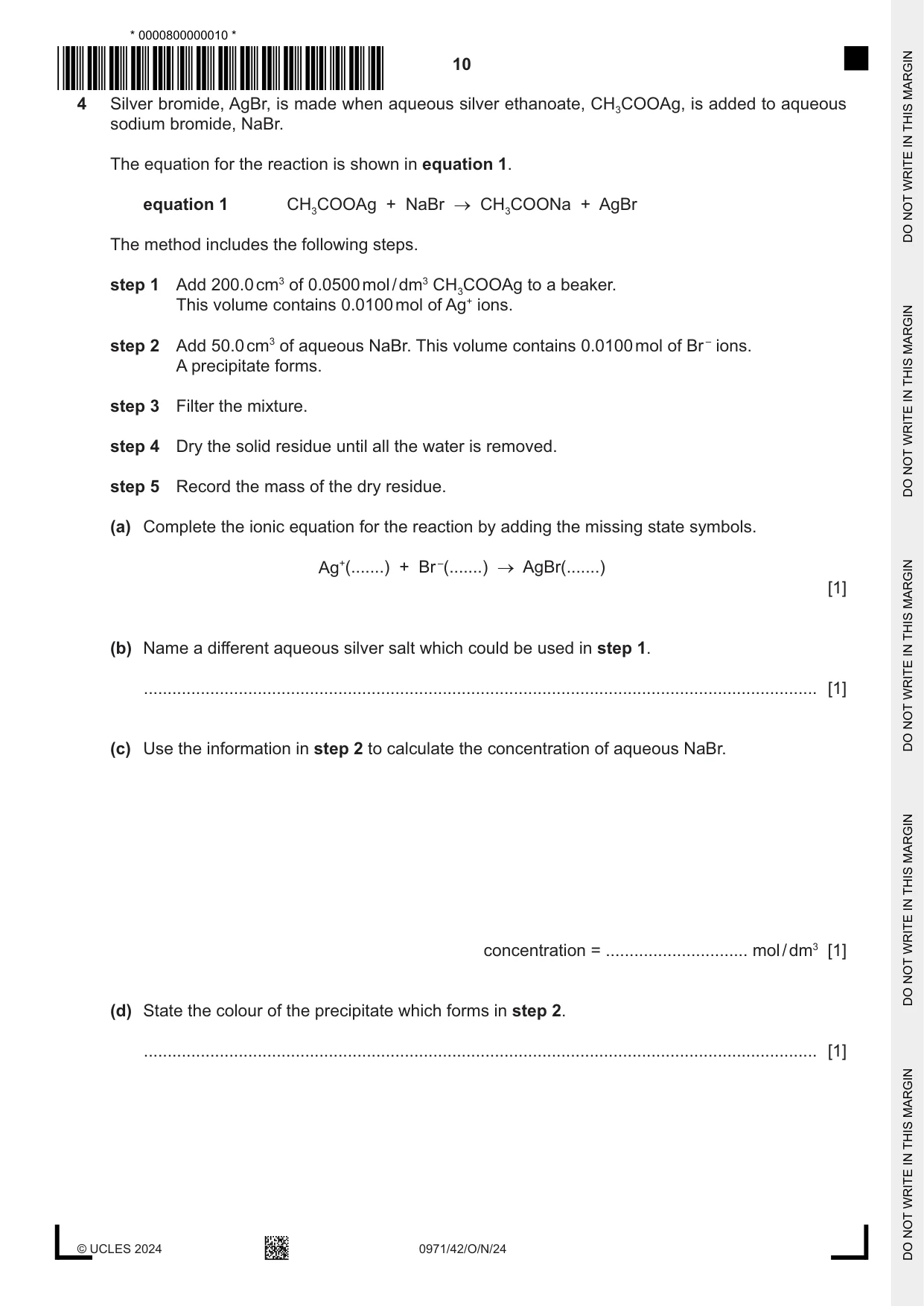
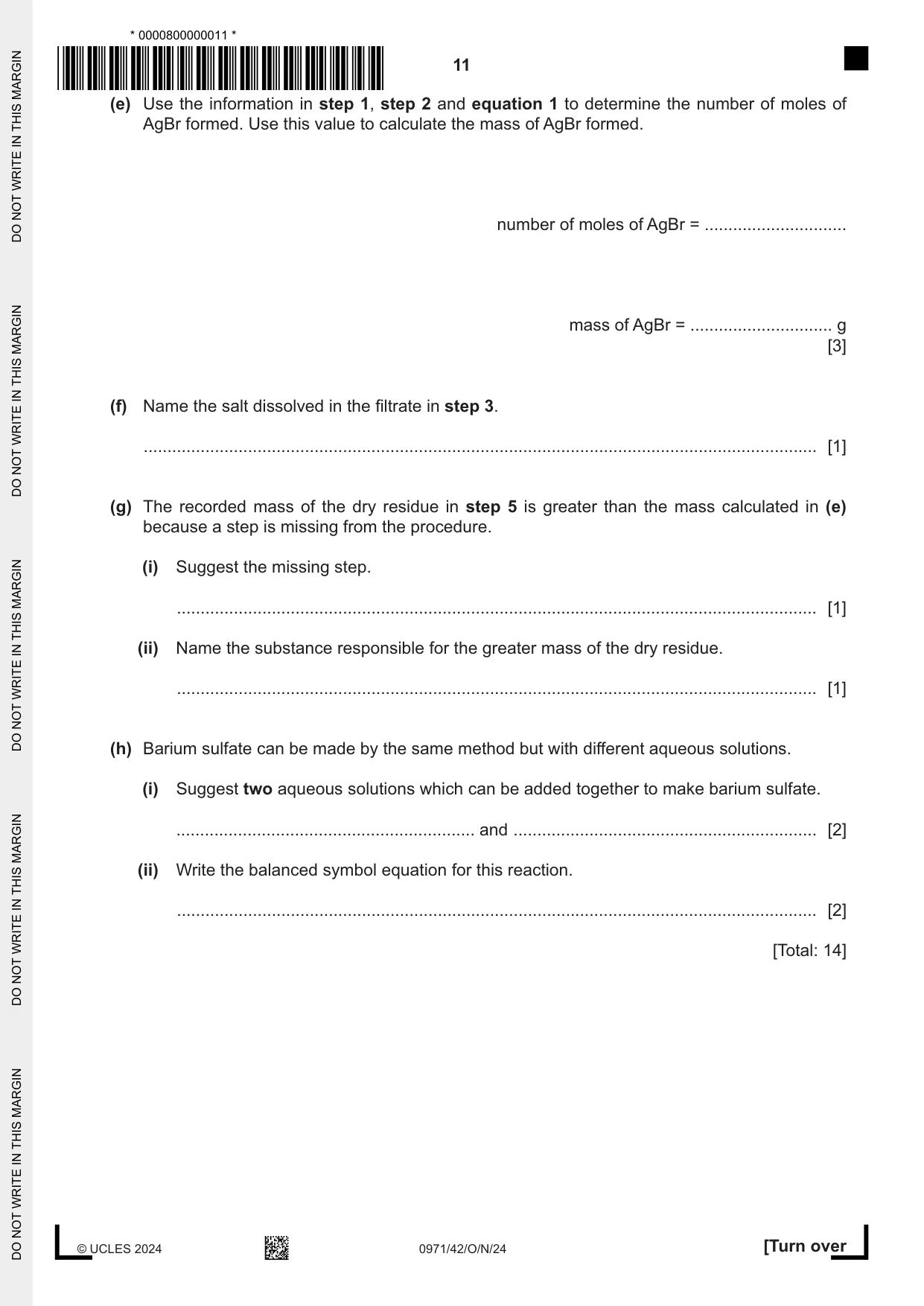
4 Silver bromide, AgBr, is made when aqueous silver ethanoate, CH3COOAg, is added to aqueous sodium bromide, NaBr. The equation for the reaction is shown in equation 1. equation 1 CH3COOAg + NaBr → CH3COONa + AgBr The method includes the following steps. step 1 Add 200.0 cm3 of 0.0500 mol / dm3 CH3COOAg to a beaker. This volume contains 0.0100 mol of Ag+ ions. step 2 Add 50.0 cm3 of aqueous NaBr. This volume contains 0.0100 mol of Br – ions. A precipitate forms. step 3 Filter the mixture. step 4 Dry the solid residue until all the water is removed. step 5 Record the mass of the dry residue. (a) Complete the ionic equation for the reaction by adding the missing state symbols. Ag+(.......) + Br –(.......) → AgBr(.......) [1] (b) Name a different aqueous silver salt which could be used in step 1. .............................................................................................................................................. [1] (c) Use the information in step 2 to calculate the concentration of aqueous NaBr. concentration = .............................. mol / dm3 [1] (d) State the colour of the precipitate which forms in step 2. .............................................................................................................................................. [1] (e) Use the information in step 1, step 2 and equation 1 to determine the number of moles of AgBr formed. Use this value to calculate the mass of AgBr formed. number of moles of AgBr = .............................. mass of AgBr = .............................. g [3] (f) Name the salt dissolved in the filtrate in step 3. .............................................................................................................................................. [1] (g) The recorded mass of the dry residue in step 5 is greater than the mass calculated in (e) because a step is missing from the procedure. (i) Suggest the missing step. ....................................................................................................................................... [1] (ii) Name the substance responsible for the greater mass of the dry residue. ....................................................................................................................................... [1] (h) Barium sulfate can be made by the same method but with different aqueous solutions. (i) Suggest two aqueous solutions which can be added together to make barium sulfate. ............................................................... and ................................................................ [2] (ii) Write the balanced symbol equation for this reaction. ....................................................................................................................................... [2] [Total: 14]
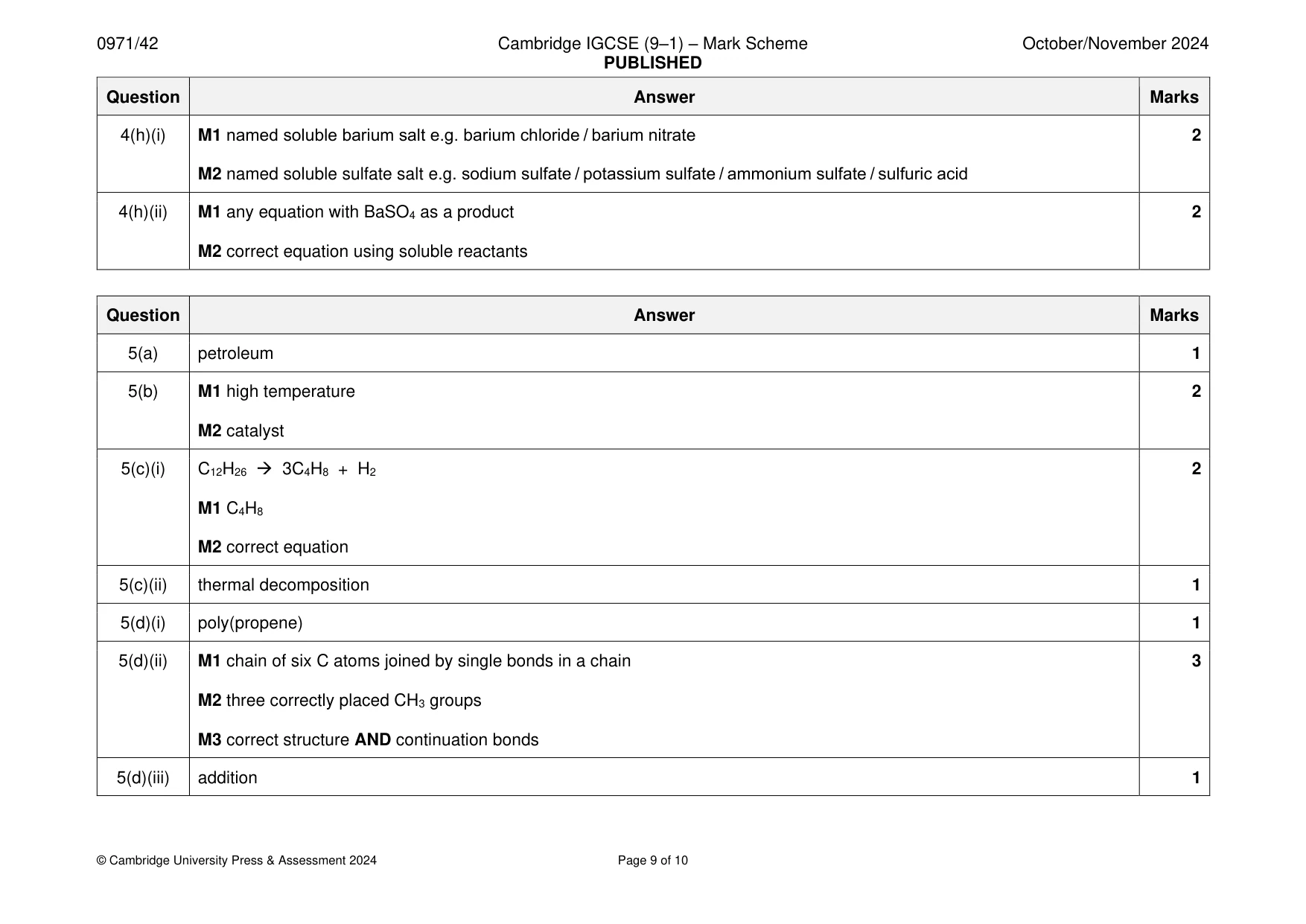
Mark scheme: 4(a) Ag+(aq) + Br–(aq) → AgBr(s) 1 4(b) (silver) nitrate 1 4(c) 0.01 1000 / 50 = 0.2(00) (mol / dm3) 1 4(d) cream 1 4(e) M1 mol of AgBr = 0.01(00) 3 M2 Mr of AgBr = 188 M3 188 x 0.01 = 1.88 (g) 4(f) sodium ethanoate 1 4(g)(i) rinsing of residue 1 4(g)(ii) (crystals of) sodium ethanoate 1 4(h)(i) M1 named soluble barium salt e.g. barium chloride / barium nitrate 2 M2 named soluble sulfate salt e.g. sodium sulfate / potassium sulfate / ammonium sulfate / sulfuric acid 4(h)(ii) M1 any equation with BaSO4 as a product 2 M2 correct equation using soluble reactants
Q5 · Alkenes are manufactured by cracking larger alkane molecules
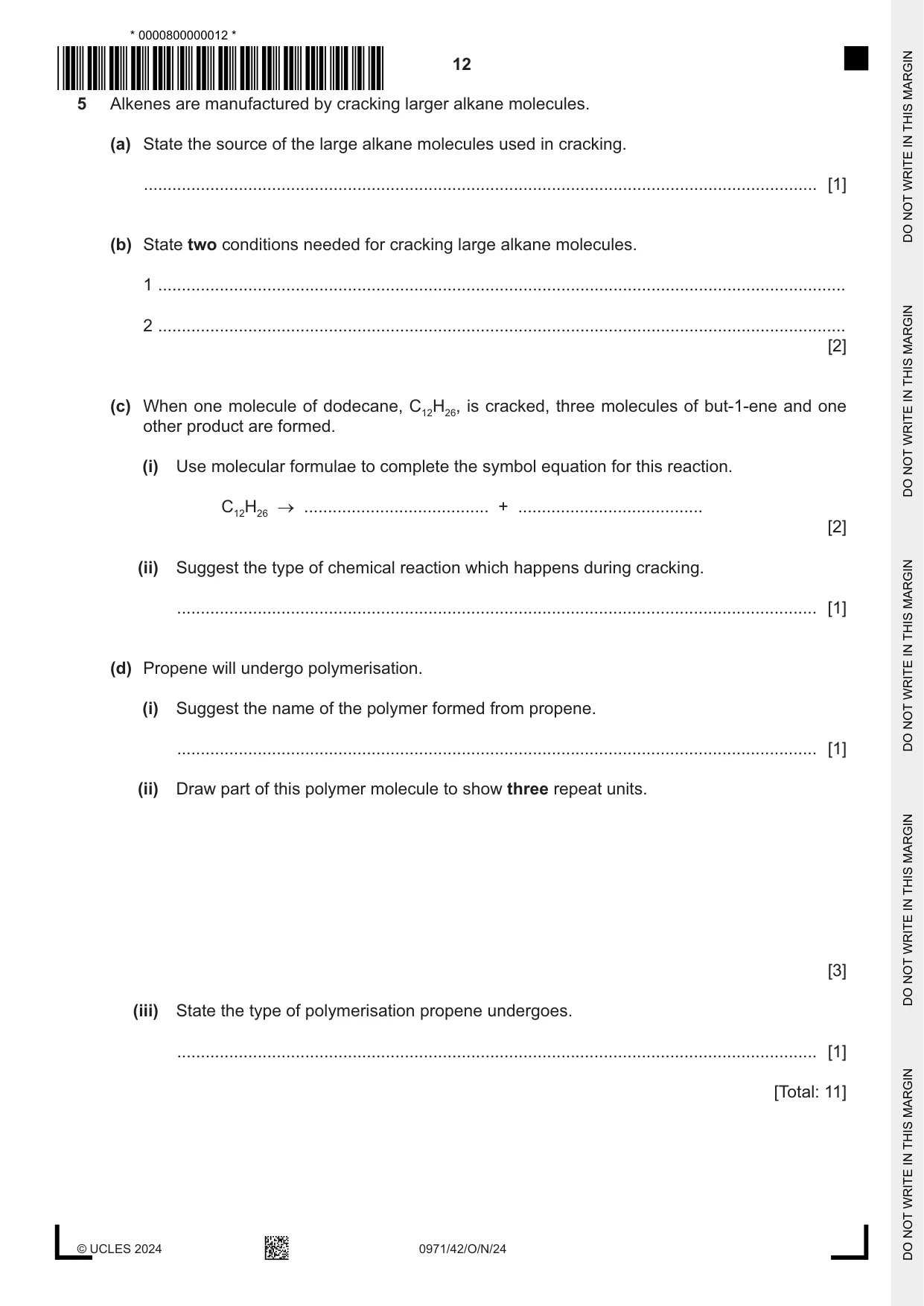
5 Alkenes are manufactured by cracking larger alkane molecules. (a) State the source of the large alkane molecules used in cracking. .............................................................................................................................................. [1] (b) State two conditions needed for cracking large alkane molecules. 1 ................................................................................................................................................. 2 ................................................................................................................................................. [2] (c) When one molecule of dodecane, C12H26, is cracked, three molecules of but-1-ene and one other product are formed. (i) Use molecular formulae to complete the symbol equation for this reaction. C12H26 → ....................................... + ....................................... [2] (ii) Suggest the type of chemical reaction which happens during cracking. ....................................................................................................................................... [1] (d) Propene will undergo polymerisation. (i) Suggest the name of the polymer formed from propene. ....................................................................................................................................... [1] (ii) Draw part of this polymer molecule to show three repeat units. [3] (iii) State the type of polymerisation propene undergoes. ....................................................................................................................................... [1] [Total: 11] Question 6 starts on the next page.
Mark scheme: 5(a) petroleum 1 5(b) M1 high temperature 2 M2 catalyst 5(c)(i) C12H26 → 3C4H8 + H2 2 M1 C4H8 M2 correct equation 5(c)(ii) thermal decomposition 1 5(d)(i) poly(propene) 1 5(d)(ii) M1 chain of six C atoms joined by single bonds in a chain 3 M2 three correctly placed CH3 groups M3 correct structure AND continuation bonds 5(d)(iii) addition 1
Q6 · Polyamides and polyesters are polymers
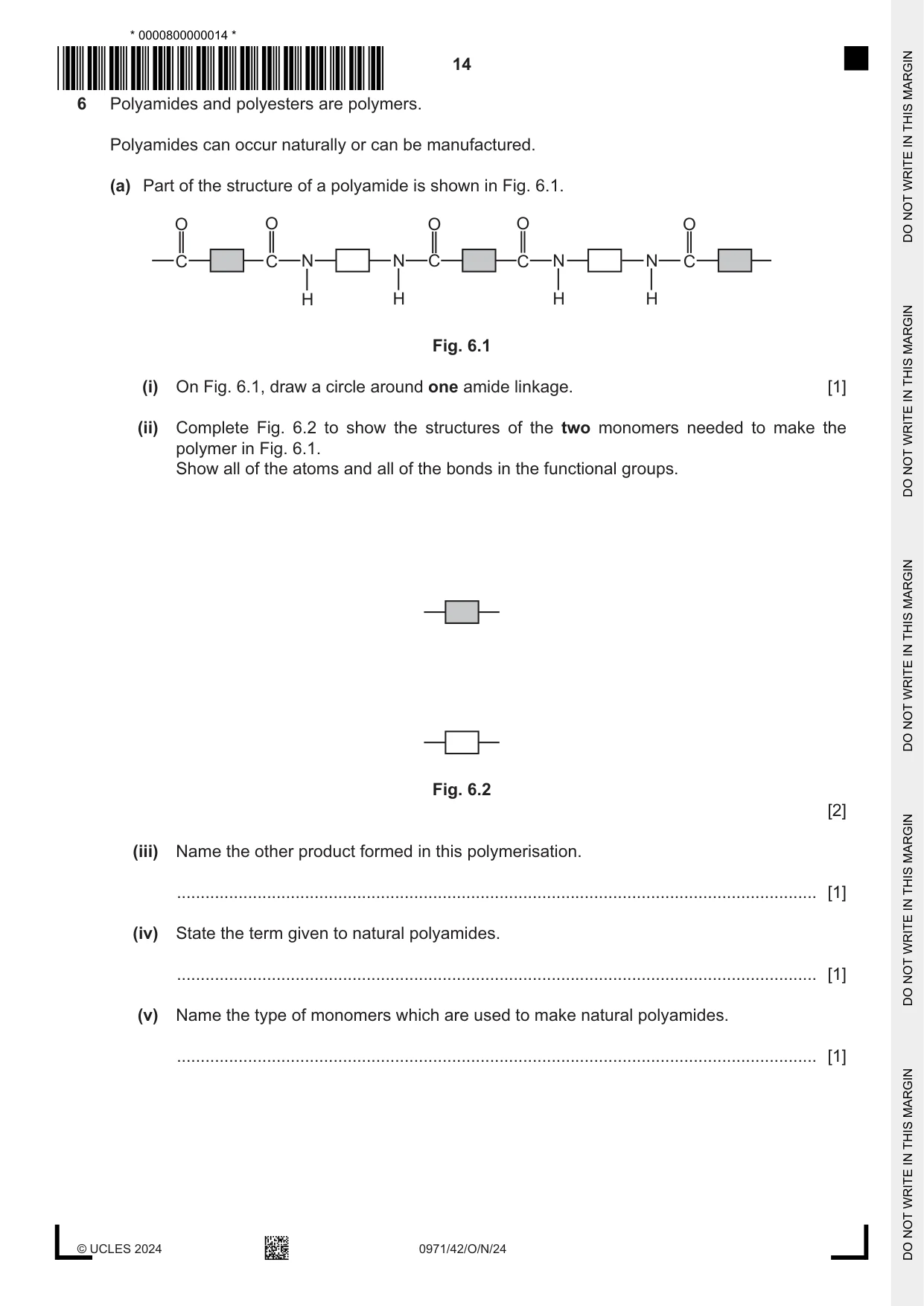
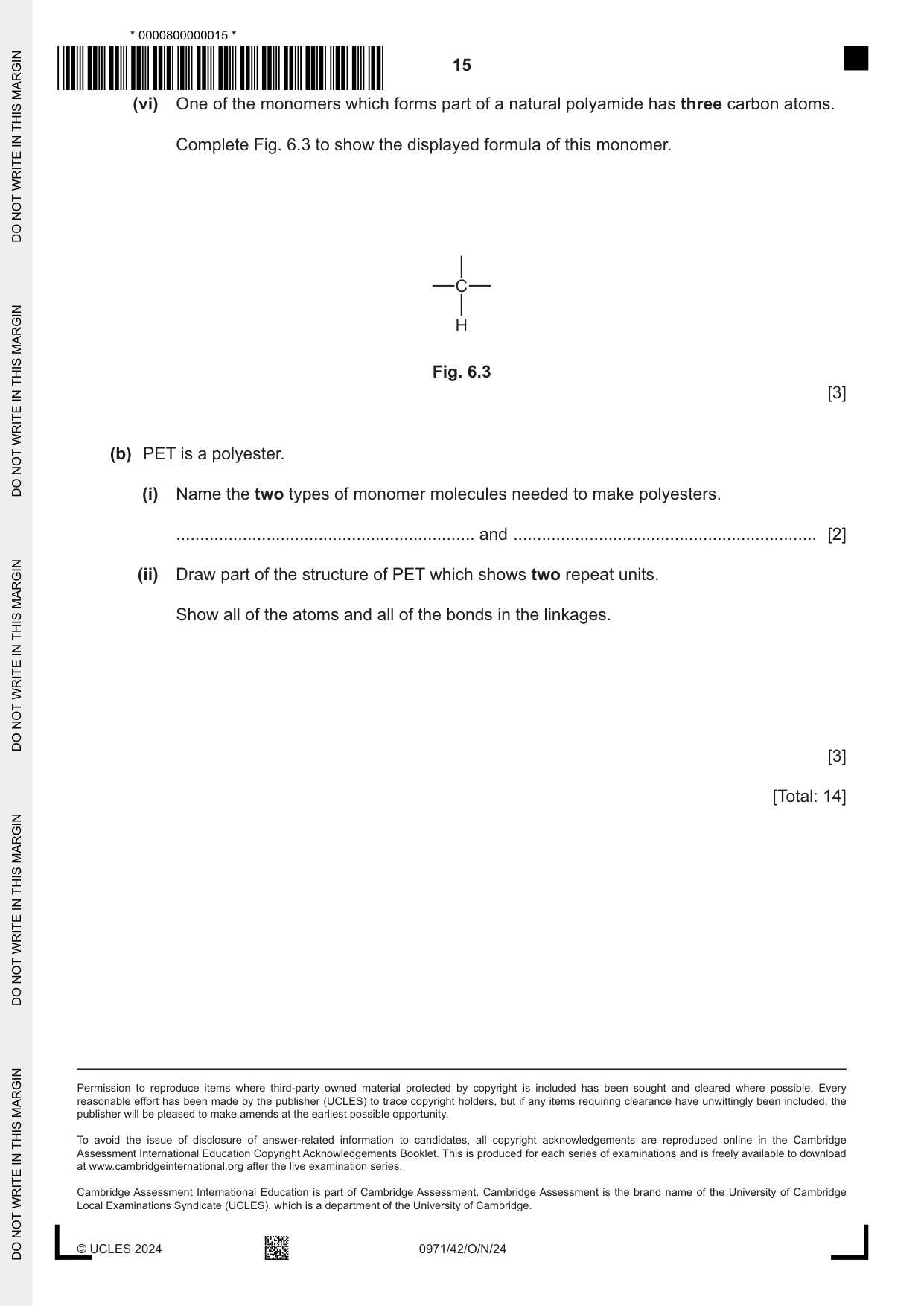
6 Polyamides and polyesters are polymers. Polyamides can occur naturally or can be manufactured. (a) Part of the structure of a polyamide is shown in Fig. 6.1. O O O O O C C N N C C N N C H H H H Fig. 6.1 (i) On Fig. 6.1, draw a circle around one amide linkage. [1] (ii) Complete Fig. 6.2 to show the structures of the two monomers needed to make the polymer in Fig. 6.1. Show all of the atoms and all of the bonds in the functional groups. Fig. 6.2 [2] (iii) Name the other product formed in this polymerisation. ....................................................................................................................................... [1] (iv) State the term given to natural polyamides. ....................................................................................................................................... [1] (v) Name the type of monomers which are used to make natural polyamides. ....................................................................................................................................... [1] (vi) One of the monomers which forms part of a natural polyamide has three carbon atoms. Complete Fig. 6.3 to show the displayed formula of this monomer. C H Fig. 6.3 [3] (b) PET is a polyester. (i) Name the two types of monomer molecules needed to make polyesters. ............................................................... and ................................................................ [2] (ii) Draw part of the structure of PET which shows two repeat units. Show all of the atoms and all of the bonds in the linkages. [3] [Total: 14]
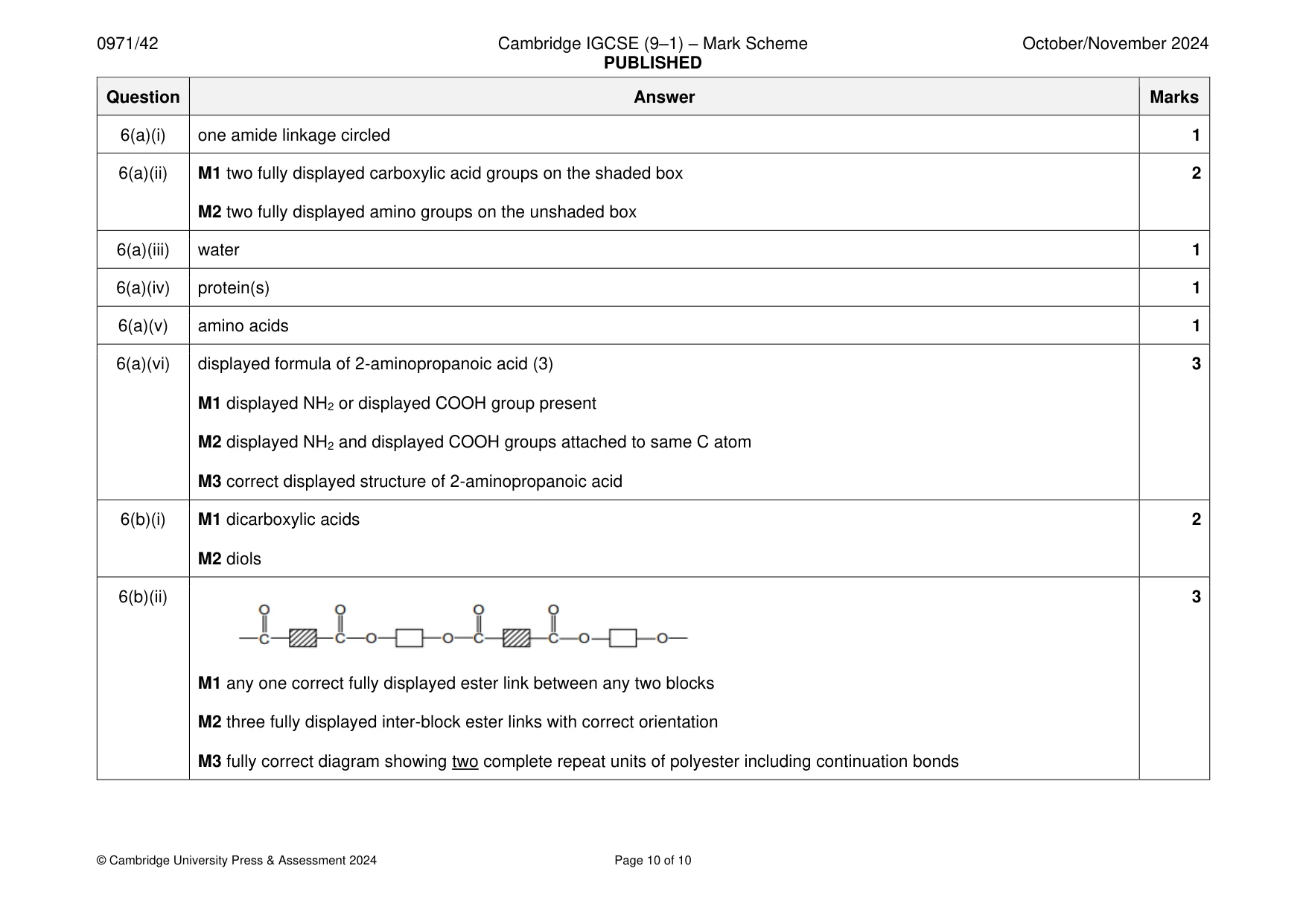
Mark scheme: 6(a)(i) one amide linkage circled 1 6(a)(ii) M1 two fully displayed carboxylic acid groups on the shaded box 2 M2 two fully displayed amino groups on the unshaded box 6(a)(iii) water 1 6(a)(iv) protein(s) 1 6(a)(v) amino acids 1 6(a)(vi) displayed formula of 2-aminopropanoic acid (3) 3 M1 displayed NH2 or displayed COOH group present M2 displayed NH2 and displayed COOH groups attached to same C atom M3 correct displayed structure of 2-aminopropanoic acid 6(b)(i) M1 dicarboxylic acids 2 M2 diols 6(b)(ii) 3 M1 any one correct fully displayed ester link between any two blocks M2 three fully displayed inter-block ester links with correct orientation M3 fully correct diagram showing two complete repeat units of polyester including continuation bonds
What was in this paper
The subtopics covered by these 6 questions, and how many questions each got. Open one in a new tab to see every Cambridge question on it.
What you needed in this session
Cambridge’s own grade thresholds for 2024 Oct/Nov, Paper 4 · Variant 2. A higher threshold means an easier paper — the bar moves with how the cohort did.