Cambridge IGCSE Chemistry (9-1) 0971 — 2023 Oct/Nov Paper 4 · Variant 2
0971/42/O/N/23 · 6 questions · 80 marks · 75 min
The question paper and its mark scheme, free to read here and free to download. This is Cambridge’s own paper, exactly as it was sat.
Question paper16 pages

Mark scheme10 pages
Answers below. Sit the paper first if you are practising.
Questions as text
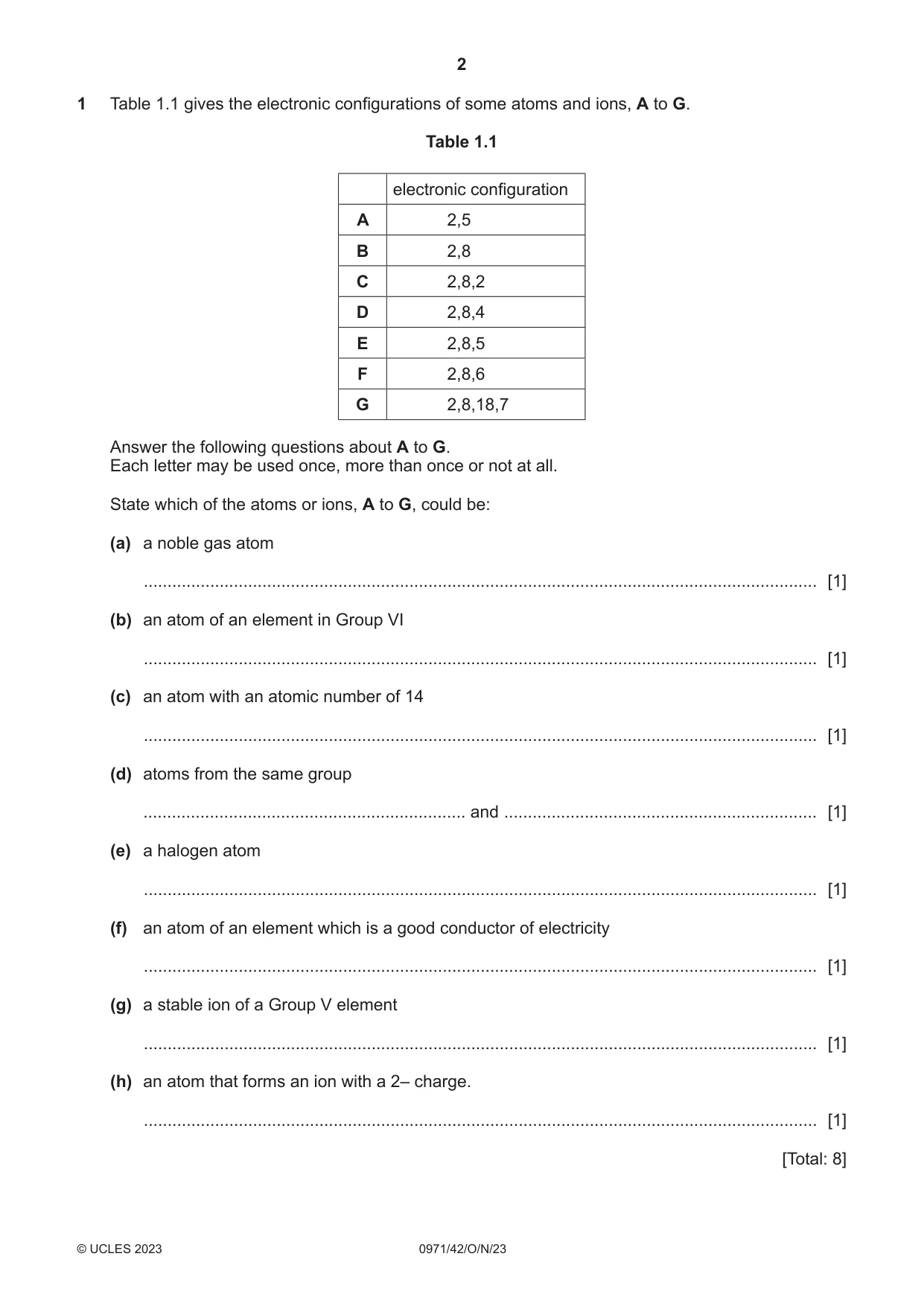
Q1 · The electronic configurations of some atoms and ions, A to G
1 Table 1.1 gives the electronic configurations of some atoms and ions, A to G. Table 1.1 electronic configuration A 2,5 B 2,8 C 2,8,2 D 2,8,4 E 2,8,5 F 2,8,6 G 2,8,18,7 Answer the following questions about A to G. Each letter may be used once, more than once or not at all. State which of the atoms or ions, A to G, could be: (a) a noble gas atom .............................................................................................................................................. [1] (b) an atom of an element in Group VI .............................................................................................................................................. [1] (c) an atom with an atomic number of 14 .............................................................................................................................................. [1] (d) atoms from the same group .................................................................... and .................................................................. [1] (e) a halogen atom .............................................................................................................................................. [1] (f) an atom of an element which is a good conductor of electricity .............................................................................................................................................. [1] (g) a stable ion of a Group V element .............................................................................................................................................. [1] (h) an atom that forms an ion with a 2– charge. .............................................................................................................................................. [1] [Total: 8]
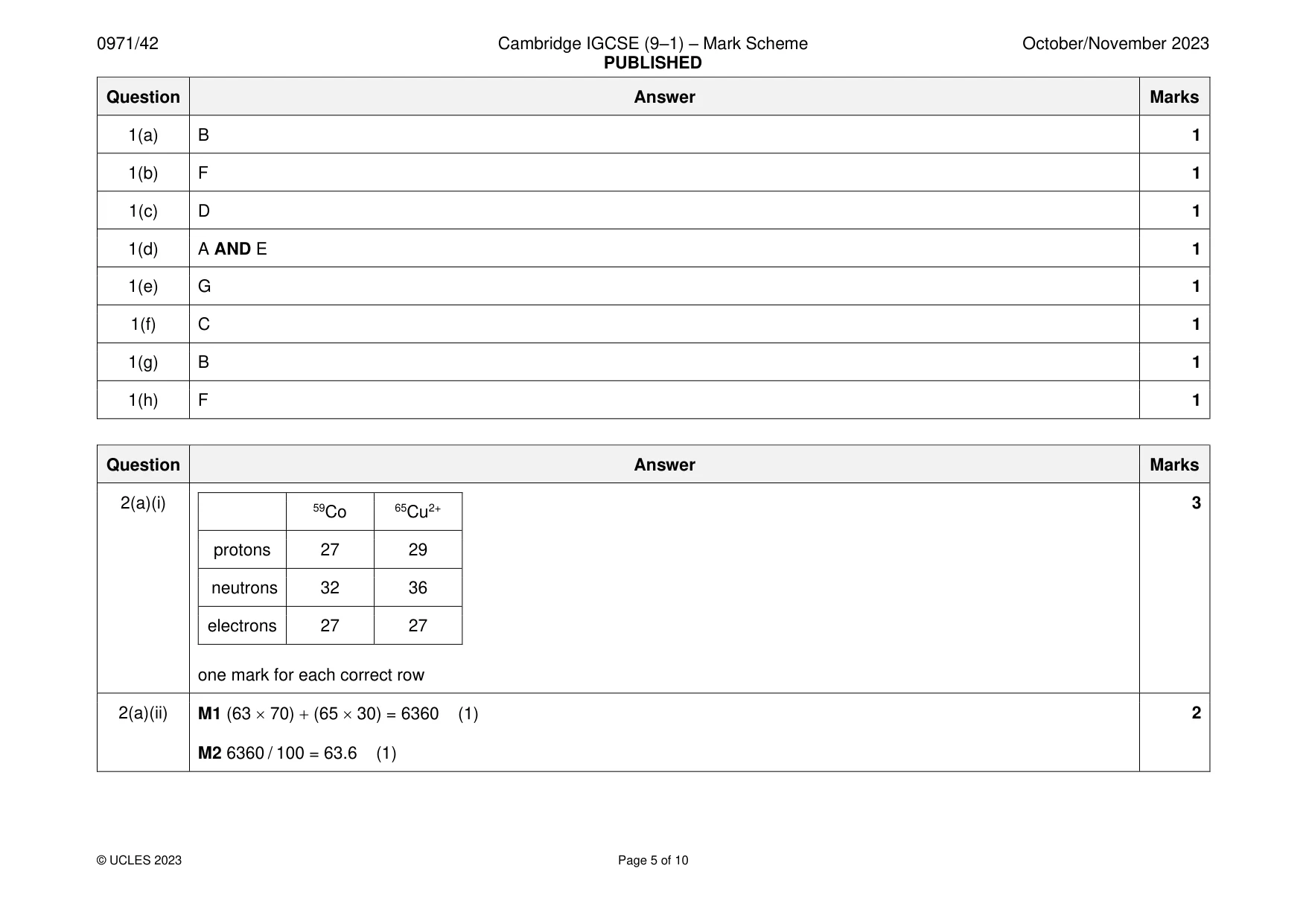
Mark scheme: Question Answer Marks 1(a) B 1 1(b) F 1 1(c) D 1 1(d) A AND E 1 1(e) G 1 1(f) C 1 1(g) B 1 1(h) F 1
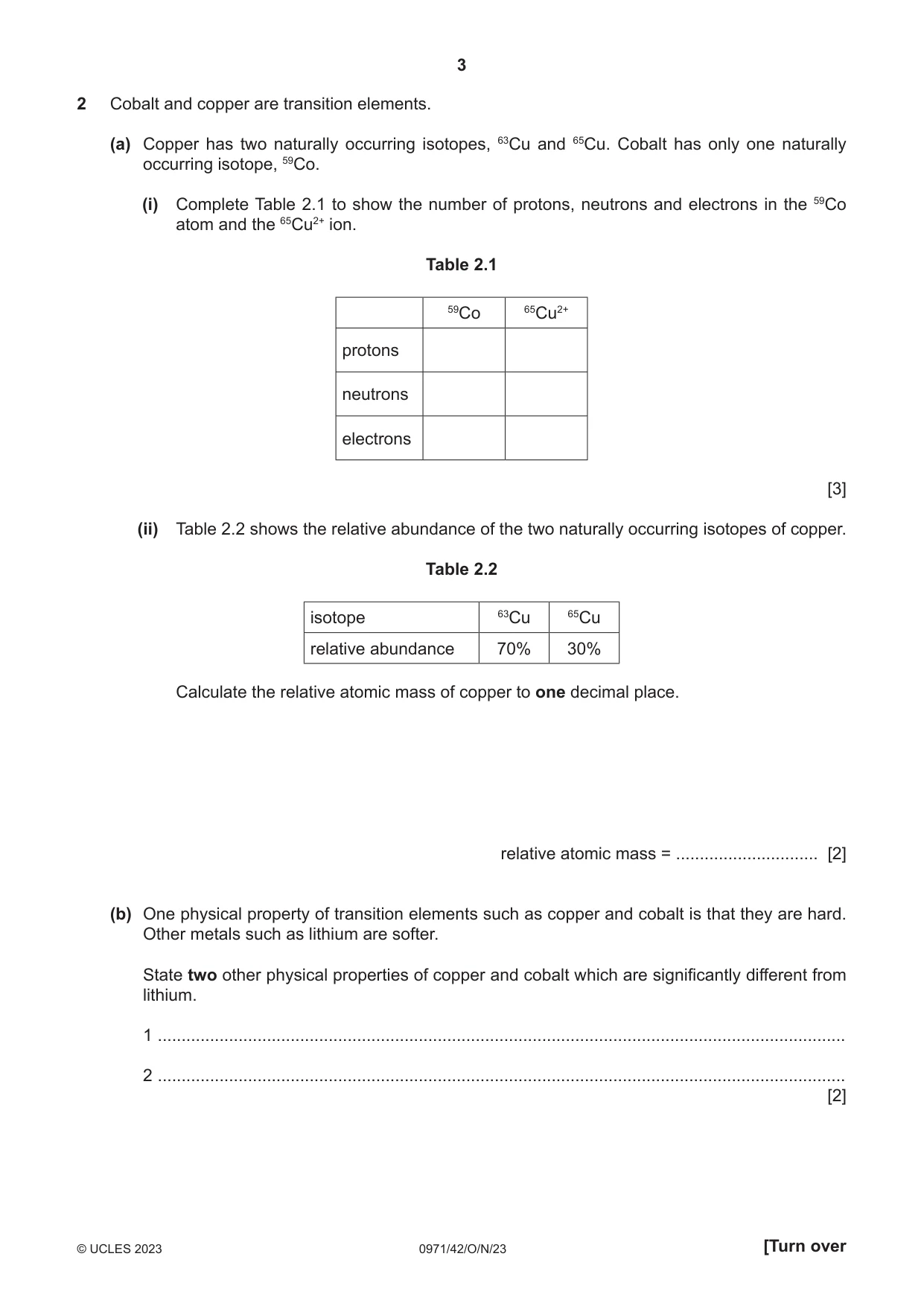
Q2 · Cobalt and copper are transition elements
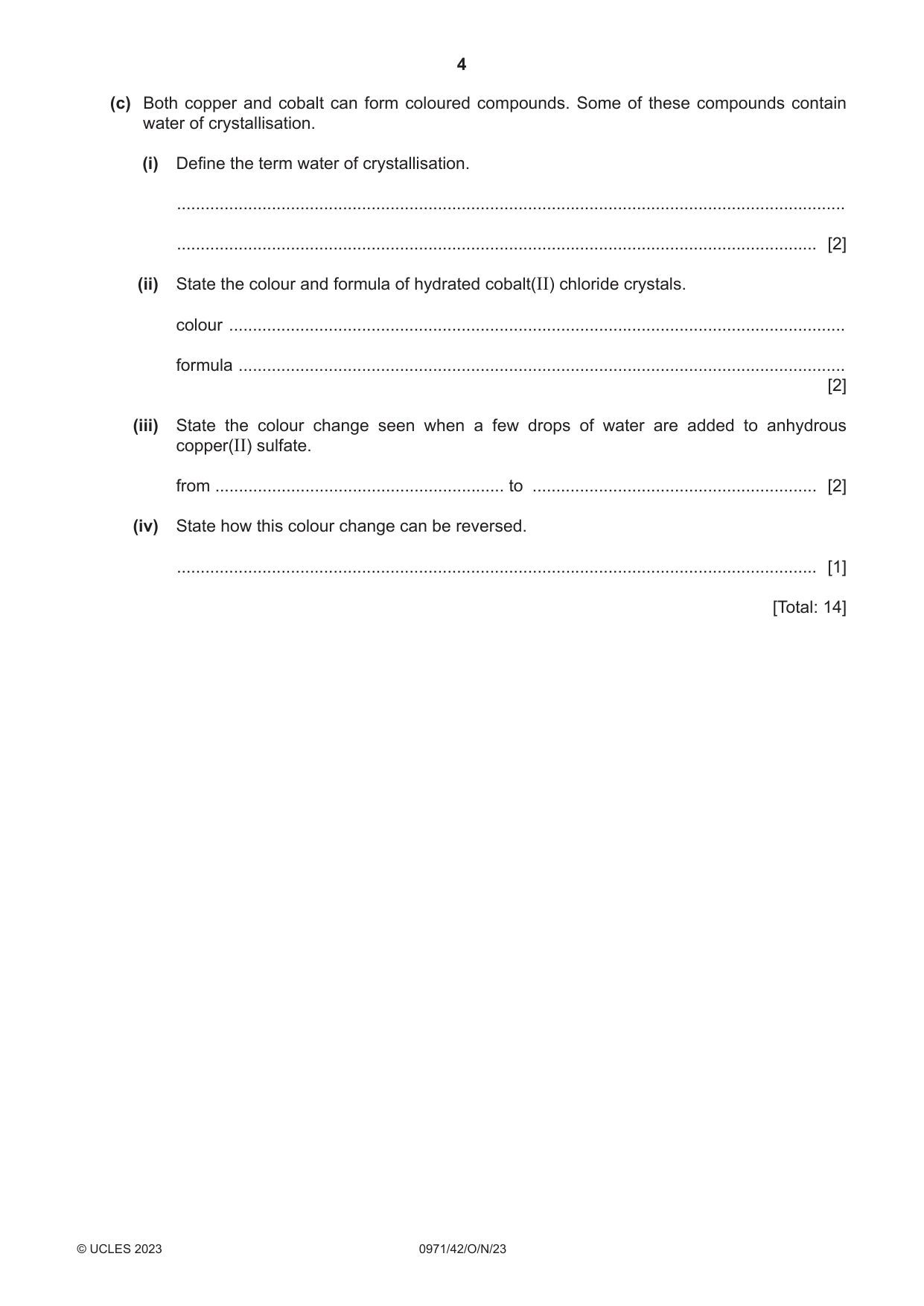
2 Cobalt and copper are transition elements. (a) Copper has two naturally occurring isotopes, 63Cu and 65Cu. Cobalt has only one naturally occurring isotope, 59Co. (i) Complete Table 2.1 to show the number of protons, neutrons and electrons in the 59Co atom and the 65Cu2+ ion. Table 2.1 59Co 65Cu2+ protons neutrons electrons [3] (ii) Table 2.2 shows the relative abundance of the two naturally occurring isotopes of copper. Table 2.2 isotope 63Cu 65Cu relative abundance 70% 30% Calculate the relative atomic mass of copper to one decimal place. relative atomic mass = .............................. [2] (b) One physical property of transition elements such as copper and cobalt is that they are hard. Other metals such as lithium are softer. State two other physical properties of copper and cobalt which are significantly different from lithium. 1 ................................................................................................................................................. 2 ................................................................................................................................................. [2] (c) Both copper and cobalt can form coloured compounds. Some of these compounds contain water of crystallisation. (i) Define the term water of crystallisation. ............................................................................................................................................. ....................................................................................................................................... [2] (ii) State the colour and formula of hydrated cobalt(II) chloride crystals. colour .................................................................................................................................. formula ................................................................................................................................ [2] (iii) State the colour change seen when a few drops of water are added to anhydrous copper(II) sulfate. from ............................................................. to ������������������������������������������������������������ [2] (iv) State how this colour change can be reversed. ....................................................................................................................................... [1] [Total: 14]
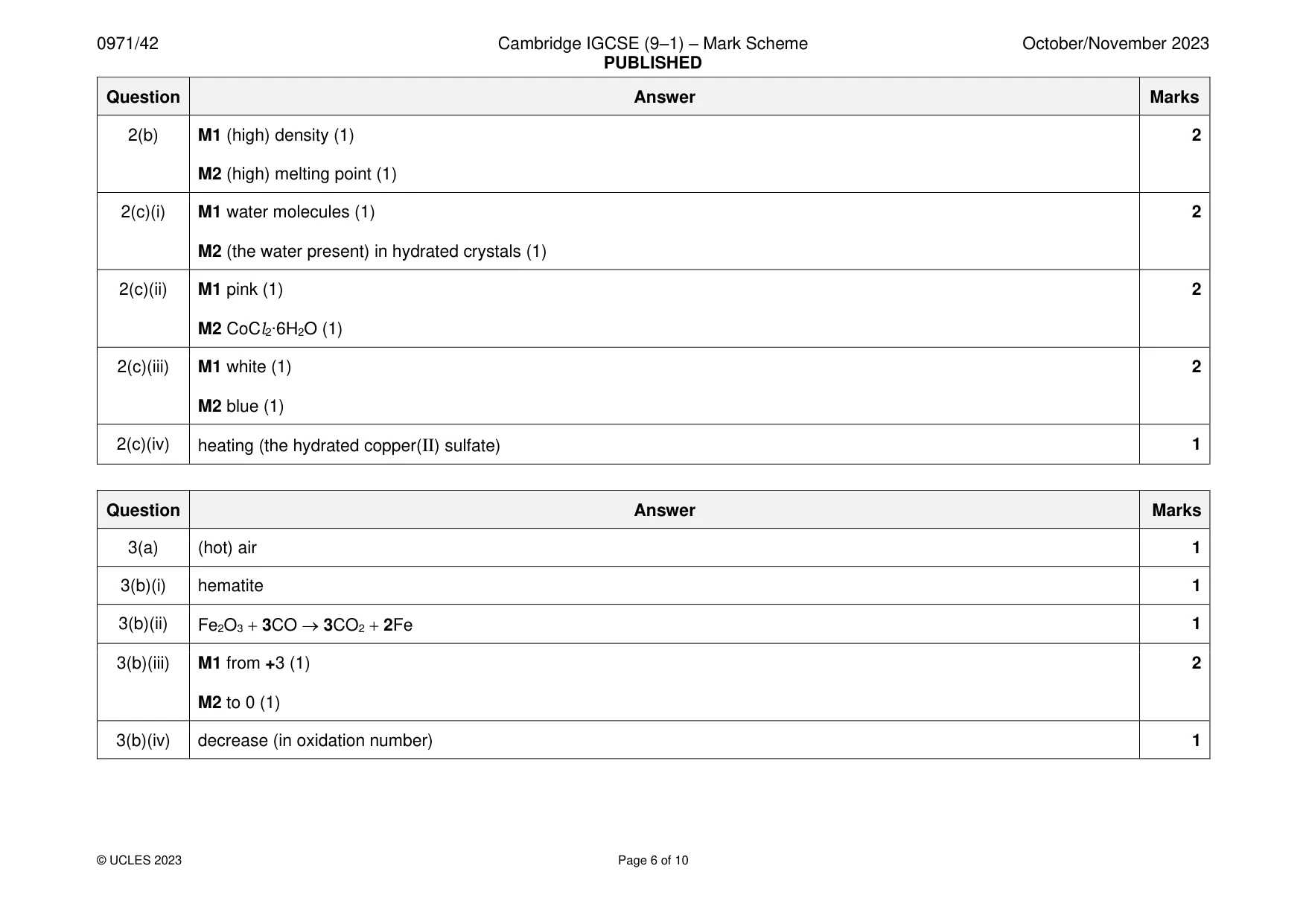
Mark scheme: 2(a)(i) 3 59Co 65Cu2+ protons 27 29 neutrons 32 36 electrons 27 27 one mark for each correct row 2(a)(ii) M1 (63 70) + (65 30) = 6360 (1) 2 M2 6360 / 100 = 63.6 (1) 2(b) M1 (high) density (1) 2 M2 (high) melting point (1) 2(c)(i) M1 water molecules (1) 2 M2 (the water present) in hydrated crystals (1) 2(c)(ii) M1 pink (1) 2 M2 CoCl2∙6H2O (1) 2(c)(iii) M1 white (1) 2 M2 blue (1) 2(c)(iv) heating (the hydrated copper(II) sulfate) 1
Q3 · Iron is manufactured in a blast furnace
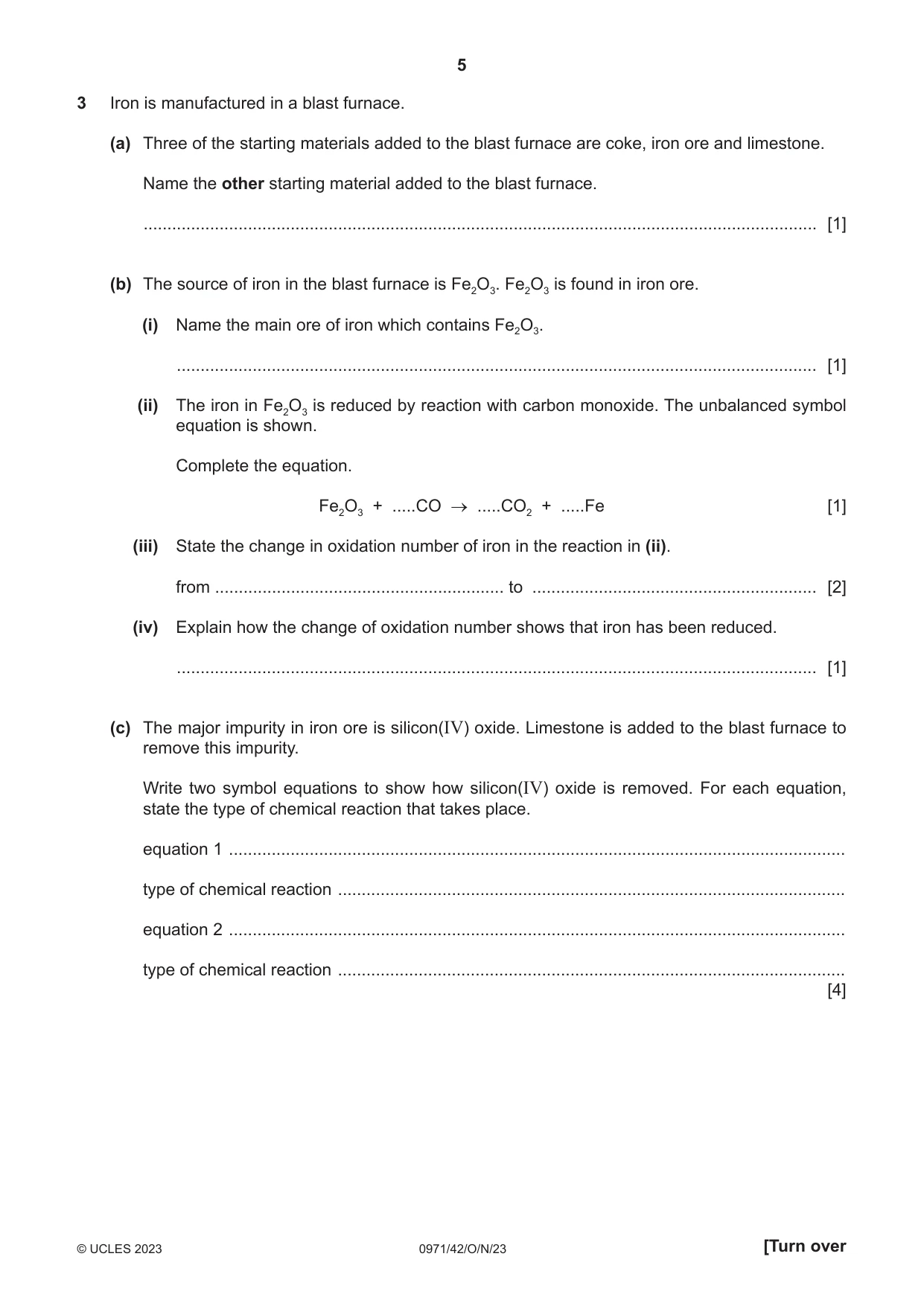
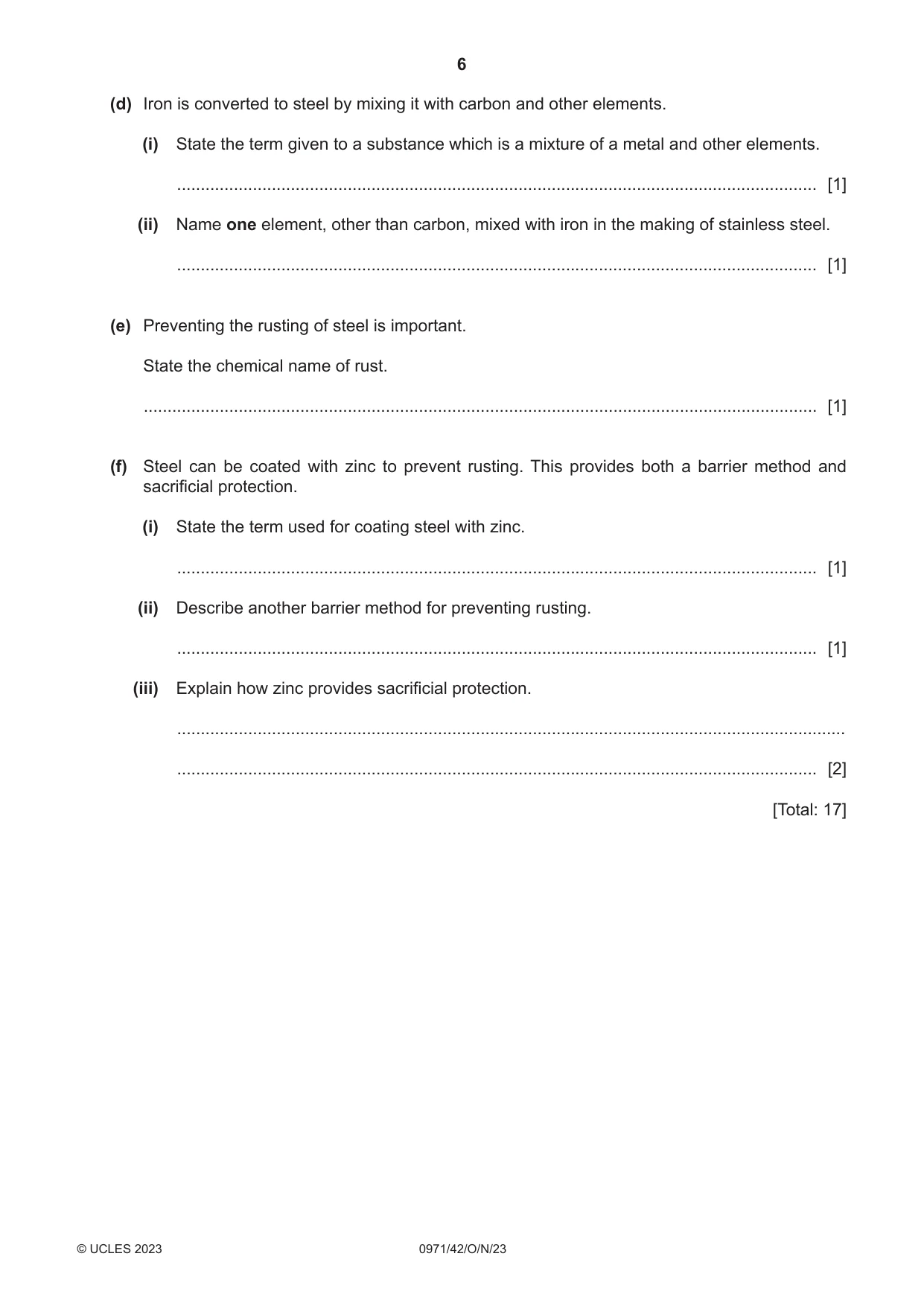
3 Iron is manufactured in a blast furnace. (a) Three of the starting materials added to the blast furnace are coke, iron ore and limestone. Name the other starting material added to the blast furnace. .............................................................................................................................................. [1] (b) The source of iron in the blast furnace is Fe2O3. Fe2O3 is found in iron ore. (i) Name the main ore of iron which contains Fe2O3. ....................................................................................................................................... [1] (ii) The iron in Fe2O3 is reduced by reaction with carbon monoxide. The unbalanced symbol equation is shown. Complete the equation. Fe2O3 + .....CO → .....CO2 + .....Fe [1] (iii) State the change in oxidation number of iron in the reaction in (ii). from ............................................................. to ������������������������������������������������������������ [2] (iv) Explain how the change of oxidation number shows that iron has been reduced. ....................................................................................................................................... [1] (c) The major impurity in iron ore is silicon(IV) oxide. Limestone is added to the blast furnace to remove this impurity. Write two symbol equations to show how silicon(IV) oxide is removed. For each equation, state the type of chemical reaction that takes place. equation 1 .................................................................................................................................. type of chemical reaction ........................................................................................................... equation 2 .................................................................................................................................. type of chemical reaction ........................................................................................................... [4] (d) Iron is converted to steel by mixing it with carbon and other elements. (i) State the term given to a substance which is a mixture of a metal and other elements. ....................................................................................................................................... [1] (ii) Name one element, other than carbon, mixed with iron in the making of stainless steel. ....................................................................................................................................... [1] (e) Preventing the rusting of steel is important. State the chemical name of rust. .............................................................................................................................................. [1] (f) Steel can be coated with zinc to prevent rusting. This provides both a barrier method and sacrificial protection. (i) State the term used for coating steel with zinc. ....................................................................................................................................... [1] (ii) Describe another barrier method for preventing rusting. ....................................................................................................................................... [1] (iii) Explain how zinc provides sacrificial protection. ............................................................................................................................................. ....................................................................................................................................... [2] [Total: 17]
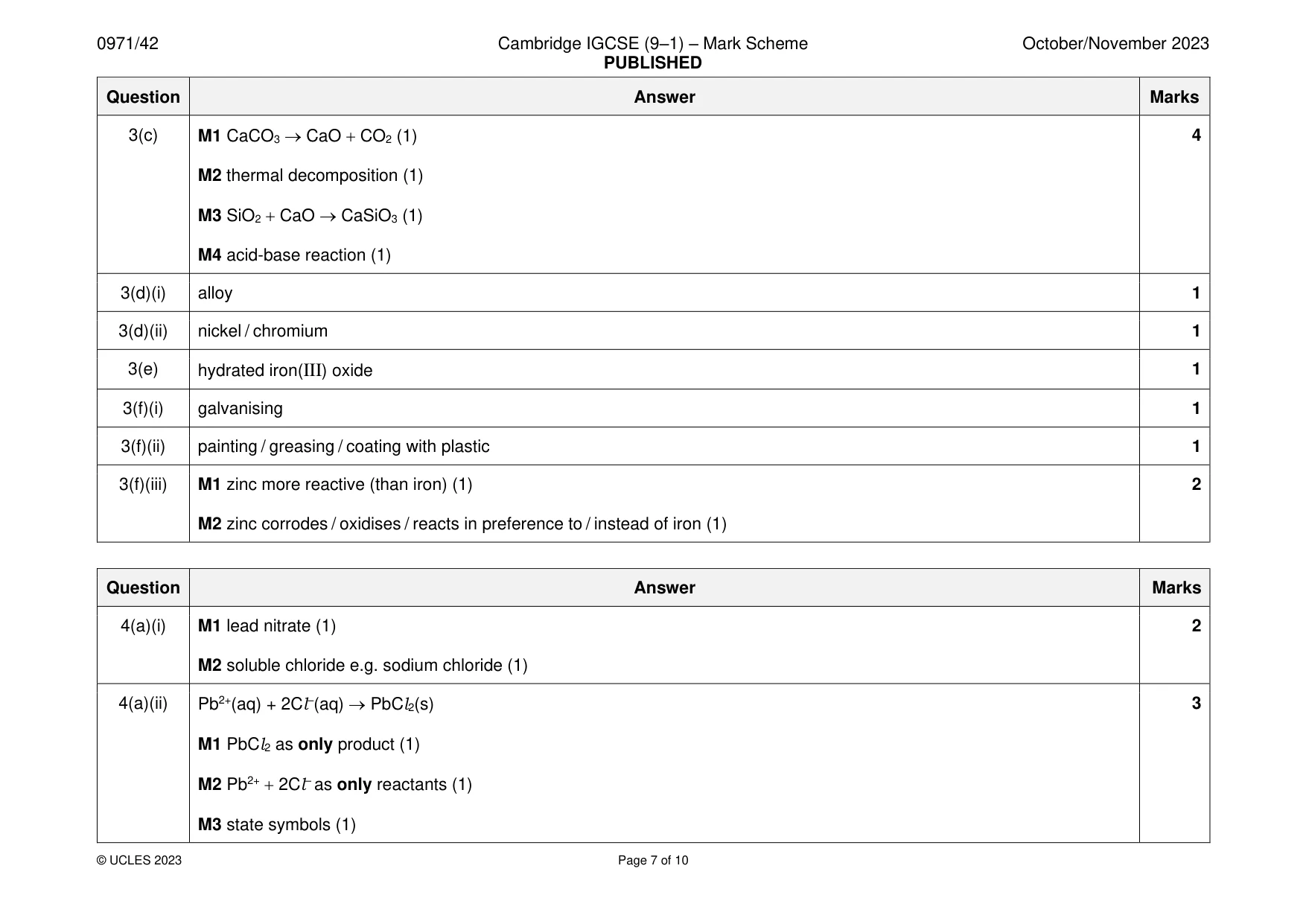
Mark scheme: 3(a) (hot) air 1 3(b)(i) hematite 1 3(b)(ii) Fe2O3 + 3CO → 3CO2 + 2Fe 1 3(b)(iii) M1 from +3 (1) 2 M2 to 0 (1) 3(b)(iv) decrease (in oxidation number) 1 3(c) M1 CaCO3 → CaO + CO2 (1) 4 M2 thermal decomposition (1) M3 SiO2 + CaO → CaSiO3 (1) M4 acid-base reaction (1) 3(d)(i) alloy 1 3(d)(ii) nickel / chromium 1 3(e) hydrated iron(III) oxide 1 3(f)(i) galvanising 1 3(f)(ii) painting / greasing / coating with plastic 1 3(f)(iii) M1 zinc more reactive (than iron) (1) 2 M2 zinc corrodes / oxidises / reacts in preference to / instead of iron (1)
Q4 · This question is about lead(II) chloride, PbCl 2
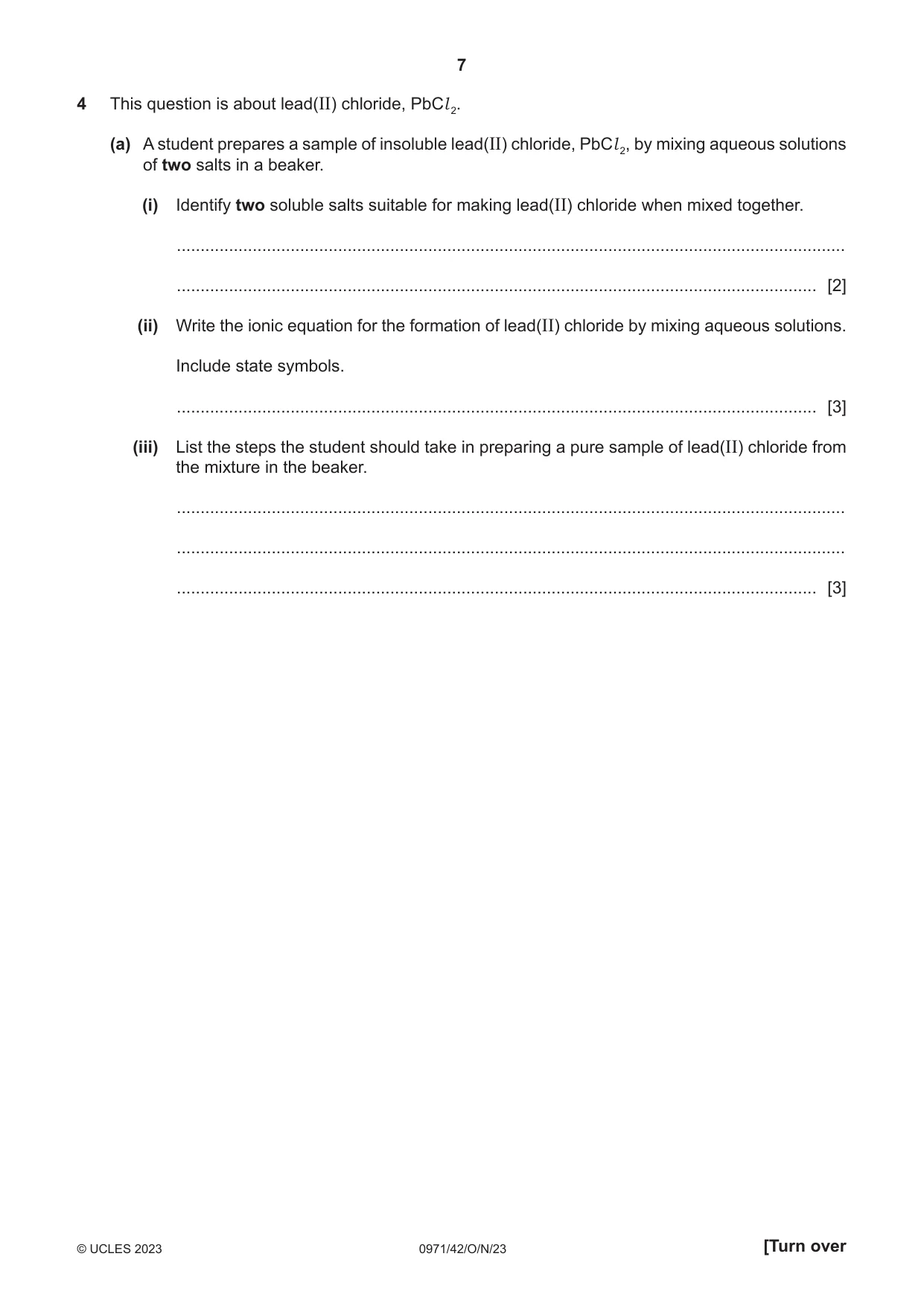
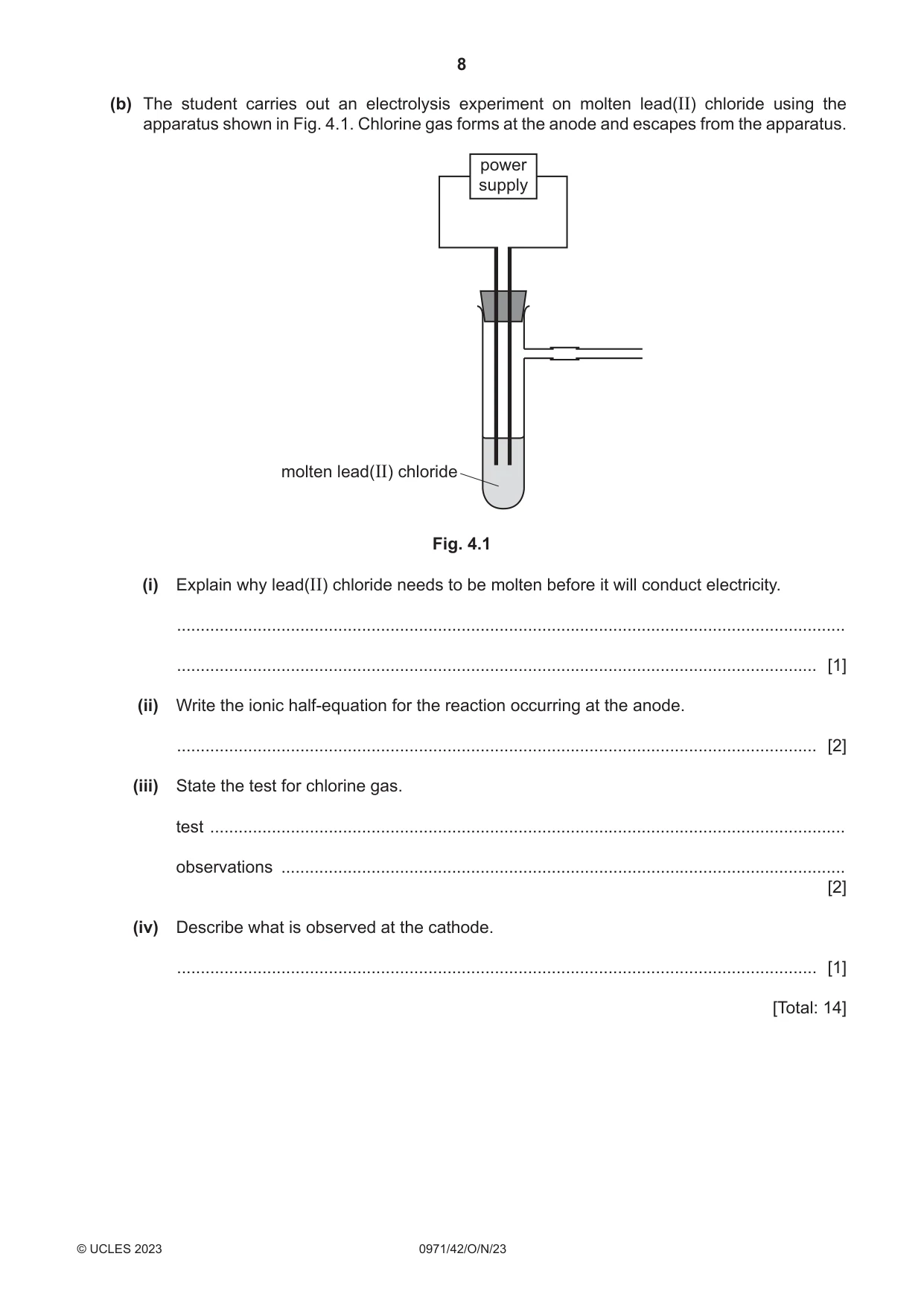
4 This question is about lead(II) chloride, PbCl 2. (a) A student prepares a sample of insoluble lead(II) chloride, PbCl 2, by mixing aqueous solutions of two salts in a beaker. (i) Identify two soluble salts suitable for making lead(II) chloride when mixed together. ............................................................................................................................................. ....................................................................................................................................... [2] (ii) Write the ionic equation for the formation of lead(II) chloride by mixing aqueous solutions. Include state symbols. ....................................................................................................................................... [3] (iii) List the steps the student should take in preparing a pure sample of lead(II) chloride from the mixture in the beaker. ............................................................................................................................................. ............................................................................................................................................. ....................................................................................................................................... [3] (b) The student carries out an electrolysis experiment on molten lead(II) chloride using the apparatus shown in Fig. 4.1. Chlorine gas forms at the anode and escapes from the apparatus. power supply molten lead(II) chloride Fig. 4.1 (i) Explain why lead(II) chloride needs to be molten before it will conduct electricity. ............................................................................................................................................. ....................................................................................................................................... [1] (ii) Write the ionic half-equation for the reaction occurring at the anode. ....................................................................................................................................... [2] (iii) State the test for chlorine gas. test ...................................................................................................................................... observations ........................................................................................................................ [2] (iv) Describe what is observed at the cathode. ....................................................................................................................................... [1] [Total: 14]
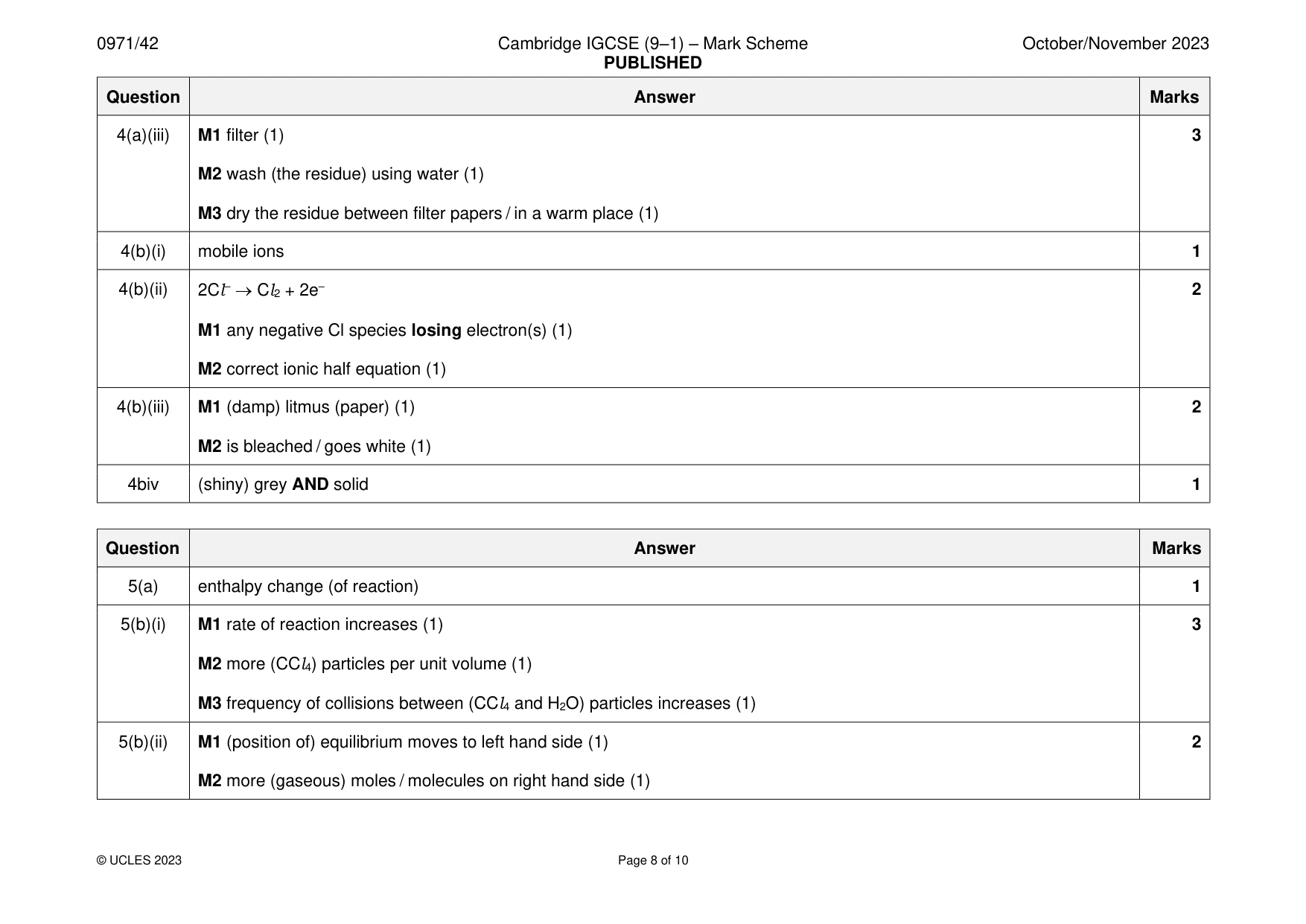
Mark scheme: 4(a)(i) M1 lead nitrate (1) 2 M2 soluble chloride e.g. sodium chloride (1) 4(a)(ii) Pb2+(aq) + 2Cl–(aq) → PbCl2(s) 3 M1 PbCl2 as only product (1) M2 Pb2+ + 2Cl– as only reactants (1) M3 state symbols (1) 4(a)(iii) M1 filter (1) 3 M2 wash (the residue) using water (1) M3 dry the residue between filter papers / in a warm place (1) 4(b)(i) mobile ions 1 4(b)(ii) 2Cl– → Cl2 + 2e– 2 M1 any negative Cl species losing electron(s) (1) M2 correct ionic half equation (1) 4(b)(iii) M1 (damp) litmus (paper) (1) 2 M2 is bleached / goes white (1) 4biv (shiny) grey AND solid 1
Q5 · Chemical reactions can involve transfer of thermal energy
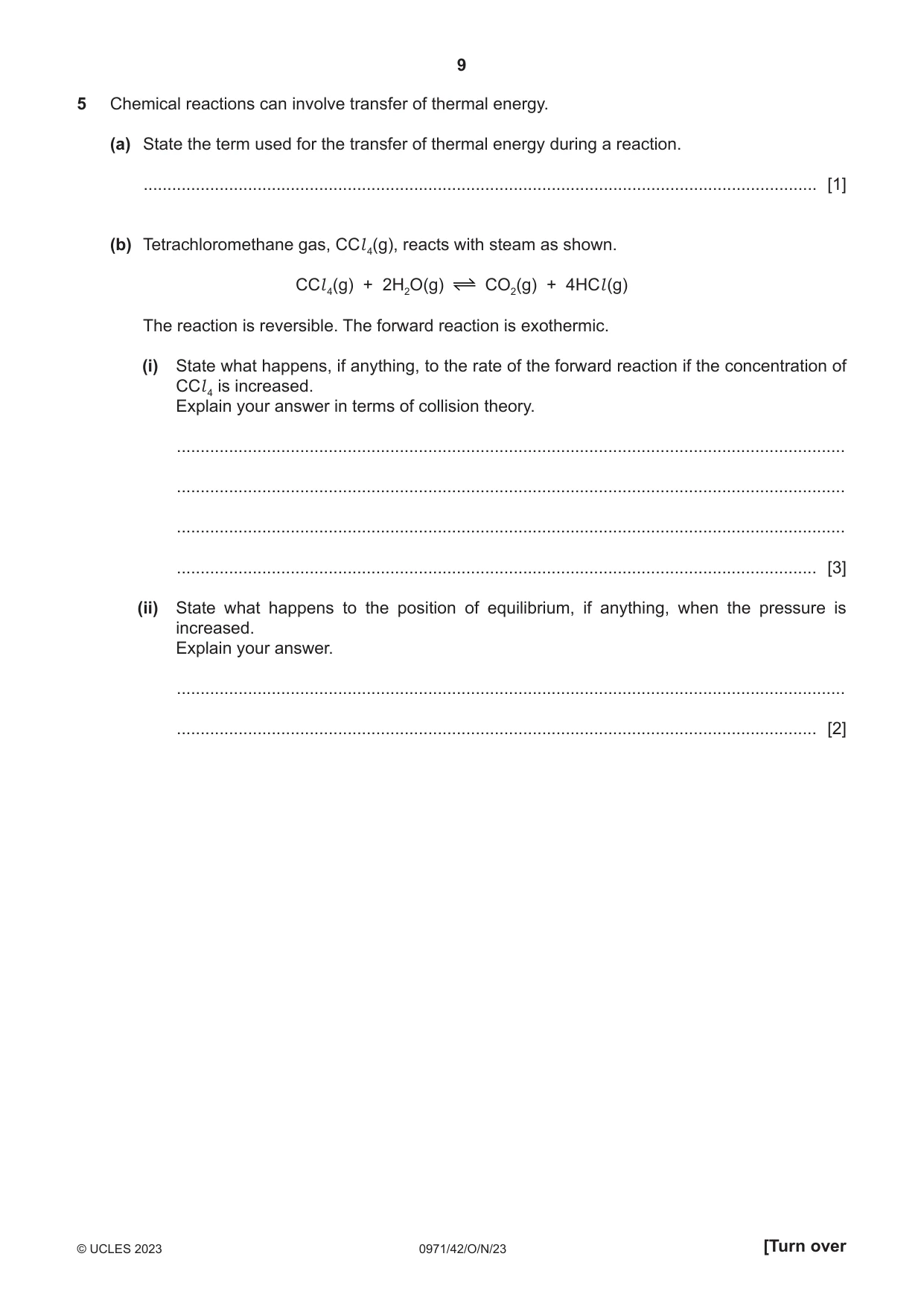
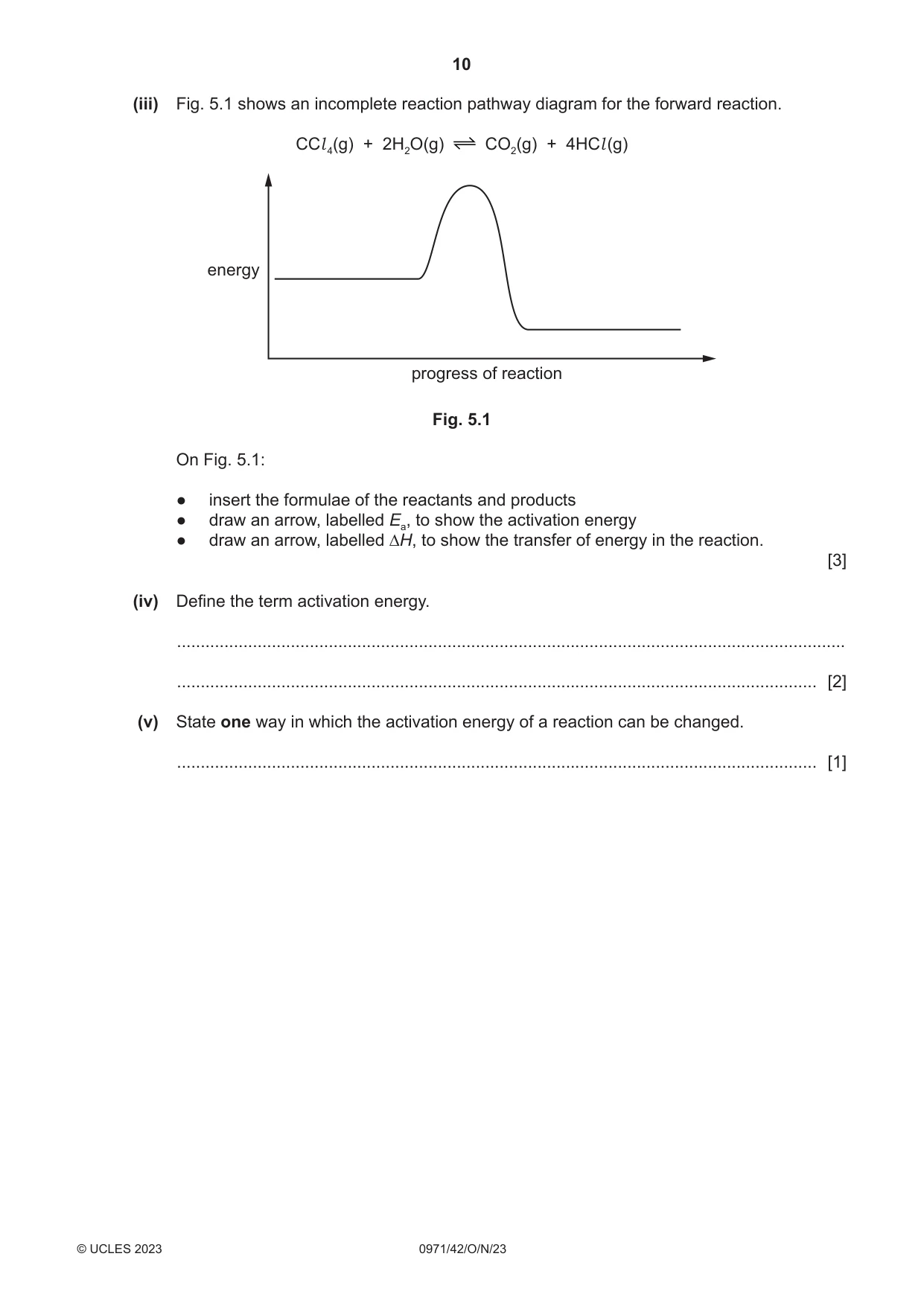
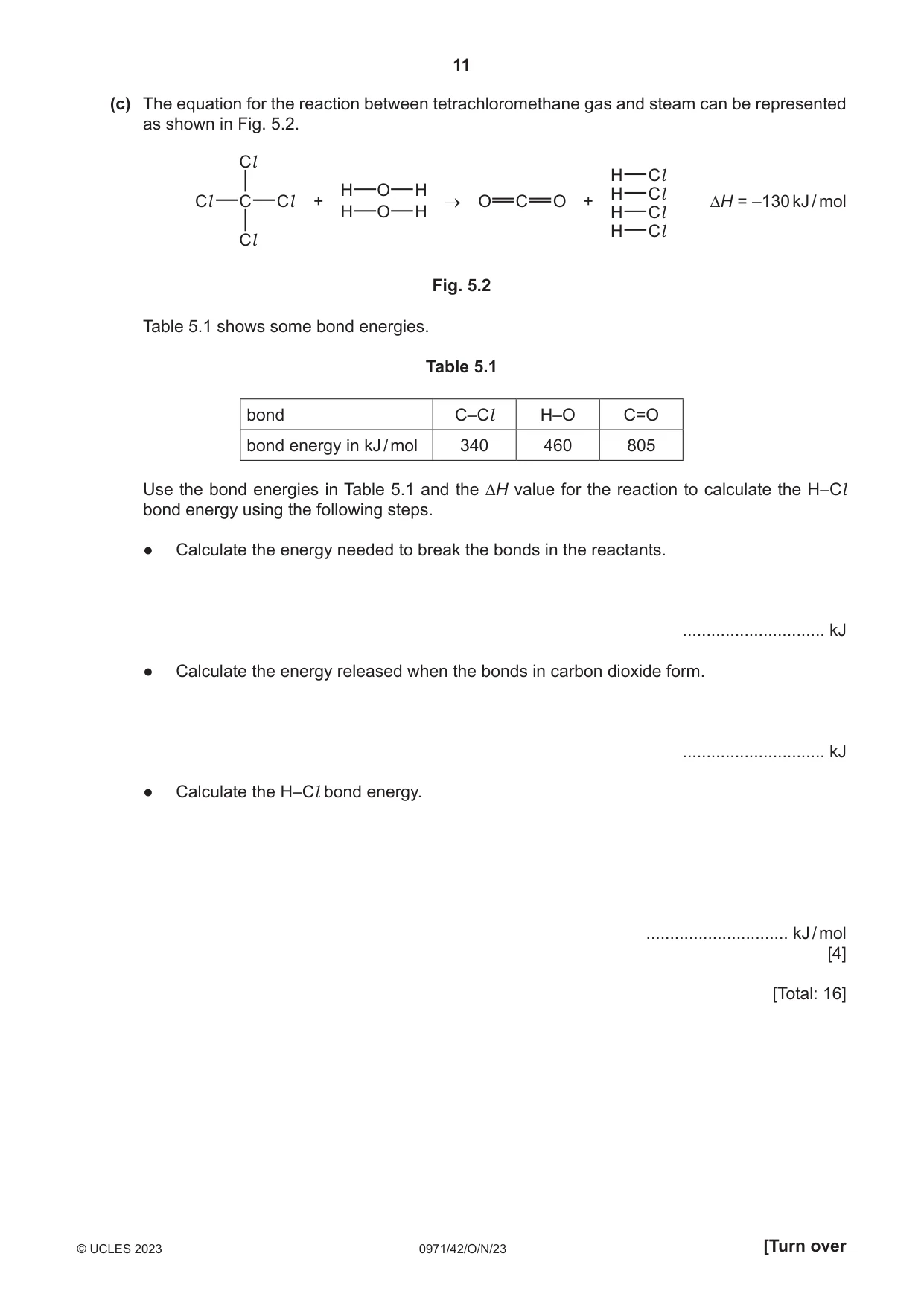
5 Chemical reactions can involve transfer of thermal energy. (a) State the term used for the transfer of thermal energy during a reaction. .............................................................................................................................................. [1] (b) Tetrachloromethane gas, CCl 4(g), reacts with steam as shown. CCl 4(g) + 2H2O(g) CO2(g) + 4HCl (g) The reaction is reversible. The forward reaction is exothermic. (i) State what happens, if anything, to the rate of the forward reaction if the concentration of CCl 4 is increased. Explain your answer in terms of collision theory. ............................................................................................................................................. ............................................................................................................................................. ............................................................................................................................................. ....................................................................................................................................... [3] (ii) State what happens to the position of equilibrium, if anything, when the pressure is increased. Explain your answer. ............................................................................................................................................. ....................................................................................................................................... [2] (iii) Fig. 5.1 shows an incomplete reaction pathway diagram for the forward reaction. CCl 4(g) + 2H2O(g) CO2(g) + 4HCl (g) energy progress of reaction Fig. 5.1 On Fig. 5.1: ● insert the formulae of the reactants and products ● draw an arrow, labelled Ea, to show the activation energy ● draw an arrow, labelled ∆H, to show the transfer of energy in the reaction. [3] (iv) Define the term activation energy. ............................................................................................................................................. ....................................................................................................................................... [2] (v) State one way in which the activation energy of a reaction can be changed. ....................................................................................................................................... [1] (c) The equation for the reaction between tetrachloromethane gas and steam can be represented as shown in Fig. 5.2. Cl H Cl H O H H Cl Cl C Cl + O C O + H = –130 kJ / mol H O H H Cl H Cl Cl Fig. 5.2 Table 5.1 shows some bond energies. Table 5.1 bond C–Cl H–O C=O bond energy in kJ / mol 340 460 805 Use the bond energies in Table 5.1 and the ∆H value for the reaction to calculate the H–Cl bond energy using the following steps. ● Calculate the energy needed to break the bonds in the reactants. .............................. kJ ● Calculate the energy released when the bonds in carbon dioxide form. .............................. kJ ● Calculate the H–Cl bond energy. .............................. kJ / mol [4] [Total: 16]
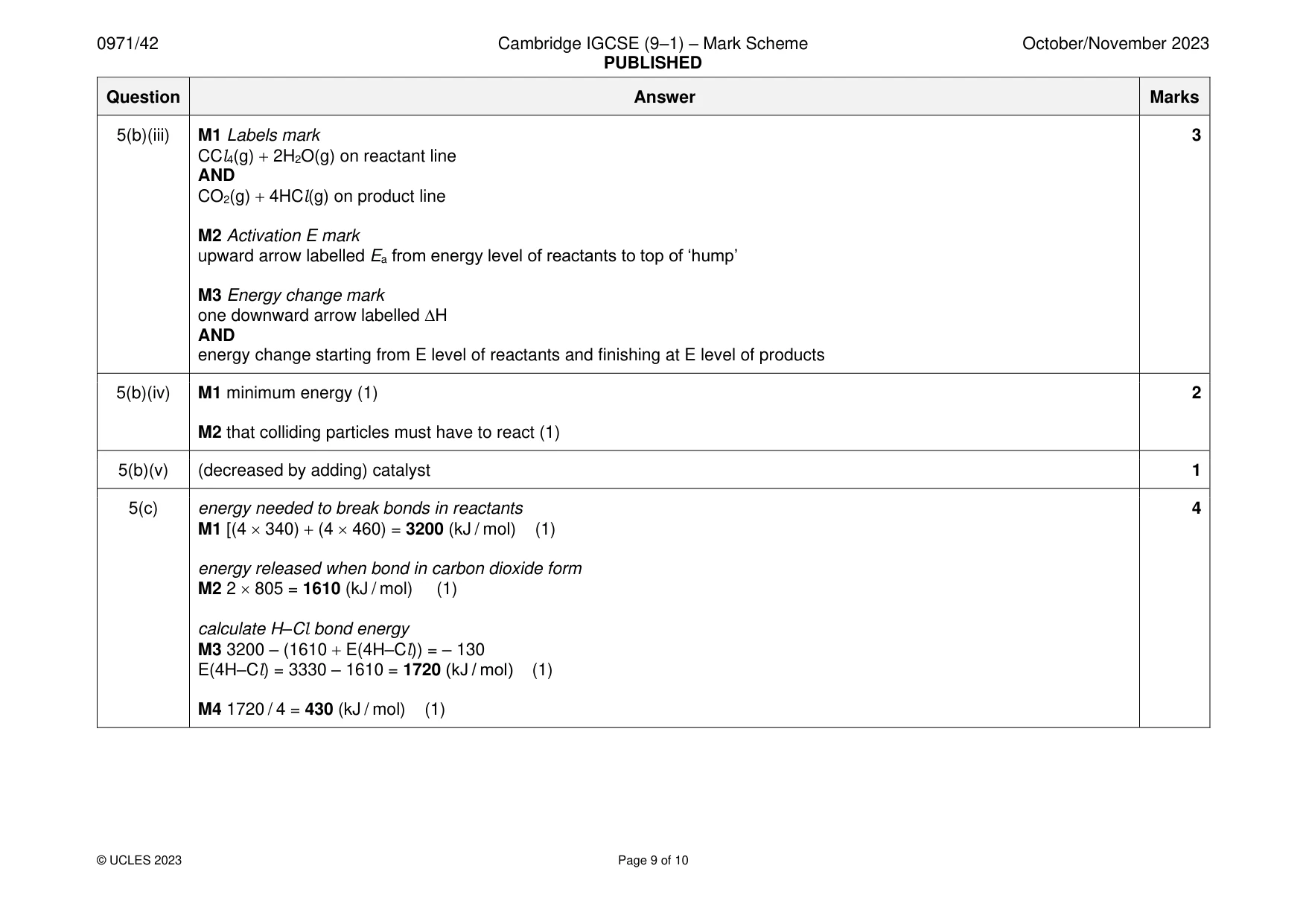
Mark scheme: 5(a) enthalpy change (of reaction) 1 5(b)(i) M1 rate of reaction increases (1) 3 M2 more (CCl4) particles per unit volume (1) M3 frequency of collisions between (CCl4 and H2O) particles increases (1) 5(b)(ii) M1 (position of) equilibrium moves to left hand side (1) 2 M2 more (gaseous) moles / molecules on right hand side (1) 5(b)(iii) M1 Labels mark 3 CCl4(g) + 2H2O(g) on reactant line AND CO2(g) + 4HCl(g) on product line M2 Activation E mark upward arrow labelled Ea from energy level of reactants to top of ‘hump’ M3 Energy change mark one downward arrow labelled H AND energy change starting from E level of reactants and finishing at E level of products 5(b)(iv) M1 minimum energy (1) 2 M2 that colliding particles must have to react (1) 5(b)(v) (decreased by adding) catalyst 1 5(c) energy needed to break bonds in reactants 4 M1 [(4 340) + (4 460) = 3200 (kJ / mol) (1) energy released when bond in carbon dioxide form M2 2 805 = 1610 (kJ / mol) (1) calculate H–Cl bond energy M3 3200 – (1610 + E(4H–Cl)) = – 130 E(4H–Cl) = 3330 – 1610 = 1720 (kJ / mol) (1) M4 1720 / 4 = 430 (kJ / mol) (1)
Q6 · A homologous series is a family of organic compounds whose members have similar chemical…
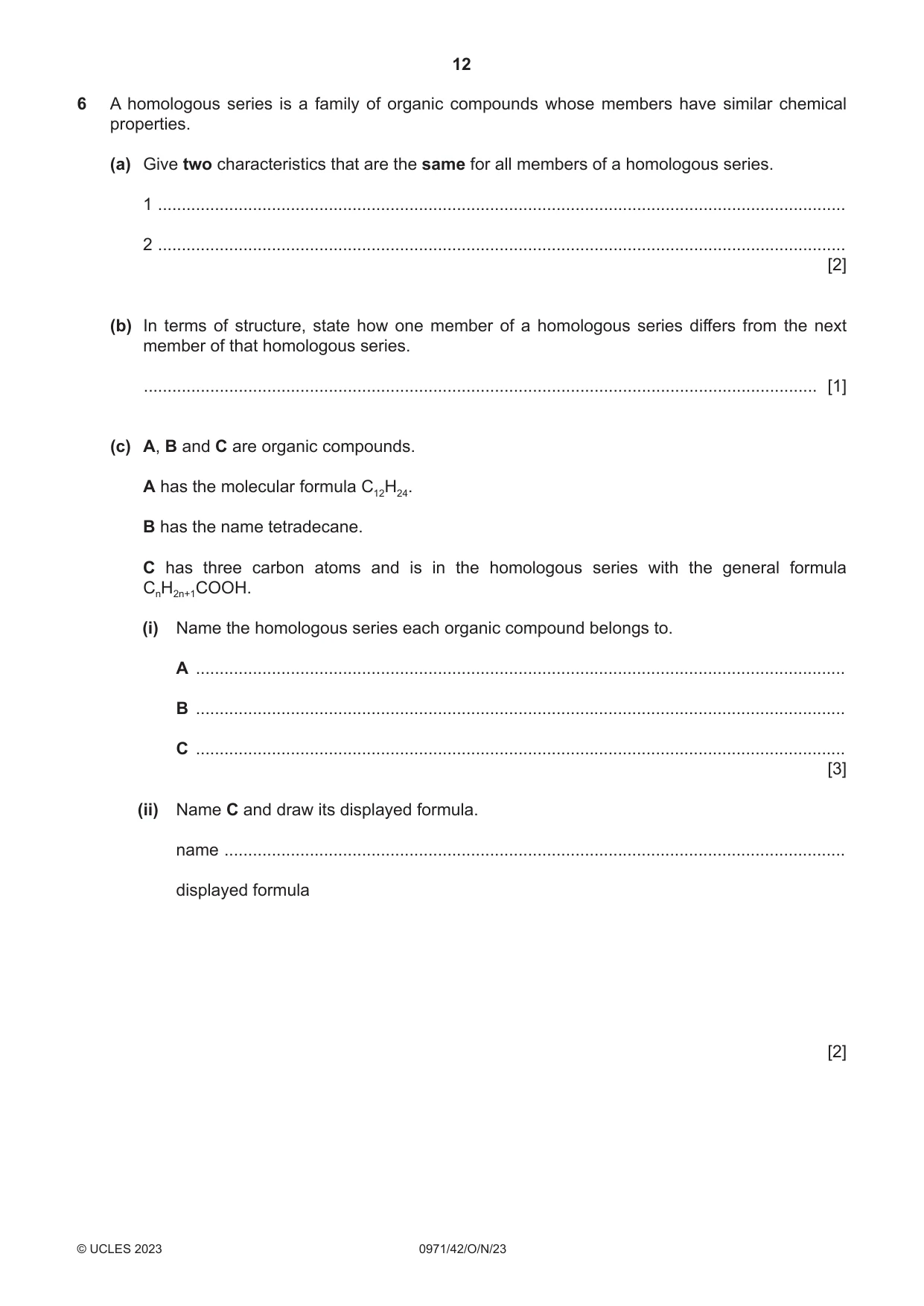
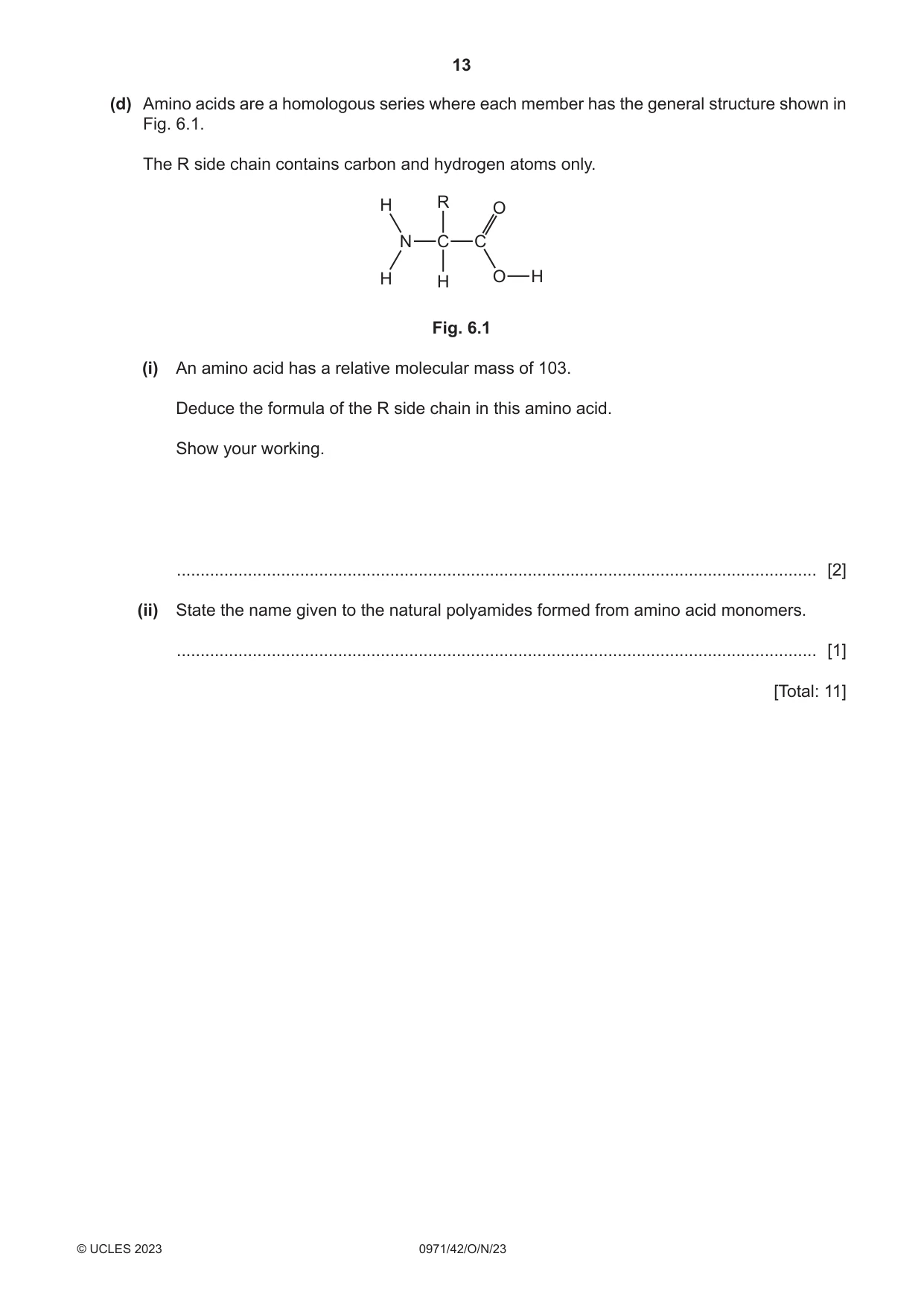
6 A homologous series is a family of organic compounds whose members have similar chemical properties. (a) Give two characteristics that are the same for all members of a homologous series. 1 ................................................................................................................................................. 2 ................................................................................................................................................. [2] (b) In terms of structure, state how one member of a homologous series differs from the next member of that homologous series. .............................................................................................................................................. [1] (c) A, B and C are organic compounds. A has the molecular formula C12H24. B has the name tetradecane. C has three carbon atoms and is in the homologous series with the general formula CnH2n+1COOH. (i) Name the homologous series each organic compound belongs to. A .......................................................................................................................................... B .......................................................................................................................................... C .......................................................................................................................................... [3] (ii) Name C and draw its displayed formula. name ................................................................................................................................... displayed formula [2] (d) Amino acids are a homologous series where each member has the general structure shown in Fig. 6.1. The R side chain contains carbon and hydrogen atoms only. H R O N C C H H O H Fig. 6.1 (i) An amino acid has a relative molecular mass of 103. Deduce the formula of the R side chain in this amino acid. Show your working. ....................................................................................................................................... [2] (ii) State the name given to the natural polyamides formed from amino acid monomers. ....................................................................................................................................... [1] [Total: 11]
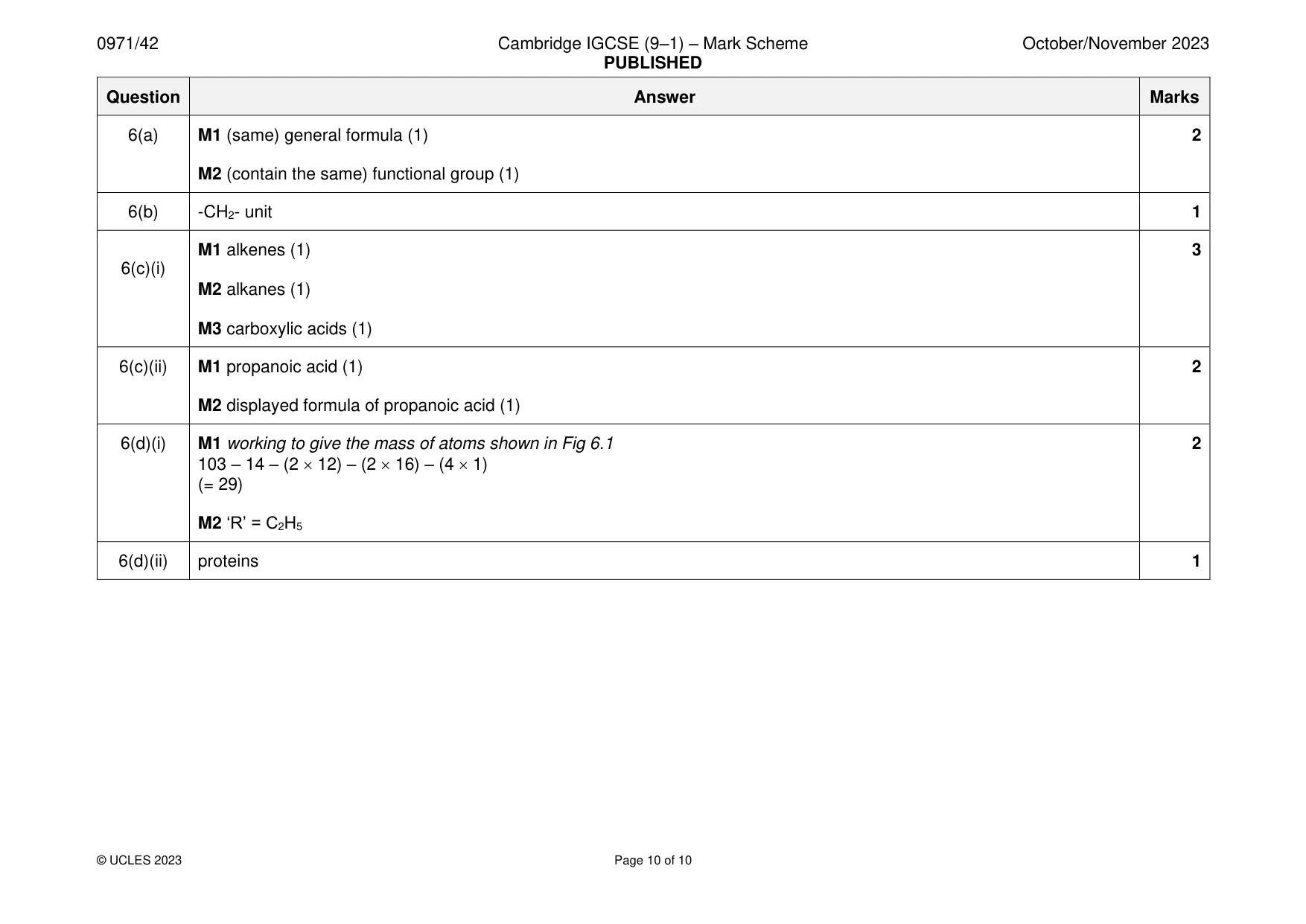
Mark scheme: 6(a) M1 (same) general formula (1) 2 M2 (contain the same) functional group (1) 6(b) -CH2- unit 1 M1 alkenes (1) 3 6(c)(i) M2 alkanes (1) M3 carboxylic acids (1) 6(c)(ii) M1 propanoic acid (1) 2 M2 displayed formula of propanoic acid (1) 6(d)(i) M1 working to give the mass of atoms shown in Fig 6.1 2 103 – 14 – (2 12) – (2 16) – (4 1) (= 29) M2 ‘R’ = C2H5 6(d)(ii) proteins 1
More questions on Formulae, functional groups and terminology
What was in this paper
The subtopics covered by these 6 questions, and how many questions each got. Open one in a new tab to see every Cambridge question on it.
What you needed in this session
Cambridge’s own grade thresholds for 2023 Oct/Nov, Paper 4 · Variant 2. A higher threshold means an easier paper — the bar moves with how the cohort did.