Cambridge IGCSE Chemistry (9-1) 0971 — 2022 May/June Paper 4 · Variant 2
0971/42/M/J/22 · 6 questions · 80 marks · ≈90 min
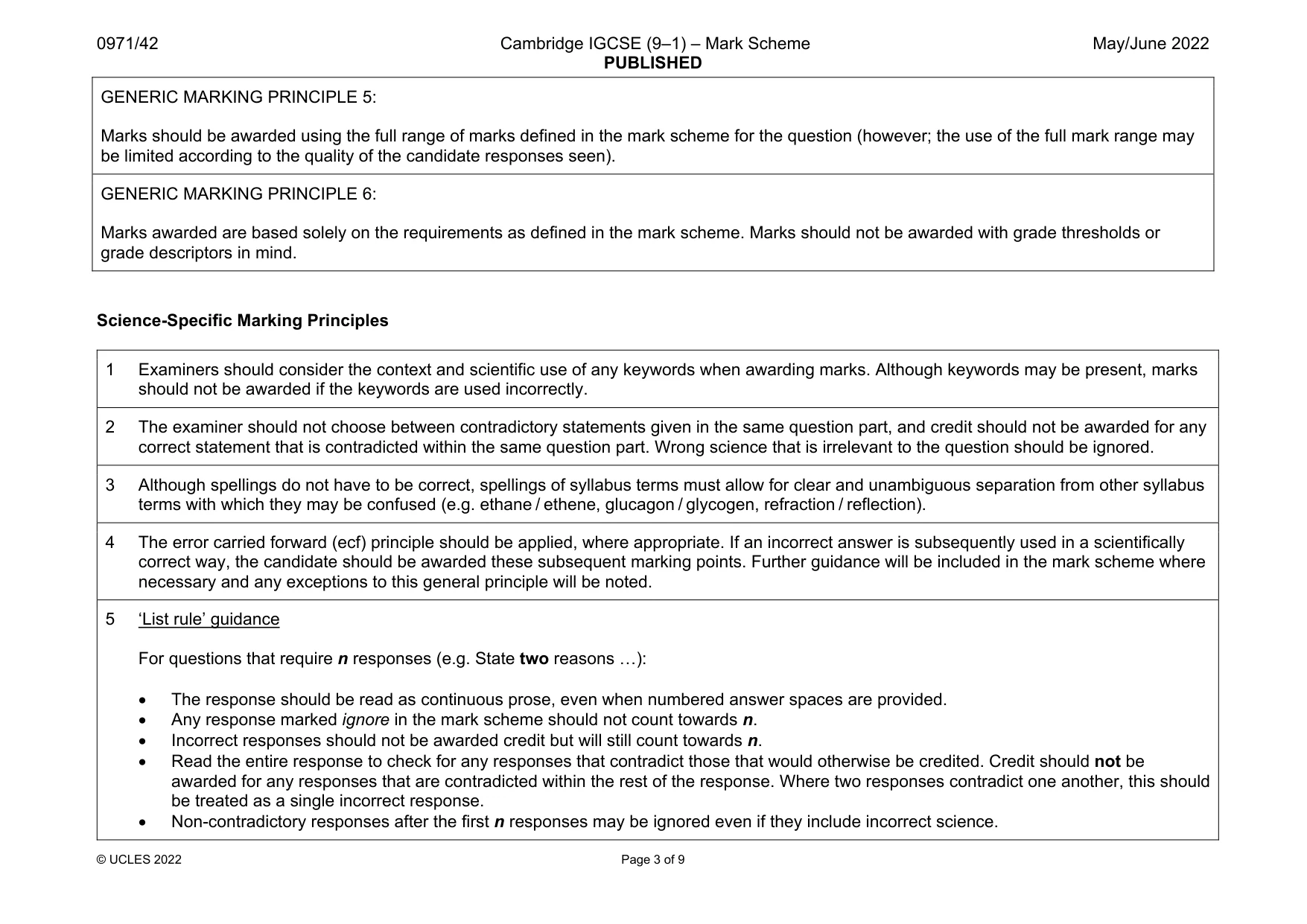
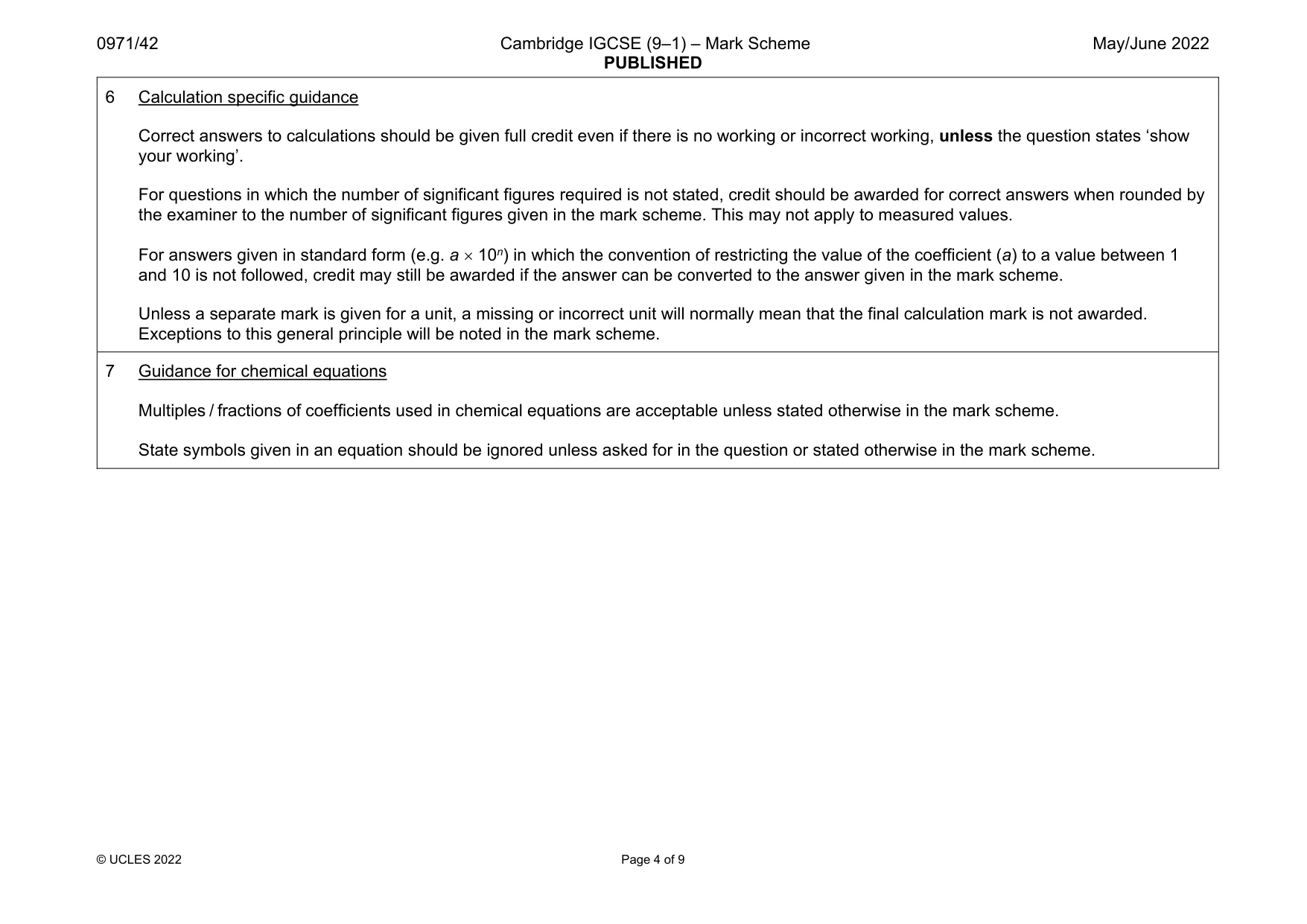
The question paper and its mark scheme, free to read here and free to download. This is Cambridge’s own paper, exactly as it was sat.
Question paper16 pages


Mark scheme9 pages
Answers below. Sit the paper first if you are practising.
Questions as text
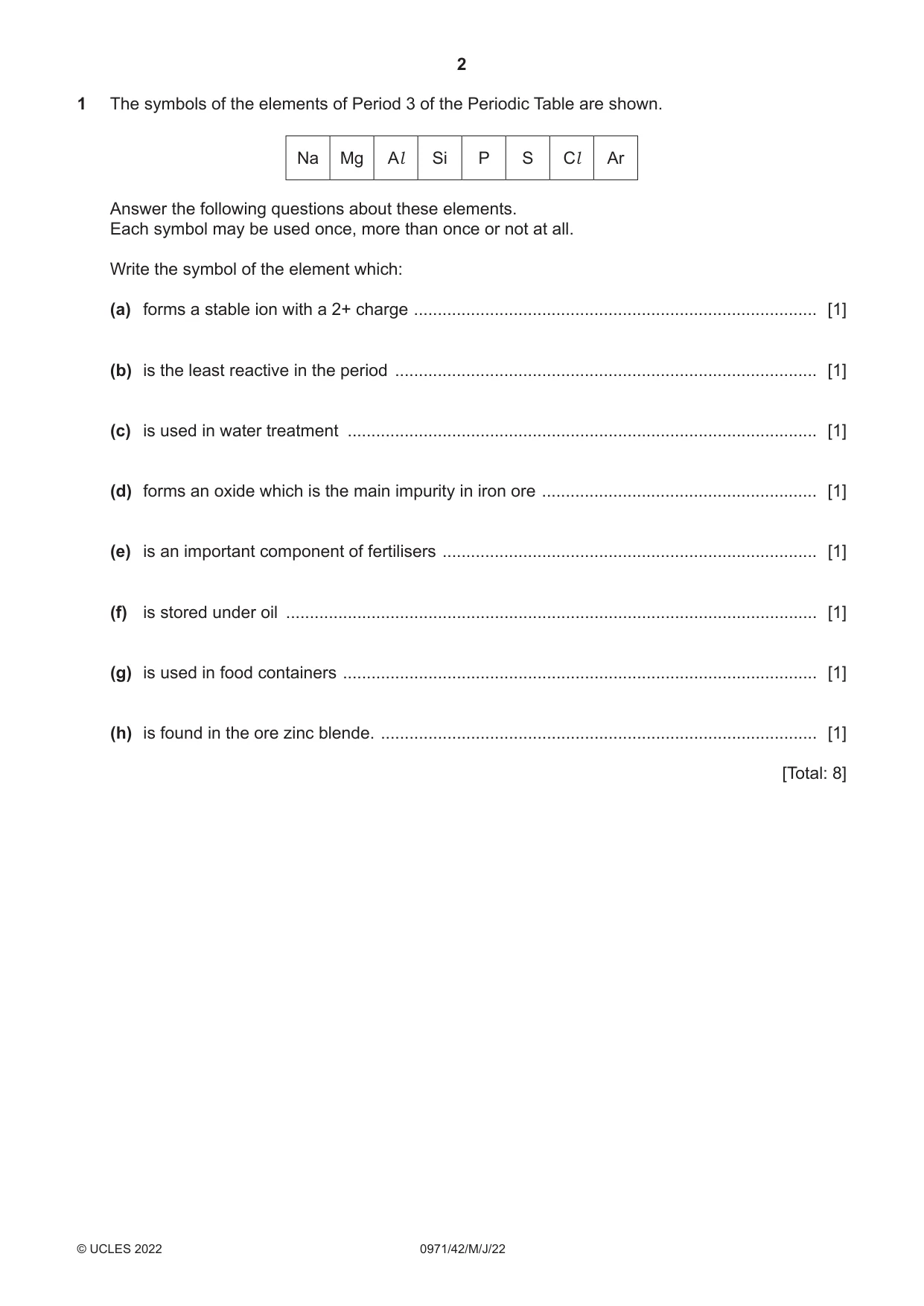
Q1 · The symbols of the elements of Period 3 of the Periodic Table are shown
1 The symbols of the elements of Period 3 of the Periodic Table are shown. Na Mg Al Si P S Cl Ar Answer the following questions about these elements. Each symbol may be used once, more than once or not at all. Write the symbol of the element which: (a) forms a stable ion with a 2+ charge ������������������������������������������������������������������������������������� [1] (b) is the least reactive in the period ����������������������������������������������������������������������������������������� [1] (c) is used in water treatment ��������������������������������������������������������������������������������������������������� [1] (d) forms an oxide which is the main impurity in iron ore ���������������������������������������������������������� [1] (e) is an important component of fertilisers ������������������������������������������������������������������������������� [1] (f) is stored under oil ���������������������������������������������������������������������������������������������������������������� [1] (g) is used in food containers ���������������������������������������������������������������������������������������������������� [1] (h) is found in the ore zinc blende. �������������������������������������������������������������������������������������������� [1] [Total: 8] Question 2 starts on the next page.
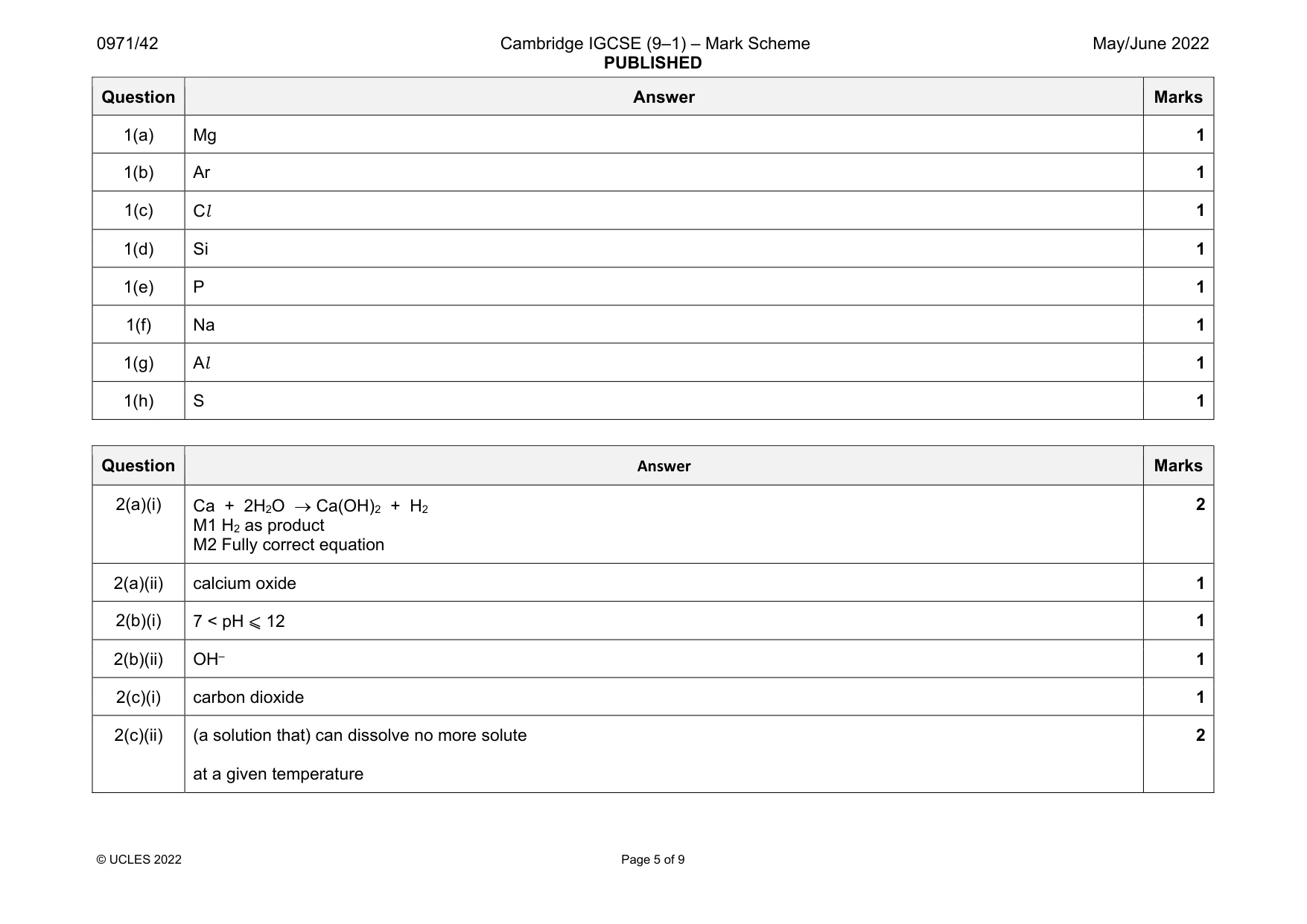
Mark scheme: 1(a) Mg 1 1(b) Ar 1 1(c) Cl 1 1(d) Si 1 1(e) P 1 1(f) Na 1 1(g) Al 1 1(h) S 1
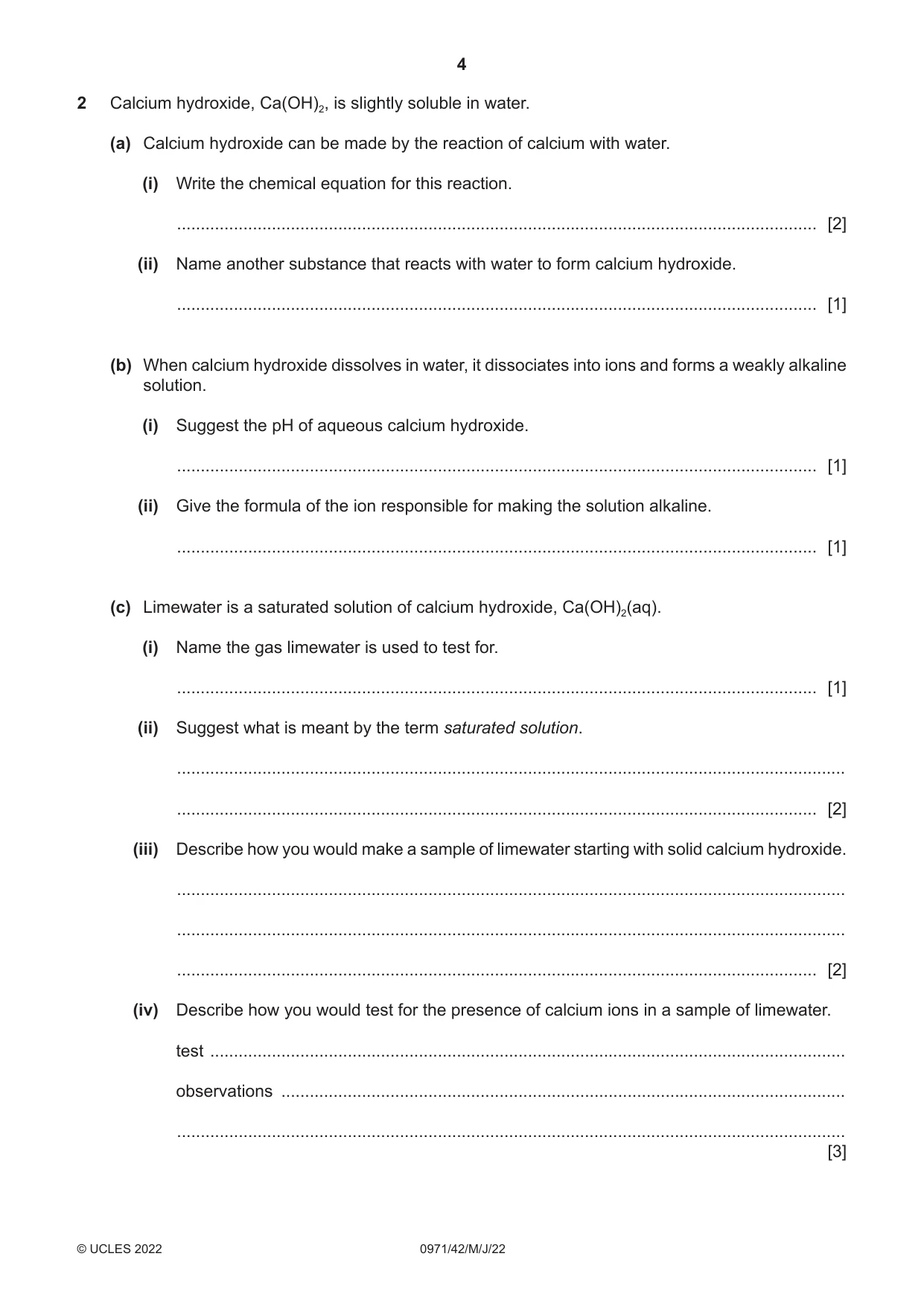
Q2 · Calcium hydroxide, Ca(OH)2, is slightly soluble in water
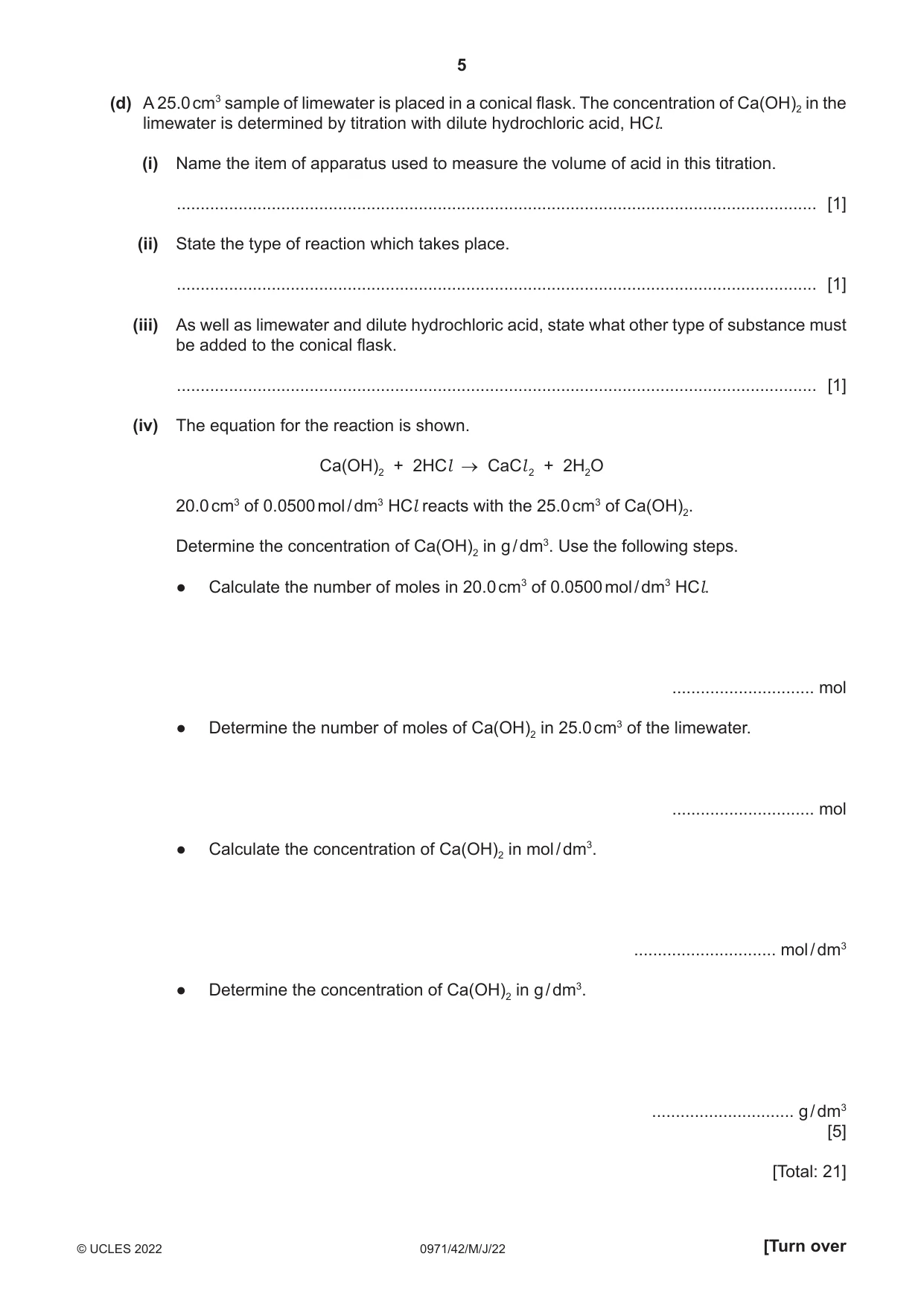
2 Calcium hydroxide, Ca(OH)2, is slightly soluble in water. (a) Calcium hydroxide can be made by the reaction of calcium with water. (i) Write the chemical equation for this reaction. ....................................................................................................................................... [2] (ii) Name another substance that reacts with water to form calcium hydroxide. ....................................................................................................................................... [1] (b) When calcium hydroxide dissolves in water, it dissociates into ions and forms a weakly alkaline solution. (i) Suggest the pH of aqueous calcium hydroxide. ....................................................................................................................................... [1] (ii) Give the formula of the ion responsible for making the solution alkaline. ....................................................................................................................................... [1] (c) Limewater is a saturated solution of calcium hydroxide, Ca(OH)2(aq). (i) Name the gas limewater is used to test for. ....................................................................................................................................... [1] (ii) Suggest what is meant by the term saturated solution. ............................................................................................................................................. ....................................................................................................................................... [2] (iii) Describe how you would make a sample of limewater starting with solid calcium hydroxide. ............................................................................................................................................. ............................................................................................................................................. ....................................................................................................................................... [2] (iv) Describe how you would test for the presence of calcium ions in a sample of limewater. test ...................................................................................................................................... observations ........................................................................................................................ ............................................................................................................................................. [3] (d) A 25.0 cm3 sample of limewater is placed in a conical flask. The concentration of Ca(OH)2 in the limewater is determined by titration with dilute hydrochloric acid, HCl. (i) Name the item of apparatus used to measure the volume of acid in this titration. ....................................................................................................................................... [1] (ii) State the type of reaction which takes place. ....................................................................................................................................... [1] (iii) As well as limewater and dilute hydrochloric acid, state what other type of substance must be added to the conical flask. ....................................................................................................................................... [1] (iv) The equation for the reaction is shown. Ca(OH)2 + 2HCl → CaCl 2 + 2H2O 20.0 cm3 of 0.0500 mol / dm3 HCl reacts with the 25.0 cm3 of Ca(OH)2. Determine the concentration of Ca(OH)2 in g / dm3. Use the following steps. ● Calculate the number of moles in 20.0 cm3 of 0.0500 mol / dm3 HCl. .............................. mol ● Determine the number of moles of Ca(OH)2 in 25.0 cm3 of the limewater. .............................. mol ● Calculate the concentration of Ca(OH)2 in mol / dm3. .............................. mol / dm3 ● Determine the concentration of Ca(OH)2 in g / dm3. .............................. g / dm3 [5] [Total: 21]
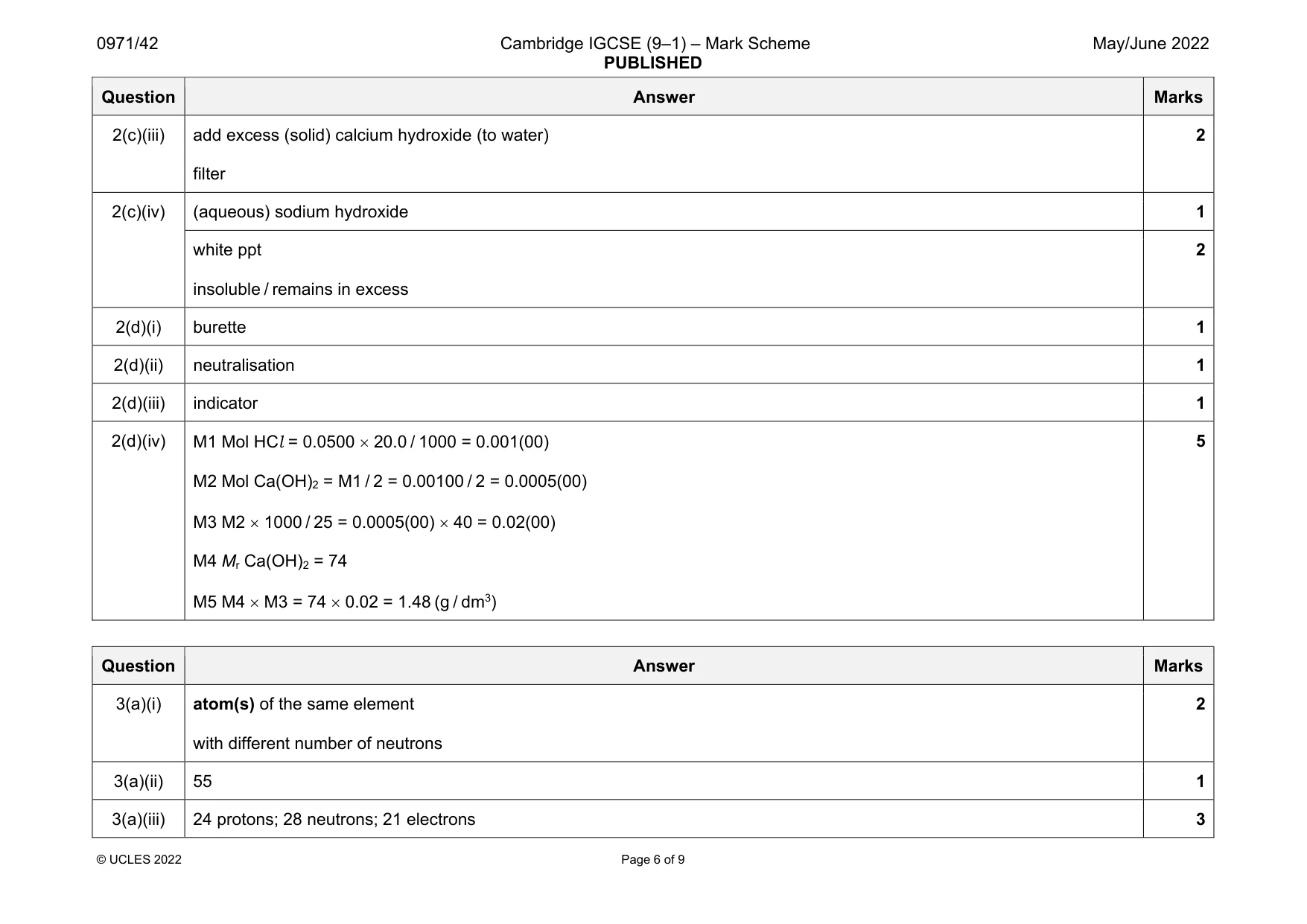
Mark scheme: 2(a)(i) M1 H2 as product M2 Fully correct equation 2(a)(ii) calcium oxide 1 2(b)(i) 7 < pH ⩽ 12 1 2(b)(ii) OH– 1 2(c)(i) carbon dioxide 1 2(c)(ii) (a solution that) can dissolve no more solute at a given temperature 2 Question Answer Marks 2(c)(iii) add excess (solid) calcium hydroxide (to water) filter 2 2(c)(iv) (aqueous) sodium hydroxide 1 white ppt insoluble / remains in excess 2 2(d)(i) burette 1 2(d)(ii) neutralisation 1 2(d)(iii) indicator 1 2(d)(iv) M1 Mol HCl = 0.0500 20.0 / 1000 = 0.001(00) M2 Mol Ca(OH)2 = M1 / 2 = 0.00100 / 2 = 0.0005(00) M3 M2 1000 / 25 = 0.0005(00) 40 = 0.02(00) M4 Mr Ca(OH)2 = 74 M5 M4 M3 = 74 0.02 = 1.48 (g / dm3) 5
Q3 · Transition elements are found in the middle block of the Periodic Table
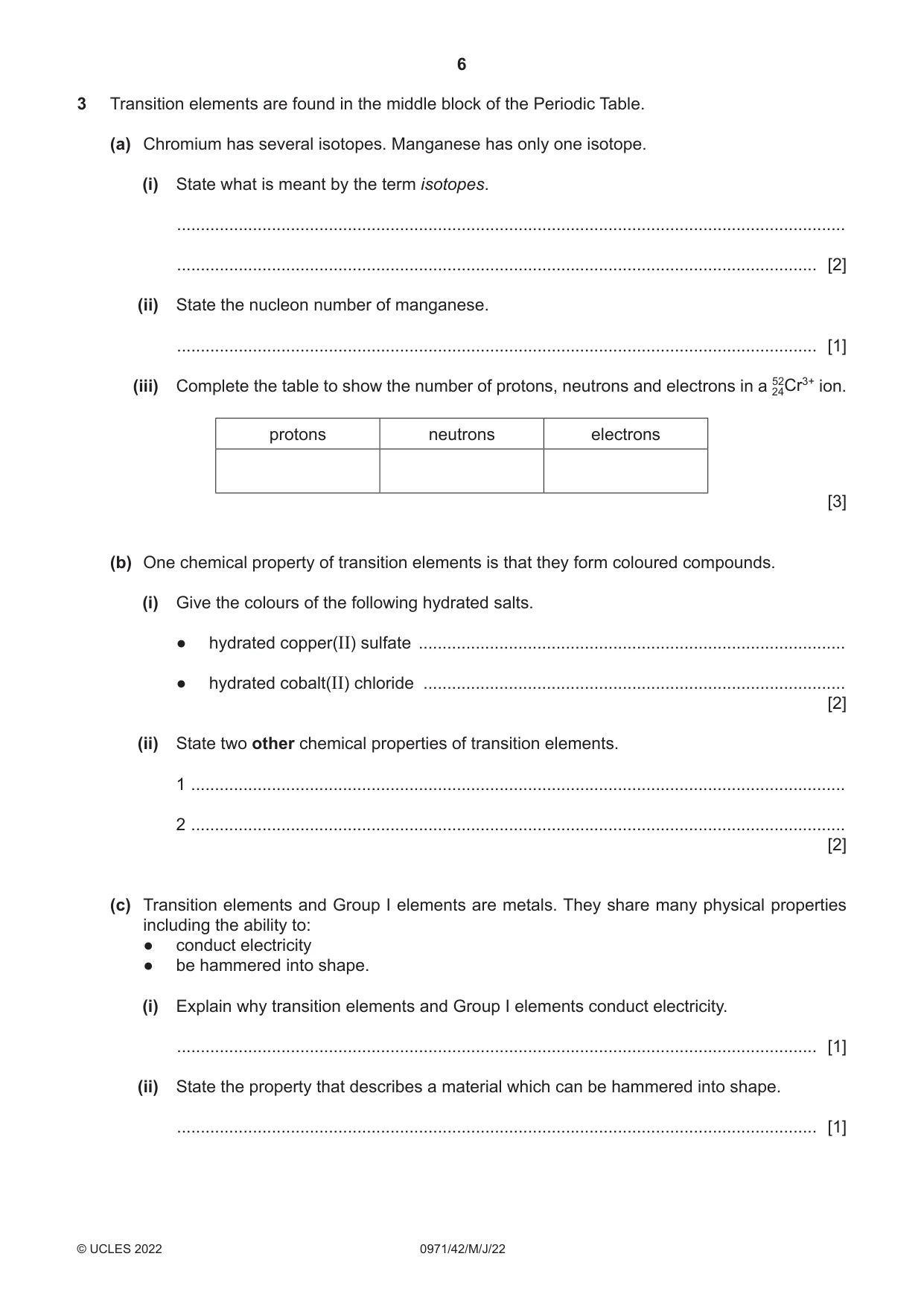
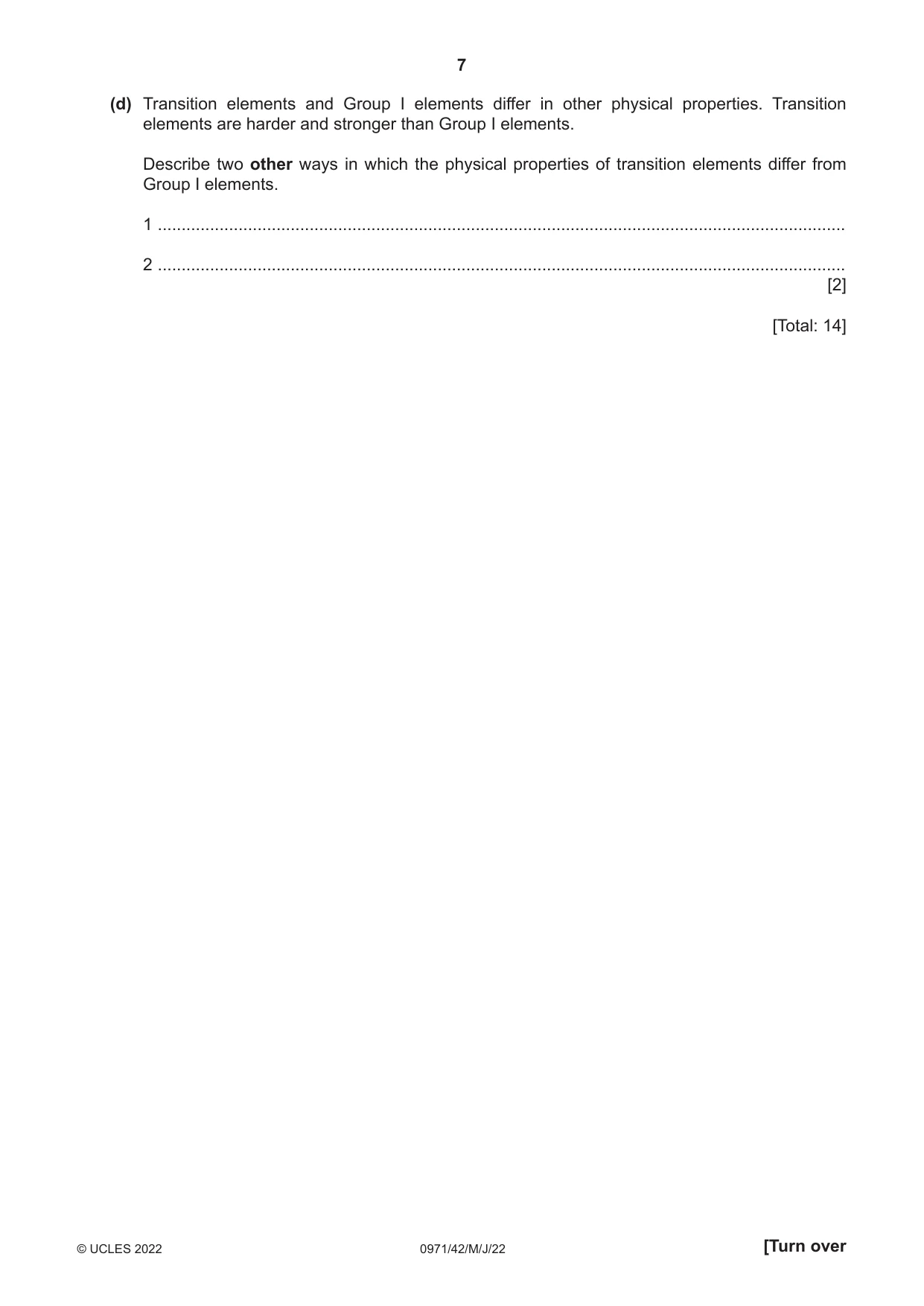
3 Transition elements are found in the middle block of the Periodic Table. (a) Chromium has several isotopes. Manganese has only one isotope. (i) State what is meant by the term isotopes. ............................................................................................................................................. ....................................................................................................................................... [2] (ii) State the nucleon number of manganese. ....................................................................................................................................... [1] (iii) Complete the table to show the number of protons, neutrons and electrons in a 2452Cr3+ ion. protons neutrons electrons [3] (b) One chemical property of transition elements is that they form coloured compounds. (i) Give the colours of the following hydrated salts. ● hydrated copper(II) sulfate ������������������������������������������������������������������������������������������ ● hydrated cobalt(II) chloride ����������������������������������������������������������������������������������������� [2] (ii) State two other chemical properties of transition elements. 1 .......................................................................................................................................... 2 .......................................................................................................................................... [2] (c) Transition elements and Group I elements are metals. They share many physical properties including the ability to: ● conduct electricity ● be hammered into shape. (i) Explain why transition elements and Group I elements conduct electricity. ....................................................................................................................................... [1] (ii) State the property that describes a material which can be hammered into shape. ....................................................................................................................................... [1] (d) Transition elements and Group I elements differ in other physical properties. Transition elements are harder and stronger than Group I elements. Describe two other ways in which the physical properties of transition elements differ from Group I elements. 1 ................................................................................................................................................. 2 ................................................................................................................................................. [2] [Total: 14]
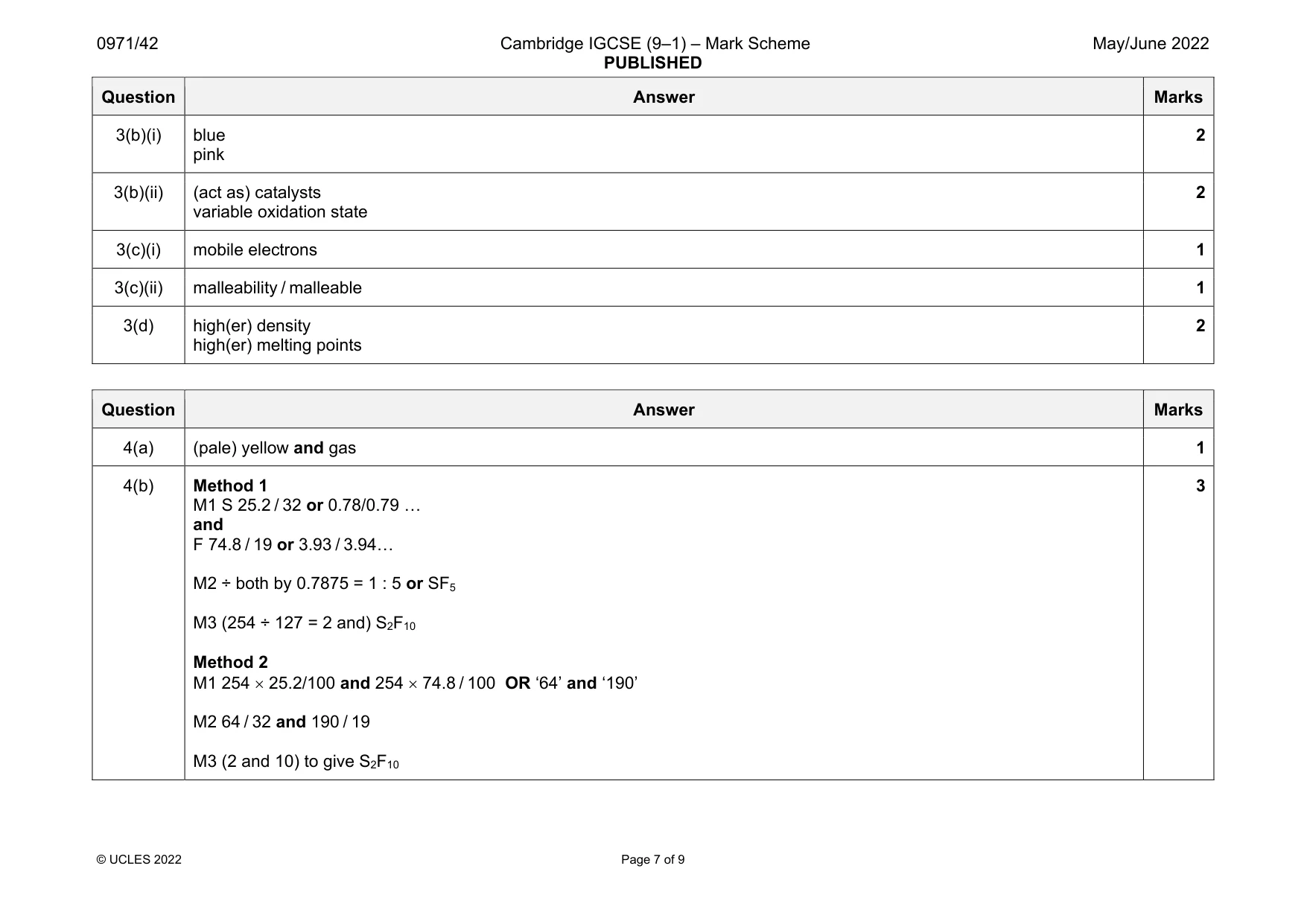
Mark scheme: 3(a)(i) atom(s) of the same element with different number of neutrons 2 3(a)(ii) 55 1 3(a)(iii) 24 protons; 28 neutrons; 21 electrons 3 Question Answer Marks 3(b)(i) blue pink 2 3(b)(ii) (act as) catalysts variable oxidation state 2 3(c)(i) mobile electrons 1 3(c)(ii) malleability / malleable 1 3(d) high(er) density high(er) melting points 2
Q4 · Fluorine and chlorine are halogens
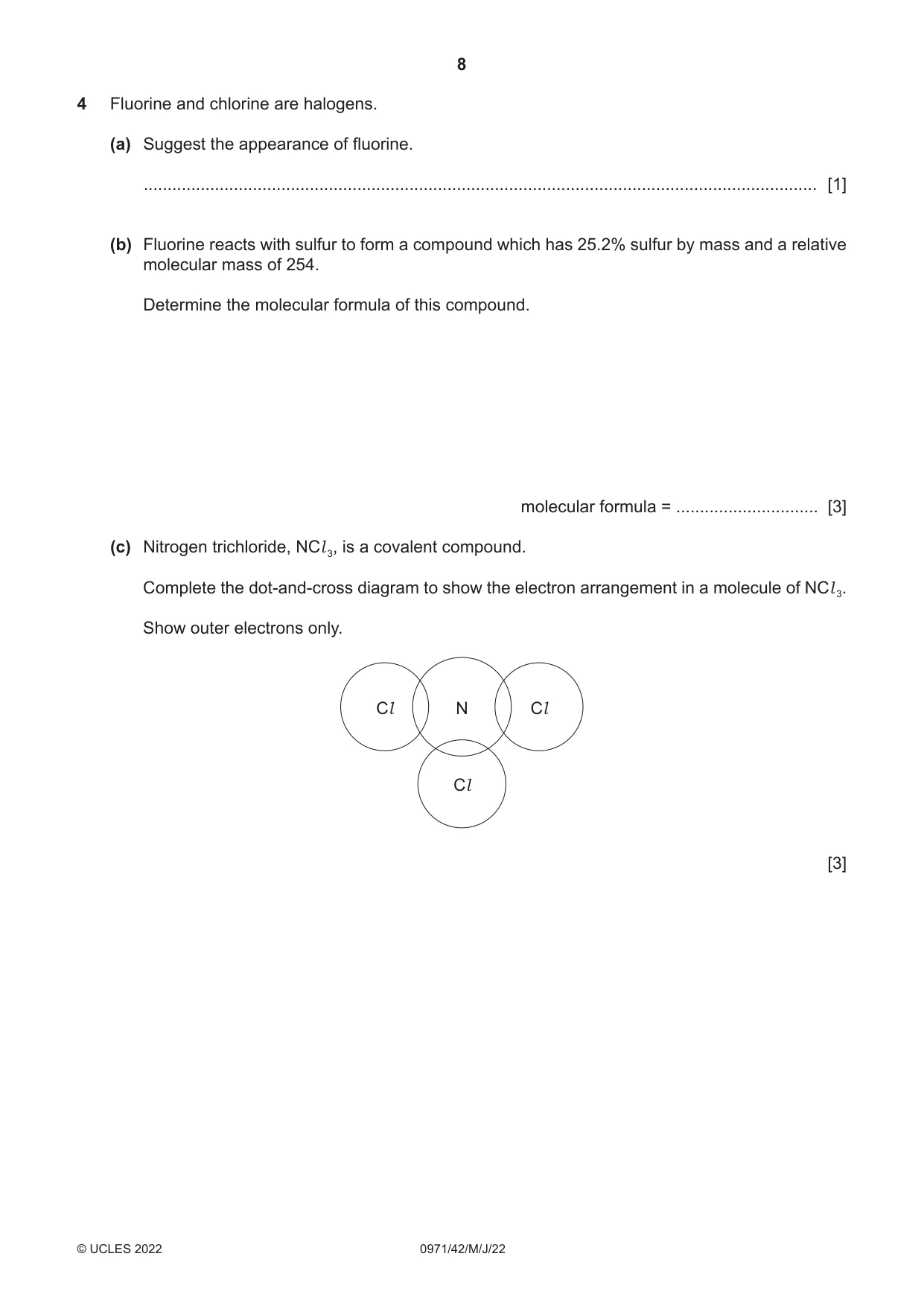
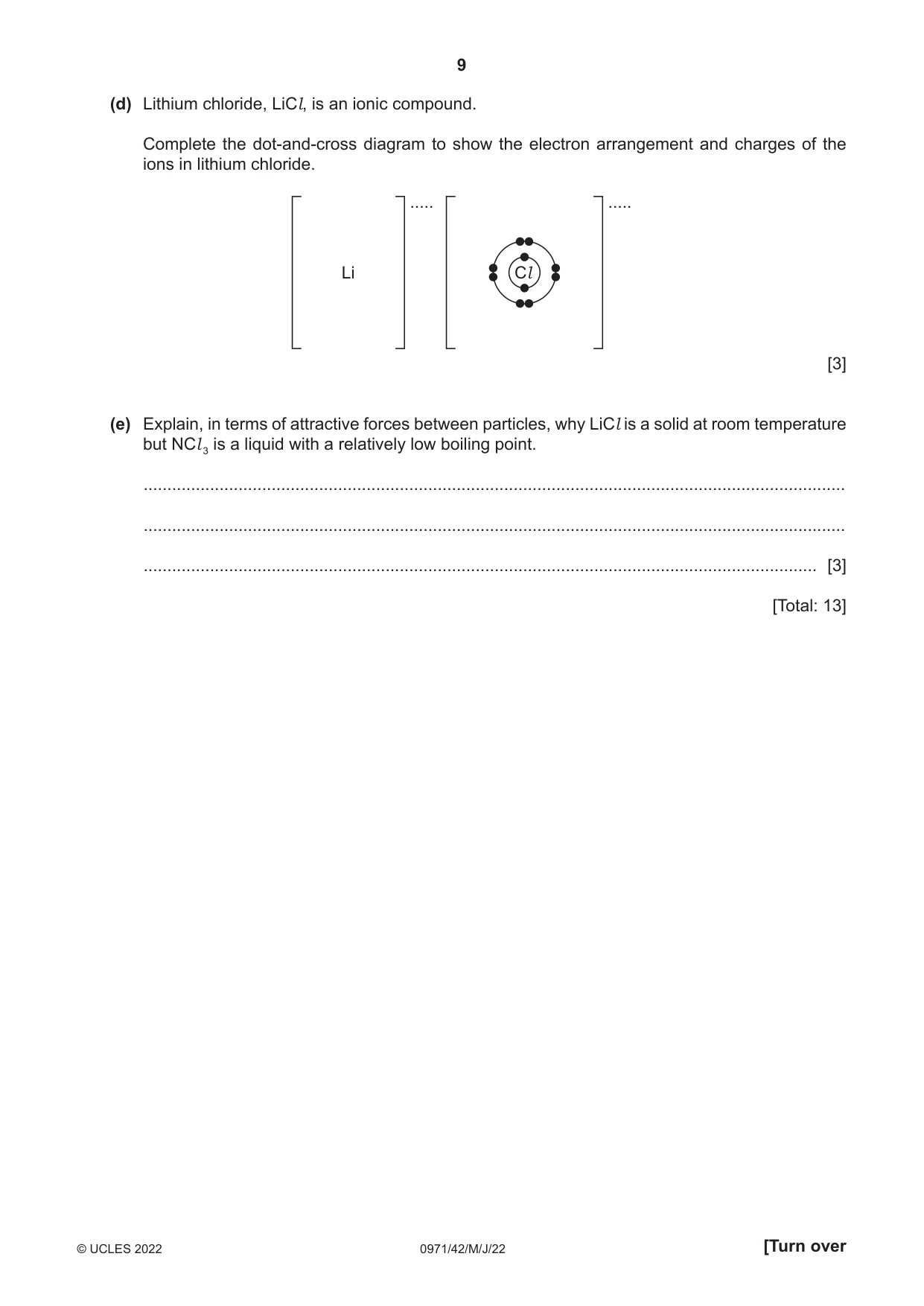
4 Fluorine and chlorine are halogens. (a) Suggest the appearance of fluorine. .............................................................................................................................................. [1] (b) Fluorine reacts with sulfur to form a compound which has 25.2% sulfur by mass and a relative molecular mass of 254. Determine the molecular formula of this compound. molecular formula = .............................. [3] (c) Nitrogen trichloride, NCl 3, is a covalent compound. Complete the dot-and-cross diagram to show the electron arrangement in a molecule of NCl 3. Show outer electrons only. Cl N Cl Cl [3] (d) Lithium chloride, LiCl, is an ionic compound. Complete the dot-and-cross diagram to show the electron arrangement and charges of the ions in lithium chloride. ..... ..... Li Cl [3] (e) Explain, in terms of attractive forces between particles, why LiCl is a solid at room temperature but NCl 3 is a liquid with a relatively low boiling point. .................................................................................................................................................... .................................................................................................................................................... .............................................................................................................................................. [3] [Total: 13]
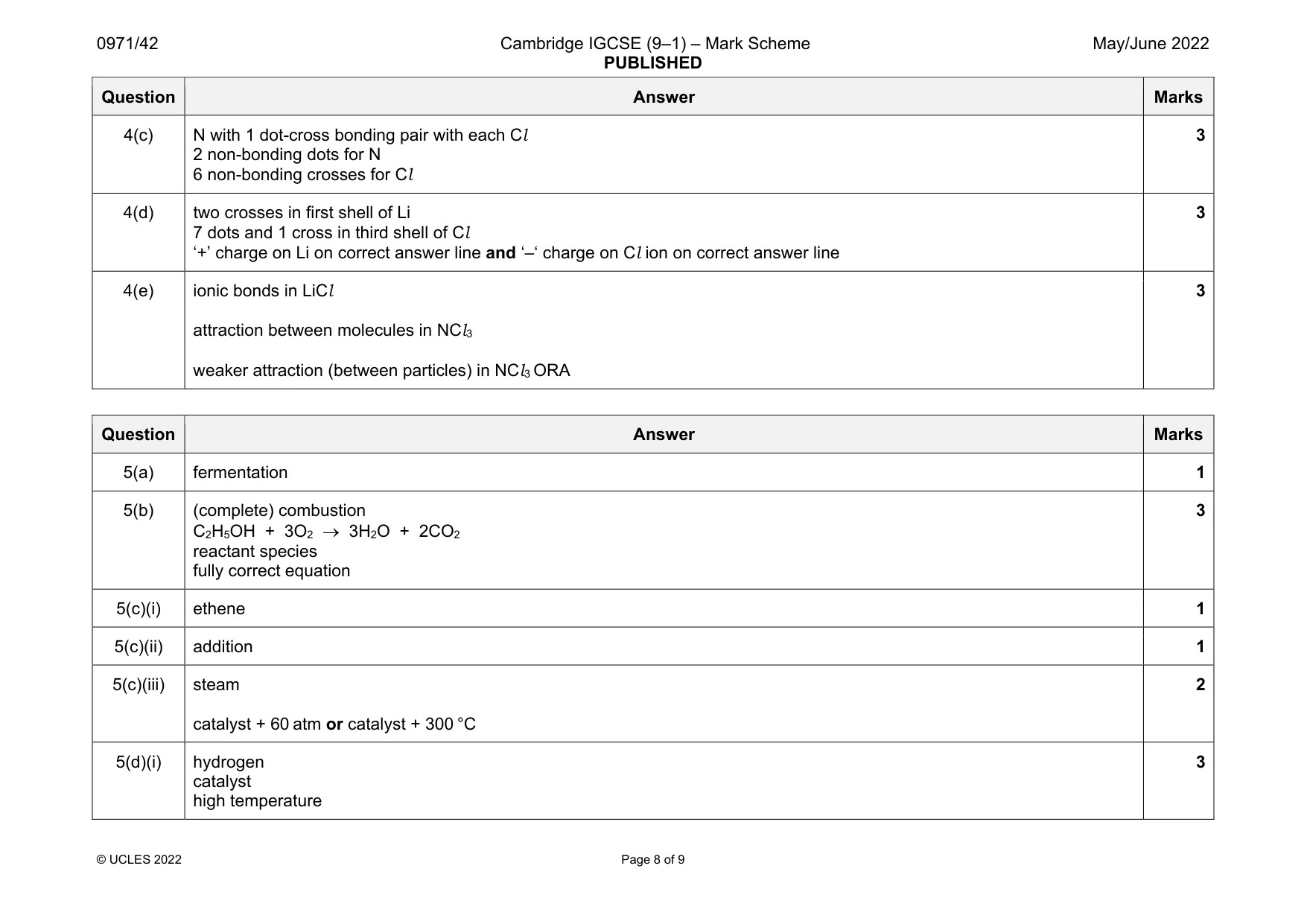
Mark scheme: 4(a) (pale) yellow and gas 1 4(b) Method 1 M1 S 25.2 / 32 or 0.78/0.79 … and F 74.8 / 19 or 3.93 / 3.94… M2 ÷ both by 0.7875 = 1 : 5 or SF5 M3 (254 ÷ 127 = 2 and) S2F10 Method 2 M1 254 25.2/100 and 254 74.8 / 100 OR ‘64’ and ‘190’ M2 64 / 32 and 190 / 19 M3 (2 and 10) to give S2F10 3 Question Answer Marks 4(c) N with 1 dot-cross bonding pair with each Cl 2 non-bonding dots for N 6 non-bonding crosses for Cl 3 4(d) two crosses in first shell of Li 7 dots and 1 cross in third shell of Cl ‘+’ charge on Li on correct answer line and ‘–‘ charge on Cl ion on correct answer line 3 4(e) ionic bonds in LiCl attraction between molecules in NCl3 weaker attraction (between particles) in NCl3 ORA 3
Q5 · The reaction scheme shows five organic reactions, numbered 1 to 5
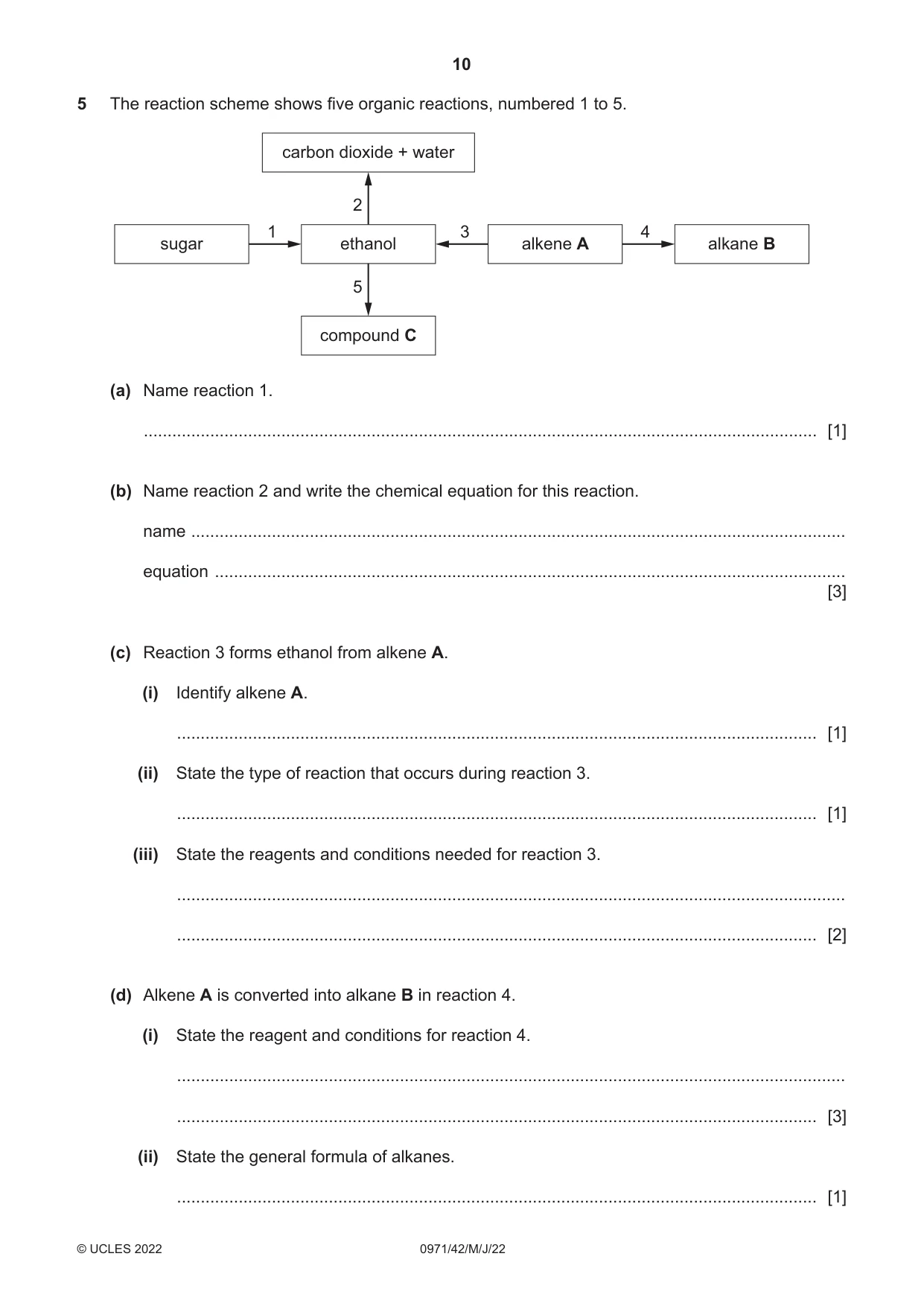
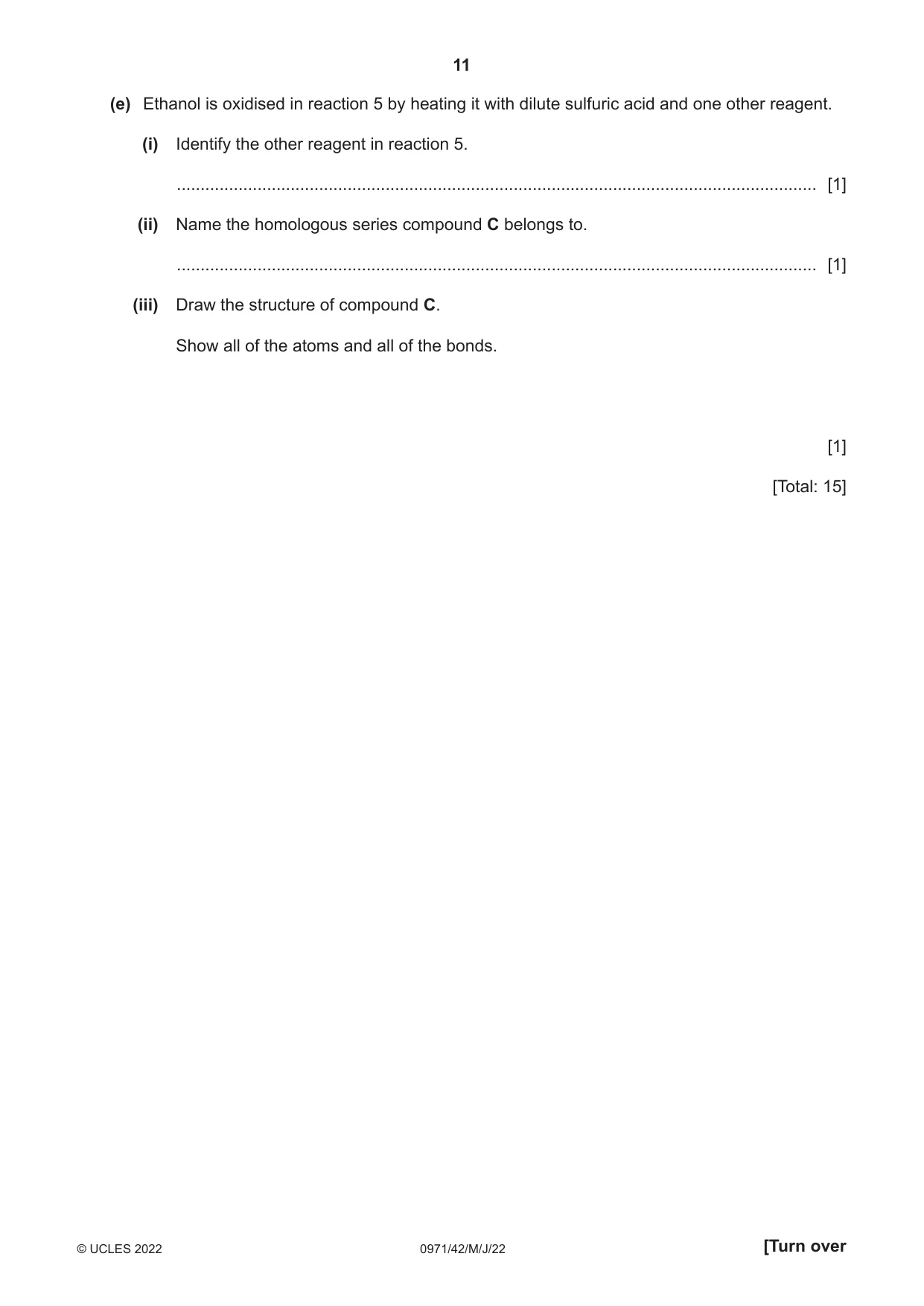
5 The reaction scheme shows five organic reactions, numbered 1 to 5. carbon dioxide + water 2 1 3 4 sugar ethanol alkene A alkane B 5 compound C (a) Name reaction 1. .............................................................................................................................................. [1] (b) Name reaction 2 and write the chemical equation for this reaction. name .......................................................................................................................................... equation ..................................................................................................................................... [3] (c) Reaction 3 forms ethanol from alkene A. (i) Identify alkene A. ....................................................................................................................................... [1] (ii) State the type of reaction that occurs during reaction 3. ....................................................................................................................................... [1] (iii) State the reagents and conditions needed for reaction 3. ............................................................................................................................................. ....................................................................................................................................... [2] (d) Alkene A is converted into alkane B in reaction 4. (i) State the reagent and conditions for reaction 4. ............................................................................................................................................. ....................................................................................................................................... [3] (ii) State the general formula of alkanes. ....................................................................................................................................... [1] (e) Ethanol is oxidised in reaction 5 by heating it with dilute sulfuric acid and one other reagent. (i) Identify the other reagent in reaction 5. ....................................................................................................................................... [1] (ii) Name the homologous series compound C belongs to. ....................................................................................................................................... [1] (iii) Draw the structure of compound C. Show all of the atoms and all of the bonds. [1] [Total: 15]
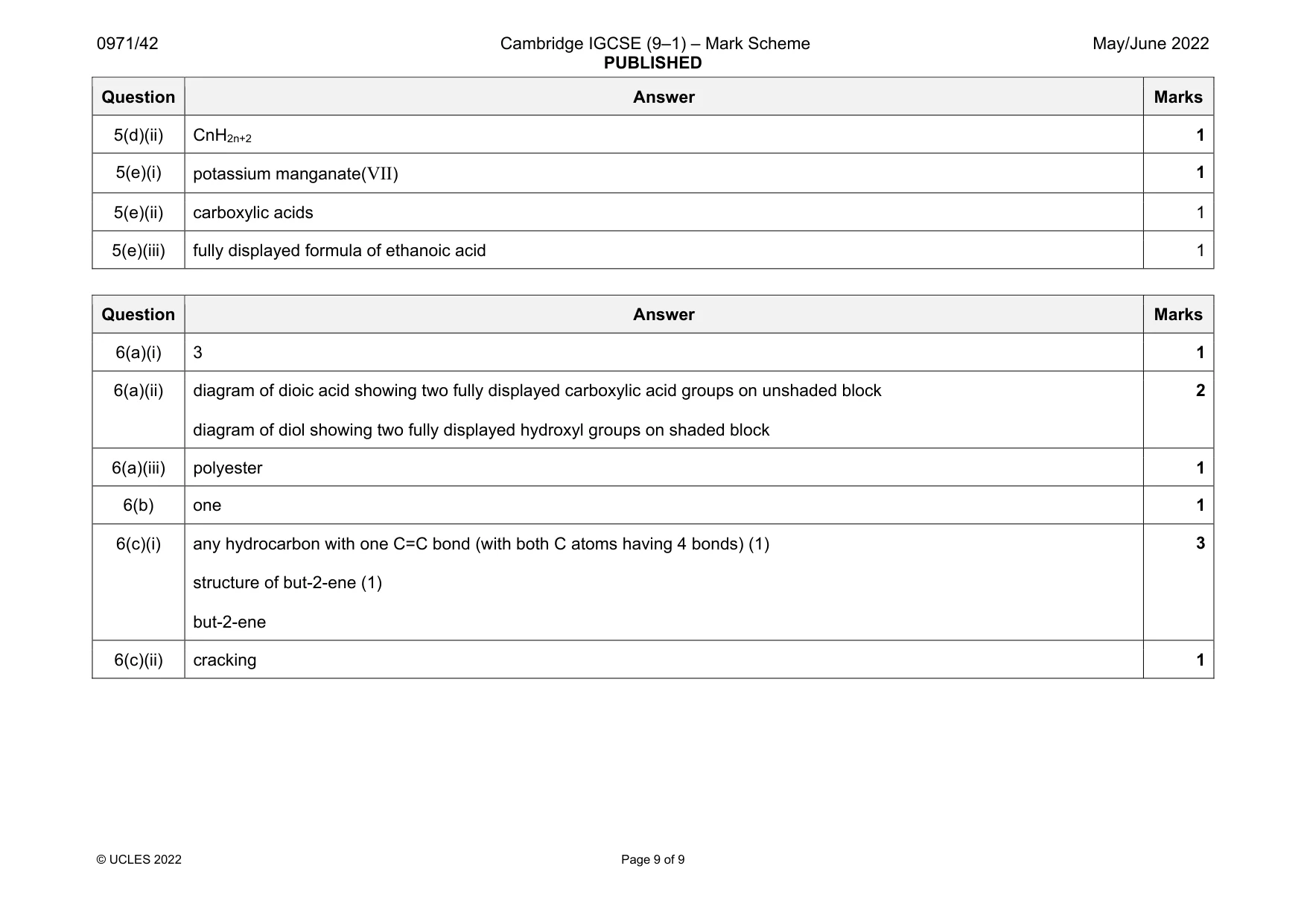
Mark scheme: 5(a) fermentation 1 5(b) (complete) combustion C2H5OH + 3O2 3H2O + 2CO2 reactant species fully correct equation 3 5(c)(i) ethene 1 5(c)(ii) addition 1 5(c)(iii) steam catalyst + 60 atm or catalyst + 300 °C 2 5(d)(i) hydrogen catalyst high temperature 3 Question Answer Marks 5(d)(ii) CnH2n+2 1 5(e)(i) potassium manganate(VII) 1 5(e)(ii) carboxylic acids 1 5(e)(iii) fully displayed formula of ethanoic acid 1
Q6 · This question is about polymers
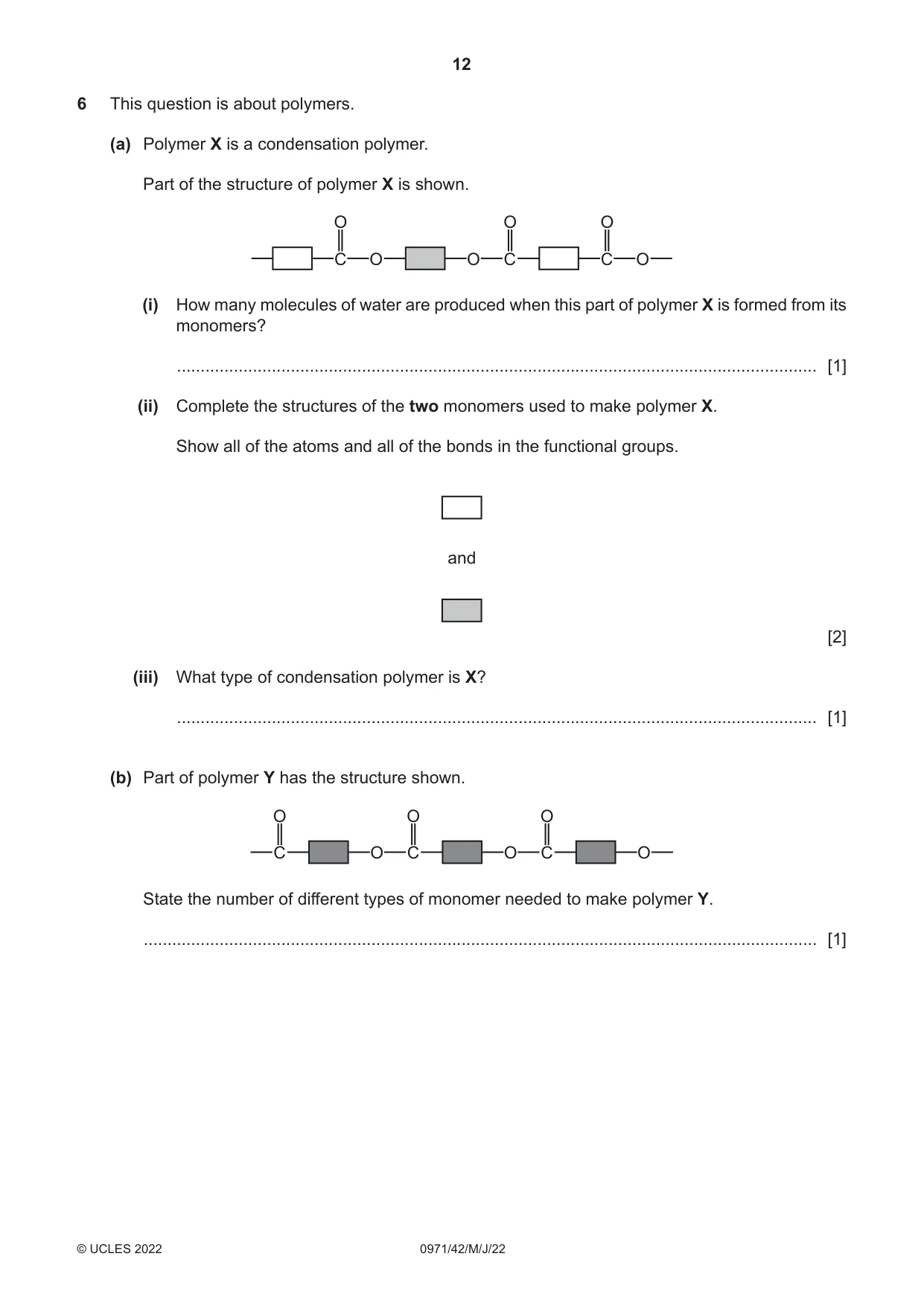
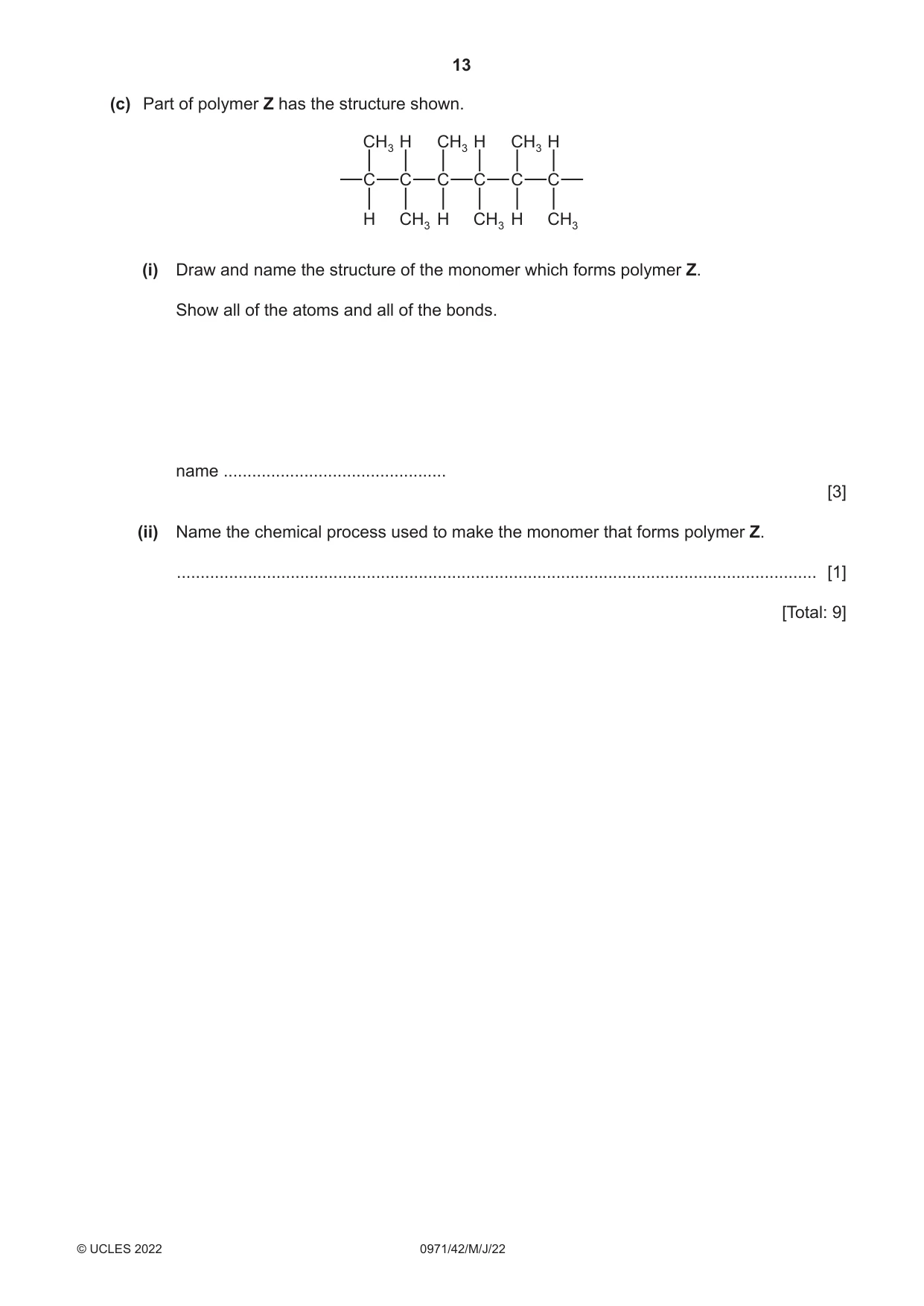
6 This question is about polymers. (a) Polymer X is a condensation polymer. Part of the structure of polymer X is shown. O O O C O O C C O (i) How many molecules of water are produced when this part of polymer X is formed from its monomers? ....................................................................................................................................... [1] (ii) Complete the structures of the two monomers used to make polymer X. Show all of the atoms and all of the bonds in the functional groups. and [2] (iii) What type of condensation polymer is X? ....................................................................................................................................... [1] (b) Part of polymer Y has the structure shown. O O O C O C O C O State the number of different types of monomer needed to make polymer Y. .............................................................................................................................................. [1] (c) Part of polymer Z has the structure shown. CH3 H CH3 H CH3 H C C C C C C H CH3 H CH3 H CH3 (i) Draw and name the structure of the monomer which forms polymer Z. Show all of the atoms and all of the bonds. name ............................................... [3] (ii) Name the chemical process used to make the monomer that forms polymer Z. ....................................................................................................................................... [1] [Total: 9]
Mark scheme: 6(a)(i) 3 1 6(a)(ii) diagram of dioic acid showing two fully displayed carboxylic acid groups on unshaded block diagram of diol showing two fully displayed hydroxyl groups on shaded block 2 6(a)(iii) polyester 1 6(b) one 1 6(c)(i) any hydrocarbon with one C=C bond (with both C atoms having 4 bonds) (1) structure of but-2-ene (1) but-2-ene 3 6(c)(ii) cracking 1
What was in this paper
The subtopics covered by these 6 questions, and how many questions each got. Open one in a new tab to see every Cambridge question on it.
What you needed in this session
Cambridge’s own grade thresholds for 2022 May/June, Paper 4 · Variant 2. A higher threshold means an easier paper — the bar moves with how the cohort did.