Cambridge IGCSE Chemistry (9-1) 0971 — 2023 May/June Paper 4 · Variant 1
0971/41/M/J/23 · 7 questions · 80 marks · 75 min
The question paper and its mark scheme, free to read here and free to download. This is Cambridge’s own paper, exactly as it was sat.
Question paper16 pages
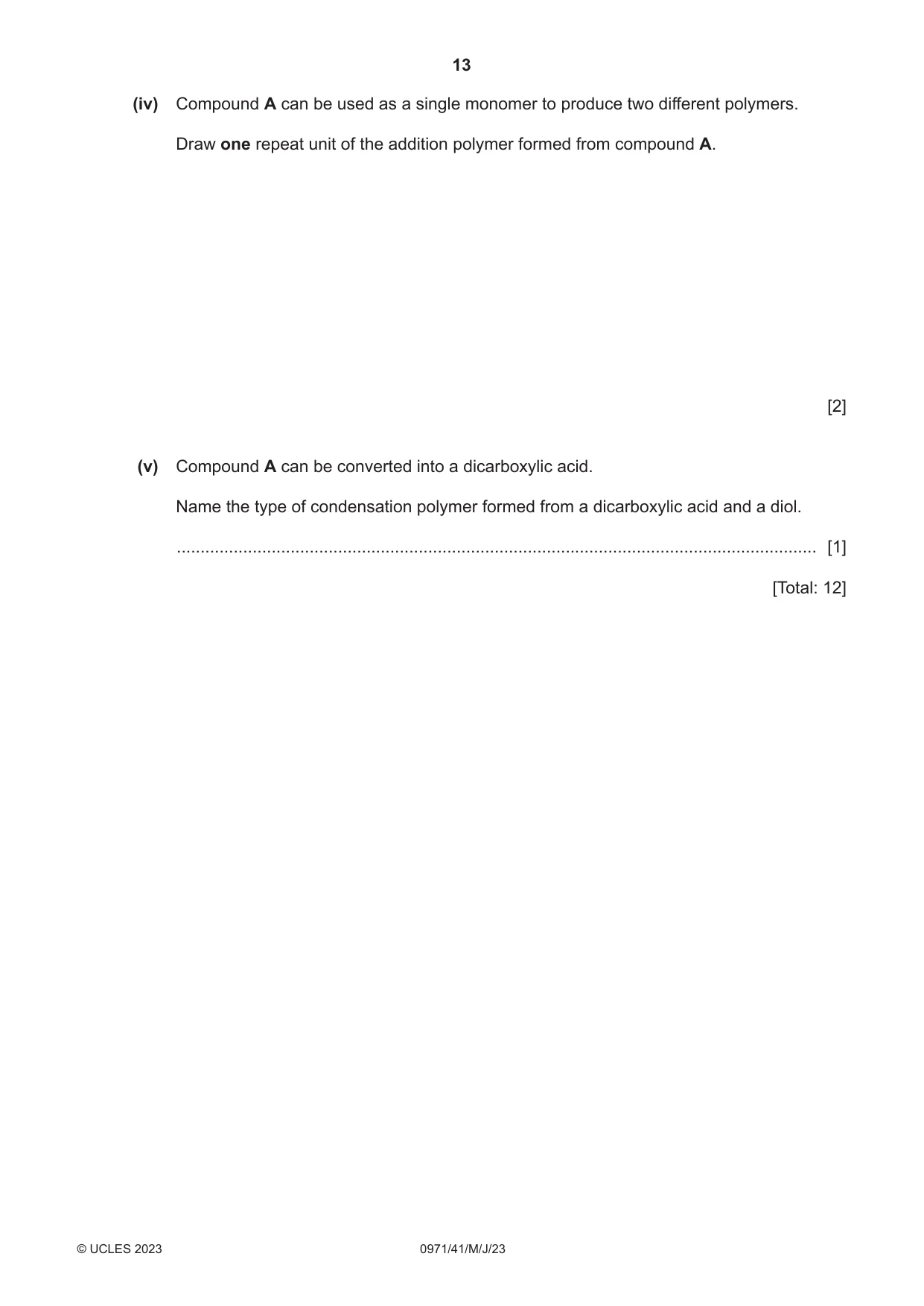


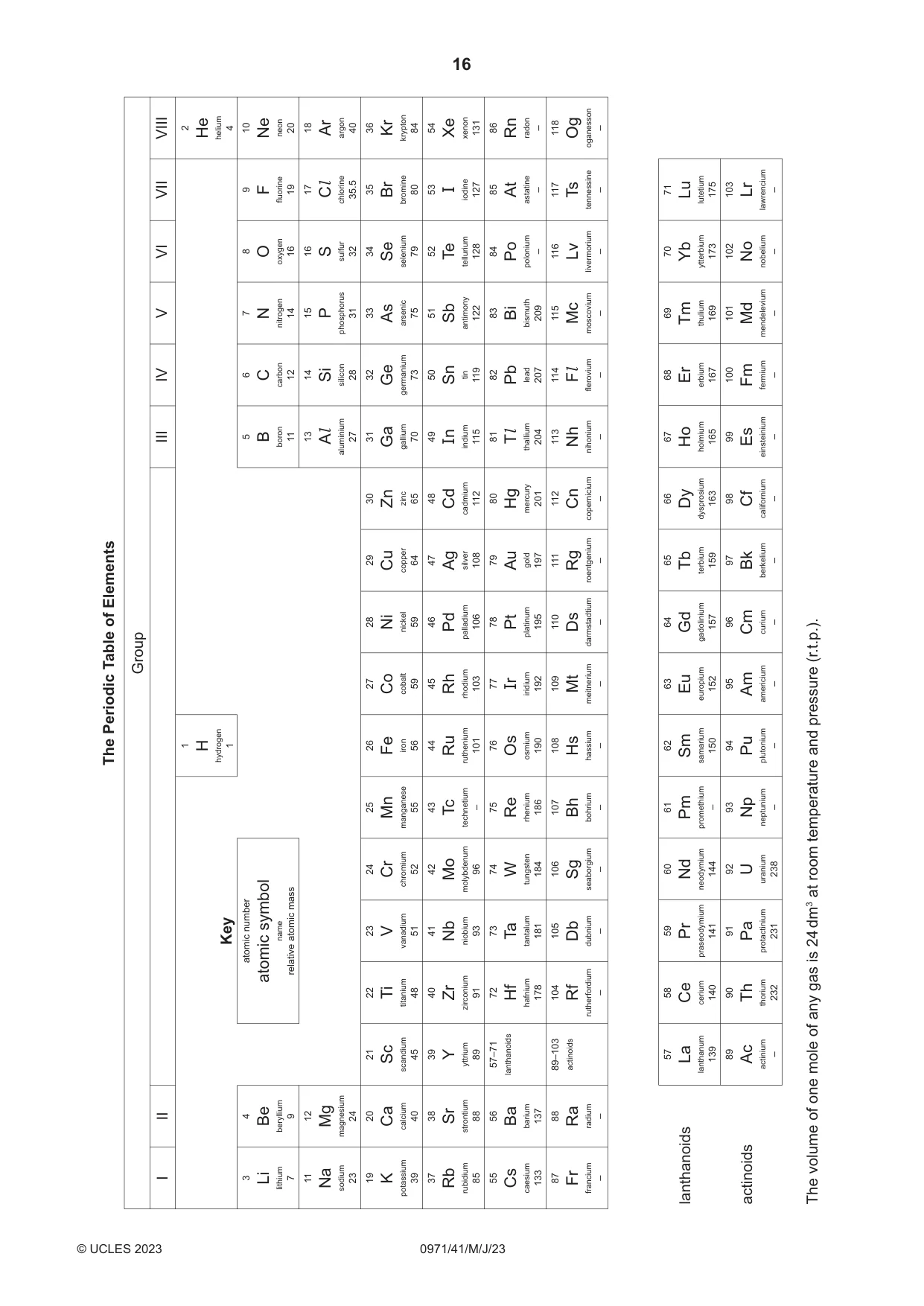
Mark scheme12 pages
Answers below. Sit the paper first if you are practising.
Questions as text
Q1 · Some symbol equations and word equations, A to J, are shown
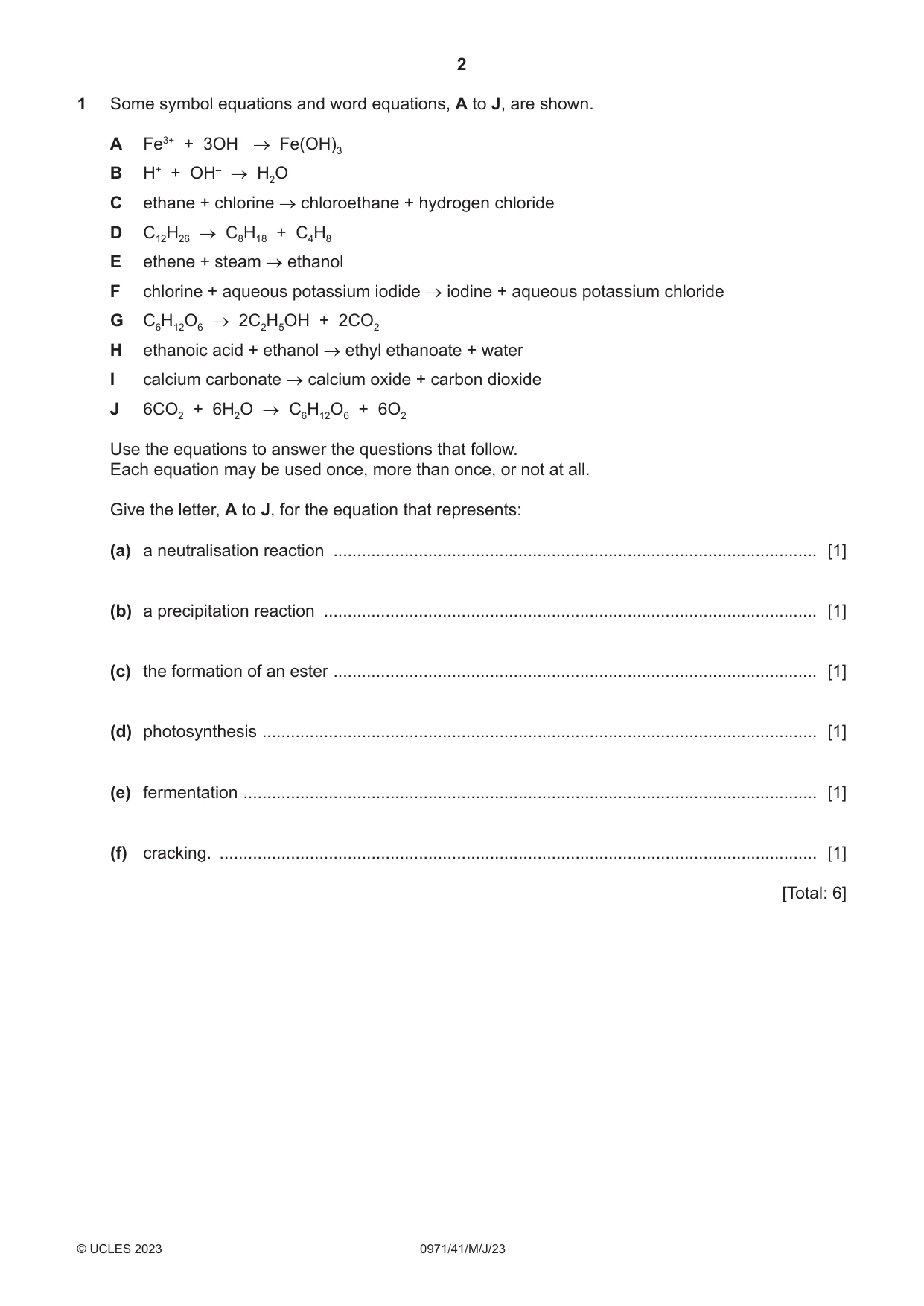
1 Some symbol equations and word equations, A to J, are shown. A Fe3+ + 3OH– → Fe(OH)3 B H+ + OH– → H2O C ethane + chlorine → chloroethane + hydrogen chloride D C12H26 → C8H18 + C4H8 E ethene + steam → ethanol F chlorine + aqueous potassium iodide → iodine + aqueous potassium chloride G C6H12O6 → 2C2H5OH + 2CO2 H ethanoic acid + ethanol → ethyl ethanoate + water I calcium carbonate → calcium oxide + carbon dioxide J 6CO2 + 6H2O → C6H12O6 + 6O2 Use the equations to answer the questions that follow. Each equation may be used once, more than once, or not at all. Give the letter, A to J, for the equation that represents: (a) a neutralisation reaction ������������������������������������������������������������������������������������������������������ [1] (b) a precipitation reaction �������������������������������������������������������������������������������������������������������� [1] (c) the formation of an ester ������������������������������������������������������������������������������������������������������ [1] (d) photosynthesis ��������������������������������������������������������������������������������������������������������������������� [1] (e) fermentation ������������������������������������������������������������������������������������������������������������������������� [1] (f) cracking. ������������������������������������������������������������������������������������������������������������������������������ [1] [Total: 6]
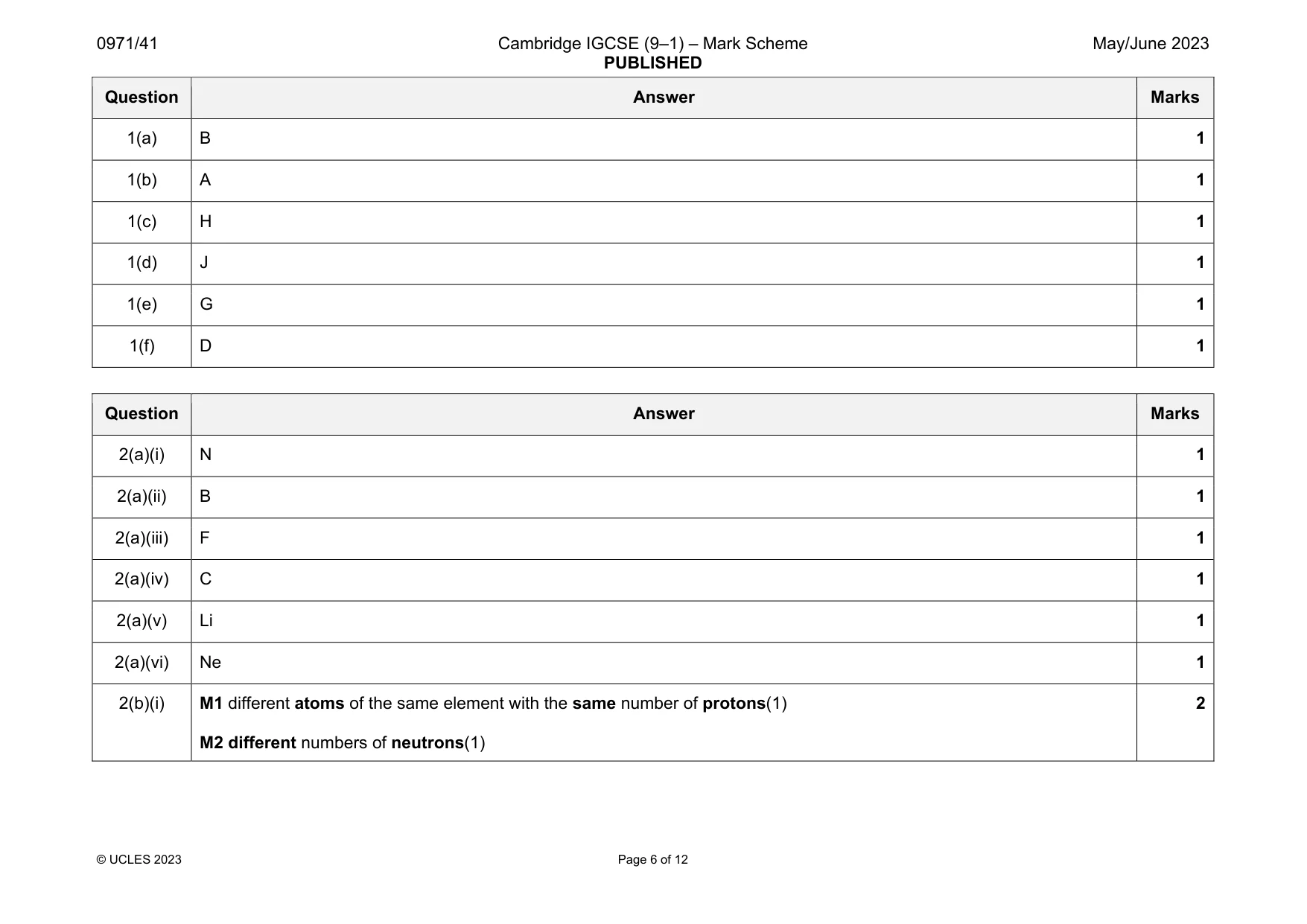
Mark scheme: 1(a) B 1 1(b) A 1 1(c) H 1 1(d) J 1 1(e) G 1 1(f) D 1
More questions on The characteristic properties of acids and bases
Q2 · The symbols of the elements in Period 2 of the Periodic Table are shown
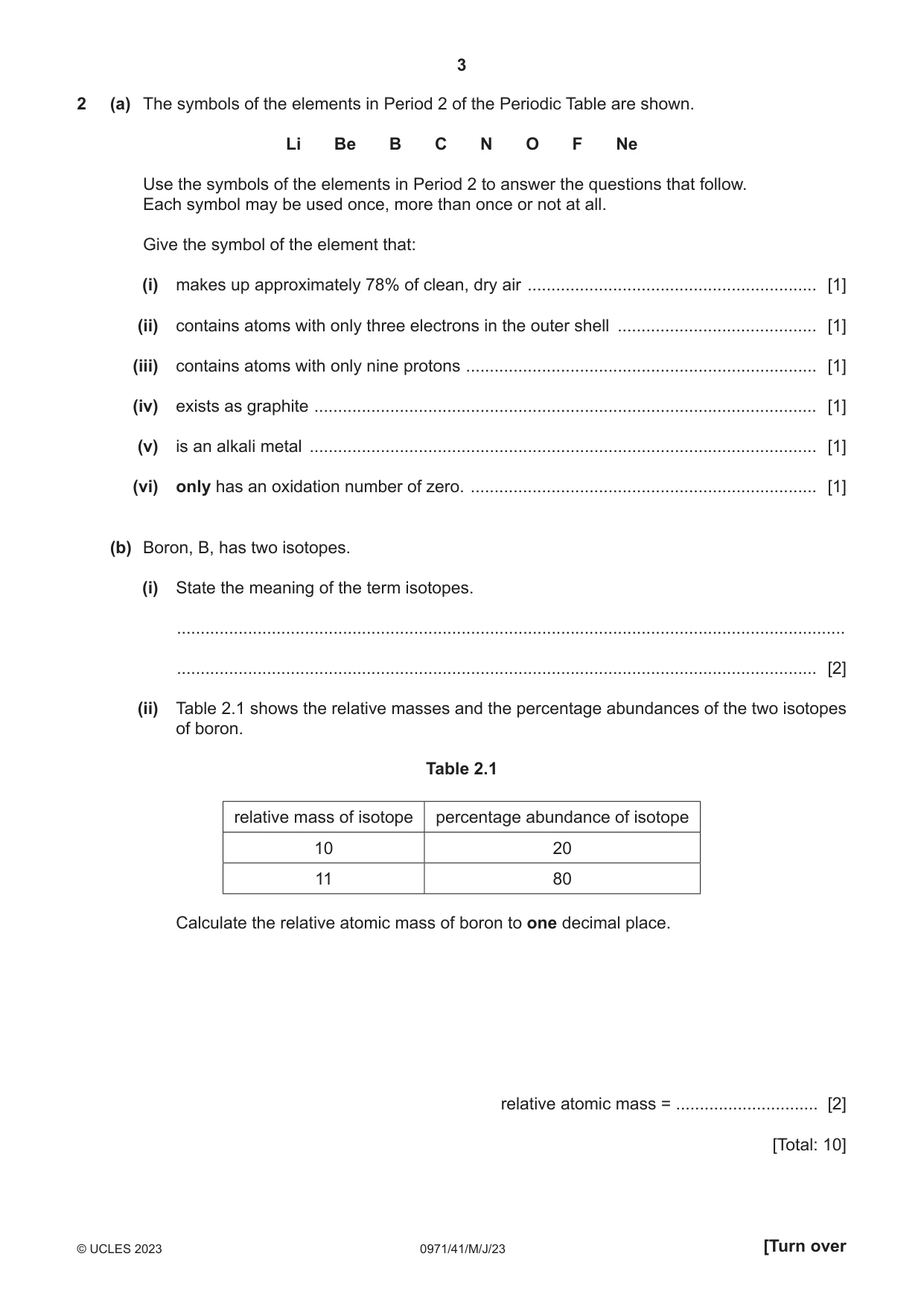
2 (a) The symbols of the elements in Period 2 of the Periodic Table are shown. Li Be B C N O F Ne Use the symbols of the elements in Period 2 to answer the questions that follow. Each symbol may be used once, more than once or not at all. Give the symbol of the element that: (i) makes up approximately 78% of clean, dry air ������������������������������������������������������������� [1] (ii) contains atoms with only three electrons in the outer shell ������������������������������������������ [1] (iii) contains atoms with only nine protons �������������������������������������������������������������������������� [1] (iv) exists as graphite ���������������������������������������������������������������������������������������������������������� [1] (v) is an alkali metal ����������������������������������������������������������������������������������������������������������� [1] (vi) only has an oxidation number of zero. ������������������������������������������������������������������������� [1] (b) Boron, B, has two isotopes. (i) State the meaning of the term isotopes. ............................................................................................................................................. ....................................................................................................................................... [2] (ii) Table 2.1 shows the relative masses and the percentage abundances of the two isotopes of boron. Table 2.1 relative mass of isotope percentage abundance of isotope 10 20 11 80 Calculate the relative atomic mass of boron to one decimal place. relative atomic mass = .............................. [2] [Total: 10]
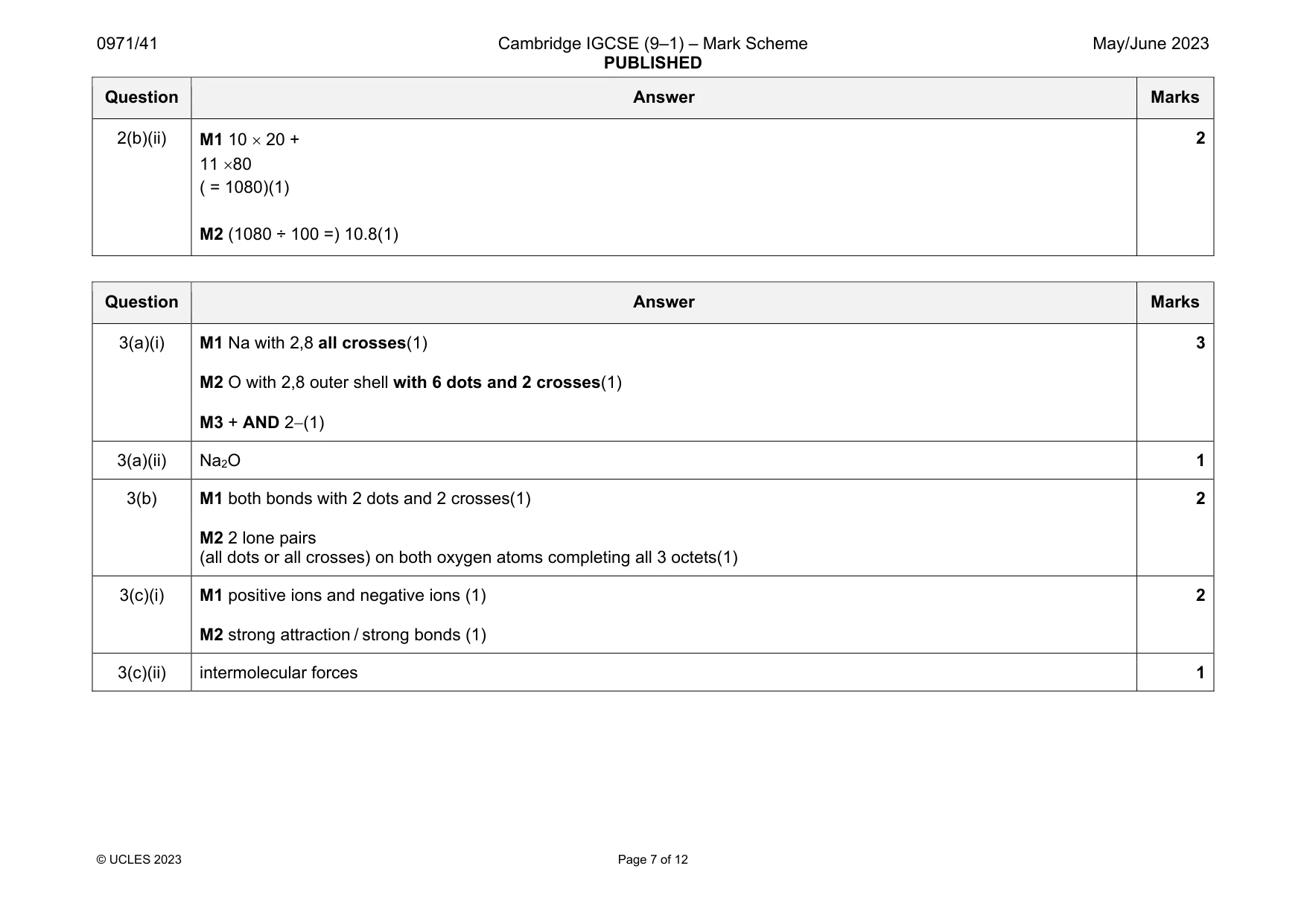
Mark scheme: 2(a)(i) N 1 2(a)(ii) B 1 2(a)(iii) F 1 2(a)(iv) C 1 2(a)(v) Li 1 2(a)(vi) Ne 1 2(b)(i) M1 different atoms of the same element with the same number of protons(1) M2 different numbers of neutrons(1) 2 Question Answer Marks 2(b)(ii) M1 10 20 + 11 80 ( = 1080)(1) M2 (1080 ÷ 100 =) 10.8(1) 2
Q3 · This question is about ionic and covalent compounds
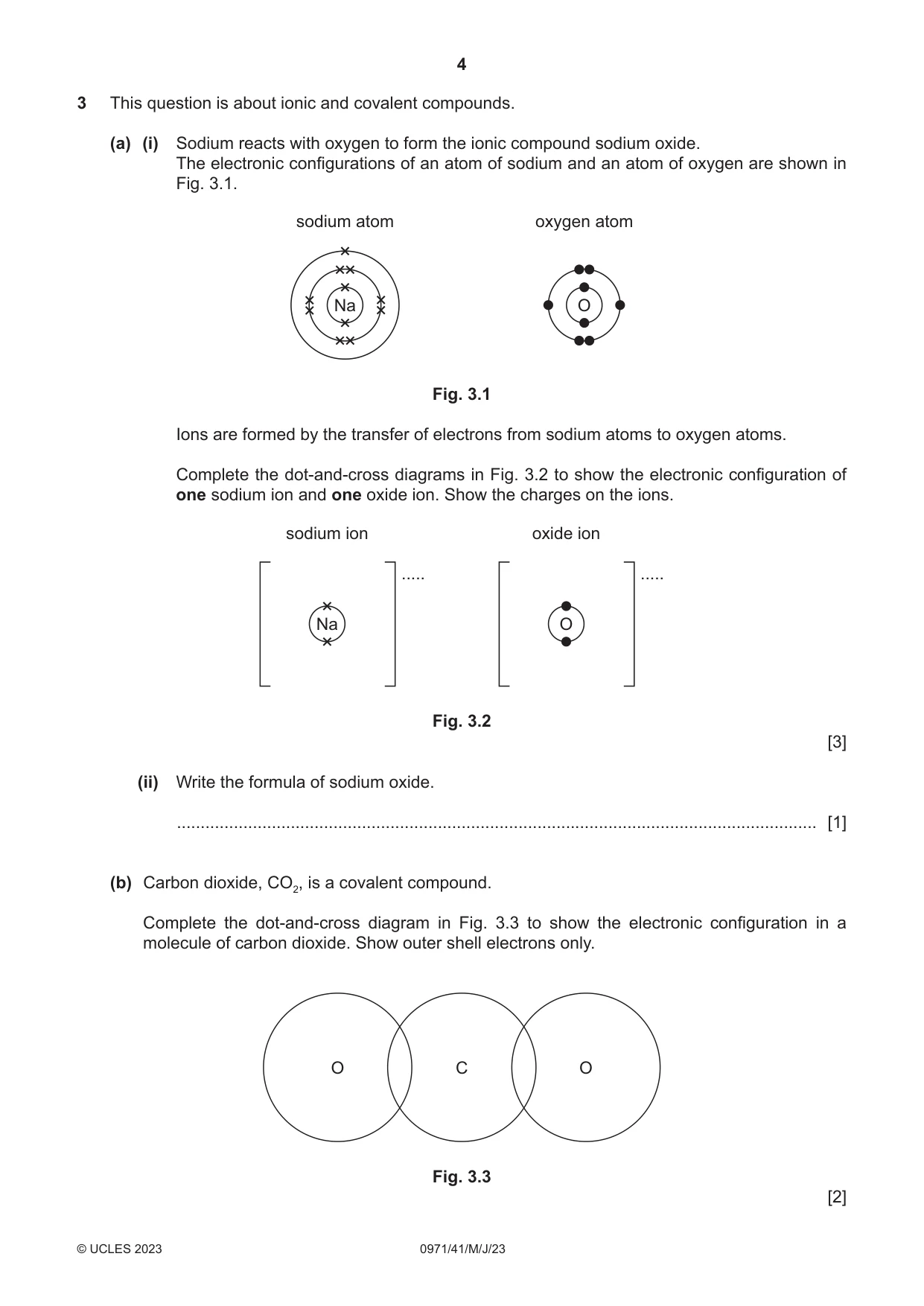
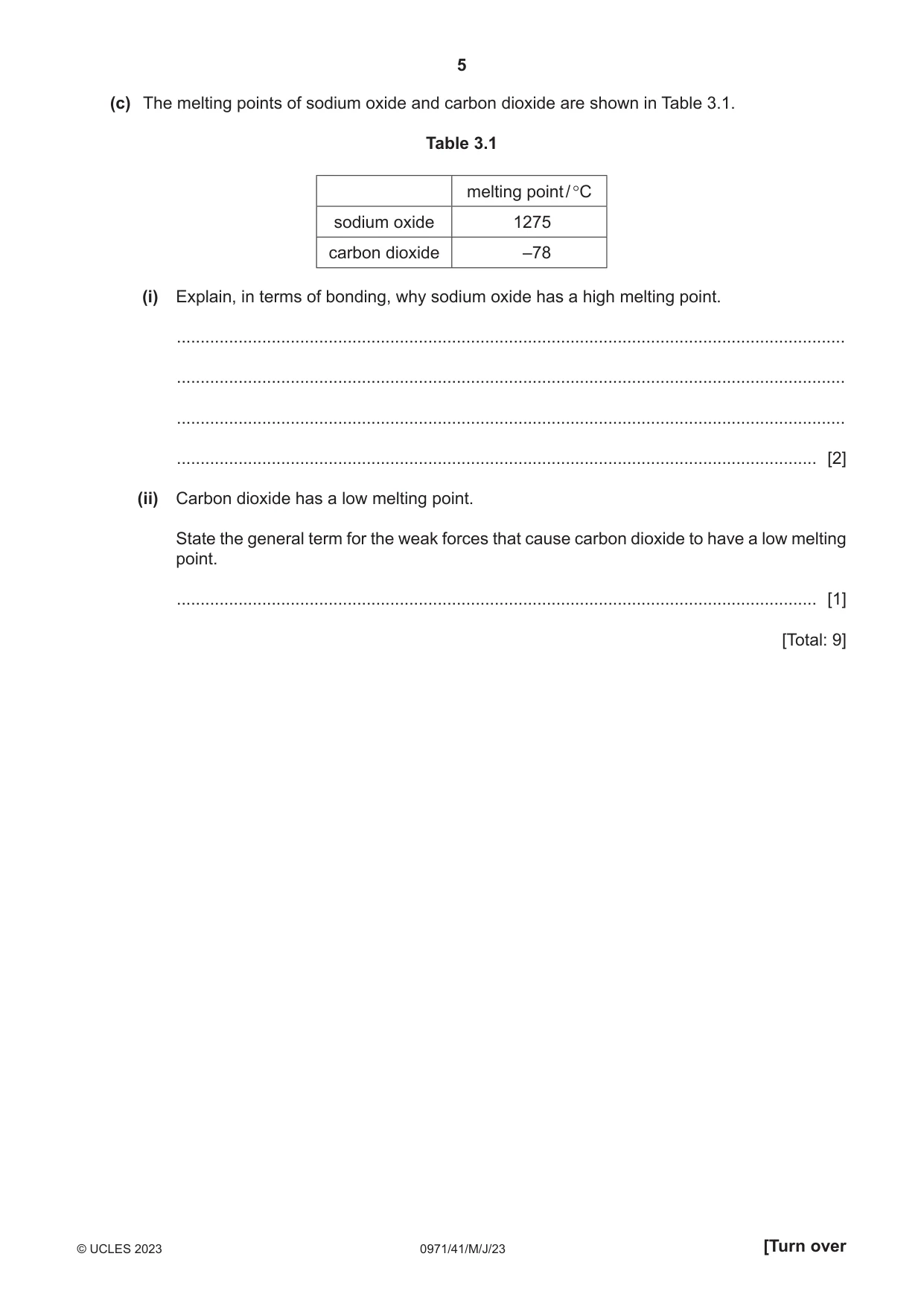
3 This question is about ionic and covalent compounds. (a) (i) Sodium reacts with oxygen to form the ionic compound sodium oxide. The electronic configurations of an atom of sodium and an atom of oxygen are shown in Fig. 3.1. sodium atom oxygen atom Na O Fig. 3.1 Ions are formed by the transfer of electrons from sodium atoms to oxygen atoms. Complete the dot-and-cross diagrams in Fig. 3.2 to show the electronic configuration of one sodium ion and one oxide ion. Show the charges on the ions. sodium ion oxide ion ..... ..... Na O Fig. 3.2 [3] (ii) Write the formula of sodium oxide. ....................................................................................................................................... [1] (b) Carbon dioxide, CO2, is a covalent compound. Complete the dot-and-cross diagram in Fig. 3.3 to show the electronic configuration in a molecule of carbon dioxide. Show outer shell electrons only. O C O Fig. 3.3 [2] (c) The melting points of sodium oxide and carbon dioxide are shown in Table 3.1. Table 3.1 melting point / °C sodium oxide 1275 carbon dioxide –78 (i) Explain, in terms of bonding, why sodium oxide has a high melting point. ............................................................................................................................................. ............................................................................................................................................. ............................................................................................................................................. ....................................................................................................................................... [2] (ii) Carbon dioxide has a low melting point. State the general term for the weak forces that cause carbon dioxide to have a low melting point. ....................................................................................................................................... [1] [Total: 9]
Mark scheme: 3(a)(i) M1 Na with 2,8 all crosses(1) M2 O with 2,8 outer shell with 6 dots and 2 crosses(1) M3 + AND 2(1) 3(a)(ii) Na2O 1 3(b) M1 both bonds with 2 dots and 2 crosses(1) M2 2 lone pairs (all dots or all crosses) on both oxygen atoms completing all 3 octets(1) 2 3(c)(i) M1 positive ions and negative ions (1) M2 strong attraction / strong bonds (1) 2 3(c)(ii) intermolecular forces 1
Q4 · Oxygen is produced by the decomposition of aqueous hydrogen peroxide
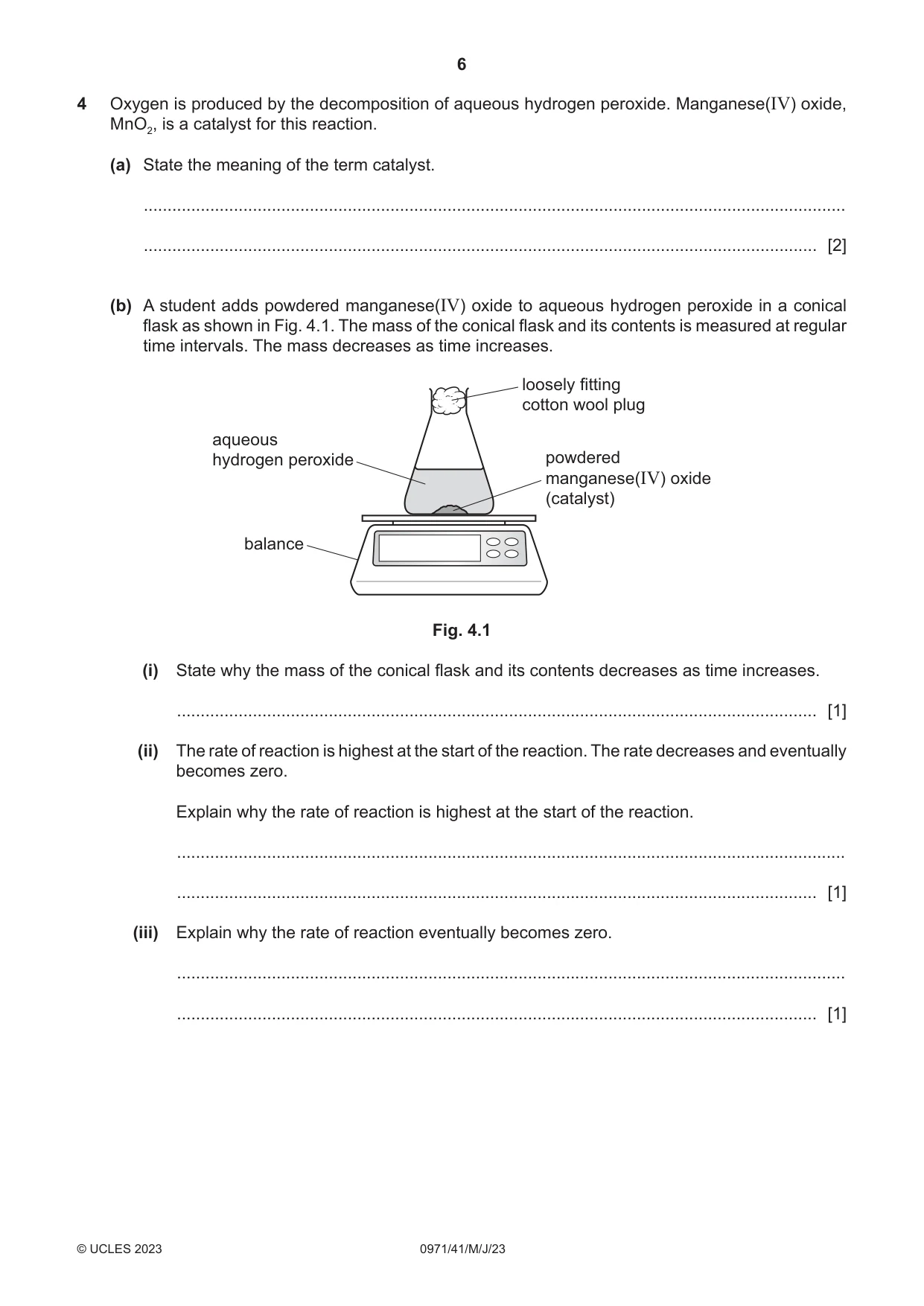
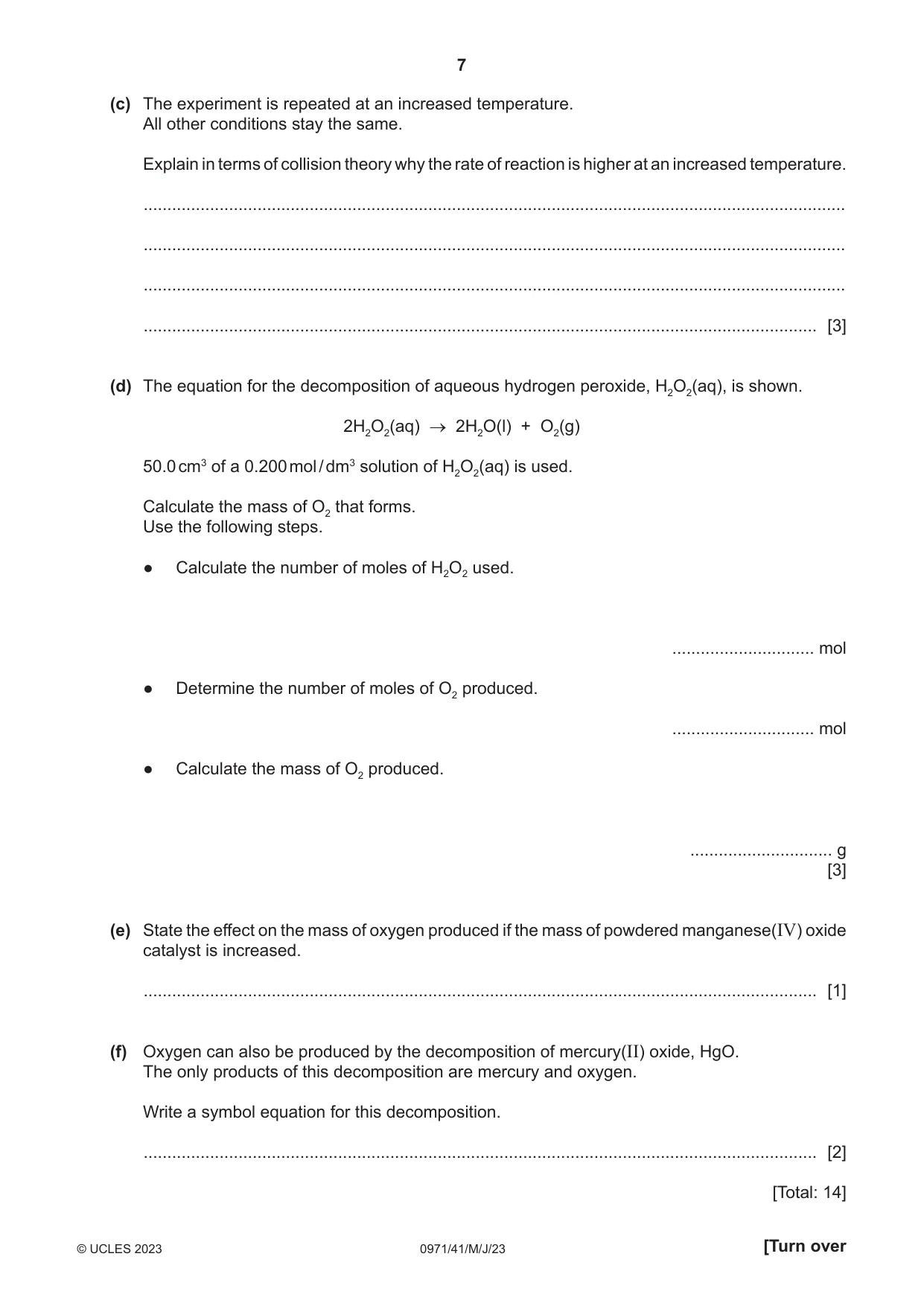
4 Oxygen is produced by the decomposition of aqueous hydrogen peroxide. Manganese(IV) oxide, MnO2, is a catalyst for this reaction. (a) State the meaning of the term catalyst. .................................................................................................................................................... .............................................................................................................................................. [2] (b) A student adds powdered manganese(IV) oxide to aqueous hydrogen peroxide in a conical flask as shown in Fig. 4.1. The mass of the conical flask and its contents is measured at regular time intervals. The mass decreases as time increases. loosely fitting cotton wool plug aqueous hydrogen peroxide powdered manganese(IV) oxide (catalyst) balance Fig. 4.1 (i) State why the mass of the conical flask and its contents decreases as time increases. ....................................................................................................................................... [1] (ii) The rate of reaction is highest at the start of the reaction. The rate decreases and eventually becomes zero. Explain why the rate of reaction is highest at the start of the reaction. ............................................................................................................................................. ....................................................................................................................................... [1] (iii) Explain why the rate of reaction eventually becomes zero. ............................................................................................................................................. ....................................................................................................................................... [1] (c) The experiment is repeated at an increased temperature. All other conditions stay the same. Explain in terms of collision theory why the rate of reaction is higher at an increased temperature. .................................................................................................................................................... .................................................................................................................................................... .................................................................................................................................................... .............................................................................................................................................. [3] (d) The equation for the decomposition of aqueous hydrogen peroxide, H2O2(aq), is shown. 2H2O2(aq) → 2H2O(l) + O2(g) 50.0 cm3 of a 0.200 mol / dm3 solution of H2O2(aq) is used. Calculate the mass of O2 that forms. Use the following steps. ● Calculate the number of moles of H2O2 used. .............................. mol ● Determine the number of moles of O2 produced. .............................. mol ● Calculate the mass of O2 produced. .............................. g [3] (e) State the effect on the mass of oxygen produced if the mass of powdered manganese(IV) oxide catalyst is increased. .............................................................................................................................................. [1] (f) Oxygen can also be produced by the decomposition of mercury(II) oxide, HgO. The only products of this decomposition are mercury and oxygen. Write a symbol equation for this decomposition. .............................................................................................................................................. [2] [Total: 14]
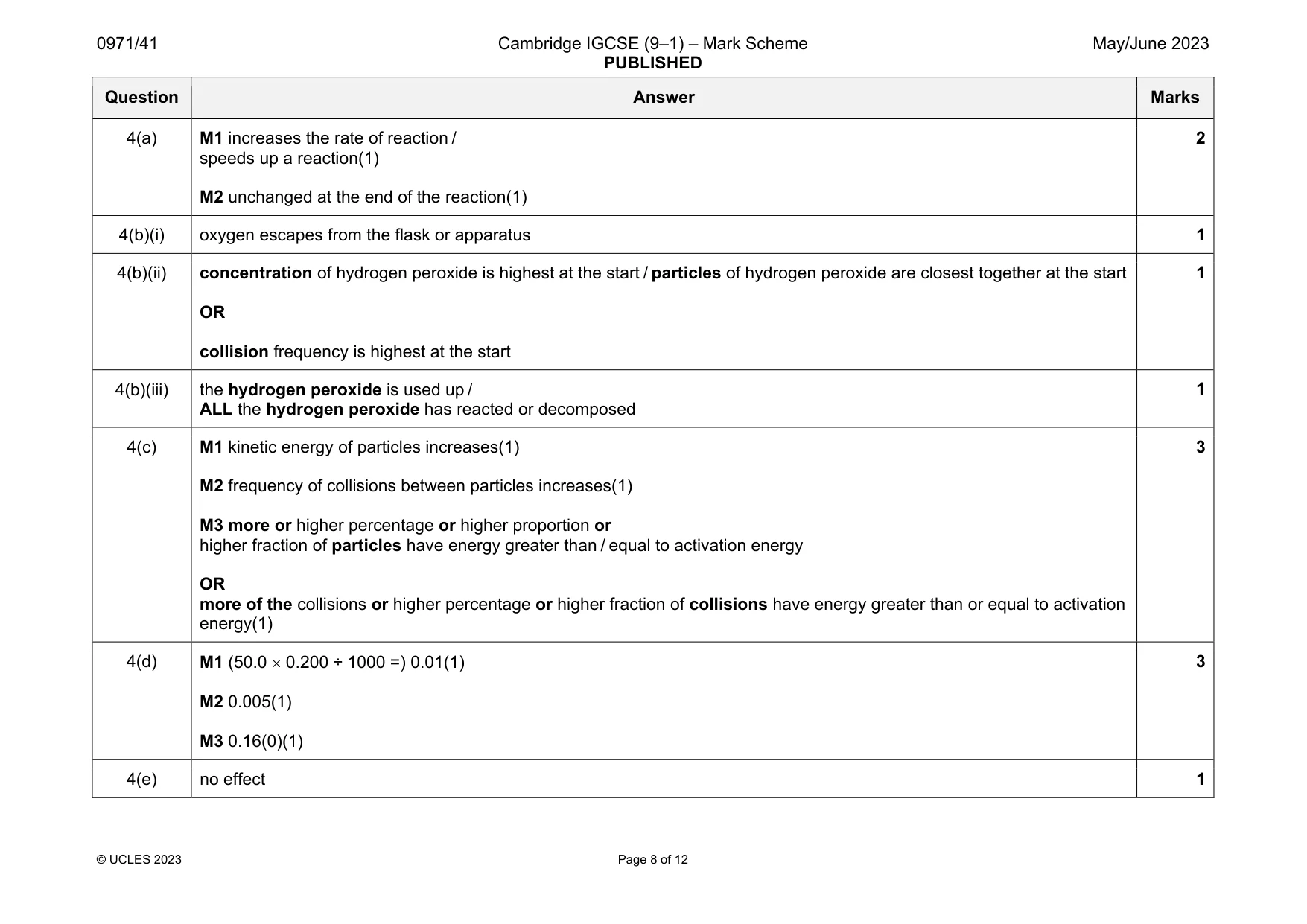
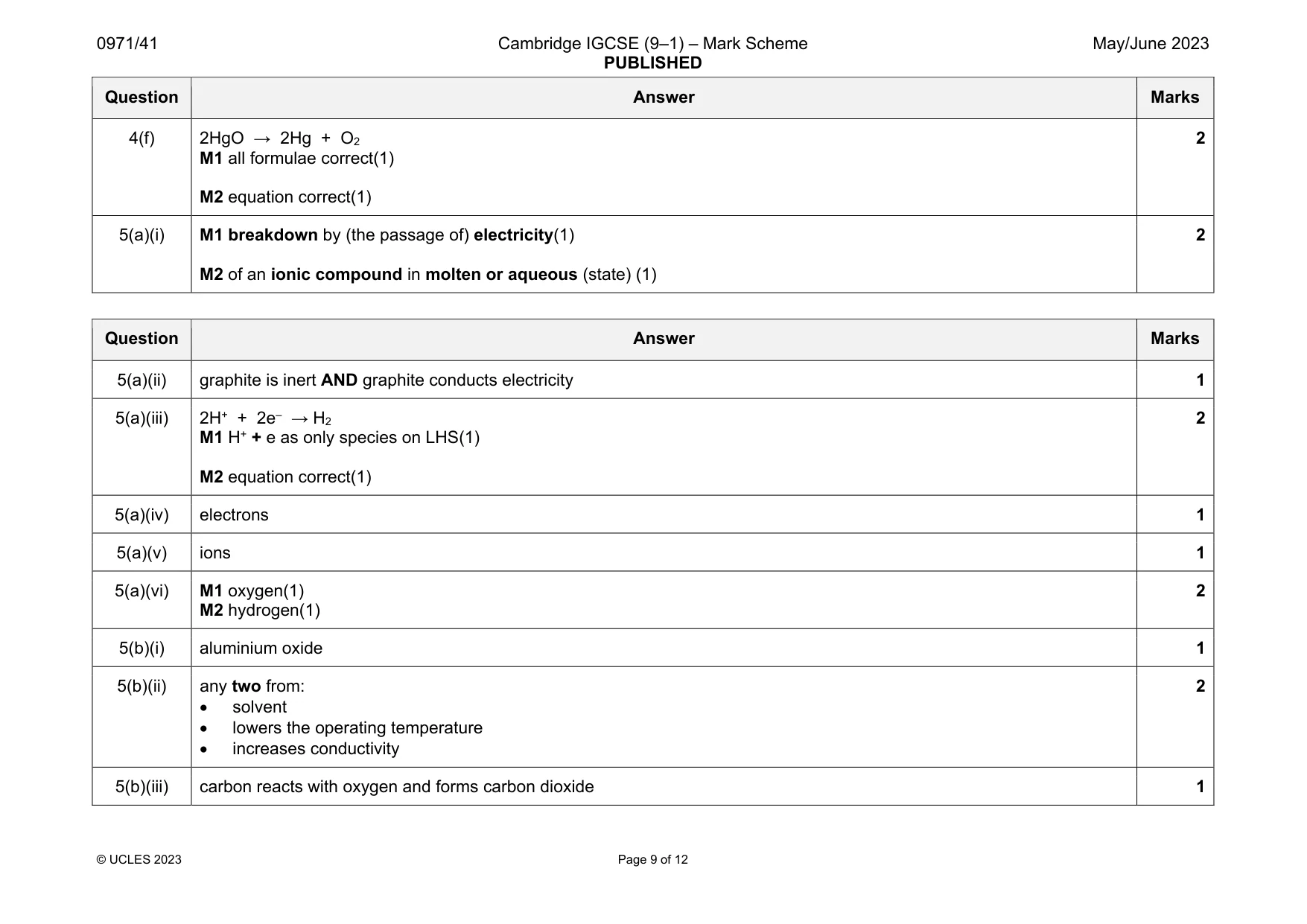
Mark scheme: 4(a) M1 increases the rate of reaction / speeds up a reaction(1) M2 unchanged at the end of the reaction(1) 2 4(b)(i) oxygen escapes from the flask or apparatus 1 4(b)(ii) concentration of hydrogen peroxide is highest at the start / particles of hydrogen peroxide are closest together at the start OR collision frequency is highest at the start 1 4(b)(iii) the hydrogen peroxide is used up / ALL the hydrogen peroxide has reacted or decomposed 1 4(c) M1 kinetic energy of particles increases(1) M2 frequency of collisions between particles increases(1) M3 more or higher percentage or higher proportion or higher fraction of particles have energy greater than / equal to activation energy OR more of the collisions or higher percentage or higher fraction of collisions have energy greater than or equal to activation energy(1) 3 4(d) M1 (50.0 0.200 ÷ 1000 =) 0.01(1) M2 0.005(1) M3 0.16(0)(1) 3 4(e) no effect 1 Question Answer Marks 4(f) 2HgO → 2Hg + O2 M1 all formulae correct(1) M2 equation correct(1) 2
Q5 · This question is about electricity and chemical reactions
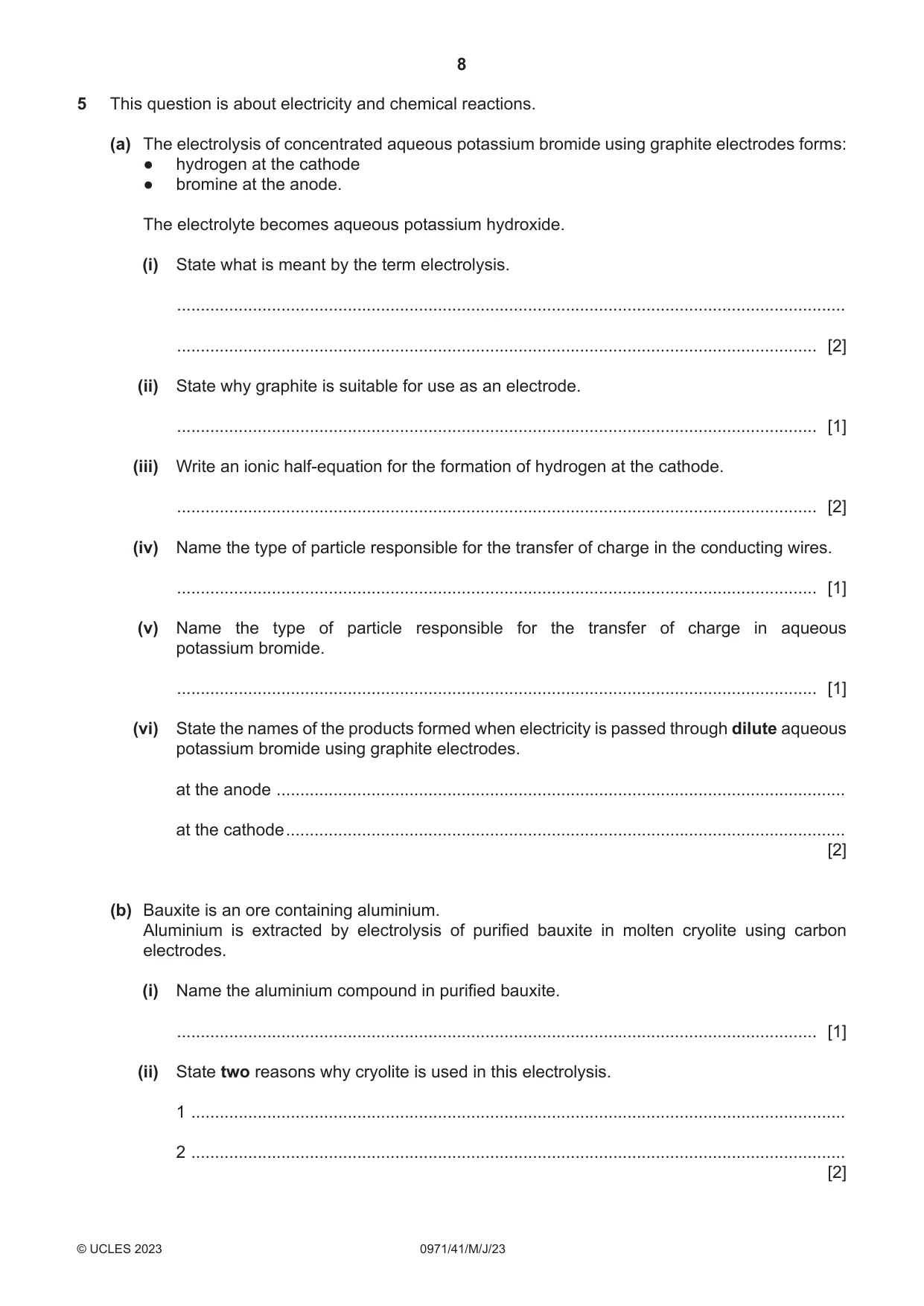
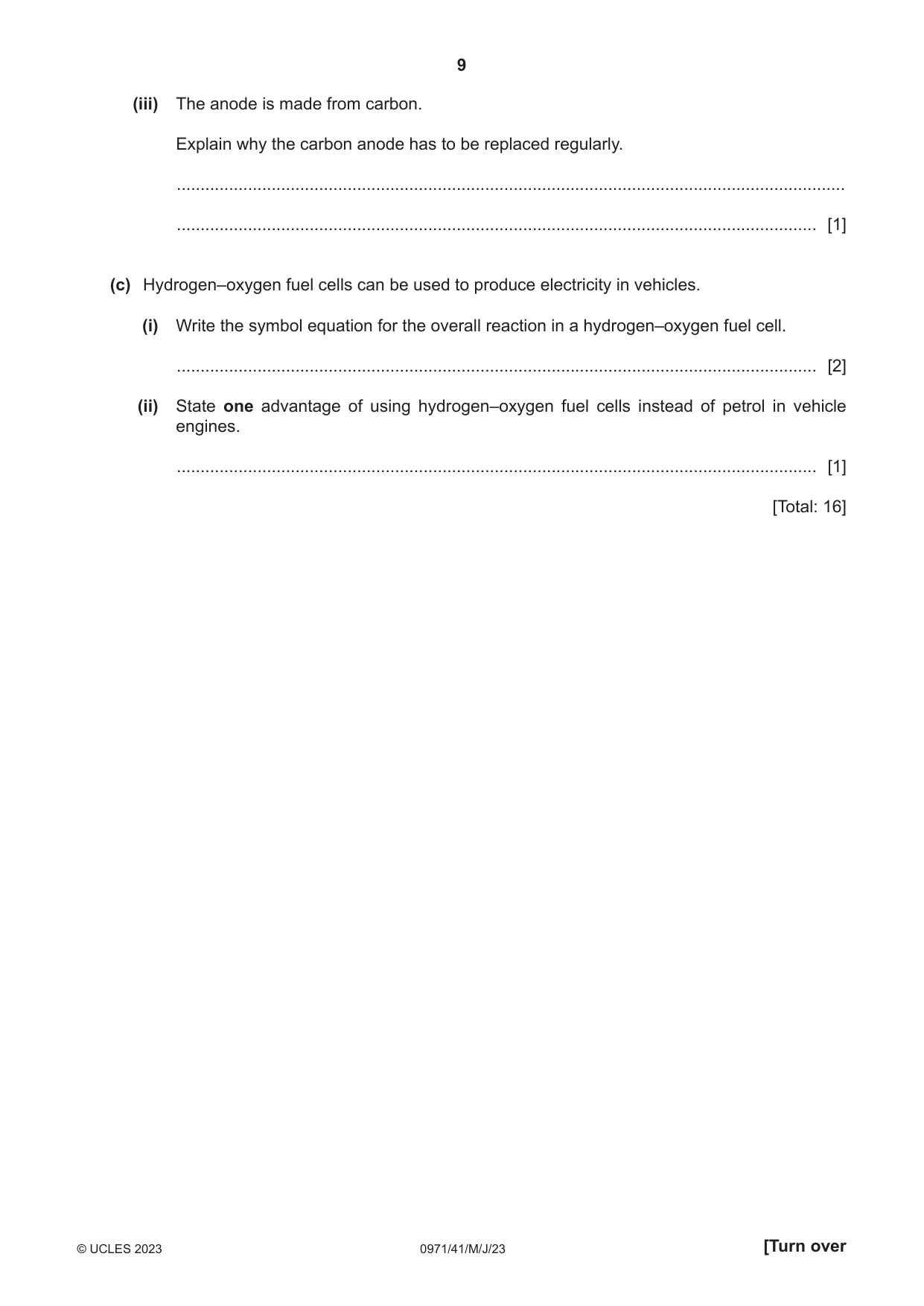
5 This question is about electricity and chemical reactions. (a) The electrolysis of concentrated aqueous potassium bromide using graphite electrodes forms: ● hydrogen at the cathode ● bromine at the anode. The electrolyte becomes aqueous potassium hydroxide. (i) State what is meant by the term electrolysis. ............................................................................................................................................. ....................................................................................................................................... [2] (ii) State why graphite is suitable for use as an electrode. ....................................................................................................................................... [1] (iii) Write an ionic half-equation for the formation of hydrogen at the cathode. ....................................................................................................................................... [2] (iv) Name the type of particle responsible for the transfer of charge in the conducting wires. ....................................................................................................................................... [1] (v) Name the type of particle responsible for the transfer of charge in aqueous potassium bromide. ....................................................................................................................................... [1] (vi) State the names of the products formed when electricity is passed through dilute aqueous potassium bromide using graphite electrodes. at the anode ........................................................................................................................ at the cathode...................................................................................................................... [2] (b) Bauxite is an ore containing aluminium. Aluminium is extracted by electrolysis of purified bauxite in molten cryolite using carbon electrodes. (i) Name the aluminium compound in purified bauxite. ....................................................................................................................................... [1] (ii) State two reasons why cryolite is used in this electrolysis. 1 .......................................................................................................................................... 2 .......................................................................................................................................... [2] (iii) The anode is made from carbon. Explain why the carbon anode has to be replaced regularly. ............................................................................................................................................. ....................................................................................................................................... [1] (c) Hydrogen–oxygen fuel cells can be used to produce electricity in vehicles. (i) Write the symbol equation for the overall reaction in a hydrogen–oxygen fuel cell. ....................................................................................................................................... [2] (ii) State one advantage of using hydrogen–oxygen fuel cells instead of petrol in vehicle engines. ....................................................................................................................................... [1] [Total: 16]
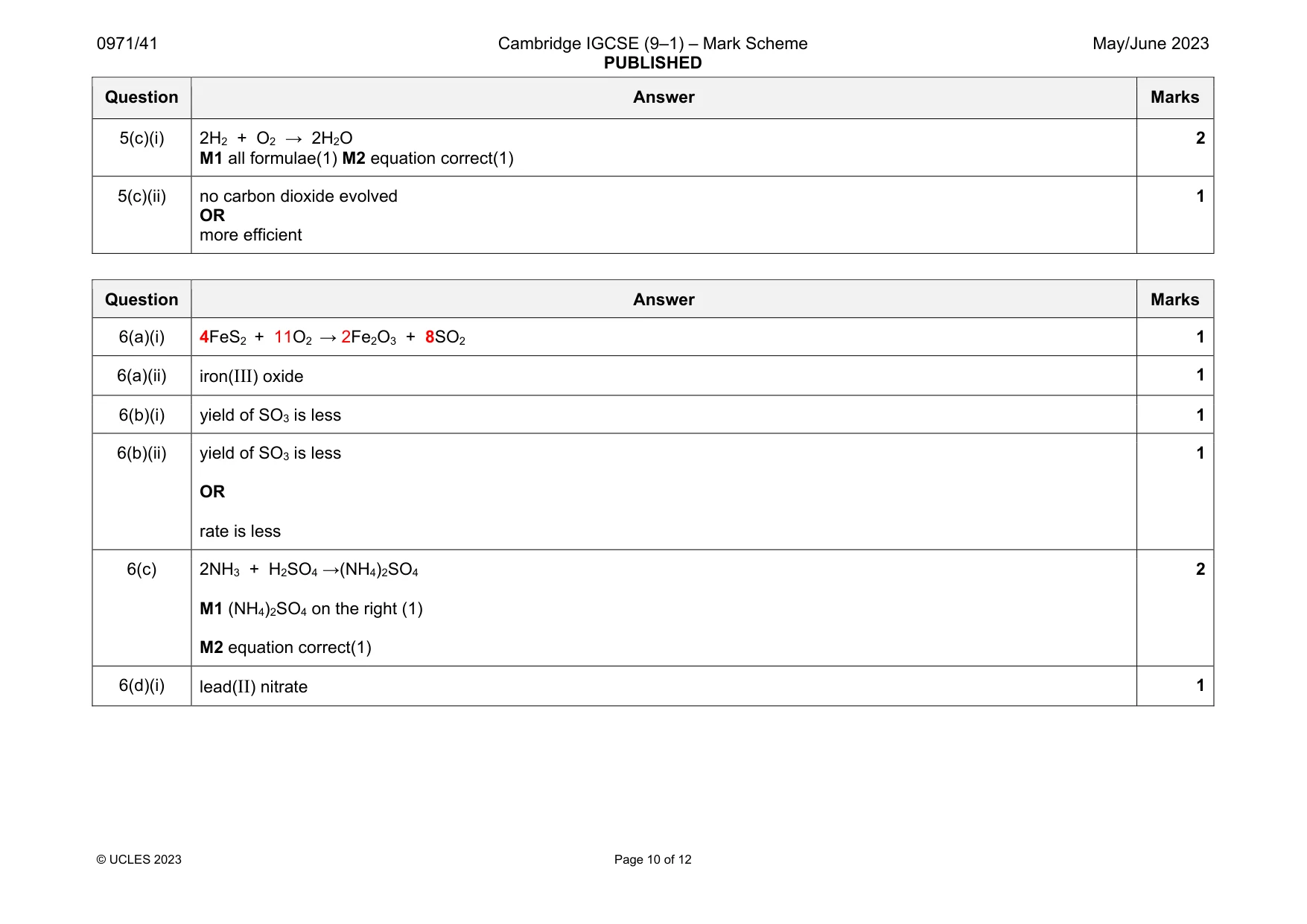
Mark scheme: 5(a)(i) M1 breakdown by (the passage of) electricity(1) M2 of an ionic compound in molten or aqueous (state) (1) 2 Question Answer Marks 5(a)(ii) graphite is inert AND graphite conducts electricity 1 5(a)(iii) 2H+ + 2e– → H2 M1 H+ + e as only species on LHS(1) M2 equation correct(1) 2 5(a)(iv) electrons 1 5(a)(v) ions 1 5(a)(vi) M1 oxygen(1) M2 hydrogen(1) 2 5(b)(i) aluminium oxide 1 5(b)(ii) any two from: solvent lowers the operating temperature increases conductivity 2 5(b)(iii) carbon reacts with oxygen and forms carbon dioxide 1 Question Answer Marks 5(c)(i) 2H2 + O2 → 2H2O M1 all formulae(1) M2 equation correct(1) 2 5(c)(ii) no carbon dioxide evolved OR more efficient 1
Q6 · This question is about sulfur and compounds of sulfur
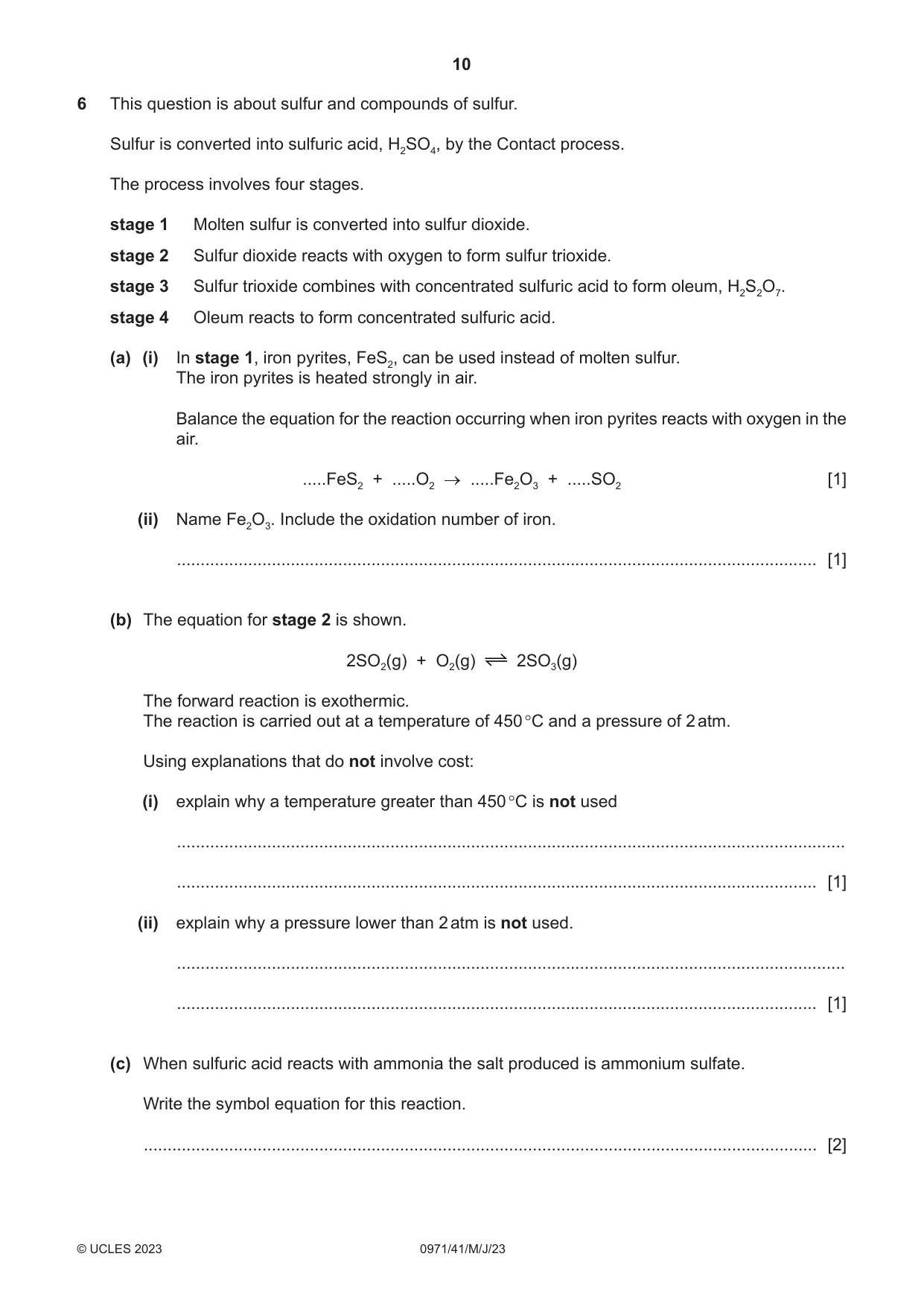
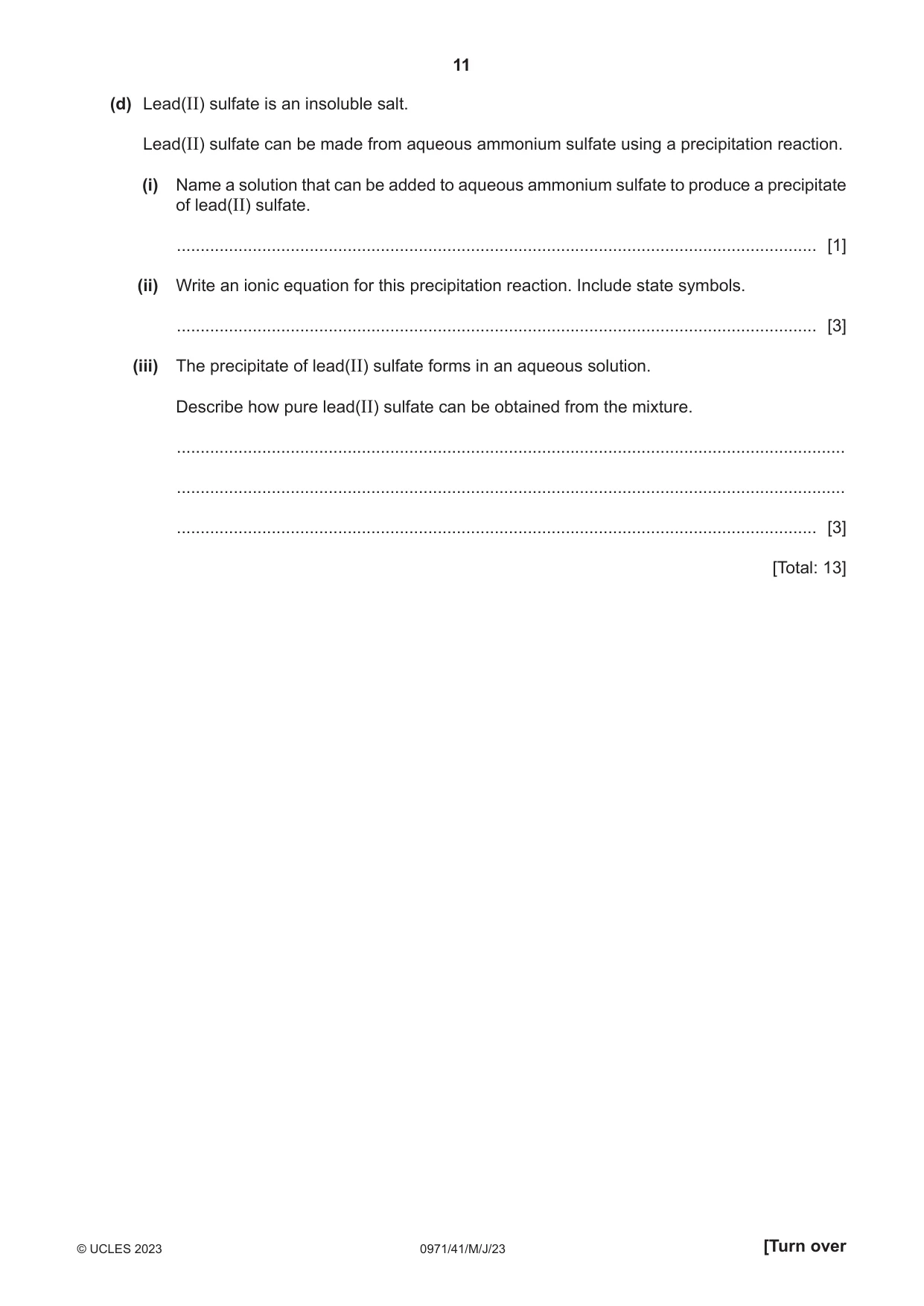
6 This question is about sulfur and compounds of sulfur. Sulfur is converted into sulfuric acid, H2SO4, by the Contact process. The process involves four stages. stage 1 Molten sulfur is converted into sulfur dioxide. stage 2 Sulfur dioxide reacts with oxygen to form sulfur trioxide. stage 3 Sulfur trioxide combines with concentrated sulfuric acid to form oleum, H2S2O7. stage 4 Oleum reacts to form concentrated sulfuric acid. (a) (i) In stage 1, iron pyrites, FeS2, can be used instead of molten sulfur. The iron pyrites is heated strongly in air. Balance the equation for the reaction occurring when iron pyrites reacts with oxygen in the air. .....FeS2 + .....O2 → .....Fe2O3 + .....SO2 [1] (ii) Name Fe2O3. Include the oxidation number of iron. ....................................................................................................................................... [1] (b) The equation for stage 2 is shown. 2SO2(g) + O2(g) 2SO3(g) The forward reaction is exothermic. The reaction is carried out at a temperature of 450 °C and a pressure of 2 atm. Using explanations that do not involve cost: (i) explain why a temperature greater than 450 °C is not used ............................................................................................................................................. ....................................................................................................................................... [1] (ii) explain why a pressure lower than 2 atm is not used. ............................................................................................................................................. ....................................................................................................................................... [1] (c) When sulfuric acid reacts with ammonia the salt produced is ammonium sulfate. Write the symbol equation for this reaction. .............................................................................................................................................. [2] (d) Lead(II) sulfate is an insoluble salt. Lead(II) sulfate can be made from aqueous ammonium sulfate using a precipitation reaction. (i) Name a solution that can be added to aqueous ammonium sulfate to produce a precipitate of lead(II) sulfate. ....................................................................................................................................... [1] (ii) Write an ionic equation for this precipitation reaction. Include state symbols. ....................................................................................................................................... [3] (iii) The precipitate of lead(II) sulfate forms in an aqueous solution. Describe how pure lead(II) sulfate can be obtained from the mixture. ............................................................................................................................................. ............................................................................................................................................. ....................................................................................................................................... [3] [Total: 13]
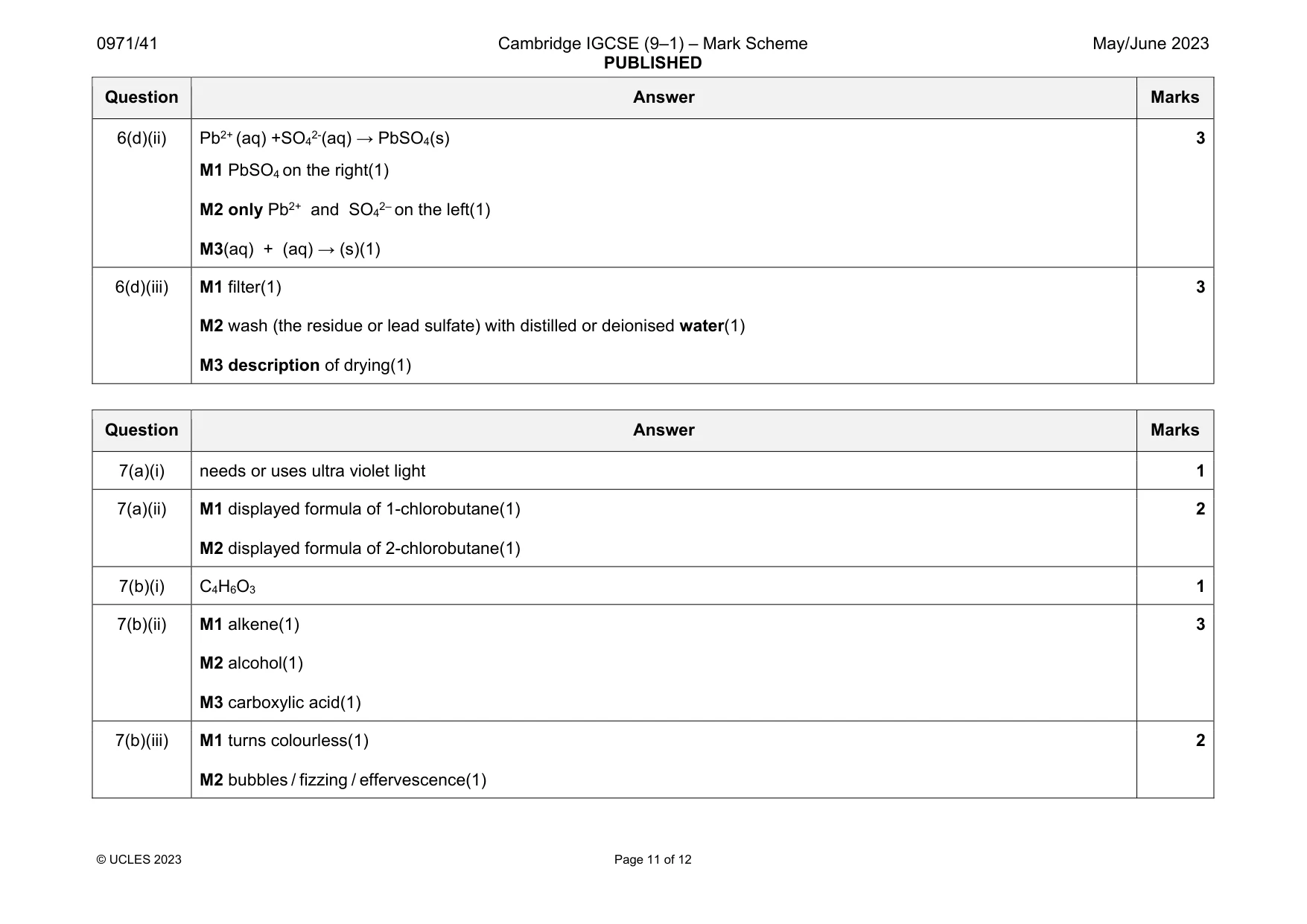
Mark scheme: 6(a)(i) 4FeS2 + 11O2 → 2Fe2O3 + 8SO2 1 6(a)(ii) iron(III) oxide 1 6(b)(i) yield of SO3 is less 1 6(b)(ii) yield of SO3 is less OR rate is less 1 6(c) 2NH3 + H2SO4 →(NH4)2SO4 M1 (NH4)2SO4 on the right (1) M2 equation correct(1) 2 6(d)(i) lead(II) nitrate 1 Question Answer Marks 6(d)(ii) Pb2+ (aq) +SO42-(aq) → PbSO4(s) M1 PbSO4 on the right(1) M2 only Pb2+ and SO42– on the left(1) M3(aq) + (aq) → (s)(1) 3 6(d)(iii) M1 filter(1) M2 wash (the residue or lead sulfate) with distilled or deionised water(1) M3 description of drying(1) 3
Q7 · This question is about organic compounds
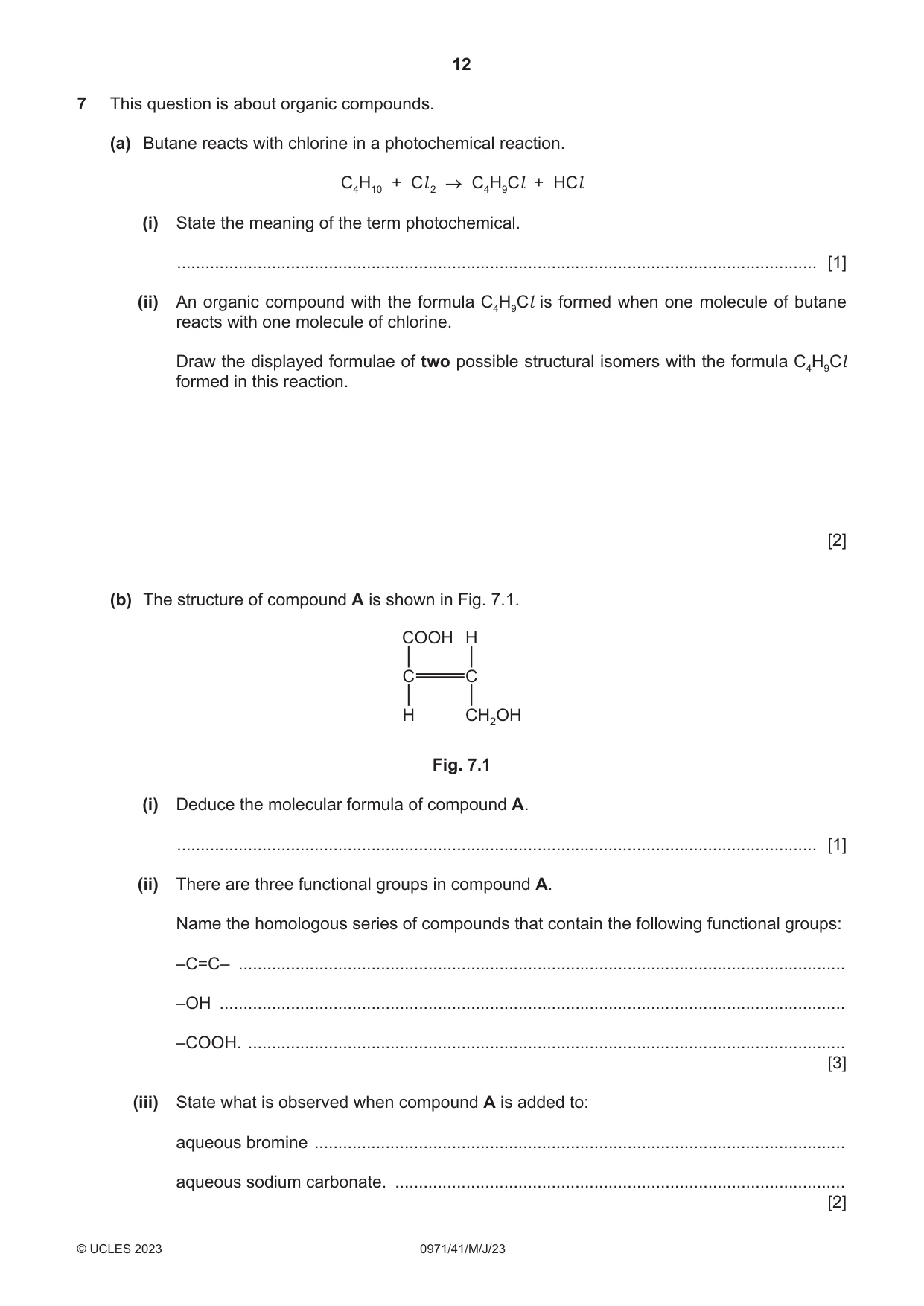
7 This question is about organic compounds. (a) Butane reacts with chlorine in a photochemical reaction. C4H10 + Cl 2 → C4H9Cl + HCl (i) State the meaning of the term photochemical. ....................................................................................................................................... [1] (ii) An organic compound with the formula C4H9Cl is formed when one molecule of butane reacts with one molecule of chlorine. Draw the displayed formulae of two possible structural isomers with the formula C4H9Cl formed in this reaction. [2] (b) The structure of compound A is shown in Fig. 7.1. COOH H C C H CH2OH Fig. 7.1 (i) Deduce the molecular formula of compound A. ....................................................................................................................................... [1] (ii) There are three functional groups in compound A. Name the homologous series of compounds that contain the following functional groups: –C=C– ................................................................................................................................. –OH ..................................................................................................................................... –COOH. .............................................................................................................................. [3] (iii) State what is observed when compound A is added to: aqueous bromine ................................................................................................................ aqueous sodium carbonate. ................................................................................................ [2] (iv) Compound A can be used as a single monomer to produce two different polymers. Draw one repeat unit of the addition polymer formed from compound A. [2] (v) Compound A can be converted into a dicarboxylic acid. Name the type of condensation polymer formed from a dicarboxylic acid and a diol. ....................................................................................................................................... [1] [Total: 12]
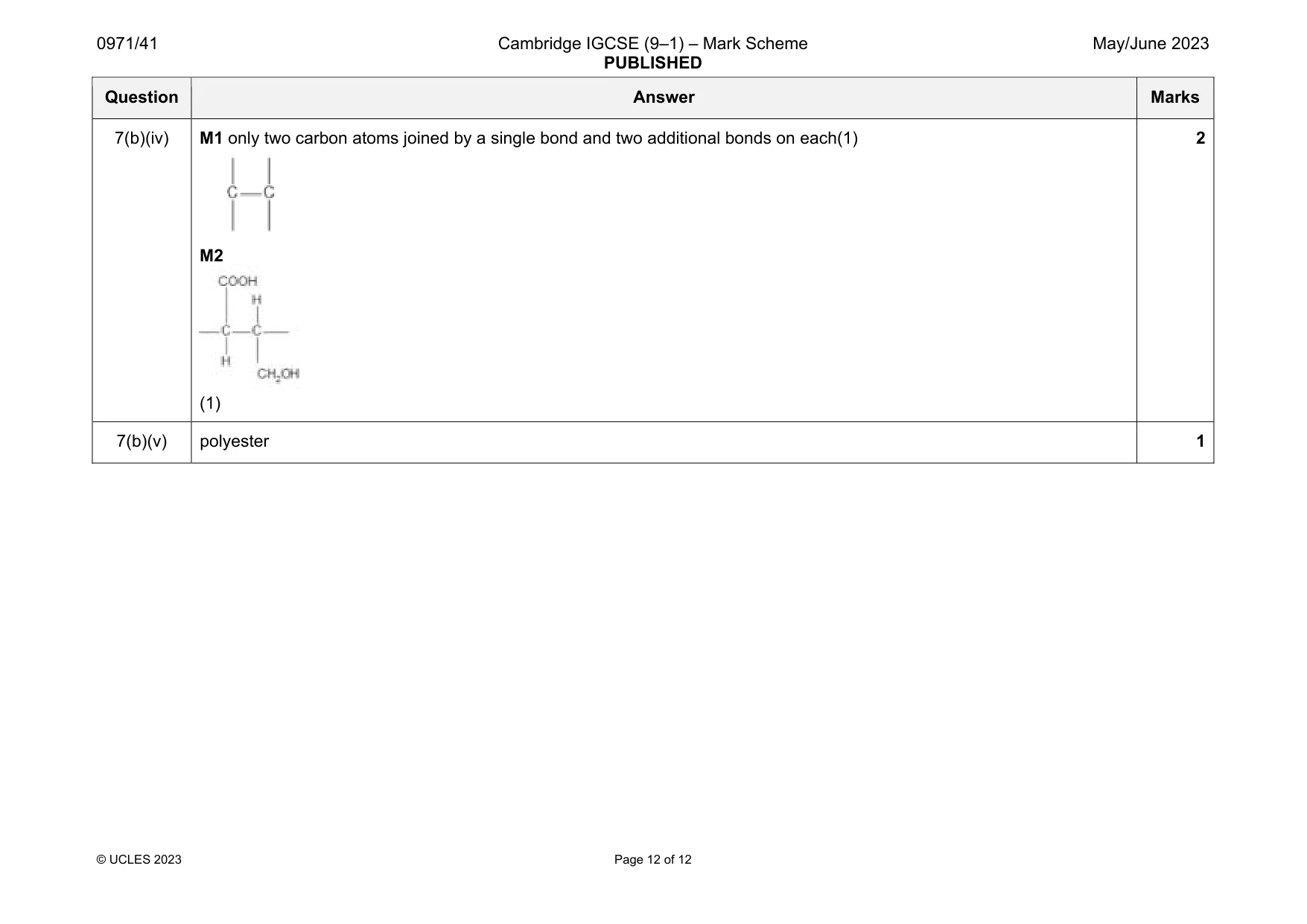
Mark scheme: 7(a)(i) needs or uses ultra violet light 1 7(a)(ii) M1 displayed formula of 1-chlorobutane(1) M2 displayed formula of 2-chlorobutane(1) 2 7(b)(i) C4H6O3 1 7(b)(ii) M1 alkene(1) M2 alcohol(1) M3 carboxylic acid(1) 3 7(b)(iii) M1 turns colourless(1) M2 bubbles / fizzing / effervescence(1) 2 Question Answer Marks 7(b)(iv) M1 only two carbon atoms joined by a single bond and two additional bonds on each(1) M2 (1) 2 7(b)(v) polyester 1
More questions on Formulae, functional groups and terminology
What was in this paper
The subtopics covered by these 7 questions, and how many questions each got. Open one in a new tab to see every Cambridge question on it.
What you needed in this session
Cambridge’s own grade thresholds for 2023 May/June, Paper 4 · Variant 1. A higher threshold means an easier paper — the bar moves with how the cohort did.