Cambridge IGCSE Chemistry (9-1) 0971 — 2021 May/June Paper 4 · Variant 2
0971/42/M/J/21 · 6 questions · 80 marks · ≈90 min
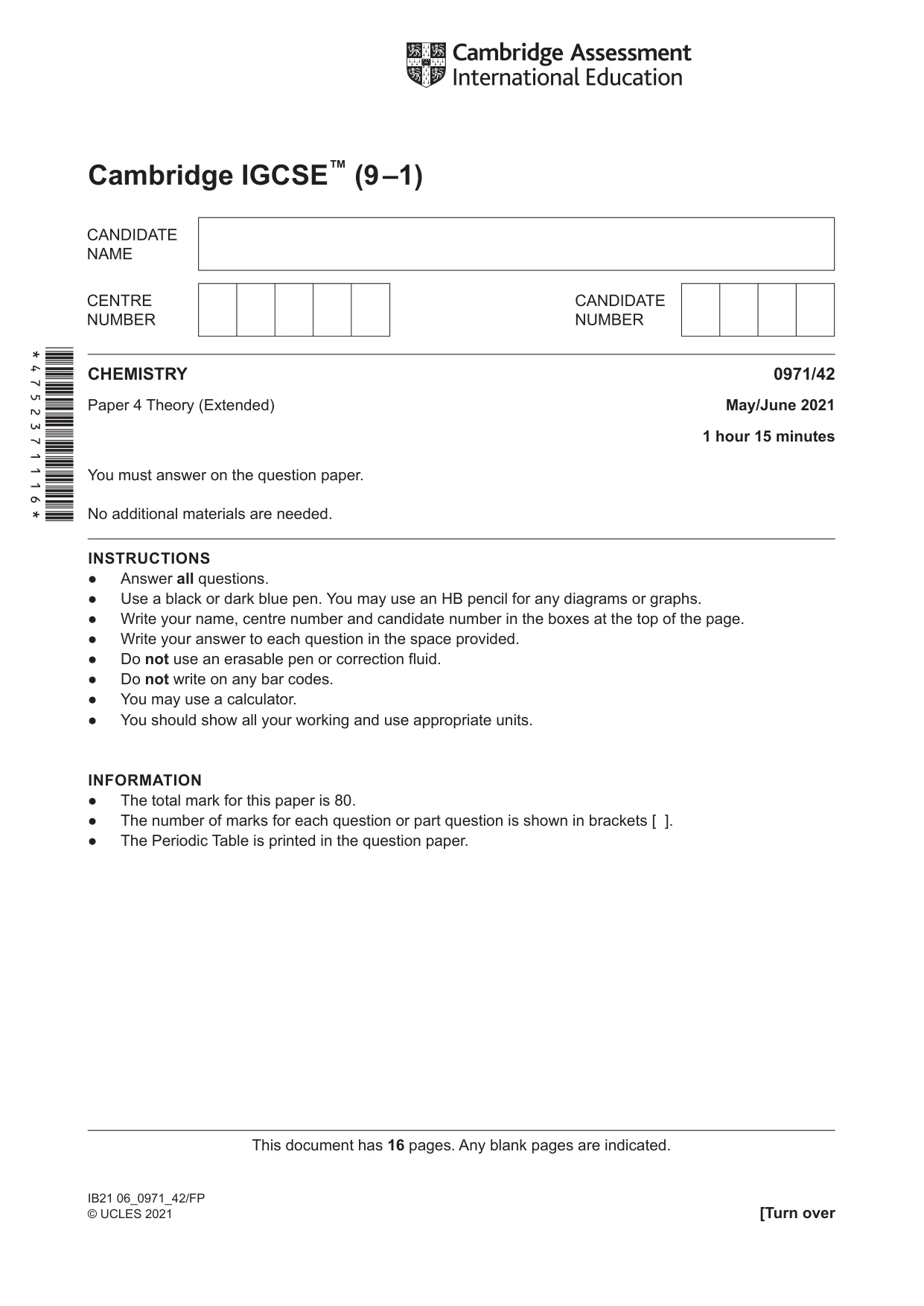
The question paper and its mark scheme, free to read here and free to download. This is Cambridge’s own paper, exactly as it was sat.
Question paper16 pages


Mark scheme9 pages
Answers below. Sit the paper first if you are practising.
Questions as text
Q1 · The symbols of the elements of Period 3 of the Periodic Table are shown
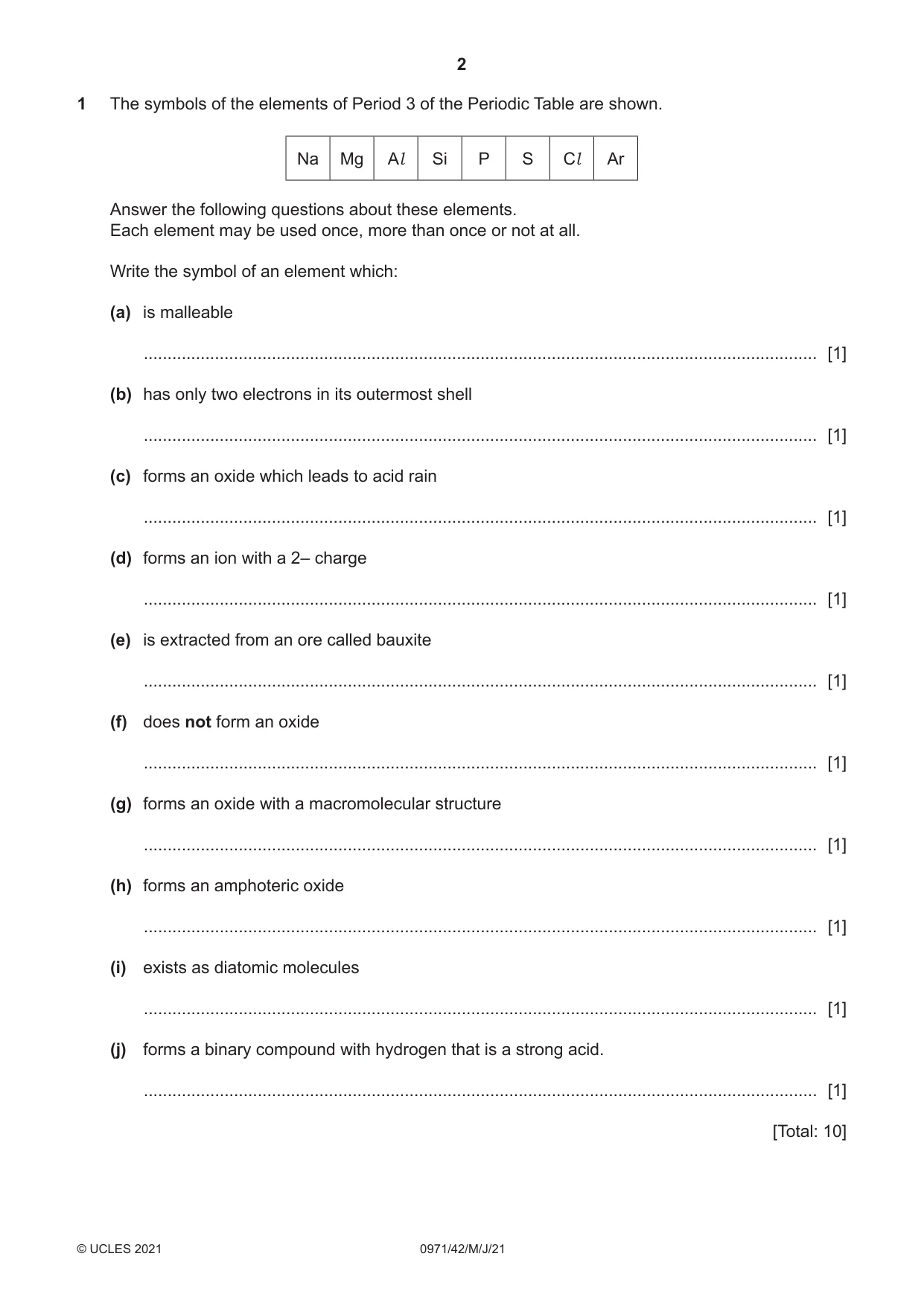
1 The symbols of the elements of Period 3 of the Periodic Table are shown. Na Mg Al Si P S Cl Ar Answer the following questions about these elements. Each element may be used once, more than once or not at all. Write the symbol of an element which: (a) is malleable .............................................................................................................................................. [1] (b) has only two electrons in its outermost shell .............................................................................................................................................. [1] (c) forms an oxide which leads to acid rain .............................................................................................................................................. [1] (d) forms an ion with a 2– charge .............................................................................................................................................. [1] (e) is extracted from an ore called bauxite .............................................................................................................................................. [1] (f) does not form an oxide .............................................................................................................................................. [1] (g) forms an oxide with a macromolecular structure .............................................................................................................................................. [1] (h) forms an amphoteric oxide .............................................................................................................................................. [1] (i) exists as diatomic molecules .............................................................................................................................................. [1] (j) forms a binary compound with hydrogen that is a strong acid. .............................................................................................................................................. [1] [Total: 10]
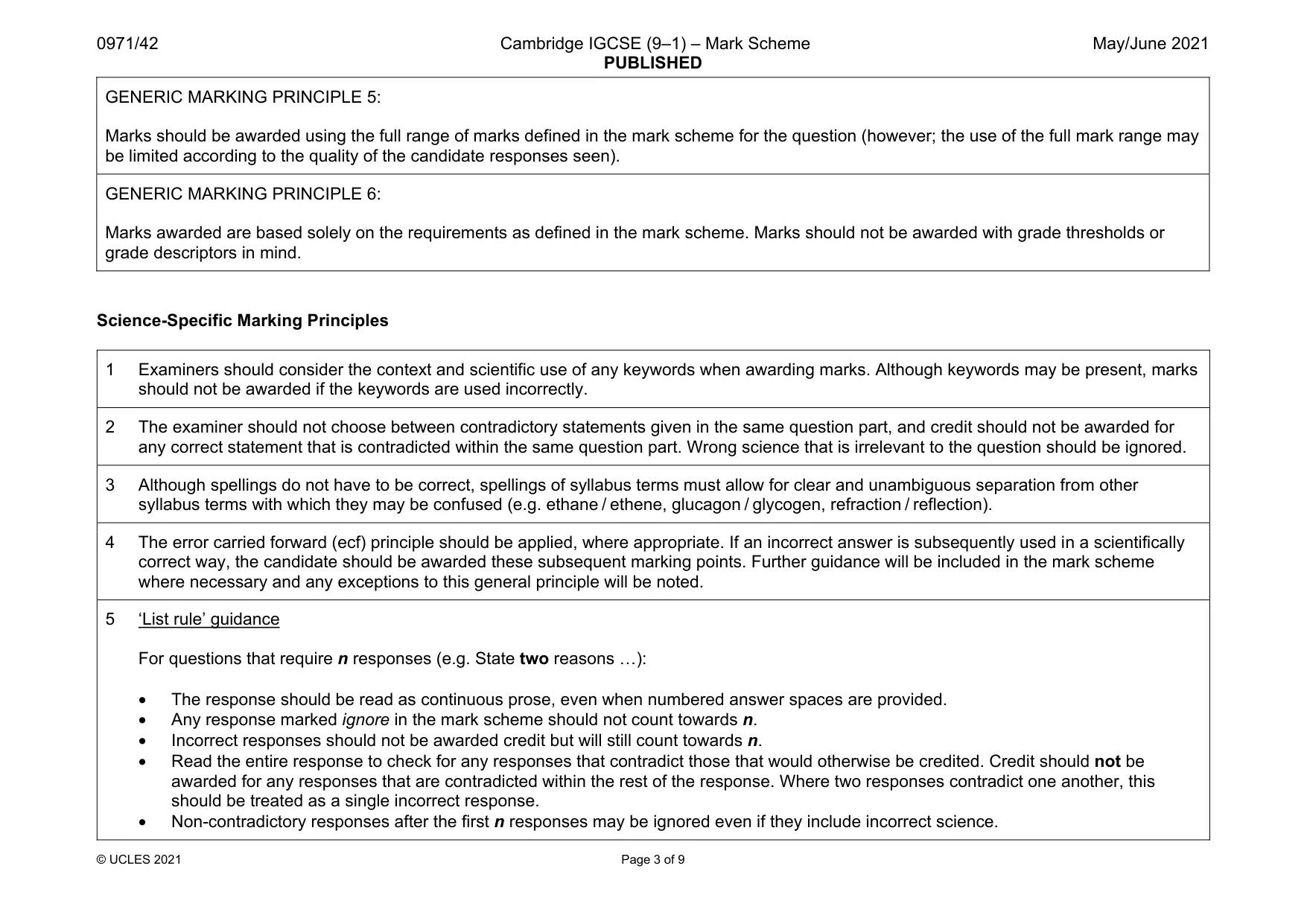
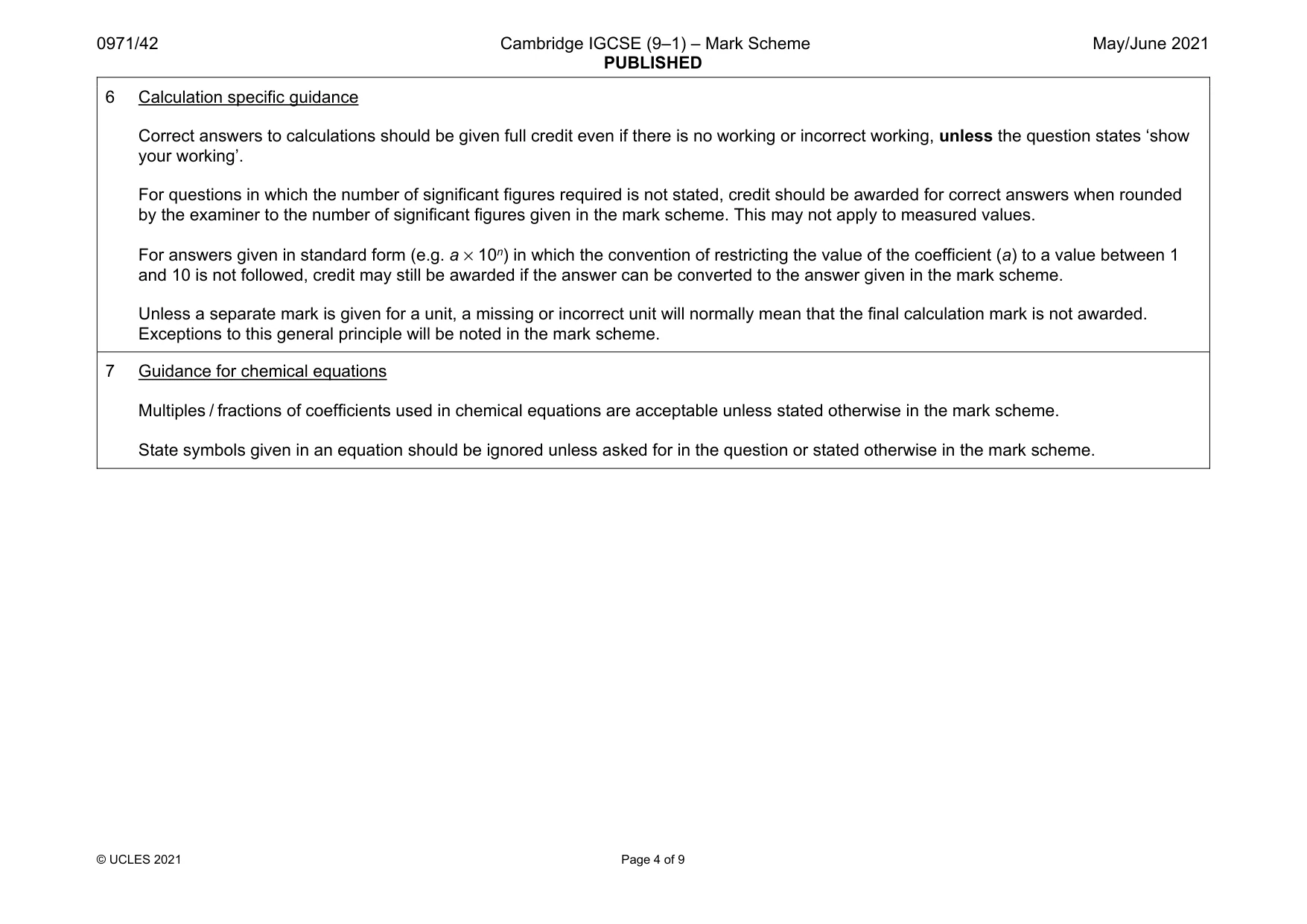
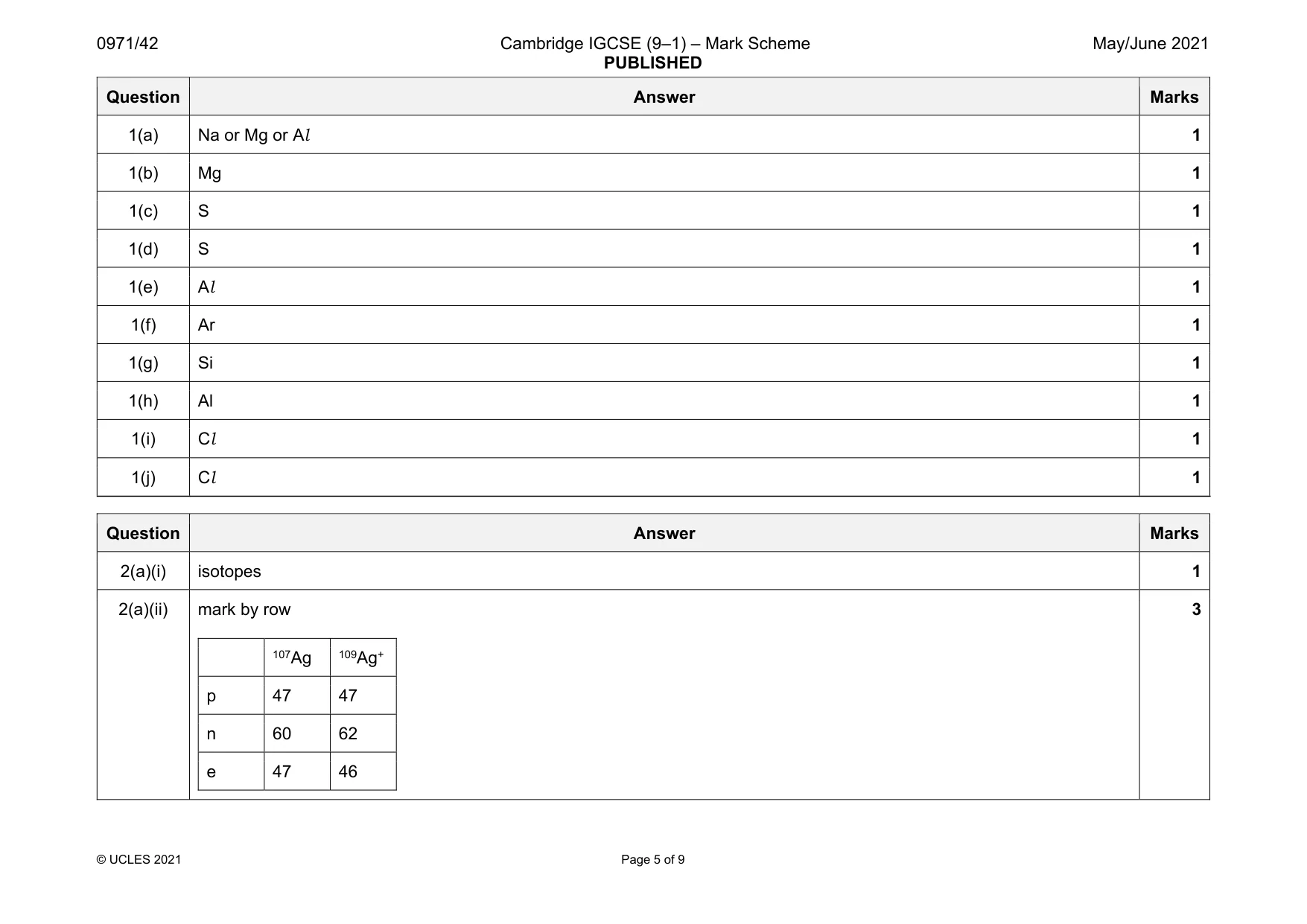
Mark scheme: 1(a) 1 1(b) Mg 1 1(c) S 1 1(d) S 1 1(e) Al 1 1(f) Ar 1 1(g) Si 1 1(h) Al 1 1(i) Cl 1 1(j) Cl 1
Q2 · Silver has an atomic number of 47
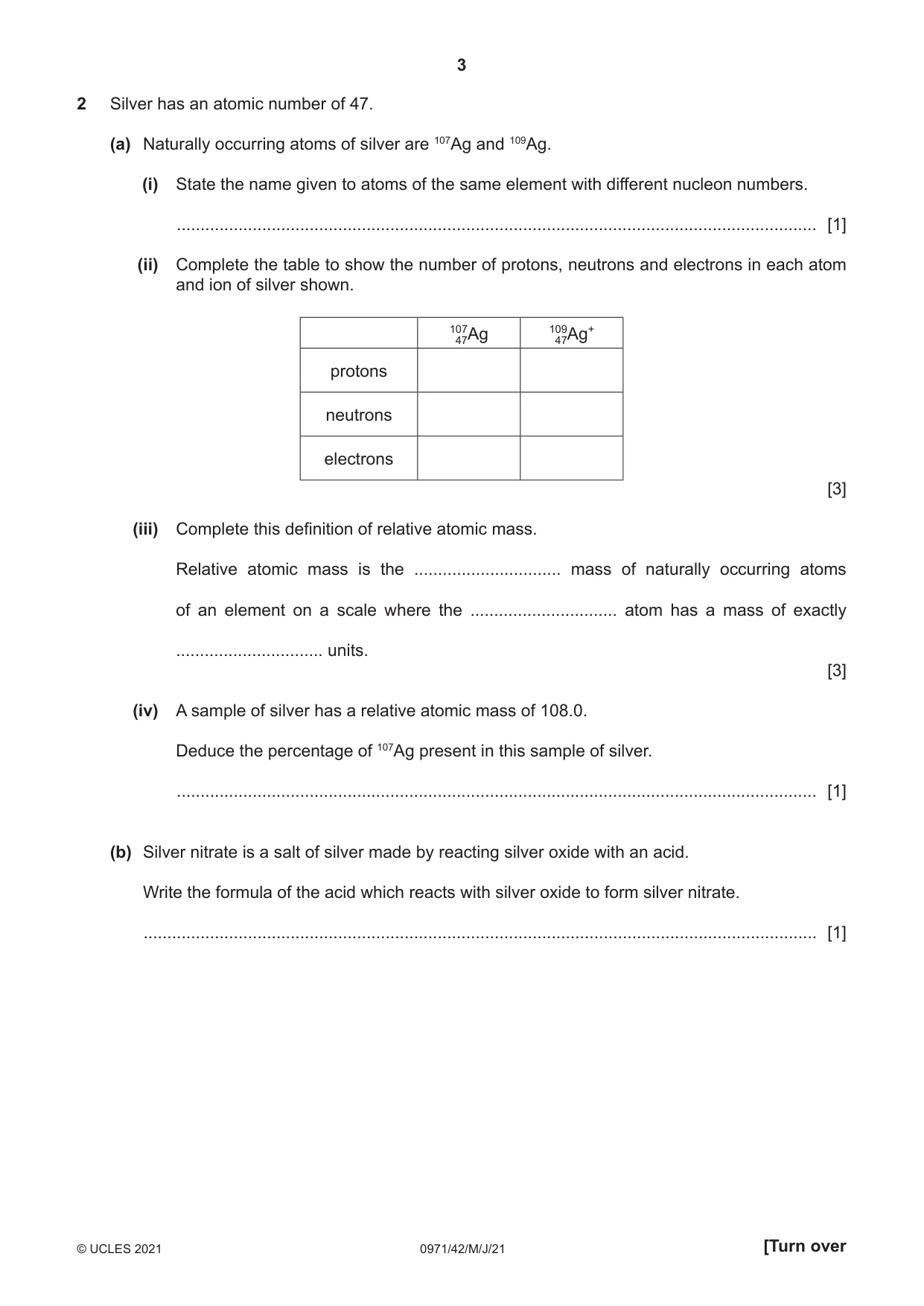
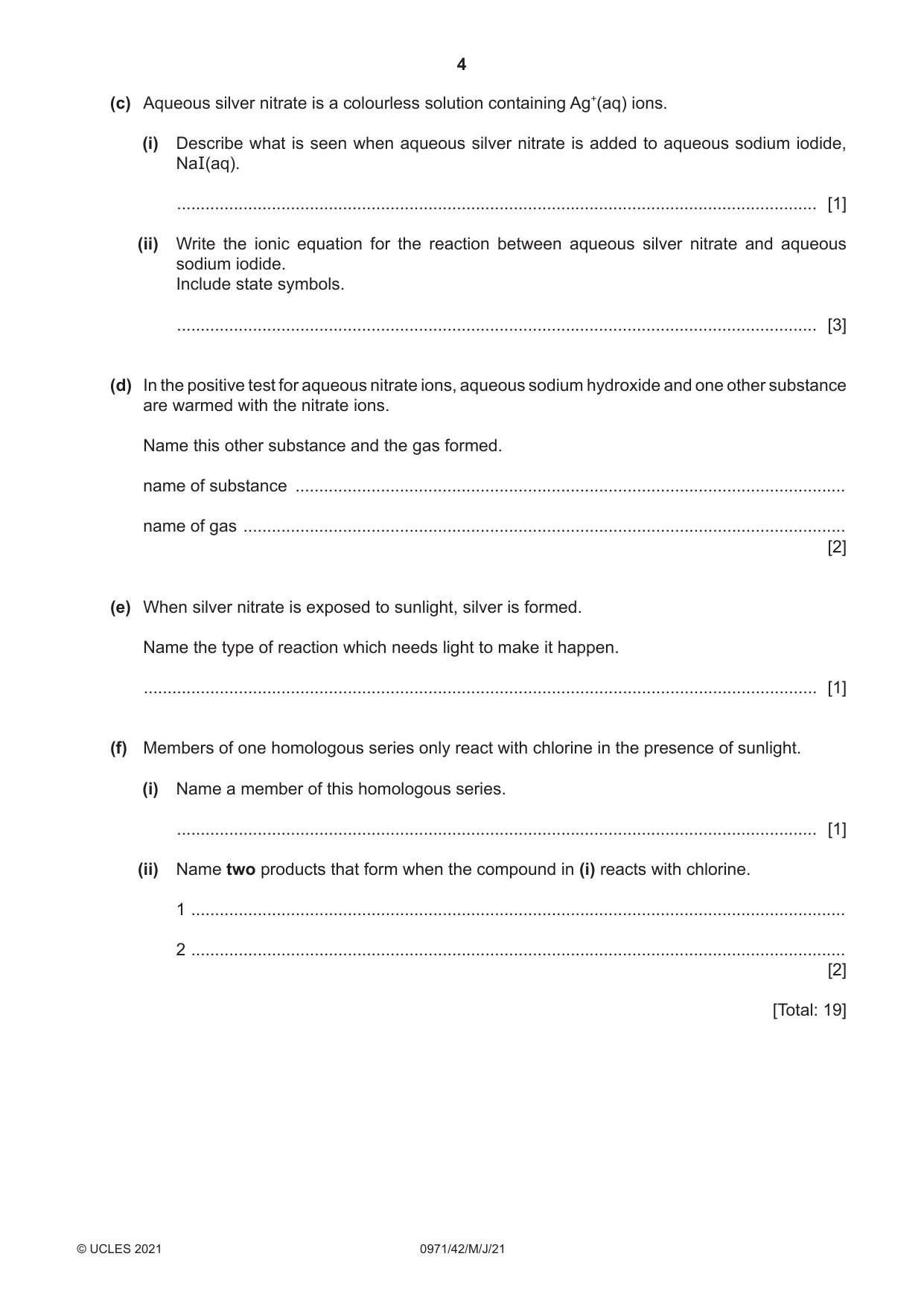
2 Silver has an atomic number of 47. (a) Naturally occurring atoms of silver are 107Ag and 109Ag. (i) State the name given to atoms of the same element with different nucleon numbers. ....................................................................................................................................... [1] (ii) Complete the table to show the number of protons, neutrons and electrons in each atom and ion of silver shown. 107Ag47 109Ag+47 protons neutrons electrons [3] (iii) Complete this definition of relative atomic mass. Relative atomic mass is the ............................... mass of naturally occurring atoms of an element on a scale where the ............................... atom has a mass of exactly ............................... units. [3] (iv) A sample of silver has a relative atomic mass of 108.0. Deduce the percentage of 107Ag present in this sample of silver. ....................................................................................................................................... [1] (b) Silver nitrate is a salt of silver made by reacting silver oxide with an acid. Write the formula of the acid which reacts with silver oxide to form silver nitrate. .............................................................................................................................................. [1] (c) Aqueous silver nitrate is a colourless solution containing Ag+(aq) ions. (i) Describe what is seen when aqueous silver nitrate is added to aqueous sodium iodide, NaI(aq). ....................................................................................................................................... [1] (ii) Write the ionic equation for the reaction between aqueous silver nitrate and aqueous sodium iodide. Include state symbols. ....................................................................................................................................... [3] (d) In the positive test for aqueous nitrate ions, aqueous sodium hydroxide and one other substance are warmed with the nitrate ions. Name this other substance and the gas formed. name of substance ..................................................................................................................... name of gas ............................................................................................................................... [2] (e) When silver nitrate is exposed to sunlight, silver is formed. Name the type of reaction which needs light to make it happen. .............................................................................................................................................. [1] (f) Members of one homologous series only react with chlorine in the presence of sunlight. (i) Name a member of this homologous series. ....................................................................................................................................... [1] (ii) Name two products that form when the compound in (i) reacts with chlorine. 1 .......................................................................................................................................... 2 .......................................................................................................................................... [2] [Total: 19]
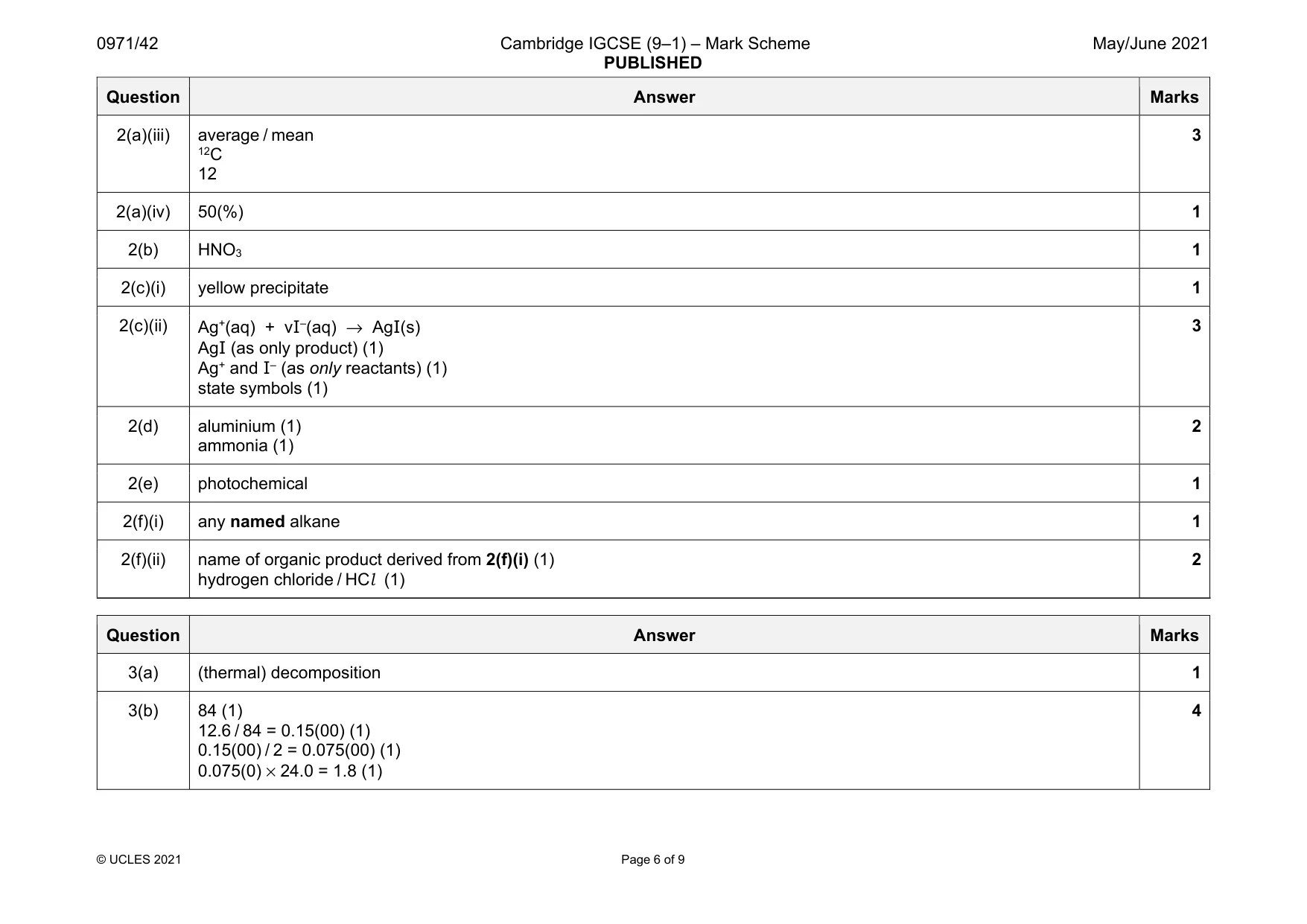
Mark scheme: 2(a)(i) isotopes 1 2(a)(ii) mark by row 107Ag 109Ag+ p 47 47 n 60 62 e 47 46 3 Question Answer Marks 2(a)(iii) average / mean 12C 12 3 2(a)(iv) 50(%) 1 2(b) HNO3 1 2(c)(i) yellow precipitate 1 2(c)(ii) Ag+(aq) + vI–(aq) → AgI(s) AgI (as only product) (1) Ag+ and I– (as only reactants) (1) state symbols (1) 3 2(d) aluminium (1) ammonia (1) 2 2(e) photochemical 1 2(f)(i) any named alkane 1 2(f)(ii) name of organic product derived from 2(f)(i) (1) hydrogen chloride / HCl (1) 2
Q3 · Sodium hydrogencarbonate is found in baking powder
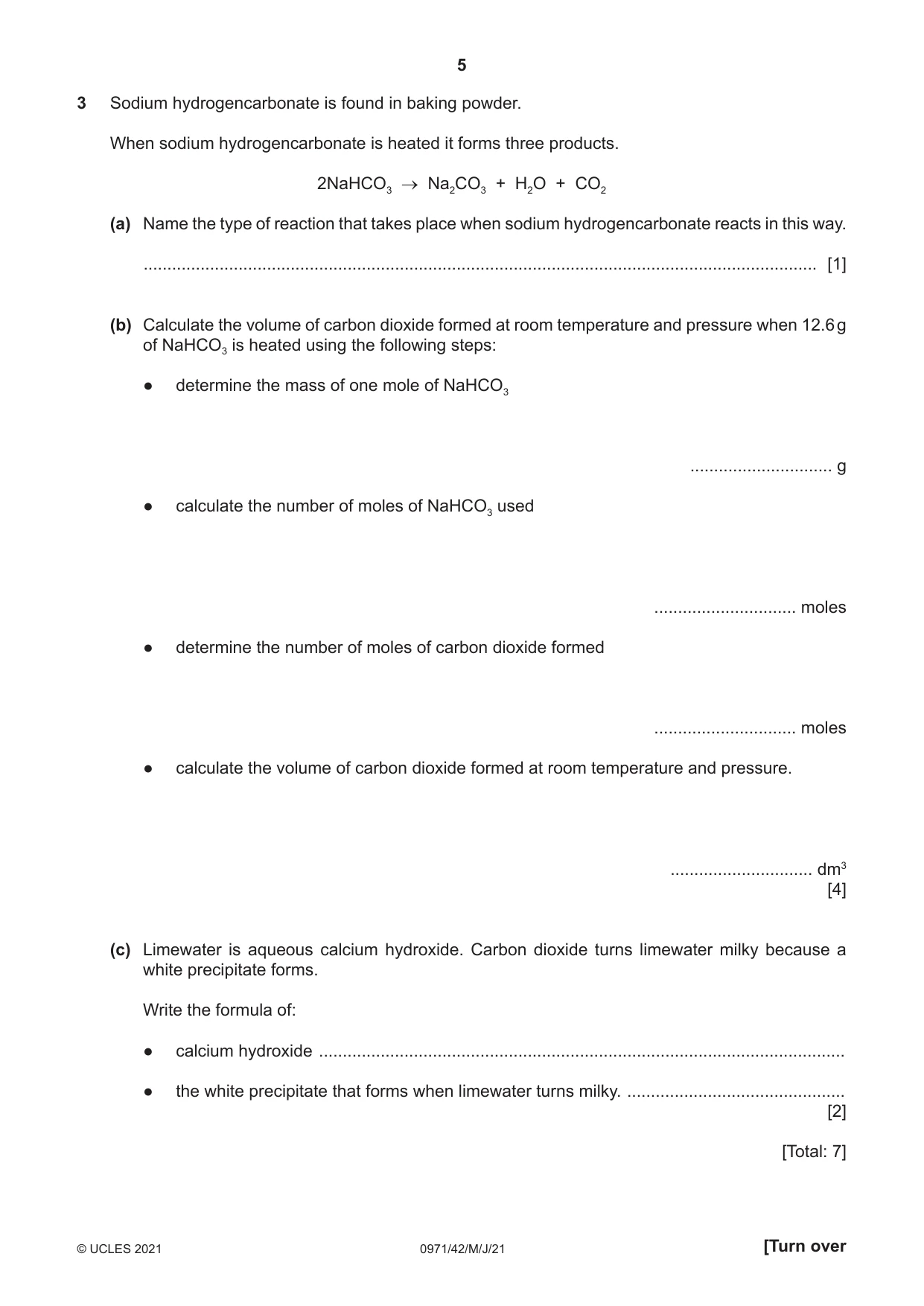
3 Sodium hydrogencarbonate is found in baking powder. When sodium hydrogencarbonate is heated it forms three products. 2NaHCO3 → Na2CO3 + H2O + CO2 (a) Name the type of reaction that takes place when sodium hydrogencarbonate reacts in this way. .............................................................................................................................................. [1] (b) Calculate the volume of carbon dioxide formed at room temperature and pressure when 12.6 g of NaHCO3 is heated using the following steps: ● determine the mass of one mole of NaHCO3 .............................. g ● calculate the number of moles of NaHCO3 used .............................. moles ● determine the number of moles of carbon dioxide formed .............................. moles ● calculate the volume of carbon dioxide formed at room temperature and pressure. .............................. dm3 [4] (c) Limewater is aqueous calcium hydroxide. Carbon dioxide turns limewater milky because a white precipitate forms. Write the formula of: ● calcium hydroxide ............................................................................................................... ● the white precipitate that forms when limewater turns milky. .............................................. [2] [Total: 7]
Mark scheme: 3(a) (thermal) decomposition 1 3(b) 84 (1) 12.6 / 84 = 0.15(00) (1) 0.15(00) / 2 = 0.075(00) (1) 0.075(0) × 24.0 = 1.8 (1) 4 Question Answer Marks 3(c) Ca(OH)2 (1) CaCO3 (1) 2
Q4 · A student carries out an electrolysis experiment using the apparatus shown
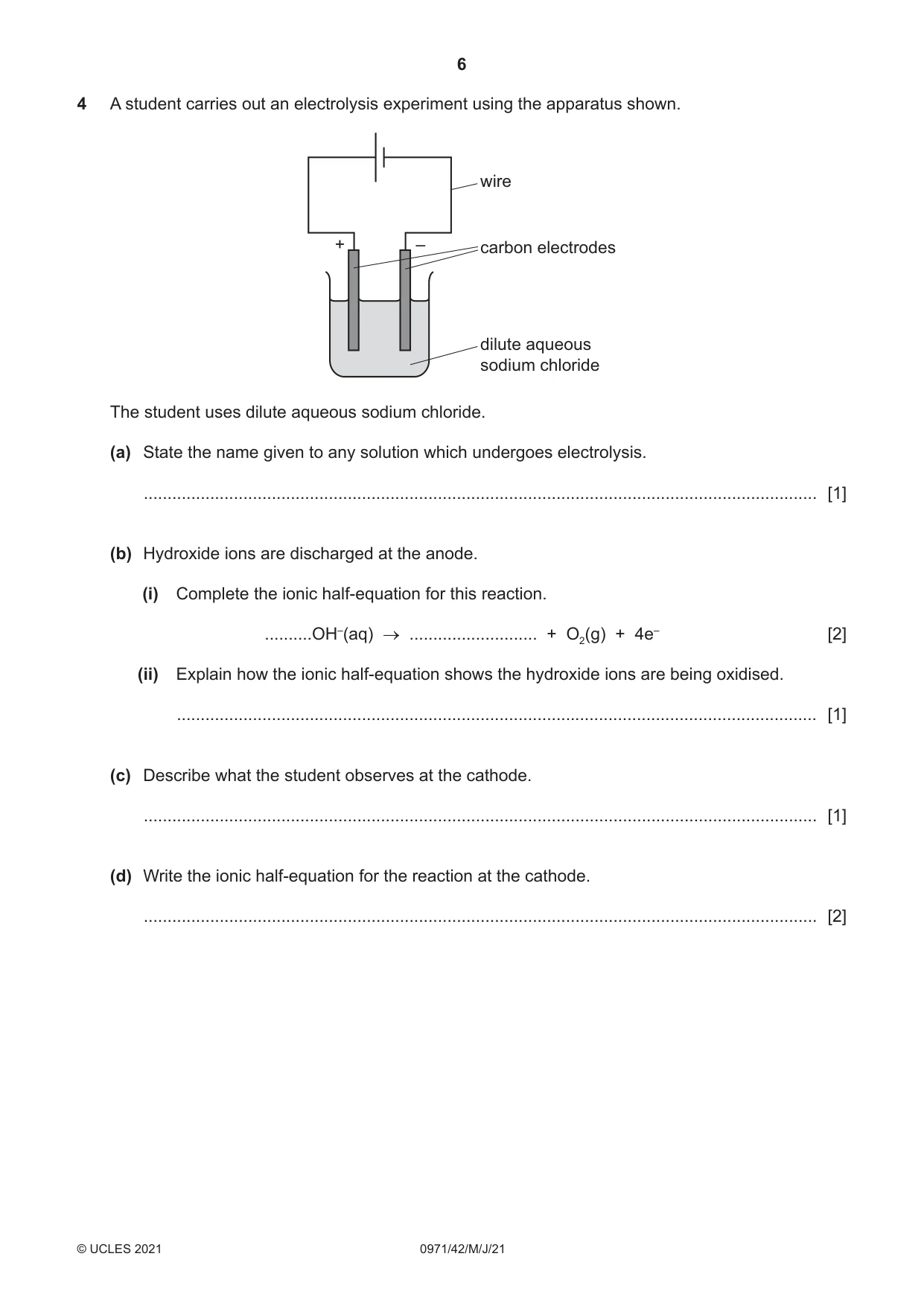
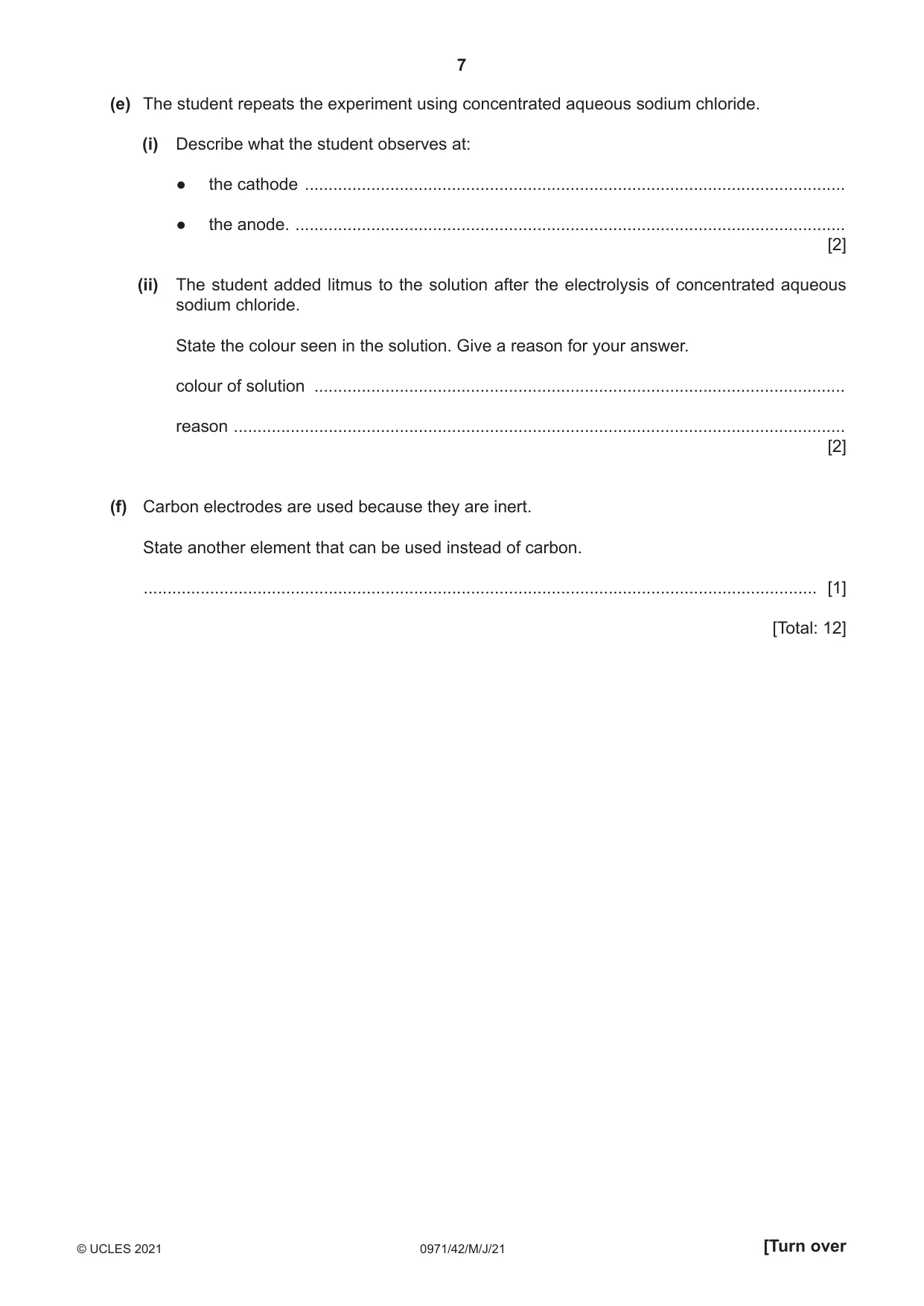
4 A student carries out an electrolysis experiment using the apparatus shown. wire + – carbon electrodes dilute aqueous sodium chloride The student uses dilute aqueous sodium chloride. (a) State the name given to any solution which undergoes electrolysis. .............................................................................................................................................. [1] (b) Hydroxide ions are discharged at the anode. (i) Complete the ionic half-equation for this reaction. ..........OH–(aq) → ........................... + O2(g) + 4e– [2] (ii) Explain how the ionic half-equation shows the hydroxide ions are being oxidised. ....................................................................................................................................... [1] (c) Describe what the student observes at the cathode. .............................................................................................................................................. [1] (d) Write the ionic half-equation for the reaction at the cathode. .............................................................................................................................................. [2] (e) The student repeats the experiment using concentrated aqueous sodium chloride. (i) Describe what the student observes at: ● the cathode ................................................................................................................... ● the anode. .................................................................................................................... [2] (ii) The student added litmus to the solution after the electrolysis of concentrated aqueous sodium chloride. State the colour seen in the solution. Give a reason for your answer. colour of solution ................................................................................................................. reason ................................................................................................................................. [2] (f) Carbon electrodes are used because they are inert. State another element that can be used instead of carbon. .............................................................................................................................................. [1] [Total: 12]
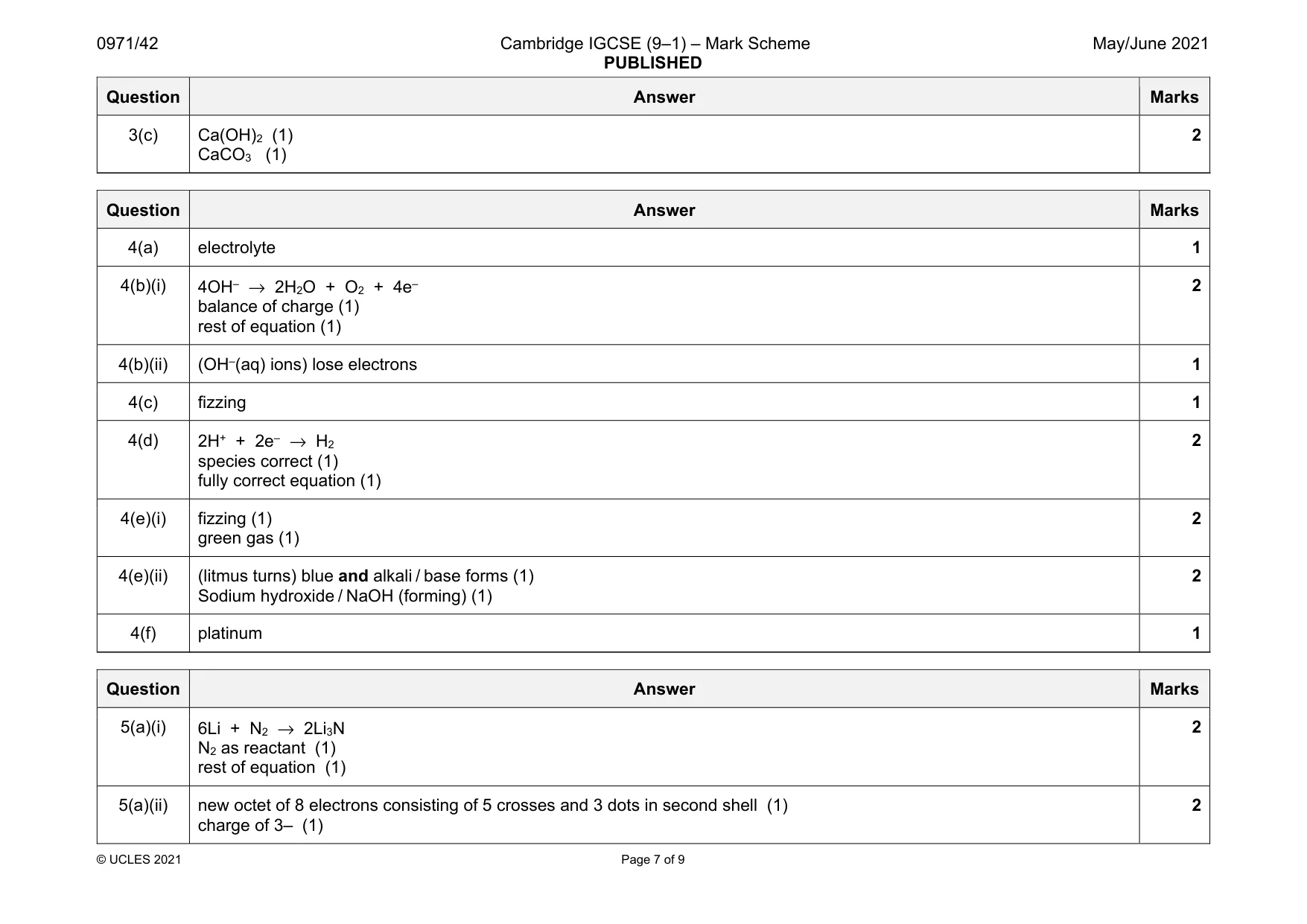
Mark scheme: 4(a) electrolyte 1 4(b)(i) 4OH– → 2H2O + O2 + 4e– balance of charge (1) rest of equation (1) 2 4(b)(ii) (OH–(aq) ions) lose electrons 1 4(c) fizzing 1 4(d) 2H+ + 2e– → H2 species correct (1) fully correct equation (1) 2 4(e)(i) fizzing (1) green gas (1) 2 4(e)(ii) (litmus turns) blue and alkali / base forms (1) Sodium hydroxide / NaOH (forming) (1) 2 4(f) platinum 1
Q5 · This question is about compounds of nitrogen
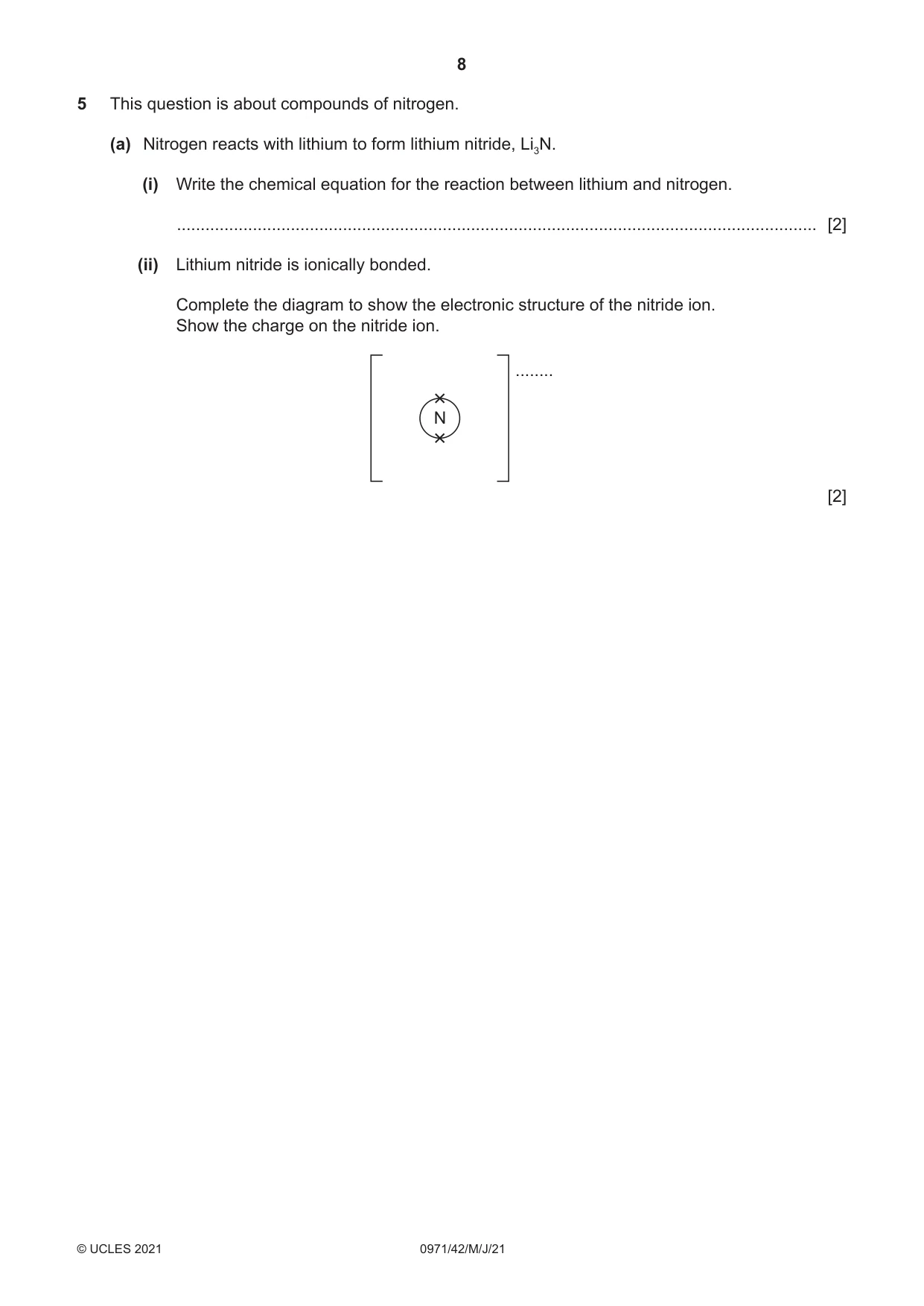
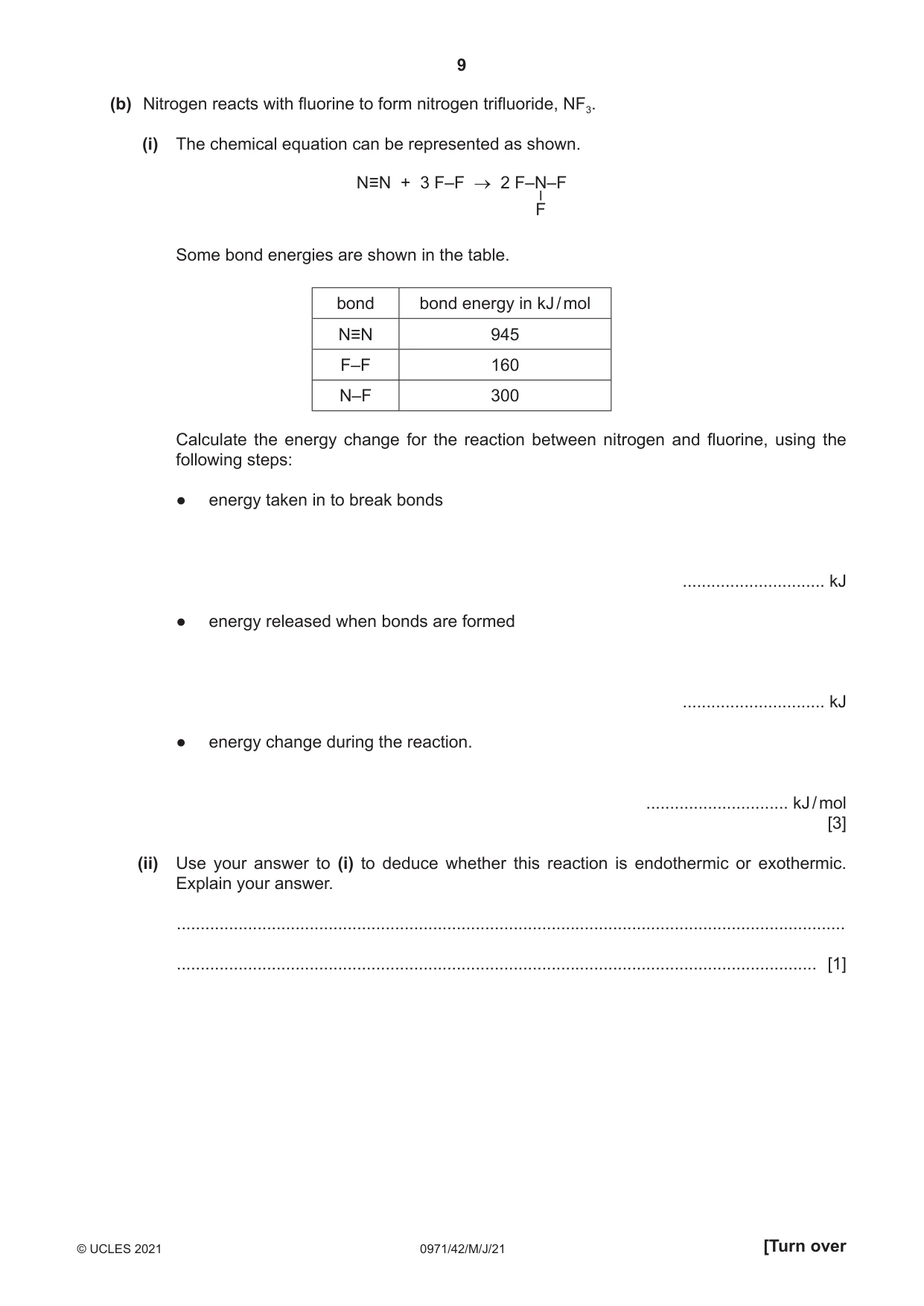
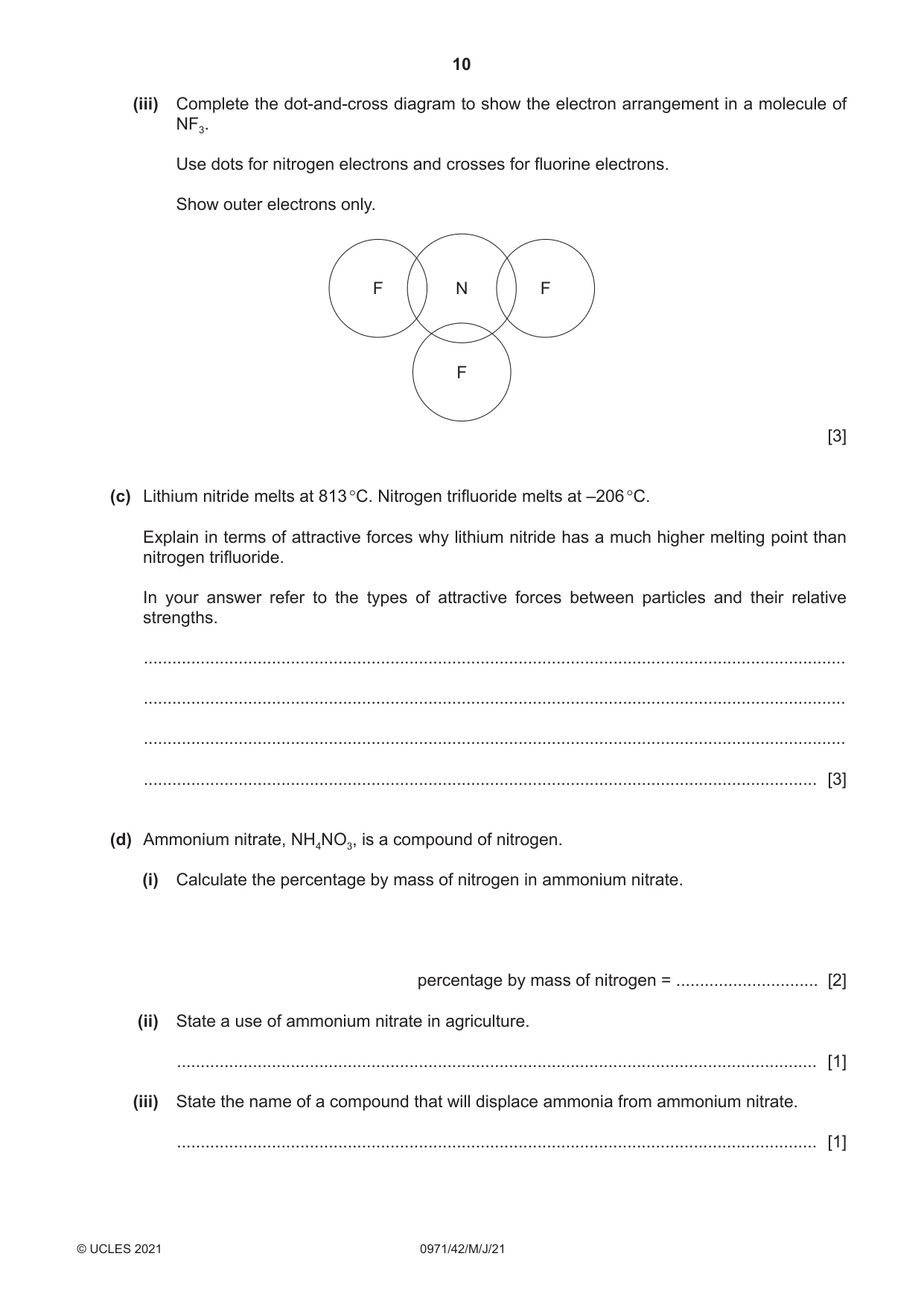
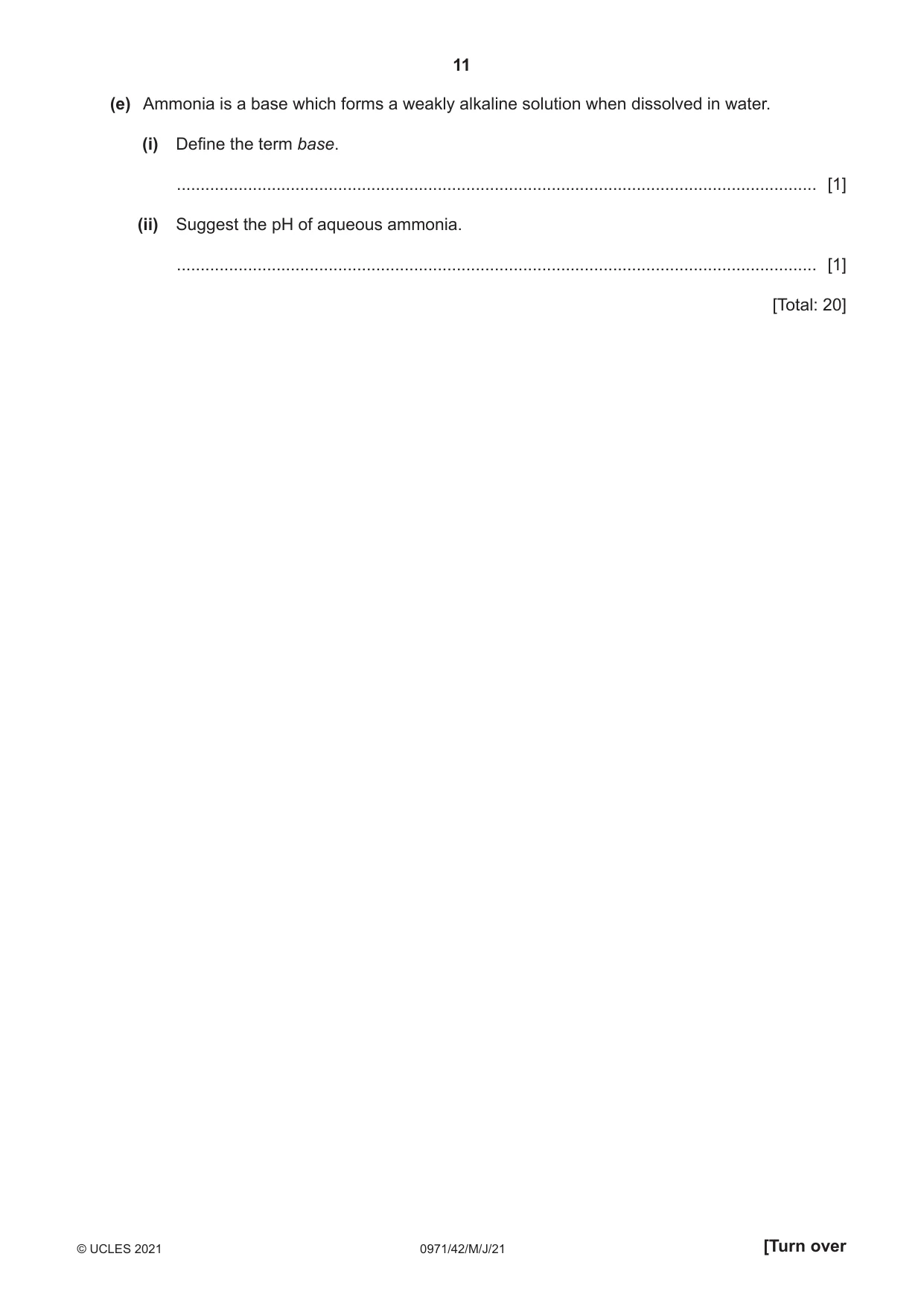
5 This question is about compounds of nitrogen. (a) Nitrogen reacts with lithium to form lithium nitride, Li3N. (i) Write the chemical equation for the reaction between lithium and nitrogen. ....................................................................................................................................... [2] (ii) Lithium nitride is ionically bonded. Complete the diagram to show the electronic structure of the nitride ion. Show the charge on the nitride ion. ........ N [2] (b) Nitrogen reacts with fluorine to form nitrogen trifluoride, NF3. (i) The chemical equation can be represented as shown. N≡N + 3 F–F 2 F–N–F F Some bond energies are shown in the table. bond bond energy in kJ / mol N≡N 945 F–F 160 N–F 300 Calculate the energy change for the reaction between nitrogen and fluorine, using the following steps: ● energy taken in to break bonds .............................. kJ ● energy released when bonds are formed .............................. kJ ● energy change during the reaction. .............................. kJ / mol [3] (ii) Use your answer to (i) to deduce whether this reaction is endothermic or exothermic. Explain your answer. ............................................................................................................................................. ....................................................................................................................................... [1] (iii) Complete the dot-and-cross diagram to show the electron arrangement in a molecule of NF3. Use dots for nitrogen electrons and crosses for fluorine electrons. Show outer electrons only. F N F F [3] (c) Lithium nitride melts at 813 °C. Nitrogen trifluoride melts at –206 °C. Explain in terms of attractive forces why lithium nitride has a much higher melting point than nitrogen trifluoride. In your answer refer to the types of attractive forces between particles and their relative strengths. .................................................................................................................................................... .................................................................................................................................................... .................................................................................................................................................... .............................................................................................................................................. [3] (d) Ammonium nitrate, NH4NO3, is a compound of nitrogen. (i) Calculate the percentage by mass of nitrogen in ammonium nitrate. percentage by mass of nitrogen = .............................. [2] (ii) State a use of ammonium nitrate in agriculture. ....................................................................................................................................... [1] (iii) State the name of a compound that will displace ammonia from ammonium nitrate. ....................................................................................................................................... [1] (e) Ammonia is a base which forms a weakly alkaline solution when dissolved in water. (i) Define the term base. ....................................................................................................................................... [1] (ii) Suggest the pH of aqueous ammonia. ....................................................................................................................................... [1] [Total: 20]
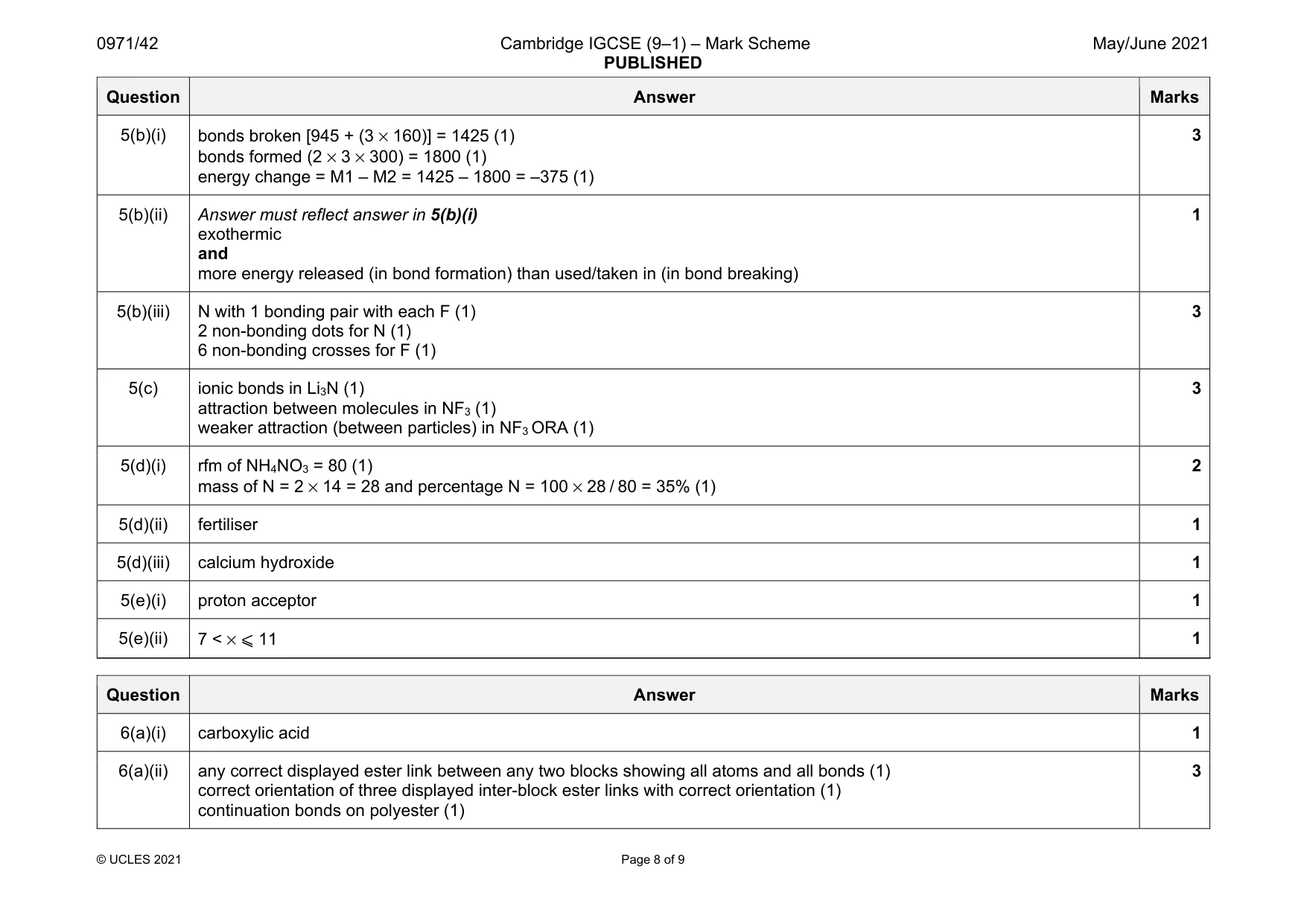
Mark scheme: 5(a)(i) 6Li + N2 → 2Li3N N2 as reactant (1) rest of equation (1) 2 5(a)(ii) new octet of 8 electrons consisting of 5 crosses and 3 dots in second shell (1) charge of 3– (1) 2 Question Answer Marks 5(b)(i) bonds broken [945 + (3 × 160)] = 1425 (1) bonds formed (2 × 3 × 300) = 1800 (1) energy change = M1 – M2 = 1425 – 1800 = –375 (1) 3 5(b)(ii) Answer must reflect answer in 5(b)(i) exothermic and more energy released (in bond formation) than used/taken in (in bond breaking) 1 5(b)(iii) N with 1 bonding pair with each F (1) 2 non-bonding dots for N (1) 6 non-bonding crosses for F (1) 3 5(c) ionic bonds in Li3N (1) attraction between molecules in NF3 (1) weaker attraction (between particles) in NF3 ORA (1) 3 5(d)(i) rfm of NH4NO3 = 80 (1) mass of N = 2 × 14 = 28 and percentage N = 100 × 28 / 80 = 35% (1) 2 5(d)(ii) fertiliser 1 5(d)(iii) calcium hydroxide 1 5(e)(i) proton acceptor 1 5(e)(ii) 7 < × ⩽ 11 1
Q6 · Molecules A and B can form condensation polymers
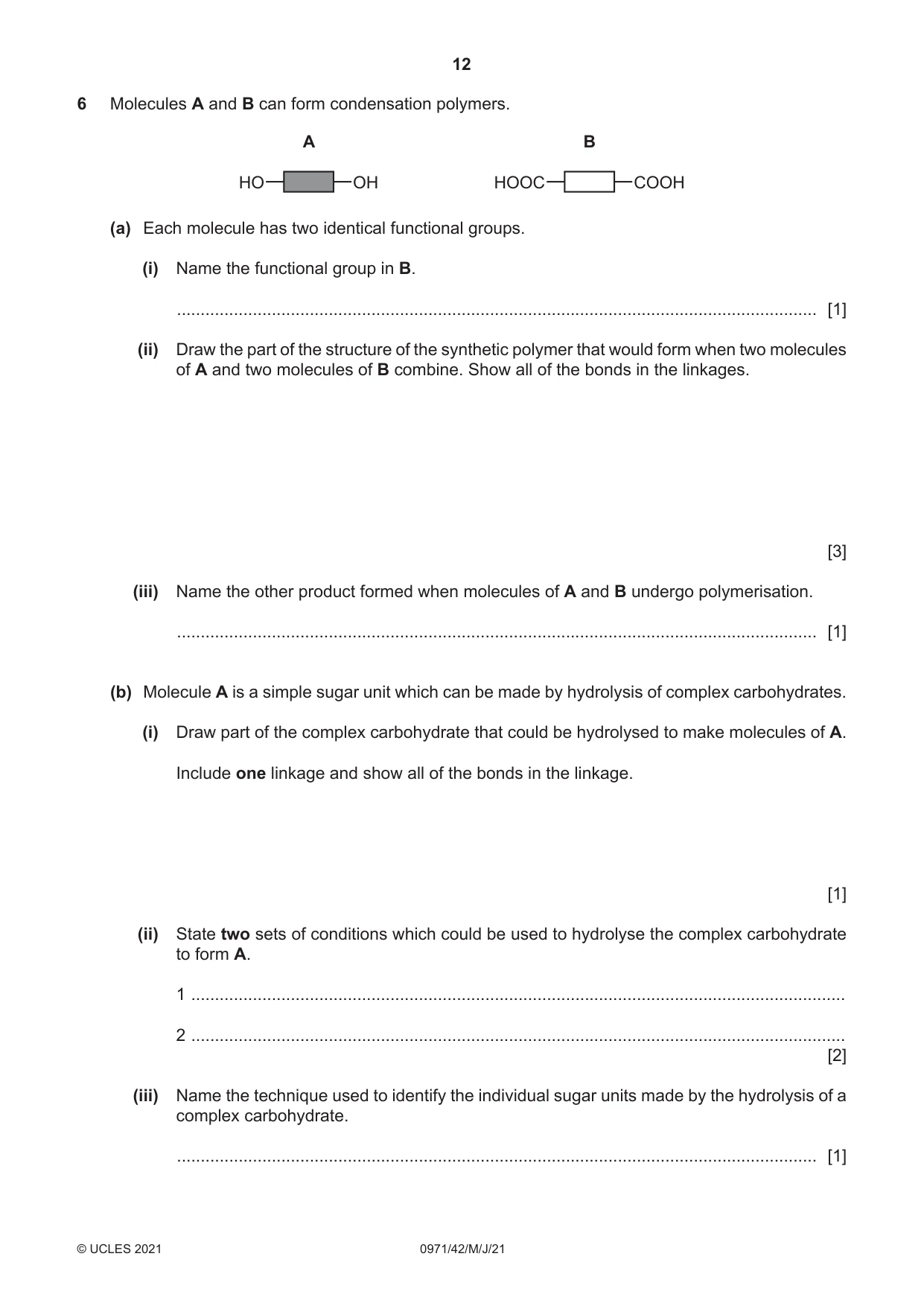
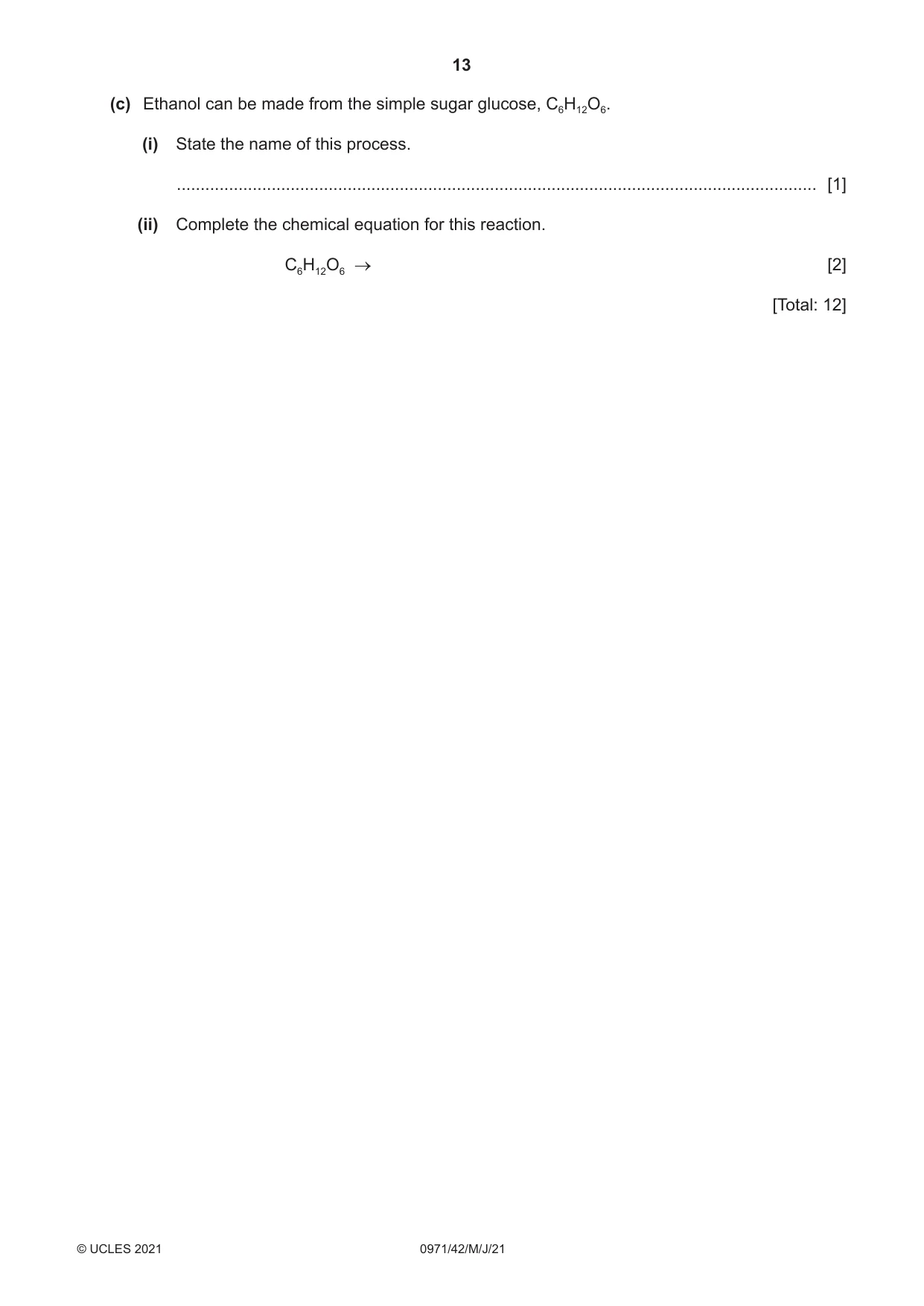
6 Molecules A and B can form condensation polymers. A B HO OH HOOC COOH (a) Each molecule has two identical functional groups. (i) Name the functional group in B. ....................................................................................................................................... [1] (ii) Draw the part of the structure of the synthetic polymer that would form when two molecules of A and two molecules of B combine. Show all of the bonds in the linkages. [3] (iii) Name the other product formed when molecules of A and B undergo polymerisation. ....................................................................................................................................... [1] (b) Molecule A is a simple sugar unit which can be made by hydrolysis of complex carbohydrates. (i) Draw part of the complex carbohydrate that could be hydrolysed to make molecules of A. Include one linkage and show all of the bonds in the linkage. [1] (ii) State two sets of conditions which could be used to hydrolyse the complex carbohydrate to form A. 1 .......................................................................................................................................... 2 .......................................................................................................................................... [2] (iii) Name the technique used to identify the individual sugar units made by the hydrolysis of a complex carbohydrate. ....................................................................................................................................... [1] (c) Ethanol can be made from the simple sugar glucose, C6H12O6. (i) State the name of this process. ....................................................................................................................................... [1] (ii) Complete the chemical equation for this reaction. C6H12O6 → [2] [Total: 12]
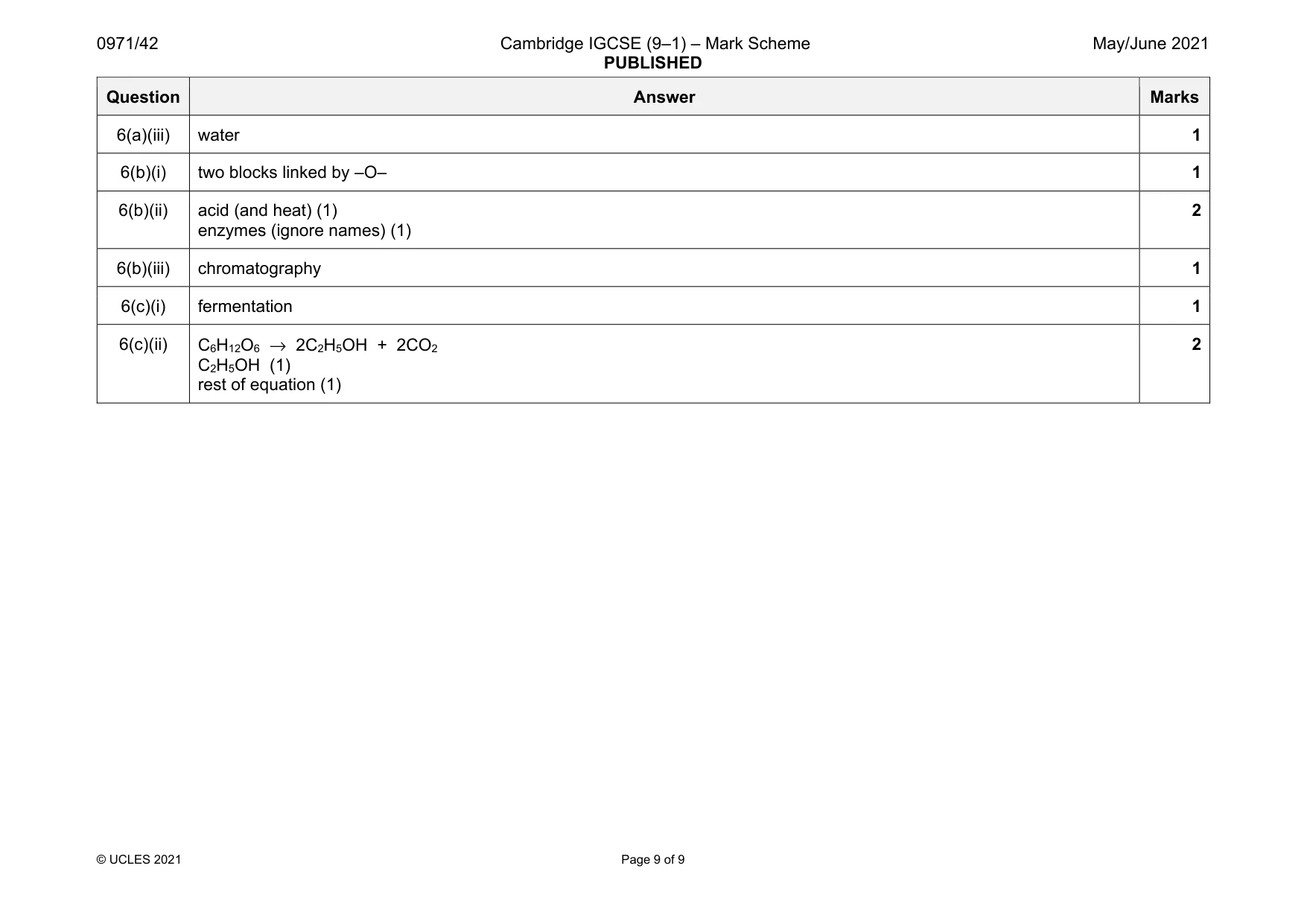
Mark scheme: 6(a)(i) carboxylic acid 1 6(a)(ii) any correct displayed ester link between any two blocks showing all atoms and all bonds (1) correct orientation of three displayed inter-block ester links with correct orientation (1) continuation bonds on polyester (1) 3 Question Answer Marks 6(a)(iii) water 1 6(b)(i) two blocks linked by –O– 1 6(b)(ii) acid (and heat) (1) enzymes (ignore names) (1) 2 6(b)(iii) chromatography 1 6(c)(i) fermentation 1 6(c)(ii) C6H12O6 → 2C2H5OH + 2CO2 C2H5OH (1) rest of equation (1) 2
What was in this paper
The subtopics covered by these 6 questions, and how many questions each got. Open one in a new tab to see every Cambridge question on it.
What you needed in this session
Cambridge’s own grade thresholds for 2021 May/June, Paper 4 · Variant 2. A higher threshold means an easier paper — the bar moves with how the cohort did.