Cambridge IGCSE Chemistry (9-1) 0971 — 2021 May/June Paper 4 · Variant 1
0971/41/M/J/21 · 7 questions · 80 marks · ≈90 min
The question paper and its mark scheme, free to read here and free to download. This is Cambridge’s own paper, exactly as it was sat.
Question paper16 pages
Mark scheme10 pages
Answers below. Sit the paper first if you are practising.
Questions as text
Q1 · Give the name of the process that is used: (a) to produce ammonia from nitrogen…
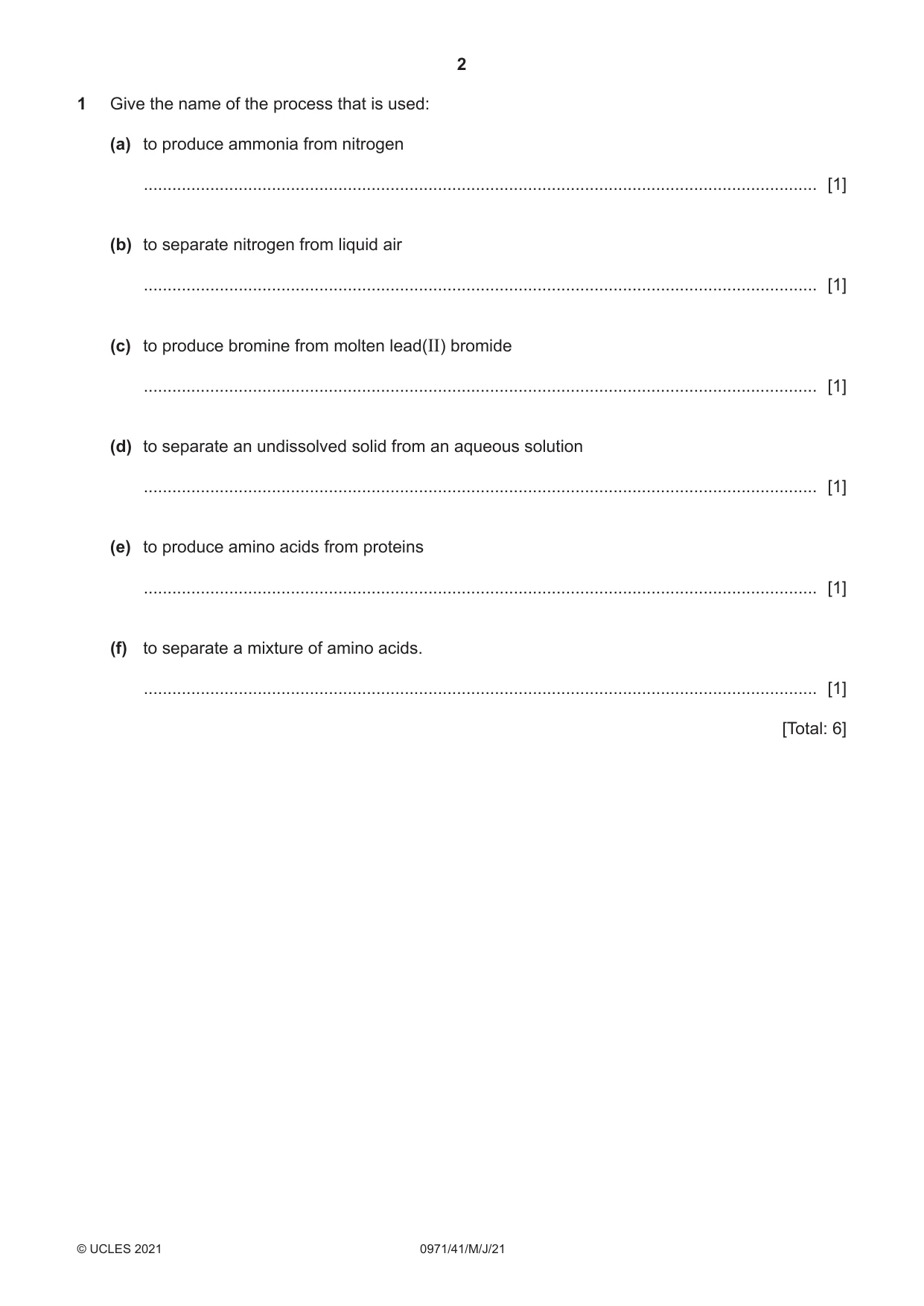
1 Give the name of the process that is used: (a) to produce ammonia from nitrogen .............................................................................................................................................. [1] (b) to separate nitrogen from liquid air .............................................................................................................................................. [1] (c) to produce bromine from molten lead(II) bromide .............................................................................................................................................. [1] (d) to separate an undissolved solid from an aqueous solution .............................................................................................................................................. [1] (e) to produce amino acids from proteins .............................................................................................................................................. [1] (f) to separate a mixture of amino acids. .............................................................................................................................................. [1] [Total: 6]
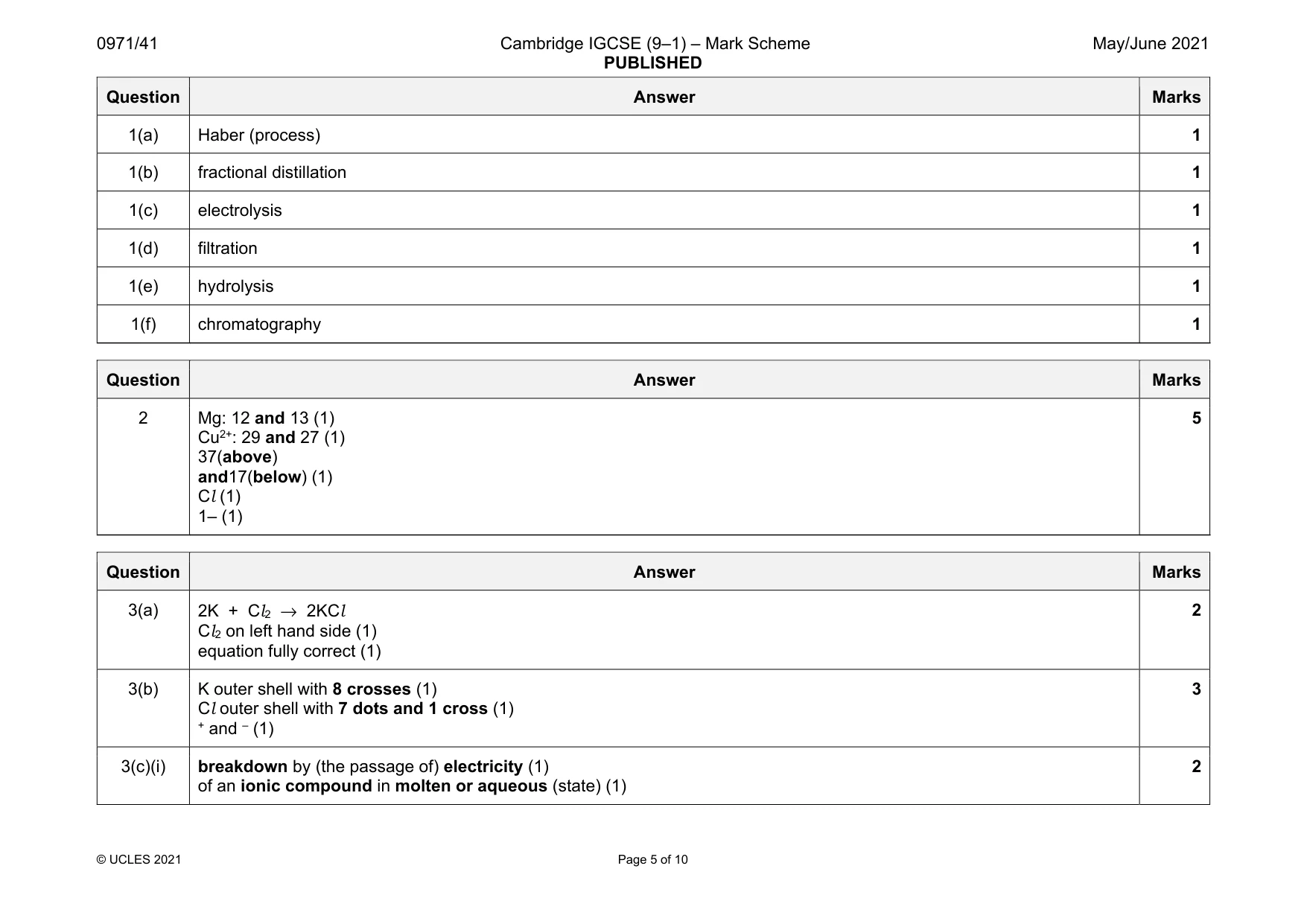
Mark scheme: 1(a) Haber (process) 1 1(b) fractional distillation 1 1(c) electrolysis 1 1(d) filtration 1 1(e) hydrolysis 1 1(f) chromatography 1
Q2 · Complete the table to: ● deduce the number of protons, electrons and neutrons in the…
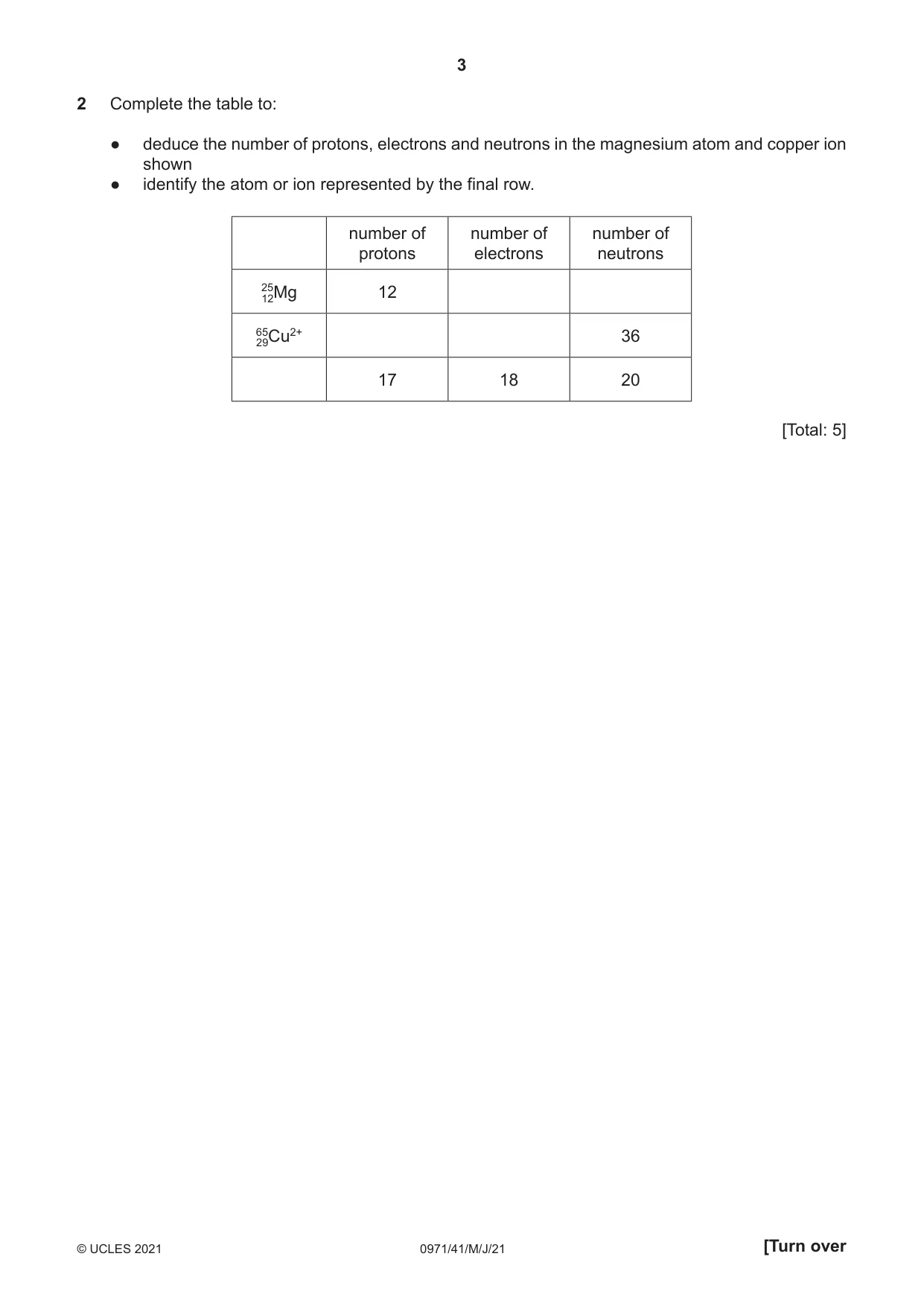
2 Complete the table to: ● deduce the number of protons, electrons and neutrons in the magnesium atom and copper ion shown ● identify the atom or ion represented by the final row. number of number of number of protons electrons neutrons 25Mg12 12 65Cu2+29 36 17 18 20 [Total: 5]
Mark scheme: 2 Mg: 12 and 13 (1) Cu2+: 29 and 27 (1) 37(above) and17(below) (1) Cl (1) 1– (1) 5
Q3 · Potassium reacts with chlorine to form potassium chloride, KCl
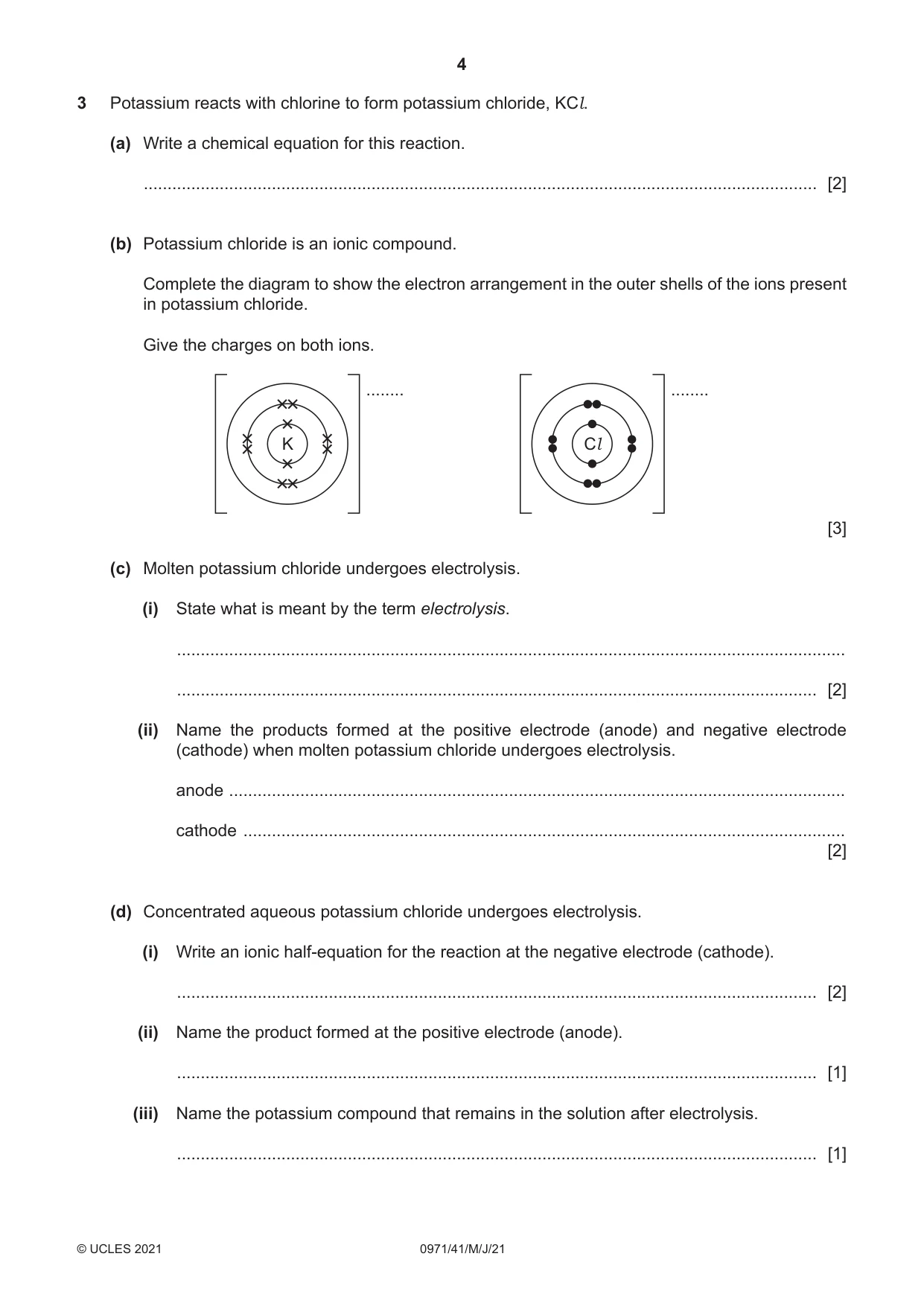
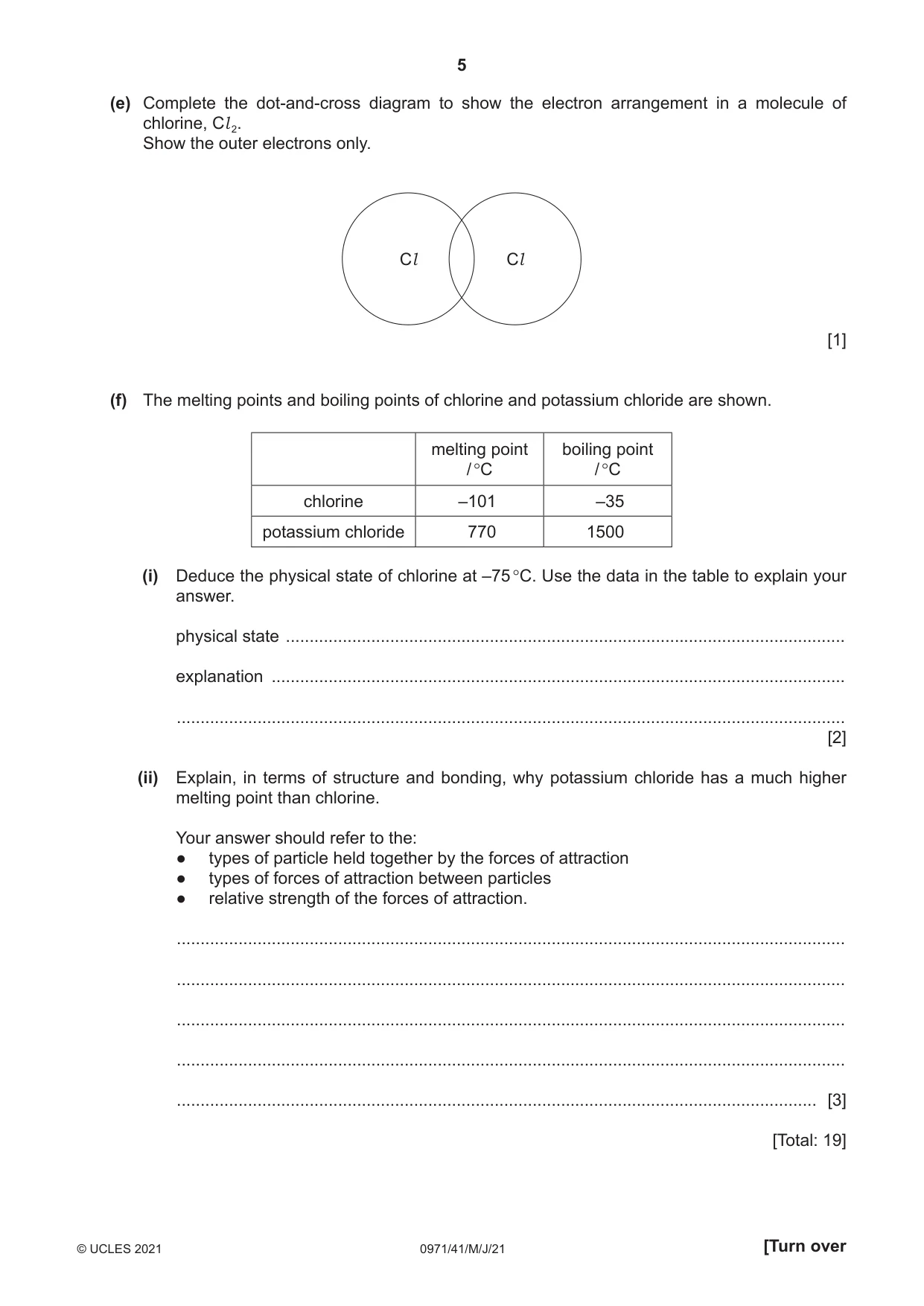
3 Potassium reacts with chlorine to form potassium chloride, KCl. (a) Write a chemical equation for this reaction. .............................................................................................................................................. [2] (b) Potassium chloride is an ionic compound. Complete the diagram to show the electron arrangement in the outer shells of the ions present in potassium chloride. Give the charges on both ions. ........ ........ K Cl [3] (c) Molten potassium chloride undergoes electrolysis. (i) State what is meant by the term electrolysis. ............................................................................................................................................. ....................................................................................................................................... [2] (ii) Name the products formed at the positive electrode (anode) and negative electrode (cathode) when molten potassium chloride undergoes electrolysis. anode .................................................................................................................................. cathode ............................................................................................................................... [2] (d) Concentrated aqueous potassium chloride undergoes electrolysis. (i) Write an ionic half-equation for the reaction at the negative electrode (cathode). ....................................................................................................................................... [2] (ii) Name the product formed at the positive electrode (anode). ....................................................................................................................................... [1] (iii) Name the potassium compound that remains in the solution after electrolysis. ....................................................................................................................................... [1] (e) Complete the dot-and-cross diagram to show the electron arrangement in a molecule of chlorine, Cl 2. Show the outer electrons only. Cl Cl [1] (f) The melting points and boiling points of chlorine and potassium chloride are shown. melting point boiling point / °C / °C chlorine –101 –35 potassium chloride 770 1500 (i) Deduce the physical state of chlorine at –75 °C. Use the data in the table to explain your answer. physical state ...................................................................................................................... explanation .......................................................................................................................... ............................................................................................................................................. [2] (ii) Explain, in terms of structure and bonding, why potassium chloride has a much higher melting point than chlorine. Your answer should refer to the: ● types of particle held together by the forces of attraction ● types of forces of attraction between particles ● relative strength of the forces of attraction. ............................................................................................................................................. ............................................................................................................................................. ............................................................................................................................................. ............................................................................................................................................. ....................................................................................................................................... [3] [Total: 19]
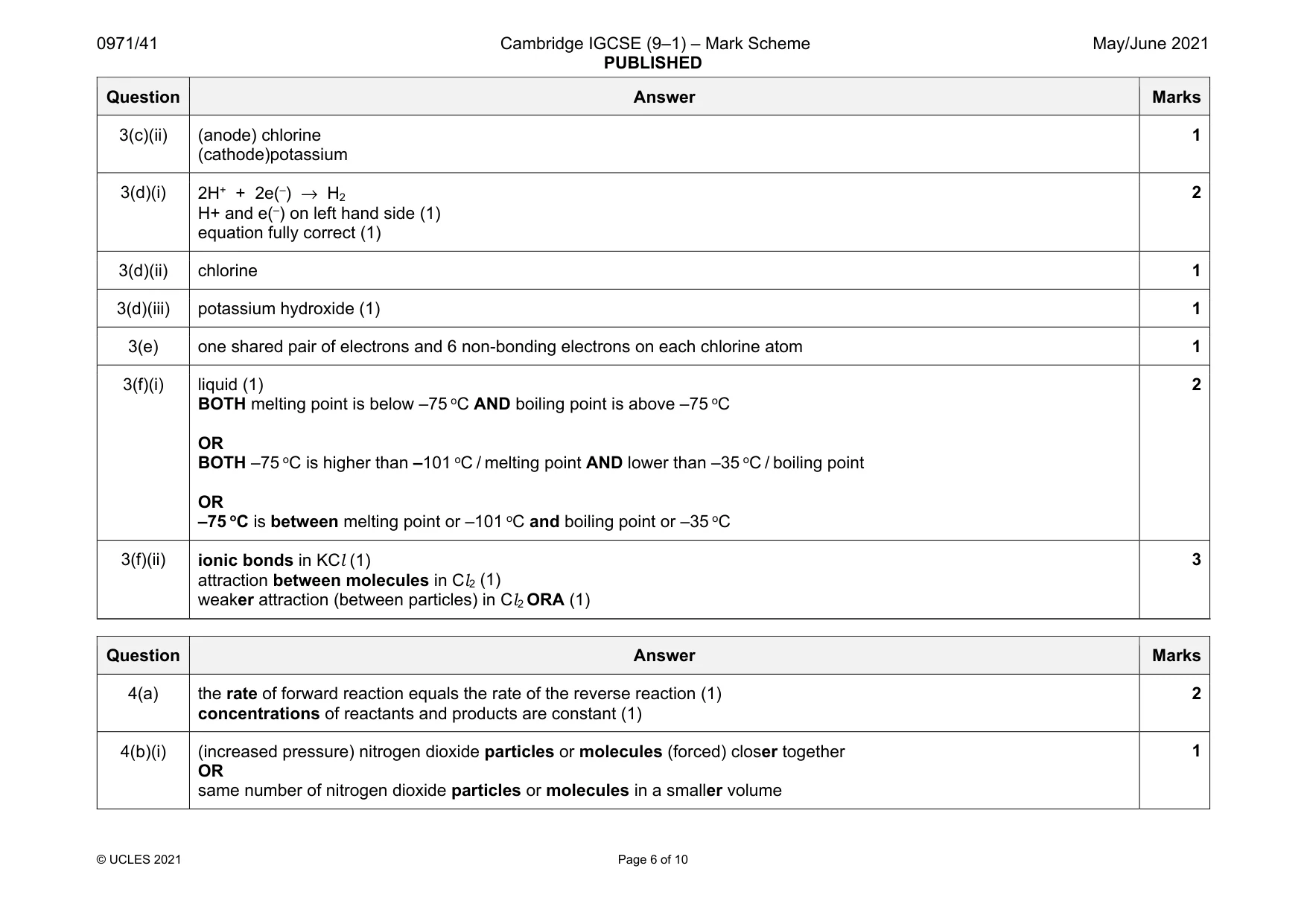
Mark scheme: 3(a) 2K + Cl2 → 2KCl Cl2 on left hand side (1) equation fully correct (1) 2 3(b) K outer shell with 8 crosses (1) Cl outer shell with 7 dots and 1 cross (1) + and – (1) 3 3(c)(i) breakdown by (the passage of) electricity (1) of an ionic compound in molten or aqueous (state) (1) 2 Question Answer Marks 3(c)(ii) (anode) chlorine (cathode)potassium 1 3(d)(i) 2H+ + 2e(–) → H2 H+ and e(–) on left hand side (1) equation fully correct (1) 2 3(d)(ii) chlorine 1 3(d)(iii) potassium hydroxide (1) 1 3(e) one shared pair of electrons and 6 non-bonding electrons on each chlorine atom 1 3(f)(i) liquid (1) BOTH melting point is below –75 oC AND boiling point is above –75 oC OR BOTH –75 oC is higher than –101 oC / melting point AND lower than –35 oC / boiling point OR –75 oC is between melting point or –101 oC and boiling point or –35 oC 2 3(f)(ii) ionic bonds in KCl (1) attraction between molecules in Cl2 (1) weaker attraction (between particles) in Cl2 ORA (1) 3
Q4 · Dinitrogen tetroxide, N2O4, decomposes into nitrogen dioxide, NO2
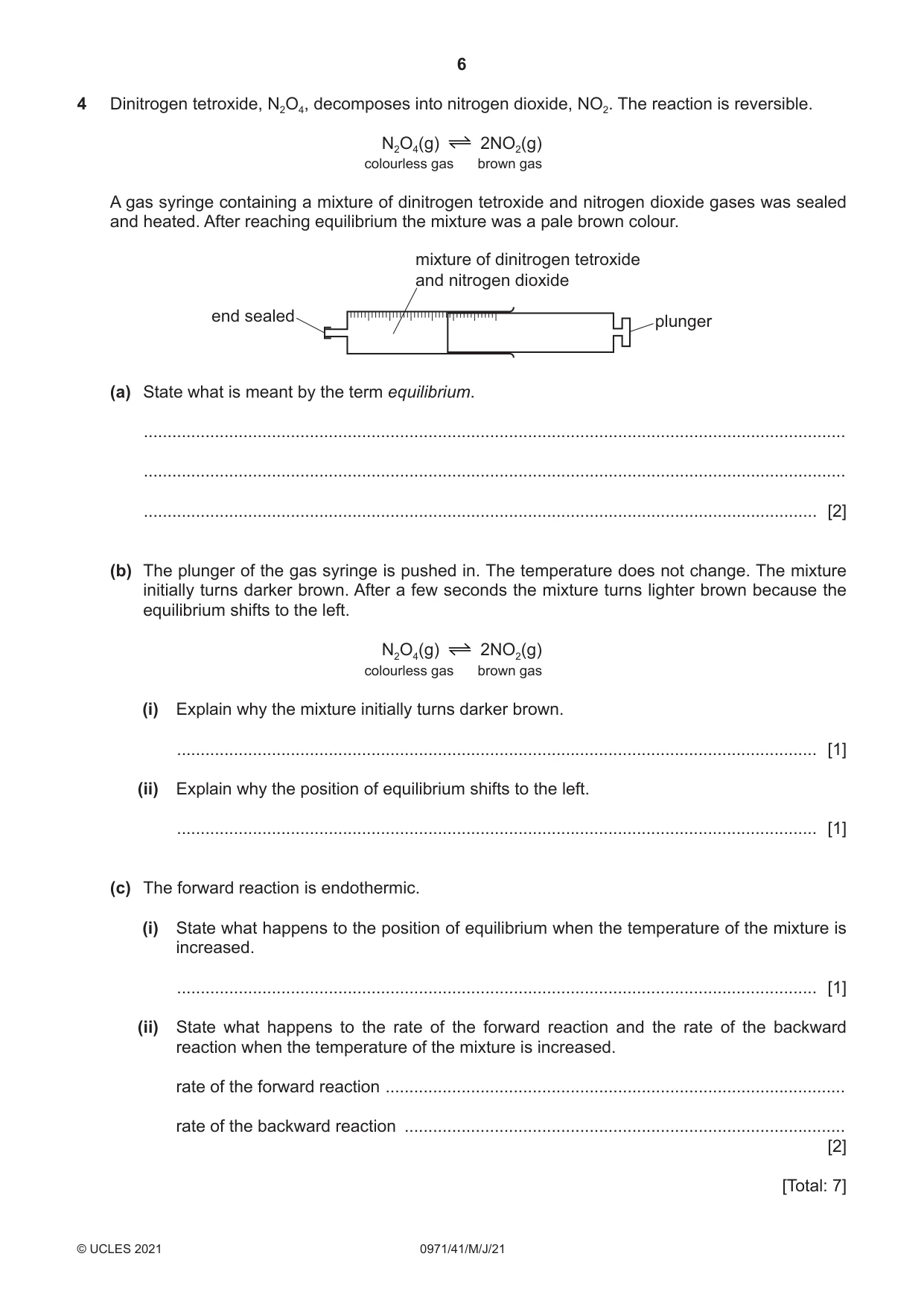
4 Dinitrogen tetroxide, N2O4, decomposes into nitrogen dioxide, NO2. The reaction is reversible. N2O4(g) 2NO2(g) colourless gas brown gas A gas syringe containing a mixture of dinitrogen tetroxide and nitrogen dioxide gases was sealed and heated. After reaching equilibrium the mixture was a pale brown colour. mixture of dinitrogen tetroxide and nitrogen dioxide end sealed plunger (a) State what is meant by the term equilibrium. .................................................................................................................................................... .................................................................................................................................................... .............................................................................................................................................. [2] (b) The plunger of the gas syringe is pushed in. The temperature does not change. The mixture initially turns darker brown. After a few seconds the mixture turns lighter brown because the equilibrium shifts to the left. N2O4(g) 2NO2(g) colourless gas brown gas (i) Explain why the mixture initially turns darker brown. ....................................................................................................................................... [1] (ii) Explain why the position of equilibrium shifts to the left. ....................................................................................................................................... [1] (c) The forward reaction is endothermic. (i) State what happens to the position of equilibrium when the temperature of the mixture is increased. ....................................................................................................................................... [1] (ii) State what happens to the rate of the forward reaction and the rate of the backward reaction when the temperature of the mixture is increased. rate of the forward reaction ................................................................................................. rate of the backward reaction .............................................................................................. [2] [Total: 7]
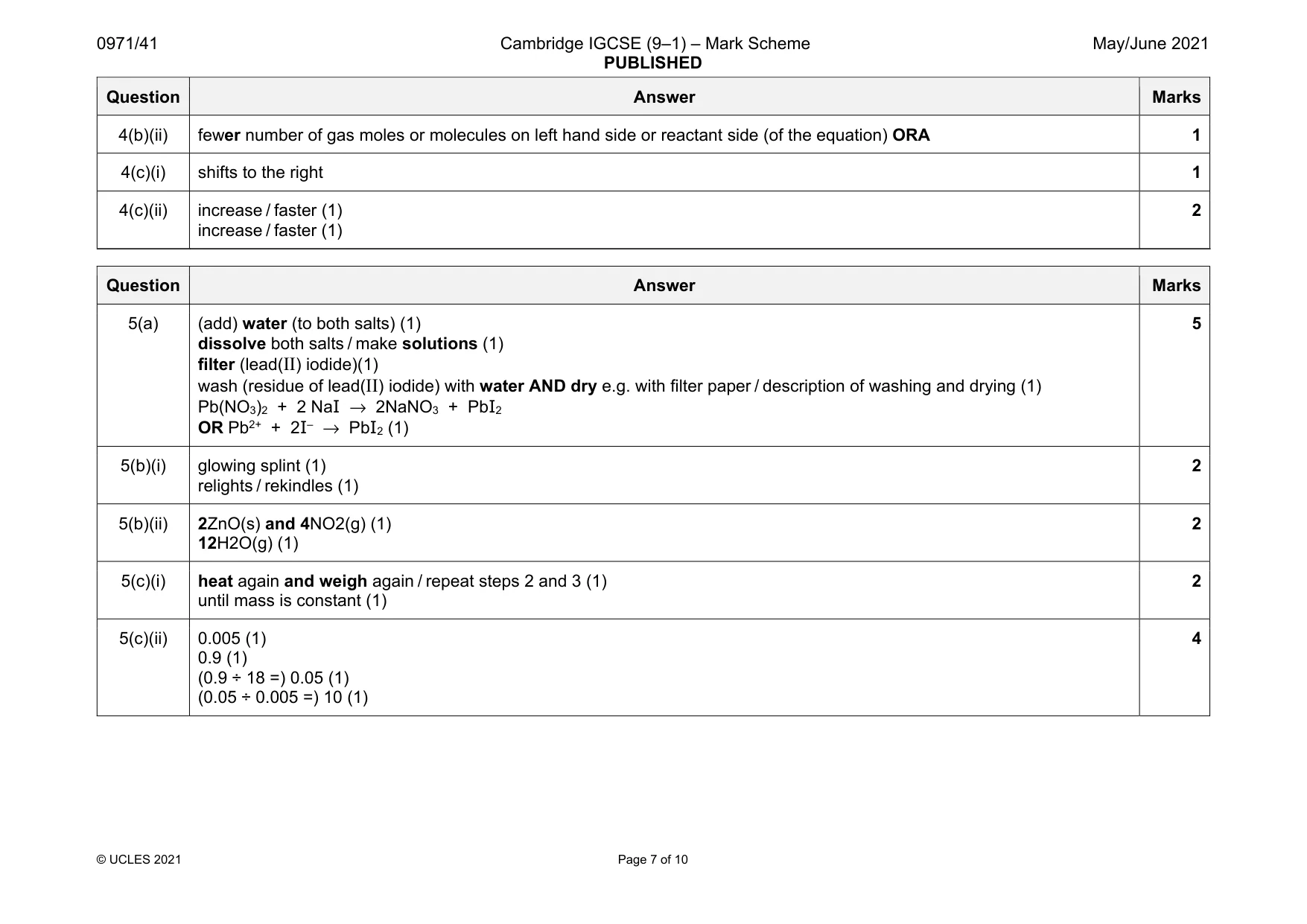
Mark scheme: 4(a) the rate of forward reaction equals the rate of the reverse reaction (1) concentrations of reactants and products are constant (1) 2 4(b)(i) (increased pressure) nitrogen dioxide particles or molecules (forced) closer together OR same number of nitrogen dioxide particles or molecules in a smaller volume 1 Question Answer Marks 4(b)(ii) fewer number of gas moles or molecules on left hand side or reactant side (of the equation) ORA 1 4(c)(i) shifts to the right 1 4(c)(ii) increase / faster (1) increase / faster (1) 2
Q5 · This question is about salts
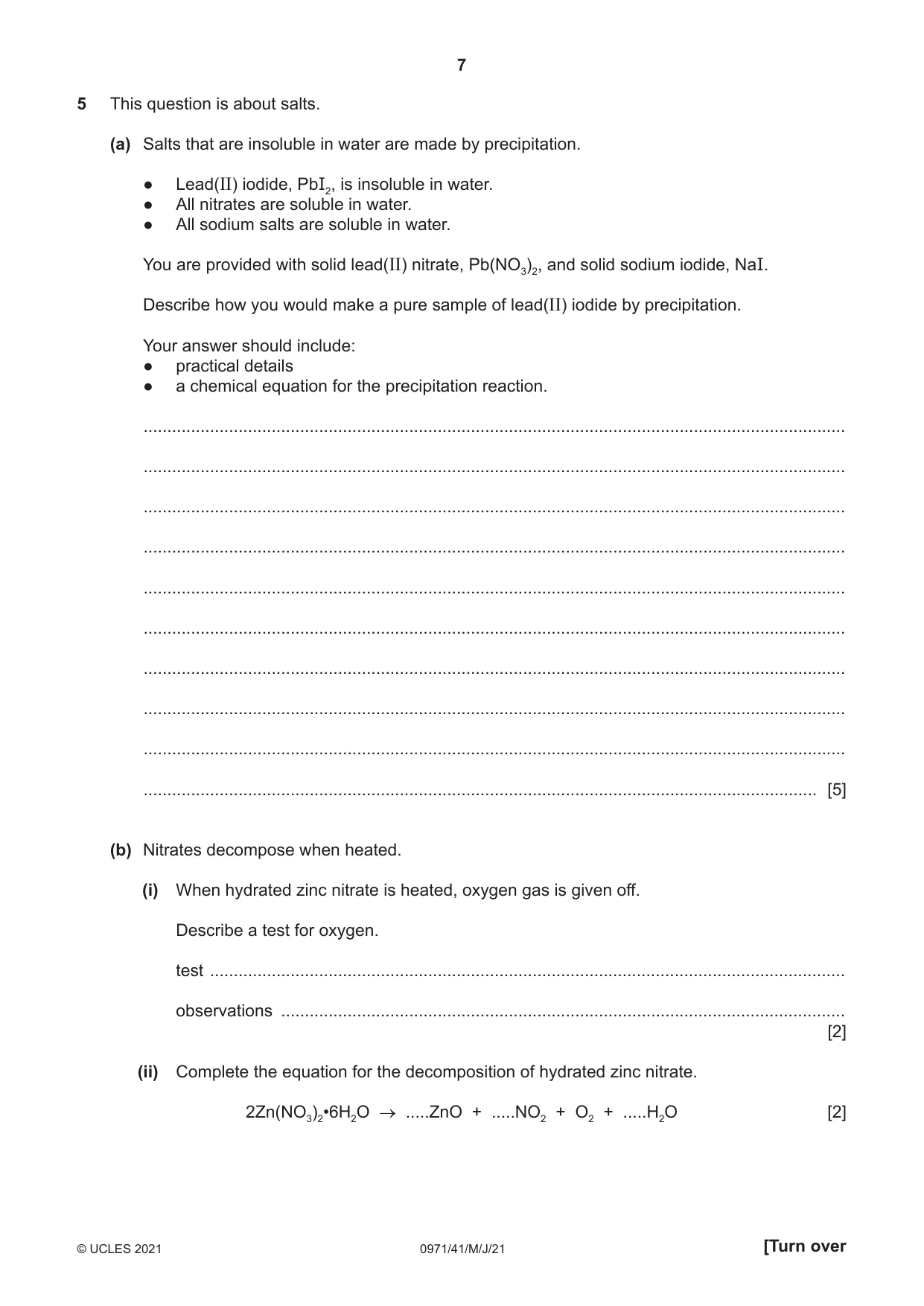
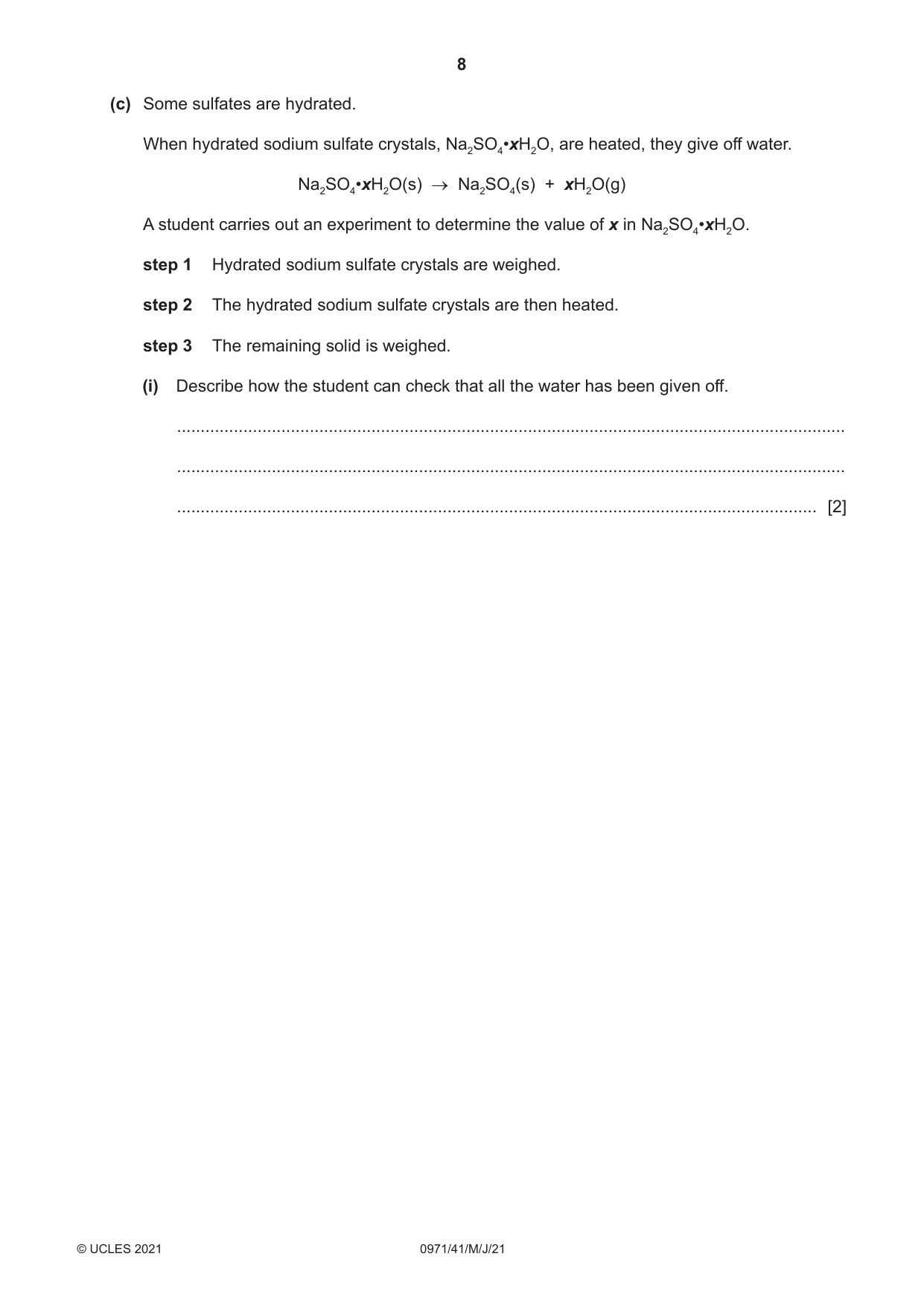
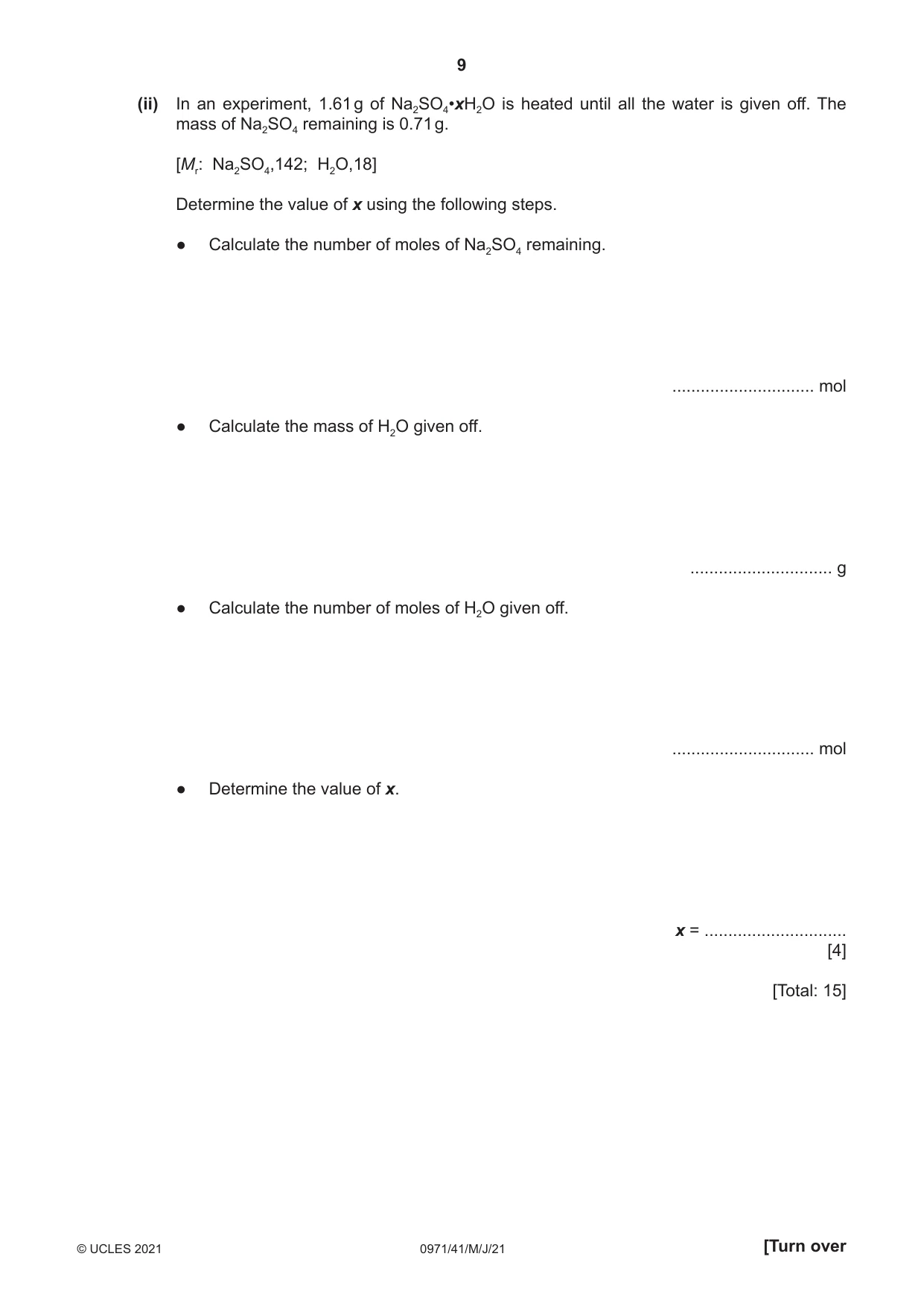
5 This question is about salts. (a) Salts that are insoluble in water are made by precipitation. ● Lead(II) iodide, PbI2, is insoluble in water. ● All nitrates are soluble in water. ● All sodium salts are soluble in water. You are provided with solid lead(II) nitrate, Pb(NO3)2, and solid sodium iodide, NaI. Describe how you would make a pure sample of lead(II) iodide by precipitation. Your answer should include: ● practical details ● a chemical equation for the precipitation reaction. .................................................................................................................................................... .................................................................................................................................................... .................................................................................................................................................... .................................................................................................................................................... .................................................................................................................................................... .................................................................................................................................................... .................................................................................................................................................... .................................................................................................................................................... .................................................................................................................................................... .............................................................................................................................................. [5] (b) Nitrates decompose when heated. (i) When hydrated zinc nitrate is heated, oxygen gas is given off. Describe a test for oxygen. test ...................................................................................................................................... observations ........................................................................................................................ [2] (ii) Complete the equation for the decomposition of hydrated zinc nitrate. 2Zn(NO3)2•6H2O → .....ZnO + .....NO2 + O2 + .....H2O [2] (c) Some sulfates are hydrated. When hydrated sodium sulfate crystals, Na2SO4•xH2O, are heated, they give off water. Na2SO4•xH2O(s) → Na2SO4(s) + xH2O(g) A student carries out an experiment to determine the value of x in Na2SO4•xH2O. step 1 Hydrated sodium sulfate crystals are weighed. step 2 The hydrated sodium sulfate crystals are then heated. step 3 The remaining solid is weighed. (i) Describe how the student can check that all the water has been given off. ............................................................................................................................................. ............................................................................................................................................. ....................................................................................................................................... [2] (ii) In an experiment, 1.61 g of Na2SO4•xH2O is heated until all the water is given off. The mass of Na2SO4 remaining is 0.71 g. [Mr: Na2SO4,142; H2O,18] Determine the value of x using the following steps. ● Calculate the number of moles of Na2SO4 remaining. .............................. mol ● Calculate the mass of H2O given off. .............................. g ● Calculate the number of moles of H2O given off. .............................. mol ● Determine the value of x. x = .............................. [4] [Total: 15]
Mark scheme: 5(a) (add) water (to both salts) (1) dissolve both salts / make solutions (1) filter (lead(II) iodide)(1) wash (residue of lead(II) iodide) with water AND dry e.g. with filter paper / description of washing and drying (1) Pb(NO3)2 + 2 NaI → 2NaNO3 + PbI2 OR Pb2+ + 2I– → PbI2 (1) 5(b)(i) glowing splint (1) relights / rekindles (1) 2 5(b)(ii) 2ZnO(s) and 4NO2(g) (1) 12H2O(g) (1) 2 5(c)(i) heat again and weigh again / repeat steps 2 and 3 (1) until mass is constant (1) 2 5(c)(ii) 0.005 (1) 0.9 (1) (0.9 ÷ 18 =) 0.05 (1) (0.05 ÷ 0.005 =) 10 (1) 4
Q6 · This question is about iron
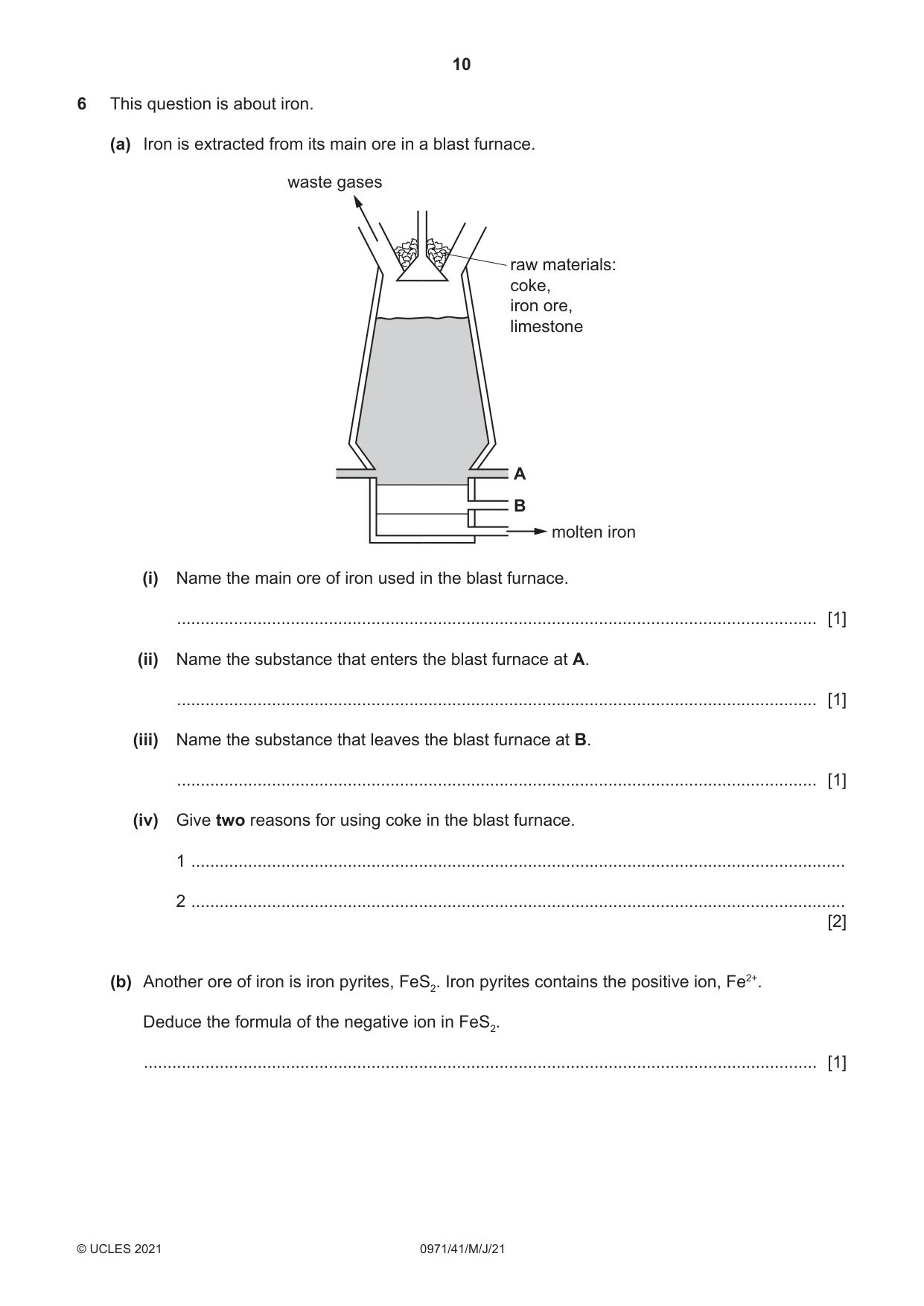
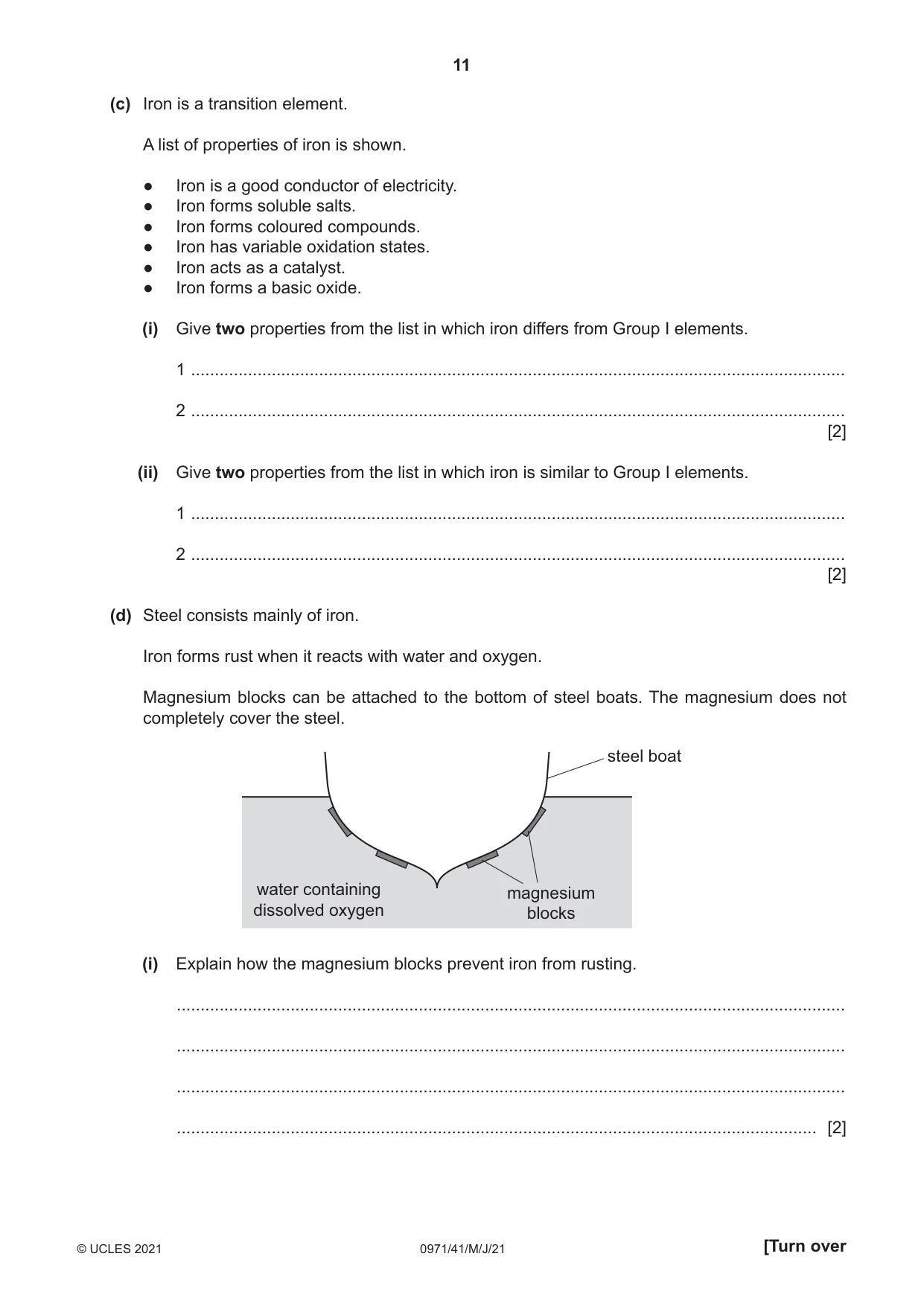
6 This question is about iron. (a) Iron is extracted from its main ore in a blast furnace. waste gases raw materials: coke, iron ore, limestone A B molten iron (i) Name the main ore of iron used in the blast furnace. ....................................................................................................................................... [1] (ii) Name the substance that enters the blast furnace at A. ....................................................................................................................................... [1] (iii) Name the substance that leaves the blast furnace at B. ....................................................................................................................................... [1] (iv) Give two reasons for using coke in the blast furnace. 1 .......................................................................................................................................... 2 .......................................................................................................................................... [2] (b) Another ore of iron is iron pyrites, FeS2. Iron pyrites contains the positive ion, Fe2+. Deduce the formula of the negative ion in FeS2. .............................................................................................................................................. [1] (c) Iron is a transition element. A list of properties of iron is shown. ● Iron is a good conductor of electricity. ● Iron forms soluble salts. ● Iron forms coloured compounds. ● Iron has variable oxidation states. ● Iron acts as a catalyst. ● Iron forms a basic oxide. (i) Give two properties from the list in which iron differs from Group I elements. 1 .......................................................................................................................................... 2 .......................................................................................................................................... [2] (ii) Give two properties from the list in which iron is similar to Group I elements. 1 .......................................................................................................................................... 2 .......................................................................................................................................... [2] (d) Steel consists mainly of iron. Iron forms rust when it reacts with water and oxygen. Magnesium blocks can be attached to the bottom of steel boats. The magnesium does not completely cover the steel. steel boat water containing magnesium dissolved oxygen blocks (i) Explain how the magnesium blocks prevent iron from rusting. ............................................................................................................................................. ............................................................................................................................................. ............................................................................................................................................. ....................................................................................................................................... [2] (ii) Explain why replacing the magnesium blocks with copper blocks will not prevent the bottom of the boat from rusting. ............................................................................................................................................. ....................................................................................................................................... [1] [Total: 13]
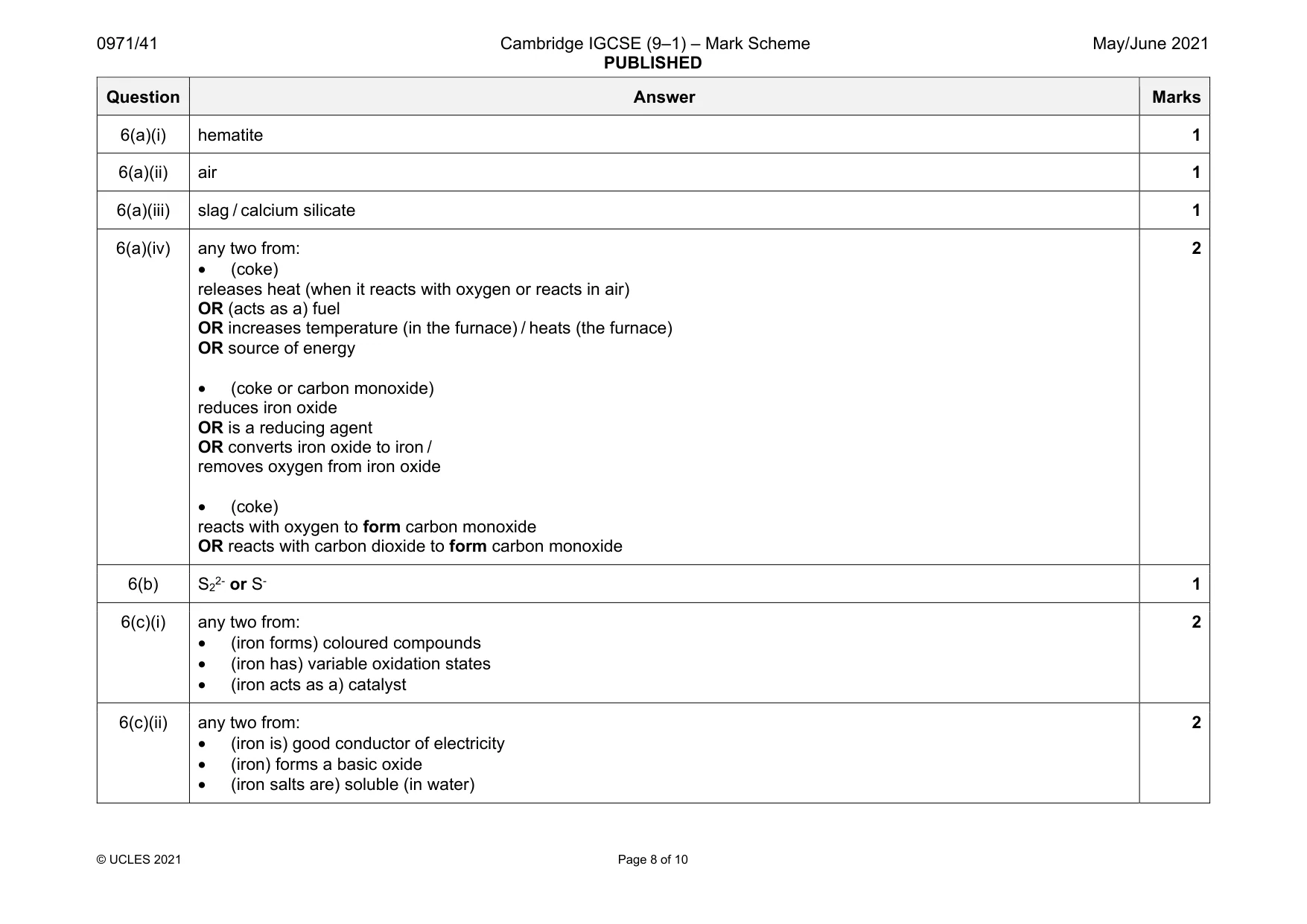
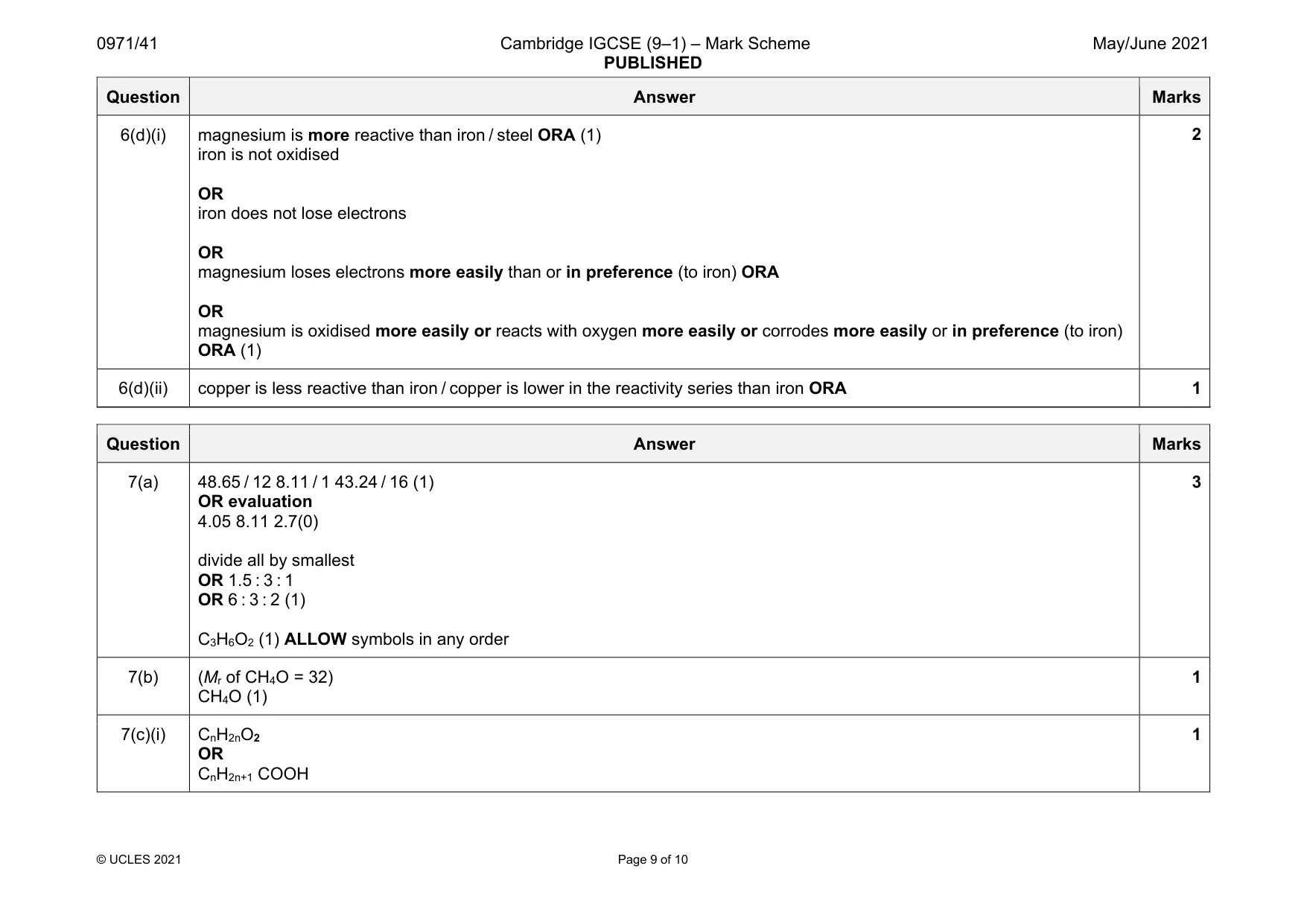
Mark scheme: 6(a)(i) hematite 1 6(a)(ii) air 1 6(a)(iii) slag / calcium silicate 1 6(a)(iv) any two from: • (coke) releases heat (when it reacts with oxygen or reacts in air) OR (acts as a) fuel OR increases temperature (in the furnace) / heats (the furnace) OR source of energy • (coke or carbon monoxide) reduces iron oxide OR is a reducing agent OR converts iron oxide to iron / removes oxygen from iron oxide • (coke) reacts with oxygen to form carbon monoxide OR reacts with carbon dioxide to form carbon monoxide 2 6(b) S22- or S- 1 6(c)(i) any two from: • (iron forms) coloured compounds • (iron has) variable oxidation states • (iron acts as a) catalyst 2 6(c)(ii) any two from: • (iron is) good conductor of electricity • (iron) forms a basic oxide • (iron salts are) soluble (in water) 2 Question Answer Marks 6(d)(i) magnesium is more reactive than iron / steel ORA (1) iron is not oxidised OR iron does not lose electrons OR magnesium loses electrons more easily than or in preference (to iron) ORA OR magnesium is oxidised more easily or reacts with oxygen more easily or corrodes more easily or in preference (to iron) ORA (1) 2 6(d)(ii) copper is less reactive than iron / copper is lower in the reactivity series than iron ORA 1
Q7 · Many organic compounds contain carbon, hydrogen and oxygen only
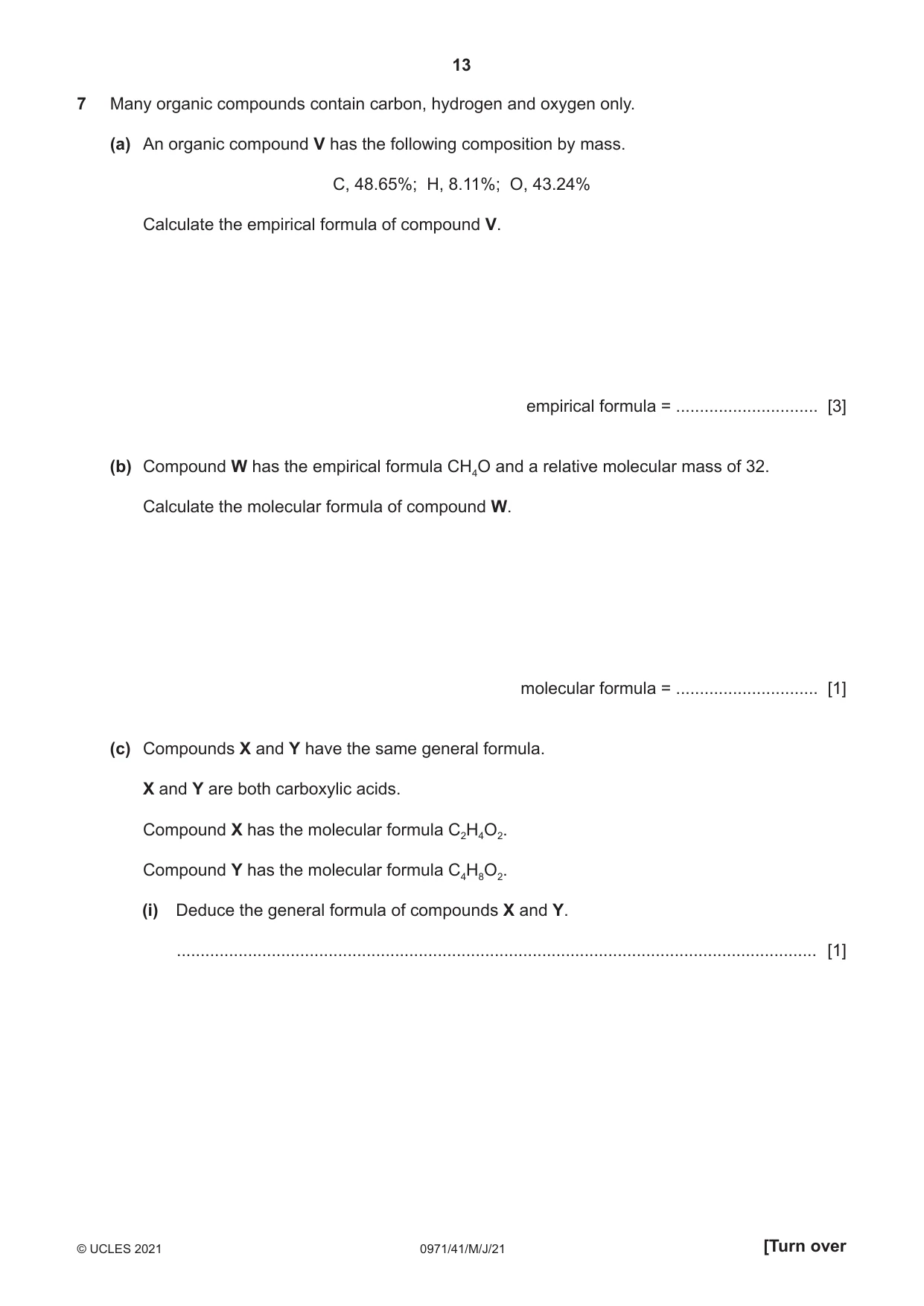
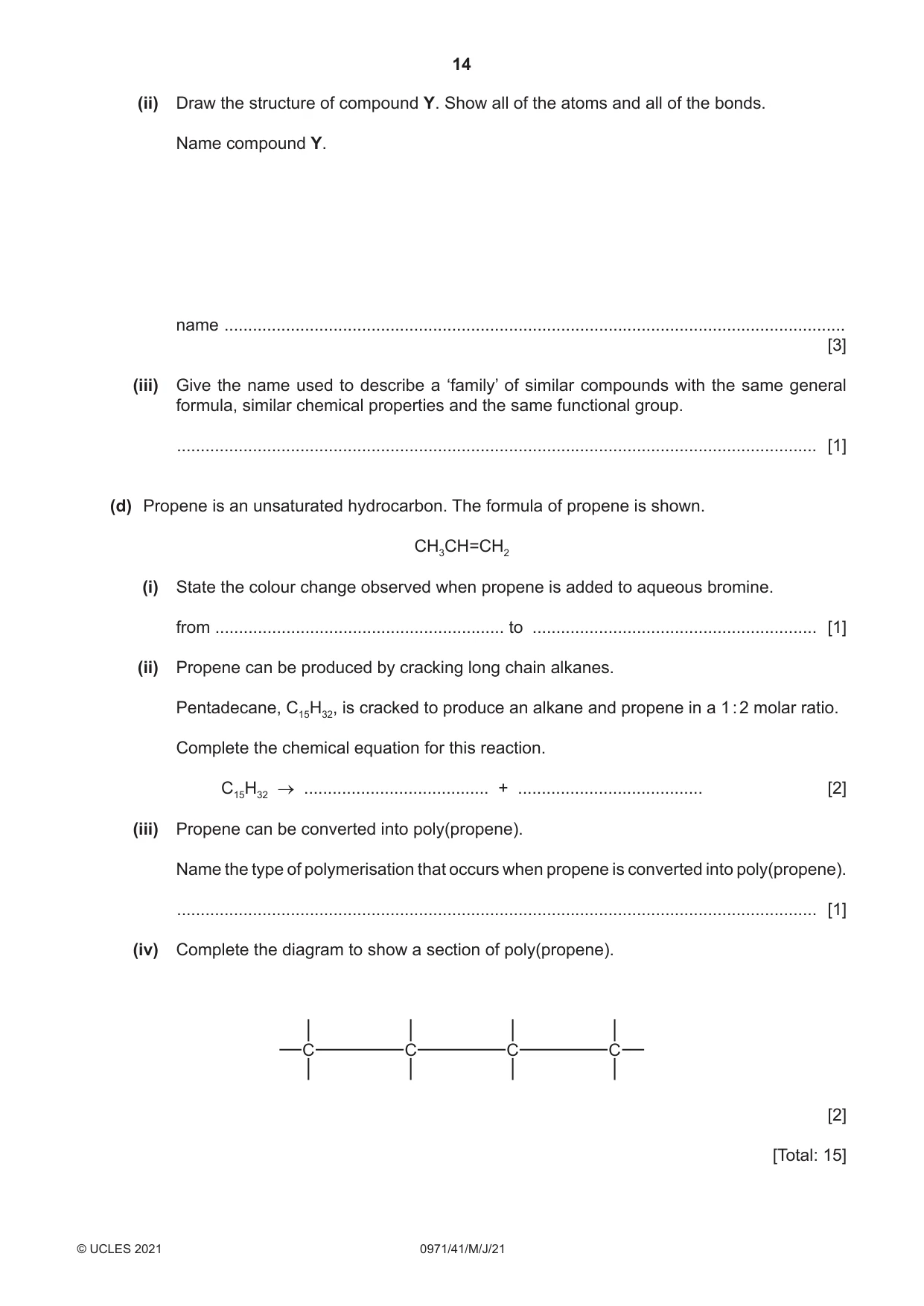
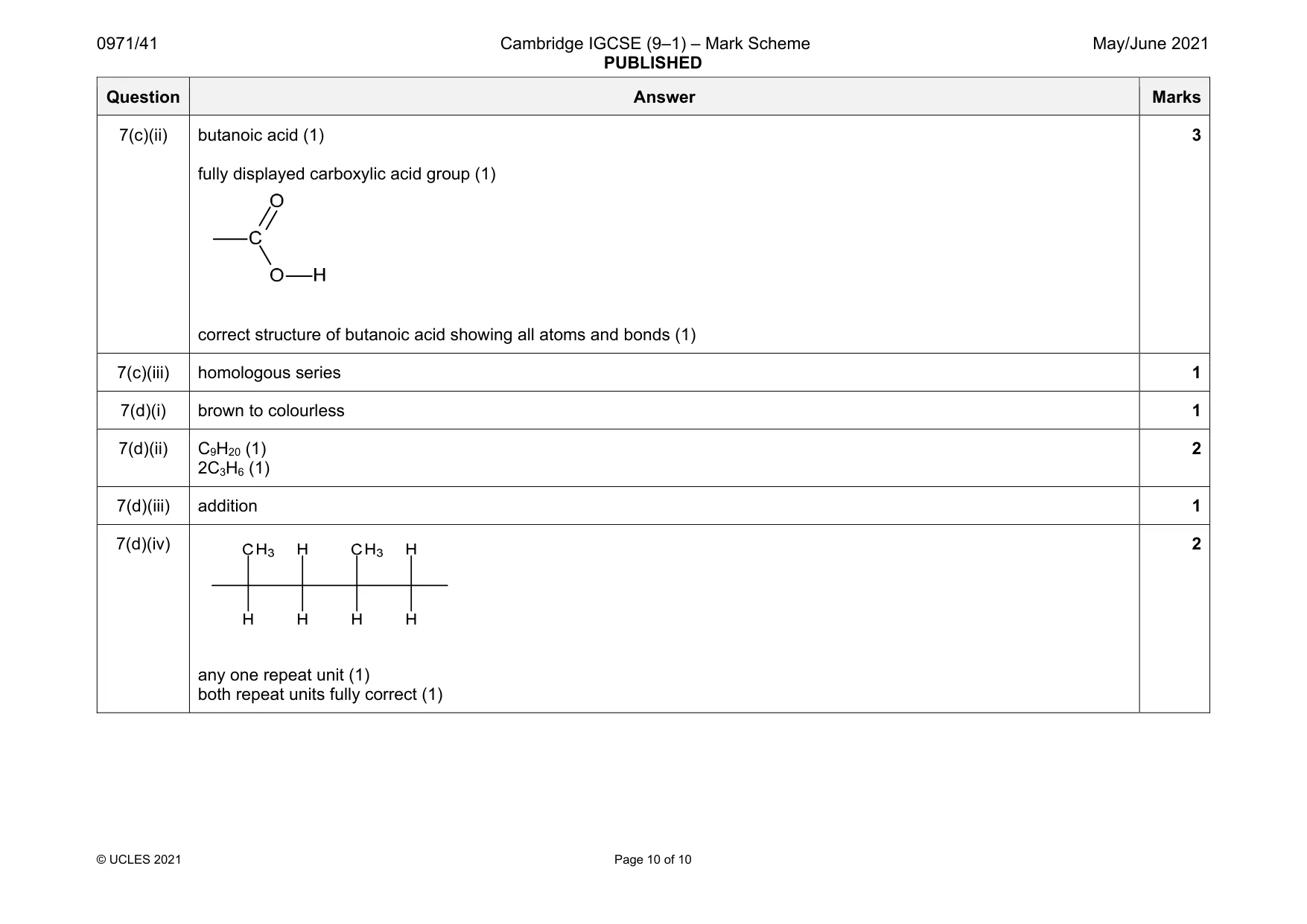
7 Many organic compounds contain carbon, hydrogen and oxygen only. (a) An organic compound V has the following composition by mass. C, 48.65%; H, 8.11%; O, 43.24% Calculate the empirical formula of compound V. empirical formula = .............................. [3] (b) Compound W has the empirical formula CH4O and a relative molecular mass of 32. Calculate the molecular formula of compound W. molecular formula = .............................. [1] (c) Compounds X and Y have the same general formula. X and Y are both carboxylic acids. Compound X has the molecular formula C2H4O2. Compound Y has the molecular formula C4H8O2. (i) Deduce the general formula of compounds X and Y. ....................................................................................................................................... [1] (ii) Draw the structure of compound Y. Show all of the atoms and all of the bonds. Name compound Y. name ................................................................................................................................... [3] (iii) Give the name used to describe a ‘family’ of similar compounds with the same general formula, similar chemical properties and the same functional group. ....................................................................................................................................... [1] (d) Propene is an unsaturated hydrocarbon. The formula of propene is shown. CH3CH=CH2 (i) State the colour change observed when propene is added to aqueous bromine. from ............................................................. to ............................................................. [1] (ii) Propene can be produced by cracking long chain alkanes. Pentadecane, C15H32, is cracked to produce an alkane and propene in a 1 : 2 molar ratio. Complete the chemical equation for this reaction. C15H32 → ....................................... + ....................................... [2] (iii) Propene can be converted into poly(propene). Name the type of polymerisation that occurs when propene is converted into poly(propene). ....................................................................................................................................... [1] (iv) Complete the diagram to show a section of poly(propene). C C C C [2] [Total: 15]
Mark scheme: 7(a) 48.65 / 12 8.11 / 1 43.24 / 16 (1) OR evaluation 4.05 8.11 2.7(0) divide all by smallest OR 1.5 : 3 : 1 OR 6 : 3 : 2 (1) C3H6O2 (1) ALLOW symbols in any order 7(b) (Mr of CH4O = 32) CH4O (1) 1 7(c)(i) CnH2nO2 OR CnH2n+1 COOH 1 Question Answer Marks 7(c)(ii) butanoic acid (1) fully displayed carboxylic acid group (1) correct structure of butanoic acid showing all atoms and bonds (1) 3 7(c)(iii) homologous series 1 7(d)(i) brown to colourless 1 7(d)(ii) C9H20 (1) 2C3H6 (1) 2 7(d)(iii) addition 1 7(d)(iv) any one repeat unit (1) both repeat units fully correct (1) 2
What was in this paper
The subtopics covered by these 7 questions, and how many questions each got. Open one in a new tab to see every Cambridge question on it.
What you needed in this session
Cambridge’s own grade thresholds for 2021 May/June, Paper 4 · Variant 1. A higher threshold means an easier paper — the bar moves with how the cohort did.