Cambridge IGCSE Chemistry (9-1) 0971 — 2020 May/June Paper 4 · Variant 2
0971/42/M/J/20 · 6 questions · 80 marks · ≈90 min
The question paper and its mark scheme, free to read here and free to download. This is Cambridge’s own paper, exactly as it was sat.
Question paper16 pages


Mark scheme9 pages
Answers below. Sit the paper first if you are practising.
Questions as text
Q1 · Give the name of the process that: (i) occurs when a gas turns into a liquid…
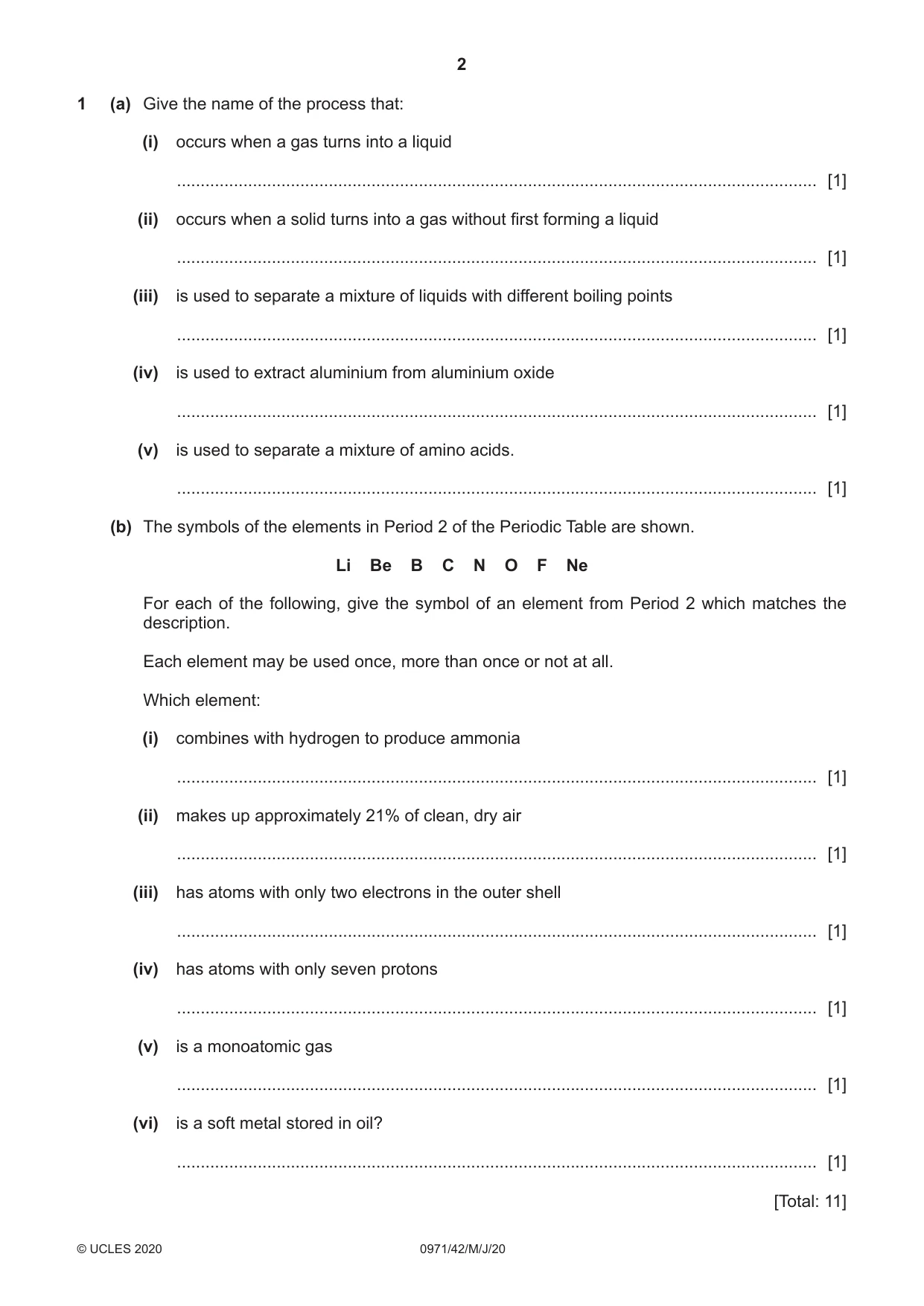
1 (a) Give the name of the process that: (i) occurs when a gas turns into a liquid ....................................................................................................................................... [1] (ii) occurs when a solid turns into a gas without first forming a liquid ....................................................................................................................................... [1] (iii) is used to separate a mixture of liquids with different boiling points ....................................................................................................................................... [1] (iv) is used to extract aluminium from aluminium oxide ....................................................................................................................................... [1] (v) is used to separate a mixture of amino acids. ....................................................................................................................................... [1] (b) The symbols of the elements in Period 2 of the Periodic Table are shown. Li Be B C N O F Ne For each of the following, give the symbol of an element from Period 2 which matches the description. Each element may be used once, more than once or not at all. Which element: (i) combines with hydrogen to produce ammonia ....................................................................................................................................... [1] (ii) makes up approximately 21% of clean, dry air ....................................................................................................................................... [1] (iii) has atoms with only two electrons in the outer shell ....................................................................................................................................... [1] (iv) has atoms with only seven protons ....................................................................................................................................... [1] (v) is a monoatomic gas ....................................................................................................................................... [1] (vi) is a soft metal stored in oil? ....................................................................................................................................... [1] [Total: 11]
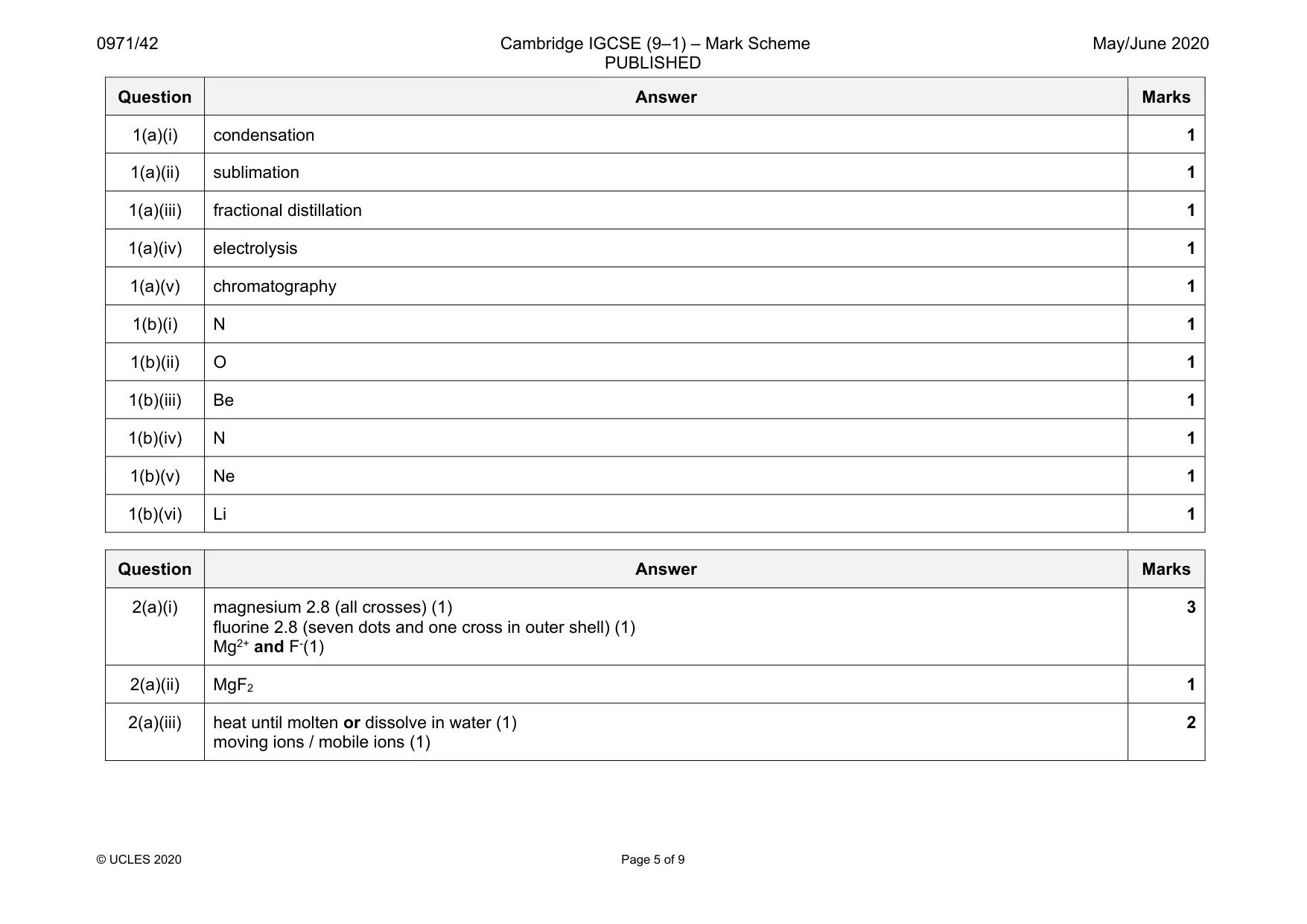
Mark scheme: 1(a)(i) condensation 1 1(a)(ii) sublimation 1 1(a)(iii) fractional distillation 1 1(a)(iv) electrolysis 1 1(a)(v) chromatography 1 1(b)(i) N 1 1(b)(ii) O 1 1(b)(iii) Be 1 1(b)(iv) N 1 1(b)(v) Ne 1 1(b)(vi) Li 1
Q2 · Fluorine forms both ionic and covalent compounds
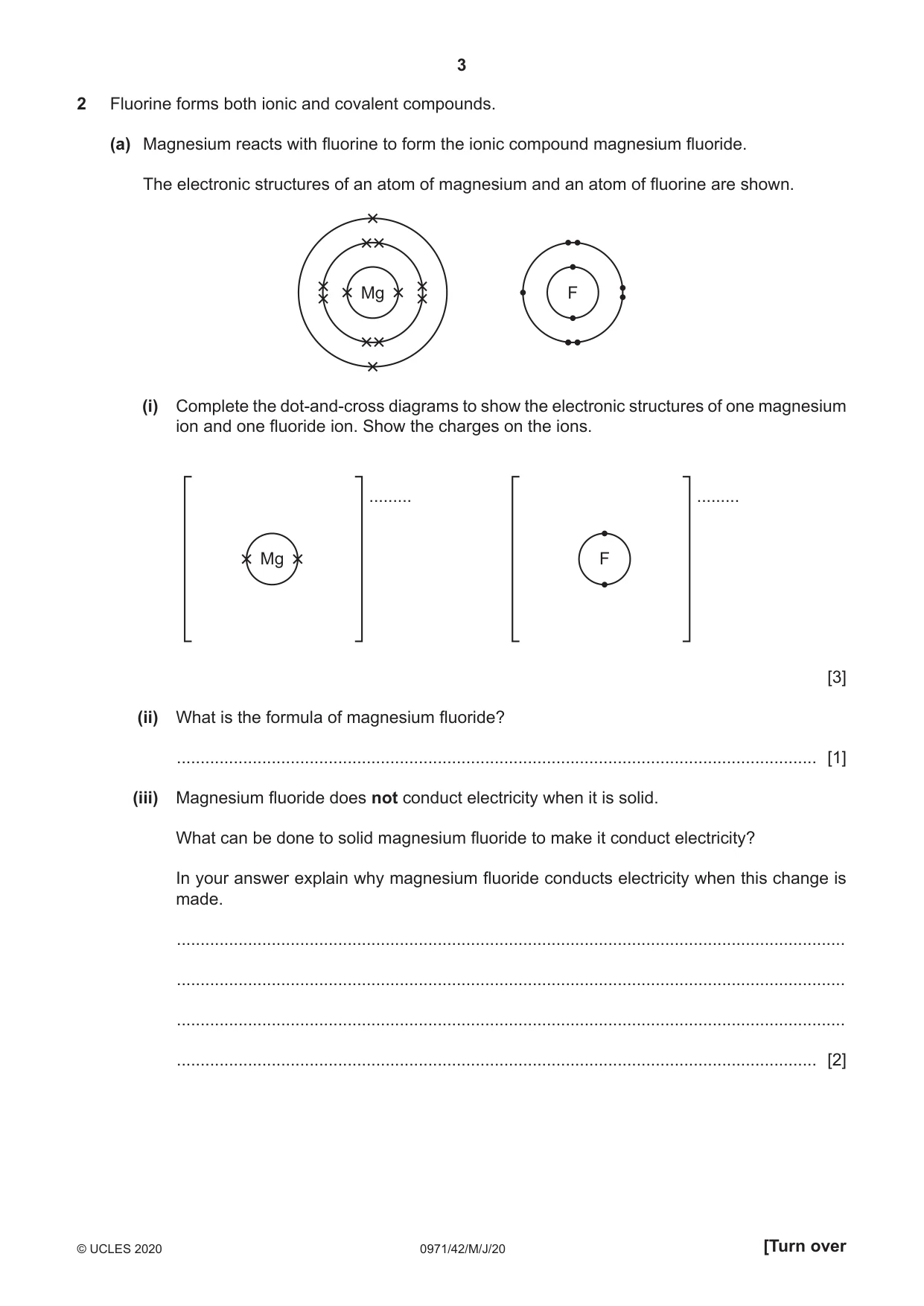
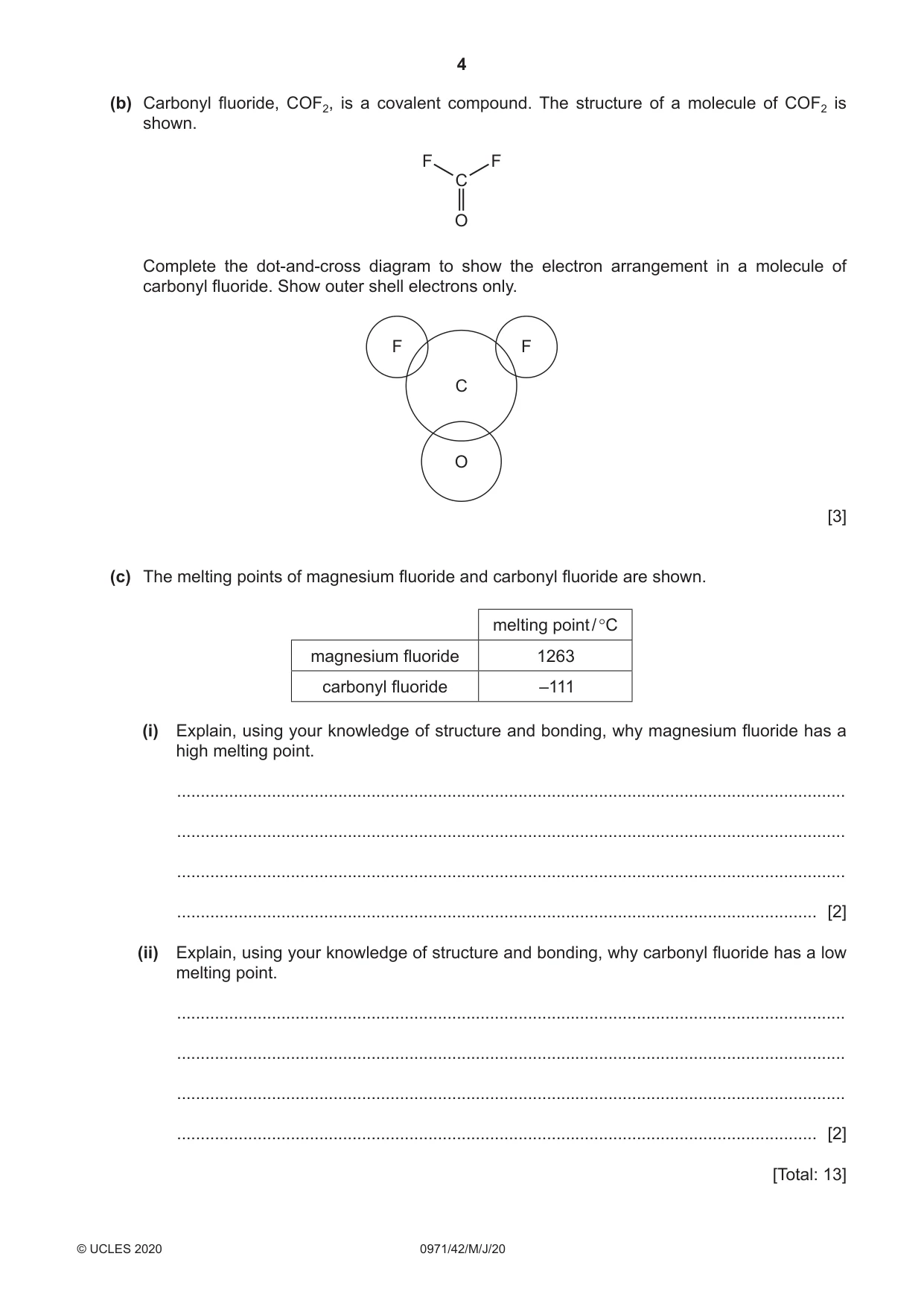
2 Fluorine forms both ionic and covalent compounds. (a) Magnesium reacts with fluorine to form the ionic compound magnesium fluoride. The electronic structures of an atom of magnesium and an atom of fluorine are shown. Mg F (i) Complete the dot-and-cross diagrams to show the electronic structures of one magnesium ion and one fluoride ion. Show the charges on the ions. ......... ......... Mg F [3] (ii) What is the formula of magnesium fluoride? ....................................................................................................................................... [1] (iii) Magnesium fluoride does not conduct electricity when it is solid. What can be done to solid magnesium fluoride to make it conduct electricity? In your answer explain why magnesium fluoride conducts electricity when this change is made. ............................................................................................................................................. ............................................................................................................................................. ............................................................................................................................................. ....................................................................................................................................... [2] (b) Carbonyl fluoride, COF2, is a covalent compound. The structure of a molecule of COF2 is shown. F F C O Complete the dot-and-cross diagram to show the electron arrangement in a molecule of carbonyl fluoride. Show outer shell electrons only. F F C O [3] (c) The melting points of magnesium fluoride and carbonyl fluoride are shown. melting point / °C magnesium fluoride 1263 carbonyl fluoride –111 (i) Explain, using your knowledge of structure and bonding, why magnesium fluoride has a high melting point. ............................................................................................................................................. ............................................................................................................................................. ............................................................................................................................................. ....................................................................................................................................... [2] (ii) Explain, using your knowledge of structure and bonding, why carbonyl fluoride has a low melting point. ............................................................................................................................................. ............................................................................................................................................. ............................................................................................................................................. ....................................................................................................................................... [2] [Total: 13]
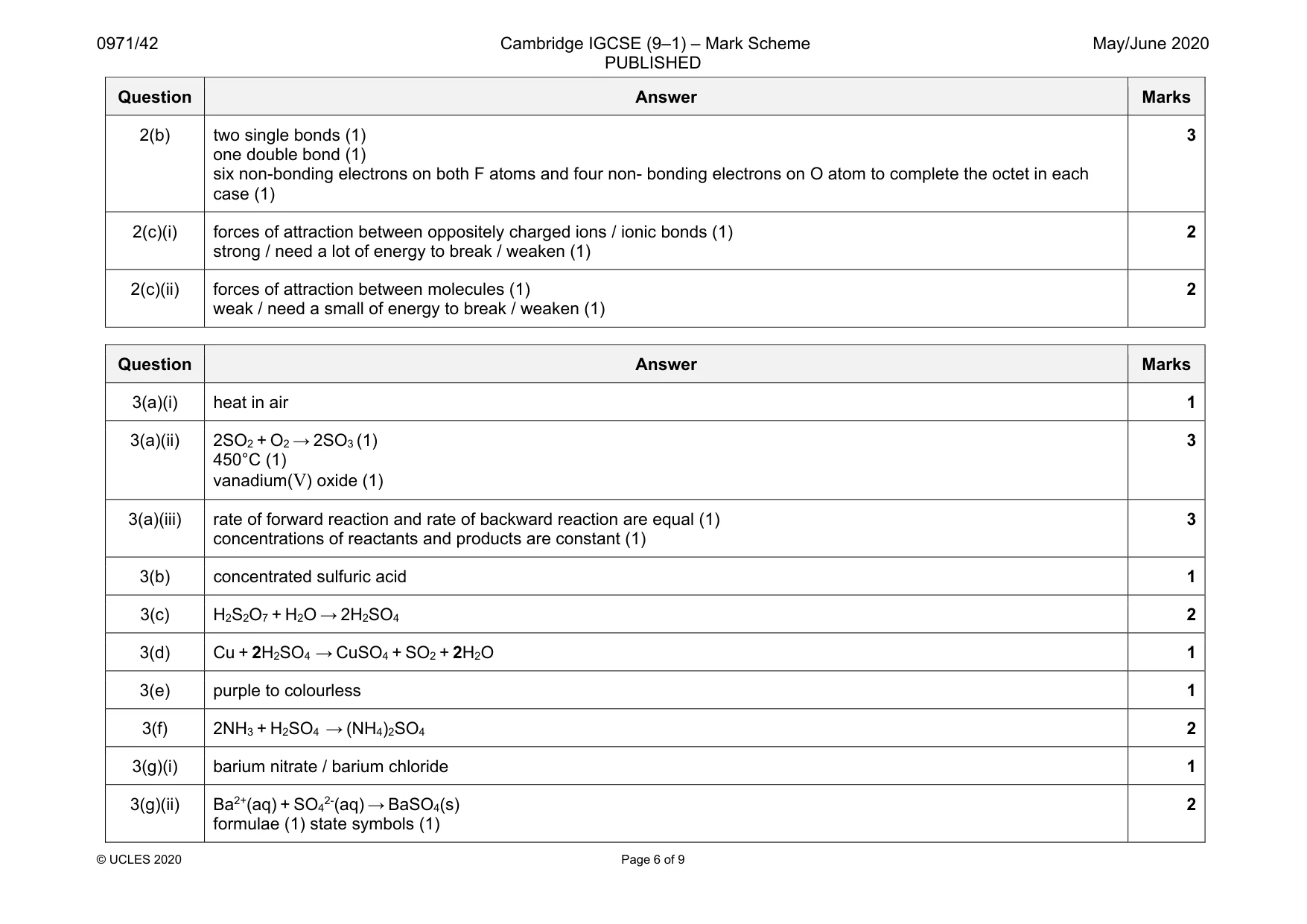
Mark scheme: 2(a)(i) magnesium 2.8 (all crosses) (1) fluorine 2.8 (seven dots and one cross in outer shell) (1) Mg2+ and F-(1) 3 2(a)(ii) MgF2 1 2(a)(iii) heat until molten or dissolve in water (1) moving ions / mobile ions (1) 2 Question Answer Marks 2(b) two single bonds (1) one double bond (1) six non-bonding electrons on both F atoms and four non- bonding electrons on O atom to complete the octet in each case (1) 3 2(c)(i) forces of attraction between oppositely charged ions / ionic bonds (1) strong / need a lot of energy to break / weaken (1) 2 2(c)(ii) forces of attraction between molecules (1) weak / need a small of energy to break / weaken (1) 2
Q3 · Sulfuric acid is made from sulfur in a four-stage process
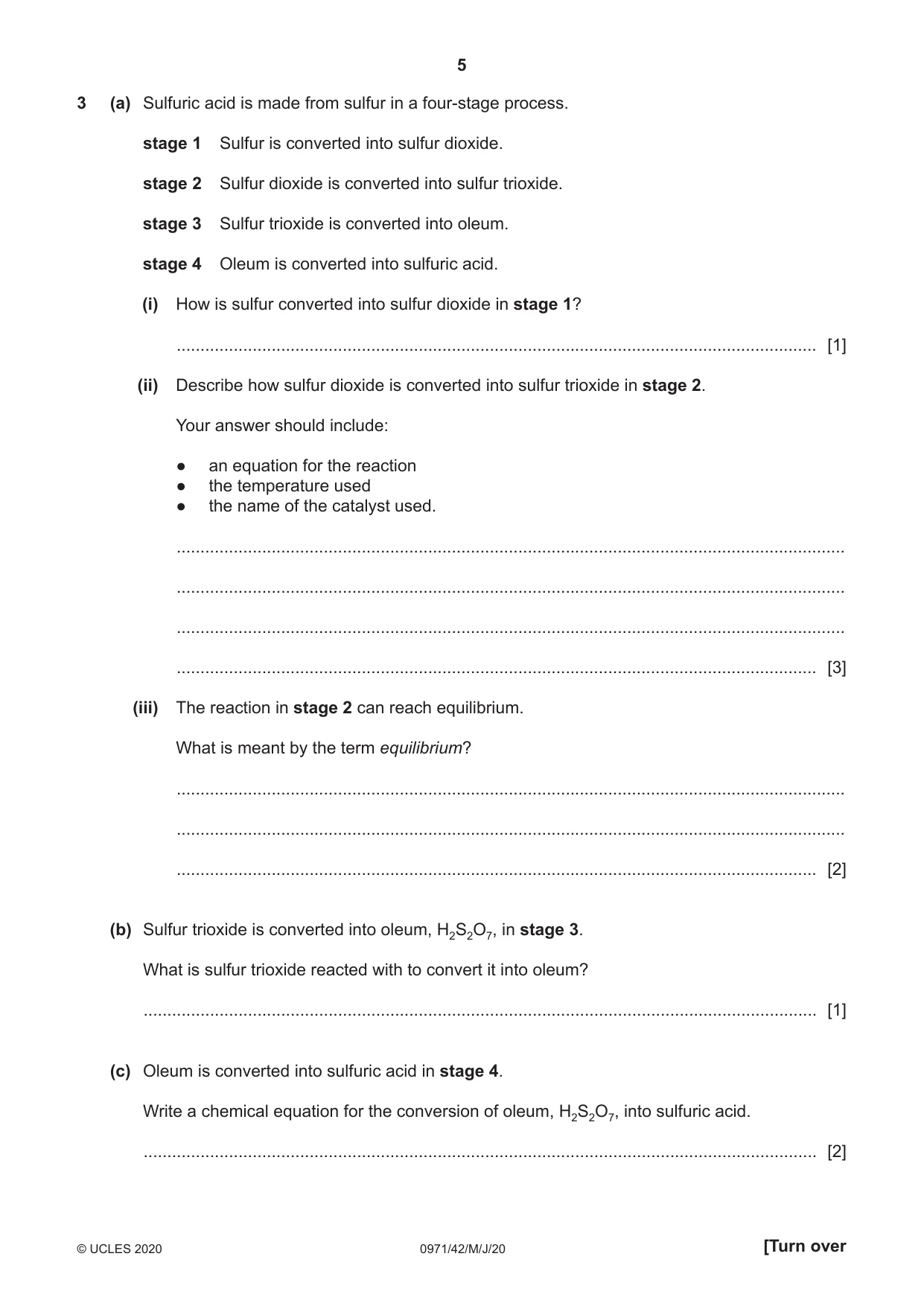
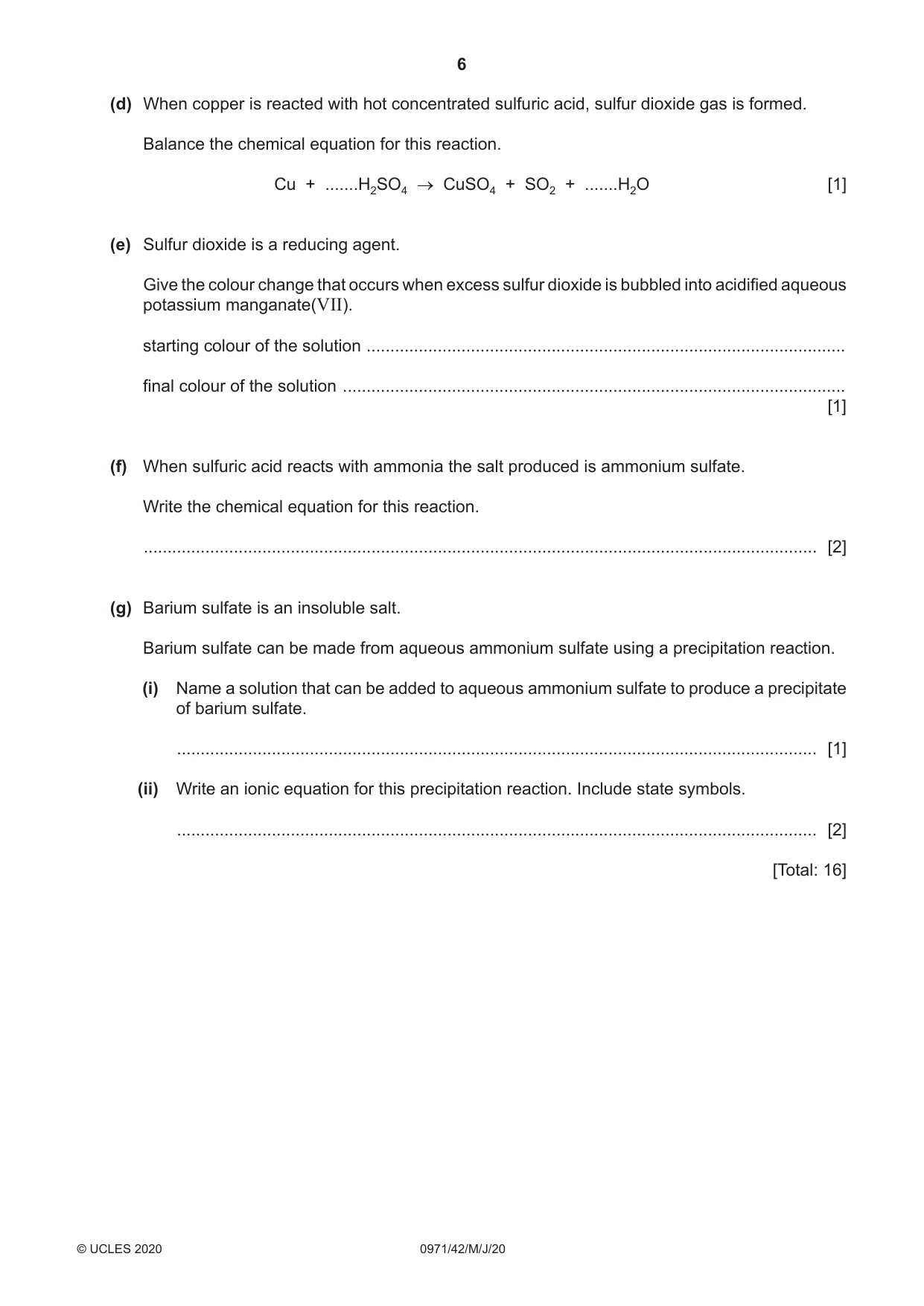
3 (a) Sulfuric acid is made from sulfur in a four-stage process. stage 1 Sulfur is converted into sulfur dioxide. stage 2 Sulfur dioxide is converted into sulfur trioxide. stage 3 Sulfur trioxide is converted into oleum. stage 4 Oleum is converted into sulfuric acid. (i) How is sulfur converted into sulfur dioxide in stage 1? ....................................................................................................................................... [1] (ii) Describe how sulfur dioxide is converted into sulfur trioxide in stage 2. Your answer should include: ●● an equation for the reaction ●● the temperature used ●● the name of the catalyst used. ............................................................................................................................................. ............................................................................................................................................. ............................................................................................................................................. ....................................................................................................................................... [3] (iii) The reaction in stage 2 can reach equilibrium. What is meant by the term equilibrium? ............................................................................................................................................. ............................................................................................................................................. ....................................................................................................................................... [2] (b) Sulfur trioxide is converted into oleum, H2S2O7, in stage 3. What is sulfur trioxide reacted with to convert it into oleum? .............................................................................................................................................. [1] (c) Oleum is converted into sulfuric acid in stage 4. Write a chemical equation for the conversion of oleum, H2S2O7, into sulfuric acid. .............................................................................................................................................. [2] (d) When copper is reacted with hot concentrated sulfuric acid, sulfur dioxide gas is formed. Balance the chemical equation for this reaction. Cu + .......H2SO4 → CuSO4 + SO2 + .......H2O [1] (e) Sulfur dioxide is a reducing agent. Give the colour change that occurs when excess sulfur dioxide is bubbled into acidified aqueous potassium manganate(VII). starting colour of the solution ..................................................................................................... final colour of the solution .......................................................................................................... [1] (f) When sulfuric acid reacts with ammonia the salt produced is ammonium sulfate. Write the chemical equation for this reaction. .............................................................................................................................................. [2] (g) Barium sulfate is an insoluble salt. Barium sulfate can be made from aqueous ammonium sulfate using a precipitation reaction. (i) Name a solution that can be added to aqueous ammonium sulfate to produce a precipitate of barium sulfate. ....................................................................................................................................... [1] (ii) Write an ionic equation for this precipitation reaction. Include state symbols. ....................................................................................................................................... [2] [Total: 16]
Mark scheme: 3(a)(i) heat in air 1 3(a)(ii) 2SO2 + O2 → 2SO3 (1) 450°C (1) vanadium(V) oxide (1) 3 3(a)(iii) rate of forward reaction and rate of backward reaction are equal (1) concentrations of reactants and products are constant (1) 3 3(b) concentrated sulfuric acid 1 3(c) H2S2O7 + H2O →2H2SO4 2 3(d) Cu + 2H2SO4 →CuSO4 + SO2 + 2H2O 1 3(e) purple to colourless 1 3(f) 2NH3 + H2SO4 →(NH4)2SO4 2 3(g)(i) barium nitrate / barium chloride 1 3(g)(ii) Ba2+(aq) + SO42-(aq) → BaSO4(s) formulae (1) state symbols (1) 2
Q4 · Oxygen is produced by the decomposition of hydrogen peroxide
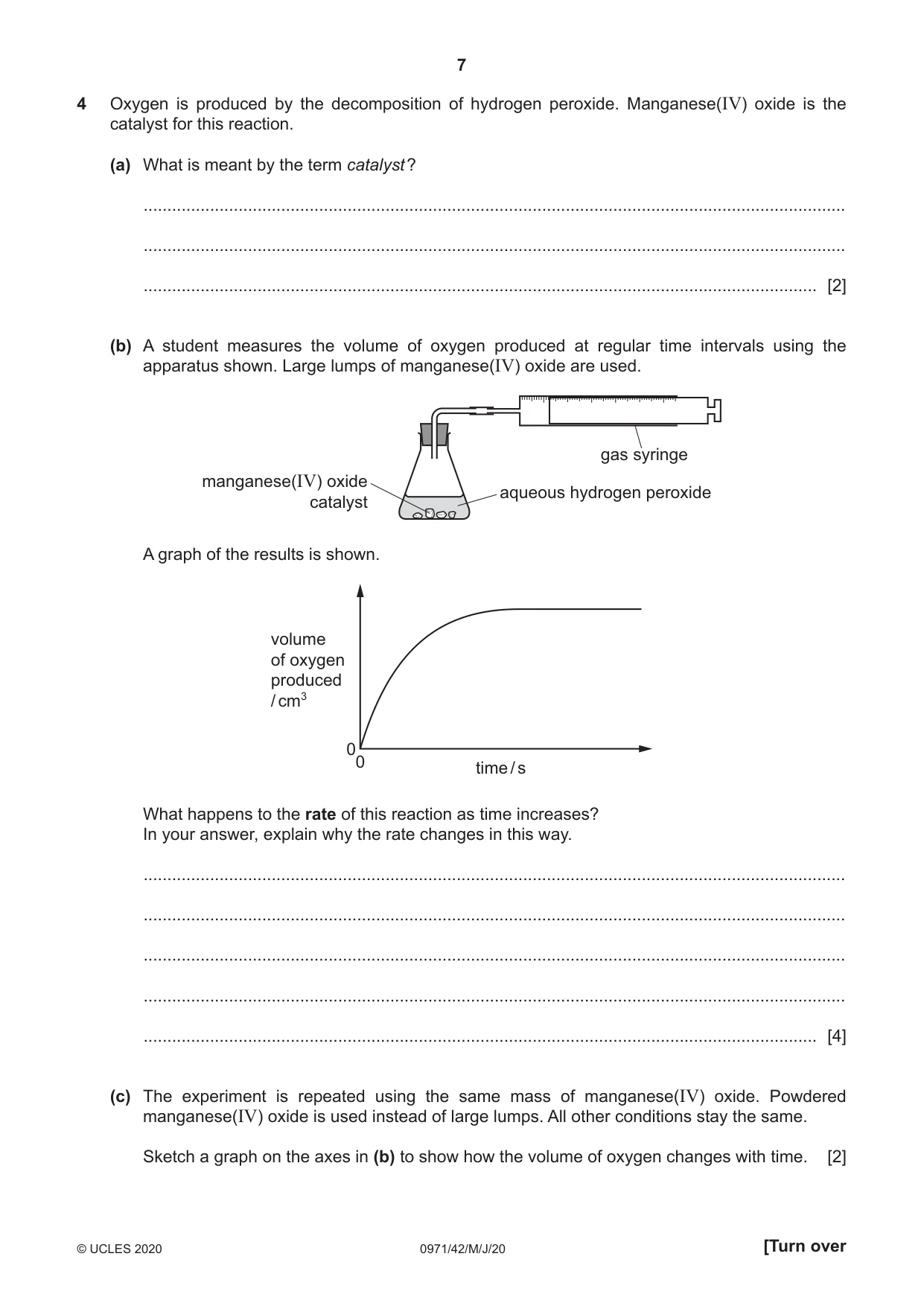
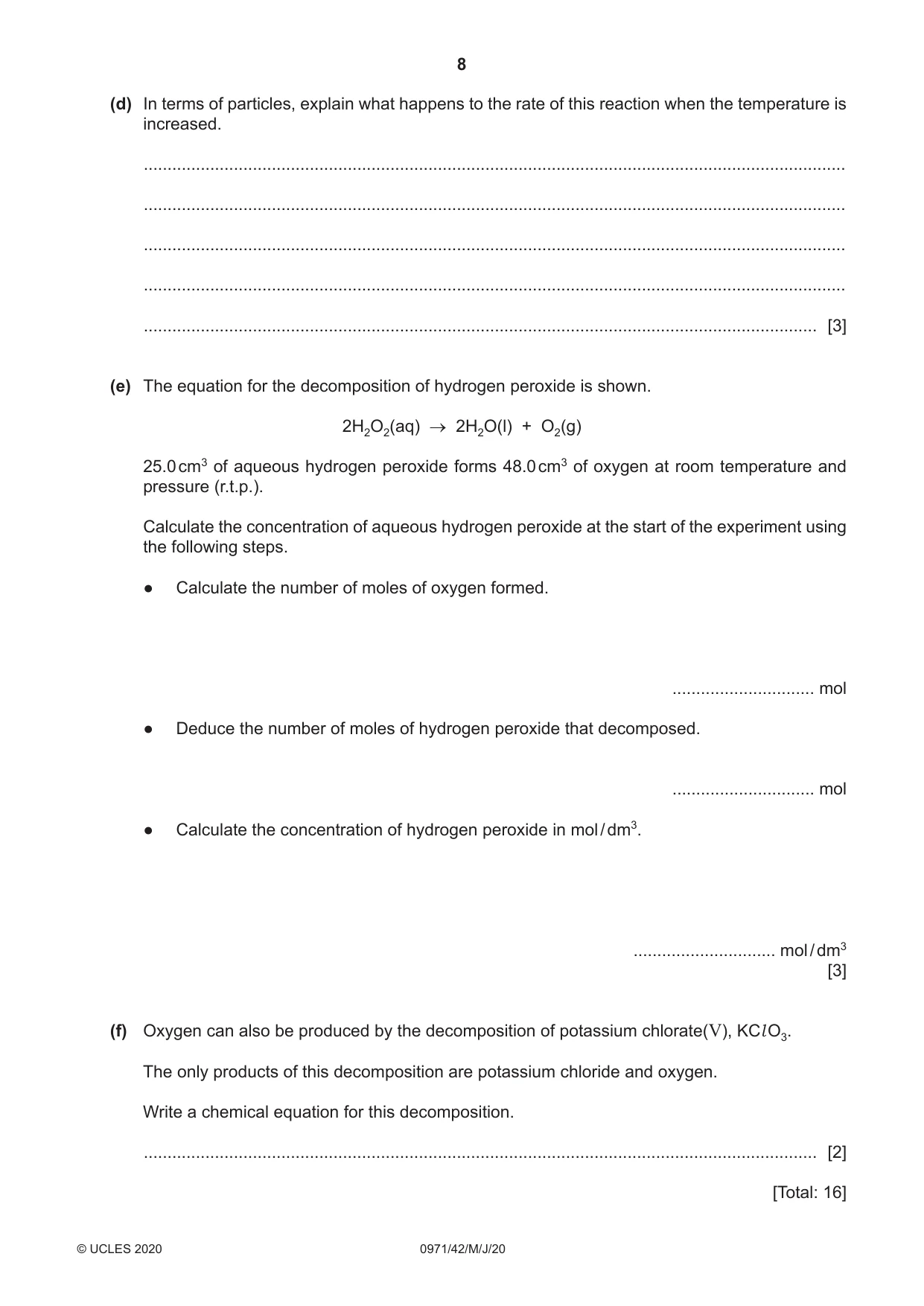
4 Oxygen is produced by the decomposition of hydrogen peroxide. Manganese(IV) oxide is the catalyst for this reaction. (a) What is meant by the term catalyst ? .................................................................................................................................................... .................................................................................................................................................... .............................................................................................................................................. [2] (b) A student measures the volume of oxygen produced at regular time intervals using the apparatus shown. Large lumps of manganese(IV) oxide are used. gas syringe manganese(IV) oxide aqueous hydrogen peroxide catalyst A graph of the results is shown. volume of oxygen produced / cm3 0 0 time / s What happens to the rate of this reaction as time increases? In your answer, explain why the rate changes in this way. .................................................................................................................................................... .................................................................................................................................................... .................................................................................................................................................... .................................................................................................................................................... .............................................................................................................................................. [4] (c) The experiment is repeated using the same mass of manganese(IV) oxide. Powdered manganese(IV) oxide is used instead of large lumps. All other conditions stay the same. Sketch a graph on the axes in (b) to show how the volume of oxygen changes with time. [2] (d) In terms of particles, explain what happens to the rate of this reaction when the temperature is increased. .................................................................................................................................................... .................................................................................................................................................... .................................................................................................................................................... .................................................................................................................................................... .............................................................................................................................................. [3] (e) The equation for the decomposition of hydrogen peroxide is shown. 2H2O2(aq) → 2H2O(l) + O2(g) 25.0 cm3 of aqueous hydrogen peroxide forms 48.0 cm3 of oxygen at room temperature and pressure (r.t.p.). Calculate the concentration of aqueous hydrogen peroxide at the start of the experiment using the following steps. ●● Calculate the number of moles of oxygen formed. .............................. mol ●● Deduce the number of moles of hydrogen peroxide that decomposed. .............................. mol ●● Calculate the concentration of hydrogen peroxide in mol / dm3. .............................. mol / dm3 [3] (f) Oxygen can also be produced by the decomposition of potassium chlorate(V), KCl O3. The only products of this decomposition are potassium chloride and oxygen. Write a chemical equation for this decomposition. .............................................................................................................................................. [2] [Total: 16]
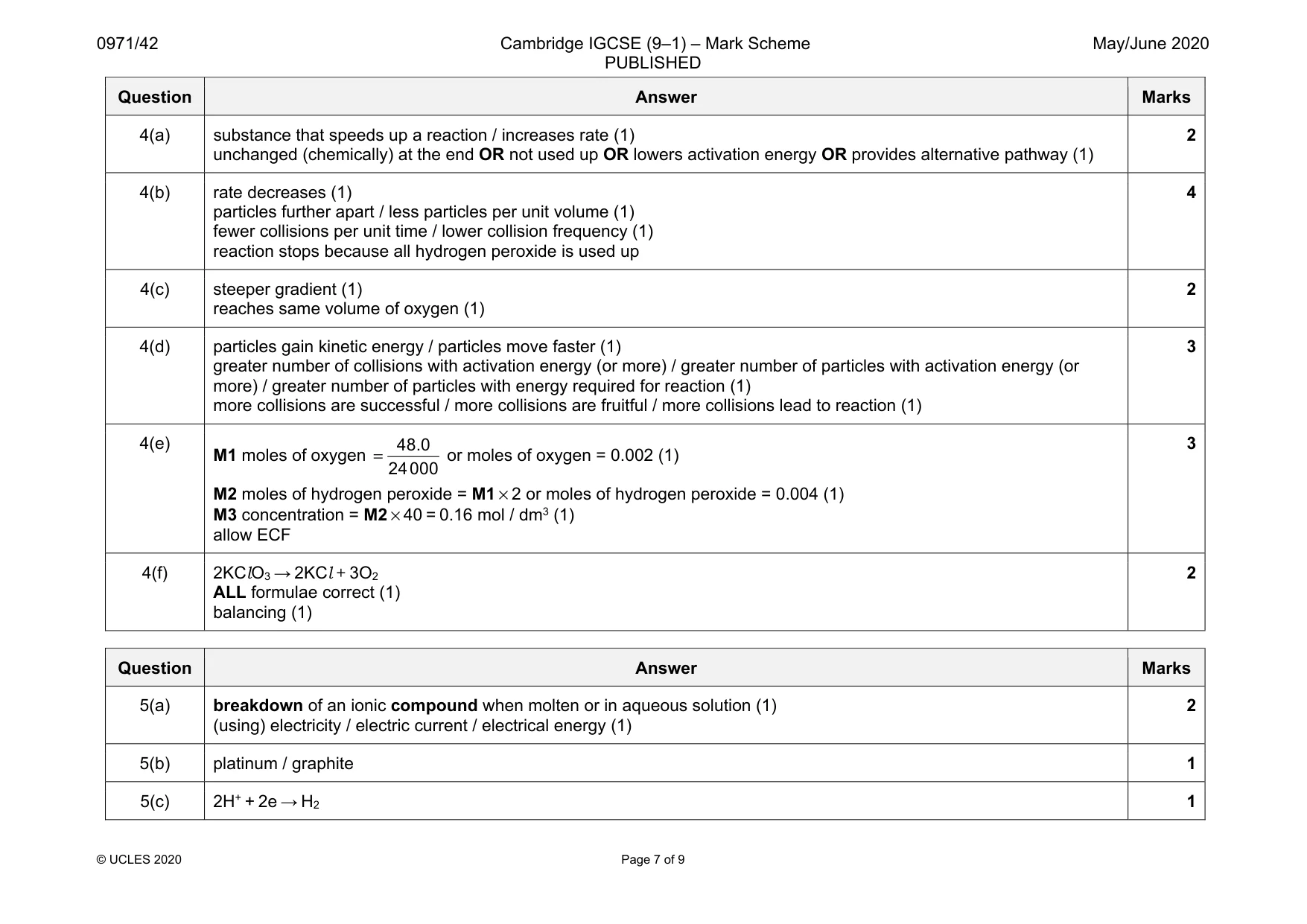
Mark scheme: 4(a) substance that speeds up a reaction / increases rate (1) unchanged (chemically) at the end OR not used up OR lowers activation energy OR provides alternative pathway (1) 2 4(b) rate decreases (1) particles further apart / less particles per unit volume (1) fewer collisions per unit time / lower collision frequency (1) reaction stops because all hydrogen peroxide is used up 4 4(c) steeper gradient (1) reaches same volume of oxygen (1) 2 4(d) particles gain kinetic energy / particles move faster (1) greater number of collisions with activation energy (or more) / greater number of particles with activation energy (or more) / greater number of particles with energy required for reaction (1) more collisions are successful / more collisions are fruitful / more collisions lead to reaction (1) 3 4(e) M1 moles of oxygen 48.0 24000 = or moles of oxygen = 0.002 (1) M2 moles of hydrogen peroxide = M1 × 2 or moles of hydrogen peroxide = 0.004 (1) M3 concentration = M2 × 40 = 0.16 mol / dm3 (1) allow ECF 3 4(f) 2KClO3 → 2KCl + 3O2 ALL formulae correct (1) balancing (1) 2
Q5 · Electrolysis of concentrated aqueous sodium chloride using inert electrodes forms…
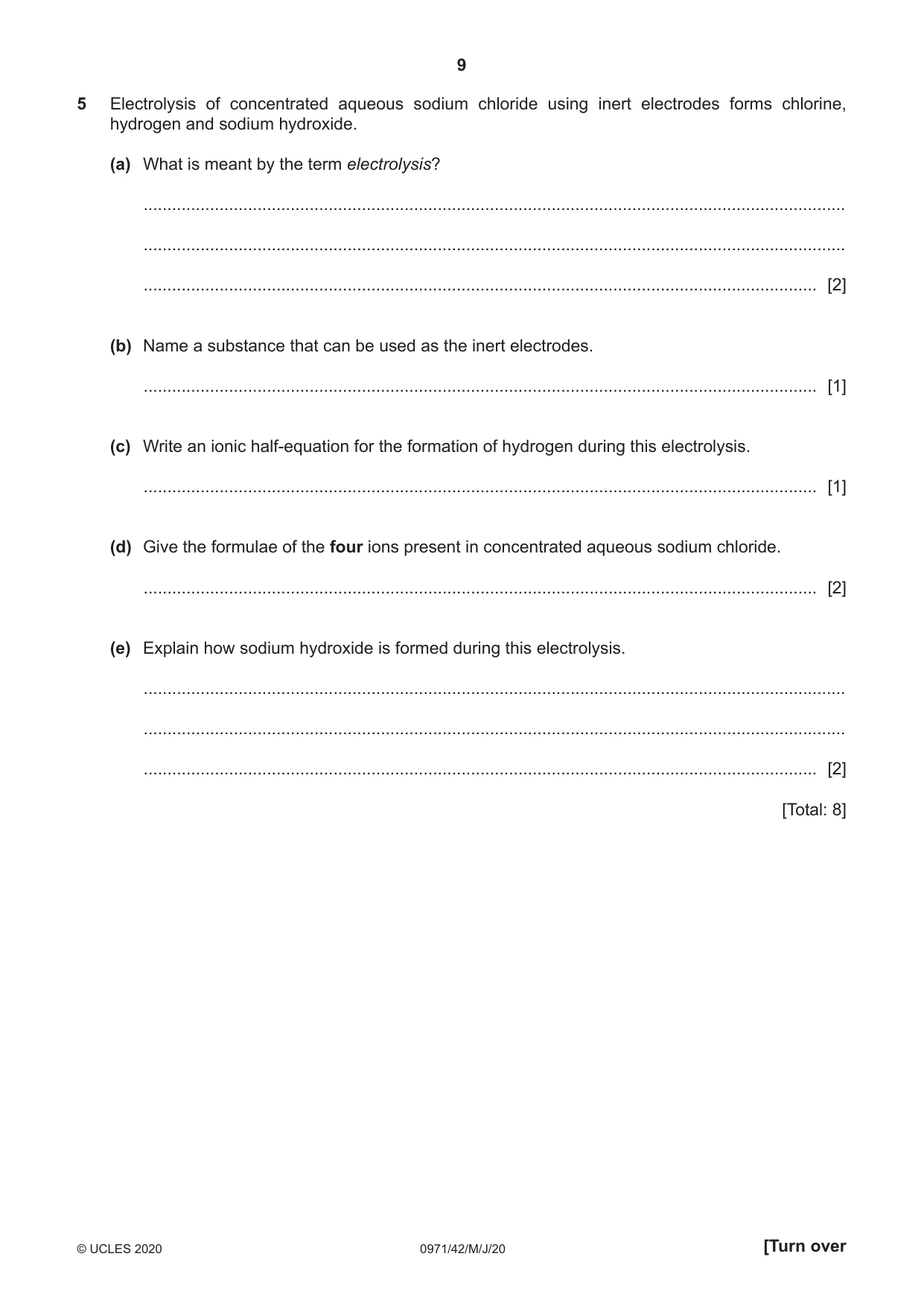
5 Electrolysis of concentrated aqueous sodium chloride using inert electrodes forms chlorine, hydrogen and sodium hydroxide. (a) What is meant by the term electrolysis? .................................................................................................................................................... .................................................................................................................................................... .............................................................................................................................................. [2] (b) Name a substance that can be used as the inert electrodes. .............................................................................................................................................. [1] (c) Write an ionic half-equation for the formation of hydrogen during this electrolysis. .............................................................................................................................................. [1] (d) Give the formulae of the four ions present in concentrated aqueous sodium chloride. .............................................................................................................................................. [2] (e) Explain how sodium hydroxide is formed during this electrolysis. .................................................................................................................................................... .................................................................................................................................................... .............................................................................................................................................. [2] [Total: 8]
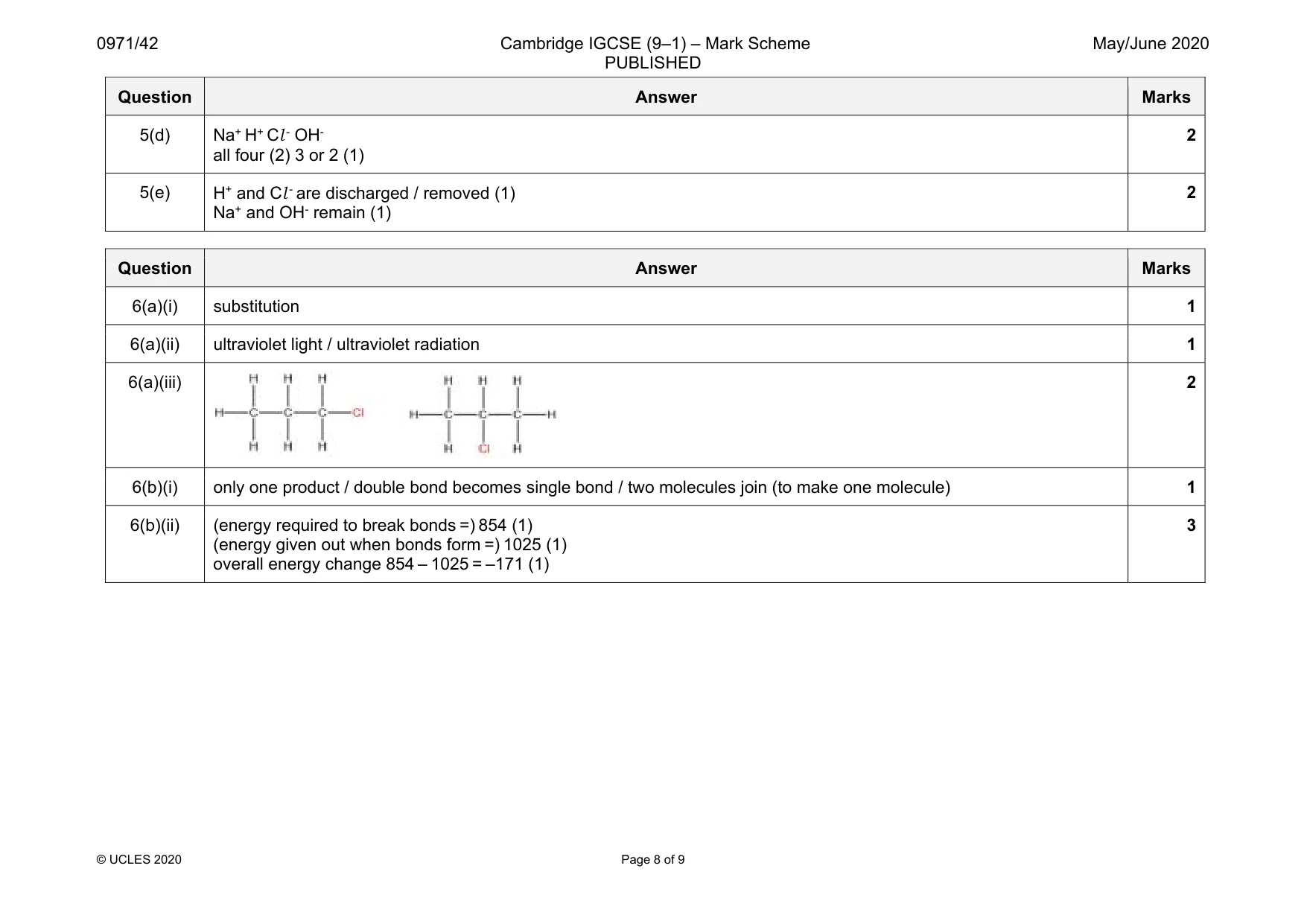
Mark scheme: 5(a) breakdown of an ionic compound when molten or in aqueous solution (1) (using) electricity / electric current / electrical energy (1) 2 5(b) platinum / graphite 1 5(c) 2H+ + 2e →H2 1 Question Answer Marks 5(d) Na+ H+ Cl - OH- all four (2) 3 or 2 (1) 2 5(e) H+ and Cl - are discharged / removed (1) Na+ and OH- remain (1) 2
Q6 · Propane reacts with chlorine in a photochemical reaction as shown
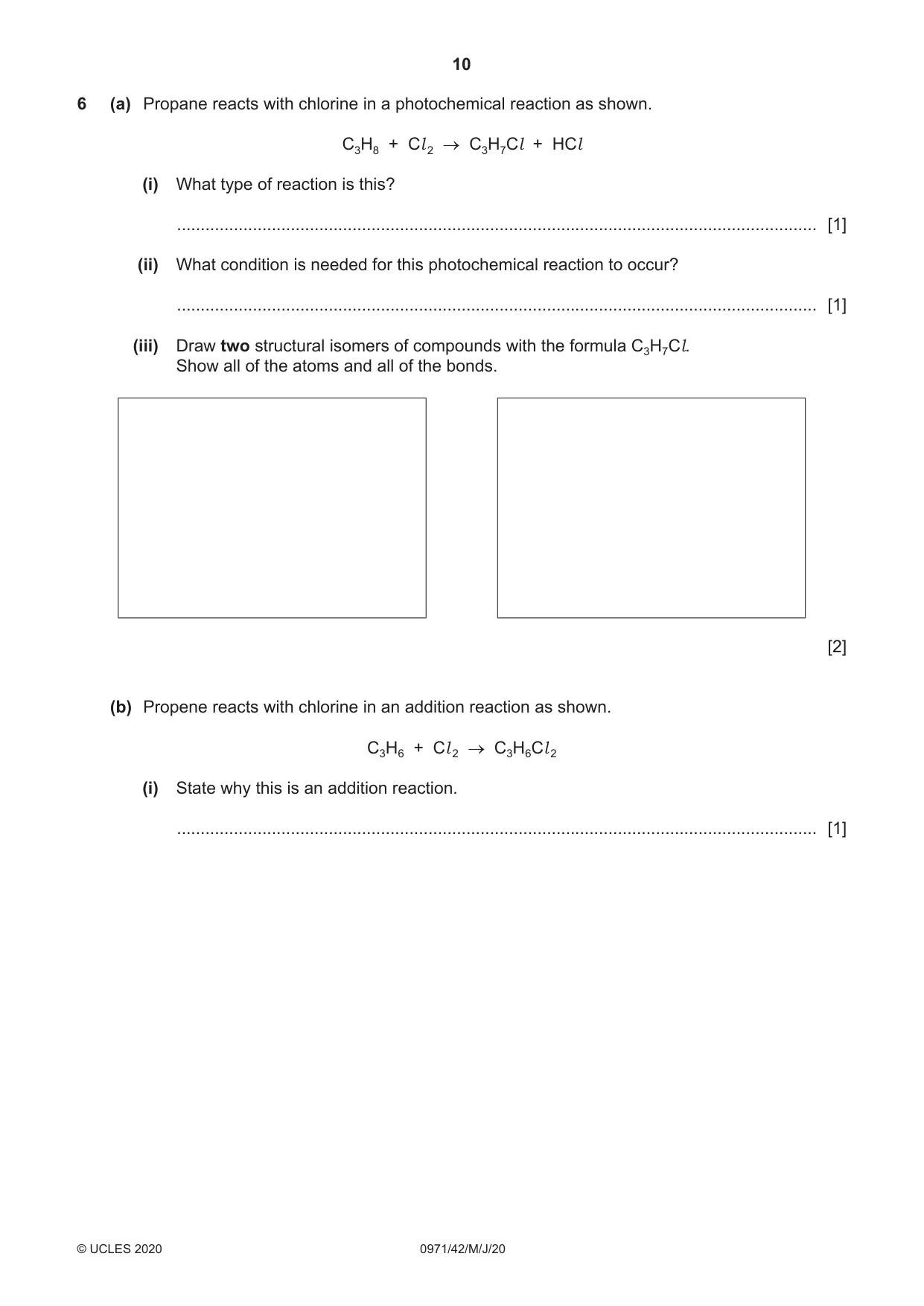
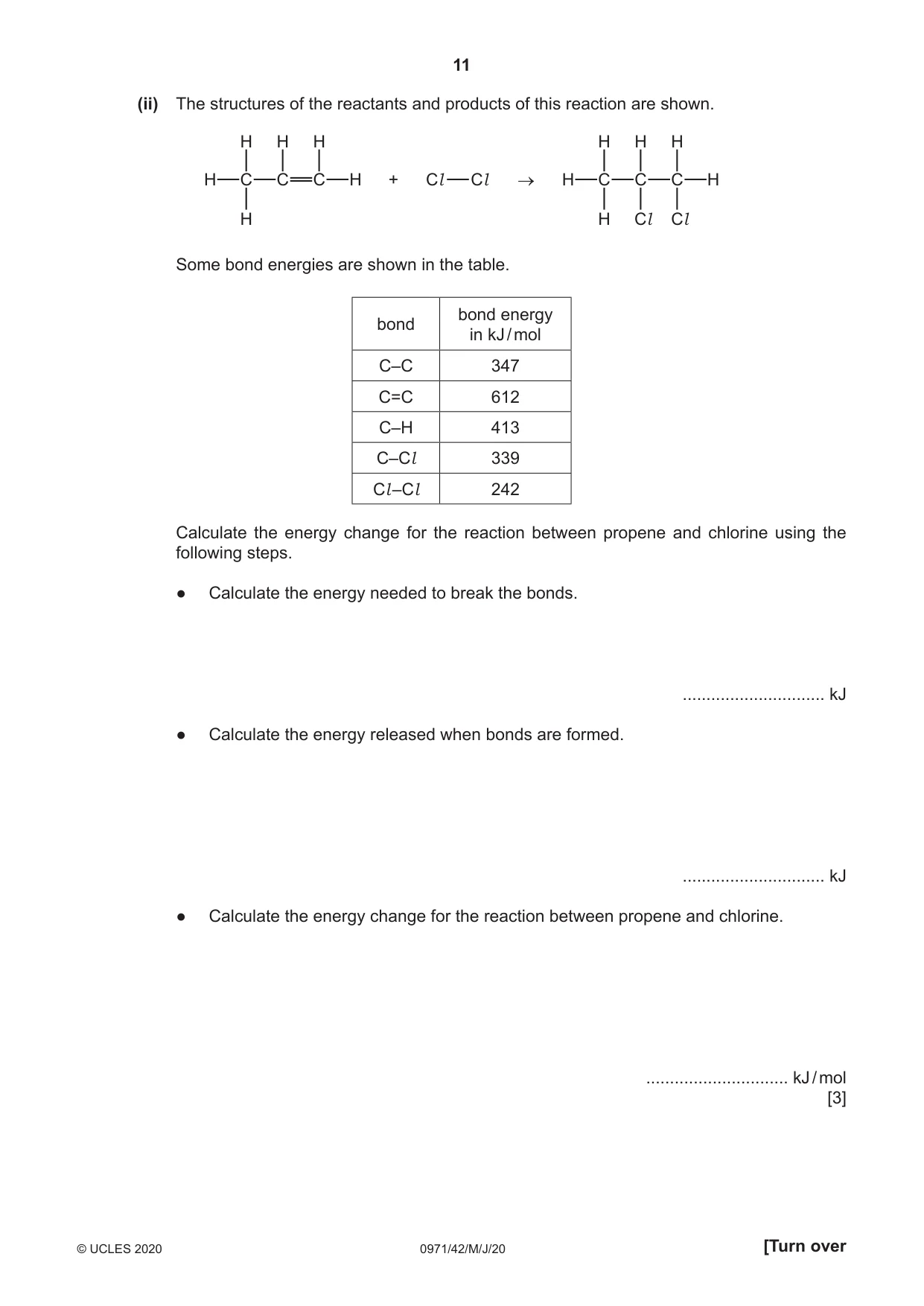
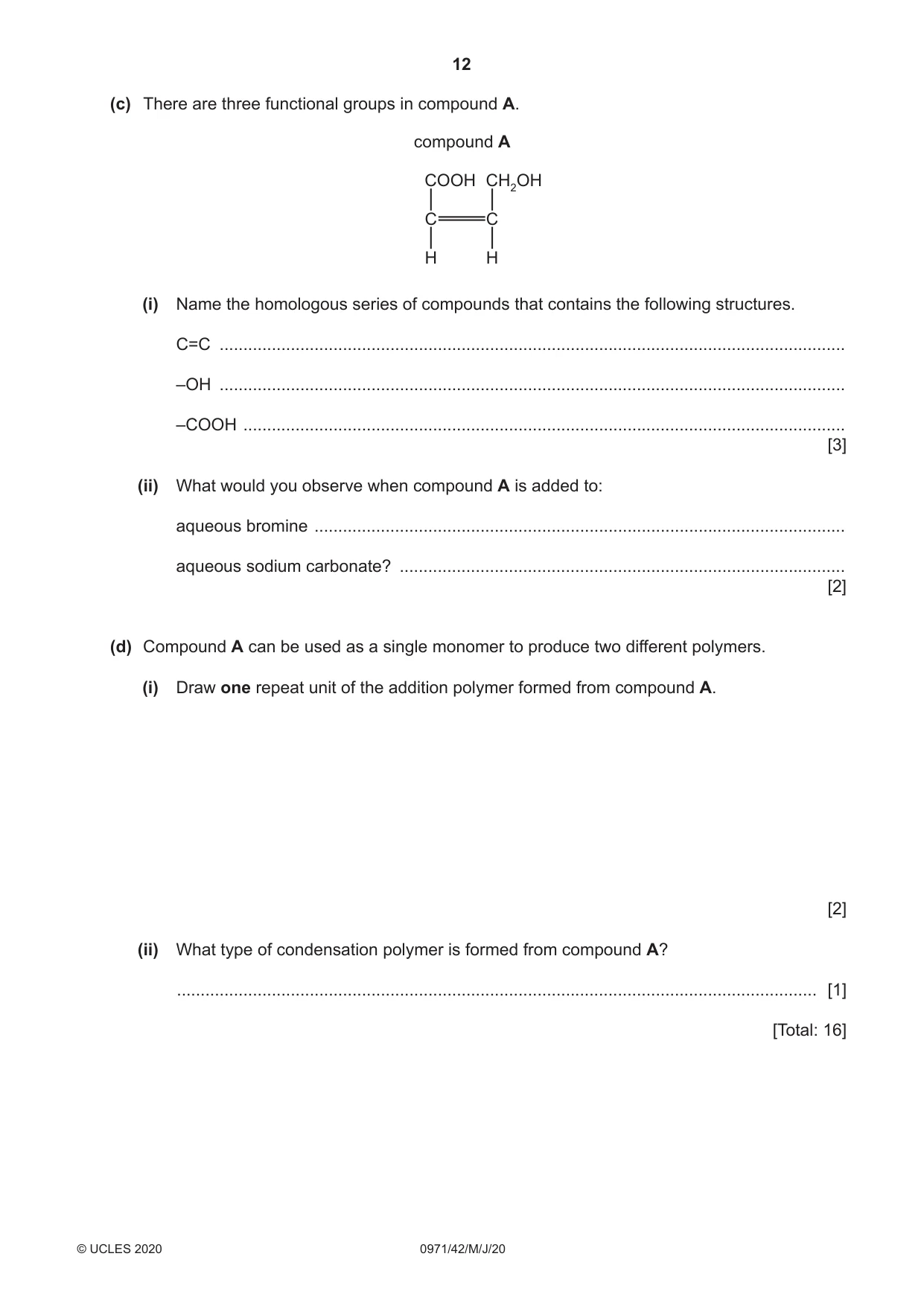
6 (a) Propane reacts with chlorine in a photochemical reaction as shown. C3H8 + Cl 2 → C3H7Cl + HCl (i) What type of reaction is this? ....................................................................................................................................... [1] (ii) What condition is needed for this photochemical reaction to occur? ....................................................................................................................................... [1] (iii) Draw two structural isomers of compounds with the formula C3H7Cl. Show all of the atoms and all of the bonds. [2] (b) Propene reacts with chlorine in an addition reaction as shown. C3H6 + Cl 2 → C3H6Cl 2 (i) State why this is an addition reaction. ....................................................................................................................................... [1] (ii) The structures of the reactants and products of this reaction are shown. H H H H H H H C C C H + Cl Cl → H C C C H H H Cl Cl Some bond energies are shown in the table. bond energy bond in kJ / mol C–C 347 C=C 612 C–H 413 C–Cl 339 Cl –Cl 242 Calculate the energy change for the reaction between propene and chlorine using the following steps. ●● Calculate the energy needed to break the bonds. .............................. kJ ●● Calculate the energy released when bonds are formed. .............................. kJ ●● Calculate the energy change for the reaction between propene and chlorine. .............................. kJ / mol [3] (c) There are three functional groups in compound A. compound A COOH CH2OH C C H H (i) Name the homologous series of compounds that contains the following structures. C=C ..................................................................................................................................... –OH ..................................................................................................................................... –COOH ............................................................................................................................... [3] (ii) What would you observe when compound A is added to: aqueous bromine ................................................................................................................ aqueous sodium carbonate? ............................................................................................... [2] (d) Compound A can be used as a single monomer to produce two different polymers. (i) Draw one repeat unit of the addition polymer formed from compound A. [2] (ii) What type of condensation polymer is formed from compound A? ....................................................................................................................................... [1] [Total: 16]
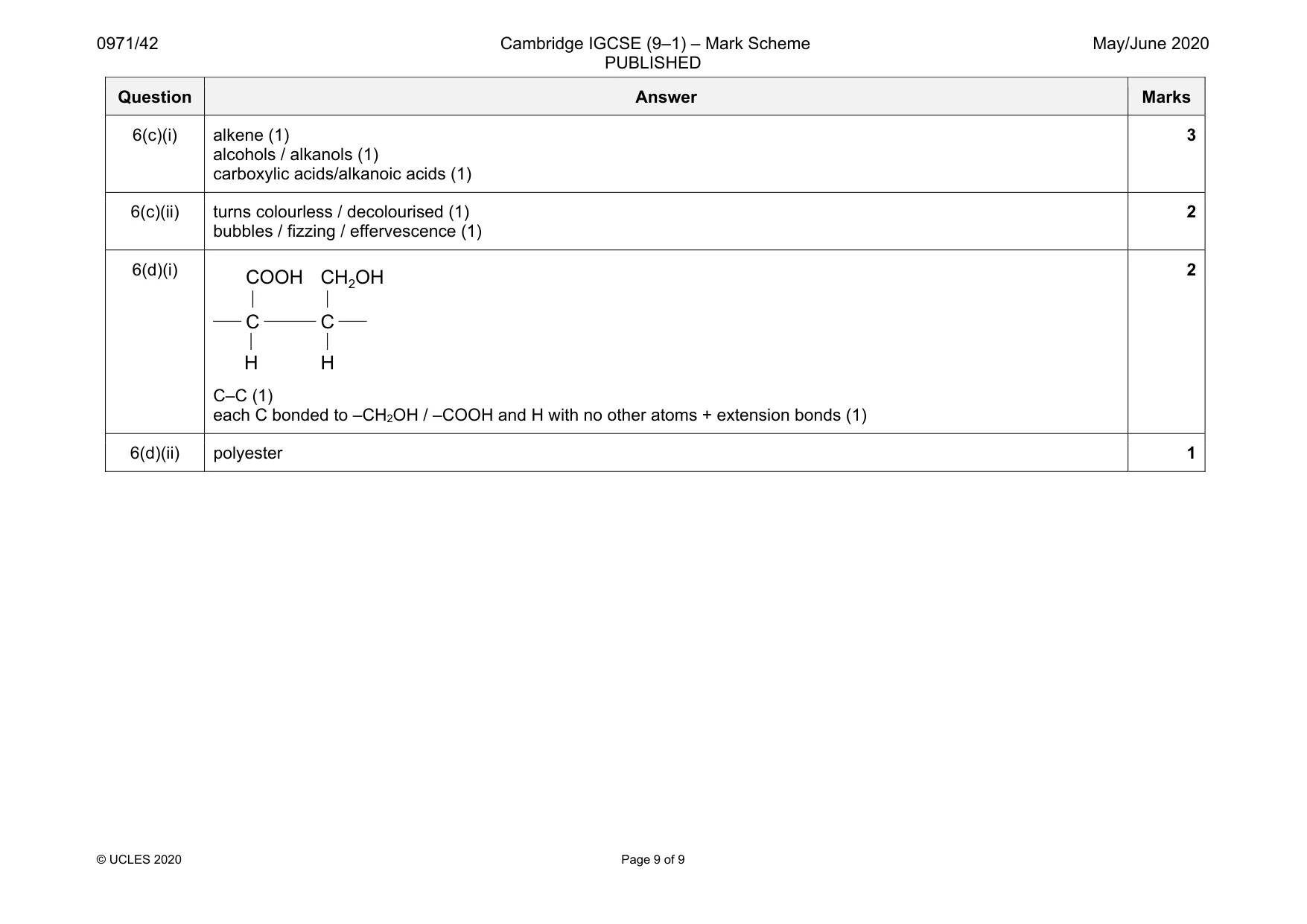
Mark scheme: 6(a)(i) substitution 1 6(a)(ii) ultraviolet light / ultraviolet radiation 1 6(a)(iii) 2 6(b)(i) only one product / double bond becomes single bond / two molecules join (to make one molecule) 1 6(b)(ii) (energy required to break bonds =) 854 (1) (energy given out when bonds form =) 1025 (1) overall energy change 854 – 1025 = –171 (1) 3 Question Answer Marks 6(c)(i) alkene (1) alcohols / alkanols (1) carboxylic acids/alkanoic acids (1) 3 6(c)(ii) turns colourless / decolourised (1) bubbles / fizzing / effervescence (1) 2 6(d)(i) C–C (1) each C bonded to –CH2OH / –COOH and H with no other atoms + extension bonds (1) 2 6(d)(ii) polyester 1 C C COOH CH2OH H H
What was in this paper
The subtopics covered by these 6 questions, and how many questions each got. Open one in a new tab to see every Cambridge question on it.