Cambridge IGCSE Chemistry (9-1) 0971 — 2020 May/June Paper 4 · Variant 1
0971/41/M/J/20 · 5 questions · 80 marks · ≈90 min
The question paper and its mark scheme, free to read here and free to download. This is Cambridge’s own paper, exactly as it was sat.
Question paper12 pages
Mark scheme9 pages
Answers below. Sit the paper first if you are practising.
Questions as text
Q1 · This question is about elements X, Y and Z
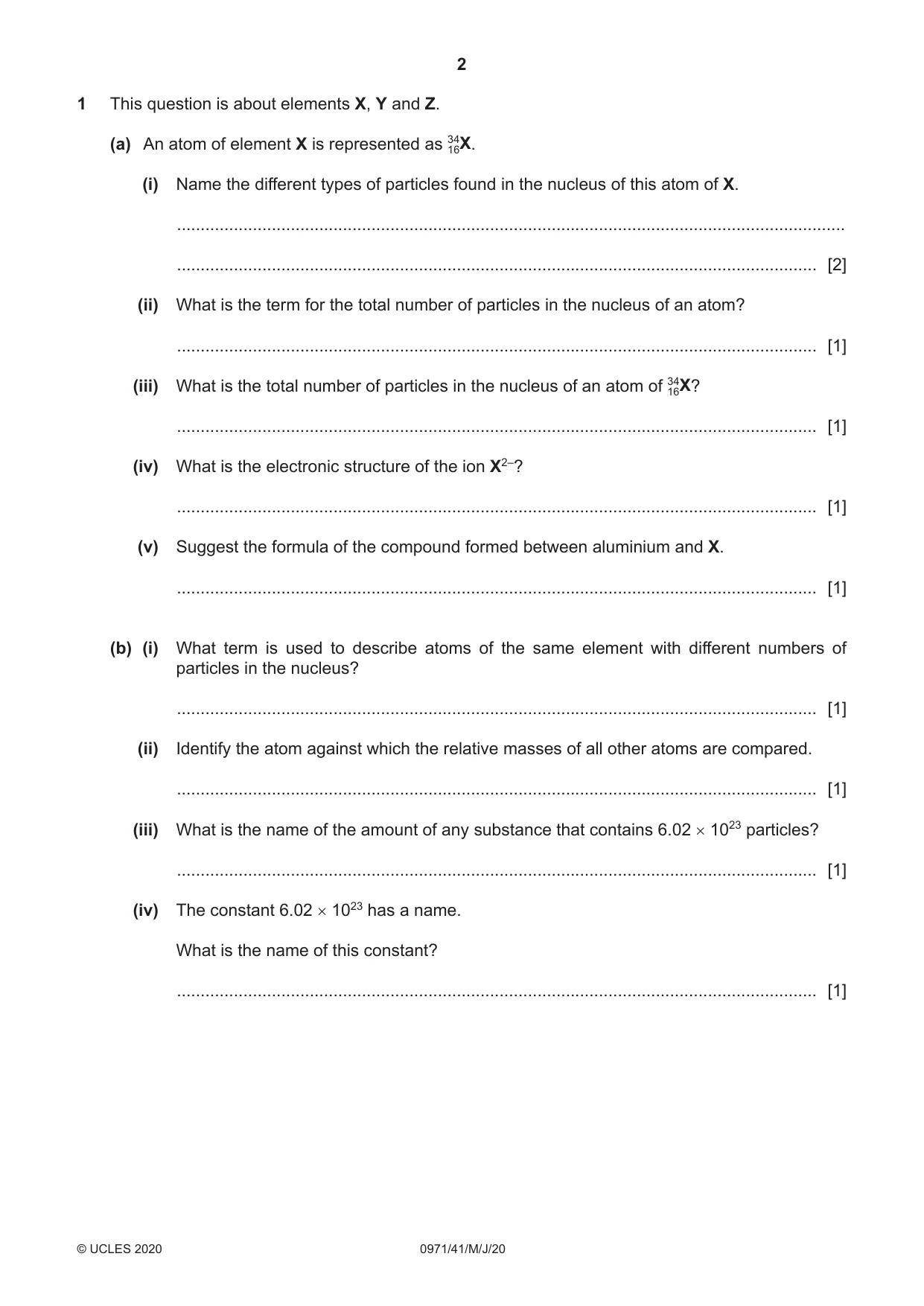
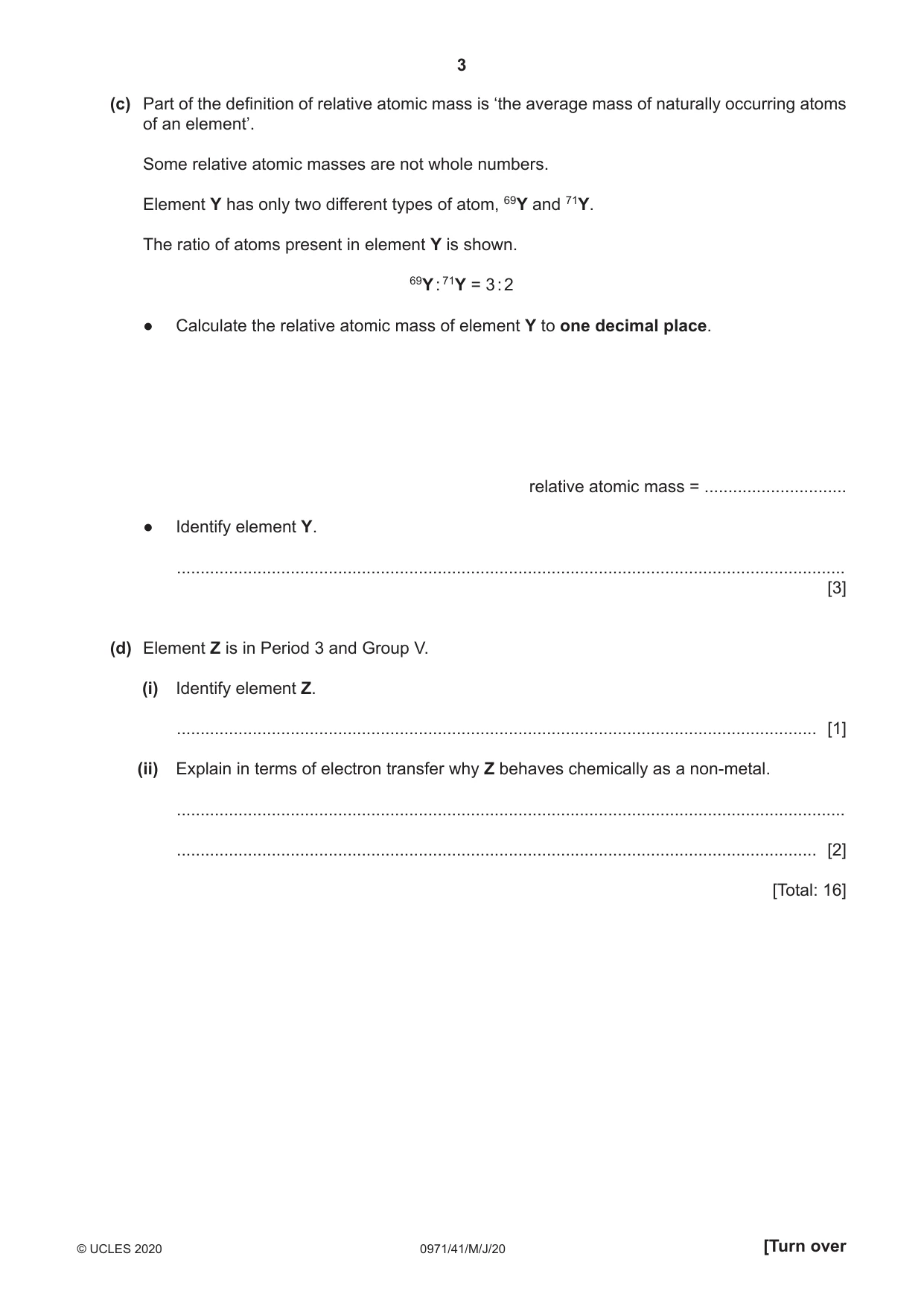
1 This question is about elements X, Y and Z. (a) An atom of element X is represented as 1634X. (i) Name the different types of particles found in the nucleus of this atom of X. ............................................................................................................................................. ....................................................................................................................................... [2] (ii) What is the term for the total number of particles in the nucleus of an atom? ....................................................................................................................................... [1] (iii) What is the total number of particles in the nucleus of an atom of 1634X? ....................................................................................................................................... [1] (iv) What is the electronic structure of the ion X2–? ....................................................................................................................................... [1] (v) Suggest the formula of the compound formed between aluminium and X. ....................................................................................................................................... [1] (b) (i) What term is used to describe atoms of the same element with different numbers of particles in the nucleus? ....................................................................................................................................... [1] (ii) Identify the atom against which the relative masses of all other atoms are compared. ....................................................................................................................................... [1] (iii) What is the name of the amount of any substance that contains 6.02 × 10²³ particles? ....................................................................................................................................... [1] (iv) The constant 6.02 × 10²³ has a name. What is the name of this constant? ....................................................................................................................................... [1] (c) Part of the definition of relative atomic mass is ‘the average mass of naturally occurring atoms of an element’. Some relative atomic masses are not whole numbers. Element Y has only two different types of atom, 69Y and 71Y. The ratio of atoms present in element Y is shown. 69Y : 71Y = 3 : 2 ●● Calculate the relative atomic mass of element Y to one decimal place. relative atomic mass = .............................. ●● Identify element Y. ............................................................................................................................................. [3] (d) Element Z is in Period 3 and Group V. (i) Identify element Z. ....................................................................................................................................... [1] (ii) Explain in terms of electron transfer why Z behaves chemically as a non-metal. ............................................................................................................................................. ....................................................................................................................................... [2] [Total: 16]
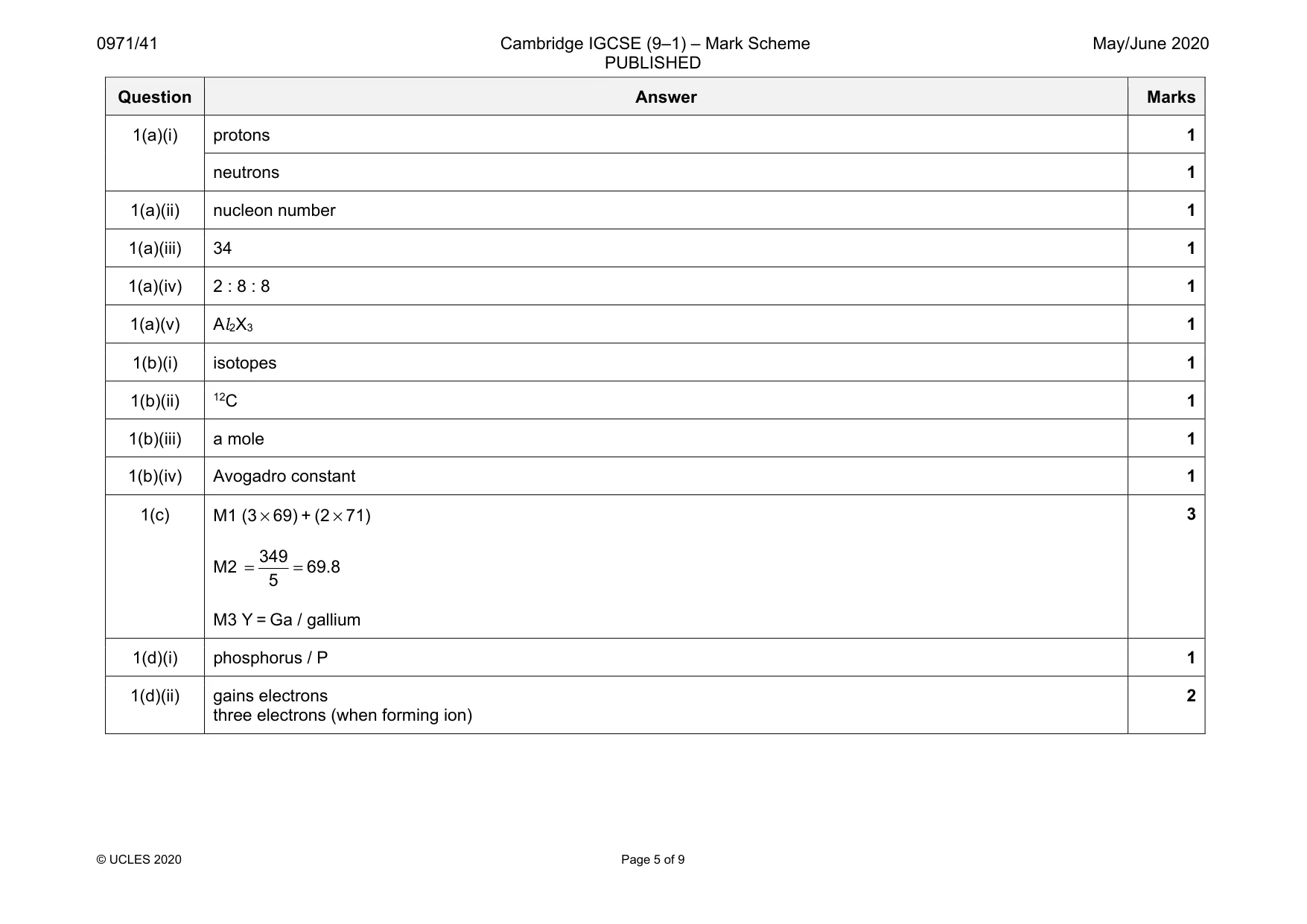
Mark scheme: 1(a)(i) protons 1 neutrons 1 1(a)(ii) nucleon number 1 1(a)(iii) 34 1 1(a)(iv) 2 : 8 : 8 1 1(a)(v) Al2X3 1 1(b)(i) isotopes 1 1(b)(ii) 12C 1 1(b)(iii) a mole 1 1(b)(iv) Avogadro constant 1 1(c) M1 (3 × 69) + (2 × 71) M2 349 69.8 5 = = M3 Y = Ga / gallium 3 1(d)(i) phosphorus / P 1 1(d)(ii) gains electrons three electrons (when forming ion) 2
Q2 · Magnesium is a metal
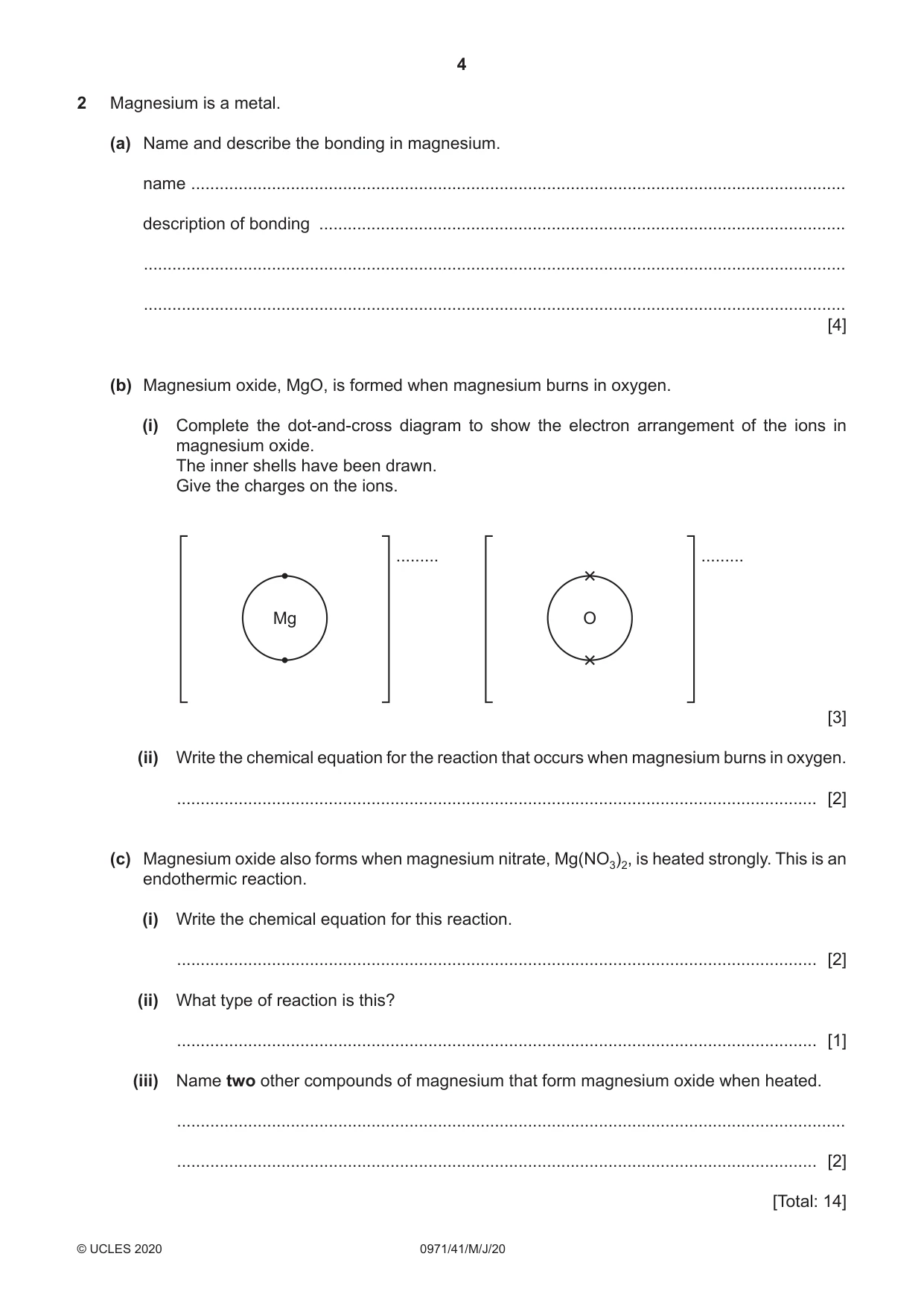
2 Magnesium is a metal. (a) Name and describe the bonding in magnesium. name .......................................................................................................................................... description of bonding ................................................................................................................ .................................................................................................................................................... .................................................................................................................................................... [4] (b) Magnesium oxide, MgO, is formed when magnesium burns in oxygen. (i) Complete the dot-and-cross diagram to show the electron arrangement of the ions in magnesium oxide. The inner shells have been drawn. Give the charges on the ions. ......... ......... Mg O [3] (ii) Write the chemical equation for the reaction that occurs when magnesium burns in oxygen. ....................................................................................................................................... [2] (c) Magnesium oxide also forms when magnesium nitrate, Mg(NO3)2, is heated strongly. This is an endothermic reaction. (i) Write the chemical equation for this reaction. ....................................................................................................................................... [2] (ii) What type of reaction is this? ....................................................................................................................................... [1] (iii) Name two other compounds of magnesium that form magnesium oxide when heated. ............................................................................................................................................. ....................................................................................................................................... [2] [Total: 14]
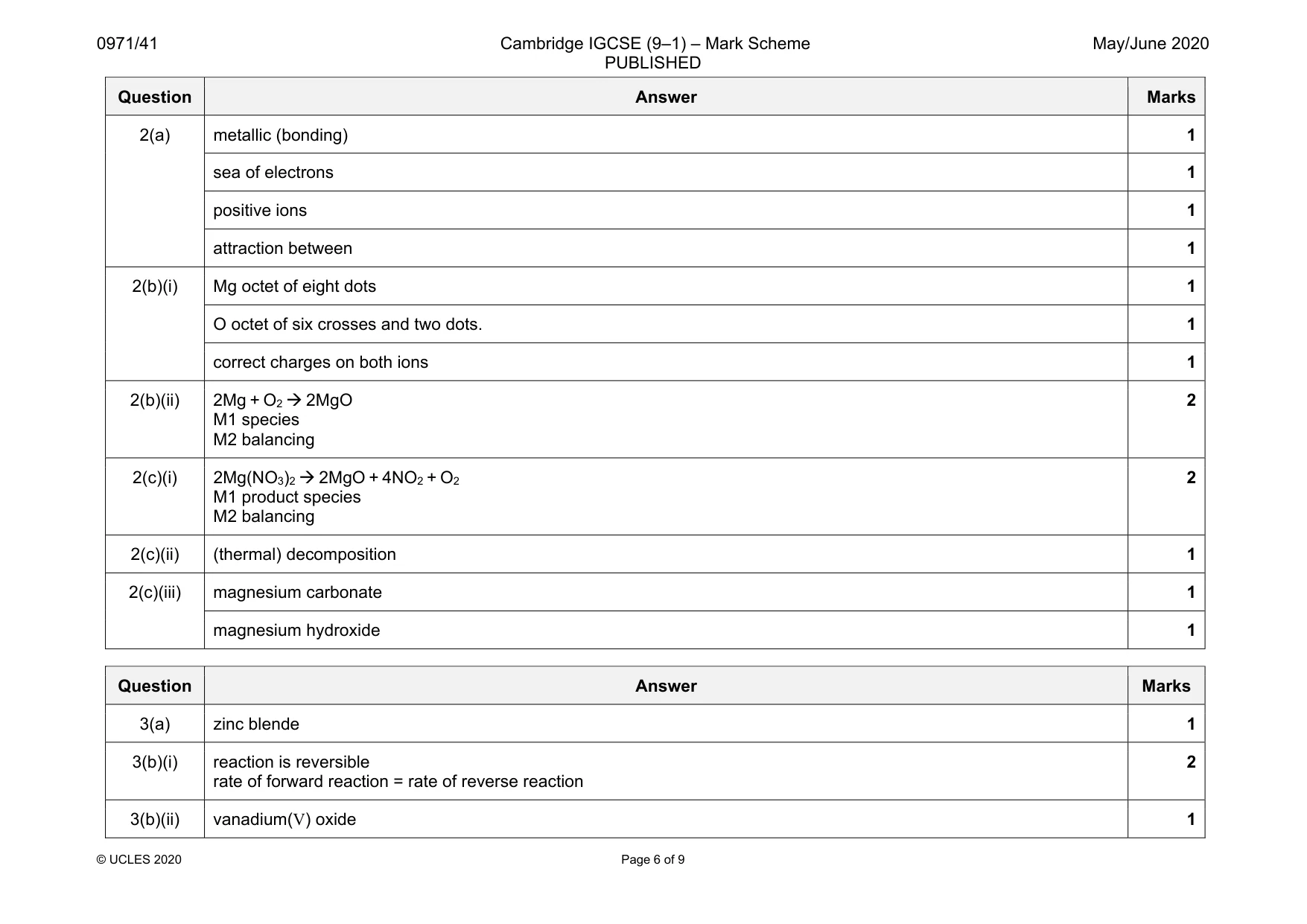
Mark scheme: 2(a) metallic (bonding) 1 sea of electrons 1 positive ions 1 attraction between 1 2(b)(i) Mg octet of eight dots 1 O octet of six crosses and two dots. 1 correct charges on both ions 1 2(b)(ii) 2Mg + O2 2MgO M1 species M2 balancing 2 2(c)(i) 2Mg(NO3)2 2MgO + 4NO2 + O2 M1 product species M2 balancing 2 2(c)(ii) (thermal) decomposition 1 2(c)(iii) magnesium carbonate 1 magnesium hydroxide 1
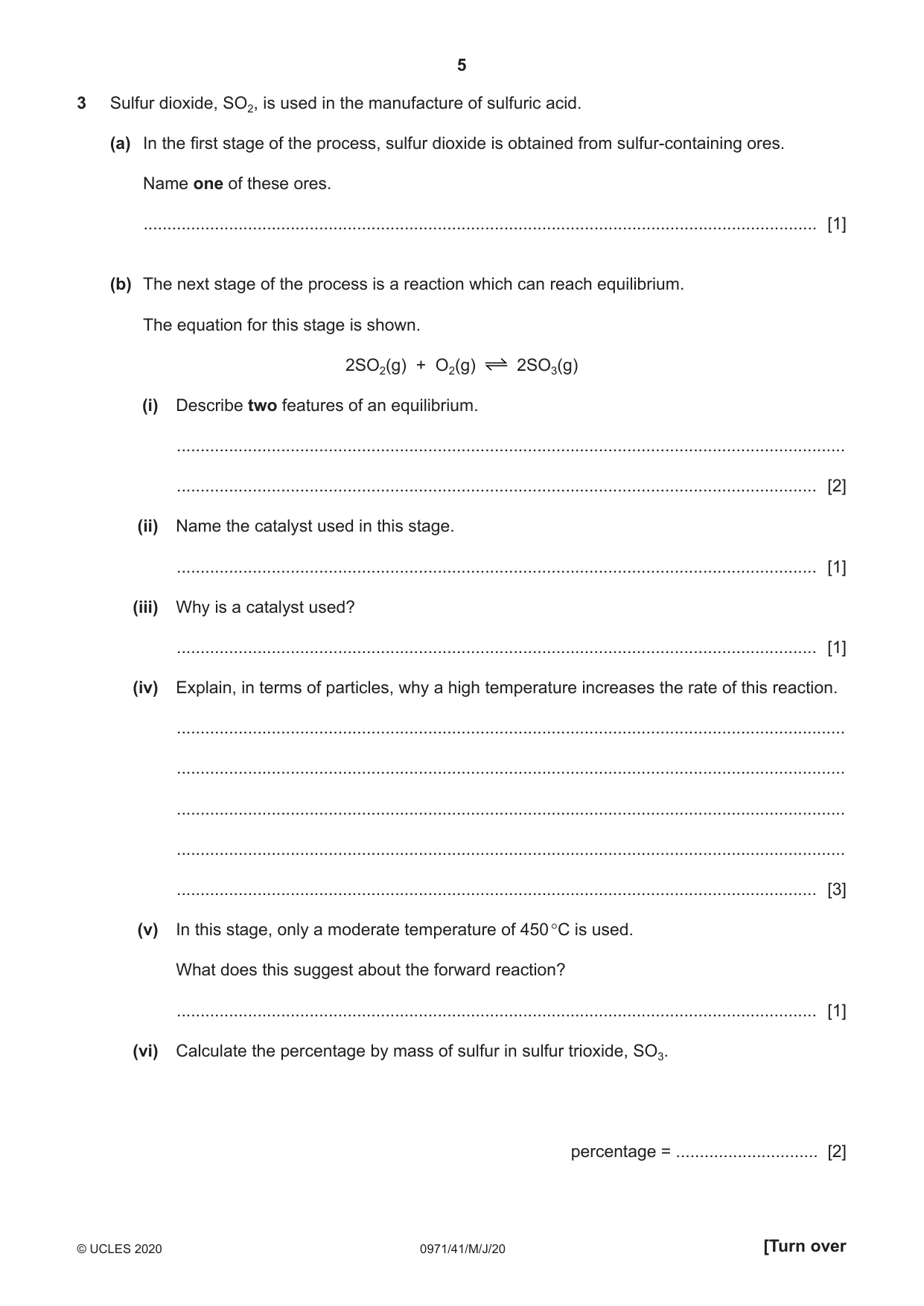
Q3 · Sulfur dioxide, SO2, is used in the manufacture of sulfuric acid
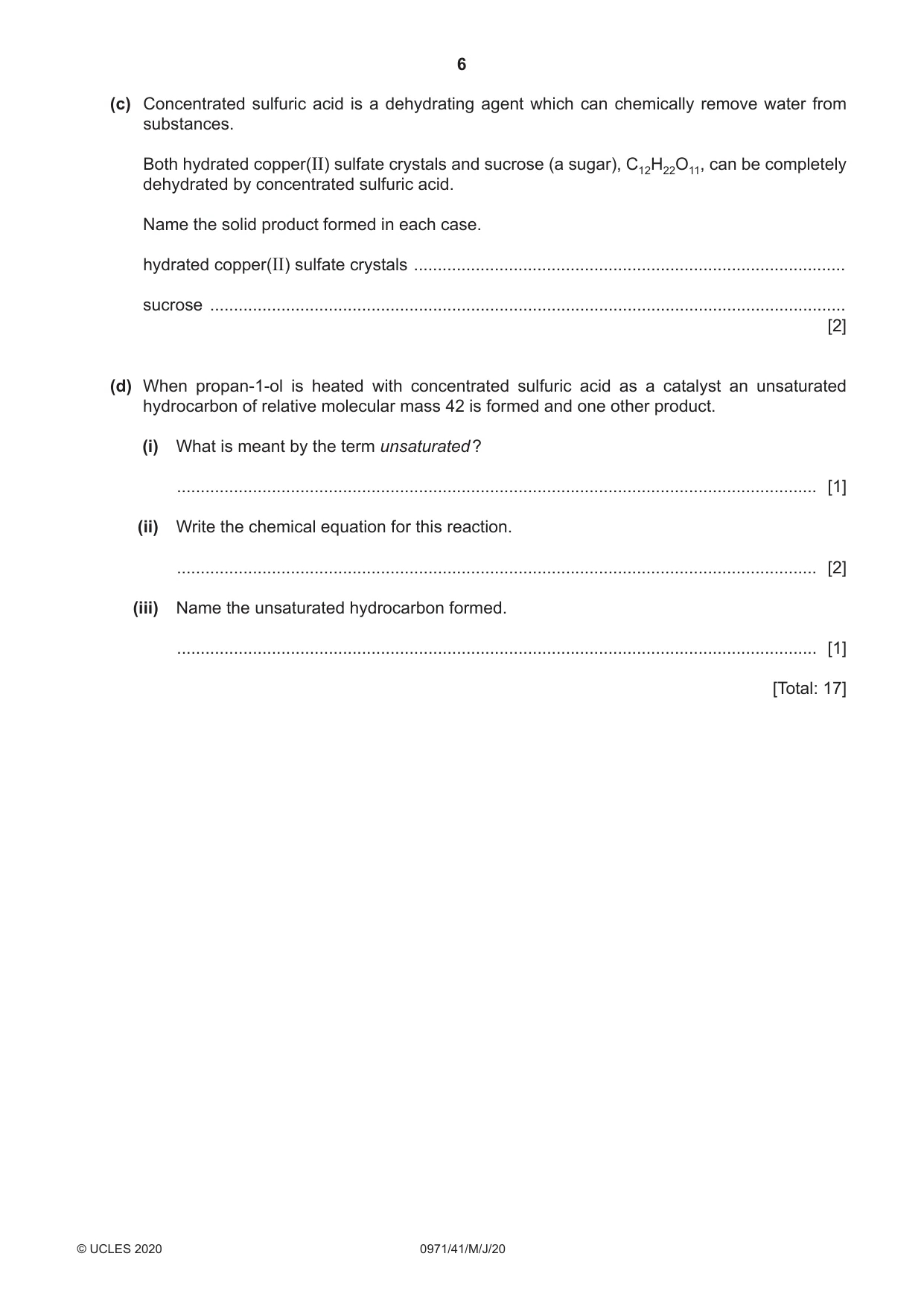
3 Sulfur dioxide, SO2, is used in the manufacture of sulfuric acid. (a) In the first stage of the process, sulfur dioxide is obtained from sulfur-containing ores. Name one of these ores. .............................................................................................................................................. [1] (b) The next stage of the process is a reaction which can reach equilibrium. The equation for this stage is shown. 2SO2(g) + O2(g) 2SO3(g) (i) Describe two features of an equilibrium. ............................................................................................................................................. ....................................................................................................................................... [2] (ii) Name the catalyst used in this stage. ....................................................................................................................................... [1] (iii) Why is a catalyst used? ....................................................................................................................................... [1] (iv) Explain, in terms of particles, why a high temperature increases the rate of this reaction. ............................................................................................................................................. ............................................................................................................................................. ............................................................................................................................................. ............................................................................................................................................. ....................................................................................................................................... [3] (v) In this stage, only a moderate temperature of 450 °C is used. What does this suggest about the forward reaction? ....................................................................................................................................... [1] (vi) Calculate the percentage by mass of sulfur in sulfur trioxide, SO3. percentage = .............................. [2] (c) Concentrated sulfuric acid is a dehydrating agent which can chemically remove water from substances. Both hydrated copper(II) sulfate crystals and sucrose (a sugar), C12H22O11, can be completely dehydrated by concentrated sulfuric acid. Name the solid product formed in each case. hydrated copper(II) sulfate crystals ........................................................................................... sucrose ....................................................................................................................................... [2] (d) When propan-1-ol is heated with concentrated sulfuric acid as a catalyst an unsaturated hydrocarbon of relative molecular mass 42 is formed and one other product. (i) What is meant by the term unsaturated ? ....................................................................................................................................... [1] (ii) Write the chemical equation for this reaction. ....................................................................................................................................... [2] (iii) Name the unsaturated hydrocarbon formed. ....................................................................................................................................... [1] [Total: 17]
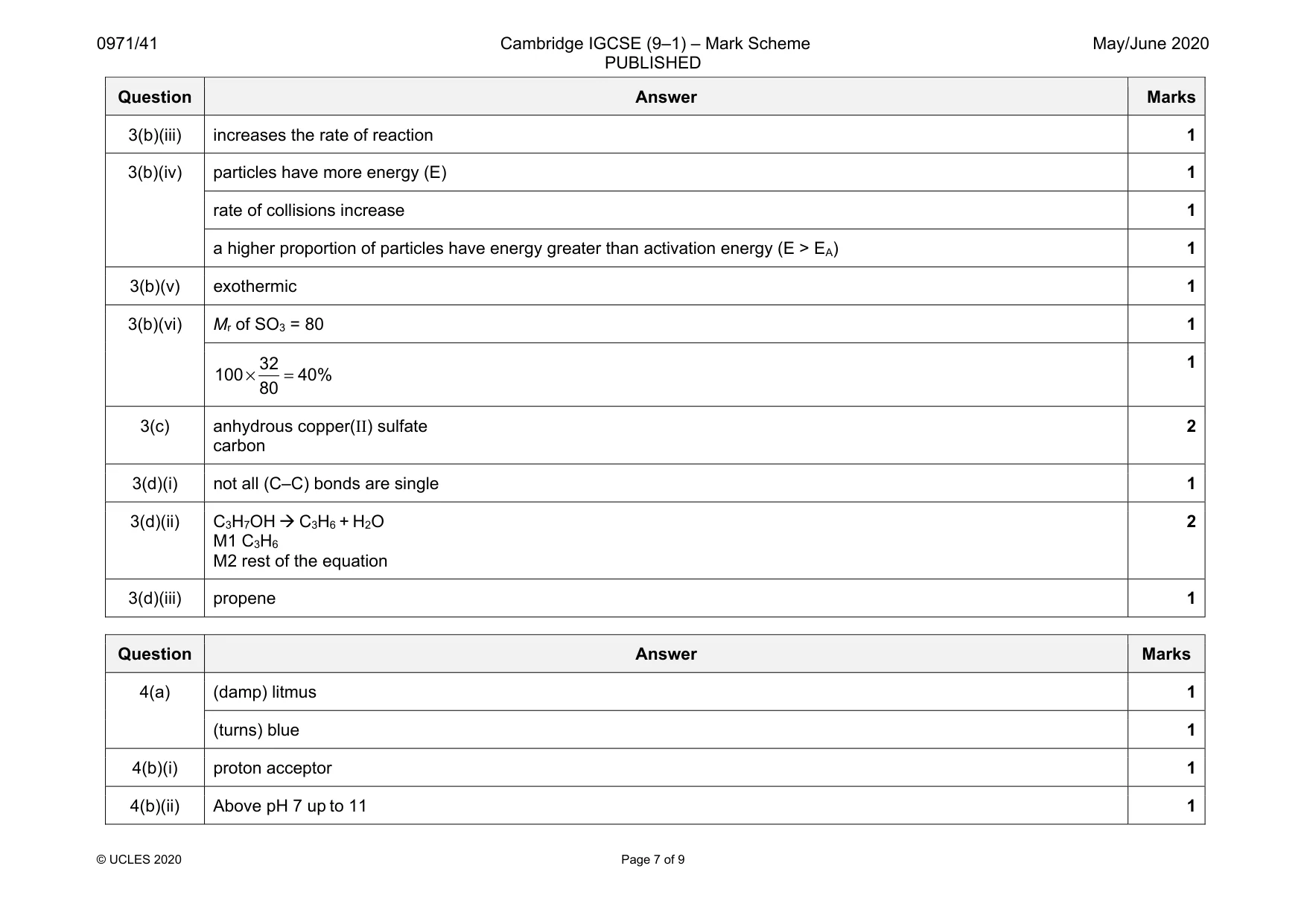
Mark scheme: 3(a) zinc blende 1 3(b)(i) reaction is reversible rate of forward reaction = rate of reverse reaction 2 3(b)(ii) vanadium(V) oxide 1 Question Answer Marks 3(b)(iii) increases the rate of reaction 1 3(b)(iv) particles have more energy (E) 1 rate of collisions increase 1 a higher proportion of particles have energy greater than activation energy (E > EA) 1 3(b)(v) exothermic 1 3(b)(vi) Mr of SO3 = 80 1 32 100 40% 80 × = 1 3(c) anhydrous copper(II) sulfate carbon 2 3(d)(i) not all (C–C) bonds are single 1 3(d)(ii) C3H7OH C3H6 + H2O M1 C3H6 M2 rest of the equation 2 3(d)(iii) propene 1
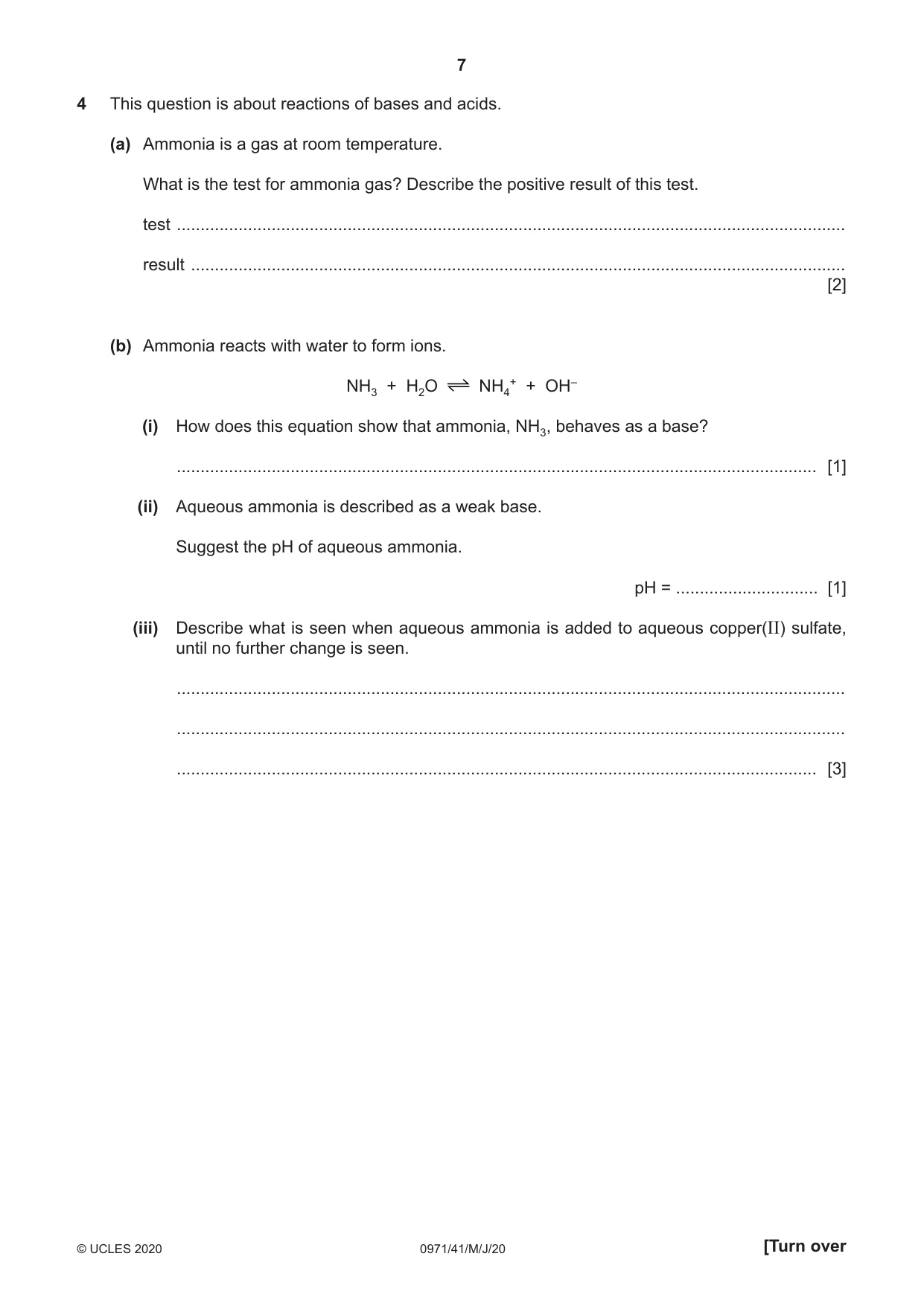
Q4 · This question is about reactions of bases and acids
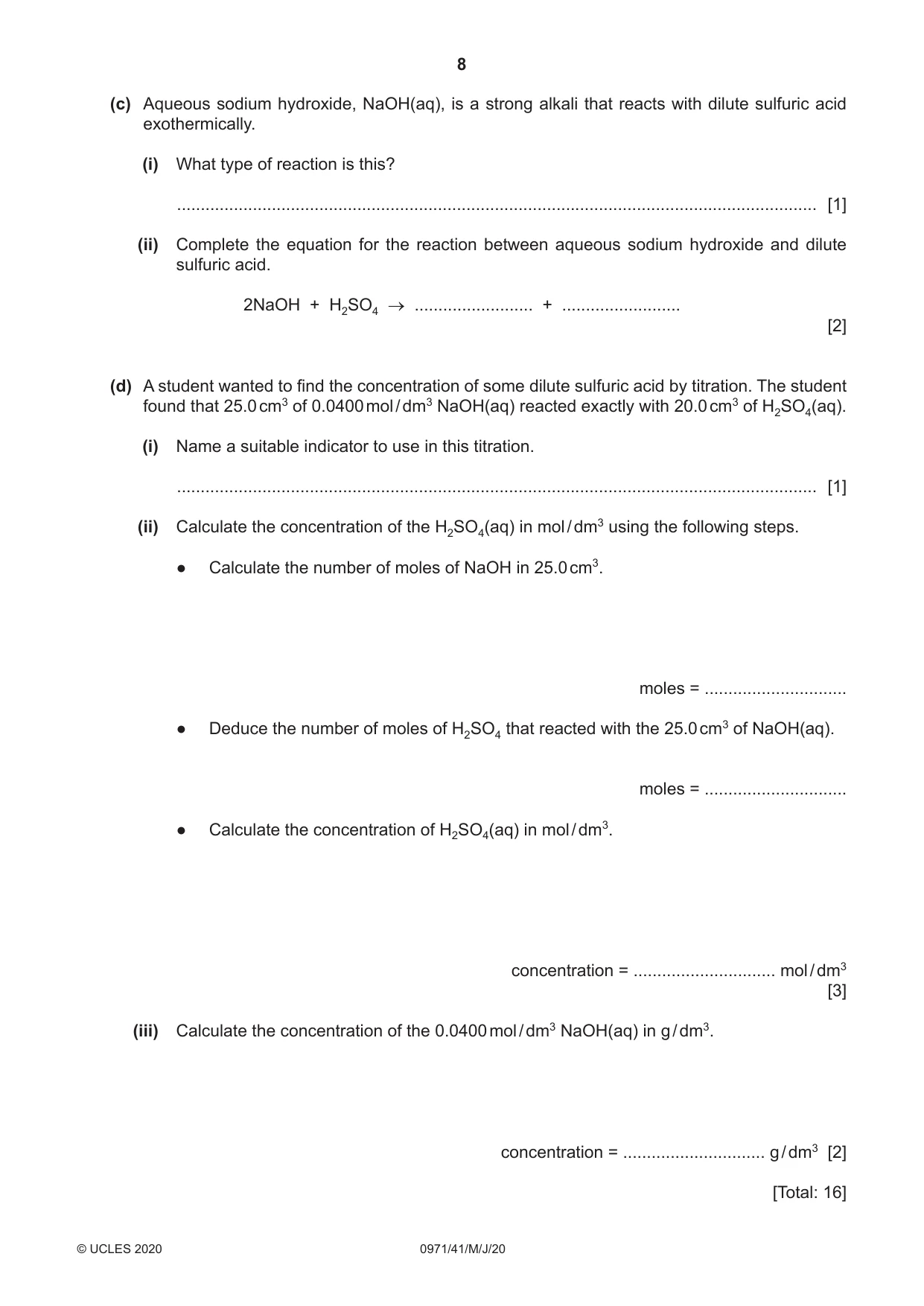
4 This question is about reactions of bases and acids. (a) Ammonia is a gas at room temperature. What is the test for ammonia gas? Describe the positive result of this test. test ............................................................................................................................................. result .......................................................................................................................................... [2] (b) Ammonia reacts with water to form ions. NH3 + H2O NH4+ + OH– (i) How does this equation show that ammonia, NH3, behaves as a base? ....................................................................................................................................... [1] (ii) Aqueous ammonia is described as a weak base. Suggest the pH of aqueous ammonia. pH = .............................. [1] (iii) Describe what is seen when aqueous ammonia is added to aqueous copper(II) sulfate, until no further change is seen. ............................................................................................................................................. ............................................................................................................................................. ....................................................................................................................................... [3] (c) Aqueous sodium hydroxide, NaOH(aq), is a strong alkali that reacts with dilute sulfuric acid exothermically. (i) What type of reaction is this? ....................................................................................................................................... [1] (ii) Complete the equation for the reaction between aqueous sodium hydroxide and dilute sulfuric acid. 2NaOH + H2SO4 → ......................... + ......................... [2] (d) A student wanted to find the concentration of some dilute sulfuric acid by titration. The student found that 25.0 cm3 of 0.0400 mol / dm3 NaOH(aq) reacted exactly with 20.0 cm3 of H2SO4(aq). (i) Name a suitable indicator to use in this titration. ....................................................................................................................................... [1] (ii) Calculate the concentration of the H2SO4(aq) in mol / dm3 using the following steps. ●● Calculate the number of moles of NaOH in 25.0 cm3. moles = .............................. ●● Deduce the number of moles of H2SO4 that reacted with the 25.0 cm3 of NaOH(aq). moles = .............................. ●● Calculate the concentration of H2SO4(aq) in mol / dm3. concentration = .............................. mol / dm3 [3] (iii) Calculate the concentration of the 0.0400 mol / dm3 NaOH(aq) in g / dm3. concentration = .............................. g / dm3 [2] [Total: 16]
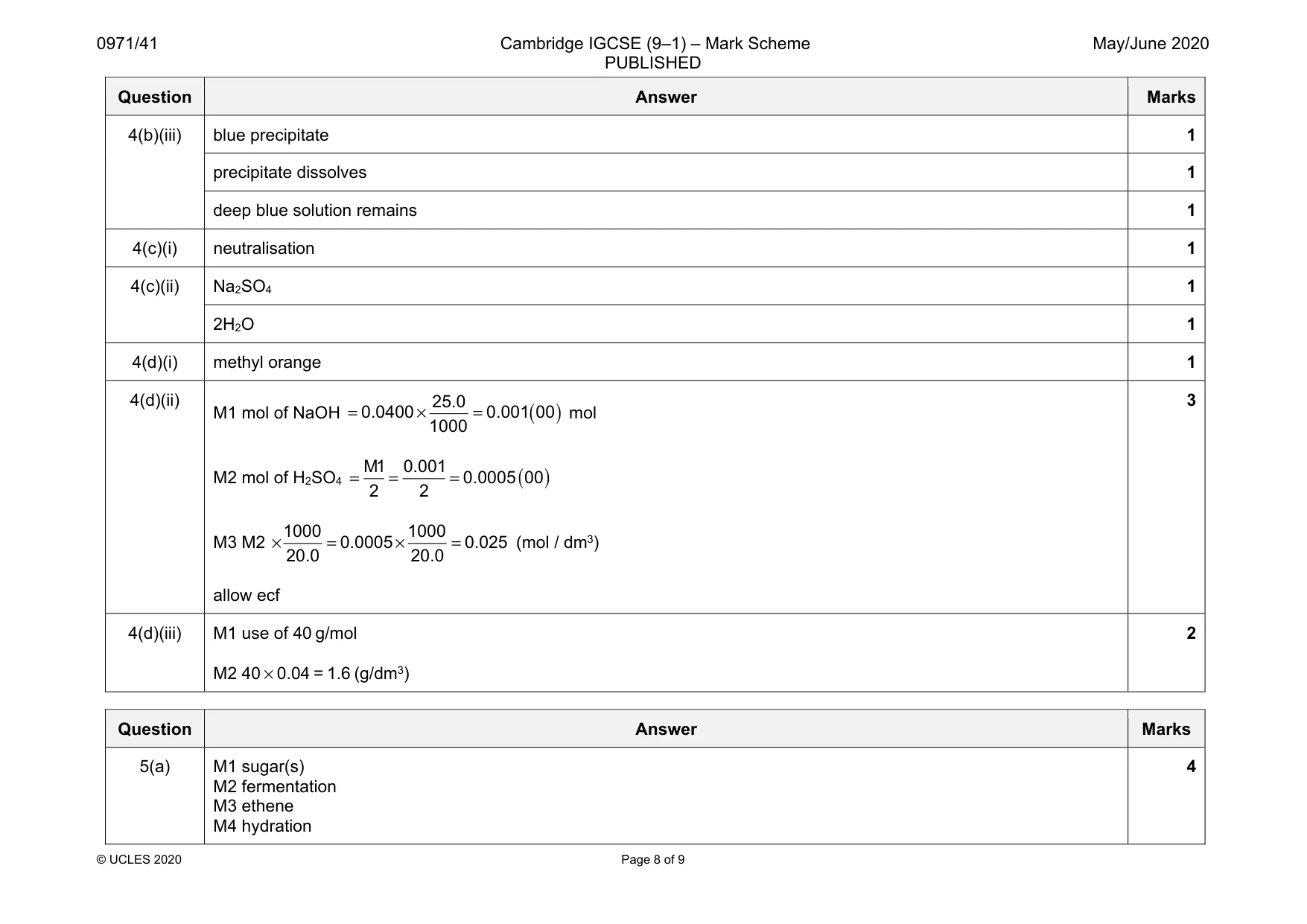
Mark scheme: 4(a) (damp) litmus 1 (turns) blue 1 4(b)(i) proton acceptor 1 4(b)(ii) Above pH 7 up to 11 1 Question Answer Marks 4(b)(iii) blue precipitate 1 precipitate dissolves 1 deep blue solution remains 1 4(c)(i) neutralisation 1 4(c)(ii) Na2SO4 1 2H2O 1 4(d)(i) methyl orange 1 4(d)(ii) M1 mol of NaOH ( ) 25.0 0.0400 0.001 00 1000 = × = mol M2 mol of H2SO4 ( ) M1 0.001 0.0005 00 2 2 = = = M3 M2 1000 1000 0.0005 0.025 20.0 20.0 × = × = (mol / dm3) allow ecf 3 4(d)(iii) M1 use of 40 g/mol M2 40 × 0.04 = 1.6 (g/dm3) 2
Q5 · Ethanol is manufactured by two different processes
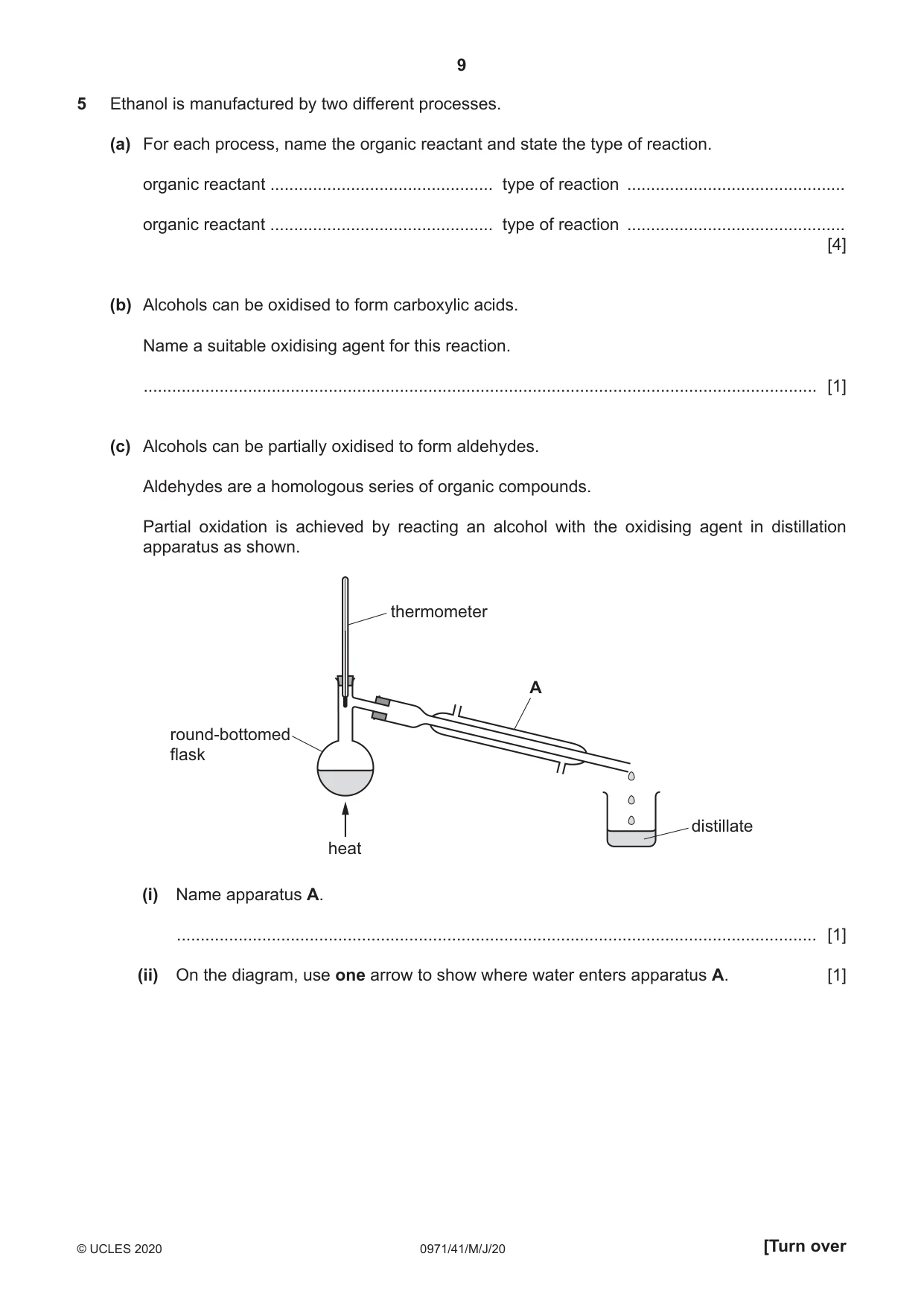
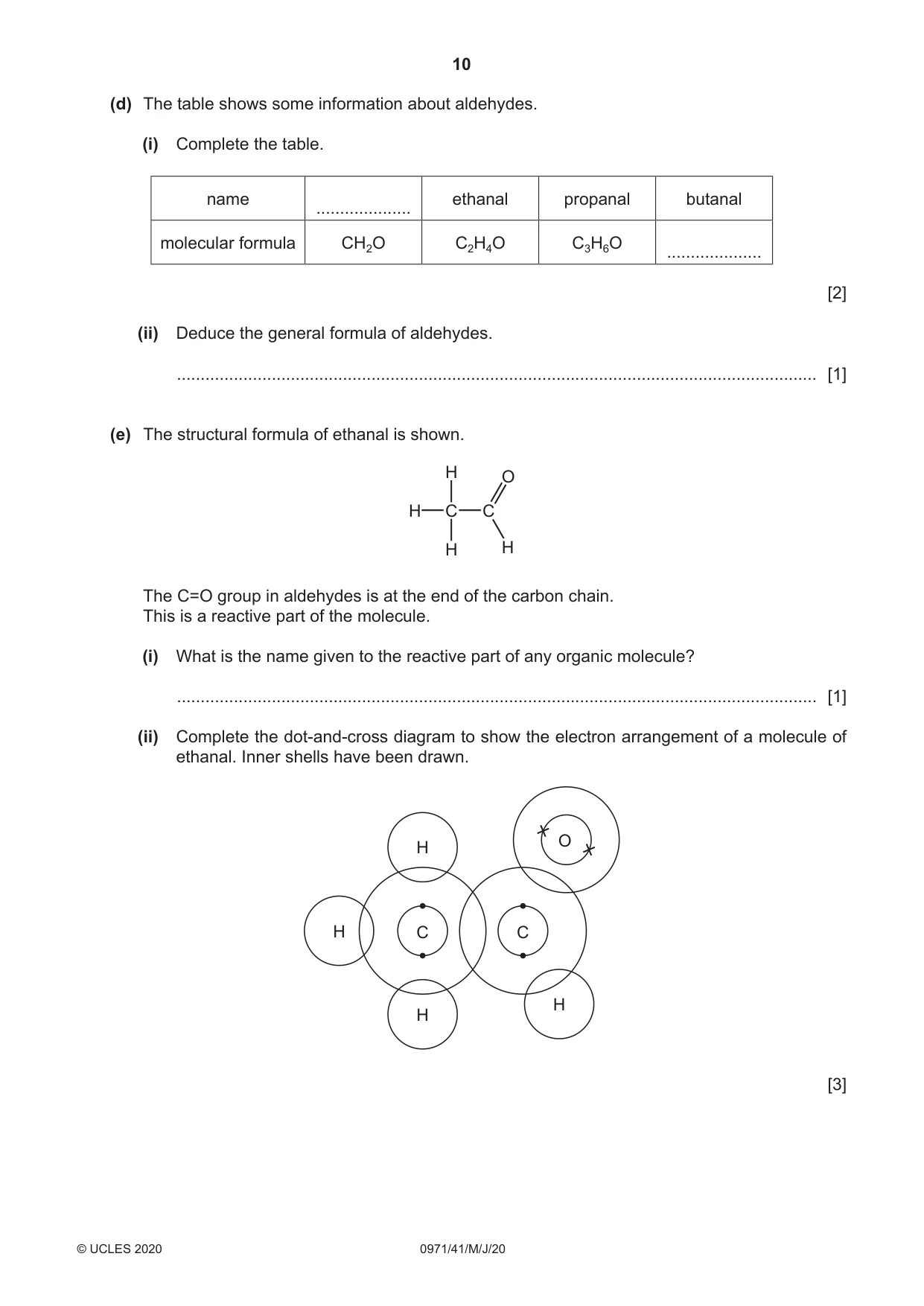
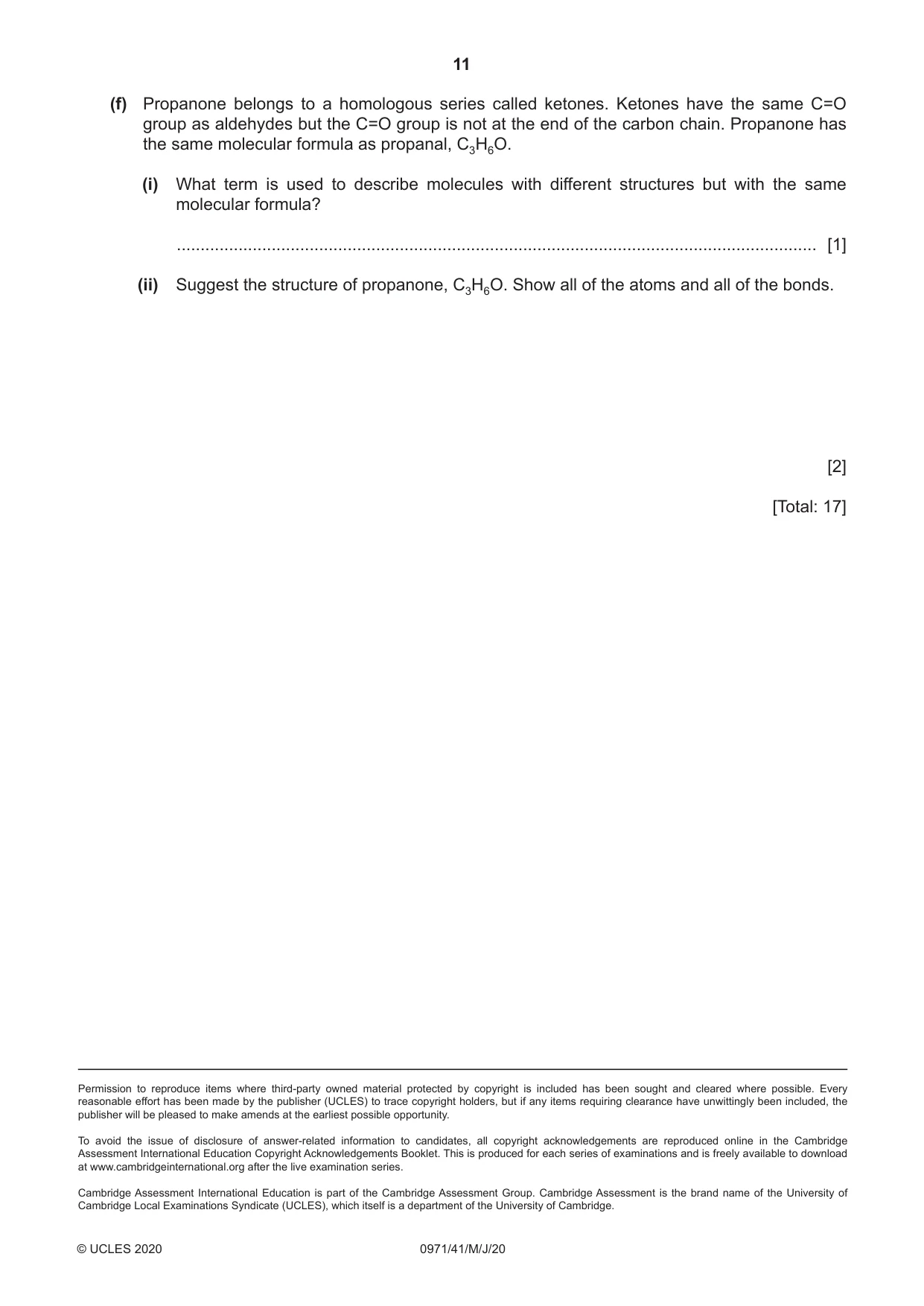
5 Ethanol is manufactured by two different processes. (a) For each process, name the organic reactant and state the type of reaction. organic reactant ............................................... type of reaction ............................................... organic reactant ............................................... type of reaction ............................................... [4] (b) Alcohols can be oxidised to form carboxylic acids. Name a suitable oxidising agent for this reaction. .............................................................................................................................................. [1] (c) Alcohols can be partially oxidised to form aldehydes. Aldehydes are a homologous series of organic compounds. Partial oxidation is achieved by reacting an alcohol with the oxidising agent in distillation apparatus as shown. thermometer A round-bottomed flask distillate heat (i) Name apparatus A. ....................................................................................................................................... [1] (ii) On the diagram, use one arrow to show where water enters apparatus A. [1] (d) The table shows some information about aldehydes. (i) Complete the table. name ethanal propanal butanal .................... molecular formula CH2O C2H4O C3H6O .................... [2] (ii) Deduce the general formula of aldehydes. ....................................................................................................................................... [1] (e) The structural formula of ethanal is shown. H O H C C H H The C=O group in aldehydes is at the end of the carbon chain. This is a reactive part of the molecule. (i) What is the name given to the reactive part of any organic molecule? ....................................................................................................................................... [1] (ii) Complete the dot-and-cross diagram to show the electron arrangement of a molecule of ethanal. Inner shells have been drawn. O H H C C H H [3] (f) Propanone belongs to a homologous series called ketones. Ketones have the same C=O group as aldehydes but the C=O group is not at the end of the carbon chain. Propanone has the same molecular formula as propanal, C3H6O. (i) What term is used to describe molecules with different structures but with the same molecular formula? ....................................................................................................................................... [1] (ii) Suggest the structure of propanone, C3H6O. Show all of the atoms and all of the bonds. [2] [Total: 17]
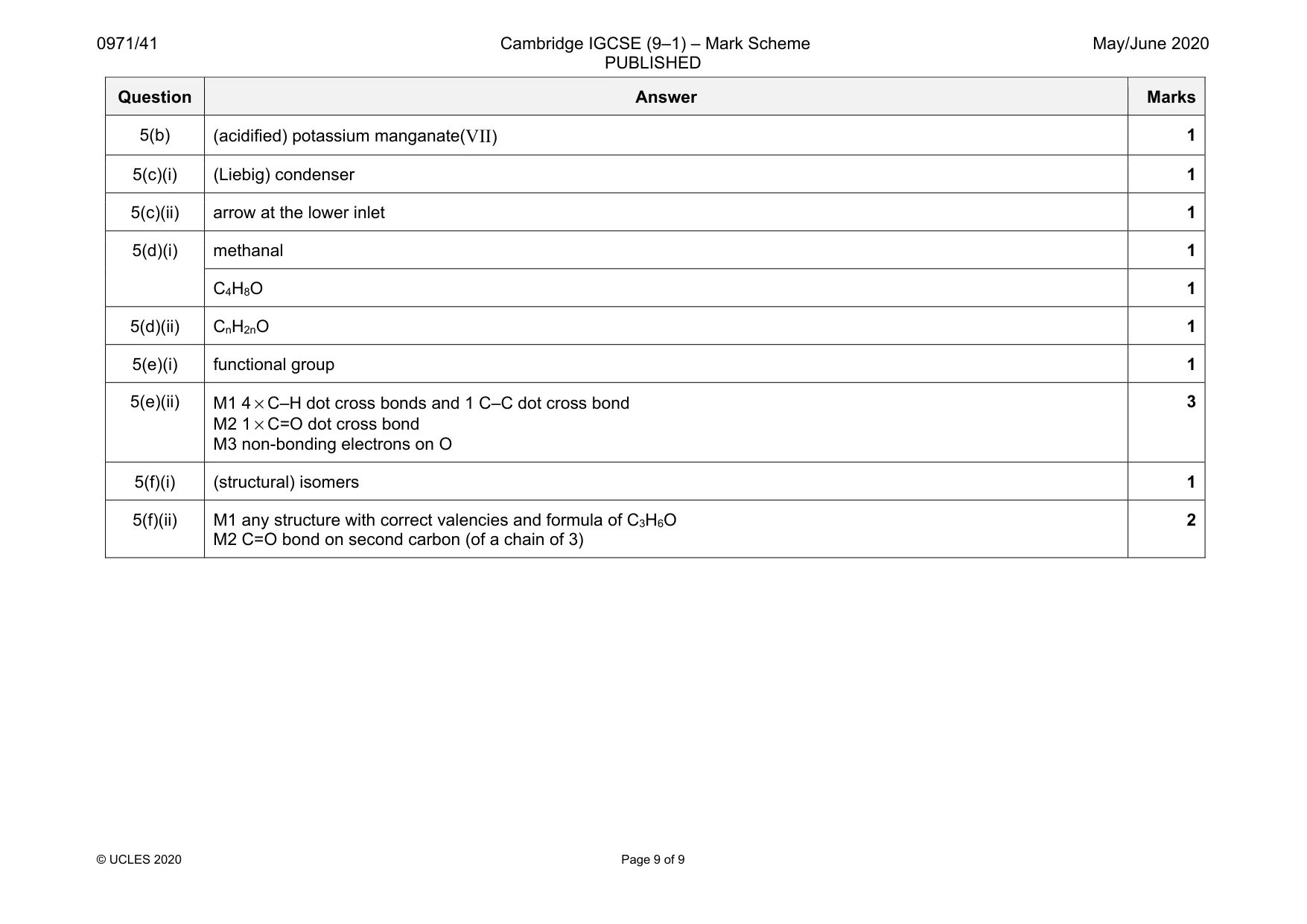
Mark scheme: 5(a) M1 sugar(s) M2 fermentation M3 ethene M4 hydration Question Answer Marks 5(b) (acidified) potassium manganate(VII) 1 5(c)(i) (Liebig) condenser 1 5(c)(ii) arrow at the lower inlet 1 5(d)(i) methanal 1 C4H8O 1 5(d)(ii) CnH2nO 1 5(e)(i) functional group 1 5(e)(ii) M1 4 × C–H dot cross bonds and 1 C–C dot cross bond M2 1 × C=O dot cross bond M3 non-bonding electrons on O 3 5(f)(i) (structural) isomers 1 5(f)(ii) M1 any structure with correct valencies and formula of C3H6O M2 C=O bond on second carbon (of a chain of 3) 2
More questions on Formulae, functional groups and terminology
What was in this paper
The subtopics covered by these 5 questions, and how many questions each got. Open one in a new tab to see every Cambridge question on it.