Cambridge IGCSE Biology (9-1) 0970 — 2025 May/June Paper 4 · Variant 2
0970/42/M/J/25 · 6 questions · 80 marks · ≈90 min
The question paper and its mark scheme, free to read here and free to download. This is Cambridge’s own paper, exactly as it was sat.
Question paper16 pages

Mark scheme16 pages
Answers below. Sit the paper first if you are practising.
Questions as text
Q1 · Part of the human gas exchange system
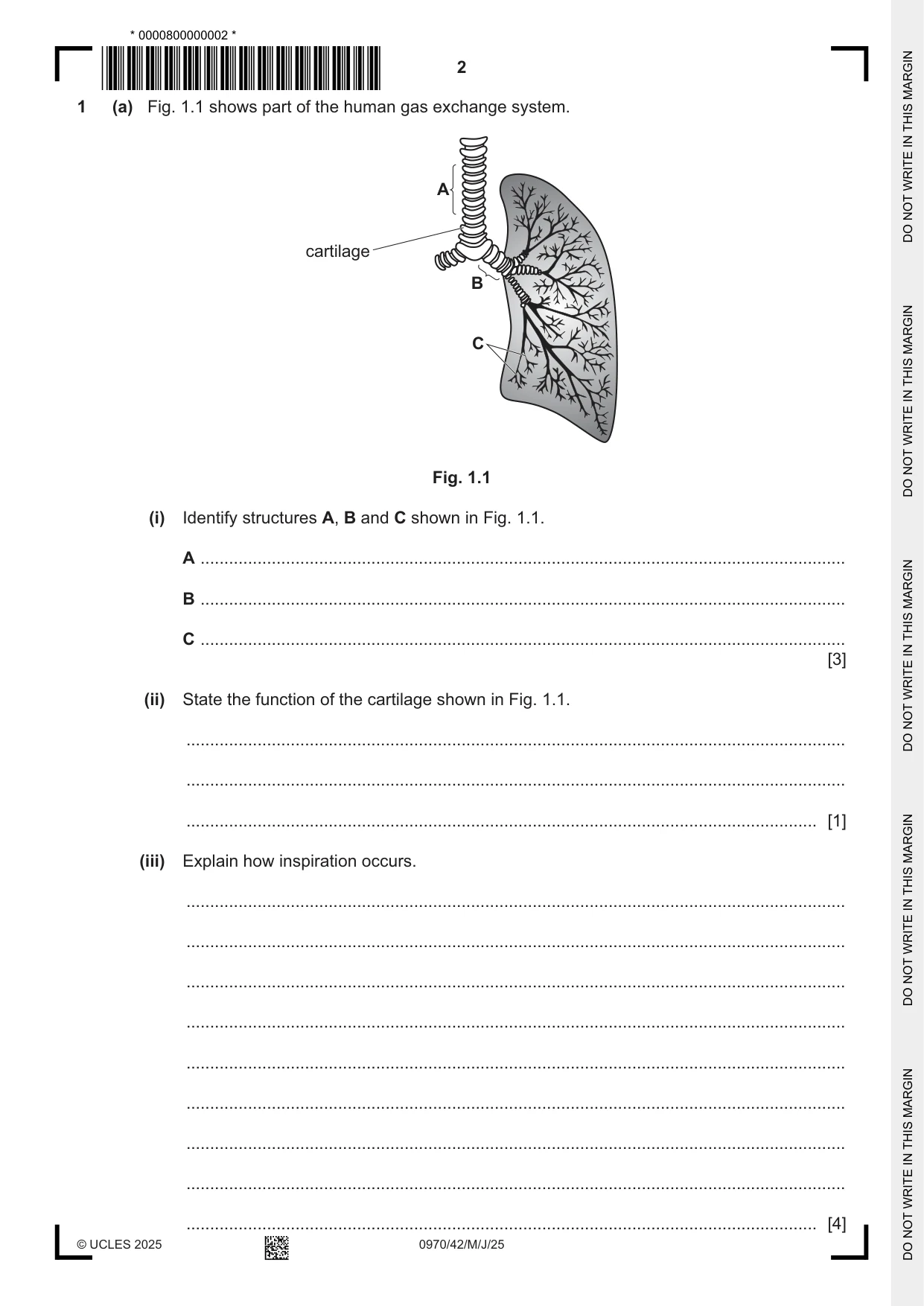
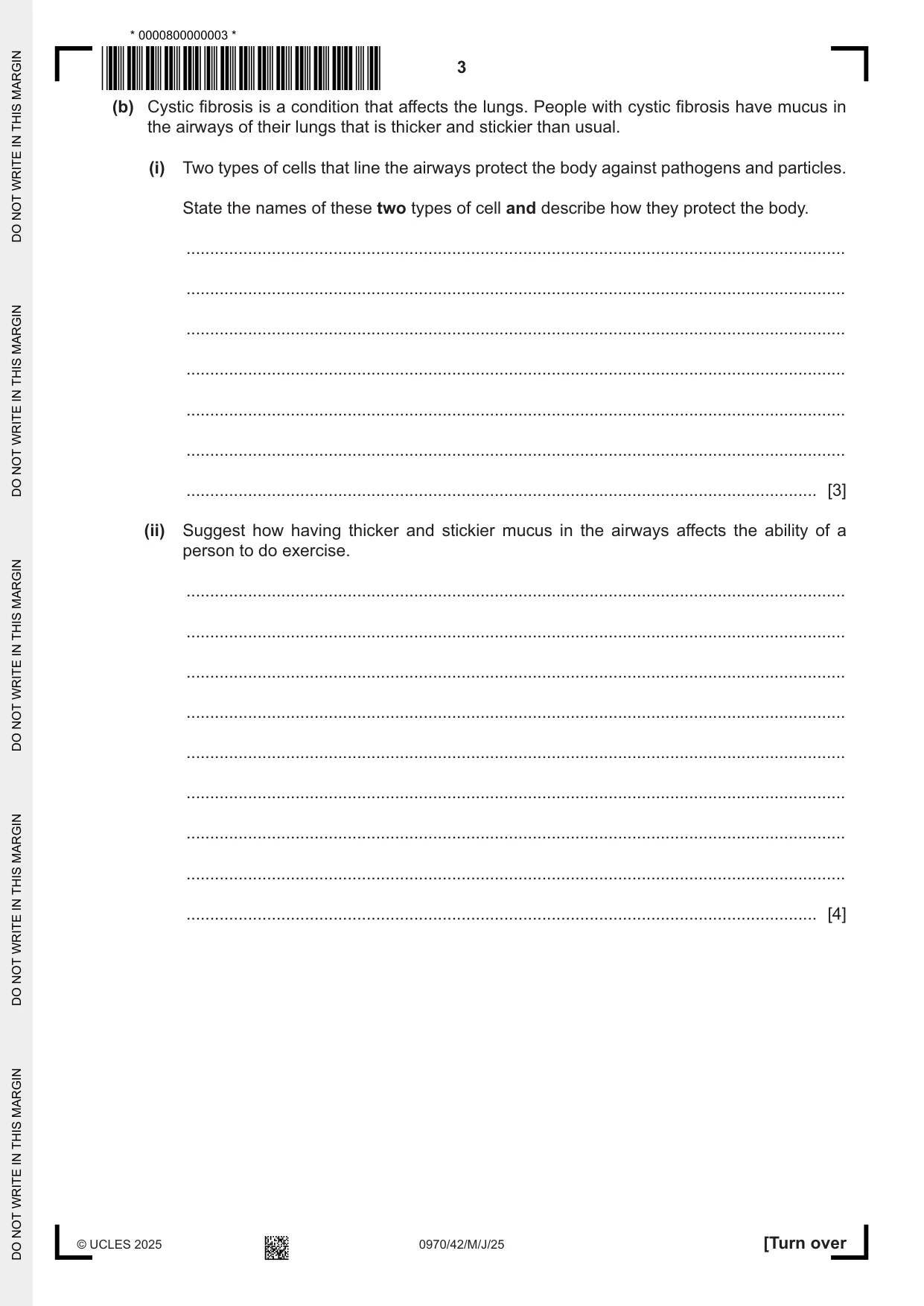
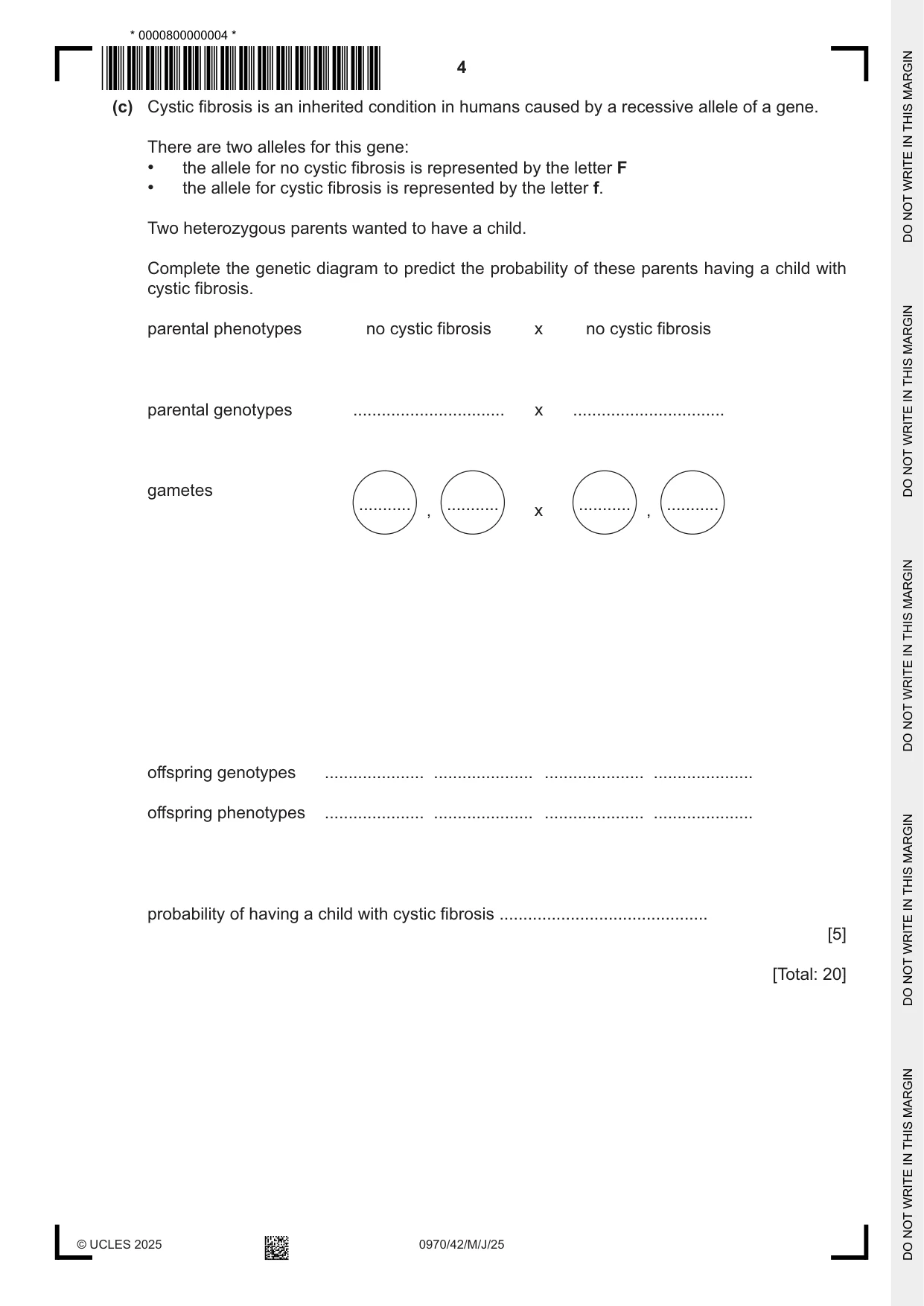
1 (a) Fig. 1.1 shows part of the human gas exchange system. A cartilage B C Fig. 1.1 (i) Identify structures A, B and C shown in Fig. 1.1. A ........................................................................................................................................ B ........................................................................................................................................ C ........................................................................................................................................ [3] (ii) State the function of the cartilage shown in Fig. 1.1. ........................................................................................................................................... ........................................................................................................................................... ..................................................................................................................................... [1] (iii) Explain how inspiration occurs. ........................................................................................................................................... ........................................................................................................................................... ........................................................................................................................................... ........................................................................................................................................... ........................................................................................................................................... ........................................................................................................................................... ........................................................................................................................................... ........................................................................................................................................... ................ ............................................................................................................... [4] (b) Cystic fibrosis is a condition that affects the lungs. People with cystic fibrosis have mucus in the airways of their lungs that is thicker and stickier than usual. (i) Two types of cells that line the airways protect the body against pathogens and particles. State the names of these two types of cell and describe how they protect the body. ........................................................................................................................................... ........................................................................................................................................... ........................................................................................................................................... ........................................................................................................................................... ........................................................................................................................................... ........................................................................................................................................... ..................................................................................................................................... [3] (ii) Suggest how having thicker and stickier mucus in the airways affects the ability of a person to do exercise. ........................................................................................................................................... ........................................................................................................................................... ........................................................................................................................................... ........................................................................................................................................... ........................................................................................................................................... ........................................................................................................................................... ........................................................................................................................................... ........................................................................................................................................... ..................................................................................................................................... [4] (c) Cystic fibrosis is an inherited condition in humans caused by a recessive allele of a gene. There are two alleles for this gene: • the allele for no cystic fibrosis is represented by the letter F • the allele for cystic fibrosis is represented by the letter f. Two heterozygous parents wanted to have a child. Complete the genetic diagram to predict the probability of these parents having a child with cystic fibrosis. parental phenotypes no cystic fibrosis x no cystic fibrosis parental genotypes ................................ x ................................ gametes ........... ........... ........... ........... , x , offspring genotypes ..................... ..................... ..................... ..................... offspring phenotypes ..................... ..................... ..................... ..................... probability of having a child with cystic fibrosis ............................................ [5] [Total: 20]
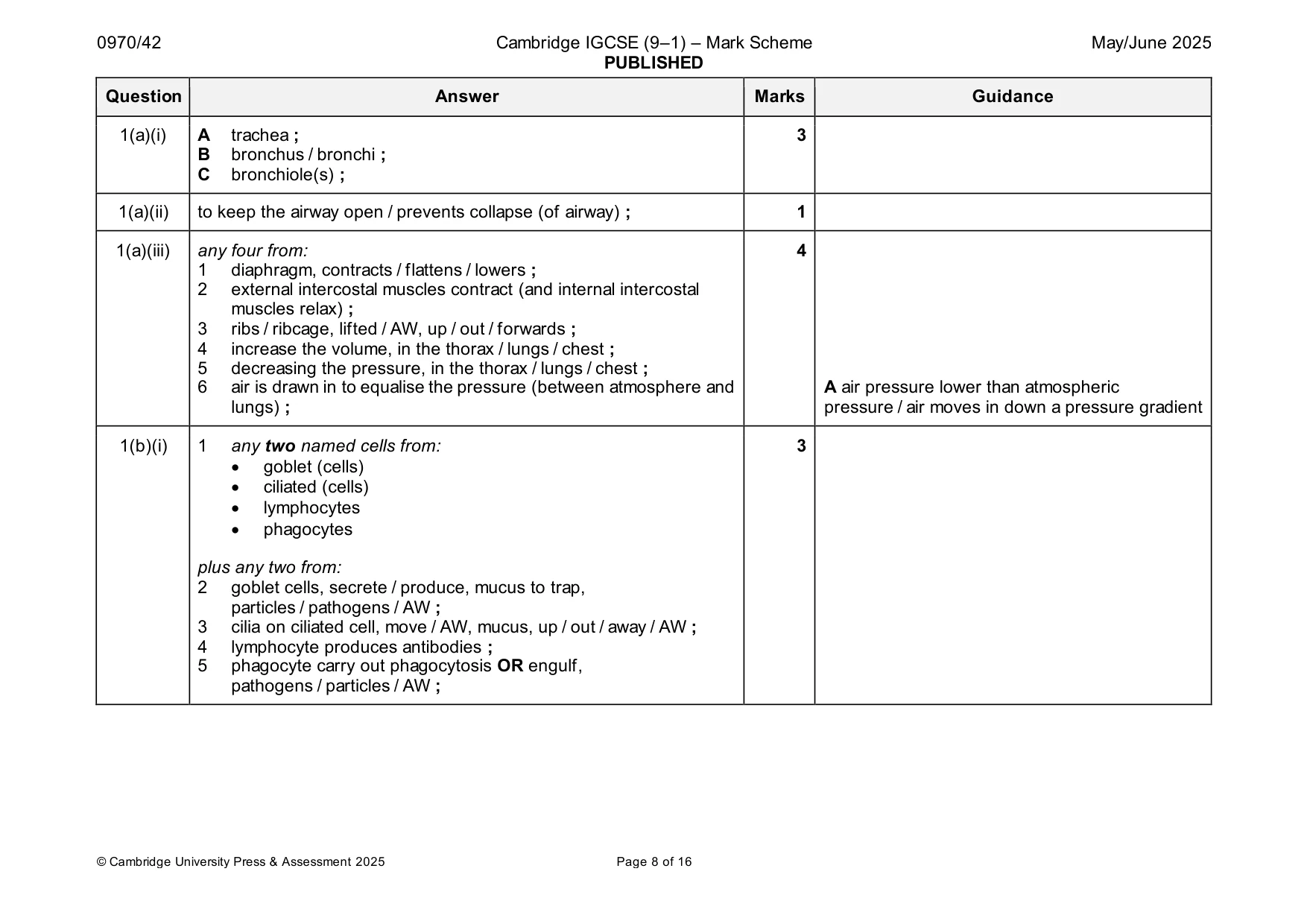
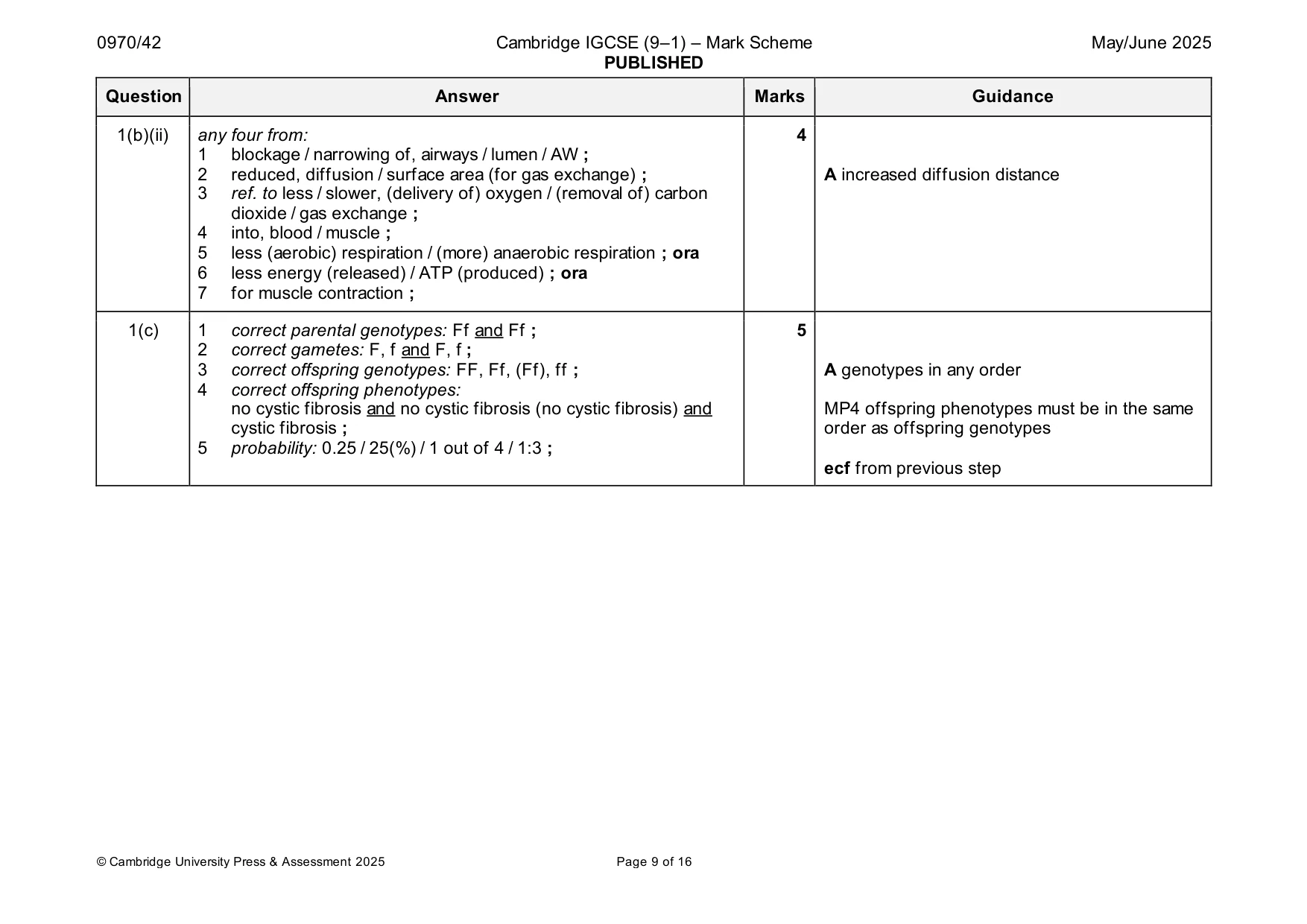
Mark scheme: Question Answer Marks Guidance 1(a)(i) A trachea ; 3 B bronchus / bronchi ; C bronchiole(s) ; 1(a)(ii) to keep the airway open / prevents collapse (of airway) ; 1 1(a)(iii) any four from: 4 1 diaphragm, contracts / flattens / lowers ; 2 external intercostal muscles contract (and internal intercostal muscles relax) ; 3 ribs / ribcage, lifted / AW, up / out / forwards ; 4 increase the volume, in the thorax / lungs / chest ; 5 decreasing the pressure, in the thorax / lungs / chest ; 6 air is drawn in to equalise the pressure (between atmosphere and A air pressure lower than atmospheric lungs) ; pressure / air moves in down a pressure gradient 1(b)(i) 1 any two named cells from: 3 • goblet (cells) • ciliated (cells) • lymphocytes • phagocytes plus any two from: 2 goblet cells, secrete / produce, mucus to trap, particles / pathogens / AW ; 3 cilia on ciliated cell, move / AW, mucus, up / out / away / AW ; 4 lymphocyte produces antibodies ; 5 phagocyte carry out phagocytosis OR engulf, pathogens / particles / AW ; 1(b)(ii) any four from: 4 1 blockage / narrowing of, airways / lumen / AW ; 2 reduced, diffusion / surface area (for gas exchange) ; A increased diffusion distance 3 ref. to less / slower, (delivery of) oxygen / (removal of) carbon dioxide / gas exchange ; 4 into, blood / muscle ; 5 less (aerobic) respiration / (more) anaerobic respiration ; ora 6 less energy (released) / ATP (produced) ; ora 7 for muscle contraction ; 1(c) 1 correct parental genotypes: Ff and Ff ; 5 2 correct gametes: F, f and F, f ; 3 correct offspring genotypes: FF, Ff, (Ff), ff ; A genotypes in any order 4 correct offspring phenotypes: no cystic fibrosis and no cystic fibrosis (no cystic fibrosis) and MP4 offspring phenotypes must be in the same cystic fibrosis ; order as offspring genotypes 5 probability: 0.25 / 25(%) / 1 out of 4 / 1:3 ; ecf from previous step
Q2 · A photomicrograph of human blood
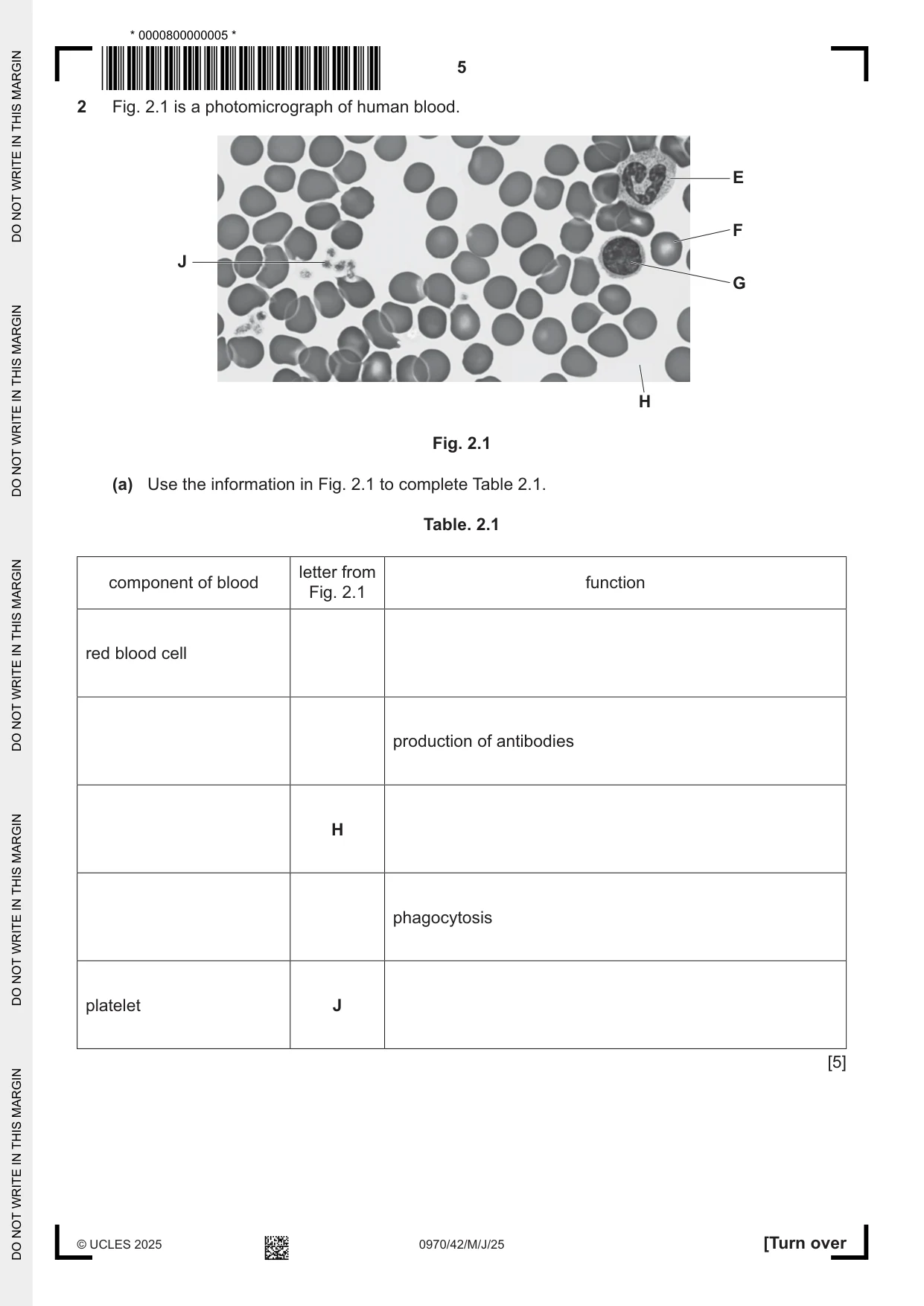
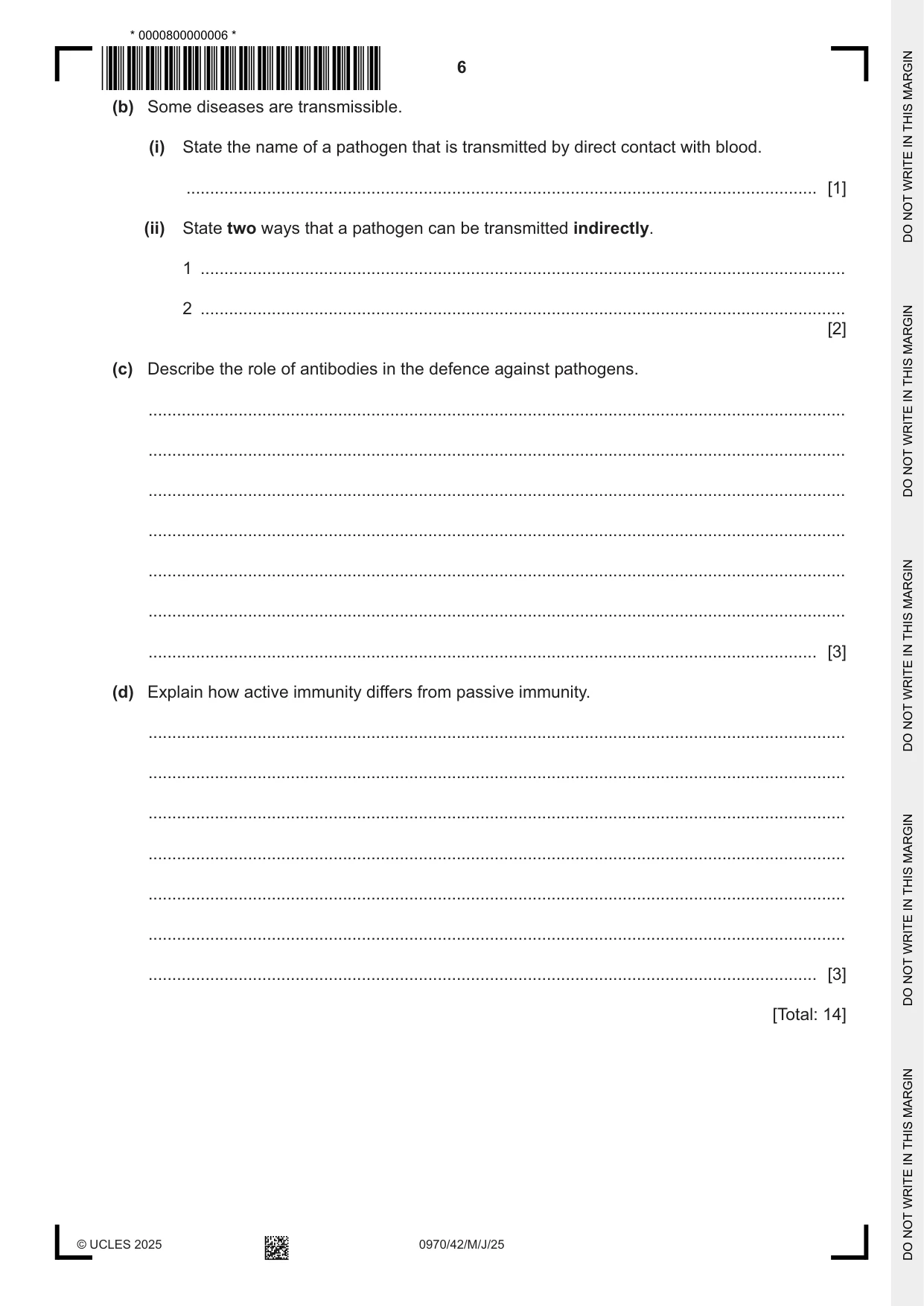
2 Fig. 2.1 is a photomicrograph of human blood. E F J G H Fig. 2.1 (a) Use the information in Fig. 2.1 to complete Table 2.1. Table. 2.1 letter from component of blood function Fig. 2.1 red blood cell production of antibodies H phagocytosis platelet J [5] (b) Some diseases are transmissible. (i) State the name of a pathogen that is transmitted by direct contact with blood. ..................................................................................................................................... [1] (ii) State two ways that a pathogen can be transmitted indirectly. 1 ........................................................................................................................................ 2 ........................................................................................................................................ [2] (c) Describe the role of antibodies in the defence against pathogens. ................................................................................................................................................... ................................................................................................................................................... ................................................................................................................................................... ................................................................................................................................................... ................................................................................................................................................... ................................................................................................................................................... ............................................................................................................................................. [3] (d) Explain how active immunity differs from passive immunity. ................................................................................................................................................... ................................................................................................................................................... ................................................................................................................................................... ................................................................................................................................................... ................................................................................................................................................... ................................................................................................................................................... ............................................................................................................................................. [3] [Total: 14]
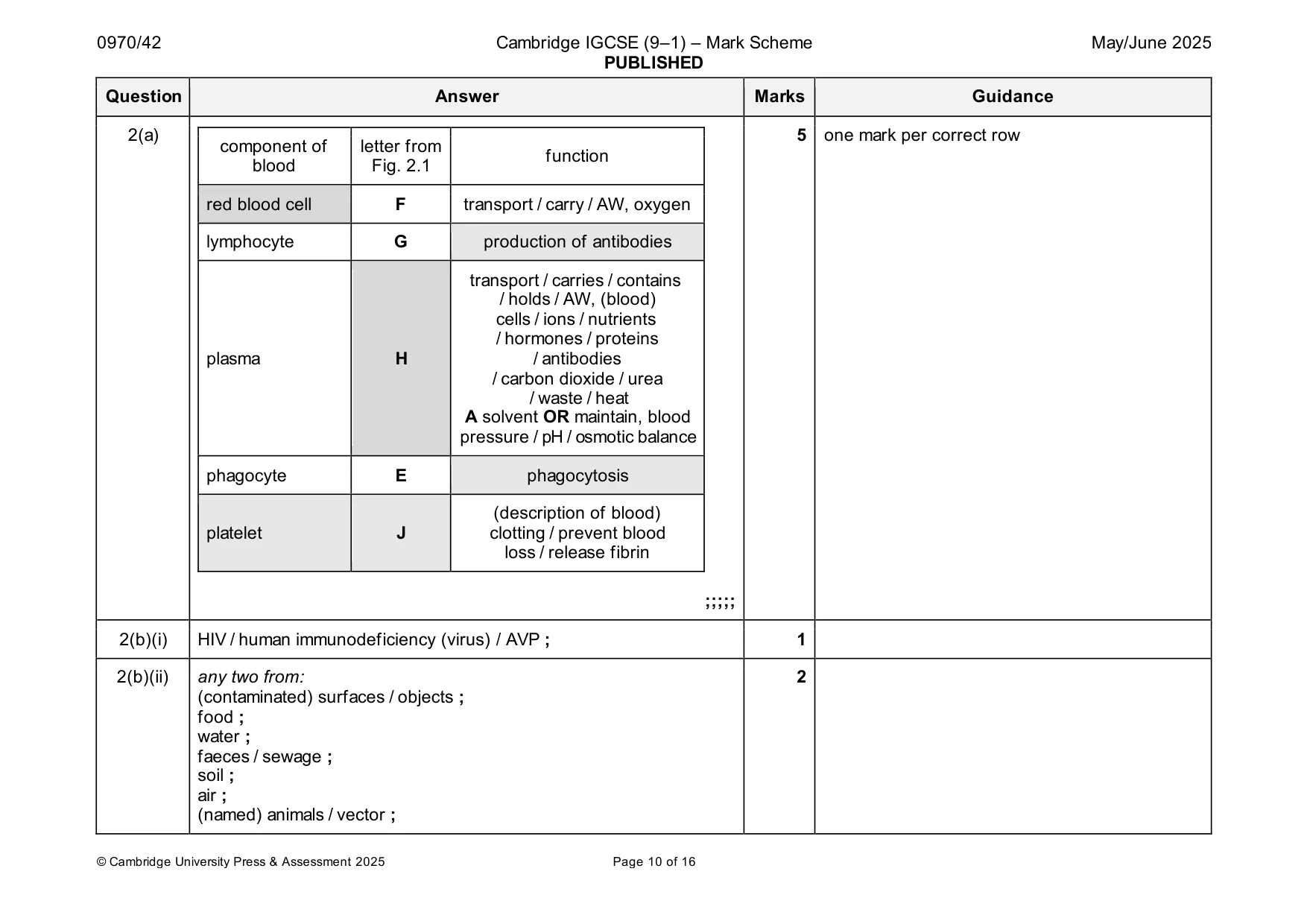
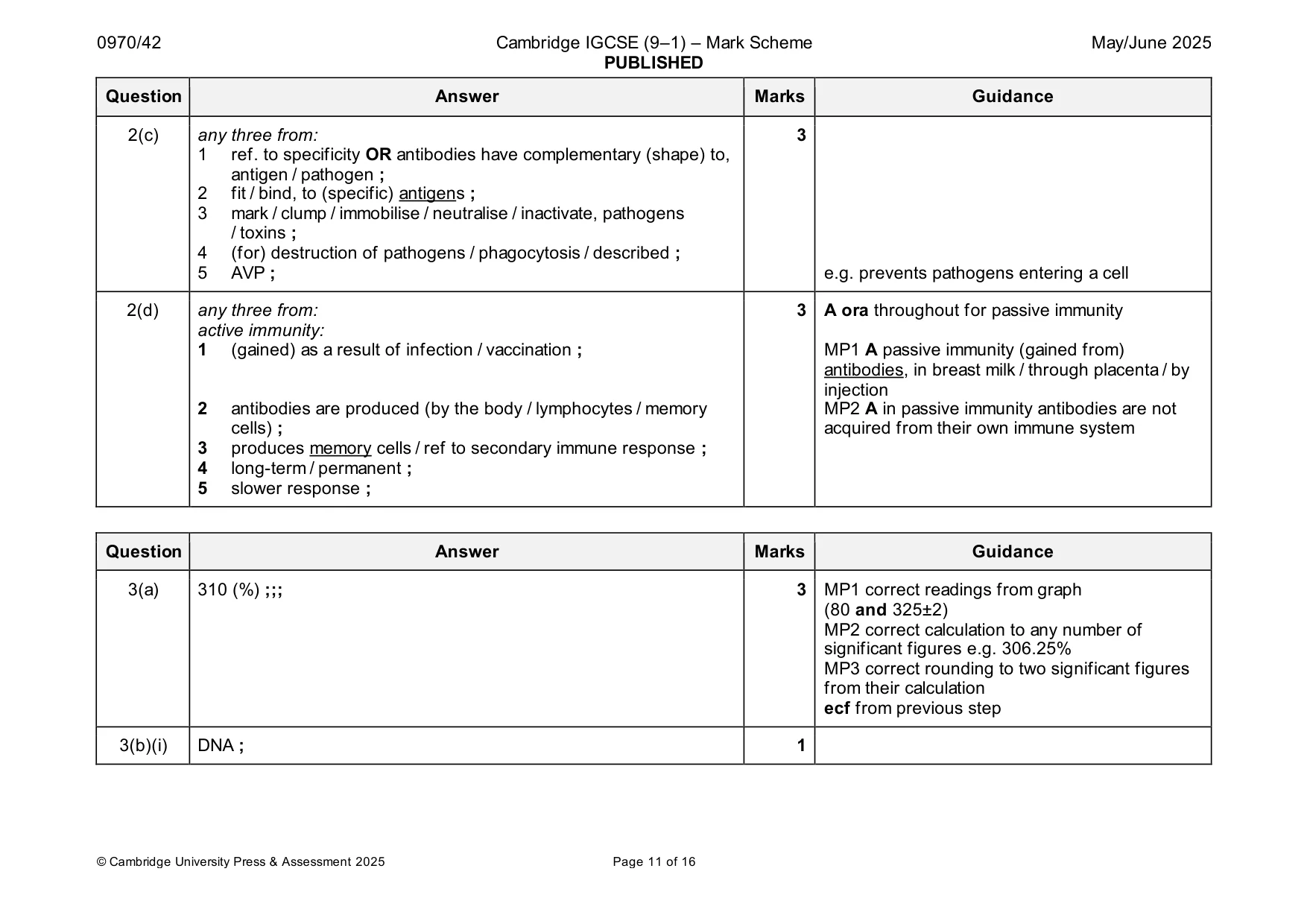
Mark scheme: 2(a) 5 one mark per correct row component of letter from function blood Fig. 2.1 red blood cell F transport / carry / AW, oxygen lymphocyte G production of antibodies transport / carries / contains / holds / AW, (blood) cells / ions / nutrients / hormones / proteins plasma H / antibodies / carbon dioxide / urea / waste / heat A solvent OR maintain, blood pressure / pH / osmotic balance phagocyte E phagocytosis (description of blood) platelet J clotting / prevent blood loss / release fibrin ;;;;; 2(b)(i) HIV / human immunodeficiency (virus) / AVP ; 1 2(b)(ii) any two from: 2 (contaminated) surfaces / objects ; food ; water ; faeces / sewage ; soil ; air ; (named) animals / vector ; 2(c) any three from: 3 1 ref. to specificity OR antibodies have complementary (shape) to, antigen / pathogen ; 2 fit / bind, to (specific) antigens ; 3 mark / clump / immobilise / neutralise / inactivate, pathogens / toxins ; 4 (for) destruction of pathogens / phagocytosis / described ; 5 AVP ; e.g. prevents pathogens entering a cell 2(d) any three from: 3 A ora throughout for passive immunity active immunity: 1 (gained) as a result of infection / vaccination ; MP1 A passive immunity (gained from) antibodies, in breast milk / through placenta / by injection 2 antibodies are produced (by the body / lymphocytes / memory MP2 A in passive immunity antibodies are not cells) ; acquired from their own immune system 3 produces memory cells / ref to secondary immune response ; 4 long-term / permanent ; 5 slower response ;
Q3 · Scientists developed genetically modified (GM) maize
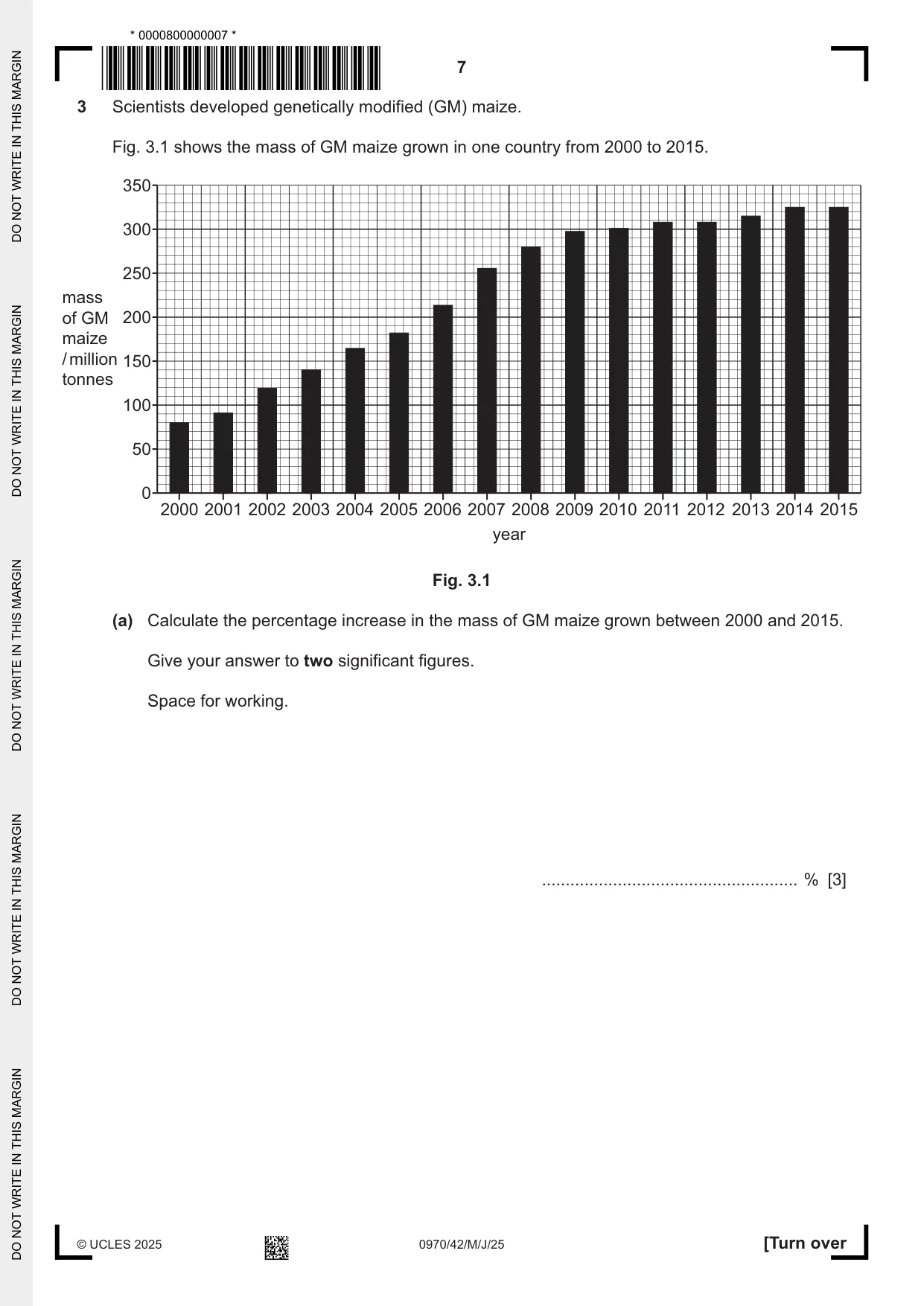
3 Scientists developed genetically modified (GM) maize. Fig. 3.1 shows the mass of GM maize grown in one country from 2000 to 2015. 350 300 250 mass of GM 200 maize / million 150 tonnes 100 50 0 2000 2001 2002 2003 2004 2005 2006 2007 2008 2009 2010 2011 2012 2013 2014 2015 year Fig. 3.1 (a) Calculate the percentage increase in the mass of GM maize grown between 2000 and 2015. Give your answer to two significant figures. Space for working. ...................................................... % [3] (b) To develop GM maize, a gene for producing a natural insecticide was taken from a bacterium and transferred into maize plant cells. (i) Genes are found at specific positions on a biological molecule. State the name of this biological molecule. ..................................................................................................................................... [1] (ii) Scientists who develop GM crop plants breed them for many generations before allowing farmers to grow the crop plants. Suggest why scientists breed the GM crop plants for many generations. ........................................................................................................................................... ........................................................................................................................................... ........................................................................................................................................... ........................................................................................................................................... ..................................................................................................................................... [2] (iii) Human proteins can also be made using bacteria that have been genetically modified. Describe how a gene can be transferred from one organism to another using genetic modification. ........................................................................................................................................... ........................................................................................................................................... ........................................................................................................................................... ........................................................................................................................................... ........................................................................................................................................... ........................................................................................................................................... ........................................................................................................................................... ........................................................................................................................................... ........................................................................................................................................... ........................................................................................................................................... ........................................................................................................................................... ........................................................................................................................................... ..................................................................................................................................... [6] (c) Some people are worried that GM crops could pollinate wild plants. (i) Suggest how pollination between GM crops and wild plants could be prevented. ........................................................................................................................................... ........................................................................................................................................... ..................................................................................................................................... [1] (ii) State two advantages of GM crops other than insect resistance. 1 ........................................................................................................................................ 2 ........................................................................................................................................ [2] [Total: 15]
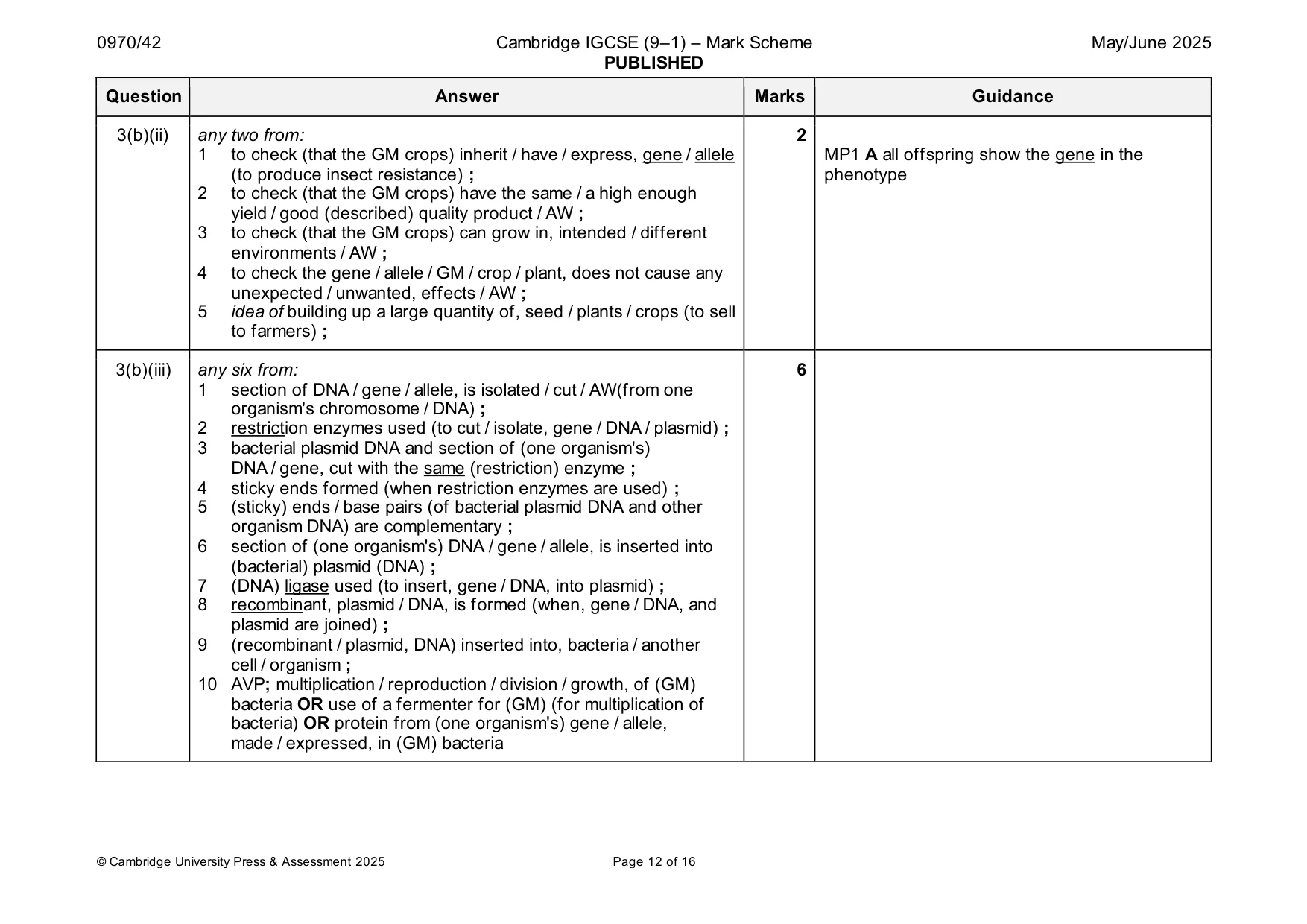
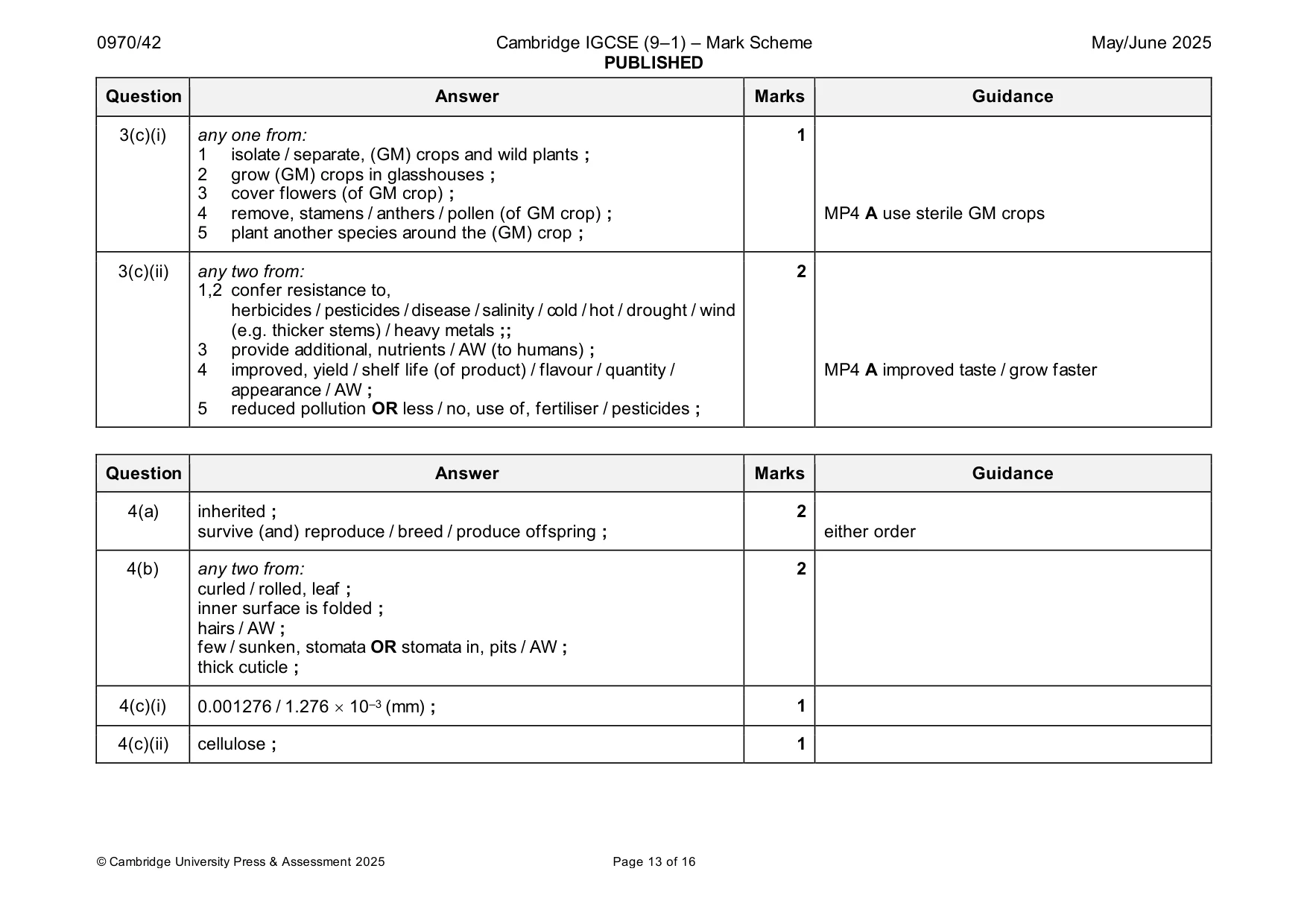
Mark scheme: 3(a) 310 (%) ;;; 3 MP1 correct readings from graph (80 and 325±2) MP2 correct calculation to any number of significant figures e.g. 306.25% MP3 correct rounding to two significant figures from their calculation ecf from previous step 3(b)(i) DNA ; 1 3(b)(ii) any two from: 2 1 to check (that the GM crops) inherit / have / express, gene / allele MP1 A all offspring show the gene in the (to produce insect resistance) ; phenotype 2 to check (that the GM crops) have the same / a high enough yield / good (described) quality product / AW ; 3 to check (that the GM crops) can grow in, intended / different environments / AW ; 4 to check the gene / allele / GM / crop / plant, does not cause any unexpected / unwanted, effects / AW ; 5 idea of building up a large quantity of, seed / plants / crops (to sell to farmers) ; 3(b)(iii) any six from: 6 1 section of DNA / gene / allele, is isolated / cut / AW(from one organism's chromosome / DNA) ; 2 restriction enzymes used (to cut / isolate, gene / DNA / plasmid) ; 3 bacterial plasmid DNA and section of (one organism's) DNA / gene, cut with the same (restriction) enzyme ; 4 sticky ends formed (when restriction enzymes are used) ; 5 (sticky) ends / base pairs (of bacterial plasmid DNA and other organism DNA) are complementary ; 6 section of (one organism's) DNA / gene / allele, is inserted into (bacterial) plasmid (DNA) ; 7 (DNA) ligase used (to insert, gene / DNA, into plasmid) ; 8 recombinant, plasmid / DNA, is formed (when, gene / DNA, and plasmid are joined) ; 9 (recombinant / plasmid, DNA) inserted into, bacteria / another cell / organism ; 10 AVP; multiplication / reproduction / division / growth, of (GM) bacteria OR use of a fermenter for (GM) (for multiplication of bacteria) OR protein from (one organism's) gene / allele, made / expressed, in (GM) bacteria 3(c)(i) any one from: 1 1 isolate / separate, (GM) crops and wild plants ; 2 grow (GM) crops in glasshouses ; 3 cover flowers (of GM crop) ; 4 remove, stamens / anthers / pollen (of GM crop) ; MP4 A use sterile GM crops 5 plant another species around the (GM) crop ; 3(c)(ii) any two from: 2 1,2 confer resistance to, herbicides / pesticides / disease / salinity / cold / hot / drought / wind (e.g. thicker stems) / heavy metals ;; 3 provide additional, nutrients / AW (to humans) ; 4 improved, yield / shelf life (of product) / flavour / quantity / MP4 A improved taste / grow faster appearance / AW ; 5 reduced pollution OR less / no, use of, fertiliser / pesticides ;
Q4 · Xerophytes are plants that show adaptive features for dry habitats
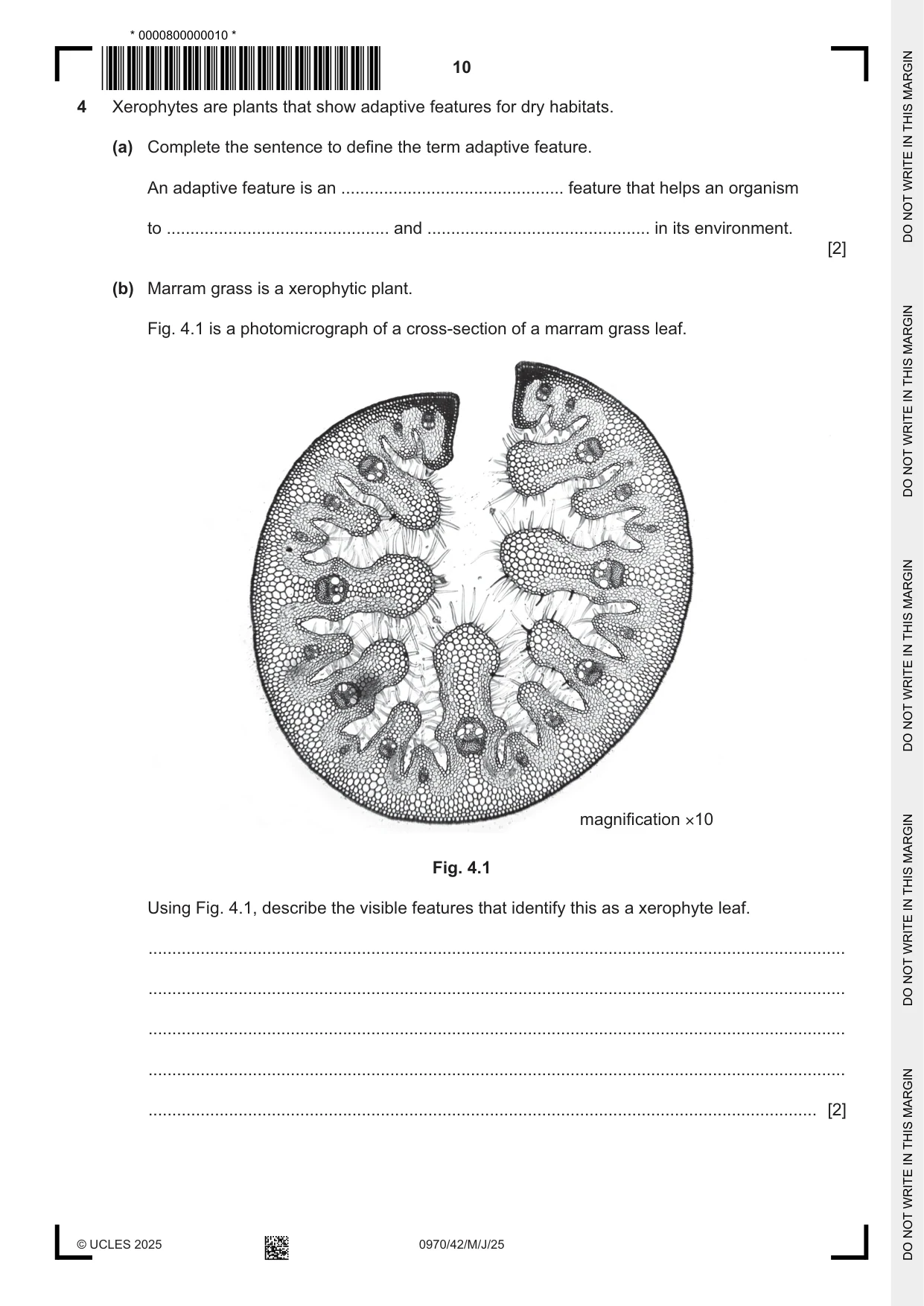
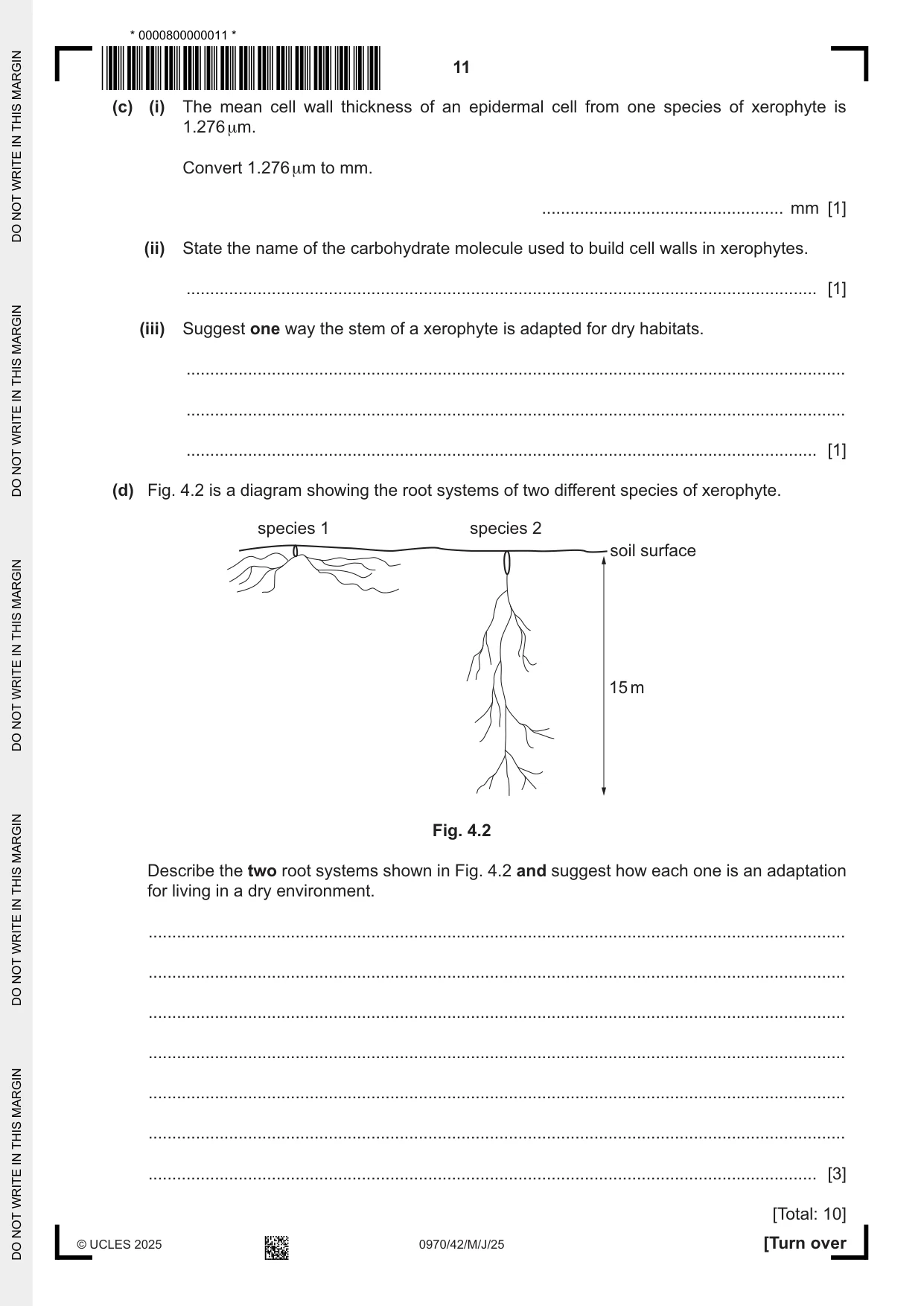
4 Xerophytes are plants that show adaptive features for dry habitats. (a) Complete the sentence to define the term adaptive feature. An adaptive feature is an ............................................... feature that helps an organism to ............................................... and ............................................... in its environment. [2] (b) Marram grass is a xerophytic plant. Fig. 4.1 is a photomicrograph of a cross-section of a marram grass leaf. magnification ×10 Fig. 4.1 Using Fig. 4.1, describe the visible features that identify this as a xerophyte leaf. ................................................................................................................................................... ................................................................................................................................................... ................................................................................................................................................... ................................................................................................................................................... ............................................................................................................................................. [2] (c) (i) The mean cell wall thickness of an epidermal cell from one species of xerophyte is 1.276 μm. Convert 1.276 μm to mm. ................................................... mm [1] (ii) State the name of the carbohydrate molecule used to build cell walls in xerophytes. ..................................................................................................................................... [1] (iii) Suggest one way the stem of a xerophyte is adapted for dry habitats. ........................................................................................................................................... ........................................................................................................................................... ..................................................................................................................................... [1] (d) Fig. 4.2 is a diagram showing the root systems of two different species of xerophyte. species 1 species 2 soil surface 15 m Fig. 4.2 Describe the two root systems shown in Fig. 4.2 and suggest how each one is an adaptation for living in a dry environment. ................................................................................................................................................... ................................................................................................................................................... ................................................................................................................................................... ................................................................................................................................................... ................................................................................................................................................... ................................................................................................................................................... ............................................................................................................................................. [3] [Total: 10]
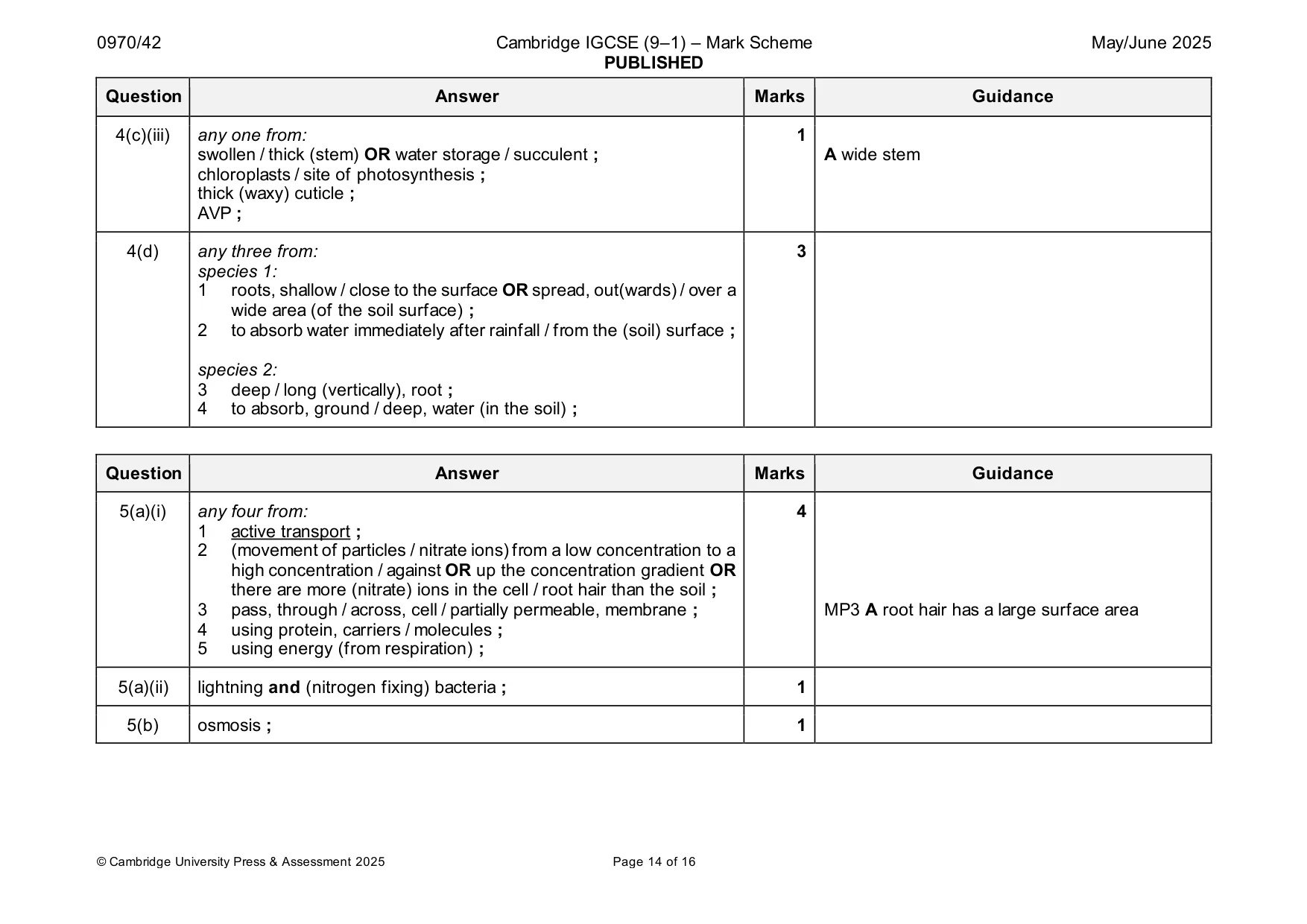
Mark scheme: 4(a) inherited ; 2 survive (and) reproduce / breed / produce offspring ; either order 4(b) any two from: 2 curled / rolled, leaf ; inner surface is folded ; hairs / AW ; few / sunken, stomata OR stomata in, pits / AW ; thick cuticle ; 4(c)(i) 0.001276 / 1.276 10–3 (mm) ; 1 4(c)(ii) cellulose ; 1 4(c)(iii) any one from: 1 swollen / thick (stem) OR water storage / succulent ; A wide stem chloroplasts / site of photosynthesis ; thick (waxy) cuticle ; AVP ; 4(d) any three from: 3 species 1: 1 roots, shallow / close to the surface OR spread, out(wards) / over a wide area (of the soil surface) ; 2 to absorb water immediately after rainfall / from the (soil) surface ; species 2: 3 deep / long (vertically), root ; 4 to absorb, ground / deep, water (in the soil) ;
Q5 · A diagram of a plant root hair cell
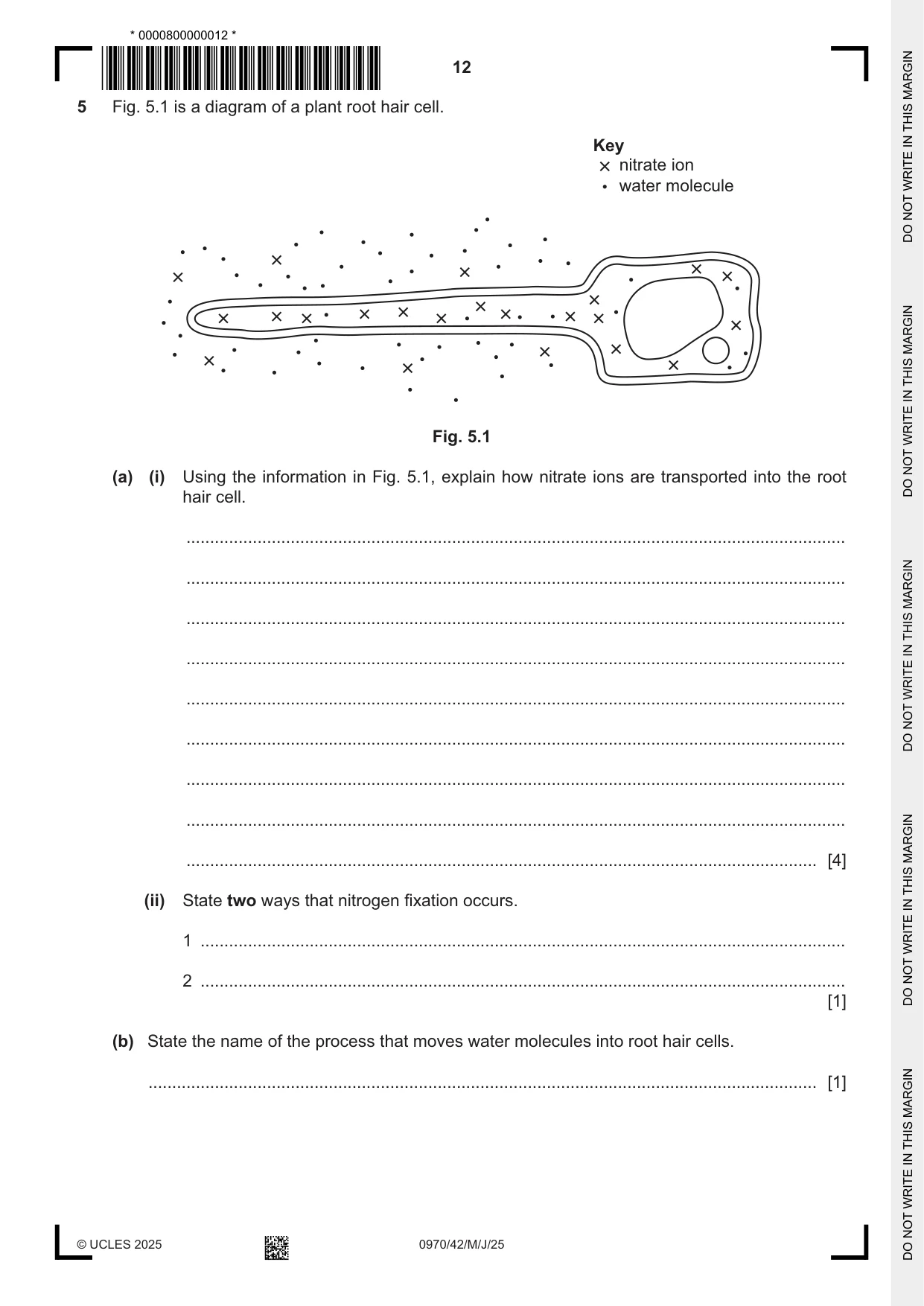
5 Fig. 5.1 is a diagram of a plant root hair cell. Key nitrate ion water molecule Fig. 5.1 (a) (i) Using the information in Fig. 5.1, explain how nitrate ions are transported into the root hair cell. ........................................................................................................................................... ........................................................................................................................................... ........................................................................................................................................... ........................................................................................................................................... ........................................................................................................................................... ........................................................................................................................................... ........................................................................................................................................... ........................................................................................................................................... ..................................................................................................................................... [4] (ii) State two ways that nitrogen fixation occurs. 1 ........................................................................................................................................ 2 ........................................................................................................................................ [1] (b) State the name of the process that moves water molecules into root hair cells. ............................................................................................................................................. [1] (c) Describe differences and similarities between the structure of a plant root hair cell and a bacterial cell. ................................................................................................................................................... ................................................................................................................................................... ................................................................................................................................................... ................................................................................................................................................... ................................................................................................................................................... ................................................................................................................................................... ................................................................................................................................................... ................................................................................................................................................... ................................................................................................................................................... ................................................................................................................................................... ............................................................................................................................................. [5] [Total: 11]
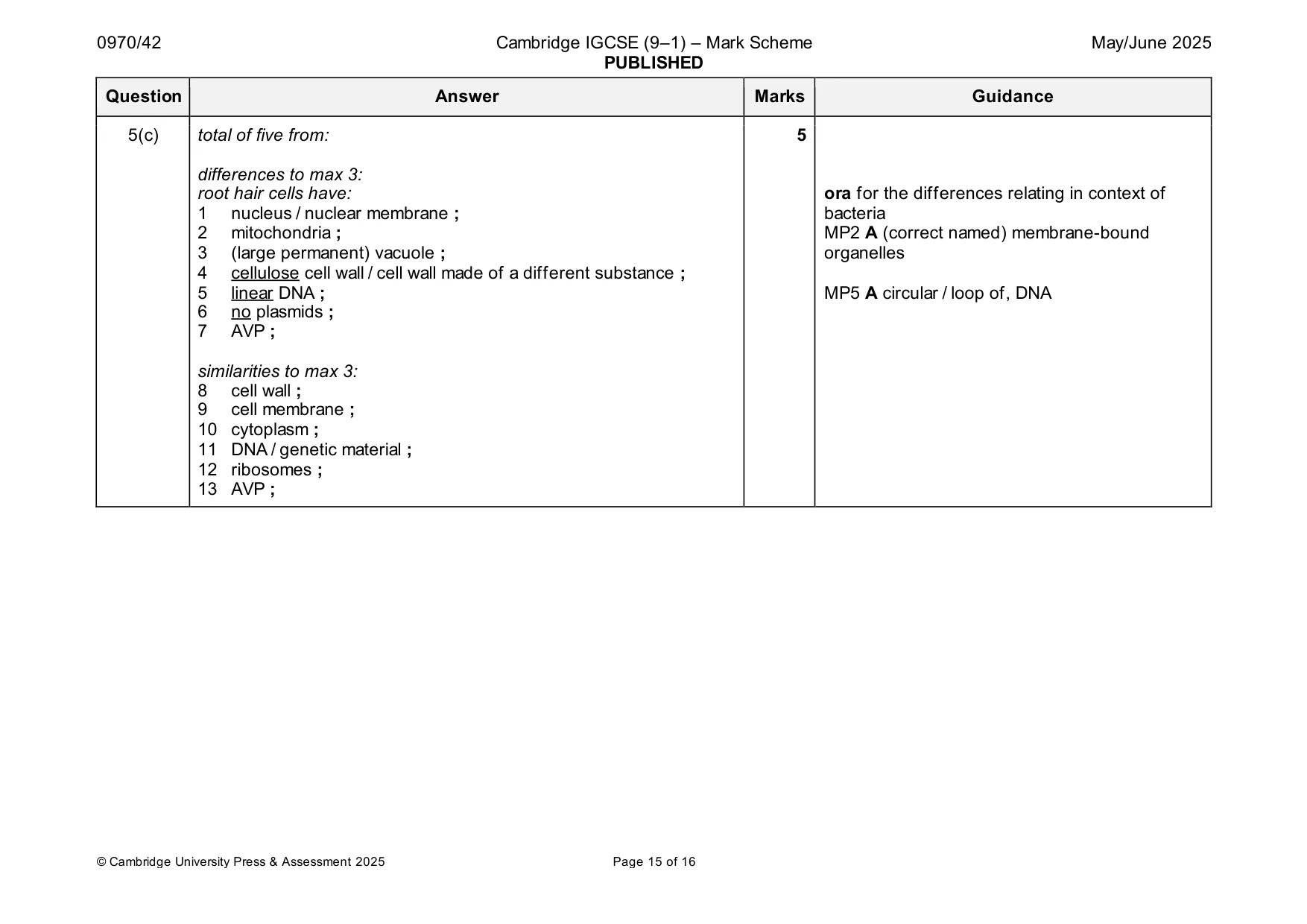
Mark scheme: 5(a)(i) any four from: 4 1 active transport ; 2 (movement of particles / nitrate ions) from a low concentration to a high concentration / against OR up the concentration gradient OR there are more (nitrate) ions in the cell / root hair than the soil ; 3 pass, through / across, cell / partially permeable, membrane ; MP3 A root hair has a large surface area 4 using protein, carriers / molecules ; 5 using energy (from respiration) ; 5(a)(ii) lightning and (nitrogen fixing) bacteria ; 1 5(b) osmosis ; 1 5(c) total of five from: 5 differences to max 3: root hair cells have: ora for the differences relating in context of 1 nucleus / nuclear membrane ; bacteria 2 mitochondria ; MP2 A (correct named) membrane-bound 3 (large permanent) vacuole ; organelles 4 cellulose cell wall / cell wall made of a different substance ; 5 linear DNA ; MP5 A circular / loop of, DNA 6 no plasmids ; 7 AVP ; similarities to max 3: 8 cell wall ; 9 cell membrane ; 10 cytoplasm ; 11 DNA / genetic material ; 12 ribosomes ; 13 AVP ;
Q6 · A scientist investigated the effect of changes in pH on the activity of two different…
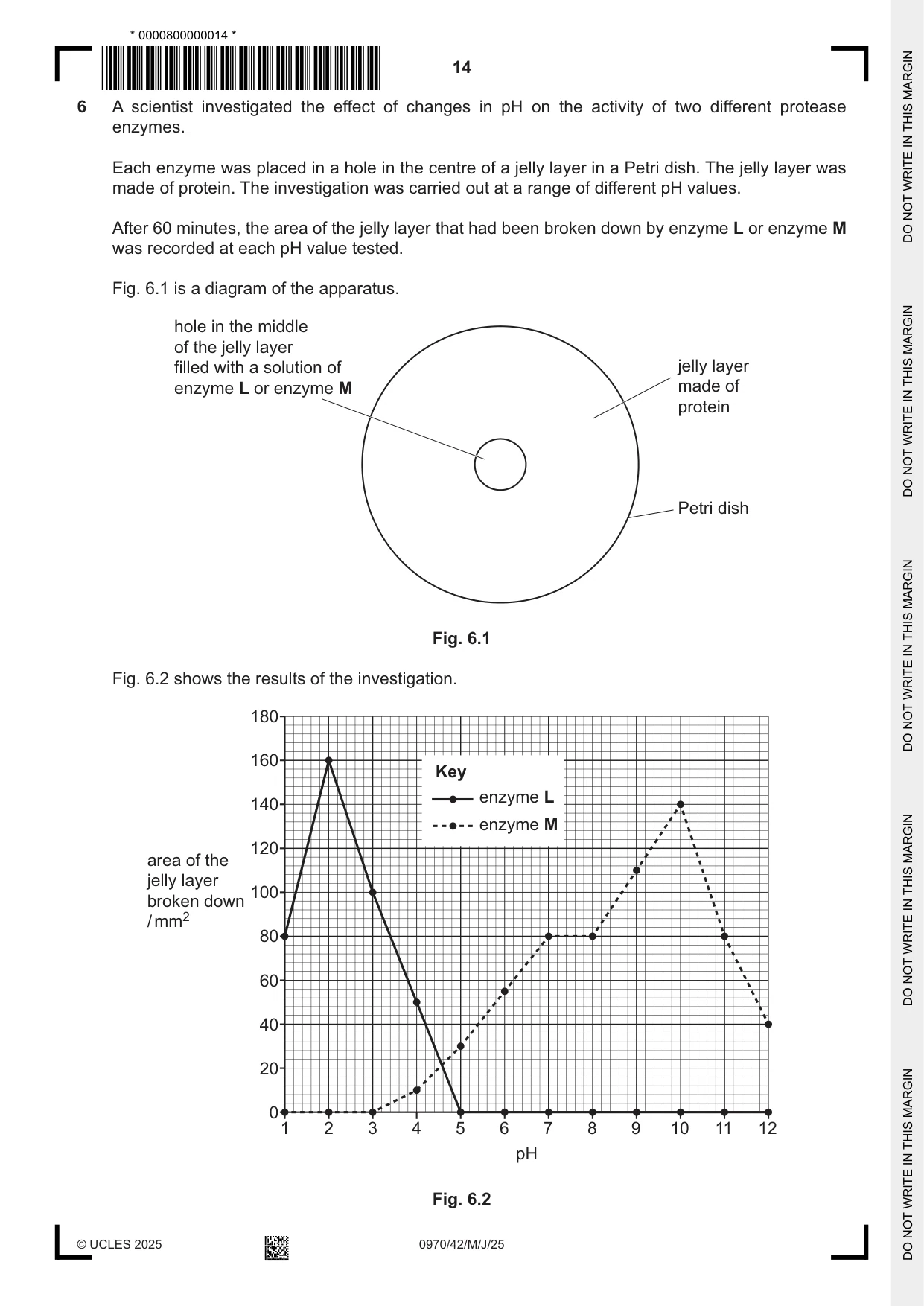
6 A scientist investigated the effect of changes in pH on the activity of two different protease enzymes. Each enzyme was placed in a hole in the centre of a jelly layer in a Petri dish. The jelly layer was made of protein. The investigation was carried out at a range of different pH values. After 60 minutes, the area of the jelly layer that had been broken down by enzyme L or enzyme M was recorded at each pH value tested. Fig. 6.1 is a diagram of the apparatus. hole in the middle of the jelly layer filled with a solution of jelly layer enzyme L or enzyme M made of protein Petri dish Fig. 6.1 Fig. 6.2 shows the results of the investigation. 180 160 Key enzyme L 140 enzyme M 120 area of the jelly layer 100 broken down / mm2 80 60 40 20 0 1 2 3 4 5 6 7 8 9 10 11 12 pH Fig. 6.2 (a) Using the information in Fig. 6.2, describe the results of this investigation. ................................................................................................................................................... ................................................................................................................................................... ................................................................................................................................................... ................................................................................................................................................... ................................................................................................................................................... ................................................................................................................................................... ................................................................................................................................................... ................................................................................................................................................... ................................................................................................................................................... ................................................................................................................................................... ............................................................................................................................................. [5] (b) Explain the result for enzyme M at pH 2 shown in Fig. 6.2. ................................................................................................................................................... ................................................................................................................................................... ................................................................................................................................................... ................................................................................................................................................... ................................................................................................................................................... ................................................................................................................................................... ............................................................................................................................................. [3] (c) Suggest the name of enzyme L and state its location in the human digestive system. name of enzyme L .................................................................................................................... location ..................................................................................................................................... [2] [Total: 10]
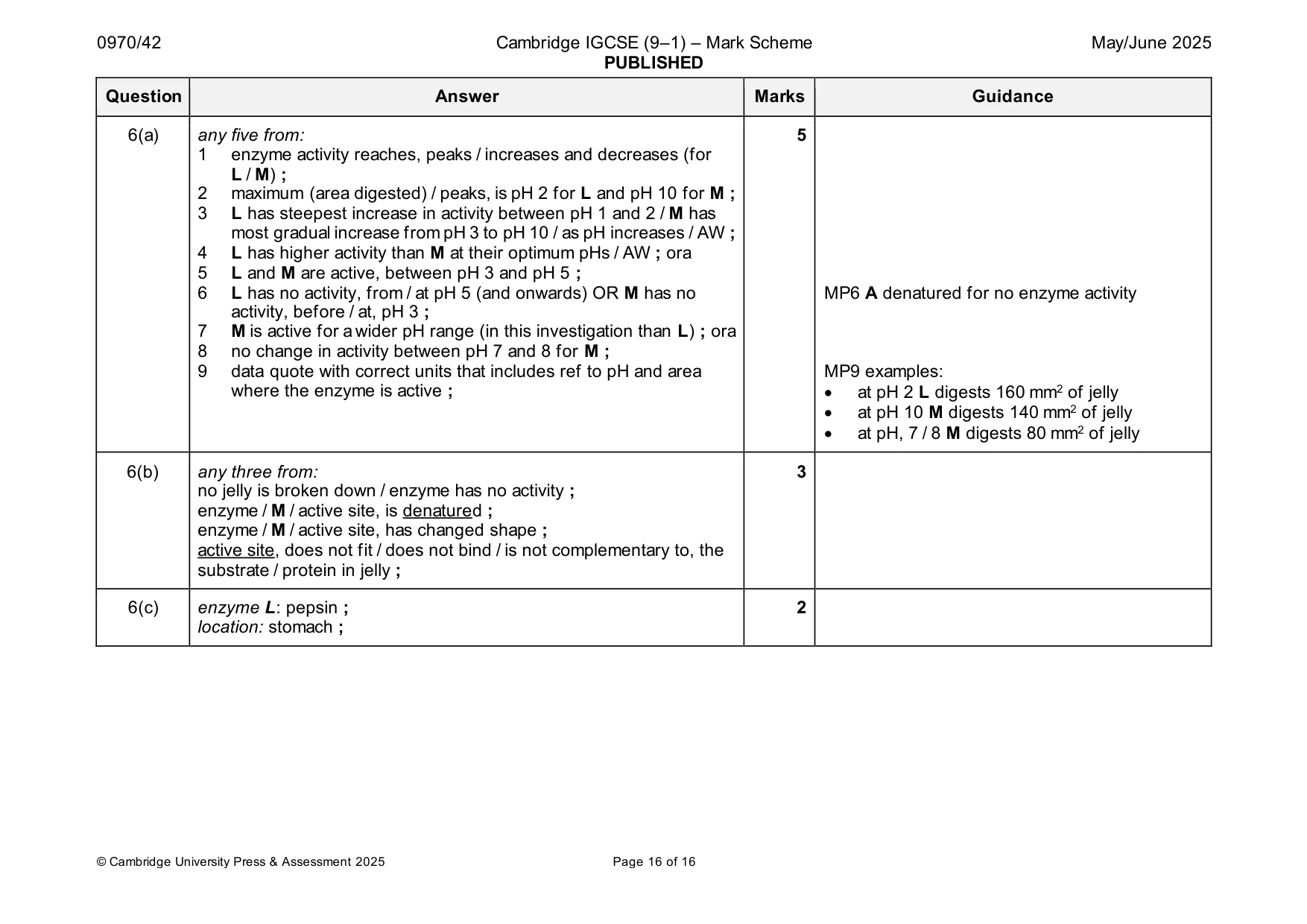
Mark scheme: 6(a) any five from: 5 1 enzyme activity reaches, peaks / increases and decreases (for L / M) ; 2 maximum (area digested) / peaks, is pH 2 for L and pH 10 for M ; 3 L has steepest increase in activity between pH 1 and 2 / M has most gradual increase from pH 3 to pH 10 / as pH increases / AW ; 4 L has higher activity than M at their optimum pHs / AW ; ora 5 L and M are active, between pH 3 and pH 5 ; 6 L has no activity, from / at pH 5 (and onwards) OR M has no MP6 A denatured for no enzyme activity activity, before / at, pH 3 ; 7 M is active for a wider pH range (in this investigation than L) ; ora 8 no change in activity between pH 7 and 8 for M ; 9 data quote with correct units that includes ref to pH and area MP9 examples: where the enzyme is active ; • at pH 2 L digests 160 mm2 of jelly • at pH 10 M digests 140 mm2 of jelly • at pH, 7 / 8 M digests 80 mm2 of jelly 6(b) any three from: 3 no jelly is broken down / enzyme has no activity ; enzyme / M / active site, is denatured ; enzyme / M / active site, has changed shape ; active site, does not fit / does not bind / is not complementary to, the substrate / protein in jelly ; 6(c) enzyme L: pepsin ; 2 location: stomach ;
What was in this paper
The subtopics covered by these 6 questions, and how many questions each got. Open one in a new tab to see every Cambridge question on it.
What you needed in this session
Cambridge’s own grade thresholds for 2025 May/June, Paper 4 · Variant 2. A higher threshold means an easier paper — the bar moves with how the cohort did.