Cambridge IGCSE Biology (9-1) 0970 — 2024 May/June Paper 4 · Variant 2
0970/42/M/J/24 · 6 questions · 80 marks · ≈90 min
The question paper and its mark scheme, free to read here and free to download. This is Cambridge’s own paper, exactly as it was sat.
Question paper20 pages



Mark scheme13 pages
Answers below. Sit the paper first if you are practising.
Questions as text
Q1 · Fungal cells and plant cells contain mitochondria
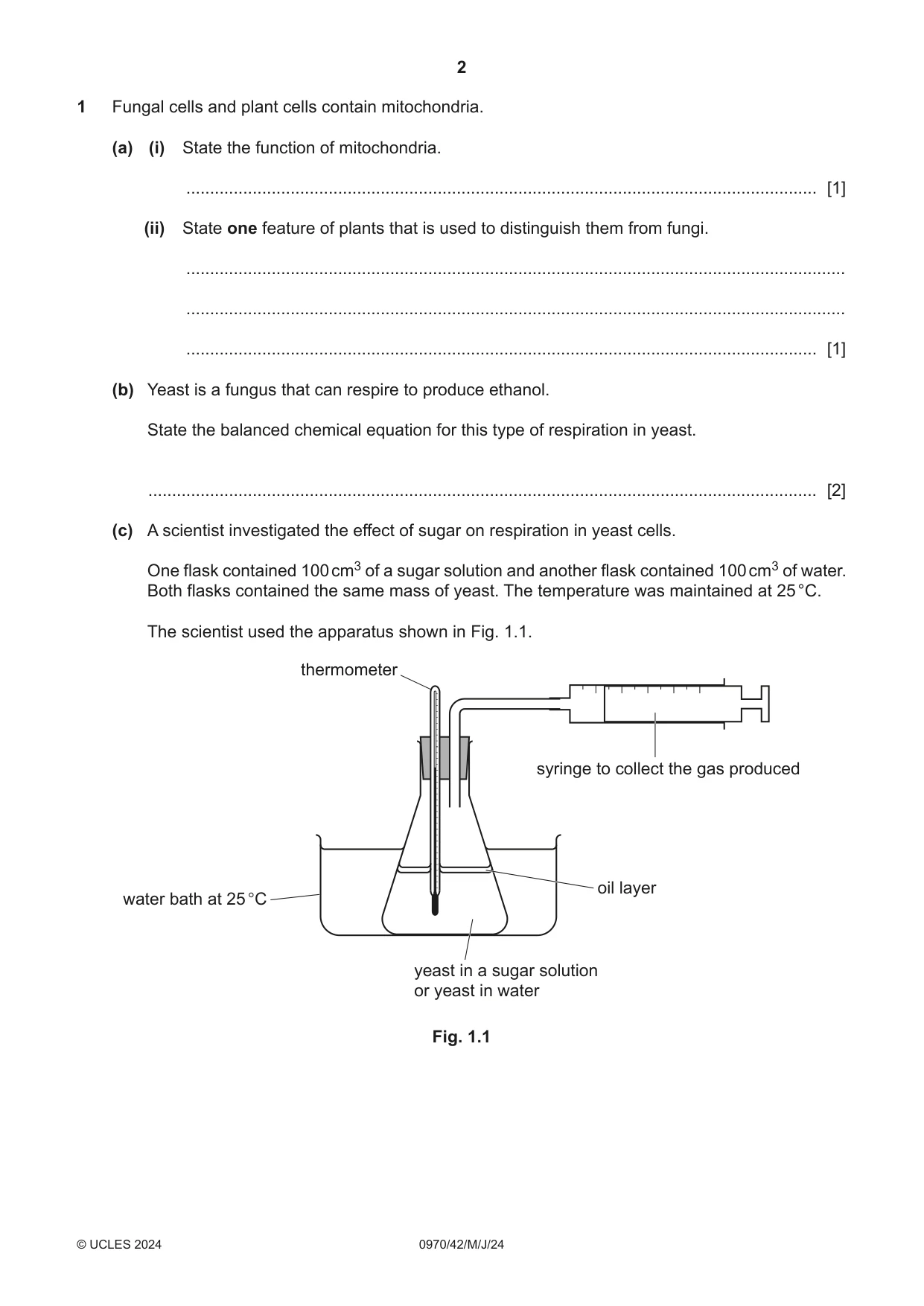
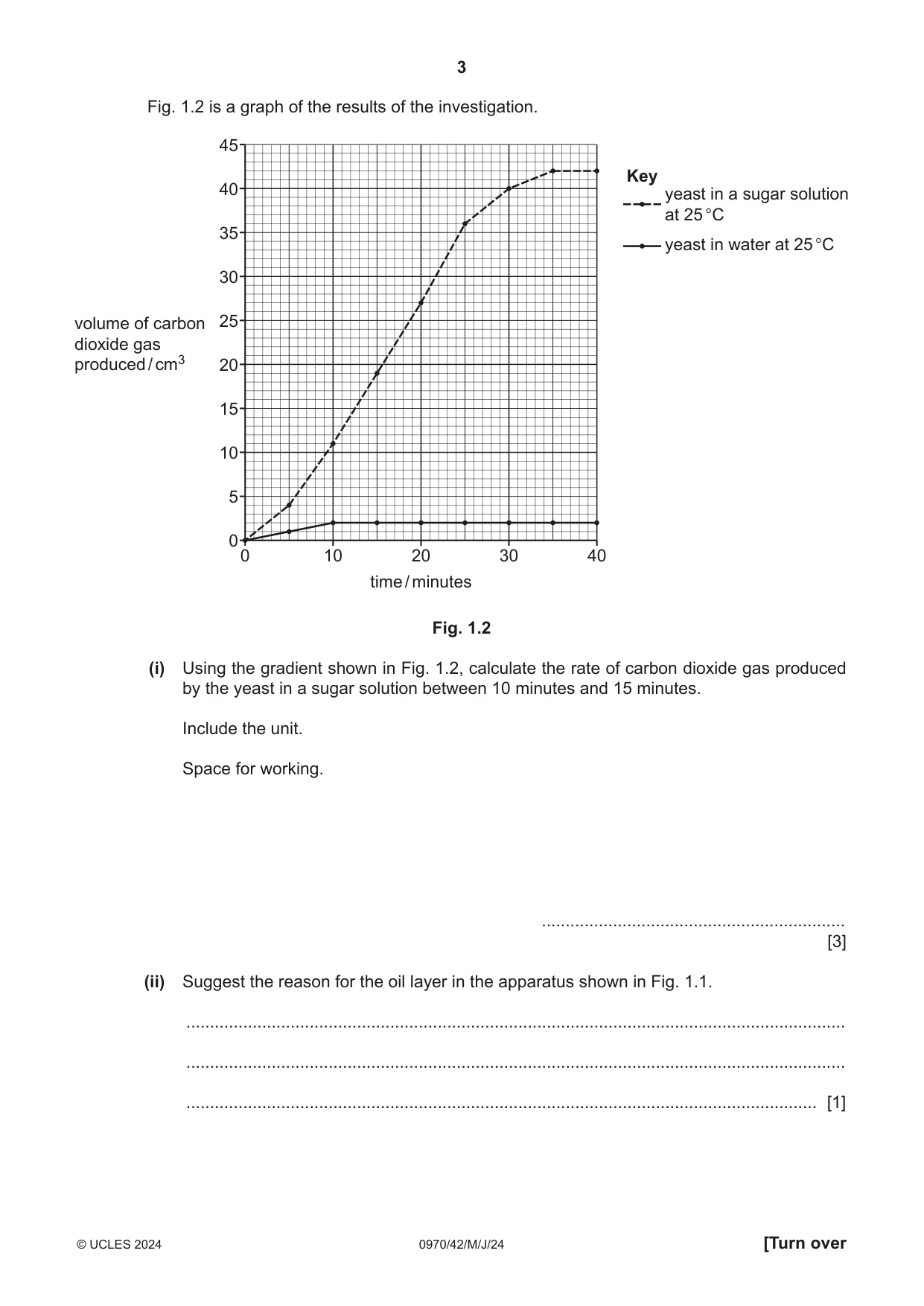
1 Fungal cells and plant cells contain mitochondria. (a) (i) State the function of mitochondria. ..................................................................................................................................... [1] (ii) State one feature of plants that is used to distinguish them from fungi. ........................................................................................................................................... ........................................................................................................................................... ..................................................................................................................................... [1] (b) Yeast is a fungus that can respire to produce ethanol. State the balanced chemical equation for this type of respiration in yeast. ............................................................................................................................................. [2] (c) A scientist investigated the effect of sugar on respiration in yeast cells. One flask contained 100 cm3 of a sugar solution and another flask contained 100 cm3 of water. Both flasks contained the same mass of yeast. The temperature was maintained at 25 °C. The scientist used the apparatus shown in Fig. 1.1. thermometer syringe to collect the gas produced oil layer water bath at 25 °C yeast in a sugar solution or yeast in water Fig. 1.1 Fig. 1.2 is a graph of the results of the investigation. 45 Key 40 yeast in a sugar solution at 25 °C 35 yeast in water at 25 °C 30 volume of carbon 25 dioxide gas produced / cm3 20 15 10 5 0 0 10 20 30 40 time / minutes Fig. 1.2 (i) Using the gradient shown in Fig. 1.2, calculate the rate of carbon dioxide gas produced by the yeast in a sugar solution between 10 minutes and 15 minutes. Include the unit. Space for working. ................................................................ [3] (ii) Suggest the reason for the oil layer in the apparatus shown in Fig. 1.1. ........................................................................................................................................... ........................................................................................................................................... ..................................................................................................................................... [1] (iii) State one reason why no more carbon dioxide gas was produced after 35 minutes by the yeast in a sugar solution, shown in Fig. 1.2. ........................................................................................................................................... ........................................................................................................................................... ..................................................................................................................................... [1] (iv) The scientist repeated the investigation using yeast and the sugar solution at a temperature of 95 °C. Explain why no carbon dioxide was produced at a temperature of 95 °C. ........................................................................................................................................... ........................................................................................................................................... ........................................................................................................................................... ........................................................................................................................................... ........................................................................................................................................... ........................................................................................................................................... ........................................................................................................................................... ........................................................................................................................................... ..................................................................................................................................... [3] (d) State one way in which humans use the carbon dioxide gas produced by yeast cells. ............................................................................................................................................. [1] (e) State the name of one gas, other than carbon dioxide, that contributes to the enhanced greenhouse effect. ............................................................................................................................................. [1] [Total: 14]
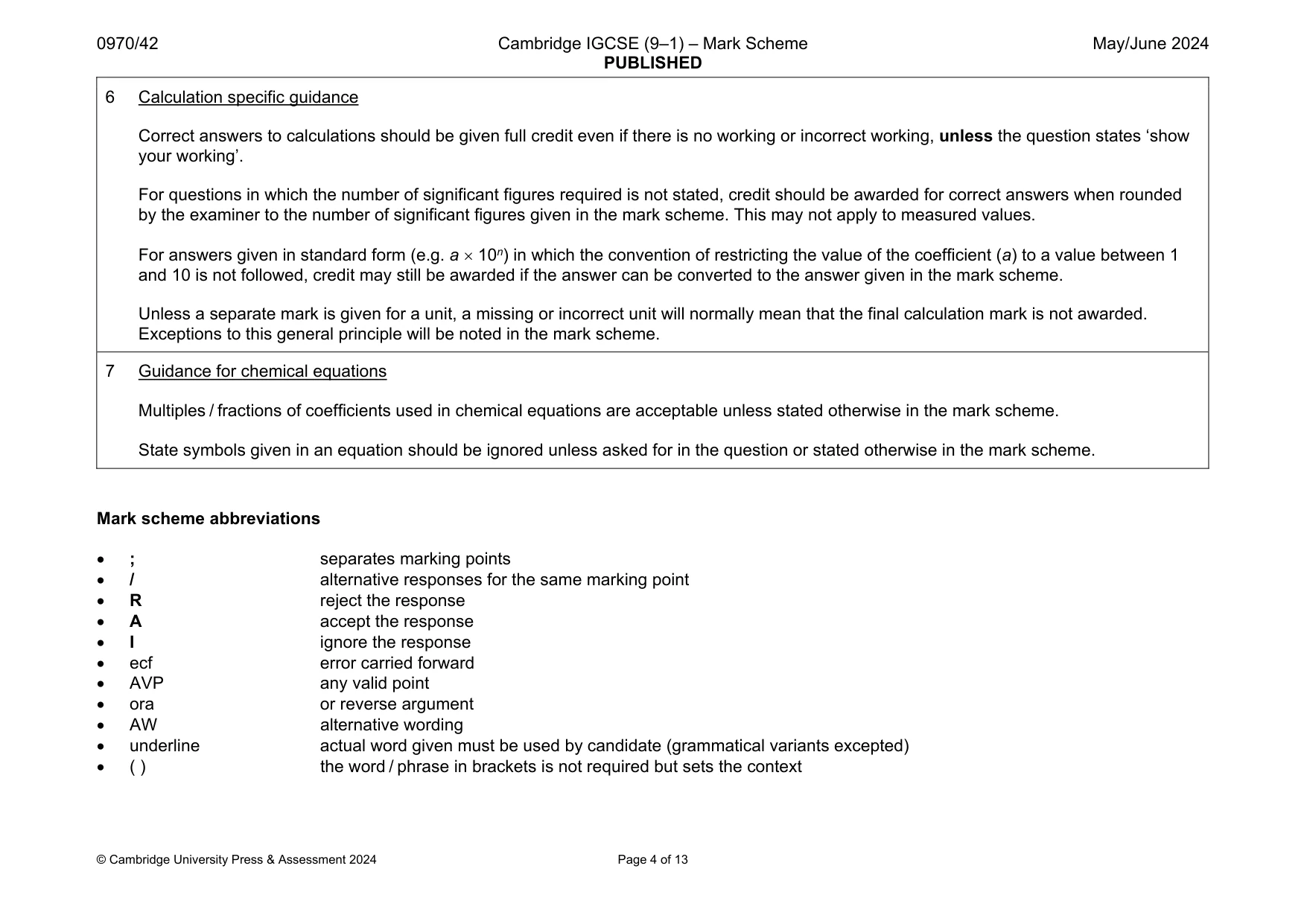
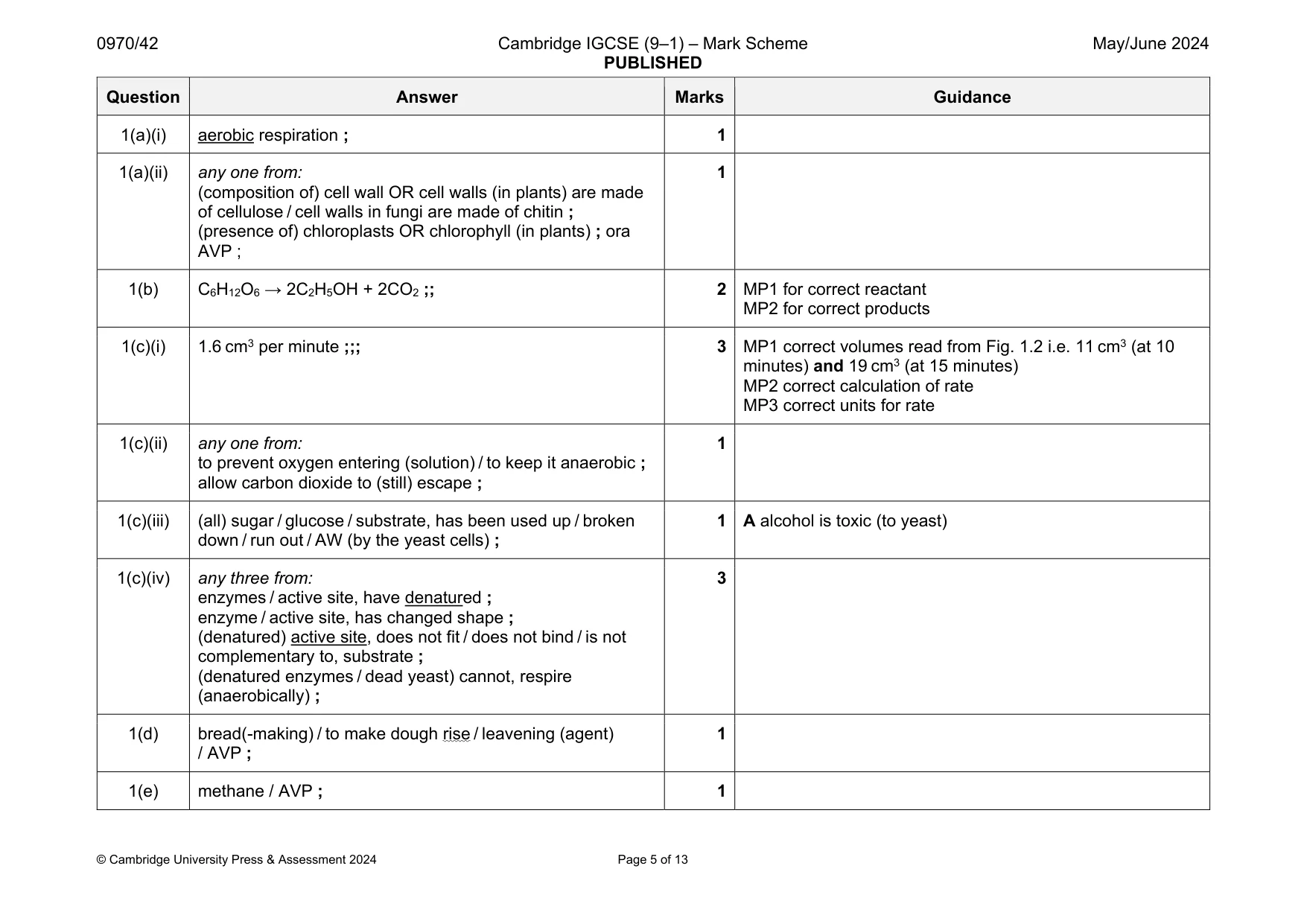
Mark scheme: 1(a)(i) aerobic respiration ; 1 1(a)(ii) any one from: (composition of) cell wall OR cell walls (in plants) are made of cellulose / cell walls in fungi are made of chitin ; (presence of) chloroplasts OR chlorophyll (in plants) ; ora AVP ; 1 1(b) C6H12O6 → 2C2H5OH + 2CO2 ;; 2 MP1 for correct reactant MP2 for correct products 1(c)(i) 1.6 cm3 per minute ;;; 3 MP1 correct volumes read from Fig. 1.2 i.e. 11 cm3 (at 10 minutes) and 19 cm3 (at 15 minutes) MP2 correct calculation of rate MP3 correct units for rate 1(c)(ii) any one from: to prevent oxygen entering (solution) / to keep it anaerobic ; allow carbon dioxide to (still) escape ; 1 1(c)(iii) (all) sugar / glucose / substrate, has been used up / broken down / run out / AW (by the yeast cells) ; 1 A alcohol is toxic (to yeast) 1(c)(iv) any three from: enzymes / active site, have denatured ; enzyme / active site, has changed shape ; (denatured) active site, does not fit / does not bind / is not complementary to, substrate ; (denatured enzymes / dead yeast) cannot, respire (anaerobically) ; 3 1(d) bread(-making) / to make dough rise / leavening (agent) / AVP ; 1 1(e) methane / AVP ; 1
Q2 · Define the term sense organ
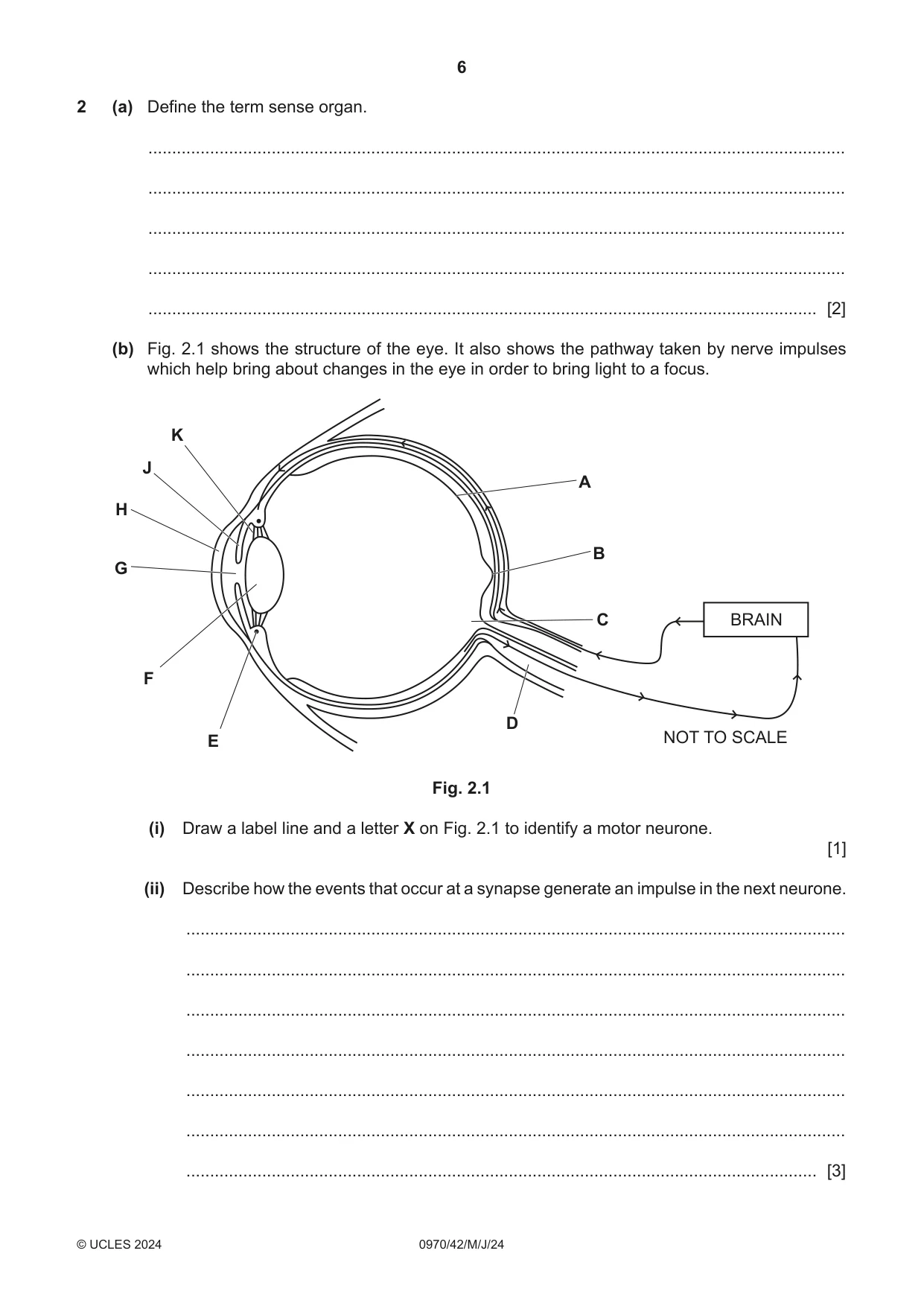
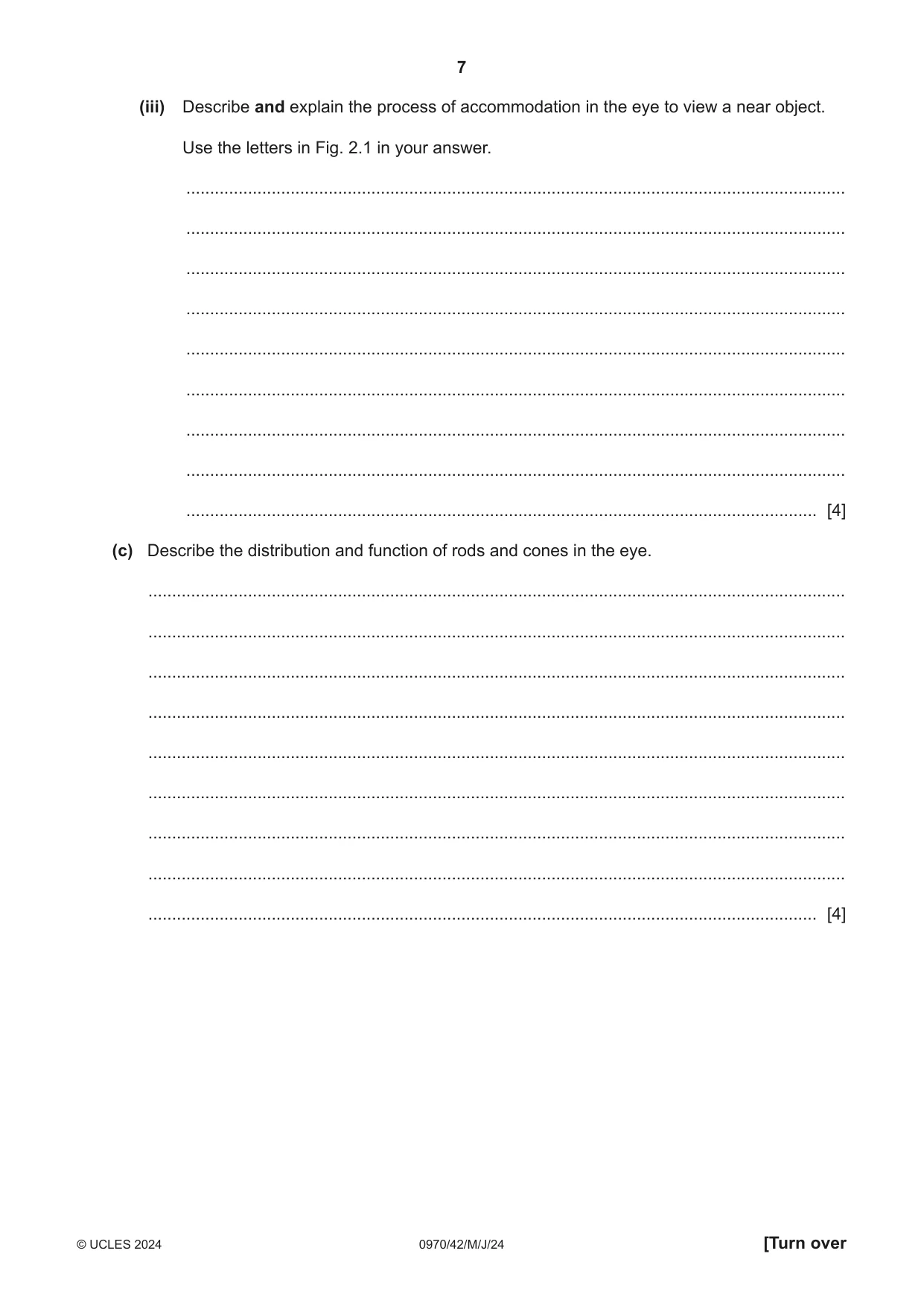
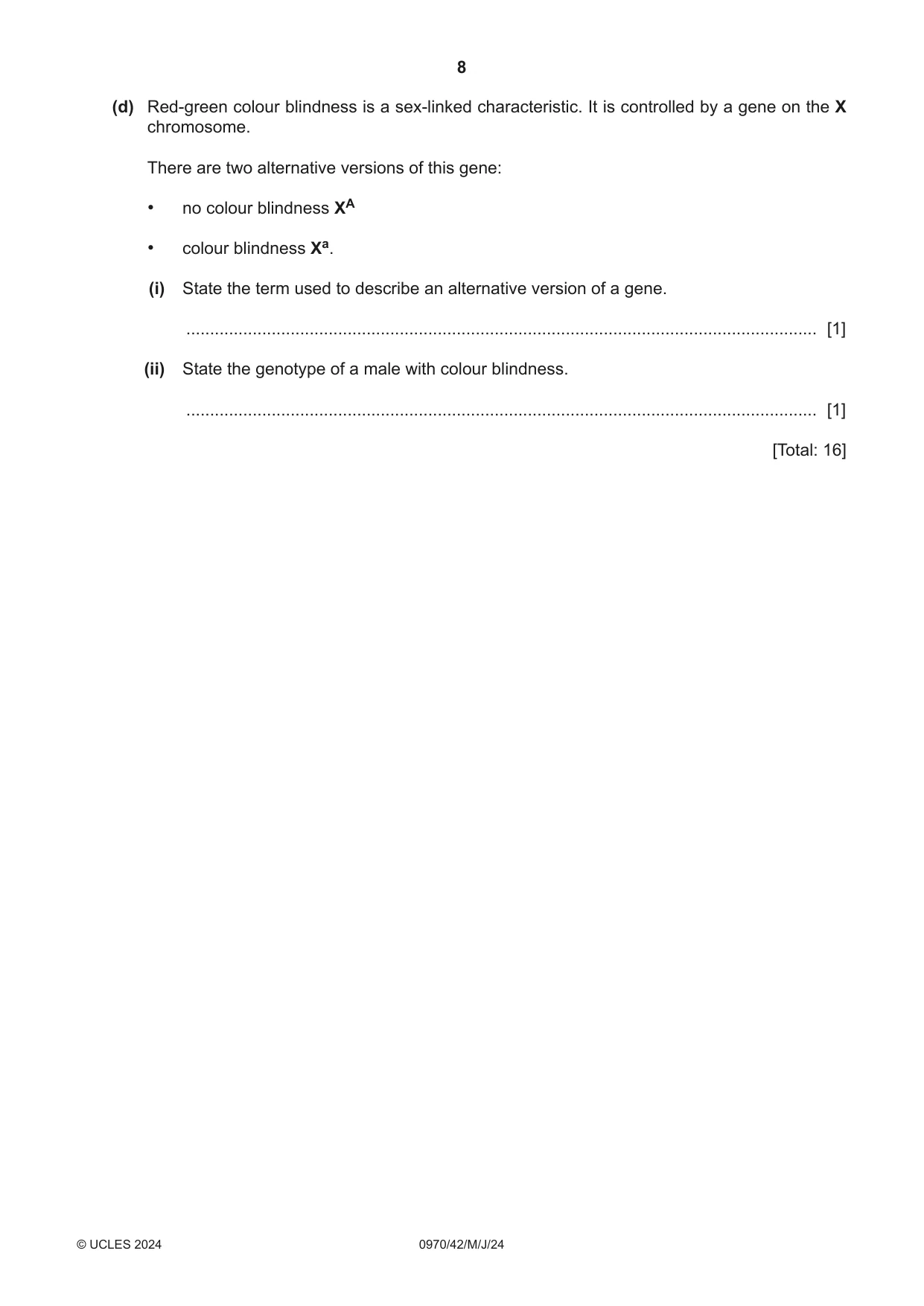
2 (a) Define the term sense organ. ................................................................................................................................................... ................................................................................................................................................... ................................................................................................................................................... ................................................................................................................................................... ............................................................................................................................................. [2] (b) Fig. 2.1 shows the structure of the eye. It also shows the pathway taken by nerve impulses which help bring about changes in the eye in order to bring light to a focus. K J A H B G C BRAIN F D E NOT TO SCALE Fig. 2.1 (i) Draw a label line and a letter X on Fig. 2.1 to identify a motor neurone. [1] (ii) Describe how the events that occur at a synapse generate an impulse in the next neurone. ........................................................................................................................................... ........................................................................................................................................... ........................................................................................................................................... ........................................................................................................................................... ........................................................................................................................................... ........................................................................................................................................... ..................................................................................................................................... [3] (iii) Describe and explain the process of accommodation in the eye to view a near object. Use the letters in Fig. 2.1 in your answer. ........................................................................................................................................... ........................................................................................................................................... ........................................................................................................................................... ........................................................................................................................................... ........................................................................................................................................... ........................................................................................................................................... ........................................................................................................................................... ........................................................................................................................................... ..................................................................................................................................... [4] (c) Describe the distribution and function of rods and cones in the eye. ................................................................................................................................................... ................................................................................................................................................... ................................................................................................................................................... ................................................................................................................................................... ................................................................................................................................................... ................................................................................................................................................... ................................................................................................................................................... ................................................................................................................................................... ............................................................................................................................................. [4] (d) Red‑green colour blindness is a sex‑linked characteristic. It is controlled by a gene on the X chromosome. There are two alternative versions of this gene: • no colour blindness XA • colour blindness Xa. (i) State the term used to describe an alternative version of a gene. ..................................................................................................................................... [1] (ii) State the genotype of a male with colour blindness. ..................................................................................................................................... [1] [Total: 16]
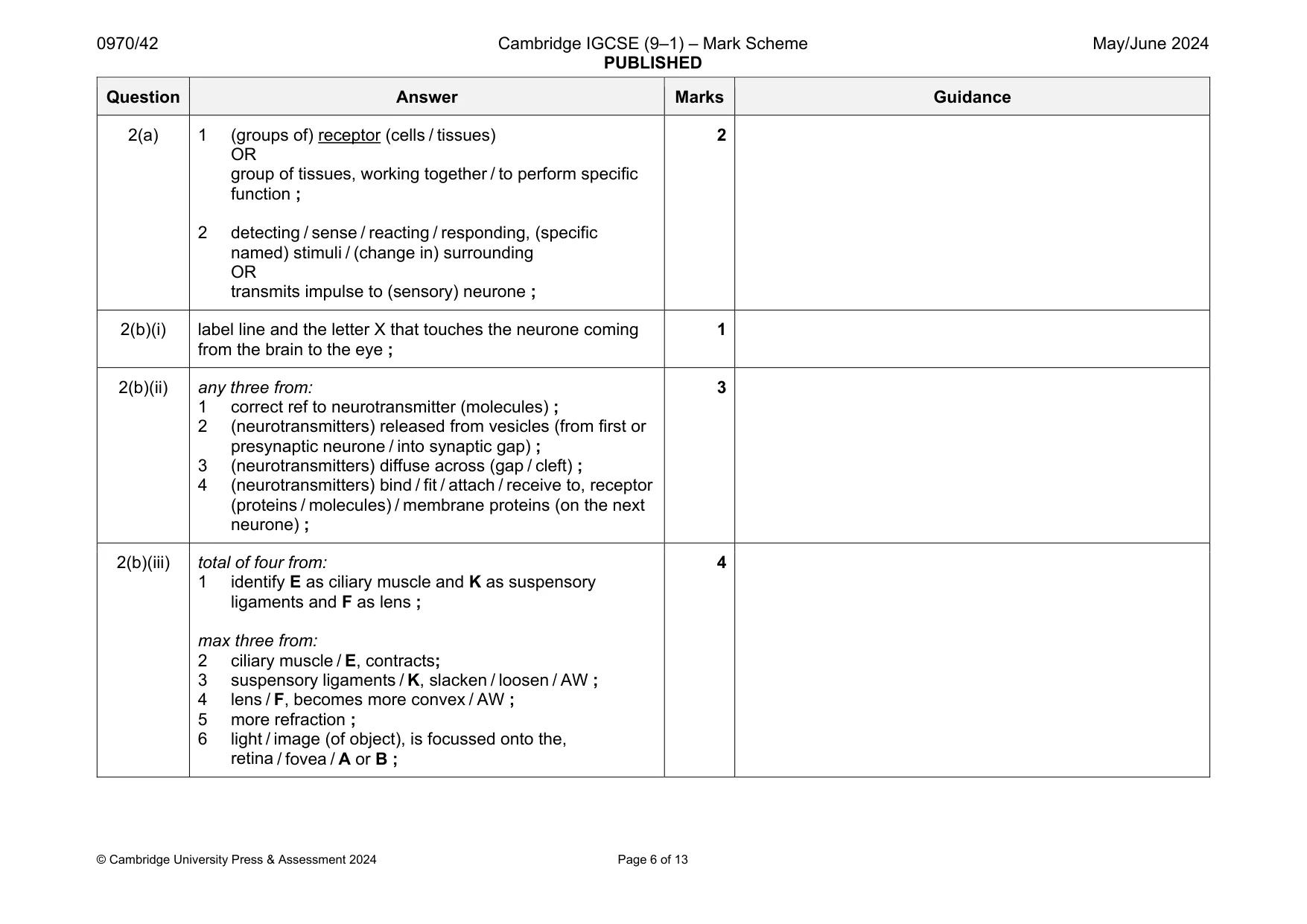
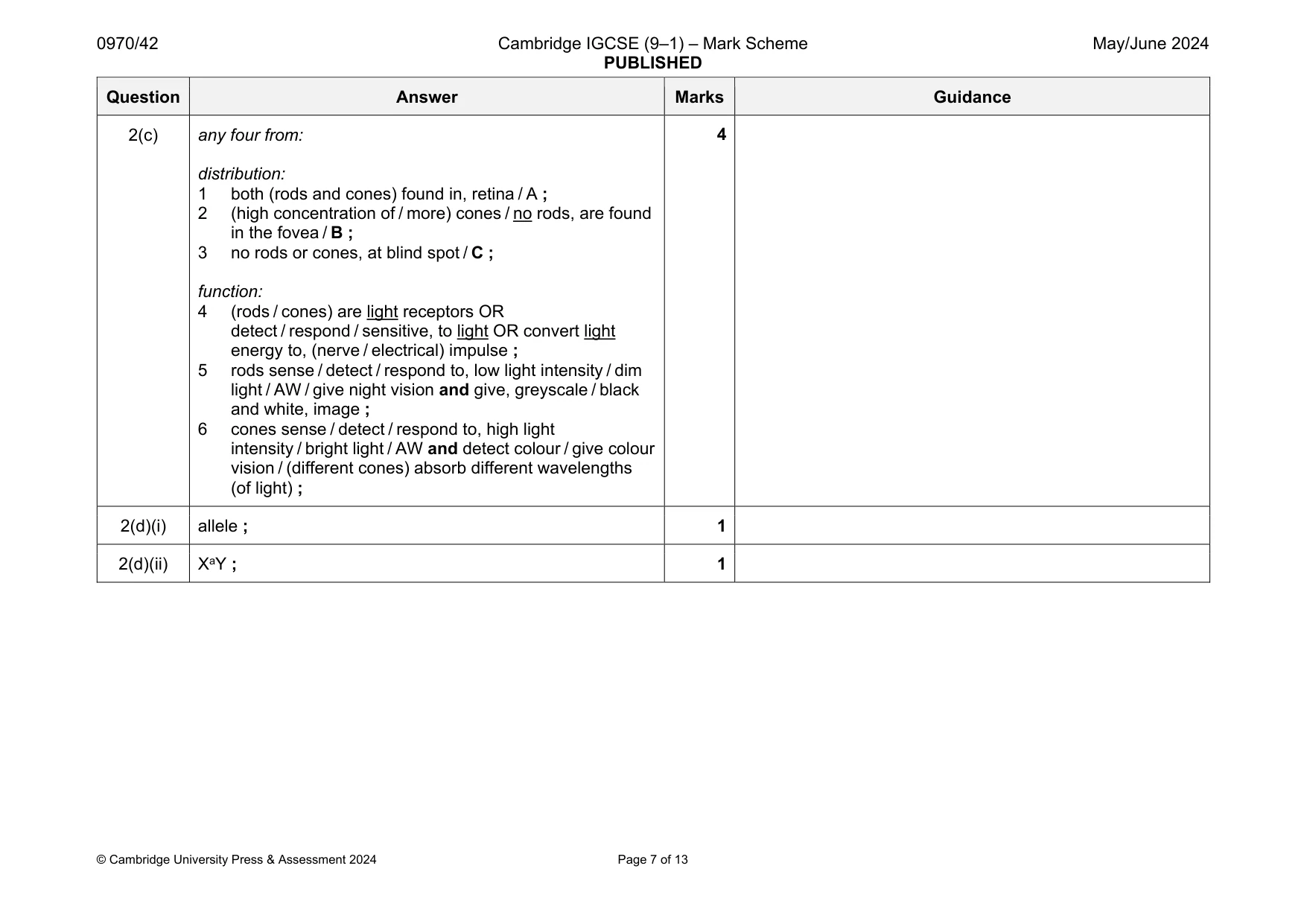
Mark scheme: 2(a) 1 (groups of) receptor (cells / tissues) OR group of tissues, working together / to perform specific function ; 2 detecting / sense / reacting / responding, (specific named) stimuli / (change in) surrounding OR transmits impulse to (sensory) neurone ; 2 2(b)(i) label line and the letter X that touches the neurone coming from the brain to the eye ; 1 2(b)(ii) any three from: 1 correct ref to neurotransmitter (molecules) ; 2 (neurotransmitters) released from vesicles (from first or presynaptic neurone / into synaptic gap) ; 3 (neurotransmitters) diffuse across (gap / cleft) ; 4 (neurotransmitters) bind / fit / attach / receive to, receptor (proteins / molecules) / membrane proteins (on the next neurone) ; 3 2(b)(iii) total of four from: 1 identify E as ciliary muscle and K as suspensory ligaments and F as lens ; max three from: 2 ciliary muscle / E, contracts; 3 suspensory ligaments / K, slacken / loosen / AW ; 4 lens / F, becomes more convex / AW ; 5 more refraction ; 6 light / image (of object), is focussed onto the, retina / fovea / A or B ; 4 Question Answer Marks Guidance 2(c) any four from: distribution: 1 both (rods and cones) found in, retina / A ; 2 (high concentration of / more) cones / no rods, are found in the fovea / B ; 3 no rods or cones, at blind spot / C ; function: 4 (rods / cones) are light receptors OR detect / respond / sensitive, to light OR convert light energy to, (nerve / electrical) impulse ; 5 rods sense / detect / respond to, low light intensity / dim light / AW / give night vision and give, greyscale / black and white, image ; 6 cones sense / detect / respond to, high light intensity / bright light / AW and detect colour / give colour vision / (different cones) absorb different wavelengths (of light) ; 4 2(d)(i) allele ; 1 2(d)(ii) XaY ; 1
Q3 · Meiosis and mitosis are important processes in the life cycles of organisms
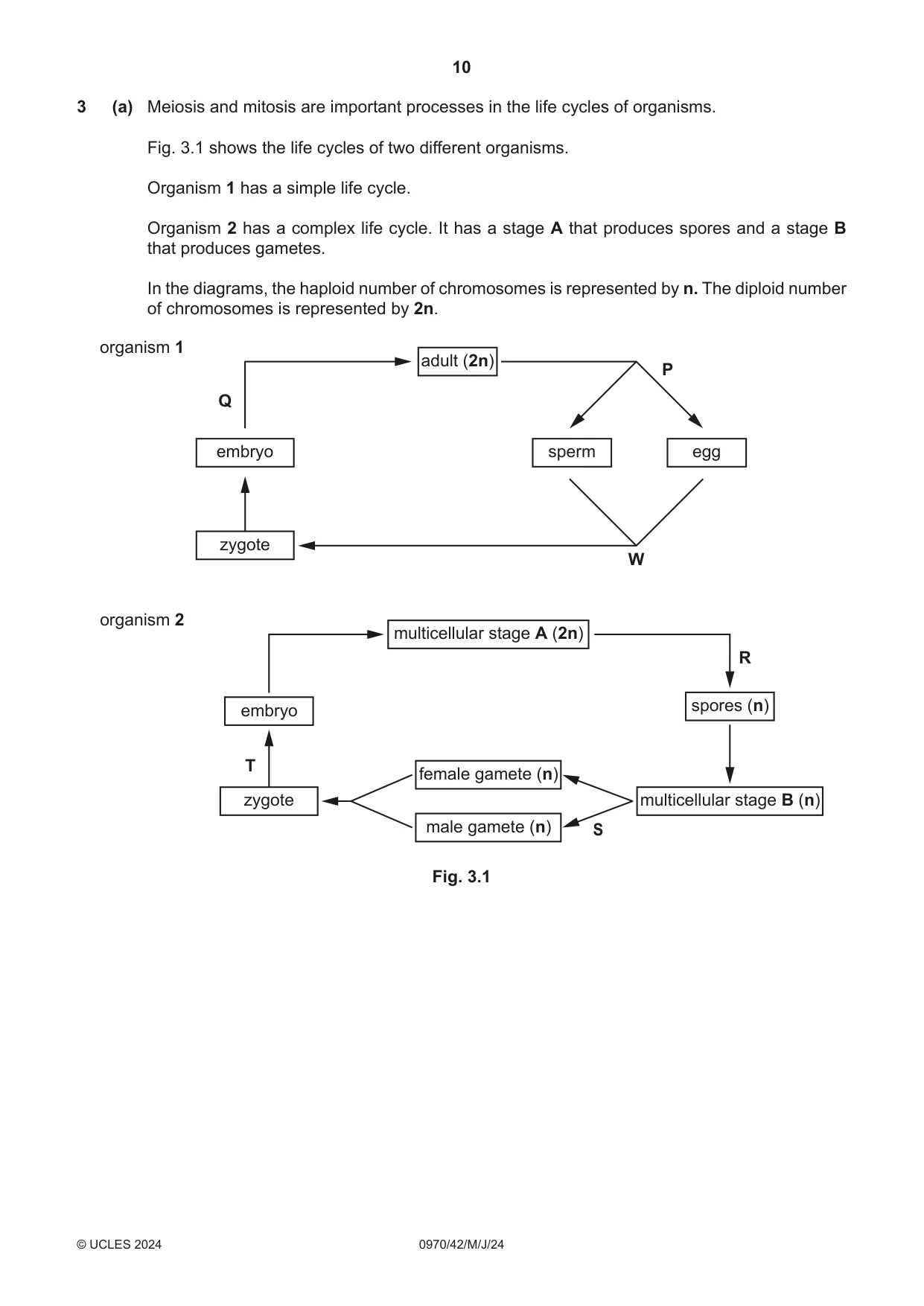
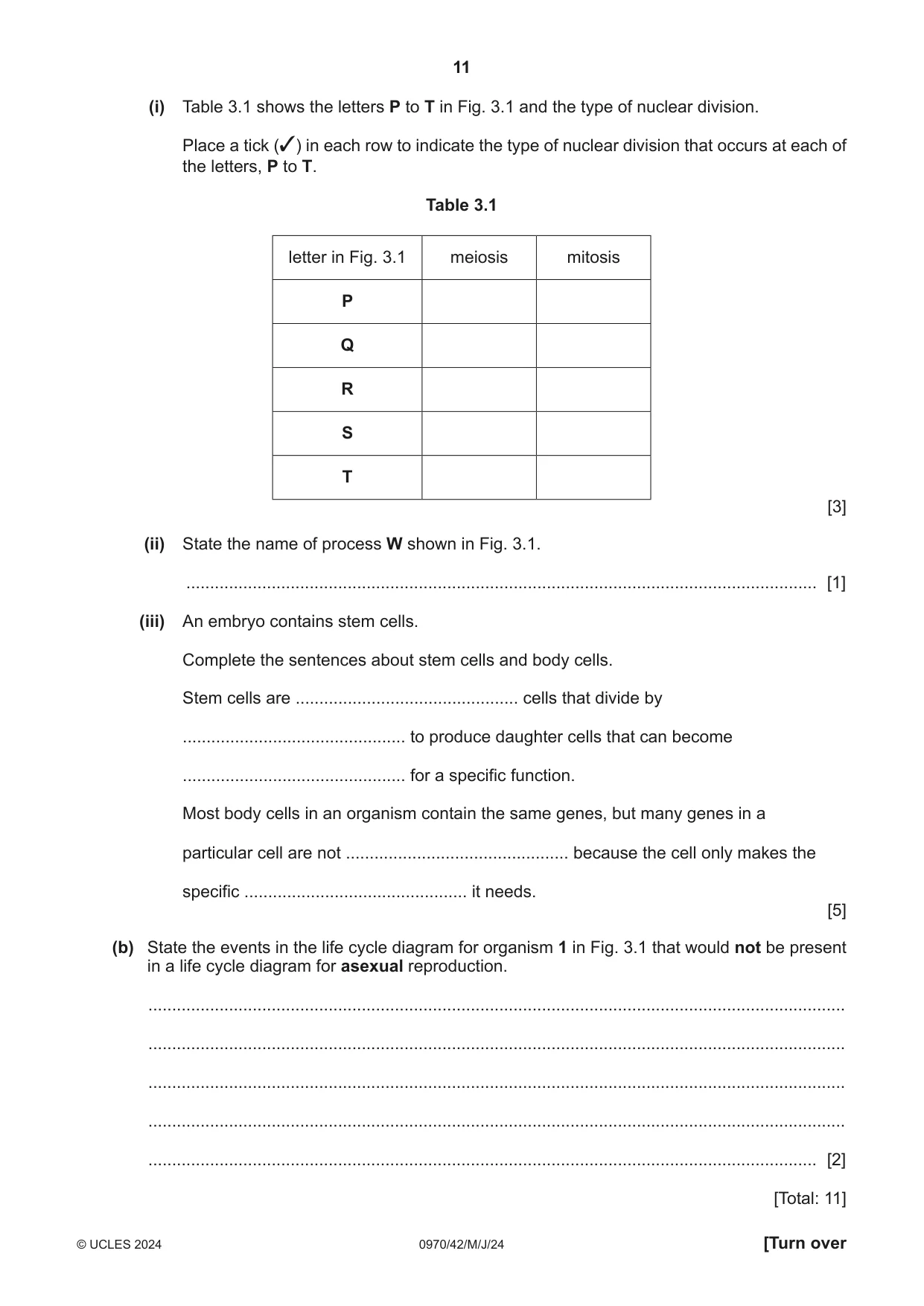
3 (a) Meiosis and mitosis are important processes in the life cycles of organisms. Fig. 3.1 shows the life cycles of two different organisms. Organism 1 has a simple life cycle. Organism 2 has a complex life cycle. It has a stage A that produces spores and a stage B that produces gametes. In the diagrams, the haploid number of chromosomes is represented by n. The diploid number of chromosomes is represented by 2n. organism 1 adult (2n) P Q embryo sperm egg zygote W organism 2 multicellular stage A (2n) R spores (n) embryo T female gamete (n) zygote multicellular stage B (n) male gamete (n) S Fig. 3.1 (i) Table 3.1 shows the letters P to T in Fig. 3.1 and the type of nuclear division. Place a tick (✓) in each row to indicate the type of nuclear division that occurs at each of the letters, P to T. Table 3.1 letter in Fig. 3.1 meiosis mitosis P Q R S T [3] (ii) State the name of process W shown in Fig. 3.1. ..................................................................................................................................... [1] (iii) An embryo contains stem cells. Complete the sentences about stem cells and body cells. Stem cells are ............................................... cells that divide by ............................................... to produce daughter cells that can become ............................................... for a specific function. Most body cells in an organism contain the same genes, but many genes in a particular cell are not ............................................... because the cell only makes the specific ............................................... it needs. [5] (b) State the events in the life cycle diagram for organism 1 in Fig. 3.1 that would not be present in a life cycle diagram for asexual reproduction. ................................................................................................................................................... ................................................................................................................................................... ................................................................................................................................................... ................................................................................................................................................... ............................................................................................................................................. [2] [Total: 11]
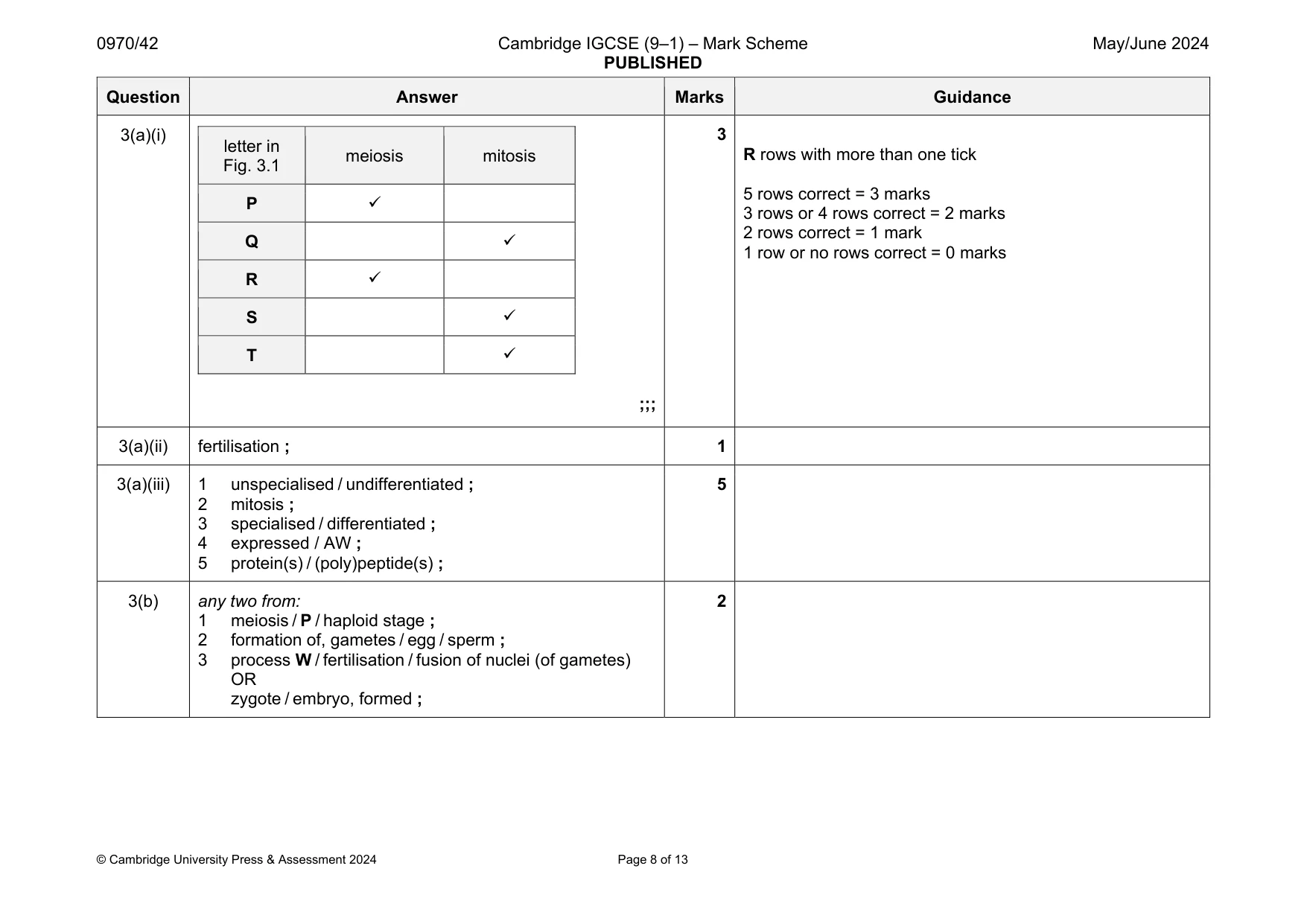
Mark scheme: 3(a)(i) letter in Fig. 3.1 meiosis mitosis P Q R S T ;;; R rows with more than one tick 5 rows correct = 3 marks 3 rows or 4 rows correct = 2 marks 2 rows correct = 1 mark 1 row or no rows correct = 0 marks 3(a)(ii) fertilisation ; 1 3(a)(iii) 1 unspecialised / undifferentiated ; 2 mitosis ; 3 specialised / differentiated ; 4 expressed / AW ; 5 protein(s) / (poly)peptide(s) ; 5 3(b) any two from: 1 meiosis / P / haploid stage ; 2 formation of, gametes / egg / sperm ; 3 process W / fertilisation / fusion of nuclei (of gametes) OR zygote / embryo, formed ; 2
Q4 · Some algae are single‑celled organisms that can photosynthesise
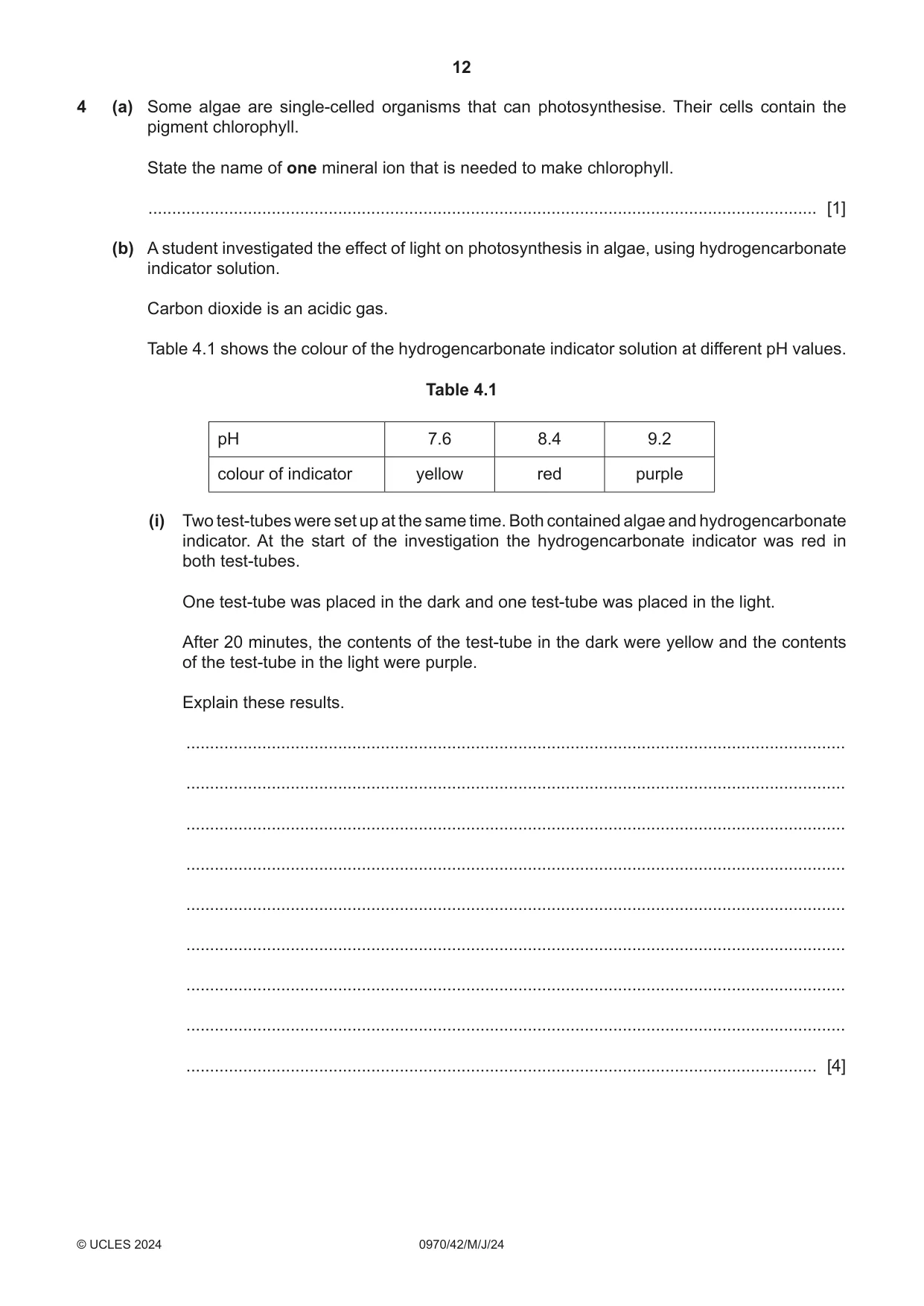
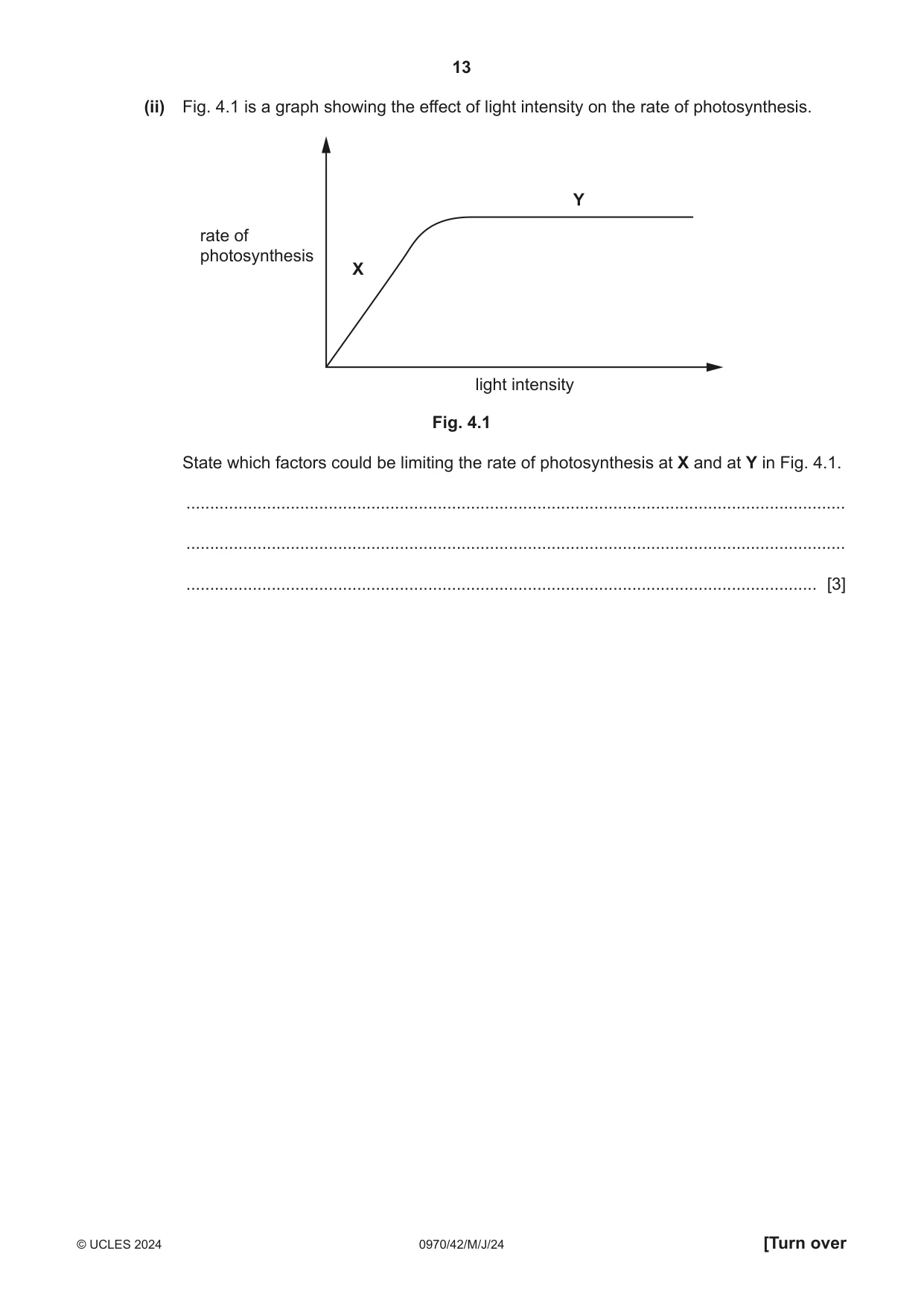
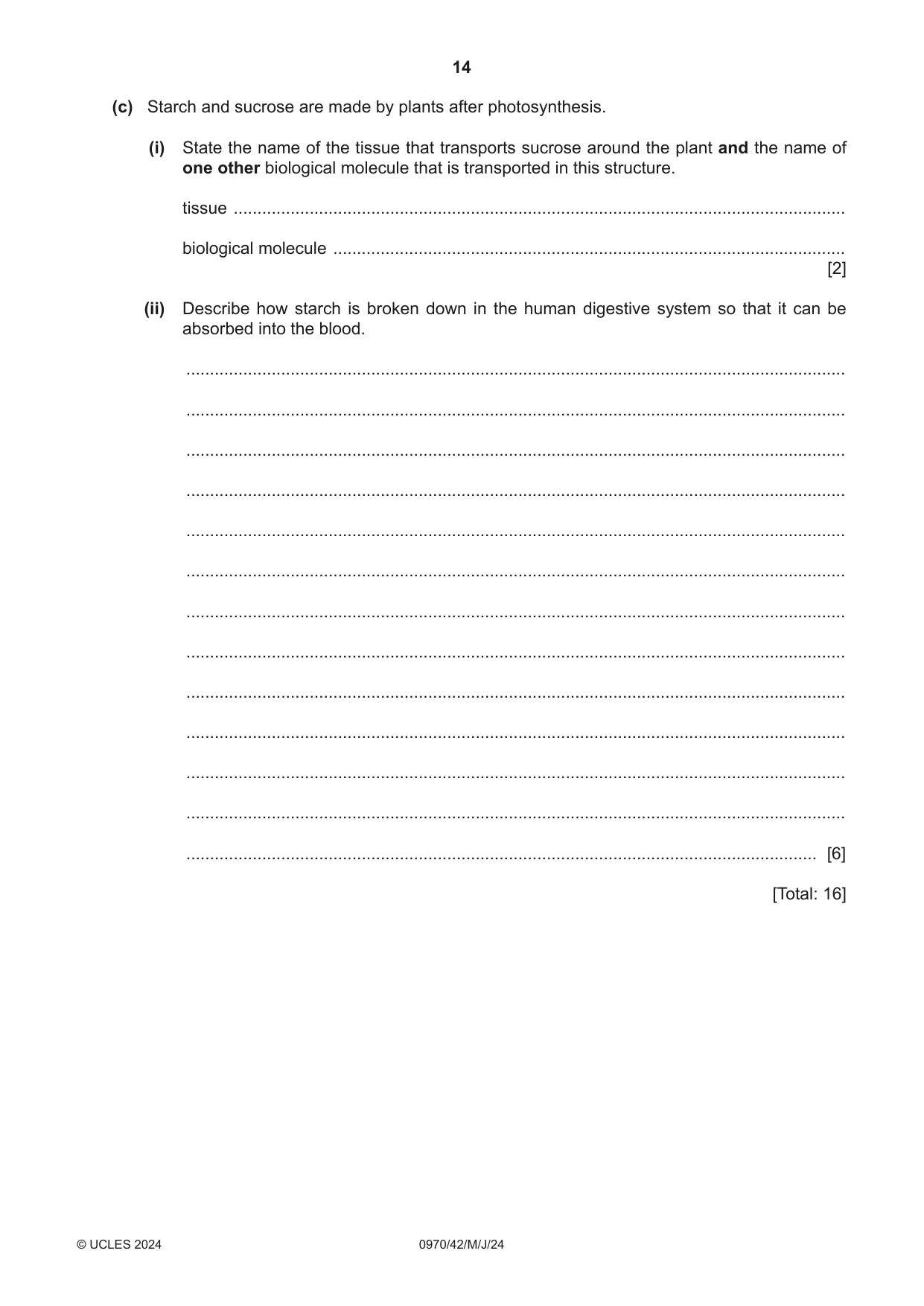
4 (a) Some algae are single‑celled organisms that can photosynthesise. Their cells contain the pigment chlorophyll. State the name of one mineral ion that is needed to make chlorophyll. ............................................................................................................................................. [1] (b) A student investigated the effect of light on photosynthesis in algae, using hydrogencarbonate indicator solution. Carbon dioxide is an acidic gas. Table 4.1 shows the colour of the hydrogencarbonate indicator solution at different pH values. Table 4.1 pH 7.6 8.4 9.2 colour of indicator yellow red purple (i) Two test‑tubes were set up at the same time. Both contained algae and hydrogencarbonate indicator. At the start of the investigation the hydrogencarbonate indicator was red in both test‑tubes. One test‑tube was placed in the dark and one test‑tube was placed in the light. After 20 minutes, the contents of the test‑tube in the dark were yellow and the contents of the test‑tube in the light were purple. Explain these results. ........................................................................................................................................... ........................................................................................................................................... ........................................................................................................................................... ........................................................................................................................................... ........................................................................................................................................... ........................................................................................................................................... ........................................................................................................................................... ........................................................................................................................................... ..................................................................................................................................... [4] (ii) Fig. 4.1 is a graph showing the effect of light intensity on the rate of photosynthesis. Y rate of photosynthesis X light intensity Fig. 4.1 State which factors could be limiting the rate of photosynthesis at X and at Y in Fig. 4.1. ........................................................................................................................................... ........................................................................................................................................... ..................................................................................................................................... [3] (c) Starch and sucrose are made by plants after photosynthesis. (i) State the name of the tissue that transports sucrose around the plant and the name of one other biological molecule that is transported in this structure. tissue ................................................................................................................................. biological molecule ............................................................................................................ [2] (ii) Describe how starch is broken down in the human digestive system so that it can be absorbed into the blood. ........................................................................................................................................... ........................................................................................................................................... ........................................................................................................................................... ........................................................................................................................................... ........................................................................................................................................... ........................................................................................................................................... ........................................................................................................................................... ........................................................................................................................................... ........................................................................................................................................... ........................................................................................................................................... ........................................................................................................................................... ........................................................................................................................................... ..................................................................................................................................... [6] [Total: 16]
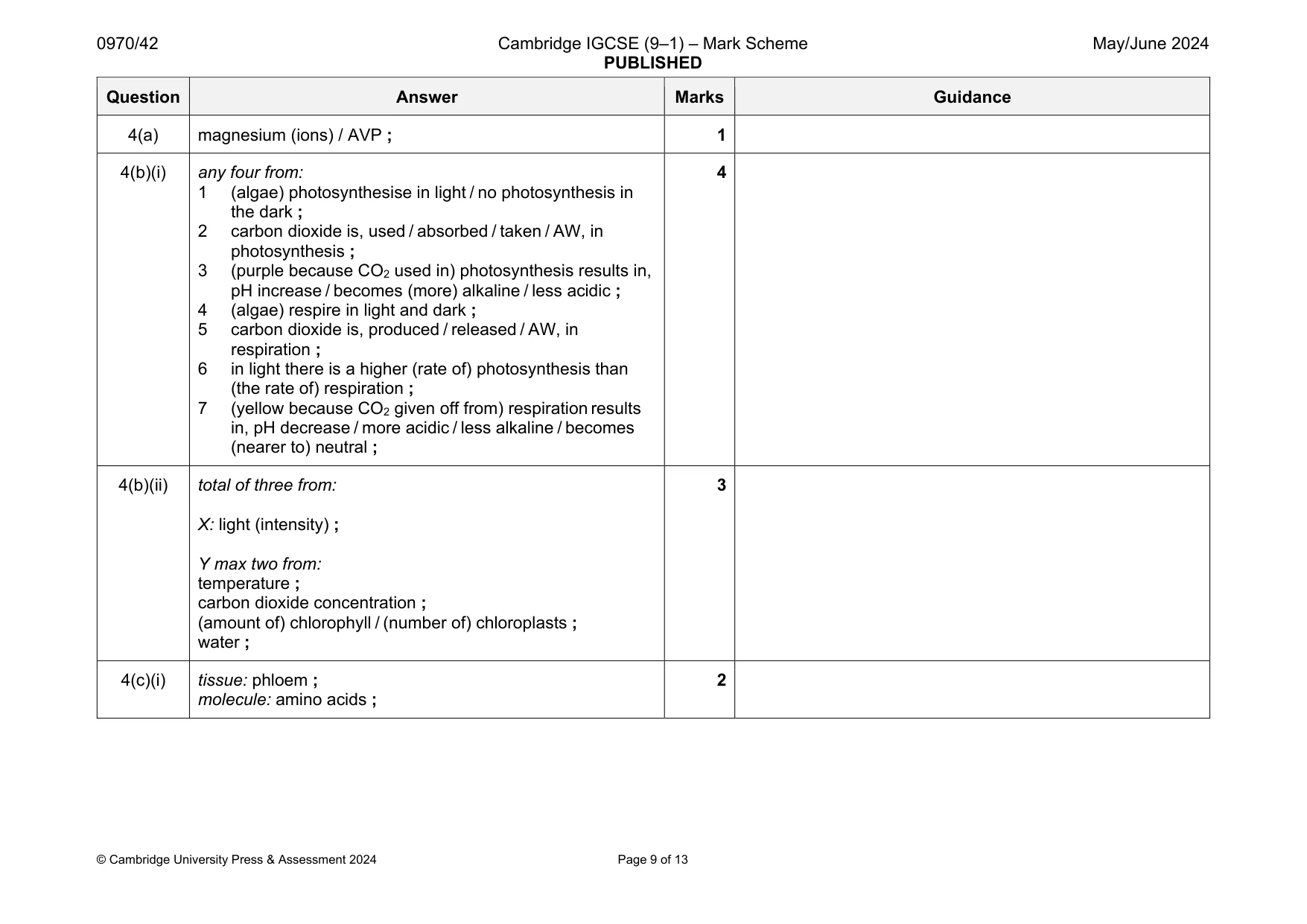
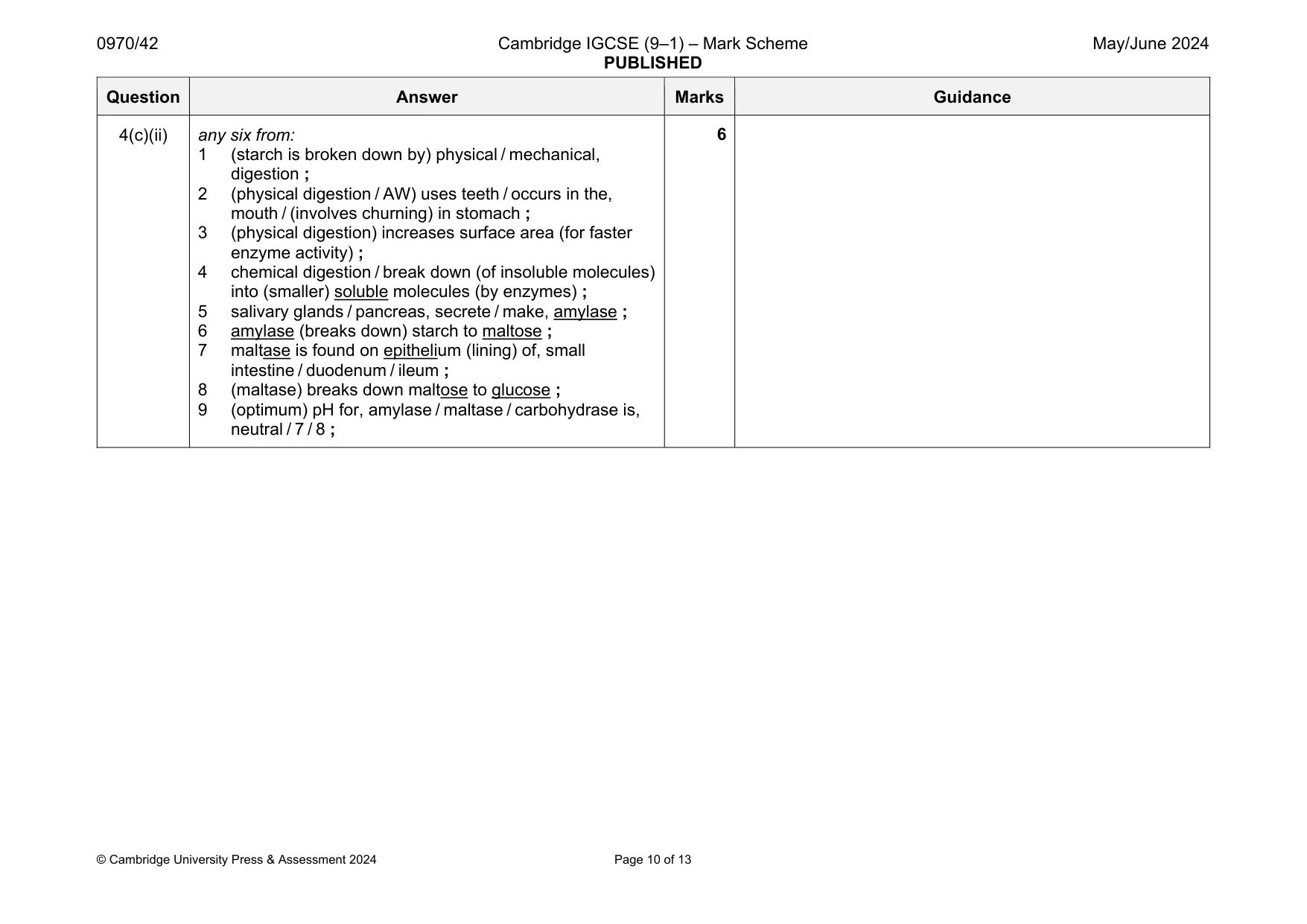
Mark scheme: 4(a) magnesium (ions) / AVP ; 1 4(b)(i) any four from: 1 (algae) photosynthesise in light / no photosynthesis in the dark ; 2 carbon dioxide is, used / absorbed / taken / AW, in photosynthesis ; 3 (purple because CO2 used in) photosynthesis results in, pH increase / becomes (more) alkaline / less acidic ; 4 (algae) respire in light and dark ; 5 carbon dioxide is, produced / released / AW, in respiration ; 6 in light there is a higher (rate of) photosynthesis than (the rate of) respiration ; 7 (yellow because CO2 given off from) respiration results in, pH decrease / more acidic / less alkaline / becomes (nearer to) neutral ; 4 4(b)(ii) total of three from: X: light (intensity) ; Y max two from: temperature ; carbon dioxide concentration ; (amount of) chlorophyll / (number of) chloroplasts ; water ; 3 4(c)(i) tissue: phloem ; molecule: amino acids ; 2 Question Answer Marks Guidance 4(c)(ii) any six from: 1 (starch is broken down by) physical / mechanical, digestion ; 2 (physical digestion / AW) uses teeth / occurs in the, mouth / (involves churning) in stomach ; 3 (physical digestion) increases surface area (for faster enzyme activity) ; 4 chemical digestion / break down (of insoluble molecules) into (smaller) soluble molecules (by enzymes) ; 5 salivary glands / pancreas, secrete / make, amylase ; 6 amylase (breaks down) starch to maltose ; 7 maltase is found on epithelium (lining) of, small intestine / duodenum / ileum ; 8 (maltase) breaks down maltose to glucose ; 9 (optimum) pH for, amylase / maltase / carbohydrase is, neutral / 7 / 8 ; 6
Q5 · A photograph of a koala
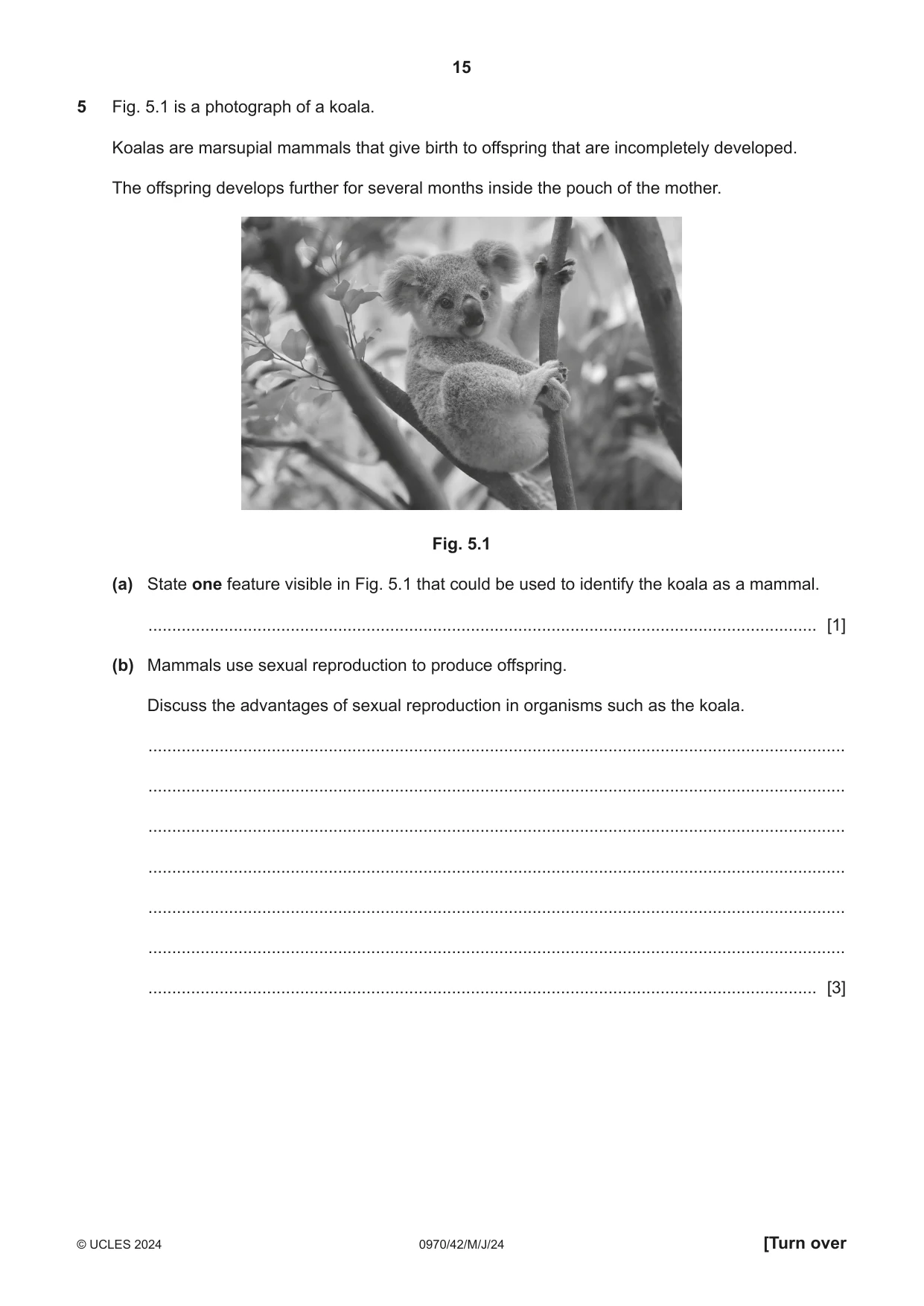
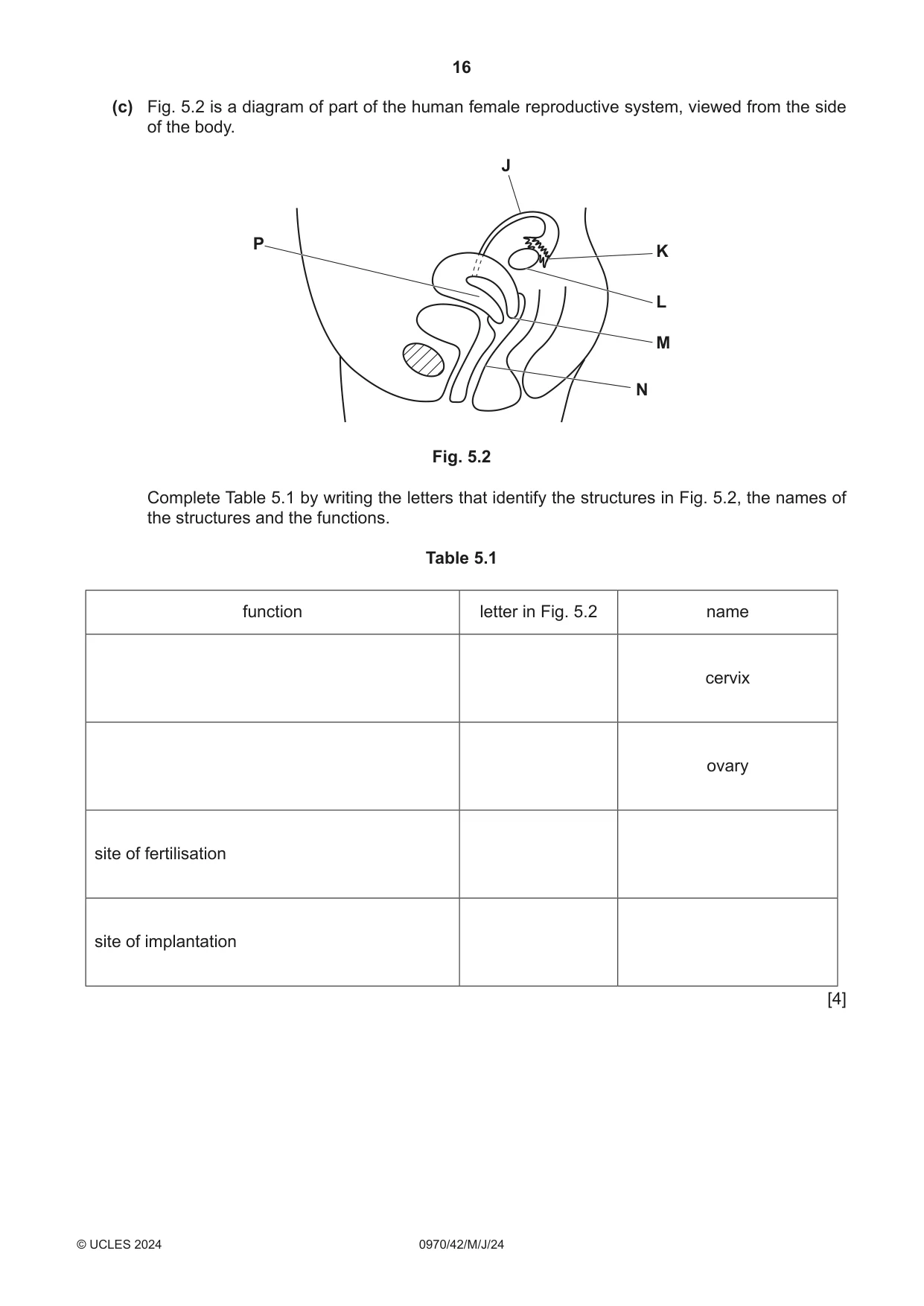
5 Fig. 5.1 is a photograph of a koala. Koalas are marsupial mammals that give birth to offspring that are incompletely developed. The offspring develops further for several months inside the pouch of the mother. Fig. 5.1 (a) State one feature visible in Fig. 5.1 that could be used to identify the koala as a mammal. ............................................................................................................................................. [1] (b) Mammals use sexual reproduction to produce offspring. Discuss the advantages of sexual reproduction in organisms such as the koala. ................................................................................................................................................... ................................................................................................................................................... ................................................................................................................................................... ................................................................................................................................................... ................................................................................................................................................... ................................................................................................................................................... ............................................................................................................................................. [3] (c) Fig. 5.2 is a diagram of part of the human female reproductive system, viewed from the side of the body. J P K L M N Fig. 5.2 Complete Table 5.1 by writing the letters that identify the structures in Fig. 5.2, the names of the structures and the functions. Table 5.1 function letter in Fig. 5.2 name cervix ovary site of fertilisation site of implantation [4] (d) Pregnant human females have a placenta. (i) Describe the function of the placenta in humans. ........................................................................................................................................... ........................................................................................................................................... ........................................................................................................................................... ........................................................................................................................................... ........................................................................................................................................... ........................................................................................................................................... ........................................................................................................................................... ........................................................................................................................................... ..................................................................................................................................... [4] (ii) The placenta is connected to the amniotic sac. State two functions of the amniotic fluid that is found in the amniotic sac. 1 ......................................................................................................................................... ........................................................................................................................................... 2 ......................................................................................................................................... ........................................................................................................................................... [2] [Total: 14]
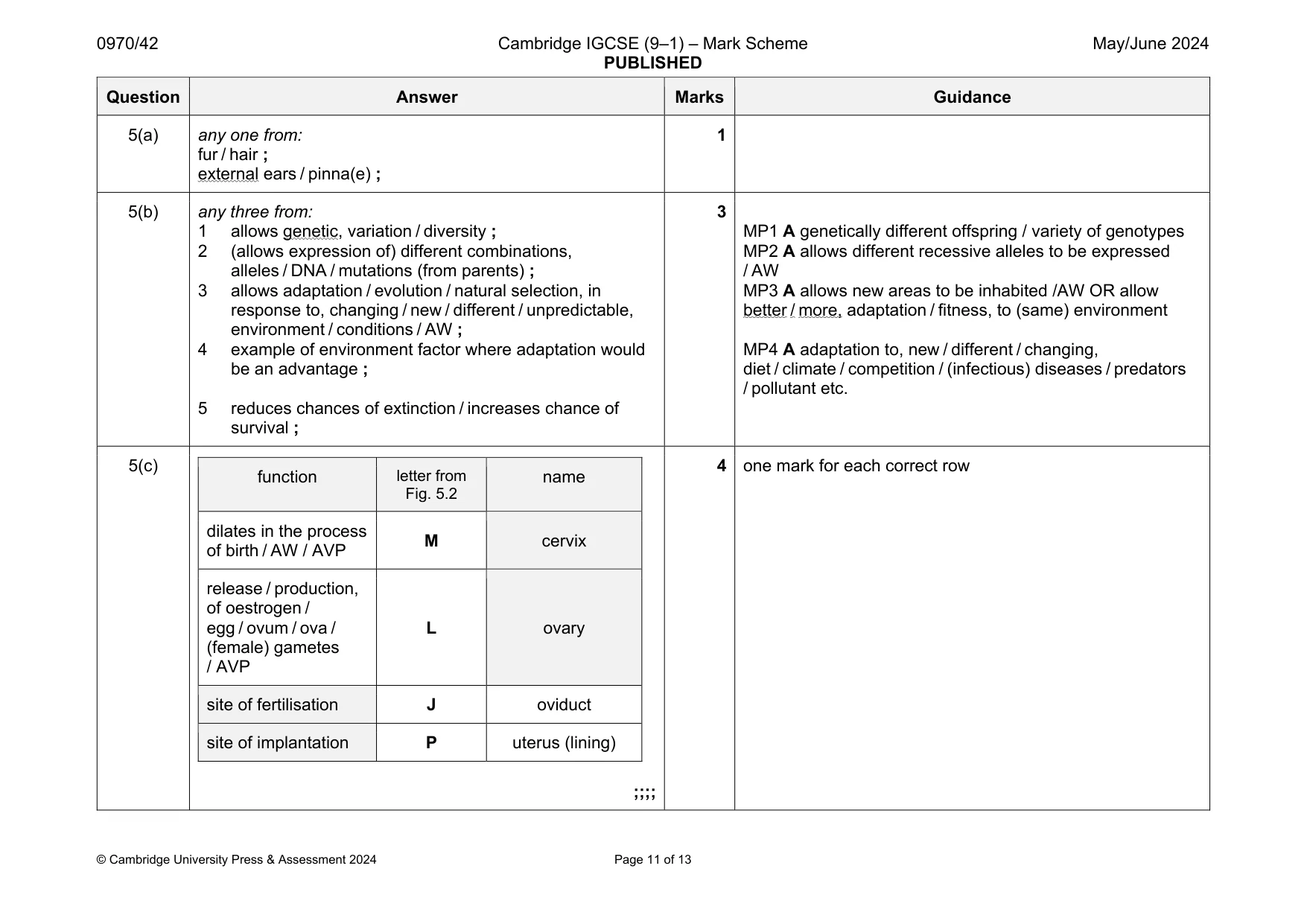
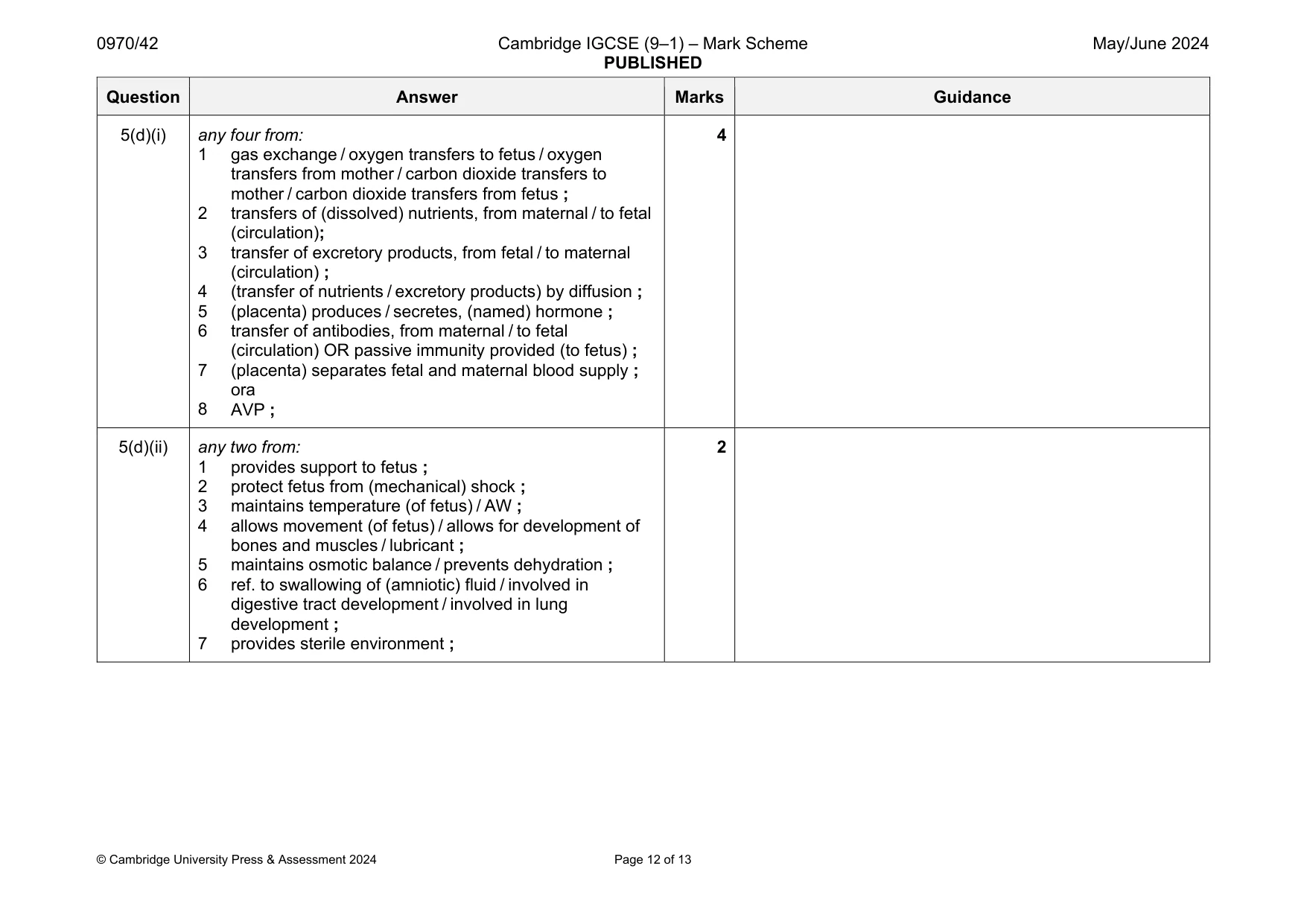
Mark scheme: 5(a) any one from: fur / hair ; external ears / pinna(e) ; 1 5(b) any three from: 1 allows genetic, variation / diversity ; 2 (allows expression of) different combinations, alleles / DNA / mutations (from parents) ; 3 allows adaptation / evolution / natural selection, in response to, changing / new / different / unpredictable, environment / conditions / AW ; 4 example of environment factor where adaptation would be an advantage ; 5 reduces chances of extinction / increases chance of survival ; 3 MP1 A genetically different offspring / variety of genotypes MP2 A allows different recessive alleles to be expressed / AW MP3 A allows new areas to be inhabited /AW OR allow better / more, adaptation / fitness, to (same) environment MP4 A adaptation to, new / different / changing, diet / climate / competition / (infectious) diseases / predators / pollutant etc. 5(c) function letter from Fig. 5.2 name dilates in the process of birth / AW / AVP M cervix release / production, of oestrogen / egg / ovum / ova / (female) gametes / AVP L ovary site of fertilisation J oviduct site of implantation P uterus (lining) ;;;; 4 one mark for each correct row Question Answer Marks Guidance 5(d)(i) any four from: 1 gas exchange / oxygen transfers to fetus / oxygen transfers from mother / carbon dioxide transfers to mother / carbon dioxide transfers from fetus ; 2 transfers of (dissolved) nutrients, from maternal / to fetal (circulation); 3 transfer of excretory products, from fetal / to maternal (circulation) ; 4 (transfer of nutrients / excretory products) by diffusion ; 5 (placenta) produces / secretes, (named) hormone ; 6 transfer of antibodies, from maternal / to fetal (circulation) OR passive immunity provided (to fetus) ; 7 (placenta) separates fetal and maternal blood supply ; ora 8 AVP ; 4 5(d)(ii) any two from: 1 provides support to fetus ; 2 protect fetus from (mechanical) shock ; 3 maintains temperature (of fetus) / AW ; 4 allows movement (of fetus) / allows for development of bones and muscles / lubricant ; 5 maintains osmotic balance / prevents dehydration ; 6 ref. to swallowing of (amniotic) fluid / involved in digestive tract development / involved in lung development ; 7 provides sterile environment ; 2
Q6 · Complete the sentences about human teeth
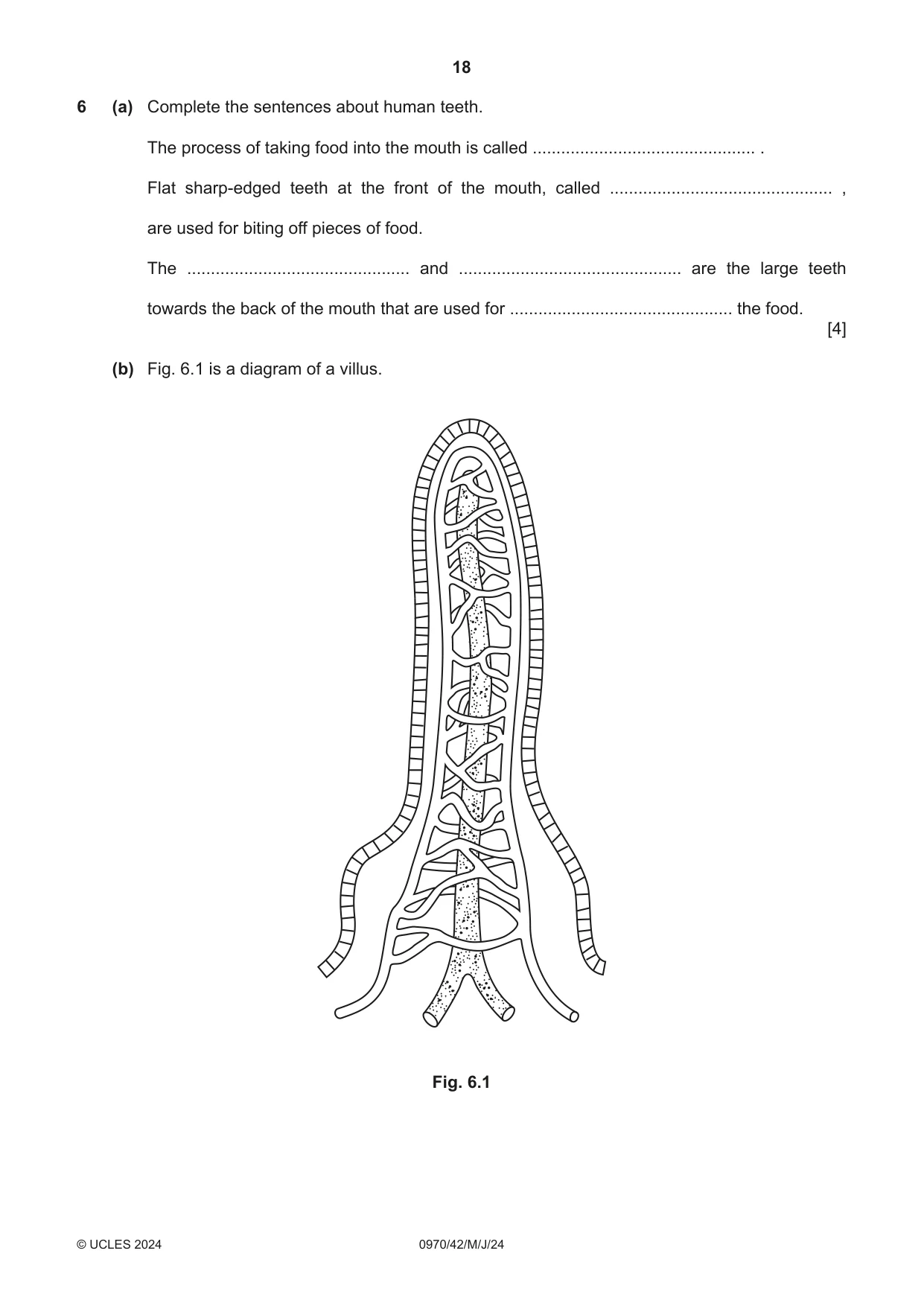
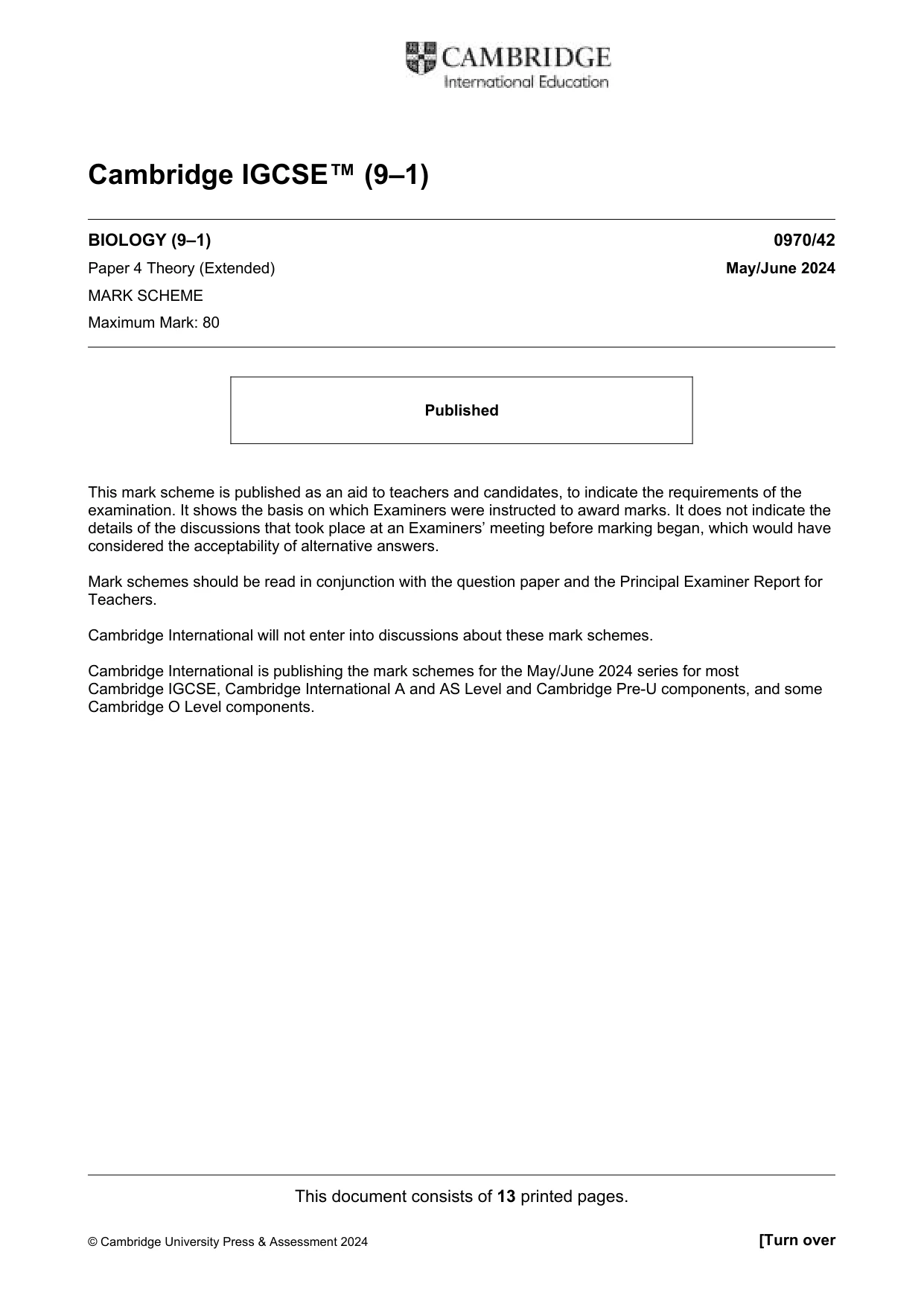
6 (a) Complete the sentences about human teeth. The process of taking food into the mouth is called ............................................... . Flat sharp‑edged teeth at the front of the mouth, called ............................................... , are used for biting off pieces of food. The ............................................... and ............................................... are the large teeth towards the back of the mouth that are used for ............................................... the food. [4] (b) Fig. 6.1 is a diagram of a villus. Fig. 6.1 (i) Draw labels and label lines on Fig. 6.1 to identify a capillary and a lacteal. [1] (ii) State the part of the digestive system where villi are located. ..................................................................................................................................... [1] (iii) State the function of the lacteal. ........................................................................................................................................... ........................................................................................................................................... ..................................................................................................................................... [1] (c) Describe the pathway taken by the products of protein digestion from the villi to the liver. ................................................................................................................................................... ................................................................................................................................................... ................................................................................................................................................... ................................................................................................................................................... ............................................................................................................................................. [2] [Total: 9]
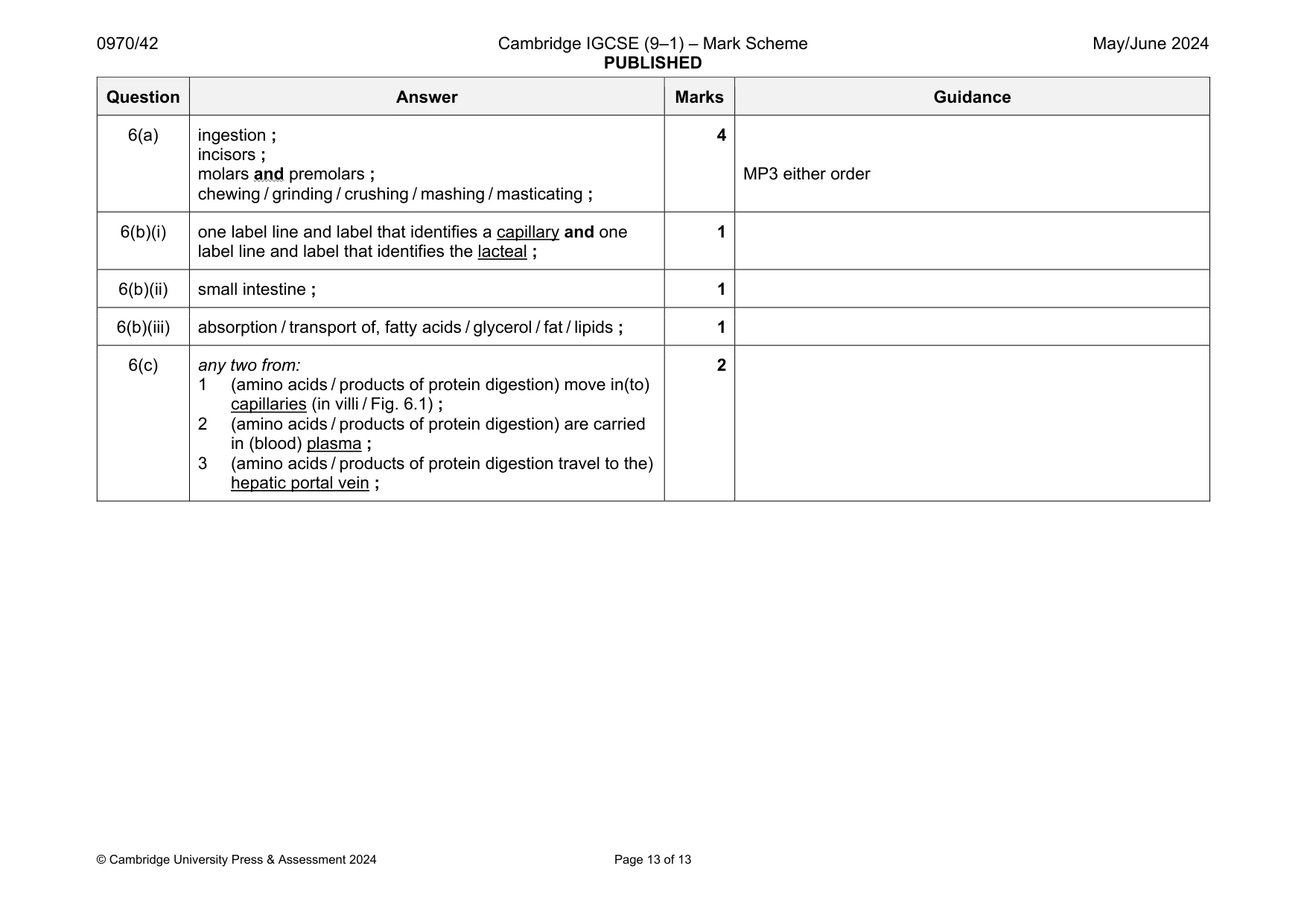
Mark scheme: 6(a) ingestion ; incisors ; molars and premolars ; chewing / grinding / crushing / mashing / masticating ; 4 MP3 either order 6(b)(i) one label line and label that identifies a capillary and one label line and label that identifies the lacteal ; 1 6(b)(ii) small intestine ; 1 6(b)(iii) absorption / transport of, fatty acids / glycerol / fat / lipids ; 1 6(c) any two from: 1 (amino acids / products of protein digestion) move in(to) capillaries (in villi / Fig. 6.1) ; 2 (amino acids / products of protein digestion) are carried in (blood) plasma ; 3 (amino acids / products of protein digestion travel to the) hepatic portal vein ; 2
What was in this paper
The subtopics covered by these 6 questions, and how many questions each got. Open one in a new tab to see every Cambridge question on it.
What you needed in this session
Cambridge’s own grade thresholds for 2024 May/June, Paper 4 · Variant 2. A higher threshold means an easier paper — the bar moves with how the cohort did.